
Regions Financial (RF) 10-K risk factor changes: FY2023 vs FY2022
The 2023-12-31 10-K against the 2022-12-31 one, compared heading by heading and sentence by sentence.
Item 1A145 rewritten53 added41 removed433 unchanged
All filing items1,863 rewritten848 added865 removed3,478 unchanged
Summary
counted, not written
- Item 1A lists 49 risk factor headings: 2 new, 5 reworded and 42 unchanged since FY2022. 2 headings from FY2022 no longer appear.
- Sentence by sentence, 848 added, 865 removed, 1,863 rewritten and 3,478 unchanged across 16 items that differ.
- New this year: Item 1C. Cybersecurity.
New Item 1A headings (2)
- Fluctuations in market interest rates, including the level and shape of the yield curve, may adversely affect our performance.Interest rates
- Loss of deposits or a change in deposit mix could increase our funding costs.
Removed Item 1A headings (2)
- Fluctuations in market interest rates may adversely affect our performance.
- Our business, financial condition, liquidity, capital and results of operations have been, and will likely continue to be, adversely affected by the COVID-19 pandemic and may, in the future also be affected by other pandemics.
Reworded Item 1A headings (5)
- Transitions away from and the replacement of
[removed: LIBOR and other]benchmark rates could adversely impact our business, financial condition and results of operations. - We are at risk of a variety of systems failures or errors and
[removed: cybersecurity][added: cyber-attacks or other similar] incidents that could adversely affect customer experience and our business and financial performance. - We are subject to a variety of operational risks, including the risk of fraud or theft by
[removed: employees,][added: internal or external parties,] which may adversely affect our business and results of operations. - We are subject to environmental, social and governance risks that could adversely affect our [added: business,] reputation and the trading price of our common stock.
- Weather-related
[removed: events][added: events, pandemics] and other natural or man-made disasters could cause a disruption in our operations or lead to other consequences that could adversely impact our financial results and condition. These impacts could be intensified by climate change. Heightening focus on climate change may also carry transition risks that could negatively impact our results of operations and financial condition.
A heading is new when no FY2022 heading matches it after ignoring case and punctuation, and reworded when it shares at least 60 percent of its words with one that went away. All current risk factor headings.
Sentences by item
24 items, with every count and a link to each item that changed
Underlined words on a shaded ground are new in FY2023; struck-through words were in FY2022. Sentences that are wholly new or wholly gone are labelled rather than marked.
Item 1A. Risk Factors
145 rewritten, 53 added, 41 removed, 433 unchanged
Read the full itemFY2023 item · filed February 23, 2024FY2022 item · filed February 24, 2023
An investment in the Company involves risks, some of which, including market, credit, technology, strategic, operational, reputational, legal, regulatory and compliance, liquidity, [removed: reputational,] talent management, estimate and [removed: assumption,] [added: assumption] and other external risks, could be substantial and is inherent in our business.
These risks also [removed: includes] [added: include] the possibility that the value of the investment could decrease considerably, and dividends or other distributions concerning the investment could be reduced or eliminated.
- Fluctuations in market interest [removed: rates] [added: rates, including the level and shape of the yield curve,] may adversely affect our performance.
- Transitions away from and the replacement of [removed: LIBOR and other] benchmark rates could adversely impact our business, financial condition and results of operations.
- We will continually encounter technological change and must effectively anticipate, [removed: develop,] [added: develop] and implement new technology.
- We are subject to a variety of operational risks, including the risk of fraud or theft by [removed: employees,] [added: internal or external parties,] which may adversely affect our business and results of operations.
- We are subject to environmental, social and governance risks that could adversely affect our [added: business,] reputation and the trading price of our common stock.
- We may not be able to complete future acquisitions, may not be successful in realizing the benefits of any future acquisitions that are [removed: completed,] [added: completed] or may choose not to pursue acquisition opportunities we might find beneficial.
- Weather-related [removed: events] [added: events, pandemics] and other natural or man-made disasters could cause a disruption in our operations or lead to other consequences that could adversely impact our financial results and condition.
We provide traditional commercial, retail and mortgage banking services, as well as other financial services including asset management, wealth management, securities brokerage, merger-and-acquisition advisory services and other specialty [removed: financing.]
- A decrease in the demand for, or the availability of, loans and other products and services offered by us, including as a result of [removed: increases in] [added: changing] interest [removed: rates;][added: rate conditions;]
- A decrease in interest income from variable rate loans, due to declines in interest rates; [removed: and]
- An increase in the number of clients and counterparties who become delinquent, file for protection under bankruptcy laws or default on their loans or other obligations to us, which could result in a higher level of nonperforming assets, net charge-offs, provisions for credit [removed: losses,] [added: losses] and valuation adjustments on loans held for [removed: sale][added: sale;]
- A decrease in the supply of deposits or [removed: significant increase in competition for deposits,] [added: the need to price interest-bearing deposits higher due to competitive forces,] which could result in substantial increase in cost to retain and service [removed: deposits.][added: deposits; and]
Volatility and uncertainty related to inflation and the effects of inflation, which has [removed: recently] led to increased costs for businesses and consumers and potentially contribute to poor business and economic conditions [removed: generally,] [added: generally and] may enhance or [added: contribute to some of the risks of our business.]
The range of potential rate paths over the coming year is [removed: extremely] wide and will ultimately be driven by the path [removed: for] [added: of] inflation, [removed: and its impact on the] labor market [added: performance] and economic growth.
[removed: The Federal Reserve also plans to continue to reduce the size of its balance sheet in 2023.To] [added: To] the extent these policies do not mitigate the volatility and uncertainty related to inflation and the effects of inflation, or to the extent conditions otherwise worsen, we could experience adverse effects on our business, financial [removed: condition,] [added: condition] and results of operations.
Fluctuations in market interest [removed: rates] [added: rates, including the level and shape of the yield curve,] may adversely affect our performance.
Our profitability depends to a large extent on our net interest income, which is the difference between the interest income received on interest-earning assets (primarily loans, leases, investment securities and cash balances held at the [removed: FRB)] [added: Federal Reserve Bank)] and the interest expense incurred in connection with interest-bearing liabilities (primarily deposits and borrowings).
Moreover, the [removed: market's] [added: market’s] expectation of the future course of FOMC policy and economic factors interact to influence [removed: short- and long-tenor] [added: the path for market interest] rates [removed: in] [added: and] the [removed: yield curve, each] [added: shape] of [removed: which have diverse impacts on Regions' portfolios.][added: the yield curve.]
[removed: While a persistently elevated, or increasing rate environment from current levels would continue to support net] [added: Additionally, elevated] interest [removed: income, increasing] rates would [removed: also] increase debt service requirements for some of our borrowers and may adversely affect those borrowers’ ability to pay as contractually obligated, ultimately resulting in additional delinquencies or charge-offs.
Conversely, should interest rates move lower, [removed: we would expect modest declines in] net interest income [removed: over the next twelve months,] [added: is well supported by a mostly neutral interest rate risk position] aided [removed: somewhat] by the [removed: protection in place from the] Company’s interest rate hedging program.
For a more detailed discussion of these risks and our management strategies for these risks, see the [removed: "Executive Overview",] [added: “Executive Overview,”] “Net Interest Income, Margin and Interest Rate Risk,” “Net Interest Income and Margin,” “Market Risk-Interest Rate Risk” and “Securities” sections of Item 7.
Transitions away from and the replacement of [removed: LIBOR and other] benchmark rates could adversely impact our business, financial condition and results of operations.
Certain securities within the investment portfolio, certain hedging transactions and certain of the products that we offer, such as floating-rate loans and mortgages, determine their applicable interest rate or payment amount by reference to a benchmark rate, [removed: such as LIBOR,] an index, or other financial metric.
LIBOR and certain other benchmark rates [added: have been or currently] are the subject of recent national, international, and other regulatory guidance and proposals for reform.
For a more detailed discussion of our management strategies related to the LIBOR cessation and transition, see the “LIBOR [removed: Transition”] [added: Transition and Reference Rate Reform”] section of Item 7.
Refer to Note 20 [removed: "Derivative] [added: “Derivative] Financial Instruments and Hedging [removed: Activities"] [added: Activities”] to the consolidated financial statements of this Annual Report on Form 10-K for the fair value of contracts subject to [added: contingent credit features and the collateral postings associated with such contracts.]
Financial services [removed: companies] [added: institutions] are interrelated as a result of trading, clearing, counterparty [removed: or] [added: and] other relationships.
[removed: We have] [added: Regions has] exposure to many different industries and [removed: counterparties,] [added: counterparties] and [removed: we] routinely [removed: execute] [added: executes] transactions with counterparties in the financial [removed: services] industry, including brokers and dealers, [added: central counterparties,] commercial banks, investment banks, mutual and hedge [removed: funds,] [added: funds] and other institutional [added: investors and] clients.
As a result, defaults by, or even [removed: mere speculation] [added: rumors or questions] about, one or more financial services [removed: companies,] [added: institutions] or the financial services industry generally, [removed: may lead] [added: in the past have led] to market-wide liquidity problems and could lead to losses or defaults by [removed: us] [added: Regions] or by other institutions.
Many of these transactions expose [removed: us] [added: Regions] to credit risk in the event of default of [removed: our] [added: Regions’] counterparty or client.
In addition, [removed: our] [added: Regions’] credit risk may be exacerbated [removed: if] [added: when] the collateral held by [removed: us] [added: Regions] cannot be [removed: realized] [added: liquidated] or is liquidated at prices not sufficient to recover the full amount of [removed: the loan or lease or derivative exposure due us.][added: Regions’ exposure.]
Any such losses [removed: may] [added: could] materially and adversely affect [removed: our business, financial condition or] [added: Regions’] results of [removed: operations.][added: operations and financial condition.]
Factors that could detrimentally impact our access to liquidity sources include increases in funding costs, a downturn in the geographic markets in which our loans and operations are concentrated, difficult credit [removed: markets,] [added: markets] or unforeseen outflows of cash or collateral, including as a result of unusual effects in the market.
In [removed: 2022,] [added: 2023,] we sold [removed: 36.9%] [added: 35.1%] of the mortgage loans we originated to the Agencies.
We are at risk of a variety of systems failures or errors and [removed: cybersecurity] [added: cyber-attacks or other similar] incidents that could adversely affect customer experience and our business and financial performance.
Failure or errors in or breach of our systems or networks, or those of our third-party service providers (or providers to such third-party service providers), including as a result of [removed: cyber-attacks, information security breaches] [added: cybersecurity] or other similar incidents, could disrupt our businesses or impact our customers.
[removed: This] [added: These incidents] could result in the loss, unauthorized disclosure, [removed: misuse,] [added: misuse] or misappropriation of confidential, personal, [removed: proprietary,] [added: proprietary] or other information, damage to our reputation, increases to our costs and cause customer and financial losses.
As a large financial institution, we depend on our ability to process, record and monitor a large number of customer transactions on a continuous basis and otherwise collect, transmit, store and [removed: otherwise] process a significant amount of personal information in connection therewith.
- Loss of deposits or a change in deposit mix could increase our funding costs.
financing.
- A change in the pricing or spread environment could adversely impact the yields received on newly originated loans or securities.
In response to sustained inflationary pressures, the Federal Reserve has tightened monetary policy, as described below.
The monetary policy tightening cycle observed since 2022 has led to increased volatility in fixed income markets.
The Federal Reserve increased the benchmark federal funds interest rate from near zero in early 2022 to a range between 5.25 percent and 5.50 percent with the last increase occurring at its July 26, 2023 meeting.
Estimates for net interest income exposure to interest rate changes have been reduced recently.
While a persistently elevated, or
increasing, rate environment from current levels would continue to support net interest income, elevated rates also increase the cost of funding and competition for deposits.
In this environment, deposit and funding costs will move lower; however, net interest income may be adversely impacted if those costs cannot move lower as fast as expected.
All LIBOR settings ceased to be published as of June 30, 2023.
Additionally, Regions transitioned LIBOR-based products to alternative rates that are consistent with industry standard conventions.
In the fourth quarter of 2023, Bloomberg Index Services Limited announced the permanent cessation of the BSBY index and all tenors effective November 15, 2024.
Regions is in the process of evaluating exposure to BSBY and planning for cessation.
Adverse developments affecting the overall strength and soundness of other financial institutions, the financial services industry as a whole and the general economic climate and the U.S. Treasury market could have a negative impact on perceptions about the strength and soundness of our business even if we are not subject to the same adverse developments.
In addition, adverse developments with respect to third parties with whom we have important relationships could also negatively impact perceptions about us.
These perceptions about us could cause our business to be negatively affected and exacerbate the other risks that we face.
Regions may be impacted by actual or perceived soundness of other financial institutions, including as a result of the financial or operational failure of a major financial institution, or concerns about the creditworthiness of such a financial institution or its ability to fulfill its obligations, which can cause substantial and cascading disruption within the financial markets and increased expenses, including FDIC insurance premiums, and could affect our ability to attract and retain depositors and to borrow or raise capital.
For example, during 2023 the FDIC took control and was appointed receiver of Silicon Valley Bank, Signature Bank and First Republic Bank.
The failure of other banks and financial institutions and the measures taken by governments, businesses and other organizations in response to these events could adversely impact Regions’ business, financial condition and results of operations.
Regions’ ability to engage in routine funding transactions could be adversely affected by the actions and commercial soundness of other financial institutions.
Loss of deposits or a change in deposit mix could increase our funding costs.
Deposits are a low cost and stable source of funding.
Regions competes with banks and other financial institutions for deposits and as a result, Regions could lose deposits in the future, clients may shift their deposits into higher cost products or Regions may need to raise interest rates to avoid deposit attrition.
Funding costs may also increase if deposits lost are replaced with wholesale funding.
Higher funding costs reduce Regions’ net interest margin, net interest income and net income.
Any of a variety of single or combined factors could contribute to adverse movement in deposits or deposit costs, including but not limited to economic uncertainty, rapid movements in market interest rates or the Federal Reserve's monetary policy, entrance of competitors, disruptive technology, and/or diminishment of confidence in Regions or banks broadly.
crime, hackers, terrorists, nation-states, nation state-supported actors, activists and other external parties.
Additionally, cybersecurity and other similar incidents or terrorist activities could disrupt our or our customers’ or other third parties’ business operations.
As new privacy and cybersecurity-related laws, regulations, rules and standards are implemented, the time and resources needed for us
Similar laws already exist in a number of other states, and such legislation continues to expand across the country.
disruption in the industry and improve client offerings and service.
Specifically, the office property segment, which represents 1.5 percent of our total loan portfolio, is undergoing a structural shift given the rise of a remote work environment resulting in heightened vacancies and potentially reduced leasing needs.
It is anticipated that this heightened risk environment for the office segment may take several years to resolve.
Instability in geopolitical matters could have a material adverse effect on our results of operations and financial condition.
The macroeconomic environment in the United States is susceptible to global events and volatility in financial markets.
For example, trade negotiations between the United States and other nations remain uncertain and could adversely impact economic and market conditions for our and our clients and counterparties.
The wars in the Ukraine, Israel and the Gaza Strip presents destabilizing forces, including higher and more volatile commodity and food prices, which may cause international and domestic economic deterioration.
Financial markets may be adversely affected by the current or anticipated impact of military conflict, including the wars in the Ukraine, Israel and the Gaza Strip, terrorism or other geopolitical events.
This could magnify
- Our business, financial condition, liquidity, capital and results of operations have been, and will likely continue to be, adversely affected by the COVID-19 pandemic and may, in the future also be affected by other pandemics.
contribute to some of the risks of our business.
In response to sustained inflationary pressures, the Federal Reserve increased the benchmark federal funds interest rate by 425 basis points to a range between 4.25 percent and 4.50 percent between their March 16, 2022 and December 14, 2022 meetings.
Furthermore, on February 1, 2023, the Federal Reserve increased the benchmark federal funds interest rate by an additional 25 basis points to a range between 4.50 percent and 4.75 percent.
The low benchmark federal funds interest rate observed over the last several years has ended leading to increased volatility in fixed income markets.
The Federal Reserve increased the benchmark federal funds interest rate by 425 basis points to a range between 4.25 percent and 4.50 percent between their March 16, 2022 and December 14, 2022 meetings.
Furthermore, on February 1, 2023, the Federal Reserve increased the benchmark federal funds interest rate by an additional 25 basis points to a range between 4.50 percent and 4.75, and has signaled it intends to hold interest rates at an elevated level over the course of 2023.
The range of potential rate paths over the coming year is extremely wide and will ultimately be driven by the path for inflation, and its impact on the labor market and economic growth.
The publication of one week and two-month LIBOR settings ceased to be published as of December 31, 2021.
The publication of all other LIBOR settings, which are the most commonly used U.S. dollar LIBOR settings, will cease to be published or cease to be representative after June 30,
2023.
Financial market participants have transitioned away from LIBOR and other similar inter-bank offering rates.
Certain of our LIBOR-based financial products and contracts, including, but not limited to, hedging products, preferred stock, investments, and loans, extend beyond proposed LIBOR cessation timelines.
We are in the process of transitioning the aforementioned LIBOR-based products to alternative rates that are consistent with the IOSCO's Principles for Financial Benchmarks.
Increases in the allowance will result in an expense for the period, thereby reducing our reported net income.
contingent credit features and the collateral postings associated with such contracts.
As public and regulatory expectations, as well as
In recent years, attacks in which hackers inserted malware into software updates, have highlighted the growing risk from the infection of software while it is under assembly, known as a supply chain attack.
For example, denial of service attacks have been launched against a number of large financial services institutions, including us.
Due to applicable laws and regulations or contractual obligations, we may be held responsible for cyber-attacks,
Such laws have taken effect, or are scheduled to take effect, in at least four other states in 2023 alone (Virginia, Colorado, Connecticut and Utah).
The move toward digital banking and financial services, and customer
Such volatility is
these activities.
Our regulatory capital position is discussed in
The Basel Committee has published standards that it describes as the finalization of the Basel III post-crisis regulatory reforms.
Among other things, these standards revise the standardized approach for credit risk and provide a new standardized approach for operational risk capital.
The Basel framework contemplates that national regulators would have implemented these standards by January 1, 2023, with an aggregate output floor phasing in through January 1, 2028; however, the U.S. federal bank regulatory authorities have not yet proposed rules implementing the Basel III revisions for purposes of their risk-based capital ratios.
Under the current capital rules, these standards only apply to advanced approached institutions and not to Regions or Regions Bank and any impact of these standards on us will depend on the manner in which the revisions are implemented in the U.S. with respect to firms such as Regions and Regions Bank.
Additional risks could arise from our or third parties' failure to provide adequate disclosure or transparency to our customers about the personal information collected from them and the use of such information; to receive, document, and honor the privacy preferences expressed by our customers; to protect personal information from unauthorized disclosure; or to maintain proper training on privacy practices for all employees or third parties who have access to personal information.
fines, and enforcement actions.
goodwill, other intangible assets or deferred tax asset balances; significantly increase our accrued income taxes; or significantly decrease the value of our residential MSRs.
For example, FASB’s CECL accounting standard became effective on January 1, 2020 and substantially changed the accounting for credit losses on loans and other financial assets held by banks, financial institutions and other organizations.
The standard had a material impact to our allowance and capital at adoption.
See Regions' impact at adoption in Note 1 "Summary of Significant Accounting Policies" to the consolidated financial statements of our Annual Report on Form 10-K for the year ended December 31, 2020.
Adverse events or circumstances could impact the recoverability of these intangible assets including loss of core deposits, losses of broker and contractor relationships, significant losses of credit card accounts and/or balances, increased competition and adverse changes in the economy.
Our business, financial condition, liquidity, capital and results of operations have been, and will likely continue to be, adversely affected by the COVID-19 pandemic and may, in the future also be affected by other pandemics.
The COVID-19 pandemic created disruptions that have adversely affected our business, financial condition, liquidity, capital and results of operations.
The nature and extent of any ongoing or future adverse effects from COVID-19 or any future similar pandemics will depend on future developments, which are highly uncertain and outside our control, including its impact on our employees, clients, customers, counterparties and service providers, as well as other market participants.
Circumstances brought about by the pandemics may include supply chain disruptions, labor shortages, increased market volatility, credit deterioration and defaults, and increased spending on business continuity efforts, which may require that we reduce costs and investments in other areas.
An excerpt. Shown here: 40 of 145 rewritten, 40 of 53 added and 40 of 41 removed. The counts are complete. For every sentence, read Item 1A. Risk Factors in the FY2023 filing and the FY2022 filing.
Item 7. Management's Discussion and Analysis of Financial Condition and Results of Operations
585 rewritten, 336 added, 431 removed, 708 unchanged
Read the full itemFY2023 item · filed February 23, 2024FY2022 item · filed February 24, 2023
Management believes the following sections provide an overview of several of the most relevant matters necessary for an understanding of the financial aspects of Regions's business, particularly regarding its [removed: 2022] [added: 2023] results.
After full-year [removed: 2022 real GDP] [added: 2023] growth of [removed: 2.1] [added: 2.5] percent, [removed: the January 2023] [added: Regions'] baseline forecast anticipates real GDP growth of [removed: 1.1 percent in 2023 and 1.5] [added: 2.6] percent in 2024.
A number of [added: in-footprint] states [removed: within the footprint] have seen heightened flows of domestic in-migration since the onset of the pandemic, which has resulted in more rapid rates of job growth and more rapid growth in housing costs.
[removed: It is likely that migration patterns will shift in 2023] [added: If,] as [added: Regions anticipates,] the broader economy [added: slows] and [removed: the] labor market [removed: slow.][added: conditions loosen, it could be that migration patterns will shift over coming quarters.]
The continued economic uncertainty, as described above, impacted Regions' forecast utilized in calculating the ACL as of December 31, [removed: 2022.][added: 2023.]
[removed: 2022 Results][added: | | | | 2022 (3) | | | | | | | | | | | | | | |]
Regions reported net income available to common shareholders of [removed: $2.1] [added: $2.0] billion or [removed: $2.28] [added: $2.11] per diluted share in [removed: 2022] [added: 2023] compared to net income available to common shareholders of [removed: $2.4] [added: $2.1] billion or [removed: $2.49] [added: $2.28] per diluted share in [removed: 2021.][added: 2022.]
Net interest income (taxable-equivalent basis) totaled [removed: $4.8] [added: $5.4] billion in [removed: 2022] [added: 2023] compared to [removed: $4.0] [added: $4.8] billion in [removed: 2021.][added: 2022.]
The net interest margin (taxable-equivalent basis) was [removed: 3.36] [added: 3.90] percent in [removed: 2022,] [added: 2023,] reflecting a [removed: 51] [added: 54] basis point increase from [removed: 2021.][added: 2022.]
The increase in net interest income was primarily driven by [removed: an] [added: a significant] increase in market interest [removed: rates, average loan growth, which includes consumer home improvement loans from the fourth quarter 2021 acquisition of EnerBank,] [added: rates] and [removed: a larger] average [removed: securities portfolio.][added: loan growth.]
The provision for credit losses totaled [removed: $271] [added: $553] million in [removed: 2022] [added: 2023] compared to [removed: a benefit from credit losses of $524] [added: $271] million in [removed: 2021.][added: 2022.]
The provision for credit losses was higher than net charge-offs by [removed: $8] [added: $156] million in [removed: 2022.][added: 2023.]
Non-interest income was [removed: $2.4] [added: $2.3] billion in [removed: 2022] [added: 2023] compared to [removed: $2.5] [added: $2.4] billion in [removed: 2021.][added: 2022.]
The decrease was primarily driven by lower [added: capital markets income, service charges on deposit accounts and] mortgage income [removed: and unfavorable] [added: partially offset by an increase in] market valuation adjustments on employee benefit assets.
Non-interest expense was [removed: $4.1] [added: $4.4] billion in [removed: 2022] [added: 2023] and [removed: $3.7] [added: $4.1] billion in [removed: 2021.][added: 2022.]
The [removed: increase in] [added: 2021] professional, legal and regulatory expenses [removed: is] [added: are] related to [removed: the settlement with the CFPB discussed previously.][added: professional and legal expenses for acquisitions.]
Regions' effective tax rate was [removed: 22.0] [added: 20.5] percent in [removed: 2022] [added: 2023] compared to [removed: 21.6] [added: 22.0] percent in [removed: 2021.][added: 2022.]
In [removed: 2022,] [added: the fourth quarter of 2023,] Regions repurchased approximately [removed: 8] [added: 16] million shares of common stock under these programs, which reduced shareholders' equity by [removed: $230] [added: $252] million.
At December 31, [removed: 2022,] [added: 2023,] Regions’ Tier 1 capital and Total capital ratios were estimated to be [removed: 10.91%] [added: 11.57%] and [removed: 12.54%,] [added: 13.35%,] respectively.
Regions' CET1 ratio at December 31, [removed: 2022] [added: 2023] was estimated to be [removed: 9.60%.][added: 10.26%.]
During [removed: 2022,] [added: 2023,] total loans increased by [removed: $9.2] [added: $1.4] billion or [removed: 10.5] [added: 1.4] percent compared to [removed: 2021.][added: 2022.]
Net charge-offs totaled [removed: $263] [added: $397] million, or [removed: 0.29] [added: 0.40] percent of average loans, in [removed: 2022,] [added: 2023,] compared to [removed: $204] [added: $263] million, or [removed: 0.24] [added: 0.29] percent in [removed: 2021,] [added: 2022, with both periods] reflecting [removed: increased net charge-offs] [added: an increase] in [removed: the other] consumer [removed: loan portfolio driven by] [added: charge-offs due to] the sale of [removed: unsecured consumer loans at the end of the third quarter of 2022 and a full year of EnerBank charge-offs.][added: loan portfolios.]
The allowance was [removed: 1.63] [added: 1.73] percent of total loans, net of unearned income at December 31, [removed: 2022, a decrease] [added: 2023, an increase] from [removed: 1.79] [added: 1.63] percent at December 31, [removed: 2021.][added: 2022.]
The coverage ratio of allowance to non-performing loans excluding held for sale was [removed: 317] [added: 211] percent at December 31, [removed: 2022,] [added: 2023,] compared to [removed: 349] [added: 317] percent at December 31, [removed: 2021.][added: 2022.]
- “Loans,” “Allowance for Credit Losses,” [removed: “Troubled Debt Restructurings”] and “Non-performing Assets” discussions within the “Balance Sheet Analysis” section of MD&A
At the end of [removed: 2022,] [added: 2023,] Regions Bank had [removed: $9.2] [added: $4.2] billion in cash on deposit with the Federal Reserve [added: Bank] and the loan-to-deposit ratio was [removed: 74] [added: 77] percent.
Cash and cash equivalents at the parent company totaled [removed: $1.6] [added: $1.9] billion.
Cash at the Federal Reserve declined from December 31, [removed: 2021 as the Company used cash balances] [added: 2022 due] to [removed: fund loan growth and experienced a] [added: an expected] decline in [removed: deposits due to normalizing pandemic liquidity.][added: deposits, as well as growth in loans.]
At December 31, [removed: 2022,] [added: 2023,] the Company’s borrowing capacity with the Federal Reserve was [removed: $13.2] [added: $21.3] billion based on available collateral.
Borrowing availability with the FHLB was [removed: $14.5] [added: $15.1] billion based on available collateral at the same date.
| Net Charge-Offs / Average Loans | | | | | | [removed: 25-35 bps] [added: 40-50 basis points] | | |
| Effective Tax Rate | | | | | | [removed: 22-23%] [added: 21-22%] | | |
(1)Expectation for CET1 is to [added: continue to] manage [removed: near the upper end of a 9.25-9.75% operating range] [added: around 10 percent] over the near term.
For more information related to the Company's [removed: 2023] [added: 2024] expectations, refer to the related sub-sections discussed in more detail within Management's Discussion and Analysis of this Form 10-K.
The emphasis of this discussion will be on operations for the years [removed: 2022] [added: 2023] and [removed: 2021;] [added: 2022;] in addition, financial information for prior years will also be presented when appropriate.
Net interest income is primarily the difference between the interest income Regions receives on interest-earning assets, such as loans, leases, investment securities and cash balances held at the [removed: FRB,] [added: Federal Reserve Bank,] and the interest expense Regions pays on interest-bearing liabilities, principally deposits and borrowings.
These non-GAAP financial measures include "adjusted net loan charge-offs", "adjusted net loan charge-offs as a percent of average loans, annualized", [removed: “adjusted] [added: "adjusted] non-interest expense", "adjusted non-interest income", "adjusted total revenue", [added: and] "adjusted total revenue, taxable-equivalent [removed: basis", and "adjusted operating leverage ratio".][added: basis".]
[removed: Non-interest income (GAAP) is] presented excluding adjustments to arrive at adjusted non-interest income (non-GAAP).
[removed: equivalent basis (non-GAAP) less the year over year percentage change in] [added: 3) a reconciliation of non-interest expense (GAAP) to] adjusted [removed: total] non-interest expense [added: (non-GAAP), 4) a reconciliation of non-interest income (GAAP) to adjusted non-interest income (non-GAAP), 5) a computation of adjusted total revenue (non-GAAP), and 6) a computation of adjusted total revenue on a taxable-equivalent basis] (non-GAAP).
The following table provides: 1) a reconciliation of net loan charge-offs (GAAP) to adjusted net loan charge-offs (non-GAAP), 2) a computation of adjusted net loan charge-offs as a percentage of average loans, annualized [removed: (non-GAAP), 3) a reconciliation of non-interest expense (GAAP) to adjusted non-interest expense (non-GAAP), 4) a reconciliation of non-interest income (GAAP) to adjusted non-interest income (non-GAAP), 5) a computation of adjusted total revenue (non-GAAP), 6) a computation of adjusted total revenue on a taxable-equivalent basis (non-GAAP) and 7) presentation of the operating leverage ratio (GAAP) and the adjusted operating leverage ratio] (non-GAAP).
While the Company did not have recession as its base forecast for 2023, the economy outperformed expectations, reflecting marked improvement on the supply side of the economy that allowed for faster growth and decelerating inflation.
Growth is expected to be somewhat restrained over the first half of 2024 before picking up over the second half of the year.
The labor market proved to be resilient in 2023.
While the pace of job growth slowed over the course of the year, it was driven by a slower pace of hiring as opposed to a rising pace of layoffs.
This pattern is expected to continue in 2024, with further slowing in the pace of job growth putting upward pressure on the unemployment rate, but the Company does not anticipate a significant, broad-based, and sustained spike in layoffs.
A slowing pace of job growth will lead to further deceleration in growth of aggregate labor earnings, but growth in labor earnings is expected to continue to outpace inflation, thus providing support for consumer spending.
Household balance sheets remain notably healthy, and the preponderance of fixed-rate debt on household balance sheets has been a buffer against the effects of higher interest rates.
Full-year 2024 growth in real consumer spending is expected to be slightly faster than 2023 growth.
Real business investment in equipment and machinery is expected to remain soft before picking up over the second half of 2024.
At the same time, the wave of business spending on structures seen over much of 2023 is subsiding, to the point that real spending on structures is expected to offer little, if any, support for real GDP growth in 2024.
After having been displaced by spending on structures in 2023, business investment in intellectual property products is expected to return to its usual role as the fastest growing segment of real business fixed investment.
Higher mortgage interest rates weighed on single family construction and sales in 2023, but sales of new single family homes proved to be more resilient than anticipated driven by a combination of still-significant pent-up demand for home purchases and the lack of existing single family homes for sale.
While mortgage rates have started to decline, helping to ease affordability constraints, it will likely not do much to unlock inventories of existing homes for sale.
Builders should fare better in 2024 and real residential fixed investment should be a modest support for top-line real GDP growth in 2024.
Further deceleration in inflation in 2024, driven by a slower pace of economic growth, a modestly rising unemployment rate, and the avoidance of disruptions to the supply side of the economy would be consistent with the FOMC beginning to cut the Fed funds rate even with inflation above their 2.0 percent target rate.
The real, or, inflation-adjusted, current funds rate is meaningfully restrictive, and further deceleration in inflation without cuts in the Fed funds rate would effectively make policy more restrictive.
As such, we expect four twenty-five basis point cuts in the Fed funds rate by year-end 2024.
Patterns of economic activity within the Regions footprint are expected to be broadly similar to those seen for the U.S. as a whole.
Job growth for the Company's footprint as a whole is expected to be faster than that for the U.S. as a whole.
Some of the metro areas which had, prior to the increase in mortgage interest rates, seen the largest increases in house prices could experience declining house prices, but continued robust population growth in these markets will help stem the extent of any such declines.
2023 Results
Deposit mix and pricing normalization combined with higher overall funding costs, which are expected in a rising rate environment, partially offset the increases in net interest income.
The increase in the provision for credit losses was driven primarily by adverse risk migration and continued credit normalization, as well as a build in qualitative adjustments for incremental risk in higher risk portfolios.
The increase was driven by an increase in FDIC insurance assessments primarily related to the special assessment, operational losses, and salaries and employee benefits.
These increases were partially offset by a decline in professional, legal and regulatory expenses related to a settled matter with the CFPB in 2022.
The increase was primarily driven by an increase in the consumer portfolio of $1.2 billion, with the combined balance of commercial and investor real estate loans also increasing by $198 million.
The increase in consumer loans reflects growth in residential first mortgage and in other consumer loans, which was driven by consumer home improvement loans.
In 2023 and 2022, adjusted net charge-offs (non-GAAP) totaled $362 million, or 0.37 percent, and $200 million, or 0.22 percent, respectively.
See Table 1 "GAAP to Non-GAAP Reconciliations for additional information.
Commercial and industrial net charge-offs also increased from 2022 to 2023.
2024 Expectations
| 2024 Expectations (1) | | | | | | | | |
| Net Interest Income(2) | | | | | | $4.7-$4.8 billion | | |
| Adjusted Non-Interest Income | | | | | | $2.3-$2.4 billion | | |
| Adjusted Non-Interest Expense | | | | | | approximately ~$4.1 billion | | |
| Average Loans | | | | | | grow low-single digits | | |
| Average Deposits | | | | | | stable to modestly lower | | |
(2)Expectation for net interest income assumes stable or lower short-term interest rates; flat long-term rate held at December 31, 2023 levels.
Non-interest income (GAAP) is
(1)In the fourth quarter of 2023, the Company sold substantially all of its portfolio of a third party relationship.
One of the primary factors influencing the credit performance of Regions’ loan portfolio is the overall economic environment in the U.S. and the primary markets in which it operates.
As 2022 came to a close, many of the distortions stemming from the pandemic and the policy response to it that had impacted the economy for the prior two years were fading while interest-sensitive sectors of the economy were impacted by the effects of significant increases in market interest rates in 2022.
Regions continues to expect that by late-2024 the economy will be back on the path of growth around 2.0 percent that prevailed prior to the pandemic.
As has been the case since the onset of the pandemic, however, there remains a heightened degree of uncertainty around current economic forecasts.
Many businesses across a broad range of industry groups are struggling to ascertain the level of underlying demand as 2023 begins.
Firms who produce goods or provide services to consumers saw robust growth in demand from the second half of 2020 through much of 2022, reflecting in part financial transfers as part of the policy response to the pandemic and in part by a faster pace of wage growth.
Consumer demand for goods began to waver over the second half of 2022, and while faster growth in consumer spending on services took up that slack, services spending is expected to slow in 2023.
Firms who produce goods or provide services to firms saw robust growth in demand from late-2020 through much of 2022, which was mainly a reflection of two factors.
First, firms rushed to fill in the gaps left by production having been disrupted by the effects of the pandemic on the labor market, supply chains, and shipping networks.
Second, firms built up inventories to levels higher than were considered normal prior to the pandemic, as a hedge against further supply chain/labor supply disruptions.
Much of that catch-up or precautionary demand began to wane in late-2022 with order backlogs having been worked down and inventories having been built up.
With the robust growth in demand seen over much of the past two years having subsided, firms are left trying to gauge underlying demand and, in turn, appropriate levels of staffing and capital spending.
In areas such as retail trade, warehousing/distribution, and technology, many firms were not anticipating a drop-off in demand and are now adjusting to lower than anticipated demand by laying off workers and decreasing capital budgets.
Other firms are reassessing planned levels of staffing and capital outlays.
Subsiding demand is likely to be an ongoing challenge through much of 2023, as a period of elevated inflation and rising interest rates has had an impact on the demand side of the economy and on consumer and business confidence.
While supply chain stresses have eased considerably, they have not yet fully cleared, but with the demand side of the economy easing, any lingering supply chain stresses are not as disruptive to businesses as has been the case over the past two years.
One sector still being impacted is residential construction, with many builders still having difficulty sourcing building materials.
While higher mortgage interest rates contributed to steep declines in home sales, builders were still sitting on sizable backlogs of unfilled orders and units in various phases of construction.
This has put a floor under demand for construction materials and supplies, thus helping sustain supply-side stresses.
With a slower pace of growth in consumer spending, businesses scaling down planned growth in capital expenditures, and growth in residential construction remaining weighed down by higher mortgage interest rates, the overall pace of economic activity in 2023 is expected to be considerably slower than the pace seen over the second half of 2022.
This will be accompanied by a marked slowdown in the pace of job growth, which will likely fall below the pace required to keep the jobless rate steady.
The pace of job growth slowed steadily over the second half of 2022 but remained more than sufficient to keep the unemployment rate from rising.
Moreover, there were over ten million open jobs across the U.S. economy as 2022 came to a close.
Given the well below-trend pace of real GDP growth anticipated over the next several quarters, Regions expects the demand for labor to decline, but there is uncertainty in how that will manifest itself.
Regions expects a meaningfully slower pace of job growth coupled with a significant decline in job vacancies, with firms also resorting to reducing hours worked by current workers as a lever with which to manage total labor input.
Regions believes that, given how hard and costly it has been for firms to attract and retain labor, firms will be unlikely to lay workers off in large numbers.
While there were several high-profile announcements of layoffs as 2022 came to a close, the collective number of layoffs was a minute share of total nonfarm employment, and those workers losing jobs were able to find new positions relatively quickly.
The rate of layoffs and discharges, measured as a share of total nonfarm employment, was still below pre-pandemic norms at year-end 2022.
That
Table of Contents
Regions expects the unemployment rate to rise over coming quarters is more a reflection of diminished hiring than of widespread layoffs.
As labor demand becomes more closely aligned with labor supply, growth in hourly wages and in total labor compensation costs will slow.
As measured by the CPI, inflation rose to 8.0 percent in 2022, the highest annual rate since 1981, with an intra-year peak rate of 9.1 percent.
Inflation did decelerate over the second half of the year, in part due to what by year-end 2022 were falling prices for core consumer goods (consumer goods excluding food and energy).
Services price inflation proved to be more persistent, but there were signs that it too was decelerating by year-end 2022.
While the Company expects inflation to decelerate further over the course of 2023, it also expects it to end the year above the FOMC’s 2.0 percent target rate.
The FOMC, however, does not yet feel confident that inflation is on a one-way track lower and, to that point, as China’s economy comes back online in 2023 there could be a new round of upward pressure on energy and commodity prices.
That would in turn push headline inflation higher but, even should that prove to be the case, Regions looks for core inflation to decelerate.
Regions expects 25-basis point increases in the Fed funds rate at the first two FOMC meetings of 2023, after which the expectation is for the FOMC to remain on hold.
At present Regions does not expect the FOMC to cut the Fed funds rate in 2023.
An excerpt. Shown here: 40 of 585 rewritten, 40 of 336 added and 40 of 431 removed. The counts are complete. For every sentence, read Item 7. Management's Discussion and Analysis of Financial Condition and Results of Operations in the FY2023 filing and the FY2022 filing.
Item 1. Business
98 rewritten, 54 added, 36 removed, 252 unchanged
Read the full itemFY2023 item · filed February 23, 2024FY2022 item · filed February 24, 2023
At December 31, [removed: 2022,] [added: 2023,] Regions had total consolidated assets of approximately [removed: $155.2] [added: $152.2] billion, total consolidated deposits of approximately [removed: $131.7] [added: $127.8] billion and total consolidated shareholders’ equity of approximately [removed: $15.9] [added: $17.4] billion.
At December 31, [removed: 2022,] [added: 2023,] Regions operated [removed: 2,039] [added: 2,023] ATMs and [removed: 1,286] [added: 1,271] total branch outlets primarily across the South, Midwest and Texas.
| Mississippi | | | [removed: 101] [added: 99] | | |
| Louisiana | | | [removed: 83] [added: 82] | | |
| Arkansas | | | [removed: 58] [added: 57] | | |
| Missouri | | | [removed: 51] [added: 49] | | |
| Indiana | | | [removed: 41] [added: 40] | | |
| Kentucky | | | [removed: 10] [added: 9] | | |
In addition to laws and regulations, state and federal bank regulatory agencies may issue policy statements, interpretive [removed: letters,] [added: letters] and similar written guidance applicable to Regions and its subsidiaries.
Regions cannot predict future changes in the applicable laws, regulations and regulatory agency policies, including [removed: any changes resulting from changes in the U.S. presidential administration.]
The scope of the laws and [removed: regulations,] [added: regulations] and the intensity of the supervision to which Regions is subject have increased in recent years, initially in response to the financial crisis, and more recently in light of other factors, including [added: the failure of U.S. depository institutions in the first half of 2023,] technological factors, market changes, [removed: climate,] [added: climate change concerns,] as well as increased scrutiny and possible denials of bank mergers and acquisitions by federal banking regulators.
These descriptions do not summarize all possible or proposed changes in laws or regulations and are [removed: are] not intended to be [added: a] substitute for the related statues or regulatory provisions.
As a [removed: BHC] [added: BHC,] Regions is subject to regulation under the BHC Act and to regulation, [removed: examination,] [added: examination] and supervision by the Federal Reserve.
As a Federal Reserve System member bank, Regions Bank is required to hold stock in the Federal Reserve Bank of Atlanta in an amount equal to [removed: 6] [added: six] percent of its capital stock and surplus.
Member banks with total assets in excess of $10 billion, including Regions Bank, receive a floating rate dividend tied to 10-year U.S. Treasuries, with the maximum dividend rate capped at [removed: 6] [added: six] percent.
Regions Bank and its affiliates are also subject to supervision, [removed: regulation,] [added: regulation] and examination by the CFPB with respect to consumer protection laws and regulations.
Regions and certain of its subsidiaries and affiliates, including those that engage in derivatives transactions, securities underwriting, market making, brokerage, investment [removed: advisory,] [added: advisory] and insurance activities, are subject to other federal and state laws and regulations, as well as supervision and examination by other federal and state regulatory agencies and other regulatory authorities, including the SEC, CFTC, [removed: FINRA,] [added: FINRA] and the NYSE.
Regions Bank is also subject to additional state and federal laws, as well as various compliance regulations, that govern its activities, the investments it [removed: makes,] [added: makes] and the aggregate amount of loans that may be granted to one borrower.
Examinations by [removed: Region’s] [added: Regions’] regulators consider not only compliance with applicable laws, [removed: regulations,] [added: regulations] and supervisory policies of the agency, but also capital levels, asset quality, risk management effectiveness, the ability and performance of [removed: management,] [added: management] and the board of directors, the effectiveness of internal controls, earnings, liquidity, [added: interest rate risk management] and various other factors.
This supervisory framework, including the examination reports and supervisory ratings, which are considered confidential supervisory information, could materially impact the conduct, [removed: growth,] [added: growth] and profitability of [removed: Region’s] [added: Regions’] operations.
The results of examinations by any of [removed: Region’s] [added: Regions’] federal bank regulators potentially can result in the imposition of significant limitations on [removed: Region’s] [added: Regions’] activities and growth.
These regulatory agencies generally have broad enforcement authority and discretion to impose restrictions and limitations on the operations of a regulated entity, including the imposition of substantial monetary penalties and non-monetary requirements against a regulated entity where the relevant agency determines that the operations of the regulated entity or any of its subsidiaries fail to comply with applicable laws or regulations, are conducted in an unsafe or unsound [removed: manner,] [added: manner] or represent an unfair or deceptive act or practice.
[removed: The Tailoring Rules assign each U.S. BHC with $100 billion or more in total consolidated assets,] as well as its bank subsidiaries, to one of four categories based on its size and five other risk-based indicators: (1) cross-jurisdictional activity, (2) wSTWF, (3) non-bank assets, (4) off-balance sheet [removed: exposure,] [added: exposure] and (5) status as a U.S. G-SIB.
Accordingly, under the Tailoring Rules, Category IV firms are, among other things, (1) not subject to LCR or NSFR requirements (or, in certain cases, subject to reduced requirements), (2) remain eligible to opt-out of the requirement to recognize most elements of AOCI in regulatory [removed: capital] [added: capital,] (3) not subject to company-run capital stress testing requirements, (4) subject to supervisory capital stress testing on a biennial instead of annual basis, (5) subject to requirements to develop and maintain a capital plan on an annual basis and (6) subject to certain liquidity risk management and risk committee requirements.
[removed: Capital] [added: Regulatory Capital] Requirements
The Basel III-based U.S. capital rules, among other things, include both risk-based requirements, which compare three measures of capital to RWAs, as well as leverage requirements, which in the case of Category IV [removed: BHCs] [added: banking organizations] such as Regions, consist of the Tier 1 leverage ratio described below.
[removed: As a Category IV BHC, Regions' SCB is determined through the FRB’s CCAR supervisory stress tests which include analyses using baseline and severely adverse economic and financial scenarios Regions] [added: Regions’] SCB requirement is determined by adding the [removed: FRB's] [added: Federal Reserve’s] modeled capital degradation, in the supervisory severely adverse scenario, plus four quarters of planned common stock dividends.
As a Category IV [removed: BHC,] [added: banking organization,] the capital degradation component of the SCB is calculated every other year, in even-numbered years.
During a year in which a Category IV [removed: bank] [added: banking organization] does not undergo a supervisory stress test, [removed: the BHC] [added: it] will receive an updated SCB requirement that reflects [removed: the BHC's] [added: its] updated planned common stock dividends.
A Category IV [removed: BHC] [added: banking organization] is also able to elect to participate in the supervisory stress test in a year in which [removed: the BHC] [added: it] would not normally be subject to the supervisory stress test and consequently receive an updated SCB requirement.
Regions is also subject to rules that provide for simplified capital requirements relating to the threshold deductions for mortgage servicing assets, deferred tax assets arising from temporary differences that a banking organization could not realize through net operating loss carry [removed: backs,] [added: backs] and investments in the capital of unconsolidated financial institutions, as well as the inclusion of minority interests in regulatory capital.
As a Category IV [removed: BHC,] [added: banking organization,] Regions must also develop and maintain a capital plan, and must submit the capital plan to the [removed: FRB] [added: Federal Reserve] as part of the CCAR process.
The CCAR process is intended to help ensure that [removed: these] BHCs have robust, forward-looking capital planning processes that account for each company’s unique risks and that permit continued operations during times of economic and financial stress.
In addition, the [removed: FRB's] [added: Federal Reserve’s] capital plan rule relating to the CCAR process provides that a BHC must receive prior approval for any dividend, stock repurchase or other capital distribution if the BHC is required to resubmit its capital plan, subject to an exception for distributions on newly issued capital instruments.
In [removed: response to the COVID-19 pandemic, in] 2020, the U.S. federal banking agencies published [removed: another] [added: a] final rule to delay the estimated impact on regulatory capital stemming from the implementation of CECL.
The final rule [removed: maintains the three-year transition option in the previous rule and] provides banks the option to delay for two years an estimate of CECL’s effect on regulatory capital, [added: relative to the incurred loss methodology’s effect on regulatory capital, followed by a three-year transition period (five-year transition option).]
Furthermore, as a Category IV firm, Regions is obligated, at a minimum, to: (i) calculate collateral positions monthly; (ii) establish a more limited set of liquidity risk [removed: limits ;] [added: limits;] (iii) monitor elements of intraday liquidity risk exposures; and (iv) report liquidity data on the FR 2052a on a monthly basis.
Category IV firms such as Regions are not required to submit [added: 165(d)] resolution plans.
Regions Bank submitted [removed: it's] [added: its] most recent resolution plan in November 2022.
The federal banking agencies have broad authority to issue orders to depository institutions and their holding companies prohibiting activities that constitute violations of law, rule, [removed: regulation,] [added: regulation] or administrative order, or that represent unsafe or unsound banking practices, as determined by the federal banking agencies.
Further, Regions and its subsidiaries deliver other financial services capabilities described below.
| Florida | | | 272 | | |
| Tennessee | | | 198 | | |
| Alabama | | | 186 | | |
| Georgia | | | 117 | | |
| Total | | | 1,271 | | |
In addition to its banking operations, Regions and its subsidiaries deliver specialty capabilities including merger and acquisition advisory services, capital markets solutions, home improvement lending, investment services, equipment financing for commercial clients and small business customers, low income housing tax credit corporate fund syndication and asset management, financing to CRA-qualified customers, investments and insurance products, broker-dealer services to commercial clients, and others.
any changes resulting from changes in the U.S. presidential administration.
The Tailoring Rules assign each U.S. BHC with $100 billion or more in total consolidated assets,
As a Category IV banking organization, Regions’ SCB is determined through the Federal Reserve’s CCAR supervisory stress tests which include analyses using baseline and severely adverse economic and financial scenarios.
While Regions was not required to participate in 2023 supervisory stress testing, the Company did receive its SCB reflecting planned capital changes including plans to increase its common stock dividend.
For the fourth quarter of 2023
through the third quarter of 2024, the SCB continues to be floored at 2.5 percent, the regulatory minimum.
In July 2023, the U.S. banking regulators issued a proposal to revise the risk-based capital standards applicable to Regions, which generally aligns with the global Basel Accord.
The proposal would introduce a new measure of risk-weighted assets, which would reflect the proposed new standardized approaches for credit risk, operational risk and credit valuation adjustment risk, as well as a proposed new measure for market risk that would be based on both internal models and standardized supervisory models of market risk.
For Category III and IV institutions, this includes removing the AOCI opt-out in calculating regulatory capital.
The proposed effective date is July 1, 2025, subject to a three-year transition period ending July 1, 2028, over which the expanded total risk-weighted assets would be phased in.
The Company will continue to evaluate this proposal, as well as any potential future changes to the proposal, and the potential impacts on Regions.
In August 2023, the U.S. banking regulators proposed a rule that would require banking organizations with $100 billion or more in total assets to comply with long-term debt requirements and clean holding company requirements that currently apply only to global systemically important banking organizations.
This proposal would also impose a long-term debt requirement on certain categories of IDIs, including IDIs with $100 billion or more in total assets, such as Regions Bank.
If adopted, this proposal would require the Company and Regions Bank to each maintain a minimum outstanding eligible long-term debt amount of no less than the greatest of (i) 6% of risk-weighted assets, (ii) 2.5% of total leverage exposure and (iii) 3.5% of average total consolidated assets.
Regions Bank would be required to issue the minimum amount of eligible long-term debt to the Company, and the Company would be required to issue the minimum amount of eligible long-term debt externally.
In addition, if adopted as proposed, the clean holding company requirement would limit or prohibit the Company from entering into certain transactions that could impede its orderly resolution, including, for example, prohibiting the Company from entering into transactions that could spread losses to subsidiaries and third parties, as well as limiting the amount of the Company’s liabilities that are not eligible long-term.
This proposal is subject to a comment period.
The Company will continue to evaluate this proposal and the potential impacts, if adopted as proposed.
In August 2023, the FDIC issued a proposal to amend its rules requiring covered IDIs, including Regions Bank, to periodically submit resolution plans to the FDIC.
If adopted as proposed, Regions Bank would be required to submit a full resolution plan to the FDIC every two years and submit an interim supplement in each year that it is not required to submit a full resolution plan.
In addition, this proposal would increase the content requirements for plan submissions and introduce a new credibility standard for the FDIC’s evaluation of resolution plans, which would be enforceable against the covered IDIs.
banking markets.
documentation, approval and reporting requirements.
In November 2023, the FDIC issued a final rule to implement a special assessment to recoup losses to the DIF associated with bank failures in the first half of 2023.
Under the rule, the assessment base for the special assessment is equal to an IDI’s estimated uninsured deposits reported as of December 31, 2022, adjusted to exclude the first $5 billion of uninsured deposits.
The special assessment for Regions is estimated at approximately $119 million, was recorded in the fourth quarter of 2023 and will be paid in eight quarterly installments beginning in the first quarter of 2024.
For more details on the special assessment, see the “Non-Interest Expense” section of Item 7.
“Management’s Discussion and Analysis of Financial Condition and Results of Operations” of this Annual Report on Form 10-K.
The CFPB may issue regulations that impact products and services offered by Regions or Regions Bank.
The regulations could reduce the fees that Regions receives, alter the way Regions provides its products and services or expose Regions to greater risk of private litigation or regulatory enforcement action.
In addition,
Further, in 2023, the SEC issued regulations requiring public companies to disclose certain information regarding material cybersecurity incidents impacting those companies, as well as descriptions about how they manage material cybersecurity risks.
In October 2023, the CFPB proposed a rule to implement Section 1033 of the Dodd-Frank Act, sometimes referred to as the Dodd-Frank Act's "open banking" provision, which would require certain entities, including Regions and Regions Bank, to comply with an established framework to govern consumer access to electronic financial data.
Further, Regions and its subsidiaries deliver specialty capabilities including merger and acquisition advisory services, capital markets solutions, home improvement lending and others.
| Florida | | | 275 | | |
| Tennessee | | | 200 | | |
| Alabama | | | 189 | | |
| Georgia | | | 116 | | |
| Total | | | 1,286 | | |
In addition to its banking operations, Regions provides additional financial services through the following subsidiaries:
Regions Equipment Finance Corporation and Regions Commercial Equipment Finance, LLC, both wholly-owned subsidiaries of Regions Bank, provide equipment financing products focusing on commercial clients.
Ascentium Capital, also a wholly-owned subsidiary of Regions Bank, provides financing of essential-use equipment for small business customers through a technology-enabled model that delivers same-day credit decisions and funding.
Sabal Capital Partners, LLC, is a wholly-owned subsidiary of Regions Bank headquartered in Irvine, California, and is a national commercial real estate lender.
Regions Affordable Housing LLC is a wholly-owned subsidiary of Regions Bank headquartered in Great Neck, New York, and engages in low income housing tax credit corporate fund syndication and asset management.
Regions Community Development Corporation, a wholly-owned subsidiary of Regions Bank, provides financing to qualifying customers under the CRA and also invests in CRA related projects.
Regions Investment Services, Inc., a wholly-owned subsidiary of Regions Bank, offers investments and insurance products to Regions Bank customers, provided by licensed insurance agents.
In addition, Regions Bank and Regions Investment Services, Inc. also maintain an agreement with Cetera Investment Services, LLC to offer securities, insurance and advisory services to Regions Bank customers through dually-employed financial advisors.
Regions Securities LLC, a wholly-owned subsidiary of Regions headquartered in Atlanta, Georgia, serves as a broker-dealer to commercial clients and acts in an advisory capacity to merger and acquisition transactions.
BlackArch Partners LLC is a wholly-owned subsidiary of Regions and is headquartered in Charlotte, North Carolina.
BlackArch Partners LLC and its broker-dealer subsidiary, BlackArch Securities LLC, offer merger and acquisition services to its institutional clients and commercial entities, as well as serving as a broker-dealer to commercial clients.
Clearsight Advisors, Inc. is a wholly-owned subsidiary of Regions headquartered in McLean, Virginia, and acts in an advisory capacity to merger and acquisition transactions.
Regions Investment Management, Inc. serves as the investment adviser to Regions Wealth Management division and trades in stocks and bonds for trust clients.
Highland Associates, Inc. is an institutional investment firm providing investment counsel and consulting services to not-for-profit healthcare entities and mission-based organizations.
Regions Bank has also retained Highland Associates, Inc. to provide investment advisory services with respect to assets held in accounts in Regions Bank’s trust department.
Both Regions Investment Management, Inc. and Highland Associates, Inc. are wholly-owned subsidiaries of Regions Bank.
With the result of Regions' 2022 stress testing, finalized on August 4, 2022, the FRB announced that Regions' SCB for the fourth quarter of 2022 through the third quarter of 2023 is floored at 2.5 percent, the regulatory minimum.
In December 2017, the Basel Committee published standards that it described as the finalization of the Basel III post-crisis regulatory reforms.
Among other things, these standards revise the Basel Committee’s standardized approach for credit risk (including recalibrating risk weights and introducing new capital requirements for certain “unconditionally cancellable commitments,” such as unused credit card and home equity lines of credit) and provide a new standardized approach for operational risk capital.
The Basel framework contemplates that national regulators would have implemented these standards by January 1, 2023, with an aggregate output floor phasing in through January 1, 2028.
The U.S. federal bank regulatory authorities have not yet proposed rules implementing the post-Basel III revisions for purposes of their risk-based capital ratios.
Furthermore, under the current U.S. Basel III rules, operational risk capital requirements and a capital floor apply only to advanced approaches institutions, and not to Regions or Regions Bank.
The impact of these standards will depend on the manner in which they are implemented in the U.S. with respect to firms such as Regions and Regions Bank.
In addition, in December 2018, the U.S. federal banking agencies finalized rules that permit BHCs and banks to phase in, for regulatory capital purposes, the day-one impact of CECL on retained earnings over a period of three years.
relative to the incurred loss methodology’s effect on regulatory capital, followed by a three-year transition period (five-year transition option).
application information.
services at competitive prices.
In 2022, Regions launched the DEI Executive Council.
This tool provides
Most recently, we entered into an agreement to partner with Guild Education Services, an education, skilling and mobility solution provider.
An excerpt. Shown here: 40 of 98 rewritten, 40 of 54 added and all 36 removed. The counts are complete. For every sentence, read Item 1. Business in the FY2023 filing and the FY2022 filing.
Cover and table of contents
45 rewritten, 21 added, 22 removed, 220 unchanged
Read the full itemFY2023 item · filed February 23, 2024FY2022 item · filed February 24, 2023
For the fiscal year ended December 31, [removed: 2022][added: 2023]
Common Stock, $.01 par [removed: value—934,561,674] [added: value—918,864,048] shares issued and outstanding as of February [removed: 22, 2023.][added: 21, 2024.]
Portions of the proxy statement for the registrant's [removed: 2023] [added: 2024] Annual Meeting of Shareholders are incorporated by reference into Part III to the extent described therein.
| Cautionary Note Regarding Forward-Looking Statements and Risk Factor Summary | | | | | | | | | | | | [removed: [7](#i979934bd3e34401bb0bf1f22723bf744_19)] [added: [7](#i3ebf721cb4514e428579776295f83b85_13)] | | |
| Item 1. | | | | | | Business | | | | | | [removed: [10](#i979934bd3e34401bb0bf1f22723bf744_22)] [added: [10](#i3ebf721cb4514e428579776295f83b85_238)] | | |
| Item 1A. | | | | | | Risk Factors | | | | | | [removed: [21](#i979934bd3e34401bb0bf1f22723bf744_25)] [added: [22](#i3ebf721cb4514e428579776295f83b85_241)] | | |
| Item 1B. | | | | | | Unresolved Staff Comments | | | | | | [removed: [41](#i979934bd3e34401bb0bf1f22723bf744_28)] [added: [42](#i3ebf721cb4514e428579776295f83b85_427)] | | |
| Item 2. | | | | | | Properties | | | | | | [removed: [41](#i979934bd3e34401bb0bf1f22723bf744_31)] [added: [43](#i3ebf721cb4514e428579776295f83b85_430)] | | |
| Item 3. | | | | | | Legal Proceedings | | | | | | [removed: [41](#i979934bd3e34401bb0bf1f22723bf744_34)] [added: [43](#i3ebf721cb4514e428579776295f83b85_433)] | | |
| Item 4. | | | | | | Mine Safety Disclosures | | | | | | [removed: [41](#i979934bd3e34401bb0bf1f22723bf744_37)] [added: [43](#i3ebf721cb4514e428579776295f83b85_436)] | | |
| Item 5. | | | | | | Market for Registrant's Common Equity, Related shareholder Matters and Issuer Purchases of Equity Securities | | | | | | [removed: [43](#i979934bd3e34401bb0bf1f22723bf744_46)] [added: [45](#i3ebf721cb4514e428579776295f83b85_445)] | | |
| Item 6. | | | | | | \[Reserved\] | | | | | | [removed: [44](#i979934bd3e34401bb0bf1f22723bf744_52)] [added: [46](#i3ebf721cb4514e428579776295f83b85_451)] | | |
| Item 7. | | | | | | Management's Discussion and Analysis of Financial Condition and Results of Operations | | | | | | [removed: [45](#i979934bd3e34401bb0bf1f22723bf744_55)] [added: [47](#i3ebf721cb4514e428579776295f83b85_454)] | | |
| Item 7A. | | | | | | Quantitative and Qualitative Disclosures about Market Risk | | | | | | [removed: [45](#i979934bd3e34401bb0bf1f22723bf744_55)] [added: [87](#i3ebf721cb4514e428579776295f83b85_5831)] | | |
| Item 8. | | | | | | Financial Statements and Supplementary Data | | | | | | [removed: [88](#i979934bd3e34401bb0bf1f22723bf744_262)] [added: [88](#i3ebf721cb4514e428579776295f83b85_457)] | | |
| Item 9. | | | | | | Changes in and Disagreements with Accountants on Accounting and Financial Disclosure | | | | | | [removed: [168](#i979934bd3e34401bb0bf1f22723bf744_379)] [added: [165](#i3ebf721cb4514e428579776295f83b85_709)] | | |
| Item 9A. | | | | | | Controls and Procedures | | | | | | [removed: [168](#i979934bd3e34401bb0bf1f22723bf744_382)] [added: [165](#i3ebf721cb4514e428579776295f83b85_712)] | | |
| Item 9B. | | | | | | Other Information | | | | | | [removed: [168](#i979934bd3e34401bb0bf1f22723bf744_385)] [added: [165](#i3ebf721cb4514e428579776295f83b85_715)] | | |
| Item 9C. | | | | | | Disclosure Regarding Foreign Jurisdictions that Prevent Inspections | | | | | | [removed: [168](#i979934bd3e34401bb0bf1f22723bf744_385)] [added: [165](#i3ebf721cb4514e428579776295f83b85_715)] | | |
| Item 10. | | | | | | Directors, Executive Officers and Corporate Governance | | | | | | [removed: [169](#i979934bd3e34401bb0bf1f22723bf744_394)] [added: [166](#i3ebf721cb4514e428579776295f83b85_721)] | | |
| Item 11. | | | | | | Executive Compensation | | | | | | [removed: [170](#i979934bd3e34401bb0bf1f22723bf744_397)] [added: [166](#i3ebf721cb4514e428579776295f83b85_724)] | | |
| Item 12. | | | | | | Security Ownership of Certain Beneficial Owners and Management and Related Stockholder Matters | | | | | | [removed: [170](#i979934bd3e34401bb0bf1f22723bf744_400)] [added: [166](#i3ebf721cb4514e428579776295f83b85_727)] | | |
| Item 13. | | | | | | Certain Relationships and Related Transactions, and Director Independence | | | | | | [removed: [170](#i979934bd3e34401bb0bf1f22723bf744_403)] [added: [166](#i3ebf721cb4514e428579776295f83b85_730)] | | |
| Item 14. | | | | | | Principal Accountant Fees and Services | | | | | | [removed: [170](#i979934bd3e34401bb0bf1f22723bf744_406)] [added: [166](#i3ebf721cb4514e428579776295f83b85_733)] | | |
| Item 15. | | | | | | Exhibits and Financial Statement Schedules | | | | | | [removed: [171](#i979934bd3e34401bb0bf1f22723bf744_412)] [added: [167](#i3ebf721cb4514e428579776295f83b85_739)] | | |
| Item 16. | | | | | | Form 10-K Summary | | | | | | [removed: [176](#i979934bd3e34401bb0bf1f22723bf744_415)] [added: [172](#i3ebf721cb4514e428579776295f83b85_742)] | | |
AMLA - Anti-Money Laundering Act of [removed: 2020][added: 2020.]
CCPA - California Privacy Rights [removed: Act.][added: Act of 2018, as amended by the California Privacy Rights Act of 2020.]
DEI - Diversity, Equity & [removed: Inclusion][added: Inclusion.]
EEO-1 - Equal employment opportunity commission's [removed: standard form] [added: Standard Form] 100 [removed: report][added: report.]
The [added: terms “Regions,” the “Company,” “we,” “us” and “our” as used herein mean collectively Regions Financial Corporation, a Delaware corporation, together with its subsidiaries when or where appropriate.The] words “future,” “anticipates,” “assumes,” “intends,” “plans,” “seeks,” “believes,” “predicts,” “potential,” “objectives,” “estimates,” “expects,” “targets,” “projects,” “outlook,” “forecast,” “would,” “will,” “may,” “might,” “could,” “should,” “can,” and similar terms and expressions often signify forward-looking statements.
These risks, uncertainties and other factors include, but are not limited to, [removed: the risks identified in Item 1A.][added: those described below:]
- Changes in market interest rates or capital markets could adversely affect our revenue and expense, the value of assets [added: (such as our portfolio of investment securities)] and obligations, [removed: and] [added: as well as] the availability and cost of capital and liquidity.
- The impact of [removed: pandemics, including the COVID-19 pandemic,] [added: pandemics] on our businesses, [removed: operations,] [added: operations] and financial results and conditions.
The duration and severity of any pandemic [added: as well as government actions or other restrictions in connection with such events] could disrupt the global economy, adversely affect our capital and liquidity position, impair the ability of borrowers to repay outstanding loans and increase our allowance for credit losses, impair collateral [removed: values,] [added: values] and result in lost revenue or additional expenses.
- Any impairment of our goodwill or other intangibles, any repricing of [removed: assets,] [added: assets] or any adjustment of valuation allowances on our deferred tax assets due to changes in tax law, adverse changes in the economic [removed: environment,] [added: environment] declining operations of the reporting unit or other factors.
- The effect of new tax legislation and/or interpretation of existing tax law, which may impact our earnings, capital [removed: ratios,] [added: ratios] and our ability to return capital to shareholders.
- Possible acceleration of prepayments on mortgage-backed securities due to [removed: low] [added: declining] interest rates, and the related acceleration of premium amortization on those securities.
- Loss of customer checking and savings account deposits as customers pursue other, higher-yield investments, [removed: which could increase our funding costs.][added: or the need to price interest-bearing deposits higher due to competitive forces.]
- Our ability to effectively compete with other traditional and non-traditional financial services companies, including fintechs, some of [removed: whom] [added: which] possess greater financial resources than we do or are subject to different regulatory standards than we are.
If securities are registered pursuant to Section 12(b) of the Act, indicate by check mark whether the financial statements of the registrant included in the filing reflect the correction of an error to previously issued financial statements.
Indicate by check mark whether any of those error corrections are restatements that required a recovery analysis of incentive-based compensation received by any of the registrant’s executive officers during the relevant recovery period pursuant to §240.10D-1(b).
Common Stock, $.01 par value—$16,319,687,553 as of June 30, 2023.
| Item 1C. | | | | | | Cybersecurity | | | | | | [42](#i3ebf721cb4514e428579776295f83b85_6845) | | |
| SIGNATURES | | | | | | | | | | | | [173](#i3ebf721cb4514e428579776295f83b85_745) | | |
Basel III Endgame - New rules for capital requirements that include broad-based changes to the risk-weighting framework that were proposed by U.S. federal regulators in 2023.
BTFP - Bank Term Funding Program.
CFTC - Commodity Futures Trading Commission
ERMC - Enterprise Risk Management Committee.
IDI - Insured Depository Institution.
IS Program - Information Security Program.
NIST - National Institute of Standards and Technology.
ORC - Operational Risk Committee.
TOROC - Technology Operations Risk Oversight Committee.
TPRM - Third-Party Risk Management.
Either of these activities could increase our funding costs.
- The loss of value of our investment portfolio could negatively impact market perceptions of us.
- The effects of social media on market perceptions of us and banks generally.
- Volatility in the financial services industry (including failures or rumors of failures of other depository institutions), along with actions taken by governmental agencies to address such turmoil, could affect the ability of depository institutions, including us, to attract and retain depositors and to borrow or raise capital.
- Fraud, theft or other misconduct conducted by external parties, including our customers and business partners, or by our employees.
- Changes in laws and regulations affecting our businesses, including legislation and regulations relating to bank products and services, such as changes to debit card interchange fees, special FDIC assessments, any new long-term debt requirements, as well as changes in the enforcement and interpretation of such laws and regulations by applicable governmental and self-regulatory agencies, including as a result of the changes in U.S. presidential administration, control of the U.S. Congress, and
Common Stock, $.01 par value—$17,100,675,350 as of June 30, 2022.
| SIGNATURES | | | | | | | | | | | | [177](#i979934bd3e34401bb0bf1f22723bf744_418) | | |
ALLL - Allowance for loan and lease losses.
ASC - Accounting Standards Codification
ARRC - Alternative Reference Rates Committee.
Ascentium - Ascentium Capital, LLC., an equipment finance entity acquired April 1, 2020.
CARES Act - Coronavirus Aid, Relief, and Economic Security Act.
CCB - Capital Conservation Buffer.
Clearsight - Clearsight Advisors, Inc., a mergers and acquisitions firm acquired December 31, 2021.
EnerBank - EnerBank USA, a consumer lending institution acquired October 1, 2021.
FHLMC - Federal Home Loan Mortgage Corporation, known as Freddie Mac.
FNMA - Federal National Mortgage Association, known as Fannie Mae.
FRB - Federal Reserve Bank.
GNMA - Government National Mortgage Association, known as Ginnie Mae.
IOSCO - International Organization of Securities Commissions.
IRE - Investor real estate portfolio segment.
M&A - Mergers and acquisitions.
PPP - Paycheck Protection Program.
Raymond James - Raymond James Financial, Inc.
Sabal - Sabal Capital Partners, LLC, a diversified financial services firm acquired December 1, 2021.
“Risk Factors” of this Annual Report on Form 10-K and those described below:
- Fraud or misconduct by our customers, employees or business partners.
An excerpt. Shown here: 40 of 45 rewritten, all 21 added and all 22 removed. The counts are complete. For every sentence, read Cover and table of contents in the FY2023 filing and the FY2022 filing.
Item 1C. Cybersecurity
0 rewritten, 41 added, 0 removed, 0 unchanged
New section this year
Read the full itemFY2023 item · filed February 23, 2024
Risk Identification and Assessment. Regions devotes significant financial and non-financial resources to identify and mitigate threats to the confidentiality, availability and integrity of its information systems.
As more fully described below, the Regions IS Program’s controls and risk management practices are designed to prevent and detect cybersecurity threats in order to reduce the likelihood that they materially affect Regions' business strategy, operations, or financial condition.
Regions regularly tests and assesses its environment so it can update and maintain its systems and controls to mitigate the risks from cyber threats and vulnerabilities.
These include risk assessments and penetration testing as well as testing against security controls.
Layered security controls are designed and maintained to complement each other and enhance risk mitigation efforts.
Regions will continue to develop and enhance controls, processes and technology to respond to evolving disruptive technology and to protect its systems from attacks or unauthorized access.
In addition, Regions’ TPRM function establishes the risk-based framework that governs all associates, subsidiaries, and affiliates who are engaged in the sourcing, planning, risk assessment, due diligence, contracting, ongoing monitoring, and governance of vendor engagements, including those that present cybersecurity risks for Regions.
The TPRM framework includes the initial inherent-risk assessment conducted at onboarding and the applicable due diligence risk assessments, based on the engagement’s risk profile.
Upon completion of the applicable due diligence, the contract is constructed and negotiated, with efforts made to ensure appropriate terms are in place to further mitigate the risks presented.
Thereafter, each engagement is reassessed on the established cadence associated with the inherent-risk tier, and performance scorecards are competed to ensure optimal delivery and to denote material changes in the engagement.
Risk Management. As a company that deals with large volumes of sensitive customer information and financial transactions, Regions treats cybersecurity risk as a key operational risk within its enterprise-wide risk management framework.
As part of this framework, Regions utilizes the "Three Lines of Defense" concept to clearly designate risk management activities within the Company, and this concept is applicable to cybersecurity risk (see the “Risk Management” section of Item 7.
“Management’s Discussion and Analysis of Financial Condition and Results of Operations” of this Annual Report on Form 10-K).
To manage cybersecurity risk, the Company has designed and implemented an IS Program that is led by our Chief Information Security Officer, who has close to two decades of experience in the cybersecurity field, including leadership roles at multiple financial services organizations.
The IS Program includes information security policies, procedures, and controls designed to prevent, detect, limit and respond to cyber-attack or other similar incidents which might impact Regions' technologies, systems, and networks.
Regions' IS Program is designed and implemented to substantially align with standards promulgated by the NIST.
The Information Security Policy establishes technical, administrative, and physical control directives that are implemented to protect informational assets from reasonably foreseeable risks and threats.
The IS Program is supplemented by cybersecurity operations that protect the integrity and availability of information systems.
As discussed above, Regions' TPRM function also conducts due diligence and ongoing oversight of the Company’s third-party vendors.
The Company maintains a Cyber Incident Response Plan, which is part of broader business continuity planning and the Crisis Management Program, to help the Company respond to a possible data breach.
The Company engages with external experts and advisors, as needed, to review, enhance, and support our IS Program.
For example, third parties may be used to assist in the event of a breach or to mitigate certain threats to Regions' environment.
Internally, the Company regularly provides associates with cybersecurity training and education.
To bolster these practices, Regions maintains cybersecurity insurance, which is reviewed annually, to cover potential financial losses from cyber events.
In addition, Regions participates in information sharing organizations to gather and share information with peer banks and other financial institutions to better prepare and protect its information systems from attack as well as topics including fraud.
Governance. Regions’ system of internal controls also incorporates an organization-wide protocol for the reporting and escalation of cybersecurity matters, including to management and the Board.
The Board also receives updates on the Company’s enterprise services, which includes resilience, information technology, and cybersecurity.
The Board considers both business and technical resilience, cybersecurity and technological innovation, and privacy considerations, along with related risk considerations and mitigation efforts, within the Company’s strategic plan.
The Board is actively engaged in the oversight of Regions’ continuous efforts to reinforce and enhance its operational resilience and receives education on the cybersecurity landscape.
The Board oversees the management of cybersecurity and related risks primarily through its Risk Committee, which is supported at the management level by the ERMC, ORC, and TOROC which fall under the Risk Committee's purview.
The Board's Risk Committee annually reviews and approves the Information Security Policy; reviews information and regular reports on the topic from members of management on at least a quarterly basis; and recommends actions and other steps to be taken, as it deems appropriate.
Additionally, the Board’s Audit Committee periodically receives reports on the IS Program prepared by the Chief Information Security Officer and the Company's Risk Management and Internal Audit functions.
The Board’s Technology Committee is charged with oversight of the overall role of technology in executing Regions’ business strategy and coordinates with the Risk Committee on risk assessment and management associated with technology-related strategic investments, major technology vendor relationships, and risks associated with information technology and security
Table of Contents
activities.
The Board annually reviews the information security program and, through its various committees, is briefed at least quarterly on cybersecurity matters.
In addition, our management follows a risk-based escalation process to notify the Audit Committee and Risk Committee outside of the regular reporting cycle when they identify an emerging risk or material issue.
Cybersecurity Incidents. In 2023, we did not identify any cybersecurity threats or incidents that have materially affected or are reasonably likely to materially affect our business strategy, results of operations or financial condition.
Despite our efforts, we cannot eliminate all risks from cybersecurity threats, or provide assurances that we have not experienced an undetected cybersecurity incident.
For more information about these risks, see the Technology Risks in Item 1A.
An excerpt. Shown here: all 0 rewritten, 40 of 41 added and all 0 removed. The counts are complete. For every sentence, read Item 1C. Cybersecurity in the FY2023 filing.
Item 2. Properties
2 rewritten, 0 added, 0 removed, 3 unchanged
Read the full itemFY2023 item · filed February 23, 2024FY2022 item · filed February 24, 2023
At December 31, [removed: 2022,] [added: 2023,] Regions Bank, Regions’ banking subsidiary, operated [removed: 1,286] [added: 1,271] banking offices.
At December 31, [removed: 2022,] [added: 2023,] there were no significant encumbrances on the offices, equipment and other operational facilities owned by Regions and its subsidiaries.
Item 4. Mine Safety Disclosures.
10 rewritten, 1 added, 1 removed, 6 unchanged
Read the full itemFY2023 item · filed February 23, 2024FY2022 item · filed February 24, 2023
Information concerning the Executive Officers of Regions as of [removed: February 24, 2023,] [added: February 23, 2024,] is set forth below.
| John M. Turner, Jr. | | | | | | [removed: 61] [added: 62] | | | | | | President and Chief Executive Officer of registrant and Regions Bank. Previously served as Head of Corporate Banking Group of registrant and Regions Bank and as South Region President of Regions Bank. Prior to joining Regions, served as President of Whitney National Bank and Whitney Holding Corporation. | | | | | | 2011 | | |
| David J. Turner, Jr. | | | | | | [removed: 59] [added: 60] | | | | | | Senior Executive Vice President and Chief Financial Officer of registrant and Regions Bank. | | | | | | 2010 | | |
| Kate R. Danella | | | | | | [removed: 44] [added: 45] | | | | | | Senior Executive Vice President and Head of Consumer Banking Group of registrant and Regions Bank. Previously served as Chief Strategy and Client Experience Officer; Head of Strategic Planning & Consumer Bank Products and Origination Partnerships; and as Head of Strategic Planning and Corporate Development of registrant and Regions Bank. Previously served as Head of Private Wealth Management of Regions Bank. Prior to joining Regions, served as Vice President of Capital Group Companies. | | | | | | 2018 | | |
| David R. Keenan | | | | | | [removed: 55] [added: 56] | | | | | | Senior Executive Vice President and Chief Administrative and Human Resources Officer of registrant and Regions Bank. Previously served as Chief Human Resources Officer of registrant and Regions Bank. | | | | | | 2010 | | |
| C. Dandridge Massey | | | | | | [removed: 50] [added: 53] | | | | | | Senior Executive Vice President and Chief Enterprise Operations and Technology Officer of registrant and Regions Bank. Previously served as Head of Digital and Contact Center Banking and Head of Enterprise Technology Strategic Services at Truist Bank. | | | | | | 2022 | | |
| Scott M. Peters | | | | | | [removed: 61] [added: 62] | | | | | | Senior Executive Vice President and Chief Transformation Officer of registrant and Regions Bank. [added: Previously served as] Director of Regions Investment Services, Inc. Previously served as Head of Consumer Banking Group and as Consumer Services Group Head of registrant and Regions Bank. | | | | | | 2010 | | |
| Tara A. Plimpton | | | | | | [removed: 54] [added: 55] | | | | | | Senior Executive Vice President, Chief Legal Officer and Corporate Secretary of registrant and Regions Bank. Previously served as General Counsel of registrant and Regions Bank. Prior to joining Regions, served as Vice President and General Counsel of GE Global Operations and as General Counsel of GE Energy Connections. | | | | | | 2020 | | |
| William D. Ritter | | | | | | [removed: 52] [added: 53] | | | | | | Senior Executive Vice President and Head of Wealth Management Group of registrant and Regions Bank. Director of Highland Associates, Inc. | | | | | | 2010 | | |
| Ronald G. Smith | | | | | | [removed: 62] [added: 63] | | | | | | Senior Executive Vice President and Head of Corporate Banking Group of registrant and Regions Bank. Director of Regions Equipment Finance Corporation. Manager of RFC Financial Services Holding LLC. Previously served as Regional President, Mid-America Region of Regions Bank. | | | | | | 2010 | | |
| Russell Zusi | | | | | | 49 | | | | | | Senior Executive Vice President and Chief Risk Officer of registrant and Regions Bank. Prior to joining Regions, served as Co-head of Global Compliance and Operational Risk and Global Technology and Operations Chief Risk Officer, and previously as Credit Review Executive, of Bank of America Corp. | | | | | | 2024 | | |
| C. Matthew Lusco | | | | | | 65 | | | | | | Senior Executive Vice President and Chief Risk Officer of registrant and Regions Bank. Previously served as managing partner of KPMG LLP’s offices in Birmingham, Alabama and Memphis, Tennessee. | | | | | | 2011 | | |
Item 5. Market For Registrant’s Common Equity, Related Shareholder Matters and Issuer Purchases of Equity Securities
4 rewritten, 11 added, 4 removed, 13 unchanged
Read the full itemFY2023 item · filed February 23, 2024FY2022 item · filed February 24, 2023
As of February [removed: 22, 2023,] [added: 21, 2024,] there were [removed: 36,067] [added: 35,025] holders of record of Regions common stock (including participants in the Broadridge Direct Stock Purchase and Dividend Reinvestment Plan for Regions Financial Corporation).
Restrictions on the ability of Regions Bank to transfer funds to Regions at December 31, [removed: 2022,] [added: 2023,] are set forth in Note 12 "Regulatory Capital Requirements and Restrictions" to the consolidated financial statements, which are included in Item 8.
[removed: 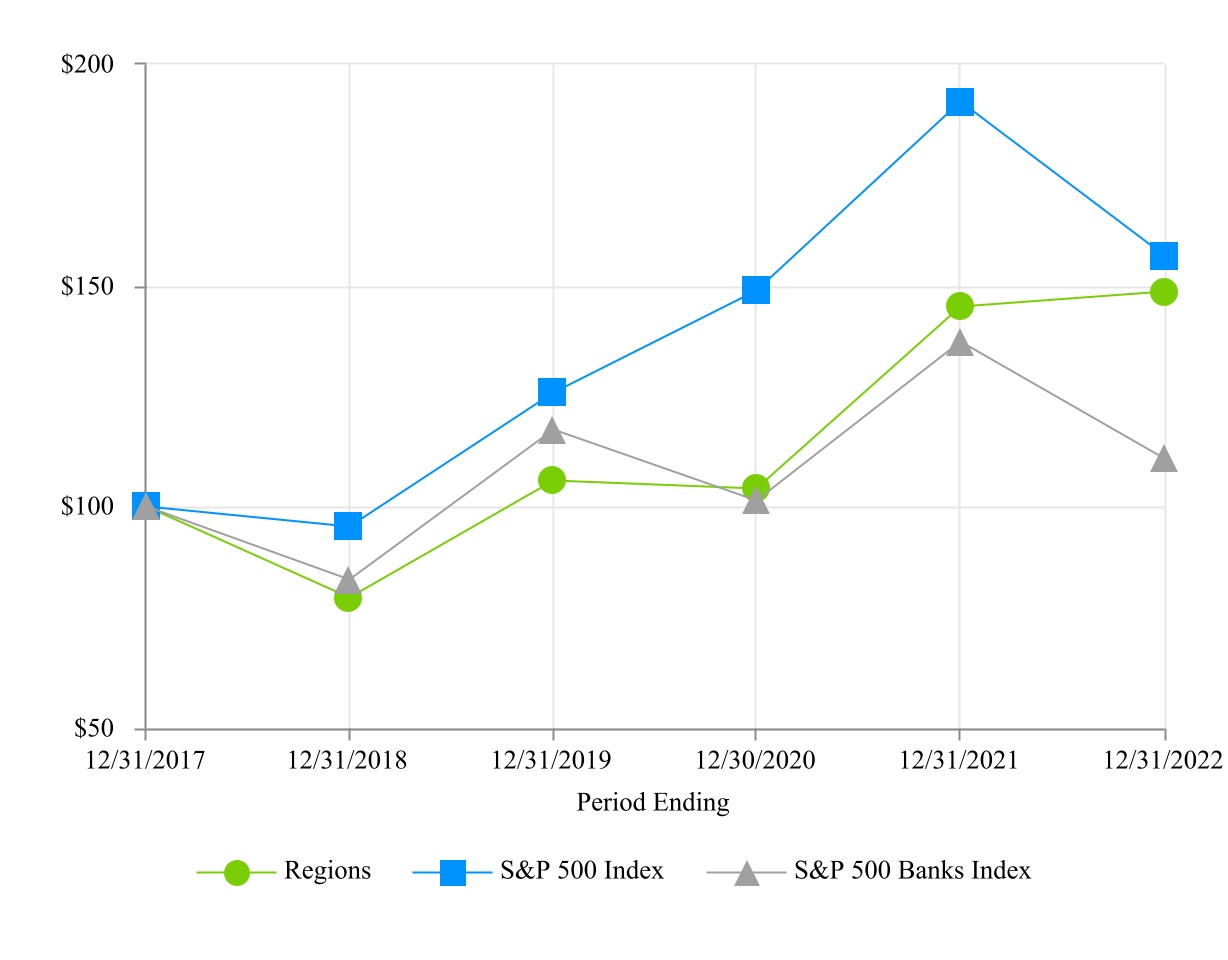][added: 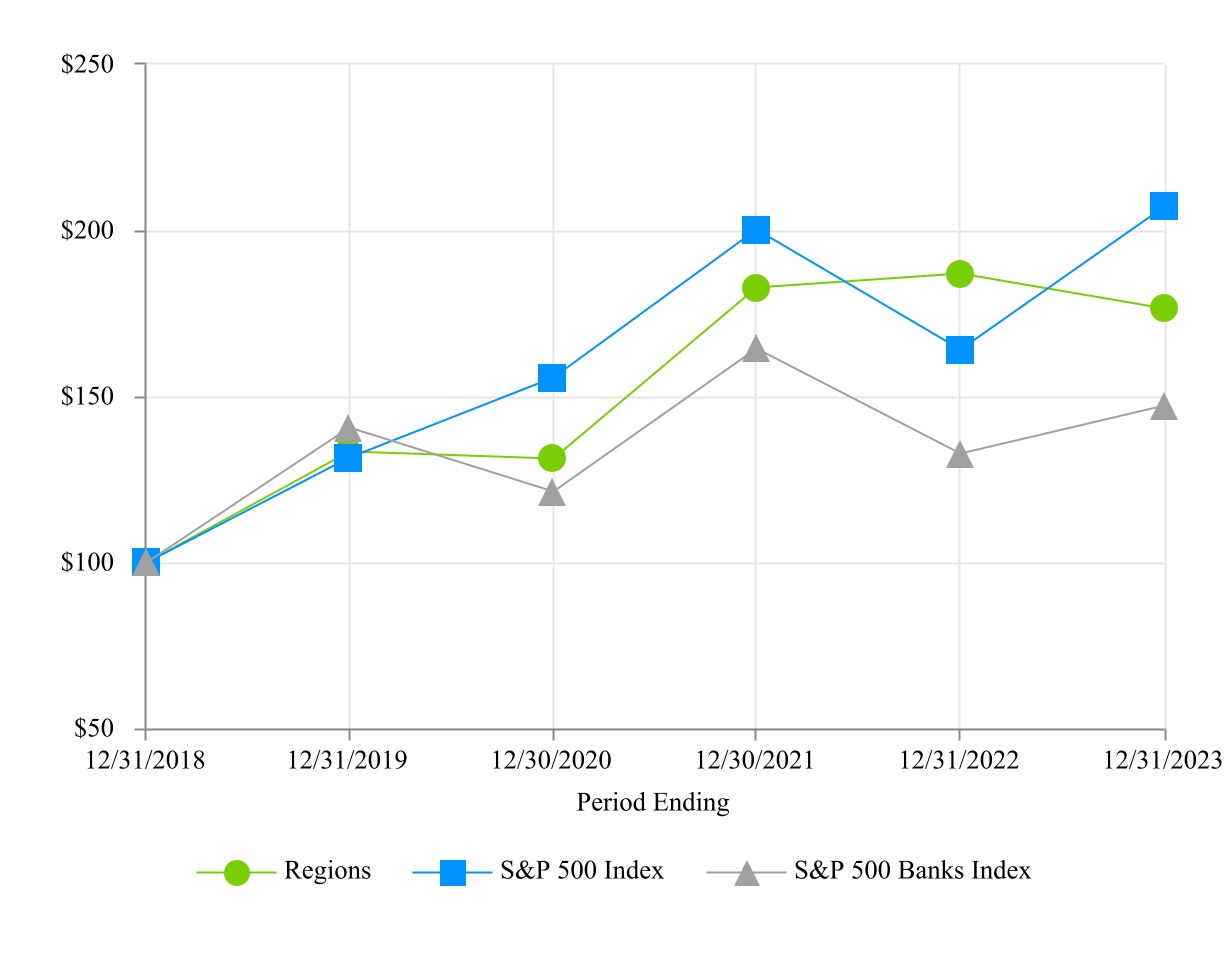]
| | | | [removed: 12/31/2017] [added: 12/31/2018] | | | | | | [removed: 12/31/2018] [added: 12/31/2019] | | | | | | [removed: 12/31/2019] [added: 12/31/2020] | | | | | | [removed: 12/31/2020] [added: 12/31/2021] | | | | | | [removed: 12/31/2021] [added: 12/31/2022] | | | | | | [removed: 12/31/2022] [added: 12/31/2023] | | |
The following table presents information regarding issuer purchases of equity securities during the fourth quarter of 2023.
| Period | | | | | | | | | Total Number of Shares Purchased | | | | | | Average Price Paid per Share(1) | | | | | | Total Number of Shares Purchased as Part of Publicly Announced Plans or Programs | | | | | | Maximum Approximate Dollar Value of Shares that May Yet Be Purchased Under Publicly Announced Plans or Programs | | |
| October 1-31, 2023 | | | | | | | | | 6,437,685 | | | | | | $ | 14.22 | | | | | 6,437,685 | | | | | | $ | 2,393,179,589 | |
| November 1-30, 2023 | | | | | | | | | 5,653,231 | | | | | | $ | 15.66 | | | | | 5,653,231 | | | | | | $ | 2,304,697,925 | |
| December 1-31, 2023 | | | | | | | | | 4,038,243 | | | | | | $ | 17.36 | | | | | 4,038,243 | | | | | | $ | 2,234,699,026 | |
| Total Fourth Quarter | | | | | | | | | 16,129,159 | | | | | | $ | 15.82 | | | | | 16,129,159 | | | | | | $ | 2,234,699,026 | |
_____
(1) Average price paid does not reflect the 1 percent excise tax charged on public company share repurchases.
| Regions | | | $ | 100.00 | | | | | $ | 133.30 | | | | | $ | 131.12 | | | | | $ | 182.78 | | | | | $ | 187.01 | | | | | $ | 176.35 | |
| S&P 500 Index | | | 100.00 | | | | | | 131.47 | | | | | | 155.65 | | | | | | 200.29 | | | | | | 163.98 | | | | | | 207.04 | | |
| S&P 500 Banks Index | | | 100.00 | | | | | | 140.64 | | | | | | 121.29 | | | | | | 164.28 | | | | | | 132.73 | | | | | | 147.28 | | |
As of December 31, 2022, Regions had repurchased approximately 725 thousand shares of common stock at a total cost of $15 million under this plan.
| Regions | | | $ | 100.00 | | | | | $ | 79.43 | | | | | $ | 105.88 | | | | | $ | 104.15 | | | | | $ | 145.18 | | | | | $ | 148.54 | |
| S&P 500 Index | | | 100.00 | | | | | | 95.61 | | | | | | 125.70 | | | | | | 148.81 | | | | | | 191.48 | | | | | | 156.77 | | |
| S&P 500 Banks Index | | | 100.00 | | | | | | 83.56 | | | | | | 117.52 | | | | | | 101.35 | | | | | | 137.28 | | | | | | 110.91 | | |
Item 8. Financial Statements and Supplementary Data
901 rewritten, 328 added, 323 removed, 1,730 unchanged
Read the full itemFY2023 item · filed February 23, 2024FY2022 item · filed February 24, 2023
Regions’ management assessed the effectiveness of the Company’s internal control over financial reporting as of December 31, [removed: 2022.][added: 2023.]
Based on our assessment, we believe and assert that, as of December 31, [removed: 2022,] [added: 2023,] the Company’s internal control over financial reporting is effective based on those criteria.
We have audited Regions Financial Corporation and subsidiaries’ internal control over financial reporting as of December 31, [removed: 2022,] [added: 2023,] based on criteria established in Internal Control—Integrated Framework issued by the Committee of Sponsoring Organizations of the Treadway Commission (2013 framework) (the COSO criteria).
In our opinion, Regions Financial Corporation and subsidiaries (the Company) maintained, in all material respects, effective internal control over financial reporting as of December 31, [removed: 2022,] [added: 2023,] based on the COSO criteria.
We also have audited, in accordance with the standards of the Public Company Accounting Oversight Board (United States) (PCAOB), the consolidated balance sheets of [removed: Regions Financial Corporation and subsidiaries] [added: the Company] as of December 31, [removed: 2022] [added: 2023] and [removed: 2021,] [added: 2022,] the related consolidated statements of income, comprehensive income (loss), [added: changes in] shareholders’ equity and cash flows for each of the three years in the period ended December 31, [removed: 2022,] [added: 2023,] and the related notes and our report dated February [removed: 24, 2023] [added: 23, 2024] expressed an unqualified opinion thereon.
We have audited the accompanying consolidated balance sheets of Regions Financial Corporation and subsidiaries (the Company) as of December 31, [removed: 2022] [added: 2023] and [removed: 2021,] [added: 2022,] the related consolidated statements of income, comprehensive income (loss), [added: changes in] shareholders’ equity and cash flows for each of the three years in the period ended December 31, [removed: 2022,] [added: 2023,] and the related notes (collectively referred to as the “consolidated financial statements”).
In our opinion, the consolidated financial statements present fairly, in all material respects, the financial position of the Company at December 31, [removed: 2022] [added: 2023] and [removed: 2021,] [added: 2022,] and the results of its operations and its cash flows for each of the three years in the period ended December 31, [removed: 2022,] [added: 2023,] in conformity with U.S. generally accepted accounting principles.
We also have audited, in accordance with the standards of the Public Company Accounting Oversight Board (United States) (PCAOB), the Company’s internal control over financial reporting as of December 31, [removed: 2022,] [added: 2023,] based on criteria established in Internal Control-Integrated Framework issued by the Committee of Sponsoring Organizations of the Treadway Commission (2013 framework) and our report dated February [removed: 24, 2023] [added: 23, 2024] expressed an unqualified opinion thereon.
The critical audit matter communicated below is a matter arising from the current period audit of the financial statements that was communicated or required to be communicated to the audit committee and that: (1) relates to accounts or disclosures that are material to the financial statements and (2) involved [added: our] especially challenging, subjective, or complex judgments.
| *Description of the Matter* | | | | | | The [removed: allowance for credit losses consists of two components:] [added: Company’s loan and lease portfolio and] the [added: associated] allowance for [removed: loan] [added: credit] losses [added: (ACL), were $98.4 billion] and [removed: the reserve for unfunded commitments. As] [added: $1.7 billion as] of December 31, [removed: 2022, the allowance for credit losses (ACL) was $1.6 billion.] [added: 2023, respectively.] The provision for credit losses was [removed: $271] [added: $553] million for the year ended December 31, [removed: 2022.] [added: 2023.] As discussed in Notes 1 and 5 to the consolidated financial statements, the ACL is established to absorb expected credit losses over the contractual life of the loans measured at amortized cost, including unfunded commitments. Management’s measurement of expected losses is driven by loss forecasting models which utilize relevant quantitative information about historical experience, current conditions and the reasonable and supportable economic forecast that affects the collectability of the reported amount. Management’s estimate for the expected credit losses is established through these quantitative factors, as well as qualitative considerations to account for the imprecision inherent in the estimation process. As a result, management may adjust the ACL for the potential impact of qualitative factors through their established framework. Management’s qualitative framework provides for specific model and general imprecision adjustments for such factors as the economic forecast imprecision, potential model imprecision, process imprecision and specific issues or events that Management believes are not adequately captured in the modeled outcomes. Auditing management’s ACL estimate and related provision for credit losses involved a high degree of complexity in evaluating the expected loss forecasting models and subjectivity in evaluating management’s measurement of the economic forecast used during the reasonable and supportable period and the qualitative factors. | | |
| *How We Addressed the Matter in Our Audit* | | | | | | We obtained an understanding, evaluated the design and tested the operating effectiveness of the Company’s process for establishing the ACL, including management’s controls over: 1) expected loss forecasting models including model validation, monitoring, the completeness and accuracy of key inputs and assumptions used in the models; 2) the development and application of the reasonable and supportable economic forecast; 3) the identification and measurement of qualitative factors. With respect to expected loss forecasting models, with the support of specialists, we evaluated the conceptual soundness of the model methodology and replicated a sample of models. We also tested the appropriateness of key inputs and assumptions used in these models by agreeing a sample of inputs to supporting information. Regarding the reasonable and supportable economic forecast, with the support of specialists, we assessed the forecasted economic scenario by, among other procedures, evaluating management’s methodology for developing the forecast and comparing a sample of key economic variables developed to external sources. With respect to the identification of qualitative factors, we evaluated the potential impact of imprecision in the quantitative models and hence the need to consider a qualitative adjustment to the [removed: ACL.] [added: ACL for factors which may not be directly measured in the modeled calculations.] Regarding measurement of the qualitative factors, we evaluated the methodology applied and data utilized by management to estimate the appropriate level of the qualitative factors. We also considered if qualitative adjustments were consistent with external macroeconomic factors [removed: independently obtained during the audit] and the results produced by the Company’s Credit Review, Internal Audit and Model Validation groups. We evaluated the overall ACL amount, including model estimates and qualitative factor adjustments, and whether the recorded ACL appropriately reflects expected credit losses on the loan portfolio and unfunded credit commitments. We reviewed historical loss statistics, peer-bank information, subsequent events and transactions and considered whether they corroborate or contradict the Company’s measurement of the ACL. | | |
| | | | [added: | | | | | | | | | | | | 2023 | | | | | |] 2022 | | | | | | 2021 | | |
| Cash and due from banks | | | $ | [removed: 1,997] [added: 2,635] | | | | | $ | [removed: 1,350] [added: 1,997] | |
| Interest-bearing deposits in other banks | | | [removed: 9,230] [added: 4,166] | | | | | | [removed: 28,061] [added: 9,230] | | |
| Debt securities held to maturity (estimated fair value of [removed: $751] [added: $716] and [removed: $950,] [added: $751,] respectively) | | | [removed: 801] [added: 754] | | | | | | [removed: 899] [added: 801] | | |
| Debt securities available for sale (amortized cost of [removed: $31,367] [added: $30,864] and [removed: $28,263,] [added: $31,367,] respectively) | | | [removed: 27,933] [added: 28,104] | | | | | | [removed: 28,481] [added: 27,933] | | |
| Loans held for sale (includes [removed: $196] [added: $201] and [removed: $783] [added: $196] measured at fair value, respectively) | | | [removed: 354] [added: 400] | | | | | | [removed: 1,003] [added: 354] | | |
| Loans, net of unearned income | | | [removed: 97,009] [added: 98,379] | | | | | | [removed: 87,784] [added: 97,009] | | |
| Allowance for loan losses | | | [removed: (1,464)] [added: (1,576)] | | | | | | [removed: (1,479)] [added: (1,464)] | | |
| Net loans | | | [removed: 95,545] [added: 96,803] | | | | | | [removed: 86,305] [added: 95,545] | | |
| Other earning assets | | | [removed: 1,308] [added: 1,417] | | | | | | [removed: 1,187] [added: 1,308] | | |
| Premises and equipment, net | | | [removed: 1,718] [added: 47] | | | | | | [removed: 1,814] [added: 28] | | |
| Interest receivable | | | [removed: 511] [added: 614] | | | | | | [removed: 319] [added: 511] | | |
| Goodwill | | | 5,733 | | | | | | [removed: 5,744] [added: 5,733] | | |
| Residential mortgage servicing rights at fair value | | | [removed: 812] [added: 906] | | | | | | [removed: 418] [added: 812] | | |
| Other identifiable intangible assets, net | | | [removed: 249] [added: 205] | | | | | | [removed: 305] [added: 249] | | |
| Other assets | | | [removed: 9,029] [added: 8,815] | | | | | | [removed: 7,052] [added: 9,029] | | |
| Total assets | | | $ | [removed: 155,220] [added: 152,194] | | | | | $ | [removed: 162,938] [added: 155,220] | |
| Non-interest-bearing | | | $ | [removed: 51,348] [added: 42,368] | | | | | $ | [removed: 58,369] [added: 51,348] | |
| Interest-bearing | | | [removed: 80,395] [added: 85,420] | | | | | | [removed: 80,703] [added: 80,395] | | |
| Total deposits | | | [removed: 131,743] [added: 127,788] | | | | | | [removed: 139,072] [added: 131,743] | | |
| Long-term borrowings | | | [removed: 2,284] [added: 2,330] | | | | | | [removed: 2,407] [added: 2,284] | | |
| Total borrowed funds | | | [removed: 2,284] [added: 2,330] | | | | | | [removed: 2,407] [added: 2,284] | | |
| Other liabilities | | | [removed: 5,242] [added: 4,583] | | | | | | [removed: 3,133] [added: 5,242] | | |
| Total liabilities | | | [removed: 139,269] [added: 134,701] | | | | | | [removed: 144,612] [added: 139,269] | | |
| Issued including treasury [removed: stock—975,524,168] [added: stock—963,375,681] and [removed: 982,940,601] [added: 975,524,168] shares, respectively | | | 10 | | | | | | 10 | | |
| Additional paid-in capital | | | [removed: 11,988] [added: 11,757] | | | | | | [removed: 12,189] [added: 11,988] | | |
| Retained earnings | | | [removed: 7,004] [added: 8,186] | | | | | | [removed: 5,550] [added: 7,004] | | |
| Accumulated other comprehensive income (loss), net | | | [removed: (3,343)] [added: (2,812)] | | | | | | [removed: 289] [added: (3,343)] | | |
| Total shareholders’ equity | | | [removed: 15,947] [added: 17,429] | | | | | | [removed: 18,326] [added: 15,947] | | |
February 23, 2024
February 23, 2024
| Impact of common stock share repurchases | | | — | | | | | | — | | | | | | (16) | | | | | | — | | | | | | (252) | | | | | | — | | | | | | — | | | | | | — | | | | | | (252) | | | | | | — | | |
| BALANCE AT DECEMBER 31, 2023 | | | 2 | | | | | | $ | 1,659 | | | | | 924 | | | | | | $ | 10 | | | | | $ | 11,757 | | | | | $ | 8,186 | | | | | $ | (1,371) | | | | | $ | (2,812) | | | | | $ | 17,429 | | | | | $ | 64 | |
The amount is then considered the new cost basis of the loan.
At the time of transfer, write-downs on the loans that are credit related are recorded as charge-offs.
commercial portfolio segment.
*Modifications to Borrowers Experiencing Financial Difficulty*
On January 1, 2023, the Company adopted new accounting guidance that eliminated the recognition and measurement guidance for TDRs while enhancing disclosure requirements for certain loan refinancings and restructurings made to borrowers experiencing financial difficulty, also referred to as modifications to troubled borrowers.
Modifications to troubled borrowers are considered in the allowance the same as all other portfolio loans as described in the allowance section below.
The guidance also requires disclosure of current-period gross write-offs by year of origination.
Regions applied the guidance prospectively, except Regions used the modified-retrospective transition method related to the recognition and measurement of TDRs.
The
cumulative effect of the modified-retrospective application was a decrease in the allowance of $38 million and an increase to retained earnings of $28 million, net of taxes.
Modifications to troubled borrowers are loans where the borrower is experiencing financial difficulty at the time of modification and are undertaken in order to improve the likelihood of repayment.
Modification types classified as modifications to troubled borrowers include interest rate reductions, other than insignificant term extensions, other than insignificant payment deferrals, principal forgiveness, or any combination of these.
Further details are as follows:
- Interest rate reduction modifications include instances where the absolute interest rate is reduced as part of the modification.
In instances where the rate index changes for variable-rate loans, Regions evaluates whether or not the absolute interest rate decreases from the original rate to the updated rate.
- Term extensions are maturity extensions, many of which occur through renewals or restructurings.
- Payment deferrals include modifications wherein the contractual payment term is extended.
Examples of payment deferral modifications include, but are not limited to, re-agings, payment delays or holidays, lengthening of amortization terms, allowing for an interest-only payment period, and capitalizing interest payments in loan restructurings.
- Regions rarely grants principal forgiveness modifications.
Prior to January 1, 2023, the Company accounted for loans in which the borrower was experiencing financial difficulty at the modification date and wherein Regions had granted a concession to the borrower as a TDR.
Prior to 2023, the Company also deviated from contractual maturity for loans where the Company had a reasonable expectation at the reporting date that it would execute a TDR with the borrower ("RETDR").
See Note 1 in the Annual Report on Form 10-K for the year ended December 31, 2022 for a discussion of RETDRs.
The majority of Regions' credit card portfolio balances are categorized as revolvers for the purpose of the allowance.
A loan is considered to be collateral-dependent if the borrower is experiencing financial difficulty and management expects substantial repayment of the loan through the sale or operation of the collateral.
Regions defines significant commercial and investor real estate non-accrual loans wherein repayment is expected to be substantially from the sale or operation of collateral as collateral dependent.
portfolios and classes using econometric models to estimate expected credit losses.
Lease contracts are structured with either fixed or variable lease payment terms.
Variable lease payments are based on an index provided within the leasing agreement.
Software is generally depreciated over 3 years (or over a longer estimated life of 5-20 years for larger software systems).
The income approach, which is the primary valuation approach, consists of discounting projected
The market approaches incorporate comparable public company information, valuation multiples, and consideration of a market control premium along with data related to comparable observed purchase transactions in the financial services industry for the reporting units.
Where legally enforceable, these master netting agreements give the Company, in the event of default by the counterparty, the right to liquidate securities held as collateral and to offset receivables and payables with the same counterparty.
For purposes of the consolidated balance sheets, the Company offsets derivative assets and liabilities and cash collateral held with the same counterparty where it has such a legally enforceable master netting agreement.
Derivative assets and liabilities are included in other assets and liabilities as operating cash flows in the consolidated statements of cash flows.
On March 5, 2021, the FCA announced that LIBOR would not be available for use after December 31, 2021 and would not be published after June 30, 2023.
In the third quarter of 2020, Regions adopted temporary accounting relief for affected transactions that reference LIBOR.
Table of Contents
February 24, 2023
Table of Contents
Table of Contents
February 24, 2023
Table of Contents
| BALANCE AT JANUARY 1, 2020 | | | 2 | | | | | | $ | 1,310 | | | | | 957 | | | | | | $ | 10 | | | | | $ | 12,685 | | | | | $ | 3,751 | | | | | $ | (1,371) | | | | | $ | (90) | | | | | $ | 16,295 | | | | | $ | — | |
At the time of transfer, write-downs on the loans are recorded as charge-offs when credit related and non-interest expense or non-interest income (dependent on loan type) when not credit related and a new cost basis is established.
Any subsequent lower of cost or market adjustment is determined on an individual loan basis.
TDRs are loans in which the borrower is experiencing financial difficulty at the time of restructuring, and Regions has granted a concession to the borrower.
Insignificant delays in payments are not considered TDRs.
The CAP was designed to evaluate potential consumer loan participants as early as possible in the life cycle of the troubled loan (as described in Note 5).
Many of the modifications are finalized without the borrower ever reaching the applicable number of days past due, and therefore the loan may never be placed on non-accrual.
Accordingly, given the positive impact of the restructuring on the likelihood of recovery of cash flows due under the modified terms, accrual status continues to be appropriate for these loans.
As provided in the CARES Act passed into law on March 27, 2020, and subsequently extended through the Consolidated Appropriations Act signed into law on December 27, 2020, certain loan modifications related to the COVID-19 pandemic beginning March 1, 2020, through the earlier of 60 days after the end of the pandemic or January 1, 2022, were eligible for relief from TDR classification.
Regions elected this provision of both Acts; therefore, modified loans that met the required guidelines for relief were not considered TDRs.
Regions adopted CECL on January 1, 2020, which replaced the incurred loss methodology to estimate the allowance with the expected loss methodology.
("RETDR") or 2) extension or renewal options are included in the original or modified contract at the reporting date and are not unconditionally cancellable by Regions.
RETDR
Regions individually identifies commercial and investor real estate loans for inclusion as RETDRs.
The identification criteria are based on internal risk ratings and time to maturity.
Regions typically does not identify consumer loans as RETDRs due to the insignificant time period between initial contact with a customer regarding a loan modification and when a TDR modification is consummated.
The RETDR status extends the life of the loan past the contractual maturity and includes the allowance impact of interest rate concessions.
Loans identified as RETDRs will be treated consistently from a modeling/reserving perspective as loans identified as TDRs.
Contractual term extensions (borrower versus lender option to renew)
Regions' consumer loan contracts do not permit automatic extensions or unilateral customer extensions, and Regions retains the right to approve or deny any extension requested from the borrower.
As a result, extensions and renewal options are not included in the life of consumer loans for the purposes of calculating the allowance.
Similarly, Regions does not include extension and renewal options in the life of commercial loans for the purposes of calculating the allowance, unless it is a RETDR.
Most commercial products do not offer borrowers a unilateral right to renew or extend.
Regions' credit card portfolio is comprised primarily of revolvers.
Regions evaluates significant commercial and investor real estate loans that are in financial difficulty and secured by collateral to determine if they are collateral dependent.
Segmentation
Other identifiable intangibles assets are primarily amortized over their expected useful lives while agency commercial real estate licenses are non-amortizing.
units.
Eurodollar futures are futures contracts on Eurodollar deposits.
Eurodollar futures subject Regions to market risk associated with changes in interest rates.
Because futures contracts are cash settled daily through a margining process in an exchange, there is minimal credit risk associated with Eurodollar futures.
At the date of repurchase, shareholders' equity is reduced by the repurchase price.
Prior to 2021, Regions' sponsored plans also included stock options.
flow analyses and option pricing models based on market rates and volatilities, which are Level 2 measurements.
An excerpt. Shown here: 40 of 901 rewritten, 40 of 328 added and 40 of 323 removed. The counts are complete. For every sentence, read Item 8. Financial Statements and Supplementary Data in the FY2023 filing and the FY2022 filing.
Item 9A. Controls and Procedures
1 rewritten, 0 added, 0 removed, 3 unchanged
Read the full itemFY2023 item · filed February 23, 2024FY2022 item · filed February 24, 2023
During the fourth fiscal quarter of the year ended December 31, [removed: 2022,] [added: 2023,] there have been no changes in Regions’ internal control over financial reporting that have materially affected, or are reasonably likely to materially affect, Regions’ control over financial reporting.
Item 10. Directors, Executive Officers and Corporate Governance
3 rewritten, 0 added, 2 removed, 3 unchanged
Read the full itemFY2023 item · filed February 23, 2024FY2022 item · filed February 24, 2023
Information about the Directors and Director nominees of Regions included in Regions’ Proxy Statement for the [removed: 2023] [added: 2024] Annual Meeting of Shareholders (the “Proxy Statement”) under the captions “PROPOSAL 1—ELECTION OF [removed: DIRECTORS—Who are this year's nominees?,” “—What criteria were considered by the NCG Committee in selecting the nominees?,” “—What skills and characteristics are currently represented on the Board?,” and “—How often are the members elected?”] [added: DIRECTORS”] and the information incorporated by reference pursuant to Item 13.
Information regarding Regions’ Audit Committee included in the Proxy Statement under the caption “CORPORATE [removed: GOVERNANCE—Audit Committee”] [added: GOVERNANCE—Committees of the Board of Directors”] is incorporated herein by reference.
Information regarding Regions’ Code of Ethics for Senior Financial Officers included in the Proxy Statement under the caption “CORPORATE GOVERNANCE—Codes of [removed: Ethics”] [added: Conduct”] is incorporated herein by reference.
Information included in the Proxy Statement under the caption “CORPORATE GOVERNANCE—Family Relationships” is incorporated herein by reference.
Table of Contents
Item 11. Executive Compensation
1 rewritten, 0 added, 0 removed, 0 unchanged
Read the full itemFY2023 item · filed February 23, 2024FY2022 item · filed February 24, 2023
All information presented under the captions “COMPENSATION DISCUSSION AND ANALYSIS,” “COMPENSATION OF EXECUTIVE OFFICERS,” “COMPENSATION AND HUMAN RESOURCES COMMITTEE REPORT,” [added: “DIRECTOR COMPENSATION,” and] “CORPORATE GOVERNANCE—Compensation Committee Interlocks and Insider Participation” and “—Relationship of Compensation Policies and Practices to Risk [removed: Management,” and “PROPOSAL 1—ELECTION OF DIRECTORS—How are Directors compensated?”] [added: Management”] of the Proxy Statement are incorporated herein by reference.
Item 12. Security Ownership of Certain Beneficial Owners and Management and Related Stockholder Matters
3 rewritten, 1 added, 1 removed, 7 unchanged
Read the full itemFY2023 item · filed February 23, 2024FY2022 item · filed February 24, 2023
The following table gives information about the common stock that may be issued upon the exercise of options, warrants and rights under all of Regions’ existing equity compensation plans as of December 31, [removed: 2022.][added: 2023.]
| Equity Compensation Plans Approved by Stockholders | | | — | | | | | | $ | — | | [removed: 27,767,251] [added: 24,086,496] | | | (b) | | |
(a)Does not include outstanding restricted stock units of [removed: 10,163,763.][added: 8,000,041.]
| Total | | | — | | | | | | $ | — | | 24,086,496 | | | | | |
| Total | | | — | | | | | | $ | — | | 27,767,251 | | | | | |
Item 13. Certain Relationships and Related Transactions, and Director Independence
1 rewritten, 0 added, 0 removed, 0 unchanged
Read the full itemFY2023 item · filed February 23, 2024FY2022 item · filed February 24, 2023
All information presented under the captions “CORPORATE [removed: GOVERNANCE—Transactions with Directors,” “—Other Business Relationships and] [added: GOVERNANCE—Related Person] Transactions,” [removed: “—Policies Governing Transactions with Related Persons”] and “—Director Independence” of the Proxy Statement is incorporated herein by reference.
Item 15. Exhibits and Financial Statement Schedules
47 rewritten, 0 added, 3 removed, 57 unchanged
Read the full itemFY2023 item · filed February 23, 2024FY2022 item · filed February 24, 2023
| Consolidated Balance Sheets—December 31, [removed: 2022] [added: 2023] and [removed: 2021;] [added: 2022;] | | |
| Consolidated Statements of Income—Years ended December 31, [removed: 2022, 2021] [added: 2023, 2022] and [removed: 2020;] [added: 2021;] | | |
| Consolidated Statements of Comprehensive Income—Years ended December 31, [removed: 2022, 2021] [added: 2023, 2022] and [removed: 2020;] [added: 2021;] | | |
| Consolidated Statements of Changes in Shareholders’ Equity—Years ended December 31, [removed: 2022, 2021] [added: 2023, 2022] and [removed: 2020;] [added: 2021;] and | | |
| Consolidated Statements of Cash Flows—Years ended December 31, [removed: 2022, 2021] [added: 2023, 2022] and [removed: 2020.] [added: 2021.] | | |
| 3.6 | | | [Bylaws as amended and [removed: restated on July 21, 2021,] [added: restated,] incorporated by reference to Exhibit 3.2 to Form 8-K [removed: Current Report] filed by registrant on [removed: July 21, 2021](https://www.sec.gov/Archives/edgar/data/0001281761/000119312521220699/d191960dex32.htm).] [added: October 18, 2023.](https://www.sec.gov/Archives/edgar/data/1281761/000119312523258601/d550552dex32.htm)] | | | | | |
| 4.2A | | | [Amendment [removed: to](https://www.sec.gov/Archives/edgar/data/1281761/000128176123000012/rf-20221231xex42a.htm) [Deposit] [added: to Deposit] Agreement, dated as of April 29, [removed: 2014](https://www.sec.gov/Archives/edgar/data/1281761/000128176123000012/rf-20221231xex42a.htm)[,] [added: 2014,] effective as [removed: of](https://www.sec.gov/Archives/edgar/data/1281761/000128176123000012/rf-20221231xex42a.htm) [October] [added: of October] 21, 2022, by and among Regions Financial [removed: Corporation,](https://www.sec.gov/Archives/edgar/data/1281761/000128176123000012/rf-20221231xex42a.htm) [Computershare, Inc](https://www.sec.gov/Archives/edgar/data/1281761/000128176123000012/rf-20221231xex42a.htm)[., Computer](https://www.sec.gov/Archives/edgar/data/1281761/000128176123000012/rf-20221231xex42a.htm)[share] [added: Corporation, Computershare, Inc., Computershare] Trust Company, [removed: N.A.](https://www.sec.gov/Archives/edgar/data/1281761/000128176123000012/rf-20221231xex42a.htm)[,](https://www.sec.gov/Archives/edgar/data/1281761/000128176123000012/rf-20221231xex42a.htm) [and](https://www.sec.gov/Archives/edgar/data/1281761/000128176123000012/rf-20221231xex42a.htm) [Broadridge] [added: N.A., and Broadridge] Corporate Issuer Solutions, [removed: Inc](https://www.sec.gov/Archives/edgar/data/1281761/000128176123000012/rf-20221231xex42a.htm)[.](https://www.sec.gov/Archives/edgar/data/1281761/000128176123000012/rf-20221231xex42a.htm)[](https://www.sec.gov/Archives/edgar/data/1281761/000128176123000012/rf-20221231xex42a.htm)] [added: Inc. incorporated by reference to Exhibit 4.2A to Form 10-K Annual Report filed by the registrant on February 24, 2023.](https://www.sec.gov/Archives/edgar/data/1281761/000128176123000012/rf-20221231xex42a.htm)] | | | | | |
| 4.5A | | | [Amendment [removed: to](https://www.sec.gov/Archives/edgar/data/1281761/000128176123000012/rf-20221231xex45a.htm) [Deposit] [added: to Deposit] Agreement, dated as of April 30, [removed: 2019](https://www.sec.gov/Archives/edgar/data/1281761/000128176123000012/rf-20221231xex45a.htm)[,] [added: 2019,] effective as [removed: of](https://www.sec.gov/Archives/edgar/data/1281761/000128176123000012/rf-20221231xex45a.htm) [October] [added: of October] 21, 2022, by and among Regions Financial Corporation, Computershare, [removed: Inc.,](https://www.sec.gov/Archives/edgar/data/1281761/000128176123000012/rf-20221231xex45a.htm) [Computershare] [added: Inc., Computershare] Trust Company, [removed: N.A.](https://www.sec.gov/Archives/edgar/data/1281761/000128176123000012/rf-20221231xex45a.htm)[,](https://www.sec.gov/Archives/edgar/data/1281761/000128176123000012/rf-20221231xex45a.htm)[and](https://www.sec.gov/Archives/edgar/data/1281761/000128176123000012/rf-20221231xex45a.htm) [Broadridge] [added: N.A.,and Broadridge] Corporate Issuer Solutions, [removed: Inc](https://www.sec.gov/Archives/edgar/data/1281761/000128176123000012/rf-20221231xex45a.htm)[.](https://www.sec.gov/Archives/edgar/data/1281761/000128176123000012/rf-20221231xex45a.htm)] [added: Inc. incorporated by reference to Exhibit 4.5A to Form 10-K Annual Report filed by the registrant on February 24, 2023.](https://www.sec.gov/Archives/edgar/data/1281761/000128176123000012/rf-20221231xex45a.htm)] | | | | | |
| 4.7A | | | [Amendment [removed: to](https://www.sec.gov/Archives/edgar/data/1281761/000128176123000012/rf-20221231xex47a.htm) [Deposit] [added: to Deposit] Agreement, dated as of June 5, [removed: 2020](https://www.sec.gov/Archives/edgar/data/1281761/000128176123000012/rf-20221231xex47a.htm)[,] [added: 2020,] effective as [removed: of](https://www.sec.gov/Archives/edgar/data/1281761/000128176123000012/rf-20221231xex47a.htm) [October] [added: of October] 21, [removed: 2022](https://www.sec.gov/Archives/edgar/data/1281761/000128176123000012/rf-20221231xex47a.htm)[,](https://www.sec.gov/Archives/edgar/data/1281761/000128176123000012/rf-20221231xex47a.htm) [by] [added: 2022, by] and among Regions Financial [removed: Corporation,](https://www.sec.gov/Archives/edgar/data/1281761/000128176123000012/rf-20221231xex47a.htm) [Computershare, Inc.,](https://www.sec.gov/Archives/edgar/data/1281761/000128176123000012/rf-20221231xex47a.htm) [Computershare] [added: Corporation, Computershare, Inc., Computershare] Trust Company, [removed: N.A.](https://www.sec.gov/Archives/edgar/data/1281761/000128176123000012/rf-20221231xex47a.htm)[,](https://www.sec.gov/Archives/edgar/data/1281761/000128176123000012/rf-20221231xex47a.htm) [](https://www.sec.gov/Archives/edgar/data/1281761/000128176123000012/rf-20221231xex47a.htm)[and](https://www.sec.gov/Archives/edgar/data/1281761/000128176123000012/rf-20221231xex47a.htm) [Broadridge] [added: N.A., and Broadridge] Corporate Issuer Solutions, [removed: Inc](https://www.sec.gov/Archives/edgar/data/1281761/000128176123000012/rf-20221231xex47a.htm)[.](https://www.sec.gov/Archives/edgar/data/1281761/000128176123000012/rf-20221231xex47a.htm)] [added: Inc.](https://www.sec.gov/Archives/edgar/data/1281761/000128176123000012/rf-20221231xex47a.htm) [](https://www.sec.gov/Archives/edgar/data/1281761/000128176123000012/rf-20221231xex47a.htm)[incorporated by reference to Exhibit 4.](https://www.sec.gov/Archives/edgar/data/1281761/000128176123000012/rf-20221231xex47a.htm)[7](https://www.sec.gov/Archives/edgar/data/1281761/000128176123000012/rf-20221231xex47a.htm)[A to Form 10-K Annual Report filed by the registrant on February 24, 2023.](https://www.sec.gov/Archives/edgar/data/1281761/000128176123000012/rf-20221231xex47a.htm)[](https://www.sec.gov/Archives/edgar/data/1281761/000128176123000012/rf-20221231xex47a.htm)] | | | | | |
| 4.9 | | | [Deposit Agreement, dated as of May 4, 2021, by and among Regions Financial Corporation, Computershare [removed: Inc.](https://www.sec.gov/Archives/edgar/data/1281761/000119312521147588/d188159dex41.htm) [](https://www.sec.gov/Archives/edgar/data/1281761/000119312521147588/d188159dex41.htm)[a](https://www.sec.gov/Archives/edgar/data/1281761/000119312521147588/d188159dex41.htm)[n](https://www.sec.gov/Archives/edgar/data/1281761/000119312521147588/d188159dex41.htm)[d](https://www.sec.gov/Archives/edgar/data/1281761/000119312521147588/d188159dex41.htm) [](https://www.sec.gov/Archives/edgar/data/1281761/000119312521147588/d188159dex41.htm)[Computershare] [added: Inc. and Computershare] Trust Company, [removed: N.A.,](https://www.sec.gov/Archives/edgar/data/1281761/000119312521147588/d188159dex41.htm) [jointly as](https://www.sec.gov/Archives/edgar/data/1281761/000119312521147588/d188159dex41.htm) [depositary,] [added: N.A., jointly as depositary,] and the holders from time to time of the depositary receipts described therein, incorporated by reference to Exhibit 4.1 to the Form 8-A filed by registrant on May 3, 2021.](https://www.sec.gov/Archives/edgar/data/1281761/000119312521147588/d188159dex41.htm) | | | | | |
| 4.9A | | | [Amendment [removed: to](https://www.sec.gov/Archives/edgar/data/1281761/000128176123000012/rf-20221231xex49a.htm) [Deposit] [added: to Deposit] Agreement, dated as of May 4, [removed: 2021](https://www.sec.gov/Archives/edgar/data/1281761/000128176123000012/rf-20221231xex49a.htm)[,] [added: 2021,] effective as [removed: of](https://www.sec.gov/Archives/edgar/data/1281761/000128176123000012/rf-20221231xex49a.htm) [October] [added: of October] 21, [removed: 2022](https://www.sec.gov/Archives/edgar/data/1281761/000128176123000012/rf-20221231xex49a.htm)[,](https://www.sec.gov/Archives/edgar/data/1281761/000128176123000012/rf-20221231xex49a.htm) [by] [added: 2022, by] and among Regions Financial [removed: Corporation,](https://www.sec.gov/Archives/edgar/data/1281761/000128176123000012/rf-20221231xex49a.htm) [Computershare, Inc.,](https://www.sec.gov/Archives/edgar/data/1281761/000128176123000012/rf-20221231xex49a.htm) [Computershare] [added: Corporation, Computershare, Inc., Computershare] Trust Company, [removed: N.A.](https://www.sec.gov/Archives/edgar/data/1281761/000128176123000012/rf-20221231xex49a.htm)[,](https://www.sec.gov/Archives/edgar/data/1281761/000128176123000012/rf-20221231xex49a.htm) [](https://www.sec.gov/Archives/edgar/data/1281761/000128176123000012/rf-20221231xex49a.htm)[and](https://www.sec.gov/Archives/edgar/data/1281761/000128176123000012/rf-20221231xex49a.htm) [Broadridge] [added: N.A., and Broadridge] Corporate Issuer Solutions, [removed: Inc](https://www.sec.gov/Archives/edgar/data/1281761/000128176123000012/rf-20221231xex49a.htm)[.](https://www.sec.gov/Archives/edgar/data/1281761/000128176123000012/rf-20221231xex49a.htm)] [added: Inc.](https://www.sec.gov/Archives/edgar/data/1281761/000128176123000012/rf-20221231xex49a.htm) [](https://www.sec.gov/Archives/edgar/data/1281761/000128176123000012/rf-20221231xex49a.htm)[incorporated by reference to Exhibit 4.](https://www.sec.gov/Archives/edgar/data/1281761/000128176123000012/rf-20221231xex49a.htm)[9](https://www.sec.gov/Archives/edgar/data/1281761/000128176123000012/rf-20221231xex49a.htm)[A to](https://www.sec.gov/Archives/edgar/data/1281761/000128176123000012/rf-20221231xex49a.htm) [](https://www.sec.gov/Archives/edgar/data/1281761/000128176123000012/rf-20221231xex49a.htm)[Form 10-K Annual Report filed by the registrant on February 24, 2023.](https://www.sec.gov/Archives/edgar/data/1281761/000128176123000012/rf-20221231xex49a.htm)] | | | | | |
| 4.11 | | | [Description of Registered [removed: Securities](https://www.sec.gov/Archives/edgar/data/1281761/000128176123000012/rf-20221231xex411.htm).] [added: Securities](https://www.sec.gov/Archives/edgar/data/1281761/000128176124000010/rf-20231231xex411.htm).] | | | | | |
| 10.11* | | | [Form of Amendment to Change-in-Control Agreement with executive officers David J. Turner, [removed: Jr.,](http://www.sec.gov/Archives/edgar/data/1281761/000119312513069212/d418921dex1052.htm) [David] [added: Jr., David] R. Keenan, Scott M. Peters, Ronald G. Smith, and William D. Ritter, incorporated by reference to Exhibit 10.52 to Form 10-K Annual Report filed by registrant on February 21, 2013.](http://www.sec.gov/Archives/edgar/data/1281761/000119312513069212/d418921dex1052.htm) | | | | | |
| 10.12* | | | [Offer Letter with executive officer C. Dandridge Massey dated May 2, [removed: 2022.](https://www.sec.gov/Archives/edgar/data/1281761/000128176123000012/rf-20221231xex1012.htm)] [added: 2022](https://www.sec.gov/Archives/edgar/data/1281761/000128176123000012/rf-20221231xex1012.htm)[, incorporated by reference to Exhibit 10.12 to](https://www.sec.gov/Archives/edgar/data/1281761/000128176123000012/rf-20221231xex1012.htm) [Form](https://www.sec.gov/Archives/edgar/data/1281761/000128176123000012/rf-20221231xex1012.htm) [](https://www.sec.gov/Archives/edgar/data/1281761/000128176123000012/rf-20221231xex1012.htm)[10-K Annual Report filed by the registrant on February 24, 2023](https://www.sec.gov/Archives/edgar/data/1281761/000128176123000012/rf-20221231xex1012.htm)[.](https://www.sec.gov/Archives/edgar/data/1281761/000128176123000012/rf-20221231xex1012.htm)] | | | | | |
| 10.13* | | | [Repayment Agreement with executive officer C. Dandridge Massey dated May 2, [removed: 2022.](https://www.sec.gov/Archives/edgar/data/1281761/000128176123000012/rf-20221231exx1013.htm)] [added: 2022](https://www.sec.gov/Archives/edgar/data/1281761/000128176123000012/rf-20221231exx1013.htm)[, inc](https://www.sec.gov/Archives/edgar/data/1281761/000128176123000012/rf-20221231exx1013.htm)[orporated by reference to Exhibit 10.1](https://www.sec.gov/Archives/edgar/data/1281761/000128176123000012/rf-20221231exx1013.htm)[3 to](https://www.sec.gov/Archives/edgar/data/1281761/000128176123000012/rf-20221231exx1013.htm) [Form 10-K Annual Report filed by the registrant on February 24, 2023](https://www.sec.gov/Archives/edgar/data/1281761/000128176123000012/rf-20221231exx1013.htm)[.](https://www.sec.gov/Archives/edgar/data/1281761/000128176123000012/rf-20221231exx1013.htm)] | | | | | |
| 10.17* | | | [removed: [2019] [added: [2020] Form of Notice and Form of Restricted Stock Unit Award Agreement under Regions Financial Corporation 2015 Long Term Incentive Plan, incorporated by reference to Exhibit 10.2 to Form 10-Q Quarterly Report filed by registrant on August [removed: 7, 2019.](http://www.sec.gov/Archives/edgar/data/1281761/000128176119000071/rf-2019630xex102.htm)] [added: 5, 2020.](https://www.sec.gov/Archives/edgar/data/1281761/000128176120000075/rf-2020630xex102.htm)] | | | | | |
| [removed: 10.18*] [added: 10.19*] | | | [2020 Form of Notice and Form of [removed: Restricted] [added: Performance] Stock Unit Award Agreement under Regions Financial Corporation 2015 Long Term Incentive Plan, incorporated by reference to Exhibit [removed: 10.2] [added: 10.3] to Form 10-Q Quarterly Report filed by registrant on August 5, [removed: 2020.](https://www.sec.gov/Archives/edgar/data/1281761/000128176120000075/rf-2020630xex102.htm)] [added: 2020.](https://www.sec.gov/Archives/edgar/data/1281761/000128176120000075/rf-2020630xex103.htm)] | | | | | |
| [removed: 10.19*] [added: 10.18*] | | | [Form of Associate Restricted Stock Unit Notice and Award Agreement under the Regions Financial Corporation 2015 Long Term Incentive Plan, incorporated by reference to Exhibit 10.2 to Form 10-Q Quarterly Report filed by registrant on August 6, 2021.](https://www.sec.gov/Archives/edgar/data/1281761/000128176121000067/rf-2021630xex102.htm) | | | | | |
| 10.20* | | | [removed: [2019 Form of Notice and Form] [added: [Form] of [added: Associate] Performance Stock Unit [added: Notice and] Award Agreement under [added: the] Regions Financial Corporation 2015 Long Term Incentive Plan, incorporated by reference to Exhibit 10.3 to Form 10-Q Quarterly Report filed by registrant on August [removed: 7, 2019.](http://www.sec.gov/Archives/edgar/data/1281761/000128176119000071/rf-2019630xex103.htm)] [added: 6, 2021.](https://www.sec.gov/Archives/edgar/data/1281761/000128176121000067/rf-2021630xex103.htm)] | | | | | |
| 10.21* | | | [2020 Form of Notice and Form of Performance [removed: Stock] Unit Award Agreement under Regions Financial Corporation 2015 Long Term Incentive Plan, incorporated by reference to Exhibit [removed: 10.3] [added: 10.4] to Form 10-Q Quarterly Report filed by registrant on August 5, [removed: 2020.](https://www.sec.gov/Archives/edgar/data/1281761/000128176120000075/rf-2020630xex103.htm)] [added: 2020.](https://www.sec.gov/Archives/edgar/data/1281761/000128176120000075/rf-2020630xexx104.htm)] | | | | | |
| 10.22* | | | [Form of Associate Performance [removed: Stock] Unit Notice and Award Agreement under the Regions Financial Corporation 2015 Long Term Incentive Plan, incorporated by reference to Exhibit [removed: 10.3] [added: 10.4] to Form 10-Q Quarterly Report filed by registrant on August 6, [removed: 2021.](https://www.sec.gov/Archives/edgar/data/1281761/000128176121000067/rf-2021630xex103.htm)] [added: 2021.](https://www.sec.gov/Archives/edgar/data/1281761/000128176121000067/rf-2021630xex104.htm)] | | | | | |
| 10.23* | | | [removed: [2019 Form of] [added: [Restricted Stock Unit] Notice and [removed: Form of Performance Unit] Award Agreement under [added: the] Regions Financial Corporation 2015 Long Term Incentive [removed: Plan,] [added: Plan with executive officer C. Dandridge Massey dated July 1, 2022](https://www.sec.gov/Archives/edgar/data/1281761/000128176123000012/rf-20221231exx1026.htm)[,] incorporated by reference [removed: to Exhibit 10.3 to Form 10-Q Quarterly] [added: to](https://www.sec.gov/Archives/edgar/data/1281761/000128176123000012/rf-20221231exx1026.htm) [Exhibit 10.26 to](https://www.sec.gov/Archives/edgar/data/1281761/000128176123000012/rf-20221231exx1026.htm) [Form 10-K Annual] Report filed by registrant on [removed: August 7, 2019.](http://www.sec.gov/Archives/edgar/data/1281761/000128176119000071/rf-2019630xex103.htm)] [added: February 24, 2023](https://www.sec.gov/Archives/edgar/data/1281761/000128176123000012/rf-20221231exx1026.htm)[.](https://www.sec.gov/Archives/edgar/data/1281761/000128176123000012/rf-20221231exx1026.htm)] | | | | | |
| [removed: 10.24*] [added: 10.26*] | | | [removed: [2020 Form of Notice and Form of Performance Unit Award Agreement under Regions] [added: [Regions] Financial Corporation [removed: 2015 Long Term Incentive Plan,] [added: Non-Qualified Excess 401(k) Plan (Amended and Restated as of June 1, 2020),] incorporated by reference to Exhibit [removed: 10.4] [added: 10.5] to Form 10-Q Quarterly Report filed by registrant on August 5, [removed: 2020.](https://www.sec.gov/Archives/edgar/data/1281761/000128176120000075/rf-2020630xexx104.htm)] [added: 2020.](https://www.sec.gov/Archives/edgar/data/1281761/000128176120000075/rf-2020630xex105.htm)] | | | | | |
| [removed: 10.25*] [added: 10.24*] | | | [removed: [Form of Associate Performance Unit Notice and Award Agreement under the Regions] [added: [Regions] Financial Corporation [removed: 2015 Long Term] [added: Executive] Incentive [removed: Plan,] [added: Plan (Effective January 1, 2021),] incorporated by reference to Exhibit [removed: 10.4] [added: 10.50] to Form [removed: 10-Q Quarterly] [added: 10-K Annual] Report filed by registrant on [removed: August 6, 2021.](https://www.sec.gov/Archives/edgar/data/1281761/000128176121000067/rf-2021630xex104.htm)] [added: February 24, 2021.](https://www.sec.gov/Archives/edgar/data/1281761/000128176121000012/rf-20201231xex1050.htm)] | | | | | |
| [removed: 10.27*] [added: 10.37*] | | | [Regions Financial Corporation Executive [removed: Incentive] [added: Severance] Plan [removed: (Effective] [added: (Amended and Restated effective] January 1, [removed: 2021)](https://www.sec.gov/Archives/edgar/data/1281761/000128176121000012/rf-20201231xex1050.htm)[,] [added: 2020),] incorporated by reference to Exhibit [removed: 10.50] [added: 10.32] to Form 10-K Annual Report filed by registrant on February [removed: 24, 2021.](https://www.sec.gov/Archives/edgar/data/1281761/000128176121000012/rf-20201231xex1050.htm)] [added: 21, 2020.](https://www.sec.gov/Archives/edgar/data/1281761/000128176120000010/rf-20191231xex1032.htm)] | | | | | |
| [removed: 10.28*] [added: 10.25*] | | | [Regions Financial [removed: Corporation](https://www.sec.gov/Archives/edgar/data/1281761/000128176123000012/rf-20221231xex1028.htm) [Executive Incentive](https://www.sec.gov/Archives/edgar/data/1281761/000128176123000012/rf-20221231xex1028.htm) [Plan](https://www.sec.gov/Archives/edgar/data/1281761/000128176123000012/rf-20221231xex1028.htm) [(Amended](https://www.sec.gov/Archives/edgar/data/1281761/000128176123000012/rf-20221231xex1028.htm) [and Restated](https://www.sec.gov/Archives/edgar/data/1281761/000128176123000012/rf-20221231xex1028.htm) [Effective](https://www.sec.gov/Archives/edgar/data/1281761/000128176123000012/rf-20221231xex1028.htm) [January 1,](https://www.sec.gov/Archives/edgar/data/1281761/000128176123000012/rf-20221231xex1028.htm) [2023).](https://www.sec.gov/Archives/edgar/data/1281761/000128176123000012/rf-20221231xex1028.htm)] [added: Corporation Executive Incentive Plan (Amended and Restated Effective January 1, 2023).](https://www.sec.gov/Archives/edgar/data/1281761/000128176124000010/rf-20231231xex1025.htm)] | | | | | |
| [removed: 10.29*] [added: 10.27*] | | | [removed: [Regions] [added: [Amendment One to the Regions] Financial Corporation Non-Qualified Excess 401(k) Plan (Amended and Restated as of June 1, 2020), incorporated by reference to Exhibit [removed: 10.5] [added: 10.2] to Form 10-Q Quarterly Report filed by registrant on [removed: August 5, 2020.](https://www.sec.gov/Archives/edgar/data/1281761/000128176120000075/rf-2020630xex105.htm)] [added: November 4, 2021.](https://www.sec.gov/Archives/edgar/data/1281761/000128176121000079/rf-2021930ex102.htm)] | | | | | |
| [removed: 10.30*] [added: 10.28*] | | | [Amendment [removed: One] [added: Two] to the Regions Financial Corporation Non-Qualified Excess 401(k) Plan (Amended and Restated as of June 1, 2020), incorporated by reference to Exhibit [removed: 10.2] [added: 10.34] to Form [removed: 10-Q Quarterly] [added: 10-K Annual] Report filed by registrant on [removed: November 4, 2021.](https://www.sec.gov/Archives/edgar/data/1281761/000128176121000079/rf-2021930ex102.htm)] [added: February 24, 2022.](https://www.sec.gov/Archives/edgar/data/1281761/000128176122000016/rf-20211231xex1034.htm)] | | | | | |
| [removed: 10.31*] [added: 10.32*] | | | [Amendment [removed: Two] [added: Number Three] to the Regions Financial Corporation [removed: Non-Qualified Excess 401(k)] [added: Post 2006 Supplemental Executive Retirement] Plan [removed: (Amended] [added: Amended] and Restated as of [removed: June] [added: January] 1, [removed: 2020)](https://www.sec.gov/Archives/edgar/data/1281761/000128176122000016/rf-20211231xex1034.htm)[,](https://www.sec.gov/Archives/edgar/data/1281761/000128176122000016/rf-20211231xex1034.htm) [incorporated] [added: 2020, incorporated] by reference to Exhibit [removed: 10.3](https://www.sec.gov/Archives/edgar/data/1281761/000128176122000016/rf-20211231xex1034.htm)[4] [added: 10.38] to Form 10-K Annual Report filed by registrant on February 24, [removed: 2022.](https://www.sec.gov/Archives/edgar/data/1281761/000128176122000016/rf-20211231xex1034.htm)] [added: 2022.](https://www.sec.gov/Archives/edgar/data/1281761/000128176122000016/rf-20211231xex1038.htm)] | | | | | |
| [removed: 10.32*] [added: 10.29*] | | | [Regions Financial Corporation Post 2006 Supplemental Executive Retirement Plan Amended and Restated as of January 1, 2020, incorporated by reference to Exhibit 10.42 to Form 10-K Annual Report filed by registrant on February 21, 2020.](https://www.sec.gov/Archives/edgar/data/1281761/000128176120000010/rf-20191231xex1042.htm) | | | | | |
| [removed: 10.33*] [added: 10.30*] | | | [Amendment Number One to the Regions Financial Corporation Post 2006 Supplemental Executive Retirement Plan Amended and Restated as of January 1, 2020, incorporated by reference to Exhibit 10.1 to Form 10-Q Quarterly Report filed by registrant on November 5, 2020.](https://www.sec.gov/Archives/edgar/data/1281761/000128176120000087/rf-2020930xex101.htm) | | | | | |
| [removed: 10.34*] [added: 10.31*] | | | [Amendment Number Two to the Regions Financial Corporation Post 2006 Supplemental Executive Retirement Plan Amended and Restated as of January 1, 2020, incorporated by reference to Exhibit 10.1 [removed: to](https://www.sec.gov/Archives/edgar/data/0001281761/000119312521302086/d31151dex101.htm) [Form] [added: to Form] 8-K filed by registrant on October 19, 2021.](https://www.sec.gov/Archives/edgar/data/0001281761/000119312521302086/d31151dex101.htm) | | | | | |
| [removed: 10.35*] [added: 10.39*] | | | [removed: [Amendment Number Three to the Regions] [added: [Regions] Financial Corporation [removed: Post 2006 Supplemental Executive Retirement Plan Amended and Restated as] [added: Use] of [removed: January 1, 2020](https://www.sec.gov/Archives/edgar/data/1281761/000128176122000016/rf-20211231xex1038.htm)[,](https://www.sec.gov/Archives/edgar/data/1281761/000128176122000016/rf-20211231xex1038.htm) [incorporated] [added: Corporate Aircraft Policy, amended and restated December 2022, incorporated] by reference to [removed: Exhibit](https://www.sec.gov/Archives/edgar/data/1281761/000128176122000016/rf-20211231xex1038.htm) [10.38] [added: Exhibit 10.43] to Form 10-K Annual Report filed by registrant on February 24, [removed: 2022.](https://www.sec.gov/Archives/edgar/data/1281761/000128176122000016/rf-20211231xex1038.htm)] [added: 2023.](https://www.sec.gov/Archives/edgar/data/1281761/000128176123000012/rf-20221231ex1043.htm)] | | | | | |
| [removed: 10.36*] [added: 10.33*] | | | [AmSouth Bancorporation Deferred Compensation Plan, incorporated by reference to Exhibit 10.13 to Form 10-K Annual Report filed by AmSouth Bancorporation on March 15, 2005.](http://www.sec.gov/Archives/edgar/data/3133/000119312505051242/dex1013.htm) | | | | | |
| [removed: 10.37*] [added: 10.34*] | | | [Amendment Number 1 to AmSouth Bancorporation Deferred Compensation Plan effective November 4, 2006, incorporated by reference to Exhibit 10.59 to Form 10-K Annual Report filed by registrant on March 1, 2007.](http://www.sec.gov/Archives/edgar/data/1281761/000119312507043798/dex1059.htm) | | | | | |
| [removed: 10.38*] [added: 10.35*] | | | [Amendment Number 2 to AmSouth Bancorporation Deferred Compensation Plan, incorporated by reference to Exhibit 10.36 to Form 10-K Annual Report filed by registrant on February 25, 2009.](http://www.sec.gov/Archives/edgar/data/1281761/000119312509036452/dex1036.htm) | | | | | |
| [removed: 10.39*] [added: 10.36*] | | | [Amendment Number Three to the AmSouth Bancorporation Deferred Compensation Plan, incorporated by reference to Exhibit 10.1 to Form 10-Q Quarterly Report filed by registrant on November 5, 2014.](http://www.sec.gov/Archives/edgar/data/1281761/000128176114000074/rf-20140930xex101.htm) | | | | | |
| [removed: 10.41*] [added: 10.38*] | | | [Form of Aircraft Time Sharing Agreement, incorporated by reference to Exhibit 99.2 to Form 8-K Current Report filed by registrant on June 19, 2018.](http://www.sec.gov/Archives/edgar/data/1281761/000128176118000060/exh992.htm) | | | | | |
| [removed: 10.42*] [added: 10.40*] | | | [Regions Financial Corporation Use of Corporate Aircraft Policy, amended and restated December [removed: 2019, incorporated by reference to Exhibit 10.46 to Form 10-K Annual Report filed by registrant on February 21, 2020.](https://www.sec.gov/Archives/edgar/data/1281761/000128176120000010/rf-20191231xex1046.htm)] [added: 2023.](https://www.sec.gov/Archives/edgar/data/1281761/000128176124000010/rf-20231231xex1040.htm)] | | | | | |
| 21 | | | [List of subsidiaries of [removed: registrant.](https://www.sec.gov/Archives/edgar/data/1281761/000128176123000012/rf-20221231ex21.htm)] [added: registrant.](https://www.sec.gov/Archives/edgar/data/1281761/000128176124000010/rf-20231231exx21.htm)] | | | | | |
| 10.26* | | | [Restricted Stock Unit Notice and Award Agreement under the Regions Financial Corporation 2015 Long Term Incentive Plan with executive officer C. Dandridge Massey dated July 1, 2022.](https://www.sec.gov/Archives/edgar/data/1281761/000128176123000012/rf-20221231exx1026.htm) | | | | | |
| 10.40* | | | [Regions Financial Corporation Executive Severance Plan (Amended and Restated effective January 1, 2020), incorporated by reference to Exhibit 10.32 to Form 10-K Annual Report filed by registrant on February 21, 2020.](https://www.sec.gov/Archives/edgar/data/1281761/000128176120000010/rf-20191231xex1032.htm) | | | | | |
| 10.43* | | | [Regions Financial Corporation](https://www.sec.gov/Archives/edgar/data/1281761/000128176123000012/rf-20221231ex1043.htm) [Use of Corporate Aircraft Policy, amended](https://www.sec.gov/Archives/edgar/data/1281761/000128176123000012/rf-20221231ex1043.htm) [and](https://www.sec.gov/Archives/edgar/data/1281761/000128176123000012/rf-20221231ex1043.htm) [restated December 2022.](https://www.sec.gov/Archives/edgar/data/1281761/000128176123000012/rf-20221231ex1043.htm) | | | | | |
An excerpt. Shown here: 40 of 47 rewritten, all 0 added and all 3 removed. The counts are complete. For every sentence, read Item 15. Exhibits and Financial Statement Schedules in the FY2023 filing and the FY2022 filing.
Item 16. Form 10-K Summary
17 rewritten, 2 added, 1 removed, 29 unchanged
Read the full itemFY2023 item · filed February 23, 2024FY2022 item · filed February 24, 2023
| DATE: | | | February [removed: 24, 2023] [added: 23, 2024] | | | | | | Regions Financial Corporation | | |
| /S/ JOHN M. TURNER, JR. | | | | | | President and Chief Executive Officer, and Director (principal executive officer) | | | February [removed: 24, 2023] [added: 23, 2024] | | |
| /S/ DAVID J. TURNER, JR. | | | | | | Senior Executive Vice President and Chief Financial Officer (principal financial officer) | | | February [removed: 24, 2023] [added: 23, 2024] | | |
| /S/ Karin K. Allen | | | | | | Executive Vice President and Assistant Controller (Chief Accounting Officer and Authorized Officer) | | | February [removed: 24, 2023] [added: 23, 2024] | | |
| * | | | | | | Director | | | February [removed: 24, 2023] [added: 23, 2024] | | |
| * | | | | | | Director | | | February [removed: 24, 2023] [added: 23, 2024] | | |
| * | | | | | | Director | | | February [removed: 24, 2023] [added: 23, 2024] | | |
| * | | | | | | Director | | | February [removed: 24, 2023] [added: 23, 2024] | | |
| * | | | | | | Director | | | February [removed: 24, 2023] [added: 23, 2024] | | |
| * | | | | | | Director | | | February [removed: 24, 2023] [added: 23, 2024] | | |
| * | | | | | | Director | | | February [removed: 24, 2023] [added: 23, 2024] | | |
| * | | | | | | Director | | | February [removed: 24, 2023] [added: 23, 2024] | | |
| * | | | | | | Director | | | February [removed: 24, 2023] [added: 23, 2024] | | |
| * | | | | | | Director | | | February [removed: 24, 2023] [added: 23, 2024] | | |
| * | | | | | | Director | | | February [removed: 24, 2023] [added: 23, 2024] | | |
| * | | | | | | Director | | | February [removed: 24, 2023] [added: 23, 2024] | | |
| * | | | | | | Director | | | February [removed: 24, 2023] [added: 23, 2024] | | |
| Alison S. Rand | | | | | | | | | | | |
Table of Contents
| Samuel A. Di Piazza, Jr. | | | | | | | | | | | |