 filings.tools
Super Micro Computer 10-K 2019-06-30
Filed 2019-12-19. 21 sections, 702K characters. Original on sec.gov · Markdown · JSON
Cover and table of contents
10-K 1 smci-2019630x10k.htm 10-K
UNITED STATES
SECURITIES AND EXCHANGE COMMISSION
Washington, D.C. 20549
Form 10-K
| x | ANNUAL REPORT PURSUANT TO SECTION 13 OR 15(d) OF THE SECURITIES EXCHANGE ACT OF 1934 |
For the fiscal year ended June 30, 2019
or
| ¨ | TRANSITION REPORT PURSUANT TO SECTION 13 OR 15(d) OF THE SECURITIES EXCHANGE ACT OF 1934 |
For the transition period from to
Commission File Number 001-33383
Super Micro Computer, Inc.
(Exact name of registrant as specified in its charter)
| Delaware | 77-0353939 | |
| (State or other jurisdiction of incorporation or organization) | (I.R.S. Employer Identification No.) |
980 Rock Avenue
San Jose, CA 95131
(Address of principal executive offices, including zip code)
(408) 503-8000
(Registrant’s telephone number, including area code)
Securities registered pursuant to Section 12(b) of the Act:
| Title of each class | Trading Symbol | Name of each exchange on which registered |
| Common Stock, $0.001 par value per share | SMCI | OTC |
Securities registered pursuant to section 12(g) of the Act: None
Indicate by check mark if the registrant is a well-known seasoned issuer, as defined in Rule 405 of the Securities Act. Yes ¨ No x
Indicate by check mark if the registrant is not required to file reports pursuant to Section 13 or Section 15(d) of the Act. Yes ¨ No x
Indicate by check mark whether the registrant (1) has filed all reports required to be filed by Section 13 or 15(d) of the Securities Exchange Act of 1934 during the preceding 12 months (or for such shorter period that the registrant was required to file such reports), and (2) has been subject to such filing requirements for the past 90 days. Yes ¨ No x
Indicate by check mark whether the registrant has submitted electronically every Interactive Data File required to be submitted pursuant to Rule 405 of Regulation S-T (§232.405 of this chapter) during the preceding 12 months (or for such shorter period that the registrant was required to submit such files). Yes ¨ No x
Indicate by check mark whether the registrant is a large accelerated filer, an accelerated filer, a non-accelerated filer, a smaller reporting company, or an emerging growth company. See the definitions of “large accelerated filer,” “accelerated filer,” “smaller reporting company,” and “emerging growth company” in Rule 12b-2 of the Exchange Act.
| Large accelerated filer x | Accelerated filer ¨ | |
| Non-accelerated filer ¨ | Smaller reporting company ¨ | |
| Emerging growth company ¨ |
If an emerging growth company, indicate by check mark if the registrant has elected not to use the extended transition period for complying with any new or revised financial accounting standards provided pursuant to Section 13(a) of the Exchange Act. ¨
Indicate by check mark whether the registrant is a shell company (as defined in Rule 12b of the Exchange Act) Yes ¨ No x
The aggregate market value of the registrant’s common stock held by non-affiliates, based upon the closing price of the common stock on December 31, 2018, as reported by the OTC Market, was $596,876,261. Shares of common stock held by each executive officer and director and by each person who owns 5% or more of the outstanding common stock, based on filings with the Securities Exchange Commission, have been excluded since such persons may be deemed affiliates. This determination of affiliate status is not necessarily a conclusive determination for other purposes.
As of November 30, 2019, there were 50,085,282 shares of the registrant’s common stock, $0.001 par value, outstanding, which is the only class of common stock of the registrant issued.
DOCUMENTS INCORPORATED BY REFERENCE
None
SUPER MICRO COMPUTER, INC.
ANNUAL REPORT ON FORM 10-K
FOR THE FISCAL YEAR ENDED JUNE 30, 2019
TABLE OF CONTENTS
Unless the context requires otherwise, the words “Super Micro,” “Supermicro,” “we,” “Company,” “us” and “our” in this document refer to Super Micro Computer, Inc. and where appropriate, our wholly owned subsidiaries. Supermicro, the Company logo and our other registered or common law trademarks, service marks, or trade names appearing in this Annual Report on Form 10-K are the property of Super Micro Computer, Inc. or its affiliates. Other trademarks, service marks, or trade names appearing in this Annual Report on Form 10-K are the property of their respective owners.
Explanatory Note
We are filing this comprehensive Annual Report on Form 10-K (this “Annual Report”) for the fiscal year ended June 30, 2019 with expanded financial and other disclosures in lieu of filing a separate Annual Report on Form 10-K for the fiscal year ended June 30, 2018 and separate Quarterly Reports on Form 10-Q for the quarterly periods ended September 30, 2017, December 31, 2017, and March 31, 2018. Prior to the filing of this Annual Report, we filed separate Quarterly Reports on Form 10-Q for the quarterly periods ended September 30, 2018, December 31, 2018, and March 31, 2019 (collectively, the “2019 10-Qs”). This Annual Report is being filed to facilitate the dissemination of financial and other information to investors. We do not intend to file a separate Annual Report on Form 10-K for the fiscal year ended June 30, 2018 or Quarterly Reports on Form 10-Q for the quarterly periods ended September 30, 2017, December 31, 2017 and March 31, 2018.
We did not file our Annual Report on Form 10-K for the fiscal year ended June 30, 2017 (the “2017 10-K”) until May 17, 2019. On that date we also filed amended Quarterly Reports on Form 10-Q/A for the quarters ended September 30, 2016, December 31, 2016 and March 31, 2017 (the “2017 Amended Quarterly Reports” and with the 2017 10-K, the “2017 Reports”). Some of the financial statements contained in the 2017 Reports were restated. The circumstances leading to the need to restate those financial statements, and our efforts to investigate, assess and remediate those matters, are more fully described in those reports.
Our delay in the filing of this Annual Report was primarily due to the time required to (a) complete the preparation of the 2017 Reports, including the restatement of certain of our previously issued consolidated financial statements; (b) prepare the financial statements for each of the quarters in our fiscal year ended June 30, 2018; (c) prepare and file the Quarterly Reports on Form 10-Q for each of the quarters in our fiscal year ended June 30, 2019; (d) prepare the consolidated financial statements for the fiscal years ended June 30, 2019 and 2018; and (e) prepare other disclosures contained herein.
SPECIAL NOTE REGARDING FORWARD-LOOKING STATEMENTS
This Annual Report contains “forward-looking statements” within the meaning of Section 27A of the Securities Act of 1933 and Section 21E of the Securities Exchange Act of 1934, as amended that involve risks and uncertainties. These statements relate to future events or our future financial performance. In some cases, you can identify forward-looking statements by terminology including “would,” “could,” “may,” “will,” “should,” “expect,” “intend,” “plan,” “anticipate,” “believe,” “estimate,” “predict,” “potential,” or “continue,” the negative of these terms or other comparable terminology. In evaluating these statements, you should specifically consider various factors, including the risks described below, under Part I, Item 1A, “Risk Factors”, and in other parts of this Form 10-K as well as in our other filings with the SEC. Moreover, we operate in a very competitive and rapidly changing environment. New risks emerge from time to time. It is not possible for our management to predict all risks, nor can we assess the impact of all factors on our business or the extent to which any factor, or combination of factors, may cause actual results to differ materially from those contained in any forward-looking statements we may make. In light of these risks, uncertainties and assumptions, the future events and trends discussed in this Annual Report may not occur and actual results could differ materially and adversely from those anticipated or implied in the forward-looking statements.
We undertake no obligation to update or revise any forward-looking statements, whether as a result of new information, future events or otherwise, except as required by law. We cannot guarantee future results, levels of activity, performance or achievements. Given these risks and uncertainties, readers are cautioned not to place undue reliance on such forward-looking statements.
PART I
Item 1. Business
Overview
We are a Silicon Valley founded, headquartered and operated provider of application-optimized high performance and high-efficiency server and storage systems. We develop and provide end-to-end green computing solutions to the cloud computing, data centers, enterprise, big data, artificial intelligence ("AI"), High-Performance Computing ("HPC"), edge computing and Internet of Things/embedded (“IoT”) markets. Our solutions range from complete server, storage, modular blade servers, blades and workstations to full racks, networking devices, server management software, server sub-systems and global support and services. We offer our customers a high degree of flexibility and customization by providing a broad array of server configurations from which they can choose the optimal solutions to fit their computing needs. Our server and storage systems, subsystems and accessories are architecturally designed to provide high levels of reliability, quality, configurability, and scalability.
We perform the majority of our research and development efforts, at our San Jose, California headquarters, which we believe increases the efficiency of communication and collaboration between design teams, streamlines the development process and reduces time-to-market. This building block approach allows us to provide a broad range of products and enables us to build and deliver application-optimized solutions based upon customers’ requirements.
Our resource-saving architecture continues our tradition of leading the market with green IT innovation. Leveraging an overall architecture that optimizes data center power, cooling, shared resources and refresh cycles, we believe this approach helps the environment and provides total cost of ownership (“TCO”) savings for our customers. Furthermore, our architecture disaggregates central processing units (“CPU”) and memory, which allows each resource to be refreshed independently thereby allowing data centers to reduce refresh cycle costs.
We conduct our operations principally from our Silicon Valley headquarters in California and subsidiaries in Taiwan and the Netherlands. Our sales and marketing activities are conducted through a combination of our direct sales force and indirect sales channel partners. In our indirect sales channels, we work with distributors, value added resellers, system integrators, and original equipment manufacturers ("OEMs") to market and sell our optimized solutions to their end customers. During each of the fiscal years 2019 and 2018, we sold to over 850 direct customers in over 110 countries. During the same periods, through our indirect sales channels, we have also sold to numerous end users. We commenced operations in 1993 and have been profitable every year since inception.
The Supermicro Solution
We develop and manufacture high-performance server and storage solutions based upon an innovative, modular and open architecture. Our primary competitive advantages are the breadth of our product portfolio that can better match exact customer requirements and our ability to deliver new technologies to market faster. Our integrated internal research and development resources along with our deep understanding of complex computing and storage requirements enable us to deliver the advanced functionality and capabilities required by our customers. We believe that our approach provides us with greater flexibility to quickly and efficiently develop optimized server solutions for our customers’ specific application requirements.
Rapid Time-to-Market Server Solutions
Our in-house design competencies, control of design of many of the components used within our server and storage systems and our building block architecture enable us to rapidly develop, build and test server and storage systems, subsystems and accessories with unique configurations. As a result, when new technologies are brought to market, we are generally able to quickly design, integrate and assemble a broad portfolio of solutions by leveraging common building blocks across product lines. We work closely with the leading microprocessor, graphics processing units (“GPU”), memory, disk/flash, and interconnect vendors and other hardware and software suppliers to coordinate the design of our new products with their product release schedules, thereby enhancing our ability to rapidly introduce new products incorporating the latest technology.
Improved Power Efficiency and Thermal Management
We believe that we are an industry leader in power-saving technology. We have designed flexible power management systems, which customize or eliminate components to reduce overall power consumption. We have developed proprietary power supplies capable of integration across a wide range of server system form factors which can significantly enhance power efficiency. We have also developed thermal management technologies to reduce the effects of heat dissipation from our servers. Our products achieve a competitive price-to-performance ratio while minimizing energy costs and reducing the risk of server malfunction caused by overheating. We have also developed power management software that controls power consumption of server clusters by policy-based administration.
High-Density Servers
Our servers are designed to enable customers to maximize computing power while minimizing the physical space utilized, which allows our customers to deploy our server and storage systems in scale-out configurations. Our systems can offer significantly more memory, hard drive, solid-state drive (“SSD”), storage and expansion slots than traditional server and storage systems with a comparable server form factor. For example, our BigTwin® solutions contain two or four full feature dual-processor hot-pluggable compute nodes with All-Flash Non-Volatile Memory express (“NVMe”) support in a two rack unit (“2U”) server. This high-density design is well suited for our customers that require highly space-efficient solutions and delivers better efficiency through sharing resources across systems.
Strategy
Our objective is to be the world’s leading provider of application-optimized, high-performance server, storage and networking solutions. Achieving this objective requires continuous development and innovation of our solutions with better price-performance and architectural advantages compared with our prior generation of solutions and with solutions offered by our competitors. We believe that our ability to innovate and execute will enable us to maintain or improve our relative competitive position in many product areas and provide us with additional long-term growth opportunities. Key elements of our strategy include sustaining our time-to-market advantage, enhancing our software management solutions, expanding our service and support offerings, further optimizing our global operating structure and deepening our relationships with customers, partners, suppliers and manufacturers.
Maintain Our Time-to-Market Advantage
We believe one of our major competitive advantages is our ability to rapidly incorporate the latest technological innovations into our products. We intend to maintain our time-to-market advantage by continuing our investment in our research and development efforts to rapidly develop new proprietary server, storage and networking solutions based on industry-standard components. We plan to continue to work closely with technology partners such as Intel Corporation (“Intel”), Nvidia Corporation (“Nvidia”) and Advanced Micro Devices, Inc. (“AMD”), to develop products that are compatible with the latest generation of industry-standard technologies and maintain our time-to-market advantage.
Enhance Our Software Management Solutions
We have introduced and plan to continue to develop additional server, storage and networking management software capabilities as well as partner with software suppliers for software solutions that are integrated with our server products. We have invested in system management software like industry standard Redfish APIs for automation, RAS functionality to improve quality, and diagnostics to help reduce debug times. We have partnerships with security researchers, and have also invested in security technologies and testing tools like Root of Trust for improving product security on BIOS and BMC images. This strategy will enable our customers to simplify and automate the large scale deployment, configuration and monitoring of our servers.
Expand Our Service and Support Offerings
We intend to continue to expand our global customer service and support offerings that enable our customers to purchase service and support together with our complete server and storage systems as complete solution packages. Our service and support are designed to help our customers improve uptime, reduce costs and enhance the productivity of our products. We believe that continued enhancement of these offerings will support the continued growth of our business and increase our market-penetration with enterprise customers.
Further Optimize Our Global Operating Structure
We plan to continue to increase our worldwide manufacturing capacity and logistics abilities in the United States, the Netherlands and Taiwan to more efficiently serve our customers and lower our overall manufacturing costs. We remain focused on our global tax structure to optimally manage our tax obligations. Within our global operating structure, we employ stringent due diligence and qualification processes to select our contract manufacturers, which we regularly audit for process, quality, security and control. Our global manufacturing process is designed to ensure the end-to-end security of our products.
Deepen Our Relationships with Suppliers and Manufacturers
Our efficient supply chain and combined internal and outsourced manufacturing strategy allow us to build application optimized systems while minimizing costs. We plan to continue leveraging our relationships with suppliers and contract manufacturers, two of which are related parties, to maintain and improve our cost structure as we benefit from economies of scale.
We have also partnered with industry leading software suppliers, including Microsoft, RedHat and SAP for software solutions that are integrated with our server and storage systems.
Products and Services
We offer a broad range of application-optimized server solutions, including storage, rackmount and blade server and storage systems and subsystems and accessories, which can be used to build complete server and storage systems serving a variety of markets, including cloud computing, data center, enterprise, big data, HPC, AI, 5G, IoT, embedded and edge computing. The percentage of our net sales represented by sales of server and storage systems increased to 81.7% in fiscal year 2019 from 79.3% in fiscal year 2018 and from 70.0% in fiscal year 2017, and the percentage of our net sales represented by sales of subsystems and accessories was 18.3% in fiscal year 2019, 20.7% in fiscal year 2018 and 30.0% in fiscal year 2017.
Server and Storage Systems
We sell server and storage systems in rackmount, blade, and multi-node (Twin) form factors, which support single, dual, and multiprocessor architectures. A summary of our server and storage systems and their markets are listed below.
Our SuperBlade® and MicroBlade™ system families are each designed to share common computing resources, thereby saving space and power over standard rackmount servers. We believe that with our SuperBlade and MicroBlade servers, leveraging our unique disaggregated resource-saving architectures customers can upgrade individual compute modules and other Blade resources for multiple generations of technology, thereby reducing their overall acquisition costs and environmental impact.
Our SuperStorage systems provide high-density storage while leveraging high-efficiency power to maximize performance-per-watt savings to reduce TCO for enterprise data centers, big data, and other high-performance applications. For example, our All-Flash NVMe systems can deliver better performance and efficiency than traditional storage solutions; and our
Simply Double SuperStorage systems which include twice the number of hotswap bays as 2U industry-standard systems, offer up to twice the storage capacity and input/output operations per second in the same amount of space.
Our Twin family of multi-node server systems including 1U and 2U Twin™, 1U and 2U TwinPro™, 4U FatTwin™, and new 2U BigTwin™ are optimized for density, performance, and power efficiency for customers' storage, HPC, Hyper-converged infrastructure and cloud computing requirements. The new 2U four-node BigTwin delivers double the density of traditional rackmounts while supporting maximum performance and functionality with up to 205 watt Intel Xeon Scalable Processors, 24 DIMMS and All-Flash NVMe.
Our Ultra Server systems in 1U and 2U platforms are designed to deliver performance, flexibility, scalability and serviceability that are ideal for demanding enterprise workloads. They provide enterprise IT professionals with the ability to select a single server platform that can easily be reconfigured for many applications reducing qualification time and lowering spare inventory required.
Our GPU or accelerated computing server systems in 1U, 2U, 4U, 10U, and blade platforms deliver advanced parallel processing capabilities built on the latest GPU designs, and provide high performance in calculation-intensive applications. We work closely with GPU leaders, specifically Nvidia, Intel and others to offer a rich set of GPU based systems.
Our multi-processor product line supports four and eight-socket configurations for high-performance memory-intensive enterprise applications with 192 DIMMS for up to 36 terabytes memory capacity and 23 PCI-E expansion slots. We recently expanded our offerings to support SAP HANA in-memory databases with optimal performance.
Our Data Center Optimized server systems deliver superior performance-per-watt to optimize data center TCO with an improved thermal architecture utilizing efficient power components and offset processors to help eliminate CPU preheating and support a 5+ year product life cycle.
Our MicroCloud server systems are high density, multi-node UP servers with up to 24 hot-pluggable nodes in a compact 3U form factor. MicroCloud integrates advanced technologies within a compact functional design to deliver high performance in environments with space and power constraints. These combined features provide a cost-effective solution for IT professionals implementing new hosting architectures for small and medium sized businesses and public/private cloud computing applications.
Our IoT server and storage systems are compact, smart and secure products that reside on the edge of the network, connecting smart sensors and devices to the cloud over wireless or wired networks. These server and storage systems are built on open architectures to ensure interoperability, ease of services deployment and enable a broad ecosystem of solution providers. The IoT server and storage systems empower users to securely aggregate, share and filter data for analysis. These server and storage systems help ensure that data generated by devices can travel securely and efficiently from the edge of the network to the cloud and back, without replacing existing infrastructure.
Our internally developed switch products include our 1G/10G/40G/100G Ethernet, InfiniBand and Omni Path switches for rack-mount servers. These switches enable us to offer more complete solutions for our customers.
Data center, cloud and HPC customers can use Supermicro as a one-stop shop for complete rack level solutions. Our SuperRack total server solutions provide rack level solutions that incorporate server, storage, networking and software with a wide range of flexible accessory options. Our SuperRack total solutions offer testing and validation, complete installation, user-friendly cabling and cable identification, and effortless integration of our high density server, storage and blade systems.
Server Software Management Solutions
Our open industry-standard remote system management solutions, such as our Server Management suite, including Supermicro Server Manager (“SSM”), Supermicro Power Management software (“SPM”), Supermicro Update Manager (“SUM”), and SuperDoctor 5, have been designed to help manage large-scale heterogeneous data center environments from the cloud to the edge.
Server Subsystems and Accessories
In addition to our complete systems business, we offer a large array of modular server subsystems and accessories such as serverboards, chassis, power supplies and other accessories. These subsystems are the foundation of our server solutions and span product offerings from the entry-level single and dual processor server segment to the high-end multi-
processor market. The majority of the subsystems and accessories we sell individually are optimized to work together and are ultimately integrated into complete server and storage systems.
Serverboards
We design our serverboards with the latest hardware technologies and infrastructure software. Each serverboard is designed and optimized to adhere to specific physical, electrical, and design requirements to work with certain combinations of chassis and power supplies and achieve maximum functionality.
Chassis and Power Supplies
Our chassis are designed to efficiently house our servers while maintaining interoperability, adhering to industry standards, and increasing output efficiency through power supply design. We believe that our latest generation of power supplies achieves the maximum power efficiency commercially available to date. Our server chassis come with hot-plug, heavy-duty fans, fan speed control, and an advanced air shroud design to maximize airflow and system reliability.
Supermicro Global Services
We provide global service and support offerings for our direct and OEM customers and our indirect sales channel partners directly or through approved distributors and third-party partners. Our services include server and storage system integration, configuration and software upgrades and updates. We also identify service requirements, create and execute project plans, conduct verification testing and training and provide technical documentation.
Global Services: Our strategic direct and OEM customers may purchase a variety of on-site support service plans. Our service plans vary depending on specific services, response times, coverage hours and duration, repair priority levels, spare parts requirements, logistics, data privacy and security needs. Our Global Services team provides help desk services and on-site product support for our server and storage systems.
Support Services: Our customer support services offer competitive market warranties, generally from one-to-three years, and warranty extension options for products sold by our direct sales team and approved indirect sales channel partners. Our customer support team provides ongoing maintenance and technical support for our products through our website and 24-hour continuous direct phone-based support.
Research and Development
We perform the majority of our research and development activities in-house in San Jose, California, increasing the communication and collaboration between design teams to streamline the development process and reducing time-to-market. We believe that the combination of our focus on internal research and development activities, our close working relationships with customers and vendors and our modular design approach allows us to minimize time-to-market. We continue to invest in reducing our design and manufacturing costs and improving the performance, cost-effectiveness and power and space-efficiency of our solutions.
Our research and development teams focus on the development of new and enhanced products that can support emerging technological and engineering innovations while highly optimizing the overall system performance. Much of our research and development activity relates to the new product cycles of leading processor vendors. We work closely with Intel, Nvidia and AMD, among others, to develop products that are compatible with the latest generation of industry-standard technologies under development. Our collaborative approach with these vendors allows us to coordinate the design of our new products with their product release schedules, thereby enhancing our ability to rapidly introduce new products incorporating the latest technology. We work closely with their respective development teams to optimize system performance and reduce system-level issues. Similarly, we work very closely with our customers to identify their needs and develop our new product plans accordingly.
Customers
During each of the fiscal years 2019 and 2018, we sold to over 850 direct customers in over 110 countries. During the same periods, through our indirect sales channels, we have also sold to numerous end users. These customers represent a diverse set of market verticals including cloud computing, data center, enterprise, artificial intelligence and machine learning, big data, HPC and IoT. In fiscal years 2019 and 2018, no customer represented greater than 10% of our total net sales.
Sales and Marketing
Our sales and marketing activities are conducted through a combination of our direct sales force and our indirect sales channel partners. Our direct sales force is primarily focused on selling complete systems and solutions, including management software and global services to large scale cloud, enterprise and OEM customers.
We work with distributors, value-added resellers, system integrators, and OEMs to market and sell application optimized solutions to their end customers. We provide sales and marketing assistance and training to our indirect sales channel partners and OEMs, who in turn provide service and support to end customers. We leverage our relationships in our indirect sales channel and with our OEMs to penetrate select industry segments where our products can provide a superior alternative to existing solutions.
We maintain close contact with our indirect sales channel partners and end customers. We often collaborate during the sales process with our indirect sales channel partners and the end customer’s technical staff to help determine the optimal system configuration for the customer’s needs. Our interaction with our indirect sales channel partners and end customers allows us to monitor customer requirements and develop new products to meet their needs.
International Sales
Our global sales efforts are supported both by our international offices in the Netherlands, Taiwan, United Kingdom, China and Japan as well as by our United States based sales team. Product fulfillment and first level support for our international customers are provided by Supermicro Global Services and through our indirect sales channel and OEMs. Sales to customers located outside of the United States represented 41.9%, 43.4% and 42.8% of net sales in fiscal years 2019, 2018 and 2017, respectively.
Marketing
Our marketing programs are designed to create a global awareness and branding for our company, understanding of the unique value we bring to customers, and inform existing and potential customers, the trade press, indirect sales channel partners and OEMs about the capabilities and benefits of using our products and solutions. Our marketing efforts support the sale and distribution of our products through direct sales and indirect channels. We rely on a variety of marketing vehicles, including advertising, public relations, web, social media, participation in industry trade shows and conferences to help gain market acceptance. We provide funds for cooperative marketing to our indirect sales channel partners to extend the reach of our marketing efforts. We also actively utilize our suppliers’ cooperative marketing programs and jointly benefit from their marketing development funds to which we are entitled.
Intellectual Property
We seek to protect our intellectual property rights with a combination of patents, trademarks, copyrights, trade secret laws, and disclosure restrictions. We rely primarily on trade secrets, technical know-how, and other unpatented proprietary information relating to our design and product development activities. We also enter into confidentiality and proprietary rights agreements with our employees, consultants, and other third parties and control access to our designs, documentation and other proprietary information.
Manufacturing and Quality Control
We manufacture the majority of our systems at our San Jose, California headquarters. We believe we are the only major server and storage vendor that designs, develops, and manufactures the majority of their systems in the United States. Global assembly, test and quality control of our servers are performed at our manufacturing facilities in San Jose, California, the Netherlands, and Taiwan. Each of our facilities has been certified according to ISO 9001, ISO 14001 and/or ISO 13485 standards. Our suppliers and contract manufacturers are required to support the same standards to maintain consistent product and service quality and continuous improvement of quality and environmental performance.
We use several third-party suppliers and contract manufacturers for materials and sub-assemblies, such as serverboards, chassis, disk drives, SSDs, power supplies, fans and computer processors. We believe that selectively using outsourced manufacturing services allows us to focus on our core competencies in product design and development and increases our operational flexibility. We believe our manufacturing strategy allows us to adjust manufacturing capacity in response to changes in customer demand and to rapidly introduce new products to the market. We use Ablecom Technology, Inc. (“Ablecom”) and its affiliate Compuware Technology, Inc. ("Compuware"), both of which are related parties, for contract
design and manufacturing coordination support. We work with Ablecom to optimize modular designs for our chassis and several other components. Ablecom also coordinates the manufacturing of chassis for us. In addition to providing a large volume of contract manufacturing services to us, Ablecom warehouses multiple components and subassemblies manufactured by various suppliers before shipment to our facilities in the United States, Europe and Asia. We also have a series of agreements with Compuware, including multiple product development, production and service agreements, product manufacturing agreements and lease agreements for office space. See Part II, Item 8, Note 12, “Related Party Transactions” to the consolidated financial statements and Part III, Item 13, “Certain Relationships and Related Transactions and Director Independence.”
We monitor our inventory continuously to be able to meet customer delivery requirements and to avoid inventory obsolescence. Due to our building-block designs, our inventory can generally be used with multiple different products, lowering working capital requirements and reducing the risk of inventory write-downs.
Competition
The market for our products is highly competitive, rapidly evolving and subject to new technological developments, changing customer needs and new product introductions. In particular, in recent years the market has been subject to substantial change. We compete primarily with large vendors of X86 based general purpose servers and components. In addition, we also compete with smaller vendors that specialize in the sale of server components and systems. Over the last several years, we have experienced increased competition from Original Design Manufacturers ("ODMs”) that benefit from their scale and very low cost manufacturing and are increasingly offering their own branded products. We believe our principal competitors include:
| • | Global technology vendors such as Cisco, Dell, Hewlett-Packard Enterprise, Huawei, IBM, and Lenovo; and |
| • | ODMs, such as Inspur, Quanta Computer, and Wiwynn Corporation. |
The principal competitive factors in our market include the following:
| • | First to market with new emerging technologies; |
| • | High product performance, efficiency and reliability; |
| • | Early identification of emerging opportunities; |
| • | Cost-effectiveness; |
| • | Interoperability of products; |
| • | Scalability; and |
| • | Localized and responsive customer support on a worldwide basis. |
We believe that we compete favorably with respect to most of these factors. However, most of our competitors have longer operating histories, significantly greater resources, greater name recognition and deeper market penetration. They may be able to devote greater resources to the development, promotion and sale of their products than we can, which could allow them to respond more quickly to new technologies and changes in customer needs. See Part I, Item 1A, "Risk Factors" risk titled “The market in which we participate is highly competitive, and if we do not compete effectively, we may not be able to increase our market penetration, grow our net sales or improve our gross margins.”
Employees
As of June 30, 2019, we employed 3,670 full time employees, consisting of 1,533 employees in research and development, 430 employees in sales and marketing, 362 employees in general and administrative and 1,345 employees in manufacturing. Of these employees, 2,281 employees are based in our San Jose facilities. As of June 30, 2018, we employed 3,266 full time employees, consisting of 1,346 employees in research and development, 390 employees in sales and marketing,316 employees in general and administrative and 1,214 employees in manufacturing. Of these employees, 2,090 employees are based in our San Jose facilities. We consider our highly qualified and motivated employees to be a key factor in our business success. Our employees are not represented by any collective bargaining organization, and we have never experienced a work stoppage. We believe that our relations with our employees are good.
Corporate Information
We were founded in, and maintain our worldwide headquarters and the majority of our employees in San Jose, California. We are one of the largest employers in the City of San Jose and an active member of the San Jose and Silicon Valley community.
We were incorporated in California in September 1993. We reincorporated in Delaware in March 2007. Our common stock is quoted on the OTC Markets under the symbol "SMCI.” Our principal executive offices are located at 980 Rock Avenue, San Jose, CA 95131, and our telephone number is (408) 503-8000. Our website address is www.supermicro.com.
Financial Information about Segments and Geographic Areas
Please see Part II, Item 8, Note 17, “Segment Reporting” to the consolidated financial statements in this Annual Report for information regarding our international operations, and see Part I, Item 1A, “Risk Factors” for further information on risks associated with our international operations.
Working Capital
We focus considerable attention on managing our inventories and other working-capital-related items. We manage inventories by communicating with our customers and partners and using our industry experience to forecast demand. We place manufacturing orders for our products that are based on forecasted demand. We generally maintain substantial inventories of our products because the computer server industry is characterized by short lead-time orders and quick delivery schedules. As a result, we do not have a significant backlog of unfilled customer orders.
Available Information
Our Annual Report on Form 10-K, Quarterly Reports on Form 10-Q, Current Reports on Form 8-K and amendments to reports filed or furnished pursuant to Sections 13(a) and 15(d) of the Securities Exchange Act of 1934, as amended (the “Exchange Act”) are available free of charge, on or through our website at www.supermicro.com, as soon as reasonably practicable after we electronically file such reports with, or furnish those reports to, the SEC. Information contained on our website is not incorporated by reference in, or made part of this Annual Report or our other filings with or reports furnished to the SEC. The SEC also maintains a website that contains our SEC filings.
Item 1A. Risk Factors
Risks Related to Our Material Weaknesses in Internal Control Over Financial Reporting and Related Matters
We face risks related to being delinquent in our SEC reporting obligations.
Primarily due to the matters that led to our restatement of prior financial statements and the material weaknesses identified in connection therewith, which are more fully detailed in our 2017 10-K, immediately prior to the filing of this Annual Report, our SEC filings, including our Annual Reports on Form 10-K for the fiscal years ended June 30, 2018 and 2019 and our Quarterly Reports on Form 10-Q for the quarterly periods ended September 30, 2017, December 31, 2017, March 31, 2018, September 30, 2018, December 31, 2018, March 31, 2019 and September 30, 2019, were delinquent. Following this filing, our only delinquent report will be our Quarterly Report on Form 10-Q for the quarterly period ended September 30, 2019. While we cannot give assurance as to when we will file this outstanding quarterly report, our current intention is to file it in or before January 2020, and thereafter resume a timely filing schedule with respect to our future SEC reports. We expect to continue to face many of the risks and challenges related to the matters that led to the delay in the filing of our 2017 10-K, including the following:
| • | We may fail to remediate material weaknesses in our internal control over financial reporting and other material weaknesses may be identified in the future, which would adversely affect the accuracy and timing of our financial reporting; |
| • | Failure to timely file our SEC reports and make our current financial information available, has placed, and will continue to place, downward pressure on our stock price and result in the continued inability of our employees to sell the shares of our common stock underlying their awards granted pursuant to our equity compensation plans, which has adversely affected, and may continue to adversely affect, hiring and employee retention; |
| • | Further delay in the filing of our SEC reports will delay our ability to seek the relisting of our common stock on a national securities exchange, and as a result, may continue to reduce the liquidity of our common stock; |
| • | Litigation and claims as well as regulatory examinations, investigations, proceedings and orders arising out of our failure to file SEC reports on a timely basis, including the reasons and causes for such failure to file, will continue to divert management attention and resources from the operation of our business; |
| • | We may not be able to recapture lost business or business opportunities due to ongoing reputational harm; and |
| • | Negative reports or actions on our commercial credit ratings would increase our costs of, or reduce our access to, future commercial credit arrangements and limit our ability to refinance existing indebtedness. |
If one or more of the foregoing risks or challenges persist, our business, operations and financial condition are likely to be materially and adversely affected.
We have identified material weaknesses in our internal control over financial reporting, which could, if not remediated, adversely affect our ability to report our financial condition and results of operations in a timely and accurate manner.
We have concluded that our internal control over financial reporting was not effective as of June 30, 2019 due to the existence of material weaknesses in such controls, and we have also concluded that our disclosure controls and procedures were not effective as of June 30, 2019 due to material weaknesses in our internal control over financial reporting, all as described in Part II, Item 9A, “Controls and Procedures” of this Annual Report. While we have initiated remediation measures to address the identified material weaknesses, we cannot provide assurance that our remediation efforts will be adequate to allow us to conclude that such controls will be effective in the future. We also cannot assure you that additional material weaknesses in our internal control over financial reporting will not arise or be identified in the future. We intend to continue our control remediation activities and to continue to improve our overall control environment and our operational, information technology, financial systems, and infrastructure procedures and controls, as well as to continue to train, retain and manage our personnel who are essential to effective internal controls. In doing so, we will continue to incur expenses and expend management time on compliance-related issues. If we are unable to successfully complete our remediation efforts or favorably assess the effectiveness of our internal control over financial reporting, our operating results, financial position, ability to accurately report our financial results and timely file our SEC reports, and stock price could be adversely affected.
Moreover, because of the inherent limitations of any control system, material misstatements due to error or fraud may not be prevented or detected on a timely basis, or at all. If we are unable to provide reliable and timely financial reports in the future, our business and reputation may be further harmed. Restated financial statements and failures in internal controls may also cause us to fail to meet reporting obligations, negatively affect investor and customer confidence in our management or result in adverse publicity and concerns from investors and customers, any of which could have a negative effect on the price of
our common stock, subject us to further regulatory investigations, potential penalties or stockholder litigation, and have a material adverse impact on our business and financial condition.
The circumstances that led to the delay in the filing of our 2017 10-K, and our efforts to investigate, assess and remediate those matters have also caused substantial delays in the preparation and filing of our annual and quarterly reports for periods after June 30, 2017, including this Annual Report.
Our ability to resume a timely filing schedule with respect to our SEC reporting is subject to a number of contingencies, including whether and how quickly we are able to effectively remediate the identified material weaknesses in our internal control over financial reporting. We cannot give assurances as to when we will file our Quarterly Report on Form 10-Q for the quarter ended September 30, 2019, our current intention is to file it in or before January 2020, and thereafter resume a timely filing schedule with respect to our future SEC reports.
Investors will need to evaluate certain decisions with respect to our common stock in light of our lack of current financial information due to our inability to file our Quarterly Report on Form 10-Q for the quarter ended September 30, 2019, on a timely basis. Accordingly, any investment in our common stock involves a greater degree of risk. Our lack of current public information may have an adverse impact on investor confidence, which could lead to a reduction in our stock price. In addition, for so long as we are not current in our SEC filings, we are precluded from registering our securities with the SEC for offer and sale. This precludes us from raising debt or equity financing in the public markets, limits our access to the private markets and also limits our ability to use stock options and other equity-based awards to attract, retain and provide incentives to our employees.
The delisting of our common stock may continue to have a material adverse effect on the trading and price of our common stock, and we cannot assure you that our common stock will be relisted, or that once relisted, it will remain listed.
As a result of the delay in the filing of our periodic reports with the SEC, we were unable to comply with Nasdaq’s listing
Showing the first 8K of 100K characters. Open the full section
Item 1B. Unresolved Staff Comments
None.
Item 2. Properties
As of June 30, 2019, we owned approximately 1,308,000 square feet and leased approximately 768,000 square feet of office and manufacturing space. Our long-lived assets located outside of the United States represented 21.5%, 22.9% and 22.1% of total long-lived assets in fiscal years 2019, 2018 and 2017, respectively. See Part II, Item 8, Note 17, “Segment Reporting” to the consolidated financial statements in this Annual Report for a summary of long-lived assets by geographic region.
Our principal executive offices, research and development center and production operations are located in San Jose, California where we own approximately 1,097,000 square feet of office and manufacturing space. These facilities are subject to a revolving line of credit with $1.1 million outstanding as of June 30, 2019. We lease approximately 246,000 square feet of warehouse space in Fremont, California under a lease that expires in July 2020, lease approximately 46,000 square feet of office space in San Jose, California under a lease that expires in January 2022, and lease approximately 5,000 square feet of office in Jersey City, New Jersey under a lease that expires in July 2020. Our European headquarters for manufacturing and service operations is located in Den Bosch, the Netherlands where we lease approximately 165,000 square feet of office and manufacturing space under three leases, which expire in July 2025 and June 2026. In Asia, our manufacturing facilities are located in Taoyuan County, Taiwan where we own approximately 211,000 square feet of office and manufacturing space on 7.0 acres of land. These manufacturing facilities are subject to an existing term loan with $22.5 million remaining outstanding as of June 30, 2019. Our research and development center, service operations, and warehouse space in Asia are located in an approximately 106,000 square feet facility in Taipei, Taiwan under eleven leases that expire at various dates ranging from October 2019 through July 2022 and an approximately 194,000 square feet facility in Taoyuan, Taiwan under seven leases that expire in December 2021. We lease approximately 3,000 square feet of office space in Shanghai and Beijing, China for sales and service operations under two leases that expire in April 2020 and August 2020, respectively. In addition, we lease approximately 3,000 square feet of office space in Japan under two leases, which expire in January 2020 and April 2020, respectively.
Additionally, we own 36 acres of land in San Jose, California that would allow us to expand our Green Computing Park. We remodeled one warehouse with approximately 310,000 square feet of storage space and completed the construction of a new manufacturing and warehouse building with approximately 182,000 square feet of manufacturing space in August 2015. In fiscal years 2018 and 2019, we continued to engage several contractors for the development and construction of improvements on the property. We completed the construction of a second new manufacturing and warehouse building in the first quarter of fiscal year 2018. We financed this development through our operating cash flows and borrowings from banks. See Part II, Item 8, Note 10, “Short-term Debt” to the consolidated financial statements in this Annual Report for a discussion of our company’s short-term debt.
We believe that our existing properties, including both owned and leased, are in good condition and are suitable for the conduct of our business.
Item 3. Legal Proceedings
From time to time, we have been involved in various legal proceedings arising from the course of business activities. In management’s opinion, the resolution of any matters will not have a material adverse effect on our consolidated financial condition, results of operations or liquidity.
On September 4, 2015, a complaint was filed against us, our CEO, and our former CFO in the U.S. District Court for the Northern District of California (Deason v. Super Micro Computer, Inc., et al., No. 15-cv-04049). The complaint claimed that the defendants violated Section 10(b) of the Securities Exchange Act of 1934 because of alleged misrepresentations and/or omissions in public statements which supposedly were revealed when we announced on August 31, 2015 that the filing of our Annual Report on Form 10-K for fiscal year 2015 would be delayed to allow us to complete an investigation into certain marketing expenses. On January 12, 2018, after an initial round of successful motion to dismiss briefing leading to Plaintiff filing an amended complaint, we and the named individual defendants filed another motion to dismiss on the grounds that the amended complaint failed to state a claim because it did not plead falsity or scienter. On June 27, 2018, the Court granted our motion to dismiss without leave to amend and entered judgment in favor of us and the other defendants. On July 24, 2018, Plaintiff filed a notice of appeal to the 9th Circuit Court of Appeals; however, Plaintiff subsequently filed a voluntary notice dismissing the appeal and, thus, ending the litigation on November 1, 2018.
On February 8, 2018, two putative class action complaints were filed against us, our CEO, and our former CFO in the U.S. District Court for the Northern District of California (Hessefort v. Super Micro Computer, Inc., et al., No. 18-cv-00838 and United Union of Roofers v. Super Micro Computer, Inc., et al., No. 18-cv-00850). The complaints contain similar allegations, claiming that the defendants violated Section 10(b) of the Securities Exchange Act due to alleged misrepresentations and/or omissions in public statements regarding recognition of revenue. The court subsequently appointed New York Hotel Trades Council & Hotel Association of New York City, Inc. Pension Fund as lead plaintiff and it filed an amended complaint naming our Senior Vice President of Investor Relations as an additional defendant. On June 21, 2019, plaintiff filed a further amended complaint naming our former Senior Vice President of International Sales, Corporate Secretary, and Director as an additional defendant. On July 26, 2019, we filed a motion to dismiss which remains pending. We believe the allegations filed are without merit, and intend to vigorously defend against the lawsuit.
We cooperated with the SEC in its investigation of marketing expenses that contained certain irregularities discovered by our management, which irregularities were disclosed on August 31, 2015. In addition, we have received subpoenas from the SEC in connection with the matters underlying our inability to timely file our Form 10-K for the fiscal year ending June 30, 2017. We also received a subpoena from the SEC following the publication of a false and widely discredited news article in October 2018 concerning our products. We are cooperating fully to comply with these government requests.
Due to the inherent uncertainties of legal proceedings, we cannot predict the outcome of these proceedings at this time, and we can give no assurance that they will not have a material adverse effect on our financial position or results of operations.
Item 4. Mine Safety Disclosures
Not applicable.
PART II
| Item 5. | Market for Registrant's Common Equity, Related Stockholder Matters and Issuer Purchases of Equity Securities |
Market Information
Effective at the open of business on August 23, 2018, our common stock was suspended from trading on the Nasdaq Global Select Market. Effective March 22, 2019, our common stock was delisted from the Nasdaq Global Select Market. Since the date our common stock was suspended from trading on the Nasdaq Global Select Market, our common stock has been quoted on the OTC Market and is currently traded under the symbol “SMCI.” Any OTC Market quotations reflect inter-dealer prices, without retail mark-up, mark-down or commission and may not necessarily represent actual transactions. Prior to the suspension, we had traded on the Nasdaq Global Select Market since March 29, 2007, and prior to that time there was no public market for our common stock.
Holders
As of November 30, 2019, there were 31 registered stockholders of record of our common stock. Because most of our shares are held by brokers and other institutions on behalf of stockholders, we are unable to estimate the total number of beneficial stockholders represented by these holders of record.
Dividend Policy
We have never declared or paid cash dividends on our capital stock. We intend to retain any future earnings and do not expect to pay any dividends in the foreseeable future. Under the terms of the credit agreement with Bank of America, dated April 19, 2018, we may not pay any dividends.
Equity Compensation Plan
Please see Part III, Item 12, “Security Ownership of Certain Beneficial Owners and Management and Related Stockholder Matters” of this Annual Report for disclosure relating to our equity compensation plans.
Stock Performance Graph
This performance graph shall not be deemed “soliciting material” or to be "filed" with the SEC for purposes of Section 18 of the Exchange Act, or otherwise subject to the liabilities under that Section, and shall not be deemed to be incorporated by reference into any filing of Super Micro Computer, Inc. under the Securities Act of 1933, as amended, or the Exchange Act.
The following graph compares our cumulative five-year total stockholder return on our common stock with the cumulative return of the Nasdaq Computer Index, the Nasdaq Composite Index and a new industry peer group, which we refer to as the FY2019 Peer Group, consisting of: Cray Inc., Extreme Networks, Inc., Infinera Corporation, NetApp, Inc., and NetGear, Inc. In selecting the companies for inclusion in the FY2019 Peer Group, we considered and selected companies with similar industry comparability, net revenues, and operating income as our company. Due to our delisting from the Nasdaq Global Select Market on March 22, 2019, we have added the FY2019 Industry Peer Group.
The graph reflects an investment of $100 (with reinvestment of all dividends, if any) in our common stock, the Nasdaq Computer Index, the Nasdaq Composite Index and the FY2019 Peer Group, on June 30, 2014 and our relative performance tracked through June 30, 2019. The stockholder return shown on the graph below is not necessarily indicative of future performance, and we do not make or endorse any predictions as to future stockholder returns.
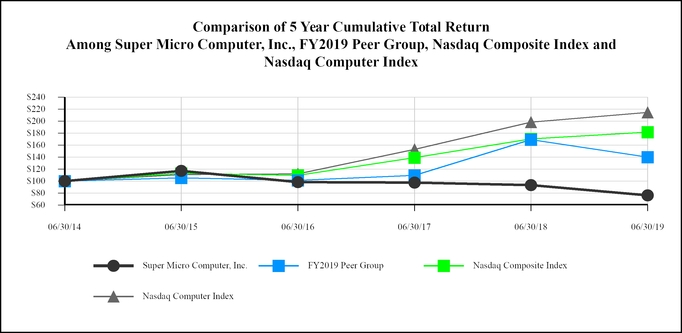
| 6/30/2014 | 6/30/2015 | 6/30/2016 | 6/30/2017 | 6/30/2018 | 6/30/2019 | |||||||||||||
| Super Micro Computer, Inc. | 100.00 | 117.06 | 98.34 | 97.55 | 93.59 | 76.57 | ||||||||||||
| FY2019 Peer Group | 100.00 | 105.68 | 101.44 | 109.63 | 169.32 | 140.32 | ||||||||||||
| Nasdaq Composite Index | 100.00 | 113.13 | 109.86 | 139.30 | 170.37 | 181.62 | ||||||||||||
| Nasdaq Computer Index | 100.00 | 110.81 | 112.37 | 153.16 | 198.30 | 214.60 |
Recent Sales of Unregistered Securities
During fiscal years 2018 and 2019 we granted a consultant restricted stock units covering a total of 26,491 shares of our common stock for services rendered. The restricted stock units were fully vested at the time of grant. The issuances did not involve a public offering of securities and we believe that the transactions were exempt from the registration requirements of the Securities Act pursuant to Section 4(a)(2) thereof and Rule 506 of Regulation D promulgated thereunder.
Issuer Purchases of Equity Securities
None.
Item 6. Selected Financial Data
The following selected consolidated financial data should be read in conjunction with Part I, Item 7, "Management’s Discussion and Analysis of Financial Condition and Results of Operations" and the consolidated financial statements and the notes thereto included in Part II, Item 8, "Financial Statements and Supplementary Data" of this Annual Report to fully understand factors that may affect the comparability of the information presented below. We derived the selected consolidated balance sheet data as of June 30, 2019 and 2018, and the consolidated statement of operations data for the years ended June 30, 2019, 2018 and 2017 from our audited consolidated financial statements and accompanying notes included in this Annual Report. The consolidated balance sheet data as of June 30, 2017, 2016 and 2015, and the consolidated statement of operations data for the years ended June 30, 2016 and 2015 are derived from our audited consolidated financial statements which are not included in this Annual Report. Operating results for any year are not necessarily indicative of results to be expected for any future periods.
| Years Ended June 30, | |||||||||||||||||||
| 2019 | 2018 | 2017 | 2016 | 2015 | |||||||||||||||
| (in thousands, except per share data) | |||||||||||||||||||
| Consolidated Statements of Operations Data: | |||||||||||||||||||
| Net sales | $ | 3,500,360 | $ | 3,360,492 | $ | 2,484,929 | $ | 2,225,022 | $ | 1,954,353 | |||||||||
| Cost of sales | 3,004,838 | 2,930,498 | 2,134,971 | 1,894,521 | 1,647,769 | ||||||||||||||
| Gross profit | 495,522 | 429,994 | 349,958 | 330,501 | 306,584 | ||||||||||||||
| Operating expenses: | |||||||||||||||||||
| Research and development | 179,907 | 165,104 | 143,992 | 124,223 | 101,402 | ||||||||||||||
| Sales and marketing | 77,154 | 71,579 | 66,445 | 58,338 | 47,496 | ||||||||||||||
| General and administrative | 141,228 | 98,597 | 44,646 | 40,449 | 25,040 | ||||||||||||||
| Total operating expenses | 398,289 | 335,280 | 255,083 | 223,010 | 173,938 | ||||||||||||||
| Income from operations | 97,233 | 94,714 | 94,875 | 107,491 | 132,646 | ||||||||||||||
| Other income (expense), net | (1,020 | ) | (773 | ) | (984 | ) | 1,507 | 956 | |||||||||||
| Interest expense | (6,690 | ) | (5,726 | ) | (2,300 | ) | (1,594 | ) | (965 | ) | |||||||||
| Income before income tax provision | 89,523 | 88,215 | 91,591 | 107,404 | 132,637 | ||||||||||||||
| Income tax provision | (14,884 | ) | (38,443 | ) | (24,434 | ) | (35,323 | ) | (40,082 | ) | |||||||||
| Share of loss from equity investee, net of taxes | (2,721 | ) | (3,607 | ) | (303 | ) | — | — | |||||||||||
| Net income | $ | 71,918 | $ | 46,165 | $ | 66,854 | $ | 72,081 | $ | 92,555 | |||||||||
| Net income per common share: | |||||||||||||||||||
| Basic | $ | 1.44 | $ | 0.94 | $ | 1.38 | $ | 1.50 | $ | 1.99 | |||||||||
| Diluted | $ | 1.39 | $ | 0.89 | $ | 1.29 | $ | 1.39 | $ | 1.85 | |||||||||
| Shares used in per share calculation: | |||||||||||||||||||
| Basic | 49,917 | 49,345 | 48,383 | 47,917 | 46,434 | ||||||||||||||
| Diluted | 51,716 | 52,151 | 51,679 | 51,836 | 50,094 | ||||||||||||||
| Stock-based compensation: | |||||||||||||||||||
| Cost of sales | $ | 1,663 | $ | 1,812 | $ | 1,382 | $ | 1,157 | $ | 962 | |||||||||
| Research and development | 12,981 | 13,893 | 12,559 | 10,651 | 9,195 | ||||||||||||||
| Sales and marketing | 1,805 | 1,980 | 2,144 | 1,934 | 1,601 | ||||||||||||||
| General and administrative | 4,735 | 6,971 | 3,580 | 3,188 | 2,678 | ||||||||||||||
| Total stock-based compensation | $ | 21,184 | $ | 24,656 | $ | 19,665 | $ | 16,930 | $ | 14,436 |
| As of June 30, | |||||||||||||||||||
| 2019 | 2018 | 2017 | 2016 | 2015 | |||||||||||||||
| (in thousands) | |||||||||||||||||||
| Consolidated Balance Sheet Data: | |||||||||||||||||||
| Cash and cash equivalents | $ | 248,164 | $ | 115,377 | $ | 110,606 | $ | 178,820 | $ | 92,920 | |||||||||
| Working capital | 815,802 | 719,321 | 588,636 | 544,698 | 438,144 | ||||||||||||||
| Total assets | 1,682,594 | 1,769,505 | 1,515,130 | 1,191,483 | 1,122,031 | ||||||||||||||
| Long-term obligations | 135,449 | 114,296 | 68,754 | 85,200 | 26,062 | ||||||||||||||
| Total stockholders’ equity | 941,176 | 843,652 | 773,846 | 696,653 | 593,585 |
Item 7. Management's Discussion and Analysis of Financial Condition and Results of Operations
The following discussion should be read in conjunction with the consolidated financial statements and related notes which appear elsewhere in this Annual Report. This discussion contains forward-looking statements that involve risks and uncertainties. Our actual results could differ materially from those anticipated in these forward-looking statements as a result of various factors, including those discussed below and elsewhere in this Annual Report, particularly under the heading "Risk Factors."
Nasdaq Delisting of our Common Stock
As a result of the delay in filing our periodic reports with the SEC and failure to hold an annual meeting, we were unable to comply with the Nasdaq listing standards and our common stock was suspended from trading on the Nasdaq Global Select Market effective August 23, 2018 and formally delisted effective March 22, 2019. Following the suspension of trading, our common stock has been quoted on the OTC Market and is currently traded under the symbol “SMCI.” For further information regarding trading in our common stock, refer to Part II, Item 5, “Market for Registrant's Common Equity, Related Stockholder Matters and Issuer Purchases of Equity Securities” in this Annual Report.
Overview
We are a global leader and innovator of high-performance, high-efficiency server and storage technology. We develop and provide end-to-end green computing solutions to the cloud computing, data centers, enterprise, big data, AI, HPC, edge computing and IoT markets. Our solutions range from complete server, storage, modular blade servers, blades and workstations to full racks, networking devices, server management software, server sub-systems and global support and services.
We commenced operations in 1993 and have been profitable every year since inception. For fiscal years 2019, 2018 and 2017, our net income was $71.9 million, $46.2 million and $66.9 million, respectively. In order to increase our sales and profits, we believe that we must continue to develop flexible and application optimized server and storage solutions and be among the first to market with new features and products. We must also continue to expand our software and customer service and support offerings, particularly as we increasingly focus on larger enterprise customers. We measure our financial success based on various indicators, including growth in net sales, gross profit margin and operating margin. Among the key non-financial indicators of our success is our ability to rapidly introduce new products and deliver the latest application-optimized server and storage solutions. In this regard, we work closely with microprocessor and other key component vendors to take advantage of new technologies as they are introduced. Historically, our ability to introduce new products rapidly has allowed us to benefit from technology transitions such as the introduction of new microprocessors and storage technologies, and as a result, we monitor the introduction cycles of Intel Corporation, Advanced Micro Devices, Inc., Nvidia Corporation, Samsung Electronics Company Limited, Micron Technology, Inc. and others carefully. This also impacts our research and development expenditures as we continue to invest more in our current and future product development efforts.
During fiscal years 2018 and 2019, we continued to concentrate our efforts on selling server and storage systems to larger customers such as enterprise and data center customers. As a result of these efforts, sales of server and storage systems represented sequentially greater percentages of our net sales over the course of the two fiscal years, rising from 70.0% of net sales in fiscal year 2017 to 79.3% in fiscal year 2018 and 81.7% in fiscal year 2019. Server and storage systems generally have higher average selling prices and provide an opportunity to sell services. The substantial increase in our net sales from fiscal year 2017 to fiscal year 2018 reflected both this concentration on selling server and storage systems and an increased demand for our products. The further increase in our net sales from fiscal year 2018 to fiscal year 2019, which was less substantial than the prior year’s increase in net sales, reflected our continued concentration on selling server and storage systems, but also reflected a softening demand for our products due to an overall market slowdown in the second half of fiscal year 2019. In addition, adverse publicity associated with false assertions made against our company in a news article published in October 2018 and the unrelated suspension of trading in our common stock on NASDAQ in August 2018 may have been factors contributing to the slower growth in our net sales for fiscal year 2019.
Financial Highlights
The following is a summary of financial highlights of fiscal years 2019 and 2018:
| • | Net sales increased by 4.2% and 35.2% in fiscal years 2019 and 2018, respectively, as compared to fiscal years 2018 and 2017, respectively. |
| • | Gross margin increased to 14.2% in fiscal year 2019 from 12.8% in fiscal year 2018, primarily due to lower prices for key components, a favorable geographic mix with less competitive pricing, and increased service revenues that have higher margins. Gross margin in fiscal year 2018 decreased by 130 basis points from 14.1% in fiscal year 2017 primarily due to higher costs of key components resulting from shortages of memory and SSDs, higher volume of server and storage systems sales configured with these key components and a less favorable geographical mix of sales resulting in a higher cost of sales. |
| • | Operating expenses increased by 18.8% and 31.4% in fiscal years 2019 and 2018, respectively, as compared to fiscal years 2018 and 2017, respectively. The increase in both fiscal years was primarily due to an increase in professional fees incurred to investigate, assess and begin remediating the causes that led to the delay in filing our periodic reports with the SEC and the associated restatement of certain of our previously issued financial statements, as well as an increase in the number of employees to support our growth. |
| • | Net income increased to $71.9 million as compared to $46.2 million in fiscal year 2018, which was primarily due to a reduction in our effective tax rate to 16.6% as compared to 43.6% in fiscal year 2018 and a $1.3 million increase in income before taxes. Net income in fiscal year 2018 decreased by $20.7 million from $66.9 million in fiscal year 2017 primarily due to an increase in our effective tax rate to 43.6% in fiscal year 2018, in part due to the remeasurement of our deferred tax assets under the 2017 Tax Reform Act, as compared to 26.7% in fiscal year 2017. |
| • | Our cash and cash equivalents were $248.2 million, $115.4 million and $110.6 million at the end of fiscal years 2019, 2018, and 2017, respectively. In fiscal year 2019, we generated net cash of $141.8 million, of which $262.6 million was generated from operating activities related to increased net income and improved working capital management while we invested $24.8 million primarily in new manufacturing capacity and used $95.8 million in financing activities primarily to repay outstanding loans. In fiscal year 2018, we generated net cash of $7.6 million, of which $84.3 million was generated from operating activities related to improved working capital management while we invested $25.9 million primarily in new manufacturing capacity and used $50.8 million in financing activities to primarily repay outstanding loans. |
Subsequent Events
For details, see Part II, Item 8, Note 19, “Subsequent Events” in our notes to the consolidated financial statements in this Annual Report.
Critical Accounting Policies
General
Our discussion and analysis of our financial condition and results of operations are based upon our consolidated financi
Showing the first 8K of 140K characters. Open the full section
Item 7A. Quantitative and Qualitative Disclosure About Market Risk
Interest Rate Risk
The primary objectives of our investment activities are to preserve principal, provide liquidity and maximize income without significantly increasing the risk. Some of the securities we invest in are subject to market risk. This means that a change in prevailing interest rates may cause the fair value of the investment to fluctuate. To minimize this risk, we maintain our portfolio of cash equivalents and short-term investments in money market funds and certificates of deposit. Our investment in an auction rate security has been classified as non-current due to the lack of a liquid market for these securities. Since our results of operations are not dependent on investments, the risk associated with fluctuating interest rates is limited to our investment portfolio, and we believe that a 10% change in interest rates would not have a significant impact on our results of operations. As of June 30, 2019, our investments were in money market funds, certificates of deposits and auction rate securities.
We are exposed to changes in interest rates as a result of our borrowings under our term loan and revolving lines of credit. The interest rates for the term loans and the revolving lines of credit ranged from 0.93% to 4.50% at June 30, 2019 and 0.95% to 4.75% at June 30, 2018. Based on the outstanding principal indebtedness of $23.6 million under our credit facilities as of June 30, 2019, we believe that a 10% change in interest rates would not have a significant impact on our results of operations.
Foreign Currency Risk
To date, our international customer and supplier agreements have been denominated primarily in U.S. dollars and accordingly, we have limited exposure to foreign currency exchange rate fluctuations from customer agreements, and do not currently engage in foreign currency hedging transactions. The functional currency of our subsidiaries in the Netherlands and Taiwan is the U.S. dollar. However, certain transactions in these entities are denominated in a currency other than the U.S. dollar, and thus we are subject to foreign currency exchange rate fluctuations associated with re-measurement to U.S. dollars. Such fluctuations have not been significant historically. Foreign exchange gain (loss) for fiscal years 2019, 2018 and 2017 was $0.5 million, $(0.6) million and $(1.3) million, respectively.
Item 8. Financial Statements and Supplementary Data
INDEX TO CONSOLIDATED FINANCIAL STATEMENTS
REPORT OF INDEPENDENT REGISTERED PUBLIC ACCOUNTING FIRM
To the Stockholders and the Board of Directors of Super Micro Computer, Inc.
Opinion on the Financial Statements
We have audited the accompanying consolidated balance sheets of Super Micro Computer, Inc. and subsidiaries (the "Company") as of June 30, 2019 and 2018, the related consolidated statements of operations, comprehensive income, stockholders' equity, and cash flows, for each of the three years in the period ended June 30, 2019, and the related notes (collectively referred to as the "financial statements"). In our opinion, the financial statements present fairly, in all material respects, the financial position of the Company as of June 30, 2019 and 2018, and the results of its operations and its cash flows for each of the three years in the period ended June 30, 2019, in conformity with accounting principles generally accepted in the United States of America.
We have also audited, in accordance with the standards of the Public Company Accounting Oversight Board (United States) (PCAOB), the Company's internal control over financial reporting as of June 30, 2019, based on criteria established in Internal Control - Integrated Framework (2013) issued by the Committee of Sponsoring Organizations of the Treadway Commission (COSO) and our report dated December 19, 2019, expressed an adverse opinion on the Company’s internal control over financial reporting because of material weaknesses.
Change in Accounting Principle
As discussed in Note 1 to the financial statements, effective July 1, 2018, the Company has changed its method of accounting for revenue due to adoption of Accounting Standards Codification Topic 606 (ASU No. 2014-09), Revenue from Contracts with Customers, and all subsequent amendments (collectively, “ASC 606”). The Company adopted ASC 606 using the modified retrospective approach.
Basis for Opinion
These financial statements are the responsibility of the Company's management. Our responsibility is to express an opinion on the Company's financial statements based on our audits. We are a public accounting firm registered with the PCAOB and are required to be independent with respect to the Company in accordance with the U.S. federal securities laws and the applicable rules and regulations of the Securities and Exchange Commission and the PCAOB.
We conducted our audits in accordance with the standards of the PCAOB. Those standards require that we plan and perform the audit to obtain reasonable assurance about whether the financial statements are free of material misstatement, whether due to error or fraud. Our audits included performing procedures to assess the risks of material misstatement of the financial statements, whether due to error or fraud, and performing procedures that respond to those risks. Such procedures included examining, on a test basis, evidence regarding the amounts and disclosures in the financial statements. Our audits also included evaluating the accounting principles used and significant estimates made by management, as well as evaluating the overall presentation of the financial statements. We believe that our audits provide a reasonable basis for our opinion.
Critical Audit Matters
The critical audit matters communicated below are matters arising from the current-period audit of the financial statements that were communicated or required to be communicated to the audit committee and that (1) relate to accounts or disclosures that are material to the financial statements and (2) involved our especially challenging, subjective, or complex judgments. The communication of critical audit matters does not alter in any way our opinion on the financial statements, taken as a whole, and we are not, by communicating the critical audit matters below, providing separate opinions on the critical audit matters or on the accounts or disclosures to which they relate.
Related Party Transactions - Variable Interest Entity Primary Beneficiary Determination - Refer to Note 1 to the financial statements
Critical Audit Matter Description
The Company has a variety of business relationships defined by various agreements with Ablecom Technology, Inc. (“Ablecom”) and its affiliate, Compuware Technology, Inc. ("Compuware"). Ablecom is one of the Company’s major contract manufacturers; Compuware is both a distributor of the Company’s products and a contract manufacturer for the Company.
Purchases from Ablecom and Compuware were $144.5 million and $139.6 million, respectively, for the fiscal year ended June 30, 2019. Net sales to Compuware as a distributor were $17.7 million for the fiscal year ended June 30, 2019.
The Company concluded that Ablecom and Compuware are variable interest entities (VIEs) and that it is not the primary beneficiary as it does not have the power to direct the activities that are most significant to Ablecom and Compuware. Therefore, the Company does not consolidate Ablecom and Compuware. The Company considered its explicit arrangements with Ablecom and Compuware, including its supplier arrangements, and as a result of the substantial related party relationships between the Company, Ablecom and Compuware, the Company also considered whether any implicit arrangements exist that would cause the Company to protect those related parties’ interests from suffering losses. The Company determined that no material implicit arrangements exist with Ablecom, Compuware, or their shareholders.
We identified management’s conclusion that it is not the primary beneficiary as a critical audit matter because of the judgments necessary for management to determine whether any explicit and implicit arrangements exist that would cause the Company to protect those related parties’ interest from absorbing losses, as well as the material weaknesses identified by the Company in all five components of Internal Control - Integrated Framework (2013) issued by COSO. This required extensive audit effort due to the complexity and variety of related party relationships with Ablecom and Compuware and required a high degree of auditor judgment when performing audit procedures to audit the Company’s conclusion that it is not the primary beneficiary.
How the Critical Audit Matter Was Addressed in the Audit
Our audit procedures related to management’s conclusion that it is not the primary beneficiary included the following, among others:
| • | We evaluated and tested whether the arrangements are accurately considered and that arrangements have been included in the consideration by comparing those related parties we had identified during our audit procedures for proper inclusion in the Company’s evaluation and performed inspection of source documents on a sample basis. |
| • | We tested management’s assertion that it does not have the power to direct the activities that are most significant to, or obligation to absorb the losses of, Ablecom and Compuware by reviewing al |
Showing the first 8K of 180K characters. Open the full section
Item 9. Changes in and Disagreements with Accountants on Accounting and Financial Disclosure
None.
Item 9A. Controls and Procedures
Background
Prior to the issuance of the Company’s consolidated financial statements for the fiscal year ended June 30, 2017, the audit committee (the “Audit Committee”) of the Company’s Board of Directors (the “Board”) investigated and assessed certain accounting and internal control matters at the Company, principally focused on certain revenue recognition matters. Concurrently, new members of the Company’s management, under the direction of the Audit Committee, performed a thorough analysis of the Company’s historical financial statements, accounting policies and financial reporting, as well as the Company’s disclosure controls and procedures and its internal control over financial reporting. Management concluded that our disclosure controls and procedures were not effective as of June 30, 2017 because of certain material weaknesses in our internal control over financial reporting, as described in our 2017 10-K.
The Company is committed to remediating these material weaknesses and strengthening its internal control over financial reporting, and our management has developed a comprehensive plan for this remediation and strengthening. In consultation with the Audit Committee, our management began developing this plan during the comprehensive analysis described above and continued developing it after we filed the 2017 10-K. We began to implement certain elements of the plan during fiscal years 2018 and 2019, and have continued to implement the plan during the current fiscal year. Among other actions, our actions to date have included both strengthening existing individual controls and designing and implementing new individual controls. However, before our management can conclude that these new and strengthened controls are sufficient to remediate the material weaknesses, the controls must operate effectively for a sufficient period of time. As of June 30, 2019,
sufficient time had not elapsed since we implemented the new and strengthened controls for our management to determine that they operated effectively as of that date. For this reason, although we have taken many actions to strengthen our internal control over financial reporting and the Company’s disclosure controls and procedures, our management did not conclude that any of the material weaknesses identified in the 2017 10-K had been remediated as of June 30, 2019. The actions we have taken to address these material weaknesses are described below under “Remediation Plan and Status.”
In connection with the preparation and filing of this Annual Report on Form 10-K, we have conducted the requisite evaluations of the effectiveness of our disclosure controls and procedures and of our internal control over financial reporting, both as of June 30, 2019.
Evaluation of Disclosure Controls and Procedures
Under the supervision, and with the participation, of our management, including our Chief Executive Officer (“CEO”) and Chief Financial Officer (“CFO”), we evaluated the effectiveness of our disclosure controls and procedures as defined in Rules 13a-15(e) and 15d-15(e) under the Securities Exchange Act of 1934, as amended (the “Exchange Act”), as of June 30, 2019. Based on this evaluation of our disclosure controls and procedures, our CEO and CFO have concluded that our disclosure controls and procedures were not effective as of June 30, 2019 because of certain material weaknesses in our internal control over financial reporting, as further described below.
Notwithstanding the conclusion by our CEO and CFO that our disclosure controls and procedures as of June 30, 2019 were not effective, and notwithstanding the material weaknesses in our internal control over financial reporting described below, management believes that the consolidated financial statements and related financial information included in this Annual Report fairly present in all material respects our financial condition, results of operations and cash flows as of the dates presented, and for the periods ended on such dates, in conformity with accounting principles generally accepted in the United States of America (“U.S. GAAP”).
Management’s Report on Internal Control Over Financial Reporting
Management is responsible for establishing and maintaining adequate internal control over financial reporting, as such term is defined in Exchange Act Rules 13a-15(f) and 15d-15(f).
Internal control over financial reporting is a process designed by, or under the supervision of, our CEO and CFO to provide reasonable assurance regarding the reliability of financial reporting and the preparation of our consolidated financial statements for external purposes in accordance with U.S. GAAP. Management’s internal control over financial reporting includes those policies and procedures that (i) pertain to the maintenance of records that, in reasonable detail, accurately and fairly reflect the transactions and dispositions of our assets, (ii) provide reasonable assurance that transactions are appropriately recorded to permit preparation of financial statements in accordance with U.S. GAAP and that our receipts and expenditures are made only in accordance with authorizations of management, acting under authority delegated to them by the Board, and (iii) provide reasonable assurance regarding prevention or timely detection of unauthorized acquisition, use or disposition of our assets that could have a material effect on our financial statements.
Management, including our CEO and CFO, assessed our internal control over financial reporting as of June 30, 2019. In making this assessment, management used the criteria set forth by the Committee of Sponsoring Organizations of the Treadway Commission in its Internal Control - Integrated Framework (2013) (the “COSO Framework”). Based on this assessment, management has determined that we did not maintain effective internal control over financial reporting as of June 30, 2019 because of the material weaknesses described below.
A material weakness in internal controls is a deficiency, or a combination of deficiencies, in internal control over financial reporting, such that there is a reasonable possibility that a material misstatement of our annual or interim financial statements will not be prevented or detected on a timely basis. Because of its inherent limitations, even appropriate internal control over financial reporting may not prevent or detect misstatements.
In connection with management’s assessment of the Company’s internal control over financial reporting described above, management has identified the deficiencies described below that constitute material weaknesses in our internal control over financial reporting as of June 30, 2019.
Control Environment
In our Annual Report on Form 10-K for the year ended June 30, 2017 we disclosed the identification of deficiencies in the control environment component of the COSO Framework that constituted material weaknesses, either individually or in the aggregate. These deficiencies related to all the principles associated with the control environment component of the COSO Framework.
We are committed to remediating the underlying cause of these material weaknesses and are taking actions to enhance our internal control over financial reporting relating to the material weaknesses. However, we are still in the process of implementing our comprehensive remediation plan and we have not had sufficient time to test the effectiveness of the new and strengthened controls as of June 30, 2019. Consequently, deficiencies that constitute material weaknesses, either individually or in the aggregate, in the control environment and other components remain.
The material weaknesses noted above cannot be considered remediated until each control has been appropriately designed, has operated for a sufficient period of time, and management has concluded, through testing, that the control is operating effectively. Due to the interdependencies between the COSO Framework components, the material weakness in our control environment contributed to other material weaknesses within our system of internal control over financial reporting.
Risk Assessment
We identified deficiencies in the risk assessment component of the COSO Framework that aggregated to a material weakness. These deficiencies related to the principles associated with the risk assessment component of the COSO Framework, specifically principles within the component related to: (i) identifying, assessing, and communicating appropriate control objectives, (ii) identifying and analyzing risks to achieve these objectives, (iii) contemplating fraud risks, and (iv) identifying and assessing changes in the business that could impact the system of internal controls. As of June 30, 2019, our risk assessment component framework had not yet operated for a sufficient period of time for us to determine its effectiveness.
Control Activities
We identified deficiencies in the control activities component of the COSO Framework that aggregated to a material weakness. These deficiencies related to principles associated with the control activities component of the COSO Framework, specifically principles within the component related to (i) selecting and developing control activities that mitigate risks, (ii) selecting and developing general controls over technology and (iii) deploying control activities through policies that establish what is expected and procedures that put policies into action. We did not design or operate certain control activities to sufficiently respond to potential risks of material misstatement in the area of revenue recognition. We did not effectively select and develop certain information technology (“IT”) general controls and we also had control deficiencies at both the IT administrator and end-user levels across multiple applications relevant to financial reporting. We also had deficiencies related to segregation of duties. Deficiencies in control activities contributed to the potential for there to have been material accounting errors in substantially all financial statements account balances and disclosures.
Information and Communication
We identified deficiencies in the information and communication component of the COSO Framework that aggregated to a material weakness. These deficiencies related to principles associated with the information and communications component of the COSO Framework, specifically principles within the component related to (i) generating and using relevant quality information and (ii) internally communicating information, including objectives and responsibilities for internal control, necessary to support the functioning of internal control. We rely on manual business processes to compensate for a lack of extensive integration in our information systems. We also rely heavily on each of our various functions, such as sales, operations, accounting, legal and management, to communicate to the other functions information that the entire organization needs to operate an effective internal control environment. In certain areas, our control activity deficiencies resulted from insufficient communication of information among our internal functions.
Monitoring of Controls
We identified deficiencies in the monitoring of controls component of the COSO Framework that aggregated to a material weakness. There were deficiencies related to a principle associated with the monitoring of controls component of the COSO Framework, specifically selecting, developing and performing ongoing and/or separate evaluations. We lacked controls (i) to determine whether components of internal control were present and functioning and (ii) to detect incorrect accounting practices.
The material weaknesses noted above contributed to the following additional material weaknesses:
Revenue Recognition Accounting
We identified deficiencies in revenue recognition accounting controls that resulted in material weaknesses, either individually or in the aggregate, as we did not appropriately design, or effectively operate, internal controls over certain aspects of accurate recording, presentation, and disclosure of revenue and related costs. The following were contributing factors to the material weaknesses in revenue recognition accounting:
| • | Our internal controls did not consistently identify and properly account for certain key non-standard contract or arrangement terms for sales transactions. |
| • | Our internal controls failed to consistently identify transactions where the terms of the sales arrangements with our customers were not properly documented in a form that fully reflected the final understanding between the parties as to the specific nature and terms of the agreed-upon transaction. |
| • | Our internal controls failed to consistently identify, resolve, document, and allow for proper accounting where there were inconsistencies among the various documents underlying our sales transactions, and we did not always communicate the existence or resolution of those inconsistencies to our accounting organization to enable the proper recognition of revenue. |
| • | Internal controls intended to establish a consistent approach for reviewing pricing and establishing supportable estimates of standalone selling price in allocating revenue between multiple performance obligations have not been implemented for a sufficient period of time to demonstrate the controls were operating effectively. |
Information Technology General Controls
We identified deficiencies related to IT general controls that represented a material weakness, either individually or in the aggregate. The following were contributing factors to the material weakness in information technology and general controls:
| • | We have a decentralized approach to developing IT policies and practices and to monitoring our IT controls. As a result, our internal procedures for granting and monitoring employee access, and managing changes to various applications and infrastructure layers relevant to our financial reporting are not consistent across those applications and infrastructure layers. In addition, some of our internally-developed applications relevant to financial reporting lack system tracking capabilities to monitor access changes or application changes. We have also authorized certain users with broad access, both as a user and as an administrator, to all parts of our primary accounting system without adequate monitoring or recording of how they used that access. As a result of these factors, we have material weaknesses related to access controls and change management. The fact that we have material weaknesses related to access controls and change management means that it is possible that our business process controls that depend on the affected information systems, or that depend on data or financial reports generated from the affected information systems, could be adversely affected due to the access control and change management issues, although we have identified no instances of any adverse effect due to these deficiencies. |
The effectiveness of our internal control over financial reporting as of June 30, 2019 has been audited by Deloitte & Touche LLP, our independent registered public accounting firm, as stated in its report that is included herein.
Remediation Plan and Status
As previously disclosed, starting in the second half of fiscal year 2018 and throughout fiscal year 2019, we began to design and implement processes and procedures to remediate material weaknesses identified as of June 30, 2017.
Our management is committed to remediating identified control deficiencies (including both those that rise to the level of a material weakness and those that do not), fostering continuous improvement in our internal controls and enhancing our overall internal controls environment. Our management believes that these remediation actions, along with additional actions, when fully implemented, will remediate the material weaknesses we have identified and strengthen our internal control over financial reporting. We are committed to improving our internal control processes and intend to continue to review and improve our financial reporting controls and procedures. As we continue to evaluate and work to improve our internal control over financial reporting, we may take additional or different measures to address control deficiencies with the overall objective to
design and operate internal controls that mitigate identified risks and enable an effective system of internal control over external financial reporting.
We have taken the following actions, among others, to address previously disclosed material weaknesses:
| • | Restructured our sales organization, which resulted in the resignations of the Senior Vice President of International Sales, the Senior Vice President of Worldwide Sales, the Vice President, Strategic Accounts, the Vice President, Strategic Sales, the Vice President, Business Development and certain other sales personnel. |
| • | Appointed experienced professionals to key accounting and finance and compliance leadership positions, including the appointments of a new Chief Financial Officer and a new Corporate Controller in January 2018, and the creation of, and appointments to, two newly established roles of Chief Compliance Officer and Vice President of Internal Audit in May 2018 and August 2018, respectively. |
| • | Reviewed and amended our Code of Conduct to align with the organizational changes described above and to strengthen certain provisions regarding compliance and reporting violations of the Code of Conduct. |
| • | Adopted an Internal Audit Charter setting forth the responsibilities of the internal audit function and establishing that the Vice President of Internal Audit reports directly to the Audit Committee and that the Audit Committee has authority to provide adequate funding for this function. |
| • | Changed our organizational structure to narrow the scope of responsibilities of certain of our senior executives and to revise various reporting relationships, which included the appointment of a new Senior Vice President of Worldwide Sales, and a new Senior Vice President of Operations. |
| • | Conducted training in the following areas: |
| – | Revenue recognition training for our global sales force, various operations personnel, and certain senior executives, including our CEO, which included detailed examples of acceptable and unacceptable sales practices, |
| – | Reviewed with our senior management team our amended Code of Conduct, |
| – | Reviewed with our CEO enhanced processes for periodic evaluations by the CEO and the CFO of the effectiveness of our disclosure controls and procedures, and the periodic assessments by the CEO and the CFO of the effectiveness of our internal control over financial reporting, and other compliance matters, and |
| – | Shipping and cut-off training for accounting and operations personnel that included new requirements for quarter-end procedures. |
| • | Enhanced the sales sub-certification document that supports our CEO’s and CFO’s financial statement certifications and expanded the sub-certification participation population to the global sales force. |
To date, we have taken the following actions related to material weaknesses that, as of June 30, 2019, had not yet been fully implemented or had not been in place for a sufficient period of time to demonstrate that they were having their desired effect:
| • | Upgraded our accounting department to include the new roles of Senior Director of Tax, Financial Audit Director and Information Technology Audit Director, as well as replaced certain of our accounting personnel with more experienced individuals, including rebuilding and expanding our revenue recognition team. |
| • | Enhanced the financial statement risk assessment and fraud risk assessment which are a foundational element of our Sarbanes-Oxley compliance program. |
| • | Implemented a sequence of meetings around our processes to prepare and report on the consolidated financial statements that promotes cross-functional communication and broadens the accountability for internal controls. |
| • | Implemented new revenue recognition processes and controls to: |
| – | Effect an appropriate cutoff of shipping activity |
| – | Increase the alignment of invoicing with physical shipment |
| – | Identify and account for transactions that may not have met revenue recognition criteria |
| – | Appropriately account for the allocation of revenue among performance obligations |
| • | Assigned accountability for certain internal controls to our Compliance Department, such as our organizational-wide quarterly sales certification process. |
| • | Conducted a process by which employees re-certified their understanding of, and compliance with, the Company’s Code of Conduct. |
| • | Adopted a charter for our compliance program to promote an organizational culture that encourages the highest standards of ethical business conduct and compliance with the law, exercises appropriate due diligence to prevent and detect unlawful conduct, and protects the Company’s reputation. |
Our management believes that meaningful progress has been made on the remaining remediation efforts. Management regards successful completion of our remaining remediation actions as an important priority. Some of the more significant remaining remediation activities include:
| • | Developing and implementing an ongoing compliance training program regarding significant accounting and financial reporting matters, as well as broad compliance matters, for accounting, financial reporting, sales and operations personnel, as well as for our CEO, our other corporate executives and the Board. |
| • | Integrating the responsibility for internal controls across business functions to assign accountability for internal controls beyond the accounting and finance team. |
| • | Increasing standardization and automation within accounting processes to improve the reliability of information used by existing accounting personnel. |
| • | Implementing a governance committee for our Sarbanes-Oxley compliance program and assigning individual accountability for internal controls. |
| • | Redesigning and implementing necessary changes to the existing system of internal controls in the context of the revised and more comprehensive risk assessment. |
| • | Updating selected policies and assigning accountable policy owners related to revenue recognition. |
| • | Reevaluating the boundary applications that interface with our primary accounting and reporting application and redesigning logical access and program change controls to enhance the reliability of information used to conduct other internal controls. |
| • | Implementing and/or enhancing IT general controls and segregation of duties controls: |
| – | Monitoring instances in which individuals are granted broad access |
| – | Strengthening provisioning of privileged access roles |
| – | Developing change management capabilities in certain boundary applications and implementing new change management controls |
| • | Identifying and properly accounting for non-standard terms, including increased information sharing between Sales and other departments on sales transactions |
| • | Identifying and resolving instances in which customer contracts and purchase orders have conflicting terms, including the new processes to ensure customer master data is complete, accurate and updated as needed on a timely basis |
| • | Enhancing procedures to ensure contracts create enforceable rights and obligations, including standardizing the method by which we accept customer purchase orders. |
| • | Developing a system of daily reports related to revenue recognition that enable ongoing monitoring for non-standard transactions and the appropriate allocation of revenue among performance obligations. |
| • | Testing of sufficient instances of the performance of controls to determine operational effectiveness. |
Changes in Internal Control Over Financial Reporting
Other than the ongoing remediation efforts described above, there were no changes in our internal control over financial reporting identified in connection with the evaluation required by Rule 13a-15(d) and 15d-15(d) of the Exchange Act that occurred during the three months ended June 30, 2019 that have materially affected, or are reasonably likely to materially affect, our internal control over financial reporting.
REPORT OF INDEPENDENT REGISTERED PUBLIC ACCOUNTING FIRM
To the shareholders and the Board of Directors of Super Micro Computer, Inc.
Opinion on Internal Control over Financial Reporting
We have audited the internal control over financial reporting of Super Micro Computer, Inc. and subsidiaries (the “Company”) as of June 30, 2019, based on criteria established in Internal Control - Integrated Framework (2013) issued by the Committee of Sponsoring Organizations of the Treadway Commission (COSO). In our opinion, because of the effect of the material weaknesses identified below on the achievement of the objectives of the control criteria, the Company has not maintained effective internal control over financial reporting as of June 30, 2019, based on criteria established in Internal Control - Integrated Framework (2013) issued by COSO.
We have also audited, in accordance with the standards of the Public Company Accounting Oversight Board (United States) (PCAOB), the consolidated financial statements as of and for the year June 30, 2019, of the Company and our report dated December 19, 2019, expressed an unqualified opinion on those financial statements and included an explanatory paragraph regarding the Company’s change in method of accounting for revenue in fiscal year 2019 due to the adoption of Accounting Standards Codification 606, Revenue from Contracts with Customers.
Basis for Opinion
The Company’s management is responsible for maintaining effective internal control over financial reporting and for its assessment of the effectiveness of internal control over financial reporting, included in the accompanying Management’s Report on Internal Control Over Financial Reporting. Our responsibility is to express an opinion on the Company’s internal control over financial reporting based on our audit. We are a public accounting firm registered with the PCAOB and are required to be independent with respect to the Company in accordance with the U.S. federal securities laws and the applicable rules and regulations of the Securities and Exchange Commission and the PCAOB.
We conducted our audit in accordance with the standards of the PCAOB. Those standards require that we plan and perform the audit to obtain reasonable assurance about whether effective internal control over financial reporting was maintained in all material respects. Our audit included obtaining an understanding of internal control over financial reporting, assessing the risk that a material weakness exists, testing and evaluating the design and operating effectiveness of internal control based on the assessed risk, and performing such other procedures as we considered necessary in the circumstances. We believe that our audit provides a reasonable basis for our opinion.
Definition and Limitations of Internal Control over Financial Reporting
A company’s internal control over financial reporting is a process designed to provide reasonable assurance regarding the reliability of financial reporting and the preparation of financial statements for external purposes in accordance with generally accepted accounting principles. A company’s internal control over financial reporting includes those policies and procedures that (1) pertain to the maintenance of records that, in reasonable detail, accurately and fairly reflect the transactions and dispositions of the assets of the company; (2) provide reasonable assurance that transactions are recorded as necessary to permit preparation of financial statements in accordance with generally accepted accounting principles, and that receipts and expenditures of the company are being made only in accordance with authorizations of management and directors of the company; and (3) provide reasonable assurance regarding prevention or timely detection of unauthorized acquisition, use, or disposition of the company’s assets that could have a material effect on the financial statements.
Because of its inherent limitations, internal control over financial reporting may not prevent or detect misstatements. Also, projections of any evaluation of effectiveness to future periods are subject to the risk that controls may become inadequate because of changes in conditions, or that the degree of compliance with the policies or procedures may deteriorate.
Material Weaknesses
A material weakness is a deficiency, or a combination of deficiencies, in internal control over financial reporting, such that there is a reasonable possibility that a material misstatement of the company’s annual or interim financial statements will not be prevented or detected on a timely basis. The following material weaknesses have been identified and included in management's assessment:
Control Environment
The Company has identified deficiencies in the control environment component of the COSO Framework that constituted material weaknesses, either individually or in the aggregate. These deficiencies related to all the principles associated with the control environment component of the COSO Framework. The Company is still in the process of implementing its comprehensive remediation plan and has not had sufficient time to test the effectiveness of certain remediation actions as of June 30, 2019. Consequently, deficiencies that constitute material weaknesses, either individually or in the aggregate, in the control environment and other components remain.
Due to the interdependencies between the COSO Framework components, the material weakness in the control environment contributed to other material weaknesses within the Company’s system of internal control over financial reporting.
Risk Assessment
The Company identified deficiencies in the risk assessment component of the COSO Framework that aggregated to a material weakness. These deficiencies related to the principles associated with the risk assessment component of the COSO Framework, specifically principles within the component related to: (i) identifying, assessing, and communicating appropriate control objectives, (ii) identifying and analyzing risks to achieve these objectives, (iii) contemplating fraud risks, and (iv) identifying and assessing changes in the business that could impact the system of internal controls. As of June 30, 2019, the Company’s risk assessment component framework had not yet operated for a sufficient period of time to determine its effectiveness.
Control Activities
The Company identified deficiencies in the control activities component of the COSO Framework that aggregated to a material weakness. These deficiencies related to principles associated with the control activities component of the COSO Framework, specifically principles within the component related to (i) selecting and developing control activities that mitigate risks, (ii) selecting and developing general controls over technology and (iii) deploying control activities through policies that establish what is expected and procedures that put policies into action. The Company did not design or operate certain control activities to sufficiently respond to potential risks of material misstatement in the area of revenue recognition. The Company did not effectively select and develop certain information technology (“IT”) general controls and also had control deficiencies at both the IT administrator and end-user levels across multiple applications relevant to financial reporting. The Company also had deficiencies related to segregation of duties. Deficiencies in control activities contributed to the potential for there to have been material accounting errors in substantially all financial statements account balances and disclosures.
Information and Communication
The Company identified deficiencies in the information and communication component of the COSO Framework that aggregated to a material weakness. These deficiencies related to principles associated with the information and communications component of the COSO Framework, specifically principles within the component related to (i) generating and using relevant quality information and (ii) internally communicating information, including objectives and responsibilities for internal control, necessary to support the functioning of internal control. The Company relies on manual business processes to compensate for a lack of extensive integration in their information systems. The Company also relies heavily on each of the various functions, such as sales, operations, accounting, legal and management, to communicate to the other functions information that the entire organization needs to operate an effective internal control environment. In certain areas, control activity deficiencies resulted from insufficient communication of information among internal functions.
Monitoring of Controls
The Company identified deficiencies in the monitoring of controls component of the COSO Framework that aggregated to a material weakness. There were deficiencies related to a principle associated with the monitoring of controls component of the COSO Framework, specifically selecting, developing and performing ongoing and/or separate evaluations. The Company lacked controls (i) to determine whether components of internal control were present and functioning and (ii) to detect incorrect accounting practices.
The material weaknesses noted above contributed to the following additional material weaknesses:
Revenue Recognition Accounting
The Company identified deficiencies in revenue recognition accounting controls that resulted in material weaknesses, either individually or in the aggregate, as the Company did not appropriately design, or effectively operate, internal controls
over certain aspects of accurate recording, presentation, and disclosure of revenue and related costs. The following were contributing factors to the material weaknesses in revenue recognition accounting:
| • | Internal controls did not consistently identify and properly account for certain key non-standard contract or arrangement terms for sales transactions. |
| • | Internal controls failed to consistently identify transactions where the terms of the sales arrangements with customers were not properly documented in a form that fully reflected the final understanding between the parties as to the specific nature and terms of the agreed-upon transaction. |
| • | Internal controls failed to consistently identify, resolve, document, and allow for proper accounting where there were inconsistencies among the various documents underlying sales transactions, and the Company did not always communicate the existence or resolution of those inconsistencies to the accounting organization to enable the proper recognition of revenue. |
| • | Internal controls intended to establish a consistent approach for reviewing pricing and establishing supportable estimates of standalone selling price in allocating revenue between multiple performance obligations have not been implemented for a sufficient period of time to demonstrate the controls were operating effectively. |
Information Technology General Controls
The Company identified deficiencies related to IT general controls that represented a material weakness, either individually or in the aggregate. The following were contributing factors to the material weakness in information technology and general controls:
| • | The Company has a decentralized approach to developing IT policies and practices and to monitoring our IT controls. As a result, the Company’s internal procedures for granting and monitoring employee access and managing changes to various applications and infrastructure layers relevant to financial reporting are not consistent across those applications and infrastructure layers. In addition, some of the Company’s internally-developed applications relevant to financial reporting lack system tracking capabilities to monitor access changes or application changes. The Company has also authorized certain users with broad access, both as a user and as an administrator, to all parts of the primary accounting system without adequate monitoring or recording of how they used that access. As a result of these factors, the Company has material weaknesses related to access controls and monitoring for changes to applications. The fact that the Company had material weaknesses related to access controls and change management means that it is possible that business process controls that depend on the affected information systems, or that depend on data or financial reports generated from affected information systems, could be adversely affected due to the access control and change management issues, although the Company has identified no instances of any adverse effect due to these deficiencies. |
These material weaknesses were considered in determining the nature, timing, and extent of audit tests applied in our audit of the consolidated financial statements as of and for the year ended June 30, 2019, of the Company, and this report does not affect our report on such financial statements.
/s/ Deloitte & Touche LLP
San Jose, California
December 19, 2019
Item 9B. Other Information
None.
PART III
Item 10. Directors, Executive Officers, and Corporate Governance
Executive Officers and Directors
The following table sets forth information regarding our current directors and executive officers and their ages as of November 30, 2019:
| Name | Age | Position(s) | ||
| Charles Liang | 62 | President, Chief Executive Officer and Chairman of the Board | ||
| Kevin Bauer | 59 | Senior Vice President, Chief Financial Officer | ||
| Alex Hsu | 71 | Chief Operating Officer | ||
| Don Clegg | 60 | Senior Vice President of Worldwide Sales | ||
| George Kao | 59 | Senior Vice President of Operations | ||
| David Weigand | 61 | Senior Vice President, Chief Compliance Officer | ||
| Sara Liu | 58 | Co-Founder, Senior Vice President and Director | ||
| Daniel W. Fairfax (1)(4) | 64 | Director | ||
| Michael S. McAndrews (1)(4) | 66 | Director | ||
| Hwei-Ming (Fred) Tsai (1)(2)(3)(4) | 64 | Director | ||
| Saria Tseng (2)(3)(4) | 49 | Director | ||
| Sherman Tuan (2)(3)(4) | 66 | Director | ||
| Tally Liu (1)(4) | 68 | Director |
(1)Member of the Audit Committee
(2)Member of the Compensation Committee
(3)Member of the Nominating and Corporate Governance Committee
(4)Determined by the Board of Directors to be “independent”
Executive Officers and Management Directors
Charles Liang founded Super Micro and has served as our President, Chief Executive Officer and Chairman of the Board since our inception in September 1993. Mr. Liang has been developing server and storage system architectures and technologies for the past two decades. From July 1991 to August 1993, Mr. Liang was President and Chief Design Engineer of Micro Center Computer Inc., a high-end motherboard design and manufacturing company. From January 1988 to April 1991, Mr. Liang was Senior Design Engineer and Project Leader for Chips & Technologies, Inc., a chipset technology company, and Suntek Information International Group, a system and software development company. Mr. Liang has been granted many server technology patents. Mr. Liang holds an M.S. in Electrical Engineering from the University of Texas at Arlington and a B.S. in Electrical Engineering from National Taiwan University of Science & Technology in Taiwan. Our Nominating and Corporate Governance Committee (“Governance Committee”) concluded that Mr. Liang should serve on the Board based on his skills, experience and qualifications in managing technology businesses, his technical expertise, and his long familiarity with our company’s business.
Kevin Bauer has served as our Senior Vice President, Chief Financial Officer since January 2018 and previously served as our Senior Vice President, Corporate Development and Strategy beginning January 2017. Prior to his employment with our company, Mr. Bauer was the Senior Vice President and Chief Financial Officer of Pericom Semiconductor Corporation, a semiconductor company, from February 2014 until its sale to Diodes, Incorporated in November 2015 and, thereafter, assisted Diodes with the integration of Pericom until November 2016. Prior to that he was Chief Financial Officer of Exar Corporation, a semiconductor manufacturer, from June 2009 through December 2012, Corporate Controller from August 2004 to June 2009 and Operations Controller from February 2001 to August 2004. Previously, Mr. Bauer was Operations Controller at WaferTech LLC (a subsidiary of Taiwan Semiconductor Manufacturing Company Limited) from July 1997 to February 2001. Prior to WaferTech, he was at VLSI Technology for ten years where he held a variety of increasingly more senior finance roles culminating in his position as Director and Group Controller. Mr. Bauer received an M.B.A. from Santa Clara University and a B.S. in Business Administration from California Lutheran University.
Alex Hsu serves as our Chief Operating Officer. Mr. Hsu has served in various positions with the Company since October 2003, including as the Chairman of Supermicro Taiwan since February 2018, Sr. Chief Executive of Strategic Business since August 2009, Executive Director of Supermicro Technology (Beijing) Co. Ltd. since August 2009, Chief Sales and Marketing Officer from July 2006 to August 2009, Senior Vice President of Sales from October 2004 to July 2006 and President of European Offices and Vice President of Operations (USA) from October 2003 to October 2004. From January 2002 to September 2003, Mr. Hsu was President and Chief Operating Officer of Bizlink Group, an IT solutions company. From January 2001 to January 2002, he was a private investor and consultant working with startup companies in Silicon Valley. From August 1999 to December 2000, he was President and Chief Operating Officer at Oplink Communications, Inc., a networking solutions company. Mr. Hsu has over 40 years of experience in the IT industry and served in various managerial and executive positions at Philips, Acer, Hewlett-Packard and Umax group. Mr. Hsu holds an M.B.A. and a B.S. in Electrical Engineering from National Chao-Tung University in Taiwan.
Don Clegg serves as our Senior Vice President of Worldwide Sales. He previously served as our Vice President of Marketing and Worldwide Business Development. Mr. Clegg has been an employee since April 2006 and has held various senior sales and marketing roles with the Company during that time. Mr. Clegg started his career as a Design Engineer and evolved from Engineer to Vice President of Sales and Marketing working at several established and startup Silicon Valley system and semiconductor companies. Mr. Clegg graduated with high honors from Brigham Young University, where he earned a B.S. in Electrical Engineering.
George Kao serves as our Senior Vice President of Operations and previously served as our Vice President of Operations. Mr. Kao joined the Company in October 2016. Mr. Kao was Vice President of Operations of Pericom Semiconductor Corp. from October 2006 to September 2016. Mr. Kao served as a Chief Operating Officer of Orient Semiconductor Electronics Philippines, Inc., a subsidiary of Orient Semiconductor Electronics Ltd., from July 2003 to March 2006. Mr. Kao joined Orient Semiconductor Electronics Philippines, Inc. from Santa Clara-based Foveon after a 20-year career in technology in the United States that began at National Semiconductor. Mr. Kao holds a B.S. in Electrical Engineering from California State Polytechnic University in San Luis Obispo.
David Weigand has served as our Senior Vice President, Chief Compliance Officer since May 2018. Prior to his employment with our company, Mr. Weigand was a Vice President at Hewlett Packard Enterprise (HPE) from November 2016 until April 2018 and served as Vice President, Tax at Silicon Graphics International, Inc., from September 2013 until its acquisition by HPE in November 2016. Prior to that he was Vice President, Chief Financial Officer of Renesas Electronics America, a semiconductor company formed by the merger of the semiconductor businesses of NEC Corporation, Hitachi and Mitsubishi Electric from October 2010 until April 2013, and Vice President, Controller of NEC Electronics America from October 2004 until September 2010. Mr. Weigand holds a M.S. degree in Taxation from the University of Hartford and a B.S. degree in Accounting from San Jose State University and is a Certified Public Accountant in California (Inactive).
Sara Liu co-founded Super Micro in September 1993, has been a member of our Board of Directors since March 2007 and currently serves as our Co-Founder, Senior Vice President, and a director. She has held a variety of positions with the Company, including Treasurer from inception to May 2019, Senior Vice President of Operations from May 2014 to February 2018, and Chief Administrative Officer from October 1993 to May 2019. From 1985 to 1993, Ms. Liu held accounting and operational positions for several companies, including Micro Center Computer Inc. Ms. Liu holds a B.S. in Accounting from Providence University in Taiwan. Ms. Liu is married to Mr. Charles Liang, our Chairman, President and Chief Executive Officer. Our Governance Committee concluded that Ms. Liu should serve on the Board based on her skills, experience, her general expertise in business and operations and her long familiarity with our company’s business.
Non-Management Directors
Daniel W. Fairfax has been a member of our Board of Directors since July 2019. Mr. Fairfax served as Senior Vice President and Chief Financial Officer of Brocade Communications, a networking equipment company ("Brocade") from June 2011 to November 2017. Brocade was acquired by Broadcom in November 2017. Mr. Fairfax previously served as Brocade's Vice President of Global Services from August 2009 to June 2011 and Brocade's Vice President of Business Operations from January 2009 to August 2009. Prior to Brocade, Mr. Fairfax served as Chief Financial Officer of Foundry Networks, Inc., from January 2007 until December 2008. Foundry Networks was acquired by Brocade in December 2008. Earlier in his career Mr. Fairfax served in executive financial management and/or general management positions as GoRemote Internet Communications, Ironside Technologies, Acta Technology, NeoVista Software, Siemens and Spectra-Physics. He began his career as a consultant with the National Telecommunications Practice Group of Ernst & Young. Mr. Fairfax currently serves on the board of directors of Energous Corporation, where he is the chair of the audit committee. Mr. Fairfax holds an MBA degree from The University of Chicago Booth School of Business and a Bachelor of Arts degree, with a major in Economics, from
Whitman College. Our Governance Committee concluded that Mr. Fairfax should serve on the Board based on his skills, experience, his financial literacy and his familiarity with technology businesses.
Michael S. McAndrews has been a member of our Board of Directors since February 2015. Mr. McAndrews has served as a Principal of Abbott, Stringham & Lynch, an accounting firm serving the Silicon Valley, since September 2013. From June 2002 to June 2013, he served as a Partner at PricewaterhouseCoopers LLP, a multinational professional services network, where he provided tax planning and consulting services to multinational public companies, private companies and their owners and emerging businesses in a variety of industries including high-technology, manufacturing, food processing and wholesale/retail distribution. From November 1979 to June 2002, he worked for Arthur Andersen and Company, a global professional services firm. He served as Partner from 1993 to 2002 where he focused primarily on providing tax planning and compliance services to high technology companies ranging in size from start-ups to large multinational public companies. Mr. McAndrews is a certified public accountant with an active license in California and holds a Bachelor of Science in Commerce, Accounting degree from Santa Clara University. Our Governance Committee concluded that Mr. McAndrews should serve on the Board based on his skills, experience, his financial literacy and his familiarity with technology businesses.
Hwei-Ming (Fred) Tsai has been a member of our Board of Directors since August 2006. Mr. Tsai served as an independent director of ANZ Bank (Taiwan) Limited, a wholly owned subsidiary of Australia and New Zealand Banking Group Limited from September 2013 to April 2019. Mr. Tsai has also served as an independent director of Dynapack International Technology Corporation, a public company in Taiwan, since June 2017. Mr. Tsai has been an independent business consultant since January 2010. Mr. Tsai served as Executive Vice President and Chief Financial Officer of SinoPac Bancorp, a financial holding company based in Los Angeles, California from February 2001 and August 2005, respectively, to December 2009. He also served as Senior Executive Vice President of Far East National Bank, a commercial bank that is held by SinoPac Bancorp from December 2002 to December 2009. Mr. Tsai holds a Master in Professional Accounting from the University of Texas at Austin and a B.A. in Accounting from National Taiwan University in Taiwan. Our Governance Committee concluded that Mr. Tsai should serve on the Board based on his skills, experience and qualifications in capital finance, his financial literacy and his familiarity with our company’s business.
Saria Tseng has been a member of our Board of Directors since November 2016. Ms. Tseng has served as Vice President of Strategic Corporate Development, General Counsel and Secretary of Monolithic Power Systems, Inc. a fabless manufacturer of high-performance analog and mixed-signal semiconductors since 2004. From 2001 to 2004, Ms. Tseng served as Vice President, General Counsel and Corporate Secretary of MaXXan Systems, an enterprise class storage network system. Previously, Ms. Tseng was an attorney at Gray Cary (now DLA Piper) and Jones Day. Ms. Tseng is a member of the state bar in both California and New York and is a member of the bar association of the Republic of China, Taiwan. She holds Master of Law degrees from the University of California at Berkeley and the Chinese Culture University in Taipei. Our Governance Committee concluded that Ms. Tseng should serve on the Board based on her skills, experience and qualifications in business and corporate law, her legal expertise and her familiarity with technology business.
Sherman Tuan has been a member of our Board of Directors since February 2007. Mr. Tuan is founder of PurpleComm, Inc. (doing business as 9x9.tv), a platform for connected TV, where he has served as Chief Executive Officer since January 2005 and Chairman of the Board since June 2003. From September 1999 to May 2002, he was director of Metromedia Fiber Network, Inc., a fiber optical networking infrastructure provider. Mr. Tuan was co-founder of AboveNet Communications, Inc., an internet connectivity solutions provider, where he served as President from March 1996 to January 1998, Chief Executive Officer from March 1996 to May 2002 and director from March 1996 to September 1999. Mr. Tuan holds a degree in Electrical Engineering from Feng-Chia University in Taiwan. Our Governance Committee concluded that Mr. Tuan should serve on the Board based on his skills, experience and qualifications in managing technology businesses, his technical expertise, and his familiarity with our company’s business.
Tally Liu was appointed to our Board of Directors and our Audit Committee on January 30, 2019, and was appointed as the chair of the Audit Committee on June 30, 2019. Mr. Liu has been retired since 2015. Prior to his retirement, Mr. Liu was Chief Executive Officer of Wintec Industries, a supply chain solutions company for high-tech manufacturers, from 2012 to 2015. Prior to Wintec, Mr. Liu served as Chairman of the Board and Chief Executive Officer of Newegg, Inc., an internet consumer technology retailer, from 2008 to 2010, and as President of Newegg in 2008. Prior to Newegg, Mr. Liu held various positions with Knight Ridder Inc., including Vice President, Finance & Advance Technology and Vice President of Internal Audit. Mr. Liu served as President of the International Newspapers Financial Executives (INFE) for one year before it merged with other media associations. A Certified Public Accountant from 1982-2007, Mr. Liu is a member of the American Institute of Certified Public Accountants (AICPA) with retired status, and was previously a member of the Florida Institute of Certified Public Accountants (FICPA). Mr. Liu is also a Certified Information System Auditor (CISA) and Certified Information Security Manager (CISM), with non-practice status, with the Information Systems Audit and Control Association (ISACA) and has also been certified in Control Self-assessment (CCSA) by the Institute of Internal Auditors (IIA). After earning his BA of Commerce
from National Chengchi University, Taipei, Taiwan, and MBA from Florida Atlantic University, Mr. Liu received executive leadership training at the Stanford Advanced Finance Program in 1986 and at Harvard Business School in the Advanced Management Program (AMP) in 1998. Mr. Liu is not related to any member of our Board of Directors or any of our officers. Our Governance Committee concluded that Mr. Liu should serve on the Board based on his skills, experience, his financial literacy and his familiarity with technology businesses.
Except for Mr. Charles Liang and Ms. Sara Liu who are married, there are no other family relationships among any of our directors or executive officers.
Composition of the Board
Our authorized number of directors is eight. There are currently eight directors. Our amended and restated certificate of incorporation provides for a classified Board of Directors divided into three classes. The members of each class are elected to serve a term expiring at the third succeeding annual meeting of stockholders after such election. Vacancies may be filled by a majority of the directors then in office, although less than a quorum, or by a sole remaining director. Alternatively, the Board of Directors, at its option, may reduce the number of directors, provided that no decrease in the number of directors constituting the Board of Directors shall shorten the term of any incumbent director.
The current composition of the Board of Directors is:
| Class I Directors (1) | Charles Liang Sherman Tuan Tally Liu |
| Class II Directors (1) | Daniel W. Fairfax Michael S. McAndrews |
| Class III Directors (1) | Sara Liu Hwei-Ming (Fred) Tsai Saria Tseng |
| (1) | Because we did not, prior to the filing of this Annual Report, file our Annual Reports on Form 10-K for fiscal years 2017 and 2018 in a timely manner, we were unable to hold our annual meetings following the fiscal years 2017 and 2018.. We are not able to hold an annual meeting until such time as we have filed all delinquent Annual Reports on Form 10-K and our Annual Report on Form 10-K for the most recently completed fiscal year. The Class II Directors’ terms were originally to expire at the annual meeting following fiscal 2017, the Class III Directors’ terms were originally to expire at the annual meeting following 2018 and the Class I Directors' terms will expire at the annual meeting following fiscal year 2019, which we expect to hold in the first half of calendar 2020. We expect that the Class I Directors, Class II Directors and Class III Directors will all come up for election at that annual meeting. |
CORPORATE GOVERNANCE
Corporate Governance Guidelines
We have adopted “Corporate Governance Guidelines” to help ensure that the Board of Directors is independent from management, appropriately performs its function as the overseer of management, and that the interests of the Board of Directors and management align with the interests of our stockholders. The “Corporate Governance Guidelines” are available at www.Supermicro.com by first clicking on “About Us” and then “Investor Relations” and then “Corporate Governance.”
Code of Ethics
We have adopted a “Code of Business Conduct and Ethics” that is applicable to all directors, executive officers and employees and embodies our principles and practices relating to the ethical conduct of our business and our long-standing commitment to honesty, fair dealing and full compliance with all laws affecting our business. Our “Code of Business Conduct and Ethics” is available at www.Supermicro.com by first clicking on “About Us” and then “Investor Relations” and then “Corporate Governance.” Any substantive amendment or waiver of the Code relating to executive officers or directors will be made only after approval by our Board of Directors and will be promptly disclosed on our website within four business days.
Director Independence
Although our common stock is not currently listed on Nasdaq, we have operated in accordance with Nasdaq listing standards with respect to director independence requirements. The rules of Nasdaq generally require that a majority of the members of a listed company's board of directors be independent. In addition, the listing rules generally require that, subject to specified exceptions, each member of a listed company's audit committee, compensation committee, and nominating and corporate governance committees be independent. Audit Committee members must also satisfy the independence criteria set forth in Rule 10A-3 under the Securities Exchange Act of 1934, as amended (the "Exchange Act") and the listing requirements of The Nasdaq Stock Market. In addition, compensation committee members must satisfy the independence criteria set forth in Rule 10C-1 under the Exchange Act and the listing requirements of The Nasdaq Stock Market.
The Board affirmatively determines the independence of each director and nominee for election as a director in accordance with Nasdaq listing standards.
Based on these standards, our Board of Directors has determined that six of its current eight members, Daniel W. Fairfax, Michael S. McAndrews, Hwei-Ming (Fred) Tsai, Saria Tseng, Sherman Tuan and Tally Liu, are "independent directors" under the applicable rules and regulations of the SEC and the listing requirements and rules of The Nasdaq Stock Market.
Executive Sessions
Non-management directors meet in executive session without management present each time the Board holds its regularly scheduled meetings.
Communications with the Board of Directors
The Board of Directors welcomes the submission of any comments or concerns from stockholders or other interested parties. If you wish to send any communications to the Board of Directors, you may use one of the following methods:
- Write to the Board at the following address:
Board of Directors
Super Micro Computer, Inc.
c/o General Counsel
980 Rock Avenue
San Jose, California 95131
- E-mail the Board of Directors at BODInquiries@supermicro.com
Communications that are intended specifically for the independent directors or non-management directors should be sent to the e-mail address or street address noted above, to the attention of the "Independent Directors."
MEETINGS AND COMMITTEES OF THE BOARD
Board Meetings
Each director is expected to devote sufficient time, energy and attention to ensure diligent performance of his or her duties and to attend all Board and committee meetings. We encourage, but do not require, each Board member to attend our annual meeting of stockholders. We have not held an annual meeting of stockholders since March 1, 2017 (following the completion of our fiscal year on June 30, 2016). The Board held five meetings during fiscal year 2018, four of which were regularly scheduled meetings and one of which was a special meeting. The Board held 16 meetings during fiscal year 2019, four of which were regularly scheduled meetings and 12 of which were special meetings. All directors attended at least 75% of the meetings of the Board and the committees on which they served during the time they were members of the Board or such committees during fiscal year 2018 and during fiscal year 2019, except that Sherman Tuan attended only 21% of such meetings during fiscal year 2019 due to an illness beginning in April 2018. He resumed attending Board and committee meetings on a consistent basis starting in April 2019. For fiscal years 2015, 2016 and 2017, Mr. Tuan’s attendance rate for Board and committee meetings was 100%, 75% and 100%, respectively.
Board Leadership Structure
Our Chairman, Charles Liang, is also our Chief Executive Officer. The Board and our Nominating and Corporate Governance Committee (the "Governance Committee") believe that it is appropriate for Mr. Liang to serve as both the Chief
Executive Officer and Chairman due to the relatively small size of our Board, and the fact that Mr. Liang is the founder of our company with extensive experience in our industry. We do not currently have a lead independent director.
Board Role in the Oversight of Risk
The Board exercises oversight over our risk management activities, requesting and receiving reports from management. The Board exercises this oversight responsibility directly and through its committees. Our Board has delegated primary responsibility for oversight of risks relating to financial controls and reporting to our Audit Committee, which in turn reports to the full Board on such matters as appropriate. The Audit Committee also assists the Board in oversight of certain risks, particularly in the areas of internal controls over financial reporting, financial reporting and review of related party transactions.
Our management with oversight from our Compensation Committee has reviewed its compensation policies and practices with respect to risk-taking incentives and risk management and does not believe that potential risks arising from its compensation polices or practices are reasonably likely to have a material adverse effect on our company.
Committees of the Board of Directors
The Board has three standing committees to facilitate and assist the Board in discharging its responsibilities: the Audit Committee, the Compensation Committee and the Governance Committee. In accordance with applicable Nasdaq listing standards, each of these committees is comprised solely of non-employee, independent directors. The charter for each committee is available at www.Supermicro.com by first clicking on “About Us” and then “Investor Relations” and then “Corporate Governance.” In January 2019, the Board of Directors approved amendments to the charters for each of the Audit Committee, the Compensation Committee and the Governance Committee, which amendments are reflected in the descriptions contained herein. The charter of each committee also is available in print to any stockholder who requests it. The following table sets forth the current members of each of the standing Board committees:
| Audit Committee | Compensation Committee | Nominating and Corporate Governance Committee | ||
| Tally Liu (1) | Sherman Tuan (1) | Hwei-Ming (Fred) Tsai (1) | ||
| Daniel W. Fairfax | Hwei-Ming (Fred) Tsai | Saria Tseng | ||
| Michael S. McAndrews | Saria Tseng | Sherman Tuan | ||
| Hwei-Ming (Fred) Tsai |
| (1) | Committee Chairperson |
Audit Committee
The Audit Committee has four members. The Audit Committee met nine times in fiscal year 2019, four of which were regularly scheduled meetings and five of which were special meetings. During fiscal year 2018, the Audit Committee met 42 times, four of which were regularly scheduled meetings and 38 of which were special meetings. The Board has determined that each member of our Audit Committee meets the requirements for independence under the applicable listing standards of Nasdaq and the rules of the SEC. The Board has also determined that each member of our Audit Committee is an “audit committee financial expert” as defined under applicable SEC rules.
As outlined more specifically in the Audit Committee charter, the Audit Committee has, among other duties, the following responsibilities:
| • | Appoints, retains and approves the compensation of our independent auditors, and the review and evaluation of the auditors’ qualifications, independence and performance; |
| • | Oversees the independent auditors’ audit work and reviews and pre-approves all audit and non-audit services that may be performed by them; |
| • | Discusses with the independent auditors any audit problems, difficulties and management’s response, and matters that the Public Company Accounting Oversight Board and the SEC require to be discussed with the committee; |
| • | Reviews and discusses with management press releases regarding our financial results, as well as financial information and earnings guidance provided to securities analysts and rating agencies; |
| • | Reviews and approves the planned scope of our annual audit; |
| • | Monitors the rotation of partners of the independent auditors on our engagement team as required by law; |
| • | Reviews our financial statements and discusses with management and the independent auditors the results of the annual audit and the review of our quarterly financial statements; |
| • | Reviews our critical accounting policies and estimates; |
| • | Oversees the adequacy of our financial controls; |
| • | Periodically reviews with management and the independent auditors our disclosure controls and procedures and internal control over financial reporting; |
| • | Reviews and approves the internal audit function’s (i) audit plan, (ii) all major changes to the audit plan, (iii) the scope, progress and results of executing the internal audit plan, and (iv) the annual performance of the internal audit function |
| • | Reviews and approves all related party transactions; |
| • | Establishes and oversees procedures for the receipt, retention and treatment of complaints regarding accounting, internal controls or auditing matters and oversees enforcement, compliance and remedial measures under our Code of Business Conduct and Ethics; |
| • | Initiates investigations and hire legal, accounting and other outside advisors or experts to assist the Audit Committee, as it deems necessary to fulfill its duties; |
| • | Periodically discusses with management our major financial risk exposures and steps management has taken to monitor and control the exposures, including our risk assessment and risk management guidelines and policies; and |
| • | Reviews and evaluates, at least annually, the adequacy of the Audit Committee charter and recommends any proposed changes to the Board for approval. |
Compensation Committee
The Compensation Committee has three members. The Compensation Committee met seven times in fiscal year 2019, four of which were regularly scheduled meetings and three of which were special meetings. During fiscal year 2018, the Compensation Committee met four times, all of which were regularly scheduled meetings. The Compensation Committee is comprised solely of non-employee directors. The Board has determined that each member of our Compensation Committee meets the requirements for independence under the applicable Nasdaq listing standards.
As outlined more specifically in the Compensation Committee charter, the Compensation Committee has, among other duties, the following responsibilities:
| • | Periodically reviews and advises the Board concerning our overall compensation philosophy, policies and plans, including a review and approval of a group of companies for general executive compensation competitive comparisons, approval of target pay and performance objectives against this group, and monitoring of our executive compensation levels and their performance relative to this group; |
| • | Reviews and approves corporate goals and objectives relevant to compensation of the Chief Executive Officer and other executive officers; |
| • | Evaluates the performance of the Chief Executive Officer and other executive officers in light of those goals and objectives, including generally against the overall performance of executive officers at comparable companies, all while taking into account our risk management policies and practices; |
| • | Reviews and approves the compensation of the Chief Executive Officer and other executive officers; |
| • | Reviews and approves our incentive compensation plans and equity compensation plans; |
| • | Monitors and assesses risks associated with our compensation policies, including whether such policies could lead to unnecessary risk-taking behavior, and consults with management regarding such risks; |
| • | Administers the issuance of restricted stock grants, stock options and other equity awards to executive officers, directors and other eligible individuals under our equity compensation plans; and |
| • | Reviews and evaluates, at least annually, the performance of the Compensation Committee and its members, including compliance of the Compensation Committee with its charter and the adequacy of the Compensation Committee charter. |
In general, the Compensation Committee discharges the Board's responsibilities regarding the determination of executive compensation, and reviews and makes recommendations to the full Board in the determination of non-employee director compensation. The Compensation Committee also makes recommendations to the full Board regarding non-ordinary course executive compensation matters, including with respect to new or amended employment contracts, severance or change-in-control plans or arrangements. The Compensation Committee may delegate its responsibilities to subcommittees comprised of one or more Compensation Committee members, subject to requirements of our bylaws and applicable laws, regulations and the terms of our executive compensation plans. Additional information about the Compensation Committee's processes for determining executive and non-employee director compensation, including the role of the Compensation Committee's
compensation consultant and our executive officers, can be found in the "Executive Compensation" and "2019 Director Compensation" sections of this Annual Report.
Nominating and Corporate Governance Committee
The Governance Committee has three members. The Governance Committee met six times in fiscal year 2019, four of which were regularly scheduled meetings and two of which were special meetings. During fiscal year 2018, the Governance Committee met five times, four of which were regularly scheduled meetings and one of which was a special meeting. The Governance Committee is comprised solely of non-employee directors. The Board has determined that each member of our Governance Committee meets the requirements for independence under the applicable Nasdaq listing standards.
As outlined more specifically in the Governance Committee charter, the Governance Committee has, among other duties, the following responsibilities:
| • | Identifies individuals qualified to become directors; |
| • | Evaluates and selects, or recommends to the Board, director nominees for each election of directors; |
| • | Develops and recommends to the Board criteria for selecting qualified director candidates in the context of the current make-up of the Board; |
| • | Considers any nominations of director candidates validly made by our stockholders; |
| • | Reviews committee structures and compositions and recommends to the Board concerning qualifications, appointment and removal of committee members; |
| • | Develops, recommends for approval by the Board and reviews on an ongoing basis the adequacy of the corporate governance principles applicable us; |
| • | Develops and recommends to the Board our Corporate Governance Guidelines; |
| • | Reviews, on a periodic basis, the adequacy of our Corporate Governance Guidelines and recommends any proposed changes to the Board; |
| • | Oversees compliance with our Corporate Governance Guidelines and reports on such compliance to the Board; |
| • | Assists the Board in the evaluation of the Board and each committee; and |
| • | Periodically reviews the scope of responsibilities of the Governance Committee and the committee's performance of its duties. |
Delinquent Section 16(a) Reports
The members of the Board, our executive officers and persons who hold more than 10% of our outstanding common stock are subject to the reporting requirements of Section 16(a) of the Exchange Act, which require them to file reports with respect to their ownership of our common stock and their transactions in our common stock. Based upon (i) the copies of Section 16(a) reports that we received from such persons for their fiscal year 2019 and 2018 transactions in our common stock and their common stock holdings and (ii) the written representations, if any, received from one or more of such persons that no annual Form 5 reports were required to be filed by them for fiscal year 2019 or 2018, we believe that all reporting requirements under Section 16(a) were met in a timely manner by the persons who were executive officers, members of the Board or greater than 10% stockholders during such fiscal year, other than one late report made by each of Sherman Tuan, Charles Liang, Sara Liu, and Kevin Bauer in fiscal year 2018, in each case with respect to one transaction.
Item 11. Executive Compensation
EXECUTIVE COMPENSATION
Compensation Discussion and Analysis
In this section we provide an explanation and analysis of the material elements of the compensation provided to our Chief Executive Officer, Chief Financial Officer and other three most highly compensated executive officers who were serving as executive officers at the end of our fiscal years 2019 and 2018 (collectively referred to as our “named executive officers”).
Our named executive officers and their positions during fiscal year 2019 were:
| Charles Liang | President, Chief Executive Officer and Chairman of the Board |
| Kevin Bauer | Senior Vice President, Chief Financial Officer |
| Don Clegg | Senior Vice President, Worldwide Sales |
| George Kao | Senior Vice President, Operations |
| David Weigand | Senior Vice President, Chief Compliance Officer |
Our named executive officers and their positions during fiscal year 2018 were:
| Charles Liang | President, Chief Executive Officer and Chairman of the Board |
| Kevin Bauer | Senior Vice President, Chief Financial Officer |
| Howard Hideshima (1) | Former Senior Vice President, Chief Financial Officer |
| Sara Liu | Senior Vice President |
| Phidias Chou (1) | Former Senior Vice President, Worldwide Sales |
| Wally Liaw (1) | Former Senior Vice President, International Sales |
| (1) | Messrs. Hideshima, Chou and Liaw resigned effective January 30, 2018. None of them received any severance or other enhanced benefits in connection with their termination of employment. |
Process Overview
The Compensation Committee of the Board discharges the Board’s responsibilities relating to compensation of all of our executive officers. During both fiscal year 2019 and 2018, the Compensation Committee was comprised of three non-employee directors, all of whom are independent pursuant to the applicable listing rules of NASDAQ and Rule 16b-3 under the Exchange Act.
The agenda for meetings is determined by the Chair of the Compensation Committee with the assistance of our Chief Financial Officer. Committee meetings are regularly attended by our Chief Financial Officer and our General Counsel. However, neither our Chief Financial Officer nor our General Counsel attends the portion of meetings during which his own performance or compensation is being discussed. Our Chief Financial Officer and General Counsel support the Compensation Committee in its work by providing information relating to our financial plans, performance assessments of our executive officers and other personnel-related data. In addition, the Compensation Committee has the authority under its charter to hire, terminate and approve fees for advisors, consultants and agents as it deems necessary to assist in the fulfillment of its responsibilities. As part of making an overall assessment of each named executive officer’s role and performance, and structuring our compensation programs for fiscal year 2019 and 2018, respectively, the Compensation Committee reviewed recommendations of our Chief Executive Officer, as well as publicly available peer group compensation data.
Compensation Philosophy and Objectives
Our executive compensation philosophy is to link the named executive officers’ compensation to, and reward, corporate performance. The base salaries, quarterly bonuses and equity award grants for the named executive officers are determined in part by the Compensation Committee reviewing data on prevailing compensation practices of comparable technology companies with whom we compete for executive talent, and generally evaluating such information in connection with our corporate goals and compensation practices, all as further described below. In general, our compensation philosophy has been unchanged over the last several years.
During fiscal year 2018, however, in order to take another step in linking executive pay to performance, our Compensation Committee decided that a significant portion of our Chief Executive Officer’s periodic long-term equity award should be in the form of performance-based restricted stock units (“PRSUs”). In general, PRSUs represent an opportunity to earn a defined number of shares of our common stock if we and/or the recipient achieve pre-set performance goals over time. PRSUs generally encourage long-term commitment to the company and commitment to performance that is designed to boost long-term company results. Mr. Liang received two PRSU grants in fiscal year 2018 that are further described below: one grant with a performance period of one year, running from July 1, 2017 to June 30, 2018; and a second grant with a performance period of two years, running from July 1, 2017 to June 30, 2019. The Compensation Committee currently plans to expand its use of performance-based equity awards like PRSUs in future long-term equity awards to named executive officers in order to more tightly link the investment interests of our stockholders to the compensation interests of our senior executive leaders.
The Compensation Committee considers various sources of comparative data when determining executive compensation levels, including compensation data from a sample of public companies assembled for the Compensation Committee by Radford, an Aon Hewitt company ("Radford"). For fiscal years 2019 and 2018 compensation decisions, the sample public companies consisted of the following:
| Ciena Corp | Infinera Corporation |
| Cray, Inc. | Juniper Networks, Inc. |
| Diebold Nixdorf, Inc. | NetApp, Inc. |
| Extreme Networks, Inc. | NETGEAR, Inc. |
| F5 Networks, Inc. | Plexus Corp. |
In selecting the companies for inclusion in the sample, the following factors were considered: industry comparability, net revenues, operating income, market capitalization and whether the company may compete against us for executive talent. These companies ranged in annual revenue from approximately $455.9 million to $6.1 billion for fiscal year 2019 and from approximately $392.5 million to $5.9 billion for fiscal year 2018. These companies also ranged in operating income (loss) from approximately $1.2 billion to $(362.9) million for fiscal year 2019 and from approximately $1.2 billion to approximately $(183.1) million for fiscal year 2018. For fiscal years 2019 and 2018, our net sales were $3.5 billion and $3.4 billion, respectively, and our operating income was $97.2 million and $94.7 million, respectively.
The Compensation Committee does not benchmark compensation based upon the sample companies reviewed nor does the Compensation Committee employ any other formulaic process in making compensation decisions. Rather, the Compensation Committee uses its subjective judgment based upon a review of all information, including an annual review for each officer of his or her level of responsibility, contributions to our financial results and our overall performance. The Compensation Committee's generalized assessment of these factors influences named executive officer compensation, and this information is not weighted in any specific manner. The Compensation Committee then uses comparative compensation data as a market check on its compensation decisions. Recognizing that over-reliance on external comparisons can be of concern, the Compensation Committee uses external comparisons as only one point of reference and is mindful of the value and limitations of comparative data.
For both fiscal years 2019 and 2018, the compensation paid to several of our named executive officers, including our Chief Executive Officer, was significantly below median compensation levels for similar positions at comparable companies. The Compensation Committee was comfortable with this outcome in light of the level of stock ownership held by such persons, particularly our CEO. Recently, to induce new executives to join our company, we have utilized fixed bonuses until such t
Showing the first 8K of 96K characters. Open the full section
Item 12. Security Ownership of Certain Beneficial Owners and Management and Related Stockholder Matters
Security Ownership of Certain Beneficial Owners and Management
The following table sets forth certain information known to us regarding beneficial ownership of our common stock as of November 30, 2019 by:
| • | Each of the named executive officers during fiscal year 2019; |
| • | Each of our directors; |
| • | All directors and executive officers as a group; and |
| • | All person known to us beneficially own 5% or more of our outstanding common stock. |
| Name and Address of Beneficial Owner (1) | Amount and Nature of Beneficial Ownership (2) | Percent of Common Stock Outstanding (3) | |||
| Executive Officers and Directors: | |||||
| Charles Liang (4) | 8,417,961 | 16.5 | % | ||
| Kevin Bauer (5) | 58,953 | * | |||
| Don Clegg (6) | 45,783 | * | |||
| George Kao (7) | 22,538 | * | |||
| David Weigand (8) | 11,250 | * | |||
| Michael S. McAndrews (9) | 27,000 | * | |||
| Hwei-Ming (Fred) Tsai (10) | 290,000 | * | |||
| Saria Tseng (11) | 18,000 | * | |||
| Sherman Tuan (12) | 47,650 | * | |||
| Sara Liu (13) | 8,417,961 | 16.5 | % | ||
| Tally Liu | — | * | |||
| Daniel Fairfax | — | * | |||
| All directors and executive officers as a group (13 persons) (14) | 8,939,135 | 17.5 | % | ||
| 5% Holders Not Listed Above: | |||||
| Dimensional Fund Advisors (15) | 3,355,723 | 6.7 | % |
- Represents beneficial ownership of less than one percent of the outstanding shares of common stock
| (1) | Except as otherwise indicated, to our knowledge the persons named in this table have sole voting and investment power with respect to all shares of Common Stock shown as beneficially owned by them, subject to community property laws applicable and to the information contained in the footnotes to this table. |
| (2) | Under the SEC rules, a person is deemed to be the beneficial owner of shares that can be acquired by such person within 60 days upon the exercise of options or RSUs subject to vesting. |
| (3) | Calculated on the basis of 50,085,282 shares of common stock outstanding as of November 30, 2019, provided that any additional shares of Common Stock that a stockholder has the right to acquire within 60 days after November 30, 2019 are deemed to be outstanding for the purposes of calculating that stockholder’s percentage of beneficial ownership. |
| (4) | Includes 637,891 options exercisable within 60 days after November 30, 2019. Also includes 96,000 PRSUs that have been earned and will be vested within 60 days after November 30, 2019, none of which have been yet released. Also includes 3,175,002 shares jointly held by Mr. Liang and Sara Liu, his spouse, 472,890 shares held directly by Ms. Liu and 61,000 options exercisable within 60 days after November 30, 2019. See footnote 13. |
| (5) | Includes 52,499 shares issuable upon the exercise of options exercisable within 60 days after November 30, 2019. |
| (6) | Includes 39,020 options exercisable or 2,250 RSUs exercisable within 60 days after November 30, 2019. |
| (7) | Includes 17,735 options exercisable or RSUs subject to vesting, both within 60 days after November, 2019. |
| (8) | Includes 7,500 options exercisable or 3,750 RSUs exercisable within 60 days after November 30, 2019. |
| (9) | Includes 27,000 shares issuable upon the exercise of options exercisable within 60 days after November 30, 2019. |
| (10) | Includes 40,000 shares issuable upon the exercise of options exercisable within 60 days after November 30, 2019. |
| (11) | Includes 18,000 shares issuable upon the exercise of options exercisable within 60 days after November 30, 2019. |
| (12) | Includes 40,000 shares issuable upon the exercise of options exercisable within 60 days after November 30, 2019. |
| (13) | Includes 61,000 options exercisable within 60 days after November 30, 2019. Also includes 3,175,002 shares jointly held by Ms. Liu and Mr. Liang, her spouse, 3,969,793 shares held by Charles Liang, Ms. Liu’s spouse and 637,891 shares issuable upon the exercise of options within 60 days after November 30, 2019. Also includes 96,000 PRSUs held by Mr. Liang that have been earned and will be vested within 60 days after November 30, 2019, none of which have been yet released. See footnote 4. |
| (14) | Includes 1,042,645 shares issuable upon the exercise of options exercisable within 60 days after November 30, 2019. |
| (15) | The information with respect to the holdings of Dimensional Fund Advisors LP ("Dimensional Fund Advisors") is based solely on Schedule 13G filed on February 8, 2019 by Dimensional Fund Advisors. Dimensional Fund Advisors has the sole power to dispose or to direct the disposition of all of such shares. Dimensional Fund Advisors has the sole power to direct the vote of 3,355,723 of such shares. The address for Dimensional Fund Advisors is Building One 6300 Bee Cave Road, Austin, Texas 78746. |
Equity Compensation Plan Information
We currently maintain three compensation plans that provide for the issuance of our Common Stock to officers and other employees, directors and consultants. These consist of the 2006 Equity Incentive Plan and the 2016 Equity Incentive Plan. The 2006 Equity Incentive Plan and the 2016 Equity Incentive Plan have been approved by our stockholders. We no longer grant any equity-based awards under the 2006 Equity Incentive Plan. The following table sets forth information regarding outstanding options, RSUs, and PRSUs and shares reserved and remaining available for future issuance under the foregoing plans as of June 30, 2019:
| Plan Category | Number of securities to be issued upon exercise of outstanding options, warrants and rights (a)(1) | Weighted-average exercise price of outstanding options, warrants and rights (b)(2)(3) | Number of securities remaining available for future issuance under equity compensation plans (excluding securities reflected in column (a)(c) | ||||||
| Equity compensation plans approved by security holders | 9,283,737 | $ | 18.02 | 843,917 | |||||
| Equity compensation plans not approved by security holders | — | — | — | ||||||
| Total | 9,283,737 | 843,917 |
| (1) | This number includes 7,374,635 shares subject to outstanding options, 1,873,102 shares subject to outstanding RSU awards, and 36,000 shares subject to outstanding PRSU awards. |
| (2) | The weighted average exercise price is calculated based solely on the exercise prices of the outstanding options and does not reflect the shares that will be issued upon the vesting of outstanding awards of RSUs and PRSUs, which have no exercise price. |
| (3) | The weighted-average remaining contractual term of our outstanding options as of June 30, 2019 was 3.82 years. |
Item 13. Certain Relationships and Related Transactions and Director Independence
CERTAIN RELATIONSHIPS AND RELATED TRANSACTIONS AND DIRECTOR INDEPENDENCE
Procedures for Approval of Related Person Transactions
Pursuant to our Audit Committee charter, the Audit Committee has the responsibility for the review and approval of any related person transactions; provided that if the matter or transaction involves employment or compensation terms for services to our company, including retention or payment provisions relating to expert services, then it is presented to the Compensation Committee. In approving or rejecting a proposed transaction, or a relationship that encompasses many similar transactions, our Audit Committee will consider the relevant facts and circumstances available and deemed relevant, including but not limited to the risks, costs and benefits to us, the terms of the transaction, the availability of other sources for comparable services or products, and, if applicable, the impact on a director’s independence. Our Audit Committee approves only those transactions that, in light of known circumstances are not inconsistent with our best interests, as the Audit Committee determines in the good faith exercise of its discretion. In addition, we annually require each of our directors and executive officers to complete a directors’ and officers’ questionnaire that elicits information about related party transactions as such term is defined by SEC rules and regulations. These procedures are intended to determine whether any such related party transaction impairs the independence of a director or presents a conflict of interest on the part of a director, employee or officer.
Transactions with Related Parties, Promoters and Certain Control Persons
Director and Officer Indemnification
We have entered into agreements to indemnify our directors and executive officers to the fullest extent permitted under Delaware law. In addition, our certificate of incorporation contains provisions limiting the liability of our directors and our bylaws contain provisions requiring us to indemnify our officers and directors.
Equity-Based Awards
Please see the “Grants of Plan-Based Awards” table and the “Director Compensation” table above for information on stock option and restricted stock unit grants to our directors and named executive officers in fiscal years 2018 and 2019.
Employment Relationships
Hung-Fan (Albert) Liu, who is a brother of Sara Liu, our Co-Founder and Senior Vice President and a director, is employed in our operations organization in San Jose, California. Mr. Liu received a total compensation of approximately $272,000 and $341,000 in fiscal years 2019 and 2018, respectively. The total compensation includes salary, bonus and equity awards.
Shao Fen (Carly) Kao, who is a sister-in-law of Sara Liu, our Co-Founder and Senior Vice President and a director, is employed in our finance and accounting organization in San Jose, California. Ms. Kao received total compensation of approximately $132,000 and $140,000 in fiscal years 2019 and 2018, respectively. The total compensation includes salary, bonus and equity awards.
Transactions with Ablecom and Compuware
We have entered into a series of agreements with Ablecom Technology Inc. ("Ablecom"), a Taiwan corporation, and one of its affiliates, Compuware Technology, Inc ("Compuware"). Ablecom’s ownership of Compuware is below 50% but Compuware remains a related party as Ablecom still has significant influence over the operations. Ablecom’s Chief Executive
Officer, Steve Liang, is the brother of Charles Liang, our President, Chief Executive Officer and Chairman of our Board, and owned approximately 0.4% of our common stock as of June 30, 2017, but owned no shares as June 30, 2018 and thereafter. Charles Liang served as a Director of Ablecom during our fiscal year 2006, but is no longer serving in such capacity. In addition, Charles Liang and Sara Liu, his spouse, who is also an officer and director of ours, collectively owned approximately 10.5% of Ablecom’s capital stock throughout fiscal years 2018 and 2019. Steve Liang and his family members owned approximately 28.8% throughout fiscal years 2018 and 2019. Certain family members of Yih-Shyan (Wally) Liaw, who until January 2018 was the Senior Vice President of International Sales and a director of the Company, owned approximately 11.7% Ablecom’s capital stock throughout fiscal years 2018 and 2019. Bill Liang, a brother of both Charles Liang and Steve Liang, also is a member of the Board of Directors of Ablecom. Bill Liang is also the Chief Executive Officer of Compuware, a member of Compuware’s Board of Directors and a holder of a significant equity interest in Compuware. Steve Liang is also a member of Compuware’s Board of Directors and is an equity holder of Compuware. None of the Company, Charles Liang or Sara Liu own any capital stock of Compuware.
We have a series of agreements with Ablecom, including multiple product development, production and service agreements, product manufacturing agreements, manufacturing services agreements and lease agreements for warehouse space.
Under these agreements, we outsource a portion of our design activities and a significant part of our manufacturing of components such as server chassis to Ablecom. Ablecom agrees to design products according to our specifications. Additionally, Ablecom agrees to build the tools needed to manufacture the products. We have agreed to pay for the cost of chassis and related product tooling and engineering services and will pay for those items when the work has been completed.
We entered into a distribution agreement with Compuware, under which we appointed Compuware as a non-exclusive distributor of our products in Taiwan, China and Australia. We believe that the pricing and terms under the distribution agreement are similar to the pricing and terms of distribution arrangements we have with similar third-party distributors.
We have also entered into a series of agreements with Compuware, including a multiple product development, production and service agreements, product manufacturing agreements, and lease agreements for office space. Under these agreements, we outsource to Compuware a portion of our design activities and a significant part of our manufacturing of components, particularly power supplies. With respect to design activities, Compuware generally agrees to design certain agreed-upon products according to our specifications, and further agrees to build the tools needed to manufacture the products. We pay Compuware for the design and engineering services, and further agree to pay Compuware for the tooling.
We retain full ownership of any intellectual property resulting from the design of these products and tooling. With respect to the manufacturing aspects of the relationship, Compuware purchases most of materials needed to manufacture the power supplies from outside markets and uses these materials to manufacture the products and then sell to us. We review and frequently negotiate with Compuware the prices of the power supplies the we purchase from Compuware. Compuware also manufactures motherboards, backplanes and other components used on our printed circuit boards. We sell to Compuware most of the components needed to manufacture the above products. Compuware uses these components to manufacture and then sells back the products to us at a purchase price equal to the price at which we sold the components to Compuware, plus a “manufacturing value added” fee and other miscellaneous material charges and costs. We frequently review and negotiate with
Compuware the amount of the “manufacturing value added” fee that will be included in the price of the products we purchase from Compuware.
Ablecom’s sales to us comprise a substantial majority of Ablecom’s net sales. For fiscal years ended June 30, 2019, 2018 and 2017, we purchased products from Ablecom totaling $137.9 million, $144.4 million and $118.5 million, respectively. Amounts owed to Ablecom by us as of June 30, 2019 and 2018, were $33.9 million and $49.2 million, respectively. For the fiscal years ended June 30, 2019, 2018 and 2017, we paid Ablecom $7.4 million, $7.9 million and $5.2 million, respectively, for design services, tooling assets and miscellaneous costs.
Compuware’s sales of our products to others comprise a majority of Compuware’s net sales. For fiscal years ended June 30, 2019, 2018 and 2017, we sold products to Compuware totaling $17.7 million, $46.9 million and $23.0 million, respectively. Amounts owed to us by Compuware as of June 30, 2019 and 2018, were $14.4 million and $16.3 million, respectively. The price at which Compuware purchases the products from us is at a discount from our standard price for purchasers who purchase specified volumes from us. In exchange for this discount, Compuware assumes the responsibility to install our products at the site of the end customer and administers first-level customer support. For the fiscal years ended June 30, 2019, 2018 and 2017, we purchased products from Compuware totaling $138.9 million, $118.3 million and $117.8 million, respectively. Amounts we owed to Compuware as of June 30, 2019 and 2018, were $34.4 million and $45.6 million, respectively. For the fiscal years ended June 30, 2019, 2018 and 2017, we paid Compuware $0.7 million, $1.2 million and $1.1 million, respectively, for design services, tooling assets and miscellaneous costs.
Our exposure to financial loss as a result of our involvement with Ablecom is limited to potential losses on our purchase orders in the event of an unforeseen decline in the market price and/or demand for our products such that we incur a loss on the sale or cannot sell the products. Our outstanding purchase orders to Ablecom were $31.0 million and $39.3 million at June 30, 2019 and 2018, respectively, representing the maximum exposure to financial loss. We do not directly or indirectly guarantee any obligations of Ablecom, or any losses that the equity holders of Ablecom may suffer.
Our exposure to financial loss as a result of our involvement with Compuware is limited to potential losses on our purchase orders in the event of an unforeseen decline in the market price and/or demand for our products such that we incur a loss on the sale or cannot sell the products. Our outstanding purchase orders to Compuware were $70.6 million and $111.7 million at June 30, 2019 and 2018, respectively, representing the maximum exposure to financial loss. We do not directly or indirectly guarantee any obligations of Compuware, or any losses that the equity holders of Compuware may suffer.
Loans
In October 2018, our CEO, Charles Liang, personally borrowed approximately $12.9 million from Chang Chien-Tsun, the spouse of Steve Liang. The loan is unsecured, bore interest at 0.80% per month for the first six months and the loan has no maturity date. After the first six months, the loan bears interest at 0.85% per month. The loan was made at Charles Liang’s request, to provide funds to repay personal margin loans to two financial institutions, which loans had been secured by shares of our common stock held by Charles Liang. The lenders called the loans in October 2018, following the suspension of our common stock from trading on Nasdaq in August 2018 and the decline in the market price of our common stock in October 2018. As of November 30, 2019, the amount due on the unsecured loan (including principal and accrued interest) was approximately $14.5 million.
Transactions with Monolithic Power Systems
Monolithic Power Systems, Inc., a fabless manufacturer of high-performance analog and mixed-signal semiconductors (“MPS”), is a supplier that provides high-performance analog and mixed signal semiconductors for use in our products. Saria Tseng, who serves as a member on the Board of Directors, also serves as Vice President of Strategic Corporate Development, General Counsel and Secretary of MPS. We purchased approximately $0.3 million and $0.4 million of products from MPS for the years ended June 30, 2019 and 2018, respectively, for use in the manufacturing of our products. We did not owe any amounts to MPS as of June 30, 2019 and 2018.
Item 14. Principal Accounting Fees and Services
The Audit Committee appointed Deloitte & Touche LLP as our independent registered public accounting firm for the fiscal year 2019.
Independent Registered Public Accounting Firm Fees and Services
The following table sets forth the aggregate audit fees billed to us by our independent registered public accounting firm, Deloitte & Touche LLP, the member firms of Deloitte Touche Tohmatsu, and their respective affiliates (collectively, “Deloitte”), and fees paid to Deloitte for services in the fee categories indicated below for fiscal years 2019 and 2018. The Audit Committee has considered the scope and fee arrangements for all services provided by Deloitte, taking into account whether the provision of non-audit services is compatible with maintaining Deloitte’s independence, and has pre-approved the services described below.
| Years Ended | |||||||
| Amounts in '000s | June 30, 2019 | June 30, 2018 | |||||
| Audit Fees (1) | 7,178 | 5,053 | |||||
| Audit-Related Fees | — | — | |||||
| Tax Fees | 48 | — | |||||
| All Other Fees | 2 | 2 | |||||
| Total | 7,228 | 5,055 |
| (1) | Audit fees consist of the aggregate fees for professional services rendered for the audit of our consolidated financial statements, review of interim condensed consolidated financial statements and certain statutory audits. |
Audit Committee Pre-Approval Policies and Procedures
The Audit Committee has determined that all services performed by Deloitte & Touche LLP are compatible with maintaining the independence of Deloitte & Touche LLP. The Audit Committee’s policy on approval of services performed by the independent registered public accounting firm is to pre-approve all audit and permissible non-audit services to be provided by the independent registered public accounting firm during the fiscal year. The Audit Committee reviews each non-audit service to be provided and assesses the impact of the service on the firm’s independence.
PART IV
Item 15. Exhibits and Financial Statement Schedules
(a) 1. Financial Statements
See Index to consolidated financial statements in Part II, Item 8 of this Annual Report on Form 10-K, which is incorporated herein by reference.
- Financial Statement Schedules
All financial statement schedules have been omitted because they are either not applicable or the required information is shown in the consolidated financial statements or notes thereto.
- Exhibits
See the Exhibit Index which precedes the signature page of this Annual Report, which is incorporated herein by reference.
(b) Exhibits
See Item 15(a)(3) above.
(c) Financial Statement Schedules
See Item 15(a)(2) above.
EXHIBIT INDEX
| Exhibit Number | Description |
| + | Filed herewith |
| (1) | Incorporated by reference to the same number exhibit filed with the Registrant’s Registration Statement on Form S-1 (Registration No. 333-138370), declared effective by the Securities and Exchange Commission on March 28, 2007. |
| (2) | Incorporated by reference to the Company’s registration statement on Form S-8 (Commission File No. 333-142404) filed with the Securities and Exchange Commission on April 27, 2007. |
| (3) | Incorporated by reference to Exhibit 10.1 from the Company’s Current Report on Form 8-K (Commission File No. 001-33383) filed with the Securities and Exchange Commission on June 29, 2007. |
| (4) | Incorporated by reference to the Company’s Annual Report on Form 10-K (Commission File No. 001-33383) filed with the Securities and Exchange Commission on September 2, 2008. |
| (5) | Incorporated by reference to the Company’s Current Report on Form 8-K (Commission File No. 001-33383) filed with the Securities and Exchange Commission on December 2, 2008. |
| (6) | Incorporated by reference to the Company’s Quarterly Report on Form 10-Q (Commission File No. 001-33383) filed with the Securities and Exchange Commission on May 7, 2010. |
| (7) | Incorporated by reference to Exhibit 10.34 from the Company’s Annual Report on Form 10-K (Commission File No. 001-33383) filed with the Securities and Exchange Commission on September 7, 2010. |
| (8) | Incorporated by reference to Appendix A from the Company’s Definitive Proxy Statement on Schedule 14A (Commission File No. 001-33383) filed with the Securities and Exchange Commission on January 18, 2011. |
| (9) | Incorporated by reference to the Company's Quarterly Report on Form 10-Q (Commission File No. 001-33383) filed with the Securities and Exchange Commission on November 7, 2011. |
| (10) | Incorporated by reference to the Company's Current Report on Form 8-K (Commission File No. 001-33383) filed with the Securities and Exchange Commission on September 24, 2013. |
| (11) | Incorporated by reference to the Company’s Quarterly Report on Form 10-Q (Commission File No. 001-33383) filed with the Securities and Exchange Commission on November 7, 2013. |
| (12) | Incorporated by reference to the Company’s Quarterly Report on Form 10-Q (Commission File No. 001-33383) filed with the Securities and Exchange Commission on February 9, 2015. |
| (13) | Incorporated by reference to the Company’s Annual Report on Form 10-K (Commission File No. 001-33383) filed with the Securities and Exchange Commission on September 10, 2015. |
| (14) | Incorporated by reference to the Company’s Quarterly Report on Form 10-Q (Commission File No. 001-33383) filed with the Securities and Exchange Commission on November 16, 2015. |
| (15) | Incorporated by reference to the Company’s Quarterly Report on Form 10-Q (Commission File No. 001-33383) filed with the Securities and Exchange Commission on February 4, 2016. |
| (16) | Incorporated by reference to the Company's Current Report on Form 8-K (Commission File No. 001-33383) filed with the Securities and Exchange Commission on March 14, 2016. |
| (17) | Incorporated by reference to the Company's registration statement on Form S-8 (Commission File No.333-210881) filed with the Securities and Exchange Commission on April 22, 2016. |
| (18) | Incorporated by reference to the Company’s Quarterly Report on Form 10-Q (Commission File No. 001-33383) filed with the Securities and Exchange Commission on May 6, 2016. |
| (19) | Incorporated by reference to the Company’s Annual Report on Form 10-K (Commission File No. 001-33383) filed with the Securities and Exchange Commission on August 26, 2016. |
| (20) | Incorporated by reference to the Company’s Quarterly Report on Form 10-Q (Commission File No. 001-33383) filed with the Securities and Exchange Commission on May 10, 2017. |
| (21) | Incorporated by reference to Exhibit 10.1 from the Company’s Current Report on 8-K (Commission File No. 001-33383) filed with the Securities and Exchange Commission on October 31, 2017. |
| (22) | Incorporated by reference to Exhibit 10.1 from the Company’s Current Report on 8-K (Commission File No. 001-33383) filed with the Securities and Exchange Commission on January 17, 2018. |
| (23) | Incorporated by reference to Exhibit 10.1 from the Company’s Current Report on 8-K (Commission File No. 001-33383) filed with the Securities and Exchange Commission on March 13, 2018. |
| (24) | Incorporated by reference to Exhibit 10.1 from the Company’s Current Report on 8-K (Commission File No. 001-33383) filed with the Securities and Exchange Commission on September 12, 2018. |
| (25) | Incorporated by reference to Exhibit 14.1 from the Company’s Current Report on 8-K (Commission File No. 001-33383) filed with the Securities and Exchange Commission on February 5, 2019. |
| (26) | The certifications attached as Exhibit 32.1 and 32.2 accompany the Annual Report on Form 10-K pursuant to Section 906 of the Sarbanes-Oxley Act of 2002 and shall not be deemed “filed” by Super Micro Computer, Inc. for purposes of Section 18 of the Securities Exchange Act of 1934, as amended. |
| (27) | Incorporated by reference to the Company's Annual Report on Form 10-K (Commission File No. 001-33383) filed with the Securities and Exchange Commission on May 17, 2019. |
| (28) | Incorporated by reference to Exhibit 10.1 from the Company's Current report on 8-K (Commission File No. 001-33383) filed with the Securities and Exchange Commission on July 2, 2019. |
| * | Management contract, or compensatory plan or arrangement |
| ‡ | Certain portions of this document, the disclosure of which would constitute a clearly unwarranted invasion of personal privacy, have been redacted in accordance with Regulation S-K Item 606(a)(6). |
Item 16. Form 10-K Summary
None.
SIGNATURES
Pursuant to the requirements of Section 13 or 15(d) of the Securities Exchange Act of 1934, the registrant has duly caused this report to be signed on its behalf by the undersigned, thereunto duly authorized.
SUPER MICRO COMPUTER, INC.
| Date: | December 19, 2019 | /s/ CHARLES LIANG | |
| Charles Liang President, Chief Executive Officer and Chairman of the Board (Principal Executive Officer) |
POWER OF ATTORNEY
KNOW ALL PERSONS BY THESE PRESENTS, that each person whose signature appears below constitutes and appoints Charles Liang and Kevin Bauer, jointly and severally, his or her attorney-in-fact, each with the full power of substitution, for such person, in any and all capacities, to sign any and all amendments to this Annual Report on Form 10-K, and to file the same, with all exhibits thereto and other documents in connection therewith, with the Securities and Exchange Commission, granting unto said attorney-in-fact and agent full power and authority to do and perform each and every act and thing requisite and necessary to be done in connection therewith, as fully to all intents and purposes as he or she might do or could do in person hereby ratifying and confirming all that each of said attorneys-in-fact and agents, or his or her substitute, may do or cause to be done by virtue hereof.
Pursuant to the requirements of the Securities Exchange Act of 1934, this report has been signed below by the following persons on behalf of the registrant and in the capacities indicated and on the dates indicated.
| Signature | Title | Date | ||
| /s/ CHARLES LIANG | President, Chief Executive Officer and Chairman of the Board (Principal Executive Officer) | December 19, 2019 | ||
| Charles Liang | ||||
| /s/ KEVIN BAUER | Senior Vice President, Chief Financial Officer (Principal Financial and Accounting Officer) | December 19, 2019 | ||
| Kevin Bauer | ||||
| /s/ SARA LIU | Director | December 19, 2019 | ||
| Sara Liu | ||||
| /s/ DANIEL W. FAIRFAX | Director | December 19, 2019 | ||
| Daniel W. Fairfax | ||||
| /s/ MICHAEL S. MCANDREWS | Director | December 19, 2019 | ||
| Michael S. McAndrews | ||||
| /s/ HWEI-MING (FRED) TSAI | Director | December 19, 2019 | ||
| Hwei-Ming (Fred) Tsai | ||||
| /s/ SARIA TSENG | Director | December 19, 2019 | ||
| Saria Tseng | ||||
| /s/ SHERMAN TUAN | Director | December 19, 2019 | ||
| Sherman Tuan | ||||
| /s/ TALLY LIU | Director | December 19, 2019 | ||
| Tally Liu |