 filings.tools
Super Micro Computer (SMCI) 10-K risk factor changes: FY2019 vs FY2017
The 2019-06-30 10-K against the 2017-06-30 one, compared heading by heading and sentence by sentence. One of these filings carries no fiscal year tag, so its year is the calendar year of the period end.
Item 1A157 rewritten60 added46 removed460 unchanged
All filing items1,329 rewritten1,903 added1,029 removed2,260 unchanged
Summary
counted, not written
- Item 1A headings could not be compared: only 0 carried over between the two years, which usually means one filing was read wrongly, so none is reported as new or removed.
- Sentence by sentence, 1,903 added, 1,029 removed, 1,329 rewritten and 2,260 unchanged across 19 items that differ.
- Not in this year's filing: Item 5. Market for Registrant's Common Equity, Related Stockholder Matters and Issuer Purchases of Equity Securities.
Sentences by item
22 items, with every count and a link to each item that changed
Underlined words on a shaded ground are new in FY2019; struck-through words were in FY2017. Sentences that are wholly new or wholly gone are labelled rather than marked.
Item 1A. Risk Factors
157 rewritten, 60 added, 46 removed, 460 unchanged
Risks Related to Our [removed: Investigation, Procedures and Analysis, Consolidated Financial Statements,] [added: Material Weaknesses in] Internal Control Over Financial Reporting and Related Matters
We face risks related to being delinquent in our SEC reporting [removed: obligations if we are unable to resume a timely filing schedule.][added: obligations.]
[removed: Due] [added: Primarily due] to the [removed: circumstances discussed in the Explanatory Note and in Part II, Item 8, Note 19, “Restatement of Previously Issued Consolidated Financial Statements”] [added: matters that led] to [removed: the consolidated] [added: our restatement of prior] financial statements [removed: in this Annual Report on Form 10-K] and [removed: “Financial Statements and Supplementary Data” contained elsewhere] [added: the material weaknesses identified] in [added: connection therewith, which are more fully detailed in our 2017 10-K, immediately prior to the filing of] this Annual [removed: Report on Form 10-K,] [added: Report,] our SEC filings, including [removed: this Annual Report on Form 10-K,] our [removed: Quarterly Reports on Form 10-Q for the quarterly periods ended September 30, 2017, December 31, 2017, and March 31, 2018 (the “2018 Form 10-Qs”), our] Annual [removed: Report] [added: Reports] on Form 10-K for the fiscal [removed: year] [added: years] ended June 30, 2018 [removed: (the “2018 Form 10-K”),] and [added: 2019 and] our Quarterly Reports on Form 10-Q for the quarterly periods ended September 30, [added: 2017, December 31, 2017, March 31,] 2018, [added: September 30, 2018,] December 31, [removed: 2018 and] [added: 2018,] March 31, 2019 [removed: (the “2019 Form 10-Qs”,] and [removed: collectively with the 2018 Form 10-Qs and the 2018 Form 10-K, the “Delinquent Reports”) are] [added: September 30, 2019, were] delinquent.
[removed: We] [added: While we] cannot [removed: ensure] [added: give assurance as to] when we will file [added: this outstanding quarterly report,] our [removed: Delinquent Reports] [added: current intention is to file it in or before January 2020,] and [added: thereafter] resume a timely filing schedule with respect to our future SEC reports.
We expect to continue to face many of the risks and challenges related to the [removed: Investigation, Procedures and Analysis,] [added: matters that led to the delay in the filing of our 2017 10-K,] including the following:
| • | Failure to timely file our SEC reports and make our current financial information available, has placed, and will continue to place, downward pressure on our stock price and result in the continued inability of our employees to sell the shares of our common stock underlying their awards granted pursuant to our equity compensation plans, which has adversely affected, and may continue [added: to] adversely affect, hiring and employee retention; |
| • | Further delay in [added: the] filing [added: of] our SEC reports will delay our ability to seek the relisting of our common stock on a national securities exchange, and as a result, may continue to reduce the liquidity of our common stock; |
| • | We may not be able to recapture lost business or business opportunities due to ongoing reputational harm; [added: and] |
We have concluded that our internal control over financial reporting was not effective as of June 30, [removed: 2017] [added: 2019] due to the existence of material weaknesses in such controls, and we have also concluded that our disclosure controls and procedures were not effective as of June 30, [removed: 2017] [added: 2019] due to material weaknesses in our internal control over financial reporting, all as described in Part II, Item 9A, “Controls and Procedures” of this Annual [removed: Report on Form 10-K.][added: Report.]
While [removed: having] [added: we have] initiated remediation measures to address the identified [added: material] weaknesses, we cannot provide assurance that our remediation efforts will be adequate to allow us to conclude that such controls will be effective in the future.
[added: If we are unable to successfully complete our remediation efforts or favorably] assess the effectiveness of our internal control over financial reporting, our operating results, financial position, ability to accurately report our financial results and timely file our SEC reports, and stock price could be adversely affected.
Restated financial statements and failures in internal controls may also cause us to fail to meet reporting obligations, negatively affect investor and customer confidence in our management [removed: and the accuracy of our financial statements and disclosures,] or result in adverse publicity and concerns from investors and customers, any of which could have a negative effect on the price of [removed: our common stock, subject us to further regulatory investigations and penalties or stockholder litigation, and have a material adverse impact on our business and financial condition.]
Investors will need to evaluate certain decisions with respect to our common stock in light of [removed: a] [added: our] lack of current financial [removed: information.][added: information due to our inability to file our Quarterly Report on Form 10-Q for the quarter ended September 30, 2019, on a timely basis.]
This precludes us from raising debt or equity financing in the public [removed: markets and] [added: markets,] limits our access to the private markets and also limits our ability to use stock options and other equity-based awards to attract, retain and provide incentives to our employees.
The delisting of our common stock may [added: continue to] have a material adverse effect on the trading and price of our common stock, and we cannot assure you that our common stock will be relisted, or that once relisted, it will remain listed.
As a result of the delay in [added: the] filing [added: of] our periodic reports with the SEC, we were unable to comply with Nasdaq’s listing standards and our common stock was suspended from trading on The Nasdaq Global Select Market effective August 23, 2018 and formally delisted effective March 22, 2019.
The delisting of our common stock from Nasdaq [added: has had and] may [added: continue to] have a material adverse effect on us by, among other things, causing investors to dispose of our shares and limiting:
Following the filing of our [removed: Delinquent Reports] [added: Quarterly Report on Form 10-Q for the quarterly period ended September 30, 2019] and [added: any other required filings with the SEC, and] compliance with any other prerequisite requirements, we intend to apply to relist our common stock on a national securities exchange.
The outcome of litigation and other claims as well as regulatory examinations, investigations, proceedings and orders arising out of the matters that [removed: were] [added: led to] the [removed: subject of] [added: delay in] the [removed: Investigation, Procedures and Analysis,] [added: filing of our 2017 10-K] and our [removed: failure to file] [added: other] SEC reports [removed: on a timely basis] are unpredictable, and any orders, actions or rulings not in our favor could have a material adverse effect on our business, results of operations and financial condition.
In addition, the circumstances [removed: which gave rise] [added: that led] to the [removed: Investigation, Procedures and Analysis, and] [added: delay in] the [removed: related] [added: filing of our 2017 10-K and our continued] SEC filing delays [removed: continue to create] [added: have created] the risk of additional litigation and claims by investors and examinations, investigations, proceedings and orders by regulatory authorities.
These include a broad range of potential actions that may be taken against us by the SEC or other regulatory agencies, including a cease and desist order, suspension of trading [removed: of our securities, deregistration of our securities and/or the assessment of possible civil monetary penalties.]
We have incurred [added: significant expenses related to the matters that led to the delay in the filing of our 2017 10-K] and expect to continue to incur significant expenses related to the [removed: Investigation, Procedures and Analysis, the] remediation of deficiencies in our internal control over financial reporting and disclosure controls and procedures, and any resulting litigation.
As a result of these efforts, we have incurred [removed: and expect that we will continue to incur significant] [added: substantial] incremental fees and expenses for additional accounting, financial and other consulting and professional services, as well as the implementation and maintenance of systems and processes that will need to be updated, supplemented or replaced.
[removed: As described in this Annual Report on Form 10-K, we] [added: We] have taken a number of steps in order to strengthen our corporate culture, sales processes, and accounting function so as to allow us to be able to provide timely and accurate financial reporting.
To the extent these steps are not successful, we could be required to [removed: incur] [added: devote] significant additional time and [removed: expense.][added: incur significant additional expenses.]
The expenses we are incurring in this regard, as well as the substantial time devoted by our management [removed: towards identifying] [added: to identify] and [removed: addressing] [added: address] the internal control deficiencies, could have a material adverse effect on our business, results of operations and financial condition.
Under the terms of the credit agreement with Bank of America, N.A. (“Bank of America”), dated April 19, 2018, [added: as amended in June 2019,] we are required to deliver [removed: certain] [added: our audited] financial statements [removed: to Bank of America on a periodic basis.][added: for the fiscal years ended June 30, 2018 and 2019 by March 31, 2020.]
[removed: If this were to occur, we] [added: We] may be unable to secure [added: other] outside financing, if needed, to fund ongoing operations and [removed: for] other capital needs.
In addition, unless and until we have filed all required reports with the SEC, we will be precluded from registering our securities with the SEC for offer and sale, and the failure to timely file our SEC reports will limit our ability to use “short-form” Form S-3 registration statements for registering our securities for sale with the SEC until we again meet the [removed: timely] filing requirements of Form [added: S-3 including having timely filed all Exchange Act reports required to be filed during the twelve calendar months prior to the filing of the registration statement on Form] S-3.
[removed: Matters relating] [added: The matters leading] to [removed: or arising from] the [removed: restatement and] [added: delay in] the [removed: results] [added: filing] of [removed: the Investigation, Procedures] [added: our 2017 10-K] and [removed: Analysis of] our [added: lack of effective] internal control over financial reporting, including adverse publicity and potential concerns from our customers, have had and could continue to have an adverse effect on our business and financial condition.
We have been and could continue to be the subject of negative publicity focused on the matters [removed: underlying the Investigation, Procedures and Analysis,] [added: that led to] the [removed: lengthy] delay in [removed: filing our SEC reports, and] the [removed: resulting restatement] [added: filing] of our [removed: historical financial statements.][added: 2017 10-K.]
Pursuant to Section 404 of the Sarbanes-Oxley Act of [removed: 2002 (“Section 404”),] [added: 2002,] our management is required to report on the effectiveness of our internal control over financial reporting in our annual reports, and annually our independent auditors must attest to and [removed: report on the effectiveness of our internal control over financial reporting.]
As described in Part II, Item 9A, “Controls and Procedures” of this Annual [removed: Report on Form 10-K,] [added: Report,] we have concluded that there are material weaknesses in our internal control over financial reporting and that our disclosure controls and procedures were ineffective as of June 30, [removed: 2017.][added: 2019.]
[removed: We have concluded that there are material weaknesses in our internal control over financial reporting, which have] [added: This] adversely affected our ability to timely and accurately report our results of operations and financial condition.
[removed: This material weakness has not been fully remediated as of the filing date of this Annual Report on Form 10-K, and we] [added: We] cannot ensure that other errors or material weaknesses will not be identified in the future.
If we fail to maintain an effective system of internal control over financial reporting, the accuracy and timeliness of our financial reporting may be adversely [removed: affected.”][added: affected.]
Although we are working to remediate [removed: the] [added: our] material [removed: weaknesses identified in the course of the Investigation, Procedures and Analysis,] [added: weaknesses,] and are focused on re-establishing effective internal controls over financial reporting in order to prevent and detect material misstatements in our annual and quarterly financial statements and prevent fraud, we cannot ensure that such efforts will be effective.
| • | Variability of our margins based on the mix of server [added: and storage] systems, subsystems and accessories we sell and the percentage of our sales to internet data [removed: center] [added: center,] cloud [added: computing] customers or certain geographical regions; |
| • | Fluctuations in availability and costs associated with key components, particularly [added: memory,] storage solutions, and other materials needed to satisfy customer requirements; |
| • | Mix of whether customer purchases are of [removed: full] [added: partially or fully integrated] systems or subsystems and accessories and whether made directly or through [added: our] indirect sales [removed: channels;] [added: channel partners;] |
Following this filing, our only delinquent report will be our Quarterly Report on Form 10-Q for the quarterly period ended September 30, 2019.
our common stock, subject us to further regulatory investigations, potential penalties or stockholder litigation, and have a material adverse impact on our business and financial condition.
The circumstances that led to the delay in the filing of our 2017 10-K, and our efforts to investigate, assess and remediate those matters have also caused substantial delays in the preparation and filing of our annual and quarterly reports for periods after June 30, 2017, including this Annual Report.
We cannot give assurances as to when we will file our Quarterly Report on Form 10-Q for the quarter ended September 30, 2019, our current intention is to file it in or before January 2020, and thereafter resume a timely filing schedule with respect to our future SEC reports.
of our securities, deregistration of our securities, sanctioning of our officers and directors and/or the assessment of possible civil monetary penalties.
We have devoted substantial internal and external resources towards investigating, discovering, understanding and remediating the matters that led to the delay in the filing of our 2017 10-K (all as described in the 2017 10-K).
Specifically, in connection with these efforts, we incurred professional fees of approximately $67 million in fiscal year 2019 and $42 million in fiscal year 2018, and we continue to incur additional fees in the current fiscal year.
Even if these steps are successful, we expect to continue to incur significant legal fees in future periods as we address litigation and regulatory action arising from the matters that led to the delay in the filing our 2017 10-K.
If we are unable to become current in our SEC reports by June 30, 2020, we may lose the right to convert our existing credit facility into a five-year revolving credit facility, and may be unable to access outside financing.
With the filing of this Annual Report, we have satisfied that requirement.
The credit facility expires on June 30, 2020, although we have the right to convert it to a five-year revolving credit facility if we are current in all SEC filing obligations and meet certain other conditions.
If we are unable to become current in our SEC filing obligations by that date, we may lose the ability to elect for such a conversion, and any amounts then outstanding under the existing credit facility could become due and payable.
As of November 30, 2019, we did not have any outstanding principal obligations under the Bank of America credit facility.
report on the effectiveness of our internal control over financial reporting.
| • | Geopolitical tensions, including trade wars, tariffs and/or sanctions in our geographic markets; |
| • | Costs associated with the circumstances leading to the restatement of our previously issued financial statements, and our efforts to investigate, assess and remediate those matters, as well as related legal proceedings. |
No single customer accounted for 10% or more of net sales in fiscal years 2019, 2018 or 2017.
Increases in average selling prices for our server solutions have significantly contributed to increases in net sales in some of the periods covered by this Annual Report.
operations and financial condition.
Adverse economic conditions may harm our business.
Our business depends on the overall demand for our products and on the economic health of our current and prospective customers.
We market and sell our products both domestically and in international markets.
If economic conditions, including currency exchange rates, in the areas in which we market and sell our products and other key potential markets for our products continue to remain uncertain or deteriorate, our customers may delay or reduce their spending on our products.
If our customers or potential customers experience economic hardship, this could reduce the demand for our products, delay and lengthen sales cycles, lower prices for our products, and lead to slower growth or even a decline in our revenues, operating results and cash flows.
See Part II, Item 9A, "Controls and Procedures" of this Annual Report for a more fulsome description of our material weaknesses and remediation efforts surrounding our ERP systems.
None of
In addition, numerous states in the U.S. are also expanding data protection through legislation.
For example, in June 2018, California enacted the California Consumer Privacy Act, which takes effect on January 1, 2020, and will give California residents expanded privacy rights and protections and provide for civil penalties for violations and a private right of action for data breaches.
At the same time, certain developing countries in which we do business have already or are also currently considering adopting privacy and data protection laws and regulations.
As a result of the 2017 Tax Reform Act, we recorded a one-time write down of our U.S. deferred tax assets and liabilities resulting from the U.S. federal corporate income tax rate decrease from 35% to 21%, and a one-time transition tax, in our income tax provision for the fiscal year ended June 30, 2018.
We expect further guidance may be forthcoming from federal and state tax agencies, which could result in additional impacts.
See Part II, Item 8, Note 14, “Income Taxes” to the consolidated financial statements in this Annual Report for further discussion of the impact of the 2017 Tax Reform Act.
We continue to optimize our tax structure to align with our business operations and growth
strategy.
The market continues to evolve with the growth of public cloud shifting server and storage purchasing from traditional data centers to lower margin public cloud vendors.
ODMs sell server solutions marketed or sold under a third-party brand.
As a result, they may possess sensitive knowledge or experience which may be used against us competitively and/or which may
We have experienced much greater turnover in our sales and marketing personnel as compared to other departments and other companies, which we believe has been due in part to our employees' inability to exercise their stock options since our registration statement on Form S-8 lost its effectiveness due to our delinquent filings.
Ablecom and Compuware, related parties, accounted for 9.2%, 9.0% and 11.1% of our total
certain applications.
| • | Noncompliance with the covenants in our revolving credit facility will prohibit us from borrowing under the facility unless we are able to obtain additional amendments to the facility or waivers of the covenants from the lender; and |
In addition, because we are a large accelerated filer, we are required to file disclosure and financial statements sooner than companies that are non-accelerated filers, accelerated filers or smaller reporting companies, which gives us less time to fully remediate our material weaknesses by the filing deadlines.
In addition, we previously identified a material weakness in our internal control over financial reporting related to the revenue recognition of contracts with extended product warranties that impacted prior periods.
If we are unable to successfully complete our remediation efforts or favorably
The subject matters of the Investigation, Procedures and Analysis and the findings thereof have caused substantial delays in filing this Annual Report on Form 10-K and the Delinquent Reports, which may result in future delays in our SEC reporting.
It is uncertain when we will resume a timely filing schedule with respect to our future SEC reporting requirements, including our Delinquent Reports.
It is likely that future reports will become delinquent until the Delinquent Reports are filed with the SEC.
We have devoted and expect to continue to devote substantial internal and external resources towards remediation efforts relating to the results of the Investigation, Procedures and Analysis and revision of our previously issued consolidated financial statements, the management review process and other efforts to regain timely compliance with the filing of our future SEC periodic and other reports.
Specifically, in connection with the Audit Committee’s Investigation, Procedures and Analysis, audit and compliance efforts and related litigation, we have incurred professional fees totaling $40.6 million in fiscal year 2018 and $50.7 million through the third quarter of fiscal year 2019.
The Investigation, Procedures and Analysis and the findings thereof, have diverted, and continue to divert, management and other human resources from the operation of our business.
The absence of timely and accurate financial information has hindered and may in the future hinder our ability to effectively manage our business.
The Investigation, Procedures and Analysis have diverted, and continue to divert, management and other human resources from the operation of our business.
The Board of Directors, members of management, and our accounting, legal, administrative and other staff have spent significant time on the Investigation, Procedures and Analysis and will continue to spend significant time on remediation of disclosure controls and procedures and internal control over our financial reporting.
These resources have been, and will likely continue to be, diverted from the strategic and day-to-day management of our business and may have an adverse effect on our ability to accomplish our strategic objectives.
Our failure to file SEC reports timely and the resulting delisting of our common stock could impact our ability to comply with covenants in our debt instruments, which could adversely affect our access to outside financing.
The delay in our SEC filings could impact our ability to comply with our financial statement delivery covenant, which could result in an event of default and eventual termination of the credit agreement.
In addition, in November 2015, we reported a material weakness in our internal control over financial reporting related to the revenue recognition of contracts with extended product warranties.
| • | Costs associated with the Investigation, Procedures and Analysis and related legal proceedings. |
If we fail to meet expectations of investors or
Although no customer represented greater than 10% of our total net sales in the fiscal year ended June 30, 2017, one of our customers accounted for 11.4% and 10.4% of our net sales in the fiscal years ended June 30, 2016 and 2015, respectively.
As our business continues to grow, we may increasingly be subject to this industry risk.
materials and components on a purchase order basis.
For example, our net sales were adversely impacted in fiscal years 2013 and 2012 by disk drive shortages resulting from flooding in Thailand.
In other periods, our cost of sales as a percentage of revenue has been adversely impacted by higher component prices resulting from shortages.
For example, our gross margin was adversely impacted in the quarters ended December 31, 2016, March 31, 2017 and June 30, 2017 due to higher costs related to shortages of memory and solid-state drives ("SSD").
We commenced using a new enterprise resource planning ("ERP") system in the United States in July 2015 and in Taiwan and the Netherlands in January 2016.
practices or compliance with GDPR or other privacy-related laws and regulations could materially adversely affect our business, results of operations and financial condition.
We have grown from 1,837 employees on July 1, 2014 to 2,996 employees on June 30, 2017.
The 2017 Tax Reform Act significantly changed the existing U.S. corporate income tax laws by, among other things, lowering the corporate tax rate, implementing a territorial tax system, and imposing a one-time deemed repatriation toll tax on cumulative undistributed foreign earnings.
We cannot predict the impact of all of these changes to our business as we have not yet finalized our fiscal year 2018 financial statements.
However, it is possible that these changes
could adversely affect our business as we are currently evaluating whether to change our indefinite reinvestment assertion in light of the 2017 Tax Act, and, we consider that assessment to be incomplete.
It is possible that we will seek to revise our tax structure further in the future.
We have traditionally experienced much greater turnover in our sales and marketing personnel as compared to other departments and other companies.
One of
As a result, our product
needed to be repaired.
Ablecom owns approximately 0.4% of our common stock.
research and development efforts.
We do not control the corporate venture and any fluctuation in the results of operations of the corporate venture or any
An excerpt. Shown here: 40 of 157 rewritten, 40 of 60 added and 40 of 46 removed. The counts are complete. For every sentence, read Item 1A. Risk Factors in the FY2019 filing and the FY2017 filing.
Item 7. Management's Discussion and Analysis of Financial Condition and Results of Operations
160 rewritten, 605 added, 136 removed, 145 unchanged
The following discussion should be read in conjunction with the consolidated financial statements and related notes which appear elsewhere in this Annual [removed: Report on Form 10-K.][added: Report.]
Our actual results could differ materially from those anticipated in these forward-looking statements as a result of various factors, including those discussed below and elsewhere in this Annual [removed: Report on Form 10-K,] [added: Report,] particularly under the heading "Risk Factors." [removed: The following discussion gives effect to the restatement discussed in Part II, Item 8, Note 19, “Restatement of Previously Issued Consolidated Financial Statements” to the consolidated financial statements of this Annual Report on Form 10-K.]
Following the suspension of trading, our common stock has been quoted on the OTC Market and is currently traded under the symbol “SMCI.” For further information regarding trading in our common stock, refer to Part II, Item 5, “Market for Registrant's Common Equity, Related Stockholder Matters and Issuer Purchases of Equity Securities” in this Annual [removed: Report on Form 10-K.][added: Report.]
We are a global leader [removed: in high performance, high efficiency] [added: and innovator of high-performance, high-efficiency] server [removed: technology] and [removed: innovation.][added: storage technology.]
We develop and provide end-to-end green computing solutions to the cloud computing, data [removed: center,] [added: centers,] enterprise, big data, [removed: high performance] [added: AI, HPC, edge] computing [removed: ("HPC"] and [removed: internet of things ("IoT")/embedded] [added: IoT] markets.
Our solutions range from complete server, storage, [added: modular] blade [added: servers, blades] and workstations to full racks, networking devices, server management [removed: software] [added: software, server sub-systems] and [removed: technology] [added: global] support and services.
For fiscal years [removed: 2017, 2016] [added: 2019, 2018] and [removed: 2015,] [added: 2017,] our net income was [removed: $66.9] [added: $71.9] million, [removed: $72.1] [added: $46.2] million and [removed: $92.6] [added: $66.9] million, respectively.
In order to increase our sales and profits, we believe that we must continue to develop flexible and [removed: customizable] [added: application optimized] server [added: and storage] solutions and be among the first to market with new features and products.
We must also continue to expand our software and customer service and support offerings, particularly as we increasingly focus on larger enterprise [removed: sales.][added: customers.]
We measure our financial success based on various indicators, including growth in net sales, gross profit margin and operating [removed: margin as key measures of profitability, and cash conversion cycle as a key measure of working capital management.][added: margin.]
Among the key non-financial indicators of our success is our ability to rapidly introduce new products and deliver the latest [removed: application optimized] [added: application-optimized] server [added: and storage] solutions.
In this regard, we work closely with microprocessor and other [added: key] component vendors to take advantage of new technologies as they are introduced.
Historically, our ability to introduce new products rapidly has allowed us to benefit from [added: technology transitions such as] the introduction of new microprocessors and [added: storage technologies, and] as a [removed: result] [added: result,] we monitor the introduction cycles of Intel Corporation, Advanced Micro Devices, Inc., [removed: and] Nvidia [removed: Corporation] [added: Corporation, Samsung Electronics Company Limited, Micron Technology, Inc. and others] carefully.
The following is a summary of [removed: other] financial highlights of fiscal [removed: year 2017:][added: years 2019 and 2018:]
For details, see Part II, Item 8, Note [removed: 18,] [added: 19,] “Subsequent Events” in our notes to the consolidated financial statements in this Annual [removed: Report on Form 10-K.][added: Report.]
Our discussion and analysis of our financial condition and results of operations are based upon our consolidated financial statements, which have been prepared in accordance with [removed: accounting principles] generally accepted [added: accounting principles] in the United States.
The preparation of these [added: consolidated] financial statements requires us to make estimates and judgments that affect the reported amount of assets, liabilities, [removed: revenues] [added: net sales] and expenses.
We [added: evaluate our estimates on an on-going basis, and] base our estimates on historical experience and on various other assumptions that we believe to be reasonable under the circumstances, the results of which form the basis for making the judgments we make about the carrying values of assets and liabilities that are not readily apparent from other sources.
A summary of significant accounting policies is included in Part II, Item 8, Note 1, “Organization and Summary of Significant Accounting Policies” in our notes to the consolidated financial statements in this Annual [removed: Report on Form 10-K.][added: Report.]
Revenue from distributors may be recognized on sell-in or sell-through basis depending on the terms of the arrangement [removed: between] [added: with] the [removed: distributor and us.][added: distributor.]
[removed: We] [added: Based on historical experience, we] accrue for estimated returns of defective products at the time revenue is [removed: recognized based on historical warranty experience and recent trends.][added: recognized.]
We monitor warranty obligations and may make revisions to [removed: our] [added: its] warranty reserve if actual costs of product repair and replacement are significantly higher or lower than estimated.
[removed: We adjust the changes in] estimates [added: that are updated] on an ongoing basis [added: taking into consideration inputs such] as [removed: a result of] new product [removed: introductions or] [added: introductions,] changes in [removed: unit volumes] [added: the volume of claims] compared with our historical experience, [removed: or if] [added: and] the [added: changes in the] cost of servicing warranty [removed: claims is greater or lesser than expected, and we account for the changes in estimates prospectively.][added: claims.]
Inventories are stated at weighted average cost, subject to lower of cost or [removed: market.][added: net realizable value.]
Inventories consist of purchased parts and raw materials (principally [added: electronic] components), work in process (principally products being assembled) and finished goods.
We evaluate inventory on a quarterly basis for lower of cost or [removed: market] [added: net realizable value] and excess and obsolescence and, as necessary, write down the valuation of units based upon [added: our forecasted] usage and sales, anticipated [removed: sales] [added: selling] price, product obsolescence and other factors.
The rebates [added: earned] are recognized as a reduction of cost of inventories and [removed: reduces] [added: reduce] the cost of sales in the period when the related inventory is sold.
If we later determine that our exposure is lower or that the liability is not sufficient to cover our revised expectations, we adjust the liability and effect a related charge in our tax provision during the period in which we make such [added: a] determination.
We measure and recognize compensation expense for all share-based awards made to [removed: employees, consultants] [added: employees] and [removed: non-employee members of our Board of Directors] [added: non-employees,] including stock options and restricted stock units ("RSUs").
[removed: The] [added: Prior to July 1, 2017, we estimated forfeitures and expensed the] value of awards that [removed: are] [added: were] ultimately expected to vest [removed: is recognized as an expense] over the requisite service periods.
The fair value of RSUs [added: with service conditions or performance conditions] is based on the closing market price of our common stock on the date of grant.
We [removed: estimated] [added: estimate] the fair value of stock options granted using a Black-Scholes [removed: option-pricing] [added: option pricing] model and a single option award approach.
The expected term represents the period that our stock-based awards are expected to be outstanding and was determined based on [removed: a combination of] our [removed: peer group and our] historical experience.
The expected volatility is based on [removed: a combination of our] [added: the] implied and historical [removed: volatility.][added: volatility of our common stock.]
We determine at the inception of each arrangement whether an entity in which we hold an investment or in which we have other variable interests [removed: in] is considered a variable interest entity ("VIE").
The primary beneficiary of a VIE is the party that meets both of the following criteria: (1) has the power to make decisions that most significantly affect the economic performance of the [removed: VIE;] [added: VIE] and (2) has the obligation to absorb losses or the right to receive benefits that in either case could potentially be significant to the VIE.
If we are not the primary beneficiary in a VIE, we account for the investment [removed: under the equity method] or [removed: cost method] [added: other variable interest] in accordance with [removed: the] applicable GAAP.
In performing this analysis, [removed: our management] [added: we] considered our explicit arrangements with Ablecom and Compuware, including the supplier arrangements.
Also, as a result of the substantial related party relationships between us and these two companies, [removed: management] [added: we] considered whether any implicit arrangements exist that would cause us to protect those related parties’ interests from suffering losses.
[removed: Management] [added: We] determined that no [added: material] implicit arrangements exist with Ablecom, Compuware, or their shareholders.
During fiscal years 2018 and 2019, we continued to concentrate our efforts on selling server and storage systems to larger customers such as enterprise and data center customers.
As a result of these efforts, sales of server and storage systems represented sequentially greater percentages of our net sales over the course of the two fiscal years, rising from 70.0% of net sales in fiscal year 2017 to 79.3% in fiscal year 2018 and 81.7% in fiscal year 2019.
Server and storage systems generally have higher average selling prices and provide an opportunity to sell services.
The substantial increase in our net sales from fiscal year 2017 to fiscal year 2018 reflected both this concentration on selling server and storage systems and an increased demand for our products.
The further increase in our net sales from fiscal year 2018 to fiscal year 2019, which was less substantial than the prior year’s increase in net sales, reflected our continued concentration on selling server and storage systems, but also reflected a softening demand for our products due to an overall market slowdown in the second half of fiscal year 2019.
In addition, adverse publicity associated with false assertions made against our company in a news article published in October 2018 and the unrelated suspension of trading in our common stock on NASDAQ in August 2018 may have been factors contributing to the slower growth in our net sales for fiscal year 2019.
| • | Net sales increased by 4.2% and 35.2% in fiscal years 2019 and 2018, respectively, as compared to fiscal years 2018 and 2017, respectively. |
| • | Gross margin increased to 14.2% in fiscal year 2019 from 12.8% in fiscal year 2018, primarily due to lower prices for key components, a favorable geographic mix with less competitive pricing, and increased service revenues that have higher margins. Gross margin in fiscal year 2018 decreased by 130 basis points from 14.1% in fiscal year 2017 primarily due to higher costs of key components resulting from shortages of memory and SSDs, higher volume of server and storage systems sales configured with these key components and a less favorable geographical mix of sales resulting in a higher cost of sales. |
| • | Operating expenses increased by 18.8% and 31.4% in fiscal years 2019 and 2018, respectively, as compared to fiscal years 2018 and 2017, respectively. The increase in both fiscal years was primarily due to an increase in professional fees incurred to investigate, assess and begin remediating the causes that led to the delay in filing our periodic reports with the SEC and the associated restatement of certain of our previously issued financial statements, as well as an increase in the number of employees to support our growth. |
| • | Net income increased to $71.9 million as compared to $46.2 million in fiscal year 2018, which was primarily due to a reduction in our effective tax rate to 16.6% as compared to 43.6% in fiscal year 2018 and a $1.3 million increase in income before taxes. Net income in fiscal year 2018 decreased by $20.7 million from $66.9 million in fiscal year 2017 primarily due to an increase in our effective tax rate to 43.6% in fiscal year 2018, in part due to the remeasurement of our deferred tax assets under the 2017 Tax Reform Act, as compared to 26.7% in fiscal year 2017. |
| • | Our cash and cash equivalents were $248.2 million, $115.4 million and $110.6 million at the end of fiscal years 2019, 2018, and 2017, respectively. In fiscal year 2019, we generated net cash of $141.8 million, of which $262.6 million was generated from operating activities related to increased net income and improved working capital management while we invested $24.8 million primarily in new manufacturing capacity and used $95.8 million in financing activities primarily to repay outstanding loans. In fiscal year 2018, we generated net cash of $7.6 million, of which $84.3 million was generated from operating activities related to improved working capital management while we invested $25.9 million primarily in new manufacturing capacity and used $50.8 million in financing activities to primarily repay outstanding loans. |
Making estimates and judgments about future events is inherently unpredictable and is subject to significant uncertainties, some of which are beyond our control.
Should any of these estimates and assumptions change or prove to have been incorrect, it could have a material impact on our results of operations, financial position and statement of cash flows.
Revenue recognition for periods after adoption of ASC 606 as of July 1, 2018
We adopted the new accounting guidance issued by the Financial Accounting Standards Board (“FASB”), Revenue from Contracts with Customers, (“ASC 606”) as of July 1, 2018 using the modified retrospective method for all contracts not completed as of the date of adoption.
For contracts that were modified before the effective date, we considered the effect of all
modifications when identifying performance obligations and allocating transaction price, which did not have a material effect on the adjustment to retained earnings.
We recognized the cumulative effect of initially applying ASC 606 as an adjustment to the opening balance of retained earnings.
The comparative information has not been recast and continues to be reported under the accounting standards in effect for those periods.
ASC 606 provides a unified model in determining when and how revenue is recognized with the core principle that revenue should be recognized when a customer obtains control of the promised goods or services in an amount that reflects the consideration to which the entity expects to be entitled in exchange for those goods or services.
We generate revenues from the sale of server and storage systems, subsystems, accessories, services, server software management solutions, and support services.
We recognize revenue from sales of products as control is transferred to customers, which generally happens at the point of shipment or upon delivery, unless customer acceptance is uncertain.
Products sold are delivered via shipment from our facilities or drop shipment directly to our customer from our vendor.
Revenue from distributors is recognized when the distributor obtains control of the product, which generally happens at the point of shipment or upon delivery, unless customer acceptance is uncertain, and in the amount of consideration to which we expect to be entitled.
As part of determining the transaction price in contracts with customers, we estimate reserves for future sales returns based on a review of our history of actual returns for each major product line.
Based upon historical experience a refund liability is recorded at the time of sale for estimated product returns and an asset is recognized for the amount expected to be recorded in inventory upon product return, less the expected recovery costs.
We also reduce revenue for the estimated costs of customer and distributor programs and incentive offerings such as price protection and rebates as well as the estimated costs of cooperative marketing arrangements where the fair value of the benefit derived from the costs cannot be reasonably estimated.
Any provision for customer and distributor programs and other discounts is recorded as a reduction of revenue at the time of sale based on an evaluation of the contract terms and historical experience.
Revenue related to extended warranty commences upon the expiration of the standard warranty period and is recognized ratably over the contractual period as we stand ready to perform any required warranty service.
Revenue related to on-site services commences upon recognition of the product sale and is recognized ratably over the contractual period as the on-site services are made available to the customer.
Contracts with multiple promised goods and services.
Certain of our contracts contain multiple promised goods and services.
Performance obligations in a contract are identified based on the promised goods or services that will be transferred to the customer that are both capable of being distinct, whereby the customer can benefit from the service either on its own or together with other resources that are readily available from third parties or from us, and are distinct in the context of the contract, whereby the transfer of the services is separately identifiable from other promises in the contract.
If these criteria are not met, the promised goods and services are accounted for as a combined performance obligation.
Revenue allocated to each performance obligation is recognized at the time the related performance obligation is satisfied by transferring control of the promised good or service to a customer.
If the contract contains a single performance obligation, the entire transaction price is allocated to the single performance obligation.
Contracts that contain multiple performance obligations require an allocation of the transaction price to each performance obligation based on a relative standalone selling price basis.
We determine standalone selling prices based on the price at which the performance obligation is sold separately.
If the standalone selling price is not observable through past transactions, we estimate the standalone selling price taking into account available information, such as internally approved pricing guidelines with respect to geographies, customer type, internal costs, and gross margin objectives, for the related performance obligations.
When we receive consideration from a customer prior to transferring goods or services to the customer, we record a contract liability (deferred revenue).
See related discussion in the Explanatory Note.
Background of Investigation, Procedures and Analysis
See "Explanatory Note" to this Annual Report on Form-10K.
| | |
| --- | --- |
| • | Net sales increased by 11.7% as compared to fiscal year 2016 primarily due to increased unit shipments, reflecting the successful execution of our strategy to ship more complete systems, which increased by 13.5% as compared to fiscal year 2016. |
| • | Gross margin declined to 14.1% from 14.9% in fiscal year 2016 primarily due to increased component prices for memory and storage relative to our ability to pass cost increases to our customers as well as increased sales where pricing is typically more competitive and lower total capacity utilization while we ramp up use of our new facilities. |
| • | Operating expenses increased by 14.4% as compared to fiscal year 2016, but remained approximately 10% of sales as we continued to increase our human talent, primarily with respect to further investments in research and development. |
| • | Net income declined to $66.9 million as compared to $72.1 million in fiscal 2016, which was primarily due to a $16.1 million decline in income before taxes, which was partially offset by a reduction in our effective tax rate to 26.8% as compared to 32.9% in fiscal 2016. |
| • | Our cash and cash equivalents were $110.6 million at the end of fiscal year 2017, compared with $178.8 million at the end of fiscal year 2016. The decrease in our cash and cash equivalents at the end of fiscal year 2017 was primarily due to $96.2 million of cash used in our operating activities and $29.4 million of purchases of property, plant and equipment, of which $16.1 million was related to property and equipment in connection with the construction of buildings at our Green Computing Park in San Jose, California, partially offset by $66.6 million of borrowings, net of repayments. |
| • | The cash conversion cycle is the sum of days of sales outstanding (“DSO”) and days of inventory outstanding (“DIO”), less days of purchases outstanding (“DPO”). Cash conversion cycle at the end of fiscal year 2017 was 86 days compared with 76 at the end of fiscal year 2016. DSO and DIO at the end of fiscal year 2017 were 3 days higher and 6 days higher, respectively, than at the end of fiscal year 2016. DPO at the end of fiscal year 2017 was 1 day lower than at the end of fiscal year 2016. |
| • | Our inventory balance was $736.7 million at the end of fiscal year 2017, compared with $516.8 million at the end |
of fiscal year 2016.
The increase in inventory was to meet current demand and expected future sales volume growth.
| • | Our purchase commitments with contract manufacturers and suppliers were $309.1 million at the end of fiscal year 2017 and $334.0 million at the end of fiscal year 2016. |
Fiscal Year
Our fiscal year ends on June 30.
References to fiscal year 2017, for example, refer to the fiscal year ended June 30, 2017.
We evaluate our estimates on an on-going basis, including those related to allowances for doubtful accounts and sales returns, inventory valuation, useful lives of property, plant and equipment, product warranty accruals, stock-based compensation, impairment of investments and long-lived assets, and income taxes.
Revenue Recognition
Market value represents net realizable value for finished goods and work in process and replacement value for purchased parts and raw materials.
Once a reserve is established, it is maintained until the product to which it relates is sold or scrapped.
In addition, forfeitures of share-based awards are estimated at the time of grant and revised, if necessary, in subsequent periods if actual forfeitures differ from those estimates.
We use historical data to estimate pre-vesting option and restricted stock unit forfeitures and record stock-based compensation expense only for those awards that are expected to vest.
Therefore, we concluded that we are the primary beneficiary of the Management Company.
| Server systems | $ | 1,740.6 | | | $ | 1,533.4 | | | $ | 1,186.3 | | | $ | 207.2 | | | 13.5 | % | | $ | 347.1 | | | 29.3 | % |
| Subsystems and accessories | 744.3 | | | | 691.6 | | | | 768.1 | | | | 52.7 | | | | 7.6 | % | | (76.5 | | ) | | (10.0 | )% |
| Total net sales | $ | 2,484.9 | | | $ | 2,225.0 | | | $ | 1,954.4 | | | $ | 259.9 | | | 11.7 | % | | $ | 270.6 | | | 13.8 | % |
The year-over-year increase of $259.9 million in our net sales in fiscal year 2017 compared with fiscal year 2016 was primarily due to an increase in sales of our server systems.
The year-over-year increase of $270.6 million in our net sales in fiscal year 2016 compared with fiscal year 2015 was due to an increase in sales of our server systems partially offset by reduced sales of subsystems.
systems that offer higher density computing and more memory and hard drive capacity.
| Distributors | 47.8 | % | | 45.8 | % | | 49.6 | % | | 2 | % | | (3.8 | )% |
| United States | 57.2 | % | | 63.3 | % | | 58.8 | % | | (6.1 | )% | | 4.5 | % |
| Asia | 20.2 | % | | 14.4 | % | | 16.0 | % | | 5.8 | % | | (1.6 | )% |
| Europe | 18.3 | % | | 17.4 | % | | 18.8 | % | | 0.9 | % | | (1.4 | )% |
| Others | 4.3 | % | | 4.9 | % | | 6.4 | % | | (0.6 | )% | | (1.5 | )% |
As a result, our United States sales as a percentage of total net sales decreased in fiscal year 2017 compared with fiscal year 2016.
The year-over-year increase in net sales in the United States in fiscal year 2016 as a percentage of total net sales as compared with fiscal year 2015 was primarily due to the higher sales of our server systems to our cloud computing and internet data center customers, which sales represent a higher portion of sales in the United States than in other regions.
The year-over-year decrease in net sales in Asia and Europe in fiscal year 2016 as a percentage of total net sales as compared with fiscal year
| Cost of sales | $ | 2,135.0 | | | $ | 1,894.5 | | | $ | 1,647.8 | | | $ | 240.5 | | | 12.7 | % | | $ | 246.7 | | | 15.0 | % |
An excerpt. Shown here: 40 of 160 rewritten, 40 of 605 added and 40 of 136 removed. The counts are complete. For every sentence, read Item 7. Management's Discussion and Analysis of Financial Condition and Results of Operations in the FY2019 filing and the FY2017 filing.
Item 7A. Quantitative and Qualitative Disclosure About Market Risk
5 rewritten, 0 added, 0 removed, 12 unchanged
Our [removed: long-term investments include] [added: investment in an] auction rate [removed: securities, which have] [added: security has] been classified as [removed: long-term] [added: non-current] due to the lack of a liquid market for these securities.
As of June 30, [removed: 2017,] [added: 2019,] our investments were in money market funds, certificates of deposits and auction rate securities.
The interest rates for the term loans and the revolving lines of credit ranged from 0.93% to [removed: 2.46%] [added: 4.50%] at June 30, [removed: 2017] [added: 2019] and [removed: 0.90%] [added: 0.95%] to [removed: 1.96%] [added: 4.75%] at June 30, [removed: 2016.][added: 2018.]
Based on the outstanding principal indebtedness of [removed: $161.4] [added: $23.6] million under our credit facilities as of June 30, [removed: 2017,] [added: 2019,] we believe that a 10% change in interest rates would not have a significant impact on our results of operations.
Foreign exchange gain (loss) for fiscal years [removed: 2017, 2016] [added: 2019, 2018] and [removed: 2015] [added: 2017] was [removed: $(1.3)] [added: $0.5] million, [removed: $1.3] [added: $(0.6)] million and [removed: $0.8] [added: $(1.3)] million, respectively.
Item 1. Business
130 rewritten, 22 added, 42 removed, 90 unchanged
We are a Silicon Valley founded, headquartered and operated provider of [removed: application optimized] [added: application-optimized] high performance and [removed: high efficiency] [added: high-efficiency] server and storage systems.
We develop and provide end-to-end green computing solutions to the cloud computing, data [removed: center,] [added: centers,] enterprise, [removed: artificial intelligence and machine learning,] big data, [removed: hyper-converged, OEM, high performance computing] [added: artificial intelligence ("AI"), High-Performance Computing] ("HPC"), [added: edge computing] and Internet of [removed: Things ("IoT")/embedded] [added: Things/embedded (“IoT”)] markets.
Our solutions range from complete server, storage, [added: modular] blade [added: servers, blades] and workstations to full racks, networking devices, server management [removed: software] [added: software, server sub-systems] and global support and services.
Our server [added: and storage] systems, subsystems and accessories are architecturally designed to provide high levels of reliability, quality, [removed: configurability and scalability, thereby enabling our customers to benefit from improvements in compute performance, density, thermal management] [added: configurability,] and [removed: power efficiency, which lead to lower total cost of ownership.][added: scalability.]
We perform the majority of our research and development [removed: efforts in-house,] [added: efforts,] at our San Jose, California headquarters, which we believe increases the efficiency of communication and collaboration between design teams, streamlines the development process and reduces time-to-market.
This building block approach allows us to provide a broad range of [removed: products,] [added: products] and enables us to build and deliver application-optimized solutions based upon customers’ requirements.
We develop and manufacture [removed: high performance] [added: high-performance] server [added: and storage] solutions based upon an innovative, modular and open architecture.
Our [removed: competitive advantages arise from how we combine our] integrated internal research and development resources [added: along] with our deep understanding of complex computing [added: and storage] requirements [added: enable us] to [removed: develop] [added: deliver] the [removed: intellectual property used in] [added: advanced functionality and capabilities required by] our [removed: server solutions.][added: customers.]
We believe that our approach provides us with greater flexibility to quickly and efficiently develop [removed: new] [added: optimized] server solutions [removed: that are optimized] for our [removed: customers'] [added: customers’] specific application requirements.
Rapid Time-to-Market [added: Server Solutions]
Our in-house design competencies, control of [removed: the] design of many of the components used within our server [added: and storage] systems and our building block architecture enable us to rapidly develop, build and test server [added: and storage] systems, subsystems and accessories with unique configurations.
As a result, when new technologies are brought to market, we are generally able to quickly design, integrate and assemble [removed: solutions with little need to re-engineer other portions] [added: a broad portfolio] of [removed: our solution.][added: solutions by leveraging common building blocks across product lines.]
We work closely with the leading microprocessor, [removed: GPU,] [added: graphics processing units (“GPU”),] memory, disk/flash, and interconnect vendors and other hardware and software suppliers to coordinate the design of our new products with their product release schedules, thereby enhancing our ability to rapidly introduce new products incorporating the latest technology.
We believe that we are an industry leader in [removed: power saving] [added: power-saving] technology.
We have designed flexible power management [removed: systems] [added: systems,] which customize or eliminate components [removed: in an effort] to reduce overall power consumption.
We have developed proprietary power supplies [removed: that can be integrated] [added: capable of integration] across a wide range of server system form factors which can significantly enhance power efficiency.
We have also developed [added: thermal management] technologies [removed: that are specifically designed] to reduce the effects of heat dissipation from our servers.
Our [removed: thermal management technology allows our] products [removed: to] achieve a [removed: better] [added: competitive] price-to-performance ratio while minimizing energy costs and reducing the risk of server malfunction caused by overheating.
[removed: High Density] [added: High-Density] Servers
Our servers are designed to enable customers to maximize computing power while minimizing the physical space utilized, which allows our customers to [removed: efficiently] deploy our server [added: and storage] systems in scale-out configurations.
[removed: Through our industry-leading technology, our] [added: Our] systems [added: can] offer significantly more memory, hard [added: drive, solid-state] drive [added: (“SSD”),] storage and expansion slots than traditional server [added: and storage] systems with a comparable server form factor.
For example, our [removed: BigTwin] [added: BigTwin®] solutions contain two or four full feature [removed: dual processor] [added: dual-processor] hot-pluggable compute nodes with All-Flash Non-Volatile Memory express (“NVMe”) support in a [removed: 2] [added: two] rack unit (“2U”) server.
This [removed: high density] [added: high-density] design is well suited for our customers that require highly space-efficient solutions and delivers [removed: higher] [added: better] efficiency through sharing resources across systems.
Our objective is to be the world’s leading provider of [removed: application optimized, high performance] [added: application-optimized, high-performance] server, storage and networking solutions.
Achieving this objective requires continuous development and innovation of our solutions with better [removed: price performance] [added: price-performance] and architectural advantages compared with our prior generation of solutions and with solutions offered by our competitors.
We believe that our [removed: strategy and our] ability to innovate and execute will enable us to maintain [added: or improve] our relative competitive position in many [removed: of our] product areas and [removed: improve our competitive position in others, while providing] [added: provide] us with additional long-term growth opportunities.
Key elements of our strategy include [removed: maintaining] [added: sustaining] our time-to-market advantage, enhancing our software management solutions, [removed: expand] [added: expanding] our service and support offerings, further [removed: optimize] [added: optimizing] our global operating structure and [removed: deepen] [added: deepening] our relationships with [added: customers, partners,] suppliers and manufacturers.
We believe one of our major competitive advantages is our ability to rapidly incorporate the latest [removed: computing] [added: technological] innovations into our products.
We intend to maintain our time-to-market advantage by continuing our investment in our research and development efforts to rapidly develop new proprietary server, storage and networking solutions based on [removed: industry standard] [added: industry-standard] components.
We plan to continue to work closely with technology partners such as Intel Corporation [removed: ("Intel"),] [added: (“Intel”),] Nvidia Corporation [removed: ("Nvidia")] [added: (“Nvidia”)] and Advanced Micro Devices, Inc. [removed: ("AMD"),] [added: (“AMD”),] to develop products that are compatible with the latest generation of [removed: industry standard technologies.][added: industry-standard technologies and maintain our time-to-market advantage.]
We have introduced and plan to continue [removed: developing] [added: to develop] additional server, storage and networking management software capabilities [removed: and partnering] [added: as well as partner] with [removed: certain] software suppliers for software solutions that are integrated with our server products.
This [added: strategy] will enable our customers to simplify and automate the large scale deployment, configuration and monitoring of our servers.
Expand Our Service [removed: &] [added: and] Support Offerings
We intend to continue to expand our global customer service and support offerings [removed: and] [added: that] enable our customers to purchase service and support together with our complete server [added: and storage] systems as [removed: total] [added: complete] solution [removed: packages around the world.][added: packages.]
Our service and support [removed: is] [added: are] designed to help our customers improve uptime, reduce costs and enhance the productivity of [removed: their investment in] our products.
We believe that continued enhancement of these offerings will support the continued growth of our business and increase our [removed: penetration] [added: market-penetration] with enterprise customers.
We plan to continue to increase our worldwide manufacturing capacity and logistics [removed: capabilities] [added: abilities] in the [removed: US,] [added: United States, the] Netherlands and Taiwan [removed: in order] to more efficiently serve our customers and lower our [added: overall] manufacturing costs.
Within our global operating structure, we employ stringent due diligence and qualification processes to select our contract manufacturers, which we regularly audit for process, [removed: quality] [added: quality, security] and control.
Our efficient supply chain and combined internal and outsourced manufacturing [added: strategy] allow us to build [removed: customized] [added: application optimized] systems [removed: to order,] while minimizing costs.
We plan to continue leveraging our relationships with suppliers and contract [removed: manufacturers in order] [added: manufacturers, two of which are related parties,] to maintain and improve our cost structure as we benefit from economies of scale.
Our resource-saving architecture continues our tradition of leading the market with green IT innovation.
Leveraging an overall architecture that optimizes data center power, cooling, shared resources and refresh cycles, we believe this approach helps the environment and provides total cost of ownership (“TCO”) savings for our customers.
Furthermore, our architecture disaggregates central processing units (“CPU”) and memory, which allows each resource to be refreshed independently thereby allowing data centers to reduce refresh cycle costs.
In our indirect sales channels, we work with distributors, value added resellers, system integrators, and original equipment manufacturers ("OEMs") to market and sell our optimized solutions to their end customers.
During each of the fiscal years 2019 and 2018, we sold to over 850 direct customers in over 110 countries.
During the same periods, through our indirect sales channels, we have also sold to numerous end users.
We have invested in system management software like industry standard Redfish APIs for automation, RAS functionality to improve quality, and diagnostics to help reduce debug times.
We have partnerships with security researchers, and have also invested in security technologies and testing tools like Root of Trust for improving product security on BIOS and BMC images.
We remain focused on our global tax structure to optimally manage our tax obligations.
For example, our All-Flash NVMe systems can deliver better performance and efficiency than traditional storage solutions; and our
We work closely with GPU leaders, specifically Nvidia, Intel and others to offer a rich set of GPU based systems.
These switches enable us to offer more complete solutions for our customers.
Our SuperRack total server solutions provide rack level solutions that incorporate server, storage, networking and software with a wide range of flexible accessory options.
processor market.
During each of the fiscal years 2019 and 2018, we sold to over 850 direct customers in over 110 countries.
During the same periods, through our indirect sales channels, we have also sold to numerous end users.
Our sales and marketing activities are conducted through a combination of our direct sales force and our indirect sales channel partners.
design and manufacturing coordination support.
See Part II, Item 8, Note 12, “Related Party Transactions” to the consolidated financial statements and Part III, Item 13, “Certain Relationships and Related Transactions and Director Independence.”
As of June 30, 2018, we employed 3,266 full time employees, consisting of 1,346 employees in research and development, 390 employees in sales and marketing,316 employees in general and administrative and 1,214 employees in manufacturing.
Of these employees, 2,090 employees are based in our San Jose facilities.
As a result, we do not have a significant backlog of unfilled customer orders.
We have developed a set of design principles which allow us to aggregate individual industry standard components and materials to develop optimized products, such as serverboards, chassis, power supplies, and networking and storage devices.
Core to our business is our focus on green computing.
We are committed to leveraging the best new and emerging technologies and designs to reduce the environmental impact of the systems we deliver to market.
Building these higher efficiency resource optimized systems brings a dual benefit to our customers of lower acquisition and operating costs while at the same time reducing the energy consumption and eWaste.
We sell through our direct sales force as well as through distributors, including value added resellers and system integrators, and OEMs who develop their products on our systems.
During fiscal year 2017, our products were purchased by over 900 customers in 110 countries.
For fiscal years 2017, 2016 and 2015, our net sales were $2,484.9 million, $2,225.0 million and $1,954.4 million, respectively, and our net income was $66.9 million, $72.1 million and $92.6 million, respectively.
These competitive advantages have enabled us to develop a set of design principles and performance specifications that meet industry standard Server System Infrastructure ("SSI") requirements and also incorporate the advanced functionality and capabilities required by our customers.
Flexible and Customizable Server Solutions
We provide a broad portfolio of flexible and customizable server solutions to better address the specific application needs of our customers.
Our design principles allow us to aggregate industry standard components and materials to develop optimized server subsystems and accessories, such as serverboards, mid/backplanes, chassis and power supplies to deliver a broad range of products with superior features.
This building block approach allows us to provide a broad range of optimized solution SKUs.
We are able to reduce the design and development time required to incorporate the latest technologies into the next generation of application optimized server solutions.
Our efficient design capabilities allow us to offer our customers server solutions incorporating the latest technology with a better price-to-performance ratio.
We leverage advanced technology and system design expertise to reduce the power consumption of our server, blade, workstation and storage systems.
Our server solutions include many design innovations to optimize power consumption and manage heat dissipation.
We believe that many of these product innovations are gaining momentum based on the strong year-over-year
revenue growth across these next-generation products.
We believe these efforts will allow us to continue to offer products that lead in price for performance as each generation of computing innovations becomes available.
We continue to assess the efficiency of our global tax structure to manage our tax costs.
We intend to continue to source non-core products from external suppliers.
They provide industry-leading density, price-to-performance per square foot and energy savings to reduce data center total cost of ownership ("TCO").
We have introduced a complete portfolio of Xeon Phi and Nvidia Pascal based systems.
Our SuperRack total server solutions offer a wide range of flexible accessory options including front, rear and side expansion units to provide modular solutions for system configuration.
SPM is designed specifically for HPC/Data Center cluster deployment and management.
For our rackmount server systems, we not only adhere to SSI specifications, but our customized specifications provide an advanced set of features that increase the functionality and flexibility of our products.
Our Battery Backup Power ("BBP") Module provides backup power to systems during an electricity outage and provides flexible backup power capability and reduces total cost of ownership.
Our Powerstick design provides the slim form factor of a redundant power supply that increases system computing and storage density across our multiple product lines.
Our Supermicro Global Services are comprised of customer support services and hardware enhanced services.
Both customer support services and hardware enhanced services develop and implement services solutions for our direct and OEM customers as well as our distributors.
We continue to invest in
As of June 30, 2017, we had 1,254 employees and 14 engineering consultants dedicated to research and development.
Our total research and development expenses were $144.0 million, $124.2 million, and $101.4 million for fiscal years 2017, 2016 and 2015, respectively.
For fiscal year 2017, our products were purchased by over 900 customers, in 110 countries.
In fiscal years 2016 and 2015, sales to SoftLayer, a division of IBM Corporation, represented 11.4% and 10.4%, respectively, of our total net sales.
As of June 30, 2017, our sales and marketing team consisted of 358 employees and 37 independent sales representatives in 23 locations worldwide.
Our long-lived assets located outside of the United States represented 22.1%, 24.0% and 23.8% of total long-lived assets in fiscal years 2017, 2016 and 2015, respectively.
products through direct sales and distribution channels.
Please see Part II, Item 8, Note 16, “Segment Reporting” to the consolidated financial statements in this Annual Report on Form 10-K for information regarding our international operations, and see Part II, Item 1A, “Risk Factors” for further information on risks attendant to our international operations.
The address of the site is www.sec.gov.
An excerpt. Shown here: 40 of 130 rewritten, all 22 added and 40 of 42 removed. The counts are complete. For every sentence, read Item 1. Business in the FY2019 filing and the FY2017 filing.
Item 3. Legal Proceedings
5 rewritten, 2 added, 1 removed, 14 unchanged
From time to time, we have been involved in various legal proceedings arising from the [removed: normal] course of business activities.
The complaint claimed that the defendants violated Section 10(b) of the Securities Exchange Act of 1934 because of alleged misrepresentations and/or omissions in public statements which supposedly were revealed when we announced on August 31, 2015 that the filing of our Annual Report on Form 10-K for fiscal [added: year] 2015 would be delayed to allow us to complete an investigation into certain marketing expenses.
The court subsequently appointed New York Hotel Trades Council & Hotel Association of New York City, Inc. Pension Fund as lead plaintiff and it filed an amended complaint naming our Senior Vice President of Investor [removed: Relations,] [added: Relations] as an additional defendant.
[removed: Between late 2015 and 2017, we] [added: We] cooperated with the SEC in its investigation of marketing expenses that contained certain irregularities discovered by our management, which irregularities were disclosed on August 31, 2015.
We also received a subpoena from the SEC following the [added: publication of a] false and [removed: widely-discredited reporting] [added: widely discredited news article] in October 2018 [removed: by Bloomberg Businessweek] concerning our products.
On June 21, 2019, plaintiff filed a further amended complaint naming our former Senior Vice President of International Sales, Corporate Secretary, and Director as an additional defendant.
On July 26, 2019, we filed a motion to dismiss which remains pending.
The court approved the parties’ agreement to permit a further amendment of the complaint, which was filed on January 22, 2019.
Cover and table of contents
30 rewritten, 11 added, 15 removed, 82 unchanged
For the fiscal year ended June 30, [removed: 2017][added: 2019]
Indicate by check mark whether the registrant has submitted electronically [removed: and posted on its corporate Web site, if any,] every Interactive Data File required to be submitted [removed: and posted] pursuant to Rule 405 of Regulation S-T [removed: (§229.405] [added: (§232.405] of this chapter) during the preceding 12 months (or for such shorter period that the registrant was required to submit [removed: and post] such files).
| Non-accelerated filer ¨ [removed: (Do not check if a smaller reporting company)] | | Smaller reporting company ¨ |
The aggregate market value of the registrant’s common stock held by non-affiliates, based upon the closing price of the common stock on December 31, [removed: 2016,] [added: 2018,] as reported by the [removed: Nasdaq Global Select] [added: OTC] Market, was [removed: $1,110,444,831.][added: $596,876,261.]
As of [removed: March 31,] [added: November 30,] 2019, there were [removed: 49,881,914] [added: 50,085,282] shares of the registrant’s common stock, $0.001 par value, outstanding, which is the only class of common stock of the registrant issued.
| | [Explanatory [removed: Note](#sB5E401CF9F57198B845789985B4BBBCF)] [added: Note](#sD0A14931AD1855CBB6BDEA57FEEA4800)] | [removed: [2](#sB5E401CF9F57198B845789985B4BBBCF)] [added: [2](#sD0A14931AD1855CBB6BDEA57FEEA4800)] |
| Item 1. | [removed: [Business](#sE39AA0A4A681BA78B1C48998685D3E6E)] [added: [Business](#sA578BD5545F355689063C6A6319F58C8)] | [removed: [3](#sE39AA0A4A681BA78B1C48998685D3E6E)] [added: [3](#sA578BD5545F355689063C6A6319F58C8)] |
| Item 1A. | [Risk [removed: Factors](#s6A9C31C45124A8F1F4F1899868FED936)] [added: Factors](#sE0C211C4E6885564879962A481DE6996)] | [removed: [11](#s6A9C31C45124A8F1F4F1899868FED936)] [added: [11](#sE0C211C4E6885564879962A481DE6996)] |
| Item 1B. | [Unresolved Staff [removed: Comments](#s0A0E20260BE0F881E95589986A8058F3)] [added: Comments](#sC8825EDAD9885DDFBFCF1081C6312DC2)] | [removed: [28](#s0A0E20260BE0F881E95589986A8058F3)] [added: [29](#sC8825EDAD9885DDFBFCF1081C6312DC2)] |
| Item 2. | [removed: [Properties](#s93FCB9DF3B2E7380C0C789986AA3C829)] [added: [Properties](#s4FEFBED5D5B458A996F27EA2C9BF2882)] | [removed: [28](#s93FCB9DF3B2E7380C0C789986AA3C829)] [added: [29](#s4FEFBED5D5B458A996F27EA2C9BF2882)] |
| Item 3. | [Legal [removed: Proceedings](#sFCA87BAF3B781815061F89986AD7785C)] [added: Proceedings](#s44F7D7136F4556A38BD376B1E93089BC)] | [removed: [29](#sFCA87BAF3B781815061F89986AD7785C)] [added: [29](#s44F7D7136F4556A38BD376B1E93089BC)] |
| Item 4. | [Mine Safety [removed: Disclosures](#s3234737E481428CA84FE89986AF60F30)] [added: Disclosures](#s584434F9BA9B565681142DE0EDA1E13D)] | [removed: [30](#s3234737E481428CA84FE89986AF60F30)] [added: [30](#s584434F9BA9B565681142DE0EDA1E13D)] |
| Item 5. | [Market for Registrant’s Common Equity, Related Stockholder Matters and Issuer Purchases of Equity [removed: Securities](#sF4C9F39FEB525A738C8B89986B400DDC)] [added: Securities](#s718D71E65DB25196B5BFB619ACEFFB74)] | [removed: [31](#sF4C9F39FEB525A738C8B89986B400DDC)] [added: [31](#s718D71E65DB25196B5BFB619ACEFFB74)] |
| Item 6. | [Selected Financial [removed: Data](#s5070B549D1942FA93438899859BBFA47)] [added: Data](#s2C7627875E065257A6885752BA316795)] | [removed: [33](#s5070B549D1942FA93438899859BBFA47)] [added: [33](#s2C7627875E065257A6885752BA316795)] |
| Item 7. | [Management’s Discussion and Analysis of Financial Condition and Results of [removed: Operations](#s687C016014814EE7FA1489986C96BB7C)] [added: Operations](#sFE5C6F40CD755136BCD44DA42315624F)] | [removed: [35](#s687C016014814EE7FA1489986C96BB7C)] [added: [35](#sFE5C6F40CD755136BCD44DA42315624F)] |
| Item 7A. | [Quantitative and Qualitative Disclosures About Market [removed: Risk](#s039BF49392230852DE8089986FB81FEC)] [added: Risk](#s5376AC4FA73A5604B1782BE6BD61F84C)] | [removed: [50](#s039BF49392230852DE8089986FB81FEC)] [added: [64](#s5376AC4FA73A5604B1782BE6BD61F84C)] |
| Item 8. | [Financial Statements and Supplementary [removed: Data](#s4BA376F0C04FEC38EF9B89986FD0AB40)] [added: Data](#s0E6C84166A7C52BEBD1673C557E62CE5)] | [removed: [51](#s4BA376F0C04FEC38EF9B89986FD0AB40)] [added: [66](#s0E6C84166A7C52BEBD1673C557E62CE5)] |
| Item 9. | [Changes in and Disagreements with Accountants on Accounting and Financial [removed: Disclosure](#sB95D51AC64772AD4C37C89987C6F408C)] [added: Disclosure](#sE66C61839A6751CD92CAF9DC763AFCC7)] | [removed: [100](#sB95D51AC64772AD4C37C89987C6F408C)] [added: [111](#sE66C61839A6751CD92CAF9DC763AFCC7)] |
| Item 9A. | [Controls and [removed: Procedures](#s0E1BD44599D70EBACFBB89987C77B219)] [added: Procedures](#s013007C8C4005F538300C4374593FC0F)] | [removed: [100](#s0E1BD44599D70EBACFBB89987C77B219)] [added: [111](#s013007C8C4005F538300C4374593FC0F)] |
| Item 9B. | [Other [removed: Information](#s830FB9CFE9B9A25D58A089987C93F873)] [added: Information](#s10AEF1DE31045D99B1080C615C6D6964)] | [removed: [110](#s830FB9CFE9B9A25D58A089987C93F873)] [added: [120](#s10AEF1DE31045D99B1080C615C6D6964)] |
| Item 10. | [Directors, Executive Officers and Corporate [removed: Governance](#s426865170AD7727EDC4A89987CD655DB)] [added: Governance](#s27960CED3689548AB262B8536FFFF41D)] | [removed: [110](#s426865170AD7727EDC4A89987CD655DB)] [added: [121](#s27960CED3689548AB262B8536FFFF41D)] |
| Item 11. | [Executive [removed: Compensation](#s74984FF7DA79138641AD89987D3149AE)] [added: Compensation](#s0C8431ED4E9B5B80B3539D1DA9E9C015)] | [removed: [117](#s74984FF7DA79138641AD89987D3149AE)] [added: [128](#s0C8431ED4E9B5B80B3539D1DA9E9C015)] |
| Item 12. | [Security Ownership of Certain Beneficial Owners and Management and Related Stockholder [removed: Matters](#s7B06813D6D882B1D2A2A899857E36B46)] [added: Matters](#s2B30CA7D394F5824AAACCAB22157314F)] | [removed: [128](#s7B06813D6D882B1D2A2A899857E36B46)] [added: [148](#s2B30CA7D394F5824AAACCAB22157314F)] |
| Item 13. | [Certain Relationships and Related Transactions and Director [removed: Independence](#s69B19D9511CC19AFC9CC89987F3C623D)] [added: Independence](#sC63B5AF9B2055898B645DF11172750A9)] | [removed: [130](#s69B19D9511CC19AFC9CC89987F3C623D)] [added: [150](#sC63B5AF9B2055898B645DF11172750A9)] |
| Item 14. | [Principal Accountant Fees and [removed: Services](#sF6448DFA1EE252532FE189987F5F5F26)] [added: Services](#s5344B95841FE58419818503804A6DFFB)] | [removed: [132](#sF6448DFA1EE252532FE189987F5F5F26)] [added: [152](#s5344B95841FE58419818503804A6DFFB)] |
| Item 15. | [Exhibits and Financial Statement [removed: Schedules](#s2F1D9C119C6A186447F489987F83E117)] [added: Schedules](#s69D4128A71985D59A7EB7E0ADB095BE7)] | [removed: [132](#s2F1D9C119C6A186447F489987F83E117)] [added: [153](#s69D4128A71985D59A7EB7E0ADB095BE7)] |
Prior to [added: the] filing [added: of] this Annual [removed: Report on Form 10-K,] [added: Report,] we filed [added: separate] Quarterly Reports on Form [removed: 10-Q/A] [added: 10-Q] for the quarterly periods ended [removed: March 31, 2017,] [added: September 30, 2018,] December 31, [removed: 2016,] [added: 2018,] and [removed: September 30, 2016, which included restatement of the condensed consolidated financial statements (and related disclosures) for] [added: March 31, 2019 (collectively,] the [removed: periods described therein, as set forth in those reports.][added: “2019 10-Qs”).]
This Annual Report [removed: on Form 10-K] contains “forward-looking statements” within the meaning of Section 27A of the Securities Act of 1933 and Section 21E of the Securities Exchange Act of 1934, as amended that involve risks and uncertainties.
In light of these risks, uncertainties and assumptions, the future events and trends discussed in this Annual Report [removed: on Form 10-K] may not occur and actual results could differ materially and adversely from those anticipated or implied in the forward-looking statements.
We undertake no obligation to [removed: publicly] update or revise any forward-looking statements, whether as a result of new information, future events or otherwise, except as required by law.
10-K 1 smci-2019630x10k.htm 10-K
FOR THE FISCAL YEAR ENDED JUNE 30, 2019
| | [Signatures](#sFA6D19347E705C1CAC15A2941AE41F1F) | [157](#sFA6D19347E705C1CAC15A2941AE41F1F) |
We are filing this comprehensive Annual Report on Form 10-K (this “Annual Report”) for the fiscal year ended June 30, 2019 with expanded financial and other disclosures in lieu of filing a separate Annual Report on Form 10-K for the fiscal year ended June 30, 2018 and separate Quarterly Reports on Form 10-Q for the quarterly periods ended September 30, 2017, December 31, 2017, and March 31, 2018.
This Annual Report is being filed to facilitate the dissemination of financial and other information to investors.
We do not intend to file a separate Annual Report on Form 10-K for the fiscal year ended June 30, 2018 or Quarterly Reports on Form 10-Q for the quarterly periods ended September 30, 2017, December 31, 2017 and March 31, 2018.
We did not file our Annual Report on Form 10-K for the fiscal year ended June 30, 2017 (the “2017 10-K”) until May 17, 2019.
On that date we also filed amended Quarterly Reports on Form 10-Q/A for the quarters ended September 30, 2016, December 31, 2016 and March 31, 2017 (the “2017 Amended Quarterly Reports” and with the 2017 10-K, the “2017 Reports”).
Some of the financial statements contained in the 2017 Reports were restated.
The circumstances leading to the need to restate those financial statements, and our efforts to investigate, assess and remediate those matters, are more fully described in those reports.
Our delay in the filing of this Annual Report was primarily due to the time required to (a) complete the preparation of the 2017 Reports, including the restatement of certain of our previously issued consolidated financial statements; (b) prepare the financial statements for each of the quarters in our fiscal year ended June 30, 2018; (c) prepare and file the Quarterly Reports on Form 10-Q for each of the quarters in our fiscal year ended June 30, 2019; (d) prepare the consolidated financial statements for the fiscal years ended June 30, 2019 and 2018; and (e) prepare other disclosures contained herein.
10-K 1 smci-2017630x10kxa.htm 10-K
Indicate by check mark if disclosure of delinquent filers pursuant to Item 405 of Regulation S-K (§229.405 of this chapter) is not contained herein, and will not be contained, to the best of registrant’s knowledge, in definitive proxy or information statements incorporated by reference in Part III of this Form 10-K or any amendment to this Form 10-K.
| | [Signatures](#sF03E6486950DA0DF44AB89987FC35AE1) | [136](#sF03E6486950DA0DF44AB89987FC35AE1) |
This Annual Report on Form 10-K includes restatement of: (1) our consolidated balance sheet as of June 30, 2016 and the related consolidated statements of operations, comprehensive income, stockholders’ equity, and cash flows for each of the fiscal years ended June 30, 2016 and 2015 in Part II, Item 8 of this Annual Report on Form 10-K; (2) our selected financial data as of and for our fiscal years ended June 30, 2016 and 2015 located in Part II, Item 6 of this Annual Report on Form 10-K; (3) our management’s discussion and analysis of financial condition and results of operations as of and for our fiscal years ended June 30, 2016 and 2015 contained in Part II, Item 7 of this Annual Report on Form 10-K; and (4) our quarterly financial information for the three months ended June 30, 2016 in Part II, Item 8, Note 17, “Quarterly Financial Information (Unaudited)” of the notes to the consolidated financial statements in Part II, Item 8 of this Annual Report on Form 10-K.
See below and Part II, Item 8, Note 19, “Restatement of Previously Issued Consolidated Financial Statements” of the notes to the consolidated financial statements of this Annual Report on Form 10-K for a detailed discussion of the effect of the restatement.
We have not previously issued consolidated financial statements as of and for the year ended June 30, 2017, for the reasons set forth below under “Background of Restatement.” This Annual Report on Form 10-K includes our consolidated balance sheet as of June 30, 2017 and related consolidated statements of operations, comprehensive income, stockholders’ equity for the fiscal year then ended, and unaudited quarterly financial information for the quarter ended June 30, 2017.
Background of Restatement
In August 2017, prior to the issuance of our consolidated financial statements for the fiscal year ended June 30, 2017, the audit committee (the “Audit Committee”) of our Board of Directors (the “Board”) commenced an investigation (the “Investigation”) into certain accounting and internal control matters, principally focused on certain revenue recognition matters.
The Investigation was conducted with the assistance of outside counsel, which retained forensic accountants to assist them in their work.
Following the conclusion of the Investigation, the Audit Committee directed its outside counsel and its forensic accountants to conduct additional procedures on an expanded scope of revenue recognition matters.
Concurrent with these additional procedures, new members of our management, under the direction of the Audit Committee, performed a thorough analysis of our historical financial statements, accounting policies and financial reporting, as well as our disclosure controls and procedures and our internal control over financial reporting.
During the course of the Investigation, the further procedures by outside counsel and the management analysis (collectively, the “Investigation, Procedures and Analysis”), the Audit Committee and management determined certain employees had violated our Code of Business Conduct and Ethics and discovered accounting and financial reporting errors and certain irregularities.
On November 14, 2018, the Board, upon the recommendation, and with the concurrence of the Audit Committee and new members of management, concluded that certain previously filed consolidated financial statements and related financial information should no longer be relied upon.
The Investigation, Procedures and Analysis identified certain material weaknesses in our internal control over financial reporting.
See Part II, Item 9A, “Controls and Procedures” of this Annual Report on Form 10-K for the conclusions of our Chief Executive Officer and Chief Financial Officer regarding disclosure controls and procedures and our internal control over financial reporting.
Item 2. Properties
9 rewritten, 3 added, 0 removed, 7 unchanged
As of June 30, [removed: 2017,] [added: 2019,] we owned approximately [removed: 1,408,000] [added: 1,308,000] square feet and leased approximately [removed: 558,000] [added: 768,000] square feet of office and manufacturing space.
Our principal executive offices, research and development center and production operations are located in San Jose, California where we own approximately [removed: 1,197,000] [added: 1,097,000] square feet of office and manufacturing [removed: space which is subject to existing term loans and revolving line of credit with $123.2 million outstanding as of June 30, 2017.][added: space.]
Our European headquarters for manufacturing and service operations is located in Den Bosch, the Netherlands where we lease approximately [removed: 124,000] [added: 165,000] square feet of office and manufacturing space under [removed: two] [added: three] leases, which expire in July 2025 and June 2026.
These manufacturing facilities are subject to an existing term loan with [removed: $19.7] [added: $22.5] million remaining outstanding as of June 30, [removed: 2017.][added: 2019.]
Our research and development [removed: center and] [added: center,] service [removed: operations] [added: operations, and warehouse space] in Asia are located in an approximately [removed: 131,000] [added: 106,000] square feet facility in Taipei, Taiwan under eleven leases that expire at various dates ranging from [removed: May] [added: October] 2019 through [removed: January 2022.][added: July 2022 and an approximately 194,000 square feet facility in Taoyuan, Taiwan under seven leases that expire in December 2021.]
In addition, we lease approximately [removed: 2,000] [added: 3,000] square feet of office space in Japan under [removed: one lease,] [added: two leases,] which [removed: expires] [added: expire] in January [removed: 2020.][added: 2020 and April 2020, respectively.]
In fiscal [removed: year 2017,] [added: years 2018 and 2019,] we continued to engage several contractors for the development and construction of improvements on the property.
We financed this development through our operating cash flows and [removed: additional] borrowings from banks.
See Part II, Item 8, Note [removed: 9,] [added: 10,] “Short-term [removed: and Long-term Obligations”] [added: Debt”] to the consolidated financial statements in this Annual Report [removed: on Form 10-K] for a discussion of our company’s short-term [removed: and long-term obligations.][added: debt.]
Our long-lived assets located outside of the United States represented 21.5%, 22.9% and 22.1% of total long-lived assets in fiscal years 2019, 2018 and 2017, respectively.
See Part II, Item 8, Note 17, “Segment Reporting” to the consolidated financial statements in this Annual Report for a summary of long-lived assets by geographic region.
These facilities are subject to a revolving line of credit with $1.1 million outstanding as of June 30, 2019.
Item 4. Mine Safety Disclosures
0 rewritten, 38 added, 0 removed, 2 unchanged
| | |
| --- | --- |
| Item 5. | Market for Registrant's Common Equity, Related Stockholder Matters and Issuer Purchases of Equity Securities |
Market Information
Effective at the open of business on August 23, 2018, our common stock was suspended from trading on the Nasdaq Global Select Market.
Effective March 22, 2019, our common stock was delisted from the Nasdaq Global Select Market.
Since the date our common stock was suspended from trading on the Nasdaq Global Select Market, our common stock has been quoted on the OTC Market and is currently traded under the symbol “SMCI.” Any OTC Market quotations reflect inter-dealer prices, without retail mark-up, mark-down or commission and may not necessarily represent actual transactions.
Prior to the suspension, we had traded on the Nasdaq Global Select Market since March 29, 2007, and prior to that time there was no public market for our common stock.
Holders
As of November 30, 2019, there were 31 registered stockholders of record of our common stock.
Because most of our shares are held by brokers and other institutions on behalf of stockholders, we are unable to estimate the total number of beneficial stockholders represented by these holders of record.
Dividend Policy
We have never declared or paid cash dividends on our capital stock.
We intend to retain any future earnings and do not expect to pay any dividends in the foreseeable future.
Under the terms of the credit agreement with Bank of America, dated April 19, 2018, we may not pay any dividends.
Equity Compensation Plan
Please see Part III, Item 12, “Security Ownership of Certain Beneficial Owners and Management and Related Stockholder Matters” of this Annual Report for disclosure relating to our equity compensation plans.
Stock Performance Graph
This performance graph shall not be deemed “soliciting material” or to be "filed" with the SEC for purposes of Section 18 of the Exchange Act, or otherwise subject to the liabilities under that Section, and shall not be deemed to be incorporated by reference into any filing of Super Micro Computer, Inc. under the Securities Act of 1933, as amended, or the Exchange Act.
The following graph compares our cumulative five-year total stockholder return on our common stock with the cumulative return of the Nasdaq Computer Index, the Nasdaq Composite Index and a new industry peer group, which we refer to as the FY2019 Peer Group, consisting of: Cray Inc., Extreme Networks, Inc., Infinera Corporation, NetApp, Inc., and NetGear, Inc. In selecting the companies for inclusion in the FY2019 Peer Group, we considered and selected companies with similar industry comparability, net revenues, and operating income as our company.
Due to our delisting from the Nasdaq Global Select Market on March 22, 2019, we have added the FY2019 Industry Peer Group.
The graph reflects an investment of $100 (with reinvestment of all dividends, if any) in our common stock, the Nasdaq Computer Index, the Nasdaq Composite Index and the FY2019 Peer Group, on June 30, 2014 and our relative performance tracked through June 30, 2019.
The stockholder return shown on the graph below is not necessarily indicative of future performance, and we do not make or endorse any predictions as to future stockholder returns.
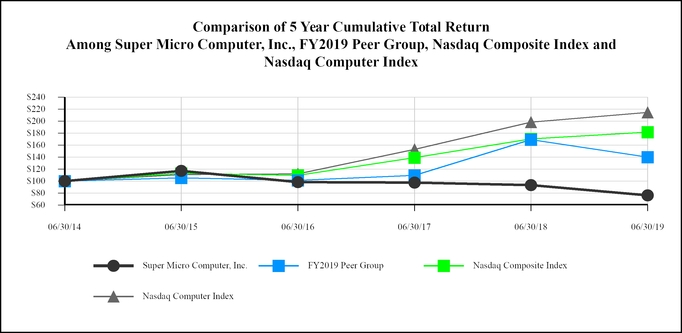
| | | | | | | | | | | | | | | | | | | |
| --- | --- | --- | --- | --- | --- | --- | --- | --- | --- | --- | --- | --- | --- | --- | --- | --- | --- | --- |
| | | | | | | | | | | | | | | | | | | |
| | | 6/30/2014 | | | 6/30/2015 | | | 6/30/2016 | | | 6/30/2017 | | | 6/30/2018 | | | 6/30/2019 | |
| Super Micro Computer, Inc. | | 100.00 | | | 117.06 | | | 98.34 | | | 97.55 | | | 93.59 | | | 76.57 | |
| FY2019 Peer Group | | 100.00 | | | 105.68 | | | 101.44 | | | 109.63 | | | 169.32 | | | 140.32 | |
| Nasdaq Composite Index | | 100.00 | | | 113.13 | | | 109.86 | | | 139.30 | | | 170.37 | | | 181.62 | |
| Nasdaq Computer Index | | 100.00 | | | 110.81 | | | 112.37 | | | 153.16 | | | 198.30 | | | 214.60 | |
Recent Sales of Unregistered Securities
During fiscal years 2018 and 2019 we granted a consultant restricted stock units covering a total of 26,491 shares of our common stock for services rendered.
The restricted stock units were fully vested at the time of grant.
The issuances did not involve a public offering of securities and we believe that the transactions were exempt from the registration requirements of the Securities Act pursuant to Section 4(a)(2) thereof and Rule 506 of Regulation D promulgated thereunder.
Issuer Purchases of Equity Securities
None.
Item 6. Selected Financial Data
30 rewritten, 21 added, 20 removed, 0 unchanged
The following selected consolidated financial data [removed: is qualified by reference to, and] should be read in conjunction [removed: with, our] [added: with Part I, Item 7, "Management’s Discussion and Analysis of Financial Condition and Results of Operations" and the] consolidated financial statements and [added: the] notes thereto [added: included] in Part II, Item 8, "Financial Statements and Supplementary Data" [removed: and “Management’s Discussion and Analysis] of [removed: Financial Condition and Results of Operations” in Part II, Item 7, of] this Annual Report [removed: on Form 10-K.][added: to fully understand factors that may affect the comparability of the information presented below.]
| | [removed: Fiscal] Years Ended June 30, | | | | | | | | | | | | [removed: Fiscal Years Ended June 30,] | | | | | | | [removed: | | | Fiscal Years Ended June 30, | | | | | | | | |]
| | [removed: 2017 | | | | 2016 | | | | 2015 | | | | 2014] [added: 2019] | | | | [added: 2018] | | | | [added: 2017] | | [removed: 2013] | | [added: 2016] | | | | [added: 2015] | | |
| | (in thousands, except per share data) | | | | | | | | | | | | | | | | | | | [removed: | | | | | | | | | | | |]
| Consolidated Statements of Operations Data: | | | | | | | | | | | | | | | | | | | | [removed: | | | | | | | | | | | |]
| Operating expenses: | | | | | | | | | | | | | | | | | | | | [removed: | | | | | | | | | | | |]
| Research and development | [removed: 143,992 | | | | 124,223 | | | | 101,402 | | | | 84,257] [added: 179,907] | | | [removed: 917] | [added: 165,104] | | [removed: 85,174] | | [added: 143,992] | | [removed: 75,208] | | [added: 124,223] | [removed: 60] | | | [removed: 75,268] [added: 101,402] | | |
| Sales and marketing | [removed: 66,445 | | | | 58,338 | | | | 47,496 | | | | 38,012] [added: 77,154] | | | [removed: 264] | [added: 71,579] | | [removed: 38,276] | | [added: 66,445] | | [removed: 33,785] | | [added: 58,338] | [removed: 108] | | | [removed: 33,893] [added: 47,496] | | |
| General and administrative | [removed: 44,646 | | | | 40,449 | | | | 25,040 | | | | 23,017] [added: 141,228] | | | [removed: (192] | [added: 98,597] | [removed: )] | [removed: 22,825] | | [added: 44,646] | | [removed: 23,902] | | [added: 40,449] | [removed: 4] | | | [removed: 23,906] [added: 25,040] | | |
| Income from operations | [removed: 94,875 | | | | 107,491 | | | | 132,646 | | | | 80,259] [added: 97,233] | | | [removed: (7,416] | [added: 94,714] | [removed: )] | [removed: 72,843] | | [added: 94,875] | | [removed: 27,158] | | [added: 107,491] | [removed: (3,016] | | [removed: )] | [removed: 24,142] [added: 132,646] | | |
| Other income (expense), net | [removed: (1,287] [added: (1,020] | | ) | | [removed: 1,507 | | | | 956 | | | | 92 | | | — |] [added: (773] | | [removed: 92] [added: )] | | [added: (984] | | [removed: 48] [added: )] | | [added: 1,507] | [removed: —] | | | [removed: 48] [added: 956] | | |
| Interest expense | [removed: (2,300 | | ) | | (1,594 | | ) | | (965] [added: (6,690] | | ) | | [removed: (757] [added: (5,726] | | ) | [removed: —] | [removed: | | (757] [added: (2,300] | | ) | | [removed: (610] [added: (1,594] | | ) | [removed: —] | [removed: | | (610] [added: (965] | | ) |
| Income before income tax provision | [removed: 91,288 | | | | 107,404 | | | | 132,637 | | | | 79,594] [added: 89,523] | | | [removed: (7,416] | [added: 88,215] | [removed: )] | [removed: 72,178] | | [added: 91,591] | | [removed: 26,596] | | [added: 107,404] | [removed: (3,016] | | [removed: )] | [removed: 23,580] [added: 132,637] | | |
| Income tax provision | [removed: 24,434 | | | | 35,323 | | |] [added: (14,884] | [removed: 40,082] | [added: )] | | [added: (38,443] | [removed: 25,437] | [added: )] | | [removed: (1,342] [added: (24,434] | | ) | [removed: 24,095] | [removed: | |] [added: (35,323] | [removed: 5,317] | [added: )] | | [removed: (473] [added: (40,082] | | ) | [removed: 4,844 | | |]
| Net income per common share: | | | | | | | | | | | | | | | | | | | | [removed: | | | | | | | | | | | |]
| Basic | $ | [removed: 1.38 | | | $ | 1.50 | | | $ | 1.99] [added: 1.44] | | | $ | [removed: 1.24 | |] [added: 0.94] | | | $ | [removed: 1.10] [added: 1.38] | | | $ | [removed: 0.50 | |] [added: 1.50] | | | $ | [removed: 0.45] [added: 1.99] | |
| Diluted | $ | [removed: 1.29 | | | $ |] 1.39 | | | $ | [removed: 1.85 | | | $ | 1.16 | |] [added: 0.89] | | | $ | [removed: 1.03] [added: 1.29] | | | $ | [removed: 0.48 | |] [added: 1.39] | | | $ | [removed: 0.43] [added: 1.85] | |
| Shares used in per share calculation: | | | | | | | | | | | | | | | | | | | | [removed: | | | | | | | | | | | |]
| Basic | [removed: 48,383 | | | | 47,917 | | | | 46,434 | | | | 43,599] [added: 49,917] | | | | [added: 49,345] | | [removed: 43,599] | | [added: 48,383] | | [removed: 41,992] | | [added: 47,917] | | | | [removed: 41,992] [added: 46,434] | | |
| Diluted | [removed: 51,679 | | | | 51,836 | | | | 50,094 | | | | 46,512] [added: 51,716] | | | | [added: 52,151] | | [removed: 46,512] | | [added: 51,679] | | [removed: 43,907] | | [added: 51,836] | | | | [removed: 43,907] [added: 50,094] | | |
| Stock-based compensation: | | | | | | | | | | | | | | | | | | | | [removed: | | | | | | | | | | | |]
| Cost of sales | $ | [removed: 1,382 | | | $ | 1,157 | | | $ | 962] [added: 1,663] | | | $ | [removed: 941 | | $] [added: 1,812] | [removed: (21] | [removed: )] | $ | [removed: 920] [added: 1,382] | | | $ | [removed: 953 | | $] [added: 1,157] | [removed: (21] | [removed: )] | $ | [removed: 932] [added: 962] | |
| Research and development | [removed: 12,559 | | | | 10,651 | | | | 9,195 | | | | 6,783] [added: 12,981] | | | [removed: 147] | [added: 13,893] | | [removed: 6,930] | | [added: 12,559] | | [removed: 6,527] | | [added: 10,651] | [removed: (144] | | [removed: )] | [removed: 6,383] [added: 9,195] | | |
| Sales and marketing | [removed: 2,144 | | | | 1,934 | | | | 1,601 | | | | 1,260] [added: 1,805] | | | [removed: (26] | [added: 1,980] | [removed: )] | [removed: 1,234] | | [added: 2,144] | | [removed: 1,541] | | [added: 1,934] | [removed: (34] | | [removed: )] | [removed: 1,507] [added: 1,601] | | |
| General and administrative | [removed: 3,580 | | | | 3,188 | | | | 2,678 | | | | 2,078] [added: 4,735] | | | [removed: (100] | [added: 6,971] | [removed: )] | [removed: 1,978] | | [added: 3,580] | | [removed: 2,340] | | [added: 3,188] | [removed: (52] | | [removed: )] | [removed: 2,288] [added: 2,678] | | |
| Total stock-based compensation | $ | [removed: 19,665 | | | $ | 16,930 | | | $ | 14,436] [added: 21,184] | | | $ | [removed: 11,062 | | $] [added: 24,656] | [removed: —] | | $ | [removed: 11,062] [added: 19,665] | | | $ | [removed: 11,361 | | $] [added: 16,930] | [removed: (251] | [removed: )] | $ | [removed: 11,110] [added: 14,436] | |
| | As of June 30, | | | | | | | | | | | | | | | | | | | [removed: | | | | | | | | | | | |]
| | (in thousands) | | | | | | | | | | | | | | | | | | | [removed: | | | | | | | | | | | |]
| Consolidated Balance Sheet Data: | | | | | | | | | | | | | | | | | | | | [removed: | | | | | | | | | | | |]
| Cash and cash equivalents | $ | [removed: 110,606 | | | $ | 178,820 | | | $ | 92,920] [added: 248,164] | | | $ | [removed: 96,872 | | $] [added: 115,377] | [removed: (1,390] | [removed: )] | $ | [removed: 95,482] [added: 110,606] | | | $ | [removed: 93,038 | | $] [added: 178,820] | [removed: (1,306] | [removed: )] | $ | [removed: 91,732] [added: 92,920] | |
We derived the selected consolidated balance sheet data as of June 30, 2019 and 2018, and the consolidated statement of operations data for the years ended June 30, 2019, 2018 and 2017 from our audited consolidated financial statements and accompanying notes included in this Annual Report.
The consolidated balance sheet data as of June 30, 2017, 2016 and 2015, and the consolidated statement of operations data for the years ended June 30, 2016 and 2015 are derived from our audited consolidated financial statements which are not included in this Annual Report.
Operating results for any year are not necessarily indicative of results to be expected for any future periods.
| | | | | | | | | | | | | | | | | | | | |
| --- | --- | --- | --- | --- | --- | --- | --- | --- | --- | --- | --- | --- | --- | --- | --- | --- | --- | --- | --- |
| | | | | | | | | | | | | | | | | | | | |
| Net sales | $ | 3,500,360 | | | $ | 3,360,492 | | | $ | 2,484,929 | | | $ | 2,225,022 | | | $ | 1,954,353 | |
| Cost of sales | 3,004,838 | | | | 2,930,498 | | | | 2,134,971 | | | | 1,894,521 | | | | 1,647,769 | | |
| Gross profit | 495,522 | | | | 429,994 | | | | 349,958 | | | | 330,501 | | | | 306,584 | | |
| Total operating expenses | 398,289 | | | | 335,280 | | | | 255,083 | | | | 223,010 | | | | 173,938 | | |
| Share of loss from equity investee, net of taxes | (2,721 | | ) | | (3,607 | | ) | | (303 | | ) | | — | | | | — | | |
| Net income | $ | 71,918 | | | $ | 46,165 | | | $ | 66,854 | | | $ | 72,081 | | | $ | 92,555 | |
| | | | | | | | | | | | | | | | | | | | |
| | | | | | | | | | | | | | | | | | | | |
| --- | --- | --- | --- | --- | --- | --- | --- | --- | --- | --- | --- | --- | --- | --- | --- | --- | --- | --- | --- |
| | | | | | | | | | | | | | | | | | | | |
| | 2019 | | | | 2018 | | | | 2017 | | | | 2016 | | | | 2015 | | |
| Working capital | 815,802 | | | | 719,321 | | | | 588,636 | | | | 544,698 | | | | 438,144 | | |
| Total assets | 1,682,594 | | | | 1,769,505 | | | | 1,515,130 | | | | 1,191,483 | | | | 1,122,031 | | |
| Long-term obligations | 135,449 | | | | 114,296 | | | | 68,754 | | | | 85,200 | | | | 26,062 | | |
| Total stockholders’ equity | 941,176 | | | | 843,652 | | | | 773,846 | | | | 696,653 | | | | 593,585 | | |
| | | | | | | | | | | | | | | | | | | | | | | | | | | | | | | | |
| --- | --- | --- | --- | --- | --- | --- | --- | --- | --- | --- | --- | --- | --- | --- | --- | --- | --- | --- | --- | --- | --- | --- | --- | --- | --- | --- | --- | --- | --- | --- | --- |
| | | | | | (As Revised) (1) | | | | (As Revised) (1) | | | | As Reported | | | Adjustments (2) | | | As Adjusted | | | | As Reported | | | Adjustments (2) | | | As Adjusted | | |
| Net sales | $ | 2,484,929 | | | $ | 2,225,022 | | | $ | 1,954,353 | | | $ | 1,467,202 | | $ | (17,037 | ) | $ | 1,450,165 | | | $ | 1,162,561 | | $ | (15,332 | ) | $ | 1,147,229 | |
| Cost of sales | 2,134,971 | | | | 1,894,521 | | | | 1,647,769 | | | | 1,241,657 | | | (10,610 | | ) | 1,231,047 | | | | 1,002,508 | | | (12,488 | | ) | 990,020 | | |
| Gross profit | 349,958 | | | | 330,501 | | | | 306,584 | | | | 225,545 | | | (6,427 | | ) | 219,118 | | | | 160,053 | | | (2,844 | | ) | 157,209 | | |
| Total operating expenses | 255,083 | | | | 223,010 | | | | 173,938 | | | | 145,286 | | | 989 | | | 146,275 | | | | 132,895 | | | 172 | | | 133,067 | | |
| Net income | $ | 66,854 | | | $ | 72,081 | | | $ | 92,555 | | | $ | 54,157 | | $ | (6,074 | ) | $ | 48,083 | | | $ | 21,279 | | $ | (2,543 | ) | $ | 18,736 | |
__________________________
(1) See Part II, Item 8, Note 19, "Restatement of Previously Issued Consolidated Financial Statements", in our notes to the consolidated financial statements.
(2) The adjustments are similar in nature to those discussed in Part II, Item 8, Note 19, "Restatement of Previously Issued Consolidated Financial Statements", in our notes to the consolidated financial statements.
| | | | | | (As Revised) (1) | | | | (As Revised) (2) | | | | As Reported | | | Adjustments (2) | | | As Adjusted | | | | As Reported | | | Adjustments (2) | | | As Adjusted | | |
| Working capital | 588,636 | | | | 544,698 | | | | 438,144 | | | | 343,195 | | | (14,255 | | ) | 328,940 | | | | 281,528 | | | (9,437 | | ) | 272,091 | | |
| Total assets | 1,515,130 | | | | 1,191,483 | | | | 1,122,031 | | | | 796,325 | | | 29,970 | | | 826,295 | | | | 632,257 | | | 38,412 | | | 670,669 | | |
| Long-term obligations | 68,754 | | | | 85,200 | | | | 26,062 | | | | 16,208 | | | 4,710 | | | 20,918 | | | | 16,869 | | | 2,121 | | | 18,990 | | |
| Total stockholders’ equity | 773,846 | | | | 696,653 | | | | 593,585 | | | | 469,231 | | | (17,072 | | ) | 452,158 | | | | 373,724 | | | (10,999 | | ) | 362,725 | | |
| | |
| --- | --- |
| (1) | See Part II, Item 8, Note 19, "Restatement of Previously Issued Consolidated Financial Statements", in our notes to the consolidated financial statements. |
| (2) | The adjustments are similar in nature to those discussed in Part II, Item 8, Note 19, "Restatement of Previously Issued Consolidated Financial Statements", in our notes to the consolidated financial statements. |
Item 8. Financial Statements and Supplementary Data
421 rewritten, 502 added, 580 removed, 626 unchanged
INDEX TO CONSOLIDATED FINANCIAL [removed: STATEMENTS*][added: STATEMENTS]
| [Report of Independent Registered Public Accounting [removed: Firm](#sF65EA4B02BED66BCF46C899870022A8C)] [added: Firm](#s1ED6CD27F0875B9A9E7E469F34243E0E)] | [removed: [52](#sF65EA4B02BED66BCF46C899870022A8C)] [added: [67](#s1ED6CD27F0875B9A9E7E469F34243E0E)] |
| [Consolidated Balance [removed: Sheets](#sB65DAF4FAF6CBBBA9F238998235E34F2)] [added: Sheets](#sDF5D7330ABF95F7EB0D0F26052214326)] | [removed: [53](#sB65DAF4FAF6CBBBA9F238998235E34F2)] [added: [71](#sDF5D7330ABF95F7EB0D0F26052214326)] |
| [Consolidated Statements of [removed: Operations](#s85346E6DA5F9DB22CE09899823CDB27E)] [added: Operations](#s233F7B56E9325431BFCE3EE7A7DADFA2)] | [removed: [54](#s85346E6DA5F9DB22CE09899823CDB27E)] [added: [72](#s233F7B56E9325431BFCE3EE7A7DADFA2)] |
| [Consolidated Statements of Comprehensive [removed: Income](#s52559EF33EB1C546C37D89982452D9FB)] [added: Income](#s7034767BE92E5EE895DABA98BC650A3B)] | [removed: [55](#s52559EF33EB1C546C37D89982452D9FB)] [added: [73](#s7034767BE92E5EE895DABA98BC650A3B)] |
| [Consolidated Statements of Stockholders’ [removed: Equity](#sC721A6349C115E66F9218998246C6957)] [added: Equity](#s043B781422A15B5FAA46E3C16122F410)] | [removed: [56](#sC721A6349C115E66F9218998246C6957)] [added: [74](#s043B781422A15B5FAA46E3C16122F410)] |
| [Consolidated Statements of Cash [removed: Flows](#s49E208E2C2449863057089982540D15B)] [added: Flows](#s13D5F7E5983D5CBA808FFC1522B23EF1)] | [removed: [57](#s49E208E2C2449863057089982540D15B)] [added: [75](#s13D5F7E5983D5CBA808FFC1522B23EF1)] |
| [Notes to Consolidated Financial [removed: Statements](#s6D344B54E34E6794B9A18998721DAE1C)] [added: Statements](#s10233E1EF33C5358B01764C9E4BCA980)] | [removed: [58](#s6D344B54E34E6794B9A18998721DAE1C)] [added: [77](#s10233E1EF33C5358B01764C9E4BCA980)] |
To the [added: Stockholders and the] Board of Directors [removed: and Stockholders] of [added: Super Micro Computer, Inc.]
We have audited the accompanying consolidated balance sheets of Super Micro Computer, Inc. and subsidiaries (the [removed: “Company”)] [added: "Company")] as of June 30, [removed: 2017 and 2016,] [added: 2019] and [added: 2018,] the related consolidated statements of operations, comprehensive income, [removed: stockholders’] [added: stockholders'] equity, and cash [removed: flows] [added: flows,] for each of the three years in the period ended June 30, [removed: 2017.][added: 2019, and the related notes (collectively referred to as the "financial statements").]
Our responsibility is to express an opinion on [removed: these] [added: the Company's] financial statements based on our audits.
We conducted our audits in accordance with the standards of the [removed: Public Company Accounting Oversight Board (United States).][added: PCAOB.]
Those standards require that we plan and perform the audit to obtain reasonable assurance about whether the financial statements are free of material [removed: misstatement.][added: misstatement, whether due to error or fraud.]
[removed: An audit includes] [added: Such procedures included] examining, on a test basis, evidence [removed: supporting] [added: regarding] the amounts and disclosures in the financial statements.
[removed: An audit] [added: Our audits] also [removed: includes assessing] [added: included evaluating] the accounting principles used and significant estimates made by management, as well as evaluating the overall [added: presentation of the] financial [removed: statement presentation.][added: statements.]
In our opinion, [removed: such consolidated] [added: the] financial statements present fairly, in all material respects, the financial position of [removed: Super Micro Computer, Inc. and subsidiaries] [added: the Company] as of June 30, [removed: 2017] [added: 2019] and [removed: 2016,] [added: 2018,] and the results of [removed: their] [added: its] operations and [removed: their] [added: its] cash flows for each of the three years in the period ended June 30, [removed: 2017,] [added: 2019,] in conformity with accounting principles generally accepted in the United States of America.
We have also audited, in accordance with the standards of the Public Company Accounting Oversight Board (United [removed: States),] [added: States) (PCAOB),] the Company's internal control over financial reporting as of June 30, [removed: 2017,] [added: 2019,] based on [removed: the] criteria established in Internal Control [removed: -Integrated] [added: - Integrated] Framework (2013) issued by the Committee of Sponsoring Organizations of the Treadway Commission [added: (COSO)] and our report dated [removed: May 16, 2019] [added: December 19, 2019,] expressed an adverse opinion on the [removed: Company's] [added: Company’s] internal control over financial reporting because of material weaknesses.
| Prepaid expenses and other current assets (including receivables from related parties of [removed: $13,327] [added: $21,302] and [removed: $9,622] [added: $24,016] at June 30, [removed: 2017] [added: 2019] and [removed: 2016,] [added: 2018,] respectively) | [removed: 89,213] [added: 109,795] | | | | [removed: 79,427] [added: 110,856] | | |
| Investment in equity investee | [removed: 6,067] [added: 1,701] | | | | [removed: —] [added: 2,376] | | |
| Deferred income taxes, net | [removed: 39,119] [added: 41,126] | | | | [removed: 33,678] [added: 25,583] | | |
| Income taxes payable | [removed: 1,364] [added: 13,021] | | | | [removed: 5,054] [added: 7,191] | | |
[removed: | Long-term debt | — | | | | 40,000 | | |][added: Short-term Debt]
| Other long-term liabilities (including related party balance of [removed: $4,900] [added: $3,000] and [removed: $0] [added: $3,500] at June 30, [removed: 2017] [added: 2019] and [removed: 2016,] [added: 2018,] respectively) | [removed: 68,754] [added: 26,183] | | | | [removed: 45,200] [added: 24,565] | | |
| Commitments and contingencies (Note [removed: 14)] [added: 15)] | | | | | | | |
| Treasury stock (at cost), 1,333,125 [removed: and 445,028] shares at June 30, [removed: 2017] [added: 2019] and [removed: 2016, respectively] [added: 2018] | (20,491 | | ) | | [removed: (2,030] [added: (20,491] | | ) |
| Accumulated other comprehensive [removed: loss] [added: (loss) income] | [removed: (77] [added: (80] | | ) | | [removed: (85] [added: 165] | | [removed: )] |
| Total Super Micro Computer, Inc. stockholders’ equity | [removed: 773,676] [added: 941,015] | | | | [removed: 696,469] [added: 843,495] | | |
| [removed: Total liabilities and stockholders’ equity] [added: LIABILITIES AND STOCKHOLDERS' EQUITY] | [removed: $] | [removed: 1,515,130] | | | [removed: $] | [removed: 1,191,483] | | [added: | | | |]
| | Years Ended June 30, | | | | | | | | | [added: 2019 over 2018] | | [added: | 2018 over 2017 | |]
| Net sales (including related party sales of [removed: $33,821, $29,110] [added: $69,906, $68,637] and [removed: $47,684] [added: $33,821] in fiscal years [removed: 2017, 2016] [added: 2019, 2018] and [removed: 2015,] [added: 2017,] respectively) | $ | [removed: 2,484,929] [added: 3,500,360] | | | $ | [removed: 2,225,022] [added: 3,360,492] | | | $ | [removed: 1,954,353] [added: 2,484,929] | |
| Cost of sales (including related party purchases of [removed: $236,062, $242,638] [added: $276,843, $262,747,] and [removed: $227,661] [added: $236,062] in fiscal years [removed: 2017, 2016] [added: 2019, 2018] and [removed: 2015,] [added: 2017,] respectively) | [removed: 2,134,971] [added: 3,004,838] | | | | [removed: 1,894,521] [added: 2,930,498] | | | | [removed: 1,647,769] [added: 2,134,971] | | |
| Sales and marketing | [removed: 66,445] [added: 77,154] | | | | [removed: 58,338] [added: 71,579] | | | | [removed: 47,496] [added: 66,445] | | |
| General and administrative | [removed: 44,646] [added: 141,228] | | | | [removed: 40,449] [added: 98,597] | | | | [removed: 25,040] [added: 44,646] | | |
| Income from operations | [removed: 94,875] [added: 97,233] | | | | [removed: 107,491] [added: 94,714] | | | | [removed: 132,646] [added: 94,875] | | |
| Interest expense | [removed: (2,300] [added: (6,690] | | ) | | [removed: (1,594] [added: (5,726] | | ) | | [removed: (965] [added: (2,300] | | ) |
| Income tax provision | [removed: 24,434] [added: (14,884] | | [added: )] | | [removed: 35,323] [added: (38,443] | | [added: )] | | [removed: 40,082] [added: (24,434] | | [added: )] |
| Net income | $ | [removed: 66,854] [added: 71,918] | | | $ | [removed: 72,081] [added: 46,165] | | | $ | [removed: 92,555] [added: 66,854] | |
| Diluted | $ | [removed: 1.29] [added: 1.39] | | | $ | [removed: 1.39] [added: 0.89] | | | $ | [removed: 1.85] [added: 1.29] | |
| Basic | [removed: 48,383] [added: 49,917] | | | | [removed: 47,917] [added: 49,345] | | | | [removed: 46,434] [added: 48,383] | | |
| Other comprehensive [removed: income (loss),] [added: (loss) income,] net of tax: | | | | | | | | | | | |
Opinion on the Financial Statements
Change in Accounting Principle
As discussed in Note 1 to the financial statements, effective July 1, 2018, the Company has changed its method of accounting for revenue due to adoption of Accounting Standards Codification Topic 606 (ASU No. 2014-09), Revenue from Contracts with Customers, and all subsequent amendments (collectively, “ASC 606”).
The Company adopted ASC 606 using the modified retrospective approach.
Basis for Opinion
We are a public accounting firm registered with the PCAOB and are required to be independent with respect to the Company in accordance with the U.S. federal securities laws and the applicable rules and regulations of the Securities and Exchange Commission and the PCAOB.
Our audits included performing procedures to assess the risks of material misstatement of the financial statements, whether due to error or fraud, and performing procedures that respond to those risks.
Critical Audit Matters
The critical audit matters communicated below are matters arising from the current-period audit of the financial statements that were communicated or required to be communicated to the audit committee and that (1) relate to accounts or disclosures that are material to the financial statements and (2) involved our especially challenging, subjective, or complex judgments.
The communication of critical audit matters does not alter in any way our opinion on the financial statements, taken as a whole, and we are not, by communicating the critical audit matters below, providing separate opinions on the critical audit matters or on the accounts or disclosures to which they relate.
Related Party Transactions - Variable Interest Entity Primary Beneficiary Determination - Refer to Note 1 to the financial statements
Critical Audit Matter Description
The Company has a variety of business relationships defined by various agreements with Ablecom Technology, Inc. (“Ablecom”) and its affiliate, Compuware Technology, Inc. ("Compuware").
Purchases from Ablecom and Compuware were $144.5 million and $139.6 million, respectively, for the fiscal year ended June 30, 2019.
Net sales to Compuware as a distributor were $17.7 million for the fiscal year ended June 30, 2019.
The Company concluded that Ablecom and Compuware are variable interest entities (VIEs) and that it is not the primary beneficiary as it does not have the power to direct the activities that are most significant to Ablecom and Compuware.
Therefore, the Company does not consolidate Ablecom and Compuware.
The Company considered its explicit arrangements with Ablecom and Compuware, including its supplier arrangements, and as a result of the substantial related party relationships between the Company, Ablecom and Compuware, the Company also considered whether any implicit arrangements exist that would cause the Company to protect those related parties’ interests from suffering losses.
We identified management’s conclusion that it is not the primary beneficiary as a critical audit matter because of the judgments necessary for management to determine whether any explicit and implicit arrangements exist that would cause the Company to protect those related parties’ interest from absorbing losses, as well as the material weaknesses identified by the Company in all five components of Internal Control - Integrated Framework (2013) issued by COSO.
This required extensive audit effort due to the complexity and variety of related party relationships with Ablecom and Compuware and required a high degree of auditor judgment when performing audit procedures to audit the Company’s conclusion that it is not the primary beneficiary.
How the Critical Audit Matter Was Addressed in the Audit
Our audit procedures related to management’s conclusion that it is not the primary beneficiary included the following, among others:
| • | We evaluated and tested whether the arrangements are accurately considered and that arrangements have been included in the consideration by comparing those related parties we had identified during our audit procedures for proper inclusion in the Company’s evaluation and performed inspection of source documents on a sample basis. |
| • | We tested management’s assertion that it does not have the power to direct the activities that are most significant to, or obligation to absorb the losses of, Ablecom and Compuware by reviewing all agreements and transactions between the parties. |
| • | We obtained confirmations directly from Ablecom and Compuware regarding the nature of their business relationships with the Company, the extent of power, if any, held by the Company over the most significant activities of Ablecom and Compuware’s businesses, and the existence of any implicit arrangements that may have a bearing on the Company’s ability to have power over Ablecom and Compuware. |
As a result of the material weaknesses identified by the Company in all five components of Internal Control - Integrated Framework (2013) issued by COSO, we increased the extent of testing around the Company’s procedures for assessing whether the arrangements with Ablecom and Compuware are off market or whether they force Ablecom and Compuware to absorb losses.
We also increased the extent of testing to determine if there are any agreements that provide the Company with power to direct the activities that are most significant to Ablecom and Compuware.
Inventories - Excess and Obsolescence Reserve - Refer to Notes 1 and 5 to the financial statements
Critical Audit Matter Description
The Company’s inventories are stated at weighted average cost, subject to lower of cost or net realizable value, and as necessary, the Company writes down the valuation of inventories for excess and obsolescence.
The provision for excess and obsolete inventory for the fiscal year ended June 30, 2019, was $28.5 million.
We identified the excess and obsolescence reserve as a critical audit matter because of the judgments management makes to estimate the excess and obsolescence reserve, as well as the material weaknesses identified by the Company in all five components of Internal Control - Integrated Framework (2013) issued by COSO.
This required a high degree of auditor judgment and an increased extent of effort when performing audit procedures to evaluate the methodology and the reasonableness of the excess and obsolescence reserve.
How the Critical Audit Matter Was Addressed in the Audit
Our audit procedures related to the Company’s excess and obsolescence reserve included the following procedures, among others:
| • | We gained an understanding and evaluated the Company’s methodology for determining inventory that is excess or obsolete and the key assumptions and judgments made as part of the process. |
| • | We evaluated the assumptions used by the Company to define what is considered aged inventory by assessing historical trends in the Company’s product life cycle as well as evaluating the underlying calculations applied to the aged inventory. |
| • | We evaluated the inventory valuation utilizing the methodology above to assess the inventory reserve rate applied to different aging buckets. |
As a result of the Company’s material weaknesses identified by the Company in all five components of Internal Control - Integrated Framework (2013) issued by COSO, we increased the extent of testing on reports derived from the Company’s systems and applications.
Revenue - Refer to Note 3 to the financial statements
*The consolidated financial statements for the fiscal years ended June 30, 2016 and 2015 have been restated as further discussed in Note 19, "Restatement of Previously Issued Consolidated Financial Statements."
Super Micro Computer, Inc.
San Jose, California
As discussed in Note 19 to the consolidated financial statements, the accompanying 2016 and 2015 consolidated financial statements have been restated to correct misstatements.
As discussed in Note 11 to the consolidated financial statements, the Company has significant purchases from and sales to two related parties.
May 16, 2019
| | 2017 | | | | 2016 | | |
| | | | | | (As Restated- see Note 19) | | |
| Cash and cash equivalents | $ | 110,606 | | | $ | 178,820 | |
| Accounts receivable, net of allowances of $2,699 and $2,413 at June 30, 2017 and 2016, respectively (including amounts receivable from related parties of $6,877 and $49 at June 30, 2017 and 2016, respectively) | 324,004 | | | | 174,933 | | |
| Inventories | 736,668 | | | | 516,807 | | |
| Prepaid income taxes | 675 | | | | 4,341 | | |
| Total current assets | 1,261,166 | | | | 954,328 | | |
| Long-term investments | 2,625 | | | | 2,643 | | |
| Property, plant and equipment, net | 195,576 | | | | 187,949 | | |
| Other assets | 10,577 | | | | 12,885 | | |
| Total assets | $ | 1,515,130 | | | $ | 1,191,483 | |
| Accounts payable (including amounts due to related parties of $55,928 and $44,941 at June 30, 2017 and 2016, respectively) | $ | 396,895 | | | $ | 267,391 | |
| Accrued liabilities (including amounts due to related parties of $8,450 and $5,354 at June 30, 2017 and 2016, respectively) | 112,824 | | | | 83,596 | | |
| Short-term debt and current portion of long-term debt, net of debt issuance costs | 161,447 | | | | 53,589 | | |
| Total current liabilities | 672,530 | | | | 409,630 | | |
| Total liabilities | 741,284 | | | | 494,830 | | |
| Issued shares: 50,273,527 and 48,999,717 at June 30, 2017 and 2016, respectively | 308,271 | | | | 279,465 | | |
| Retained earnings | 485,973 | | | | 419,119 | | |
| Noncontrolling interest | 170 | | | | 184 | | |
| Total stockholders’ equity | 773,846 | | | | 696,653 | | |
| | | | | | | | | | | | |
| --- | --- | --- | --- | --- | --- | --- | --- | --- | --- | --- | --- |
| | 2017 | | | | 2016 | | | | 2015 | | |
| | | | | | (As Restated- see Note 19) | | | | (As Restated- see Note 19) | | |
| Gross profit | 349,958 | | | | 330,501 | | | | 306,584 | | |
| Research and development | 143,992 | | | | 124,223 | | | | 101,402 | | |
| Total operating expenses | 255,083 | | | | 223,010 | | | | 173,938 | | |
| Other income (expense), net | (1,287 | | ) | | 1,507 | | | | 956 | | |
| Income before income tax provision | 91,288 | | | | 107,404 | | | | 132,637 | | |
| Basic | $ | 1.38 | | | $ | 1.50 | | | $ | 1.99 | |
| Diluted | 51,679 | | | | 51,836 | | | | 50,094 | | |
| Unrealized gains (losses) on investments | (11 | | ) | | 5 | | | | (8 | | ) |
| Balance at June 30, 2014 (As previously reported) | 45,739,936 | | | $ | 199,062 | | | (445,028 | ) | | $ | (2,030 | ) | | $ | (63 | ) | | $ | 272,087 | | | $ | 175 | | | $ | 469,231 | |
| Cumulative restatement adjustments | — | | | 531 | | | | — | | | — | | | | — | | | | (17,604 | | ) | | — | | | | (17,073 | | ) |
An excerpt. Shown here: 40 of 421 rewritten, 40 of 502 added and 40 of 580 removed. The counts are complete. For every sentence, read Item 8. Financial Statements and Supplementary Data in the FY2019 filing and the FY2017 filing.
Item 9A. Controls and Procedures
64 rewritten, 101 added, 28 removed, 119 unchanged
[removed: In August 2017, prior] [added: Prior] to the issuance of the Company’s consolidated financial statements for the fiscal year ended June 30, 2017, the audit committee (the “Audit Committee”) of the Company’s Board of Directors (the “Board”) [removed: commenced an investigation (the “Investigation”) into] [added: investigated and assessed] certain accounting and internal control matters at the Company, principally focused on certain revenue recognition matters.
[removed: Concurrently with these additional procedures,] [added: Concurrently,] new members of the Company’s management, under the direction of the Audit Committee, performed a thorough analysis of the Company’s historical financial statements, accounting policies and financial reporting, as well as the Company’s disclosure controls and procedures and its internal control over financial reporting.
In connection with the preparation and filing of this Annual Report on Form 10-K, we have conducted the requisite evaluations of the effectiveness of our disclosure controls and procedures and of our internal control over financial [removed: reporting] [added: reporting,] both as of June 30, [removed: 2017.][added: 2019.]
Under the supervision, and with the participation, of our [removed: current] management, including our [removed: CEO] [added: Chief Executive Officer (“CEO”)] and [removed: CFO,] [added: Chief Financial Officer (“CFO”),] we evaluated the effectiveness of our disclosure controls and procedures as defined in Rules 13a-15(e) and 15d-15(e) under the Securities Exchange Act of 1934, as amended (the “Exchange Act”), as of June 30, [removed: 2017.][added: 2019.]
Based on this evaluation of our disclosure controls and procedures, our CEO and CFO have concluded that our disclosure controls and procedures were not effective as of June 30, [removed: 2017] [added: 2019] because of certain material weaknesses in our internal control over financial reporting, as further described below.
Notwithstanding the conclusion by our CEO and CFO that our disclosure controls and procedures as of June 30, [removed: 2017] [added: 2019] were not effective, and notwithstanding the material weaknesses in our internal control over financial reporting described below, management believes that the consolidated financial statements and related financial information included in this Annual Report [removed: on Form 10-K] fairly present in all material respects our financial condition, results of operations and cash flows as of the dates presented, and for the periods ended on such dates, in conformity with accounting principles generally accepted in the United States of America (“U.S. GAAP”).
Management, including our CEO and CFO, assessed our internal control over financial reporting as of June 30, [removed: 2017.][added: 2019.]
In making this assessment, management used the criteria set forth by the Committee of Sponsoring Organizations of the Treadway Commission in [added: its] Internal Control - Integrated Framework (2013) (the “COSO Framework”).
Based on this assessment, management has determined that we did not maintain effective internal control over financial reporting as of June 30, [removed: 2017] [added: 2019] because of the material weaknesses described below.
In connection with management’s assessment of the Company’s internal control over financial reporting described above, management has identified the deficiencies described below that [removed: constituted] [added: constitute] material weaknesses in our internal control over financial reporting as of June 30, [removed: 2017.][added: 2019.]
[removed: We have] [added: The Company has] identified deficiencies in the control environment component of the COSO Framework that [removed: constitute] [added: constituted] material weaknesses, either individually or in the aggregate.
Due to the interdependencies between the COSO Framework components, the [removed: weaknesses] [added: material weakness] in our control environment contributed to other material weaknesses within our system of internal control over financial reporting.
We [removed: have] identified deficiencies in the risk assessment component of the COSO Framework that [removed: aggregate] [added: aggregated] to a material weakness.
These deficiencies related to the principles associated with the risk assessment component of the COSO Framework, specifically principles within the component related to: (i) identifying, assessing, and communicating appropriate control objectives, (ii) identifying and analyzing risks to achieve these objectives, (iii) contemplating fraud risks, and (iv) identifying and assessing changes in the business that could impact [removed: our] [added: the] system of internal controls.
We [removed: have] identified deficiencies in the control activities component of the COSO Framework that [removed: aggregate] [added: aggregated] to a material weakness.
These deficiencies related to principles associated with the control activities component of the COSO Framework, specifically principles within the component related to (i) selecting and developing control activities that mitigate [removed: risks] [added: risks,] (ii) selecting and developing general controls over technology and (iii) deploying control activities through policies that establish what is expected and procedures that put policies into action.
Deficiencies in control activities contributed to [removed: material accounting errors, and] the potential for there to have been material accounting [removed: errors,] [added: errors] in substantially all financial statements account balances and disclosures.
We [removed: have] identified deficiencies in the information and communication component of the COSO Framework that [removed: aggregate] [added: aggregated] to a material weakness.
These deficiencies related to principles associated with the information and communications component of the COSO Framework, specifically principles within the component related to (i) generating and using relevant quality [removed: information,] [added: information and] (ii) internally communicating information, including objectives and responsibilities for internal control, necessary to support the functioning of internal [removed: control and (iii) communicating with external parties regarding matters affecting the functioning of internal] control.
In certain areas, our control activity deficiencies resulted from insufficient communication of information among our internal [removed: functions as well as from officers and managers to both the Audit Committee and our external auditors.][added: functions.]
We [removed: have] identified deficiencies in the monitoring of controls component of the COSO Framework that [removed: aggregate] [added: aggregated] to a material weakness.
There were deficiencies related to [removed: principles] [added: a principle] associated with the monitoring of controls component of the COSO Framework, specifically [removed: principles within the component related to (i)] selecting, developing and performing ongoing and/or separate [removed: evaluations and (ii) evaluating and communicating deficiencies in a timely manner.][added: evaluations.]
[removed: We] [added: The Company] lacked controls (i) to determine whether components of internal control were present and [removed: functioning, (ii) to mitigate the risk of management overriding internal controls] [added: functioning] and [removed: (iii)] [added: (ii)] to detect incorrect accounting practices.
We [removed: have] identified deficiencies in revenue recognition accounting controls that resulted in material [removed: errors constituting material] weaknesses, either individually or in the aggregate, as we did not appropriately design, or effectively operate, internal controls over certain aspects of accurate recording, presentation, and disclosure of revenue and related costs.
| • | [removed: With respect to sales transactions near quarter-end, our] [added: Our] internal controls failed to consistently identify transactions where the terms of the sales arrangements with our customers were not properly documented in a form that fully reflected the final understanding between the parties as to the specific nature and terms of the agreed-upon transaction. |
| • | Our internal controls failed to consistently identify, resolve, [removed: document in our accounting system] [added: document,] and allow for proper accounting where there were inconsistencies among the various documents underlying our sales transactions, and we did not always communicate the existence or resolution of those inconsistencies to our accounting organization to enable the proper recognition of revenue. |
We [removed: have] identified deficiencies related to IT general controls that [removed: represent] [added: represented] a material weakness, either individually or in the aggregate.
The following were contributing [removed: factors:][added: factors to the material weakness in information technology and general controls:]
| • | We have a decentralized approach to developing IT policies and practices and to monitoring our IT controls. As a result, our internal procedures for granting and monitoring employee access, and managing changes to various applications and infrastructure layers relevant to our financial reporting are not consistent across those applications and infrastructure layers. In addition, some of our internally-developed applications relevant to financial reporting lack [removed: logging] [added: system tracking] capabilities to monitor access changes or application changes. We have also authorized certain users with broad access, both as a user and as an administrator, to all parts of our primary accounting system without adequate monitoring or recording of how they used that access. As a result of these factors, we have material weaknesses related to access controls and change management. The fact that we [removed: had] [added: have] material weaknesses related to access controls and change management means that it is possible that our business process controls that depend on the affected information systems, or that depend on data or financial reports generated from [added: the] affected information systems, could be adversely affected due to the access control and change management issues, although we have identified no instances of any adverse effect due to these deficiencies. |
The effectiveness of our internal control over financial reporting as of June 30, [removed: 2017] [added: 2019] has been audited by Deloitte & Touche LLP, our independent registered public accounting firm, as stated in its report that is included herein.
As we continue to evaluate and work to improve our internal control over financial reporting, we may take additional [added: or different] measures to address control deficiencies with the overall objective to [removed: design and operate internal controls that mitigate identified risks and enable an effective system of internal control over external financial reporting.]
| • | Reviewed and amended our Code of Conduct to align with the organizational changes described above and to strengthen certain provisions regarding compliance and [removed: reporting.] [added: reporting violations of the Code of Conduct.] |
| [removed: −] [added: –] | Revenue recognition training for our global sales force, various operations personnel, and certain senior executives, including our CEO, which included detailed examples of acceptable and unacceptable sales practices, |
| [removed: −] [added: –] | [removed: Reviewing] [added: Reviewed] with our senior management team our amended Code of Conduct, |
[removed: − Reviewing] [added: | – | Reviewed] with our CEO enhanced processes for periodic evaluations by the CEO and the CFO of the effectiveness of our disclosure controls and procedures, and the periodic assessments by the CEO and the CFO of the effectiveness of our internal control over financial reporting, and other compliance matters, and [added: |]
[removed: −] [added: | – |] Shipping and cut-off training for accounting and operations personnel that included new requirements for quarter-end procedures. [added: |]
[removed: Although timetables vary, management] [added: Management] regards successful completion of our remaining remediation actions as an important priority.
| • | Integrating the responsibility for internal controls across business functions to [removed: ensure] [added: assign] accountability for internal controls beyond the accounting and finance team. |
| • | [removed: Assigning] [added: Assigned] accountability for certain internal controls to our Compliance Department, such as our organizational-wide quarterly sales certification process. |
[removed: | • | Continuing to re-assess risks and controls related to the] [added: over certain aspects of] accurate recording, presentation, and disclosure of revenue and related [removed: costs |][added: costs.]
Management concluded that our disclosure controls and procedures were not effective as of June 30, 2017 because of certain material weaknesses in our internal control over financial reporting, as described in our 2017 10-K.
The Company is committed to remediating these material weaknesses and strengthening its internal control over financial reporting, and our management has developed a comprehensive plan for this remediation and strengthening.
In consultation with the Audit Committee, our management began developing this plan during the comprehensive analysis described above and continued developing it after we filed the 2017 10-K.
We began to implement certain elements of the plan during fiscal years 2018 and 2019, and have continued to implement the plan during the current fiscal year.
Among other actions, our actions to date have included both strengthening existing individual controls and designing and implementing new individual controls.
However, before our management can conclude that these new and strengthened controls are sufficient to remediate the material weaknesses, the controls must operate effectively for a sufficient period of time.
As of June 30, 2019,
sufficient time had not elapsed since we implemented the new and strengthened controls for our management to determine that they operated effectively as of that date.
For this reason, although we have taken many actions to strengthen our internal control over financial reporting and the Company’s disclosure controls and procedures, our management did not conclude that any of the material weaknesses identified in the 2017 10-K had been remediated as of June 30, 2019.
The actions we have taken to address these material weaknesses are described below under “Remediation Plan and Status.”
In our Annual Report on Form 10-K for the year ended June 30, 2017 we disclosed the identification of deficiencies in the control environment component of the COSO Framework that constituted material weaknesses, either individually or in the aggregate.
We are committed to remediating the underlying cause of these material weaknesses and are taking actions to enhance our internal control over financial reporting relating to the material weaknesses.
However, we are still in the process of implementing our comprehensive remediation plan and we have not had sufficient time to test the effectiveness of the new and strengthened controls as of June 30, 2019.
Consequently, deficiencies that constitute material weaknesses, either individually or in the aggregate, in the control environment and other components remain.
The material weaknesses noted above cannot be considered remediated until each control has been appropriately designed, has operated for a sufficient period of time, and management has concluded, through testing, that the control is operating effectively.
As of June 30, 2019, our risk assessment component framework had not yet operated for a sufficient period of time for us to determine its effectiveness.
| • | Our internal controls did not consistently identify and properly account for certain key non-standard contract or arrangement terms for sales transactions. |
| • | Internal controls intended to establish a consistent approach for reviewing pricing and establishing supportable estimates of standalone selling price in allocating revenue between multiple performance obligations have not been implemented for a sufficient period of time to demonstrate the controls were operating effectively. |
As previously disclosed, starting in the second half of fiscal year 2018 and throughout fiscal year 2019, we began to design and implement processes and procedures to remediate material weaknesses identified as of June 30, 2017.
design and operate internal controls that mitigate identified risks and enable an effective system of internal control over external financial reporting.
We have taken the following actions, among others, to address previously disclosed material weaknesses:
To date, we have taken the following actions related to material weaknesses that, as of June 30, 2019, had not yet been fully implemented or had not been in place for a sufficient period of time to demonstrate that they were having their desired effect:
| • | Enhanced the financial statement risk assessment and fraud risk assessment which are a foundational element of our Sarbanes-Oxley compliance program. |
| • | Implemented a sequence of meetings around our processes to prepare and report on the consolidated financial statements that promotes cross-functional communication and broadens the accountability for internal controls. |
| • | Implemented new revenue recognition processes and controls to: |
| – | Effect an appropriate cutoff of shipping activity |
| – | Increase the alignment of invoicing with physical shipment |
| – | Identify and account for transactions that may not have met revenue recognition criteria |
| – | Appropriately account for the allocation of revenue among performance obligations |
| • | Conducted a process by which employees re-certified their understanding of, and compliance with, the Company’s Code of Conduct. |
| • | Adopted a charter for our compliance program to promote an organizational culture that encourages the highest standards of ethical business conduct and compliance with the law, exercises appropriate due diligence to prevent and detect unlawful conduct, and protects the Company’s reputation. |
| • | Increasing standardization and automation within accounting processes to improve the reliability of information used by existing accounting personnel. |
| • | Implementing a governance committee for our Sarbanes-Oxley compliance program and assigning individual accountability for internal controls. |
| | |
| --- | --- |
| • | Updating selected policies and assigning accountable policy owners related to revenue recognition. |
| | |
| --- | --- |
| | |
| --- | --- |
The Investigation was conducted with the assistance of outside counsel, which retained forensic accountants to assist them in their work.
Following the conclusion of the Investigation, the Audit Committee directed its outside counsel and its forensic accountants to conduct additional procedures on an expanded scope of revenue recognition matters.
During the course of the Investigation, the further procedures by outside counsel and the management analysis (collectively, the “Investigation, Procedures and Analysis”), the Audit Committee and management discovered accounting and financial reporting errors and certain irregularities.
The Audit Committee and management also discovered internal control deficiencies and determined that certain employees had violated the Company’s Code of Business Conduct and Ethics (“Code of Conduct”).
These conclusions are explained below.
These deficiencies led to material errors in our previously issued financial statements, which in turn led to the restatement of those previously issued financial statements, as described in Note 19 to our consolidated financial statements included in this Annual Report on Form 10-K.
Contributing factors include:
| • | We had a culture of aggressively focusing on quarterly revenue without sufficient focus on compliance. Senior management did not establish and promote a control environment with an appropriate tone of compliance and control consciousness throughout the entire Company. The Company did not sufficiently promote, monitor or enforce adherence to the Code of Conduct. In the pursuit of quarterly revenue, certain of our sales, finance and operations personnel, including officers and managers, were aware of, condoned or were involved in actions that reflected an inappropriate tone at the top, that violated our Code of Conduct and our accounting policies and procedures, and that were inconsistent with a commitment to integrity and ethical values. These actions included (i) shipping products in advance of customer requested delivery dates, (ii) shipping products to storage facilities at the end of a quarter for later delivery to customers, (iii) in certain cases entering into side agreements with customers, (iv) in certain cases, shipping products before manufacturing was completed, (v) altering source documents related to some sales transactions and (vi) failing to disclose or obscuring material facts about sales transactions. As a result of those actions, we recognized revenue from numerous sales transactions in the incorrect period, although these valid sales transactions were recognized in one or more subsequent quarters in the aforementioned restatement. Some employees, including officers and managers, also failed to raise issues with material accounting consequences to the Audit Committee and our external auditors, and with respect to one transaction, appear to have attempted to minimize material facts about a sales transaction to, or obscure those facts from, the Audit Committee and our external auditors. Finally, we did not, on a consistent basis, (i) timely and thoroughly detect and address failures to comply with the Code of Conduct and (ii) train employees adequately to identify and report issues to management and the Audit Committee. |
| • | The Company did not maintain a sufficient complement of management, accounting, financial reporting, sales, operations, engineering and information technology personnel who had appropriate levels of knowledge, experience, and training in accounting and internal control matters commensurate with the nature, growth and complexity of our business. The lack of sufficient appropriately skilled and trained personnel contributed to our failure to (i) adequately identify potential risks, (ii) include in the scope of our internal controls framework certain systems relevant to financial reporting and the preparation of our consolidated financial statements, (iii) design and implement certain risk-mitigating internal controls and (iv) consistently operate certain of our internal controls. The lack of sufficient appropriately skilled and trained personnel also contributed to deficiencies in establishing and maintaining policies and procedures, establishing and enforcing standards for maintaining documents for revenue recognition purposes and establishing accountability for internal controls across the entire Company. |
Consequently, we did not identify internal control deficiencies, or did not raise such deficiencies in a timely manner to those parties responsible for internal controls.
In addition, we did not always ensure that these deficiencies were remediated thoroughly and timely.
| • | The Company’s internal controls did not consistently identify and properly account for key non-standard contract or arrangement terms for sales transactions that involved multiple elements (such as when the price of a system includes an extended warranty period and/or our agreement to provide services to our customer). Specifically, the Company’s internal controls failed to identify, accumulate and assess the accounting impact of situations in which we recognized revenue before all the elements necessary to establish “delivery” had occurred. |
| • | We lacked a control to ensure a consistent approach for reviewing our pricing and establishing supportable estimates of best estimated selling prices in allocating revenue between multiple elements. Consequently, we did not always correctly calculate the portions of the total revenue recognized from sales transactions allocated among the various elements. |
To date, we have taken the following remediation actions:
| • | Continuing to assess current staffing levels and competencies to ensure the optimal complement of personnel with appropriate qualifications and skill sets. |
| • | Reevaluating and revising our Sarbanes-Oxley compliance program (our “SOX Program”), and making improvements to our SOX Program governance, risk assessment processes, testing methodologies and corrective action mechanisms. |
Super Micro Computer, Inc.
San Jose, California
Because of the inherent limitations of internal control over financial reporting, including the possibility of collusion or improper management override of controls, material misstatements due to error or fraud may not be prevented or detected on a timely basis.
| • | The Company had a culture of aggressively focusing on quarterly revenue without sufficient focus on compliance. Senior management, did not establish and promote a control environment with an appropriate tone of compliance and control consciousness throughout the entire Company. The Company did not sufficiently promote, monitor or enforce adherence to the Code of Business Conduct and Ethics (“Code of Conduct”). In the pursuit of quarterly revenue, certain sales, finance and operations personnel, including officers and managers, were aware of, condoned or were involved in actions that reflected an inappropriate tone at the top, that violated the Code of Conduct and accounting policies and procedures, and that were inconsistent with a commitment to integrity and ethical values. As a result of those actions, the Company recognized revenue from numerous sales transactions in the incorrect period. Some Company employees, including officers and managers, also failed to raise issues with material accounting consequences to the Audit Committee and to us, as its external auditors, and with respect to one transaction, appear to have attempted to minimize material facts about a sales transaction to, or obscure those facts from, the Audit Committee and us, as its external auditors. Finally, the Company did not, on a consistent basis, (i) timely and thoroughly detect and address failures to comply with the Code of Conduct and (ii) train employees adequately to identify and report issues to management and the Audit Committee. |
| • | The Company did not maintain a sufficient complement of management, accounting, financial reporting, sales, operations, engineering and information technology personnel who had appropriate levels of knowledge, experience, and training in accounting and internal control matters. The lack of sufficient appropriately skilled and trained personnel also contributed to deficiencies in establishing and maintaining policies and procedures, establishing and enforcing standards for maintaining documents for revenue recognition purposes and establishing accountability for internal controls across the entire Company. |
Monitoring of Controls - The Company identified deficiencies in the monitoring of controls component of the COSO framework that aggregate to a material weakness.
Consequently, the Company did not identify internal control deficiencies, or did not raise such deficiencies in a timely manner to those parties responsible for internal controls.
In addition, the Company did not always ensure that these deficiencies were remediated thoroughly and timely.
| • | The Company’s internal controls did not consistently identify and properly account for key non-standard contract or arrangement terms for sales transactions that involved multiple elements (such as when the price of a system includes an extended warranty period and/or the Company’s agreement to provide services to its customer). Specifically, the Company’s internal controls failed to identify, accumulate and assess the accounting impact of situations in which they recognized revenue before all the elements necessary to establish “delivery” had occurred. |
| • | The Company lacked a control to ensure a consistent approach for reviewing its pricing and establishing supportable estimates of best estimated selling prices in allocating revenue between multiple elements. Consequently, the Company did not always correctly calculate the portions of the total revenue recognized from sales transactions allocated among the various elements. |
the accompanying 2016 and 2015 consolidated financial statements, which have been restated to correct misstatements, and significant purchases from and sales to two related parties.
May 16, 2019
An excerpt. Shown here: 40 of 64 rewritten, 40 of 101 added and all 28 removed. The counts are complete. For every sentence, read Item 9A. Controls and Procedures in the FY2019 filing and the FY2017 filing.
Item 10. Directors, Executive Officers, and Corporate Governance
67 rewritten, 43 added, 22 removed, 232 unchanged
The following table sets forth information regarding our current directors and executive officers and their ages as of [removed: March 31,] [added: November 30,] 2019:
| Charles Liang | | [removed: 61] [added: 62] | | President, Chief Executive Officer and Chairman of the Board |
| George Kao | | [removed: 58] [added: 59] | | Senior Vice President of Operations |
| David Weigand | | [removed: 60] [added: 61] | | Senior Vice President, Chief Compliance Officer |
| Sara Liu | | [removed: 57] [added: 58] | | Co-Founder, Senior Vice President and Director |
| Michael S. [removed: McAndrews(1)(4)] [added: McAndrews (1)(4)] | | 66 | | Director |
| Hwei-Ming (Fred) [removed: Tsai(1)(2)(3)(4)] [added: Tsai (1)(2)(3)(4)] | | [removed: 63] [added: 64] | | Director |
| Saria [removed: Tseng(2)(3)(4)] [added: Tseng (2)(3)(4)] | | [removed: 48] [added: 49] | | Director |
| Sherman [removed: Tuan(2)(3)(4)] [added: Tuan (2)(3)(4)] | | [removed: 65] [added: 66] | | Director |
| Tally [removed: Liu(1)(4)] [added: Liu (1)(4)] | | 68 | | Director |
[removed: | (1) | Member] [added: (1)Member] of the Audit Committee [removed: |]
[removed: | (2) | Member] [added: (2)Member] of the Compensation Committee [removed: |]
[removed: | (3) | Member] [added: (3)Member] of the Nominating and Corporate Governance Committee [removed: |]
[removed: | (4) | Determined] [added: (4)Determined] by the Board of Directors to be “independent” [removed: |]
Mr. Liang has been developing server [added: and storage] system architectures and technologies for the past two decades.
Prior to WaferTech, he was at VLSI Technology for ten years where he held a variety of increasingly more [added: senior finance roles culminating in his position as Director and Group Controller.]
Mr. Kao served as a Chief Operating Officer of Orient Semiconductor Electronics Philippines, Inc., a subsidiary of Orient Semiconductor Electronics Ltd., from [removed: September] [added: July] 2003 to March 2006.
Mr. Kao holds a B.S. in Electrical Engineering from California State Polytechnic [removed: University.][added: University in San Luis Obispo.]
[removed: Laura Black] [added: Fairfax] has been a member of our Board of Directors since [removed: April 2012.][added: July 2019.]
Our Governance Committee concluded that [removed: Ms. Black] [added: Mr. Fairfax] should serve on the Board based on [removed: her] [added: his] skills, [removed: experience and qualifications in capital finance, her] [added: experience, his] financial literacy and [removed: her] [added: his] familiarity with technology businesses.
Mr. McAndrews is a certified public accountant with an active license in California and holds a Bachelor of Science in Commerce, Accounting [added: degree from Santa Clara University.]
Tally Liu was appointed to our Board of Directors and our Audit Committee on January 30, [added: 2019, and was appointed as the chair of the Audit Committee on June 30,] 2019.
[removed: After earning his BA of Commerce] from National Chengchi University, Taipei, Taiwan, and MBA from Florida Atlantic University, Mr. Liu received executive leadership training at the Stanford Advanced Finance Program in 1986 and at Harvard Business School in the Advanced Management Program (AMP) in 1998.
[added: The members of each class are elected] to serve a term expiring at the third succeeding annual meeting of stockholders after such election.
| Class I Directors [removed: (terms expiring at the 2019 annual meeting)] [added: (1)] | Charles Liang Sherman Tuan Tally Liu |
| Class II Directors (1) | [removed: Laura Black] [added: Daniel W. Fairfax] Michael S. McAndrews |
[added: | (1) | Because we did not, prior to the filing of this Annual Report, file our Annual Reports on Form 10-K for fiscal years 2017 and 2018 in a timely manner, we were unable to hold our annual meetings following the fiscal years 2017 and 2018..] We are not able to hold an annual meeting until such time as we have filed all delinquent Annual Reports on Form 10-K and our Annual Report on Form 10-K for the most recently completed fiscal year. [added: The Class II Directors’ terms were originally to expire at the annual meeting following fiscal 2017, the Class III Directors’ terms were originally to expire at the annual meeting following 2018 and the Class I Directors' terms will expire at the annual meeting following fiscal year 2019, which we expect to hold in the first half of calendar 2020. We expect that the Class I Directors, Class II Directors and Class III Directors will all come up for election at that annual meeting. |]
We have adopted “Corporate Governance Guidelines” to help ensure that the Board of Directors is independent from management, appropriately performs its function as the overseer of management, and that the interests of the Board of Directors and management align with the interests of [removed: the] [added: our] stockholders.
[removed: The] [added: Our] “Code of Business Conduct and Ethics” is available at www.Supermicro.com by first clicking on “About Us” and then “Investor Relations” and then “Corporate Governance.” Any substantive amendment or waiver of the Code relating to executive officers or directors will be made only after approval by our Board of Directors and will be promptly disclosed on our website within four business days.
Although our common stock is not currently listed on Nasdaq, we have [removed: endeavored to continue to operate] [added: operated] in accordance with Nasdaq listing standards with respect to director independence requirements.
Based on these standards, our Board of Directors has determined that [removed: five] [added: six] of its current eight members, [removed: Laura Black, Michael S.][added: Daniel W.]
[removed: | • |] [added: -] Write to the Board at the following address: [removed: |]
[removed: | • |] [added: -] E-mail the Board of Directors at BODInquiries@supermicro.com [removed: |]
The Board [removed: of Directors] held [removed: four] [added: 16] meetings during fiscal year [removed: 2017, each] [added: 2019, four] of which were regularly scheduled [added: meetings and 12 of which were special] meetings.
All directors attended at least 75% of the meetings of the Board [removed: of Directors] and [removed: of] the committees on which they served during the time they [removed: served as a director in] [added: were members of the Board or such committees during] fiscal year [removed: 2017.][added: 2018 and during fiscal year 2019, except that Sherman Tuan attended only 21% of such meetings during fiscal year 2019 due to an illness beginning in April 2018.]
[removed: The Board and our Nominating and Corporate Governance Committee (the "Governance Committee") believe that it is appropriate for Mr. Liang to serve as both the Chief] Executive Officer and Chairman due to the relatively small size of our Board, and the fact that Mr. Liang is the founder of our company with extensive experience in our industry.
[removed: Our] [added: The] Board exercises oversight over our risk management activities, requesting and receiving reports from management.
The Board [removed: of Directors] exercises this oversight responsibility directly and through its committees.
The Board has three standing committees to facilitate and assist the Board [removed: of Directors] in discharging its responsibilities: the Audit Committee, the Compensation Committee and the Governance Committee.
| [removed: Michael S. McAndrews | |] Hwei-Ming (Fred) Tsai | | [removed: Hwei-Ming (Fred) Tsai (1)] | [added: | |]
| Alex Hsu | | 71 | | Chief Operating Officer |
| Daniel W. Fairfax (1)(4) | | 64 | | Director |
Alex Hsu serves as our Chief Operating Officer.
Mr. Hsu has served in various positions with the Company since October 2003, including as the Chairman of Supermicro Taiwan since February 2018, Sr. Chief Executive of Strategic Business since August 2009, Executive Director of Supermicro Technology (Beijing) Co. Ltd. since August 2009, Chief Sales and Marketing Officer from July 2006 to August 2009, Senior Vice President of Sales from October 2004 to July 2006 and President of European Offices and Vice President of Operations (USA) from October 2003 to October 2004.
From January 2002 to September 2003, Mr. Hsu was President and Chief Operating Officer of Bizlink Group, an IT solutions company.
From January 2001 to January 2002, he was a private investor and consultant working with startup companies in Silicon Valley.
From August 1999 to December 2000, he was President and Chief Operating Officer at Oplink Communications, Inc., a networking solutions company.
Mr. Hsu has over 40 years of experience in the IT industry and served in various managerial and executive positions at Philips, Acer, Hewlett-Packard and Umax group.
Mr. Hsu holds an M.B.A. and a B.S. in Electrical Engineering from National Chao-Tung University in Taiwan.
Daniel W.
Mr. Fairfax served as Senior Vice President and Chief Financial Officer of Brocade Communications, a networking equipment company ("Brocade") from June 2011 to November 2017.
Brocade was acquired by Broadcom in November 2017.
Mr. Fairfax previously served as Brocade's Vice President of Global Services from August 2009 to June 2011 and Brocade's Vice President of Business Operations from January 2009 to August 2009.
Prior to Brocade, Mr. Fairfax served as Chief Financial Officer of Foundry Networks, Inc., from January 2007 until December 2008.
Foundry Networks was acquired by Brocade in December 2008.
Earlier in his career Mr. Fairfax served in executive financial management and/or general management positions as GoRemote Internet Communications, Ironside Technologies, Acta Technology, NeoVista Software, Siemens and Spectra-Physics.
He began his career as a consultant with the National Telecommunications Practice Group of Ernst & Young.
Mr. Fairfax currently serves on the board of directors of Energous Corporation, where he is the chair of the audit committee.
Mr. Fairfax holds an MBA degree from The University of Chicago Booth School of Business and a Bachelor of Arts degree, with a major in Economics, from
Whitman College.
After earning his BA of Commerce
Our Governance Committee concluded that Mr. Liu should serve on the Board based on his skills, experience, his financial literacy and his familiarity with technology businesses.
Fairfax, Michael S.
We have not held an annual meeting of stockholders since March 1, 2017 (following the completion of our fiscal year on June 30, 2016).
The Board held five meetings during fiscal year 2018, four of which were regularly scheduled meetings and one of which was a special meeting.
He resumed attending Board and committee meetings on a consistent basis starting in April 2019.
For fiscal years 2015, 2016 and 2017, Mr. Tuan’s attendance rate for Board and committee meetings was 100%, 75% and 100%, respectively.
The Board and our Nominating and Corporate Governance Committee (the "Governance Committee") believe that it is appropriate for Mr. Liang to serve as both the Chief
| Tally Liu (1) | | Sherman Tuan (1) | | Hwei-Ming (Fred) Tsai (1) |
| Michael S. McAndrews | | Saria Tseng | | Sherman Tuan |
__________________________
During fiscal year 2018, the Audit Committee met 42 times, four of which were regularly scheduled meetings and 38 of which were special meetings.
The Compensation Committee has three members.
During fiscal year 2018, the Compensation Committee met four times, all of which were regularly scheduled meetings.
In general, the Compensation Committee discharges the Board's responsibilities regarding the determination of executive compensation, and reviews and makes recommendations to the full Board in the determination of non-employee director compensation.
The Compensation Committee also makes recommendations to the full Board regarding non-ordinary course executive compensation matters, including with respect to new or amended employment contracts, severance or change-in-control plans or arrangements.
The Compensation Committee may delegate its responsibilities to subcommittees comprised of one or more Compensation Committee members, subject to requirements of our bylaws and applicable laws, regulations and the terms of our executive compensation plans.
Additional information about the Compensation Committee's processes for determining executive and non-employee director compensation, including the role of the Compensation Committee's
compensation consultant and our executive officers, can be found in the "Executive Compensation" and "2019 Director Compensation" sections of this Annual Report.
The Governance Committee has three members.
| Laura Black(1)(4) | | 57 | | Director |
| | |
| --- | --- |
senior finance roles culminating in his position as Director and Group Controller.
Since March 1999, she has served as a Managing Director of Needham & Company, LLC, a full-service investment banking firm.
At Needham, she has raised public and private equity capital for numerous technology companies and served as strategic financial advisor on multiple M&A transactions.
From July 1995 to February 1999, she served as a Managing Director and Corporate Finance at Black & Company, a regional investment bank subsequently acquired by Wells Fargo Van Kasper.
From July 1993 to June 1995, Ms. Black served as a Director for TRW Avionics & Surveillance Group where she evaluated acquisition candidates, managed direct investments and raised venture capital to back spin-off companies.
From August 1983 to August 1992, she worked at TRW as an electrical engineer designing spread spectrum communication systems.
Ms. Black holds a BSEE from University of California at Davis, a MSEE from Santa Clara University and a MS Management from Stanford.
degree from Santa Clara University.
The members of each class are elected
(1) Because we did not, prior to the filing of this Annual Report on Form 10-K, file our Annual Reports on Form 10-K for fiscal years 2017 and 2018, we were unable to hold our 2017 and 2018 annual meetings.
As such, while the Class II Directors’ terms were originally to expire at the 2017 annual meeting and the Class III Directors’ terms were originally to expire at the 2018 annual meeting, we expect that the Class II Directors and Class III Directors will not come up for election until the 2019 annual meeting.
Four of our directors attended our annual meeting of stockholders held during fiscal 2017.
The Board of Directors also acted by written consent one time during fiscal year 2017.
| Laura Black (1) | | Sherman Tuan (1) | | Sherman Tuan |
| Tally Liu | | | | |
| • | Oversees the evaluation of our executive officers other than the Chief Executive Officer; |
The Governance Committee has three members and met four times in fiscal year 2017.
and
Section 16(a) Beneficial Ownership Reporting Compliance
An excerpt. Shown here: 40 of 67 rewritten, 40 of 43 added and all 22 removed. The counts are complete. For every sentence, read Item 10. Directors, Executive Officers, and Corporate Governance in the FY2019 filing and the FY2017 filing.
Item 11. Executive Compensation
178 rewritten, 442 added, 69 removed, 155 unchanged
In this section we provide an explanation and analysis of the material elements of the compensation provided to our Chief Executive Officer, Chief Financial Officer and other three most highly compensated executive officers who were serving as executive officers at the end of our fiscal [removed: year 2017] [added: years 2019 and 2018] (collectively referred to as our “named executive officers”).
[removed: Those] [added: Our] named executive officers and their positions during [removed: the] fiscal year [removed: 2017] [added: 2019] were:
| Howard Hideshima [added: (1)] | Former Senior Vice President, Chief Financial Officer |
| Phidias Chou [added: (1)] | Former Senior Vice President, Worldwide Sales |
| [removed: Yih-Shyan (Wally)] [added: Wally] Liaw [added: (1)] | Former Senior Vice [removed: President of] [added: President,] International [removed: Sales, Corporate Secretary and Director] [added: Sales] |
| Sara Liu | Senior Vice President [removed: of Operations, Chief Administrative Officer, Treasurer and Director] |
[added: | (1) | Mr.] Hideshima, [added: Mr.] Chou and [added: Mr.] Liaw resigned effective January 30, 2018. [added: |]
The Compensation Committee of the Board [removed: of Directors] discharges the [removed: Board of Directors’] [added: Board’s] responsibilities relating to compensation of all of our executive officers.
[removed: The] [added: During both fiscal year 2019 and 2018, the] Compensation Committee [removed: is] [added: was] comprised of three non-employee directors, all of whom are independent pursuant to the applicable listing rules of [removed: NASDAQ,] [added: NASDAQ and] Rule 16b-3 under the Exchange [removed: Act, and Section 162(m) of the Internal Revenue Code (“Code”).][added: Act.]
However, [added: neither] our Chief Financial Officer [removed: does not attend] [added: nor our General Counsel attends] the portion of meetings during which his own performance or compensation is being discussed.
[removed: In August 2016, as] [added: As] part of making an overall assessment of each [removed: individual’s] [added: named executive officer’s] role and performance, and structuring our compensation programs for fiscal year [removed: 2017,] [added: 2019 and 2018, respectively,] the Compensation Committee reviewed recommendations of [removed: management] [added: our Chief Executive Officer,] as well as publicly available peer group compensation data.
[removed: It is the Compensation Committee’s] [added: Our executive compensation] philosophy [added: is] to link the named executive officers’ compensation [removed: to] [added: to, and reward,] corporate performance.
The base [removed: salary,] [added: salaries,] quarterly bonuses and equity award grants [removed: of] [added: for] the named executive officers are determined in part by the Compensation Committee reviewing data on prevailing compensation practices of comparable technology companies with whom we compete for executive talent, and [added: generally] evaluating such information in connection with our corporate goals and compensation [removed: practices.][added: practices, all as further described below.]
[removed: Our] [added: In general, our] compensation philosophy has been unchanged over the last several years.
The Compensation Committee considers various sources of [removed: competitive] [added: comparative] data when determining executive compensation levels, including compensation data from a [removed: sampling] [added: sample] of public companies [removed: and public compensation surveys obtained from] [added: assembled for the Compensation Committee by] Radford, an Aon Hewitt [removed: company.][added: company ("Radford").]
| Cray, Inc. | [removed: NetApp,] [added: Juniper Networks,] Inc. |
In selecting the companies for inclusion in the sample, the following factors were considered: [removed: industry,] [added: industry comparability,] net revenues, operating [removed: income] [added: income, market capitalization] and whether the company may compete against us for executive talent.
For fiscal years [removed: 2017] [added: 2019] and [removed: 2016,] [added: 2018,] our net sales were [removed: $2.5] [added: $3.5] billion and [removed: $2.2] [added: $3.4] billion, [added: respectively, and our operating income was $97.2 million and $94.7 million,] respectively.
The Compensation Committee does not [removed: seek to specifically] benchmark compensation based upon the sample companies reviewed nor does the Compensation Committee employ any other formulaic process in making compensation decisions.
The Compensation [removed: Committee makes a] [added: Committee's] generalized assessment of these factors [added: influences named executive officer compensation,] and this information is not weighted in any specific manner.
[removed: The] [added: For both fiscal years 2019 and 2018, the] compensation [removed: arrangements for] [added: paid to] several of our named executive officers, including our Chief Executive Officer, [removed: were] [added: was] significantly below median compensation levels for similar positions at comparable companies.
Finally, we believe that creating stockholder value requires not only managerial talent but active [added: and unified] participation by all employees.
In recognition of [removed: this,] [added: this belief,] we try to minimize the number of compensation arrangements that are distinct or exclusive to [added: one or more of] our named executive officers.
We currently provide base salary, quarterly [removed: bonuses] [added: bonus opportunities] and long-term equity incentive compensation to a considerable number of our domestic [removed: employees] and international employees, in addition to our [added: named] executive officers.
The Role of [added: the Most Recent] Stockholder Say-on-Pay [removed: Votes][added: Vote]
[removed: Our Board of Directors, the] [added: The] Compensation [removed: Committee] [added: Committee, with the entire Board,] and our management value the opinions of our stockholders.
At our [added: last] annual meeting of [removed: stockholders] [added: stockholders, which was] held on March 1, 2017 (the [removed: "2016] [added: "Fiscal Year 2016] Annual Meeting"), we provided our stockholders the opportunity to vote to approve, on an [added: annual] advisory basis, the compensation of our named executive officers as disclosed in the proxy statement for our [added: Fiscal Year] 2016 Annual Meeting.
At the meeting, [removed: 40,503,998 shares or approximately 99.2%] [added: over 99%] of the stockholders who were present and entitled to vote on this “say-on-pay” proposal approved the compensation of our named executive [removed: officers, while only 41,966 or approximately 0.1% voted against (with approximately 280,370 shares or approximately 0.7% abstaining).][added: officers.]
Although the [removed: advisory stockholder] [added: say-on-pay] vote [removed: on named executive officer compensation is] [added: was] non-binding, the Compensation Committee has [removed: considered] [added: considered,] and expects to continue to [removed: consider] [added: consider,] the outcome of the vote when making future compensation decisions for [added: our] named executive officers.
In determining [added: named] executive [added: officer] compensation for [added: both] fiscal [removed: year 2017,] [added: years 2019 and 2018,] our Compensation Committee [removed: took into account the results of the 2016 Annual Meeting stockholder advisory vote to approve executive compensation, particularly] [added: specifically considered] the strong support expressed by our [removed: stockholders,] [added: stockholders at the Fiscal Year 2016 Annual Meeting in the say-on-pay vote] as one [removed: of the many factors considered] [added: factor] in deciding that our compensation policies and procedures for [removed: 2017] [added: fiscal years 2019 and 2018] should largely remain consistent with our policies and procedures in prior years.
[removed: Management] [added: Each year, management] provides recommendations to the Compensation Committee [removed: on issues such as] [added: regarding] compensation program [removed: design,] [added: design] and evaluations of executive and [removed: our] [added: company] performance.
While the Compensation Committee carefully considers all recommendations made by members of management, ultimate authority for all compensation decisions regarding our [added: named] executive officers rests with the Compensation Committee and the Board.
Fiscal Year [removed: 2017] [added: 2019 and 2018] Named Executive Officer Compensation Components
For fiscal [removed: year 2017,] [added: years 2019 and 2018,] the principal components of compensation for our [added: named] executive officers were:
Base salaries for our [added: named] executive officers other than the Chief Executive Officer are determined annually by the Compensation Committee based upon recommendations by our Chief Executive Officer, taking into account [removed: such] factors [added: such] as salary norms in comparable companies and publicly available data regarding compensation increases in [removed: the] [added: our] industry, [removed: a] subjective [removed: assessment] [added: assessments] of the nature of the [removed: position] [added: officers' positions] and an annual review of the contribution and experience of each executive officer.
For the Chief Executive Officer, the Compensation Committee considers substantially the same type of information, as well as our [added: overall] size [added: in terms of annual revenue] and [added: number of employees and] the Chief Executive Officer’s overall stock ownership.
| | Principal Position During Fiscal Year [removed: 2017] [added: 2018] | | Fiscal [removed: 2016] [added: Year 2017] Base Salary Rate | | | | Fiscal [removed: 2017] [added: Year 2018] Base Salary Rate | | | | Base Salary % Change | |
| Howard Hideshima [added: (1)] | Former Senior Vice [removed: President and] [added: President,] Chief Financial Officer | | $ | 322,023 | | | $ | 322,023 | | | — | % |
| Phidias Chou [added: (1)] | Former Senior Vice President, Worldwide Sales | | $ | 287,317 | | | $ | 287,317 | | | — | % |
| [removed: Yih-Shyan (Wally)] [added: Wally] Liaw [added: (1)] | Former Senior Vice President, International [removed: Sales, Corporate Secretary and Director] [added: Sales] | | $ | 233,327 | | | $ | 233,327 | | | — | % |
| Don Clegg | Senior Vice President, Worldwide Sales |
| George Kao | Senior Vice President, Operations |
| David Weigand | Senior Vice President, Chief Compliance Officer |
Our named executive officers and their positions during fiscal year 2018 were:
| Kevin Bauer | Senior Vice President, Chief Financial Officer |
| (1) | Messrs. Hideshima, Chou and Liaw resigned effective January 30, 2018. None of them received any severance or other enhanced benefits in connection with their termination of employment. |
During fiscal year 2018, however, in order to take another step in linking executive pay to performance, our Compensation Committee decided that a significant portion of our Chief Executive Officer’s periodic long-term equity award should be in the form of performance-based restricted stock units (“PRSUs”).
In general, PRSUs represent an opportunity to earn a defined number of shares of our common stock if we and/or the recipient achieve pre-set performance goals over time.
PRSUs generally encourage long-term commitment to the company and commitment to performance that is designed to boost long-term company results.
Mr. Liang received two PRSU grants in fiscal year 2018 that are further described below: one grant with a performance period of one year, running from July 1, 2017 to June 30, 2018; and a second grant with a performance period of two years, running from July 1, 2017 to June 30, 2019.
The Compensation Committee currently plans to expand its use of performance-based equity awards like PRSUs in future long-term equity awards to named executive officers in order to more tightly link the investment interests of our stockholders to the compensation interests of our senior executive leaders.
For fiscal years 2019 and 2018 compensation decisions, the sample public companies consisted of the following:
| Ciena Corp | Infinera Corporation |
| Diebold Nixdorf, Inc. | NetApp, Inc. |
| F5 Networks, Inc. | Plexus Corp. |
These companies ranged in annual revenue from approximately $455.9 million to $6.1 billion for fiscal year 2019 and from approximately $392.5 million to $5.9 billion for fiscal year 2018.
These companies also ranged in operating income (loss) from approximately $1.2 billion to $(362.9) million for fiscal year 2019 and from approximately $1.2 billion to approximately $(183.1) million for fiscal year 2018.
The Compensation Committee then uses comparative compensation data as a market check on its compensation decisions.
Recognizing that over-reliance on external comparisons can be of concern, the Compensation Committee uses external comparisons as only one point of reference and is mindful of the value and limitations of comparative data.
The Compensation Committee was comfortable with this outcome in light of the level of stock ownership held by such persons, particularly our CEO.
Recently, to induce new executives to join our company, we have utilized fixed bonuses until such time as we establish a more formal short-term bonus program.
This in turn may require us to pay higher or different forms of compensation.
Additional Information on the Compensation Committee's Compensation Consultant
For both fiscal years 2019 and 2018, the Compensation Committee directly engaged Radford to assist it in obtaining and reviewing information relevant to named executive officer compensation decisions.
The independence and performance of Radford are of the utmost importance to the Compensation Committee.
In fiscal year 2019, after Radford had advised the Compensation Committee regarding executive officer compensation decisions, our management commissioned Radford to provide additional services to management for similar compensation studies to evaluate certain components of total compensation for our employees generally.
The Compensation Committee has assessed the independence of Radford in the light of all relevant factors, including the additional services and other factors required by the Securities and Exchange Commission, that could give rise to a potential conflict of interest with respect to Radford during fiscal years 2019 and 2018.
Based on these reviews and assessments, the Compensation Committee did not identify any conflicts of interest raised by the work performed by Radford.
In particular, in fiscal years 2019 and 2018, our Chief Executive Officer and Chief Financial Officer provided the Compensation Committee with their views on the appropriate company performance considerations for use in our short-term and long-term incentive programs.
Management's input was provided based on its view of investor expectations and our operating plans and financial goals.
At the end of fiscal years 2019 and 2018, our Chief Executive Officer provided the Compensation Committee with his views of the nature and extent of our performance against expectations.
Finally, our Chief Executive Officer also provided the Compensation Committee with regular performance evaluations of the other named executive officers, including his views as to their impact on strategic initiatives and organizational goals, as well as their leadership behaviors.
In fiscal years 2019 and 2018, the Compensation Committee also had access to the comparative compensation data discussed above, which had been furnished by Radford.
| • | Bonuses; and |
| • | Equity-based incentive compensation consisting of grants of: (1) for fiscal year 2019, stock options and/or time-based restricted stock units (“RSUs”) to certain named executive officers; and (2) for fiscal year 2018, stock options, time-based RSUs and/or PRSUs to certain named executive officers. |
We pay base salaries to our named executive officers to provide them with a base level of fixed income for services rendered to us.
In determining base salaries for fiscal year 2019, the Compensation Committee decided to maintain all named executive officer base salaries at fiscal year 2018 levels because the Compensation Committee believed it was not appropriate to increase base salaries at a time when we were still in the process of completing our review and analysis of the matters that led to the delay filing the 2017 10-K.
| | Principal Position During Fiscal Year 2019 | | Fiscal Year 2018 Base Salary Rate | | | | Fiscal Year 2019 Base Salary Rate | | | | Base Salary % Change | |
| Kevin Bauer | Senior Vice President, Chief Financial Officer | | $ | 329,600 | | | $ | 329,600 | | | — | % |
| Don Clegg | Senior Vice President, Worldwide Sales | | $ | 320,000 | | | $ | 320,000 | | | — | % |
Messrs.
They did not receive any severance or other enhanced benefits in connection with their terminations of employment.
For fiscal year 2017 compensation decisions, the sample of companies consisted of the following, which were the same companies in our peer group for fiscal year 2016 compensation decisions:
| Brocade Communications Systems, Inc. | Infinera Corporation |
These companies ranged in annual revenue from approximately $528.4 million to $5.5 billion.
This is principally due to the high level of stock ownership held by such persons.
This in turn may require us to pay higher compensation closer to or in excess of that typically paid by comparable companies.
5,961,842 shares held by brokers were not entitled to vote with respect to this proposal.
40.5 million shares for 0.3 million abstention 6.0 million non-votes.
In fiscal year 2017, the Compensation Committee also had access to competitive data collected by management.
| • | Quarterly bonus; and |
| • | Equity-based incentive compensation. |
In August 2016, the Compensation Committee met to review the base salaries of our named executive officers for fiscal year 2017.
In determining base salaries for fiscal year 2017, the Compensation Committee decided to provide no base salary adjustments for our named executive officers.
Quarterly Bonus.
Our quarterly cash bonus program seeks to motivate executive officers to work effectively to achieve our financial performance objectives and to reward them when such objectives are met.
Quarterly bonuses for executive officers are subject to approval by the Compensation Committee.
Bonuses are not awarded based upon any specific plan or formula, but are subjectively determined based upon our performance during the quarter and the individual’s contributions.
Historically these bonuses have ranged from zero to an amount equal to two weeks of base salary.
For fiscal year 2017, approximately two weeks of base salary ($10,000) was granted to Mr. Chou in the aggregate as a one-time bonus in recognition of him reaching his first quarter 2017 sales target.
None of the other named executive officers received any quarterly bonuses for fiscal 2017.
Other Bonus.
Year-end gifting bonuses of $650 were granted to each named executive officer under a company-wide program that all employees participated in.
The stock options and restricted stock unit awards granted to executive officers by the Compensation Committee generally vest over periods of four years subject to continued service with our company, and stock options expire no later than ten years from the date of
grant.
The stock options and restricted stock unit awards vest as to 25% of the shares on the first anniversary of the vesting commencement date and as to 1/16th of the shares per quarter thereafter.
In August 2016, the Compensation Committee approved a grant of 12,500 stock options and 5,630 RSUs to Mr. Hideshima, based on the Compensation Committee’s review of all employee grant levels and on the recommendation of the Chief Executive Officer.
No equity grants were made to any other named executive officer in fiscal year 2017 as none of the other named executive officers were eligible for a two-year refresh grant in fiscal year 2017.
If the Board of Directors determine that any excess incentive-based compensation was paid to executives, the recoupment of the incentive-based compensation would be immaterial.
While we may consider accounting and tax treatment, these factors alone are not dispositive.
| | 2015 | | 367,528 | | | 7,607 | | | | | — | | | | 2,607,616 | | | | — | | | | — | | | | — | | | | 2,982,751 | | | |
| | 2015 | | 315,816 | | | 6,990 | | | | | — | | | | 403,580 | | | | — | | | | — | | | | — | | | | 726,386 | | | |
| | 2015 | | 300,278 | | | 6,446 | | | | | — | | | | — | | | | — | | | | — | | | | — | | | | 306,724 | | | |
| Yih-Shyan (Wally) Liaw | | 2017 | | 246,105 | | | 650 | | | | | — | | | | — | | | | — | | | | — | | | | — | | | | 246,755 | | |
| | 2015 | | 247,271 | | | 5,422 | | | | | — | | | | — | | | | — | | | | — | | | | — | | | | 252,693 | | | |
| | 2015 | | 230,546 | | | 5,309 | | | | | — | | | | — | | | | — | | | | — | | | | — | | | | 235,855 | | | |
________________
| (2) | Amounts disclosed under “Bonus” reflect the discretionary cash bonuses earned by the named executive officers. |
| (5) | Amounts disclosed under “All Other Compensation” reflect payments made by our company in connection with medical and dental benefit waivers. |
Except for Mr. Hideshima, no other named executive officer received a plan-based award during fiscal year 2017.
An excerpt. Shown here: 40 of 178 rewritten, 40 of 442 added and 40 of 69 removed. The counts are complete. For every sentence, read Item 11. Executive Compensation in the FY2019 filing and the FY2017 filing.
Item 12. Security Ownership of Certain Beneficial Owners and Management and Related Stockholder Matters
28 rewritten, 12 added, 16 removed, 64 unchanged
The following table sets forth certain information known to us regarding beneficial ownership of our common stock as of [removed: March 31,] [added: November 30,] 2019 by:
| • | Each of the named executive officers during [removed: Fiscal Year 2017;] [added: fiscal year 2019;] |
| Name and Address of Beneficial [removed: Owner(1)] [added: Owner (1)] | Amount and Nature of Beneficial [removed: Ownership(2)] [added: Ownership (2)] | | | Percent of Common Stock [removed: Outstanding(3)] [added: Outstanding (3)] | |
| Charles [removed: Liang(4)] [added: Liang (4)] | [removed: 8,330,684] [added: 8,417,961] | | | 16.5 | % |
| Sara [removed: Liu(7)] [added: Liu (13)] | [removed: 8,330,684] [added: 8,417,961] | | | 16.5 | % |
| Michael S. [removed: McAndrews(10)] [added: McAndrews (9)] | 27,000 | | | * | |
| Hwei-Ming (Fred) [removed: Tsai(11)] [added: Tsai (10)] | 290,000 | | | * | |
| Saria [removed: Tseng(12)] [added: Tseng (11)] | [removed: 15,750] [added: 18,000] | | | * | |
| Sherman [removed: Tuan(13)] [added: Tuan (12)] | 47,650 | | | * | |
| All directors and executive officers as a group (13 [removed: persons)(14)] [added: persons) (14)] | [removed: 10,802,799] [added: 8,939,135] | | | [removed: 21.1] [added: 17.5] | % |
[removed: *Represents] [added: * Represents] beneficial ownership of less than one percent of the outstanding shares of common stock
| (3) | Calculated on the basis of [removed: 49,881,914] [added: 50,085,282] shares of common stock outstanding as of [removed: March 31,] [added: November 30,] 2019, provided that any additional shares of Common Stock that a stockholder has the right to acquire within 60 days after [removed: March 31,] [added: November 30,] 2019 are deemed to be outstanding for the purposes of calculating that stockholder’s percentage of beneficial ownership. |
| (4) | Includes [removed: 612,614] [added: 637,891] options exercisable within 60 days after [removed: March 31,] [added: November 30,] 2019. Also includes [added: 96,000 PRSUs that have been earned and will be vested within 60 days after November 30, 2019, none of which have been yet released. Also includes] 3,175,002 shares jointly held by Mr. Liang and Sara Liu, his spouse, [removed: 472,425] [added: 472,890] shares held directly by Ms. Liu and [removed: 95,465] [added: 61,000] options exercisable [removed: or restricted stock units subject to vesting, both] within 60 days after [removed: March 31,] [added: November 30,] 2019. See footnote [removed: 8.] [added: 13.] |
| (5) | Includes [removed: 148,435] [added: 52,499] shares issuable upon the exercise of options exercisable within 60 days after [removed: March 31,] [added: November 30,] 2019. |
| [removed: (6)] [added: (9)] | Includes [removed: 136,427] [added: 27,000] shares issuable upon the exercise of options exercisable within 60 days after [removed: March 31,] [added: November 30,] 2019. |
| [removed: (7)] [added: (13)] | Includes [removed: 95,465] [added: 61,000] options exercisable [removed: or restricted stock units subject to vesting, both] within 60 days after [removed: March 31,] [added: November 30,] 2019. Also includes 3,175,002 shares jointly held by Ms. Liu and Mr. Liang, her spouse, 3,969,793 shares held by Charles Liang, Ms. Liu’s spouse and [removed: 612,614] [added: 637,891] shares issuable upon the exercise of options [added: within 60 days after November 30, 2019. Also includes 96,000 PRSUs] held by Mr. Liang [added: that have been earned] and [removed: exercisable] [added: will be vested] within 60 days after [removed: March 31, 2019.] [added: November 30, 2019, none of which have been yet released.] See footnote 4. |
| [removed: (9)] [added: (10)] | Includes [removed: 31,500] [added: 40,000] shares issuable upon the exercise of options exercisable within 60 days after [removed: March 31,] [added: November 30,] 2019. |
| [removed: (10)] [added: (11)] | Includes [removed: 27,000] [added: 18,000] shares issuable upon the exercise of options exercisable within 60 days after [removed: March 31,] [added: November 30,] 2019. |
| [removed: (11)] [added: (12)] | Includes 40,000 shares issuable upon the exercise of options exercisable within 60 days after [removed: March 31,] [added: November 30,] 2019. |
| [removed: (12)] [added: (14)] | Includes [removed: 15,750] [added: 1,042,645] shares issuable upon the exercise of options exercisable within 60 days after [removed: March 31,] [added: November 30,] 2019. |
| [removed: (14)] [added: (7)] | Includes [removed: 10,795,299] [added: 17,735] options exercisable or [removed: restricted stock units] [added: RSUs] subject to vesting, both within 60 days after [removed: March 31,] [added: November,] 2019. |
We currently maintain [removed: two] [added: three] compensation plans that provide for the issuance of our Common Stock to officers and other employees, directors and consultants.
[removed: These consist of the] [added: The] 2006 Equity Incentive Plan and the 2016 Equity Incentive [removed: Plan, both of which] [added: Plan] have been approved by our stockholders.
The following table sets forth information regarding outstanding [removed: options] [added: options, RSUs,] and [removed: RSUs] [added: PRSUs] and shares reserved and remaining available for future issuance under the foregoing plans as of June 30, [removed: 2017:][added: 2019:]
| Plan Category | Number of securities to be issued upon exercise of outstanding options, warrants and rights (a)(1) | | | Weighted-average exercise price of outstanding options, warrants and rights (b)(2)(3) | | | | Number of securities remaining available for future issuance under equity compensation plans (excluding securities reflected in column [removed: (a)) (c)] [added: (a)(c)] | |
| (1) | This number includes [removed: 8,375,659] [added: 7,374,635] shares subject to outstanding [removed: options and 1,226,357] [added: options, 1,873,102] shares subject to outstanding RSU [added: awards, and 36,000 shares subject to outstanding PRSU] awards. |
| (2) | The weighted average exercise price is calculated based solely on the exercise prices of the outstanding options and does not reflect the shares that will be issued upon the vesting of outstanding awards of [removed: RSUs,] [added: RSUs and PRSUs,] which have no exercise price. |
| (3) | The weighted-average remaining contractual term of our outstanding options as of June 30, [removed: 2017] [added: 2019] was [removed: 4.37] [added: 3.82] years. |
| Kevin Bauer (5) | 58,953 | | | * | |
| Don Clegg (6) | 45,783 | | | * | |
| George Kao (7) | 22,538 | | | * | |
| David Weigand (8) | 11,250 | | | * | |
| Tally Liu | — | | | * | |
| Daniel Fairfax | — | | | * | |
| (6) | Includes 39,020 options exercisable or 2,250 RSUs exercisable within 60 days after November 30, 2019. |
| (8) | Includes 7,500 options exercisable or 3,750 RSUs exercisable within 60 days after November 30, 2019. |
| (15) | The information with respect to the holdings of Dimensional Fund Advisors LP ("Dimensional Fund Advisors") is based solely on Schedule 13G filed on February 8, 2019 by Dimensional Fund Advisors. Dimensional Fund Advisors has the sole power to dispose or to direct the disposition of all of such shares. Dimensional Fund Advisors has the sole power to direct the vote of 3,355,723 of such shares. The address for Dimensional Fund Advisors is Building One 6300 Bee Cave Road, Austin, Texas 78746. |
These consist of the 2006 Equity Incentive Plan and the 2016 Equity Incentive Plan.
| Equity compensation plans approved by security holders | 9,283,737 | | | $ | 18.02 | | | 843,917 | |
| Total | 9,283,737 | | | | | | | 843,917 | |
| Howard Hideshima(5) | 149,655 | | | * | |
| Phidias Chou(6) | 136,247 | | | * | |
| Yih-Shyan (Wally) Liaw(8) | 1,721,895 | | | 3.4 | % |
| Laura Black(9) | 31,500 | | | * | |
| (8) | Includes 70,027 shares issuable upon the exercise of options exercisable within 60 days after March 31, 2019. 1,582,597 shares held by Liaw Family Trust, for which Mr. Liaw and his spouse serve as trustees, 24,256 shares held by Mr. Liaw’s daughters and 44,177 shares held by Mrs. Liaw. |
| (13) | Includes 40,000 shares issuable upon the exercise of options exercisable within 60 days after March 31, 2019. |
| (15) | The information with respect to the holdings of Dimensional Fund Advisors LP ("Dimensional Fund Advisors") is |
based solely on Schedule 13G filed on February 8, 2019 by Dimensional Fund Advisors.
Dimensional Fund Advisors
has the sole power to dispose or to direct the disposition of all of such shares.
Dimensional Fund Advisors has the sole
power to direct the vote of 3,355,723 of such shares.
The address for Dimensional Fund Advisors is Building One,
6300 Bee Cave Road, Austin, Texas 78746.
| Equity compensation plans approved by security holders | 9,602,016 | | | $ | 17.19 | | | 2,785,792 | |
| Total | 9,602,016 | | | $ | 17.19 | | | 2,785,792 | |
Item 13. Certain Relationships and Related Transactions and Director Independence
19 rewritten, 16 added, 0 removed, 47 unchanged
Please see the “Grants of Plan-Based Awards” table and the “Director Compensation” table above for information on stock option and restricted stock unit grants to our directors and named executive officers in fiscal [removed: year 2017.][added: years 2018 and 2019.]
Hung-Fan (Albert) Liu, who is a brother of Sara Liu, our Co-Founder and Senior Vice President and a director, [removed: was] [added: is] employed in our operations organization in San Jose, California.
Mr. Liu received a total compensation of approximately [removed: $262,000] [added: $272,000 and $341,000] in fiscal [removed: year 2017.][added: years 2019 and 2018, respectively.]
Shao Fen (Carly) Kao, who is a sister-in-law of Sara Liu, our Co-Founder and Senior Vice President and a director, [removed: was] [added: is] employed in our finance and accounting organization in San Jose, California.
Ms. Kao received total compensation of approximately [removed: $122,000] [added: $132,000 and $140,000] in fiscal [removed: year 2017.][added: years 2019 and 2018, respectively.]
[removed: Ablecom’s Chief Executive] Officer, Steve Liang, is the brother of Charles Liang, our President, Chief Executive Officer and Chairman of [removed: the Board of Directors,] [added: our Board,] and [removed: owns] [added: owned] approximately 0.4% of our common [removed: stock.][added: stock as of June 30, 2017, but owned no shares as June 30, 2018 and thereafter.]
Charles Liang served as a Director of Ablecom during our fiscal [added: year] 2006, but is no longer serving in such capacity.
In addition, Charles Liang and Sara Liu, his spouse, who is also an officer and director of ours, collectively [removed: own] [added: owned] approximately 10.5% of Ablecom’s capital [removed: stock, while Steve Liang and other family members owned approximately 36.0% and 36.0% of Ablecom at June 30, 2017] [added: stock throughout fiscal years 2018] and [removed: 2016, respectively.][added: 2019.]
[removed: We frequently review and negotiate with] Compuware the amount of the “manufacturing value added” fee that will be included in the price of the products we purchase from Compuware.
For fiscal years ended June 30, [removed: 2017, 2016] [added: 2019, 2018] and [removed: 2015,] [added: 2017,] we purchased products from Ablecom totaling [removed: $118.5] [added: $137.9] million, [removed: $117.6] [added: $144.4] million and [removed: $123.1] [added: $118.5] million, respectively.
Amounts owed to Ablecom by us as of June 30, [removed: 2017] [added: 2019] and [removed: 2016,] [added: 2018,] were [removed: $30.8] [added: $33.9] million and [removed: $29.8] [added: $49.2] million, respectively.
For the fiscal years ended June 30, [removed: 2017, 2016] [added: 2019, 2018] and [removed: 2015,] [added: 2017,] we paid Ablecom [removed: $5.2] [added: $7.4] million, [removed: $7.8] [added: $7.9] million and [removed: $4.9] [added: $5.2] million, respectively, for design services, tooling assets and miscellaneous costs.
For fiscal years ended June 30, [removed: 2017, 2016] [added: 2019, 2018] and [removed: 2015,] [added: 2017,] we sold products to Compuware totaling [removed: $23.0] [added: $17.7] million, [removed: $29.1] [added: $46.9] million and [removed: $47.6] [added: $23.0] million, respectively.
Amounts owed to us by Compuware as of June 30, [removed: 2017] [added: 2019] and [removed: 2016,] [added: 2018,] were [removed: $7.9] [added: $14.4] million and [removed: $3.7] [added: $16.3] million, respectively.
For the fiscal years ended June 30, [removed: 2017, 2016] [added: 2019, 2018] and [removed: 2015,] [added: 2017,] we purchased products from Compuware totaling [removed: $117.5] [added: $138.9] million, [removed: $125.0] [added: $118.3] million and [removed: $104.6] [added: $117.8] million, respectively.
Amounts we owed to Compuware as of June 30, [removed: 2017] [added: 2019] and [removed: 2016,] [added: 2018,] were [removed: $32.2] [added: $34.4] million and [removed: $20.5] [added: $45.6] million, respectively.
For the fiscal years ended June 30, [removed: 2017, 2016] [added: 2019, 2018] and [removed: 2015,] [added: 2017,] we paid Compuware [removed: $1.4] [added: $0.7] million, [removed: $1.1] [added: $1.2] million and [removed: $0.8] [added: $1.1] million, respectively, for design services, tooling assets and miscellaneous costs.
Our outstanding purchase orders to Ablecom were [removed: $23.5] [added: $31.0] million and [removed: $22.8] [added: $39.3] million at June 30, [removed: 2017] [added: 2019] and [removed: 2016,] [added: 2018,] respectively, representing the maximum exposure to financial loss.
Our outstanding purchase orders to Compuware were [removed: $56.4] [added: $70.6] million and [removed: $40.0] [added: $111.7] million at June 30, [removed: 2017] [added: 2019] and [removed: 2016,] [added: 2018,] respectively, representing the maximum exposure to financial loss.
Ablecom’s Chief Executive
Steve Liang and his family members owned approximately 28.8% throughout fiscal years 2018 and 2019.
Certain family members of Yih-Shyan (Wally) Liaw, who until January 2018 was the Senior Vice President of International Sales and a director of the Company, owned approximately 11.7% Ablecom’s capital stock throughout fiscal years 2018 and 2019.
We frequently review and negotiate with
Loans
In October 2018, our CEO, Charles Liang, personally borrowed approximately $12.9 million from Chang Chien-Tsun, the spouse of Steve Liang.
The loan is unsecured, bore interest at 0.80% per month for the first six months and the loan has no maturity date.
After the first six months, the loan bears interest at 0.85% per month.
The loan was made at Charles Liang’s request, to provide funds to repay personal margin loans to two financial institutions, which loans had been secured by shares of our common stock held by Charles Liang.
The lenders called the loans in October 2018, following the suspension of our common stock from trading on Nasdaq in August 2018 and the decline in the market price of our common stock in October 2018.
As of November 30, 2019, the amount due on the unsecured loan (including principal and accrued interest) was approximately $14.5 million.
Transactions with Monolithic Power Systems
Monolithic Power Systems, Inc., a fabless manufacturer of high-performance analog and mixed-signal semiconductors (“MPS”), is a supplier that provides high-performance analog and mixed signal semiconductors for use in our products.
Saria Tseng, who serves as a member on the Board of Directors, also serves as Vice President of Strategic Corporate Development, General Counsel and Secretary of MPS.
We purchased approximately $0.3 million and $0.4 million of products from MPS for the years ended June 30, 2019 and 2018, respectively, for use in the manufacturing of our products.
We did not owe any amounts to MPS as of June 30, 2019 and 2018.
Item 14. Principal Accounting Fees and Services
4 rewritten, 4 added, 4 removed, 15 unchanged
The Audit Committee appointed Deloitte & Touche LLP as our independent registered public accounting firm for the fiscal year [removed: 2017.][added: 2019.]
The following table sets forth the aggregate audit fees billed to us by our independent registered public accounting firm, Deloitte & Touche LLP, the member firms of Deloitte Touche Tohmatsu, and their respective affiliates (collectively, “Deloitte”), and fees paid to Deloitte for services in the fee categories indicated below for [removed: the] fiscal years [removed: 2017] [added: 2019] and [removed: 2016.][added: 2018.]
| Tax Fees | [removed: —] [added: 48] | | | | — | | |
| All Other Fees | [removed: 2,000] [added: 2] | | | | [removed: —] [added: 2] | | |
| | Years Ended | | | | | | |
| Amounts in '000s | June 30, 2019 | | | | June 30, 2018 | | |
| Audit Fees (1) | 7,178 | | | | 5,053 | | |
| Total | 7,228 | | | | 5,055 | | |
| | Fiscal Year Ended | | | | | | |
| | June 30, 2017 | | | | June 30, 2016 | | |
| Audit Fees(1) | $ | 22,259,000 | | | $ | 2,427,000 | |
| Total | $ | 22,261,000 | | | $ | 2,427,000 | |
Item 15. Exhibits and Financial Statement Schedules
12 rewritten, 19 added, 0 removed, 163 unchanged
See the Exhibit Index which precedes the signature page of this Annual [removed: Report on Form 10-K,] [added: Report,] which is incorporated herein by reference.
| 10.13* | | [Director Compensation [removed: Policy(1)](http://www.sec.gov/Archives/edgar/data/1375365/000119312506220908/dex1023.htm)] [added: Policy through March 1, 2019(1)](http://www.sec.gov/Archives/edgar/data/1375365/000119312506220908/dex1023.htm)] |
| [removed: 10.47+] [added: 10.47] | | [Summary of Credit Facilities with CTBC Bank dated May 8, [removed: 2017](https://www.sec.gov/Archives/edgar/data/1375365/000137536519000039/smci-ex1047_20170630x10kxa.htm)] [added: 2017](http://www.sec.gov/Archives/edgar/data/1375365/000137536519000039/smci-ex1047_20170630x10kxa.htm)(27)] |
| [removed: 10.51+] [added: 10.51] | | [Loan and Security Agreement with Bank of America, N.A., dated April 19, [removed: 2018](https://www.sec.gov/Archives/edgar/data/1375365/000137536519000039/active_99881535x9xbabcxsmc.htm)] [added: 2018](http://www.sec.gov/Archives/edgar/data/1375365/000137536519000039/active_99881535x9xbabcxsmc.htm)] |
| [removed: 10.53+] [added: 10.53] | | [Summary of Credit Facilities with CTBC Bank dated January 17, 2018 and Extension letters dated on April 29, [removed: 2018](https://www.sec.gov/Archives/edgar/data/1375365/000137536519000039/smci-ex1055_20170630x10kxa.htm)] [added: 2018](http://www.sec.gov/Archives/edgar/data/1375365/000137536519000039/smci-ex1055_20170630x10kxa.htm)(27)] |
| [removed: 21.1] [added: 21.1+] | | [Subsidiaries of Super Micro Computer, [removed: Inc.(15)](http://www.sec.gov/Archives/edgar/data/1375365/000162828016010768/exhibit211.htm)] [added: Inc.](https://www.sec.gov/Archives/edgar/data/1375365/000137536519000079/smci-ex211_2019630x10k.htm)] |
| 31.1+ | | [Certification of Charles Liang, President and CEO Pursuant to Section 302 of the Sarbanes-Oxley Act of [removed: 2002](https://www.sec.gov/Archives/edgar/data/1375365/000137536519000039/smci-ex311_2017630x10kxa.htm)] [added: 2002](https://www.sec.gov/Archives/edgar/data/1375365/000137536519000079/smci-ex311_2019630x10k.htm)] |
| 31.2+ | | [Certification of Kevin Bauer, CFO and Secretary Pursuant to Section 302 of the Sarbanes-Oxley Act of [removed: 2002](https://www.sec.gov/Archives/edgar/data/1375365/000137536519000039/smci-ex312_2017630x10kxa.htm)] [added: 2002](https://www.sec.gov/Archives/edgar/data/1375365/000137536519000079/smci-ex312_2019630x10k.htm)] |
| 32.1+ | | [Certification of Charles Liang, President and CEO Pursuant to Section 906 of the Sarbanes-Oxley Act of [removed: 2002(26)](https://www.sec.gov/Archives/edgar/data/1375365/000137536519000039/smci-ex321_2017630x10kxa.htm)] [added: 2002(26)](https://www.sec.gov/Archives/edgar/data/1375365/000137536519000079/smci-ex321_2019630x10k.htm)] |
| 32.2+ | | [Certification of Kevin Bauer, CFO and Secretary Pursuant to Section 906 of the Sarbanes-Oxley Act of [removed: 2002(26)](https://www.sec.gov/Archives/edgar/data/1375365/000137536519000039/smci-ex322_2017630x10kxa.htm)] [added: 2002(26)](https://www.sec.gov/Archives/edgar/data/1375365/000137536519000079/smci-ex322_2019630x10k.htm)] |
| (17) | Incorporated by reference to the Company's [added: registration statement on] Form S-8 (Commission File No.333-210881) filed with the Securities and Exchange Commission on April 22, 2016. |
| (25) | Incorporated by reference to Exhibit [removed: 10.1] [added: 14.1] from the Company’s Current Report on 8-K (Commission File No. 001-33383) filed with the Securities and Exchange Commission on February 5, 2019. |
| 4.5+ | | [Description of Securities](https://www.sec.gov/Archives/edgar/data/1375365/000137536519000079/smci-ex45_2019630x10k.htm) |
| | | |
| --- | --- | --- |
| | | |
| 10.54+ | | [Second Amendment to Loan and Security Agreement, dated as of June 27, 2019(28)](https://www.sec.gov/Archives/edgar/data/1375365/000137536519000079/smci-ex1054_2019630x10k.htm) |
| 10.55*+‡ | | [Offer Letter for Kevin Bauer](https://www.sec.gov/Archives/edgar/data/1375365/000137536519000079/smci-ex1055_2019630x10k.htm) |
| 10.56*+‡ | | [Offer Letter for Don Clegg](https://www.sec.gov/Archives/edgar/data/1375365/000137536519000079/smci-ex1056_2019630x10k.htm) |
| 10.57*+‡ | | [Offer Letter for George Kao](https://www.sec.gov/Archives/edgar/data/1375365/000137536519000079/smci-ex1057_2019630x10k.htm) |
| 10.58*+‡ | | [Offer Letter for David Weigand](https://www.sec.gov/Archives/edgar/data/1375365/000137536519000079/smci-ex1058_2019630x10k.htm) |
| 10.59+ | | [Letter Agreement with Bank of America, N.A., dated October 28, 2019](https://www.sec.gov/Archives/edgar/data/1375365/000137536519000079/smci-ex1059_2019630x10k.htm) |
| (27) | Incorporated by reference to the Company's Annual Report on Form 10-K (Commission File No. 001-33383) filed with the Securities and Exchange Commission on May 17, 2019. |
| | |
| --- | --- |
| (28) | Incorporated by reference to Exhibit 10.1 from the Company's Current report on 8-K (Commission File No. 001-33383) filed with the Securities and Exchange Commission on July 2, 2019. |
| | |
| --- | --- |
| | |
| --- | --- |
| ‡ | Certain portions of this document, the disclosure of which would constitute a clearly unwarranted invasion of personal privacy, have been redacted in accordance with Regulation S-K Item 606(a)(6). |
Item 16. Form 10-K Summary
10 rewritten, 2 added, 2 removed, 23 unchanged
| Date: | [removed: May 16,] [added: December 19,] 2019 | | /s/ CHARLES LIANG |
KNOW ALL PERSONS BY THESE PRESENTS, that each person whose signature appears below constitutes and appoints Charles Liang and Kevin Bauer, jointly and severally, his [added: or her] attorney-in-fact, each with the full power of substitution, for such person, in any and all capacities, to sign any and all amendments to this Annual Report on Form 10-K, and to file the same, with all exhibits thereto and other documents in connection therewith, with the Securities and Exchange Commission, granting unto said attorney-in-fact and agent full power and authority to do and perform each and every act and thing requisite and necessary to be done in connection therewith, as fully to all intents and purposes as he [added: or she] might do or could do in person hereby ratifying and confirming all that each of said attorneys-in-fact and agents, or his [added: or her] substitute, may do or cause to be done by virtue hereof.
| /s/ CHARLES LIANG | | President, Chief Executive Officer and Chairman of the Board (Principal Executive Officer) | | [removed: May 16,] [added: December 19,] 2019 |
| /s/ KEVIN BAUER | | Senior Vice President, Chief Financial Officer (Principal Financial and Accounting Officer) | | [removed: May 16,] [added: December 19,] 2019 |
| /s/ SARA LIU | | Director | | [removed: May 16,] [added: December 19,] 2019 |
| /s/ MICHAEL S. MCANDREWS | | Director | | [removed: May 16,] [added: December 19,] 2019 |
| /s/ HWEI-MING (FRED) TSAI | | Director | | [removed: May 16,] [added: December 19,] 2019 |
| /s/ SARIA TSENG | | Director | | [removed: May 16,] [added: December 19,] 2019 |
| /s/ SHERMAN TUAN | | Director | | [removed: May 16,] [added: December 19,] 2019 |
| /s/ TALLY LIU | | Director | | [removed: May 16,] [added: December 19,] 2019 |
| /s/ DANIEL W. FAIRFAX | | Director | | December 19, 2019 |
| Daniel W. Fairfax | | | | |
| /s/ LAURA BLACK | | Director | | May 16, 2019 |
| Laura Black | | | | |
Item 5. Market for Registrant's Common Equity, Related Stockholder Matters and Issuer Purchases of Equity Securities
0 rewritten, 0 added, 48 removed, 0 unchanged
Dropped this year
Market Information
Effective at the open of business on August 23, 2018, our common stock was suspended from trading on the Nasdaq Global Select Market.
Effective March 22, 2019, our common stock was delisted from the Nasdaq Global Select Market.
Since the date our common stock was suspended from trading on the Nasdaq Global Select Market, our common stock has been quoted on the OTC Market and is currently traded under the symbol “SMCI.” Prior to the suspension, we had traded on the Nasdaq Global Select Market since March 29, 2007, and prior to that time there was no public market for our common stock.
The following table sets forth, for the periods indicated, the high and low sales closing prices of our Common Stock as reported by The Nasdaq Global Select Market.
On March 31, 2019, the last reported bid price of our common stock on the OTC Markets was $21.13 per share.
The OTC Markets quotations reflect inter-dealer prices, without retail mark-up, mark down or commission and may not represent actual transactions.
| | | | | | | | |
| --- | --- | --- | --- | --- | --- | --- | --- |
| | | | | | | | |
| | High | | | | Low | | |
| Fiscal Year 2016: | | | | | | | |
| First Quarter | $ | 30.25 | | | $ | 24.24 | |
| Second Quarter | $ | 31.82 | | | $ | 22.32 | |
| Third Quarter | $ | 34.08 | | | $ | 21.52 | |
| Fourth Quarter | $ | 34.49 | | | $ | 23.78 | |
| | High | | | | Low | | |
| Fiscal Year 2017: | | | | | | | |
| First Quarter | $ | 26.34 | | | $ | 19.02 | |
| Second Quarter | $ | 29.00 | | | $ | 21.37 | |
| Third Quarter | $ | 28.85 | | | $ | 24.60 | |
| Fourth Quarter | $ | 25.25 | | | $ | 23.60 | |
Holders
As of March 31, 2019, there were 31 registered stockholders of record of our common stock.
Because most of our shares are held by brokers and other institutions on behalf of stockholders, we are unable to estimate the total number of beneficial stockholders represented by these holders of record.
Dividend Policy
We have never declared or paid cash dividends on our capital stock.
We intend to retain any future earnings and do not expect to pay any dividends in the foreseeable future.
Under the terms of the credit agreement with Bank of America, dated April 19, 2018, we cannot pay any dividends.
Equity Compensation Plan
Please see Part III, Item 12, “Security Ownership of Certain Beneficial Owners and Management and Related Stockholder Matters” of this report for disclosure relating to our equity compensation plans.
Stock Performance Graph
This performance graph shall not be deemed “soliciting material” or to be "filed" with the SEC for purposes of Section 18 of the Exchange Act, or otherwise subject to the liabilities under that Section, and shall not be deemed to be incorporated by reference into any filing of Super Micro Computer, Inc. under the Securities Act of 1933, as amended, or the Exchange Act.
The following graph compares our cumulative five-year total stockholder return on our common stock with the cumulative return of the Nasdaq Computer Index and the Nasdaq Composite Index, which both included our common stock, for the comparable period.
The graph reflects an investment of $100 (with reinvestment of all dividends, if any) in our common stock, the Nasdaq Computer Index and the Nasdaq Composite Index, on June 30, 2012 and our relative performance tracked through June 30, 2017.
The stockholder return shown on the graph below is not necessarily indicative of future performance, and we do not make or endorse any predictions as to future stockholder returns.
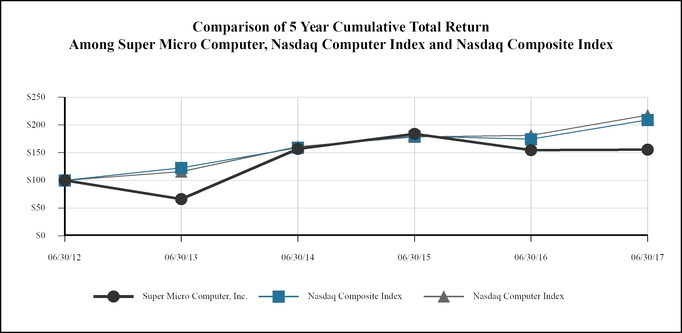
| | | | | | | | | | | | | | | | | | | |
| --- | --- | --- | --- | --- | --- | --- | --- | --- | --- | --- | --- | --- | --- | --- | --- | --- | --- | --- |
| | | | | | | | | | | | | | | | | | | |
An excerpt. Shown here: all 0 rewritten, all 0 added and 40 of 48 removed. The counts are complete. For every sentence, read Item 5. Market for Registrant's Common Equity, Related Stockholder Matters and Issuer Purchases of Equity Securities in the FY2017 filing.