 filings.tools
Item 1. BUSINESS
64K characters. Original on sec.gov · Markdown
Item 1. BUSINESS
Unless otherwise noted in this report, any description of "we," "us" or "our" includes Molson Coors Brewing Company ("MCBC" or the "Company"), principally a holding company, and its operating and non-operating subsidiaries included within our reporting segments and Corporate. Our reporting segments include: MillerCoors LLC ("MillerCoors" or U.S. segment), operating in the United States; Molson Coors Canada ("MCC" or Canada segment), operating in Canada; Molson Coors Europe (Europe segment), operating in Bulgaria, Croatia, Czech Republic, Hungary, Montenegro, the Republic of Ireland, Romania, Serbia, the United Kingdom and various other European countries; and Molson Coors International ("MCI" or International segment), operating in various other countries.
Unless otherwise indicated, information in this report is presented in USD and comparisons are to comparable prior periods. Our primary operating currencies, other than USD, include the CAD, the GBP, and our Central European operating currencies such as the EUR, CZK, HRK and RSD.
Background
We are one of the world's largest brewers and have a diverse portfolio of owned and partner brands, including global priority brands Blue Moon, Coors Banquet, Coors Light, Miller Genuine Draft, Miller Lite, and Staropramen, regional champion brands Carling, Molson Canadian and other leading country-specific brands, as well as craft and specialty beers such as Creemore Springs, Cobra, Doom Bar, Henry's Hard and Leinenkugel's. With centuries of brewing heritage, we have been crafting high-quality, innovative products with the purpose of delighting the world's beer drinkers and with the ambition to be the first choice for our consumers and customers. Our success depends on our ability to make our products available to meet a wide range of consumer segments and occasions.
Molson and Coors were founded in 1786 and 1873, respectively. Our commitment to producing the highest quality beers is a key part of our heritage and remains so to this day. Our brands are designed to appeal to a wide range of consumer tastes, styles and price preferences. Our largest markets are the U.S., Canada and Europe.
Coors was incorporated in June 1913 under the laws of the state of Colorado. In October 2003, Coors merged with and into Adolph Coors Company, a Delaware corporation. In February 2005, Adolph Coors Company merged with Molson Inc. Upon completion of the merger, Adolph Coors Company changed its name to Molson Coors Brewing Company.
Acquisition
On October 11, 2016, we completed the acquisition of SABMiller plc's ("SABMiller") 58% economic interest and 50% voting interest in MillerCoors and all trademarks, contracts and other assets primarily related to the "Miller International Business," as defined in the purchase agreement, outside of the U.S. and Puerto Rico (the "Acquisition") from Anheuser-Busch InBev SA/NV ("ABI"). The Acquisition was completed for $12.0 billion in cash, subject to a downward adjustment as described in the purchase agreement. This purchase price "Adjustment Amount," as defined in the purchase agreement, required payment to MCBC if the unaudited EBITDA for the Miller International Business for the twelve months prior to closing was below $70 million. Under the purchase agreement, we retained the rights to all of the brands in the MillerCoors portfolio at the time of the Acquisition for the U.S. and Puerto Rican markets, including import brands such as Peroni and Pilsner Urquell, as well as obtained full ownership of the Miller brand portfolio outside of the U.S. and Puerto Rico. Additionally, in consolidating control of MillerCoors, we expect we will further improve our scale and agility, benefit from significantly enhanced cash flows from operations, and capture substantial operational synergies. We believe the purchase of the Miller brand trademarks outside of the U.S. and Puerto Rico provides a strategic opportunity to leverage the iconic Miller trademark globally alongside our trademarks for Coors and Staropramen, and presents volume and profit growth opportunities in both core markets and emerging markets.
On January 21, 2018, MCBC and ABI entered into a settlement agreement related to the purchase price adjustment under the purchase agreement, and on January 26, 2018, pursuant to the settlement agreement, ABI paid to MCBC $330.0 million, of which $328.0 million constitutes the Adjustment Amount. As this settlement occurred following the finalization of purchase accounting, we recorded the settlement proceeds related to the Adjustment Amount as a gain within special items, net in our consolidated statement of operations in our Corporate segment and within cash provided by operating activities within our consolidated statement of cash flows for the year ended December 31, 2018. MCBC and ABI also agreed to certain mutual releases as further described in the settlement agreement.
Industry Overview
The brewing industry has significantly evolved over the years, becoming an increasingly global beer market. The industry was previously founded on local presence with modest international expansion achieved through export, license and partnership arrangements. More recently, it has become increasingly complex, as the consolidation of brewers has occurred globally, resulting in fewer major global market participants. In addition to the acquisitive element of this industry consolidation, the market continues to utilize export, license and partnership arrangements; however, these are often with the same global competitors that make up the majority of the market. This industry consolidation has resulted in a small number of large global brewers representing the majority of the worldwide beer market. At the same time, smaller local brewers within certain established markets are experiencing accelerated growth as consumers increasingly place value on locally-produced, regionally-sourced products. As the beer industry continues its evolution of consolidation and diversification of its products to meet consumer demand with broadening preferences, large global brewers are uniquely positioned to leverage the scale, depth of product portfolio and industry knowledge to continue to lead the market forward.
Global Competitors' Market Capitalization
We evaluate ourselves in relation to other global brewers using various metrics, including overall market capitalization, volume, net sales revenue, gross margins and net profits, as well as our position within each of our core markets, with the goal to be the first choice for our consumers and customers. To provide a perspective of the relative size of the major participants in the global brewing market, the market capitalizations of our primary global competitors, based on foreign exchange rates as of December 31, 2018, were as follows:
| Market Capitalization | |||
| (In billions) | |||
| Anheuser-Busch InBev SA/NV | $ | 133.6 | |
| Heineken N.V. ("Heineken") | $ | 51.0 | |
| Asahi Group Holdings, Ltd. ("Asahi") | $ | 18.8 | |
| Carlsberg Group ("Carlsberg") | $ | 16.1 | |
| MCBC | $ | 12.2 |
Our Products
We have a diverse portfolio of owned and partner brands which are positioned to meet a wide range of consumer segments and occasions in a variety of markets, including Blue Moon, Coors Banquet, Coors Light, Miller Genuine Draft, Miller Lite and Staropramen. We consider these our global priority brands which we continue to invest in and focus on growing globally. We believe our portfolio encompasses all segments of the beer industry with the purpose of delighting the world's beer drinkers, including premium and premium lights, economy, above premium and craft, as well as adjacencies such as ciders and other malt beverages. The following includes our primary brands sold in each of our segments.
Brands sold in the U.S.
| Global priority brands | Regional champion brands | Craft and import brands | ||
| Blue Moon | Hamm's | Grolsch(1) | ||
| Coors Banquet | Icehouse | Hop Valley | ||
| Coors Light | Keystone | Leinenkugel's | ||
| Miller Genuine Draft | Mickey's | Peroni Nastro Azurro(1) | ||
| Miller Lite | Miller64 | Pilsner Urquell(1) | ||
| Miller High Life | Revolver | |||
| Milwaukee's Best | Saint Archer | |||
| Olde English | Sol(2) | |||
| Steel Reserve | Terrapin | |||
| Hard cider brands | Flavored malt beverages | |||
| Crispin | Arnold Palmer Spiked(3) | |||
| Smith & Forge | Henry's Hard | |||
| Redd's(4) | ||||
| Steel Reserve Alloy Series | ||||
| (1) Under perpetual royalty-free license from Asahi. | ||||
| (2) Under license from Heineken. | ||||
| (3) In partnership with Hornell Brewing, an affiliate of Arizona Beverages | ||||
| (4) Under perpetual royalty-free license from ABI. |
Brands sold in Canada
| Global priority brands | National champion and other regional brands | Craft and import brands | ||
| Belgian Moon | Carling | Brasseurs de Montréal | ||
| Coors Banquet | Carling Black Label | Creemore Springs | ||
| Coors Light | Keystone | Granville Island | ||
| Miller Genuine Draft | Mad Jack | Henry's Hard | ||
| Miller Lite | Miller High Life | Le Trou du Diable | ||
| Molson Canadian | Leinenkugel's | |||
| Molson Canadian 67 | ||||
| Molson Canadian Cider | ||||
| Molson Dry | ||||
| Molson Export | ||||
| Old Style Pilsner | ||||
| Rickard's | ||||
| Licensed premium import brands(1) | ||||
| Amstel Light | Desperados | |||
| Heineken | Dos Equis | |||
| Murphy's | Moretti | |||
| Newcastle | Sol | |||
| Strongbow cider | Tecate | |||
| (1) Under license from Heineken. |
Brands sold in Europe
| Global priority brands | Regional champion brands | Other(1) | ||
| Blue Moon | Bergenbier | Aspall Cider | ||
| Coors Light | Borsodi | Bavaria | ||
| Miller Genuine Draft | Carling | Beck's | ||
| Staropramen | Jelen | Branik | ||
| Kamenitza | Birradamare | |||
| Niksicko | Cobra | |||
| Ozujsko | Corona Extra | |||
| Grolsch | ||||
| Lowenbrau | ||||
| Rekorderlig cider | ||||
| Singha | ||||
| Sharp's Doom Bar | ||||
| Stella Artois | ||||
| (1) The European business has licensing and distribution agreements with various other brewers through which it also brews and distributes Beck's, Lowenbrau, Stella Artois and Spaten, as well as a distribution agreement for the exclusive distribution of the Corona brand, throughout the Central European countries in which we operate. We have an agreement with Dutch brewer, Bavaria, for the exclusive on-premise and off-premise rights to the sales, distribution and customer marketing of Bavaria and its portfolio of brands in the U.K. Starting in 2018, we have an agreement for licensed brewing and distribution of Bavaria portfolio in Croatia, Bosnia and Herzegovina, Serbia and Montenegro. We also distribute the Rekorderlig cider brand in the U.K. and the Republic of Ireland. In the U.K., we also sell the Cobra brands through the Cobra Beer Partnership Ltd. joint venture and the Grolsch brands through a joint venture with Royal Grolsch N.V., and are the exclusive distributor for several brands including Singha. Additionally, in order to be able to provide a full line of beer and other beverages to our U.K. on-premise customers, we sell "factored" brands, which are third-party beverage brands for which we provide distribution to retail, typically on a non-exclusive basis. |
Brands sold in International
| Global priority brands | Regional champion brands | Other | ||
| Blue Moon | Miller High Life | Carling Strong | ||
| Coors Light(1) | Thunderbolt | Coors Banquet | ||
| Miller Genuine Draft(1) | Coors 1873 | |||
| Miller Lite(1) | Keystone | |||
| Staropramen | Milwaukee's Best | |||
| Miller Ace | ||||
| Miller Chill | ||||
| Miller Ultra | ||||
| Molson Canadian | ||||
| Zima | ||||
| (1) Focus brands in International segment |
Our Segments
In 2018, we operated the following segments: the U.S., Canada, Europe and International. A separate operating team manages each segment and each segment manufactures, markets, and sells beer and other malt beverage products.
United States Segment
| • | Headquarters: Chicago, Illinois |
| • | Approximately 7,300 employees |
| • | Second largest brewer by volume in the U.S., selling approximately 24% of the total 2018 U.S. brewing industry shipments (excluding exports) |
| • | Currently operating seven primary breweries, six craft breweries and two container operations |
Prior to the Acquisition completed on October 11, 2016, MCBC owned a 50% voting and 42% economic interest in MillerCoors (which was originally formed on July 1, 2008, as a joint venture between MCBC and SABMiller), and MillerCoors was accounted for under the equity method of accounting. Following the completion of the Acquisition, MillerCoors became a wholly-owned subsidiary of MCBC and its results were fully consolidated by MCBC prospectively beginning on October 11, 2016.
Sales and Distribution
In the United States, beer is generally distributed through a three-tier system consisting of manufacturers, distributors and retailers. A national network of approximately 400 independent distributors and one owned distributor, Coors Distributing Company, purchases our products and distributes them to on- and off-premise retail accounts.
References to on- and off-premise sales volumes are the sales to retailers of these distributors, which we believe is a useful data point relative to consumer trends.
Channels
In the United States, the on-premise channel industry volume, which includes sales in bars and restaurants, declined approximately 2% in 2018.
The off-premise channel includes sales in convenience stores, grocery stores, liquor stores and other retail outlets. The off-premise channel industry volume declined approximately 1% in 2018 versus prior year.
The following table reflects the industry channel trends over the last five years in the United States. Note that percentages reflect estimates based on market data currently available.
| Industry channel trend | ||||||||||||||
| 2018 | 2017 | 2016 | 2015 | 2014 | ||||||||||
| On-premise | 16 | % | 16 | % | 16 | % | 17 | % | 17 | % | ||||
| Off-premise | 84 | % | 84 | % | 84 | % | 83 | % | 83 | % |
Coors Distributing Company distributed less than 2% of our total owned and non-owned volume in 2018.
Manufacturing, Production and Packaging
Brewing Raw Materials
We use high quality ingredients to brew our products. We malt a portion of our production requirements, using barley purchased under primarily annual contracts from independent farmers located predominantly in the western United States. Other barley, malt, and cereal grains are purchased from suppliers primarily in the U.S. Hops are purchased from suppliers in the U.S. and Europe. We both own and lease water rights, as well as purchase water through local municipalities, to provide for and sustain brewing operations in case of a prolonged drought in the regions where we have operations. We do not currently anticipate future difficulties in accessing water or agricultural products used in our brewing process in the near term.
Packaging Materials
The following summarizes the percentage of our U.S. segment's packaging materials by type for the year ended December 31, 2018.
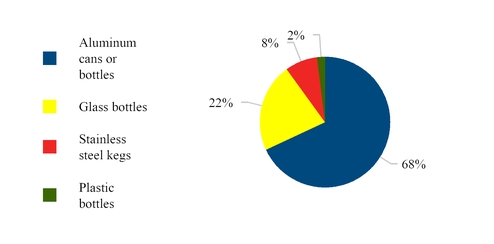
Aluminum cans or bottles:
| • | A portion of the aluminum containers was purchased from Rocky Mountain Metal Container ("RMMC"), our joint venture with Ball Corporation ("Ball"), whose production facilities, which are leased from us, are located near our brewery in Golden, Colorado. |
| • | In addition to the supply agreement with RMMC, we have a supply agreement with Ball to purchase cans and ends in excess of what is supplied through RMMC. |
| • | The RMMC joint venture agreement along with the cans and ends purchase agreement expire on December 31, 2021. |
Glass bottles:
| • | A portion of the glass bottles was provided by Rocky Mountain Bottle Company ("RMBC"), our joint venture with Owens-Brockway Glass Container, Inc. ("Owens"), whose production facilities, which are leased from us, are located in Wheat Ridge, Colorado. The RMBC joint venture agreement expires on July 31, 2025. |
| • | In addition to the supply agreement with RMBC, we have a supply agreement with Owens for requirements in excess of RMBC's production, which expires on December 31, 2021. |
Stainless steel kegs:
| • | Kegs are packaged in half, quarter, and one-sixth barrel stainless steel kegs. |
| • | A limited number of kegs are purchased each year, and we have no long-term supply agreement. |
Crowns, labels, corrugate and paperboard are purchased from a small number of sources unique to each product. In recent years, we have experienced a slight shift in the allocation among different packaging types toward aluminum cans and bottles and away from glass bottles. In general, aluminum cans allow for lower packaging costs compared to most other types of packaging materials. We do not currently anticipate future difficulties in accessing packaging products in the near term.
Contract Manufacturing
We have an agreement to brew, package and ship products for Pabst Brewing Company. Additionally, the U.S. segment produces beer for export to our Canada and International segments.
Seasonality of the Business
Total industry volume in the U.S. is sensitive to factors such as weather, changes in demographics, consumer preferences and drinking occasions. Weather conditions consisting of high temperatures and extended periods of warm weather favor increased consumption of our products, while unseasonably cool or wet weather, especially during the summer months, adversely affects our sales volumes and net sales. Accordingly, consumption of beer in the U.S. is seasonal, with approximately 39% of industry sales volume typically occurring during the warmer months from May through August.
Known Trends and Competitive Conditions
2018 U.S. Beer Industry Overview
The beer industry in the United States is highly competitive, and the two largest brewers, ABI and MCBC together represented the majority of the market in 2018. However, we estimate the two largest brewers lost share in 2018 due to volume growth in the import and flavored malt beverage categories as consumer preferences continue to shift within the industry to above premium priced beers. We believe growing or even maintaining our market share will require stabilizing our core brands and increasing our presence in the fast growing areas of the industry.
Competition from outside of the beer category continues to be a challenge for the beer industry. The following table summarizes the estimated percentage market share by volume of beer (including flavored malt beverages) and other alcohol beverages, including wine and spirits, as a component of the overall U.S. alcohol market over the last five years. We anticipate that 2018 data, when available, will reflect a continuation of the recent consumer trends. Note that percentages reflect estimates based on market data currently available.
| 2017 | 2016 | 2015 | 2014 | 2013 | ||||||||||
| Beer | 50 | % | 51 | % | 51 | % | 51 | % | 52 | % | ||||
| Other alcohol beverages | 50 | % | 49 | % | 49 | % | 49 | % | 48 | % |
Our Competitive Position
Our portfolio of beers competes with numerous above premium, premium, and economy brands. These competing brands are produced by international, national, regional and local brewers. We compete most directly with ABI brands, but also compete with imported and craft beer brands, as well as flavored malt beverages. The following table summarizes the estimated percentage share of the U.S. beer market represented by Molson Coors, ABI and all other brewers over the last five years. Note that current year percentages reflect estimates based on market data currently available.
| 2018 | 2017 | 2016 | 2015 | 2014 | ||||||||||
| MCBC's share | 24 | % | 25 | % | 25 | % | 26 | % | 27 | % | ||||
| ABI's share | 42 | % | 43 | % | 44 | % | 45 | % | 46 | % | ||||
| Others' share | 34 | % | 32 | % | 31 | % | 29 | % | 27 | % |
Our products also compete with other alcohol beverages, including wine and spirits, and thus their competitive position is affected by consumer preferences between and among these other categories. Driven by increased spirits advertising along with increased wine and spirits sales execution, sales of wine and spirits have grown faster than sales of beer in recent years, resulting in a reduction in the beer segment's lead in the overall alcohol beverage market.
Regulation
The U.S. beer business is regulated by federal, state, and local governments. These regulations govern many parts of our operations, including brewing, marketing and advertising, transportation, distributor relationships, sales, and environmental issues. To operate our facilities, we must obtain and maintain numerous permits, licenses and approvals from various governmental agencies, including the U.S. Treasury Department, Alcohol and Tobacco Tax and Trade Bureau, the U.S. Department of Agriculture, the U.S. Food and Drug Administration, state alcohol regulatory agencies, and state and federal environmental agencies.
Governmental entities also levy taxes and may require bonds to ensure compliance with applicable laws and regulations. In 2018, excise taxes on malt beverages were approximately $15 per hectoliter sold on a reported basis which includes the impact of the Craft Beverage Modernization and Tax Reform Act which took effect on January 1, 2018, for all qualified large domestic brewers and importers effective for 2018 and 2019, and resulted in reduced excise taxes for MCBC in the U.S. by $2 per barrel on the first six million barrels, which equated to $1.70 per hectoliter on this portion of volume. We transfer a portion of our share of these savings to distributors consistent with the revenue splitting approach of our U.S. segment’s economic model. State excise taxes are levied in specific states at varying rates.
Refer to Part I—Item 1A, Risk Factors for risks associated with the regulatory environment in the U.S.
Canada Segment
| • | Headquarters: Toronto, Ontario |
| • | Approximately 2,600 employees |
| • | Canada's second largest brewer by volume and North America's oldest beer company, selling approximately 32% of the total 2018 Canada beer market |
| • | Currently operating five primary breweries and four craft breweries |
We brew, market, sell and distribute a wide variety of beer brands nationally. Our portfolio has leading brands in all major product and price segments. In 2018, Coors Light had an approximate 10% market share and was the second largest selling beer brand in Canada, and Molson Canadian had an approximate 5% market share and was the fourth largest selling beer in Canada. As a result of the Acquisition, the Miller brands returned to our Canada business.
The Canada segment also includes our partnership arrangements related to the distribution of beer in Ontario, Brewers' Retail Inc. ("BRI"), and in the Western provinces, Brewers' Distributor Ltd. ("BDL"). BRI and BDL are accounted for under the equity method of accounting. The majority of ownership in BRI resides with MCC, Labatt Breweries of Canada LP (a subsidiary of ABI) and Sleeman Breweries Ltd. (a subsidiary of Sapporo International). BDL is jointly owned by MCC and ABI.
In line with our strategic initiatives to expand our craft portfolio, the Canada segment acquired two craft breweries in Quebec, Le Trou du Diable and Brasseurs de Montréal, Inc. in 2017 and in 2016, respectively. There were no additional acquisitions during 2018. However, on October 4, 2018, a wholly-owned subsidiary within our Canadian business completed the formation of an independent Canadian joint venture, Truss LP ("Truss"), with HEXO Corp. ("HEXO") to pursue opportunities to develop, produce and market non-alcoholic, cannabis-infused beverages once legal in Canada. Truss is structured as a standalone start-up company with its own board of directors and an independent management team and we maintain a 57.5% controlling interest in the joint venture.
Sales and Distribution
In Canada, provincial governments regulate the beer industry, particularly with regard to the pricing, mark-up, container management, sale, distribution and advertising of beer. Distribution and the retail sale of alcohol products involve a wide range and varied degree of Canadian government control through their respective provincial liquor boards. See below discussion for details by province.
Channels
In Canada, the on-premise channel includes sales in bars and restaurants. In Ontario and Western Canada, we use jointly-owned distribution systems to deliver beer to on-premise customers along with products from Labatt Breweries of Canada LP and Sleeman Breweries Ltd. In Quebec and Eastern Canada, we primarily deliver directly. The on-premise channel, and relationships with customers, are highly regulated and the regulations differ significantly across different provincial jurisdictions.
The off-premise channel includes sales to convenience stores, grocery stores, liquor stores and other specialty retail outlets, including "The Beer Store" in Ontario, which is the world's largest beer retailer and is co-owned by Ontario's three largest brewers. The off-premise channel is highly regulated and differs significantly across different provincial jurisdictions.
The following table reflects the industry channel trends over the last five years in Canada.
| Industry channel trend | ||||||||||||||
| 2018 | 2017 | 2016 | 2015 | 2014 | ||||||||||
| On-premise | 16 | % | 17 | % | 17 | % | 17 | % | 17 | % | ||||
| Off-premise | 84 | % | 83 | % | 83 | % | 83 | % | 83 | % |
Province of Ontario
In Ontario, beer is primarily purchased at retail outlets operated by BRI, at government-regulated retail outlets operated by the Liquor Control Board of Ontario ("LCBO"), at approved agents of the LCBO, at certain licensed grocery stores, or at any bar, restaurant, or tavern licensed by the LCBO to sell alcohol for on-premise consumption. The BRI retail outlets operate under The Beer Store name. Brewers may deliver directly to BRI's outlets or may choose to use BRI's distribution centers to access retail stores in Ontario, the LCBO system, the grocery channel and licensed establishments.
Province of Québec
In Québec, the distribution and sale of beer is governed by the Quebec Alcohol Corporation ("SAQ"). Beer is distributed to retail outlets directly by each brewer or through approved independent agents. We are the agent for the licensed brands we distribute. The brewer or agent distributes the products to permit holders for retail sales for on-premise consumption. Québec retail sales for off-premise consumption are made through grocery and convenience stores, as well as government operated outlets.
Province of British Columbia
In British Columbia, the government's Liquor Distribution Branch controls the regulatory elements of distribution of all alcohol products in the province. BDL, which we co-own with ABI, manages the distribution of our products throughout British Columbia. Consumers can purchase beer at any Liquor Distribution Branch retail outlet, at any independently owned and licensed retail store or at any licensed establishment for on-premise consumption. Establishments licensed primarily for on-premise alcohol sales may also be licensed for off-premise consumption.
Province of Alberta
In Alberta, the distribution of beer is managed by independent private warehousing and shipping companies or by a government sponsored system in the case of U.S. sourced products. All sales of liquor in Alberta are made through retail outlets licensed by the Alberta Gaming and Liquor Commission or licensees, such as bars, hotels and restaurants. BDL manages the distribution of our products in Alberta.
Other Provinces
Our products are distributed in the provinces of Manitoba and Saskatchewan through local liquor boards. Manitoba and Saskatchewan also have licensed private retailers. BDL manages the distribution of our products in Manitoba and Saskatchewan. In the Maritime Provinces (other than Newfoundland), local liquor boards distribute and sell our products. In Newfoundland, our products are sold through independent distributors. In Yukon, Northwest Territories and Nunavut, government liquor commissioners manage the distribution and sale of our products.
Manufacturing, Production and Packaging
Brewing Raw Materials
We use high quality ingredients to brew our products. We also use hedging instruments to mitigate the risk of volatility in certain commodities and foreign exchange markets.
We source barley malt from one primary provider, from which we have a committed supply through 2022. Hops are purchased from a variety of global suppliers in the U.S. and Europe through contracts that vary in length based on market conditions and cover our supply requirements through 2021. Other starch brewing adjuncts are sourced from two main suppliers, both in North America, through 2022. Water used in the brewing process is from local sources in the communities where our breweries operate. We do not currently anticipate future difficulties in accessing water or agricultural products used in our brewing process in the near term.
Packaging Materials
The following summarizes the percentage of our Canada segment's packaging materials by type for the year ended December 31, 2018.
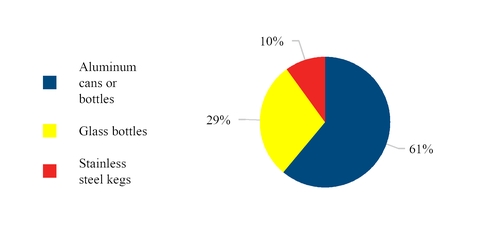
Aluminum cans or bottles:
| • | We source cans and lids from two primary providers with contracts ending December 2021 and December 2023, respectively. |
| • | The distribution systems in each province generally provide the collection network for returnable bottles and aluminum cans. |
Bottles:
| • | We single source glass bottles and have a committed supply through December 2021. |
| • | The standard bottle for beer brewed in Canada is the 341 ml returnable bottle and represents the vast majority of our bottle sales. |
| • | Bottle sales continue to decline as we have experienced a shift in consumers' preference toward aluminum cans. The standard returnable bottle requires significant investment behind our returnable bottle inventory and bottling equipment. The trend away from returnable bottles could result in higher fixed cost deleverage related to these assets and an ultimate decreased need for the assets that support this packaging, which could adversely impact profitability. |
Stainless steel kegs:
| • | A limited number of kegs are purchased every year, and we have no long-term supply commitment. |
Crowns are currently sourced from one major supplier with a contract through June 2019, which we are currently in the process of extending. Paperboard and labels are currently sourced from one supplier each with contracts through December 2020 and December 2021, respectively. Corrugate is purchased from a small number of sources with contracts through December 2020 and March 2021 and we are in the process of extending two additional contracts which expired in 2018, however, supply has continued without issue while these are being negotiated. We do not currently anticipate future difficulties in accessing any of our required packaging materials in the near term.
Contract Manufacturing
We have an agreement with North American Breweries, Inc. ("NAB") to brew and package certain Labatt brands for export to the U.S. market. We also have an agreement with Asahi to brew and package Asahi Super Dry and Asahi Select for export to the U.S. market.
Seasonality of Business
Total industry volume in Canada is sensitive to factors such as weather, changes in demographics, consumer preferences and drinking occasions. Weather conditions consisting of high temperatures and extended periods of warm weather favor increased consumption of our products, while unseasonably cool or wet weather, especially during the summer months, adversely affects our sales volumes and net sales. Accordingly, consumption of beer in Canada is seasonal, with approximately 41% of industry sales volume typically occurring during the warmer months from May through August.
Known Trends and Competitive Conditions
2018 Canada Beer Industry Overview
The Canadian brewing industry is a mature market and ABI and MCBC are the two largest brewers. It is characterized by aggressive competition for volume and market share from regional brewers, microbrewers and certain foreign brewers, as well as our main domestic competitor. These competitive pressures require significant annual investment in marketing and selling activities. In 2018, the Ontario and Québec markets accounted for approximately 61% of the total beer market in Canada.
There are three major beer price segments: above premium, which includes craft and most imports; premium, which includes the majority of domestic brands and the light sub-segment; and value (below premium). Since 2001, the premium beer segment in Canada has gradually lost volume to the above premium and value segments.
The beer industry has declined in five of the last six years. Aging population and strong competition from other alcohol beverages have been the main contributors to the declining state of the beer industry.
The following table summarizes the estimated percentage market share by volume of beer (including adjacencies, such as cider) and other alcohol beverages, including wine and spirits, as a component of the overall Canadian alcohol market over the last five years, for which data is currently available. We anticipate that 2018 data, when available, will reflect a continuation of the recent consumer trends. Note that percentages reflect estimates based on market data currently available.
| 2017 | 2016 | 2015 | 2014 | 2013 | ||||||||||
| Beer | 47 | % | 47 | % | 48 | % | 48 | % | 48 | % | ||||
| Other alcohol beverages | 53 | % | 53 | % | 52 | % | 52 | % | 52 | % |
Our Competitive Position
Our brands compete with competitor beer brands and other alcohol beverages, including wine and spirits, and thus our competitive position is affected by consumer preferences among these other categories. Our brand portfolio gives us strong representation in all major beer segments.
The following table summarizes the estimated percentage share of the Canadian beer market represented by MCBC, ABI and all other brewers over the last five years. Note that the sum of the percentages below may not equal 100% due to rounding. Current year percentages reflect estimates based on market data currently available.
| 2018 | 2017 | 2016 | 2015 | 2014 | ||||||||||
| MCBC's share(1) | 32 | % | 33 | % | 33 | % | 34 | % | 37 | % | ||||
| ABI's share(1) | 42 | % | 42 | % | 43 | % | 43 | % | 43 | % | ||||
| Others' share | 26 | % | 25 | % | 24 | % | 23 | % | 21 | % |
| (1) | The decrease in MCBC's share in 2015 was largely driven by the loss of the contract with Miller Brewing Company ("Miller"), under which we had exclusive rights to distribute certain Miller brands in Canada and was terminated effective March 2015. As a result of the Acquisition, beginning October 11, 2016, these Miller brands returned to our Canada business. |
Regulation
In Canada, provincial governments regulate the production, marketing, distribution, selling and pricing of beer (including the establishment of minimum prices), and impose commodity taxes and license fees in relation to the production, distribution and sale of beer. In addition, the federal government regulates the advertising, labeling, quality control, and international trade of beer, and also imposes commodity taxes on both domestically produced and imported beer. In 2018, our Canada segment excise taxes were approximately $54 per hectoliter sold on a reported basis. Further, certain bilateral and multilateral treaties entered into by the federal government, provincial governments and certain foreign governments, especially with the United States, affect the Canadian beer industry.
Europe Segment
| • | Headquarters: Prague, Czech Republic |
| • | Approximately 6,600 employees |
| • | Europe's second largest brewer by volume, on a combined basis, within the European countries in which we operate, with an approximate aggregate 20% market share (excluding factored products) in 2018 |
| • | Currently operating twelve primary breweries, five craft breweries and one cidery |
The majority of our European segment sales are in the U.K., Croatia, Czech Republic and Romania. Our portfolio includes beers that have the largest share in their respective countries, such as Carling in the U.K., Ozujsko in Croatia, Jelen in Serbia and Niksicko in Montenegro. We have beers that rank in the top three in market share in their respective segments throughout the region, such as Bergenbier in Romania, Kamenitza in Bulgaria and Borsodi in Hungary. Additionally, as a result of the Acquisition, we began selling Miller Genuine Draft in various European countries. Our Europe segment includes our consolidated joint venture arrangements for the production and distribution of Grolsch and Cobra brands in the U.K. and the Republic of Ireland and factored brand sales (beverage brands owned by other companies, but sold and delivered to retail by us).
Effective January 1, 2017, European markets including Sweden, Spain, Germany, Ukraine and Russia, which were previously reported under our International segment, are reported within our Europe segment. Additionally, in January 2017, we purchased a controlling interest in the Spanish craft brewery La Sagra Brew. Located near Madrid, La Sagra expands our craft portfolio in the world's 11th largest beer market and offers a new distribution partner in Spain for Blue Moon Belgian White, the largest craft brand in the U.S. In July 2017, we also completed the purchase of Birradamare, a small Italian craft brewery based just outside of Rome, which gives us an opportunity to develop its special brands in Italy and select export markets. In January 2018, we purchased Aspall Cider Limited in the U.K., which will strengthen the U.K. portfolio with a premium top ten cider as well as a cider production facility.
Sales and Distribution
In Europe, beer is generally distributed through either a two-tier system consisting of manufacturers and retailers, or a three-tier system consisting of manufacturers, distributors and retailers. Distribution activities for both the on-premise and off-premise channels are conducted primarily by third-party logistics providers. Most of our beer in the U.K. is sold directly to retailers. We have an agreement with Tradeteam Ltd. ("Tradeteam", a subsidiary of DHL) to provide the distribution of our products throughout the U.K. through 2023. We utilize several hundred third-party logistics providers across our Central European operations. We also conduct a small amount of secondary distribution in Czech Republic utilizing our own fleet of vehicles. It is also common in the U.K. for brewers to distribute beer, wine, spirits, and other products owned and produced by other companies, which we refer to as factored brands, to the on-premise channel (bars and restaurants). Approximately 18% of our Europe segment net sales in 2018 represented factored brands. In addition, we have an agreement with Heineken through December 2019, whereby they sell, market and distribute Coors Light in the Republic of Ireland.
Channels
In Europe, the on-premise channel includes sales to pubs and restaurants. The installation and maintenance of draught beer dispensing equipment in the on-premise channel is generally the responsibility of the brewer. Accordingly, we own refrigeration units and other equipment used to dispense beer from kegs to consumers that are used in on-premise outlets. This includes beer lines, cooling equipment, taps, and counter mounts.
The off-premise channel includes sales to supermarkets, convenience stores, liquor stores, distributors, and wholesalers. Over the last few years, the off-premise channel has become increasingly concentrated among a small number of super-store chains.
Generally, over the years, industry volumes in Europe have shifted from the higher margin on-premise channel, where products are consumed in pubs and restaurants, to the lower margin off-premise channel, also referred to as the "take-home" market. In 2018, approximately 40% of sales were on-premise and 60% were off-premise. Consistent with prior years, the on-premise channel has continued to experience declines from shifting consumer preference to off-premise partially due to smoking bans in many countries.
Manufacturing, Production and Packaging
Brewing Raw Materials
We use high quality ingredients to brew our products. During 2018, our malt requirements were sourced from third-party suppliers. We have multiple agreements with various suppliers that cover almost all of our total required malt, with terms ending in 2020 through 2026. Hops are purchased under various contracts with suppliers in Germany, the U.S. and the U.K.,
which cover our requirements through 2019. Adjuncts are purchased under various contracts with local producers, which are typically crop year contracts commencing in October of each year. Water used in the brewing process is sourced from various wells and through water rights and supply contracts. We do not currently anticipate future difficulties in accessing required water or agricultural products used in our brewing process in the near term.
Packaging Materials
The following summarizes the percentage of our Europe segment's packaging materials by type for the year ended December 31, 2018.
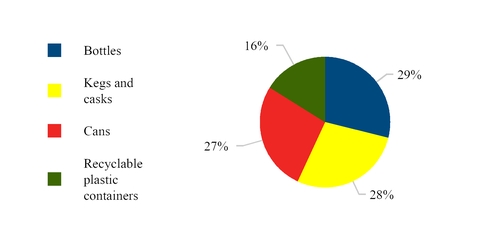
Bottles:
| • | A significant majority of returnable bottles are sourced under various agreements with third-party suppliers. |
Kegs:
| • | A limited number of kegs are purchased each year from various suppliers, and we have no long-term supply commitment. We are currently in the process of signing new agreements which would cover all of our requirements for kegs in 2019. |
Cans:
| • | We have long-term agreements with various suppliers that cover all of our required supply of cans, with terms ending in 2019 through 2023. |
Recyclable plastic containers:
| • | We have multiple agreements with various manufacturers in the region, covering 100% of our requirements which expire in 2019. We do not currently anticipate any issues in renegotiating and extending contracts or in otherwise being able to access recyclable plastic containers. |
Crowns, labels and corrugate are purchased from sources unique to each category. We do not currently foresee future difficulties in accessing these or other packaging materials in the near term.
Seasonality of Business
In Europe, the beer industry is subject to seasonal sales fluctuations primarily influenced by holidays, weather and by certain major televised sporting events. Weather conditions consisting of high temperatures and extended periods of warm weather favor increased consumption of our products, while unseasonably cool or wet weather, especially during the summer months, adversely affects our sales volumes and net sales. Accordingly, the peak selling seasons typically occur during the summer and during the Christmas and New Year holiday season.
Known Trends and Competitive Conditions
2018 Europe Beer Industry Overview
Based on current data, we estimate that the Europe beer market increased in 2018 compared to 2017, driven by increased beer consumption versus last year in some of the largest regions in which we operate. Since 2010, the off-premise market share has increased in our European markets from 55% to over 60% of total volume, and the on-premise market share has declined
from 45% to below 40%. Europe beer industry retail shipments have fluctuated by approximately 1% to 2% annually over the last five years. These market fluctuations are consistent with the fluctuations within the overall alcohol market in each of the respective years.
Our beers compete not only with similar products from competitors, but also with other alcohol beverages, including wines and spirits. The following table summarizes the estimated percentage market share by volume of beer and other alcohol beverages, including wine and spirits, as a component of the overall European alcohol market, within the countries in which we have production facilities, over the last five years, for which data is currently available. We anticipate that 2018 data, when available, will reflect a continuation of the recent consumer trends. Note that percentages reflect estimates based on market data currently available.
| 2017 | 2016 | 2015 | 2014 | 2013 | ||||||||||
| Beer | 28 | % | 28 | % | 28 | % | 28 | % | 29 | % | ||||
| Other alcohol beverages | 72 | % | 72 | % | 72 | % | 72 | % | 71 | % |
Our Competitive Position
In European countries where we currently operate, our primary competitors are Heineken, Asahi, ABI and Carlsberg. We believe our brand portfolio gives us strong representation in all major beer categories. The following table summarizes our estimated percentage share of the beer market within the European countries where we operate and our primary competitors over the last five years. Note that current year percentages reflect estimates based on market data currently available.
| 2018 | 2017 | 2016 | 2015 | 2014 | ||||||||||
| MCBC's share | 20 | % | 20 | % | 20 | % | 20 | % | 20 | % | ||||
| Primary competitors' share | 57 | % | 56 | % | 57 | % | 57 | % | 59 | % | ||||
| Others' share | 23 | % | 24 | % | 23 | % | 23 | % | 21 | % |
Regulation
Each country that is part of our Europe segment is either a member of the European Union ("EU") or a current candidate to join, with the exception of Bosnia, which is a potential candidate, and, as such, there are similarities in the regulations that apply to many parts of our Europe segment's operations and products, including brewing, food safety, labeling and packaging, marketing and advertising, environmental, health and safety, employment and data protection regulations. To operate breweries and conduct our business in Europe, we must obtain and maintain numerous permits and licenses from various governmental agencies.
The U.K. is expected to leave the European Union on March 29, 2019. However, the proposed withdrawal agreement was rejected by the U.K. Parliament on November 14, 2018 and January 15, 2019. As a result, the terms of the withdrawal remain unknown, which subjects our Europe segment to regulatory and market uncertainty in the U.K. and in the rest of Europe. See Part I—Item 1A Risk Factors under "Risks Specific to the Europe Segment" for further discussion of the risks specific to the U.K.'s proposed exit from the EU.
Each country's government levies excise taxes on all alcohol beverages. With the exception of Serbia, Montenegro and Bosnia, all countries' laws on excise taxes are consistent with the directives of the EU. With the exception of Serbia, where a flat excise per hectoliter is used, all European countries use similar measurements based on either alcohol by volume or Plato degrees. The EU Excise Directives are currently under review which may result in all jurisdictions being required to account by reference to alcohol by volume. In 2018, the excise taxes for our Europe segment were approximately $46 per hectoliter on a reported basis. Refer to Part I—Item 1A, Risk Factors for risks associated with the regulatory environment in Europe.
International Segment
| • | Headquarters: Denver, Colorado |
| • | Approximately 450 employees |
| • | International beer markets, including emerging markets in Latin America, Asia Pacific and Africa |
| • | Currently operating under export models and license agreements, as well as owned breweries, which brew and package brands sold in India |
The objective of our International segment is to grow and expand our business and brand portfolio in new and existing markets, while being a meaningful contributor to overall MCBC growth. Our strategy is centered on our focus markets and
focus brands. Our focus brands are Coors Light, Miller Lite and Miller Genuine Draft, which are aligned with global priority brands and account for the majority of our volumes. The International segment's portfolio of beers competes within the above premium category in most of our markets. Our principal competitors include large global brewers, as well as local brewers. As our International segment's objective is to grow and expand our business, we are developing scale and building market share in the countries where we operate. Many of the markets in which we operate are considered emerging beer markets, with other brewers controlling the majority of the market share. Our beers compete not only with similar products from competitors, but also with other alcohol beverages, including wines, spirits, and ciders, and thus our competitive position is affected by consumer preferences between and among these other categories.
As part of the acquisition of the Miller International Business, which we acquired in the fourth quarter of 2016, we entered into various Transitional Service Agreements (“TSAs”) with local SABMiller and now ABI owned entities for services including the selling, distribution and production of Miller brands. We have successfully created a presence and commercial routes to market related to the Miller brands, but continue to leverage production TSAs, which are set to expire in October 2019, in certain markets. We are in the process of establishing alternative production for the Miller brands and do not currently anticipate any material disruption in the supply of our products after the currently-scheduled expiration of the production TSAs.
Latin America
In Latin America, we use a combination of export models and license agreements to sell Blue Moon, Coors Light, Miller Genuine Draft, Miller High Life, Miller Lite and other brands. In our export model markets, we import beer from the U.S. and sell it through agreements with independent distributors. Our export markets include countries such as Dominican Republic, Paraguay and Puerto Rico. In license markets, such as Argentina, Colombia and Mexico, we have established exclusive licensing agreements with brewers and distributors for the manufacturing and distribution of our products. In Honduras, Panama and Chile we rely on a combination of export and license agreements.
Asia Pacific
Our operations in the Asia Pacific region include markets such as Australia, India, Japan and South Korea. Our business in India consists primarily of operations in the states of Haryana, Punjab and Uttar Pradesh. Our consolidated India business produces, markets and sells a beer portfolio consisting of Thunderbolt, Miller Ace, Miller High Life and Carling Strong. We own three breweries in India (one of which is currently not operational as a result of the State of Bihar, India’s enactment of total alcohol prohibition in 2016), where we use high quality ingredients to brew our products, which are sourced through various contracts with local suppliers. We do not currently anticipate any significant disruption in the supply of these raw materials or brewing inputs in the near term.
Our Japan business imports our brands and sells through independent wholesalers. Our focus is on the marketing and selling of the Blue Moon, Coors Light and Zima brands. During the fourth quarter of 2018, we entered into an exclusive distribution agreement with Boon Rawd Trading International Co. Ltd, best known for its flagship brand, Singha. Under this agreement, we will be the exclusive importer, distributor, marketer and seller of Singha in Japan beginning January 2019. In Australia, we license our brands to a local partner that distributes locally produced and imported products including Blue Moon, Coors, Miller Genuine Draft, Miller Chill and other products for us. In South Korea, our brands include Blue Moon, Coors Light, Miller Genuine Draft, Miller Lite and Staropramen and are imported and sold through an independent distributor. During the first half of 2018, we decided to formally exit our business in China and we have subsequently completed the substantial liquidation of the corresponding entity.
Africa
We sell Miller Genuine Draft in South Africa and Zambia. Miller Genuine Draft is produced in South Africa and sold through a local license agreement.
Corporate
Corporate is not a reportable segment and primarily includes interest and certain other general and administrative costs that are not allocated to any of the operating segments. The majority of these corporate costs relate to worldwide administrative functions, such as corporate affairs, legal, human resources, information technology, finance, internal audit, insurance, ethics and compliance, risk management, global growth, supply chain and commercial initiatives, as well as acquisition, integration and financing costs associated with the Acquisition. Additionally, Corporate includes the results of our water resources and energy operations in Colorado as well as the unrealized changes in fair value on our commodity swaps not designated in hedging relationships recorded within cost of goods sold, which are later reclassified when realized to the segment in which the underlying exposure resides.
Other Information
Global Intellectual Property
We own trademarks on the majority of the brands we produce and have licenses for the remainder. We also hold several patent and design registrations with expiration dates through 2038 relating to brewing methods, beer dispensing systems, packaging and certain other innovations. We are not reliant on patent royalties for our financial success. Therefore, these expirations are not expected to have a significant impact on our business.
Sustainability
We believe in producing a beer we can be proud of, from barley to bottle. Our Beer Print is MCBC's approach to sustainability and the right way to grow our business. Our Beer Print is integral to how we will build long-term value for society and our shareholders, while leaving a positive imprint on our communities, on our environment and on our business.
We have a long legacy of leaving a positive imprint on the environment and our community. MCBC has been recognized on the Dow Jones Sustainability North America Index for eight consecutive years for our sustainability performance.
In 2012, MCBC built on long-standing efforts to reduce harmful drinking by becoming a signatory of the Beer, Wine and Spirits Producers’ Commitments to Reduce Harmful Drinking. We have been working closely with other leading beer, wine and spirit companies and with governments around the world to deliver a 10% reduction in the harmful use of alcohol by 2025. The current phase of the Commitments ended in 2017, and we look forward to working with our industry partners to develop the next set of ambitious targets.
In 2017, we launched Our Beer Print 2025 agenda, Raising the Bar on Beer, a new sustainability strategy for Molson Coors and a set of ambitious goals to take us to 2025. We focused our efforts where we can have the most positive impact on our business and society. We established goals across three pillars - Responsibly Refreshing, Sustainable Brewing and Collectively Crafted - that aim to address the shifting expectations of our consumers and stakeholders, while we continue to drive our operations to be even more resource efficient and resilient. More information about Our Beer Print 2025 agenda can be found on our sustainability website, www.OurBeerPrint.com, which includes:
| • | Our Beer Print Report 2018, which presents our 2025 strategy and highlights of our work across our three pillars; and |
| • | ESG (Environment, Social and Governance) Report 2018, which offers greater detail on Molson Coors sustainability performance. |
The information provided on our website (or any other website referred to in this report) is not part of this report and is not incorporated by reference as part of this report.
Environmental Matters
Our operations are subject to a variety of extensive and changing federal, state and local environmental laws, regulations and ordinances that govern activities or operations that may have an impact on human health or the environment. Such laws, regulations or ordinances may impose liability for the cost of remediation, and for certain damages resulting from sites of past releases of hazardous materials. Our policy is to comply with all such legal requirements. While we cannot predict our eventual aggregate cost for the environmental and related matters in which we may be or are currently involved, we believe that any payments, if required, for these matters would be made over a period of time in amounts that would not be material in any one year to our operating results, cash flows, or our financial or competitive position. We believe adequate reserves have been provided for losses that are probable and estimable. However, there can be no assurance that environmental laws will not become more stringent in the future or that we will not incur material costs in the future in order to comply with such laws. See Part II—Item 8 Financial Statements and Supplementary Data, Note 18, "Commitments and Contingencies" of the Notes under the caption "Environmental" for additional information regarding environmental matters.
Employees
As of the end of 2018, we employed approximately 17,750 employees within our business globally. Specifically, we employed approximately 7,300 within our U.S. segment, 6,600 within our Europe segment, 2,600 within our Canada segment, 450 within our International segment, 300 within our Corporate headquarters in Colorado and 500 within our Global Business Services center.
Available Information
We file with, or furnish to, the SEC reports, including our annual report on Form 10-K, quarterly reports on Form 10-Q, current reports on Form 8-K and amendments to those reports pursuant to Section 13(a) or 15(d) of the Exchange Act. These
reports are available free of charge via EDGAR through the SEC website (www.sec.gov) and are also available free of charge on our corporate website (www.molsoncoors.com) as soon as reasonably practicable after they are electronically filed with or furnished to the SEC. The foregoing website addresses are provided as inactive textual references only. The information provided on our website (or any other website referred to in this report) is not part of this report and is not incorporated by reference as part of this report.
Executive Officers
The following table sets forth certain information regarding our executive officers as of February 12, 2019:
| Name | Age | Position | ||
| Mark R. Hunter | 56 | President and Chief Executive Officer | ||
| Tracey I. Joubert | 52 | Chief Financial Officer | ||
| Gavin D.K. Hattersley | 56 | President and Chief Executive Officer, MillerCoors LLC | ||
| Sergey Yeskov | 42 | President and Chief Executive Officer, Molson Coors International | ||
| Simon Cox | 51 | President and Chief Executive Officer, Molson Coors Europe | ||
| Frederic Landtmeters | 45 | President and Chief Executive Officer, Molson Coors Canada | ||
| E. Lee Reichert | 52 | Chief Legal and Corporate Affairs Officer and Secretary | ||
| Celso L. White | 57 | Chief Supply Chain Officer | ||
| Michelle S. Nettles | 47 | Chief People and Diversity Officer | ||
| Krishnan Anand | 61 | Chief Growth Officer |
Previous: Cover and table of contents · Next: Item 1A. RISK FACTORS