 filings.tools
Tesla 10-K 2023-12-31
Filed 2024-01-29. 24 sections, 515K characters. Original on sec.gov · Markdown · JSON
Cover and table of contents
UNITED STATES
SECURITIES AND EXCHANGE COMMISSION
Washington, D.C. 20549
FORM 10-K
(Mark One)
| x | ANNUAL REPORT PURSUANT TO SECTION 13 OR 15(d) OF THE SECURITIES EXCHANGE ACT OF 1934 |
For the fiscal year ended December 31, 2023
OR
| o | TRANSITION REPORT PURSUANT TO SECTION 13 OR 15(d) OF THE SECURITIES EXCHANGE ACT OF 1934 |
For the transition period from _________ to _________
Commission File Number: 001-34756
Tesla, Inc.
(Exact name of registrant as specified in its charter)
| Delaware | 91-2197729 | |||||||
| (State or other jurisdiction of incorporation or organization) | (I.R.S. Employer Identification No.) |
| 1 Tesla Road Austin, Texas | 78725 | |||||||
| (Address of principal executive offices) | (Zip Code) |
(512) 516-8177
(Registrant’s telephone number, including area code)
Securities registered pursuant to Section 12(b) of the Act:
| Title of each class | Trading Symbol(s) | Name of each exchange on which registered | ||||||
| Common stock | TSLA | The Nasdaq Global Select Market |
| Securities registered pursuant to Section 12(g) of the Act: | ||
| None |
Indicate by check mark whether the registrant is a well-known seasoned issuer, as defined in Rule 405 of the Securities Act. Yes x No o
Indicate by check mark if the registrant is not required to file reports pursuant to Section 13 or 15(d) of the Act. Yes o No x
Indicate by check mark whether the registrant (1) has filed all reports required to be filed by Section 13 or 15(d) of the Securities Exchange Act of 1934 (“Exchange Act”) during the preceding 12 months (or for such shorter period that the registrant was required to file such reports), and (2) has been subject to such filing requirements for the past 90 days. Yes x No o
Indicate by check mark whether the registrant has submitted electronically every Interactive Data File required to be submitted pursuant to Rule 405 of Regulation S-T (§232.405 of this chapter) during the preceding 12 months (or for such shorter period that the registrant was required to submit such files). Yes x No o
Indicate by check mark whether the registrant is a large accelerated filer, an accelerated filer, a non-accelerated filer, a smaller reporting company, or an emerging growth company. See the definitions of “large accelerated filer,” “accelerated filer,” “smaller reporting company” and “emerging growth company” in Rule 12b-2 of the Exchange Act:
| Large accelerated filer | x | Accelerated filer | o | |||||||||||
| Non-accelerated filer | o | Smaller reporting company | o | |||||||||||
| Emerging growth company | o |
If an emerging growth company, indicate by check mark if the registrant has elected not to use the extended transition period for complying with any new or revised financial accounting standards provided pursuant to Section 13(a) of the Exchange Act. o
Indicate by check mark whether the Registrant has filed a report on and attestation to its management’s assessment of the effectiveness of its internal control over financial reporting under Section 404(b) of the Sarbanes-Oxley Act (15 U.S.C. 7262(b)) by the registered public accounting firm that prepared or issued its audit report. x
If securities are registered pursuant to Section 12(b) of the Act, indicate by check mark whether the financial statements of the registrant included in the filing reflect the correction of an error to previously issued financial statements. o
Indicate by check mark whether any of those error corrections are restatements that required a recovery analysis of incentive-based compensation received by any of the registrant’s executive officers during the relevant recovery period pursuant to §240.10D-1(b). o
Indicate by check mark whether the registrant is a shell company (as defined in Rule 12b-2 of the Exchange Act). Yes o No x
The aggregate market value of voting stock held by non-affiliates of the registrant, as of June 30, 2023, the last day of the registrant’s most recently completed second fiscal quarter, was $722.52 billion (based on the closing price for shares of the registrant’s Common Stock as reported by the NASDAQ Global Select Market on June 30, 2023). Shares of Common Stock held by each executive officer and director have been excluded in that such persons may be deemed to be affiliates. This determination of affiliate status is not necessarily a conclusive determination for other purposes.
As of January 22, 2024, there were 3,184,790,415 shares of the registrant’s common stock outstanding.
DOCUMENTS INCORPORATED BY REFERENCE
Portions of the registrant’s Proxy Statement for the 2024 Annual Meeting of Stockholders are incorporated herein by reference in Part III of this Annual Report on Form 10-K to the extent stated herein. Such proxy statement will be filed with the Securities and Exchange Commission within 120 days of the registrant’s fiscal year ended December 31, 2023.
TESLA, INC.
ANNUAL REPORT ON FORM 10-K FOR THE YEAR ENDED DECEMBER 31, 2023
INDEX
Forward-Looking Statements
The discussions in this Annual Report on Form 10-K contain forward-looking statements reflecting our current expectations that involve risks and uncertainties. These forward-looking statements include, but are not limited to, statements concerning supply chain constraints, our strategy, competition, future operations and production capacity, future financial position, future revenues, projected costs, profitability, expected cost reductions, capital adequacy, expectations regarding demand and acceptance for our technologies, growth opportunities and trends in the markets in which we operate, prospects and plans and objectives of management. The words “anticipates,” “believes,” “could,” “estimates,” “expects,” “intends,” “may,” “plans,” “projects,” “will,” “would” and similar expressions are intended to identify forward-looking statements, although not all forward-looking statements contain these identifying words. We may not actually achieve the plans, intentions or expectations disclosed in our forward-looking statements and you should not place undue reliance on our forward-looking statements. Actual results or events could differ materially from the plans, intentions and expectations disclosed in the forward-looking statements that we make. These forward-looking statements involve risks and uncertainties that could cause our actual results to differ materially from those in the forward-looking statements, including, without limitation, the risks set forth in Part I, Item 1A, “Risk Factors” of the Annual Report on Form 10-K for the fiscal year ended December 31, 2023 and that are otherwise described or updated from time to time in our other filings with the Securities and Exchange Commission (the “SEC”). The discussion of such risks is not an indication that any such risks have occurred at the time of this filing. We do not assume any obligation to update any forward-looking statements.
PART I
Item 1. BUSINESS
Overview
We design, develop, manufacture, sell and lease high-performance fully electric vehicles and energy generation and storage systems, and offer services related to our products. We generally sell our products directly to customers, and continue to grow our customer-facing infrastructure through a global network of vehicle showrooms and service centers, Mobile Service, body shops, Supercharger stations and Destination Chargers to accelerate the widespread adoption of our products. We emphasize performance, attractive styling and the safety of our users and workforce in the design and manufacture of our products and are continuing to develop full self-driving technology for improved safety. We also strive to lower the cost of ownership for our customers through continuous efforts to reduce manufacturing costs and by offering financial and other services tailored to our products.
Our mission is to accelerate the world’s transition to sustainable energy. We believe that this mission, along with our engineering expertise, vertically integrated business model and focus on user experience differentiate us from other companies.
Segment Information
We operate as two reportable segments: (i) automotive and (ii) energy generation and storage.
The automotive segment includes the design, development, manufacturing, sales and leasing of high-performance fully electric vehicles as well as sales of automotive regulatory credits. Additionally, the automotive segment also includes services and other, which includes sales of used vehicles, non-warranty after-sales vehicle services, body shop and parts, paid Supercharging, vehicle insurance revenue and retail merchandise. The energy generation and storage segment includes the design, manufacture, installation, sales and leasing of solar energy generation and energy storage products and related services and sales of solar energy systems incentives.
Our Products and Services
Automotive
We currently manufacture five different consumer vehicles – the Model 3, Y, S, X and Cybertruck. Model 3 is a four-door mid-size sedan that we designed for manufacturability with a base price for mass-market appeal. Model Y is a compact sport utility vehicle (“SUV”) built on the Model 3 platform with seating for up to seven adults. Model S is a four-door full-size sedan and Model X is a mid-size SUV with seating for up to seven adults. Model S and Model X feature the highest performance characteristics and longest ranges that we offer in a sedan and SUV, respectively. In November 2023, we entered the consumer pickup truck market with first deliveries of the Cybertruck, a full-size electric pickup truck with a stainless steel exterior that has the utility and strength of a truck while featuring the speed of a sports car.
In 2022, we also began early production and deliveries of a commercial electric vehicle, the Tesla Semi. We have planned electric vehicles to address additional vehicle markets, and to continue leveraging developments in our proprietary Full Self-Driving (“FSD”) Capability features, battery cell and other technologies.
Energy Generation and Storage
Energy Storage Products
Powerwall and Megapack are our lithium-ion battery energy storage products. Powerwall, which we sell directly to customers, as well as through channel partners, is designed to store energy at a home or small commercial facility. Megapack is an energy storage solution for commercial, industrial, utility and energy generation customers, multiple of which may be grouped together to form larger installations of gigawatt hours (“GWh”) or greater capacity.
We also continue to develop software capabilities for remotely controlling and dispatching our energy storage systems across a wide range of markets and applications, including through our real-time energy control and optimization platforms.
Solar Energy Offerings
We sell retrofit solar energy systems to customers and channel partners and also make them available through power purchase agreement (“PPA”) arrangements. We purchase most of the components for our retrofit solar energy systems from multiple sources to ensure competitive pricing and adequate supply. We also design and manufacture certain components for our solar energy products.
We sell our Solar Roof, which combines premium glass roof tiles with energy generation, directly to customers, as well as through channel customers. We continue to improve our installation capability and efficiency, including through collaboration with real estate developers and builders on new homes.
Technology
Automotive
Battery and Powertrain
Our core vehicle technology competencies include powertrain engineering and manufacturing and our ability to design vehicles that utilize the unique advantages of an electric powertrain. We have designed our proprietary powertrain systems to be adaptable, efficient, reliable and cost-effective while withstanding the rigors of an automotive environment. We offer dual motor powertrain vehicles, which use two electric motors to maximize traction and performance in an all-wheel drive configuration, as well as vehicle powertrain technology featuring three electric motors for further increased performance in certain versions of Model S and Model X, Cybertruck and the Tesla Semi.
We maintain extensive testing and R&D capabilities for battery cells, packs and systems, and have built an expansive body of knowledge on lithium-ion cell chemistry types and performance characteristics. In order to enable a greater supply of cells for our products with higher energy density at lower costs, we have developed a new proprietary lithium-ion battery cell and improved manufacturing processes.
Vehicle Control and Infotainment Software
The performance and safety systems of our vehicles and their battery packs utilize sophisticated control software. Control systems in our vehicles optimize performance, customize vehicle behavior, manage charging and control all infotainment functions. We develop almost all of this software, including most of the user interfaces, internally and update our vehicles’ software regularly through over-the-air updates.
Self-Driving Development and Artificial Intelligence
We have expertise in developing technologies, systems and software to enable self-driving vehicles using primarily vision-based technologies. Our FSD Computer runs our neural networks in our vehicles, and we are also developing additional computer hardware to better enable the massive amounts of field data captured by our vehicles to continually train and improve these neural networks for real-world performance.
Currently, we offer in our vehicles certain advanced driver assist systems under our Autopilot and FSD Capability options. Although at present the driver is ultimately responsible for controlling the vehicle, our systems provide safety and convenience functionality that relieves drivers of the most tedious and potentially dangerous aspects of road travel much like the system that airplane pilots use, when conditions permit. As with other vehicle systems, we improve these functions in our vehicles over time through over-the-air updates.
We intend to establish in the future an autonomous Tesla ride-hailing network, which we expect would also allow us to access a new customer base even as modes of transportation evolve.
We are also applying our artificial intelligence learnings from self-driving technology to the field of robotics, such as through Optimus, a robotic humanoid in development, which is controlled by the same AI system.
Energy Generation and Storage
Energy Storage Products
We leverage many of the component-level technologies from our vehicles in our energy storage products. By taking a modular approach to the design of battery systems, we can optimize manufacturing capacity of our energy storage products. Additionally, our expertise in power electronics enables our battery systems to interconnect with electricity grids while providing fast-acting systems for power injection and absorption. We have also developed software to remotely control and dispatch our energy storage systems.
Solar Energy Systems
We have engineered Solar Roof over numerous iterations to combine aesthetic appeal and durability with power generation. The efficiency of our solar energy products is aided by our own solar inverter, which incorporates our power electronics technologies. We designed both products to integrate with Powerwall.
Design and Engineering
Automotive
We have established significant in-house capabilities in the design and test engineering of electric vehicles and their components and systems. Our team has significant experience in computer-aided design as well as durability, strength and crash test simulations, which reduces the product development time of new models. We have also achieved complex engineering feats in stamping, casting and thermal systems, and developed a method to integrate batteries directly with vehicle body structures without separate battery packs to optimize manufacturability, weight, range and cost characteristics.
We are also expanding our manufacturing operations globally while taking action to localize our vehicle designs and production for particular markets, including country-specific market demands and factory optimizations for local workforces. As we increase our capabilities, particularly in the areas of automation, die-making and line-building, we are also making strides in the simulations modeling these capabilities prior to construction.
Energy Generation and Storage
Our expertise in electrical, mechanical, civil and software engineering allows us to design, engineer, manufacture and install energy generating and storage products and components, including at the residential through utility scale. For example, the modular design of our Megapack utility-scale battery line is intended to significantly reduce the amount of assembly required in the field. We also customize solutions including our energy storage products, solar energy systems and/or Solar Roof for customers to meet their specific needs.
Sales and Marketing
Historically, we have been able to achieve sales without traditional advertising and at relatively low marketing costs. We continue to monitor our public narrative and brand, and tailor our marketing efforts accordingly, including through investments in customer education and advertising as necessary.
Automotive
Direct Sales
Our vehicle sales channels currently include our website and an international network of company-owned stores. In some jurisdictions, we also have galleries to educate and inform customers about our products, but such locations do not transact in the sale of vehicles. We believe this infrastructure enables us to better control costs of inventory, manage warranty service and pricing, educate consumers about electric vehicles, make our vehicles more affordable, maintain and strengthen the Tesla brand and obtain rapid customer feedback.
We reevaluate our sales strategy both globally and at a location-by-location level from time to time to optimize our sales channels. However, sales of vehicles in the automobile industry tend to be cyclical in many markets, which may expose us to volatility from time to time.
Used Vehicle Sales
Our used vehicle business supports new vehicle sales by integrating the trade-in of a customer’s existing Tesla or non-Tesla vehicle with the sale of a new or used Tesla vehicle. The Tesla and non-Tesla vehicles we acquire as trade-ins are subsequently remarketed, either directly by us or through third parties. We also remarket used Tesla vehicles acquired from other sources including lease returns.
Public Charging
We have a growing global network of Tesla Superchargers, which are our industrial-grade, high-speed vehicle chargers. Where possible, we co-locate Superchargers with our solar and energy storage systems to reduce costs and promote renewable power. Supercharger stations are typically placed along well-traveled routes and in and around dense city centers to allow vehicle owners the ability to enjoy quick, reliable charging along an extensive network with convenient stops. Use of the Supercharger network either requires payment of a fee or is free under certain sales programs. In November 2021, we began to offer Supercharger access to non-Tesla vehicles in certain locations in support of our mission to accelerate the world’s transition to sustainable energy, and in November 2022, we opened up our previously proprietary charging connector as the North American Charging Standard (NACS). This enables all electric vehicles and charging stations to interoperate — which makes charging easier and more efficient for everyone and advances our mission to accelerate the world’s transition to sustainable energy. Following this, a number of major automotive companies announced their adoption of NACS, with their access to the Supercharger network beginning in phases in 2024 and their production of NACS vehicles beginning no later than 2025. We also engaged SAE International to govern NACS as an industry standard, now named J3400. We continue to monitor and increase our network of Tesla Superchargers in anticipation of future demand.
We also work with a wide variety of hospitality, retail and public destinations, as well as businesses with commuting employees, to offer additional charging options for our customers, as well as single-family homeowners and multi-family residential entities, to deploy home charging solutions.
In-App Upgrades
As our vehicles are capable of being updated remotely over-the-air, our customers may purchase additional paid options and features through the Tesla app or through the in-vehicle user interface. We expect that this functionality will also allow us to offer certain options and features on a subscription basis in the future.
Energy Generation and Storage
We market and sell our solar and energy storage products to residential, commercial and industrial customers and utilities through a variety of channels, including through our website, stores and galleries, as well as through our network of channel partners, and in the case of some commercial customers, through PPA transactions. We emphasize simplicity, standardization and accessibility to make it easy and cost-effective for customers to adopt clean energy, while reducing our customer acquisition costs.
Service and Warranty
Automotive
Service
We provide service for our electric vehicles at our company-owned service locations and through Tesla Mobile Service technicians who perform work remotely at customers’ homes or other locations. Servicing the vehicles ourselves allows us to identify problems and implement solutions and improvements faster than traditional automobile manufacturers and their dealer networks. The connectivity of our vehicles also allows us to diagnose and remedy many problems remotely and proactively.
Vehicle Limited Warranties and Extended Service Plans
We provide a manufacturer’s limited warranty on all new and used Tesla vehicles we sell directly to consumers, which may include limited warranties on certain components, specific types of damage or battery capacity retention. We also currently offer optional extended service plans that provide coverage beyond the new vehicle limited warranties for certain models in specified regions.
Energy Generation and Storage
We provide service and repairs to our energy product customers, including under warranty where applicable. We generally provide manufacturer’s limited warranties with our energy storage products and offer certain extended limited warranties that are available at the time of purchase of the system. If we install a system, we also provide certain limited warranties on our installation workmanship.
For retrofit solar energy systems, we provide separate limited warranties for workmanship and against roof leaks, and for Solar Roof, we also provide limited warranties for defects and weatherization. For components not manufactured by us, we generally pass-through the applicable manufacturers’ warranties.
As part of our solar energy system and energy storage contracts, we may provide the customer with performance guarantees that commit that the underlying system will meet or exceed the minimum energy generation or performance requirements specified in the contract.
Financial Services
Automotive
Purchase Financing and Leases
We offer leasing and/or loan financing arrangements for our vehicles in certain jurisdictions in North America, Europe and Asia ourselves and through various financial institutions. Under certain of such programs, we have provided resale value guarantees or buyback guarantees that may obligate us to cover a resale loss up to a certain limit or repurchase the subject vehicles at pre-determined values.
Insurance
In 2021, we launched our insurance product using real-time driving behavior in select states, which offers rates that are often better than other alternatives and promotes safer driving. Our insurance products are currently available in 12 states and we plan to expand the markets in which we offer insurance products, as part of our ongoing effort to decrease the total cost of ownership for our customers.
Energy Generation and Storage
We offer certain financing options to our solar customers, which enable the customer to purchase and own a solar energy system, Solar Roof or integrated solar and Powerwall system. Our solar PPAs, offered primarily to commercial customers, charge a fee per kilowatt-hour based on the amount of electricity produced by our solar energy systems.
Manufacturing
We currently have manufacturing facilities in the U.S. in Northern California, in Buffalo, New York, Gigafactory New York; in Austin, Texas, Gigafactory Texas and near Reno, Nevada, Gigafactory Nevada. At these facilities, we manufacture and assemble, among other things, vehicles, certain vehicle parts and components, such as our battery packs and battery cells, energy storage components and solar products and components.
Internationally, we also have manufacturing facilities in China (Gigafactory Shanghai) and Germany (Gigafactory Berlin-Brandenburg), which allows us to increase the affordability of our vehicles for customers in local markets by reducing transportation and manufacturing costs and eliminating the impact of unfavorable tariffs. In March 2023, we announced the location of our next Gigafactory in Monterrey, Mexico. Generally, we continue to expand production capacity at our existing facilities. We also intend to further increase cost-competitiveness in our significant markets by strategically adding local manufacturing.
Supply Chain
Our products use thousands of parts that are sourced from hundreds of suppliers across the world. We have developed close relationships with vendors of key parts such as battery cells, electronics and complex vehicle assemblies. Certain components purchased from these suppliers are shared or are similar across many product lines, allowing us to take advantage of pricing efficiencies from economies of scale.
As is the case for some automotive companies, some of our procured components and systems are sourced from single suppliers. Where multiple sources are available for certain key components, we work to qualify multiple suppliers for them where it is sensible to do so in order to minimize potential production risks due to disruptions in their supply. We also mitigate risk by maintaining safety stock for key parts and assemblies and die banks for components with lengthy procurement lead times.
Our products use various raw materials including aluminum, steel, cobalt, lithium, nickel and copper. Pricing for these materials is governed by market conditions and may fluctuate due to various factors outside of our control, such as supply and demand and market speculation. We strive to execute long-term supply contracts for such materials at competitive pricing when feasible, and we currently believe that we have adequate access to raw materials supplies to meet the needs of our operations.
Governmental Programs, Incentives and Regulations
Globally, the ownership of our products by our customers is impacted by various government credits, incentives, and policies. Our business and products are also subject to numerous governmental regulations that vary among jurisdictions.
The operation of our business is also impacted by various government programs, incentives, and other arrangements. See Note 2, Summary of Significant Accounting Policies, to the consolidated financial statements included elsewhere in this Annual Report on Form 10-K for further details.
Programs and Incentives
Inflation Reduction Act
On August 16, 2022, the Inflation Reduction Act of 2022 (“IRA”) was enacted into law and is effective for taxable years beginning after December 31, 2022, and remains subject to future guidance releases. The IRA includes multiple incentives to promote clean energy, electric vehicles, battery and energy storage manufacture or purchase, including through providing tax credits to consumers. For example, qualifying Tesla customers may receive up to $7,500 in federal tax credits for the purchase of qualified electric vehicles in the U.S. through 2032.
Automotive Regulatory Credits
We earn tradable credits in the operation of our business under various regulations related to zero-emission vehicles (“ZEVs”), greenhouse gas, fuel economy and clean fuel. We sell these credits to other regulated entities who can use the credits to comply with emission standards and other regulatory requirements. Sales of these credits are recognized within automotive regulatory credits revenue in our consolidated statements of operations included elsewhere in this Annual Report on Form 10-K.
Energy Storage System Incentives and Policies
While the regulatory regime for energy storage projects is still under development, there are various policies, incentives and financial mechanisms at the federal, state and local levels that support the adoption of energy storage.
For example, energy storage systems that are charged using solar energy may be eligible for the solar energy-related U.S. federal tax credits described below. The Federal Energy Regulatory Commission (“FERC”) has also taken steps to enable the participation of energy storage in wholesale energy markets. In addition, California and a number of other states have adopted procurement targets for energy storage, and behind-the-meter energy storage systems qualify for funding under the California Self Generation Incentive Program. Our customers primarily benefit directly under these programs. In certain instances our customers may transfer such credits to us as contract consideration. In such transactions, they are included as a component of energy generation and storage revenues in our consolidated statements of operations included elsewhere in this Annual Report on Form 10-K.
Pursuant to the IRA, under Sections 48, 48E and 25D of the Internal Revenue Code (”IRC”), standalone energy storage technology is eligible for a tax credit between 6% and 50% of qualified expenditures, regardless of the source of energy, which may be claimed by our customers for storage systems they purchase or by us for arrangements where we own the systems. These tax credits are primarily for the benefit of our customers and are currently scheduled to phase-out starting in 2032 or later.
Solar Energy System Incentives and Policies
U.S. federal, state and local governments have established various policies, incentives and financial mechanisms to reduce the cost of solar energy and to accelerate the adoption of solar energy. These incentives include tax credits, cash grants, tax abatements and rebates.
In particular, pursuant to the IRA, Sections 48, 48E and 25D of the IRC provides a tax credit between 6% and 70% of qualified commercial or residential expenditures for solar energy systems, which may be claimed by our customers for systems they purchase, or by us for arrangements where we own the systems for properties that meet statutory requirements. These tax credits are primarily for the direct benefit of our customers and are currently scheduled to phase-out starting in 2032 or later.
Regulations
Vehicle Safety and Testing
In the U.S., our vehicles are subject to regulation by the National Highway Traffic Safety Administration (“NHTSA”), including all applicable Federal Motor Vehicle Safety Standards (“FMVSS”) and the NHTSA bumper standard. Numerous FMVSS apply to our vehicles, such as crash-worthiness and occupant protection requirements. Our current vehicles fully comply and we expect that our vehicles in the future will fully comply with all applicable FMVSS with limited or no exemptions, however, FMVSS are subject to change from time to time. As a manufacturer, we must self-certify that our vehicles meet all applicable FMVSS and the NHTSA bumper standard, or otherwise are exempt, before the vehicles may be imported or sold in the U.S.
We are also required to comply with other federal laws administered by NHTSA, including the Corporate Average Fuel Economy standards, Theft Prevention Act requirements, labeling requirements and other information provided to customers in writing, Early Warning Reporting requirements regarding warranty claims, field reports, death and injury reports and foreign recalls, a Standing General Order requiring reports regarding crashes involving vehicles equipped with advanced driver assistance systems, and additional requirements for cooperating with compliance and safety investigations and recall reporting. The U.S. Automobile Information and Disclosure Act also requires manufacturers of motor vehicles to disclose certain information regarding the manufacturer’s suggested retail price, optional equipment and pricing. In addition, federal law requires inclusion of fuel economy ratings, as determined by the U.S. Department of Transportation and the Environmental Protection Agency (the “EPA”), and New Car Assessment Program ratings as determined by NHTSA, if available.
Our vehicles sold outside of the U.S. are subject to similar foreign compliance, safety, environmental and other regulations. Many of those regulations are different from those applicable in the U.S. and may require redesign and/or retesting. Some of those regulations impact or prevent the rollout of new vehicle features.
Self-Driving Vehicles
Generally, laws pertaining to self-driving vehicles are evolving globally, and in some cases may create restrictions on features or vehicle designs that we develop. While there are currently no federal U.S. regulations pertaining specifically to self-driving vehicles or self-driving equipment, NHTSA has published recommended guidelines on self-driving vehicles, apart from the FMVSS and manufacturer reporting obligations, and retains the authority to investigate and/or take action on the safety or compliance of any vehicle, equipment or features operating on public roads. Certain U.S. states also have legal restrictions on the operation, registration or licensure of self-driving vehicles, and many other states are considering them. This regulatory patchwork increases the legal complexity with respect to self-driving vehicles in the U.S.
In markets that follow the regulations of the United Nations Economic Commission for Europe (“ECE markets”), some requirements restrict the design of advanced driver-assistance or self-driving features, which can compromise or prevent their use entirely. Other applicable laws, both current and proposed, may hinder the path and timeline to introducing self-driving vehicles for sale and use in the markets where they apply.
Other key markets, including China, continue to consider self-driving regulation. Any implemented regulations may differ materially from the U.S. and ECE markets, which may further increase the legal complexity of self-driving vehicles and limit or prevent certain features.
Automobile Manufacturer and Dealer Regulation
In the U.S., state laws regulate the manufacture, distribution, sale and service of automobiles, and generally require motor vehicle manufacturers and dealers to be licensed in order to sell vehicles directly to residents. Certain states have asserted that the laws in such states do not permit automobile manufacturers to be licensed as dealers or to act in the capacity of a dealer, or that they otherwise restrict a manufacturer’s ability to deliver or perform warranty repairs on vehicles. To sell vehicles to residents of states where we are not licensed as a dealer, we generally conduct the sale out of the state. In certain such states, we have opened “galleries” that serve an educational purpose and where sales may not occur.
Some automobile dealer trade associations have both challenged the legality of our operations in court and used administrative and legislative processes to attempt to prohibit or limit our ability to operate existing stores or expand to new locations. Certain dealer associations have also actively lobbied state licensing agencies and legislators to interpret existing laws or enact new laws in ways not favorable to our ownership and operation of our own retail and service locations. We expect such challenges to continue, and we intend to actively fight any such efforts.
Battery Safety and Testing
Our battery packs are subject to various U.S. and international regulations that govern transport of “dangerous goods,” defined to include lithium-ion batteries, which may present a risk in transportation. We conduct testing to demonstrate our compliance with such regulations.
We use lithium-ion cells in our high voltage battery packs in our vehicles and energy storage products. The use, storage and disposal of our battery packs are regulated under existing laws and are the subject of ongoing regulatory changes that may add additional requirements in the future. We have agreements with third party battery recycling companies to recycle our battery packs, and we are also piloting our own recycling technology.
Solar Energy—General
We are subject to certain state and federal regulations applicable to solar and battery storage providers and sellers of electricity. To operate our systems, we enter into standard interconnection agreements with applicable utilities. Sales of electricity and non-sale equipment leases by third parties, such as our leases and PPAs, have faced regulatory challenges in some states and jurisdictions.
Solar Energy—Net Metering
Most states in the U.S. make net energy metering, or net metering, available to solar customers. Net metering typically allows solar customers to interconnect their solar energy systems to the utility grid and offset their utility electricity purchases by receiving a bill credit for excess energy generated by their solar energy system that is exported to the grid. In certain jurisdictions, regulators or utilities have reduced or eliminated the benefit available under net metering or have proposed to do so.
Competition
Automotive
The worldwide automotive market is highly competitive and we expect it will become even more competitive in the future as a significant and growing number of established and new automobile manufacturers, as well as other companies, have entered, or are reported to have plans to enter the electric vehicle market.
We believe that our vehicles compete in the market based on both their traditional segment classification as well as their propulsion technology. For example, Cybertruck competes with other pickup trucks, Model S and Model X compete primarily with premium sedans and premium SUVs and Model 3 and Model Y compete with small to medium-sized sedans and compact SUVs, which are extremely competitive markets. Competing products typically include internal combustion vehicles from more established automobile manufacturers; however, many established and new automobile manufacturers have entered or have announced plans to enter the market for electric and other alternative fuel vehicles. Overall, we believe these announcements and vehicle introductions, including the introduction of electric vehicles into rental car company fleets, promote the development of the electric vehicle market by highlighting the attractiveness of electric vehicles relative to the internal combustion vehicle. Many major automobile manufacturers have electric vehicles available today in major markets including the U.S., China and Europe, and other current and prospective automobile manufacturers are also developing electric vehicles. In addition, several manufacturers offer hybrid vehicles, including plug-in versions.
We believe that there is also increasing competition for our vehicle offerings as a platform for delivering self-driving technologies, charging solutions and other features and services, and we expect to compete in this developing market through continued progress on our Autopilot, FSD and neural network capabilities, Supercharger network and our infotainment offerings.
Energy Generation and Storage
Energy Storage Systems
The market for energy storage products is also highly competitive, and both established and emerging companies have introduced products that are similar to our product portfolio or that are alternatives to the elements of our systems. We compete with these companies based on price, energy density and efficiency. We believe that the specifications and features of our products, our strong brand and the modular, scalable nature of our energy storage products give us a competitive advantage in our markets.
Solar Energy Systems
The primary competitors to our solar energy business are the traditional local utility companies that supply energy to our potential customers. We compete with these traditional utility companies primarily based on price and the ease by which customers can switch to electricity generated by our solar energy systems. We also compete with solar energy companies that provide products and services similar to ours. Many solar energy companies only install solar energy systems, while others only provide financing for these installations. We believe we have a significant expansion opportunity with our offerings and that the regulatory environment is increasingly conducive to the adoption of renewable energy systems.
Intellectual Property
We place a strong emphasis on our innovative approach and proprietary designs which bring intrinsic value and uniqueness to our product portfolio. As part of our business, we seek to protect the underlying intellectual property rights of these innovations and designs such as with respect to patents, trademarks, copyrights, trade secrets, confidential information and other measures, including through employee and third-party nondisclosure agreements and other contractual arrangements. For example, we place a high priority on obtaining patents to provide the broadest and strongest possible protection to enable our freedom to operate our innovations and designs across all of our products and technologies as well as to protect and defend our product portfolio. We have also adopted a patent policy in which we irrevocably pledged that we will not initiate a lawsuit against any party for infringing our patents through activity relating to electric vehicles or related equipment for so long as such party is acting in good faith. We made this pledge in order to encourage the advancement of a common, rapidly-evolving platform for electric vehicles, thereby benefiting ourselves, other companies making electric vehicles and the world.
Environmental, Social and Governance (ESG) and Human Capital Resources
ESG
The very purpose of Tesla's existence is to accelerate the world's transition to sustainable energy. We believe the world cannot reduce carbon emissions without addressing both energy generation and consumption, and we are designing and manufacturing a complete energy and transportation ecosystem to achieve this goal. As we expand, we are building each new factory to be more efficient and sustainably designed than the previous one, including with respect to per-unit waste reduction and resource consumption, including water and energy usage. We are focused on further enhancing sustainability of operations outside of our direct control, including reducing the carbon footprint of our supply chain.
We are committed to sourcing only responsibly produced materials, and our suppliers are required to provide evidence of management systems that ensure social, environmental and sustainability best practices in their own operations, as well as to demonstrate a commitment to responsible sourcing into their supply chains. We have a zero-tolerance policy when it comes to child or forced labor and human trafficking by our suppliers and we look to the Organization for Economic Co-operation and Development Due Diligence Guidelines to inform our process and use feedback from our internal and external stakeholders to find ways to continually improve. We are also driving safety in our own factories by focusing on worker engagement. Our incidents per vehicle continue to drop even as our production volumes increase. We also strive to be an employer of choice by offering compelling, impactful jobs with best in-industry benefits.
We believe that sound corporate governance is critical to helping us achieve our goals, including with respect to ESG. We continue to evolve a governance framework that exercises appropriate oversight of responsibilities at all levels throughout the company and manages its affairs consistent with high principles of business ethics. Our ESG Sustainability Council is made up of leaders from across our company, and regularly presents to our Board of Directors, which oversees our ESG impacts, initiatives and priorities.
Human Capital Resources
A competitive edge for Tesla is its ability to attract and retain high quality employees. During the past year, Tesla made substantial investments in its workforce, further strengthening its standing as one of the most desirable and innovative companies to work for. As of December 31, 2023, our employee headcount worldwide was 140,473.
We have created an environment that fosters growth opportunities, and as of this report, nearly two-thirds (65%) of our managers were promoted from an internal, non-manager position, and 43% of our management employees have been with Tesla for more than five years. Tesla’s growth of 35% over the past two years has offered internal career development to our employees as well as the ability to make a meaningful contribution to a sustainable future.
We are able to retain our employees, in part, not only because employees can enjoy ownership in Tesla through stock (of which 89% have been given the opportunity to), but because we also provide them with excellent health benefits such as free counseling, paid parental leave, paid time off and zero-premium medical plan options that are made available on the first day of employment.
We recognize the positive impact that leaders can have on their teams and offer fundamental skills training and continuous development to all leaders through various programs globally.
We don’t stop there. Tesla has several other programs strategically designed to increase paths for greater career opportunity such as:
-
Technician Trainee (Service) – The Tesla Technician Trainee Program provides on-the-job automotive maintenance training at Tesla, resulting in an industry certification. Targeted at individuals with limited experience, whether in industry or vocational schools, the program prepares trainees for employment as technicians. In 2023, we hired over 1,900 Technician Trainees across the U.S., Germany and China.
-
START (Manufacturing and Service) – Tesla START is an intensive training program that complements the Technician Trainee program and equips individuals with the skills needed for a successful technician role at Tesla. We have partnered with colleges and technical academies to launch Tesla START in the U.S., United Kingdom and Germany. In 2023, we hired over 350 trainees for manufacturing and service roles through this program, providing an opportunity to transition into full-time employment.
-
Internships – Annually, Tesla hires over 6,000 university and college students from around the world. We recruit from diverse student organizations and campuses, seeking top talent passionate about our mission. Our interns engage in meaningful work from day one, and we often offer them full-time positions post-internship.
-
Military Fellowship and Transition Programs – The Military Fellowship and Transition Programs are designed to offer exiting military service members in the U.S. and Europe with career guidance on transitioning into the civil workforce. We partner with the career transition services of European Defence Ministries across five countries, as well as the U.S. Chamber of Commerce’s Hire our Heroes. These programs aim to convert high-performing individuals to full-time roles and create a veteran talent pipeline.
-
Apprenticeships – Tesla Apprenticeships are offered globally, providing academic and on-the-job training to prepare specialists in skilled trades. Apprentices will complete between one to four years of on-the-job training. Apprentice programs have seen skilled trade hires across the U.S., Australia, Hong Kong, Korea and Germany.
-
Manufacturing Development Program – Tesla's manufacturing pathway program is designed to provide graduating high school seniors with the financial resources, coursework and experience they need to start a successful manufacturing career at Tesla. We hired 373 graduates through this program in 2023, and our goal in 2024 is grow this program to over 600 students annually across our Fremont Factory, Gigafactory Nevada, Gigafactory Texas and Gigafactory New York.
-
Engineering Development Program – Launched in January 2024, this program targets recent college and university graduates for specialized engineering fields. In collaboration with Austin Community College, the program educates early-career engineers in controls engineering, enhancing their knowledge of high-demand technologies for U.S. manufacturing.
We will continue to expand the opportunities for our employees to add skills and develop professionally with a new Employee Educational Assistance Program launching in the U.S. in the spring of 2024 to help employees pursue select certificates or degrees. With virtual, self-paced education options available, employees can pursue a new path or expand their knowledge while continuing to grow their career.
At Tesla, our employees show up passionate about making a difference in the world and for each other. We remain unwavering in our demand that our factories, offices, stores and service centers are places where our employees feel respected and appreciated. Our policies are designed to promote fairness and respect for everyone. We hire, evaluate and promote employees based on their skills and performance. Everyone is expected to be trustworthy, demonstrate excellence in their performance and collaborate with others. With this in mind, we will not tolerate certain behaviors. These include harassment, retaliation, violence, intimidation and discrimination of any kind on the basis of race, color, religion, national origin, gender, sexual orientation, gender identity, gender expression, age, disability or veteran status.
Anti-harassment training is conducted on day one of new hire orientation for all employees and reoccurring for leaders. In addition, we run various leadership development programs throughout the year aimed at enhancing leaders’ skills, and in particular, helping them to understand how to appropriately respond to and address employee concerns.
Employees are encouraged to speak up both in regard to misconduct and safety concerns and can do so by contacting the integrity line, submitting concerns through our Take Charge process, or notifying their Human Resource Partner or any member of management. Concerns are reviewed in accordance with established protocols by investigators with expertise, who also review for trends and outcomes for remediation and appropriate controls. Responding to questions timely is key so Human Resource Partners for each functional area are visible throughout facilities and are actively involved in driving culture and engagement alongside business leaders.
Available Information
We file or furnish periodic reports and amendments thereto, including our Annual Reports on Form 10-K, our Quarterly Reports on Form 10-Q and Current Reports on Form 8-K, proxy statements and other information with the SEC. In addition, the SEC maintains a website (www.sec.gov) that contains reports, proxy and information statements, and other information regarding issuers that file electronically. Our website is located at www.tesla.com, and our reports, amendments thereto, proxy statements and other information are also made available, free of charge, on our investor relations website at ir.tesla.com as soon as reasonably practicable after we electronically file or furnish such information with the SEC. The information posted on our website is not incorporated by reference into this Annual Report on Form 10-K.
Item 1A. RISK FACTORS
You should carefully consider the risks described below together with the other information set forth in this report, which could materially affect our business, financial condition and future results. The risks described below are not the only risks facing our company. Risks and uncertainties not currently known to us or that we currently deem to be immaterial also may materially adversely affect our business, financial condition and operating results.
Risks Related to Our Ability to Grow Our Business
We may experience delays in launching and ramping the production of our products and features, or we may be unable to control our manufacturing costs.
We have previously experienced and may in the future experience launch and production ramp delays for new products and features. For example, we encountered unanticipated supplier issues that led to delays during the initial ramp of our first Model X and experienced challenges with a supplier and with ramping full automation for certain of our initial Model 3 manufacturing processes. In addition, we may introduce in the future new or unique manufacturing processes and design features for our products. As we expand our vehicle offerings and global footprint, there is no guarantee that we will be able to successfully and timely introduce and scale such processes or features.
In particular, our future business depends in large part on increasing the production of mass-market vehicles. In order to be successful, we will need to implement, maintain and ramp efficient and cost-effective manufacturing capabilities, processes and supply chains and achieve the design tolerances, high quality and output rates we have planned at our manufacturing facilities in California, Nevada, Texas, China, Germany and any future sites such as Mexico. We will also need to hire, train and compensate skilled employees to operate these facilities. Bottlenecks and other unexpected challenges such as those we experienced in the past may arise during our production ramps, and we must address them promptly while continuing to improve manufacturing processes and reducing costs. If we are not successful in achieving these goals, we could face delays in establishing and/or sustaining our product ramps or be unable to meet our related cost and profitability targets.
We have experienced, and may also experience similar future delays in launching and/or ramping production of our energy storage products and Solar Roof; new product versions or variants; new vehicles; and future features and services based on artificial intelligence. Likewise, we may encounter delays with the design, construction and regulatory or other approvals necessary to build and bring online future manufacturing facilities and products.
Any delay or other complication in ramping the production of our current products or the development, manufacture, launch and production ramp of our future products, features and services, or in doing so cost-effectively and with high quality, may harm our brand, business, prospects, financial condition and operating results.
Our suppliers may fail to deliver components according to schedules, prices, quality and volumes that are acceptable to us, or we may be unable to manage these components effectively.
Our products contain thousands of parts purchased globally from hundreds of suppliers, including single-source direct suppliers, which exposes us to multiple potential sources of component shortages. Unexpected changes in business conditions, materials pricing, including inflation of raw material costs, labor issues, wars, trade policies, natural disasters, health epidemics such as the global COVID-19 pandemic, trade and shipping disruptions, port congestions, cyberattacks and other factors beyond our or our suppliers’ control could also affect these suppliers’ ability to deliver components to us or to remain solvent and operational. For example, a global shortage of semiconductors beginning in early 2021 has caused challenges in the manufacturing industry and impacted our supply chain and production. Additionally, if our suppliers do not accurately forecast and effectively allocate production or if they are not willing to allocate sufficient production to us, or face other challenges such as insolvency, it may reduce our access to components and require us to search for new suppliers. The unavailability of any component or supplier could result in production delays, idle manufacturing facilities, product design changes and loss of access to important technology and tools for producing and supporting our products, as well as impact our capacity expansion and our ability to fulfill our obligations under customer contracts. Moreover, significant increases in our production or product design changes by us have required and may in the future require us to procure additional components in a short amount of time. We have faced in the past, and may face suppliers who are unwilling or unable to sustainably meet our timelines or our cost, quality and volume needs, which may increase our costs or require us to replace them with other sources. Finally, as we construct new manufacturing facilities and add production lines to existing facilities, we may experience issues in correspondingly increasing the level of localized procurement at those facilities. While we believe that we will be able to secure additional or alternate sources or develop our own replacements for most of our components, there is no assurance that we will be able to do so quickly or at all. Additionally, we may be unsuccessful in our continuous efforts to negotiate with existing suppliers to obtain cost reductions and avoid unfavorable changes to terms, source less expensive suppliers for certain parts and redesign certain parts to make them less expensive to produce, especially in the case of increases in materials pricing. Any of these occurrences may harm our business, prospects, financial condition and operating results.
As the scale of our vehicle production increases, we will also need to accurately forecast, purchase, warehouse and transport components at high volumes to our manufacturing facilities and servicing locations internationally. If we are unable to accurately match the timing and quantities of component purchases to our actual needs or successfully implement automation, inventory management and other systems to accommodate the increased complexity in our supply chain and parts management, we may incur unexpected production disruption, storage, transportation and write-off costs, which may harm our business and operating results.
We may be unable to meet our projected construction timelines, costs and production ramps at new factories, or we may experience difficulties in generating and maintaining demand for products manufactured there.
Our ability to increase production of our vehicles on a sustained basis, make them affordable globally by accessing local supply chains and workforces and streamline delivery logistics is dependent on the construction and ramp of our current and future factories. The construction of and commencement and ramp of production at these factories are subject
to a number of uncertainties inherent in all new manufacturing operations, including ongoing compliance with regulatory requirements, procurement and maintenance of construction, environmental and operational licenses and approvals for additional expansion, supply chain constraints, hiring, training and retention of qualified employees and the pace of bringing production equipment and processes online with the capability to manufacture high-quality units at scale. Moreover, we will have to establish and ramp production of our proprietary battery cells and packs at our new factories, and we additionally intend to incorporate sequential design and manufacturing changes into vehicles manufactured at each new factory. If we experience any issues or del
Showing the first 8K of 79K characters. Open the full section
Item 1B. UNRESOLVED STAFF COMMENTS
None.
Item 1C. CYBERSECURITY
Cybersecurity Risk Management and Strategy
We recognize the importance of assessing, identifying, and managing material risks associated with cybersecurity threats, as such term is defined in Item 106(a) of Regulation S-K. These risks include, among other things: operational risks, intellectual property theft, fraud, extortion, harm to employees or customers and violation of data privacy or security laws.
Identifying and assessing cybersecurity risk is integrated into our overall risk management systems and processes. Cybersecurity risks related to our business, technical operations, privacy and compliance issues are identified and addressed through a multi-faceted approach including third party assessments, internal IT Audit, IT security, governance, risk and compliance reviews. To defend, detect and respond to cybersecurity incidents, we, among other things: conduct proactive privacy and cybersecurity reviews of systems and applications, audit applicable data policies, perform penetration testing using external third-party tools and techniques to test security controls, operate a bug bounty program to encourage proactive vulnerability reporting, conduct employee training, monitor emerging laws and regulations related to data protection and information security (including our consumer products) and implement appropriate changes.
We have implemented incident response and breach management processes which have four overarching and interconnected stages: 1) preparation for a cybersecurity incident, 2) detection and analysis of a security incident, 3) containment, eradication and recovery, and 4) post-incident analysis. Such incident responses are overseen by leaders from our Information Security, Product Security, Compliance and Legal teams regarding matters of cybersecurity.
Security events and data incidents are evaluated, ranked by severity and prioritized for response and remediation. Incidents are evaluated to determine materiality as well as operational and business impact, and reviewed for privacy impact.
We also conduct tabletop exercises to simulate responses to cybersecurity incidents. Our team of cybersecurity professionals then collaborate with technical and business stakeholders across our business units to further analyze the risk to the company, and form detection, mitigation and remediation strategies.
As part of the above processes, we regularly engage external auditors and consultants to assess our internal cybersecurity programs and compliance with applicable practices and standards. As of 2023, our Information Security Management System has been certified to conform to the requirements of ISO/IEC 27001:2013.
Our risk management program also assesses third party risks, and we perform third-party risk management to identify and mitigate risks from third parties such as vendors, suppliers, and other business partners associated with our use of third-party service providers. Cybersecurity risks are evaluated when determining the selection and oversight of applicable third-party service providers and potential fourth-party risks when handling and/or processing our employee, business or customer data. In addition to new vendor onboarding, we perform risk management during third-party cybersecurity compromise incidents to identify and mitigate risks to us from third-party incidents.
We describe whether and how risks from identified cybersecurity threats, including as a result of any previous cybersecurity incidents, have materially affected or are reasonably likely to materially affect us, including our business strategy, results of operations, or financial condition, under the heading “Our information technology systems or data, or those of our service providers or customers or users could be subject to cyber-attacks or other security incidents, which could result in data breaches, intellectual property theft, claims, litigation, regulatory investigations, significant liability, reputational damage and other adverse consequences” included as part of our risk factor disclosures at Item 1A of this Annual Report on Form 10-K.
Cybersecurity Governance
Cybersecurity is an important part of our risk management processes and an area of focus for our Board and management. Our Audit Committee is responsible for the oversight of risks from cybersecurity threats. Members of the Audit Committee receive updates on a quarterly basis from senior management, including leaders from our Information Security, Product Security, Compliance and Legal teams regarding matters of cybersecurity. This includes existing and new cybersecurity risks, status on how management is addressing and/or mitigating those risks, cybersecurity and data privacy incidents (if any) and status on key information security initiatives. Our Board members also engage in ad hoc conversations with management on cybersecurity-related news events and discuss any updates to our cybersecurity risk management and strategy programs.
Our cybersecurity risk management and strategy processes are overseen by leaders from our Information Security, Product Security, Compliance and Legal teams. Such individuals have an average of over 15 years of prior work experience in various roles involving information technology, including security, auditing, compliance, systems and programming. These individuals are informed about, and monitor the prevention, mitigation, detection and remediation of cybersecurity incidents through their management of, and participation in, the cybersecurity risk management and strategy processes described above, including the operation of our incident response plan, and report to the Audit Committee on any appropriate items.
Item 2. PROPERTIES
We are headquartered in Austin, Texas. Our principal facilities include a large number of properties in North America, Europe and Asia utilized for manufacturing and assembly, warehousing, engineering, retail and service locations, Supercharger sites and administrative and sales offices. Our facilities are used to support both of our reporting segments, and are suitable and adequate for the conduct of our business. We generally lease such facilities with the primary exception of some manufacturing facilities. The following table sets forth the location of our primary owned and leased manufacturing facilities.
| Primary Manufacturing Facilities | Location | Owned or Leased | ||||||||||||
| Gigafactory Texas | Austin, Texas | Owned | ||||||||||||
| Fremont Factory | Fremont, California | Owned | ||||||||||||
| Gigafactory Nevada | Sparks, Nevada | Owned | ||||||||||||
| Gigafactory Berlin-Brandenburg | Grunheide, Germany | Owned | ||||||||||||
| Gigafactory Shanghai | Shanghai, China | * | ||||||||||||
| Gigafactory New York | Buffalo, New York | Leased | ||||||||||||
| Megafactory | Lathrop, California | Leased |
*We own the building and the land use rights with an initial term of 50 years. The land use rights are treated as operating lease right-of-use assets.
Item 3. LEGAL PROCEEDINGS
For a description of our material pending legal proceedings, please see Note 15, Commitments and Contingencies, to the consolidated financial statements included elsewhere in this Annual Report on Form 10-K.
In addition, each of the matters below is being disclosed pursuant to Item 103 of Regulation S-K because it relates to environmental regulations and aggregate civil penalties that we currently believe could potentially exceed $1 million. We believe that any proceeding that is material to our business or financial condition is likely to have potential penalties far in excess of such amount.
District attorneys in certain California counties conducted an investigation into Tesla’s waste segregation practices pursuant to Cal. Health & Saf. Code § 25100 et seq. and Cal. Civil Code § 1798.80. Tesla has implemented various remedial measures, including conducting training and audits, and enhancements to its site waste management programs, and settlement discussions are ongoing. While the outcome of this matter cannot be determined at this time, it is not currently expected to have a material adverse impact on our business.
Item 4. MINE SAFETY DISCLOSURES
Not applicable.
PART II
Item 5. MARKET FOR REGISTRANT’S COMMON EQUITY, RELATED STOCKHOLDER MATTERS AND ISSUER PURCHASES OF EQUITY SECURITIES
Market Information
Our common stock has traded on The NASDAQ Global Select Market under the symbol “TSLA” since it began trading on June 29, 2010. Our initial public offering was priced at approximately $1.13 per share on June 28, 2010 as adjusted to give effect to the three-for-one stock split effected in the form of a stock dividend in August 2022 (the “2022 Stock Split”) and the five-for-one stock split effected in the form of a stock dividend in August 2020 (the “2020 Stock Split”).
Holders
As of January 22, 2024, there were 9,300 holders of record of our common stock. A substantially greater number of holders of our common stock are “street name” or beneficial holders, whose shares are held by banks, brokers and other financial institutions.
Dividend Policy
We have never declared or paid cash dividends on our common stock. We currently do not anticipate paying any cash dividends in the foreseeable future. Any future determination to declare cash dividends will be made at the discretion of our board of directors, subject to applicable laws, and will depend on our financial condition, results of operations, capital requirements, general business conditions and other factors that our board of directors may deem relevant.
Stock Performance Graph
This performance graph shall not be deemed “filed” for purposes of Section 18 of the Securities Exchange Act of 1934, as amended (the “Exchange Act”), or incorporated by reference into any filing of Tesla, Inc. under the Securities Act of 1933, as amended (the “Securities Act”), or the Exchange Act, except as shall be expressly set forth by specific reference in such filing.
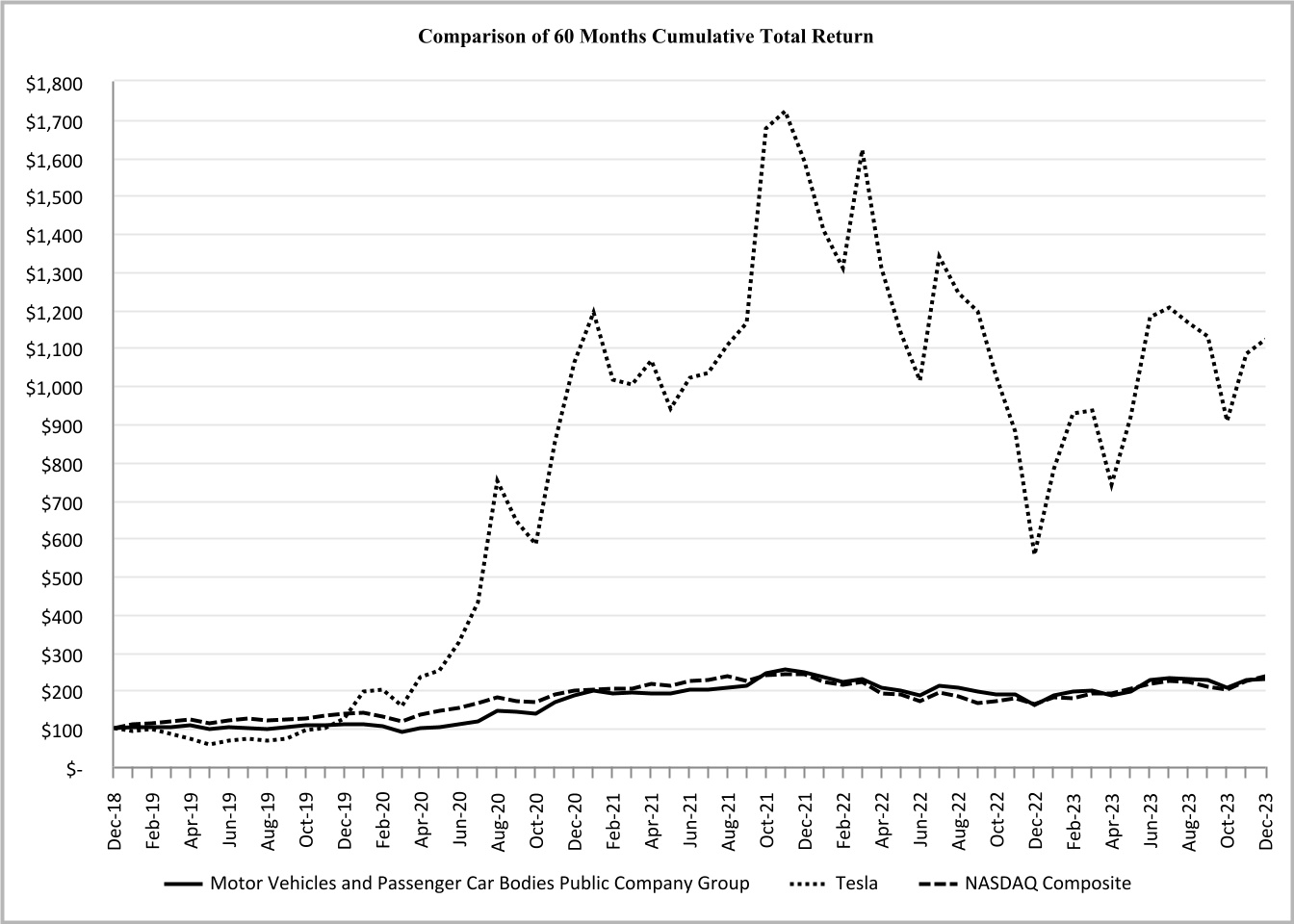
The following graph shows a comparison, from January 1, 2019 through December 31, 2023, of the cumulative total return on our common stock, The NASDAQ Composite Index and a group of all public companies sharing the same SIC code as us, which is SIC code 3711, “Motor Vehicles and Passenger Car Bodies” (Motor Vehicles and Passenger Car Bodies Public Company Group). Such returns are based on historical results and are not intended to suggest future performance. Data for The NASDAQ Composite Index and the Motor Vehicles and Passenger Car Bodies Public Company Group assumes an investment of $100 on January 1, 2019 and reinvestment of dividends. We have never declared or paid cash dividends on our common stock nor do we anticipate paying any such cash dividends in the foreseeable future.
Unregistered Sales of Equity Securities and Use of Proceeds
None.
Purchases of Equity Securities by the Issuer and Affiliated Purchasers
None.
Item 6. [RESERVED]
Item 7. MANAGEMENT’S DISCUSSION AND ANALYSIS OF FINANCIAL CONDITION AND RESULTS OF OPERATIONS
The following discussion and analysis should be read in conjunction with the consolidated financial statements and the related notes included elsewhere in this Annual Report on Form 10-K. For further discussion of our products and services, technology and competitive strengths, refer to Item 1- Business. For discussion related to changes in financial condition and the results of operations for fiscal year 2022-related items, refer to Part II, Item 7. Management’s Discussion and Analysis of Financial Condition and Results of Operations in our Annual Report on Form 10-K for fiscal year 2022, which was filed with the Securities and Exchange Commission on January 31, 2023.
Overview and 2023 Highlights
Our mission is to accelerate the world’s transition to sustainable energy. We design, develop, manufacture, lease and sell high-performance fully electric vehicles, solar energy generation systems and energy storage products. We also offer maintenance, installation, operation, charging, insurance, financial and other services related to our products. Additionally, we are increasingly focused on products and services based on artificial intelligence, robotics and automation.
In 2023, we produced 1,845,985 consumer vehicles and delivered 1,808,581 consumer vehicles. We are currently focused on increasing vehicle production, capacity and delivery capabilities, reducing costs, improving and developing our vehicles and battery technologies, vertically integrating and localizing our supply chain, improving and further deploying our FSD capabilities, increasing the affordability and efficiency of our vehicles, bringing new products to market and expanding our global infrastructure, including our service and charging infrastructure.
In 2023, we deployed 14.72 GWh of energy storage products and 223 megawatts of solar energy systems. We are currently focused on ramping production of energy storage products, improving our Solar Roof installation capability and efficiency, and increasing market share of retrofit solar energy systems.
In 2023, we recognized total revenues of $96.77 billion, representing an increase of $15.31 billion, compared to the prior year. We continue to ramp production, build new manufacturing capacity and expand our operations to enable increased deliveries and deployments of our products, and invest in research and development to accelerate our AI, software and fleet-based profits for further revenue growth.
In 2023, our net income attributable to common stockholders was $15.00 billion, representing a favorable change of $2.44 billion, compared to the prior year. This included a one-time non-cash tax benefit of $5.93 billion for the release of valuation allowance on certain deferred tax assets. We continue to focus on further cost reductions and operational efficiencies while maximizing delivery volumes.
We ended 2023 with $29.09 billion in cash and cash equivalents and investments, representing an increase of $6.91 billion from the end of 2022. Our cash flows provided by operating activities in 2023 and 2022 were $13.26 billion and $14.72 billion, respectively, representing a decrease of $1.47 billion. Capital expenditures amounted to $8.90 billion in 2023, compared to $7.16 billion in 2022, representing an increase of $1.74 billion. Sustained growth has allowed our business to generally fund itself, and we will continue investing in a number of capital-intensive projects and research and development in upcoming periods.
Management Opportunities, Challenges and Uncertainties and 2024 Outlook
Automotive—Production
The following is a summary of the status of production of each of our announced vehicle models in production and under development, as of the date of this Annual Report on Form 10-K:
| Production Location | Vehicle Model(s) | Production Status | ||||||||||||
| Fremont Factory | Model S / Model X | Active | ||||||||||||
| Model 3 / Model Y | Active | |||||||||||||
| Gigafactory Shanghai | Model 3 / Model Y | Active | ||||||||||||
| Gigafactory Berlin-Brandenburg | Model Y | Active | ||||||||||||
| Gigafactory Texas | Model Y | Active | ||||||||||||
| Cybertruck | Active | |||||||||||||
| Gigafactory Nevada | Tesla Semi | Pilot production | ||||||||||||
| Various | Next Generation Platform | In development | ||||||||||||
| TBD | Tesla Roadster | In development |
We are focused on growing our manufacturing capacity, which includes capacity for manufacturing new vehicle models such as our Cybertruck and next generation platform, and ramping all of our production vehicles to their installed production capacities as well as increasing production rate and efficiency at our current factories. The next phase of production growth will depend on the continued ramp at our factories and the introduction of our next generation platform, as well as our ability to add to our available sources of battery cell supply by manufacturing our own cells that we are developing to have high-volume output, lower capital and production costs and longer range. Our goals are to improve vehicle performance, decrease production costs and increase affordability and customer awareness.
These plans are subject to uncertainties inherent in establishing and ramping manufacturing operations, which may be exacerbated by new product and manufacturing technologies we introduce, the number of concurrent international projects, any industry-wide component constraints, labor shortages and any future impact from events outside of our control. For example, during the third quarter of 2023, we experienced a sequential decline in production volumes due to pre-planned shutdowns for upgrades at various factories. Moreover, we have set ambitious technological targets with our plans for battery cells as well as for iterative manufacturing and design improvements for our vehicles with each new factory.
Automotive—Demand, Sales, Deliveries and Infrastructure
Our cost reduction efforts, cost innovation strategies, and additional localized procurement and manufacturing are key to our vehicles’ affordability and have allowed us to competitively price our vehicles. We will also continue to generate demand and brand awareness by improving our vehicles’ performance and functionality, including through products based on artificial intelligence such as Autopilot, FSD Capability, and other software features and delivering new vehicles, such as our Cybertruck. Moreover, we expect to continue to benefit from ongoing electrification of the automotive sector and increasing environmental regulations and initiatives.
However, we operate in a cyclical industry that is sensitive to political and regulatory uncertainty, including with respect to trade and the environment, all of which can be compounded by inflationary pressures, rising energy prices, interest rate fluctuations and the liquidity of enterprise customers. For example, inflationary pressures have increased across the markets in which we operate. In an effort to curb this trend, central banks in developed countries raised interest rates rapidly and substantially, impacting the affordability of vehicle lease and finance arrangements. Further, sales of vehicles in the automotive industry also tend to be cyclical in many markets, which may expose us to increased volatility as we expand and adjust our operations. Moreover, as additional competitors enter the marketplace and help bring the world closer to sustainable transportation, we will have to adjust and continue to execute well to maintain our momentum. Additionally, our
Showing the first 8K of 61K characters. Open the full section
Item 7A. QUANTITATIVE AND QUALITATIVE DISCLOSURES ABOUT MARKET RISK
Foreign Currency Risk
We transact business globally in multiple currencies and hence have foreign currency risks related to our revenue, costs of revenue and operating expenses denominated in currencies other than the U.S. dollar (primarily the Chinese yuan and euro in relation to our current year operations). In general, we are a net receiver of currencies other than the U.S. dollar for our foreign subsidiaries. Accordingly, changes in exchange rates affect our operating results as expressed in U.S. dollars as we do not typically hedge foreign currency risk.
We have also experienced, and will continue to experience, fluctuations in our net income as a result of gains (losses) on the settlement and the re-measurement of monetary assets and liabilities denominated in currencies that are not the local currency (primarily consisting of our intercompany and cash and cash equivalents balances).
We considered the historical trends in foreign currency exchange rates and determined that it is reasonably possible that adverse changes in foreign currency exchange rates of 10% for all currencies could be experienced in the near-term. These changes were applied to our total monetary assets and liabilities denominated in currencies other than our local currencies at the balance sheet date to compute the impact these changes would have had on our net income before income taxes. These changes would have resulted in a gain or loss of $1.01 billion at December 31, 2023 and $473 million at December 31, 2022, assuming no foreign currency hedging.
Item 8. FINANCIAL STATEMENTS AND SUPPLEMENTARY DATA
Index to Consolidated Financial Statements
Report of Independent Registered Public Accounting Firm
To the Board of Directors and Stockholders of Tesla, Inc.
Opinions on the Financial Statements and Internal Control over Financial Reporting
We have audited the accompanying consolidated balance sheets of Tesla, Inc. and its subsidiaries (the “Company”) as of December 31, 2023 and 2022, and the related consolidated statements of operations, of comprehensive income, of redeemable noncontrolling interests and equity and of cash flows for each of the three years in the period ended December 31, 2023, including the related notes (collectively referred to as the “consolidated financial statements”). We also have audited the Company's internal control over financial reporting as of December 31, 2023, based on criteria established in Internal Control - Integrated Framework (2013) issued by the Committee of Sponsoring Organizations of the Treadway Commission (COSO).
In our opinion, the consolidated financial statements referred to above present fairly, in all material respects, the financial position of the Company as of December 31, 2023 and 2022, and the results of its operations and its cash flows for each of the three years in the period ended December 31, 2023 in conformity with accounting principles generally accepted in the United States of America. Also in our opinion, the Company maintained, in all material respects, effective internal control over financial reporting as of December 31, 2023, based on criteria established in Internal Control - Integrated Framework (2013) issued by the COSO.
Changes in Accounting Principles
As discussed in Note 2 to the consolidated financial statements, the Company changed the manner in which it accounts for convertible debt in 2021.
Basis for Opinions
The Company's management is responsible for these consolidated financial statements, for maintaining effective internal control over financial reporting, and for its assessment of the effectiveness of internal control over financial reporting, included in Management’s Report on Internal Control over Financial Reporting appearing under Item 9A. Our responsibility is to express opinions on the Company’s consolidated financial statements and on the Company's internal control over financial reporting based on our audits. We are a public accounting firm registered with the Public Company Accounting Oversight Board (United States) (PCAOB) and are required to be independent with respect to the Company in accordance with the U.S. federal securities laws and the applicable rules and regulations of the Securities and Exchange Commission and the PCAOB.
We conducted our audits in accordance with the standards of the PCAOB. Those standards require that we plan and perform the audits to obtain reasonable assurance about whether the consolidated financial statements are free of material misstatement, whether due to error or fraud, and whether effective internal control over financial reporting was maintained in all material respects.
Our audits of the consolidated financial statements included performing procedures to assess the risks of material misstatement of the consolidated financial statements, whether due to error or fraud, and performing procedures that respond to those risks. Such procedures included examining, on a test basis, evidence regarding the amounts and disclosures in the consolidated financial statements. Our audits also included evaluating the accounting principles used and significant estimates made by management, as well as evaluating the overall presentation of the consolidated financial statements. Our audit of internal control over financial reporting included obtaining an understanding of internal control over financial reporting, assessing the risk that a material weakness exists, and testing and evaluating the design and operating effectiveness of internal control based on the assessed risk. Our audits also included performing such other procedures as we considered necessary in the circumstances. We believe that our audits provide a reasonable basis for our opinions.
Definition and Limitations of Internal Control over Financial Reporting
A company’s internal control over financial reporting is a process designed to provide reasonable assurance regarding the reliability of financial reporting and the preparation of financial statements for external purposes in accordance with generally accepted accounting principles. A company’s internal control over financial reporting includes those policies and procedures that (i) pertain to the maintenance of records that, in reasonable detail, accurately and fairly reflect the transactions and dispositions of the assets of the company; (ii) provide reasonable assurance that transactions are recorded as necessary to permit preparation of financial statements in accordance with generally accepted accounting principles, and that receipts and expenditures of the company are being made only in accordance with authorizations of management and directors of the company; and (iii) provide reasonable assurance regarding prevention or timely detection of unauthorized acquisition, use, or disposition of the company’s assets that could have a material effect on the financial statements.
Because of its inherent limitations, internal control over financial reporting may not prevent or detect misstatements. Also, projections of any evaluation of effectiveness to future periods are subject to the risk that controls may become inadequate because of changes in conditions, or that the degree of compliance with the policies or procedures may deteriorate.
Critical Audit Matters
The critical audit matter communicated below is a matter arising from the current period audit of the consolidated financial statements that was communicated or required to be communicated to the audit committee and that (i) relates to accounts or disclosures that are material to the consolidated financial statements and (ii) involved our especially challenging, subjective, or complex judgments. The communication of critical audit matters does not alter in any way our opinion on the consolidated financial statements, taken as a whole, and we are not, by communicating the critical audit matter below, providing a separate opinion on the critical audit matter or on the accounts or disclosures to which it relates.
Automotive Warranty Reserve
As described in Note 2 to the consolidated financial statements, total accrued warranty, which primarily relates to the automotive segment, was $5,152 million as of December 31, 2023. The Company provides a manufacturer’s warranty on all new and used Tesla vehicles. A warranty reserve is accrued for these products sold, which includes management’s best estimate of t
Showing the first 8K of 204K characters. Open the full section
Item 9. CHANGES IN AND DISAGREEMENTS WITH ACCOUNTANTS ON ACCOUNTING AND FINANCIAL DISCLOSURE
None.
Item 9A. CONTROLS AND PROCEDURES
Evaluation of Disclosure Controls and Procedures
Our management, with the participation of our Chief Executive Officer and our Chief Financial Officer, evaluated the effectiveness of our disclosure controls and procedures pursuant to Rule 13a-15 under the Securities Exchange Act of 1934, as amended (the “Exchange Act”). In designing and evaluating the disclosure controls and procedures, our management recognizes that any controls and procedures, no matter how well designed and operated, can provide only reasonable assurance of achieving the desired control objectives. In addition, the design of disclosure controls and procedures must reflect the fact that there are resource constraints and that our management is required to apply its judgment in evaluating the benefits of possible controls and procedures relative to their costs.
Based on this evaluation, our Chief Executive Officer and our Chief Financial Officer concluded that, as of December 31, 2023, our disclosure controls and procedures were designed at a reasonable assurance level and were effective to provide reasonable assurance that the information we are required to disclose in reports that we file or submit under the Exchange Act is recorded, processed, summarized and reported within the time periods specified in the SEC rules and forms, and that such information is accumulated and communicated to our management, including our Chief Executive Officer and our Chief Financial Officer, as appropriate, to allow timely decisions regarding required disclosures.
Management’s Report on Internal Control over Financial Reporting
Our management is responsible for establishing and maintaining adequate internal control over financial reporting. Internal control over financial reporting is a process designed by, or under the supervision of, our Chief Executive Officer and Chief Financial Officer to provide reasonable assurance regarding the reliability of financial reporting and the preparation of financial statements for external purposes in accordance with generally accepted accounting principles and includes those policies and procedures that (1) pertain to the maintenance of records that in reasonable detail accurately and fairly reflect the transactions and dispositions of our assets; (2) provide reasonable assurance that transactions are recorded as necessary to permit preparation of financial statements in accordance with generally accepted accounting principles, and that our receipts and expenditures are being made only in accordance with authorizations of our management and directors and (3) provide reasonable assurance regarding prevention or timely detection of unauthorized acquisition, use or disposition of our assets that could have a material effect on the financial statements.
Under the supervision and with the participation of our management, including our Chief Executive Officer and Chief Financial Officer, we conducted an evaluation of the effectiveness of our internal control over financial reporting based on criteria established in Internal Control – Integrated Framework (2013) issued by the Committee of Sponsoring Organizations of the Treadway Commission (“COSO”). Our management concluded that our internal control over financial reporting was effective as of December 31, 2023.
Our independent registered public accounting firm, PricewaterhouseCoopers LLP, has audited the effectiveness of our internal control over financial reporting as of December 31, 2023, as stated in their report which is included herein.
Limitations on the Effectiveness of Controls
Because of inherent limitations, internal control over financial reporting may not prevent or detect misstatements and projections of any evaluation of effectiveness to future periods are subject to the risk that controls may become inadequate because of changes in conditions, or that the degree of compliance with the policies or procedures may deteriorate.
Changes in Internal Control over Financial Reporting
There was no change in our internal control over financial reporting that occurred during the quarter ended December 31, 2023, which has materially affected, or is reasonably likely to materially affect, our internal control over financial reporting.
Item 9B. OTHER INFORMATION
None of the Company’s directors or officers adopted, modified or terminated a Rule 10b5-1 trading arrangement or a non-Rule 10b5-1 trading arrangement during the Company’s fiscal quarter ended December 31, 2023, as such terms are defined under Item 408(a) of Regulation S-K, except as follows:
On October 23, 2023, Robyn Denholm, one of our directors, adopted a Rule 10b5-1 trading arrangement for the potential sale of up to 281,116 shares of our common stock, subject to certain conditions. The trading arrangement covers stock options that expire in August 2024. The arrangement's expiration date is August 16, 2024.
On November 13, 2023, Andrew Baglino, Senior Vice President, Powertrain and Energy Engineering, adopted a Rule 10b5-1 trading arrangement for the potential sale of up to 115,500 shares of our common stock, subject to certain conditions. The arrangement's expiration date is December 31, 2024.
Item 9C. DISCLOSURE REGARDING FOREIGN JURISDICTIONS THAT PREVENT INSPECTIONS
Not applicable.
PART III
Item 10. DIRECTORS, EXECUTIVE OFFICERS AND CORPORATE GOVERNANCE
The information required by this Item 10 of Form 10-K will be included in our 2024 Proxy Statement to be filed with the Securities and Exchange Commission in connection with the solicitation of proxies for our 2024 Annual Meeting of Stockholders and is incorporated herein by reference. The 2024 Proxy Statement will be filed with the Securities and Exchange Commission within 120 days after the end of the fiscal year to which this report relates.
Item 11. EXECUTIVE COMPENSATION
The information required by this Item 11 of Form 10-K will be included in our 2024 Proxy Statement and is incorporated herein by reference.
Item 12. SECURITY OWNERSHIP OF CERTAIN BENEFICIAL OWNERS AND MANAGEMENT AND RELATED STOCKHOLDER MATTERS
The information required by this Item 12 of Form 10-K will be included in our 2024 Proxy Statement and is incorporated herein by reference.
Item 13. CERTAIN RELATIONSHIPS AND RELATED TRANSACTIONS AND DIRECTOR INDEPENDENCE
The information required by this Item 13 of Form 10-K will be included in our 2024 Proxy Statement and is incorporated herein by reference.
Item 14. PRINCIPAL ACCOUNTANT FEES AND SERVICES
The information required by this Item 14 of Form 10-K will be included in our 2024 Proxy Statement and is incorporated herein by reference.
PART IV
Item 15. EXHIBITS AND FINANCIAL STATEMENT SCHEDULES
1.Financial statements (see Index to Consolidated Financial Statements in Part II, Item 8 of this report)
2.All financial statement schedules have been omitted since the required information was not applicable or was not present in amounts sufficient to require submission of the schedules, or because the information required is included in the consolidated financial statements or the accompanying notes
3.The exhibits listed in the following Index to Exhibits are filed or incorporated by reference as part of this report
INDEX TO EXHIBITS
| Exhibit Number | Incorporated by Reference | Filed Herewith | ||||||||||||||||||||||||||||||||||||
| Exhibit Description | Form | File No. | Exhibit | Filing Date | ||||||||||||||||||||||||||||||||||
| 4.7 | Waiver to Fifth Amended and Restated Investor’s Rights Agreement, dated as of May 22, 2011, between Registrant and certain holders of the Registrant’s capital stock named therein. | S-1/A | 333-174466 | 4.2E | June 2, 2011 | |||||||||||||||||||||||||||||||||
| 4.8 | Amendment to Fifth Amended and Restated Investor’s Rights Agreement, dated as of May 30, 2011, between Registrant and certain holders of the Registrant’s capital stock named therein. | 8-K | 001-34756 | 4.1 | June 1, 2011 | |||||||||||||||||||||||||||||||||
| 4.9 | Sixth Amendment to Fifth Amended and Restated Investors’ Rights Agreement, dated as of May 15, 2013 among the Registrant, the Elon Musk Revocable Trust dated July 22, 2003 and certain other holders of the capital stock of the Registrant named therein. | 8-K | 001-34756 |
Showing the first 8K of 90K characters. Open the full section
Item 16. SUMMARY
None.
SIGNATURES
Pursuant to the requirements of Section 13 or 15(d) the Securities Exchange Act of 1934, the registrant has duly caused this report to be signed on its behalf by the undersigned, thereunto duly authorized.
| Tesla, Inc. | |||||
| Date: January 26, 2024 | /s/ Elon Musk | ||||
| Elon Musk | |||||
| Chief Executive Officer | |||||
| (Principal Executive Officer) |
Pursuant to the requirements of the Securities Exchange Act of 1934, this report has been signed below by the following persons on behalf of the registrant and in the capacities and on the dates indicated.
| Signature | Title | Date | ||||||||||||
| /s/ Elon Musk | Chief Executive Officer and Director (Principal Executive Officer) | January 26, 2024 | ||||||||||||
| Elon Musk | ||||||||||||||
| /s/ Vaibhav Taneja | Chief Financial Officer (Principal Financial Officer and Principal Accounting Officer ) | January 26, 2024 | ||||||||||||
| Vaibhav Taneja | ||||||||||||||
| /s/ Robyn Denholm | Director | January 26, 2024 | ||||||||||||
| Robyn Denholm | ||||||||||||||
| /s/ Ira Ehrenpreis | Director | January 26, 2024 | ||||||||||||
| Ira Ehrenpreis | ||||||||||||||
| /s/ Joseph Gebbia | Director | January 26, 2024 | ||||||||||||
| Joseph Gebbia | ||||||||||||||
| /s/ James Murdoch | Director | January 26, 2024 | ||||||||||||
| James Murdoch | ||||||||||||||
| /s/ Kimbal Musk | Director | January 26, 2024 | ||||||||||||
| Kimbal Musk | ||||||||||||||
| /s/ JB Straubel | Director | January 26, 2024 | ||||||||||||
| JB Straubel | ||||||||||||||
| /s/ Kathleen Wilson-Thompson | Director | January 26, 2024 | ||||||||||||
| Kathleen Wilson-Thompson |