 filings.tools
Universal Health Services (UHS) 10-K risk factor changes: FY2021 vs FY2020
The 2021-12-31 10-K against the 2020-12-31 one, compared heading by heading and sentence by sentence.
Item 1A48 rewritten74 added32 removed333 unchanged
All filing items1,258 rewritten590 added798 removed2,701 unchanged
Summary
counted, not written
- Item 1A headings could not be compared: only 0 carried over between the two years, which usually means one filing was read wrongly, so none is reported as new or removed.
- Sentence by sentence, 590 added, 798 removed, 1,258 rewritten and 2,701 unchanged across 18 items that differ.
- New this year: Item 9C. Disclosure Regarding Foreign Jurisdictions that Prevent Inspections. Other Information.
Sentences by item
23 items, with every count and a link to each item that changed
Underlined words on a shaded ground are new in FY2021; struck-through words were in FY2020. Sentences that are wholly new or wholly gone are labelled rather than marked.
Item 1A. Risk Factors
48 rewritten, 74 added, 32 removed, 333 unchanged
[removed: A] [added: A] significant portion of our revenue is produced by facilities located in Texas, Nevada and [removed: California.][added: California.]
On a combined basis, these facilities contributed 16% of our consolidated net revenues during each of [removed: 2020, 2019] [added: 2021] and [removed: 2018.][added: 2020.]
On a combined basis, after deducting an allocation for corporate overhead expense, these facilities generated [removed: 13% in 2020, 14%] [added: 11%] in [removed: 2019] [added: 2021] and [removed: 12%] [added: 13%] in [removed: 2018,] [added: 2020,] of our income from operations after net income attributable to noncontrolling interest.
Nevada: We own [removed: 8] [added: 9] inpatient acute care hospitals and [removed: 4] [added: 3] inpatient behavioral healthcare facilities as listed in *Item 2.
On a combined basis, these facilities contributed 17% of our consolidated net revenues during [removed: 2020, 18% in 2019] [added: each of 2021] and [removed: 17% during 2018.][added: 2020.]
On a combined basis, after deducting an allocation for corporate overhead expense, these facilities generated [removed: 17% in 2020, 23%] [added: 22%] in [removed: 2019] [added: 2021] and [removed: 24%] [added: 17%] in [removed: 2018,] [added: 2020,] of our income from operations after net income attributable to noncontrolling interest.
California: We own 5 inpatient acute care hospitals and [removed: 7] [added: 8] inpatient behavioral healthcare facilities as listed in *Item 2.
On a combined basis, these facilities contributed 11% of our consolidated net revenues during each of [removed: 2020, 2019] [added: 2021] and [removed: 2018.][added: 2020.]
On a combined basis, after deducting an allocation for corporate overhead expense, these facilities generated 20% [removed: in 2020, 17% in 2019] [added: during each of 2021] and [removed: 16% in 2018] [added: 2020,] of our income from operations after net income attributable to noncontrolling interest.
[removed: Our] [added: Our] revenues and results of operations are significantly affected by payments received from the government and [removed: other third party payers.][added: other third party payers.]
We [removed: receive Medicaid revenues in excess of $100 million annually from each of California, Texas, Nevada, Washington, D.C., Pennsylvania, Illinois and Massachusetts, making us] [added: are therefore] particularly sensitive to [added: potential] reductions in Medicaid and other [removed: state based] [added: state-based] revenue programs as well as regulatory, economic, environmental and competitive changes in those states.
[removed: CMS] [added: Centers for Medicare and Medicaid Services (“CMS”)] publishes performance data related to quality measures and data on patient satisfaction surveys that hospitals submit in connection with the Medicare program.
Additionally, the Legislation requires all hospitals to annually establish, update and make public a list [removed: of their standard charges for products and services.]
[removed: If] [added: If] we do not continually enhance our hospitals with the most recent technological advances in diagnostic and surgical equipment, our ability to maintain and expand our markets will be adversely [removed: affected.][added: affected.]
The nationwide shortage of nurses and other [removed: medical] [added: clinical staff and] support personnel has been a significant operating issue facing us and other healthcare providers.
This [added: staffing] shortage may require us to [added: further] enhance wages and benefits to recruit and retain nurses and other [removed: medical] [added: clinical staff and] support personnel or require us to hire expensive temporary personnel.
In addition, in some markets like California, there are requirements to maintain specified nurse-staffing [added: levels which could adversely affect our net revenues to the extent we cannot meet those] levels.
To the extent we cannot [removed: meet those levels,] [added: maintain sufficient staffing levels at our hospitals,] we may be required to limit the [removed: healthcare] [added: acute and behavioral health care] services provided [removed: in these markets,] [added: at certain of our hospitals] which would have a corresponding adverse effect on our net [removed: operating] revenues.
[removed: The] [added: The] failure of certain employers, or the closure of certain facilities, could have a disproportionate impact on our [removed: hospitals.][added: hospitals.]
We expect value-based purchasing programs, including programs that condition reimbursement on patient outcome measures, [removed: to become more common and to involve a higher percentage of reimbursement amounts.]
Miller, our former President, [added: was appointed and] has been [removed: appointed] [added: serving] as [removed: new] [added: our] Chief Executive Officer.
The federal government has declared COVID-19 a national emergency, as many federal and state authorities have implemented aggressive [added: measures to “flatten the curve” of confirmed individuals diagnosed with COVID-19 in an attempt to curtail the spread of the virus and to avoid overwhelming the health care system.]
Despite these measures, there have been waves of escalated COVID-19 cases at various times, including the fourth quarter of 2020 and into the first quarter of 2021, [added: as well as the fourth quarter of 2021 and into the first quarter of 2022,] in many states in the U.S., including many states in which we operate hospitals.
We are not able to fully quantify the impact that these factors will have on our future financial results, but expect developments related to the COVID-19 pandemic to materially affect our financial performance in [removed: 2021.][added: 2022.]
[removed: The CARES Act also makes other] forms of financial assistance available to healthcare providers, including through Medicare and Medicaid payment adjustments and an expansion of the Medicare Accelerated and Advance Payment Program, which makes available accelerated payments of Medicare funds in order to increase cash flow to providers.
The CAA also provides that not less than 85 percent of the unobligated PHSSEF amounts and any future funds recovered from health care providers should be used for additional distributions that consider financial losses and [added: changes in operating expenses in the third or fourth quarters of 2020 and the first quarter of 2021 that are attributable to the coronavirus.]
The Budget Control Act of 2011 (the [removed: “*Budget] [added: “Budget] Control [removed: Act*”)] [added: Act”)] mandated significant reductions in federal spending for fiscal years 2012-2021, including a reduction of 2% on all Medicare payments during this period.
Subsequent legislation enacted by Congress [added: eliminated the 2% reduction through 2021 but] extended these reductions through [removed: 2030.][added: 2030 in exchange.]
Such reductions have been delayed several times, most recently under the CAA, which further delays the DSH [added: reductions] through 2024.
[removed: Conversely, certain facilities will receive reduced reimbursement for failing to meet quality] parameters; such hospitals will include those with excessive readmission or hospital-acquired condition rates.
CMS [removed: has] [added: had] granted section 1115 demonstration waivers providing for work and community engagement requirements for certain Medicaid eligible individuals.
Certain Legislation provisions, such as that creating the Medicare Shared Savings Program, create uncertainty in how healthcare may be reimbursed by federal programs in the [added: future.]
The Trump Administration had directed the issuance of final rules (i) enabling the formation of association health plans that would be exempt from certain Legislation requirements such as the provision of essential health benefits; (ii) expanding the availability of short-term, limited duration health insurance, (iii) eliminating cost-sharing reduction payments to insurers that would otherwise offset deductibles and other out-of-pocket expenses for health plan enrollees at or below 250 percent of the federal poverty level; (iv) relaxing requirements for state innovation waivers that could reduce enrollment in the individual and small group markets and lead to additional enrollment in short-term, limited duration insurance and association health plans; and (v) incentivizing the use of health [removed: reimbursement accounts by employers to permit employees to purchase health insurance in the individual market.]
The case was appealed to the U.S. Court of Appeals for the Fifth Circuit and on December 18, 2019, a three-judge [added: panel declared the Legislation’s individual mandate unconstitutional and remanded the case back to the Texas Federal District Court to determine which of the Legislation’s provisions should be stricken with the mandate or whether the entire law is unconstitutional without the individual mandate.]
[removed: We, our subsidiaries, PSI,] [added: We] and [removed: its subsidiaries,] [added: our subsidiaries] are subject to pending legal actions, governmental investigations and regulatory actions (see *Note 8 to the Consolidated Financial Statements - Commitments and Contingencies*, as included this Form 10-K).
[removed: If] [added: If] any of our existing health care facilities lose their accreditation or any of our new facilities fail to receive accreditation, such facilities could become ineligible to receive reimbursement under Medicare or [removed: Medicaid.][added: Medicaid.]
In September, 2020, we [added: had] experienced an information technology security incident which led us to suspend user access to our information technology applications related to operations located in the United States.
Our revenues and volume trends are dependent on many factors, including physicians’ clinical decisions and availability, payer programs shifting to a more outpatient-based environment, whether or not certain services are offered, seasonal and severe weather conditions, including the effects of extreme low temperatures, hurricanes and tornados, earthquakes, climate change, current local [added: economic and demographic changes.]
In addition, as of December 31, [removed: 2020,] [added: 2021,] we had approximately [removed: $3.9] [added: $4.0] billion of goodwill recorded on our consolidated balance sheet.
Should the revenues and financial results of our acute care and/or behavioral health care facilities be materially, unfavorably impacted due to, among other things, a worsening of the economic and employment conditions in the United States that could negatively impact our patient volumes and reimbursement rates, a continued rise in the unemployment rate and [removed: continued] increases in the number of uninsured patients treated at our facilities, we may incur future charges to recognize impairment in the carrying value of our goodwill and other intangible assets, which could have a material adverse effect on our financial results.
We receive annual Medicaid revenues of approximately $100 million, or greater, from each of Texas, California, Nevada, Illinois, Pennsylvania, Washington, D.C., Kentucky, Florida and Massachusetts.
We also receive Medicaid disproportionate share hospital payments in certain states including Texas and South Carolina.
of their standard charges for products and services.
In particular, like others in the healthcare industry, we continue to experience a shortage of nurses and other clinical staff and support personnel at our acute care and behavioral health care hospitals in many geographic areas, which shortage has been exacerbated by the COVID‑19 pandemic.
We are treating patients with COVID‑19 in our facilities and, in some areas, the increased demand for care is putting a strain on our resources and staff, which has required us to utilize higher‑cost temporary labor and pay premiums above standard compensation for essential workers.
The length and extent of the disruptions caused by the COVID‑19 pandemic are currently unknown; however, we expect such disruptions to continue into 2022 and potentially throughout the duration of the pandemic and beyond.
to become more common and to involve a higher percentage of reimbursement amounts.
Since the first quarter of 2021, COVID-19 vaccinations have begun to be administered.
Since that time, through the second quarter of 2021, we had generally experienced a decline in COVID-19 patients as well as a corresponding recovery in non-COVID-19 patient activity.
However, during the third quarter of 2021, our facilities generally experienced an increase in COVID-19 patients resulting primarily from the Delta variant.
Also, since late in 2021, the newly discovered and highly transmissible Omicron variant has resulted in an increase in COVID-19 infections.
Since the third quarter of 2021, booster doses for COVID-19 vaccination have begun to be administered, and while we expect the administration of booster doses to assist in easing the number of COVID-19 patients, the pace at which this is likely to occur is difficult to predict.
The COVID-19 pandemic has led to a constrained supply environment which could result in higher cost to procure, and potential unavailability of, critical personal protection equipment, pharmaceuticals and medical supplies.
Should a supply disruption result in the inability to obtain especially high margin drugs and compound components necessary for patient care, our consolidated financial statements could be negatively impacted.
In addition, CMS issued an Interim Final Rule (“IFR”) effective November 5, 2021 mandating COVID-19 vaccinations for all applicable staff at all Medicare and Medicaid certified facilities.
Under the IFR, facilities covered by this regulation must establish a policy ensuring all eligible staff have received the first dose of a two-dose COVID-19 vaccine or a one-dose COVID-19 vaccine prior to providing any care, treatment, or other services by December 5, 2021.
All eligible staff must have received the necessary shots to be fully vaccinated – either two doses of Pfizer or Moderna or one dose of Johnson & Johnson – by January 4, 2022.
The regulation also provides for exemptions based on recognized medical conditions or religious beliefs, observances, or practices.
Under the IFR, facilities must develop a similar process or plan for permitting exemptions in alignment with federal law.
If facilities fail to comply with the IFR by the deadlines established, they are subject to potential termination from the Medicare and Medicaid program for non-compliance.
In addition, the Occupational Safety and Health Administration also issued an Emergency Temporary Standard (“ETS”) requiring all businesses with 100 or more employees to be vaccinated by January 4, 2022.
Pursuant to the ETS, those employees not vaccinated by that date will need to show a negative COVID-19 test weekly and wear a face mask in the workplace.
Legal challenges to these rules ensued, and the U.S. Supreme Court has upheld a stay of the ETS requirements but permitted the IFR vaccination requirements to go into effect pending additional litigation.
CMS has indicated that hospitals in states not involved in the Supreme Court litigation are expected to be in compliance with IFR vaccination requirements consistent with the dates referenced above.
Hospitals in states that were involved in the Supreme Court litigation must now come into compliance with first dose requirements by February 13, 2022 and second dose requirements by March 15, 2022.
Hospitals in Texas must come into compliance with the first dose requirements by February 19, 2022 and the second dose requirements by March 21, 2022, due to the recent termination of separate litigation there.
We cannot predict at this time the potential viability or impact of any such additional litigation.
Implementation of these rules could have an impact on staffing at our facilities for those employees that are not vaccinated in accordance with IFR and ETS requirements, and associated loss of revenues and increased costs resulting from staffing issues could have a material adverse effect on our financial results.
The ultimate impact of the COVID-19 pandemic, including the future volumes and severity of COVID-19 patients caused by new variants of the virus, as well as related pressures on staffing and wage rates and the strained supply environment, is highly uncertain and subject to change.
Despite these measures, there have been waves of escalated COVID-19 cases at various times, including the third and fourth quarters of 2021 and continuing into the first quarter of 2022, in many states in the U.S., including many states in which we operate hospitals.
The extent to which the COVID-19 pandemic and measures taken in response thereto impact our business, results of operations and financial condition will depend on numerous factors and future developments, most of which are beyond our control or ability to predict.
We are not able to fully quantify the impact that these factors will have on our future financial results, but expect developments related to the COVID-19 pandemic to materially affect our financial performance in 2022.
Even after the COVID-19 pandemic has subsided, we may continue to experience materially adverse impacts on our financial condition and our results of operations as a result of its macroeconomic impact, including any recession that has occurred or may occur in the future.
The CARES Act also makes other
The most recent legislation extended the payment reduction suspension through March 31, 2022, with a 1% payment reduction from then until June 30, 2022 and the full 2% payment reduction thereafter.
Conversely, certain facilities will receive reduced reimbursement for failing to meet quality
However, most recently, the Biden Administration has expressed disfavor with Medicaid program work requirements, with the understanding that such requirements pose a substantial risk that many potential demonstration beneficiaries would be prevented from initially enrolling in coverage or that the requirements would lead to a sizable number of eligibility suspensions and eventual disenrollments among beneficiaries who are initially able to enroll.
Accordingly, CMS has recently revoked certain State Medicaid program approvals including work requirements.
reimbursement accounts by employers to permit employees to purchase health insurance in the individual market.
The U.S. Supreme Court heard appeals and ultimately held in *California v.
Our performance depends on our ability to attract and retain qualified nurses and medical support staff and we face competition for staffing that may increase our labor costs and harm our results of operations.
We depend on the efforts, abilities, and experience of our medical support personnel, including our nurses, pharmacists and lab technicians and other healthcare professionals.
We compete with other healthcare providers in recruiting and retaining qualified hospital management, nurses and other medical personnel.
We cannot predict the degree to which we will be affected by the future availability or cost of attracting and retaining talented medical support staff.
If our general labor and related expenses increase, we may not be able to raise our rates correspondingly.
Our failure to either recruit and retain qualified hospital management, nurses and other medical support personnel or control our labor costs could harm our results of operations.
Increased labor union activity is another factor that could adversely affect our labor costs.
measures to “flatten the curve” of confirmed individuals diagnosed with COVID-19 in an attempt to curtail the spread of the virus and to avoid overwhelming the health care system.
changes in operating expenses in the third or fourth quarters of 2020 and the first quarter of 2021 that are attributable to the coronavirus.
There is a substantial risk that Congress could act to extend or increase these across-the-board reductions.
The Consolidated Appropriations Act, 2021 (“CAA”) eliminated the 2% reduction in Medicare payments from sequestration through March 31, 2021.
CMS has also released guidance to states interested in receiving their Medicaid funding through a block grant mechanism.
It is anticipated this will lead to reductions in coverage, and likely increases in uncompensated care, in states where these demonstration waivers are granted.
future.
panel declared the Legislation’s individual mandate unconstitutional and remanded the case back to the Texas Federal District Court to determine which of the Legislation’s provisions should be stricken with the mandate or whether the entire law is unconstitutional without the individual mandate.
On March 2, 2020, the Supreme Court agreed to hear two consolidated cases, filed by the State of California and the United States House of Representatives, asking the Supreme Court to review the ruling by the U.S. Court of Appeals for the Fifth Circuit decision and to review whether, if the mandate is unconstitutional, it can be separated from the rest of the Legislation.
Oral argument was heard on November 10, 2020, and a ruling is expected in 2021.
The Legislation will remain law while the case proceeds through the appeals process; however, the case creates additional uncertainty as to whether any or all of the Legislation could be struck down, which creates operational risk for the health care industry.
We cannot predict the effect of the elimination of the individual mandate tax penalty, the final result and effect of the *California v.
Texas* case.
The legislation requires implementing regulations within a year of enactment.
In addition, in some markets like California, there are
requirements to maintain specified nurse-staffing levels.
Union organizing activities and certain potential changes in federal labor laws and regulations could increase the likelihood of employee unionization
economic and demographic changes.
We cannot predict, however, whether financing for our
The LIBOR calculation method may change and LIBOR is expected to be phased out after 2021.
Our Credit Agreement permits interest on borrowings to be calculated based on LIBOR, and in the past, we have had interest rate swaps that were based on LIBOR.
The phase-out of LIBOR may result in the establishment of one or more alternative benchmark rates, but at this time it is uncertain what alternative benchmark rates would replace LIBOR.
In the meantime, actions by the FCA, other regulators, or law enforcement agencies may result in changes to the method by which LIBOR is calculated.
At this time, it is not possible to predict the effect of any such changes or any other reforms to LIBOR that may be enacted in the United Kingdom or elsewhere.
holder.
An excerpt. Shown here: 40 of 48 rewritten, 40 of 74 added and all 32 removed. The counts are complete. For every sentence, read Item 1A. Risk Factors in the FY2021 filing and the FY2020 filing.
Item 7. Management’s Discussion and Analysis of Financial Condition and Results of Operations
361 rewritten, 184 added, 344 removed, 653 unchanged
As of February [removed: 25, 2021,] [added: 24, 2022,] we owned and/or operated [removed: 360] [added: 363] inpatient facilities and [removed: 39] [added: 40] outpatient and other facilities including the following located in [removed: 38] [added: 39] states, Washington, D.C., the United Kingdom and Puerto Rico:
| | • | [removed: 17] [added: 19] free-standing emergency departments, and; |
Behavioral health care facilities [removed: (334] [added: (335] inpatient facilities and [removed: 15] [added: 14] outpatient facilities):
| | • | [removed: 185] [added: 187] inpatient behavioral health care facilities, and; |
| | • | [removed: 146] [added: 145] inpatient behavioral health care facilities, and; |
| | • | [removed: 3] [added: 2] outpatient behavioral health care facilities. |
[removed: As a percentage of our consolidated net revenues, net] [added: Net] revenues from our acute care hospitals, outpatient facilities and commercial health insurer accounted for [removed: 55% during 2020, 54%] [added: 56% of our consolidated net revenues] during [removed: 2019] [added: 2021] and [removed: 53%] [added: 55%] during [removed: 2018.][added: 2020.]
Net revenues from our behavioral health care facilities and commercial health insurer accounted for [removed: 45%] [added: 44%] of our consolidated net revenues during [removed: 2020, 46% during 2019] [added: 2021] and [removed: 47%] [added: 45%] during [removed: 2018.][added: 2020.]
Our behavioral health care facilities located in the U.K. generated net revenues of approximately [removed: $584 million in 2020, $554] [added: $688] million in [removed: 2019] [added: 2021] and [removed: $505] [added: $584] million in [removed: 2018.][added: 2020.]
Total assets at our U.K. behavioral health care facilities were approximately [removed: $1.334 billion as of December 31, 2020, $1.270] [added: $1.351] billion as of December 31, [removed: 2019] [added: 2021] and [removed: $1.224] [added: $1.334] billion as of December 31, [removed: 2018.][added: 2020.]
You should carefully review the information contained in this Annual Report, and should particularly consider any risk factors that we set forth in this Annual Report [added: on Form 10-K for the year ended December 31, 2021,] and in other reports or documents that we file from time to time with the Securities and Exchange Commission (the “SEC”).
[removed: Forward-looking statements include, among other things, the information concerning our possible future results of operations, business and growth] strategies, financing plans, expectations that regulatory developments or other matters will not have a material adverse effect on our business or financial condition, our competitive position and the effects of competition, the projected growth of the industry in which we operate, and the benefits and synergies to be obtained from our completed and any future acquisitions, and statements of our goals and objectives, and other similar expressions concerning matters that are not historical facts.
[added: Risk Factors.*] Those factors may cause our actual results to differ materially from any of our forward-looking statements.
[removed: | | • | the Coronavirus Aid, Relief, and Economic Security Act (the “CARES Act”), a stimulus package signed into law on March 27, 2020, authorizes $100 billion in grant funding to hospitals and other healthcare providers to be distributed through the Public Health and Social Services Emergency Fund (the “PHSSEF”). These funds are not required to be repaid provided the recipients attest to and comply with certain terms and conditions, including limitations on balance billing and not using PHSSEF funds to reimburse expenses or losses that other sources are obligated to reimburse. However, since the expenses and losses will be ultimately measured over the life of the COVID-19 pandemic, potential retrospective unfavorable adjustments in future periods, of funds recorded as revenues in prior periods, could occur. The U.S. Department of Health and Human Services (“HHS”) initially distributed $30 billion of this funding based on each provider’s share of total Medicare fee-for-service reimbursement in 2019. Subsequently, HHS distributed $50 billion in CARES Act funding (including the $30 billion already distributed) would be allocated proportional to providers’ share of 2018 net patient revenue. We have received payments from these initial distributions of the PHSSEF as disclosed herein. HHS has indicated that distributions of the remaining $50 billion will be targeted primarily to hospitals in COVID-19 high impact areas, to rural providers, safety net hospitals and certain Medicaid providers and to reimburse providers for COVID-19-related treatment of uninsured patients. We have received payments from these targeted distributions of the PHSSEF, as disclosed herein. The CARES Act also makes other forms of financial assistance available to healthcare providers, including through Medicare and Medicaid payment adjustments and an expansion of the Medicare Accelerated and Advance Payment Program, which makes available accelerated payments of Medicare funds in order to increase cash flow to providers. On April 26, 2020, CMS announced it was reevaluating and temporarily suspending the Accelerated and Advance Payment Program in light of the availability of the PHSSEF and the significant funds available through other programs. We have received accelerated payments under this program as disclosed herein. The Paycheck Protection Program and Health Care Enhancement Act (the “PPPHCE Act”), a stimulus package signed into law on April 24, 2020, |][added: | | • | the Coronavirus Aid, Relief, and Economic Security Act (the “CARES Act”), a stimulus package signed into law on March 27, 2020, authorizes $100 billion in grant funding to hospitals and other healthcare providers to be distributed through the Public Health and Social Services Emergency Fund (the “PHSSEF”). These funds are not required to be repaid provided the recipients attest to and comply with certain terms and conditions, including limitations on balance billing and not using PHSSEF funds to reimburse expenses or losses that other sources are obligated to reimburse. However, since the expenses and losses will be ultimately measured over the life of the COVID-19 pandemic, potential retrospective unfavorable adjustments in future periods, of funds recorded as revenues in prior periods, could occur. The U.S. Department of Health and Human Services (“HHS”) initially distributed $30 billion of this funding based on each provider’s share of total Medicare fee-for-service reimbursement in 2019. Subsequently, HHS determined that CARES Act funding (including the $30 billion already distributed) would be allocated proportional to providers’ share of 2018 net patient revenue. We have received payments from these initial distributions of the PHSSEF as disclosed herein. HHS has indicated that distributions of the remaining $50 billion will be targeted primarily to hospitals in COVID-19 high impact areas, to rural providers, safety net hospitals and certain Medicaid providers and to reimburse providers for COVID-19 related treatment of uninsured patients. We have received payments from these targeted distributions of the PHSSEF, as disclosed herein. The CARES Act also makes other forms of financial assistance available to healthcare providers, including through Medicare and Medicaid payment adjustments and an expansion of the Medicare Accelerated and Advance Payment Program, which made available accelerated payments of Medicare funds in order to increase cash flow to providers. On April 26, 2020, CMS announced it was reevaluating and temporarily suspending the Medicare Accelerated and Advance Payment Program in light of the availability of the PHSSEF and the significant funds available through other programs. We have received accelerated payments under this program during 2020, and returned early all of those funds during the first quarter of 2021, as disclosed herein. The Paycheck Protection Program and Health Care Enhancement Act (the “PPPHCE Act”), a stimulus package signed into law on April 24, 2020, includes additional emergency appropriations for COVID-19 response, including $75 billion to be distributed to eligible providers through the PHSSEF. A third phase of PHSSEF allocations made $24.5 billion available for providers who previously received, rejected or accepted PHSSEF payments. Applicants that had not yet received PHSSEF payments of 2 percent of patient revenue were to receive a payment that, when combined with prior payments (if any), equals 2 percent of patient care revenue. Providers that have already received payments of approximately 2 percent of annual revenue from patient care were potentially eligible for an additional payment. Recipients will not be required to repay the government for PHSSEF funds received, provided they comply with HHS defined terms and conditions. On December 27, 2020, the Consolidated Appropriations Act, 2021 (“CAA”) was signed into law. The CAA appropriated an additional $3 billion to the PHSSEF, codified flexibility for providers to calculate lost revenues, and permitted parent organizations to allocate PHSSEF targeted distributions to subsidiary organizations. The CAA also provides that not less than 85 percent of the unobligated PHSSEF amounts and any future funds recovered from health care providers should be used for additional distributions that consider financial losses and changes in operating expenses in the third or fourth quarters of 2020 and the first quarter of 2021 that are attributable to the coronavirus. The CAA provided additional funding for testing, contact tracing and vaccine administration. Providers receiving payments were required to sign terms and conditions regarding utilization of the payments. Any provider receiving funds in excess of $10,000 in the aggregate will be required to report data elements to HHS detailing utilization of the payments, and we will be required to file such reports. We, and other providers, will report healthcare related expenses attributable to COVID-19 that have not been reimbursed by another source, which may include general and administrative or healthcare related operating expenses. Funds may also be applied to lost revenues, represented as a negative change in year-over-year net patient care operating income. The deadline for using all Provider |]
| | • | an increasing number of legislative initiatives have been passed into law that may result in major changes in the health care delivery system on a national or state level. [removed: Legislation has already been enacted that] [added: For example, Congress] has [removed: eliminated] [added: reduced to $0] the penalty for failing to maintain health coverage that was part of the original [removed: Patient Protection] [added: Legislation as part of the Tax Cuts] and [removed: Affordable Care Act (the “Legislation”).] [added: Jobs Act.] President Biden [added: has undertaken and] is expected to undertake [added: additional] executive actions that will strengthen the Legislation and [removed: may] reverse the policies of the prior administration. [added: To date, the Biden administration has issued executive orders implementing a special enrollment period permitting individuals to enroll in health plans outside of the annual open enrollment period and reexamining policies that may undermine the Legislation or the Medicaid program.] The [added: ARPA’s expansion of subsidies to purchase coverage through a Legislation exchange is anticipated to increase exchange enrollment. The] Trump Administration had directed the issuance of final rules (i) enabling the formation of association health plans that would be exempt from certain Legislation requirements such as the provision of essential health [removed: benefits; (iii)] [added: benefits, (ii)] expanding the [added: availability] of short-term, limited duration health insurance, (iii) eliminating cost-sharing reduction payments to insurers that would otherwise offset deductibles and other out-of-pocket expenses for health plan enrollees at or below 250 percent of the federal poverty [removed: level;] [added: level,] (iv) relaxing requirements for state innovation waivers that could reduce enrollment in the individual and small group markets and lead to additional enrollment in short-term, limited duration insurance and association health [removed: plans, and;] [added: plans and] (v) incentivizing the use of health reimbursement arrangements by employers to permit employees to purchase health insurance in the individual market. The uncertainty resulting from these Executive Branch policies [removed: has] [added: may have] led to reduced Exchange enrollment in 2018, 2019 and [removed: 2020 and is expected to further worsen the individual and small group market risk pools in future years.] [added: 2020.] It is also anticipated that these policies, to the extent that they remain as [removed: implements,] [added: implemented,] may create additional cost and reimbursement pressures on hospitals, including ours. In addition, [removed: while attempts] [added: there have been numerous political and legal efforts] to [removed: repeal the entirety of] [added: expand, repeal, replace or modify] the Legislation [added: since its enactment, some of which] have [removed: not] been [removed: successful to date, a key provision of] [added: successful, in part, in modifying] the [removed: Legislation was repealed] [added: Legislation,] as [removed: part] [added: well as court challenges to the constitutionality] of the [removed: Tax Cuts and Jobs Act and on December 14, 2018, a federal] [added: Legislation. The] U.S. [removed: District] [added: Supreme] Court [removed: Judge in Texas ruled] [added: rejected] the [removed: entire Legislation is unconstitutional. That ruling was appealed and] [added: latest such case] on [removed: December 18, 2019,] [added: June 17, 2021, when] the [removed: Fifth Circuit] Court [removed: of Appeals voted 2-1 to strike down the Legislation individual mandate as unconstitutional and sent] [added: held in *California v. Texas* that] the [removed: case back] [added: plaintiffs lacked standing] to [added: challenge] the [removed: U.S. District Court in Texas] [added: Legislation’s requirement] to [removed: determine which Legislation provisions should be stricken with the mandate] [added: obtain minimum essential health insurance coverage,] or [removed: whether] the [removed: entire law is unconstitutional without the] individual mandate. [removed: On March 2, 2020, the U.S. Supreme Court agreed to hear, during the 2020-2021 term, two consolidated cases, filed by the State of California and the United States House of Representatives, asking the Supreme] [added: The] Court [removed: to review] [added: dismissed] the [added: case without specifically] ruling [removed: by] [added: on] the [removed: Fifth Circuit Court] [added: constitutionality] of [removed: Appeals. Oral argument was heard on November 10, 2020, and] [added: the Legislation. As] a [removed: ruling is expected in 2021. The] [added: result, the] Legislation will [removed: remain law while the case proceeds through the appeals process; however, the case creates additional uncertainty as] [added: continue] to [removed: whether any or all of the Legislation could be struck down, which creates operational risk] [added: remain law, in its entirety, likely] for the [removed: health care industry. We are unable to predict the final outcome of this matter which has caused greater uncertainty regarding the] [added: foreseeable future. Any] future [removed: status of the Legislation. If all] [added: efforts to challenge, replace] or [removed: any parts of] [added: replace] the Legislation [removed: are ultimately found to be unconstitutional, it could have a material adverse effect on our business, financial condition and results of operations.] [added: or expand or substantially amend its provision is unknown.] See below in *Sources of Revenue and Health Care Reform* for additional disclosure; |
| | • | under the Legislation, hospitals are required to make public a list of their standard charges, and effective January 1, 2019, CMS has required that this disclosure be in machine-readable format and include charges for all hospital items and services and average charges for diagnosis-related groups. On November 27, 2019, CMS published a final rule on “Price Transparency Requirements for Hospitals to Make Standard Charges Public.” This rule took effect on January 1, 2021 and requires all hospitals to also make public their payor-specific negotiated rates, minimum negotiated rates, maximum negotiated rates, and cash for all items and services, including individual items and services and service packages, that could be provided by a hospital to a patient. Failure to comply with these requirements may result in daily monetary [removed: penalties;] [added: penalties. On November 2, 2021, CMS released a final rule amending several hospital price transparency policies and increasing the amount of penalties for noncompliance through the use of a scaling factor based on hospital bed count;] |
| | • | as part of the CAA, Congress passed legislation aimed at preventing or limiting patient balance billing in certain circumstances. The CAA addresses surprise medical bills stemming from emergency services, out-of-network ancillary providers at in-network facilities, and air ambulance carriers. The legislation prohibits surprise billing when out-of-network emergency services or out-of-network services at an in-network facility are provided, unless informed consent is received. In these circumstances providers are prohibited from billing the patient for any amounts that exceed in-network cost-sharing requirements. [removed: The legislation requires] [added: On July 13, 2021,] HHS, [removed: as well as] the Department of [removed: the Treasury,] [added: Labor] and [added: the] Department of [removed: Labor] [added: the Treasury issued an interim final rule, which begins] to [removed: issue implementing regulations within a year of enactment;] [added: implement the legislation. The rule would limit our ability to receive payment for services at usually higher out-of-network rates in certain circumstances and prohibit out-of-network payments in other circumstances;] |
| | • | the outcome of known and unknown litigation, government investigations, false claims act allegations, and liabilities and other claims asserted against us and other matters as disclosed in *Note [removed: 8] [added: 6] to the Consolidated Financial Statements - Commitments and Contingencies* and the effects of adverse publicity relating to such matters*;* |
| | • | [removed: we experienced a cyberattack in September, 2020 that had an adverse effect on our operating results during the fourth quarter of 2020. Although we can provide no assurance or estimation related to the amount of the ultimate insurance proceeds that we may receive in connection with this incident, we believe we are entitled to recovery of the majority of the unfavorable economic impact of the cyberattack pursuant to a commercial insurance policy. However,] there is a heightened risk of future cybersecurity threats, including ransomware attacks targeting healthcare providers. If successful, future cyberattacks could have a material adverse effect on our business. Any costs that we incur as a result of a data security incident or breach, including costs to update our security protocols to mitigate such an incident or breach could be significant. Any breach or failure in our operational security systems can result in loss of data or an unauthorized disclosure of or access to sensitive or confidential member or protected personal or health information and could result in significant penalties or fines, litigation, loss of customers, significant damage to our reputation and business, and other [removed: losses;] [added: losses. Previously, we had experienced a cyberattack in September, 2020 that had an adverse effect on our operating results during the fourth quarter of 2020, before giving effect to partial recovery of the loss through receipt, during 2021, of commercial insurance proceeds and collection of previously reserved patient accounts, as discussed herein;] |
| | • | as discussed below in *Sources of Revenue,* we receive revenues from various state and [removed: county based] [added: county-based] programs, including Medicaid in all the states in which we [removed: operate (we] [added: operate. We] receive [added: annual] Medicaid revenues [removed: in excess] of [added: approximately] $100 [removed: million annually] [added: million, or greater,] from each of [removed: California,] Texas, [added: California,] Nevada, [added: Illinois, Pennsylvania,] Washington, D.C., [removed: Pennsylvania, Illinois and Massachusetts); CMS-approved Medicaid supplemental programs in certain states including Texas, Mississippi, Illinois, Oklahoma, Nevada, Arkansas, California] [added: Kentucky, Florida] and [removed: Indiana, and; state] [added: Massachusetts. We also receive] Medicaid disproportionate share hospital payments in certain states including Texas and South Carolina. We are therefore particularly sensitive to potential reductions in Medicaid and other [removed: state based] [added: state-based] revenue programs as well as regulatory, economic, environmental and competitive changes in those states. We can provide no assurance that reductions to revenues earned pursuant to these programs, and the effect of the COVID-19 pandemic on state budgets, particularly in the above-mentioned states, will not have a material adverse effect on our future results of operations; |
| | • | [removed: in August, 2011,] the Budget Control Act of 2011 (the “2011 Act”) [removed: was enacted into law. The 2011 Act] imposed annual spending limits for most federal agencies and programs aimed at reducing budget deficits by $917 billion between 2012 and 2021, according to a report released by the Congressional Budget Office. Among its other provisions, the law established a bipartisan Congressional committee, known as the Joint Select Committee on Deficit Reduction (the “Joint Committee”), which was tasked with making recommendations aimed at reducing future federal budget deficits by an additional $1.5 trillion over 10 years. The Joint Committee was unable to reach an agreement by the November 23, 2011 deadline and, as a result, across-the-board cuts to discretionary, national defense and Medicare spending were implemented on March 1, 2013 resulting in Medicare payment reductions of up to 2% per fiscal year with a uniform percentage reduction across all Medicare programs. The Bipartisan Budget Act of 2015, enacted on November 2, 2015, continued the 2% reductions to Medicare reimbursement imposed under the 2011 Act. [removed: The CARES Act] [added: Recent legislation has] suspended payment reductions [removed: between May 1 and] [added: through] December 31, [removed: 2020,] [added: 2021] in exchange for extended cuts through 2030. [removed: The CAA] [added: Subsequent legislation] extended the [removed: suspension of] payment [removed: reductions until] [added: reduction suspension through] March 31, [removed: 2021.] [added: 2022, with a 1% payment reduction from then until June 30, 2022 and the full 2% payment reduction thereafter.] We cannot predict whether Congress will restructure the implemented Medicare payment reductions or what other federal budget deficit reduction initiatives may be proposed by Congress going [removed: forward;] [added: forward. See below in *2019 Novel Coronavirus Disease Medicare and Medicaid Payment Related Legislation – Medicare Sequestration Relief*, for additional disclosure related to the favorable effect the legislative extensions have had/are expected to have on our results of operations during 2020 and 2021;] |
| | • | in June, 2016, the United Kingdom affirmatively voted in a non-binding referendum in favor of the exit of the United Kingdom (“U.K.”) from the European Union (the “Brexit”) and it was approved by vote of the British legislature. On March 29, 2017, the United Kingdom triggered Article 50 of the Lisbon Treaty, formally starting negotiations regarding its exit from the European Union. On January 31, 2020, the U.K. formally exited the European Union. On December 24, 2020, the United Kingdom and the European Union reached a post-Brexit trade and cooperation agreement that created new business and security requirements and preserved the United Kingdom’s tariff- and quota-free access to the European Union member states. [added: The trade and cooperation agreement was provisionally applied as of January 1, 2021 and entered into force on May 1, 2021, following ratification by the European Union.] We do not know to what extent Brexit will ultimately impact the business and regulatory environment in the U.K., the European Union, or other countries. Any of these effects of Brexit, and others we cannot anticipate, could harm our business, financial condition and results of [removed: operations;] [added: operations, and;] |
[removed: Critical] [added: Critical] Accounting Policies and [removed: Estimates][added: Estimates]
[added: Revenue Recognition:] We report net patient service revenue at the estimated net realizable amounts from patients and third-party payers and others for services rendered.
Estimates of contractual [removed: allowances,] [added: allowances under managed care plans,] which represent explicit price [removed: concessions under ASC 606, under managed care plans] [added: concessions,] are based upon the payment terms specified in the related contractual agreements.
Adjustments related to the final settlement of these retrospectively determined amounts did not materially impact our results in [removed: 2020, 2019] [added: 2021, 2020] or [removed: 2018.][added: 2019.]
If it were to occur, each 1% adjustment to our estimated net Medicare revenues that are subject to retrospective review and settlement as of December 31, [removed: 2020,] [added: 2021,] would change our after-tax net income by approximately $1 million.
[added: The federal poverty] guidelines are established by the federal government and are based on income and family size.
Although the patient’s ultimate eligibility determination may result in adjustments to net revenues, these adjustments did not have a material impact on our results of operations in [removed: 2020, 2019] [added: 2021, 2020] or [removed: 2018] [added: 2019] since our facilities make estimates at each financial reporting period to adjust revenue based on historical collections.
[removed: Uncompensated] [added: Uncompensated] care (charity care and uninsured [removed: discounts):][added: discounts):]
The following table shows the amounts recorded at our acute care hospitals for charity care and uninsured discounts, based on charges at established rates, for the years ended December 31, [removed: 2020, 2019] [added: 2021] and [removed: 2018:][added: 2020:]
| | | (dollar amounts in thousands) | | | | | | | | | | | | | | | | [removed: | | | | | | |]
| | | Amount | | | | % | | | | Amount | | | | % | | | | [removed: Amount | | | | % | | |]
| Charity care | | $ | [removed: 622,668] [added: 661,965] | | | | [removed: 28] [added: 33] | % | | $ | [removed: 672,326] [added: 622,668] | | | | [removed: 31] [added: 28] | % | | [removed: $ | 761,783 | | | | 40 | % |]
| Uninsured discounts | | | [removed: 1,578,470] [added: 1,336,319] | | | | [removed: 72] [added: 67] | % | | | [removed: 1,511,738] [added: 1,578,470] | | | | [removed: 69] [added: 72] | % | | [removed: | 1,132,811 | | | | 60 | % |]
| Total uncompensated care | | $ | [removed: 2,201,138] [added: 1,998,284] | | | | 100 | % | | $ | [removed: 2,184,064] [added: 2,201,138] | | | | 100 | % | | [removed: $ | 1,894,594 | | | | 100 | % |]
| | | (amounts in thousands) | | | | | | | [removed: | | | |]
| Estimated cost of providing charity care | | $ | [removed: 73,690 | | | $ | 77,886] [added: 72,095] | | | $ | [removed: 94,088] [added: 73,690] | |
| Estimated cost of providing uninsured discounts related care | | | [removed: 186,804 | | | | 175,128] [added: 145,538] | | | | [removed: 139,913] [added: 186,804] | |
| Estimated cost of providing uncompensated care | | $ | [removed: 260,494 | | | $ | 253,014] [added: 217,633] | | | $ | [removed: 234,001] [added: 260,494] | |
The following Management’s Discussion and Analysis of Financial Condition and Results of Operations (“MD&A”) is intended to promote an understanding of our operating results and financial condition.
The MD&A is provided as a supplement to, and should be read in conjunction with, our consolidated financial statements and the accompanying notes to the Consolidated Financial Statements, as included in this Annual Report on Form 10-K.
The MD&A contains forward-looking statements that involve risks, uncertainties, and assumptions.
Actual results may differ materially from those anticipated in these forward-looking statements as a result of various factors, including, but not limited to, those presented under *Item 1A.
Risk Factors,* and below in *Forward-Looking Statements and Risk Factors* and as included elsewhere in this Annual Report on Form 10-K.
This section generally discusses our results of operations for the year ended December 31, 2021 as compared to the year ended December 31, 2020.
For discussion of our result of operations and changes in our financial condition for the year ended December 31, 2020 as compared to the year ended December 31, 2019, please refer to *Part II, Management’s Discussion and Analysis of Financial Condition and Results of Operations* in our Annual Report on Form 10-K for the year ended December 31, 2020, as filed with the Securities and Exchange Commission on February 25, 2021.
| | • | 28 inpatient acute care hospitals (including a newly constructed, 170-bed hospital located in Reno, Nevada, that is scheduled to be completed and opened during the first quarter of 2022); |
Forward-looking statements include, among other things, the information concerning our possible future results of operations, business and growth
| | • | the impact of the COVID-19 pandemic, which began during the second half of March, 2020, has had a material effect on our operations and financial results since that time. The COVID-19 vaccination process commenced during the first quarter of 2021. Since that time through the second quarter of 2021, we had generally experienced a decline in COVID-19 patients as well as a corresponding recovery in non-COVID patient activity. However, during the third and fourth quarters of 2021, and continuing into the first quarter of 2022, our facilities generally experienced an increase in COVID-19 patients resulting from the Delta and, more recently, the highly transmissible Omicron variants. Booster doses for COVID-19 vaccinations began during the third quarter of 2021, and while we expect the administration of vaccines booster doses will assist in easing the number of COVID-19 patients, the pace at which this is likely to occur is very difficult to predict. Also, the COVID-19 pandemic has led to a constrained supply environment which could result in higher cost to procure, and potential unavailability of, critical personal protection equipment, pharmaceuticals and medical supplies. Should a supply disruption result in the inability to obtain especially high margin drugs and compound components necessary for patient care, our consolidated financial statements could be negatively impacted. As of December 31, 2021, we have not experienced a significant impact in the availability of supplies from the COVID-19 pandemic. Since the future volumes and severity of COVID-19 patients remain highly uncertain and subject to change, including potential increases in future COVID-19 patient volumes caused by new variants of the virus, as well as related pressures on staffing and wage rates and the strained supply environment, we are not able to fully quantify the impact that these factors will have on our future financial results. However, developments related to the COVID-19 pandemic could materially affect our financial performance during 2022. Even after the COVID-19 pandemic has subsided, we may continue to experience materially adverse impacts on our financial condition and our results of operations as a result of its macroeconomic impact, and many of our known risks described in the *Risk Factors* section of our Annual Report on Form 10-K for the year ended December 31, 2021; |
| | • | the nationwide shortage of nurses and other clinical staff and support personnel has been a significant operating issue facing us and other healthcare providers. In particular, like others in the healthcare industry, we continue to experience a shortage of nurses and other clinical staff and support personnel at our acute care and behavioral health care hospitals in many geographic areas, which shortage has been exacerbated by the COVID‑19 pandemic. We are treating patients with COVID‑19 in our facilities and, in some areas, the increased demand for care is putting a strain on our resources and staff, which has required us to utilize higher‑cost temporary labor and pay premiums above standard compensation for essential workers. The length and extent of the disruptions caused by the COVID‑19 pandemic are currently unknown; however, we expect such disruptions to continue into 2022 and potentially throughout the duration of the pandemic and beyond. This staffing shortage may require us to further enhance wages and benefits to recruit and retain nurses and other clinical staff and support personnel or require us to hire expensive temporary personnel. To the extent we cannot maintain sufficient staffing levels at our hospitals, we may be required to limit the acute and behavioral health care services provided at certain of our hospitals which would have a corresponding adverse effect on our net revenues. In addition, in some markets like California, there are requirements to maintain specified nurse-staffing levels which could adversely affect our net revenues to the extent we cannot meet those levels; |
| | • | the Centers for Medicare and Medicaid Services (“CMS”) issued an Interim Final Rule (“IFR”) effective November 5, 2021 mandating COVID-19 vaccinations for all applicable staff at all Medicare and Medicaid certified facilities. Under the IFR, facilities covered by this regulation must establish a policy ensuring all eligible staff have received the first dose |
| | | of a two-dose COVID-19 vaccine or a one-dose COVID-19 vaccine prior to providing any care, treatment, or other services by December 5, 2021. All eligible staff must have received the necessary shots to be fully vaccinated – either two doses of Pfizer or Moderna or one dose of Johnson & Johnson – by January 4, 2022. The regulation also provides for exemptions based on recognized medical conditions or religious beliefs, observances, or practices. Under the IFR, facilities must develop a similar process or plan for permitting exemptions in alignment with federal law. If facilities fail to comply with the IFR by the deadlines established, they are subject to potential termination from the Medicare and Medicaid program for non-compliance. In addition, the Occupational Safety and Health Administration also issued an Emergency Temporary Standard (“ETS”) requiring all businesses with 100 or more employees to be vaccinated by January 4, 2022. Pursuant to the ETS, those employees not vaccinated by that date will need to show a negative COVID-19 test weekly and wear a face mask in the workplace. Legal challenges to these rules ensued, and the U.S. Supreme Court has upheld a stay of the ETS requirements but permitted the IFR vaccination requirements to go into effect pending additional litigation. CMS has indicated that hospitals in states not involved in the Supreme Court litigation are expected to be in compliance with IFR vaccination requirements consistent with the dates referenced above. Hospitals in states that were involved in the Supreme Court litigation must now come into compliance with first dose requirements by February 13, 2022 and second dose requirements by March 15, 2022. Hospitals in Texas must come into compliance with first dose requirements by February 19, 2022 and second dose requirements by March 21, 2022 due to the recent termination of separate litigation. We cannot predict at this time the potential viability or impact of any such additional litigation. Implementation of these rules could have an impact on staffing at our facilities for those employees that are not vaccinated in accordance with IFR and ETS requirements, and associated loss of revenues and increased costs resulting from staffing issues could have a material adverse effect on our financial results; |
| | | Relief Fund payments depends on the date of the payment received period; payments received in the first period of April 10, 2020 to June 30, 2020 were to have been expended by June 30, 2021 and payments received in the fourth period of July 1, 2021 to December 31, 2021 must be expended by December 31, 2022. The American Rescue Plan Act of 2021 (“ARPA”), enacted on March 11, 2021, included funding directed at detecting, diagnosing, tracing, and monitoring COVID-19 infections; establishing community vaccination centers and mobile vaccine units; promoting, distributing, and tracking COVID-19 vaccines; and reimbursing rural hospitals and facilities for healthcare-related expenses and lost revenues attributable to COVID-19. ARPA increased the eligibility for, and amount of, premium tax credits to purchase health coverage through Patient Protection and Affordable Care Act, as amended by the Health and Education Reconciliation Act (collectively, the “Legislation”). Further, ARPA set the Medicaid program’s federal medical assistance percentage (“FMAP”) at 100 percent for amounts expended for COVID-19 vaccines and vaccine administration. ARPA also increases the FMAP by 5 percent for eight calendar quarters to incentivize states to expand their Medicaid programs. Finally, ARPA provides subsidies to cover 100 percent of health insurance premiums under the Consolidated Omnibus Budget Reconciliation Act through September 30, 2021. There is a high degree of uncertainty surrounding the implementation of the CARES Act, the PPPHCE Act, the CAA and ARPA, and the federal government may consider additional stimulus and relief efforts, but we are unable to predict whether additional stimulus measures will be enacted or their impact. There can be no assurance as to the total amount of financial and other types of assistance we will receive under the CARES Act, the PPPHCE Act, the CAA and the ARPA, and it is difficult to predict the impact of such legislation on our operations or how they will affect operations of our competitors. Moreover, we are unable to assess the extent to which anticipated negative impacts on us arising from the COVID-19 pandemic will be offset by amounts or benefits received or to be received under the CARES Act, the PPPHCE Act, the CAA and the ARPA; |
| | • | our ability to enter into managed care provider agreements on acceptable terms and the ability of our competitors to do the same; |
| --- | --- | --- | --- | --- | --- | --- | --- | --- | --- | --- | --- | --- | --- | --- | --- | --- | --- |
| | | 2021 | | | | | | | | 2020 | | | | | | | |
| --- | --- | --- | --- | --- | --- | --- | --- | --- |
| | | 2021 | | | | 2020 | | |
We believe
2021:
During 2021, we received approximately $189 million of additional funds from the federal government in connection with the CARES Act, substantially all of which were received during the first quarter of 2021.
During the second quarter of 2021, we returned the $189 million to the appropriate government agencies utilizing a portion of our cash and cash equivalents held on deposit.
Also, in March of 2021 we made an early repayment of $695 million of funds received during 2020 pursuant to the Medicare Accelerated and Advance Payment Program.
These funds were returned to the government utilizing a portion of our cash and cash equivalents held on deposit.
| --- | --- | --- | --- | --- | --- | --- | --- | --- | --- | --- | --- | --- | --- | --- | --- | --- | --- |
| | | 2021 | | | | | | | | 2020 | | | | | | | |
| Supplies expense | | | 1,427,134 | | | | 11.3 | % | | | 1,288,132 | | | | 11.1 | % | |
| Net income | | | 987,632 | | | | 7.8 | % | | | 952,790 | | | | 8.2 | % | |
Net revenues increased by 9.4%, or $1.08 billion, to $12.64 billion during 2021 as compared to $11.56 billion during 2020.
During 2021, approximately $39 million of the reserves increase is included in our same facility basis acute care hospitals services’ results and approximately $13 million is included in our behavioral health services’ results.
The following table sets forth certain operating statistics for our acute care hospital services for the years ended December 31, 2021 and 2020.
| | | | Same Facility Basis | | | | | | | | All | | | | | | |
| --- | --- | --- | --- | --- | --- | --- | --- | --- | --- | --- | --- | --- | --- | --- | --- | --- | --- |
| | | | 2021 | | | | 2020 | | | | 2021 | | | | 2020 | | |
| Average licensed beds | | | | 6,543 | | | | 6,457 | | | | 6,566 | | | | 6,457 | |
| Average available beds | | | | 6,371 | | | | 6,285 | | | | 6,394 | | | | 6,285 | |
| Patient days | | | | 1,564,828 | | | | 1,458,321 | | | | 1,568,639 | | | | 1,458,321 | |
| Average daily census | | | | 4,287.2 | | | | 3,984.5 | | | | 4,297.6 | | | | 3,984.5 | |
| Occupancy-licensed beds | | | | 65.5 | % | | | 61.7 | % | | | 65.5 | % | | | 61.7 | % |
| | • | 26 inpatient acute care hospitals; |
| --- | --- | --- |
Risk Factors*.
| | • | the COVID-19 pandemic has adversely impacted and is likely to further adversely impact us, our employees, our patients, our vendors and supply chain partners, and financial institutions, which could continue to have a material adverse effect on our business, results of operations and financial condition. In an effort to slow the spread of the disease, since March, 2020, at various times, most state and local governments mandated general “shelter-in-place” orders or other similar restrictions that require or strongly encourage social distancing and, face coverings, and that have closed or limited non-essential business activities. Some of these restrictions remain in place. Additionally, evidence suggests that individuals may be deciding to forego medical care delivered in traditional venues. These dynamics have manifested themselves in our hospitals in, among other ways, reduced emergency room visits, elective/scheduled procedures and acute and behavioral health patient days. While such measures are expected to assist in responding to the recent outbreak, self-quarantines, shelter-in-place orders, and suspension of voluntary procedures and surgeries have had, and will likely continue to have, an adverse impact on the operations and financial position of health care provider systems due to increased costs (including labor costs which have been pressured during the COVID-19 pandemic due to a shortage of clinicians and increased wage rates resulting from increased demand for those services), actual reduction and potential reduction in overall patient volume, and shifts in payor mix. Despite these measures, there have been waves of escalated COVID-19 cases at various times, including the fourth quarter of 2020 and into the first quarter of 2021, in many states in the U.S., including many states in which we operate hospitals. Recently, COVID-19 vaccinations have begun to be administered and while we expect the administration of vaccines will assist in easing the number of COVID-19 patients, the pace at which this is likely to occur is difficult to predict. The extent to which the COVID-19 pandemic and measures taken in response thereto impact our business, results of operations and financial condition will depend on numerous factors and future developments, most of which are beyond our control or ability to predict. The ultimate impact of the COVID-19 pandemic is highly uncertain and subject to change. We are not able to fully quantify the impact that these factors will have on our future financial results, but expect developments related to the COVID-19 pandemic to materially affect our financial performance in 2021. Even after the COVID-19 pandemic has subsided, we may continue to experience materially adverse impacts on our financial condition and our results of operations as a result of its macroeconomic impact, including any recession that has occurred or may occur in the future, and many of our known risks described in the *Risk Factors* section herein; |
| | | includes additional emergency appropriations for COVID-19 response, including $75 billion to be distributed to eligible providers through the PHSSEF. A third phase of PHSSEF allocations was recently announced, under which $24.5 billion was made available for providers who previously received, rejected or accepted PHSSEF payments. Applicants that have not yet received PHSSEF payments of 2 percent of patient revenue will receive a payment that, when combined with prior payments (if any), equals 2 percent of patient care revenue. Providers that have already received payments of approximately 2 percent of annual revenue from patient care can submit more information and may be eligible for an additional payment. On December 27, 2020, the Consolidated Appropriations Act, 2021 (“CAA”) was signed into law. The CAA appropriated an additional $3 billion to the PHSSEF, codified flexibility for providers to calculate lost revenues, and permitted parent organizations to allocate PHSSEF targeted distributions to subsidiary organizations. The CAA also provides that not less than 85 percent of the unobligated PHSSEF amounts and any future funds recovered from health care providers should be used for additional distributions that consider financial losses and changes in operating expenses in the third or fourth quarters of 2020 and the first quarter of 2021 that are attributable to the coronavirus. The CAA provided additional funding for testing, contact tracing and vaccine administration. Providers receiving payments were required to sign terms and conditions regarding utilization of the payments. Any provider receiving funds in excess of $10,000 in the aggregate will be required to report data elements to HHS detailing utilization of the payments. Providers will report healthcare related expenses attributable to COVID-19 that have not been reimbursed by another source, which may include general and administrative or healthcare related operating expenses. Funds may also be applied to lost revenues, represented as a negative change in year-over-year net patient care operating income. All Provider Relief Fund payments must be expended by June 30, 2021. Recipients will not be required to repay the government for funds received, provided they comply with HHS-defined terms and conditions. There is a high degree of uncertainty surrounding the implementation of the CARES Act and the PPPHCE Act, and the federal government may consider additional stimulus and relief efforts, but we are unable to predict whether additional stimulus measures will be enacted or their impact. There can be no assurance as to the total amount of financial and other types of assistance we will receive under the CARES Act and the PPPHCE Act, and it is difficult to predict the impact of such legislation on our operations or how they will affect operations of our competitors. Moreover, we are unable to assess the extent to which anticipated negative impacts on us arising from the COVID-19 pandemic will be offset by amounts or benefits received or to be received under the CARES Act and the PPPHCE Act; |
| | • | our ability to enter into managed care provider agreements on acceptable terms and the ability of our competitors to do the same, including contracts with United/Sierra Healthcare in Las Vegas, Nevada. Effective January, 2020, United/Sierra Healthcare in Las Vegas, entered into an agreement with a competitor health system that was previously excluded from their contractual network in the area. As a result, we believe that our 6 acute care hospitals in the Las Vegas, Nevada market, will likely experience a decline in patient volumes. However, we have entered into an amended agreement with United/Sierra Healthcare related to our hospitals in the Las Vegas market that provide for various rate increases beginning in January, 2020. Although we estimate that the unfavorable impact of the projected declines in patient volumes should be largely offset by the favorable impact of the increased rates, we can provide no assurance that these developments, as well as the effect of COVID-19 on the Las Vegas market, will not have a material adverse impact on our future results of operations; |
| | • | fluctuations in the value of our common stock, and; |
Revenue Recognition: On January 1, 2018, we adopted, using the modified retrospective approach, ASU 2014-09 and ASU 2016-08, “Revenue from Contracts with Customers (Topic 606)” and “Revenue from Contracts with Customers: Principal versus Agent Considerations (Reporting Revenue Gross versus Net)”, respectively, which provides guidance for revenue recognition.
The standard’s core principle is that a company will recognize revenue when it transfers promised goods or services to customers in an amount that reflects the consideration to which the company expects to be entitled in exchange for those goods or services.
The most significant change from the adoption of the new standard relates to our estimation for the allowance for doubtful accounts.
Under the previous standards, our estimate for amounts not expected to be collected based upon our historical experience, were reflected as provision for doubtful accounts, included within net revenue.
Under the new standard, our estimate for amounts not expected to be collected based on historical experience will continue to be recognized as a reduction to net revenue, however, not reflected separately as provision for doubtful accounts.
Under the new standard, subsequent changes in estimate of collectability due to a change in the financial status of a payer, for example a bankruptcy, will be recognized as bad debt expense in operating charges.
The adoption of this ASU in 2018, and amounts recognized as bad debt expense and included in other operating expenses, did not have a material impact on our consolidated financial statements.
The federal poverty
Under ASC 605, these estimates were reported in the provision for doubtful accounts.
| --- | --- | --- | --- | --- | --- | --- | --- | --- | --- | --- | --- | --- | --- | --- | --- | --- | --- | --- | --- | --- | --- | --- | --- | --- |
| | | 2020 | | | | | | | | 2019 | | | | | | | | 2018 | | | | | | |
| --- | --- | --- | --- | --- | --- | --- | --- | --- | --- | --- | --- | --- |
| | | 2020 | | | | 2019 | | | | 2018 | | |
insured employee benefits programs for employee healthcare and dental claims.
Our 2019 and 2018 financial results included aggregate pre-tax provisions for asset impairments of $98 million and $49 million, respectively, recorded in connection with Foundations Recovery Network, L.L.C. (“Foundations”), which was acquired by us in 2015.
These pre-tax provisions for asset impairments include: (i) a $124 million impairment provision to write-off the carrying value of the Foundations’ tradename intangible asset ($75 million recorded during 2019 and $49 million recorded during 2018), and; (ii) a $23 million impairment provision recorded during 2019 to reduce the carrying value of real property assets of certain Foundations’ facilities.
Please see below in *Provision for Asset Impairment-Foundations Recovery Network* for additional information.
On December 22, 2017, the President of the United States signed into law comprehensive tax legislation commonly referred to as the Tax Cuts and Jobs Act of 2017 (the “TCJA-17”).
The TCJA-17 made broad and complex changes to the U.S. tax code, including, but not limited to, (1) reducing the U.S. federal corporate tax rate from 35 percent to 21 percent; (2) requiring companies to pay a one-time transition tax on certain unrepatriated earnings of foreign subsidiaries; (3) generally eliminating U.S. federal income taxes on dividends from foreign subsidiaries; (4) requiring current inclusion in U.S. federal taxable income of certain earnings of controlled foreign corporations through the implementation of a territorial tax system; (5) creating a new limitation on deductible interest expense, and; (6) limiting certain other deductions.
We provided a provisional estimate of the effects of the TCJA-17 in the fourth quarter of 2017 financial statements.
In the fourth quarter of 2018, we completed our analysis to determine the effects of the TCJA-17 in accordance with Staff Accounting Bulletin No. 118 as follows:
Reduction of U.S. federal corporate tax rate: The TCJA-17 reduces the corporate tax rate to 21 percent, effective January 1, 2018.
Deferred income taxes are based on the estimated future tax effects of differences between the financial statement carrying amounts and the tax basis of assets and liabilities under the provisions of the enacted laws.
For certain of our deferred tax assets and deferred tax liabilities, we recorded a provisional decrease of $97 million and $127 million, respectively, with a corresponding net adjustment to deferred tax benefit of $30 million for the year ended December 31, 2017.
Upon completion of our 2017 U.S. Corporate Income Tax Return, an increase of $1 million attributable to certain deferred tax assets and a decrease of $5 million attributable to certain deferred tax liabilities was recorded resulting in an additional net deferred tax benefit of $6 million.
Deemed Repatriation Transition Tax: The Deemed Repatriation Transition Tax (“Transition Tax”) is a tax on previously untaxed accumulated and current earnings and profits (“E&P”) of certain of our foreign subsidiaries.
The one-time Transition Tax is based upon the amount of post-1986 E&P of the relevant subsidiaries, the amount of non-U.S. income tax paid on such earnings, as well as other factors.
We originally estimated and recorded a provisional Transition Tax obligation of $11.3 million.
Upon
completion of our 2017 U.S. Corporate Income Tax Return, the final Transition Tax increased by $100,000 for a total of $11.4 million.
| | o | As of December 31, 2020, approximately $4 million of these funds remain in the Medicare accelerated payments and deferred CARES Act and other grants liability account in our consolidated balance sheet. |
| | ▪ | We are planning for the early repayment of the $695 million of Medicare accelerated payments previously received pursuant to the MAAPP. We have commenced the repayment process and anticipate that the $695 million of funds will be repaid to the government in March or April of 2021. |
Additional CARES Act grants amounting to $187 million were received in January, 2021.
An excerpt. Shown here: 40 of 361 rewritten, 40 of 184 added and 40 of 344 removed. The counts are complete. For every sentence, read Item 7. Management’s Discussion and Analysis of Financial Condition and Results of Operations in the FY2021 filing and the FY2020 filing.
Item 7A. Quantitative and Qualitative Disclosures About Market Risk
8 rewritten, 6 added, 3 removed, 24 unchanged
We account for our derivative and hedging activities using the Financial Accounting Standard Board’s guidance which requires all derivative [added: instruments, including certain derivative instruments embedded in other contracts, to be carried at fair value on the balance sheet.]
During [removed: 2015,] [added: 2019,] we [removed: entered into] [added: had] nine [removed: forward starting] interest rate swaps [added: outstanding, all of which expired on April 15, 2019,] whereby we paid a fixed rate on a total notional amount of $1.0 billion and received one-month LIBOR.
The average fixed rate payable on these [removed: swaps, all of which matured on April 15, 2019,] [added: swaps] was 1.31%.
The table below presents information about our long-term financial instruments that are sensitive to changes in interest rates as of December 31, [removed: 2020.][added: 2021.]
| | | [removed: 2021 | | | |] 2022 | | | | 2023 | | | | 2024 | | | | 2025 | | | | [added: 2026 | | | |] Thereafter | | | | Total | | |
| Average interest rates | | | [removed: 3.7] [added: 2.4] | % | | | [removed: 3.6] [added: 2.4] | % | | | [removed: 3.6] [added: 2.4] | % | | | [removed: 3.6] [added: 2.4] | % | | | [removed: 3.6] [added: 2.4] | % | | | 3.2 | % | | | [removed: 3.6] [added: 2.6] | % |
| Average interest rates | | | [removed: 1.6] [added: 1.4] | % | | | [removed: 1.6] [added: 1.4] | % | | | [removed: 1.6] [added: 1.4] | % | | | [removed: 1.9] [added: 1.4] | % | | | [removed: 1.9] [added: 1.4] | % | | | 0.0 | % | | | [removed: 1.7] [added: 1.4] | % |
As calculated based upon our variable rate debt outstanding as of December 31, [removed: 2020] [added: 2021] that is subject to interest rate fluctuations, each 1% change in interest rates would impact our pre-tax income by approximately [removed: $26] [added: $20] million.
During the years ended December 31, 2021 and 2020, we had no cash flow hedges outstanding.
| Debt | | $ | 5,909 | | | $ | 6,523 | | | $ | 7,012 | | | $ | 6,274 | | | $ | 700,168 | | | $ | 1,437,551 | | | $ | 2,163,437 | |
| Debt | | $ | 42,500 | | | $ | 53,125 | | | | 85,000 | | | | 85,000 | | | | 1,761,226 | | | | 0 | | | $ | 2,026,851 | |
| Interest rate swaps: | | | | | | | | | | | | | | | | | | | | | | | | | | | | |
| Notional amount | | | | | | | | | | | | | | | | | | | | | | | | | | | | |
| Average interest rates | | | | | | | | | | | | | | | | | | | | | | | | | | | | |
instruments, including certain derivative instruments embedded in other contracts, to be carried at fair value on the balance sheet.
| Debt | | $ | 2,081 | | | $ | 2,587 | | | $ | 2,918 | | | $ | 3,284 | | | $ | 2,371 | | | $ | 1,234,661 | | | $ | 1,247,902 | |
| Debt | | $ | 329,917 | | | $ | 105,000 | | | | 1,702,161 | | | | 5,000 | | | | 466,271 | | | | 0 | | | $ | 2,608,349 | |
Item 1. Business
61 rewritten, 42 added, 49 removed, 357 unchanged
As of February [removed: 25, 2021,] [added: 24, 2022,] we owned and/or operated [removed: 360] [added: 363] inpatient facilities and [removed: 39] [added: 40] outpatient and other facilities including the following located in [removed: 38] [added: 39] states, Washington, D.C., the United Kingdom and Puerto Rico:
| | • | [removed: 17] [added: 19] free-standing emergency departments, and; |
Behavioral health care facilities [removed: (334] [added: (335] inpatient facilities and [removed: 15] [added: 14] outpatient facilities):
| | • | [removed: 185] [added: 187] inpatient behavioral health care facilities, and; |
| | • | [removed: 146] [added: 145] inpatient behavioral health care facilities, and; |
| | • | [removed: 3] [added: 2] outpatient behavioral health care facilities. |
[removed: As a percentage of our consolidated net revenues, net] [added: Net] revenues from our acute care hospitals, outpatient facilities and commercial health insurer accounted for [removed: 55% during 2020, 54%] [added: 56% of our consolidated net revenues] during [removed: 2019] [added: 2021] and [removed: 53%] [added: 55%] during [removed: 2018.][added: 2020.]
Net revenues from our behavioral health care facilities and commercial health insurer accounted for [removed: 45%] [added: 44%] of our consolidated net revenues during [removed: 2020, 46% during 2019] [added: 2021] and [removed: 47%] [added: 45%] during [removed: 2018.][added: 2020.]
Our behavioral health care facilities located in the U.K. generated net revenues of approximately [removed: $584 million in 2020, $554] [added: $688] million in [removed: 2019] [added: 2021] and [removed: $505] [added: $584] million in [removed: 2018.][added: 2020.]
Total assets at our U.K. behavioral health care facilities were approximately [removed: $1.334 billion as of December 31, 2020, $1.270] [added: $1.351] billion as of December 31, [removed: 2019] [added: 2021] and [removed: $1.224] [added: $1.334] billion as of December 31, [removed: 2018.][added: 2020.]
Our Board of Directors’ committee charters (Audit Committee, Compensation [removed: Committee and] [added: Committee,] Nominating & Governance [added: Committee and Quality and Compliance] Committee), Code of Business Conduct and Corporate Standards applicable to all employees, Code of Ethics for Senior Financial Officers, Corporate Governance Guidelines and our Code of Conduct, Corporate Compliance Manual and Compliance Policies and Procedures are available free of charge on our website.
In accordance with Section 303A.12(a) of the New York Stock Exchange Listed Company Manual, we submitted our CEO’s certification to the New York Stock Exchange in [removed: 2020.][added: 2021.]
From [removed: time to time] [added: time-to-time] applications are filed with state health planning agencies to add new services in existing hospitals in states which require certificates of need, or CONs.
[removed: Regulation] [added: Regulation] and Other [removed: Factors][added: Factors]
[removed: In the past, we have] not experienced any material adverse effects from those requirements, but we cannot predict the impact of these changes upon our operations.
If these audits identify overpayments, we could be required to pay a substantial rebate of prior years’ payments subject to [added: various administrative appeal rights.]
These types of referrals are known as “self-referrals.” Sanctions for violating the Stark Law include civil penalties up to [removed: $25,820] [added: $26,125] for each violation, and up to [removed: $172,137] [added: $174,172] for sham arrangements.
[removed: These activities, which must meet certain requirements, include (but are not limited to) the following: investment interests,] space rental, equipment rental, practitioner recruitment, personnel services and management contracts, sale of practice, referral services, warranties, discounts, employees, group purchasing organizations, waiver of beneficiary coinsurance and deductible amounts, managed care arrangements, obstetrical malpractice insurance subsidies, investments in group practices, freestanding surgery centers, donation of technology for electronic health records and referral agreements for specialty services.
Civil money penalties may include fines of up to [removed: $104,330] [added: $105,563] per violation and damages of up to three times the total amount of the remuneration and/or exclusion from participation in Medicare and Medicaid.
[removed: Similar] [added: Similar] State [removed: Laws:] [added: Laws:] Many of the states in which we operate have adopted laws that prohibit payments to physicians in exchange for referrals similar to the anti-kickback statute and the Stark Law, some of which apply regardless of the source of payment for care.
When a defendant is determined by a court of law to have violated the False Claims Act, the defendant may be liable for up to three times the actual damages sustained by the government, plus mandatory civil penalties of between [removed: $11,803] [added: $12,537] to [removed: $23,607] [added: $25,076] for each separate false claim.
HIPAA also introduced enforcement mechanisms to prevent [removed: fraud and abuse in Medicare.]
In addition to any liabilities that a hospital may incur under EMTALA, an injured patient, the patient’s family or a medical facility that suffers a financial loss as a [removed: direct result of another hospital’s violation of the law can bring a civil suit against the hospital unrelated to the rights granted under that statute.]
[removed: Health] [added: Health] Care Industry [removed: Investigations:] [added: Investigations:] We are subject to claims and suits in the ordinary course of business, including those arising from care and treatment afforded by our hospitals and are party to various government investigations and litigation.
[removed: United] [added: United] Kingdom [removed: Regulation:] [added: Regulation:] Our operations in the United Kingdom are also subject to a high level of regulation relating to registration and licensing requirements, employee regulation, clinical standards, environmental rules as well as other areas.
[removed: Human] [added: Human] Capital [removed: Management][added: Management]
As of [removed: early February,] [added: December 31,] 2021, we had approximately [removed: 89,000] [added: 89,400] total employees consisting of: (i) approximately [removed: 78,800] [added: 78,900] employees located in the U.S., of which approximately [removed: 57,900] [added: 57,800] were employed full-time, and; (ii) approximately [removed: 10,200] [added: 10,500] employees located in the U.K. Our hospitals are staffed by licensed physicians who have been admitted to the medical staff of individual hospitals.
Within our acute care division, approximately [removed: 310] [added: 340] physicians are employed by physician practice management subsidiaries of ours either directly or through contracts with affiliated group practices structured as 501A corporations.
In addition, within our behavioral health division, approximately [removed: 510] [added: 490] psychiatrists are employed by subsidiaries of ours either directly or through contracts with affiliated group practices structured as 501A corporations.
Approximately [removed: 1,725] [added: 990] of our employees at five of our hospitals are unionized.
At Valley Hospital Medical Center, housekeeping and dietary employees are represented by the Culinary Workers and Bartenders Union, engineers are represented by the International Union of Operating [removed: Engineers and Registered Nurses are represented by the Service Employees International Union (“SEIU”).][added: Engineers.]
[removed: Engineers at] [added: At] Desert Springs [removed: Hospital] [added: Hospital, engineers] are represented by the International Union of Operating Engineers and [removed: Registered Nurses and Technical employees] [added: registered nurses] are represented by the [removed: SEIU.][added: Service Employees International Union (“SEIU”).]
[removed: Registered Nurses, Licensed Practical Nurses,] [added: At HRI Hospital, registered nurses, licensed practical nurses,] certain technicians and [removed: therapists and] some clerical employees [removed: at HRI Hospital in Boston] are represented by the [removed: Service Employees International Union.][added: SEIU.]
[removed: Employee Development][added: Employee Development]
We encourage employees to take charge of their career [added: development and set objectives in partnership with their managers.]
During [removed: 2020,] [added: 2021,] the UHS Foundation, which was previously established to assist our employees that are significantly impacted by various events such as FEMA-qualified natural disasters and presidential-declared natural disasters, [removed: expanded eligibility] [added: continued] to provide financial support for UHS employees and their families who were significantly impacted by the COVID-19 pandemic.
During [removed: the year,] [added: 2020,] in response to the COVID 19 pandemic, the base salaries of all of our executive and non-executive officers, as well as certain other members of our senior management team, were [removed: be] reduced by various percentages.
Our acute care and behavioral health care facilities are experiencing the effects of a [removed: shortage of skilled nursing staff nationwide,] [added: nationwide staffing shortage,] which has caused and may continue to cause an increase in salaries, wages and benefits expense in excess of the inflation rate.
At December 31, [removed: 2020,] [added: 2021,] we held approximately 5.7% of the outstanding shares of Universal Health Realty Income Trust (the “Trust”).
The advisory agreement was renewed by the Trust for [removed: 2021] [added: 2022] at the same rate as the prior three years, providing for an advisory computation at 0.70% of the Trust’s average invested real estate assets.
| | • | 28 inpatient acute care hospitals (including a newly constructed, 170-bed hospital located in Reno, Nevada, that is scheduled to be completed and opened during the first quarter of 2022); |
In the past, we have
These activities, which must meet certain requirements, include (but are not limited to) the following: investment interests,
fraud and abuse in Medicare.
direct result of another hospital’s violation of the law can bring a civil suit against the hospital unrelated to the rights granted under that statute.
We compete for acquisitions with other for-profit health care companies, private equity and venture capital firms, as well as not-for-profit entities.
Included in our share of the Trust’s income during 2021 was approximately $5.0 million related to our share of gains on various transactions recorded by the Trust, including an asset purchase and sale transaction between the Trust and UHS, as discussed below.
On December 31, 2021 we entered into an asset purchase and sale agreement with the Trust, pursuant to the terms of which:
| | • | a wholly-owned subsidiary of ours purchased from the Trust, the real estate assets of the Inland Valley Campus of Southwest Healthcare System located in Wildomar, California, at its fair market value of $79.6 million. | |
| --- | --- | --- | --- |
| | • | two wholly-owned subsidiaries of ours transferred to the Trust, the real estate assets of the following properties: | |
| --- | --- | --- | --- |
| | o | Aiken Regional Medical Center (“Aiken”), located in Aiken, South Carolina (which includes a 211-bed acute care hospital and a 62-bed behavioral health facility), at its fair-market value of approximately $57.7 million, and; | |
| --- | --- | --- | --- |
| | o | Canyon Creek Behavioral Health (“Canyon Creek”), located in Temple, Texas, at its fair-market value of approximately $24.7 million. | |
| --- | --- | --- | --- |
| | • | in connection with this transaction, since the fair-market value of Aiken and Canyon Creek, which totaled approximately $82.4 million in the aggregate, exceeded the $79.6 million fair-market value of the Inland Valley Campus of Southwest Healthcare System, we received approximately $2.8 million in cash from the Trust. This transaction generated a gain of approximately $68.4 million for the Trust, our share of which (approximately $4.0 million) is included in our consolidated statement of income for the year ended December 31, 2021. | |
| --- | --- | --- | --- |
Also on December 31, 2021, Aiken and Canyon Creek (as lessees), entered into a master lease and individual property leases (with the Trust as lessor), for initial lease terms on each property of approximately twelve years, ending on December 31, 2033.
Subject to the terms of the master lease, Aiken and Canyon Creek have the right to renew their leases, at the then current fair market
rent (as defined in the master lease), for seven, five-year optional renewal terms.
The aggregate annual rental during 2022 pursuant to the leases for these two facilities, amounts to approximately $5.6 million ($3.9 million related to Aiken and $1.7 million related to Canyon Creek).
There is no bonus rental component applicable to either of these leases.
Beginning on January 1, 2023, and thereafter on each January 1st through 2033, the annual rental will increase by 2.25% on a cumulative and compounded basis.
As a result of the purchase options within the lease agreements for Aiken and Canyon Creek, the asset purchase and sale transaction is accounted for as a failed sale leaseback in accordance with U.S. GAAP.
We have accounted for the asset exchange and substitution transaction with the Trust as a financing arrangement and, since we did not derecognize the real property related to Aiken and Canyon Creek, we will continue to depreciate the assets.
Our Consolidated Balance Sheet as of December 31, 2021 reflects a financial liability of $82.4 million, which is included in debt, for the fair value of real estate assets that we exchanged as part of the transaction.
Our monthly lease payments payable to the Trust will be recorded to interest expense and the outstanding financial liability.
The amount allocated to interest expense will be determined using our incremental borrowing rate and will be based on the outstanding financial liability.
In addition, we are the managing, majority member in a joint venture with an unrelated third-party that operates Clive Behavioral Health, a 100-bed behavioral health care facility located in Clive, Iowa.
The real property of this newly constructed facility, which was completed and opened in late, 2020, is also leased from the Trust (annual rental of approximately $2.5 million during 2021) pursuant to the lease terms as provided in the table below.
In connection with the lease on this facility, the joint venture has the right to purchase the leased facility from the Trust at its appraised fair market value upon either of the following: (i) by providing notice at least 270 days prior to the end of the lease terms or any renewal terms, or; (ii) upon 30 days’ notice anytime within 12 months of a change of control of the Trust (UHS also has this right should the joint venture decline to exercise its purchase right).
Additionally, the joint venture has rights of first offer to purchase the facility prior to any third-party sale.
The table below provides certain details for each of the hospitals leased from the Trust as of January 1, 2022:
| Aiken Regional Medical Center/Aurora Pavilion Behavioral Health Services | | | $ | 3,895,000 | | | December, 2033 | | | 35 | | (c) |
| Canyon Creek Behavioral Health | | | $ | 1,670,000 | | | December, 2033 | | | 35 | | (c) |
| Clive Behavioral Health Hospital | | | $ | 2,628,000 | | | December, 2040 | | | 50 | | (d) |
| (b) | We have one 5-year renewal option at fair market value lease rates (through 2031). Upon the December 31, 2021 expiration of the lease on Wellington Regional Medical Center, a wholly-owned subsidiary of ours exercised its fair market value renewal option and renewed the lease for a 5-year term scheduled to expire on December 31, 2026. Effective January 1, 2022, the annual fair market value lease rate for this hospital is $6.3 million (there is no longer a bonus rental component of the lease payment). Beginning on January 1, 2023, and thereafter on each January 1st through 2026, the annual rent will increase by 2.50% on a cumulative and compounded basis. |
| (d) | This facility is operated by a joint venture in which we are the managing, majority member and an unrelated third-party holds a minority ownership interest. The joint venture has three, 10-year renewal options at computed lease rates as stipulated in the lease (2041 through 2070) and two additional, 10-year renewal options at fair market values lease rates (2071 through 2090). |
| | Beginning in January, 2022, and thereafter in each January through 2040 (and potentially through 2070 if three, 10-year renewal options are exercised), the annual rental will increase by 2.75% on a cumulative and compounded basis. |
| | • | 26 inpatient acute care hospitals; |
The following table sets forth certain operating statistics for hospitals operated by us for the years indicated.
Accordingly, information related to hospitals acquired during the five-year period has been included from the respective dates of acquisition, and information related to hospitals divested during the five year period has been included up to the respective dates of divestiture.
| | | 2020 | | | | 2019 | | | | 2018 | | | | 2017 | | | | 2016 | | |
| --- | --- | --- | --- | --- | --- | --- | --- | --- | --- | --- | --- | --- | --- | --- | --- | --- | --- | --- | --- | --- |
| Average Licensed Beds: | | | | | | | | | | | | | | | | | | | | |
| Acute Care Hospitals | | | 6,457 | | | | 6,379 | | | | 6,232 | | | | 6,127 | | | | 5,934 | |
| Behavioral Health Centers | | | 23,661 | | | | 23,812 | | | | 23,509 | | | | 23,151 | | | | 21,829 | |
| Average Available Beds (1): | | | | | | | | | | | | | | | | | | | | |
| Acute Care Hospitals | | | 6,285 | | | | 6,205 | | | | 6,056 | | | | 5,954 | | | | 5,759 | |
| Behavioral Health Centers | | | 23,559 | | | | 23,711 | | | | 23,425 | | | | 23,068 | | | | 21,744 | |
| Admissions: | | | | | | | | | | | | | | | | | | | | |
| Acute Care Hospitals | | | 286,535 | | | | 317,983 | | | | 303,985 | | | | 297,390 | | | | 274,074 | |
| Behavioral Health Centers | | | 448,870 | | | | 488,367 | | | | 482,658 | | | | 467,822 | | | | 456,052 | |
| Average Length of Stay (Days): | | | | | | | | | | | | | | | | | | | | |
| Acute Care Hospitals | | | 5.1 | | | | 4.6 | | | | 4.5 | | | | 4.4 | | | | 4.6 | |
| Behavioral Health Centers | | | 13.7 | | | | 13.3 | | | | 13.3 | | | | 13.6 | | | | 13.2 | |
| Patient Days (2): | | | | | | | | | | | | | | | | | | | | |
| Acute Care Hospitals (1) | | | 1,458,321 | | | | 1,451,847 | | | | 1,376,988 | | | | 1,312,265 | | | | 1,251,511 | |
| Behavioral Health Centers | | | 6,142,823 | | | | 6,487,707 | | | | 6,418,334 | | | | 6,381,756 | | | | 6,004,066 | |
| Occupancy Rate-Licensed Beds (3): | | | | | | | | | | | | | | | | | | | | |
| Acute Care Hospitals | | | 62 | % | | | 62 | % | | | 61 | % | | | 59 | % | | | 58 | % |
| Behavioral Health Centers | | | 71 | % | | | 75 | % | | | 75 | % | | | 76 | % | | | 75 | % |
| Occupancy Rate-Available Beds (3): | | | | | | | | | | | | | | | | | | | | |
| Acute Care Hospitals | | | 63 | % | | | 64 | % | | | 62 | % | | | 60 | % | | | 59 | % |
| (1) | “Average Available Beds” is the number of beds which are actually in service at any given time for immediate patient use with the necessary equipment and staff available for patient care. A hospital may have appropriate licenses for more beds than are in service for a number of reasons, including lack of demand, incomplete construction, and anticipation of future needs. |
| (2) | “Patient Days” is the sum of all patients for the number of days that hospital care is provided to each patient. |
| (3) | “Occupancy Rate” is calculated by dividing average patient days (total patient days divided by the total number of days in the period) by the number of average beds, either available or licensed. |
various administrative appeal rights.
development and set objectives in partnership with their managers.
We face competition for acquisition candidates primarily from other for-profit health care companies, as well as from not-for-profit entities.
The table below details the renewal options and terms for each of our three wholly-owned acute care hospital facilities leased from the Trust:
| Southwest Healthcare System, Inland Valley Campus | | | $ | 2,648,000 | | | December, 2021 | | | 10 | | (b) |
The existing lease on Southwest Healthcare System, Inland Valley Campus is scheduled to expire on December 31, 2021 and we are considering terminating the lease at that time.
As permitted pursuant to the terms of the lease, we have the right to purchase the leased property at its appraised fair market value at the end of the existing lease term.
However, we are planning to offer the Trust potential substitution properties, with a fair market value substantially equal to that of the existing leased property, in exchange for the Inland Valley Campus.
We expect to submit our proposal to the Trust, which is subject to the Trust’s approval, during the first quarter of 2021.
Should a property substitution agreement be reached with the Trust, we anticipate that the transaction would be effective December 31, 2021, upon expiration of the existing lease on the Inland Valley Campus.
We can provide no assurance that we will ultimately agree on a property substitution with the Trust in connection with the Inland Valley Campus.
The construction on this MOB was substantially completed in December, 2020.
An excerpt. Shown here: 40 of 61 rewritten, 40 of 42 added and 40 of 49 removed. The counts are complete. For every sentence, read Item 1. Business in the FY2021 filing and the FY2020 filing.
Cover and table of contents
24 rewritten, 3 added, 1 removed, 75 unchanged
For the fiscal year ended December 31, [removed: 2020][added: 2021]
[removed: UNIVERSAL] [added: UNIVERSAL] HEALTH SERVICES, [removed: INC.][added: INC.]
The aggregate market value of voting stock held by non-affiliates at June 30, [removed: 2020] [added: 2021] was [removed: $7.0] [added: $10.8] billion.
The number of shares of the registrant’s Class A Common Stock, $.01 par value, Class B Common Stock, $.01 par value, Class C Common Stock, $.01 par value, and Class D Common Stock, $.01 par value, outstanding as of January 31, [removed: 2021,] [added: 2022,] were 6,577,100; [removed: 77,836,686;] [added: 67,552,047;] 661,688 and [removed: 18,191,] [added: 14,625,] respectively.
Portions of the registrant’s definitive proxy statement for our [removed: 2021] [added: 2022] Annual Meeting of Stockholders, which will be filed with the Securities and Exchange Commission within 120 days after December 31, [removed: 2020] [added: 2021] (incorporated by reference under Part III).
[removed: 2020] [added: 2021] FORM 10-K ANNUAL REPORT
| Item 1A | | [Risk Factors](#ITEM_1A_RISK_FACTORS) | [removed: 13] [added: 12] |
| Item 3 | | [Legal Proceedings](#ITEM_3_LEGAL_PROCEEDINGS) | [removed: 35] [added: 36] |
| Item 4 | | [Mine Safety Disclosure](#ITEM_4_MINE_SAFETY_DISCLOSURES) | [removed: 35] [added: 36] |
| Item 5 | | [Market for Registrant’s Common Equity, Related Stockholder Matters and Issuer Purchases of Equity Securities](#ITEM_5_MARKET_FOR_REGISTRANTS_COMMON_EQU) | [removed: 36] [added: 37] |
| Item 7A | | [Quantitative and Qualitative Disclosures About Market Risk](#ITEM_7A_QUANTITATIVE_QUALITATIVE_DISCLOS) | [removed: 81] [added: 74] |
| Item 8 | | [Financial Statements and Supplementary Data](#ITEM_8_FINANCIAL_STATEMENTS_SUPPLEMENTAR) | [removed: 82] [added: 75] |
| Item 9 | | [Changes in and Disagreements with Accountants on Accounting and Financial Disclosure](#ITEM_9_CHANGES_IN_DISAGREEMENTS_WITH_ACC) | [removed: 82] [added: 75] |
| Item 9A | | [Controls and Procedures](#ITEM_9A_CONTROLS_PROCEDURES) | [removed: 83] [added: 75] |
| Item 9B | | [Other Information](#ITEM_9B_OR_INFORMATION) | [removed: 83] [added: 76] |
| Item 10 | | [Directors, Executive Officers and Corporate Governance](#ITEM_10_DIRECTORS_EXECUTIVE_FICERS_CORPO) | [removed: 84] [added: 77] |
| Item 11 | | [Executive Compensation](#ITEM_11_EXECUTIVE_COMPENSATION) | [removed: 84] [added: 77] |
| Item 12 | | [Security Ownership of Certain Beneficial Owners and Management and Related Stockholder Matters](#ITEM_12_SECURITY_OWNERSHIP_CERTAIN_BENEF) | [removed: 84] [added: 77] |
| Item 13 | | [Certain Relationships and Related Transactions, and Director Independence](#ITEM_13_CERTAIN_RELATIONSHIPS_RELATED_TR) | [removed: 84] [added: 77] |
| Item 14 | | [Principal Accountant Fees and Services](#ITEM_14_PRINCIPAL_ACCOUNTANT_FEES_SERVIC) | [removed: 84] [added: 77] |
| Item 15 | | [Exhibits and Financial Statement Schedules](#ITEM_15_EXHIBITS_FINANCIAL_STATEMENT_SCH) | [removed: 85] [added: 78] |
| Item 16 | | [Form 10-K Summary](#ITEM_16_FORM_10_K_SUMMARY) | [removed: 90] [added: 84] |
| [SIGNATURES](#SIGNATURES) | | | [removed: 91] [added: 85] |
This Annual Report on Form 10-K is for the year ended December 31, [removed: 2020.][added: 2021.]
| Item 6 | | [\[RESERVED\]](#ITEM_6_RESERVED) | 38 |
| Item 9C | | [Disclosure Regarding Foreign Jurisdictions that Prevent Inspections](#ITEM_9C_DISCLOSURE_REGARDING_FOREIGN) | 76 |
| | | | |
| Item 6 | | [Selected Financial Data](#ITEM_6_SELECTED_FINANCIAL_DATA) | 38 |
Item 2. Properties
163 rewritten, 27 added, 25 removed, 315 unchanged
[removed: Facilities][added: Facilities]
| Aiken Regional Medical Centers [added: (2)] | Aiken, South Carolina | 211 | [removed: Owned] [added: Leased] |
| Aurora Pavilion [added: Behavioral Health Services (2)] | Aiken, South Carolina | 62 | [removed: Owned] [added: Leased] |
| Centennial Hills Hospital Medical Center | Las Vegas, Nevada | [removed: 336] [added: 339] | Owned |
| Desert Springs Hospital [added: Medical Center] | Las Vegas, Nevada | [removed: 293] [added: 282] | Owned |
| [removed: Doctors’] [added: Doctors] Hospital of Laredo (7) | Laredo, Texas | 183 | Owned |
| [removed: Doctor’s] [added: Doctors] Hospital Emergency Room [removed: Laredo] [added: South] | Laredo, Texas | — | Leased |
| [removed: Doctor’s] [added: Doctors] Hospital Emergency Room Saunders | Laredo, Texas | — | Owned |
| Henderson Hospital | Henderson, Nevada | [removed: 170] [added: 239] | Owned |
| Northern Nevada Medical Center | Sparks, Nevada | [removed: 124] [added: 219] | Owned |
| ER at [removed: McCarren] [added: McCarran] NW | Reno, Nevada | — | Owned |
| [removed: The Pavilion at] Northwest Texas Healthcare System [added: Behavioral Health] | Amarillo, Texas | 90 | Owned |
| [removed: McAllen] [added: South Texas Health System] Heart [removed: Hospital] (3) | McAllen, Texas | 60 | Owned |
| South Texas [removed: Behavioral] Health [removed: Center] [added: System Behavioral] (3) | McAllen, Texas | 134 | Owned |
| Inland Valley [added: Medical Center] Campus [removed: (2)] | Wildomar, California | 120 | [removed: Leased] [added: Owned] |
| Rancho Springs [added: Medical Center] Campus | Murrieta, California | 120 | Owned |
| Valley Hospital Medical Center | Las Vegas, Nevada | [removed: 306] [added: 328] | Owned |
| [added: BHC] Alhambra Hospital | Rosemead, California | 115 | Owned |
| [removed: The] Arbour Hospital | Boston, Massachusetts | 136 | Owned |
| [removed: Arbour-Fuller] [added: Fuller] Hospital | South Attleboro, Massachusetts | 102 | Owned |
| [removed: Arbour-HRI] [added: HRI] Hospital | Brookline, Massachusetts | 62 | Owned |
| Benchmark Behavioral Health [removed: System] [added: Systems] | Woods Cross, Utah | 94 | Owned |
| Black Bear [removed: Treatment Center] [added: Lodge] | Sautee, Georgia | 115 | Owned |
| Brentwood Behavioral [removed: Health of Mississippi] [added: Healthcare] | Flowood, Mississippi | 121 | Owned |
| [added: The] Brook Hospital—Dupont | Louisville, Kentucky | 88 | Owned |
| [added: The] Brook Hospital—KMI | Louisville, Kentucky | 110 | Owned |
| Calvary [removed: Addiction Recovery] Center | Phoenix, Arizona | 68 | Owned |
| Canyon [added: Creek] Behavioral Health [added: (2)] | Temple, Texas | 102 | [removed: Owned] [added: Leased] |
| Cedar Creek [added: Hospital] | St. Johns, Michigan | 54 | Owned |
| Cedar Ridge [added: Behavioral Hospital] | Oklahoma City, Oklahoma | 60 | Owned |
| Cedar Springs [removed: Behavioral Health] [added: Hospital] | Colorado Springs, Colorado | 110 | Owned |
| Centennial Peaks [added: Hospital] | Louisville, Colorado | 104 | Owned |
| Clive Behavioral Health [added: (2)] (12) | Clive, Iowa | 100 | Leased |
| Coral Shores [added: Behavioral Health] | Stuart, Florida | 80 | Owned |
| Cumberland Hall [added: Hospital] | Hopkinsville, Kentucky | 97 | Owned |
| Cumberland Hospital [added: for Children and Adolescents] | New Kent, Virginia | 110 | Owned |
| Del Amo [removed: Hospital] [added: Behavioral Health System] | Torrance, California | 166 | Owned |
| Dover Behavioral Health [added: System] | Dover, Delaware | 104 | Owned |
| Fairfax [removed: Hospital] [added: Behavioral Health] | Kirkland, Washington | 157 | Owned |
| Fairfax [removed: Hospital—Everett] [added: Behavioral Health—Everett] | Everett, Washington | 30 | Leased |
| ER at Valley Vista | Las Vegas, Nevada | — | Owned |
| Northern Nevada Sierra Medical Center (15) | Reno, Nevada | 170 | Owned |
| South Texas Health System McAllen (2) (3) | McAllen, Texas | 431 | Leased |
| Valley Health Specialty Hospital | Las Vegas, Nevada | 66 | Owned |
| Elite Medical Center | Las Vegas, Nevada | — | Owned |
| Beaumont Behavioral Health (13) | Dearborn, Michigan | 32 | Leased |
| Granite Hills Hospital | West Allis, Wisconsin | 120 | Leased |
| Heritage Oaks Patient Enrichment Center | Sacramento, California | 16 | Owned |
| SandyPines Residential Treatment Center | Tequesta, Florida | 149 | Owned |
| Southeast Behavioral Health (14) | Cape Girardeau, Missouri | 102 | Owned |
| Adele Cottage | Rainworth, UK | 2 | Owned |
| Cygnet Appletree | Meadowfield, UK | 26 | Owned |
| Cygnet Grange | Sutton-in-Ashfield, UK | 8 | Owned |
| Cygnet Hospital Clifton | Nottingham, UK | 25 | Owned |
| Cygnet Hospital Hexham | Northumberland, UK | 27 | Owned |
| Cygnet Hospital—Kewstoke | Weston-super-Mare, UK | 72 | Owned |
| Cygnet Joyce Parker Hospital | Coventry, UK | 56 | Owned |
| Cygnet Lodge | Sutton-in-Ashfield, UK | 8 | Owned |
| Cygnet Manor | Shirebrook, UK | 20 | Owned |
| Cygnet Storthfield House | Derbyshire, UK | 22 | Owned |
| Cygnet Victoria House | Darlington, UK | 6 | Owned |
| (13) | We manage and hold a 74.1% ownership interest in this facility. The remaining 25.9% ownership interest is held by an unaffiliated third party. |
| --- | --- |
| (14) | We manage and hold a 75% ownership interest in this facility. The remaining 25% ownership interest is held by an unaffiliated third party. |
| --- | --- |
| (15) | Hospital is scheduled to be completed and opened during the first quarter of 2022. |
| --- | --- |
| --- | --- | --- | --- |
| Name of Facility | Location | Number of Beds | Real Property Ownership Interest |
| McAllen Medical Center (2) (3) | McAllen, Texas | 441 | Leased |
| United States: | | | |
| Garland Behavioral Health | Garland, Texas | 72 | Leased |
| Sandy Pines Hospital | Tequesta, Florida | 149 | Owned |
| Southern Crescent Behavioral Health | | | |
| West Hills Hospital | Reno, Nevada | 95 | Owned |
| Cambian Ansel Clinic | Nottingham, UK | 25 | Owned |
| Cambian Appletree | Durham, UK | 26 | Owned |
| Cambian Grange | Nottinghamshire, UK | 8 | Owned |
| Cambian Lodge | Nottinghamshire, UK | 8 | Owned |
| Cambian Manor | Central Drive, UK | 20 | Owned |
| Chesterholme | Northumberland, UK | 16 | Owned |
| Coventry | Coventry, UK | 56 | Owned |
| North West Supported Living | Macclesfield, UK | 5 | Owned |
| Sherwood Lodge | Mansfield, UK | 17 | Owned |
| Storthfields | Derby, UK | 22 | Owned |
| River View | County Durham, UK | 6 | Owned |
| Woking Hospital | Woking, UK | 60 | Owned |
| | | |
| --- | --- | --- |
| Name of Facility | Location | Real Property Ownership Interest |
| Oakwood Gardens (SL) | Wolverhampton, UK | Leased |
| Outpatient Centers and Surgical Hospital | | |
An excerpt. Shown here: 40 of 163 rewritten, all 27 added and all 25 removed. The counts are complete. For every sentence, read Item 2. Properties in the FY2021 filing and the FY2020 filing.
Item 5. Market for Registrant’s Common Equity, Related Stockholder Matters and Issuer Purchases of Equity Securities
14 rewritten, 16 added, 13 removed, 16 unchanged
The number of stockholders of record as of January 31, [removed: 2021,] [added: 2022,] were as follows:
| Class [removed: B] [added: D] Common | | | [removed: 895] [added: 90] | |
| Class [removed: D] [added: B] Common | | | [removed: 92] [added: 814] | |
Pursuant to this program, [removed: which had an aggregate available repurchase authorization of $559.6 million as of December 31, 2020,] shares of our Class B Common Stock may be repurchased, from time to time as conditions allow, on the open market or in negotiated private transactions.
[added: | | (1) |] During the [removed: three –month] [added: three-month] period ended December 31, [removed: 2020, 49,525] [added: 2021, 588] shares were repurchased in connection with income tax withholding obligations resulting from the exercise of stock options and the vesting of restricted stock grants. [added: |]
During the period of October 1, [removed: 2020] [added: 2021] through December 31, [removed: 2020,] [added: 2021,] we repurchased the following shares:
| | | Additional Dollars Authorized For Repurchase (in thousands) | | | | Total number of shares purchased [added: (1)] | | | | Total number of shares cancelled | | | | Average price paid per share for forfeited restricted shares | | | | Total Number of shares purchased as part of publicly announced programs [added: (2)] | | | | Average price paid per share for shares purchased as part of publicly announced program | | | | Aggregate purchase price paid (in thousands) | | | | Maximum number of dollars that may yet be purchased under the program (in thousands) | | |
Our Board of Directors [removed: have recently] approved [added: the] resumption of quarterly dividend [removed: payments,] [added: payments] of $0.20 per [removed: share,] [added: share] beginning in the first quarter of [removed: 2021.][added: 2021 (after being temporarily suspended during 2020 as part of various COVID-19 initiatives).]
[removed: Equity Compensation][added: Equity Compensation]
[removed: Stock] [added: Stock] Price Performance [removed: Graph][added: Graph]
The following graph compares the cumulative total stockholder return on our common stock with the cumulative total return on the stock included in the Standard & Poor’s 500 Index and a Peer Group Index during the [removed: five year] [added: five-year] period ended December 31, [removed: 2020.][added: 2021.]
The graph assumes an investment of $100 made in our common stock and each Index as of January 1, [removed: 2016] [added: 2017] and has been weighted based on market capitalization.
[removed: ][added: 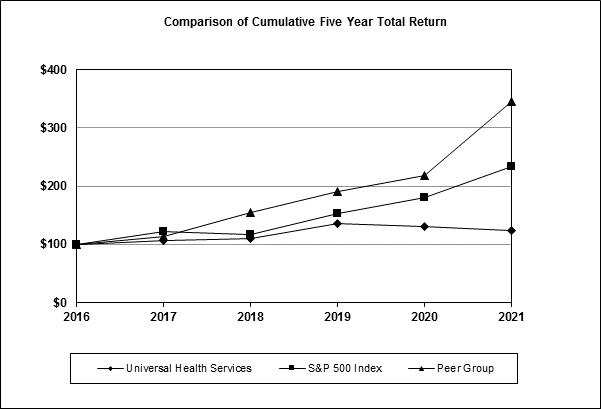]
| Company Name / Index | | [removed: 2015 Base | | | |] 2016 [added: Base] | | | | 2017 | | | | 2018 | | | | 2019 | | | | 2020 | | | [added: | 2021 | | |]
On February 24, 2022, our Board of Directors authorized a $1.4 billion increase to our stock repurchase program.
As reflected below, during the fourth quarter of 2021, pursuant to previous share repurchase authorizations, including a $1.0 billion increase to the program approved by our Board of Directors in July, 2021, we have repurchased approximately 3.43 million shares at an aggregate cost of approximately $432.3 million.
For the year ended December 31, 2021, we have repurchased approximately 8.41 million shares at an aggregate cost of approximately $1.201 billion.
As of December 31, 2021, prior to the above-mentioned increased authorization approved in February, 2022, we had an aggregate available repurchase authorization of $358.2 million.
| October, 2021 | | | — | | | | 29 | | | | 731 | | | $ | 0.01 | | | | — | | | $ | — | | | $ | — | | | $ | 790,495 | |
| November, 2021 | | | — | | | | 2,222,037 | | | | 1,206 | | | $ | 0.01 | | | | 2,221,796 | | | $ | 126.53 | | | $ | 281,125 | | | $ | 509,370 | |
| December, 2021 | | | — | | | | 1,203,913 | | | | 1,301 | | | $ | 0.01 | | | | 1,203,595 | | | $ | 125.57 | | | $ | 151,137 | | | $ | 358,233 | |
| Total October through December | | $ | \- | | | | 3,425,979 | | | | 3,238 | | | $ | 0.01 | | | | 3,425,391 | | | $ | 126.19 | | | $ | 432,262 | | | | | |
| --- | --- | --- |
| | (2) | The only publicly announced program pursuant to which the shares were repurchased was the share repurchase program described above. There is no other plan or program that has expired during this time period. Also, there is no other plan or program that we have determined to terminate prior to expiration, or under which we do not intend to make further purchases. |
| --- | --- | --- |
During the year ended December 31, 2021 we paid dividends of $0.80 per share.
Dividend equivalents are accrued on unvested restricted stock units and are paid upon vesting of the restricted stock unit.
| Universal Health Services, Inc. | | $ | 100.00 | | | $ | 106.93 | | | $ | 110.31 | | | $ | 136.36 | | | $ | 130.90 | | | $ | 124.14 | |
| S&P 500 Index | | $ | 100.00 | | | $ | 121.83 | | | $ | 116.49 | | | $ | 153.17 | | | $ | 181.35 | | | $ | 233.41 | |
| Peer Group | | $ | 100.00 | | | $ | 113.54 | | | $ | 154.00 | | | $ | 191.48 | | | $ | 218.39 | | | $ | 345.88 | |
In July, 2019, our Board of Directors authorized a $1.0 billion increase to our stock repurchase program, which increased the aggregate authorization to $2.7 billion from the previous $1.7 billion authorization approved in various increments since 2014.
In April, 2020, as part of various COVID-19 initiatives, we suspended our stock repurchase program.
We are planning to resume stock repurchases, subject to approval by our Board of Directors, during the second quarter of 2021.
As reflected below, during the three-month period ended December 31, 2020, no shares were repurchased pursuant to the terms of our stock repurchase program, since as mentioned above, we have suspended our stock repurchase program as part of our various COVID-19 initiatives.
| October, 2020 | | | — | | | | — | | | | 1,100 | | | $ | 0.01 | | | | — | | | $ | — | | | $ | — | | | $ | 559,563 | |
| November, 2020 | | | — | | | | 10,346 | | | | 573 | | | $ | 0.01 | | | | — | | | $ | — | | | $ | — | | | $ | 559,563 | |
| December, 2020 | | | — | | | | 39,179 | | | | 1,384 | | | $ | 0.01 | | | | — | | | $ | — | | | $ | — | | | $ | 559,563 | |
| Total October through December | | $ | \- | | | | 49,525 | | | | 3,057 | | | $ | 0.01 | | | | — | | | N/A | | | | $ | — | | | | | |
We have a history of paying quarterly cash dividends to our shareholders.
In April, 2020, as part of various COVID-19 initiatives, we suspended declaration and payment of quarterly dividends.
| Universal Health Services, Inc. | | $ | 100.00 | | | $ | 89.32 | | | $ | 95.51 | | | $ | 98.53 | | | $ | 121.80 | | | $ | 116.92 | |
| S&P 500 Index | | $ | 100.00 | | | $ | 111.96 | | | $ | 136.40 | | | $ | 130.42 | | | $ | 171.49 | | | $ | 203.04 | |
| Peer Group | | $ | 100.00 | | | $ | 90.10 | | | $ | 102.29 | | | $ | 138.74 | | | $ | 172.52 | | | $ | 197.03 | |
Item 6. [RESERVED]
0 rewritten, 0 added, 45 removed, 1 unchanged
| --- | --- |
The following table contains our selected financial data for, or as of the end of, each of the five years ended December 31, 2020.
You should read this table in conjunction with the consolidated financial statements and related notes included elsewhere in this report and in Part II, *Item 7, Management’s Discussion and Analysis of Financial Condition and Results of Operations.*
| | | Year Ended December 31, | | | | | | | | | | | | | | | | | | |
| --- | --- | --- | --- | --- | --- | --- | --- | --- | --- | --- | --- | --- | --- | --- | --- | --- | --- | --- | --- | --- |
| | | 2020 | | | | 2019 | | | | 2018 | | | | 2017 | | | | 2016 | | |
| Summary of Operations (in thousands) | | | | | | | | | | | | | | | | | | | | |
| Net revenues | | $ | 11,558,897 | | | $ | 11,378,259 | | | $ | 10,772,278 | | | $ | 10,409,865 | | | $ | 9,766,210 | |
| Income before income taxes | | $ | 1,252,083 | | | $ | 1,066,337 | | | $ | 1,034,525 | | | $ | 1,135,009 | | | $ | 1,156,358 | |
| Net income attributable to UHS | | $ | 943,953 | | | $ | 814,854 | | | $ | 779,705 | | | $ | 752,303 | | | $ | 702,409 | |
| Net margin | | | 8.2 | % | | | 7.2 | % | | | 7.2 | % | | | 7.2 | % | | | 7.2 | % |
| Return on average equity | | | 16.1 | % | | | 15.0 | % | | | 14.6 | % | | | 15.5 | % | | | 16.0 | % |
| Financial Data (in thousands) | | | | | | | | | | | | | | | | | | | | |
| Cash provided by operating activities | | $ | 2,360,169 | | | $ | 1,438,469 | | | $ | 1,274,742 | | | $ | 1,247,585 | | | $ | 1,254,509 | |
| Capital expenditures, net (1) | | $ | 731,307 | | | $ | 634,095 | | | $ | 664,962 | | | $ | 557,506 | | | $ | 519,939 | |
| Total assets | | $ | 13,476,879 | | | $ | 11,668,250 | | | $ | 11,265,480 | | | $ | 10,761,828 | | | $ | 10,317,802 | |
| Current maturities of long-term debt | | $ | 331,998 | | | $ | 87,550 | | | $ | 63,446 | | | $ | 545,619 | | | $ | 105,895 | |
| Long-term debt | | $ | 3,524,253 | | | $ | 3,896,577 | | | $ | 3,935,187 | | | $ | 3,494,390 | | | $ | 4,030,230 | |
| UHS’s common stockholders’ equity | | $ | 6,317,146 | | | $ | 5,504,105 | | | $ | 5,389,262 | | | $ | 4,989,514 | | | $ | 4,533,220 | |
| Percentage of total debt to total capitalization | | | 38 | % | | | 42 | % | | | 43 | % | | | 45 | % | | | 48 | % |
| Operating Data—Acute Care Hospitals (2) | | | | | | | | | | | | | | | | | | | | |
| Average licensed beds | | | 6,457 | | | | 6,379 | | | | 6,232 | | | | 6,127 | | | | 5,934 | |
| Average available beds | | | 6,285 | | | | 6,205 | | | | 6,056 | | | | 5,954 | | | | 5,759 | |
| Inpatient admissions | | | 286,535 | | | | 317,983 | | | | 303,985 | | | | 297,390 | | | | 274,074 | |
| Average length of patient stay | | | 5.1 | | | | 4.6 | | | | 4.5 | | | | 4.4 | | | | 4.6 | |
| Patient days | | | 1,458,321 | | | | 1,451,847 | | | | 1,376,988 | | | | 1,312,265 | | | | 1,251,511 | |
| Occupancy rate for licensed beds | | | 62 | % | | | 62 | % | | | 61 | % | | | 59 | % | | | 58 | % |
| Occupancy rate for available beds | | | 63 | % | | | 64 | % | | | 62 | % | | | 60 | % | | | 59 | % |
| Operating Data—Behavioral Health Facilities (2) | | | | | | | | | | | | | | | | | | | | |
| Average licensed beds | | | 23,661 | | | | 23,812 | | | | 23,509 | | | | 23,151 | | | | 21,829 | |
| Average available beds | | | 23,559 | | | | 23,711 | | | | 23,425 | | | | 23,068 | | | | 21,744 | |
| Inpatient admissions | | | 448,870 | | | | 488,367 | | | | 482,658 | | | | 467,822 | | | | 456,052 | |
| Average length of patient stay | | | 13.7 | | | | 13.3 | | | | 13.3 | | | | 13.6 | | | | 13.2 | |
| Patient days | | | 6,142,823 | | | | 6,487,707 | | | | 6,418,334 | | | | 6,381,756 | | | | 6,004,066 | |
| Occupancy rate for licensed beds | | | 71 | % | | | 75 | % | | | 75 | % | | | 76 | % | | | 75 | % |
| Occupancy rate for available beds | | | 71 | % | | | 75 | % | | | 75 | % | | | 76 | % | | | 75 | % |
| Per Share Data | | | | | | | | | | | | | | | | | | | | |
| Net income attributable to UHS—basic | | $ | 11.06 | | | $ | 9.16 | | | $ | 8.35 | | | $ | 7.86 | | | $ | 7.22 | |
| Net income attributable to UHS—diluted | | $ | 10.99 | | | $ | 9.13 | | | $ | 8.31 | | | $ | 7.81 | | | $ | 7.14 | |
| Dividends declared | | $ | 0.20 | | | $ | 0.60 | | | $ | 0.40 | | | $ | 0.40 | | | $ | 0.40 | |
An excerpt. Shown here: all 0 rewritten, all 0 added and 40 of 45 removed. The counts are complete. For every sentence, read Item 6. [RESERVED] in the FY2021 filing and the FY2020 filing.
Item 9A. Controls and Procedures.
5 rewritten, 0 added, 0 removed, 8 unchanged
As of December 31, [removed: 2020,] [added: 2021,] under the supervision and with the participation of our management, including our Chief Executive Officer (“CEO”) and Chief Financial Officer (“CFO”), we performed an evaluation of the effectiveness of our disclosure controls and procedures as defined in Rule 13a-15(e) or Rule 15d-15(e) of the Securities Exchange Act of 1934, as amended.
[removed: Changes] [added: Changes] in Internal Control Over Financial [removed: Reporting][added: Reporting]
There have been no changes in our internal control over financial reporting or in other factors during the fourth quarter of [removed: 2020] [added: 2021] that have materially affected, or are reasonably likely to materially affect, our internal control over financial reporting.
Based on its assessment, management has concluded that we maintained effective internal control over financial reporting as of December 31, [removed: 2020,] [added: 2021,] based on criteria in *Internal Control—Integrated Framework (2013)*, issued by the COSO.
The effectiveness of the Company’s internal control over financial reporting as of December 31, [removed: 2020] [added: 2021] has been audited by PricewaterhouseCoopers LLP, an independent registered public accounting firm as stated in its report which appears herein.
Item 9B. Other Information
0 rewritten, 0 added, 1 removed, 2 unchanged
PART III
Item 9C. Disclosure Regarding Foreign Jurisdictions that Prevent Inspections. Other Information
0 rewritten, 3 added, 0 removed, 0 unchanged
New section this year
| --- | --- |
Not applicable.
PART III
Item 10. Directors, Executive Officers and Corporate Governance
1 rewritten, 0 added, 0 removed, 2 unchanged
There is hereby incorporated by reference the information to appear under the captions “Election of Directors”, “Section 16(a) Beneficial Ownership Reporting Compliance” and “Corporate Governance” in our Proxy Statement, to be filed with the Securities and Exchange Commission within 120 days after December 31, [removed: 2020.][added: 2021.]
Item 11. Executive Compensation
1 rewritten, 0 added, 0 removed, 1 unchanged
There is hereby incorporated by reference the information to appear under the caption “Executive Compensation” in our Proxy Statement to be filed with the Securities and Exchange Commission within 120 days after December 31, [removed: 2020.][added: 2021.]
Item 12. Security Ownership of Certain Beneficial Owners and Management and Related Stockholder Matters
1 rewritten, 0 added, 0 removed, 1 unchanged
There is hereby incorporated by reference the information to appear under the caption “Security Ownership of Certain Beneficial Owners and Management” and “Executive Compensation” in our Proxy Statement, to be filed with the Securities and Exchange Commission within 120 days after December 31, [removed: 2020.][added: 2021.]
Item 13. Certain Relationships and Related Transactions, and Director Independence
1 rewritten, 0 added, 0 removed, 1 unchanged
There is hereby incorporated by reference the information to appear under the captions “Certain Relationships and Related Transactions” and “Corporate Governance” in our Proxy Statement, to be filed with the Securities and Exchange Commission within 120 days after December 31, [removed: 2020.][added: 2021.]
Item 14. Principal Accountant Fees and Services.
1 rewritten, 0 added, 0 removed, 2 unchanged
There is hereby incorporated by reference the information to appear under the caption “Relationship with Independent Auditors” in our Proxy Statement, to be filed with the Securities and Exchange Commission within 120 days after December 31, [removed: 2020.][added: 2021.]
Item 15. Exhibits and Financial Statement Schedules
38 rewritten, 9 added, 0 removed, 126 unchanged
| [removed: 4.1] [added: 4.2] | | [Indenture, dated as of [removed: June 3, 2016, between] [added: September 21, 2020, by and among] the Company, the [removed: subsidiary guarantors] [added: Subsidiary Guarantors] party thereto, MUFG Union Bank, N.A., as trustee, and JPMorgan Chase Bank, N.A., as collateral [removed: agent,] [added: agent.,] previously filed as Exhibit [removed: 4.2] [added: 4.1] to the Company’s Current Report on Form 8-K dated [removed: June 8, 2016,] [added: September 21, 2020,] is incorporated herein by [removed: reference.](http://www.sec.gov/Archives/edgar/data/0000352915/000119312516616699/d200774dex42.htm)] [added: reference.](http://www.sec.gov/Archives/edgar/data/352915/000156459020044127/uhs-ex41_36.htm)] |
| [removed: 4.2] [added: 4.6] | | [Additional Authorized Representative Joinder Agreement, dated as of [removed: June 3, 2016,] [added: August 24, 2021,] among [added: U.S. Bank National Association, as Trustee and Additional Authorized Representative,] the Company, the [removed: subsidiary guarantors] [added: Subsidiary Guarantors] party [removed: thereto] [added: thereto,] and JPMorgan Chase Bank, N.A., as collateral [added: agent and administrative] agent, previously filed as Exhibit [removed: 4.3] [added: 4.2] to the Company’s Current Report on Form 8-K dated [removed: June 8, 2016,] [added: August 24, 2021,] is incorporated herein by [removed: reference.](http://www.sec.gov/Archives/edgar/data/0000352915/000119312516616699/d200774dex43.htm)] [added: reference.](http://www.sec.gov/Archives/edgar/data/0000352915/000156459021045588/uhs-ex42_11.htm)] |
| [removed: 4.3] [added: 4.1] | | [Description of Securities of the Registrant previously filed as Exhibit 4.5 to the Company’s Annual Report on Form 10-K for the year ended December 31, 2019, is incorporated herein by reference.](http://www.sec.gov/Archives/edgar/data/0000352915/000156459020006793/uhs-ex45_148.htm) |
| [removed: 4.4] [added: 4.5] | | [Indenture, dated as of [removed: September 21, 2020,] [added: August 24, 2021,] by and among the Company, the Subsidiary Guarantors party thereto, [removed: MUFG Union Bank, N.A.,] [added: U.S. Bank National Association,] as [removed: trustee,] [added: Trustee,] and JPMorgan Chase Bank, N.A., as collateral [removed: agent.,] [added: agent,] previously filed as Exhibit 4.1 to the Company’s Current Report on Form 8-K dated [removed: September 21, 2020,] [added: August 24, 2021,] is incorporated herein by [removed: reference.](http://www.sec.gov/Archives/edgar/data/352915/000156459020044127/uhs-ex41_36.htm)] [added: reference.](http://www.sec.gov/Archives/edgar/data/0000352915/000156459021045588/uhs-ex41_13.htm)] |
| [removed: 4.5] [added: 4.3] | | [Additional Authorized Representative Joinder Agreement, dated as of September 21, 2020, among the Company, the Subsidiary Guarantors party thereto, JPMorgan Chase Bank, N.A., as collateral agent, the Authorized Representatives specified therein and MUFG Union Bank, N.A., as trustee, as an Additional Authorized Representative, previously filed as Exhibit 4.2 to the Company’s Current Report on Form 8-K dated September 21, 2020, is incorporated herein by reference](http://www.sec.gov/Archives/edgar/data/0000352915/000156459020044127/uhs-ex42_7.htm). |
| [removed: 4.6] [added: 4.4] | | [Registration Rights Agreement, dated as of September 21, 2020, by and among the Company, the Subsidiary Guarantors party thereto, and J.P. Morgan Securities LLC, BofA Securities, Inc. and Goldman Sachs & Co. LLC, as representatives of the several Initial Purchasers, previously filed as Exhibit 10.1 to the Company’s Current Report on Form 8-K dated September 21, 2020, is incorporated herein by [removed: reference.](http://www.sec.gov/Archives/edgar/data/0000352915/000156459020044127/uhs-ex101_8.htm)] [added: reference.](https://www.sec.gov/Archives/edgar/data/352915/000156459022006717/uhs-ex101_10.htm)] |
| 10.1 | | [Agreement, dated December [removed: 2, 2020,] [added: 1, 2021,] to renew Advisory Agreement dated as of December 24, 1986, and amended and restated effective as of January 1, 2019 between Universal Health Realty Income Trust and UHS of Delaware, [removed: Inc.](https://www.sec.gov/Archives/edgar/data/352915/000156459021008851/uhs-ex103_8.htm)] [added: Inc.](https://www.sec.gov/Archives/edgar/data/352915/000156459022006717/uhs-ex103_8.htm)] |
| [removed: 10.25] [added: 10.26] | | [Assignment and Assumption Agreement, dated as of October 27, 2010, previously filed as Exhibit 10.3 to the Company’s Current Report on Form 8-K dated November 2, 2010, is incorporated herein by reference.](http://www.sec.gov/Archives/edgar/data/0000352915/000119312510243987/dex103.htm) |
| [removed: 10.26] [added: 10.27] | | [Credit Agreement, dated as of November 15, 2010, by and among Universal Health Services, Inc., JPMorgan Chase Bank, N.A. and the various financial institutions as are or may become parties thereto, as Lenders, SunTrust Bank, The Royal Bank of Scotland, Plc, Bank of Tokyo-Mitsubishi UFJ Trust Company and Credit Agricole Corporate and Investment Bank, as co-documentation agents, Deutsche Bank Securities Inc. and Bank of America N.A. as co-syndication agents, and JPMorgan Chase Bank, N.A., as administrative agent for the Lenders and as collateral agent for the secured parties, previously filed as Exhibit 10.1 to the Company’s Current Report on Form 8-K dated November 17, 2010, is incorporated herein by reference.](http://www.sec.gov/Archives/edgar/data/0000352915/000095015710002042/ex10-1.htm) |
| [removed: 10.27] [added: 10.28] | | [First Amendment, dated as of March 15, 2011, to the Credit Agreement, dated as of November 15, 2010, by and among Universal Health Services, Inc., JPMorgan Chase Bank, N.A. and the various financial institutions as are or may become parties thereto, as Lenders, certain banks as co-documentation agents, and as co-syndication agents, and JPMorgan Chase Bank, N.A., as administrative agent for the Lenders and as collateral agent for the secured parties, previously filed as Exhibit 10.1 to the Company’s Current Report on Form 8-K dated March 15, 2011, is incorporated herein by reference.](http://www.sec.gov/Archives/edgar/data/0000352915/000119312511067583/dex101.htm) |
| [removed: 10.28] [added: 10.29] | | [Credit Agreement, dated as of November 15, 2010 and amended and restated as of September 21, 2012, by and among Universal Health Services, Inc. (the borrower), the several lenders from time to time parties thereto, Credit Agricole Corporate and Investment Bank, Mizuho Corporate Bank LTD., Royal Bank of Canada and The Royal Bank of Scotland PLC (as co-documentation agents), Bank of Tokyo-Mitsubishi UFJ Trust Company, Bank of America N.A. and SunTrust Bank (as co-syndication agents), and JPMorgan Chase Bank, N.A. (as administrative agent), previously filed as Exhibit 10.1 to the Company’s Current Report on Form 8-K dated September 26, 2012, is incorporated herein by reference.](http://www.sec.gov/Archives/edgar/data/0000352915/000119312512404549/d415922dex101.htm) |
| [removed: 10.29] [added: 10.30] | | [Second Amendment, dated as of September 21, 2012, to the Credit Agreement, dated as of November 15, 2010 (as amended from time to time), among Universal Health Services, Inc., a Delaware corporation, the several banks and other financial institutions from time to time parties thereto, JPMorgan Chase Bank, N.A., as administrative agent and the other agents party thereto, previously filed as Exhibit 10.2 to the Company’s Current Report on Form 8-K dated September 26, 2012, is incorporated herein by reference.](http://www.sec.gov/Archives/edgar/data/0000352915/000119312512404549/d415922dex102.htm) |
| [removed: 10.30] [added: 10.31] | | [Third Amendment, dated as of May 16, 2013, to the Credit Agreement, dated as of November 15, 2010, as amended from time to time, among Universal Health Services, Inc., a Delaware corporation, the several banks and other financial institutions from time to time parties thereto, JPMorgan Chase Bank, N.A., as administrative agent and the other agents party thereto, previously filed as Exhibit 10.1 to the Company’s Current Report on Form 8-K dated May 17, 2013, is incorporated herein by reference.](http://www.sec.gov/Archives/edgar/data/0000352915/000119312513225260/d540638dex101.htm) |
| [removed: 10.31] [added: 10.32] | | [Fourth Amendment, dated as of August 7, 2014, to the Credit Agreement, dated as of November 15, 2010, as previously amended from time to time, by and among Universal Health Services, Inc., the several banks and other financial institutions from time to time parties thereto, JPMorgan Chase Bank, N.A., as administrative agent and the other agents party thereto, previously filed as Exhibit 10.1 to the Company’s Current Report on Form 8-K dated August 12, 2014, is incorporated herein by reference.](http://www.sec.gov/Archives/edgar/data/0000352915/000119312514306618/d773872dex101.htm) |
| [removed: 10.32] [added: 10.34] | | [Fifth Amendment to the Credit Agreement, dated as of November 15, 2010, as amended on March 15, 2011, September 21, 2012, May 16, 2013 and August 7, 2014, among the Company, as borrower, the several banks and other financial institutions from time to time parties thereto, as lenders, JPMorgan Chase Bank, N.A., as administrative agent, and the other agents party thereto, previously filed as Exhibit 10.1 to the Company’s Current Report on Form 8-K dated June 8, 2016, is incorporated herein by reference.](http://www.sec.gov/Archives/edgar/data/0000352915/000119312516616699/d200774dex101.htm) |
| [removed: 10.33] [added: 10.35] | | [Sixth Amendment, dated as of October 23, 2018, to the Credit Agreement, dated as of November 15, 2010, as amended on March 15, 2011, September 21, 2012, May 16, 2013, August 7, 2014 and June 7, 2016, among the Company, as borrower, the several banks and other financial institutions from time to time parties thereto, as lenders, JPMorgan Chase Bank, N.A., as administrative agent, and the other agents party thereto, previously filed as Exhibit 10.1 to the Company’s Current Report on Form 8-K dated October 24, 2018, is incorporated herein by reference.](http://www.sec.gov/Archives/edgar/data/0000352915/000156459018024906/uhs-ex101_7.htm) |
| [removed: 10.34] [added: 10.36] | | [Increased Facility Activation Notice – Incremental Term Loans, dated as of October 31, 2018, to the Credit Agreement, dated as of November 15, 2010, as amended on March 15, 2011, September 21, 2012, May 16, 2013, August 7, 2014, June 7, 2016 and October 23, 2018, among the Company, as borrower, the several banks and other financial institutions from time to time parties thereto, as lenders, JPMorgan Chase Bank, N.A., as administrative agent, and the other agents party thereto, previously filed as Exhibit 10.1 to the Company’s Current Report on Form 8-K dated November 2, 2018, is incorporated herein by reference.](http://www.sec.gov/Archives/edgar/data/0000352915/000156459018026508/uhs-ex101_7.htm) |
| [removed: 10.35] [added: 10.33] | | [Credit Agreement, dated as of November 15, 2010 and amended and restated as of August 7, 2014, by and among Universal Health Services, Inc., the several banks and other financial institutions from time to time parties thereto, JPMorgan Chase Bank, N.A., as administrative agent and the other agents party thereto, previously filed as Exhibit 10.2 to the Company’s Current Report on Form 8-K dated August 12, 2014, is incorporated herein by reference.](http://www.sec.gov/Archives/edgar/data/0000352915/000119312514306618/d773872dex102.htm) |
| [removed: 10.36*] [added: 10.39*] | | [Form of Supplemental Life Insurance Plan and Agreement Part A: Alan B. Miller 1998 Dual Life Insurance Trust (effective December 9, 2010, by and between Universal Health Services, Inc., a Delaware corporation (the “Company”), and Anthony Pantaleoni as Trustee), previously filed as Exhibit 10.1 to the Company’s Current Report on Form 8-K dated December 10, 2010, is incorporated herein by reference.](http://www.sec.gov/Archives/edgar/data/0000352915/000119312510278167/dex101.htm) |
| [removed: 10.37*] [added: 10.40*] | | [Form of Supplemental Life Insurance Plan and Agreement Part B: Alan B. Miller 2002 Trust (effective December 9, 2010, by and between Universal Health Services, Inc., a Delaware corporation (the “Company”), and Anthony Pantaleoni as Trustee), previously filed as Exhibit 10.2 to the Company’s Current Report on Form 8-K dated December 10, 2010, is incorporated herein by reference.](http://www.sec.gov/Archives/edgar/data/0000352915/000119312510278167/dex102.htm) |
| [removed: 10.38*] [added: 10.41*] | | [Universal Health Services, Inc. Termination, Assignment and Release Agreement (effective December 9, 2010, by and between Universal Health Services, Inc., a Delaware corporation (the “Company”), Anthony Pantaleoni as Trustee of the Alan B. Miller 1998 Dual Life Insurance Trust, and Alan B. Miller, Executive), previously filed as Exhibit 10.3 to the Company’s Current Report on Form 8-K dated December 10, 2010, is incorporated herein by reference.](http://www.sec.gov/Archives/edgar/data/0000352915/000119312510278167/dex103.htm) |
| [removed: 10.39*] [added: 10.42*] | | [Universal Health Services, Inc. Termination, Assignment and Release Agreement (effective December 9, 2010, by and between Universal Health Services, Inc., a Delaware corporation (the “Company”), Anthony Pantaleoni as Trustee of the Alan B. Miller 2002 Trust, and Alan B. Miller, Executive), previously filed as Exhibit 10.4 to the Company’s Current Report on Form 8-K dated December 10, 2010, is incorporated herein by reference.](http://www.sec.gov/Archives/edgar/data/0000352915/000119312510278167/dex104.htm) |
| [removed: 10.40] [added: 10.43] | | [Collateral Agreement, dated as of August 7, 2014, among Universal Health Services, Inc., the subsidiary guarantors party thereto, MUFG Union Bank, N.A., as 2014 Trustee, The Bank of New York Mellon Trust Company, N.A., as 2006 Trustee, and JPMorgan Chase Bank, N.A., as collateral agent, previously filed as Exhibit 10.4 to the Company’s Current Report on Form 8-K dated August 12, 2014, is incorporated herein by reference.](http://www.sec.gov/Archives/edgar/data/0000352915/000119312514306618/d773872dex104.htm) |
| [removed: 10.41] [added: 10.44] | | [Universal Health Services, Inc. 2020 Omnibus Stock and Incentive Plan, previously filed as Exhibit 99.1 to the Company’s Registration Statement on Form S-8 (File No. 333-238880) dated June 2, 2020, is incorporated herein by reference.](http://www.sec.gov/Archives/edgar/data/0000352915/000156459020028068/uhs-s8.htm) |
| [removed: 10.42] [added: 10.45] | | [Form of Stock Option Award Agreement under the Universal Health Services, Inc. 2020 Omnibus Stock and Incentive Plan, previously filed as Exhibit 10.5 to the Company’s Quarterly Report on Form 10-Q filed on August 7, 2020, is incorporated herein by reference.](http://www.sec.gov/Archives/edgar/data/0000352915/000156459020038367/uhs-ex105_114.htm) |
| [removed: 10.43] [added: 10.46] | | [Form of Restricted Stock Award Agreement under the Universal Health Services, Inc. 2020 Omnibus Stock and Incentive Plan, previously filed as Exhibit 10.6 to the Company’s Quarterly Report on Form 10-Q filed on August 7, 2020, is incorporated herein by reference.](http://www.sec.gov/Archives/edgar/data/0000352915/000156459020038367/uhs-ex106_115.htm) |
| [removed: 10.44] [added: 10.47] | | [Form of Restricted Stock Unit Award Agreement under the Universal Health Services, Inc. 2020 Omnibus Stock and Incentive Plan, previously filed as Exhibit 10.7 to the Company’s Quarterly Report on Form 10-Q filed on August 7, 2020, is incorporated herein by reference.](http://www.sec.gov/Archives/edgar/data/0000352915/000156459020038367/uhs-ex107_113.htm) |
| [removed: 10.45] [added: 10.48] | | [Settlement Agreement among: (i) the United States of America, acting through the United States Department of Justice and on behalf of the Office of Inspector General (OIG-HHS) of the Department of Health and Human Services (HHS); the Defense Health Agency (DHA), acting on behalf of the TRICARE Program; the Office of Personnel Management (OPM), which administers the Federal Employees Health Benefits Program (FEHBP); and the United States Department of Veteran Affairs (VA) (collectively, the United States); (ii) Universal Health Services, Inc. (“UHS, Inc.”) and UHS of Delaware, Inc. (“UHS of Delaware, Inc.”), acting on behalf of the entities listed on Exhibits A and B, (collectively the “Defendants” or “UHS”); and (iii) various individuals (collectively, the “Relators”), previously filed as Exhibit 10.1 to the Company’s Current Report on Form 8-K dated July 10, 2020, is incorporated herein by reference.](http://www.sec.gov/Archives/edgar/data/0000352915/000156459020032190/uhs-ex101_17.htm) |
| [removed: 10.46] [added: 10.49] | | [Form of Settlement Agreement between various states and Universal Health Services, Inc. and UHS of Delaware, Inc., acting on behalf of the entities listed on Exhibits A and B, previously filed as Exhibit 10.2 to the Company’s Current Report on Form 8-K dated July 10, 2020, is incorporated herein by reference.](http://www.sec.gov/Archives/edgar/data/0000352915/000156459020032190/uhs-ex102_15.htm) |
| [removed: 10.47] [added: 10.50] | | [Corporate Integrity Agreement between the Office of Inspector General of the Department of Health and Human Services and Universal Health Services, Inc. and UHS of Delaware, Inc., previously filed as Exhibit 10.3 to the Company’s Current Report on Form 8-K dated July 10, 2020, is incorporated herein by reference.](http://www.sec.gov/Archives/edgar/data/0000352915/000156459020032190/uhs-ex103_16.htm) |
| [removed: 10.48*] [added: 10.52*] | | [Employment Agreement between Universal Health Services, Inc. and Marc D. Miller dated as of December 23, 2020, previously filed as Exhibit 10.1 to the Company’s Current Report on Form 8-K dated December 23, 2020, is incorporated herein by reference.](http://www.sec.gov/Archives/edgar/data/0000352915/000156459020058584/uhs-ex101_6.htm) |
| [removed: 10.49*] [added: 10.53*] | | [Employment Agreement between Universal Health Services, Inc. and Alan B. Miller dated as of December 23, 2020, previously filed as Exhibit 10.2 to the Company’s Current Report on Form 8-K dated December 23, 2020, is incorporated herein by reference.](http://www.sec.gov/Archives/edgar/data/0000352915/000156459020058584/uhs-ex102_7.htm) |
| 21 | | [Subsidiaries of [removed: Registrant.](https://www.sec.gov/Archives/edgar/data/352915/000156459021008851/uhs-ex21_13.htm)] [added: Registrant.](https://www.sec.gov/Archives/edgar/data/352915/000156459022006717/uhs-ex21_8.htm)] |
| 23.1 | | [Consent of Independent Registered Public Accounting Firm-PricewaterhouseCoopers [removed: LLP.](https://www.sec.gov/Archives/edgar/data/352915/000156459021008851/uhs-ex231_12.htm)] [added: LLP.](https://www.sec.gov/Archives/edgar/data/352915/000156459022006717/uhs-ex231_6.htm)] |
| 31.1 | | [Certification from the Company’s Chief Executive Officer Pursuant to Rule 13a-14(a)/15(d)-14(a) of the Securities Exchange Act of [removed: 1934.](https://www.sec.gov/Archives/edgar/data/352915/000156459021008851/uhs-ex311_11.htm)] [added: 1934.](https://www.sec.gov/Archives/edgar/data/352915/000156459022006717/uhs-ex311_9.htm)] |
| 31.2 | | [Certification from the Company’s Chief Financial Officer Pursuant to Rule 13a-14(a)/15(d)-14(a) of the Securities Exchange Act of [removed: 1934.](https://www.sec.gov/Archives/edgar/data/352915/000156459021008851/uhs-ex312_9.htm)] [added: 1934.](https://www.sec.gov/Archives/edgar/data/352915/000156459022006717/uhs-ex312_12.htm)] |
| 32.1 | | [Certification from the Company’s Chief Executive Officer Pursuant to 18 U.S.C. Section 1350, as Adopted Pursuant to Section 906 of the Sarbanes-Oxley Act of [removed: 2002.](https://www.sec.gov/Archives/edgar/data/352915/000156459021008851/uhs-ex321_7.htm)] [added: 2002.](https://www.sec.gov/Archives/edgar/data/352915/000156459022006717/uhs-ex321_7.htm)] |
| 32.2 | | [Certification from the Company’s Chief Financial Officer Pursuant to 18 U.S.C. Section 1350, as Adopted Pursuant to Section 906 of the Sarbanes-Oxley Act of [removed: 2002.](https://www.sec.gov/Archives/edgar/data/352915/000156459021008851/uhs-ex322_6.htm)] [added: 2002.](https://www.sec.gov/Archives/edgar/data/352915/000156459022006717/uhs-ex322_11.htm)] |
| 4.7 | | [Supplemental Indenture, dated as of August 24, 2021, among the Company, the Subsidiary Guarantors party thereto, U.S. Bank National Association (as successor to MUFG Union Bank, N.A.), as trustee, and JPMorgan Chase Bank, N.A., as collateral agent, to the indenture, dated as of September 21, 2020, governing the Existing 2030 Notes, previously filed as Exhibit 4.3 to the Company’s Current Report on Form 8-K dated August 24, 2021, is incorporated herein by reference.](http://www.sec.gov/Archives/edgar/data/0000352915/000156459021045588/uhs-ex43_9.htm) |
| 4.8 | | [Registration Rights Agreement, dated as of August 24, 2021, by and among the Company, the Subsidiary Guarantors party thereto, and J.P. Morgan Securities LLC, BofA Securities, Inc., Goldman Sachs & Co. LLC and Truist Securities, Inc., as representatives of the several Initial Purchasers, previously filed as Exhibit 10.1 to the Company’s Current Report on Form 8-K dated August 24, 2021, is incorporated herein by reference.](http://www.sec.gov/Archives/edgar/data/0000352915/000156459021045588/uhs-ex101_12.htm) |
| 10.25 | | [Seventh Amendment to Amended and Restated Credit and Security Agreement, dated as of April 26, 2021, previously filed as Exhibit 10.1 to the Company’s Quarterly Report on Form 10-Q dated May 7, 2021, is incorporated herein by reference.](http://www.sec.gov/Archives/edgar/data/0000352915/000156459021025562/uhs-ex101_23.htm) |
| 10.37 | | [Seventh Amendment, dated as of August 24, 2021, to the Credit Agreement, dated as of November 15, 2010, as amended on March 15, 2011, September 21, 2012, May 16, 2013, August 7, 2014, June 7, 2016 and October 23, 2018, among the Company, as borrower, the several banks and other financial institutions from time to time parties thereto, as lenders, JPMorgan Chase Bank, N.A., as administrative agent, and the other agents party thereto, previously filed as Exhibit 10.2 to the Company’s Current Report on Form 8-K dated August 24, 2021, is incorporated herein by reference.](http://www.sec.gov/Archives/edgar/data/0000352915/000156459021045588/uhs-ex102_10.htm) |
| 10.38 | | [Eighth Amendment, dated as of September 10, 2021, to the Credit Agreement, dated as of November 15, 2010, as amended on March 15, 2011, September 21, 2012, May 16, 2013, August 7, 2014, June 7, 2016, October 23, 2018 and August 24, 2021, among the Company, as borrower, the several banks and other financial institutions from time to time parties thereto, as lenders, JPMorgan Chase Bank, N.A., as administrative agent, and the other agents party thereto, previously filed as Exhibit 10.3 to the Company’s Quaterly Report on Form 10-Q dated November 8, 2021, is incorporated herein by reference.](http://www.sec.gov/Archives/edgar/data/0000352915/000156459021055254/uhs-ex103_23.htm) |
| 10.51 | | [Stipulation and Agreement of Settlement, dated as of September 15, 2021, by and among (a) lead plaintiffs in the stockholder derivative action captioned In re Universal Health Services, Inc., Derivative Litigation, Case No. 2:17-cv-02187-JHS (including each of its member cases, the “Federal Action”), pending in the United States District Court for the Eastern District of Pennsylvania; (b) plaintiffs in the stockholder derivative litigation captioned Delaware County Employees’ Retirement Fund and the Chester County Employees’ Retirement System v. Alan B. Miller, et al., C.A. No. 2017-0475-JTL (the “Delaware Action”), brought in the Court of Chancery of the State of Delaware; (c) Dr. Eli Inzlicht-Sprei; (d) defendants in the Federal Action; (e) defendants in the Delaware Action; and (f) nominal defendant in the Federal Action and Delaware Action: Universal Health Services, Inc., by and through their respective undersigned counsel, previously filed as Exhibit 99.3 to the Company’s Current Report on Form 8-K dated October 25, 2021, is incorporated herein by reference.](http://www.sec.gov/Archives/edgar/data/0000352915/000156459021051847/uhs-ex993_9.htm) |
| 10.54 | | [Master Lease Document between certain subsidiaries of Universal Health Services, Inc. and Universal Health Realty Income Trust, dated December 31, 2021.](https://www.sec.gov/Archives/edgar/data/352915/000156459022006717/uhs-ex1054_42.htm) |
| | | |
| | | |
Item 16. Form 10-K Summary
531 rewritten, 226 added, 285 removed, 772 unchanged
| /s/ ALAN B. MILLER Alan B. Miller | | | | Executive Chairman of the Board | | | | February [removed: 25, 2021] [added: 24, 2022] | | | |
| /s/ MARC D. MILLER Marc D. Miller | | | | Director, [added: President and] Chief Executive Officer [removed: and President] (Principal Executive Officer) | | | | February [removed: 25, 2021] [added: 24, 2022] | | | |
| /s/ LAWRENCE S. GIBBS Lawrence S. Gibbs | | | | Director | | | | February [removed: 25, 2021] [added: 24, 2022] | | | |
| /s/ EILEEN C. MCDONNELL Eileen C. McDonnell | | | | Director | | | | February [removed: 25, 2021] [added: 24, 2022] | | | |
| /s/ WARREN J. NIMETZ Warren J. Nimetz | | | | Director | | | | February [removed: 25, 2021] [added: 24, 2022] | | | |
| /s/ MARIA SINGER Maria Singer | | | | Director | | | | February [removed: 25, 2021] [added: 24, 2022] | | | |
| /s/ ELLIOTT J. SUSSMAN M.D. Elliot J. Sussman M.D. | | | | Director | | | | February [removed: 25, 2021] [added: 24, 2022] | | | |
| /s/ STEVE FILTON Steve Filton | | | | Executive Vice President, Chief Financial Officer and Secretary (Principal Financial and Accounting Officer) | | | | February [removed: 25, 2021] [added: 24, 2022] | | | |
[removed: UNIVERSAL] [added: UNIVERSAL] HEALTH SERVICES, [removed: INC.][added: INC.]
| [Report of Independent Registered Public Accounting Firm](#ReportofIndependentRegisteredPublic) [added: (PCAOB ID: 238)] | [removed: 93] [added: 2] |
| [Consolidated Statements of Income for December 31, [added: 2021,] 2020, [removed: 2019,] and [removed: 2018](#CONSOLIDATED_STATEMENTS_INCOME)] [added: 2019](#CONSOLIDATED_STATEMENTS_INCOME)] | [removed: 95] [added: 2] |
| [Consolidated Statements of Comprehensive Income for December 31, [added: 2021,] 2020, [removed: 2019,] and [removed: 2018](#CONSOLIDATED_STATEMENTS_COMPREHENSIVE_IN)] [added: 2019](#CONSOLIDATED_STATEMENTS_COMPREHENSIVE_IN)] | [removed: 96] [added: 2] |
| [Consolidated Balance Sheets as of December 31, [removed: 2020] [added: 2021] and [removed: 2019](#CONSOLIDATED_BALANCE_SHEETS)] [added: 2020](#CONSOLIDATED_BALANCE_SHEETS)] | [removed: 97] [added: 2] |
| [Consolidated Statements of Changes in Equity for December 31, [removed: 2020, 2019] [added: 2021, 2010] and [removed: 2018](#CONSOLIDATED_STATEMENTS_CHANGES_IN_EQUIT)] [added: 2019](#CONSOLIDATED_STATEMENTS_CHANGES_IN_EQUIT)] | [removed: 98] [added: 2] |
| [Consolidated Statements of Cash Flows for December 31, [removed: 2020, 2019] [added: 2021, 2020] and [removed: 2018](#CONSOLIDATED_STATEMENTS_CASH_FLOWS)] [added: 2019](#CONSOLIDATED_STATEMENTS_CASH_FLOWS)] | [removed: 101] [added: 2] |
| [Notes to Consolidated Financial Statements](#NOTES_TO_CONSOLIDATED_FINANCIAL_STATEMEN) | [removed: 102] [added: 2] |
| [Supplemental Financial Statement Schedule II: Valuation and Qualifying Accounts as of and for December 31, [added: 2021,] 2020, [removed: 2019,] and [removed: 2018](#SCHEDULE_IIVALUATION_QUALIFYING_ACCOUNTS)] [added: 2019](#SCHEDULEII_VALUATION)] | [removed: 138] [added: 2] |
We have audited the accompanying consolidated balance sheets of Universal Health Services, Inc. and its subsidiaries (the “Company”) as of December 31, [removed: 2020] [added: 2021] and [removed: 2019,] [added: 2020,] and the related consolidated statements of income, of comprehensive income, of changes in equity and of cash flows for each of the three years in the period ended December 31, [removed: 2020,] [added: 2021,] including the related notes and financial statement schedule listed in the accompanying index (collectively referred to as the “consolidated financial statements”).
We also have audited the Company's internal control over financial reporting as of December 31, [removed: 2020,] [added: 2021,] based on criteria established in *Internal Control - Integrated Framework* (2013) issued by the Committee of Sponsoring Organizations of the Treadway Commission (COSO).
In our opinion, the consolidated financial statements referred to above present fairly, in all material respects, the financial position of the Company as of December 31, [removed: 2020] [added: 2021] and [removed: 2019,] [added: 2020,] and the results of its operations and its cash flows for each of the three years in the period ended December 31, [removed: 2020] [added: 2021] in conformity with accounting principles generally accepted in the United States of America.
Also in our opinion, the Company maintained, in all material respects, effective internal control over financial reporting as of December 31, [removed: 2020,] [added: 2021,] based on criteria established in *Internal Control - Integrated Framework* (2013) issued by the COSO.
[removed: The] communication of critical audit matters does not alter in any way our opinion on the consolidated financial statements, taken as a whole, and we are not, by communicating the critical audit matter below, providing a separate opinion on the critical audit matter or on the accounts or disclosures to which it relates.
As described in Notes 1, 10 and 12 to the consolidated financial statements, the [removed: Company’s Acute Care Hospital Services and Behavioral Health Care Services operating segments report] [added: Company reports] net patient service revenue at the estimated net realizable amounts from patients and third-party payers and others for services rendered.
As of December 31, [removed: 2020,] [added: 2021,] the net accounts receivable balance was $1.7 billion.
These procedures also included, among others, (i) testing management’s process for developing the estimate for price concessions, as well as the relevance of the historical billing and collection data as an input to the valuation approach; (ii) testing the accuracy of a sample of revenue transactions and a sample of cash collections from the historical billing data and historical collection data used in management’s estimation of price concessions; (iii) evaluating the historical accuracy of management’s process for developing the estimate of the amount which will ultimately be collected by comparing actual cash collections to the previously recorded net accounts receivable balance; and (iv) [removed: for the Acute Care Hospital Services operating segment,] developing an independent expectation of the net accounts receivable balance.
Developing an independent expectation involved calculating the percentage of cash collections as compared to the recorded net accounts receivable balance as of the end of the prior year, applying those calculated percentages to the recorded accounts receivable balance as of December 31, [removed: 2020,] [added: 2021,] and comparing the calculated balance to management’s estimate of the [removed: Acute Care Hospital Services] net accounts receivable balance.
[removed: UNIVERSAL] [added: UNIVERSAL] HEALTH SERVICES, INC. AND [removed: SUBSIDIARIES][added: SUBSIDIARIES]
| | | [removed: 2020] [added: 2021] | | | | [removed: 2019] [added: 2020] | | | | [removed: 2018] [added: 2019] | | |
| Net revenues | | $ | [removed: 11,558,897] [added: 12,642,117] | | | $ | [removed: 11,378,259] [added: 11,558,897] | | | $ | [removed: 10,772,278] [added: 11,378,259] | |
| Salaries, wages and benefits | | | [removed: 5,613,097] [added: 6,163,944] | | | | [removed: 5,588,893] [added: 5,613,097] | | | | [removed: 5,254,536] [added: 5,588,893] | |
| Other operating expenses | | | [removed: 2,672,762] [added: 3,035,869] | | | | [removed: 2,723,911] [added: 2,672,762] | | | | [removed: 2,614,687] [added: 2,723,911] | |
| Supplies expense | | | [removed: 1,288,132] [added: 1,427,134] | | | | [removed: 1,251,346] [added: 1,288,132] | | | | [removed: 1,168,654] [added: 1,251,346] | |
| Depreciation and amortization | | | [removed: 510,493] [added: 533,213] | | | | [removed: 490,392] [added: 510,493] | | | | [removed: 453,045] [added: 490,392] | |
| Lease and rental expense | | | [removed: 116,059] [added: 118,863] | | | | [removed: 107,809] [added: 116,059] | | | | [removed: 106,094] [added: 107,809] | |
| | | | [removed: 10,200,543] [added: 11,279,023] | | | | [removed: 10,162,351] [added: 10,200,543] | | | | [removed: 9,597,016] [added: 10,162,351] | |
| Income from operations | | | [removed: 1,358,354] [added: 1,363,094] | | | | [removed: 1,215,908] [added: 1,358,354] | | | | [removed: 1,175,262] [added: 1,215,908] | |
| Interest expense, net | | | [removed: 106,285] [added: 83,672] | | | | [removed: 162,733] [added: 106,285] | | | | [removed: 154,956] [added: 162,733] | |
| Other (income) expense, net | | | [removed: (14] [added: (13,891] | ) | | | [removed: (13,162] [added: (14] | ) | | | [removed: (14,219] [added: (13,162] | ) |
| Income before income taxes | | | [removed: 1,252,083] [added: 1,293,313] | | | | [removed: 1,066,337] [added: 1,252,083] | | | | [removed: 1,034,525] [added: 1,066,337] | |
| Provision for income taxes | | | [removed: 299,293] [added: 305,681] | | | | [removed: 238,794] [added: 299,293] | | | | [removed: 236,642] [added: 238,794] | |
February 24, 2022
The
February 24, 2022
| | | 2021 | | | | 2020 | | |
| | | | 10,105,220 | | | | 9,378,486 | |
| | | | 5,208,793 | | | | 4,865,722 | |
| | | | 5,874,275 | | | | 5,373,124 | |
| | | | 4,955,712 | | | | 4,821,886 | |
| Other | | | 560,036 | | | | 526,298 | |
For the Years Ended December 31, 2021, 2020 and 2019
| Repurchased | | | — | | | | — | | | | (85 | ) | | | — | | | | — | | | | — | | | | (1,220,790 | ) | | | — | | | | (1,220,875 | ) | | | — | | | | (1,220,875 | ) |
| Purchase of ownership interests by minority members | | | — | | | | — | | | | — | | | | — | | | | — | | | | — | | | | — | | | | — | | | | — | | | | 13,909 | | | | 13,909 | |
| Net income to UHS / noncontrolling interests | | | 752 | | | | — | | | | — | | | | — | | | | — | | | | — | | | | 991,590 | | | | — | | | | 991,590 | | | | (4,710 | ) | | | 986,880 | |
| Subtotal - comprehensive income | | | 752 | | | | — | | | | — | | | | — | | | | — | | | | — | | | | 991,590 | | | | (17,829 | ) | | | 973,761 | | | | (4,710 | ) | | | 969,051 | |
| Balance, December 31, 2021 | | $ | 5,119 | | | $ | 66 | | | $ | 698 | | | $ | 7 | | | $ | — | | | $ | (545,487 | ) | | $ | 6,604,089 | | | $ | 30,291 | | | $ | 6,089,664 | | | $ | 103,389 | | | $ | 6,193,053 | |
| Net income | | $ | 987,632 | | | $ | 952,790 | | | $ | 827,543 | |
Revenue Recognition
| Adjustments to goodwill (b) | | | 13,509 | | | | 10,994 | | | | 24,503 | |
| Balance, December 31, 2021 | | $ | 515,936 | | | $ | 3,446,688 | | | $ | 3,962,624 | |
| | (b) | Adjustments to goodwill during 2021 consist of the following: $13.5 million in Acute Care Services consists primarily of a measurement period adjustment to the preliminary purchase price allocation related to a 2020 acquisition; and the $11.0 million in Behavioral Health Services consists of $16.3 million recorded in connection with a third party minority ownership interest in a majority owned joint venture that constructed and owns a recently opened behavioral health facility, partially offset by a $5.3 million decrease related to foreign currency translation adjustments. |
Other Assets and Intangible Assets: Other assets consist primarily of amounts related to: (i) intangible assets acquired in connection with our acquisitions of Cambian Group, PLC’s adult services’ division during 2015, Ascend Health Corporation during 2012 and Psychiatric Solutions, Inc. during 2010; (ii) prepaid fees for various software and other applications used by our hospitals;
In connection with the discontinuation of a certain module of a new clinical/financial information technology application under development, our financial results for the year ended December 31, 2021 include a pre-tax provision for asset impairment of approximately $14 million to write-off the applicable portion of the capitalized costs incurred and is included in other operating expenses on the accompanying consolidated statement of income.
There was no impairment recorded during 2020.
| | | 2021 | | | | 2020 | | |
Accordingly, the amounts recorded as redeemable noncontrolling interests on our Consolidated Balance Sheet reflects the estimated fair market value of these ownership interests.
| 2021 activity: | | | | | | | | | | | | | | | | |
| Pretax amount | | | 0 | | | | (20,743 | ) | | | 1,427 | | | | (19,316 | ) |
| Income tax effect | | | 0 | | | | 1,829 | | | | (342 | ) | | | 1,487 | |
| Change, net of income tax | | | 0 | | | | (18,914 | ) | | | 1,085 | | | | (17,829 | ) |
| Balance, December 31, 2021, net of income tax | | $ | (17 | ) | | $ | 33,524 | | | $ | (3,216 | ) | | $ | 30,291 | |
Cash flow hedges are accounted for by recording the fair value
| Net Income | | $ | 987,632 | | | $ | 952,790 | | | $ | 827,543 | |
| Weighted average number of common shares—basic | | | 82,519 | | | | 85,061 | | | | 88,762 | |
| Weighted average number of common shares and equivalents—diluted | | | 83,692 | | | | 85,587 | | | | 89,040 | |
CARES Act and Other Governmental Grants and Medicare Accelerated Payments: During 2021, we received approximately $189 million of additional funds from the federal government in connection with the CARES Act, which we returned during the year utilizing a portion of our cash and cash equivalents held on deposit.
Therefore, there was no impact on our earnings during 2021 in connection with receipt of those funds.
Also during 2021, we made an early repayment of $695 million of funds received during 2020 pursuant to the Medicare Accelerated and Advance Payment Program (“MAAPP”).
These funds, which were required to be repaid to the government beginning in the second quarter of 2021 through the third quarter of 2022, were returned to the government utilizing a portion of our cash and cash equivalents held on deposit.
As of December 31, 2020, $372 million of the MAAPP funds were included in the current liabilities in our consolidated balance sheet and $323 million were included noncurrent liabilities.
During 2021, we spent $105 million on the acquisition of businesses and property, consisting primarily of a micro acute care hospital located in Las Vegas, Nevada, and a physician practice management company located in California.
| --- | --- | --- |
February 25, 2021
Change in Accounting Principle
As discussed in Note 7 to the consolidated financial statements, the Company changed the manner in which it accounts for leases in 2019.
| Other | | | 0 | | | | 0 | | | | 4,398 | |
| | | | 9,378,486 | | | | 8,729,395 | |
| | | | 4,865,722 | | | | 4,639,716 | |
| | | | 5,373,124 | | | | 5,016,698 | |
| | | | 4,821,886 | | | | 4,735,618 | |
| Legal reserves | | | 12,625 | | | | 144,509 | |
| Other | | | 513,673 | | | | 354,209 | |
| Balance, January 1, 2018 | | $ | 6,702 | | | $ | 66 | | | $ | 869 | | | $ | 7 | | | $ | 0 | | | $ | (371,814 | ) | | $ | 5,353,209 | | | $ | 7,177 | | | $ | 4,989,514 | | | $ | 61,922 | | | $ | 5,051,436 | |
| Cumulative-effect adjustment due to adoption of ASU 2016-01 (net of income tax effect of $1,045) | | | | | | | | | | | | | | | | | | | | | | | | | | | (3,353 | ) | | | 3,353 | | | | — | | | | | | | | — | |
| Repurchased | | | — | | | | — | | | | (34 | ) | | | — | | | | — | | | | — | | | | (413,968 | ) | | | — | | | | (414,002 | ) | | | — | | | | (414,002 | ) |
| Other | | | — | | | | — | | | | — | | | | — | | | | — | | | | — | | | | — | | | | — | | | | — | | | | 8,616 | | | | 8,616 | |
| Net income to UHS / noncontrolling interests | | | 90 | | | | — | | | | — | | | | — | | | | — | | | | — | | | | 779,705 | | | | — | | | | 779,705 | | | | 18,088 | | | | 797,793 | |
| Reclassification due to adoption of ASU 2018-02 | | | — | | | | — | | | | — | | | | — | | | | — | | | | — | | | | 1,802 | | | | (1,802 | ) | | | — | | | | | | | | | |
| Unrealized derivative gains on cash flow hedges (net of income tax effect of $667) | | | — | | | | — | | | | — | | | | — | | | | — | | | | — | | | | — | | | | (2,138 | ) | | | (2,138 | ) | | | — | | | | (2,138 | ) |
| Subtotal - comprehensive income | | | 90 | | | | — | | | | — | | | | — | | | | — | | | | — | | | | 778,154 | | | | (2,935 | ) | | | 775,219 | | | | 18,088 | | | | 793,307 | |
| Unrealized derivative gains on cash flow hedges (net of income tax effect of $928) | | | — | | | | — | | | | — | | | | — | | | | — | | | | — | | | | — | | | | — | | | | — | | | | — | | | | — | |
Revenue Recognition: On January 1, 2018, we adopted, using the modified retrospective approach, ASU 2014-09 and ASU 2016-08, “Revenue from Contracts with Customers (Topic 606)” and “Revenue from Contracts with Customers: Principal versus Agent Considerations (Reporting Revenue Gross versus Net)”, respectively, which provides guidance for revenue recognition.
The standard’s core principle is that a company will recognize revenue when it transfers promised goods or services to customers in an amount that reflects the consideration to which the company expects to be entitled in exchange for those goods or services.
The most significant change from the adoption of the new standard relates to our estimation for the allowance for doubtful accounts.
Under the previous standards, our estimate for amounts not expected to be collected based upon our historical experience, were reflected as provision for doubtful accounts, included within net revenue.
Under the new standard, our estimate for amounts not expected to be collected based on historical experience will continue to be recognized as a reduction to net revenue, however, not reflected separately as provision for doubtful accounts.
The adoption of this ASU in 2018, and amounts recognized as bad debt expense and included in other operating expenses, did not have a material impact on our consolidated financial statements.
as warranted.
| Adjustments to goodwill (a) | | | 27 | | | | 19,179 | | | | 19,206 | |
The $49 million pre-tax provision for asset impairment recorded during 2018 reduced the carrying value of a tradename intangible asset to approximately $75 million from its original value of approximately $124 million.
The provision for asset impairment recorded during 2018, which is also included in other operating expenses, was recorded after an evaluation, at that time, of the estimated fair value of the Foundations’ tradename for its existing facilities, consisting of 4 inpatient and 12 outpatient facilities as of December 31, 2018, as well as estimated planned de novos.
The 2018 asset impairment charge was impacted by the following: (i) the lost future revenue and cash flows resulting from the permanent closure of a Foundations’ inpatient facility located in Malibu, California that was severely damaged in the California wildfires during the fourth quarter of 2018; (ii) reduction in growth rates of projected future patient volumes, revenues and operating cash flows based upon pressures on reimbursement rates experienced from certain payers and competitive pressures experienced in certain markets, and; (iii) revisions made to the number and timing of planned de novo facilities.
| Balance, January 1, 2019, net of income tax | | $ | 2,980 | | | $ | 15,375 | | | $ | (14,113 | ) | | $ | 4,242 | |
| 2019 activity: | | | | | | | | | | | | | | | | |
| Pretax amount | | | (3,925 | ) | | | 27,886 | | | | 8,503 | | | | 32,464 | |
| Income tax effect | | | 928 | | | | (3,693 | ) | | | (2,048 | ) | | | (4,813 | ) |
| Change, net of income tax | | | (2,997 | ) | | | 24,193 | | | | 6,455 | | | | 27,651 | |
To manage this risk in a cost-effective manner, we, from time to time, enter into interest rate swap agreements in which we agree to exchange various combinations of fixed and/or variable interest rates based on agreed upon notional amounts.
For derivative transactions designated as hedges, we formally document all relationships between the hedging instrument and the related hedged item, as well as its risk-management objective and strategy for undertaking each hedge transaction.
Derivative instruments designated in a hedge relationship to mitigate exposure to variability in expected future cash flows, or other types of forecasted transactions, are considered cash flow hedges.
Amounts are reclassified from AOCI to the income statement in the period or periods the hedged transaction affects earnings.
An excerpt. Shown here: 40 of 531 rewritten, 40 of 226 added and 40 of 285 removed. The counts are complete. For every sentence, read Item 16. Form 10-K Summary in the FY2021 filing and the FY2020 filing.