 filings.tools
Universal Health Services (UHS) 10-K risk factor changes: FY2023 vs FY2022
The 2023-12-31 10-K against the 2022-12-31 one, compared heading by heading and sentence by sentence.
Item 1A41 rewritten56 added77 removed326 unchanged
All filing items1,490 rewritten633 added570 removed2,499 unchanged
Summary
counted, not written
- Item 1A lists 33 risk factor headings: 3 new, 2 reworded and 28 unchanged since FY2022. 2 headings from FY2022 no longer appear.
- Sentence by sentence, 633 added, 570 removed, 1,490 rewritten and 2,499 unchanged across 17 items that differ.
- New this year: Item 1C. Cybersecurity.
New Item 1A headings (3)
- Continued increase in hospital based physician expenses will materially affect our costs and results of operations.
- Continuing Inflationary Pressures continue to increase our operating costs and we may not be able to pass on increases in costs commensurate with these increases in costs.
- The United Kingdom’s exit from the European Union will continue to have uncertain effects and could adversely impact our business, results of operations and financial condition.
Removed Item 1A headings (2)
- The failure of certain employers, or the closure of certain facilities, could have a disproportionate impact on our hospitals.
- Legal uncertainty or a worsening of the economic conditions in the United Kingdom could materially affect our business and future results of operations.
Reworded Item 1A headings (2)
[removed: There is a high degree of uncertainty regarding the implementation and impact of][added: Compliance with] the Coronavirus Aid, Relief, and Economic Security Act (the “CARES Act”) and the Paycheck Protection Program and Health Care Enhancement Act (“PPPHCE Act”).- A cyber security incident could cause a violation of HIPAA, breach of
[removed: member][added: patient or other persons] privacy, or other negative impacts.
A heading is new when no FY2022 heading matches it after ignoring case and punctuation, and reworded when it shares at least 60 percent of its words with one that went away. All current risk factor headings.
Sentences by item
24 items, with every count and a link to each item that changed
Underlined words on a shaded ground are new in FY2023; struck-through words were in FY2022. Sentences that are wholly new or wholly gone are labelled rather than marked.
Item 1A. Risk Factors
41 rewritten, 56 added, 77 removed, 326 unchanged
On a combined basis, these facilities contributed [removed: 17% and] 16% [added: and 17%] of our consolidated net revenues during [removed: 2022] [added: 2023] and [removed: 2021,] [added: 2022,] respectively.
On a combined basis, after deducting an allocation for corporate overhead expense, these facilities generated [removed: 27%] [added: 26%] in [removed: 2022] [added: 2023] and [removed: 13%] [added: 27%] in [removed: 2021,] [added: 2022,] of our income from operations after net income attributable to noncontrolling interest.
Nevada: We own [removed: 10] [added: 9] inpatient acute care hospitals, [removed: 5] [added: 9] free-standing emergency departments, [removed: 1] [added: 3] acute outpatient [removed: center] [added: centers] and 3 inpatient behavioral healthcare facilities as listed in *Item 2.
On a combined basis, these facilities contributed 17% [removed: and 18%] of our consolidated net revenues during [removed: 2022] [added: both 2023] and [removed: 2021,] [added: 2022,] respectively.
On a combined basis, after deducting an allocation for corporate overhead expense, these facilities generated [removed: 14%] [added: 16%] in [removed: 2022] [added: 2023] and [removed: 24%] [added: 14%] in [removed: 2021,] [added: 2022,] of our income from operations after net income attributable to noncontrolling interest.
California: We own 5 inpatient acute care hospitals, 2 acute outpatient centers, [removed: 8] [added: 9] inpatient behavioral healthcare facilities and 3 behavioral healthcare outpatient facilities as listed in *Item 2.
On a combined basis, these facilities contributed 11% [removed: of] our consolidated net revenues during [removed: each of 2022] [added: both 2023] and [removed: 2021.][added: 2022, respectively.]
On a combined basis, after deducting an allocation for corporate overhead expense, these facilities generated [removed: 15%] [added: 12%] in [removed: 2022] [added: 2023] and [removed: 14%] [added: 15%] in [removed: 2021,] [added: 2022,] of our income from operations after net income attributable to noncontrolling interest.
Changes in these government programs in recent years have resulted in limitations on reimbursement and, in some cases, reduced [removed: levels of reimbursement for healthcare services.]
We receive annual Medicaid revenues of approximately $100 million, or greater, from each of Texas, California, Nevada, Illinois, Pennsylvania, Washington, D.C., Florida, [removed: Kentucky] [added: Kentucky, Massachusetts] and [removed: Massachusetts.][added: Virginia.]
[added: If any of our hospitals achieve poor] results on the quality measures or patient satisfaction surveys (or results that are lower than our competitors) or if our standard charges are higher than our competitors, our patient volume could decline because patients may elect to use competing hospitals or other health care providers that have better metrics and pricing.
The number of inpatient facilities, as well as outpatient surgical and diagnostic centers, many of which are [removed: fully or partially owned by physicians, in the geographic areas in which we operate has increased significantly.]
It may become difficult for us to attract and retain an adequate number of physicians to practice in certain [removed: of the non-urban] communities in which our hospitals are located.
[added: If our facilities do not stay current with] technological advances in the health care industry, patients may seek treatment from other providers and/or physicians may refer their patients to alternate sources, which could adversely affect our results of operations and harm our business.
In addition, in some markets [removed: like] [added: such as] California, there are requirements to maintain specified nurse-staffing levels which could adversely affect our net revenues to the extent we cannot meet those levels.
We are unable at this time to predict how this trend will affect our results of operations, but it could negatively impact our revenues if we are unable to meet [added: or maintain high] quality standards established by both governmental and private payers.
In some areas, the labor scarcity is putting a strain on our resources and staff, which has required us to utilize [removed: higher‑cost] [added: higher cost] temporary labor and pay premiums above standard compensation for essential workers.
[removed: These] [added: Many of these] factors, which had a material unfavorable impact on our results of operations during 2022, [removed: have been moderating] [added: moderated] to a certain degree [removed: but are expected to continue to have an unfavorable material impact on our results of operations for the foreseeable future.][added: during 2023.]
[removed: There is a high degree of uncertainty regarding the implementation and impact of] [added: Compliance with] the Coronavirus Aid, Relief, and Economic Security Act (the “CARES Act”) and the Paycheck Protection Program and Health Care Enhancement Act (“PPPHCE Act”).
We [removed: have] received payments from [removed: these] [added: the] targeted distributions of the [removed: PHSSEF, as disclosed herein.][added: PHSSEF.]
The CARES Act also makes other forms of financial assistance available to healthcare providers, including through Medicare and Medicaid payment adjustments and an expansion of the Medicare Accelerated and Advance Payment Program, which [removed: makes] [added: made] available accelerated payments of Medicare funds in order to increase cash flow to providers.
[removed: Providers will report healthcare related] expenses attributable to COVID-19 that have not been reimbursed by another source, which may include general and administrative or healthcare related operating expenses.
[removed: The Legislation provides that a healthcare provider that retains an overpayment in excess of 60 days is subject to the] federal civil False Claims Act, although certain final regulations implementing this statutory requirement remain pending.
While attempts to repeal the entirety of the Legislation have not been successful to date, a key provision of the Legislation was repealed as part of the Tax Cuts and Jobs Act and on December 14, 2018, a Texas Federal District Court Judge declared the Legislation unconstitutional, reasoning that the individual mandate tax penalty was essential to and not severable from the remainder [added: of the Legislation.]
On November 27, 2019, CMS published a final rule on “Price Transparency Requirements for Hospitals to Make Standard Charges Public.” This rule took effect on January 1, 2021 and requires all hospitals to also make public [removed: their payer-specific negotiated rates, minimum negotiated rates, maximum negotiated rates and cash for all items and services, including individual items and services and service packages, that could be provided by a hospital to a patient.]
[removed: On July 13, 2021,] HHS, the Department of Labor and the Department of the Treasury [added: have] issued [removed: an] interim final [removed: rule, which begins] [added: rules that begin] to implement [removed: this] [added: the] legislation.
The [removed: rule would limit our] [added: rules have limited the] ability [added: of our hospital-based physicians] to receive [removed: payment] [added: payments] for services at usually higher out-of-network rates in certain [removed: circumstances and prohibit out-of-network payments in other circumstances.][added: circumstances, and, as a result, have caused us to increase subsidies to these physicians or to replace their services at a higher cost level.]
Among these laws are the federal False Claims Act, the Health Insurance Portability and Accountability Act of 1996, (“HIPAA”), the federal anti-kickback statute and the provision of the Social Security Act commonly known as the “Stark Law.” These laws, and particularly the anti-kickback statute and the Stark Law, impact the relationships that we may have with physicians and [removed: other referral sources.]
[removed: Many of the] [added: Certain] states in which we operate hospitals have [removed: enacted Certificates] [added: certificates] of [removed: Need, or (“CON”),] [added: need (“CON”)] laws as a condition prior to hospital capital expenditures, construction, expansion, modernization or initiation of major new services.
A cyber security incident could cause a violation of HIPAA, breach of [removed: member] [added: patient or other persons] privacy, or other negative impacts.
Our IT [added: systems, and the networks and information] systems [added: of third parties that we rely on,] are subject to damage or interruption from power outages, facility damage, computer and telecommunications failures, computer viruses, security breaches including credit card or personally identifiable information breaches, vandalism, theft, natural disasters, catastrophic events, human error and potential cyber threats, including malicious codes, worms, phishing attacks, denial of service attacks, ransomware and other sophisticated cyber-attacks, and our disaster recovery planning cannot account for all eventualities.
However, if any of our [added: or our third-party service providers’] systems are damaged, fail to function properly or otherwise become unavailable, we may incur substantial costs to repair or replace them, and may experience loss or corruption of critical data such as protected health information or other data subject to privacy laws and proprietary business information and interruptions or disruptions and delays in our ability to perform critical functions, which could materially and adversely affect our businesses and results of operations and could result in significant penalties or fines, litigation, loss of customers, significant damage to our reputation and business, and other losses.
[removed: Given the location of our facilities,] we are particularly susceptible to revenue loss, cost increase, or damage caused by severe weather conditions or natural disasters such as hurricanes, wildfires, earthquakes, or tornadoes.
To the extent that significant changes in the climate occur in areas where our facilities are located, we may experience increased frequency of severe [added: weather conditions or natural disasters or other changes to weather patterns, all of which may result in physical damage to or a decrease in demand for properties affected by these conditions.]
In addition, as of December 31, [removed: 2022,] [added: 2023,] we had approximately $3.9 billion of goodwill recorded on our consolidated balance [removed: sheet.][added: sheets.]
[added: The ultimate effects of the] Brexit [removed: could lead] [added: are still difficult] to [added: predict as there remain ongoing significant] legal and regulatory uncertainty as the United Kingdom determines which European Union laws to replace or [removed: replicate.][added: replicate and the resulting divergence between the national laws and regulations in the United Kingdom and the European Union laws and regulations.]
At December 31, [removed: 2022, 23.6] [added: 2023, 20.5] million shares of Class B Common Stock were reserved for issuance upon conversion of shares of Class A, C and D Common Stock outstanding, for issuance upon exercise of options to purchase Class B Common Stock and for issuance of stock under other incentive plans.
During [removed: 2022,] [added: 2023,] in conjunction with our stock repurchase program, we [added: have] repurchased approximately [removed: 6.7] [added: 3.9] million shares at an aggregate cost of approximately [removed: $811] [added: $525] million.
As of March [removed: 24, 2022,] [added: 22, 2023,] the shares of Class A and Class C Common Stock constituted [removed: 9.7%] [added: 10.3%] of the aggregate outstanding shares of our Common Stock, had the right to elect five members of the Board of Directors and constituted [removed: 89.5%] [added: 90.4%] of our general voting [removed: power as of that date.]
[removed: As] [added: And as] of [removed: March 24, 2022,] [added: that date,] the shares of Class B and Class D Common Stock (excluding shares issuable upon exercise of options) constituted [removed: 90.3%] [added: 89.7%] of the outstanding shares of our Common Stock, had the right to elect two members of the Board of Directors and constituted [removed: 10.5%] [added: 9.6%] of our general voting power as of that date.
This geographic concentration makes us particularly sensitive to regulatory, economic, public health, environmental and competitive conditions in those states.
Any material change in the current payment programs or regulatory, economic, public health, environmental or competitive conditions in those states could have a disproportionate effect on our overall business results.
In addition, certain of our facilities and our operations in those states may be adversely impacted by wildfires, winter storms, and other severe weather conditions, which adverse weather conditions may be more frequent and/or severe as the result of climate change.
Such wildfires, storms or other severe weather conditions may cause considerable disruptions in our operations due to property damage or electrical outages experienced in affected areas by our personnel, payers, vendors and others.
levels of reimbursement for healthcare services.
fully or partially owned by physicians, in the geographic areas in which we operate has increased significantly.
Continued increase in hospital based physician expenses will materially affect our costs and results of operations.
In our acute care segment, we have experienced a significant increase in hospital based physician related expenses (especially in the areas of emergency room care and anesthesiology) which has had a material unfavorable impact on our results of operations during 2023.
Increases in these physician related expenses could continue to have an unfavorable material impact on our results of operations for the foreseeable future.
The federal government had previously declared COVID-19 a national emergency, that declaration expired on May 11, 2023 at which time the favorable payment provisions available to us during the declared national emergency ended.
Many of the federal and state legislative and regulatory measures allowing for flexibility in delivery of care and various financial supports for healthcare providers were available only for the duration of the public health emergency (“PHE”).
Most states have ended their state-level emergency declarations.
On December 29, 2022, the Consolidated Appropriations Act, 2023, was signed into law and phased out the enhanced federal medical assistance percentage rate states have received during the COVID-19 PHE and fully eliminated the increase on December 31, 2023.
States were also permitted to begin Medicaid eligibility redeterminations on March 31, 2023, which is anticipated to result in a large decrease in Medicaid enrollment.
The federal Coronavirus Aid, Relief, and Economic Security Act (the “CARES Act”) created a $175 billion “Public Health and Social Services Emergency Fund” to reimburse eligible health care providers for “health care related expenses or lost revenues that are attributable to coronavirus” (the “PHSSEF”).
The retention of funds from the PHSSEF is conditioned on eligibility and the acceptance of terms and conditions, and other guidelines or requirements that may change from time to time, including with respect to recordkeeping and repayment requirements.
We received accelerated payments under this program during 2020, and returned early all of those funds during the first quarter of 2021.
We, and other providers, will report healthcare related
The U.S. Department of Health and Human Services (“HHS”) is actively auditing recipients of PHSSEF funds to ensure compliance with the terms and conditions thereof.
Failure to comply with such terms and conditions could result in recoupment, False Claims Act liability, or other penalty.
The Legislation provides that a healthcare provider that retains an overpayment in excess of 60 days is subject to the
The government has appealed the decision to the U.S. Circuit Court of Appeals for the Fifth Circuit.
their payer-specific negotiated rates, minimum negotiated rates, maximum negotiated rates and cash for all items and services, including individual items and services and service packages, that could be provided by a hospital to a patient.
On April 26, 2023, CMS announced updated enforcement processes that requires a shortened timeline for coming into compliance when a violation has been identified and the automatic imposition of a civil monetary penalties in certain circumstances of noncompliance.
On February 28, 2022, a district judge in the Eastern District of Texas invalidated portions of the rule governing aspects of the Independent Dispute Resolution (“IDR”) process.
In light of this decision, the government issued a final rule on August 19, 2022 eliminating the rebuttable presumption in favor of the qualifying payment amount (“QPA”) by the IDR entity and providing additional factors the IDR entity should consider when choosing between two competing offers.
On September 22, 2022, the Texas Medical Association filed a lawsuit challenging the IDR process provided in the updated final rule and alleging that the final rule unlawfully elevates the QPA above other factors the IDR entity must consider.
On February 6, 2023, a federal judge vacated parts of the rule, including provisions related to considerations of the QPA.
The government's appeal of the district court's order is pending in the U.S. Court of Appeals for the Fifth Circuit.
other referral sources.
Aspects of United Kingdom data protection law, including the UK Data Protection Act and legislation commonly referred to as the UK GDPR, remain unclear following the United Kingdom’s exit from the European Union, including with respect to data transfers between the United Kingdom and other jurisdictions.
We cannot fully predict how the Data Protection Act, the UK GDPR, and other United Kingdom data protection laws or regulations may develop in the medium to longer term nor the effects of divergent laws and guidance regarding data transfers.
Our systems, in turn, interface with and rely on third-party systems that we do not control, including medical devices and other processes supporting the interoperability of healthcare infrastructures.
Third parties to whom we outsource certain of our functions, or with whom our systems interface and who may, in some instances, store our sensitive and confidential data, are also subject to the risks outlined above and may not have or use controls effective to protect such information.
An attack, breach or other system disruption affecting any of these third parties could similarly harm our business.
On February 22, 2024, UnitedHealth Group Incorporated (“UnitedHealth”) indicated in a Form 8-K filing, that a suspected nation-state associated cyber security threat actor had gained access to some of its Change Healthcare information technology systems.
In the Form 8-K filing, UnitedHealth indicated that it cannot estimate the duration or extent of the disruption.
To the best of our knowledge this did not directly have any impact on our information technology systems; however, as a result of the disruption to the Change Healthcare systems, certain of our patient billing and collections processes have been disrupted which may cause delays in a portion of our patient bills being received by commercial payers thereby delaying the related cash remittances to us.
In addition, in connection with our acute care segment commercial health insurer, certain functions, including certain administrative functions, interface directly and/or indirectly with Change Healthcare systems.
Such functions include, but are not limited to, eligibility and enrollment, patient access, claims management and payments, and billings and collections.
If any of our hospitals achieve poor
Generally, the top ten attending physicians within each of our facilities represent a large share of our inpatient revenues and admissions.
If our facilities do not stay current with
The length and extent of the disruptions caused by the COVID‑19 pandemic are currently unknown; however, we expect such disruptions to continue for the foreseeable future.
The failure of certain employers, or the closure of certain facilities, could have a disproportionate impact on our hospitals.
The economies in the communities in which our hospitals operate are often dependent on a small number of large employers.
Those employers often provide income and health insurance for a disproportionately large number of community residents who may depend on our hospitals and other health care facilities for their care.
The failure of one or more large employer or the closure or substantial reduction in the number of individuals employed at facilities located in or near the communities where our hospitals operate, could cause affected employees to move elsewhere to seek employment or lose insurance coverage that was otherwise available to them.
The occurrence of these events could adversely affect our revenue and results of operations, thereby harming our business.
Effective January 1, 2021, Mr. Alan B.
Miller, our Founder, Chairman and Chief Executive Officer stepped down as Chief Executive Officer and Mr. Marc D.
Miller, our former President, was appointed and has been serving as our Chief Executive Officer.
Mr. Alan B.
Miller continues to serve in his current role as Executive Chairman of our Board of Directors in addition to retaining certain other management responsibilities within our Company.
The length and extent of the disruptions caused by the COVID‑19 pandemic are currently unknown; however, we expect such disruptions to continue into the future.
In addition, CMS issued an Interim Final Rule (“IFR”) effective November 5, 2021 mandating COVID-19 vaccinations for all applicable staff at all Medicare and Medicaid certified facilities.
Under the IFR, facilities covered by this regulation must establish a policy ensuring all eligible staff have received the first dose of a two-dose COVID-19 vaccine or a one-dose COVID-19 vaccine prior to providing any care, treatment, or other services by December 5, 2021.
All eligible staff must have received the necessary shots to be fully vaccinated – either two doses of Pfizer or Moderna or one dose of Johnson & Johnson – by January 4, 2022.
The regulation also provides for exemptions based on recognized medical conditions or religious beliefs, observances, or practices.
Under the IFR, facilities must develop a similar process or plan for permitting exemptions in alignment with federal law.
If facilities fail to comply
with the IFR by the deadlines established, they are subject to potential termination from the Medicare and Medicaid program for non-compliance.
In addition, the Occupational Safety and Health Administration also issued an Emergency Temporary Standard (“ETS”) requiring all businesses with 100 or more employees to be vaccinated by January 4, 2022.
Pursuant to the ETS, those employees not vaccinated by that date will need to show a negative COVID-19 test weekly and wear a face mask in the workplace.
Legal challenges to these rules ensued, and the U.S. Supreme Court upheld a stay of the ETS requirements but permitted the IFR vaccination requirements to go into effect pending additional litigation.
CMS has indicated that hospitals in states not involved in the Supreme Court litigation are expected to be in compliance with IFR vaccination requirements consistent with the dates referenced above.
Hospitals in states that were involved in the Supreme Court litigation were required to come into compliance with first dose requirements by February 13, 2022 and second dose requirements by March 15, 2022.
Hospitals in Texas were required to come into compliance with the first dose requirements by February 19, 2022 and the second dose requirements by March 21, 2022.
We cannot predict at this time the potential viability or impact of any such additional litigation.
Implementation of these rules could have an impact on staffing at our facilities for those employees that are not vaccinated in accordance with IFR and ETS requirements, and associated loss of revenues and increased costs resulting from staffing issues could have a material adverse effect on our financial results.
The extent to which the COVID-19 pandemic and measures taken in response thereto impact our business, results of operations and financial condition will depend on numerous factors and future developments, most of which are beyond our control or ability to predict.
We are not able to fully quantify the impact that these factors will have on our future financial results, but expect developments related to the COVID-19 pandemic to materially affect our financial performance for the foreseeable future.
Even after the COVID-19 pandemic has subsided, we may continue to experience materially adverse impacts on our financial condition and our results of operations as a result of its macroeconomic impact, including any recession that has occurred or may occur in the future.
Despite these measures, there have been waves of escalated COVID-19 cases at various times, including the third and fourth quarters of 2021 and continuing into the first quarter of 2022, in many states in the U.S., including many states in which we operate hospitals.
Recently, COVID-19 vaccinations have begun to be administered and while we expect the administration of vaccines will assist in easing the number of COVID-19 patients, the pace at which this is likely to occur is very difficult to predict.
The ultimate impact of the COVID-19 pandemic is highly uncertain and subject to change.
The Coronavirus Aid, Relief, and Economic Security Act (the “CARES Act”), a stimulus package signed into law on March 27, 2020, authorizes $100 billion in grant funding to hospitals and other healthcare providers to be distributed through the Public Health and Social Services Emergency Fund (the “PHSSEF”).
These funds are not required to be repaid provided the recipients attest to and comply with certain terms and conditions, including limitations on balance billing and not using PHSSEF funds to reimburse expenses or losses that other sources are obligated to reimburse.
However, since the expenses and losses will be ultimately measured over the life of the COVID-19 pandemic, potential retrospective unfavorable adjustments in future periods, of funds recorded as revenues in prior periods, could occur.
The U.S. Department of Health and Human Services (“HHS”) initially distributed $30 billion of this funding based on each provider’s share of total Medicare fee-for-service reimbursement in 2019.
An excerpt. Shown here: 40 of 41 rewritten, 40 of 56 added and 40 of 77 removed. The counts are complete. For every sentence, read Item 1A. Risk Factors in the FY2023 filing and the FY2022 filing.
Item 7. Management’s Discussion and Analysis of Financial Condition and Results of Operations
393 rewritten, 260 added, 296 removed, 576 unchanged
This section generally discusses our results of operations for the year ended December 31, [removed: 2022,] [added: 2023,] as compared to the year ended December 31, [removed: 2021.][added: 2022.]
For discussion of our result of operations and changes in our financial condition for the year ended December 31, [removed: 2021] [added: 2022] as compared to the year ended December 31, [removed: 2020,] [added: 2021,] please refer to *Part II, Item 7.
Management’s Discussion and Analysis of Financial Condition and Results of Operations* in our Annual Report on Form 10-K for the year ended December 31, [removed: 2021,] [added: 2022,] as filed with the Securities and Exchange Commission on February [removed: 24, 2022.][added: 27, 2023.]
As of February 27, [removed: 2023,] [added: 2024,] we owned and/or operated [removed: 359] [added: 360] inpatient facilities and [removed: 39] [added: 48] outpatient and other [removed: facilities] [added: facilities,] including the [removed: following] [added: following,] located in 39 states, Washington, D.C., the United Kingdom and Puerto Rico:
[removed: 28] [added: 27] inpatient acute care hospitals;
[removed: 21] [added: 27] free-standing emergency departments, and;
[removed: 7] [added: 10] outpatient centers & 1 surgical hospital.
Behavioral health care facilities [removed: (331] [added: (333] inpatient facilities and 10 outpatient facilities):
[removed: 185] [added: 186] inpatient behavioral health care facilities, and;
[removed: 143] [added: 144] inpatient behavioral health care facilities, and;
Net revenues from our acute care hospitals, outpatient facilities and commercial health insurer accounted for 57% of our consolidated net revenues during [removed: 2022] [added: each of 2023] and [removed: 56% during 2021.][added: 2022.]
Net revenues from our behavioral health care facilities and commercial health insurer accounted for 43% of our consolidated net revenues during [removed: 2022] [added: each of 2023] and [removed: 44% during 2021.][added: 2022.]
Our behavioral health care facilities located in the U.K. generated net revenues of approximately [removed: $685] [added: $761] million in [removed: 2022] [added: 2023] and [removed: $688] [added: $685] million in [removed: 2021.][added: 2022.]
Total assets at our U.K. behavioral health care facilities were approximately [removed: $1.235] [added: $1.327] billion as of December 31, [removed: 2022] [added: 2023] and [removed: $1.351] [added: $1.235] billion as of December 31, [removed: 2021.][added: 2022.]
You should carefully review the information contained in this Annual Report, and should particularly consider any risk factors that we set forth in this Annual Report on Form 10-K for the year ended December 31, [removed: 2022,] [added: 2023,] and in other reports or documents that we file from time to time with the Securities and Exchange Commission (the “SEC”).
[removed: In] [added: in] January 2020, the Centers for Disease Control and Prevention [removed: (“CDC”)] confirmed the spread of [removed: the disease] [added: COVID-19] to the United [removed: States.][added: States and, in March 2020, the World Health Organization declared the COVID-19 outbreak a pandemic.]
[removed: the] [added: The] impact of the COVID-19 pandemic, which began [removed: during the second half of] [added: in] March, 2020, has had a material effect on our operations and financial [removed: results] [added: results, at various times,] since that time.
[added: In addition,] the nationwide shortage of nurses and other clinical staff and support personnel [added: experienced by healthcare providers in the past] has been a significant operating issue facing us and other healthcare providers.
In some areas, the labor scarcity [removed: is putting a strain on] [added: has strained] our resources and staff, which has required us to utilize higher‑cost temporary labor and pay premiums above standard compensation for essential workers.
[removed: This] [added: The] staffing shortage has required us to [removed: hire expensive temporary personnel and/or] enhance wages and benefits to recruit and retain nurses and other clinical staff and support [added: personnel or required us to hire expensive temporary] personnel.
At certain facilities, particularly within our behavioral health care segment, [removed: we] [added: there] have been [added: occasions when we were] unable to fill all vacant positions and, consequently, [removed: have been] [added: we were] required to limit patient volumes.
[removed: These] [added: Many of these] factors, which had a material unfavorable impact on our results of operations during 2022, [removed: are expected to continue] [added: moderated] to [removed: have an unfavorable material impact on our results of operations for the foreseeable future;][added: a certain degree during 2023;]
We [removed: have] received payments from [removed: these initial] [added: the targeted] distributions of the [removed: PHSSEF] [added: PHSSEF,] as disclosed herein.
We [removed: have] received accelerated payments under this program during 2020, and returned early all of those funds during the first quarter of 2021, as disclosed herein.
Providers receiving [added: PHSSEF] payments were required to sign terms and conditions regarding utilization of the payments.
[removed: ARPA increased] [added: In 2010,] the [removed: eligibility for, and amount of, premium tax credits to purchase health coverage through] Patient Protection and Affordable Care Act, as amended by the Health and Education Reconciliation Act (collectively, the [removed: “Legislation”).][added: “Legislation”) was enacted and its two primary goals were to provide for increased access to coverage for healthcare and to reduce healthcare-related expenses.]
On December 29, 2022, the Consolidated Appropriations Act, 2023, was signed into law and phases out the enhanced [removed: FMAP] [added: federal medical assistance percentage] rate [added: states have received during the COVID-19 PHE] and fully eliminates the increase on December 31, 2023.
States [removed: are] [added: were] also permitted to begin Medicaid eligibility redeterminations on March 31, 2023, which is anticipated to result in a large decrease in Medicaid enrollment.
We cannot predict whether the loss of any such favorable conditions available to providers during the declared PHE will ultimately have a negative financial impact on [removed: us;][added: us.]
For example, Congress has reduced to $0 the penalty for failing to maintain health coverage that was part of the original [removed: Legislation] [added: Patient Protection and Affordable Care Act,] as [added: amended by the Health and Education Reconciliation Act (collectively, the "Legislation") as] part of the Tax Cuts and Jobs Act.
The [removed: ARPA’s] [added: American Rescue Plan Act’s] expansion of subsidies to purchase coverage through a Legislation exchange, which the IRA continued through 2025, is anticipated to increase exchange enrollment.
[removed: In addition,] there have been numerous political and legal efforts to expand, repeal, replace or modify the [removed: Legislation] [added: Legislation,] since its enactment, some of which have been successful, in part, in modifying the Legislation, as well as court challenges to the constitutionality of the Legislation.
See below in *Sources of [removed: Revenue] [added: Revenues] and Health Care Reform* for additional disclosure;
On November 2, 2021, CMS released a final rule amending several hospital price transparency policies and increasing the amount of penalties for noncompliance through the use of a scaling factor based on hospital bed [removed: count;][added: count.]
as part of the [removed: CAA,] [added: Consolidated Appropriations Act of 2021 (the "CAA"),] Congress passed legislation aimed at preventing or limiting patient balance billing in certain circumstances.
The legislation prohibits surprise billing when out-of-network emergency services or out-of-network services at an in-network facility are provided, unless informed consent is [added: received.]
The rules [removed: are expected to limit our] [added: have limited the] ability [added: of our hospital-based physicians] to receive [removed: payment] [added: payments] for services at usually higher out-of-network rates in certain [removed: circumstances and prohibit out-of-network payments in other circumstances.][added: circumstances, and, as a result, have caused us to increase subsidies to these physicians or to replace their services at a higher cost level.]
our ability to attract and retain qualified personnel, nurses, physicians and other healthcare professionals and the impact on our labor [added: and related] expenses resulting from a shortage of [removed: nurses] [added: nurses, physicians] and other healthcare professionals;
Any breach or failure in our operational security [added: systems, or any third-party security] systems [added: that we rely on,] can result in loss of data or an unauthorized disclosure of or access to sensitive or confidential member or protected personal or health information and could result in [added: violations of applicable privacy and other laws,] significant penalties or fines, litigation, loss of customers, significant damage to our reputation and business, and other [removed: losses;][added: liability or losses.]
We receive annual Medicaid revenues of approximately $100 million, or greater, from each of Texas, California, Nevada, Illinois, Pennsylvania, Washington, D.C., [added: Kentucky,] Florida, [removed: Kentucky] [added: Massachusetts] and [removed: Massachusetts.][added: Virginia.]
in our acute care segment, we have experienced a significant increase in hospital based physician related expenses (especially in the areas of emergency room care and anesthesiology) which has had a material unfavorable impact on our results of operations during 2023.
Although we have implemented various initiatives to mitigate the increased expense, to the degree possible, increases in these physician related expenses could continue to have an unfavorable material impact on our results of operations for the foreseeable future;
In the past, the staffing shortage has, at times, required us to hire expensive temporary personnel and/or enhance wages and benefits to recruit and retain nurses and other clinical staff and support personnel.
Further, given the complexities of the reimbursement landscape in which we operate, our ability to pass on increased costs associated with providing healthcare to Medicare and Medicaid patients is limited due to various federal, state and local laws, which in certain circumstances, limit our ability to increase prices.
In addition, although we have been requesting and negotiating increased rates from commercial payers to defray our increased cost of providing patient care, commercial payers may be unwilling or unable to increase reimbursement rates commensurate with the inflationary impacts on our costs;
on January 19, 2024, President Biden signed into law H.R. 2872 which provides fiscal year 2024 appropriations to federal agencies for continuing projects and activities funded in four of the 12 annual appropriations bills through March 1, 2024.
The remaining eight annual appropriations bills are funded through March 8, 2024.
We cannot predict whether or not there will be future legislation averting a federal government shutdown, however, our operating cash flows and results of operations could be materially unfavorably impacted by a federal government shutdown;
Although the federal government had previously declared COVID-19 a national emergency, that declaration expired on May 11, 2023 at which time the favorable payment provisions available to us during the declared national emergency ended.
Many of the federal and state legislative and regulatory measures allowing for flexibility in delivery of care and various financial supports for healthcare
providers were available only for the duration of the public health emergency (“PHE”).
Most states have ended their state-level emergency declarations.
The federal Coronavirus Aid, Relief, and Economic Security Act (the “CARES Act”) created a $175 billion “Public Health and Social Services Emergency Fund” to reimburse eligible health care providers for “health care related expenses or lost revenues that are attributable to coronavirus” (the “PHSSEF”).
We cannot predict if there will be future disruptions caused by the COVID-19 pandemic;
The government has appealed the decision to the U.S. Circuit Court of Appeals for the Fifth Circuit.
On April 26, 2023, CMS announced updated enforcement processes that requires a shortened timeline for coming into compliance when a violation has been identified and the automatic imposition of a civil monetary penalties in certain circumstances of noncompliance;
On February 6, 2023, a federal judge vacated parts of the rule, including provisions related to considerations of the QPA.
The government's appeal of the district court's order is pending in the U.S. Court of Appeals for the Fifth Circuit;
We may also incur additional costs related to cybersecurity risk management and remediation.
There can be no assurance that we or our service providers, if applicable, will not suffer losses relating to cyber-attacks or other information security breaches in the future or that our insurance coverage will be adequate to cover all the costs resulting from such events;
our business, results of operations, financial condition, or stock price may be adversely affected if we are not able to achieve our environmental, social and governance (“ESG”) goals or comply with emerging ESG regulations, or otherwise meet the expectations of our stakeholders with respect to ESG matters;
the impact of a shift of care from inpatient to lower cost outpatient settings and controls designed to reduce inpatient services on our revenue, and;
| | | 2023 | | | | | | | | 2022 | | | | | | | |
| | | 2023 | | | | 2022 | | |
Due to recent guidance and enacted laws surrounding the global 15% minimum tax rate that will be effective after 2024 from the Organization for Economic Co-operation and Development ("OECD") as well as jurisdictions that we operate in, we anticipate adverse effects to our provision for income taxes as well as cash taxes.
We do not expect these adverse effects to be material and will continue to monitor changes in tax policies and laws issued by the OECD and jurisdictions that we operate in.
The healthcare industry is labor intensive and salaries, wages and benefits are subject to inflationary pressures, as are supplies expense and other operating expenses.
In the past, the staffing shortage has, at times, required us to hire expensive temporary personnel and/or enhance wages and benefits to recruit and retain nurses and other clinical staff and support personnel.
At certain facilities, particularly within our behavioral health care segment, there have been occasions when we were unable to fill all vacant positions and, consequently, we were required to limit patient volumes.
We have also experienced general inflationary cost increases related to medical supplies as well as certain of our other operating expenses.
In our acute care segment, we have experienced a significant increase in hospital-based physician related expenses (especially in the areas of emergency room care and anesthesiology) which has had a material unfavorable impact on our results of operations during 2023.
Although we have implemented various initiatives to mitigate the increased expense, to the degree possible, increases in these physician related expenses could continue to have an unfavorable material impact on our results of operations for the foreseeable future.
| | | 2023 | | | | | | | | 2022 | | | | | | |
| Supplies expense | | | 1,532,828 | | | | 10.7 | % | | | 1,474,339 | | | | 11.0 | % |
| Net income | | | 719,307 | | | | 5.0 | % | | | 656,982 | | | | 4.9 | % |
$123 million of other combined net decreases including $162 million of decreased revenues at Desert Springs which discontinued all inpatient operations during the first quarter of 2023.
Income before income taxes increased by $74 million to $940 million during 2023 as compared to $866 million during 2022.
$60 million of other combined net decreases, including a $28 million increase in the unrealized loss in the market value of certain equity securities.
Net income attributable to UHS increased by $42 million to $718 million during 2023 as compared to $676 million during 2022.
*Professional and general liability:*
we are subject to risks associated with public health threats and epidemics, including the health concerns relating to the COVID-19 pandemic.
In March 2020, the World Health Organization declared the COVID-19 outbreak a pandemic.
The federal government has declared COVID-19 a national emergency, as many federal and state authorities have implemented aggressive measures to “flatten the curve” of confirmed individuals diagnosed with COVID-19 in an attempt to curtail the spread of the virus and to avoid overwhelming the health care system;
The length and extent of the disruptions caused by the COVID‑19 pandemic are currently unknown; however, we expect such disruptions to continue into the future.
Since the future volumes and severity of COVID-19 patients remain highly uncertain and subject to change, including potential increases in future COVID-19 patient volumes caused by new variants of the virus, as well as related pressures on staffing and wage rates, we are not able to fully quantify the impact that these factors will have on our future financial results.
However, developments related to the COVID-19 pandemic could continue to materially affect our financial performance.
Even after the COVID-19 pandemic has subsided, we may continue to experience materially adverse impacts on our financial condition and our results of operations as a result of its macroeconomic impact, including the risks of a global recession or a recession in one or more of our key markets, the impact they may have on us and our customers and our assessment of that impact, and any disruptions and inefficiencies in the supply chain, and many of our known risks described in the *Risk Factors* section of our Annual Report on Form 10-K for the year ended December 31, 2022;
Like others in the healthcare industry, we continue to experience a shortage of nurses and other clinical staff and support personnel at our acute care and behavioral health care hospitals in many geographic areas.
the Centers for Medicare and Medicaid Services (“CMS”) issued an Interim Final Rule (“IFR”) effective November 5, 2021 mandating COVID-19 vaccinations for all applicable staff at all Medicare and Medicaid certified facilities.
Under the IFR, facilities covered by this regulation must establish a policy ensuring all eligible staff have received the COVID-19 vaccine prior to providing any care, treatment, or other services.
All eligible staff must have received the necessary shots to be fully vaccinated.
The regulation also provides for exemptions based on recognized medical conditions or religious beliefs, observances, or practices.
Under the IFR, facilities must develop a similar process or plan for permitting exemptions in alignment with federal law.
If facilities fail to comply with the IFR by the deadlines established, they are subject to potential termination from the Medicare and Medicaid program for non-compliance.
We cannot predict at this time the potential viability or impact of any additional vaccination requirements.
Implementation of these rules could have an impact on staffing at our facilities for those employees that are not vaccinated in accordance with IFR requirements, and associated loss of revenues and increased costs resulting from staffing issues could have a material adverse effect on our financial results;
the Coronavirus Aid, Relief, and Economic Security Act (the “CARES Act”), a stimulus package signed into law on March 27, 2020, authorizes $100 billion in grant funding to hospitals and other healthcare providers to be distributed through the Public Health and Social Services Emergency Fund (the “PHSSEF”).
These funds are not required to be repaid provided the recipients attest to and comply with certain terms and conditions, including limitations on balance billing and not using PHSSEF funds to reimburse expenses or losses that other sources are obligated to reimburse.
However, since the expenses and losses will be ultimately measured over the life of the COVID-19 pandemic, potential retrospective unfavorable adjustments in future periods, of funds recorded as revenues in prior periods, could occur.
The U.S. Department of Health and Human Services (“HHS”) initially distributed $30 billion of this funding based on each provider’s share of total Medicare fee-for-service reimbursement in 2019.
Subsequently, HHS determined that CARES Act funding (including the $30 billion already distributed) would be allocated proportional to providers’ share of 2018 net patient revenue.
HHS has indicated that distributions of the remaining $50 billion will be targeted primarily to hospitals in COVID-19 high impact areas, to rural providers, safety net hospitals and certain Medicaid providers and to reimburse providers for COVID-19 related treatment of uninsured patients.
We have received payments from these targeted distributions of the PHSSEF, as disclosed herein.
On April 26, 2020, CMS announced it was reevaluating and temporarily suspending the Medicare Accelerated and Advance Payment Program in light of the availability of the PHSSEF and the significant funds available through other programs.
The Paycheck Protection Program and Health Care Enhancement Act (the “PPPHCE Act”), a stimulus package signed into law on April 24, 2020, includes additional emergency appropriations for COVID-19 response, including $75 billion to be distributed to eligible providers through the PHSSEF.
A third phase of PHSSEF allocations made $24.5 billion available for providers who previously received, rejected or accepted PHSSEF payments.
Applicants that had not yet received PHSSEF payments of 2 percent of patient revenue were to receive a payment that, when combined with prior payments (if any), equals 2 percent of patient care revenue.
Providers that have already received payments of approximately 2 percent of annual revenue from patient care were potentially eligible for an additional payment.
Recipients will not be required to repay the government for PHSSEF funds received, provided they comply with HHS defined terms and conditions.
On December 27, 2020, the Consolidated Appropriations Act, 2021 (“CAA”) was signed into law.
The CAA appropriated an additional $3 billion to the PHSSEF, codified flexibility for providers to calculate lost revenues, and permitted parent organizations to allocate PHSSEF targeted distributions to subsidiary organizations.
The CAA also provides that not less than 85 percent of the unobligated PHSSEF amounts and any future funds recovered from health care providers should be used for additional distributions that consider financial losses and changes in operating expenses in the third or fourth quarters of 2020 and the first quarter of 2021 that are attributable to the coronavirus.
The CAA provided additional funding for testing, contact tracing and vaccine administration.
Any provider receiving funds in excess of $10,000 in the aggregate will be required to report data elements to HHS detailing utilization of the payments, and we will be required to file such reports.
The deadline for using all Provider Relief Fund payments depends on the date of the payment received period; payments received in the first period of April 10, 2020 to June 30, 2020 were to have been expended by June 30, 2021 and payments received in the fourth period of July 1, 2021 to December 31, 2021 were to have been expended by December 31, 2022.
The American Rescue Plan Act of 2021 (“ARPA”), enacted on March 11, 2021, included funding directed at detecting, diagnosing, tracing, and monitoring COVID-19 infections; establishing community vaccination centers and mobile vaccine units; promoting, distributing, and tracking COVID-19 vaccines; and reimbursing rural hospitals and facilities for healthcare-related expenses and lost revenues attributable to COVID-19.
Further, ARPA set the Medicaid program’s federal medical assistance percentage (“FMAP”) at 100 percent for amounts expended for COVID-19 vaccines and vaccine administration.
ARPA also increases the FMAP by 5 percent for eight calendar quarters to incentivize states to expand their Medicaid programs.
Finally, ARPA provides subsidies to cover 100 percent of health insurance premiums under the Consolidated Omnibus Budget Reconciliation Act through September 30, 2021.
There is a high degree of uncertainty surrounding the implementation of the CARES Act, the PPPHCE Act, the CAA and ARPA, and the federal government may consider additional stimulus and relief efforts, but we are unable to predict whether additional stimulus measures will be enacted or their impact.
An excerpt. Shown here: 40 of 393 rewritten, 40 of 260 added and 40 of 296 removed. The counts are complete. For every sentence, read Item 7. Management’s Discussion and Analysis of Financial Condition and Results of Operations in the FY2023 filing and the FY2022 filing.
Item 7A. Quantitative and Qualitative Disclosures About Market Risk
5 rewritten, 2 added, 3 removed, 28 unchanged
The table below presents information about our long-term financial instruments that are sensitive to changes in interest rates as of December 31, [removed: 2022.][added: 2023.]
| | | [removed: 2023 | | | |] 2024 | | | | 2025 | | | | 2026 | | | | 2027 | | | | [added: 2028 | | | |] Thereafter | | | | Total | | |
| Average interest rates | | | 2.4 | % | | | 2.4 | % | | | 2.4 | % | | | [removed: 2.4] [added: 2.8] | % | | | 2.8 | % | | | 3.2 | % | | | [removed: 2.6] [added: 2.7] | % |
| Average interest rates | | | [removed: 5.9] [added: 7.0] | % | | | [removed: 5.9] [added: 7.0] | % | | | [removed: 5.9] [added: 7.0] | % | | | [removed: 5.9] [added: 0.0] | % | | | 0.0 | % | | | 0.0 | % | | | [removed: 5.9] [added: 7.0] | % |
As calculated based upon our variable rate debt outstanding as of December 31, [removed: 2022] [added: 2023] that is subject to interest rate fluctuations, each 1% change in interest rates would impact our pre-tax income by approximately [removed: $26] [added: $27] million.
| Debt | | $ | 6,686 | | | $ | 6,345 | | | $ | 702,847 | | | $ | 7,191 | | | $ | 7,751 | | | $ | 1,431,774 | | | $ | 2,162,594 | |
| Debt | | $ | 120,000 | | | $ | 120,000 | | | | 2,509,875 | | | | 0 | | | | 0 | | | | 0 | | | $ | 2,749,875 | |
During the years ended December 31, 2022, 2021 and 2020, we had no cash flow hedges outstanding.
| Debt | | $ | 6,447 | | | $ | 7,008 | | | $ | 6,255 | | | $ | 701,345 | | | $ | 7,136 | | | $ | 1,437,502 | | | $ | 2,165,693 | |
| Debt | | $ | 75,000 | | | $ | 120,000 | | | | 120,000 | | | | 2,327,287 | | | | 0 | | | | 0 | | | $ | 2,642,287 | |
Item 1. Business
71 rewritten, 47 added, 9 removed, 358 unchanged
As of February 27, [removed: 2023,] [added: 2024,] we owned and/or operated [removed: 359] [added: 360] inpatient facilities and [removed: 39] [added: 48] outpatient and other [removed: facilities] [added: facilities,] including the [removed: following] [added: following,] located in 39 states, Washington, D.C., the United Kingdom and Puerto Rico:
[removed: 28] [added: 27] inpatient acute care hospitals;
[removed: 21] [added: 27] free-standing emergency departments, and;
[removed: 7] [added: 10] outpatient centers & 1 surgical hospital.
Behavioral health care facilities [removed: (331] [added: (333] inpatient facilities and 10 outpatient facilities):
[removed: 185] [added: 186] inpatient behavioral health care facilities, and;
[removed: 143] [added: 144] inpatient behavioral health care facilities, and;
Net revenues from our acute care hospitals, outpatient facilities and commercial health insurer accounted for 57% of our consolidated net revenues during [removed: 2022] [added: each of 2023] and [removed: 56% during 2021.][added: 2022.]
Net revenues from our behavioral health care facilities and commercial health insurer accounted for 43% of our consolidated net revenues during [removed: 2022] [added: each of 2023] and [removed: 44% during 2021.][added: 2022.]
Our behavioral health care facilities located in the U.K. generated net revenues of approximately [removed: $685] [added: $761] million in [removed: 2022] [added: 2023] and [removed: $688] [added: $685] million in [removed: 2021.][added: 2022.]
Total assets at our U.K. behavioral health care facilities were approximately [removed: $1.235] [added: $1.327] billion as of December 31, [removed: 2022] [added: 2023] and [removed: $1.351] [added: $1.235] billion as of December 31, [removed: 2021.][added: 2022.]
In accordance with Section 303A.12(a) of the New York Stock Exchange Listed Company Manual, we submitted our CEO’s certification to the New York Stock Exchange in [removed: 2022.][added: 2023.]
[removed: Other factors that affect utilization include] general and local economic conditions, market penetration of managed care programs, the degree of outpatient use, the availability of [added: reimbursement programs such as Medicare and Medicaid, and demographic changes such as the growth in local populations.]
Certificates of Need: [removed: Many] [added: Certain] of the states in which we operate hospitals have [removed: enacted] certificates of need (“CON”) laws as a condition prior to hospital capital expenditures, construction, expansion, modernization or initiation of major new services.
Although the level of government involvement varies from state to state, the trend is to provide for increased governmental review and, in some cases, approval of a transaction in which a not-for-profit entity sells a health care facility [removed: to a for-profit entity.]
These types of referrals are known as “self-referrals.” Sanctions for violating the Stark Law include civil penalties up to [removed: $27,750] [added: $29,899] for each violation, and up to [removed: $185,009] [added: $199,338] for sham arrangements.
[removed: The fact that] conduct or a business arrangement does not fall within a safe harbor or exception does not automatically render the conduct or business arrangement illegal under the anti-kickback statute.
Civil money penalties may include fines of up to [removed: $112,131] [added: $120,816] per violation and damages of up to three times the total amount of the remuneration and/or exclusion from participation in Medicare and Medicaid.
HIPAA Administrative Simplification and Privacy Requirements: The administrative simplification provisions of HIPAA, as amended by the Health Information Technology for Economic and Clinical Health Act (“HITECH”), require the use of uniform [removed: electronic data transmission standards for health care claims and payment transactions submitted or received electronically.]
The privacy and security regulations address the use and disclosure of [added: individual health care information and the rights of patients to understand and control how such information is used and disclosed.]
[added: CMS] has not yet issued regulations or guidance in response to that request for comments.
[removed: We are] also subject to a highly regulated business environment, and failure to comply with the various laws and regulations applicable to us could lead to substantial penalties and other adverse effects on our business.
As of December 31, [removed: 2022,] [added: 2023,] we had approximately [removed: 93,800] [added: 96,700] total employees consisting of: (i) approximately [removed: 82,300] [added: 84,450] employees located in the U.S., of which approximately [removed: 59,700] [added: 61,100] were employed full-time, and; (ii) approximately [removed: 11,500] [added: 12,250] employees located in the U.K. Our hospitals are staffed by licensed physicians who have been admitted to the medical staff of individual hospitals.
Within our acute care division, approximately [removed: 370] [added: 380] physicians are employed by physician practice management subsidiaries of ours either directly or through contracts with affiliated group practices structured as 501A corporations.
In addition, within our behavioral health division, approximately [removed: 490 psychiatrists] [added: 500 physicians] are employed by subsidiaries of ours either directly or through contracts with affiliated group practices structured as 501A corporations.
Approximately [removed: 825] [added: 535] of our employees at four of our hospitals are unionized.
During [removed: 2022,] [added: 2023,] we strengthened our recruitment efforts, improved the overall hiring and onboarding [removed: experience,] [added: experience (89% very satisfied/satisfied with overall recruitment process),] expanded the training resources employees need to do their jobs effectively and safely, facilitated more teamwork and collaboration, addressed burnout, expanded mentorship and increased employee engagement.
[removed: Leading into 2022, we launched a new] [added: We continue to promote the] employee assistance program which has provided a superior level of service to all our employees and members of their households.
We also offer financial assistance programs, such as [removed: tuition] [added: educational] reimbursement, to support employees participating in [removed: degree or] [added: degree,] certification [added: and continuing education] programs.
As an EEO [removed: Employer,] [added: Employer] we [removed: support] [added: support,] and are fully [removed: committed] [added: committed,] to recruitment, selection, placement, promotion and compensation of all individuals without regard to race, color, religion, [removed: age,] [added: age (40 and over or as otherwise defined by applicable law),] sex (including pregnancy, gender identity, and sexual orientation), genetic [removed: information,] [added: information (including family medical history),] national origin, disability status, protected veteran status or any other characteristic protected by federal, state or local laws.
In [removed: 2022,] [added: 2023,] we continued to expand the UHS Resource Guide which provides details on access to the benefits, resources and support tools available to employees throughout our organization.
In [removed: 2022,] [added: 2023,] the UHS Foundation continued to support employees and their families who suffered losses due to natural disasters across the country, including [removed: fires] [added: tornados] in [removed: Boulder, Colorado, Hurricane Ida, Hurricane Ian,] [added: Arkansas] and [removed: the storms that impacted Kentucky.][added: Hurricane Ian.]
[removed: In] [added: While our facilities tend to be located in fast growing, concentrated geographies, in] some markets, certain of our competitors may have greater financial resources, be better equipped and offer a broader range of services than us.
The increase in outpatient treatment and diagnostic facilities, [added: including] outpatient surgical centers and [removed: freestanding ambulatory surgical] [added: addiction treatment centers,] also increases competition for us.
In addition, we depend on the efforts, abilities, and experience of our medical support personnel, including our [removed: nurses, pharmacists and lab technicians] [added: nurses] and other health care [removed: professionals.][added: professionals, as well as non-professionals such as mental health technicians.]
To the extent we cannot meet [removed: those] [added: appropriate staffing] levels, we may be required to limit the healthcare services provided in these markets which would have a corresponding adverse effect on our net operating revenues.
[removed: Many] [added: Certain] states in which we operate hospitals have CON laws.
[removed: In those states] that do not have CON laws or which set relatively high levels of expenditures before they become reviewable by state authorities, competition in the form of new services, facilities and capital spending is more prevalent.
Managed care [removed: plans] [added: plans, including managed Medicare and Medicaid plans,] attempt to direct and control the use of hospital services and to demand that we accept lower rates of payment.
[removed: A key] [added: An] element of our growth strategy is expansion through the acquisition of additional hospitals in select markets.
Other factors that affect utilization include
to a for-profit entity.
The fact that
electronic data transmission standards for health care claims and payment transactions submitted or received electronically.
We are
At Fairmount Behavioral Health, registered nurses and certain other professional job classifications are represented by District 1199C, National Union of Hospital and Health Care Employees, AFSCME, AFL-CIO, as are Licensed Practical Nurses who are currently organized in a separate bargaining unit.
In 2023, we held 13 workshops with 134 individuals certified as Service Excellence Facilitators.
We conducted a Pulse Employee Engagement Survey and had an overall participation rate of 67% across the organization.
81% of staff indicated “I feel included on my team/work unit.” Engagement efforts such as services awards, safety programs and employee-led service excellence/culture committees has assisted with increased employee retention.
We have partnered with Chamberlin University and Drexel University to provide their students with opportunities to earn clinical experience at our healthcare facilities.
In 2023, Chamberlin University students participated in more than 1,000 clinical rotations at various acute care and behavioral health care facilities of ours nationwide.
Environmental
We have implemented environmentally sustainable practices and we comply with applicable legal and regulatory environmental standards to protect our patients, visitors, staff and local communities.
Our environmental stewardship includes following best practices when managing energy usage, constructing and designing new builds and/or major renovations and protecting the local environment.
Our facilities located in the U.S. utilize a centralized utility billing management system to monitor energy usage and detect significant deviations from normal usage consumption patterns.
Also, 23 of our acute care hospitals utilize automatic fault detection and diagnostics software to monitor the efficiencies of the heating, ventilation and air conditioning operations.
Most of these facilities also undergo retro-commissioning and monitoring-based commissioning.
Our newly built facilities, or those undergoing major renovations, are required to meet or exceed all federal, state and local energy efficiency stands and energy codes, and use mechanical-electrical-plumbing systems to optimize energy efficiencies and water conservation.
Newly constructed acute care facilities are expected to achieve an ENERGY STAR® Portfolio Manager Score of 90 or higher.
In addition, all new construction or major renovation projects costing $20 million or more are required to be assessed for Green Globes and/or U.S. Green Building Council’s Leadership in Energy and Environmental Design certifications.
Our facilities have adopted policies and procedures that are compliant with the applicable laws from the Environmental Protection Agency, local departments of health and other regulatory bodies overseeing the responsible disposal of pollution and waste.
Our water management program is designed to oversee potable, process and utility water programs through active management and hazard control validation.
The program is designed to ensure safe water throughout our buildings and meets ANSI/ASHRAE
Standard 188 (*Legionellosis: Risk Management for Building Water Systems)*.
The program also manages domestic potable, process water and utility water.
Our facilities located in the U.K. continue to procure 100% of their electricity from renewable sources, a practice that has been in place since 2021.
Recently Cygnet updated its emissions targets:
Net zero carbon for direct (Scope 1) and indirect (Scope 2) emissions by 2035
Net zero carbon emissions in our supply chain (Scope 3) by 2040.
Our leadership teams actively manage opportunities and risks related to our facilities, including those related to climate change and other environmental risks.
Revenue and volume trends may be affected by seasonal and severe weather conditions, including the effects of extreme low temperatures, hurricanes and tornadoes, earthquakes, climate change, current local economic and demographic changes.
We have a high concentration of facilities in various geographic areas, including states that have a potentially higher risk of experiencing events such as severe weather conditions and earthquakes.
Given the location of our facilities, we are particularly susceptible to revenue loss, cost increase, or damage caused by severe weather conditions or natural disasters such as hurricanes, wildfires, earthquakes, or tornadoes.
Any significant loss due to a natural disaster may not be covered by insurance and may lead to an increase in the cost of insurance or unavailability on acceptable terms.
Climate change may also have effects on our business by increasing the cost of property insurance or making coverage unavailable on acceptable terms.
To the extent that significant changes in the climate occur in areas where our facilities are located, we may experience increased frequency of severe 24 weather conditions or natural disasters or other changes to weather patterns, all of which may result in physical damage to or a decrease in demand for properties affected by these conditions.
Should the impact of climate change be material in nature or occur for lengthy periods of time, our financial condition, revenues, results of operations, or cash flow may be adversely affected.
In addition, operations may be subject to increases in energy prices as well as increased government regulation, such as the limiting of greenhouse gas emissions, intended to mitigate the impact of climate change, severe weather patterns, or natural disasters.
These could result in additional required capital and/or operational expenditures to comply with such regulation without a corresponding increase in our revenues.
In those states
reimbursement programs such as Medicare and Medicaid, and demographic changes such as the growth in local populations.
individual health care information and the rights of patients to understand and control how such information is used and disclosed.
CMS
At Desert Springs Hospital, which is scheduled to discontinue all inpatient operations by March of 2023, engineers are represented by the International Union of Operating Engineers and registered nurses are represented by the Service Employees International Union (“SEIU”).
They also provided support on site at any of our hospitals.
In addition, in some markets like California, there are requirements to maintain specified nurse-staffing levels.
market rent (as defined in the master lease), for seven, five-year optional renewal terms.
The total aggregate rental for leases on the four wholly-owned hospital facilities with the Trust (excluding Clive Behavioral Health Hospital which is discussed below) was approximately $20.2 million during 2022.
lease (2041 through 2070) and two additional, 10-year renewal options at fair market values lease rates (2071 through 2090).
An excerpt. Shown here: 40 of 71 rewritten, 40 of 47 added and all 9 removed. The counts are complete. For every sentence, read Item 1. Business in the FY2023 filing and the FY2022 filing.
Cover and table of contents
15 rewritten, 1 added, 0 removed, 92 unchanged
For the fiscal year ended December 31, [removed: 2022][added: 2023]
Indicate by check mark whether any of those error corrections are restatements that required a recovery analysis of incentive-based compensation received by any of the registrant’s executive [removed: officers] [added: officers] during the relevant recovery period pursuant to §240.10D-1(b).
The aggregate market value of voting stock held by non-affiliates at June 30, [removed: 2022] [added: 2023] was [removed: $6.4] [added: $9.5] billion.
The number of shares of the registrant’s Class A Common Stock, $.01 par value, Class B Common Stock, $.01 par value, Class C Common Stock, $.01 par value, and Class D Common Stock, $.01 par value, outstanding as of January 31, [removed: 2023,] [added: 2024,] were 6,577,100; [removed: 63,417,294;] [added: 59,969,747;] 661,688 and [removed: 14,170,] [added: 12,802,] respectively.
Portions of the registrant’s definitive proxy statement for our [removed: 2022] [added: 2024] Annual Meeting of Stockholders, which will be filed with the Securities and Exchange Commission within 120 days after December 31, [removed: 2022] [added: 2023] (incorporated by reference under Part III).
[removed: 2022] [added: 2023] FORM 10-K ANNUAL REPORT
| Item 1A | | [Risk Factors](#item_1a_risk_factors) | [removed: 12] [added: 14] |
| Item 1B | | [Unresolved Staff Comments](#item_1b_unresolved_staff_comments) | [removed: 26] [added: 27] |
| Item 2 | | [Properties](#item_2_properties) | [removed: 26] [added: 28] |
| Item 3 | | [Legal Proceedings](#item_3_legal_proceedings) | [removed: 35] [added: 37] |
| Item 4 | | [Mine Safety Disclosure](#item_4_mine_safety_disclosures) | [removed: 35] [added: 37] |
| Item 5 | | [Market for Registrant’s Common Equity, Related Stockholder Matters and Issuer Purchases of Equity Securities](#item_5_market) | [removed: 36] [added: 38] |
| Item 6 | | [\[RESERVED\]](#item_6_reserved) | [removed: 37] [added: 39] |
| Item 7 | | [Management’s Discussion and Analysis of Financial Condition and Results of Operations](#item_7_managements_discussion_analysis_f) | [removed: 38] [added: 40] |
This Annual Report on Form 10-K is for the year ended December 31, [removed: 2022.][added: 2023.]
| Item 1C | | [Cybersecurity](#item_1c_cybersecurity) | 27 |
Item 1C. Cybersecurity
0 rewritten, 30 added, 0 removed, 0 unchanged
New section this year
*Cybersecurity risk management and strategy*
Protecting our data, which includes information related to our patients, members, and customers, is a primary area of our focus.
Given the critical nature of this information, we have developed and implemented a robust cybersecurity risk management program to assess, identify, and manage risks associated with cybersecurity threats as identified in Item 106(a) of Regulation S-K.
Cybersecurity is an important and integrated part of our risk management program that identifies, monitors and mitigates business, operational and legal risks.
This program has a multi-tier risk management structure that includes regular reviews of laws, policies, vulnerabilities, and resource levels to address risks facing our organization.
Such risks include operational, intellectual property theft, fraud, risks that have potential unfavorable impacts on our employees and/or patients, and violation of data privacy or security laws.
To address cybersecurity risks facing our organization, we have adopted a “continuous risk assessment” process.
We engage a third party to conduct a bi-annual National Institute of Technology-Cyber Security Framework assessment to determine the maturity of our program and related controls.
The results of that assessment are shared with management, which drives prioritization and investment in resources to address those risks.
Likewise, annual penetration tests occur to review the efficacy of our technical controls, results which are reviewed by management and resolved in a timely manner.
Other factors that feed into our risk management practices are also operational events and incidents, which can lead to controls being reviewed and enhanced.
We also have a mature incident response process in place in the event a cybersecurity incident occurs.
This process defines roles, responsibilities and action plans designed to contain, eradicate, and restore systems in the event of a major disruption.
Regularly, we conduct tabletop exercises to simulate responses to an incident and implement any insight gained from those exercises to improve our recovery practices.
As part of these processes, we regularly engage with assessors, consultants, auditors, and other third parties to review our cybersecurity program to help identify areas for continued focus, improvement, and compliance.
Third parties who provide services and solutions to our organization are also a source of cyber risk.
Through a third-party risk management program, we review risks associated with these third parties through contractual reviews, vendor risk assessments, and
continual risk reviews by monitoring the cybersecurity risk exposure these third parties pose and implementing remediation where necessary.
Based on the information available as of the date of this Form 10-K, during our fiscal year 2023 and through the date of this filing, we did not identify any risks from cybersecurity threats, including as a result of any previous cybersecurity incidents (as such terms are defined in Item 106(a) of Regulation S-K), that have materially affected or are reasonably likely to materially affect us, including our business strategy, results of operations or financial condition.
For more information on risks to us from cybersecurity threats, see “*Risks Related to Information Technology - A cyber security incident could cause a violation of HIPAA, breach of patient or other persons privacy, or other negative impacts*.” under “*Item 1A.
Risk Factors*.”
*Governance of Cybersecurity*
Cybersecurity is an integral part of our risk management program and is an area of focus for our Board of Directors and management.
The Audit Committee of our Board of Directors is responsible for the oversight of risks from cybersecurity threats.
Members of the Audit Committee receive updates, as warranted, including quarterly updates from our Chief Information Security Officer (“CISO”) regarding matters of cybersecurity, such as key risks facing the organization, core topics, review of incidents, as well as progress against key information security initiatives.
Senior executive leadership also engage in ad-hoc discussions with management on cybersecurity topics.
In addition, our Board of Directors are provided with an annual report regarding cybersecurity information and related topics.
Our cybersecurity risk management and strategy processes are overseen by our CISO along with leaders from our Information Security, Compliance, Legal and Internal Auditing teams.
Such individuals have an average of over 20 years of prior work experience in various roles involving information technology, including security, auditing, compliance, systems and programming.
These individuals monitor the prevention, mitigation, detection and remediation of cybersecurity incidents through their management of, and participation in, the cybersecurity risk management and strategy processes described above, including the operation of our incident response plan.
Item 2. Properties
405 rewritten, 60 added, 14 removed, 65 unchanged
| Name of Facility | [added: |] Location | Number of Beds | Real Property Ownership Interest |
| Aiken Regional Medical Centers (1) | [added: |] Aiken, South Carolina | 211 | Leased |
| Aurora Pavilion Behavioral Health Services (1) | [added: |] Aiken, South Carolina | 62 | Leased |
| ER at Sweetwater | [added: |] North Augusta, South Carolina | — | Owned |
| Centennial Hills Hospital Medical Center | [added: |] Las Vegas, Nevada | 339 | Owned |
| ER at Valley Vista | [added: |] North Las Vegas, Nevada | — | Owned |
| Corona Regional Medical Center | [added: |] Corona, California | [removed: 238] [added: 259] | Owned |
| [added: ER at] Desert Springs [removed: Hospital Medical Center] | [added: |] Las Vegas, Nevada | [removed: 282] [added: —] | Owned |
| Desert View Hospital | [added: |] Pahrump, Nevada | 25 | Owned |
| Doctors Hospital of Laredo (6) | [added: |] Laredo, Texas | 183 | Owned |
| Doctors Hospital Emergency Room Saunders | [added: |] Laredo, Texas | — | Owned |
| Doctors Hospital Emergency Room South | [added: |] Laredo, Texas | — | Leased |
| Fort Duncan Regional Medical Center | [added: |] Eagle Pass, Texas | 101 | Owned |
| The George Washington University Hospital [removed: (19)] [added: (17)] | [added: |] Washington, D.C. | 395 | Leased |
| Henderson Hospital | [added: |] Henderson, Nevada | 303 | Owned |
| ER at Green Valley Ranch | [added: |] Henderson, Nevada | — | Owned |
| Lakewood Ranch Medical Center | [added: |] Lakewood Ranch, Florida | 120 | Owned |
| ER at Fruitville | [added: |] Sarasota, Florida | — | Owned |
| Manatee Memorial Hospital | [added: |] Bradenton, Florida | 295 | Owned |
| ER at Sun City [added: Center] | [added: |] Wimauma, Florida | −− | [added: Owned] |
| Northern Nevada Medical Center | [added: |] Sparks, Nevada | [removed: 219] [added: 124] | Owned |
| ER at McCarran NW | [added: |] Reno, Nevada | — | Owned |
| Northern Nevada Sierra Medical Center | [added: |] Reno, Nevada | 158 | Owned |
| Northwest Texas Healthcare System | [added: |] Amarillo, Texas | 405 | Owned |
| Northwest Texas Healthcare System Behavioral Health | [added: |] Amarillo, Texas | 90 | Owned |
| Northwest Emergency at Town Square | [added: |] Amarillo, Texas | — | Owned |
| Northwest Emergency on Georgia | [added: |] Amarillo, Texas | — | Owned |
| Palmdale Regional Medical Center | [added: |] Palmdale, California | 184 | Owned |
| South Texas Health System (2) | | | | [added: |]
| South Texas Health System Behavioral (2) | [added: |] McAllen, Texas | 134 | Owned |
| South Texas Health System Heart (2) | [added: |] McAllen, Texas | 60 | Owned |
| South Texas Health System McAllen (1) (2) | [added: |] McAllen, Texas | 431 | Leased |
| South Texas Health System ER Alamo (2) | [added: |] Alamo, Texas | — | Owned |
| South Texas Health System ER McColl (2) | [added: |] Edinburg, Texas | — | Owned |
| South Texas Health System ER Mission (1) (2) | [added: |] Mission, Texas | — | Leased |
| South Texas Health System ER Monte Cristo (2) | [added: |] Edinburg, Texas | — | Owned |
| South Texas Health System ER Ware Road (2) | [added: |] McAllen, Texas | — | Owned |
| South Texas Health System ER Weslaco (1) (2) | [added: |] Weslaco, Texas | — | Leased |
| Southwest Healthcare System | | | | [added: |]
| [added: Southwest Healthcare] Inland Valley [removed: Medical Center Campus] [added: Hospital] | [added: |] Wildomar, California | 120 | Owned |
| | | | | |
| --- | --- | --- | --- | --- |
| ER at West Craig | | Las Vegas, Nevada | — | Owned |
| | | | | |
| --- | --- | --- | --- | --- |
| Name of Facility | | Location | Number of Beds | Real Property Ownership Interest |
| Manatee ER at Bayshore Gardens | | Bradenton, Florida | −− | Owned |
| ER at Damonte Ranch | | Reno, Nevada | — | Owned |
| ER at Spanish Springs | | Sparks, Nevada | — | Owned |
| South Texas Health System Edinburg/South Texas Health System Children’s (2) | | Edinburg, Texas | 294 | Owned |
| ER at North Las Vegas | | North Las Vegas, Nevada | — | Owned |
| | | | | |
| --- | --- | --- | --- | --- |
| Name of Facility | | Location | Number of Beds | Real Property Ownership Interest |
| | | | | |
| --- | --- | --- | --- | --- |
| Name of Facility | | Location | Number of Beds | Real Property Ownership Interest |
| | | | | |
| --- | --- | --- | --- | --- |
| United States: | | | | |
| Name of Facility | | Location | Number of Beds | Real Property Ownership Interest |
| | | | | |
| --- | --- | --- | --- | --- |
| United States: | | | | |
| Name of Facility | | Location | Number of Beds | Real Property Ownership Interest |
| River Vista Behavioral Health | | Madera, California | 128 | Owned |
| | | | | |
| --- | --- | --- | --- | --- |
| United States: | | | | |
| Name of Facility | | Location | Number of Beds | Real Property Ownership Interest |
| | | | | |
| | | | | |
| --- | --- | --- | --- | --- |
| Name of Facility | | Location | Number of Beds | Real Property Ownership Interest |
| Adarna House | | Bradford, UK | 9 | Owned |
| | | | | |
| --- | --- | --- | --- | --- |
| Name of Facility | | Location | Number of Beds | Real Property Ownership Interest |
| Cygnet Hospital—Sherwood | | Mansfield, UK | 44 | Owned |
| | | | | |
| | | | |
| --- | --- | --- | --- |
| Edinburg Regional Medical Center/Children’s Hospital (2) | Edinburg, Texas | 251 | Owned |
| Cygnet Woodside | Bradford, UK | 9 | Owned |
| Limes Houses | Mansfield, UK | 6 | Owned |
| Newbus Grange | Neasham, UK | 17 | Owned |
| Yew Trees | Essex, UK | 10 | Owned |
| | | |
| --- | --- | --- |
We manage and hold a 74.1% ownership interest in this facility.
The remaining 25.9% ownership interest is held by an unaffiliated third party.
We manage and hold a 75% ownership interest in this facility.
The remaining 25% ownership interest is held by an unaffiliated third party.
(19)
An excerpt. Shown here: 40 of 405 rewritten, 40 of 60 added and all 14 removed. The counts are complete. For every sentence, read Item 2. Properties in the FY2023 filing and the FY2022 filing.
Item 5. . Market for Registrant’s Common Equity, Related Stockholder Matters and Issuer Purchases of Equity Securities
15 rewritten, 9 added, 10 removed, 28 unchanged
The number of stockholders of record as of January 31, [removed: 2023,] [added: 2024,] were as follows:
| Class [removed: B] [added: D] Common | | | [removed: 729] [added: 81] | |
| Class [removed: D] [added: B] Common | | | [removed: 85] [added: 656] | |
As reflected below, during the fourth quarter of [removed: 2022,] [added: 2023,] we have repurchased approximately [removed: 812,141] [added: 1.13 million] shares at an aggregate cost of approximately [removed: $107.23] [added: $157.32] million (approximately [removed: $132.03] [added: $139.28] per share) pursuant to the terms of our stock repurchase program.
In addition, during the three-month period ended December 31, [removed: 2022, 17,727] [added: 2023, 32,019] shares were repurchased in connection with income tax withholding obligations resulting from stock-based compensation programs.
For the year ended December 31, [removed: 2022,] [added: 2023,] we have repurchased approximately [removed: 6.67] [added: 3.86] million shares at an aggregate cost of approximately [removed: $810.86] [added: $524.48] million (approximately [removed: $121.63] [added: $136.05] per share).
In addition, for the year ended December 31, [removed: 2022, 153,305] [added: 2023, 164,649] shares were repurchased in connection with income tax withholding obligations resulting from stock-based compensation programs.
During the period of October 1, [removed: 2022] [added: 2023] through December 31, [removed: 2022,] [added: 2023,] we repurchased the following shares:
Also includes [removed: 745, 286] [added: 40, 46] and [removed: 550] [added: 543] restricted shares that were forfeited and canceled by former employees pursuant to the terms of our restricted stock purchase plan during October, November and December, [removed: 2022,] [added: 2023,] respectively.
During the year ended December 31, [removed: 2022] [added: 2023] we paid dividends of $0.80 per share.
The following graph compares the cumulative total stockholder return on our common stock with the cumulative total return on the stock included in the Standard & Poor’s 500 Index and a Peer Group Index during the five-year period ended December 31, [removed: 2022.][added: 2023.]
The graph assumes an investment of $100 made in our common stock and each Index as of January 1, [removed: 2018] [added: 2019] and has been weighted based on market capitalization.
Companies in the peer group, which consist of companies in the S&P 500 Index or S&P MidCap 400 Index are as follows: Acadia Healthcare Company, Inc., Community Health Systems, Inc., HCA Healthcare, Inc., [removed: LifePoint Health, Inc. (included until November, 2018, when it was acquired by Apollo Management)] and Tenet Healthcare Corporation.
[removed: 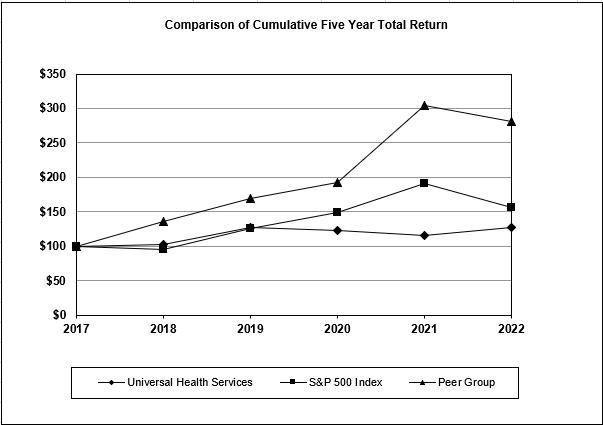][added: 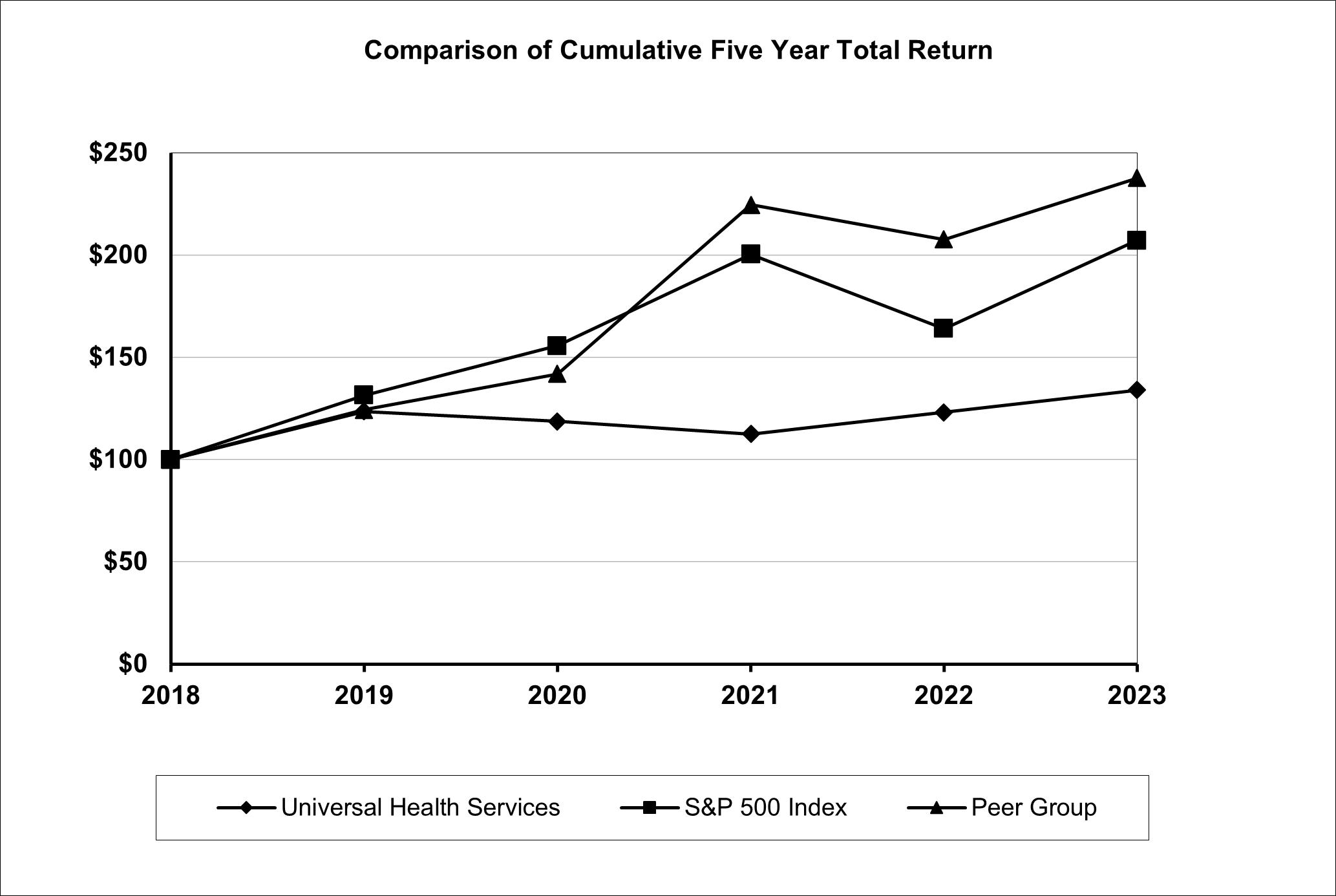]
| Company Name / Index | | [removed: 2017] [added: 2018] Base | | | | [removed: 2018 | | | |] 2019 | | | | 2020 | | | | 2021 | | | | 2022 | | | [added: | 2023 | | |]
As of January 1, 2023, we had an aggregate available repurchase authorization of $947.37 million under our stock repurchase program.
As of December 31, 2023, we had an aggregate available repurchase authorization of $422.88 million pursuant to our stock repurchase program.
| October, 2023 | | | — | | | | 388 | | | | 40 | | | $ | 0.01 | | | | — | | | $ | — | | | $ | — | | | $ | 580,204 | |
| November, 2023 | | | — | | | | 681,009 | | | | 46 | | | $ | 0.01 | | | | 679,495 | | | $ | 131.47 | | | $ | 89,334 | | | $ | 490,870 | |
| December, 2023 | | | — | | | | 480,746 | | | | 543 | | | $ | 0.01 | | | | 450,000 | | | $ | 151.08 | | | $ | 67,987 | | | $ | 422,883 | |
| Total October through December | | $ | — | | | | 1,162,143 | | | | 629 | | | $ | 0.01 | | | | 1,129,495 | | | $ | 139.28 | | | $ | 157,321 | | | | | |
| Universal Health Services, Inc. | | $ | 100.00 | | | $ | 123.62 | | | $ | 118.67 | | | $ | 112.54 | | | $ | 123.09 | | | $ | 133.96 | |
| S&P 500 Index | | $ | 100.00 | | | $ | 131.49 | | | $ | 155.68 | | | $ | 200.37 | | | $ | 164.08 | | | $ | 207.21 | |
| Peer Group | | $ | 100.00 | | | $ | 124.34 | | | $ | 141.81 | | | $ | 224.60 | | | $ | 207.65 | | | $ | 237.61 | |
As of December 31, 2021, we had an aggregate available purchase authorization of $358.2 million.
In February, 2022, our Board of Directors authorized a $1.4 billion increase to the program.
As of December 31, 2022, we had an aggregate available repurchase authorization of $947.37 million.
| October, 2022 | | | — | | | | 1,730 | | | | 745 | | | $ | 0.01 | | | | — | | | $ | — | | | $ | — | | | $ | 1,054,597 | |
| November, 2022 | | | — | | | | 191,955 | | | | 286 | | | $ | 0.01 | | | | 182,141 | | | $ | 129.64 | | | $ | 23,612 | | | $ | 1,030,985 | |
| December, 2022 | | | — | | | | 637,764 | | | | 550 | | | $ | 0.01 | | | | 630,000 | | | $ | 132.73 | | | $ | 83,617 | | | $ | 947,368 | |
| Total October through December | | $ | \- | | | | 831,449 | | | | 1,581 | | | $ | 0.01 | | | | 812,141 | | | $ | 132.03 | | | $ | 107,229 | | | | | |
| Universal Health Services, Inc. | | $ | 100.00 | | | $ | 103.16 | | | $ | 127.53 | | | $ | 122.42 | | | $ | 116.10 | | | $ | 126.98 | |
| S&P 500 Index | | $ | 100.00 | | | $ | 95.62 | | | $ | 125.72 | | | $ | 148.85 | | | $ | 191.58 | | | $ | 156.88 | |
| Peer Group | | $ | 100.00 | | | $ | 135.63 | | | $ | 168.65 | | | $ | 192.34 | | | $ | 304.63 | | | $ | 281.64 | |
Item 9A. Controls and Procedures.
4 rewritten, 0 added, 0 removed, 8 unchanged
As of December 31, [removed: 2022,] [added: 2023,] under the supervision and with the participation of our management, including our Chief Executive Officer (“CEO”) and Chief Financial Officer (“CFO”), we performed an evaluation of the effectiveness of our disclosure controls and procedures as defined in Rule 13a-15(e) or Rule 15d-15(e) of the Securities Exchange Act of 1934, as amended.
There have been no changes in our internal control over financial reporting or in other factors during the fourth quarter of [removed: 2022] [added: 2023] that have materially affected, or are reasonably likely to materially affect, our internal control over financial reporting.
Based on its assessment, management has concluded that we maintained effective internal control over financial reporting as of December 31, [removed: 2022,] [added: 2023,] based on criteria in *Internal Control—Integrated Framework (2013)*, issued by the COSO.
The effectiveness of the Company’s internal control over financial reporting as of December 31, [removed: 2022] [added: 2023] has been audited by PricewaterhouseCoopers LLP, an independent registered public accounting firm as stated in its report which appears herein.
Item 9B. Other Information
0 rewritten, 1 added, 1 removed, 0 unchanged
None of the Company’s directors or officers adopted, modified or terminated a Rule 10b5-1 trading arrangement or a non-Rule 10b5-1 trading arrangement during the Company’s quarter ended December 31, 2023, as such terms are defined under Item 408(a) of Regulation S-K.
None.
Item 10. Directors, Executive Officers and Corporate Governance
1 rewritten, 0 added, 0 removed, 1 unchanged
There is hereby incorporated by reference the information to appear under the captions “Election of Directors”, “Section 16(a) Beneficial Ownership Reporting Compliance” and “Corporate Governance” in our Proxy Statement, to be filed with the Securities and Exchange Commission within 120 days after December 31, [removed: 2022.][added: 2023.]
Item 11. Executive Compensation
1 rewritten, 0 added, 0 removed, 0 unchanged
There is hereby incorporated by reference the information to appear under the caption “Executive Compensation” in our Proxy Statement to be filed with the Securities and Exchange Commission within 120 days after December 31, [removed: 2022.][added: 2023.]
Item 12. Security Ownership of Certain Beneficial Owners and Management and Related Stockholder Matters
1 rewritten, 0 added, 0 removed, 0 unchanged
There is hereby incorporated by reference the information to appear under the caption “Security Ownership of Certain Beneficial Owners and Management” and “Executive Compensation” in our Proxy Statement, to be filed with the Securities and Exchange Commission within 120 days after December 31, [removed: 2022.][added: 2023.]
Item 13. Certain Relationships and Related Transactions, and Director Independence
1 rewritten, 0 added, 0 removed, 0 unchanged
There is hereby incorporated by reference the information to appear under the captions “Certain Relationships and Related Transactions” and “Corporate Governance” in our Proxy Statement, to be filed with the Securities and Exchange Commission within 120 days after December 31, [removed: 2022.][added: 2023.]
Item 14. Principal Accountant Fees and Services.
1 rewritten, 0 added, 0 removed, 1 unchanged
There is hereby incorporated by reference the information to appear under the caption “Relationship with Independent Auditors” in our Proxy Statement, to be filed with the Securities and Exchange Commission within 120 days after December 31, [removed: 2022.][added: 2023.]
Item 15. Exhibits and Financial Statement Schedules
28 rewritten, 1 added, 9 removed, 181 unchanged
| [removed: 4.5] [added: 4.4] | | [Indenture, dated as of August 24, 2021, by and among the Company, the Subsidiary Guarantors party thereto, U.S. Bank National Association, as Trustee, and JPMorgan Chase Bank, N.A., as collateral agent, previously filed as Exhibit 4.1 to the Company’s Current Report on Form 8-K dated August 24, 2021, is incorporated herein by reference.](https://www.sec.gov/Archives/edgar/data/0000352915/000156459021045588/uhs-ex41_13.htm) |
| [removed: 4.6] [added: 4.5] | | [Additional Authorized Representative Joinder Agreement, dated as of August 24, 2021, among U.S. Bank National Association, as Trustee and Additional Authorized Representative, the Company, the Subsidiary Guarantors party thereto, and JPMorgan Chase Bank, N.A., as collateral agent and administrative agent, previously filed as Exhibit 4.2 to the Company’s Current Report on Form 8-K dated August 24, 2021, is incorporated herein by reference.](https://www.sec.gov/Archives/edgar/data/0000352915/000156459021045588/uhs-ex42_11.htm) |
| [removed: 4.7] [added: 4.6] | | [Supplemental Indenture, dated as of August 24, 2021, among the Company, the Subsidiary Guarantors party thereto, U.S. Bank National Association (as successor to MUFG Union Bank, N.A.), as trustee, and JPMorgan Chase Bank, N.A., as collateral agent, to the indenture, dated as of September 21, 2020, governing the Existing 2030 Notes, previously filed as Exhibit 4.3 to the Company’s Current Report on Form 8-K dated August 24, 2021, is incorporated herein by reference.](https://www.sec.gov/Archives/edgar/data/0000352915/000156459021045588/uhs-ex43_9.htm) |
| | | [removed: [Inc.,] [added: [JPMorgan Chase Bank, N.A.,] as [removed: representatives of] [added: collateral agent, to] the [removed: several Initial Purchasers,] [added: indenture, dated as of August 24, 2021,] previously filed as Exhibit [removed: 10.1] [added: 4.2] to the Company’s Current Report on Form 8-K dated [removed: August 24, 2021,] [added: June 27, 2022,] is incorporated herein by [removed: reference.](https://www.sec.gov/Archives/edgar/data/0000352915/000156459021045588/uhs-ex101_12.htm)] [added: reference.](https://www.sec.gov/Archives/edgar/data/352915/000156459022024223/uhs-ex42_7.htm)] |
| [removed: 4.9] [added: 4.7] | | [Second Supplemental Indenture, dated as of June 23, 2022, among the Company, the Subsidiary Guarantors party thereto, U.S. Bank Trust Company, National Association (as successor to U.S. Bank National Association), as trustee, and JPMorgan Chase Bank, N.A., as collateral agent, to the indenture, dated as of September 21, 2020, previously filed as Exhibit 4.1 to the Company’s Current Report on Form 8-K dated June 27, 2022, is incorporated herein by reference.](https://www.sec.gov/Archives/edgar/data/352915/000156459022024223/uhs-ex41_9.htm) |
| 4.10 | | [removed: [First] [added: [Second] Supplemental Indenture, dated as of [removed: June 23,] [added: November 4,] 2022, among the Company, the Subsidiary Guarantors party thereto, U.S. Bank Trust Company, National Association (as successor to U.S. Bank National Association), as trustee, and JPMorgan Chase Bank, N.A., as collateral agent, to the indenture, dated as of August 24, 2021, previously filed as Exhibit 4.2 to the Company’s [removed: Current] [added: Quarterly] Report on Form [removed: 8-K] [added: 10-Q] dated [removed: June 27,] [added: November 8,] 2022, is incorporated herein by [removed: reference.](https://www.sec.gov/Archives/edgar/data/352915/000156459022024223/uhs-ex42_7.htm)] [added: reference.](https://www.sec.gov/Archives/edgar/data/352915/000156459022037046/uhs-ex42_47.htm)] |
| [removed: 4.11] [added: 4.9] | | [Third Supplemental Indenture, dated as of November 4, 2022, among the Company, the Subsidiary Guarantors party thereto, U.S. Bank Trust Company, National Association (as successor to U.S. Bank National Association), as trustee, and JPMorgan Chase Bank, N.A., as collateral agent, to the indenture, dated as of September 21, 2020, previously filed as Exhibit 4.1 to the Company’s Quarterly Report on Form 10-Q dated November 8, 2022, is incorporated herein by reference.](https://www.sec.gov/Archives/edgar/data/352915/000156459022037046/uhs-ex41_48.htm) |
| [removed: 4.12] [added: 4.8] | | [removed: [Second] [added: [First] Supplemental Indenture, dated as of [removed: November 4,] [added: June 23,] 2022, among the Company, the Subsidiary Guarantors party thereto, U.S. Bank Trust Company, National Association (as successor to U.S. Bank National Association), as trustee, [removed: and JPMorgan Chase Bank, N.A., as collateral agent, to the indenture, dated as of August 24, 2021, previously filed as Exhibit 4.2 to the Company’s Quarterly Report on Form 10-Q dated November 8, 2022, is incorporated herein by reference.](https://www.sec.gov/Archives/edgar/data/352915/000156459022037046/uhs-ex42_47.htm)] [added: and](https://www.sec.gov/Archives/edgar/data/352915/000156459022024223/uhs-ex42_7.htm)] |
| 10.1 | | [Agreement, dated [removed: November 30, 2022,] [added: December 7, 2023,] to renew Advisory Agreement dated as of December 24, 1986, and amended and restated effective as of January 1, 2019 between Universal Health Realty Income Trust and UHS of Delaware, [removed: Inc.](https://www.sec.gov/Archives/edgar/data/352915/000095017023004656/uhs-ex10_1.htm)] [added: Inc.](https://www.sec.gov/Archives/edgar/data/352915/000095017024021175/uhs-ex10_1.htm)] |
| 10.35 | | [Fifth Amendment to the Credit Agreement, dated as of November 15, 2010, as amended on March 15, 2011, September 21, 2012, May 16, 2013 and August 7, 2014, among the Company, as borrower, the several banks and other [removed: financial](https://www.sec.gov/Archives/edgar/data/0000352915/000119312516616699/d200774dex101.htm)] [added: financial institutions from time to time parties thereto, as lenders, JPMorgan Chase Bank, N.A., as administrative agent, and the other agents party thereto, previously filed as Exhibit 10.1 to the Company’s Current Report on Form 8-K dated June 8, 2016, is incorporated herein by reference.](https://www.sec.gov/Archives/edgar/data/0000352915/000119312516616699/d200774dex101.htm)] |
| [added: 10.45] | | [removed: [institutions from time to time parties] [added: [Collateral Agreement, dated as of August 7, 2014, among Universal Health Services, Inc., the subsidiary guarantors party] thereto, [added: MUFG Union Bank, N.A.,] as [removed: lenders,] [added: 2014 Trustee, The Bank of New York Mellon Trust Company, N.A., as 2006 Trustee, and] JPMorgan Chase Bank, N.A., as [removed: administrative] [added: collateral] agent, [removed: and the other agents party thereto,] previously filed as Exhibit [removed: 10.1] [added: 10.4] to the Company’s Current Report on Form 8-K dated [removed: June 8, 2016,] [added: August 12, 2014,] is incorporated herein by [removed: reference.](https://www.sec.gov/Archives/edgar/data/0000352915/000119312516616699/d200774dex101.htm)] [added: reference.](https://www.sec.gov/Archives/edgar/data/0000352915/000119312514306618/d773872dex104.htm)] |
| [removed: 10.46] [added: 10.46*] | | [Universal Health Services, Inc. 2020 Omnibus Stock and Incentive Plan, previously filed as Exhibit 99.1 to the Company’s Registration Statement on Form S-8 (File No. 333-238880) dated June 2, 2020, is incorporated herein by reference.](https://www.sec.gov/Archives/edgar/data/0000352915/000156459020028068/uhs-s8.htm) |
| [removed: 10.47] [added: 10.47*] | | [Form of Stock Option Award Agreement under the Universal Health Services, Inc. 2020 Omnibus Stock and Incentive Plan, previously filed as Exhibit 10.5 to the Company’s Quarterly Report on Form 10-Q filed on August 7, 2020, is incorporated herein by reference.](https://www.sec.gov/Archives/edgar/data/0000352915/000156459020038367/uhs-ex105_114.htm) |
| [removed: 10.48] [added: 10.48*] | | [Form of Restricted Stock Award Agreement under the Universal Health Services, Inc. 2020 Omnibus Stock and Incentive Plan, previously filed as Exhibit 10.6 to the Company’s Quarterly Report on Form 10-Q filed on August 7, 2020, is incorporated herein by reference.](https://www.sec.gov/Archives/edgar/data/0000352915/000156459020038367/uhs-ex106_115.htm) |
| [removed: 10.49] [added: 10.49*] | | [Form of Restricted Stock Unit Award Agreement under the Universal Health Services, Inc. 2020 Omnibus Stock and Incentive Plan, previously filed as Exhibit 10.7 to the Company’s Quarterly Report on Form 10-Q filed on August 7, 2020, is incorporated herein by reference.](https://www.sec.gov/Archives/edgar/data/0000352915/000156459020038367/uhs-ex107_113.htm) |
| [removed: 10.60] [added: 10.60*] | | [Universal Health Services, Inc. Amended and Restated 2020 Omnibus Stock and Incentive Plan, previously filed as Exhibit 99.1 to the Company’s Registration Statement on Form S-8 (File No. 333-265495) dated June 9, 2022, is incorporated herein by reference.](https://www.sec.gov/Archives/edgar/data/352915/000156459022022864/uhs-ex991_6.htm) |
| [removed: 10.61] [added: 10.61*] | | [Form of Restricted Stock Unit Award Agreement under the Universal Health Services, Inc. 2020 Omnibus Stock and Incentive Plan, previously filed as Exhibit 10.4 to the Company’s Quarterly Report on Form 10-Q filed on August 8, 2022, is incorporated herein by reference.](https://www.sec.gov/Archives/edgar/data/352915/000156459022028437/uhs-ex104_238.htm) |
| 10.66* | | [Employment Agreement between Universal Health Services, Inc. and Edward Sim dated October 18, [removed: 2022.](https://www.sec.gov/Archives/edgar/data/0000352915/000156459020058584/uhs-ex101_6.htm)] [added: 2022 previously filed as Exhibit 10.66 to the Company’s Annual Report on Form 10-K dated February 27, 2023, is incorporated herein by reference.](https://www.sec.gov/Archives/edgar/data/352915/000095017023004656/uhs-ex10_66.htm)] |
| 21 | | [Subsidiaries of [removed: Registrant.](https://www.sec.gov/Archives/edgar/data/352915/000095017023004656/uhs-ex21.htm)] [added: Registrant.](https://www.sec.gov/Archives/edgar/data/352915/000095017024021175/uhs-ex21.htm)] |
| 22.1 | | [List of Guarantor Subsidiaries and Issuers of Guaranteed Securities and Affiliates Whose Securities Collateralize Securities of the [removed: Registrant.](https://www.sec.gov/Archives/edgar/data/352915/000095017023004656/uhs-ex22_1.htm)] [added: Registrant.](https://www.sec.gov/Archives/edgar/data/352915/000095017024021175/uhs-ex22_1.htm)] |
| 23.1 | | [Consent of Independent Registered Public Accounting Firm-PricewaterhouseCoopers [removed: LLP.](https://www.sec.gov/Archives/edgar/data/352915/000095017023004656/uhs-ex23_1.htm)] [added: LLP.](https://www.sec.gov/Archives/edgar/data/352915/000095017024021175/uhs-ex23_1.htm)] |
| 31.1 | | [Certification from the Company’s Chief Executive Officer Pursuant to Rule [removed: 13a-14(a)/15(d)-14(a)] [added: 13a-14(a)/15d-14(a)] of the Securities Exchange Act of [removed: 1934.](https://www.sec.gov/Archives/edgar/data/352915/000095017023004656/uhs-ex31_1.htm)] [added: 1934.](https://www.sec.gov/Archives/edgar/data/352915/000095017024021175/uhs-ex31_1.htm)] |
| 31.2 | | [Certification from the Company’s Chief Financial Officer Pursuant to Rule [removed: 13a-14(a)/15(d)-14(a)] [added: 13a-14(a)/15d-14(a)] of the Securities Exchange Act of [removed: 1934.](https://www.sec.gov/Archives/edgar/data/352915/000095017023004656/uhs-ex31_2.htm)] [added: 1934.](https://www.sec.gov/Archives/edgar/data/352915/000095017024021175/uhs-ex31_2.htm)] |
| 32.1 | | [Certification from the Company’s Chief Executive Officer Pursuant to 18 U.S.C. Section 1350, as Adopted Pursuant to Section 906 of the Sarbanes-Oxley Act of [removed: 2002.](https://www.sec.gov/Archives/edgar/data/352915/000095017023004656/uhs-ex32_1.htm)] [added: 2002.](https://www.sec.gov/Archives/edgar/data/352915/000095017024021175/uhs-ex32_1.htm)] |
| 32.2 | | [Certification from the Company’s Chief Financial Officer Pursuant to 18 U.S.C. Section 1350, as Adopted Pursuant to Section 906 of the Sarbanes-Oxley Act of [removed: 2002.](https://www.sec.gov/Archives/edgar/data/352915/000095017023004656/uhs-ex32_2.htm)] [added: 2002.](https://www.sec.gov/Archives/edgar/data/352915/000095017024021175/uhs-ex32_2.htm)] |
| 101.INS | | Inline XBRL Instance Document [removed: (the] [added: - the] instance document does not appear in the Interactive Data File [removed: because] [added: as] its XBRL tags are embedded within the Inline XBRL [removed: document)] [added: document] |
| 101.SCH | | Inline XBRL Taxonomy Extension Schema [removed: Document] [added: With Embedded Linkbase Documents] |
| 104 | | Cover [removed: Page Interactive Data File (formatted] [added: page formatted] as Inline XBRL and contained in Exhibit [removed: 101)] [added: 101] |
| 97 | | [Universal Health Services, Inc. Clawback Policy.](https://www.sec.gov/Archives/edgar/data/352915/000095017024021175/uhs-ex97.htm) |
| | | |
| 4.4 | | [Registration Rights Agreement, dated as of September 21, 2020, by and among the Company, the Subsidiary Guarantors party thereto, and J.P. Morgan Securities LLC, BofA Securities, Inc. and Goldman Sachs & Co. LLC, as representatives of the several Initial Purchasers, previously filed as Exhibit 10.1 to the Company’s Current Report on Form 8-K dated September 21, 2020, is incorporated herein by reference.](https://www.sec.gov/Archives/edgar/data/352915/000156459020044127/uhs-ex101_8.htm) |
| 4.8 | | [Registration Rights Agreement, dated as of August 24, 2021, by and among the Company, the Subsidiary Guarantors party thereto, and J.P. Morgan Securities LLC, BofA Securities, Inc., Goldman Sachs & Co. LLC and Truist Securities,](https://www.sec.gov/Archives/edgar/data/0000352915/000156459021045588/uhs-ex101_12.htm) |
| 10.45 | | [Collateral Agreement, dated as of August 7, 2014, among Universal Health Services, Inc., the subsidiary guarantors party thereto, MUFG Union Bank, N.A., as 2014 Trustee, The Bank of New York Mellon Trust Company, N.A., as 2006](https://www.sec.gov/Archives/edgar/data/0000352915/000119312514306618/d773872dex104.htm) |
| | | [Trustee, and JPMorgan Chase Bank, N.A., as collateral agent, previously filed as Exhibit 10.4 to the Company’s Current Report on Form 8-K dated August 12, 2014, is incorporated herein by reference.](https://www.sec.gov/Archives/edgar/data/0000352915/000119312514306618/d773872dex104.htm) |
| 101.CAL | | Inline XBRL Taxonomy Extension Calculation Linkbase Document |
| 101.DEF | | Inline XBRL Taxonomy Extension Definition Linkbase Document |
| 101.LAB | | Inline XBRL Taxonomy Extension Label Linkbase Document |
| 101.PRE | | Inline XBRL Taxonomy Extension Presentation Linkbase Document |
Item 16. Form 10-K Summary
508 rewritten, 166 added, 151 removed, 826 unchanged
| | | Marc D. Miller Chief Executive Officer [removed: February] [added: February] 27, [removed: 2023] [added: 2024] |
| /s/ ALAN B. MILLER Alan B. Miller | | | | Executive Chairman of the Board | | | | February 27, [removed: 2023] [added: 2024] | | |
| /s/ MARC D. MILLER Marc D. Miller | | | | Director, President and Chief Executive Officer (Principal Executive Officer) | | | | February 27, [removed: 2023] [added: 2024] | | |
| /s/ NINA CHEN\-LANGENMAYR | | | | Director | | | | February 27, [removed: 2023] [added: 2024] | | |
| /s/ EILEEN C. MCDONNELL Eileen C. McDonnell | | | | Director | | | | February 27, [removed: 2023] [added: 2024] | | |
| /s/ WARREN J. NIMETZ Warren J. Nimetz | | | | Director | | | | February 27, [removed: 2023] [added: 2024] | | |
| /s/ MARIA SINGER Maria Singer | | | | Director | | | | February 27, [removed: 2023] [added: 2024] | | |
| /s/ ELLIOTT J. SUSSMAN M.D. Elliot J. Sussman M.D. | | | | Director | | | | February 27, [removed: 2023] [added: 2024] | | |
| /s/ STEVE FILTON Steve Filton | | | | Executive Vice President, Chief Financial Officer and Secretary (Principal Financial and Accounting Officer) | | | | February 27, [removed: 2023] [added: 2024] | | |
| [Consolidated Statements of Income for December 31, [added: 2023,] 2022, [removed: 2021,] and [removed: 2020](#consolidated_statements_income)] [added: 2021](#consolidated_statements_income)] | 91 |
| [Consolidated Statements of Comprehensive Income for December 31, [added: 2023,] 2022, [removed: 2021,] and [removed: 2020](#consolidated_statements_comprehensive_in)] [added: 2021](#consolidated_statements_comprehensive_in)] | 92 |
| [Consolidated Balance Sheets as of December 31, [removed: 2022] [added: 2023] and [removed: 2021](#consolidated_balance_sheets)] [added: 2022](#consolidated_balance_sheets)] | 93 |
| [Consolidated Statements of Changes in Equity for December 31, [removed: 2022, 2021] [added: 2023, 2022] and [removed: 2020](#consolidated_statements_changes_in_equit)] [added: 2021](#consolidated_statements_changes_in_equit)] | 94 |
| [Consolidated Statements of Cash Flows for December 31, [removed: 2022, 2021] [added: 2023, 2022] and [removed: 2020](#consolidated_statements_cash_flows)] [added: 2021](#consolidated_statements_cash_flows)] | 97 |
| [Supplemental Financial Statement Schedule II: Valuation and Qualifying Accounts as of and for December 31, [added: 2023,] 2022, [removed: 2021,] and [removed: 2020](#scheduleii_valuation)] [added: 2021](#scheduleii_valuation)] | 128 |
We have audited the accompanying consolidated balance sheets of Universal Health Services, Inc. and its subsidiaries (the “Company”) as of December 31, [removed: 2022] [added: 2023] and [removed: 2021,] [added: 2022,] and the related consolidated statements of income, of comprehensive income, of changes in equity and of cash flows for each of the three years in the period ended December 31, [removed: 2022,] [added: 2023,] including the related notes and financial statement schedule listed in the accompanying index (collectively referred to as the “consolidated financial statements”).
We also have audited the Company's internal control over financial reporting as of December 31, [removed: 2022,] [added: 2023,] based on criteria established in [removed: Internal] [added: *Internal] Control - Integrated [removed: Framework] [added: Framework*] (2013) issued by the Committee of Sponsoring Organizations of the Treadway Commission (COSO).
In our opinion, the consolidated financial statements referred to above present fairly, in all material respects, the financial position of the Company as of December 31, [removed: 2022] [added: 2023] and [removed: 2021,] [added: 2022,] and the results of its operations and its cash flows for each of the three years in the period ended December 31, [removed: 2022] [added: 2023] in conformity with accounting principles generally accepted in the United States of America.
Also in our opinion, the Company maintained, in all material respects, effective internal control over financial reporting as of December 31, [removed: 2022,] [added: 2023,] based on criteria established in [removed: Internal] [added: *Internal] Control - Integrated [removed: Framework] [added: Framework*] (2013) issued by the COSO.
As of December 31, [removed: 2022,] [added: 2023,] the net accounts receivable balance was [removed: $2.0] [added: $2.2] billion.
Developing an independent expectation involved calculating the percentage of cash collections as compared to the recorded net accounts receivable balance as of the end of the prior year, applying those calculated percentages to the recorded accounts receivable balance as of December 31, [removed: 2022,] [added: 2023,] and comparing the calculated balance to management’s estimate of the net accounts receivable balance.
| | | [removed: 2022] [added: 2023] | | | | [removed: 2021] [added: 2022] | | | | [removed: 2020] [added: 2021] | | |
| Net revenues | | $ | [removed: 13,399,370] [added: 14,281,976] | | | $ | [removed: 12,642,117] [added: 13,399,370] | | | $ | [removed: 11,558,897] [added: 12,642,117] | |
| Salaries, wages and benefits | | | [removed: 6,762,256] [added: 7,107,484] | | | | [removed: 6,163,944] [added: 6,762,256] | | | | [removed: 5,613,097] [added: 6,163,944] | |
| Other operating expenses | | | [removed: 3,445,733] [added: 3,757,216] | | | | [removed: 3,035,869] [added: 3,445,733] | | | | [removed: 2,672,762] [added: 3,035,869] | |
| Supplies expense | | | [removed: 1,474,339] [added: 1,532,828] | | | | [removed: 1,427,134] [added: 1,474,339] | | | | [removed: 1,288,132] [added: 1,427,134] | |
| Depreciation and amortization | | | [removed: 581,861] [added: 568,041] | | | | [removed: 533,213] [added: 581,861] | | | | [removed: 510,493] [added: 533,213] | |
| Lease and rental expense | | | [removed: 131,626] [added: 141,026] | | | | [removed: 118,863] [added: 131,626] | | | | [removed: 116,059] [added: 118,863] | |
| | | | [removed: 12,395,815] [added: 13,106,595] | | | | [removed: 11,279,023] [added: 12,395,815] | | | | [removed: 10,200,543] [added: 11,279,023] | |
| Income from operations | | | [removed: 1,003,555] [added: 1,175,381] | | | | [removed: 1,363,094] [added: 1,003,555] | | | | [removed: 1,358,354] [added: 1,363,094] | |
| Interest expense, net | | | [removed: 126,889] [added: 206,674] | | | | [removed: 83,672] [added: 126,889] | | | | [removed: 106,285] [added: 83,672] | |
| Other (income) expense, net | | | [removed: 10,406] [added: 28,281] | | | | [removed: (13,891] [added: 10,406] | [removed: )] | | | [removed: (14] [added: (13,891] | ) |
| Income before income taxes | | | [removed: 866,260] [added: 940,426] | | | | [removed: 1,293,313] [added: 866,260] | | | | [removed: 1,252,083] [added: 1,293,313] | |
| Provision for income taxes | | | [removed: 209,278] [added: 221,119] | | | | [removed: 305,681] [added: 209,278] | | | | [removed: 299,293] [added: 305,681] | |
| Net income | | | [removed: 656,982] [added: 719,307] | | | | [removed: 987,632] [added: 656,982] | | | | [removed: 952,790] [added: 987,632] | |
| Less: Net [removed: (loss)] income [added: (loss)] attributable to noncontrolling interests | | | [removed: (18,627] [added: 1,512] | [removed: )] | | | [removed: (3,958] [added: (18,627] | ) | | | [removed: 8,837] [added: (3,958] | [added: )] |
| Net income attributable to UHS | | $ | [removed: 675,609] [added: 717,795] | | | $ | [removed: 991,590] [added: 675,609] | | | $ | [removed: 943,953] [added: 991,590] | |
| Basic earnings per share attributable to UHS | | $ | [removed: 9.23] [added: 10.35] | | | $ | [removed: 11.99] [added: 9.23] | | | $ | [removed: 11.06] [added: 11.99] | |
| Diluted earnings per share attributable to UHS | | $ | [removed: 9.14] [added: 10.23] | | | $ | [removed: 11.82] [added: 9.14] | | | $ | [removed: 10.99] [added: 11.82] | |
| Weighted average number of common shares—basic | | | [removed: 73,118] [added: 69,321] | | | | [removed: 82,519] [added: 73,118] | | | | [removed: 85,061] [added: 82,519] | |
February 27, 2024
| | | 2023 | | | | 2022 | | |
| | | | 11,044,863 | | | | 10,523,027 | |
| | | | 5,392,345 | | | | 5,355,633 | |
| | | | 6,124,529 | | | | 5,918,458 | |
| | | | 5,031,723 | | | | 5,038,390 | |
For the Years Ended December 31, 2023, 2022 and 2021
| Balance, January 1, 2022 | | $ | 5,119 | | | $ | 66 | | | $ | 698 | | | $ | 7 | | | $ | — | | | $ | (545,487 | ) | | $ | 6,604,089 | | | $ | 30,291 | | | $ | 6,089,664 | | | $ | 103,389 | | | $ | 6,193,053 | |
For the Years Ended December 31, 2023, 2022 and 2021
| Balance, January 1, 2023 | | $ | 4,695 | | | $ | 66 | | | $ | 637 | | | $ | 7 | | | $ | — | | | $ | (604,127 | ) | | $ | 6,533,667 | | | $ | (9,668 | ) | | $ | 5,920,582 | | | $ | 44,768 | | | $ | 5,965,350 | |
| Repurchased | | | — | | | | — | | | | (41 | ) | | | — | | | | — | | | | — | | | | (552,567 | ) | | | — | | | | (552,608 | ) | | | — | | | | (552,608 | ) |
| Net income to UHS / noncontrolling interests | | | 1,546 | | | | — | | | | — | | | | — | | | | — | | | | — | | | | 717,795 | | | | — | | | | 717,795 | | | | (34 | ) | | | 717,761 | |
| Subtotal - comprehensive income | | | 1,546 | | | | — | | | | — | | | | — | | | | — | | | | — | | | | 717,795 | | | | 18,957 | | | | 736,752 | | | | (34 | ) | | | 736,718 | |
| Balance, December 31, 2023 | | $ | 5,191 | | | $ | 66 | | | $ | 599 | | | $ | 7 | | | $ | — | | | $ | (659,890 | ) | | $ | 6,798,930 | | | $ | 9,289 | | | $ | 6,149,001 | | | $ | 47,714 | | | $ | 6,196,715 | |
| Net income | | $ | 719,307 | | | $ | 656,982 | | | $ | 987,632 | |
| Adjustments to goodwill (a) | | | 2 | | | | 24,413 | | | | 24,415 | |
| Balance, December 31, 2023 | | $ | 516,628 | | | $ | 3,415,779 | | | $ | 3,932,407 | |
plan that is held by an independent trustee in a rabbi-trust and that has a related payable included in other noncurrent liabilities, and; (viii) other miscellaneous assets.
There were no impairments in 2023 or 2022.
| | | 2023 | | | | 2022 | | |
(a) Indefinite lives.
Due to recent guidance and enacted laws surrounding the global 15% minimum tax rate that will be effective after 2024 from the Organization for Economic Co-operation and Development ("OECD") as well as jurisdictions that we operate in.
We do not expect these adverse effects to be material and will continue to monitor changes in tax policies and laws issued by the OECD and jurisdictions that we operate in.
The noncontrolling interest
| 2023 activity: | | | | | | | | | | | | | | | | |
| Pretax amount | | | 0 | | | | 15,271 | | | | 4,166 | | | | 19,437 | |
| Income tax effect | | | 0 | | | | 520 | | | | (1,000 | ) | | | (480 | ) |
| Balance, December 31, 2023, net of income tax | | $ | (17 | ) | | $ | 11,536 | | | $ | (2,230 | ) | | $ | 9,289 | |
| Net Income | | $ | 719,307 | | | $ | 656,982 | | | $ | 987,632 | |
| Weighted average number of common shares—basic | | | 69,321 | | | | 73,118 | | | | 82,519 | |
| Weighted average number of common shares and equivalents—diluted | | | 70,125 | | | | 73,832 | | | | 83,692 | |
deferred income, on a pro rata basis, as a reduction to our supplies expense over the initial expected life of the GPO agreement.
Recent Accounting Standards: In November 2023, the FASB issued ASU 2023-07, “Improvements to Reportable Segment Disclosures (Topic 280)”.
ASU 2023-07 modifies reportable segment disclosure requirements, primarily through enhanced disclosures about segment expenses categorized as significant or regularly provided to the Chief Operating Decision Maker (CODM).
In addition, the amendments enhance interim disclosure requirements, clarify circumstances in which an entity can disclose multiple segment measures of profit or loss, and contain other disclosure requirements.
The purpose of the amendments is to enable investors to better understand an entity’s overall performance and assess potential future cash flows.
This ASU is effective for annual periods beginning after December 15, 2023, and interim periods within annual periods beginning after December 15, 2024, with early adoption permitted.
We are currently evaluating the impact this new standard will have on the related disclosures in the consolidated financial statements, but do not believe there will be a material impact.
In December 2023, the FASB issued ASU 2023-09, “Improvements to Income Tax Disclosures (Topic 740)”.
ASU 2023-09 requires enhanced disclosures on income taxes paid, adds disaggregation of continuing operations before income taxes between foreign and domestic earnings and defines specific categories for the reconciliation of jurisdictional tax rate to effective tax rate.
| | | | | | | | | | | |
| /s/ LAWRENCE S. GIBBS | | | | Director | | | | February 27, 2023 | | |
| Lawrence S. Gibbs | | | | | | | | | | |
February 27, 2023
| | | | 10,523,027 | | | | 10,105,220 | |
| | | | 5,355,633 | | | | 5,208,793 | |
| | | | 5,918,458 | | | | 5,874,275 | |
| | | | 5,038,390 | | | | 4,955,712 | |
| Balance, January 1, 2020 | | $ | 4,333 | | | $ | 66 | | | $ | 794 | | | $ | 7 | | | $ | 0 | | | $ | (462,159 | ) | | $ | 5,933,504 | | | $ | 31,893 | | | $ | 5,504,105 | | | $ | 74,766 | | | $ | 5,578,871 | |
| Repurchased | | | — | | | | — | | | | (20 | ) | | | — | | | | — | | | | — | | | | (206,699 | ) | | | — | | | | (206,719 | ) | | | — | | | | (206,719 | ) |
| Other | | | — | | | | — | | | | — | | | | — | | | | — | | | | — | | | | — | | | | — | | | | | | | | 3,300 | | | | 3,300 | |
| Net income to UHS / noncontrolling interests | | | 736 | | | | — | | | | — | | | | — | | | | — | | | | — | | | | 943,953 | | | | — | | | | 943,953 | | | | 8,101 | | | | 952,054 | |
| Subtotal - comprehensive income | | | 736 | | | | — | | | | — | | | | — | | | | — | | | | — | | | | 943,953 | | | | 16,227 | | | | 960,180 | | | | 8,101 | | | | 968,281 | |
| Other | | | — | | | | — | | | | — | | | | — | | | | — | | | | — | | | | — | | | | — | | | | — | | | | — | | | | — | |
| Investment in, and advances to, joint ventures and other | | | 0 | | | | 0 | | | | (2,672 | ) |
The more significant accounting policies follow:
| Balance, January 1, 2021 | | $ | 447,021 | | | $ | 3,435,694 | | | $ | 3,882,715 | |
| Adjustments to goodwill (a) | | | 13,509 | | | | 10,994 | | | | 24,503 | |
Adjustments to goodwill during 2021 consist of the following: $13.5 million in Acute Care Services consists primarily of a measurement period adjustment to the preliminary purchase price allocation related to a 2020 acquisition; and the $11.0 million in Behavioral Health Services consists of $16.3 million recorded in connection with a third party minority ownership interest in a majority owned joint venture that constructed and owns a recently opened behavioral health facility, partially offset by a $5.3 million decrease related to foreign currency translation adjustments.
(b)
acute care facilities; (iv) statutorily required capital reserves related to our commercial insurance subsidiary ($116 million and $82 million as of December 31, 2022 and 2021, respectively); (v) deposits; (vi) investments in various businesses, including Universal Health Realty Income Trust ($8 million and $9 million as of as of December 31, 2022 and 2021, respectively) and Premier, Inc. ($78 million and $92 million as of December 31, 2022 and 2021, respectively); (vii) the invested assets related to a deferred compensation plan that is held by an independent trustee in a rabbi-trust and that has a related payable included in other noncurrent liabilities, and; (viii) other miscellaneous assets.
Given our significant insurance-related exposure, there can be no assurance that a sharp increase in the number and/or severity of claims asserted against us will not have a material adverse effect on our future results of operations.
See Note 8 - *Commitments and Contingencies* for additional disclosure related to our self-insured general and professional liability and workers’ compensation liability.
Our tax returns have been examined by the Internal Revenue Service (“IRS”) through the year ended December 31, 2006.
Iowa and Michigan, respectively, and; (iii) approximately 5% in an acute care facility located in Nevada.
| Balance, January 1, 2021, net of income tax | | $ | (17 | ) | | $ | 52,438 | | | $ | (4,301 | ) | | $ | 48,120 | |
| 2021 activity: | | | | | | | | | | | | | | | | |
| Pretax amount | | | 0 | | | | (20,743 | ) | | | 1,427 | | | | (19,316 | ) |
| Income tax effect | | | 0 | | | | 1,829 | | | | (342 | ) | | | 1,487 | |
In August, 2017, the FASB issued new guidance on hedge accounting (ASU 2017-12) that is intended to more closely align hedge accounting with companies’ risk management strategies, simplify the application of hedge accounting, and increase transparency as to the scope and results of hedging programs.
The new guidance amends the presentation and disclosure requirements, and changes how companies assess effectiveness.
We adopted this guidance as of January 1, 2019 and applied to all existing hedges as of the adoption date.
As of December 31, 2022 we have no cash flow hedges.
In conjunction with the January 1, 2019 adoption of ASU 2017-12, “Targeted Improvements to Accounting for Hedging Activities”, we reclassified our presentation of the net cash inflows or outflows, which were received or paid in connection with foreign exchange contracts that hedge our net investment in foreign operations against movements in exchange rates, to investing cash flows on the consolidated statements of cash flows.
As of December 31, 2020, we received an aggregate of $1.112 billion of funds consisting of: (i) $417 million received pursuant to various governmental stimulus programs, most notably the Public Health and Social Services Emergency Fund (the “PHSSEF”) as provided for by the CARES Act, of which approximately $413 million were recorded as net revenues during 2020 and approximately $4 million remained in the Medicare accelerated payments and deferred CARES Act and other grants liability account in our consolidated balance sheet, and; (ii) $695 million of MAAPP funds, which as discussed above, were repaid early to the government during 2021.
There was no impact on our earnings during 2021 or 2020 in connection with receipt of the MAAPP funds.
date.
During 2020, we spent $52 million on the acquisition of businesses and property, consisting primarily of the real estate assets of an acute care hospital located in Las Vegas, Nevada.
| | | | | | | | | | | | |
| --- | --- | --- | --- | --- | --- | --- | --- | --- | --- | --- | --- |
An excerpt. Shown here: 40 of 508 rewritten, 40 of 166 added and 40 of 151 removed. The counts are complete. For every sentence, read Item 16. Form 10-K Summary in the FY2023 filing and the FY2022 filing.