 filings.tools
Vulcan Materials 10-K 2021-12-31
Filed 2022-02-25. 21 sections, 495K characters. Original on sec.gov · Markdown · JSON
Cover and table of contents
st
| UNITED STATES SECURITIES AND EXCHANGE COMMISSION Washington, D.C. 20549 FORM 10-K | |||||
| þ | ANNUAL REPORT PURSUANT TO SECTION 13 OR 15(d) OF THE SECURITIES EXCHANGE ACT OF 1934 For the Fiscal Year Ended December 31**, 2021** OR | ||||
| o | TRANSITION REPORT PURSUANT TO SECTION 13 OR 15(d) OF THE SECURITIES EXCHANGE ACT OF 1934 For the Transition Period From to | ||||
| Commission file number: 001-33841 VULCAN MATERIALS COMPANY (Exact Name of Registrant as Specified in Its Charter) | |||||
| New Jersey (State or other jurisdiction of incorporation or organization) | 20-8579133 (I.R.S. Employer Identification No.) | ||||
| 1200 Urban Center Drive**,** Birmingham**,** Alabama (Address of Principal Executive Offices) | 35242 (Zip Code) | ||||
| (205) 298-3000 (Registrant’s telephone number, including area code) | |||||
| Securities registered pursuant to Section 12(b) of the Act: | |||||
| Title of each class Common Stock, $1 par value | Trading Symbol VMC | Name of each exchange on which registered New York Stock Exchange | |||
| Securities registered pursuant to Section 12(g) of the Act: None | |||||
| Indicate by check mark if the registrant is a well-known seasoned issuer, as defined in Rule 405 of the Securities Act. Yes þ No o Indicate by check mark if the registrant is not required to file reports pursuant to Section 13 or Section 15(d) of the Act. Yes o No þ Indicate by check mark whether the registrant: (1) has filed all reports required to be filed by Section 13 or 15(d) of the Securities Exchange Act of 1934 during the preceding 12 months (or for such shorter period that the registrant was required to file such reports), and (2) has been subject to such filing requirements for the past 90 days. Yes þ No o Indicate by check mark whether the registrant has submitted electronically every Interactive Data File required to be submitted pursuant to Rule 405 of Regulation S-T during the preceding 12 months (or for such shorter period that the registrant was required to submit such files). Yes þ No o Indicate by check mark whether the registrant is a large accelerated filer, an accelerated filer, a non-accelerated filer, a smaller reporting company or an emerging growth company. See the definitions of “large accelerated filer,” “accelerated filer,” “smaller reporting company” and “emerging growth company” in Rule 12b-2 of the Exchange Act. | |||||
| Large accelerated filer þ Non-accelerated filer o | Accelerated filer o Smaller reporting company o Emerging growth company o | ||||
| If an emerging growth company, indicate by check mark if the registrant has elected not to use the extended transition period for complying with any new or revised financial accounting standards provided pursuant to Section 13(a) of the Exchange Act. o | |||||
| Indicate by check mark whether the registrant has filed a report on and attestation to its management’s assessment of the effectiveness of its internal control over financial reporting under Section 404(b) of the Sarbanes-Oxley Act (15 U.S.C. 7262(b)) by the registered public accounting firm that prepared or issued its audit report. þ | |||||
| Indicate by check mark whether the registrant is a shell company (as defined in Rule 12b-2 of the Act). | Yes o No þ |
| Aggregate market value of voting and non-voting common stock held by non-affiliates as of June 30, 2021: | $23,045,807,043 |
| Number of shares of common stock, $1.00 par value, outstanding as of February 15, 2022: | 132,792,275 |
| DOCUMENTS INCORPORATED BY REFERENCE | |
| Portions of the registrant’s annual proxy statement for the annual meeting of its shareholders to be held on May 13, 2022, are incorporated by reference into Part III of this Annual Report on Form 10-K. |
Unless otherwise stated or the context otherwise requires, references in this report to “Vulcan,” the “Company,” “we,” “our,” or “us” refer to Vulcan Materials Company and its consolidated subsidiaries.
| Table of Contents | i |
PART I
“SAFE HARBOR” STATEMENT UNDER THE PRIVATE SECURITIESLITIGATION REFORM ACT OF 1995
Certain of the matters and statements made herein or incorporated by reference into this report constitute forward-looking statements within the meaning of Section 21E of the Securities Exchange Act of 1934. All such statements are made pursuant to the safe harbor provisions of the Private Securities Litigation Reform Act of 1995. These statements reflect our intent, belief or current expectation. Often, forward-looking statements can be identified by the use of words, such as “anticipate,” “may,” “believe,” “estimate,” “project,” “expect,” “intend” and words of similar import. In addition to the statements included in this report, we may from time to time make other oral or written forward-looking statements in other filings under the Securities Exchange Act of 1934 or in other public disclosures. Forward-looking statements are not guarantees of future performance, and actual results could differ materially from those indicated by the forward-looking statements. All forward-looking statements involve certain assumptions, risks and uncertainties that could cause actual results to differ materially from those included in or contemplated by the statements. These assumptions, risks and uncertainties include, but are not limited to:
general economic and business conditions
a pandemic, epidemic or other public health emergency, such as the COVID-19 outbreak
our dependence on the construction industry, which is subject to economic cycles
the timing and amount of federal, state and local funding for infrastructure
changes in the level of spending for private residential and private nonresidential construction
changes in our effective tax rate
the increasing reliance on information technology infrastructure, including the risks that the infrastructure does not work as intended, experiences technical difficulties or is subjected to cyber-attacks
the impact of the state of the global economy on our businesses and financial condition and access to capital markets
international business operations and relationships, including recent actions taken by the Mexican government with respect to our operations in that country
the highly competitive nature of the construction industry
the impact of future regulatory or legislative actions, including those relating to climate change, wetlands, greenhouse gas emissions, the definition of minerals, tax policy or international trade
the outcome of pending legal proceedings
pricing of our products
weather and other natural phenomena, including the impact of climate change and availability of water
availability and cost of trucks, railcars, barges and ships, as well as their licensed operators, for transport of our materials
energy costs
costs of hydrocarbon-based raw materials
healthcare costs
labor shortages and constraints
the amount of long-term debt and interest expense we incur
changes in interest rates
volatility in pension plan asset values and liabilities, which may require cash contributions to the pension plans
the impact of environmental cleanup costs and other liabilities relating to existing and/or divested businesses
our ability to secure and permit aggregates reserves in strategically located areas
our ability to manage and successfully integrate acquisitions
the effect of changes in tax laws, guidance and interpretations
significant downturn in the construction industry may result in the impairment of goodwill or long-lived assets
changes in technologies, which could disrupt the way we do business and how our products are distributed
| Part I | 1 |
the risks set forth in Item 1A “Risk Factors,” Item 3 “Legal Proceedings,” Item 7 “Management’s Discussion and Analysis of Financial Condition and Results of Operations,” and Note 12 “Commitments and Contingencies” to the consolidated financial statements in Item 8 “Financial Statements and Supplementary Data,” all as set forth in this report
other assumptions, risks and uncertainties detailed from time to time in our filings made with the Securities and Exchange Commission
All forward-looking statements are made as of the date of filing or publication. We undertake no obligation to publicly update any forward-looking statements, whether as a result of new information, future events or otherwise, except to the extent required by law. Investors are cautioned not to rely unduly on such forward-looking statements when evaluating the information presented in our filings, and are advised to consult any of our future disclosures in filings made with the Securities and Exchange Commission and our press releases with regard to our business and consolidated financial position, results of operations and cash flows.
our mission
We are the company we are today thanks to the positive actions of our nearly 12,000 employees. We believe that doing the right thing is good for our business, our environment and our society. That’s our commitment.
Our Mission
Provide quality products and services that consistently
exceed our customers’ expectations. Be responsible stewards
with respect to safety and the environmental impact of our operations
and products. Drive value and superior returns for our customers,
employees, communities and shareholders.
We maintain the highest degree of respect for people — for their dignity, talents and interests. We believe that empowering, mentoring, training and rewarding our people helps create a highly engaged workforce, happy people and sustainable, long-term value.
We act fairly and honorably to earn the respect and trust of all parties with whom we interact. We hold ourselves to high ethical standards, including abiding by both the letter and spirit of the laws and regulations related to our business.
We are committed to excellence in all of our activities. We value innovation. We strive to maintain a position of leadership in all of our businesses.
DOING THE RIGHT THING, THE RIGHT WAY, AT THE RIGHT TIME. IT’S THE VULCAN WAY.
| Part I | 2 |
Item 1. BUSINESS
BUSINESS
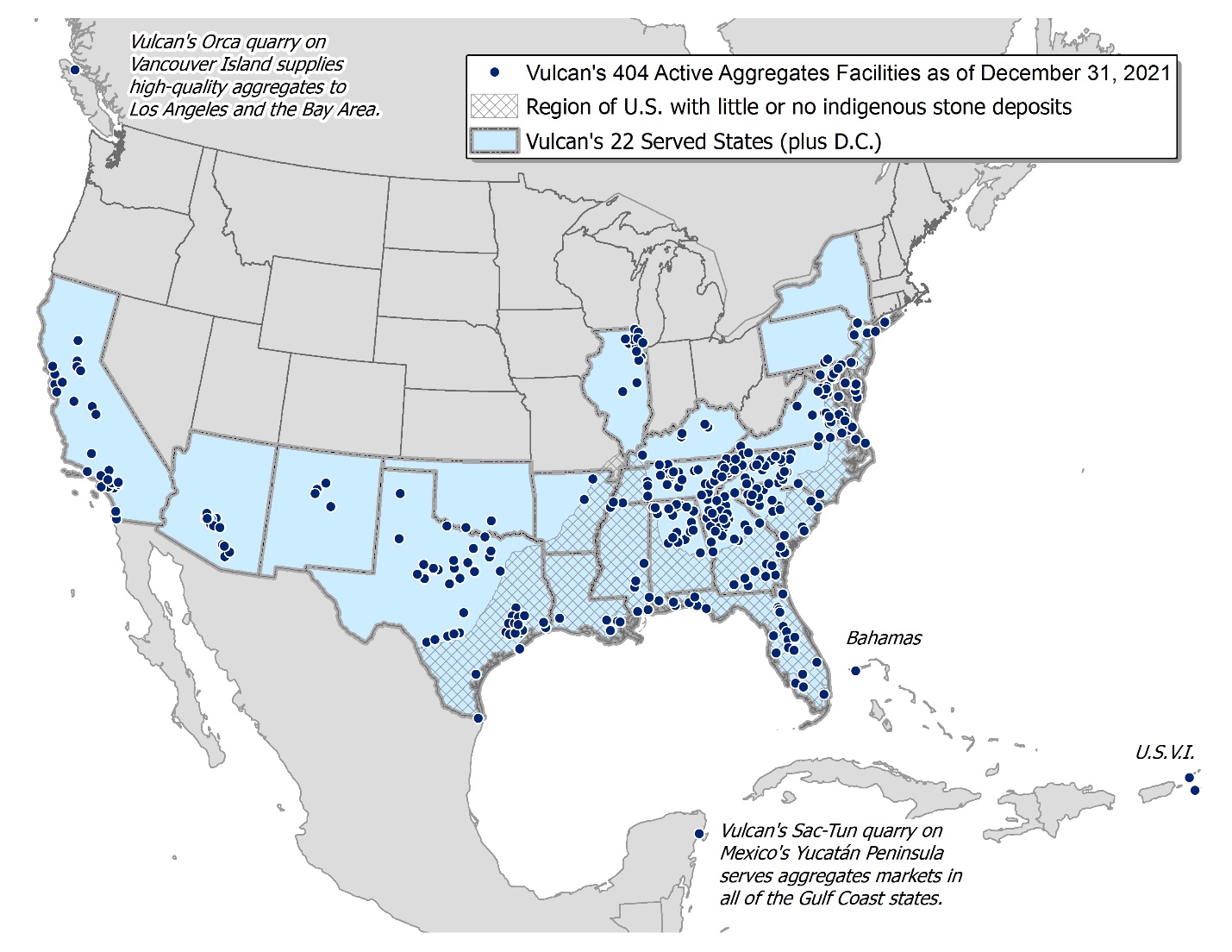
Vulcan Materials Company operates primarily in the U.S. and is the nation’s largest supplier of construction aggregates (primarily crushed stone, sand and gravel), a major producer of asphalt mix and ready-mixed concrete, and a supplier of construction paving services. We provide the basic materials for the infrastructure needed to maintain and expand the U.S. economy. Delivered by trucks, ships, barges and trains, our products are the indispensable materials building homes, offices, places of worship, schools, hospitals and factories, as well as vital infrastructure including highways, bridges, roads, ports and harbors, water systems, campuses, dams, airports and rail networks. As of December 31, 2021, we had 404 active aggregates facilities as shown below.
While aggregates is our focus and primary business, as of December 31, 2021, we further served our customers through our 69 asphalt facilities and 173 concrete facilities located in Alabama, Arizona, California, Maryland, New Jersey, New Mexico, New York, Oklahoma, Pennsylvania, Tennessee, Texas, Virginia, the U.S. Virgin Islands, Washington D.C. and the Bahamas.
BUSINESS STRATEGY
Our strategy and competitive advantage are based on our strength in aggregates, which are used in most types of construction and in the production of asphalt mix and ready-mixed concrete. Our strategy for long-term value creation is built on: (1) an aggregates-focused business, (2) a disciplined approach to growth management and capital allocation, (3) a focus on continuous compounding improvement in profitability, (4) a holistic approach to land management, and (5) our commitment to safety, health and the environment.
| Part I | 3 |
1. AGGREGATES FOCUS
Aggregates are used in virtually all types of public and private construction, practically no substitutes for quality aggregates exist, and significant barriers to entry exist in most markets. Vulcan is uniquely positioned as the largest aggregates supplier in the U.S. and the most aggregates-focused public company.

Source: 2020 reported financial information and Company estimates. VMC excludes U.S. Concrete, which was acquired in August 2021.
Given our focus on aggregates, we:
n****TAKE ADVANTAGE OF SIZE AND SCALE: While certain aspects of each aggregates operation are unique, such as its location within a local market and its particular geological characteristics, every operation uses a similar group of assets to produce saleable aggregates and provide customer service. Our 404 active aggregates facilities as of December 31, 2021 provide opportunities to share and scale best practices across our operations and to procure equipment (fixed and mobile), parts, supplies and services in an efficient and cost-effective manner, both regionally and nationally. Additionally, we are able to share best practices across the organization and leverage our size for administrative support, customer service, accounting, procurement, technical support and engineering.
BUILD AND HOLD SUBSTANTIAL RESERVES: Our reserves are critical to our long-term success. We currently have 15.6 billion tons of proven and probable aggregates reserves. They are strategically located throughout the United States in high-growth areas that are expected to require large amounts of aggregates to meet future construction demand. Moreover, there are significant barriers to entry in many metropolitan markets due to stringent zoning and permitting regulations. These restrictions curtail expansion in certain areas, but they also increase the value of our reserves at existing locations.
| Part I | 4 |
2. Growth management AND CAPITAL ALLOCATION
growth management: Demand for our products is dependent on construction activity and correlates positively with changes in population growth, household formation and employment. As such, we have pursued a strategy to increase our presence in U.S. metropolitan areas that are expected to grow the most rapidly and to divest assets that are no longer considered part of our long-term growth strategy. During the period 2020 - 2030, Moody's Analytics projects that 75% of the U.S. population growth, 72% of household formation and 70% of new jobs will occur in Vulcan-served states. Our coast-to-coast footprint serves 20 of the top 25 highest-growth metropolitan statistical areas in 22 states plus the U.S. Virgin Islands and Washington D.C. The close proximity of our aggregates reserves and our production facilities to this projected population growth creates many opportunities to invest capital in high-return projects.
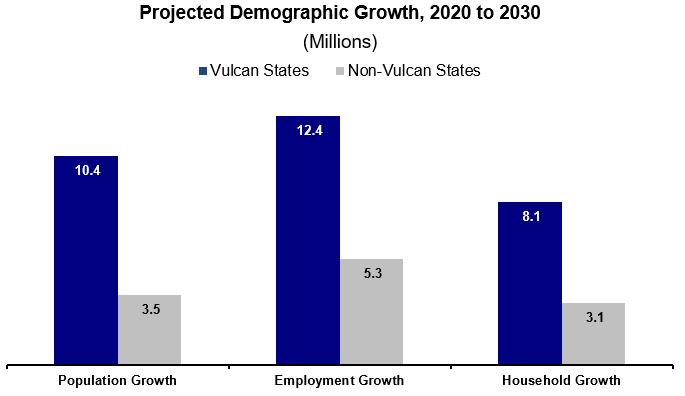
Source: Moody’s Analytics as of December 10, 2021
Our top ten revenue producing states accounted for 88% of our 2021 revenues while our top five accounted for 61%.
| VULCAN’S TOP TEN REVENUE PRODUCING STATES IN 2021 | ||||||||||||
| 1. | Texas | 6. | Florida | |||||||||
| 2. | California | 7. | Alabama | |||||||||
| 3. | Georgia | 8. | Arizona | |||||||||
| 4. | Tennessee | 9. | North Carolina | |||||||||
| 5. | Virginia | 10. | South Carolina |
| Part I | 5 |
Since becoming a public company in 1956, Vulcan has principally grown by mergers and acquisitions. In 1999, we acquired CalMat Co., thereby expanding our aggregates operations into California and Arizona and making us one of the nation’s leading producers of asphalt mix. In 2007, we acquired Florida Rock Industries, Inc., expanding our aggregates business in Florida and our aggregates and ready-mixed concrete businesses in other Mid-Atlantic and Southeastern states. In 2017, we acquired Aggregates USA, greatly expanding our ability to serve customers in Florida, Georgia and South Carolina. In 2021, we acquired U.S. Concrete, enhancing and expanding our aggregates-led business in attractive growing metropolitan areas.
While an aggregates-focused business, we selectively make investments in downstream products that drive local market profitability. Our downstream businesses (asphalt and concrete) use Vulcan-produced aggregates almost exclusively. In 2017, we entered the asphalt market in Tennessee through the acquisition of several asphalt mix operations and a construction paving business. In 2018, we entered the asphalt mix and construction paving markets in Alabama and expanded our asphalt operations and service offerings in Texas through the acquisition of several asphalt mix operations and construction paving businesses. Through our 2021 acquisition of U.S. Concrete, we entered the Oklahoma, New Jersey, New York, Pennsylvania and U.S. Virgin Islands concrete markets and expanded our California, Texas and Washington D.C. concrete markets.
Additionally, throughout our history, we have completed many bolt-on aggregates and downstream acquisitions that have contributed significantly to our growth. From 2019 to 2021, we invested over $1,758.1 million in acquisitions as outlined in Note 19 “Acquisitions and Divestitures” in Item 8 “Financial Statements and Supplementary Data.”
capital allocation: Our long-term capital allocation strategy is focused on the following priorities:
Operating Capital (maintain and grow the value of our franchise)
Growth Capital (including greenfields and acquisitions)
Dividend Growth (with a keen focus on sustainability)
Return Excess Cash to Shareholders (primarily via share repurchase
Showing the first 8K of 61K characters. Open the full section
Item 1A. RISK FACTORS
RISK FACTORS
The following risks could materially and adversely affect our business, financial condition and results of operations, and cause the trading price of our common stock to decline. These risk factors do not identify all risks that we face; our operations could also be affected by factors that are not presently known to us or that we currently consider to be immaterial to our operations. Due to risks and uncertainties, known and unknown, our past financial results may not be a reliable indicator of future performance, and historical trends should not be used to anticipate results or trends in future periods. You should also refer to the other information set forth in this Annual Report on Form 10-K, including Item 7 “Management’s Discussion and Analysis of Financial Condition and Results of Operations” and Item 8 “Financial Statements and Supplementary Data.”
ECONOMIC/POLITICAL RISKS
Our business is dependent on the construction industry and is subject to economic cycles — Our products are principally sold to the U.S. construction industry. Because our business is dependent on spending in both the public and private sector construction markets, our profits are sensitive to the underlying national, regional, and local economic conditions. Construction spending, which is cyclical, is affected by general economic conditions, changes in interest rates, demographic shifts, industry cycles, employment levels, inflation and other business, economic and financial factors that are beyond our control. A downturn in construction activities or spending in Vulcan-served markets, particularly in our top revenue-generating markets, could have a material adverse effect on our business, financial condition, and results of operations.
A pandemic, epidemic or other public health emergency, such as the ongoing coronavirus (COVID-19) pandemic, could have a material adverse effect on our business, results of operations, financial condition and cash flows — Our operations expose us to risks associated with pandemics, epidemics or other public health emergencies, such as the COVID-19 pandemic. This pandemic has resulted in governments around the world implementing or reimplementing strict measures to help control the spread of the virus, including quarantines, “shelter in place” and “stay at home” orders, travel restrictions, business curtailments, school closures, and other measures. In addition, governments and central banks in several parts of the world have enacted fiscal and monetary stimulus measures to counteract the impacts of the COVID-19 pandemic and may take further action as circumstances warrant.
Consistent with federal guidelines and with state and local orders to date, we currently continue to operate across our footprint. Notwithstanding our continued operations and an economic environment that has shown signs of improvement, the COVID-19 pandemic has had and may have further negative impacts on our operations, supply chain, transportation networks and customers, which may lower our revenues and EBITDA, including as a result of preventative and precautionary measures that we, other businesses and governments are taking. The COVID-19 pandemic is a widespread public health crisis that is adversely affecting the economies and financial markets of many countries. Any resulting economic downturn could adversely affect demand for our products and contribute to volatile supply and demand conditions affecting prices and volumes in the markets for our products and services. The progression of this matter has and may continue to negatively impact our business or results of operations by affecting the health of our employees and through the temporary closure of our operating locations or those of our customers or suppliers. The extent to which the COVID-19 outbreak impacts our business, results of operations, financial condition or cash flows will depend on future developments, which remain highly uncertain and cannot be predicted, including, but not limited to, the duration and geographic spread of the outbreak, its severity, the actions to contain the virus or treat its impact including the reimplementation of restrictions on economic activity following new outbreaks, the availability, durability and efficacy of vaccines, the long-term impacts of the virus on transportation revenues, government budgets and other funding priorities and the extent and pace at which normal economic and operating conditions can resume. There can be no assurance that we will not be impacted by adverse consequences that may be brought about by pandemics on global financial markets, which may reduce resources, share prices and financial liquidity and may severely limit the availability of financing capital.
| Part I | 22 |
Changes in legal requirements and governmental policies concerning zoning, land use, environmental and other areas of the law may result in additional liabilities, a reduction in operating hours and additional capital expenditures — Our operations are affected by numerous federal, state and local laws and regulations, including those related to zoning, land use and environmental matters. Despite our compliance efforts, we have an inherent risk of liability in the operation of our business. These potential liabilities could have an adverse impact on our operations and profitability. In addition, our operations require numerous governmental approvals and permits, which often require us to make significant capital and operating expenditures to comply with the applicable requirements. Stricter laws and regulations, or more stringent interpretations of existing laws or regulations, may impose new liabilities, taxes or tariffs on us; reduce operating hours; require additional investment by us in pollution control equipment; create restrictions on our products; impede our access to reserves or hamper the opening of new or expansion of existing plants or facilities.
Our business is dependent on the timing and amount of federal, state and local funding for infrastructure — Our products are used in a variety of public infrastructure projects that are funded and financed by federal, state and local governments. In 2021, voters in local jurisdictions in Arizona, Georgia, Texas and Virginia, among others, approved bond and revenue-raising measures to provide additional resources for transportation projects. In 2020, Virginia passed new long-term highway funding legislation and voters in Arkansas made permanent a ½ cent gas tax increase first approved in 2012. In November 2021, the federal Infrastructure Investment and Jobs Act (IIJA), which included a five year road, bridge and public transportation program reauthorization at record levels, was signed into law. The highway programs, as well as funding for other aggregates-intensive public infrastructure, will provide assistance to state departments of transportation, federal, state and local agencies, and metro areas for several years to come. However, given the time to set up new federal programs, varying state and local budgetary situations and the stages of projects, we cannot be entirely assured of the existence, amount and timing of appropriations for future public infrastructure projects.
Climate change and climate change legislation or regulations may adversely impact our business — A number of governmental bodies have introduced or are contemplating legislative and regulatory change in response to the potential impacts of climate change. Such legislation or regulation, if enacted, potentially could include provisions for a “cap and trade” system of allowances and credits or a carbon tax, among other provisions.
Other potential impacts of climate change include physical impacts, such as disruption in production and product distribution due to impacts from major storm events, shifts in regional weather patterns and intensities, availability of water and potential impacts from sea level changes. There is also a potential for climate change legislation and regulation to adversely impact the cost of purchased energy and electricity. A number of our facilities are located in desert climates, and while we have not experienced any significant shortages of energy or water in the past, we cannot guarantee that we will not in the future. Furthermore, public expectations for reductions in greenhouse gas emissions could result in increased energy, transportation and raw material costs, and may require us to make additional investments in facilities and equipment.
The impacts of climate change on our operations and the company overall are highly uncertain and difficult to estimate. However, climate change legislation and regulation concerning greenhouse gases could have a material adverse effect on our future financial position, results of operations or cash flows.
We are subject to various risks arising from our international business operations and relationships, which could adversely affect our business — We have international operations and are subject to both the risks of conducting international business and the requirements of the Foreign Corrupt Practices Act of 1977 (the FCPA). We face political and other risks, including legal risks for failure to comply with the FCPA, associated with our international operations, including our largest aggregates production facility located in Playa del Carmen, Mexico and our newly acquired aggregates production facility in British Columbia, Canada. These risks have included and may in the future include changes in international trade policies, such as the United States - Mexico - Canada Agreement (USMCA), imposition of duties, taxes or government royalties, arbitrary changes to permits, zoning classifications or operating agreements, or overt acts by foreign governments, including expropriations and other forms of takings of property. Recently, the Mexican government has taken actions that adversely affect our operations in that country, including delays in issuing a historically routine three-year customs permit for our deep-water port. Mexico instead issued a short-term customs permit that must be renewed after two months. While we continue to negotiate with the Mexican authorities to reach an agreeable and mutually beneficial solution, failure by the Mexican government to issue future customs permits or its taking of any other measures that force us to cease our operations in Mexico would have an adverse effect on our ability to supply customers.
| Part I | 23 |
GROWTH AND COMPETITIVE RISKS
Within our local markets, we operate in a highly competitive industry which may negatively impact prices, volumes and costs — The construction aggregates industry is highly fragmented with a large number of independent local producers in a number of our markets. Additionally, in most markets, we also compete against large private and public companies, some of which are significantly vertically integrated. Therefore, there is intense competition in a number of markets in which we operate. This significant competition could lead to lower prices and lower sales volumes in some markets, negatively affecting our earnings and cash flows.
The expanded use of aggregates substitutes could have a material adverse effect on our business, financial condition and results of operations — Recycled concrete and asphalt are increasingly being used in a number of our markets, particularly urban markets, as a substitute for aggregates. The expanded use of recycled concrete and asphalt could cause a significant reduction in the demand for aggregates.
Our long-term success depends upon securing and permitting aggregates reserves in strategically located areas**. If we are unable to secure and permit such reserves it could negatively affect our future earnings** — Construction aggregates are bulky and heavy and, therefore, difficult to transport efficiently. Because of the nature of the products, the freight costs can quickly surpass the production costs. Therefore, except for geographic regions that do not possess commercially viable deposits of aggregates and are served by rail, barge or ship, the markets for our products tend to be localized around our quarry sites and are served by truck. New quarry sites often take years to develop; therefore, our strategic planning and new site development must stay ahead of actual growth. Additionally, in a number of urban and suburban areas in which we operate, it is increasingly difficult to permit new sites or expand existing sites due to community resistance. Therefore, our future success is dependent, in part, on our ability to accurately forecast future areas of high growth in order to locate optimal facility sites and on our ability to secure operating and environmental permits to operate at those sites.
Our future growth depends in part on acquiring other businesses in our industry and successfully integrating them with our existing operations**. If we are unable to integrate acquisitions successfully, it could lead to higher costs and could negatively affect our earnings —** The expansion of our business is dependent in part on the acquisition of existing businesses that own or control aggregates reserves. Disruptions in the availability of financing could make it more difficult to capitalize on potential acquisitions. Additionally, with regard to the acquisitions we are able to complete, our future results will depend in part on our ability to successfully integrate these businesses with our existing operations.
FINANCIAL/ACCOUNTING RISKS
Our industry is capital intensive, resulting in significant fixed and semi-fixed costs**. Therefore, our earnings are highly sensitive to changes in product shipment volumes —** Due to the high levels of fixed capital required for extracting and producing construction aggregates, our profits are negatively affected by significant decreases in shipment volumes.
Significant downturn in the construction industry may result in an impairment of our goodwill — We test goodwill for impairment on an annual basis or more frequently if events or circumstances change in a manner that would more likely than not reduce the fair value of a reporting unit below its carrying value. While we have not identified any events or changes in circumstances since our annual impairment test on November 1, 2021 that indicate the fair value of any of our reporting units is below its carrying value, a significant downturn in the construction industry may have a material effect on the fair value of our reporting units. A significant decrease in the estimated fair value of one or more of our reporting units could result in the recognition of a material, noncash write-down of goodwill.
A deterioration in our credit ratings and/or the state of the capital markets could negatively impact the cost and/or availability of financing — We currently have $3.95 billion of debt with maturities between 2022 and 2048. We expect to finance acquisitions with a combination of cash flows from existing operations, additional debt and/or additional equity. The mix of financing sources for acquisitions will be situationally dependent.
A deterioration in our credit ratings, regardless of the cause, could limit our debt financing options and increase the cost of such debt financing. While we do not anticipate a credit ratings downgrade, and plan to manage our capital structure consistent with investment-grade credit metrics, we cannot assure our current credit ratings.
A deterioration in the state of the capital markets, regardless of our credit ratings, could impact our access to and cost of, new debt or equity capital.
| Part I | 24 |
We use estimates in accounting for a number of significant items**. Changes in our estimates could adversely affect our future financial results —** As discussed more fully in “Critical Accounting Policies” under Item 7 “Management’s Discussion and Analysis of Financial Condition and Results of Operations,” we use significant judgment in accounting for:
goodwill impairment
impairment of long-lived assets excluding goodwill
business combinations and purchase price allocation
pension and other postretirement benefits
environmental compliance costs
claims and litigation including self-insurance
income taxes
These assumptions and estimates could change significantly in the future and could adversely affect our financial position, results of operations, or cash flows.
An increase in our effective tax rate could negatively affect our earnings and net cash provided by operating activities — Factors that may increase our future effective tax rate include, but are not limited to: governmental authorities increasing statutory income tax rates or eliminating deductions or credits; the mix of jurisdictions in which our earnings are taxed; changes in the valuation of our deferred tax assets and liabilities; the effect our stock price has with regard to excess tax benefits from share-based compensation; adjustments to estimated taxes upon finalization of various income tax returns; the resolution of issues arising from income tax audits with various tax authorities; and the interpretation of income tax laws and/or administrative practices.
PERSONNEL RISKS
Our future success greatly depends upon attracting and retaining qualified personnel, particularly in sales and operations — A significant factor in our future profitability is our ability to attract, develop and retain qualified personnel. Our success in attracting qualified personnel, particularly in the areas of sales and operations, is affected by changing demographics of the available pool of workers with the training and skills necessary to fill the available positions, the impact on the labor supply due to general economic conditions, and our ability to offer competitive compensation and benefit packages.
Disputes with organized labor could disrupt our business operations — Labor unions represent approximately 16% of our workforce. Disputes with our trade unions, or the inability to renew our labor agreements, may lead to strikes or other actions that could disrupt our business operations leading to higher costs and/or reduced revenues.
GENERAL RISK FACTORS
A significant interruption of our information technology systems (our own and that of our service providers such as Amazon Web Services) or the loss of confidential or other sensitive data (whether our own, our employees’, our suppliers’, or our customers’) could have a material adverse impact on our operations and financial results — We have a dedicated information security team that executes, and updates as warranted based on emerging risk and new risk management technology, our information security program. The Audit Committee, which has oversight responsibility for our information security program, is briefed on such program at least twice annually, and our Chief Financial Officer is briefed on such program at least quarterly. While we have invested in the protection of our data and information technology and routinely test the security of our information systems network, we cannot be assured that our efforts will prevent breakdowns or breaches in our systems that could adversely affect our business.
Weather can materially affect our operating results — Almost all of our products are consumed outdoors in the public or private construction industry, and our production and distribution facilities are located outdoors. Inclement weather affects both our ability to produce and distribute our products and affects our customers’ short-term demand because their work also can be hampered by weather.
| Part I | 25 |
Our products are transported by truck, rail, barge or ship, often by third-party providers. Significant delays or increased costs affecting these transportation methods could materially affect our operations and earnings — Our products are distributed either by truck to local markets or by rail, barge or oceangoing vessel to remote markets. The costs of transporting our products could be negatively affected by factors outside of our control, including rail service interruptions or rate increases, tariffs, rising fuel costs, truck/railcar/barge shortages, truck driver and rail crew shortages, capacity constraints and minimum tonnage requirements. Additionally, inclement weather, including hurricanes, tornadoes and other weather events, can negatively impact our distribution network.
We use large amounts of electricity, diesel fuel, liquid asphalt and other petroleum-based resources that are subject to potential supply constraints and significant price fluctuation**, which could affect our operating results and profitability** — In our production and distribution processes, we consume significant amounts of electricity, diesel fuel, liquid asphalt and other petroleum-based resources. The availability and pricing of these resources are subject to market forces that are beyond our control. Our suppliers contract separately for the purchase of such resources, and our sources of supply could be interrupted should our suppliers not be able to obtain these materials due to higher demand or other factors that interrupt their availability. Variability in the supply and prices of these resources could materially affect our operating results from period to period, and rising costs could erode our profitability.
Aggregates resources and reserves calculations are estimates only and are subject to uncertainty due to factors including the inherent variability of the deposit and recoverability of saleable material in the mining process — The calculation of mineral resources and reserves are estimates and depend upon geological interpretation and statistical inferences or assumptions drawn from drilling and sampling analysis, which may prove to be unpredictable. Until mineral reserves are actually mined and processed, the quantity must be considered as an estimate only.
We are involved in a number of legal proceedings. We cannot predict the outcome of litigation and other contingencies with certainty — We are involved in several complex litigation proceedings, some arising from our previous ownership and operation of a Chemicals business. Although we divested the Chemicals business in June 2005, we retained certain liabilities related to the business. As required by generally accepted accounting principles (GAAP), we establish reserves when a loss is determined to be probable and the amount can be reasonably estimated. Our assessment of probability and loss estimates are based on the facts and circumstances known to us at a particular point in time. Subsequent developments in legal proceedings may affect our assessment and estimates of a loss contingency and could result in an adverse effect on our financial position, results of operations or cash flows. For a description of our current significant legal proceedings see Note 12 “Commitments and Contingencies” in Item 8 “Financial Statements and Supplementary Data.”
Our construction paving business may subject us to contractually imposed penalties or lost profits — We operate construction paving businesses in Alabama, Tennessee and Texas. In some instances, including many of our fixed price paving contracts, we agree to complete a project by a certain date. If we fail to complete the project as scheduled, we may be held responsible for costs resulting from the delay. Consequently, the total project cost could exceed our original estimate, and we could experience reduced profits or even a loss on the project.
We are involved in certain environmental matters. We cannot predict the outcome of these contingencies with certainty — We are involved in environmental investigations and cleanups at sites that we own or owned, where we operate or have operated or where we sent materials for recycling or disposal, as well as related offsite investigations and cleanups. As required by GAAP, we establish reserves when a loss is determined to be probable and the amount can be reasonably estimated. Our assessment of probability and loss estimates are based on the facts and circumstances known to us at a particular point in time. Subsequent developments related to these matters may affect our assessment and estimates of loss contingency, and could result in an adverse effect on our financial position, results of operations or cash flows. For a description of our current significant environmental matters see Note 12 “Commitments and Contingencies” in Item 8 “Financial Statements and Supplementary Data.”
Item 1B. UNRESOLVED STAFF COMMENTS
UNRESOLVED STAFF COMMENTS
We have not received any written comments from the Securities and Exchange Commission staff regarding our periodic or current reports under the Exchange Act of 1934 that remain unresolved.
| Part I | 26 |
Item 2. PROPERTIES
PROPERTIES
AGGREGATES
As the largest U.S. supplier of construction aggregates, we have mining properties across the U.S. and in the Bahamas, Canada and Mexico. We principally serve markets in twenty-two states, the U.S. Virgin Islands, Washington D.C., and the local markets surrounding our operations in British Columbia, Canada and Quintana Roo, Mexico. Our primary focus is serving states and metropolitan markets in the U.S. that are expected to experience the most significant growth in population, households and employment. These three demographic factors are significant drivers of demand for aggregates.
Our mining properties are categorized as follows: (1) Production Stage – properties with reported proven or probable reserves where we are actively mining aggregates, (2) Development Stage – properties with reported proven or probable reserves where we are not actively mining aggregates, and (3) Exploration Stage – properties with no reported reserves. The following map illustrates the location of our 228 aggregates production stage properties and 71 development stage properties. Our 34 aggregates exploration stage properties are excluded from this map.

Active aggregates facilities generally include one or more scale houses, office buildings, maintenance shops and processing plants.
| Part I | 27 |
Our aggregates resources and reserves are our foundation and fundamental to our success. However, no individual mining property is individually material to our business. As of December 31, 2021, we directly operated substantially all of our aggregates production facilities.
Our aggregates resources and reserves estimates are calculated in accordance with subpart 1300 of Regulation S-K under the Exchange Act. Our proven and probable aggregates reserves may not be comparable to similar information regarding aggregates reserves disclosed in accordance with the guidance of other countries. We conduct ongoing studies of our deposits to optimize economic values and to manage risk.
We revise our mine plans and estimates of proven and probable aggregates reserves as required and in accordance with the latest available studies. Once mine plans are initially established, the ongoing viability of the plan is reviewed regularly with the benefit of hindsight. Discussions between mine planning, operations, and management determine the need for adjustments, additional resources, drilling information, or other key information. While construction aggregates reserves and resources are relatively consistent, conditions can change with time that require a newly tailored solution. Examples of changes include fluctuations in physical or chemical parameters of the product, sales product shifts, overburden removal or placement management, structural changes, entitlement changes and land additions.
Our estimates of proven and probable aggregates reserves are prepared by and are the responsibility of our employees. The methodology employed takes a systematic approach to collecting sufficient information to estimate the reserves and resources. Each of our reserve and resource bearing properties is evaluated with supporting information to identify its geological, mining and economic viability. The supporting information includes aerial photography, topography, geologic maps, aggregates rock quality information (including core drilling, hand samples, and bulk sample testing, and/or geophysical data), hydrology, archaeology, biology, property boundary information, zoning information, relevant municipal and environmental permitting information. The information is collected by experienced mining engineers and geologists who determine the extent of a resource using a combination of methods including ordinary planimetric based measurements to computer aided design 3-dimensional models.
The results of the supporting information are reviewed by various levels of management, including our “qualified person” (as defined by subpart 1300). This qualified person then verifies that the information adheres to regulatory mandated quantification methods. The economic viability of our reserves is evaluated taking into account historical performance of relevant operations and sales forecasts, among other factors.
Measurements of our proven and probable aggregates reserves have inherent risks. These risks include the accuracy and completeness of geologic information, the interpretation of the data, operational execution, market shifts, structural events and the uncertainty of uncovered material. Management and the qualified person work together to assess these risks regularly and amend the reserves assessments with new information as appropriate. New information can yield site changes that require capital expenditures or cause production performance changes that have financial impacts.
| Part I | 28 |
AGGREGATES RESOURCES
Mineral resources are defined as a concentration or occurrence of material of economic interest in or on the earth’s crust in such form, grade or quality, and quantity that there are reasonable prospects for its economic extraction. Mineral resources are classified into three categories, in decreasing level of confidence, as follows:
Measured — based on conclusive geological evidence and sampling, meaning that evidence is sufficient to test and confirm geological and grade or quality continuity. After applying modifying factors (as noted in the Aggregates Reserves section below), measured resources may be converted to either proven or probable reserves
Indicated — based on adequate geological evidence and sampling, meaning that evidence is sufficient to establish geological and grade or quality continuity with reasonable certainty. After applying modifying factors, indicated resources may be converted to probable reserves
Inferred — based on limited geological evidence and sampling, meaning that evidence is only sufficient to establish that geological and grade or quality continuity is more likely than not. Inferred resources may not be converted to reserves
Our reported aggregates resources do not include amounts that have been identified as mineral reserves. Our 2021 measured, indicated and inferred aggregates resources are based on an initial assessment using an average sales price assumption ranging from $5.00 to $20.00 per ton depending on the location/market. The table below presents, by division, the tons of measured, indicated and inferred aggregates resources and the percentage of aggregates resources by commodity as of December 31, 2021.
| (millions of tons) | Percentage of Aggregates Resources by Commodity | ||||||||||||||||||||
| Aggregates Resources | Sand & | ||||||||||||||||||||
| Division 1 | Measured (M) | Indicated (I) | Total (M) + (I) | Inferred | Limestone | Granite | Gravel | Other 2 | |||||||||||||
| Central | 556.4 | 1,144.1 | 1,700.5 | 362.9 | 16.0% | 0.0% | 0.1% | 0.0% | |||||||||||||
| International | 144.2 | 757.2 | 901.4 | 0.0 | 0.0% | 0.6% | 0.5% | 5.9% | |||||||||||||
| Mideast | 2,133.7 | 132.0 | 2,265.7 | 6.2 | 0.0% | 6.0% | 0.1% | 11.7% | |||||||||||||
| Mountain West | 30.1 | 0.4 | 30.5 | 31.5 | 0.0% | 0.1% | 0.4% | 0.0% | |||||||||||||
| Southeast | 2,009.8 | 1,205.1 | 3,214.9 | 671.9 | 1.8% | 0.7% | 1.2% | 26.8% | |||||||||||||
| Southern Gulf Coast | 667.5 | 129.2 | 796.7 | 177.7 | 6.8% | 0.4% | 0.3% | 0.1% | |||||||||||||
| Southwest | 449.6 | 31.6 | 481.2 | 500.0 | 7.7% | 0.0% | 0.0% | 0.0% | |||||||||||||
| Western | 69.0 | 1,183.8 | 1,252.8 | 275.2 | 0.0% | 3.0% | 9.0% | 0.0% | |||||||||||||
| U.S. Concrete | 94.4 | 0.0 | 94.4 | 0.0 | 0.0% | 0.0% | 0.2% | 0.6% | |||||||||||||
| Total | 6,154.7 | 4,583.4 | 10,738.1 | 2,025.4 | 32.2% | 10.8% | 11.8% | 45.2% |
| 1 | The divisions are defined by states/countries as follows: Central Division — Illinois, Kentucky and Tennessee International Division — *Quintana Roo (*Mexico), the U.S. Virgin Islands and British Columbia (Canada) Mideast Division — Delaware, Maryland, North Carolina, Pennsylvania, Virginia and Washington D.C. Mountain West Division — Arizona and New Mexico Southeast Division — Florida (excluding panhandle), Georgia and South Carolina Southern Gulf Coast Division — Alabama, Arkansas, Florida Panhandle, Louisiana and Mississippi Southwest Division — Oklahoma and Texas Western Division — California U.S. Concrete — Aggregates facilities are located in New Jersey, New York, Oklahoma, and Texas. Excludes the U.S. Virgin Islands and British Columbia (Canada) which are included in the International Division | |
| 2 | Other: amphibolite, argillite, gneiss, marble, sandstone and quartzite |
| Part I | 29 |
AGGREGATES RESERVES
Mineral reserves are defined as the economically mineable part of a measured or indicated mineral resource. Mineral reserves are classified into two categories, in decreasing level of confidence, as follows:
Proven — those reserves for which the quantity is computed from dimensions revealed by drill data, together with other direct and measurable observations, such as outcrops, trenches and quarry faces. The grade and quality of those reserves are computed from the results of detailed sampling, and the sampling and measurement data are spaced so closely and the geologic character is so well defined that size, shape, depth and mineral content of reserves are well established
Probable — those reserves for which quantity, grade and quality are computed partly from specific measurements and partly from projections based on reasonable, though not drilled, geologic evidence. The degree of assurance, although lower than that for proven reserves, is high enough to assume continuity between points of observation
Reported proven and probable reserves include only quantities that are owned in fee or under lease and for which all appropriate zoning and permitting have been obtained through permit, contract or grandfathered status. We apply modifying factors to establish the economic viability of the reserves, as follows:
Contractual and governmental regulations (for example, leases, zoning, permits and reclamation plans) often set limits on the areas, depths and lengths of time allowed for mining, stipulate setbacks and slopes that must be left in place, and designate which areas may be used for surface facilities, berms, and overburden or waste storage, among other requirements and restrictions
Technical and economic factors affect the estimates of reported reserves regardless of what might otherwise be considered proven or probable based on a geologic analysis. For example, excessive overburden or weathered rock, rock quality issues, excessive mining depths, groundwater issues, overlying wetlands, endangered species habitats, and rights of way or easements may effectively limit the quantity of reserves considered proven and probable
Mining and processing waste are also factored in our computations for proven and probable reserves
Our 2021 proven and probable aggregates reserves were estimated by internal experts (i.e. geologists or engineers). The economic viability of our reserves were determined using average aggregates prices ranging from $5.00 to $20.00 per ton depending on the location/market.
| Part I | 30 |
The tables below present by reserve classification — proven, probable and total proven & probable (P&P) — and by division, the tons of aggregates reserves as of December 31, 2021 and the percentages by commodity type. The third (proven & probable) table also notes the 2021 production.
| (millions of tons) | Percentage of Proven Aggregates Reserves by Commodity | |||||||||||||||||||
| Aggregates Reserves | Sand & | |||||||||||||||||||
| Division 1 | Proven | Limestone | Granite | Gravel | Other 3 | |||||||||||||||
| Central | 2,015.1 | 17.2% | 0.0% | 0.1% | 0.0% | |||||||||||||||
| International | 499.2 | 3.5% | 0.0% | 0.8% | 0.0% | |||||||||||||||
| Mideast | 2,317.5 | 3.8% | 2.9% | 0.5% | 12.7% | |||||||||||||||
| Mountain West | 234.6 | 0.0% | 0.3% | 1.3% | 0.4% | |||||||||||||||
| Southeast 4 | 2,888.6 | 3.0% | 1.0% | 1.7% | 19.2% | |||||||||||||||
| Southern Gulf Coast | 1,734.5 | 13.6% | 0.9% | 0.0% | 0.5% | |||||||||||||||
| Southwest | 1,230.4 | 9.8% | 0.8% | 0.0% | 0.0% | |||||||||||||||
| Western | 715.1 | 0.0% | 3.8% | 2.3% | 0.0% | |||||||||||||||
| U.S. Concrete | 0.0 | 0.0% | 0.0% | 0.0% | 0.0% | |||||||||||||||
| Total Proven Reserves | 11,635.0 | 50.9% | 9.7% | 6.7% | 32.7% |
| (millions of tons) | Percentage of Probable Aggregates Reserves by Commodity | |||||||||||||||||||
| Aggregates Reserves | Sand & | |||||||||||||||||||
| Division 1 | Probable | Limestone | Granite | Gravel | Other 3 | |||||||||||||||
| Central | 1,038.3 | 25.9% | 0.0% | 0.1% | 0.0% | |||||||||||||||
| International | 29.1 | 0.0% | 0.7% | 0.0% | 0.0% | |||||||||||||||
| Mideast | 960.3 | 6.1% | 4.7% | 0.4% | 12.8% | |||||||||||||||
| Mountain West | 98.8 | 0.0% | 0.5% | 2.0% | 0.0% | |||||||||||||||
| Southeast 4 | 880.3 | 1.6% | 1.4% | 0.7% | 18.4% | |||||||||||||||
| Southern Gulf Coast | 46.7 | 1.2% | 0.0% | 0.0% | 0.0% | |||||||||||||||
| Southwest | 105.0 | 2.6% | 0.0% | 0.0% | 0.0% | |||||||||||||||
| Western | 688.9 | 0.0% | 8.4% | 8.8% | 0.0% | |||||||||||||||
| U.S. Concrete | 143.9 | 0.3% | 0.0% | 3.0% | 0.4% | |||||||||||||||
| Total Probable Reserves | 3,991.3 | 37.6% | 15.8% | 15.0% | 31.6% |
| (millions of tons) | Percentage of Total P&P Aggregates Reserves by Commodity | |||||||||||||||||||
| Aggregates Reserves | 2021 2 | Sand & | ||||||||||||||||||
| Division 1 | Total Proven & Probable | Production | Limestone | Granite | Gravel | Other 3 | ||||||||||||||
| Central | 3,053.4 | 33.8 | 19.4% | 0.0% | 0.1% | 0.0% | ||||||||||||||
| International | 528.3 | 10.2 | 2.6% | 0.2% | 0.6% | 0.0% | ||||||||||||||
| Mideast | 3,277.8 | 38.6 | 4.4% | 3.4% | 0.5% | 12.7% | ||||||||||||||
| Mountain West | 333.4 | 8.8 | 0.0% | 0.3% | 1.5% | 0.3% | ||||||||||||||
| Southeast 4 | 3,768.9 | 56.1 | 2.6% | 1.1% | 1.4% | 19.0% | ||||||||||||||
| Southern Gulf Coast | 1,781.2 | 25.7 | 10.4% | 0.7% | 0.0% | 0.3% | ||||||||||||||
| Southwest | 1,335.4 | 24.7 | 7.9% | 0.6% | 0.0% | 0.0% | ||||||||||||||
| Western | 1,404.0 | 20.7 | 0.0% | 5.0% | 4.0% | 0.0% | ||||||||||||||
| U.S. Concrete | 143.9 | 4.2 | 0.1% | 0.0% | 0.8% | 0.1% | ||||||||||||||
| Total P&P Reserves | 15,626.3 | 222.8 | 47.5% | 11.3% | 8.8% | 32.4% |
| 1 | The divisions are defined geographically in the first table within this Item 2 - Properties. | |
| 2 | Production totals for the two prior years were as follows: 2020 – 203.1 million tons and 2019 – 217.0 million tons. | |
| 3 | Other: amphibolite, argillite, gneiss, marble, sandstone and quartzite. | |
| 4 | Includes a maximum of 300.3 million tons of reserves encumbered by volumetric production payments as defined in Note 2 “Revenues” in Item 8 “Financial Statements and Supplementary Data.” |
| Part I | 31 |
Our current estimate of 15.6 billion tons of proven and probable aggregates reserves reflects a decrease of 0.3 billion tons from the prior year’s estimate. Approximately 0.3 billion tons were added as a result of 2021 acquisitions. Estimates of reserves are of recoverable stone, sand and gravel of suitable quality for economic extraction, based on drilling and studies by our geologists and engineers, recognizing reasonable economic and operating constraints as to maximum depth of overburden and stone excavation, and subject to permit or other restrictions.
Of the 15.6 billion tons of estimated proven and probable aggregates reserves reported at the end of 2021, 13.2 billion tons or 86% are located on production stage properties and 2.2 billion tons or 14% are located on development stage properties. We do not report aggregates reserves for exploration stage sites.
Of the 15.6 billion tons of aggregates reserves at December 31, 2021, 9.1 billion tons or 58% are located on owned land and 6.5 billion tons or 42% are located on leased land. Our land portfolio consists of more than 240,000 acres.
In addition to our aggregates mining properties we operate aggregates sales yards and recycled concrete plants. The table below presents, by division, the count of active aggregates facilities as of December 31, 2021 and the types of facilities operated.
| Count of Active Aggregates Operating Facilities | |||||||||||||||||||
| Production Stage Mining Properties 1 | Sales | Recycled | Total | ||||||||||||||||
| Division 2 | Stone | Sand & Gravel | Total | Yards | Plants | ||||||||||||||
| Central | 48 | 3 | 51 | 5 | 10 | 66 | |||||||||||||
| International | 3 | 1 | 4 | 0 | 0 | 4 | |||||||||||||
| Mideast | 33 | 4 | 37 | 24 | 19 | 80 | |||||||||||||
| Mountain West | 2 | 10 | 12 | 2 | 4 | 18 | |||||||||||||
| Southeast | 43 | 8 | 51 | 25 | 3 | 79 | |||||||||||||
| Southern Gulf Coast | 25 | 0 | 25 | 22 | 3 | 50 | |||||||||||||
| Southwest | 17 | 0 | 17 | 24 | 1 | 42 | |||||||||||||
| Western | 7 | 8 | 15 | 1 | 11 | 27 | |||||||||||||
| U.S. Concrete | 3 | 13 | 16 | 8 | 0 | 24 | |||||||||||||
| Total | 181 | 47 | 228 | 111 | 51 | 390 |
| 1 | The facility counts above only include mining properties with production in the current year (excludes for example, mining properties with sales from existing stockpiles with no current year production). | |
| 2 | The divisions are defined geographically in the first table within this Item 2 - Properties. |
| Part I | 32 |
ASPHALT, CONCRETE AND CALCIUM
As of December 31, 2021, we operated a number of facilities producing asphalt mix, ready-mixed concrete and calcium in several of our divisions as reflected in the table below:
| Asphalt 2 | Concrete 3 | Calcium 4 | ||||||||||||||||||||
| Division 1 | Facilities | Facilities | Facilities | |||||||||||||||||||
| Central | 10 | 0 | 0 | |||||||||||||||||||
| Mideast | 0 | 33 | 0 | |||||||||||||||||||
| Mountain West | 20 | 0 | 0 | |||||||||||||||||||
| Southeast | 0 | 0 | 1 | |||||||||||||||||||
| Southern Gulf Coast | 2 | 0 | 0 | |||||||||||||||||||
| Southwest | 16 | 7 | 0 | |||||||||||||||||||
| Western | 21 | 3 | 0 | |||||||||||||||||||
| U.S. Concrete | 0 | 130 | 0 | |||||||||||||||||||
| Total | 69 | 173 | 1 |
| 1 | The divisions are defined geographically in the first table within this Item 2 - Properties. Our International Division has no asphalt, concrete or calcium facilities. U.S. Concrete — Concrete facilities are located in California, New Jersey, New York, Oklahoma, Pennsylvania, Texas, the U.S. Virgin Islands and Washington D.C. |
| 2 | Asphalt facilities for the Central, Southern Gulf Coast and Southwest Divisions are c**omprised of asphalt mix facilities and construction paving businesses*.* |
| 3 | In addition to the concrete facilities above, U.S. Concrete operated a fleet of approximately 90 volumetric mixer trucks (which are effectively mobile mini-plants) serving major markets in Texas*, and is one of the largest volumetric operations in the U.S. Volumetric ready-mixed concrete trucks mix concrete to the customer's specification on the job site, better serving smaller jobs and specialized applications, and allowing flexibility for servicing remote job locations. Because of their versatility, these trucks offer the contractor multiple options for a single job without the inconvenience or added costs typically associated with standard ready-mix trucks delivering special or short-loads to a job site. Because of their unique on-demand production capabilities, these trucks minimize the amount of wasted concrete, which improves margins and reduces environmental impact**.* |
| 4 | Comprised of a ground calcium plant in Brooksville, Florida. |
The asphalt and concrete facilities are able to meet their needs for raw material inputs with a combination of internally sourced and purchased raw materials.
Our Calcium segment operates a quarry at Brooksville, Florida that provides feedstock for the ground calcium operation. The Brooksville quarry is not individually material to our business. Calcium resources and reserves are outlined in the table below:
| (millions of tons) | |||||||||||||
| Calcium Resources | |||||||||||||
| Location | Measured (M) | Indicated (I) | Total (M) + (I) | Inferred | |||||||||
| Brooksville | 0.0 | 0.0 | 0.0 | 0.0 |
| (millions of tons) | |||||||||||||
| Calcium Reserves | 2021 1 | ||||||||||||
| Location | Proven | Probable | Total | Production | |||||||||
| Brooksville | 4.2 | 7.2 | 11.4 | 0.3 |
| 1 | Production totals for the two prior years were as follows: 2020 – 0.3 million tons and 2019 – 0.3 million tons. |
Our production stage, leased Brooksville limestone quarry produces a supplement for end-use products, such as animal feed and plastics. High purity limestone is inert and relatively inexpensive compared to the other components used in these end-use products. The Brooksville limestone quarry has an average calcium carbonate (CaCO3) content of 97%.
| Part I | 33 |
HEADQUARTERS
Our headquarters are located in an office complex in Birmingham, Alabama. The office space consists of approximately 184,410 square feet and is leased through December 31, 2038. The annual rental cost for the current term of the lease is approximately $3.8 million.
Item 3. LEGAL PROCEEDINGS
LEGAL PROCEEDINGS
We are subject to occasional governmental proceedings and orders pertaining to occupational safety and health or to protection of the environment, such as proceedings or orders relating to noise abatement, air emissions or water discharges. As part of our continuing program of stewardship in safety, health and environmental matters, we have been able to resolve such proceedings and to comply with such orders without any material adverse effects on our business.
We are a defendant in various lawsuits in the ordinary course of business. It is not possible to determine with precision the outcome of, or the amount of liability, if any, under these lawsuits, especially where the cases involve possible jury trials with as yet undetermined jury panels.
We were not subject to any penalties in 2021 for failure to disclose transactions identified by the Internal Revenue Service as abusive under Internal Revenue Code Section 6707A.
See Note 12 “Commitments and Contingencies” in Item 8 “Financial Statements and Supplementary Data” for a discussion of our material legal proceedings.
Item 4. MINE SAFETY DISCLOSURES
MINE SAFETY DISCLOSURES
The information concerning mine safety violations or other regulatory matters required by Section 1503(a) of the Dodd-Frank Wall Street Reform and Consumer Protection Act and Item 104 of Regulation S-K is included in Exhibit 95 of this report.
| Part I | 34 |
INFORMATION ABOUT OUR EXECUTIVE OFFICERS
The names, positions and ages, as of February 20, 2022, of our executive officers are as follows:
| __ | ||
|---|---|---|
| Name | Position | Age |
| J. Thomas Hill | Chairman, President and Chief Executive Officer | 62 |
| Suzanne H. Wood | Senior Vice President and Chief Financial Officer | 61 |
| Stanley G. Bass | Chief Strategy Officer | 60 |
| Thompson S. Baker II | Chief Operating Officer | 63 |
| David P. Clement | Senior Vice President, Central Division, Operations Support, Procurement & Environmental | 61 |
| Denson N. Franklin III | Senior Vice President, General Counsel and Secretary | 58 |
| Jerry F. Perkins Jr. | Senior Vice President, Southern & Gulf Coast and Mountain West Divisions, Commercial Excellence | 52 |
| Ronnie Pruitt | Senior Vice President, U.S. Concrete, and Western and Southwest Divisions | 51 |
| Jason P. Teter | Senior Vice President, Mideast and Southeast Divisions | 47 |
| Randy L. Pigg | Vice President, Controller and Principal Accounting Officer | 49 |
The principal occupations of the executive officers during the past five years are set forth below:
J. Thomas Hill was elected Chairman of the Board of Directors effective January 1, 2016 and President and Chief Executive Officer in July 2014. Previously, he served as Executive Vice President and Chief Operating Officer from January 2014 to July 2014, and Senior Vice President — South Region from December 2011 to December 2013. Prior to that, he served in a number of positions with Vulcan including President, Florida Rock Division from September 2010 to December 2011.
Suzanne H. Wood was elected Senior Vice President, Chief Financial Officer effective September 2018 and also served as Secretary from September 2019 to December 2019. From 2012 to 2018, she served as Group Finance Director and Chief Financial Officer of Ashtead Group plc, a FTSE 50 international equipment rental company serving the construction industry and other markets. Prior to that, she was Executive Vice President and Chief Financial Officer of Sunbelt Rentals, Inc., the North American subsidiary of Ashtead Group plc. A certified public accountant, she also previously held Chief Financial Officer positions at Tultex Corporation and Oakwood Homes Corporation. She currently serves on the board of directors and is chair of the audit committee of RELX Group, a FTSE 50 global professional information and analytics company. She also serves on the board of directors, audit committee and nominations committee of Ferguson plc, the FTSE 100 leading distributor of plumbing and heating products.
Stanley G. Bass was elected Chief Strategy Officer in March 2021 after serving as Chief Growth Officer since February 2016. He served as Senior Vice President — Western and Mountain West Divisions from January 2015 to February 2016, and Senior Vice President — West Region from September 2013 to December 2014. Prior to that, he served as Senior Vice President — Central and West Regions from February 2013 to September 2013 and Senior Vice President — Central Region from December 2011 to February 2013. Prior to that, he served in a number of positions with Vulcan including President, Midsouth and Southwest Divisions from September 2010 to December 2011.
Thompson S. Baker II was appointed Chief Operating Officer effective May 2019. He previously served as Senior Vice President from March 2017 to April 2019. Prior to that, he served in a number of positions with Vulcan, including President — Florida Rock Division, before serving as Chief Executive Officer of FRP Holdings, Inc. from October 2010 to March 2017 and President and Chief Executive Officer of Patriot Transportation Holding, Inc. from December 2014 to March 2017.
| Part I | 35 |
David P. Clement was appointed Senior Vice President Central Division, Operations Support, Procurement & Environmental in September 2021. He previously served as Senior Vice President of the Central Division since August 2021 and, prior to that role, served as Senior Vice President of the Mountain West and Western Divisions since March 2020. He first joined the organization as an operations management trainee in 1983 and progressed to the position of area production manager in 1993. After spending a few years at Pioneer Mid-Atlantic and working as a consultant, he rejoined Vulcan in 2004 as Vice President and General Manager of the Midwest Division. He has held the positions of Vice President of Operations for the Midwest Division, Vice President and General Manager of the Central Region, Senior Vice President of the Central Region, and most recently as President of the Central Division.
Denson N. Franklin III joined us in December 2019 as Senior Vice President, General Counsel and Secretary. Prior to that he was a partner at Bradley Arant Boult Cummings LLP, a law firm based in Birmingham, Alabama. While at Bradley, he served as Vulcan’s primary outside counsel for more than 20 years and advised other companies in the construction materials, building and engineering industries.
Jerry F. Perkins Jr. was appointed Senior Vice President Southern & Gulf Coast and Mountain West Divisions, Commercial Excellence in September 2021. He previously served as Senior Vice President of the Southern & Gulf Coast and Mountain West Divisions since August 2021 and, prior to that role, served as Senior Vice President of the Southern & Gulf Coast and Southwest Divisions since March 2020. Prior to that role, he was President of the Southern and Gulf Coast Division. He also served as General Counsel and Corporate Secretary and held various legal leadership roles for Vulcan. Before joining Vulcan in 2002, he worked as a certified public accountant (CPA) at a global accounting firm and was an attorney with Burr & Forman LLP in Birmingham, Alabama.
Ronnie Pruitt is Senior Vice President of U.S. Concrete and the Western and Southwest Divisions. He joined Vulcan as part of Vulcan’s August 2021 acquisition of U.S. Concrete, Inc. He held various leadership roles at U.S. Concrete, including President and Chief Executive Officer from April 2020 to August 2021, President and Chief Operating Officer from April 2019 to April 2020, and Senior Vice President and Chief Operating Officer from October 2015 to April 2019. Prior to joining U.S. Concrete in 2015, he served as the Vice President of Cement Sales of Martin Marietta Materials, Inc. and held various positions at Texas Industries, Inc.
Jason P. Teter was appointed Senior Vice President of the Mideast and Southeast Divisions in March 2020. Prior to his current position, he was President of the Southeast Division. He joined Vulcan in 2013 as Vice President of Business Development. He also served as Vice President of Finance for Vulcan and President of the Southern and Gulf Coast Division. Before joining Vulcan, he spent ten years in various finance, business development and general management positions with Lafarge North America.
Randy L. Pigg was elected Vice President, Controller and Principal Accounting Officer in April 2018. He served as Vice President, Accounting since June 2016, and prior to that served as Director, Financial Shared Services since April 2014. Prior to that, he served in a number of positions with Vulcan, including Manager Financial Research & Reporting and Finance Director — Central Region.
| Part I | 36 |
PART II
Item 5. MARKET FOR REGISTRANT'S COMMON EQUITY, RELATED STOCKHOLDER MATTERS AND ISSUER PURCHASES OF EQUITY SECURITIES
MARKET FOR REGISTRANT'S COMMON EQUITY, RELATED STOCKHOLDER MATTERS**** AND ISSUER PURCHASES OF EQUITY SECURITIES
Our common stock is traded on the New York Stock Exchange (ticker symbol VMC). As of February 15, 2022, the number of shareholders of record was 2,277.
ISSUER PURCHASES OF EQUITY SECURITIES
Purchases of our equity securities during the quarter ended December 31, 2021 are summarized below.
| Total Number | Maximum | ||||||||||
| of Shares | Number of | ||||||||||
| Total | Purchased as | Shares that May | |||||||||
| Number of | Average | Part of Publicly | Yet Be Purchased | ||||||||
| Shares | Price Paid | Announced Plans | Under the Plans | ||||||||
| Period | Purchased | Per Share | or Programs | or Programs 1 | |||||||
| 2021 | |||||||||||
| Oct 1 - Oct 31 | 0 | $ 0.00 | 0 | 8,064,851 | |||||||
| Nov 1 - Nov 30 | 0 | $ 0.00 | 0 | 8,064,851 | |||||||
| Dec 1 - Dec 31 | 0 | $ 0.00 | 0 | 8,064,851 | |||||||
| Total | 0 | $ 0.00 | 0 |
| 1 | In February 2017, our Board of Directors authorized us to purchase up to 10,000,000 shares of our common stock. As of December 31, 2021, there were 8,064,851 shares remaining under this authorization*. Depending upon market, business, legal and other conditions, we may purchase shares* from time to time through the open market (including plans designed to comply with Rule 10b5-1 of the Securities Exchange Act of 1934*) and/or through* *privately negotiated transactions.* The authorization has no time limit, does not obligate us to purchase any specific number of shares, and may be suspended or discontinued at any time. |
We did not have any unregistered sales of equity securities during the fourth quarter of 2021.
| Part II | 37 |
Item 7. MANAGEMENT'S DISCUSSION AND ANALYSIS OF FINANCIAL CONDITION AND RESULTS OF OPERATIONS
MANAGEMENT'S DISCUSSION AND ANALYSIS OF FINANCIAL CONDITION AND RESULTS OF OPERATIONS
The objective of our management’s discussion and analysis is to help investors understand our operations and current business environment from the perspective of our management. The following discussion should be read in conjunction with the consolidated financial statements and the accompanying notes contained in this Annual Report. The following generally includes a comparison of our results of operations and liquidity and capital resources for 2021 and 2020. For the discussion of changes from 2019 to 2020 and other financial information related to 2019, refer to Part II, Item 7. Management’s Discussion and Analysis of Financial Condition and Results of Operations, of our Form 10-K for the year ended December 31, 2020 filed with the Securities and Exchange Commission on February 25, 2021.
EXECUTIVE SUMMARY
FINANCIAL SUMMARY FOR 2021 (compared to 2020)
Total revenues increased $695.4 million, or 14%, to $5,552.2 million
Gross profit increased $91.9 million, or 7%, to $1,373.4 million
Aggregates segment sales increased $400.7 million, or 10%, to $4,345.0 million
Aggregates segment freight-adjusted revenues increased $306.3 million, or 10%, to $3,313.9 million
Shipments increased 7%, or 14.6 million tons, to 222.9 million tons
Same-store shipments increased 5%, or 10.2 million tons, to 218.5 million tons
Freight-adjusted sales price increased 3.0%, or $0.43 per ton to $14.87
Same-store freight-adjusted sales price also increased 3.0% to $14.87 per ton
Aggregates segment gross profit increased $136.5 million, or 12%, to $1,295.7 million
Unit profitability (as measured by gross profit per ton) increased 4% to $5.81 per ton
Same-store unit profitability (as measured by gross profit per ton) increased 7% to $5.95 per ton
Asphalt, Concrete and Calcium segment gross profit decreased $44.6 million, or 36%, to $77.7 million, collectively
Selling, administrative and general (SAG) expenses increased 16% to $417.6 million and increased 0.1 percentage point (10 basis points) as a percentage of total revenues
Operating earnings increased $115.1 million, or 13%, to $1,010.8 million
Earnings attributable to Vulcan from continuing operations were $5.05 per diluted share, compared to $4.41
Discrete items in 2021 include:
$13.7 million of tax charges related to an increase in the Alabama NOL carryforward valuation allowance
pretax net gain of $114.7 million related to the sale of a reclaimed quarry in Southern California
pretax charges of $1.5 million for divested operations
pretax charges of $39.0 million associated with non-routine business development
pretax charges of $13.4 million for COVID-19 pandemic direct incremental costs
pretax charge of $12.1 million for pension settlement
pretax charges of $15.0 million for managerial restructuring
pretax interest charges of $9.4 million related to financing the acquisition of U.S. Concrete
Discrete items in 2020 include:
pretax charges of $6.9 million for divested operations
pretax charges of $7.3 million associated with non-routine business development
pretax charges of $10.2 million for COVID-19 pandemic direct incremental costs
pretax charges of $22.7 million for pension settlement
pretax charges of $1.3 million for restructuring
Adjusted (for the discrete pretax items noted above) earnings attributable to Vulcan from continuing operations were $5.04 per diluted share, compared to $4.68 per diluted share
Net earnings attributable to Vulcan were $670.8 million, an increase of $86.3 million, or 15%
Adjusted EBITDA was $1,451.3 million, an increase of $127.8 million, or 10%
Returned capital to shareholders via dividends of $196.4 million @ $1.48 per share versus $180.2 million @ $1.36 per share
| Part II | 38 |
Our teams finished the year strong, despite ongoing challenges from inflationary pressures and labor constraints. We expanded our industry-leading unit profitability by continuing to focus on our operating disciplines and taking pricing actions where necessary to mitigate these headwinds. We continue to make excellent progress integrating the U.S. Concrete operations into our business. This acquisition extends our growth platform in certain existing markets as well as new geographies. These results demonstrate our ability to execute on Vulcan’s four strategic disciplines — Operational Excellence, Strategic Sourcing, Commercial Excellence and Logistics Innovation (as outlined in Item 1 “Business” under the “Business Strategy” heading) — and enhance our operating leverage moving forward. We are well positioned to capitalize on the positive demand trends we see developing in 2022 and beyond.
As demand and the pricing environment continue to strengthen, we expect healthy growth in unit profitability again in 2022. Robust growth in aggregates pricing and continued focus on operational excellence will more than offset anticipated inflationary pressures. In our asphalt business, we expect recent pricing efforts to begin to mitigate higher liquid asphalt costs and lead to gross profit margin improvement beginning in the second half of 2022. In our concrete business, improvement in private nonresidential construction activity will help drive earnings growth in 2022.
At year end 2021, total debt to Adjusted EBITDA was 2.7x (2.5x on a net debt basis). We remain committed to our stated long-term target leverage range of 2.0x to 2.5x total debt to Adjusted EBITDA.
Return on invested capital was 14.2% and we remain committed to driving further improvement through solid operating earnings growth coupled with disciplined capital management.
CAPITAL ALLOCATION
Our balanced approach to capital allocation remains unchanged. Through economic cycles we intend to balance reinvestment in our business, growth through acquisitions, and return of capital to shareholders while maintaining financial strength and flexibility evidenced by our strong balance sheet and investment-grade credit ratings. Our capital allocation priorities are as follows:
1.Operating Capital (maintain and grow the value of our franchise)
2.Growth Capital (including greenfields and acquisitions)
3.Dividend Growth (with a keen focus on sustainability)
4.Return Excess Cash to Shareholders (primarily via share repurchases)
Our first priority is to maintain and protect our valuable franchise by keeping our operations in good working order to ensure the production of high quality materials and timely delivery of goods and services to our customers. This capital requirement expands and contracts as production and shipment levels change. During 2021, we invested $281.7 million to replace or improve existing property, plant & equipment.
Our second priority is to grow our franchise through internal growth projects and business acquisitions. Internal growth projects have generally been among our highest returning projects. During 2021, we invested $169.6 million in internal growth projects to secure new aggregates reserves, develop new production and/or distribution sites, enhance our distribution capabilities and support the targeted growth of our asphalt and concrete operations. For business acquisitions, we tend to look for bolt-on acquisitions which are easy to integrate and will pursue large business combinations that are the right fit and the right price. During August 2021, we closed on one such large business combination (U.S. Concrete) for $1,634.5 million. We use strategic and returns-based criteria to price potential acquisitions and are disciplined in our approach. We look at a lot of potential acquisitions and only make offers on a few. We closed two business acquisitions (including U.S. Concrete) during 2021 for total consideration of $1,639.4 million.
Our third priority is growing the dividend with a keen focus on sustainability through the economic cyc
Showing the first 8K of 110K characters. Open the full section
Item 7A. QUANTITATIVE AND QUALITATIVE DISCLOSURES ABOUT MARKET RISK
QUANTITATIVE AND QUALITATIVE DISCLOSURES ABOUT MARKET RISK
MARKET RISK
We are exposed to certain market risks arising from transactions that are entered into in the normal course of business. To manage these market risks, we may use derivative financial instruments. We do not enter into derivative financial instruments for trading or speculative purposes.
As discussed in the Liquidity and Financial Resources section of Item 7 “Management’s Discussion and Analysis of Financial Condition and Results of Operations,” we actively manage our capital structure and resources to balance the cost of capital and risk of financial stress. Such activity includes balancing the cost and risk of interest expense. In addition to floating-rate borrowings, we at times use interest rate swaps to manage the mix of fixed-rate and floating-rate debt.
At December 31, 2021, the estimated fair value of our long-term debt including current maturities was $4,423.7 million compared to a face value of $3,949.6 million. The estimated fair value was determined by averaging several asking price quotes for the publicly traded notes and assuming par value for the remainder of the debt. The fair value estimate is based on information available as of the balance sheet date. The effect of a decline in interest rates of one percentage point would increase the fair value of our debt by approximately $380.9 million.
We are exposed to certain economic risks related to the costs of our pension and other postretirement benefit plans. These economic risks include changes in the discount rate for high-quality bonds and the expected return on plan assets. The impact of a change in these assumptions on our annual pension and other postretirement benefits costs is discussed in greater detail within the Critical Accounting Policies section of this Annual Report.
| Part II | 72 |
Item 8. FINANCIAL STATEMENTS AND SUPPLEMENTARY DATA
FINANCIAL STATEMENTS AND SUPPLEMENTARY DATA
REPORT OF INDEPENDENT REGISTERED PUBLIC ACCOUNTING FIRM
To the shareholders and the Board of Directors of Vulcan Materials Company:
Opinion on the Financial Statements
We have audited the accompanying consolidated balance sheets of Vulcan Materials Company and subsidiaries (the “Company”) as of December 31, 2021 and 2020, the related consolidated statements of comprehensive income, equity, and cash flows, for each of the three years in the period ended December 31, 2021, and the related notes (collectively referred to as the “financial statements”). In our opinion, the financial statements present fairly, in all material respects, the financial position of the Company as of December 31, 2021 and 2020, and the results of its operations and its cash flows for each of the three years in the period ended December 31, 2021, in conformity with accounting principles generally accepted in the United States of America.
We have also audited, in accordance with the standards of the Public Company Accounting Oversight Board (United States) (PCAOB), the Company's internal control over financial reporting as of December 31, 2021, based on the criteria established in Internal Control — Integrated Framework (2013) issued by the Committee of Sponsoring Organizations of the Treadway Commission and our report dated February 25, 2022 expressed an unqualified opinion on the Company's internal control over financial reporting.
Basis for Opinion
These financial statements are the responsibility of the Company's management. Our responsibility is to express an opinion on the Company’s financial statements based on our audits. We are a public accounting firm registered with the PCAOB and are required to be independent with respect to the Company in accordance with the U.S. federal securities laws and the applicable rules and regulations of the Securities and Exchange Commission and the PCAOB.
We conducted our audits in accordance with the standards of the PCAOB. Those standards require that we plan and perform the audit to obtain reasonable assurance about whether the financial statements are free of material misstatement, whether due to error or fraud. Our audits included performing procedures to assess the risks of material misstatement of the financial statements, whether due to error or fraud, and performing procedures that respond to those risks. Such procedures included examining, on a test basis, evidence regarding the amounts and disclosures in the financial statements. Our audits also included evaluating the accounting principles used and significant estimates made by management, as well as evaluating the overall presentation of the financial statements. We believe that our audits provide a reasonable basis for our opinion.
Critical Audit Matters
The critical audit matters communicated below are matters arising from the current-period audit of the financial statements that were communicated or required to be communicated to the audit committee and that (1) relate to accounts or disclosures that are material to the financial statements and (2) involved our especially challenging, subjective, or complex judgments. The communication of critical audit matters does not alter in any way our opinion on the financial statements, taken as a whole, and we are not, by communicating the critical audit matters below, providing separate opinions on the critical audit matters or on the accounts or disclosures to which they relate.
| Part II | 73 |
Acquisitions – U.S. Concrete - Refer to Note 19 to the consolidated financial statements
Critical Audit Matter Description
The Company completed the acquisition of U.S. Concrete, Inc. (“USCR”), a leading supplier of aggregates and ready-mixed concrete, for total consideration of $1.63 billion on August 26, 2021. The Company accounted for the business combination under the acquisition method of accounting. Accordingly, the purchase price was allocated to the assets acquired and liabilities assumed based on their respective fair values, resulting in recorded goodwill of approximately $525 million. Management determined the fair value of acquired intangible assets and property, plant & equipment to be approximately $674 million and $1.11 billion, respectively. Management estimated the fair value of the intangible assets and property, plant & equipment using techniques that required management to make significant estimates and assumptions including those related to future cash flows, current market pricing of similar assets, and the selection of discount rates.
We identified the acquisition of USCR as a critical audit matter because of the subjectivity inherent in the estimates and assumptions management made in the determination of fair value of the aforementioned acquired assets. Performing audit procedures to evaluate the reasonableness of future cash flows, discount rates and market pricing inputs required a high degree of auditor judgment and an increased extent of effort, including the need to involve internal fair value specialists.
How the Critical Audit Matter Was Addressed in the Audit
Our audit procedures related to the estimates of fair value, including future cash flows, consisted of the following, among others:
We tested the effectiveness of controls over the purchase price allocation, including management’s controls over forecasts of future cash flows and the selection of the discount rate utilized to value the amortizable intangible assets acquired. We also tested the effectiveness of management’s controls over the selection of market pricing inputs for the valuation of property, plant & equipment assets.
With the assistance of internal fair value specialists, we:
Evaluated the reasonableness of the selected valuation methodologies and the application of those methodologies;
Tested the source information underlying the determination of the discount rates and tested the mathematical accuracy of the fair value models;
Compared market pricing inputs to applicable external market sources.
We evaluated the reasonableness of management’s forecasts of future cash flows by comparing the assumptions used in the projections to external market sources, historical data, and results from other areas of the audit.
| Part II | 74 |
Hewitt Landfill Environmental Matter – Refer to Note 12 to the consolidated financial statements
Critical Audit Matter Description
The Company is subject to governmental proceedings and orders pertaining to the protection of the environment. Specific to the Hewitt Landfill Environmental Matter, management is engaged in groundwater testing, certain remedial procedures and ongoing dialogue with federal and local agencies such as the Environmental Protection Agency (EPA), Los Angeles Regional Water Quality Control Board (RWQCB) and the Los Angeles Department of Water and Power (LADWP) as well as other interested parties. The testing and dialogue is related to the Company’s potential contribution to soil, soil vapor and/or groundwater contamination in the former Hewitt Landfill in Los Angeles and the potential contribution of the Hewitt Landfill to groundwater contamination in the North Hollywood Operable Unit (NHOU) of the San Fernando Valley Superfund Site.
The groundwater treatment system for the Hewitt Landfill on-site remediation is fully operational as of December 31, 2021. The incurred and anticipated costs have been fully accrued for based on facts and circumstances known to the Company at this time. The Company has disclosed facts and circumstances that led to the accrual and the inherent uncertainty that exists in the timing and recognition of potential incremental responsibility or share of costs for the Hewitt Landfill on-site remediation or the NHOU. Due to these uncertainties, future amounts recorded related to the ultimate res
Showing the first 8K of 211K characters. Open the full section
Item 9. CHANGES IN AND DISAGREEMENTS WITH ACCOUNTANTS ON ACCOUNTING AND FINANCIAL DISCLOSURE
CHANGES IN AND DISAGREEMENTS WITH ACCOUNTANTS ON ACCOUNTING AND FINANCIAL DISCLOSURE
None.
Item 9A. CONTROLS AND PROCEDURES
CONTROLS AND PROCEDURES
DISCLOSURE CONTROLS AND PROCEDURES
We maintain a system of controls and procedures designed to ensure that information required to be disclosed in reports we file with the SEC is recorded, processed, summarized and reported within the time periods specified by the SEC's rules and forms. These disclosure controls and procedures (as defined in the Securities Exchange Act of 1934 Rules 13a - 15(e) or 15d - 15(e)), include, without limitation, controls and procedures designed to ensure that such information is accumulated and communicated to our management, including our Chief Executive Officer and Chief Financial Officer, to allow timely decisions regarding required disclosure. Our Chief Executive Officer and Chief Financial Officer, with the participation of other management officials, evaluated the effectiveness of the design and operation of the disclosure controls and procedures as of December 31, 2021. Based upon that evaluation, our Chief Executive Officer and Chief Financial Officer concluded that our disclosure controls and procedures were effective as of December 31, 2021.
Excluding the U.S. Concrete acquisition noted below, no material changes were made during the fourth quarter of 2021 to our internal controls over financial reporting, nor have there been other factors that materially affect these controls.
MANAGEMENT'S REPORT ON INTERNAL CONTROL OVER FINANCIAL REPORTING
Our management is responsible for establishing and maintaining an adequate system of internal control over financial reporting as required by the Sarbanes-Oxley Act of 2002 and as defined in Securities Exchange Act Rule 13a-15(f).
Under management's supervision, an evaluation of the design and effectiveness of our internal control over financial reporting was conducted based on the framework in Internal Control — Integrated Framework (2013) issued by the Committee of Sponsoring Organizations of the Treadway Commission. Based on this evaluation, management concluded that our internal control over financial reporting was effective as of December 31, 2021.
We completed our acquisition of U.S. Concrete on August 26, 2021 and have not yet included U.S. Concrete in management’s assessment of the effectiveness of our internal controls over financial reporting. We are currently integrating U.S. Concrete into our operations and internal control processes. Accordingly, pursuant to the SEC’s general guidance that an assessment of a recently acquired business may be omitted from the scope of an assessment for one year following the acquisition, the scope of management’s assessment of the effectiveness of our disclosure controls and procedures does not include U.S. Concrete. U.S. Concrete constituted approximately 10% of our total assets as of December 31, 2021 and approximately 8% of our total revenues for the year ended December 31, 2021.
Deloitte & Touche LLP, an independent registered public accounting firm, as auditors of our consolidated financial statements, has issued an attestation report on the effectiveness of our internal control over financial reporting as of December 31, 2021. Deloitte & Touche LLP's report, which expresses an unqualified opinion on the effectiveness of our internal control over financial reporting, follows this report.
LIMITATIONS OF EFFECTIVENESS OF CONTROLS AND PROCEDURES
In designing and evaluating our disclosure controls and procedures, management recognizes that any controls and procedures, no matter how well designed and operated, can provide only reasonable assurance of achieving the desired control objectives. In addition, the design of disclosure controls and procedures must reflect the fact that there are resource constraints and that management is required to apply its judgment in evaluating the benefits of possible controls and procedures relative to their costs.
| Part II | 129 |
REPORT OF INDEPENDENT REGISTERED PUBLIC ACCOUNTING FIRM – INTERNAL CONTROL OVER FINANCIAL REPORTING
To the shareholders and Board of Directors of Vulcan Materials Company:
Opinion on Internal Control over Financial Reporting
We have audited the internal control over financial reporting of Vulcan Materials Company and subsidiaries (the “Company”) as of December 31, 2021, based on criteria established in Internal Control — Integrated Framework (2013) issued by the Committee of Sponsoring Organizations of the Treadway Commission (COSO). In our opinion, the Company maintained, in all material respects, effective internal control over financial reporting as of December 31, 2021, based on criteria established in Internal Control — Integrated Framework (2013) issued by COSO.
We have also audited, in accordance with the standards of the Public Company Accounting Oversight Board (United States) (PCAOB), the consolidated financial statements as of and for the year ended December 31, 2021, of the Company and our report dated February 25, 2022, expressed an unqualified opinion on those financial statements.
As described in Item 9A, Controls and Procedures, management excluded from its assessment the internal control over financial reporting at U.S. Concrete, which was acquired on August 26, 2021, and whose financial statements constitute 10% of total assets and 8% of total revenues of the consolidated financial statement amounts as of and for the year ended December 31, 2021. Accordingly, our audit did not include the internal control over financial reporting at U.S. Concrete.
Basis for Opinion
The Company’s management is responsible for maintaining effective internal control over financial reporting and for its assessment of the effectiveness of internal control over financial reporting, included in the accompanying Management’s Report on Internal Control over Financial Reporting. Our responsibility is to express an opinion on the Company’s internal control over financial reporting based on our audit. We are a public accounting firm registered with the PCAOB and are required to be independent with respect to the Company in accordance with the U.S. federal securities laws and the applicable rules and regulations of the Securities and Exchange Commission and the PCAOB.
We conducted our audit in accordance with the standards of the PCAOB. Those standards require that we plan and perform the audit to obtain reasonable assurance about whether effective internal control over financial reporting was maintained in all material respects. Our audit included obtaining an understanding of internal control over financial reporting, assessing the risk that a material weakness exists, testing and evaluating the design and operating effectiveness of internal control based on the assessed risk, and performing such other procedures as we considered necessary in the circumstances. We believe that our audit provides a reasonable basis for our opinion.
Definition and Limitations of Internal Control over Financial Reporting
A company's internal control over financial reporting is a process designed to provide reasonable assurance regarding the reliability of financial reporting and the preparation of financial statements for external purposes in accordance with generally accepted accounting principles. A company's internal control over financial reporting includes those policies and procedures that (1) pertain to the maintenance of records that, in reasonable detail, accurately and fairly reflect the transactions and dispositions of the assets of the company; (2) provide reasonable assurance that transactions are recorded as necessary to permit preparation of financial statements in accordance with generally accepted accounting principles, and that receipts and expenditures of the company are being made only in accordance with authorizations of management and directors of the company; and (3) provide reasonable assurance regarding prevention or timely detection of unauthorized acquisition, use, or disposition of the company's assets that could have a material effect on the financial statements.
Because of the inherent limitations, internal control over financial reporting may not prevent or detect misstatements. Also, projections of any evaluation of the effectiveness to future periods are subject to the risk that the controls may become inadequate because of changes in conditions, or that the degree of compliance with the policies or procedures may deteriorate.
| /s/ DELOITTE & TOUCHE LLP |
| Birmingham, Alabama |
| February 25, 2022 |
| Part II | 130 |
Item 9B. OTHER INFORMATION
OTHER INFORMATION
None.
ITEM 9C
DISCLOSURE REGARDING FOREIGN JURISDICTIONS THAT PREVENT INSPECTIONS
Not applicable.
| Part II | 131 |
PART III
Item 10. DIRECTORS, EXECUTIVE OFFICERS AND CORPORATE GOVERNANCE
DIRECTORS, EXECUTIVE OFFICERS AND CORPORATE GOVERNANCE
On or about March 28, 2022, we expect to file a definitive proxy statement with the Securities and Exchange Commission pursuant to Regulation 14A (our “2022 Proxy Statement”). The information under the headings “Proposal 1 - Election of Directors,” “Corporate Governance – Policies,” “Corporate Governance – Director Nomination Process,” “Corporate Governance – Committees of the Board of Directors” and “Delinquent Section 16(a) Reports” (to the extent reported therein) included in our 2022 Proxy Statement is incorporated herein by reference. See also the information about our executive officers and governance policies set forth above in Part I of this report.
Item 11. EXECUTIVE COMPENSATION
EXECUTIVE COMPENSATION
The information under the headings “Compensation Discussion and Analysis,” “Director Compensation,” “Executive Compensation,” “Corporate Governance – Compensation Committee Interlocks and Insider Participation,” and “Compensation Committee Report” included in our 2022 Proxy Statement is incorporated herein by reference.
Item 12. SECURITY OWNERSHIP OF CERTAIN BENEFICIAL OWNERS AND MANAGEMENT AND RELATED
SECURITY OWNERSHIP OF CERTAIN BENEFICIAL OWNERS AND MANAGEMENT AND RELATED
STOCKHOLDER MATTERS
The information under the headings “Security Ownership of Certain Beneficial Owners and Management,” and “Equity Compensation Plans” included in our 2022 Proxy Statement is incorporated herein by reference.
Item 13. CERTAIN RELATIONSHIPS AND RELATED TRANSACTIONS, AND DIRECTOR INDEPENDENCE
CERTAIN RELATIONSHIPS AND RELATED TRANSACTIONS, AND DIRECTOR INDEPENDENCE
The information under the headings “Corporate Governance – Director Independence,” and “Corporate Governance – Transactions with Related Persons” included in our 2022 Proxy Statement is incorporated herein by reference.
Item 14. PRINCIPAL ACCOUNTING FEES AND SERVICES
PRINCIPAL ACCOUNTING FEES AND SERVICES
The information under the heading “Independent Registered Public Accounting Firm” included in our 2022 Proxy Statement is incorporated herein by reference.
| 1208 | |
|---|---|
| Part III | 132 |
PART IV
Item 15. EXHIBITS AND FINANCIAL STATEMENT SCHEDULES
EXHIBITS AND FINANCIAL STATEMENT SCHEDULES
(a) (1) Financial statements
The following financial statements are included herein on the pages shown below:
| Page in Report | |||
| Report of Independent Registered Public Accounting Firm (PCAOB ID 34) | 73 – 75 | ||
| Consolidated Statements of Comprehensive Income | 76 | ||
| Consolidated Balance Sheets | 77 | ||
| Consolidated Statements of Cash Flows | 78 | ||
| Consolidated Statements of Equity | 79 | ||
| Notes to Consolidated Financial Statements | 80 – 128 |
(a) (2) Financial statement schedules
Financial statement schedules are omitted because of the absence of conditions under which they are required or because the required information is provided in the financial statements or notes thereto.
Financial statements (and summarized financial information) of 50% or less owned entities accounted for by the equity method have been omitted because they do not, considered individually or in the aggregate, constitute a significant subsidiary.
(a) (3) Exhibits
| Part IV | 133 |
| Part IV | 134 |
| Part IV | 135 |
| Part IV | 136 |
| Exhibit 24 | Powers of Attorney | ||||
|---|---|---|---|---|---|
| Exhibit 31(a) | Certification of Chief Executive Officer pursuant to Section 302 of the Sarbanes-Oxley Act of 2002 | ||||
| Exhibit 31(b) | Certification of Chief Financial Officer pursuant to Section 302 of the Sarbanes-Oxley Act of 2002 | ||||
| Exhibit 32(a) | Certification of Chief Executive Officer pursuant to Section 906 of the Sarbanes-Oxley Act of 2002 | ||||
| Exhibit 32(b) | Certification of Chief Financial Officer pursuant to Section 906 of the Sarbanes-Oxley Act of 2002 | ||||
| Exhibit 95 | MSHA Citations and Litigation | ||||
| Exhibit 101 | The following financial information from this Annual Report on Form 10-K for the year ended December 31, 2021 are formatted in iXBRL (Inline eXtensible Business Reporting Language): (i) the Consolidated Statements of Comprehensive Income, (ii) the Consolidated Balance Sheets, (iii) the Consolidated Statements of Cash Flows, (iv) the Consolidated Statements of Equity and (v) the Notes to Consolidated Financial Statements. | ||||
| Exhibit 104 | Cover Page Interactive Data File – the cover page from this Annual Report on Form 10-K for the year ended December 31, 2021 is formatted in iXBRL (contained in Exhibit 101). | ||||
| 1 | Incorporated by reference. | ||||
| 2 | Management contract or compensatory plan. |
Our SEC file number for documents filed with the SEC pursuant to the Securities Exchange Act of 1934, as amended, is 001-33841.
| Part IV | 137 |
Item 16. FORM 10-K SUMMARY
FORM 10-K SUMMARY
We have chosen not to include an optional summary of the information required by this Form 10-K.
| Part IV | 138 |
SIGNATURES
Pursuant to the requirements of Section 13 or 15(d) of the Securities Exchange Act of 1934, the registrant has duly caused this report to be signed on its behalf by the undersigned, thereunto duly authorized on February 25, 2022.
| VULCAN MATERIALS COMPANY | |
 J. Thomas Hill Chairman, President and Chief Executive Officer J. Thomas Hill Chairman, President and Chief Executive Officer |
Pursuant to the requirements of the Securities Exchange Act of 1934, this report has been signed below by the following persons on behalf of the registrant and in the capacities and on the dates indicated.
| Signature | Title | Date |
| J. Thomas Hill | Chairman, President and Chief Executive Officer (Principal Executive Officer) | February 25, 2022 |
 Suzanne H. Wood Suzanne H. Wood | Senior Vice President and Chief Financial Officer (Principal Financial Officer) | February 25, 2022 |
 Randy L. Pigg Randy L. Pigg | Vice President, Controller (Principal Accounting Officer) | February 25, 2022 |
| The following directors: Melissa H. Anderson Thomas A. Fanning O. B. Grayson Hall, Jr. Cynthia L. Hostetler Richard T. O'Brien James T. Prokopanko Kathleen L. Quirk David P. Steiner Lee J. Styslinger, III George Willis | Director Director Director Director Director Director Director Director Director Director | |
 Denson N. Franklin III Attorney-in-Fact Denson N. Franklin III Attorney-in-Fact | February 25, 2022 |
| Part IV | 139 |