 filings.tools
Vivmark Residential 10-K 2023-12-31
Filed 2024-02-15. 19 sections, 582K characters. Original on sec.gov · Markdown · JSON
Cover and table of contents
UNITED STATES
SECURITIES AND EXCHANGE COMMISSION
Washington, D.C. 20549
FORM 10-K
| ☒ | ANNUAL REPORT PURSUANT TO SECTION 13 OR 15(d) OF THE SECURITIES EXCHANGE ACT OF 1934 |
For the Fiscal Year Ended December 31, 2023
OR
| ☐ | TRANSITION REPORT PURSUANT TO SECTION 13 OR 15(d) OF THE SECURITIES EXCHANGE ACT OF 1934 |
For the transition period from to
Commission File Number: 1-12252 (Equity Residential)
Commission File Number: 0-24920 (ERP Operating Limited Partnership)
EQUITY RESIDENTIAL
ERP OPERATING LIMITED PARTNERSHIP
(Exact name of registrant as specified in its charter)
| Maryland (Equity Residential) | 13-3675988 (Equity Residential) |
| Illinois (ERP Operating Limited Partnership) | 36-3894853 (ERP Operating Limited Partnership) |
| (State or other jurisdiction of incorporation or organization) | (I.R.S. Employer Identification No.) |
| Two North Riverside Plaza**,** Chicago**,** Illinois 60606 | (312) 474-1300 |
| (Address of principal executive offices) (Zip Code) | (Registrant’s telephone number, including area code) |
Securities registered pursuant to Section 12(b) of the Act:
| Title of each class | Trading Symbol(s) | Name of each exchange on which registered | ||
| Common Shares of Beneficial Interest, $0.01 Par Value (Equity Residential) | EQR | New York Stock Exchange | ||
| 7.57% Notes due August 15, 2026 (ERP Operating Limited Partnership) | N/A | New York Stock Exchange |
Securities registered pursuant to Section 12(g) of the Act:
None (Equity Residential)
Units of Limited Partnership Interest (ERP Operating Limited Partnership)
(Title of each class)
Indicate by check mark if the registrant is a well-known seasoned issuer, as defined in Rule 405 of the Securities Act.
| Equity Residential Yes ☒ No ☐ | ERP Operating Limited Partnership Yes ☒ No ☐ |
Indicate by check mark if the registrant is not required to file reports pursuant to Section 13 or Section 15(d) of the Act.
| Equity Residential Yes ☐ No ☒ | ERP Operating Limited Partnership Yes ☐ No ☒ |
Indicate by check mark whether the registrant (1) has filed all reports required to be filed by Section 13 or 15(d) of the Securities Exchange Act of 1934 during the preceding 12 months (or for such shorter period that the registrant was required to file such reports), and (2) has been subject to such filing requirements for the past 90 days.
| Equity Residential Yes ☒ No ☐ | ERP Operating Limited Partnership Yes ☒ No ☐ |
Indicate by check mark whether the registrant has submitted electronically every Interactive Data File required to be submitted pursuant to Rule 405 of Regulation S-T (§ 232.405 of this chapter) during the preceding 12 months (or for such shorter period that the registrant was required to submit such files).
| Equity Residential Yes ☒ No ☐ | ERP Operating Limited Partnership Yes ☒ No ☐ |
Indicate by check mark whether the registrant is a large accelerated filer, an accelerated filer, a non-accelerated filer, a smaller reporting company, or an emerging growth company. See the definitions of “large accelerated filer,” “accelerated filer,” “smaller reporting company,” and “emerging growth company” in Rule 12b-2 of the Exchange Act.
| Equity Residential: | ||||||
| Large accelerated filer | ☒ | Accelerated filer | ☐ | |||
| Non-accelerated filer | ☐ | Smaller reporting company | ☐ | |||
| Emerging growth company | ☐ |
| ERP Operating Limited Partnership: | ||||||
| Large accelerated filer | ☐ | Accelerated filer | ☐ | |||
| Non-accelerated filer | ☒ | Smaller reporting company | ☐ | |||
| Emerging growth company | ☐ |
If an emerging growth company, indicate by check mark if the registrant has elected not to use the extended transition period for complying with any new or revised financial accounting standards provided pursuant to Section 13(a) of the Exchange Act.
| Equity Residential | ☐ | ERP Operating Limited Partnership | ☐ |
Indicate by check mark whether the registrant has filed a report on and attestation to its management’s assessment of the effectiveness of its internal control over financial reporting under Section 404(b) of the Sarbanes-Oxley Act (15 U.S.C. 7262(b)) by the registered public accounting firm that prepared or issued its audit report.
| Equity Residential | ☒ | ERP Operating Limited Partnership | ☒ | |||
| If securities are registered pursuant to Section 12(b) of the Act, indicate by check mark whether the financial statements of the registrant included in the filing reflect the correction of an error to previously issued financial statements. | ||||||
| Equity Residential | ☐ | ERP Operating Limited Partnership | ☐ | |||
| Indicate by check mark whether any of those error corrections are restatements that required a recovery analysis of incentive-based compensation received by any of the registrant’s executive officers during the relevant recovery period pursuant to §240.10D-1(b). | ||||||
| Equity Residential | ☐ | ERP Operating Limited Partnership | ☐ |
Indicate by check mark whether the registrant is a shell company (as defined in Rule 12b-2 of the Act).
| Equity Residential Yes ☐ No ☒ | ERP Operating Limited Partnership Yes ☐ No ☒ |
The aggregate market value of Common Shares held by non-affiliates of the Registrant was approximately $25.0 billion based upon the closing price on June 30, 2023 of $65.97 using beneficial ownership of shares rules adopted pursuant to Section 13 of the Securities Exchange Act of 1934 to exclude voting shares owned by Trustees and Executive Officers, some of whom may not be held to be affiliates upon judicial determination.
The number of Common Shares of Beneficial Interest, $0.01 par value, outstanding on February 8, 2024 was 379,553,591.
| Auditor Firm Id: | 42 | Auditor Name: | Ernst and Young LLP | Auditor Location: | Chicago, Illinois, USA |
DOCUMENTS INCORPORATED BY REFERENCE
Part III incorporates by reference certain information that will be contained in Equity Residential’s Proxy Statement relating to its 2024 Annual Meeting of Shareholders, which Equity Residential intends to file no later than 120 days after the end of its fiscal year ended December 31, 2023, and thus these items have been omitted in accordance with General Instruction G(3) to Form 10-K. Equity Residential is the general partner and 97.0% owner of ERP Operating Limited Partnership.
EXPLANATORY NOTE
This report combines the annual reports on Form 10-K for the year ended December 31, 2023 of Equity Residential and ERP Operating Limited Partnership. Unless stated otherwise or the context otherwise requires, references to “EQR” mean Equity Residential, a Maryland real estate investment trust (“REIT”), and references to “ERPOP” mean ERP Operating Limited Partnership, an Illinois limited partnership. References to the “Company,” “we,” “us” or “our” mean collectively EQR, ERPOP and those entities/subsidiaries owned or controlled by EQR and/or ERPOP. References to the “Operating Partnership” mean collectively ERPOP and those entities/subsidiaries owned or controlled by ERPOP. The following chart illustrates the Company’s and the Operating Partnership’s corporate structure:
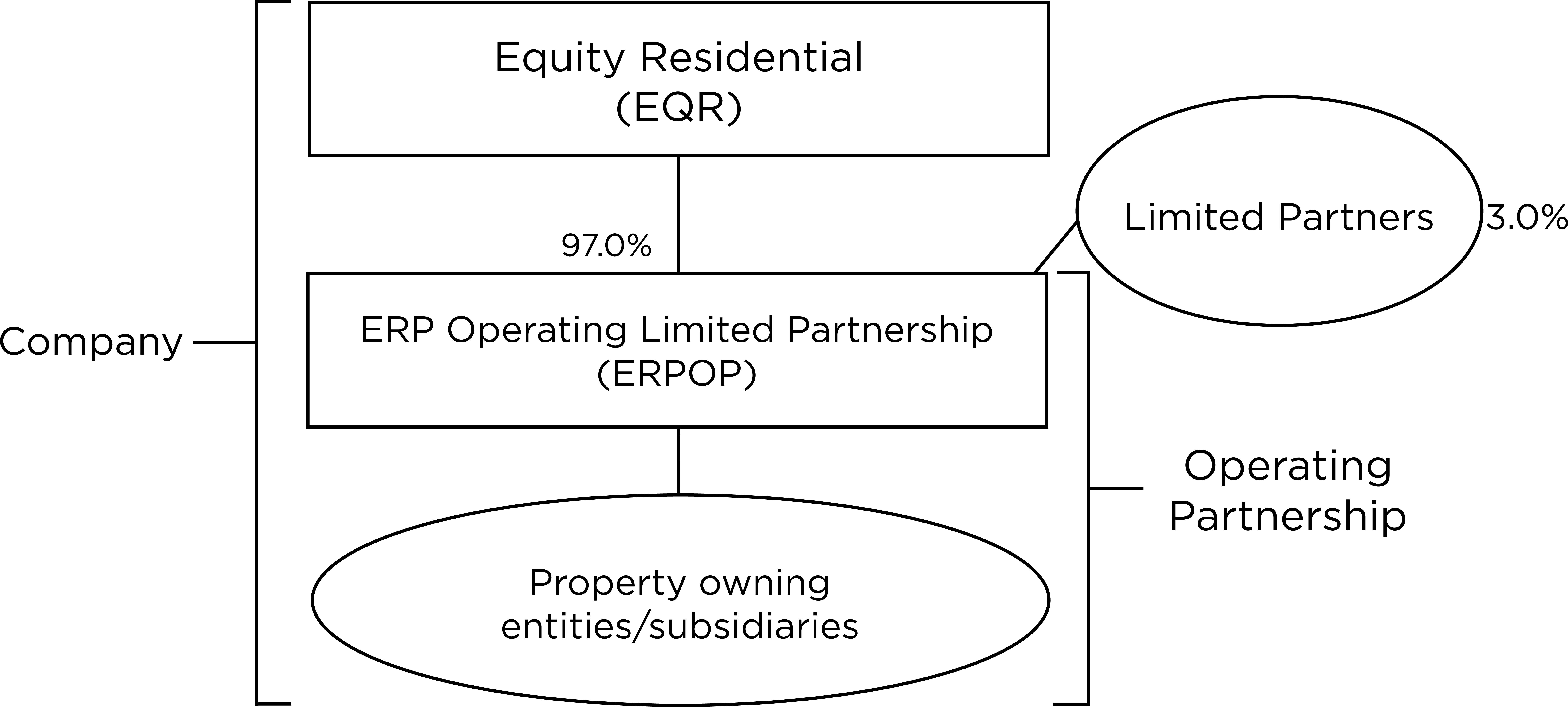
EQR is the general partner of, and as of December 31, 2023 owned an approximate 97.0% ownership interest in, ERPOP. The remaining 3.0% interest is owned by limited partners. As the sole general partner of ERPOP, EQR has exclusive control of ERPOP’s day-to-day management. Management operates the Company and the Operating Partnership as one business. The management of EQR consists of the same members as the management of ERPOP.
The Company is structured as an umbrella partnership REIT (“UPREIT”) and EQR contributes all net proceeds from its various equity offerings to ERPOP. In return for those contributions, EQR receives a number of OP Units (see definition below) in ERPOP equal to the number of Common Shares it has issued in the equity offering. The Company may acquire properties in transactions that include the issuance of OP Units as consideration for the acquired properties. Such transactions may, in certain circumstances, enable the sellers to defer in whole or in part, the recognition of taxable income or gain that might otherwise result from the sales. This is one of the reasons why the Company is structured in the manner shown above. Based on the terms of ERPOP’s partnership agreement, OP Units can be exchanged with Common Shares on a one-for-one basis because the Company maintains a one-for-one relationship between the OP Units of ERPOP issued to EQR and the outstanding Common Shares.
The Company believes that combining the reports on Form 10-K of EQR and ERPOP into this single report provides the following benefits:
enhances investors’ understanding of the Company and the Operating Partnership by enabling investors to view the business as a whole in the same manner as management views and operates the business;
eliminates duplicative disclosure and provides a more streamlined and readable presentation since a substantial portion of the disclosure applies to both the Company and the Operating Partnership; and
creates time and cost efficiencies through the preparation of one combined report instead of two separate reports.
The Company believes it is important to understand the few differences between EQR and ERPOP in the context of how EQR and ERPOP operate as a consolidated company. All of the Company’s property ownership, development and related business operations are conducted through the Operating Partnership and EQR has no material assets or liabilities other than its investment in ERPOP. EQR’s primary function is acting as the general partner of ERPOP. EQR also issues equity from time to time, the net proceeds of which it is obligated to contribute to ERPOP. EQR does not have any indebtedness as all debt is incurred by the Operating Partnership. The Operating Partnership holds substantially all of the assets of the Company, including the Company’s ownership interests in its joint ventures. The Operating Partnership conducts the operations of the business and is structured as a partnership with no publicly traded equity. Except for the net proceeds from equity offerings by EQR (which are contributed to the capital of ERPOP in exchange for additional partnership interests in ERPOP (“OP Units”) (on a one-for-one Common Share per OP Unit basis) or additional preference units in ERPOP (on a one-for-one preferred share per preference unit basis)), the Operating Partnership generates all remaining capital required by the Company’s business. These sources include the Operating Partnership’s working capital, net cash provided by operating activities, borrowings under its revolving credit facility and/or commercial paper program, the issuance of secured and unsecured debt and partnership interests, and proceeds received from disposition of certain properties and joint venture interests.
Shareholders’ equity, partners’ capital and noncontrolling interests are the main areas of difference between the consolidated financial statements of the Company and those of the Operating Partnership. The limited partners of the Operating Partnership are accounted for as partners’ capital in the Operating Partnership’s financial statements and as noncontrolling interests in the Company’s financial statements. The noncontrolling interests in the Operating Partnership’s financial statements include the interests of unaffiliated partners in various consolidated partnerships. The noncontrolling interests in the Company’s financial statements include the same noncontrolling interests at the Operating Partnership level and limited partner OP Unit holders of the Operating Partnership. The differences between shareholders’ equity and partners’ capital result from differences in the equity issued at the Company and Operating Partnership levels.
To help investors understand the differences between the Company and the Operating Partnership, this report provides separate consolidated financial statements for the Company and the Operating Partnership; a single set of consolidated notes to such financial statements that includes separate discussions of each entity’s debt, noncontrolling interests and shareholders’ equity or partners’ capital, as applicable; and a combined Management’s Discussion and Analysis of Financial Condition and Results of Operations section that includes discrete information related to each entity.
This report also includes separate Part II, Item 9A, Controls and Procedures, sections and separate Exhibits 31 and 32 certifications for each of the Company and the Operating Partnership in order to establish that the requisite certifications have been made and that the Company and the Operating Partnership are compliant with Rule 13a-15 or Rule 15d-15 of the Securities Exchange Act of 1934, as amended (the “Exchange Act”), and 18 U.S.C. §1350.
In order to highlight the differences between the Company and the Operating Partnership, the separate sections in this report for the Company and the Operating Partnership specifically refer to the Company and the Operating Partnership. In the sections that combine disclosure of the Company and the Operating Partnership, this report refers to actions or holdings as being actions or holdings of the Company. Although the Operating Partnership is generally the entity that directly or indirectly enters into contracts and joint ventures and holds assets and debt, reference to the Company is appropriate because the Company is one business and the Company operates that business through the Operating Partnership.
As general partner with control of ERPOP, EQR consolidates ERPOP for financial reporting purposes, and EQR essentially has no assets or liabilities other than its investment in ERPOP. Therefore, the assets and liabilities of the Company and the Operating Partnership are the same on their respective financial statements. The separate discussions of the Company and the Operating Partnership in this report should be read in conjunction with each other to understand the results of the Company on a consolidated basis and how management operates the Company.
EQUITY RESIDENTIAL
ERP OPERATING LIMITED PARTNERSHIP
TABLE OF CONTENTS
PART I
Item 1. Business
General
Equity Residential (“EQR”) is committed to creating communities where people thrive. The Company, a member of the S&P 500, is focused on the acquisition, development and management of residential properties located in and around dynamic cities that attract affluent long-term renters. ERP Operating Limited Partnership (“ERPOP”) is focused on conducting the multifamily property business of EQR. EQR is a Maryland real estate investment trust (“REIT”) formed in March 1993 and ERPOP is an Illinois limited partnership formed in May 1993. References to the “Company,” “we,” “us” or “our” mean collectively EQR, ERPOP and those entities/subsidiaries owned or controlled by EQR and/or ERPOP. References to the “Operating Partnership” mean collectively ERPOP and those entities/subsidiaries owned or controlled by ERPOP.
EQR is the general partner of, and as of December 31, 2023 owned an approximate 97.0% ownership interest in, ERPOP. All of the Company’s property ownership, development and related business operations are conducted through the Operating Partnership and EQR has no material assets or liabilities other than its investment in ERPOP. EQR issues equity from time to time, the net proceeds of which it is obligated to contribute to ERPOP, but does not have any indebtedness as all debt is incurred by the Operating Partnership. The Operating Partnership holds substantially all of the assets of the Company, including the Company’s ownership interests in its joint ventures. The Operating Partnership conducts the operations of the business and is structured as a partnership with no publicly traded equity.
The Company’s corporate headquarters is located in Chicago, Illinois and the Company also operates regional property management offices in most of its markets.
On May 18, 2023, the Company announced that Samuel Zell, its Founder and Chairman of the Board of Trustees, had passed away earlier that same day. David J. Neithercut, the Company’s former Chief Executive Officer and a member of the Company’s Board of Trustees since 2006, has been appointed as Chairman.
Certain capitalized terms used herein are defined in the Notes to Consolidated Financial Statements or the Definitions section of Item 7, Management's Discussion and Analysis of Financial Condition and Results of Operations. See also Note 17 in the Notes to Consolidated Financial Statements for additional discussion regarding the Company’s segment disclosures.
Available Information
You may access our Annual Report on Form 10-K, our Quarterly Reports on Form 10-Q, our Current Reports on Form 8-K, our proxy statements and any amendments to any of those reports/statements we file with or furnish to the Securities and Exchange Commission (“SEC”) free of charge on our website, www.equityapartments.com. These reports/statements are made available on our website as soon as reasonably practicable after we file them with or furnish them to the SEC. The information contained on our website, including any information referred to in this report as being available on our website, is not a part of or incorporated into this report.
Business Objectives and Operating and Investing Strategies
Overview
The Company is one of the largest U.S. publicly-traded owners and operators of high quality rental apartment properties, with an established presence in Boston, New York, Washington, D.C., Southern California (including Los Angeles, Orange County and San Diego), San Francisco and Seattle, and an expanding presence in Denver, Atlanta, Dallas/Ft. Worth and Austin. Through our ownership in these markets, we seek to optimize our portfolio by balancing risk and maximizing returns. We believe that this portfolio will allow us to produce more consistent cash flows in a volatile world where local market conditions may cause operating fundamentals to change rapidly. We believe our markets are knowledge centers of the U.S. economy that draw employers and their talented affluent workers that drive economic growth in the United States. We believe the locations of our properties in these markets are attractive to these affluent knowledge workers (who often choose to rent for lifestyle reasons) that we hope to convert into satisfied long-term residents.
We believe we have created an industry-leading operating platform and balance sheet to run our properties. Our employees are focused on delivering remarkable customer service to our residents so they will stay with us longer, be willing to pay higher rent for a great experience and will tell others about how much they love living in an Equity Residential property. We utilize technology and other innovative methods of engagement with our residents to foster relationships and community, improve the resident experience and operate our business more efficiently. We pair that with disciplined balance sheet management that enhances returns and value creation
while maintaining flexibility to take advantage of future opportunities. We believe that our stakeholders value stability, liquidity, predictability and accountability and that is the mission to which we remain unwaveringly committed.
Despite overall economic concerns, demand to live in our apartment communities remains healthy and we believe that the long-term prospects for our business remain strong. Our business benefits from elevated single family home ownership costs, positive household formation trends and the overall deficit in housing across the country, especially in the areas in which we are investing. Our well-located communities provide an exceptional experience for our residents around dynamic cities that we believe will continue to attract affluent long-term renters.
Equity Residential is committed to creating communities where people thrive. We carry this, our corporate purpose, through our relationships with our customers, our employees, our shareholders and the communities in which we operate. It drives our commitments to sustainability, diversity and inclusion, the total wellbeing of our employees and being a responsible corporate citizen in the communities in which we operate.
Investment Strategy
The Company’s long-term strategy is to invest in apartment properties located in strategically targeted markets with the goal of maximizing our risk-adjusted total returns by balancing current cash flow generation with long-term capital appreciation. We seek to meet this goal by investing in markets that are characterized by conditions favorable to multifamily property operations over the long-term. Our multi-pronged investment strategy featuring acquisitions, new stand-alone and expansion developments, densifying developments and accretive renovations of existing properties is focused on optimizing and balancing our portfolio in terms of location, including between our established and expansion markets and between urban and suburban submarkets within those markets. The markets we focus on generally feature one or more of the following characteristics that allow us to drive performance:
Large and diverse economic drivers. Our markets are some of the largest cities in the United States. They are markets that generally attract a variety of large and diverse industries and businesses. They include a number of submarkets that are attractive for long-term multifamily ownership and are positioned to capture future demand.
High costs of single family home ownership. Elevated single family home ownership costs (large down payments, high interest rates, etc.), low for sale inventory and existing homeowners that are reluctant to sell given favorable locked-in financing all support renting in the long-term, especially in the markets in which we operate.
Strong high quality job growth. Our markets attract and create high quality jobs that are often focused in growing areas of the knowledge-based economy. These jobs result in the significant presence and growth in affluent renters that work in the highest earning sectors of the economy, are not rent burdened and are attracted to our type of properties. This creates the ability to raise rents more readily in good economic times and reduces risk during downturns. Many of these affluent workers are employed in the fields of Science, Technology, Engineering and Mathematics, or STEM jobs, as well as financial services, medical, legal and other higher-earning professions.
Significant apartment demand that meets new apartment supply. We remain focused on owning and operating properties in markets and submarkets where the supply of apartments is met with strong demand. While at times supply and demand imbalances may occur, over the long-term we believe that the dynamics in our markets will support superior long-term returns.
We also focus on resiliency/environmental and regulatory issues when choosing which markets/submarkets in which to concentrate our investment efforts. We conduct climate resilience analyses and assess the regulatory climate to identify potential risks and opportunities as part of our due diligence process for new acquisitions and developments, as well as potential markets for portfolio expansion. Resiliency and regulatory issues also factor into our decisions to dispose of certain properties and/or exit certain submarkets.
We believe our strategy capitalizes on the preference of renters of all ages to live in the locations where we operate which typically are near transportation (both public transit and convenient highway access), entertainment, employment centers/universities and cultural and outdoor amenities. Furthermore, we believe that demand for rental housing will continue to be driven primarily through household formations from the younger segments of our population, particularly Generation Z, while retaining Millennials for longer, and to a lesser extent, capturing the aging Baby Boomer generation.
Generation Z is approximately 70 million people born between 1997 and 2012. This cohort is entering prime renter age and is expected to continue to be an important source of demand.
Millennials are individuals born between 1981 and 1996, totaling approximately 72 million people, and continue to be a significant portion of the renter population. They also tend to remain renters longer due to the high cost of single family home ownership, societal trends favoring delays in marriage and having children and caution around making large financial commitments during uncertain economic times.
Baby Boomers, a demographic of more than 68 million people born between 1946 and 1964, also may trend toward apartment rentals as they downsize and enter retirement in vibrant cities.
The Company continues to allocate capital in order to optimize performance by balancing current cash flow growth with long-term capital appreciation. We have done so by adding expansion markets to our portfolio when certain submarkets in those markets meet many of the same characteristics listed above. Expansion into these markets of Denver, Atlanta, Dallas/Ft. Worth and Austin includes investments in both urban and suburban properties in select submarkets and is generally being funded by reducing exposure to older or lower returning assets in selected established markets. Development also plays an important role in our capital allocation. Development activity is focused on our in-house pipeline and redevelopment of some existing operating properties and our strategic partnerships and joint-ventures with third-party developers in both established and expansion markets. The Company remains committed to development as a driver of external growth but acknowledges its incremental risk, particularly in higher inflationary cost environments, when evaluating it as a method of expansion.
Competition
All of the Company’s properties are located in developed areas with multiple housing choices, including other multifamily properties. The number of competitive housing choices or multifamily properties in a particular area could have a material effect on the Company’s ability to lease apartment units at its properties and on the rents charged. The Company may be competing with other housing providers that have greater resources than the Company and whose managers have more experience than the Company’s managers. In addition, other forms of rental properties and single family housing provide housing alternatives to potential residents of multifamily properties. See Item 1A, Risk Factors, for additional information with respect to competition.
Operations and Innovation
We attempt to balance occupancy and rental rates to maximize our revenue while exercising tight cost control to generate the highest possible cash flow generation to our shareholders. Our focus on operating efficiency and delivery of an exceptional resident living experience has driven strong Physical Occupancy and a high Percentage of Residents Renewing while achieving strong renewal rate growth.
We deliver this performance through rapidly evolving technology and innovation that is increasingly prevalent in our industry. We have been and continue to be a leader in deploying and investing in property technology to serve our customers better and operate more efficiently. Having a history as a first mover in such important areas as online leasing, we are focused on technology that drives superior margins and improves customer experience. We use a standardized purchasing system to control our operating expenses and a business intelligence platform and other data analytics that allow our team members to quickly identify and address issues and opportunities. Many of these initiatives allow us to interact with our customers in a safe, responsible and convenient manner, including self-guided tours, automated responses to customer inquiries and enhanced service and maintenance management. While we believe areas such as “smart home” technology and others will provide the foundation for current and future improvements to how we do business, we will continue to consider the cost and longevity of technology capital investments and their benefits.
Our Commitment to Corporate Responsibility
At Equity Residential, we believe focusing on corporate responsibility is a key way to programmatically address stakeholder concerns as part of our corporate purpose as we recognize the profound impact that the real estate industry can have on our environment and society as a whole. We strive to create and maintain a sustainable portfolio that not only has a low environmental footprint, but also one that is attractive to our customers and the community and resilient to the changing climate. We apply best practices for sustainability across all aspects of our real estate business. We have a dedicated in-house team that initiates and applies sustainable practices in all aspects of our business, including investment activities, development, property operations and property management activities. Multifamily housing is one of the most environmentally-friendly uses of real estate, as each property provides homes for hundreds of families in a denser shared environment. We consider building locations based on walkability, accessibility, neighborhoods and communities. Our properties support amenities such as fitness centers and we select locations near shops, restaurants, outdoor amenities such as bike/running paths and health clubs, enabling a low carbon footprint lifestyle for our residents to live, work and play.
Equity Residential’s sustainability program actively manages environmental impacts and climate-related risks and opportunities through optimized, financially responsible capital investments and technologies. We methodically focus on energy, water, waste and emissions to advance the program’s policies, targets and resilience outcomes as well as our shareholders' long-term financial interests. Together, we believe our program drives long-term asset value, responsibly manages risks and engages our communities, residents, employees and shareholders as part of our broader sustainability strategy and commitment to good corporate citizenship and maximizing investment performance. Our expertise has shown that as real estate owners, developers and managers, we have the ability to make a positive impact on the environment while also enhancing our financial performance and strengthening our organization’s sense of purpose.
To further strengthen our commitments to sustainability initiatives, we set ambitious targets to reduce our environmental impact across the portfolio aligned with global climate change initiatives. For example, we recently set a science-based target to reduce our absolute Scope 1, 2, and 3 greenhouse gas emissions (from our two biggest categories) by 30% by 2030 from a 2018 base year. We continue to enhance our environmental disclosure efforts by calculating and disclosing our Scope 3 emissions.
We also issued two sustainable fixed-income instruments (each a “green bond”) designed to support projects that contribute to environmental sustainability, becoming the first multifamily REIT to ever issue a green bond. The Company also has a $10.0 million investment in a fund focused on early stage sustainability and climate change mitigation technology relevant to the built environment.
As detailed below, we have a commitment to our employees’ engagement, diversity and inclusion and wellness that serves as the foundation of our corporate purpose. We celebrate differences and are committed to cultivating an inclusive environment of belonging for all employees, driving excellence through shared perspectives and collaborative innovation. We also recognize that a successful company must incorporate the best corporate governance practices in order to better serve its stakeholders. Consistent with the Company's purpose and commitment to the incorporation of corporate responsibility concepts in all aspects of its business, executive compensation includes a goal which focuses on environmental, social and governance factors.
For additional information regarding our corporate responsibility efforts, see our 2023 Environmental, Social and Governance Report at our website, www.equityapartments.com, which includes third-party limited assurance covering some of the environmental metrics included in the report. The report, which includes Sustainability Accounting Standards Board disclosures and incorporates recommendations from the Task Force on Climate-Related Financial Disclosures, was reviewed and approved by the Corporate Governance Committee of our Board of Trustees, which monitors the Company’s ongoing corporate responsibility efforts. The Environmental, Social and Governance Report is not part of or incorporated into this report. Furthermore, our annual proxy statements contain additional information on our corporate responsibility efforts, including detailed information regarding our corporate governance practices. Such annual proxy statements and the information contained therein are not part of nor incorporated into this report, except as otherwise provided herein.
Human Capital
At Equity Residential, our team of approximately 2,400 employees is the driving force of our success. We believe that our richly diverse work environment captures top talent, cultivates the best ideas and creates the widest possible platform for this success in line with our corporate purpose of “Creating communities where people thrive”. Our core principles, affectionately named “Ten Ways to Be a Winner,” guide our behavior as individuals and collectively as a team, helping us in our goal to deliver market-leading performance. As part of our Ten Ways to Be a Winner, we encourage our team members to raise questions, take educated risks, offer new ideas and help us make the right decisions. One way we live the “Ten Ways” is by enriching our culture through our core “Equity Values," which include Diversity & Inclusion, Social Responsibility, Sustainability and Total Wellbeing. We have assembled the Equity Values Council, a diverse employee group reflective of the broader Company, to lead our efforts on these values by acting as change agents to drive initiatives, create goals and awareness, and encourage colleagues to participate in community service activities and wellness initiatives.
Diversity and Inclusion
Our commitment to diversity and inclusion starts with a highly skilled and diverse Board of Trustees.
We are committed to fostering a safe, inclusive and productive workplace for all employees. We believe providing a work environment based on respect, trust and collaboration creates an exceptional employee experience where employees can bring their whole selves to work and thrive in their careers. In recent years, we have created dedicated Diversity and Inclusion staffing to oversee this crucial work.
To further prioritize the importance of our diversity and inclusion efforts, our executives’ annual compensation goals include an evaluation of objective metrics measuring our Company’s progress in this regard.
We have the benefit of a diverse workforce, of which over 60% currently identify as ethnically diverse.
A diversity and inclusion lens is embedded in our talent review processes. This includes the development of our Overcoming Bias in Performance Review Toolkit, which is designed to provide practical bias interrupters and guidelines to improve fairness in the performance evaluation process.
We strategically identify opportunities to increase the diversity of our talent pipeline at all levels, including by actively seeking to source a pool of diverse candidates for mid-management and above positions in the communities where we serve, such as from Project Destined, Fannie Mae’s Future Housing Leaders, Howard University, Roosevelt University and Evanston Scholars.
We employ interns from universities across the nation and local colleges to provide pathways for students of various backgrounds interested in real estate.
Pay Equity
In order to develop, attract and retain the best employees, we are committed to providing a total compensation package which is market-based, performance driven, fair and internally equitable.
Our goal is to be competitive both within the general employment market as well as with our competitors in the real estate industry, with our strongest performers being paid more.
Base pay is reviewed annually, as is Equity Residential’s compensation framework, by partnering with managers to create and update job descriptions that reflect the duties, skills, experience and education required to perform the role, and then benchmarking the Company’s pay practices and budget as well as our jobs against third-party compensation surveys to determine the market value of the job.
During the year-end performance evaluation process, managers review and calibrate compensation for all employees on their team, in an effort to ensure equity around our pay practices and allow us to reward and motivate our top talent.
Employee Engagement
Employee engagement and experience are extremely important at Equity Residential. Our Employee Experience (EX) Survey measures employee engagement and diversity and inclusion, among other components of the employee experience.
Our 2023 engagement score of 78% favorability is very strong, especially given changes in employee expectations in the wake of the pandemic. Our Diversity & Inclusion Index score of 84% demonstrated significant employee favorability for the initiatives taking place and a greater sense of belonging.
Executive leaders are assessed annually on their leadership results for diversity and inclusion, engagement and manager completion of Ethics and Positive Workplace training, which for 2023 were measured by an employee experience survey and course completion rates.
Training and Development
We believe a successful workplace is one where employees constantly learn and grow. Our HR Transformation Learning & Development (“L&D”) team works regularly with leaders and employees to expand their knowledge and skills. L&D develops and delivers a wide range of training and development opportunities, from tactical to strategic, face-to-face to virtual, social learning to self-directed learning, and more.
Health, Safety and Wellness
Equity Residential is committed to providing the tools and resources to help our employees achieve total wellbeing. Having a thriving employee base is the pinnacle of our total wellbeing efforts. When employees bring their whole self to work, perform their best and are well supported, they can make powerful contributions to the business, culture and our communities. Whether physical, mental, financial, career, social or community wellbeing, Equity Residential offers benefits to help meet our employee needs.
Physical Wellbeing: Equity Residential is focused on providing benefits that help our employees achieve balance and address good health proactively, with coverage for ongoing needs and emergencies that can arise as well. Long before healthcare reform, Equity Residential made a commitment to cover 100% of employee preventive care. This commitment—and our robust and highly popular wellness program—has made proactive personal healthcare more accessible and manageable for employees, while encouraging ongoing healthy behaviors and rewarding employees for taking a proactive approach to their health.
Mental Wellbeing: We strive to make mental healthcare accessible. Our communications are designed to highlight awareness-building and our resources are centered around culturally competent care that scales toward employees’
needs. This includes educational resources for maintaining mental health, online mobile apps to address or discuss ways to improve, and partnerships with virtual care providers and support networks for those who need immediate and critical support. All employees and their family members have access to five free counseling sessions (per year per presenting matter) through our Employee Assistance Program. Understanding the importance of a mentally healthy workforce, we also added an industry-leading meditation app, free to all employees and their family members, designed to promote mental health. Our dedication to mental wellness is reflected in providing tools like this, fostering a culture that values self-care and effective mental health practices.
Financial Wellbeing: These benefits and resources help our employees manage their money better today, while preparing for financial milestones and retirement in the future. Financial peace of mind is at the core of these offerings, whether it’s our generous 401(k) match, basic and supplemental insurance to ensure our loved ones and possessions are cared for, rent discounts at our properties or additional savings and investment options like our employee share purchase plan.
Career Wellbeing: When employees move up in skill and experience, so does Equity Residential. We encourage our employees to Test their Limits (one of the Ten Ways), push the boundaries of their comfort zones and seek new challenges through several learning resources and courses, in addition to tuition reimbursement. We actively promote from within, and many senior corporate and property leaders have risen from entry level or junior positions.
Social and Community Wellbeing: We offer a number of benefits that foster social and community wellbeing, including paid time off to volunteer in our communities.
Equity Residential continues to partner with Employees1st to provide financial relief via a crisis fund for employees struck by personal hardships or unforeseen disasters. The Company contributes funds to further support employees who experience unforeseen or catastrophic hardship. We are proud that this program allows yet another avenue for us to tangibly demonstrate a one team culture by ensuring that employees feel safe and supported during extreme circumstances.
Regulatory Considerations
See Item 1A, Risk Factors, for information concerning the potential effects of governmental regulations, including environmental regulations, on our operations.
Item 1A. Risk Factors
General
This Item 1A includes forward-looking statements. You should refer to our discussion of the qualifications and limitations on forward-looking statements included in Item 7, Management’s Discussion and Analysis of Financial Condition and Results of Operations.
The occurrence of the events discussed in the following risk factors could adversely affect, possibly in a material manner, our business, financial condition or results of operations, which could affect the value of our common shares of beneficial interest or preferred shares of beneficial interest (which we refer to collectively as “Shares”), Preference Units, OP Units, restricted units and our public unsecured debt. In this section, we refer to the Shares, Preference Units, OP Units, restricted units and public unsecured debt together as our “securities” and the investors who own such securities as our “security holders.”
Risks Related to our Business Strategy
Investing in real estate is inherently subject to risks that could negatively impact our business.
Investing in real estate is subject to varying degrees and types of risk. While we seek to mitigate these risks through various strategies, including geographic diversification, market research and proactive asset management, among other techniques, these risks cannot be eliminated entirely. Factors that may impact cash flows and real estate values include, but are not limited to:
Local economic conditions, particularly oversupply or reductions in demand;
National, regional and local political and regulatory climates, governmental fiscal health and governmental policies;
The inability or unwillingness of residents to pay rent increases;
Increases in our operating expenses due to inflationary or other pressures;
Cost and availability of labor and materials required to maintain our properties at acceptable standards;
Availability of attractive financing opportunities;
Changes in social preferences, demographics or migration patterns; and
Additional risks that are discussed below.
The geographic concentration of our properties could have an adverse effect on our operations.
While the Company continues to diversify its portfolio with the addition of the expansion markets, the Company’s properties are still predominantly concentrated in our established coastal markets (generally within certain dense urban and suburban submarkets). If one or more of these markets is unfavorably impacted by specific geopolitical and/or economic conditions, local real estate conditions, increases in social unrest, increases in real estate and other taxes, reduced quality of life, deterioration of local or state government health, rent control or rent stabilization laws, other similar regulations, or localized environmental and climate issues, the impact of such conditions may have a more negative impact on our results of operations than if our properties were more geographically diverse. Additionally, to the extent that these markets or submarkets become less desirable to operate in, including changes in multifamily housing supply and demand, our results of operations could be more negatively impacted than if we were more diversified within our markets or invested in a greater number of markets.
Competition for housing may negatively affect operations and demand for the Company’s properties or residents.
Our properties face competition for residents from other existing or new multifamily properties, condominiums, single family homes and other living arrangements, whether owned or rental, that may attract residents from our properties or prospective residents that would otherwise choose to live with us. As a result, we may not be able to renew existing resident leases or enter into new resident leases, or if we are able to renew or enter into new leases, they may be at rates or terms that are less favorable than our current rates or terms, resulting in a material impact on our results of operations.
Additionally, our properties face competition for residents as a result of innovations in technology and amenities. Therefore, we may not be able to retain residents or attract new residents if we are unable to identify and cost effectively implement new, relevant technologies/amenities and keep up with constantly changing resident demand for the latest innovations in these areas.
The short-term nature of apartment leases exposes us more quickly to the effects of declining market rents, potentially making our results of operations and cash flows more volatile.
Generally, our residential apartment leases are for twelve months or less. If the terms of the renewal or releasing are less favorable than current terms, then the Company’s results of operations and financial condition could be negatively affected. Given our generally shorter-term lease structure, our rental revenues are impacted by declines in market rents more quickly than if our leases were for longer terms. In addition, operating expenses associated with each property, such as real estate taxes, insurance, utilities, maintenance costs and employee wages and benefits, may not decline at all or decline at the same rate as revenues when circumstances might cause a reduction of those revenues at our properties.
Because real estate investments are illiquid, we may not be able to sell properties when appropriate.
Real estate investments often cannot be sold quickly due to regulatory constraints, market conditions or otherwise. As a result, we may not be able to reconfigure our portfolio, including the diversification of our portfolio into the expansion markets, as promptly as desired or as quickly in response to changing economic or other conditions. We may also be unable to consummate dispositions in a timely manner, on attractive terms, or at all. The capitalization rates/disposition yields at which properties may be sold could also be higher than historic rates, thereby reducing our potential proceeds from sale. In some cases, we may also determine that we will not recover the carrying amount of the property upon disposition, potentially causing an impairment charge. This inability to reallocate our capital promptly could negatively affect our financial condition, including our ability to make distributions to our security holders.
Competition may prevent us from acquiring properties on favorable terms.
We may not be successful in pursuing acquisition and development opportunities. We expect that other real estate investors will compete with us for attractive investment opportunities or may also develop properties in markets where we focus our development and acquisition efforts. We may not be in a position or have the opportunity in the future to make suitable property acquisitions on favorable terms.
Operations from new acquisitions, development projects and renovations may fail to perform as expected.
We intend to actively acquire, develop and renovate multifamily operating properties as part of our business strategy. Newly acquired, developed or renovated properties may not perform as we expect. We may overestimate the revenue (or underestimate the expenses) that these new or repositioned properties may generate. The occupancy and rental rates at these properties may also fail to meet our expectations for these investments. Land parcels acquired for development may lose significant value prior to the start of construction. Development and renovations are subject to even greater uncertainties and risks due to the complexities and lead time to build or complete these projects. We may also underestimate the costs to complete a development property or to complete a renovation.
Additionally, we have and may in the future acquire large portfolios of properties or companies that could increase our size and result in alterations to our capital structure. We may be unable to integrate the operations of newly acquired large por
Showing the first 8K of 62K characters. Open the full section
Item 1B. Unresolved Staff Comments
None.
Item 1C. Cybersecurity
Risk management and strategy
We have an enterprise-wide information security program designed to protect our information systems from cybersecurity threats. We identify and assess risks from cybersecurity threats by monitoring and evaluating our digital assets and our risk profile using various methods. We monitor security events that are internally discovered or externally reported that may affect our systems and have processes and procedures to assess those events for potential cybersecurity impact or risk and consequently improve our security measures and planning. Additionally, we work with third parties from time to time that assist us in refining our cybersecurity risk strategy in order to identify, assess and manage cybersecurity risks, including professional services firms and consulting firms. We seek to detect and investigate unauthorized attempts and attacks against our network and services, and to minimize their occurrence and recurrence through changes or updates to our internal processes and tools and changes or updates to our services; however, we remain potentially vulnerable to known or unknown threats.
Our cybersecurity incident response processes are designed to escalate certain cybersecurity events to members of management depending on the circumstances. Key members of management, including representatives from IT, operations, legal, finance, risk management and internal audit, serve on the Company’s senior security incident response team to help the Company mitigate and remediate cybersecurity incidents of which they are notified, and certain cybersecurity incidents are escalated to the Company’s executives. In addition, the Company’s incident response processes include potential reporting to the Audit Committee of our Board of Trustees for certain cybersecurity incidents.
We also have a third-party risk management program in place to manage cybersecurity risks associated with third-party service providers. While we do maintain processes and procedures to identify, prioritize and assess risks associated with third-party service providers, we must rely on third parties to augment our security program, and we cannot ensure in all circumstances that their efforts will be successful.
While to date we have not experienced a cybersecurity threat or incident that resulted in a material adverse impact to our business or operations, there can be no guarantee that we will not experience such an incident in the future. Any significant disruption to our systems could adversely affect our business and results of operations. Further, a cyber incident impacting our systems or a third-party’s systems could subject us to business, regulatory, litigation and reputational risk, which could have a negative effect on our business, financial condition and results of operations.
Notwithstanding the extensive approach we take to cybersecurity, we may not be successful in preventing or mitigating a cybersecurity incident that could have a material adverse effect on us. While we maintain cybersecurity insurance, the costs related to cybersecurity threats or disruptions may not be fully insured. See Item 1A, Risk Factors, for a discussion of cybersecurity risks.
Governance
Our Information Technology Security Team, under the oversight of our Senior Vice President of IT and the leadership of our VP of IT Infrastructure and Security, is responsible for our overall information security strategy, policy, security engineering, operations and cyber threat detection and response. The Information Technology Security Team manages and continually enhances a robust enterprise security structure with the ultimate goal of minimizing cybersecurity incidents to the extent feasible, while simultaneously increasing our system resilience in an effort to minimize the business impact should an incident occur. Our Information Technology Security Team possesses decades of experience in navigating cybersecurity threats and mitigating associated risks as a result of holding similar positions at other large companies. Most members of the team hold degrees in cybersecurity and/or related disciplines, have cybersecurity certifications such as Certified Information Systems Security Professional (CISSP) and/or periodically attend various cyber-focused conferences and training programs. Specifically, our Senior Vice President of IT and our VP of IT Infrastructure and Security combined have over 30 years of technology and cybersecurity experience. The team provides regular reports to senior management and affected departments on various cybersecurity threats, assessments and findings.
The Audit Committee of our Board of Trustees oversees our annual enterprise risk management assessment, where we assess key risks within the Company, including security and technology risks and cybersecurity threats. The Audit Committee oversees our ongoing cybersecurity risk management efforts and regularly receives detailed reports from representatives of our Information Technology Security Team addressing a wide range of related topics. At least annually, our IT leadership (and external cybersecurity experts if applicable) reviews key cybersecurity strategies and policies with the full Board of Trustees, including risk assessments, mitigation strategies, areas of emerging risks, incidents and industry trends and other areas of importance.
Item 2. Properties
As of December 31, 2023, the Company, directly or indirectly through investments in title holding entities, owned all or a portion of 302 properties located in 10 states and the District of Columbia consisting of 80,191 apartment units. See Item 1, Business, for additional information regarding the Company’s properties and the markets/metro areas upon which we are focused. The Company’s properties are summarized by building type in the following table:
| Type | Properties | Apartment Units | Average Apartment Units | |||||||||
| Garden | 90 | 24,553 | 273 | |||||||||
| Mid/High-Rise | 212 | 55,638 | 262 | |||||||||
| 302 | 80,191 | 266 |
Garden is generally defined as properties with two and/or three story buildings while mid/high-rise is generally defined as properties with greater than three story buildings. These two property types typically provide residents with amenities, such as rooftop decks and swimming pools, fitness centers and community rooms. In addition, many of our urban properties have non-residential components, such as parking garages and/or retail spaces.
The Company’s properties are summarized by ownership type in the following table:
| Properties | Apartment Units | |||||||
| Wholly Owned Properties | 288 | 77,131 | ||||||
| Partially Owned Properties – Consolidated | 14 | 3,060 | ||||||
| 302 | 80,191 |
The following table sets forth certain information by market relating to the Company’s properties at December 31, 2023:
| Portfolio Summary | ||||||||||||||||
| Markets/Metro Areas | Properties | Apartment Units | % of Stabilized Budgeted NOI (1) | Average Rental Rate (2) | ||||||||||||
| Established Markets: | ||||||||||||||||
| Los Angeles | 58 | 14,732 | 17.1 | % | $ | 2,929 | ||||||||||
| Orange County | 13 | 4,028 | 5.4 | % | 2,873 | |||||||||||
| San Diego | 12 | 2,878 | 4.0 | % | 3,108 | |||||||||||
| Subtotal – Southern California | 83 | 21,638 | 26.5 | % | 2,942 | |||||||||||
| Washington, D.C. | 48 | 15,028 | 16.3 | % | 2,657 | |||||||||||
| San Francisco | 43 | 11,667 | 15.4 | % | 3,303 | |||||||||||
| New York | 34 | 8,536 | 14.1 | % | 4,566 | |||||||||||
| Boston | 27 | 7,170 | 11.8 | % | 3,574 | |||||||||||
| Seattle | 44 | 9,267 | 10.4 | % | 2,561 | |||||||||||
| Subtotal – Established Markets | 279 | 73,306 | 94.5 | % | 3,145 | |||||||||||
| Expansion Markets: | ||||||||||||||||
| Denver | 9 | 2,792 | 2.8 | % | 2,411 | |||||||||||
| Atlanta | 7 | 2,111 | 1.6 | % | 2,169 | |||||||||||
| Dallas/Ft. Worth | 4 | 1,241 | 0.7 | % | 1,935 | |||||||||||
| Austin | 3 | 741 | 0.4 | % | 1,819 | |||||||||||
| Subtotal – Expansion Markets | 23 | 6,885 | 5.5 | % | 2,188 | |||||||||||
| Total | 302 | 80,191 | 100.0 | % | $ | 3,063 |
Note: Projects under development are not included in the Portfolio Summary until construction has been completed.
(1)
% of Stabilized Budgeted NOI - Represents original budgeted 2024 NOI for stabilized properties and projected annual NOI at stabilization (defined as having achieved 90% occupancy for three consecutive months) for properties that are in lease-up.
(2)
Average Rental Rate - Total Residential rental revenues reflected on a straight-line basis in accordance with GAAP divided by the weighted average occupied apartment units for the reporting period presented.
The following tables provide a rollforward of the apartment units included in Same Store Properties (please refer to the Definitions section in Item 7, Management’s Discussion and Analysis of Financial Condition and Results of Operations) and a reconciliation of apartment units included in Same Store Properties to those included in Total Properties for the year ended December 31, 2023:
| Year Ended December 31, 2023 | ||||||||
| Properties | Apartment Units | |||||||
| Same Store Properties at December 31, 2022 | 283 | 72,872 | ||||||
| 2021 acquisitions | 16 | 4,326 | ||||||
| 2023 dispositions | (11 | ) | (912 | ) | ||||
| Other | — | 11 | ||||||
| Same Store Properties at December 31, 2023 | 288 | 76,297 |
| Year Ended December 31, 2023 | ||||||||
| Properties | Apartment Units | |||||||
| Same Store | 288 | 76,297 | ||||||
| Non-Same Store: | ||||||||
| 2023 acquisitions | 4 | 1,183 | ||||||
| 2022 acquisitions | 1 | 172 | ||||||
| 2021 acquisitions not yet stabilized | 1 | 421 | ||||||
| Properties removed from same store (1) | 2 | 819 | ||||||
| Lease-up properties not yet stabilized (2) | 5 | 1,298 | ||||||
| Other | 1 | 1 | ||||||
| Total Non-Same Store | 14 | 3,894 | ||||||
| Total Properties and Apartment Units | 302 | 80,191 |
Note: Properties are considered “stabilized” when they have achieved 90% occupancy for three consecutive months. Properties are included in same store when they are stabilized for all of the current and comparable periods presented.
(1)
Consists of two properties which were removed from the same store portfolio as discussed further below:
a.
Laguna Clara located in Santa Clara, CA containing 222 apartment units was removed from the same store portfolio in the second quarter of 2022 due to a major renovation and redevelopment project, including the demolition of 42 apartment units. As of December 31, 2023, the property had a Physical Occupancy of 67.4%. This property will not return to the same store portfolio until it is stabilized for all of the current and comparable periods presented.
b.
Pearl MDR located in Marina Del Rey, CA containing 597 apartment units was removed from the same store portfolio in the third quarter of 2022 due to a large scale re-piping and renovation project in which significant portions of the property are being taken offline for extended time periods. As of December 31, 2023, the property had a Physical Occupancy of 64.5%. This property will not return to the same store portfolio until it is stabilized for all of the current and comparable periods presented.
(2)
Consists of properties in various stages of lease-up and properties where lease-up has been completed but the properties were not stabilized for the comparable periods presented. Also includes one former third-party master-leased property that was not stabilized.
For the year ended December 31, 2023, the Company’s same store Physical Occupancy was 95.9% and its total portfolio-wide Physical Occupancy, which includes completed development properties in various stages of lease-up, was 95.4%. Certain of the Company’s properties are encumbered by mortgages and additional detail can be found on Schedule III – Real Estate and Accumulated Depreciation.
The properties in various stages of development and lease-up at December 31, 2023 are included in the following table:
| Development and Lease-Up Projects as of December 31, 2023 | |||||||||||||||||||||||||||||||||
| (Amounts in thousands except for project and apartment unit amounts) | |||||||||||||||||||||||||||||||||
| Estimated/Actual | |||||||||||||||||||||||||||||||||
| Projects | Location | Ownership Percentage | No. of Apartment Units | Total Budgeted Capital Cost (1) | Total Book Value to Date | Total Debt (2) | Percentage Completed | Start Date | Initial Occupancy | Completion Date | Stabilization Date | Percentage Leased / Occupied | |||||||||||||||||||||
| CONSOLIDATED: | |||||||||||||||||||||||||||||||||
| Projects Under Development: | |||||||||||||||||||||||||||||||||
| Laguna Clara II | Santa Clara, CA | 100% | 225 | $ | 152,621 | $ | 78,036 | $ | — | 53% | Q2 2022 | Q4 2024 | Q1 2025 | Q4 2025 | – / – | ||||||||||||||||||
| Projects Under Development - Consolidated | 225 | 152,621 | 78,036 | — | |||||||||||||||||||||||||||||
| Projects Completed Not Stabilized: | |||||||||||||||||||||||||||||||||
| Reverb (fka 9th and W) (3) | Washington, D.C. | 92% | 312 | 108,027 | 104,651 | — | 100% | Q3 2021 | Q2 2023 | Q2 2023 | Q3 2024 | 82% / 79% | |||||||||||||||||||||
| Projects Completed Not Stabilized - Consolidated | 312 | 108,027 | 104,651 | — | |||||||||||||||||||||||||||||
| UNCONSOLIDATED: | |||||||||||||||||||||||||||||||||
| Projects Under Development: | |||||||||||||||||||||||||||||||||
| Alloy Sunnyside (4) | Denver, CO | 80% | 209 | 70,004 | 62,071 | 27,304 | 94% | Q3 2021 | Q2 2024 | Q2 2024 | Q1 2025 | – / – | |||||||||||||||||||||
| Alexan Harrison (4) | Harrison, NY | 62% | 450 | 200,664 | 175,135 | 77,058 | 92% | Q3 2021 | Q1 2024 | Q4 2024 | Q2 2026 | – / – | |||||||||||||||||||||
| Solana Beeler Park (4) | Denver, CO | 90% | 270 | 85,206 | 56,178 | 22,858 | 64% | Q4 2021 | Q2 2024 | Q3 2024 | Q1 2025 | – / – | |||||||||||||||||||||
| Remy (Toll) (4) | Frisco, TX | 75% | 357 | 98,937 | 77,170 | 31,494 | 80% | Q1 2022 | Q1 2024 | Q4 2024 | Q3 2025 | – / – | |||||||||||||||||||||
| Sadie (fka Settler) (Toll) (4) | Fort Worth, TX | 75% | 362 | 82,775 | 55,522 | 14,944 | 69% | Q2 2022 | Q2 2024 | Q3 2024 | Q3 2025 | – / – | |||||||||||||||||||||
| Lyle (Toll) (3) | Dallas, TX | 75% | 334 | 86,332 | 52,914 | 21,962 | 66% | Q3 2022 | Q2 2024 | Q3 2024 | Q1 2026 | – / – | |||||||||||||||||||||
| Projects Under Development - Unconsolidated | 1,982 | 623,918 | 478,990 | 195,620 | |||||||||||||||||||||||||||||
| Total Development Projects - Consolidated | 537 | 260,648 | 182,687 | — | |||||||||||||||||||||||||||||
| Total Development Projects - Unconsolidated | 1,982 | 623,918 | 478,990 | 195,620 | |||||||||||||||||||||||||||||
| Total Development Projects | 2,519 | $ | 884,566 | $ | 661,677 | $ | 195,620 |
(1)
Total Budgeted Capital Cost – Estimated remaining cost for projects under development and/or developed plus all capitalized costs incurred to date, including land acquisition costs, construction costs, capitalized real estate taxes and insurance, capitalized interest and loan fees, permits, professional fees, allocated development overhead and other regulatory fees, plus any estimates of costs remaining to be funded for all projects, all in accordance with GAAP. Amounts for partially owned consolidated and unconsolidated properties are presented at 100% of the project.
(2)
Except for Reverb where the Company paid off the third-party construction loan during the year ended December 31, 2023, all non-wholly owned projects are being partially funded with project-specific construction loans. None of these loans are recourse to the Company.
(3)
The land parcels under these projects are subject to long-term ground leases.
(4)
The Total Budgeted Capital Cost on these projects increased by an aggregate of $13.0 million or 2.5% of initial budget primarily due to higher than budgeted interest incurred on construction loans.
Item 3. Legal Proceedings
The Company has been named as a defendant in a number of cases filed in late 2022 and 2023 alleging antitrust violations by RealPage, Inc., a seller of revenue management software products, and various owners and/or operators of multifamily housing, including us, that have utilized these products. The complaints allege collusion among the defendants to illegally fix and inflate the pricing of multifamily rents and seek monetary damages, injunctive relief, fees and costs. All of the cases except for one have been consolidated into a single putative class action in the United States District Court for the Middle District of Tennessee. On December 28, 2023, motions to dismiss this consolidated action, filed by RealPage, Inc. as well as us and our multifamily co-defendants, were denied by the Court and the case is proceeding. Another case with similar allegations has been filed by the District of Columbia against
RealPage, Inc. and a number of multifamily owners and/or operators, including us. We believe these various lawsuits are without merit and we intend to vigorously defend against them. As these proceedings are in the early stages, it is not possible for the Company to predict the outcome nor is it possible to estimate the amount of loss, if any, which may be associated with an adverse decision in any of these cases.
As of December 31, 2023, the Company does not believe there is any litigation pending or threatened against it that, individually or in the aggregate, may reasonably be expected to have a material adverse effect on the Company.
Item 4. Mine Safety Disclosures
Not applicable.
PART II
Item 5. Market for Registrant’s Common Equity, Related Stockholder Matters and Issuer Purchases of Equity Securities
Common Share/Unit Information (Equity Residential and ERP Operating Limited Partnership)
The Company’s Common Shares trade on the New York Stock Exchange under the trading symbol EQR. There is no established public market for the Operating Partnership’s Units (OP Units and restricted units). At February 8, 2024, the number of record holders of Common Shares was approximately 1,710 and 379,553,591 Common Shares were outstanding. At February 8, 2024, the number of record holders of Units in the Operating Partnership was approximately 450 and 391,291,526 Units were outstanding.
Unregistered Common Shares Issued in the Quarter Ended December 31, 2023 (Equity Residential)
During the quarter ended December 31, 2023, EQR issued 151,199 Common Shares in exchange for 151,199 OP Units held by various limited partners of ERPOP. OP Units are generally exchangeable into Common Shares on a one-for-one basis or, at the option of ERPOP, the cash equivalent thereof, at any time one year after the date of issuance. These shares were either registered under the Securities Act of 1933, as amended (the “Securities Act”), or issued in reliance on an exemption from registration under Section 4(a)(2) of the Securities Act and the rules and regulations promulgated thereunder, as these were transactions by an issuer not involving a public offering. In light of the manner of the sale and information obtained by EQR from the limited partners in connection with these transactions, EQR believes it may rely on these exemptions.
Common Shares Repurchased in the Quarter Ended December 31, 2023
The Company repurchased and retired the following Common Shares during the quarter ended December 31, 2023:
| Period | Total Number of Common Shares Purchased (1) | Weighted Average Price Paid Per Share (1), (2) | Total Number of Common Shares Purchased as Part of Publicly Announced Plans or Programs (1) | Maximum Number of Common Shares that May Yet Be Purchased Under the Plans or Programs (1), (3) | ||||||||||||
| October 1, 2023 - October 31, 2023 | — | $ | — | — | 13,000,000 | |||||||||||
| November 1, 2023 - November 30, 2023 | 664,696 | $ | 55.44 | 664,696 | 12,335,304 | |||||||||||
| December 1, 2023 - December 31, 2023 | 199,690 | $ | 61.28 | 199,690 | 12,135,614 | |||||||||||
| Total | 864,386 | $ | 56.79 | 864,386 |
(1)
The Common Shares repurchased during the quarter ended December 31, 2023 represent Common Shares repurchased under the Company’s publicly announced share repurchase program approved by its Board of Trustees. The Company's share repurchase program was publicly announced on July 30, 2013 and the increase to its 13.0 million shares capacity was publicly announced on August 4, 2016. The program does not have an expiration date and may be suspended or discontinued at any time and does not obligate the Company to make any repurchases of its Common Shares. In January 2024, the Company’s Board of Trustees approved replenishing the Company’s share repurchase program authorization back to its original 13.0 million shares.
(2)
Weighted average price paid per share excludes costs associated with the repurchases.
(3)
The number of shares available for purchase under the Company’s publicly announced share repurchase program authorized by the Board of Trustees. The Company may repurchase Common Shares under its share repurchase program in open market or privately negotiated transactions. The timing and actual number of shares repurchased under the repurchase program depend on a variety of factors, including price, general business and market conditions and other investment opportunities.
Item 6. Reserved
Item 7. Management’s Discussion and Analysis of Financial Condition and Results of Operations
The following discussion and analysis of the results of operations and financial condition of the Company and the Operating Partnership should be read in connection with the Consolidated Financial Statements and Notes thereto. Due to the Company’s ability to control the Operating Partnership and its subsidiaries, the Operating Partnership and each such subsidiary entity has been consolidated with the Company for financial reporting purposes, except for any unconsolidated properties/entities. Capitalized terms used herein and not defined are as defined elsewhere in this Annual Report on Form 10-K. In addition, please refer to the Definitions section below for various capitalized terms not immediately defined in this Item 7, Management’s Discussion and Analysis of Financial Condition and Results of Operations.
Forward-Looking Statements
Forward-looking statements are intended to be made pursuant to the safe harbor provisions of the Private Securities Litigation Reform Act of 1995. These statements are based on current expectations, estimates, projections and assumptions made by management. While the Company’s management believes the assumptions underlying its forward-looking statements are reasonable, such information is inherently subject to uncertainties and may involve certain risks, which could cause actual results, performance or achievements of the Company to differ materially from anticipated future results, performance or achievements expressed or implied by such forward-looking statements. Many of these uncertainties and risks are difficult to predict and beyond management’s control. Additional factors that might cause such differences are discussed in Part I of this Annual Report on Form 10-K, particularly those under Item 1A, Risk Factors. Forward-looking statements and related uncertainties are also included in the Notes to Consolidated Financial Statements in this report. Forward-looking statements are not guarantees of future performance, results or events. The forward-looking statements contained herein are made as of the date hereof and the Company undertakes no obligation to update or supplement these forward-looking statements.
Overview
See Item 1, Business, for discussion regarding the Company’s overview.
Business Objectives and Operating and Investing Strategies
See Item 1, Business, for discussion regarding the Company’s business objectives and operating and investing strategies.
Results of Operations
2022 and 2023 Transactions
In conjunction with our business objectives and operating and investing strategies, the following table provides a rollforward of the transactions that occurred during the years ended December 31, 2022 and 2023:
Portfolio Rollforward
($ in thousands)
| Properties | Apartment Units | Purchase Price | Acquisition Cap Rate | |||||||||||||
| 12/31/2021 | 310 | 80,407 | ||||||||||||||
| Acquisitions: | ||||||||||||||||
| Consolidated Rental Properties | 1 | 172 | $ | 113,000 | 3.5 | % | ||||||||||
| Unconsolidated Land Parcels (1) | — | — | $ | 56,886 | ||||||||||||
| Sales Price | Disposition Yield | |||||||||||||||
| Dispositions: | ||||||||||||||||
| Consolidated Rental Properties | (3 | ) | (945 | ) | $ | (746,150 | ) | (3.4 | )% | |||||||
| Configuration Changes | — | (37 | ) | |||||||||||||
| 12/31/2022 | 308 | 79,597 | ||||||||||||||
| Purchase Price | Acquisition Cap Rate | |||||||||||||||
| Acquisitions: | ||||||||||||||||
| Consolidated Rental Properties | 2 | 577 | $ | 189,734 | (3) | 5.1 | % | |||||||||
| Consolidated Rental Properties – Not Stabilized (2) | 2 | 606 | $ | 176,600 | 5.9 | % | ||||||||||
| Sales Price | Disposition Yield | |||||||||||||||
| Dispositions: | ||||||||||||||||
| Consolidated Rental Properties | (11 | ) | (912 | ) | $ | (379,893 | ) | (5.5 | )% | |||||||
| Completed Developments – Consolidated | 1 | 312 | ||||||||||||||
| Configuration Changes | — | 11 | ||||||||||||||
| 12/31/2023 | 302 | 80,191 |
(1)
The purchase price listed represents the total consideration for the closing of the respective joint ventures.
(2)
The Company acquired two properties in the Atlanta market during the year ended December 31, 2023 that are in lease-up and are expected to stabilize in their second year of ownership at the weighted average Acquisition Cap Rate listed above.
(3)
Purchase price is net of a mark-to-market discount of approximately $11.2 million on a mortgage assumed in connection with the purchase of a property.
Acquisitions
The consolidated property acquired in 2022 is located in the San Diego market;
In 2022, the Company acquired its joint venture partner’s 25% interest in a 432-unit apartment property located in the Washington, D.C. market for $32.2 million, and the property is now wholly owned;
The consolidated properties acquired in 2023 are located in the Atlanta (3) and Denver markets; and
In 2023, the Company acquired its joint venture partner's 10% interest in a 200-unit apartment property located in the San Francisco market for $4.6 million, of which the Company paid $3.7 million in cash and ERPOP issued $0.9 million of 3.00% Series Q Preference Units. The property is now wholly owned. The Company also repaid $64.7 million of mortgage debt at par prior to maturity in conjunction with the buyout.
Dispositions
The consolidated properties disposed of in 2022 were located in the New York (2) and Washington, D.C. markets and the sales generated an Unlevered IRR of 5.3%; and
The consolidated properties disposed of in 2023 were located in the Los Angeles (8), Seattle (2) and San Francisco markets
and the sales generated an Unlevered IRR of 11.4%.
Developments
The Company commenced construction on one consolidated and three unconsolidated apartment properties during 2022, located in the San Francisco and Dallas/Ft. Worth (3) markets, consisting of 1,278 apartment units totaling approximately $417.7 million of expected development costs;
The Company stabilized two consolidated apartment properties during 2022, located in the Washington, D.C. and Boston markets, consisting of 624 apartment units totaling approximately $482.1 million of development costs;
The Company spent approximately $203.6 million during 2022, primarily for consolidated and unconsolidated development projects;
The Company stabilized one consolidated apartment property during 2023, located in the San Francisco market, consisting of 200 apartment units totaling approximately $116.4 million of development costs;
The Company completed construction on one consolidated apartment property during 2023, located in the Washington, D.C. market, consisting of 312 apartment units totaling approximately $108.0 million of development costs; and
The Company spent approximately $118.2 million during 2023, primarily for consolidated and unconsolidated development projects.
Investments in Unconsolidated Entities
The Company entered into three separate unconsolidated joint ventures during 2022 for the purpose of developing vacant land parcels in the Dallas/Ft. Worth and Boston (2) markets. The Company’s total investment in these three joint ventures was approximately $66.8 million as of December 31, 2022. O
Showing the first 8K of 67K characters. Open the full section
Item 7A. Quantitative and Qualitative Disclosures about Market Risk
The Company is exposed to market risk from financial instruments primarily from changes in interest rates. Such risks derive from the refinancing of debt maturities, from exposure to interest rate fluctuations on floating rate debt and from derivative instruments utilized to swap fixed rate debt to floating or to hedge rates in anticipation of future debt issuances. Our operating results are, therefore, affected by changes in short-term interest rates, primarily SOFR and Securities Industry and Financial Markets Association (“SIFMA”) indices, which directly impact borrowings under our revolving credit facility and/or interest on secured and unsecured borrowings contractually tied to such rates. Short-term interest rates also indirectly affect the discount on notes issued under our commercial paper program. Additionally, we have exposure to long-term interest rates, particularly U.S. Treasuries, as they are utilized to price our long-term borrowings and therefore affect the cost of refinancing existing debt or incurring additional debt.
The Alternative Reference Rates Committee (the “ARRC”) identified SOFR as the preferred alternative rate for USD LIBOR, which was discontinued in June 2023. During the year ended December 31, 2022, SOFR became the primary basis for determining interest payments on borrowings on the Company’s $2.5 billion revolving credit facility. The transition did not have a material impact on the Company's financial position or cash flows.
The Company monitors and manages interest rates as part of its risk management process, by targeting adequate levels of floating rate exposure and an appropriate debt maturity profile. From time to time, we may utilize derivative instruments to manage interest rate exposure and to comply with the requirements of certain lenders, but not for trading or speculative purposes.
The Company had total variable rate debt of $0.6 billion, representing 8.7% of total debt, and $0.5 billion, representing 6.4% of total debt, as of December 31, 2023 and 2022, respectively. If interest rates had been 100 basis points higher in 2023 and 2022 and average balances coincided with year end balances, our annual interest expense would have been $6.4 million and $4.7 million higher, respectively. Unsecured notes issued under the Company’s commercial paper program are treated as variable rate debt for the purposes of this calculation even though they do not have a stated interest rate, given their short-term nature. The effect of derivatives, if applicable, is also considered when computing the total amount of variable rate debt.
Changes in interest rates also affect the estimated fair market value of our fixed rate debt, computed using a discounted cash flow model. As of December 31, 2023, the Company had total outstanding fixed rate debt of $6.7 billion, or 91.3% of total debt, with an estimated fair market value of $6.2 billion. If interest rates had been 100 basis points lower as of December 31, 2023, the estimated fair market value would have increased by approximately $411.2 million. As of December 31, 2022, the Company had total outstanding fixed rate debt of $7.0 billion, or 93.6% of total debt, with an estimated fair market value of $6.2 billion. If interest rates had been 100 basis points lower as of December 31, 2022, the estimated fair market value would have increased by approximately $397.5 million.
As of December 31, 2023, the Company did not have any outstanding derivative instruments used for hedging purposes. As of December 31, 2022, the Company’s derivative instruments had a net asset fair value of approximately $20.7 million. If interest rates increased by 35 basis points across the curve relative to market quotes as of December 31, 2022 (a 10% upward “parallel shift”), the net asset fair value of the Company’s derivative instruments would be approximately $39.4 million. If interest rates decreased by 35 basis points (a 10% downward “parallel shift”), the net asset fair value of the Company’s derivative instruments would be approximately $1.5 million.
These amounts were determined by considering the impact of hypothetical interest rates on the Company’s financial instruments. These analyses do not consider the effects of the changes in overall economic activity that could exist in such an environment. Further, in the event of changes of such magnitude, management would likely take actions to further mitigate its exposure to these changes. However, due to the uncertainty of the specific actions that would be taken and their possible effects, this analysis assumes no changes in the Company’s financial structure or results.
The Company cannot predict the effect of adverse changes in interest rates on its debt and derivative instruments and, therefore, its exposure to market risk, nor can there be any assurance that long-term debt will be available at advantageous pricing. Consequently, future results may differ materially from the estimated adverse changes discussed above.
Item 8. Financial Statements and Supplementary Data
See Index to Consolidated Financial Statements and Schedule on page F-1 of this Form 10-K.
Item 9. Changes in and Disagreements with Accountants on Accounting and Financial Disclosure
None.
Item 9A. Controls and Procedures
Equity Residential
(a) Evaluation of Disclosure Controls and Procedures:
Effective as of December 31, 2023, the Company carried out an evaluation, under the supervision and with the participation of the Company’s management, including the Chief Executive Officer and Chief Financial Officer, of the effectiveness of the Company’s disclosure controls and procedures pursuant to Exchange Act Rules 13a-15 and 15d-15. Based on that evaluation, the Chief Executive Officer and Chief Financial Officer concluded that the disclosure controls and procedures are effective to ensure that information required to be disclosed by the Company in its Exchange Act filings is recorded, processed, summarized and reported within the time periods specified in the SEC’s rules and forms.
(b) Management’s Report on Internal Control over Financial Reporting:
Equity Residential’s management is responsible for establishing and maintaining adequate internal control over financial reporting, as such term is defined in Rule 13a-15(f) under the Exchange Act. Under the supervision and with the participation of management, including the Company’s Chief Executive Officer and Chief Financial Officer, management conducted an evaluation of the effectiveness of internal control over financial reporting based on the framework in Internal Control – Integrated Framework issued by the Committee of Sponsoring Organizations of the Treadway Commission (2013 framework).
Because of its inherent limitations, internal control over financial reporting may not prevent or detect misstatements. Therefore, even those systems determined to be effective can only provide reasonable assurance with respect to financial statement preparation and presentation.
Based on the Company’s evaluation under the framework in Internal Control – Integrated Framework, management concluded that its internal control over financial reporting was effective as of December 31, 2023. Our internal control over financial reporting has been audited as of December 31, 2023 by Ernst & Young LLP, an independent registered public accounting firm, as stated in their report which is included herein.
(c) Changes in Internal Control over Financial Reporting:
There were no changes to the internal control over financial reporting of the Company identified in connection with the Company’s evaluation referred to above that occurred during the fourth quarter of 2023 that have materially affected, or are reasonably likely to materially affect, the Company’s internal control over financial reporting.
ERP Operating Limited Partnership
(a) Evaluation of Disclosure Controls and Procedures:
Effective as of December 31, 2023, the Operating Partnership carried out an evaluation, under the supervision and with the participation of the Operating Partnership’s management, including the Chief Executive Officer and Chief Financial Officer of EQR, of the effectiveness of the Operating Partnership’s disclosure controls and procedures pursuant to Exchange Act Rules 13a-15 and 15d-15. Based on that evaluation, the Chief Executive Officer and Chief Financial Officer concluded that the disclosure controls and procedures are effective to ensure that information required to be disclosed by the Operating Partnership in its Exchange Act filings is recorded, processed, summarized and reported within the time periods specified in the SEC’s rules and forms.
(b) Management’s Report on Internal Control over Financial Reporting:
ERP Operating Limited Partnership’s management is responsible for establishing and maintaining adequate internal control over financial reporting, as such term is defined in Rule 13a-15(f) under the Exchange Act. Under the supervision and with the participation of management, including the Chief Executive Officer and Chief Financial Officer of EQR, management conducted an evaluation of the effectiveness of internal control over financial reporting based on the framework in Internal Control – Integrated Framework issued by the Committee of Sponsoring Organizations of the Treadway Commission (2013 framework).
Because of its inherent limitations, internal control over financial reporting may not prevent or detect misstatements. Therefore, even those systems determined to be effective can only provide reasonable assurance with respect to financial statement preparation and presentation.
Based on the Operating Partnership’s evaluation under the framework in Internal Control – Integrated Framework, management concluded that its internal control over financial reporting was effective as of December 31, 2023. Our internal control over financial reporting has been audited as of December 31, 2023 by Ernst & Young LLP, an independent registered public accounting firm, as stated in their report which is included herein.
(c) Changes in Internal Control over Financial Reporting:
There were no changes to the internal control over financial reporting of the Operating Partnership identified in connection with the Operating Partnership’s evaluation referred to above that occurred during the fourth quarter of 2023 that have materially affected, or are reasonably likely to materially affect, the Operating Partnership’s internal control over financial reporting.
Item 9B. Other Information
During the quarter ended December 31, 2023, no trustee or officer of the Company adopted or terminated a "Rule 10b5-1 trading arrangement" or "non-Rule 10b5-1 trading arrangement," as each term is defined in Item 408 of Regulation S-K.
Item 9C. Disclosure Regarding Foreign Jurisdictions that Prevent Inspections
Not applicable.
PART III
Items 10, 11, 1****2, 13 and 14.
Trustees, Executive Officers and Corporate Governance; Executive Compensation; Security Ownership of Certain Beneficial Owners and Management and Related Stockholder Matters; Certain Relationships and Related Transactions, and Trustee Independence; and Principal Accountant Fees and Services
The information required by Item 10, Item 11, Item 12 (with the exception of the Equity Compensation Plan Information provided below), Item 13 and Item 14 is incorporated by reference to, and will be contained in, Equity Residential’s Proxy Statement, which the Company intends to file no later than 120 days after the end of its fiscal year ended December 31, 2023, and thus these items have been omitted in accordance with General Instruction G(3) to Form 10-K. Equity Residential is the general partner and 97.0% owner of ERP Operating Limited Partnership.
Equity Compensation Plan Information
The following table provides information as of December 31, 2023 with respect to the Company’s Common Shares that may be issued under its existing equity compensation plans.
| Plan Category | Number of securities to be issued upon exercise of outstanding options, warrants and rights | Weighted-average exercise price of outstanding options, warrants and rights | Number of securities remaining available for future issuance under equity compensation plans (excluding securities in column (a)) | |||
| (a) (1) | (b) (1) | (c) (2) | ||||
| Equity compensation plans approved by shareholders | 3,958,252 | $64.76 | 10,631,971 | |||
| Equity compensation plans not approved by shareholders | N/A | N/A | N/A |
(1)
The amounts shown in columns (a) and (b) of the above table do not include 320,070 outstanding Common Shares (all of which are restricted and subject to vesting requirements) that were granted under the Company’s 2019 Share Incentive Plan, as amended (the “2019 Plan”), and outstanding Common Shares that have been purchased by employees and trustees under the Company’s ESPP.
(2)
Includes 8,213,508 Common Shares that may be issued under the 2019 Plan and 2,418,463 Common Shares that may be sold to employees and trustees under the ESPP.
On June 27, 2019, the shareholders of EQR approved the Company's 2019 Plan and the Company filed a Form S-8 registration statement to register 11,331,958 Common Shares under this plan. As of December 31, 2023, 8,213,508 shares were available for future issuance. The 2019 Plan expires on June 27, 2029.
Any Common Shares issued pursuant to EQR’s incentive equity compensation and employee share purchase plans will result in ERPOP issuing OP Units to EQR on a one-for-one basis, with ERPOP receiving the net cash proceeds of such issuances.
PART IV
Item 15. Exhibit and Financial Statement Schedules
(a) The following documents are filed as part of this Report:
(1)
Financial Statements: See Index to Consolidated Financial Statements and Schedule on page F-1 of this Form 10-K.
(2)
Exhibits: See the Exhibit Index.
(3)
Financial Statement Schedules: See Index to Consolidated Financial Statements and Schedule on page F-1 of this Form 10-K.
Item 16. Form 10-K Summary
None.
EXHIBIT INDEX
The exhibits listed below are filed as part of this report. References to exhibits or other filings under the caption “Location” indicate that the exhibit or other filing has been filed, that the indexed exhibit and the exhibit referred to are the same and that the exhibit referred to is incorporated by reference. The Commission file numbers for our Exchange Act filings referenced below are 1-12252 (Equity Residential) and 0-24920 (ERP Operating Limited Partnership).
| Exhibit | Description | Location | ||
| 3.1 | Articles of Restatement of Declaration of Trust of Equity Residential dated December 9, 2004. | Included as Exhibit 3.1 to Equity Residential’s Form 10-K for the year ended December 31, 2004. | ||
| 3.2 | Eighth Amended and Restated Bylaws of Equity Residential, effective as of October 1, 2015. | Included as Exhibit 3.1 to Equity Residential's Form 8-K dated and filed on October 1, 2015. | ||
| 3.3 | First Amendment to Eighth Amended and Restated Bylaws of Equity Residential, dated November 20, 2017. | Included as Exhibit 3.1 to Equity Residential's Form 8-K dated and filed on November 20, 2017. | ||
| 3.4 | Second Amendment to Eighth Amended and Restated Bylaws of Equity Residential, effective as of May 4, 2020. | Included as Exhibit 3.1 to Equity Residential's Form 8-K dated May 4, 2020, filed on May 8, 2020. | ||
| 3.5 | Seventh Amended and Restated Agreement of Limited Partnership for ERP Operating Limited Partnership, dated as of March 18, 2021 and effective as of January 1, 2020. | Included as Exhibit 10.1 to Equity Residential's and ERP Operating Limited Partnership's Form 8-K dated March 18, 2021, filed on March 24, 2021. | ||
| 3.6 | Form of Preference Unit Term Sheet for 3.00% Series Q Cumulative Redeemable Preference Units. | Included as Exhibit 3.1 to ERP Operating Limited Partnership's Form 8-K dated April 13, 2023, filed on April 19, 2023. | ||
| 4.1 | Description of Equity Residential Common Shares Registered Under Section 12 of the Securities Exchange Act of 1934. | Attached herein. | ||
| 4.2 | Description of ERP Operating Limited Partnership Notes Registered Under Section 12 of the Securities Exchange Act of 1934. | Included as Exhibit 4.2 to Equity Residential's and ERP Operating Limited Partnership's Form 10-K for the year ended December 31, 2019. | ||
| 4.3 | Description of ERP Operating Limited Partnership OP Units Registered Under Section 12 of the Securities Exchange Act of 1934. | Attached herein. | ||
| 4.4 | Indenture, dated October 1, 1994, between the Operating Partnership and The Bank of New York Mellon Trust Company, N.A., as successor trustee (“Indenture”). | Included as Exhibit 4(a) to ERP Operating Limited Partnership’s Form S-3 filed on October 7, 1994. ** | ||
| 4.5 | First Supplemental Indenture to Indenture, dated as of September 9, 2004. | Included as Exhibit 4.2 to ERP Operating Limited Partnership’s Form 8-K, filed on September 10, 2004. | ||
| 4.6 | Second Supplemental Indenture to Indenture, dated as of August 23, 2006. | Included as Exhibit 4.1 to ERP Operating Limited Partnership’s Form 8-K dated August 16, 2006, filed on August 23, 2006. | ||
| 4.7 | Third Supplemental Indenture to Indenture, dated as of June 4, 2007. | Included as Exhibit 4.1 to ERP Operating Limited Partnership’s Form 8-K dated May 30, 2007, filed on June 1, 2007. | ||
| 4.8 | Fourth Supplemental Indenture to Indenture, dated as of December 12, 2011. | Included as Exhibit 4.2 to ERP Operating Limited Partnership's Form 8-K dated December 7, 2011, filed on December 9, 2011. | ||
| 4.9 | Fifth Supplemental Indenture to Indenture, dated as of February 1, 2016. | Included as Exhibit 4.6 to Equity Residential's and ERP Operating Limited Partnership's Form 10-K for the year ended December 31, 2015. | ||
| 4.10 | Form of 3.375% Note due June 1, 2025. | Included as Exhibit 4.1 to ERP Operating Limited Partnership's Form 8-K dated May 11, 2015, filed on May 13, 2015. | ||
| 4.11 | Terms Agreement regarding 7.57% Notes due August 15, 2026. | Included as Exhibit 1 to ERP Operating Limited Partnership’s Form 8-K, filed on August 13, 1996. | ||
| 4.12 | Form of 2.850% Note due November 1, 2026. | Included as Exhibit 4.1 to ERP Operating Limited Partnership's Form 8-K dated October 4, 2016, filed on October 7, 2016. | ||
| 4.13 | Form of 3.250% Note due August 1, 2027. | Included as Exhibit 4.1 to Equity Residential's and ERP Operating Limited Partnership's Form 8-K dated July 31, 2017, filed on August 2, 2017. | ||
| 4.14 | Form of 3.500% Note due March 1, 2028. | Included as Exhibit 4.1 to Equity Residential's and ERP Operating Limited Partnership's Form 8-K dated February 1, 2018, filed on February 6, 2018. | ||
| 4.15 | Form of 4.150% Note due December 1, 2028. | Included as Exhibit 4.1 to Equity Residential's and ERP Operating Limited Partnership's Form 8-K dated November 28, 2018, filed on November 29, 2018. | ||
| 4.16 | Form of 3.000% Note due July 1, 2029. | Included as Exhibit 4.1 to Equity Residential's and ERP Operating Limited Partnership's Form 8-K dated June 17, 2019, filed on June 20, 2019. | ||
| 4.17 | Form of 2.500% Note due February 15, 2030. | Included as Exhibit 4.1 to Equity Residential's and ERP Operating Limited Partnership's Form 8-K dated August 20, 2019, filed on August 22, 2019. | ||
| 4.18 | Form of 1.850% Note due August 1, 2031. | Included as Exhibit 4.1 |
Showing the first 8K of 367K characters. Open the full section