 filings.tools
Vertex Pharmaceuticals 10-K 2020-12-31
Filed 2021-02-11. 22 sections, 612K characters. Original on sec.gov · Markdown · JSON
Cover and table of contents
UNITED STATES
SECURITIES AND EXCHANGE COMMISSION
WASHINGTON, D.C. 20549
FORM 10-K
☒ ANNUAL REPORT PURSUANT TO SECTION 13 OR 15(d) OF THE SECURITIES EXCHANGE ACT OF 1934
For the Fiscal Year Ended December 31, 2020
or
☐ TRANSITION REPORT PURSUANT TO SECTION 13 OR 15(d) OF THE SECURITIES EXCHANGE ACT OF 1934
FOR THE TRANSITION PERIOD FROM TO
Commission file number 000-19319
Vertex Pharmaceuticals Incorporated
(Exact name of registrant as specified in its charter)
Massachusetts
(State or other jurisdiction of incorporation or organization)
50 Northern Avenue, Boston, Massachusetts
(Address of principal executive offices)
04-3039129
(I.R.S. Employer Identification No.)
02210
(Zip Code)
Registrant’s telephone number, including area code (617) 341-6100
Securities registered pursuant to Section 12(b) of the Exchange Act:
| Title of Each Class | Trading Symbol | Name of Each Exchange on Which Registered | ||||||||||||
| Common Stock, $0.01 Par Value Per Share | VRTX | The Nasdaq Global Select Market |
Securities registered pursuant to Section 12(g) of the Exchange Act: None
Indicate by check mark if the registrant is a well-known seasoned issuer, as defined in Rule 405 of the Securities Act. Yes ☒ No ☐
Indicate by check mark if the registrant is not required to file reports pursuant to Section 13 or Section 15(d) of the Exchange Act. Yes ☐ No ☒
Indicate by check mark whether the registrant: (1) has filed all reports required to be filed by Section 13 or 15(d) of the Securities Exchange Act of 1934 during the preceding 12 months (or for such shorter period that the registrant was required to file such reports), and (2) has been subject to such filing requirements for the past 90 days. Yes ☒ No ☐
Indicate by check mark whether the registrant has submitted electronically every Interactive Data File required to be submitted pursuant to Rule 405 of Regulation S-T (§232.405 of this chapter) during the preceding 12 months (or for such shorter period that the registrant was required to submit such files). Yes ☒ No ☐
Indicate by check mark whether the registrant is a large accelerated filer, an accelerated filer, a non-accelerated filer, a smaller reporting company, or an emerging growth company. See the definitions of “large accelerated filer,” “accelerated filer,” “smaller reporting company,” and “emerging growth company” in Rule 12b-2 of the Exchange Act (Check one):
Large accelerated filer ☒ Accelerated filer ☐ Non-accelerated filer ☐ Smaller reporting company ☐ Emerging growth company ☐
If an emerging growth company, indicate by check mark if the registrant has elected not to use the extended transition period for complying with any new or revised financial accounting standards provided pursuant to Section 13(a) of the Exchange Act. ☐
Indicate by check mark whether the registrant has filed a report on and attestation to its management’s assessment of the effectiveness of its internal control over financial reporting under Section 404(b) of the Sarbanes-Oxley Act (15 U.S.C. 7262(b)) by the registered public accounting firm that prepared or issued its audit report. ☒
Indicate by check mark whether the registrant is a shell company (as defined in Rule 12b-2 of the Exchange Act). Yes ☐ No ☒
The aggregate market value of the registrant’s common stock held by non-affiliates of the registrant based on the closing price on June 30, 2020 (the last business day of the registrant’s most recently completed second fiscal quarter of 2020) was $74.8 billion.
As of January 31, 2021, the registrant had 259,960,062 shares of common stock outstanding.
DOCUMENTS INCORPORATED BY REFERENCE
Portions of the definitive proxy statement for the 2021 Annual Meeting of Shareholders, which we expect to hold on May 19, 2021, are incorporated by reference into Part III of this Annual Report on Form 10-K.
VERTEX PHARMACEUTICALS INCORPORATED
ANNUAL REPORT ON FORM 10-K
TABLE OF CONTENTS
“We,” “us,” “Vertex” and the “Company” as used in this Annual Report on Form 10-K refer to Vertex Pharmaceuticals Incorporated, a Massachusetts corporation, and its subsidiaries.
“Vertex,” “KALYDECO®,” “ORKAMBI®,” “SYMDEKO®,” “SYMKEVI®” and “TRIKAFTA®” are registered trademarks of Vertex. The trademark for “KAFTRIO” is pending in the United States and registered in the European Union. Other brands, names and trademarks contained in this Annual Report on Form 10-K are the property of their respective owners.
We use the brand name for our products when we refer to the product that has been approved and with respect to the indications on the approved label. Otherwise, including in discussions of our cystic fibrosis development programs, we refer to our compounds by their scientific (or generic) name or VX developmental designation.
This Annual Report on Form 10-K contains forward-looking statements. Words such as “anticipates,” “may,” “forecasts,” “expects,” “intends,” “plans,” “potentially,” “believes,” “seeks,” “estimates,” variations of such words and similar expressions are intended to identify such forward-looking statements, although not all forward-looking statements contain these identifying words. Please refer to “Special Note Regarding Forward-Looking Statements” set forth in Part I, Item 1A, for a discussion of our forward-looking statements and the related risks and uncertainties of such statements.
PART I
Item 1. BUSINESS
OVERVIEW
We are a global biotechnology company that invests in scientific innovation to create transformative medicines for people with serious diseases with a focus on specialty markets.
Cystic Fibrosis
Our goal is to develop treatment regimens that will provide benefits to all people with cystic fibrosis, or CF, and will enhance the benefits currently provided to people taking our medicines. Our marketed medicines are TRIKAFTA/KAFTRIO (elexacaftor/tezacaftor/ivacaftor and ivacaftor), SYMDEKO/SYMKEVI (tezacaftor/ivacaftor and ivacaftor), ORKAMBI (lumacaftor/ivacaftor) and KALYDECO (ivacaftor). Our triple combination regimen, TRIKAFTA/KAFTRIO, was approved in 2019 in the United States, or U.S., and in 2020 in the European Union, or E.U. Collectively, our four medicines are approved to treat the majority of the approximately 83,000 people with CF in North America, Europe and Australia. We are evaluating our medicines, including our triple combination regimen, in additional patient populations, including younger children, with the goal of having small molecule treatments for up to 90% of people with CF. We are pursuing genetic therapies to address the remaining 10% of people with CF.
Research and Development
Our goal is to identify and develop innovative medicines by combining transformative advances in the understanding of human disease and in the science of therapeutics to advance human health. Our research and early development strategy includes advancing multiple compounds from each program into early clinical trials and evaluating the resulting data to inform drug discovery and development, with the goal of bringing best-in-class therapies to patients. This strategy and approach is intended to increase the likelihood of successfully bringing transformative medicines to patients.
Small Molecule Programs
Alpha-1 Antitrypsin Deficiency. We are focused on identifying and developing multiple drug candidates with the potential to increase the levels of functional alpha-1 antitrypsin, or AAT, in the blood, to address the lung and liver manifestations of AAT deficiency. Enrollment is ongoing in a Phase 2 proof-of-concept trial for VX-864, an investigational small molecule corrector for the treatment of AAT deficiency. We expect data from this clinical trial in the first half of 2021.
APOL1-Mediated Kidney Diseases. We are evaluating inhibitors of APOL1 function to reduce levels of protein in the urine, or proteinuria, in people with serious kidney diseases, including focal segmental glomerulosclerosis, or FSGS, and other APOL1-mediated kidney diseases. In 2020, we initiated a Phase 2 proof-of-concept clinical trial designed to evaluate the reduction in proteinuria in people with APOL1-mediated FSGS after treatment with VX-147. Enrollment in this clinical trial is ongoing and we expect data in 2021.
Pain. We believe that NaV1.8 inhibitors have the potential to provide an effective non-opioid treatment for pain. We are advancing a portfolio of NaV1.8 inhibitors through pre-clinical and early clinical development.
Cell and Genetic Therapies
Sickle cell disease and transfusion-dependent beta thalassemia. We are co-developing CTX001, an investigational CRISPR/Cas9-based gene-editing therapy for sickle cell disease, or SCD, and transfusion-dependent beta thalassemia, or TDT, with CRISPR Therapeutics AG, or CRISPR. Enrollment and dosing are ongoing in two Phase 1/2 clinical trials to evaluate CTX001 as a potential one-time curative therapy for people with severe SCD and TDT. In December 2020, we announced positive interim data from 10 people treated with CTX001 and that a total of thirteen people with TDT and seven people with severe SCD have been dosed with CTX001. We expect to complete enrollment in both clinical trials in 2021.
Type 1 Diabetes. In 2019, we acquired Semma Therapeutics, Inc., or Semma, and established preclinical cell therapy programs for type 1 diabetes, or T1D. We are pursuing two programs for the transplant of functional islets into patients: transplantation of islet cells alone, using immunosuppression to protect the implanted cells, and implantation of the islet cells inside a novel immunoprotective device. The FDA has cleared our Investigational New Drug Application, or IND, for
VX-880, the first program (transplantation of islet cells alone), and we expect to initiate a Phase 1/2 clinical trial evaluating VX-880 in the first half of 2021.
Duchenne muscular dystrophy, or DMD, and myotonic dystrophy type 1, or DM1. In 2019, we acquired Exonics Therapeutics, Inc., or Exonics, and expanded our collaboration with CRISPR enabling the establishment of preclinical genetic therapy programs for DMD and DM1.
We plan to continue investing in our research and development programs and fostering scientific innovation by continuing to identify additional drug candidates through our internal research efforts and investing in business development transactions to access emerging technologies, drugs and drug candidates.
CYSTIC FIBROSIS
Background
CF is a life-shortening genetic disease caused by a defective or missing CFTR protein resulting from mutations in the CFTR gene. To develop CF, children must inherit two defective CFTR genes, which are referred to as alleles; one allele is inherited from each parent. The vast majority of patients with CF carry at least one of the two most prevalent mutations, the F508del mutation and the G551D mutation. The F508del mutation results in a defect in the CFTR protein in which the CFTR protein does not reach the surface of the cells in sufficient quantities and does not adequately transport chloride ions. The G551D mutation results in a defect in the CFTR protein in which the defective protein reaches the surface of a cell but does not adequately transport chloride ions across the cell membrane.
The absence of working CFTR proteins results in poor flow of salt and water into and out of cells in a number of organs, including the lungs. As a result, thick, sticky mucus builds up and blocks the passages in many organs, leading to a variety of symptoms. In particular, mucus builds up and clogs the airways in the lungs, causing chronic lung infections and progressive lung damage. CFTR potentiators such as ivacaftor and VX-561 increase the probability that the CFTR protein channels open on the cell surface, increasing the flow of salt and water into and out of the cell. Our CFTR correctors, such as lumacaftor, tezacaftor, and elexacaftor, help CFTR proteins reach the cell surface.
Our Medicines
Our medicines, TRIKAFTA/KAFTRIO, SYMDEKO/SYMKEVI, ORKAMBI and KALYDECO, are collectively approved to treat the majority of people with CF in North America, Europe and Australia. Our approved medicines, including information regarding the indication and age groups for which the medicine is approved, are set forth in the table below.
| Product | Scientific Name | Region/Initial Approval | Indication | Eligible Age Group | ||||||||||
 | elexacaftor/tezacaftor/ivacaftor and ivacaftor | U.S. (2019) | People with CF with (i) at least one F508del mutation, or (ii) another mutation that is responsive to elexacaftor/tezacaftor/ivacaftor and ivacaftor | 12 years of age and older | ||||||||||
 | elexacaftor/tezacaftor/ivacaftor and ivacaftor | E.U. (2020) | People with CF with (i) at least one F508del mutation and one minimal function mutation, or (ii) two F508del mutations | 12 years of age and older | ||||||||||
| 
Dividends
We currently expect that any future earnings will be retained for use in our business. Any future determination to declare cash dividends will be subject to the discretion of our board of directors and applicable law and will depend on various factors, including our results of operations, financial condition, prospects and any other factors deemed relevant by our board of directors. In addition, our credit agreement limits our ability to pay cash dividends on our common stock.
Issuer Repurchases of Equity Securities
In July 2019, our Board of Directors approved a share repurchase program (the “2019 Share Repurchase Program”), pursuant to which we were authorized to repurchase up to $500.0 million of our common stock between August 1, 2019 and December 31, 2020. As of December 31, 2020, we had repurchased the entire $500.0 million of common stock that was authorized under the 2019 Share Repurchase Program.
In November 2020, our Board of Directors approved a new share repurchase program (the “2020 Share Repurchase Program”), pursuant to which we are authorized to repurchase up to $500.0 million of our common stock by December 31, 2022. As of December 31, 2020, there was a total of $424.9 million remaining for repurchases under the 2020 Share Repurchase Program.
The table set forth below shows repurchases of securities by us during the three months ended December 31, 2020 under our 2019 Share Repurchase Program and our 2020 Share Repurchase Program.
| Period | Total Number of Shares Purchased | Average Price Paid per Share | Total Number of Shares Purchased as Part of Publicly Announced Plans or Programs (3) | Approximate dollar value of Shares that May Yet be Purchased Under the Plans or Programs (3) | ||||||||||
| Oct. 1, 2020 to Oct. 31, 2020 (1) | 252,375 | $ | 221.90 | 252,375 | $ | — | ||||||||
| Nov. 1, 2020 to Nov. 30, 2020 (2) | 345,897 | $ | 217.08 | 345,897 | $ | 424,912,410 | ||||||||
| Dec. 1, 2020 to Dec. 31, 2020 (2) | — | $ | — | — | $ | 424,912,410 | ||||||||
| Total | 598,272 | $ | 219.12 | 598,272 | $ | 424,912,410 |
(1)Shares purchased and approximate dollar value of shares that may yet be purchased under our 2019 Share Repurchase Program.
(2)Shares purchased and approximate dollar value of shares that may yet be purchased under our 2020 Share Repurchase Program.
(3)Under our 2020 Share Repurchase Program, we are authorized to purchase shares from time to time through open market or privately negotiated transactions. Such purchases may be made pursuant to Rule 10b5-1 plans or other means as determined by our management and in accordance with the requirements of the Securities and Exchange Commission. The approximate dollar value of shares that may yet be repurchased is based solely on shares that may be repurchased under the share repurchase program and excludes any shares that may be repurchased under our employee equity programs.
Item 6. SELECTED FINANCIAL DATA
The following unaudited selected consolidated financial data are derived from our audited consolidated financial statements. These data should be read in conjunction with our audited consolidated financial statements and related notes that are included elsewhere in this Annual Report on Form 10-K and with “Management’s Discussion and Analysis of Financial Condition and Results of Operations” included in Item 7.
| Year Ended December 31, | |||||||||||||||||||||||||||||
| 2020 | 2019 | 2018 | 2017 | 2016 | |||||||||||||||||||||||||
| Consolidated Statements of Operations Data: | (in thousands, except per share amounts) | ||||||||||||||||||||||||||||
| Product revenues, net | $ | 6,202,783 | $ | 4,160,726 | $ | 3,038,325 | $ | 2,165,480 | $ | 1,683,632 | |||||||||||||||||||
| Collaborative and royalty revenues | 2,900 | 2,095 | 9,272 | 323,172 | 18,545 | ||||||||||||||||||||||||
| Total revenues | 6,205,683 | 4,162,821 | 3,047,597 | 2,488,652 | 1,702,177 | ||||||||||||||||||||||||
| Total costs and expenses (1) | 3,349,393 | 2,965,255 | 2,412,447 | 2,365,409 | 1,692,241 | ||||||||||||||||||||||||
| Provision for (benefit from) income taxes (2) | 405,151 | 218,109 | (1,486,862) | (107,324) | 16,665 | ||||||||||||||||||||||||
| Net income (loss) attributable to Vertex | $ | 2,711,647 | $ | 1,176,810 | $ | 2,096,896 | $ | 263,484 | $ | (112,052) | |||||||||||||||||||
| Diluted income (loss) per share attributable to Vertex common shareholders | $ | 10.29 | $ | 4.51 | $ | 8.09 | $ | 1.04 | $ | (0.46) | |||||||||||||||||||
| Shares used in per diluted share calculations | 263,396 | 260,673 | 259,185 | 253,225 | 244,685 | ||||||||||||||||||||||||
| As of December 31, | |||||||||||||||||||||||||||||
| 2020 | 2019 | 2018 | 2017 | 2016 | |||||||||||||||||||||||||
| Consolidated Balance Sheet Data: | (in thousands) | ||||||||||||||||||||||||||||
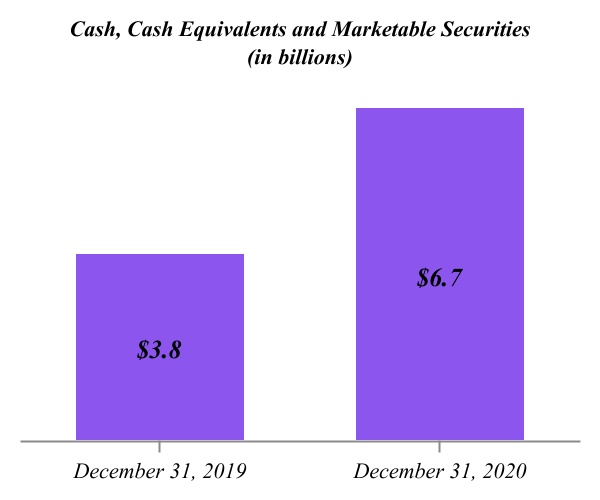
| Cash, cash equivalents and marketable securities | $ | 6,658,897 | $ | 3,808,294 | $ | 3,168,242 | $ | 2,088,666 | $ | 1,434,557 | |||||||||||||||||||
| Deferred tax assets (2) | 882,779 | 1,190,815 | 1,499,672 | — | — | ||||||||||||||||||||||||
| Total assets | 11,751,808 | 8,318,465 | 6,245,898 | 3,546,014 | 2,896,787 | ||||||||||||||||||||||||
| Total current liabilities | 1,877,533 | 1,334,827 | 1,120,290 | 807,260 | 792,537 | ||||||||||||||||||||||||
| Long-term finance leases | 539,042 | 538,576 | 581,550 | 583,902 | 521,335 | ||||||||||||||||||||||||
| Other long-term liabilities | 648,418 | 359,818 | 108,853 | 112,546 | 244,724 | ||||||||||||||||||||||||
| Total shareholders’ equity | 8,686,815 | 6,085,244 | 4,435.203 | 2,042,306 | 1,338,191 |
(1) Total costs and expenses included (i) in 2017, an intangible asset impairment charge of $255.3 million, and (ii) in 2020, 2019, 2018 and 2017, collaborative license and asset acquisition expenses of $184.6 million, $318.3 million, $111.9 million and $168.7 million, respectively. See Note B, “Collaborative Arrangements.”
(2) In 2018, we released the valuation allowance on the majority of our net operating losses and other deferred tax assets resulting in a benefit from income taxes of $1.56 billion in the fourth quarter of 2018 and we recorded a $1.50 billion deferred tax asset on our consolidated balance sheet as of December 31, 2018. In 2020 and 2019, we began recording a provision for income taxes on our pre-tax income approximating statutory rates. In 2020, our provision for income taxes included discrete tax benefits associated with the $209.0 million transfer of intellectual property rights to the U.K., the write-off of a long-term intercompany receivable, and an increase in the U.K.’s corporate tax rate. See Note O, “Income Taxes.” In 2017, we recorded a benefit from income taxes related to the impairment of an intangible asset.
Item 7. MANAGEMENT’S DISCUSSION AND ANALYSIS OF FINANCIAL CONDITION AND RESULTS OF OPERATIONS
OVERVIEW
We invest in scientific innovation to create transformative medicines for people with serious diseases with a focus on specialty markets. We have four approved medicines to treat cystic fibrosis, or CF, a life-threatening genetic disease, and we are focused on increasing the number of patients eligible and able to receive our current medicines through label expansions, approval of new medicines and expanded reimbursement. We are broadening our pipeline into additional disease areas through internal research efforts and accessing external innovation through business development transactions.
Our triple combination regimen, TRIKAFTA/KAFTRIO, was approved in 2019 in the United States, or U.S., and in 2020 in the European Union, or E.U. Collectively, our four medicines are approved to treat the majority of the approximately 83,000 people with CF in North America, Europe and Australia. We are evaluating our medicines, including our triple combination regimen, in additional patient populations, including younger children, with the goal of having small molecule treatments for up to 90% of people with CF. We are also pursuing genetic therapies to address the remaining 10% of people with CF.
Beyond CF, our small molecule programs include programs focused on developing treatments for alpha-1 antitrypsin, or AAT, deficiency, APOL1-mediated kidney diseases and pain. We are also focused on developing cell and genetic therapies for various diseases in our pipeline. We are evaluating CTX001, a genetic therapy, as a potential treatment for sickle cell disease, or SCD, and transfusion-dependent beta thalassemia, or TDT, in Phase 1/2 clinical trials in collaboration with CRISPR Therapeutics AG, or CRISPR. In T1D, we are pursuing two programs for the transplant of functional islets into patients: transplantation of islet cells alone, using immunosuppression to protect the implanted cells, and implantation of the islet cells inside a novel immunoprotective device. In 2020, we continued to advance our cell and genetic therapy pipeline programs through internal research efforts and investing in business development transactions to access emerging technologies.
Financial Highlights
Revenues
In 2020, our net product revenues continued to increase due to the approval of TRIKAFTA in late 2019 and uptake of our medicines in ex-U.S. markets following the approval of KAFTRIO and completion of several significant reimbursement agreements.
Expenses
Our total R&D and SG&A expenses increased from $2.41 billion in 2019 to $2.60 billion in 2020. In 2020, cost of sales was approximately 12% of our net product revenues.

Business Updates
Cystic Fibrosis
We expect to continue to grow our CF business through increasing the number of people with CF eligible and able to receive our medicines and providing improved treatment options for people who are already eligible for one of our medicines. Since the beginning of 2020, we have made important progress in activities supporting these efforts.
-
In August, the European Commission granted marketing authorization for KAFTRIO to treat people with CF 12 years of age and older with one F508del mutation and one minimal function mutation, or two F508del mutations.
-
The FDA expanded the eligibility for TRIKAFTA to include people with CF 12 years of age and older with certain mutations that are responsive to TRIKAFTA based on in vitro data. SYMDEKO and KALYDECO also received approvals to include additional responsive mutations in people with CF 6 years of age and older and 4 months of age and older, respectively.
-
In January 2021, the FDA accepted our supplemental New Drug Application, or sNDA, for TRIKAFTA for the treatment of children with CF 6 to 11 years of age with at least one F508del mutation or have certain mutations that are responsive to TRIKAFTA based on in vitro data. The FDA granted Priority Review of the sNDA.
-
The European Commission approved the label extension of SYMKEVI in combination with KALYDECO for the treatment of children with CF 6 years of age and older with two F508del mutations or one F508del mutation and certain residual function mutations.
-
The FDA approved KALYDECO for treatment of infants with CF four months of age and older who have at least one mutation in their CFTR gene that is responsive to KALYDECO.
-
The European Commission approved KALYDECO for treatment of infants with CF four months of age and older who have the R117H mutation or certain gating mutations.
Pipeline
We continue to advance a broad pipeline of potentially transformative small molecule, cell and genetic therapies aimed at treating serious diseases. Since the beginning of 2020, we have made important progress in activities supporting these efforts.
Beta Thalassemia and Sickle Cell Disease
*•*In December, we and our collaborator, CRISPR, announced positive interim data from 10 people with TDT or SCD treated with CTX001 and that 20 people with severe hemoglobinopathies have been dosed with CTX001 in the ongoing Phase 1/2 clinical trials. Enrollment and dosing are ongoing, and completion of enrollment in both clinical trials is expected in 2021.
Alpha-1 Antitrypsin Deficiency
-
Enrollment is ongoing in a Phase 2 proof-of-concept clinical trial for the corrector VX-864. We expect data from this clinical trial in the first half of 2021.
-
We discontinued development of VX-814, our first corrector, based on the safety and pharmacokinetic profile of VX-814 observed in a Phase 2 clinical trial.
APOL1-Mediated Kidney Diseases
- Enrollment is ongoing in a Phase 2 proof-of-concept clinical trial designed to evaluate the reduction of proteinuria in people with APOL1-mediated FSGS after treatment with VX-147. We expect data from this clinical trial in 2021.
Type 1 Diabetes
- We are developing a cell therapy designed to replace insulin-producing islet cells in patients with T1D. We are pursuing two programs for the transplant of these functional islets into patients: transplantation of islet cells alone,
using immunosuppression to protect the implanted cells, and implantation of the islet cells inside a novel immunoprotective device.
- In January 2021, the FDA cleared our IND for VX-880, the islet cells alone program. We expect to initiate a Phase 1/2 clinical trial evaluating this program in the first half of 2021. This clinical trial will involve an infusion of fully differentiated, functional islet cells, and chronic administration of concomitant immunosuppressive therapy, to protect the islet cells from immune rejection.
Investment in External Innovation
-
We entered into a collaboration with Skyhawk Therapeutics, Inc., or Skyhawk, for the discovery and development of novel small molecules that modulate RNA splicing for the treatment of serious diseases.
-
We entered into a new collaboration with Moderna, Inc., or Moderna, aimed at the discovery and development of lipid nanoparticles and mRNAs that can deliver gene-editing therapies to lung cells for the treatment of CF.
*•*We entered into a collaboration with Affinia Therapeutics, Inc., or Affinia, to gain access to a novel library of AAV capsids to support on our ongoing research and development efforts in genetic therapies, including DMD, DM1 and CF.
COVID-19
We continue to monitor the impacts of the COVID-19 global pandemic on our business. COVID-19 has not affected our supply chain or the demand for our medicines, and we believe that we will be able to continue to supply all of our approved medicines to patients globally. We have adjusted our business operations in response to COVID-19, with a majority of our employees continuing to work remotely. We continue to monitor local COVID-19 trends and g
Showing the first 8K of 81K characters. Open the full section
Item 7A. QUANTITATIVE AND QUALITATIVE DISCLOSURES ABOUT MARKET RISK
As part of our investment portfolio, we own financial instruments that are sensitive to market risks. The investment portfolio is used to preserve our capital. None of these market risk-sensitive instruments are held for trading purposes. We do not have derivative financial instruments in our investment portfolio.
Interest Rate Risk
We invest our cash in a variety of financial instruments, principally securities issued by the U.S. government and its agencies, investment-grade corporate bonds and commercial paper, and money market funds. These investments are denominated in U.S. Dollars. All of our interest-bearing securities are subject to interest rate risk and could decline in value if interest rates fluctuate, including potential fluctuations as a result of COVID-19. Substantially all of our investment portfolio consists of marketable securities with active secondary or resale markets to help ensure portfolio liquidity, and we have implemented guidelines limiting the term-to-maturity of our investment instruments. Due to the conservative nature of these instruments, we do not believe that we have a material exposure to interest rate risk. If interest rates were to increase or decrease by 1%, the fair value of our investment portfolio would increase or decrease by an immaterial amount.
We entered into a credit agreement in each of 2020 and 2019. Loans under these credit agreements bear interest, at our option, at either a base rate or a Eurocurrency rate, in each case plus an applicable margin based on our consolidated leverage ratio (the ratio of our total consolidated funded indebtedness to our consolidated EBITDA for the most recently completed four fiscal quarter period). Pursuant to the credit agreement that we entered into in 2019, the applicable margin on base rate loans ranges from 0.125% to 0.500% and the applicable margin on Eurocurrency loans ranges from 1.125% to 1.500%. Pursuant to the credit agreement that we entered into in 2020, the applicable margin on base rate loans ranges from 0.500% to 0.875% and the applicable margin on Eurocurrency loans ranges from 1.500% to 1.875%. We do not believe that changes in interest rates related to either credit agreement would have a material effect on our consolidated financial statements. As
of December 31, 2020, we had no principal or interest outstanding under either of our existing credit facilities. A portion of our “Interest expense” in 2021 will be dependent on whether, and to what extent, we borrow amounts under these existing facilities.
Foreign Exchange Market Risk
As a result of our foreign operations, we face exposure to movements in foreign currency exchange rates, primarily the Euro and British Pound against the U.S. Dollar. Fluctuations in the global markets, including as a result of COVID-19, may have a positive or negative effect on our foreign exchange rate exposure. The current exposures arise primarily from cash, accounts receivable, intercompany receivables and payables, payables and accruals and inventories. Both positive and negative effects to our net revenues from international product sales from movements in exchange rates are partially mitigated by the natural, opposite effect that exchange rates have on our international operating costs and expenses.
We have a foreign currency management program with the objective of reducing the effect of exchange rate fluctuations on our operating results and forecasted revenues and expenses denominated in foreign currencies. We currently have cash flow hedges for the Euro, British Pound, Canadian Dollar and Australian Dollar related to a portion of our forecasted product revenues that qualify for hedge accounting treatment under U.S. GAAP. We do not seek hedge accounting treatment for our foreign currency forward contracts related to monetary assets and liabilities that impact our operating results. As of December 31, 2020, we held foreign exchange forward contracts that were designated as cash flow hedges with notional amounts totaling $1.1 billion representing a net liability of $63.5 million recorded on our consolidated balance sheet.
Although not predictive in nature, we believe a hypothetical 10% threshold reflects a reasonably possible near-term change in exchange rates. Assuming that the December 31, 2020 exchange rates were to change by a hypothetical 10%, the fair value recorded on our consolidated balance sheet related to our foreign exchange forward contracts that were designated as cash flow hedges as of December 31, 2020 would change by approximately $109.2 million. However, since these contracts hedge a specific portion of our forecasted product revenues denominated in certain foreign currencies, any change in the fair value of these contracts is recorded in “Accumulated other comprehensive loss” on our consolidated balance sheet and is reclassified to earnings in the same periods during which the underlying product revenues affect earnings. Therefore, any change in the fair value of these contracts that would result from a hypothetical 10% change in exchange rates would be entirely offset by the change in value associated with the underlying hedged product revenues resulting in no impact on our future anticipated earnings and cash flows with respect to the hedged portion of our forecasted product revenues.
Equity Price Risk
Information required by this section is incorporated by reference from the discussion in the “Strategic Investments” section of this Part II, Item 7, “Management’s Discussion and Analysis of Financial Condition and Results of Operations.”
Item 8. FINANCIAL STATEMENTS AND SUPPLEMENTARY DATA
The information required by this Item 8 is contained on pages F-1 through F-49 of this Annual Report on Form 10-K.
Item 9. CHANGES IN AND DISAGREEMENTS WITH ACCOUNTANTS ON ACCOUNTING AND FINANCIAL DISCLOSURE
Not applicable.
Item 9A. CONTROLS AND PROCEDURES
(1) Evaluation of Disclosure Controls and Procedures. The Company’s chief executive officer and chief financial officer, after evaluating the effectiveness of the Company’s disclosure controls and procedures (as defined in Rule 13a-15(e) and Rule 15d-15(e) promulgated under the Securities Exchange Act of 1934, as amended) as of the end of the period covered by this Annual Report on Form 10-K, have concluded that, based on such evaluation, the Company’s disclosure controls and procedures were effective. In designing and evaluating the disclosure controls and procedures, the Company’s management recognized that any controls and procedures, no matter how well designed and operated, can provide only reasonable assurance of achieving the desired control objectives, and the Company’s management necessarily was required to apply its judgment in evaluating the cost-benefit relationship of possible controls and procedures.
(2) Management’s Annual Report on Internal Control Over Financial Reporting. The management of the Company is responsible for establishing and maintaining adequate internal control over financial reporting. Internal control over financial reporting is defined in Rule 13a-15(f) and Rule 15d-15(f) promulgated under the Securities Exchange Act of 1934, as amended, as a process designed by, or under the supervision of, the Company’s principal executive and principal financial officers and effected by the Company’s board of directors, management and other personnel, to provide reasonable assurance regarding the reliability of financial reporting and the preparation of financial statements for external purposes in accordance with generally accepted accounting principles. The Company’s internal control over financial reporting includes those policies and procedures that:
-
pertain to the maintenance of records that, in reasonable detail, accurately and fairly reflect the transactions and dispositions of the assets of the Company;
-
provide reasonable assurance that transactions are recorded as necessary to permit preparation of financial statements in accordance with generally accepted accounting principles, and that receipts and expenditures of the Company are being made only in accordance with authorizations of management and directors of the Company; and
-
provide reasonable assurance regarding prevention or timely detection of unauthorized acquisition, use or disposition of the Company’s assets that could have a material effect on the financial statements.
Because of its inherent limitations, internal control over financial reporting may not prevent or detect misstatements. Also, projections of any evaluation of effectiveness to future periods are subject to the risk that controls may become inadequate because of changes in conditions, or that the degree of compliance with the policies or procedures may deteriorate.
The Company’s management assessed the effectiveness of the Company’s internal control over financial reporting as of December 31, 2020. In making this assessment, it used the criteria set forth in the Internal Control—Integrated Framework (2013) issued by the Committee of Sponsoring Organizations of the Treadway Commission (COSO). Based on its assessment, the Company’s management has concluded that, as of December 31, 2020, the Company’s internal control over financial reporting is effective based on those criteria.
The Company’s independent registered public accounting firm, Ernst & Young LLP, issued an attestation report on the Company’s internal control over financial reporting. See Section 4 below.
(3) Changes in Internal Controls. During the quarter ended December 31, 2020, there were no changes in the Company’s internal control over financial reporting that materially affected, or are reasonably likely to materially affect, the Company’s internal control over financial reporting.
(4) Report of Independent Registered Public Accounting Firm
To the Shareholders and the Board of Directors of Vertex Pharmaceuticals Incorporated
Opinion on Internal Control over Financial Reporting
We have audited Vertex Pharmaceuticals Incorporated’s internal control over financial reporting as of December 31, 2020, based on criteria established in Internal Control-Integrated Framework issued by the Committee of Sponsoring Organizations of the Treadway Commission (2013 framework) (the COSO criteria). In our opinion, Vertex Pharmaceuticals Incorporated (the Company) maintained, in all material respects, effective internal control over financial reporting as of December 31, 2020, based on the COSO criteria.
We also have audited, in accordance with the standards of the Public Company Accounting Oversight Board (United States) (PCAOB), the 2020 consolidated financial statements of the Company and our report dated February 11, 2021, expressed an unqualified opinion thereon.
Basis for Opinion
The Company’s management is responsible for maintaining effective internal control over financial reporting and for its assessment of the effectiveness of internal control over financial reporting included in the accompanying Management’s Report on Internal Control Over Financial Reporting. Our responsibility is to express an opinion on the Company’s internal control over financial reporting based on our audit. We are a public accounting firm registered with the PCAOB and are required to be independent with respect to the Company in accordance with the U.S. federal securities laws and the applicable rules and regulations of the Securities and Exchange Commission and the PCAOB.
We conducted our audit in accordance with the standards of the PCAOB. Those standards require that we plan and perform the audit to obtain reasonable assurance about whether effective internal control over financial reporting was maintained in all material respects.
Our audit included obtaining an understanding of internal control over financial reporting, assessing the risk that a material weakness exists, testing and evaluating the design and operating effectiveness of internal control based on the assessed risk, and performing such other procedures as we considered necessary in the circumstances. We believe that our audit provides a reasonable basis for our opinion.
Definition and Limitations of Internal Control over Financial Reporting
A company’s internal control over financial reporting is a process designed to provide reasonable assurance regarding the reliability of financial reporting and the preparation of financial statements for external purposes in accordance with generally accepted accounting principles. A company’s internal control over financial reporting includes those policies and procedures that (1) pertain to the maintenance of records that, in reasonable detail, accurately and fairly reflect the transactions and dispositions of the assets of the company; (2) provide reasonable assurance that transactions are recorded as necessary to permit preparation of financial statements in accordance with generally accepted accounting principles, and that receipts and expenditures of the company are being made only in accordance with authorizations of management and directors of the company; and (3) provide reasonable assurance regarding prevention or timely detection of unauthorized acquisition, use, or disposition of the company’s assets that could have a material effect on the financial statements.
Because of its inherent limitations, internal control over financial reporting may not prevent or detect misstatements. Also, projections of any evaluation of effectiveness to future periods are subject to the risk that controls may become inadequate because of changes in conditions, or that the degree of compliance with the policies or procedures may deteriorate.
/s/ Ernst & Young LLP
Boston, Massachusetts
February 11, 2021
Item 9B. OTHER INFORMATION
Michael Parini, one of our current executive officers, has informed us that he will be leaving his position at our company effective March 1, 2021.
Stuart Arbuckle, one of our current executive officers, will assume additional responsibilities and be appointed to the position of EVP and Chief Commercial and Operations Officer, effective March 1, 2021.
Additional information regarding Mr. Arbuckle and Mr. Parini is provided in Part I, Item 1 of this Annual Report on Form 10-K.
PART III
Portions of our definitive Proxy Statement for the 2021 Annual Meeting of Shareholders, or 2021 Proxy Statement, are incorporated by reference into this Part III of our Annual Report on Form 10-K.
Item 10. DIRECTORS, EXECUTIVE OFFICERS AND CORPORATE GOVERNANCE
The information regarding directors required by this Item 10 will be included in our 2021 Proxy Statement and is incorporated herein by reference. We expect this information to be provided under “Election of Directors,” “Corporate Governance and Risk Management,” “Shareholder Proposals for the 2021 Annual Meeting and Nominations for Director,” “Delinquent Section 16(a) Reports” and “Code of Conduct.” The information regarding executive officers required by this Item 10 is included in Part I of this Annual Report on Form 10-K.
Item 11. EXECUTIVE COMPENSATION
The information required by this Item 11 will be included in the 2021 Proxy Statement and is incorporated herein by reference. We expect this information to be provided under “Compensation Committee Interlocks and Insider Participation,” “Compensation Discussion and Analysis,” “Compensation and Equity Tables,” “Director Compensation,” “Management Development and Compensation Committee Report” and/or “Corporate Governance and Risk Management.”
Item 12. SECURITY OWNERSHIP OF CERTAIN BENEFICIAL OWNERS AND MANAGEMENT AND RELATED STOCKHOLDER MATTERS
The information required by this Item 12 will be included in the 2021 Proxy Statement and is incorporated herein by reference. We expect this information to be provided under “Security Ownership of Certain Beneficial Owners and Management” and “Equity Compensation Plan Information.”
Item 13. CERTAIN RELATIONSHIPS AND RELATED TRANSACTIONS, AND DIRECTOR INDEPENDENCE
The information required by this Item 13 will be included in the 2021 Proxy Statement and is incorporated herein by reference. We expect this information to be provided under “Election of Directors,” “Corporate Governance and Risk Management,” and “Audit and Finance Committee.”
Item 14. PRINCIPAL ACCOUNTANT FEES AND SERVICES
The information required by this Item 14 will be included in the 2021 Proxy Statement and is incorporated herein by reference. We expect this information to be provided under “Ratification of the Appointment of Independent Registered Public Accounting Firm.”
PART IV
Item 15. EXHIBITS AND FINANCIAL STATEMENT SCHEDULES
(a)(1) The Financial Statements required to be filed by Items 8 and 15(c) of Form 10-K, and filed herewith, are as follows:
| Page Number in this Form 10-K | |||||
| Report of Independent Registered Public Accounting Firm | F-1 | ||||
| Consolidated Statements of Operations for the years ended December 31, 2020, 2019 and 2018 | F-3 | ||||
| Consolidated Statements of Comprehensive Income for the years ended December 31, 2020, 2019 and 2018 | F-4 | ||||
| Consolidated Balance Sheets as of December 31, 2020 and 2019 | F-5 | ||||
| Consolidated Statements of Shareholders’ Equity and Noncontrolling Interest for the years ended December 31, 2020, 2019 and 2018 | F-6 | ||||
| Consolidated Statements of Cash Flows for the years ended December 31, 2020, 2019 and 2018 | F-7 | ||||
| Notes to Consolidated Financial Statements | F-8 |
(a)(2) Financial Statement Schedules have been omitted because they are either not applicable or the required information is included in the consolidated financial statements or notes thereto listed in (a)(1) above.
(a)(3) Exhibits.
The following is a list of exhibits filed as part of this Annual Report on Form 10-K.
- Management contract, compensatory plan or agreement.
† Confidential portions of this document have been redacted according to the applicable rules.
Item 16. FORM 10-K SUMMARY
Not applicable.
SIGNATURES
Pursuant to the requirements of Section 13 or 15(d) of the Securities Exchange Act of 1934, the registrant has duly caused this report to be signed on its behalf by the undersigned, thereunto duly authorized.
| Vertex Pharmaceuticals Incorporated | ||||||||
| February 11, 2021 | By: | /s/ Reshma Kewalramani | ||||||
| Reshma Kewalramani Chief Executive Officer |
Pursuant to the requirements of the Securities Exchange Act of 1934, this report has been signed below by the following persons on behalf of the registrant and in the capacities and on the dates indicated.
| Name | Title | Date | |||||||||||||||||||||||||||||||||||||||
| /s/ Reshma Kewalramani | |||||||||||||||||||||||||||||||||||||||||
| Reshma Kewalramani | President, Chief Executive Officer and Director (Principal Executive Officer) | February 11, 2021 | |||||||||||||||||||||||||||||||||||||||
| /s/ Charles F. Wagner, Jr. | |||||||||||||||||||||||||||||||||||||||||
| Charles F. Wagner, Jr. | Executive Vice President and Chief Financial Officer (Principal Financial Officer) | February 11, 2021 | |||||||||||||||||||||||||||||||||||||||
| /s/ Paul M. Silva | |||||||||||||||||||||||||||||||||||||||||
| Paul M. Silva | Senior Vice President and Chief Accounting Officer (Principal Accounting Officer) | February 11, 2021 | |||||||||||||||||||||||||||||||||||||||
| /s/Jeffrey M. Leiden | |||||||||||||||||||||||||||||||||||||||||
| Jeffrey M. Leiden | Executive Chairman | February 11, 2021 | |||||||||||||||||||||||||||||||||||||||
| /s/ Sangeeta N. Bhatia | |||||||||||||||||||||||||||||||||||||||||
| Sangeeta N. Bhatia | Director | February 11, 2021 | |||||||||||||||||||||||||||||||||||||||
| /s/ Lloyd Carney | |||||||||||||||||||||||||||||||||||||||||
| Lloyd Carney | Director | February 11, 2021 | |||||||||||||||||||||||||||||||||||||||
| /s/ Alan Garber | |||||||||||||||||||||||||||||||||||||||||
| Alan Garber | Director | February 11, 2021 | |||||||||||||||||||||||||||||||||||||||
| /s/ Terrence C. Kearney | |||||||||||||||||||||||||||||||||||||||||
| Terrence C. Kearney | Director | February 11, 2021 | |||||||||||||||||||||||||||||||||||||||
| /s/ Yuchun Lee | |||||||||||||||||||||||||||||||||||||||||
| Yuchun Lee | Director | February 11, 2021 | |||||||||||||||||||||||||||||||||||||||
| /s/ Margaret G. McGlynn | |||||||||||||||||||||||||||||||||||||||||
| Margaret G. McGlynn | Director | February 11, 2021 | |||||||||||||||||||||||||||||||||||||||
| /s/ Diana McKenzie | |||||||||||||||||||||||||||||||||||||||||
| Diana McKenzie | Director | February 11, 2021 | |||||||||||||||||||||||||||||||||||||||
| /s/ Bruce I. Sachs | |||||||||||||||||||||||||||||||||||||||||
| Bruce I. Sachs | Director | February 11, 2021 |
Report of Independent Registered Public Accounting Firm
To the Shareholders and the Board of Vertex Pharmaceuticals Incorporated
Opinion on the Financial Statements
We have audited the accompanying consolidated balance sheets of Vertex Pharmaceuticals Incorporated (the Company) as of December 31, 2020 and 2019, the related consolidated statements of operations, comprehensive income, shareholders’ equity and noncontrolling interest, and cash flows for each of the three years in the period ended December 31, 2020, and the related notes (collectively referred to as the “consolidated financial statements”). In our opinion, the consolidated financial statements present fairly, in all material respects, the financial position of the Company at December 31, 2020 and 2019, and the results of its operations and its cash flows for each of the three years in the period ended December 31, 2020, in conformity with U.S. generally accepted accounting principles.
We also have audited, in accordance with the standards of the Public Company Accounting Oversight Board (United States) (PCAOB), the Company’s internal contro
Showing the first 8K of 224K characters. Open the full section