 filings.tools
Westinghouse Air Brake Technologies 10-K 2022-12-31
Filed 2023-02-15. 18 sections, 401K characters. Original on sec.gov · Markdown · JSON
Cover and table of contents
UNITED STATES
SECURITIES AND EXCHANGE COMMISSION
WASHINGTON, D.C. 20549
FORM 10-K
| ☒ | Annual Report Pursuant to Section 13 or 15(d) of the Securities Exchange Act of 1934 |
For the fiscal year ended December 31, 2022
OR
| ☐ | Transition Report Pursuant to Section 13 or 15(d) of the Securities Exchange Act of 1934 |
For the transition period from to
Commission file number 033-90866
WESTINGHOUSE AIR BRAKE TECHNOLOGIES CORPORATION
(Exact name of registrant as specified in its charter)
| Delaware | 25-1615902 | ||||
| (State or other jurisdiction of incorporation or organization) | (IRS Employer Identification No.) |
| 30 Isabella Street Pittsburgh, Pennsylvania 15212 | (412) 825-1000 | ||||
| (Address of principal executive offices, including zip code) | (Registrant’s telephone number) |
Securities registered pursuant to Section 12(b) of the Act:
| Class | Trading Symbol | Name of Exchange on which registered | ||||||
| Common Stock, par value $.01 per share | WAB | New York Stock Exchange |
Securities registered pursuant to Section 12(g) of the Act: None
Indicate by check mark if the registrant is a well-known seasoned issuer, as defined in Rule 405 of the Securities Act. Yes ☒ No ¨.
Indicate by check mark if the registrant is not required to file reports pursuant to Section 13 or 15(d) of the Act. Yes ¨ No ☒.
Indicate by check mark whether the registrant (1) has filed all reports required to be filed by Section 13 or 15(d) of the Securities Exchange Act of 1934 during the preceding 12 months (or for such shorter period that the registrant was required to file such reports) and (2) has been subject to such filing requirements for the past 90 days. Yes ☒ No ☐.
Indicate by check mark whether the registrant has submitted electronically every Interactive Data File required to be submitted pursuant to Rule 405 of Regulation S-T during the preceding 12 months (or for such shorter period that the registrant was required to submit and post such files) Yes ☒ No ¨.
Indicate by check mark whether the registrant is a large accelerated filer, an accelerated filer, a non-accelerated filer, a smaller reporting company, or an emerging growth company. See the definitions of “large accelerated filer,” “accelerated filer,” “smaller reporting company,” and "emerging growth company" in Rule 12b-2 of the Exchange Act.:
| Large accelerated filer | ☒ | Accelerated filer | ☐ | Non-accelerated filer | ☐ | ||||||||||||||||||
| Emerging growth company | ☐ | Smaller reporting company | ☐ |
If an emerging growth company, indicate by check mark if the registrant has elected not to use the extended transition period for complying with any new or revised financial accounting standards provided pursuant to Section 13(a) of the Exchange Act. ☐
Indicate by check mark whether the registrant has filed a report on and attestation to its management's assessment of the effectiveness of its internal control over financial reporting under Section 404(b) of the Sarbanes-Oxley Act (15 U.S.C. 7262(b)) by the registered public accounting firm that prepared or issued its audit report. ☒
If securities are registered pursuant to Section 12(b) of the Act, indicate by check mark whether the financial statements of the registrant included in the filing reflect the correction of an error to previously issued financial statements. ☐
Indicate by check mark whether any of those error corrections are restatements that required a recovery analysis of incentive-based compensation received by any of the registrant’s executive officers during the relevant recovery period pursuant to §240.10D-1(b). ☐
Indicate by check mark whether the registrant is a shell company (as defined in Rule 12b-2 of the Exchange Act). Yes ☐ No ☒.
The registrant estimates that as of June 30, 2022, the aggregate market value of the voting shares held by non-affiliates of the registrant was approximately $15.0 billion based on the closing price on the New York Stock Exchange for such stock.
As of February 10, 2023, 180,352,300 shares of Common Stock of the registrant were issued and outstanding.
DOCUMENTS INCORPORATED BY REFERENCE:
Portions of the Proxy Statement for the registrant’s Annual Meeting of Stockholders to be held on May 17, 2023 are incorporated by reference into Part III of this Form 10-K.
TABLE OF CONTENTS
PART I
Item 1. BUSINESS
General
Westinghouse Air Brake Technologies Corporation, doing business as Wabtec Corporation, is a Delaware corporation with headquarters at 30 Isabella Street in Pittsburgh, Pennsylvania. Our telephone number is 412-825-1000, and our website is located at www.wabteccorp.com. Except as the context otherwise requires, all references to “we”, “our”, “us”, the “Company” and “Wabtec” refer to Westinghouse Air Brake Technologies Corporation and its consolidated subsidiaries. George Westinghouse founded the original Westinghouse Air Brake Co. in 1869 when he invented the air brake. Westinghouse Air Brake Company (“WABCO”) was formed in 1990 when it acquired certain assets and operations from American Standard, Inc., now known as Trane (“Trane”). The Company went public on the New York Stock Exchange in 1995.
Throughout the years, the Company has made a number of strategic acquisitions leading the Company to where it is today. These have primarily included:
-
the 1999 merger with MotivePower Industries, Inc. whereby the Company adopted its current name of Westinghouse Air Brake Technologies Corporation, or Wabtec;
-
the 2017 acquisition of Faiveley Transport, S.A. (“Faiveley Transport”), a leading provider of value-added, integrated systems and services, primarily for the global transit rail market. Based in France, the Faiveley Transport business has roots to 1919 and made Wabtec a leader in manufacturing pantographs, automatic door mechanisms, air conditioning systems, railway braking systems and couplers; and,
-
the 2019 acquisition of GE Transportation, a business unit of General Electric Company. This brought a global technology leader and supplier of locomotives, equipment, services and digital solutions to the rail, mining, marine, stationary power and drilling industries into Wabtec.
As a result of those strategic acquisitions, as well as other smaller acquisitions and organic growth, Wabtec is now one of the world’s largest providers of value-added, technology-based locomotives, equipment, systems and services for the global freight rail and passenger transit industries, and also serves customers in the mining, marine, and industrial markets. Wabtec has approximately 27,000 employees, excluding contingent workers, and operations in over 50 countries. We hold a leading market share for many of our core product lines globally. Our highly engineered products, which are intended to enhance safety, improve productivity and reduce maintenance costs for customers, can be found on most locomotives, freight cars, passenger transit cars and buses around the world.
Through both internal growth as well as acquisitions, Wabtec has positioned itself with the following strategic strengths:
-
Diversity of revenues by product, geography and market. Comprehensive product and service offerings spanning the freight rail and passenger transit industries, as well as products in the bus, mining, marine, and discrete industrial markets help Wabtec to balance the cyclical nature of the global rail business.
-
Significant operating synergies and improved financial profile. The acquisition and integration of GE Transportation has led to operating synergies across all of Wabtec. Wabtec continues to focus on realizing operating synergies from smaller strategic bolt-on acquisitions as well as driving operational efficiencies through the previously announced Integration 2.0 initiative, a three-year strategic initiative that targets operational synergies and supports Wabtec's margin improvement through productivity gains. Wabtec is also focused on earnings growth through expanding high-margin recurring revenue streams.
-
Exceptional technical and engineering expertise. Wabtec's engineers and technical capabilities support continued focus on innovative product development and efforts to achieve scalable technologies. Our technology expertise and investment in technology is key for Wabtec leading the decarbonization of the rail industry.
-
Scale of Wabtec’s operations. Wabtec is one of the world’s largest providers of technology-enabled locomotives and equipment, freight car components, systems, and services for the freight rail and passenger transit industries. The size of Wabtec's operations enables the Company to achieve economies of scale, in addition to using best-cost locations for executing on operational decisions.
-
Complementary Digital and Electronics technologies. Wabtec has a comprehensive digital and electronics portfolio and leading engineering and technical intellectual property, which provides electronics and digital technologies to meet growing demand for train intelligence and network optimization.
-
Enhanced Aftermarket and Services opportunities. Wabtec has an installed base of more than 23,000 locomotives and content on virtually all North American locomotives and freight cars, as well as a diverse offering of Transit
locomotives and cars both internationally and domestically, which enables significant opportunities in the higher-margin aftermarket parts and services business and mitigates the exposure to cycles.
Industry Overview
The Company primarily serves the global freight rail and passenger transit industries. As such, our operating results are largely dependent on the level of activity, financial condition and capital spending plans of freight railroads and passenger transit agencies around the world, and transportation equipment manufacturers who serve those markets. Many factors influence these industries, including general economic conditions; traffic volumes, as measured by freight carloads and passenger ridership; government spending on public transportation; and investment in new technologies. In general, trends such as urbanization and growth in developing markets, sustainability and environmental awareness, investment in technology solutions, an aging equipment fleet, and growth in global trade are expected to drive continued investment in freight rail and passenger transit.
The Association of the European Rail Industry, UNIFE, advocates for and represents European train builders and rail suppliers. UNIFE publishes a biennial market study that provides an overview of the market in its current form and a forecast of its future development in different regions and market segments. The 2022 biennial edition of the study concluded that the rail supply industry faced a moderate annual decline of 0.2% in the 2019 to 2020 period as a result of the negative impacts of the COVID-19 pandemic but forecasts a recovery of the global rail supply market with a compound annual growth rate of 3% through 2027.
As growth continues, Wabtec expects to have additional opportunities to provide products and services in these markets. New technologies offered by Wabtec can provide solutions to improve safety, cost and reliability of rail, as well as support the modernization of the global rail fleets. Consistent with the 2020 UNIFE study, increased investment in infrastructure improvements, digitalization and automation is expected, all of which would improve efficiency in the global rail industry.
Business Segments and Products
We provide our products and services through two principal business segments, the Freight Segment and the Transit Segment, both of which have different market characteristics and business drivers. The Freight Segment primarily manufactures new locomotives; provides aftermarket parts and services to existing locomotives; provides components to new and existing freight cars; builds new commuter locomotives; supplies rail control and infrastructure products including electronics, positive train control equipment, signal design and engineering services; provides a comprehensive suite of software-enabled solutions designed to improve customer efficiency and productivity in the transportation and mining industries; overhauls locomotives; and provides heat exchangers and cooling systems for rail and othe
Showing the first 8K of 64K characters. Open the full section
Item 1A. RISK FACTORS
RISKS RELATED TO OUR BUSINESS AND OPERATIONS
We are dependent upon key customers.
We rely on several key customers who represent a significant portion of our business. While we believe our relationships with our customers are generally good, our top customers could choose to reduce or terminate their relationships with Wabtec. In addition, many of our customers place orders for products on an as-needed basis and operate in cyclical industries. As a result, customer order levels have varied from period to period in the past and may vary significantly in the future. Such customer orders are dependent upon their markets and customers and may be subject to delays and cancellations. Furthermore, the average service life of certain products in our end markets has increased in recent years due to innovations in technologies and manufacturing processes, which has also allowed end users to replace parts less often. As a result of our dependence on our key customers, we could experience a material adverse effect on our business, results of operations and financial condition if we lost any one or more of our key customers or if there is a reduction in their demand for our products.
Our business operates in a highly competitive industry.
We operate in a global, competitive marketplace and face substantial competition from a limited number of established competitors, some of which may have greater financial resources than we do, may have a more extensive low-cost sourcing
strategy and presence in low-cost regions than we do, or may receive significant governmental support. Price competition is strong and, coupled with the existence of a number of cost-conscious customers with significant negotiating power, has historically limited our ability to increase prices. In addition to price, competition is based on product performance and technological leadership, quality, reliability of delivery, and customer service and support. If our competitors invest heavily in innovation and develop products that are more efficient or effective than our products, we may not be able to compete effectively. There can be no assurance that competition in one or more of our markets will not adversely affect us and our results of operations.
A failure to predict and react to customer demand could adversely affect our business.
If we are unable to accurately forecast demand for our existing products or to react appropriately to changes in demand, we may experience delayed product shipments and customer dissatisfaction. If demand increases significantly from current levels, both we and our suppliers may have difficulty meeting such demand, particularly if such demand increases occur rapidly. Alternatively, we may carry excess inventory if demand for our products decreases below projected levels.
Additionally, we have dedicated significant resources to the development, manufacturing and marketing of new products. Decisions to develop and market new transportation products are typically made without firm indications of customer acceptance. Moreover, by their nature, new products may require alteration of existing business methods or threaten to displace existing equipment in which our customers may have a substantial capital investment. There can be no assurance that any new products that we develop will gain widespread acceptance in the marketplace or that such products will be able to compete successfully with other new products or services that may be introduced by competitors. Furthermore, we may incur additional warranty or other costs as new products are tested and used by customers.
Failure to accurately predict and react to customer demand could have a material adverse effect on our business, results of operations and financial condition.
We may fail to respond adequately or in a timely manner to innovative changes in new technology.
In recent years, the global transportation landscape has been characterized by rapid changes in technology, leading to innovative transportation and logistics concepts that could change the way the railway industry does business. There may be additional innovations impacting the railway industry that we cannot yet foresee. Any failure by us to quickly adapt to and adopt new innovations in products and processes desired by our customers may result in a significant loss of demand for our product and service offerings. In addition, advances in technology may require us to increase investments in order to remain competitive, and our customers may not be willing to accept higher prices to cover the cost of these investments.
Our revenues are subject to cyclical variations in the railway and passenger transit markets and changes in government spending.
The railway industry historically has been subject to significant fluctuations due to overall economic conditions, the use of alternate methods of transportation and the levels of government spending on railway projects. In economic downturns, railroads have deferred, and may defer, certain expenditures in order to conserve cash in the short term. For example, the economic slowdown that was caused by COVID-19 impacted the timing of some orders, as customers deferred the delivery of some goods and services to future years. Reductions in freight traffic may reduce demand for our replacement products.
The passenger transit railroad industry is also cyclical and is influenced by a variety of factors. New passenger transit car orders vary from year to year and are influenced by a variety of factors, including major replacement programs, the construction or expansion of transit systems by transit authorities and the quality and cost of alternative modes of transportation. To the extent that future funding for proposed public projects is curtailed or withdrawn altogether as a result of changes in political, economic, fiscal, or other conditions beyond our control, such projects may be delayed or canceled, resulting in a potential loss of business for us, including transit aftermarket and new transit car orders. There can be no assurance that economic conditions will be favorable or that there will not be significant fluctuations adversely affecting the industry as a whole and Wabtec.
Our backlog is not necessarily indicative of the level of our future revenues.
Our backlog represents future production and estimated potential revenue attributable to firm contracts with, or written orders from, our customers for delivery in various periods. Instability in the global economy, negative conditions in the global credit markets, volatility in the industries that our products serve, changes in legislative policy, adverse changes in the financial condition of our customers, adverse changes in the availability of raw materials and supplies, or un-remedied contract breaches could possibly lead to contract termination or cancellations of orders in our backlog or request for deferred deliveries of our backlog orders, each of which could adversely affect our cash flows and results of operations. For example, although the economic slowdown caused by COVID-19 did not result in any material cancellations of the Company's backlog, it did impact the timing of some orders in backlog as, in certain cases, the delivery of goods and services were pushed out from their original timelines.
Equipment failures, interruptions, delays in deliveries or extensive damage to our facilities, supply chains, distribution systems or information technology systems, could adversely affect our business.
All of our facilities, equipment, supply chains, distribution systems and information technology systems are subject to the risk of catastrophic loss due to unanticipated events, such as cyber-attacks, disease outbreak, fires, earthquakes, explosions, floods, tornadoes, hurricanes or weather conditions. An interruption in our manufacturing capabilities, supply chains, distribution systems or information technology systems, whether as a result of such catastrophic loss or any other reason, could reduce, prevent or delay our production and shipment of our product offerings, result in defective products or services, damage customer relationships and our reputation and result in legal exposure and large repair or replacement expenses. This could result in the delay or termination of orders, the loss of future sales and a negative impact to our reputation with our customers.
Third-party insurance coverage that we maintain with respect to such matters will vary from time to time in both type and amount depending on cost, availability and our decisions regarding risk retention, and may be unavailable or insufficient to protect us against losses. Any of these risks coming to fruition could materially adversely affect our business, results of operations and financial condition.
Disruption of our supply chain could have an adverse impact on our business, financial condition, and results of operations.
Our ability to make, move, and sell our products is critical to our success. Damage or disruption to our supply chain, including third-party manufacturing or transportation and distribution capabilities, could impair our ability to manufacture or sell our products. Failure to take adequate steps to mitigate the likelihood or potential impact of disruptions, or to effectively manage such events if they occur, particularly when a product is sourced from a single supplier or location, could adversely affect our business or financial results. Due to the ongoing impacts and uncertainty of continued impacts of the COVID-19 pandemic and the global government actions to contain it, some of our supply chains, particularly in China, India, the U.S., and Europe, have been, and continue to be, impacted. Supply chain disruptions and labor availability have caused component and chip shortages resulting in an adverse effect on the timing of the Company’s revenue generation. Additionally, broad-based inflation, escalation of metals and commodities costs, transportation and logistics costs and labor costs have all resulted from the COVID-19 pandemic. There can be no assurance that there will not be further, or deeper, supply chain disruptions, or that the steps we are taking to mitigate such disruptions will be effective or achieve their desired results in a timely fashion.
In addition, disputes with significant suppliers, including disputes regarding pricing or performance, could adversely affect our ability to supply products to our customers and could materially and adversely affect our product sales, financial condition, and results of operations.
We intend to pursue acquisitions, joint ventures and alliances that involve a number of inherent risks, any of which may cause us not to realize anticipated benefits.
One aspect of our business strategy is to selectively pursue acquisitions, joint ventures and alliances that we believe will improve our market position and provide opportunities to realize operating synergies. These transactions involve inherent risks and uncertainties, any one of which could have a material adverse effect on our business, results of operations and financial condition including:
-
difficulties in achieving identified financial and operating synergies, including the integration of operations, services and products;
-
diversion of management’s attention from other business concerns;
-
the assumption of unknown liabilities; and
-
unanticipated changes in the market conditions, business and economic factors affecting such an acquisition, joint venture or alliance.
We cannot assure that we will be able to consummate any future acquisitions, joint ventures or other business combinations. If we are unable to identify or consummate suitable acquisitions, joint ventures or alliances, we may be unable to fully implement our business strategy, and our business and results of operations may be adversely affected as a result. In addition, our ability to engage in such strategic transactions will be dependent on our ability to raise substantial capital, and we may not be able to raise the funds necessary to implement this strategy on terms satisfactory to us, if at all.
The integration of our recently completed acquisitions may not result in anticipated improvements in market position or the realization of anticipated operating synergies or may take longer to realize than expected.
Although we believe that our recent acquisitions will improve our market position and realize positive operating results, including operating synergies, operating expense reductions and overhead cost savings, we cannot be assured that these improvements will be obtained or the timing of such improvements. The management and acquisition of businesses involves substantial risks, any of which may result in a material adverse effect on our business and results of operations, including:
-
the uncertainty that an acquired business will achieve anticipated operating results;
-
significant expenses to integrate;
-
diversion of management’s attention from business operations to integration matters;
-
departure of key personnel from the acquired business;
-
effectively managing entrepreneurial spirit and decision-making;
-
integration of different information systems;
-
unanticipated costs and exposure to unforeseen liabilities; and
-
impairment of assets.
The effects of COVID-19 and other potential future public health crises, epidemics, pandemics or similar events on our business, operating results and cash flows are uncertain.
We face a wide variety of risks related to health epidemics, pandemics and similar outbreaks, including the global outbreak of COVID-19. Since first reported in late 2019, the COVID-19 pandemic has dramatically impacted the global health and economic environment, including millions of confirmed cases, business slowdowns or shutdowns, government challenges and market volatility of an unprecedented nature. Although we have, to date, managed to continue our operations, we cannot predict the future course of events nor can we assure that this global pandemic, including its economic impact, will not have a material adverse impact on our business, financial position, results of operations and/or cash flows. The extent of the impact of the COVID-19 pandemic on our operational and financial performance remains uncertain and will depend on future pandemic related developments, including the duration of the pandemic, any potential subsequent waves of COVID-19 and new strains of the virus, the effectiveness, distribution and acceptance of COVID-19 vaccines, and related government actions to prevent and manage disease spread, all of which are uncertain and cannot be predicted. Our operations may be further impacted by the COVID-19 pandemic if significant portions of our workforce are unable to work effectively, including because of illness, quarantines, travel restrictions or absenteeism; steps the company has taken to protect health and well-being; government actions; facility closures; work slowdowns or stoppages; inadequate supplies or resources (such as reliable personal protective equipment, testing and vaccines); or other circumstances related to COVID-19. Governments around the world have taken steps to mitigate some of the more severe anticipated economic effects, but there can be no assurance that such steps will be effective or achieve their desired results in a timely fashion.
The COVID-19 pandemic has resulted in operational and supply chain disruptions for us and our customers and may further adversely affect operations and the operations of our customers and suppliers. Accordingly, COVID-19 had a materially adverse impact on our operations and business results for the years ended December 31, 2021, and 2020. Supply chain disruptions and shortages in labor availability have caused component and chip shortages, which have resulted in adverse effects on the timing of our revenue generation. Additionally, broad-based inflation, escalation of metals and commodities costs, transportation and logistics costs and labor costs have all resulted from the COVID-19 pandemic and have adversely impacted our business. The spread of COVID-19, and the emergence of new strains of the virus, have caused us to modify our business practices and to implement significant proactive measures to protect the health and safety of employees, and we may take further actions as may be required by government authorities or as we determine are appropriate under the circumstances. There is no certainty that such measures will be sufficient to mitigate the continued risks posed by the pandemic.
The COVID-19 pandemic and related volatility in financial markets and deterioration of national and global economic conditions could affect our business and operations in a variety of ways. For example, we have experienced and could experience further operational disruptions and financial losses as a result of the following:
-
a decrease in demand for our products as a result of COVID-19 and cost control measures implemented by our customers;
-
delays in orders or delivery of orders, the occurrence of which negatively impacts our cash conversion cycle and ability to convert our backlog into cash;
-
inability to collect full or partial payments from customers due to deterioration in customer liquidity, including customer bankruptcies;
-
a shutdown of one or multiple of our manufacturing facilities due to government restrictions or illness in connection with COVID-19.
The continued spread of COVID-19 has also led to disruption and volatility in the global capital markets, which depending on future developments may make it more costly or difficult for us to obtain debt or equity financing, including to refinance our existing debt, or to identify or execute on investment opportunities, in each case on terms and within time periods
acceptable to us. We are also monitoring the impacts of COVID-19 on the fair value of our assets. While we do not currently anticipate any material impairments on our assets as a result of COVID-19, future changes in expectations for sales, earnings and cash flows related to intangible assets and goodwill below our current projections could cause these assets to be impaired.
We continue to work with our stakeholders (including customers, employees, suppliers and local communities) in an effort to address responsibly this global pandemic. We continue to monitor the situation, to assess further possible implications to our employees, business, supply chain and customers, and to take certain actions in an effort to mitigate various adverse consequences. However, uncertainty around general global economic and market conditions, exacerbated by the COVID-19 pandemic, will have an impact on our sales and operations in 2023 and beyond.
We expect that the longer the COVID-19 pandemic, including its economic disruption, continues, the greater the adverse impact on our business operations, financial performance and results of operations could be. Given the tremendous uncertainties and variables, we cannot at this time predict the impact of the global COVID-19 pandemic, or any future pandemic, but any one could have a material adverse impact on our business, financial position, results of operations and/or cash flows.
RISKS RELATED TO INTERNATIONAL OPERATIONS
A significant portion of our sales may be derived from our international operations, which exposes us to certain risks inherent in doing business on an international level.
For the fiscal year ended December 31, 2022, approximately 55% of our consolidated net sales were to customers outside of the United States. We intend to continue to expand our international operations, including in emerging markets, in the future. Our global headquarters for the Transit group is located in France, and we conduct other international operations through a variety of wholly and majority-owned subsidiaries and joint ventures, including in Australia, Austria, Brazil, Canada, China, Czech Republic, France, Germany, India, Italy, Kazakhstan/Commonwealth of Independent States ("CIS"), Macedonia, Mexico, the Netherlands, Poland, Spain, South Africa, Turkey, and the United Kingdom. As a result, we are subject to various risks, any one of which could have a material adverse effect on those operations and on our business as a whole, including:
-
lack of complete operating control;
-
lack of local business experience;
-
currency exchange fluctuations and devaluations;
-
restrictions on currency conversion or the transfer of funds or limitations on our ability to repatriate income or capital;
-
the complexities of operating within multiple tax jurisdictions;
-
foreign trade restrictions and exchange controls;
-
adverse impacts of international trade policies, such as import quotas, capital controls or tariffs;
-
difficulty enforcing agreements and intellectual property rights;
-
the challenges of complying with complex and changing laws, regulations, and policies of foreign governments;
-
the difficulties involved in staffing and managing widespread operations;
-
the potential for nationalization of enterprises;
-
economic, political and social instability;
-
potential reputational harm associated with doing business in certain countries;
-
possible local catastrophes, such as natural disasters and epidemics; and
-
possible terrorist attacks, conflicts and wars, including those against American interests.
Our exposure to the risks associated with international operations may intensify if our international operations expand in the future.
We may incur increased costs or margin degradation due to fluctuations in interest rates and foreign currency exchange rates.
In the ordinary course of business, we are exposed to increases in interest rates that may adversely affect funding costs associated with variable-rate debt and changes in foreign currency exchange rates. We are subject to currency exchange rate risk to the extent that our costs may be denominated in currencies other than those in which we earn and report revenues and vice versa. In addition, a decrease in the value of any of these currencies relative to the U.S. dollar could reduce our profits from non-U.S. operations and the translated value of the net assets of our non-U.S. operations when reported in U.S. dollars in our consolidated financial statements. We may seek to minimize these risks through the use of interest rate swap contracts and
currency hedging agreements. There can be no assurance that any of these measures will be effective. Material changes in interest or exchange rates could result in material losses to us.
We have substantial operations located in emerging markets, and are subject to regulatory, economic, social and political uncertainties in such markets.
We have substantial operations located in emerging markets, such as Brazil, India, and Kazakhstan. Operations in such emerging markets are inherently risky due to a number of regulatory, economic, social and political uncertainties. These risks include economies that may be dependent on only a few products and are therefore subject to significant fluctuations, weak legal systems which may affect our ability to enforce contractual rights, possible exchange controls, unstable governments, nationalization or privatization actions or other government actions affecting the flow of goods and currency.
Significant changes in economic and regulatory policy in emerging countries as well as social or political uncertainties could significantly harm business and economic conditions in these markets generally and could disproportionately impact the rail industry, which could adversely affect our business and prospects in these markets.
In addition, physical and financial infrastructure may be less developed in some emerging countries than that of many developed nations. Any disruptions with respect to banking and financial infrastructure, communication systems or any public facility, including transportation infrastructure, could disrupt our normal business activity. Such disruptions could interrupt our business operations and significantly harm our results of operations, financial condition and cash flows.
The ongoing conflict between Russia and Ukraine may adversely affect our business and results of operations.
Given the nature of our business and our global operations, political, economic, and other conditions in foreign countries and regions, including geopolitical risks such as those arising from the current conflict between Russia and Ukraine, has and may continue to adversely affect our business and results of operations. The broader consequences of this conflict, which may include further sanctions, embargoes, regional instability, and geopolitical shifts; disruptions to transportation and distribution routes, or strategic decisions to alter certain routes; potential retaliatory action by the Russian government against companies, including us, including nationalization of foreign businesses and/or assets in Russia; increased tensions between the United States and countries in which we operate; and the extent of the conflict’s effect on our business and results of operations as well as the global economy, cannot be predicted.
Additionally, Wabtec has operations and a strategic joint venture in Kazakhstan that have continued operating but have incurred supply, distribution and currency impacts as an indirect result from the Russian invasion of Ukraine. To date, the operations in Kazakhstan have not been significantly impacted by the ongoing conflict outside of the overall unfavorable impact to economic conditions; however, the future impact to these operations cannot be predicted.
To the extent the current conflict between Russia and Ukraine adversely affects our business, particularly in Russia and Kazakhstan, it may also have the effect of heightening many other risks disclosed in this Annual Report, any of which could materially and adversely affect our business and results of operations. Such risks include, but are not limited to, adverse effects on macroeconomic conditions, including inflation and business spending; disruptions to our global technology infrastructure, including through cyberattack, ransom attack, or cyber-intrusion; adverse changes in international trade policies and relations; our ability to maintain or increase our prices, our ability to implement and execute our business strategy, disruptions in global supply chains, our exposure to foreign currency fluctuations, and constraints, volatility, or disruption in the capital markets, difficulty staffing and managing impacted operations, and the recoverability of assets in the region.
RISKS RELATED TO MACRO-ECONOMIC CONDITIONS AND POLICIES
Prolonged unfavorable economic and market conditions could adversely affect our business.
Unfavorable general economic and market conditions in the United States and internationally, particularly in our key end markets, could have a negative impact on our sales and operations. To the extent that these factors result in continued instability of capital markets, shortages of raw materials or component parts, longer sales cycles, deferral or delay of customer orders or an inability to market our products effectively, our business and results of operations could be materially adversely affected.
We may be exposed to raw material shortages, supply shortages, fluctuations in raw material, energy and commodity prices, and inflationary pressure.
We purchase energy, steel, aluminum, copper, rubber and rubber-based materials, chemicals, polymers and other key manufacturing inputs from outside sources, and traditionally have not had long-term pricing contracts with our pure raw material suppliers. The costs of these raw materials have been volatile historically and are influenced by factors that are outside our control, including inflationary pressure. If we are unable to pass increases in the costs of our raw materials on to our customers, experience a lag in our ability to pass increases to our customers, or operational efficiencies are not achieved, our operating margins and results of operations may be materially adversely affected.
Our businesses compete globally for key production inputs. In addition, we rely upon third-party suppliers, including certain single-sourced suppliers, for various components for our products. In the event of a shortage or discontinuation of certain raw materials or key inputs, we may experience challenges sourcing certain of our components to meet our production requirements and may not be able to arrange for alternative sources of certain raw materials or key inputs. Any such shortage may materially adversely affect our competitive position versus companies that are able to better or more cheaply source such raw materials or key inputs.
Changes to international trade policies, including tariffs and foreign trade restrictions, could adversely affect our business.
As a global transportation company, we generate export sales from our U.S. operations and also derive international sales through our foreign subsidiaries, licensees and joint ventures. We also do business with industry suppliers located in various international markets. A protectionist trade environment in either the United States or those foreign countries in which we do business, such as a change in the current tariff structures, export compliance or other trade policies, may adversely affect our business. In particular, such policies may impact or delay our customers' investments in our products, reduce the competitiveness of our products in certain markets, and inhibit our ability to cost-effectively purchase necessary inputs from certain suppliers. In addition, to the extent developments in international trade relations result in reduced global trade or slower growth in global trade, it is likely that this would result in reductions in investment in freight and transit rail.
International trade policies are affected by a diverse array of factors, including global and national economic and political conditions, which make it impossible for us to predict future developments regarding tariffs and other trade restrictions. Although we actively monitor developments in international trade and proactively engage in efforts to mitigate the effect of trade policies, there can be no guarantee that these efforts will be successful.
LEGAL AND REGULATORY RISKS
We are subject to a variety of laws and regulations, including anti-corruption laws, in various jurisdictions.
We are subject to various laws, rules and regulations administered by authorities in jurisdictions in which we do business, such as the anti-corruption laws of the U.S. Foreign Corrupt Practices Act, the French Law n° 2016-1691 (Sapin II) and the U.K. Bribery Act, relating to our business and our employees. We are also subject to other laws and regulations governing our international operations, including regulations administered by the U.S. Department of Commerce’s Bureau of Industry and Security, the U.S. Department of Treasury’s Office of Foreign Assets Control, and various non-U.S. government entities, including applicable export control regulations, economic sanctions on countries and persons, customs requirements, currency exchange regulations, and transfer pricing regulations. Despite our policies, procedures and compliance programs, our internal controls and compliance systems may not be able to protect us from prohibited acts willfully committed by our employees, agents or business partners that would violate such applicable laws and regulations. Any such improper acts could damage our reputation, subject us to civil or criminal judgments, fines or penalties, and could otherwise disrupt our business, and as a result, could materially adversely impact our business, results of operations and financial condition.
In addition, our manufacturing operations and products are subject to safety, operations, maintenance and mechanical standards, rules and regulations enforced by various federal and state agencies and industry organizations both domestically and internationally. Our business may be adversely impacted by new rules and regulations or changes to existing rules or regulations, which could require additional maintenance or substantial modification or refurbishment of certain of our products or could make such products obsolete or require them to be phased out prior to their useful lives. We are unable to predict what impact these or other regulatory changes may have, if any, on our business or the industry as a whole. We cannot assure that costs incurred to comply with any new standards or regulations will not be material to our business, results of operations and financial condition.
We are subject to a variety of environmental laws and regulations.
We are subject to a variety of increasingly stringent environmental laws and regulations governing air emissions, discharges into water, chemical substances in products, the use, handling, storage, and disposal of hazardous substances or waste materials, as well as the remediation of contamination associated with releases of hazardous substances. We have incurred, and will continue to incur, both operating and capital costs to comply with environmental laws and regulations, including costs associated with the clean-up and investigation of some of our current and former properties and offsite disposal locations. We believe our operations currently comply in all material respects with all of the various environmental laws and regulations applicable to our business; however, there can be no assurance that environmental requirements will not change in the future or that we will not incur significant costs to comply with such requirements. Failure to comply with environmental laws and regulations could have significant consequences on our business and results of operations, including the imposition of substantial fines and sanctions for violations, injunctive relief (including requirements that we limit or cease operations at affected facilities), and reputational risk.
In addition, certain of our products are subject to extensive, and increasingly stringent, statutory and regulatory requirements governing, e.g., emissions and noise, including standards imposed by the U.S. Environmental Protection Agency,
the European Union and other regulatory agencies around the world. We have made, and will continue to make, significant capital and research expenditures relating to compliance with these standards. The successful development and introduction of new and enhanced products in order to comply with new regulatory requirements are subject to other risks, such as delays in product development, cost over-runs and unanticipated technical and manufacturing difficulties. In addition to these risks, the nature and timing of government implementation and enforcement of these standards-particularly in emerging markets-are unpredictable and subject to change.
Future climate change regulation could result in increased operating costs, affect the demand for our products or affect the ability of our critical suppliers to meet our needs.
Management believes it is reasonably likely that the scientific and political attention to issues concerning the existence and extent of climate change, and the role of human activity in it, will continue, with the potential for further regulation that affects the company’s operations and products. The potential challenges posed by evolving climate change policy and prospective legislation are heavily dependent on the nature and degree of such legislation and the extent to which it applies to our industry. Although uncertain, these developments could increase costs or reduce the demand for the products the company sells. The Company’s manufacturing and service operations typically result in emissions of greenhouse gases. Likewise, emissions arise from midstream and downstream operations, including operations of our locomotives and other products. Finally, although beyond the control of the company, the use of fuels and related products by operators also results in greenhouse gas emissions that may be regulated. International agreements, domestic legislation and regulatory measures to limit greenhouse gas emissions are currently in various phases of discussion or implementation. While we are carefully monitoring developments, at this time, we cannot predict the ultimate impact of climate change and climate change legislation on our operations. Any laws or regulations that may be adopted to restrict or reduce emissions of greenhouse gas could require us to incur increased operating costs and could have an adverse effect on demand for our products. In addition, the price and availability of certain of the raw materials that we use could vary in the future as a result of environmental laws and regulations affecting our suppliers. An increase in the price of our raw materials or a decline in their availability could adversely affect our operating margins or result in reduced demand for our products.
The occurrence of litigation in which we are, or could be, named as a defendant is unpredictable.
From time to time, we are subject, directly or through our subsidiaries, to litigation or other commercial disputes and other legal and regulatory proceedings with respect to our business, customers, suppliers, creditors, stockholders, product liability (including, asbestos claims), intellectual property infringement, competition and antitrust claims, warranty claims or environmental-related matters.
Due to the inherent uncertainties of any litigation, commercial disputes or other legal or regulatory proceedings, we cannot accurately predict their ultimate outcome, including the outcome of any related appeals. We may incur significant expense to defend or otherwise address current or future claims. Although we maintain insurance policies for certain risks, we cannot make assurances that this insurance will be adequate to protect us from all material judgments and expenses related to potential future claims or that these levels of insurance will be available in the future at economical prices or at all. In addition, although in some cases we may be indemnified by non-affiliated entities that retain liabilities in connection with specific matters, there can be no assurance that these indemnitors will remain financially viable and capable of satisfying their obligations.
Any litigation, even a claim without merit, could result in substantial costs and diversion of resources and could have a material adverse effect on our business and results of operations.
Our manufacturer’s warranties or product liability may expose us to potentially significant claims.
We warrant the workmanship and materials of many of our products. Accordingly, we are subject to a risk of product liability or warranty claims in the event that the failure of any of our products results in personal injury or death or does not conform to our customers’ specifications. In addition, in recent years, we have introduced a number of new products for which we do not have a history of warranty experience. Although we currently maintain liability insurance coverage, we cannot assure that product liability claims, if made, would not exceed our insurance coverage limits or that insurance will continue to be available on commercially acceptable terms, if at all. The possibility exists for these types of warranty claims to result in costly product recalls, significant repair costs and damage to our reputation.
Expectations relating to environmental, social and governance considerations expose us to potential liabilities, increased costs, reputational harm, and other adverse effects on our business.
Many governments, regulators, investors, employees, customers and other stakeholders are increasingly focused on environmental, social and governance considerations relating to businesses, including climate action and greenhouse gas emissions, supply chain due diligence, human capital management, and diversity, equity and inclusion. We make statements about our ESG goals and initiatives through information provided in reports that we file or furnish with the Securities and
Exchange Commission, on our website, in press statements, and in other communications, including through our Sustainability Reports. Our response to these ESG considerations and the implementation of these goals and initiatives involves risks and uncertainties, including those described under “Forward-Looking Statements,” and such response may be impacted by factors that are outside our control. In addition, some stakeholders may disagree with our goals and initiatives and the focus of stakeholders may change and evolve over time. Stakeholders also may have different views on the relative prioritization of the Company's ESG focus, including differing views of regulators in various jurisdictions in which we operate. Any failure, or perceived failure, by us to achieve our goals, further our initiatives, adhere to our public statements, comply with federal, state or international environmental, social and governance laws and regulations, or meet evolving and varied stakeholder expectations and standards could result in legal and regulatory proceedings against us and materially adversely affect our business, reputation, results of operations, financial condition, and stock price.
RISKS RELATED TO DATA SECURITY AND INTELLECTUAL PROPERTY
If we are not able to protect our intellectual property and other proprietary rights, we may be adversely affected.
Our success can be impacted by our ability to protect our intellectual property and other proprietary rights. We rely primarily on patents, trademarks, copyrights, trade secrets and unfair competition laws, as well as license agreements and other contractual provisions, to protect our intellectual property and other proprietary rights. However, filing, prosecuting and defending patents on our products in all countries and jurisdictions throughout the world would be prohibitively expensive. Moreover, existing U.S. legal standards relating to the validity, enforceability and scope of protection of intellectual property rights offer only limited protection, may not provide us with any competitive advantages and may be challenged by third parties. The laws of countries other than the United States may be even less protective of intellectual property rights. As a result, a significant portion of our technology is not patented, and we may be unable or may not seek to obtain patent protection for this technology. Further, although we routinely conduct anti-counterfeiting activities in multiple jurisdictions, we have encountered counterfeit reproductions of our products or products that otherwise infringe on our intellectual property rights. Counterfeit components of low quality may negatively impact our brand value. Accordingly, despite our efforts, we may be unable to prevent third parties from infringing upon, counterfeiting or misappropriating our intellectual property or otherwise gaining access to our technology. If we fail to protect our intellectual property and other proprietary rights, then our business, results of operations and financial condition could be negatively impacted.
In addition, we operate in industries in which there are many third-party owners of intellectual property rights. Owners of intellectual property that we need to conduct our business as it evolves may be unwilling to license such intellectual property rights to us on terms we consider reasonable. Third party intellectual property owners may assert infringement claims against us based on their intellectual property portfolios. If we are sued for intellectual property infringement, we may incur significant expenses investigating and defending such claims, even if we prevail.
We face cyber-security and data protection risks relating to cyber-attacks and information technology failures that could cause loss of confidential information and other business disruptions.
We rely extensively on the security, stability, and availability of technology systems in our business. We also collect, process, and retain sensitive and confidential customer information, including proprietary business information, personal data and other information that may be subject to privacy and security laws, regulations and/or customer-imposed data protection controls. Our business may be adversely impacted by unintentional technology disruptions, including those resulting from programming errors, employee operational errors, software defects, and product vulnerabilities.
We also provide technological products integral to train operation. Accordingly, our business may be adversely impacted by disruptions to our own or third-party information technology infrastructure, which could result from cybersecurity incidents, including, but not limited to, unauthorized access to the Company’s information technology systems, data access or acquisition, and/or encryption of the Company’s environment. For instance, during 2021, one of our vendors publicly disclosed vulnerabilities in its operating system that we use for certain Wabtec products. Additionally, during 2022, the Company detected a cyber-security incident which impacted the Company’s network. The Company promptly activated incident response protocols and completed a thorough investigation. The incident did not have a material impact on our business, operations or financial results. A successful exploitation of our own or our vendors’ information technology infrastructure could result in service interruptions, safety hazards, misappropriation of confidential information, process failures, security breaches or other operational difficulties. Such an event could result in decreased revenues and increased capital, insurance or operating costs, including the increased costs of security to protect the Company’s infrastructure, among other results. Insurance maintained by the Company to protect against loss of business and other related consequences resulting from cyber incidents may not be sufficient to cover all damages. A disruption or compromise of the Company’s technology systems, even for short periods of time, could have a material adverse effect.
RISKS RELATED TO HUMAN CAPITAL
Labor shortages and labor disputes may have a material adverse effect on our operations and profitability.
We depend on skilled labor in our manufacturing and other businesses. Due to the competitive nature of the labor markets in which we operate, we may not be able to retain, recruit and train the personnel we require, particularly when the economy expands, production rates are high or competition for such skilled labor increases.
We collectively bargain with labor unions at some of our operations throughout the world. Failure to reach an agreement could result in strikes or other labor protests which could disrupt our operations. Furthermore, non-union employees in certain countries have the right to strike. If we were to experience a strike or work stoppage, it would be difficult for us to find a sufficient number of employees with the necessary skills to replace these employees. We cannot assure that we will reach any such agreement or that we will not encounter strikes or other types of conflicts with the labor unions of our personnel.
Any such labor shortages or labor disputes could have an adverse effect on our business, results of operations and financial condition, could cause us to lose revenues and customers and might have permanent effects on our business.
We rely on our management team and other key personnel.
We depend on the skills, working relationships, and continued services of key personnel, including our experienced management team, and other key employees. In addition, our ability to achieve our operating goals depends on our ability to identify, hire, train, and retain qualified individuals. We compete with other companies both within and outside of our industry for talented personnel, and we may lose key personnel or fail to attract, train, and retain other talented personnel. Any such loss or failure could adversely affect our product sales, financial condition, and operating results. If we lose key personnel, because they terminate their employment or retire, or as a result of illness, disability or death, or if an insufficient number of employees is retained to maintain effective operations, our business activities may be adversely affected and our management team's attention may be diverted. In addition, we may not be able to locate suitable replacements for any key personnel that we lose, or we may not be able to hire potential replacements on reasonable terms, all of which could adversely affect our product sales, financial condition, and operating results.
RISKS RELATED TO OUR INDEBTEDNESS
Our indebtedness could adversely affect our financial health.
At December 31, 2022, we had total debt of $4.0 billion, primarily related to Senior Notes. Being indebted could have important consequences to us. For example, our indebtedness could:
-
increase our vulnerability to general adverse economic and industry conditions;
-
require us to dedicate a substantial portion of our cash flow from operations to payments on our indebtedness, thereby reducing the availability of our cash flow to fund working capital, capital expenditures, acquisitions and other general corporate purposes;
-
limit our flexibility in planning for, or reacting to, changes in our business and the industries in which we operate;
-
place us at a disadvantage compared to competitors that have less debt; and
-
limit our ability to borrow additional funds.
Moreover, our Restated Credit Agreement and the indentures governing our Senior Notes permit us to incur substantial additional indebtedness, which may further contribute to, or exacerbate the impact of, the foregoing impacts.
The indentures for our outstanding Senior Notes and our Restated Credit Agreement contain various covenants that limit our management’s discretion in the operation of our businesses.
Our Restated Credit Agreement subjects us to customary (i) affirmative covenants, including requirements with respect to certain reporting obligations on us and our subsidiaries, and (ii) negative covenants, including limitations on: indebtedness; liens; restricted payments; fundamental changes (including certain changes in control); business activities; transactions with affiliates; restrictive agreements; changes in fiscal year; and use of proceeds. In addition, we are required to maintain (i) a ratio of EBITDA to interest expense of at least 3.00 to 1.00 over each period of four consecutive fiscal quarters ending on the last day of a fiscal quarter and (ii) a Leverage Ratio, calculated as of the last day of a fiscal quarter for a period of four consecutive fiscal quarters, of 3.5 or less. All terms are as defined in the Restated Credit Agreement.
The indentures under which our Senior Notes were issued contain covenants and restrictions which limit, subject to certain exceptions, certain sale and leaseback transactions with respect to principal properties, the incurrence of secured debt without equally and ratably securing the senior notes and certain merger and consolidation transactions. In addition, the indentures require that we offer to repurchase our outstanding Senior Notes upon the occurrence of certain change of control triggering events.
Item 1B. UNRESOLVED STAFF COMMENTS
None.
Item 2. PROPERTIES
Facilities
The following table provides certain summary information about the principal facilities owned or leased by the Company as of December 31, 2022. The Company believes that its facilities and equipment are generally in good condition and that, together with scheduled capital improvements, they are adequate for its present and immediately projected needs. Leases on the facilities are mainly long-term and generally include options to renew.
| Location | Primary Use | Segment | Own/Lease | Approximate Square Feet | |||||||||||||||||||||||||
| Domestic | |||||||||||||||||||||||||||||
| Erie, PA | Manufacturing/Warehouse/Office | Freight | Own | 3,800,000 | |||||||||||||||||||||||||
| Grove City, PA | Manufacturing/Warehouse | Freight | Own | 486,000 | |||||||||||||||||||||||||
| Salem, VA | Manufacturing | Freight | Own | 320,000 | |||||||||||||||||||||||||
| Justin, Texas | Manufacturing/Warehouse | Freight | Own | 305,000 | |||||||||||||||||||||||||
| Fort Worth, Texas | Manufacturing/Warehouse | Freight | Own | 304,000 | |||||||||||||||||||||||||
| Houston, Texas | Manufacturing/Service | Freight | Own | 280,000 | |||||||||||||||||||||||||
| Hanover Park, Illinois | Manufacturing | Freight | Lease | 250,000 | |||||||||||||||||||||||||
| Pittsburgh, PA | Office | Global HQ | Lease | 84,000 | |||||||||||||||||||||||||
| International | |||||||||||||||||||||||||||||
| Shenyang, China | Manufacturing/Warehouse/Office | Transit | Own | 336,000 | |||||||||||||||||||||||||
| Doncaster, UK | Manufacturing | Transit | Own | 330,000 | |||||||||||||||||||||||||
| Changzhou, China | Manufacturing | Transit | Own | 316,000 | |||||||||||||||||||||||||
| Northampton, UK | Manufacturing | Freight | Lease | 300,000 | |||||||||||||||||||||||||
| Shenyang City, China | Manufacturing | Transit | Lease | 291,000 | |||||||||||||||||||||||||
| Piossasco, Italy | Manufacturing | Transit | Own | 301,000 | |||||||||||||||||||||||||
| Burton-on-Trent, UK | Manufacturing/Office | Transit | Lease | 260,000 | |||||||||||||||||||||||||
| Bangalore, India | Manufacturing | Freight/Transit | Lease | 168,000 |
Item 3. LEGAL PROCEEDINGS
Information with respect to legal proceedings is included in Note 18 of “Notes to Consolidated Financial Statements” included in Part II, Item 8 of this report and incorporated by reference herein.
Item 4. MINE SAFETY DISCLOSURES
Not applicable.
PART II
Item 5. MARKET FOR REGISTRANT’S COMMON EQUITY, RELATED STOCKHOLDER MATTERS AND ISSUER PURCHASES OF EQUITY SECURITIES
The Common Stock of the Company is listed on the New York Stock Exchange under the symbol “WAB.” As of February 10, 2023, there were 180,352,300 shares of Common Stock outstanding held by approximately 103,420 holders of record.
The Company has historically paid quarterly dividends to shareholders, subject to quarterly approval by our Board of Directors, currently at a rate of approximately $123 million annually. The declaration and payment of future dividends are at the discretion of the Board of Directors.
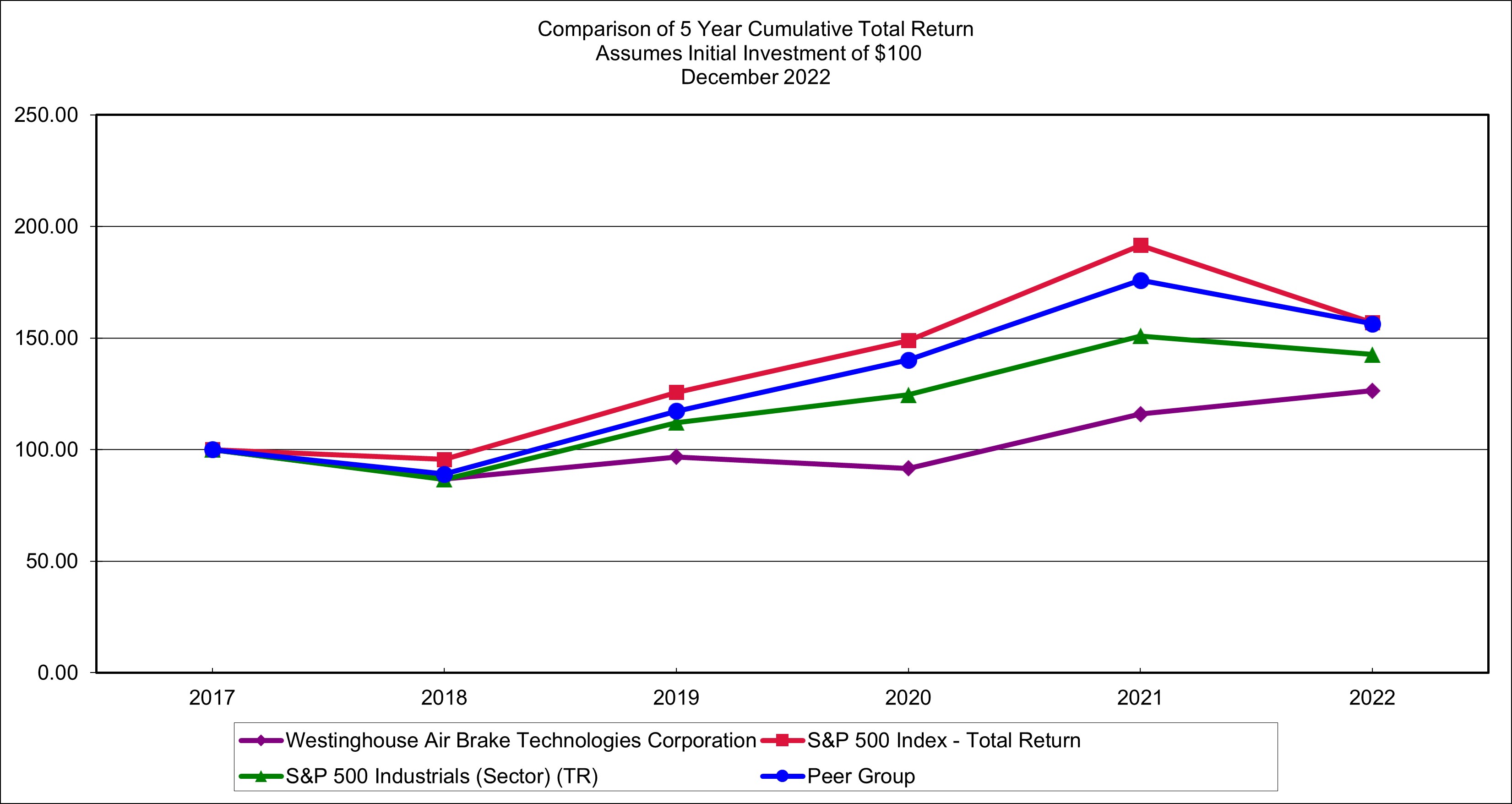
The following performance graph and related information shall not be deemed “soliciting material” or to be “filed” with the Securities and Exchange Commission, nor shall such information be incorporated by reference to any future filings under the Securities Act of 1933 and the Securities Exchange Act of 1934, each as amended, except to the extent that Wabtec specifically incorporates it by reference into such filing. The graph below compares the total stockholder return through December 31, 2022, of Wabtec’s common stock to (i) the S&P 500, (ii) the S&P 500 Industrials and, (iii) our peer group of manufacturing companies which consists of the following publicly traded companies: AGCO, AMETEK, Arconic, Borg Warner, CSX, Dover, Emerson Electric, Fortive, Greenbrier Companies, Illinois Tool Works, Ingersoll-Rand, Norfolk Southern, Oshkosh, Parker-Hannifin, Rockwell Automation, Terex, Textron, Trinity Industries, and Xylem.
| Issuer Purchases of Common Stock | ||||||||||||||||||||||||||
| Month | Total Number of Shares Purchased | Average Price Paid per Share | Total Number of Shares Purchased as Part of Publicly Announced Programs (1) | Maximum Dollar Value of Shares That May Yet Be Purchased Under the Programs (1) In millions | ||||||||||||||||||||||
| October 2022 | — | $ | — | — | $ | 395 | ||||||||||||||||||||
| November 2022 | 578,667 | $ | 95.32 | 578,667 | $ | 340 | ||||||||||||||||||||
| December 2022 | 181,568 | $ | 100.18 | 181,568 | $ | 322 | ||||||||||||||||||||
| Total quarter ended December 31, 2022 | 760,235 | $ | 96.48 | 760,235 | $ | 322 |
(1) As of December 31, 2022, approximately $322 million was remaining under the stock repurchase plan. On February 14, 2023, the Board of Directors reauthorized its stock repurchase program to refresh the amount available for stock repurchases to $750 million of the Company’s outstanding shares. This new stock repurchase authorization supersedes the previous authorization of $750 million, of which approximately $232 million remained at the reauthorization date. No time limit was set for the completion of the program which conforms to the requirements under the Restated Credit Agreement and the indentures for the Senior Notes currently outstanding. The Company may repurchase shares in the future at any time, depending upon market conditions, our capital needs and other factors. Purchases of shares may be made by open market purchases or privately negotiated purchases and may be made pursuant to Rule 10b5-1 plan or otherwise.
Item 6. [RESERVED]
Item 7. MANAGEMENT’S DISCUSSION AND ANALYSIS OF FINANCIAL CONDITION AND RESULTS OF OPERATIONS
OVERVIEW
Wabtec is one of the world’s largest providers of value-added, technology-based locomotives, equipment, systems and services for the global freight rail and passenger transit industries, and also serves customers in the mining, marine, and industrial markets. Our highly engineered products, which are intended to enhance safety, improve productivity and reduce maintenance costs for customers, can be found on most locomotives, freight cars, passenger transit cars and buses around the world. Our core products and services are essential in the safe and efficient operation of freight rail and passenger transit vehicles. Wabtec is a global company with operations in over 50 countries and our products can be found in more than 100 countries throughout the world. In 2022, approximately 55% of the Company’s net sales came from customers outside the U.S.
Wabtec’s long-term financial goals are to drive strong cash flow conversion, maintain a strong credit profile while minimizing our overall cost of capital, increase margins through strict attention to cost controls, drive improved efficiencies across the business, and increase revenues through a focused growth strategy, including product innovation and new technologies, global and market expansion, aftermarket products and services, and strategic acquisitions. In addition, Management evaluates the Company’s current operational performance through measures such as safety, quality and on-time delivery.
The Company primarily serves the worldwide freight and transit rail industries. Our operating results are largely dependent on the level of activity, financial condition and capital spending plans of railroads and passenger transit agencies around the world, and transportation equipment manufacturers who serve those markets. Many factors influence these industries, including general economic conditions; traffic volumes, as measured by freight carloads and passenger ridership; number of locomotives and railcars in operation; government spending on public transportation; and investment in new technologies. In general, trends such as urbanization and growth in developing markets, sustainability and environmental awareness, investment in technology solutions, an aging equipment fleet, and growth in global trade are expected to drive continued investment in freight rail and passenger transit.
The Company monitors a variety of factors and statistics to gauge market activity. Freight rail markets around the world are driven primarily by overall economic conditions and activity, while Transit markets are driven primarily by government funding and passenger ridership. Changes in these market drivers can cause fluctuations in demand for Wabtec's products and services.
Business Update
During 2022, Wabtec achieved a multitude of accomplishments while successfully navigating volatile market conditions. Through leveraging our installed customer base and our innovative scalable technologies, Wabtec was able to secure several key contracts globally that position the Company for long-term revenue generation. These contracts include the largest locomotive modernization deal in rail industry history, orders for our FLXdrive battery-electric powered locomotives, international locomotive orders, as well as a North American locomotive order with a Class I railroad. Wabtec executed on calculated market expansions through several strategic acquisitions that will allow us to leverage current and future product and service offerings for greater market share. Wabtec continued significant progress on our sustainability initiatives as exhibited in our completed green bond allocation and with our battery electric locomotive being recognized for sustainable innovation by the Business Intelligence Group and awarded “Commercial Technology of the Year” at the Platts Global Energy Awards. Management also launched Integration 2.0 to further poise the company for operational efficiencies into the future.
During the first quarter of 2022, Wabtec announced Integration 2.0, a three-year strategic initiative to target incremental run rate synergies estimated to be between $75 million and $90 million by 2025. The scope of the review includes consolidating our operating footprint, reducing headcount, streamlining the end-to-end manufacturing process, restructuring the North America distribution channels, expanding operations in low-cost countries and simplifying the business through systems enablement, including the source-to-pay process. Management will also consider additional capital investments to further simplify and streamline the business. The Company anticipates that it will incur one-time charges of approximately $135 million to $165 million related to this initiative. The estimate could change based on the specific programs approved or changes to the scope of the review. During 2022, the Company incurred one-time charges related to the initiative of approximately $46 million, primarily for employee-related costs associated with site consolidations in Europe and costs related to the restructuring of the North America distribution channels. See Note 21 of "Notes to Consolidated Financial Statements" included in Part II, Item 8 of this report for additional information.
The unfavorable global economic conditions driven by the impacts of the pandemic and supply chain disruptions, and further intensified by the Russian invasion of Ukraine, continue to have an adverse impact on our operations and business results. Impacts for the years ended December 31, 2022, and 2021 are discussed in more detail in the Results of Operations section below. Supply chain disruptions and labor availability have caused component, raw material and chip shortages
resulting in an adverse effect on the timing of the Company’s revenue generation. Additionally, broad-based inflation, escalation of diesel, metals, energy and other commodity costs, transportation and logistics costs, labor costs, and foreign currency exchange rate fluctuations all continue to impact our results.
The Russian invasion of Ukraine and the resultant sanctions related to Russia and Belarus have further impacted our supply and distribution channels and caused significant price inflation which had, and are expected to continue to have, adverse effects on Wabtec’s business results. For the year ended December 31, 2021, prior to the Russian invasion of Ukraine and the resulting imposition of various sanctions against Russia and Belarus, Wabtec had earnings of approximately $40 million attributable to customers in Russia, while earnings from customers in Ukraine and Belarus were not significant. As of December 31, 2022 and 2021, Wabtec had approximately $14 million and $20 million of assets, respectively, related to Russian operations, which were primarily cash and inventory. Management has determined, based on information currently available, that these assets are expected to be recoverable and therefore no impairment was recorded during 2022. This will continue to be monitored and may result in a future impairment charge based on changes in the situation. Management determined that inventory related to operations in Ukraine were not expected to be recoverable and were written off resulting in an insignificant charge during the first quarter of 2022. Remaining assets related to Ukraine and those in Belarus were not significant.
The Company has implemented various mitigating actions intended to lessen the impact of these unfavorable economic conditions. These actions include implementing price escalations and surcharges, driving operational efficiencies through various cost mitigation efforts and discretionary spend management, strategically sourcing materials, reviewing and modifying distribution logistics, and accelerating integration synergies where possible, including Integration 2.0. Additionally, the Company has proactively built-up inventory ahead of expected growth and in
Showing the first 8K of 64K characters. Open the full section
Item 7A. QUANTITATIVE AND QUALITATIVE DISCLOSURES ABOUT MARKET RISK
All market risk sensitive instruments were entered into for non-trading purposes.
Interest Rate Risk
In the ordinary course of business, Wabtec is exposed to risks that increases in interest rates may adversely affect funding costs associated with its available variable-rate debt facilities. At December 31, 2022, the Company's interest risk related to variable-rate debt is limited to the amounts borrowed under the multi-currency Revolving Credit Facility. At December 31, 2022 and 2021, the Company had no outstanding variable rate debt.
Foreign Currency Exchange Rate Risk
The Company is exposed to certain risks associated with changes in foreign currency exchange rates to the extent our operations are conducted in currencies other than the U.S. dollar. To reduce the impact of changes in currency exchange rates, the Company has periodically entered into foreign currency forward contracts. Refer to “Financial Derivatives and Hedging Activities” in Notes 2, 17 and 20 of “Notes to Consolidated Financial Statements” included in Part II, Item 8 of this report for more information regarding foreign currency exchange risk and sales by geographic area.
Item 8. FINANCIAL STATEMENTS AND SUPPLEMENTARY DATA
MANAGEMENT’S REPORTS TO WABTEC SHAREHOLDERS
Management’s Report on Financial Statements and Practices
The accompanying consolidated financial statements of Westinghouse Air Brake Technologies Corporation and subsidiaries (the “Company”) were prepared by Management, which is responsible for their integrity and objectivity. The statements were prepared in accordance with U.S. generally accepted accounting principles and include amounts that are based on Management’s best judgments and estimates. The other financial information included in the Form 10-K is consistent with that in the financial statements.
Management also recognizes its responsibility for conducting the Company’s affairs according to the highest standards of personal and corporate conduct. This responsibility is characterized and reflected in key policy statements issued from time to time regarding, among other things, conduct of its business activities within the laws of host countries in which the Company operates and potentially conflicting outside business interests of its employees. The Company maintains a systematic program to assess compliance with these policies.
Management’s Report on Internal Control over Financial Reporting
Management is responsible for establishing and maintaining adequate internal control over financial reporting for the Company. In order to evaluate the effectiveness of internal control over financial reporting, as required by Section 404 of the Sarbanes-Oxley Act, Management has conducted an assessment, including testing, using the criteria in Internal Control-Integrated Framework issued by the Committee of Sponsoring Organizations of the Treadway Commission (2013 Framework) (COSO). The Company’s system of internal control over financial reporting is designed to provide reasonable assurance regarding the reliability of financial reporting and the preparation of financial statements for external purposes in accordance with generally accepted accounting principles. Because of its inherent limitations, internal control over financial reporting may not prevent or detect misstatements. Also, projections of any evaluation of effectiveness to future periods are subject to the risk that controls may become inadequate because of changes in conditions, or that the degree of compliance with the policies or procedures may deteriorate.
Based on its assessment, Management has concluded that the Company maintained effective internal control over financial reporting as of December 31, 2022, based on criteria in Internal Control-Integrated Framework issued by the COSO. The effectiveness of the Company’s internal control over financial reporting as of December 31, 2022, has been audited by Ernst & Young LLP, independent registered public accounting firm, as stated in their report which is included herein.
Report Of Independent Registered Public Accounting Firm
To the Shareholders and the Board of Directors of Westinghouse Air Brake Technologies Corporation
Opinion on the Financial Statements
We have audited the accompanying consolidated balance sheets of Westinghouse Air Brake Technologies Corporation (the Company) as of December 31, 2022 and 2021, the related consolidated statements of income, comprehensive income, cash flows and shareholders' equity for each of the three years in the period ended December 31, 2022, and the related notes and financial statement schedule listed in the Index at Item 15.(2) (collectively referred to as the “consolidated financial statements”). In our opinion, the consolidated financial statements present fairly, in all material respects, the financial position of the Company at December 31, 2022 and 2021, and the results of its operations and its cash flows for each of the three years in the period ended December 31, 2022, in conformity with U.S. generally accepted accounting principles.
We also have audited, in accordance with the standards of the Public Company Accounting Oversight Board (United States) (PCAOB), the Company's internal control over financial reporting as of December 31, 2022, based on criteria established in Internal Control-Integrated Framework issued by the Committee of Sponsoring Organizations of the Treadway Commission (2013 framework), and our report dated February 15, 2023 expressed an unqualified opinion thereon.
Basis for Opinion
These financial statements are the responsibility of the Company's management. Our responsibility is to express an opinion on the Company’s financial statements based on our audits. We are a public accounting firm registered with the PCAOB and are required to be independent with respect to the Company in accordance with the U.S. federal securities laws and the applicable rules and regulations of the Securities and Exchange Commission and the PCAOB.
We conducted our audits in accordance with the standards of the PCAOB. Those standards require that we plan and perform the audit to obtain reasonable assurance about whether the financial statements are free of material misstatement, whether due to error or fraud. Our audits included performing procedures to assess the risks of material misstatement of the financial statements, whether due to error or fraud, and performing procedures that respond to those risks. Such procedures included examining, on a test basis, evidence regarding the amounts and disclosures in the financial statements. Our audits also included evaluating the accounting principles used and significant estimates made by management, as well as evaluating the overall presentation of the financial statements. We believe that our audits provide a reasonable basis for our opinion.
Critical Audit Matter
The critical audit matter communicated below is a matter arising from the current period audit of the financial statements that was communicated or required to be communicated to the audit committee and that: (1) relates to accounts or disclosures that are material to the financial statements and (2) involved our especially challenging, subjective or complex judgments. The communication of the critical audit matter does not alter in any way our opinion on the consolidated financial statements, taken as a whole, and we are not, by communicating the critical audit matter below, providing a separate opinion on the critical audit matter or on the accounts or disclosures to which it relates.
| Over Time Revenue Recognition for Long-Term Contracts | |||||
| Description of the Matter | As described in Note 2 to the consolidated financial statements, the Company has long-term customer arrangements involving the design and production of highly engineered products that require revenue to be recognized over time. The Company uses input-based measures for determining the amount of revenue, cost and gross margin to recognize over time for these customer arrangements. The input methods used for these arrangements include costs of material and labor. During the year ended December 31, 2022, a material amount of the Company's total revenues were derived from performance obligations that are satisfied over time. Auditing the Company's measurement of revenue recognized over time on long-term contracts is especially challenging because it involves subjective management assumptions regarding the estimated remaining costs of the long-term contract that could span several years. These assumptions could be impacted by the future cost of materials, labor availability and productivity, complexity of the work to be performed, and the performance of suppliers, customers and subcontractors that may be associated with the contract and may be affected by future market or economic conditions. | ||||
| How We Addressed the Matter in Our Audit | We obtained an understanding, evaluated the design and tested the operating effectiveness of controls over the Company's process to recognize |
Showing the first 8K of 167K characters. Open the full section
Item 9. CHANGES IN AND DISAGREEMENTS WITH ACCOUNTANTS ON ACCOUNTING AND FINANCIAL DISCLOSURE
There have been no disagreements with our independent registered public accountants.
Item 9A. CONTROLS AND PROCEDURES
Evaluation of Disclosure Controls and Procedures
Wabtec’s principal executive officer and its principal financial officer have evaluated the effectiveness of Wabtec’s “disclosure controls and procedures,” (as defined in Exchange Act Rule 13a-15(e)) as of December 31, 2022. Based upon their evaluation, the principal executive officer and principal financial officer concluded that Wabtec’s disclosure controls and procedures are effective to provide reasonable assurance that information required to be disclosed by Wabtec in the reports filed or submitted by it under the Exchange Act is recorded, processed, summarized and reported within the time periods specified in the SEC’s rules and forms, and to provide reasonable assurance that information required to be disclosed by Wabtec in such reports is accumulated and communicated to Wabtec’s Management, including its principal executive officer and principal finance officer, as appropriate to allow timely decisions regarding required disclosure.
Changes in Internal Control over Financial Reporting
There was no change in Wabtec’s “internal control over financial reporting” (as defined in Rule 13a-15(f) under the Exchange Act) that occurred during the quarter ended December 31, 2022, that has materially affected, or is reasonably likely to materially affect, Wabtec’s internal control over financial reporting. Management’s annual report on internal control over financial reporting and the attestation report of the registered public accounting firm are included in Part II, Item 8 of this report.
Management’s Report on Internal Control over Financial Reporting
Management’s Report on Internal Control Over Financial Reporting appears on page 44 and is incorporated by reference herein.
Report of Independent Registered Public Accounting Firm on Internal Control over Financial Reporting
Ernst & Young LLP's attestation report on internal control over financial reporting appears on page 47 and is incorporated by reference herein.
Item 9B. OTHER INFORMATION
None.
Item 9C. DISCLOSURE REGARDING FOREIGN JURISDICTIONS THAT PREVENT INSPECTIONS
Not applicable.
PART III
Items 10 through 14.
In accordance with the provisions of General Instruction G(3) to Form 10-K, the information required by Item 10 (Directors, Executive Officers and Corporate Governance), Item 11 (Executive Compensation), Item 12 (Security Ownership of Certain Beneficial Owners and Management and Related Stockholder Matters), Item 13 (Certain Relationships and Related Transactions, and Director Independence) and Item 14 (Principal Accounting Fees and Services) is incorporated herein by reference from the Company’s definitive Proxy Statement for its Annual Meeting of Stockholders to be held on May 17, 2023, except for the Equity Compensation Plan Information required by Item 12, which is set forth in the table below. The definitive Proxy Statement will be filed with the Securities and Exchange Commission not later than 120 days after December 31, 2022. Information relating to the executive officers of the Company is set forth in Part I.
Wabtec has adopted a Code of Business Conduct and Ethics which is applicable to all of our employees, including our executive officers. This Code of Business Conduct and Ethics is posted on our website at www.wabteccorp.com. In the event that we make any amendments to or waivers from this code, we will disclose the amendment or waiver and the reasons for such on our website.
This table provides aggregate information as of December 31, 2022 concerning equity awards under Wabtec’s compensation plans and arrangements.
| Plan Category | (a) Number of securities to be issued upon exercise of outstanding options, warrants and rights | (b) Weighted-average exercise price of outstanding options warrants and rights | (c) Number of securities remaining available for future issuance under equity compensation plans (excluding securities reflected in column (a)) | |||||||||||||||||
| Equity compensation plans approved by shareholders | 1,100,000 | $ | 77.32 | 5,500,000 | ||||||||||||||||
| Equity compensation plans not approved by shareholders | — | — | — | |||||||||||||||||
| Total | 1,100,000 | $ | 77.32 | 5,500,000 |
PART IV
Item 15. EXHIBITS AND FINANCIAL STATEMENT SCHEDULES
The financial statements filed as part of this report are included in Part II Item 8 of this report. Financial statement schedules and exhibits listed below are filed as part of this annual report:
| 1 | Filed herewith. | ||||
| 2 | Filed as an exhibit to the Company’s Registration Statement on Form S-1 (File No. 033-90866). | ||||
| 3 | Filed as an exhibit to the Company’s Quarterly Report on Form 10-Q (File No. 033-90866) for the period ended March 31, 2006. | ||||
| 4 | Filed as an Annex to the Company’s Schedule 14A Proxy Statement (File No. 033-90866) filed on March 31, 2017. | ||||
| 5 | Filed as an exhibit to the Company’s Current Report on Form 8-K (File No. 033-90866) filed on April 6, 2022. | ||||
| 6 | Filed as an exhibit to the Company’s Quarterly Report on Form 10-Q (File No. 033-90866) for the period ended September 30, 2008. | ||||
| 7 | Filed as an exhibit to the Company’s Current Report on Form 8-K (File No. 033-90866) dated July 2, 2009. | ||||
| 8 | Filed as an exhibit to the Company’s Current Report on Form 8-K (File No. 033-90866), dated February 14, 2023. | ||||
| 9 | Filed as an exhibit to the Company’s Annual Report on Form 10-K (File No. 033-90866), dated February 25, 2011. | ||||
| 10 | Filed as an exhibit to the Company’s Annual Report on Form 10-K (File No. 033-90866), dated February 22, 2013. | ||||
| 11 | Filed as an exhibit to the Company’s Current Report on Form 8-K (File No. 033-90866), dated September 9, 2019. | ||||
| 12 | Filed as an exhibit to the Company’s Current Report on Form 8-K (File No. 033-90866), dated August 8, 2013. | ||||
| 13 | Filed as an exhibit to the Company’s Current Report on Form 8-K (File No. 033-90866), dated October 6,2015. | ||||
| 14 | Filed as an exhibit to the Company's Current Report on Form 8-K (File No. 033-90866), dated October 26, 2016. | ||||
| 15 | Filed as an exhibit to the Company's Current Report on Form 8-K (File No. 033-90866), dated November 3, 2016. | ||||
| 16 | Filed as an exhibit to the Company's Current Report on Form 10-K (File No. 033-90866), dated February 28, 2017. | ||||
| 17 | Filed as an exhibit to the Company's Quarterly Report on Form 10-Q (File No. 033-90866), for the period ended March 31, 2017. | ||||
| 18 | Filed as an exhibit to the Company's Registration Statement on Form S-4 (File No. 0333-219354). | ||||
| 19 | Filed as an exhibit to the Company's Quarterly Report on Form 10-Q (File No. 033-90866), for the period ended June 30, 2018. | ||||
| 20 | Filed as an exhibit to the Company’s Current Report on Form 8-K (File No. 033-90866), dated September 14, 2018. | ||||
| 21 | Filed as an exhibit to the Company’s Current Report on Form 8-K (File No. 033-90866), dated February 25, 2019. | ||||
| 22 | Filed as an exhibit to the Company’s Annual Report on Form 10-K (File No. 033-90866), dated February 27, 2019. | ||||
| 23 | Filed as an exhibit to the Company’s Quarterly Report on Form 10-Q (File No. 033-90866), dated August 1, 2019. | ||||
| 24 | Filed as an exhibit to the Company's Quarterly Report on Form 10-Q (File No. 033-90866), dated May 9, 2019. | ||||
| 25 | Filed as an exhibit to the Company's Current Report on Form 8-K (File No. 033-90866), dated June 29, 2020. | ||||
| 26 | Filed as an exhibit to the Company's Current Report on Form 8-K (File No 033-90866), dated December 7, 2022. | ||||
| 27 | Filed as an exhibit to the Company's Current Report on Form 8-K (File No 033-90866), dated June 2, 2021 | ||||
| 28 | Filed as an exhibit to the Company's Quarterly Report on Form 10-Q (File No. 033-90866), dated November 1, 2022. | ||||
| 29 | [Reserved] | ||||
| 30 | Filed as an exhibit to the Company's Current Report on Form 8-K (File No 033-90866), dated October 21, 2021 | ||||
| 31 | Filed as an exhibit to the Company's Quarterly Report on Form 10-Q (File No. 033-90866), for the period ended September 30, 2021. | ||||
| 32 | Filed as an exhibit to the Company’s Annual Report on Form 10-K (File No. 033-90866), dated February 19, 2021. | ||||
| 33 | Filed as an exhibit to the Company's Registration Statement on Form S-8 (File No. 033-90866), dated March 2, 2012. |
| * | Management contract or compensatory plan. | ||||
| ** | Certain schedules have been omitted pursuant to Item 601(b)(2) of Regulation S-K. Wabtec hereby undertakes to furnish supplementally, copies of any of the omitted schedules upon request by the SEC. |
SCHEDULE II
WESTINGHOUSE AIR BRAKE TECHNOLOGIES CORPORATION
VALUATION AND QUALIFYING ACCOUNTS
For each of the three years ended December 31
| In millions | Balance at beginning of period | Charged to expense | Charged/ (credited) to other accounts (1) | Deductions from reserves (2) | Balance at end of period | |||||||||||||||||||||||||||
| 2022 | ||||||||||||||||||||||||||||||||
| Allowance for doubtful accounts | $ | 32 | $ | 4 | $ | (1) | $ | (7) | $ | 28 | ||||||||||||||||||||||
| Valuation allowance-taxes | $ | 64 | $ | — | $ | — | $ | (18) | $ | 46 | ||||||||||||||||||||||
| 2021 | ||||||||||||||||||||||||||||||||
| Allowance for doubtful accounts | $ | 37 | $ | 3 | $ | (1) | $ | (7) | $ | 32 | ||||||||||||||||||||||
| Valuation allowance-taxes | $ | 42 | $ | 22 | $ | — | $ | — | $ | 64 | ||||||||||||||||||||||
| 2020 | ||||||||||||||||||||||||||||||||
| Allowance for doubtful accounts | $ | 20 | $ | 18 | $ | — | $ | (1) | $ | 37 | ||||||||||||||||||||||
| Valuation allowance-taxes | $ | 58 | $ | — | $ | — | $ | (16) | $ | 42 |
(1)Impact of fluctuations in foreign currency exchange rates.
(2)Deductions in Allowance for doubtful accounts are from amounts written off as uncollectible or proceeds from subsequent collections. Deductions for Valuation allowances-taxes were primarily from changes in expected deferred tax utilization.
Item 16. FORM 10-K SUMMARY
Not applicable.
SIGNATURES
Pursuant to the requirements of Section 13 or 15(d) of the Securities Exchange Act of 1934, the Company has duly caused this report to be signed on its behalf by the undersigned, thereunto duly authorized.
| WESTINGHOUSE AIR BRAKE TECHNOLOGIES CORPORATION | |||||||||||
| Date: | February 15, 2023 | By: | /S/ RAFAEL SANTANA | ||||||||
| Rafael Santana, | |||||||||||
| President and Chief Executive Officer, and Director |
Pursuant to the requirements of the Securities Exchange Act of 1934, this report has been signed below by the following persons on behalf of the Company and in the capacities and on the dates indicated.
| Signature and Title | Date | |||||||
| By | /S/ ALBERT J. NEUPAVER | February 15, 2023 | ||||||
| Albert J. Neupaver, Chairman of the Board | ||||||||
| By | /S/ RAFAEL SANTANA | February 15, 2023 | ||||||
| Rafael Santana, President and Chief Executive Officer and Director (Principal Executive Officer) | ||||||||
| By | /S/ JOHN A. OLIN | February 15, 2023 | ||||||
| John A. Olin, Executive Vice President and Chief Financial Officer (Principal Financial Officer) | ||||||||
| By | /S/ JOHN A. MASTALERZ | February 15, 2023 | ||||||
| John A. Mastalerz, Senior Vice President and Principal Accounting Officer | ||||||||
| By | /S/ LINDA A. HARTY | February 15, 2023 | ||||||
| Linda A. Harty, Lead Director | ||||||||
| By | /S/ BEVERLEY BABCOCK | February 15, 2023 | ||||||
| Beverley Babcock, Director | ||||||||
| By | /S/ LEE BANKS | February 15, 2023 | ||||||
| Lee Banks, Director | ||||||||
| By | /S/ BYRON FOSTER | February 15, 2023 | ||||||
| Byron Foster, Director | ||||||||
| By | /S/ BRIAN P. HEHIR | February 15, 2023 | ||||||
| Brian P. Hehir, Director | ||||||||
| By | /S/ WILLIAM E. KASSLING | February 15, 2023 | ||||||
| William E. Kassling, Director | ||||||||
| By | /S/ ANN R. KLEE | February 15, 2023 | ||||||
| Ann R. Klee, Director |