 filings.tools
Cover and table of contents
107K characters. Original on sec.gov · Markdown
Cover and table of contents
10-K 1 d268303d10k.htm 10-K
Table of Contents
UNITED STATES SECURITIES AND EXCHANGE COMMISSION
Washington, D.C. 20549
Form 10-K
| ☑ | ANNUAL REPORT PURSUANT TO SECTION 13 OR 15(d) |
|---|
| OF THE SECURITIES EXCHANGE ACT OF 1934 |
|---|
For the fiscal year ended December 31, 2016
or
| ☐ | TRANSITION REPORT PURSUANT TO SECTION 13 OR 15(d) |
|---|
| OF THE SECURITIES EXCHANGE ACT OF 1934 |
|---|
Commission File Number: 01-14010
Waters Corporation
(Exact name of registrant as specified in its charter)
| Delaware | 13-3668640 | |
| (State or other jurisdiction of incorporation or organization) | (I.R.S. Employer Identification No.) |
34 Maple Street
Milford, Massachusetts 01757
(Address, including zip code, of principal executive offices)
(508) 478-2000
(Registrant’s telephone number, including area code)
| Securities registered pursuant to Section 12(b) of the Act: | Common Stock, par value $0.01 per share | |
| New York Stock Exchange, Inc. | ||
| Securities registered pursuant to Section 12(g) of the Act: | None |
Indicate by check mark if the registrant is a well-known seasoned issuer, as defined in Rule 405 of the Securities Act. Yes ☑ No ☐
Indicate by check mark if the registrant is not required to file reports pursuant to Section 13 or Section 15(d) of the Act. Yes ☐ No ☑
Indicate by check mark whether the registrant (1) has filed all reports required to be filed by Section 13 or 15(d) of the Securities Exchange Act of 1934 during the preceding 12 months (or for such shorter period that the registrant was required to file such reports), and (2) has been subject to such filing requirements for the past 90 days. Yes ☑ No ☐
Indicate by check mark whether the registrant has submitted electronically and posted on its corporate website, if any, every Interactive Data File required to be submitted and posted pursuant to Rule 405 of Regulation S-T (§232.405 of this chapter) during the preceding 12 months (or for such shorter period that the registrant was required to submit and post such files). Yes ☑ No ☐
Indicate by check mark if disclosure of delinquent filers pursuant to Item 405 of Regulation S-K (§229.405 of this chapter) is not contained herein, and will not be contained, to the best of registrant’s knowledge, in definitive proxy or information statements incorporated by reference in Part III of this Form 10-K or any amendment to this Form 10-K. ☑
Indicate by check mark whether the registrant is a large accelerated filer, an accelerated filer, a non-accelerated filer, or smaller reporting company. See the definition of “large accelerated filer”, “accelerated filer” and “smaller reporting company” in Rule 12b-2 of the Exchange Act. (Check one):
| Large accelerated filer ☑ | Accelerated filer ☐ | Non-accelerated filer ☐ | Smaller reporting company ☐ | |||
| (Do not check if a smaller reporting company) |
Indicate by check mark whether the registrant is a shell company (as defined in Rule 12b-2 of the Act). Yes ☐ No ☑
State the aggregate market value of the registrant’s common stock held by non-affiliates of the registrant as of July 2, 2016: $11,522,067,374.
Indicate the number of shares outstanding of the registrant’s common stock as of February 17, 2017: 80,085,831
DOCUMENTS INCORPORATED BY REFERENCE
Portions of the registrant’s definitive proxy statement that will be filed for the 2017 Annual Meeting of Stockholders are incorporated by reference in Part III.
Table of Contents
WATERS CORPORATION AND SUBSIDIARIES
ANNUAL REPORT ON FORM 10-K
INDEX
Table of Contents
PART I
| Item 1: | Business |
|---|
General
Waters Corporation (the “Company”) is an analytical instrument manufacturer that primarily designs, manufactures, sells and services high performance liquid chromatography (“HPLC”), ultra performance liquid chromatography (“UPLC®” and together with HPLC, referred to as “LC”) and mass spectrometry (“MS”) technology systems and support products, including chromatography columns, other consumable products and comprehensive post-warranty service plans. These systems are complementary products that are frequently employed together (“LC-MS”) and sold as integrated instrument systems using a common software platform. In addition, the Company designs, manufactures, sells and services thermal analysis, rheometry and calorimetry instruments through its TA® product line. The Company is also a developer and supplier of software-based products that interface with the Company’s instruments, as well as other suppliers’ instruments, and are typically purchased by customers as part of the instrument system.
The Company’s products are used by life science, pharmaceutical, biochemical, industrial, nutritional safety, environmental, academic and governmental customers working in research and development, quality assurance and other laboratory applications. The Company’s LC and LC-MS instruments are utilized in this broad range of industries to detect, identify, monitor and measure the chemical, physical and biological composition of materials, and to purify a full range of compounds. These instruments are used in drug discovery and development, including clinical trial testing, the analysis of proteins in disease processes (known as “proteomics”), nutritional safety analysis and environmental testing. LC-MS instruments combine a liquid phase sample introduction and separation system with mass spectrometric compound identification and quantification. The Company’s thermal analysis, rheometry and calorimetry instruments are used in predicting the suitability and stability of fine chemicals, pharmaceuticals, water, polymers, metals and viscous liquids for various industrial, consumer goods and healthcare products, as well as for life science research.
Waters Corporation, organized as a Delaware corporation in 1991, is a holding company that owns all of the outstanding common stock of Waters Technologies Corporation, its operating subsidiary. Waters Corporation became a publicly-traded company with its initial public offering (“IPO”) in November 1995. Since the IPO, the Company has added two significant and complementary technologies to its range of products with the acquisitions of TA Instruments in May 1996 and Micromass Limited in September 1997.
Business Segments
The Company’s business activities, for which discrete financial information is available, are regularly reviewed and evaluated by the chief operating decision maker. As a result of this evaluation, the Company determined that it has two operating segments: Waters® and TA. The Company operates in the analytical instruments industry by designing, manufacturing, distributing and servicing instrument systems, columns and other chemistry consumables that can be integrated and used along with other analytical instruments. The Company’s two operating segments have similar economic characteristics; product processes; products and services; types and classes of customers; methods of distribution; and regulatory environments. Because of these similarities, the two operating segments have been aggregated into one reporting segment for financial statement purposes.
Information concerning revenues and long-lived assets attributable to each of the Company’s products, services and geographic areas is set forth in Note 16 in the Notes to the Consolidated Financial Statements, which is incorporated herein by reference.
Table of Contents
Waters Products and Markets
High Performance and Ultra Performance Liquid Chromatography
HPLC is a standard technique used to identify and analyze the constituent components of a variety of chemicals and other materials. The Company believes that HPLC’s performance capabilities enable it to separate, identify and quantify approximately 80% of all known chemicals and materials. As a result, HPLC is used to analyze substances in a wide variety of industries for research and development purposes, quality control and process engineering applications.
The most significant end-use markets for HPLC are those served by the pharmaceutical and life science industries. In these markets, HPLC is used extensively to understand diseases, identify new drugs, develop manufacturing methods and assure the potency and purity of new pharmaceuticals. HPLC is also used in a variety of other applications, such as analyses of foods and beverages for nutritional labeling and compliance with safety regulations and the testing of water and air purity within the environmental testing industry, as well as applications in other industries, such as chemical and consumer products. HPLC is also used by universities, research institutions and governmental agencies, such as the United States Food and Drug Administration (“FDA”) and the United States Environmental Protection Agency (“EPA”) and their foreign counterparts that mandate testing requiring HPLC-based methodologies.
In 2004, Waters introduced a novel technology that the Company describes as ultra performance liquid chromatography that utilizes a packing material with small, uniform diameter particles and a specialized instrument, the ACQUITY UPLC®, to accommodate the increased pressure and narrow chromatographic bands that are generated by these small particles. By using the ACQUITY UPLC, researchers and analysts are able to achieve more comprehensive chemical separations and faster analysis times in comparison with many analyses performed by HPLC. In addition, in using the ACQUITY UPLC, researchers have the potential to extend the range of applications beyond that of HPLC, enabling them to uncover more levels of scientific information. While offering significant performance advantages, the ACQUITY UPLC is also compatible with the Company’s software products and the general operating protocols of HPLC. For these reasons, the Company’s customers and field sales and support organizations are well positioned to utilize this new technology and instrument. In 2012, the Company introduced UltraPerformance Convergence Chromatography® (“UPC2®”) with the release of the ACQUITY® UPC2® system. This new technology marries the unrealized potential of supercritical fluid chromatography (“SFC”) with the proven UPLC technology, using carbon dioxide as the primary mobile phase. By varying mobile phase strength, pressure, temperature and stationary phase with UPC2, a user can separate, detect and quantify structural analogs, isomers, enantiomeric and diasteriomeric mixtures — all compounds or samples that challenge today’s laboratories. In 2014, the Company introduced the ACQUITY UPLC® M-Class instrument system. This system delivers the sensitivity to quantify and identify vanishingly small concentrations of key molecules, particularly when used with advanced mass spectrometric characterization. The innovations incorporated into the ACQUITY UPLC M-Class system are led by its internal low-volume design and newly redesigned fluidics that minimize dispersive and adsorptive losses during a chromatographic separation. In 2015, the Company introduced the ACQUITY® Arc System and its enabling Arc Multi-flow pathTM technology, which bridges the gap between HPLC and UPLC by emulating a variety of HPLC systems without altering the method’s gradient table and enabling improved chromatographic performance of methods by leveraging 2.5-2.7 micron particle column technologies.
Waters manufactures LC instruments that are offered in configurations that allow for varying degrees of automation, from component configured systems for academic teaching and research applications to fully automated systems for regulated testing, and that have a variety of detection technologies, from ultra-violet (“UV”) absorbance to MS, optimized for certain analyses. The Company also manufactures tailored LC systems for the analysis of biologics, as well as an LC detector utilizing evaporative light scattering technology to expand the usage of LC to compounds that are not amenable to UV absorbance detection.
The primary consumable products for LC are chromatography columns. These columns are packed with separation media used in the LC testing process and are typically replaced at regular intervals. The
Table of Contents
chromatography column contains one of several types of packing material, typically stationary phase particles made from silica or polymeric resins. As the sample permeates through the column, it is separated into its constituent components.
Waters HPLC columns can be used on Waters-branded and competitors’ LC systems. The Company believes that it is one of a few suppliers in the world that processes silica and polymeric resins, packs columns and distributes its own products. In doing so, the Company believes it can better ensure product consistency, a key attribute for its customers in quality control laboratories, and can react quickly to new customer requirements. The Company believes that its ACQUITY UPLC lines of columns are used primarily on its ACQUITY UPLC instrument systems and, furthermore, that its ACQUITY UPLC instruments primarily use ACQUITY UPLC columns. In 2014, the Company expanded its CORTECS® family with a new line of 2.7 micron silica-based, solid-core particle columns for usage on UPLC, as well as HPLC systems. In addition, the Company introduced size exclusion chromatography columns for the characterization of proteins and ACQUITY UPC2 columns for chiral and achiral separations. In 2015, the Company introduced the Oasis® PRiME HLB cartridges, which process samples up to 40% faster and deliver samples that are up to 70% cleaner with fewer LC-MS matrix effects than samples prepared using other extraction techniques. In addition, the ACQUITY UPLC® Glycoprotein BEH Amide columns were introduced in 2015 to help biopharmaceutical companies to better understand where glycan groups (bonded sugars) are located within the therapeutic proteins they are developing and manufacturing. In 2016, the Company continued to expand its column chemistry capabilities through the introduction of CORTECS® C8, CORTECS® Phenyl, CORTECS® T3 and CORTECS® Shield RP18. In addition, the Company expanded its TorusTM SFC column line through the introduction of four new preparative SFC columns, which are typically larger diameter columns designed for purification laboratories investigating drug compounds, natural products or synthetic chemicals.
The Company’s chemistry consumable products also include environmental and nutritional safety testing products, including Certified Reference Materials (CRMs) and Proficiency Testing (PT) products. Laboratories around the world and across multiple industries use these products for quality control and proficiency testing and also purchase product support services required to help with their federal and state mandated accreditation requirements or with quality control over critical pharmaceutical analysis. For example, the Company provides tests to identify and quantify mycotoxins (fungal biological contaminants) in various agricultural commodities. These test kits provide reliable, quantitative detection of particular mycotoxins through the choice of fluorimetry, HPLC or LC-MS. In 2014, the Company introduced the Afla-V® AQUA test strips for detecting aflatoxins in grain and received USDA-GIPSA certification for its Afla-V® lateral flow strip tests for the quantitative analysis of total aflatoxins in corn. In 2016, the Company announced a single extraction method for the detection of aflatoxins and fumonisins in corn and grain using the Afla-V® AQUA and Fumo-V® AQUA.
Mass Spectrometry and Liquid Chromatography-Mass Spectrometry
MS is a powerful analytical technology that is used to identify unknown compounds, to quantify known materials and to elucidate the structural and chemical properties of molecules by measuring the masses of molecules that have been converted into ions.
The Company believes it is a technology and market leader in the development, manufacture, sale and distribution of MS instruments. These instruments are typically integrated and used along with other complementary analytical instruments and systems, such as LC, chemical electrophoresis, chemical electrophoresis chromatography and gas chromatography. A wide variety of instrumental designs fall within the overall category of MS instrumentation, including devices that incorporate quadrupole, ion trap, time-of-flight (“Tof”), magnetic sector and ion mobility technologies. Furthermore, these technologies are often used in tandem to maximize the speed and/or efficacy of certain experiments.
Currently, the Company offers a wide range of MS instrument systems utilizing various combinations of quadrupole, Tof and ion mobility designs. These instrument systems are used in drug discovery and
Table of Contents
development, as well as for environmental, clinical and nutritional safety testing. The overwhelming majority of mass spectrometers sold by the Company are designed to utilize an LC system and a liquid compatible interface (such as an electrospray ionization source) as the sample introduction device. These products supply a diverse market with a strong emphasis on the life science, pharmaceutical, biomedical, clinical, food and beverage and environmental market segments worldwide.
MS is an increasingly important detection technology for LC. The Company’s smaller-sized mass spectrometers, such as the single quadrupole detector (“SQD”) and the tandem quadrupole detector (“TQD”), are often referred to as LC “detectors” and are typically sold as part of an LC system or as an LC system upgrade. Larger quadrupole systems, such as the Xevo® TQ and Xevo® TQ-S instruments, are used primarily for experiments performed for late-stage drug development, including clinical trial testing. Quadrupole time-of-flight (“Q-TofTM”) instruments, such as the Company’s SYNAPT® G2-S, are often used to analyze the role of proteins in disease processes, an application sometimes referred to as “proteomics”. In 2014, the Company introduced the ionKey/MSTM system, Xevo® G2-XS and Xevo® TQ-S micro. The ionKey/MS system physically integrates a UPLC separation into the mass spectrometer, producing a significant improvement in sensitivity with reduced solvent and sample sizes. The Xevo G2-XS mass spectrometer combines the new XS Collision Cell with the signature technologies of Tof-MRM, StepWaveTM and QuanTofTM. The Xevo TQ-S micro is a more compact, research-grade instrument designed to acquire sensitive, robust and dependable data at accelerated rates of acquisition. In 2015, the Company introduced the GlycoWorks® _Rapi_Fluor-MS® N-Glycan Kit, which enables fast de-glycosylation and labeling, reduces sample preparation time and allows mass detection for characterization and development with enhanced sensitivity. In addition, the Company introduced the Vion® IMS Q-TofTM Mass Spectrometer in 2015, which is a bench-top tandem mass spectrometer featuring ion mobility and Rapid Evaporative Ionization Mass Spectrometry (“REIMSTM”) Research System with iKnifeTM sampling to combine direct-from-sample ionization with high performance time-of-flight mass spectrometry. In 2016, the Company introduced the Xevo® TQ-XS mass spectrometry system enabled by the newly designed StepWaveTM SX ion guide, which features a unique combination of ion optics, detection and ionization technologies resulting in levels of sensitivity not previously seen. The Company also introduced SONAR in 2016, which is a new data acquisition technology for use with the Xevo G2-XS that allows for the quantification and identification of lipids, metabolites and proteins in complex samples in a more efficient manner.
In July 2014, the Company acquired the net assets of Medimass Research, Development and Service Kft. (“Medimass”), a developer of mass spectrometry-related technologies with the potential to be used for a variety of applications, for $23 million in cash. In addition, the Company potentially has to pay additional contingent consideration, which had an estimated fair value of $3 million as of the closing date. The net assets acquired consist primarily of the REIMS technology, including patent applications, software, databases and REIMS expertise. REIMS is an ambient pressure surface ionization technique that, when used with mass spectrometry, can characterize the molecular topography of complex surfaces, such as cellular membranes.
In November 2015, the Company acquired all of the outstanding stock of MPE Orbur Group Limited and its sole operating subsidiary, Midland Precision Equipment Company, Ltd. (“MPE”), a manufacturer of MS instrumentation components, for $12 million, net of cash acquired. MPE is a highly skilled manufacturer and former Waters supplier that produces critical components that support the Company’s MS instrument systems.
LC and MS are typically embodied within an analytical system tailored for either a dedicated class of analyses or as a general purpose analytical device. An increasing percentage of the Company’s customers are purchasing LC and MS components simultaneously and it has become common for LC and MS instrumentation to be used within the same laboratory and operated by the same user. The descriptions of LC and MS above reflect the historical segmentation of these analytical technologies and the historical categorization of their respective practitioners. Increasingly in today’s instrument market, this segmentation and categorization is becoming obsolete as a high percentage of instruments used in the laboratory embody both LC and MS technologies as part of a single device. In response to this development and to further promote the high utilization of these hybrid instruments, the Company has organized its Waters operating segment to develop, manufacture, sell and service integrated LC-MS systems.
Table of Contents
Based upon reports from independent marketing research firms and publicly-disclosed sales figures from competitors, the Company believes that it is one of the world’s largest manufacturers and distributors of LC and LC-MS instrument systems, chromatography columns and other consumables and related services. The Company also believes that it has the leading combined LC and LC-MS market share in the United States, Europe and Asia (excluding Japan), and believes it may have a market share position in Japan that ranks second to an established domestic supplier.
The Company has been a developer and supplier of software-based products that interface with the Company’s instruments, as well as other suppliers’ instruments. The Company’s newest software platform, UNIFI®, is a scientific information system that is the culmination of a multi-year effort to substantially bring all of Waters’ preexisting, distinct software systems under one operating system. UNIFI joins Waters’ suite of informatics products — Empower® Chromatography Data Software, MassLynx® Mass Spectrometry Software and NuGenesis® Scientific Data Management System, each of which is used to support innovations within world-leading institutions. UNIFI is the industry’s first comprehensive software that seamlessly integrates UPLC chromatography, mass spectrometry and informatics data workflows. In 2014, the Company introduced three new UNIFI-based instrument systems and now offers a total of eight UNIFI-based solutions. In 2015, the Company’s introduction of the Vion IMS Q-Tof Mass Spectrometer marks the first Waters mass spectrometer to be fully supported on UNIFI. In 2016, the Company announced two reference libraries available within UNIFI, the Metabolic Profiling CCS Library and the _Rapi_Fluor-MS® Glycan GU Scientific Library. The Company also introduced Symphony Data Pipeline software in 2016, which is a client-server application that automates the movement and transformation of large amounts of LC-MS data to speed up analytical workflows and liberate scientists from mundane yet necessary tasks associated with managing data files.
Waters Service
Services provided by Waters enable customers to maximize technology productivity, support customer compliance activities and provide transparency into enterprise resource management efficiencies. The customer benefits from improved budget control, data-driven technology adoption and accelerated workflow at a site or on a global perspective. The Company considers its service offerings to be highly differentiated from our competition, as evidenced by a consistent increase in annual service revenues. The Company’s principal competitors in the service market include PerkinElmer, Inc., Agilent Technologies, Inc., Thermo Fisher Scientific Inc. and General Electric Company. These competitors can provide certain services on Waters instruments to varying degrees and always present competitive risk.
The servicing and support of instruments, software and accessories is an important source of revenue and represents over 30% of sales for Waters. These revenues are derived primarily through the sale of support plans, demand services, spare parts, customer performance validation services and customer training. Support plans typically involve scheduled instrument maintenance and an agreement to promptly repair a non-functioning instrument in return for a fee described in a contract that is priced according to the configuration of the instrument.
TA Products and Markets
Thermal Analysis, Rheometry and Calorimetry
Thermal analysis measures the physical or thermodynamic characteristics of materials as a function of temperature. Changes in temperature affect several characteristics of materials, such as their heat flow characteristics, physical state, weight, dimension and mechanical and electrical properties, which may be measured by one or more thermal analysis techniques, including calorimetry. Consequently, thermal analysis techniques are widely used in the development, production and characterization of materials in various industries, such as plastics, chemicals, automobiles, pharmaceuticals and electronics.
Rheometry instruments often complement thermal analyzers in characterizing materials. Rheometry characterizes the flow properties of materials and measures their viscosity, elasticity and deformation under
Table of Contents
different types of “loading” or other conditions. The information obtained under such conditions provides insight into a material’s behavior during processing, packaging, transport, usage and storage.
Thermal analysis, rheometry and calorimetry instruments are heavily used in material testing laboratories and, in many cases, provide information useful in predicting the suitability and stability of industrial polymers, fine chemicals, pharmaceuticals, water, metals and viscous liquids in various industrial, consumer goods and healthcare products, as well as for life science research. As with systems offered by Waters, a range of instrument configurations is available with increasing levels of sample handling and information processing automation. In addition, systems and accompanying software packages can be tailored for specific applications. In 2015, TA introduced the TAM IV and TAM IV-48, which extend the operating temperature range (4°C to 150°C) with long-term temperature stability for measuring processes. In 2015, TA also introduced the Affinity ITC and ITC Auto, which are designed for the most challenging life science laboratory environments that require high sensitivity, high productivity and the most advanced isothermal titration calorimetry. In 2016, TA introduced a new line of differential scanning calorimeters and thermogravimetric analyzers. These new Discovery DSC systems feature enhanced sensing technologies resulting in unprecedented performance in baseline flatness, sensitivity, resolution and reproducibility. In addition, TA introduced the ACS-2 Air Chiller System, ElectroForce 3310 test instrument and DuraPulseTM Stent Graft test instrument in 2016.
In January 2014, the Company acquired ULSP B.V. (“ULSP”), a manufacturer of instrumentation components that enable ultra low temperature generation, for $4 million in cash. ULSP’s core business is the manufacturing and servicing of high quality low temperature coolers for thermal analysis and rheology applications, and these products are important accessories for many TA core instrument offerings. In 2014, TA introduced the new Air Chiller System, ACS-3, which is equipped with a three-stage cascading compressor design, enabling testing to temperatures as low as -100°C, a capability that the Company believes competing systems do not possess.
In May 2015, the Company acquired the net assets of the ElectroForce® business of the Bose Corporation (“ElectroForce”), a manufacturer of testing systems, for $9 million in cash. ElectroForce’s core business is the manufacturing of dynamic mechanical testing systems used to characterize medical devices, biologic and engineered materials. The ElectroForce test instruments are based on unique motor designs that are quiet, energy-efficient and scalable, while delivering precise performance over a wide range of force and frequency.
In September 2016, the Company acquired all of the outstanding stock of Rubotherm GmbH (“Rubotherm”), a manufacturer of gravimetric analysis systems, for approximately $6 million in cash, $5 million of which was paid at closing and an additional $1 million paid after closing to settle certain liabilities. Rubotherm develops and manufactures analytical test instruments for thermogravimetric and sorption measurements that are used in both industrial and academic research laboratories in disciplines that include chemistry, material science and engineering. The Rubotherm acquisition will help support and further expand product offerings within TA’s thermal analysis business.
TA Service
Similar to Waters, the servicing and support of TA’s instruments is an important source of revenue and represents more than 25% of sales for TA. TA operates independently from the Waters operating segment, though many of its overseas offices are situated in Waters’ facilities to achieve operational efficiencies. TA has dedicated field sales and service operations. Service sales are primarily derived from the sale of support plans, replacement parts and billed labor fees associated with the repair, maintenance and upgrade of installed systems.
Customers
The Company typically has a broad and diversified customer base that includes pharmaceutical accounts, other industrial accounts, universities and governmental agencies. Purchase of the Company’s instrument systems is
Table of Contents
often dependent on its customers’ capital spending, or funding as in the cases of governmental, academic and research institutions, which often fluctuate from year to year. The pharmaceutical segment represents the Company’s largest sector and includes multinational pharmaceutical companies, generic drug manufacturers, contract research organizations (CROs) and biotechnology companies. The Company’s other industrial customers include chemical manufacturers, polymer manufacturers, food and beverage companies and environmental testing laboratories. The Company also sells to universities and governmental agencies worldwide. The Company’s technical sales and support staff members work closely with its customers in developing and implementing applications that meet their full range of analytical requirements. During 2016, 56% of the Company’s sales were to pharmaceutical accounts, 31% to other industrial accounts and 13% to governmental agencies and academic institutions.
The Company typically experiences an increase in sales in the fourth quarter, as a result of purchasing habits for capital goods of many customers who tend to exhaust their spending budgets by calendar year end. The Company does not rely on any single customer for a material portion of its sales. During fiscal years 2016, 2015 and 2014, no single customer accounted for more than 2% of the Company’s net sales.
Sales and Service
The Company has one of the largest direct sales and service organizations focused exclusively on the technologies offered by the Company. Across these product technologies, using respective specialized sales and service workforces, the Company serves its customer base with 91 sales offices throughout the world as of December 31, 2016 and approximately 3,600, 3,400 and 3,100 field representatives in 2016, 2015 and 2014, respectively. This investment in sales and service personnel serves to maintain and expand the Company’s installed base of instruments. The Company’s sales representatives have direct responsibility for account relationships, while service representatives work in the field to install instruments, train customers and minimize instrument downtime. In-house and field-based technical support representatives work directly with customers, providing them assistance with applications and procedures on Company products. The Company provides customers with comprehensive information through various corporate and regional internet websites and product literature, and also makes consumable products available through electronic ordering facilities and a dedicated catalog.
Manufacturing and Distribution
The Company provides high product quality by overseeing each stage of the production of its instruments, columns and chemical reagents.
The Company currently assembles a portion of its LC instruments at its facility in Milford, Massachusetts, where it performs machining, assembly and testing. The Milford facility maintains quality management and environmental management systems in accordance with the requirements of ISO 9001:2008, ISO 13485:2003 and ISO 14001:2004, and adheres to applicable regulatory requirements (including the FDA Quality System Regulation and the European In-Vitro Diagnostic Directive). The Company outsources manufacturing of certain electronic components, such as computers, monitors and circuit boards, to outside vendors that meet the Company’s quality requirements. In addition, the Company outsources the manufacturing of certain LC instrument systems and components to well-established contract manufacturing firms in Singapore. The Company’s Singapore entity is ISO 9001:2008 certified and manages all Asian outsourced manufacturing as well as the distribution of all products from Asia. The Company may pursue outsourcing opportunities as they arise but believes it maintains adequate supply chain and manufacturing capabilities in the event of disruption or natural disasters.
The Company manufactures certain SFC/SFE products in its facility in Sharpsburg, Pennsylvania. The Sharpsburg facility is aligned with the policies and procedures for product manufacturing and distribution as adhered to in the Milford, Massachusetts facility and is under the same structural leadership organization.
Table of Contents
The Company primarily manufactures and distributes its LC columns at its facilities in Taunton, Massachusetts and Wexford, Ireland. The Taunton facility processes, sizes and treats silica and polymeric media that are packed into columns, solid phase extraction cartridges and bulk shipping containers in both Taunton and Wexford. The Wexford facility also manufactures and distributes certain data, instruments and software components for the Company’s LC, MS and TA product lines. The Company’s Taunton facility is certified to ISO 9001:2008. The Wexford facility is certified to ISO 9001:2008 and ISO 13485:2003/EN ISO 13485:2012. VICAM® manufactures antibody-linked resins and magnetic beads that are packed into columns and kits in Milford, Massachusetts and Nixa, Missouri. The Company manufactures and distributes its Analytical Standards and Reagents and Environmental Resource Associates (“ERA”) product lines at its facility in Golden, Colorado, which is certified to ISO 9001:2015 and accredited to ISO/IEC 17025, ISO/IEC 17043 and ISO Guide 34. Some ERA products are also manufactured in the Wexford, Ireland facility.
The Company manufactures and distributes its MS products at its facilities in Wilmslow, England and Wexford, Ireland. Certain components or modules of the Company’s MS instruments are manufactured at its facility in Solihull, England and by long-standing outside contractors. Each stage of this supply chain is closely monitored by the Company to maintain high quality and performance standards. The instruments, components or modules are then returned to the Company’s facilities, where its engineers perform final assembly, calibrations to customer specifications and quality control procedures. The Company’s MS facilities are certified to ISO 9001:2008 and ISO 13485:2003/EN ISO 13485:2012.
TA’s thermal analysis, rheometry and calorimetry products are manufactured and distributed at the Company’s New Castle, Delaware, Wakefield, Massachusetts, Eden Prairie, Minnesota, Lindon, Utah, Bochum, Germany, Huellhorst, Germany, Wetzlar, Germany and Ede, Netherlands facilities. Similar to MS, elements of TA’s products are manufactured by outside contractors and are then returned to the Company’s facilities for final assembly, calibration and quality control. The Company’s New Castle facility is certified to ISO 9001:2008 standards and the Eden Prairie facility is certified to both ISO 9001:2008 and ISO/IEC 17025:2005 standards.
Raw Materials
The Company purchases a variety of raw materials, primarily consisting of high temperature alloy sheet metal and castings, forgings, pre-plated metals and electrical components from various vendors. The materials used by the Company’s operations are generally available from a number of sources and in sufficient quantities to meet current requirements subject to normal lead times.
The Company is subject to rules of the Securities and Exchange Commission (“SEC”) under the Dodd-Frank Wall Street Reform and Consumer Protection Act, requiring disclosure as to whether certain materials (tantalum, tin, gold and tungsten), known as conflict minerals, which may be contained in the Company’s products, are mined from the Democratic Republic of the Congo and adjoining countries. In 2015, the Company was not able to determine with certainty the country of origin of some of the conflict minerals in its manufactured products. However, the Company does not have knowledge that any of its conflict minerals originated from the Democratic Republic of the Congo or adjoining countries. The Company is in the process of evaluating its 2016 supply chain, and the Company plans to file its 2016 Form SD with the SEC in May 2017. The results of this and future evaluations may impose additional costs and may introduce new risks related to the Company’s ability to verify the origin of any conflict minerals contained in its products.
In addition, the Company continues to monitor environmental health and safety regulations in countries in which it operates throughout the world, in particular, European Union and China Restrictions on the use of certain Hazardous Substances in electrical and electronic equipment (RoHS) and European Union Waste Electrical and Electronic Equipment directives. Further information regarding these regulations is available on the Company’s website, www.waters.com, under the caption “About Waters / Environmental Health & Safety”.
Table of Contents
Research and Development
The Company maintains an active research and development program focused on the development and commercialization of products that extend, complement and update its existing product offering. The Company’s research and development expenditures for 2016, 2015 and 2014 were $125 million, $119 million and $108 million, respectively. In addition, in 2015 and 2014, the Company incurred charges of $4 million and $15 million, respectively, for acquired in-process research and development related to the licensing of certain intellectual property relating to mass spectrometry technologies yet to be commercialized and for which there was no future alternative use as of the acquisition date. These licensing arrangements are significantly related to new, biologically-focused applications, as well as other applications, and require the Company to make additional future payments of up to $12 million if certain milestones are achieved, as well as royalties on future net sales.
Nearly all of the Company’s LC products have been developed at the Company’s main research and development center located in Milford, Massachusetts, with input and feedback from the Company’s extensive field organizations and customers. The majority of the Company’s MS products are developed at facilities in England and most of the Company’s current materials characterization products are developed at the Company’s research and development center in New Castle, Delaware. At December 31, 2016, 2015 and 2014, there were 971, 955 and 875 employees, respectively, involved in the Company’s research and development efforts. The Company has increased research and development expenses from its continued commitment to invest significantly in new product development and existing product enhancements, and as a result of acquisitions. Despite the Company’s active research and development programs, there can be no assurance that the Company’s product development and commercialization efforts will be successful or that the products developed by the Company will be accepted by the marketplace.
Employees
The Company employed approximately 6,900, 6,600 and 6,200 employees at December 31, 2016, 2015 and 2014, respectively, with approximately 42% of the Company’s employees located in the United States. The Company believes its employee relations are generally good. The Company’s employees are not unionized or affiliated with any internal or external labor organizations. The Company firmly believes that its future success largely depends upon its continued ability to attract and retain highly skilled employees.
Competition
The analytical instrument systems, supplies and services market is highly competitive. The Company encounters competition from several worldwide suppliers and other companies in both domestic and foreign markets for each of its three primary technologies. The Company competes in its markets primarily on the basis of product performance, reliability, service and, to a lesser extent, price. Competitors continuously introduce new products and have instrument businesses that are generally more diversified than the Company’s business. Some competitors have greater financial resources and broader distribution than the Company’s.
In the markets served by Waters, the Company’s principal competitors include: Agilent Technologies, Inc., Shimadzu Corporation, Bruker Corporation, Danaher Corporation and Thermo Fisher Scientific Inc. In the markets served by TA, the Company’s principal competitors include: PerkinElmer, Inc., Mettler-Toledo International Inc., NETZSCH-Geraetebau GmbH, Thermo Fisher Scientific Inc., Malvern Instruments Ltd. and Anton-Paar GmbH.
The market for consumable LC products, including separation columns, is highly competitive and generally more fragmented than the analytical instruments market. The Company encounters competition in the consumable columns market from chemical companies that produce column sorbents and small specialized companies that primarily pack purchased sorbents into columns and subsequently package and distribute
Table of Contents
columns. The Company believes that it is one of the few suppliers that processes silica and polymeric resins, packs columns and distributes its own products. The Company competes in this market on the basis of performance, reproducibility, reputation and, to a lesser extent, price. In recent years, the Company’s principal competitors for consumable products have included: Danaher Corporation; Merck KGaA, Darmstadt, Germany; Agilent Technologies, Inc.; General Electric Company and Thermo Fisher Scientific Inc. The ACQUITY UPLC instrument is designed to offer a predictable level of performance when used with ACQUITY UPLC columns and the Company believes that the expansion of the ACQUITY UPLC instrument base will enhance its chromatographic column business because of the high level of synergy between ACQUITY UPLC columns and the ACQUITY UPLC instruments.
Patents, Trademarks and Licenses
The Company owns a number of United States and foreign patents and has patent applications pending in the United States and abroad. Certain technology and software has been acquired or is licensed from third parties. The Company also owns a number of trademarks. The Company’s patents, trademarks and licenses are viewed as valuable assets to its operations. However, the Company believes that no one patent or group of patents, trademark or license is, in and of itself, essential to the Company such that its loss would materially affect the Company’s business as a whole.
Environmental Matters and Climate Change
The Company is subject to federal, state and local laws, regulations and ordinances that (i) govern activities or operations that may have adverse environmental effects, such as discharges to air and water as well as handling and disposal practices for solid and hazardous wastes, and (ii) impose liability for the costs of cleaning up and certain damages resulting from sites of past spills, disposals or other releases of hazardous substances. The Company believes that it currently conducts its operations and has operated its business in the past in substantial compliance with applicable environmental laws. From time to time, Company operations have resulted or may result in noncompliance with environmental laws or liability for cleanup pursuant to environmental laws. The Company does not currently anticipate any material adverse effect on its operations, financial condition or competitive position as a result of its efforts to comply with environmental laws.
The Company is sensitive to the growing global debate with respect to climate change. An internal sustainability working group develops increasingly robust data with respect to the Company’s utilization of carbon producing substances in an effort to continuously reduce the Company’s carbon footprint. In 2012, the Company published a sustainability report identifying the various actions and behaviors the Company has adopted concerning its commitment to both the environment and the broader topic of social responsibility. See Item 1A, Risk Factors — The effects of climate change could harm the Company’s business, for more information on the potential significance of climate change legislation. See also Note 16 in the Notes to the Consolidated Financial Statements for financial information about geographic areas.
Available Information
The Company files or furnishes all required reports with the SEC. The public may read and copy any materials the Company files or furnishes with the SEC at the SEC’s Public Reference Room at 100 F Street, N.E., Washington, DC 20549. The public may obtain information on the operation of the Public Reference Room by calling the SEC at 1-800-SEC-0330.
The Company is an electronic filer and the SEC maintains a website that contains reports, proxy and information statements and other information regarding issuers that file electronically with the SEC. The address of the SEC electronic filing website is http://www.sec.gov. The Company also makes available, free of charge on its website, its annual report on Form 10-K, quarterly reports on Form 10-Q, current reports on Form 8-K and any amendments to those reports as soon as reasonably practicable after such material is electronically filed with or furnished to the SEC. The website address for Waters Corporation is http://www.waters.com and SEC filings can be found under the caption “Investors”.
Table of Contents
Forward-Looking Statements
Certain of the statements in this Form 10-K and the documents incorporated herein, may contain forward-looking statements within the meaning of Section 27A of the Securities Act of 1933, as amended, and Section 21E of the Securities Exchange Act of 1934, as amended (the “Exchange Act”), with respect to future results and events, including any statements regarding, among other items, anticipated trends or growth in the Company’s business, including, but not limited to, the impact of foreign currency translation on financial results; development of products by acquired businesses; the growth rate of sales and research and development expenses; the impact of costs associated with developing new technologies and bringing these new technologies to market; the impact of new product launches and the associated costs, such as the amortization expense related to software platforms; geographic sales mix of business; development of products by acquired businesses and the amount of contingent payments to the sellers of an acquired business; anticipated expenses, including interest expense, capitalized software costs and effective tax rates; the impact and outcome of the Company’s various ongoing tax audit examinations; the achievement of contractual milestones to preserve foreign tax rates; the impact and outcome of litigation matters; the impact of the loss of intellectual property protection; the impact of new accounting standards and pronouncements; the adequacy of the Company’s supply chain and manufacturing capabilities and facilities; the impact of regulatory compliance; the Company’s expected cash flow, borrowing capacity, debt repayment and refinancing; the Company’s ability to fund working capital, capital expenditures, service debt, repay outstanding lines of credit, make authorized share repurchases, fund potential acquisitions and pay any adverse litigation or tax audit liabilities, particularly in the U.S.; future impairment charges; the Company’s contributions to defined benefit plans; the Company’s expectations regarding changes to its financial position; compliance with applicable environmental laws; and the impact of recent acquisitions on sales and earnings.
Many of these statements appear, in particular, under the heading “Management’s Discussion and Analysis of Financial Condition and Results of Operations” in Part II, Item 7 of this Form 10-K. Statements that are not statements of historical fact may be deemed forward-looking statements. You can identify these forward-looking statements by the use of the words “feels”, “believes”, “anticipates”, “plans”, “expects”, “may”, “will”, “would”, “intends”, “suggests”, “appears”, “estimates”, “projects”, “should” and similar expressions, whether in the negative or affirmative. These statements are subject to various risks and uncertainties, many of which are outside the control of the Company, including, and without limitation:
| • | Foreign exchange rate fluctuations that could adversely affect translation of the Company’s future sales, financial operating results and the condition of its non-U.S. operations, especially when a currency weakens against the U.S. dollar. |
|---|
| • | Current global economic, sovereign and political conditions and uncertainties, particularly regarding the effect of the U.K. voting to exit the European Union as well as the Chinese government’s ongoing tightening of restrictions on procurement by government-funded customers; the Company’s ability to access capital and maintain liquidity in volatile market conditions of customers; changes in timing and demand by the Company’s customers and various market sectors, particularly if they should reduce capital expenditures or are unable to obtain funding, as in the cases of governmental, academic and research institutions; the effect of mergers and acquisitions on customer demand; and the Company’s ability to sustain and enhance service. |
|---|
| • | Negative industry trends; changes in the competitive landscape as a result of changes in ownership, mergers and continued consolidation among the Company’s competitors; introduction of competing products by other companies and loss of market share; pressures on prices from customers or resulting from competition; regulatory, economic and competitive obstacles to new product introductions; lack of acceptance of new products; expansion of our business in developing markets; spending by certain end-markets; ability to obtain alternative sources for components and modules; and the possibility that future sales of new products related to acquisitions, which trigger contingent purchase payments, may exceed the Company’s expectations. |
|---|
| • | Increased regulatory burdens as the Company’s business evolves, especially with respect to the FDA and EPA, among others, as well as regulatory, environmental and logistical obstacles affecting the distribution |
|---|
Table of Contents
| of the Company’s products, completion of purchase order documentation by our customers and ability of customers to obtain letters of credit or other financing alternatives. |
|---|
| • | Risks associated with lawsuits, particularly involving claims for infringement of patents and other intellectual property rights. |
|---|
| • | The impact and costs incurred from changes in accounting principles and practices; the impact and costs of changes in statutory or contractual tax rates; shifts in taxable income among jurisdictions with different effective tax rates; and the outcome of and costs associated with ongoing and future tax audit examinations or changes in respective country legislation affecting the Company’s effective rates. |
|---|
Certain of these and other factors are further described below in Item 1A, Risk Factors, of this Form 10-K. Actual results or events could differ materially from the plans, intentions and expectations disclosed in the forward-looking statements, whether because of these factors or for other reasons. All forward-looking statements speak only as of the date of this annual report on Form 10-K and are expressly qualified in their entirety by the cautionary statements included in this report. Except as required by law, the Company does not assume any obligation to update any forward-looking statements.
| Item 1A: Risk | Factors |
|---|
The Company is subject to risks common to companies in the analytical instrument industry, including, but not limited to, the following:
The Company’s international operations may be negatively affected by political events, wars or terrorism and regulatory changes, related to either a specific country or a larger region. These potential political, currency and economic disruptions, as well as foreign currency exchange rate fluctuations, could have a material adverse effect on the Company’s results of operations or financial condition.
Approximately 69% and 68% of the Company’s net sales in 2016 and 2015, respectively, were outside of the United States and were primarily denominated in foreign currencies. In addition, the Company has considerable manufacturing operations in Ireland and the United Kingdom, as well as significant subcontractors located in Singapore. As a result, a significant portion of the Company’s sales and operations are subject to certain risks, including adverse developments in the political, regulatory and economic environment, in particular, uncertainty regarding possible changes to foreign and domestic trade policy; the effect of the U.K. voting to exit the European Union as well as the financial difficulties and debt burden experienced by a number of European countries; the instability and potential impact of war or terrorism; the instability and possible dissolution of the Euro as a single currency; sudden movements in a country’s foreign exchange rates due to a change in a country’s sovereign risk profile or foreign exchange regulatory practices; tariffs and other trade barriers; difficulties in staffing and managing foreign operations; and associated adverse operational, contractual and tax consequences.
Additionally, the U.S. dollar value of the Company’s net sales, cost of sales, operating expenses, interest, taxes and net income varies with foreign currency exchange rate fluctuations. Significant increases or decreases in the value of the U.S. dollar relative to certain foreign currencies, particularly the Euro, Japanese yen and British pound, could have a material adverse effect or benefit on the Company’s results of operations or financial condition.
Global economic conditions may decrease demand for the Company’s products and harm the Company’s financial results.
The Company is a global business that may be adversely affected by changes in global economic conditions. These changes in global economic conditions, both inside and outside the U.S., may affect the demand for the Company’s products and services. This may result in a decline in sales in the future, increased rate of order cancellations or delays, increased risk of excess or obsolete inventories, longer sales cycles and potential difficulty in collecting sales proceeds. There can be no assurance regarding demand for the Company’s products and services in the future.
Table of Contents
The Company’s financial results are subject to changes in customer demand, which may decrease for a number of reasons, many beyond the Company’s control.
The demand for the Company’s products is dependent upon the size of the markets for its LC, LC-MS, thermal analysis, rheometry and calorimetry products; the timing and level of capital spending and expenditures of the Company’s customers; changes in governmental regulations, particularly affecting drug, food and drinking water testing; funding available to governmental, academic and research institutions; general economic conditions and the rate of economic growth in the Company’s major markets; and competitive considerations. The Company typically experiences an increase in sales in its fourth quarter as a result of purchasing habits for capital goods by customers that tend to exhaust their spending budgets by calendar year end. There can be no assurance that the Company’s results of operations or financial condition will not be adversely impacted by a change in any of the factors listed above or the continuation of uncertain global economic conditions.
Additionally, the analytical instrument market may, from time to time, experience low sales growth. Approximately 56% and 54% of the Company’s net sales in 2016 and 2015, respectively, were to the worldwide pharmaceutical and biotechnology industries, which may be periodically subject to unfavorable market conditions and consolidations. Unfavorable industry conditions could have a material adverse effect on the Company’s results of operations or financial condition.
Disruption in worldwide financial markets could adversely impact the Company’s access to capital and financial condition.
Financial markets in the U.S., Europe and Asia have experienced times of extreme disruption in recent years, including, among other things, sharp increases in the cost of new capital, credit rating downgrades and bailouts, severely diminished capital availability and severely reduced liquidity in money markets. Financial and banking institutions have also experienced disruptions, resulting in large asset write-downs, higher costs of capital, rating downgrades and reduced desire to lend money. There can be no assurance that there will not be future deterioration or prolonged disruption in financial markets or financial institutions. Any future deterioration or prolonged disruption in financial markets or financial institutions in which the Company participates may impair the Company’s ability to access its existing cash, utilize its existing syndicated bank credit facility funded by such financial institutions, and impair its ability to access sources of new capital. The cost to the Company of any new capital raised and interest expense would increase if this were to occur.
Competitors may introduce more effective or less expensive products than the Company’s, which could result in decreased sales. The competitive landscape may transform as a result of potential changes in ownership, mergers and continued consolidations among the Company’s competitors, which could harm the Company’s business.
The analytical instrument market and, in particular, the portion related to the Company’s HPLC, UPLC, LC-MS, thermal analysis, rheometry and calorimetry product lines, is highly competitive and subject to rapid changes in technology. The Company encounters competition from several international instrument suppliers and other companies in both domestic and foreign markets. Some competitors have instrument businesses that are generally more diversified than the Company’s business, but are typically less focused on the Company’s chosen markets. Over the years, some competitors have merged with other competitors for various reasons, some of which include increasing product line offerings, improving market share and reducing costs. There can be no assurance that the Company’s competitors will not introduce more effective and less costly products than those of the Company or that the Company will be able to increase its sales and profitability from new product introductions. There can be no assurance that the Company’s sales and marketing forces will compete successfully against the Company’s competitors in the future.
Strategies for organic growth require developing new technologies and bringing these new technologies to market, which could negatively impact the Company’s financial results.
The Company is in the process of developing new products with recently acquired technologies. The future development of these new products will require a significant amount of spending over the next few years before
Table of Contents
significant, robust sales will be realized. These new products will be sold into both the clinical and non-clinical markets, and any new products requiring FDA clearance may take longer to bring to market. There can be no assurance given as to the timing of these new product launches and the ultimate realization of sales and profitability in the future.
In addition, despite testing prior to the release and throughout the lifecycle of a product or service, the Company’s software or hardware may contain coding or manufacturing errors that could impact their function, performance and security, and result in other negative consequences. The detection and correction of any errors in released software or hardware can be time consuming and costly. This could delay the development or release of new products or services, or new versions of products or services, create security vulnerabilities in the Company’s products or services, and adversely affect market acceptance of products or services. If the Company experiences errors or delays in releasing its software or hardware, or new versions thereof, its sales could be affected and revenues could decline. Errors in software or hardware could expose the Company to product liability, performance and warranty claims as well as harm to brand and reputation, which could impact future sales.
The Company’s financial condition and results of operations could be adversely affected if the Company is unable to maintain a sufficient level of cash flow in the U.S.
The Company had $1,827 million in debt and $2,813 million in cash, cash equivalents and investments as of December 31, 2016. As of December 31, 2016, the Company also had the ability to borrow an additional $468 million from its existing, committed credit facility. All but a small portion of the Company’s debt is in the U.S. There is a substantial cash requirement in the U.S. to fund operations and capital expenditures, service debt interest obligations, finance potential U.S. acquisitions and continue authorized stock repurchase programs in the U.S. A majority of the Company’s cash is generated from foreign operations, with $2,766 million of the Company’s cash held by foreign subsidiaries, and may be subject to material tax effects on distribution to U.S. legal entities. The Company’s financial condition and results of operations could be adversely impacted if the Company is unable to maintain a sufficient level of cash flow in the U.S. to address these requirements through (1) cash from U.S. operations, (2) efficient, cost-effective and timely distribution of cash from non-U.S. subsidiaries, (3) the Company’s ability to access its existing cash and revolving credit facility, (4) the ability to expand the Company’s borrowing capacity and (5) other sources of capital obtained at an acceptable cost.
Debt covenants, and the Company’s failure to comply with them, could negatively impact the Company’s capital and financial results.
The Company’s debt is subject to restrictive debt covenants that limit the Company’s ability to engage in certain activities that could otherwise benefit the Company. These debt covenants include restrictions on the Company’s ability to enter into certain contracts or agreements that may limit the Company’s ability to make dividend or other payments, secure other indebtedness, enter into transactions with affiliates and consolidate, merge or transfer all or substantially all of the Company’s assets. The Company is also required to meet specified financial ratios under the terms of the Company’s debt agreements. The Company’s ability to comply with these financial restrictions and all other covenants is dependent on the Company’s future performance, which is subject to, but not limited to, prevailing economic conditions and other factors, including factors that are beyond the Company’s control, such as foreign exchange rates, interest rates, changes in technology and changes in the level of competition.
Disruption of operations at the Company’s manufacturing facilities could harm the Company’s financial condition.
The Company manufactures LC instruments at facilities in Milford, Massachusetts and through a subcontractor in Singapore; chemistry separation columns at its facilities in Taunton, Massachusetts and Wexford, Ireland; MS products at its facilities in Wilmslow, England, Solihull, England and Wexford, Ireland; thermal analysis and rheometry products at its facilities in New Castle, Delaware and other instruments and consumables at various
Table of Contents
other locations as a result of the Company’s acquisitions. Any prolonged disruption to the operations at any of these facilities, whether due to labor difficulties, destruction of or damage to any facility or other reasons, could have a material adverse effect on the Company’s results of operations or financial condition.
The loss of key members of management and the risks inherent in succession planning could adversely affect the Company’s results of operations or financial condition.
The operation of the Company requires managerial and operational expertise. None of the Company’s key management employees, with the exception of the President and Chief Executive Officer and the Senior Vice President and Chief Financial Officer, have an employment contract with the Company and there can be no assurance that such individuals will remain with the Company. If, for any reason, other such key personnel do not continue to be active in management, the Company’s results of operations or financial condition could be adversely affected.
Failure to adequately protect intellectual property could have materially adverse effects on the Company’s results of operations or financial condition.
The Company vigorously protects its intellectual property rights and seeks patent coverage on all developments that it regards as material and patentable. However, there can be no assurance that any patents held by the Company will not be challenged, invalidated or circumvented or that the rights granted thereunder will provide competitive advantages to the Company. Conversely, there could be successful claims against the Company by third-party patent holders with respect to certain Company products that may infringe the intellectual property rights of such third parties. The Company’s patents, including those licensed from others, expire on various dates. If the Company is unable to protect its intellectual property rights, it could have an adverse and material effect on the Company’s results of operations or financial condition.
The Company’s business would suffer if the Company were unable to acquire adequate sources of supply.
Most of the raw materials, components and supplies purchased by the Company are available from a number of different suppliers; however, a number of items are purchased from limited or single sources of supply and disruption of these sources could have, at a minimum, a temporary adverse effect on shipments and the financial results of the Company. A prolonged inability to obtain certain materials or components could have an adverse effect on the Company’s financial condition or results of operations and could result in damage to its relationships with its customers and, accordingly, adversely affect the Company’s business.
The Company’s sales would deteriorate if the Company’s outside contractors fail to provide necessary components or modules.
Certain components or modules of the Company’s LC and MS instruments are manufactured by outside contractors, including the manufacturing of LC instrument systems and related components by contract manufacturing firms in Singapore. Disruptions of service by these outside contractors could have an adverse effect on the supply chain and the financial results of the Company. A prolonged inability to obtain these components or modules could have an adverse effect on the Company’s financial condition or results of operations.
The Company’s financial results are subject to unexpected shifts in pre-tax income between tax jurisdictions, changing application of tax law and tax audit examinations.
The Company is subject to rates of income tax that range from 0% to in excess of 35% in various jurisdictions in which it conducts business. In addition, the Company typically generates a substantial portion of its income in the fourth quarter of each fiscal year. Geographical shifts in income from previous quarters’ projections caused by factors including, but not limited to, changes in volume and product mix and fluctuations in foreign currency translation rates, could therefore have potentially significant favorable or unfavorable effects on the Company’s income tax expense, effective tax rate and results of operations.
Table of Contents
Governments in the jurisdictions in which the Company operates implement changes to tax laws and regulations from time to time. Any changes in corporate income tax rates or regulations regarding transfer pricing or repatriation of dividends or capital, as well as changes in the interpretation of existing tax laws and regulations, in the jurisdictions in which the Company operates could adversely affect the Company’s cash flow and lead to increases in its overall tax burden, which would negatively affect the Company’s profitability. In addition, the Company has a contractual tax rate in Singapore of 0% through March 2021, based upon the achievement and continued satisfaction of certain operational and financial milestones, which the Company expects to continue to meet. Currently, the Company has determined that it is more likely than not to realize the contractual tax rate in Singapore of 0% and has not recognized an uncertain tax benefit in its balance sheet related to the achievement of the contractual milestones in Singapore. In the event that it appears that the milestone targets will not be met, the Company will no longer be entitled to a 0% contractual tax rate benefit on income earned in Singapore dating back to the start date of the agreement (April 1, 2016), at which time all tax benefits previously recorded would be reversed and an income tax charge equal to the statutory tax of 17% on income earned during that period would be recorded.
As a global business, the Company is subject to tax audit examinations in various jurisdictions throughout the world. The Company must manage the cost and disruption of responding to governmental audits, investigation and proceedings, whether or not they have merit. In addition, the impact of the settlement of pending or future tax audit examination could have an unfavorable effect on the Company’s income tax expense, effective tax rate and results of operations.
Disruption, cyber attack or unforeseen problems with the security, maintenance or upgrade of the Company’s information and web-based systems could have an adverse effect on the Company’s operations and financial condition.
The Company relies on its technology infrastructure and that of its software and banking partners, among other functions, to interact with suppliers, sell products and services, fulfill contract obligations, ship products, collect and make electronic wire and check based payments and otherwise conduct business. The Company’s technology infrastructure may be vulnerable to damage or interruption from, but not limited to, natural disasters, power loss, telecommunication failures, terrorist attacks, computer viruses, unauthorized access to customer or employee data, unauthorized access to and funds transfers from Company bank accounts and other attempts to harm the Company’s systems. Any prolonged disruption to the Company’s technology infrastructure, at any of its facilities, could have a material adverse effect on the Company’s results of operations or financial condition.
If the Company’s security measures are compromised or fail to adequately protect its technology infrastructure, research and development efforts or manufacturing operations, the Company’s products and services may be perceived as vulnerable or unreliable, the information the Company’s controls and processes may be subject to unauthorized access, acquisition or modification, the Company’s brand and reputation could be damaged, the services that the Company provides to its customers could be disrupted, and customers may stop using the Company’s products and services, all of which could reduce the Company’s revenue and earnings, increase its expenses and expose the Company to legal claims and regulatory actions.
The Company is in the business of designing, manufacturing, selling and servicing analytical instruments to life science, pharmaceutical, biochemical, industrial, nutritional safety, and environmental, academic and governmental customers working in research and development, quality assurance and other laboratory applications, and the Company is also a developer and supplier of software-based products that support instrument systems. Many of the Company’s customers are in highly regulated industries. While the Company has invested time and resources implementing measures designed to protect the integrity and security of its technology infrastructure, research and development processes, manufacturing operations, products and services, and the internal and external data managed by the Company, there is a risk these measures will be defeated or compromised or that they are otherwise insufficient to protect against existing or emerging threats. The Company also has acquired companies, products, services and technologies over time and may inherit risk when integrating these acquisitions into the Company. In addition, at times, the Company faces attempts by third parties to defeat
Table of Contents
its security measures or exploit vulnerabilities in its systems. These risks will increase as the Company continues to grow and expand geographically, and its systems, products and services become increasingly digital and sensor- and web-based.
The Company could suffer significant damage to its brand and reputation if a security incident resulted in unauthorized access to, acquisition of, or modification to the Company’s technology infrastructure, research and development processes, manufacturing operations, its products and services as well as the internal and external data managed by the Company. Such an incident could disrupt the Company’s operations and customers could lose confidence in the Company’s ability to deliver quality and reliable products or services. This could negatively impact sales and could increase costs related to fixing and addressing these incidents and any vulnerabilities exposed by them, as well as to lawsuits, regulatory investigations, claims or legal liability including contractual liability, costs and expenses owed to customers and business partners.
Compliance failures could harm the Company’s business.
The Company is subject to regulation by various federal, state and foreign governments and agencies in areas including, among others, health and safety, import/export, privacy and data protection, the Foreign Corrupt Practices Act and environmental laws and regulations. A portion of the Company’s operations are subject to regulation by the FDA and similar foreign regulatory agencies. These regulations are complex and govern an array of product activities, including design, development, labeling, manufacturing, promotion, sales and distribution. Any failure by the Company to comply with applicable governmental regulations could result in product recalls, the imposition of fines, restrictions on the Company’s ability to conduct or expand its operations or the cessation of all or a portion of its operations.
Regulators globally are increasingly imposing greater fines and penalties for privacy and data protection violations, and the European Union has enacted a broad data protection regulation with fines based on a percentage of global revenues. Changes in laws or regulations associated with enhanced protection of certain sensitive types of personal information, such as information related to health, could greatly increase the cost of compliance and the cost of providing the Company’s products or services. Any failure, or perceived failure, by the Company to comply with laws and regulations on privacy, data security or consumer protection, or other policies, public perception, standards, self-regulatory requirements or legal obligations, could result in lost or restricted business, proceedings, actions or fines brought against the Company or levied by governmental entities or others, or could otherwise adversely affect the business and harm the Company’s reputation.
Some of the Company’s operations are subject to domestic and international laws and regulations with respect to the manufacturing, handling, use or sale of toxic or hazardous substances. This requires the Company to devote substantial resources to maintain compliance with those applicable laws and regulations. If the Company fails to comply with such requirements in the manufacturing or distribution of its products, it could face civil and/or criminal penalties and potentially be prohibited from distributing or selling such products until they are compliant.
Some of the Company’s products are also subject to the rules of certain industrial standards bodies, such as the International Standards Organization. The Company must comply with these rules, as well as those of other agencies, such as the United States Occupational Safety and Health Administration. Failure to comply with such rules could result in the loss of certification and/or the imposition of fines and penalties, which could have a material adverse effect on the Company’s operations.
As a publicly-traded company, the Company is subject to the rules of the Public Company Accounting Oversight Board, the SEC and the New York Stock Exchange. In addition, the Company must comply with the Sarbanes-Oxley rules, which require the Company to establish and maintain adequate internal control over financial reporting. The Company’s efforts to comply with such laws and regulations are time consuming and costly; however, failure to comply with such rules could have a material adverse effect on the Company’s financial condition and operations.
Table of Contents
The Company is subject to the rules of the SEC under the Dodd-Frank Wall Street Reform and Consumer Protection Act, requiring disclosure as to whether certain materials (tantalum, tin, gold and tungsten), known as conflict minerals, which may be contained in the Company’s products, are mined from the Democratic Republic of the Congo and adjoining countries. In 2015, the Company was not able to determine with certainty the country of origin of some of the conflict minerals in its manufactured products. However, the Company does not have knowledge that any of its conflict minerals originated from the Democratic Republic of the Congo or adjoining countries. The Company is in the process of evaluating its 2016 supply chain, and the Company plans to file its 2016 Form SD with the SEC in May 2017. The results of this and future evaluations may impose additional costs and may introduce new risks related to the Company’s ability to verify the origin of any conflict minerals contained in its products.
The Company’s financial condition and results of operations could be adversely affected by changes to the Company’s retirement plans or retirement plan assets.
The Company sponsors various retirement plans, both inside and outside the U.S. Any changes in regulations made by governments in countries in which the Company sponsors retirement plans could adversely impact the Company’s cash flows or results of operations. In connection with these retirement plans, the Company is exposed to market risks associated with changes in the various capital markets. For example, changes in long-term interest rates affect the discount rate that is used to measure the Company’s retirement plan obligations and related expense. In addition, changes in the market value of investments held by the retirement plans could materially impact the funded status of the retirement plans, and affect the related pension expense and level and timing of contributions required under applicable laws.
Estimates and assumptions made in accounting for the Company’s results from operations are dependent on future results, which involve significant judgments and may be imprecise and may differ materially from actual results.
The preparation of consolidated financial statements in conformity with generally accepted accounting principles requires the Company to make estimates and judgments that affect the reported amounts of assets, liabilities, revenues and expenses, and related disclosure of contingent liabilities at the dates of the financial statements. These estimates and assumptions must be made due to certain information used in preparation of our financial statements which is dependent on future events, cannot be calculated with a high degree of precision from data available or is not capable of being readily calculated based on generally accepted methodologies. The Company believes that the accounting related to revenue recognition, product returns and allowances, bad debts, inventory valuation, goodwill and intangible assets, income taxes, warranty and installation provisions, litigation, retirement plan obligations, stock-based compensation, equity investments and contingencies involves significant judgments and estimates. Actual results for all estimates could differ materially from the estimates and assumptions used, which could have a material adverse effect on our financial condition and results of operations.
The effects of climate change could harm the Company’s business.
The Company’s manufacturing processes for certain of its products involve the use of chemicals and other substances that are regulated under various international, federal, state and local laws governing the environment. In the event that any future climate change legislation would require that stricter standards be imposed by domestic or international environmental regulatory authorities with respect to the use and/or levels of possible emissions from such chemicals and/or other substances, the Company may be required to make certain changes and adaptations to its manufacturing processes. Any such changes could have a material adverse effect on the financial statements of the Company.
Another potential effect of climate change is an increase in the severity of global weather conditions. The Company’s manufacturing facilities are located in the United States, United Kingdom, Ireland and Germany. In addition, the Company manufactures a growing percentage of its HPLC, UPLC and MS products in both
Table of Contents
Singapore and Ireland. Severe weather and geological conditions or events, including earthquakes, hurricanes and/or tsunamis, could potentially cause significant damage to the Company’s manufacturing facilities in each of these countries. The effects of such damage and the resulting disruption of manufacturing operations could have a material adverse impact on the financial results of the Company.
| Item 1B: | Unresolved Staff Comments |
|---|
None.
| Item 2: | Properties |
|---|
Waters Corporation operates 21 United States facilities and 77 international facilities, including field offices. The Company believes its facilities are suitable and adequate for its current production level and for reasonable growth over the next several years. The Company’s primary facilities are summarized in the table below.
Primary Facility Locations
| Location | Function (1) | Owned/Leased | ||
| Golden, CO | M, R, S, D, A | Leased | ||
| New Castle, DE | M, R, S, D, A | Owned | ||
| Milford, MA | M, R, S, D, A | Owned | ||
| Taunton, MA | M, R | Owned | ||
| Wakefield, MA | M, R, S, D, A | Leased | ||
| Eden Prairie, MN | M, R, S, D, A | Leased | ||
| Nixa, MO | M, S, D, A | Leased | ||
| Sharpsburg, PA | M, R, S, D, A | Leased | ||
| Lindon, UT | M, R, S, D, A | Leased | ||
| New Castle, England | R, S, D, A | Leased | ||
| Solihull, England | M, A | Owned | ||
| Wilmslow, England | M, R, S, D, A | Owned | ||
| St. Quentin, France | S, A | Leased | ||
| Huellhorst, Germany | M, R, S, D, A | Owned | ||
| Bochum, Germany | M, R, S, D, A | Leased | ||
| Budapest, Hungary | R | Leased | ||
| Wexford, Ireland | M, R, D, A | Owned | ||
| Ede, Netherlands | M, R, S, D, A | Leased | ||
| Etten-Leur, Netherlands | S, D, A | Owned | ||
| Brasov, Romania | R, A | Leased | ||
| Singapore | R, S, D, A | Leased |
| (1) | M = Manufacturing; R = Research; S = Sales and Service; D = Distribution; A = Administration |
|---|
Table of Contents
The Company operates and maintains 11 field offices in the United States and 64 field offices abroad in addition to sales offices in the primary facilities listed above. The Company’s field office locations are listed below.
Field Office Locations (2)
| United States | International | |||||
| Irvine, CA | Australia | India | Portugal | |||
| Pleasanton, CA | Austria | Ireland | Poland | |||
| Wood Dale, IL | Belgium | Israel | Puerto Rico | |||
| Columbia, MD | Brazil | Italy | Spain | |||
| Beverly, MA | Canada | Japan | Sweden | |||
| Ann Arbor, MI | Czech Republic | Korea | Switzerland | |||
| Durham, NC | Denmark | Malaysia | Taiwan | |||
| Morrisville, NC | Finland | Mexico | United Kingdom | |||
| Parsippany, NJ | France | Netherlands | ||||
| Plymouth Meeting, PA | Germany | Norway | ||||
| Bellaire, TX | Hungary | People’s Republic of China |
| (2) | The Company operates more than one field office within certain states and foreign countries. |
|---|
| Item 3: | Legal Proceedings |
|---|
From time to time, the Company and its subsidiaries are involved in various litigation matters arising in the ordinary course of business. The Company believes it has meritorious arguments in its current litigation matters and believes any outcome, either individually or in the aggregate, will not be material to the Company’s financial position or results of operations. In both 2016 and 2015, the Company recorded $4 million of litigation settlement provisions and related costs associated with multiple litigation matters.
| Item 4: | Mine Safety Disclosures |
|---|
Not applicable.
EXECUTIVE OFFICERS OF THE REGISTRANT
Officers of the Company are elected annually by the Board of Directors and hold office at the discretion of the Board of Directors. The following persons serve as executive officers of the Company:
Christopher J. O’Connell, 50, has served as a Director of the Company since September 2015, when he assumed the position of President and Chief Executive Officer of the Company. Mr. O’Connell served as Executive Vice President and President of Restorative Therapies Group of Medtronic plc from August 2009 to August 2015. From 1994 to August 2009, Mr. O’Connell served in the following positions at Medtronic plc: Senior Vice President and President of Medtronic Diabetes, President of Medtronic Physio-Control, Vice President of Sales and Marketing for the Cardiac Rhythm Management business, Vice President/General Manager of the Patient Management Business, Vice President of Corporate Strategy, Director of Investor Relations and Corporate Development Associate.
Mark T. Beaudouin, 62, was appointed Senior Vice President, General Counsel and Secretary in February 2016 and was Vice President, General Counsel and Secretary of the Company since April 2003. Prior to joining Waters Corporation, he served as Senior Vice President, General Counsel and Secretary of PAREXEL International Corporation, a bio/pharmaceutical services company, from January 2000 to April 2003. Previously, from May 1985 to January 2000, Mr. Beaudouin served in several senior legal management positions, including Vice President, General Counsel and Secretary of BC International, Inc., a development stage biotechnology company, First Senior Vice President, General Counsel and Secretary of J. Baker, Inc., a diversified retail company, and General Counsel and Secretary of GenRad, Inc., a high technology test equipment manufacturer.
Table of Contents
Sherry L. Buck, 53, was appointed Senior Vice President and Chief Financial Officer in January 2017. Previously, Ms. Buck served as the Vice President, Chief Financial Officer of Libbey Inc. since August 2012. From 1993 to 2012, Ms. Buck held several positions at Whirlpool Corporation, including Vice President, Finance/Chief Financial Officer, Global Product and Enterprise Cost Leadership; Vice President, Finance — US; Vice President, Cost Leadership; Vice President, Finance — International; and Vice President, Business Performance Management.
Dr. Michael C. Harrington, 56, was appointed Senior Vice President, Global Markets in February 2016. Dr. Harrington joined Waters Corporation in 1987 and has held several senior positions with Waters Corporation, including Vice President, Europe and Asia Pacific Operations, Senior Director of US Sales Operations, Director of US Chemistry Sales and General Manager of Phase Separations. Prior to joining Waters Corporation, Dr. Harrington held senior sales positions at Celsis, Inc.
Terrance P. Kelly, 54, was appointed Senior Vice President and President, TA Instruments in February 2016. Mr. Kelly has served as President, TA instruments since February 2005. Mr. Kelly started his career in finance and accounting at ICI in 1985. He joined DuPont in 1988. He held various sales and marketing positions with DuPont, and later TA Instruments. Mr. Kelly joined Waters Corporation in 1996, when TA Instruments was acquired.
Dr. Rohit Khanna, 59, was appointed Senior Vice President, Applied Technology in February 2016. Dr. Khanna previously served as Vice President, Worldwide Marketing and Informatics since 2002 and also held several senior positions with Waters Corporation, including Vice-President, Customer Assurance and Vice President, Data Products. Dr. Khanna joined Waters Corporation in 1986 when Dynamic Solutions, a company co-founded and managed by Dr. Khanna, was acquired.
Ian S. King, 60, was appointed Senior Vice President, Instrument Technology in February 2016. Mr. King joined Waters in 1982 and previously served as Vice President, Separations Technologies and Vice President and General Manager of Consumable Division, as well as a variety of scientific and management positions in Waters Corporation’s international subsidiaries. Prior to joining Waters Corporation, Mr. King worked at Edinburgh University as a research scientist.
Elizabeth B. Rae, 59, was appointed Senior Vice President, Global Human Resources in February 2016 and was Vice President of Human Resources since October 2005 and Vice President of Worldwide Compensation and Benefits since January 2002. Ms. Rae joined Waters Corporation in January 1996 as Director of Worldwide Compensation. Prior to joining Waters Corporation, she held senior human resources positions in retail, healthcare and financial services companies.
David A. Terricciano, 61, was appointed Senior Vice President, Global Operations in February 2016. Mr. Terricciano previously served as Vice President of Global Operations since August 2001. Prior to joining Waters Corporation, he worked as Vice President and General Manager of Operations for Perkin-Elmer Instruments. Previously, he held a variety of executive positions at Goodrich Aerospace, Honeywell Aerospace and Textron Corporation.
Table of Contents
PART II
| Item 5: | Market for Registrant’s Common Equity, Related Stockholder Matters and Issuer Purchases of Equity Securities |
|---|
The Company’s common stock is registered under the Exchange Act, and is listed on the New York Stock Exchange under the symbol WAT. As of February 17, 2017, the Company had 100 common stockholders of record. The Company has not declared or paid any dividends on its common stock in its past three fiscal years. The Company has not made any sales of unregistered equity securities in the years ended December 31, 2016, 2015 or 2014.
Securities Authorized for Issuance under Equity Compensation Plans
Equity compensation plan information is incorporated by reference from Part III, Item 12, Security Ownership of Certain Beneficial Owners and Management and Related Stockholder Matters, of this document and should be considered an integral part of this Item 5.
Table of Contents
Stock Price Performance Graph
The following performance graph and related information shall not be deemed to be “soliciting material” or to be “filed” with the SEC, nor shall such information be incorporated by reference into any future filing under the Securities Act of 1933, as amended, or the Exchange Act, except to the extent that the Company specifically incorporates it by reference into such filing.
The following graph compares the cumulative total return on $100 invested as of December 31, 2011 (the last day of public trading of the Company’s common stock in fiscal year 2011) through December 31, 2016 (the last day of public trading of the common stock in fiscal year 2016) in the Company’s common stock, the NYSE Market Index, the SIC Code 3826 Index and the S&P 500 Index. The return of the indices is calculated assuming reinvestment of dividends during the period presented. The Company has not paid any dividends since its IPO. The stock price performance shown on the graph below is not necessarily indicative of future price performance.
COMPARISON OF CUMULATIVE TOTAL RETURN SINCE DECEMBER 31, 2011
AMONG WATERS CORPORATION, NYSE MARKET INDEX, SIC CODE 3826 INDEX –
LABORATORY ANALYTICAL INSTRUMENTS AND S&P 500 INDEX
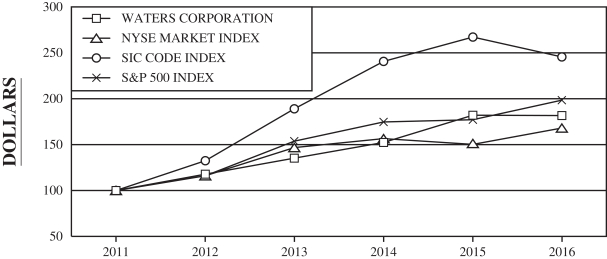
| 2011 | 2012 | 2013 | 2014 | 2015 | 2016 | |||||||||||||||||||
| WATERS CORPORATION | $ | 100.00 | $ | 117.65 | $ | 135.04 | $ | 152.22 | $ | 181.74 | $ | 181.49 | ||||||||||||
| NYSE MARKET INDEX | $ | 100.00 | $ | 115.99 | $ | 146.47 | $ | 156.36 | $ | 149.97 | $ | 167.87 | ||||||||||||
| SIC CODE INDEX | $ | 100.00 | $ | 132.41 | $ | 188.94 | $ | 240.66 | $ | 267.00 | $ | 245.55 | ||||||||||||
| S&P 500 INDEX | $ | 100.00 | $ | 116.00 | $ | 153.58 | $ | 174.60 | $ | 177.01 | $ | 198.18 |
Table of Contents
Market for Registrant’s Common Equity
The quarterly range of high and low sales prices for the Company’s common stock as reported by the New York Stock Exchange is as follows:
| Price Range | ||||||||
| For the Quarter Ended | High | Low | ||||||
| April 4, 2015 | $ | 125.86 | $ | 111.77 | ||||
| July 4, 2015 | $ | 137.39 | $ | 120.79 | ||||
| October 3, 2015 | $ | 136.17 | $ | 113.98 | ||||
| December 31, 2015 | $ | 136.95 | $ | 115.21 | ||||
| April 2, 2016 | $ | 133.60 | $ | 112.00 | ||||
| July 2, 2016 | $ | 143.73 | $ | 128.90 | ||||
| October 1, 2016 | $ | 162.53 | $ | 140.76 | ||||
| December 31, 2016 | $ | 160.00 | $ | 133.35 |
Purchases of Equity Securities by the Issuer
The following table provides information about purchases by the Company during the three months ended December 31, 2016 of equity securities registered by the Company under the Exchange Act (in thousands, except per share data):
| Period | Total Number of Shares Purchased (1) | Average Price Paid per Share | Total Number of Shares Purchased as Part of Publicly Announced Programs (2) | Maximum Dollar Value of Shares that May Yet Be Purchased Under the Programs (2) | ||||||||||||
| October 2 to October 29, 2016 | 35 | $ | 140.11 | 35 | $ | 200,676 | ||||||||||
| October 30 to November 26, 2016 | 345 | $ | 138.99 | 345 | $ | 152,724 | ||||||||||
| November 27 to December 31, 2016 | 227 | $ | 136.48 | 215 | $ | 123,413 | ||||||||||
| Total | 607 | $ | 138.12 | 595 | $ | 123,413 | ||||||||||
| (1) | The Company repurchased $8 million of common stock related to the vesting of restricted stock units during 2016. |
|---|
| (2) | The Company purchased an aggregate of 2.3 million shares of its outstanding common stock in 2016 in open market transactions pursuant to a repurchase program that was announced in May 2014 (the “2014 Program”). The 2014 Program authorized the repurchase of up to $750 million of common stock in open market transactions over a three-year period. |
|---|
Table of Contents
| Item 6: Selected | Financial Data |
|---|
The following table sets forth selected historical consolidated financial and operating data for the periods indicated. The statement of operations and balance sheet data is derived from audited financial statements for the years 2016, 2015, 2014, 2013 and 2012. The Company’s financial statements as of December 31, 2016 and 2015, and for each of the three years in the period ended December 31, 2016 are included in Item 8, Financial Statements and Supplementary Data, in Part II of this Form 10-K.
| In thousands, except per share and employees data | 2016 | 2015 | 2014 | 2013 | 2012 | |||||||||||||||
| STATEMENT OF OPERATIONS DATA: | ||||||||||||||||||||
| Net sales | $ | 2,167,423 | $ | 2,042,332 | $ | 1,989,344 | $ | 1,904,218 | $ | 1,843,641 | ||||||||||
| Income from operations before income taxes | $ | 600,114 | $ | 541,919 | $ | 490,740 | $ | 490,105 | $ | 487,625 | ||||||||||
| Net income | $ | 521,503 | $ | 469,053 | $ | 431,620 | $ | 450,003 | $ | 461,443 | ||||||||||
| Net income per basic common share | $ | 6.46 | $ | 5.70 | $ | 5.12 | $ | 5.27 | $ | 5.25 | ||||||||||
| Weighted-average number of basic common shares | 80,786 | 82,336 | 84,358 | 85,426 | 87,841 | |||||||||||||||
| Net income per diluted common share | $ | 6.41 | $ | 5.65 | $ | 5.07 | $ | 5.20 | $ | 5.19 | ||||||||||
| Weighted-average number of diluted common shares and equivalents | 81,417 | 83,087 | 85,151 | 86,546 | 88,979 | |||||||||||||||
| BALANCE SHEET AND OTHER DATA: | ||||||||||||||||||||
| Cash, cash equivalents and investments | $ | 2,813,032 | $ | 2,399,263 | $ | 2,055,388 | $ | 1,803,670 | $ | 1,539,025 | ||||||||||
| Working capital, including current maturities of debt* | $ | 3,115,124 | $ | 2,649,457 | $ | 2,236,558 | $ | 2,038,100 | $ | 1,701,784 | ||||||||||
| Total assets* | $ | 4,662,059 | $ | 4,268,677 | $ | 3,874,690 | $ | 3,580,106 | $ | 3,181,597 | ||||||||||
| Long-term debt* | $ | 1,701,966 | $ | 1,493,027 | $ | 1,237,463 | $ | 1,188,162 | $ | 1,042,559 | ||||||||||
| Stockholders’ equity | $ | 2,301,949 | $ | 2,058,851 | $ | 1,894,666 | $ | 1,763,173 | $ | 1,467,357 | ||||||||||
| Employees | 6,899 | 6,594 | 6,161 | 5,965 | 5,860 |
| * | In 2015, the Company adopted new accounting guidance related to the presentation of debt issuance costs and deferred income taxes, both standards have been applied above retrospectively. Certain debt issuance costs have been reclassified from intangible assets and are presented as a direct deduction from the carrying value of the associated debt. Current deferred tax assets and liabilities have been reclassified as non-current deferred tax assets and liabilities. |
|---|
Next: Item 7. Management’s Discussion and Analysis of Financial Condition and Results of Operations