 filings.tools
Waste Management 10-K 2018-12-31
Filed 2019-02-14. 22 sections, 514K characters. Original on sec.gov · Markdown · JSON
Cover and table of contents
10-K 1 wm-20181231x10k.htm 10-K
s
UNITED STATES SECURITIES AND EXCHANGE COMMISSION
Washington, D.C. 20549
Form 10-K
(Mark One)
☑ ANNUAL REPORT PURSUANT TO SECTION 13 OR 15(d) OF THE SECURITIES AND EXCHANGE ACT OF 1934
For the fiscal year ended December 31, 2018
OR
☐ TRANSITION REPORT PURSUANT TO SECTION 13 OR 15(d) OF THE SECURITIES AND EXCHANGE ACT OF 1934
For the transition period from to
Commission file number 1-12154
Waste Management, Inc.
(Exact name of registrant as specified in its charter)
| Delaware | 73-1309529 |
| (State or other jurisdiction of | (I.R.S. Employer |
| incorporation or organization) | Identification No.) |
| 1001 Fannin Street | |
| Houston, Texas | 77002 |
| (Address of principal executive offices) | (Zip code) |
Registrant’s telephone number, including area code:
(713) 512-6200
Securities registered pursuant to Section 12(b) of the Act:
| Title of Each Class | Name of Each Exchange on Which Registered |
| Common Stock, $0.01 par value | New York Stock Exchange |
Indicate by check mark if the registrant is a well-known seasoned issuer, as defined by Rule 405 of the Securities Act. Yes ☑ No ☐
Indicate by check mark if the registrant is not required to file reports pursuant to Section 13 or Section 15(d) of the Act. Yes ☐ No ☑
Indicate by check mark whether the registrant (1) has filed all reports required to be filed by Section 13 or 15(d) of the Securities Exchange Act of 1934 during the preceding 12 months (or for such shorter period that the registrant was required to file such reports), and (2) has been subject to such filing requirements for the past 90 days. Yes ☑ No ☐
Indicate by check mark whether the registrant has submitted electronically every Interactive Data File required to be submitted pursuant to Rule 405 of Regulations S-T (§ 232.405 of this chapter) during the preceding 12 months (or for such shorter period that the registrant was required to submit and post such files). Yes ☑ No ☐
Indicate by check mark if disclosure of delinquent filers pursuant to Item 405 of Regulations S-K (§ 229.405 of this chapter) is not contained herein, and will not be contained, to the best of Registrant’s knowledge, in definitive proxy or information statements incorporated by reference in Part III of this Form 10-K or any amendment to this Form 10-K. ☑
Indicate by check mark whether the registrant is a large accelerated filer, an accelerated filer, a non-accelerated filer, smaller reporting company or an emerging growth company. See the definitions of “large accelerated filer,” “accelerated filer,” “smaller reporting company” and “emerging growth company” in Rule 12b-2 of the Exchange Act.
| Large accelerated filer | ☑ | Accelerated filer ☐ |
| Non-accelerated filer | ☐ | Smaller reporting company ☐ |
| Emerging growth company ☐ |
If an emerging growth company, indicate by check mark if the registrant has elected not to use the extended transition period for complying with any new or revised financial accounting standards provided pursuant to Section 13(a) of the Exchange Act. ☐
Indicate by check mark whether the registrant is a shell company (as defined in Rule 12b-2 of the Act). Yes ☐ No ☑
The aggregate market value of the voting stock held by non-affiliates of the registrant as of June 30, 2018 was approximately $34.8 billion. The aggregate market value was computed by using the closing price of the common stock as of that date on the New York Stock Exchange (“NYSE”). (For purposes of calculating this amount only, all directors and executive officers of the registrant have been treated as affiliates.)
The number of shares of Common Stock, $0.01 par value, of the registrant outstanding as of February 8, 2019 was 423,779,540 (excluding treasury shares of 206,502,921).
DOCUMENTS INCORPORATED BY REFERENCE
| Document | Incorporated as to | |
| Proxy Statement for the 2019 Annual Meeting of Stockholders | Part III |
TABLE OF CONTENTS
PART I
Item 1. Business.
General
Waste Management, Inc. is a holding company and all operations are conducted by its subsidiaries. When the terms “the Company,” “we,” “us” or “our” are used in this document, those terms refer to Waste Management, Inc., its consolidated subsidiaries and consolidated variable interest entities. When we use the term “WM,” we are referring only to Waste Management, Inc., the parent holding company.
WM was incorporated in Oklahoma in 1987 under the name “USA Waste Services, Inc.” and was reincorporated as a Delaware company in 1995. In a 1998 merger, the Illinois-based waste services company formerly known as Waste Management, Inc. became a wholly-owned subsidiary of WM and changed its name to Waste Management Holdings, Inc. (“WM Holdings”). At the same time, our parent holding company changed its name from USA Waste Services to Waste Management, Inc. Like WM, WM Holdings is a holding company and all operations are conducted by subsidiaries. For details on the financial position, results of operations and cash flows of WM, WM Holdings and their subsidiaries, see Note 21 to the Consolidated Financial Statements.
Our principal executive offices are located at 1001 Fannin Street, Houston, Texas 77002. Our telephone number is (713) 512‑6200. Our website address is www.wm.com. Our annual reports on Form 10‑K, quarterly reports on Form 10‑Q and current reports on Form 8‑K are all available, free of charge, on our website as soon as practicable after we file the reports with the SEC. Our stock is traded on the New York Stock Exchange under the symbol “WM.”
We are North America’s leading provider of comprehensive waste management environmental services. We partner with our residential, commercial, industrial and municipal customers and the communities we serve to manage and reduce waste at each stage from collection to disposal, while recovering valuable resources and creating clean, renewable energy. Our “Solid Waste” business is operated and managed locally by our subsidiaries that focus on distinct geographic areas and provides collection, transfer, disposal, and recycling and resource recovery services. Our “Traditional Solid Waste” business excludes our recycling and resource recovery services. Through our subsidiaries, we are also a leading developer, operator and owner of landfill gas-to-energy facilities in the United States (“U.S.”). During 2018, our largest customer represented 1% of annual revenues. We employed approximately 43,700 people as of December 31, 2018.
We own or operate 252 landfill sites, which is the largest network of landfills in North America. In order to make disposal more practical for larger urban markets, where the distance to landfills is typically farther, we manage 314 transfer stations that consolidate, compact and transport waste efficiently and economically. We also use waste to create energy, recovering the gas produced naturally as waste decomposes in landfills and using the gas in generators to make electricity. We are a leading recycler in North America, handling materials that include paper, cardboard, glass, plastic and metal. We provide cost-efficient, environmentally sound recycling programs for municipalities, businesses and households across the U.S. and Canada as well as other services that supplement our Traditional Solid Waste business.
Our Company’s goals are targeted at serving our customers, our employees, the environment, the communities in which we work and our stockholders. Increasingly, customers want more of their waste materials recovered while waste streams are becoming more complex, and our aim is to address the current needs, while anticipating the expanding and evolving needs of our customers.
We believe we are uniquely equipped to meet the challenges of the changing waste industry and our customers’ waste management needs, both today and as we work together to envision and create a more sustainable future. As the waste industry leader, we have the expertise necessary to collect and handle our customers’ waste efficiently and responsibly by delivering environmental performance — maximizing resource value, while minimizing environmental impact — so that both our economy and our environment can thrive.
Our fundamental strategy has not changed; we remain dedicated to providing long-term value to our stockholders by successfully executing our core strategy of focused differentiation and continuous improvement. Our strategic planning processes appropriately consider that the future of our business and the industry can be influenced by changes in economic conditions, the competitive landscape, the regulatory environment, asset and resource availability and technology. We believe that focused differentiation, which is driven by capitalizing on our unique and extensive network of assets, will deliver profitable growth and position us to leverage competitive advantages. Simultaneously, we believe the combination of cost control, process improvement and operational efficiency will deliver on the Company’s strategy of continuous improvement and yield an attractive total cost structure and enhanced service quality. While we will continue to monitor emerging diversion technologies that may generate additional value and related market dynamics, our current attention will be on improving existing diversion technologies, such as our recycling operations.
We believe that execution of our strategy will deliver shareholder value and leadership in a dynamic industry. In addition, we intend to continue to return value to our stockholders through dividend payments and our common stock repurchase program. In December 2018, we announced that our Board of Directors expects to increase the quarterly dividend from $0.465 to $0.5125 per share for dividends declared in 2019, which is a 10.2% increase from the quarterly dividends we declared in 2018. This is an indication of our ability to generate strong and consistent cash flows and marks the 16th consecutive year of dividend increases. All quarterly dividends will be declared at the discretion of our Board of Directors and depend on various factors, including our net earnings, financial condition, cash required for future business plans, growth and acquisitions and other factors the Board of Directors may deem relevant.
Operations
General
We evaluate, oversee and manage the financial performance of our Solid Waste business subsidiaries through our 17 Areas. See Note 19 to the Consolidated Financial Statements for additional information about our reportable segments. We also provide additional services that are not managed through our Solid Waste business, as described below. These operations are presented in this report as “Other.” The services we currently provide include collection, landfill (solid and hazardous waste landfills), transfer, recycling and resource recovery and other services, as described below.
Collection. Our commitment to customers begins with a vast waste collection network. Collection involves picking up and transporting waste and recyclable materials from where it was generated to a transfer station, material recovery facility (“MRF”) or disposal site. We generally provide collection services under one of two types of arrangements:
| · | For commercial and industrial collection services, typically we have a three-year service agreement. The fees under the agreements are influenced by factors such as collection frequency, type of collection equipment we furnish, type and volume or weight of the waste collected, distance to the disposal facility, labor costs, cost of disposal and general market factors. As part of the service, we provide steel containers to most customers to store their solid waste between pick-up dates. Containers vary in size and type according to the needs of our customers and the restrictions of their communities. Many are designed to be lifted mechanically and either emptied into a truck’s compaction hopper or directly into a disposal site. By using these containers, we can service most of our commercial and industrial customers with trucks operated by only one employee. |
|---|
| · | For most residential collection services, we have a contract with, or a franchise granted by, a municipality, homeowners’ association or some other regional authority that gives us the exclusive right to service all or a portion of the homes in an area. These contracts or franchises are typically for periods of three to ten years. We also provide services under individual monthly subscriptions directly to households. The fees for residential collection are either paid by the municipality or authority from their tax revenues or service charges, or are paid directly by the residents receiving the service. |
|---|
Landfill. Landfills are the main depositories for solid waste in North America. As of December 31, 2018, we owned or operated 247 solid waste landfills and five secure hazardous waste landfills, which represents the largest network of landfills in North America. Solid waste landfills are constructed and operated on land with engineering safeguards that limit the possibility of water and air pollution, and are operated under procedures prescribed by regulation. A landfill must
meet federal, state or provincial, and local regulations during its design, construction, operation and closure. The operation and closure activities of a solid waste landfill include excavation, construction of liners, continuous spreading and compacting of waste, covering of waste with earth or other acceptable material and constructing final capping of the landfill. These operations are carefully planned to maintain environmentally safe conditions and to maximize the use of the airspace.
All solid waste management companies must have access to a disposal facility, such as a solid waste landfill. The significant capital requirements of developing and operating a landfill serve as a barrier to landfill ownership and, thus, third-party haulers often dispose of waste at our landfills. It is usually preferable for our collection operations to use disposal facilities that we own or operate, a practice we refer to as internalization, rather than using third-party disposal facilities. Internalization generally allows us to realize higher consolidated margins and stronger operating cash flows. The fees charged at disposal facilities, which are referred to as tipping fees, are based on several factors, including competition and the type and weight or volume of solid waste deposited.
Under environmental laws, the federal government (or states with delegated authority) must issue permits for all hazardous waste landfills. All of our hazardous waste landfills have obtained the required permits, although some can accept only certain types of hazardous waste. These landfills must also comply with specialized operating standards. Only hazardous waste in a stable, solid form, which meets regulatory requirements, can be deposited in our secure disposal cells. In some cases, hazardous waste can be treated before disposal. Generally, these treatments involve the separation or removal of solid materials from liquids and chemical treatments that transform waste into inert materials that are no longer hazardous. Our hazardous waste landfills are sited, constructed and operated in a manner designed to provide long-term containment of waste. We also operate a hazardous waste facility at which we isolate treated hazardous waste in liquid form by injection into deep wells that have been drilled in certain acceptable geologic formations far below the base of fresh water to a point that is safely separated by other substantial geological confining layers.
Transfer. As of December 31, 2018, we owned or operated 314 transfer stations in North America. We deposit waste at these stations, as do other waste haulers. The solid waste is then consolidated and compacted to reduce the volume and increase the density of the waste and transported by transfer trucks or by rail to disposal sites.
Access to transfer stations is critical to haulers who collect waste in areas not in close proximity to disposal facilities. Fees charged to third parties at transfer stations are usually based on the type and volume or weight of the waste deposited at the transfer station, the distance to the disposal site, market rates for disposal costs and other general market factors.
The utilization of our transfer stations by our own collection operations improves internalization by allowing us to retain fees that we would otherwise pay to third parties for the disposal of the waste we collect. It enables us to manage costs associated with waste disposal because (i) transfer trucks, railcars or rail containers have larger capacities than collection trucks, allowing us to deliver more waste to the disposal facility in each trip; (ii) waste is accumulated and compacted at transfer stations that are strategically located to increase the efficiency of our network of operations and (iii) we can retain the volume by managing the transfer of the waste to one of our own disposal sites.
The transfer stations that we operate but do not own generally are operated through lease agreements under which we lease property from third parties. There are some instances where transfer stations are operated under contract, generally for municipalities. In most cases, we own the permits and will be responsible for any regulatory requirements relating to the operation and closure of the transfer station.
Recycling. Our recycling operations provide communities and businesses with an alternative to traditional landfill disposal and support our strategic goals to extract more value from the materials we manage. We were the first major solid waste company to focus on residential single-stream recycling, which allows customers to mix recyclable paper, plastic and glass in one bin. Residential single-stream programs have greatly increased the recycling volumes. Single-stream recycling is possible through the use of various mechanized screens and optical sorting technologies. We have also been advancing the single-stream recycling programs for commercial applications. Recycling involves the separation of
reusable materials from the waste stream for processing and resale or other disposition. Our recycling operations include the following:
Materials processing — Through our collection operations, we collect recyclable materials from residential, commercial and industrial customers and direct these materials to one of our MRFs for processing. As of December 31, 2018, we operated 102 MRFs where paper, cardboard, metals, plastics, glass, construction and demolition materials and other recycling commodities are recovered for resale or redirected for other purposes.
Recycling commodities — We market and resell recycling commodities globally. We manage the marketing of recycling commodities that are processed in our facilities by maintaining comprehensive service centers that continuously analyze market prices, logistics, market demands and product quality.
Recycling brokerage services — We also provide recycling brokerage services, which involve managing the marketing of recyclable materials for third parties. The experience of our recycling operations in managing recycling commodities for our own operations gives us the expertise needed to effectively manage volumes for third parties. Utilizing the resources and knowledge of our recycling operations’ service centers, we can assist customers in marketing and selling their recycling commodities with minimal capital requirements.
Some of the recyclable materials processed in our MRFs are purchased from various sources, including third parties and our own operations. The price we pay for recyclable materials is often referred to as a “rebate.” In some cases, rebates are based on fixed contractual rates or on defined minimum per-ton rates but are generally based upon the price we receive for sales of processed goods, market conditions and transportation costs. As a result, changes in commodity prices for recycled materials also significantly affect the rebates we pay to our suppliers and depending on the key terms of the agreement are recorded as either operating expenses or a reduction in operating revenues within our Consolidated Statements of Operations, subsequent to the adoption of Accounting Standards Update (“ASU”) 2014-09 on January 1, 2018. See Note 2 to the Consolidated Financial Statements for additional information. In recent years, we have been focused on revising our rebate structures to ensure that we cover our cost of handling and processing the materials and generate an acceptable margin on the materials we process and sell.
Other. Other services we provide include the following:
Although many waste management services such as collection and disposal are local services, our strategic accounts organization, which is managed by our Strategic Business Solutions (“WMSBS”) organization, works with customers whose locations span the U.S. and Canada. Our strategic accounts program provides centralized customer service, billing and management of accounts to streamline the administration of customers multiple locations’ waste management needs.
Our Energy and Environmental Services (“EES”) organization offers our customers in all Areas a variety of services in collaboration with our Area and strategic accounts programs, including (i) construction and remediation services; (ii) services associated with the disposal of fly ash, residue generated from the combustion of coal and other fuel stocks; (iii) in-plant services, where our employees work full-time inside our customers’ facilities to provide full-service waste management solutions and consulting services; this service is managed through our EES organization but reflected principally in our collection line of business and (iv) specialized disposal services for oil and gas exploration and production operations; revenues for this service are also reflected principally in our collection line of business. Our vertically integrated waste management operations enable us to provide customers with full management of their waste. The breadth of our service offerings and the familiarity we have with waste management practices gives us the unique ability to assist customers in minimizing the amount of waste they generate, identifying recycling opportunities, determining the most efficient means available for waste collection and disposal and ensuring that disposal is achieved in a manner that is both reflective of the current regulatory environment and environmentally friendly.
We develop, operate and promote projects for the beneficial use of landfill gas through our WM Renewable Energy organization. Landfill gas is produced naturally as waste decomposes in a landfill. The methane component of the landfill gas is a readily available, renewable energy source that can be gathered and used beneficially as an alternative to fossil fuel. The U.S. Environmental Protection Agency (“EPA”) endorses landfill gas as a renewable energy resource, in the
same category as wind, solar and geothermal resources. As of December 31, 2018, we had 130 landfill gas beneficial use projects producing commercial quantities of methane gas at owned or operated landfills. For 101 of these projects, the processed gas is used to fuel electricity generators. The electricity is then sold to public utilities, municipal utilities or power cooperatives. For 15 of these projects, the landfill gas is processed to pipeline-quality natural gas and then sold to natural gas suppliers. For 14 of these projects, the gas is used at the landfill or delivered by pipeline to industrial customers as a direct substitute for fossil fuels in industrial processes.
We continue to invest in businesses and technologies that are designed to offer services and solutions ancillary or supplementary to our current operations. These investments include joint ventures, acquisitions and partial ownership interests. The solutions and services include the collection of project waste, including construction debris and household or yard waste, through our Bagster® program; the development, operation and marketing of plasma gasification facilities; operation of a landfill gas-to-liquid natural gas plant; solar powered trash compactors and organic waste-to-fuel conversion technology. We also have expanded service offerings and solutions including fluorescent bulb and universal waste mail-back through our LampTracker® program; portable restroom servicing under the name Port-o-Let®; and street and parking lot sweeping services.
Competition
We encounter intense competition from governmental, quasi-governmental and private sources in all aspects of our operations. We principally compete with large national waste management companies, counties and municipalities that maintain their own waste collection and disposal operations and regional and local companies of varying sizes and financial resources. The industry also includes companies that specialize in certain discrete areas of waste management, operators of alternative disposal facilities, companies that seek to use parts of the waste stream as feedstock for renewable energy and other by-products, and waste brokers that rely upon haulers in local markets to address customer needs. In recent years, the industry has seen some additional consolidation, though the industry remains intensely competitive.
Operating costs, disposal costs and collection fees vary widely throughout the areas in which we operate. The prices that we charge are determined locally, and typically vary by volume and weight, type of waste collected, treatment requirements, risk of handling or disposal, frequency of collections, distance to final disposal sites, the availability of airspace within the geographic region, labor costs and amount and type of equipment furnished to the customer. We face intense competition in our Solid Waste business based on pricing and quality of service. We have also begun competing for business based on breadth of service offerings. As companies, individuals and communities look for ways to be more sustainable, we are investing in greener technologies and promoting our comprehensive services that go beyond our core business of collecting and disposing of waste.
Seasonal Trends
Our operating revenues tend to be somewhat higher in summer months, primarily due to the higher construction and demolition waste volumes. The volumes of industrial and residential waste in certain regions where we operate also tend to increase during the summer months. Our second and third quarter revenues and results of operations typically reflect these seasonal trends.
Service disruptions caused by severe storms, extended periods of inclement weather or climate extremes resulting from climate change can significantly affect the operating results of the Areas affected. On the other hand, certain destructive weather and climate conditions, such as wildfires in the Western U.S. and hurricanes that most often impact our operations in the Southern and Eastern U.S. during the second half of the year, can increase our revenues in the Areas affected. While weather-related and other event driven special projects can boost revenues through additional work for a limited time, as a result of significant start-up costs and other factors, such revenue can generate earnings at comparatively lower margins.
Employees
As of December 31, 2018, we had approximately 43,700 full-time employees, of which approximately 8,200 were employed in administrative and sales positions and the balance in operations. Approximately 8,300 of our employees are covered by collective bargaining agreements.
Financial Assurance and Insurance Obligations
Financial Assurance
Municipal and governmental waste service contracts generally require contracting parties to demonstrate financial responsibility for their obligations under the contract. Financial assurance is also a requirement for (i) obtaining or retaining disposal site or transfer station operating permits; (ii) supporting certain variable-rate tax-exempt debt and (iii) estimated final capping, closure, post-closure and environmental remedial obligations at many of our landfills. We establish financial assurance using surety bonds, letters of credit, insurance policies, trust and escrow agreements and financial guarantees. The type of assurance used is based on several factors, most importantly: the jurisdiction, contractual requirements, market factors and availability of credit capacity.
Surety bonds and insurance policies are supported by (i) a diverse group of third-party surety and insurance companies; (ii) an entity in which we have a noncontrolling financial interest or (iii) a wholly-owned insurance captive, the sole business of which is to issue surety bonds and/or insurance policies on our behalf. Letters of credit generally are supported by our long-term U.S. and Canadian revolving credit facility (“$2.75 billion revolving credit facility”) and other credit facilities established for that purpose.
Insurance
We carry a broad range of insurance coverages, including general liability, automobile liability, workers’ compensation, real and personal property, directors’ and officers’ liability, pollution legal liability and other coverages we believe are customary to the industry. Our exposure to loss for insurance claims is generally limited to the per-incident deductible under the related insurance policy. In December 2017, we elected to use a wholly-owned insurance captive to insure the deductibles for our general liability, automobile liability and workers’ compensation claims programs. As of December 31, 2018, both our commercial General Liability Insurance Policy and our workers’ compensation insurance program carried self-insurance exposures of up to $5 million per incident. As of December 31, 2018, our automobile liability insurance program included a per-incident deductible of up to $10 million. We do not expect the impact of any known casualty, property, environmental or other contingency to have a material impact on our financial condition, results of operations or cash flows. Our estimated insurance liabilities as of December 31, 2018 are summarized in Note 10 to the Consolidated Financial Statements.
Regulation
Our business is subject to extensive and evolving federal, state or provincial and local environmental, health, safety and transportation laws and regulations. These laws and regulations are administered by the EPA, Environment Canada, and various other federal, state, provincial and local environmental, zoning, transportation, land use, health and safety agencies in the U.S. and Canada. Many of these agencies regularly examine our operations to monitor compliance with these laws and regulations and have the power to enforce compliance, obtain injunctions or impose civil or criminal penalties in case of violations.
Because the primary mission of our business is to collect and manage solid waste in an environmentally sound manner, a significant amount of our capital expenditures is related, either directly or indirectly, to environmental protection measures, including compliance with federal, state, provincial and local rules. There are costs associated with siting, design, permitting, operations, monitoring, site maintenance, corrective actions, financial assurance, and facility closure and post-closure obligations. With acquisition, development or expansion of a waste management or disposal facility or transfer station, we must often spend considerable time, effort and money to obtain or maintain required permits and
approvals. There are no assurances that we will be able to obtain or maintain required governmental approvals. Once obtained, operating permits are subject to renewal, modification, suspension or revocation by the issuing agency. Compliance with current regulations and future requirements could require us to make significant capital and operating expenditures. However, most of these expenditures are made in the normal course of business and do not place us at any competitive disadvantage.
In recent years, we perceived an increase in both the amount of government regulation and the number of enforcement actions being brought by regulatory entities against operations in the waste services industry. The current U.S. presidential administration has called for substantial changes to foreign trade policy and has generally appeared to be in favor of reducing regulation, including environmental regulation. We cannot predict what impact the current administration will have on regulations impacting our industry, especially given the number of rules currently in litigation, nor can we predict the timing of any such changes. Reduction of regulation may have a favorable impact on our operating costs, but the extensive environmental regulation applicable to landfills is a substantial barrier to entry that benefits our Company. Moreover, the risk reduction provided by stringent regulation is valuable to our customers and the communities we serve.
The primary U.S. federal statutes affecting our business are summarized below:
| · | The Resource Conservation and Recovery Act of 1976 (“RCRA”), as amended, regulates handling, transporting and disposing of hazardous and non-hazardous waste and delegates authority to states to develop programs to ensure the safe disposal of solid waste. In 1991, the EPA issued final regulations under Subtitle D of RCRA, which set forth minimum federal performance and design criteria for solid waste landfills. These regulations are typically implemented by the states, although states can impose requirements that are more stringent than the Subtitle D standards. We incur costs in complying with these standards in the ordinary course of our operations. In December 2018, the EPA signed a final rule that establishes management standards for pharmaceutical wastes that are classified as hazardous wastes. The requirements of the rule apply primarily to healthcare facilities and reverse distributors of hazardous waste pharmaceuticals and include a broad prohibition on disposal of hazardous waste pharmaceuticals in sewage systems. The rule is not currently anticipated to materially affect our industry, but we do expect that it will create new waste volumes for disposal at facilities permitted to incinerate hazardous waste. Also, in December 2018, the EPA published an Advanced Notice of Proposed Rulemaking to consider whether to propose revisions to the MSW Landfill criteria to support advances in liquids management. The notice does not reopen any existing regulations; we will review the topic for both risks and opportunities for our business and respond appropriately. |
|---|
| · | The Comprehensive Environmental Response, Compensation and Liability Act of 1980, as amended, (“CERCLA”) which is also known as Superfund, provides for federal authority to respond directly to releases or threatened releases of hazardous substances into the environment that have created actual or potential environmental hazards. CERCLA’s primary means for addressing such releases is to impose strict liability for cleanup of disposal sites upon current and former site owners and operators, generators of the hazardous substances at the site and transporters who selected the disposal site and transported substances thereto. Liability under CERCLA is not dependent on the intentional release of hazardous substances; it can be based upon the release or threatened release of hazardous substances, even resulting from lawful, unintentional and attentive action, as the term is defined by CERCLA and other applicable statutes and regulations. The EPA may issue orders requiring responsible parties to perform response actions at sites, or the EPA may seek recovery of funds expended or to be expended in the future at sites. Liability may include contribution for cleanup costs incurred by a defendant in a CERCLA civil action or by an entity that has previously resolved its liability to federal or state regulators in an administrative or judicially-approved settlement. Liability under CERCLA could also include obligations to a potentially responsible party (“PRP”) that voluntarily expends site clean-up costs. Further, liability for damage to publicly-owned natural resources may also be imposed. We are subject to potential liability under CERCLA as an owner or operator of facilities at which hazardous substances have been disposed and as a generator or transporter of hazardous substances disposed of at other locations. |
|---|
| · | The Federal Water Pollution Control Act of 1972, as amended, known as the Clean Water Act, regulates the discharge of pollutants into streams, rivers, groundwater, or other surface waters from a variety of sources, including solid and hazardous waste disposal sites. If our operations discharge any pollutants into surface waters, the Clean Water Act requires us to apply for and obtain discharge permits, conduct sampling and monitoring, |
|---|
| and, under certain circumstances, reduce the quantity of pollutants in those discharges. In 1990, the EPA issued additional standards for management of storm water run-off that require landfills and other waste-handling facilities to obtain storm water discharge permits. Also, if a landfill or other facility discharges wastewater through a sewage system to a publicly-owned treatment works, the facility must comply with discharge limits imposed by the treatment works. Further, before the development or expansion of a landfill can alter or affect “wetlands,” a permit may have to be obtained providing for mitigation or replacement wetlands. The Clean Water Act provides for civil, criminal and administrative penalties for violations of its provisions. |
|---|
| · | The Clean Air Act of 1970, as amended, provides for federal, state and local regulation of the emission of air pollutants. Certain of our operations are subject to the requirements of the Clean Air Act, including large municipal solid waste landfills and landfill gas-to-energy facilities. In 1996 the EPA issued new source performance standards (“NSPS”) and emission guidelines controlling landfill gases from new and existing large landfills. In January 2003, the EPA issued Maximum Achievable Control Technology (“MACT”) standards for municipal solid waste landfills subject to the NSPS. These regulations impose limits on air emissions from large municipal solid waste landfills, subject most of these landfills to certain operating permit requirements under Title V of the Clean Air Act and, in many instances, require installation of landfill gas collection and control systems to control emissions or to treat and utilize landfill gas on- or off-site. On August 29, 2016, the EPA published two rules with new requirements for landfill gas control and monitoring at both new municipal solid waste landfills (constructed or modified after July 17, 2014) as well as existing landfills (operating after November 8, 1987 and not modified after July 17, 2014). Working with our trade associations and other landfill owners and operators, we identified significant legal, technical and implementation concerns with the rules and together filed a judicial appeal of the rules while also filing administrative petitions asking that the EPA stay the rules and initiate a rulemaking process, which the EPA has convened. The EPA is also reviewing the landfill MACT standards to determine whether revisions are warranted. A court has required that this Risk Technology Review must be completed, and a final rule issued by March 2020. We cannot predict the outcome of either rulemaking process; however, we do not believe regulatory changes, if determined, will have a material adverse impact on our business as a whole. |
|---|
The EPA and the Department of Transportation finalized Greenhouse Gas Emissions and Fuel Efficiency Standards for Medium and Heavy-Duty Engines and Vehicles – Phase 2 on August 16, 2016. The rule will increase fuel economy standards and reduce vehicle emissions standards for our collection fleet between model years 2021 and 2027. We expect to be able to purchase fully compliant vehicles that will meet our operational needs, and while the regulations could increase the costs of operating our fleet, we do not believe any such regulations would have a material adverse impact on our business as a whole.
| · | The Occupational Safety and Health Act of 1970, as amended, (“OSHA”) establishes certain employer responsibilities, including maintenance of a workplace free of recognized hazards likely to cause death or serious injury, compliance with standards promulgated by the Occupational Safety and Health Administration, and various reporting and record keeping obligations as well as disclosure and procedural requirements. Various standards for notices of hazards, safety in excavation and demolition work and the handling of asbestos, may apply to our operations. The Department of Transportation and OSHA, along with other federal agencies, have jurisdiction over certain aspects of hazardous materials and hazardous waste, including safety, movement and disposal. Various state and local agencies with jurisdiction over disposal of hazardous waste may seek to regulate movement of hazardous materials in areas not otherwise preempted by federal law. |
|---|
We are also actively monitoring the following recent regulatory developments affecting our business:
| · | In 2010, the EPA issued the Prevention of Significant Deterioration (“PSD”) and Title V Greenhouse Gas (“GHG”) Tailoring Rule, which expanded the EPA’s federal air permitting authority to include the six GHGs, including methane and carbon dioxide. The rule sets new thresholds for GHG emissions that define when Clean Air Act permits are required. The requirements of these rules have not significantly affected our operations or cash flows, due to the tailored thresholds and exclusions of certain emissions from regulation. |
|---|
Since 2014, decisions from the U.S Supreme Court and U.S. Court of Appeals for the D.C Circuit, as well as EPA policy memorandum, have significantly narrowed the applicability and scope of EPA permitting requirements for GHGs from stationary sources, including with respect to biogenic carbon dioxide (“CO2”) permitting. In
2016, the EPA proposed revisions to the PSD and Title V GHG permitting regulations establishing a significant emissions rate (“SER”) threshold, below which sources would not be required to implement additional control technologies for their GHG emissions. This SER threshold should prevent most of our operational changes, such as landfill expansions and beneficial gas recovery projects, from being subject to PSD or Title V permit requirements due to our GHG emissions – assuming the EPA classifies biogenic CO2 emissions from municipal solid waste and landfill gas as carbon neutral. The EPA has not yet finalized this rulemaking. The EPA also has not yet finalized its policy for addressing biogenic CO2 emissions from waste management; however, the EPA’s independent Science Advisory Board has recommended it treat waste-derived CO2 emissions as carbon-neutral. These recent judicial and regulatory actions have reduced, and are expected to continue to reduce, the potential impact of the PSD and Title V GHG Tailoring Rule on our air permits, compliance and operating requirements. See Item 1A. Risk Factors — The adoption of climate change legislation or regulations restricting emissions of “greenhouse gases” could increase our costs to operate.
Other recent regulatory actions to increase the stringency of certain National Ambient Air Quality Standards (“NAAQS”) could affect the cost, timeliness and availability of air permits for new and modified large municipal solid waste landfills and landfill gas-to-energy facilities. However, the EPA under the current administration is reviewing the implementation of the new NAAQS and considering revisions to make the regulations less stringent. While we cannot predict the ultimate outcome of potential revisions to NAAQS, we do not believe that the ultimate requirements will have a material adverse impact on our business as a whole.
We continue to anticipate the needs of our customers, which includes investing in and developing ever-more-advanced recycling and reuse technologies. Potential climate change, GHG regulatory, and corporate sustainability initiatives have influenced our business strategy to provide low-carbon services to our customers, and we increasingly view our ability to offer lower carbon services as a key component of our business growth. If the U.S. were to impose a carbon tax or other form of GHG regulation increasing demand for low-carbon service offerings in the future, the services we are developing will be increasingly valuable.
| · | In December 2014, the EPA issued a final rule regulating the disposal and beneficial use of coal combustion residuals (“CCR”). This codification of the CCR rule provides utilities with a stable regulatory regime and encourages beneficial use of CCR in encapsulated uses (e.g., used in cement or wallboard), and use according to established industry standards (e.g., application of sludge for agricultural enrichment). The EPA also deemed disposal and beneficial use of CCR at permitted municipal solid waste landfills exempt from the new regulations because the RCRA Subtitle D standards applicable at municipal solid waste landfills provide at least equivalent protection. The new standards are consistent with our approach to handling CCR at our sites currently, and the new standards have provided a growth opportunity for the Company. States may impose standards more stringent than the federal program, and under the 2016 Water Infrastructure Improvements for the Nation Act, may receive approval to run permitting programs for CCR in their states. In 2018, the U.S. Court of Appeals for the D.C Circuit vacated significant portions of the 2014 final rule and remanded the rule to the EPA for further revision. Because vacated elements of the rule had allowed for the continued operation of unlined CCR ash ponds, the ongoing EPA rulemaking may further expand the Company’s opportunity to provide CCR disposal services. |
|---|
| · | In May 2016, the EPA established lifetime health advisories for certain per- and polyfluoroalkyl substances (“PFAS”), a group of man-made chemicals that have been manufactured and used globally since the 1940s in products such as textiles, fire suppressants, cookware, packaging and plastics. PFAS are typically very persistent in the environment and can be found in water, soil and air. Citing concerns about potential adverse human health effects from exposure to PFAS, several states have recently enacted new drinking water, surface water and/or groundwater limits for various PFAS, and the EPA has stated that it will be considering additional regulatory action related to the compounds. We are working with both the EPA and state regulatory agencies to maintain compliance with these evolving PFAS standards and anticipate additional expense that will result from these efforts |
|---|
State, Provincial and Local Regulations
There are also various state or provincial and local regulations that affect our operations. Each state and province in which we operate has its own laws and regulations governing solid waste disposal, water and air pollution, and, in most
cases, releases and cleanup of hazardous substances and liabilities for such matters. States and provinces have also adopted regulations governing the design, operation, maintenance and closure of landfills and transfer stations. Some counties, municipalities and other local governments have adopted similar laws and regulations. Our facilities and operations are likely to be subject to these types of requirements.
Our landfill operations are affected by the increasing preference for alternatives to landfill disposal. Many state and local governments mandate recycling and waste reduction at the source and prohibit the disposal of certain types of waste, such as yard waste, food waste and electronics at landfills. The number of state and local governments with recycling requirements and disposal bans continues to grow, while the logistics and economics of recycling the items remain challenging.
Various states have enacted, or are considering enacting, laws that restrict the disposal within the state of solid waste generated outside the state. While laws that overtly discriminate against out-of-state waste have been found to be unconstitutional, some laws that are less overtly discriminatory have been upheld in court. From time to time, the U.S. Congress has considered legislation authorizing states to adopt regulations, restrictions, or taxes on the importation of out-of-state or out-of-jurisdiction waste. Additionally, several state and local governments have enacted “flow control” regulations, which attempt to require that all waste generated within the state or local jurisdiction be deposited at specific sites. In 1994, the U.S. Supreme Court ruled that a flow control ordinance that gave preference to a local facility that was privately owned was unconstitutional, but in 2007, the Court ruled that an ordinance directing waste to a facility owned by the local government was constitutional. The U.S. Congress’ adoption of legislation allowing restrictions on interstate transportation of out-of-state or out-of-jurisdiction waste or certain types of flow control, or courts’ interpretations of interstate waste and flow control legislation, could adversely affect our solid and hazardous waste management services.
Additionally, regulations establishing extended producer responsibility (“EPR”) are being considered or implemented in many places around the world, including in the U.S. and Canada. EPR regulations are designed to place either partial or total responsibility on producers to fund the post-use life cycle of the products they create. Along with the funding responsibility, producers may be required to take over management of local recycling programs by taking back their products from end users or managing the collection operations and recycling processing infrastructure. There is no federal law establishing EPR in the U.S. or Canada; however, state, provincial and local governments could take, and in some cases have taken, steps to implement EPR regulations. If wide-ranging EPR regulations were adopted, they could have a fundamental impact on the waste, recycling and other streams we manage and how we operate our business, including contract terms and pricing.
Many states, provinces and local jurisdictions have enacted “fitness” laws that allow the agencies that have jurisdiction over waste services contracts or permits to deny or revoke these contracts or permits based on the applicant’s or permit holder’s compliance history. Some states, provinces and local jurisdictions go further and consider the compliance history of the parent, subsidiaries or affiliated companies, in addition to the applicant or permit holder. These laws authorize the agencies to make determinations of an applicant’s or permit holder’s fitness to be awarded a contract to operate, and to deny or revoke a contract or permit because of unfitness, unless there is a showing that the applicant or permit holder has been rehabilitated through the adoption of various operating policies and procedures put in place to assure future compliance with applicable laws and regulations. While fitness laws can present potential increased costs and barriers to entry into market areas, these laws have not, and are not expected to have a material adverse impact on our business as a whole.
Recycling; Foreign Import and Export Regulations
Enforcement or implementation of foreign and domestic regulations can affect our ability to export products. A significant portion of the fiber that we market has been shipped to export markets across the globe, particularly China. In 2013, the Chinese government began to strictly enforce regulations that establish limits on moisture and non-conforming materials that may be contained in imported recycled paper and plastics and restrict the import of certain other plastic recyclables. In 2017, the Chinese government announced a ban on certain materials, including mixed waste paper and mixed plastics, effective January 1, 2018, as well as extremely restrictive quality requirements effective March 1, 2018 that have been difficult for the industry to achieve. Many other markets, both domestic and foreign, have tightened their quality expectations as well. In addition, other countries have limited or restricted the import of certain recyclables.
Single stream MRFs process a wide range of commingled materials and tend to receive a higher percentage of non-recyclables, which results in increased processing and residual disposal costs to achieve quality standards. Also in 2017, the Chinese government began to limit the flow of material into the country by restricting the issuance of required import licenses. The use of restrictions on import licenses to restrict flow into China continued in 2018 and is expected to continue to constrict in 2019. Additionally, increased container weight tracking and port fees have driven up operating costs in the recycling industry and have resulted in increased price volatility. The current U.S. presidential administration has made substantial changes to foreign trade policy and imposed increases in tariffs on international trade. In response, China has imposed new tariffs on the import of recyclable commodities, including wastepaper, plastics and metals. Such restrictions and tariffs may have a significant impact on our recycling operations.
In recent years, we have been revising our service agreements to address increased costs and are working with stakeholders to educate the public on the need to recycle properly. We are investing time and labor and working with customers to help improve quality. However, there is uncertainty about the industry’s ability to adapt to the stricter quality expectations. We have been actively working to identify alternative markets for recycled commodities, but it is possible there may not be sufficient demand for all of the material we produce, resulting in price decreases and volatility. Industry trade organizations and government agencies are engaged in discussions to mitigate long-term impacts to recycling programs and the industry as a whole.
With a heightened awareness of the global problems of plastic waste in the environment, an increasing number of cities across the country have passed ordinances banning certain types of plastics from sale or use. Bans on single use plastic bags, straws, and polystyrene food containers have been passed in over 350 cities, and a ban on single use plastic bags has been implemented in the State of California. These bans have increased pressure by manufacturers on our recycling facilities to accept a broader array of materials in curbside recycling programs to alleviate public pressures to ban the sale of those materials. However, with no viable end markets for recycling these materials, we and other recyclers are working to educate and remind customers of the need for end market demand and economic viability to support sustainable recycling programs.
Regulation of Oil and Gas Exploration, Production and Disposal
Our EES organization provides specialized environmental management and disposal services for fluids used and wastes generated by customers engaged in oil and gas exploration and production, and these disposal services include use of underground injection wells. There is heightened federal regulatory focus on emissions of methane that occur during drilling and transportation of natural gas, as well as state attention to protective disposal of drilling residuals. There also remains heightened attention from the public, some states and the EPA to the alleged potential for hydraulic fracturing that occurs during drilling to impact drinking water supplies. Increased regulation of oil and gas exploration and production, including GHG emissions or hydraulic fracturing, could make it more difficult or cost-prohibitive for our EES customers to continue operations, adversely affecting our business.
Additionally, any new regulations regarding the treatment and disposal of wastes associated with exploration and production operations, including through use of injection wells, could increase our costs to provide oilfield services and reduce our margins and revenue from such services. Conversely, any loosening of regulations regarding how such wastes are handled or disposed of could adversely affect our business, as we believe the size, capital structure, regulatory sophistication and established reliability of our Company provide us with an advantage in providing services that must comply with any complex regulatory regime that may govern providing oilfield waste services.
Emissions from Natural Gas Fueling and Infrastructure
We operate a large fleet of natural gas vehicles, and we plan to continue to invest in these assets for our collection fleet. As of December 31, 2018, we were operating 7,621 natural gas trucks and 123 natural gas fueling facilities; 25 of these fueling stations also serve the public, and in some cases our facilities serve the fleet of pre-approved third parties. Concerns have been raised about the potential for emissions from the fueling stations and infrastructure that serve natural gas-fueled vehicles. We have partnered with the environmental organization Environmental Defense Fund, as well as other heavy-duty equipment users and experts, on an emissions study to be made available to policy makers. We anticipate that
this comprehensive study of emissions from our heavy-duty fleet may ultimately help inform regulations that will affect equipment manufacturers and will define operating procedures across the industry. Additional regulation of, or restrictions on, natural gas fueling infrastructure or reductions in associated tax incentives could increase our operating costs. We are not yet able to evaluate potential operating changes or costs associated with such regulations, but we do not anticipate that such regulations would have a material adverse impact on our business or our future investment in natural gas vehicles.
Renewable Fuel Production
We have invested, and continue to invest, in facilities to capture and treat renewable natural gas (“RNG”) from the Company’s landfills, and we use RNG from landfill biogas in approximately 30% of our natural gas collection vehicles. The Energy Policy Act of 2005 and Energy Independence and Security Act of 2007 authorize the Renewable Fuels Standards (“RFS”) program that promotes the production and use of renewable transportation fuels. The Company is an EPA-registered producer of transportation fuel making compressed and liquefied RNG from landfill biogas, which qualifies as a cellulosic biofuel under the RFS program. Oil refiners and importers are required through the RFS program to blend specified volumes of various categories of renewable transportation fuels with gasoline or buy credits, referred to as renewable identification numbers (“RINs”), from renewable fuel producers. The market value for RINs is tied to renewable fuel volumes set by the EPA annually, and the final 2019 required volumes for cellulosic biofuel are 45% higher than in 2018. The EPA is required to develop a rulemaking this year that will set required volume requirements for a three‑year period from 2020 through 2022. Based on the overall political framework and the upcoming rulemakings, we anticipate a stable market for the Company’s RINs.
Federal, State and Local Climate Change Initiatives; Sustainability
In light of regulatory and business developments related to concerns about climate change, we have identified a strategic business opportunity to provide our public and private sector customers with sustainable solutions to reduce their GHG emissions. As part of our on-going marketing evaluations, we assess customer demand for and opportunities to develop waste services offering verifiable carbon reductions, such as waste reduction, increased recycling, and conversion of landfill gas and discarded materials into electricity and fuel. We use carbon life cycle tools in evaluating potential new services and in establishing the value proposition that makes us attractive as an environmental service provider. We are active in support of public policies that encourage development and use of lower carbon energy and waste services that lower users’ carbon footprints. We understand the importance of broad stakeholder engagement in these endeavors, and actively seek opportunities for public policy discussion on more sustainable materials management practices. In addition, we work with stakeholders at the federal and state level in support of legislation that encourages production and use of renewable, low-carbon fuels and electricity. Despite the announcement that the U.S. will withdraw from the Paris Climate Accords, we have seen no reduction in customer demand for services aligned with their GHG reduction goals and strategies. Moreover, we have seen initiatives at the federal, state and local level to enhance the environmental benefits in terms of GHG reductions realized by recycling programs by focusing on reducing contamination in the recyclable material.
We continue to assess the physical risks to company operations from the effects of severe weather events and use risk mitigation planning to increase our resiliency in the face of such events. We are investing in infrastructure to withstand more severe storm events, which may afford us a competitive advantage and reinforce our reputation as a reliable service provider through continued service in the aftermath of such events.
Consistent with our Company’s long-standing commitment to corporate sustainability and environmental stewardship, we have published our 2018 Sustainability Report, “Driving Change,” which details the GHG emissions reductions we have facilitated to date and our determination to expand these reductions in the future, as well as our commitment to help make the communities in which we live and work safe, resilient and sustainable. The information in this report can be found at our Company website but does not constitute a part of this Form 10-K. The Company actively participates in a number of sustainability reporting programs and frameworks, including the Dow Jones Sustainability Index, where we are “Sector Leader” for Commercial Services, the CDP, where we are among “A List” companies, and the Sustainability Accounting Standards Board, on which we serve as a member of the Board’s advisory council.
Item 1A. Risk Factors.
In an effort to keep our stockholders and the public informed about our business, we may make “forward-looking statements.” Forward-looking statements usually relate to future events and anticipated revenues, earnings, cash flows or other aspects of our operations or operating results. Forward-looking statements are often identified by the words, “will,” “may,” “should,” “continue,” “anticipate,” “believe,” “expect,” “plan,” “forecast,” “project,” “estimate,” “intend” and words of a similar nature and generally include statements containing:
| · | projections about accounting and finances; |
|---|
| · | plans and objectives for the future; |
|---|
| · | projections or estimates about assumptions relating to our performance; or |
|---|
| · | our opinions, views or beliefs about the effects of current or future events, circumstances or performance. |
|---|
You should view these statements with caution. These statements are not guarantees of future performance, circumstances or events. They are based on facts and circumstances known to us as of the date the statements are made. All aspects of our business are subject to uncertainties, risks and other influences, many of which we do not control. Any of these factors, either alone or taken together, could have a material adverse effect on us and could change whether any forward-looking statement ultimately turns out to be true. Additionally, we assume no obligation to update any forward-looking statement as a result of future events, circumstances or developments. The following discussion should be read together with the Consolidated Financial Statements and the notes thereto. Outlined below are some of the risks that we believe could affect our business and financial statements for 2019 and beyond and that could cause actual results to be materially different from those that may be set forth in forward-looking statements made by the Company.
The waste industry is highly competitive, and if we cannot successfully compete in the marketplace, our business, financial condition and operating results may be materially adversely affected.
We encounter intense competition from governmental, quasi-governmental and private sources in all aspects of our operations. We principally compete with large national waste management companies, counties and municipalities that maintain their own waste collection and disposal operations and regional and local companies of varying sizes and financial resources. The industry also includes companies that specialize in certain discrete areas of waste management, operators of alternative disposal facilities, companies that seek to use parts of the waste stream as feedstock for renewable energy and other by-products, and waste brokers that rely upon haulers in local markets to address customer needs. In recent years, the industry has seen some additional consolidation, though the industry remains intensely competitive. Counties and municipalities may have financial competitive advantages because tax revenues are available to them and tax-exempt financing is more readily available to them. Also, such governmental units may attempt to impose flow control or other restrictions that would give them a competitive advantage. In addition, some of our competitors may have lower financial expectations, allowing them to reduce their prices to expand sales volume or to win competitively-bid contracts, including large national accounts and exclusive franchise arrangements with municipalities. When this happens, we may lose customers and be unable to execute our pricing strategy, resulting in a negative impact to our revenue growth from yield on base business.
If we fail to implement our business strategy, our financial performance and our growth could be materially and adversely affected.
Our future financial performance and success are dependent in large part upon our ability to implement our business strategy successfully. Implementation of our strategy will require effective management of our operational, financial and human resources and will place significant demands on those resources. See Item 1. Business for more information on our business strategy.
There are risks involved in pursuing our strategy, including the following:
| · | Our employees, customers or investors may not embrace and support our strategy. |
|---|
| · | We may not be able to hire or retain the personnel necessary to manage our strategy effectively. |
|---|
| · | A key element of our strategy is yield management through focus on price leadership, which has presented challenges to keep existing business and win new business at reasonable returns. We have also continued our environmental fee, fuel surcharge and regulatory recovery fee to offset costs. The loss of volumes as a result of price increases and our unwillingness to pursue lower margin volumes may negatively affect our cash flows or results of operations. Additionally, we have in the past and continue to face purported class action lawsuits related to our customer service agreements, prices and fees. |
|---|
| · | We may be unsuccessful in implementing improvements to operational efficiency and such efforts may not yield the intended result. |
|---|
| · | We may not be able to maintain cost savings achieved through optimization efforts. |
|---|
| · | Strategic decisions with respect to our asset portfolio may result in impairments to our assets. See Item 1A. Risk Factors — We may record material charges against our earnings due to impairments to our assets. |
|---|
| · | Our ability to make strategic acquisitions depends on our ability to identify desirable acquisition targets, negotiate advantageous transactions despite competition for such opportunities, fund such acquisitions on favorable terms, obtain regulatory approvals and realize the benefits we expect from those transactions. |
|---|
| · | Acquisitions, investments and/or new service offerings may not increase our earnings in the timeframe anticipated, or at all, due to difficulties operating in new markets or providing new service offerings, failure of emerging technologies to perform as expected, failure to operate within budget, integration issues, or regulatory issues, among others. |
|---|
| · | Integration of acquisitions and/or new services offerings could increase our exposure to the risk of inadvertent noncompliance with applicable laws and regulations. |
|---|
| · | Liabilities associated with acquisitions, including ones that may exist only because of past operations of an acquired business, may prove to be more difficult or costly to address than anticipated. |
|---|
| · | Execution of our strategy, particularly growth through acquisitions, may cause us to incur substantial additional indebtedness, which may divert capital away from our traditional business operations and other financial plans. |
|---|
| · | We continue to seek to divest underperforming and non-strategic assets if we cannot improve their profitability. We may not be able to successfully negotiate the divestiture of underperforming and non-strategic operations, which could result in asset impairments or the continued operation of low-margin businesses. |
|---|
In addition to the risks set forth above, implementation of our business strategy could also be affected by factors beyond our control, such as increased competition, legal developments, government regulation, general economic conditions, increased operating costs or expenses, subcontractor costs and availability and changes in industry trends. We may decide to alter or discontinue certain aspects of our business strategy at any time. If we are not able to implement our business strategy successfully, our long-term growth and profitability may be adversely affected. Even if we are able to implement some or all of the initiatives of our business strategy successfully, our operating results may not improve to the extent we anticipate, or at all.
Compliance with existing or increased future regulations and/or enforcement of such regulations may restrict or change our operations, increase our operating costs or require us to make additional capital expenditures, and a decrease in regulation may lower barriers to entry for our competitors.
Stringent government regulations at the federal, state, provincial and local level in the U.S. and Canada have a substantial impact on our business, and compliance with such regulations is costly. Many complex laws, rules, orders and interpretations govern environmental protection, health, safety, land use, zoning, transportation and related matters.
Among other things, governmental regulations and enforcement actions may restrict our operations and adversely affect our financial condition, results of operations and cash flows by imposing conditions such as:
| · | limitations on siting and constructing new waste disposal, transfer, recycling or processing facilities or on expanding existing facilities; |
|---|
| · | limitations, regulations or levies on collection and disposal prices, rates and volumes; |
|---|
| · | limitations or bans on disposal or transportation of out-of-state waste or certain categories of waste; |
|---|
| · | mandates regarding the management of solid waste, including requirements to recycle, divert or otherwise process certain waste, recycling and other streams; or |
|---|
| · | limitations or restrictions on the recycling, processing or transformation of waste, recycling and other streams. |
|---|
Regulations affecting the siting, design and closure of landfills could require us to undertake investigatory or remedial activities, curtail operations or close landfills temporarily or permanently. Future changes in these regulations may require us to modify, supplement or replace equipment or facilities. The costs of complying with these regulations could be substantial.
We also have significant financial obligations relating to final capping, closure, post-closure and environmental remediation at our existing landfills. We establish accruals for these estimated costs, but we could underestimate such accruals because of the types of waste collected and manner in which it is transported and disposed of, including actions taken in the past by companies we have acquired or third-party landfill operators or due to new information about waste types previously collected, among other reasons. Environmental regulatory changes could accelerate or increase capping, closure, post-closure and remediation costs, requiring our expenditures to materially exceed our current accruals.
In order to develop, expand or operate a landfill or other waste management facility, we must have various facility permits and other governmental approvals, including those relating to zoning, environmental protection and land use. The permits and approvals are often difficult, time consuming and costly to obtain and could contain conditions that limit our operations.
Various states have enacted, or are considering enacting, laws that restrict the disposal within the state of solid waste generated outside the state. From time to time, the U.S. Congress has considered legislation authorizing states to adopt regulations, restrictions, or taxes on the importation of out-of-state or out-of-jurisdiction waste. Additionally, several state and local governments have enacted “flow control” regulations, which attempt to require that all waste generated within the state or local jurisdiction be deposited at specific sites. The U.S. Congress’ adoption of legislation allowing restrictions on interstate transportation of out-of-state or out-of-jurisdiction waste certain types of flow control, or courts’ interpretations of interstate waste and flow control legislation, could adversely affect our solid and hazardous waste management services.
Additionally, regulations establishing extended producer responsibility (“EPR”) are being considered or implemented in many places around the world, including in the U.S. and Canada. EPR regulations are designed to place either partial or total responsibility on producers to fund the post-use life cycle of the products they create. Along with the funding responsibility, producers may be required to take over management of local recycling programs by taking back their products from end users or managing the collection operations and recycling processing infrastructure. There is no federal law establishing EPR in the U.S. or Canada; however, state, provincial and local governments could, and in some cases have, taken steps to implement EPR regulations. If wide-ranging EPR regulations were adopted, they could have a fundamental impact on the waste streams we manage and how we operate our business, including contract terms and pricing. A significant reduction in the waste, recycling and other streams we manage could have a material adverse effect on our financial condition, results of operations and cash flows.
In recent years, we perceived an increase in both the amount of government regulation and the number of enforcement actions being brought by regulatory entities against operations in the waste services industry. The current U.S. presidential administration has called for substantial changes to foreign trade policy and has generally appeared to be in favor of reducing regulation, including environmental regulation. We cannot predict what impact the current administration will
have on the political and regulatory environment in the U.S., the timing of any such changes, or the impact of any such changes on our business. Reduction of regulation may have a favorable impact on our operating costs, but the extensive environmental regulation applicable to landfills is a substantial barrier to entry that benefits our Company. Moreover, the risk reduction provided by stringent regulation is valuable to our customers and the communities we serve. It is likely that some policies adopted by the current administration will benefit us and others will negatively affect us.
Our revenues, earnings and cash flows will fluctuate based on changes in commodity prices, and commodity prices for recyclable materials are particularly susceptible to volatility based on regulations and tariffs that affect our ability to export products.
Our recycling operations process for sale certain recyclable materials, including fibers, aluminum and plastics, which are subject to significant market price fluctuations. Most of the recyclables that we process for sale are paper fibers, including old corrugated cardboard and old newsprint, and a significant portion of the fiber that we market has been shipped to export markets across the globe, particularly China. In 2013, the Chinese government began to strictly enforce regulations that establish limits on moisture and non-conforming materials that may be contained in imported recycled paper and plastics and restrict the import of certain other plastic recyclables. In 2017, the Chinese government announced a ban on certain materials, including mixed waste paper and mixed plastics, effective January 1, 2018, as well as extremely restrictive quality requirements effective March 1, 2018 that have been difficult for the industry to achieve. Many other markets, both domestic and foreign, have tightened their quality expectations as well. In addition, other countries have limited or restricted the import of certain recyclables. Single stream MRFs process a wide range of commingled materials and tend to receive a higher percentage of non-recyclables, which results in increased processing and residual disposal costs to achieve quality standards. Also in 2017, the Chinese government began to limit the flow of material into the country by restricting the issuance of required import licenses. The use of restrictions on import licenses to restrict flow into China continued in 2018 and is expected to continue in 2019. The current U.S. presidential administration has made substantial changes to foreign trade policy and imposed increases in tariffs on international trade. In response, China has imposed new tariffs on the import of recyclable commodities, including wastepaper, plastics and metals. If the Chinese government’s regulations and tariffs or initiatives or other similar regulations, tariffs or initiatives result in further reduced demand or increased operating costs, the profitability of our recycling operations may decline.
We have been actively working to identify alternative markets for recycled commodities, but it is possible there may not be sufficient demand for all of the material we produce, resulting in price decreases and increased volatility. The fluctuations in the market prices or demand for these commodities can affect our operating income and cash flows negatively, as we experienced in 2018 or positively, as we experienced in 2017 and 2016. As we have increased the size of our recycling operations, we have also increased our exposure to commodity price fluctuations.
The decline in market prices in 2018 for recycling commodities resulted in a decrease in revenue of $273 million. The increase in market prices in 2017 and 2016 for recycling commodities resulted in increases in revenue of $237 million and $51 million, respectively. Additionally, under some agreements, our recycling operations are required to pay rebates to suppliers. In some cases, if we experience higher revenues based on increased market prices for recycling commodities, the rebates we pay will also increase. In other circumstances, the rebates may be subject to a floor, such that as market prices decrease, any expected profit margins on materials subject to the rebate floor are reduced or eliminated. As we work to revise service agreements to mitigate the impact of commodity price fluctuations, the potential increase in the cost for recycling services may make it more difficult for us to win bids and may slow the growth of recycling overall.
Fluctuation in energy prices also affects our business, including recycling of plastics manufactured from petroleum products. Significant variations in the price of methane gas, electricity and other energy-related products that are marketed and sold by our landfill gas recovery operations can result in a corresponding significant impact to our revenue from yield from such operations. Additionally, we provide specialized disposal services for oil and gas exploration and production operations through our EES organization. Demand for these services decreases when drilling activity slows due to depressed oil and gas prices, such as the low prices throughout the last few years. Any of the commodity prices to which we are subject may fluctuate substantially and without notice in the future.
Changes in regulations applicable to oil and gas exploration, production and disposal could adversely affect our EES organization.
Our EES organization provides specialized environmental management and disposal services for fluids used and wastes generated by customers engaged in oil and gas exploration and production, and these disposal services include the use of underground injection wells. Demand for these services may be adversely affected if drilling activity slows due to regulation and industry conditions beyond our control, in addition to changes in oil and gas prices. There is heightened federal regulatory focus on emissions of methane that occur during drilling and transportation, as well as state attention to protective disposal of drilling residuals. There also remains heightened attention from the public, some states and the EPA to the alleged potential for hydraulic fracturing that occurs during drilling to impact drinking water supplies. Increased regulation of oil and gas exploration and production, including GHG emissions or hydraulic fracturing, could make it more difficult or cost-prohibitive for our EES customers to continue operations, adversely affecting our business.
Additionally, any new regulations regarding the treatment and disposal of wastes associated with exploration and production operations, including through the use of injection wells, could increase our costs to provide oilfield services and reduce our margins and revenue from such services. Conversely, any loosening of regulations regarding how such wastes are handled or disposed of could adversely impact demand for our EES services.
Changes to the regulatory framework related to renewable fuel standards could affect our financial performance in that sector as a renewable fuel producer.
The Company acts as a renewable fuel producer in the RFS program enacted by Congress under the Energy Policy Act and Energy Independence and Security Act. Oil refiners and importers are required through the RFS program to blend specified volumes of renewable transportation fuels with gasoline or buy credits, referred to as RINs, from renewable fuel producers. The Company has invested, and continues to invest, in facilities to capture and treat renewable natural gas from the Company’s landfills so that we can participate in the program. The value of the RINs associated with our landfill gas is set through a market established by the program. Changes in the RFS market or the structure of the RFS program could reduce the value of landfill gas RINs and negatively impact the financial performance of the facilities constructed to capture and treat the gas.
Increasing customer preference for alternatives to landfill disposal and bans on certain types of waste could reduce our landfill volumes and cause our revenues and operating results to decline.
Our customers are increasingly diverting waste to alternatives to landfill disposal, such as recycling and composting, while also working to reduce the amount of waste they generate. In addition, many state and local governments mandate diversion, recycling and waste reduction at the source and prohibit the disposal of certain types of waste, such as yard waste, food waste and electronics at landfills. Where such organic waste is not banned from the landfill, some large customers such as grocery stores and restaurants are choosing to divert their organic waste from landfills. Zero-waste goals (sending no waste to the landfill) have been set by many of North America’s largest companies. Although such mandates and initiatives help to protect our environment, these developments reduce the volume of waste going to our landfills which may affect the prices that we can charge for landfill disposal. Our landfills currently provide our highest income from operations margins. If we are not successful in expanding our service offerings and growing lines of businesses to service waste streams that do not go to landfills and to provide services for customers that wish to reduce waste entirely, then our revenues and operating results may decline. Additionally, despite the development of new service offerings and lines of business, it is possible that our revenues and our income from operations margins could be negatively affected due to disposal alternatives.
Additionally, with a heightened awareness of the global problems of plastic waste in the environment, an increasing number of cities across the country have passed ordinances banning certain types of plastics from sale or use. Bans on single use plastic bags, straws, and polystyrene food containers have been passed in over 350 cities, and a ban on single use plastic bags has been implemented in the State of California. These bans have increased pressure by manufacturers on our recycling facilities to accept a broader array of materials in curbside recycling programs to alleviate public pressure to ban the sale of those materials. However, there are currently no viable end markets for recycling these materials and
inclusion of such materials in our recycling stream can increase contamination of the recycling stream and negatively affect the results of our recycling operations.
Developments in technology could trigger a fundamental change in the waste management industry, as waste streams are increasingly viewed as a resource, which may adversely impact volumes at our landfills and our profitability.
Our Company and others have recognized the value of the traditional waste stream as a potential resource. Research and development activities are on-going to provide disposal alternatives that maximize the value of waste, including using waste as a source for renewable energy and other valuable by-products. We and many other companies are investing in these technologies. It is possible that such investments and technological advancements may reduce the cost of waste disposal or the value of landfill gas recovery to a level below our costs and may reduce the demand for landfill space. As a result, our revenues and margins could be adversely affected due to advancements in disposal alternatives.
If we are not able to develop new service offerings and protect intellectual property, or if a competitor develops or obtains exclusive rights to a breakthrough technology, our financial results may suffer.
Our existing and proposed service offerings to customers may require that we invest in, develop or license, and protect new technologies. Research and development of new technologies and investment in emerging technologies often requires significant spending that may divert capital investment away from our traditional business operations. We may experience difficulties or delays in the research, development, production and/or marketing of new products and services or emerging technologies in which we have invested, which may negatively impact our operating results and prevent us from recouping or realizing a return on the investments required to bring new products and services to market. Further, protecting our intellectual property rights and combating unlicensed copying and use of intellectual property is difficult, and any inability to obtain or protect new technologies could impact our services to customers and development of new revenue sources. Our Company and others are increasingly focusing on new technologies that provide alternatives to traditional disposal and maximize the resource value of waste. If a competitor develops or obtains exclusive rights to a “breakthrough technology” that provides a revolutionary change in traditional waste management, or if we have inferior intellectual property to our competitors, our financial results may suffer.
Our business depends on our reputation and the value of our brand.
We believe we have developed a reputation for high-quality service, reliability and social and environmental responsibility, and we believe our brand symbolizes these attributes. The Waste Management brand name, trademarks and logos and our reputation are powerful sales and marketing tools, and we devote significant resources to promoting and protecting them. Adverse publicity, whether or not justified, relating to activities by our operations, employees or agents could tarnish our reputation and reduce the value of our brand. Damage to our reputation and loss of brand equity could reduce demand for our services. This reduction in demand, together with the dedication of time and expense necessary to defend our reputation, could have an adverse effect on our financial condition, liquidity and results of operations, as well as require additional resources to rebuild our reputation and restore the value of our brand.
Our operations are subject to environmental, health and safety laws and regulations, as well as contractual obligations that may result in significant liabilities.
There is risk of incurring significant environmental liabilities in the use, treatment, storage, transfer and disposal of waste materials. Under applicable environmental laws and regulations, we could be liable if our operations cause environmental damage to our properties or to the property of other landowners, particularly as a result of the contamination of air, drinking water or soil. Under current law, we could also be held liable for damage caused by conditions that existed before we acquired the assets or operations involved and for conditions resulting from waste types or compounds previously considered non-hazardous but later determined to present possible threat to public health or the environment. The risks of successor liability and emerging contaminants are of particular concern as we execute our growth strategy, partially though acquisitions, because we may be unsuccessful in identifying and assessing potential liabilities during our due diligence investigations. Further, the counterparties in such transactions may be unable to perform their
indemnification obligations owed to us. Any substantial liability for environmental damage could have a material adverse effect on our financial condition, results of operations and cash flows.
In the ordinary course of our business, we have in the past, we are currently, and we may in the future, become involved in legal and administrative proceedings relating to land use and environmental laws and regulations. These include proceedings in which:
| · | agencies of federal, state, local or foreign governments seek to impose liability on us under applicable statutes, sometimes involving civil or criminal penalties for violations, or to revoke or deny renewal of a permit we need; and |
|---|
| · | local communities, citizen groups, landowners or governmental agencies oppose the issuance of a permit or approval we need, allege violations of the permits under which we operate or laws or regulations to which we are subject, or seek to impose liability on us for environmental damage. |
|---|
We generally seek to work with the authorities or other persons involved in these proceedings to resolve any issues raised. If we are not successful, the adverse outcome of one or more of these proceedings could result in, among other things, material increases in our costs or liabilities as well as material charges for asset impairments.
Further, we often enter into agreements with landowners imposing obligations on us to meet certain regulatory or contractual conditions upon site closure or upon termination of the agreements. Compliance with these agreements inherently involves subjective determinations and may result in disputes, including litigation. Costs to remediate or restore the condition of closed sites may be significant.
General economic conditions can directly and adversely affect our revenues and our income from operations margins.
Our business is directly affected by changes in national and general economic factors that are outside of our control, including consumer confidence, interest rates and access to capital markets. A weak economy generally results in decreased consumer spending and decreases in volumes of waste generated, which negatively impacts the ability to grow through new business or service upgrades, and may result in customer turnover and reduction in customers’ waste service needs. Consumer uncertainty and the loss of consumer confidence may also reduce the number and variety of services requested by customers. Additionally, a weak market for consumer goods can significantly decrease demand by paper mills for recycled corrugated cardboard used in packaging; such decrease in demand can negatively impact commodity prices and our operating income and cash flows.
A decrease in waste volumes generated results in an increase in competitive pricing pressure, and such economic conditions may also interfere with our ability to implement our pricing strategy. Many of our contracts have price adjustment provisions that are tied to an index such as the Consumer Price Index, and our costs may increase more than the increase, if any, in the Consumer Price Index. This is partially due to our relatively high fixed-cost structure, which is difficult to quickly adjust to match shifting volume levels and vendor costs, which may not correlate with the Consumer Price Index or the waste industry.
Some of our customers, including governmental entities, have suffered financial difficulties affecting their credit risk, which could negatively impact our operating results.
We provide service to a number of governmental entities and municipalities, some of which have suffered significant financial difficulties in recent years, due in part to reduced tax revenue and/or high cost structures. Some of these entities could be unable to pay amounts owed to us or renew contracts with us at previous or increased rates.
Many non-governmental customers have also suffered serious financial difficulties, including bankruptcy in some cases. Purchasers of our recycling commodities can be particularly vulnerable to financial difficulties in times of commodity price volatility. The inability of our customers to pay us in a timely manner or to pay increased rates, particularly large national accounts, could negatively affect our operating results.
In addition, the financial difficulties of municipalities could result in a decline in investors’ demand for municipal bonds and a correlating increase in interest rates. As of December 31, 2018, we had $705 million of tax-exempt bonds with term interest rate periods that expire within the next 12 months and $513 million of variable-rate tax-exempt bonds with interest rates reset on either a daily or a weekly basis. If market dynamics resulted in repricing of our tax-exempt bonds at significantly higher interest rates, we would incur increased interest expenses that may negatively affect our operating results and cash flows.
We may be unable to obtain or maintain required permits or to expand existing permitted capacity of our landfills, which could decrease our revenue and increase our costs.
Our ability to meet our financial and operating objectives depends in part on our ability to obtain and maintain the permits necessary to operate landfill sites. Permits to build, operate and expand solid waste management facilities, including landfills and transfer stations, have become more difficult and expensive to obtain and maintain. Permits often take years to obtain as a result of numerous hearings and compliance requirements with regard to zoning, environmental and other regulations. These permits are also often subject to resistance from citizen or other groups and other political pressures. Local communities and citizen groups, adjacent landowners or governmental agencies may oppose the issuance of a permit or approval we may need, allege violations of the permits under which we currently operate or laws or regulations to which we are subject, or seek to impose liability on us for environmental damage. Responding to these challenges has, at times, increased our costs and extended the time associated with establishing new facilities and expanding existing facilities. In addition, failure to receive regulatory and zoning approval may prohibit us from establishing new facilities or expanding existing facilities. Our failure to obtain the required permits to operate our landfills could have a material adverse impact on our financial condition, results of operations and cash flows.
Significant shortages in diesel fuel supply or increases in diesel fuel prices will increase our operating expenses.
The price and supply of diesel fuel can fluctuate significantly based on international, political and economic circumstances, as well as other factors outside our control, such as actions by the Organization of the Petroleum Exporting Countries (“OPEC”) and other oil and gas producers, regional production patterns, weather conditions and environmental concerns. We need diesel fuel to run a significant portion of our collection and transfer trucks and our equipment used in our landfill operations. Supply shortages could substantially increase our operating expenses. Additionally, if fuel prices increase, our direct operating expenses increase and many of our vendors raise their prices to offset their own rising costs. We have in place a fuel surcharge program, designed to offset increased fuel expenses; however, we may not be able to pass through all of our increased costs and some customers’ contracts prohibit any pass-through of the increased costs. Additionally, lawsuits have challenged our fuel and environmental charges included on our invoices. Regardless of any offsetting surcharge programs, increased operating costs due to higher diesel fuel prices will decrease our income from operations margins.
We have an extensive natural gas truck fleet, which makes us partially dependent on the availability of natural gas and fueling infrastructure and vulnerable to natural gas prices.
We operate a large fleet of natural gas vehicles, and we plan to continue to invest in these assets for our collection fleet. However, natural gas fueling infrastructure is not yet broadly available in North America; as a result, we have constructed and operate natural gas fueling stations, some of which also serve the public or pre-approved third parties. It will remain necessary for us to invest capital in fueling infrastructure in order to power our natural gas fleet. Concerns have been raised about the potential for emissions from fueling infrastructure that serve natural gas-fueled vehicles. New regulation of, or restrictions on, natural gas fueling infrastructure or reductions in associated tax incentives could increase our operating costs. Additionally, fluctuations in the price and supply of natural gas could substantially increase our operating expenses, and a reduction in the existing cost differential between natural gas and diesel fuel could materially reduce the benefits we anticipate from our investment in natural gas vehicles. Further, our fuel surcharge program is currently indexed to diesel fuel prices, and price fluctuations for natural gas may not effectively be recovered by this program.
We are increasingly dependent on technology in our operations and if our technology fails, our business could be adversely affected.
We may experience problems with the operation of our current information technology systems or the technology systems of third parties on which we rely, as well as the development and deployment of new information technology systems, that could adversely affect, or even temporarily disrupt, all or a portion of our operations until resolved. Inabilities and delays in implementing new systems can also affect our ability to realize projected or expected cost savings. Additionally, any systems failures could impede our ability to timely collect and report financial results in accordance with applicable laws and regulations.
A cybersecurity incident could negatively impact our business and our relationships with customers and expose us to litigation risk.
Substantially all aspects of our business operations rely on digital technology. We use computers, mobile devices, social networking and other online platforms to connect with our employees and our customers. Such uses give rise to cybersecurity risks, including security breach, espionage, system disruption, theft and inadvertent release of information. Our business involves the storage and transmission of numerous classes of sensitive and/or confidential information and intellectual property, including customers’ personal information, private information about employees, and financial and strategic information about the Company and its business partners. We also rely on a Payment Card Industry compliant third party to protect our customers’ credit card information.
We are regularly the target of attempted cyber intrusions, and we must commit substantial resources to continuously monitor and further develop our networks and infrastructure to prevent, detect, and address the risk of unauthorized access, misuse, computer viruses and other events. Our preventative measures and incident response efforts may not be effective in all cases. The theft, destruction, loss, misappropriation, or release of sensitive and/or confidential information or intellectual property, or interference with our information technology systems or the technology systems of third parties on which we rely, could result in business disruption, direct financial loss, negative publicity, brand damage, violation of privacy laws, loss of customers, potential litigation and liability and competitive disadvantage.
Further, as the Company pursues its strategy to grow through acquisitions and to pursue new initiatives that improve our operations and cost structure, the Company is also expanding and improving its information technologies, resulting in a larger technological presence and corresponding exposure to cybersecurity risk. Certain new technologies, such as use of autonomous vehicles, remote-controlled equipment and virtual reality, present new and significant cybersecurity safety risks that must be analyzed and addressed before implementation. If we fail to assess and identify cybersecurity risks associated with acquisitions and new initiatives, we may become increasingly vulnerable to such risks.
Our operating expenses could increase as a result of labor unions organizing or changes in regulations related to labor unions.
Labor unions continually attempt to organize our employees, and these efforts will likely continue in the future. Certain groups of our employees are currently represented by unions, and we have negotiated collective bargaining agreements with these unions. Additional groups of employees may seek union representation in the future, and, if successful, would enhance organized labor’s leverage to obtain higher than expected wage and benefits costs and resist the introduction of new technology and other initiatives, which can result in increased operating expenses and lower net income. If we are unable to negotiate acceptable collective bargaining agreements, our operating expenses could increase significantly as a result of work stoppages, including strikes. Any of these matters could adversely affect our financial condition, results of operations and cash flows.
We could face significant liabilities for withdrawal from Multiemployer Pension Plans.
We are a participating employer in a number of trustee-managed multiemployer defined benefit pension plans (“Multiemployer Pension Plans”) for employees who are covered by collective bargaining agreements. In the event of our withdrawal from a Multiemployer Pension Plan, we may incur expenses associated with our obligations for unfunded
vested benefits at the time of the withdrawal. Depending on various factors, future withdrawals could have a material adverse effect on results of operations or cash flows for a particular reporting period. We have previously withdrawn from certain underfunded Multiemployer Pension Plans, and we recognized related expenses of $3 million and $12 million in 2018 and 2017, respectively. In 2016, we did not recognize any charges for the withdrawal from Multiemployer Pension Plans. See Notes 9 and 10 to the Consolidated Financial Statements for more information related to our participation in Multiemployer Pension Plans.
Our business is subject to operational and safety risks, including the risk of personal injury to employees and others.
Providing environmental and waste management services, including constructing and operating landfills, transfer stations, MRFs and other disposal facilities, involves risks such as truck accidents, equipment defects, malfunctions and failures. Additionally, we closely monitor and manage landfills to minimize the risk of waste mass instability, releases of hazardous materials, and odors that could be triggered by weather or natural disasters. There may also be risks presented by the potential for subsurface heat reactions causing elevated landfill temperatures and increased production of leachate, landfill gas and odors. We also build and operate natural gas fueling stations, some of which also serve the public or third parties. Operation of fueling stations and landfill gas collection and control systems involves additional risks of fire and explosion. Any of these risks could potentially result in injury or death of employees and others, a need to shut down or reduce operation of facilities, increased operating expense and exposure to liability for pollution and other environmental damage, and property damage or destruction.
While we seek to minimize our exposure to such risks through comprehensive training, compliance and response and recovery programs, as well as vehicle and equipment maintenance programs, if we were to incur substantial liabilities in excess of any applicable insurance, our business, results of operations and financial condition could be adversely affected. Any such incidents could also tarnish our reputation and reduce the value of our brand. Additionally, a major operational failure, even if suffered by a competitor, may bring enhanced scrutiny and regulation of our industry, with a corresponding increase in operating expense.
We have substantial financial assurance and insurance requirements, and increases in the costs of obtaining adequate financial assurance, or the inadequacy of our insurance coverages, could negatively impact our liquidity and increase our liabilities.
The amount of insurance we are required to maintain for environmental liability is governed by statutory requirements. We believe that the cost for such insurance is high relative to the coverage it would provide and, therefore, our coverages are generally maintained at the minimum statutorily-required levels. We face the risk of incurring additional costs for environmental damage if our insurance coverage is ultimately inadequate to cover those damages. We also carry a broad range of other insurance coverages that are customary for a company our size. We use these programs to mitigate risk of loss, thereby enabling us to manage our self-insurance exposure associated with claims. The inability of our insurers to meet their commitments in a timely manner and the effect of significant claims or litigation against insurance companies may subject us to additional risks. To the extent our insurers are unable to meet their obligations, or our own obligations for claims are more than we estimated, there could be a material adverse effect to our financial results.
In addition, to fulfill our financial assurance obligations with respect to variable-rate tax-exempt debt, final capping, closure, post-closure and environmental remediation obligations, we generally obtain letters of credit or surety bonds, rely on insurance, including captive insurance, fund trust and escrow accounts or rely upon WM financial guarantees. We currently have in place all financial assurance instruments necessary for our operations. Our financial position, which can be negatively affected by asset impairments, our credit profile and general economic factors, may adversely affect the cost of our current financial assurance instruments, and changes in regulations may impose stricter requirements on the types of financial assurance that will be accepted. Additionally, in the event we are unable to obtain sufficient surety bonding, letters of credit or third-party insurance coverage at reasonable cost, or one or more states cease to view captive insurance as adequate coverage, we would need to rely on other forms of financial assurance. It is possible that we could be forced to deposit cash to collateralize our obligations. Other forms of financial assurance could be more expensive to obtain, and any requirements to use cash to support our obligations would negatively impact our liquidity and capital resources and could affect our ability to meet our obligations as they become due.
We may record material charges against our earnings due to impairments to our assets.
In accordance with U.S. Generally Accepted Accounting Principles (“GAAP”), we capitalize certain expenditures and advances relating to disposal site development, expansion projects, acquisitions, software development costs and other projects. Events that could, in some circumstances, lead to an impairment include, but are not limited to, shutting down a facility or operation or abandoning a development project or the denial of an expansion permit. Additionally, declining waste volumes and development of, and customer preference for, alternatives to traditional waste disposal could warrant asset impairments. If we determine an asset or expansion project is impaired, we will charge against earnings any unamortized capitalized expenditures and advances relating to such asset or project reduced by any portion of the capitalized costs that we estimate will be recoverable, through sale or otherwise. We also carry a significant amount of goodwill on our Consolidated Balance Sheets, which is required to be assessed for impairment annually, and more frequently in the case of certain triggering events. We may be required to incur charges against earnings if such impairment tests indicate that the fair value of a reporting unit is below its carrying amount. Any such charges could have a material adverse effect on our results of operations.
Our capital requirements and our business strategy could increase our expenses, cause us to change our growth and development plans, or result in an inability to maintain our desired credit profile.
If economic conditions or other risks and uncertainties cause a significant reduction in our cash flows from operations, we may reduce or suspend capital expenditures, growth and acquisition activity, implementation of our business strategy, dividend declarations or share repurchases. We may choose to incur indebtedness to pay for these activities, although our access to capital markets is not assured and we may not be able to incur indebtedness at a cost that is consistent with current borrowing rates. We also may need to incur indebtedness to refinance scheduled debt maturities, and it is possible that the cost of financing could increase significantly, thereby increasing our expenses and decreasing our net income. Further, our ability to execute our financial strategy and our ability to incur indebtedness is somewhat dependent upon our ability to maintain investment grade credit ratings on our senior debt. The credit rating process is contingent upon our credit profile and several other factors, many of which are beyond our control, including methodologies established and interpreted by third-party rating agencies. If we were unable to maintain our investment grade credit ratings in the future, our interest expense would increase and our ability to obtain financing on favorable terms could be adversely affected.
Additionally, we have $2.2 billion of debt as of December 31, 2018 that is exposed to changes in market interest rates within the next 12 months because of the combined impact of our tax-exempt bonds, outstanding borrowings under our commercial paper program and our $2.75 billion revolving credit facility. If interest rates increase, our interest expense would also increase, lowering our net income and decreasing our cash flow.
We may use our $2.75 billion revolving credit facility to meet our cash needs, to the extent available, until maturity in June 2023. As of December 31, 2018, we had C$15 million, or $11 million, of Canadian borrowings outstanding borrowings under this facility. We had $587 million of letters of credit issued and $990 million of outstanding borrowings under our commercial paper program, both supported by this facility, leaving unused and available credit capacity of $1.2 billion as of December 31, 2018. In the event of a default under our credit facility, we could be required to immediately repay all outstanding borrowings and make cash deposits as collateral for all obligations the facility supports, which we may not be able to do. Additionally, any such default could cause a default under many of our other credit agreements and debt instruments. Without waivers from lenders party to those agreements, any such default would have a material adverse effect on our ability to continue to operate.
The adoption of climate change legislation or regulations restricting emissions of “greenhouse gases” could increase our costs to operate.
Our landfill operations emit methane, identified as a GHG. There are a number of legislative and regulatory efforts at the state, regional and federal levels to curtail the emission of GHGs to ameliorate the effect of climate change. Should comprehensive federal climate change legislation be enacted, we expect it could impose costs on our operations that might not be offset by the revenue increases associated with our lower-carbon service options, the materiality of which we cannot predict. In 2010, the EPA published a Prevention of Significant Deterioration and Title V GHG Tailoring Rule, which
expanded the EPA’s federal air permitting authority to include the six GHGs. The rule sets new thresholds for GHG emissions that define when Clean Air Act permits are required. The current requirements of these rules have not significantly affected our operations or cash flows, due to the tailored thresholds and exclusions of certain emissions from regulation. However, if certain changes to these regulations were enacted, such as lowering the thresholds or the inclusion of biogenic emissions, then the amendments could have an adverse effect on our operating costs.
The seasonal nature of our business, severe weather events and event driven special projects cause our results to fluctuate, and prior performance is not necessarily indicative of our future results.
Our operating revenues tend to be somewhat higher in summer months, primarily due to the higher construction and demolition waste volumes. The volumes of industrial and residential waste in certain regions where we operate also tend to increase during the summer months. Our second and third quarter revenues and results of operations typically reflect these seasonal trends.
Service disruptions caused by severe storms, extended periods of inclement weather or climate extremes resulting from climate change can significantly affect the operating results of the Areas affected. On the other hand, certain destructive weather and climate conditions, such as wildfires in the Western U.S. and hurricanes that most often impact our operations in the Southern and Eastern U.S. during the second half of the year, can increase our revenues in the Areas affected. While weather-related and other event driven special projects can boost revenues through additional work for a limited time, due to significant start-up costs and other factors, such revenue can generate earnings at comparatively lower margins.
For these and other reasons, operating results in any interim period are not necessarily indicative of operating results for an entire year, and operating results for any historical period are not necessarily indicative of operating results for a future period. Our stock price may be negatively impacted by interim variations in our results.
We could be subject to significant fines and penalties, and our reputation could be adversely affected, if our businesses, or third parties with whom we have a relationship, were to fail to comply with U.S. or foreign laws or regulations.
Some of our projects and new business may be conducted in countries where corruption has historically been prevalent. It is our policy to comply with all applicable anti-bribery laws, such as the U.S. Foreign Corrupt Practices Act, and with applicable local laws of the foreign countries in which we operate, and we monitor our local partners’ compliance with such laws as well. Our reputation may be adversely affected if we were reported to be associated with corrupt practices or if we or our local partners failed to comply with such laws. Such damage to our reputation could adversely affect our ability to grow our business. Additionally, violations of such laws could subject us to significant fines and penalties.
Currently pending or future litigation or governmental proceedings could result in material adverse consequences, including judgments or settlements.
From time to time we are involved in governmental proceedings relating to the conduct of our business. We are also party to civil litigation. As a large company with operations across the U.S. and Canada, we are subject to various proceedings, lawsuits, disputes and claims arising in the ordinary course of our business. Actions that have been filed against us, and that may be filed against us in the future, include personal injury, property damage, commercial, customer, and employment-related claims, including purported state and national class action lawsuits related to:
| · | alleged environmental contamination, including releases of hazardous materials and odors; |
|---|
| · | sales and marketing practices, customer service agreements, prices and fees; and |
|---|
| · | federal and state wage and hour and other laws. |
|---|
The timing of the final resolutions to these types of matters is often uncertain. Additionally, the possible outcomes or resolutions to these matters could include adverse judgments or settlements, either of which could require substantial payments, adversely affecting our liquidity.
We may experience adverse impacts on our reported results of operations as a result of adopting new accounting standards or interpretations.
Our implementation of and compliance with changes in accounting rules, including new accounting rules and interpretations, could adversely affect our reported financial position or operating results or cause unanticipated fluctuations in our reported operating results in future periods.
Item 1B. Unresolved Staff Comments.
None.
Item 2. Properties.
Our principal executive offices are in Houston, Texas, where we occupy approximately 345,000 square feet under leases expiring through 2020. We also have administrative offices in Arizona, Connecticut, Illinois and India. We own or lease real property in most locations where we have operations or administrative functions. We have operations in all 50 states except Montana, the District of Columbia and throughout Canada.
Our principal property and equipment consists of land (primarily landfills and other disposal facilities, transfer stations and bases for collection operations), buildings, vehicles and equipment. We believe that our operating properties, vehicles and equipment are adequately maintained and sufficient for our current operations. However, we expect to continue to make investments in additional property and equipment for expansion, for the replacement of aging assets and investment in assets that support our strategy of continuous improvement through efficiency and innovation. For more information, see Item 7. Management’s Discussion and Analysis of Financial Condition and Results of Operations included within this report.
The following table summarizes our various operations as of December 31:
| 2018 | 2017 | |||
| Landfills owned or operated (a) | 252 | 249 | ||
| Transfer stations | 314 | 305 | ||
| Material recovery facilities | 102 | 90 |
| (a) | As of December 31, 2018 and 2017, our landfills owned or operated consisted of total acreage of 157,369 and 156,784; permitted acreage of 42,730 and 42,590; and expansion acreage of 944 and 821, respectively. Total acreage includes permitted acreage, expansion acreage, other acreage available for future disposal that has not been permitted, buffer land and other land. Permitted acreage consists of all acreage at the landfill encompassed by an active permit to dispose of waste. Expansion acreage consists of unpermitted acreage where the related expansion efforts meet our criteria to be included as expansion airspace. A discussion of the related criteria is included within Item 7. Management’s Discussion and Analysis of Financial Condition and Results of Operations — Critical Accounting Estimates and Assumptions included within this report. |
|---|
Item 3. Legal Proceedings.
Information regarding our legal proceedings can be found under the Environmental Matters and Litigation sections of Note 10 to the Consolidated Financial Statements included within this report.
Item 4. Mine Safety Disclosures.
Information concerning mine safety and other regulatory matters required by Section 1503(a) of the Dodd-Frank Wall Street Reform and Consumer Protection Act and Item 104 of Regulation S-K is included in Exhibit 95 to this annual report.
PART II
Item 5. Market for Registrant’s Common Equity, Related Stockholder Matters and Issuer Purchases of Equity Securities.
Our common stock is traded on the New York Stock Exchange (“NYSE”) under the symbol “WM.” The number of holders of record of our common stock on February 8, 2019 was 8,942.
The graph below shows the relative investment performance of Waste Management, Inc. common stock, the S&P 500 Index and the Dow Jones Waste & Disposal Services Index for the last five years, assuming reinvestment of dividends at date of payment into the common stock. The graph is presented pursuant to SEC rules and is not meant to be an indication of our future performance.
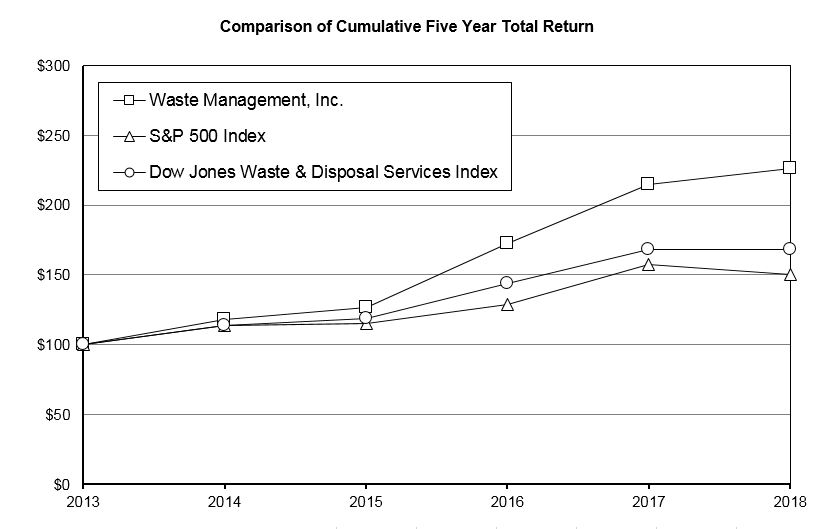
| 12/31/13 | 12/31/14 | 12/31/15 | 12/31/16 | 12/31/17 | 12/31/18 | |||||||||||||
| Waste Management, Inc. | $ | 100 | $ | 118 | $ | 127 | $ | 173 | $ | 215 | $ | 226 | ||||||
| S&P 500 Index | $ | 100 | $ | 114 | $ | 115 | $ | 129 | $ | 157 | $ | 150 | ||||||
| Dow Jones Waste & Disposal Services Index | $ | 100 | $ | 114 | $ | 119 | $ | 144 | $ | 168 | $ | 168 |
The Company repurchases shares of its common stock as part of capital allocation programs authorized by our Board of Directors. We announced in December 2017 that the Board of Directors authorized up to $1.25 billion in future share repurchases. During 2018, we repurchased an aggregate of $1,008 million of our common stock under accelerated share repurchase (“ASR”) agreements and open market repurchases, which equated to 11.7 million shares with a weighted average price per share of $86.35. See Note 13 to the Consolidated Financial Statements for additional information.
The following table summarizes common stock repurchases made during the fourth quarter of 2018 (shares in millions):
Issuer Purchases of Equity Securities
| Total Number of | |||||||||||
| Total | Shares Purchased as | Approximate Maximum | |||||||||
| Number of | Average | Part of Publicly | Dollar Value of Shares that | ||||||||
| Shares | Price Paid | Announced Plans or | May Yet be Purchased Under | ||||||||
| Period | Purchased | per Share | Programs | the Plans or Programs | |||||||
| October 1 — 31 | 2.8 | $ | 89.60 | (a) | 2.8 | $ | 252 million | ||||
| November 1 — 30 | — | $ | — | — | $ | 252 million | |||||
| December 1 — 31 | 0.5 | $ | 88.88 | (b) | 0.5 | $ | 1.5 billion | (c) | |||
| Total | 3.3 | $ | 89.49 | 3.3 |
| (a) | In October 2018, we completed an ASR agreement that was entered into in July 2018 to repurchase $200 million of our common stock. At the beginning of the repurchase period, we delivered $200 million in cash and received 1.8 million shares. The ASR agreement completed in October 2018, at which time we received 0.4 million additional shares. At the beginning of October, subsequent to the completion of the July 2018 ASR agreement, we repurchased 0.5 million shares of our common stock in open market transactions in compliance with Rule 10b5-1 and Rule 10b‑18 of the Exchange Act for $48 million, inclusive of per-share commissions. |
|---|
At the end of October 2018, we entered into a new ASR agreement to repurchase $200 million of our common stock. At the beginning of the repurchase period, we delivered $200 million in cash and received 1.9 million shares. The October 2018 ASR agreement completed in December 2018.
The “Average Price Paid per Share” in the table represents the final weighted average price per share paid for the completed ASR agreements and the open market repurchases.
| (b) | In December 2018, we completed the October 2018 ASR agreement discussed above at which time we received 0.4 million additional shares. Subsequent to the completion of the October 2018 ASR agreement, we repurchased an additional 0.1 million shares of our common stock in open market transactions in compliance with Rule 10b5-1 and Rule 10b-18 of the Exchange Act for $10 million, inclusive of per-share commissions. The “Average Price Paid per Share” in the table represents the final weighted average price per share paid for the completed ASR agreement and the open market repurchases. |
|---|
| (c) | We announced in December 2018 that the Board of Directors has authorized up to $1.5 billion in future share repurchases, which supersedes and replaces remaining authority under any prior Board of Directors authorization for share repurchases after the completion of our current open market repurchase plan ending February 15, 2019. |
|---|
Any future share repurchases will be made at the discretion of management and will depend on various factors including our net earnings, financial condition, cash required for future business plans, and growth and acquisitions.
Item 6. Selected Financial Data.
The information below was derived from the audited Consolidated Financial Statements included within this report and in previous annual reports we filed with the SEC. This information should be read together with those Consolidated Financial Statements and the notes thereto. These historical results are not necessarily indicative of the results to be expected in the future.
| Years Ended December 31, | |||||||||||||||
| 2018(a) | 2017(a) | 2016(a) | 2015 | 2014 | |||||||||||
| (In Millions, Except per Share Amounts) | |||||||||||||||
| Statement of Operations Data: | |||||||||||||||
| Operating revenues | $ | 14,914 | $ | 14,485 | $ | 13,609 | $ | 12,961 | $ | 13,996 | |||||
| Consolidated net income | 1,923 | 1,949 | 1,180 | 752 | 1,338 | ||||||||||
| Net income attributable to Waste Management, Inc. | 1,925 | 1,949 | 1,182 | 753 | 1,298 | ||||||||||
| Basic earnings per common share | 4.49 | 4.44 | 2.66 | 1.66 | 2.80 | ||||||||||
| Diluted earnings per common share | 4.45 | 4.41 | 2.65 | 1.65 | 2.79 | ||||||||||
| Cash dividends declared per common share | 1.86 | 1.70 | 1.64 | 1.54 | 1.50 | ||||||||||
| Balance Sheet Data: | |||||||||||||||
| Working capital (deficit) (b) | $ | (463) | $ | (568) | $ | (418) | $ | (165) | $ | 41 | |||||
| Total assets | 22,650 | 21,829 | 20,859 | 20,367 | 21,252 | ||||||||||
| Long-term debt, including current portion | 10,026 | 9,491 | 9,310 | 8,929 | 9,390 | ||||||||||
| Total Waste Management, Inc. stockholders’ equity | 6,275 | 6,019 | 5,297 | 5,345 | 5,866 | ||||||||||
| Total equity | 6,276 | 6,042 | 5,320 | 5,367 | 5,889 |
| (a) | For more information see Item 7. Management’s Discussion and Analysis of Financial Condition and Results of Operations. |
|---|
| (b) | Prior year information was revised to conform to our current year presentation. |
|---|
Item 7. Management’s Discussion and Analysis of Financial Condition and Results of Operations.
This section includes a discussion of our results of operations for the three years ended December 31, 2018. This discussion may contain forward-looking statements that anticipate results based on management’s plans that are subject to uncertainty. We discuss in more detail various factors that could cause actual results to differ materially from expectations in Item 1A. Risk Factors. The following discussion should be read considering those disclosures and together with the Consolidated Financial Statements and the notes thereto.
Overview
We are North America’s leading provider of comprehensive waste management environmental services. We partner with our residential, commercial, industrial and municipal customers and the communities we serve to manage and reduce waste at each stage from collection to disposal, while recovering valuable resources and creating clean, renewable energy. We own or operate the largest network of landfills in North America. In order to make disposal more practical for larger urban markets, where the distance to landfills is typically farther, we manage transfer stations that consolidate, compact and transport waste efficiently and economically. We also use waste to create energy, recovering the gas produced naturally as waste decomposes in landfills and using the gas in generators to make electricity. Additionally, we are a leading recycler in North America, handling materials that include paper, cardboard, glass, plastic and metal. Our “Solid Waste” business is operated and managed locally by our subsidiaries that focus on distinct geographic areas and provides collection, transfer, disposal, and recycling and resource recovery services. Our “Traditional Solid Waste” business excludes our recycling and resource recovery services. Through our subsidiaries, we are also a leading developer, operator and owner of landfill gas-to-energy facilities in the U.S.
Our Solid Waste operating revenues are primarily generated from fees charged for our collection, transfer, disposal, and recycling and resource recovery services, and from sales of commodities by our recycling and landfill gas-to-energy operations. Revenues from our collection operations are influenced by factors such as collection frequency, type of collection equipment furnished, type and volume or weight of the waste collected, distance to the disposal facility or material recovery facility and our disposal costs. Revenues from our landfill operations consist of tipping fees, which are generally based on the type and weight or volume of waste being disposed of at our disposal facilities. Fees charged at transfer stations are generally based on the weight or volume of waste deposited, taking into account our cost of loading, transporting and disposing of the solid waste at a disposal site. Recycling revenues generally consist of tipping fees and the sale of recycling commodities to third parties. The fees we charge for our services generally include our environmental fee, fuel surcharge and regulatory recovery fee which are intended to pass through to customers direct and indirect costs incurred. We also provide additional services that are not managed through our Solid Waste business, described under Results of Operations below.
Business Environment
The waste industry is a comparatively mature and stable industry. However, customers increasingly expect more of their waste materials to be recovered and those waste streams are becoming more complex. In addition, many state and local governments mandate diversion, recycling and waste reduction at the source and prohibit the disposal of certain types of waste at landfills. Due to this, we monitor these developments to adapt our services offerings. As companies, individuals and communities look for ways to be more sustainable, we are promoting our comprehensive services that go beyond our core business of collecting and disposing of waste in order to meet their needs.
Despite some industry consolidation in recent years, we encounter intense competition from governmental, quasi-governmental and private service providers based on pricing, service quality, customer experience and breadth of service offerings. We also encounter competition for acquisition and growth opportunities. Our industry is directly affected by changes in general economic factors, as increases and decreases in consumer spending, business expansions and construction starts generally correlate to volumes of waste generated and our revenues. Negative economic conditions, in addition to competitor actions, can make it more challenging to negotiate, renew or expand service contracts with acceptable margins and customers may reduce their service needs. General economic factors and the market for consumer goods, in addition to regulatory developments, can also significantly impact commodity prices for recyclable materials we sell. Our operating expenses are directly impacted by volume levels; as volume levels shift, due to economic and other factors, we must manage our network capacity and cost structure accordingly.
The generally favorable macro-economic environment, including steady spending by consumers and businesses and construction starts, has benefited our volume growth and gross margins in recent quarters. We are not expecting any significant shift in the near term, but there is increased market volatility and uncertainty about longer-term macro-economic indicators. Disruptions in the global movement of recycling commodities, due in part to actions by the Chinese government, resulted in significantly lower average markets prices in 2018 compared to 2017; however, we currently expect market price declines for recycling commodities to moderate in 2019. The recycling industry is continuing to adapt to the heightened quality standards and regulations. In addition, we are also focusing on managing processing costs, developing alternative markets and educating customers to reduce contamination in the recycling stream.
Current Year Financial Results
During 2018, we continued to produce strong operating results from our Traditional Solid Waste business, driven by strong yield and volume growth in our collection and disposal business. Net income and earnings per diluted share both increased primarily as a result of the strong operating results from our Traditional Solid Waste business as well as the favorable impact on our effective tax rate due to enactment of tax reform. The Company continued its commitment to supporting both organic and inorganic growth during 2018, allocating $1,694 million of available cash to capital expenditures and $466 million to the acquisition of solid waste businesses. We also allocated $1,806 million to our shareholders during 2018 through common stock repurchases and dividends.
Key items of our 2018 financial results include:
| · | Revenues of $14,914 million for 2018 compared with $14,485 million in 2017, an increase of $429 million, or 3.0%. This increase is primarily attributable to (i) higher volumes due to improving market conditions; (ii) increased yield in our collection and disposal business and (iii) increased recycling brokerage volumes, partially offset by (i) lower market prices for recycling commodities and (ii) fluctuations in foreign currency and other; |
|---|
| · | Operating expenses of $9,249 million in 2018, or 62.0% of revenues, compared with $9,021 million, or 62.3% of revenues, in 2017. This increase of $228 million is primarily attributable to higher volumes and cost inflation in the current year period, partially offset by (i) changes in accounting for rebates and certain franchise fees required by the adoption of ASU 2014-09 and (ii) decreased cost of goods sold due to lower market prices for recycling commodities; |
|---|
| | · | | Selling, general and administrative expenses of $1,453 million in 2018, or 9.7% of revenues, compared with $1
Showing the first 8K of 108K characters. Open the full section
Item 7A. Quantitative and Qualitative Disclosures about Market Risk.
In the normal course of business, we are exposed to market risks, including changes in interest rates, certain commodity prices and Canadian currency rates. From time to time, we use derivatives to manage some portion of these risks. The Company had no derivatives outstanding as of December 31, 2018.
Interest Rate Exposure — Our exposure to market risk for changes in interest rates relates primarily to our financing activities. As of December 31, 2018, we had $10.1 billion of long-term debt, excluding the impacts of accounting for debt issuance costs, discounts, premiums and fair value adjustments attributable to terminated interest rate derivatives. We have $2.2 billion of debt that is exposed to changes in market interest rates within the next 12 months comprised of (i) $990 million of short-term borrowings under our commercial paper program; (ii) $705 million of tax-exempt bonds with term interest rate periods that expire within the next 12 months; (iii) $513 million of variable-rate tax-exempt bonds that are subject to repricing on either a daily or weekly basis and (iv) C$15 million, or $11 million, of Canadian borrowings under our $2.75 billion revolving credit facility. We currently estimate that a 100‑basis point increase in the interest rates of our outstanding variable-rate debt obligations would increase our 2019 interest expense by $19 million.
Our remaining outstanding debt obligations have fixed interest rates through either the scheduled maturity of the debt or, for certain of our fixed-rate tax-exempt bonds, through the end of a term interest rate period that exceeds 12 months. The fair value of our fixed-rate debt obligations can increase or decrease significantly if market interest rates change.
We performed a sensitivity analysis to determine how market rate changes might affect the fair value of our market risk-sensitive debt instruments. This analysis is inherently limited because it reflects a singular, hypothetical set of assumptions. Actual market movements may vary significantly from our assumptions. An instantaneous, 100‑basis point increase in interest rates across all maturities attributable to these instruments would have decreased the fair value of our debt by approximately $575 million as of December 31, 2018.
We are also exposed to interest rate market risk from our cash and cash equivalent balances, as well as assets held in restricted trust funds and escrow accounts. These assets are generally invested in high quality, liquid instruments including money market funds that invest in U.S. government obligations with original maturities of three months or less. We believe that our exposure to changes in fair value of these assets due to interest rate fluctuations is insignificant as the fair value generally approximates our cost basis. We also invest a portion of our restricted trust and escrow account balances in available-for-sale securities, including U.S. Treasury securities, U.S. agency securities, municipal securities, mortgage- and asset-backed securities and equity securities.
Commodity Price Exposure — In the normal course of our business, we are subject to operating agreements that expose us to market risks arising from changes in the prices for commodities such as diesel fuel; recyclable materials, including old corrugated cardboard, old newsprint and plastics; and electricity, which generally correlates with natural gas prices in many of the markets in which we operate. We attempt to manage these risks through operational strategies that focus on capturing our costs in the prices we charge our customers for the services provided. Accordingly, as the market prices for these commodities increase or decrease, our revenues may also increase or decrease.
Currency Rate Exposure — We have operations in Canada as well as certain support functions in India. Where significant, we have quantified and described the impact of foreign currency translation on components of income, including operating revenue and operating expenses. However, the impact of foreign currency has not materially affected our results of operations.
Item 8. Financial Statements and Supplementary Data.
INDEX TO
CONSOLIDATED FINANCIAL STATEMENTS
REPORT OF INDEPENDENT REGISTERED PUBLIC ACCOUNTING FIRM
The Board of Directors and Stockholders of Waste Management, Inc.
Opinion on Internal Control over Financial Reporting
We have audited Waste Management, Inc.’s internal control over financial reporting as of December 31, 2018, based on criteria established in Internal Control-Integrated Framework issued by the Committee of Sponsoring Organizations of the Treadway Commission (2013 framework) (the COSO criteria). In our opinion, Waste Management, Inc. (the Company) maintained, in all material respects, effective internal control over financial reporting as of December 31, 2018, based on the COSO criteria.
We also have audited, in accordance with the standards of the Public Company Accounting Oversight Board (United States) (PCAOB), the 2018 consolidated financial statements of the Company, and our report dated February 14, 2019 expressed an unqualified opinion thereon.
Basis for Opinion
The Company’s management is responsible for maintaining effective internal control over financial reporting and for its assessment of the effectiveness of internal control over financial reporting included in the accompanying Management’s Report on Internal Control Over Financial Reporting. Our responsibility is to express an opinion on the Company’s internal control over financial reporting based on our audit. We are a public accounting firm registered with the PCAOB and are required to be independent with respect to the Company in accordance with the U.S. federal securities laws and the applicable rules and regulations of the Securities and Exchange Commission and the PCAOB.
We conducted our audit in accordance with the standards of the PCAOB. Those standards require that we plan and perform the audit to obtain reasonable assurance about whether effective internal control over financial reporting was maintained in all material respects.
Our audit included obtaining an understanding of internal control over financial reporting, assessing the risk that a material weakness exists, testing and evaluating the design and operating effectiveness of internal control based on the assessed risk, and performing such other procedures as we considered necessary in the circumstances. We believe that our audit provides a reasonable basis for our opinion.
Definition and Limitations of Internal Control Over Financial Reporting
A company’s internal control over financial reporting is a process designed to provide reasonable assurance regarding the reliability of financial reporting and the preparation of financial statements for external purposes in accordance with generally accepted accounting principles. A company’s internal control over financial reporting includes those policies and procedures that (1) pertain to the maintenance of records that, in reasonable detail, accurately and fairly reflect the transactions and dispositions of the assets of the company; (2) provide reasonable assurance that transactions are recorded as necessary to permit preparation of financial statements in accordance with generally accepted accounting principles, and that receipts and expenditures of the company are being made only in accordance with authorizations of management and directors of the company; and (3) provide reasonable assurance regarding prevention or timely detection of unauthorized acquisition, use, or disposition of the company’s assets that could have a material effect on the financial statements.
Because of its inherent limitations, internal control over financial reporting may not prevent or detect misstatements. Also, projections of any evaluation of effectiveness to future periods are subject to the risk that controls may become inadequate because of changes in conditions, or that the degree of compliance with the policies or procedures may deteriorate.
| 5 | |
|---|---|
| /s/ ERNST & YOUNG LLP | |
| Houston, Texas February 14, 2019 |
REPORT OF INDEPENDENT REGISTERED PUBLIC ACCOUNTING FIRM
The Board of Directors and Stockholders of Waste Management, Inc.
Opinion on the Financial Statements
We have audited the accompanying consolidated balance sheets of Waste Management, Inc. (the Company) as of December 31, 2018 and 2017, the related consolidated statements of operations, comprehensive income, cash flows, and changes in equity for each of the three years in the period ended December 31, 2018, and the related notes (collectively referred to as the “consolidated financial statements”). In our opinion, the consolidated financial statements present fairly, in all material respects, the financial position of the Company at December 31, 2018 and 2017, and the results of its operations and its cash flows for each of the three years in the period ended December 31, 2018, in conformity with U.S. generally accepted accounting principles.
We also have audited, in accordance with the standards of the Public Company Accounting Oversight Board (United States) (PCAOB), the Company’s internal control over financial reporting as of December 31, 2018, based on criteria established in Internal Control-Integrated Framework issued by the Committee of Sponsoring Organizations of the Treadway Commission (2013 framework), and our report dated February 14, 2019 expressed an unqualified opinion thereon.
Basis for Opinion
These financial statements are the responsibility of the Company's management. Our responsibility is to express an opinion on the Company’s financial statements based on our audits. We are a public accounting firm registered with the PCAOB and are required to be independent with respect to the Company in accordance with the U.S. federal securities laws and the applicable rules and regulations of the Securities and Exchange Commission and the PCAOB.
We conducted our audits in accordance with the standards of the PCAOB. Those standards require that we plan and perform the audit to obtain reasonable assurance about whether the financial statements are free of material misstatement, whether due to error or fraud. Our audits included performing procedures to assess the risks of material misstatement of the financial statements, whether due to error or fraud, and performing procedures that respond to those risks. Such procedures included examining, on a test basis, evidence regarding the amounts and disclosures in the financial statements. Our audits also included evaluating the accounting principles used and significant estimates made by management, as well as evaluating the overall presentation of the financial statements. We believe that our audits provide a reasonable basis for our opinion.
| /s/ ERNST & YOUNG LLP | |
| We have served as the Company’s auditor since 2002. | |
| Houston, Texas February 14, 2019 |
WASTE MANAGEMENT, INC.
CONSOLIDATED BALANCE SHEETS
(In Millions, Except Share and Par Value Amounts)
| December 31, | |||||
| 2018 | 2017 | ||||
Showing the first 8K of 242K characters. Open the full section
Item 9. Changes in and Disagreements with Accountants on Accounting and Financial Disclosure.
None.
Item 9A. Controls and Procedures.
Effectiveness of Controls and Procedures
Our management, with the participation of our principal executive and financial officers, has evaluated the effectiveness of our disclosure controls and procedures in ensuring that the information required to be disclosed in reports that we file or submit under the Securities Exchange Act of 1934, as amended, is recorded, processed, summarized and reported within the time periods specified in the SEC’s rules and forms, including ensuring that such information is accumulated and communicated to management (including the principal executive and financial officers) as appropriate to allow timely decisions regarding required disclosure. Based on such evaluation, our principal executive and financial officers have concluded that such disclosure controls and procedures were effective as of December 31, 2018 (the end of the period covered by this Annual Report on Form 10‑K).
Management’s Report on Internal Control Over Financial Reporting
Management of the Company, including the principal executive and financial officers, is responsible for establishing and maintaining adequate internal control over financial reporting, as defined in Rules 13a‑15(f) and 15d‑15(f) of the Securities Exchange Act of 1934, as amended. Our internal controls are designed to provide reasonable assurance as to the reliability of our financial reporting and the preparation of the consolidated financial statements for external purposes in accordance with accounting principles generally accepted in the United States and includes those policies and procedures that:
| i. | pertain to the maintenance of records that in reasonable detail accurately and fairly reflect the transactions and dispositions of the assets of the Company; |
|---|
| ii. | provide reasonable assurance that transactions are recorded as necessary to permit preparation of financial statements in accordance with generally accepted accounting principles, and that receipts and expenditures of the Company are being made only in accordance with authorizations of management and directors of the Company; and |
|---|
| iii. | provide reasonable assurance regarding prevention or timely detection of unauthorized acquisition, use or disposition of the Company’s assets that could have a material effect on the financial statements. |
|---|
Because of its inherent limitations, internal control over financial reporting may not prevent or detect misstatements. Projections of any evaluation of effectiveness to future periods are subject to the risk that controls may become inadequate because of changes in conditions, or that the degree of compliance with the policies or procedures may deteriorate.
Management of the Company assessed the effectiveness of our internal control over financial reporting as of December 31, 2018 based on the Internal Control — Integrated Framework issued by the Committee of Sponsoring Organizations of the Treadway Commission (2013 framework). Based on this assessment, management has concluded that our internal control over financial reporting was effective as of December 31, 2018.
The effectiveness of our internal control over financial reporting has been audited by Ernst & Young LLP, the independent registered public accounting firm that audited our consolidated financial statements, as stated in their report, which is included within this report.
Changes in Internal Control over Financial Reporting
Management, together with our CEO and CFO, evaluated the changes in our internal control over financial reporting during the quarter ended December 31, 2018. We determined that there were no changes in our internal control over financial reporting during the quarter ended December 31, 2018 that have materially affected, or are reasonably likely to materially affect, our internal control over financial reporting.
Item 9B. Other Information.
None.
PART III
Item 10. Directors, Executive Officers and Corporate Governance.
The information required by this Item is incorporated by reference to the sections entitled “Board of Directors,” “Section 16(a) Beneficial Ownership Reporting Compliance,” and “Executive Officers,” in the Company’s definitive Proxy Statement for its 2019 Annual Meeting of Stockholders (the “Proxy Statement”), to be held May 14, 2019. The Proxy Statement will be filed with the SEC within 120 days of the end of our fiscal year.
We have adopted a code of ethics that applies to our CEO, CFO and Chief Accounting Officer, as well as other officers, directors and employees of the Company. The code of ethics, entitled “Code of Conduct,” is posted on our website at www.wm.com under the section “Corporate Governance” within the “Investor Relations” tab.
Item 11. Executive Compensation.
The information required by this Item is incorporated herein by reference to the sections entitled “Board of Directors — Compensation Committee Report,” “— Compensation Committee Interlocks and Insider Participation,” “— Non-Employee Director Compensation,” “Executive Compensation — Compensation Discussion and Analysis” and “— Executive Compensation Tables” in the Proxy Statement.
Item 12. Security Ownership of Certain Beneficial Owners and Management and Related Stockholder Matters.
The information required by this Item is incorporated herein by reference to the sections entitled “Executive Compensation — Executive Compensation Tables — Equity Compensation Plan Table,” “Director and Officer Stock Ownership,” and “Security Ownership of Certain Beneficial Owners” in the Proxy Statement.
Item 13. Certain Relationships and Related Transactions, and Director Independence.
The information required by this Item is incorporated herein by reference to the sections entitled “Board of Directors — Related Party Transactions” and “— Independence of Board Members” in the Proxy Statement.
Item 14. Principal Accounting Fees and Services.
The information required by this Item is incorporated herein by reference to the section entitled “Ratification of Independent Registered Public Accounting Firm — Independent Registered Public Accounting Firm Fee Information” in the Proxy Statement.
PART IV
Item 15. Exhibits, Financial Statement Schedules.
(a) (1) Consolidated Financial Statements:
Reports of Independent Registered Public Accounting Firm
Consolidated Balance Sheets as of December 31, 2018 and 2017
Consolidated Statements of Operations for the years ended December 31, 2018, 2017 and 2016
Consolidated Statements of Comprehensive Income for the years ended December 31, 2018, 2017 and 2016
Consolidated Statements of Cash Flows for the years ended December 31, 2018, 2017 and 2016
Consolidated Statements of Changes in Equity for the years ended December 31, 2018, 2017 and 2016
Notes to Consolidated Financial Statements
(a) (2) Consolidated Financial Statement Schedules:
All schedules have been omitted because the required information is not significant or is included in the financial statements or notes thereto, or is not applicable.
(a) (3) Exhibits:
- Filed herewith.
** Furnished herewith.
† Denotes management contract or compensatory plan or arrangement.
Item 16. Form 10-K Summary.
None.
SIGNATURES
Pursuant to the requirements of Section 13 or 15(d) of the Securities Exchange Act of 1934, the Registrant has duly caused this Report to be signed on its behalf by the undersigned, thereunto duly authorized.
| WASTE MANAGEMENT, INC. | ||
| By: | /s/ JAMES C. FISH, JR. | |
| James C. Fish, Jr. | ||
| President, Chief Executive Officer and Director |
Date: February 14, 2019
Pursuant to the requirements of the Securities Exchange Act of 1934, this report has been signed below by the following persons on behalf of the Registrant and in the capacities and on the dates indicated.
| Signature | Title | Date | ||
| /s/ JAMES C. FISH, JR. | President, Chief Executive Officer and Director | February 14, 2019 | ||
| James C. Fish, Jr. | (Principal Executive Officer) | |||
| /s/ DEVINA A. RANKIN | Senior Vice President and | February 14, 2019 | ||
| Devina A. Rankin | Chief Financial Officer | |||
| (Principal Financial Officer) | ||||
| /s/ LESLIE K. NAGY | Vice President and Chief Accounting Officer | February 14, 2019 | ||
| Leslie K. Nagy | (Principal Accounting Officer) | |||
| /s/ FRANK M. CLARK, JR. | Director | February 14, 2019 | ||
| Frank M. Clark, Jr. | ||||
| /s/ ANDRÉS R. GLUSKI | Director | February 14, 2019 | ||
| Andrés R. Gluski | ||||
| /s/ PARTICK W. GROSS | Director | February 14, 2019 | ||
| Patrick W. Gross | ||||
| /s/ VICTORIA M. HOLT | Director | February 14, 2019 | ||
| Victoria M. Holt | ||||
| /s/ KATHLEEN M. MAZZARELLA | Director | February 14, 2019 | ||
| Kathleen M. Mazzarella | ||||
| /s/ JOHN C. POPE | Director | February 14, 2019 | ||
| John C. Pope | ||||
| /s/ THOMAS H. WEIDEMEYER | Chairman of the Board and Director | February 14, 2019 | ||
| Thomas H. Weidemeyer | ||||