 filings.tools
Waste Management (WM) 10-K risk factor changes: FY2021 vs FY2020
The 2021-12-31 10-K against the 2020-12-31 one, compared heading by heading and sentence by sentence.
Item 1A71 rewritten61 added88 removed271 unchanged
All filing items1,135 rewritten556 added629 removed2,058 unchanged
Summary
counted, not written
- Item 1A lists 5 risk factor headings: 2 new, 2 reworded and 1 unchanged since FY2020. 1 heading from FY2020 no longer appears.
- Sentence by sentence, 556 added, 629 removed, 1,135 rewritten and 2,058 unchanged across 14 items that differ.
New Item 1A headings (2)
- Governmental regulations requiring mandatory COVID-19 vaccination of employees could adversely impact our ability to perform or compete for certain contracts and negatively affect our results of operations.
- Market disruption, including labor shortages and supply chain constraints, and macroeconomic pressures, including the heightened pace of inflation, have adversely impacted our business and results of operations.
Removed Item 1A headings (1)
- We may not realize the strategic benefits and cost synergies that are anticipated from our acquisition of Advanced Disposal Services, Inc. (“Advanced Disposal”), and we may encounter difficulties integrating Advanced Disposal’s operations and systems that could impact the effectiveness of our internal controls over financial reporting.
Reworded Item 1A headings (2)
- We are implementing a new enterprise resource planning [added: and human capital management] system, and challenges with the implementation of the system may impact our business and operations.
- Changes to federal and state renewable fuel policies could affect our financial performance in that sector as a renewable fuel
[removed: producer.][added: producer and impact our projected future investments.]
A heading is new when no FY2020 heading matches it after ignoring case and punctuation, and reworded when it shares at least 60 percent of its words with one that went away. All current risk factor headings.
Sentences by item
22 items, with every count and a link to each item that changed
Underlined words on a shaded ground are new in FY2021; struck-through words were in FY2020. Sentences that are wholly new or wholly gone are labelled rather than marked.
Item 1A. Risk Factors.
71 rewritten, 61 added, 88 removed, 271 unchanged
[removed: Additionally, we] [added: We] assume no obligation to update any forward-looking [removed: statement] [added: statement, whether] as a result of future events, circumstances or [removed: developments.][added: developments or otherwise.]
Outlined below are some of the risks that we believe could affect our business and financial statements for [removed: 2021] [added: 2022] and beyond and could cause actual results to be materially different from those [removed: that may be] set forth in forward-looking statements made by the Company.
| | ● | We may not be able to maintain cost savings achieved through optimization [removed: efforts.] [added: efforts, due to inflationary cost pressure or otherwise.] |
[removed: We may not realize] [added: | | ● | As we complete] the [removed: strategic benefits and cost synergies that are anticipated from] [added: integration of] our [added: prior] acquisition of Advanced Disposal Services, Inc. (“Advanced Disposal”), [removed: and] we may [removed: encounter difficulties integrating Advanced Disposal’s operations and systems that could impact] [added: not continue to realize] the [removed: effectiveness of our internal controls over financial reporting.][added: strategic benefits and cost synergies anticipated. |]
[removed: We have significant financial] obligations relating to final capping, closure, post-closure and environmental remediation at our existing landfills and we establish accruals for these estimated costs.
Local communities and citizen groups, adjacent landowners or governmental agencies may oppose the issuance of a permit or approval we may need, allege violations of the permits under which we currently operate or laws or regulations to which we are subjected, or seek to impose liability on us for [added: alleged] environmental damage.
[removed: States] [added: Federal, state] and [removed: municipalities] [added: local governments] are also increasingly adopting requirements for environmental justice reviews as part of certain permitting decisions.
In addition, failure to receive regulatory and zoning approval may prohibit us from establishing new facilities or [removed: expanding existing facilities.]
This includes key individuals in leadership and specialty roles, as well as a very large number of drivers, [added: technicians and other front-line and back-office team members necessary to provide our environmental services.]
The [removed: Waste Management] [added: WM] brand name, trademarks and logos and our reputation are powerful sales and marketing tools, and we devote significant resources to promoting and protecting them.
Adverse publicity, whether or not justified, relating to activities by our operations, employees or [removed: agents] [added: agents, or challenges to our assertions of social and environmental responsibility,] could tarnish our reputation and reduce the value of our brand.
[removed: This reduction in demand, together with the dedication of time and expense necessary] [added: Damage] to [removed: defend] our [removed: reputation,] [added: reputation] could [added: reduce demand for our services and potentially] have an adverse effect on our financial condition, liquidity and results of operations, as well as require additional resources to rebuild our reputation and restore the value of our brand.
[removed: Although current options for heavy-duty electric vehicles lack sufficient range and proven experience for our operations,] we [added: are] proactively [removed: engage] [added: engaging] in pilots of electric powered [removed: heavy duty] [added: heavy-duty] vehicles and anticipate that we could redirect future planned capital investments in our fleet toward these assets when the vehicles prove economically and operationally viable.
Certain groups of our employees are currently represented by unions, and we have negotiated collective bargaining [added: agreements with these unions.]
The seasonal nature of our business, severe weather events resulting from climate change and event driven special projects cause our results to fluctuate, and prior performance [removed: is] [added: may] not [removed: necessarily] [added: be] indicative of our future results.
Service disruptions caused by severe storms, extended periods of inclement weather or climate events can significantly affect the operating results of the [removed: Areas] [added: geographic areas] affected.
On the other hand, certain destructive weather and climate conditions, such as wildfires in the Western U.S. and hurricanes that most often impact our operations in the Southern and Eastern U.S. during the second half of the year, can increase our revenues in the [removed: Areas] [added: geographic areas] affected as a result of the waste volumes generated by these events.
For these and other reasons, operating results in any [removed: interim] period [removed: are] [added: may] not [removed: necessarily] [added: be] indicative of operating results for [removed: an entire year, and operating results for] any [removed: historical period are not necessarily indicative of operating results for a future] [added: other] period.
During 2020 and continuing into 2021, federal, state and local governments throughout North America [removed: have] imposed varying degrees of restriction on social and commercial activity to promote social distancing in an effort to slow the spread of COVID-19.
The [removed: resulting] [added: initial] business [removed: closures, increases in unemployment and loss of consumer financial stability] [added: closures] and [removed: confidence has] [added: negative impact on general economic conditions] resulted in volume declines and reductions in customers’ waste service needs, which [removed: has] negatively impacted our results of operations and cash flows.
[removed: If] [added: Additionally, if] a large portion of our employee base were to become ill, it could impact our ability to provide timely and reliable service.
[removed: Additionally, the transition of most of our back-office employees to] [added: Employee] work-from-home [removed: increases] [added: arrangements prompted by the COVID-19 pandemic increase] various [removed: operational] [added: technology] risks, including potential exposure to cyber incidents, loss of data, fraud, internal control challenges and other disruptions as a consequence of more employees accessing Company systems and information remotely in the course of their ordinary work.
[removed: Should these or similar pandemic-related] [added: If such] conditions [removed: persist for a prolonged period,] [added: were to deepen and extend the broad-based economic slow-down,] it may have a material adverse impact on our financial condition, results of operations and cash flows and hinder our ability to grow our business and execute our business strategy.
As an example, on January 1, 2021, new restrictions on the [added: international] trade of most plastics went into effect as part of the Basel Convention on the Control of Transboundary Movements of Hazardous Wastes and Their Disposal.
[removed: The] [added: At this time, the] U.S. is not a party to the Basel Convention, but most countries to which we export [added: commodities] are, which may limit [removed: exports of] [added: our ability to export] certain plastics.
COVID-19 placed additional financial stress on [added: recyclers and] municipalities, resulting in [added: some] recycling programs being paused or eliminated.
Additionally, future regulation, tariffs, international trade policies or [added: other] initiatives may [removed: result in further reduced] [added: impact supply and] demand [added: of material,] or [removed: increased] [added: increase] operating costs, which [removed: would cause] [added: could impact] the profitability of our recycling [removed: operations to decline.][added: operations.]
Significant variations in the price of [removed: methane gas,] [added: biogas,] electricity and other energy-related products that are marketed and sold by our landfill gas recovery operations can result in a corresponding significant impact to our revenue from yield from such operations.
In addition, many state and local governments mandate diversion, recycling and waste reduction at the source and prohibit the disposal of certain types of [removed: waste,] [added: materials at landfills,] such as [added: recyclables (cardboard, bottles and cans),] yard waste, food waste and [removed: electronics at landfills.][added: electronics.]
Where [removed: such] organic waste is not banned from the landfill, some large customers such as grocery stores and restaurants are choosing to divert their organic waste from landfills.
If we are not successful in expanding our service offerings, growing lines of businesses to service waste streams that do not go to [removed: landfills] [added: landfills, and] providing [added: alternative] services for customers that wish to reduce waste entirely, then our revenues and operating results may decline.
The most common materials banned include plastic [added: bags and] straws, polystyrene plastic and [added: some types of] single use packaging.
These bans have increased pressure by manufacturers on our recycling facilities to accept a broader array of materials in curbside recycling [added: and composting] programs to alleviate public pressures to ban the sale of those materials.
However, there are currently no viable end markets for recycling [added: many of] these materials, and inclusion of such materials in our recycling stream increases contamination and operating costs [removed: and] [added: that] can negatively affect the results of our recycling operations.
[added: A weak economy generally results in] decreased consumer spending and decreases in volumes of waste generated, which negatively impacts the ability to grow through new business or service upgrades, and may result in customer turnover and reduction in customers’ waste service needs.
As of December 31, [removed: 2020,] [added: 2021,] we had [removed: $1.2 billion] [added: $645 million] of tax-exempt bonds with term interest rate periods that expire within the next 12 months and $54 million of variable-rate tax-exempt bonds with interest rates reset on [removed: either] a [removed: daily or a] weekly basis.
If ultimately enacted into law, [removed: this] [added: such an increase] could materially impact our tax provision, cash tax [removed: liability and] [added: liability,] effective tax [removed: rate.][added: rate and net deferred tax liabilities.]
[removed: Supply] [added: Fuel supply] shortages [added: and price increases] could substantially increase our operating expenses.
[removed: Our Company and others are increasingly focusing on new technologies that innovate our operations,] improve the customer experience and provide alternatives to traditional disposal and maximize the resource value of waste.
[removed: In 2020, we] [added: We] are continuing our multi-year commitment to strategic investments in technology, including accelerated investments in customer service digitalization.
The Company continues to be optimistic about volume recovery and overall economic recovery from the impacts of the COVID-19 pandemic.
However, uncertainty remains with respect to various factors that influence the pace of economic recovery, including the risks discussed below and the potential for future resurgence in transmission of COVID-19 and related business closures due to virus variants or otherwise.
Such conditions could have an unanticipated adverse impact on our business.
We have significant financial
expanding existing facilities.
(Also see Item 1A.
_Risk Factors — Market disruption, including labor shortages and supply chain constraints, and macroeconomic pressures, including the heightened pace of inflation, have adversely impacted our business and results of operations_.) Additionally, the market for employees that serve on our digital team is highly competitive.
Although current options for heavy-duty electric vehicles lack sufficient range and proven experience for our operations,
In particular, COVID-19 caused decreases in volumes in higher margin businesses, impacting key financial metrics.
Throughout 2021, our volumes recovered from the sharp decline experienced in April 2020, with minimal impact from the resurgence in transmission of COVID-19 associated with recent virus variants, as communities and businesses remained open.
However, uncertainty remains with respect to various factors that influence the pace of economic recovery, including factors discussed in the two risk factors immediately below.
The potential for future resurgence in transmission of COVID-19 and related business closures, due to COVID-19 variants or other pandemic conditions, could adversely impact our volumes and costs in the future.
Governmental regulations requiring mandatory COVID-19 vaccination of employees could adversely impact our ability to perform or compete for certain contracts and negatively affect our results of operations.
In September 2021, President Biden issued an executive order requiring all employers with U.S. government contracts to ensure that their U.S.-based employees, contractors and subcontractors that work on or in support of U.S. government contracts, with some exceptions, to be fully vaccinated against COVID-19.
We are currently party to certain service agreements with the U.S. government.
The vaccine mandate is facing legal challenges and currently is enjoined nationwide.
In November 2021, OSHA announced an Emergency Temporary Standard (“ETS”) mandating either full vaccination against COVID-19 or weekly testing of employees for employers with 100 or more employees; however, the agency withdrew the ETS in January 2022 following an unfavorable decision by the U.S. Supreme Court.
OSHA has indicated that it will continue to pursue the vaccine and testing requirements of the ETS through the traditional rulemaking process, and additional vaccine mandates may be announced in jurisdictions in which our businesses operate.
We cannot currently predict the impact of any such vaccine requirements on our workforce, although implementation may result in our inability to perform or compete for certain contracts, as well as significant cost, operational disruption, attrition and difficulty securing future labor needs in the already-constrained labor market.
Market disruption, including labor shortages and supply chain constraints, and macroeconomic pressures, including the heightened pace of inflation, have adversely impacted our business and results of operations.
Certain macroeconomic pressures and market disruption, driven in part by the COVID-19 pandemic, intensified during the second half of 2021 and are continuing.
The constrained labor market has resulted in increased costs for wage adjustments, overtime hours and training new hires to address operational challenges servicing customers.
The COVID-19 pandemic and the constrained labor market have also contributed to significant global supply chain disruption and inflationary pressure for the goods and services we purchase, with a particular impact on our repair and maintenance costs.
Supply chain constraints have also caused delayed delivery of fleet, steel containers and other purchases.
Aspects of our business rely on third-party transportation providers, and such services have become more limited and expensive.
Additionally, we are currently experiencing margin pressures from commodity-driven business impacts, particularly from recycling brokerage rebates and higher fuel prices.
The extent and duration of the impact of these labor market, supply chain and transportation challenges are subject to numerous factors, including the continuing impact of the COVID-19 pandemic; size, location and qualifications of the labor pool; behavioral changes; wage and price structures; adoption of new or revised regulations; and broader macroeconomic conditions.
If we are not able to overcome limitations on labor availability, it could materially impact our ability to service our customers and our financial results.
Accelerated and pronounced economic pressures, such as the recent inflationary cost pressures on labor and the goods and services we rely upon to deliver service to our customers, have had and continue to have a significant impact on our cost structure and capital expenditures.
Significant components of our operating expenses vary directly as we experience changes in revenue due to volume and a heightened pace of inflation, and we may not be able to dynamically manage our cost structure in response to such changes.
A significant portion of our revenue is tied to a price escalation index with a lookback provision, resulting in a timing lag in our ability to recover increased costs under those contracts during this period of rapid inflation.
Separately, for many of our customers we provide services under multi-year contracts that can restrict our ability to increase prices and the timing of such increases.
Our overall strategic pricing efforts are focused on recovering as much of the inflationary cost increases we experience in our business as possible by increasing our average unit rate, but such efforts may not be successful for various reasons including the pace of inflation, operating cost inefficiencies, contractual limitations, and market responses.
The inability to adequately increase prices to offset increased
costs and inflationary pressures, or otherwise mitigate the impact of these macroeconomic conditions and market disruptions on our business, will increase our costs of doing business and reduce our margins.
If such impacts are prolonged and substantial, they could have a material negative effect on our results of operations.
Attention on waste in the environment has led to new international laws restricting the flow of certain recyclables.
In recent years, changes in regulations affecting the international flow of recyclables, have led to a reduction in export activity for recyclables, higher quality requirements and higher processing costs.
These changes have led to a number of states considering EPR regulations.
Prices and demand for recyclables fluctuate.
All aspects of our business are subject to uncertainties, risks and other influences, many of which we do not control.
Any of these factors, either alone or taken together, could have a material adverse effect on us and could change whether any forward-looking statement ultimately turns out to be true.
The benefits that are expected to result from our acquisition of Advanced Disposal will depend, in part, on our ability to successfully integrate Advanced Disposal’s operations and systems and realize anticipated cost synergies.
There is a significant degree of difficulty and management distraction inherent in the process of integrating an acquisition of this size.
The process of integrating operations could cause business interruption and distraction.
Some members of our management may be required to devote considerable time to this integration process, which will decrease the time they will have to manage our Company, service existing customers, attract new customers and develop new products or strategies.
If management is not able to effectively manage the integration process, or if any significant business activities are interrupted as a result of the integration process, our business, financial condition and results of operations could suffer.
The acquisition of Advanced Disposal may not result in realization of the benefits and cost synergies that we currently expect, and we cannot guarantee that these benefits and cost synergies will be achieved within anticipated time frames or at all.
Additionally, we may incur substantial expenses in connection with the ongoing integration of Advanced Disposal, which may exceed expectations and offset certain benefits.
As described further in Item 9A.
_Controls and Procedures_, in accordance with SEC staff guidance, we have excluded Advanced Disposal from the assessment of the effectiveness of our internal control over financial reporting as of December 31, 2020 contained in this Annual Report on Form 10-K; however, this exclusion may not extend beyond one year from the October 30, 2020 closing date.
We are in the process of integrating Advanced Disposal’s operations and systems to ensure the effectiveness of the internal control over financial reporting for this acquired business.
Establishing, testing and maintaining an effective system of internal control over financial reporting requires significant resources and time commitments on the part of our management and our finance staff, and the time and expenditures needed may exceed our expectations.
If we encounter difficulties integrating Advanced Disposal operations and systems into our system of internal control over financial reporting, and if we are unable to correct any issues encountered in a timely manner, our ability to record, process, summarize, and report financial data may be adversely affected, which may impact the accuracy,
quality and completeness of our financial statements.
Such failure could materially and adversely impact our business and subject us to potential investigations, liability, and penalties.
Additionally, if we are unable to conclude that our internal control over financial reporting is effective in any future period (or if our auditors are unable to express an opinion on the effectiveness of our internal controls or conclude that our internal controls are ineffective), we could lose investor confidence and suffer an adverse effect on our stock price.
Various states have enacted, or are considering enacting, laws that restrict the disposal within the state of solid waste generated outside the state.
From time to time, the U.S. Congress has considered legislation authorizing states to adopt regulations, restrictions, or taxes on the importation of out-of-state or out-of-jurisdiction waste.
Additionally, several state and local governments have enacted “flow control” regulations, which attempt to require that all waste generated within the state or local jurisdiction be deposited at specific sites.
The U.S. Congress’ adoption of legislation allowing restrictions on interstate transportation of out-of-state or out-of-jurisdiction waste certain types of flow control, or courts’ interpretations of interstate waste and flow control legislation, could adversely affect our solid and hazardous waste management services.
The regulatory environment in which we operate is influenced by changes in leadership at the federal, state, provincial and local levels.
The policies set forth under the previous U.S. administration, for example, included substantial changes to foreign trade policy and generally were in favor of reducing regulation and corporate taxation.
While it is anticipated that the new administration will reverse course on various regulatory policies impacting our Company, we cannot predict what impact the change in administrations will have on specific regulations, nor can we predict the timing of any such changes.
It is likely that some policies adopted by the new administration will benefit us and others will negatively affect us.
technicians and other front-line and back-office team members necessary to provide our environmental services.
Additionally, the market for employees that serve on our digital team is highly competitive.
Damage to our reputation and loss of brand equity could reduce demand for our services.
agreements with these unions.
We have incurred costs related to health, safety and financial security of our workforce during the COVID-19 pandemic.
This included transitioning back-office employees to work-from-home and providing financial certainty to employees by guaranteeing all full-time hourly employees compensation for a 40-hour work week regardless of service decreases and reduced work schedules that resulted from the COVID-19 pandemic.
It could be necessary for us to incur additional such costs in the future related to pandemic conditions.
A broad-based economic slowdown resulting from prolonged negative effects of COVID-19 could have significant adverse consequences for the financial condition of our customers or suppliers.
As a result, customers may seek to reduce service levels or terminate our contracts, or they may be unable to timely pay outstanding receivables owed to us, each of which would adversely affect our results of operations and cash flows.
Additionally, such factors have made it more challenging to implement our pricing strategy and are likely to negatively impact our ability to negotiate, renew or expand service contracts with acceptable margins.
Volume changes can fluctuate dramatically by line of business and decreases in volumes in higher margin businesses, such as what we have seen with COVID-19, can impact key financial metrics.
Additionally, as stay-at-home orders and work from home trends continue, the costs to service our residential customers could continue to negatively impact our margins.
To the extent our suppliers experience a deterioration in financial condition or operational capability as a result of the impacts of COVID-19, we may experience material supply chain disruptions and delays, which could also increase our operating costs.
We are not able to estimate the full impact of COVID-19 on our business, but we expect that this situation will continue to have an adverse impact on the economy in general and on the Company’s results of operations until a substantial portion of the U.S. population is vaccinated and social distancing restrictions are lifted.
In 2017, the Chinese government announced bans on certain scrap materials and begun to enforce extremely restrictive quality and other requirements, which significantly reduced China’s import of recyclables.
An excerpt. Shown here: 40 of 71 rewritten, 40 of 61 added and 40 of 88 removed. The counts are complete. For every sentence, read Item 1A. Risk Factors. in the FY2021 filing and the FY2020 filing.
Item 7. Management’s Discussion and Analysis of Financial Condition and Results of Operations.
316 rewritten, 179 added, 218 removed, 370 unchanged
This section includes a discussion of our results of operations for the three years ended December 31, [removed: 2020.][added: 2021.]
We own or operate the largest network of landfills [removed: in] [added: throughout] the U.S. and Canada.
We also use waste to create energy, recovering the gas produced naturally as waste [removed: decomposes in landfills and using the gas in generators to make electricity.]
Our “Solid Waste” business is operated and managed locally by our subsidiaries that focus on distinct geographic areas and [removed: provides] [added: provide] collection, transfer, disposal, and recycling and resource recovery services.
[removed: Through our subsidiaries, we are also a leading developer, operator and owner of landfill gas-to-energy facilities in the U.S.] Consistent with our Company’s long-standing commitment to [removed: corporate] sustainability and environmental stewardship, we [removed: have] published our [removed: 2020] [added: 2021] Sustainability Report, which details our [added: people-first] commitment to help make the communities in which we live and work safe, resilient and sustainable.
The information in this report can be found at https://sustainability.wm.com but [added: it] does not constitute a part of, and is not incorporated by reference into, this Annual Report on Form 10-K.
For further discussion see section [removed: “Federal, State] [added: “_Regulation – Emerging Trends in Policy] and [removed: Local] [added: Regulation –] Climate [removed: Change Initiatives; Sustainability”] [added: and Sustainability_”] in Item 1.
The fees we charge for our services generally include our [removed: environmental fee,] [added: environmental,] fuel surcharge and regulatory recovery [removed: fee] [added: fees] which are intended to pass through to customers direct and indirect costs incurred.
This acquisition [removed: grows] [added: grew] our footprint and allows us to provide differentiated, sustainable waste management and recycling services to approximately three million new commercial, industrial and residential customers primarily located in the Eastern half of the U.S. The acquisition was funded using [removed: our] [added: a] $3.0 billion, 364-day, U.S. revolving credit facility (“364-day revolving credit facility”) and our commercial paper [removed: program, as discussed further in Note 7 to the Consolidated Financial Statements.][added: program.]
As a result of the acquisition we recorded $4.1 billion of net assets including $2.5 billion of [removed: goodwill.][added: goodwill as of December 31, 2020.]
For the year ended December 31, [added: 2021, we incurred $51 million of integration related costs, and for the year ended December 31,] 2020, we incurred $156 million of acquisition and integration related costs, which [removed: are] [added: were] primarily classified as “Selling, general and administrative expenses”.
[removed: Since the acquisition date,] [added: Post-closing through December 31, 2020,] Advanced Disposal [removed: has] recognized $205 million, $142 million and $60 million of revenue, operating expenses and selling, general and administrative expenses, respectively, which are included in our Consolidated Statement of Operations.
The [removed: challenges posed by the] [added: impacts of] COVID-19 [removed: pandemic] on the global economy increased rapidly [removed: at the end of] [added: during] the [removed: first] [added: second] quarter of [removed: 2020 and have continued through the date of this report, impacting] [added: 2020, affecting] our business in most geographies and across a variety of our customer types.
[removed: The] [added: Throughout the COVID-19 pandemic, the] Company has proactively taken steps to put our employees’ and customers’ needs first and we continue to work with the appropriate regulatory agencies to ensure we can provide our essential services safely and efficiently.
[removed: The above steps,] [added: These efforts,] combined with our disciplined execution in our daily operations, have positioned the Company to prudently manage the challenges presented by [removed: the COVID-19 pandemic.][added: COVID-19.]
The revenue declines due to the COVID-19 pandemic [removed: have] had a greater impact on our higher margin [removed: business] lines [added: of business] and [removed: have] negatively impacted [removed: our] operating costs as a percentage of revenues.
We monitor these developments to adapt our [removed: services] [added: service] offerings.
[removed: General economic factors] and the market for consumer goods, in addition to regulatory developments, can also significantly impact commodity prices for the recyclable materials we sell.
Significant components of our operating expenses vary [removed: in correlation to] [added: directly as we experience] changes in revenue due to [removed: volume.][added: volume and a heightened pace of inflation.]
Volume changes can fluctuate dramatically by line of business and [removed: decreases in volumes] [added: volume changes] in higher margin businesses, such as what we [removed: have seen] [added: saw] with COVID-19, can impact key financial metrics.
We have [added: also] maintained our focus on converting to a fee-based pricing model that [removed: addresses] [added: ensures fees paid by customers address] the cost of processing materials and the impact on our cost structure [removed: to manage] [added: of managing] contamination in the recycling stream.
We believe [removed: that] the Company’s industry-leading asset network and strategic [removed: focuses] [added: focus] on investing in [added: our] people and our digital platform will give the Company the necessary tools to address the [added: evolving] challenges [removed: presented by] [added: impacting] the [removed: COVID-19 pandemic] [added: Company] and [removed: the impacts on] our industry.
In line with our commitment to continuous improvement and a differentiated customer experience, we [removed: continue to accelerate] [added: remain focused on] our customer service digitalization initiative to change the way we interact with our customers.
Enhancements made through this initiative are [removed: designed] [added: intended] to seamlessly and digitally connect all [removed: of] the Company’s functions [removed: necessary] [added: required] to [removed: provide] [added: service] our customers [added: in order to provide] the best experience and service.
We also allocated [removed: $1,329] [added: $2,320] million of available cash to our shareholders during [removed: 2020] [added: 2021] through dividends and common stock repurchases.
Key elements of our [removed: 2020] [added: 2021] financial results include:
| | ● | Selling, general and administrative expenses of [removed: $1,728] [added: $1,864] million in [removed: 2020,] [added: 2021,] or [removed: 11.4%] [added: 10.4%] of revenues, compared with [removed: $1,631] [added: $1,728] million, or [removed: 10.6%] [added: 11.4%] of revenues, in [removed: 2019. This increase of $97] [added: 2020. The $136] million [added: increase] is primarily attributable to (i) [removed: increased acquisition-related] [added: higher incentive compensation] costs; (ii) [removed: higher costs associated with] [added: strategic] investments in our digital [removed: platform;] [added: platform] and (iii) [added: increased labor, support and integration] costs [removed: incurred as a result] [added: following our acquisition] of [removed: the COVID-19 pandemic, including an increase in provision for bad debts.] [added: Advanced Disposal.] These cost increases [removed: were offset, in part,] [added: are partially offset] by (i) lower [added: consulting, advisory and] legal [removed: reserves; (ii)] [added: fees associated with our completion of] the [removed: proactive steps taken to reduce discretionary expenses] [added: Advanced Disposal acquisition in 2020] and [removed: (iii) lower annual incentive compensation costs;] [added: (ii) a decrease in our provision for bad debts as collections returned to pre-pandemic levels;] |
[removed: | | ● | Net cash provided by] [added: Our] operating [removed: activities was $3,403 million,] [added: cash flows for 2020, as] compared with [removed: $3,874 million in the prior year period with the decline driven] [added: 2019, decreased] by [added: $471 million as a result of] (i) higher income tax payments related to [added: a taxable gain on] the sale of [added: Advanced Disposal] assets to GFL Environmental; (ii) increased interest payments and integration related spending due to our acquisition of Advanced Disposal; (iii) payments associated with investments we [removed: are making] [added: made] in our digital platform and (iv) [added: to a lesser extent,] lower earnings on our traditional Solid Waste business primarily caused by the impact of the COVID-19 [removed: |][added: pandemic.]
[removed: | | | pandemic.] These results were partially offset by cash benefits in [removed: the current year] [added: 2020] associated with the 2019 federal alternative fuel [removed: credits and |][added: credits.]
| | ● | Free cash flow was [removed: $2,656] [added: $2,530] million [added: in 2021,] compared with [removed: $2,105] [added: $2,656] million in [removed: the prior year period.] [added: 2020.] The [removed: increase] [added: decrease] in free cash flow is primarily [removed: due] [added: attributable] to [removed: (i)] higher proceeds from [removed: the sale of net assets to GFL Environmental and (ii) an intentional reduction] [added: divestitures] in [removed: capital expenditures during the current year period] [added: 2020 primarily related] to [removed: align with] [added: assets required to be sold by] the [removed: lower volumes] [added: U.S. Department of Justice] in [added: connection with] our [removed: business. These positive impacts were] [added: acquisition of Advanced Disposal,] partially offset by [removed: a decrease] [added: an increase] in net cash provided by operating activities [removed: noted] [added: discussed] above. Free cash flow is a non-GAAP measure of liquidity. Refer to _Free Cash Flow_ [removed: within _Liquidity and Capital Resources_] [added: below] for our definition of free cash flow, additional information about our use of this measure, and a reconciliation to net cash provided by operating activities, which is the most comparable GAAP measure. |
Our [added: Solid Waste] operating revenues [removed: set forth below] are primarily generated from fees charged for our collection, transfer, disposal, and recycling and resource recovery services, and from sales of commodities by our recycling and landfill gas-to-energy operations.
We also provide additional services that are not managed through our Solid Waste business, including both our [removed: WMSBS] [added: Strategic Business Solutions (“WMSBS”)] and [removed: EES] [added: Energy and Environmental Services (“EES”)] businesses, recycling brokerage services, landfill gas-to-energy services and certain other expanded service offerings and solutions.
The mix of operating revenues from our major lines of business [removed: is reflected in the table below] for the year ended December 31 [added: are as follows] (in millions):
| | | | [removed: 2020] [added: 2021] | | | [removed: 2019] [added: 2020] | | | [removed: 2018] [added: 2019] | |
| Commercial | | | $ | [removed: 4,102] [added: 4,760] | | $ | [removed: 4,229] [added: 4,102] | | $ | [removed: 3,972] [added: 4,229] |
| Residential | | | | [removed: 2,716] [added: 3,172] | | | [removed: 2,613] [added: 2,716] | | | [removed: 2,529] [added: 2,613] |
| Industrial | | | | [removed: 2,770] [added: 3,210] | | | [removed: 2,916] [added: 2,770] | | | [removed: 2,773] [added: 2,916] |
| Other collection | | | | [removed: 465] [added: 533] | | | [removed: 482] [added: 465] | | | [removed: 450] [added: 482] |
| Total collection | | | | [removed: 10,053] [added: 11,675] | | | [removed: 10,240] [added: 10,053] | | | [removed: 9,724] [added: 10,240] |
| Landfill | | | | [removed: 3,667] [added: 4,153] | | | [removed: 3,846] [added: 3,667] | | | [removed: 3,560] [added: 3,846] |
decomposes in landfills and using the gas in generators to make electricity or natural gas.
In 2021, our senior management began evaluating, overseeing and managing the financial performance of our Solid Waste operations through two operating segments.
Our East Tier primarily consists of geographic areas located in the Eastern U.S., the Great Lakes region and substantially all of Canada.
Our West Tier primarily includes geographic areas located in the Western U.S., including the upper Midwest region, and British Columbia, Canada.
Each of our Solid Waste operating segments provides integrated environmental services, including collection, transfer, recycling, and disposal.
The Company finalized the assessment of our segments during the fourth quarter of 2021.
The East and West Tiers are presented in this report and constitute our existing Solid Waste business.
In November 2020, we issued $2.5 billion of senior notes and used a portion of the proceeds to repay all outstanding borrowings under the 364-day revolving credit facility at which time it was terminated.
Post-closing adjustments to our purchase price allocation were not material.
During 2021, we made significant progress on our integration of Advanced Disposal.
The focus of these efforts has been to ensure that we continue to provide uninterrupted service to our customers through the integration of certain customer facing and back office digital platforms.
We continue to operate with a focus on protecting the health and safety of our employees and maintaining business continuity for our customers.
Over the last year, our volumes have been recovering from the sharp decline experienced in April 2020 as a result of COVID-19.
The pace of recovery in our volumes accelerated in the second quarter of 2021, and continued in the back-half of 2021 with minimal impact from the resurgence in transmission of recent COVID-19 virus variants as communities and businesses remained open.
The portions of our business that had the most pronounced decreases in volume due to the pandemic were our industrial and commercial collection businesses and construction and demolition and special waste volumes at our landfills.
As we completed 2021, volumes in each of these lines of business were either on par with pre-pandemic levels or have now surpassed 2019 volumes.
We continue to be optimistic about our volume recovery and overall economic recovery from the impacts of the COVID-19 pandemic.
However, uncertainty remains with respect to various factors that influence the pace of economic recovery and the potential for future resurgence in transmission of COVID-19 and related business closures due to virus variants or otherwise.
Such conditions could adversely impact our volumes and costs in the future.
This includes expanding traditional recycling services, increasing organics collection and processing, and expanding our renewable energy projects to meet the evolving needs of our diverse customer base.
As the leading waste management environmental services provider in North America, we are taking big, bold steps in an effort to catalyze positive change – change that will impact our Company as well as the communities we serve.
Our sustainability agenda includes expanding recycling and focuses on meeting or exceeding specific 2025 and 2038 sustainability goals around people, customers, the environment, and community, which align with eight of the United Nations Sustainable Development Goals.
We encounter intense competition from governmental, quasi-governmental and private service providers based on pricing, and to a much lesser extent, the nature of service offerings, particularly in the residential line of business.
General economic factors
We must dynamically manage our cost structure in response to volume changes and cost inflation.
Additionally, in early 2022, we substantially implemented our new enterprise resource planning system which will drive operational and service excellence by empowering our people through a modern, simplified and connected employee experience.
Certain macroeconomic pressures and market disruption, driven in part by the COVID-19 pandemic, intensified during the second half of 2021 and are continuing.
The constrained labor market has resulted in increased costs for wage adjustments, overtime hours and training new hires to address frontline employee turnover, increased volume, and operational challenges servicing customers.
The COVID-19 pandemic and the constrained labor market have also contributed to significant global supply chain disruption and inflationary pressure for the goods and services we purchase, with a particular impact on our repair and maintenance costs.
Supply chain constraints have also caused delayed delivery of fleet, steel containers and other purchases.
Aspects of our business rely on third-party transportation providers, and such services have become more limited and expensive.
Additionally, we are currently experiencing margin pressures from commodity-driven business impacts, particularly from recycling brokerage rebates and higher fuel prices.
The extent and duration of the impact of these labor market, supply chain and transportation challenges are subject to numerous factors, including the continuing impact of the COVID-19 pandemic; size, location and qualifications of the labor pool; behavioral changes; wage and price structures; adoption of new or revised regulations, including vaccine mandates; and broader macroeconomic conditions.
As costs increase, we focus on our strategic pricing efforts, as well as operating efficiencies and cost controls, to maintain and grow our earnings and cash flow.
With increased pressure from the strong economic recovery, particularly on labor, we remain focused on putting our people first to ensure that they are well positioned to diligently and safely execute our daily operations.
We are encouraged by our results in 2021 and remain focused on delivering outstanding customer service, managing our variable costs with changing volumes and investing in technology that will enhance our customers’ experience and reduce our cost to serve.
During 2021, we delivered strong revenue and income from operations as we continued to experience higher yield and volume recovery in our landfill, commercial and industrial collection businesses and benefited from the acquisition of Advanced Disposal.
However, our income from operations was impacted by constraints on labor availability and inflationary cost pressures, primarily in the second half of 2021.
We continue to invest in our people through market wage adjustments, investments in our digital platform and training for new team members.
In addition, we are focused on executing on our disciplined pricing programs to drive margin growth in the face of these additional labor cost and inflationary pressures.
Immediately following the closing of the Advanced Disposal acquisition, the transactions contemplated by the U.S. Department of Justice in connection with our acquisition of Advanced Disposal (as subsequently amended, the “Divestiture Agreement”) were consummated.
The required divestitures included a combination of assets and businesses belonging to us and Advanced Disposal.
The Company subsequently received cash proceeds from the sale of $856 million, subject to certain post-closing adjustments.
We recognized a net gain of $33 million on our net assets divested in this transaction, primarily within our Tier 2 segment.
The impact on our results of operations from the divestitures was not material for the year ended December 31, 2020.
In January 2020, a novel strain of coronavirus (“COVID-19”) was declared a Public Health Emergency of International Concern and was subsequently declared a global pandemic in March 2020.
We have contingency plans in place to ensure continuity of operations at our collection sites, transfer stations, landfills and recycling facilities.
These plans ensure that we are in compliance with federal, state, provincial and local guidelines.
Key elements of our business continuity plan have been executed consistently across the organization.
Our safety team has medical experts and industrial hygienists that are continuously monitoring and incorporating guidance from relevant authorities.
To date our existing personal protective equipment, hygiene and operating procedures comply with guidelines established to protect our employees from additional risks associated with COVID-19.
COVID-19 began to impact our business in mid-March 2020, the results of which are described in detail under Results of Operations below.
Waste Management provides essential services to a diverse customer base and, as a result, many elements of our business are less exposed to variability.
However, steps taken by national and local governments to slow the spread of the virus, including travel bans, prohibitions on group events and gatherings, shutdowns of certain businesses, curfews, stay-at-home orders and recommendations to practice social distancing resulted in revenue declines at our landfills, as well as decreased demand from our industrial and commercial collection customers.
Additionally, within the residential line of business, the cost to service our customers increased as stay-at-home orders and continuing work-from-home trends increased the waste we collect.
While we have seen improvement in our landfill and industrial and commercial collection volumes from the lowest levels observed in April 2020, uncertainty continues in the pace of business and economic recovery as national and local governments respond to guidance from relevant authorities in response to changes in COVID-19 statistics within local jurisdictions.
These
efforts are, in some instances, reducing short-term revenues or increasing our costs, though they are sound decisions that reflect our focus on the long-term strength of our business.
Examples of these efforts include:
_Employees_ — We have prioritized the health, safety and financial security of our workforce.
As local government bodies began to implement stay-at-home orders, and as business closures became more prevalent during the first half of 2020, key steps taken to benefit our workforce included (i) transitioning back-office employees to work-from-home; (ii) providing financial certainty to employees by temporarily guaranteeing all full-time hourly employees’ compensation for a 40 hour work week regardless of COVID-19 related service decreases; (iii) securing additional personal protective equipment to bolster the safety and security of our workplaces and (iv) guaranteeing elements of incentive compensation to certain employees to reflect our appreciation for their dedication and focus on executing well in the face of the pandemic.
We continue to monitor COVID-19 and remain committed to keeping our employees safe by following federal and local laws and regulations.
_Customers_ — Our top priority with respect to our customers has been ensuring that essential waste service needs continue to be safely met despite the unprecedented changes encountered in their communities.
During the initial months of the pandemic, we worked with customers impacted by the COVID-19 pandemic to waive and suspend certain ancillary service charges, defer certain annual price increases, extend payment terms, adjust customer service levels and provide qualifying small and medium businesses with one month of free service upon re-opening.
Beginning in July, with communities and governments re-opening, social distancing and safety measures being adopted, and signs of an improving economy, we resumed fees and price increases in accordance with our contractual terms and our average yield improved as expected.
The fundamentals of the Company continue to remain strong, and we have sufficient liquidity on hand to continue business operations during this volatile period.
We attribute the following notable impacts on our results of operations for the year ended December 31, 2020 to the COVID-19 pandemic:
_Revenues_ — During the year ended December 31, 2020, we experienced a negative impact to revenue that we attribute to reductions in customers’ waste service needs as a result of COVID-19.
While it is very difficult to measure, we believe that the COVID-19-related revenue loss was approximately $890 million.
While the customer-centric steps discussed above have also contributed to this revenue decline, these impacts have been relatively immaterial to the overall revenue decline.
As mentioned above, our volumes, particularly in our landfill and industrial and commercial collection lines of businesses, have improved from the lows experienced in April 2020, though the pace of volume recovery moderated during the fourth quarter of 2020 as local governments responded to recommendations from applicable authorities and changes in the COVID-19 statistics.
_Operating Expenses_ — Volume-driven revenue declines and our strategic focus on proactive cost management led to a significant reduction in certain variable operating expenses.
These reductions have been most significant in labor costs, where we have focused on developing an optimal work week that reduces overtime hours, and maintenance and repairs.
Additionally, our operating expenses have been impacted by employee pay guarantees and increases in container weights in our residential collection line of business, which increased our overall cost to serve these customers.
Despite this, our proactive cost management efforts positioned us to hold our overall operating expenses as a percentage of revenues flat when compared with the prior year period.
_Selling, General and Administrative Expenses_ — COVID-19 impacts on our customers and related customer receipts has led to an increase in the provision for bad debts for the year ended December 31, 2020.
However, during the second half of 2020, we began to see an improvement in the provision for bad debts driven by successful collection efforts.
Additionally, during 2020 we incurred costs associated with transitioning back-office employees to a work-from-home environment and costs related to employee pay guarantees.
The ultimate impacts of COVID-19 on our long-term outlook for the business will depend on future developments, including the duration of the pandemic and pace of economic recovery.
These factors and their impacts on our business, financial condition, results of operations and cash flows are uncertain and cannot be predicted at this time.
An excerpt. Shown here: 40 of 316 rewritten, 40 of 179 added and 40 of 218 removed. The counts are complete. For every sentence, read Item 7. Management’s Discussion and Analysis of Financial Condition and Results of Operations. in the FY2021 filing and the FY2020 filing.
Item 7A. Quantitative and Qualitative Disclosures about Market Risk.
10 rewritten, 3 added, 1 removed, 13 unchanged
The Company had no derivatives outstanding as of December 31, [removed: 2020.][added: 2021.]
As of December 31, [removed: 2020,] [added: 2021,] we had [removed: $13.9] [added: $13.5] billion of long-term debt, excluding the impacts of accounting for debt issuance costs, [removed: discounts, premiums] [added: discounts] and fair value adjustments attributable to terminated interest rate derivatives.
We have [removed: $3.1] [added: $2.5] billion of debt that is exposed to changes in market interest rates within the next 12 months comprised of (i) $1.8 billion of short-term borrowings under our commercial paper program; (ii) [removed: $1.2] [added: $645] billion of tax-exempt bonds with term interest rate periods that expire within the next 12 months and (iii) $54 million of variable-rate tax-exempt bonds that are subject to repricing on [removed: either] a [removed: daily or] weekly basis.
We currently estimate that a 100-basis point increase in the interest rates of our outstanding variable-rate debt obligations would increase our [removed: 2021] [added: 2022] interest expense by [removed: $12] [added: $7] million.
An instantaneous, 100-basis point increase in interest rates across all maturities attributable to these instruments would have decreased the fair value of our debt by approximately [removed: $1.1 billion] [added: $900 million] as of December 31, [removed: 2020.][added: 2021.]
These assets are generally invested in high-quality, liquid instruments including [added: money market funds that invest in U.S. government obligations with original maturities of three months or less.]
We also invest a portion of our restricted trust and escrow account balances in available-for-sale securities, including U.S. Treasury securities, U.S. agency securities, municipal securities, mortgage- and asset-backed [removed: securities and equity] securities, which generally mature over the next nine [removed: years.][added: years, as well as equity securities.]
_Commodity Price Exposure —_ In the normal course of our business, we are subject to operating agreements that expose us to market risks arising from changes in the prices for commodities such as diesel [removed: fuel; recyclable] [added: fuel, electricity and recycled] materials, including old corrugated [removed: cardboard, plastics] [added: cardboard] and [removed: electricity, which generally correlates with natural gas prices in many of the markets in which we operate.][added: plastics.]
We [removed: attempt] [added: work] to manage these risks through operational strategies that focus on capturing our costs in the prices we charge our customers for the services provided.
Accordingly, as the market prices for these commodities increase or decrease, our [removed: revenues] [added: revenues, operating costs and margins] may also increase or decrease.
As discussed in Item 7.
_Management’s Discussion and Analysis of Financial Condition and Results of Operations_, we saw significant increases in commodity prices and demand for recycled materials in 2021, resulting in increased annual revenue for our recycling business of $537 million.
Variability in commodity prices can also impact the margins of our business as certain components of our revenue are structured as a pass through of costs, including recycling brokerage and fuel surcharges.
money market funds that invest in U.S. government obligations with original maturities of three months or less.
Item 1. Business.
80 rewritten, 70 added, 48 removed, 207 unchanged
When we use the term [removed: “WM,”] [added: “WMI,”] we are referring only to Waste Management, Inc., the parent holding company.
[removed: WM] [added: WMI] was incorporated in Oklahoma in 1987 under the name “USA Waste Services, Inc.” and was reincorporated as a Delaware company in 1995.
In a 1998 merger, the Illinois-based waste services company formerly known as Waste Management, Inc. became a wholly-owned subsidiary of [removed: WM] [added: WMI] and changed its name to Waste Management Holdings, Inc. (“WM Holdings”).
At the same time, our parent holding company changed its name from USA Waste Services to Waste Management, Inc. Like [removed: WM,] [added: WMI,] WM Holdings is a holding company and all operations are conducted by subsidiaries.
Our principal executive offices are located at 800 Capitol Street, [added: Suite 3000,] Houston, Texas 77002.
Through our subsidiaries, we are also a leading developer, operator and owner of landfill gas-to-energy facilities in the U.S. During [removed: 2020,] [added: 2021,] our largest customer represented less than 5% of annual revenues.
We employed approximately [removed: 48,250] [added: 48,500] people as of December 31, [removed: 2020.][added: 2021.]
We own or operate [removed: 268] [added: 260] landfill sites, which is the largest network of landfills [removed: in] [added: throughout] the U.S. and Canada.
In order to make disposal more practical for larger urban markets, where the distance to landfills is typically farther, we manage [removed: 348] [added: 340] transfer stations that consolidate, compact and transport waste efficiently and economically.
[removed: people-first, technology-led focus, that] [added: Our strategy] leverages and sustains the strongest asset network in the industry to drive [removed: best-in-class] [added: best in class] customer experience and growth.
Simultaneously, we believe the combination of cost control, [added: enhancements to our digital platform,] process improvement and operational efficiency will deliver on the Company’s strategy of continuous improvement and yield an attractive total cost structure and enhanced service quality.
While we [removed: will] continue to [removed: monitor emerging diversion technologies that may generate additional value and related market dynamics, our current attention will be on improving] [added: improve] existing diversion technologies, such as [added: through investments in] our recycling [removed: operations.][added: operations, we are also evaluating and pursuing emerging diversion technologies that may generate additional value.]
In December [removed: 2020,] [added: 2021,] we announced that our Board of Directors expects to increase the quarterly dividend from [removed: $0.545 to] $0.575 [added: to $0.65] per share for dividends declared in [removed: 2021,] [added: 2022,] which is a [removed: 5.5%] [added: 13.0%] increase from the quarterly dividends we declared in [removed: 2020.][added: 2021.]
This is an indication of our ability to generate strong and consistent cash flows and marks the [removed: 18th] [added: 19th] consecutive year of dividend increases.
These operations are presented in this report as “Other.” The services we [removed: currently] provide [removed: include collection, landfill (solid and hazardous waste landfills), transfer, recycling and resource recovery and other services, as] [added: are] described below.
| | ● | For most residential collection services, we have a contract with, or a franchise granted by, a municipality, homeowners’ association or some other regional authority that gives us the exclusive right to service all or a portion of the homes in an area. These contracts or franchises are typically for periods of three to ten years. We also provide services under individual monthly subscriptions directly to households. The fees for residential collection are either paid by the municipality or authority from their tax revenues or service charges, or are paid [added: directly by the residents receiving the service. The Company is generally phasing out traditional manual systems and moving to further automate residential collection services. Benefits of automation include enhanced worker safety, improved service delivery to the customer and an overall reduction in the cost to provide services.] |
As of December 31, [removed: 2020,] [added: 2021,] we owned or operated [removed: 263] [added: 255] solid waste landfills and five secure hazardous waste landfills, which represents the largest network of landfills [removed: in] [added: throughout] the U.S. and Canada.
_Transfer._ As of December 31, [removed: 2020,] [added: 2021,] we owned or operated [removed: 348] [added: 340] transfer stations in the U.S. and Canada.
As of December 31, [removed: 2020,] [added: 2021,] we operated [removed: 103 MRFs] [added: 96 MRFs, of which 49 are single stream,] where cardboard, paper, glass, metals, plastics, construction and demolition materials and other recycling commodities are recovered for resale or redirected for other purposes.
[removed: Over time] [added: In our materials processing business,] we have been transitioning our customer base [added: over time] from the traditional rebate model, where we paid suppliers for the inbound material, to a fee-for-service model that ensures the cost of processing the recyclable materials is covered along with an acceptable margin.
[removed: Our strategic accounts] program provides centralized customer service, billing and management of accounts to streamline the administration of customers’ waste management needs across multiple locations.
Our Energy and Environmental Services (“EES”) business offers our customers a variety of services in collaboration with our Area and strategic accounts programs, including (i) construction and remediation services; (ii) services associated with the disposal of fly ash, [added: which is] residue generated from the combustion of [removed: coal] [added: coal,] and other fuel stocks; (iii) in-plant services, where our employees work full-time inside our customers’ facilities to provide full-service waste management solutions and consulting services (this service is managed through our EES business but reflected principally in our collection line of business) and (iv) specialized disposal services for oil and gas exploration and production operations (revenues for this [added: service are also reflected principally in our collection line of business).]
As of December 31, [removed: 2020,] [added: 2021,] we had [removed: 146] [added: 144] landfill gas beneficial use projects producing commercial quantities of methane gas at owned or operated landfills.
For [removed: 104] [added: 102] of these projects, the processed gas is used to fuel electricity generators.
Operating costs, disposal costs and collection fees vary widely throughout the [removed: Areas] [added: geographic areas] in which we operate.
We [removed: have] also [removed: begun competing] [added: compete] for business based on breadth of service offerings.
The volumes of industrial and residential waste in certain regions where we operate also tend [added: to increase during the summer months.]
Service disruptions caused by severe storms, extended periods of inclement weather or climate events can significantly affect the operating results of the [removed: Areas impacted.][added: geographic areas affected.]
On the other hand, certain destructive weather and climate conditions, such as wildfires in the Western U.S. and hurricanes that most often impact our operations in the Southern and Eastern U.S. during the second half of the year, can increase our revenues in the [removed: Areas] [added: geographic areas] affected as a result of the waste volumes generated by these events.
While weather-related and other [removed: event driven] [added: event-driven] special projects can boost revenues through additional work for a limited time, due to significant start-up costs and other factors, such revenue can generate earnings at comparatively lower margins.
As of December 31, [removed: 2020,] [added: 2021,] we had approximately [removed: 48,250] [added: 48,500] full-time employees across the U.S., Canada and India.
Approximately [removed: 45,200] [added: 45,400] employees were located within the U.S. and [removed: 3,050] [added: 3,100] employees were located outside of the U.S. Approximately [removed: 9,100] [added: 9,200] employees were employed in administrative and sales positions with the remainder in operations.
Approximately [removed: 8,750] [added: 8,500] of our employees are covered by collective bargaining agreements.
Additional information about our workforce can be found in our [removed: 2020] [added: 2021] Sustainability Report at https://sustainability.wm.com.
Our [removed: 2020] [added: 2021] Sustainability Report does not constitute a part of, and is not incorporated by reference into, this report or any other report we file with (or furnish to) the SEC, whether made before or after the date of this Annual Report on Form 10-K.
As our industry and workforce evolve, we are focused on our imperatives of keeping our employees safe, improving diversity, equity, and inclusion at all levels of our Company, managing employee turnover and increasing [removed: retention and supporting ongoing cultural integration and knowledge transfer.]
[removed: Inclusion] [added: Inclusion, Equity] and Diversity
[removed: Inclusion and diversity (“I&D”) are part of the Company’s core values; we] [added: We] embrace and cultivate respect, trust, open [removed: communication] [added: communications] and diversity of thought and people.
We also provide plans to help employees save for their future; refer to Note [removed: 10] [added: 9] to the Consolidated Financial Statements for additional information on our employee benefit plans.
We carry a broad range of insurance coverages, including health and welfare, general liability, automobile liability, workers’ compensation, real and personal property, directors’ and officers’ liability, pollution legal liability, cyber incident [added: liability and other coverages we believe are customary to the industry.]
As North America’s
leading provider of comprehensive waste management environmental services, sustainability and environmental stewardship is embedded in all that we do.
We have enabled a people-first, technology-led focus to drive our mission, that we are always working for a sustainable tomorrow.
In 2021, our senior management began evaluating, overseeing and managing the financial performance of our Solid Waste operations through two operating segments.
Our East Tier primarily consists of geographic areas located in the Eastern U.S., the Great Lakes region and substantially all of Canada.
Our West Tier primarily includes geographic areas located in the Western U.S., including the upper Midwest region, and British Columbia, Canada.
Each of our Solid Waste operating segments provides integrated environmental services, including collection, transfer, recycling, and disposal.
The Company finalized the assessment of our segments during the fourth quarter of 2021.
The East and West Tiers are presented in this report and constitute our existing Solid Waste business.
On October 30, 2020, we acquired Advanced Disposal Services, Inc. (“Advanced Disposal”), the operations of which are presented in this report within our existing Solid Waste tiers.
Additional information related to our acquisition of Advanced Disposal and segments is included in Notes 17 and 19 to the Consolidated Financial Statements, respectively.
In 2021, we made significant investments in technology to automate our equipment, which benefits our labor productivity, produce higher quality commodities for our customers, and increase our capacity in geographies where we currently have a MRF, as well as expanding our footprint into new geographies.
In addition to advancing our single stream recycling programs for commercial applications, we will continue to invest in recycling technologies designed to offer services and solutions to support and grow our current operations.
Our strategic accounts
WM Renewable Energy also produces renewable natural gas (“RNG”) from landfill gas and generates renewable identification numbers (“RINs”) under the Renewable Fuel Standard (“RFS”) program and other credits under a variety of state programs associated with the use of RNG in our compressed natural gas fleet.
The RINs and credits are sold to counterparties who are obligated under the regulatory programs and have a responsibility to procure RINs and credits proportionate to their fossil fuel production and imports.
RINs prices generally respond to regulations enacted by the EPA or other regulatory bodies, as well as fluctuations in supply and demand.
WM Renewable Energy currently has four owned facilities producing 3.2 million MMBtu of RNG annually and most of the revenue from these facilities is generated through the sale of RINs.
We expect to grow the number of plants from four to 21 by 2026 and project that we will generate approximately 24 million MMBtu of RNG annually with the expanded asset base.
While developing these facilities and expanding our renewable energy generation, we intend to evaluate various offtake arrangements, including the sale of RINs and the direct sale of RNG to large industrial users such as utilities and colleges and universities.
retention and supporting ongoing cultural integration and knowledge transfer.
"We Are WM" is our Employer Value Proposition, grounded in our People First commitment and shared through a framework that enables us to display that we are (i) investing in our teams by providing comprehensive benefits; (ii) committed to the growth of our team by providing state-of-the-art trainings and our new education benefit, Your Tomorrow, as further discussed under _Compensation and Benefits_; (iii) performing essential and meaningful work and (iv) working for a sustainable tomorrow by leaving the world a better place than we found it.
We are committed to equality for all, and foster an environment where all teammates feel welcomed, valued and seen.
We are laser-focused on strengthening our current business strategy to see that inclusion, equity and diversity (“IE&D”) are not an initiative, but core in everything that we do.
Our commitment to IE&D starts at the top with our senior leadership team being comprised of 30% ethnic minorities and 30% women as of December 31, 2021; and with our overall workforce in the U.S. being comprised of approximately 45% ethnic minorities and approximately 19% women as of the same date.
We are proud of what we have been able to achieve.
To enable us to achieve our goals, we have established a cross-functional IE&D Council aimed at evaluating policies, practices and procedures, recruitment and partnerships to ensure that our IE&D efforts are sustainable and are tied to our business strategy.
We also recognize the value of learning beyond the workplace.
In 2021, we announced a new education benefit, Your Tomorrow.
Your Tomorrow was created in partnership with Guild Education
to pay 100% of benefits-eligible employees’ and dependents’ tuition for a broad range of four-year college degree programs, as well as programs such as high-school equivalency and, for employees, other certificate programs and graduate degrees.
There are no assurances that we
The current U.S. administration, for example, has been taking steps towards reinstating, and in some cases enhancing, policies and regulations rolled back by the previous administration.
_Federal Regulation_
We continue to monitor certain developments under RCRA, including relief from increased user fees accompanying the system that the EPA uses to track hazardous waste shipments electronically, potential changes to the rules governing the disposal and beneficial use of coal combustion residuals, and clarity on the U.S. Department of Energy’s progress in establishing a government facility and corresponding fee structure for the long-term storage and disposal of elemental mercury.
We cannot predict what costs we will incur in connection with these regulations, but we do not anticipate a material impact to our operations.
We also are working closely with both agencies to minimize risks to our industry on these regulatory matters.
| | ● | The Federal Water Pollution Control Act of 1972, as amended, known as the Clean Water Act, regulates the discharge of pollutants into streams, rivers, groundwater, or other surface waters from a variety of sources, including solid and hazardous waste disposal sites. If our operations discharge any pollutants into federally protected surface waters, the Clean Water Act requires us to apply for and obtain discharge permits, conduct sampling and monitoring, and, under certain circumstances, reduce the quantity of pollutants in those discharges. |
The EPA finalized a rule in May 2021 implementing landfill gas control and monitoring requirements for older landfills; however, the regulatory changes contemplated therein are not expected to have a material adverse impact on our business as a whole.
We also are closely monitoring the evolving capabilities of ground, aerial, and satellite-based methane detection and monitoring systems, and investing in pilot programs to further explore these innovations.
We have enabled a
We evaluate, oversee and manage the financial performance of our Solid Waste business subsidiaries through our 17 Areas.
See Note 20 to the Consolidated Financial Statements for additional information about our reportable segments.
On October 30, 2020, we completed the acquisition of all outstanding shares of Advanced Disposal Services, Inc. (“Advanced Disposal”).
This acquisition expanded our collection and disposal business in a number of markets in the Eastern half of the U.S. The acquisition is discussed further in Note 18 to the Consolidated Financial Statements.
| --- | --- | --- |
| | | directly by the residents receiving the service. The Company is generally phasing out traditional manual systems and moving to further automate residential collection services. Benefits of automation include enhanced worker safety, improved service delivery to the customer and an overall reduction in the cost to provide services. |
We have also been advancing the single-stream recycling programs for commercial applications.
service are also reflected principally in our collection line of business).
In recent years, the industry has seen some additional consolidation, though the industry remains intensely competitive.
to increase during the summer months.
Refer to _COVID-19 Update_ within Item 7.
_Management’s Discussion and Analysis of Financial Condition and Results of Operations_ for discussion regarding our focus on employees during the COVID-19 pandemic.
Fostering mutual trust and respect for one another is a cornerstone of being an inclusive and welcoming workplace, one that is well-positioned to serve our customers and communities.
We are continually working to further embed I&D as central pillars of our culture.
To this end, we established two aspirational goals to achieve by 2025: (i) achieve ethnic diversity in each segment of our workforce, with an emphasis on improving representation of minorities in all aspects of our business, including leadership and (ii) lead the industry in female representation at all levels, with a special emphasis on operations and leadership.
To enable us to achieve these goals, we have established a cross-functional Inclusion and Diversity Leadership Council aimed at ensuring all of the Company’s policies, practices and procedures support these efforts.
liability and other coverages we believe are customary to the industry.
The policies set forth under the previous U.S. administration, for example, generally were in favor of reducing regulation and corporate taxation.
While it is anticipated that the new U.S. administration will reverse course on regulatory policies impacting our Company, we cannot predict what impact the change in administrations will have on specific regulations, nor can we predict the timing of any such changes.
| | ● | The Comprehensive Environmental Response, Compensation and Liability Act of 1980 (“CERCLA”), as amended, which is also known as Superfund, provides for federal authority to respond directly to releases or threatened releases of hazardous substances into the environment that have created actual or potential environmental hazards. CERCLA’s primary means for addressing such releases is to impose strict liability for |
We are also actively monitoring the following recent federal regulatory developments affecting our business:
| | ● | With regard to regulatory developments under RCRA, the EPA published an advance notice of proposed rulemaking in December 2018 to consider whether to propose revisions to the municipal solid waste landfill criteria to support advances in liquids management. Although the notice does not reopen any existing regulations, we have been working closely with the EPA to ensure that the agency is aware of how future regulation could impact our industry. In July 2019, the EPA announced increases in the user fees accompanying the system that |
| | | the agency uses to track hazardous waste shipments electronically. The U.S. Department of Energy (“DOE”) has responsibility under the Mercury Export Ban Act to designate a government facility to consolidate the long-term storage and disposal of elemental mercury and establish a fee structure to cover the facility’s operating costs. Our Company continues to store mercury, largely on behalf of our customers, in anticipation of the planned DOE announcements. We cannot predict what cost we will incur in connection with these regulations, but we do not anticipate a material impact to our hazardous waste business units. We are working closely with the EPA and DOE to minimize risks more broadly to our industry. |
| | ● | With regard to regulatory requirements pertaining to greenhouse gas emissions, since 2014, decisions from the U.S Supreme Court and U.S. Court of Appeals for the D.C Circuit, as well as EPA policy memoranda, have significantly narrowed the applicability and scope of EPA permitting requirements for GHGs from stationary sources, including with respect to biogenic carbon dioxide (“CO2”) permitting. In 2016, the EPA proposed revisions to the Prevention of Significant Deterioration (“PSD”) and Title V Greenhouse Gas (“GHG”) permitting regulations establishing a significant emissions rate (“SER”) threshold, below which sources would not be required to implement additional control technologies for their GHG emissions. This SER threshold should prevent most of our operational changes, such as landfill expansions and beneficial gas recovery projects, from being subject to PSD or Title V permit requirements due to our GHG emissions – assuming the EPA classifies biogenic CO2 emissions from municipal solid waste and landfill gas as carbon neutral. The EPA has not yet finalized this rulemaking, although the EPA’s independent Science Advisory Board has recommended that the agency treat waste-derived CO2 emissions as carbon neutral. These judicial and regulatory actions have reduced, and are expected to continue to reduce, the potential impact of the GHG-related PSD and Title V regulations on our air permits, compliance and operating requirements. Future GHG regulations may require landfill gas emission quantification and/or emission reduction requirements beyond what is currently required, and such amendments could have an adverse effect on our operating costs. |
Potential climate change, GHG regulatory, and corporate sustainability initiatives have influenced our business strategy to provide low-carbon services to our customers, and we increasingly view our ability to offer lower carbon services as a key component of our business growth.
We continue to anticipate the needs of our customers, which include investing in and developing ever-more-advanced recycling and reuse technologies.
As the U.S. and Canada continue to explore various forms of GHG regulation that increase demand for low-carbon service offerings, the services we are developing are becoming increasingly valuable.
| | ● | We continue to monitor periodic regulatory actions to increase the stringency of certain National Ambient Air Quality Standards (“NAAQS”) which could affect the cost, timeliness and availability of air permits for new and modified large municipal solid waste landfills and landfill gas-to-energy facilities. While we cannot predict the ultimate outcome of potential revisions to NAAQS, we do not believe that the such requirements will have a material adverse impact on our business as a whole. |
| | ● | In December 2014, the EPA issued a final rule regulating the disposal and beneficial use of coal combustion residuals (“CCR”). This codification of the CCR rule provides utilities with a stable regulatory regime and encourages beneficial use of CCR in encapsulated uses (e.g., used in cement or wallboard), and use according to established industry standards (e.g., application of sludge for agricultural enrichment). The EPA also deemed disposal and beneficial use of CCR at permitted municipal solid waste landfills exempt from the new regulations because the RCRA Subtitle D standards applicable at municipal solid waste landfills provide at least equivalent protection. These standards are consistent with our approach to handling CCR at our sites currently, and the new standards have provided a growth opportunity for the Company. In 2018, the U.S. Court of Appeals for the D.C Circuit vacated significant portions of the 2014 final rule and remanded the rule to the EPA for further revision. As of December 2020, the EPA had finalized two rules and is in the process of developing three other rules aimed at providing utilities with some flexibility in closing or retrofitting unlined storage ponds and in regulating onsite storage of CCR for beneficial reuse. The Company will monitor whether the new administration intends to revisit these rules as we continue to evaluate opportunities to provide CCR disposal services. |
| | ● | In May 2016, the EPA established lifetime health advisories for certain per- and polyfluoroalkyl substances (“PFAS”), a group of man-made chemicals that have been manufactured and used globally since the 1940s in products such as textiles, fire suppressants, cookware, packaging and plastics. PFAS are typically very persistent in the environment and can be found in water, soil and air. Citing concerns about potential adverse human health |
| | ● | In August 2016, the EPA published two rules to update the 1996 standards with new requirements for landfill gas control and monitoring at both new municipal solid waste landfills (constructed or modified after July 17, 2014) as well as existing landfills (operating after November 8, 1987, and not modified after July 17, 2014). Working with our trade associations and other landfill owners and operators, we identified significant legal, technical and implementation concerns with the rules and together filed a judicial appeal of the rules while also filing administrative petitions asking that the EPA stay the rules and initiate a rulemaking process. We also alerted the EPA that its August 2016 rulemakings led to an inconsistent regulatory structure in which six separate overlapping and inconsistent sets of work practices now govern the disposal industry. In May 2017, the EPA granted our industry’s administrative petitions for reconsideration and rulemaking, signaling its intent to reconsider its 2016 rulemakings. In March 2020, the EPA updated its regulations to its 2003 MACT standards, adding further confusion to this regulatory scheme, while declining to address many of the ongoing issues that our industry has identified as problematic. Meanwhile, the agency continues to move forward with an additional rulemaking package (a federal plan to implement the 2016 rule for existing landfills) that could also lead to further regulatory confusion. We cannot predict the outcome of any of these ongoing rulemaking processes; however, we do not believe any such regulatory changes will have a material adverse impact on our business as a whole. |
In 1994, the U.S. Supreme Court ruled that a flow control ordinance that gave preference to a local facility that was privately owned was unconstitutional, but in 2007, the Court ruled that an ordinance directing waste to a facility owned by the local government was constitutional.
In 2017, the Chinese government announced bans on certain scrap materials and begun to enforce extremely restrictive quality and other requirements, which significantly reduced China’s import of recyclables.
As of January 1, 2021, China ceased importing virtually all recyclables, including those exported by us.
Many other markets, both domestic and foreign, have also tightened their quality expectations and limited or restricted the import of certain recyclables.
The impact of Basel Convention restrictions is unknown at this time, but it will be mitigated by the fact that we no longer export residential recyclables.
Such trade restrictions have disrupted the global trade of recyclables, particularly fiber, creating excess supply and decreasing recyclable commodity prices.
The heightened quality requirements have been difficult for the industry to achieve and have driven up operating costs.
In particular, single-stream MRFs process a wide range of commingled materials and tend to receive a higher percentage of non-recyclables, which results in increased processing and residual disposal costs to achieve quality standards.
An excerpt. Shown here: 40 of 80 rewritten, 40 of 70 added and 40 of 48 removed. The counts are complete. For every sentence, read Item 1. Business. in the FY2021 filing and the FY2020 filing.
Item 3. Legal Proceedings.
1 rewritten, 0 added, 0 removed, 0 unchanged
Information regarding our legal proceedings can be found under the _Environmental Matters_ and _Litigation_ sections of Note [removed: 11] [added: 10] to the Consolidated Financial Statements included within this report.
Cover and table of contents
21 rewritten, 1 added, 1 removed, 67 unchanged
For the fiscal year ended December 31, [removed: 2020][added: 2021]
| 800 Capitol Street [added: Suite 3000] | |
| Large accelerated filer [removed: |] ☑ | [added: |] Accelerated filer ◻ |
| Non-accelerated filer [removed: |] ◻ | [added: |] Smaller reporting company ☐ |
The aggregate market value of the voting stock held by non-affiliates of the registrant as of June 30, [removed: 2020] [added: 2021] was approximately [removed: $44.7] [added: $58.9] billion.
The number of shares of Common Stock, $0.01 par value, of the registrant outstanding as of February [removed: 12, 2021] [added: 9, 2022] was [removed: 423,152,948] [added: 414,586,718] (excluding treasury shares of [removed: 207,129,513).][added: 215,695,743).]
| Proxy Statement for the [removed: 2021] [added: 2022] Annual Meeting of Stockholders | | Part III |
| [Item 1B.](#Item1BUnresolvedStaffComments_347325) | [Unresolved Staff Comments](#Item1BUnresolvedStaffComments_347325) | [removed: 32] [added: 31] |
| [Item 2.](#Item2Properties_696453) | [Properties](#Item2Properties_696453) | [removed: 32] [added: 31] |
| [Item 5.](#Item5MarketforRegistrantsCommon_605372) | [Market for Registrant’s Common Equity, Related Stockholder Matters and Issuer Purchases of Equity Securities](#Item5MarketforRegistrantsCommon_605372) | [removed: 33] [added: 32] |
| [Item 8.](#Item8FinancialStatements_338840) | [Financial Statements and Supplementary Data](#Item8FinancialStatements_338840) | [removed: 68] [added: 67] |
| [Item 9.](#Item9ChangesinandDisagreements_74478) | [Changes in and Disagreements with Accountants on Accounting and Financial Disclosure](#Item9ChangesinandDisagreements_74478) | [removed: 132] [added: 127] |
| [Item 9A.](#Item9AControlsandProcedures_86084) | [Controls and Procedures](#Item9AControlsandProcedures_86084) | [removed: 132] [added: 127] |
| [Item 9B.](#Item9BOtherInformation_948347) | [Other Information](#Item9BOtherInformation_948347) | [removed: 133] [added: 128] |
| [Item 10.](#Item10DirectorsExecutive_334717) | [Directors, Executive Officers and Corporate Governance](#Item10DirectorsExecutive_334717) | [removed: 133] [added: 128] |
| [Item 11.](#Item11ExecutiveCompensation_362877) | [Executive Compensation](#Item11ExecutiveCompensation_362877) | [removed: 133] [added: 128] |
| [Item 12.](#Item12SecurityOwnership_987251) | [Security Ownership of Certain Beneficial Owners and Management and Related Stockholder Matters](#Item12SecurityOwnership_987251) | [removed: 134] [added: 128] |
| [Item 13.](#Item13CertainRelationships_733675) | [Certain Relationships and Related Transactions, and Director Independence](#Item13CertainRelationships_733675) | [removed: 134] [added: 128] |
| [Item 14.](#Item14PrincipalAccounting_341161) | [Principal Accounting Fees and Services](#Item14PrincipalAccounting_341161) | [removed: 134] [added: 128] |
| [Item 15.](#Item15ExhibitsFinancial_136084) | [Exhibits](#Item15ExhibitsFinancial_136084) | [removed: 135] [added: 129] |
| [Item 16.](#Item_16_Form_10K_Summary) | [Form 10-K Summary](#Item_16_Form_10K_Summary) | [removed: 137] [added: 131] |
| [Item 6.](#Item6Reserved_994472) | [\[Reserved\]](#Item6Reserved_994472) | 34 |
| [Item 6.](#Item_6_Selected_Financial_Data) | [Selected Financial Data](#Item_6_Selected_Financial_Data) | 34 |
Item 2. Properties.
6 rewritten, 1 added, 3 removed, 11 unchanged
[removed: In 2019, the Company commenced a lease for new] [added: Our] principal executive offices [added: are] in Houston, Texas where we [removed: will occupy] [added: lease] approximately 297,000 square feet under a lease expiring in 2035.
We also have administrative offices in Arizona, Connecticut, [removed: Illinois, Florida] [added: Illinois] and India.
| Landfills owned or operated (a) | | [removed: 268] [added: 260] | | [removed: 249] [added: 268] |
| Transfer stations | | [removed: 348] [added: 340] | | [removed: 302] [added: 348] |
| Material recovery facilities | | [removed: 103] [added: 96] | | 103 |
| (a) | As of December 31, [removed: 2020] [added: 2021] and [removed: 2019,] [added: 2020,] our landfills owned or operated consisted of total acreage of [removed: 172,217] [added: 173,071] and [removed: 159,080;] [added: 172,217;] permitted acreage of [removed: 45,642] [added: 45,897] and [removed: 42,992;] [added: 45,642;] and expansion acreage of [removed: 716] [added: 674] and [removed: 795,] [added: 716,] respectively. Total acreage includes permitted acreage, expansion acreage, other acreage available for future disposal that has not been permitted, buffer land and other land. Permitted acreage consists of all acreage at the landfill encompassed by an active permit to dispose of waste. Expansion acreage consists of unpermitted acreage where the related expansion efforts meet our criteria to be included as expansion airspace. A discussion of the related criteria is included within Item 7. _Management’s Discussion and Analysis of Financial Condition and Results of Operations_ — _Critical Accounting Estimates and Assumptions_ included within this report. |
| | | 2021 | | 2020 |
The leases on the Company’s previous principal executive offices in Houston, Texas for approximately 345,000 square feet expired on December 31, 2020.
Occupancy of the new facility began in early 2021.
| | | 2020 | | 2019 |
Item 5. Market for Registrant’s Common Equity, Related Stockholder Matters and Issuer Purchases of Equity Securities.
5 rewritten, 26 added, 5 removed, 6 unchanged
Our common stock is traded on the New York Stock Exchange (“NYSE”) under the symbol “WM.” The number of holders of record of our common stock on February [removed: 12, 2021] [added: 9, 2022] was [removed: 8,419.][added: 8,099.]
[removed: Description automatically generated](https://www.sec.gov/Archives/edgar/data/823768/000155837021001348/wm-20201231x10k002.jpg)][added: 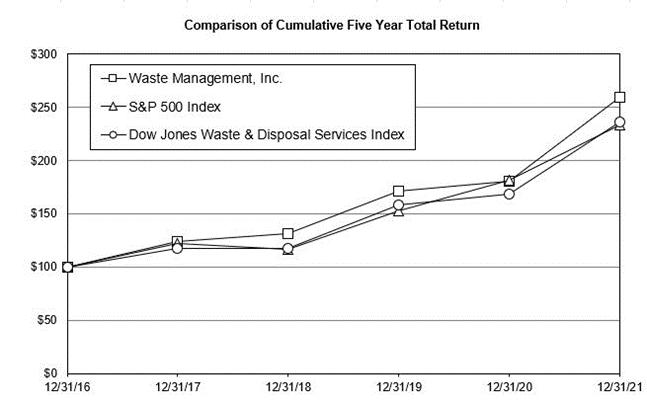]
| Dow Jones Waste & Disposal Services Index | | $ | 100 | | $ | [removed: 121] [added: 117] | | $ | [removed: 142] [added: 117] | | $ | [removed: 142] [added: 158] | | $ | [removed: 192] [added: 169] | | $ | [removed: 204] [added: 236] |
[added: | (b) |] We announced in December [removed: 2020] [added: 2021] that the Board of Directors has authorized up to [removed: $1.35] [added: $1.5] billion in future share [removed: repurchases, which supersedes and replaces remaining authority under any prior Board of Directors’ authorization for share] repurchases. [added: |]
See Note [removed: 14] [added: 13] to the Consolidated Financial Statements for additional information.
| | | 12/31/16 | | | 12/31/17 | | | 12/31/18 | | | 12/31/19 | | | 12/31/20 | | | 12/31/21 | |
| Waste Management, Inc. | | $ | 100 | | $ | 124 | | $ | 131 | | $ | 171 | | $ | 180 | | $ | 259 |
| S&P 500 Index | | $ | 100 | | $ | 122 | | $ | 116 | | $ | 153 | | $ | 181 | | $ | 233 |
During 2021, we allocated an aggregate of $1.35 billion in cash under our accelerated share repurchase (“ASR”) agreements.
As of December 31, 2021, we had received 8.7 million shares with a weighted average price per share of $146.61.
In January 2022, we completed our ASR agreement executed in December 2021, at which time we received an additional 0.4 million shares.
The following table summarizes common stock repurchases made during the fourth quarter of 2021 (shares in millions):
Issuer Purchases of Equity Securities
| | | | | | | | | | | | |
| --- | --- | --- | --- | --- | --- | --- | --- | --- | --- | --- | --- |
| | | | | | | | Total Number of | | | | |
| | | Total | | | | | Shares Purchased as | | Approximate Maximum | | |
| | | Number of | | Average | | | Part of Publicly | | Dollar Value of Shares that | | |
| | | Shares | | Price Paid | | | Announced Plans or | | May Yet be Purchased Under | | |
| Period | | Purchased | | per Share | | | Programs | | the Plans or Programs | | |
| October 1 — 31 | | — | | $ | — | | — | | $ | 350 million | |
| November 1 — 30 | | — | | $ | — | | — | | $ | 350 million | |
| December 1 — 31 | | 2.2 | | $ | 159.32 | (a) | 2.2 | | $ | 1.5 billion | (b) |
| Total | | 2.2 | | $ | 159.32 | | 2.2 | | | | |
| (a) | In August 2021, we entered into an ASR agreement to repurchase $500 million of our common stock. At the beginning of the repurchase period, we delivered $500 million in cash and received 2.7 million shares based on a stock price of $147.27. The ASR agreement completed in the fourth quarter of 2021, at which time we received 0.5 million additional shares based on a final weighted average price of $154.72. |
| --- | --- |
In December 2021, we executed an ASR agreement to repurchase $350 million of our common stock.
At the beginning of the repurchase period, we delivered $350 million in cash and received 1.7 million shares based on a stock price of $160.67.
The ASR agreement completed in January 2022, at which time we received 0.4 million additional shares based on a final weighted average price of $160.33.
The “Average Price Paid per Share” in the table represents the final weighted average price per share paid for the ASR agreement executed in August 2021 and the initial price per share paid for the ASR agreement executed in December 2021.
| --- | --- |
![Chart, line chart
| | | 12/31/15 | | | 12/31/16 | | | 12/31/17 | | | 12/31/18 | | | 12/31/19 | | | 12/31/20 | |
| Waste Management, Inc. | | $ | 100 | | $ | 136 | | $ | 170 | | $ | 179 | | $ | 233 | | $ | 246 |
| S&P 500 Index | | $ | 100 | | $ | 112 | | $ | 136 | | $ | 130 | | $ | 171 | | $ | 203 |
During 2020, we repurchased an aggregate of $402 million of our common stock under accelerated share repurchase agreements and open market repurchases, which equated to 3.7 million shares with a weighted average price per share of $108.92.
Item 6. [Reserved]
0 rewritten, 1 added, 2 removed, 0 unchanged
None.
The statement of operations data for the years ended December 31, 2020, 2019 and 2018, and the balance sheet data as of December 31, 2020 and 2019, are presented in the Consolidated Financial Statements included in Part II, Item 8.
The statement of operations data for the years ended December 31, 2017 and 2016, and the balance sheet data as of December 31, 2018, 2017 and 2016, are not included in this Annual Report on Form 10-K, and are provided in Part II, Item 8 of our Annual Reports on Form 10-K for the years ended December 31, 2018 and 2017.
Item 8. Financial Statements and Supplementary Data.
589 rewritten, 208 added, 246 removed, 1,008 unchanged
| [Reports of Independent Registered Public Accounting Firm](#Report) [added: (PCAOB ID 42)] | | [removed: 69] [added: 68] |
| [Consolidated Balance Sheets as of December 31, [removed: 2020] [added: 2021] and [removed: 201](#BALANCESHEETS_191365)9] [added: 2020](#BALANCESHEETS_191365)] | | [removed: 75] [added: 72] |
| [Consolidated Statements of Operations for the Years Ended December 31, [removed: 2020, 2019] [added: 2021, 2020] and [removed: 201](#STATEMENTSOFOPERATIONS_745891)8] [added: 2019](#STATEMENTSOFOPERATIONS_745891)] | | [removed: 76] [added: 73] |
| [Consolidated Statements of Comprehensive Income for the Years Ended December 31, [removed: 2020, 2019] [added: 2021, 2020] and [removed: 201](#COMPREHENSIVEINCOME_932746)8] [added: 2019](#COMPREHENSIVEINCOME_932746)] | | [removed: 76] [added: 73] |
| [Consolidated Statements of Cash Flows for the Years Ended December 31, [removed: 2020, 2019] [added: 2021, 2020] and [removed: 201](#CASHFLOWS_594152)8] [added: 2019](#CASHFLOWS_594152)] | | [removed: 77] [added: 74] |
| [Consolidated Statements of Changes in Equity for the Years Ended December 31, [removed: 2020, 2019] [added: 2021, 2020] and [removed: 201](#CHANGESINEQUITY_625544)8] [added: 2019](#CHANGESINEQUITY_625544)] | | [removed: 78] [added: 75] |
| [Notes to Consolidated Financial Statements](#NOTESTOCONSOLIDATEDFINANCIALSTATEMENTS_4) | | [removed: 79] [added: 76] |
We have audited Waste Management, Inc.’s internal control over financial reporting as of December 31, [removed: 2020,] [added: 2021,] based on criteria established in Internal Control-Integrated Framework issued by the Committee of Sponsoring Organizations of the Treadway Commission (2013 framework) (the COSO criteria).
In our opinion, Waste Management, Inc. (the Company) maintained, in all material respects, effective internal control over financial reporting as of December 31, [removed: 2020,] [added: 2021,] based on the COSO criteria.
We also have audited, in accordance with the standards of the Public Company Accounting Oversight Board (United States) (PCAOB), the [removed: 2020] [added: 2021] consolidated financial statements of the Company, and our report dated February [removed: 22, 2021] [added: 15, 2022] expressed an unqualified opinion thereon.
| Houston, Texas February [removed: 22, 2021] [added: 15, 2022] | |
We have audited the accompanying consolidated balance sheets of Waste Management, Inc. (the Company) as of December 31, [removed: 2020] [added: 2021] and [removed: 2019,] [added: 2020,] the related consolidated statements of operations, comprehensive income, cash flows, and changes in equity for each of the three years in the period ended December 31, [removed: 2020,] [added: 2021,] and the related notes (collectively referred to as the “consolidated financial statements”).
In our opinion, the consolidated financial statements present fairly, in all material respects, the financial position of the Company at December 31, [removed: 2020] [added: 2021] and [removed: 2019,] [added: 2020,] and the results of its operations and its cash flows for each of the three years in the period ended December 31, [removed: 2020,] [added: 2021,] in conformity with U.S. generally accepted accounting principles.
We also have audited, in accordance with the standards of the Public Company Accounting Oversight Board (United States) (PCAOB), the Company’s internal control over financial reporting as of December 31, [removed: 2020,] [added: 2021,] based on criteria established in Internal Control-Integrated Framework issued by the Committee of Sponsoring Organizations of the Treadway Commission (2013 framework), and our report dated February [removed: 22, 2021] [added: 15, 2022] expressed an unqualified opinion thereon.
| _Description of the Matter_ | At December 31, [removed: 2020,] [added: 2021,] the Company’s landfill assets, net of accumulated amortization, totaled [removed: $7.2] [added: $7.3] billion and the associated amortization expense for [removed: 2020] [added: 2021] was [removed: $568] [added: $731] million. As discussed in Note [removed: 3] [added: 2] of the financial statements, the Company updates the estimates used to calculate individual landfill amortization rates at least annually, or more often if significant facts change. Landfill amortization rates are used in the computation of landfill amortization expense. Auditing landfill amortization rates and related amortization expense is complex due to the highly judgmental nature of assumptions used in estimating the rates. Significant assumptions used in the calculation of the rates include: estimated future development costs associated with the construction and retirement of the landfill, estimated remaining permitted airspace and unpermitted expansion airspace, airspace utilization factors, projected annual tonnage intakes, and projected timing of retirement activities. |
| _Description of the Matter_ | At December 31, [removed: 2020,] [added: 2021,] the carrying value of the Company’s landfill asset retirement obligations related to final capping, closure and post-closure costs totaled [removed: $2.2] [added: $2.3] billion. As discussed in Note [removed: 3] [added: 2] of the financial statements, the Company updates the estimates used to measure the asset retirement obligations annually, or more often if significant facts change. Auditing the landfill asset retirement obligation is complex due to the highly judgmental nature of the assumptions used in the measurement process. These assumptions include: estimated future costs associated with the capping, closure and post closure activities at each specific landfill; airspace consumed to date in relation to total estimated permitted airspace; the projected annual tonnage intake; and the projected timing of retirement activities. |
| _How We Addressed the Matter in Our Audit_ | We obtained an understanding, evaluated the design, and tested the operating effectiveness of the Company’s controls over the calculation of asset retirement obligations. Our audit procedures included, among others, testing the Company’s controls over the landfill asset retirement obligation estimation process and management’s review of the significant assumptions used in the estimation of the liability, including the amount and timing of retirement costs. To test the landfill asset retirement obligation valuation, we performed audit procedures that included, among others, assessing methodologies used by the Company, testing the completeness of activities included in the estimate (e.g., gas monitoring and extraction), and testing the significant assumptions discussed above, inclusive of the underlying data used by the Company in its development of these assumptions. We compared the significant assumptions used by management to historical trends and, when available, to comparable size landfills accepting the same type of waste. In addition, we considered the professional qualifications and objectivity of management’s internal engineers responsible for developing the assumptions. We involved EY [removed: and external] engineering specialists to assist us with these procedures. Specifically, we utilized the EY engineering specialists to evaluate the reasons for significant changes in assumptions from the historical trend, and to determine whether the change from the historical trend was appropriate and identified timely. We [removed: utilized the external engineers to evaluate the estimates of remaining landfill airspace. We] also tested the completeness and accuracy of the historical data utilized in preparing the estimate. |
| | | [added: 2021 | | |] 2020 | | | 2019 | |
| Cash and cash equivalents | | $ | [added: 118 | | $ |] 553 | | $ | 3,561 |
| Accounts receivable, net of allowance for doubtful accounts of [removed: $33] [added: $25] and [removed: $28,] [added: $33,] respectively | | | [removed: 2,097] [added: 2,278] | | | [removed: 1,949] [added: 2,097] |
| Other receivables, net of allowance for doubtful accounts of [removed: $7] [added: $8] and [removed: $1,] [added: $7,] respectively | | | [removed: 527] [added: 268] | | | [removed: 370] [added: 527] |
| Parts and supplies | | | [removed: 124] [added: 135] | | | [removed: 106] [added: 124] |
| Other assets | | | [removed: 239] [added: 270] | | | [removed: 223] [added: 239] |
| Total current assets | | | [removed: 3,540] [added: 3,069] | | | [removed: 6,209] [added: 3,540] |
| Property and equipment, net of accumulated depreciation and amortization of [removed: $20,095] [added: $20,537] and [removed: $18,657,] [added: $19,337,] respectively | | | [removed: 14,148] [added: 14,419] | | | [removed: 12,893] [added: 14,148] |
| Goodwill | | | [removed: 8,994] [added: 9,028] | | | [removed: 6,532] [added: 8,994] |
| Other intangible assets, net | | | [removed: 1,024] [added: 898] | | | [removed: 521] [added: 1,024] |
| Restricted trust and escrow accounts | | | [removed: 347] [added: 348] | | | [removed: 313] [added: 347] |
| Investments in unconsolidated entities | | | [removed: 426] [added: 432] | | | [removed: 483] [added: 426] |
| Other assets | | | [removed: 866] [added: 903] | | | [removed: 792] [added: 866] |
| Total assets | | $ | [removed: 29,345] [added: 29,097] | | $ | [removed: 27,743] [added: 29,345] |
| Accounts payable | | $ | [removed: 1,121] [added: 1,375] | | $ | [removed: 1,065] [added: 1,121] |
| Accrued liabilities | | | [removed: 1,342] [added: 1,428] | | | [removed: 1,327] [added: 1,342] |
| Deferred revenues | | | [removed: 539] [added: 571] | | | [removed: 534] [added: 539] |
| Current portion of long-term debt | | | [removed: 551] [added: 708] | | | [removed: 218] [added: 551] |
| Total current liabilities | | | [removed: 3,553] [added: 4,082] | | | [removed: 3,144] [added: 3,553] |
| Long-term debt, less current portion | | | [removed: 13,259] [added: 12,697] | | | [removed: 13,280] [added: 13,259] |
| Deferred income taxes | | | [removed: 1,806] [added: 1,694] | | | [removed: 1,407] [added: 1,806] |
| Landfill and environmental remediation liabilities | | | [removed: 2,222] [added: 2,373] | | | [removed: 1,930] [added: 2,222] |
| Other liabilities | | | [removed: 1,051] [added: 1,125] | | | [removed: 912] [added: 1,051] |
| Houston, Texas February 15, 2022 | |
| Consolidated net income | | $ | 1,817 | | $ | 1,496 | | $ | 1,671 |
| Depreciation and amortization | | | 1,999 | | | 1,671 | | | 1,574 |
| New borrowings | | | 7,948 | | | 9,420 | | | 13,237 |
| Debt repayments | | | (8,404) | | | (9,629) | | | (10,088) |
| Cash, cash equivalents and restricted cash and cash equivalents at end of period | | $ | 194 | | $ | 648 | | $ | 3,647 |
| Balance, December 31, 2021 | | $ | 7,126 | | 630,282 | | $ | 6 | | $ | 5,169 | | $ | 12,004 | | $ | 17 | | (214,159) | | $ | (10,072) | | $ | 2 |
Basis of Presentation
In 2021, our senior management began evaluating, overseeing and managing the financial performance of our Solid Waste operations through two operating segments.
Our East Tier primarily consists of geographic areas located in the Eastern U.S., the Great Lakes region and substantially all of Canada.
Our West Tier primarily includes geographic areas located in the Western U.S., including the upper Midwest region, and British Columbia, Canada.
Each of our Solid Waste operating segments provides integrated environmental services, including collection, transfer, recycling, and disposal.
The Company finalized the assessment of our segments during the fourth quarter of 2021.
The East and West Tiers are presented in this report and constitute our existing Solid Waste business.
In our Annual Report on Form 10-K for the year ended December 31, 2020, our accumulated depreciation and gross property and equipment balances as of December 31, 2020 were overstated.
We subsequently corrected the balances in our Quarterly Report on Form 10-Q for the quarter ended March 31, 2021 and have provided the corrected balances in all filings thereafter.
As of December 31, 2021, we had $2,278 million of trade receivables, net of allowance for doubtful accounts of $25 million.
These actions contributed to an increase in the aging of outstanding balances during the year and resulted in a related increase in our allowance for doubtful accounts.
interest, on-site road construction and other capital infrastructure costs.
As of December 31, 2021 and 2020, we inflated the costs by 2.25%.
See Note 17 for additional information related to our acquisitions, including our 2020 acquisition of Advanced Disposal.
depending on the estimated timing and purpose of the use of funds.
| | | 2021 | | | 2020 | |
December 31, 2020 and to 1.2639 at December 31, 2021.
During 2021, we had $30 million of non-cash financing activities from new financing leases.
| | | 2021 | | | | | | | | | 2020 | | | | | | | |
| | | $ | 2,326 | | $ | 213 | | $ | 2,539 | | $ | 2,156 | | $ | 230 | | $ | 2,386 |
| December 31, 2021 | | $ | 2,326 | | $ | 213 |
| (a) | The amount reported for our landfill liabilities includes an increase of $15 million due to a business decision to accelerate the closure timing of a landfill in our West Tier segment, which resulted in the acceleration of the expected timing of capping, closure and post-closure activities. The remaining increase relates to revisions in estimated costs and timing of capping, closure and post-closure liabilities. |
| (b) | The amount reported for our landfill liabilities includes an increase of $13 million related to changes in the fair values assigned to certain acquired Advanced Disposal sites. |
Anticipated
| | | 2021 | | | 2020 | |
| Vehicles (a) | | | 5,893 | | | 5,800 |
| Containers (a) | | | 2,807 | | | 2,694 |
| | | | 34,956 | | | 33,485 |
| (a) | In our Annual Report on Form 10-K for the year ended December 31, 2020, our accumulated depreciation and gross property and equipment balances as of December 31, 2020 were overstated. We subsequently corrected the balances in our Quarterly Report on Form 10-Q for the quarter ended March 31, 2021 and have provided the corrected balances in all filings thereafter, as discussed in Note 1. |
See Note 5 for information regarding amortization of our intangible assets.
The $34 million increase in goodwill during 2021 is primarily related to acquisitions, partially offset by divestitures.
| 2021 | | | | | | | | | | | | |
| Intangible assets | | $ | 1,355 | | $ | 43 | | $ | 142 | | $ | 1,540 |
| --- | --- | --- |
As indicated in the accompanying Management’s Report on Internal Control Over Financial Reporting, management’s assessment of and conclusion on the effectiveness of internal control over financial reporting did not include the internal controls of Advanced Disposal Services, Inc., which is included in the 2020 consolidated financial statements of the Company and constituted approximately 10.6% of total consolidated assets, excluding goodwill, as of December 31, 2020, approximately 1.3% of total consolidated revenues and less than 1% of consolidated operating income, for the year then ended.
Our audit of internal control over financial reporting of the Company also did not include an evaluation of the internal control over financial reporting of Advanced Disposal Services, Inc.
Adoption of ASU No. 2016-02 (Topic 842)
As discussed in Note 2 to the consolidated financial statements, the Company changed its method of accounting for leases in the 2019 financial statements to reflect the accounting method change due to the adoption of ASU No. 2016-02, _Leases (Topic 842)_, and the related amendments.
| | Acquisition of Advanced Disposal Services, Inc. – Valuation of Customer Relationship and Landfill rights/permits |
| _Description of the Matter_ | As described in Note 18 to the consolidated financial statements, during the year ended December 31, 2020, the Company completed the acquisition of Advanced Disposal Services, Inc. (“Advance Disposal”) for net consideration of $4.1 billion. The transaction was accounted for as a business combination. Auditing the Company’s accounting for its acquisition of Advance Disposal was complex due to the significant estimation required by management in determining the fair value of the acquired customer relationships and landfill assets included within Other intangible assets and Property and equipment, respectively, in Note 18, both of which utilize prospective financial information. The Company valued the customer relationship asset using an income approach; specifically, the multi-period excess earnings model. The significant assumptions used to value customer relationships included, among others, the attrition rate, revenue growth rate, and discount rate. The Company valued the landfill assets using an income approach; specifically, a discounted cash flow model. The significant assumptions used to value landfill assets included, among others, the forecasted revenue and revenue growth (including forecasted waste volumes and rate per ton), discount rate, and forecasted capital expenditures. These assumptions are forward-looking and could be affected by future economic and market conditions. |
| | |
| _How We Addressed the Matter in Our Audit_ | We obtained an understanding, evaluated the design, and tested the operating effectiveness of the Company’s controls over its accounting for the Advance Disposal acquisition. For example, we tested controls over the valuation of customer relationships and landfill assets, including management’s review of the valuation models, and underlying data and assumptions used to develop the estimated fair value of these assets. To test the estimated fair value of the customer relationship and landfill assets, we performed audit procedures that included, among others, evaluating the Company’s selection of the valuation methodology, evaluating the significant assumptions used to determine the valuation calculations, and testing the completeness and accuracy of the underlying data supporting the significant assumptions. We involved our valuation specialists to assist with evaluating the methodology and significant assumptions used by the management to determine the fair value estimates. Additionally, we performed sensitivity analyses of the identified significant assumptions and compared them, as applicable, to current industry and market trends, the assumptions used by the Company to value similar assets in other acquisitions, as well as historical results, among other procedures. |
WASTE MANAGEMENT, INC.
| New borrowings | | | 5,790 | | | 4,683 | | | 359 |
| Debt repayments | | | (7,807) | | | (533) | | | (499) |
| Net commercial paper borrowings (repayments) | | | 1,808 | | | (1,001) | | | 453 |
| Balance, December 31, 2017 | | $ | 6,042 | | 630,282 | | $ | 6 | | $ | 4,933 | | $ | 8,588 | | $ | 8 | | (196,964) | | $ | (7,516) | | $ | 23 |
| Divestiture of noncontrolling interest | | | (19) | | — | | | — | | | — | | | — | | | — | | — | | | — | | | (19) |
Business
We evaluate, oversee and manage the financial performance of our Solid Waste business subsidiaries through our 17 Areas.
New Accounting Standards and Reclassifications
Adoption of New Accounting Standards
_Leases_ — In February 2016, the Financial Accounting Standards Board (“FASB”) issued Accounting Standards Update (“ASU”) 2016-02 associated with lease accounting.
There were further amendments, including practical expedients, with the issuance of ASU 2018-01 in January 2018, ASU 2018-11 in July 2018 and ASU 2018-20 in December 2018.
On January 1, 2019, we adopted this ASU using the optional transition method which allows entities to continue to apply historical accounting guidance in the comparative periods presented in the year of adoption.
Accordingly, our financial statements for the reported periods after January 1, 2019 are presented under this amended guidance, while prior period amounts are not adjusted and continue to be reported in accordance with historical accounting guidance.
We elected to apply the following package of practical expedients on a consistent basis permitting entities not to reassess: (i) whether any expired or existing contracts are or contain a lease; (ii) lease classification for any expired or existing leases and (iii) whether initial direct costs for any expired or existing leases qualify for capitalization under the amended guidance.
In addition, we applied (i) the practical expedient for land easements, which allows the Company to not apply the lease standard to certain existing land easements at transition and (ii) the practical expedient to include both the lease and non-lease components as a single component and account for it as a lease.
_Financial Instruments-Credit Losses_ — In June 2016, the FASB issued ASU 2016-13 associated with the measurement of credit losses on financial instruments.
On January 1, 2020, we adopted this ASU using the modified retrospective transition method.
The amended guidance replaced the previous incurred loss impairment methodology of recognizing credit losses when a loss is probable, with a methodology that reflects expected credit losses and requires
NOTES TO CONSOLIDATED FINANCIAL STATEMENTS — (Continued)
consideration of a broader range of reasonable and supportable information to assess credit loss estimates.
This expected loss model generally results in earlier recognition of an allowance for losses.
We recognized a net $2 million after tax decrease to retained earnings as of January 1, 2020 for the cumulative impact of adopting the amended guidance.
_Implementation Costs Incurred in a Cloud Computing Arrangement_ — In August 2018, the FASB issued ASU 2018-15 associated with a customer’s accounting for implementation costs incurred in a cloud computing arrangement that is a service contract.
The amendments align the requirements for capitalizing implementation costs incurred in a hosting arrangement that is a service contract with the requirements for capitalizing implementation costs incurred to develop or obtain internal-use software.
Costs for implementation activities in the application development stage are capitalized as prepayments depending on the nature of the costs, while costs incurred during the preliminary project and post-implementation stages are expensed as the activities are performed.
The Company adopted this amended guidance on January 1, 2020 prospectively, and it did not have a material impact on our consolidated financial statements.
_Guarantor Financial Information_ — In March 2020, the Securities and Exchange Commission (“SEC”) adopted final rules that simplify the disclosure requirements related to certain registered securities under SEC Regulation S-X, Rules 3-10 and 3-16, permitting registrants to provide certain alternative financial disclosures and non-financial disclosures in lieu of separate consolidating financial statements for subsidiary issuers and guarantors of registered debt securities (which we previously included within the notes to our financial statements included in our Annual Reports on Form 10-K and Quarterly Reports on Form 10-Q) if certain conditions are met.
The disclosure requirements, as amended, are now located in newly-created Rules 13-01 and 13-02 of Regulation S-X and are generally effective for filings on or after January 4, 2021, with early adoption permitted.
We early adopted the new disclosure requirements effective as of April 1, 2020 and are providing the summarized financial information and related disclosures in Item 7.
An excerpt. Shown here: 40 of 589 rewritten, 40 of 208 added and 40 of 246 removed. The counts are complete. For every sentence, read Item 8. Financial Statements and Supplementary Data. in the FY2021 filing and the FY2020 filing.
Item 9A. Controls and Procedures.
5 rewritten, 0 added, 9 removed, 13 unchanged
Our management, with the participation of our principal executive and financial officers, has evaluated the effectiveness of our disclosure controls and procedures [added: (as defined] in [added: Rules 13a-15(e) and 15d-15(e) of the Securities Exchange Act of 1934, as amended) in] ensuring that the information required to be disclosed in reports that we file or submit under the Securities Exchange Act of 1934, as amended, is recorded, processed, summarized and reported within the time periods specified in the SEC’s rules and forms, including ensuring that such information is accumulated and communicated to management (including the principal executive and financial officers) as appropriate to allow timely decisions regarding required disclosure.
Based on such evaluation, our principal executive and financial officers have concluded that such disclosure controls and procedures were effective as of December 31, [removed: 2020] [added: 2021] (the end of the period covered by this Annual Report on Form [removed: 10-K).][added: 10-K) at a reasonable assurance level.]
[removed: Management] [added: Our management conducted an evaluation] of the [removed: Company assessed the] effectiveness of our internal control over financial reporting [removed: as of December 31, 2020] based on the [added: 2013 framework in] Internal [removed: Control — Integrated] [added: Control—Integrated] Framework issued by the Committee of Sponsoring Organizations of the Treadway Commission [removed: (2013 framework).][added: (the COSO criteria).]
The effectiveness of our internal control over financial reporting has been audited by Ernst & Young LLP, the independent registered public accounting firm that audited our consolidated financial statements, as stated in their report, which is included [removed: within] [added: in Item 8 of] this [removed: report.][added: Annual Report on Form 10-K.]
[removed: We determined that there] [added: There] were no changes in our internal control over financial reporting during the quarter ended December 31, [removed: 2020] [added: 2021] that [removed: have] materially affected, or are reasonably likely to materially affect, our internal control over financial reporting.
On October 30, 2020, we consummated our acquisition of Advanced Disposal Services, Inc. (“Advanced Disposal”).
As permitted by the SEC rules and regulations, management's assessment did not include the internal controls of the acquired operations of Advanced Disposal, which are included in our consolidated financial statements as of December 31, 2020 and for the period from the acquisition date through December 31, 2020.
In accordance with our integration efforts, we plan to incorporate the acquired operations of Advanced Disposal into our internal control over financial reporting program within the time period provided by applicable SEC rules and regulations.
The assets, excluding goodwill, of the acquired operations of Advanced Disposal constituted approximately 10.6% of our total consolidated assets as of December 31, 2020.
Operating results of the acquired operations of Advanced Disposal comprised approximately 1.3% of our total consolidated revenues and less than 1% our consolidated operating income for the year ended December 31, 2020.
Based on the results of its evaluation, which excluded assessments of the internal control of the acquired operations of Advanced Disposal, management believes that as of December 31, 2020, our internal control over financial reporting is effective based on those criteria.
Operating results of the acquired operations of Advanced Disposal comprised approximately 1.3% of our total consolidated revenues and less than 1% of our consolidated operating income for the year ended December 31, 2020.
Based on this assessment, management has concluded that our internal control over financial reporting was effective as of December 31, 2020.
Management, together with our CEO and CFO, evaluated the changes in our internal control over financial reporting during the quarter ended December 31, 2020.
Item 10. Directors, Executive Officers and Corporate Governance.
1 rewritten, 0 added, 0 removed, 3 unchanged
The information required by this Item is incorporated by reference to the sections entitled “Board of Directors” and “Executive Officers” in the Company’s definitive Proxy Statement for its [removed: 2021] [added: 2022] Annual Meeting of Stockholders (the “Proxy Statement”), to be held May [removed: 11, 2021.][added: 10, 2022.]
Item 15. Exhibits, Financial Statement Schedules.
20 rewritten, 1 added, 6 removed, 42 unchanged
Consolidated Balance Sheets as of December 31, [removed: 2020] [added: 2021] and [removed: 2019][added: 2020]
Consolidated Statements of Operations for the years ended December 31, [removed: 2020, 2019] [added: 2021, 2020] and [removed: 2018][added: 2019]
Consolidated Statements of Comprehensive Income for the years ended December 31, [removed: 2020, 2019] [added: 2021, 2020] and [removed: 2018][added: 2019]
Consolidated Statements of Cash Flows for the years ended December 31, [removed: 2020, 2019] [added: 2021, 2020] and [removed: 2018][added: 2019]
Consolidated Statements of Changes in Equity for the years ended December 31, [removed: 2020, 2019] [added: 2021, 2020] and [removed: 2018][added: 2019]
| 4.7* | — | [Schedule of Officers’ Certificates delivered pursuant to Section 301 of the Indenture dated September 10, 1997 establishing the terms and form of Waste Management, Inc.’s Senior Notes. Waste Management and its subsidiaries are parties to debt instruments that have not been filed with the SEC under which the total amount of securities authorized under any single instrument does not exceed 10% of the total assets of Waste Management and its subsidiaries on a consolidated basis. Pursuant to paragraph 4(iii)(A) of Item 601(b) of Regulation S-K, Waste Management agrees to furnish a copy of such instruments to the SEC upon [removed: request.](https://www.sec.gov/Archives/edgar/data/823768/000155837021001348/wm-20201231xex4d7.htm)] [added: request.](https://www.sec.gov/Archives/edgar/data/823768/000155837022001179/wm-20211231xex4d7.htm)] |
| [removed: 4.8*] [added: 4.8] | — | [Officers’ Certificate delivered pursuant to Section 301 of the Indenture dated September 10, 1997 establishing the terms and form of the [removed: 0.750%] [added: 2.00%] Senior Notes due [removed: 2025.](https://www.sec.gov/Archives/edgar/data/823768/000155837021001348/wm-20201231xex4d8.htm)] [added: 2029 \[incorporated by reference to Exhibit 4.1 to Form 10-Q for the quarter ended June 30, 2021\].](https://www.sec.gov/Archives/edgar/data/0000823768/000155837021009319/wm-20210630ex410a8a250.htm)] |
| [removed: 4.9*] [added: 4.9] | — | [Guarantee Agreement by Waste Management Holdings, Inc. in favor of The Bank of New York Mellon Trust Company, N.A., as Trustee for the holders of the [removed: 0.750%] [added: 2.00%] Senior Notes due [removed: 2025.](https://www.sec.gov/Archives/edgar/data/823768/000155837021001348/wm-20201231xex4d9.htm)] [added: 2029 \[incorporated by reference to Exhibit 4.3 to Form 10-Q for the quarter ended June 30, 2021\].](https://www.sec.gov/Archives/edgar/data/0000823768/000155837021009319/wm-20210630ex43ccc6c08.htm)] |
| 10.2† | — | [First Amendment to 2014 Stock Incentive Plan \[incorporated by reference to Exhibit 10.2 to Form [removed: 8 K] [added: 8-K] dated May 12, 2020\].](https://www.sec.gov/Archives/edgar/data/823768/000110465920062449/tm2018602d2_ex10-2.htm) |
| 10.16† | — | [Form of [removed: 2018] [added: 2019] Long Term Incentive Compensation Award Agreement for Senior Leadership Team \[incorporated by reference to Exhibit 10.1 to Form 8-K dated February 19, [removed: 2018\].](https://www.sec.gov/Archives/edgar/data/823768/000110465918011700/a18-6740_1ex10d1.htm)] [added: 2019\].](https://www.sec.gov/Archives/edgar/data/0000823768/000110465919010295/a19-5282_1ex10d1.htm#EXHIBIT10_1_092649)] |
| 10.17† | — | [Form of [removed: 2019] [added: 2020] Long Term Incentive Compensation Award Agreement for Senior Leadership Team \[incorporated by reference to Exhibit 10.1 to Form 8-K dated February 19, [removed: 2019\].](https://www.sec.gov/Archives/edgar/data/823768/000110465920024590/tm207498d2_ex10-1.htm)] [added: 2020\].](https://www.sec.gov/Archives/edgar/data/823768/000110465920024590/tm207498d2_ex10-1.htm)] |
| 10.18† | — | [Form of [removed: 2020] [added: 2021] Long Term Incentive Compensation Award Agreement for Senior Leadership Team \[incorporated by reference to Exhibit 10.1 to Form 8-K dated February [removed: 19, 2020\].](https://www.sec.gov/ix?doc=/Archives/edgar/data/823768/000110465920024590/tm207498-2_8k.htm)] [added: 23, 2021\].](https://www.sec.gov/Archives/edgar/data/0000823768/000110465921029723/tm216945d2_ex10-1.htm)] |
| 21.1* | — | [Subsidiaries of the [removed: Registrant.](https://www.sec.gov/Archives/edgar/data/823768/000155837021001348/wm-20201231xex21d1.htm)] [added: Registrant.](https://www.sec.gov/Archives/edgar/data/823768/000155837022001179/wm-20211231xex21d1.htm)] |
| 22.1* | — | [Guarantor [removed: Subsidiary.](https://www.sec.gov/Archives/edgar/data/823768/000155837021001348/wm-20201231xex22d1.htm)] [added: Subsidiary.](https://www.sec.gov/Archives/edgar/data/823768/000155837022001179/wm-20211231xex22d1.htm)] |
| 23.1* | — | [Consent of Independent Registered Public Accounting [removed: Firm.](https://www.sec.gov/Archives/edgar/data/823768/000155837021001348/wm-20201231xex23d1.htm)] [added: Firm.](https://www.sec.gov/Archives/edgar/data/823768/000155837022001179/wm-20211231xex23d1.htm)] |
| 31.1* | — | [Certification Pursuant to Rule 13a-14(a) and 15d-14(a) under the Securities Exchange Act of 1934, as amended, of James C. Fish, Jr., President and Chief Executive [removed: Officer.](https://www.sec.gov/Archives/edgar/data/823768/000155837021001348/wm-20201231xex31d1.htm)] [added: Officer.](https://www.sec.gov/Archives/edgar/data/823768/000155837022001179/wm-20211231xex31d1.htm)] |
| 31.2* | — | [Certification Pursuant to Rule 13a-14(a) and 15d-14(a) under the Securities Exchange Act of 1934, as amended, of Devina A. Rankin, Executive Vice President and Chief Financial [removed: Officer.](https://www.sec.gov/Archives/edgar/data/823768/000155837021001348/wm-20201231xex31d2.htm)] [added: Officer.](https://www.sec.gov/Archives/edgar/data/823768/000155837022001179/wm-20211231xex31d2.htm)] |
| 32.1 | — | [Certification Pursuant to 18 U.S.C. §1350 of James C. Fish, Jr., President and Chief Executive [removed: Officer.](https://www.sec.gov/Archives/edgar/data/823768/000155837021001348/wm-20201231xex32d1.htm)] [added: Officer.](https://www.sec.gov/Archives/edgar/data/823768/000155837022001179/wm-20211231xex32d1.htm)] |
| 32.2 | — | [Certification Pursuant to 18 U.S.C. §1350 of Devina A. Rankin, Executive Vice President and Chief Financial [removed: Officer.](https://www.sec.gov/Archives/edgar/data/823768/000155837021001348/wm-20201231xex32d2.htm)] [added: Officer.](https://www.sec.gov/Archives/edgar/data/823768/000155837022001179/wm-20211231xex32d2.htm)] |
| 95* | — | [Mine Safety [removed: Disclosures.](https://www.sec.gov/Archives/edgar/data/823768/000155837021001348/wm-20201231xex95.htm)] [added: Disclosures.](https://www.sec.gov/Archives/edgar/data/823768/000155837022001179/wm-20211231xex95.htm)] |
| 10.19†* | | [Form of 2021 Long Term Incentive Compensation RSU Award Agreement.](https://www.sec.gov/Archives/edgar/data/823768/000155837022001179/wm-20211231xex10d19.htm) |
| 4.10* | — | [Officers’ Certificate delivered pursuant to Section 301 of the Indenture dated September 10, 1997 establishing the terms and form of the 1.150% Senior Notes due 2028.](https://www.sec.gov/Archives/edgar/data/823768/000155837021001348/wm-20201231xex4d10.htm) |
| 4.11* | — | [Guarantee Agreement by Waste Management Holdings, Inc. in favor of The Bank of New York Mellon Trust Company, N.A., as Trustee for the holders of the 1.150% Senior Notes due 2028.](https://www.sec.gov/Archives/edgar/data/823768/000155837021001348/wm-20201231xex4d11.htm) |
| 4.12* | — | [Officers’ Certificate delivered pursuant to Section 301 of the Indenture dated September 10, 1997 establishing the terms and form of the 1.500% Senior Notes due 2031.](https://www.sec.gov/Archives/edgar/data/823768/000155837021001348/wm-20201231xex4d12.htm) |
| 4.13* | — | [Guarantee Agreement by Waste Management Holdings, Inc. in favor of The Bank of New York Mellon Trust Company, N.A., as Trustee for the holders of the 1.500% Senior Notes due 2031.](https://www.sec.gov/Archives/edgar/data/823768/000155837021001348/wm-20201231xex4d13.htm) |
| 4.14* | — | [Officers’ Certificate delivered pursuant to Section 301 of the Indenture dated September 10, 1997 establishing the terms and form of the 2.500% Senior Notes due 2050.](https://www.sec.gov/Archives/edgar/data/823768/000155837021001348/wm-20201231xex4d14.htm) |
| 4.15* | — | [Guarantee Agreement by Waste Management Holdings, Inc. in favor of The Bank of New York Mellon Trust Company, N.A., as Trustee for the holders of the 2.500% Senior Notes due 2050.](https://www.sec.gov/Archives/edgar/data/823768/000155837021001348/wm-20201231xex4d15.htm) |
Item 16. Form 10-K Summary.
10 rewritten, 5 added, 2 removed, 36 unchanged
Date: February [removed: 22, 2021][added: 15, 2022]
| /s/ JAMES C. FISH, JR. | | President, Chief Executive Officer and Director | | February [removed: 22, 2021] [added: 15, 2022] |
| /s/ DEVINA A. RANKIN | | Executive Vice President and | | February [removed: 22, 2021] [added: 15, 2022] |
| /s/ LESLIE K. NAGY | | Vice President and Chief Accounting Officer | | February [removed: 22, 2021] [added: 15, 2022] |
| /s/ ANDRÉS R. GLUSKI | | Director | | February [removed: 22, 2021] [added: 15, 2022] |
| /s/ VICTORIA M. HOLT | | Director | | February [removed: 22, 2021] [added: 15, 2022] |
| /s/ KATHLEEN M. MAZZARELLA | | Director | | February [removed: 22, 2021] [added: 15, 2022] |
| /s/ WILLIAM B. PLUMMER | | Director | | February [removed: 22, 2021] [added: 15, 2022] |
| /s/ JOHN C. POPE | | Director | | February [removed: 22, 2021] [added: 15, 2022] |
| /s/ THOMAS H. WEIDEMEYER | | Chairman of the Board and Director | | February [removed: 22, 2021] [added: 15, 2022] |
| /s/ SEAN E. MENKE | | Director | | February 15, 2022 |
| Sean E. Menke | | | | |
| /s/ MARYROSE T. SYLVESTER | | Director | | February 15, 2022 |
| Maryrose T. Sylvester | | | | |
| | | | | |
| /s/ FRANK M. CLARK, JR. | | Director | | February 22, 2021 |
| Frank M. Clark, Jr. | | | | |