 filings.tools
Waste Management (WM) 10-K risk factor changes: FY2022 vs FY2021
The 2022-12-31 10-K against the 2021-12-31 one, compared heading by heading and sentence by sentence.
Item 1A102 rewritten57 added39 removed262 unchanged
All filing items1,149 rewritten478 added422 removed2,139 unchanged
Summary
counted, not written
- Item 1A lists 4 risk factor headings: 2 new, 1 reworded and 1 unchanged since FY2021. 3 headings from FY2021 no longer appear.
- Sentence by sentence, 478 added, 422 removed, 1,149 rewritten and 2,139 unchanged across 13 items that differ.
New Item 1A headings (2)
- We may not be able to achieve our sustainability and other environmental, social and governance ("ESG")-related goals, including reduction of our greenhouse gas ("GHG") emissions, or execute on our sustainability-related growth strategy and initiatives, within planned timelines, and expectations and regulations relating to ESG performance and disclosure can result in increased costs, risk of noncompliance, and related adverse effects.
- We have announced a sustainability growth strategy that includes significant planned investments in our renewable energy businesses; changes to federal and state renewable fuel policies could affect our financial performance, and such investments may not yield the results anticipated.
Removed Item 1A headings (3)
- Governmental regulations requiring mandatory COVID-19 vaccination of employees could adversely impact our ability to perform or compete for certain contracts and negatively affect our results of operations.
- We are implementing a new enterprise resource planning and human capital management system, and challenges with the implementation of the system may impact our business and operations.
- Changes to federal and state renewable fuel policies could affect our financial performance in that sector as a renewable fuel producer and impact our projected future investments.
Reworded Item 1A headings (1)
- Market disruption, including labor shortages and supply chain constraints, and macroeconomic pressures, including
[removed: the heightened pace of]inflation, have adversely impacted our business and results of operations.
A heading is new when no FY2021 heading matches it after ignoring case and punctuation, and reworded when it shares at least 60 percent of its words with one that went away. All current risk factor headings.
Sentences by item
22 items, with every count and a link to each item that changed
| Item | Added | Removed | Rewritten | Unchanged |
|---|---|---|---|---|
| Item 1A. Risk Factors. | 57 | 39 | 102 | 262 |
| Item 7. Management’s Discussion and Analysis of Financial Condition and Results of Operations. | 152 | 157 | 324 | 372 |
| Item 7A. Quantitative and Qualitative Disclosures about Market Risk. | 16 | 2 | 8 | 16 |
| Item 1. Business. | 63 | 42 | 91 | 224 |
| Item 3. Legal Proceedings. | 0 | 0 | 0 | 1 |
| Cover and table of contents | 3 | 1 | 25 | 63 |
| Item 1B. Unresolved Staff Comments. | 0 | 0 | 0 | 1 |
| Item 2. Properties. | 3 | 3 | 5 | 10 |
| Item 4. Mine Safety Disclosures. | 0 | 0 | 0 | 2 |
| Item 5. Market for Registrant’s Common Equity, Related Stockholder Matters and Issuer Purchases of Equity Securities. | 9 | 12 | 8 | 17 |
| Item 6. [Reserved] | 0 | 0 | 0 | 1 |
| Item 8. Financial Statements and Supplementary Data. | 166 | 165 | 535 | 1,078 |
| Item 9. Changes in and Disagreements with Accountants on Accounting and Financial Disclosure. | 0 | 0 | 0 | 1 |
| Item 9A. Controls and Procedures. | 5 | 0 | 3 | 15 |
| Item 9B. Other Information. | 0 | 0 | 0 | 2 |
| Item 10. Directors, Executive Officers and Corporate Governance. | 0 | 0 | 1 | 3 |
| Item 11. Executive Compensation. | 0 | 0 | 1 | 0 |
| Item 12. Security Ownership of Certain Beneficial Owners and Management and Related Stockholder Matters. | 0 | 0 | 0 | 1 |
| Item 13. Certain Relationships and Related Transactions, and Director Independence. | 0 | 0 | 0 | 1 |
| Item 14. Principal Accounting Fees and Services. | 0 | 0 | 0 | 2 |
| Item 15. Exhibits, Financial Statement Schedules. | 4 | 1 | 34 | 28 |
| Item 16. Form 10-K Summary. | 0 | 0 | 12 | 39 |
Underlined words on a shaded ground are new in FY2022; struck-through words were in FY2021. Sentences that are wholly new or wholly gone are labelled rather than marked.
Item 1A. Risk Factors.
102 rewritten, 57 added, 39 removed, 262 unchanged
| | ● | projections, estimates or assumptions relating to our operational or financial [removed: performance; or] [added: performance, including anticipated impacts of the Inflation Reduction Act of 2022;] |
Outlined below are some of the risks that we believe could affect our business and financial statements for [removed: 2022] [added: 2023] and beyond and could cause actual results to be materially different from those set forth in forward-looking statements made by the Company.
| | ● | We may be unsuccessful in implementing [added: our technology-led automation and optimization strategy and other] improvements to operational efficiency and such efforts may not yield the intended result. |
| | ● | We may not be able to maintain cost savings achieved through [added: our automation and] optimization efforts, due to inflationary cost pressure or otherwise. |
| | ● | Acquisitions, investments and/or new service offerings [added: or lines of business] may not increase our earnings in the timeframe anticipated, or at all, due to difficulties operating in new markets or providing new service [removed: offerings,] [added: offerings or lines of business,] failure of [removed: emerging] technologies to perform as expected, failure to operate within budget, integration [removed: issues, or regulatory issues, among others.] |
| | ● | Integration of acquisitions and/or new services offerings [added: or lines of business] could increase our exposure to the risk of inadvertent noncompliance with applicable laws and [removed: regulations.] [added: regulations, and any expansion into markets outside of North America would result in our business being subject to new laws and regulatory regimes, resulting in greater exposure to risk of inadvertent noncompliance and additional compliance costs.] |
| | ● | Liabilities associated with acquisitions, including ones that may exist only because of past operations of an acquired business, may prove to be more difficult or costly to address than [removed: anticipated.] [added: anticipated, and businesses or assets we acquire may have undisclosed liabilities, despite our efforts to minimize exposure to such risks through due diligence and other measures.] |
| | ● | Execution of our strategy, [removed: particularly] [added: including] growth through [removed: acquisitions,] [added: acquisitions and our planned expansion of our recycling and renewable energy businesses,] may cause us to incur substantial additional indebtedness, which may divert capital away from our traditional business operations and other financial plans. |
In addition to the risks set forth above, implementation of our business strategy could also be affected by other factors beyond our control, such as increased competition, legal developments, government regulation, general economic conditions, [added: including slower growth or recession,] increased operating costs or expenses, subcontractor costs and availability and changes in industry trends.
| | ● | [removed: limitations] [added: limitations, bans, taxes] or [removed: bans] [added: charges] on disposal or transportation of out-of-state waste or certain categories of waste; |
| | ● | mandates regarding the management of solid [removed: waste,] [added: waste and other materials,] including requirements to recycle, divert or otherwise process certain waste, recycling and other streams; or |
[added: We have significant financial] obligations relating to final capping, closure, post-closure and environmental remediation at our existing landfills and we establish accruals for these estimated costs.
Expenditures could be accelerated or materially exceed our accruals due to [added: earlier than expected closure of landfills;] the types of waste collected and manner in which it is transported and disposed of, including actions taken in the past by companies we have acquired or third-party landfill operators; environmental regulatory changes; new information about waste types previously collected, such as PFAS or other emerging [removed: contaminates,] [added: contaminates] and other reasons.
There is no federal law establishing EPR in the U.S. or Canada; however, federal, state, provincial and local governments could, and in [removed: some] [added: several] cases have, taken steps to implement EPR regulations for packaging, including traditional recyclables such as cardboard, bottles and cans.
If wide-ranging EPR regulations were adopted, they could [removed: have a fundamental] [added: significantly] impact [removed: on] the waste [added: and recycling] streams we manage and how we operate our business, including contract terms and pricing.
Providing environmental and waste management services, including constructing and operating landfills, transfer stations, [removed: MRFs] [added: material recovery facilities (“MRFs”)] and other disposal facilities, [added: and landfill gas-to-energy facilities,] involves risks such as truck accidents, equipment defects, malfunctions and [removed: failures.][added: failures, and improper use of dangerous equipment.]
Operation of fueling stations and landfill gas collection and control [removed: systems] [added: systems, as well as operation of heavy machinery and management of flammable materials at our MRFs and transfer stations,] involves additional risks of fire and explosion.
We may be unable to obtain or maintain required permits or expand existing permitted capacity [removed: of] [added: at] our landfills, [added: due to land scarcity, public opposition or otherwise,] which [removed: could decrease our] [added: can require us to identify disposal alternatives, resulting in decreased] revenue and [removed: increase our] [added: increased] costs.
Our ability to meet our financial and operating objectives depends in part on our ability to obtain and maintain the permits necessary to operate landfill [removed: sites.][added: sites and transfer stations.]
In addition, failure to receive regulatory and zoning [removed: approval] [added: approval, as well as land scarcity, particularly in densely populated areas,] may prohibit us from establishing new facilities or [added: expanding existing facilities.]
Our failure to obtain the required permits [added: and necessary capacity expansion] to operate our landfills could have a material adverse impact on our financial condition, results of operations and cash flows.
_Risk Factors — Market disruption, including labor shortages and supply chain constraints, and macroeconomic pressures, including [removed: the heightened pace of] inflation, have adversely impacted our business and results of operations_.) Additionally, the market for employees that serve on our digital team is highly competitive.
As we have accelerated our investments in our [removed: digital platform,] [added: technology-led automation and optimization strategy,] it is increasingly important that we are able to attract and retain employees with the skills and expertise necessary to implement and manage [removed: our technology-led strategy.][added: these projects.]
There is increasing pressure to reduce the use of fossil fuel in the heavy-duty truck industry, and some cities and states are [removed: beginning to discuss] [added: pursuing] requirements for using [removed: more advanced] [added: alternative] engine technology, such as electric powered vehicles, rather than natural gas or diesel vehicles.
This is resulting in [added: regulatory actions to advance the adoption of zero-emission vehicles and] a [removed: reduction in] [added: gradual shift away from] tax incentives and grants for natural gas trucks.
Although current options for heavy-duty electric vehicles lack sufficient range and proven experience for our operations, [added: we are proactively engaging in pilots of electric powered heavy-duty vehicles and anticipate that we could redirect future planned capital investments in our fleet toward these assets when the vehicles prove economically and operationally viable.]
Service [added: or operational] disruptions caused by severe storms, extended periods of inclement weather or climate events can significantly affect the operating results of the geographic areas affected.
While weather-related and other [removed: event driven] [added: event-driven] special projects can boost revenues through additional work for a limited time, due to significant start-up costs and other factors, such revenue can generate earnings at comparatively lower margins.
The COVID-19 global pandemic [removed: has caused a significant disruption in] [added: disrupted] social and commercial activity [added: and financial markets] throughout North [removed: America, and the continuation] [added: America; a significant resurgence or new variant] of the COVID-19 [removed: pandemic,] [added: virus,] or other similar pandemic conditions, may have a material adverse impact on our business, financial condition, results of operations and cash flows.
The [added: COVID-19] pandemic and related [added: protective] measures [removed: have] had a significant adverse impact on many sectors of the economy, including environmental services.
[removed: The potential for] [added: A significant] future resurgence in transmission of [removed: COVID-19 and related business closures, due to COVID-19 variants] [added: COVID-19, a significant new virus variant,] or other pandemic [removed: conditions,] [added: conditions that result in business closures and social restrictions] could adversely impact our volumes and [removed: costs in the future.][added: costs.]
If such conditions were to [removed: deepen and extend the] [added: deepen, resulting in a] broad-based economic slow-down, it may have a material adverse impact on our financial condition, results of operations and cash flows and hinder our ability to grow our business and execute our business strategy.
[removed: We cannot currently predict the impact of] [added: Governmental regulation in response to pandemic conditions, including] any [removed: such vaccine requirements on our workforce, although implementation may] [added: vaccination requirements, could] result in our inability to perform or compete for certain contracts, as well as significant cost, operational disruption, attrition and difficulty securing future labor [removed: needs in the already-constrained labor market.][added: needs.]
Market disruption, including labor shortages and supply chain constraints, and macroeconomic pressures, including [removed: the heightened pace of] inflation, have adversely impacted our business and results of operations.
The constrained labor market has resulted in increased costs for wage adjustments, overtime hours and training new [removed: hires to address operational challenges servicing customers.][added: hires.]
[removed: The COVID-19 pandemic and the constrained labor market have also contributed to significant] [added: Significant] global supply chain disruption and [removed: inflationary pressure] [added: the heightened pace of inflation have reduced availability and increased costs] for the goods and services we purchase, with a particular impact on our repair and maintenance costs.
[removed: Additionally, we] [added: We] are [added: also] currently experiencing margin pressures from commodity-driven business impacts, particularly from [removed: recycling brokerage rebates and] higher fuel prices.
The extent and duration of the impact of these labor market, supply [removed: chain and] [added: chain,] transportation [added: and commodity-price] challenges are subject to numerous [removed: factors,] [added: external factors beyond our control,] including [removed: the continuing impact of the COVID-19 pandemic;] [added: broader macroeconomic conditions; recessionary fears and/or an economic recession;] size, [removed: location] [added: location,] and qualifications of the labor pool; [removed: behavioral changes;] wage and price structures; adoption of new or revised regulations; [added: future resurgence of COVID-19 or other pandemic conditions] and [removed: broader macroeconomic conditions.][added: restrictions; geopolitical conflicts and responses; and supply and demand for recycled materials.]
Accelerated and pronounced economic pressures, such as the [removed: recent] [added: continuing] inflationary cost [removed: pressures] [added: pressure] on labor and the goods and services we rely upon to deliver service to our customers, have had and continue to have a significant impact on our cost structure and capital expenditures.
A significant portion of our revenue is tied to a price escalation index with a lookback provision, resulting in a timing lag in our ability to recover increased costs under those contracts during [removed: this period] [added: periods] of rapid inflation.
| | ● | projections, estimates or assumptions relating to our capital expenditures; or |
| | | issues, or regulatory issues and compliance costs, among others, and we may experience issues successfully integrating acquisitions into our internal controls, operations, and/or accounting systems. |
| | ● | Supply chain disruptions or delays could detrimentally impact the execution timeline for our planned expansion of our recycling and renewable energy businesses. |
Such actions could also impact our ability to do business by causing reputational harm.
Diminishing disposal capacity, typically in proximity to major metropolitan areas, sometimes requires us to transport waste by rail or find alternative disposal solutions in affected areas, increasing our operating costs.
Extreme weather events may also lead to supply chain disruption and delayed project development, or disruption of our customers’ businesses, reducing the amount of waste generated by their operations.
We may not be able to achieve our sustainability and other environmental, social and governance ("ESG")-related goals, including reduction of our greenhouse gas ("GHG") emissions, or execute on our sustainability-related growth strategy and initiatives, within planned timelines, and expectations and regulations relating to ESG performance and disclosure can result in increased costs, risk of noncompliance, and related adverse effects.
Consistent with our Company’s long-standing commitment to sustainability and environmental stewardship, we have set goals to reduce our GHG emissions and announced other ESG-related goals and initiatives.
We have also announced a sustainability growth strategy that includes significant planned investments in our recycling and renewable energy businesses.
Our ability to achieve these goals and successfully execute our sustainability growth strategy may be impacted by the numerous risks and uncertainties associated with our business and the environmental services industry, including financial and operating performance, availability of technology and financing, changes in regulation, commodity price fluctuation and general economic conditions.
(Also see Item 1A.
_Risk Factors_ — _Our revenues, earnings and cash flows will fluctuate based on changes in commodity prices, and commodity prices for recyclable materials are particularly susceptible to volatility based on macroeconomic conditions and regulations that affect our ability to export products_ and _— We have announced a sustainability growth strategy that includes significant planned investments in our renewable energy businesses; changes to federal and state renewable fuel policies could affect our financial performance, and such investments may not yield the results anticipated._)
Some or all of the expected benefits of our sustainability-related investments and initiatives may not occur within the anticipated time periods, or may cost more to achieve than anticipated.
An inability to develop, obtain, or scale necessary technology and innovations, and challenges arising from the availability or cost of materials and infrastructure associated
with our sustainability investments and initiatives, could impede our ability to execute on our plans and achieve our goals.
Actions we take to achieve these goals and implement our sustainability growth strategy and initiatives, including development and implementation of enhanced technology and reporting systems, will require increased capital expenditures and management focus, which may divert investment and management focus away from other aspects of our business operations.
There is increasing governmental and social pressure on companies to develop and implement robust ESG policies, practices, and disclosures.
The nature, scope and complexity of matters that our Company must assess and report are expanding due to growing mandatory and voluntary reporting on climate-related risks and other topics, such as water usage, waste production, labor, human capital, environmental justice, cybersecurity and privacy, and risk oversight.
Our industry faces challenges from these and other rapidly changing laws, regulations, policies and related interpretations, as well as the risk of enforcement actions by governmental and regulatory agencies for noncompliance.
Significant expenditures and commitment of time by management, employees and consultants is involved in developing, implementing and overseeing policies, practices, additional disclosures and internal controls related to ESG risk and performance.
An inability to implement such policies, practices, and internal controls and maintain compliance with laws and regulations, or a perception among stakeholders that our ESG disclosures and sustainability goals are insufficient or our goals are unattainable, could harm our reputation and competitive position and negatively impact our stock price and business performance.
Macroeconomic pressures, including inflation and rising interest rates, and market disruption resulting in labor market, supply chain and transportation constraints are continuing.
Additionally, we expect continued significant headwinds from commodity prices for recycled material into 2023, resulting from the slowdown in the global economy, which reduced retail demand and the corresponding need for cardboard packaging to ship retail goods.
Geopolitical conflict and the resulting international response, including Russia’s invasion of Ukraine, have also exacerbated market disruption, leading to volatility in commodity prices, impacts on the availability and cost of energy, and vendor and supplier disruptions across the global supply chain.
While demand for recyclables generally continues to trend upwards, during the second half of 2022, we saw significant declines in commodity prices for recycled material, and we expect significant commodity price headwinds to continue into 2023, resulting from the slowdown in the global economy, which reduced retail demand and the corresponding need for cardboard packaging to ship retail goods.
We have announced a sustainability growth strategy that includes significant planned investments in our recycling business to increase automation and reduce labor dependency.
Such investments are also targeted at addressing increases in quality requirements for commodities.
If the Company does not effectively manage changes in demand and commodity prices for recycling materials, or if we do not successfully execute our sustainability growth strategy, our investments in recycling infrastructure and technology may not yield the results anticipated.
We are currently experiencing commodity-price driven impacts from higher fuel costs.
We have increased our investment in landfill gas-to-energy facilities and the size of our landfill gas recovery operations.
Demand for these services decreases when drilling activity slows due to depressed oil and gas prices, and our Company and the companies for which we provide these services could face increased regulation and corresponding costs as a result of regulations related to climate change or other environmental concerns.
Reducing landfilled organic waste also reduces the amount of landfill gas produced from our landfills, adversely impacting our landfill gas-to-energy facilities.
Many in the financial industry have predicted that the North American economy is poised to enter, or has entered, into a period of economic recession.
and variety of services requested by customers.
An economic recession or other economic weakness is likely to negatively impact our revenues and margins.
We are continuing our multi-year commitment to strategic investments in technology that prioritize reduction of labor dependency for certain high-turnover jobs, further digitalize our customer self-service and implement technologies to further enhance the safety, reliability and efficiency of our collection operations.
In 2022, we implemented a new general ledger accounting system, complementary finance enterprise resource planning system and a human capital management system.
We are regularly the target of attempted cyber intrusions, and we anticipate continuing to be subject to such attempts as cyber intrusions become increasingly sophisticated and more difficult to predict and protect against.
Geopolitical conflict, including Russia’s invasion of Ukraine, has also increased the risk of cyber incidents.
Although we believe that the probability of occurrence of a significant cybersecurity incident is less than likely, if such an incident were to occur, the impact on the Company could be substantial.
The Company continues to be optimistic about volume recovery and overall economic recovery from the impacts of the COVID-19 pandemic.
However, uncertainty remains with respect to various factors that influence the pace of economic recovery, including the risks discussed below and the potential for future resurgence in transmission of COVID-19 and related business closures due to virus variants or otherwise.
Such conditions could have an unanticipated adverse impact on our business.
| | ● | As we complete the integration of our prior acquisition of Advanced Disposal Services, Inc. (“Advanced Disposal”), we may not continue to realize the strategic benefits and cost synergies anticipated. |
We have significant financial
expanding existing facilities.
we are proactively engaging in pilots of electric powered heavy-duty vehicles and anticipate that we could redirect future planned capital investments in our fleet toward these assets when the vehicles prove economically and operationally viable.
During 2020 and continuing into 2021, federal, state and local governments throughout North America imposed varying degrees of restriction on social and commercial activity to promote social distancing in an effort to slow the spread of COVID-19.
Throughout 2021, our volumes recovered from the sharp decline experienced in April 2020, with minimal impact from the resurgence in transmission of COVID-19 associated with recent virus variants, as communities and businesses remained open.
However, uncertainty remains with respect to various factors that influence the pace of economic recovery, including factors discussed in the two risk factors immediately below.
Governmental regulations requiring mandatory COVID-19 vaccination of employees could adversely impact our ability to perform or compete for certain contracts and negatively affect our results of operations.
In September 2021, President Biden issued an executive order requiring all employers with U.S. government contracts to ensure that their U.S.-based employees, contractors and subcontractors that work on or in support of U.S. government contracts, with some exceptions, to be fully vaccinated against COVID-19.
We are currently party to certain service agreements with the U.S. government.
The vaccine mandate is facing legal challenges and currently is enjoined nationwide.
In November 2021, OSHA announced an Emergency Temporary Standard (“ETS”) mandating either full vaccination against COVID-19 or weekly testing of employees for employers with 100 or more employees; however, the agency withdrew the ETS in January 2022 following an unfavorable decision by the U.S. Supreme Court.
OSHA has indicated that it will continue to pursue the vaccine and testing requirements of the ETS through the traditional rulemaking process, and additional vaccine mandates may be announced in jurisdictions in which our businesses operate.
Certain macroeconomic pressures and market disruption, driven in part by the COVID-19 pandemic, intensified during the second half of 2021 and are continuing.
The inability to adequately increase prices to offset increased
Attention on waste in the environment has led to new international laws restricting the flow of certain recyclables.
As an example, on January 1, 2021, new restrictions on the international trade of most plastics went into effect as part of the Basel Convention on the Control of Transboundary Movements of Hazardous Wastes and Their Disposal.
At this time, the U.S. is not a party to the Basel Convention, but most countries to which we export commodities are, which may limit our ability to export certain plastics.
To support recent increases in both quality requirements and demand for commodities, we have increased our investment in recycling infrastructure and the size of our recycling operations.
Demand for these services decreases when drilling activity slows due to depressed oil and gas prices, such as the low prices throughout the last few years.
However, future changes in tax laws could reverse the impacts of the Tax Act, and the current presidential administration has previously indicated support for increasing the U.S. corporate statutory tax rate.
improve the customer experience and provide alternatives to traditional disposal and maximize the resource value of waste.
We are continuing our multi-year commitment to strategic investments in technology, including accelerated investments in customer service digitalization.
We are implementing a new enterprise resource planning and human capital management system, and challenges with the implementation of the system may impact our business and operations.
We are in the process of a complex, multi-year implementation of a new enterprise resource planning and human capital management (“ERP/HCM”) system.
The ERP/HCM system implementation requires the integration of the new system with multiple new and existing information systems and business processes and is designed to accurately maintain our books and records and provide information to our management team important to the operation of the business.
Such an implementation is a major undertaking from a financial, management, and personnel perspective, and we have made interim adjustments to our implementation timeline to accommodate aspects that have proven more difficult, or time consuming than initially predicted.
Any material disruptions, delays, deficiencies or cost increases associated with the design and implementation of our new ERP/HCM system could adversely affect our ability to produce timely and accurate financial statements or comply with applicable regulations, resulting in negative impacts on our business and operations and subject us to potential liability.
Problems faced by us or our third-party providers, including technological or business-related disruptions, as well as cybersecurity threats, could adversely impact our business, results of operations and financial condition for future periods.
Changes to federal and state renewable fuel policies could affect our financial performance in that sector as a renewable fuel producer and impact our projected future investments.
Each year, the EPA is required to finalize a rule establishing refiners’ obligations to purchase renewable natural gas and other cellulosic biofuels under the RFS program.
Market uncertainty stemming from these annual rulemakings, as well as the EPA’s administration of other aspects of the RFS program, led to a rapid decline in RIN values in 2019 and much of 2020 before rebounding in November 2020.
We continue to assess the physical risks to our operations from the effects of climate change.
by more frequent or more severe storms associated with climate extremes could negatively impact operating results.
access to capital markets is not assured and we may not be able to incur indebtedness at a cost that is consistent with current borrowing rates.
We also carry a significant amount of
An excerpt. Shown here: 40 of 102 rewritten, 40 of 57 added and all 39 removed. The counts are complete. For every sentence, read Item 1A. Risk Factors. in the FY2022 filing and the FY2021 filing.
Item 7. Management’s Discussion and Analysis of Financial Condition and Results of Operations.
324 rewritten, 152 added, 157 removed, 372 unchanged
This section includes a discussion of our results of operations for the three years ended December 31, [removed: 2021.][added: 2022.]
We are North America’s leading provider of comprehensive [removed: waste management] environmental [removed: services,] [added: solutions,] providing services throughout the United States (“U.S.”) and Canada.
The information in this report can be found at https://sustainability.wm.com but it does not constitute a part of, and is not incorporated by reference into, this Annual Report on Form [removed: 10-K.][added: 10 K.]
[removed: In 2021, our] [added: Our] senior management [removed: began evaluating, overseeing] [added: evaluates, oversees] and [removed: managing] [added: manages] the financial performance of our Solid Waste operations through two operating segments.
Fees charged at transfer stations are generally based on the weight or volume of waste deposited, [removed: taking into account] [added: considering] our cost of loading, transporting and disposing of the solid waste at a disposal site.
This acquisition grew our footprint and allows us to provide differentiated, sustainable waste management and recycling services to approximately three million new commercial, industrial and residential customers primarily located in the Eastern half of the U.S. [removed: The] [added: In connection with our] acquisition [removed: was funded using] [added: of Advanced Disposal, we and Advanced Disposal entered into an agreement that provided for GFL Environmental to acquire] a [removed: $3.0 billion, 364-day, U.S. revolving credit facility (“364-day revolving credit facility”)] [added: combination of assets from us] and [removed: our commercial paper program.][added: Advanced Disposal]
See Note [removed: 11 and] 17 to the Consolidated Financial Statements for [removed: more] [added: additional] information.
For the year ended December 31, [added: 2022 and] 2021, we incurred [removed: $51 million of] integration related [removed: costs,] [added: costs of $10 million] and [added: $51 million, respectively, and] for the year ended December 31, 2020, we incurred [removed: $156 million of] acquisition and integration related [removed: costs,] [added: costs of $156 million,] which were primarily classified as “Selling, general and administrative expenses”.
The pace of recovery in our volumes accelerated in the second quarter of [removed: 2021,] [added: 2021] and continued in the [removed: back-half] [added: second half] of 2021 with minimal impact from [removed: the resurgence] [added: periodic resurgences] in transmission of [removed: recent] COVID-19 virus variants as communities and businesses [added: have] remained open.
[removed: We] [added: While we] continue to be optimistic about [removed: our volume recovery and] [added: North America’s] overall economic recovery from the impacts of the COVID-19 pandemic.
As [removed: the] [added: North America’s] leading [removed: waste management environmental services] provider [removed: in North America,] [added: of comprehensive environmental solutions,] we are taking big, bold steps [removed: in an effort] to catalyze positive change – change that will impact our Company as well as the communities we serve.
Negative economic [removed: conditions, including the impact of COVID-19,] [added: conditions and other macroeconomic trends] can and have caused customers to reduce their service needs.
Such negative economic conditions, in addition to competitor actions, can [removed: and have made it more challenging to implement] [added: impact] our [removed: pricing] strategy [removed: and] [added: to] negotiate, [removed: renew] [added: renew,] or expand service contracts [removed: with acceptable margins.][added: and grow our business.]
[added: General economic factors] and the market for consumer goods, in addition to regulatory developments, can also significantly impact commodity prices for the recyclable materials we sell.
Significant components of our operating expenses vary directly as we experience changes in revenue due to volume and a heightened pace of [removed: inflation.]
Volume changes can fluctuate [removed: dramatically] [added: significantly] by line of business and volume changes in higher margin businesses, such as what we saw with COVID-19, can impact key financial metrics.
In line with our commitment to continuous improvement and a differentiated customer experience, we remain focused on our [removed: customer service digitalization initiative] [added: automation and optimization investments] to [added: enhance our operational efficiency and] change the way we interact with our customers.
Enhancements made through [removed: this initiative] [added: these initiatives] are intended to seamlessly and digitally connect all the Company’s functions required to service our customers in order to provide the best experience and service.
Additionally, in [removed: early] 2022, we [removed: substantially] implemented [removed: our] [added: a] new [added: general ledger accounting system, complementary finance] enterprise resource planning system [added: and a human capital management system,] which will drive operational and service excellence by empowering our people through a modern, simplified and connected employee experience.
The constrained labor market has resulted in increased costs for wage adjustments, overtime hours and training new [removed: hires to address frontline employee turnover, increased volume, and operational challenges servicing customers.][added: hires.]
[removed: The COVID-19 pandemic and the constrained labor market have also contributed to significant] [added: Significant] global supply chain disruption and [removed: inflationary pressure] [added: the heightened pace of inflation have reduced availability and increased costs] for the goods and services we purchase, with a particular impact on our repair and maintenance costs.
[removed: Additionally, we] [added: We] are [added: also] currently experiencing margin pressures from [added: other] commodity-driven business impacts, particularly from [removed: recycling brokerage rebates and] higher fuel prices.
The extent and duration of the impact of these labor market, supply [removed: chain and] [added: chain,] transportation [added: and recycling] challenges are subject to numerous [removed: factors,] [added: external factors beyond our control,] including [removed: the continuing impact of the COVID-19 pandemic;] [added: broader macroeconomic conditions; recessionary fears and/or an economic recession;] size, [removed: location] [added: location,] and qualifications of the labor pool; [removed: behavioral changes;] wage and price structures; adoption of new or revised [removed: regulations, including vaccine mandates;] [added: regulations; future resurgence of COVID-19 or other pandemic conditions] and [removed: broader macroeconomic conditions.][added: restrictions; geopolitical conflicts and responses and supply and demand for recycled materials.]
As [removed: costs increase,] we [added: experience inflationary cost pressures, we] focus on our strategic pricing efforts, as well as operating efficiencies and cost controls, to maintain and grow our earnings and cash flow.
With [removed: increased pressure from the strong economic recovery, particularly on labor,] [added: these macroeconomic pressures,] we remain focused on putting our people first to ensure that they are well positioned to [removed: diligently and safely] execute our daily [removed: operations.][added: operations diligently and safely.]
We are encouraged by our results in [removed: 2021] [added: 2022] and remain focused on delivering outstanding customer service, managing our variable costs with changing volumes and investing in technology that will enhance our customers’ experience and reduce our cost to serve.
We continue to invest in our people through market wage adjustments, investments in our digital platform and training for [removed: new] [added: our] team members.
During [removed: 2021,] [added: 2022,] the Company allocated [removed: $1,904] [added: $2,587] million of available cash to capital expenditures.
We also allocated [removed: $2,320] [added: $2,577] million of available cash to our shareholders during [removed: 2021] [added: 2022] through dividends and common stock repurchases.
Key elements of our [removed: 2021] [added: 2022] financial results include:
| | ● | Revenues of [removed: $17,931] [added: $19,698] million for [removed: 2021] [added: 2022] compared with [removed: $15,218] [added: $17,931] million in [removed: 2020,] [added: 2021,] an increase of [removed: $2,713] [added: $1,767] million, or [removed: 17.8%.] [added: 9.9%.] The increase is primarily attributable to (i) [removed: the acquisition] [added: higher yield in our collection and disposal lines] of [removed: Advanced Disposal;] [added: business;] (ii) [removed: record-high] increases [removed: in the market prices for recycling commodities we sell;] [added: from our fuel surcharge program and] (iii) higher [removed: yield] [added: volume] in our collection and disposal lines of [removed: business and (iv) strong volume growth;] [added: business;] |
[removed: | | ● | Operating] [added: Our operating] expenses [removed: of $11,111 million] in [removed: 2021, or 62.0% of revenues,] [added: 2021 increased, as] compared with [removed: $9,341 million, or 61.4% of revenues, in 2020. The $1,770 million increase is] [added: 2020,] primarily [removed: attributable] [added: due] to (i) increased volumes from the acquisition of Advanced Disposal; (ii) commodity-driven business impacts, particularly from recycling brokerage rebates and higher fuel [removed: prices, which also meaningfully impacted our operating expense as a percentage of revenue;] [added: prices;] (iii) volume recovery from earlier [removed: pandemic] [added: pandemic-driven] lows; (iv) labor cost pressure from frontline employee wage adjustments, increased turnover driving up training costs and higher overtime due to driver shortages and volume growth and (v) inflationary cost pressures, primarily in the second half of [removed: 2021; |][added: 2021.]
[removed: | | ● |] Selling, general and administrative expenses [removed: of $1,864 million] in 2021, [removed: or 10.4% of revenues,] [added: as] compared with [removed: $1,728 million, or 11.4% of revenues, in 2020. The $136 million increase is] [added: 2020, increased] primarily [removed: attributable] [added: due] to (i) higher incentive compensation costs; (ii) strategic investments in our digital platform and (iii) increased labor, support and integration costs following our acquisition of Advanced Disposal. [removed: These cost increases are partially offset by (i) lower consulting, advisory and legal fees associated with our completion of the Advanced Disposal acquisition in 2020 and (ii) a decrease in our provision for bad debts as collections returned to pre-pandemic levels; |]
| | ● | Net income attributable to Waste Management, Inc. was [removed: $1,816] [added: $2,238] million, or [removed: $4.29] [added: $5.39] per diluted share, compared with [removed: $1,496] [added: $1,816] million, or [removed: $3.52] [added: $4.29] per diluted share, in [removed: the prior year period.] [added: 2021.] The increase in income from [removed: operations] [added: operations, as] discussed above, in addition to [removed: lower interest expense, drove an increase in net income which was partially offset by] a [added: net] loss on early extinguishment of [removed: debt;] [added: debt of $220 million in 2021 that did not repeat in 2022, drove an increase in net income;] |
[removed: | | ● | Net cash provided by] [added: Our] operating [removed: activities was $4,338 million in] [added: cash flows for] 2021, [added: as] compared with [removed: $3,403 million in 2020 with the improvement driven] [added: 2020, increased] by [added: $935 million largely as a result of] (i) an increase in [removed: earnings;] [added: earnings primarily attributable to our collection, disposal and recycling lines of business;] (ii) our acquisition of Advanced Disposal; (iii) lower interest [removed: payments;] [added: payments in 2021 primarily due to certain refinancing activities and the retirement of high-coupon debt during 2020 reducing our overall interest rates;] (iv) lower income taxes paid in [removed: the current year] [added: 2021] and (v) favorable changes in our working capital, net of effects of acquisitions and [removed: divestitures; and |][added: divestitures.]
| | ● | Free cash flow was [removed: $2,530] [added: $1,976] million in [removed: 2021,] [added: 2022,] compared with [removed: $2,656] [added: $2,530] million in [removed: 2020.] [added: 2021.] The decrease in free cash flow is primarily attributable to [removed: higher proceeds from divestitures] [added: (i) an increase] in [removed: 2020] [added: capital spending,] primarily [removed: related to assets required to be sold] [added: driven] by [removed: the U.S. Department of Justice] [added: our intentional investment] in [removed: connection with] [added: sustainability growth projects as well as timing differences in] our [removed: acquisition of Advanced Disposal,] [added: fixed asset purchases to support our ongoing operations and (ii) higher income tax payments in 2022. This decrease was] partially offset by [removed: an increase] [added: increased earnings] in [removed: net cash provided by operating activities discussed above.] [added: 2022.] Free cash flow is a non-GAAP measure of liquidity. Refer to _Free Cash Flow_ below for our definition of free cash flow, additional information about our use of this measure, and a reconciliation to net cash provided by operating activities, which is the most comparable GAAP measure. |
We also provide additional services that are not managed through our Solid Waste business, including both our Strategic Business Solutions (“WMSBS”) and [removed: Energy] [added: Sustainability] and Environmental Services [removed: (“EES”)] [added: (“SES”)] businesses, [removed: recycling brokerage services,] [added: which include] landfill gas-to-energy [added: services, environmental solutions] services and [removed: certain other expanded service offerings and solutions.][added: recycling brokerage services.]
| | | | [removed: 2021] [added: 2022] | | | [removed: 2020] [added: 2021] | | | [removed: 2019] [added: 2020] | |
| Commercial | | | $ | [removed: 4,760] [added: 5,450] | | $ | [removed: 4,102] [added: 4,760] | | $ | [removed: 4,229] [added: 4,102] |
| Residential | | | | [removed: 3,172] [added: 3,339] | | | [removed: 2,716] [added: 3,172] | | | [removed: 2,613] [added: 2,716] |
Through our subsidiaries, including our Waste Management Renewable Energy (“WM Renewable Energy”) business, we are also a leading developer, operator and owner of landfill gas-to-energy facilities in the U.S. and Canada that produce renewable electricity and renewable natural gas, which is a significant source of fuel for our natural gas fleet.
Consistent with our Company’s long-standing commitment to sustainability and environmental stewardship, we published our 2022 Sustainability Report providing details on our Environmental, Social and Governance (“ESG”) performance and outlining new 2030 goals.
The Sustainability Report conveys the strong linkage between the Company’s ESG goals and our growth strategy, inclusive of the planned expansion of the Company’s recycling and renewable energy businesses.
For further discussion see Item1.
_Business – Regulation – Recent Developments and Focus Areas in Policy and Regulation_.
inflation.
In late 2021, we began to execute on the next phase of this technology enablement strategy to automate and optimize certain elements of our service delivery model.
This next phase will prioritize reduced labor dependency on certain high-turnover jobs, particularly in customer experience, recycling and residential collection.
We continue to make these investments to further digitalize our customer self-service and implement technologies to further enhance the safety, reliability and efficiency of our collection operations.
Macroeconomic pressures, including inflation and rising interest rates, and market disruption, resulting in labor market, supply chain and transportation constraints are continuing.
While demand for recyclables generally continues to trend upwards, during the second half of 2022, we saw significant declines in commodity prices for recycled materials, and we expect continued significant headwinds from commodity prices for recycled material into 2023, resulting from the slowdown in the global economy, which reduced retail demand and the corresponding need for cardboard packaging to ship retail goods.
Geopolitical conflict and the resulting international response, including Russia’s invasion of Ukraine, have also exacerbated market disruption, leading to volatility in commodity prices, impacts on the availability and cost of energy, and vendor and supplier disruptions across the global supply chain.
to address divestitures required by the U.S. Department of Justice.
For more information related to our acquisitions, see Notes 11 and 17 to the Consolidated Financial Statements and the _Summary of Cash Flow Activity_ section below.
COVID-19 Impact
Over the past two years, our volumes have recovered, largely exceeding volumes from the pre-pandemic levels in 2019.
A significant future resurgence in transmission of COVID-19, a significant new virus variant, or other pandemic conditions that result in business closures and social restrictions could adversely impact our volumes and costs in the future.
During 2022, we continued to advance our strategic priorities—enhancing employee engagement, improving our operations through the use of technology and automation, and investing in growth through our recycling and renewable energy businesses.
This strategic focus, combined with strong operational execution resulted in increased revenue, income from operations and income from operations margin driven primarily by both yield and volume growth in our collection and disposal business.
We were able to achieve these results despite high inflationary cost pressures.
We remain diligent in offering a competitively profitable service that meets the needs of our customers and are focused on driving operating efficiencies and reducing discretionary spend.
Despite the significant downturn in commodity prices for recyclable materials in the second half of the year, we remain committed to our investment in recycling automation, which reduces costs and increases throughput, positioning us to overcome commodity price headwinds and deliver a differentiated service.
We also continue to make investments in automation and optimization to enhance our operational efficiency and improve labor productivity for all lines of business.
| | ● | Operating expenses of $12,294 million in 2022, or 62.4% of revenues, compared with $11,111 million, or 62.0% of revenues, in 2021. The $1,183 million increase is primarily attributable to (i) inflationary cost pressures, particularly for maintenance and repairs and subcontractor costs; (ii) commodity-driven business impacts from higher fuel prices and recycling and (iii) labor cost increases from frontline employee wage adjustments; |
| | ● | Selling, general and administrative expenses of $1,938 million in 2022, or 9.8% of revenues, compared with $1,864 million, or 10.4% of revenues, in 2021. The $74 million increase is primarily attributable to (i) higher costs associated with our strategic investments in our digital platform and sustainability initiatives; (ii) increased labor costs primarily from higher annual incentive compensation costs and merit increases; (iii) increased |
| | | business travel and entertainment expense and (iv) an increase in provision for bad debts; partially offset by (i) lower long-term incentive compensation costs; (ii) market adjustments for deferred compensation plans related to investment performance and (iii) lower litigation costs; |
| | ● | Income from operations of $3,365 million, or 17.1% of revenues, in 2022 compared with $2,965 million, or 16.5% of revenues, in 2021. The increase in the current year was primarily driven by revenue growth in our collection and disposal lines of business driven by both yield and volume, partially offset by (i) inflationary cost pressures; (ii) labor cost increases from frontline employee wage adjustments; (iii) non-cash asset impairments; and (iv) reduced profitability in our recycling business; |
| | ● | Net cash provided by operating activities was $4,536 million in 2022, compared with $4,338 million in 2021. The increase in net cash provided by operating activities was driven by (i) an increase in earnings and (ii) lower interest payments during 2022. These results were partially offset by higher income tax payments in 2022 primarily as a result of higher pre-tax earnings and a deposit of approximately $103 million that was made to the Internal Revenue Service (“IRS”) related to a disputed tax matter. The Company expects to seek a refund of the entire amount deposited with the IRS and litigate any denial of the claim for refund. See Note 8 to the Consolidated Financial Statements for further discussion; and |
We also offer
certain other expanded service offerings and solutions.
| | | | | | | | | | | | | | | | | | | | | | | | | |
| --- | --- | --- | --- | --- | --- | --- | --- | --- | --- | --- | --- | --- | --- | --- | --- | --- | --- | --- | --- | --- | --- | --- | --- | --- |
| | | | | | As a % of | | | | | | As a % of | | | | | | As a % of | | | | | | As a % of | |
In 2022, we experienced all-time high recycling commodity pricing in the first half of the year to be followed by historically low pricing through the second half of the year, resulting from the slowdown in the global economy, which reduced retail demand and the corresponding need for cardboard packaging to ship retail goods.
We expect significant commodity price headwinds to continue into 2023.
Revenue from yield growth in our WM Renewable Energy business increased $48 million and $85 million in 2022 and 2021, respectively, as compared to the prior year period, primarily driven by increases in the value for electricity and
renewable natural gas credits.
Our collection and disposal business volumes grew 1.8% and 3.0% in 2022 and 2021, respectively.
Our 2022 volume growth has moderated when compared to the accelerated volume recovery from COVID-related impacts experienced in 2021.
Special waste volumes at our landfills have been the most significant driver of volume growth, primarily due to an increase in event-driven projects.
We also use waste to create energy, recovering the gas produced naturally as waste
decomposes in landfills and using the gas in generators to make electricity or natural gas.
Consistent with our Company’s long-standing commitment to sustainability and environmental stewardship, we published our 2021 Sustainability Report, which details our people-first commitment to help make the communities in which we live and work safe, resilient and sustainable.
For further discussion see section “_Regulation – Emerging Trends in Policy and Regulation – Climate and Sustainability_” in Item 1.
The Company finalized the assessment of our segments during the fourth quarter of 2021.
The East and West Tiers are presented in this report and constitute our existing Solid Waste business.
In November 2020, we issued $2.5 billion of senior notes and used a portion of the proceeds to repay all outstanding borrowings under the 364-day revolving credit facility at which time it was terminated.
As a result of the acquisition we recorded $4.1 billion of net assets including $2.5 billion of goodwill as of December 31, 2020.
Post-closing adjustments to our purchase price allocation were not material.
In connection with our acquisition of Advanced Disposal, we and Advanced Disposal entered into an agreement that provided for GFL Environmental to acquire a combination of assets from us and Advanced Disposal to address divestitures required by the U.S. Department of Justice.
During 2021, we made significant progress on our integration of Advanced Disposal.
The focus of these efforts has been to ensure that we continue to provide uninterrupted service to our customers through the integration of certain customer facing and back office digital platforms.
COVID-19 Update
Throughout the COVID-19 pandemic, the Company has proactively taken steps to put our employees’ and customers’ needs first and we continue to work with the appropriate regulatory agencies to ensure we can provide our essential services safely and efficiently.
We continue to operate with a focus on protecting the health and safety of our employees and maintaining business continuity for our customers.
These efforts, combined with our disciplined execution in our daily operations, have positioned the Company to prudently manage the challenges presented by COVID-19.
Over the last year, our volumes have been recovering from the sharp decline experienced in April 2020 as a result of COVID-19.
The portions of our business that had the most pronounced decreases in volume due to the pandemic were our industrial and commercial collection businesses and construction and demolition and special waste volumes at our landfills.
As we completed 2021, volumes in each of these lines of business were either on par with pre-pandemic levels or have now surpassed 2019 volumes.
However, uncertainty remains with respect to various factors that influence the pace of economic recovery and the potential for future resurgence in transmission of COVID-19 and related business closures due to virus variants or otherwise.
Such conditions could adversely impact our volumes and costs in the future.
Our sustainability agenda includes expanding recycling and focuses on meeting or exceeding specific 2025 and 2038 sustainability goals around people, customers, the environment, and community, which align with eight of the United Nations Sustainable Development Goals.
General economic factors
Certain macroeconomic pressures and market disruption, driven in part by the COVID-19 pandemic, intensified during the second half of 2021 and are continuing.
During 2021, we delivered strong revenue and income from operations as we continued to experience higher yield and volume recovery in our landfill, commercial and industrial collection businesses and benefited from the acquisition of Advanced Disposal.
However, our income from operations was impacted by constraints on labor availability and inflationary cost pressures, primarily in the second half of 2021.
In addition, we are focused on executing on our disciplined pricing programs to drive margin growth in the face of these additional labor cost and inflationary pressures.
We also made significant investments in recycling automation technology and customer service digitalization to further support our continued focus on optimizing operational efficiency as well as achieving improved labor productivity for all lines of business.
| --- | --- | --- |
| | ● | Income from operations of $2,965 million, or 16.5% of revenues, in 2021 compared with $2,434 million, or 16.0% of revenues, in 2020. The improved earnings in the current year are driven by (i) strong operating results in our collection and disposal business; (ii) improved profitability in our recycling business; (iii) lower transaction-related costs following our 2020 acquisition of Advanced Disposal and (iv) improved profitability in our WM Renewable Energy business. The increase in income from operations was partially offset by (i) labor cost pressure from frontline employee wage adjustments, increased turnover driving up training costs and higher overtime due to driver shortages and volume growth; (ii) inflationary cost pressures and (iii) increased depreciation and amortization from our acquisition of Advanced Disposal and increased landfill amortization from higher volumes and revisions in landfill estimates. During 2021, the positive earnings contributions from Advanced Disposal were offset by elevated depreciation and amortization of acquired assets; |
| | | | | | | | | | | | | | | | | | | | | | | | | | | | | | | | | | | | | | | | | | | | |
| --- | --- | --- | --- | --- | --- | --- | --- | --- | --- | --- | --- | --- | --- | --- | --- | --- | --- | --- | --- | --- | --- | --- | --- | --- | --- | --- | --- | --- | --- | --- | --- | --- | --- | --- | --- | --- | --- | --- | --- | --- | --- | --- | --- |
| | | | | | | | As a % of | | | | | | | | | | | As a % of | | | | | | | | | | | | As a % of | | | | | | | | | | | As a % of | | |
| (d) | Beginning in 2021, includes changes in our revenue attributable to our WM Renewable Energy business from yield, which is included in Fuel Surcharges and Other, and Volume. |
A significant portion of our revenue is tied to a price escalation index with a lookback provision, which has resulted in a timing lag in our ability to recover increased costs under those contracts during this period of rapid inflation.
Separately, for many of our customers we provide services under multi-year contracts that can restrict our ability to increase prices and the timing of such increases.
As we enter 2022, many of these contract lookback provisions will begin to capture the recent inflationary cost increases.
Market prices began to increase in 2020 from the unprecedented lows experienced in 2019, largely due to COVID-19 related decreases in the supply of recycled materials.
Consistent with the general downturn in oil and gas markets in 2020, market prices for diesel fuel were approximately 16% lower in 2020, as compared to 2019.
Additionally, we transitioned certain customers’ pricing away from a fuel surcharge in 2020, reflecting the cost of fuel in the base rates we charge for our services, which further contributed to the decline in 2020 as compared with 2019.
An excerpt. Shown here: 40 of 324 rewritten, 40 of 152 added and 40 of 157 removed. The counts are complete. For every sentence, read Item 7. Management’s Discussion and Analysis of Financial Condition and Results of Operations. in the FY2022 filing and the FY2021 filing.
Item 7A. Quantitative and Qualitative Disclosures about Market Risk.
8 rewritten, 16 added, 2 removed, 16 unchanged
The Company had no derivatives outstanding as of December 31, [removed: 2021.][added: 2022.]
As of December 31, [removed: 2021,] [added: 2022,] we had [removed: $13.5] [added: $15.1] billion of long-term debt, excluding the impacts of accounting for debt issuance costs, discounts and fair value adjustments attributable to terminated interest rate derivatives.
We have [removed: $2.5] [added: $3.5] billion of debt that is exposed to changes in market interest rates within the next 12 months comprised [added: primarily] of (i) [removed: $1.8] [added: $1.7] billion of short-term borrowings under our commercial paper program; (ii) [removed: $645] [added: $1.0] billion of [added: long-term borrowings under our $1.0 billion, two-year, U.S. term credit agreement and (iii) $725 million of] tax-exempt bonds with term interest rate periods that expire within the next 12 [removed: months and (iii) $54 million of variable-rate tax-exempt bonds that are subject to repricing on a weekly basis.][added: months.]
We currently estimate that a 100-basis point increase in the interest rates of our outstanding variable-rate debt obligations would increase our [removed: 2022] [added: 2023] interest expense by [removed: $7] [added: $28] million.
An instantaneous, 100-basis point increase in interest rates across all maturities attributable to these instruments would have decreased the fair value of our debt by approximately [removed: $900] [added: $700] million as of December 31, [removed: 2021.][added: 2022.]
We are also exposed to interest rate market risk from our cash and cash equivalent balances, as well as assets held in restricted trust [removed: funds and escrow] [added: fund] accounts.
We also invest a portion of our restricted trust [removed: and escrow] [added: fund] account balances in available-for-sale securities, including U.S. Treasury securities, U.S. agency securities, municipal securities, mortgage- and asset-backed securities, which generally mature over the next nine years, as well as equity securities.
_Commodity Price Exposure —_ In the normal course of our business, we are subject to operating agreements that expose us to market risks arising from changes in the prices for commodities such as diesel fuel, electricity [added: (and related renewable energy credits)] and recycled materials, including old corrugated cardboard and plastics.
Recycling revenues attributable to yield increased $19 million and $537 million in 2022 and 2021, respectively, as compared with the prior year periods, primarily from higher market prices for recycling commodities in 2021 and the first half of 2022, before the significant downturn in the second half of 2022.
Demand for recycled materials strengthened through 2021 and into early 2022, primarily driven by the growth in e-commerce, businesses re-opening, and manufacturers committing to use more recycled content in their packaging.
In 2022, we experienced all-time high recycling commodity pricing in the first half of the year to be followed by historically low pricing through the second half of the year, resulting from the slowdown in the global economy, which reduced retail demand and the corresponding need for cardboard packaging to ship retail goods.
We expect significant commodity price headwinds to continue into 2023.
Average market prices for recycling commodities at the Company’s facilities were approximately 10% lower and 115% higher in 2022 and 2021, respectively, when compared with the prior year periods.
Revenue decline from lower commodity pricing was offset by higher pricing in our recycling brokerage business as well as our continued focus on a fee-based pricing model that ensures fees paid by customers cover the cost of processing materials and the impact on our cost structure of managing contamination in the recycling stream.
The primary drivers of renewable fuel development at our landfills are tax policies, such as the recently expanded federal tax credits for renewable natural gas (“RNG”) production and renewable electricity generation, and federal and state incentive programs, such as the federal Renewable Fuel Standard (“RFS”) program and the California Low Carbon Fuel Standard.
At the federal level, oil refiners and importers are required through the RFS program to blend specified volumes of renewable transportation fuels with gasoline or buy credits, referred to as renewable identification numbers (“RINs”), from renewable fuel producers.
The Company has invested, and continues to invest, in facilities that capture and convert landfill gas into RNG, and also works with facilities that capture and convert dairy digester gas into RNG, so that we can participate in the program, and the Company has stated its intention to grow its asset base to notably increase its RNG production by 2026.
RINs prices generally respond to regulations enacted by the EPA, as well as fluctuations in supply and demand.
The value of the RINs associated with RNG is set through a market established by the program.
Prior to 2022, the EPA has promulgated rules on an annual basis establishing refiners’ obligations to purchase RNG and other cellulosic biofuels under the RFS program; however, the EPA issued a highly anticipated proposed rule in late 2022 setting forth the direction of the RFS program for compliance years 2023 through 2025.
Although this proposal delivers on many reforms that benefit the solid waste sector, the EPA’s programmatic shift towards multi-year standards could lead to market uncertainty and volatility in the price of RINs.
We continue to advocate for the current administration to implement policies that ensure long term stability for renewable transportation fuels and expand opportunities for the biogas sector to participate in the RFS program.
Changes in the RFS market, the structure of the RFS program or RINs prices and demand can and has impacted the financial performance of the facilities constructed to capture and treat the gas.
Such changes could impact or alter our projected future investments, and such investments may not yield the results anticipated.
As discussed in Item 7.
_Management’s Discussion and Analysis of Financial Condition and Results of Operations_, we saw significant increases in commodity prices and demand for recycled materials in 2021, resulting in increased annual revenue for our recycling business of $537 million.
Item 1. Business.
91 rewritten, 63 added, 42 removed, 224 unchanged
When the terms “the Company,” “we,” “us” or “our” are used in this document, those terms refer to Waste Management, Inc., [added: together with] its consolidated subsidiaries and consolidated variable interest entities.
We are North America’s leading provider of comprehensive [removed: waste management] environmental [removed: services,] [added: solutions,] providing services throughout the United States (“U.S.”) and Canada.
We employed approximately [removed: 48,500] [added: 49,500] people as of December 31, [removed: 2021.][added: 2022.]
We own or operate [removed: 260] [added: 259] landfill sites, which is the largest network of landfills throughout the U.S. and Canada.
In order to make disposal more practical for larger urban markets, where the distance to landfills is typically farther, we manage [removed: 340] [added: 337] transfer stations that consolidate, compact and transport waste efficiently and economically.
We believe we are uniquely equipped to meet the challenges of the changing waste industry and our customers’ waste management needs, both today and [added: tomorrow] as we work together to envision and create a more sustainable future.
[added: As North America’s] leading provider of comprehensive [removed: waste management] environmental [removed: services,] [added: solutions,] sustainability and environmental stewardship is embedded in all that we do.
We have enabled a people-first, technology-led focus to drive our [removed: mission,] [added: mission to maximize resource value, while minimizing environmental impact, so] that [removed: we] [added: both our economy and our environment] are [removed: always working for a sustainable tomorrow.][added: positively impacted.]
Our strategy leverages and sustains the strongest asset network in the industry to drive [removed: best in class] [added: best-in-class] customer experience and growth.
Simultaneously, we believe the combination of cost [removed: control, enhancements] [added: control and investing in automation] to [removed: our digital platform, process improvement] [added: improve processes] and [added: drive] operational efficiency will [removed: deliver on the Company’s strategy of continuous improvement and] yield an attractive total cost structure and enhanced service quality.
[removed: While we continue to] improve existing diversion technologies, such as through investments in our recycling operations, we are also evaluating and pursuing emerging diversion technologies that may generate additional value.
In December [removed: 2021,] [added: 2022,] we announced that our Board of Directors expects to increase the quarterly dividend from [removed: $0.575 to] $0.65 [added: to $0.70] per share for dividends declared in [removed: 2022,] [added: 2023,] which is a [removed: 13.0%] [added: 7.7%] increase from the quarterly dividends we declared in [removed: 2021.][added: 2022.]
This is an indication of our ability to generate strong and consistent cash flows and marks the [removed: 19th] [added: 20th] consecutive year of dividend increases.
[removed: In 2021, our] [added: Our] senior management [removed: began evaluating, overseeing] [added: evaluates, oversees] and [removed: managing] [added: manages] the financial performance of our Solid Waste operations through two operating segments.
We also provide [removed: expanded service offerings and solutions] [added: additional services] that are not managed through our Solid Waste business, as described below.
| | [removed: ●] | [removed: For most residential collection services, we have a contract with, or a franchise granted by, a municipality, homeowners’ association or some other regional authority that gives us the exclusive right to service all or a] portion of the homes in an area. These contracts or franchises are typically for periods of three to ten years. We also provide services under individual monthly subscriptions directly to households. The fees for residential collection are either paid by the municipality or authority from their tax revenues or service charges, or are paid directly by the residents receiving the service. The Company is generally phasing out traditional manual systems and moving to further automate residential collection services. Benefits of automation include enhanced worker safety, improved service delivery to the customer and an overall reduction in the cost to provide services. |
As of December 31, [removed: 2021,] [added: 2022,] we owned or operated [removed: 255] [added: 254] solid waste landfills and five secure hazardous waste landfills, which represents the largest network of landfills throughout the U.S. and Canada.
_Transfer._ As of December 31, [removed: 2021,] [added: 2022,] we owned or operated [removed: 340] [added: 337] transfer stations in the U.S. and Canada.
There are some instances where transfer stations are operated under contract, generally [removed: for municipalities.]
[removed: _Recycling._] Our recycling operations provide communities and businesses with an alternative to traditional landfill disposal and support our strategic goals to extract more value from the materials we manage.
Residential single-stream programs have greatly increased [removed: the] recycling volumes.
In addition to advancing our single stream recycling programs for commercial applications, we [removed: will] continue to invest in recycling technologies [added: and businesses,] designed to offer services and solutions to support and grow our current [removed: operations.][added: operations, including our recent purchase of a controlling interest in a business intended to accelerate our film and plastic wrap recycling capabilities.]
[added: _Recycling._] Recycling involves the separation of reusable materials from the waste stream for processing and resale or other disposition.
[added: We continue to invest in MRF automation in several markets across the U.S.] Our recycling operations include the following:
As of December 31, [removed: 2021,] [added: 2022,] we operated [removed: 96] [added: 97] MRFs, of which [removed: 49] [added: 46] are single stream, where cardboard, paper, glass, metals, plastics, construction and demolition materials and other recycling commodities are recovered for resale or redirected for other purposes.
[removed: The] [added: Our] experience [removed: of our recycling operations] in managing recycling commodities for our own operations gives us the expertise needed to effectively manage volumes for third parties.
[added: | | ● | _Strategic Business Solutions (“WMSBS”)_ —] Although many waste management services such as collection and disposal are local services, our [removed: Strategic Business Solutions (“WMSBS”)] [added: WMSBS] business works with customers whose locations span the U.S. and Canada. [added: Our strategic accounts program provides these customers with streamlined service, enhanced reporting, measurement tools aimed at meeting sustainability objectives and centralized billing and management of accounts. |]
[removed: Our Energy] [added: | | ● | _Sustainability] and Environmental [removed: Services (“EES”)] [added: Solutions (“SES”)_ — Our SES] business offers our customers a variety of services in collaboration with our [removed: Area] [added: Areas] and strategic accounts programs, including (i) construction and remediation services; (ii) services associated with the disposal of fly ash, which is residue generated from the combustion of coal, and other [added: forms of] fuel [removed: stocks;] [added: and] (iii) in-plant services, where our employees work full-time inside our customers’ facilities to provide full-service waste management solutions and consulting services (this service is managed through our [removed: EES] [added: SES] business but reflected principally in our collection line of [removed: business)] [added: business). Our vertically integrated waste management operations enable us to provide customers with full management of their waste. The breadth of our service offerings, the familiarity we have with waste management practices] and [removed: (iv) specialized disposal services for oil] [added: our use of technology give us the ability help customers reduce the amount of waste they generate, identify recycling opportunities] and [removed: gas exploration] [added: determine efficient] and [removed: production operations (revenues] [added: environmentally friendly means] for [removed: this service are also reflected principally in our] [added: waste] collection [removed: line of business).][added: and disposal. Through these services, we aim to help customers increase circularity and accelerate their decarbonization goals. |]
WM Renewable Energy [removed: also] produces renewable natural gas (“RNG”) from landfill gas and generates renewable identification numbers (“RINs”) under the Renewable Fuel Standard (“RFS”) program and other credits under a variety of state programs associated with the use of RNG in our compressed natural gas fleet.
WM Renewable Energy currently has [removed: four] [added: five] owned facilities producing [removed: 3.2] [added: 3.5] million MMBtu of RNG annually and [removed: most of] the revenue from these facilities is [added: primarily] generated through the sale of [removed: RINs.][added: natural gas, RINs and related environmental attributes.]
[added: | | ● | _Expanded Service Offerings and Solutions_ —] We provide expanded service offerings and solutions that are not managed through our Solid Waste business including the collection of project waste, including construction debris and household or yard waste, through our Bagster® business. [added: |]
[removed: The solutions and services include (i) waste collection, processing, and recycling; (ii) the development, operation and marketing] of waste processing facilities and technologies; (iii) operation of renewable natural gas plants and (iv) the development and operation of organic recycling technologies.
Service [added: or operational] disruptions caused by severe storms, extended periods of inclement weather or climate events can significantly affect the operating results of the geographic areas affected.
As of December 31, [removed: 2021,] [added: 2022,] we had approximately [removed: 48,500] [added: 49,500] full-time employees across the U.S., Canada and India.
Approximately [removed: 45,400] [added: 46,300] employees were located within the U.S. and [removed: 3,100] [added: 3,200] employees were located outside of the U.S. Approximately [removed: 9,200] [added: 8,500] employees were employed in administrative and sales positions with the remainder in operations.
Approximately [removed: 8,500] [added: 8,600] of our employees are covered by collective bargaining agreements.
Additional information about our workforce can be found in our [removed: 2021] [added: 2022] Sustainability Report at https://sustainability.wm.com.
Our [removed: 2021] [added: 2022] Sustainability Report does not constitute a part of, and is not incorporated by reference into, this report or any other report we file with (or furnish to) the SEC, whether made before or after the date of this Annual Report on Form 10-K.
Our [removed: Company is committed to] People [removed: First,] [added: First commitment means] knowing that the daily contributions of our team members are what enable us to play a vital role in the communities we serve.
As our industry and workforce evolve, we are focused on our imperatives of keeping our employees safe, improving diversity, equity, and inclusion at all levels of our Company, managing employee [removed: turnover and] [added: turnover,] increasing [added: retention, succession planning and development, and supporting employee experience, ongoing cultural integration and knowledge transfer.]
Through our subsidiaries, including our Waste Management Renewable Energy (“WM Renewable Energy”) business, we are also a leading developer, operator and owner of landfill gas-to-energy facilities in the U.S. and Canada that produce renewable electricity and renewable natural gas, which is a significant source of fuel for our natural gas fleet.
During 2022, our largest customer represented less than 5% of annual revenues.
While we continue to
Our brand promise is ALWAYS WORKING FOR A SUSTAINABLE TOMORROW®.
We live this promise through our service offerings and sustainable solutions, our investments in innovation, our people, and our commitment to the future.
Through our longtime focus on finding sustainable solutions, we continue to evolve beyond being a traditional environmental waste services company.
| | ● | For most residential collection services, we have a contract with, or a franchise granted by, a municipality, homeowners’ association or some other regional authority that gives us the exclusive right to service all or a |
As of December 31, 2022, we owned or controlled the management of 231 sites with remedial activities, that are in closure or that have received a certification of closure from the applicable regulatory agency.
for municipalities.
We are North America’s leading recycler of post-consumer materials.
We not only collect materials from households and businesses across the U.S. and Canada, we also sell them to manufacturers to be recycled and sold in the North American market.
Demand for recycled materials is generally growing.
Several states have recently passed minimum-recycled-content mandates, and many companies are responding to requirements for recycled content from their own customers and to meet sustainability targets.
We are helping expand the availability of recycled materials by investing in infrastructure, increasing access to recycling services and educating customers through our Recycle Right® program.
We are investing in enhanced MRF technology at new and existing facilities to benefit labor productivity, support increased recycling capacity and allow for dynamic adjustments to respond to evolving end-market demands.
In 2022, we opened five new MRFs within the U.S. equipped with advanced recycling technology.
| | ● | _WM Renewable Energy_ — We develop, operate and promote projects for the beneficial use of landfill gas through our WM Renewable Energy business. Landfill gas is produced naturally as waste decomposes in a landfill. The methane component of the landfill gas is a readily available, renewable energy source that can be gathered and used beneficially as an alternative to fossil fuel. The U.S. Environmental Protection Agency (“EPA”) endorses landfill gas as a renewable energy resource, in the same category as wind, solar and geothermal resources. As of December 31, 2022, we had 135 landfill gas beneficial use projects producing commercial quantities of methane gas at owned or operated landfills. For 95 of these projects, the processed gas is used to fuel electricity generators. The electricity is then sold to public utilities, municipal utilities or power cooperatives. For 23 of these projects, the gas is used at the landfill or delivered by pipeline to industrial customers as a direct substitute for fossil fuels in industrial processes. For 17 of these projects, the landfill gas is processed to pipeline-quality natural gas and then sold to natural gas suppliers. |
We are also modernizing our landfills and expanding our network of renewable natural gas facilities.
Together, these robust solutions will make us a better advisor to our customers while supporting our own sustainability goals.
The solutions and services include (i) waste collection, processing, and recycling; (ii) the development, operation and marketing
Extreme weather events may also lead to supply chain disruption and delayed project development, or disruption of our customers’ businesses, reducing the amount of waste generated by their operations.
In 2022, the Company announced a safety goal focused on reduction of our Total Recordable Incident Rate (“TRIR”) by 3% annually, targeting TRIR of 2.0 annually by 2030.
TRIR measures the number of injuries occurring per 100 employees for total hours worked annually.
Our TRIR as of December 31, 2022 and 2021 was 3.02 and 3.0, respectively.
The Company also remains focused on the prevention of serious injuries.
We are proud of what we have been able to achieve so far, and we will continue to strive to further embed IE&D within the Company.
To solidify this commitment, in 2022 the Company developed two new IE&D goals: (i) increase the overall representation of women in our workforce to at least 25% by 2030 and (ii) increase the representation of racial/ethnic minority employees in our Manager roles and above to 30% by 2030.
For example, divided government likely will impede significant legislative action in the 118th Congress, leading to an expectation that the White House will prioritize regulatory changes to implement parts of its agenda, including taking steps towards reinstating, and in some cases enhancing, policies and regulations rolled back by the previous administration.
| --- | --- | --- |
| | | include obligations to a potentially responsible party (“PRP”) that voluntarily expends site clean-up costs. Further, liability for damage to publicly-owned natural resources may also be imposed. We are subject to potential liability under CERCLA as an owner or operator of facilities at which hazardous substances have been disposed and as a generator or transporter of hazardous substances disposed of at other locations. |
| --- | --- | --- |
| --- | --- | --- |
| --- | --- | --- |
| --- | --- | --- |
_Recent Developments and Focus Areas in Policy and Regulation_
We continue to expand our work with various private and government entities employing ground, aerial and satellite-based measurements of our sites.
We understand the importance of broad stakeholder engagement in
Consistent with our Company’s long-standing commitment to sustainability and environmental stewardship, we have published our 2022 Sustainability Report, providing details on our environmental, social and governance (“ESG”) performance and outlining new 2030 goals.
The Sustainability Report conveys the strong linkage between the Company’s ESG goals and our growth strategy, inclusive of the planned expansion of the Company’s recycling and renewable energy businesses.
During 2022, the EPA proposed designation of two PFAS compounds as hazardous substances under CERCLA.
Through our subsidiaries, we are also a leading developer, operator and owner of landfill gas-to-energy facilities in the U.S. During 2021, our largest customer represented less than 5% of annual revenues.
As the waste industry leader, we have the expertise necessary to collect and handle our customers’ waste efficiently and responsibly by delivering environmental performance — maximizing resource value, while minimizing environmental impact — so that both our economy and our environment can thrive.
As North America’s
The Company finalized the assessment of our segments during the fourth quarter of 2021.
In 2021, we made significant investments in technology to automate our equipment, which benefits our labor productivity, produce higher quality commodities for our customers, and increase our capacity in geographies where we currently have a MRF, as well as expanding our footprint into new geographies.
Our strategic accounts
program provides centralized customer service, billing and management of accounts to streamline the administration of customers’ waste management needs across multiple locations.
Our vertically integrated waste management operations enable us to provide customers with full management of their waste.
The breadth of our service offerings and the familiarity we have with waste management practices gives us the unique ability to assist customers in minimizing the amount of waste they generate, identifying recycling opportunities, determining the most efficient means available for waste collection and disposal and ensuring that disposal is achieved in a manner that is both reflective of the current regulatory environment and environmentally friendly.
We develop, operate and promote projects for the beneficial use of landfill gas through our WM Renewable Energy business.
Landfill gas is produced naturally as waste decomposes in a landfill.
The methane component of the landfill gas is a readily available, renewable energy source that can be gathered and used beneficially as an alternative to fossil fuel.
The U.S. Environmental Protection Agency (“EPA”) endorses landfill gas as a renewable energy resource, in the same category as wind, solar and geothermal resources.
As of December 31, 2021, we had 144 landfill gas beneficial use projects producing commercial quantities of methane gas at owned or operated landfills.
For 102 of these projects, the processed gas is used to fuel electricity generators.
The electricity is then sold to public utilities, municipal utilities or power cooperatives.
For 16 of these projects, the landfill gas is processed to pipeline-quality natural gas and then sold to natural gas suppliers.
For 26 of these projects, the gas is used at the landfill or delivered by pipeline to industrial customers as a direct substitute for fossil fuels in industrial processes.
We expect to grow the number of plants from four to 21 by 2026 and project that we will generate approximately 24 million MMBtu of RNG annually with the expanded asset base.
While developing these facilities and expanding our renewable energy generation, we intend to evaluate various offtake arrangements, including the sale of RINs and the direct sale of RNG to large industrial users such as utilities and colleges and universities.
retention and supporting ongoing cultural integration and knowledge transfer.
We are proud of what we have been able to achieve.
Your Tomorrow was created in partnership with Guild Education
As of December 31, 2021, both our commercial general liability insurance policy and our workers’ compensation insurance program carried self-insurance exposures of up to $5 million per incident.
As of December 31, 2021, our automobile liability insurance program included a per-incident deductible of up to $10 million.
There are no assurances that we
The current U.S. administration, for example, has been taking steps towards reinstating, and in some cases enhancing, policies and regulations rolled back by the previous administration.
We continue to monitor certain developments under RCRA, including relief from increased user fees accompanying the system that the EPA uses to track hazardous waste shipments electronically, potential changes to the rules governing the disposal and beneficial use of coal combustion residuals, and clarity on the U.S. Department of Energy’s progress in establishing a government facility and corresponding fee structure for the long-term storage and disposal of elemental mercury.
We cannot predict what costs we will incur in connection with these regulations, but we do not anticipate a material impact to our operations.
We also are working closely with both agencies to minimize risks to our industry on these regulatory matters.
| | | The EPA also requires landfills and other waste-handling facilities to obtain storm water discharge permits, and if a landfill or other facility discharges wastewater through a sewage system to a publicly-owned treatment works, the facility must comply with discharge limits imposed by the treatment works. Further, before the development or expansion of a landfill can alter or affect certain “wetlands,” a permit may have to be obtained providing for mitigation or replacement wetlands. The Clean Water Act provides for civil, criminal and administrative penalties for violations of its provisions. |
The EPA finalized a rule in May 2021 implementing landfill gas control and monitoring requirements for older landfills; however, the regulatory changes contemplated therein are not expected to have a material adverse impact on our business as a whole.
OSHA has recently indicated that it will pursue COVID-19 vaccine and testing requirements through a traditional rulemaking process, and additional vaccine mandates may be announced in jurisdictions in which our businesses operate.
We cannot currently predict the impact of any such vaccine requirements on our workforce.
_Emerging Trends in Policy and Regulation_
Consistent with our Company’s long-standing commitment to sustainability and environmental stewardship, we have published our 2021 Sustainability Report, which details the GHG emissions reductions we have facilitated to date and our determination to expand these reductions in the future, as well as our commitment to help make the communities in which we live and work safe, resilient and sustainable.
To support recent increases in both quality requirements and demand for commodities, we have increased our investment in recycling infrastructure and the size of our recycling operations.
We have continued our focus on developing a sustainable recycling business model that meets
RIN prices rebounded in 2020 in response to a court ruling limiting the number of small refinery exemptions that the EPA could grant to renewable fuel obligations, and later following the November 2020 federal elections on the belief that the newly elected presidential administration would result in stronger enforcement of mandates for RNG and other advanced and conventional biofuels.
An excerpt. Shown here: 40 of 91 rewritten, 40 of 63 added and 40 of 42 removed. The counts are complete. For every sentence, read Item 1. Business. in the FY2022 filing and the FY2021 filing.
Cover and table of contents
25 rewritten, 3 added, 1 removed, 63 unchanged
[removed: Form 10-K][added: Form 10-K]
For the fiscal year ended December [removed: 31, 2021][added: 31, 2022]
[removed: Waste] [added: Waste] Management, [removed: Inc.][added: Inc.]
The aggregate market value of the voting stock held by non-affiliates of the registrant as of June 30, [removed: 2021] [added: 2022] was approximately [removed: $58.9] [added: $63.1] billion.
The number of shares of Common Stock, $0.01 par value, of the registrant outstanding as of [removed: February 9, 2022] [added: January 31, 2023] was [removed: 414,586,718] [added: 408,152,162] (excluding treasury shares of [removed: 215,695,743).][added: 222,130,299).]
| Proxy Statement for the [removed: 2022] [added: 2023] Annual Meeting of Stockholders | | Part III |
| [Item 1A.](#Item1ARiskFactors_689078) | [Risk Factors](#Item1ARiskFactors_689078) | [removed: 17] [added: 18] |
| [Item 1B.](#Item1BUnresolvedStaffComments_347325) | [Unresolved Staff Comments](#Item1BUnresolvedStaffComments_347325) | [removed: 31] [added: 33] |
| [Item 2.](#Item2Properties_696453) | [Properties](#Item2Properties_696453) | [removed: 31] [added: 33] |
| [Item 3.](#Item3LegalProceedings_313163) | [Legal Proceedings](#Item3LegalProceedings_313163) | [removed: 32] [added: 33] |
| [Item 4.](#Item4MineSafetyDisclosures_74576) | [Mine Safety Disclosures](#Item4MineSafetyDisclosures_74576) | [removed: 32] [added: 33] |
| [Item 5.](#Item5MarketforRegistrantsCommon_605372) | [Market for Registrant’s Common Equity, Related Stockholder Matters and Issuer Purchases of Equity Securities](#Item5MarketforRegistrantsCommon_605372) | [removed: 32] [added: 33] |
| [Item 6.](#Item6Reserved_994472) | [\[Reserved\]](#Item6Reserved_994472) | [removed: 34] [added: 35] |
| [Item 7.](#Item7ManagementsDiscussion_595297) | [Management’s Discussion and Analysis of Financial Condition and Results of Operations](#Item7ManagementsDiscussion_595297) | [removed: 34] [added: 35] |
| [Item 7A.](#Item7AQuantitative_14076) | [Quantitative and Qualitative Disclosures About Market Risk](#Item7AQuantitative_14076) | [removed: 66] [added: 65] |
| [Item 9.](#Item9ChangesinandDisagreements_74478) | [Changes in and Disagreements with Accountants on Accounting and Financial Disclosure](#Item9ChangesinandDisagreements_74478) | [removed: 127] [added: 125] |
| [Item 9A.](#Item9AControlsandProcedures_86084) | [Controls and Procedures](#Item9AControlsandProcedures_86084) | [removed: 127] [added: 125] |
| [Item 9B.](#Item9BOtherInformation_948347) | [Other Information](#Item9BOtherInformation_948347) | [removed: 128] [added: 126] |
| [Item 10.](#Item10DirectorsExecutive_334717) | [Directors, Executive Officers and Corporate Governance](#Item10DirectorsExecutive_334717) | [removed: 128] [added: 126] |
| [Item 11.](#Item11ExecutiveCompensation_362877) | [Executive Compensation](#Item11ExecutiveCompensation_362877) | [removed: 128] [added: 126] |
| [Item 12.](#Item12SecurityOwnership_987251) | [Security Ownership of Certain Beneficial Owners and Management and Related Stockholder Matters](#Item12SecurityOwnership_987251) | [removed: 128] [added: 126] |
| [Item 13.](#Item13CertainRelationships_733675) | [Certain Relationships and Related Transactions, and Director Independence](#Item13CertainRelationships_733675) | [removed: 128] [added: 126] |
| [Item 14.](#Item14PrincipalAccounting_341161) | [Principal Accounting Fees and Services](#Item14PrincipalAccounting_341161) | [removed: 128] [added: 126] |
| [Item 15.](#Item15ExhibitsFinancial_136084) | [Exhibits](#Item15ExhibitsFinancial_136084) | [removed: 129] [added: 127] |
| [Item 16.](#Item_16_Form_10K_Summary) | [Form 10-K Summary](#Item_16_Form_10K_Summary) | [removed: 131] [added: 129] |
If securities are registered pursuant to Section 12(b) of the Act, indicate by check mark whether the financial statements of the registrant included in the filing reflect the correction of an error to previously issued financial statements.
Indicate by check mark whether any of those error corrections are restatements that required a recovery analysis of incentive-based compensation received by any of the registrant’s executive officers during the relevant recovery period pursuant to §240.10D-1(b).
s
Item 2. Properties.
5 rewritten, 3 added, 3 removed, 10 unchanged
Our principal executive offices are in Houston, Texas where we lease approximately [removed: 297,000] [added: 285,000] square feet under a lease expiring in 2035.
We have operations [added: (i)] in all 50 states except [removed: Montana,] [added: Montana; (ii) in] the District of Columbia and [added: (iii)] throughout Canada.
| Landfills owned or operated [removed: (a)] | | [removed: 260] [added: 259] | | [removed: 268] [added: 260] |
| Transfer stations | | [removed: 340] [added: 337] | | [removed: 348] [added: 340] |
| Material recovery facilities | | [removed: 96] [added: 97] | | [removed: 103] [added: 96] |
In addition, we continue to make progress on our planned investments to expand our renewable energy and recycling businesses.
As of December 31, 2022 and 2021, we owned and operated five and four renewable natural gas facilities, respectively.
| | | 2022 | | 2021 |
| | | 2021 | | 2020 |
| (a) | As of December 31, 2021 and 2020, our landfills owned or operated consisted of total acreage of 173,071 and 172,217; permitted acreage of 45,897 and 45,642; and expansion acreage of 674 and 716, respectively. Total acreage includes permitted acreage, expansion acreage, other acreage available for future disposal that has not been permitted, buffer land and other land. Permitted acreage consists of all acreage at the landfill encompassed by an active permit to dispose of waste. Expansion acreage consists of unpermitted acreage where the related expansion efforts meet our criteria to be included as expansion airspace. A discussion of the related criteria is included within Item 7. _Management’s Discussion and Analysis of Financial Condition and Results of Operations_ — _Critical Accounting Estimates and Assumptions_ included within this report. |
| --- | --- |
Item 5. Market for Registrant’s Common Equity, Related Stockholder Matters and Issuer Purchases of Equity Securities.
8 rewritten, 9 added, 12 removed, 17 unchanged
Our common stock is traded on the New York Stock Exchange (“NYSE”) under the symbol “WM.” The number of holders of record of our common stock on [removed: February 9, 2022] [added: January 31, 2023] was [removed: 8,099.][added: 7,847.]
[removed: 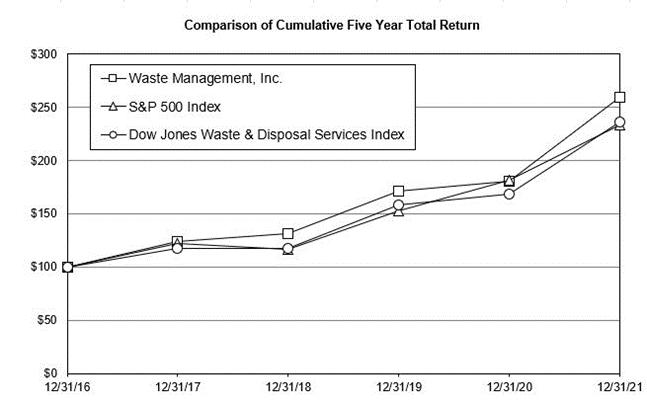][added: ]
| Dow Jones Waste & Disposal Services Index | | $ | 100 | | $ | [removed: 117] [added: 100] | | $ | [removed: 117] [added: 135] | | $ | [removed: 158] [added: 144] | | $ | [removed: 169] [added: 201] | | $ | [removed: 236] [added: 191] |
In [removed: January 2022,] [added: addition, in December 2021,] we [removed: completed our] [added: executed an] ASR agreement [removed: executed] [added: that completed] in [removed: December 2021,] [added: January 2022,] at which time we received [removed: an additional] 0.4 million shares.
The following table summarizes common stock repurchases made during the fourth quarter of [removed: 2021] [added: 2022] (shares in millions):
| November 1 — 30 | | [removed: —] [added: 2.1] | | $ | [removed: —] [added: 161.19] | [removed: ] [added: (b)] | [removed: —] [added: 2.1] | | $ | [removed: 350] [added: 84] million | |
| December 1 — 31 | | [removed: 2.2] [added: 0.5] | | $ | [removed: 159.32] [added: 161.19] | [removed: (a)] [added: (b)] | [removed: 2.2] [added: 0.5] | | $ | 1.5 billion | [removed: (b)] [added: ] |
[removed: | (b) |] We announced in December [removed: 2021] [added: 2022] that the Board of Directors has authorized up to $1.5 billion in future share repurchases. [removed: |]
| | | 12/31/17 | | | 12/31/18 | | | 12/31/19 | | | 12/31/20 | | | 12/31/21 | | | 12/31/22 | |
| Waste Management, Inc. | | $ | 100 | | $ | 105 | | $ | 137 | | $ | 145 | | $ | 208 | | $ | 199 |
| S&P 500 Index | | $ | 100 | | $ | 96 | | $ | 126 | | $ | 149 | | $ | 192 | | $ | 157 |
During 2022, we repurchased an aggregate of $1.5 billion of our common stock under accelerated share repurchase (“ASR”) agreements and open market transactions, which equated to 9.4 million shares with a weighted average price per share of $160.32, inclusive of per-share commissions.
This new authorization replaces our prior $1.5 billion authorization that was fully utilized in 2022.
| October 1 — 31 | | 0.1 | | $ | 159.79 | (a) | 0.1 | | $ | 417 million | |
| Total | | 2.7 | | $ | 161.13 | | 2.7 | | | | |
| (a) | In October 2022, we repurchased 125,167 shares of our common stock in open market transactions in compliance with Rule 10b5-1 and Rule 10b-18 of the Exchange Act for $20 million, inclusive of per-share commissions, at a weighted average price of $159.79. |
| (b) | In November 2022, we delivered $417 million cash and received 2.1 million shares pursuant to an Accelerated Share Repurchase (“ASR”) agreement executed in late October 2022. In December 2022, we completed the ASR agreement and received 0.5 million additional shares based on a final weighted average price of $161.19. The “Average Price Paid per Share” in the table represents the final weighted average price per share paid for the ASR agreement. |
| | | 12/31/16 | | | 12/31/17 | | | 12/31/18 | | | 12/31/19 | | | 12/31/20 | | | 12/31/21 | |
| Waste Management, Inc. | | $ | 100 | | $ | 124 | | $ | 131 | | $ | 171 | | $ | 180 | | $ | 259 |
| S&P 500 Index | | $ | 100 | | $ | 122 | | $ | 116 | | $ | 153 | | $ | 181 | | $ | 233 |
During 2021, we allocated an aggregate of $1.35 billion in cash under our accelerated share repurchase (“ASR”) agreements.
As of December 31, 2021, we had received 8.7 million shares with a weighted average price per share of $146.61.
| October 1 — 31 | | — | | $ | — | | — | | $ | 350 million | |
| Total | | 2.2 | | $ | 159.32 | | 2.2 | | | | |
| (a) | In August 2021, we entered into an ASR agreement to repurchase $500 million of our common stock. At the beginning of the repurchase period, we delivered $500 million in cash and received 2.7 million shares based on a stock price of $147.27. The ASR agreement completed in the fourth quarter of 2021, at which time we received 0.5 million additional shares based on a final weighted average price of $154.72. |
In December 2021, we executed an ASR agreement to repurchase $350 million of our common stock.
At the beginning of the repurchase period, we delivered $350 million in cash and received 1.7 million shares based on a stock price of $160.67.
The ASR agreement completed in January 2022, at which time we received 0.4 million additional shares based on a final weighted average price of $160.33.
The “Average Price Paid per Share” in the table represents the final weighted average price per share paid for the ASR agreement executed in August 2021 and the initial price per share paid for the ASR agreement executed in December 2021.
Item 8. Financial Statements and Supplementary Data.
535 rewritten, 166 added, 165 removed, 1,078 unchanged
| [Consolidated Balance Sheets as of December 31, [removed: 2021] [added: 2022] and [removed: 2020](#BALANCESHEETS_191365)] [added: 2021](#BALANCESHEETS_191365)] | | 72 |
| [Consolidated Statements of Operations for the Years Ended December 31, [removed: 2021, 2020] [added: 2022, 2021] and [removed: 2019](#STATEMENTSOFOPERATIONS_745891)] [added: 2020](#STATEMENTSOFOPERATIONS_745891)] | | 73 |
| [Consolidated Statements of Comprehensive Income for the Years Ended December 31, [removed: 2021, 2020] [added: 2022, 2021] and [removed: 2019](#COMPREHENSIVEINCOME_932746)] [added: 2020](#COMPREHENSIVEINCOME_932746)] | | 73 |
| [Consolidated Statements of Cash Flows for the Years Ended December 31, [removed: 2021, 2020] [added: 2022, 2021] and [removed: 2019](#CASHFLOWS_594152)] [added: 2020](#CASHFLOWS_594152)] | | 74 |
| [Consolidated Statements of Changes in Equity for the Years Ended December 31, [removed: 2021, 2020] [added: 2022, 2021] and [removed: 2019](#CHANGESINEQUITY_625544)] [added: 2020](#CHANGESINEQUITY_625544)] | | 75 |
We have audited Waste Management, Inc.’s internal control over financial reporting as of December 31, [removed: 2021,] [added: 2022,] based on criteria established in Internal Control-Integrated Framework issued by the Committee of Sponsoring Organizations of the Treadway Commission (2013 framework) (the COSO criteria).
In our opinion, Waste Management, Inc. (the Company) maintained, in all material respects, effective internal control over financial reporting as of December 31, [removed: 2021,] [added: 2022,] based on the COSO criteria.
We also have audited, in accordance with the standards of the Public Company Accounting Oversight Board (United States) (PCAOB), the [removed: 2021] [added: 2022] consolidated financial statements of the Company, and our report dated February [removed: 15, 2022] [added: 7, 2023] expressed an unqualified opinion thereon.
| Houston, Texas February [removed: 15, 2022] [added: 7, 2023] | |
We have audited the accompanying consolidated balance sheets of Waste Management, Inc. (the Company) as of December 31, [removed: 2021] [added: 2022] and [removed: 2020,] [added: 2021,] the related consolidated statements of operations, comprehensive income, cash flows, and changes in equity for each of the three years in the period ended December 31, [removed: 2021,] [added: 2022,] and the related notes (collectively referred to as the “consolidated financial statements”).
In our opinion, the consolidated financial statements present fairly, in all material respects, the financial position of the Company at December 31, [removed: 2021] [added: 2022] and [removed: 2020,] [added: 2021,] and the results of its operations and its cash flows for each of the three years in the period ended December 31, [removed: 2021,] [added: 2022,] in conformity with U.S. generally accepted accounting principles.
We also have audited, in accordance with the standards of the Public Company Accounting Oversight Board (United States) (PCAOB), the Company’s internal control over financial reporting as of December 31, [removed: 2021,] [added: 2022,] based on criteria established in Internal Control-Integrated Framework issued by the Committee of Sponsoring Organizations of the Treadway Commission (2013 framework), and our report dated February [removed: 15, 2022] [added: 7, 2023] expressed an unqualified opinion thereon.
| _Description of the Matter_ | At December 31, [removed: 2021,] [added: 2022,] the Company’s landfill assets, net of accumulated [removed: amortization,] [added: depletion,] totaled [removed: $7.3] [added: $7.6] billion and the associated [removed: amortization] [added: depletion] expense for [removed: 2021] [added: 2022] was [removed: $731] [added: $754] million. As discussed in Note 2 of the financial statements, the Company updates the estimates used to calculate individual landfill [removed: amortization] [added: depletion] rates at least annually, or more often if significant facts change. Landfill [removed: amortization] [added: depletion] rates are used in the computation of landfill [removed: amortization] [added: depletion] expense. Auditing landfill [removed: amortization] [added: depletion] rates and related [removed: amortization] [added: depletion] expense is complex due to the highly judgmental nature of assumptions used in estimating the rates. Significant assumptions used in the calculation of the rates include: estimated future development costs associated with the construction and retirement of the landfill, estimated remaining permitted [removed: airspace] and [removed: unpermitted] expansion airspace, airspace utilization factors, [removed: projected annual tonnage intakes,] and projected timing of retirement activities. |
| _How We Addressed the Matter in Our Audit_ | We obtained an understanding, evaluated the design, and tested the operating effectiveness of the Company’s controls over determining landfill [removed: amortization] [added: depletion] rates and calculating [removed: amortization] [added: depletion] expense. Our audit procedures included, among others, testing controls over: the Company’s process for evaluating and updating the significant assumptions used in the development of the landfill [removed: amortization] [added: depletion] rates, management’s review of those significant assumptions, and the mathematical accuracy of the calculation and recording of [removed: amortization] [added: depletion] expense. To test the landfill asset [removed: amortization] [added: depletion] rates, our audit procedures included, among others, assessing methodologies used by the Company and testing the significant assumptions discussed above, inclusive of the underlying data used by the Company in its development of these assumptions. We compared the significant assumptions used by management to historical trends and, when available, to comparable size landfills accepting a similar type of waste. Regarding [removed: unpermitted] expansion airspace, we evaluated the Company’s criteria for inclusion in remaining airspace. In addition, we considered the professional qualifications and objectivity of management’s internal engineers responsible for developing the assumptions. We involved EY’s engineering specialists to assist with the evaluation of the Company’s landfill future development cost and airspace assumptions. We also tested the completeness and accuracy of the historical data utilized in the development of the landfill [removed: amortization] [added: depletion] rates. |
| _Description of the Matter_ | At December 31, [removed: 2021,] [added: 2022,] the carrying value of the Company’s landfill asset retirement obligations related to final capping, closure and post-closure costs totaled [removed: $2.3] [added: $2.7] billion. As discussed in Note 2 of the financial statements, the Company updates the estimates used to measure the asset retirement obligations annually, or more often if significant facts change. Auditing the landfill asset retirement obligation is complex due to the highly judgmental nature of the assumptions used in the measurement process. These assumptions include: estimated future costs associated with the capping, closure and post closure activities at each specific landfill; airspace consumed to date in relation to total estimated permitted [added: and expansion] airspace; [removed: the projected annual tonnage intake;] and the projected timing of retirement activities. |
| _How We Addressed the Matter in Our Audit_ | We obtained an understanding, evaluated the design, and tested the operating effectiveness of the Company’s controls over the calculation of [added: landfill] asset retirement obligations. Our audit procedures included, among others, testing the Company’s controls over the landfill asset retirement obligation estimation process and management’s review of the significant assumptions used in the estimation of the liability, including the amount and timing of retirement costs. To test the landfill asset retirement obligation valuation, we performed audit procedures that included, among others, assessing methodologies used by the Company, testing the completeness of activities included in the estimate (e.g., gas monitoring and extraction), and testing the significant assumptions discussed above, inclusive of the underlying data used by the Company in its development of these assumptions. We compared the significant assumptions used by management to historical trends and, when available, to comparable size landfills accepting the same type of waste. In addition, we considered the professional qualifications and objectivity of management’s internal engineers responsible for developing the assumptions. We involved EY engineering specialists to assist us with these procedures. Specifically, we utilized the EY engineering specialists to evaluate the reasons for significant changes in assumptions from the historical trend, and to determine whether the change from the historical trend was appropriate and identified timely. We also tested the completeness and accuracy of the historical data utilized in preparing the estimate. |
[removed: WASTE MANAGEMENT, INC.][added: | Net income attributable to Waste Management, Inc. | | | 1,685 |]
| | | [added: 2022 | | |] 2021 | | | 2020 | |
| Cash and cash equivalents | | $ | [added: 351 | | $ |] 118 | | $ | 553 |
| Accounts receivable, net of allowance for doubtful accounts of [removed: $25] [added: $26] and [removed: $33,] [added: $25,] respectively | | | [removed: 2,278] [added: 2,461] | | | [removed: 2,097] [added: 2,278] |
| Other receivables, net of allowance for doubtful accounts of [removed: $8] [added: $7] and [removed: $7,] [added: $8,] respectively | | | [removed: 268] [added: 291] | | | [removed: 527] [added: 268] |
| Parts and supplies | | | [removed: 135] [added: 164] | | | [removed: 124] [added: 135] |
| Other assets | | | [removed: 270] [added: 284] | | | [removed: 239] [added: 270] |
| Total current assets | | | [removed: 3,069] [added: 3,551] | | | [removed: 3,540] [added: 3,069] |
| Property and equipment, net of accumulated depreciation and [removed: amortization] [added: depletion] of [removed: $20,537] [added: $21,627] and [removed: $19,337,] [added: $20,537,] respectively | | | [removed: 14,419] [added: 15,719] | | | [removed: 14,148] [added: 14,419] |
| Goodwill | | | [removed: 9,028] [added: 9,323] | | | [removed: 8,994] [added: 9,028] |
| Other intangible assets, net | | | [removed: 898] [added: 827] | | | [removed: 1,024] [added: 898] |
| Investments in unconsolidated entities | | | [removed: 432] [added: 578] | | | [removed: 426] [added: 432] |
| Other assets | | | [removed: 903] [added: 1,021] | | | [removed: 866] [added: 903] |
| Total assets | | $ | [removed: 29,097] [added: 31,367] | | $ | [removed: 29,345] [added: 29,097] |
| Accounts payable | | $ | [removed: 1,375] [added: 1,766] | | $ | [removed: 1,121] [added: 1,375] |
| Accrued liabilities | | | [removed: 1,428] [added: 1,625] | | | [removed: 1,342] [added: 1,428] |
| Deferred revenues | | | [removed: 571] [added: 589] | | | [removed: 539] [added: 571] |
| Current portion of long-term debt | | | [removed: 708] [added: 414] | | | [removed: 551] [added: 708] |
| Total current liabilities | | | [removed: 4,082] [added: 4,394] | | | [removed: 3,553] [added: 4,082] |
| Long-term debt, less current portion | | | [removed: 12,697] [added: 14,570] | | | [removed: 13,259] [added: 12,697] |
| Deferred income taxes | | | [removed: 1,694] [added: 1,733] | | | [removed: 1,806] [added: 1,694] |
| Landfill and environmental remediation liabilities | | | [removed: 2,373] [added: 2,700] | | | [removed: 2,222] [added: 2,373] |
| Other liabilities | | | [removed: 1,125] [added: 1,106] | | | [removed: 1,051] [added: 1,125] |
| Total liabilities | | | [removed: 21,971] [added: 24,503] | | | [removed: 21,891] [added: 21,971] |
| | Landfill Depletion |
| Houston, Texas February 7, 2023 | |
| Restricted funds | | | 348 | | | 348 |
| Consolidated net income | | $ | 2,240 | | $ | 1,817 | | $ | 1,496 |
| Depreciation, depletion and amortization | | | 2,038 | | | 1,999 | | | 1,671 |
| Cash, cash equivalents and restricted cash and cash equivalents at end of period | | $ | 445 | | $ | 194 | | $ | 648 |
| Balance, December 31, 2022 | | $ | 6,864 | | 630,282 | | $ | 6 | | $ | 5,314 | | $ | 13,167 | | $ | (69) | | (222,396) | | $ | (11,569) | | $ | 15 |
| | ● | _Closure —_ Includes the construction of the final portion of methane gas collection systems (when required), demobilization and routine maintenance costs. These are costs incurred after the site ceases to accept waste, but |
Changes in
We routinely review and evaluate sites that require remediation and determine our estimated cost for the likely remedy based on a number of estimates and assumptions.
Our discount rate has increased since 2020 as a result of the overall increase in the 10-year Treasury rates.
During the review of a landfill expansion application, a regulator
Restricted Funds
| | | 2022 | | | 2021 | |
We also offer certain other expanded service offerings and solutions.
Our contract acquisition costs are classified as current or noncurrent based on
of the potential loss or range of loss associated with such contingencies.
Internal-Use Software
We include capitalized costs associated with developing or obtaining internal-use software within long-term other assets, and these costs are amortized over the term of the relevant subscription period including any renewal options that are reasonably certain of being exercised.
These costs include direct external costs of materials and services used in developing or obtaining the software and internal costs for employees directly associated with the software development project.
As of December 31, 2022 and 2021, total costs capitalized for our internal-use software were $45 million and $48 million, respectively, net of accumulated amortization of $27 million and $11 million, respectively.
During each of the years ended December 31, 2022, 2021 and 2020, we amortized $16 million, $10 million and $1 million, respectively, to selling, general and administrative expense.
| (a) | The increase in income taxes paid in 2022 is primarily due to the increase in pre-tax book income during 2022 and a deposit of approximately $103 million made to the Internal Revenue Service (“IRS”) in the fourth quarter of 2022 related to a disputed tax matter for which we expect to seek a refund. See Note 8 for further discussion. |
Additionally, we had approximately $135 million of non-cash investing activities related to non-cash consideration transferred as part of our acquisitions in 2022.
See Note 17 for further discussion of our 2022 acquisitions.
| | | 2022 | | | | | | | | | 2021 | | | | | | | |
| | | $ | 2,664 | | $ | 204 | | $ | 2,868 | | $ | 2,326 | | $ | 213 | | $ | 2,539 |
| December 31, 2022 | | $ | 2,664 | | $ | 204 |
| (a) | In 2021, the increase in our landfill liabilities for revisions in estimates and interest rate assumptions was $33 million. The increase in our landfill liabilities in 2022 is primarily due to inflationary cost pressures that are expected to impact costs over the remaining landfill lives. |
| | | 2022 | | | 2021 | |
| | | | 37,346 | | | 34,956 |
See Note 11 for information regarding asset impairments.
| 2022 | | | | | | | | | | | | |
| Intangible assets | | $ | 1,288 | | $ | 51 | | $ | 141 | | $ | 1,480 |
| | | $ | 745 | | $ | 28 | | $ | 54 | | $ | 827 |
The decrease in amortization expense in 2022 was primarily due to decreasing amortization under the 150% declining balance approach for intangible assets from the acquisition of Advanced Disposal.
| | | 2022 | | | 2021 | |
| Term Loan maturing May 2024, interest rate of 5.1% as of December 31, 2022 | | | 1,000 | | | — |
| | | | 14,984 | | | 13,405 |
| Current portion of long-term debt | | | 414 | | | 708 |
| | Landfill Amortization |
| | | | | | | |
| --- | --- | --- | --- | --- | --- | --- |
| Restricted trust and escrow accounts | | | 348 | | | 347 |
| Balance, December 31, 2018 | | $ | 6,276 | | 630,282 | | $ | 6 | | $ | 4,993 | | $ | 9,797 | | $ | (87) | | (206,299) | | $ | (8,434) | | $ | 1 |
The Company finalized the assessment of our segments during the fourth quarter of 2021.
In our Annual Report on Form 10-K for the year ended December 31, 2020, our accumulated depreciation and gross property and equipment balances as of December 31, 2020 were overstated.
We subsequently corrected the balances in our Quarterly Report on Form 10-Q for the quarter ended March 31, 2021 and have provided the corrected balances in all filings thereafter.
NOTES TO CONSOLIDATED FINANCIAL STATEMENTS — (Continued)
| Adoption of new accounting standard | | | — | | | (1) |
As of December 31, 2021, we had $2,278 million of trade receivables, net of allowance for doubtful accounts of $25 million.
As of December 31, 2020, we had $2,097 million of trade receivables, net of allowance for doubtful accounts of $33 million.
In January 2020, COVID-19 was declared a Public Health Emergency of International Concern and subsequently declared a global pandemic in March 2020.
With this in mind, during 2020, we extended payment terms and postponed collections and service discontinuation for customers who were negatively impacted by the COVID-19 pandemic.
These actions contributed to an increase in the aging of outstanding balances during the year and resulted in a related increase in our allowance for doubtful accounts.
Improved economic conditions during 2021 have allowed us to return to more regular business practices, in accordance with our contractual terms.
All receivables, as well as other instruments, are adjusted for our expectation of future market conditions and trends.
As of December 31, 2021, we had $451 million of notes and other receivables, net of allowance of $10 million.
As of December 31, 2020, we had $703 million of notes and other receivables, net of allowance of $8 million.
interest, on-site road construction and other capital infrastructure costs.
For unpermitted airspace to be initially included in our estimate of remaining permitted and expansion airspace, the expansion effort must meet all the criteria listed above.
We routinely review and evaluate sites that require remediation, considering whether we were an owner, operator, transporter, or generator at the site, the amount and type of waste hauled to the site and the number of years we were associated with the site.
Restricted Trust and Escrow Accounts
December 31, 2020 and to 1.2639 at December 31, 2021.
| | | $ | 2,326 | | $ | 213 | | $ | 2,539 | | $ | 2,156 | | $ | 230 | | $ | 2,386 |
| December 31, 2020 | | $ | 2,156 | | $ | 230 |
| (a) | The amount reported for our landfill liabilities includes an increase of $15 million due to a business decision to accelerate the closure timing of a landfill in our West Tier segment, which resulted in the acceleration of the expected timing of capping, closure and post-closure activities. The remaining increase relates to revisions in estimated costs and timing of capping, closure and post-closure liabilities. |
| (b) | The amount reported for our landfill liabilities includes an increase of $13 million related to changes in the fair values assigned to certain acquired Advanced Disposal sites. |
Anticipated
| | | | 34,956 | | | 33,485 |
| (a) | In our Annual Report on Form 10-K for the year ended December 31, 2020, our accumulated depreciation and gross property and equipment balances as of December 31, 2020 were overstated. We subsequently corrected the balances in our Quarterly Report on Form 10-Q for the quarter ended March 31, 2021 and have provided the corrected balances in all filings thereafter, as discussed in Note 1. |
| 2020 | | | | | | | | | | | | |
| Intangible assets | | $ | 1,436 | | $ | 68 | | $ | 142 | | $ | 1,646 |
| | | $ | 939 | | $ | 22 | | $ | 63 | | $ | 1,024 |
| | | | 13,405 | | | 13,810 |
| | | $ | 12,697 | | $ | 13,259 |
As of December 31, 2021, we also had $54 million of variable-rate tax-exempt bonds with long-term scheduled maturities supported by letters of credit under our $3.5 billion revolving credit facility.
The interest rates on our variable-rate tax-exempt bonds reset on a weekly basis through a remarketing process.
All recent tax-exempt bond remarketings have successfully placed Company bonds with investors at market-driven rates and we currently expect future remarketings to be successful.
However, if the remarketing agent is unable to remarket our bonds, the remarketing agent can put the bonds to us.
An excerpt. Shown here: 40 of 535 rewritten, 40 of 166 added and 40 of 165 removed. The counts are complete. For every sentence, read Item 8. Financial Statements and Supplementary Data. in the FY2022 filing and the FY2021 filing.
Item 9A. Controls and Procedures.
3 rewritten, 5 added, 0 removed, 15 unchanged
Effectiveness of [added: Disclosure] Controls and Procedures
Based on such evaluation, our principal executive and financial officers have concluded that such disclosure controls and procedures were effective as of December 31, [removed: 2021] [added: 2022] (the end of the period covered by this Annual Report on Form 10-K) at a reasonable assurance level.
[removed: There were no] [added: While these systems implementations enhance our framework for internal control over financial reporting, management, together with our CEO and CFO, has determined that the] changes in our internal [removed: control] [added: controls] over financial reporting during the quarter ended December 31, [removed: 2021 that materially affected, or] [added: 2022 have not been material and] are [added: not] reasonably likely to materially [removed: affect,] [added: affect] our internal [removed: control] [added: controls] over financial reporting.
Management of the Company assessed the effectiveness of our internal control over financial reporting as of December 31, 2022 based on the 2013 framework in Internal Control—Integrated Framework issued by the Committee of Sponsoring Organizations of the Treadway Commission (the COSO criteria).
Based on this assessment, management has concluded that our internal control over financial reporting was effective as of December 31, 2022.
In 2022, we implemented a new general ledger accounting system, complementary finance enterprise resource planning system and a human capital management system.
These new system implementations were achieved after a multi-year review of existing accounting, reporting and human capital processes and the design and configuration of system-enabled enhancements to such processes.
The changes in our general ledger, finance enterprise resource planning and human capital management systems were subject to thorough testing and review by internal and external parties both before and after implementation.
Item 10. Directors, Executive Officers and Corporate Governance.
1 rewritten, 0 added, 0 removed, 3 unchanged
The information required by this Item is incorporated by reference to the sections entitled “Board of [added: Directors,” “Election of] Directors” and “Executive Officers” in the Company’s definitive Proxy Statement for its [removed: 2022] [added: 2023] Annual Meeting of Stockholders (the “Proxy Statement”), to be held May [removed: 10, 2022.][added: 9, 2023.]
Item 11. Executive Compensation.
1 rewritten, 0 added, 0 removed, 0 unchanged
The information required by this Item is incorporated herein by reference to the sections entitled “Board of Directors — Compensation Committee Report,” “— Compensation Committee Interlocks and Insider Participation,” “— Non-Employee Director Compensation,” “Executive Compensation — Compensation Discussion and [removed: Analysis” and] [added: Analysis,”] “— Executive Compensation Tables” [added: and “— Pay Versus Performance”] in the Proxy Statement.
Item 15. Exhibits, Financial Statement Schedules.
34 rewritten, 4 added, 1 removed, 28 unchanged
Consolidated Balance Sheets as of December 31, [removed: 2021] [added: 2022] and [removed: 2020][added: 2021]
Consolidated Statements of Operations for the years ended December 31, [removed: 2021, 2020] [added: 2022, 2021] and [removed: 2019][added: 2020]
Consolidated Statements of Comprehensive Income for the years ended December 31, [removed: 2021, 2020] [added: 2022, 2021] and [removed: 2019][added: 2020]
Consolidated Statements of Cash Flows for the years ended December 31, [removed: 2021, 2020] [added: 2022, 2021] and [removed: 2019][added: 2020]
Consolidated Statements of Changes in Equity for the years ended December 31, [removed: 2021, 2020] [added: 2022, 2021] and [removed: 2019][added: 2020]
| 3.2 | — | [Amended and Restated By-laws of Waste Management, Inc. \[incorporated by reference to Exhibit 3.2 to Form 8-K dated November [removed: 17, 2020\].](https://www.sec.gov/Archives/edgar/data/823768/000110465920126928/tm2036284d1_ex3-2.htm)] [added: 8, 2022\].](https://www.sec.gov/Archives/edgar/data/823768/000110465922117214/tm2230189d1_ex3-2.htm)] |
| 4.4 | — | [Indenture for Subordinated Debt Securities dated February [removed: 3,] [added: 1,] 1997, among the Registrant and The Bank of New York Mellon Trust Company, N.A. (the current successor to Texas Commerce Bank National Association), as trustee \[incorporated by reference to Exhibit 4.1 to Form 8-K dated February 7, 1997\].](http://www.sec.gov/Archives/edgar/data/823768/0000950129-97-000380.txt) |
| 4.7* | — | [Schedule of Officers’ Certificates delivered pursuant to Section 301 of the Indenture dated September 10, 1997 establishing the terms and form of Waste Management, Inc.’s Senior Notes. Waste Management and its subsidiaries are parties to debt instruments that have not been filed with the SEC under which the total amount of securities authorized under any single instrument does not exceed 10% of the total assets of Waste Management and its subsidiaries on a consolidated basis. Pursuant to paragraph 4(iii)(A) of Item 601(b) of Regulation S-K, Waste Management agrees to furnish a copy of such instruments to the SEC upon [removed: request.](https://www.sec.gov/Archives/edgar/data/823768/000155837022001179/wm-20211231xex4d7.htm)] [added: request.](https://www.sec.gov/Archives/edgar/data/823768/000155837023000964/wm-20221231xex4d7.htm)] |
| 4.8 | — | [Officers’ Certificate delivered pursuant to Section 301 of the Indenture dated September 10, 1997 establishing the terms and form of the [removed: 2.00%] [added: 4.15%] Senior Notes due [removed: 2029] [added: 2032] \[incorporated by reference to Exhibit 4.1 to Form 10-Q for the quarter ended June 30, [removed: 2021\].](https://www.sec.gov/Archives/edgar/data/0000823768/000155837021009319/wm-20210630ex410a8a250.htm)] [added: 2022\].](https://www.sec.gov/Archives/edgar/data/823768/000155837022011119/wm-20220630xex4d1.htm)] |
| 4.9 | — | [Guarantee Agreement by Waste Management Holdings, Inc. in favor of The Bank of New York Mellon Trust Company, N.A., as Trustee for the holders of the [removed: 2.00%] [added: 4.15%] Senior Notes due [removed: 2029] [added: 2032] \[incorporated by reference to Exhibit [removed: 4.3] [added: 4.2] to Form 10-Q for the quarter ended June 30, [removed: 2021\].](https://www.sec.gov/Archives/edgar/data/0000823768/000155837021009319/wm-20210630ex43ccc6c08.htm)] [added: 2022\].](https://www.sec.gov/Archives/edgar/data/823768/000155837022011119/wm-20220630xex4d2.htm)] |
| [removed: 10.3†] [added: 10.4†] | — | [2009 Stock Incentive Plan \[incorporated by reference to Appendix B to the Proxy Statement on Schedule 14A filed March 25, 2009\].](https://www.sec.gov/Archives/edgar/data/823768/000119312509062520/ddef14a.htm) |
| [removed: 10.4†] [added: 10.5†] | — | [2005 Annual Incentive Plan \[incorporated by reference to Appendix D to the Proxy Statement on Schedule 14A filed April 8, 2004\].](https://www.sec.gov/Archives/edgar/data/823768/000119312504059008/ddef14a.htm) |
| [removed: 10.5†] [added: 10.6†] | — | [Waste Management, Inc. Employee Stock Purchase Plan (As Amended and Restated effective May 12, 2020) \[incorporated by reference to Exhibit 10.1 to Form 8-K dated May 12, 2020\].](https://www.sec.gov/Archives/edgar/data/823768/000110465920062449/tm2018602d2_ex10-1.htm) |
| [removed: 10.6†] [added: 10.7†] | — | [Waste Management, Inc. 409A Deferral Savings Plan as Amended and Restated effective January 1, 2014 \[incorporated by reference to Exhibit 10.2 to Form 10-Q for the quarter ended March 31, 2014\].](http://www.sec.gov/Archives/edgar/data/823768/000119312514156430/d690567dex102.htm) |
| [removed: 10.7] [added: 10.8] | — | [$3.5 Billion [removed: Fifth] [added: Sixth] Amended and Restated Revolving Credit Agreement dated as of [removed: November 7, 2019] [added: May 27, 2022] by and among Waste Management, Inc., Waste Management of Canada Corporation, WM Quebec Inc. and Waste Management Holdings, Inc., certain banks party thereto, and Bank of America, N.A., as administrative agent \[incorporated by reference to Exhibit 10.1 to Form 8-K dated [removed: November 7, 2019\].](http://www.sec.gov/Archives/edgar/data/823768/000110465919062660/tm1920691d2_ex10-1.htm)] [added: May 27, 2022\].](https://www.sec.gov/Archives/edgar/data/823768/000110465922067600/tm2217217d1_ex10-1.htm)] |
| [removed: 10.8] [added: 10.10] | — | [Commercial Paper Dealer Agreement, substantially in the form as executed with each of Mizuho Securities USA [added: LLC, BofA Securities,] Inc., [removed: Merrill Lynch, Pierce, Fenner & Smith Incorporated, and] J.P. Morgan Securities LLC, [added: MUFG Securities Americas Inc., Wells Fargo Securities, LLC, RBC Capital Markets, LLC and Siebert Williams Shank & Co., LLC] as [removed: Dealer, dated August 22, 2016] [added: Dealer] \[incorporated by reference to Exhibit 10.11 to Form 10-K for the year ended December 31, [removed: 2016\].](http://www.sec.gov/Archives/edgar/data/823768/000119312517046480/d252547dex1011.htm)] [added: 2016\].](https://www.sec.gov/Archives/edgar/data/823768/000119312517046480/d252547dex1011.htm)] |
| [removed: 10.9] [added: 10.15†] | — | [removed: [Commercial Paper Issuing and Paying Agent] [added: [Employment] Agreement between [removed: Waste Management, Inc.] [added: USA Waste-Management Resources, LLC] and [removed: Bank of America, National Association] [added: Charles C. Boettcher] dated [removed: August 15, 2016] [added: December 22, 2017] \[incorporated by reference to Exhibit [removed: 10.12] [added: 10.23] to Form 10-K for the year ended December 31, [removed: 2016\].](http://www.sec.gov/Archives/edgar/data/823768/000119312517046480/d252547dex1012.htm)] [added: 2017\].](http://www.sec.gov/Archives/edgar/data/823768/000155837018000716/wm-20171231ex10236fa05.htm)] |
| [removed: 10.10†] [added: 10.12†] | — | [First Amended and Restated Employment Agreement between USA Waste-Management Resources, LLC and James C. Fish, Jr. dated December 22, 2017 \[incorporated by reference to Exhibit 10.2 to Form 8-K dated December 22, 2017\].](http://www.sec.gov/Archives/edgar/data/823768/000110465917075030/a17-28786_1ex10d2.htm) |
| [removed: 10.11†] [added: 10.13†] | — | [Employment Agreement between USA Waste-Management Resources, LLC and Devina A. Rankin dated December 22, 2017 \[incorporated by reference to Exhibit 10.3 to Form 8-K dated December 22, 2017\].](http://www.sec.gov/Archives/edgar/data/823768/000110465917075030/a17-28786_1ex10d3.htm) |
| [removed: 10.12†] [added: 10.14†] | — | [First Amended and Restated Employment Agreement between USA Waste-Management Resources, LLC and John J. Morris, Jr. \[incorporated by reference to Exhibit 10.4 to Form 8-K dated December 22, 2017\].](http://www.sec.gov/Archives/edgar/data/823768/000110465917075030/a17-28786_1ex10d4.htm) |
| [removed: 10.13†] [added: 10.16†] | — | [removed: [Employment Agreement between USA Waste-Management Resources, LLC] [added: [Form of Director] and [removed: Charles C. Boettcher dated December 22, 2017] [added: Executive Officer Indemnity Agreement] \[incorporated by reference to Exhibit [removed: 10.23] [added: 10.43] to Form 10-K for the year ended December 31, [removed: 2017\].](http://www.sec.gov/Archives/edgar/data/823768/000155837018000716/wm-20171231ex10236fa05.htm)] [added: 2012\].](http://www.sec.gov/Archives/edgar/data/823768/000119312513058892/d413187dex1043.htm)] |
| [removed: 10.15†] [added: 10.17†] | — | [Waste Management Holdings, Inc. Executive Severance Plan \[incorporated by reference to Exhibit 10.1 to Form 8-K dated December 22, 2017\].](http://www.sec.gov/Archives/edgar/data/823768/000110465917075030/a17-28786_1ex10d1.htm) |
| [removed: 10.16†] [added: 10.19†] | — | [Form of [removed: 2019] [added: 2021] Long Term Incentive Compensation Award Agreement for Senior Leadership Team \[incorporated by reference to Exhibit 10.1 to Form 8-K dated February [removed: 19, 2019\].](https://www.sec.gov/Archives/edgar/data/0000823768/000110465919010295/a19-5282_1ex10d1.htm#EXHIBIT10_1_092649)] [added: 23, 2021\].](https://www.sec.gov/Archives/edgar/data/0000823768/000110465921029723/tm216945d2_ex10-1.htm)] |
| [removed: 10.17†] [added: 10.18†] | — | [Form of 2020 Long Term Incentive Compensation Award Agreement for Senior Leadership Team \[incorporated by reference to Exhibit 10.1 to Form 8-K dated February 19, 2020\].](https://www.sec.gov/Archives/edgar/data/823768/000110465920024590/tm207498d2_ex10-1.htm) |
| [removed: 10.18†] [added: 10.21†] | — | [Form of [removed: 2021] [added: 2022] Long Term Incentive Compensation Award Agreement for Senior Leadership Team \[incorporated by reference to Exhibit 10.1 to Form 8-K dated [removed: February 23, 2021\].](https://www.sec.gov/Archives/edgar/data/0000823768/000110465921029723/tm216945d2_ex10-1.htm)] [added: March 1, 2022\].](https://www.sec.gov/Archives/edgar/data/823768/000110465922030973/tm228341d1_ex10-1.htm)] |
| [removed: 10.19†*] [added: 10.20†] | [removed: ] [added: —] | [Form of 2021 Long Term Incentive Compensation RSU Award [removed: Agreement.](https://www.sec.gov/Archives/edgar/data/823768/000155837022001179/wm-20211231xex10d19.htm)] [added: Agreement \[incorporated by reference to Exhibit 10.19 to Form 10-K for the year ended December 31, 2021\].](https://www.sec.gov/Archives/edgar/data/823768/000155837022001179/wm-20211231xex10d19.htm)] |
| 21.1* | — | [Subsidiaries of the [removed: Registrant.](https://www.sec.gov/Archives/edgar/data/823768/000155837022001179/wm-20211231xex21d1.htm)] [added: Registrant.](https://www.sec.gov/Archives/edgar/data/823768/000155837023000964/wm-20221231xex21d1.htm)] |
| 22.1* | — | [Guarantor [removed: Subsidiary.](https://www.sec.gov/Archives/edgar/data/823768/000155837022001179/wm-20211231xex22d1.htm)] [added: Subsidiary.](https://www.sec.gov/Archives/edgar/data/823768/000155837023000964/wm-20221231xex22d1.htm)] |
| 23.1* | — | [Consent of Independent Registered Public Accounting [removed: Firm.](https://www.sec.gov/Archives/edgar/data/823768/000155837022001179/wm-20211231xex23d1.htm)] [added: Firm.](https://www.sec.gov/Archives/edgar/data/823768/000155837023000964/wm-20221231xex23d1.htm)] |
| 31.1* | — | [Certification Pursuant to [removed: Rule] [added: Rules] 13a-14(a) and 15d-14(a) under the Securities Exchange Act of [removed: 1934, as amended,] [added: 1934] of James C. Fish, Jr., President and Chief Executive [removed: Officer.](https://www.sec.gov/Archives/edgar/data/823768/000155837022001179/wm-20211231xex31d1.htm)] [added: Officer.](https://www.sec.gov/Archives/edgar/data/823768/000155837023000964/wm-20221231xex31d1.htm)] |
| 31.2* | — | [Certification Pursuant to [removed: Rule] [added: Rules] 13a-14(a) and 15d-14(a) under the Securities Exchange Act of [removed: 1934, as amended,] [added: 1934] of Devina A. Rankin, Executive Vice President and Chief Financial [removed: Officer.](https://www.sec.gov/Archives/edgar/data/823768/000155837022001179/wm-20211231xex31d2.htm)] [added: Officer.](https://www.sec.gov/Archives/edgar/data/823768/000155837023000964/wm-20221231xex31d2.htm)] |
| 32.1 | — | [Certification Pursuant to 18 U.S.C. §1350 of James C. Fish, Jr., President and Chief Executive [removed: Officer.](https://www.sec.gov/Archives/edgar/data/823768/000155837022001179/wm-20211231xex32d1.htm)] [added: Officer.](https://www.sec.gov/Archives/edgar/data/823768/000155837023000964/wm-20221231xex32d1.htm)] |
| 32.2 | — | [Certification Pursuant to 18 U.S.C. §1350 of Devina A. Rankin, Executive Vice President and Chief Financial [removed: Officer.](https://www.sec.gov/Archives/edgar/data/823768/000155837022001179/wm-20211231xex32d2.htm)] [added: Officer.](https://www.sec.gov/Archives/edgar/data/823768/000155837023000964/wm-20221231xex32d2.htm)] |
| 95* | — | [Mine Safety [removed: Disclosures.](https://www.sec.gov/Archives/edgar/data/823768/000155837022001179/wm-20211231xex95.htm)] [added: Disclosures.](https://www.sec.gov/Archives/edgar/data/823768/000155837023000964/wm-20221231xex95.htm)] |
| 10.3† | — | [Second Amendment to 2014 Stock Incentive Plan \[incorporated by reference to Exhibit 10.3 to Form 10-Q for the quarter ended June 30, 2022\].](https://www.sec.gov/Archives/edgar/data/823768/000155837022011119/wm-20220630xex10d3.htm) |
| 10.9 | — | [$1.0 Billion Term Loan Credit Agreement dated as of May 27, 2022 by and among Waste Management, Inc., Waste Management Holdings, Inc., certain banks party thereto, and Bank of America, N.A., as administrative agent \[incorporated by reference to Exhibit 10.2 to Form 8-K dated May 27, 2022\].](https://www.sec.gov/Archives/edgar/data/823768/000110465922067600/tm2217217d1_ex10-2.htm) |
| 10.11* | — | [Commercial Paper Issuing and Paying Agent Agreement between Waste Management, Inc. and U.S. Bank Trust Company, National Association dated October 28, 2022.](https://www.sec.gov/Archives/edgar/data/823768/000155837023000964/wm-20221231xex10d11.htm) |
| 10.22† | — | [Form of 2022 Long Term Incentive Compensation RSU Award Agreement \[incorporated by reference to Exhibit 10.2 to Form 8-K dated March 1, 2022\].](https://www.sec.gov/Archives/edgar/data/823768/000110465922030973/tm228341d1_ex10-2.htm) |
| 10.14† | — | [Form of Director and Executive Officer Indemnity Agreement \[incorporated by reference to Exhibit 10.43 to Form 10-K for the year ended December 31, 2012\].](http://www.sec.gov/Archives/edgar/data/823768/000119312513058892/d413187dex1043.htm) |
Item 16. Form 10-K Summary.
12 rewritten, 0 added, 0 removed, 39 unchanged
Date: February [removed: 15, 2022][added: 7, 2023]
| /s/ JAMES C. FISH, JR. | | President, Chief Executive Officer and Director | | February [removed: 15, 2022] [added: 7, 2023] |
| /s/ DEVINA A. RANKIN | | Executive Vice President and | | February [removed: 15, 2022] [added: 7, 2023] |
| /s/ LESLIE K. NAGY | | Vice President and Chief Accounting Officer | | February [removed: 15, 2022] [added: 7, 2023] |
| /s/ ANDRÉS R. GLUSKI | | Director | | February [removed: 15, 2022] [added: 7, 2023] |
| /s/ VICTORIA M. HOLT | | Director | | February [removed: 15, 2022] [added: 7, 2023] |
| /s/ KATHLEEN M. MAZZARELLA | | Director | | February [removed: 15, 2022] [added: 7, 2023] |
| /s/ SEAN E. MENKE | | Director | | February [removed: 15, 2022] [added: 7, 2023] |
| /s/ WILLIAM B. PLUMMER | | Director | | February [removed: 15, 2022] [added: 7, 2023] |
| /s/ JOHN C. POPE | | Director | | February [removed: 15, 2022] [added: 7, 2023] |
| /s/ MARYROSE T. SYLVESTER | | Director | | February [removed: 15, 2022] [added: 7, 2023] |
| /s/ THOMAS H. WEIDEMEYER | | Chairman of the Board and Director | | February [removed: 15, 2022] [added: 7, 2023] |