 filings.tools
Waste Management 10-K 2023-12-31
Filed 2024-02-13. 24 sections, 580K characters. Original on sec.gov · Markdown · JSON
Cover and table of contents
UNITED STATES SECURITIES AND EXCHANGE COMMISSION
Washington, D.C. 20549
Form 10-K
(Mark One)
☑ ANNUAL REPORT PURSUANT TO SECTION 13 OR 15(d) OF THE SECURITIES AND EXCHANGE ACT OF 1934
For the fiscal year ended December 31**, 2023**
OR
☐ TRANSITION REPORT PURSUANT TO SECTION 13 OR 15(d) OF THE SECURITIES AND EXCHANGE ACT OF 1934
For the transition period from to
Commission file number 1-12154
Waste Management, Inc**.**
(Exact name of registrant as specified in its charter)
| | |
|---|---|
| Delaware | 73-1309529 |
| (State or other jurisdiction of | (I.R.S. Employer |
| incorporation or organization) | Identification No.) |
| | |
| 800 Capitol Street Suite 3000 | |
| Houston**,** Texas | 77002 |
| (Address of principal executive offices) | (Zip code) |
Registrant’s telephone number, including area code:
(713) 512-6200
Securities registered pursuant to Section 12(b) of the Act:
| | | |
|---|---|---|
| Title of Each Class | Trading Symbol | Name of Each Exchange on Which Registered |
| Common Stock, $0.01 par value | WM | New York Stock Exchange |
Indicate by check mark if the registrant is a well-known seasoned issuer, as defined by Rule 405 of the Securities Act. Yes ☑ No ◻
Indicate by check mark if the registrant is not required to file reports pursuant to Section 13 or Section 15(d) of the Act. Yes ◻ No ☑
Indicate by check mark whether the registrant (1) has filed all reports required to be filed by Section 13 or 15(d) of the Securities Exchange Act of 1934 during the preceding 12 months (or for such shorter period that the registrant was required to file such reports), and (2) has been subject to such filing requirements for the past 90 days. Yes ☑ No ◻
Indicate by check mark whether the registrant has submitted electronically every Interactive Data File required to be submitted pursuant to Rule 405 of Regulations S-T (§ 232.405 of this chapter) during the preceding 12 months (or for such shorter period that the registrant was required to submit and post such files). Yes ☑ No ◻
Indicate by check mark whether the registrant is a large accelerated filer, an accelerated filer, a non-accelerated filer, smaller reporting company or an emerging growth company. See the definitions of “large accelerated filer,” “accelerated filer,” “smaller reporting company” and “emerging growth company” in Rule 12b-2 of the Exchange Act.
| Large accelerated filer ☑ | Accelerated filer ◻ | |
| Non-accelerated filer ◻ | Smaller reporting company ☐ | |
| Emerging growth company ☐ |
If an emerging growth company, indicate by check mark if the registrant has elected not to use the extended transition period for complying with any new or revised financial accounting standards provided pursuant to Section 13(a) of the Exchange Act. ◻
Indicate by check mark whether the registrant has filed a report on and attestation to its management’s assessment of the effectiveness of its internal control over financial reporting under Section 404(b) of the Sarbanes-Oxley Act (15 U.S.C. 7262(b)) by the registered public accounting firm that prepared or issued its audit report. ☑
If securities are registered pursuant to Section 12(b) of the Act, indicate by check mark whether the financial statements of the registrant included in the filing reflect the correction of an error to previously issued financial statements. ◻
Indicate by check mark whether any of those error corrections are restatements that required a recovery analysis of incentive-based compensation received by any of the registrant’s executive officers during the relevant recovery period pursuant to §240.10D-1(b). ◻
Indicate by check mark whether the registrant is a shell company (as defined in Rule 12b-2 of the Act). Yes ☐ No ☑
The aggregate market value of the voting stock held by non-affiliates of the registrant as of June 30, 2023 was approximately $70.1 billion. The aggregate market value was computed by using the closing price of the common stock as of that date on the New York Stock Exchange (“NYSE”). (For purposes of calculating this amount only, all directors and executive officers of the registrant have been treated as affiliates.)
The number of shares of Common Stock, $0.01 par value, of the registrant outstanding as of February 8, 2024 was 401,598,077 (excluding treasury shares of 228,684,384).
DOCUMENTS INCORPORATED BY REFERENCE
| | | |
|---|---|---|
| Document | Incorporated as to | |
| Proxy Statement for the 2024 Annual Meeting of Stockholders | | Part III |
TABLE OF CONTENTS
PART I
Cautionary Statement About Forward-Looking Statements
This Annual Report on Form 10-K contains certain forward-looking statements that are made subject to the safe harbor protections provided by the Private Securities Litigation Reform Act of 1995. Forward-looking statements are often identified by the words, “will,” “may,” “should,” “continue,” “anticipate,” “believe,” “expect,” “target,” “plan,” “forecast,” “project,” “estimate,” “intend,” “commit,” “potential” and words of a similar nature and generally include statements regarding future results of operations, including revenues, earnings or cash flows; plans and objectives for the future; projections, estimates or assumptions relating to our operational or financial performance, including anticipated impacts of the Inflation Reduction Act of 2022; projections, estimates or assumptions relating to our capital expenditures; or our opinions, views or beliefs about the effects of current or future events, circumstances or performance.
You should view these statements with caution. These statements are not guarantees of future performance, circumstances or events. They are based on facts and circumstances known to us as of the date the statements are made, and you should not place undue reliance on any such forward-looking statements. Forward-looking statements are subject to certain risks and uncertainties that could cause actual results to differ materially from our historical experience and our present expectations or anticipated results. These risks and uncertainties include, but are not limited to, those described in Part I, “Item 1A. Risk Factors” and elsewhere in this report and may also be described from time to time in our future reports filed with the U.S. Securities and Exchange Commission (“SEC”). We do not undertake any obligation to update forward-looking statements to reflect events, circumstances, changes in expectations or other developments after the date of those statements.
Item 1. Business.
General
Waste Management, Inc. is a holding company and all operations are conducted by its subsidiaries. When the terms “the Company,” “we,” “us” or “our” are used in this document, those terms refer to Waste Management, Inc., together with its consolidated subsidiaries and consolidated variable interest entities. When we use the term “WMI,” we are referring only to Waste Management, Inc., the parent holding company.
WMI was incorporated in Oklahoma in 1987 under the name “USA Waste Services, Inc.” and was reincorporated as a Delaware company in 1995. In a 1998 merger, the Illinois-based waste services company formerly known as Waste Management, Inc. became a wholly-owned subsidiary of WMI and changed its name to Waste Management Holdings, Inc. (“WM Holdings”). At the same time, our parent holding company changed its name from USA Waste Services to Waste Management, Inc. Like WMI, WM Holdings is a holding company and all operations are conducted by subsidiaries.
Our principal executive offices are located at 800 Capitol Street, Suite 3000, Houston, Texas 77002. Our telephone number is (713) 512-6200. Our website address is www.wm.com. Our annual reports on Form 10-K, quarterly reports on Form 10-Q and current reports on Form 8-K are all available, free of charge, on our website as soon as practicable after we file the reports with the SEC. Our stock is traded on the New York Stock Exchange under the symbol “WM.”
We are North America’s leading provider of comprehensive environmental solutions, providing services throughout the United States (“U.S.”) and Canada. We partner with our customers and the communities we serve to manage and reduce waste at each stage from collection to disposal, while recovering valuable resources and creating clean, renewable energy. Our solid waste business is operated and managed locally by our subsidiaries that focus on distinct geographic areas and provide collection, transfer, disposal, recycling and resource recovery services. Through our subsidiaries, including our Waste Management Renewable Energy (“WM Renewable Energy”) business, we are also a leading developer, operator and owner of landfill gas-to-energy facilities in the U.S. and Canada that produce renewable electricity and renewable natural gas, which is a significant source of fuel that we allocate to our natural gas fleet. During 2023, our largest customer represented less than 5% of annual revenues.
We own or operate 263 landfill sites, which is the largest network of landfills throughout the U.S. and Canada. In order to make disposal more practical for larger urban markets, where the distance to landfills is typically farther, we manage 332 transfer stations that consolidate, compact and transport waste efficiently and economically. We also use waste to create energy, recovering the gas produced naturally as waste decomposes in landfills and using the gas in generators to make electricity. We are a leading recycler in the U.S. and Canada, handling materials that include cardboard, paper, glass, plastic and metal. We provide cost-efficient, environmentally sound recycling programs for municipalities, businesses and households across the U.S. and Canada as well as other services that supplement our solid waste business.
Our fundamental strategy has not changed; we remain dedicated to providing long-term value to our stockholders by successfully executing our core strategy of focused differentiation and continuous improvement. We have enabled a people-first, technology-led focus to drive our mission to maximize resource value, while minimizing environmental impact, and sustainability and environmental stewardship is embedded in all that we do. Our strategy leverages and sustains the strongest asset network in the industry to drive best-in-class customer experience and growth. Our strategic planning processes appropriately consider that the future of our business and the industry can be influenced by changes in economic conditions, the competitive landscape, the regulatory environment, asset and resource availability and technology. We believe that focused differentiation, which is driven by capitalizing on our unique and extensive network of assets, will deliver profitable growth and position us to leverage competitive advantages. Simultaneously, we believe that investing in automation to improve processes and drive operational efficiency combined with a focus on the cost to serve our customer will yield an attractive profit margin and enhanced service quality. We are furthering our strategy of focused differentiation and continuous improvement beyond our traditional waste operations through our sustainability growth strategy that includes significant planned investments in our WM Renewable Energy and Recycling Processing and Sales businesses, while increasing automation and reducing labor dependency. We are also evaluating and pursuing emerging diversion technologies that may generate additional value.
Our Company’s goals are targeted at putting our people first, positioning them to serve and care for our customers, the environment, the communities in which we work and our stockholders. Our brand promise is ALWAYS WORKING FOR A SUSTAINABLE TOMORROW®. We live this promise through our service offerings and sustainable solutions, our investments in innovation, our people, and our commitment to the future. Through our longtime focus on finding sustainable solutions, we continue to evolve beyond being a traditional environmental waste services company. Increasingly, our industry-leading focus on environmental sustainability aligns with demand from our customers who want more of their waste materials recovered. Waste streams are becoming more complex, and our aim is to address current needs, while anticipating the expanding and evolving needs of our customers. We believe we are uniquely equipped to meet the challenges of the changing waste industry and our customers’ waste management needs, both today and tomorrow as we work together to envision and create a more sustainable future.
We believe that execution of our strategy will deliver shareholder value and leadership in a dynamic industry and in any economic environment. In addition, we intend to continue to return value to our stockholders through dividend payments and our common stock repurchase program. In December 2023, we announced that our Board of Directors expects to increase the quarterly dividend from $0.70 to $0.75 per share for dividends declared in 2024, which is a 7.1% increase from the quarterly dividends we declared in 2023. This is an indication of our ability to generate strong and consistent cash flows and marks the 21st consecutive year of dividend increases. All quarterly dividends will be declared at the discretion of our Board of Directors and depend on various factors, including our net earnings, financial condition, cash required for future business plans, growth and acquisitions and other factors the Board of Directors may deem relevant.
Operations
General
To enhance transparency regarding our financial performance, highlight the strength and consistency of our core solid waste businesses, and underscore our commitment to sustainability through planned and ongoing investments in our Recycling Processing and Sales, and WM Renewable Energy businesses, beginning in the fourth quarter of 2023, our senior management revised its segment reporting to (i) reflect the financial results of our collection, transfer, disposal and resource recovery services businesses independently; (ii) combine the results of all recycling facilities from our East and West Tier segments with our recycling brokerage and sales activities to form a newly created Recycling Processing and
Sales reportable segment and (iii) include our WM Renewable Energy business as a reportable segment. Accordingly, our senior management now evaluates, oversees and manages the financial performance of our business through
Showing the first 8K of 81K characters. Open the full section
Item 1A. Risk Factors.
Our business, financial condition and results of operations are subject to numerous risks and uncertainties. You should carefully consider the following risk factors in conjunction with “Management’s Discussion and Analysis of Financial Condition and Results of Operations” in Item 7 and our “Financial Statements and Supplementary Data” in Item 8. In addition to the following risks, there may be additional risks and uncertainties that adversely affect our business, performance, or financial condition in the future that are not presently known or are not currently believed to be material.
Strategy and Operational Risks
If we fail to implement our business strategy, our financial performance and our growth could be materially and adversely affected.
Our future financial performance and success are dependent in large part upon our ability to implement our business strategy successfully. Implementation of our strategy will require effective management of our operational, financial and human resources and will place significant demands on those resources. See Item 1. Business for more information on our business strategy. There are risks involved in pursuing our strategy, including the following:
| ● | Our employees, customers or investors may not embrace and support our strategy. |
|---|
| ● | We may not be able to hire or retain the personnel necessary to manage our strategy effectively. |
|---|
| ● | A key element of our strategy is yield management through focus on price leadership, which has presented challenges to keep existing business and win new business at reasonable returns. We also utilize an energy surcharge and other mandated fees. The loss of volumes as a result of price increases and our unwillingness to pursue lower margin volumes may negatively affect our cash flows or results of operations. Additionally, we have in the past and may in the future face purported class action lawsuits related to our customer service agreements, prices and fees. |
|---|
| ● | We may be unsuccessful in implementing our technology-led automation and optimization strategy and other improvements to operational efficiency and such efforts may not yield the intended result. |
|---|
| ● | We may not be able to maintain cost savings achieved, including through our automation and optimization efforts, due to inflationary cost pressure or otherwise. |
|---|
| ● | Strategic decisions with respect to our asset portfolio may result in impairments to our assets. |
|---|
| ● | Our ability to make strategic acquisitions depends on our ability to identify desirable acquisition targets, negotiate advantageous transactions despite competition for such opportunities, fund such acquisitions on favorable terms, obtain regulatory approvals and realize the benefits we expect from those transactions. |
|---|
| ● | Acquisitions, investments and/or new service offerings or lines of business may not increase our earnings in the timeframe anticipated, or at all, due to difficulties operating in new markets or providing new service offerings or lines of business, failure of technologies to perform as expected, failure to operate within budget, integration issues, or regulatory issues and compliance costs, among others, and we may experience issues successfully integrating acquisitions into our internal controls, operations, and/or accounting systems. |
|---|
| ● | Integration of acquisitions and/or new services offerings or lines of business could increase our exposure to the risk of inadvertent noncompliance with applicable laws and regulations, and additional expansion into markets outside of North America would result in our business being subject to new laws and regulatory regimes, resulting in greater exposure to risk of inadvertent noncompliance and additional compliance costs. |
|---|
| ● | Liabilities associated with acquisitions, including ones that may exist only because of past operations of an acquired business, may prove to be more difficult or costly to address than anticipated, and businesses or assets we acquire may have undisclosed liabilities, despite our efforts to minimize exposure to such risks through due diligence and other measures. |
|---|
| ● | Execution of our strategy, including growth through acquisitions and our planned expansion of our Recycling Processing and Sales and WM Renewable Energy segments, may cause us to incur substantial additional indebtedness, which may divert capital away from our traditional business operations and other financial plans, and may introduce additional risks and volatility to our financial performance. |
|---|
| ● | Supply chain, regulatory or permitting disruptions or delays could detrimentally impact the execution timeline for our planned expansion of our Recycling Processing and Sales and WM Renewable Energy businesses. |
|---|
| ● | We continue to seek to divest underperforming and non-strategic assets if we cannot improve their profitability. We may not be able to successfully negotiate the divestiture of underperforming and non-strategic operations, which could result in asset impairments or the continued operation of low-margin businesses. |
|---|
In addition to the risks set forth above, implementation of our business strategy could also be affected by other factors beyond our control, such as increased competition, legal developments, government regulation, general economic conditions, including slower growth or recession, increased operating costs or expenses, subcontractor costs and availability and changes in industry trends. We may decide to alter or discontinue certain aspects of our business strategy at any time. If we are not able to implement our business strategy successfully, our long-term growth and profitability may be adversely affected. Even if we are able to implement some or all of the initiatives of our business strategy successfully, our operating results may not improve to the extent we anticipate, or at all.
Our operations must comply with extensive existing regulations, and changes in regulations, including with respect to emerging contaminants and extended producer responsibility, can restrict or alter our operations, increase our operating costs, increase our tax rate, or require us to make additional capital expenditures.
Stringent government regulations at the federal, state, provincial and local level in the U.S. and Canada have a substantial impact on our operations, and compliance with such regulations is costly. Many complex laws, rules, orders and interpretations govern environmental protection, health, safety, land use, zoning, transportation and related matters. Among other things, governmental regulations and enforcement actions restrict our operations at times and may adversely affect our financial condition, results of operations and cash flows by imposing conditions such as:
| ● | limitations on siting and constructing new waste disposal, transfer, recycling or processing facilities or on expanding existing facilities; |
|---|
| ● | limitations, regulations or levies on collection and disposal prices, rates and volumes; |
|---|
| ● | limitations, bans, taxes or charges on disposal or transportation of out-of-state waste or certain categories of waste; |
|---|
| ● | mandates regarding the management of solid waste and other materials, including requirements to recycle, divert or otherwise process certain waste, recycling and other streams; or |
|---|
| ● | limitations or restrictions on the recycling, processing or transformation of waste, recycling and other streams. |
|---|
Regulations affecting the siting, design and closure of landfills require us,
Showing the first 8K of 82K characters. Open the full section
Item 1B. Unresolved Staff Comments.
None.
Item 1C. Cybersecurity.
Strategy, Governance and Risk Management
Our Technology Risk Program is designed to proactively identify, monitor, and mitigate technology-related risks across our digital operations and assess cybersecurity risks related to third-party vendors and suppliers. Our Cybersecurity Program and our Technology Risk Program are led by our Chief Information Security Officer (“CISO”) a Certified Information Systems Security Professional with two decades of cybersecurity leadership. The CISO and his team are responsible for leading enterprise-wide cybersecurity strategy, policy, standards, architecture, and processes. The Technology Risk Oversight Committee chaired by our CISO, with members representing leadership throughout our Company, provides oversight and guidance to technology risks, including cybersecurity. Our Company’s Cybersecurity Program is designed to align with the National Institute of Standards and Technology (“NIST”) Cybersecurity Framework and leading industry practices, and our Cybersecurity Program is integrated into our Company’s Enterprise Risk Management framework. Internal and external experts regularly evaluate our Cybersecurity Program, and the results of those reviews are reported to senior management and our Company’s Board of Directors. Our Incident Response Committee, which is comprised of leaders in the areas of information security, digital, legal, finance, privacy, compliance and ethics, corporate security and communications, is responsible for leading our Company’s response to cyber incidents. Our Cybersecurity Incident Response Plan outlines the processes by which management is informed about and monitors detection and mediation of cyber incidents. We actively engage with key vendors, industry participants, and intelligence and law enforcement communities as part of our continuing efforts to evaluate and enhance the effectiveness of our information security policies and procedures.
Risks from cybersecurity threats, including as a result of previous cybersecurity incidents encountered by the Company and known incidents encountered by third parties with a connection to the Company, have not materially affected, and are not currently viewed as reasonably likely to materially affect our Company, including our business strategy, results of operations or financial condition. However, we are regularly the target of attempted cyber intrusions, and we anticipate continuing to be subject to such attempts. Our security programs and measures do not prevent all intrusions. Cyber intrusions require a significant amount of time and effort to assess and remedy, and our incident response efforts may not be effective in all cases. Although we believe that the probability of occurrence of a significant cybersecurity incident is less than likely, if such an incident were to occur, the impact on the Company could be substantial. See Item 1A. Risk Factors — Significant cybersecurity incidents negatively impact our business and our relationships with customers, vendors and employees and expose us to increased liability for additional discussion.
Board Oversight
Management has primary responsibility for risk management within our Company. The Company’s Board of Directors, with the support of its committees, oversees risk management to ensure that the processes designed, implemented and maintained by our executives are functioning as intended and adapted when necessary to respond to changes in our Company’s strategy as well as emerging risks. The Audit Committee of the Company’s Board of Directors has responsibility for oversight of information and cybersecurity risks and assessment of cyber threats and defenses. The Audit Committee receives reports on these matters from our most senior executives in the digital organization, including our Chief Information Officer and CISO, and the Company’s executive officers, at least twice a year. Topics historically covered in such reports include third-party evaluation of our technology infrastructure and information security against the NIST cybersecurity framework; risk mitigation through the Company’s enterprise-wide cybersecurity training, including our Board of Directors, conducted at least annually; regular simulated phishing tests and third-party penetration testing; review of the Company’s cyber incident insurance coverage and external cyber incident resources; review of the Company’s Cybersecurity Incident Response Plan and consideration of applicable laws and regulations, including those related to privacy. The Company’s Cybersecurity Incident Response Plan includes a section on Board escalation that specifies the process for notification of the Chair of the Audit Committee and the Chair of the Board of the Directors upon certain triggering events, and that group then determines the appropriate form and frequency of communication with the full Audit Committee or Board of Directors, depending on the unique characteristics of the incident.
Item 2. Properties.
Our principal executive offices are in Houston, Texas where we lease approximately 285,000 square feet under a lease expiring in 2035. We also have administrative offices in Arizona, Connecticut, Illinois and India. We own or lease real property in most locations where we have operations or administrative functions. We have operations (i) in all 50 states except Montana; (ii) in the District of Columbia and (iii) throughout Canada.
Our principal property and equipment consist of land (primarily landfills and other disposal facilities, transfer stations and bases for collection operations), buildings, vehicles and equipment. We believe that our operating properties, vehicles and equipment are adequately maintained and sufficient for our current operations. However, we expect to continue to make investments in additional property and equipment for expansion, for the replacement of aging assets and investment in assets that support our strategy of continuous improvement through efficiency and innovation. In addition, we continue to make progress on our planned investments to expand our Recycling Processing and Sales and WM Renewable Energy segments. As of December 31, 2023, we had 92 landfill gas beneficial use projects producing commercial quantities of methane gas at owned or operated landfills. For 66 of these projects, the processed gas is used to fuel electricity generators. The electricity is then sold to public utilities, municipal utilities or power cooperatives. For 20 of these projects, the gas is used at the landfill or delivered by pipeline to industrial customers as a direct substitute for fossil fuels in industrial processes. For six of these projects, the landfill gas is processed to pipeline quality RNG and then sold to natural gas suppliers. For more information, see Item 7. Management’s Discussion and Analysis of Financial Condition and Results of Operations included within this report.
The following table summarizes our various operations as of December 31:
| | | | | |
|---|---|---|---|---|
| | 2023 | 2022 | ||
| Landfills owned or operated | 263 | 263 | ||
| Transfer stations | 332 | 337 | ||
| Recycling facilities | 102 | 97 |
Item 3. Legal Proceedings.
Information regarding our legal proceedings can be found under the Environmental Matters and Litigation sections of Note 10 to the Consolidated Financial Statements included within this report.
Item 4. Mine Safety Disclosures.
Information concerning mine safety and other regulatory matters required by Section 1503(a) of the Dodd-Frank Wall Street Reform and Consumer Protection Act and Item 104 of Regulation S-K is included in Exhibit 95 to this annual report.
PART II
Item 5. Market for Registrant’s Common Equity, Related Stockholder Matters and Issuer Purchases of Equity Securities.
Our common stock is traded on the New York Stock Exchange (“NYSE”) under the symbol “WM.” The number of holders of record of our common stock on February 8, 2024 was 7,489.
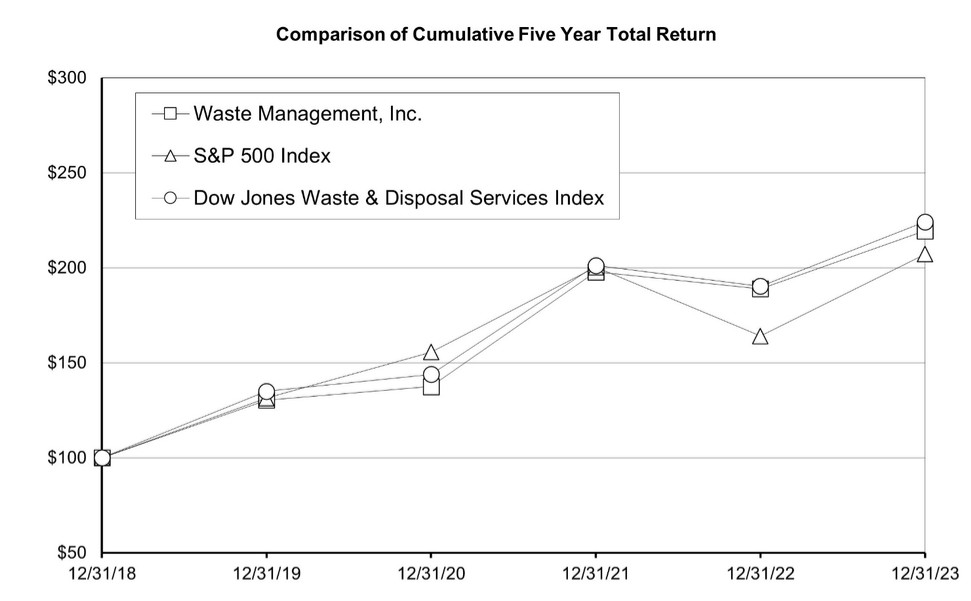
The graph below shows the relative investment performance of Waste Management, Inc. common stock, the S&P 500 Index and the Dow Jones Waste & Disposal Services Index for the last five years, assuming reinvestment of dividends at date of payment into the common stock. The graph is presented pursuant to SEC rules and is not meant to be an indication of our future performance.
| | | | | | | | | | | | | | | | | | | |
|---|---|---|---|---|---|---|---|---|---|---|---|---|---|---|---|---|---|---|
| | 12/31/18 | 12/31/19 | 12/31/20 | 12/31/21 | 12/31/22 | 12/31/23 | ||||||||||||
| Waste Management, Inc. | | $ | 100 | | $ | 130 | | $ | 138 | | $ | 198 | | $ | 189 | | $ | 220 |
| S&P 500 Index | | $ | 100 | | $ | 131 | | $ | 156 | | $ | 200 | | $ | 164 | | $ | 207 |
| Dow Jones Waste & Disposal Services Index | | $ | 100 | | $ | 135 | | $ | 144 | | $ | 201 | | $ | 190 | | $ | 224 |
The Company repurchases shares of its common stock as part of capital allocation programs authorized by our Board of Directors. Share repurchases are a part of our long-term strategy and incorporated into our overall capital allocation plan to enhance our Company’s performance, in conjunction with our other uses of capital, and to return value to stockholders in a tax-efficient manner. During 2023, we allocated an aggregate of $1.3 billion to repurchase our common stock under accelerated share repurchase (“ASR”) agreements and open market transactions. As of December 31, 2023, we had received 7.8 million shares with a weighted average price per share of $158.47, exclusive of per-share commissions. In February 2024, we completed our ASR agreement executed in October 2023, at which time we received 0.2 million shares. See Note 13 to the Consolidated Financial Statements for additional information. We announced in December 2023 that the Board of Directors has authorized up to $1.5 billion in future share repurchases, excluding the 1% excise tax discussed further below. This new authorization supersedes and replaces remaining authority under the prior Board of Directors’ authorization for share repurchases announced in December 2022.
The following table summarizes common stock repurchases made during the fourth quarter of 2023 (shares in millions):
| | | | | | | | | | | | |
|---|---|---|---|---|---|---|---|---|---|---|---|
| | | | | | | | Total Number of | | | | |
| | | Total | | | | | Shares Purchased as | | Approximate Maximum | ||
| | | Number of | | Average | | Part of Publicly | | Dollar Value of Shares that | |||
| | | Shares | | Price Paid | | Announced Plans or | | May Yet be Purchased Under | |||
| Period | Purchased | per Share(a) | Programs | the Plans or Programs(a) | |||||||
| October 1 — 31 (b) | 1.6 | | $ | 161.15 | | 1.6 | | $ | 257.5 million | | |
| November 1 — 30 | — | | $ | — | | — | | $ | 257.5 million | | |
| December 1 — 31 | — | | $ | — | | — | | $ | 1.5 billion | | |
| Total | 1.6 | | $ | 161.15 | | 1.6 | | | | |
| (a) | The Inflation Reduction Act of 2022, which was enacted into law on August 16, 2022, imposed a nondeductible 1% excise tax on the net value of certain stock repurchases made after December 31, 2022. We reflected the applicable excise tax in treasury stock as part of the cost basis of the stock repurchased. In the table above and footnotes below, the average price paid per share, total repurchase costs and approximate maximum dollar value of shares that may yet be purchased under the plans or programs exclude the 1% excise tax. |
|---|
| (b) | In October 2023, we repurchased 70,350 shares of our common stock in open market transactions in compliance with Rule 10b5-1 and Rule 10b-18 of the Exchange Act for $11 million, inclusive of per share commissions, at a weighted average price of $156.35. Additionally, we repurchased $300 million of our common stock pursuant to an ASR agreement. At the beginning of the repurchase period, we delivered $300 million cash and received 1.5 million shares based on a stock price of $161.38. The ASR agreement completed in February 2024, at which time we received 0.2 million additional shares based on a final weighted average price of $175.29. |
|---|
The amount of future share repurchases executed under our Board of Directors’ authorization is determined in management’s discretion, based on various factors, including our net earnings, financial condition and cash required for future business plans, growth and acquisitions.
Item 6. [Reserved]
None.
Item 7. Management’s Discussion and Analysis of Financial Condition and Results of Operations.
This section includes a discussion of our results of operations for the three years ended December 31, 2023. This discussion may contain forward-looking statements. See “Cautionary Statement about Forward-Looking Statements” in Part I of this Annual Report on Form 10-K for more information. Forward-looking statements are subject to certain risks and uncertainties that could cause actual results to differ materially from our historical experience and our present expectations or anticipated results. These risks and uncertainties include, but are not limited to, those described in Part I, “Item 1A. Risk Factors” and elsewhere in this report and may also be described from time to time in our future reports filed with the U.S. Securities and Exchange Commission (“SEC”). The following discussion should be read considering those disclosures and together with the Consolidated Financial Statements and the notes thereto.
Overview
We are North America’s leading provider of comprehensive environmental solutions, providing services throughout the United States (“U.S.”) and Canada. We partner with our customers and the communities we serve to manage and reduce waste at each stage from collection to disposal, while recovering valuable resources and creating clean, renewable energy. We own or operate the largest network of landfills throughout the U.S. and Canada. In order to make disposal more practical for larger urban markets, where the distance to landfills is typically farther, we manage transfer stations that consolidate, compact and transport waste efficiently and economically. Our solid waste business is operated and managed locally by our subsidiaries that focus on distinct geographic areas and provide collection, transfer, disposal, recycling and resource recovery services. Through our subsidiaries, including our Waste Management Renewable Energy (“WM Renewable Energy”) business, we are also a leading developer, operator and owner of landfill gas-to-energy facilities in the U.S. and Canada that produce renewable electricity and renewable natural gas, which is a significant source
of fuel that we allocate to our natural gas fleet. Additionally, we are a leading recycler in the U.S. and Canada, handling materials that include paper, cardboard, glass, plastic and metal.
To enhance transparency regarding our financial performance, highlight the strength and consistency of our core solid waste businesses, and underscore our commitment to sustainability through planned and ongoing investments in our Recycling Processing and Sales and WM Renewable Energy businesses, beginning in the fourth quarter of 2023, our senior management revised its segment reporting to (i) reflect the financial results of our collection, transfer, disposal and resource recovery service businesses independently; (ii) combine the results of all recycling facilities from our East and West Tier segments with our recycling brokerage and sales activities to form a newly created Recycling Processing and Sales reportable segment and (iii) include our WM Renewable Energy business as a reportable segment. Accordingly, our senior management now evaluates, oversees and manages the financial performance of our business through four reportable segments, referred to as (i) Collection and Disposal East Tier (“East Tier”); (ii) Collection and Disposal - West Tier (“West Tier”); (iii) Recycling Processing and Sales and (iv) WM Renewable Energy. Our East and West Tiers along with certain ancillary services not managed through our Tier segments, but that support our collection and disposal operations, form our “Collection and Disposal” businesses.
Collection and Disposal
Our Collection and Disposal businesses provide integrated environmental services, including collection, transfer, disposal and resource recovery services. We evaluate our Collection and Disposal businesses primarily through two geographic segments, East Tier and West Tier. Our East Tier primarily consists of geographic areas located in the Eastern U.S., the Great Lakes region and substantially all of Canada. Our West Tier primarily includes geographic areas located in the Western U.S., including the upper Midwest region, and British Columbia, Canada. Additionally, we provide certain ancillary services (“Other Ancillary”) that are not managed through the Tier segments but that support our collection and disposal operations. Other Ancillary includes specialized services performed for customers that have differentiated needs. These specialized services are targeted at large industrial customers managed through our Sustainability and Environmental Solutions (“SES”) business or geographically dispersed customers managed through our Strategic Business Solutions (“WMSBS”) business. Also included within Other Ancillary are the results of non-operating entities that provide financial assurance and self-insurance support for our business, net of intercompany activity.
Our Collection and Disposal businesses’ operating revenues are primarily generated from fees charged for our collection, transfer, disposal and resource recovery services. Revenues from our collection operations are influenced by factors such as collection frequency, type of collection equipment furnished, type and volume or weight of the waste collected, distance to the disposal facility or recycling facility and our disposal costs. Revenues from our landfill operations consist of tipping fees, which are generally based on the type and weight or volume of waste being disposed of at our disposal facilities. Fees charged at transfer stations are generally based on the weight or volume of waste deposited, considering our cost of loading, transporting and disposing of the solid waste at a disposal site.
Included within our Collection and Disposal businesses are landfills having (i) 21 third-party power generating facilities converting our landfill gas to fuel electricity generators; (ii) 14 third-party renewable natural gas (“RNG”) facilities processing landfill gas to be sold to natural gas suppliers and (iii) two third-party projects delivering our landfill gas by pipeline to industrial customers as a direct substitute for fossil fuels in industrial processes. In return for providing our landfill gas, we receive royalties from each facility, including the benefit of a 15% royalty from our WM Renewable Energy segment based on net operating revenue generated through the sale of RNG, renewable identification numbers (“RINs”), electricity and capacity, Renewable Energy Credits (“RECs”) and related environmental attributes from the 83 landfill beneficial use renewable energy projects owned by WM Renewable Energy on our active landfills, which is eliminated in consolidation.
Recycling Processing and Sales
Our Recycling Processing and Sales segment includes the processing and sales of materials collected from residential, commercial and industrial customers. The materials are delivered to and processed at one of our many recycling facilities. Through our brokerage business, we also manage the marketing of recycling commodities that are processed in our facilities and by third parties by maintaining comprehensive service centers that continuously analyze market prices, logistics, market demands and product quality.
Recycling Processing and Sales revenues generally consist of tipping fees and the sale of recycling commodities to and/or on behalf of third parties. Our Recycling Processing and Sales segment excludes the collection of recycled materials from our residential, commercial, and industrial customers which is included within our Collection and Disposal businesses.
WM Renewable Energy
Our WM Renewable Energy segment develops, operates and promotes projects for the beneficial use of landfill gas. Landfill gas is produced naturally as waste decomposes in a landfill. The methane component of the landfill gas is a readily available, renewable energy source that can
Showing the first 8K of 132K characters. Open the full section
Item 7A. Quantitative and Qualitative Disclosures about Market Risk.
In the normal course of business, we are exposed to market risks, including changes in interest rates, certain commodity prices and Canadian currency rates. From time to time, we use derivatives to manage some portion of these risks. The Company had no derivatives outstanding as of December 31, 2023.
Interest Rate Exposure — Our exposure to market risk for changes in interest rates relates primarily to our financing activities. As of December 31, 2023, we had $16.4 billion of long-term debt, excluding the impacts of accounting for debt issuance costs, discounts and fair value adjustments attributable to terminated interest rate derivatives. We have $2.5 billion of debt that is exposed to changes in market interest rates within the next 12 months comprised primarily of (i) $860 million of short-term borrowings under our commercial paper program and (ii) $1.6 billion of tax-exempt bonds with term interest rate periods that expire within the next 12 months. We currently estimate that a 100-basis point increase in the interest rates of our outstanding variable-rate debt obligations would increase our 2024 interest expense by $18 million.
Our remaining outstanding debt obligations have fixed interest rates through either the scheduled maturity of the debt or, for certain of our fixed-rate tax-exempt bonds, through the end of a term interest rate period that exceeds 12 months. The fair value of our fixed-rate debt obligations can increase or decrease significantly if market interest rates change.
We performed a sensitivity analysis to determine how market rate changes might affect the fair value of our market risk-sensitive debt instruments. This analysis is inherently limited because it reflects a singular, hypothetical set of assumptions. Actual market movements may vary significantly from our assumptions. An instantaneous, 100-basis point increase in interest rates across all maturities attributable to these instruments would have decreased the fair value of our debt by approximately $900 million as of December 31, 2023.
We are also exposed to interest rate market risk from our cash and cash equivalent balances, as well as assets held in restricted trust fund accounts. These assets are generally invested in high-quality, liquid instruments including money market funds that invest in U.S. government obligations with original maturities of three months or less. We believe that our exposure to changes in fair value of these assets due to interest rate fluctuations is insignificant as the fair value generally approximates our cost basis. We also invest a portion of our restricted trust fund account balances in available-for-sale securities, including U.S. Treasury securities, U.S. agency securities, municipal securities, mortgage- and asset-backed securities, which generally mature over the next ten years, as well as equity securities.
Commodity Price Exposure — In the normal course of our business, we are subject to operating agreements that expose us to market risks arising from changes in the prices for commodities such as diesel fuel, electricity (and related renewable energy credits) and recycled materials, including old corrugated cardboard and plastics. We work to manage these risks through operational strategies that focus on capturing our costs in the prices we charge our customers for the services provided. Accordingly, as the market prices for these commodities increase or decrease, our revenues, operating costs and margins may also increase or decrease. Recycling revenues attributable to yield decreased $308 million and increased $19 million in 2023 and 2022, respectively, as compared with the prior year periods. With the significant decline in commodity prices that started in the second half of 2022 from their all-time highs and has continued into 2023, we are currently experiencing margin pressures from our commodity-driven businesses. Average market prices for single-stream recycled commodities were down 40% and 10% in 2023 and 2022, respectively, as compared to the prior year periods. Variability in commodity prices can also impact the margins of our business as certain components of our revenue are structured as a pass through of costs, including recycling brokerage and fuel surcharges.
We have invested, and continue to invest, in facilities to capture methane produced from the Company’s landfills and convert it into renewable natural gas (“RNG”) and electricity. RNG produced from our landfills, as well as dairy biogas, constitute a significant source of fuel allocated to our natural gas collection vehicles. The Company’s investment in renewable energy production is guided partly by the EPA’s implementation of the Renewable Fuel Standard (“RFS”) program, which promotes the production and use of renewable transportation fuels. Many of our facilities are EPA-registered producers of transportation fuel making compressed and RNG from landfill biogas, which qualifies as a cellulosic biofuel under the RFS program. Oil refiners and importers are required through the RFS program to blend specified volumes of various categories of renewable transportation fuels with gasoline or buy credits, referred to as renewable identification numbers (“RINs”), from renewable fuel producers.
RIN prices generally respond to regulations enacted by the EPA, as well as fluctuations in supply and demand. The value of the RINs associated with RNG is set through a market established by the RFS program. Prior to 2022, the EPA had promulgated rules on an annual basis establishing refiners’ obligations to purchase RNG and other cellulosic biofuels under the RFS program, which introduced uncertainty and volatility into the renewable fuels and RINs market. However, in 2023, the EPA issued a highly anticipated rule establishing biofuel blending volumes under the RFS program for compliance years 2023 through 2025. The rule reflected the outsized role of biogas under the program, delivered on many reforms that benefit the solid waste sector, and recognized the continued growth of the market for RNG in vehicle applications. However, we cannot be certain that these changes, or the outcome of litigation challenging various aspects of the rule, will ultimately reduce volatility in the RINs market or that future rulemakings will be similarly favorable to our business. We continue to advocate for the current federal administration to implement policies that could reduce the potential for volatility in the RINs market and ensure long-term stability for renewable transportation fuels, as changes in the RFS market or the structure of the RFS program can and has impacted the financial performance of the facilities constructed to capture and treat the gas. Such changes could impact or alter our projected future investments, and such investments may not yield the results anticipated. Revenue in our WM Renewable Energy segment declined $73 million and increased $48 million in 2023 and 2022, respectively, as compared to the prior year periods, primarily driven by the fluctuations in energy and RIN market prices.
The Company’s sustainability growth strategy also is informed by the increased adoption of state and Canadian clean fuel standard programs, utility policies, and voluntary market demand for RNG in transportation and industrial applications. Clean fuel standard programs, originally developed in California and subsequently adopted in Oregon and Washington, establish annual carbon intensity benchmarks for transportation fuels that decrease over time. These programs operate similar to the RFS program in that certain regulated parties purchase credits from fuel producers, including RNG producers, to meet their carbon intensity obligations. Like RINs, clean fuel standard program credit values can fluctuate with policy and market dynamics. As such, we are advocating for existing programs to adopt measures to promote stability in credit pricing and for other states to adopt similar programs that incentivize the growth in RNG. We also are working closely with stakeholders to encourage the voluntary market for RNG demand, including utility RNG procurement programs, and sustainability protocols, as companies and other customers increasingly look to reduce their greenhouse gas emissions profiles.
Currency Rate Exposure — Our operations are primarily in the U.S. but we also have significant operations in Canada. Additionally, we have certain support functions in India. Where significant, we have quantified and described the impact of foreign currency translation on components of income, including operating revenue and operating expenses. However, the impact of foreign currency has not materially affected our results of operations.
Item 8. Financial Statements and Supplementary Data.
INDEX TO
CONSOLIDATED FINANCIAL STATEMENTS
REPORT OF INDEPENDENT REGISTERED PUBLIC ACCOUNTING FIRM
To the Stockholders and the Board of Directors of Waste Management, Inc.
Opinion on Internal Control Over Financial Reporting
We have audited Waste Management, Inc.’s internal control over financial reporting as of December 31, 2023, based on criteria established in Internal Control-Integrated Framework issued by the Committee of Sponsoring Organizations of the Treadway Commission (2013 framework) (the COSO criteria). In our opinion, Waste Management, Inc. (the Company) maintained, in all material respects, effective internal control over financial reporting as of December 31, 2023, based on the COSO criteria.
We also have audited, in accordance with the standards of the Public Company Accounting Oversight Board (United States) (PCAOB), the 2023 consolidated financial statements of the Company, and our report dated February 13, 2024 expressed an unqualified opinion thereon.
Basis for Opinion
The Company’s management is responsible for maintaining effective internal control over financial reporting and for its assessment of the effectiveness of internal control over financial reporting included in the accompanying Management’s Report on Internal Control Over Financial Reporting. Our responsibility is to express an opinion on the Company’s internal control over financial reporting based on our audit. We are a public accounting firm registered with the PCAOB and are required to be independent with respect to the Company in accordance with the U.S. federal securities laws and the applicable rules and regulations of the Securities and Exchange Commission and the PCAOB.
We conducted our audit in accordance with the standards of the PCAOB. Those standards require that we plan and perform the audit to obtain reasonable assurance about whether effective internal control over financial reporting was maintained in all material respects.
Our audit included obtaining an understanding of internal control over financial reporting, assessing the risk that a material weakness exists, testing and evaluating the design and operating effectiveness of internal control based on the assessed risk, and performing such other procedures as we considered necessary in the circumstances. We believe that our audit provides a reasonable basis for our opinion.
Definition and Limitations of Internal Control Over Financial Reporting
A company’s internal control over financial reporting is a process designed to provide reasonable assurance regarding the reliability of financial reporting and the preparation of financial statements for external purposes in accordance with generally accepted accounting principles. A company’s internal control over financial reporting includes those policies and procedures that (1) pertain to the maintenance of records that, in reasonable detail, accurately and fairly reflect the transactions and dispositions of the assets of the company; (2) provide reasonable assurance that transactions are recorded as necessary to permit preparation of financial statements in accordance with generally accepted accounting principles, and that receipts and expenditures of the company are being made only in accordance with authorizations of management and directors of the company; and (3) provide reasonable assurance regarding prevention or timely detection of unauthorized acquisition, use, or disposition of the company’s assets that could have a material effect on the financial statements.
Because of its inherent limitations, internal control over financial reporting may not prevent or detect misstatements. Also, projections of any evaluation of effectiveness to future periods are subject to the risk that controls may become inadequate because of changes in conditions, or that the degree of compliance with the policies or procedures may deteriorate.
| 5 | |
|---|---|
| | /s/ ERNST & YOUNG LLP |
| Houston, Texas February 13, 2024 | |
REPORT OF INDEPENDENT REGISTERED PUBLIC ACCOUNTING FIRM
To the Stockholders and the Board of Directors of Waste Management, Inc.
Opinion on the Financial Statements
We have audited the accompanying consolidated balance sheets of Waste Management, Inc. (the Company) as of December 31, 2023 and 2022, the related consolidated statements of operations, comprehensive income, cash flows, and changes in equity for each of the three years in the period ended December 31, 2023, and the related notes (collectively referred to as the “consolidated financial statements”). In our opinion, the consolidated financial statements present fairly, in all material respects, the financial position of the Company at December 31, 2023 and 2022, and the results of its operations and its cash flows for each of the three years in the period ended December 31, 2023, in conformity with U.S. generally accepted accounting principles.
We also have audited, in accordance with the standards of the Public Company Accounting Oversight Board (United States) (PCAOB), the Company’s internal control over financial reporting as of December 31, 2023, based on criteria established in Internal Control-Integrated Framework issued by the Committee of Sponsoring Organizations of the Treadway Commission (2013 framework), and our report dated February 13, 2024 expressed an unqualified opinion thereon.
Basis for Opinion
These financial statements are the responsibility of the Company's management. Our responsibility is to express an opinion on the Company’s financial statements based on our audits. We are a public accounting firm registered with the PCAOB and are required to be independent with respect to the Company in accordance with the U.S. federal securities laws and the applicable rules and regulations of the Securities and Exchange Commission and the PCAOB.
We conducted our audits in accordance with the standards of the PCAOB. Those standards require that we plan and perform the audit to obtain reasonable assurance about whether the financial statements are free of material misstatement, whether due to error or fraud. Our audits included performing procedures to assess the risks of material misstatement of the financial statements, whether due to error or fraud, and performing procedures that respond to those risks. Such procedures included examining, on a test basis, evidence regarding the amounts and disclosures in the financial statements. Our audits also included evaluating the accounting principles used and significant estimates made by management, as well as evaluating the overall presentation of the financial statements. We believe that our audits provide a reasonable basis for our opinion.
Critical Audit Matters
The critical audit matters communicated below are matters arising from the current period audit of the financial statements that were communicated or required to be communicated to the audit committee and that: (1) relate to accounts or disclosures that are material to the fi
Showing the first 8K of 228K characters. Open the full section
Item 9. Changes in and Disagreements with Accountants on Accounting and Financial Disclosure.
None.
Item 9A. Controls and Procedures.
Effectiveness of Disclosure Controls and Procedures
Our management, with the participation of our principal executive and financial officers, has evaluated the effectiveness of our disclosure controls and procedures (as defined in Rules 13a-15(e) and 15d-15(e) of the Securities Exchange Act of 1934, as amended) in ensuring that the information required to be disclosed in reports that we file or submit under the Securities Exchange Act of 1934, as amended, is recorded, processed, summarized and reported within the time periods specified in the SEC’s rules and forms, including ensuring that such information is accumulated and communicated to management (including the principal executive and financial officers) as appropriate to allow timely decisions regarding required disclosure. Based on such evaluation, our principal executive and financial officers have concluded that such disclosure controls and procedures were effective as of December 31, 2023 (the end of the period covered by this Annual Report on Form 10-K) at a reasonable assurance level.
Management’s Report on Internal Control Over Financial Reporting
Management of the Company, including the principal executive and financial officers, is responsible for establishing and maintaining adequate internal control over financial reporting, as defined in Rules 13a-15(f) and 15d-15(f) of the Securities Exchange Act of 1934, as amended. Our management conducted an evaluation of the effectiveness of our internal control over financial reporting based on the 2013 framework in Internal Control—Integrated Framework issued by the Committee of Sponsoring Organizations of the Treadway Commission (the COSO criteria). Our internal controls are designed to provide reasonable assurance as to the reliability of our financial reporting and the preparation of the consolidated financial statements for external purposes in accordance with accounting principles generally accepted in the United States and includes those policies and procedures that:
| i. | pertain to the maintenance of records that in reasonable detail accurately and fairly reflect the transactions and dispositions of the assets of the Company; |
|---|
| ii. | provide reasonable assurance that transactions are recorded as necessary to permit preparation of financial statements in accordance with generally accepted accounting principles, and that receipts and expenditures of the Company are being made only in accordance with authorizations of management and directors of the Company; and |
|---|
| iii. | provide reasonable assurance regarding prevention or timely detection of unauthorized acquisition, use or disposition of the Company’s assets that could have a material effect on the financial statements. |
|---|
Because of its inherent limitations, internal control over financial reporting may not prevent or detect misstatements. Projections of any evaluation of effectiveness to future periods are subject to the risk that controls may become inadequate because of changes in conditions, or that the degree of compliance with the policies or procedures may deteriorate.
Management of the Company assessed the effectiveness of our internal control over financial reporting as of December 31, 2023 based on the 2013 framework in Internal Control—Integrated Framework issued by the Committee of Sponsoring Organizations of the Treadway Commission (the COSO criteria). Based on this assessment, management has concluded that our internal control over financial reporting was effective as of December 31, 2023.
The effectiveness of our internal control over financial reporting has been audited by Ernst & Young LLP, the independent registered public accounting firm that audited our consolidated financial statements, as stated in their report, which is included in Item 8 of this Annual Report on Form 10-K.
Changes in Internal Control over Financial Reporting
Management, together with our CEO and CFO, evaluated the changes in our internal control over financial reporting during the quarter ended December 31, 2023. We determined that there were no changes in our internal control over financial reporting during the quarter ended December 31, 2023 that have materially affected, or are reasonably likely to materially affect, our internal control over financial reporting.
Item 9B. Other Information.
Securities Trading Plans of Directors and Executive Officers
On October 30, 2023, James C. Fish, Jr., President, Chief Executive Officer and member of our Board of Directors, adopted a stock trading plan (the “Fish Trading Plan”). The Fish Trading Plan went into effect on the date of adoption and was not intended to satisfy the affirmative defense of Rule 10b5-1(c) under the Exchange Act. The Fish Trading Plan provided for the potential exercise of 83,419 vested stock options and instructed that, upon our common stock reaching a specified market price on or before December 7, 2023, the options would automatically be exercised and the Company would withhold shares of common stock necessary to cover tax requirements and the exercise price of such options. The Fish Trading Plan provided that Mr. Fish would continue to hold all remaining shares of common stock resulting from the option exercise after the net share settlement process.
On November 21, 2023, Mr. Rafael Carrasco, Senior Vice President, Enterprise Strategy, adopted a stock trading plan (the “Carrasco Trading Plan”) intended to satisfy the affirmative defense of Rule 10b5-1(c) under the Exchange Act. The Carrasco Trading Plan will commence on February 20, 2024 and will automatically terminate on the earlier of February 20, 2025 and the completion of all of the contemplated transactions set forth therein. The Carrasco Trading Plan provides for the potential cashless exercise of two stock option awards totaling 4,207 stock options, upon our common stock reaching a specified market price, pursuant to which shares of common stock will be sold to cover option costs, tax obligations, commissions and fees; Mr. Carrasco will then continue to hold all remaining shares of common stock resulting from the option exercise after the settlement.
On November 21, 2023, Ms. Devina Rankin, Executive Vice President and Chief Financial Officer, adopted a stock trading plan (the “Rankin Trading Plan”) intended to satisfy the affirmative defense of Rule 10b5-1(c) under the Exchange Act. The Rankin Trading Plan will commence on February 20, 2024 and will automatically terminate on the earlier of February 20, 2025 and the completion of all of the contemplated transactions set forth therein. The Rankin Trading Plan provides for the potential sale of 50% of net after-tax shares of our common stock received from the payout of performance share unit (“PSU”) equity compensation awards, for the performance period ended December 31, 2023, upon our common stock reaching a specified market price. Ms. Rankin received a target grant of 14,736 PSU awards with a performance period ended December 31, 2023; the number of shares to be paid out to Ms. Rankin on account of these PSU awards can range from zero to 200% of the initial target grant. As a result, the number of shares of common stock to potentially be sold pursuant to the Rankin Trading Plan will be determined in the first quarter of 2024 based on certification by the Management Development and Compensation Committee of the Board of Directors of the Company’s achievement relative to applicable performance measures for the underlying PSU awards.
On December 1, 2023, Mr. Fish adopted a stock trading plan (the “Second Fish Trading Plan”) intended to satisfy the affirmative defense of Rule 10b5-1(c) under the Exchange Act. The Second Fish Trading Plan will commence on March 1, 2024 and will automatically terminate on the earlier of February 20, 2025 and the completion of all of the contemplated transactions set forth therein. The Second Fish Trading Plan provides for (a) the potential sale of up to 19,100 shares of our common stock upon our common stock reaching specified market prices and (b) the potential sale of 50% of net after-tax shares of our common stock received from the payout of PSU equity compensation awards for the performance period ended December 31, 2023, upon our common stock reaching a specified market price. Mr. Fish received a target grant of 59,650 PSU awards with a performance period ended December 31, 2023; the number of shares to be paid out to Mr. Fish on account of these PSU awards can range from zero to 200% of the initial target grant. As a result, as described above in connection with the Rankin Trading Plan, the number of shares of common stock to potentially be sold pursuant to the Second Fish Trading Plan will be determined in the first quarter of 2024.
Item 9C. Disclosure Regarding Foreign Jurisdictions that Prevent Inspections.
Not applicable.
PART III
Item 10. Directors, Executive Officers and Corporate Governance.
We have adopted a code of ethics that applies to our CEO, CFO and Chief Accounting Officer, as well as other officers, directors and employees of the Company. The code of ethics, entitled “Code of Conduct,” is available on-line at investors.wm.com in the tab “ESG — Corporate Governance” (https://investors.wm.com/esg-practices/governance). We intend to post any amendments to the Code of Conduct that apply to our officers and directors, and any required disclosure of waivers from the Code of Conduct, to the “ESG – Corporate Governance” tab at investors.wm.com.
All other information required by this Item will be included in the Company’s definitive proxy statement for its 2024 Annual Meeting of Stockholders (the “2024 Proxy Statement”) to be filed with SEC within 120 days of the end of our fiscal year and is incorporated herein by reference.
Item 11. Executive Compensation.
The information required by this Item will be included in the 2024 Proxy Statement and is incorporated herein by reference.
Item 12. Security Ownership of Certain Beneficial Owners and Management and Related Stockholder Matters.
The information required by this Item will be included in the 2024 Proxy Statement and is incorporated herein by reference.
Item 13. Certain Relationships and Related Transactions, and Director Independence.
The information required by this Item will be included in the 2024 Proxy Statement and is incorporated herein by reference.
Item 14. Principal Accounting Fees and Services.
The information required by this Item will be included in the 2024 Proxy Statement and is incorporated herein by reference.
PART IV
Item 15. Exhibits, Financial Statement Schedules.
(a) (1) Consolidated Financial Statements:
Reports of Independent Registered Public Accounting Firm
Consolidated Balance Sheets as of December 31, 2023 and 2022
Consolidated Statements of Operations for the years ended December 31, 2023, 2022 and 2021
Consolidated Statements of Comprehensive Income for the years ended December 31, 2023, 2022 and 2021
Consolidated Statements of Cash Flows for the years ended December 31, 2023, 2022 and 2021
Consolidated Statements of Changes in Equity for the years ended December 31, 2023, 2022 and 2021
Notes to Consolidated Financial Statements
(a) (2) Consolidated Financial Statement Schedules:
All schedules have been omitted because the required information is not significant or is included in the financial statements or notes thereto, or is not applicable.
(a) (3) Exhibits:
| 101.SCH* | — | Inline XBRL Taxonomy Extension Schema. |
|---|---|---|
| 101.CAL* | — | Inline XBRL Taxonomy Extension Calculation. |
| 101.LAB* | — | Inline XBRL Taxonomy Extension Labels. |
| 101.PRE* | — | Inline XBRL Taxonomy Extension Presentation. |
| 101.DEF* | — | Inline XBRL Taxonomy Extension Definition. |
| 104* | — | Cover Page Interactive Data File (formatted as Inline XBRL and contained in Exhibit 101). |
- Filed herewith.
** Furnished herewith.
† Denotes management contract or compensatory plan or arrangement.
Item 16. Form 10-K Summary.
None.
SIGNATURES
Pursuant to the requirements of Section 13 or 15(d) of the Securities Exchange Act of 1934, the Registrant has duly caused this Report to be signed on its behalf by the undersigned, thereunto duly authorized.
| | | |
|---|---|---|
| | WASTE MANAGEMENT, INC. | |
| | | |
| | By: | /s/ JAMES C. FISH, JR. |
| | | James C. Fish, Jr. |
| | | President, Chief Executive Officer and Director |
Date: February 13, 2024
Pursuant to the requirements of the Securities Exchange Act of 1934, this report has been signed below by the following persons on behalf of the Registrant and in the capacities and on the dates indicated.
| | | | ||
|---|---|---|---|---|
| Signature | Title | Date | ||
| | | | | |
| /s/ JAMES C. FISH, JR. | | President, Chief Executive Officer and Director | | February 13, 2024 |
| James C. Fish, Jr. | | (Principal Executive Officer) | | |
| | | | | |
| /s/ DEVINA A. RANKIN | | Executive Vice President and | | February 13, 2024 |
| Devina A. Rankin | | Chief Financial Officer | | |
| | | (Principal Financial Officer) | | |
| | | | | |
| /s/ JOHN CARROLL | | Vice President and Chief Accounting Officer | | February 13, 2024 |
| John Carroll | | (Principal Accounting Officer) | | |
| | | | | |
| /s/ BRUCE E. CHINN | | Director | | February 13, 2024 |
| Bruce E. Chinn | | | | |
| | | | | |
| /s/ ANDRÉS R. GLUSKI | | Director | | February 13, 2024 |
| Andrés R. Gluski | | | | |
| | | | | |
| /s/ VICTORIA M. HOLT | | Director | | February 13, 2024 |
| Victoria M. Holt | | | | |
| | | | | |
| /s/ KATHLEEN M. MAZZARELLA | | Chairman of the Board and Director | | February 13, 2024 |
| Kathleen M. Mazzarella | | | | |
| | | | | |
| /s/ SEAN E. MENKE | | Director | | February 13, 2024 |
| Sean E. Menke | | | | |
| | | | | |
| /s/ WILLIAM B. PLUMMER | | Director | | February 13, 2024 |
| William B. Plummer | | | | |
| | | | | |
| /s/ JOHN C. POPE | | Director | | February 13, 2024 |
| John C. Pope | | | | |
| | | | | |
| /s/ MARYROSE T. SYLVESTER | | Director | | February 13, 2024 |
| Maryrose T. Sylvester | | | | |
| | | | | |