 filings.tools
Waste Management (WM) 10-K risk factor changes: FY2024 vs FY2023
The 2024-12-31 10-K against the 2023-12-31 one, compared heading by heading and sentence by sentence.
Item 1A143 rewritten134 added66 removed219 unchanged
All filing items1,313 rewritten951 added408 removed2,116 unchanged
Summary
counted, not written
- Item 1A headings could not be compared: only 0 carried over between the two years, which usually means one filing was read wrongly, so none is reported as new or removed.
- Sentence by sentence, 951 added, 408 removed, 1,313 rewritten and 2,116 unchanged across 18 items that differ.
Sentences by item
24 items, with every count and a link to each item that changed
Underlined words on a shaded ground are new in FY2024; struck-through words were in FY2023. Sentences that are wholly new or wholly gone are labelled rather than marked.
Item 1A. Risk Factors.
143 rewritten, 134 added, 66 removed, 219 unchanged
[removed: If] [added: If] we fail to implement our business strategy, our financial performance and our growth could be materially and adversely [removed: affected.][added: affected.]
| | ● | A key element of our strategy is yield management through focus on price leadership, which has presented challenges to keep existing business and win new business at reasonable returns. [removed: We also utilize an energy surcharge and other mandated fees.] The loss of volumes as a result of price increases and our unwillingness to pursue lower margin volumes may negatively affect our cash flows or results of operations. Additionally, we have in the past and may in the future face purported class action lawsuits related to our customer service agreements, [removed: prices] [added: prices, surcharges] and [added: other mandated] fees. |
| | ● | We may not be able to maintain cost savings achieved, including through our automation and optimization efforts, due to inflationary cost [removed: pressure] [added: pressures] or otherwise. |
| | ● | Integration of acquisitions and/or new services offerings or lines of [removed: business could increase] [added: business, such as] our [removed: exposure to the risk of inadvertent noncompliance with applicable laws] [added: expansion into medical waste, controlled substances waste] and [removed: regulations,] [added: secure information destruction services,] and additional expansion into markets outside of North America [added: has and] would result in our business being subject to new laws and regulatory regimes, resulting in greater exposure to risk of inadvertent noncompliance and additional compliance costs. |
| | ● | Execution of our strategy, including growth through [removed: acquisitions] [added: acquisitions, such as our recent Stericycle acquisition,] and our planned [added: and ongoing] expansion of our Recycling Processing and Sales and WM Renewable Energy segments, [added: has caused, and] may [added: in the future,] cause us to incur substantial additional indebtedness, which may divert capital away from our traditional business operations and other financial plans, and may introduce additional risks and volatility to our financial performance. |
| | ● | Supply chain, regulatory or permitting disruptions or delays could detrimentally impact the execution timeline for our planned [removed: expansion] [added: and ongoing expansions] of our Recycling Processing and Sales and WM Renewable Energy businesses. |
| | ● | We continue to seek to divest underperforming and non-strategic assets [added: and operations] if we cannot improve their profitability. We may not be able to successfully [removed: negotiate the divestiture of] [added: divest] underperforming and non-strategic [added: assets and] operations, which could result in asset impairments or the continued operation of low-margin businesses. |
In addition to the risks set forth above, implementation of our business strategy could [removed: also] be affected by other factors beyond our control, such as increased competition, legal developments, government regulation, [added: global geopolitical instability,] general economic conditions, including slower growth or recession, increased operating costs or expenses, [added: inflation,] subcontractor costs and availability and changes in industry trends.
[removed: Our] [added: Our] operations must comply with extensive existing regulations, and changes in regulations, including with respect to emerging contaminants and extended producer responsibility, can restrict or alter our operations, increase our operating costs, increase our tax [removed: rate,] [added: liabilities, reduce revenues,] or require us to make additional capital [removed: expenditures.][added: expenditures.]
Stringent government regulations at the federal, state, provincial and local level in the U.S. and [removed: Canada] [added: Canada, as well as other international jurisdictions where we operate,] have a substantial impact on our operations, and compliance with such regulations is costly.
Many complex laws, rules, orders and interpretations govern environmental protection, health, safety, land use, zoning, [removed: transportation and related matters.][added: transportation, ethical business conduct,]
| | ● | limitations on siting and constructing new waste disposal, [added: destruction,] transfer, recycling or processing facilities or on expanding existing facilities; |
| | ● | limitations, bans, taxes or charges on [removed: disposal] [added: the disposal, destruction] or transportation of out-of-state waste or certain categories of waste; |
| | ● | mandates regarding the management of solid [added: waste, organics, medical waste, controlled substances] waste and other materials, including requirements to recycle, [removed: divert] [added: divert, destroy,] or otherwise process certain waste, recycling and other streams; or |
Expenditures could be accelerated or materially exceed our accruals due to earlier than expected closure of landfills; the types of waste collected and manner in which it is transported and disposed of, including actions taken in the past by companies we have acquired or third-party landfill operators; environmental regulatory changes; new information about waste types previously collected, [removed: such as per- and polyfluoroalkyl substances (“PFAS”)] or other emerging [removed: contaminates and other reasons.][added: contaminants.]
_Business – Regulation – Recent Developments and Focus Areas in Policy and Regulation – PFAS_ for additional [removed: background] information.
[removed: Additionally, regulations] [added: Regulations] establishing extended producer responsibility (“EPR”) are being considered or implemented in many places around the world, including in [added: certain states in] the U.S. and [added: provinces in] Canada.
EPR regulations are designed to place either partial or total responsibility on producers of consumer-packaged goods and other products to fund the post-use life cycle of the products [added: and packaging] they create.
[removed: Our] [added: Our] business is subject to operational and safety risks, including the risk of [removed: personal] injury to employees and [removed: others.][added: others.]
Providing environmental and waste management services, including constructing and operating landfills, transfer stations, [added: processing facilities,] recycling facilities and other disposal [added: or destruction] facilities, and landfill gas-to-energy facilities, involves risks such as truck accidents, equipment defects, malfunctions and failures, and improper use of dangerous equipment.
There are also risks presented by the potential for subsurface heat reactions causing elevated landfill temperatures and increased production of leachate, landfill gas and [removed: odors.][added: odors, and we have proactively incurred increased costs to manage leachate in response to this risk.]
We [removed: also] build and operate natural gas fueling stations, some of which also serve the public or third parties.
[removed: Any of these] [added: These] risks could [removed: potentially] [added: also] result in [removed: injury or death of employees and others,] a need to shut down or reduce operation of facilities, increased operating [removed: expense] [added: costs] and exposure to liability for [removed: pollution] [added: pollution, public nuisance,] and other environmental damage, and property damage or destruction.
[removed: We] [added: We] may be unable to obtain or maintain required permits [added: for our operations] or expand existing permitted capacity at our landfills, due to land scarcity, public opposition or otherwise, which can require us to identify disposal alternatives, resulting in decreased revenue and increased [removed: costs.][added: costs.]
Our ability to meet our financial and operating objectives depends in part on our ability to obtain and maintain the [removed: permits] [added: permits, authorizations, approvals, certificates, and other governmental permissions] necessary to operate landfill [removed: sites] [added: sites, recycling facilities, compost facilities, processing facilities, landfill gas-to-energy facilities, incineration facilities] and transfer [removed: stations.][added: stations in the various jurisdictions in which we operate.]
[removed: Federal, state and local governments] [added: Governments] are [removed: also] increasingly adopting requirements for environmental justice reviews as part of certain permitting decisions.
Our failure to obtain the required permits and necessary capacity expansion to operate our [removed: landfills] [added: business, including our landfills,] could have a material adverse impact on our financial condition, results of operations and cash flows.
[removed: If] [added: If] we are unable to attract, hire or retain key team members and a high-quality workforce, or if our succession planning does not develop an adequate pipeline of future leaders, it could disrupt our business, jeopardize our strategic priorities and result in increased costs, negatively impacting our results of [removed: operations.][added: operations.]
This includes key individuals in leadership and specialty roles, as well as a very large number of drivers, [added: technicians and other front-line and back-office team members necessary to provide our environmental services.]
[removed: _Risk] [added: Risk] Factors — Market disruption, including labor [removed: shortages] [added: shortages, external strikes,] and supply chain constraints, and macroeconomic pressures, including inflation, have [removed: adversely impacted] [added: recently had, and may in the future have, an adverse impact on] our business and results of [removed: operations_.)] [added: operations.)] Additionally, the market for employees that serve on our digital team is highly competitive.
[removed: We] [added: We] have made significant investments in an extensive natural gas truck fleet, which makes us partially dependent on the availability of natural gas and fueling infrastructure and vulnerable to natural gas prices, and requirements to transition [removed: to other] [added: away from our current] vehicle [removed: types] [added: fleet to electric powered vehicles] could impair [removed: these investments.][added: our investments and result in cost increases and significant additional capital investment.]
[removed: Additionally, fluctuations] [added: Fluctuations] in the price and supply of natural gas [added: or diesel fuel] could substantially increase our operating expenses; a reduction in the existing cost differential between natural gas and diesel fuel could materially reduce the benefits we anticipate from our investment in natural gas vehicles.
[removed: Should regulation mandate] [added: Regulation mandating] an accelerated transition [added: away from natural gas trucks and our remaining diesel vehicles, including the recently acquired Stericycle fleet,] to electric powered [removed: vehicles,] [added: vehicles would increase] our cost to acquire vehicles needed to service our [removed: customers could increase,] [added: customers, and] capital investment required to establish sufficient charging infrastructure could be [removed: significant and investments we have made in an industry-leading natural gas fleet and infrastructure could be impaired.][added: significant.]
[removed: In addition, tax] [added: Tax] incentives and grants that advance the adoption of zero-emissions vehicles and lead to a shift away from natural gas trucks and RNG infrastructure would likely also negatively impact our investments in landfill gas-to-energy facilities.
[removed: Increases] [added: Increases] in our labor costs as a result of labor unions organizing, changes in regulations related to labor unions or increases in employee minimum wages, could adversely affect our future [removed: results.][added: results.]
[removed: The] [added: The] seasonal nature of our business, severe weather events resulting from climate change and event driven [removed: special] projects cause our results to fluctuate, and prior performance may not be indicative of our future [removed: results.][added: results.]
[removed: While weather-related and other event-driven special projects can boost revenues through additional] work for a limited time, due to significant start-up costs and other factors, such revenue can generate earnings at comparatively lower margins.
[removed: We] [added: We] may not be able to achieve our [removed: sustainability related] [added: sustainability-related] goals, including reduction of our greenhouse gas ("GHG") emissions, or execute on our sustainability-related growth strategy and initiatives, within planned timelines or anticipated budget, which could damage our reputation and negatively impact the benefits anticipated from our [removed: investments.][added: investments.]
We may not be able to meet such goals or implement such initiatives in the manner or on timelines contemplated due to challenges including, but not limited to, unforeseen costs or delays, [added: changes in how GHG emissions are calculated or otherwise reported,] supply chain disruptions, regulatory impacts, [added: integration of acquired assets or businesses,] technology limitations or technical difficulties associated with achieving such goals.
In addition, our [removed: sustainability] [added: sustainability-related] growth strategy includes significant planned [added: and ongoing] investments in our Recycling Processing and Sales and WM Renewable Energy segments.
We may not realize the strategic benefits and cost synergies anticipated from the Stericycle acquisition.
The benefits we expect to receive from the acquisition of Stericycle depend on the performance of the Stericycle business and its ability to achieve financial and operational targets and strategic goals.
The acquired Stericycle business, which is now presented as our new WM Healthcare Solutions segment, is subject to numerous risks and uncertainties that could cause performance to be materially different than we anticipate; such factors include, but are not limited to, decreases in the volume of medical waste and controlled substances wastes or personal and confidential information collected from customers; disruptions resulting from deployment of systems, including with respect to the implementation of Stericycle’s enterprise resource planning system and billing and collection delays that Stericycle has experienced following the launch of such system upgrade; changing market conditions in the healthcare industry; competition and demand for services for the medical waste, controlled substances waste and secure information destruction industries; commodity price volatility; changes in regulation of the collection, transportation, treatment and disposal or destruction of medical waste and controlled substances waste or the proper handling and protection of personal and confidential information; the level of government enforcement of regulations governing medical waste and controlled substances waste collection and treatment or the proper handling and protection of personal and confidential information; and the outcome of pending, future or settled litigation or investigations.
Should the Stericycle business be unsuccessful in achieving financial and operational targets and implementing the WM Healthcare Solutions business strategy, it could negatively impact our realization of benefits from the acquisition, as well as our stock price and our future business and financial results.
The benefits that are expected to result from our acquisition of Stericycle also depend, in part, on our ability to realize anticipated cost synergies.
Our success in realizing these benefits and cost synergies, and the timing of this realization, depends on the successful integration of the Stericycle business.
There is a significant degree of difficulty and management attention inherent in the process of integrating an acquisition of this size.
The process of integrating operations could cause business interruption and distraction.
Some members of our management may be required to devote considerable time to this integration process, which will decrease the time they will have to manage our Company, service existing customers, attract new customers and develop new products or strategies.
If management is not able to effectively manage the integration process, including retention of key Stericycle personnel, or if any significant business activities are interrupted as a result of the integration process, our business, financial condition and results of operations could suffer.
The acquisition of Stericycle may not result in realization of the benefits and cost synergies that we currently expect, and we cannot guarantee that these benefits and cost synergies will be achieved within anticipated time frames or at all.
Additionally, we may incur substantial expenses in connection with the integration of the Stericycle business, which may exceed expectations and offset certain benefits.
_Business – Regulation_ for additional information.
data privacy and security, and other related and similar subjects.
Similar issues can also result in a significant increase in operating costs; for example, developments in recent years related to management of per-and polyfluoroalkyl substances (“PFAS”) have increased our landfill operating costs.
We may face increased exposure to testing, remediation and litigation costs as a result of new and emerging PFAS regulations and requirements.
For additional information, See Item 1.
_Business – Regulation – Recent Developments and Focus Areas in Policy and Regulation – Extended Producer Responsibility_.
Following our acquisition of Stericycle, we are subject to additional laws and regulations in the U.S. and internationally concerning transportation, management and disposal or destruction of medical waste streams, including regulations that govern the definition, generation, segregation, handling, packaging, transportation, treatment, storage and disposal or destruction of medical waste and controlled substances waste, along with extensive recordkeeping and documentation requirements.
Additionally, Stericycle’s secure information destruction services are subject to additional laws and regulations regarding proper handling and protection of personal and confidential information.
Relaxation of enforcement, government shutdowns, or other changes in governmental regulation of medical waste and controlled substances waste and personal and confidential information could increase the number of competitors we face or reduce or delay the need for these services.
Stericycle is, and has been, involved in government investigations, enforcement proceedings, private lawsuits and other disputes alleging noncompliance with applicable regulations, including alleged noncompliance with the Controlled Substances Act and other statutes involving its now-divested Domestic Environmental Solutions business of collecting, transporting, and destroying controlled substances from retail customers.
With the acquisition of Stericycle, these matters may result in adverse consequences, including permit revocations or denials and civil, criminal and administrative penalties.
The new U.S. presidential administration has called for substantial changes to areas of foreign trade policy and has generally appeared to be in favor of reducing regulation, including environmental regulation.
We do not know what impact the change in U.S. presidential administration will have on specific regulatory policies impacting our industry and our Company, especially given the number of rules currently in litigation, nor can we predict the timing of any such changes.
Reduction of regulation may have a favorable impact on our operating costs, but the extensive environmental regulation applicable to our industry is also a barrier to rapid entry that benefits our Company.
Significant new restrictions and tariffs on foreign trade could have a negative impact on our recycling export business and our cross-border commerce, particularly with Canada, and could increase the cost of certain equipment and other materials used in our operations that we procure from outside the U.S., including our trucks and certain equipment used to implement our sustainability growth strategy.
It is likely that some policies adopted by the new administration will benefit us and others will negatively affect us.
If we encounter regulatory compliance issues in the course of operating our business, we may experience adverse publicity, which may intensify if such noncompliance results in legal liability.
Any legal liability or adverse publicity from such noncompliance may harm our reputation and result in difficulties in attracting new customers, or retaining existing customers, which would negatively impact our results of operations and financial condition.
The Stericycle business requires handling of medical waste and controlled substances waste.
Incidents such as truck accidents, damaged or leaking containers, improper storage of medical waste and controlled substances waste, placement of prohibited materials into the waste stream, or malfunctioning plant equipment could result in exposure to contaminated or infectious waste or other hazardous materials.
Any of these risks could potentially result in injury, illness or death of employees and others.
Changes in applicable laws and regulations could require us to obtain new permits or to change the way in which we operate our business.
Even where permits are obtained, they may contain conditions or restrictions that limit our ability to operate efficiently.
Our ability
to receive permits is also impacted by land scarcity, particularly in densely populated areas.
If we are not able to implement our business strategy successfully, our long-term growth and profitability may be adversely affected.
The EPA proposed the designation of two PFAS compounds as hazardous substances under CERCLA.
We are closely monitoring this proposed rulemaking and are actively working with both Congress and the EPA to provide landfills and other essential public services with relief from CERCLA liability and instead hold accountable manufacturers and heavy users of these compounds.
Without such relief, we may face increased exposure to remediation and litigation costs associated with properties that the EPA may designate as CERCLA sites due to the presence of PFAS.
Along with the funding responsibility, producers may be required to undertake additional responsibilities, such as taking over management of local recycling programs by taking back their products from end users or managing the collection operations and recycling processing and marketing infrastructure.
During periods of economic difficulty, governmental entities have increased their interest in implementing EPR regulations to reduce municipal spending on recycling programs.
There is no federal law establishing EPR in the U.S. or Canada; however, federal, state,
provincial and local governments could, and in several cases have, taken steps to implement EPR regulations for packaging, including traditional recyclables such as cardboard, bottles and cans.
If wide-ranging EPR regulations were adopted, they could significantly impact the waste and recycling streams we manage and how we operate our business, including contract terms and pricing.
In addition, failure to receive regulatory and zoning approval, as well as land scarcity, particularly in densely populated areas, may prohibit us from establishing new facilities or expanding existing facilities.
technicians and other front-line and back-office team members necessary to provide our environmental services.
Our business depends on our reputation and the value of our brand.
_Risk Factors — Focus on, and regulation of, environmental, social and governance (“ESG”) performance and disclosure can result in increased costs, risk of noncompliance, damage to our reputation and related adverse effects._) Damage to our reputation could reduce demand for our services and potentially have an adverse effect on our financial condition, liquidity and results of operations, as well as require additional resources to rebuild our reputation and restore the value of our brand.
For example, California is at various stages of regulation that would require heavy-duty vehicle fleets to phase-in zero-emissions vehicles.
The extent to which other states adopt California’s standards or something similar into their own regulatory frameworks could accelerate the industry-wide adoption of electric vehicles.
Although current options for heavy-duty electric vehicles lack sufficient range and proven experience for our operations, we are proactively engaging in pilots of electric powered heavy-duty vehicles and anticipate that we could redirect future planned capital investments in our fleet toward these assets when the vehicles prove economically and operationally viable.
regulatory approvals or permitting requirements associated with our sustainability investments and initiatives, could impede our ability to execute on our plans and achieve our goals or realize our expected financial performance from these investments.
Additionally, favorable expectations regarding potential investment tax credits or other benefits stemming from the Inflation Reduction Act of 2022 (“IRA”) may not materialize or could fail to meet expectations.
Recently, the IRS issued proposed regulations applicable to the investment tax credits, as expanded by the IRA, that could call into question our ability to realize some, or all, of this tax benefit, which would negatively impact financial expectations in connection with our sustainability growth projects in our WM Renewable Energy segment.
There is increasing governmental and stakeholder interest in ESG matters.
Methodology and timelines for mandatory emissions reporting requirements, such as the recently passed California Corporate Data Accountability Act, may be inconsistent with requirements enacted by other governmental entities, including disclosure requirements that are ultimately adopted by the SEC, which could further increase costs and divert management time and attention.
Disclosures related to GHG emissions data or potential climate-related impacts could also negatively affect our reputation to the extent we are perceived as not meeting individual stakeholder climate-related expectations.
Supply chain constraints have caused delayed delivery of fleet, steel containers and other purchases.
Additionally, the downturn in market prices for recycling commodities that started in the second half of 2022 persisted throughout 2023.
The decrease continued
to be driven by the slowdown in the global economy, which reduced retail demand and the corresponding need for cardboard packaging to ship retail goods.
The downturn in market prices for recycling commodities that started in the second half of 2022 continued in 2023.
Average market prices for single-stream recycled commodities were down 40% in 2023 when compared to the comparable prior year period.
Decreases in the market prices for recycling commodities resulted in a decrease in recycling revenues attributable to yield of $308 million in 2023 as compared to the prior year period.
Recycling revenues attributable to yield increased $19 million in 2022 as compared with the prior year period, primarily from higher market prices for recycling commodities in the first half of 2022, before the significant downturn in the second half of 2022.
In recent years, many in the financial industry have debated whether the North American economy is likely to enter into a period of economic recession.
and variety of services requested by customers.
The Company’s effective tax rate and tax liability could materially change as a result of the adoption of new tax legislation and other factors.
Predominantly all of the Company’s revenues are generated in the U.S., and changes in U.S. tax laws could materially impact our effective tax rate, financial condition and results of operations.
The U.S. Tax Cuts and Jobs Act, enacted on December 22, 2017 (the “Tax Act”), had a significant impact on our effective tax rate, cash tax expenses and net deferred tax liabilities.
The Tax Act reduced the U.S. corporate statutory tax rate and eliminated or limited the deduction of several expenses that were previously deductible, among other things.
However, future changes in tax laws could reverse the impacts of the Tax Act and if ultimately enacted into law, such an increase could materially impact our tax provision, cash tax liability, effective tax rate and net deferred tax liabilities.
We may experience problems with the operation of our current information technology systems or the technology systems of third parties on which we rely, as well as the development and deployment of new information technology systems, that could adversely affect, or even temporarily disrupt, all or a portion of our operations until resolved.
In 2022, we implemented a new general ledger accounting system, complementary finance enterprise resource planning system and a human capital management system.
These systems increase our utilization of, and dependance on, third-party “cloud” computing services in connection with our business operations.
An excerpt. Shown here: 40 of 143 rewritten, 40 of 134 added and 40 of 66 removed. The counts are complete. For every sentence, read Item 1A. Risk Factors. in the FY2024 filing and the FY2023 filing.
Item 7. Management’s Discussion and Analysis of Financial Condition and Results of Operations.
294 rewritten, 131 added, 118 removed, 430 unchanged
This section includes a discussion of our results of operations for the three years ended December 31, [removed: 2023.][added: 2024.]
We are North America’s leading provider of comprehensive environmental solutions, [added: primarily] providing services throughout the United States (“U.S.”) and Canada.
Through our subsidiaries, including our Waste Management Renewable Energy (“WM Renewable Energy”) [removed: business,] [added: segment,] we are also a leading developer, operator and owner of landfill gas-to-energy facilities in the U.S. and Canada that produce renewable electricity and renewable natural gas, which is a significant source [added: of fuel that we allocate to our natural gas fleet.]
[removed: Accordingly, our] [added: Our] senior management [removed: now] evaluates, oversees and manages the financial performance of our business through [removed: four] [added: five] reportable segments, referred to as (i) Collection and Disposal [added: -] East Tier (“East Tier”); (ii) Collection and Disposal - West Tier (“West Tier”); (iii) Recycling Processing and [removed: Sales and] [added: Sales;] (iv) WM Renewable [removed: Energy.][added: Energy and (v) WM Healthcare Solutions.]
Our East and West Tiers along with certain ancillary services [added: (“Other Ancillary”) that are] not managed through our Tier segments, but that support our collection and disposal operations, form our “Collection and Disposal” businesses.
Additionally, we provide [removed: certain ancillary] [added: Other Ancillary] services [removed: (“Other Ancillary”)] that are not managed through the Tier segments but that support our collection and disposal operations.
Included within our Collection and Disposal businesses are landfills having (i) [removed: 21] [added: 20] third-party power generating facilities converting our landfill gas to fuel electricity generators; (ii) [removed: 14] [added: 16] third-party renewable natural gas (“RNG”) facilities processing landfill gas to be sold to natural gas suppliers and (iii) [removed: two] [added: six] third-party projects delivering our landfill gas by pipeline to industrial customers as a direct substitute for fossil fuels in industrial processes.
In return for providing our landfill gas, we receive royalties from each facility, including the benefit of a 15% royalty from our WM Renewable Energy segment based on net operating revenue generated through the sale of RNG, renewable identification numbers (“RINs”), electricity and capacity, Renewable Energy Credits (“RECs”) and related environmental attributes from the [removed: 83] [added: 84] landfill beneficial use renewable energy projects owned by WM Renewable Energy on our active landfills, which is eliminated in consolidation.
[removed: Our Recycling Processing and Sales segment excludes the collection of recycled materials] from our residential, commercial, and industrial customers which is included within our Collection and Disposal businesses.
As of December 31, [removed: 2023,] [added: 2024,] we had [removed: 92] [added: 102] landfill gas beneficial use projects producing commercial quantities of methane gas at owned or operated landfills.
For [removed: 66] [added: 65] of these projects, the processed gas is used to fuel electricity generators.
For [removed: 20] [added: 23] of these projects, the gas is used at the landfill or delivered by pipeline to industrial customers as a direct substitute for fossil fuels in industrial processes.
For [removed: six] [added: 11] of these projects, the landfill gas is processed to pipeline quality RNG and then sold to natural gas suppliers.
The revenues from these facilities are primarily generated through the sale of RNG, RINs, electricity and capacity, [added: heat and/or steam,] RECs and related environmental attributes.
WM Renewable Energy is charged a 15% royalty on net operating revenue from these facilities residing on our active and closed landfills from our Collection and [removed: Disposal,] [added: Disposal] and Corporate and Other businesses, which is eliminated in consolidation.
Additionally, WM Renewable Energy operates and maintains [removed: 12] [added: seven] third-party landfill beneficial gas use projects in return for service revenue.
Our Collection and Disposal and Corporate and Other businesses benefit from these projects as well as [removed: 32] [added: 52] additional third-party landfill beneficial gas use projects in the form of royalties.
Also included within our Corporate and Other businesses [removed: are] closed sites [removed: that include] [added: are] (i) [removed: five] [added: six] third-party power generating facilities converting our landfill gas to fuel electricity generators; (ii) [removed: one] [added: two] third-party [removed: project] [added: projects] delivering our landfill gas by pipeline to industrial customers as a direct substitute for fossil fuels in industrial processes and (iii) [removed: one] [added: two] third-party RNG [added: facilities] processing landfill gas to be sold to natural gas suppliers in return for a royalty.
Additionally, Corporate and Other benefits from a 15% royalty from our WM Renewable Energy segment based on net operating revenue generated through the sale of RNG, RINs, electricity and capacity, RECs and related environmental attributes from the [removed: nine] [added: 15] landfill beneficial use renewable energy projects owned by WM Renewable Energy on our closed sites, which is eliminated in consolidation.
In addition, many state and local governments mandate diversion, recycling and waste reduction at the source and prohibit the disposal of certain types [added: of waste at landfills.]
This includes expanding traditional recycling services, increasing organics collection and processing, [added: providing medical waste services] and expanding our renewable energy projects to meet the evolving needs of our diverse customer base.
Consistent with our Company’s long-standing commitment to sustainability and environmental stewardship, we have published our [removed: 2023] [added: 2024] Sustainability Report, providing details on our sustainability-related performance and outlining progress towards our 2030 sustainability goals.
The information in this report can be found at [removed: https://sustainability.wm.com] [added: sustainability.wm.com] but it does not constitute a part of, and is not incorporated by reference into, this Annual Report on Form 10-K.
For further discussion see [removed: Item1.][added: Item 1.]
[removed: Volume changes] can fluctuate significantly by line of business and volume changes in higher margin businesses can impact key financial metrics.
[removed: In late 2021, we began to execute] [added: We have made significant progress in executing] this technology enablement strategy to automate and optimize certain elements of our service delivery model.
The key benefits are [removed: to reduce] [added: reduced] labor dependency on certain high-turnover jobs, particularly in customer experience, recycling and residential collection, while further elevating our customer self-service through digitalization and implementation of technologies to enhance the safety, reliability and efficiency within our collection operations.
[removed: With the significant decline in commodity prices that started in the second half of 2022 and has continued into 2023, we are currently experiencing] [added: We sometimes experience] margin pressures [added: and variability in earnings and margins] from our commodity-driven businesses, specifically within our Recycling Processing and Sales and WM Renewable Energy segments.
While [removed: still below prices seen at the beginning of 2022, recycling commodity prices began to improve in the fourth quarter of 2023 and while] there may be short-term fluctuations in our commodity-driven businesses as prices change, we [removed: continue to focus on adjusting] [added: believe that] our business models [added: and processes appropriately mitigate the downside risk of changes in commodity prices.]
[removed: With these macroeconomic pressures, we] [added: We] remain committed to putting our people first to ensure that they are well positioned to execute our daily operations diligently and safely.
During [removed: 2023,] [added: 2024,] we continued to focus on our priorities to advance our strategy—enhancing employee engagement, [removed: permanently] reducing our cost to serve through the use of technology and automation, and investing in growth through [added: acquisitions and] our Recycling Processing and Sales and WM Renewable Energy segments.
This strategic focus, combined with strong operational execution, resulted in increased revenue, income from operations and income from operations [removed: margin.][added: margin in 2024 when compared to the prior year.]
We remain diligent in offering [removed: a] competitive and differentiated [removed: service] [added: services] that [removed: meets] [added: meet] the needs of our customers, and we are focused on driving operating efficiencies and reducing discretionary spend.
We continue to invest in our people through paying a competitive market wage, [removed: investments] [added: investing] in our digital platform and [added: providing] training for our team members.
During [removed: 2023,] [added: 2024,] the Company allocated [removed: $2,895] [added: $3,231] million of available cash to capital expenditures.
We also allocated [removed: $2,438] [added: $1,472] million of available cash to our shareholders during [removed: 2023] [added: 2024] through dividends and common stock repurchases.
Key elements of our [removed: 2023] [added: 2024] financial results include:
| | ● | Revenues of [removed: $20,426] [added: $22,063] million for [removed: 2023] [added: 2024] compared with [removed: $19,698] [added: $20,426] million in [removed: 2022,] [added: 2023,] an increase of [removed: $728] [added: $1,637] million, or [removed: 3.7%.] [added: 8.0%.] The increase is primarily attributable to (i) higher yield in our Collection and Disposal businesses; (ii) acquisitions, net of [removed: divestitures and] [added: divestitures;] (iii) [removed: increased volumes. These] increases [removed: were partially offset by] [added: in] commodity [removed: price declines] [added: prices] in our Recycling [removed: Processing] and Sales and WM Renewable Energy segments and [removed: decreased] [added: (iv) increased volumes. These increases were partially offset by a decrease in] revenue from our energy surcharge program as a result of a decline in the price of fuel, particularly diesel; |
| | ● | Income from operations of [removed: $3,575] [added: $4,063] million, or [removed: 17.5%] [added: 18.4%] of revenues, in [removed: 2023] [added: 2024] compared with [removed: $3,365] [added: $3,575] million, or [removed: 17.1%] [added: 17.5%] of revenues, in [removed: 2022.] [added: 2023.] The increase in the current year earnings was primarily driven by [added: (i)] revenue growth [added: and improved performance] within our Collection and Disposal [removed: businesses partially offset by (i)] [added: businesses; (ii)] impairments [removed: within our Recycling Processing and Sales segment as well as certain investments] [added: incurred] in [removed: our Corporate] [added: 2023] and [removed: Other operations; (ii) lower] [added: (iii) higher RIN quantities generated and sold at higher] market values [removed: for RINs and (iii) the decline] in [removed: recycling commodity prices affecting profitability in our Recycling Processing and Sales segment;] [added: the current year;] |
| | ● | Net income attributable to Waste Management, Inc. was [removed: $2,304] [added: $2,746] million, or [removed: $5.66] [added: $6.81] per diluted share, compared with [removed: $2,238] [added: $2,304] million, or [removed: $5.39] [added: $5.66] per diluted share, in [removed: 2022.] [added: 2023.] The [added: $442 million] increase [added: is due to an increase] in income from operations discussed [removed: above was] [added: above, as well as lower income tax expense driven by benefits generated from our low-income housing investments and federal tax credits realized from our RNG investments. These increases were] partially offset by higher interest [removed: and income tax] expense; |
Stericycle Acquisition
On November 4, 2024, we completed our acquisition of all outstanding shares of Stericycle for $62.00 per share in cash, pursuant to an Agreement and Plan of Merger dated June 3, 2024.
Total enterprise value of the acquisition was $7.2 billion (net of cash acquired) when including the assumption of $0.5 billion of debt and the repayment of approximately $0.8 billion of net debt.
The acquisition expands our offerings in the U.S., Canada and parts of Western Europe.
The post-closing operating results of Stericycle have been included in our Consolidated Financial Statements, as a new reportable segment referred to as WM Healthcare Solutions.
For the year ended December 31, 2024, we incurred approximately $160 million of acquisition and integration related costs, which are primarily classified as “Selling, general and administrative expenses.” Refer to Note 19 for more information on the performance of our WM Healthcare Solutions segment.
We also provide additional services not managed through our five reportable segments, which are presented as Corporate and Other.
Our Recycling Processing and Sales segment excludes the collection of recycled materials
Additionally, three of these projects are on third-party landfills.
WM Healthcare Solutions
Our WM Healthcare Solutions segment includes (i) Regulated Waste and Compliance Services (“RWCS”) which provide compliance programs and collection, processing, and disposal of regulated and specialized waste, including medical, pharmaceutical and hazardous waste and (ii) Secure Information Destruction (“SID”) services, which provide for the collection of personal and confidential information for secure destruction and recycling of sorted office paper.
RWCS are provided to customers in the U.S., Canada, Ireland and the United Kingdom (“U.K.”).
SID services are provided to customers in the U.S., Belgium, Canada, France, Germany, Ireland, Luxembourg, the Netherlands and the U.K.
Our WM Healthcare Solutions customers are primarily in the following industries: enterprise healthcare (i.e., hospitals, health systems, and national and corporate healthcare), practices and care providers (i.e., physician offices, surgery centers, veterinary clinics, nursing and long-term care facilities, dental clinics, clinics and urgent care, dialysis centers, and home health organizations), and pharmacy labs and research centers.
Our WM Healthcare Solutions businesses also provide services to airports and seaports, education institutions, funeral homes and crematories, government and military, banks and professional services, and other businesses.
While the WM Healthcare Solutions businesses manage large volumes of waste and other materials, the average volume per customer site is relatively small.
Our customers typically enter into a contract for the provision of services on a scheduled basis, including weekly, monthly or on an as-needed basis over the contract term.
Under the contract terms, the WM Healthcare Solutions businesses receive fees based on a monthly, quarterly or annual rate and/or fees based on contractual rates depending upon measures including the volume, weight, and type of waste.
Operating revenues are invoiced based on the terms of the underlying contract either on a regular basis, or as services are performed and are generally due within a short period of time after invoicing based upon normal terms and conditions for our business type and the geography of the services performed.
As of December 31, 2024, our WM Healthcare Solutions businesses include a global fleet of approximately 6,100 routed trucks, tractors, collection vans and small duty vehicles.
Our WM Healthcare Solutions segment operates out of approximately 361 leased and owned facilities worldwide with 69 autoclaves or other alternative medical waste treatment facilities, 18 medical waste incinerator facilities, 107 SID processing facilities and 167 transfer stations.
Included within our WM Healthcare Solutions segment are 35 locations that are classified as held for sale as of December 31, 2024.
Volume changes
While recycling commodity prices have recovered in 2024 from the low levels experienced in 2023, commodity prices are still below levels seen at the beginning of 2022.
The impacts of commodity price fluctuations are not currently material to our WM Renewable Energy segment; however, as we continue to make investments to grow that segment, we may experience more significant impacts from fluctuations in the prices of electricity, natural gas, RINs and RECs.
We continue to take proactive steps to adjust our business models to protect against the down-side risk of changes in commodity prices.
Variability in economic conditions, including inflation, interest rates, employment trends and supply chain reliability, can create risk and uncertainty in financial outlook.
We invested approximately $8 billion, with $7.5 billion funded in cash and $0.5 billion as the assumption of debt, on acquisitions in 2024, including having completed our acquisition of Stericycle in early November.
| | ● | Operating expenses of $13,383 million in 2024, or 60.7% of revenues, compared with $12,606 million, or 61.7% of revenues, in 2023. As a percentage of revenue, operating expenses improved significantly compared to the prior year as revenue growth from price, efficiency gains, improved employee retention and momentum in truck deliveries offset the impacts of inflationary increases in wages and other expenses. The increase in total operating expenses from prior year related primarily to (i) acquisitions; (ii) inflationary pressure on wages and expenses; (iii) higher recycling customer rebates resulting from an approximate 50% increase in single-stream recycling commodity prices; (iv) volume growth within our WMSBS business which relies more extensively on subcontracted hauling and services than our Collection and Disposal businesses; (v) increases in landfill operating costs, particularly for higher leachate costs due to wet weather and (vi) higher risk management spend, due in part, to increases in certain large loss claims reserves. These increases were partially offset by lower diesel fuel prices and an increase in gains on the sale of non-strategic assets in 2024 as compared with the prior year; |
| | ● | Selling, general and administrative expenses of $2,264 million in 2024, or 10.3% of revenues, compared with $1,926 million, or 9.4% of revenues, in 2023. The $338 million increase was primarily due to (i) costs incurred in connection with the acquisition and integration of Stericycle of which a significant portion were transaction and integration costs that are not expected to recur; (ii) increased labor costs from higher annual and long-term incentive compensation costs and annual wage increases and (iii) increased professional fees to support strategic initiatives. Partially offsetting these increases was a decline in litigation costs; |
| 2024 | | | | | | | | | |
| Commercial | | $ | 5,371 | | $ | 798 | | $ | 6,169 |
| Industrial | | | 3,089 | | | 794 | | | 3,883 |
| Residential | | | 3,466 | | | 89 | | | 3,555 |
| Other collection | | | 2,964 | | | 230 | | | 3,194 |
| Total collection | | | 14,890 | | | 1,911 | | | 16,801 |
| Landfill | | | 3,445 | | | 1,513 | | | 4,958 |
| Transfer | | | 1,381 | | | 1,067 | | | 2,448 |
| WM Renewable Energy | | | 318 | | | 3 | | | 321 |
| WM Healthcare Solutions | | | 403 | | | 10 | | | 413 |
of fuel that we allocate to our natural gas fleet.
To enhance transparency regarding our financial performance, highlight the strength and consistency of our core solid waste businesses, and underscore our commitment to sustainability through planned and ongoing investments in our Recycling Processing and Sales and WM Renewable Energy businesses, beginning in the fourth quarter of 2023, our senior management revised its segment reporting to (i) reflect the financial results of our collection, transfer, disposal and resource recovery service businesses independently; (ii) combine the results of all recycling facilities from our East and West Tier segments with our recycling brokerage and sales activities to form a newly created Recycling Processing and Sales reportable segment and (iii) include our WM Renewable Energy business as a reportable segment.
of waste at landfills.
Macroeconomic pressures, including inflation and rising interest rates, and market disruption resulting in labor, supply chain and transportation constraints have impacted our results; however, we began to see moderate improvements during the second half of 2023.
Significant global supply chain disruption has reduced availability of certain assets used in our business, and inflation has increased costs for the goods and services we purchase, particularly for labor, repair and maintenance, and subcontractor costs.
Supply chain constraints have caused delayed delivery of fleet, steel containers and other purchases.
Aspects of our business rely on third-party transportation providers, and such services have become more limited and expensive.
to protect against the down-side risk by spreading the inherent risk of changes in commodity prices across the vertically integrated value chain.
The extent and duration of the impact of labor, supply chain, transportation and commodity price challenges are subject to numerous external factors beyond our control, including broader macroeconomic conditions; recessionary fears and/or an economic recession; size, location, and qualifications of the labor pool; wage and price structures; adoption of new or revised regulations; geopolitical conflicts and responses and supply and demand for commodities.
As we experience inflationary cost pressures, we focus on our pricing efforts, as well as operating efficiencies and cost controls, to maintain our earnings and cash flow and facilitate growth.
| --- | --- | --- |
| | ● | Operating expenses of $12,606 million in 2023, or 61.7% of revenues, compared with $12,294 million, or 62.4% of revenues, in 2022. The $312 million increase is primarily attributable to (i) inflationary cost pressures, particularly for maintenance and repairs and subcontractor costs and (ii) labor cost pressure from wage increases. These increases were offset, in part, by commodity driven business impacts from lower recycling rebates reflected in costs of goods sold and lower fuel prices; |
| | ● | Selling, general and administrative expenses of $1,926 million in 2023, or 9.4% of revenues, compared with $1,938 million, or 9.8% of revenues, in 2022. The $12 million decrease was primarily due to (i) reduced professional fees in connection with investments in our digital platform, as certain digital projects have moved from higher cost development activities to implementation activities and (ii) lower annual incentive compensation costs; |
| Landfill | | | 4,863 | | | (1,611) | | | 3,252 |
| Total | | $ | 25,176 | | $ | (4,750) | | $ | 20,426 |
| Landfill | | | 4,597 | | | (1,535) | | | 3,062 |
| Total | | $ | 24,018 | | $ | (4,320) | | $ | 19,698 |
| 2021 | | | | | | | | | |
| Commercial | | $ | 4,759 | | $ | (476) | | $ | 4,283 |
| Industrial | | | 3,210 | | | (524) | | | 2,686 |
| Residential | | | 3,181 | | | (36) | | | 3,145 |
| Other collection | | | 2,309 | | | (179) | | | 2,130 |
| Total collection | | | 13,459 | | | (1,215) | | | 12,244 |
| Landfill | | | 4,184 | | | (1,434) | | | 2,750 |
| Transfer | | | 2,023 | | | (918) | | | 1,105 |
| WM Renewable Energy | | | 220 | | | 56 | | | 276 |
| Total | | $ | 21,693 | | $ | (3,762) | | $ | 17,931 |
| --- | --- |
| (d) | Beginning in 2023, the results include changes in our revenue attributable to our WM Renewable Energy segment. Previously these changes in revenue were included in energy surcharges and mandated fees. We have revised our prior year results to conform with the current year presentation. |
| (e) | Our energy surcharge was revised in the second quarter of 2023 to incorporate market prices for both diesel and compressed natural gas (“CNG”). |
While still below prices seen at the beginning of 2022, recycling commodity prices began to improve in the fourth quarter of 2023 and while there may be short-term fluctuations in our commodity-driven businesses as prices change, we continue to focus on adjusting our business models to protect against the down-side risk by spreading the inherent risk of changes in commodity prices across the vertically integrated value chain.
The increase in energy surcharge revenues in 2022 was driven by a 50% increase in diesel fuel in 2022, as compared with the prior year period.
Our Collection and Disposal businesses volume grew 0.7% and 1.8% in 2023 and 2022, respectively.
Our 2023 volume growth has moderated when compared to 2022.
Special waste volumes at our landfills continue to be a significant driver, primarily due to an increase in event-driven projects.
In addition, we saw an increase in our WMSBS volumes.
Our operating expenses increased in 2022, as compared with 2021, primarily due to (i) inflationary cost pressures, particularly for maintenance and repairs and subcontractor costs; (ii) commodity-driven business impacts from higher fuel and recycling prices and (iii) labor cost pressure from frontline employee wage adjustments.
These impacts were partially offset by our continued focus on operating efficiency and efforts to control costs as volumes grow.
The increase in maintenance and repairs costs in 2022, as compared with 2021, was largely driven by (i) inflationary cost increases for parts, supplies and third-party services; (ii) additional fleet maintenance driven by supply chain constraints, which have delayed deliveries of new trucks; (iii) labor cost increases for our technicians, including higher overtime; (iv) increased building maintenance costs including improvements to facilities and (v) an increase in container repairs driven by delays in delivery of steel containers due to supply chain constraints.
The increase in cost of goods sold in 2022, as compared with 2021, was primarily driven by all-time high recycling commodity pricing in the first half of the year offset, in part, by the historically low pricing through the second half of the year that persisted into 2023.
An excerpt. Shown here: 40 of 294 rewritten, 40 of 131 added and 40 of 118 removed. The counts are complete. For every sentence, read Item 7. Management’s Discussion and Analysis of Financial Condition and Results of Operations. in the FY2024 filing and the FY2023 filing.
Item 7A. Quantitative and Qualitative Disclosures about Market Risk.
21 rewritten, 10 added, 3 removed, 24 unchanged
In the normal course of business, we are exposed to market risks, including changes in interest rates, certain commodity prices and [removed: Canadian] currency rates.
As of December 31, [removed: 2023,] [added: 2024,] we had [removed: $16.4] [added: $24.1] billion of long-term debt, excluding the impacts of accounting for debt issuance costs, discounts and fair value adjustments attributable to terminated interest rate derivatives.
We have [removed: $2.5] [added: $2.7] billion of debt that is exposed to changes in market interest rates within the next 12 months comprised primarily of (i) [removed: $860 million] [added: $1.3 billion] of short-term borrowings under our commercial paper program and (ii) [removed: $1.6] [added: $1.4] billion of tax-exempt bonds with term interest rate periods that expire within the next 12 months.
We currently estimate that a 100-basis point increase in the interest rates of our outstanding variable-rate debt obligations would increase our 2024 interest expense by [removed: $18] [added: $19] million.
An instantaneous, 100-basis point increase in interest rates across all maturities attributable to these instruments would have decreased the fair value of our debt by approximately [removed: $900 million] [added: $1.3 billion] as of December 31, [removed: 2023.][added: 2024.]
Recycling revenues attributable to yield [removed: decreased $308] [added: increased $245] million and [removed: increased $19] [added: decreased $308] million in [removed: 2023] [added: 2024] and [removed: 2022,] [added: 2023,] respectively, as compared with the prior year periods.
Average market prices for single-stream recycled commodities were [added: up 50% and] down 40% [removed: and 10%] in [removed: 2023] [added: 2024] and [removed: 2022,] [added: 2023,] respectively, as compared to the prior year periods.
We have invested, and continue to invest, in facilities to capture methane produced from the Company’s landfills and [removed: convert] [added: process] it into [removed: renewable natural gas (“RNG”)] [added: RNG] and electricity.
RNG produced from our [removed: landfills, as well as dairy biogas, constitute] [added: landfills constitutes] a significant source of fuel allocated to our natural gas collection vehicles.
Many of our facilities are EPA-registered producers of transportation fuel making compressed and [added: liquefied] RNG from landfill biogas, which qualifies as a cellulosic biofuel under the RFS program.
[removed: Oil] [added: At the federal level, oil] refiners and importers are required through the RFS program to blend specified volumes of various categories of renewable transportation fuels with gasoline or buy credits, referred to as [removed: renewable identification numbers] [added: Renewable Identification Numbers] (“RINs”), from renewable fuel producers.
[removed: RIN] [added: RINs] prices generally respond to regulations enacted by the EPA, as well as fluctuations in supply and demand.
The value of the RINs [removed: associated with RNG] is set through a market established by the RFS [removed: program.][added: program, which market has historically been very volatile.]
Prior to 2022, the EPA had promulgated rules on an annual basis establishing refiners’ obligations to purchase RNG and other cellulosic biofuels under the RFS program, which introduced [added: a level of] uncertainty [removed: and volatility] into the renewable fuels and RINs market.
However, we cannot be certain that these changes, or the outcome of [added: pending] litigation challenging various aspects of the rule, will ultimately reduce volatility in the RINs market or that future rulemakings will be similarly favorable to our business.
We continue to advocate for [removed: the current federal administration to implement] policies that could reduce the potential for volatility in the RINs market and ensure long-term stability for renewable transportation fuels, as changes in the [removed: RFS] [added: RINs] market or the structure of the RFS program can and has impacted the financial performance of [removed: the facilities constructed to capture and treat the gas.][added: our facilities.]
Revenue in our WM Renewable Energy segment [removed: declined $73] [added: attributable to yield increased $26] million and [removed: increased $48] [added: decreased $73] million in [removed: 2023] [added: 2024] and [removed: 2022,] [added: 2023,] respectively, as compared to the prior year periods, primarily driven by the fluctuations in energy and RIN market prices.
Clean fuel standard programs, originally developed in California and subsequently adopted in [removed: Oregon and] [added: Oregon,] Washington, [added: and New Mexico,] establish annual carbon intensity benchmarks for transportation fuels that decrease over time.
We also are working closely with stakeholders to encourage the voluntary market for RNG demand, including utility RNG procurement programs, and sustainability protocols, as companies and other customers increasingly look to reduce their [removed: greenhouse gas] [added: GHG] emissions profiles.
_Currency Rate Exposure —_ Our operations are primarily in the U.S. but we also have significant operations in [removed: Canada.][added: Canada and certain countries in Europe.]
Where significant, we have quantified and described the impact of foreign currency translation on components of income, including operating [removed: revenue] [added: revenues] and operating expenses.
As of December 31, 2024, our outstanding derivatives were immaterial.
While recycling commodity prices have recovered in 2024 from the low levels experienced in 2023, commodity values are still below prices seen at the beginning of 2022.
In recent years, we have discussed our sustainability growth strategy that includes significant planned and ongoing investments in our WM Renewable Energy segment.
The primary drivers of renewable fuel development at our landfills are tax policies, such as the federal tax credits for RNG production and renewable electricity generation under the IRA, and federal and state incentive programs, such as the federal Renewable Fuel Standard (“RFS”) program, California Low Carbon Fuel Standard and similar state programs that promote the production and use of renewable transportation fuels.
The Company has invested, and continues to invest, in facilities that capture and process landfill gas into RNG so that we can participate in the RFS program, and the Company has grown and stated its intention to continue to grow its asset base to increase its RNG production.
The new U.S. presidential administration could seek to reduce existing renewable fuel targets in a new rulemaking or otherwise set reduced targets for renewable fuels under the RFS program in future rulemakings.
Moreover, consistent with its prior approach, the new administration may also increase the frequency with which it grants small refinery exemptions from RFS program requirements.
While we cannot predict what actions the new administration may take with respect to the RFS program, any changes to existing or future renewable fuel targets or more frequent approval of requests for small refinery exemptions could have a significant negative impact on demand for renewable fuels and the value of RINs.
In an effort to mitigate against such risk and stabilize our RNG portfolio, we are pursuing long-term sales transactions in the voluntary market.
However, these state and voluntary programs may be altered, paused, or otherwise revoked by the applicable governmental authorities or as result of legal challenges.
The Company had no derivatives outstanding as of December 31, 2023.
With the significant decline in commodity prices that started in the second half of 2022 from their all-time highs and has continued into 2023, we are currently experiencing margin pressures from our commodity-driven businesses.
The Company’s investment in renewable energy production is guided partly by the EPA’s implementation of the Renewable Fuel Standard (“RFS”) program, which promotes the production and use of renewable transportation fuels.
Item 1. Business.
148 rewritten, 124 added, 44 removed, 227 unchanged
Through our subsidiaries, including our Waste Management Renewable Energy (“WM Renewable Energy”) [removed: business,] [added: segment,] we are also a leading developer, operator and owner of landfill gas-to-energy facilities in the U.S. and Canada that produce renewable electricity and renewable natural gas, which is a significant source of fuel that we allocate to our natural gas fleet.
During [removed: 2023,] [added: 2024,] our largest customer represented less than 5% of annual revenues.
We own or operate [removed: 263] [added: 262] landfill sites, which is the largest network of landfills throughout the U.S. and Canada.
In order to make disposal more practical for larger urban markets, where the distance to landfills is typically farther, we manage [removed: 332] [added: 339] transfer [removed: stations] [added: stations, excluding those acquired from Stericycle,] that consolidate, compact and transport waste efficiently and economically.
We have enabled a people-first, technology-led focus to drive our mission to maximize resource value, while minimizing environmental [removed: impact, and sustainability and environmental stewardship is embedded in all that we do.]
Simultaneously, we believe that investing in automation to improve processes and drive operational efficiency combined with a focus on the cost to serve our [removed: customer] [added: customers] will yield an attractive profit margin and enhanced service quality.
We are furthering our strategy of focused differentiation and continuous improvement beyond our traditional waste operations through our sustainability growth strategy that includes significant planned investments in our WM Renewable Energy and Recycling Processing and Sales [removed: businesses,] [added: segments,] while increasing automation and reducing labor dependency.
[removed: We] [added: Furthermore, we] are also evaluating and pursuing emerging diversion technologies that may generate additional value.
We live this promise through our service offerings and sustainable solutions, our investments in innovation, our [removed: people,] [added: people] and our commitment to the future.
In December [removed: 2023,] [added: 2024,] we announced that our Board of Directors expects to increase the quarterly dividend from [removed: $0.70 to] $0.75 [added: to $0.825] per share for dividends declared in [removed: 2024,] [added: 2025,] which is a [removed: 7.1%] [added: 10%] increase from the quarterly dividends we declared in [removed: 2023.][added: 2024.]
This is an indication of our ability to generate strong and consistent cash flows and marks the [removed: 21st] [added: 22nd] consecutive year of dividend increases.
[removed: Accordingly, our] [added: Our] senior management [removed: now] evaluates, oversees and manages the financial performance of our business through [removed: four] [added: five] reportable segments, referred to as (i) Collection and Disposal - East Tier (“East Tier”); (ii) Collection and Disposal - West Tier (“West Tier”); (iii) Recycling Processing and [removed: Sales and] [added: Sales,] (iv) WM Renewable [removed: Energy.][added: Energy and (v) WM Healthcare Solutions.]
Our East and West [removed: Tiers,] [added: Tiers] along with certain ancillary services (“Other Ancillary”) [added: that are] not managed through our Tier segments, but that support our collection and disposal operations, form our “Collection and Disposal” businesses.
Our West Tier primarily includes geographic areas located in the Western U.S., including the upper Midwest [removed: region,] [added: region] and British Columbia, Canada.
We also provide additional services not managed through our [removed: four] [added: five] reportable segments, which are presented as Corporate and Other.
As of December 31, [removed: 2023,] [added: 2024,] we owned or operated [removed: 258] [added: 257] solid waste landfills and five secure hazardous waste landfills, which represents the largest network of landfills throughout the U.S. and Canada.
As of December 31, [removed: 2023,] [added: 2024,] we owned or controlled the management of [removed: 237] [added: 239] sites with remedial [removed: activities,] [added: activities] that are in closure or [removed: that] have received a certification of closure from the applicable regulatory agency.
Solid waste landfills are constructed and operated on land with engineering safeguards that limit the possibility of water and air [removed: pollution,] [added: pollution] and are operated under procedures prescribed by regulation.
A landfill must meet federal, state or [removed: provincial,] [added: provincial] and local regulations during its design, construction, operation and closure.
The significant capital requirements of developing and operating a landfill serve as a barrier to landfill ownership and, thus, [added: third-party haulers often dispose of waste at our landfills.]
Our hazardous waste landfills are sited, constructed and operated in a manner designed to provide long-term [removed: containment of waste.]
Included within our Collection and Disposal businesses are landfills having (i) [removed: 21] [added: 20] third-party power generating facilities converting our landfill gas to fuel electricity generators; (ii) [removed: 14] [added: 16] third-party renewable natural gas (“RNG”) facilities processing landfill gas to be sold to natural gas suppliers and (iii) [removed: two] [added: six] third-party projects delivering our landfill gas by pipeline to industrial customers as a direct substitute for fossil fuels in industrial processes.
In return for providing our landfill gas, we receive royalties from each facility, including the benefit of a 15% royalty from our WM Renewable Energy segment based on net operating revenue generated through the sale of RNG, renewable identification numbers (“RINs”), electricity and capacity, Renewable Energy Credits (“RECs”) and related environmental attributes from the [removed: 83] [added: 84] landfill beneficial use renewable energy projects owned by WM Renewable Energy on our active landfills, which is eliminated in consolidation.
_Transfer._ As of December 31, [removed: 2023,] [added: 2024,] we owned or operated [removed: 332] [added: 339] transfer stations in the U.S. and Canada.
_Sustainability and Environmental Solutions (“SES”)_ — Our SES business collaborates with our geographic areas and [removed: WMSBS] [added: national accounts sales] team to offer our customers end-to-end solutions that help businesses achieve their sustainability, recycling and waste diversion goals while meeting industry-specific compliance requirements and rising environmental demands.
These solutions include (i) Sustainability Services, where our employees provide full-service waste management solutions and [removed: consulting] [added: advisory] services, working full-time onsite at our customers’ facilities or through remote-managed programs (this service is managed through our SES business but reflected principally in our collection line of business); (ii) remediation and construction services; (iii) management and marketing of fly ash, which is residue generated from the combustion of coal to generate electricity; and (iv) industrial waste services, which uses thermal and mechanical separation technologies to minimize waste volumes and recover commodities at the point of generation.
The breadth of these service offerings, combined with our large and expanding network of technology-enabled infrastructure in recycling, [removed: organics,] [added: organics] and renewable energy give us the ability to help customers reduce the amount of waste they generate, identify recycling [removed: opportunities,] [added: opportunities] and determine efficient and environmentally friendly means for waste collection and disposal.
We not only collect materials from households and businesses across the U.S. and Canada, we also [added: process and] sell them to manufacturers to be recycled and sold generally within the North American market.
In [removed: 2023,] [added: 2023 and 2024,] we opened eight [added: and three] new recycling [removed: facilities] [added: facilities, respectively,] within the U.S. and Canada equipped with advanced recycling technology.
As of December 31, [removed: 2023,] [added: 2024,] we operated [removed: 102] [added: 105] recycling facilities, of which [removed: 44] [added: 45] are single stream, where cardboard, paper, glass, metals, plastics, construction and demolition materials and other recycling commodities are recovered for resale or redirected for other purposes.
With our current fee-for-service model, the pricing for these recyclable materials can either be a charge or “tip fee” when commodity pricing does not cover our cost to process the recyclable materials or a “rebate” when commodity pricing is higher than our processing costs and we are able to share this benefit with the customers generating recyclable [removed: materials.]
We develop, operate and promote projects for the beneficial use of landfill gas through our WM Renewable Energy [removed: businesses.][added: segment.]
As of December 31, [removed: 2023,] [added: 2024,] we had [removed: 92] [added: 102] landfill gas beneficial use projects producing commercial quantities of methane gas at owned or operated landfills.
For [removed: 66] [added: 65] of these projects, the processed gas is used to fuel electricity generators.
For [removed: 20] [added: 23] of these projects, the gas is used at the landfill or delivered by pipeline to industrial customers as a direct substitute for fossil fuels in industrial processes.
For [removed: six] [added: 11] of these projects, the landfill gas is processed to [removed: pipeline-quality] [added: pipeline quality] RNG and then sold to natural gas suppliers.
The revenues from these facilities are primarily generated through the sale of RNG, RINs, electricity and capacity, [added: heat and/or steam,] RECs and related environmental attributes.
WM Renewable Energy is charged a 15% royalty on net operating revenue from these facilities residing on our active and closed landfills from our Collection and [removed: Disposal,] [added: Disposal] and Corporate and Other businesses, which is eliminated in consolidation.
Additionally, WM Renewable Energy operates and maintains [removed: 12] [added: seven] third-party landfill beneficial gas use projects in return for service revenue.
Our Collection and Disposal and Corporate and Other businesses benefit from these projects as well as [removed: 32] [added: 52] additional third-party landfill beneficial gas use projects in the form of royalties.
On November 4, 2024, we completed our acquisition of all outstanding shares of Stericycle, Inc. (“Stericycle”), the operations of which are presented in this report as our new WM Healthcare Solutions segment.
The acquisition expands our offerings in the U.S. and Canada and adds operations in parts of Western Europe.
These businesses provide Regulated Waste and Compliance Services (“RWCS”) and Secure Information Destruction (“SID”) services that protect people and brands, promote health and well-being and safeguard the environment.
Stericycle operates out of approximately 361 leased and owned facilities worldwide with 69 autoclaves or alternative medical waste treatment facilities, 18 medical waste incinerator facilities, 107 SID processing facilities, and 167 transfer stations.
Included within our WM Healthcare Solutions segment are 35 locations that are classified as held for sale as of December 31, 2024.
The acquisition is discussed further in Note 17 to the Consolidated Financial Statements.
impact, and sustainability and environmental stewardship is embedded in all that we do.
In addition, with our acquisition of Stericycle, we have advanced our growth strategy and built upon our sustainability initiatives.
The acquisition provides a complementary business platform in medical waste, a sector with attractive near- and long-term growth dynamics, and in secure information destruction services to further our leading suite of comprehensive waste and environmental solutions.
In addition, we intend to continue to return value to our stockholders through dividend payments and expect to resume share repurchases once the Company’s leverage returns to targeted levels, which is currently projected to be about 18 months after the November 2024 acquisition of Stericycle.
containment of waste.
_Organics processing and sales_ — We collect recyclable food and yard waste from commercial, residential, and industrial customers, and process these materials through a network of mulching, composting, CORe®, and anaerobic digestion facilities.
As of December 31, 2024, we operated 49 organics recycling facilities and also partner with third-party processors.
Our network of facilities utilizes, markets and sells products including mulch, compost, soil amendments, and renewable energy.
materials.
Additionally, three of these projects are on third-party landfills.
WM Healthcare Solutions
Our WM Healthcare Solutions segment, through our subsidiary Stericycle, is primarily a business-to-business company providing RWCS and SID services that protect people and brands, promote health and well-being and safeguard the environment.
WM Healthcare Solutions serves customers in the U.S., Canada and Western Europe with solutions to safely manage materials that could otherwise spread disease, contaminate the environment, or compromise one’s identity.
Services provided through our WM Healthcare Solutions segment includes the following:
_Regulated Waste and Compliance Services_
WM Healthcare Solutions includes compliance programs and collection, processing, and disposal of regulated and specialized waste, including medical, pharmaceutical and hazardous waste.
RWCS are provided to customers in the U.S., Canada, Ireland and the United Kingdom (“U.K.”).
Regulated waste can be defined as any material subject to government-imposed guidelines for handling the material for transportation or disposal.
Examples include medical waste, pathological waste, sharps and pharmaceutical waste.
_Collection and Transportation_ — The collection process for regulated waste streams begins at the customer location with waste segregation.
To assure regulatory compliance, we educate our customers and will not accept material from
customers unless it complies with our waste acceptance protocols and is properly stored or packaged in containers that we have either supplied or approved and is appropriately labeled.
Our team members then collect containers at the customer location via our fleet of vehicles.
The majority of collected waste is then transported directly to one of our processing facilities or to one of our WM Healthcare Solutions transfer stations where waste is aggregated until it is transported to a processing facility.
_Processing and Disposal of Regulated Waste_ — Upon arrival at a processing facility, containers or boxes of regulated waste undergo a quality control process to verify that they do not contain any unacceptable substances.
Any container or box that is discovered to contain unacceptable waste goes through a corrective action process which could include redirecting the waste, returning the waste to the customer and/or notifying the appropriate regulatory authorities.
From there, regulated waste is processed using one of several treatments or processing technologies, predominantly at one of our facilities:
| | ● | _Autoclaving_ — Autoclaving is the primary method of regulated waste treatment. This process relies on steam at high temperature and pressure to kill pathogens and render materials non-infectious. |
| | ● | _Alternative Technologies_ — We use several different non-incineration alternatives to autoclaves, predominantly outside of the U.S. The processes used by these technologies are similar to autoclaving, as the regulated waste is heated to a specified temperature for a required time to kill the pathogens and render materials non-infectious. Depending on local requirements, the waste may be shredded before or after treatment to render it unrecognizable. |
| | ● | _Incineration_ — While we strive to use alternative, non-incineration methods for treating medical waste, incineration remains a regulatory requirement and/or a best practice in certain geographies or for certain types of medical waste that need to be chemically destroyed. Incineration burns regulated waste at elevated temperatures and reduces it to ash. Incineration reduces the volume of waste, and it is the recommended treatment and disposal option for some types of regulated waste such as anatomical waste, residues from chemotherapy procedures and non-hazardous pharmaceutical waste. Air emissions from incinerators can contain certain byproducts that are subject to federal, state and in some cases, local regulation. In some circumstances, the ash byproduct of incineration may be regulated. |
Upon completion of the treatment process, the resulting waste or incinerator ash is transported for disposal in a landfill owned by unaffiliated third parties or by the Company.
Additionally, in several of our incineration facilities, primarily in the U.K., we use different types of waste-to-energy solutions as part of our processes.
_Secure Information Destruction_
WM Healthcare Solutions also provides for the collection of personal and confidential information for secure destruction and recycling of sorted office paper.
In addition, we intend to continue to return value to our stockholders through dividend payments and our common stock repurchase program.
To enhance transparency regarding our financial performance, highlight the strength and consistency of our core solid waste businesses, and underscore our commitment to sustainability through planned and ongoing investments in our Recycling Processing and Sales, and WM Renewable Energy businesses, beginning in the fourth quarter of 2023, our senior management revised its segment reporting to (i) reflect the financial results of our collection, transfer, disposal and resource recovery services businesses independently; (ii) combine the results of all recycling facilities from our East and West Tier segments with our recycling brokerage and sales activities to form a newly created Recycling Processing and
Sales reportable segment and (iii) include our WM Renewable Energy business as a reportable segment.
Reclassifications have been made to our prior period consolidated financial information to conform to the current year presentation.
third-party haulers often dispose of waste at our landfills.
Additionally, Corporate and Other benefits
Approximately 8,400 employees were employed in administrative and sales positions with the remainder in operations.
Our TRIR as of December 31, 2023 and 2022 was 3.08 and 3.02, respectively.
While our overall results in 2023 did not demonstrate targeted progress toward the 2030 goal, we were able to determine that a significant driver of the measure in the current year was related to acquisition activity.
The Company also remains focused on the prevention of serious injuries, and reduced the number of serious injuries that resulted in multiple days away from work or a change in job role by 8% in 2023.
Diversity and Inclusion
We see D&I as core in everything that we do.
Our commitment to D&I starts at the top with our senior leadership team being comprised of 20% ethnic minorities and 30% women as of December 31, 2023; and with our overall workforce in the U.S. being comprised of
approximately 43% ethnic minorities and approximately 19% women as of the same date.
To solidify this commitment, in 2022 the Company developed two new D&I goals: (i) increase the overall representation of women in our workforce and (ii) increase the representation of racial/ethnic minority employees in our manager roles and above.
In 2021, we announced a new education benefit, Your Tomorrow.
Our exposure to loss for insurance claims is
For example, divided government and election-year politics likely will impede significant federal legislative action in 2024, leading to an expectation that the White House will continue to prioritize regulatory changes to implement parts of its agenda, including taking steps towards reinstating, and in some cases enhancing, policies and regulations rolled back by the previous administration.
| | | under CERCLA is not dependent on the intentional release of hazardous substances; it can be based upon the release or threatened release of hazardous substances, even resulting from lawful, unintentional and attentive action, as the term is defined by CERCLA and other applicable statutes and regulations. The EPA may issue orders requiring responsible parties to perform response actions at sites, or the EPA may seek recovery of funds expended or to be expended in the future at sites. Liability may include contribution for cleanup costs incurred by a defendant in a CERCLA civil action or by an entity that has previously resolved its liability to federal or state regulators in an administrative or judicially-approved settlement. Liability under CERCLA could also include obligations to a potentially responsible party (“PRP”) that voluntarily expends site clean-up costs. Further, liability for damage to publicly-owned natural resources may also be imposed. We are subject to potential liability under CERCLA as an owner or operator of facilities at which hazardous substances have been disposed and as a generator or transporter of hazardous substances disposed of at other locations. |
Some counties, municipalities and other local governments have adopted similar laws and regulations that apply to our facilities and operations.
materials at landfills, such as recyclable materials (cardboard, bottles and cans), yard waste, food waste and electronics.
We continue to expand our work with various private and government entities employing ground, aerial and satellite-based measurements of our sites.
Continued dialogue with these regulatory agencies will be important in
Both the EPA and the ECCC also plan to develop methods and standards for advanced measurement technologies, and we are actively engaged and collaborating with the agencies in these efforts, leveraging our own study results and experiences.
There is increasing governmental and stakeholder interest in environmental, social and governance (“ESG”) matters.
Methodology and timelines for mandatory emissions reporting requirements, such as the recently passed California Corporate Data Accountability Act, may be inconsistent with requirements enacted by other governmental entities, including disclosure requirements that are ultimately adopted by the SEC, which could further increase costs and divert management time and attention.
Disclosures related to GHG emissions data or potential climate-related impacts could also negatively affect our reputation to the extent we are perceived as not meeting individual stakeholder climate-related expectations.
A final rule is expected in 2024.
Additionally, in 2023, the EPA published an advance notice of proposed rulemaking seeking public input and data to assist in the consideration of potential future regulations under CERCLA regarding seven additional PFAS compounds.
As an example, on January 1, 2021, new restrictions on the international trade of most plastics went into effect as part of the Basel Convention on the Control of Transboundary Movements of Hazardous Wastes and Their Disposal.
At this time, the U.S. is not a party to the Basel Convention, but most countries to which we export commodities are, which may limit our ability to export certain plastics.
Recently, however, the IRS issued proposed regulations applicable to the investment tax credits that could call into question our ability to realize some, or all, of this tax benefit, which would negatively impact financial expectations in connection with our significant planned and ongoing investments in sustainability growth projects in our WM Renewable Energy segment.
The proposed regulations provide a public comment period, culminating in public hearings before the Treasury Department, to allow taxpayers to provide input prior to the issuance of final regulations.
In coordination with other members of the RNG industry, we are actively using this public comment period to work with external advisors, the U.S. Congress, the current federal administration, and other biogas sector stakeholders to encourage the Treasury Department to further refine its analysis prior to publication of final regulations that more accurately reflect the express language and legislative intent of the statute with respect to the investment tax credit.
However, there is no guarantee that such efforts will be successful.
Our current expectation is that the IRA’s minimum corporate tax will not have an impact on the Company.
Finally, in accordance with the IRA, we incurred a nondeductible excise tax of 1% on the net value of certain stock repurchases in 2023, which is reflected in the cost of purchasing the underlying shares as a component of treasury stock in our Consolidated Balance Sheet.
Additionally, numerous countries have agreed to a statement in support of the Organization for Economic Co-operation and Development (“OECD”) model rules that propose a global minimum tax rate of 15%.
The Company operates in countries that have agreed to implement the global minimum tax, and the OECD continues to refine technical guidance for such.
At this time, we do not expect the 15% global minimum tax to have a material, if any, impact to our income taxes, and we will continue to monitor and evaluate the potential impact on our business in future periods.
An excerpt. Shown here: 40 of 148 rewritten, 40 of 124 added and 40 of 44 removed. The counts are complete. For every sentence, read Item 1. Business. in the FY2024 filing and the FY2023 filing.
Cover and table of contents
30 rewritten, 87 added, 0 removed, 73 unchanged
For the fiscal year ended December 31, [removed: 2023][added: 2024]
Indicate by check mark whether the registrant is a [removed: large] [added: large,] accelerated filer, an accelerated filer, a non-accelerated filer, smaller reporting company or an emerging growth company.
The aggregate market value of the voting stock held by non-affiliates of the registrant as of June 30, [removed: 2023] [added: 2024] was approximately [removed: $70.1] [added: $85.4] billion.
The number of shares of Common Stock, $0.01 par value, of the registrant outstanding as of February [removed: 8, 2024] [added: 14, 2025] was [removed: 401,598,077] [added: 402,115,439] (excluding treasury shares of [removed: 228,684,384).][added: 228,167,022).]
| Proxy Statement for the [removed: 2024] [added: 2025] Annual Meeting of Stockholders | | Part III |
| | [PART [removed: I](#PARTI_995551)] [added: I](#partI)] | |
| [Item 1.](#Item1Business_462719) | [Business](#Item1Business_462719) | [removed: 3] [added: 6] |
| [Item 1A.](#Item1ARiskFactors_689078) | [Risk Factors](#Item1ARiskFactors_689078) | [removed: 20] [added: 25] |
| [Item 1B.](#Item1BUnresolvedStaffComments_347325) | [Unresolved Staff Comments](#Item1BUnresolvedStaffComments_347325) | [removed: 35] [added: 43] |
| [Item 1C.](#Item1Cybersecurity) | [Cybersecurity](#Item1Cybersecurity) | [removed: 35] [added: 43] |
| [Item 2.](#Item2Properties_696453) | [Properties](#Item2Properties_696453) | [removed: 36] [added: 44] |
| [Item 3.](#Item3LegalProceedings_313163) | [Legal Proceedings](#Item3LegalProceedings_313163) | [removed: 36] [added: 45] |
| [Item 4.](#Item4MineSafetyDisclosures_74576) | [Mine Safety Disclosures](#Item4MineSafetyDisclosures_74576) | [removed: 36] [added: 45] |
| [Item 5.](#Item5MarketforRegistrantsCommon_605372) | [Market for Registrant’s Common Equity, Related Stockholder Matters and Issuer Purchases of Equity Securities](#Item5MarketforRegistrantsCommon_605372) | [removed: 36] [added: 45] |
| [Item 6.](#Item6Reserved_994472) | [\[Reserved\]](#Item6Reserved_994472) | [removed: 38] [added: 46] |
| [Item 7.](#Item7ManagementsDiscussion_595297) | [Management’s Discussion and Analysis of Financial Condition and Results of Operations](#Item7ManagementsDiscussion_595297) | [removed: 38] [added: 46] |
| [Item 7A.](#Item7AQuantitative_14076) | [Quantitative and Qualitative Disclosures About Market Risk](#Item7AQuantitative_14076) | [removed: 68] [added: 75] |
| [Item 8.](#Item8FinancialStatements_338840) | [Financial Statements and Supplementary Data](#Item8FinancialStatements_338840) | [removed: 70] [added: 78] |
| [Item 9.](#Item9ChangesinandDisagreements_74478) | [Changes in and Disagreements with Accountants on Accounting and Financial Disclosure](#Item9ChangesinandDisagreements_74478) | [removed: 129] [added: 144] |
| [Item 9A.](#Item9AControlsandProcedures_86084) | [Controls and Procedures](#Item9AControlsandProcedures_86084) | [removed: 129] [added: 144] |
| [Item 9B.](#Item9BOtherInformation_948347) | [Other Information](#Item9BOtherInformation_948347) | [removed: 130] [added: 145] |
| [Item 9C.](#Item9CDisclosureRegardingForeignJuris) | [Disclosure Regarding Foreign Jurisdictions that Prevent Inspections](#Item9CDisclosureRegardingForeignJuris) | [removed: 131] [added: 146] |
| [Item 10.](#Item10DirectorsExecutive_334717) | [Directors, Executive Officers and Corporate Governance](#Item10DirectorsExecutive_334717) | [removed: 131] [added: 146] |
| [Item 11.](#Item11ExecutiveCompensation_362877) | [Executive Compensation](#Item11ExecutiveCompensation_362877) | [removed: 131] [added: 147] |
| [Item 12.](#Item12SecurityOwnership_987251) | [Security Ownership of Certain Beneficial Owners and Management and Related Stockholder Matters](#Item12SecurityOwnership_987251) | [removed: 131] [added: 147] |
| [Item 13.](#Item13CertainRelationships_733675) | [Certain Relationships and Related Transactions, and Director Independence](#Item13CertainRelationships_733675) | [removed: 131] [added: 147] |
| [Item 14.](#Item14PrincipalAccounting_341161) | [Principal Accounting Fees and Services](#Item14PrincipalAccounting_341161) | [removed: 131] [added: 147] |
| [Item 15.](#Item15ExhibitsFinancial_136084) | [Exhibits](#Item15ExhibitsFinancial_136084) | [removed: 131] [added: 147] |
| [Item 16.](#Item_16_Form_10K_Summary) | [Form 10-K Summary](#Item_16_Form_10K_Summary) | [removed: 134] [added: 150] |
_Risk Factors_” and elsewhere in this [removed: report] [added: Annual Report] and may also be described from time to time in our future reports filed with the U.S. Securities and Exchange Commission (“SEC”).
| [Cautionary Statement on Forward-Looking Statements](#cautionaryStatementAbout) | | 3 |
| [Risk Factors Summary](#RiskFactorsSummary) | | 3 |
Risk Factors Summary
Our business is subject to numerous risks and uncertainties, including those described in Part I, “Item 1A.
_Risk Factors_” of this Annual Report.
These risks include the following:
Strategy and Operational Risks
| | ● | If we fail to implement our business strategy, our financial performance and our growth could be materially and adversely affected. |
| --- | --- | --- |
| | ● | We may not realize the strategic benefits and cost synergies anticipated from the Stericycle acquisition. |
| --- | --- | --- |
| | ● | Our operations must comply with extensive existing regulations, and changes in regulations, including with respect to emerging contaminants, such as PFAS (as defined below), and extended producer responsibility, can restrict or alter our operations, increase our operating costs, increase our tax liabilities, reduce revenues, or require us to make additional capital expenditures. |
| --- | --- | --- |
| | ● | Our business is subject to operational and safety risks, including the risk of injury to employees and others. |
| --- | --- | --- |
| | ● | We may be unable to obtain or maintain required permits for our operations or expand existing permitted capacity at our landfills, due to land scarcity, public opposition or otherwise, which can require us to identify disposal alternatives, resulting in decreased revenue and increased costs. |
| --- | --- | --- |
| | ● | If we are unable to attract, hire or retain key team members and a high-quality workforce, or if our succession planning does not develop an adequate pipeline of future leaders, it could disrupt our business, jeopardize our strategic priorities and result in increased costs, negatively impacting our results of operations. |
| --- | --- | --- |
| | ● | Increases in our labor costs as a result of labor unions organizing, changes in regulations related to labor unions or increases in employee minimum wages, could adversely affect our future results. |
| --- | --- | --- |
| | ● | The seasonal nature of our business, severe weather events resulting from climate change and event driven projects cause our results to fluctuate, and prior performance may not be indicative of our future results. |
| --- | --- | --- |
| | ● | Damage to our reputation and the value of our brand would negatively impact our business. |
| --- | --- | --- |
| | ● | We have made significant investments in an extensive natural gas truck fleet, which makes us partially dependent on the availability of natural gas and fueling infrastructure and vulnerable to natural gas prices, and requirements to transition away from our current vehicle fleet to electric powered vehicles could impair our investments and result in cost increases and significant additional capital investment. |
| --- | --- | --- |
| | ● | We may not be able to achieve our sustainability-related goals, including reduction of our greenhouse gas emissions, or execute on our sustainability-related growth strategy and initiatives, within planned timelines or anticipated budget, which could damage our reputation and negatively impact the benefits anticipated from our investments. |
| --- | --- | --- |
| | ● | Focus on, and regulation of, sustainability performance and disclosure can result in increased costs, risk of noncompliance, damage to our reputation and related adverse effects. |
| --- | --- | --- |
External Economic and Industry Risks
| | ● | Market disruption, including labor shortages, external strikes, and supply chain constraints, and macroeconomic pressures, including inflation, have recently had, and may in the future have, an adverse impact on our business and results of operations. |
| --- | --- | --- |
| | ● | The environmental services industry is highly competitive, and if we cannot successfully compete in the marketplace, our business, financial condition and operating results may be materially adversely affected. |
| --- | --- | --- |
| | ● | Our revenues, earnings and cash flows fluctuate based on changes in commodity prices and demand and may fluctuate substantially without notice in the future. |
| --- | --- | --- |
| | ● | Increasing customer preference for alternatives to landfill disposal and bans on certain types of waste could reduce our landfill volumes and cause our revenues and operating results to decline. |
| --- | --- | --- |
An excerpt. Shown here: all 30 rewritten, 40 of 87 added and all 0 removed. The counts are complete. For every sentence, read Cover and table of contents in the FY2024 filing and the FY2023 filing.
Item 1C. Cybersecurity.
5 rewritten, 6 added, 2 removed, 17 unchanged
The CISO and his team are responsible for leading enterprise-wide cybersecurity strategy, policy, standards, [removed: architecture,] [added: architecture] and processes.
Risks from cybersecurity threats, including [removed: as a result of] previous cybersecurity incidents encountered by the Company and known incidents encountered by third parties with a connection to the Company, [removed: have not materially affected, and] are [added: also] not currently viewed as reasonably likely to materially [removed: affect] [added: impact] our Company, including our business strategy, results of operations or financial condition.
[removed: However, we] [added: We] are regularly the target of attempted cyber intrusions, [added: have experienced cyber intrusions,] and we anticipate continuing to be subject to such [removed: attempts.][added: attempts as cyber intrusions become increasingly sophisticated and more difficult to predict and protect against.]
The Audit Committee receives reports on these matters from our most senior executives in the digital organization, including [removed: our Chief Information Officer and CISO, and the Company’s executive officers, at least twice a year.]
Topics historically covered in such [removed: reports] [added: reports, and for which our Board exercises oversight,] include third-party evaluation of our technology infrastructure and information security against the NIST cybersecurity framework; [added: management of emerging cyber threats such as merger and acquisition activity and the adoption and governance of artificial intelligence;] risk mitigation through the Company’s enterprise-wide cybersecurity training, including our Board of Directors, conducted at least annually; regular simulated phishing tests and third-party penetration testing; review of the Company’s cyber incident insurance coverage and external cyber incident resources; review of the Company’s Cybersecurity Incident Response [removed: Plan] [added: Plan; review of readouts from cyber incident table top exercises;] and consideration of applicable laws and regulations, including those related to privacy.
We have a Data Protection Office that works closely with, and assists, our enterprise Privacy Program, overseen by the Chief Privacy Officer, along with advisory support from appointed Data Protection Officers in Europe and Quebec.
While we have experienced cybersecurity threats and breaches targeting our information technology systems and networks and those of our third-party providers, including within the last three years, these incidents have not had a material impact on our Company, including our business strategy, results of operations or financial condition.
Geopolitical conflicts and developments and technological advancements also increase the risk and likelihood of cyber incidents.
As such, we must commit substantial resources to continuously monitor and further develop our networks and infrastructure to prevent, detect, and address the risk of unauthorized access, misuse, computer viruses and other events.
Although we have implemented and maintain commercially reasonable security measures and safeguards, including to protect against and identify potential threats, these protections and other systems designed to mitigate cybersecurity risks may not fully defend against an attack or future cybersecurity incident, which can be unpredictable in nature.
our Chief Information Officer and CISO, and the Company’s executive officers, at least twice a year.
Our security programs and measures do not prevent all intrusions.
Cyber intrusions require a significant amount of time and effort to assess and remedy, and our incident response efforts may not be effective in all cases.
Item 2. Properties.
9 rewritten, 9 added, 1 removed, 12 unchanged
We also have administrative offices in Arizona, Connecticut, [removed: Illinois] [added: Illinois, India] and [removed: India.][added: parts of Western Europe.]
We have operations (i) in all 50 [removed: states except Montana;] [added: states;] (ii) in the District of [removed: Columbia and] [added: Columbia;] (iii) [removed: throughout Canada.][added: parts of Canada and (iv) parts of Western Europe.]
As of December 31, [removed: 2023,] [added: 2024,] we had [removed: 92] [added: 102] landfill gas beneficial use projects producing commercial quantities of methane gas at owned or operated landfills.
For [removed: 66] [added: 65] of these projects, the processed gas is used to fuel electricity generators.
For [removed: 20] [added: 23] of these projects, the gas is used at the landfill or delivered by pipeline to industrial customers as a direct substitute for fossil fuels in industrial processes.
For [removed: six] [added: 11] of these projects, the landfill gas is processed to pipeline quality RNG and then sold to natural gas suppliers.
| Landfills owned or operated | | [removed: 263] [added: 262] | | 263 |
| Transfer stations [added: (a)(b)] | | [removed: 332] [added: 506] | | [removed: 337] [added: 332] |
| Recycling facilities | [added: ] | [removed: 102] [added: 105] | [added: ] | [removed: 97] [added: 102] |
Additionally, three of these projects are on third-party landfills.
| | | 2024(a) | | 2023 |
| Autoclave or alternative medical waste treatment facilities (b) | | 69 | | — |
| Medical waste incinerator facilities (b) | | 18 | | — |
| Secure information destruction processing facilities (b) | | 107 | | — |
| | (a) | Includes 167 transfer stations in 2024 that are related to our WM Healthcare Solutions segment. |
| --- | --- | --- |
| | (b) | Includes 35 Spain and Portugal locations consisting of 19 transfer stations, 12 autoclave or alternative medical waste treatment facilities, 1 medical waste incinerator facility and 3 secure information destruction processing facilities which were classified as assets held for sale as of December 31, 2024. See Note 17 to the Consolidated Financial Statements for further discussion. |
| --- | --- | --- |
| | | 2023 | | 2022 |
Item 5. Market for Registrant’s Common Equity, Related Stockholder Matters and Issuer Purchases of Equity Securities.
6 rewritten, 5 added, 21 removed, 8 unchanged
Our common stock is traded on the New York Stock Exchange (“NYSE”) under the symbol “WM.” The number of holders of record of our common stock on February [removed: 8, 2024] [added: 14, 2025] was [removed: 7,489.][added: 7,046.]
[removed: 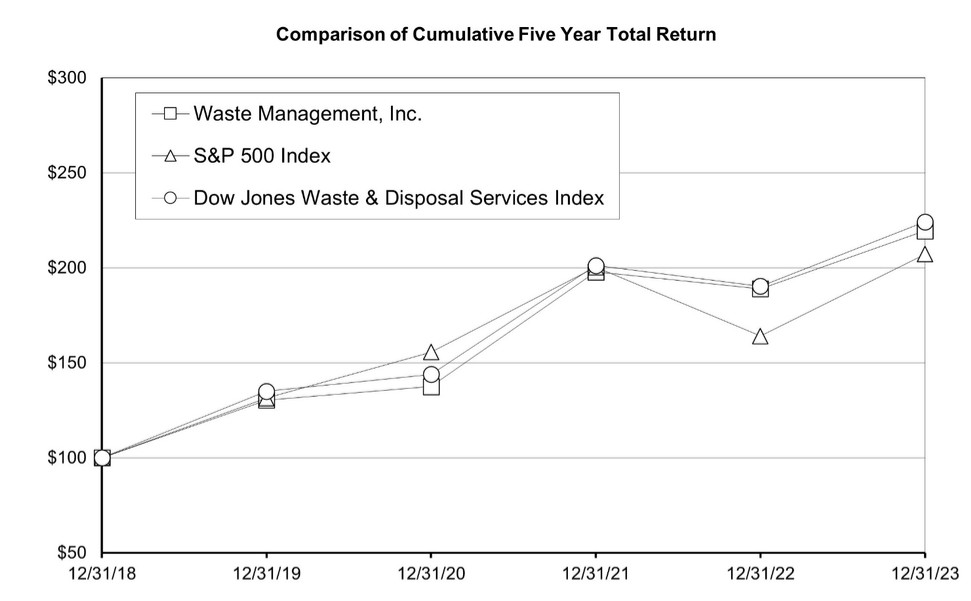][added: ]
| Dow Jones Waste & Disposal Services Index | | $ | 100 | | $ | [removed: 135] [added: 107] | | $ | [removed: 144] [added: 149] | | $ | [removed: 201] [added: 141] | | $ | [removed: 190] [added: 166] | | $ | [removed: 224] [added: 198] |
During [removed: 2023,] [added: 2024,] we allocated an aggregate of [removed: $1.3 billion] [added: $262 million] to repurchase our common stock under accelerated share repurchase (“ASR”) agreements and open market transactions.
As of December 31, [removed: 2023,] [added: 2024,] we had received [removed: 7.8] [added: 1.5] million shares with a weighted average price per share of [removed: $158.47,] [added: $196.95,] exclusive of per-share commissions.
[removed: The following table summarizes] [added: There were no] common stock repurchases [removed: made] during the fourth quarter of [removed: 2023 (shares in millions):][added: 2024.]
| | | 12/31/19 | | | 12/31/20 | | | 12/31/21 | | | 12/31/22 | | | 12/31/23 | | | 12/31/24 | |
| Waste Management, Inc. | | $ | 100 | | $ | 105 | | $ | 152 | | $ | 145 | | $ | 168 | | $ | 192 |
| S&P 500 Index | | $ | 100 | | $ | 118 | | $ | 152 | | $ | 125 | | $ | 158 | | $ | 197 |
As a result of the Stericycle acquisition, the Company has temporarily suspended share repurchases.
We expect to resume share repurchases once the Company’s leverage returns to targeted levels, which is currently projected to be about 18 months after the November 2024 acquisition of Stericycle.
| | | 12/31/18 | | | 12/31/19 | | | 12/31/20 | | | 12/31/21 | | | 12/31/22 | | | 12/31/23 | |
| Waste Management, Inc. | | $ | 100 | | $ | 130 | | $ | 138 | | $ | 198 | | $ | 189 | | $ | 220 |
| S&P 500 Index | | $ | 100 | | $ | 131 | | $ | 156 | | $ | 200 | | $ | 164 | | $ | 207 |
In February 2024, we completed our ASR agreement executed in October 2023, at which time we received 0.2 million shares.
We announced in December 2023 that the Board of Directors has authorized up to $1.5 billion in future share repurchases, excluding the 1% excise tax discussed further below.
This new authorization supersedes and replaces remaining authority under the prior Board of Directors’ authorization for share repurchases announced in December 2022.
| | | | | | | | | | | | |
| --- | --- | --- | --- | --- | --- | --- | --- | --- | --- | --- | --- |
| | | | | | | | Total Number of | | | | |
| | | Total | | | | | Shares Purchased as | | Approximate Maximum | | |
| | | Number of | | Average | | | Part of Publicly | | Dollar Value of Shares that | | |
| | | Shares | | Price Paid | | | Announced Plans or | | May Yet be Purchased Under | | |
| Period | | Purchased | | per Share(a) | | | Programs | | the Plans or Programs(a) | | |
| October 1 — 31 (b) | | 1.6 | | $ | 161.15 | | 1.6 | | $ | 257.5 million | |
| November 1 — 30 | | — | | $ | — | | — | | $ | 257.5 million | |
| December 1 — 31 | | — | | $ | — | | — | | $ | 1.5 billion | |
| Total | | 1.6 | | $ | 161.15 | | 1.6 | | | | |
| (a) | The Inflation Reduction Act of 2022, which was enacted into law on August 16, 2022, imposed a nondeductible 1% excise tax on the net value of certain stock repurchases made after December 31, 2022. We reflected the applicable excise tax in treasury stock as part of the cost basis of the stock repurchased. In the table above and footnotes below, the average price paid per share, total repurchase costs and approximate maximum dollar value of shares that may yet be purchased under the plans or programs exclude the 1% excise tax. |
| --- | --- |
| (b) | In October 2023, we repurchased 70,350 shares of our common stock in open market transactions in compliance with Rule 10b5-1 and Rule 10b-18 of the Exchange Act for $11 million, inclusive of per share commissions, at a weighted average price of $156.35. Additionally, we repurchased $300 million of our common stock pursuant to an ASR agreement. At the beginning of the repurchase period, we delivered $300 million cash and received 1.5 million shares based on a stock price of $161.38. The ASR agreement completed in February 2024, at which time we received 0.2 million additional shares based on a final weighted average price of $175.29. |
The amount of future share repurchases executed under our Board of Directors’ authorization is determined in management’s discretion, based on various factors, including our net earnings, financial condition and cash required for future business plans, growth and acquisitions.
Item 8. Financial Statements and Supplementary Data.
594 rewritten, 390 added, 147 removed, 997 unchanged
| [Reports of Independent Registered Public Accounting Firm](#Report) (PCAOB ID 42) | | [removed: 71] [added: 79] |
| [Consolidated Balance Sheets as of December 31, [removed: 2023] [added: 2024] and [removed: 2022](#BALANCESHEETS_191365)] [added: 2023](#BALANCESHEETS_191365)] | | [removed: 75] [added: 84] |
| [Consolidated Statements of Operations for the Years Ended December 31, [removed: 2023, 2022] [added: 2024, 2023] and [removed: 2021](#STATEMENTSOFOPERATIONS_745891)] [added: 2022](#STATEMENTSOFOPERATIONS_745891)] | | [removed: 76] [added: 85] |
| [Consolidated Statements of Comprehensive Income for the Years Ended December 31, [removed: 2023, 2022] [added: 2024, 2023] and [removed: 2021](#COMPREHENSIVEINCOME_932746)] [added: 2022](#COMPREHENSIVEINCOME_932746)] | | [removed: 76] [added: 85] |
| [Consolidated Statements of Cash Flows for the Years Ended December 31, [removed: 2023, 2022] [added: 2024, 2023] and [removed: 2021](#CASHFLOWS_594152)] [added: 2022](#CASHFLOWS_594152)] | | [removed: 77] [added: 86] |
| [Consolidated Statements of Changes in Equity for the Years Ended December 31, [removed: 2023, 2022] [added: 2024, 2023] and [removed: 2021](#CHANGESINEQUITY_625544)] [added: 2022](#CHANGESINEQUITY_625544)] | | [removed: 78] [added: 87] |
| [Notes to Consolidated Financial Statements](#NOTESTOCONSOLIDATEDFINANCIALSTATEMENTS_4) | | [removed: 79] [added: 88] |
We have audited Waste Management, Inc.’s internal control over financial reporting as of December 31, [removed: 2023,] [added: 2024,] based on criteria established in Internal [removed: Control-Integrated] [added: Control—Integrated] Framework issued by the Committee of Sponsoring Organizations of the Treadway Commission (2013 framework) (the COSO criteria).
In our opinion, Waste Management, Inc. (the Company) maintained, in all material respects, effective internal control over financial reporting as of December 31, [removed: 2023,] [added: 2024,] based on the COSO criteria.
We also have audited, in accordance with the standards of the Public Company Accounting Oversight Board (United States) (PCAOB), the [removed: 2023] [added: 2024] consolidated financial statements of the Company, and our report dated February [removed: 13, 2024] [added: 19, 2025] expressed an unqualified opinion thereon.
| Houston, Texas February [removed: 13, 2024] [added: 19, 2025] | |
We have audited the accompanying consolidated balance sheets of Waste Management, Inc. (the Company) as of December 31, [removed: 2023] [added: 2024] and [removed: 2022,] [added: 2023,] the related consolidated statements of operations, comprehensive income, cash [removed: flows,] [added: flows] and changes in equity for each of the three years in the period ended December 31, [removed: 2023,] [added: 2024,] and the related notes (collectively referred to as the “consolidated financial statements”).
In our opinion, the consolidated financial statements present fairly, in all material respects, the financial position of the Company at December 31, [removed: 2023] [added: 2024] and [removed: 2022,] [added: 2023,] and the results of its operations and its cash flows for each of the three years in the period ended December 31, [removed: 2023,] [added: 2024,] in conformity with U.S. generally accepted accounting principles.
We also have audited, in accordance with the standards of the Public Company Accounting Oversight Board (United States) (PCAOB), the Company’s internal control over financial reporting as of December 31, [removed: 2023,] [added: 2024,] based on criteria established in Internal Control-Integrated Framework issued by the Committee of Sponsoring Organizations of the Treadway Commission (2013 framework), and our report dated February [removed: 13, 2024] [added: 19, 2025] expressed an unqualified opinion thereon.
| _Description of the Matter_ | At December 31, [removed: 2023,] [added: 2024,] the Company’s landfill assets, net of accumulated depletion, totaled [removed: $7.8] [added: $8.0] billion and the associated depletion expense for [removed: 2023] [added: 2024] was [removed: $745] [added: $795] million. As discussed in Note 2 of the financial statements, the Company updates the estimates used to calculate individual landfill depletion rates at least annually, or more often if significant facts change. Landfill depletion rates are used in the computation of landfill depletion expense. Auditing landfill depletion rates and related depletion expense is complex due to the highly judgmental nature of assumptions used in estimating the rates. Significant assumptions used in the calculation of the rates include: estimated future development costs associated with the construction and retirement of the landfill, estimated remaining permitted and expansion airspace, and airspace utilization factors. |
| _Description of the Matter_ | At December 31, [removed: 2023,] [added: 2024,] the carrying value of the Company’s landfill asset retirement obligations related to final capping, closure and post-closure costs totaled [removed: $2.9] [added: $3.1] billion. As discussed in Note 2 of the financial statements, the Company updates the estimates used to measure the asset retirement obligations annually, or more often if significant facts change. Auditing the landfill asset retirement obligation is complex due to the highly judgmental nature of the assumptions used in the measurement process. Significant assumptions include: estimated future costs associated with the capping, closure and post closure activities at each specific landfill, airspace consumed to date in relation to total estimated permitted and expansion airspace and the projected remaining landfill life. |
| | | [added: 2024 | | |] 2023 | | | 2022 | |
| Cash and cash equivalents | | $ | [added: 414 | | $ |] 458 | | $ | 351 |
| Accounts receivable, net of allowance for doubtful accounts of [removed: $30] [added: $165] and [removed: $26,] [added: $30,] respectively | | | [removed: 2,633] [added: 3,272] | | | [removed: 2,461] [added: 2,633] |
| Other receivables, net of allowance for doubtful accounts of $4 and [removed: $7,] [added: $4,] respectively | | | [removed: 237] [added: 415] | | | [removed: 291] [added: 237] |
| Parts and supplies | | | [removed: 173] [added: 206] | | | [removed: 164] [added: 173] |
| Other [added: current] assets | | | [removed: 303] [added: 467] | | | [removed: 284] [added: 303] |
| Total current assets | | | [removed: 3,804] [added: 4,774] | | | [removed: 3,551] [added: 3,804] |
| Property and equipment, net of accumulated depreciation and depletion of [removed: $22,826] [added: $23,777] and [removed: $21,627,] [added: $22,826,] respectively | | | [removed: 16,968] [added: 19,340] | | | [removed: 15,719] [added: 16,968] |
| Goodwill | | | [removed: 9,254] [added: 13,438] | | | [removed: 9,323] [added: 9,254] |
| Other intangible assets, net | | | [removed: 759] [added: 4,188] | | | [removed: 827] [added: 759] |
| Restricted funds | | | [removed: 422] [added: 413] | | | [removed: 348] [added: 422] |
| Investments in unconsolidated entities | | | [removed: 606] [added: 846] | | | [removed: 578] [added: 606] |
| Other [added: long-term] assets | | | [removed: 1,010] [added: 1,568] | | | [removed: 1,021] [added: 1,010] |
| Total assets | | $ | [removed: 32,823] [added: 44,567] | | $ | [removed: 31,367] [added: 32,823] |
| Accounts payable | | $ | [removed: 1,709] [added: 2,046] | | $ | [removed: 1,766] [added: 1,709] |
| Accrued liabilities | | | [removed: 1,605] [added: 2,180] | | | [removed: 1,625] [added: 1,605] |
| Deferred revenues | | | [removed: 578] [added: 673] | | | [removed: 589] [added: 578] |
| Current portion of long-term debt | | | [removed: 334] [added: 1,359] | | | [removed: 414] [added: 334] |
| Total current liabilities | | | [removed: 4,226] [added: 6,258] | | | [removed: 4,394] [added: 4,226] |
| Long-term debt, less current portion | | | [removed: 15,895] [added: 22,541] | | | [removed: 14,570] [added: 15,895] |
| Deferred income taxes | | | [removed: 1,826] [added: 2,815] | | | [removed: 1,733] [added: 1,826] |
| Landfill and environmental remediation liabilities | | | [removed: 2,888] [added: 3,048] | | | [removed: 2,700] [added: 2,888] |
| Other [added: long-term] liabilities | | | [removed: 1,092] [added: 1,651] | | | [removed: 1,106] [added: 1,092] |
| Total liabilities | | | [removed: 25,927] [added: 36,313] | | | [removed: 24,503] [added: 25,927] |
As indicated in the accompanying Management’s Report on Internal Control Over Financial Reporting, management’s assessment of and conclusion on the effectiveness of internal control over financial reporting did not include the internal controls of Stericycle, Inc., which is included in the 2024 consolidated financial statements of the Company and constituted approximately 13.0% of total assets, excluding goodwill, as of December 31, 2024 and approximately 1.8% of consolidated operating revenues, for the year then ended.
Our audit of internal control over financial reporting of the Company also did not include an evaluation of the internal control over financial reporting of Stericycle, Inc.
| | |
| | Acquisition of Stericycle, Inc. – Valuation of Customer Relationships |
| _Description of the Matter_ | As described in Note 17 to the consolidated financial statements, during the year ended December 31, 2024, the Company completed the acquisition of Stericycle, Inc. (“Stericycle”) for purchase consideration of approximately $6.9 billion, of which $2.3 billion was allocated to customer relationships. The transaction was accounted for as a business combination. Auditing the Company's accounting for its acquisition of Stericycle was complex due to the significant estimation uncertainty in determining the fair value of certain customer relationships included within Other intangible assets. The Company valued the customer relationships using an income approach; specifically, the multi-period excess earnings model. The significant estimation uncertainty was primarily due to the sensitivity of the fair value to underlying assumptions, including projected revenue, attrition rate, EBITDA margin, and discount rate. These significant assumptions are forward-looking and could be affected by future economic and market conditions. |
| _How We Addressed the Matter in Our Audit_ | We obtained an understanding, evaluated the design, and tested the operating effectiveness of the Company’s controls over the purchase price allocation process. We tested management’s review controls over the significant assumptions described above along with the completeness and accuracy of the data used in the fair value estimates. To test the estimated fair value of the customer relationships, our audit procedures included, among others, evaluating the Company's selection of the valuation methodology, evaluating the significant assumptions described above used to develop the prospective financial information and testing the completeness and accuracy of the underlying data supporting the significant assumptions. We involved our valuation specialists to assist with evaluating the methodology and significant assumptions used by the management to determine the fair value estimates. We compared the significant assumptions to current industry, market and economic trends, the assumptions used by the Company to value similar assets in other acquisitions, as well as historical results of the Company's business and other guideline companies within the same industry. We also performed a sensitivity analysis of the significant assumptions to evaluate the change in the estimated fair value of the customer relationships resulting from changes in the assumptions. |
| | |
| Houston, Texas February 19, 2025 | |
| Accumulated other comprehensive income (loss) | | | (115) | | | (37) |
| Consolidated net income | | $ | 2,745 | | $ | 2,276 | | $ | 2,240 |
| Depreciation, depletion and amortization | | | 2,267 | | | 2,071 | | | 2,038 |
| Cash, cash equivalents and restricted cash and cash equivalents at end of period | | $ | 487 | | $ | 552 | | $ | 445 |
| Adoption of new accounting standard | | | (12) | | — | | | — | | | — | | | (12) | | | — | | — | | | — | | | — |
| Balance, December 31, 2024 | | $ | 8,254 | | 630,282 | | $ | 6 | | $ | 5,496 | | $ | 15,858 | | $ | (115) | | (228,788) | | $ | (12,993) | | $ | 2 |
On November 4, 2024, we completed our acquisition of all outstanding shares of Stericycle, Inc. (“Stericycle”), the operations of which are presented in this report as our new WM Healthcare Solutions segment.
The acquisition expands our offerings in the U.S. and Canada and adds operations in parts of Western Europe.
These businesses provide Regulated Waste and Compliance Services (“RWCS”) and Secure Information Destruction (“SID”) services that protect people and brands, promote health and well-being and safeguard the environment.
Refer to Note 17 for further discussion.
In the opinion of management, these Consolidated Financial Statements include all adjustments, which, unless otherwise disclosed, are of a normal recurring nature, necessary for a fair presentation of the financial position, results of operations, comprehensive income, cash flows, and changes in equity for the periods presented.
All material intercompany
Our acquisition of Stericycle introduced a new mix of customers which we believe generally share similar risk characteristics with our existing trade receivables; however, Stericycle has and continues to encounter certain billing and collection delays.
The Company determined that a portion of the acquired Stericycle receivables have experienced more-than-insignificant deterioration in credit quality since origination, as of the acquisition date.
As a result, a gross allowance for doubtful accounts of trade receivables was recognized in the amount of $130 million as of the acquisition date of November 4, 2024.
Because these obligations
Under current laws
We record our obligations on an undiscounted basis unless we are aware of a material environmental liability where we believe that both the amount and timing of the payments are fixed or reliably determinable.
volumes or the issuance of permits for expanded landfill airspace.
Acquired contingencies whose fair value is not determinable during the measurement period are recognized only if they are probable and reasonably estimable.
During 2024, we acquired Stericycle which is included in our new WM Healthcare Solutions segment.
We also acquired 11 solid waste and recycling businesses.
Definite-lived intangibles are amortized over their useful lives on a straight-line basis while indefinite-lived intangibles are not amortized.
Fair value is
Estimated
As a result of adopting ASU 2023-02 in 2024, our investments in entities established to invest in and manage low-income housing properties are accounted for using the proportional amortization method.
Under the proportional amortization method, the equity investment is amortized in proportion to the income tax credits and other income tax benefits received.
| Investments qualifying for proportional amortization method (a) | | | 707 | | | — |
| (a) | As discussed above, our low-income housing investments are accounted for using the proportional amortization method. Prior to 2024, these investments were included as equity method investments. |
_Derivative Instruments_
At times we use derivative instruments to manage risk.
To qualify for hedge accounting, the hedged item must expose us to risk and the related derivative instrument must reduce the exposure to that risk and meet specific hedge documentation requirements related to designation dates, expectations for hedge effectiveness and the probability that hedged future transactions will occur as forecasted.
| 5 | |
| Premiums and other paid on early extinguishment of debt | | | — | | | — | | | (211) |
| Balance, December 31, 2020 | | $ | 7,454 | | 630,282 | | $ | 6 | | $ | 5,129 | | $ | 11,159 | | $ | 39 | | (207,481) | | $ | (8,881) | | $ | 2 |
To enhance transparency regarding our financial performance, highlight the strength and consistency of our core solid waste businesses, and underscore our commitment to sustainability through planned and ongoing investments in our Recycling Processing and Sales and WM Renewable Energy businesses, beginning in the fourth quarter of 2023, our senior management revised its segment reporting to (i) reflect the financial results of our collection, transfer, disposal and resource recovery services businesses independently; (ii) combine the results of all recycling facilities from our East and West Tier segments with our recycling brokerage and sales activities to form a newly created Recycling Processing and Sales reportable segment and (iii) include our WM Renewable Energy business as a reportable segment.
We determined that all of our trade receivables share similar risk characteristics.
| | | before the landfill is certified as closed by the applicable state regulatory agency. These costs are recorded as an asset retirement obligation as airspace is consumed over the life of the landfill with a corresponding increase in the landfill asset. Closure obligations are recorded over the life of the landfill based on estimates of the discounted cash flows associated with performing closure activities. |
Changes in such estimates associated with a fully
Where we believe that both the amount of a particular environmental remediation liability and the timing of the payments are fixed or reliably determinable, we inflate the cost in current dollars until the expected time of payment and discount the cost to present value using a risk-free discount rate, which is based on the rate for U.S. Treasury bonds with a term approximating the weighted average period until settlement of the underlying obligation.
Some may include renewal or purchase
If the fair values of such contingencies cannot be readily determined, they are recognized as of the acquisition date if the contingencies are probable and an amount can be reasonably estimated.
deposits made to comply with contractual arrangements; (iii) the ongoing use of funds; (iv) acquisitions or divestitures and (v) changes in the fair value of the financial instruments held in the restricted funds accounts.
The fair value of our redeemable preferred stock has been measured based on third-party investors’ recent or pending transactions in these securities, which are considered the best evidence of fair value.
| Redeemable preferred stock | | | — | | | 56 |
| (a) | The increase in income taxes paid in 2022 is primarily due to the increase in pre-tax book income during 2022 and a deposit of approximately $103 million made to the Internal Revenue Service (“IRS”) in the fourth quarter of 2022 related to a disputed tax matter for which we expect to seek a refund. See Note 8 for further discussion. |
During 2022, we had $225 million of non-cash financing activities primarily from our low-income housing investment and new financing leases.
During 2021, we had $30 million of non-cash financing activities from new financing leases.
Non-cash investing and financing activities are generally excluded from the Consolidated Statements of Cash Flows.
| | | | | | | | | | | | | | | | | | | |
| --- | --- | --- | --- | --- | --- | --- | --- | --- | --- | --- | --- | --- | --- | --- | --- | --- | --- | --- |
| | | $ | 2,853 | | $ | 209 | | $ | 3,062 | | $ | 2,664 | | $ | 204 | | $ | 2,868 |
| December 31, 2022 | | $ | 2,664 | | $ | 204 |
| | | | 39,794 | | | 37,346 |
| (a) | As of December 31, 2023 and 2022, includes $1.5 billion and $1.1 billion, respectively, related to recycling facilities. As of December 31, 2023 and 2022, includes $720 million and $570 million, respectively, related to RNG facilities. |
Partially offsetting the decrease in our goodwill balance was a $90 million increase in goodwill associated with acquisitions primarily within our Collection and Disposal businesses.
Prior to 2023, our recycling facilities were reflected as a component of the respective Tier segments and our recycling brokerage services were included as a component of our “Other” operations.
Reclassifications have been made to our prior period consolidated financial
information to conform to the current year presentation.
| Balance, December 31, 2021 | | $ | 5,008 | | $ | 3,673 | | $ | 25 | | $ | 321 | | $ | 1 | | $ | 9,028 |
| | | | | | | | | | | | | |
| --- | --- | --- | --- | --- | --- | --- | --- | --- | --- | --- | --- | --- |
| Intangible assets | | $ | 1,288 | | $ | 51 | | $ | 141 | | $ | 1,480 |
| | | $ | 745 | | $ | 28 | | $ | 54 | | $ | 827 |
| Term Loan, interest rate of 5.1% as of December 31, 2022 | | | — | | | 1,000 |
| | | | 16,229 | | | 14,984 |
_Term Loan_ — In May 2022, we entered into a $1.0 billion, two-year, U.S. term credit agreement maturing May 2024 (“Term Loan”) to support general corporate purposes.
WM Holdings guaranteed all obligations under our Term Loan.
The interest rate we paid on our Term Loan was generally based on SOFR, plus a spread depending on WMI’s senior public debt rating assigned by Moody’s Investors Service, Inc. and Standard and Poor’s Global Ratings.
Our Term Loan had a contractual maturity of May 2024, but we elected to repay all outstanding borrowings under our Term Loan in August 2023 with proceeds from our July 2023 senior notes issuance, which is discussed further below.
We used the net proceeds to reduce outstanding borrowings under our commercial paper program, repay $500 million of WMI’s 2.4% senior notes upon maturity in May 2023, and for general corporate purposes, including our planned and ongoing investments in our Recycling Processing and Sales and WM Renewable Energy segments.
An excerpt. Shown here: 40 of 594 rewritten, 40 of 390 added and 40 of 147 removed. The counts are complete. For every sentence, read Item 8. Financial Statements and Supplementary Data. in the FY2024 filing and the FY2023 filing.
Item 9A. Controls and Procedures.
5 rewritten, 6 added, 0 removed, 16 unchanged
Based on such evaluation, our principal executive and financial officers have concluded that such disclosure controls and procedures were effective as of December 31, [removed: 2023] [added: 2024] (the end of the period covered by this Annual Report on Form 10-K) at a reasonable assurance level.
Management of the Company assessed the effectiveness of our internal control over financial reporting as of December 31, [removed: 2023] [added: 2024] based on the 2013 framework in Internal Control—Integrated Framework issued by the Committee of Sponsoring Organizations of the Treadway Commission (the COSO criteria).
Based on this assessment, management has concluded that our internal control over financial reporting was effective as of December 31, [removed: 2023.][added: 2024.]
Management, together with our CEO and CFO, evaluated the changes in our internal control over financial reporting during the quarter ended December 31, [removed: 2023.][added: 2024.]
We determined that there were no changes in our internal control over financial reporting during the quarter ended December 31, [removed: 2023] [added: 2024] that have materially affected, or are reasonably likely to materially affect, our internal control over financial reporting.
On November 4, 2024 we consummated our acquisition of Stericycle, Inc. (“Stericycle”).
As permitted by the SEC rules and regulations, management's assessment did not include the internal controls of the acquired operations of Stericycle, which are included in our consolidated financial statements as of December 31, 2024 and for the period from the acquisition date through December 31, 2024.
In accordance with our integration efforts, we plan to incorporate the acquired operations of Stericycle into our internal control over financial reporting program within the time period provided by applicable SEC rules and
regulations.
The assets, excluding goodwill, of the acquired operations of Stericycle constituted approximately 13.0% of total assets as of December 31, 2024.
Operating results of the acquired operations of Stericycle comprised approximately 1.8% of consolidated operating revenues for the year ended December 31, 2024.
Item 9B. Other Information.
15 rewritten, 25 added, 1 removed, 3 unchanged
The Fish Trading Plan provided for the [removed: potential] exercise of [removed: 83,419] [added: 44,125] vested stock options [removed: and instructed that,] upon our common stock reaching a specified market price on or before December [removed: 7, 2023, the options would automatically be exercised and the Company would withhold shares of common stock necessary to cover tax requirements and the exercise price of such options.][added: 6, 2024.]
[removed: The Fish Trading Plan provided that Mr. Fish would continue to hold all] [added: All] remaining shares of common stock resulting from the option exercise after the net share settlement [removed: process.][added: process were delivered to Mr. Fish.]
On November [removed: 21, 2023,] [added: 5, 2024,] Mr. [removed: Rafael Carrasco, Senior Vice President, Enterprise Strategy,] [added: Fish] adopted a stock trading plan (the [removed: “Carrasco] [added: “Second Fish] Trading Plan”) intended to satisfy the affirmative defense of Rule 10b5-1(c) under the Exchange Act.
The [removed: Carrasco] [added: Morris] Trading Plan will commence on [removed: February 20, 2024] [added: March 7, 2025] and will automatically terminate on the earlier of [removed: February 20, 2025] [added: March 6, 2026] and the completion of all of the contemplated transactions set forth therein.
The [removed: Carrasco] [added: Watson] Trading Plan provides for [added: (i)] the [added: sale of 3,000 shares of our common stock; (ii) the] potential cashless exercise of [removed: two stock option awards totaling 4,207] [added: 11,594] stock options, [removed: upon our common stock reaching a specified market price,] pursuant to which shares of common stock will be sold to cover option costs, tax obligations, commissions and [removed: fees;] [added: fees, and] Mr. [removed: Carrasco] [added: Watson] will then continue to hold all remaining shares of common stock resulting from the option exercise after the [removed: settlement.][added: settlement; (iii) the potential sale of 50% of net after-tax shares of our common stock received from the vesting on March 1, 2025 of 5,102 restricted share unit (“RSU”) equity compensation awards and (iv) the potential sale of 50% of net after-tax shares of our common stock received from the payout of PSU equity compensation awards for the performance period ended December 31, 2024.]
[removed: On November 21, 2023, Ms. Devina Rankin,] [added: Morris, Jr.,] Executive Vice President and Chief [removed: Financial] [added: Operating] Officer, adopted a stock trading plan (the [removed: “Rankin] [added: “Morris] Trading Plan”) intended to satisfy the affirmative defense of Rule 10b5-1(c) under the Exchange Act.
The [removed: Rankin] [added: Watson] Trading Plan will commence [added: two business days following the filing of this Annual Report] on [removed: February 20, 2024] [added: Form 10-K] and will automatically terminate on the earlier of February [removed: 20, 2025] [added: 12, 2026] and the completion of all of the contemplated transactions set forth therein.
The [removed: Rankin] [added: Second Fish] Trading Plan provides for the potential sale of [removed: 50% of] [added: all] net after-tax shares of our common stock received from the payout of performance share unit (“PSU”) equity compensation [removed: awards,] [added: awards] for the performance period ended December 31, [removed: 2023,] [added: 2024,] upon our common stock reaching [removed: a] specified market [removed: price.][added: prices.]
[removed: Ms. Rankin] [added: Mr. Fish] received a target grant of [removed: 14,736] [added: 47,620] PSU awards with a performance period ended December 31, [removed: 2023;] [added: 2024;] the number of shares to be paid out to [removed: Ms. Rankin] [added: Mr. Fish] on account of these PSU awards can range from zero to 200% of the initial target grant.
As a result, the number of shares of common stock to potentially be sold pursuant to the [removed: Rankin] [added: Second Fish] Trading Plan will be determined in the first quarter of [removed: 2024] [added: 2025] based on certification by the Management Development and Compensation Committee of the Board of Directors of the Company’s achievement relative to applicable performance measures for the underlying PSU awards.
[removed: On December 1, 2023, Mr. Fish] [added: Watson, Senior Vice President and Chief Customer Officer,] adopted a stock trading plan (the [removed: “Second Fish] [added: “Watson] Trading Plan”) intended to satisfy the affirmative defense of Rule 10b5-1(c) under the Exchange Act.
The Second Fish Trading Plan will commence [added: two business days following the filing of this Annual Report] on [removed: March 1, 2024] [added: Form 10-K,] and will automatically terminate on the earlier of February [removed: 20, 2025] [added: 3, 2026] and the completion of all of the contemplated transactions set forth therein.
The [removed: Second Fish] [added: Morris] Trading Plan provides for [removed: (a)] [added: (i)] the potential sale of [removed: up to 19,100] [added: all net after-tax] shares of our common stock [removed: upon our common stock reaching specified market prices] [added: received from the vesting on March 1, 2025 of 10,204 RSU equity compensation awards] and [removed: (b)] [added: (ii)] the potential sale of [removed: 50% of] [added: all] net after-tax shares of our common stock received from the payout of PSU equity compensation awards for the performance period ended December 31, [removed: 2023, upon our common stock reaching a specified market price.][added: 2024.]
Mr. [removed: Fish] [added: Morris] received a target grant of [removed: 59,650] [added: 14,150] PSU awards with a performance period ended December 31, [removed: 2023;] [added: 2024;] the number of shares to be paid out to Mr. [removed: Fish] [added: Morris] on account of these PSU awards can range from zero to 200% of the initial target grant.
As a result, as described above in connection with the [removed: Rankin] [added: Second Fish] Trading Plan, the number of shares of common stock to potentially be sold pursuant to the [removed: Second Fish] [added: Watson] Trading Plan will be determined in the first quarter of [removed: 2024.][added: 2025.]
On November 5, 2024, James C.
The options were automatically exercised pursuant to such terms, and the Company withheld shares of common stock necessary to cover tax requirements and the exercise price of such options.
On November 5, 2024, Michael J.
Each of the contemplated transactions will occur upon our common stock reaching specified market prices.
Mr. Watson received a target grant of 5,986 PSU awards with a performance period ended December 31, 2024; the number of shares to be paid out to Mr. Watson on account of
these PSU awards can range from zero to 200% of the initial target grant.
On November 8, 2024, Mr. Charles C.
Boettcher, Executive Vice President and Chief Legal Officer, adopted a stock trading plan (the “Boettcher Trading Plan”).
The Boettcher Trading Plan went into effect on the date of adoption and was not intended to satisfy the affirmative defense of Rule 10b5-1(c) under the Exchange Act.
The Boettcher Trading Plan provided for the exercise of 7,500 vested stock options upon our common stock reaching a specified market price on or before December 6, 2024.
The options were automatically exercised pursuant to such terms, and the Company withheld shares of common stock necessary to cover tax requirements and the exercise price of such options.
All remaining shares of common stock resulting from the option exercise after the net share settlement process were delivered to Mr. Boettcher.
On November 26, 2024, Mr. Fish adopted a stock trading plan (the “Third Fish Trading Plan”).
The Third Fish Trading Plan went into effect on the date of adoption and was not intended to satisfy the affirmative defense of Rule 10b5 1(c) under the Exchange Act.
The Third Fish Trading Plan provided for the exercise of 19,805 vested stock options upon our common stock reaching a specified market price on or before December 6, 2024.
The options were automatically exercised pursuant to such terms, and the Company withheld shares of common stock necessary to cover tax requirements and the exercise price of such options.
All remaining shares of common stock resulting from the option exercise after the net share settlement process were delivered to Mr. Fish.
On November 26, 2024, Mr. Boettcher, adopted a stock trading plan (the “Second Boettcher Trading Plan”).
The Second Boettcher Trading Plan went into effect on the date of adoption and was not intended to satisfy the affirmative defense of Rule 10b5-1(c) under the Exchange Act.
The Second Boettcher Trading Plan provided for the exercise of 8,458 vested stock options upon our common stock reaching a specified market price on or before December 4, 2024.
The options were automatically exercised pursuant to such terms, and the Company withheld shares of common stock necessary to cover tax requirements and the exercise price of such options.
All remaining shares of common stock resulting from the option exercise after the net share settlement process were delivered to Mr. Boettcher.
On December 4, 2024, John J.
Each of the contemplated transactions will occur upon our common stock reaching specified market prices.
As a result, as described above in connection with the Second Fish Trading Plan, the number of shares of common stock to potentially be sold pursuant to the Morris Trading Plan will be determined in the first quarter of 2025.
On October 30, 2023, James C.
Item 10. Directors, Executive Officers and Corporate Governance.
3 rewritten, 3 added, 0 removed, 1 unchanged
The code of ethics, entitled “Code of Conduct,” is available on-line at investors.wm.com in the tab “ESG — Corporate Governance” [removed: (https://investors.wm.com/esg-practices/governance).][added: (investors.wm.com/esg-practices/governance).]
[removed: We intend] to post any amendments to the Code of Conduct that apply to our officers and directors, and any required disclosure of waivers from the Code of Conduct, to the “ESG – Corporate Governance” tab at investors.wm.com.
All other information required by this Item will be included in the Company’s definitive proxy statement for its [removed: 2024] [added: 2025] Annual Meeting of Stockholders (the [removed: “2024] [added: “2025] Proxy Statement”) to be filed with SEC within 120 days of the end of our fiscal year and is incorporated herein by reference.
We intend
We have adopted an Insider Trading Policy governing the purchase, sale and other disposition of Company securities by directors, officers, employees, contractors and consultants providing services to the Company, as well as by the Company itself, that we believe is reasonably designed to promote compliance with insider trading laws, rules and regulations and New York Stock Exchange listing standards.
The foregoing summary of the Insider Trading Policy does not purport to be complete and is qualified in its entirety by reference to the full text of the Insider Trading Policy filed as Exhibit 19.1 to this Annual Report.
Item 11. Executive Compensation.
1 rewritten, 0 added, 0 removed, 0 unchanged
The information required by this Item will be included in the [removed: 2024] [added: 2025] Proxy Statement and is incorporated herein by reference.
Item 12. Security Ownership of Certain Beneficial Owners and Management and Related Stockholder Matters.
1 rewritten, 0 added, 0 removed, 0 unchanged
The information required by this Item will be included in the [removed: 2024] [added: 2025] Proxy Statement and is incorporated herein by reference.
Item 13. Certain Relationships and Related Transactions, and Director Independence.
1 rewritten, 0 added, 0 removed, 0 unchanged
The information required by this Item will be included in the [removed: 2024] [added: 2025] Proxy Statement and is incorporated herein by reference.
Item 14. Principal Accounting Fees and Services.
1 rewritten, 0 added, 0 removed, 1 unchanged
The information required by this Item will be included in the [removed: 2024] [added: 2025] Proxy Statement and is incorporated herein by reference.
Item 15. Exhibits, Financial Statement Schedules.
25 rewritten, 18 added, 2 removed, 43 unchanged
Consolidated Balance Sheets as of December 31, [removed: 2023] [added: 2024] and [removed: 2022][added: 2023]
Consolidated Statements of Operations for the years ended December 31, [removed: 2023, 2022] [added: 2024, 2023] and [removed: 2021][added: 2022]
Consolidated Statements of Comprehensive Income for the years ended December 31, [removed: 2023, 2022] [added: 2024, 2023] and [removed: 2021][added: 2022]
Consolidated Statements of Cash Flows for the years ended December 31, [removed: 2023, 2022] [added: 2024, 2023] and [removed: 2021][added: 2022]
Consolidated Statements of Changes in Equity for the years ended December 31, [removed: 2023, 2022] [added: 2024, 2023] and [removed: 2021][added: 2022]
| [removed: 3.1] [added: 10.8†] | — | [removed: [Third Restated Certificate of Incorporation of Waste] [added: [Waste] Management, Inc. [added: 409A Deferral Savings Plan as Amended and Restated effective January 1, 2014] \[incorporated by reference to Exhibit [removed: 3.1] [added: 10.2] to Form 10-Q for the quarter ended [removed: June 30, 2010\].](http://www.sec.gov/Archives/edgar/data/823768/000095012310070947/h74168exv3w1.htm)] [added: March 31, 2014\].](http://www.sec.gov/Archives/edgar/data/823768/000119312514156430/d690567dex102.htm)] |
| [removed: 4.6] [added: 97] | — | [removed: [Description of Waste] [added: [Waste] Management, [removed: Inc.’s Common Stock] [added: Inc. Clawback Policy] \[incorporated by [removed: reference] [added: refence] to Exhibit [removed: 4.9] [added: 97] to Form 10-K for the year ended December 31, [removed: 2019\].](https://www.sec.gov/Archives/edgar/data/823768/000155837020000762/ex-4d9.htm)] [added: 2023\].](https://www.sec.gov/Archives/edgar/data/823768/000155837024001049/wm-20231231xex97.htm)] |
| 4.7* | — | [Schedule of Officers’ Certificates delivered pursuant to Section 301 of the Indenture dated September 10, 1997 establishing the terms and form of Waste Management, Inc.’s Senior Notes. Waste Management and its subsidiaries are parties to debt instruments that have not been filed with the SEC under which the total amount of securities authorized under any single instrument does not exceed 10% of the total assets of Waste Management and its subsidiaries on a consolidated basis. Pursuant to paragraph 4(iii)(A) of Item 601(b) of Regulation S-K, Waste Management agrees to furnish a copy of such instruments to the SEC upon [removed: request.](https://www.sec.gov/Archives/edgar/data/823768/000155837024001049/wm-20231231xex4d7.htm)] [added: request.](https://www.sec.gov/Archives/edgar/data/823768/000155837025001132/wm-20241231xex4d7.htm)] |
| [removed: 4.8] [added: 4.8*] | — | [Officers’ Certificate delivered pursuant to Section 301 of the Indenture dated September 10, 1997 establishing the terms and form of the [removed: 4.875%] [added: 4.500%] Senior Notes due [removed: 2029 \[incorporated by reference to Exhibit 4.1 to Form 10-Q for the quarter ended September 30, 2023\].](https://www.sec.gov/Archives/edgar/data/823768/000155837023016700/wm-20230930xex4d1.htm)] [added: 2028.](https://www.sec.gov/Archives/edgar/data/823768/000155837025001132/wm-20241231xex4d8.htm)] |
| [removed: 4.9] [added: 4.20] | — | [Guarantee Agreement by Waste Management Holdings, Inc. in favor of The Bank of New York Mellon Trust Company, N.A., as Trustee for the holders of the [removed: 4.875%] [added: 3.875%] Senior Notes due 2029 \[incorporated by reference to Exhibit [removed: 4.3] [added: 4.4] to Form [removed: 10-Q for the quarter ended September 30, 2023\].](https://www.sec.gov/Archives/edgar/data/823768/000155837023016700/wm-20230930xex4d3.htm)] [added: 8-K dated November 8, 2024\].](https://www.sec.gov/Archives/edgar/data/823768/000110465924115866/tm2427884d1_ex4-4.htm)] |
| 10.5† | — | [removed: [2009 Stock] [added: [2005 Annual] Incentive Plan \[incorporated by reference to Appendix [removed: B] [added: D] to the Proxy Statement on Schedule 14A filed [removed: March 25, 2009\].](https://www.sec.gov/Archives/edgar/data/823768/000119312509062520/ddef14a.htm)] [added: April 8, 2004\].](https://www.sec.gov/Archives/edgar/data/823768/000119312504059008/ddef14a.htm)] |
| [removed: 10.7†] [added: 10.6†] | — | [Waste Management, Inc. Employee Stock Purchase Plan (As Amended and Restated effective May 12, 2020) \[incorporated by reference to Exhibit 10.1 to Form 8-K dated May 12, 2020\].](https://www.sec.gov/Archives/edgar/data/823768/000110465920062449/tm2018602d2_ex10-1.htm) |
| [removed: 10.8†*] [added: 10.7†] | — | [First Amendment to the Waste Management, Inc. Employee Stock Purchase [removed: Plan.](https://www.sec.gov/Archives/edgar/data/823768/000155837024001049/wm-20231231xex10d8.htm)] [added: Plan \[incorporated by reference to Exhibit 10.8 to Form 10-K for the year ended December 31, 2023\].](https://www.sec.gov/Archives/edgar/data/823768/000155837024001049/wm-20231231xex10d8.htm)] |
| [removed: 10.10] [added: 10.9] | — | [$3.5 Billion [removed: Sixth] [added: Seventh] Amended and Restated Revolving Credit Agreement dated as of May [removed: 27, 2022] [added: 8, 2024] by and among Waste Management, Inc., Waste Management of Canada Corporation, WM Quebec Inc. and Waste Management Holdings, Inc., certain banks party thereto, and Bank of America, N.A., as administrative agent \[incorporated by reference to Exhibit 10.1 to Form 8-K dated May [removed: 27, 2022\].](https://www.sec.gov/Archives/edgar/data/823768/000110465922067600/tm2217217d1_ex10-1.htm)] [added: 8, 2024\].](https://www.sec.gov/Archives/edgar/data/823768/000110465924059949/tm2412128d2_ex10-1.htm)] |
| [removed: 10.14†*] [added: 10.14†] | — | [Compensation Relinquishment Agreement between USA Waste-Management Resources, LLC and James C. Fish, [removed: Jr.](https://www.sec.gov/Archives/edgar/data/823768/000155837024001049/wm-20231231xex10d14.htm)] [added: Jr. \[incorporated by reference to Exhibit 10.14 to Form 10-K for the year ended December 31, 2023\].](https://www.sec.gov/Archives/edgar/data/823768/000155837024001049/wm-20231231xex10d14.htm)] |
| [removed: 10.15†*] [added: 10.15†] | — | [First Amendment to Compensation Relinquishment Agreement between USA Waste-Management Resources, LLC and James C. Fish, [removed: Jr.](https://www.sec.gov/Archives/edgar/data/823768/000155837024001049/wm-20231231xex10d15.htm)] [added: Jr. \[incorporated by reference to Exhibit 10.15 to Form 10-K for the year ended December 31, 2023\].](https://www.sec.gov/Archives/edgar/data/823768/000155837024001049/wm-20231231xex10d15.htm)] |
| 21.1* | — | [Subsidiaries of the [removed: Registrant.](https://www.sec.gov/Archives/edgar/data/823768/000155837024001049/wm-20231231xex21d1.htm)] [added: Registrant.](https://www.sec.gov/Archives/edgar/data/823768/000155837025001132/wm-20241231xex21d1.htm)] |
| 22.1* | — | [Guarantor [removed: Subsidiary.](https://www.sec.gov/Archives/edgar/data/823768/000155837024001049/wm-20231231xex22d1.htm)] [added: Subsidiary.](https://www.sec.gov/Archives/edgar/data/823768/000155837025001132/wm-20241231xex22d1.htm)] |
| 23.1* | — | [Consent of Independent Registered Public Accounting [removed: Firm.](https://www.sec.gov/Archives/edgar/data/823768/000155837024001049/wm-20231231xex23d1.htm)] [added: Firm.](https://www.sec.gov/Archives/edgar/data/823768/000155837025001132/wm-20241231xex23d1.htm)] |
| 31.1* | — | [Certification Pursuant to Rules 13a-14(a) and 15d-14(a) under the Securities Exchange Act of 1934 of James C. Fish, Jr., President and Chief Executive [removed: Officer.](https://www.sec.gov/Archives/edgar/data/823768/000155837024001049/wm-20231231xex31d1.htm)] [added: Officer.](https://www.sec.gov/Archives/edgar/data/823768/000155837025001132/wm-20241231xex31d1.htm)] |
| 31.2* | — | [Certification Pursuant to Rules 13a-14(a) and 15d-14(a) under the Securities Exchange Act of 1934 of Devina A. Rankin, Executive Vice President and Chief Financial [removed: Officer.](https://www.sec.gov/Archives/edgar/data/823768/000155837024001049/wm-20231231xex31d2.htm)] [added: Officer.](https://www.sec.gov/Archives/edgar/data/823768/000155837025001132/wm-20241231xex31d2.htm)] |
| 32.1 | — | [Certification Pursuant to 18 U.S.C. §1350 of James C. Fish, Jr., President and Chief Executive [removed: Officer.](https://www.sec.gov/Archives/edgar/data/823768/000155837024001049/wm-20231231xex32d1.htm)] [added: Officer.](https://www.sec.gov/Archives/edgar/data/823768/000155837025001132/wm-20241231xex32d1.htm)] |
| 32.2 | — | [Certification Pursuant to 18 U.S.C. §1350 of Devina A. Rankin, Executive Vice President and Chief Financial [removed: Officer.](https://www.sec.gov/Archives/edgar/data/823768/000155837024001049/wm-20231231xex32d2.htm)] [added: Officer.](https://www.sec.gov/Archives/edgar/data/823768/000155837025001132/wm-20241231xex32d2.htm)] |
| 95* | — | [Mine Safety [removed: Disclosures.](https://www.sec.gov/Archives/edgar/data/823768/000155837024001049/wm-20231231xex95.htm)] [added: Disclosures.](https://www.sec.gov/Archives/edgar/data/823768/000155837025001132/wm-20241231xex95.htm)] |
| [removed: 97*] [added: 4.6*] | — | [removed: [Waste] [added: [Description of Waste] Management, [removed: Inc. Clawback Policy](https://www.sec.gov/Archives/edgar/data/823768/000155837024001049/wm-20231231xex97.htm).] [added: Inc.’s Common Stock.](https://www.sec.gov/Archives/edgar/data/823768/000155837025001132/wm-20241231xex4d6.htm)] |
| 3.1 | — | [Fourth Restated Certificate of Incorporation of Waste Management, Inc. \[incorporated by reference to Exhibit 3.2 to Form 8-K dated May 14, 2024\].](https://www.sec.gov/Archives/edgar/data/823768/000110465924063047/tm2412128d3_ex3-2.htm) |
| 4.9* | — | [Officers’ Certificate delivered pursuant to Section 301 of the Indenture dated September 10, 1997 establishing the terms and form of the 4.650% Senior Notes due 2030.](https://www.sec.gov/Archives/edgar/data/823768/000155837025001132/wm-20241231xex4d9.htm) |
| 4.10* | — | [Officers’ Certificate delivered pursuant to Section 301 of the Indenture dated September 10, 1997 establishing the terms and form of the 4.800% Senior Notes due 2032.](https://www.sec.gov/Archives/edgar/data/823768/000155837025001132/wm-20241231xex4d10.htm) |
| 4.11* | — | [Officers’ Certificate delivered pursuant to Section 301 of the Indenture dated September 10, 1997 establishing the terms and form of the 4.950% Senior Notes due 2035.](https://www.sec.gov/Archives/edgar/data/823768/000155837025001132/wm-20241231xex4d11.htm) |
| 4.12* | — | [Officers’ Certificate delivered pursuant to Section 301 of the Indenture dated September 10, 1997 establishing the terms and form of the 5.350% Senior Notes due 2054.](https://www.sec.gov/Archives/edgar/data/823768/000155837025001132/wm-20241231xex4d12.htm) |
| 4.13* | — | [Guarantee Agreement by Waste Management Holdings, Inc. in favor of The Bank of New York Mellon Trust Company, N.A., as Trustee for the holders of the 4.500% Senior Notes due 2028.](https://www.sec.gov/Archives/edgar/data/823768/000155837025001132/wm-20241231xex4d13.htm) |
| 4.14* | — | [Guarantee Agreement by Waste Management Holdings, Inc. in favor of The Bank of New York Mellon Trust Company, N.A., as Trustee for the holders of the 4.650% Senior Notes due 2030.](https://www.sec.gov/Archives/edgar/data/823768/000155837025001132/wm-20241231xex4d14.htm) |
| 4.15* | — | [Guarantee Agreement by Waste Management Holdings, Inc. in favor of The Bank of New York Mellon Trust Company, N.A., as Trustee for the holders of the 4.800% Senior Notes due 2032.](https://www.sec.gov/Archives/edgar/data/823768/000155837025001132/wm-20241231xex4d15.htm) |
| 4.16* | — | [Guarantee Agreement by Waste Management Holdings, Inc. in favor of The Bank of New York Mellon Trust Company, N.A., as Trustee for the holders of the 4.950% Senior Notes due 2035.](https://www.sec.gov/Archives/edgar/data/823768/000155837025001132/wm-20241231xex4d16.htm) |
| 4.17* | — | [Guarantee Agreement by Waste Management Holdings, Inc. in favor of The Bank of New York Mellon Trust Company, N.A., as Trustee for the holders of the 5.350% Senior Notes due 2054.](https://www.sec.gov/Archives/edgar/data/823768/000155837025001132/wm-20241231xex4d17.htm) |
| 4.18 | — | [Registration Rights Agreement by and among Waste Management, Inc., Waste Management Holdings, Inc., Barclays Capital Inc., Deutsche Bank Securities Inc. and Goldman Sachs & Co. LLC in connection with the 3.875% Senior Notes due 2029 \[incorporated by reference to Exhibit 4.5 to Form 8-K dated November 8, 2024\].](https://www.sec.gov/Archives/edgar/data/823768/000110465924115866/tm2427884d1_ex4-5.htm) |
| 4.19 | — | [Officers’ Certificate delivered pursuant to Section 301 of the Indenture dated September 10, 1997 establishing the terms and form of the 3.875% Senior Notes due 2029 \[incorporated by reference to Exhibit 4.2 to Form 8-K dated November 8, 2024\].](https://www.sec.gov/Archives/edgar/data/823768/000110465924115866/tm2427884d1_ex4-2.htm) |
| 10.10* | — | [Amendment No. 1 to Seventh Amended and Restated Revolving Credit Agreement dated as of November 22, 2024.](https://www.sec.gov/Archives/edgar/data/823768/000155837025001132/wm-20241231xex10d10.htm) |
| 10.26† | — | [Form of 2024 Long Term Incentive Compensation Award Agreement for Senior Leadership Team \[incorporated by reference to Exhibit 10.1 to Form 8-K dated March 1, 2024\].](https://www.sec.gov/Archives/edgar/data/823768/000110465924031504/tm247937d1_ex10-1.htm) |
| 10.27† | — | [Form of 2024 Executive Officer Annual Incentive Award Agreement for Senior Leadership Team \[incorporated by reference to Exhibit 10.2 to Form 8-K dated March 1, 2024\].](https://www.sec.gov/Archives/edgar/data/823768/000110465924031504/tm247937d1_ex10-2.htm) |
| 10.28† | — | [Form of 2024 Long Term Incentive Compensation Award Agreement for Leadership Tier (Chief Accounting Officer) \[incorporated by reference to Exhibit 10.3 to Form 10-Q for the quarter ended March 31, 2024\].](https://www.sec.gov/Archives/edgar/data/823768/000155837024005734/wm-20240331xex10d3.htm) |
| 10.29† | — | [Form of 2024 Long Term Incentive Compensation Award Agreement RSU Award (U.S.)(Three-Year Step Vest) \[incorporated by reference to Exhibit 10.2 to Form 10-Q for the quarter ended September 30, 2024\].](https://www.sec.gov/Archives/edgar/data/823768/000155837024013762/wm-20240930xex10d2.htm) |
| 19.1* | — | [Insider Trading Policy](https://www.sec.gov/Archives/edgar/data/823768/000155837025001132/wm-20241231xex19d1.htm). |
| 10.6† | — | [2005 Annual Incentive Plan \[incorporated by reference to Appendix D to the Proxy Statement on Schedule 14A filed April 8, 2004\].](https://www.sec.gov/Archives/edgar/data/823768/000119312504059008/ddef14a.htm) |
| 10.9† | — | [Waste Management, Inc. 409A Deferral Savings Plan as Amended and Restated effective January 1, 2014 \[incorporated by reference to Exhibit 10.2 to Form 10-Q for the quarter ended March 31, 2014\].](http://www.sec.gov/Archives/edgar/data/823768/000119312514156430/d690567dex102.htm) |
Item 16. Form 10-K Summary.
11 rewritten, 3 added, 3 removed, 37 unchanged
Date: February [removed: 13, 2024][added: 19, 2025]
| /s/ JAMES C. FISH, JR. | | President, Chief Executive Officer and Director | | February [removed: 13, 2024] [added: 19, 2025] |
| /s/ DEVINA A. RANKIN | | Executive Vice President and | | February [removed: 13, 2024] [added: 19, 2025] |
| /s/ JOHN CARROLL | | Vice President and Chief Accounting Officer | | February [removed: 13, 2024] [added: 19, 2025] |
| /s/ BRUCE E. CHINN | | Director | | February [removed: 13, 2024] [added: 19, 2025] |
| /s/ ANDRÉS R. GLUSKI | | Director | | February [removed: 13, 2024] [added: 19, 2025] |
| /s/ VICTORIA M. HOLT | | Director | | February [removed: 13, 2024] [added: 19, 2025] |
| /s/ KATHLEEN M. MAZZARELLA | | [removed: Chairman] [added: Chair] of the Board and Director | | February [removed: 13, 2024] [added: 19, 2025] |
| /s/ SEAN E. MENKE | | Director | | February [removed: 13, 2024] [added: 19, 2025] |
| /s/ WILLIAM B. PLUMMER | | Director | | February [removed: 13, 2024] [added: 19, 2025] |
| /s/ MARYROSE T. SYLVESTER | | Director | | February [removed: 13, 2024] [added: 19, 2025] |
| /s/ THOMAS L. BENÉ | | Director | | February 19, 2025 |
| Thomas L. Bené | | | | |
| --- | --- | --- | --- | --- |
| | | | | |
| /s/ JOHN C. POPE | | Director | | February 13, 2024 |
| John C. Pope | | | | |