 filings.tools
Williams Companies 10-K 2020-12-31
Filed 2021-02-24. 21 sections, 643K characters. Original on sec.gov · Markdown · JSON
Cover and table of contents
UNITED STATES SECURITIES AND EXCHANGE COMMISSION
Washington, D.C. 20549
Form 10-K
(Mark One)
| ☑ | ANNUAL REPORT PURSUANT TO SECTION 13 OR 15(d) OF THE SECURITIES EXCHANGE ACT OF 1934 | |||||||
| For the fiscal year ended | December 31, 2020 | |||||||
| OR | ||||||||
| ☐ | TRANSITION REPORT PURSUANT TO SECTION 13 OR 15(d) OF THE SECURITIES EXCHANGE ACT OF 1934 | |||||||
| For the transition period from to |
Commission file number 1-4174
The Williams Companies, Inc.
(Exact Name of Registrant as Specified in Its Charter)
| Delaware | 73-0569878 | ||||||||||
| (State or Other Jurisdiction of Incorporation or Organization) | (IRS Employer Identification No.) | ||||||||||
| One Williams Center | |||||||||||
| Tulsa | Oklahoma | 74172 | |||||||||
| (Address of Principal Executive Offices) | (Zip Code) |
918-573-2000
(Registrant’s Telephone Number, Including Area Code)
Securities registered pursuant to Section 12(b) of the Act:
| Title of Each Class | Trading Symbol(s) | Name of Each Exchange on Which Registered | ||||||
| Common Stock, $1.00 par value | WMB | New York Stock Exchange |
Securities registered pursuant to Section 12(g) of the Act:
None
Indicate by check mark if the registrant is a well-known seasoned issuer, as defined in Rule 405 of the Securities Act. Yes ☑ No ☐
Indicate by check mark if the registrant is not required to file reports pursuant to Section 13 or Section 15(d) of the Act. Yes ☐ No ☑
Indicate by check mark whether the registrant: (1) has filed all reports required to be filed by Section 13 or 15(d) of the Securities Exchange Act of 1934 during the preceding 12 months (or for such shorter period that the registrant was required to file such reports), and (2) has been subject to such filing requirements for the past 90 days. Yes ☑ No ☐
Indicate by check mark whether the registrant has submitted electronically every Interactive Data File required to be submitted pursuant to Rule 405 of Regulation S-T (§232.405 of this chapter) during the preceding 12 months (or for such shorter period that the registrant was required to submit such files). Yes ☑ No ☐
Indicate by check mark whether the registrant is a large accelerated filer, an accelerated filer, a non-accelerated filer, a smaller reporting company, or an emerging growth company. See the definitions of “large accelerated filer,” “accelerated filer,” “smaller reporting company,” and “emerging growth company” in Rule 12b-2 of the Exchange Act.
| Large accelerated filer | ☑ | Accelerated filer | ☐ | Non-accelerated filer | ☐ | Smaller reporting company | ☐ | Emerging growth company | ☐ |
If an emerging growth company, indicate by check mark if the registrant has elected not to use the extended transition period for complying with any new or revised financial accounting standards provided pursuant to Section 13(a) of the Exchange Act. ☐
Indicate by check mark whether the registrant has filed a report on and attestation to its management’s assessment of the effectiveness of its internal control over financial reporting under Section 404(b) of the Sarbanes-Oxley Act (15 U.S.C. 7262(b)) by the registered public accounting firm that prepared or issued its audit report. ☑
Indicate by check mark whether the registrant is a shell company (as defined in Rule 12b-2 of the Act). Yes ☐ No ☑
The aggregate market value of the voting and non-voting common equity held by non-affiliates computed by reference to the price at which the common equity was last sold as of the last business day of the registrant’s most recently completed second quarter was approximately $23,078,419,375.
The number of shares outstanding of the registrant’s common stock outstanding at February 19, 2021 was 1,213,790,391.
DOCUMENTS INCORPORATED BY REFERENCE
Portions of the Registrant’s Definitive Proxy Statement for the Registrant’s Annual Meeting of Stockholders to be held on April 27, 2021, are incorporated into Part III, as specifically set forth in Part III.
THE WILLIAMS COMPANIES, INC.
FORM 10-K
TABLE OF CONTENTS
DEFINITIONS
The following is a listing of certain abbreviations, acronyms, and other industry terminology that may be used throughout this Annual Report.
Measurements:
Barrel: One barrel of petroleum products that equals 42 U.S. gallons
Mbbls/d: One thousand barrels per day
Bcf : One billion cubic feet of natural gas
Bcf/d: One billion cubic feet of natural gas per day
MMcf/d: One million cubic feet per day
British Thermal Unit (Btu): A unit of energy needed to raise the temperature of one pound of water by one degree Fahrenheit
Tbtu: One trillion British thermal units
Dekatherms (Dth): A unit of energy equal to one million British thermal units
Mdth/d: One thousand dekatherms per day
MMdth: One million dekatherms or approximately one trillion British thermal units
MMdth/d: One million dekatherms per day
Consolidated Entities:
Caiman II: Caiman Energy II, LLC, (renamed Blue Racer Midstream Holdings, LLC, effective February 2, 2021) a former equity-method investment which is a consolidated entity following our November 2020 acquisition of an additional ownership interest
Cardinal: Cardinal Gas Services, L.L.C.
Gulfstar One: Gulfstar One LLC
Northwest Pipeline: Northwest Pipeline LLC
Transco: Transcontinental Gas Pipe Line Company, LLC
UEOM: Utica East Ohio Midstream LLC, previously a Partially Owned Entity until acquiring remaining interest in March 2019
Northeast JV: Ohio Valley Midstream LLC, a partially owned venture that includes our Ohio Valley assets and UEOM
WPZ: Williams Partners L.P. Effective August 10, 2018, we completed our merger with WPZ, pursuant to which we acquired all outstanding common units of WPZ held by others and Williams continued as the surviving entity.
Partially Owned Entities: Entities in which we do not own a 100 percent ownership interest and which, as of December 31, 2020, we account for as equity-method investments, including principally the following:
Aux Sable: Aux Sable Liquid Products LP
Blue Racer: Blue Racer Midstream LLC
Constitution: Constitution Pipeline Company, LLC
Discovery: Discovery Producer Services LLC
Gulfstream: Gulfstream Natural Gas System, L.L.C.
Jackalope: Jackalope Gas Gathering Services, L.L.C., which was sold in April 2019
Laurel Mountain: Laurel Mountain Midstream, LLC
OPPL: Overland Pass Pipeline Company LLC
RMM: Rocky Mountain Midstream Holdings LLC
Targa Train 7: Targa Train 7 LLC
Government and Regulatory:
EPA: Environmental Protection Agency
Exchange Act, the: Securities and Exchange Act of 1934, as amended
FERC: Federal Energy Regulatory Commission
IRS: Internal Revenue Service
SEC: Securities and Exchange Commission
Other:
EBITDA: Earnings before interest, taxes, depreciation, and amortization
Fractionation: The process by which a mixed stream of natural gas liquids is separated into constituent products, such as ethane, propane, and butane
GAAP: U.S. generally accepted accounting principles
LNG: Liquefied natural gas; natural gas which has been liquefied at cryogenic temperatures
MVC: Minimum volume commitments
NGLs: Natural gas liquids; natural gas liquids result from natural gas processing and crude oil refining and are used as petrochemical feedstocks, heating fuels, and gasoline additives, among other applications
NGL margins: NGL revenues less Btu replacement cost, plant fuel, transportation, and fractionation
WPZ Merger: The August 10, 2018, merger transactions pursuant to which we acquired all outstanding common units of WPZ held by others, merged WPZ into Williams, and Williams continued as the surviving entity.
The statements in this Annual Report that are not historical information, including statements concerning plans and objectives of management for future operations, economic performance or related assumptions, are forward-looking statements. Forward-looking statements may be identified by various forms of words such as “anticipates,” “believes,” “seeks,” “could,” “may,” “should,” “continues,” “estimates,” “expects,” “forecasts,” “intends,” “might,” “goals,” “objectives,” “targets,” “planned,” “potential,” “projects,” “scheduled,” “will,” “assumes,” “guidance,” “outlook,” “in-service date,” or other similar expressions and other words and terms of similar meaning. Although we believe that our expectations regarding future events are based on reasonable assumptions, we can give no assurance that such expectations or assumptions will be achieved. Additional information regarding forward-looking statements and important factors that could cause actual results to differ materially from those in the forward-looking statements are described under Part I, Item 1A in this Annual Report.
PART I
Item 1. Business
In this report, Williams (which includes The Williams Companies, Inc. and, unless the context otherwise indicates, all of our subsidiaries) is at times referred to in the first person as “we,” “us,” or “our.” We also sometimes refer to Williams as the “Company.”
GENERAL
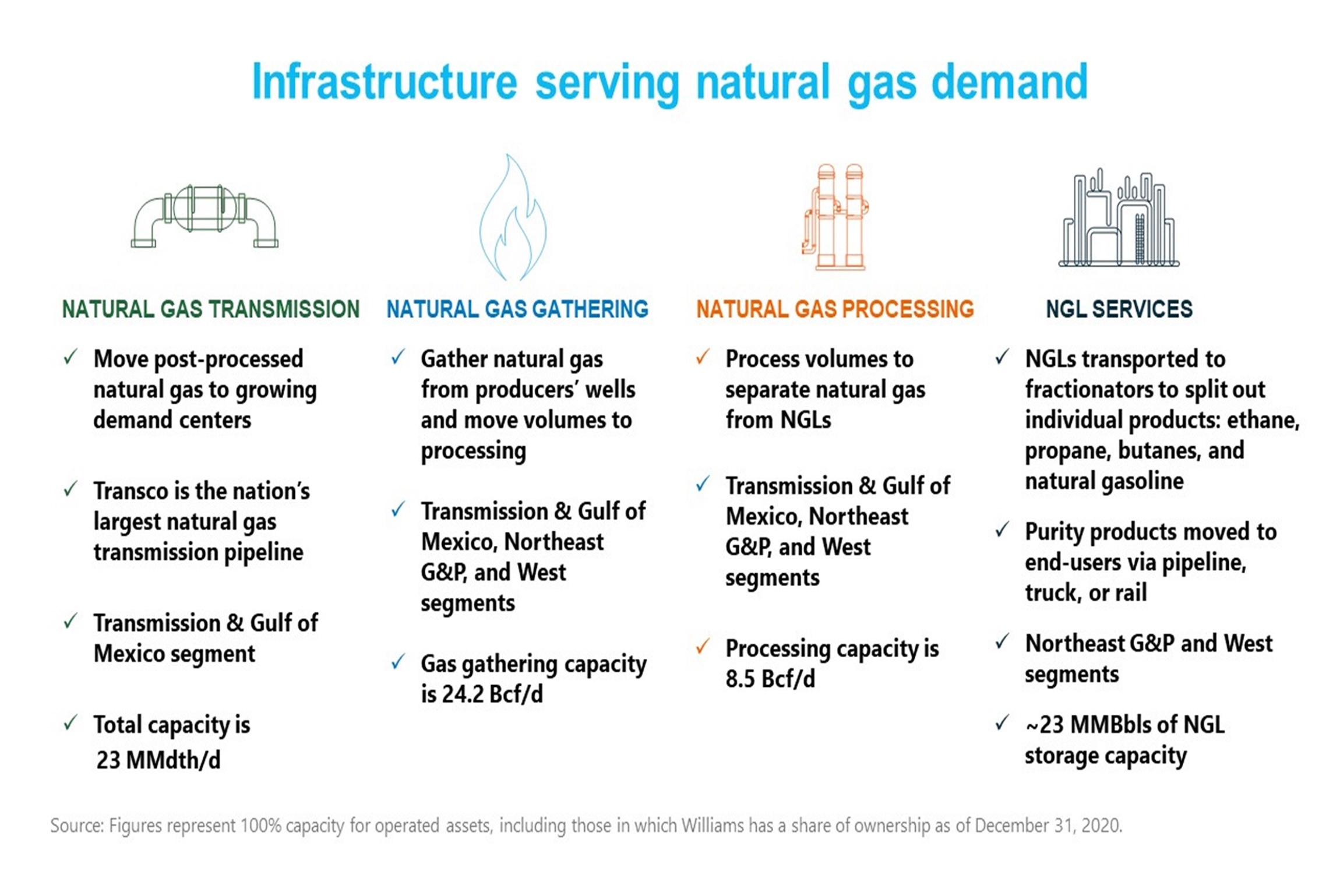
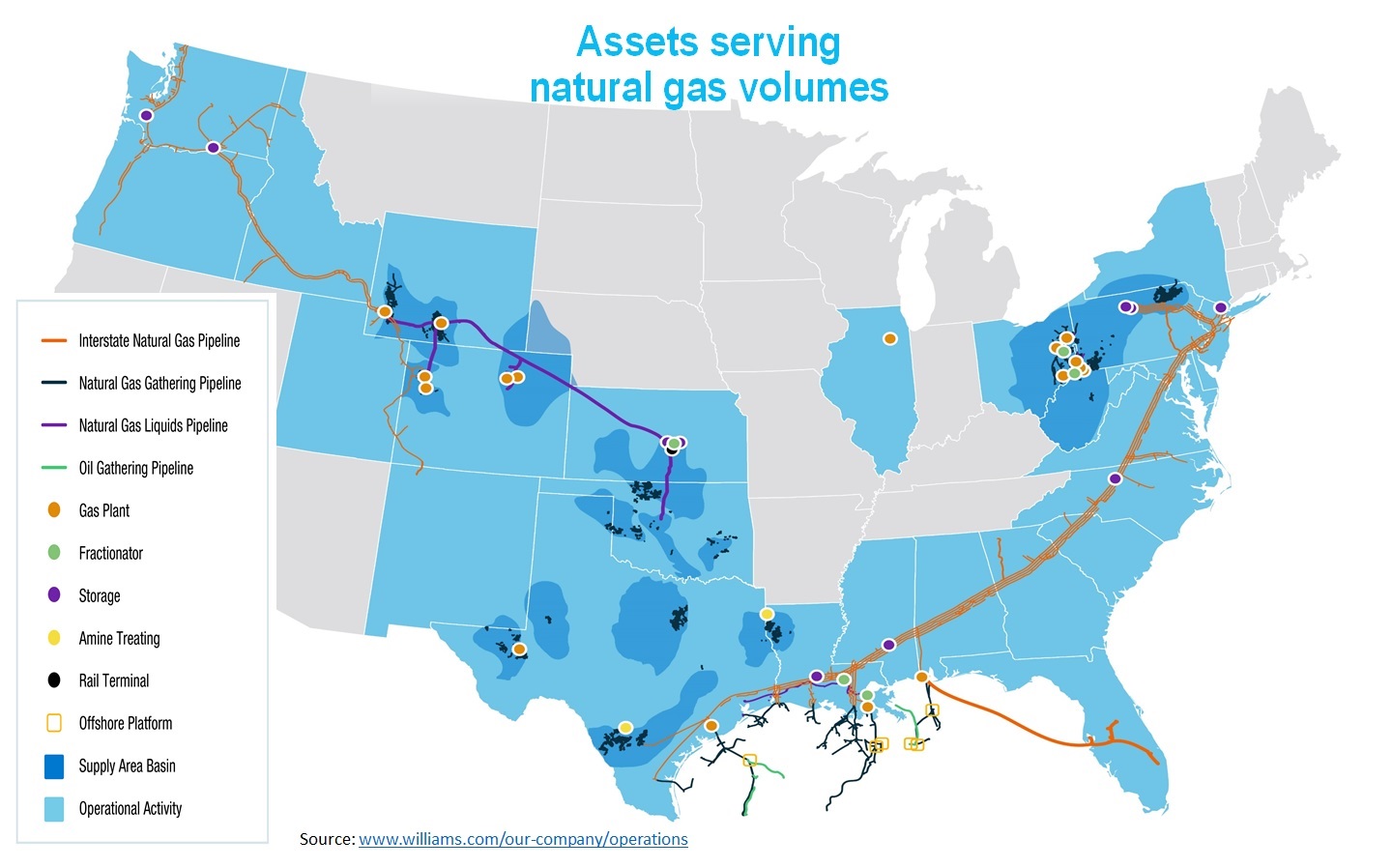
We are an energy infrastructure company committed to be the leader in providing infrastructure that safely delivers natural gas products to reliably fuel the clean energy economy. We have operations in 15 supply areas that provide natural gas gathering, processing, and transmission services and natural gas liquids fractionation, transportation, and storage services to more than 600 customers. We own an interest in and operate over 30,000 miles of pipelines, 34 processing facilities, 9 fractionation facilities, and approximately 23 million barrels of NGL storage capacity, handling approximately 30 percent of the nation’s natural gas volumes.
 |
We were founded in 1908, originally incorporated under the laws of the state of Nevada in 1949 and reincorporated under the laws of the state of Delaware in 1987. Our common stock trades on the New York Stock Exchange under the symbol “WMB.” Our operations are located in the United States. Williams’ headquarters are located in Tulsa, Oklahoma, with other major offices in Salt Lake City, Utah; Houston, Texas; and Pittsburgh, Pennsylvania. Our telephone number is 918-573-2000.
 |
Service Assets, Customers, and Contracts
Interstate Natural Gas Pipeline Assets
Our interstate natural gas pipelines, which are presented in our Transmission & Gulf of Mexico segment as described under the heading “Business Segments,” are subject to regulation by the FERC and as such, our rates and charges for the transportation of natural gas in interstate commerce are subject to regulation. The rates are established through the FERC’s ratemaking process.
Our interstate natural gas pipelines transport and store natural gas for a broad mix of customers, including local natural gas distribution companies, public utilities, municipalities, direct industrial users, electric power generators, and natural gas marketers and producers. Our interstate natural gas transmission businesses are fully contracted under long-term firm reservation contracts with high credit quality customers. These contracts have various expiration dates and account for the major portion of our regulated businesses, and are not exposed to crude oil prices. Additionally, we offer storage services and interruptible transportation services under shorter-term agreements. Transco’s and Northwest Pipeline’s three largest customers in 2020 accounted for approximately 28 percent and 51 percent, respectively, of their total operating revenues.
Gathering, Processing, and Treating Assets
Our gathering, processing, and treating operations are presented within our Transmission & Gulf of Mexico, Northeast G&P, and West reporting segments as described under the heading “Business Segments.”
Our gathering systems receive natural gas from producers’ crude oil and natural gas wells and gather these volumes to gas processing, treating, or redelivery facilities. Typically, natural gas, in its raw form, is not acceptable for transportation in major interstate natural gas pipelines or for commercial use as a fuel. Our treating facilities
remove water vapor, carbon dioxide, and other contaminants, and collect condensate. We are generally paid a fee based on the volume of natural gas gathered and/or treated, generally measured in the Btu heating value.
In addition, natural gas contains various amounts of NGLs, which generally have a higher value when separated from the natural gas stream. Our processing plants extract the NGLs, which include ethane, primarily used in the petrochemical industry; propane, used for heating, fuel, and also in the petrochemical industry; and, normal butane, isobutane, and natural gasoline, primarily used by the refining industry.
Our gas processing services generate revenues primarily from the following types of contracts:
-
Fee-based: We are paid a fee based on the volume of natural gas processed, generally measured in the Btu heating value. A portion of our fee-based processing revenue includes a share of the margins on the NGLs produced. For the year ended December 31, 2020, approximately 80 percent of our NGL production volumes were under fee-based contracts.
-
Noncash commodity-based: We also process gas under two types of commodity-based contracts, keep-whole and percent-of-liquids, where we receive consideration for our services in the form of NGLs. For a keep-whole arrangement we replace the Btu content of the retained NGLs with natural gas purchases, also known as shrink replacement gas. For a percent-of-liquids arrangement, we deliver an agreed-upon percentage of the extracted NGLs and retain the remainder. Retained NGLs are referred to as our equity NGL production. Per-unit NGL margins are calculated based on sales of our own equity volumes at the processing plants. For the year ended December 31, 2020, approximately 20 percent of our NGL production volumes were under noncash commodity-based contracts.
Generally, our gathering and processing agreements are long-term agreements, with terms ranging from month-to-month to the life of the producing lease. Certain contracts include cost of service mechanisms that are designed to support a return on invested capital and allow our gathering rates to be adjusted, subject to specified caps in certain cases, to account for variability in volume, capital expenditures, commodity price fluctuations, compression and other expenses. We also have certain gas gathering and processing agreements with MVC, whereby the customer is obligated to pay a contractually determined fee based on any shortfall between the actual gathered and processed volumes and the MVC for a stated period.
Demand for gas gathering and processing services is dependent on producers’ drilling activities, which is impacted by the strength of the economy, commodity prices, and the resulting demand for natural gas by manufacturing and industrial companies and consumers. Our gathering, processing, and treating businesses do not have direct exposure to crude oil prices. Our on-shore natural gas gathering and processing businesses are substantially focused on gas-directed drilling basins rather than crude oil, with a broad diversity of basins and customers served. Declines in crude oil drilling would be expected to result in less associated natural gas production, which could drive more demand for natural gas produced from gas-directed basins we serve.
During 2020, our facilities gathered and processed gas and crude oil for approximately 230 customers. Our top ten customers accounted for approximately 73 percent of our gathering and processing fee revenues and NGL margins from our noncash commodity-based agreements. We believe counterparty credit concerns in our gathering and processing businesses are significantly mitigated by the physical nature of our services, where we gather at the wellhead and are therefore critical to a producer’s ability to move product to market.
Crude Oil Transportation and Production Handling Assets
Our crude oil transportation operations, which are presented in our Transmission & Gulf of Mexico segment as described under the heading “Business Segments,” earn revenues typically by volumetric-based fee arrangements. Revenue sources have historically included a combination of fixed-fee, volumetric-based fee, and cost reimbursement arrangements. Generally, fixed fees associated with the production at our Gulf Coast production handling
Showing the first 8K of 76K characters. Open the full section
Item 1A. Risk Factors
FORWARD-LOOKING STATEMENTS AND CAUTIONARY STATEMENT
FOR PURPOSES OF THE “SAFE HARBOR” PROVISIONS OF
THE PRIVATE SECURITIES LITIGATION REFORM ACT OF 1995
The reports, filings, and other public announcements of Williams may contain or incorporate by reference statements that do not directly or exclusively relate to historical facts. Such statements are “forward-looking statements” within the meaning of Section 27A of the Securities Act of 1933, as amended (Securities Act) and Section 21E of the Securities Exchange Act of 1934, as amended. These forward-looking statements relate to anticipated financial performance, management’s plans and objectives for future operations, business prospects, outcomes of regulatory proceedings, market conditions, and other matters. We make these forward-looking statements in reliance on the safe harbor protections provided under the Private Securities Litigation Reform Act of 1995.
All statements, other than statements of historical facts, included in this report that address activities, events, or developments that we expect, believe, or anticipate will exist or may occur in the future, are forward-looking statements. Forward-looking statements can be identified by various forms of words such as “anticipates,” “believes,” “seeks,” “could,” “may,” “should,” “continues,” “estimates,” “expects,” “forecasts,” “intends,” “might,” “goals,” “objectives,” “targets,” “planned,” “potential,” “projects,” “scheduled,” “will,” “assumes,” “guidance,” “outlook,” “in-service date,” or other similar expressions. These forward-looking statements are based on management’s beliefs and assumptions and on information currently available to management and include, among others, statements regarding:
-
Levels of dividends to Williams stockholders;
-
Future credit ratings of Williams and its affiliates;
-
Amounts and nature of future capital expenditures;
-
Expansion and growth of our business and operations;
-
Expected in-service dates for capital projects;
-
Financial condition and liquidity;
-
Business strategy;
-
Cash flow from operations or results of operations;
-
Seasonality of certain business components;
-
Natural gas, natural gas liquids, and crude oil prices, supply, and demand;
-
Demand for our services;
-
The impact of the coronavirus (COVID-19) pandemic.
Forward-looking statements are based on numerous assumptions, uncertainties, and risks that could cause future events or results to be materially different from those stated or implied in this report. Many of the factors that will determine these results are beyond our ability to control or predict. Specific factors that could cause actual results to differ from results contemplated by the forward-looking statements include, among others, the following:
-
Availability of supplies, market demand, and volatility of prices;
-
Development and rate of adoption of alternative energy sources;
-
The impact of existing and future laws and regulations, the regulatory environment, environmental liabilities, and litigation, as well as our ability to obtain necessary permits and approvals, and achieve favorable rate proceeding outcomes;
-
Our exposure to the credit risk of our customers and counterparties;
-
Our ability to acquire new businesses and assets and successfully integrate those operations and assets into existing businesses as well as successfully expand our facilities, and to consummate asset sales on acceptable terms;
-
Whether we are able to successfully identify, evaluate, and timely execute our capital projects and investment opportunities;
-
The strength and financial resources of our competitors and the effects of competition;
-
The amount of cash distributions from and capital requirements of our investments and joint ventures in which we participate;
-
Whether we will be able to effectively execute our financing plan;
-
Increasing scrutiny and changing expectations from stakeholders with respect to our environmental, social, and governance practices;
-
The physical and financial risks associated with climate change;
-
The impacts of operational and developmental hazards and unforeseen interruptions;
-
The risks resulting from outbreaks or other public health crises, including COVID-19;
-
Risks associated with weather and natural phenomena, including climate conditions and physical damage to our facilities;
-
Acts of terrorism, cybersecurity incidents, and related disruptions;
-
Our costs and funding obligations for defined benefit pension plans and other postretirement benefit plans;
-
Changes in maintenance and construction costs, as well as our ability to obtain sufficient construction- related inputs, including skilled labor;
-
Inflation, interest rates, and general economic conditions (including future disruptions and volatility in the global credit markets and the impact of these events on customers and suppliers);
-
Risks related to financing, including restrictions stemming from debt agreements, future changes in credit ratings as determined by nationally recognized credit rating agencies, and the availability and cost of capital;
-
The ability of the members of the Organization of Petroleum Exporting Countries (OPEC) and other oil exporting nations to agree to and maintain oil price and production controls and the impact on domestic production;
-
Changes in the current geopolitical situation;
-
Changes in U.S. governmental administration and policies;
-
Whether we are able to pay current and expected levels of dividends;
-
Additional risks described in our filings with the Securities and Exchange Commission.
Given the uncertainties and risk factors that could cause our actual results to differ materially from those contained in any forward-looking statement, we caution investors not to unduly rely on our forward-looking statements. We disclaim any obligations to and do not intend to update the above list or announce publicly the result of any revisions to any of the forward-looking statements to reflect future events or developments.
In addition to causing our actual results to differ, the factors listed above and referred to below may cause our intentions to change from those statements of intention set forth in this report. Such changes in our intentions may also cause our results to differ. We may change our intentions, at any time and without notice, based upon changes in such factors, our assumptions, or otherwise.
Because forward-looking statements involve risks and uncertainties, we caution that there are important factors, in addition to those listed above, that may cause actual results to differ materially from those contained in the forward-looking statements. These factors are described in the following section.
RISK FACTORS
You should carefully consider the following risk factors in addition to the other information in this report. Each of these factors could adversely affect our business, prospects, financial condition, results of operations, cash flows, and, in some cases our reputation. The occurrence of any of such risks could also adversely affect the value of an investment in our securities.
Risks Related to Our Business
The financial condition of our natural gas transportation and midstream businesses is dependent on the continued availability of natural gas supplies in the supply basins that we access and demand for those supplies in the markets we serve.
Our ability to maintain and expand our natural gas transportation and midstream businesses depends on the level of drilling and production by third parties in our supply basins. Production from existing wells and natural gas supply basins with access to our pipeline and gathering systems will naturally decline over time. The amount of natural gas reserves underlying these existing wells may also be less than anticipated, and the rate at which production from these reserves declines may be greater than anticipated. We do n
Showing the first 8K of 67K characters. Open the full section
Item 1B. Unresolved Staff Comments
Not applicable.
Item 2. Properties
Please read “Business” for a description of the location and general character of our principal physical properties. We generally own our facilities, although a substantial portion of our pipeline and gathering facilities is constructed and maintained pursuant to rights-of-way, easements, permits, licenses, or consents on and across properties owned by others.
Item 3. Legal Proceedings
Environmental
Certain reportable legal proceedings involving governmental authorities under federal, state, and local laws regulating the discharge of materials into the environment are described below. While it is not possible for us to predict the final outcome of the proceedings that are still pending, we do not anticipate a material effect on our consolidated financial position if we receive an unfavorable outcome in any one or more of such proceedings. Our threshold for disclosing material environmental legal proceedings involving a governmental authority where potential monetary sanctions are involved is $1 million.
On January 19, 2016, we received a Notice of Noncompliance with certain Leak Detection and Repair (LDAR) regulations under the Clean Air Act at our Moundsville Fractionator Facility from the EPA, Region 3. Subsequently, the EPA alleged similar violations of certain LDAR regulations at our Oak Grove Gas Plant. On March 19, 2018, we received a Notice of Violation of certain LDAR regulations at our former Ignacio Gas Plant from the EPA, Region 8, following an on-site inspection of the facility. On March 20, 2018, we also received a Notice of Violation of certain LDAR regulations at our Parachute Creek Gas Plant from the EPA, Region 8. All such notices were subsequently referred to a common attorney at the Department of Justice (DOJ). We are exploring global resolution of the claims at these facilities, as well as alleged violations at certain other facilities, with the DOJ. Global resolution would include both payment of a civil penalty and an injunctive relief component. We continue to work with the DOJ and the other agencies to resolve these claims, whether individually or globally, and negotiations are ongoing.
Other environmental matters called for by this Item are described under the caption “Environmental Matters” in Note 19 – Contingent Liabilities and Commitments of Notes to Consolidated Financial Statements included under Part II, Item 8 Financial Statements of this report, which information is incorporated by reference into this Item.
Other litigation
The additional information called for by this Item is provided in Note 16 – Stockholders' Equity and Note 19 – Contingent Liabilities and Commitments of Notes to Consolidated Financial Statements included under Part II, Item 8 Financial Statements of this report, which information is incorporated by reference into this Item.
Item 4. Mine Safety Disclosures
Not applicable.
Information About Our Executive Officers
The name, title, age, period of service, and recent business experience of each of our executive officers as of February 24, 2021, are listed below.
| Name and Position | Age | Business Experience in Past Five Years | ||||||||||||||||||
| Alan S. Armstrong | 58 | 2011 to present | Director, Chief Executive Officer, and President, The Williams Companies, Inc. | |||||||||||||||||
| Director, Chief Executive Officer, and President | 2015 to 2018 | Chairman of the Board, WPZ | ||||||||||||||||||
| 2014 to 2018 | Chief Executive Officer, WPZ | |||||||||||||||||||
| 2012 to 2018 | Director of the general partner, WPZ | |||||||||||||||||||
| Walter J. Bennett | 51 | 2020 to present | Senior Vice President Gathering & Processing, The Williams Companies, Inc. | |||||||||||||||||
| Senior Vice President Gathering & Processing | 2015 to 2019 | Senior Vice President – West, The Williams Companies, Inc. | ||||||||||||||||||
| 2013 to 2018 | Senior Vice President – West of the general partner, WPZ | |||||||||||||||||||
| 2017 | Director of the general partner, WPZ | |||||||||||||||||||
| John D. Chandler | 51 | 2017 to present | Senior Vice President and Chief Financial Officer, The Williams Companies, Inc. | |||||||||||||||||
| Senior Vice President and Chief Financial Officer | 2017 to 2018 | Director of the general partner, WPZ | ||||||||||||||||||
| Debbie Cowan | 43 | 2018 to present | Senior Vice President and Chief Human Resources Officer, The Williams Companies, Inc. | |||||||||||||||||
| Senior Vice President and Chief Human Resources Officer | 2013 to 2018 | Global Vice President of Human Resources, Koch Chemical Technology Group, LLC | ||||||||||||||||||
| Micheal G. Dunn | 55 | 2017 to present | Executive Vice President and Chief Operating Officer, The Williams Companies, Inc. | |||||||||||||||||
| Executive Vice President and Chief Operating Officer | 2017 to 2018 | Director of the general partner, WPZ | ||||||||||||||||||
| 2015 to 2016 | President / Executive Vice President, Questar Pipeline / Questar Corporation | |||||||||||||||||||
| Scott A. Hallam | 44 | 2020 to present | Senior Vice President Transmission & Gulf of Mexico, The Williams Companies, Inc. | |||||||||||||||||
| Senior Vice President Transmission & Gulf of Mexico | 2019 | Senior Vice President – Atlantic-Gulf, The Williams Companies, Inc. | ||||||||||||||||||
| 2017 to 2019 | Vice President GM Atlantic-Gulf, The Williams Companies, Inc. | |||||||||||||||||||
| 2015 to 2017 | Vice President Northeast OA, The Williams Companies, Inc. | |||||||||||||||||||
| John D. Porter | 51 | 2020 to present | Vice President, Chief Accounting Officer, Controller and Financial Planning & Analysis, The Williams Companies, Inc. | |||||||||||||||||
| Vice President, Chief Accounting Officer, Controller and Financial Planning & Analysis | 2017 to 2019 | Vice President Enterprise Financial Planning & Analysis and Investor Relations, The Williams Companies | ||||||||||||||||||
| 2013 to 2017 | Director of Investor Relations & Enterprise Planning | |||||||||||||||||||
| Name and Position | Age | Business Experience in Past Five Years | ||||||||||||||||||
| Chad A. Teply | 49 | 2020 to present | Senior Vice President – Project Execution, The Williams Companies, Inc. | |||||||||||||||||
| Senior Vice President – Project Execution | 2017 to 2020 | Senior Vice President – Business Policy and Development, PacifiCorp | ||||||||||||||||||
| 2009 to 2017 | Vice President – Resource Development and Construction, PacifiCorp | |||||||||||||||||||
| T. Lane Wilson | 54 | 2017 to present | Senior Vice President and General Counsel, The Williams Companies, Inc. | |||||||||||||||||
| Senior Vice President and General Counsel | 2009 to 2017 | United States Magistrate Judge for the Northern District of Oklahoma | ||||||||||||||||||
| Chad J. Zamarin | 44 | 2017 to present | Senior Vice President – Corporate Strategic Development, The Williams Companies, Inc. | |||||||||||||||||
| Senior Vice President – Corporate Strategic Development | 2017 to 2018 | Director of the general partner, WPZ | ||||||||||||||||||
| 2014 to 2017 | President – Pipeline and Midstream, Cheniere Energy |
PART II
Item 5. Market for Registrant’s Common Equity, Related Stockholder Matters and Issuer Purchases of Equity Securities
Our common stock is listed on the New York Stock Exchange under the symbol “WMB.” At the close of business on February 19, 2021, we had 6,353 holders of record of our common stock.
Performance Graph
Set forth below is a line graph comparing our cumulative total stockholder return on our common stock (assuming reinvestment of dividends) with the cumulative total return of the S&P 500 Stock Index, the Bloomberg Americas Pipelines Index, and the Arca Natural Gas Index for the period of five fiscal years commencing January 1, 2016. The Bloomberg Americas Pipelines Index is composed of Enbridge Inc., TC Energy Corporation, Kinder Morgan, Inc., ONEOK, Inc., Cheniere Energy, Inc., Pembina Pipeline Corporation, New Fortress Energy Inc., Inter Pipeline Ltd., Hess Midstream LP, and Williams. The Arca Natural Gas Index is comprised of over 20 highly capitalized companies in the natural gas industry involved primarily in natural gas exploration and production and natural gas pipeline transportation and transmission. The graph below assumes an investment of $100 at the beginning of the period.
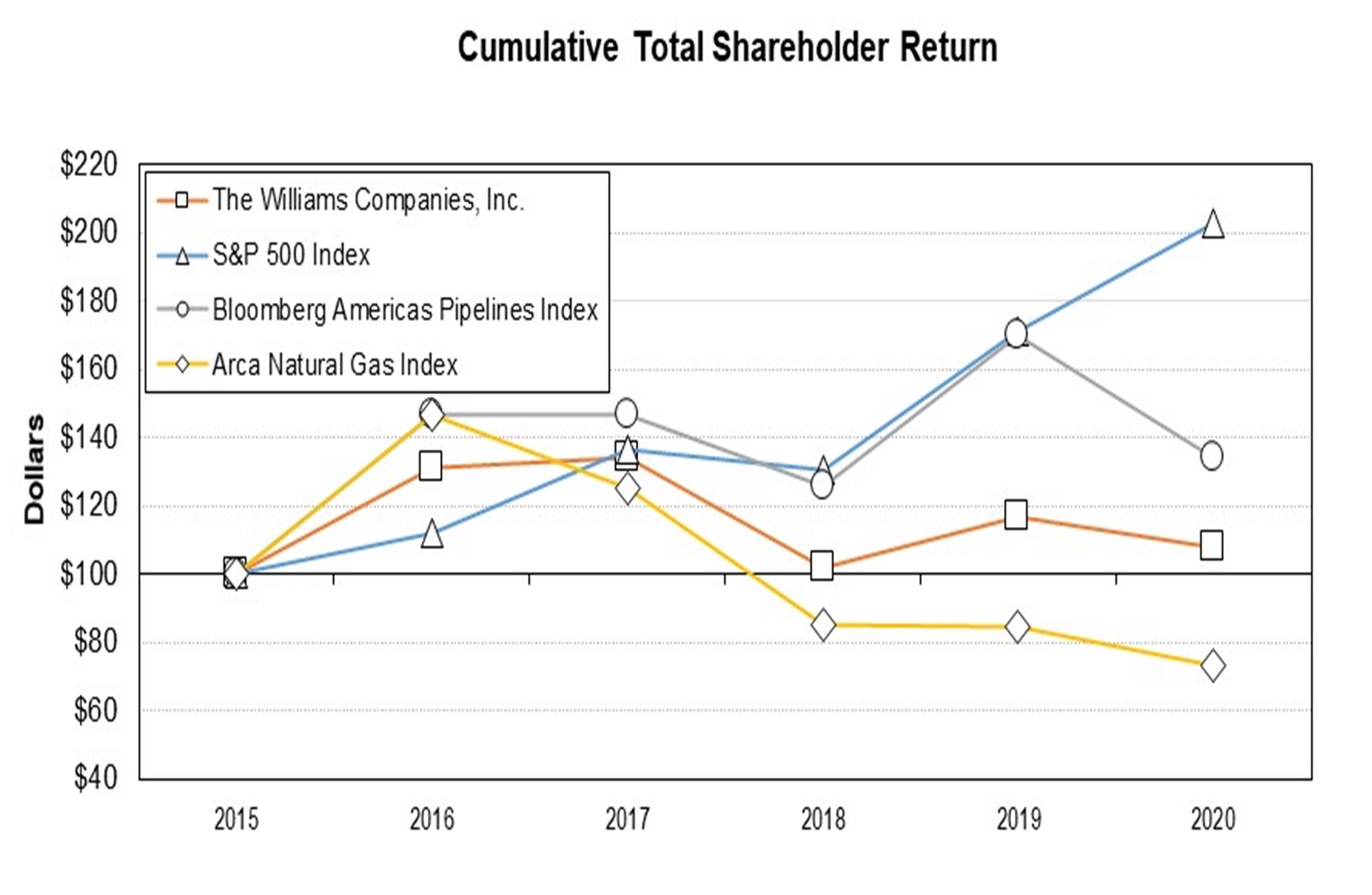
| 2015 | 2016 | 2017 | 2018 | 2019 | 2020 | ||||||||||||||||||||||||||||||
| The Williams Companies, Inc. | 100.0 | 131.4 | 134.1 | 102.0 | 116.6 | 107.7 | |||||||||||||||||||||||||||||
| S&P 500 Index | 100.0 | 112.0 | 136.4 | 130.4 | 171.4 | 203.0 | |||||||||||||||||||||||||||||
| Bloomberg Americas Pipelines Index | 100.0 | 146.8 | 146.4 | 125.6 | 169.8 | 134.4 | |||||||||||||||||||||||||||||
| Arca Natural Gas Index | 100.0 | 146.6 | 125.1 | 85.4 | 84.4 | 73.0 |
Item 7. Management’s Discussion and Analysis of Financial Condition and Results of Operations
General
We are an energy infrastructure company focused on connecting North America’s significant hydrocarbon resource plays to growing markets for natural gas and NGLs through our gas pipeline and midstream business. Our operations are located in the United States.
Our interstate natural gas pipeline strategy is to create value by maximizing the utilization of our pipeline capacity by providing high quality, low cost transportation of natural gas to large and growing markets. Our gas pipeline businesses’ interstate transmission and storage activities are subject to regulation by the FERC and as such, our rates and charges for the transportation of natural gas in interstate commerce, and the extension, expansion or abandonment of jurisdictional facilities and accounting, among other things, are subject to regulation. Rates are established in accordance with the FERC’s ratemaking process. Changes in commodity prices and volumes transported have limited near-term impact on these revenues because the majority of cost of service is recovered through firm capacity reservation charges in transportation rates.
The ongoing strategy of our midstream operations is to safely and reliably operate large-scale midstream infrastructure where our assets can be fully utilized and drive low per-unit costs. We focus on consistently attracting new business by providing highly reliable service to our customers. These services include natural gas gathering, processing, treating, and compression, NGL fractionation and transportation, crude oil production handling and transportation, marketing services for NGL, crude oil and natural gas, as well as storage facilities.
Consistent with the manner in which our chief operating decision maker evaluates performance and allocates resources, our operations are conducted, managed, and presented within the following reportable segments: Transmission & Gulf of Mexico, Northeast G&P, and West. All remaining business activities as well as corporate activities are included in Other. Our reportable segments are comprised of the following businesses:
-
Transmission & Gulf of Mexico is comprised of our interstate natural gas pipelines, Transco and Northwest Pipeline, as well as natural gas gathering and processing and crude oil production handling and transportation assets in the Gulf Coast region, including a 51 percent interest in Gulfstar One (a consolidated variable interest entity), which is a proprietary floating production system, a 50 percent equity-method investment in Gulfstream, and a 60 percent equity-method investment in Discovery.
-
Northeast G&P is comprised of our midstream gathering, processing, and fractionation businesses in the Marcellus Shale region primarily in Pennsylvania and New York, and the Utica Shale region of eastern Ohio, as well as a 65 percent interest in our Northeast JV (a consolidated variable interest entity) which operates in West Virginia, Ohio, and Pennsylvania, a 66 percent interest in Cardinal (a consolidated variable interest entity) which operates in Ohio, a 69 percent equity-method investment in Laurel Mountain, a 99 percent interest in Caiman II (a former equity-method investment which is a consolidated entity following our November 2020 acquisition of an additional ownership interest) which owns a 50 percent equity-method investment in Blue Racer, and Appalachia Midstream Investments, a wholly owned subsidiary that owns equity-method investments with an approximate average 66 percent interest in multiple gas gathering systems in the Marcellus Shale region.
-
West is comprised of our gas gathering, processing, and treating operations in the Rocky Mountain region of Colorado and Wyoming, the Barnett Shale region of north-central Texas, the Eagle Ford Shale region of south Texas, the Haynesville Shale region of northwest Louisiana, and the Mid-Continent region which includes the Anadarko, Arkoma, and Permian basins. This segment also includes our NGL and natural gas marketing business, storage facilities, an undivided 50 percent interest in an NGL fractionator near Conway, Kansas, a 50 percent equity-method investment in OPPL, a 50 percent equity-method investment in RMM, a 20 percent equity-method investment in Targa Train 7, and a 15 percent interest in Brazos Permian II, LLC (Brazos Permian II).
-
Other includes certain previously owned operations, minor business activities that are not reportable segments, as well as corporate operations.
Unless indicated otherwise, the following discussion and analysis of results of operations and financial condition and liquidity relates to our current continuing operations and should be read in conjunction with the consolidated financial statements and notes thereto included in Part II, Item 8 of this report.
Dividends
In December 2020, we paid a regular quarterly dividend of $0.40 per share. On January 26, 2021, our board of directors approved a regular quarterly dividend of $0.41 per share payable on March 29, 2021.
Overview
Net income (loss) attributable to The Williams Companies, Inc., for the year ended December 31, 2020, decreased $639 million compared to the year ended December 31, 2019, reflecting:
- An $860 million increase in Impairment of equity-method investments;
*•*A $187 million Impairment of goodwill in 2020;
- A $123 million unfavorable change in Net income (loss) attributable to noncontrolling interests primarily driven by a reduced share of certain impairment charges attributable to noncontrolling interests;
*•*The absence of a $122 million gain recognized on the sale of our interest in an equity-method investment in 2019;
*•*A $76 million unfavorable change in Other income (expense) – net.
These unfavorable changes were partially offset by:
*•*A $282 million decrease in Impairment of certain assets;
-
A $234 million favorable change in Operating and maintenance expenses and Selling, general, and administrative expenses, driven by lower employee-related expenses, including the absence of 2019 severance and related costs and the associated reduced costs in 2020 as well as the benefit of a change in an employee benefit policy;
-
A $256 million favorable change in Provision (benefit) for income taxes.
Acquisition of Caiman II (Blue Racer)
As of December 31, 2019, we effectively owned a 29 percent indirect interest in Blue Racer through our 58 percent interest in Caiman II, whose primary asset is a 50 percent interest in Blue Racer. On November 18, 2020, we paid $157 million, net of cash acquired, to acquire an additional 41 percent ownership interest in Caiman II. We now control and consolidate Caiman II, reporting the 50 percent interest in Blue Racer as an equity-method investment.
Expansion Project Updates
Significant expansion project updates for the period, including projects placed into service are described below. Ongoing major expansion projects are discussed later in Company Outlook.
Transmission & Gulf of Mexico
Hillabee
In February 2016, the FERC issued a certificate order for the initial phases of Transco’s Hillabee Expansion Project. The project involves an expansion of Transco’s existing natural gas transmission system from Station 85 in west central Alabama to an interconnection with the Sabal Trail pipeline in east central Alabama. The project is being constructed in phases, and all of the project expansion capacity is dedicated to Sabal Trail pursuant to a capacity lease agreement. Phase I was completed in 2017 and it increased capacity by
818 Mdth/d. We placed Phase II into service on May 1, 2020. Together, the first two phases of the project increased capacity by 1,025 Mdth/d.
Southeastern Trail
In October 2019, we received approval from the FERC to expand Transco’s existing natural gas transmission system to provide incremental firm transportation capacity from the Pleasant Valley interconnect with Dominion’s Cove Point Pipeline in Virginia to the S
Showing the first 8K of 97K characters. Open the full section
Item 7A. Quantitative and Qualitative Disclosures About Market Risk
Interest Rate Risk
Our current interest rate risk exposure is related primarily to our debt portfolio. Our debt portfolio is primarily comprised of fixed rate debt, which mitigates the impact of fluctuations in interest rates. Any borrowings under our credit facility and any issuances under our commercial paper program could be at a variable interest rate and could expose us to the risk of increasing interest rates. The maturity of our long-term debt portfolio is partially influenced by the expected lives of our operating assets. (See Note 14 – Debt and Banking Arrangements of Notes to Consolidated Financial Statements.)
The tables below provide information by maturity date about our interest rate risk-sensitive instruments as of December 31, 2020 and 2019. See Note 18 – Fair Value Measurements, Guarantees, and Concentration of Credit Risk of Notes to Consolidated Financial Statements for the methods used in determining the fair value of our long-term debt.
| 2021 | 2022 | 2023 | 2024 | 2025 | Thereafter (1) | Total | Fair Value December 31, 2020 | |||||||||||||||||||||||||||||||||||||||||||
| (Millions) | ||||||||||||||||||||||||||||||||||||||||||||||||||
| Long-term debt, including current portion: | ||||||||||||||||||||||||||||||||||||||||||||||||||
| Fixed rate | $ | 894 | $ | 2,025 | $ | 1,477 | $ | 2,280 | $ | 1,617 | $ | 14,051 | $ | 22,344 | $ | 27,043 | ||||||||||||||||||||||||||||||||||
| Weighted-average interest rate | 5.0 | % | 5.1 | % | 5.2 | % | 5.3 | % | 5.4 | % | 5.4 | % | ||||||||||||||||||||||||||||||||||||||
| 2020 | 2021 | 2022 | 2023 | 2024 | Thereafter (1) | Total | Fair Value December 31, 2019 | |||||||||||||||||||||||||||||||||||||||||||
| (Millions) | ||||||||||||||||||||||||||||||||||||||||||||||||||
| Long-term debt, including current portion: | ||||||||||||||||||||||||||||||||||||||||||||||||||
| Fixed rate | $ | 2,141 | $ | 893 | $ | 2,025 | $ | 1,477 | $ | 2,279 | $ | 13,473 | $ | 22,288 | $ | 25,319 | ||||||||||||||||||||||||||||||||||
| Weighted-average interest rate | 5.2 | % | 5.2 | % | 5.3 | % | 5.4 | % | 5.6 | % | 5.6 | % | ||||||||||||||||||||||||||||||||||||||
(1) Includes unamortized discount / premium and debt issuance costs.
Commodity Price Risk
We are exposed to the impact of fluctuations in the market price of NGLs and natural gas, as well as other market factors, such as market volatility and energy commodity price correlations. We are exposed to these risks in connection with our owned energy-related assets, our long-term energy-related contracts, and limited proprietary trading activities. Our management of the risks associated with these market fluctuations includes maintaining sufficient liquidity, as well as using various derivatives and nonderivative energy-related contracts. The fair value of derivative contracts is subject to many factors, including changes in energy commodity market prices, the liquidity and volatility of the markets in which the contracts are transacted, and changes in interest rates. At December 31, 2020 and 2019, our derivative activity was not material.
Item 8. Financial Statements and Supplementary Data
Report of Independent Registered Public Accounting Firm
The Stockholders and the Board of Directors of
The Williams Companies, Inc.
Opinion on the Financial Statements
We have audited the accompanying consolidated balance sheet of The Williams Companies, Inc. (the Company) as of December 31, 2020 and 2019, the related consolidated statements of operations, comprehensive income (loss), changes in equity and cash flows for each of the three years in the period ended December 31, 2020, and the related notes and the financial statement schedule listed in the index at Item 15(a) (collectively referred to as the “consolidated financial statements”). In our opinion, based on our audits and the report of other auditors, the consolidated financial statements present fairly, in all material respects, the consolidated financial position of the Company at December 31, 2020 and 2019, and the consolidated results of its operations and its cash flows for each of the three years in the period ended December 31, 2020, in conformity with U.S. generally accepted accounting principles.
We did not audit the financial statements of Gulfstream Natural Gas System, L.L.C. (Gulfstream), a limited liability corporation in which the Company has a 50 percent interest. In the consolidated financial statements, the Company’s investment in Gulfstream was $204 million and $217 million as of December 31, 2020 and 2019, respectively, and the Company’s equity earnings in the net income of Gulfstream were $77 million in 2020, $74 million in 2019 and $75 million in 2018. Gulfstream’s financial statements were audited by other auditors whose report has been furnished to us, and our opinion, insofar as it relates to the amounts included for Gulfstream, is based solely on the report of other auditors.
We also have audited, in accordance with the standards of the Public Company Accounting Oversight Board (United States) (PCAOB), the Company's internal control over financial reporting as of December 31, 2020, based on criteria established in Internal Control-Integrated Framework issued by the Committee of Sponsoring Organizations of the Treadway Commission (2013 framework) and our report dated February 24, 2021 expressed an unqualified opinion thereon.
Basis for Opinion
These consolidated financial statements are the responsibility of the Company's management. Our responsibility is to express an opinion on the Company’s consolidated financial statements based on our audits. We are a public accounting firm registered with the PCAOB and are required to be independent with respect to the Company in accordance with the U.S. federal securities laws and the applicable rules and regulations of the Securities and Exchange Commission and the PCAOB.
We conducted our audits in accordance with the standards of the PCAOB. Those standards require that we plan and perform the audit to obtain reasonable assurance about whether the consolidated financial statements are free of material misstatement, whether due to error or fraud. Our audits included performing procedures to assess the risks of material misstatement of the consolidated financial statements, whether due to error or fraud, and performing procedures that respond to those risks. Such procedures included examining, on a test basis, evidence regarding the amounts and disclosures in the consolidated financial statements. Our audits also included evaluating the accounting principles used and significant estimates made by management, as well as evaluating the overall presentation of the consolidated financial statements. We believe that our audits and the report of other auditors provide a reasonable basis for our opinion.
| Critical Audit Matters | ||||||||||||||
| The critical audit matters communicated below are matters arising from the current period audit of the financial statements that were communicated or required to be communicated to the audit committee and that (1) relate to accounts or disclosures that are material to the financial statements and (2) involved our especially challenging, subjective or complex judgments. The communication of critical audit matters does not alter in any way our opinion on the consolidated financial statements, taken as a whole, and we are not, by communicating the critical audit matters below, providing separate opinions on the critical audit matters or on the accounts or disclosures to which they relate. | ||||||||||||||
| Pension and Other Postretirement Benefit Obligations | ||||||||||||||
| Description of the Matter | At December 31, 2020, the Company’s aggregate pension and other postretirement benefit obligations were $1,403 million and were exceeded by the fair value of pension and other postretirement plan assets of $1,635 million, resulting in overfunded pension and other postretirement benefit obligations of $232 million. As explained in Note 10 to the consolidated financial statements, the Company utilized key assumptions to determine the pension and other postretirement benefit obligations. Auditing the pension and other postretirement benefit obligations is complex and required the involvement of specialists due to the judgmental nature of the actuarial assumptions (e.g., discount rates and cash balance interest crediting rate) used in the measurement process. These assumptions have a significant effect on the projected benefit obligations. | |||||||||||||
| How We Addressed the Matter in Our Audit | We obtained an understanding, evaluated the design, and tested the operating effectiveness of controls relating to the measurement and valuation of the pension and other postretirement benefit obligations, including controls over management’s review of the pension and other postretirement obligations, the significant actuarial assumptions, and the data inputs. To test the pension and other postretirement benefit obligations, our audit procedures included, among others, evaluating the methodologies used, the significant actuarial assumptions discussed above, and the underlying data used by the Company. We compared the actuarial assumptions used by management to historical trends and evaluated the changes in the funded status from prior year. In addition, we involved our actuarial specialists to assist with our procedures. For example, we evaluated management’s methodology for determining the discount rates that reflect the maturity and duration of the benefit payments and are used to measure the pension and other postretirement benefit obligations. As part of this assessment, we independently developed a range of yield curves, we compared the projected cash flows to prior year, and compared the current year benefits paid to the prior year projected cash flows. To test the cash balance interest crediting rate, we independently calculated a range of rates and compared them to the rate used by management. We also tested the completeness and accuracy of the underlying data, including the participant data. |
| Impairment Review of Equity-Method Investments | ||||||||||||||
| Description of the Matter | As discussed in Note 7 to the consolidated financial statements, the Company has investments in nonconsolidated entities accounted for using the equity-method, totaling $5,159 million as of December 31, 2020, and recorded impairments of equity-method investments of $1,046 million during 2020. The carrying value of each equity-method investment is evaluated for impairment when events or changes in circu |
Showing the first 8K of 305K characters. Open the full section
Item 9. Changes in and Disagreements with Accountants on Accounting and Financial Disclosure
None.
Item 9A. Controls and Procedures
Disclosure Controls and Procedures
Our management, including our Chief Executive Officer and Chief Financial Officer, does not expect that our disclosure controls and procedures (as defined in Rules 13a - 15(e) and 15d - 15(e) of the Securities Exchange Act) (Disclosure Controls) will prevent all errors and all fraud. A control system, no matter how well conceived and operated, can provide only reasonable, not absolute, assurance that the objectives of the control system are met. Further, the design of a control system must reflect the fact that there are resource constraints, and the benefits of controls must be considered relative to their costs. Because of the inherent limitations in all control systems, no evaluation of controls can provide absolute assurance that all control issues and instances of fraud, if any, within the company have been detected. These inherent limitations include the realities that judgments in decision-making can be faulty, and that breakdowns can occur because of simple error or mistake. Additionally, controls can be circumvented by the individual acts of some persons, by collusion of two or more people, or by management override of the control. The design of any system of controls also is based in part upon certain assumptions about the likelihood of future events, and there can be no assurance that any design will succeed in achieving its stated goals under all potential future conditions. Because of the inherent limitations in a cost-effective control system, misstatements due to error or fraud may occur and not be detected. We monitor our Disclosure Controls and make modifications as necessary; our intent in this regard is that the Disclosure Controls will be modified as systems change and conditions warrant.
Evaluation of Disclosure Controls and Procedures
An evaluation of the effectiveness of the design and operation of our Disclosure Controls was performed as of the end of the period covered by this report. This evaluation was performed under the supervision and with the participation of our management, including our Chief Executive Officer and Chief Financial Officer. Based upon that evaluation, our Chief Executive Officer and Chief Financial Officer concluded that these Disclosure Controls are effective at a reasonable assurance level.
Changes in Internal Control Over Financial Reporting
There have been no changes during the fourth quarter of 2020 that have materially affected, or are reasonably likely to materially affect, our Internal Control over Financial Reporting.
Management’s Annual Report on Internal Control over Financial Reporting
Management is responsible for establishing and maintaining adequate internal control over financial reporting (as defined in Rules 13a - 15(f) and 15d - 15(f) under the Securities Exchange Act of 1934). Our internal control over financial reporting is designed to provide reasonable assurance to our management and board of directors regarding the preparation and fair presentation of financial statements in accordance with accounting principles generally accepted in the United States. Our internal control over financial reporting includes those policies and procedures that (i) pertain to the maintenance of records that, in reasonable detail, accurately and fairly reflect the transactions and dispositions of our assets; (ii) provide reasonable assurance that transactions are recorded as to permit preparation of financial statements in accordance with generally accepted accounting principles, and that our receipts and expenditures are being made only in accordance with authorization of our management and board of directors; and (iii) provide reasonable assurance regarding prevention or timely detection of unauthorized acquisition, use or disposition of our assets that could have a material effect on our financial statements.
All internal control systems, no matter how well designed, have inherent limitations including the possibility of human error and the circumvention or overriding of controls. Therefore, even those systems determined to be effective can provide only reasonable assurance with respect to financial statement preparation and presentation.
Under the supervision and with the participation of our management, including our Chief Executive Officer and Chief Financial Officer, we assessed the effectiveness of our internal control over financial reporting as of December 31, 2020, based on the criteria set forth by the Committee of Sponsoring Organizations of the Treadway Commission (COSO) in Internal Control — Integrated Framework (2013). Based on our assessment, we concluded that, as of December 31, 2020, our internal control over financial reporting was effective.
Ernst & Young LLP, our independent registered public accounting firm, has audited our internal control over financial reporting, as stated in their report which is included in this Annual Report on Form 10-K.
Report of Independent Registered Public Accounting Firm
The Stockholders and the Board of Directors of
The Williams Companies, Inc.
Opinion on Internal Control Over Financial Reporting
We have audited The Williams Companies, Inc.’s internal control over financial reporting as of December 31, 2020, based on criteria established in Internal Control-Integrated Framework issued by the Committee of Sponsoring Organizations of the Treadway Commission (2013 framework) (the COSO criteria). In our opinion, The Williams Companies, Inc. (the Company) maintained, in all material respects, effective internal control over financial reporting as of December 31, 2020, based on the COSO criteria.
We also have audited, in accordance with the standards of the Public Company Accounting Oversight Board (United States) (PCAOB), the consolidated balance sheet of the Company as of December 31, 2020 and 2019, the related consolidated statements of operations, comprehensive income (loss), changes in equity and cash flows for each of the three years in the period ended December 31, 2020, and the related notes and the financial statement schedule listed in the index at Item 15(a) and our report dated February 24, 2021, expressed an unqualified opinion thereon.
Basis for Opinion
The Company’s management is responsible for maintaining effective internal control over financial reporting and for its assessment of the effectiveness of internal control over financial reporting included in the accompanying Management’s Annual Report on Internal Control over Financial Reporting. Our responsibility is to express an opinion on the Company’s internal control over financial reporting based on our audit. We are a public accounting firm registered with the PCAOB and are required to be independent with respect to the Company in accordance with the U.S. federal securities laws and the applicable rules and regulations of the Securities and Exchange Commission and the PCAOB.
We conducted our audit in accordance with the standards of the PCAOB. Those standards require that we plan and perform the audit to obtain reasonable assurance about whether effective internal control over financial reporting was maintained in all material respects.
Our audit included obtaining an understanding of internal control over financial reporting, assessing the risk that a material weakness exists, testing and evaluating the design and operating effectiveness of internal control based on the assessed risk, and performing such other procedures as we considered necessary in the circumstances. We believe that our audit provides a reasonable basis for our opinion.
Definition and Limitations of Internal Control Over Financial Reporting
A company’s internal control over financial reporting is a process designed to provide reasonable assurance regarding the reliability of financial reporting and the preparation of financial statements for external purposes in accordance with generally accepted accounting principles. A company’s internal control over financial reporting includes those policies and procedures that (1) pertain to the maintenance of records that, in reasonable detail, accurately and fairly reflect the transactions and dispositions of the assets of the company; (2) provide reasonable assurance that transactions are recorded as necessary to permit preparation of financial statements in accordance with generally accepted accounting principles, and that receipts and expenditures of the company are being made only in accordance with authorizations of management and directors of the company; and (3) provide reasonable assurance regarding prevention or timely detection of unauthorized acquisition, use, or disposition of the company’s assets that could have a material effect on the financial statements.
Because of its inherent limitations, internal control over financial reporting may not prevent or detect misstatements. Also, projections of any evaluation of effectiveness to future periods are subject to the risk that controls may become inadequate because of changes in conditions, or that the degree of compliance with the policies or procedures may deteriorate.
/s/ Ernst & Young LLP
Tulsa, Oklahoma
February 24, 2021
Item 9B. Other Information
None.
PART III
Item 10. Directors, Executive Officers and Corporate Governance
The information regarding our directors and nominees for director required by Item 401 of Regulation S-K will be presented under the heading “Election of Directors” in our definitive proxy statement prepared for the solicitation of proxies in connection with our Annual Meeting of Stockholders to be held April 27, 2021, which shall be filed no later than March 18, 2021 (Proxy Statement), which information is incorporated by reference herein.
Information regarding our executive officers required by Item 401 of Regulation S-K is presented at the end of Part I herein and captioned “Information About Our Executive Officers,” as permitted by General Instruction G(3) and the Instruction to Item 401 of Regulation S-K.
Information required by paragraphs (c)(3), (d)(4) and (d)(5) of Item 407 of Regulation S-K will be included under the heading “Questions and Answers About the Annual Meeting and Voting” and “Corporate Governance and Board Matters” in our Proxy Statement, which information is incorporated by reference herein.
Our Code of Business Conduct, together with our Corporate Governance Guidelines, the charters for each of our board committees, and our Code of Business Conduct applicable to all employees, including our Chief Executive Officer, Chief Financial Officer, and Chief Accounting Officer, or persons performing similar functions, are available on our Internet website at www.williams.com. We will provide, free of charge, a copy of our Code of Business Conduct or any of our other corporate documents listed above upon written request to our Corporate Secretary at Williams, One Williams Center, Suite 4700, Tulsa, Oklahoma 74172. We intend to disclose any amendments to or waivers, in each case, of the Code of Business Conduct on behalf of our Chief Executive Officer, Chief Financial Officer, Chief Accounting Officer, and persons performing similar functions on the corporate governance section of our Internet website at www.williams.com, promptly following the date of any such amendment or waiver.
Item 11. Executive Compensation
The information required by Item 402 and paragraphs (e)(4) and (e)(5) of Item 407 of Regulation S-K regarding executive compensation will be presented under the headings “Compensation Discussion and Analysis,” “Executive Compensation and Other Information,” “Compensation of Directors,” “Compensation and Management Development Committee Report on Executive Compensation,” and “Compensation and Management Development Committee Interlocks and Insider Participation” in our Proxy Statement, which information is incorporated by reference herein. Notwithstanding the foregoing, the information provided under the heading “Compensation and Management Development Committee Report on Executive Compensation” in our Proxy Statement is furnished and shall not be deemed to be filed for purposes of Section 18 of the Securities Exchange Act of 1934, as amended, is not subject to the liabilities of that section and is not deemed incorporated by reference in any filing under the Securities Act of 1933, as amended.
Item 12. Security Ownership of Certain Beneficial Owners and Management and Related Stockholder Matters
The information regarding securities authorized for issuance under equity compensation plans required by Item 201(d) of Regulation S-K and the security ownership of certain beneficial owners and management required by Item 403 of Regulation S-K will be presented under the headings “Equity Compensation Stock Plans” and “Security Ownership of Certain Beneficial Owners and Management” in our Proxy Statement, which information is incorporated by reference herein.
Item 13. Certain Relationships and Related Transactions, and Director Independence
The information regarding certain relationships and related transactions required by Item 404 and Item 407(a) of Regulation S-K will be presented under the heading “Corporate Governance and Board Matters” in our Proxy Statement, which information is incorporated by reference herein.
Item 14. Principal Accountant Fees and Services
The information regarding our principal accounting fees and services required by Item 9(e) of Schedule 14A will be presented under the heading “Principal Accountant Fees and Services” in our Proxy Statement, which information is incorporated by reference herein.
PART IV
Item 15. Exhibits and Financial Statement Schedules
(a) 1 and 2.
All other schedules have been omitted since the required information is not present or is not present in amounts sufficient to require submission of the schedule, or because the information required is included in the financial statements and notes thereto.
(a) 3 and (b). The exhibits listed below are filed as part of this annual report.
INDEX TO EXHIBITS
| Exhibit No. | Description | |||||||
| 101.INS* | — | XBRL Instance Document. The instance document does not appear in the Interactive Data File because its XBRL tags are embedded within the inline XBRL document. | ||||||
| 101.SCH* | — | XBRL Taxonomy Extension Schema. | ||||||
| 101.CAL* | — | XBRL Taxonomy Extension Calculation Linkbase. | ||||||
| 101.DEF* | — | XBRL Taxonomy Extension Definition Linkbase. | ||||||
| 101.LAB* | — | XBRL Taxonomy Extension Label Linkbase. | ||||||
| 101.PRE* | — | XBRL Taxonomy Extension Presentation Linkbase. | ||||||
| 104* | — | Cover Page Interactive Data File. The cover page interactive data file does not appear in the interactive data file because its XBRL tags are embedded within the inline XBRL document (contained in Exhibit 101). |
| ______________ | |||||
| * | Filed herewith | ||||
| ** | Furnished herewith | ||||
| § | Management contract or compensatory plan or arrangement |
Item 16. Form 10-K Summary
Not applicable.
SIGNATURES
Pursuant to the requirements of Section 13 or 15(d) of the Securities Exchange Act of 1934, the registrant has duly caused this report to be signed on its behalf by the undersigned, thereunto duly authorized.
| THE WILLIAMS COMPANIES, INC. (Registrant) | ||||||||
| By: | /s/ JOHN D. PORTER | |||||||
| John D. Porter Vice President, Controller and Chief Accounting Officer |
Date: February 24, 2021
Pursuant to the requirements of the Securities Exchange Act of 1934, this report has been signed below by the following persons on behalf of the registrant and in the capacities and on the dates indicated.
| Signature | Title | Date | ||||||||||||
| /s/ ALAN S. ARMSTRONG | President, Chief Executive Officer and Director | February 24, 2021 | ||||||||||||
| Alan S. Armstrong | (Principal Executive Officer) | |||||||||||||
| /s/ JOHN D. CHANDLER | Senior Vice President and Chief Financial Officer | February 24, 2021 | ||||||||||||
| John D. Chandler | (Principal Financial Officer) | |||||||||||||
| /s/ JOHN D. PORTER | Vice President, Controller and Chief Accounting Officer | February 24, 2021 | ||||||||||||
| John D. Porter | (Principal Accounting Officer) | |||||||||||||
| /s/ STEPHEN W. BERGSTROM | Chairman of the Board | February 24, 2021 | ||||||||||||
| Stephen W. Bergstrom | ||||||||||||||
| /s/ NANCY K. BUESE | Director | February 24, 2021 | ||||||||||||
| Nancy K. Buese | ||||||||||||||
| /s/ STEPHEN I. CHAZEN | Director | February 24, 2021 | ||||||||||||
| Stephen I. Chazen | ||||||||||||||
| /s/ CHARLES I. COGUT | Director | February 24, 2021 | ||||||||||||
| Charles I. Cogut | ||||||||||||||
| /s/ STACEY H. DORÉ | Director | February 24, 2021 | ||||||||||||
| Stacey H. Doré | ||||||||||||||
| /s/ MICHAEL A. CREEL | Director | February 24, 2021 | ||||||||||||
| Michael A. Creel | ||||||||||||||
| /s/ VICKI L. FULLER | Director | February 24, 2021 | ||||||||||||
| Vicki L. Fuller | ||||||||||||||
| /s/ PETER A. RAGAUSS | Director | February 24, 2021 | ||||||||||||
| Peter A. Ragauss | ||||||||||||||
| Signature | Title | Date | ||||||||||||
| /s/ ROSE M. ROBESON | Director | February 24, 2021 | ||||||||||||
| Rose M. Robeson | ||||||||||||||
| /s/ SCOTT D. SHEFFIELD | Director | February 24, 2021 | ||||||||||||
| Scott D. Sheffield | ||||||||||||||
| /s/ MURRAY D. SMITH | Director | February 24, 2021 | ||||||||||||
| Murray D. Smith | ||||||||||||||
| /s/ WILLIAM H. SPENCE | Director | February 24, 2021 | ||||||||||||
| William H. Spence |