 filings.tools
Weyerhaeuser 2017 10-K Annual Report
WY · CIK 106535 · Form 10-K · Fiscal year ended December 31, 2017 · Filed February 16, 2018
Revenue rose 13.1% to $7.20 billion. Operating margin was 15.7%, against 12.9% the year before. Net income was $582 million.
19 sections, 531K characters. Original on sec.gov · ·
Risk FactorsBusinessMD&AFinancial StatementsWhat changed vs 2016
| Measure | Year ended Dec 31, 2017 | Year ended Dec 31, 2016 | Change |
|---|---|---|---|
| Revenue | $7.20B | $6.37B | +13.1% |
| Operating income | $1.13B | $822M | +37.6% |
| Net income | $582M | $1.03B | -43.3% |
| Diluted EPS | $0.77 | $1.39 | -44.6% |
| Free cash flow* | $843M | $284M | +197% |
| Cash and equivalents | $824M | $676M | +21.9% |
| Operating margin* | 15.7% | 12.9% | +2.8 pts |
From the XBRL facts tagged to this filing; both columns are as reported in this filing. * Computed by filings.tools: free cash flow is operating cash flow less capital spending; operating margin is operating income over revenue.
Cover and table of contents
10-K 1 wy-123117x10k.htm 10-K
UNITED STATES
SECURITIES AND EXCHANGE COMMISSION
WASHINGTON, D.C. 20549
FORM 10-K
x ANNUAL REPORT PURSUANT TO SECTION 13 OR 15(D) OF THE SECURITIES EXCHANGE ACT OF 1934
FOR THE FISCAL YEAR ENDED DECEMBER 31, 2017
or
o TRANSITION REPORT PURSUANT TO SECTION 13 OR 15(D) OF THE SECURITIES EXCHANGE ACT OF 1934
FOR THE TRANSITION PERIOD FROM TO
COMMISSION FILE NUMBER 1-4825
WEYERHAEUSER COMPANY
A WASHINGTON CORPORATION
91-0470860
(IRS EMPLOYER IDENTIFICATION NO.)
220 OCCIDENTAL AVENUE SOUTH, SEATTLE, WASHINGTON 98104-7800 TELEPHONE (206) 539-3000
SECURITIES REGISTERED PURSUANT TO SECTION 12(b) OF THE ACT:
| TITLE OF EACH CLASS | NAME OF EACH EXCHANGE ON WHICH REGISTERED: | |
| Common Shares ($1.25 par value) | New York Stock Exchange | |
| Securities registered pursuant to Section 12(g) of the Act: None |
Indicate by check mark if the registrant is a well-known seasoned issuer, as defined in Rule 405 of the Securities Act. x Yes o No
Indicate by check mark if the registrant is not required to file reports pursuant to Section 13 or Section 15(d) of the Act. o Yes x No
Indicate by check mark whether the registrant (1) has filed all reports required to be filed by Section 13 or 15(d) of the Securities Exchange Act of 1934 during the preceding 12 months (or for such shorter period that the registrant was required to file such reports), and (2) has been subject to such filing requirements for the past 90 days. x Yes o No
Indicate by check mark whether the registrant has submitted electronically and posted on its corporate Website, if any, every Interactive Data File required to be submitted and posted pursuant to Rule 405 of Regulation S-T (§ 232.405 of this chapter) during the preceding 12 months (or for such shorter period that the registrant was required to submit and post such files). x Yes o No
Indicate by check mark if disclosure of delinquent filers pursuant to Item 405 of Regulation S-K (§ 229.405 of this chapter) is not contained herein, and will not be contained, to the best of registrant’s knowledge, in definitive proxy or information statements incorporated by reference in Part III of this Form 10-K or any amendment to this Form 10-K. x
Indicate by check mark whether the registrant is a large accelerated filer, an accelerated filer, a non-accelerated filer, smaller reporting company, or an emerging growth company. See the definitions of “large accelerated filer,” “accelerated filer,” “smaller reporting company,” and "emerging growth company" in Rule 12b-2 of the Exchange Act.
Large accelerated filer x Accelerated filer o Non-accelerated filer o
Smaller reporting company o Emerging growth company o
If an emerging growth company, indicate by check mark if the registrant has elected not to use the extended transition period for complying with any new or revised financial accounting standards provided pursuant to Section 13(a) of the Exchange Act. o
Indicate by check mark whether the registrant is a shell company (as defined in Rule 12b-2 of the Act). o Yes x No
As of June 30, 2017, the aggregate market value of the registrant’s common stock held by non-affiliates of the registrant was $25.0 billion based on the closing sale price as reported on the New York Stock Exchange Composite Price Transactions.
As of February 5, 2018, 756,097,841 shares of the registrant’s common stock ($1.25 par value) were outstanding.
DOCUMENTS INCORPORATED BY REFERENCE
Portions of the Notice of 2018 Annual Meeting of Shareholders and Proxy Statement for the company’s Annual Meeting of Shareholders to be held May 18, 2018, are incorporated by reference into Part II and III.
WEYERHAEUSER COMPANY > 2017 ANNUAL REPORT AND FORM 10-K
TABLE OF CONTENTS
Item 1. OUR BUSINESS
OUR BUSINESS
We are one of the world's largest private owners of timberlands. We own or control 12.4 million acres of timberlands, primarily in the U.S., and manage an additional 14.0 million acres of timberlands under long-term licenses in Canada. We manage these timberlands on a sustainable basis in compliance with internationally recognized forestry standards. Our objective is to maximize the long-term value of timberlands we own. We analyze each timberland acre comprehensively to understand its highest-value use. We realize this value in many ways, particularly through harvesting the trees, but also by selling properties when we can create incremental value. In addition, we focus on opportunities to realize value for oil and natural gas production, construction aggregates and mineral extraction, wind power, communication tower leases and transportation rights of way that exist in our ownership.
We are also one of the largest manufacturers of wood products in North America. We provide high-quality wood products, including softwood lumber, engineered wood products, structural panels, medium density fiberboard and other specialty products. These products are primarily supplied to the residential, multi-family, industrial, light commercial and repair and remodel markets. Our manufacturing operations are located in the United States and Canada and span across 35 facility locations.
Our company is a real estate investment trust (REIT).
We are committed to operate as a sustainable company and are listed on the North American and Dow Jones World Sustainability Indices. In our operations, we focus on increasing energy and resource efficiency, reducing greenhouse gas emissions, reducing water consumption, conserving natural resources, and offering products that meet our customers' needs with superior sustainability attributes. We operate with world class safety results, understand and address the needs of the communities in which we operate, and communicate transparently.
In 2017, we generated $7.2 billion in net sales from continuing operations and employed approximately 9,300 people who serve customers worldwide.
This portion of our Annual Report on Form 10-K provides detailed information about who we are, what we do and where we are headed. Unless otherwise specified, current information reported in this Form 10-K is as of or for the fiscal year ended December 31, 2017.
We break out financial information such as revenues, earnings and assets by the business segments that form our company. We also discuss the development of our company and the geographic areas where we do business.
Throughout this Form 10-K, unless specified otherwise, references to “we,” “our,” “us” and “the company” refer to the consolidated company.
| WE CAN TELL YOU MORE |
AVAILABLE INFORMATION
We meet the information-reporting requirements of the Securities Exchange Act of 1934 by filing periodic reports, proxy statements and other information with the Securities and Exchange Commission (SEC). These reports and statements — information about our company’s business, financial results and other matters — are available at:
| • | the SEC website — www.sec.gov; |
| • | the SEC’s Public Conference Room, 100 F St. N.E., Washington, D.C., 20549, (800) SEC-0330; and |
| • | our website (without charge) — www.weyerhaeuser.com. |
When we file the information electronically with the SEC, it also is posted to our website.
| WHO WE ARE |
Weyerhaeuser Timber Company was incorporated in the state of Washington in January 1900, when Frederick Weyerhaeuser and 15 partners bought 900,000 acres of timberland. Today, we are working to be the world's premier timber, land, and forest products company for our shareholders, customers and employees.
REAL ESTATE INVESTMENT TRUST (REIT) ELECTION
Starting with our 2010 fiscal year, we elected to be taxed as a REIT. REIT income can be distributed to shareholders without first paying corporate level tax, substantially eliminating the double taxation on income. We expect to derive most of our REIT income from investments in timberlands, including the sale of standing timber through pay-as-cut sales contracts and lump sum timber deeds. We continue to be required to pay federal corporate income taxes on earnings of our Taxable REIT Subsidiary (TRS), which includes our Wood Products segment and a portion of our Timberlands and Real Estate, Energy and Natural Resources (Real Estate & ENR) segments.
MERGER WITH PLUM CREEK
On February 19, 2016, pursuant to the Agreement and Plan of Merger dated November 6, 2015, Plum Creek Timber Company, Inc. (Plum Creek) merged with and into Weyerhaeuser. Plum Creek was a REIT that primarily owned and managed timberlands in the United States. Plum Creek also produced wood products, developed opportunities for mineral and other natural resource extraction, and sold real estate properties. The merger combined two industry leaders. The breadth and diversity of our combined timberlands, real estate, energy and natural resources assets, and wood products operations position Weyerhaeuser to capitalize on the improving housing market and to continue to capture value across the combined portfolio. See Note 4: Merger with Plum Creek in the Notes to Consolidated Financial Statements for further information about the merger.
WEYERHAEUSER COMPANY > 2017 ANNUAL REPORT AND FORM 10-K 1
OUR BUSINESS SEGMENTS
In the Consolidated Results section of Management’s Discussion and Analysis of Financial Condition and Results of Operations, you will find our overall performance results for our business segments, which are as follows:
| • | Timberlands; |
| • | Real Estate, Energy and Natural Resources (Real Estate & ENR); and |
| • | Wood Products. |
Detailed financial information about our business segments and our geographic locations is provided in Note 2: Business Segments and Note 21: Geographic Areas in the Notes to Consolidated Financial Statements, as well as in this section and in Management’s Discussion and Analysis of Financial Condition and Results of Operations.
EFFECT OF MARKET CONDITIONS
The health of the U.S. housing market strongly affects the performance of all our business segments. Wood Products primarily sells into the new residential building and repair and remodel markets. Demand for logs from our Timberlands segment is affected by the production of wood-based building products as well as export demand. Real Estate is affected by local real estate market conditions, such as the level of supply or demand for properties sharing the same or similar characteristics as our timberlands. Energy and Natural Resources is affected by underlying demand for commodities, including oil and gas.
COMPETITION IN OUR MARKETS
We operate in highly competitive domestic and foreign markets, with numerous companies selling similar products. Many of our products also face competition from substitutes for wood products. We compete in our markets primarily through product quality, service levels and price. We are relentlessly focused on operational excellence, producing quality products customers want and are willing to pay for, at the lowest possible cost.
Our business segments’ competitive strategies are as follows:
| • | Timberlands — Extract maximum timber value from each acre we own or manage. |
| • | Real Estate & ENR — Deliver premiums to timber value by identifying and monetizing higher and better use lands and |
Showing the first 8K of 95K characters. Open the full section
Item 1A. RISK FACTORS
RISK FACTORS
We are subject to various risks and events that could adversely affect our business, our financial condition, our results of operations, our cash flows and the price of our common stock.
You should consider the following risk factors, in addition to the information presented elsewhere in this report, particularly in "Our Business - Who We Are", "Our Business - What We Do", "Our Business - Natural Resources and Environmental Matters", “Forward-Looking Statements” and "Management's Discussion and Analysis of Financial Condition and Results of Operations" as well as in the filings we make from time to time with the SEC, in evaluating us, our business and an investment in our securities.
The risks discussed below are not the only risks we face. Additional risks not currently known to us or that we currently deem immaterial also may adversely affect our business.
| RISKS RELATED TO OUR INDUSTRY |
MACROECONOMIC CONDITIONS
The industries in which we operate are sensitive to macroeconomic conditions and consequently are highly cyclical.
The overall levels of demand for the products we manufacture and distribute reflect fluctuations in levels of end-user demand, which consequently impact our sales and profitability. End-user demand depends in large part on general macroeconomic conditions, both in the U.S. and globally, as well as on local economic conditions. Current economic conditions in the United States reflect growth at or below historical trends. Global economic conditions reflect issues such as inflation and volatile and sporadic growth in emerging countries. The length and magnitude of industry cycles vary over time, both by market and by product, but generally reflect changes in macroeconomic conditions and levels of industry capacity. Any decline or stagnation in macroeconomic conditions could cause us to experience lower sales volume and reduced margins.
COMMODITY PRODUCTS
Many of our products are commodities that are widely available from other producers.
Because commodity products have few distinguishing properties from producer to producer, competition for these products is based primarily on price, which is determined by supply relative to demand and competition from substitute products. In addition, prices for our products are affected by many other factors outside of our control. As a result, we have little influence over the timing and extent of price changes, which often are volatile. Our profitability with respect to these products depends, in part, on managing our costs, particularly raw material, labor (including contract labor) and energy costs, which represent significant components of our operating costs and can fluctuate based upon factors beyond our control. Both sales and profitability of our products are subject to volatility due to market forces beyond our control.
INDUSTRY SUPPLY OF LOGS AND WOOD PRODUCTS
Excess supply of logs and wood products may adversely affect prices and margins.
Our industry may increase harvest levels, which could lead to an oversupply of logs. Wood products producers may likewise expand manufacturing capacity, which could lead to an oversupply of manufactured wood products. Any increase of industry supply to our markets could adversely affect our prices and margins.
HOMEBUILDING MARKET AND ECONOMIC RISKS
High unemployment, low demand and low levels of consumer confidence can adversely affect our business and results of operations.
Our business is dependent upon the health of the U.S. housing market. Demand for homes is sensitive to changes in economic conditions such as the level of employment, consumer confidence, consumer income, the availability of financing and interest rate levels. Other factors that could limit or adversely affect demand for new homes, and hence demand for our products, include factors such as limited wage growth, increases in non-mortgage consumer debt, any weakening in consumer confidence, and any increase in foreclosure rates and distress sales of houses.
Homebuyers’ ability to qualify for and obtain affordable mortgages could be affected by changes in interest rates, changes in home loan underwriting standards and government sponsored entities and private mortgage insurance companies supporting the mortgage market.
Access to affordable mortgage financing is critical to the health of the U.S. housing market. Generally, increases in interest rates make it more difficult for home buyers to obtain mortgage financing, which could negatively affect demand for housing and, in turn, negatively affect demand for our wood products. After an extended period during which the U.S. Federal Reserve kept its benchmark interest rate at historically low levels, it began raising rates again in 2016 and 2017. The number and extent of further rate increases is uncertain.
Credit requirements were severely tightened, and the number of mortgage loans available for financing home purchases were severely reduced, during the most recent recession and ensuing credit crisis. Although the availability of credit has improved since that time, the demand for new homes could be limited or adversely affected if credit requirements were to again tighten or become more restrictive for any reason.
The liquidity provided to the mortgage industry by Fannie Mae and Freddie Mac, both of which purchase home mortgages and mortgage-backed securities originated by mortgage lenders, has been critical to the housing market. Any political or other developments that would have the effect of limiting or restricting the availability of financing by these government sponsored entities could also adversely affect interest rates and the availability of mortgage financing. Whether resulting from direct increases in borrowing rates, tightened underwriting standards on mortgage loans or reduced federal support of the mortgage lending industry, a challenging mortgage financing environment could reduce demand for housing and, therefore, adversely affect demand for our products.
WEYERHAEUSER COMPANY > 2017 ANNUAL REPORT AND FORM 10-K 25
Changes in regulations relating to tax deductions for mortgage interest expense and real estate taxes could harm our future sales and earnings.
Significant costs of homeownership include mortgage interest expense and real estate taxes, both of which are generally deductible for an individual’s federal and, in some cases, state income taxes. Recent federal legislation reduced the amount of mortgage interest and real estate taxes that certain taxpayers may deduct. These and any similar changes to income tax laws by the federal government or by a state government to eliminate or substantially reduce these income tax deductions, or any increase in real property taxes by local governments, may increase the cost of homeownership and thus could adversely affect the demand for our products.
TRANSPORTATION
We depend on third parties for transportation services and increases in costs and disruptions in the availability of transportation could materially adversely affect our business and operations.
Our business depends heavily on the availability of third-party transportation service providers for the transportation of our manufactured wood products and wood fiber; we are therefore materially affected by the availability and cost of these services. Any significant increase in the operating costs to our service providers, including without limitation the cost of fuel or labor, could have a material negative impact on our financial results by increasing the cost of these services to us, as well as result in an overall reduction in the availability of these services altogether.
Our third-party transportation providers are also subject to several events outside of their control, such as disruption of transportation infrastructure, labor issues and natural disasters. Any failure of a third-party transportation provider to timely deliver our products, including delivery of our wood products to our customer and delivery of wood fiber to our mills, could harm our supply chain, negatively affect our customer relationships and have a material adverse effect on our financial condition, results of operations and our reputation.
| RISKS RELATED TO OUR BUSINESS |
MANAGING COMMERCIAL TIMBERLANDS RISKS
Our ability to harvest and deliver timber may be subject to limitations which could adversely affect our results of operations.
Our primary assets are our timberlands. Weather conditions, timber growth cycles, access limitations, and availability of contract loggers and haulers may adversely affect our ability to harvest our timberlands. Other factors that may adversely affect our timber harvest include damage to our standing timber by fire or by insect infestation, disease, prolonged drought, flooding, severe weather and other natural disasters. Changes in global climate conditions could intensify one or more of these factors. Although damage from such causes usually is localized and affects only a limited percentage of standing timber, there can be no assurance that any damage affecting our timberlands will in fact be limited. As is common in the forest products industry, we do not maintain insurance coverage for damage to our timberlands. Our revenues, net income and cash flow from operations are dependent to a significant extent on the pricing of our products and our continued ability to harvest timber at adequate levels. Therefore, if we were to be restricted from harvesting on a significant portion of our timberlands for a prolonged period of time, or if material damage to a significant portion of our standing timber were to occur, we could suffer a materially adverse impact to our results of operations.
Our timber harvest levels may be affected by acquisitions of additional timberlands, sales of existing timberlands and shifts in harvest from one region to another. Future timber harvest levels may also be affected by our ability to timely and effectively replant harvested areas, which depends on several factors including changes in estimates of long-term sustainable yield because of silvicultural advances, natural disasters, fires, pests, insects and other hazards, regulatory constraints and other factors beyond our control.
Timber harvest activities are also subject to a number of federal, state and local regulations pertaining to the protection of fish, wildlife, water and other resources. Regulations, re-interpretations and litigation can restrict timber harvest activities and increase costs. Examples include federal and state laws protecting threatened, endangered and “at-risk” species, harvesting and forestry road building activities that may be restricted under the U.S. Federal Clean Water Act, state forestry practices laws, laws protecting aboriginal rights, and other similar regulations.
Our estimates of timber inventories and growth rates may be inaccurate and include risks inherent in calculating such estimates, which may impair our ability to realize expected revenues.
Whether in connection with managing our existing timberland portfolio or assessing potential timberland acquisitions, we make and rely on important estimates of merchantable timber inventories. These include estimates of timber inventories that may be lawfully and economically harvested, timber growth rates and end-product yields. Timber growth rates and yield estimates are developed by forest biometricians and other experts using statistical measurements of tree samples on given property. These estimates are central to forecasting our anticipated timber harvests, revenues and expected cash flows. While the company has confidence in its timber inventory processes and the professionals in the field who administer it, growth and yield estimates are inherently inexact and uncertain. If these estimates are inaccurate, our ability to manage our timberlands in a sustainable or profitable manner may be compromised, which may cause our results of operations and our stock price to be adversely affected.
Our operating results and cash flows will be materially affected by supply and demand for timber.
A variety of factors affect prices for timber, including available supply, changes in economic conditions that impact demand, the level of domestic new construction and remodeling activity, interest rates, credit availability, population growth, weather conditions and pest infestation, and other factors. These factors vary by region, by timber type (i.e., sawlogs or pulpwood logs) and by species.
Timber prices are affected by changes in demand on a local, national and international level. The closure of a mill in a region where we own timber could have a material adverse effect on demand in that region, and therefore pricing. For example, as the demand for paper continues to decline, closures of pulp mills in some of our operating regions have adversely affected the regional demand for pulpwood and wood chips. Another example involves our export of logs to Asia. While recent demand from Asian markets has remained steady, some Asian markets, particularly in China, have a history of significant volatility. A decrease in demand for logs from one or more Asian markets could have a negative impact on log and lumber prices.
WEYERHAEUSER COMPANY > 2017 ANNUAL REPORT AND FORM 10-K 26
Timber prices are also affected by changes in timber availability at the local, national and international level. Our timberland ownership is concentrated in Alabama, Arkansas, Louisiana, Mississippi, North Carolina, Oklahoma, Oregon and Washington. In some of these states, much of the timberland is privately owned. Increases in timber prices often result in substantial increases in harvesting on private timberlands, including lands not previously made available for commercial timber operations, causing a short-term increase in supply that moderates such price increases. In western states such as Oregon and Washington, where a greater proportion of timberland is government-owned, any substantial increase in timber harvesting from government-owned land could significantly reduce timber prices. Any decrease in the demand from our log export markets could also result in significant downward pressure on timber prices, particularly in the western region. On a local level, timber supplies can fluctuate depending on factors such as changes in weather conditions and harvest strategies of local timberland owners, as well as occasionally high timber salvage efforts due to events such as pest infestations, fires or other natural disasters.
Timberlands make up a significant portion of our business portfolio.
Our real property holdings are primarily timberlands and we may make additional timberlands acquisitions in the future. As the owner and manager of approximately 12.4 million acres of timberlands, we are subject to the risks that are inherent in concentrated real estate investments. A downturn in the real estate industry generally, or the timber or forest products industries specifically, could reduce the value of our properties and adversely affect our results of operations. Such a downturn could also adversely affect our customers and reduce the demand for our products, as well as our ability to realize upon our strategy of selling nonstrategic timberlands and timberland properties that have higher and better uses at attractive prices. These risks may be more pronounced than if we diversified our investments outside of real property holdings.
MANUFACTURING AND SELLING WOOD PRODUCTS RISKS
A material disruption at one of our manufacturing facilities could prevent us from meeting customer demand, reduce our sales or negatively affect our results of operation and financial condition.
Any of our manufacturing facilities, or any of our machines within an otherwise operational facility, could cease operations unexpectedly due to a number of events, including:
| • | unscheduled maintenance outages; |
| • | prolonged power failures; |
| • | equipment failure; |
| • | a chemical spill or release; |
| • | explosion of a boiler; |
| • | fires, floods, windstorms, earthquakes, hurricanes or other severe weather conditions or catastrophes, affecting the production of goods or the supply of raw materials (including fiber); |
| • | the effect of drought or reduced rainfall on water supply; |
| • | labor difficulties; |
| • | disruptions in transportation infrastructure, including roads, bridges, rail, tunnels, shipping and port facilities; |
| • | terrorism or threats of terrorism; |
| • | governmental regulations; and |
| • | other operational problems. |
Any such downtime or facility damage could prevent us from meeting customer demand for our products or require us to make unplanned capital expenditures. If one of our facilities or machines were to incur significant downtime, our ability to meet our production targets and satisfy customer requirements could be impaired, resulting in lower sales and income. Although some risks are not insurable and some coverage is limited, we purchase insurance protecting our manufacturing facilities from fires, floods, windstorms, earthquakes, equipment failures and boiler explosions.
Some of our products are vulnerable to declines in demand due to competing technologies or materials.
Our products may compete with non-fiber based alternatives or with alternative products in certain market segments. For example, plastic, wood/plastic or composite materials may be used by builders as alternatives to the products produced by our Wood Products businesses such as lumber, veneer, plywood and oriented strand board. Changes in prices for oil, chemicals and wood-based fiber can change the competitive position of our products relative to available alternatives and could increase substitution of those products for our products. If use of these alternative products grows, demand for and pricing of our products could be adversely affected.
Our results of operations and financial condition could be materially adversely affected by changes in product mix or pricing.
Our results may be materially adversely affected by a change in our product mix or pricing. If we are not successful in implementing previously announced or future price increases, or in our plans to increase sales of higher-priced, higher-value products, or if there are delays in acceptance of price increases or if customers do not accept higher-priced products, our results of operations and financial condition could be materially and adversely affected. Price discounting, if required to maintain our competitive position in one or more markets, could result in lower than anticipated price realizations and margins.
We face intense competition in our markets; any failure to compete effectively could have a material adverse effect on our business, financial condition and results of operations.
We compete with North American producers and, for some of our product lines, global producers, some of which may have greater financial resources and lower production costs than do we. The principal basis for competition for many of our products is selling price. Our ability to maintain satisfactory margins depends in large part on our ability to control our costs. Our industries also are particularly sensitive to other factors including innovation, design, quality and service, with varying emphasis on these factors depending on the product line. To the extent that one or more of our competitors become more successful with respect to any key competitive factor, our ability to attract and retain customers could be materially adversely affected. Any failure to compete effectively could have a material adverse effect on our business, financial condition and results of operations.
WEYERHAEUSER COMPANY > 2017 ANNUAL REPORT AND FORM 10-K 27
Another emerging form of competition is between brands of sustainably produced products; customer demand for certain brands could reduce competition among buyers for our products or cause other adverse effects.
In North America, our forests are third party-certified to the Sustainable Forestry Initiative (SFI®) standard. Some of our customers have expressed a preference in certain of our product lines for products made from raw materials sourced from forests certified to different standards, including standards of the Forest Stewardship Council (FSC). If and to the extent that preference for a standard other than SFI® becomes a customer requirement, there may be reduced demand and lower prices for our products relative to competitors who can supply products sourced from forests certified to competing certification standards. If we seek to comply with such other standards, we could incur materially increased costs for our operations or be required to modify our operations, such as reducing harvest levels. FSC, in particular, employs standards that are geographically variable and could cause a material reduction in the harvest levels of some of our timberlands, most notably in the Pacific Northwest.
Our business and operations could be materially adversely affected by changes in the cost or availability of raw materials and energy.
We rely heavily on certain raw materials (principally wood fiber and chemicals) and energy sources (principally natural gas, electricity and fuel oil) in our manufacturing processes. Our ability to increase earnings has been, and will continue to be, affected by changes in the costs and availability of such raw materials and energy sources. We may not be able to fully offset the effects of higher raw material or energy costs through price increases, productivity improvements, cost-reduction programs or hedging arrangements.
| RISKS RELATED TO CAPITAL MARKETS |
CAPITAL MARKETS
Deterioration in economic conditions and capital markets could adversely affect our access to capital.
Challenging market conditions could impair the company’s ability to raise debt or equity capital or otherwise access capital markets on terms acceptable to us, which may, among other impacts, reduce our ability to take advantage of growth and expansion opportunities. Likewise, our customers and suppliers may be unable to raise capital to fund their operations, which could, in turn, adversely affect their ability to purchase products or sell products to us.
CREDIT RATINGS
Changes in credit ratings issued by nationally recognized rating organizations could adversely affect our cost of financing and have an adverse effect on the market price of our securities.
Credit rating agencies rate our debt securities on factors that include our operating results and balance sheet, actions that we take, their view of the general outlook for our industry and their view of the general outlook for the economy. Ratings decisions by these agencies include maintaining, upgrading or downgrading our current rating, as well as placing the company on a "watch list" for possible future ratings actions. Any downgrade of our credit rating, or decision by a rating agency to place us on a "watch list" for possible future downgrading could have an adverse impact on our ability to access credit markets, increase our cost of financing, and have an adverse effect on the market price of our securities.
CAPITAL REQUIREMENTS AND ACCESS TO CAPITAL
Our operations require substantial capital.
Our businesses require substantial capital for expansion and for repair or replacement of existing facilities or equipment. Although we maintain our production equipment with regular scheduled maintenance, key pieces of equipment may need to be repaired or replaced periodically. The costs of repairing or replacing such equipment and the associated downtime of the affected production line could have a significant impact on our financial condition, results of operations and cash flows.
While we believe our capital resources will be adequate to meet our current projected operating needs, capital expenditures and other cash requirements, if for any reason we are unable to provide for our operating needs, capital expenditures and other cash requirements on acceptable economic terms, we could experience a material adverse effect on our business, financial condition, results of operations and cash flows.
FOREIGN CURRENCY
We will be affected by changes in currency exchange rates.
We have manufacturing operations in Canada. We are also an exporter and compete with global producers of products very similar to ours. Therefore, we are affected by changes in the strength of the U.S. dollar, particularly relative to the Canadian dollar, euro and yen, and the strength of the euro relative to the yen. Changes in exchange rates could materially and adversely affect our sales volume, margins and results of operations.
WEYERHAEUSER COMPANY > 2017 ANNUAL REPORT AND FORM 10-K 28
| RISKS RELATED TO LEGAL, REGULATORY AND TAX |
ENVIRONMENTAL LAWS AND REGULATIONS
We could incur substantial costs as a result of compliance with, violations of, or liabilities under applicable environmental laws and other laws and regulations.
We are subject to a wide range of general and industry-specific laws and regulations relating to the protection of the environment, including those governing:
| • | air emissions, |
| • | wastewater discharges, |
| • | harvesting and other silvicultural activities, |
| • | forestry operations and endangered species habitat protection, |
| • | surface water management, |
| • | the storage, management and disposal of hazardous substances and wastes, |
| • | the cleanup of contaminated sites, |
| • | landfill operation and closure obligations, |
| • | building codes, and |
| • | health and safety matters. |
We have incurred, and we expect to continue to incur, significant capital, operating and other expenditures complying with applicable environmental laws and regulations and as a result of remedial obligations. We also could incur substantial costs, such as civil or criminal fines, sanctions and enforcement actions (including orders limiting our operations or requiring corrective measures, installation of pollution control equipment or other remedial actions), cleanup and closure costs, and third-party claims for property damage and personal injury as a result of violations of, or liabilities under, environmental laws and regulations.
As the owner and operator of real estate, we may be liable under environmental laws for cleanup, closure and other damages resulting from the presence and release of hazardous substances on or from our properties or operations. In addition, surface water management regulations may present liabilities and are subject to change. The amount and timing of environmental expenditures is difficult to predict, and in some cases, our liability may exceed forecasted amounts or the value of the property itself. The discovery of additional contamination or the imposition of additional cleanup obligations at our sites or third-party sites may result in significant additional costs.
We also lease some of our properties to third-party operators for the purpose of exploring, extracting, developing and producing oil, gas, rock and other minerals in exchange for fees and royalty payments. These activities are also subject to federal, state and local laws and regulations. These operations may create risk of environmental liabilities for any unlawful discharge of oil, gas or other chemicals into the air, soil or water. Generally, these third-party operators indemnify us against any such liability, and we require that that they maintain liability insurance during the term of our lease with them. However, if for any reason our third-party operators are not able to honor their indemnity obligation, or if the required liability insurance were not in effect, then it is possible that we could be deemed responsible for costs associated with environmental liability caused by such third-party operators.
Any material liability we incur as a result of activities conducted on our properties by us or by others with whom we have a business relationship could adversely affect our financial condition.
We also anticipate public policy developments at the state, federal and international level regarding climate change and energy access, security and competitiveness. We expect these developments to address emission of carbon dioxide, renewable energy and fuel standards, and the monetization of carbon. Compliance with regulations that implement new public policy in these areas might require significant expenditures. These developments may also include mandated changes to energy use and building codes which could affect our homebuilding practices. Enactment of new environmental laws or regulations or changes in existing laws or regulations, or the interpretation of these laws or regulations, might require significant expenditures. We also anticipate public policy developments at the state, federal and international level regarding taxes and a number of other areas that could require significant expenditures.
Changes in global or regional climate conditions and governmental response to such changes at the international, U.S. federal and state levels may affect our operations or our planned or future growth activities.
There continue to be numerous international, U.S. federal and state-level initiatives and proposals to address domestic and global climate issues. Within the U.S. and Canada, some of these proposals would (and have in some Canadian provinces) regulate and/or tax the production of carbon dioxide and other greenhouse gases to facilitate the reduction of carbon compound emissions into the atmosphere and provide tax and other incentives to produce and use cleaner energy. Climate change impacts, if they occur, and governmental initiatives, laws and regulations to address potential climate concerns, could increase our costs and have a long-term adverse impact on our businesses and results of operations. Future legislation or regulatory activity in this area remains uncertain, and its impact on our operations is unclear at this time. However, it is possible that legislation or government mandates, standards or regulations intended to mitigate or reduce carbon compound or greenhouse gas emissions or other climate change impacts could adversely affect our operations. For example, such activities could limit harvest levels or result in significantly higher costs for energy and other raw materials. Because our manufacturing operations depend upon significant amounts of energy and raw materials, these initiatives could have an adverse impact on our results of operations and profitability.
LEGAL MATTERS
We are involved in various environmental, regulatory, product liability and other legal matters, disputes and proceedings that, if determined or concluded in a manner adverse to our interests, could have a material adverse effect on our financial condition.
We are, from time to time, involved in a number of legal matters, disputes and proceedings (“legal matters”), some of which involve on-going litigation. These include, without limitation, legal matters involving environmental clean-up and remediation, warranty and non-warranty product liability claims, regulatory issues, contractual and personal injury claims and other legal matters. In some cases, all or a portion of any loss we experience in connection with any such legal matters will be covered by insurance; in other cases, any such losses will not be covered.
WEYERHAEUSER COMPANY > 2017 ANNUAL REPORT AND FORM 10-K 29
The outcome, costs and other effects of current legal matters in which we are involved, and any related insurance recoveries, cannot be determined with certainty. Although the disclosures in Note 14: Legal Proceedings, Commitments and Contingencies and Note 20: Income Taxes of Notes to Consolidated Financial Statements contain management’s current views of the effect such legal matters could have on our financial results, there can be no assurance that the outcome of such legal matters will be as currently expected. It is possible that there could be adverse judgments against us in some or all major litigation matters against us, and that we could be required to take a charge and make cash payments for all or a portion of any related awards of damages. Any one or more of such charges or cash payment could materially and adversely affect our results of operations or cash flows for the quarter or year in which we record or pay it.
REIT STATUS AND TAX IMPLICATIONS
If we fail to remain qualified as a REIT, our taxable income would be subject to tax at corporate rates and we would not be able to deduct dividends to shareholders.
In any taxable year in which we fail to qualify as a REIT, unless we are entitled to relief under the Internal Revenue Code:
| • | We would not be allowed to deduct dividends to shareholders in computing our taxable income. |
| • | We would be subject to federal and state income tax on our taxable income at applicable corporate rates. |
| • | We also would be disqualified from treatment as a REIT for the four taxable years following the year during which we lost qualification. |
Qualification as a REIT involves the application of highly technical and complex provisions of the Internal Revenue Code to our operations and the determination of various factual matters and circumstances not entirely within our control. There are only limited judicial or administrative interpretations of these provisions. Although we operate in a manner consistent with the REIT qualification rules, we cannot assure you that we are or will remain so qualified.
Certain of our business activities are subject to corporate-level income tax and potentially subject to prohibited transactions tax.
Under the Internal Revenue Code, REITs generally must engage in the ownership and management of income producing real estate. For the
company, this generally includes owning and managing a timberland portfolio for the production and sale of standing timber. Accordingly, the harvesting and sale of logs, the development or sale of certain timberlands and other real estate, and the manufacture and sale of wood products are conducted through one or more of our wholly-owned taxable REIT subsidiaries (TRSs) because such activities could generate non-qualifying REIT income and could constitute “prohibited transactions.” Prohibited transactions are defined by the Internal Revenue Code generally to be sales or other dispositions of property to customers in the ordinary course of a trade or business. By conducting our business in this manner, we believe that we satisfy the REIT requirements of the Internal Revenue Code and are not subject to the 100 percent tax that could be imposed if a REIT were to conduct a prohibited transaction. The net income of our TRSs is subject to corporate-level income tax.
The extent of our use of our TRSs may affect the price of our common shares relative to the share price of other REITs.
We conduct a significant portion of our business activities through one or more TRSs. The use of our TRSs enables us to engage in non-REIT qualifying business activities such as the sale of logs, production and sale of wood products, and the development and sale of certain higher and better use (HBU) property. Our TRSs are subject to corporate-level income tax. Under the Code, no more than 20 percent of the value of the gross assets of a REIT may be represented by securities of one or more TRSs. This limitation may affect our ability to increase the size of our TRSs’ operations. Furthermore, our use of TRSs may cause the market to value our common shares differently than the shares of other REITs, which may not use TRSs as extensively as we use them.
We may be limited in our ability to fund distributions using cash generated through our TRSs.
The ability of the REIT to receive dividends from our TRSs is limited by the rules with which we must comply to maintain our status as a REIT. In particular, at least 75 percent of gross income for each taxable year as a REIT must be derived from real estate sources including sales of our standing timber and other types of qualifying real estate income and no more than 25 percent of our gross income may consist of dividends from our TRSs and other non-real estate income.
This limitation on our ability to receive dividends from our TRSs may affect our ability to fund cash distributions to our shareholders using cash flows from our TRSs. The net income of our TRSs is not required to be distributed, and TRS income that is not distributed to the REIT will not be subject to the REIT income distribution requirement.
Our cash dividends are not guaranteed and may fluctuate.
Generally, REITs are required to distribute 90 percent of their ordinary taxable income and 95 percent of their net capital gains income. Capital gains may be retained by the REIT but would be subject to corporate income taxes. If capital gains are retained rather than distributed, our shareholders would be notified, and they would be deemed to have received a taxable distribution, with a refundable credit for any federal income tax paid by the REIT. Accordingly, we believe that we are not required to distribute material amounts of cash since substantially all of our taxable income is treated as capital gains income. Our board of directors, in its sole discretion, determines the amount of quarterly dividends to be provided to our shareholders based on consideration of a number of factors. These factors include, but are not limited to, our results of operations, cash flow and capital requirements, economic conditions, tax considerations, borrowing capacity and other factors, including debt covenant restrictions that may impose limitations on cash payments, future acquisitions and divestitures, harvest levels, changes in the price and demand for our products and general market demand for timberlands including those timberland properties that have higher and better uses. Consequently, our dividend levels may fluctuate.
Changes in tax laws or their interpretation could adversely affect our shareholders and our results of operations.
Federal and state tax laws are constantly under review by persons involved in the legislative process, the Internal Revenue Service, the United States Department of the Treasury, and state taxing authorities. Changes to tax laws could adversely affect our shareholders or increase our effective tax rates. We cannot predict with certainty whether, when, in what forms, or with what effective dates, the tax laws applicable to us or our shareholders may be changed.
WEYERHAEUSER COMPANY > 2017 ANNUAL REPORT AND FORM 10-K 30
IMPORT/EXPORT TAXES AND DUTIES
We may be required to pay significant taxes on our exported products or countervailing and anti-dumping duties on our imported products.
We export logs and finished wood products to foreign markets, and our ability to do so profitably is affected by U.S. and foreign trade policy. International trade disputes occur frequently and can be taken to an International Trade Court for resolution of unfair trade practices between countries. For example, there have been many disputes and subsequent trade agreements regarding sales of softwood lumber between Canada, historically a significant source of lumber for the U.S. market, and the United States. The Softwood Lumber Agreement (SLA) between Canada and the U.S., originally signed in October 2006, expired in October 2015, and a new agreement has not been reached. The prior agreement imposed a sliding scale export tax on Canadian lumber exported to the U.S. when the price of lumber was at or below a threshold price. In November 2016, a coalition of U.S. lumber producers filed petitions seeking countervailing and anti-dumping duties on Canadian lumber. On the basis of the U.S. International Trade Commission's affirmative finding of injury to U.S. lumber producers, the U.S. Department of Commerce recently imposed final anti-dumping and countervailing duties at a combined rate of 20.23% on most Canadian softwood lumber exporters.
For more information regarding the status of the softwood lumber agreement and any U.S. government regulatory action regarding imposition of countervailing and anti-dumping duties or other actions, and the effect of any such actions on our business, see the discussion in the Management's Discussion and Analysis - Softwood Lumber Agreement section of this report.
U.S. international trade policy could result in one or more of our foreign export market jurisdictions adopting responsive trade policy making it more difficult or costly for us to export our products to those countries. We could therefore experience reduced revenues and margins in any of our businesses that is adversely affected by international trade tariffs, duties, taxes, customs or dispute settlement terms. To the extent such trade policies increase prices, they could also reduce the demand for our products and could have a material adverse effect on our business, financial results and financial condition, including facility closures or impairments of assets. We cannot predict future trade policy or the terms of any settlements of international trade disputes and their impact on our business.
DISTRIBUTION OF WRECO SHARES
We could incur substantial U.S. federal tax liability if the WRECO transaction were found not to qualify as a tax-free “reorganization” or the distribution of WRECO shares to Weyerhaeuser shareholders were found not to qualify as a tax-free distribution.
In 2014, we closed the divestiture of our home building business, Weyerhaeuser Real Estate Company (WRECO), via a "Reverse Morris Trust" transaction pursuant to which a wholly-owned subsidiary of TRI Pointe Homes, Inc. (TRI Pointe) merged with and into WRECO, with WRECO surviving the merger and becoming a wholly-owned subsidiary of TRI Pointe. The Reverse Morris Trust transaction was structured to qualify as a tax-free reorganization and the associated distribution of WRECO shares to Weyerhaeuser shareholders as a tax-free distribution. If the transaction were determined not to qualify as a tax-free reorganization, or if the distribution does not qualify as a tax-free distribution, then Weyerhaeuser or its subsidiaries or Weyerhaeuser shareholders may be required to pay substantial U.S. federal income taxes.
If the transaction were determined not to qualify as a tax-free reorganization or the distribution not to qualify as a tax-free distribution, or if Weyerhaeuser were required to indemnify TRI Pointe and WRECO, such taxes and indemnification obligations could be substantial and could materially and adversely affect the company’s cash flows, financial condition and results of operations.
OUR MERGER WITH PLUM CREEK TIMBER COMPANY, INC.
We could incur substantial U.S. federal tax liability in connection with our merger with Plum Creek.
On February 19, 2016, Plum Creek Timber Company, Inc. merged with and into Weyerhaeuser Company, with Weyerhaeuser continuing as the surviving company. Both companies have operated in a manner intended to qualify them as “REITs” for U.S. federal income tax purposes under the Internal Revenue Code. See “REIT Status and Tax Implications” above for a description of the consequences of our failure to maintain REIT status. However, even if we have operated in a manner that allows us to retain our REIT status, if Plum Creek were deemed to have lost its REIT status for a taxable year before the merger or the taxable year in which the merger occurred, we could face serious tax consequences that could substantially reduce cash available for distribution to our shareholders and significantly impair our ability to expand our business and raise capital. In addition, if the merger were determined not to qualify as a tax-free merger, we could incur substantial federal tax liability that could materially and adversely affect the company's cash flows, financial condition and results of operations.
| OTHER RISKS |
CYBERSECURITY
We rely on information technology to support our operations and reporting environments. A security failure of that technology could impact our ability to operate our businesses effectively, adversely affect our reported financial results, impact our reputation and expose us to potential liability or litigation.
We use information systems to carry out our operational activities, maintain our business records, collect and store sensitive data, including intellectual property, other proprietary and personally identifiable information. Some systems are internally managed and some are maintained by third-party service providers. We and our service providers employ what we believe are reasonably adequate security measures, but notwithstanding these efforts, our systems could be compromised as a result of a cyber incident, natural disaster, hardware or software corruption, failure or error, telecommunications system failure, service provider error or failure, intentional or unintentional personnel actions or other disruption. If by any cause our systems or information resources were compromised, or if our data were destroyed, misappropriated or inappropriately disclosed we could suffer significant loss or incur significant liability, including: damage to our reputation; loss of customer confidence or goodwill; and significant expenditures of time and money to address and remediate resulting damages to affected individuals or business partners, or to defend ourselves in resulting litigation or other legal proceedings, by affected individuals, business partners or regulators.
WEYERHAEUSER COMPANY > 2017 ANNUAL REPORT AND FORM 10-K 31
PENSION PLAN LIABILITY
We have a significant pension liability.
A portion of our current and former employees have accrued benefits under our defined benefit pension plans. Although the plans are not open to employees hired on or after January 1, 2014, current employees hired before that time continue to accrue benefits. Requirements for funding our pension plan liabilities are based on a number of actuarial assumptions, including the expected rate of return on our plan assets and the discount rate applied to our pension plan obligations. Fluctuations in equity market returns and changes in long-term interest rates could increase our costs under our plans and may significantly impact future contribution requirements. It is unknown what the actual investment return on our pension assets will be in future years and what interest rates may be at any given point in time. We cannot therefore provide any assurance of what our actual pension plan costs will be in the future, or whether we will be required under applicable law to make future material plan contributions. See Note 9: Pension and Other Postretirement Benefit Plans of Notes to Consolidated Financial Statements for additional information about these plans, including funding status.
STRATEGIC INITIATIVES
Our business and financial results may be adversely affected if we are unable to successfully execute on important strategic initiatives.
There can be no assurance that we will be able to successfully implement important strategic initiatives in accordance with our expectations, which may result in an adverse impact on our business and financial results. These strategic initiatives are designed to improve our results of operations and drive long-term shareholder value, and include, among others: optimizing cash flow through operational excellence; reducing costs to achieve industry-leading cost structure; and innovating in higher-margin products.
We may be unsuccessful in carrying out our acquisition strategy.
We intend to strategically pursue acquisitions of timberland properties when market conditions warrant. As with any investment, our acquisitions may not perform in accordance with our expectations. In addition, we anticipate financing such acquisitions through cash from operations, borrowings under our unsecured credit facilities, proceeds from equity or debt offerings or proceeds from asset dispositions, or any combination thereof. Our inability to finance future acquisitions on favorable terms could adversely affect our results of operations.
PEOPLE
Our business is dependent upon attracting, retaining and developing key personnel.
Our success depends, to a significant extent, upon our ability to attract, retain and develop senior management, operations management and other key personnel. Our financial condition or results of operations could be significantly adversely affected if we were to fail to recruit, retain, and develop such personnel, or if there were to occur any significant increase in the cost of providing such personnel with competitive total compensation and benefits.
STOCK-PRICE VOLATILITY
The market price of our common stock may be influenced by many factors, some of which are beyond our control.
The market price of our common stock may be influenced by many factors, some of which are beyond our control, including without limitation those described above and elsewhere in this report, as well as the following:
| • | actual or anticipated fluctuations in our operating results or our competitors' operating results; |
| • | announcements by us or our competitors of new products, capacity changes, significant contracts, acquisitions or strategic investments; |
| • | our growth rate and our competitors’ growth rates; |
| • | general economic conditions; |
| • | conditions in the financial markets; |
| • | changes in stock market analyst recommendations regarding us, our competitors or the forest products industry generally, or lack of analyst coverage of our common stock; |
| • | sales of our common stock by our executive officers, directors and significant stockholders; |
| • | sales or repurchases of substantial amounts of common stock; |
| • | changes in accounting principles; and |
| • | changes in tax laws and regulations. |
In addition, there has been significant volatility in the market price and trading volume of securities of companies operating in the forest products industry that often has been unrelated to individual company operating performance.
Some companies that have experienced volatile market prices for their securities have had securities litigation brought against them. If litigation of this type is brought against us, it could result in substantial costs and divert management’s attention and resources.
WEYERHAEUSER COMPANY > 2017 ANNUAL REPORT AND FORM 10-K 32
Item 1B. UNRESOLVED STAFF COMMENTS
UNRESOLVED STAFF COMMENTS
There are no unresolved comments that were received from the SEC staff relating to our periodic or current reports under the Securities Exchange Act of 1934.
Item 2. PROPERTIES
PROPERTIES
Details about our facilities, production capacities and locations are found in the Our Business — What We Do section of this report.
| • | For details about our Timberlands properties, go to Our Business/What We Do/Timberlands/Where We Do It. |
| • | For details about our Real Estate, Energy and Natural Resources properties, go to Our Business/What We Do/Real Estate, Energy and Natural Resources/Where We Do It. |
| • | For details about our Wood Products properties, go to Our Business/What We Do/Wood Products/Where We Do It. |
Item 3. LEGAL PROCEEDINGS
LEGAL PROCEEDINGS
See Note 14: Legal Proceedings, Commitments and Contingencies and Note 20: Income Taxes in the Notes to Consolidated Financial Statements for a summary of legal proceedings.
Item 5. MARKET FOR REGISTRANT’S COMMON EQUITY, RELATED STOCKHOLDER MATTERS AND ISSUER PURCHASES OF EQUITY SECURITIES
MARKET FOR REGISTRANT’S COMMON EQUITY, RELATED STOCKHOLDER MATTERS AND ISSUER PURCHASES OF EQUITY SECURITIES
Our common stock trades on the following exchanges under the symbol WY:
| • | New York Stock Exchange |
As of December 31, 2017, there were 15,138 holders of record of our common shares. Dividend-per-share data and the range of closing market prices for our common stock for each of the four quarters in 2017 and 2016 are included in Note 22: Selected Quarterly Financial Information (unaudited) in the Notes to Consolidated Financial Statements.
INFORMATION ABOUT SECURITIES AUTHORIZED FOR ISSUANCE UNDER OUR EQUITY COMPENSATION PLAN
| NUMBER OF SECURITIES TO BE ISSUED UPON EXERCISE OF OUTSTANDING OPTIONS, WARRANTS AND RIGHTS | WEIGHTED AVERAGE EXERCISE PRICE OF OUTSTANDING OPTIONS, WARRANTS AND RIGHTS | NUMBER OF SECURITIES REMAINING AVAILABLE FOR FUTURE ISSUANCE UNDER EQUITY COMPENSATION PLANS (EXCLUDING SECURITIES TO BE ISSUED UPON EXERCISE) | |||||
| Equity compensation plans approved by security holders(1) | 11,232,881 | $ | 21.21 | 21,092,207 | |||
| Equity compensation plans not approved by security holders | N/A | N/A | N/A | ||||
| Total | 11,232,881 | $ | 21.21 | 21,092,207 | |||
| (1) Includes 1,509,474 restricted stock units and 965,347 performance share units. Because there is no exercise price associated with restricted stock units and performance share units, excluding these stock units the weighted average exercise price calculation would be $26.38. |
INFORMATION ABOUT COMMON STOCK REPURCHASES DURING 2017
The 2016 Share Repurchase Authorization was approved in November 2015 by our Board of Directors and authorized management to repurchase up to $2.5 billion of outstanding shares subsequent to the closing of our merger with Plum Creek. Transaction fees incurred for repurchases are not counted as use of funds authorized for repurchase under the 2016 Share Repurchase Authorization. All common stock purchases under the stock repurchase program are to be made in open-market transactions. We did not enter into any common stock repurchases during 2017.
WEYERHAEUSER COMPANY > 2017 ANNUAL REPORT AND FORM 10-K 33
COMPARISON OF FIVE-YEAR CUMULATIVE TOTAL SHAREHOLDER RETURN
Weyerhaeuser Company, S&P 500 and S&P Global Timber & Forestry Index
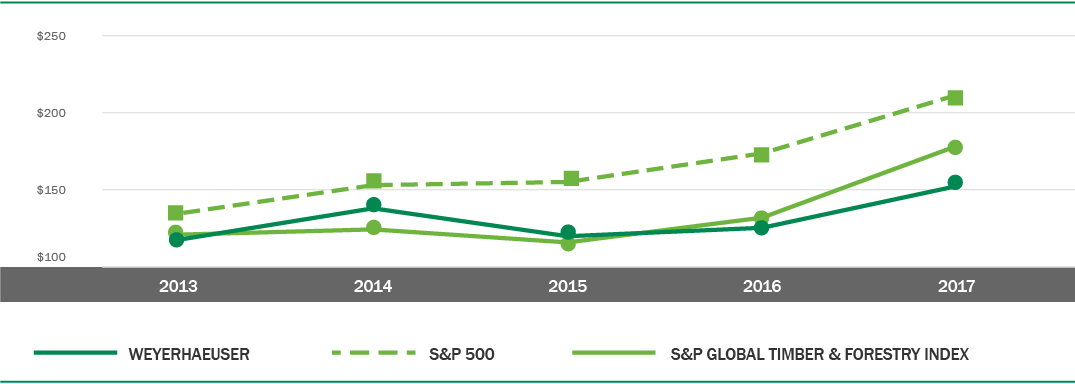
PERFORMANCE GRAPH ASSUMPTIONS
| • | Assumes $100 invested on December 31, 2012, in Weyerhaeuser common stock, the S&P 500 Index and the S&P Global Timber & Forestry Index. |
| • | Total return assumes dividends received are reinvested at month end. |
| • | Measurement dates are the last trading day of the calendar year shown. |
WEYERHAEUSER COMPANY > 2017 ANNUAL REPORT AND FORM 10-K 34
Item 6. SELECTED FINANCIAL DATA
SELECTED FINANCIAL DATA
DOLLAR AMOUNTS IN MILLIONS, EXCEPT PER-SHARE FIGURES
| PER COMMON SHARE | |||||||||||||||
| 2017 | 2016 | 2015 | 2014 | 2013 | |||||||||||
| Diluted earnings from continuing operations attributable to Weyerhaeuser common shareholders | $ | 0.77 | $ | 0.55 | $ | 0.71 | $ | 1.02 | $ | 0.54 | |||||
| Diluted earnings from discontinued operations attributable to Weyerhaeuser common shareholders | $ | — | $ | 0.84 | $ | 0.18 | $ | 2.16 | $ | 0.41 | |||||
| Diluted net earnings attributable to Weyerhaeuser common shareholders | $ | 0.77 | $ | 1.39 | $ | 0.89 | $ | 3.18 | $ | 0.95 | |||||
| Dividends paid | $ | 1.25 | $ | 1.24 | $ | 1.20 | $ | 1.02 | $ | 0.81 | |||||
| Weyerhaeuser shareholders’ interest (end of year) | $ | 11.78 | $ | 12.26 | $ | 9.54 | $ | 10.11 | $ | 11.64 | |||||
| FINANCIAL POSITION(1) | |||||||||||||||
| 2017 | 2016 | 2015 | 2014 | 2013 | |||||||||||
| Total assets | $ | 18,059 | $ | 19,243 | $ | 12,470 | $ | 13,247 | $ | 14,352 | |||||
| Total long-term debt, including current portion (2) | $ | 5,992 | $ | 6,610 | $ | 4,787 | $ | 4,873 | $ | 4,871 | |||||
| Weyerhaeuser shareholders’ interest | $ | 8,899 | $ | 9,180 | $ | 4,869 | $ | 5,304 | $ | 6,795 | |||||
| Percent earned on average year-end Weyerhaeuser shareholders’ interest | 6.4 | % | 14.3 | % | 9.1 | % | 29.5 | % | 9.9 | % | |||||
| OPERATING RESULTS | |||||||||||||||
| 2017 | 2016 | 2015 | 2014 | 2013 | |||||||||||
| Net sales | $ | 7,196 | 6,365 | 5,246 | 5,489 | 5,373 | |||||||||
| Earnings from continuing operations | 582 | 415 | 411 | 616 | 330 | ||||||||||
| Discontinued operations, net of income taxes | — | 612 | 95 | 1,210 | 233 | ||||||||||
| Net earnings | 582 | 1,027 | 506 | 1,826 | 563 | ||||||||||
| Dividends on preference shares | — | (22 | ) | (44 | ) | (44 | ) | (23 | ) | ||||||
| Net earnings attributable to Weyerhaeuser common shareholders | $ | 582 | $ | 1,005 | $ | 462 | $ | 1,782 | $ | 540 | |||||
| CASH FLOWS(1) | |||||||||||||||
| 2017 | 2016 | 2015 | 2014 | 2013 | |||||||||||
| Net cash from operations | $ | 1,201 | $ | 735 | $ | 1,075 | $ | 1,109 | $ | 1,023 | |||||
| Net cash from investing activities | 367 | 2,559 | (487 | ) | 361 | (1,848 | ) | ||||||||
| Net cash from financing activities | (1,420 | ) | (3,630 | ) | (1,156 | ) | (725 | ) | 762 | ||||||
| Net change in cash and cash equivalents | $ | 148 | $ | (336 | ) | $ | (568 | ) | $ | 745 | $ | (63 | ) | ||
| STATISTICS (UNAUDITED) | |||||||||||||||
| 2017 | 2016 | 2015 | 2014 | 2013 | |||||||||||
| Number of employees | 9,300 | 10,400 | 12,600 | 12,800 | 13,700 | ||||||||||
| Number of common shareholder accounts at year-end | 15,138 | 15,504 | 7,700 | 8,248 | 8,859 | ||||||||||
| Number of common shares outstanding at year-end (thousands) | 755,223 | 748,528 | 510,483 | 524,474 | 583,548 | ||||||||||
| Weighted average common shares outstanding – diluted (thousands) | 756,666 | 722,401 | 519,618 | 560,899 | 571,239 | ||||||||||
| (1) Amounts are not updated for the Cellulose Fibers divestitures. See Note 3: Discontinued Operations and Other Divestitures in the Notes to Consolidated Financial Statements. (2) Does not include nonrecourse debt held by our Variable Interest Entities (VIEs). See Note 8: Related Parties in the Notes to Consolidated Financial Statements for further information on our VIEs and the related nonrecourse debt. |
WEYERHAEUSER COMPANY > 2017 ANNUAL REPORT AND FORM 10-K 35
Item 7. MANAGEMENT’S DISCUSSION AND ANALYSIS OF FINANCIAL CONDITION AND RESULTS OF OPERATIONS
MANAGEMENT’S DISCUSSION AND ANALYSIS OF FINANCIAL CONDITION AND RESULTS OF OPERATIONS (MD&A)
| WHAT YOU WILL FIND IN THIS MD&A |
Our MD&A includes the following major sections:
| • | economic and market conditions affecting our operations; |
| • | financial performance summary; |
| • | discussion of the softwood lumber agreement; |
| • | results of our operations — consolidated and by segment; |
| • | liquidity and capital resources — where we discuss our cash flows; |
| • | off-balance sheet arrangements; |
| • | environmental matters, legal proceedings and other contingencies; and |
| • | accounting matters — where we discuss critical accounting policies and areas requiring judgments and estimates. |
| ECONOMIC AND MARKET CONDITIONS AFFECTING OUR OPERATIONS |
The demand for logs within our Timberlands segment is directly affected by production levels of domestic wood-based building products. This segment, specifically the Western region, is also affected by export demand. Japanese housing starts are a key driver of export log demand in Japan. The strength of the U.S. housing market strongly affects demand in our Wood Products segment, as does repair and remodeling activity.
According to the U.S. Census Bureau, housing starts in 2017 totaled 1.2 million units. Single family units accounted for 0.8 million of total housing starts year to date, increasing the share of single family units to 71 percent of total housing starts compared with 67 percent in 2016. While total housing start growth slowed in 2017, rising by a modest 2.4 percent overall, there has been a shift in construction away from multifamily units, which are down 10 percent year over year, to single family units, which have increased 9 percent over the same period. This shift to the more wood intensive single family construction has been positive for wood products demand. We continue to expect improving U.S. housing starts and anticipate a 4 percent to 10 percent increase in total starts in 2018. Consensus forecasts place expected total housing starts between 1.25 and 1.31 million units for 2018 (sources include National Association of Home Builders (NAHB), Fannie Mae, Mortgage Bankers Association, The Engineered Wood Association (APA), and Forest Economic Advisors, LLC (FEA)). Demand for homes remains strong relative to inventories. U.S. Census reported new homes sales of 608 thousand units in 2017, an increase of 8.4 percent over 2016. This sales level was characterized by consistently low inventories as measured by months of supply, which averaged 5.4 months through 2017. Existing home sales continued to rise in 2017, with total sales of 5.51 million units, a gain of 1.1 percent over 2016 and the highest sales level since 2006 according to the National Association of Realtors. Existing home inventories were also tight with supplies averaging 3.9 months for the year, down from 4.3 months in 2016. We attribute this continued improvement primarily to employment growth, improving consumer confidence and favorable mortgage rates.
According to the Joint Center for Housing Studies at Harvard University, the Leading Indicator of Remodeling Activity (LIRA) increased by 6.4 percent in 2017 and is expected to increase by 7.5 percent year over year for 2018.
U.S. wood product markets advanced in 2017, consistent with growth in homebuilding and remodeling segments, as described above. According to FEA, North American lumber consumption grew at a 7.2 percent rate in 2017. The Random Lengths framing lumber composite price increased 19.4 percent in 2017 versus 2016 while oriented strand board (OSB) increased 31 percent in 2017 versus 2016 as measured by Random Lengths North Central Price. We expect similar to slightly higher wood product prices in 2018 as demand continues to increase with growth in housing starts and remodeling.
Consistent with this, demand for logs increased with wood products production within our Western region. This coupled with higher market prices year over year drove higher realizations within this region. Douglas fir sawlog prices as reported by Loglines increased 10 percent from 2016 for the domestic market and 5.7 percent for Japan export logs. In the South, log supplies increased consistent with increased demand, leaving prices flat to slightly down year-over-year. According to TimberMart - South, prices for delivered sawtimber and stumpage were down 2.6 percent and 4.6 percent respectively.
Log inventories in Chinese ports have been stable through 2017, ranging from 1.0 million to 1.5 million cubic meters (M3) per month as reported by International Wood Markets China Bulletin. Log and lumber demand in China remain strong, primarily due to the strength of construction activity. Total imports of logs and lumber increased 13 percent and 20 percent, respectively, for the first 11 months of 2017 compared on a year ago basis. In Japan, post and beam housing starts (the primary source of log demand) for January through November 2017 are up 1.0 percent from the same period last year while total housing starts are down 0.1 percent on a year ago basis.
We expect demand from China and Japan in 2018 to be similar to modestly improved from demand experienced in 2017.
Our Real Estate, Energy and Natural Resources segment is affected by the health of the U.S. economy and especially the U.S. housing sector of the economy. According to the Realtors Land Institute of the National Association of Realtors, the dollar volume of rural properties, including timber, sold in 2017 grew 4 percent over 2016 sales while per acre prices were up 3 percent on average.
Energy markets recovered steadily in 2017. For the year, Brent crude oil averaged $54 per barrel in 2017, an increase of $10 per barrel from 2016 levels. Prices increased fairly steadily through the second half of the year, with year-end prices higher than the annual average. Natural gas prices were also higher in 2017 averaging $2.99 per million British thermal units (MMBtu) a 19 percent increase over 2016. Expectations are for energy prices to be stable to gradually increasing in 2018.
WEYERHAEUSER COMPANY > 2017 ANNUAL REPORT AND FORM 10-K 36
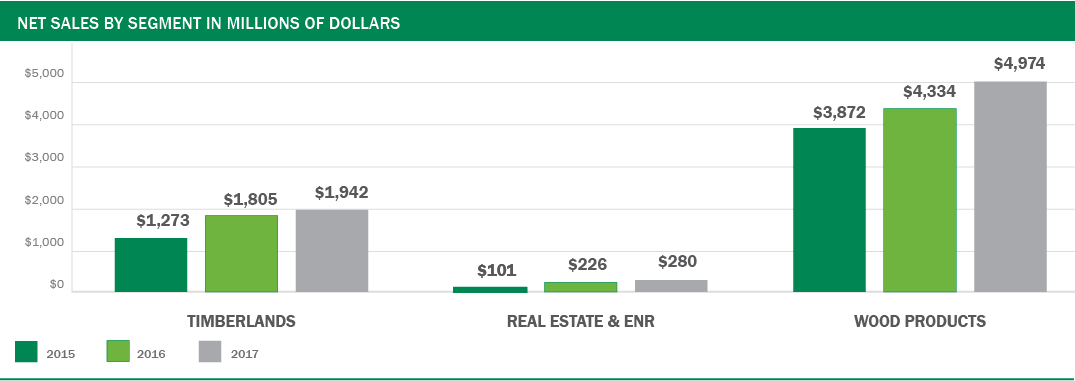
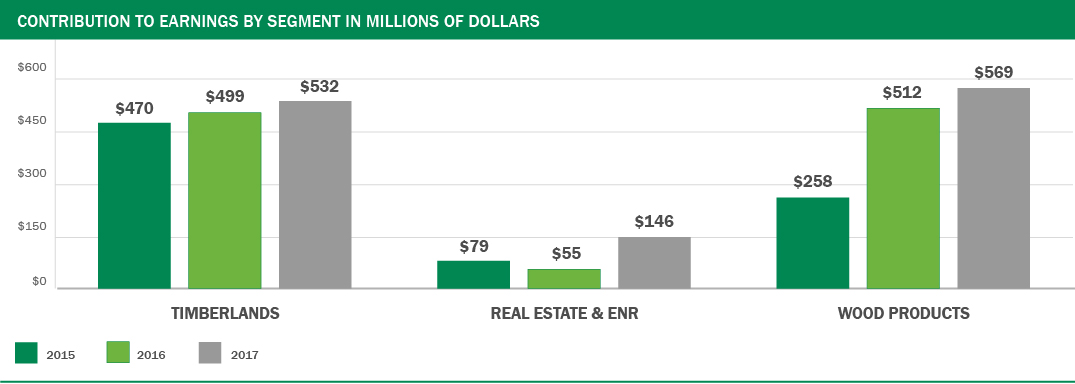
| FINANCIAL PERFORMANCE SUMMARY |
Net Sales by Segment
Contribution to Earnings by Segment
WEYERHAEUSER COMPANY > 2017 ANNUAL REPORT AND FORM 10-K 37
| SOFTWOOD LUMBER AGREEMENT |
We operate a total of 19 softwood lumber mills with a total capacity of 4.9 billion board feet. Three of these mills, located in Canada, produce approximately 900 million board feet annually, and sell products in Canada, Asia, and the U.S.
On April 24, 2017, the U.S. Department of Commerce announced a preliminary determination that it would implement countervailing duties on Canadian softwood lumber shipments to the U.S. The rate applicable to Weyerhaeuser was 19.88 percent and became effective as of April 28, 2017. The U.S. Department of Commerce also announced that retroactive deposits at the 19.88 percent rate would be collected from certain Canadian lumber producers, including Weyerhaeuser, for softwood lumber shipments from Canada to the U.S. during the 90-day period prior to April 28, 2017.
The preliminary countervailing duties were suspended on August 26, 2017, at which time we effectively stopped accruing for the expense. The suspension of the countervailing duties was set to last until the US International Trade Commission reaches its final determination of injury, which was issued December 28, 2
Showing the first 8K of 107K characters. Open the full section
Item 7A. QUANTITATIVE AND QUALITATIVE DISCLOSURES ABOUT MARKET RISK
QUANTITATIVE AND QUALITATIVE DISCLOSURES ABOUT MARKET RISK
| LONG-TERM DEBT OBLIGATIONS |
The following summary of our long-term debt obligations includes:
| • | scheduled principal repayments for the next five years and after, |
| • | weighted average interest rates for debt maturing in each of the next five years and after and |
| • | estimated fair values of outstanding obligations. |
We estimate the fair value of long-term debt based on quoted market prices we received for the same types and issues of our debt or on the discounted value of the future cash flows using market yields for the same type and comparable issues of debt. Changes in market rates of interest affect the fair value of our fixed-rate debt.
SUMMARY OF LONG-TERM DEBT OBLIGATIONS AS OF DECEMBER 31, 2017
| DOLLAR AMOUNTS IN MILLIONS | ||||||||||||||||||||||||
| 2018 | 2019 | 2020 | 2021 | 2022 | THEREAFTER | TOTAL(1)(2) | FAIR VALUE | |||||||||||||||||
| Fixed-rate debt | $ | 62 | $ | 500 | $ | — | $ | 719 | $ | 4,450 | $ | 5,731 | $ | 6,823 | ||||||||||
| Average interest rate | 7.00 | % | 7.38 | % | — | % | 5.56 | % | — | % | 6.38 | % | 6.37 | % | N/A | |||||||||
| Variable-rate debt | $ | — | $ | — | $ | — | $ | — | $ | — | $ | 225 | $ | 225 | $ | 225 | ||||||||
| Average interest rate | — | % | — | % | — | % | — | % | — | % | 3.15 | % | 3.15 | % | N/A | |||||||||
| (1) Excludes $36 million of unamortized discounts, capitalized debt expense and fair value adjustments (related to Plum Creek merger). (2) Does not include nonrecourse debt held by our Variable Interest Entities (VIEs). See Note 8: Related Parties in the Notes to Consolidated Financial Statements for further information on our VIEs and the related nonrecourse debt. |
WEYERHAEUSER COMPANY > 2017 ANNUAL REPORT AND FORM 10-K 57
Item 8. FINANCIAL STATEMENTS AND SUPPLEMENTARY DATA
FINANCIAL STATEMENTS AND SUPPLEMENTARY DATA
| REPORT OF INDEPENDENT REGISTERED PUBLIC ACCOUNTING FIRM |
To the Shareholders and Board of Directors
Weyerhaeuser Company:
Opinion on the Consolidated Financial Statements
We have audited the accompanying consolidated balance sheets of Weyerhaeuser Company and subsidiaries (the Company) as of December 31, 2017 and 2016, the related consolidated statements of operations, comprehensive income, changes in equity, and cash flows for each of the years in the three‑year period ended December 31, 2017, and the related notes (collectively, the consolidated financial statements). In our opinion, the consolidated financial statements present fairly, in all material respects, the financial position of the Company as of December 31, 2017 and 2016, and the results of its operations and its cash flows for each of the years in the three‑year period ended December 31, 2017, in conformity with U.S. generally accepted accounting principles.
We also have audited, in accordance with the standards of the Public Company Accounting Oversight Board (United States) (PCAOB), the Company’s internal control over financial reporting as of December 31, 2017, based on criteria established in Internal Control - Integrated Framework (2013) issued by the Committee of Sponsoring Organizations of the Treadway Commission, and our report dated February 16, 2018 expressed an unqualified opinion on the effectiveness of the Company’s internal control over financial reporting.
Basis for Opinion
These consolidated financial statements are the responsibility of the Company’s management. Our responsibility is to express an opinion on these consolidated financial statements based on our audits. We are a public accounting firm registered with the PCAOB and are required to be independent with respect to the Company in accordance with the U.S. federal securities laws and the applicable rules and regulations of the Securities and Exchange Commission and the PCAOB.
We conducted our audits in accordance with the standards of the PCAOB. Those standards require that we plan and perform the audit to obtain reasonable assurance about whether the consolidated financial statements are free of material misstatement, whether due to error or fraud. Our audits included performing procedures to assess the risks of material misstatement of the consolidated financial statements, whether due to error or fraud, and performing procedures that respond to those risks. Such procedures included examining, on a test basis, evidence regarding the amounts and disclosures in the consolidated financial statements. Our audits also included evaluating the accounting principles used and significant estimates made by management, as well as evaluating the overall presentation of the consolidated financial statements. We believe that our audits provide a reasonable basis for our opinion.
/s/ KPMG LLP
We have served as the Company’s auditor since 2002.
Seattle, Washington
February 16, 2018
WEYERHAEUSER COMPANY > 2017 ANNUAL REPORT AND FORM 10-K 58
| CONSOLIDATED STATEMENT OF OPERATIONS |
FOR THE THREE-YEAR PERIOD ENDED DECEMBER 31, 2017
| DOLLAR AMOUNTS IN MILLIONS, EXCEPT PER-SHARE FIGURES | |||||||||
| 2017 | 2016 | 2015 | |||||||
| Net sales | $ | 7,196 | $ | 6,365 | $ | 5,246 | |||
| Costs of products sold | 5,298 | 4,980 | 4,153 | ||||||
| Gross margin | 1,898 | 1,385 | 1,093 | ||||||
| Selling expenses | 87 | 89 | 99 | ||||||
| General and administrative expenses | 310 | 338 | 252 | ||||||
| Research and development expenses | 14 | 19 | 18 | ||||||
| Charges for integration and restructuring, closures and asset impairments (Note 17) | 194 | 170 | 39 | ||||||
| Charges for product remediation (Note 18) | 290 | — | — | ||||||
| Other operating costs (income), net (Note 19) | (128 | ) | (53 | ) | 41 | ||||
| Operating income | 1,131 | 822 | 644 | ||||||
| Equity earnings from joint ventures (Note 8) | 1 | 22 | — | ||||||
| Non-operating pension and other postretirement benefit (costs) credits | (62 | ) | 48 | 14 | |||||
| Interest income and other | 39 | 43 | 36 | ||||||
| Interest expense, net of capitalized interest | (393 | ) | (431 | ) | (341 | ) | |||
| Earnings from continuing operations before income taxes | 716 | 504 | 353 | ||||||
| Income taxes (Note 20) | (134 | ) | (89 | ) | 58 | ||||
| Earnings from continuing operations | 582 | 415 | 411 | ||||||
| Earnings from discontinued operations, net of income taxes (Note 3) | — | 612 | 95 | ||||||
| Net earnings | 582 | 1,027 | 506 | ||||||
| Dividends on preference shares | — | (22 | ) | (44 | ) | ||||
| Net earnings attributable to Weyerhaeuser common shareholders | $ | 582 | $ | 1,005 | $ | 462 | |||
| Basic earnings per share attributable to Weyerhaeuser common shareholders (Note 5): | |||||||||
| Continuing operations | $ | 0.77 | $ | 0.55 | $ | 0.71 | |||
| Discontinued operations | — | 0.85 | 0.18 | ||||||
| Net earnings per share | $ | 0.77 | $ | 1.40 | $ | 0.89 | |||
| Diluted earnings per share attributable to Weyerhaeuser common shareholders (Note 5): | |||||||||
| Continuing operations | $ | 0.77 | $ | 0.55 | $ | 0.71 | |||
| Discontinued operations | — | 0.84 | 0.18 | ||||||
| Net earnings per share | $ | 0.77 | $ | 1.39 | $ | 0.89 | |||
| Dividends paid per common share | $ | 1.25 | $ | 1.24 | $ | 1.20 | |||
| Weighted average shares outstanding (in thousands) (Note 5): | |||||||||
| Basic | 753,085 | 718,560 | 516,371 | ||||||
| Diluted | 756,666 | 722,401 | 519,618 |
See accompanying Notes to Consolidated Financial Statements.
WEYERHAEUSER COMPANY > 2017 ANNUAL REPORT AND FORM 10-K 59
| CONSOLIDATED STATEMENT OF COMPREHENSIVE INCOME |
FOR THE THREE-YEAR PERIOD ENDED DECEMBER 31, 2017
| DOLLAR AMOUNTS IN MILLIONS | |||||||||
| 2017 | 2016 | 2015 | |||||||
| Comprehensive income: | |||||||||
| Net earnings | $ | 582 | $ | 1,027 | $ | 506 | |||
| Other comprehensive income (loss): | |||||||||
| Foreign currency translation adjustments | 32 | 25 | (97 | ) | |||||
| Changes in unamortized net pension and other postretirement benefit gain (loss), net of tax expense (benefit) of ($2) in 2017, ($151) in 2016, and $131 in 2015 | (132 | ) | (269 | ) | 282 | ||||
| Changes in unamortized prior service cost, net of tax benefit of $2 in 2017, $0 in 2016 and $1 in 2015 | (5 | ) | (4 | ) | (4 | ) | |||
| Unrealized gains on available-for-sale securities | 2 | 1 | — | ||||||
| Total comprehensive income | $ | 479 | $ | 780 | $ | 687 |
See accompanying Notes to Consolidated Financial Statements.
WEYERHAEUSER COMPANY > 2017 ANNUAL REPORT AND FORM 10-K 60
| CONSOLIDATED BALANCE SHEET |
| DOLLAR AMOUNTS IN MILLIONS |
Showing the first 8K of 220K characters. Open the full section
Item 9. CHANGES IN AND DISAGREEMENTS WITH ACCOUNTANTS ON ACCOUNTING AND FINANCIAL DISCLOSURE
CHANGES IN AND DISAGREEMENTS WITH ACCOUNTANTS ON ACCOUNTING AND FINANCIAL DISCLOSURE
Not applicable.
Item 9A. CONTROLS AND PROCEDURES
CONTROLS AND PROCEDURES
| EVALUATION OF DISCLOSURE CONTROLS AND PROCEDURES |
The company’s principal executive officer and principal financial officer have evaluated the effectiveness of the company’s disclosure controls and procedures as of the end of the period covered by this annual report on Form 10-K. Disclosure controls are controls and other procedures that are designed to ensure that information required to be disclosed in the reports filed or submitted under the Securities Exchange Act of 1934, as amended (Act), is recorded, processed, summarized and reported within the time periods specified in the Securities and Exchange Commission’s (SEC) rules and forms. Disclosure controls and procedures include, without limitation, controls and procedures designed to ensure that information required to be disclosed by an issuer in the reports that it files or submits under the Act is accumulated and communicated to the company's management, including its principal executive and principal financial officers, to allow timely decisions regarding required disclosure.
Based on their evaluation, the company’s principal executive officer and principal financial officer have concluded that the company’s disclosure controls and procedures are effective to ensure that information required to be disclosed complies with the SEC’s rules and forms.
| CHANGES IN INTERNAL CONTROL |
During 2017, we integrated the acquired Plum Creek operations into our overall internal controls over financial reporting. No changes occurred in the company's internal control over financial reporting during the period that have materially affected, or are reasonably likely to materially affect, the company's internal control over financial reporting.
| MANAGEMENT’S REPORT ON INTERNAL CONTROL OVER FINANCIAL REPORTING |
Management is responsible for establishing and maintaining adequate internal control over financial reporting as is defined in the Securities and Exchange Act of 1934 rules. Management, under our supervision, conducted an evaluation of the effectiveness of the company’s internal control over financial reporting based on the framework in Internal Control — Integrated Framework (2013) issued by the Committee of Sponsoring Organizations of the Treadway Commission (COSO). Based on our evaluation under the framework in Internal Control — Integrated Framework (2013), management concluded that the company’s internal control over financial reporting was effective as of December 31, 2017. The effectiveness of the company’s internal control over financial reporting as of December 31, 2017, has been audited by KPMG LLP, an independent registered public accounting firm, as stated in their report, which is included herein.
WEYERHAEUSER COMPANY > 2017 ANNUAL REPORT AND FORM 10-K 108
| REPORT OF INDEPENDENT REGISTERED PUBLIC ACCOUNTING FIRM |
To the Shareholders and Board of Directors
Weyerhaeuser Company:
Opinion on Internal Control Over Financial Reporting
We have audited Weyerhaeuser Company and subsidiaries’ (the Company) internal control over financial reporting as of December 31, 2017, based on criteria established in Internal Control - Integrated Framework (2013) issued by the Committee of Sponsoring Organizations of the Treadway Commission. In our opinion, the Company maintained, in all material respects, effective internal control over financial reporting as of December 31, 2017, based on criteria established in Internal Control - Integrated Framework (2013) issued by the Committee of Sponsoring Organizations of the Treadway Commission.
We also have audited, in accordance with the standards of the Public Company Accounting Oversight Board (United States) (PCAOB), the consolidated balance sheets of the Company as of December 31, 2017 and 2016, the related consolidated statements of operations, comprehensive income, changes in equity, and cash flows for each of the years in the three-year period ended December 31, 2017, and the related notes (collectively, the consolidated financial statements), and our report dated February 16, 2018 expressed an unqualified opinion on those consolidated financial statements.
Basis for Opinion
The Company’s management is responsible for maintaining effective internal control over financial reporting and for its assessment of the effectiveness of internal control over financial reporting, included in the accompanying Management’s Report on Internal Control Over Financial Reporting. Our responsibility is to express an opinion on the Company’s internal control over financial reporting based on our audit. We are a public accounting firm registered with the PCAOB and are required to be independent with respect to the Company in accordance with the U.S. federal securities laws and the applicable rules and regulations of the Securities and Exchange Commission and the PCAOB.
We conducted our audit in accordance with the standards of the PCAOB. Those standards require that we plan and perform the audit to obtain reasonable assurance about whether effective internal control over financial reporting was maintained in all material respects. Our audit of internal control over financial reporting included obtaining an understanding of internal control over financial reporting, assessing the risk that a material weakness exists, and testing and evaluating the design and operating effectiveness of internal control based on the assessed risk. Our audit also included performing such other procedures as we considered necessary in the circumstances. We believe that our audit provides a reasonable basis for our opinion.
Definition and Limitations of Internal Control Over Financial Reporting
A company’s internal control over financial reporting is a process designed to provide reasonable assurance regarding the reliability of financial reporting and the preparation of financial statements for external purposes in accordance with generally accepted accounting principles. A company’s internal control over financial reporting includes those policies and procedures that (1) pertain to the maintenance of records that, in reasonable detail, accurately and fairly reflect the transactions and dispositions of the assets of the company; (2) provide reasonable assurance that transactions are recorded as necessary to permit preparation of financial statements in accordance with generally accepted accounting principles, and that receipts and expenditures of the company are being made only in accordance with authorizations of management and directors of the company; and (3) provide reasonable assurance regarding prevention or timely detection of unauthorized acquisition, use, or disposition of the company’s assets that could have a material effect on the financial statements.
Because of its inherent limitations, internal control over financial reporting may not prevent or detect misstatements. Also, projections of any evaluation of effectiveness to future periods are subject to the risk that controls may become inadequate because of changes in conditions, or that the degree of compliance with the policies or procedures may deteriorate.
/s/ KPMG LLP
Seattle, Washington
February 16, 2018
WEYERHAEUSER COMPANY > 2017 ANNUAL REPORT AND FORM 10-K 109
Item 10. DIRECTORS, EXECUTIVE OFFICERS AND CORPORATE GOVERNANCE
DIRECTORS, EXECUTIVE OFFICERS AND CORPORATE GOVERNANCE
A list of our executive officers and biographical information are found in the Our Business — Executive Officers of the Registrant section of this report. Information with respect to directors of the company and certain other corporate governance matters, as required by this item to Form 10-K, is set forth in the Notice of the 2018 Annual Meeting and Proxy Statement for the company’s Annual Meeting of Shareholders to be held May 18, 2018 under the headings "Item 1. Election of Directors - Nominees for Election," “Item 1. Election of Directors - Committees of the Board ,” “Stock Information - Section 16(a) Beneficial Ownership Reporting Compliance,” and “Corporate Governance at Weyerhaeuser - Code of Ethics,” and in each case is incorporated herein by reference.
The Weyerhaeuser Code of Ethics applies to our chief executive officer, our chief financial officer and our chief accounting officer, as well as other officers, directors and employees of the company. The Weyerhaeuser Code of Ethics is posted on our website at www.weyerhaeuser.com, and currently is located under the tabs “Sustainability”, then “Governance” and finally “Operating Ethically.”
Item 11. EXECUTIVE AND DIRECTOR COMPENSATION
EXECUTIVE AND DIRECTOR COMPENSATION
Information with respect to executive and director compensation, as required by this item to Form 10-K, is set forth in the Notice of the 2018 Annual Meeting and Proxy Statement for the company’s Annual Meeting of Shareholders to be held May 18, 2018 under the headings “Item 1. Election of Directors - Directors’ Compensation" and “Executive Compensation,” and in each case, is incorporated herein by reference.
Item 12. SECURITY OWNERSHIP OF CERTAIN BENEFICIAL OWNERS AND MANAGEMENT AND RELATED STOCKHOLDER MATTERS
SECURITY OWNERSHIP OF CERTAIN BENEFICIAL OWNERS AND MANAGEMENT AND RELATED STOCKHOLDER MATTERS
Information with respect to security ownership of certain beneficial owners and management and with respect to securities authorized for issuance under our equity compensation plans, as required by this item to Form 10-K, is set forth the Notice of the 2018 Annual Meeting and Proxy Statement for the company’s Annual Meeting of Shareholders to be held May 18, 2018 under the headings “Stock Information - Beneficial Ownership of Common Shares,” and “Stock Information - Information about Securities Authorized for Issuance under our Equity Compensation Plans,” and in each case, is incorporated herein by reference.
Item 13. CERTAIN RELATIONSHIPS AND RELATED TRANSACTIONS
CERTAIN RELATIONSHIPS AND RELATED TRANSACTIONS AND DIRECTOR INDEPENDENCE
Information about certain relationships and related transactions and director independence, as required by this item to Form 10-K, is set forth in the Notice of the 2018 Annual Meeting and Proxy Statement for the company’s Annual Meeting of Shareholders to be held May 18, 2018 under the headings “Corporate Governance at Weyerhaeuser - Related Party Transactions Review and Approval Policy,” “Corporate Governance at Weyerhaeuser - Independent Board of Directors,” and "Item 1. Election of Directors - Committees of the Board," and in each case, is incorporated herein by reference.
Item 14. PRINCIPAL ACCOUNTING FEES AND SERVICES
PRINCIPAL ACCOUNTING FEES AND SERVICES
Information with respect to principal accounting fees and services, as required by this item to Form 10-K, is set forth in the Notice of the 2018 Annual Meeting and Proxy Statement for the company’s Annual Meeting of Shareholders to be held May 18, 2018 under the heading “Item 3. Ratify Selection of Independent Registered Public Accounting Firm” and is incorporated herein by reference.
WEYERHAEUSER COMPANY > 2017 ANNUAL REPORT AND FORM 10-K 110
Item 15. EXHIBITS AND FINANCIAL STATEMENT SCHEDULES
EXHIBITS AND FINANCIAL STATEMENT SCHEDULES
All financial statement schedules have been omitted because they are not applicable or the required information is included in the consolidated financial statements, or the notes thereto, in Financial Statements and Supplementary Data above.
The agreements included as exhibits to this annual report are included to provide information about their terms and not to provide any other factual or disclosure information about the company or the other parties to the agreements. The agreements may contain representations and warranties by each of the parties to the applicable agreement that were made solely for the benefit of the other parties to the agreement and should not be treated as categorical statements of fact, but rather as a way of allocating the risk among the parties if those statements prove to be inaccurate. These representations and warranties may have been qualified by disclosures that were made to the other party in connection with the negotiation of the applicable agreement, which disclosures are not necessarily reflected in the agreement, may apply standards of materiality in a way that is different from what may be viewed as material to investors, were made only as of the date of the applicable agreement or such other date or dates as may be specified in the agreement, and are subject to more recent developments. Accordingly, these representations and warranties may not describe the actual state of affairs as of the date they were made or at any other time.
| EXHIBITS |
| 2 | — | Plan of Acquisition, Reorganization, Arrangement, Liquidation or Succession | |
| (a) | Transaction Agreement, dated as of November 3, 2013, among Weyerhaeuser Company, Weyerhaeuser Real Estate Company, TRI Pointe Homes, Inc. and Topaz Acquisition, Inc. (incorporated by reference to Exhibit 2.1 to the Current Report on Form 8-K filed on November 4, 2013 - Commission File Number 1-4825) | ||
| (b) | Agreement and Plan of Merger, dated as of November 6, 2015, between Weyerhaeuser Company and Plum Creek Timber Company, Inc. (incorporated by reference to Exhibit 2.1 to the Current Report on Form 8-K filed on November 9, 2015 - Commission File Number 1-4825) | ||
| (c) | Asset Purchase Agreement, dated as of May 1, 2016, by and between Weyerhaeuser NR Company and International Paper Company (incorporated by reference to Exhibit 2.2 to the Quarterly Report on Form 10-Q filed on August 5, 2016 - Commission File Number 1-4825) | ||
| 3 | — | Articles of Incorporation | |
| (a) | Articles of Incorporation (incorporated by reference to Exhibit 3.1 to the Quarterly Report on Form 10-Q filed on May 6, 2011 - Commission File Number 1-4825, and to Exhibit 3.1 to the Current Report on Form 8-K filed on June 20, 2013 - Commission File Number 1-4825) | ||
| (b) | Bylaws (incorporated by reference to Exhibit 3.2 to the Quarterly Report on Form 10-Q filed on May 6, 2011 - Commission File Number 1-4825) | ||
| 4 | — | Instruments Defining the Rights of Security Holders, Including Indentures | |
| (a) | Indenture dated as of April 1, 1986 between Weyerhaeuser Company and The Bank of New York Mellon Trust Company, N.A. (as successor to JPMorgan Chase Bank, formerly known as The Chase Manhattan Bank and Chemical Bank), a national banking association, as Trustee (incorporated by reference from the Registration Statement on Form S-3, Registration No. 333-36753) | ||
| (b) | First Supplemental Indenture dated as of February 15, 1991 between Weyerhaeuser Company and The Bank of New York Mellon Trust Company, N.A. (as successor to JPMorgan Chase Bank, formerly known as The Chase Manhattan Bank and Chemical Bank), a national banking association, as Trustee (incorporated by reference from the Registration Statement on Form S-3, Registration No. 333-52982)** | ||
| (c) | Second Supplemental Indenture dated as of February 1, 1993 between Weyerhaeuser Company and The Bank of New York Mellon Trust Company, N.A. (as successor to JPMorgan Chase Bank, formerly known as The Chase Manhattan Bank and Chemical Bank), a national banking association, as Trustee (incorporated by reference from the Registration Statement on Form S-3, Registration No. 333-59974)** | ||
| (d) | Third Supplemental Indenture dated as of October 22, 2001 between Weyerhaeuser Company and The Bank of New York Mellon Trust Company, N.A. (as successor to JPMorgan Chase Bank, formerly known as The Chase Manhattan Bank and Chemical Bank), a national banking association, as Trustee (incorporated by reference to Exhibit 4(d) to the Registration Statement on Form S-3, Registration No. 333-72356) | ||
| (e) | Fourth Supplemental Indenture dated as of March 12, 2002 between Weyerhaeuser Company and The Bank of New York Mellon Trust Company, N.A. (as successor to JPMorgan Chase Bank, formerly known as The Chase Manhattan Bank and Chemical Bank), a national banking association, as Trustee (incorporated by reference to Exhibit 4.8 from the Registration Statement on Form S-4/A, Registration No. 333-82376) | ||
| (f) | Indenture dated as of March 15, 1983 between Weyerhaeuser Company (as successor to Willamette Industries, Inc.) and The Bank of New York Mellon Trust Company, N.A. (as successor to JPMorgan Chase Bank, formerly known as The Chase Manhattan Bank), as Trustee | ||
| (g) | Indenture dated as of January 30, 1993 between Weyerhaeuser Company (as successor to Willamette Industries, Inc.) and The Bank of New York Mellon Trust Company, N.A. (as successor to JPMorgan Chase Bank, formerly known as The Chase Manhattan Bank), as Trustee | ||
| (h) | First Supplemental Trust Indenture dated as of March 12, 2002 between Weyerhaeuser Company (as successor to Willamette Industries, Inc.) and The Bank of New York Mellon Trust Company, N.A. (as successor to JPMorgan Chase Bank, formerly known as The Chase Manhattan Bank), as Trustee | ||
| (i) | Indenture dated as of January 15, 1996 between Weyerhaeuser Company Limited (as successor to MacMillan Bloedel Limited) and The Bank of New York Mellon Trust Company, N.A. (as successor to Harris Trust Company of New York, formerly known as Bank of Montreal Trust Company), as Trustee |
WEYERHAEUSER COMPANY > 2017 ANNUAL REPORT AND FORM 10-K 111
| (j) | First Supplemental Indenture dated as of November 1, 1999 between Weyerhaeuser Company Limited and The Bank of New York Mellon Trust Company, N.A. (as successor to Harris Trust Company of New York, formerly Bank of Montreal Trust Company), as Trustee | ||
| (k) | Note Indenture dated November 14, 2005 by and among Plum Creek Timberlands, L.P., as Issuer, Weyerhaeuser Company, as successor to Plum Creek Timber Company, Inc., as Guarantor, and U.S. Bank National Association, as Trustee (incorporated by reference to Exhibit 4.2 to the Current Report on Form 8-K filed on February 19, 2016 - Commission File Number 1-4825) | ||
| (l) | Supplemental Indenture No. 1 dated as of February 19, 2016 by and among Plum Creek Timberlands, L.P., as Issuer, Weyerhaeuser Company, as Guarantor, and U.S. Bank National Association, as Trustee (incorporated by reference to Exhibit 4.1 to the Current Report on Form 8-K filed on February 19, 2016 - Commission File Number 1-4825) | ||
| (m) | Supplemental Indenture No. 2 dated September 28, 2016 by and between Weyerhaeuser Company, as successor Issuer, and U.S. Bank National Association, as Trustee (incorporated by reference to Exhibit 4.1 to the Current Report on Form 8-K filed on September 30, 2016 - Commission File Number 1-4825) | ||
| (n) | Officer’s Certificate dated November 15, 2010 executed by Plum Creek Timberlands, L.P., as Issuer (incorporated by reference to Exhibit 4.3 to the Current Report on Form 8-K filed on February 19, 2016 - Commission File Number 1-4825 ) | ||
| (o) | Officer’s Certificate dated November 26, 2012 executed by Plum Creek Timberlands, L.P., as Issuer (incorporated by reference to Exhibit 4.4 to the Current Report on Form 8-K filed on February 19, 2016 - Commission File Number 1-4825 ) | ||
| (p) | Assumption and Amendment Agreement and Installment Note dated as of April 28, 2016 by and among Plum Creek Timberlands, L.P., Weyerhaeuser Company and MeadWestvaco Timber Note Holding Company II, L.L.C. (incorporated by reference to Exhibit 4.1 to the Current Report on Form 8-K filed on May 4, 2016 - Commission File Number 1-4825) | ||
| 10 | — | Material Contracts | |
| (a) | Form of Weyerhaeuser Executive Change of Control Agreement (incorporated by reference to Exhibit 10(a) to the Annual Report on Form 10-K for the annual period ended December 31, 2016 - Commission File Number 1-4825)* | ||
| (b) | Form of Executive Severance Agreement (incorporated by reference to Exhibit 10(b) to the Annual Report on Form 10-K for the annual period ended December 31, 2016 - Commission File Number 1-4825)* | ||
| (c) | Form of Plum Creek Executive Change in Control Agreement (incorporated by reference to Exhibit 10(c) to the Annual Report on Form 10-K for the annual period ended December 31, 2016 - Commission File Number 1-4825)* | ||
| (d) | Executive Employment Agreement with Doyle Simons dated February 17, 2016 (incorporated by reference to Exhibit 10(v) to the Annual Report on Form 10-K for the annual period ended December 31, 2015 - Commission File Number 1-4825)* | ||
| (e) | Weyerhaeuser Company 2013 Long-Term Incentive Plan (incorporated by reference to Exhibit 10.1 to the Current Report on Form 8-K filed with the Securities and Exchange Commission on February 19, 2013 - Commission File Number 1-4825)* | ||
| (f) | Form of Weyerhaeuser Company 2013 Long-Term Incentive Plan Stock Option Award Terms and Conditions (incorporated by reference to Exhibit 10.2 to the Current Report on Form 8-K filed on April 16, 2013 - Commission File Number 1-4825)* | ||
| (g) | Form of Weyerhaeuser Company 2013 Long Term Incentive Plan Performance Share Unit Award Terms and Conditions for Plan Year 2016 (incorporated by reference to Exhibit 10.1 to the Current Report on Form 8-K filed on January 22, 2016 - Commission File Number 1-4825)* | ||
| (h) | Form of Weyerhaeuser Company 2013 Long Term Incentive Plan Performance Share Unit Award Terms and Conditions for Plan Years 2017 and 2018 (incorporated by reference to Exhibit 10.1 the Current Report on Form 8-K filed on January 26, 2017 - Commission File Number 1-4825)* | ||
| (i) | Form of Weyerhaeuser Company 2013 Long-Term Incentive Plan Restricted Stock Unit Award Terms and Conditions * | ||
| (j) | Form of Weyerhaeuser Company 2004 Long-Term Incentive Plan Stock Option Award Terms and Conditions (incorporated by reference to Exhibit 10.1 to the Current Report on Form 8-K filed on February 11, 2013 - Commission File Number 1-4825)* | ||
| (k) | Weyerhaeuser Company 2004 Long-Term Incentive Compensation Plan, as Amended and Restated (incorporated by reference to Exhibit 10.5 to the Current Report on Form 8-K filed on December 29, 2010 - Commission File Number 1-4825)* | ||
| (l) | Form of Plum Creek Executive Stock Option, Restricted Stock Unit and Value Management Award Agreement For Plan Year 2009 (incorporated by reference to Exhibit 10(u) to the Annual Report on Form 10-K for the annual period ended December 31, 2016 - Commission File Number 1-4825)* | ||
| (m) | Form of Plum Creek Executive Stock Option, Restricted Stock Unit and Value Management Award Agreement For Plan Year 2010 (incorporated by reference to Exhibit 10(v) to the Annual Report on Form 10-K for the annual period ended December 31, 2016 - Commission File Number 1-4825)* | ||
| (n) | Form of Plum Creek Executive Stock Option, Restricted Stock Unit and Value Management Award Agreement For Plan Year 2011 (incorporated by reference to Exhibit 10(w) to the Annual Report on Form 10-K for the annual period ended December 31, 2016 - Commission File Number 1-4825)* | ||
| (o) | Form of Plum Creek Executive Restricted Stock Unit and Value Management Award Agreement for Plan Year 2015 (incorporated by reference to Exhibit 10(z) to the Annual Report on Form 10-K for the annual period ended December 31, 2016 - Commission File Number 1-4825)* | ||
| (p) | Form of Plum Creek Executive Restricted Stock Unit Agreement for Plan Year 2016 (incorporated by reference to Exhibit 10(aa) to the Annual Report on Form 10-K for the annual period ended December 31, 2016 - Commission File Number 1-4825)* | ||
| (q) | 2012 Plum Creek Timber Company, Inc. Stock Incentive Plan (incorporated by reference to Exhibit 99.1 from the Registration Statement on Form S-8, Registration No. 333-209617)* | ||
| (r) | Amended and Restated Plum Creek Timber Company, Inc. Stock Incentive Plan (incorporated by reference to Exhibit 99.2 from the Registration Statement on Form S-8, Registration No. 333-209617)* |
WEYERHAEUSER COMPANY > 2017 ANNUAL REPORT AND FORM 10-K 112
| (s) | Plum Creek Supplemental Pension Plan (incorporated by reference to Exhibit 10(dd) to the Annual Report on Form 10-K for the annual period ended December 31, 2016 - Commission File Number 1-4825)* | ||
| (t) | Plum Creek Pension Plan (incorporated by reference to Exhibit 10(ee) to the Annual Report on Form 10-K for the period ended December 31, 2016 - Commission File Number 1-4825)* | ||
| (u) | Plum Creek Supplemental Benefits Plan (incorporated by reference to Exhibit 10(ff) to the Annual Report on Form 10-K for the annual period ended December 31, 2016 - Commission File Number 1-4825)* | ||
| (v) | Weyerhaeuser Company Amended and Restated Annual Incentive Plan for Salaried Employees (as Amended Effective May 19, 2016) (incorporated by reference to Exhibit 10.1 to the Current Report on Form 8-K filed on May 25, 2016 - Commission File Number 1-4825)* | ||
| (w) | Weyerhaeuser Company 2015 Deferred Compensation Plan (incorporated by reference to Exhibit 10.3 to the Current Report on Form 8-K filed on December 22, 2014 - Commission File Number 1-4825)* | ||
| (x) | Weyerhaeuser Company Salaried Employees Supplemental Retirement Plan (incorporated by reference to Exhibit 10(p) to the Annual Report on Form 10-K for the annual period ended December 31, 2004 - Commission File Number 1-4825)* | ||
| (y) | 2011 Fee Deferral Plan for Directors of Weyerhaeuser Company (Amended and Restated Effective January 1, 2016) (incorporated by reference to Exhibit 10.1 to the Quarterly Report on Form 10-Q filed on May 6, 2016 - Commission File Number 1-4825)* | ||
| (z) | Form of Weyerhaeuser Company 2013 Long-Term Incentive Plan Director Restricted Stock Unit Award Terms and Conditions * | ||
| (aa) | Revolving Credit Facility Agreement dated as of March 6, 2017, among Weyerhaeuser Company, as Borrower, the lenders party thereto, JPMorgan Chase Bank, N.A., as Co-Administrative Agent, and Wells Fargo Bank, National Association, as Co-Administrative Agent and Paying Agent. (incorporated by reference to Exhibit 10.1 to the Current Report on Form 8-K filed on March 10, 2017 - Commission File Number 1-4825) | ||
| (bb) | Term Loan Agreement dated July 24, 2017, by and among Weyerhaeuser Company, Northwest Farm Credit Services, PCA, as administrative agent, and the lender party thereto (incorporated by reference to Exhibit 10 to the Quarterly Report on Form 10-Q filed on July 28, 2017- Commission File Number 1-4825) | ||
| (cc) | Form of Tax Sharing Agreement to be entered into by and among Weyerhaeuser Company, Weyerhaeuser Real Estate Company and TRI Pointe Homes, Inc. (incorporated by reference to Exhibit 10.5 to the Current Report on Form 8-K filed on November 4, 2013 - Commission File Number 1-4825) | ||
| (dd) | First Amendment to Tax Sharing Agreement dated as of July 7, 2015 by and among Weyerhaeuser Company, TRI Pointe Holdings, Inc. (f/k/a Weyerhaeuser Real Estate Company) and TRI Pointe Homes, Inc. (incorporated by reference to Exhibit 10 to the Quarterly Report on Form 10-Q filed on July 31, 2015 - Commission File Number 1-4825) | ||
| (ee) | Redemption Agreement dated as of August 30, 2016 by and among Southern Diversified Timber, LLC, Weyerhaeuser NR Company, TCG Member, LLC, Plum Creek Timber Operations I, L.L.C., TCG/Southern Diversified Manager, LLC, Southern Diversified, LLC, Campbell Opportunity Fund VI, L.P., and Campbell Opportunity Fund VI-A, L.P. (incorporated by reference to Exhibit 10.1 to the Quarterly Report on Form 10-Q filed on October 28, 2016 - Commission File Number 1-4825) | ||
| 12 | — | Statements regarding computation of ratios | |
| 14 | — | Code of Business Conduct and Ethics (incorporated by reference to Exhibit 14.1 to the Current Report on Form 8-K filed on August 22, 2016 - Commission File Number 1-4825) | |
| 21 | — | Subsidiaries of the Registrant | |
| 23 | — | Consent of Independent Registered Public Accounting Firm | |
| 31 | — | Certification pursuant to Rule 13a-14(a) under the Securities Exchange Act of 1934, as amended | |
| 32 | — | Certification pursuant to Rule 13a-14(b) under the Securities Exchange Act of 1934, as amended, and Section 1350 of Chapter 63 of Title 18 of the United States Code (18 U.S.C. 1350) | |
| 101.INS | — | XBRL Instance Document | |
| 101.SCH | — | XBRL Taxonomy Extension Schema Document | |
| 101.CAL | — | XBRL Taxonomy Extension Calculation Linkbase Document | |
| 101.DEF | — | XBRL Taxonomy Extension Definition Linkbase Document | |
| 101.LAB | — | XBRL Taxonomy Extension Label Linkbase Document | |
| 101.PRE | — | XBRL Taxonomy Extension Presentation Linkbase Document |
- Denotes a management contract or compensatory plan or arrangement.
** Filed in paper - hyperlink not required pursuant to Rule 105 of Regulation S-T
FORM 10-K SUMMARY
None.
WEYERHAEUSER COMPANY > 2017 ANNUAL REPORT AND FORM 10-K 113
| SIGNATURES |
Pursuant to the requirements of Section 13 or 15(d) of the Securities Exchange Act of 1934, the registrant has duly caused this report to be signed on its behalf by the undersigned, thereunto duly authorized February 16, 2018.
| WEYERHAEUSER COMPANY |
| /s/ DOYLE R. SIMONS |
| Doyle R. Simons |
| President and Chief Executive Officer |
Pursuant to the requirements of the Securities Exchange Act of 1934, this report has been signed below by the following persons on behalf of the registrant in the capacities indicated February 16, 2018.
| /s/ DOYLE R. SIMONS | /s/ RICK R. HOLLEY | |
| Doyle R. Simons Principal Executive Officer and Director | Rick R. Holley Chairman of the Board and Director | |
| /s/ RUSSELL S. HAGEN | /s/ KIM WILLIAMS | |
| Russell S. Hagen Principal Financial Officer | Kim Williams Director | |
| /s/ JEANNE M. HILLMAN | /s/ JOHN F. MORGAN SR. | |
| Jeanne M. Hillman Principal Accounting Officer | John F. Morgan Sr. Director | |
| /s/ LAWRENCE A. SELZER | /s/ NICOLE W. PIASECKI | |
| Lawrence A. Selzer Director | Nicole W. Piasecki Director | |
| /s/ MARK A. EMMERT | /s/ MARC F. RACICOT | |
| Mark A. Emmert Director | Marc F. Racicot Director | |
| /s/ SARA GROOTWASSINK LEWIS | /s/ CHARLES R. WILLIAMSON | |
| Sara Grootwassink Lewis Director | Charles R. Williamson Director | |
| /s/ D. MICHAEL STEUERT | ||
| D. Michael Steuert Director | ||
WEYERHAEUSER COMPANY > 2017 ANNUAL REPORT AND FORM 10-K 114