 filings.tools
Xcel Energy 2021 10-K Annual Report
XEL · CIK 72903 · Form 10-K · Fiscal year ended December 31, 2021 · Filed February 23, 2022
23 sections, 665K characters. Original on sec.gov · Markdown · JSON
Risk FactorsBusinessMD&AFinancial StatementsWhat changed vs 2020
Cover and table of contents

UNITED STATES
SECURITIES AND EXCHANGE COMMISSION
Washington, D.C. 20549
FORM 10-K
(Mark One)
| ☒ | ANNUAL REPORT PURSUANT TO SECTION 13 OR 15(d) OF THE SECURITIES EXCHANGE ACT OF 1934 |
For the fiscal year ended December 31, 2021 or
| ☐ | TRANSITION REPORT PURSUANT TO SECTION 13 OR 15(d) OF THE SECURITIES EXCHANGE ACT OF 1934 |
For the transition period from _____ to _____
| 001-3034 | ||
| (Commission File Number) |
| Xcel Energy Inc. | ||||||||
| (Exact name of registrant as specified in its charter) | ||||||||
| Minnesota | 41-0448030 | |||||||||||||
| (State or Other Jurisdiction of Incorporation or Organization) | (IRS Employer Identification No.) | |||||||||||||
| 414 Nicollet Mall | Minneapolis | Minnesota | 55401 | |||||||||||
| (Address of Principal Executive Offices) | (Zip Code) |
| 612 | 330-5500 | ||||
| (Registrant’s Telephone Number, Including Area Code) |
Securities registered pursuant to Section 12(b) of the Act:
| Title of each class | Trading Symbol(s) | Name of each exchange on which registered | ||||||||||||
| Common Stock, $2.50 par value per share | XEL | Nasdaq Stock Market LLC |
Securities registered pursuant to section 12(g) of the Act: None
Indicate by check mark if the registrant is a well-known seasoned issuer, as defined in Rule 405 of the Securities Act. ☒ Yes ☐ No
Indicate by check mark if the registrant is not required to file reports pursuant to Section 13 or Section 15(d) of the Act. ☐ Yes ☒ No
Indicate by check mark whether the registrant (1) has filed all reports required to be filed by Section 13 or 15(d) of the Securities Exchange Act of 1934 during the preceding 12 months (or for such shorter period that the registrant was required to file such reports), and (2) has been subject to such filing requirements for the past 90 days.
☒ Yes ☐ No
Indicate by check mark whether the registrant has submitted electronically every Interactive Data File required to be submitted pursuant to Rule 405 of Regulation
S-T (§232.405 of this chapter) during the preceding 12 months (or for such shorter period that the registrant was required to submit such files). ☒ Yes ☐ No
Indicate by check mark whether the registrant is a large accelerated filer, an accelerated filer, a non-accelerated filer, a smaller reporting company, or an emerging growth company. See the definitions of “large accelerated filer,” “accelerated filer,” “smaller reporting company,” and “emerging growth company” in Rule 12b-2 of the Exchange Act. ☒ Large accelerated filer ☐ Accelerated filer ☐ Non-accelerated filer ☐ Smaller reporting company ☐ Emerging growth company
If an emerging growth company, indicate by check mark if the registrant has elected not to use the extended transition period for complying with any new or revised financial accounting standards provided pursuant to Section 13(a) of the Exchange Act. ☐
Indicate by check mark whether the registrant has filed a report on and attestation to its management’s assessment of the effectiveness of its internal control over financial reporting under Section 404(b) of the Sarbanes-Oxley Act (15 U.S.C.7262(b)) by the registered public accounting firm that prepared or issued its audit report. ☒ Yes
Indicate by check mark whether the registrant is a shell company (as defined in Rule 12b-2 of the Act). ☐ Yes ☒ No
As of June 30, 2021, the aggregate market value of the voting common stock held by non-affiliates of the Registrant was $35,463,594,471.
As of Feb. 17, 2022, there were 544,213,730 shares of common stock outstanding, $2.50 par value.
DOCUMENTS INCORPORATED BY REFERENCE
Portions of the Registrant’s definitive Proxy Statement for its 2022 Annual Meeting of Shareholders are incorporated by reference into Part III of this Form 10-K.
TABLE OF CONTENTS
PART I
Item 1. BUSINESS
Definitions of Abbreviations
| Xcel Energy Inc.’s Subsidiaries and Affiliates (current and former) | |||||
| Capital Services | Capital Services, LLC | ||||
| Eloigne | Eloigne Company | ||||
| e prime | e prime inc. | ||||
| NSP-Minnesota | Northern States Power Company, a Minnesota corporation | ||||
| NSP System | The electric production and transmission system of NSP-Minnesota and NSP-Wisconsin operated on an integrated basis and managed by NSP-Minnesota | ||||
| NSP-Wisconsin | Northern States Power Company, a Wisconsin corporation | ||||
| Operating companies | NSP-Minnesota, NSP-Wisconsin, PSCo and SPS | ||||
| PSCo | Public Service Company of Colorado | ||||
| SPS | Southwestern Public Service Co. | ||||
| Utility subsidiaries | NSP-Minnesota, NSP-Wisconsin, PSCo and SPS | ||||
| WGI | WestGas InterState, Inc. | ||||
| WYCO | WYCO Development, LLC | ||||
| Xcel Energy | Xcel Energy Inc. and its subsidiaries |
| Federal and State Regulatory Agencies | |||||
| CPUC | Colorado Public Utilities Commission | ||||
| DOC | Minnesota Department of Commerce | ||||
| DOE | United States Department of Energy | ||||
| DOT | United States Department of Transportation | ||||
| EPA | United States Environmental Protection Agency | ||||
| FERC | Federal Energy Regulatory Commission | ||||
| IRS | Internal Revenue Service | ||||
| MPSC | Michigan Public Service Commission | ||||
| MPUC | Minnesota Public Utilities Commission | ||||
| NDPSC | North Dakota Public Service Commission | ||||
| NERC | North American Electric Reliability Corporation | ||||
| NMPRC | New Mexico Public Regulation Commission | ||||
| NRC | Nuclear Regulatory Commission | ||||
| PHMSA | Pipeline and Hazardous Materials Safety Administration | ||||
| PSCW | Public Service Commission of Wisconsin | ||||
| PUCT | Public Utility Commission of Texas | ||||
| SEC | Securities and Exchange Commission | ||||
| TCEQ | Texas Commission on Environmental Quality |
| Electric, Purchased Gas and Resource Adjustment Clauses | |||||
| CIP | Conservation improvement program | ||||
| DSM | Demand side management | ||||
| ECA | Retail electric commodity adjustment | ||||
| FCA | Fuel clause adjustment | ||||
| GCA | Gas cost adjustment | ||||
| GUIC | Gas utility infrastructure cost rider | ||||
| PSIA | Pipeline system integrity adjustment | ||||
| RES | Renewable energy standard | ||||
| TCR | Transmission cost recovery |
| Other | |||||
| AFUDC | Allowance for funds used during construction | ||||
| ALJ | Administrative Law Judge | ||||
| ARO | Asset retirement obligation | ||||
| ASC | FASB Accounting Standards Codification | ||||
| ATM | At-the-market | ||||
| BART | Best available retrofit technology | ||||
| C&I | Commercial and Industrial | ||||
| CAGR | Corporate annual growth rate | ||||
| CapX2020 | Alliance of electric cooperatives, municipals and investor-owned utilities in the upper Midwest involved in a joint transmission line planning and construction effort | ||||
| CCR | Coal combustion residuals |
| CCR Rule | Final rule (40 CFR 257.50 - 257.107) published by the EPA regulating the management, storage and disposal of CCRs as a nonhazardous waste | ||||
| CDD | Cooling degree-days | ||||
| CEO | Chief executive officer | ||||
| CFO | Chief financial officer | ||||
| CIG | Colorado Interstate Gas Company, LLC | ||||
| COEO | Colorado Energy Office | ||||
| CON | Certificate of Need | ||||
| COVID-19 | Novel coronavirus | ||||
| CUB | Citizens Utility Board | ||||
| CWA | Clean Water Act | ||||
| CWIP | Construction work in progress | ||||
| D.C. Circuit | United States Court of Appeals for the District of Columbia Circuit | ||||
| DECON | Decommissioning method where radioactive contamination is removed and safely disposed of at a requisite facility or decontaminated to a permitted level | ||||
| DRIP | Dividend Reinvestment Program | ||||
| EEI | Edison Electric Institute | ||||
| EIP | Energy Impact Partners | ||||
| ELG | Effluent limitations guidelines | ||||
| EMANI | European Mutual Association for Nuclear Insurance | ||||
| EPS | Earnings per share | ||||
| ESG | Environmental, Social and Governance | ||||
| ETR | Effective tax rate | ||||
| EVs | Electric Vehicles | ||||
| FASB | Financial Accounting Standards Board | ||||
| Fifth Circuit | United States Court of Appeals for the Fifth Circuit | ||||
| FTR | Financial transmission right | ||||
| GAAP | Generally accepted accounting principles | ||||
| GE | General Electric | ||||
| GHG | Greenhouse gas | ||||
| HDD | Heating degree-days | ||||
| INPO | Institute of Nuclear Power Operations | ||||
| IPCC | Intergovernmental Panel on Climate Change | ||||
| IPP | Independent power producing entity | ||||
| ISO | Independent System Operator | ||||
| ITC | Investment Tax Credit | ||||
| LP&L | Lubbock Power & Light | ||||
| MEC | Mankato Energy Center | ||||
| MGP | Manufactured gas plant | ||||
| MISO | Midcontinent Independent System Operator, Inc. | ||||
| NAAQS | National Ambient Air Quality Standard | ||||
| Native load | Demand of retail and wholesale customers that a utility has an obligation to serve under statute or contract | ||||
| NAV | Net asset value | ||||
| NEIL | Nuclear Electric Insurance Ltd. | ||||
| NOL | Net operating loss | ||||
| NOPR | Notice of proposed rulemaking | ||||
| O&M | Operating and maintenance | ||||
| OAG | Minnesota Office of the Attorney General | ||||
| OATT | Open Access Transmission Tariff | ||||
| PFAS | Per- and PolyFluoroAlkyl Substances | ||||
| PI | Prairie Island nuclear generating plant | ||||
| Post-65 | Post-Medicare | ||||
| PPA | Purchased power agreement | ||||
| Pre-65 | Pre-Medicare | ||||
| PTC | Production tax credit | ||||
| REC | Renewable energy credit |
| ROE | Return on equity | ||||
| ROU | Right-of-use | ||||
| RTO | Regional Transmission Organization | ||||
| S&P | Standard & Poor’s Global Ratings | ||||
| SERP | Supplemental executive retirement plan | ||||
| SMMPA | Southern Minnesota Municipal Power Agency | ||||
| SO2 | Sulfur dioxide | ||||
| SPP | Southwest Power Pool, Inc. | ||||
| TCJA | 2017 federal tax reform enacted as Public Law No: 115-97, commonly referred to as the Tax Cuts and Jobs Act | ||||
| THI | Temperature-humidity index | ||||
| TO | Transmission owner | ||||
| TSR | Total shareholder return | ||||
| VaR | Value at Risk | ||||
| VIE | Variable interest entity |
| Measurements | |||||
| Bcf | Billion cubic feet | ||||
| KV | Kilovolts | ||||
| KWh | Kilowatt hours | ||||
| MMBtu | Million British thermal units | ||||
| MW | Megawatts |
Showing the first 8K of 83K characters. Open the full section
Item 1A. RISK FACTORS
Xcel Energy is subject to a variety of risks, many of which are beyond our control. Risks that may adversely affect the business, financial condition, results of operations or cash flows are described below. Although the risks are organized by heading, and each risk is described separately, many of the risks are interrelated. These risks should be carefully considered together with the other information set forth in this report and future reports that we file with the SEC. You should not interpret the disclosure of any risk factor to imply that the risk has not already materialized.
While we believe we have identified and discussed below the key risk factors affecting our business, there may be additional risks and uncertainties that are not presently known or that are not currently believed to be significant that may adversely affect our business, financial condition, results of operations or cash flows in the future.
Oversight of Risk and Related Processes
The Board of Directors is responsible for the oversight of material risk and maintaining an effective risk monitoring process. Management and the Board of Directors’ committees have responsibility for overseeing the identification and mitigation of key risks and reporting its assessments and activities to the full Board of Directors.
Xcel Energy maintains a robust compliance program and promotes a culture of compliance beginning with the tone at the top. The risk mitigation process includes adherence to our code of conduct and compliance policies, operation of formal risk management structures and overall business management. Xcel Energy further mitigates inherent risks through formal risk committees and corporate functions such as internal audit, and internal controls over financial reporting and legal.
Management identifies and analyzes risks to determine materiality and other attributes such as timing, probability and controllability. Identification and risk analysis occurs formally through risk assessment conducted by senior management, the financial disclosure process, hazard risk procedures, internal audit and compliance with financial and operational controls.
Management also identifies and analyzes risk through the business planning process, development of goals and establishment of key performance indicators, including identification of barriers to implementing Xcel Energy’s strategy. The business planning process also identifies likelihood and mitigating factors to prevent the assumption of inappropriate risk to meet goals.
Management communicates regularly with the Board of Directors and key stakeholders regarding risk. Senior management presents and communicates a periodic risk assessment to the Board of Directors, providing information on the risks that management believes are material, including financial impact, timing, likelihood and mitigating factors. The Board of Directors regularly reviews management’s key risk assessments, which includes areas of existing and future macroeconomic, financial, operational, policy, environmental and security risks.
The oversight, management and mitigation of risk is an integral and continuous part of the Board of Directors’ governance of Xcel Energy. The Board of Directors assigns oversight of critical risks to each of its four committees to ensure these risks are well understood and given appropriate focus.
The Audit Committee is responsible for reviewing the adequacy of the committee’s risk oversight and affirming appropriate aggregate oversight occurs. Committees regularly report on their oversight activities and certain risk issues may be brought to the full Board of Directors for consideration when deemed appropriate.
New risks are considered and assigned as appropriate during the annual Board of Directors and committee evaluation process, resulting in updates to the committee charters and annual work plans. Additionally, the Board of Directors conducts an annual strategy session where Xcel Energy’s future plans and initiatives are reviewed.
Operational Risks
Our natural gas and electric generation/transmission and distribution operations involve numerous risks that may result in accidents and other operating risks and costs.
Our natural gas transmission and distribution activities include inherent hazards and operating risks, such as leaks, explosions, outages and mechanical problems. Our electric generation, transmission and distribution activities include inherent hazards and operating risks such as contact, fire and outages.
These risks could result in loss of life, significant property damage, environmental pollution, impairment of our operations and substantial financial losses to employees, third-party contractors, customers or the public. We maintain insurance against most, but not all, of these risks and losses.
The occurrence of these events, if not fully covered by insurance, could have a material effect on our financial condition, results of operations and cash flows as well as potential loss of reputation.
Other uncertainties and risks inherent in operating and maintaining Xcel Energy's facilities include, but are not limited to:
-
Risks associated with facility start-up operations, such as whether the facility will achieve projected operating performance on schedule and otherwise as planned.
-
Failures in the availability, acquisition or transportation of fuel or other necessary supplies.
-
The impact of unusual or adverse weather conditions and natural disasters, including, but not limited to, tornadoes, icing events, floods and droughts.
-
Performance below expected or contracted levels of output or efficiency (e.g., performance guarantees).
-
Availability of replacement equipment.
-
Availability of adequate water resources and ability to satisfy water intake and discharge requirements.
-
Inability to identify, manage properly or mitigate equipment defects.
-
Use of new or unproven technology.
-
Risks associated with dependence on a specific type of fuel or fuel source, such as commodity price risk, availability of adequate fuel supply and transportation and lack of available alternative fuel sources.
-
Increased competition due to, among other factors, new facilities, excess supply, shifting demand and regulatory changes.
Additionally, compliance with existing and potential new regulations related to the operation and maintenance of our natural gas infrastructure could result in significant costs. The PHMSA is responsible for administering the DOT’s national regulatory program to assure the safe transportation of natural gas, petroleum and other hazardous materials by pipelines. The PHMSA continues to develop regulations and other approaches to risk management to assure safety in design, construction, testing, operation, maintenance and emergency response of natural gas pipeline infrastructure. We have programs in place to comply with these regulations and systematically monitor and renew infrastructure over time, however, a significant incident or material finding of non-compliance could result in penalties and higher costs of operations.
Our natural gas and electric transmission and distribution operations are dependent upon complex information technology systems and network infrastructure, the failure of which could disrupt our normal business operations, which could have a material adverse effect on our ability to process transactions and provide services.
Our utility operations are subject to long-term planning and project risks.
Most electric utility investments are planned to be used for decades. Transmission and generation investments typically have long lead times and are planned well in advance of in-service dates and typically subject to long-term resource plans. These plans are based on numerous assumptions such as: sales growth, customer usage, commodity prices, economic activity, costs, regulatory mechanisms, customer behavior, available technology and public policy. Xcel Energy’s long-term resource plan is dependent on our ability to obtain required approvals, develop necessary technical expertise, allocate and coordinate sufficient resources and adhere to budgets and timelines.
In addition, the long-term nature of both our planning and our asset lives are subject to risk. The electric utility sector is undergoing significant change (e.g., increases in energy efficiency, wider adoption of distributed generation and shifts away from fossil fuel generation to renewable generation). Customer adoption of these technologies and increased energy efficiency could result in excess transmission and generation resources, downward pressure on sales growth, and potentially stranded costs if we are not able to fully recover costs and investments.
The magnitude and timing of resource additions and changes in customer demand may not coincide with evolving customer preference for generation resources and end-uses, which introduces further uncertainty into long-term planning. Efforts to electrify the transportation and building sectors to reduce GHG emissions may result in higher electric demand and lower natural gas demand over time. Higher electric demand may require us to adopt new technologies and make significant transmission and distribution investments including advanced grid infrastructure, which increases exposure to overall grid instability and technology obsolescence. Evolving stakeholder preference for lower emissions from generation sources and end-uses, like heating, may impact our resource mix and put pressure on our ability to recover capital investments in natural gas generation and delivery. Multiple states may not agree as to the appropriate resource mix, which may lead to costs to comply with one jurisdiction that are not recoverable across all jurisdictions served by the same assets.
We are subject to longer-term availability of inputs such as coal, natural gas, uranium and water to cool our facilities. Lack of availability of these resources could jeopardize long-term operations of our facilities or make them uneconomic to operate.
Our utilities are highly dependent on suppliers to deliver components in accordance with short and long-term project schedules.
Our products contain components that are globally sourced from suppliers who, in turn, source components from their suppliers. A shortage of key components in which an alternative supplier is not identified could significantly impact project plans. Such impacts could include timing of projects, including potential for project cancellation. Failure to adhere to project budgets and timelines could adversely impact our results of operations, financial condition or cash flows.
We are subject to commodity risks and other risks associated with energy markets and energy production.
In the event fuel costs increase, customer demand could decline and bad debt expense may rise, which may have a material impact on our results of operations. Despite existing fuel recovery mechanisms in most of our states, higher fuel costs could significantly impact our results of operations if costs are not recovered. Delays in the timing of the collection of fuel cost recoveries could impact our cash flows and liquidity.
A significant disruption in supply could cause us to seek alternative supply services at potentially higher costs and supply shortages may not be fully resolved, which could cause disruptions in our ability to provide services to our customers. Failure to provide service due to disruptions may also result in fines, penalties or cost disallowances through the regulatory process. Also, significantly higher energy or fuel costs relative to sales commitments could negatively impact our cash flows and results of operations.
We also engage in wholesale sales and purchases of electric capacity, energy and energy-related products as well as natural gas. In many markets, emission allowances and/or RECs are also needed to comply with various statutes and commission rulings. As a result, we are subject to market supply and commodity price risk.
Commodity price changes can affect the value of our commodity trading derivatives. We mark certain derivatives to estimated fair market value on a daily basis. Settlements can vary significantly from estimated fair values recorded and significant changes from the assumptions underlying our fair value estimates could cause earnings variability. The management of risks associated with hedging and trading is based, in part, on programs and procedures which utilize historical prices and trends.
Due to the inherent uncertainty involved in price movements and potential deviation from historical pricing, Xcel Energy is unable to fully assure that its risk management programs and procedures would be effective to protect against all significant adverse market deviations.
In addition, Xcel Energy cannot fully assure that its controls will be effective against all potential risks, including, without limitation, employee misconduct. If such programs and procedures are not effective, Xcel Energy’s results of operations, financial condition or cash flows could be materially impacted.
Failure to attract and retain a qualified workforce could have an adverse effect on operations.
In 2021, the competition for talent has become increasingly intense as a result of the ongoing “great resignation”, and we may experience increased employee turnover due to this tightening labor market. In addition, specialized knowledge is required of our technical employees for construction and operation of transmission, generation and distribution assets, which may pose additional difficulty for us as we work to recruit, retain and motivate employees in this climate. Failure to hire and adequately train replacement employees, including the transfer of significant internal historical knowledge and expertise to new employees or future availability and cost of contract labor may adversely affect the ability to manage and operate our business. Inability to attract and retain these employees could adversely impact our results of operations, financial condition or cash flows.
Our operations use third-party contractors in addition to employees to perform periodic and ongoing work.
We rely on third-party contractors to perform operations, maintenance and construction work. Our contractual arrangements with these contractors typically include performance standards, progress payments, insurance requirements and security for performance. Poor vendor performance or contractor unavailability could impact ongoing operations, restoration operations, our reputation and could introduce financial risk or risks of fines.
Our employees, directors, third-party contractors, or suppliers may violate or be perceived to violate our Codes of Conduct, which could have an adverse effect on our reputation.
We are exposed to risk of employee or third-party contractor fraud or other misconduct. All employees and members of the Board of Directors are subject to comply with our Code of Conduct and are required to participate in annual training. Additionally, suppliers are subject to comply with our supplier Code of Conduct.
Xcel Energy does not tolerate discrimination, violations of our Code of Conduct or other unacceptable behaviors. However, it is not always possible to identify and deter misconduct by employees and other third-parties, which may result in governmental investigations, other actions or lawsuits. If such actions are taken against us we may suffer loss of reputation and such actions could have a material effect on our financial condition, results of operations and cash flows.
Our subsidiary, NSP-Minnesota, is subject to the risks of nuclear generation.
NSP-Minnesota has two nuclear generation plants, PI and Monticello. Risks of nuclear generation include:
-
Hazards associated with the use of radioactive material in energy production, including management, handling, storage and disposal.
-
Limitations on insurance available to cover losses that may arise in connection with nuclear operations, as well as obligations to contribute to an insurance pool in the event of damages at a covered U.S. reactor.
-
Technological and financial uncertainties related to the costs of decommissioning nuclear plants may cause our funding obligations to change.
The NRC has authority to impose licensing and safety-related requirements for the operation of nuclear generation facilities, including the ability to impose fines and/or shut down a unit until compliance is achieved. NRC safety requirements could necessitate substantial capital expenditures or an increase in operating expenses. In addition, the INPO reviews NSP-Minnesota’s nuclear operations. Compliance with the INPO’s recommendations could result in substantial capital expenditures or a substantial increase in operating expenses.
If a nuclear incident did occur, it could have a material impact on our results of operations, financial condition or cash flows. Furthermore, non-compliance or the occurrence of a serious incident at other nuclear facilities could result in increased industry regulation, which may increase NSP-Minnesota’s compliance costs.
Financial Risks
Our profitability depends on the ability of our utility subsidiaries to recover their costs and changes in regulation may impair the ability of our utility subsidiaries to recover costs from their customers.
We are subject to comprehensive regulation by federal and state utility regulatory agencies, including siting and construction of facilities, customer service and the rates that we can charge customers.
The profitability of our utility operations is dependent on our ability to recover the costs of providing energy and utility services and earning a return on capital investment. Our rates are generally regulated and are based on an analysis of the utility’s costs incurred in a test year. The utility subsidiaries are subject to both future and historical test years depending upon the regulatory jurisdiction. Thus, the rates a utility is allowed to charge may or may not match its costs at any given time. Rate regulation is premised on providing an opportunity to earn a reasonable rate of return on invested capital.
There can also be no assurance that our regulatory commissions will judge all the costs of our utility subsidiaries to be prudent, which could result in disallowances, or that the regulatory process will always result in rates that will produce full recovery.
Overall, management believes prudently incurred costs are recoverable given the existing regulatory framework. However, there may be changes in the regulatory environment that could impair the ability of our utility subsidiaries to recover costs historically collected from customers, or these subsidiaries could exceed caps on capital costs required by commissions and result in less than full recovery.
Changes in the long-term cost-effectiveness or to the operating conditions of our assets may result in early retirements of utility facilities. While regulation typically provides cost recovery relief for these types of changes, there is no assurance that regulators would allow full recovery of all remaining costs.
Higher than expected inflation or tariffs may increase costs of construction and operations. Also, rising fuel costs could increase the risk that our utility subsidiaries will not be able to fully recover their fuel costs from their customers.
Adverse regulatory rulings or the imposition of additional regulations could have an adverse impact on our results of operations and materially affect our ability to meet our financial obligations, including debt payments and the payment of dividends on common stock.
Any reductions in our credit ratings could increase our financing costs and the cost of maintaining certain contractual relationships.
We cannot be assured that our current credit ratings or our subsidiaries’ ratings will remain in effect, or that a rating will not be lowered or withdrawn by a rating agency. Significant events including disallowance of costs, use of historic test years, elimination of riders or interim rates, increasing depreciation lives, lower returns on equity, changes to equity ratios and impacts of tax policy may impact our cash flows and credit metrics, potentially resulting in a change in our credit ratings. In addition, our credit ratings may change as a result of the differing methodologies or change in the methodologies used by the various rating agencies.
Any credit ratings downgrade could lead to higher borrowing costs or lower proceeds from equity issuances. It could also impact our ability to access capital markets. Also, our utility subsidiaries may enter into contracts that require posting of collateral or settlement if credit ratings fall below investment grade.
We are subject to capital market and interest rate risks.
Utility operations require significant capital investment. As a result, we frequently need to access capital markets. Any disruption in capital markets could have a material impact on our ability to fund our operations. Capital market disruption and financial market distress could prevent us from issuing short-term commercial paper, issuing new securities or cause us to issue securities with unfavorable terms and conditions, such as higher interest rates or lower proceeds from equity issuances. Higher interest rates on short-term borrowings with variable interest rates could also have an adverse effect on our operating results.
The performance of capital markets impacts the value of assets held in trusts to satisfy future obligations to decommission NSP-Minnesota’s nuclear plants and satisfy our defined benefit pension and postretirement benefit plan obligations. These assets are subject to market fluctuations and yield uncertain returns, which may fall below expected returns. A decline in the market value of these assets may increase funding requirements. Additionally, the fair value of the debt securities held in the nuclear decommissioning and/or pension trusts may be impacted by changes in interest rates.
We are subject to credit risks.
Credit risk includes the risk that our customers will not pay their bills, which may lead to a reduction in liquidity and an increase in bad debt expense. Credit risk is comprised of numerous factors including the price of products and services provided, the economy and unemployment rates.
Credit risk also includes the risk that counterparties that owe us money or product will become insolvent and may breach their obligations. Should the counterparties fail to perform, we may be forced to enter into alternative arrangements. In that event, our financial results could be adversely affected and incur losses.
Xcel Energy may have direct credit exposure in our short-term wholesale and commodity trading activity to financial institutions trading for their own accounts or issuing collateral support on behalf of other counterparties. We may also have some indirect credit exposure due to participation in organized markets, (e.g., California Independent System Operator, SPP, PJM Interconnection, LLC, MISO and Electric Reliability Council of Texas), in which any credit losses are socialized to all market participants.
We have additional indirect credit exposure to financial institutions from letters of credit provided as security by power suppliers under various purchased power contracts. If any of the credit ratings of the letter of credit issuers were to drop below investment grade, the supplier would need to replace that security with an acceptable substitute. If the security were not replaced, the party could be in default under the contract.
Increasing costs of our defined benefit retirement plans and employee benefits may adversely affect our results of operations, financial condition or cash flows.
We have defined benefit pension and postretirement plans that cover most of our employees. Assumptions related to future costs, return on investments, interest rates and other actuarial assumptions have a significant impact on our funding requirements of these plans. Estimates and assumptions may change. In addition, the Pension Protection Act sets the minimum funding requirements for defined benefit pension plans. Therefore, our funding requirements and contributions may change in the future. Also, the payout of a significant percentage of pension plan liabilities in a single year, due to high numbers of retirements or employees leaving, would trigger settlement accounting and could require Xcel Energy to recognize incremental pension expense related to unrecognized plan losses in the year liabilities are paid. Changes in industry standards utilized in key assumptions (e.g., mortality tables) could have a significant impact on future obligations and benefit costs.
Increasing costs associated with health care plans may adversely affect our results of operations.
Increasing levels of large individual health care claims and overall health care claims could have an adverse impact on our results of operations, financial condition or cash flows. Health care legislation could also significantly impact our benefit programs and costs.
We must rely on cash from our subsidiaries to make dividend payments.
Investments in our subsidiaries are our primary assets. Substantially all of our operations are conducted by our subsidiaries. Consequently, our operating cash flow and ability to service our debt and pay dividends depends upon the operating cash flows of our subsidiaries and their payment of dividends.
Our subsidiaries are separate legal entities that have no obligation to pay any amounts due pursuant to our obligations or to make any funds available for dividends on our common stock. In addition, each subsidiary’s ability to pay dividends depends on statutory and/or contractual restrictions which may include requirements to maintain minimum levels of equity ratios, working capital or assets.
If the utility subsidiaries were to cease making dividend payments, our ability to pay dividends on our common stock or otherwise meet our financial obligations could be adversely affected. Our utility subsidiaries are regulated by state utility commissions, which possess broad powers to ensure that the needs of the utility customers are met. We may be negatively impacted by the actions of state commissions that limit the payment of dividends by our utility subsidiaries.
Federal tax law may significantly impact our business.
Our utility subsidiaries collect estimated federal, state and local tax payments through their regulated rates. Changes to federal tax law may benefit or adversely affect our earnings and customer costs. Tax depreciable lives and the value/availability of various tax credits or the timeliness of their utilization may impact the economics or selection of resources. If tax rates are increased, there could be timing delays before regulated rates provide for recovery of such tax increases in revenues. In addition, certain IRS tax policies, such as tax normalization, may impact our ability to economically deliver certain types of resources relative to market prices.
Macroeconomic Risks
Economic conditions impact our business.
Xcel Energy’s operations are affected by local, national and worldwide economic conditions, which correlates to customers/sales growth (decline). Economic conditions may be impacted by insufficient financial sector liquidity leading to potential increased unemployment, which may impact customers’ ability to pay their bills, which could lead to additional bad debt expense.
Our utility subsidiaries face competitive factors, which could have an adverse impact on our financial condition**,** results of operations and cash flows. Further, worldwide economic activity impacts the demand for basic commodities necessary for utility infrastructure, which may inhibit our ability to acquire sufficient supplies. We operate in a capital-intensive industry and federal trade policy could significantly impact the cost of materials we use. There may be delays before these additional material costs can be recovered in rates.
We face risks related to health epidemics and other outbreaks, which may have a material effect on our financial condition, results of operations and cash flows.
The global outbreak of COVID-19 continues to impact countries, communities, supply chains and markets. A high degree of uncertainty continues to exist regarding the pandemic; the duration and magnitude of business restrictions (domestically and globally); the potential shortages of employees and third-party contractors due to quarantine policies, vaccination requirements or government restrictions; re-shutdowns, if any, and the level and pace of economic recovery.
Xcel Energy has experienced and may continue to experience sales volatility and shifts between residential and C&I sales as a result of COVID-19. Xcel Energy has a decoupling mechanism in Colorado for residential and non-demand small C&I electric customer classes. In Minnesota, Xcel Energy has historically had a sales true-up mechanism for all electric customer classes which has ended in 2021. We are requesting implementation of a new sales true-up mechanism for 2022 - 2024. These mechanisms mitigate the impact of changes to sales levels as compared to a baseline.
Although the financial impact of the pandemic on our financial results has largely been mitigated, we cannot ultimately predict whether it will have a material impact on our future liquidity, financial condition or results of operations. Nor can we predict the impact of the virus on the health of our employees, our supply chain or our ability to recover higher costs associated with managing through the pandemic. The impact of COVID-19 may exacerbate other risks discussed herein, which could have a material effect on us. The situation is evolving and additional impacts may arise.
Operations could be impacted by war, terrorism or other events.
Our generation plants, fuel storage facilities, transmission and distribution facilities and information and control systems may be targets of terrorist activities. Any disruption could impact operations or result in a decrease in revenues and additional costs to repair and insure our assets. These disruptions could have a material impact on our financial condition, results of operations or cash flows.
The potential for terrorism has subjected our operations to increased risks and could have a material effect on our business. We have already incurred increased costs for security and capital expenditures in response to these risks. The insurance industry has also been affected by these events and the availability of insurance may decrease. In addition, insurance may have higher deductibles, higher premiums and more restrictive policy terms.
A disruption of the regional electric transmission grid, interstate natural gas pipeline infrastructure or other fuel sources, could negatively impact our business, brand and reputation. Because our facilities are part of an interconnected system, we face the risk of possible loss of business due to a disruption caused by the actions of a neighboring utility.
We also face the risks of possible loss of business due to significant events such as severe storms, severe temperature extremes, wildfires (particularly in Colorado), widespread pandemic, generator or transmission facility outage, pipeline rupture, railroad disruption, operator error, sudden and significant increase or decrease in wind generation or a workforce disruption.
In addition, major catastrophic events throughout the world may disrupt our business. Xcel Energy participates in a global supply chain, which includes materials and components that are globally sourced. A prolonged disruption could result in the delay of equipment and materials that may impact our ability to reliably serve our customers.
A major disruption could result in a significant decrease in revenues and additional costs to repair assets, which could have a material impact on our results of operations, financial condition or cash flows.
Xcel Energy participates in GridEx, which is the largest grid security exercise in North America. These efforts, led by the NERC, test and further develop the coordination, threat sharing and interaction between utilities and various government agencies relative to potential cyber and physical threats against the nation’s electric grid.
A cyber incident or security breach could have a material effect on our business.
We operate in an industry that requires the continued operation of sophisticated information technology, control systems and network infrastructure. In addition, we use our systems and infrastructure to create, collect, use, disclose, store, dispose of and otherwise process sensitive information, including company data, customer energy usage data, and personal information regarding customers, employees and their dependents, contractors, shareholders and other individuals.
Xcel Energy’s generation, transmission, distribution and fuel storage facilities, information technology systems and other infrastructure or physical assets as well as information processed in our systems (e.g., information regarding our customers, employees, operations, infrastructure and assets) could be affected by cyber security incidents, including those caused by human error.
The utility industry has been the target of several attacks on operational systems and has seen an increased volume and sophistication of cyber security incidents from international activist organizations, Nation States and individuals. During the normal course of business, we have experienced and expect to continue to experience attempts to compromise our information technology and control systems, network infrastructure and other assets. To date, no cybersecurity incident or attack has had a material impact on our business or results of operation.
Cyber security incidents could harm our businesses by limiting our generating, transmitting and distributing capabilities, delaying our development and construction of new facilities or capital improvement projects to existing facilities, disrupting our customer operations or causing the release of customer information, all of which would likely receive state and federal regulatory scrutiny and could expose us to liability.
Xcel Energy’s generation, transmission systems and natural gas pipelines are part of an interconnected system. Therefore, a disruption caused by the impact of a cyber security incident of the regional electric transmission grid, natural gas pipeline infrastructure or other fuel sources of our third-party service providers’ operations, could also negatively impact our business.
Our supply chain for procurement of digital equipment and services may expose software or hardware to these risks and could result in a breach or significant costs of remediation. We are unable to quantify the potential impact of cyber security threats or subsequent related actions. Cyber security incidents and regulatory action could result in a material decrease in revenues and may cause significant additional costs (e.g., penalties, third-party claims, repairs, insurance or compliance) and potentially disrupt our supply and markets for natural gas, oil and other fuels.
We maintain security measures to protect our information technology and control systems, network infrastructure and other assets. However, these assets and the information they process may be vulnerable to cyber security incidents, including asset failure or unauthorized access to assets or information.
A failure or breach of our technology systems or those of our third-party service providers could disrupt critical business functions and may negatively impact our business, our brand, and our reputation. The cyber security threat is dynamic and evolves continually, and our efforts to prioritize network protection may not be effective given the constant changes to threat vulnerability.
Our operating results may fluctuate on a seasonal and quarterly basis and can be adversely affected by milder weather.
Our electric and natural gas utility businesses are seasonal and weather patterns can have a material impact on our operating performance. Demand for electricity is often greater in the summer and winter months associated with cooling and heating. Because natural gas is heavily used for residential and commercial heating, the demand depends heavily upon weather patterns. A significant amount of natural gas revenues are recognized in the first and fourth quarters related to the heating season. Accordingly, our operations have historically generated less revenues and income when weather conditions are milder in the winter and cooler in the summer. Unusually mild winters and summers could have an adverse effect on our financial condition, results of operations or cash flows.
Public Policy Risks
We may be subject to legislative and regulatory responses to climate change, with which compliance could be difficult and costly.
Legislative and regulatory responses related to climate change may create financial risk as our facilities may be subject to additional regulation at either the state or federal level in the future. International agreements could additionally lead to future federal or state regulations.
In 2015, the United Nations Framework Convention on Climate Change reached consensus among 190 nations on an agreement (the Paris Agreement) that establishes a framework for GHG mitigation actions by all countries, with a goal of holding the increase in global average temperature to below 2º Celsius above pre-industrial levels and an aspiration to limit the increase to 1.5º Celsius.
In April 2021, ahead of the United Nations Climate Change Conference in Glasgow, the Biden Administration committed the U.S. to a Nationally Determined Contribution of 50-52% net GHG emissions reduction economy-wide from 2005 levels. This commitment and other agreements made in Glasgow could result in future additional GHG reductions in the United States. In addition, the Biden Administration has announced plans to implement new climate change programs, including potential regulation of GHG emissions targeting the utility industry.
Many states and localities continue to pursue their own climate policies. The steps Xcel Energy has taken to date to reduce GHG emissions, including energy efficiency measures, adding renewable generation or retiring or converting coal plants to natural gas, occurred under state-endorsed resource plans, renewable energy standards and other state policies.
We may be subject to climate change lawsuits. An adverse outcome could require substantial capital expenditures and possibly require payment of substantial penalties or damages. Defense costs associated with such litigation can also be significant and could affect results of operations, financial condition or cash flows if such costs are not recovered through regulated rates.
If our regulators do not allow us to recover all or a part of the cost of capital investment or the O&M costs incurred to comply with the mandates, it could have a material effect on our results of operations, financial condition or cash flows.
Increased risks of regulatory penalties could negatively impact our business.
The Energy Act increased civil penalty authority for violation of FERC statutes, rules and orders. The FERC can impose penalties of up to $1.3 million per violation per day, particularly as it relates to energy trading activities for both electricity and natural gas. In addition, NERC electric reliability standards and critical infrastructure protection requirements are mandatory and subject to potential financial penalties. Also, the PHMSA, Occupational Safety and Health Administration and other federal agencies have the authority to assess penalties.
In the event of serious incidents, these agencies may pursue penalties. In addition, certain states have the authority to impose substantial penalties. If a serious reliability, cyber or safety incident did occur, it could have a material effect on our results of operations, financial condition or cash flows.
The continued use of natural gas for both power generation and gas distribution have increasingly become a public policy advocacy target. These efforts may result in a limitation of natural gas as an energy source for both power generation and heating, which could impact our ability to reliably and affordably serve our customers.
In recent years, there have been various local and state agency proposals within and outside our service territories that would attempt to restrict the use and availability of natural gas. If such policies were to prevail, we may be forced to make new resource investment decisions which could potentially result in stranded costs if we are not able to fully recover costs and investments and impact the overall reliability of our service.
Environmental Risks
We are subject to environmental laws and regulations, with which compliance could be difficult and costly.
We are subject to environmental laws and regulations that affect many aspects of our operations, including air emissions, water quality, wastewater discharges and the generation, transport and disposal of solid wastes and hazardous substances. Laws and regulations require us to obtain permits, licenses, and approvals and to comply with a variety of environmental requirements.
Environmental laws and regulations can also require us to restrict or limit the output of facilities or the use of certain fuels, shift generation to lower-emitting facilities, install pollution control equipment, clean up spills and other contamination and correct environmental hazards. Failure to meet requirements of environmental mandates may result in fines or penalties. We may be required to pay all or a portion of the cost to remediate sites where our past activities, or the activities of other parties, caused environmental contamination.
Changes in environmental policies and regulations or regulatory decisions may result in early retirements of our generation facilities. While regulation typically provides relief for these types of changes, there is no assurance that regulators would allow full recovery of all remaining costs.
We are subject to mandates to provide customers with clean energy, renewable energy and energy conservation offerings. It could have a material effect on our results of operations, financial condition or cash flows if our regulators do not allow us to recover the cost of capital investment or O&M costs incurred to comply with the requirements.
In addition, existing environmental laws or regulations may be revised and new laws or regulations may be adopted. We may also incur additional unanticipated obligations or liabilities under existing environmental laws and regulations.
We are subject to physical and financial risks associated with climate change and other weather, natural disaster and resource depletion impacts.
Climate change can create physical and financial risk. Physical risks include changes in weather conditions and extreme weather events. Our customers’ energy needs vary with weather. To the extent weather conditions are affected by climate change, customers’ energy use could increase or decrease. Increased energy use due to weather changes may require us to invest in generating assets, transmission and infrastructure. Decreased energy use due to weather changes may result in decreased revenues.
Climate change may impact the economy, which could impact our sales and revenues. The price of energy has an impact on the economic health of our communities. The cost of additional regulatory requirements, such as regulation of GHG, could impact the availability of goods and prices charged by our suppliers which would normally be borne by consumers through higher prices for energy and purchased goods.
To the extent financial markets view climate change and emissions of GHGs as a financial risk, this could negatively affect our ability to access capital markets or cause us to receive less than ideal terms and conditions.
We have committed to a number of long-term climate change goals, which in part are dependent on future technologies not currently in existence. Given the long-term nature of these goals, there is an inherent uncertainty due to internal and external factors regarding our ability to achieve our stated climate change goals. To the extent climate change goals are not met, this could negatively impact our reputation and potentially result in financial risk.
Severe weather impacts our service territories, primarily when thunderstorms, flooding, tornadoes, wildfires and snow or ice storms occur. Extreme weather conditions in general require system backup and can contribute to increased system stress, including service interruptions. Extreme weather conditions creating high energy demand may raise electricity prices, increasing the cost of energy we provide to our customers.
To the extent the frequency of extreme weather events increases, this could increase our cost of providing service. Periods of extreme temperatures could impact our ability to meet demand. Changes in precipitation resulting in droughts or water shortages could adversely affect our operations. Drought conditions also contribute to the increase in wildfire risk from our electric generation facilities.
While we carry liability insurance, given an extreme event, if Xcel Energy was found to be liable for wildfire damages, amounts that potentially exceed our coverage could negatively impact our results of operations, financial condition or cash flows.
Drought or water depletion could adversely impact our ability to provide electricity to customers, cause early retirement of power plants and increase the cost for energy. Adverse events may result in increased insurance costs and/or decreased insurance availability. We may not recover all costs related to mitigating these physical and financial risks.
Item 1B. UNRESOLVED STAFF COMMENTS
Item 2. PROPERTIES
Virtually all of the utility plant property of the operating companies is subject to the lien of their respective first mortgage bond indentures.
| NSP-Minnesota Station, Location and Unit at Dec. 31, 2021 | Fuel | Installed | MW (a) | ||||||||||||||||||||
| Steam: | |||||||||||||||||||||||
| A.S. King-Bayport, MN, 1 Unit (f) | Coal | 1968 | 511 | ||||||||||||||||||||
| Sherco-Becker, MN (e) | |||||||||||||||||||||||
| Unit 1 | Coal | 1976 | 680 | ||||||||||||||||||||
| Unit 2 | Coal | 1977 | 682 | ||||||||||||||||||||
| Unit 3 | Coal | 1987 | 517 | (b) | |||||||||||||||||||
| Monticello, MN, 1 Unit | Nuclear | 1971 | 617 | ||||||||||||||||||||
| PI-Welch, MN | |||||||||||||||||||||||
| Unit 1 | Nuclear | 1973 | 521 | ||||||||||||||||||||
| Unit 2 | Nuclear | 1974 | 519 | ||||||||||||||||||||
| Various locations, 4 Units | Wood/Refuse | Various | 36 | (c) | |||||||||||||||||||
| Combustion Turbine: | |||||||||||||||||||||||
| Angus Anson-Sioux Falls, SD, 3 Units | Natural Gas | 1994 - 2005 | 327 | ||||||||||||||||||||
| Black Dog-Burnsville, MN, 3 Units | Natural Gas | 1987 - 2018 | 494 | ||||||||||||||||||||
| Blue Lake-Shakopee, MN, 6 Units | Natural Gas | 1974 - 2005 | 447 | ||||||||||||||||||||
| High Bridge-St. Paul, MN, 3 Units | Natural Gas | 2008 | 530 | ||||||||||||||||||||
| Inver Hills-Inver Grove Heights, MN, 6 Units | Natural Gas | 1972 | 252 | ||||||||||||||||||||
| Riverside-Minneapolis, MN, 3 Units | Natural Gas | 2009 | 454 | ||||||||||||||||||||
| Various locations, 7 Units | Natural Gas | Various | 10 | ||||||||||||||||||||
| Wind: | |||||||||||||||||||||||
| Blazing Star 1-Lincoln County, MN, 100 Units | Wind | 2020 | 200 | (d) | |||||||||||||||||||
| Blazing Star 2-Lincoln County, MN, 100 Units | Wind | 2021 | 200 | (d) | |||||||||||||||||||
| Border-Rolette County, ND, 75 Units | Wind | 2015 | 148 | (d) | |||||||||||||||||||
| Community Wind North-Lincoln County, MN, 12 Units | Wind | 2020 | 26 | (d) | |||||||||||||||||||
| Courtenay Wind-Stutsman County, ND, 100 Units | Wind | 2016 | 190 | (d) | |||||||||||||||||||
| Crowned Ridge 2-Grant County, SD, 88 Units | Wind | 2020 | 192 | (d) | |||||||||||||||||||
| Foxtail-Dickey County, ND, 75 Units | Wind | 2019 | 150 | (d) | |||||||||||||||||||
| Freeborn-Freeborn County, MN, 100 Units | Wind | 2021 | 200 | (d) | |||||||||||||||||||
| Grand Meadow-Mower County, MN, 67 Units | Wind | 2008 | 99 | (d) | |||||||||||||||||||
| Jeffers-Cottonwood County, MN, 20 Units | Wind | 2020 | 43 | (d) | |||||||||||||||||||
| Lake Benton-Pipestone County, MN, 44 Units | Wind | 2019 | 99 | (d) | |||||||||||||||||||
| Mower-Mower County, MN, 43 Units | Wind | 2021 | 91 | (d) | |||||||||||||||||||
| Nobles-Nobles County, MN, 134 Units | Wind | 2010 | 197 | (d) | |||||||||||||||||||
| Pleasant Valley-Mower County, MN, 100 Units | Wind | 2015 | 196 | (d) | |||||||||||||||||||
| Total | 8,628 |
(a)Summer 2021 net dependable capacity.
(b)Based on NSP-Minnesota’s ownership of 59%.
(c)Refuse-derived fuel is made from municipal solid waste.
(d)Values disclosed are the generation levels at the point-of-interconnection for these wind units. Capacity is attainable only when wind conditions are sufficiently available (on-demand net dependable capacity is zero).
(e)A.S. King is expected to be retired early in 2028.
(f)Sherco Unit 1, 2, and 3 are expected to be retired early in 2026, 2023 and 2030, respectively.
| NSP-Wisconsin Station, Location and Unit at Dec. 31, 2021 | Fuel | Installed | MW (a) | ||||||||||||||||||||
| Steam: | |||||||||||||||||||||||
| Bay Front-Ashland, WI, 2 Units | Wood/Natural Gas | 1948 - 1956 | 41 | ||||||||||||||||||||
| French Island-La Crosse, WI, 2 Units | Wood/Refuse | 1940 - 1948 | 16 | (b) | |||||||||||||||||||
| Combustion Turbine: | |||||||||||||||||||||||
| French Island-La Crosse, WI, 2 Units | Oil | 1974 | 122 | ||||||||||||||||||||
| Wheaton-Eau Claire, WI, 5 Units | Natural Gas/Oil | 1973 | 234 | ||||||||||||||||||||
| Hydro: | |||||||||||||||||||||||
| Various locations, 63 Units | Hydro | Various | 135 | ||||||||||||||||||||
| Total | 548 |
(a)Summer 2021 net dependable capacity.
(b)Refuse-derived fuel is made from municipal solid waste.
| PSCo Station, Location and Unit at Dec. 31, 2021 | Fuel | Installed | MW (a) | ||||||||||||||||||||
| Steam: | |||||||||||||||||||||||
| Comanche-Pueblo, CO (b) | |||||||||||||||||||||||
| Unit 1 | Coal | 1973 | 325 | ||||||||||||||||||||
| Unit 2 | Coal | 1975 | 335 | ||||||||||||||||||||
| Unit 3 | Coal | 2010 | 500 | (c) | |||||||||||||||||||
| Craig-Craig, CO, 2 Units (d) | Coal | 1979 - 1980 | 82 | (e) | |||||||||||||||||||
| Hayden-Hayden, CO, 2 Units | Coal | 1965 - 1976 | 233 | (f) | |||||||||||||||||||
| Pawnee-Brush, CO, 1 Unit | Coal | 1981 | 505 | ||||||||||||||||||||
| Cherokee-Denver, CO, 1 Unit | Natural Gas | 1968 | 310 | ||||||||||||||||||||
| Combustion Turbine: | |||||||||||||||||||||||
| Blue Spruce-Aurora, CO, 2 Units | Natural Gas | 2003 | 264 | ||||||||||||||||||||
| Cherokee-Denver, CO, 3 Units | Natural Gas | 2015 | 576 | ||||||||||||||||||||
| Fort St. Vrain-Platteville, CO, 6 Units | Natural Gas | 1972 - 2009 | 973 | ||||||||||||||||||||
| Rocky Mountain-Keenesburg, CO, 3 Units | Natural Gas | 2004 | 580 | ||||||||||||||||||||
| Various locations, 8 Units | Natural Gas | Various | 251 | ||||||||||||||||||||
| Hydro: | |||||||||||||||||||||||
| Cabin Creek-Georgetown, CO | |||||||||||||||||||||||
| Pumped Storage, 2 Units | Hydro | 1967 | 210 | ||||||||||||||||||||
| Various locations, 8 Units | Hydro | Various | 25 | ||||||||||||||||||||
| Wind: | |||||||||||||||||||||||
| Rush Creek, CO, 300 units | Wind | 2018 | 582 | (g) | |||||||||||||||||||
| Cheyenne Ridge, CO, 229 units | Wind | 2020 | 477 | (g) | |||||||||||||||||||
| Total | 6,228 |
(a) Summer 2021 net dependable capacity.
(b) In 2018, the CPUC approved early retirement of PSCo’s Comanche Units 1 and 2 in 2022 and 2025, respectively.
(c) Based on PSCo’s ownership of 67%.
(d) Craig Unit 1 and 2 are expected to be retired early in 2025 and 2028, respectively.
(e) Based on PSCo’s ownership of 10%.
(f) Based on PSCo’s ownership of 76% of Unit 1 and 37% of Unit 2.
(g) Values disclosed are the generation levels at the point-of-interconnection. Capacity is attainable only when wind conditions are sufficiently available (on-demand net dependable capacity is zero).
| SPS Station, Location and Unit at Dec. 31, 2021 | Fuel | Installed | MW (a) | ||||||||||||||||||||
| Steam: | |||||||||||||||||||||||
| Cunningham-Hobbs, NM, 2 Units | Natural Gas | 1957 - 1965 | 225 | ||||||||||||||||||||
| Harrington-Amarillo, TX, 3 Units (b) | Coal | 1976 - 1980 | 1,018 | ||||||||||||||||||||
| Jones-Lubbock, TX, 2 Units | Natural Gas | 1971 - 1974 | 486 | ||||||||||||||||||||
| Maddox-Hobbs, NM, 1 Unit | Natural Gas | 1967 | 112 | ||||||||||||||||||||
| Nichols-Amarillo, TX, 3 Units | Natural Gas | 1960 - 1968 | 457 | ||||||||||||||||||||
| Plant X-Earth, TX, 4 Units | Natural Gas | 1952 - 1964 | 298 | ||||||||||||||||||||
| Tolk-Muleshoe, TX, 2 Units (d) | Coal | 1982 - 1985 | 1,067 | ||||||||||||||||||||
| Combustion Turbine: | |||||||||||||||||||||||
| Cunningham-Hobbs, NM, 2 Units | Natural Gas | 1997 | 207 | ||||||||||||||||||||
| Jones-Lubbock, TX, 2 Units | Natural Gas | 2011 - 2013 | 334 | ||||||||||||||||||||
| Maddox-Hobbs, NM, 1 Unit | Natural Gas | 1963 - 1976 | 61 | ||||||||||||||||||||
| Wind: | |||||||||||||||||||||||
| Hale-Plainview, TX, 239 Units | Wind | 2019 | 477 | (c) | |||||||||||||||||||
| Sagamore-Dora, NM, 240 Units | Wind | 2020 | 507 | (c) | |||||||||||||||||||
| Total | 5,249 |
(a) Summer 2021 net dependable capacity.
(b) Harrington is expected to be converted to natural gas by the end of 2024.
(c) Values disclosed are the generation levels at the point-of-interconnection for these wind units. Capacity is attainable only when wind conditions are sufficiently available (on-demand net dependable capacity is zero).
(d) Tolk Unit 1 and 2 are proposed to be retired in 2034.
Electric utility overhead and underground transmission and distribution lines at Dec. 31, 2021:
| Conductor Miles | NSP-Minnesota | NSP-Wisconsin | PSCo | SPS | ||||||||||||||||||||||
| Transmission | ||||||||||||||||||||||||||
| 500 KV | 2,915 | — | — | — | ||||||||||||||||||||||
| 345 KV | 13,570 | 2,943 | 4,978 | 11,688 | ||||||||||||||||||||||
| 230 KV | 2,300 | — | 12,141 | 9,763 | ||||||||||||||||||||||
| 161 KV | 640 | 1,778 | — | — | ||||||||||||||||||||||
| 138 KV | — | — | 92 | — | ||||||||||||||||||||||
| 115 KV | 8,086 | 1,818 | 5,075 | 14,880 | ||||||||||||||||||||||
| Less than 115 KV | 6,644 | 5,870 | 1,830 | 4,423 | ||||||||||||||||||||||
| Total Transmission | 34,155 | 12,409 | 24,116 | 40,754 | ||||||||||||||||||||||
| Distribution | ||||||||||||||||||||||||||
| Less than 115 KV | 81,406 | 27,701 | 78,712 | 22,651 | ||||||||||||||||||||||
| Total | 115,561 | 40,110 | 102,828 | 63,405 |
Electric utility transmission and distribution substations at Dec. 31, 2021:
| NSP-Minnesota | NSP-Wisconsin | PSCo | SPS | |||||||||||||||||||||||
| Quantity | 354 | 204 | 237 | 458 |
Natural gas utility mains at Dec. 31, 2021:
| Miles | NSP-Minnesota | NSP-Wisconsin | PSCo | SPS | WGI | |||||||||||||||||||||||||||
| Transmission | 85 | 3 | 2,174 | 20 | 11 | |||||||||||||||||||||||||||
| Distribution | 10,741 | 2,526 | 23,243 | — | — |
Item 3. LEGAL PROCEEDINGS
Xcel Energy is involved in various litigation matters in the ordinary course of business. The assessment of whether a loss is probable or is a reasonable possibility, and whether the loss or a range of loss is estimable, often involves a series of complex judgments about future events. Management maintains accruals for losses probable of being incurred and subject to reasonable estimation.
Management is sometimes unable to estimate an amount or range of a reasonably possible loss in certain situations, including but not limited to when (1) the damages sought are indeterminate, (2) the proceedings are in the early stages, or (3) the matters involve novel or unsettled legal theories. In such cases, there is considerable uncertainty regarding the timing or ultimate resolution of such matters, including a possible eventual loss.
For current proceedings not specifically reported herein, management does not anticipate that the ultimate liabilities, if any, would have a material effect on Xcel Energy’s consolidated financial statements. Legal fees are generally expensed as incurred.
See Note 12 to the consolidated financial statements, Item 1 and Item 7 for further information.
Item 4. MINE SAFETY DISCLOSURES
None.
PART II
Item 5. MARKET FOR REGISTRANT’S COMMON EQUITY, RELATED STOCKHOLDER MATTERS AND ISSUER PURCHASES OF EQUITY SECURITIES.
Stock Data
Xcel Energy Inc.’s common stock is listed on the Nasdaq Global Select Market (Nasdaq). The trading symbol is XEL. The number of common stockholders of record as of Feb. 17, 2022 was approximately 49,137.
The following compares our cumulative TSR on common stock with the cumulative TSR of the EEI Investor-Owned Electrics Index and the S&P 500 Composite Stock Price Index over the last five years.
The EEI Investor-Owned Electrics Index (market capitalization-weighted) included 39 companies at year-end and is a broad measure of industry performance.
Comparison of Five Year Cumulative Total Return*
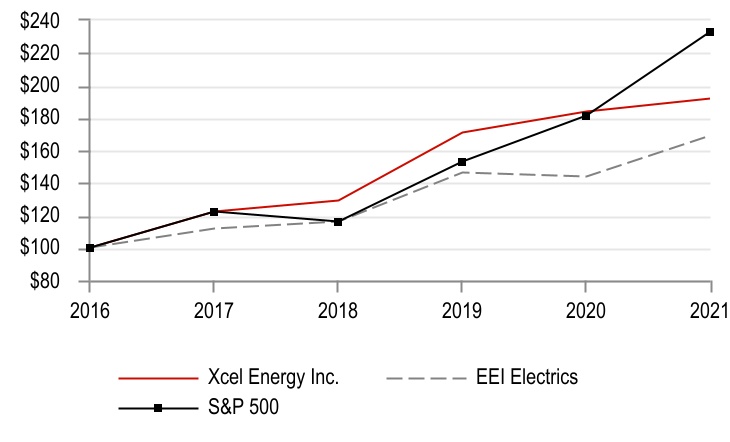
- $100 invested on Dec. 31, 2016 in stock or index — including reinvestment of dividends. Fiscal years ended Dec. 31.
Purchases of Equity Securities by Issuer and Affiliated Purchasers
For the quarter ended Dec. 31, 2021, no equity securities that are registered by Xcel Energy Inc. pursuant to Section 12 of the Securities Exchange Act of 1934 were purchased by or on behalf of us or any of our affiliated purchasers.
Item 6. [RESERVED]
Item 7. MANAGEMENT’S DISCUSSION AND ANALYSIS OF FINANCIAL CONDITION AND RESULTS OF OPERATIONS
Non-GAAP Financial Measures
The following discussion includes financial information prepared in accordance with GAAP, as well as certain non-GAAP financial measures such as ongoing ROE, ongoing earnings and ongoing diluted EPS. Generally, a non-GAAP financial measure is a measure of a company’s financial performance, financial position or cash flows that excludes (or includes) amounts that are adjusted from measures calculated and presented in accordance with GAAP.
Xcel Energy’s management uses non-GAAP measures for financial planning and analysis, for reporting of results to the Board of Directors, in determining performance-based compensation and communicating its earnings outlook to analysts and investors. Non-GAAP financial measures are intended to supplement investors’ understanding of our performance and should not be considered alternatives for financial measures presented in accordance with GAAP. These measures are discussed in more detail below and may not be comparable to other companies’ similarly titled non-GAAP financial measures.
Ongoing ROE
Ongoing ROE is calculated by dividing the net income or loss of Xcel Energy or each subsidiary, adjusted for certain nonrecurring items, by each entity’s average stockholder’s equity. We use these non-GAAP financial measures to evaluate and provide details of earnings results.
Earnings Adjusted for Certain Items (Ongoing Earnings and Ongoing Diluted EPS)
GAAP diluted EPS reflects the potential dilution that could occur if securities or other agreements to issue common stock (i.e., common stock equivalents) were settled. The weighted average number of potentially dilutive shares outstanding used to calculate Xcel Energy Inc.’s diluted EPS is calculated using the treasury stock method. Ongoing earnings reflect adjustments to GAAP earnings (net income) for certain items. Ongoing diluted EPS is calculated by dividing the net income or loss of each subsidiary, adjusted for certain items, by the weighted average fully diluted Xcel Energy Inc. common shares outstanding for the period. Ongoing diluted EPS for each subsidiary is calculated by dividing the net income or loss of such subsidiary, adjusted for certain items, by the weighted average fully diluted Xcel Energy Inc. common shares outstanding for the period.
We use these non-GAAP financial measures to evaluate and provide details of Xcel Energy’s core earnings and underlying performance. We believe these measurements are useful to investors to evaluate the actual and projected financial performance and contribution of our subsidiaries. For the years ended Dec. 31, 2021 and 2020, there were no such adjustments to GAAP earnings and therefore GAAP earnings equal ongoing earnings.
| Results of Operations |
Diluted EPS for Xcel Energy at Dec. 31:
| 2021 | 2020 | |||||||||||||
| Diluted Earnings (Loss) Per Share | GAAP and Ongoing Diluted EPS | GAAP and Ongoing Diluted EPS | ||||||||||||
| PSCo | $ | 1.22 | $ | 1.11 | ||||||||||
| NSP-Minnesota | 1.12 | 1.12 | ||||||||||||
| SPS | 0.59 | 0.56 | ||||||||||||
| NSP-Wisconsin | 0.20 | 0.20 | ||||||||||||
| Earnings from equity method investments — WYCO | 0.05 | 0.05 | ||||||||||||
| Regulated utility (a) | 3.18 | 3.04 | ||||||||||||
| Xcel Energy Inc. and Other | (0.22) | (0.25) | ||||||||||||
| Total (a) | $ | 2.96 | $ | 2.79 |
(a) Amounts may not add due to rounding.
Xcel Energy’s management believes that ongoing earnings reflects management’s performance in operating Xcel Energy and provides a meaningful representation of the performance of Xcel Energy’s core business. In addition, Xcel Energy’s management uses ongoing earnings internally for financial planning and analysis, reporting results to the Board of Directors and when communicating its earnings outlook to analysts and investors.
2021 Comparison with 2020
Xcel Energy — GAAP and ongoing earnings increased $0.17 per share for 2021. The increase was driven by capital investment recovery and other regulatory outcomes, partially offset by increases in depreciation and lower AFUDC. Fluctuations in electric and natural gas revenues associated with changes in fuel and purchased power and/or natural gas sold and transported generally do not significantly impact earnings (changes in revenues are offset by the related variation in costs).
PSCo — Earnings increased $0.11 per share for 2021, driven by capital investment recovery and other regulatory outcomes. Higher revenues were partially offset by increased depreciation, O&M expenses and other taxes (other than income taxes).
NSP-Minnesota — Earnings were flat for 2021 compared to 2020, reflecting capital investment recovery offset by additional depreciation and interest charges.
SPS — Earnings increased $0.03 per share for 2021, largely related to capital investment recovery, other regulatory outcomes and higher sales and demand, partially offset by decreased AFUDC.
NSP-Wisconsin — Earnings were flat for 2021 compared to 2020.
Xcel Energy Inc. and Other — Primarily includes financing costs at the holding company, offset by earnings from EIP investments.
Changes in Diluted EPS
Components significantly contributing to changes in EPS:
| 2021 vs. 2020 | ||||||||
| Diluted Earnings (Loss) Per Share | Dec. 31 | |||||||
| GAAP and ongoing diluted EPS — 2020 | $ | 2.79 | ||||||
| Components of change — 2021 vs. 2020 | ||||||||
| Higher electric revenues, net of electric fuel and purchased power | 0.26 | |||||||
| Lower ETR (a) | 0.17 | |||||||
| Higher natural gas revenues, net of cost of natural gas sold and transported | 0.15 | |||||||
| Changes in taxes (other than income taxes) | (0.03) | |||||||
| Lower AFUDC | (0.10) | |||||||
| Higher depreciation and amortization | (0.24) | |||||||
| Other (net) | (0.04) | |||||||
| GAAP and ongoing diluted EPS — 2021 | $ | 2.96 |
(a) Includes PTCs and plant regulatory amounts, which are primarily offset as a reduction to electric revenues.
ROE for Xcel Energy and its utility subsidiaries:
| 2021 | 2020 | |||||||||||||
| ROE | GAAP and Ongoing ROE | GAAP and Ongoing ROE | ||||||||||||
| NSP-Minnesota | 8.45 | % | 9.20 | % | ||||||||||
| PSCo | 8.23 | 8.06 | ||||||||||||
| SPS | 9.22 | 9.54 | ||||||||||||
| NSP-Wisconsin | 9.92 | 10.52 | ||||||||||||
| Operating Companies | 8.58 | 8.87 | ||||||||||||
| Xcel Energy | 10.58 | 10.59 |
Statement of Income Analysis
The following summarizes the items that affected the individual revenue and expense items reported in the consolidated statements of income.
Estimated Impact of Temperature Changes on Regulated Earnings — Unusually hot summers or cold winters increase electric and natural gas sales, while mild weather reduces electric and natural gas sales. T
Showing the first 8K of 143K characters. Open the full section
Item 7A. QUANTITATIVE AND QUALITATIVE DISCLOSURES ABOUT MARKET RISK
See the “Derivatives, Risk Management and Market Risk” section in Item 7, incorporated by reference.
Item 8. FINANCIAL STATEMENTS AND SUPPLEMENTARY DATA
See Item 15-1 for an index of financial statements included herein.
See Note 15 to the consolidated financial statements for further information.
Management Report on Internal Control Over Financial Reporting
The management of Xcel Energy Inc. is responsible for establishing and maintaining adequate internal control over financial reporting. Xcel Energy Inc.’s internal control system was designed to provide reasonable assurance to Xcel Energy Inc.’s management and Board of Directors regarding the preparation and fair presentation of published financial statements.
All internal control systems, no matter how well designed, have inherent limitations. Therefore, even those systems determined to be effective can provide only reasonable assurance with respect to financial statement preparation and presentation.
Xcel Energy Inc. management assessed the effectiveness of Xcel Energy Inc.’s internal control over financial reporting as of Dec. 31, 2021. In making this assessment, it used the criteria set forth by the Committee of Sponsoring Organizations of the Treadway Commission (COSO) in Internal Control — Integrated Framework (2013). Based on our assessment, we believe that, as of Dec. 31, 2021, Xcel Energy Inc.’s internal control over financial reporting is effective at the reasonable assurance level based on those criteria.
Xcel Energy Inc.’s independent registered public accounting firm has issued an attestation report on Xcel Energy Inc.’s internal control over financial reporting. Its report appears herein.
| /s/ ROBERT C. FRENZEL | /s/ BRIAN J. VAN ABEL | |||||||||||||
| Robert C. Frenzel | Brian J. Van Abel | |||||||||||||
| Chairman, President, Chief Executive Officer and Director | Executive Vice President, Chief Financial Officer | |||||||||||||
| Feb. 23, 2022 | Feb. 23, 2022 | |||||||||||||
REPORT OF INDEPENDENT REGISTERED PUBLIC ACCOUNTING FIRM
To the stockholders and the Board of Directors of Xcel Energy Inc.
Opinions on the Financial Statements and Internal Control over Financial Reporting
We have audited the accompanying consolidated balance sheets of Xcel Energy Inc. and subsidiaries (the "Company") as of December 31, 2021 and 2020, the related consolidated statements of income, comprehensive income, stockholders' equity, and cash flows, for each of the three years in the period ended December 31, 2021, and the related notes and the schedules listed in the Index at Item 15 (collectively referred to as the "financial statements"). We also have audited the Company’s internal control over financial reporting as of December 31, 2021, based on criteria established in Internal Control — Integrated Framework (2013) issued by the Committee of Sponsoring Organizations of the Treadway Commission (COSO).
In our opinion, the financial statements referred to above present fairly, in all material respects, the financial position of the Company as of December 31, 2021 and 2020, and the results of its operations and its cash flows for each of the three years in the period ended December 31, 2021, in conformity with accounting principles generally accepted in the United States of America. Also, in our opinion, the Company maintained, in all material respects, effective internal control over financial reporting as of December 31, 2021, based on criteria established in Internal Control — Integrated Framework (2013) issued by COSO.
Basis for Opinions
The Company’s management is responsible for these financial statements, for maintaining effective internal control over financial reporting, and for its assessment of the effectiveness of internal control over financial reporting, included in the accompanying Management Report on Internal Controls over Financial Reporting. Our responsibility is to express an opinion on these financial statements and an opinion on the Company’s internal control over financial reporting based on our audits. We are a public accounting firm registered with the Public Company Accounting Oversight Board (United States) (PCAOB) and are required to be independent with respect to the Company in accordance with the U.S. federal securities laws and the applicable rules and regulations of the Securities and Exchange Commission and the PCAOB.
We conducted our audits in accordance with the standards of the PCAOB. Those standards require that we plan and perform the audits to obtain reasonable assurance about whether the financial statements are free of material misstatement, whether due to error or fraud, and whether effective internal control over financial reporting was maintained in all material respects.
Our audits of the financial statements included performing procedures to assess the risks of material misstatement of the financial statements, whether due to error or fraud, and performing procedures to respond to those risks. Such procedures included examining, on a test basis, evidence regarding the amounts and disclosures in the financial statements. Our audits also included evaluating the accounting principles used and significant estimates made by management, as well as evaluating the overall presentation of the financial statements. Our audit of internal control over financial reporting included obtaining an understanding of internal control over financial reporting, assessing the risk that a material weakness exists, and testing and evaluating the design and operating effectiveness of internal control based on the assessed risk. Our audits also included performing such other procedures as we considered necessary in the circumstances. We believe that our audits provide a reasonable basis for our opinions.
Definition and Limitations of Internal Control over Financial Reporting
A company’s internal control over financial reporting is a process designed to provide reasonable assurance regarding the reliability of financial reporting and the preparation of financial statements for external purposes in accordance with generally accepted accounting principles. A company’s internal control over financial reporting includes those policies and procedures that (1) pertain to the maintenance of records that, in reasonable detail, accurately and fairly reflect the transactions and dispositions of the assets of the company; (2) provide reasonable assurance that transactions are recorded as necessary to permit preparation of financial statements in accordance with generally accepted accounting principles, and that receipts and expenditures of the company are being made only in accordance with authorizations of management and directors of the company; and (3) provide reasonable assurance regarding prevention or timely detection of unauthorized acquisition, use, or disposition of the company’s assets that could have a material effect on the financial statements.
Because of its inherent limitations, internal control over financial reporting may not prevent or detect misstatements. Also, projections of any evaluation of effectiveness to future periods are subject to the risk that controls may become inadequate because of changes in conditions, or that the degree of compliance with the policies or procedures may deteriorate.
Critical Audit Matter
The critical audit matter communicated below is a matter arising from the current-period audit of the financial statements that was communicated or required to be communicated to the audit committee and that (1) relates to accounts or disclosures that are material to the financial statements and (2) involved our especially challenging, subjective, or complex
Showing the first 8K of 275K characters. Open the full section
Item 9. CHANGES IN AND DISAGREEMENTS WITH ACCOUNTANTS ON ACCOUNTING AND FINANCIAL DISCLOSURE
None.
Item 9A. CONTROLS AND PROCEDURES
Disclosure Controls and Procedures
Xcel Energy maintains a set of disclosure controls and procedures designed to ensure that information required to be disclosed in reports that it files or submits under the Securities Exchange Act of 1934 is recorded, processed, summarized, and reported within the time periods specified in SEC rules and forms. In addition, the disclosure controls and procedures ensure that information required to be disclosed is accumulated and communicated to management, including the CEO and CFO, allowing timely decisions regarding required disclosure.
As of Dec. 31, 2021, based on an evaluation carried out under the supervision and with the participation of Xcel Energy’s management, including the CEO and CFO, of the effectiveness of its disclosure controls and procedures, the CEO and CFO have concluded that Xcel Energy’s disclosure controls and procedures were effective.
Internal Control Over Financial Reporting
No changes in Xcel Energy’s internal control over financial reporting occurred during the most recent fiscal quarter ended Dec. 31, 2021 that materially affected, or are reasonably likely to materially affect, Xcel Energy’s internal control over financial reporting. Xcel Energy maintains internal control over financial reporting to provide reasonable assurance regarding the reliability of the financial reporting. Xcel Energy has evaluated and documented its controls in process activities, general computer activities, and on an entity-wide level.
During the year and in preparation for issuing its report for the year ended Dec. 31, 2021 on internal controls under section 404 of the Sarbanes-Oxley Act of 2002, Xcel Energy conducted testing and monitoring of its internal control over financial reporting. Based on the control evaluation, testing and remediation performed, Xcel Energy did not identify any material control weaknesses, as defined under the standards and rules issued by the Public Company Accounting Oversight Board, as approved by the SEC and as indicated in Xcel Energy’s Management Report on Internal Controls over Financial Reporting, which is contained in Item 8 herein.
Item 9B. OTHER INFORMATION
None.
Item 9C. DISCLOSURE REGARDING FOREIGN JURISDICTIONS THAT PREVENT INSPECTIONS
Not applicable.
PART III
Item 10. DIRECTORS, EXECUTIVE OFFICERS AND CORPORATE GOVERNANCE
Information required under this Item with respect to Directors and Corporate Governance is set forth in Xcel Energy Inc.’s Proxy Statement for its 2022 Annual Meeting of Shareholders, which is expected to occur on April 5, 2022, incorporated by reference. Information with respect to Executive Officers is included in Item 1 to this report.
Item 11. EXECUTIVE COMPENSATION
Information required under this Item is set forth in Xcel Energy Inc.’s Proxy Statement for its 2022 Annual Meeting of Shareholders, which is incorporated by reference.
Item 12. SECURITY OWNERSHIP OF CERTAIN BENEFICIAL OWNERS AND MANAGEMENT AND RELATED STOCKHOLDER MATTERS
Information required under this Item is contained in Xcel Energy Inc.’s Proxy Statement for its 2022 Annual Meeting of Shareholders, which is incorporated by reference.
Item 13. CERTAIN RELATIONSHIPS AND RELATED TRANSACTIONS, AND DIRECTOR INDEPENDENCE
Information required under this Item is contained in Xcel Energy Inc.’s Proxy Statement for its 2022 Annual Meeting of Shareholders, which is incorporated by reference.
Item 14. PRINCIPAL ACCOUNTANT FEES AND SERVICES
Information required under this Item (aggregate fees billed to us by our principal accountant, Deloitte & Touche LLP (PCAOB ID No. 34)) is contained in Xcel Energy Inc.’s Proxy Statement for its 2022 Annual Meeting of Shareholders, which is incorporated by reference.
PART IV
Item 15. EXHIBIT AND FINANCIAL STATEMENT SCHEDULES
| 1 | Consolidated Financial Statements | ||||||||||
| Management Report on Internal Controls Over Financial Reporting — For the year ended Dec. 31, 2021. | |||||||||||
| Report of Independent Registered Public Accounting Firm — Financial Statements and Internal Controls Over Financial Reporting | |||||||||||
| Consolidated Statements of Income — For each of the three years ended Dec. 31, 2021, 2020, and 2019. | |||||||||||
| Consolidated Statements of Comprehensive Income — For each of the three years ended Dec. 31, 2021, 2020, and 2019. | |||||||||||
| Consolidated Statements of Cash Flows — For each of the three years ended Dec. 31, 2021, 2020, and 2019. | |||||||||||
| Consolidated Balance Sheets — As of Dec. 31, 2021 and 2020. | |||||||||||
| Consolidated Statements of Common Stockholders’ Equity — For each of the three years ended Dec. 31, 2021, 2020, and 2019. | |||||||||||
| 2 | Schedule I — Condensed Financial Information of Registrant. | ||||||||||
| Schedule II — Valuation and Qualifying Accounts and Reserves for the years ended Dec. 31, 2021, 2020, and 2019. | |||||||||||
| 3 | Exhibits | ||||||||||
| * | Indicates incorporation by reference | ||||||||||
| + | Executive Compensation Arrangements and Benefit Plans Covering Executive Officers and Directors | ||||||||||
| Xcel Energy Inc. | |||||||||||
| Exhibit Number | Description | Report or Registration Statement | Exhibit Reference | ||||||||
| 3.01* | Amended and Restated Articles of Incorporation of Xcel Energy Inc. | Xcel Energy Inc. Form 8-K dated May 16, 2012 | 3.01 | ||||||||
| 3.02* | Bylaws of Xcel Energy Inc. as Amended on April 3, 2020 | Xcel Energy Inc. Form 8-K dated April 3, 2020 | 3.01 | ||||||||
| 4.01* | Description of Securities | Xcel Energy Inc. Form 10-K for the year ended Dec. 31, 2019 | 4.01 |
Showing the first 8K of 82K characters. Open the full section
Item 16. FORM 10-K SUMMARY
None.
Signatures
Pursuant to the requirements of Section 13 or 15(d) of the Securities Exchange Act of 1934, the registrant has duly caused this annual report to be signed on its behalf by the undersigned thereunto duly authorized.
| XCEL ENERGY INC. | ||||||||
| Feb. 23, 2022 | By: | /s/ BRIAN J. VAN ABEL | ||||||
| Brian J. Van Abel | ||||||||
| Executive Vice President, Chief Financial Officer |
Pursuant to the requirements of the Securities Exchange Act of 1934, this report has been signed below by the following persons on behalf of the registrant and in the capacities on the date indicated above.
| /s/ ROBERT C. FRENZEL | Chairman, President, Chief Executive Officer and Director | ||||||||||
| Robert C. Frenzel | (Principal Executive Officer) | ||||||||||
| /s/ BRIAN J. VAN ABEL | Executive Vice President, Chief Financial Officer | ||||||||||
| Brian J. Van Abel | (Principal Financial Officer) | ||||||||||
| /s/ JEFFREY S. SAVAGE | Senior Vice President, Controller | ||||||||||
| Jeffrey S. Savage | (Principal Accounting Officer) | ||||||||||
| * | Director | ||||||||||
| Lynn Casey | |||||||||||
| * | Director | ||||||||||
| Netha N. Johnson | |||||||||||
| * | Director | ||||||||||
| Patricia L. Kampling | |||||||||||
| * | Director | ||||||||||
| George J. Kehl | |||||||||||
| * | Director | ||||||||||
| Richard T. O’Brien | |||||||||||
| * | Director | ||||||||||
| Charles Pardee | |||||||||||
| * | Director | ||||||||||
| Christopher J. Policinski | |||||||||||
| * | Director | ||||||||||
| James Prokopanko | |||||||||||
| * | Director | ||||||||||
| David A. Westerlund | |||||||||||
| * | Director | ||||||||||
| Kim Williams | |||||||||||
| * | Director | ||||||||||
| Timothy V. Wolf | |||||||||||
| * | Director | ||||||||||
| Daniel Yohannes | |||||||||||
| *By: | /s/ BRIAN J. VAN ABEL | Attorney-in-Fact | |||||||||
| Brian J. Van Abel |