 filings.tools
American International Group 10-K 2022-12-31
Filed 2023-02-17. 23 sections, 1671K characters. Original on sec.gov · Markdown · JSON
Cover and table of contents
UNITED STATES
SECURITIES AND EXCHANGE COMMISSION
Washington, D.C. 20549
——————————
FORM 10-K
☑ ANNUAL REPORT PURSUANT TO SECTION 13 OR 15(d) OF THE SECURITIES EXCHANGE ACT OF 1934
For the fiscal year ended December 31, 2022
OR
☐ TRANSITION REPORT PURSUANT TO SECTION 13 OR 15(d) OF THE SECURITIES EXCHANGE ACT OF 1934
For the transition period from to
Commission File Number 1-8787
American International Group, Inc.
(Exact name of registrant as specified in its charter)
| Delaware | 13-2592361 | ||||
| (State or other jurisdiction of incorporation or organization) | (I.R.S. Employer Identification No.) | ||||
| 1271 Avenue of the Americas, New York, New York | 10020 | ||||
| (Address of principal executive offices) | (Zip Code) |
Registrant’s telephone number, including area code: (212) 770-7000
——————————
Securities registered pursuant to Section 12(b) of the Act:
| Title of each class | Trading Symbol | Name of each exchange on which registered | ||||||
| Common Stock, Par Value $2.50 Per Share | AIG | New York Stock Exchange | ||||||
| 4.875% Series A-3 Junior Subordinated Debentures | AIG 67EU | New York Stock Exchange | ||||||
| Depositary Shares Each Representing a 1/1,000th Interest in a Share of Series A 5.85% Non-Cumulative Perpetual Preferred Stock | AIG PRA | New York Stock Exchange |
Securities registered pursuant to Section 12(g) of the Act: None
——————————
Indicate by check mark if the registrant is a well-known seasoned issuer, as defined in Rule 405 of the Securities Act. Yes ☑ No ☐
Indicate by check mark if the registrant is not required to file reports pursuant to Section 13 or Section 15(d) of the Act. Yes ☐ No ☑
Indicate by check mark whether the registrant (1) has filed all reports required to be filed by Section 13 or 15(d) of the Securities Exchange Act of 1934 during the preceding 12 months (or for such shorter period that the registrant was required to file such reports), and (2) has been subject to such filing requirements for the past 90 days. Yes ☑ No ☐
Indicate by check mark whether the registrant has submitted electronically every Interactive Data File required to be submitted pursuant to Rule 405 of Regulation S-T (§232.405 of this chapter) during the preceding 12 months (or for such shorter period that the registrant was required to submit such files). Yes ☑ No ☐
Indicate by check mark whether the registrant is a large accelerated filer, an accelerated filer, a non-accelerated filer, a smaller reporting company, or an emerging growth company. See the definitions of “large accelerated filer,” “accelerated filer,” “smaller reporting company” and “emerging growth company” in Rule 12b-2 of the Exchange Act.
| Large accelerated filer ☑ | Accelerated filer ☐ | |||||||||||||
| Non-accelerated filer ☐ | Smaller reporting company ☐ | |||||||||||||
| Emerging growth company ☐ |
If an emerging growth company, indicate by check mark if the registrant has elected not to use the extended transition period for complying with any new or revised financial accounting standards provided pursuant to Section 13(a) of the Exchange Act. ☐
Indicate by check mark whether the registrant has filed a report on and attestation to its management’s assessment of the effectiveness of its internal control over financial reporting under Section 404(b) of the Sarbanes-Oxley Act (15 U.S.C. 7262(b)) by the registered public accounting firm that prepared or issued its audit report. ☑
If securities are registered pursuant to Section 12(b) of the Act, indicate by check mark whether the financial statements of the registrant included in the filing reflect the correction of an error to previously issued financial statements. Yes ☐ No ☐
Indicate by check mark whether any of those error corrections are restatements that required a recovery analysis of incentive-based compensation received by any of the registrant's executive officers during the relevant recovery period pursuant to §240.10D-1(b). Yes ☐ No ☐
Indicate by check mark whether the registrant is a shell company (as defined in Rule 12b-2 of the Act). Yes ☐ No ☑
As of June 30, 2022, the aggregate market value of the registrant's voting and nonvoting common equity held by nonaffiliates was approximately $35,300,000,000.
As of February 10, 2023, 737,247,384 shares of the registrant's Common Stock, $2.50 par value per share, were outstanding.
DOCUMENTS INCORPORATED BY REFERENCE
| Document of the Registrant | Form 10-K Reference Locations | ||||
| Portions of the registrant’s definitive proxy statement for the 2023 Annual Meeting of Shareholders | Part II, Item 5 and Part III, Items 10, 11, 12, 13 and 14 |
AMERICAN INTERNATIONAL GROUP, INC.
ANNUAL REPORT ON FORM 10-K FOR THE YEAR ENDED DECEMBER 31, 2022
TABLE OF CONTENTS
FORM 10-K
| AIG | 2022 Form 10-K | 1 |
| Part I |
ITEM 1 | Business
| Maximizing Industry Leadership and Global Footprint | Creating Value through Profitable Growth and a Culture of Underwriting and Operational Excellence |
| American International Group, Inc. (AIG) is a leading global insurance organization. We provide a wide range of property casualty insurance, life insurance, retirement solutions and other financial services to customers in approximately 70 countries and jurisdictions. These diverse offerings include products and services that help businesses and individuals protect their assets, manage risks and provide for retirement security. AIG common stock is listed on the New York Stock Exchange. In 2022, AIG delivered strong financial results while executing on strategic imperatives such as our capital management plan; the initial public offering (IPO) of Corebridge Financial, Inc. (NYSE: CRBG); and achieved the exit run-rate savings goal of AIG 200, our global, multi-year effort focused on positioning AIG for the future. Despite global challenges, AIG achieved a sub-100 combined ratio in every quarter of 2022 as a result of disciplined underwriting, new business development and improved retention across the portfolio. | ||
In this Annual Report, unless otherwise mentioned or unless the context indicates otherwise, we use the terms “AIG,” the “Company,” “we,” “us” and “our” to refer to American International Group, Inc., a Delaware corporation, and its consolidated subsidiaries. We use the term “AIG Parent” to refer solely to American International Group, Inc., and not to any of its consolidated subsidiaries.
| 2 | AIG | 2022 Form 10-K |
ITEM 1 | Business
About AIG
| World-Class Insurance Franchises that are among the leaders in their geographies and segments, providing differentiated service and expertise. | Breadth of Loyal Customers including millions of clients and policyholders ranging from multi-national Fortune 500 companies to individuals throughout the world. | Broad and Long-Standing Distribution Relationships with brokers, agents, advisors, banks and other distributors strengthened through AIG’s dedication to quality. |
| Highly Engaged Global Workforce of more than 26,000 colleagues committed to excellence who are providing services in approximately 70 countries and jurisdictions. | Balance Sheet Strength and Financial Flexibility as demonstrated by $40 billion in shareholders’ equity and AIG Parent liquidity sources of $8.2 billion as of December 31, 2022. |
2022 Highlights
| Path to the Future Completion of IPO of Corebridge Financial, Inc. (Corebridge), the largest U.S. IPO in 2022, which created two standalone, market-leading companies Strategic partnership with BlackRock, Inc. (BlackRock) to manage up to $60 billion of assets for AIG and up to $90 billion for Corebridge. As of December 31, 2022, $162 billion of assets have been transferred AIG 200: Achieved exit run-rate savings goal of $1 billion six months ahead of schedule. We continue to execute on our multi-year effort to modernize operating infrastructure and enhance client and distribution partner experiences | Continued Progress on Capital Management Initiatives Reduced general borrowings by $9.4 billion Repurchased $5.1 billion of AIG's common stock, par value $2.50 per share (AIG Common Stock) and paid $1.0 billion of dividends | |||||||
| Strong General Insurance Performance Resulting from Significant Improvement in Underwriting Income General Insurance achieved $2.0 billion in underwriting income, up 94 percent year over year 2022 combined ratio of 91.9 compared to 95.8 in 2021, and sub-100 in every quarter of 2022 2022 accident year combined ratio, as adjusted(a) of 88.7 improved 2.3 points compared to 91.0 in 2021 | Successful Completion of Corebridge IPO AIG closed IPO, representing 12.4 percent of Corebridge's common stock. The aggregate gross proceeds of the offering to AIG, before deducting underwriting discounts and commissions and other expenses payable by AIG, were approximately $1.7 billion. After consideration of underwriting discounts, commissions and other related expenses payable by AIG, AIG recorded a $608 million increase in AIG’s shareholder’s equity Following the IPO, AIG owns approximately 77.7 percent of the outstanding common stock of Corebridge Corebridge established capital structure and paid $297 million of dividends to its shareholders in 2022, post IPO | |||||||
(a)Non-GAAP measure – for reconciliation of non-GAAP to GAAP measure, see Part II, Item 7. Management’s Discussion and Analysis of Financial Condition and Results of Operations (MD&A).
| AIG | 2022 Form 10-K | 3 |
ITEM 1 | Business
Operating Structure
AIG reports the results of its businesses through three segments – General Insurance, Life and Retirement and Other Operations. General Insurance consists of two operating segments – North America and International. Life and Retirement consists of four operating segments – Individual Retirement, Group Retirement, Life Insurance and Institutional Markets. Other Operations is primarily comprised of corporate, our institutional asset management business and consolidation and eliminations.
For additional information on our business segments, see Part II, Item 7. MD&A and Note 3 to the Consolidated Financial Statements, and for information regarding the separation of Life and Retirement and bankruptcy filing of AIG Financial Products Corp., see Note 1 to the Consolidated Financial Statements.
Business Segments
| General Insurance | Life and Retirement | ||||||||||||||||
| General Insurance is a leading provider of insurance products and services for commercial and personal insurance customers. It includes one of the world’s most far-reaching property casualty networks. General Insurance offers a broad range of products to customers through a diversified, multichannel distribution network. Customers value General Insurance’s strong capital position, extensive risk management and claims experience and its ability to be a market leader in critical lines of the insurance business. | Life and Retirement is a unique franchise that brings together a broad portfolio of life insurance, retirement and institutional products offered through an extensive, multichannel distribution network. It holds long-standing, leading market positions in many of the markets it serves in the U.S. With its strong capital position, customer-focused service, breadth of product expertise and deep distribution relationships across multiple channels, Life and Retirement is well positioned to serve growing market needs. | ||||||||||||||||
  |     | ||||||||||||||||
| General Insurance includes the following major operating companies: National Union Fire Insurance Company of Pittsburgh, Pa. (National Union); American Home Assurance Company (American Home); Lexington Insurance Company (Lexington); AIG General Insurance Company, Ltd. (AIG Sonpo); AIG Asia Pacific Insurance, Pte, Ltd.; AIG Europe S.A.; American International Group UK Ltd.; Validus Reinsurance, Ltd. (Validus Re); Talbot Holdings Ltd. (Talbot); Western World Insurance Group, Inc. and Glatfelter Insurance Group (Glatfelter). | Life and Retirement includes the following major operating companies: American General Life Insurance Company (AGL); The Variable Annuity Life Insurance Company (VALIC); The United States Life Insurance Company in the City of New York (U.S. Life); Laya Healthcare Limited and AIG Life Limited. | ||||||||||||||||
| Other Operations | |||||||||||||||||
| Other Operations primarily consists of income from assets held by AIG Parent and other corporate subsidiaries, deferred tax assets related to tax attributes, corporate expenses and intercompany eliminations, our institutional asset management business and results of our consolidated investment entities, General Insurance portfolios in run-off as well as the historical results of our legacy insurance lines ceded to Fortitude Reinsurance Company Ltd. (Fortitude Re). | |||||||||||||||||
| 4 | AIG | 2022 Form 10-K |
ITEM 1 | Business
How We Generate Revenues and Profitability
We earn revenues primarily from insurance premiums, policy fees and income from investments.
Our expenses consist of policyholder benefits and losses incurred, interest credited to policyholders, commissions and other costs of selling and servicing our products, interest expense and general operating expenses.
Our profitability is dependent on our ability to properly price and manage risk on insurance and annuity products, including establishing loss reserves, to manage our portfolio of investments effectively and to control costs through expense discipline.
For additional information on loss reserves and prior year loss development, see Part II, Item 7. MD&A – Critical Accounting Estimates – Loss Reserves, Part II, Item 7. MD&A – Insurance Reserves – Unpaid Losses and Loss Adjustment Expenses (Loss Reserves), and Note 12 to the Consolidated Financial Statements.
For additional information on investment strategies, see Part II, Item 7. MD&A – Investments.
Human Capital Management
Our people are our greatest strength. To this end, we place significant focus on human capital management; namely retaining, developing and attracting high caliber talent and fostering an inclusive environment in which we actively seek and embrace diverse thinking.
At December 31, 2022, we had approximately 26,200 employees based in approximately 50 countries, of which 34 percent are located in North America, 43 percent are in the Asia Pacific region and the remaining 23 percent are in the European, Middle East and Africa (EMEA) region and Latin America.
We believe that we foster a constructive and healthy work environment for our employees. The key programs and initiatives that are designed to attract, develop and retain our diverse workforce include:
Competitive Compensation and Benefits. Under the oversight of the Compensation and Management Resources Committee of our Board of Directors (CMRC), we seek to align compensation with individual and Company performance and provide the appropriate market-competitive incentives to attract, retain and motivate employees to achieve outstanding results.
Management and the CMRC engage the services of third-party compensation consultants to help monitor the competitiveness of our incentive programs. We provide a performance-driven compensation structure that consists of base salary and, for eligible employees, short- and long-term incentives. We also offer comprehensive benefits to support the health, wellness, work-life balance and retirement preparedness/savings needs of our employees, including subsidized health care plans, life and disability insurance, wellness and mental health benefits, legal assistance plan, paid time off, paid volunteer time off, 2:1 matching grants for eligible charitable donations, parental and bonding leave and both matching and Company 401(k) contributions for eligible employees.
Health and Safety. The health and safety of our employees is a priority. Occupational safety and health is a shared responsibility between employees and corporate stakeholders, which we implement through our Global Safety and Environment policy. We take appropriate measures to prevent workplace injuries and illnesses, to provide a safe and healthy work environment, and to meet regulatory and duty of care responsibilities regarding the health, safety and welfare of employees engaging in AIG business activities.
We offer numerous benefits and wellness programs focused on the physical, social and financial wellness of our employees. Nearly every country in which we operate has an Employee Assistance Program (EAP), which provides employees with confidential counselling, mental health resources and information to help employees and their dependents through times of stress and anxiety. In many countries where local market and regulations permit, our EAP and other programs also offer work-life balance assistance, eldercare advice, bereavement support, and legal and financial guidance.
The AIG Compassionate Colleagues Fund (the Fund) enables the Company and its employees to provide direct relief to help eligible colleagues overcome unforeseen financial hardships. The Fund has helped more than 730 employees overcome serious financial hardships and disasters. In each of 2021 and 2022, AIG made a $2 million contribution to the Fund, and additional amounts were contributed by our colleagues through voluntary donations and our 2:1 matching grants program. Employees in approximately 19 countries have contributed to the Fund and employees in 8 countries have received relief.
| AIG | 2022 Form 10-K | 5 |
ITEM 1 | Business
Talent Development. Equipping our people with the skills and capabilities to be successful and contribute to AIG is another priority. We do this by giving our employees access to meaningful tools and resources to assist in their professional development no matter where they are in their career paths.
AIG offers numerous learning opportunities to support the development of its employees. All online learning programs are accessible through a global learning management system, Your Learning Journey. Through these programs, employees can increase their insurance and business knowledge, build critical job skills and earn continuing education credits.
Alongside online courses, AIG offers a series of live, interactive learning opportunities designed to reinforce the Company's culture of excellence. These programs focus on providing employees with a strong foundation of core skills including communication, collaboration, coaching, change agility and problem solving.
Managers and leaders are critical in developing AIG’s talent for organizational success. To assess leadership skills and capabilities, we use distinct leadership assessment tools, including 360 degree feedback, which develops self-awareness and builds personalized leadership development goals. Our Leading Transformation program enhances our senior leaders’ ability to navigate and drive change and transformation to successfully achieve business objectives and build culture.
AIG places a strong emphasis on diversity and inclusion in its learning programs. We have delivered conscious inclusion training to over 59 percent of people managers to build their awareness of bias and its impact on team members and to hone their empathy skills to support diverse teams. In addition, the Company also released Hiring & Developing Top Talent, an eLearning series for people managers and talent acquisition professionals focused on exploring hidden bias in talent acquisition and development.
In addition to live courses and online training, AIG also offers tuition and certification training reimbursement to encourage employees to enhance their education and skills.
The Company also places significant importance on promoting internal talent and succession planning. Accordingly, we use a globally consistent streamlined process to support succession planning and talent development for each of our functions and operating segments. This approach helps identify a pipeline of diverse talent for positions at all levels of the organization and the actions needed to support their development. In 2022, 36 percent of all our open positions were filled with internal talent.
Diversity, Equity and Inclusion (DEI). AIG is committed to creating an inclusive workplace focused on attracting, retaining and developing diverse talent that fosters a culture of belonging for all employees. As of December 31, 2022, 53 percent of our global workforce were female and 31 percent of our U.S. workforce is ethnically diverse. In addition, management periodically reports to the CMRC on our various human capital management initiatives and metrics, including DEI.
AIG sponsors over 125 Employee Resource Groups (ERGs), which are groups of employees who come together based on a shared interest in a specific dimension of diversity in more than 40 countries to enhance allyship and inclusion across the organization. AIG’s global ERG network spans 13 different dimensions of diversity and is open to all employees. The ERGs are key to supporting a culture of inclusion and belonging at AIG and do so by connecting colleagues, supporting mental health wellness, promoting intersectionality, and giving back to our communities. AIG also provides DEI learning courses to educate, equip and engage employees, including conscious inclusion training for people managers, DEI microlearning and sessions on authentic leadership.
To support the attraction and development of diverse talent, AIG took several proactive steps in 2022, including enhancing partnerships with diverse organizations. Additionally, AIG's Accelerated Leadership Development program matches mid-level underrepresented talent in AIG’s leadership pipeline with senior executive mentors who coach them on essential senior management and executive leadership skills.
| 6 | AIG | 2022 Form 10-K |
ITEM 1 | Business
Regulation
GENERAL
Our (re)insurance subsidiaries are subject to extensive regulation and supervision in the jurisdictions in which our (re)insurance businesses are located or operate. Insurance regulatory authorities in those jurisdictions are the primary regulators for those businesses; however, our operations are subject to regulation by many different types of regulatory authorities, including insurance, securities, derivatives and investment advisory regulators in the United States and abroad.
Insurance regulators, other regulatory authorities, law enforcement agencies, and other governmental authorities from time to time make inquiries and conduct examinations or investigations regarding our compliance, as well as compliance by other companies in our industry, with applicable laws. In addition, regulation, legislation and administrative policies that are not limited in application solely to the insurance market may significantly affect the insurance industry and certain of our operations, including regulation, legislation and administrative policies related to privacy, cybersecurity, government sanctions, pensions, age and sex discrimination, financial services, securities, taxation and climate change. See Item 1A. Risk Factors – Regulation – Our businesses are heavily regulated and changes in laws and regulations may affect our operations, increase our insurance subsidiary capital requirements or reduce our profitability.
We expect that the U.S. and international regulations applicable to us and our regulated entities will continue to evolve for the foreseeable future. See Item 1A. Risk Factors – Regulation – New laws and regulations or new interpretations of current laws and regulations, both domestically and internationally, may affect our businesses, results of operations, financial condition and ability to compete effectively.
FINANCIAL, MARKET CONDUCT & CORPORATE GOVERNANCE OVERSIGHT
The method of insurance regulation of our (re)insurance subsidiaries varies, but generally has its source in statutes that delegate regulatory and supervisory powers to a state insurance official (in the United States) or another governmental agency (outside the United States). The regulation and supervision relate primarily to the financial condition of the (re)insurers, corporate conduct and market conduct activities. In general, such regulation is for the protection of policyholders rather than the creditors or equity owners of these companies. Financial, market conduct and corporate conduct oversight varies by jurisdiction, but can include activities such as:
(a)approval of policy language and rates;
(b)advertising practices;
(c)establishing minimum capital and liquidity requirements;
(d)licensing of insurers and their agents;
(e)requiring registration and periodic reporting by (re)insurance companies that are licensed in the jurisdiction;
(f)evaluating and, in some cases, requiring regulatory approval of, certain transactions between (re)insurance company subsidiaries and their affiliates;
(g)imposing restrictions and limitations on the amount of dividends or other distributions payable by a (re)insurance company;
(h)enforcing rules related to outsourcing of material functions;
(i)requiring deposits of securities for the benefit of policyholders;
(j)establishing requirements for acceptability of reinsurers and credit for reinsurance;
(k)establishing requirements for reserves; and
(l)enterprise risk management (including technology risk management) and corporate governance requirements.
Our (re)insurance subsidiaries are generally subject to laws and regulations that prescribe the type, quality and concentration of investments they can make and permissible investment practices, such as derivatives, securities lending and repurchase transactions. In non-U.S. jurisdictions, our (re)insurance subsidiaries may also be subject to laws requiring certain amounts and types of local investment. In addition, certain affiliates of our (re)insurance affiliates are themselves subject to laws and regulations concerning the investment advisory and investment management services they provide to our (re)insurance subsidiaries and other clients with respect to such investments.
Insurance laws in many jurisdictions also provide that no person, corporation or other entity may acquire control of an insurance company, or a controlling interest in (or prescribed percentage of capital of) any direct or indirect parent company of an insurance company, without the prior approval of, or notice to, such insurance company’s domiciliary insurance regulator.
| AIG | 2022 Form 10-K | 7 |
ITEM 1 | Business
As a holding company with no significant business operations of its own, AIG Parent depends on dividends from our subsidiaries to meet our obligations. U.S. state insurance laws typically provide that dividends in excess of certain prescribed limits are considered to be extraordinary dividends and require prior approval or non-disapproval from the applicable insurance regulator. Outside the U.S., (re)insurers, subject to certain exceptions, are permitted to pay dividends subject to maintaining prescribed capital and solvency requirements and ensuring that dividends are made out of profits/retained earnings.
Further, as part of their regulatory oversight processes, insurance regulators conduct periodic examinations of our (re)insurance subsidiaries. Such examinations can cover a broad scope of the (re)insurance subsidiary’s operations, including the financial strength of the (re)insurance subsidiary; sales, marketing and claims handling practices; risk management; capital and liquidity management; and information technology operations (including emerging technology risks).
Insurance and securities regulators and other law enforcement agencies and attorneys general also, from time to time, make inquiries, issue data calls and conduct examinations or investigations regarding compliance with insurance and other laws or for informational purposes that can be company-specific or part of a broader industry-wide effort.
There can be no assurance that any noncompliance with such applicable laws, regulations or guidance would not have a material adverse effect on our business or results of operations.
REGULATORY REGIMES
United States
States
At the state-level, the National Association of Insurance Commissioners (NAIC) is a standard-setting and regulatory support organization created and governed by the chief insurance regulators from the 50 states, the District of Columbia and five U.S. territories. The NAIC is not a regulator, but, with assistance from the NAIC, state insurance regulators establish standards and best practices, conduct peer reviews and coordinate regulatory oversight. Model laws and regulations promulgated by the NAIC become effective in a state once formally adopted and are subject to revision by each state. Examples of NAIC models adopted, in substantial part, by all states include:
-
The Risk-Based Capital (RBC) for Insurers Model Act, which incorporates an RBC formula calculated in accordance with instructions updated annually by the NAIC that is designed to measure the adequacy of an insurer’s total adjusted capital, as calculated pursuant to the RBC formula, in relation to certain risks inherent in its business, and authorizes certain regulatory actions regarding insurers whose RBC levels fall below specific thresholds. The NAIC has adopted, or is considering, several changes impacting how RBC is calculated, including initiatives aimed at a comprehensive review of the RBC investment framework as well as a proposed modeling methodology to determine RBC for collateralized loan obligations to replace the use of rating agency ratings. The RBC levels of each of our U.S. domiciled (re)insurance companies exceeded each of these specific thresholds as of December 31, 2022. In addition to RBC requirements, the insurance laws of our domiciliary states prescribe certain minimum capital and surplus requirements for insurance companies. If any of our (re)insurance entities fell below prescribed levels of statutory capital and surplus, it would be our intention to provide appropriate capital or other types of support to that entity. For additional information, see Part II, Item 7. MD&A – Liquidity and Capital Resources – Liquidity and Capital Resources of AIG Parent and Subsidiaries – Insurance Companies.
-
The Insurance Holding Company System Regulatory Act and the Insurance Holding Company System Model Regulation (together, the Holding Company Models) include: provisions authorizing insurance commissioners to act as global group-wide supervisors for internationally active insurance groups and participate in international supervisory colleges; standards for transactions between a domestic (re)insurance company and its affiliates and regulatory approval requirements for certain of such transactions; requirements for obtaining regulatory approval for acquiring control of a domestic (re)insurance company; and the requirement that the ultimate controlling person of a U.S. insurer file an annual enterprise risk report with its lead state regulator identifying risks likely to have a material adverse effect upon the financial condition or liquidity of its licensed insurers or the insurance holding company system as a whole, among other requirements. The New York State Department of Financial Services (NYDFS) is AIG’s lead U.S.-state regulator, and leads AIG’s Supervisory College meetings of AIG’s key global regulatory bodies.
-
The Risk Management and Own Risk and Solvency Assessment Model Act, which requires that insurers maintain a risk management framework, conduct an internal own risk and solvency assessment of the insurer’s material risks in normal and stressed environments, and submit annual Own Risk and Solvency Assessment (ORSA) summary reports to the insurance group’s lead U.S.-state regulator.
-
The Corporate Governance Annual Disclosure Model Act (CGAD), which requires insurers to submit an annual filing regarding their corporate governance structure, policies and practices.
-
And, specific to our life insurance subsidiaries, a new Valuation Manual approved by the NAIC, which contains a principle-based reserving (PBR) approach to life insurance company reserves. PBR is designed to tailor the reserving process to more closely reflect the risks of specific products rather than the factor-based approach employed historically.
| 8 | AIG | 2022 Form 10-K |
ITEM 1 | Business
The NAIC also provides standardized insurance industry accounting and reporting guidance through the NAIC Accounting Manual, which establishes statutory accounting principles applicable to (re)insurance companies. Statutory accounting principles promulgated by the NAIC may be modified by individual state laws, regulations and permitted practices granted by our domiciliary insurance regulators.
The NAIC has recently undertaken a multi-pronged effort to determine whether additional standards, safeguards or disclosures are required in connection with certain investments by U.S. insurance companies, including related party investments, structured securities and other complex assets.
In December 2020, the NAIC amended the Holding Company Models to incorporate a Liquidity Stress Testing (LST) requirement for large life insurers based on a set of scope criteria and a Group Capital Calculation (GCC) requirement. These amendments require the ultimate controlling person of every U.S. insurer that is scoped into the LST framework to submit LST results to the insurance group’s lead state insurance regulator on an annual basis. In addition, these amendments require the ultimate controlling person of every U.S. insurer to submit GCC reports to the insurance group’s lead state insurance regulator on an annual basis unless an exemption applies. The NAIC has proposed that provisions of the December 2020 amendments to the Holding Company Models that authorize the GCC and LST will become accreditation standards effective as of January 1, 2026, and, if this occurs, states will be required to adopt significant elements of the Holding Company Models that authorize the GCC and LST by January 1, 2026 to remain accredited by the NAIC.
In recent years, insurance regulators have also emphasized the investigation of alleged improper insurance pricing and sales practices by insurers, including, for example, race-based underwriting or sales practices, misleading sales presentations by insurance agents, targeting of the elderly or other vulnerable adults, and the suitability of products for potential customers.
U.S. states have state insurance guaranty associations in which insurers doing business in the state are required by law to be members. Member insurers may be assessed by the associations for certain obligations of insolvent insurance companies to policyholders and claimants. The aggregate assessments levied against us have not been material to our financial condition in any of the past three years.
Federal
At the U.S. federal level, AIG is impacted by the activities of policymakers and by the laws and regulations enforced by various federal agencies.
The Dodd-Frank Wall Street Reform and Consumer Protection Act (Dodd-Frank), signed into law in 2010, brought about extensive changes to financial regulation in the United States and established the Federal Insurance Office (FIO) to serve as the central insurance authority in the federal government. While not serving a regulatory function, FIO performs certain duties related to the business of insurance and has authority to collect information on the insurance industry and recommend prudential standards. In addition, FIO monitors market access issues, represents the United States in international insurance forums and has authority to determine if certain regulations are preempted by covered agreements. FIO’s approval is required to subject a financial company whose largest U.S. subsidiary is an insurer to the special orderly liquidation process outside the federal bankruptcy code, administered by the FDIC pursuant to Dodd-Frank. U.S. insurance subsidiaries of any such financial company, however, would be subject to rehabilitation and liquidation proceedings under state insurance laws.
FIO also assists the Secretary of the Treasury in administering the U.S. Terrorism Risk Insurance Act (TRIA), enacted in 2002 to support insurance coverage for certain terrorist acts in the U.S. The program was continued under the Terrorism Risk Insurance Program Reauthorization Act of 2019 (TRIPRA) through December 31, 2027 and is intended to provide reinsurance coverage from the federal government in limited circumstances for certified acts of terrorism that exceed a certain threshold of industry losses.
Title I of Dodd-Frank established the Financial Stability Oversight Council (Council), which is authorized to determine that certain nonbank financial companies be designated as nonbank systemically important financial institutions (SIFIs) subject to supervision by the Board of Governors of the Federal Reserve System and enhanced prudential standards. Designation by the Council of any nonbank SIFI is subject to certain statutory and regulatory standards and to the Council’s guidance. The Council may also recommend that state insurance regulators or other regulators apply new or heightened standards and safeguards for activities or practices that insurers or other nonbank financial services companies engage in.
Title V of Dodd-Frank authorizes the United States to enter into covered agreements with foreign governments or regulatory entities regarding the business of insurance and reinsurance. On September 22, 2017, the U.S. and the European Union (EU) entered into such an agreement, and on December 18, 2018, the U.S. signed a covered agreement with the United Kingdom (UK), which is similar to the agreement with the EU. Under the agreements, AIG will be supervised at the worldwide group level only by its relevant U.S. insurance supervisors, and will generally not have to satisfy EU Solvency II group capital, reporting and governance requirements for its worldwide group. U.S. state regulators have five years from the dates the covered agreements were signed to adopt reinsurance collateral reforms and a group capital assessment, which has led a number of states to adopt the NAIC’s GCC well in advance of the January 1, 2026 target implementation date.
| AIG | 2022 Form 10-K | 9 |
ITEM 1 | Business
Title VII of Dodd-Frank provides for significantly increased regulation of, and restrictions on, derivatives markets and transactions that have affected various activities of insurance and other financial services companies, including (i) regulatory reporting for swaps, including security-based swaps, (ii) mandated clearing through central counterparties and execution through regulated swap execution facilities for certain swaps (other than security-based swaps and (iii) margin and collateral requirements.
AIG Federal Savings Bank, our trust-only federal thrift subsidiary, is supervised and regulated by the Office of the Comptroller of the Currency.
International
In the UK, the Prudential Regulation Authority (PRA) is the lead prudential supervisor for our UK insurance operations and the Financial Conduct Authority has oversight of AIG’s insurance operations for consumer protection and competition matters.
In the EU, various Directives and Regulations affect our international (re)insurance operations. The Luxembourg insurance regulator, the Commissariat aux Assurances, is the insurance regulator for AIG Europe SA, which serves our European Economic Area (EEA) and Swiss policyholders. In addition, financial companies that operate in the EU are subject to a range of regulations enforced by the national regulators in each member state in which that firm operates. Solvency II governs the insurance industry’s solvency framework for the EU, including minimum capital and solvency requirements, governance requirements, risk management and public reporting standards.
AIG’s operating (re)insurance subsidiaries in Bermuda are regulated by the Bermuda Monetary Authority (BMA). Bermuda’s Insurance Act 1978, the applicable Codes of Conduct and related regulations impose solvency and liquidity standards and auditing and reporting requirements on Bermuda (re)insurance companies and grant the BMA powers to supervise, investigate and intervene in the affairs of (re)insurance companies. A variety of requirements and restrictions are imposed on our Bermuda operating (re)insurance subsidiaries including: periodic financial reporting; corporate governance framework; solvency and financial performance; compliance with minimum enhanced capital requirements; and minimum solvency margins and liquidity ratios (the latter for general business (re)insurers); and limitations on dividends and distributions.
The Monetary Authority of Singapore (MAS) supervises AIG’s insurance subsidiary in Singapore. It has broad authority under the Insurance Act 1966 to regulate insurance business in Singapore as well as insurers, insurance intermediaries and related institutions. Our Singapore insurance operations are subject to minimum capital and solvency requirements as well as financial reporting, corporate governance and conduct of business requirements. The MAS has authority to conduct inspections and investigations on insurers and to administer sanctions for regulatory non-compliance. Our Singapore insurance subsidiary holds insurance entities in the Asia Pacific region. The MAS holds the Chief Executive of the Singapore insurance subsidiary principally responsible for the management and conduct of the business of the subsidiary, including the business of its subsidiaries and overseas branches.
The Japan Financial Services Agency (JFSA) regulates AIG’s operating insurance subsidiaries and insurance holding company in Japan. The JFSA has extensive authority under the Insurance Business Act and related regulations to oversee licensing, sales practices, business conduct, investments, reserves and solvency, amongst other matters. Our Japanese insurance operations are required to maintain a minimum solvency margin ratio (SMR), which is a measure of capital adequacy. The failure to maintain an appropriate SMR, or comply with other similar indicators of financial health, could result in the JFSA imposing corrective actions on our operations.
FSB and IAIS
The Financial Stability Board (FSB) consists of representatives of national financial authorities of the G20 countries. The FSB is not a regulator but is focused primarily on promoting international financial stability. The FSB has issued a series of frameworks and recommendations to address such issues as systemic financial risk, financial group supervision, capital and solvency standards, effective recovery and resolution regimes, corporate governance including compensation, and a number of related issues associated with responses to the financial crisis.
The International Association of Insurance Supervisors (IAIS) represents insurance regulators and supervisors of more than 200 jurisdictions (including regions and states) in nearly 140 countries and seeks to promote globally consistent insurance industry supervision. The IAIS is not a regulator, but one of its activities is to develop insurance regulatory standards for use by local authorities across the globe. For example, the IAIS has adopted ComFrame, a Common Framework for the Supervision of Internationally Active Insurance Groups (IAIGs). ComFrame assists regulators in addressing an IAIG’s risks by providing supervisory standards for areas such as group supervision, governance and internal controls, enterprise risk management, and recovery and resolution planning. We currently meet the criteria set forth to identify an IAIG, and the NYDFS, as our group-wide supervisor, has publicly disclosed us as an IAIG on the IAIS’ register of IAIGs.
In addition, the FSB has charged the IAIS with developing a framework for measuring and mitigating systemic risks posed by the insurance sector, and in response the IAIS developed an enhanced set of supervisory policy measures for the assessment and mitigation of systemic risk in the insurance sector (Holistic Framework), with implementation beginning in 2020. The Holistic Framework recognizes that systemic risk can emanate from specific activities and exposures arising from either sector-wide trends or
| 10 | AIG | 2022 Form 10-K |
Item 1. Business
concentrations in individual insurers. In light of the IAIS adoption of the Holistic Framework, the FSB decided in December 2022 to discontinue the annual identification of Global Systemically Important Insurers in favor of instead applying the Holistic Framework to inform the FSB’s consideration of systemic risk in insurance.
As part of ComFrame, the IAIS is developing a risk-based global insurance capital standard (ICS) applicable to IAIGs, with the purpose of creating a common language for supervisory discussions of group solvency of IAIGs. The IAIS has adopted ICS Version 2.0 for a five-year monitoring phase, with an initial phase that commenced January 2020. During the initial phase, ICS Version 2.0 is used for confidential reporting to group-wide supervisors and discussion in supervisory colleges, but will not trigger supervisory action. At the conclusion of the five-year monitoring period, the IAIS has agreed to a second phase of implementation, whereby the ICS will be applied as a group-wide prescribed capital requirement, defined as a solvency control level above which the supervisor does not intervene on capital adequacy grounds. However, in recognition that the United States and other interested jurisdictions are developing an alternative approach to a group capital calculation that utilizes an aggregation methodology of available capital and required capital of all insurance group members (Aggregation Method or AM), the IAIS is assessing whether the AM provides comparable outcomes to ICS Version 2.0, including by collecting data from interested jurisdictions. The IAIS aims to be in a position by the end of the monitoring phase to assess whether the AM provides substantially the same outcome as the ICS, in which case it will be considered an outcome-equivalent approach to the ICS.
The standards issued by the FSB and/or the IAIS are not binding on the United States or other jurisdictions around the world unless and until the appropriate local governmental bodies or regulators adopt laws or regulations implementing such standards.
PRIVACY, DATA PROTECTION AND CYBERSECURITY
We are subject to various laws and regulations that require financial institutions and other businesses to protect and safeguard personal and other sensitive information and provide notice of their practices relating to the collection, disclosure and other processing of personal information. We also are subject to U.S. federal and state laws and regulations requiring notification to affected individuals and regulators of a data breach(es). Below we highlight a few key privacy, data protection and cybersecurity laws and regulations.
In October 2017, the NAIC adopted the Insurance Data Security Model Law (NAIC Data Security Model Law), which, among other things, requires insurers, insurance producers and other entities required to be licensed under state insurance laws to develop and maintain a written information security program, conduct risk assessments, and oversee the data security practices of third-party service providers. As of December 31, 2022, more than 20 jurisdictions had adopted the NAIC Data Security Model Law. In addition, on March 1, 2019, the NYDFS’s cybersecurity regulation became fully effective, requiring covered financial institutions, including insurance entities licensed in New York, to, among other things, implement a cybersecurity program designed to protect information systems. New York released proposed amendments to its cybersecurity regulation in 2022, which include additional obligations for large insurers including enhanced and updated governance, risk assessment, and technology requirements, new notification obligations, and clarifying changes regarding enforcement.
The State of California enacted the California Consumer Privacy Act of 2018 (CCPA), which was effective as of January 1, 2020, and imposed significant and often first-of-their-kind privacy obligations on businesses handling data related to California residents. The law has a number of exceptions as a result of amendments; however, it does not apply to personal information collected, processed, sold, or disclosed pursuant to the federal Gramm-Leach-Bliley Act (GLBA) and implementing regulations or the California Financial Information Privacy Act (FIPA). These amendments reduce the impact of the law on AIG in some, but not all, areas. In addition, exemptions for personal information obtained in the context of certain business-to-business communications or transactions and for personal information pertaining to employees, agents and similar categories of individuals sunset on January 1, 2023. The California Privacy Rights Act (CPRA) passed in November 2020 became effective January 1, 2023 and amends the CCPA to create additional privacy rights and obligations in California. Colorado, Connecticut, Utah and Virginia also enacted comprehensive consumer data privacy laws and many other states have proposed similar laws.
These privacy laws impose requirements on covered businesses that are similar to those imposed by the CCPA with respect to privacy notices, data subject rights and data security standards.
In March 2022, the SEC released several proposed rules enhancing disclosure requirements for registered companies covering cybersecurity risk and management. If enacted, the proposed rules would, among other things, require disclosure by registrants of any material cybersecurity incident on Form 8-K within four business days of determining that the incident the registrant has experienced is material. They would also require periodic disclosures of, among other things, (i) details on the company’s cybersecurity policies and procedures, (ii) cybersecurity governance and oversight policies, including the board of directors’ oversight of cybersecurity risks and (iii) details of any cybersecurity incident that was previously disclosed on Form 8-K, as well as any undisclosed incidents that were non-material, but have become material in the aggregate.
The EU General Data Protection Regulation (GDPR) took effect in May 2018. The GDPR’s scope extends to entities established within the EEA (i.e., EU member states plus Iceland, Liechtenstein and Norway) and to certain entities not established in the EEA (in certain instances, if they solicit or target individuals in the EU by offering goods or services to EEA data subjects or monitoring the personal behavior of EEA data subjects (e.g., in an online context)). The GDPR was also onshored in the UK through the European
| AIG | 2022 Form 10-K | 11 |
ITEM 1 | Business
Union (Withdrawal) Act 2018, with adjustments as provided in the Data Protection, Privacy and Electronic Communications (Amendments etc.) (EU Exit) Regulations 2019. Sanctions for non-compliance with the GDPR are onerous, with the potential for fines of up to 4 percent of global revenue for the most serious infringements of the GDPR.
We have sought to address the GDPR’s requirements by demonstrating accountability for compliance with the GDPR’s principles relating to processing of personal data, maintaining records of processing and completing mandatory Data Protection Impact Assessments in connection with higher risk data processing activities.
The GDPR imposes requirements on the transfer of personal data outside of the EEA, including via Standard Contractual Clauses supplemented by an assessment and due diligence of the legal and regulatory landscape of the jurisdiction of the data importer, the channels used to transmit personal data and the processors or subprocessors that may process personal data.
The EEA and the UK have also taken steps to regulate the use of data and algorithms used for the purpose of artificial intelligence and automated decision-making. In April 2021, the European Commission published its Proposal for a Regulation on a European approach for Artificial In
Showing the first 8K of 101K characters. Open the full section
Item 1A. Risk Factors
We employ a capital markets hedging strategy to partially offset the economic impacts of movements in equity, interest rate and credit markets, however, our hedging strategy may not effectively offset movements in our GAAP equity or our and statutory surplus and capital requirements and may otherwise be insufficient in relation to our obligations. Furthermore, we are subject to the risk that changes in policyholder behavior or actual levels of mortality/longevity as compared to assumptions in pricing and reserving, combined with adverse market events, could produce losses not addressed by the risk management techniques employed. These factors, individually or collectively, may have a material adverse effect on our business, financial condition, results of operations or liquidity including our ability to receive dividends from our operating companies.
Changes in interest rates result in changes to the fair value liability. All else being equal, higher interest rates generally decrease the fair value of our liabilities, which increases our earnings, while low interest rates generally increase the fair value of our liabilities, which decreases our earnings. A prolonged low interest rate environment or a prolonged period of widening credit spreads may also subject us to increased hedging costs or an increase in the amount of statutory reserves that our insurance subsidiaries are required to hold for our liabilities, lowering their statutory surplus, which would adversely affect their ability to pay dividends. In addition, it may also increase the perceived value of our benefits to our policyholders, which in turn may lead to a higher than expected benefit utilization and persistency of those products over time.
Differences between the change in fair value of the GAAP embedded derivatives, as well as associated statutory and tax liabilities, and the value of the related hedging portfolio may occur and can be caused by movements in the level of equity, interest rate and credit markets, market volatility, policyholder behavior and mortality/longevity rates that differ from our assumptions and our inability to purchase hedging instruments at prices consistent with the desired risk and return trade-off. In addition, we may sometimes choose not to hedge or fully mitigate these risks, based on economic considerations and other factors. The occurrence of one or more of these events has in the past resulted in, and could in the future result in, an increase in the fair value of liabilities associated with the guaranteed benefits without an offsetting increase in the value of our hedges, or a decline in the value of our hedges without an offsetting decline in our liabilities, thus reducing our results of operations and shareholders’ equity.
For additional information on these products, see Notes 12 and 13 to the Consolidated Financial Statements, Item 1. Business – Regulation and Part II, Item 7. MD&A – Critical Accounting Estimates – Guaranteed Benefit Features of Variable Annuity, Fixed Annuity and Fixed Index Annuity Products.
Our risk management policies and procedures may prove to be ineffective and leave us exposed to unidentified or unanticipated risk, which could adversely affect our businesses, results of operations, financial condition and liquidity. We have developed and continue to enhance enterprise-wide risk management policies and procedures to identify, monitor and mitigate risk and loss to which we are exposed. Our risk management policies and procedures may not be sufficiently comprehensive and may not identify or adequately protect us from every risk to which we are exposed. Many of our methods of identifying, measuring, underwriting and managing risks are based upon our study and use of historical market, applicant, customer, employee and bad actor behavior or statistics based on historical models. As a result, these methods may not accurately predict future exposures from events such as a major financial market disruption as the result of a natural or man-made disaster (for example, a climate-related event or terrorist attack), that could be significantly different than the historical measures indicate, and which could also result in a substantial change in policyholder behavior and claims levels not previously observed. We have and will continue to enhance our underwriting processes, including, from time to time, considering and integrating newly available sources of data to confirm and refine our traditional underwriting methods. Our efforts at implementing these improvements may not, however, be fully successful, which may adversely affect our competitive position. We have also introduced new product features designed to limit our risk and taken actions on in-force business, which may not be fully successful in limiting or eliminating risk. We may take additional actions on our in-force business, including adjusting crediting rates and cost of insurance, which may not be fully successful in maintaining profitability and which may result in litigation. Moreover, our hedging programs and reinsurance strategies that are designed to manage market risk and mortality risk rely on assumptions regarding our assets, liabilities, general market factors and the creditworthiness of our counterparties that could prove to be incorrect or inadequate. Our hedging programs utilize various derivative instruments, including but not limited to equity options, futures contracts, interest rate swaps and swaptions, as well as other hedging instruments, which may not effectively or completely reduce our risk; and assumptions underlying models used to measure accumulations and support reinsurance purchases may prove inaccurate and could leave us exposed to larger than expected catastrophe losses in a given year. In addition, our current business continuity and disaster recovery plans may not be sufficient to reduce the impact of pandemics, cyber risks, including ransomware, and other natural or man-made catastrophic events that are beyond our anticipated thresholds or impact tolerances. Other risk management methods depend upon the evaluation of information regarding markets, clients, or other matters that is publicly available or otherwise accessible to us, which may not always be accurate, complete, up-to-date or properly evaluated. Management of operational, legal and regulatory risks requires, among other things, policies and procedures to record and verify large numbers of transactions and events in each jurisdiction in which we operate. Jurisdictions have unique requirements with respect to artificial intelligence and environmental, social and governance matters, which may impact the efficacy of our standardized risk management tools and techniques and therefore our policies and procedures may not be fully effective. Accordingly, our risk management policies and procedures may not adequately mitigate the risks to our business, results of operations, financial condition and liquidity.
| 28 | AIG | 2022 Form 10-K |
ITEM 1A | Risk Factors
If our risk management policies and procedures are ineffective, we may suffer unexpected losses and could be materially adversely affected. As our businesses change and the markets in which we operate evolve and new risks emerge, including for example risks related to climate change or meeting regulatory and stakeholder expectations relating to ESG or cybersecurity issues, our risk management framework may not evolve at the same pace as those changes. As a result, there is a risk that new products or new business strategies may present risks that are not appropriately identified, monitored or managed. The effectiveness of our risk management strategies may be limited, resulting in losses, because of market stress, unanticipated financial market movements or unanticipated claims experience from adverse mortality, morbidity or p
Showing the first 8K of 72K characters. Open the full section
Item 1B. Unresolved Staff Comments
There are no unresolved written comments that were received from the SEC staff 180 days or more before the end of our fiscal year relating to periodic or current reports under the Exchange Act.
Item 2. Properties
We lease our corporate headquarters located at 1271 Avenue of the Americas, New York, New York. We operate from approximately 130 offices in the United States and approximately 250 offices in approximately 40 foreign countries. We own 12 office buildings in the United States.
Our General Insurance companies own offices in 10 foreign countries including Bermuda, Ecuador, Japan, Mexico, the UK and Venezuela. The remainder of the office space we use is leased. We believe that our leases and properties are sufficient for our current purposes.
LOCATIONS OF CERTAIN ASSETS
As of December 31, 2022, approximately 8 percent of our consolidated assets were located outside the U.S. and Canada.
For additional information on geographic locations, see Note 3 to the Consolidated Financial Statements.
Item 3. Legal Proceedings
For a discussion of legal proceedings, see Note 15 to the Consolidated Financial Statements, which is incorporated herein by reference.
Item 4. Mine Safety Disclosures
Not applicable.
| AIG | 2022 Form 10-K | 39 |
ITEM 5 | Market for Registrant’s Common Equity, Related Stockholder Matters and Issuer Purchases of Equity Securities
| Part II |
Item 5. Market for Registrant’s Common Equity, Related Stockholder Matters and Issuer Purchases of Equity Securities
AIG’s common stock, par value $2.50 per share (AIG Common Stock), is listed on the New York Stock Exchange (NYSE: AIG). There were approximately 19,509 stockholders of record of AIG Common Stock as of February 10, 2023.
Equity Compensation Plans
Our table of equity compensation plans will be included in the definitive proxy statement for AIG’s 2023 Annual Meeting of Shareholders. The definitive proxy statement will be filed with the SEC no later than 120 days after the end of AIG’s fiscal year pursuant to Regulation 14A.
Purchases of Equity Securities
The following table provides information about purchases made by or on behalf of AIG or any “affiliated purchaser” (as defined in Rule 10b-18(a)(3) under the Securities Exchange Act of 1934 (the Exchange Act)) of AIG Common Stock during the three months ended December 31, 2022:
| Period | Total Number of Shares Repurchased | Average Price Paid per Share | Total Number of Shares Purchased as Part of Publicly Announced Plans or Programs | Approximate Dollar Value of Shares that May Yet Be Purchased Under the Plans or Programs (in millions) | ||||||||||||||||||||||
| October 1-31 | 4,698,357 | $ | 51.97 | 4,698,357 | $ | 4,329 | ||||||||||||||||||||
| November 1-30 | 3,793,917 | 60.21 | 3,793,917 | 4,101 | ||||||||||||||||||||||
| December 1-31 | 4,896,176 | 62.59 | 4,896,176 | 3,794 | ||||||||||||||||||||||
| Total | 13,388,450 | $ | 58.19 | 13,388,450 | $ | 3,794 |
On May 3, 2022, the Board of Directors authorized the repurchase of $6.5 billion of AIG Common Stock (inclusive of the approximately $1.5 billion of expected remaining authorization upon expiration of the then-current 10b5-1 Plan as of May 20, 2022). As of December 31, 2022, approximately $3.8 billion remained under the authorization.
For additional information on our share purchases, see Note 16 to the Consolidated Financial Statements.
| 40 | AIG | 2022 Form 10-K |
ITEM 5 | Market for Registrant’s Common Equity, Related Stockholder Matters and Issuer Purchases of Equity Securities
Common Stock Performance Graph
The following Performance Graph compares the cumulative total shareholder return on AIG Common Stock for a five-year period (December 31, 2017 to December 31, 2022) with the cumulative total return of the S&P’s 500 stock index (which includes AIG), the S&P Property and Casualty Insurance Index and the S&P Life and Health Insurance Index.
Value of $100 Invested on December 31, 2017
(All $ as of December 31st)
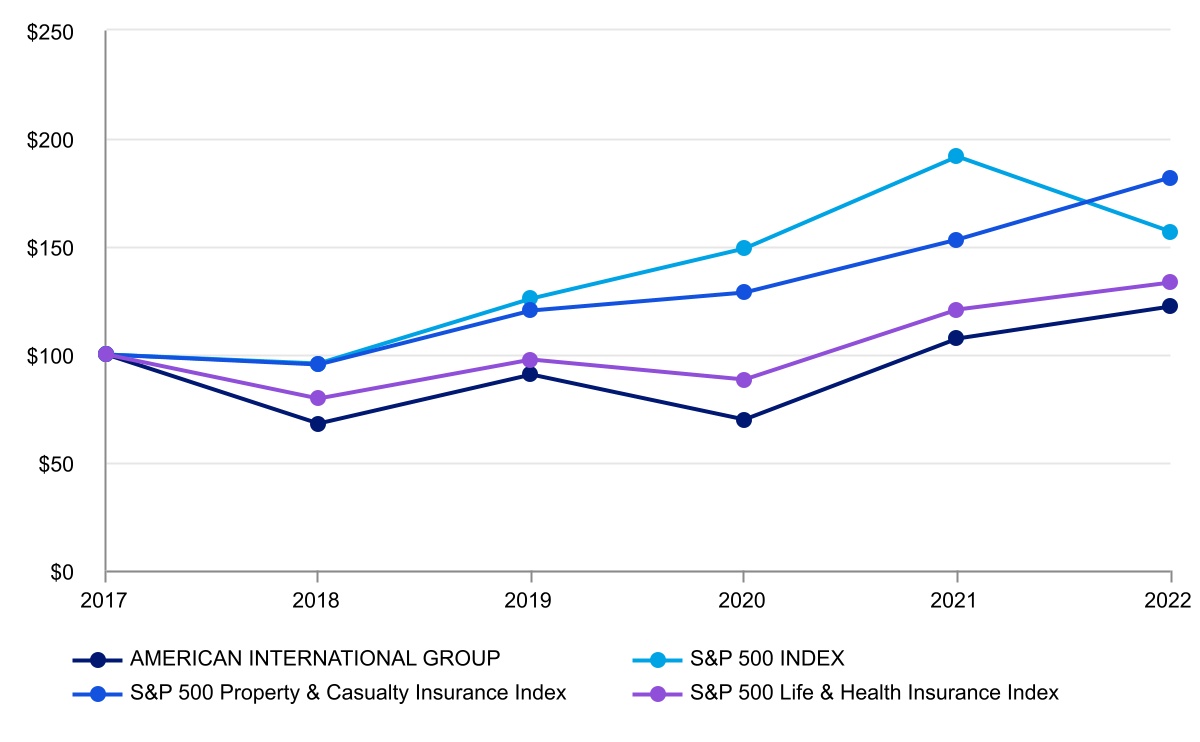
Dividend reinvestment has been assumed and returns have been weighted to reflect relative stock market capitalization.
| As of December 31, | |||||||||||||||||||||||||||||||||||||||||||||||||||||
| 2017 | 2018 | 2019 | 2020 | 2021 | 2022 | ||||||||||||||||||||||||||||||||||||||||||||||||
| AIG | $ | 100.00 | $ | 67.91 | $ | 90.72 | $ | 69.62 | $ | 107.16 | $ | 121.89 | |||||||||||||||||||||||||||||||||||||||||
| S&P 500 | 100.00 | 95.62 | 125.72 | 148.85 | 191.58 | 156.88 | |||||||||||||||||||||||||||||||||||||||||||||||
| S&P 500 Property & Casualty Insurance Index | 100.00 | 95.31 | 119.97 | 128.31 | 153.05 | 181.93 | |||||||||||||||||||||||||||||||||||||||||||||||
| S&P 500 Life & Health Insurance | 100.00 | 79.23 | 97.60 | 88.35 | 120.76 | 133.25 |
Item 6. [Reserved]
| AIG | 2022 Form 10-K | 41 |
ITEM 7 | Management’s Discussion and Analysis of Financial Condition and Results of Operations
Cautionary Statement Regarding Forward-Looking Information and Factors That May Affect Future Results
This Annual Report on Form 10-K and other publicly available documents may include, and members of AIG management may from time to time make and discuss, statements which, to the extent they are not statements of historical or present fact, may constitute “forward-looking statements” within the meaning of the U.S. Private Securities Litigation Reform Act of 1995. These forward‑looking statements are intended to provide management’s current expectations or plans for AIG’s future operating and financial performance, based on assumptions currently believed to be valid and accurate. Forward-looking statements are often preceded by, followed by or include words such as “will,” “believe,” “anticipate,” “expect,” “expectations,” “intend,” “plan,” “strategy,” “prospects,” “project,” “anticipate,” “should,” “guidance,” “outlook,” “confident,” “focused on achieving,” “view,” “target,” “goal,” “estimate,” and other words of similar meaning in connection with a discussion of future operating or financial performance. These statements may include, among other things, projections, goals and assumptions that relate to future actions, prospective services or products, future performance or results of current and anticipated services or products, sales efforts, expense reduction efforts, the outcome of contingencies such as legal proceedings, anticipated organizational, business or regulatory changes, such as the separation of the Life and Retirement business from AIG, the effect of catastrophic events, both natural and man-made, and macroeconomic and/or geopolitical events, anticipated dispositions, monetization and/or acquisitions of businesses or assets, the successful integration of acquired businesses, management succession and retention plans, exposure to risk, trends in operations and financial results, and other statements that are not historical facts.
| 42 | AIG | 2022 Form 10-K |
All forward-looking statements involve risks, uncertainties and other factors that may cause AIG’s actual results and financial condition to differ, possibly materially, from the results and financial condition expressed or implied in the forward-looking statements. Factors that could cause AIG’s actual results to differ, possibly materially, from those in specific projections, goals, assumptions and forward-looking statements include, without limitation:
-
the effects of economic conditions in the markets in which AIG and its businesses operate in the U.S. and globally and any changes therein, including financial market conditions, macroeconomic trends, fluctuations in interest rates and foreign currency exchange rates, inflationary pressures and an economic slowdown or recession, each of which may also be affected by geopolitical events or conflicts, including the conflict between Russia and Ukraine;
-
the occurrence of catastrophic events, both natural and man-made, including geopolitical events and conflicts, civil unrest and the effects of climate change;
-
availability of adequate reinsurance or access to reinsurance on acceptable terms;
-
disruptions in the availability of AIG's or a third party’s information technology infrastructure, including hardware and software, resulting from cyberattacks, data security breaches, or infrastructure vulnerabilities;
-
AIG's ability to realize expected strategic, financial, operational or other benefits from the separation of Corebridge Financial, Inc. (Corebridge) as well as AIG’s equity market exposure to Corebridge;
-
concentrations of AIG’s insurance, reinsurance and other risk exposures;
-
concentrations in AIG’s investment portfolios;
-
AIG’s reliance on third-party investment managers;
-
changes in the valuation of AIG’s investments;
-
AIG’s reliance on third parties to provide certain business and administrative services;
-
nonperformance or defaults by counterparties, including Fortitude Reinsurance Company Ltd. (Fortitude Re);
-
changes in judgments concerning potential cost-saving opportunities;
-
AIG's ability to effectively implement changes under AIG 200, including the ability to realize cost savings;
-
AIG's ability to adequately assess risk and estimate related losses as well as the effectiveness of AIG’s enterprise risk management policies and procedures, including with respect to business continuity and disaster recovery plans;
-
difficulty in marketing and distributing products through current and future distribution channels;
-
the effectiveness of strategies to retain and recruit key personnel and to implement effective succession plans;
-
actions by rating agencies with respect to AIG’s credit and financial strength ratings as well as those of its businesses and subsidiaries;
-
changes to sources of or access to liquidity;
-
changes in judgments concerning the recognition of deferred tax assets and the impairment of goodwill;
-
changes in judgments or assumptions concerning insurance underwriting and insurance liabilities;
-
changes in accounting principles and financial reporting requirements;
-
AIG’s ability to successfully dispose of, monetize and/or acquire businesses or assets or successfully integrate acquired businesses;
-
the effects of sanctions, including those related to the conflict between Russia and Ukraine and the failure to comply with those sanctions;
-
the effects of changes in laws and regulations, including those relating to the regulation of insurance, in the U.S. and other countries in which AIG and its businesses operate;
-
changes to tax laws in the U.S. and other countries in which AIG and its businesses operate;
-
the outcome of significant legal, regulatory or governmental proceedings;
-
the impact of COVID-19 and its variants or other pandemics and responses thereto;
-
AIG’s ability to effectively execute on environmental, social and governance targets and standards; and
-
such other factors discussed in:
–Part I, Item 1A. Risk Factors of this Annual Report; and
–this Part II, Item 7. Management's Discussion and Analysis of Financial Condition and Results of Operations (MD&A) of this Annual Report.
Forward-looking statements speak only as of the date of this report, or in the case of any document incorporated by reference, the date of that document. We are not under any obligation to publicly update or revise any forward-looking statements, whether as a result of new information, future events or otherwise, except as required by applicable law. Additional information as to factors that may cause actual results to differ materially from those expressed or implied in any forward-looking statements is disclosed from time to time in other filings with the Securities and Exchange Commission (SEC).
| AIG | 2022 Form 10-K | 43 |
| INDEX TO ITEM 7 | |||||
| Page | |||||
| Use of Non-GAAP Measures | 45 | ||||
| Critical Accounting Estimates | 47 | ||||
| Executive Summary | 60 | ||||
| Overview | 60 | ||||
| AIG['s Outlook – Industry and Economic Factors](#if9f982e359be4d0bb8fe661b922414e |
Showing the first 8K of 521K characters. Open the full section
Item 7. Enterprise Risk Management
Reinsurance markets include:
-
Traditional local and global reinsurance markets including those in the United States, Bermuda, London and Europe, accessed directly and through reinsurance intermediaries;
-
Capital markets through insurance-linked securities and collateralized reinsurance transactions, such as catastrophe bonds, sidecars and similar vehicles; and
-
Other insurers that engage in both direct and assumed reinsurance.
The form of reinsurance we may choose from time to time will generally depend on whether we are seeking:
-
proportional reinsurance, whereby we cede a specified percentage of premiums and losses to reinsurers;
-
non-proportional or excess of loss reinsurance, whereby we cede all or a specified portion of losses in excess of a specified amount on a per risk, per occurrence (including catastrophe reinsurance) or aggregate basis; or
-
facultative contracts that reinsure individual policies.
We continually evaluate the relative attractiveness of different forms of reinsurance contracts and different markets that may be used to achieve our risk and profitability objectives.
Reinsurance contracts do not relieve our subsidiaries from their direct obligations to insureds. However, an effective reinsurance program substantially mitigates our exposure to potentially significant losses.
In certain markets, we are required to participate on a proportional basis in reinsurance pools based on our relative share of direct writings in those markets. Such mandatory reinsurance generally covers higher-risk consumer exposures such as assigned-risk automobile and earthquake, as well as certain commercial exposures such as workers’ compensation.
Reinsurance Recoverable
AIG’s reinsurance recoverable assets are comprised of paid losses recoverable, ceded loss reserves, ceded reserves for unearned premiums, and Life and Annuity reinsurance recoverables (ceded policy and claim reserves and policyholder contract deposits).
At December 31, 2022, total reinsurance recoverable assets were $71.6 billion. These assets include general reinsurance paid losses recoverable of $4.4 billion, ceded loss reserves of $32.2 billion including reserves for IBNR claims, and ceded reserves for unearned premiums of $4.3 billion, as well as life reinsurance recoverable of $30.7 billion. The methods used to estimate IBNR and to establish the resulting ultimate losses involve projecting the frequency and severity of losses over multiple years. These methods are continually reviewed and updated by management. Any adjustments are reflected in income. We believe that the amount recorded for ceded loss reserves at December 31, 2022 reflects a reasonable estimate of the ultimate losses recoverable. Actual losses may, however, differ from the reserves currently ceded.
The Reinsurance Credit Department (RCD) conducts periodic detailed assessments of the financial strength and condition of current and potential reinsurers, both foreign and domestic. The RCD monitors both the financial condition of reinsurers as well as the total reinsurance recoverable ceded to reinsurers, and sets limits with regard to the amount and type of exposure we are willing to take with reinsurers. As part of these assessments, we attempt to identify whether a reinsurer is appropriately licensed, assess its financial capacity and liquidity, and evaluate the local economic and financial environment in which a foreign reinsurer operates. The RCD reviews the nature of the risks ceded and the need for measures, including collateral to mitigate credit risk. For example, in our treaty reinsurance contracts, we frequently include provisions that require a reinsurer to post collateral or use other measures to reduce exposure when a referenced event occurs. Furthermore, we limit our unsecured exposure to reinsurers through the use of credit triggers such as insurer financial strength rating downgrades, declines in regulatory capital, or relevant RBC ratios fall below certain levels. We also set maximum limits for reinsurance recoverable exposure, which in some cases is the recoverable amount plus an estimate of the maximum potential exposure from unexpected events for a reinsurer. In addition, credit executives within ERM review reinsurer exposures and credit limits and approve reinsurer credit limits above specified levels. Finally, even where we conclude that uncollateralized credit risk is acceptable, we require collateral from active reinsurance counterparties where it is necessary for our subsidiaries to recognize the reinsurance recoverable assets for statutory accounting purposes. At December 31, 2022, we held $74.3 billion of collateral, in the form of funds withheld, securities in reinsurance trust accounts and/or irrevocable letters of credit, in support of reinsurance recoverable assets from unaffiliated reinsurers.
At December 31, 2022, we had no significant reinsurance recoverable due from any individual reinsurer that was financially troubled. Reduced profitability associated with lower interest rates, market volatility and catastrophe losses (including COVID-19), could potentially result in reduced capacity or rating downgrades for some reinsurers. The RCD, in conjunction with the credit executives within ERM, reviews these developments, monitors compliance with credit triggers that may require the reinsurer to post collateral, and seeks to use other appropriate means to mitigate any material risks arising from these developments.
For additional information on reinsurance recoverable, see Critical Accounting Estimates – Reinsurance Assets.
| 128 | AIG | 2022 Form 10-K |
Glossary
Glossary
Accident year The annual calendar accounting period in which loss events occurred, regardless of when the losses are actually reported, booked or paid.
Accident year combined ratio, as adjusted (Accident year combined ratio, ex-CAT) The combined ratio excluding catastrophe losses and related reinstatement premiums, prior year development, net of premium adjustments, and the impact of reserve discounting.
Accident year loss ratio, as adjusted (Accident year loss ratio, ex-CAT) The loss ratio excluding catastrophe losses and related reinstatement premiums, prior year development, net of premium adjustments, and the impact of reserve discounting.
Acquisition ratio Acquisition costs divided by net premiums earned. Acquisition costs are those costs incurred to acquire new and renewal insurance contracts and also include the amortization of VOBA and DAC. Acquisition costs vary with sales and include, but are not limited to, commissions, premium taxes, direct marketing costs and certain costs of personnel engaged in sales support activities such as underwriting.
Adjusted revenues exclude Net realized gains (losses), income from non-operating litigation settlements (included in Other income for GAAP purposes), changes in fair value of securities used to hedge guaranteed living benefits (included in Net investment income for GAAP purposes) and income from elimination of the international reporting lag. Adjusted revenues is a GAAP measure for our segments.
Assets under administration include assets under management and Retail Mutual Funds and Group Retirement mutual fund assets that we sell or administer.
Attritional losses are losses recorded in the current accident year, which are not catastrophe losses.
AUM Assets under management include assets in the general and separate accounts of our subsidiaries that support liabilities and surplus related to our life and annuity insurance products and the notional value of stable value wrap contracts.
Base yield Net investment income excluding income from alternative investments and other enhancements, as a percentage of average base invested asset portfolio, which excludes alternative investments, other bond securities and certain other investments for which the fair value option has been elected.
Book value per common share, excluding accumulated other comprehensive income (loss) (AOCI) adjusted for the cumulative unrealized gains and losses related to Fortitude Re funds withheld assets and deferred tax assets (DTA) (Adjusted book value per common share) is a non-GAAP measure and is used to show the amount of our net worth on a per-common share basis. Adjusted book value per common share is derived by dividing total AIG common shareholders’ equity, excluding AOCI adjusted for the cumulative unrealized gains and losses related to Fortitude Re funds withheld assets and DTA (Adjusted common shareholders’ equity), by total common shares outstanding.
Casualty insurance Insurance that is primarily associated with the losses caused by injuries to third persons, i.e., not the insured, and the legal liability imposed on the insured as a result.
Combined ratio Sum of the loss ratio and the acquisition and general operating expense ratios.
CSA Credit Support Annex A legal document generally associated with an ISDA Master Agreement that provides for collateral postings which could vary depending on ratings and threshold levels.
Credit Valuation Adjustment (CVA)/Non-Performance Risk Adjustment (NPA) The CVA/NPA adjusts the valuation of derivatives to account for nonperformance risk of our counterparty with respect to all net derivative assets positions. The CVA/NPA also accounts for our own credit risk in the fair value measurement of all derivative net liability positions and liabilities where AIG has elected the fair value option, when appropriate.
DAC Deferred Policy Acquisition Costs Deferred costs that are incremental and directly related to the successful acquisition of new business or renewal of existing business.
DAC Related to Unrealized Appreciation (Depreciation) of Investments An adjustment to DAC and Reserves for investment-oriented products, equal to the change in DAC and unearned revenue amortization that would have been recorded if fixed maturity securities available for sale at fair value had been sold at their stated aggregate fair value and the proceeds reinvested at current yields. An adjustment to benefit reserves for investment-oriented products is also recognized to reflect the application of the benefit ratio to the accumulated assessments that would have been recorded if fixed maturity securities available for sale at fair value had been sold at their stated aggregate fair value and the proceeds reinvested at current yields.
For long-duration traditional products, significant unrealized appreciation of investments in a sustained low interest rate environment may cause additional future policy benefit liabilities to be recorded.
| AIG | 2022 Form 10-K | 129 |
Glossary
Deferred gain on retroactive reinsurance Retroactive reinsurance is a reinsurance contract in which an assuming entity agrees to reimburse a ceding entity for liabilities incurred as a result of past insurable events. If the amount of premium paid by the ceding reinsurer is less than the related ceded loss reserves, the resulting gain is deferred and amortized over the settlement period of the reserves. Any related development on the ceded loss reserves recoverable under the contract would increase the deferred gain if unfavorable, or decrease the deferred gain if favorable.
DSI Deferred Sales Inducements Represents enhanced crediting rates or bonus payments to contract holders on certain annuity and investment contract products that meet the criteria to be deferred and amortized over the life of the contract.
Expense ratio Sum of acquisition expenses and general operating expenses, divided by net premiums earned.
General operating expense ratio General operating expenses divided by net premiums earned. General operating expenses are those costs that are generally attributed to the support infrastructure of the organization and include but are not limited to personnel costs, projects and bad debt expenses. General operating expenses exclude losses and loss adjustment expenses incurred, acquisition expenses, and investment expenses.
GIC/GIA Guaranteed Investment Contract/Guaranteed Investment Agreement A contract whereby the seller provides a guaranteed repayment of principal and a fixed or floating interest rate for a predetermined period of time.
IBNR Incurred But Not Reported Estimates of claims that have been incurred but not reported to us.
ISDA Master Agreement An agreement between two counterparties, which may have multiple derivative transactions with each other governed by such agreement, that generally provides for the net settlement of all or a specified group of these derivative transactions, as well as pledged collateral, through a single payment, in a single currency, in the event of a default on, or affecting any, one derivative transaction or a termination event affecting all, or a specified group of, derivative transactions.
Loss Adjustment Expenses The expenses directly attributed to settling and paying claims of insureds and include, but are not limited to, legal fees, adjuster’s fees and the portion of general expenses allocated to claim settlement costs.
Loan-to-value ratio Principal amount of loan amount divided by appraised value of collateral securing the loan.
Loss ratio Losses and loss adjustment expenses incurred divided by net premiums earned.
Loss reserve development The increase or decrease in incurred losses and loss adjustment expenses related to prior years as a result of the re-estimation of loss reserves at successive valuation dates for a given group of claims.
Loss reserves Liability for unpaid losses and loss adjustment expenses. The estimated ultimate cost of settling claims relating to insured events that have occurred on or before the balance sheet date, whether or not reported to the insurer at that date.
Master netting agreement An agreement between two counterparties who have multiple derivative contracts with each other that provides for the net settlement of all contracts covered by such agreement, as well as pledged collateral, through a single payment, in a single currency, in the event of default on or upon termination of any one such contract.
Natural catastrophe losses are generally weather or seismic events having a net impact on AIG in excess of $10 million each and man-made catastrophe losses, such as terrorism and civil disorders that exceed the $10 million threshold.
Net premiums written represent the sales of an insurer, adjusted for reinsurance premiums assumed and ceded, during a given period. Net premiums earned are the revenue of an insurer for covering risk during a given period. Net premiums written are a measure of performance for a sales period, while net premiums earned are a measure of performance for a coverage period.
Noncontrolling interests The portion of equity ownership in a consolidated subsidiary not attributable to the controlling parent company.
Policy fees An amount added to a policy premium, or deducted from a policy cash value or contract holder account, to reflect the cost of issuing a policy, establishing the required records, sending premium notices and other related expenses.
Pool A reinsurance arrangement whereby all of the underwriting results of the pool members are combined and then shared by each member in accordance with its pool participation percentage.
Premiums and deposits – Life and Retirement includes direct and assumed amounts received and earned on traditional life insurance policies, group benefit policies and life-contingent payout annuities, as well as deposits received on universal life, investment-type annuity contracts, FHLB funding agreements and mutual funds.
Prior year development See Loss reserve development.
RBC Risk-Based Capital A formula designed to measure the adequacy of an insurer’s statutory surplus compared to the risks inherent in its business.
| 130 | AIG | 2022 Form 10-K |
Glossary
Reinstatement premiums Premiums on an insurance policy over and above the initial premium imposed at the beginning of the policy payable to reinsurers or receivable from insurers to restore coverage limits that have been reduced or exhausted as a result of reinsured losses under certain excess of loss reinsurance contracts.
Reinsurance The practice whereby one insurer, the reinsurer, in consideration of a premium paid to that insurer, agrees to indemnify another insurer, the ceding company, for part or all of the liability of the ceding company under one or more policies or contracts of insurance which it has issued.
Reinsurance recoverables are comprised of paid losses recoverable, ceded loss reserves, ceded reserves for unearned premiums, and Life and Annuity reinsurance recoverables (ceded policy and claim reserves and policyholder contract deposits).
Retroactive reinsurance See Deferred gain on retroactive reinsurance.
Return on common equity – Adjusted after-tax income excluding AOCI adjusted for the cumulative unrealized gains and losses related to Fortitude Re funds withheld assets and DTA (Adjusted return on common equity) is a non-GAAP measure and is used to show the rate of return on common shareholders’ equity. Adjusted return on common equity is derived by dividing actual or annualized adjusted after-tax income attributable to AIG common shareholders by average Adjusted common shareholders’ equity.
Subrogation The amount of recovery for claims we have paid our policyholders, generally from a negligent third party or such party’s insurer.
Surrender charge A charge levied against an investor for the early withdrawal of funds from a life insurance or annuity contract, or for the cancellation of the agreement.
Surrender rate represents annualized surrenders and withdrawals as a percentage of average reserves and Group Retirement mutual fund assets under administration.
Unearned premium reserve Liabilities established by insurers and reinsurers to reflect unearned premiums, which are usually refundable to policyholders if an insurance or reinsurance contract is canceled prior to expiration of the contract term.
VOBA Value of Business Acquired Present value of projected future gross profits from in-force policies of acquired businesses.
Acronyms
| A&H | Accident and Health Insurance | GMDB | Guaranteed Minimum Death Benefits | ||||||||
| ABS | Asset-Backed Securities | GMWB | Guaranteed Minimum Withdrawal Benefits | ||||||||
| APTI | Adjusted pre-tax income | ISDA | International Swaps and Derivatives Association, Inc. | ||||||||
| AUM | Assets Under Management | Moody's | Moody's Investors' Service Inc. | ||||||||
| CDS | Credit Default Swap | NAIC | National Association of Insurance Commissioners | ||||||||
| CLO | Collateralized loan Obligations | NM | Not Meaningful | ||||||||
| CMA | Capital Maintenance Agreement | ORR | Obligor Risk Ratings | ||||||||
| CMBS | Commercial Mortgage-Backed Securities | OTC | Over-the-Counter | ||||||||
| EGPs | Estimated Gross Profits | RMBS | Residential Mortgage-Backed Securities | ||||||||
| ERM | Enterprise Risk Management | S&P | Standard & Poor's Financial Services LLC | ||||||||
| FASB | Financial Accounting Standards Board | SEC | Securities and Exchange Commission | ||||||||
| GAAP | Accounting Principles Generally Accepted in the | URR | Unearned Revenue Reserve | ||||||||
| United States of America | VIE | Variable Interest Entity | |||||||||
| GIA | Guaranteed Investment Agreements |
| AIG | 2022 Form 10-K | 131 |
ITEM 7A | Quantitative and Qualitative Disclosures About Market Risk
Item 7A. Quantitative and Qualitative Disclosures About Market Risk
The information required by this item is set forth in the Enterprise Risk Management section of Item 7. Management’s Discussion and Analysis of Financial Condition and Results of Operations and is incorporated herein by reference.
| 132 | AIG | 2022 Form 10-K |
| Part II |
ITEM 8 | Financial Statements and Supplementary Data
AMERICAN INTERNATIONAL GROUP, INC.
REFERENCE TO FINANCIAL STATEMENTS AND SCHEDULES
| AIG | 2022 Form 10-K | 133 |
ITEM 8 | Report of Independent Registered Public Accounting Firm
Report of Independent Registered Public Accounting Firm
To the Board of Directors and Shareholders of American International Group, Inc.
Opinions on the Financial Statements and Internal Control over Financial Reporting
We have audited the accompanying consolidated balance sheets of American International Group, Inc. and its subsidiaries (the "Company") as of December 31, 2022 and 2021, and the related consolidated statements of income (loss), of comprehensive income (loss), of equity and of cash flows for each of the three years in the period ended December 31, 2022, including the related notes and financial statement schedules listed in the accompanying index (collectively referred to as the “consolidated financial statements”). We also have audited the Company's internal control over financial reporting as of December 31, 2022, based on criteria established in Internal Control - Integrated Framework (2013) issued by the Committee of Sponsoring Organizations of the Treadway Commission (COSO).
In our opinion, the consolidated financial statements referred to above present fairly, in all material respects, the financial position of the Company as of December 31, 2022 and 2021, and the results of its operations and its cash flows for each of the three years in the period ended December 31, 2022 in conformity with accounting principles generally accepted in the United States of America. Also in our opinion, the Company maintained, in all material respects, effective internal control over financial reporting as of December 31, 2022, based on criteria established in Internal Control - Integrated Framework (2013) issued by the COSO.
Basis for Opinions
The Company's management is responsible for these consolidated financial statements, for maintaining effective internal control over financial reporting, and for its assessment of the effectiveness of internal control over financial reporting, included in Management’s Report on Internal Control over Financial Reporting appearing under Item 9A. Our responsibility is to express opinions on the Company’s consolidated financial statements and on the Company's internal control over financial reporting based on our audits. We are a public accounting firm registered with the Public Company Accounting Oversight Board (United States) (PCAOB) and are required to be independent with respect to the Company in accordance with the U.S. federal securities laws and the applicable rules and regulations of the Securities and Exchange Commission and the PCAOB.
We conducted our audits in accordance with the standards of the PCAOB. Those standards require that we plan and perform the audits to obtain reasonable assurance about whether the consolidated financial statements are free of material misstatement, whether due to error or fraud, and whether effective internal control over financial reporting was maintained in all material respects.
Our audits of the consolidated financial statements included performing procedures to assess the risks of material misstatement of the consolidated financial statements, whether due to error or fraud, and performing procedures that respond to those risks. Such procedures included examining, on a test basis, evidence regarding the amounts and disclosures in the consolidated financial statements. Our audits also included evaluating the accounting principles used and significant estimates made by management, as well as evaluating the overall presentation of the consolidated financial statements. Our audit of internal control over financial reporting included obtaining an understanding of internal control over financial reporting, assessing the risk that a material weakness exists, and testing and evaluating the design and operating effectiveness of internal control based on the assessed risk. Our audits also included performing such other procedures as we considered necessary in the circumstances. We believe that our audits provide a reasonable basis for our opinions.
Definition and Limitations of Internal Control over Financial Reporting
A company’s internal control over financial reporting is a process designed to provide reasonable assurance regarding the reliability of financial reporting and the preparation of financial statements for external purposes in accordance with generally accepted accounting principles. A company’s internal control over financial reporting includes those policies and procedures that (i) pertain to the maintenance of records that, in reasonable detail, accurately and fairly reflect the transactions and dispositions of the assets of the company; (ii) provide reasonable assurance that transactions are recorded as necessary to permit preparation of financial statements in accordance with generally accepted accounting principles, and that receipts and expenditures of the company are being made only in accordance with authorizations of management and directors of the company; and (iii) provide reasonable assurance regarding prevention or timely detection of unauthorized acquisition, use, or disposition of the company’s assets that could have a material effect on the financial statements.
Because of its inherent limitations, internal control over financial reporting may not prevent or detect misstatements. Also, projections of any evaluation of effectiveness to future periods are subject to the risk that controls may become inadequate because of changes in conditions, or that the degree of compliance with the policies or procedures may deteriorate.
Critical Audit Matters
The critical audit matters communicated below are matters arising from the current period audit of the consolidated financial statements that were communicated or required to be communicated to the audit committee and that (i) relate to accounts or disclosures that are material to the consolidated financial statements and (ii) involved our especially challenging, subjective, or complex judgments. The communication of critical audit matters does not alter in any way our opinion on the consolidated financial statements, taken as a whole, and we are not, by communicating the critical audit matters below, providing separate opinions on the critical audit matters or on the accounts or disclosures to which they relate.
| 134 | AIG | 2022 Form 10-K |
ITEM 8 | Report of Independent Registered Public Accounting Firm
Valuation of Certain Level 3 Fixed Maturity Securities
As described in Note 4 to the consolidated financial statements, as of December 31, 2022, the total fair value of the Company’s level 3 fixed maturity securities, including bonds available for sale and other bond securities, was $26.4 billion, comprised of residential mortgage backed securities, commercial mortgage backed securities, collateralized loan obligations, other asset-backed securities, and fixed maturity securities issued by corporations (including private placements), states, municipalities, and other governmental agencies. As the volume or level of market activity for these securities is limited, management determines fair value either by requesting brokers who are knowledgeable about the particular security to provide a price quote, which according to management is generally non-binding, or by employing market accepted valuation models. In both cases, certain inputs used by management to determine fair value may not be observable in the market. For certain private placement securities, fair value is determined by management based on discounted cash flow models using discount rates based on credit spreads, yields or price levels of comparable securities, adjusted for illiquidity and structure. For other level 3 fixed maturity securities, such assumptions may include loan delinquencies and defaults, loss severity, and prepayments. As disclosed by management, fair value estimates are subject to management review to ensure valuation models and related inputs are reasonable.
The principal considerations for our determination that performing procedures relating to the valuation of certain level 3 fixed maturity securities is a critical audit matter are (i) the significant judgment by management to determine the fair value of these securities, which in turn led to a high degree of auditor subjectivity and judgment in performing the audit procedures relating to the aforementioned assumptions that are used to determine the fair value, (ii) the significant audit effort and judgment in evaluating the audit evidence related to the valuation, and (iii) the audit effort involved the use of professionals with specialized skill and knowledge.
Addressing the matter involved performing procedures and evaluating audit evidence in connection with forming our overall opinion on the consolidated financial statements. These procedures included testing the effectiveness of controls relating to the valuation of level 3 fixed maturity securities, including controls related to (i) management’s review over the pricing function and (ii) identifying and resolving pricing exceptions. These procedures also included, among others, obtaining independent third party vendor pricing, where available, and the involvement of professionals with specialized skill and knowledge to assist in developing an independent range of prices for a sample of securities. Developing the independent range of prices involved testing the completeness and accuracy of data provided by management on a sample basis and evaluating management’s assumptions noted above. The independent third party vendor pricing and the independently developed ranges were compared to management’s recorded fair value estimates.
Valuation of Insurance Liabilities - Unpaid Losses and Loss Adjustment Expenses (Loss Reserves), Net of Reinsurance
As described in Note 12 to the consolidated financial statements, loss reserves represent the accumulation of estimates of unpaid claims, including estimates for claims incurred but not reported and loss adjustment expenses, less applicable discount. As of December 31, 2022, the Company’s net liability for unpaid losses and loss adjustment expenses was $43.1 billion. As disclosed by management, the estimate of the loss reserves relies on several key judgments, including (i) actuarial methods, (ii) relative weights given to these methods by product line, (iii) underlying actuarial assumptions, and (iv) groupings of similar product lines. Actuarial assumptions include (i) expected loss ratios and (ii) loss development factors. During management’s actuarial reviews, various factors are considered, including economic conditions; the legal, regulatory, judicial and social environment; medical cost trends; policy pricing, terms and conditions; changes in the claims handling process; and the impact of reinsurance. As described in Note 12 to the consolidated financial statements, management uses a combination of actuarial methods to project ultimate losses for both long-tail and short-tail exposures.
The principal considerations for our determination that performing procedures relating to the valuation of insurance liabilities - loss reserves, net of reinsurance is a critical audit matter are (i) the significant judgment by management when developing their estimate, which in turn led to a high degree of auditor subjectivity and judgment in performing the audit procedures related to the estimate, (ii) the significant audit effort and judgment in evaluating the audit evidence related to the actuarial methods, weights given to these methods by product line, groupings of similar product lines, and the aforementioned actuarial assumptions, and (iii) the audit effort involved the use of professionals with specialized skill and knowledge.
Addressing the matter involved performing procedures and evaluating audit evidence in connection with forming our overall opinion on the consolidated financial statements. These procedures included testing the effectiveness of controls relating to the valuation of the net liability for unpaid losses and loss adjustment expense, including controls over the selection of actuarial methods and development of significant assumptions, as well as controls designed to identify and address management bias and contrary evidence. These procedures also included, among others, the involvement of professionals with specialized skill and knowledge to assist in performing one or a combination of procedures for a sample of product lines, including (i) independently estimating reserves using actual historical data and loss development patterns, as well as industry data and other benchmarks, and comparing management’s actuarially determined reserves to these independent estimates and (ii) evaluating management’s actuarial reserving methods and aforementioned factors, including actuarial assumptions and judgments impacting loss reserves and the consistency of management’s approach period-over-period. Performing these procedures involved testing the completeness and accuracy of data used by management on a sample basis.
Valuation of Embedded Derivatives for Variable Annuity and Fixed Index Annuity Products and Valuation of Certain Guaranteed Benefit Features for Universal Life Products
As described in Notes 4 and 13 to the consolidated financial statements, certain fixed index annuity and variable annuity contracts contain embedded derivatives that are bifurcated from the host contracts and accounted for separately at fair value in policyholder contract deposits. As of December 31, 2022, the fair value of these embedded derivatives was $5.7 billion and $0.7 billion for fixed index annuity and variable annuities with guaranteed minimum withdrawal benefits, respectively. The fair value of embedded derivatives contained in certain variable annuity and fixed index annuity contracts is measured based on policyholder behavior and capital market assumptions related to projected
| AIG | 2022 Form 10-K | 135 |
ITEM 8 | Report of Independent Registered Public Accounting Firm
cash flows over the expected lives of the contracts. The policyholder behavior assumptions for these liabilities include mortality, lapses, withdrawals, and benefit utilization, along with an explicit risk margin to reflect a market participant’s estimates of projected cash flows. Estimates of future policyholder behavior assumptions are subjective and based primarily on the Company’s historical experience. The capital market assumptions related to the embedded derivatives for variable annuity contracts involve judgments regarding expected market rates of return, market volatility, credit spreads, correlations of certain market variables, fund performance, and discount rates. Unobservable inputs used for valuing the embedded derivative include long-term equity volatilities which represent the volatility beyond the period for which observable equity volatilities are available. With respect to embedded derivatives for fixed index annuity contracts, option pricing models are used to estimate fair value, taking into account the capital market assumptions. Such models use option budget assumptions which estimate the expected long-term cost of options used to hedge exposures associated with equity price changes. The option budget determines the future costs of the options, which impacts the growth in account value and the valuation of embedded derivatives. Additional policyholder liabilities are also established for universal life policies with secondary guarantees, as well as other universal life policies for which profits followed by losses are expected at contract inception. As of December 31, 2022, the liability for universal life secondary guarantees and similar features was $2.8 billion, which is included within future policy benefits. The policyholder behavior assumptions for these liabilities include mortality, lapses and premium persistency. The capital market assumptions used for the liability for universal life secondary guarantees include discount rates and net earned rates.
The principal considerations for our determination that performing procedures relating to the valuation of embedded derivatives for variable annuity and fixed index annuity products and valuation of certain guaranteed benefit features for universal life products is a critical audit matter are (i) the significant judgment by management in developing the aforementioned policyholder behavior assumptions, as well as long-term equity volatilities and option budget assumptions, which in turn led to a high degree of auditor subjectivity and judgment in performing the audit procedures related to the significant assumptions used in the estimate, (ii) the significant audit effort and judgment in evaluating the audit evidence relating to the significant assumptions used by management in the valuation of the embedded derivatives and additional policyholder liabilities, and (iii) the audit effort involved the use of professionals with specialized skill and knowledge.
Addressing the matter involved performing procedures and evaluating audit evidence in connection with forming our overall opinion on the consolidated financial statements. These procedures included testing the effectiveness of controls relating to the development of assumptions used in the valuation of embedded derivatives for variable annuity and fixed index annuity products and valuation of certain guaranteed benefit features for universal life products. These procedures also included, among others, the involvement of professionals with specialized skill and knowledge to assist in performing an evaluation of the appropriateness of management’s methodology and the reasonableness of management’s judgments used in developing policyholder behavior, as well as long-term volatilities and option budget assumptions used in estimating the valuation of guaranteed benefit features. These procedures considered the consistency of the assumptions across products, in relation to prior periods, and in relation to management’s historical experience or observed industry practice, and the continued appropriateness of unchanged assumptions. Procedures were performed to test the completeness and accuracy of data used by management on a sample basis.
Valuation of Deferred Policy Acquisition Costs for Universal Life and Individual Retirement Variable Annuity Products
As described in Note 8 to the consolidated financial statements, as of December 31, 2022, a portion of the $11 billion deferred policy acquisition costs (DAC) for investment-oriented products are associated with universal life and individual retirement variable annuity products. Policy acquisition costs and policy issuance costs related to investment-oriented products are deferred and amortized, with interest, in relation to the incidence of estimated gross profits to be realized over the estimated lives of the contracts. Estimated gross profits are affected by a number of factors, including current and expected interest rates, net investment income and spreads, net realized gains and losses, fees, surrender rates, mortality experience, policyholder behavior experience, equity market returns, and volatility. If the assumptions used for estimated gross profits change, DAC is recalculated using the new assumptions, including actuarial assumptions related to mortality, lapse, benefit utilization, and premium persistency, and any resulting adjustment is included in income. DAC for investment-oriented products is reviewed by management for recoverability, which involves estimating the future profitability of the current business. If actual profitability is substantially lower than previously estimated profitability, DAC may be subject to an impairment charge.
The principal considerations for our determination that performing procedures relating to the valuation of DAC for universal life and individual retirement variable annuity products is a critical audit matter are (i) the significant judgment by management to determine the policyholder behavior assumptions related to mortality, lapse, benefit utilization, and premium persistency, which in turn led to a high degree of auditor subjectivity and judgment in performing the audit procedures related to the significant assumptions used in the estimate, (ii) the significant audit effort and judgment in evaluating the audit evidence relating to management’s policyholder behavior assumptions, and (iii) the audit effort involved the use of professionals with specialized skill and knowledge.
Addressing the matter involved performing procedures and evaluating audit evidence in connection with forming our overall opinion on the consolidated financial statements. These procedures included testing the effectiveness of controls relating to the amortization and recoverability of DAC for universal life and individual retirement variable annuity products, including controls over the development of significant assumptions. These procedures also included, among others, the involvement of professionals with specialized skill and knowledge to assist in evaluating the appropriateness of management’s methodology and the reasonableness of management’s policyholder behavior assumptions related to mortality, lapse, benefit utilization, and premium persistency, which are used in the calculation of estimated gross profits. The evaluation of the reasonableness of the assumptions included consideration of the consistency of the assumptions across products in relation to prior periods and in relation to management’s historical experience or observed industry practice. Procedures were performed to test the completeness and accuracy of data used by management in developing the assumptions on a sample basis.
| 136 | AIG | 2022 Form 10-K |
Item 8. Report of Independent Registered Public Accounting Firm
Recoverability of U.S. Federal Deferred Tax Asset
As described in Note 21 to the consolidated financial statements, as of December 31, 2022, the Company had a net U.S. federal deferred tax asset of $13.9 billion, $5.2 billion of which related to U.S. tax attributes of AIG's consolidated federal income tax group with a limited carryforward period. Management evaluates the recoverability of the deferred tax asset and the need for a valuation allowance based on the weight of all positive and negative evidence to reach a conclusion of whether it is more likely than not that all or some portion of the deferred tax asset will not be realized. As disclosed by management, in assessing the recoverability of the deferred tax asset, management considers a number of factors, which include forecasts of future income for each of the businesses and actual and planned business and operational changes, using assumptions about future macroeconomic and company specific conditions and events. Management subjects the forecasts to changes in key assumptions and evaluates the effect on tax attribute utilization, including tax attribute carryforward periods. Management also applies changes to assumptions about the effectiveness of relevant prudent and feasible tax planning strategies. As of December 31, 2022, management determined that it is no longer more-likely-than-not that $713 million of the Company’s deferred tax assets related to tax attribute carryforwards of AIG's consolidated federal income tax group will be utilized prior to expiration.
The principal considerations for our determination that performing procedures relating to the recoverability of the U.S. federal deferred tax asset is a critical audit matter are (i) the significant judgment by management when developing their estimate of the recoverability, which in turn led to a high degree of auditor subjectivity and judgment in performing the audit procedures relating to the forecasts of future income for each of the businesses, assumptions about future macroeconomic and company specific conditions and events, tax attribute carryforward periods, and tax planning strategies, (ii) the significant audit effort and judgment in evaluating the audit evidence related to the recoverability of the U.S. federal deferred tax asset, and (iii) the audit effort involved the use of professionals with specialized skill and knowledge.
Addressing the matter involved performing procedures and evaluating audit evidence in connection with forming our overall opinion on the consolidated financial statements. These procedures included testing the effectiveness of controls relating to the recoverability of the U.S. federal deferred tax asset, including controls over the accuracy of input data relevant to the analysis, such as cumulative income/loss measurement, reversal of temporary differences, adjustments to forecasted pre-tax income to calculate future taxable income, impacts of tax audits, and enacted and effective tax law considerations. These procedures also included, among others, the involvement of professionals with specialized skill and knowledge to assist in (i) evaluating management’s assessment of the recoverability of the U.S. federal deferred tax asset and the need for a valuation allowance, including the reasonableness of the application of tax law, (ii) testing management’s process for forecasting future income for each of the businesses, which included evaluating the impact of actual and planned business and operational changes, the reasonableness of assumptions about future macroeconomic and company specific conditions and events, impacts of tax audits, as well as considering whether management demonstrated their ability and intent in executing planned strategies, (iii) testing the tax attribute carryforward periods, and (iv) evaluating the prudence and feasibility of the implementation of available tax planning strategies that impact the recoverability of the U.S. federal deferred tax asset.
/s/ PricewaterhouseCoopers LLP
New York, New York
February 17, 2023
We have served as the Company’s auditor since 1980.
| AIG | 2022 Form 10-K | 137 |
American International Group, Inc.
Consolidated Balance Sheets
| (in millions, except for share data) | December 31, 2022 | December 31, 2021 | ||||||||||||
| Assets: | ||||||||||||||
| Investments: | ||||||||||||||
| Fixed maturity securities: | ||||||||||||||
| Bonds available for sale, at fair value, net of allowance for credit losses of $186 in 2022 and $98 in 2021 (amortized cost: 2022 - $255,993; 2021 - $259,210)* | $ | 226,156 | $ | 277,202 | ||||||||||
| Other bond securities, at fair value (See Note 5)* | 4,485 | 6,278 | ||||||||||||
| Equity securities, at fair value (See Note 5)* | 575 | 739 | ||||||||||||
| Mortgage and other loans receivable, net of allowance for credit losses of $38,351 in 2022 and $629 in 2021* | 49,605 | 46,048 | ||||||||||||
| Other invested assets (portion measured at fair value: 2022 - $12,042; 2021 - $10,504)* | 15,953 | 15,668 | ||||||||||||
| Short-term investments, including restricted cash of $140 in 2022 and $197 in 2021 (portion measured at fair value: 2022 - $5,708; 2021 - $4,426)* | 12,376 | 13,357 | ||||||||||||
| Total investments | 309,150 | 359,292 | ||||||||||||
| Cash* | 2,043 | 2,198 | ||||||||||||
| Accrued investment income* | 2,376 | 2,239 | ||||||||||||
| Premiums and other receivables, net of allowance for credit losses and disputes of $169 in 2022 and $185 in 2021 | 13,243 | 12,409 | ||||||||||||
| Reinsurance assets - Fortitude Re, net of allowance for credit losses and disputes of $0 in 2022 and $0 in 2021 | 32,159 | 33,365 | ||||||||||||
| Reinsurance assets - other, net of allowance for credit losses and disputes of $295 in 2022 and $333 in 2021 | 39,434 | 40,919 | ||||||||||||
| Deferred income taxes | 15,144 | 11,714 | ||||||||||||
| Deferred policy acquisition costs | 15,518 | 10,514 | ||||||||||||
| Other assets, net of allowance for credit losses of $49 in 2022 and $49 in 2021, including restricted cash of $33 in 2022 and $32 in 2021 (portion measured at fair value: 2022 - $621; 2021 - $957)* | 12,714 | 14,351 | ||||||||||||
| Separate account assets, at fair value | 84,853 | 109,111 | ||||||||||||
| Total assets | $ | 526,634 | $ | 596,112 | ||||||||||
| Liabilities: | ||||||||||||||
| Liability for unpaid losses and loss adjustment expenses, including allowance for credit losses of $14 in 2022 and $14 in 2021 | $ | 75,167 | $ | 79,026 | ||||||||||
| Unearned premiums | 18,338 | 19,313 | ||||||||||||
| Future policy benefits for life and accident and health insurance contracts | 59,223 | 59,950 | ||||||||||||
| Policyholder contract deposits (portion measured at fair value: 2022 - $7,146; 2021 - $9,736) | 158,891 | 156,686 | ||||||||||||
| Other policyholder funds | 3,909 | 3,476 | ||||||||||||
| Fortitude Re funds withheld payable (portion measured at fair value: 2022 - $(2,235); 2021 - $5,922) | 30,383 | 40,7 |
Showing the first 8K of 785K characters. Open the full section
Item 9. Changes in and Disagreements with Accountants on Accounting and Financial Disclosure
None.
Item 9A. Controls and Procedures
EVALUATION OF DISCLOSURE CONTROLS AND PROCEDURES
Disclosure controls and procedures are designed to ensure that information required to be disclosed in reports filed or submitted under the Securities Exchange Act of 1934, as amended (the Exchange Act), is recorded, processed, summarized and reported within the time periods specified in SEC rules and forms and that such information is accumulated and communicated to management, including the Chief Executive Officer and Chief Financial Officer, to allow timely decisions regarding required disclosures. In connection with the preparation of this Annual Report on Form 10-K, an evaluation was carried out by AIG management, with the participation of AIG’s Chief Executive Officer and Chief Financial Officer, of the effectiveness of our disclosure controls and procedures (as defined in Rules 13a-15(e) and 15d-15(e) under the Exchange Act), as of December 31, 2022. Based on this evaluation, AIG’s Chief Executive Officer and Chief Financial Officer concluded that our disclosure controls and procedures were effective as of December 31, 2022.
Management’s Report on Internal Control Over Financial Reporting
Management of AIG is responsible for establishing and maintaining adequate internal control over financial reporting. AIG’s internal control over financial reporting is a process, under the supervision of AIG’s Chief Executive Officer and Chief Financial Officer, designed to provide reasonable assurance regarding the reliability of financial reporting and the preparation of AIG’s financial statements for external purposes in accordance with U.S. GAAP.
Because of its inherent limitations, internal control over financial reporting may not prevent or detect misstatements. Also, projections of any evaluation of effectiveness to future periods are subject to the risk that controls may become inadequate because of changes in conditions, or that the degree of compliance with the policies or procedures may deteriorate.
AIG management conducted an assessment of the effectiveness of our internal control over financial reporting as of December 31, 2022 based on the criteria established in the 2013 Internal Control – Integrated Framework issued by the Committee of Sponsoring Organizations of the Treadway Commission (COSO).
AIG management has concluded that, as of December 31, 2022, our internal control over financial reporting was effective based on the criteria articulated in the 2013 Internal Control – Integrated Framework issued by the COSO. The effectiveness of our internal control over financial reporting as of December 31, 2022 has been audited by PricewaterhouseCoopers LLP, an independent registered public accounting firm, as stated in their report, which is included in this Annual Report on Form 10-K.
Changes in Internal Control Over Financial Reporting
There have been no changes in our internal control over financial reporting that have occurred during the quarter ended December 31, 2022 that have materially affected, or are reasonably likely to materially affect, our internal control over financial reporting.
Item 9B. Other Information
Not applicable.
Item 9C. Disclosure Regarding Foreign Jurisdictions that Prevent Inspections
Not applicable.
| 256 | AIG | 2022 Form 10-K |
| Part III |
Item 10. Directors, Executive Officers and Corporate Governance
All information required by Items 10, 11, 12, 13 and 14 of this Form 10-K is incorporated by reference from the definitive proxy statement for AIG’s 2023 Annual Meeting of Shareholders, which will be filed with the SEC not later than 120 days after the close of the fiscal year pursuant to Regulation 14A.
Item 11. Executive Compensation
See Item 10 herein.
Item 12. Security Ownership of Certain Beneficial Owners and Management and Related Stockholder Matters
See Item 10 herein.
Item 13. Certain Relationships and Related Transactions, and Director Independence
See Item 10 herein.
Item 14. Principal Accountant Fees and Services
See Item 10 herein.
| Part IV |
Item 15. Exhibits and Financial Statement Schedules
(a) Financial Statements and Schedules. See accompanying Index to Financial Statements.
| AIG | 2022 Form 10-K | 257 |
Exhibit Index
| Exhibit Number | Description | Location | ||||||
| 2 | Plan of acquisition, reorganization, arrangement, liquidation or succession | |||||||
| (1) Purchase Agreement, dated as of July 14, 2021, between AIG and Aztec Holdco LLC (an affiliate of Blackstone Inc.) | Incorporated by reference to Exhibit 10.4 to AIG’s Quarterly Report on Form 10-Q filed with the SEC on August 6, 2021 (File No. 1-8787). | |||||||
| 3 | Articles of incorporation and by laws | |||||||
| 3(i) | Amended and Restated Certificate of Incorporation of AIG, amended and restated May 14, 2020 | Incorporated by reference to Exhibit 3.1 to AIG’s Current Report on Form 8-K filed with the SEC on May 15, 2020 (File No. 1-8787). | ||||||
| 3(ii) | AIG By-laws, amended and restated December 9, 2020 | Incorporated by reference to Exhibit 3.1 to AIG’s Current Report on Form 8-K filed with the SEC on December 9, 2020 (File No. 1-8787). | ||||||
| 4 | Instruments defining the rights of security holders, including indentures | Certain instruments defining the rights of holders of long-term debt securities of AIG and its subsidiaries are omitted pursuant to Item 601(b)(4)(iii) of Regulation S-K. AIG hereby undertakes to furnish to the Commission, upon request, copies of any such instruments. | ||||||
| (1) Description of Registrant’s Securities | Filed herewith. | |||||||
| (2) Deposit Agreement, dated March 14, 2019, among AIG, Equiniti Trust Company, as depositary, and the holders from time to time of the depositary receipts described therein | Incorporated by reference to Exhibit 4.2 to AIG’s Current Report on Form 8-K filed with the SEC on March 14, 2019 (File No. 1-8787). | |||||||
| (3) Form of depositary receipt representing the Depository Shares (included in Exhibit A to Exhibit 4.2) | ||||||||
| (4) Indenture, dated April 5, 2022, between Corebridge Financial, Inc. and The Bank of New York Mellon, as Trustee | Incorporated by reference to Exhibit 4.1 to AIG’s Current Report on Form 8-K, filed with the SEC on April 7, 2022 (File No. 1-8787). | |||||||
| (5) First Supplemental Indenture, dated April 5, 2022, between Corebridge Financial, Inc. and The Bank of New York Mellon, as Trustee, relating to the 3.500% Senior Notes due 2025 (2025 Notes) | Incorporated by reference to Exhibit 4.2 to AIG’s Current Report on Form 8-K, filed with the SEC on April 7, 2022 (File No. 1-8787). | |||||||
| (6) Second Supplemental Indenture, dated April 5, 2022, between Corebridge Financial, Inc. and The Bank of New York Mellon, as Trustee, relating to the 3.650% Senior Notes due 2027 (2027 Notes) | Incorporated by reference to Exhibit 4.3 to AIG's Current Report on Form 8-K, filed with the SEC on April 7, 2022 (File No. 1-8787). | |||||||
| (7) Third Supplemental Indenture, dated April 5, 2022, between Corebridge Financial, Inc. and The Bank of New York Mellon, as Trustee, relating to the 3.850% Senior Notes due 2029 (2029 Notes) | Incorporated by reference to Exhibit 4.4 to AIG’s Current Report on Form 8-K, filed with the SEC on April 7, 2022 (File No. 1-8787). | |||||||
| (8) Fourth Supplemental Indenture, dated April 5, 2022, between Corebridge Financial, Inc. and The Bank of New York Mellon, as Trustee, relating to the 3.900% Senior Notes due 2032 (2032 Notes) | Incorporated by reference to Exhibit 4.5 to AIG’s Current Report on Form 8-K, filed with the SEC on April 7, 2022 (File No. 1-8787). | |||||||
| (9) Fifth Supplemental Indenture, dated April 5, 2022, between Corebridge Financial, Inc. and The Bank of New York Mellon, as Trustee, relating to the 4.350% Senior Notes due 2042 (2042 Notes) | Incorporated by reference to Exhibit 4.6 to AIG’s Current Report on Form 8-K, filed with the SEC on April 7, 2022 (File No. 1-8787). | |||||||
| (10) Sixth Supplemental Indenture, dated April 5, 2022, between Corebridge Financial, Inc. and The Bank of New York Mellon, as Trustee, relating to the 4.400% Senior Notes due 2052 (2052 Notes) | Incorporated by reference to Exhibit 4.7 to AIG’s Current Report on Form 8-K, filed with the SEC on April 7, 2022 (File No. 1-8787). | |||||||
| (11) Form of the 2025 Notes (included in Exhibit 4.5) | Incorporated by reference to Exhibit 4.2 to AIG’s Current Report on Form 8-K, filed with the SEC on April 7, 2022 (File No. 1-8787). | |||||||
| (12) Form of the 2027 Notes (included in Exhibit 4.6) | Incorporated by reference to Exhibit 4.3 to AIG’s Current Report on Form 8-K, filed with the SEC on April 7, 2022 (File No. 1-8787). | |||||||
| (13) Form of the 2029 Notes (included in Exhibit 4.7) | Incorporated by reference to Exhibit 4.4 to AIG’s Current Report on Form 8-K, filed with the SEC on April 7, 2022 (File No. 1-8787). | |||||||
| (14) Form of the 2032 Notes (included in Exhibit 4.8) | Incorporated by reference to Exhibit 4.5 to AIG’s Current Report on Form 8-K, filed with the SEC on April 7, 2022 (File No. 1-8787). | |||||||
| (15) Form of the 2042 Notes (included in Exhibit 4.9) | Incorporated by reference to Exhibit 4.6 to AIG’s Current Report on Form 8-K, filed with the SEC on April 7, 2022 (File No. 1-8787). | |||||||
| (16) Form of the 2052 Notes (included in Exhibit 4.10) | Incorporated by reference to Exhibit 4.7 to AIG’s Current Report on Form 8-K, filed with the SEC on April 7, 2022 (File No. 1-8787). | |||||||
| 9 | Voting Trust Agreement | None. | ||||||
| 10 | Material contracts | |||||||
| (1) American International Group, Inc. 2010 Stock Incentive Plan* | Incorporated by reference to Appendix B in AIG’s Definitive Proxy Statement, dated April 12, 2010 (Filed No. 1-8787). | |||||||
| (2) AIG 2010 Stock Incentive Plan Non-Employee Director Deferred Stock Units (DSU) Award Agreement* | Incorporated by reference to Exhibit 10.14 to AIG’s Quarterly Report on Form 10-Q for the quarter ended March 31, 2012 (File No. 1-8787). |
| 258 | AIG | 2022 Form 10-K |
| AIG | 2022 Form 10-K | 259 |
| Exhibit Number | Description | Location | ||||||
| (21) Description of Non-Management Director Compensation* | Incorporated by reference to “Compensation of Directors” in AIG’s Definitive Proxy Statement on Schedule 14A, dated March 29, 2022 (File No. 1-8787). | |||||||
| (22) Letter Agreement, dated May 10, 2018, between AIG and Mark Lyons* | Incorporated by reference to Exhibit 10.1 to AIG’s Current Report on Form 8-K/A, Amendment No. 1, filed with the SEC on December 14, 2018 (File No. 1-8787). | |||||||
| (23) Non-Solicitation and Non-Disclosure Agreement, dated May 13, 2018, between AIG and Mark Lyons* | Incorporated by reference to Exhibit 10.2 to AIG’s Current Report on Form 8-K/A, Amendment No. 1, filed with the SEC on December 14, 2018 (File No. 1-8787). | |||||||
| (24) Form of AIG Long Term Incentive Award Agreement (as of April 2019)* | Incorporated by reference to Exhibit 10.1 to AIG’s Quarterly Report on Form 10-Q, filed with the SEC on May 7, 2019 (File No. 1-8787). | |||||||
| (25) Form of AIG Long Term Incentive Award Agreement (as of January 2020)* | Incorporated by reference to Exhibit 10.49 to AIG’s Annual Report on Form 10-K, filed with the SEC on February 21, 2020 (File No. 1-8787). | |||||||
| (26) Amended and Restated Combination Coinsurance and Modified Coinsurance Agreement by and between American General Life Insurance Company and Fortitude Reinsurance Company, Ltd., effective as of June 1, 2020 (portions of this exhibit have been redacted pursuant to a request for confidential treatment) | Incorporated by reference to Exhibit 10.1 to AIG’s Quarterly Report on Form 10-Q, filed with the SEC on August 4, 2020 (File No. 1-8787). | |||||||
| (27) AIG 2012 Executive Severance Plan (as amended and restated February 2021)* | Incorporated by reference to Exhibit 10.35 to AIG’s Annual Report on Form 10-K, filed with the SEC on February 19, 2021 (File No. 1-8787). | |||||||
| (28) AIG Long Term Incentive Plan (as amended and restated February 2021)* | Incorporated by reference to Exhibit 10.36 to AIG’s Annual Report on Form 10-K, filed with the SEC on February 19, 2021 (File No. 1-8787). | |||||||
| (29) AIG Non-Qualified Retirement Income Plan (as amended and restated February 2021)* | Incorporated by reference to Exhibit 10.37 to AIG’s Annual Report on Form 10-K, filed with the SEC on February 19, 2021 (File No. 1-8787). | |||||||
| (30) American International Group, Inc. 2021 Omnibus Incentive Plan | Incorporated by reference to Appendix B to AIG’s Definitive Proxy Statement filed with the Commission on March 30, 2021 (File No. 001-08787). | |||||||
| (31) AIG Long Term Incentive Plan (as amended and restated April 2021)* | Incorporated by reference to Exhibit 10.6 to AIG’s Quarterly Report on Form 10-Q, filed with the SEC on May 7, 2021 (File No. 1-8787). | |||||||
| (32) AIG Long Term Incentive Plan Form of Award Agreement (April 2021)* | Incorporated by reference to Exhibit 10.7 to AIG’s Quarterly Report on Form 10-Q, filed with the SEC on May 7, 2021 (File No. 1-8787). | |||||||
| (33) AIG Long Term Incentive Plan (as amended and restated September 2021)* | Incorporated by reference to Exhibit 10.3 to AIG’s Quarterly Report on Form 10-Q, filed with the SEC on November 5, 2021 (File No. 1-8787). | |||||||
| (34) AIG Long Term Incentive Plan Form of Award Agreement (September 2021)* | Incorporated by reference to Exhibit 10.4 to AIG’s Quarterly Report on Form 10-Q, filed with the SEC on November 5, 2021 (File No. 1-8787). | |||||||
| (35) Form of AIG 2021 Omnibus Incentive Plan Non-Employee Director DSU Award Agreement* | Incorporated by reference to Exhibit 10.41 to AIG's Annual Report on Form 10-K, filed with the SEC on February 17, 2022 (File No. 1-8787). | |||||||
| (36) Credit Agreement, dated as of November 19, 2021, among AIG, the subsidiary borrowers party thereto, the lenders party thereto, Bank of America, N.A., as Administrative Agent, and each Several L/C Agent party thereto | Incorporated by reference to Exhibit 10.1 to AIG’s Current Report on Form 8-K filed with the SEC on November 22, 2021 (File No. 1-8787). | |||||||
| (37) Letter Agreement, dated December 7, 2021, between AIG and Shane Fitzsimons* | Incorporated by reference to Exhibit 10.1 to AIG’s Current Report on Form 8-K/A, Amendment No. 1, filed with the SEC on December 9, 2021 (File No. 1-8787). | |||||||
| (38) 18-Month Delayed Draw Term Agreement, dated as of February 25, 2022, among SAFG Retirement Services, Inc., as borrower, the lenders party thereto and the administrative agent party thereto | Incorporated by Reference to Exhibit 10.1 to AIG’s Quarterly Report on Form 10-Q, filed with the SEC on May 5, 2022. | |||||||
| (39) 3-Year Delayed Draw Term Agreement, dated as of February 25, 2022, among SAFG Retirement Services, Inc., as borrower, the lenders party thereto and the administrative agent party thereto | Incorporated by Reference to Exhibit 10.2 to AIG’s Quarterly Report on Form 10-Q, filed with the SEC on May 5, 2022. | |||||||
| (40) AIG Long-Term Incentive Plan (as amended and restated March 2022)* | Incorporated by Reference to Exhibit 10.3 to AIG’s Quarterly Report on Form 10-Q, filed with the SEC on May 5, 2022. | |||||||
| (41) Form of Long-Term Incentive Award Agreement (as of March 2022)* | Incorporated by Reference to Exhibit 10.4 to AIG’s Quarterly Report on Form 10-Q, filed with the SEC on May 5, 2022. | |||||||
| (42) Revolving Credit Agreement, dated as of May 12, 2022 among Corebridge Financial, Inc., the subsidiary borrowers thereto, the lenders party thereto, and JPMorgan Chase Bank, N.A., as administrative agent, and the several L/C agent party thereto | Incorporated by reference Exhibit 10.1 to AIG’s Current Report on Form 8-K, filed with the SEC on May 13, 2022 (File No. 1-8787). | |||||||
| (43) Amendment Letter, dated as of May 12, 2022, to the Credit Agreement among AIG, the subsidiary borrowers party thereto, the lenders party thereto, and Bank of America, N.A., as administrative agent, and each several L/C agent party thereto | Incorporated by Reference to Exhibit 10.2 to AIG’s Quarterly Report on Form 10-Q, filed with the SEC on August 8, 2022 (File No. 1-8787). |
| 260 | AIG | 2022 Form 10-K |
| Exhibit Number | Description | Location | ||||||
| (44) Amendment Letter, dated as of May 11, 2022, to the 3-Year Delayed Draw Term Loan Agreement among Corebridge Financial, Inc., the lenders party thereto, and JPMorgan Chase Bank, N.A., as administrative agent | Incorporated by Reference to Exhibit 10.3 to AIG’s Quarterly Report on Form 10-Q, filed with the SEC on June on August 8, 2022 (File No. 1-8787). | |||||||
| (45) Amendment Letter, dated as of August 24, 2022, to the 3-Year Delayed Draw Term Loan Agreement among Corebridge Financial, Inc., the lenders party thereto, and JPMorgan Chase Bank, N.A., as administrative agent | Incorporated by Reference to Exhibit 10.1 to AIG’s Quarterly Report on Form 10-Q, filed with the SEC on November 2, 2022 (File No. 1-8787). | |||||||
| (46) AIG Long Term Incentive Plan (as amended and restated September 2022) | Incorporated by Reference to Exhibit 10.2 to AIG’s Quarterly Report on Form 10-Q, filed with the SEC on November 2, 2022 (File No. 1-8787). | |||||||
| (47) Separation Agreement, dated as of September 14, 2022, by and between American International Group, Inc. and Corebridge Financial, Inc. | Incorporated by Reference to Exhibit 10.3 to AIG’s Quarterly Report on Form 10-Q, filed with the SEC on November 2, 2022 (File No. 1-8787). | |||||||
| (48) Registration Rights Agreement, dated as of September 14, 2022, by and between American International Group, Inc. and Corebridge Financial, Inc. | Incorporated by Reference to Exhibit 10.4 to AIG’s Quarterly Report on Form 10-Q, filed with the SEC on November 2, 2022 (File No. 1-8787). | |||||||
| (49) Transition Services Agreement, dated as of September 14, 2022, by and between American International Group, Inc. and Corebridge Financial, Inc. | Incorporated by Reference to Exhibit 10.5 to AIG’s Quarterly Report on Form 10-Q, filed with the SEC on November 2, 2022 (File No. 1-8787). | |||||||
| (50) Trademark License Agreement, dated as of September 14, 2022, by and between American International Group, Inc. and Corebridge Financial, Inc. | Incorporated by Reference to Exhibit 10.6 to AIG’s Quarterly Report on Form 10-Q, filed with the SEC on November 2, 2022 (File No. 1-8787). | |||||||
| (51) Intellectual Property Assignment Agreement, dated as of September 14, 2022, by and between American International Group, Inc. and Corebridge Financial, Inc. | Incorporated by Reference to Exhibit 10.7 to AIG’s Quarterly Report on Form 10-Q, filed with the SEC on November 2, 2022 (File No. 1-8787). | |||||||
| (52) Grantback License Agreement, dated as of September 14, 2022, by and between American International Group, Inc. and Corebridge Financial, Inc. | Incorporated by Reference to Exhibit 10.8 to AIG’s Quarterly Report on Form 10-Q, filed with the SEC on November 2, 2022 (File No. 1-8787). | |||||||
| (53) Employee Matters Agreement, dated as of September 14, 2022, by and between American International Group, Inc. and Corebridge Financial, Inc. | Incorporated by Reference to Exhibit 10.9 to AIG’s Quarterly Report on Form 10-Q, filed with the SEC on November 2, 2022 (File No. 1-8787). | |||||||
| (54) Tax Matters Agreement, dated as of September 14, 2022, by and between American International Group, Inc. and Corebridge Financial, Inc. | Incorporated by Reference to Exhibit 10.10 to AIG’s Quarterly Report on Form 10-Q, filed with the SEC on November 2, 2022 (File No. 1-8787). | |||||||
| (55) Employment Agreement, dated as of November 10, 2022, by and between American International Group, Inc. and Peter Zaffino* | Filed herewith. | |||||||
| (56) RSU Award Agreement, between American International Group, Inc. and Peter Zaffino* | Filed herewith. | |||||||
| (57) Settlement Agreement and Release, dated January 29, 2023, by and between American International Group, Inc. and Mark Lyons* | Incorporated by Reference to Exhibit 99.1 to AIG’s Current Report on Form 8-K, filed with the SEC on January 30, 2023 (File No. 1-8787). | |||||||
| 18 | Letter of PricewaterhouseCoopers LLP, dated February 17, 2023 | Filed herewith. | ||||||
| 21 | Subsidiaries of Registrant | Filed herewith. | ||||||
| 22 | Guaranteed Securities | None. | ||||||
| 23 | Consent of Independent Registered Public Accounting Firm | Filed herewith. | ||||||
| 24 | Powers of attorney | Included on signature page and filed herewith. | ||||||
| 31 | Rule 13a-14(a)/15d-14(a) Certifications | Filed herewith. | ||||||
| 32 | Section 1350 Certifications** | Filed herewith. | ||||||
| 101 | Interactive data files pursuant to Rule 405 of Regulation S-T: (i) the Consolidated Balance Sheets as of December 31, 2022 and December 31, 2021, (ii) the Consolidated Statements of Income (Loss) for the three years ended December 31, 2022, (iii) the Consolidated Statements of Equity for the three years ended December 31, 2022, (iv) the Consolidated Statements of Cash Flows for the three years ended December 31, 2022, (v) the Consolidated Statements of Comprehensive Income (Loss) for the three years ended December 31, 2022 and (vi) the Notes to the Consolidated Financial Statements. | Filed herewith. | ||||||
| 104 | Cover Page Interactive Data File (formatted as inline XBRL with applicable taxonomy extension information contained in Exhibits 101) | Filed herewith. |
*This exhibit is a management contract or a compensatory plan or arrangement.
**This information is furnished and not filed for purposes of Sections 11 and 12 of the Securities Act of 1933 and Section 18 of the Securities Exchange Act of 1934.
Item 16. Form 10-K Summary
None.
| AIG | 2022 Form 10-K | 261 |
| Signatures |
Pursuant to the requirements of Section 13 or 15(d) of the Securities Exchange Act of 1934, as amended, the Registrant has duly caused this Annual Report on Form 10-K to be signed on its behalf by the undersigned, thereunto duly authorized, on the 17th of February, 2023.
| AMERICAN INTERNATIONAL GROUP, INC. | |||||
| By | /S/ PETER ZAFFINO | ||||
| (Peter Zaffino, Chairman and Chief Executive Officer) | |||||
KNOW ALL PERSONS BY THESE PRESENTS, that each person whose signature appears below constitutes and appoints Peter Zaffino and Sabra Purtill, and each of them severally, his or her true and lawful attorney-in-fact, with full power of substitution and resubstitution, to sign in his or her name, place and stead, in any and all capacities, to do any and all things and execute any and all instruments that such attorney may deem necessary or advisable under the Securities Exchange Act of 1934, as amended, and any rules, regulations and requirements of the U.S. Securities and Exchange Commission in connection with this Annual Report on Form 10-K and any and all amendments hereto, as fully for all intents and purposes as he or she might or could do in person, and hereby ratifies and confirms all said attorneys-in-fact and agents, each acting alone, and his or her substitute or substitutes, may lawfully do or cause to be done by virtue hereof.
Pursuant to the requirements of the Securities Exchange Act of 1934, as amended, this Annual Report on Form 10-K has been signed below by the following persons on behalf of the Registrant and in the capacities indicated on the 17th of February, 2023.
| SIGNATURE | TITLE | |||||||
| /S/ PETER ZAFFINO | Chairman and Chief Executive Officer and Director | |||||||
| (Peter Zaffino) | ||||||||
| /S/ SABRA PURTILL | Executive Vice President and Interim Chief Financial Officer (Principal Financial Officer) | |||||||
| (Sabra Purtill) | ||||||||
| /S/ KATHLEEN CARBONE | Vice President and Chief Accounting Officer (Principal Accounting Officer) | |||||||
| (Kathleen Carbone) | ||||||||
| /S/ PAOLA BERGAMASCHI | Director | |||||||
| (Paola Bergamaschi) | ||||||||
| /S/ JAMES COLE JR. | Director | |||||||
| (James Cole Jr.) | ||||||||
| /S/ W. DON CORNWELL | Director | |||||||
| (W. Don Cornwell) | ||||||||
| S/ WILLIAM G. JURGENSEN | Director | |||||||
| (William G. Jurgensen) | ||||||||
| /S/ LINDA A. MILLS | Director | |||||||
| (Linda A. Mills) | ||||||||
| /S/ PETER R. PORRINO | Director | |||||||
| (Peter R. Porrino) | ||||||||
| /S/ JOHN G. RICE | Director | |||||||
| (John G. Rice) | ||||||||
| /S/ DOUGLAS M. STEENLAND | Director | |||||||
| (Douglas M. Steenland) | ||||||||
| /S/ THERESE M. VAUGHAN | Director | |||||||
| (Therese M. Vaughan) |
| 262 | AIG | 2022 Form 10-K |
Summary of Investments – Other than Investments in Related Parties
| Schedule I | ||||||||||||||||||||
| At December 31, 2022 | Amount at which shown in the Balance sheet | |||||||||||||||||||
| (in millions) | Cost(a) | Fair value | ||||||||||||||||||
| Fixed maturities: | ||||||||||||||||||||
| U.S. government and government sponsored entities | $ | 7,094 | $ | 6,619 | $ | 6,619 | ||||||||||||||
| Obligations of states, municipalities and political subdivisions | 13,306 | 12,210 | 12,210 | |||||||||||||||||
| Non-U.S. governments | 15,199 | 13,551 | 13,551 | |||||||||||||||||
| Public utilities | 23,095 | 19,190 | 19,190 | |||||||||||||||||
| All other corporate debt securities | 139,538 | 121,041 | 121,041 | |||||||||||||||||
| Mortgage-backed, asset-backed and collateralized | 62,246 | 58,030 | 58,030 | |||||||||||||||||
| Total fixed maturity securities | 260,478 | 230,641 | 230,641 | |||||||||||||||||
| Equity securities and mutual funds: | ||||||||||||||||||||
| Common stock: | ||||||||||||||||||||
| Public utilities | 1 | 1 | 1 | |||||||||||||||||
| Banks, trust and insurance companies | 155 | 155 | 155 | |||||||||||||||||
| Industrial, miscellaneous and all other | 172 | 172 | 172 | |||||||||||||||||
| Total common stock | 328 | 328 | 328 | |||||||||||||||||
| Preferred stock | 32 | 32 | 32 | |||||||||||||||||
| Mutual funds | 215 | 215 | 215 | |||||||||||||||||
| Total equity securities and mutual funds | 575 | 575 | 575 | |||||||||||||||||
| Mortgage and other loans receivable, net of allowance | 49,605 | 46,007 | 49,605 | |||||||||||||||||
| Other invested assets | 16,739 | 15,953 | 15,953 | |||||||||||||||||
| Short-term investments, at cost (approximates fair value) | 12,376 | 12,376 | 12,376 | |||||||||||||||||
| Derivative assets**(b)** | 514 | 514 | 514 | |||||||||||||||||
| Total investments | $ | 340,287 | $ | 306,066 | $ | 309,664 |
(a)Original cost of fixed maturities is reduced by repayments and adjusted for amortization of premiums or accretion of discounts.
(b)The balance is reported in Other assets.
| AIG | 2022 Form 10-K | 263 |
Condensed Financial Information of Registrant
Balance Sheets – Parent Company Only
| Schedule II | ||||||||||||||
| December 31, | ||||||||||||||
| (in millions) | 2022 | 2021 | ||||||||||||
| Assets: | ||||||||||||||
| Short-term investments | $ | 3,389 | $ | 4,332 | ||||||||||
| Other investments | 1,930 | 6,671 | ||||||||||||
| Total investments | 5,319 | 11,003 | ||||||||||||
| Cash | 5 | 3 | ||||||||||||
| Loans to subsidiaries(a) | 84 | 45,415 | ||||||||||||
| Due from affiliates - net(a) | 1,224 | 1,941 | ||||||||||||
| Intercompany tax receivable(a) | 329 | 426 | ||||||||||||
| Deferred income taxes | 4,992 | 5,845 | ||||||||||||
| Investment in consolidated subsidiaries(a) | 43,855 | 29,713 | ||||||||||||
| Other assets | 250 | 406 | ||||||||||||
| Total assets | $ | 56,058 | $ | 94,752 | ||||||||||
| Liabilities: | ||||||||||||||
| Due to affiliates(a) | $ | 1,195 | $ | 2,992 | ||||||||||
| Intercompany tax payable(a) | 1,633 | 2,193 | ||||||||||||
| Notes and bonds payable | 10,323 | 19,633 | ||||||||||||
| Junior subordinated debt | 991 | 1,164 | ||||||||||||
| Series AIGFP matched notes and bonds payable | 18 | 18 | ||||||||||||
| Loans from subsidiaries(a) | 521 | 739 | ||||||||||||
| Other liabilities | 1,375 | 2,057 | ||||||||||||
| Total liabilities | 16,056 | 28,796 | ||||||||||||
| AIG Shareholders’ equity: | ||||||||||||||
| Preferred stock | 485 | 485 | ||||||||||||
| Common stock | 4,766 | 4,766 | ||||||||||||
| Treasury stock | (56,473) | (51,618) | ||||||||||||
| Additional paid-in capital | 80,284 | 81,851 | ||||||||||||
| Retained earnings | 33,032 | 23,785 | ||||||||||||
| Accumulated other comprehensive income | (22,092) | 6,687 | ||||||||||||
| Total AIG shareholders’ equity | 40,002 | 65,956 | ||||||||||||
| Total liabilities and equity | $ | 56,058 | $ | 94,752 |
(a)Eliminated in consolidation.
See accompanying Notes to Condensed Financial Information of Registrant.
| 264 | AIG | 2022 Form 10-K |
Condensed Financial Information of Registrant (Continued)
Statements of Income – Parent Company Only
| Schedule II | ||||||||||||||||||||
| Years Ended December 31, | ||||||||||||||||||||
| (in millions) | 2022 | 2021 | 2020 | |||||||||||||||||
| Revenues: | ||||||||||||||||||||
| Equity in undistributed net income (loss) of consolidated subsidiaries(a) | $ | 7,924 | $ | (3,370) | $ | (2,569) | ||||||||||||||
| Dividend income from consolidated subsidiaries(a) | 2,974 | 14,699 | 1,797 | |||||||||||||||||
| Interest income(b) | 936 | 169 | 348 | |||||||||||||||||
| Net realized losses | (433) | (1) | (149) | |||||||||||||||||
| Other income (loss) | 22 | (3) | (1) | |||||||||||||||||
| Expenses: | ||||||||||||||||||||
| Interest expense | 631 | 948 | 1,043 | |||||||||||||||||
| Net loss on extinguishment of debt | 301 | 304 | 2 | |||||||||||||||||
| Net (gain) loss on divestitures and other | 111 | (10) | 4,010 | |||||||||||||||||
| Other expenses | 960 | 1,214 | 980 | |||||||||||||||||
| Income (loss) from continuing operations before income tax benefit | 9,420 | 9,038 | (6,609) | |||||||||||||||||
| Income tax benefit | (838) | (350) | (667) | |||||||||||||||||
| Net income (loss) | 10,258 | 9,388 | (5,942) | |||||||||||||||||
| Loss from discontinued operations | 18 | — | (2) | |||||||||||||||||
| Net income (loss) attributable to AIG Parent Company | $ | 10,276 | $ | 9,388 | $ | (5,944) |
(a)Eliminated in consolidation.
(b)Includes interest income on intercompany borrowings of $813 million, $131 million and $295 million on December 31, 2022, 2021 and 2020, respectively, eliminated in consolidation.
See accompanying Notes to Condensed Financial Information of Registrant.
Condensed Financial Information of Registrant (Continued)
Statements of Comprehensive Income – Parent Company Only
| Schedule II | ||||||||||||||||||||
| Years Ended December 31, | ||||||||||||||||||||
| (in millions) | 2022 | 2021 | 2020 | |||||||||||||||||
| Net income (loss) | $ | 10,276 | $ | 9,388 | $ | (5,944) | ||||||||||||||
| Other comprehensive income (loss) | (30,819) | (5,725) | 8,529 | |||||||||||||||||
| Total comprehensive income attributable to AIG | $ | (20,543) | $ | 3,663 | $ | 2,585 |
See accompanying Notes to Condensed Financial Information of Registrant.
| AIG | 2022 Form 10-K | 265 |
Condensed Financial Information of Registrant (Continued)
Statements of Cash Flows – Parent Company Only
| Schedule II | ||||||||||||||||||||
| Years Ended December 31, | ||||||||||||||||||||
| (in millions) | 2022 | 2021 | 2020 | |||||||||||||||||
| Net cash provided by (used in) operating activities | $ | 191 | $ | 3,837 | $ | (30) | ||||||||||||||
| Cash flows from investing activities: | ||||||||||||||||||||
| Sales and maturities of investments | 5,205 | 4,228 | 5,181 | |||||||||||||||||
| Sales of divested businesses | — | — | 2,225 | |||||||||||||||||
| Purchase of investments | (90) | (5,761) | (3,250) | |||||||||||||||||
| Net change in short-term investments | 945 | 2,647 | (3,559) | |||||||||||||||||
| Contributions from (to) subsidiaries - net | (330) | 403 | (964) | |||||||||||||||||
| Loans to subsidiaries - net | 8,427 | (104) | (22) | |||||||||||||||||
| Other, net | 45 | (41) | (402) | |||||||||||||||||
| Net cash provided by (used in) investing activities | 14,202 | 1,372 | (791) | |||||||||||||||||
| Cash flows from financing activities: | ||||||||||||||||||||
| Issuance of long-term debt | — | — | 4,065 | |||||||||||||||||
| Repayments of long-term debt | (9,364) | (3,703) | (1,696) | |||||||||||||||||
| Cash dividends paid on preferred stock | (29) | (29) | (29) | |||||||||||||||||
| Cash dividends paid on common stock | (982) | (1,083) | (1,103) | |||||||||||||||||
| Loans from subsidiaries - net | (224) | 3 | 16 | |||||||||||||||||
| Purchase of common stock | (5,200) | (2,598) | (500) | |||||||||||||||||
| Other, net | 1,408 | 2,201 | (33) | |||||||||||||||||
| Net cash provided by (used in) financing activities | (14,391) | (5,209) | 720 | |||||||||||||||||
| Change in cash and restricted cash | 2 | — | (101) | |||||||||||||||||
| Cash and restricted cash at beginning of year | 4 | 4 | 105 | |||||||||||||||||
| Cash and restricted cash at end of year | $ | 6 | $ | 4 | $ | 4 | ||||||||||||||
| Supplementary disclosure of cash flow information: | ||||||||||||||||||||
| Years Ended December 31, | ||||||||||||||||||||
| (in millions) | 2022 | 2021 | 2020 | |||||||||||||||||
| Cash | $ | 5 | $ | 3 | $ | 3 | ||||||||||||||
| Restricted cash included in Other assets | 1 | 1 | 1 | |||||||||||||||||
| Total cash and restricted cash shown in Statements of Cash Flows – Parent Company Only | $ | 6 | $ | 4 | $ | 4 | ||||||||||||||
| Cash (paid) received during the period for: | ||||||||||||||||||||
| Interest: | ||||||||||||||||||||
| Third party | $ | (716) | $ | (941) | $ | (1,014) | ||||||||||||||
| Intercompany | 63 | 1 | — | |||||||||||||||||
| Taxes: | ||||||||||||||||||||
| Income tax authorities | (348) | (494) | (466) | |||||||||||||||||
| Intercompany | 1,120 | 1,950 | 1,592 | |||||||||||||||||
| Intercompany non-cash financing and investing activities: | ||||||||||||||||||||
| Capital contributions | 660 | 2,284 | 333 | |||||||||||||||||
| Return of capital | — | 1,365 | — | |||||||||||||||||
| Dividend received in the form of intercompany note | — | 8,300 | — | |||||||||||||||||
| Dividends received in the form of securities | 494 | 1,289 | 879 |
See accompanying Notes to Condensed Financial Information of Registrant.
| 266 | AIG | 2022 Form 10-K |
NOTES TO CONDENSED FINANCIAL INFORMATION OF REGISTRANT
American International Group, Inc.’s (the Registrant) investments in consolidated subsidiaries are stated at cost plus equity in undistributed income of consolidated subsidiaries. The accompanying condensed financial statements of the Registrant should be read in conjunction with the consolidated financial statements and notes thereto of American International Group, Inc. and subsidiaries included in the Registrant’s 2022 Annual Report on Form 10-K for the year ended December 31, 2022 (Annual Report on Form 10-K) filed with the Securities and Exchange Commission on February 17, 2023.
The Registrant includes in its Statement of Income dividends from its subsidiaries and equity in undistributed income (loss) of consolidated subsidiaries, which represents the net income (loss) of each of its wholly-owned subsidiaries.
The five-year debt maturity schedule is incorporated by reference from Note 14 to Consolidated Financial Statements.
On December 14, 2022, AIG announced that its wholly-owned subsidiary, AIG Financial Products Corp. (AIGFP), filed a voluntary petition to reorganize under Chapter 11 of Title 11 of the United States Code in the United States Bankruptcy Court for the District of Delaware and filed a proposed plan of reorganization. The reorganization will not have a material impact on the consolidated balance sheets of AIG or our respective businesses. AIGFP has no material operations or businesses and no employees. In conjunction with the bankruptcy filing, AIGFP and its consolidated subsidiaries were deconsolidated from the results of AIG, resulting in a pre-tax loss of $114 million reported in Net gain (loss) on divestitures and other. The AIGFP loan receivable of $37.6 billion was reclassified to a third party asset, which has a full allowance for credit losses. In addition, AIGFP and its subsidiaries were determined to be an unconsolidated variable interest entity.
The Registrant files a consolidated federal income tax return with certain subsidiaries and acts as an agent for the consolidated tax group when making payments to the Internal Revenue Service. The Registrant and its subsidiaries have adopted, pursuant to a written agreement, a method of allocating consolidated Federal income taxes. Amounts allocated to the subsidiaries under the written agreement are included in Due from affiliates in the accompanying Condensed Balance Sheets.
Under the U.S. federal tax laws, AIGFP will continue to join in filing of AIG’s consolidated U.S. federal income tax return and AIGFP’s net operating losses continue to be available to offset taxable income of AIG’s consolidated U.S. federal income tax group. Accordingly, deferred tax assets related to AIGFP’s net operating losses remain part of AIG’s deferred tax assets as of December 31, 2022. No additional valuation allowance is required in connection with AIGFP’s reorganization.
Income taxes in the accompanying Condensed Balance Sheets are composed of the Registrant’s current and deferred tax assets, the consolidated group’s current income tax receivable and deferred taxes related to tax attribute carryforwards of AIG’s U.S. consolidated federal income tax group.
The consolidated U.S. deferred tax asset for net operating loss and tax credit carryforwards are recorded by the Parent Company, which files the consolidated U.S. Federal income tax return, and are not allocated to its subsidiaries. Generally, as, and if, the consolidated net operating losses and other tax attribute carryforwards are utilized, the intercompany tax balance will be settled with the subsidiaries.
For additional information, see Note 21 to the Consolidated Financial Statements.
| AIG | 2022 Form 10-K | 267 |
Supplementary Insurance Information
| Schedule III | ||||||||||||||||||||||||||
| At December 31, 2022, 2021 | ||||||||||||||||||||||||||
| Segment (in millions) | Deferred Policy Acquisition Costs | Liability for Unpaid Losses and Loss Adjustment Expenses, Future Policy Benefits | Unearned Premiums | Policy and Contract Claims | ||||||||||||||||||||||
| 2022 | ||||||||||||||||||||||||||
| General Insurance | $ | 2,307 | $ | 71,599 | $ | 18,253 | $ | — | ||||||||||||||||||
| Life and Retirement | 13,211 | 57,266 | 59 | 1,309 | ||||||||||||||||||||||
| Other Operations(a) | — | 5,525 | 26 | 147 | ||||||||||||||||||||||
| $ | 15,518 | $ | 134,390 | $ | 18,338 | $ | 1,456 | |||||||||||||||||||
| 2021 | ||||||||||||||||||||||||||
| General Insurance | $ | 2,428 | $ | 75,500 | $ | 19,209 | $ | — | ||||||||||||||||||
| Life and Retirement | 8,086 | 57,749 | 68 | 1,460 | ||||||||||||||||||||||
| Other Operations(a) | — | 5,727 | 36 | 89 | ||||||||||||||||||||||
| $ | 10,514 | $ | 138,976 | $ | 19,313 | $ | 1,549 |
| For the years ended December 31, 2022, 2021, and 2020 | ||||||||||||||||||||||||||||||||||||||
| Segment (in millions) | Premiums and Policy Fees | Net Investment Income | Losses and Loss Expenses Incurred, Benefits | Amortization of Deferred Policy Acquisition Costs | Other Operating Expenses | Net Premiums Written | ||||||||||||||||||||||||||||||||
| 2022 | ||||||||||||||||||||||||||||||||||||||
| General Insurance | $ | 25,340 | $ | 2,382 | $ | 15,407 | $ | 3,533 | $ | 4,352 | $ | 25,512 | ||||||||||||||||||||||||||
| Life and Retirement | 8,480 | 8,347 | 11,340 | 1,130 | 2,504 | — | ||||||||||||||||||||||||||||||||
| Other Operations(a) | 1,009 | 1,038 | (267) | 307 | 2,339 | 1,248 | ||||||||||||||||||||||||||||||||
| $ | 34,829 | $ | 11,767 | $ | 26,480 | $ | 4,970 | $ | 9,195 | $ | 26,760 | |||||||||||||||||||||||||||
| 2021 | ||||||||||||||||||||||||||||||||||||||
| General Insurance | $ | 25,057 | $ | 3,304 | $ | 16,097 | $ | 3,530 | $ | 4,375 | $ | 25,890 | ||||||||||||||||||||||||||
| Life and Retirement | 9,080 | 9,521 | 11,944 | 973 | 2,636 | — | ||||||||||||||||||||||||||||||||
| Other Operations(a) | 173 | 1,787 | (96) | 70 | 1,779 | 527 | ||||||||||||||||||||||||||||||||
| $ | 34,310 | $ | 14,612 | $ | 27,945 | $ | 4,573 | $ | 8,790 | $ | 26,417 | |||||||||||||||||||||||||||
| 2020 | ||||||||||||||||||||||||||||||||||||||
| General Insurance | $ | 23,662 | $ | 2,925 | $ | 16,803 | $ | 3,538 | $ | 4,345 | $ | 22,959 | ||||||||||||||||||||||||||
| Life and Retirement | 7,498 | 8,881 | 10,435 | 632 | 2,522 | — | ||||||||||||||||||||||||||||||||
| Other Operations(a) | 280 | 1,825 | 1,190 | 41 | 1,529 | 497 | ||||||||||||||||||||||||||||||||
| $ | 31,440 | $ | 13,631 | $ | 28,428 | $ | 4,211 | $ | 8,396 | $ | 23,456 |
(a)Includes consolidation and elimination entries and reconciling items from adjusted pre-tax income to pre-tax income. See Note 3 to the Consolidated Financial Statements.
| 268 | AIG | 2022 Form 10-K |
Reinsurance
| Schedule IV | ||||||||||||||||||||||||||||||||
| For the years ended December 31, 2022, 2021, and 2020 | ||||||||||||||||||||||||||||||||
| (in millions) | Gross Amount | Ceded to Other Companies | Assumed from Other Companies | Net Amount | Percent of Amount Assumed to Net | |||||||||||||||||||||||||||
| 2022 | ||||||||||||||||||||||||||||||||
| Long-duration insurance in-force | $ | 1,280,831 | $ | 346,879 | $ | 188 | $ | 934,140 | — | % | ||||||||||||||||||||||
| Premiums earned: | ||||||||||||||||||||||||||||||||
| General Insurance companies | $ | 32,053 | $ | 12,425 | $ | 7,137 | $ | 26,765 | 26.7 | % | ||||||||||||||||||||||
| Life and Retirement companies | 4,738 | 964 | 1,318 | 5,092 | 25.9 | |||||||||||||||||||||||||||
| Total | $ | 36,791 | $ | 13,389 | $ | 8,455 | $ | 31,857 | 26.5 | % | ||||||||||||||||||||||
| 2021 | ||||||||||||||||||||||||||||||||
| Long-duration insurance in-force | $ | 1,280,090 | $ | 363,008 | $ | 192 | $ | 917,274 | — | % | ||||||||||||||||||||||
| Premiums earned: | ||||||||||||||||||||||||||||||||
| General Insurance companies | $ | 30,279 | $ | 11,301 | $ | 6,640 | $ | 25,618 | 25.9 | % | ||||||||||||||||||||||
| Life and Retirement companies | 4,596 | 1,220 | 2,265 | 5,641 | 40.2 | |||||||||||||||||||||||||||
| Total | $ | 34,875 | $ | 12,521 | $ | 8,905 | $ | 31,259 | 28.5 | % | ||||||||||||||||||||||
| 2020 | ||||||||||||||||||||||||||||||||
| Long-duration insurance in-force | $ | 1,243,389 | $ | 349,453 | $ | 225 | $ | 894,161 | — | % | ||||||||||||||||||||||
| Premiums earned: | ||||||||||||||||||||||||||||||||
| General Insurance companies | $ | 28,596 | $ | 10,435 | $ | 5,984 | $ | 24,145 | 24.8 | % | ||||||||||||||||||||||
| Life and Retirement companies | 4,381 | 1,061 | 1,058 | 4,378 | 24.2 | |||||||||||||||||||||||||||
| Total | $ | 32,977 | $ | 11,496 | $ | 7,042 | $ | 28,523 | 24.7 | % |
Valuation and Qualifying Accounts
| Schedule V | ||||||||||||||||||||||||||||||||||||||||||||
| For the years ended December 31, 2022, 2021, and 2020 | ||||||||||||||||||||||||||||||||||||||||||||
| (in millions) | Balance, Beginning of year | Initial Allowance Upon CECL Adoption | Charged to Costs and Expenses | Charge Offs | Divestitures | Other Changes(a) | Balance, End of year | |||||||||||||||||||||||||||||||||||||
| 2022 | ||||||||||||||||||||||||||||||||||||||||||||
| Allowance for mortgage and other loans receivable(b) | $ | 629 | $ | — | $ | 104 | $ | (17) | $ | — | $ | — | $ | 716 | ||||||||||||||||||||||||||||||
| Allowance for premiums and insurances balances receivable | 185 | — | — | (15) | — | (1) | 169 | |||||||||||||||||||||||||||||||||||||
| Allowance for reinsurance assets | 333 | — | (39) | (5) | — | 6 | 295 | |||||||||||||||||||||||||||||||||||||
| Federal and foreign valuation allowance for deferred tax assets | 1,987 | — | (25) | — | — | 2,284 | 4,246 | |||||||||||||||||||||||||||||||||||||
| 2021 | ||||||||||||||||||||||||||||||||||||||||||||
| Allowance for mortgage and other loans receivable | $ | 814 | $ | — | $ | (164) | $ | (2) | $ | (19) | $ | — | $ | 629 | ||||||||||||||||||||||||||||||
| Allowance for premiums and insurances balances receivable | 205 | — | (15) | (2) | — | (3) | 185 | |||||||||||||||||||||||||||||||||||||
| Allowance for reinsurance assets | 326 | — | 24 | (17) | — | — | 333 | |||||||||||||||||||||||||||||||||||||
| Federal and foreign valuation allowance for deferred tax assets | 1,330 | — | 718 | — | — | (61) | 1,987 | |||||||||||||||||||||||||||||||||||||
| 2020 | ||||||||||||||||||||||||||||||||||||||||||||
| Allowance for mortgage and other loans receivable | $ | 438 | $ | 318 | $ | 75 | $ | (17) | $ | — | $ | — | $ | 814 | ||||||||||||||||||||||||||||||
| Allowance for premiums and insurances balances receivable | 178 | 34 | 6 | (12) | — | (1) | 205 | |||||||||||||||||||||||||||||||||||||
| Allowance for reinsurance assets | 151 | 172 | 12 | (9) | — | — | 326 | |||||||||||||||||||||||||||||||||||||
| Federal and foreign valuation allowance for deferred tax assets | 1,425 | — | (65) | — | — | (30) | 1,330 |
(a)Includes recoveries of amounts previously charged off and reclassifications to/from other accounts.
(b)Excludes $37.6 billion loan receivable from AIGFP, which has a full allowance for credit losses, recognized upon the deconsolidation of AIGFP. For additional information, see Note 1 to the Consolidated Financial Statements.
| AIG | 2022 Form 10-K | 269 |