 filings.tools
American Express (AXP) 10-K risk factor changes: FY2020 vs FY2019
The 2020-12-31 10-K against the 2019-12-31 one, compared heading by heading and sentence by sentence.
Item 1A131 rewritten65 added46 removed224 unchanged
All filing items1,717 rewritten873 added812 removed2,101 unchanged
Summary
counted, not written
- Item 1A lists 35 risk factor headings: 3 new, 11 reworded and 21 unchanged since FY2019. 2 headings from FY2019 no longer appear.
- Sentence by sentence, 873 added, 812 removed, 1,717 rewritten and 2,101 unchanged across 13 items that differ.
New Item 1A headings (3)
- The impact of the COVID-19 pandemic and the measures implemented to contain the spread of the virus have had, and are expected to continue to have, a material adverse impact on our business and results of operations.
- Difficult conditions in the business and economic environment, including as a result of the COVID-19 pandemic, have had and are expected to continue to have a material adverse effect on our business and results of operations.
- We face continued intense competitive pressure that may materially impact the prices we charge for accepting our cards for payment for goods and services, as well as the risk of losing merchant relationships, which could have a material adverse impact on our business and results of operations.
Removed Item 1A headings (2)
- Difficult conditions in the business and economic environment, as well as political conditions in the United States and elsewhere, may materially adversely affect our business and results of operations.
- We face continued intense competitive pressure that may materially impact the prices we charge merchants that accept our cards for payment for goods and services.
Reworded Item 1A headings (11)
- Our business is subject to the effects of geopolitical events, weather, natural
[removed: disasters][added: disasters, other catastrophic events] and other conditions. - A major information or cyber security incident or an increase in fraudulent activity could lead to reputational damage to our brand and material legal, regulatory and financial exposure, and could reduce the use and acceptance of our
[removed: charge and credit]cards. - Our success is dependent on maintaining a culture of integrity and
[removed: respect as well as][added: respect, the resilience of our colleagues through the pandemic, and] upon our executive officers and other key personnel, and misconduct by or loss of key personnel could materially adversely affect our business. - Legal proceedings regarding provisions in our merchant
[removed: contracts][added: contracts, including non-discrimination and honor-all-cards provisions,] could have a material adverse effect on our business and result in additional litigation and/or arbitrations, substantial monetary damages and damage to our reputation and brand. - Regulation in the areas of privacy, data protection, [added: data governance,] account access and information and cyber security could increase our costs and affect or limit our business opportunities and how we collect and/or use personal information.
- We may not be able to effectively manage the
[removed: operational, conduct][added: operational] and compliance risks to which we are exposed. - Tax legislative initiatives or assessments
[removed: by governmental authorities]could adversely affect our results of operations and financial condition. - We
[removed: may not be able][added: are exposed] to[removed: effectively manage individual or institutional]credit[removed: risk, or credit][added: risk and] trends that[removed: can]affect [added: Card Member] spending[removed: on card products]and the ability of customers and partners to pay us, which could have a material adverse effect on our results of operations and financial condition. - Interest rate
[removed: increases][added: changes] could materially adversely affect our earnings. [removed: Uncertainty relating to LIBOR and other reference rates and their potential][added: The] discontinuance [added: of LIBOR] may negatively impact our access to funding and the value of our financial instruments and commercial agreements.- Adverse
[removed: financial]market conditions may significantly affect our [added: access to, and cost of, capital and] ability to meet liquidity[removed: needs, access to capital and cost of capital.][added: needs.]
A heading is new when no FY2019 heading matches it after ignoring case and punctuation, and reworded when it shares at least 60 percent of its words with one that went away. All current risk factor headings.
Sentences by item
18 items, with every count and a link to each item that changed
| Item | Added | Removed | Rewritten | Unchanged |
|---|---|---|---|---|
| Item 1A. RISK FACTORS | 65 | 46 | 131 | 224 |
| Item 7. MANAGEMENT’S DISCUSSION AND ANALYSIS OF FINANCIAL CONDITION AND RESULTS OF OPERATIONS (MD&A) | 319 | 203 | 434 | 505 |
| Item 7A. QUANTITATIVE AND QUALITATIVE DISCLOSURES ABOUT MARKET RISK | 0 | 0 | 0 | 1 |
| Item 1. BUSINESS | 89 | 44 | 102 | 223 |
| Item 3. LEGAL PROCEEDINGS | 0 | 0 | 0 | 1 |
| Cover and table of contents | 11 | 11 | 42 | 60 |
| Item 1B. UNRESOLVED STAFF COMMENTS | 0 | 0 | 0 | 1 |
| Item 2. PROPERTIES | 1 | 2 | 1 | 3 |
| Item 4. MINE SAFETY DISCLOSURES | 0 | 0 | 0 | 2 |
| Item 5. MARKET FOR REGISTRANT’S COMMON EQUITY, RELATED STOCKHOLDER MATTERS AND ISSUER PURCHASES OF EQUITY SECURITIES | 12 | 12 | 8 | 20 |
| Item 6. SELECTED FINANCIAL DATA | 6 | 8 | 28 | 12 |
| Item 8. FINANCIAL STATEMENTS AND SUPPLEMENTARY DATA | 299 | 232 | 761 | 828 |
| Item 9. CHANGES IN AND DISAGREEMENTS WITH ACCOUNTANTS ON ACCOUNTING AND FINANCIAL DISCLOSURE | 0 | 0 | 0 | 1 |
| Item 9A. CONTROLS AND PROCEDURES | 0 | 0 | 4 | 0 |
| Item 9B. OTHER INFORMATION | 0 | 1 | 2 | 18 |
| Item 14. PRINCIPAL ACCOUNTANT FEES AND SERVICES | 0 | 0 | 1 | 1 |
| Item 15. EXHIBIT AND FINANCIAL STATEMENT SCHEDULES | 0 | 1 | 20 | 128 |
| Item 16. FORM 10-K SUMMARY | 71 | 252 | 183 | 73 |
Underlined words on a shaded ground are new in FY2020; struck-through words were in FY2019. Sentences that are wholly new or wholly gone are labelled rather than marked.
Item 1A. RISK FACTORS
131 rewritten, 65 added, 46 removed, 224 unchanged
This section highlights [removed: specific] [added: certain] risks that could affect us and our businesses, broadly categorized as “Strategic, Business and Competitive Risks,” “Legal, Regulatory and Compliance Risks” and “Credit, Liquidity and Market Risks.” You should carefully consider each of the following risks and all of the other information set forth in this Annual Report on Form 10-K, including the “Risk Management” section under “MD&A,” which describes our approach to identifying, monitoring and managing the risks we assume in conducting our businesses and provides certain quantitative and qualitative disclosures about market risks.
[removed: However, the] [added: The] risks and uncertainties we face are not limited to those described below.
[removed: Strategic, Business] [added: Strategic, Business] and Competitive Risks
[removed: Slow] economic growth, [removed: volatile or deteriorating] economic [removed: conditions] [added: contraction] or shifts in broader consumer and business trends significantly impact customer behaviors, including spending on our cards, the ability and willingness of Card Members to borrow and pay amounts owed to us, and demand for fee-based products and services.
Political [added: and social] conditions, [added: fiscal and monetary policies, trade wars and tariffs,] prolonged or recurring government shutdowns, regional [added: or domestic] hostilities and the prospect or occurrence of more widespread [removed: conflicts, social upheaval, fiscal and monetary policies, trade wars and tariffs] [added: conflicts] could also negatively affect consumer and business spending, including travel patterns and business investment, and demand for credit.
Factors such as consumer spending and confidence, unemployment rates, business investment, geopolitical instability, [removed: election results,] [added: public policy decisions,] government spending, [added: international] trade [removed: relationships with other countries,] [added: relationships,] interest rates, taxes, energy costs, the volatility and strength of the capital markets, inflation and deflation all affect the economic environment and, ultimately, our profitability.
Likewise, spending by small businesses and corporate clients, which comprised approximately [removed: 41] [added: 40] percent of our worldwide billed business during [removed: 2019,] [added: 2020,] depends in part on the economic environment and a favorable climate for continued business investment and new business [removed: formation.][added: formation, as well as on related volumes of business travel.]
The consequences of negative circumstances impacting us or the environment generally can be sudden and [removed: severe.][added: severe, as we experienced from the end of the first quarter into the second quarter of 2020 due to the pandemic.]
Our business is subject to the effects of geopolitical events, weather, natural [removed: disasters] [added: disasters, other catastrophic events] and other conditions.
Geopolitical events, terrorist attacks, natural disasters, severe weather conditions, [removed: floods,] health [removed: pandemics (including the recent coronavirus outbreak),] [added: pandemics,] information or cyber security incidents (including intrusion into or degradation of systems or technology by [removed: cyberattackers)] [added: cyberattacks)] and other catastrophic events can have a material adverse effect on our business.
Because of our proximity to the World Trade [removed: Center,] [added: Center site,] our headquarters were damaged as a result of the terrorist attacks of September 11, 2001.
[removed: Similar events or other] [added: Other] disasters or catastrophic events in the future, and [removed: events impacting other sectors] [added: the impact] of [added: such events on certain industries or] the [added: overall] economy, [removed: including the telecommunications and energy sectors,] could have a negative effect on our [removed: businesses] [added: business, results of operations] and infrastructure, including our technology and systems.
Because we derive a portion of our revenues from travel-related spending, our business is sensitive to safety concerns related to travel and tourism, limitations on travel and mobility, and health-related risks, including travel restrictions and bans as a result of the [removed: recent coronavirus outbreak.][added: COVID-19 pandemic and changes in customer behaviors that may continue even after the outbreak has subsided and containment measures are lifted, such as decisions to delay or forgo business or personal travel.]
In addition, disruptions in air travel and other forms of travel can result in the payment of claims under travel interruption insurance policies we [removed: offer and, if such disruptions to travel are prolonged, they can materially adversely affect overall travel-related spending.][added: offer.]
Our business in the United Kingdom and elsewhere may be negatively impacted by the exit of the United Kingdom from the EU (commonly referred to as [removed: Brexit) on January 31, 2020,] [added: Brexit),] including from a deterioration of the economic environment in the United Kingdom and other countries in which we [removed: operate that adversely affects spending on our cards and the ability and willingness of Card Members to pay amounts owed to us.][added: operate.]
As of December 31, [removed: 2019,] [added: 2020,] the United Kingdom constituted approximately 4 percent of our worldwide billed business and the EMEA [added: (Europe, Middle East and Africa)] region as a whole constituted approximately [removed: 11] [added: 9] percent.
The payments industry is highly competitive, and we compete with card networks, issuers and acquirers, paper-based transactions (e.g., cash and checks), bank transfer models (e.g., wire transfers and ACH), as well as evolving and growing [removed: alternative, non-traditional] [added: alternative] payment and financing providers.
We believe Visa and Mastercard are larger than we are in most [removed: countries.][added: countries based on billed business volumes.]
Our business may also be [removed: increasingly] negatively affected if we are unable to [removed: increase or maintain] [added: continue increasing] merchant acceptance [removed: and our cards are not accepted at] [added: (including by] merchants that accept cards on the Visa and Mastercard [removed: networks.][added: networks) and perceptions of coverage, or if our Card Members do not experience welcome acceptance of our cards.]
[removed: Expenses] [added: Costs] such as Card Member rewards and Card Member services expenses could continue to increase as we improve our value propositions for Card Members, including in response to increased competition.
Spending on our cards could continue to be impacted by increasing consumer usage of [removed: charge,] credit and debit cards issued on other networks, as well as adoption of alternative payment [removed: systems.][added: mechanisms, systems and products.]
To the extent other payment [added: and financing] mechanisms, systems and products continue to successfully expand, our discount revenues [added: earned from Card Member spending] and our [removed: ability to access transaction data through our integrated payments platform] [added: net interest income earned from Card Member borrowing] could be negatively impacted.
[removed: For example,] [added: In addition,] companies that control access to consumer and merchant payment method choices at the point of sale or through digital wallets, commerce-related experiences, mobile applications or other technologies could choose not to accept, suppress use of, or degrade the experience of using our products or could restrict our access to our customers and transaction data.
Such companies could also require payments from us to participate in such digital wallets, experiences or [removed: applications,] [added: applications or negotiate incentives or pricing concessions,] impacting our profitability on transactions.
To the extent we expand into new business areas and new geographic regions, [added: such as mainland China,] we [removed: may] [added: will] face competitors with more experience and more established relationships with relevant customers, regulators and industry participants, which could adversely affect our ability to compete.
For example, we have partnered with Delta, Marriott, [removed: British Airways] [added: Hilton] and [removed: Hilton,] [added: British Airways,] as well as many others globally, to offer cobranded cards for consumers and small businesses, and through our Membership Rewards program we have partnered with businesses in many industries, including Delta and others in the airline industry, to offer benefits to Card Member participants.
See [removed: “Business Partners] [added: “Partners] and Relationships” under “Business” for additional information on our business partnerships, including with Delta.
Establishing and retaining attractive cobrand card partnerships is particularly competitive among card issuers and networks as these partnerships typically appeal to high-spending [removed: loyal customers.]
All of our cobrand portfolios in the aggregate accounted for approximately [removed: 18] [added: 19] percent of our worldwide billed business for the year ended December 31, [removed: 2019.][added: 2020.]
Card Member loans related to our cobrand portfolios accounted for approximately [removed: 38] [added: 37] percent of our worldwide Card Member loans as of December 31, [removed: 2019.][added: 2020.]
Our success is, in many ways, dependent on the success of our [removed: business] partners.
[removed: For example, we are exposed to credit risk in the airline industry to the extent we protect Card Members against non-delivery of goods and] services, such as where we have remitted payment to an airline for a Card Member purchase of tickets that have not yet been used or “flown.” If we are unable to collect the amount from the airline, we may bear the loss for the amount credited to the Card Member.
We face continued intense competitive pressure that may materially impact the prices we charge [removed: merchants that accept] [added: for accepting] our cards for payment for goods and [removed: services.][added: services, as well as the risk of losing merchant relationships, which could have a material adverse impact on our business and results of operations.]
We [removed: also] face pressure from competitors that [removed: have other] [added: primarily rely on] sources of [removed: income] [added: revenue other than discount revenue] or [added: have] lower costs that can make their pricing [added: for card acceptance] more [removed: attractive to business partners and merchants.][added: attractive.]
[removed: Merchants] [added: Merchants, business partners and third-party merchant acquirers and aggregators] are also able to negotiate [removed: incentives and] [added: incentives,] pricing concessions [added: and other contractual benefits] from us as a condition to accepting our [removed: cards or] [added: cards,] being cobrand [removed: partners.][added: partners or signing merchants on our behalf.]
As merchants [removed: consolidate and] become even [removed: larger,] [added: larger (such as the largest tech companies),] we may have to increase the amount of incentives and/or concessions we provide to such [removed: merchants, which could materially and adversely affect our results of operations.][added: merchants.]
A continuing priority of ours is to drive greater and differentiated value to our merchants [removed: which,] [added: that,] if not successful, could negatively impact our discount revenue and financial results.
We may not succeed in maintaining merchant discount rates or offsetting the impact of declining merchant discount rates, [added: for the reasons discussed above and others,] which could materially and adversely affect our revenues and profitability, and therefore our ability to invest in innovation and in value-added services for merchants and Card Members.
If surcharging, steering or other forms of discrimination become widespread, American Express cards and credit and charge cards generally could become less desirable to consumers, which could result in a decrease in cards-in-force and transaction [removed: volumes.]
Discrimination against American Express cards could have a material adverse effect on our business, financial condition and results of operations, particularly [removed: to the extent] [added: where] it [added: only or] disproportionately impacts [added: credit card usage,] our Card Members or our business.
The impact of the COVID-19 pandemic and the measures implemented to contain the spread of the virus have had, and are expected to continue to have, a material adverse impact on our business and results of operations.
The COVID-19 pandemic is having widespread, rapidly evolving and unpredictable impacts on global society, economies, financial markets and business practices.
The pandemic and containment measures have contributed to, among other things:
- Widespread changes to, and significant reductions in, household and business activity and consumer and business spending, as well as economic concerns and a rise in unemployment.
- Adverse impacts on our cobrand and other partners in the travel and airline industries, our GBT JV and on our third-party service providers, merchants, customer acquisition channels, processors, aggregators, network partners and other third parties that we rely on for services that are integral to our operations.
- Adverse impacts on the creditworthiness of our customers and other counterparties and their ability to pay amounts owed to us and our ability to collect such amounts and required increases in our reserves for credit losses.
- Adverse impacts on industries representing a significant portion of our billed business (including, but not limited to, travel and entertainment (T&E) spending).
- Adverse impacts on capital and credit market conditions and our deposit base, which may limit our access to funding, increase our cost of capital, and affect our ability to meet liquidity needs.
- An increased risk of significantly higher Card Member reimbursements for goods or services purchased from merchants that cease operations or are otherwise unable to ultimately provide those goods or services or, in the case of our business partners, impairments of rewards points we purchased from those partners.
- An increased strain on our risk management policies generally, including, but not limited to, the effectiveness and accuracy of our models, given the lack of data inputs and comparable precedent.
- An increased risk of impairment, restructuring or other charges, including as a result of impairment of the value of our investments and other assets.
- Adverse impacts on our daily business operations and our colleagues’ ability to perform necessary business functions, including as a result of illness, office closures and other limitations, or restrictions on movement.
- Increased challenges in growing or retaining our Card Member base and in launching new products or businesses or refreshing existing products in line with expectations or the current and changing needs of our customers.
- Increased spending on our business continuity efforts, such as technology, service centers and our supply chain, and readiness efforts for returning to our offices, which may in turn require that we further cut costs and investments in other areas.
- An increased risk of an information or cyber security incident, fraud, a failure to maintain the uninterrupted operation of our information systems or a failure in the effectiveness of our AML and other compliance programs due to, among other things, an increase in remote work.
These and other impacts of the COVID-19 pandemic may continue even after the outbreak has subsided and containment measures are lifted, and may exacerbate many of the other risks described in this “Risk Factors” section.
The extent to which our business and results of operations will continue to be adversely affected will depend on numerous evolving factors and future developments that we are not able to predict, including the continued spread and severity of the virus and new variants; the imposition of further containment measures and their ability to control the spread of the virus; the availability, distribution and use of effective treatments and vaccines; the extent and duration of the effect on the economy, unemployment, consumer confidence and consumer and business spending; the availability and effectiveness of government stimulus measures; and how quickly and to what extent normal operating conditions and customer behaviors resume, such as with respect to travel, dining and in-person events.
Difficult conditions in the business and economic environment, including as a result of the COVID-19 pandemic, have had and are expected to continue to have a material adverse effect on our business and results of operations.
Slow
Spending at T&E merchants, for example, is sensitive to business and personal discretionary spending levels and circumstances impacting travel.
We experienced the effects of this sensitivity in 2020 as a result of the COVID-19 pandemic, with T&E spending decreasing 61 percent compared to 2019, while non-T&E spending decreased 1 percent.
During the pandemic, Card Member billed business decreased 19 percent in 2020 compared to 2019.
We increased our reserves for credit losses significantly in 2020 due to the deterioration of the global macroeconomic outlook.
As noted above, the COVID-19 pandemic has had, and is expected to continue to have, a material adverse impact on our business and results of operations.
While a trade deal was agreed to between the United Kingdom and the EU at the end of 2020, the financial, trade and legal implications of Brexit remain uncertain.
Revolving credit balances on our cards could also be impacted by alternative financing providers, such as point-of-sale lenders.
loyal customers.
Some of our partners manage certain aspects of our customer relationships, such as our OptBlue partners.
We face the risk that existing relationships will be renegotiated with less favorable terms for us or that we may be unable to renegotiate on terms that are acceptable to us.
During 2020, we pre-purchased loyalty points from certain of our travel cobrand partners, which we may use for future promotions, rewards and incentive programs for our customers.
To the extent such partners cease operations or the loyalty points are no longer desired by our customers, the value of the pre-purchased points may be diminished and may result in an impairment charge.
For example, we are exposed to credit risk in the airline industry to the extent we protect Card Members against non-delivery of goods and
At December 31, 2020, our best estimate of the maximum amount of billed business volumes for goods and services that had yet to be delivered by, or could be charged back to, merchants was $19 billion.
This amount assumes all such merchants worldwide cease operations and thus are no longer available to deliver such goods and services or to accept such chargebacks, and that all such billed business results in claims-in-full by Card Members.
Such a maximum amount has not been indicative of our actual loss exposure in the past and we have not experienced significant losses related to these exposures to date; however, our historical experience may not be representative in the current environment given the economic and financial disruptions, particularly to travel, caused by the COVID-19 pandemic and resulting containment measures.
See Note 12 to the “Consolidated Financial Statements” for additional information regarding this exposure.
We also face the risk of losing a merchant relationship that could materially adversely affect our billed business volumes, ability to retain current Card Members and attract new Card Members and therefore, our business and results of operations.
When we work with merchant acquirers, aggregators and processors to manage certain aspects of the merchant relationship, we are dependent on them to promote and support the acceptance and usage of our cards, but such third parties may have business interests, strategies or goals that are inconsistent with ours.
volumes.
Acceptance of American Express cards by merchants in certain industries can also affect perceptions of us.
Based on the information currently known to us, we believe the following information identifies the most significant risk factors affecting us.
If any of the following risks develop into actual events or if the circumstances described in the risks occur or continue to occur, these events or circumstances could have a material adverse effect on our business, financial condition or results of operations.
These events or circumstances could also have a negative effect on the trading price of our securities.
Difficult conditions in the business and economic environment, as well as political conditions in the United States and elsewhere, may materially adversely affect our business and results of operations.
Our results of operations are materially affected by economic, market, political and social conditions in the United States and abroad.
Travel and entertainment expenditures, which comprised approximately 25 percent of our U.S. billed business during 2019, for example, are sensitive to business and personal discretionary spending levels and tend to decline during general economic downturns.
If the conditions described above (or similar ones) result in widespread or lengthy disruptions to travel, they could have a material adverse effect on our results of operations.
Card Member spending may also be negatively impacted in areas affected by natural disasters or other catastrophic events.
The impact of such events on the overall economy may also adversely affect our financial condition or results of operations.
We may also experience increased volatility in the value of the pound sterling, the euro and other European currencies, which could further strengthen the U.S. dollar, adversely impacting the results of operations from our international activities.
In addition, Brexit could lead to legal uncertainty and potentially divergent national laws and regulations in the United Kingdom and the EU, and we may incur additional costs or need to make operational changes that reduce revenue as we adapt to potentially divergent regulatory frameworks.
Any of these effects of Brexit, among others, could adversely affect our business and financial results.
We have made changes to the structure of our business operations in Europe in anticipation of Brexit, although the financial, trade and legal implications of Brexit remain uncertain and may be more severe than expected given the lack of comparable precedent.
We work with our cobrand partners on an ongoing basis to demonstrate the value we deliver and evolve our relationships for the benefit of both parties.
See “Business Partners and Relationships” under “Business” for additional information on our business partnerships.
Spending at airline merchants accounted for approximately 8 percent of our worldwide billed business for the year ended December 31, 2019.
Unlike our competitors in the payments industry that rely on revolving credit balances to drive profits, our business model is more focused on Card Member spending.
Discount revenue, which represents fees generally charged to merchants when Card Members use their cards to purchase goods and services on our network, is primarily driven by billed business volumes and is our largest single revenue source.
Competitive and regulatory pressures on pricing could make it difficult to offset the costs of these incentives.
For example, in March 2018, we were alerted by Expedia that certain customers who used Expedia’s Orbitz platform may have been victims of a cyberattack.
The attack involved an Orbitz platform that served as the underlying booking engine for online travel websites, including Amextravel.com and travel booked through Amex Travel Representatives.
These transactions could be material to our financial condition and results of operations.
Regulatory oversight and supervision of our businesses are generally designed to protect consumers and enhance financial stability and are not designed to protect our security holders.
Furthermore, the European Commission is in the process of conducting an impact assessment of the interchange fee caps, which could potentially result in lower and/or additional interchange fee caps and restrictions.
For example, we have been cooperating with certain governmental authorities that have requested information from, or served subpoenas on, us seeking information relating to a small, specialized part of our business, known as foreign exchange international payments (FXIP), which offers cross-border payments services primarily to small and middle market business customers in five countries, including the United States.
In particular, we received investigative subpoenas from both the civil and criminal divisions of the U.S. Department of Justice as well as inquiries from the Federal Reserve, the OCC, the CFPB, the FDIC and others.
FXIP accounts for less than one half of one percent of our total revenue net of interest expense and is unrelated to our card businesses.
Relatedly, our review of FXIP’s pricing practices conducted with an outside law firm has concluded and as a result, we voluntarily provided approximately $1.5 million of remediation to certain customers covering a five-year period and took disciplinary action where appropriate.
A description of the outstanding legal proceedings is contained in “Legal Proceedings.”
As a result, the ultimate impact on our long-term capital and liquidity planning and our results of operations is not certain, although an increase in our capital and liquid asset levels could lower our return on equity.
As part of our required stress testing, we must continue to comply with applicable capital standards as calculated under the standardized approach in the severely adverse economic scenario published by the Federal Reserve.
To satisfy these requirements, it may be necessary for us to hold additional capital in excess of that required by the Capital Rules.
In addition, the Capital Rules include buffers that can be satisfied only with CET1 capital.
If our risk-based capital ratios were to fall below the applicable buffer levels, we would be subject to certain restrictions on dividends, stock repurchases and other capital distributions, as well as discretionary bonus payments to executive officers.
New guidance or modifications to the Tax Cuts and Jobs Act of 2017 (the Tax Act) could have an adverse effect on our results of operations.
We have established policies and procedures intended to identify, monitor and manage the types of risk to which we are subject, including credit risk, market risk, asset liability risk, liquidity risk, operational risk, compliance risk, model risk, strategic and business risk and reputational risk.
See “Risk Management” under “MD&A” for a discussion of the policies and procedures we use to identify, monitor and manage the risks we assume in conducting our businesses.
Country, regional and political risks can also contribute to credit risk.
As noted above, we began using a new credit reserve methodology, effective January 1, 2020, which differs significantly from our previous approach and alters the estimation process, inputs and assumptions used in estimating expected credit losses for loans and receivables.
The new methodology may have a significant effect on our reported results and could cause fluctuations in our reported results, even if there are no underlying changes in the economics of the business.
An excerpt. Shown here: 40 of 131 rewritten, 40 of 65 added and 40 of 46 removed. The counts are complete. For every sentence, read Item 1A. RISK FACTORS in the FY2020 filing and the FY2019 filing.
Item 7. MANAGEMENT’S DISCUSSION AND ANALYSIS OF FINANCIAL CONDITION AND RESULTS OF OPERATIONS (MD&A)
434 rewritten, 319 added, 203 removed, 505 unchanged
- Other fees and commissions, primarily represent Card Member delinquency fees, foreign currency conversion fees charged to Card Members, loyalty coalition-related fees, [removed: travel commissions and fees,] service fees earned from merchants, [added: travel commissions] and [added: fees, and] Membership Rewards program fees; and
- Other revenue, primarily represents revenues arising from contracts with partners of our GNS business (including commissions and signing fees less issuer rate payments), cross-border Card Member spending, [added: ancillary merchant-related fees,] earnings [added: (losses)] from equity method investments (including the GBT JV), [removed: ancillary merchant-related fees,] insurance premiums earned from Card Members, and prepaid card and Travelers Cheque-related revenue.
See “Supervision and Regulation” in “Business” for information on legislative and regulatory changes that could have a material adverse effect on our results of operations and financial condition and “Risk Factors” [added: and “Cautionary Note Regarding Forward Looking Statements”] for information on [added: additional potential impacts of] the [added: COVID-19 pandemic and the] potential impacts of economic, geopolitical and competitive conditions and certain litigation and regulatory matters on our business.
The discussions in the “Financial Highlights”, “Consolidated Results of Operations” and “Business Segment [removed: Results”] [added: Results of Operations”] provide commentary on the variances for the year ended December 31, [removed: 2019] [added: 2020] compared to the year ended December 31, [removed: 2018,] [added: 2019,] as presented in the accompanying tables.
For a discussion of the financial condition and results of operations for [removed: 2018] [added: 2019] compared to [removed: 2017,] [added: 2018,] please refer to Part II, Item 7.
"Management's Discussion and Analysis of Financial Condition and Results of Operations" in our Annual Report on Form 10-K for the year ended December 31, [removed: 2018,] [added: 2019,] filed with the SEC on February 13, [removed: 2019.][added: 2020.]
| Years Ended December 31, | | | | | | | | | | | | | | | | | | | | | | | | Change | | | | | | | | | | | | [removed: | | | | | |] Change | | | | | | | | | [removed: | | | | | |]
| *(Millions, except percentages and per share amounts)* | | | | | | [removed: 2019 | | | | | | 2018] [added: 2020] | | | | | | [removed: 2017] [added: 2019] | | | | | | [removed: 2019 vs.] 2018 | | | | | | [added: 2020 vs. 2019] | | | | | | | | | | | | [removed: 2018] [added: 2019] vs. [removed: 2017 | | | | | |] [added: 2018] | | | | | | | | |
| Total revenues net of interest expense | | | | | | $ | [removed: 43,556] [added: 36,087] | | | | | $ | [removed: 40,338] [added: 43,556] | | | | | $ | [removed: 36,878] [added: 40,338] | | | | | $ | [removed: 3,218] [added: (7,469)] | | | | | [removed: 8] [added: (17)] | | % | | | | $ | [removed: 3,460] [added: 3,218] | | | | | [removed: 9] [added: 8] | | % | [removed: | | | | | | | | | | | |]
| Provisions for [added: credit] losses | | | | | | [removed: 3,573 | | | | | | 3,352 | | | | | | 2,760] [added: 4,730] | | | | | | [removed: 221] [added: 3,573] | | | | | | [removed: 7] [added: 3,352] | | | | | | [removed: 592] [added: 1,157] | | | | | | [removed: 21] [added: 32] | | | | | | [added: 221] | | | | | | [added: 7] | | |
| Expenses | | | | | | [removed: 31,554 | | | | | | 28,864 | | | | | | 26,693] [added: 27,061] | | | | | | [removed: 2,690] [added: 31,554] | | | | | | [removed: 9] [added: 28,864] | | | | | | [removed: 2,171] [added: (4,493)] | | | | | | [removed: 8] [added: (14)] | | | | | | [added: 2,690] | | | | | | [added: 9] | | |
| Pretax income | | | | | | [removed: 8,429 | | | | | | 8,122 | | | | | | 7,425] [added: 4,296] | | | | | | [removed: 307] [added: 8,429] | | | | | | [removed: 4] [added: 8,122] | | | | | | [removed: 697] [added: (4,133)] | | | | | | [removed: 9] [added: (49)] | | | | | | [added: 307] | | | | | | [added: 4] | | |
| Income tax provision | | | | | | [removed: 1,670 | | | | | | 1,201 | | | | | | 4,677] [added: 1,161] | | | | | | [removed: 469] [added: 1,670] | | | | | | [removed: 39] [added: 1,201] | | | | | | [removed: (3,476)] [added: (509)] | | | | | | [removed: (74)] [added: (30)] | | | | | | [added: 469] | | | | | | [added: 39] | | |
| Net income | | | | | | [removed: 6,759 | | | | | | 6,921 | | | | | | 2,748] [added: 3,135] | | | | | | [removed: (162)] [added: 6,759] | | | | | | [removed: (2)] [added: 6,921] | | | | | | [removed: 4,173] [added: (3,624)] | | | | | | [removed: #] [added: (54)] | | | | | | [added: (162)] | | | | | | [added: (2)] | | |
| Earnings per common share — diluted(a) | | | | | | $ | [removed: 7.99] [added: 3.77] | | | | | $ | [removed: 7.91] [added: 7.99] | | | | | $ | [removed: 2.99] [added: 7.91] | | | | | $ | [removed: 0.08] [added: (4.22)] | | | | | [removed: 1] [added: (53)] | | % | | | | $ | [removed: 4.92 | | | | | # % | | | | | | |] [added: 0.08] | | | | | [added: 1] | | [added: %] |
| Return on average equity(b) | | | | | | [removed: 29.6] [added: 14.2] | | % | | | | [removed: 33.5] [added: 29.6] | | % | | | | [removed: 13.2] [added: 33.5] | | % | | | | | | | | | | | | | | | | | | | | | | | | | [removed: | | | | | | | | | | | |]
| Effective tax rate (ETR) | | | | | | [removed: 19.8] [added: 27.0] | | % | | | | [removed: 14.8] [added: 19.8] | | % | | | | [removed: 63.0] [added: 14.8] | | % | | | | | | | | | | | | | | | | | | | | | | | | | [removed: | | | | | | | | | | | |]
| Adjustments to ETR(c) | | | | | | | | | | | | [removed: 6.1] | | [removed: %] | | | | [removed: (34.7)] [added: 6.1] | | % | | | | | | | | | | | | | | | | | | | | | | | | | [removed: | | | | | | | | | | | |]
| Adjusted ETR(c) | | | | | | | | | | | | [removed: 20.9] | | [removed: %] | | | | [removed: 28.3] [added: 20.9] | | % | | | | | | | | | | | | | | | | | | | | | | | | | [removed: | | | | | | | | | | | |]
(a)Represents net income, less (i) earnings allocated to participating share awards of [removed: $47] [added: $20] million, [removed: $54] [added: $47] million and [removed: $21] [added: $54] million for the years ended December 31, [removed: 2019, 2018] [added: 2020, 2019] and [removed: 2017,] [added: 2018,] respectively, and (ii) dividends on preferred shares of [removed: $81] [added: $79] million, [removed: $80] [added: $81] million and [removed: $81] [added: $80] million for the years ended December 31, [removed: 2019, 2018] [added: 2020, 2019] and [removed: 2017,] [added: 2018,] respectively.
(b)Return on average equity (ROE) is computed by dividing (i) one-year period [added: of] net income [removed: ($6.8] [added: ($3.1] billion, [removed: $6.9] [added: $6.8] billion and [removed: $2.7] [added: $6.9] billion for [removed: 2019, 2018] [added: 2020, 2019] and [removed: 2017,] [added: 2018,] respectively) by (ii) one-year average [added: of] total shareholders’ equity [removed: ($22.8] [added: ($22.0] billion, [removed: $20.7] [added: $22.8] billion and [removed: $20.9] [added: $20.7] billion for [removed: 2019, 2018] [added: 2020, 2019] and [removed: 2017,] [added: 2018,] respectively).
(c)The adjusted [removed: ETRs] [added: ETR] for 2018 [removed: and 2017 are] [added: is a] non-GAAP [removed: measures.][added: measure.]
Refer to Note [removed: 20 of] [added: 3 to] the [removed: “Consolidated] [added: "Consolidated] Financial [removed: Statements”] [added: Statements"] for [removed: additional] [added: further] information.
| *(Millions, except percentages)* | | | | | | [removed: 2019 | | | | | | 2018] [added: 2020] | | | | | | [removed: 2017] [added: 2019] | | | | | | [removed: 2019 vs.] 2018 | | | | | | [added: 2020 vs. 2019] | | | | | | | | | | | | [removed: 2018] [added: 2019] vs. [removed: 2017 | | | | | |] [added: 2018] | | | | | | | | |
| Discount revenue | | | | | | $ | [removed: 26,167] [added: 20,401] | | | | | $ | [removed: 24,721] [added: 26,167] | | | | | $ | [removed: 22,890] [added: 24,721] | | | | | $ | [removed: 1,446] [added: (5,766)] | | | | | [removed: 6] [added: (22)] | | % | | | | $ | [removed: 1,831] [added: 1,446] | | | | | [removed: 8] [added: 6] | | % | [removed: | | | | | | | | | | | |]
| Net card fees | | | | | | [removed: 4,042 | | | | | | 3,441 | | | | | | 3,090] [added: 4,664] | | | | | | [removed: 601] [added: 4,042] | | | | | | [removed: 17] [added: 3,441] | | | | | | [removed: 351] [added: 622] | | | | | | [removed: 11] [added: 15] | | | | | | [added: 601] | | | | | | [added: 17] | | |
| Other fees and commissions | | | | | | [removed: 3,297] [added: 2,163] | | | | | | [removed: 3,153] [added: 3,297] | | | | | | [removed: 2,990] [added: 3,153] | | | | | | [removed: 144] [added: (1,134)] | | | | | | [removed: 5] [added: (34)] | | | | | | [removed: 163] [added: 144] | | | | | | 5 | | | [removed: | | | | | | | | | | | |]
| Other | | | | | | [removed: 1,430 | | | | | | 1,360 | | | | | | 1,457] [added: 874] | | | | | | [removed: 70] [added: 1,430] | | | | | | [removed: 5] [added: 1,360] | | | | | | [removed: (97)] [added: (556)] | | | | | | [removed: (7)] [added: (39)] | | | | | | [added: 70] | | | | | | [added: 5] | | |
| Total non-interest revenues | | | | | | [removed: 34,936] [added: 28,102] | | | | | | [removed: 32,675] [added: 34,936] | | | | | | [removed: 30,427] [added: 32,675] | | | | | | [removed: 2,261] [added: (6,834)] | | | | | | [removed: 7] [added: (20)] | | | | | | [removed: 2,248] [added: 2,261] | | | | | | 7 | | | [removed: | | | | | | | | | | | |]
| Total interest income | | | | | | [removed: 12,084 | | | | | | 10,606 | | | | | | 8,563] [added: 10,083] | | | | | | [removed: 1,478] [added: 12,084] | | | | | | [removed: 14] [added: 10,606] | | | | | | [removed: 2,043] [added: (2,001)] | | | | | | [removed: 24] [added: (17)] | | | | | | [added: 1,478] | | | | | | [added: 14] | | |
| Total interest expense | | | | | | [removed: 3,464 | | | | | | 2,943 | | | | | | 2,112] [added: 2,098] | | | | | | [removed: 521] [added: 3,464] | | | | | | [removed: 18] [added: 2,943] | | | | | | [removed: 831] [added: (1,366)] | | | | | | [removed: 39] [added: (39)] | | | | | | [added: 521] | | | | | | [added: 18] | | |
| Net interest income | | | | | | [removed: 8,620 | | | | | | 7,663 | | | | | | 6,451] [added: 7,985] | | | | | | [removed: 957] [added: 8,620] | | | | | | [removed: 12] [added: 7,663] | | | | | | [removed: 1,212] [added: (635)] | | | | | | [removed: 19] [added: (7)] | | | | | | [added: 957] | | | | | | [added: 12] | | |
| Total revenues net of interest expense | | | | | | $ | [removed: 43,556] [added: 36,087] | | | | | $ | [removed: 40,338] [added: 43,556] | | | | | $ | [removed: 36,878] [added: 40,338] | | | | | $ | [removed: 3,218] [added: (7,469)] | | | | | [removed: 8] [added: (17)] | | % | | | | $ | [removed: 3,460] [added: 3,218] | | | | | [removed: 9] [added: 8] | | % | [removed: | | | | | | | | | | | |]
[removed: U.S.] [added: - Worldwide non-T&E] billed business [removed: increased 6] [added: decreased 1] percent and [removed: non-U.S.] [added: T&E] billed business [removed: increased 2] [added: decreased 61] percent.
The average discount rate [removed: remained flat at 2.37] [added: was 2.28] percent for [removed: both 2019] [added: 2020] and [removed: 2018.][added: 2.37 percent for 2019.]
TABLE 3: PROVISIONS FOR [added: CREDIT] LOSSES SUMMARY
| Total provisions for [added: credit] losses | | | | | | $ | [removed: 3,573] [added: 4,730] | | | | | $ | [removed: 3,352] [added: 3,573] | | | | | $ | [removed: 2,760] [added: 3,352] | | | | | $ | [removed: 221] [added: 1,157] | | | | | [removed: 7] [added: 32] | | % | | | | $ | [removed: 592] [added: 221] | | | | | [removed: 21] [added: 7] | | % | [removed: | | | | | | | | | | | |]
PROVISIONS FOR [added: CREDIT] LOSSES
[removed: Charge card provision] [added: Provisions] for [added: credit] losses increased, primarily [removed: due to growth in receivables and] [added: driven by a] higher [removed: net write-offs] [added: reserve build] in [removed: the consumer and small business portfolios,] [added: Card Member loans,] partially offset by lower net write-offs in [added: both] the [removed: corporate portfolio.][added: Card Member loans and receivables portfolios.]
| Card Member rewards | | | | | | [removed: 10,439 | | | | | | 9,696 | | | | | | 8,687] [added: 8,041] | | | | | | [removed: 743] [added: 10,439] | | | | | | [removed: 8] [added: 9,696] | | | | | | [removed: 1,009] [added: (2,398)] | | | | | | [removed: 12] [added: (23)] | | | | | | [added: 743] | | | | | | [added: 8] | | |
The COVID-19 pandemic has brought unprecedented challenges to businesses and economies around the world.
Our 2020 financial results were significantly down year-over-year, reflecting the impact of the deterioration in the global economy due to the pandemic and the related containment measures.
There remains a high degree of uncertainty relating to the ongoing spread and severity of the virus and new variants, as well as the availability, distribution and use of effective treatments and vaccines.
To the extent that the global economy continues to be negatively impacted by the pandemic, our results will be affected, with credit trends and spending volumes being the key drivers of our financial performance.
Throughout 2020, we focused and made substantial progress on our four priorities to manage through this period of uncertainty: supporting our colleagues and winning as a team; protecting our customers and our brand; structuring the company for growth in the future; and remaining financially strong.
Since the first quarter of 2020, our colleague base has successfully operated in a mostly remote working environment and we have sought to ensure that our colleagues have the flexibility and resources they needed to stay safe, healthy and productive.
To support our customers and merchants, we offered financial and other assistance, added product benefits to reflect today’s environment, and provided the high level of customer service they expect and rely on.
We experienced lower voluntary attrition rates on our proprietary products compared to the prior year.
In addition, our Card Members continued to recognize our commitment to service excellence, ranking us number one in the J.D. Power U.S. Credit Card Satisfaction Study for the tenth time.
We worked with our strategic partners on initiatives to support our communities and launched our largest ever Shop Small campaign to help support small merchants.
In addition, we remained committed to strengthening inclusion and diversity, and committed to an action plan to promote racial, ethnic and gender equity for our colleagues, customers and communities.
Reflective of the impacts of the pandemic and the broader macroeconomic environment, our billed business for the year was down 19 percent compared to the prior year, with a low in mid-April followed by a gradual recovery over the remainder of the year.
Proprietary billed business, which accounted for 86 percent of our total billings and drives most of our financial results, was also down by 19 percent.
Since mid-April, we have seen steady improvement in our overall billed business, with different recovery trends in T&E and non-T&E spend.
Non-T&E spend, which has historically accounted for a large portion of our billed business, recovered to pre-pandemic levels in the second half of the year resulting in a full year decline of 1 percent compared to the prior year.
T&E spend continued to be significantly impacted throughout the course of the year, although we saw a modest improvement from the lows of mid-April primarily driven by proprietary consumer T&E spend, resulting in a year-over-year decline of 61 percent.
Revenues net of interest expense decreased 17 percent compared to the prior year, consistent with the trend in billings.
Discount revenue, our largest revenue line, decreased 22 percent, which was a larger contraction than the decline in billed business for the year due to a decrease in the average discount rate.
The average discount rate decrease was driven by a shift in spend mix to non-T&E categories.
Other fees and commissions and Other revenues declined year-over-year, primarily driven by a reduction in travel-related revenues.
Card fee revenues, which are recognized over a twelve-month period and therefore are slower to react to economic shifts, continued to grow as compared to the prior year.
While Card Member retention remained high throughout the year, net card fee growth decelerated as we slowed new card acquisitions to manage through the peak of uncertainty during the crisis.
Net interest income declined by 7 percent year-over-year, primarily driven by lower average loans.
As a result of the spend-centric nature of our business model, Card Member loans and receivables declined 16 percent and 24 percent year-over-year, respectively, due to lower billed business volumes.
Provisions for credit losses increased, primarily due to a higher reserve build reflecting the deterioration of the global macroeconomic outlook, including unemployment and gross domestic product (GDP), partially offset by improved credit performance and lower loan and receivable volumes.
In order to provide support to our customers impacted by the pandemic, we created a short-term Customer Pandemic Relief program and enhanced our longer-term financial relief programs.
The total balance of loans and receivables that were in a delinquent status or in one of our financial relief programs peaked in the second quarter and then declined sequentially through the remainder of the year.
In addition, our write-offs and delinquencies were down year-over-year reflecting our strong risk management practices, the record levels of government stimulus and the broad availability of forbearance programs.
Card Member rewards, Card Member services and business development expenses are generally correlated to billings or are variable based on usage, and were lower this year due to the decline in billing volumes and lower usage of travel-related benefits.
During the year, we remained focused on controlling operating expenses, while investing in marketing initiatives to support our customers, such as enhancements that we made to value propositions for many of our card products and our largest ever Shop Small campaign.
Throughout the year, our liquidity levels and capital position remained strong, with capital ratios that are well above our targets and regulatory requirements.
These robust liquidity and capital levels provide us with significant flexibility to maintain the strength of our balance sheet through this uncertain period.
Looking forward, we remain committed to capital distributions through dividend payments and resuming share repurchases up to our maximum capacity authorized by the Federal Reserve in the first quarter of 2021.
Our progress in managing through the pandemic over the last year confirms the resilience of our differentiated business model, which includes a loyal and diverse customer base, a valued brand, our global merchant network, and our integrated payments platform.
All of this, supported by our resilient colleagues around the world, provides us with a solid foundation as we move into 2021, which we see as a transition year.
We will still be managing through the effects of the pandemic, but with an increased focus on maximizing investments in areas that will enable us to rebuild growth momentum.
Refer to the "Glossary of Selected Terminology" for the definitions of certain key terms and related information appearing within this section.
These discussions should be read in conjunction with the discussion under "Business Environment," which contains further information on the COVID-19 pandemic and the related impacts on our consolidated results of operations.
As a result of the adoption of CECL on January 1, 2020, there is a lack of comparability in both the reserves and provisions for credit losses for the periods presented.
Results for reporting periods beginning after January 1, 2020 are presented using the CECL methodology, while comparative information continues to be reported in accordance with the incurred loss methodology in effect for prior periods.
FINANCIAL HIGHLIGHTS
For 2019, we reported net income of $6.8 billion and diluted earnings per share of $7.99.
This compared to $6.9 billion of net income and $7.91 diluted earnings per share for 2018.
2019 results included:
- a $0.21 per share impact of a litigation-related charge in the first quarter.
2018 results included:
- a $0.58 per share impact of certain discrete tax benefits in the fourth quarter.
Our results for 2019 continued the steady, consistent performance that we have delivered over the past two years.
These results reflect our strategy of investing in share, scale and relevance and demonstrate our success in executing against our four strategic imperatives.
We continued to invest in new card acquisitions, new services and Card Member benefits, refreshing and launching new products, and expanding our merchant network.
During the year, we returned $5.9 billion of capital to our shareholders through our share buyback program and an increase in our dividend, while maintaining strong capital ratios.
Our worldwide billed business increased 5 percent over the prior year and worldwide proprietary billings, which comprised 86% of our total billings, grew 7 percent, led by consumers.
After adjusting for foreign currency exchange (FX) rates, worldwide proprietary billed business increased 8 percent over the prior year, with international proprietary billings growing 13 percent.1 This spending occurred against the backdrop of an economy that grew at a more modest pace relative to 2018.
U.S. Consumer proprietary billed business grew at 7 percent reflecting continued strong acquisition performance and solid underlying spend growth from existing customers.
International proprietary consumer growth remained in double digits on an FX-adjusted basis.
We also saw 6 percent growth from our commercial customers, driven by steady acquisition and retention of U.S. small and mid-sized enterprise (SME) customers and strong growth in international SME customers.
GNS billed business declined 6 percent (2 percent on an FX-adjusted basis) as we exited the network business in Europe and Australia due to certain regulatory changes; excluding the billings from those geographies, GNS billed business grew 5 percent year-over-year on an FX-adjusted basis.1
Revenues net of interest expense increased 8 percent (9 percent on an FX-adjusted basis), driven by a well-balanced mix of growth in card fees, Card Member spending and net interest income.1 The fourth quarter of 2019 was the tenth consecutive quarter with FX-adjusted revenue growth of 8 percent or better.1 Card fees continue to be our fastest growing revenue line, with an increase of 17 percent year-over-year reflecting our approach of enhancing the value of our premium products to drive higher customer engagement.
Discount revenue increased 6 percent year-over-year primarily driven by the previously mentioned billings growth.
Net interest income grew at 12 percent year-over-year, driven by growth in loans and net yield, reflecting continued positive impacts from mix and pricing initiatives.
Card Member loans grew 7 percent year-over-year, as we continued to expand our lending relationships with existing customers and acquired new Card Members.
Provisions for losses increased 7 percent, driven by a modest increase in net write-offs, which reflects the impact of our lending strategy, as well as the relatively stable economy and low unemployment rate.
Spending on customer engagement (the aggregate of rewards, Card Member services, and marketing and business development expenses) increased 10 percent year-over-year with growth across all categories.
Increases in rewards and Card Member services reflected the growth in proprietary billings and continued investment and usage across many of our premium travel-related benefits.
Card Member services costs continue to be our fastest growing expense category, as it includes the costs of many components of our differentiated value propositions that support strong Card Member acquisition and engagement.
Marketing and business development expense grew due to continued investments in our partnerships, including the impact of the renewal of our relationship with Delta Air Lines earlier in 2019, and higher corporate client incentives.
Operating expenses increased 8 percent year-over-year, reflecting investments we are making across our business and the litigation-related charge in the first quarter of 2019.
1 The foreign currency adjusted information assumes a constant exchange rate between the periods being compared for purposes of currency translation into U.S. dollars (i.e., assumes the foreign exchange rates used to determine results for the current period apply to the corresponding prior year period against which such results are being compared).
FX-adjusted revenues and expenses constitute non-GAAP measures.
We believe the presentation of information on a foreign currency adjusted basis is helpful to investors by making it easier to compare our performance in one period to that of another period without the variability caused by fluctuations in currency exchange rates.
We continue to see attractive growth opportunities across our businesses and plan to invest to take advantage of them in order to generate and sustain a strong level of revenue growth, which we believe is the foundation for steady and consistent double-digit EPS growth.
While we continue to see some headwinds in the environment, including from economic and geopolitical uncertainty, regulation in countries around the world and intense competition, we remain focused on delivering differentiated value to our merchants, Card Members and business partners and delivering appropriate returns to our shareholders.
| | | | | | | | | | | | | | | | | | | | | | | | | | | | | | | | | | | | | | | | | | | | | | | | | | | | | | | | | |
| --- | --- | --- | --- | --- | --- | --- | --- | --- | --- | --- | --- | --- | --- | --- | --- | --- | --- | --- | --- | --- | --- | --- | --- | --- | --- | --- | --- | --- | --- | --- | --- | --- | --- | --- | --- | --- | --- | --- | --- | --- | --- | --- | --- | --- | --- | --- | --- | --- | --- | --- | --- | --- | --- | --- | --- | --- |
The 2017 adjusted ETR excludes the $2.6 billion charge related to the Tax Act.
Management believes the adjusted ETRs are useful in evaluating our tax rates in comparison with the other presented periods.
Discount revenue increased, primarily due to growth in billed business.
Net card fees increased, primarily driven by growth in the Platinum, Delta and Gold portfolios, as well as growth in certain key international countries.
Other fees and commissions increased, primarily driven by growth in foreign exchange conversion revenue and delinquency fees.
Other revenues increased, primarily due to higher revenues related to the GBT JV and a modification of one of our GNS arrangements, partially offset by lower revenue earned on cross-border Card Member spending.
An excerpt. Shown here: 40 of 434 rewritten, 40 of 319 added and 40 of 203 removed. The counts are complete. For every sentence, read Item 7. MANAGEMENT’S DISCUSSION AND ANALYSIS OF FINANCIAL CONDITION AND RESULTS OF OPERATIONS (MD&A) in the FY2020 filing and the FY2019 filing.
Item 1. BUSINESS
102 rewritten, 89 added, 44 removed, 223 unchanged
American Express is a globally integrated payments company that provides [added: our] customers with access to products, insights and experiences that enrich lives and build business success.
For further information about our reportable operating segments, please see “Business Segment [removed: Results”] [added: Results of Operations”] under “MD&A.”
[removed: ][added: 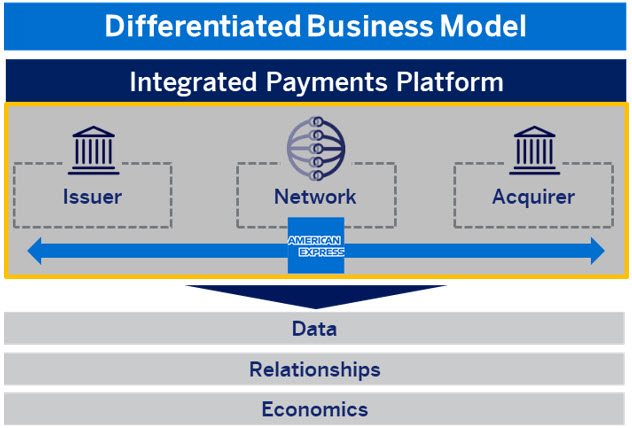]
Through contractual relationships, we also obtain information from third-party card issuers, merchant [removed: acquirers] [added: acquirers, aggregators] and processors with whom we do business.
For the year ended December 31, [removed: 2019,] [added: 2020,] worldwide proprietary billed business (spending on American Express cards issued by us) was [removed: $1,071] [added: $870.7] billion and at December 31, [removed: 2019,] [added: 2020,] we had [removed: 70] [added: 68.9] million proprietary cards-in-force worldwide.
For example, through our OptBlue® merchant-acquiring program, third-party [removed: processors] [added: acquirers] contract directly with small merchants for card acceptance [added: on our network] and determine merchant pricing.
[removed: As we] [added: We] continue to grow [removed: our network, we will seek to work with] merchant [removed: partners in the United States and] [added: acceptance of American Express cards] around the world [removed: to ensure] [added: and work with merchant partners so] that our Card Members are warmly welcomed and encouraged to spend in the millions of places where their American Express cards are accepted.
[removed: GMNS operates] [added: We operate] a payments network through which [removed: it establishes] [added: we establish] and [removed: maintains] [added: maintain] relationships with third-party banks and other institutions in approximately [removed: 94] [added: 98] countries and territories, licensing the American Express brand and extending the reach of our global network.
[removed: Under independent operator arrangements,] [added: These network] partners are licensed to issue local currency American Express-branded cards in their countries [removed: and] [added: and/or] serve as the merchant acquirer for local [removed: merchants.][added: merchants on our network.]
For the year ended December 31, [removed: 2019,] [added: 2020,] worldwide network services billed business (spending on American Express cards issued by third parties) was [removed: $170] [added: $139.9] billion and at December 31, [removed: 2019,] [added: 2020,] we had [removed: 44] [added: 43.1] million cards-in-force issued by third parties worldwide.
The following charts provide a summary of our diverse set of customers and broad geographic [removed: footprint:][added: footprint based on billed business volumes:]
[removed: 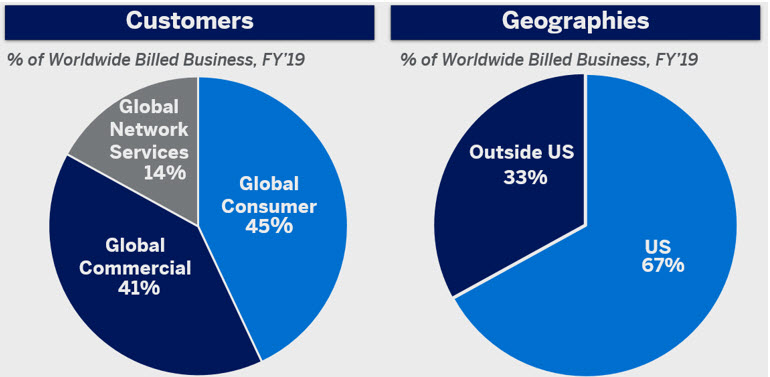][added: 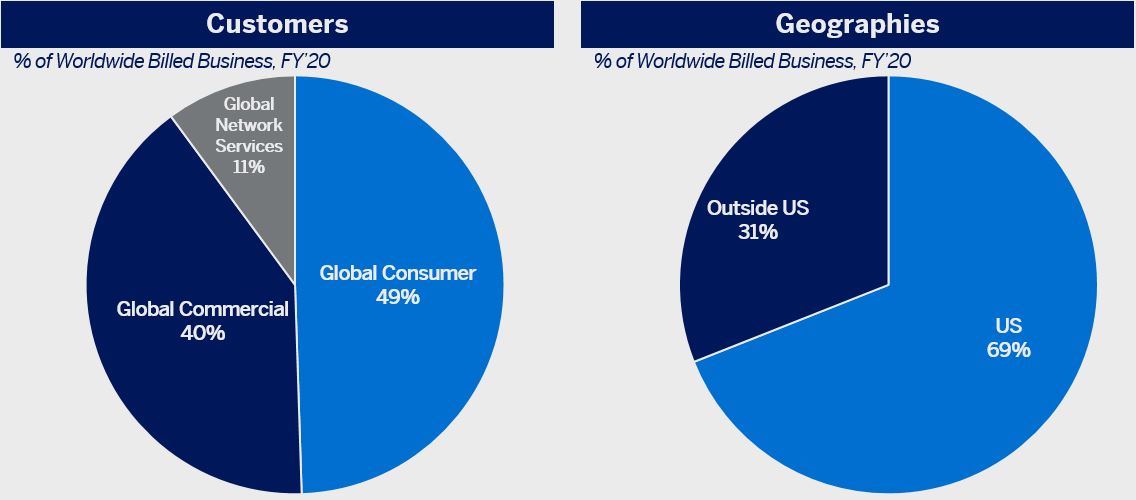]
There are many examples of how we connect partners with our integrated payments platform, including: issuing cards under cobrand arrangements with other corporations and institutions (e.g., Delta Air Lines, Marriott International, [removed: British Airways and] Hilton Worldwide [removed: Holdings);] [added: Holdings and British Airways);] offering innovative ways for our Card Members to earn and use points with our merchants (e.g., Pay with Points at Amazon.com); expanding merchant acceptance with third-party acquirers [removed: and processors] (e.g., OptBlue partners); developing new capabilities and features with our digital partners (e.g., [removed: PayPal and Venmo);] [added: PayPal);] integrating into the supplier payment processes of our [removed: corporate card clients] [added: business customers] (e.g., [added: Bill.com,] SAP [removed: Ariba);] [added: Ariba] and [added: Coupa); and] extending the platform into travel services with American Express leisure and business travel (e.g., Fine Hotels and Resorts).
We issue cards under cobrand arrangements with Delta and the Delta cobrand portfolio represented approximately [removed: 8] [added: 9] percent of our worldwide billed business and approximately [removed: 22] [added: 21] percent of worldwide Card Member loans as of December 31, [removed: 2019.][added: 2020.]
[removed: During 2019, we signed an 11-year renewal extending the] [added: The current] Delta cobrand [removed: relationship] [added: agreement runs] through the end of 2029 and [added: we] expect to continue to make significant investments in this [removed: partnership going forward.][added: partnership.]
Working with all of our partners, we [removed: will continue to] seek to provide value, choice and unique experiences across our customer base.
[removed: We] [added: And we] seek to grow our business [added: over the longer term] by focusing on four strategic imperatives:
Second, we [removed: will look] [added: seek] to build on our strong position in commercial payments by evolving our card value propositions, further differentiating our corporate card and accounts payable expense management [removed: solutions,] [added: solutions] and designing innovative products and features, including financing and supplier payment solutions for our business customers.
Third, we are focused on strengthening our global network to provide unique value by continuing to help merchants navigate the convergence of online and offline commerce with fraud protection services, marketing insights and digital connections to higher-spending Card [removed: Members,] [added: Members] and continuing to work with our network partners to offer expanded products and services.
We compete in the global payments industry with card networks, issuers and acquirers, paper-based transactions (e.g., cash and checks), bank transfer models (e.g., wire transfers and Automated Clearing House, or ACH), as well as evolving and growing alternative [removed: payment] [added: mechanisms, systems] and [added: products that leverage new technologies, business models and customer relationships to create payment or] financing [removed: providers.][added: solutions.]
As a card issuer, we compete with financial institutions that issue general-purpose [removed: charge and] credit [removed: cards] and debit cards.
We also encounter competition from businesses that issue [removed: their own] private label cards, operate [removed: their own] mobile wallets or extend [removed: credit to their customers.][added: credit.]
- The number and quality of other [removed: payment] cards and other forms of payment [added: and financing] available to customers
- The security of [removed: cardholder and] [added: cardholder,] merchant [added: and network partner] information
Another aspect of competition is the dynamic and rapid growth of alternative payment [added: and financing] mechanisms, systems and products, which include payment [removed: aggregators (e.g., PayPal, Square and Amazon), marketplace lenders, wireless] [added: aggregators, digital] payment [removed: technologies (including using mobile telephone networks to carry out transactions), financial technology companies,] [added: and] electronic wallet [removed: and push payment providers (including handset manufacturers, telecommunication providers, retailers, banks] [added: platforms, point-of-sale lenders, real-time settlement] and [added: processing systems, financial] technology [removed: companies),] [added: companies,] digital currencies developed by both governments and the private sector, blockchain and similar distributed ledger technologies, [removed: real-time settlement and processing,] prepaid systems and gift cards, and systems linked to [removed: payment cards] [added: customer accounts] or that provide payment solutions.
Various competitors are [removed: working to integrate] [added: integrating] more financial services into their product offerings and competitors are [removed: attempting] [added: seeking] to [removed: replicate our closed-loop functionality,] [added: attain the benefits of closed-loop, loyalty and rewards functionalities,] such as [removed: the merchant-processing platform ChaseNet.][added: ours.]
In addition to the discussion in this section, see “*Our operating results may materially suffer because of substantial and increasingly intense competition worldwide in the payments industry*” in “Risk Factors” for further discussion of the potential impact of competition on our business, and “*Our business is subject to comprehensive government regulation and supervision, which could materially adversely affect our results of operations and financial condition”* and “*Legal proceedings regarding provisions in our merchant [removed: contracts] [added: contracts, including non-discrimination and honor-all-cards provisions,] could have a material adverse effect on our business and result in additional litigation and/or arbitrations, substantial monetary damages and damage to our reputation and brand*” in “Risk Factors” for a discussion of the potential impact on our ability to compete effectively due to government regulations or if ongoing legal proceedings limit our ability to prevent merchants from engaging in various actions to discriminate against our card products.
[removed: In recent years, the] [added: The] financial services industry [removed: has been] [added: is] subject to rigorous scrutiny, high regulatory expectations, [removed: an increasing] [added: a] range of regulations and a stringent and unpredictable enforcement environment.
[removed: In addition, legislators] [added: Legislators] and regulators in various countries in which we operate have focused on the operation of card networks, including through [removed: antitrust] [added: enforcement] actions, legislation and regulations to change certain practices or pricing of card issuers, merchant acquirers and payment networks, and, in some cases, to establish broad and ongoing regulatory oversight regimes for payment systems.
Both the Company and TRS are subject to comprehensive consolidated supervision, regulation and examination by the Federal Reserve and AENB is [removed: likewise] supervised, regulated and examined by the Office of the Comptroller of the Currency (OCC).
Banking regulators have broad examination and enforcement power, including the power to impose substantial fines, limit dividends and other capital distributions, restrict operations and acquisitions and require [removed: divestitures.][added: divestitures, any of which could compromise our competitive position.]
If the Company fails to meet eligibility requirements for financial holding company status, it [removed: is] [added: and its subsidiaries are] likely to be barred from engaging in new types of financial activities or making certain types of acquisitions or investments in reliance on its status as a financial holding company, and ultimately could be required to either discontinue the broader range of activities permitted to financial holding companies or divest AENB.
[removed: In addition, as a] [added: Under the Tailoring Rules,] Category IV [removed: firm] [added: firms] with less than $50 billion in weighted short-term wholesale funding, [added: such as] the [removed: Company is no longer] [added: Company, are not] subject to [removed: the liquidity coverage ratio (LCR).][added: any LCR requirement.]
As a Category IV firm, the Company [removed: will be] [added: was] subject to the Federal Reserve’s supervisory stress tests [added: in 2020 and will be required to participate in the supervisory stress tests] every other [removed: year, beginning in 2020, rather than on an annual cycle.][added: year thereafter.]
We [removed: remain subject to the requirement] [added: are required] to develop and submit to the Federal Reserve an annual capital plan.
[removed: The] [added: In January 2021, the] Federal Reserve [removed: has stated it plans] [added: finalized changes] to [removed: propose changes,] [added: the capital plan rule,] which [removed: would include providing] [added: will, among other things, provide] firms subject to Category IV standards additional flexibility to develop their capital plans.
As part of the Comprehensive Capital Analysis and Review (CCAR), the Federal Reserve evaluates whether the Company has sufficient capital to continue operations by assessing our pro-forma capital position and ratios under a scenario of economic and financial market [removed: stress.][added: stress, and uses that information to determine the size of the SCB for each CCAR participating firm.]
We may be required to revise and resubmit our capital plan [removed: as required by the Federal Reserve] following certain [removed: events,] [added: events or developments,] such as a significant [removed: acquisition.][added: acquisition or an event that could result in a material change in our risk profile or financial condition.]
[removed: Dividend] [added: Common stock dividend] payments [added: and share repurchases] by the Company [removed: to shareholders] are subject to the oversight of the Federal [removed: Reserve.][added: Reserve, as described above.]
[removed: Capital, Leverage] [added: Capital] and Liquidity Regulation
The COVID-19 pandemic has brought unprecedented challenges to businesses and economies around the world.
While our business was significantly impacted by the pandemic in 2020 as further described in this report, we believe our progress in managing through it confirms the resilience of our differentiated business model.
During 2020, we enhanced our value propositions on many of our card products, including adjusting our rewards programs and adding limited time offers and statement credits in categories that are relevant in the current environment, such as wireless, streaming services, business essentials and food delivery.
We also created a Customer Pandemic Relief Program to provide short-term support for customers impacted by COVID-19, and we enhanced and expanded our longer-term Financial Relief Program for Card Members who need additional financial assistance during this time.
Additionally, we participated in the U.S. Small Business Administration Paycheck Protection Program (PPP), designed to provide small businesses with support to cover payroll and certain other expenses.
During 2020, we adjusted certain policies to back our merchant partners in the current environment, including raising contactless transaction thresholds and reminding them that we do not require Card Members’ signatures at the point of sale.
We also launched our largest-ever Shop Small campaign to support small businesses around the world, which have been significantly impacted by the pandemic.
During 2020, our joint venture with Lianlian DigiTech Co., Ltd, a Chinese fintech services company, received approval from the People’s Bank of China for a network clearing license and began processing transactions in mainland China.
Our broad and diverse customer base spans consumers, small businesses, mid-sized companies and large corporations around the world.
Our framework for managing through the pandemic and the challenging economic environment is built on four principles: supporting our colleagues and winning as a team; protecting our customers and our brand; structuring the company for growth in the future; and remaining financially strong.
We remain focused on what we can control in the short term while identifying opportunities across our businesses to position ourselves for growth in the longer term.
Our Colleagues
We are committed to delivering a great colleague experience every day, cultivating the best talent and developing new ways of working to unlock enterprise value.
We work to foster an inclusive and diverse culture and help our colleagues thrive both professionally and personally.
When we do, our colleagues are more engaged, committed, creative and effective in driving results.
At the heart of our culture is what we call our Blue Box Values – a set of guiding principles that reflect who we are and what we stand for.
In 2020, we updated our Blue Box Values to be more explicit about our efforts to create an inclusive and diverse workforce:
| We Back Our Customers | | | | | | We Embrace Diversity | | |
| We Make It Great | | | | | | We Stand for Inclusion | | |
| We Do What's Right | | | | | | We Win as A Team | | |
| We Respect People | | | | | | We Support Our Communities | | |
We take a holistic approach to serving our colleagues by offering them a variety of resources that support their physical, financial, emotional, social and overall well-being.
Throughout the pandemic, one of our top priorities has been to ensure our colleagues have the flexibility and resources they need to stay safe, healthy and productive.
As of December 31, 2020, we employed approximately 63,700 people, whom we refer to as colleagues, with approximately 22,700 colleagues in the United States and approximately 41,000 colleagues outside the United States.
We conduct an annual Colleague Experience Survey to better understand our colleagues’ needs and overall experience at American Express and in 2020, 94 percent of colleagues who participated in the survey said they would recommend American Express as a great place to work.
Our 2020 annual company scorecard included talent retention and diversity representation goals to globally increase minority and women representation at management levels and retain our key talent.
As of December 31, 2020, female colleagues comprised 52 percent of our global workforce and Asian, Black/African American and Hispanic/Latinx people represented 19.7 percent, 12.0 percent and 13.0 percent, respectively, of our U.S. workforce based on preliminary data for our 2020 U.S. EEO-1 submission.
We regularly review our compensation practices to ensure colleagues in the same job, level and location are compensated fairly regardless of gender globally, and race and ethnicity in the United States.
These reviews consider several factors known to affect compensation, including role, level, tenure, performance and geography.
In the few instances where a review has found inconsistencies, we have made adjustments.
After making these adjustments, we believe we achieved 100 percent pay equity in 2020 for colleagues across genders globally and across races and ethnicities in the United States.
| | | | | | |
| --- | --- | --- | --- | --- | --- |
| | | | | | |
| | | | | | |
| | | | | | |
| | | | | | |
| | | | | | |
| | | | | | |
| | | | | | |
As of December 31, 2019, we employed approximately 64,500 people, whom we refer to as colleagues.
We continue to grow merchant acceptance of American Express cards around the world.
As of year-end 2019, based on our internal tracking and our understanding of the latest industry data, we believe we achieved our goal of reaching virtual parity coverage with Mastercard and Visa credit card-accepting merchants in the United States.
We are also focused on increasing merchant coverage strategically in targeted countries, cities and merchant categories outside the United States, with continued growth in merchant locations internationally in 2019.
Under network card license arrangements, partners are licensed to issue American Express-branded cards on our network.
As the payments industry continues to evolve, we face increasing competition from non-traditional players that leverage new technologies, business models and customer relationships to create payment or financing solutions.
New payments competitors continue to emerge in response to evolving technologies, consumer habits and merchant needs.
The Federal Reserve has established a new rating system for large financial institutions, such as the Company, which is intended to align with the Federal Reserve’s existing supervisory program for large financial institutions and which includes component ratings for capital planning, liquidity risk management, and governance and controls.
In August 2017 and January 2018, the Federal Reserve proposed related guidance for the governance and controls component.
As a Category IV firm, the Company is, among other things, (i) no longer subject to the advanced approaches capital requirements, (ii) no longer subject to the supplementary leverage ratio (SLR), (iii) no longer subject to the countercyclical capital buffer, (iv) no longer subject to company-run stress testing requirements, (v) subject to supervisory stress testing on an every-other-year basis rather than an annual basis, and (vi) no longer subject to the requirement to prepare and submit a holding company-level resolution plan.
Sufficient capital for these purposes is likely to require us to maintain capital ratios appreciably above applicable minimum requirements and buffers.
The Federal Reserve is expected to publish the decisions for all the bank holding companies participating in CCAR, including the reasons for any objection to capital plans, by June 30.
In addition, the Federal Reserve will publish separately the results of its supervisory stress test under the supervisory severely adverse scenario.
The information to be released will include, among other things, the Federal Reserve’s projection of company-specific information, including post-stress capital ratio information over the planning horizon.
In addition to other limitations, our ability to make any capital distributions (including dividends and share repurchases) is contingent on the Federal Reserve’s non-objection to our capital plan.
See “Stress Testing and Capital Planning.” Even if the Federal Reserve has not objected to a distribution, the Company may still not make a distribution
without Federal Reserve approval if, among other things, the Company would not meet a minimum regulatory capital ratio after giving effect to the capital distribution, changes in facts would require resubmission of our capital plan or the Company’s earnings are materially underperforming its projections in the capital plan.
Since 2014, we have reported our capital adequacy ratios on a parallel basis to federal banking regulators using both risk-weighted assets calculated under the Basel III standardized approach, as adjusted for certain items, and the requirements for an advanced approaches institution.
The Capital Rules also implement a 2.5 percent capital conservation buffer composed entirely of CET1, on top of these minimum risk-weighted asset ratios.
Federal banking regulators may further increase required minimum capital ratios by a countercyclical capital buffer composed entirely of CET1 up to 2.5 percent if they determine that such a buffer is necessary to protect the banking system from disorderly downturns associated with excessively expansionary periods.
Under the Tailoring Rules, Category IV firms, such as the Company, would not be subject to such a countercyclical capital buffer.
The Federal Reserve proposed a rule in April 2018 that would, among other things, replace the static 2.5 percent capital conservation buffer with a stress capital buffer requirement for bank holding companies subject to the CCAR process.
The stress capital buffer would reflect stressed losses in the supervisory severely adverse scenario of the Federal Reserve’s CCAR stress tests and would also include four quarters of planned common stock dividends.
The proposal also included a stress leverage buffer requirement, similar to the stress capital buffer, which would apply to the Tier 1 leverage ratio.
The proposal would require bank holding companies to reduce their planned capital distributions if those distributions would not be consistent with the applicable capital buffer constraints based on the bank holding companies’ own baseline scenario projections.
The Federal Reserve has indicated that it intends to propose revisions to the stress buffer requirements that would be applicable to Category IV firms, such as the Company, to align with the two-year supervisory stress-testing cycle for Category IV bank holding companies.
*Leverage Requirements*
The Capital Rules also establish an SLR requirement for advanced approaches banking organizations.
The SLR is the ratio of Tier 1 capital to an expanded concept of leverage exposure that includes both on-balance sheet and certain off-balance sheet exposures.
The Capital Rules require a minimum SLR of 3.0 percent.
As noted above, Category IV firms, such as the Company, are not subject to the SLR requirement under the Tailoring Rules.
Although the NSFR has not been finalized, the Federal Reserve staff’s memorandum has indicated it will be applied in a manner consistent with the application of the LCR under the Tailoring Rules, provided a Category IV firm’s weighted short-term wholesale funding remains below $50 billion.
The proposed rule, among other things, would revise the definition of “deposit broker” and the accompanying exceptions.
This proposal is not expected to result in final rules, if any, becoming effective before 2021.
For example, in April 2019, the European Commission accepted commitments by Visa and Mastercard to significantly reduce inter-regional multilateral interchange fees.
In Canada, regulators have prompted the major international card networks to make voluntary commitments on pricing, specifically interchange fee levels; as American Express does not operate with interchange fees in Canada, our commitments extend to maintaining current pricing practices and complying with certain other practices.
The People’s Bank of China officially accepted our application for a business operating license to process domestic currency transactions through a joint venture in mainland China.
There can be no assurance that we will receive such a license, or, if we do, that we will be able to successfully compete in China with domestic payment card networks and alternative payment providers.
It created additional legal and compliance obligations on companies that process personal data of individuals in the EU, irrespective of the geographical location of the company.
EU Member States are required to implement the 5th and 6th EU Anti-Money Laundering Directives by January 10, 2020 and December 3, 2020, respectively.
An excerpt. Shown here: 40 of 102 rewritten, 40 of 89 added and 40 of 44 removed. The counts are complete. For every sentence, read Item 1. BUSINESS in the FY2020 filing and the FY2019 filing.
Cover and table of contents
42 rewritten, 11 added, 11 removed, 60 unchanged
| | | | For the fiscal year ended December 31, [removed: 2019] [added: 2020] | | |
[removed: ][added: ]
| Large accelerated filer þ | | | Accelerated filer o | | | Non-accelerated filer o | | | Smaller reporting company ☐ | | | Emerging growth company ☐ | | | [removed: | | | | | |]
As of June 30, [removed: 2019,] [added: 2020,] the aggregate market value of the registrant’s voting shares held by non-affiliates of the registrant was approximately [removed: $102.7] [added: $76.6] billion based on the closing sale price as reported on the New York Stock Exchange.
As of [removed: January 30, 2020,] [added: February 3, 2021,] there were [removed: 808,040,664] [added: 805,588,980] common shares of the registrant outstanding.
Part III: Portions of Registrant’s Proxy Statement to be filed with the Securities and Exchange Commission in connection with the Annual Meeting of Shareholders to be held on May [removed: 5, 2020.][added: 4, 2021.]
| | | | [PART [removed: I](#i_0_10)] [added: I](#i1c944372b39c4106a610bd44c10ce701_13)] | | | | | |
| [removed: [1.](#i_0_13)] [added: [1.](#i1c944372b39c4106a610bd44c10ce701_16)] | | | [removed: [Business](#i_0_13)] [added: [Business](#i1c944372b39c4106a610bd44c10ce701_16)] | | | [removed: [1](#i_0_13)] [added: [1](#i1c944372b39c4106a610bd44c10ce701_16)] | | |
| | | | [removed: [Competition](#i_0_22)] [added: [Competition](#i1c944372b39c4106a610bd44c10ce701_25)] | | | [removed: [4](#i_0_22)] [added: [9](#i1c944372b39c4106a610bd44c10ce701_25)] | | |
| | | | [Supervision and [removed: Regulation](#i_0_25)] [added: Regulation](#i1c944372b39c4106a610bd44c10ce701_28)] | | | [removed: [6](#i_0_25)] [added: [11](#i1c944372b39c4106a610bd44c10ce701_28)] | | |
| | | | [Additional [removed: Information](#i_0_34)] [added: Information](#i1c944372b39c4106a610bd44c10ce701_37)] | | | [removed: [17](#i_0_34)] [added: [22](#i1c944372b39c4106a610bd44c10ce701_37)] | | |
| [removed: [1A.](#i_0_37)] [added: [1A.](#i1c944372b39c4106a610bd44c10ce701_40)] | | | [Risk [removed: Factors](#i_0_37)] [added: Factors](#i1c944372b39c4106a610bd44c10ce701_40)] | | | [removed: [17](#i_0_37)] [added: [23](#i1c944372b39c4106a610bd44c10ce701_40)] | | |
| [removed: [1B.](#i_0_40)] [added: [1B.](#i1c944372b39c4106a610bd44c10ce701_43)] | | | [Unresolved Staff [removed: Comments](#i_0_40)] [added: Comments](#i1c944372b39c4106a610bd44c10ce701_43)] | | | [removed: [33](#i_0_40)] [added: [38](#i1c944372b39c4106a610bd44c10ce701_43)] | | |
| [removed: [2.](#i_0_43)] [added: [2.](#i1c944372b39c4106a610bd44c10ce701_46)] | | | [removed: [Properties](#i_0_43)] [added: [Properties](#i1c944372b39c4106a610bd44c10ce701_46)] | | | [removed: [33](#i_0_43)] [added: [38](#i1c944372b39c4106a610bd44c10ce701_46)] | | |
| [removed: [3.](#i_0_46)] [added: [3.](#i1c944372b39c4106a610bd44c10ce701_49)] | | | [Legal [removed: Proceedings](#i_0_46)] [added: Proceedings](#i1c944372b39c4106a610bd44c10ce701_49)] | | | [removed: [33](#i_0_46)] [added: [38](#i1c944372b39c4106a610bd44c10ce701_49)] | | |
| [removed: [4.](#i_0_49)] [added: [4.](#i1c944372b39c4106a610bd44c10ce701_52)] | | | [Mine Safety [removed: Disclosures](#i_0_49)] [added: Disclosures](#i1c944372b39c4106a610bd44c10ce701_52)] | | | [removed: [33](#i_0_49)] [added: [38](#i1c944372b39c4106a610bd44c10ce701_52)] | | |
| | | | [PART [removed: II](#i_0_52)] [added: II](#i1c944372b39c4106a610bd44c10ce701_55)] | | | | | |
| [removed: [5.](#i_0_55)] [added: [5.](#i1c944372b39c4106a610bd44c10ce701_58)] | | | [Market for Registrant’s Common Equity, Related Stockholder Matters and Issuer Purchases of Equity [removed: Securities](#i_0_55)] [added: Securities](#i1c944372b39c4106a610bd44c10ce701_58)] | | | [removed: [34](#i_0_55)] [added: [39](#i1c944372b39c4106a610bd44c10ce701_58)] | | |
| [removed: [6.](#i_0_58)] [added: [6.](#i1c944372b39c4106a610bd44c10ce701_64)] | | | [Selected Financial [removed: Data](#i_0_58)] [added: Data](#i1c944372b39c4106a610bd44c10ce701_64)] | | | [removed: [36](#i_0_58)] [added: [41](#i1c944372b39c4106a610bd44c10ce701_64)] | | |
| [removed: [7.](#i_0_61)] [added: [7.](#i1c944372b39c4106a610bd44c10ce701_67)] | | | [Management’s Discussion and Analysis of Financial Condition and Results of Operations [removed: (MD&A)](#i_0_61)] [added: (MD&A)](#i1c944372b39c4106a610bd44c10ce701_67)] | | | [removed: [36](#i_0_61)] [added: [42](#i1c944372b39c4106a610bd44c10ce701_67)] | | |
| | | | [Executive [removed: Overview](#i_0_64)] [added: Overview](#i1c944372b39c4106a610bd44c10ce701_70)] | | | [removed: [37](#i_0_64)] [added: [42](#i1c944372b39c4106a610bd44c10ce701_70)] | | |
| | | | [Consolidated Results of [removed: Operations](#i_0_67)] [added: Operations](#i1c944372b39c4106a610bd44c10ce701_73)] | | | [removed: [39](#i_0_67)] [added: [45](#i1c944372b39c4106a610bd44c10ce701_73)] | | |
| | | | [Business Segment [removed: Results](#i_0_70)] [added: Results](#i1c944372b39c4106a610bd44c10ce701_76)] of Operations | | | [removed: [44](#i_0_70)] [added: [53](#i1c944372b39c4106a610bd44c10ce701_76)] | | |
| | | | [Consolidated Capital Resources and [removed: Liquidity](#i_0_73)] [added: Liquidity](#i1c944372b39c4106a610bd44c10ce701_79)] | | | [removed: [53](#i_0_73)] [added: [62](#i1c944372b39c4106a610bd44c10ce701_79)] | | |
| | | | [Off-Balance Sheet Arrangements and Contractual [removed: Obligations](#i_0_76)] [added: Obligations](#i1c944372b39c4106a610bd44c10ce701_82)] | | | [removed: [59](#i_0_76)] [added: [70](#i1c944372b39c4106a610bd44c10ce701_82)] | | |
| | | | [Risk [removed: Management](#i_0_79)] [added: Management](#i1c944372b39c4106a610bd44c10ce701_85)] | | | [removed: [60](#i_0_79)] [added: [72](#i1c944372b39c4106a610bd44c10ce701_85)] | | |
| | | | [Critical Accounting [removed: Estimates](#i_0_82)] [added: Estimates](#i1c944372b39c4106a610bd44c10ce701_88)] | | | [removed: [66](#i_0_82)] [added: [80](#i1c944372b39c4106a610bd44c10ce701_88)] | | |
| | | | [Other [removed: Matters](#i_0_85)] [added: Matters](#i1c944372b39c4106a610bd44c10ce701_91)] | | | [removed: [68](#i_0_85)] [added: [84](#i1c944372b39c4106a610bd44c10ce701_91)] | | |
| [removed: [7A.](#i_0_88)] [added: [7A.](#i1c944372b39c4106a610bd44c10ce701_94)] | | | [Quantitative and Qualitative Disclosures about Market [removed: Risk](#i_0_88)] [added: Risk](#i1c944372b39c4106a610bd44c10ce701_94)] | | | [removed: [73](#i_0_88)] [added: [90](#i1c944372b39c4106a610bd44c10ce701_94)] | | |
| [removed: [8.](#i_0_91)] [added: [8.](#i1c944372b39c4106a610bd44c10ce701_97)] | | | [Financial Statements and Supplementary [removed: Data](#i_0_91)] [added: Data](#i1c944372b39c4106a610bd44c10ce701_97)] | | | [removed: [74](#i_0_91)] [added: [90](#i1c944372b39c4106a610bd44c10ce701_97)] | | |
| | | | [Management’s Report on Internal Control Over Financial [removed: Reporting](#i_0_94)] [added: Reporting](#i1c944372b39c4106a610bd44c10ce701_100)] | | | [removed: [74](#i_0_94)] [added: [90](#i1c944372b39c4106a610bd44c10ce701_100)] | | |
| | | | [Report of Independent Registered Public Accounting [removed: Firm](#i_0_97)] [added: Firm](#i1c944372b39c4106a610bd44c10ce701_103)] | | | [removed: [75](#i_0_97)] [added: [91](#i1c944372b39c4106a610bd44c10ce701_103)] | | |
| | | | [Index to Consolidated Financial [removed: Statements](#i_0_100)] [added: Statements](#i1c944372b39c4106a610bd44c10ce701_106)] | | | [removed: [77](#i_0_100)] [added: [94](#i1c944372b39c4106a610bd44c10ce701_106)] | | |
| | | | [Consolidated Financial [removed: Statements](#i_0_106)] [added: Statements](#i1c944372b39c4106a610bd44c10ce701_112)] | | | [removed: [78](#i_0_106)] [added: [95](#i1c944372b39c4106a610bd44c10ce701_112)] | | |
| | | | [Notes to Consolidated Financial [removed: Statements](#i_0_130)] [added: Statements](#i1c944372b39c4106a610bd44c10ce701_130)] | | | [removed: [83](#i_0_130)] [added: [100](#i1c944372b39c4106a610bd44c10ce701_130)] | | |
| [removed: [9.](#i_0_253)] [added: [9.](#i1c944372b39c4106a610bd44c10ce701_223)] | | | [Changes in and Disagreements with Accountants on Accounting and Financial [removed: Disclosure](#i_0_253)] [added: Disclosure](#i1c944372b39c4106a610bd44c10ce701_223)] | | | [removed: [132](#i_0_253)] [added: [159](#i1c944372b39c4106a610bd44c10ce701_223)] | | |
| [removed: [9A.](#i_0_256)] [added: [9A.](#i1c944372b39c4106a610bd44c10ce701_226)] | | | [Controls and [removed: Procedures](#i_0_256)] [added: Procedures](#i1c944372b39c4106a610bd44c10ce701_226)] | | | [removed: [132](#i_0_256)] [added: [159](#i1c944372b39c4106a610bd44c10ce701_226)] | | |
| | | | [PART [removed: III](#i_0_262)] [added: III](#i1c944372b39c4106a610bd44c10ce701_232)] | | | | | |
| [removed: [10.](#i_0_265)] [added: [10.](#i1c944372b39c4106a610bd44c10ce701_235)] | | | [Directors, Executive Officers and Corporate [removed: Governance](#i_0_265)] [added: Governance](#i1c944372b39c4106a610bd44c10ce701_235)] | | | [removed: [133](#i_0_265)] [added: [160](#i1c944372b39c4106a610bd44c10ce701_235)] | | |
| [removed: [12.](#i_0_265)] [added: [12.](#i1c944372b39c4106a610bd44c10ce701_235)] | | | [Security Ownership of Certain Beneficial Owners and Management and Related Stockholder [removed: Matters](#i_0_265)] [added: Matters](#i1c944372b39c4106a610bd44c10ce701_235)] | | | [removed: [133](#i_0_265)] [added: [160](#i1c944372b39c4106a610bd44c10ce701_235)] | | |
| | | | | | | | | | | | | | | |
| --- | --- | --- | --- | --- | --- | --- | --- | --- | --- | --- | --- | --- | --- | --- |
Indicate by check mark whether the registrant has filed a report on and attestation to its management's assessment of the effectiveness of its internal control over financial reporting under section 404(b) of the Sarbanes-Oxley Act (15 U.S.C. 7262(b)) by the registered public accounting firm that prepared or issued its audit report.
| [9B.](#i1c944372b39c4106a610bd44c10ce701_229) | | | [Other Information](#i1c944372b39c4106a610bd44c10ce701_229) | | | [159](#i1c944372b39c4106a610bd44c10ce701_229) | | |
| [11.](#i1c944372b39c4106a610bd44c10ce701_235) | | | [Executive Compensation](#i1c944372b39c4106a610bd44c10ce701_235) | | | [160](#i1c944372b39c4106a610bd44c10ce701_235) | | |
| [14.](#i1c944372b39c4106a610bd44c10ce701_238) | | | [Principal Account](#i1c944372b39c4106a610bd44c10ce701_238)[ant](#i1c944372b39c4106a610bd44c10ce701_238) [Fees and Services](#i1c944372b39c4106a610bd44c10ce701_238) | | | [161](#i1c944372b39c4106a610bd44c10ce701_238) | | |
| | | | [PART IV](#i1c944372b39c4106a610bd44c10ce701_241) | | | | | |
| [15.](#i1c944372b39c4106a610bd44c10ce701_244) | | | [Exhibit](#i1c944372b39c4106a610bd44c10ce701_244) [and](#i1c944372b39c4106a610bd44c10ce701_244) [](#i1c944372b39c4106a610bd44c10ce701_244)[Financial Statement Schedules](#i1c944372b39c4106a610bd44c10ce701_244) | | | [162](#i1c944372b39c4106a610bd44c10ce701_244) | | |
| [16.](#i1c944372b39c4106a610bd44c10ce701_250) | | | [Form 10-K Summary](#i1c944372b39c4106a610bd44c10ce701_250) | | | [168](#i1c944372b39c4106a610bd44c10ce701_250) | | |
| | | | | | | | | |
| | | | [Signatures](#i1c944372b39c4106a610bd44c10ce701_253) | | | [169](#i1c944372b39c4106a610bd44c10ce701_253) | | |
| | | | | | | | | | | | | | | | | | | | | |
| --- | --- | --- | --- | --- | --- | --- | --- | --- | --- | --- | --- | --- | --- | --- | --- | --- | --- | --- | --- | --- |
| | | | (Do not check if a smaller reporting company) | | | | | | | | | | | | | | | | | |
| | | | [Information about our Executive Officers](#i_0_28) | | | [15](#i_0_28) | | |
| [9B.](#i_0_259) | | | [Other Information](#i_0_259) | | | [132](#i_0_259) | | |
| [11.](#i_0_265) | | | [Executive Compensation](#i_0_265) | | | [133](#i_0_265) | | |
| [14.](#i_0_268) | | | [Principal Accounting Fees and Services](#i_0_268) | | | [134](#i_0_268) | | |
| | | | [PART IV](#i_0_271) | | | | | |
| [15.](#i_0_274) | | | [Exhibits, Financial Statement Schedules](#i_0_274) | | | [135](#i_0_274) | | |
| [16.](#i_0_277) | | | [Form 10-K Summary](#i_0_277) | | | [139](#i_0_277) | | |
| | | | [Signatures](#i_0_280) | | | [140](#i_0_280) | | |
An excerpt. Shown here: 40 of 42 rewritten, all 11 added and all 11 removed. The counts are complete. For every sentence, read Cover and table of contents in the FY2020 filing and the FY2019 filing.
Item 2. PROPERTIES
1 rewritten, 1 added, 2 removed, 3 unchanged
Other owned or leased principal locations include American Express offices in [removed: Sunrise, Florida,] Phoenix, Arizona, [removed: Salt Lake City, Utah, Mexico City, Mexico, Sydney, Australia, Singapore,] [added: Sunrise, Florida,] Gurgaon, India, [added: Brighton, England,] Manila, Philippines, [added: Tokyo, Japan, Kuala Lumpur, Malaysia] and [removed: Brighton, England;] [added: Sydney, Australia;] the American Express data centers in Phoenix, Arizona and Greensboro, North Carolina; the headquarters for [added: AENB in Sandy, Utah; the headquarters for] American Express Services Europe Limited in London, England; the headquarters for American Express Europe, S.A. in Madrid, Spain; [removed: and] the [added: headquarters for] Amex Bank of Canada and Amex Canada Inc. [removed: headquarters] in Toronto, Ontario, [removed: Canada.][added: Canada; and the headquarters for American Express Bank (Mexico) S.A. Institucion de Banca Multiple and American Express Company (Mexico) S.A. de C.V. in Mexico City, Mexico.]
We also lease and operate multiple travel lounges as a benefit for our Card Members in major U.S. and global hub airports.
Generally, we lease the premises we occupy in other locations.
We believe the facilities we own or occupy suit our needs and are well maintained.
Item 5. MARKET FOR REGISTRANT’S COMMON EQUITY, RELATED STOCKHOLDER MATTERS AND ISSUER PURCHASES OF EQUITY SECURITIES
8 rewritten, 12 added, 12 removed, 20 unchanged
As of December 31, [removed: 2019,] [added: 2020,] we had [removed: 19,974] [added: 19,446] common shareholders of record.
You can find dividend information concerning our common stock in Note 26 to our [removed: “Consolidated] [added: "Consolidated] Financial [removed: Statements.”] [added: Statements."] For information on dividend restrictions, see “Dividends and Other Capital Distributions” under “Supervision and Regulation” and Note 22 to our “Consolidated Financial Statements.” You can find information on securities authorized for issuance under our equity compensation plans under the caption “Executive Compensation — Equity Compensation Plans” to be contained in our definitive [removed: 2020] [added: 2021] proxy statement for our Annual Meeting of Shareholders, which is scheduled to be held on May [removed: 5, 2020.][added: 4, 2021.]
Our definitive [removed: 2020] [added: 2021] proxy statement for our Annual Meeting of Shareholders is expected to be filed with the SEC in March [removed: 2020] [added: 2021] (and, in any event, not later than 120 days after the close of our most recently completed fiscal year).
It shows the growth of a $100 investment on December 31, [removed: 2014,] [added: 2015,] including the reinvestment of all dividends.
[removed: 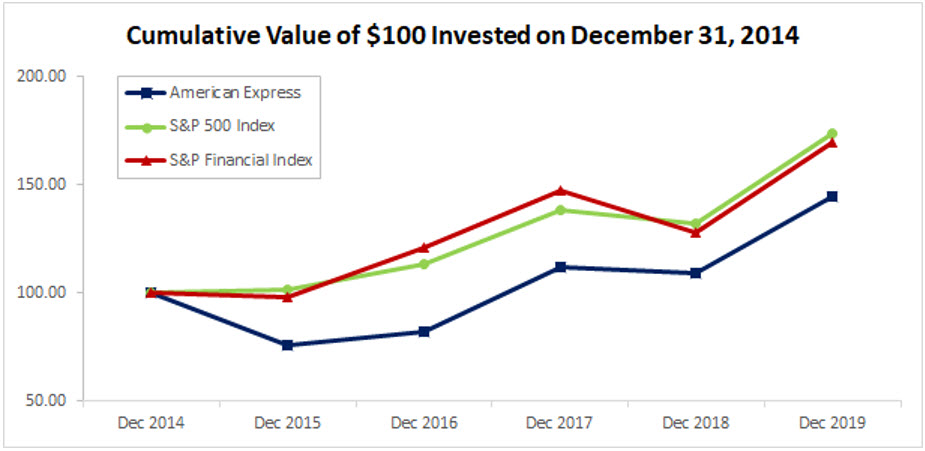][added: 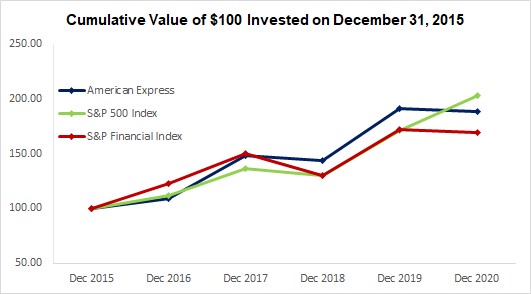]
| Year-end Data | | | | | | [removed: 2014] [added: 2015] | | | | | | [removed: 2015] [added: 2016] | | | | | | [removed: 2016] [added: 2017] | | | | | | [removed: 2017] [added: 2018] | | | | | | [removed: 2018] [added: 2019] | | | | | | [removed: 2019] [added: 2020] | | |
The table below sets forth the information with respect to purchases of our common stock made by or on behalf of us during the quarter ended December 31, [removed: 2019.][added: 2020.]
| Employee transactions(b) | | | | | | [removed: 27] [added: —] | | | | | | $ | [removed: 116.80] [added: —] | | | | | N/A | | | | | | N/A | | |
| American Express | | | | | | $ | 100.00 | | | | | $ | 108.57 | | | | | $ | 147.88 | | | | | $ | 143.99 | | | | | $ | 190.82 | | | | | $ | 188.62 | |
| S&P 500 Index | | | | | | $ | 100.00 | | | | | $ | 111.95 | | | | | $ | 136.38 | | | | | $ | 130.39 | | | | | $ | 171.44 | | | | | $ | 202.96 | |
| S&P Financial Index | | | | | | $ | 100.00 | | | | | $ | 122.75 | | | | | $ | 149.92 | | | | | $ | 130.37 | | | | | $ | 172.21 | | | | | $ | 169.19 | |
| October 1-31, 2020 | | | | | | | | | | | | | | | | | | | | | | | | | | |
| Repurchase program(a) | | | | | | — | | | | | | $ | — | | | | | — | | | | | | 102,171,653 | | |
| November 1-30, 2020 | | | | | | | | | | | | | | | | | | | | | | | | | | |
| Repurchase program(a) | | | | | | — | | | | | | $ | — | | | | | — | | | | | | 102,171,653 | | |
| Employee transactions(b) | | | | | | 19,140 | | | | | | $ | 91.24 | | | | | N/A | | | | | | N/A | | |
| December 1-31, 2020 | | | | | | | | | | | | | | | | | | | | | | | | | | |
| Repurchase program(a) | | | | | | — | | | | | | $ | — | | | | | — | | | | | | 102,171,653 | | |
| Repurchase program(a) | | | | | | — | | | | | | $ | — | | | | | — | | | | | | 102,171,653 | | |
| Employee transactions(b) | | | | | | 19,140 | | | | | | $ | 91.24 | | | | | N/A | | | | | | N/A | | |
| American Express | | | | | | $ | 100.00 | | | | | $ | 75.78 | | | | | $ | 82.28 | | | | | $ | 112.07 | | | | | $ | 109.12 | | | | | $ | 144.60 | |
| S&P 500 Index | | | | | | $ | 100.00 | | | | | $ | 101.37 | | | | | $ | 113.49 | | | | | $ | 138.26 | | | | | $ | 132.19 | | | | | $ | 173.80 | |
| S&P Financial Index | | | | | | $ | 100.00 | | | | | $ | 98.44 | | | | | $ | 120.83 | | | | | $ | 147.58 | | | | | $ | 128.33 | | | | | $ | 169.52 | |
| October 1-31, 2019 | | | | | | | | | | | | | | | | | | | | | | | | | | |
| Repurchase program(a) | | | | | | 5,039,911 | | | | | | $ | 115.67 | | | | | 5,039,911 | | | | | | 114,960,089 | | |
| November 1-30, 2019 | | | | | | | | | | | | | | | | | | | | | | | | | | |
| Repurchase program(a) | | | | | | 2,226,779 | | | | | | $ | 120.74 | | | | | 2,226,779 | | | | | | 112,733,310 | | |
| Employee transactions(b) | | | | | | 3,205 | | | | | | $ | 118.07 | | | | | N/A | | | | | | N/A | | |
| December 1-31, 2019 | | | | | | | | | | | | | | | | | | | | | | | | | | |
| Repurchase program(a) | | | | | | 3,338,428 | | | | | | $ | 122.26 | | | | | 3,338,428 | | | | | | 109,394,882 | | |
| Repurchase program(a) | | | | | | 10,605,118 | | | | | | $ | 118.81 | | | | | 10,605,118 | | | | | | 109,394,882 | | |
| Employee transactions(b) | | | | | | 3,232 | | | | | | $ | 118.06 | | | | | N/A | | | | | | N/A | | |
Item 6. SELECTED FINANCIAL DATA
28 rewritten, 6 added, 8 removed, 12 unchanged
| | | | | | | [removed: 2019] [added: 2020] | | | | | | [removed: 2018] [added: 2019] | | | | | | [removed: 2017] [added: 2018] | | | | | | [removed: 2016] [added: 2017] | | | | | | [removed: 2015(a)] [added: 2016] | | |
| Total revenues net of interest expense | | | | | | $ | [removed: 43,556] [added: 36,087] | | | | | $ | [removed: 40,338] [added: 43,556] | | | | | $ | [removed: 36,878] [added: 40,338] | | | | | $ | [removed: 35,438] [added: 36,878] | | | | | $ | [removed: 32,818] [added: 35,438] | |
| Provisions for [removed: losses(b)] [added: credit losses(a)] | | | | | | [removed: 3,573] [added: 4,730] | | | | | | [removed: 3,352] [added: 3,573] | | | | | | [removed: 2,760] [added: 3,352] | | | | | | [removed: 2,027] [added: 2,760] | | | | | | [removed: 1,988] [added: 2,027] | | |
| [removed: Expenses(b)] [added: Expenses] | | | | | | [removed: 31,554] [added: 27,061] | | | | | | [removed: 28,864] [added: 31,554] | | | | | | [removed: 26,693] [added: 28,864] | | | | | | [removed: 25,369] [added: 26,693] | | | | | | [removed: 22,892] [added: 25,369] | | |
| Pretax income | | | | | | [removed: 8,429] [added: 4,296] | | | | | | [removed: 8,122] [added: 8,429] | | | | | | [removed: 7,425] [added: 8,122] | | | | | | [removed: 8,042] [added: 7,425] | | | | | | [removed: 7,938] [added: 8,042] | | |
| Income tax provision | | | | | | [removed: 1,670] [added: 1,161] | | | | | | [removed: 1,201] [added: 1,670] | | | | | | [removed: 4,677] [added: 1,201] | | | | | | [removed: 2,667] [added: 4,677] | | | | | | [removed: 2,775] [added: 2,667] | | |
| Net income | | | | | | [removed: 6,759] [added: 3,135] | | | | | | $ | [removed: 6,921] [added: 6,759] | | | | | $ | [removed: 2,748] [added: 6,921] | | | | | $ | [removed: 5,375] [added: 2,748] | | | | | $ | [removed: 5,163] [added: 5,375] | |
| Return on average [removed: equity(c)] [added: equity(b)] | | | | | | [removed: 29.6] [added: 14.2] | | % | | | | [removed: 33.5] [added: 29.6] | | % | | | | [removed: 13.2] [added: 33.5] | | % | | | | [removed: 25.8] [added: 13.2] | | % | | | | [removed: 24.0] [added: 25.8] | | % |
| Card Member receivables, net | | | | | | [removed: 56,794] [added: 43,434] | | | | | | [removed: 55,320] [added: 56,794] | | | | | | [removed: 53,526] [added: 55,320] | | | | | | [removed: 46,841] [added: 53,526] | | | | | | [removed: 43,671] [added: 46,841] | | |
| Loans, net | | | | | | [removed: 89,624] [added: 70,643] | | | | | | [removed: 83,396] [added: 89,624] | | | | | | [removed: 74,300] [added: 83,396] | | | | | | [removed: 65,461] [added: 74,300] | | | | | | [removed: 58,799] [added: 65,461] | | |
| Investment securities | | | | | | [removed: 8,406] [added: 21,631] | | | | | | [removed: 4,647] [added: 8,406] | | | | | | [removed: 3,159] [added: 4,647] | | | | | | [removed: 3,157] [added: 3,159] | | | | | | [removed: 3,759] [added: 3,157] | | |
| Total assets | | | | | | [removed: 198,321] [added: 191,367] | | | | | | [removed: 188,602] [added: 198,321] | | | | | | [removed: 181,196] [added: 188,602] | | | | | | [removed: 158,917] [added: 181,196] | | | | | | [removed: 161,184] [added: 158,917] | | |
| Customer deposits | | | | | | [removed: 73,287] [added: 86,875] | | | | | | [removed: 69,960] [added: 73,287] | | | | | | [removed: 64,452] [added: 69,960] | | | | | | [removed: 53,042] [added: 64,452] | | | | | | [removed: 54,997] [added: 53,042] | | |
| Short-term borrowings | | | | | | [removed: 6,442] [added: 1,878] | | | | | | [removed: 3,100] [added: 6,442] | | | | | | [removed: 3,278] [added: 3,100] | | | | | | [removed: 5,581] [added: 3,278] | | | | | | [removed: 4,812] [added: 5,581] | | |
| Long-term debt | | | | | | [removed: 57,835] [added: 42,952] | | | | | | [removed: 58,423] [added: 57,835] | | | | | | [removed: 55,804] [added: 58,423] | | | | | | [removed: 46,990] [added: 55,804] | | | | | | [removed: 48,061] [added: 46,990] | | |
| Shareholders’ equity | | | | | | $ | [removed: 23,071] [added: 22,984] | | | | | $ | [removed: 22,290] [added: 23,071] | | | | | $ | [removed: 18,261] [added: 22,290] | | | | | $ | [removed: 20,523] [added: 18,261] | | | | | $ | [removed: 20,673] [added: 20,523] | |
| Basic | | | | | | $ | [removed: 8.00] [added: 3.77] | | | | | $ | [removed: 7.93] [added: 8.00] | | | | | $ | [removed: 3.00] [added: 7.93] | | | | | $ | [removed: 5.63] [added: 3.00] | | | | | $ | [removed: 5.07] [added: 5.63] | |
| Diluted | | | | | | [removed: 7.99] [added: 3.77] | | | | | | [removed: 7.91] [added: 7.99] | | | | | | [removed: 2.99] [added: 7.91] | | | | | | [removed: 5.61] [added: 2.99] | | | | | | [removed: 5.05] [added: 5.61] | | |
| Cash dividends declared per common share | | | | | | [removed: 1.64] [added: 1.72] | | | | | | $ | [removed: 1.48] [added: 1.64] | | | | | $ | [removed: 1.34] [added: 1.48] | | | | | $ | [removed: 1.22] [added: 1.34] | | | | | $ | [removed: 1.13] [added: 1.22] | |
| Book value per common share | | | | | | [removed: 26.51] [added: 26.58] | | | | | | $ | [removed: 24.45] [added: 26.51] | | | | | $ | [removed: 19.42] [added: 24.45] | | | | | $ | [removed: 20.95] [added: 19.42] | | | | | $ | [removed: 19.71] [added: 20.95] | |
| Basic | | | | | | [removed: 828] [added: 805] | | | | | | [removed: 856] [added: 828] | | | | | | [removed: 883] [added: 856] | | | | | | [removed: 933] [added: 883] | | | | | | [removed: 999] [added: 933] | | |
| Diluted | | | | | | [removed: 830] [added: 806] | | | | | | [removed: 859] [added: 830] | | | | | | [removed: 886] [added: 859] | | | | | | [removed: 935] [added: 886] | | | | | | [removed: 1,003] [added: 935] | | |
| Shares outstanding at period end *(millions)* | | | | | | [removed: 810] [added: 805] | | | | | | [removed: 847] [added: 810] | | | | | | [removed: 859] [added: 847] | | | | | | [removed: 904] [added: 859] | | | | | | [removed: 969] [added: 904] | | |
| United States | | | | | | 23 | | | | | | [removed: 21] [added: 23] | | | | | | [removed: 20] [added: 21] | | | | | | [removed: 21] [added: 20] | | | | | | 21 | | |
| Outside the United States | | | | | | 41 | | | | | | [removed: 38] [added: 41] | | | | | | [removed: 35] [added: 38] | | | | | | 35 | | | | | | [removed: 34] [added: 35] | | |
| Total | | | | | | 64 | | | | | | [removed: 59] [added: 64] | | | | | | [removed: 55] [added: 59] | | | | | | [removed: 56] [added: 55] | | | | | | [removed: 55] [added: 56] | | |
| Number of shareholders of record | | | | | | [removed: 19,974] [added: 19,446] | | | | | | [removed: 21,078] [added: 19,974] | | | | | | [removed: 22,262] [added: 21,078] | | | | | | [removed: 23,572] [added: 22,262] | | | | | | [removed: 24,704] [added: 23,572] | | |
[removed: (c)Return] [added: (b)Return] on average equity [removed: and return on average assets are] [added: is] calculated by dividing one-year period of net income by one-year average of total shareholders’ [removed: equity or total assets, respectively.][added: equity.]
| Cash and cash equivalents(c) | | | | | | $ | 32,965 | | | | | $ | 24,446 | | | | | $ | 27,808 | | | | | $ | 33,263 | | | | | $ | 25,494 | |
| | | | | | | | | | | | | | | | | | | | | | | | | | | | | | | | | |
(a)Results for reporting periods beginning after January 1, 2020 are presented using the CECL methodology, while comparative information continues to be reported in accordance with the incurred loss methodology in effect for prior periods.
Refer to Note 3 to the "Consolidated Financial Statements" for further information.
(c)Effective December 31, 2020, we reclassified restricted cash from Other assets to Cash and cash equivalents on the Consolidated Balance Sheets.
Prior period amounts have been revised to conform to the current period presentation.
| Return on average assets(c) | | | | | | 3.5 | | % | | | | 3.8 | | % | | | | 1.6 | | % | | | | 3.4 | | % | | | | 3.3 | | % |
| Cash and cash equivalents | | | | | | $ | 23,932 | | | | | $ | 27,445 | | | | | $ | 32,927 | | | | | $ | 25,208 | | | | | $ | 22,762 | |
| Card Member loans and receivables HFS(b) | | | | | | — | | | | | | — | | | | | | — | | | | | | — | | | | | | 14,992 | | |
| Average shareholders' equity to average total assets ratio | | | | | | 11.7 | | % | | | | 11.3 | | % | | | | 12.5 | | % | | | | 13.2 | | % | | | | 13.5 | | % |
| Dividend payout ratio(f) | | | | | | 20.5 | | % | | | | 18.7 | | % | | | | 44.7 | | % | | | | 21.7 | | % | | | | 22.3 | | % |
(a)2015 amounts were not restated in conjunction with the adoption of the new revenue recognition standard.
(b)Beginning December 1, 2015 through to the sale completion dates in the first half of 2016, Card Member loans and receivables related to our cobrand partnerships with JetBlue Airways Corporation and Costco Wholesale Corporation in the United States were held for sale on the Consolidated Balance Sheets and credit costs were reported in Expenses through a valuation allowance adjustment and not reflected in Provisions for losses.
(f)Calculated on year’s dividends declared per common share as a percentage of the year’s net income available per common share.
Item 8. FINANCIAL STATEMENTS AND SUPPLEMENTARY DATA
761 rewritten, 299 added, 232 removed, 828 unchanged
Our management assessed the effectiveness of our internal control over financial reporting as of December 31, [removed: 2019.][added: 2020.]
Based on management’s assessment and those criteria, we conclude that, as of December 31, [removed: 2019,] [added: 2020,] our internal control over financial reporting is effective.
PricewaterhouseCoopers LLP, our independent registered public accounting firm, has issued an audit report appearing on the following page on the effectiveness of our internal control over financial reporting as of December 31, [removed: 2019.][added: 2020.]
We have audited the accompanying consolidated balance sheets of American Express Company and its subsidiaries (the “Company”) as of December 31, [removed: 2019] [added: 2020] and [removed: 2018,] [added: 2019,] and the related consolidated statements of income, of comprehensive income, of shareholders’ equity and of cash flows for each of the three years in the period ended December 31, [removed: 2019,] [added: 2020,] including the related notes (collectively referred to as the “consolidated financial statements”).
We also have audited the Company’s internal control over financial reporting as of December 31, [removed: 2019,] [added: 2020,] based on criteria established in *Internal Control - Integrated Framework* (2013) issued by the Committee of Sponsoring Organizations of the Treadway Commission (COSO).
In our opinion, the consolidated financial statements referred to above present fairly, in all material respects, the financial position of the Company as of December 31, [removed: 2019] [added: 2020] and [removed: 2018,] [added: 2019,] and the results of its operations and its cash flows for each of the three years in the period ended December 31, [removed: 2019] [added: 2020] in conformity with accounting principles generally accepted in the United States of America.
Also in our opinion, the Company maintained, in all material respects, effective internal control over financial reporting as of December 31, [removed: 2019,] [added: 2020,] based on criteria established in *Internal Control - Integrated Framework* (2013) issued by the COSO.
The communication of critical audit matters does not alter in any way our opinion on the consolidated [added: financial statements, taken as a whole, and we are not, by communicating the critical audit matters below, providing separate opinions on the critical audit matters or on the accounts or disclosures to which they relate.]
*Membership Rewards [removed: Liability - Ultimate Redemption Rate*][added: Liability*]
The Membership Rewards liability was [removed: $8.9] [added: $9.8] billion as of December 31, [removed: 2019.][added: 2020.]
The weighted average cost [added: (WAC)] per point and the [removed: ultimate redemption rate] [added: Ultimate Redemption Rate] (URR) are key assumptions used to estimate the liability.
The principal considerations for our determination that performing procedures relating to the [removed: URR for the] Membership Rewards liability is a critical audit matter are (i) the estimate of the URR involved significant judgment by management, which in turn led to a high degree of auditor judgment, [removed: effort and] subjectivity [added: and effort] in performing procedures and evaluating [removed: results relating to] the models, significant inputs and assumptions used by [removed: management; and] [added: management,] (ii) the audit effort involved the use of professionals with specialized skill and [removed: knowledge.][added: knowledge and (iii) the estimate of the WAC involved significant judgment by management, which in turn led to a high degree of auditor judgment and subjectivity in performing procedures and evaluating the methodology.]
These procedures included testing the effectiveness of controls relating to the estimate of the Membership Rewards liability, including the URR [removed: assumption.][added: and WAC assumptions.]
These procedures also included, among others, (i) testing the completeness and accuracy of [removed: certain] [added: significant] inputs to the statistical and actuarial models used to estimate the URR assumption, including redemption trends, card product type, enrollment tenure, and card spend levels, (ii) the involvement of professionals with specialized skill and knowledge to assist in developing an independent estimate of the URR assumption and comparing the independent estimate to management’s assumption to evaluate its reasonableness, [removed: and] (iii) [removed: comparing the independent estimate of] [added: evaluating management’s methodology for determining] the [added: WAC assumption and (iv) comparing our independently calculated] Membership Rewards liability to management’s estimate.
*Reserves for [added: Credit] Losses on Card Member [removed: Loans - Qualitative Reserve Component*][added: Loans*]
As described in Note 3 to the consolidated financial statements, reserves for [added: credit] losses on Card Member loans represent management’s estimate of the [removed: probable inherent] [added: expected credit] losses in the Company’s outstanding portfolio of [removed: loans,] [added: Card Member loans] as of the balance sheet date.
Reserves for [added: credit] losses [removed: are] [added: under the incurred loss methodology were] primarily based upon statistical and analytical models that [removed: analyze] [added: analyzed] portfolio performance and [removed: reflect] [added: reflected] management’s judgments regarding the quantitative components of the reserve.
[removed: These] [added: The] models [removed: take into account] [added: considered] several factors, including delinquency-based loss migration rates, loss emergence periods and average losses and recoveries over an appropriate historical period.
[removed: Management considers] [added: Similar to the CECL methodology, we considered] whether to adjust the quantitative reserves for certain external and internal qualitative factors, which may increase or decrease the reserves for [removed: losses on Card Member loans (the “qualitative reserve component”).][added: credit losses.]
The [removed: qualitative reserve component represents a portion of the total] reserves for [added: credit] losses on Card Member loans [removed: of $2.4] [added: was $5.3] billion as of December 31, [removed: 2019.][added: 2020.]
The principal considerations for our determination that performing procedures relating to the [removed: qualitative reserve component of the] reserves for [added: credit] losses on Card Member loans is a critical audit matter are (i) [removed: there was] [added: the estimate of the reserves for credit losses on Card Member loans involved] significant judgment [removed: required] by [removed: management in estimating the qualitative reserve component, including determination of underlying factors,] [added: management,] which [added: in turn] led to a high degree of auditor [removed: judgment and] [added: judgment,] subjectivity [added: and effort] in performing procedures [removed: relating to] [added: and evaluating] the [removed: methodology] [added: models, significant inputs, qualitative reserves,] and [added: significant assumptions, including] the [removed: underlying factors;] [added: R&S Period] and [added: the loss rates used to estimate expected credit losses beyond the R&S Period and] (ii) the audit effort involved the use of professionals with specialized skill and knowledge.
These procedures included testing the effectiveness of controls relating to the reserves for [added: credit] losses on Card Member [removed: loans, including the qualitative reserve component.][added: loans.]
These procedures also included, among others, testing management’s process for [removed: determining the qualitative reserve component of] [added: estimating] the reserves for [added: credit] losses on Card Member loans through (i) [removed: the involvement of professionals with specialized skill and knowledge to evaluate] [added: evaluating] the appropriateness of management’s [removed: methodology for estimating the qualitative reserve component, including evaluating whether certain factors are reasonable given the current macroeconomic conditions and portfolio characteristics and] [added: methodology,] (ii) testing the completeness and accuracy of [removed: specific data] [added: significant] inputs and [added: (iii)] evaluating the reasonableness of [removed: specific] [added: certain qualitative reserves and significant] assumptions [removed: related] [added: used] to [removed: certain external factors applied by management in estimating] [added: estimate] the [removed: qualitative reserve component.][added: reserves.]
| [CONSOLIDATED FINANCIAL [removed: STATEMENTS](#i_0_106)] [added: STATEMENTS](#i1c944372b39c4106a610bd44c10ce701_112)] | | | PAGE | | |
| [Consolidated Statements of Income – For the Years Ended December 31, [removed: 201](#i_0_106)[9](#i_0_106)[, 201](#i_0_106)[8](#i_0_106)] [added: 20](#i1c944372b39c4106a610bd44c10ce701_112)[20](#i1c944372b39c4106a610bd44c10ce701_112)[, 201](#i1c944372b39c4106a610bd44c10ce701_112)[9](#i1c944372b39c4106a610bd44c10ce701_112)] [and [removed: 201](#i_0_106)7] [added: 201](#i1c944372b39c4106a610bd44c10ce701_112)8] | | | [removed: [78](#i_0_106)] [added: [95](#i1c944372b39c4106a610bd44c10ce701_112)] | | |
| [Consolidated Statements of Comprehensive Income – For the Years Ended December 31, [removed: 201](#i_0_109)[9](#i_0_109)[, 201](#i_0_109)[8](#i_0_109)] [added: 20](#i1c944372b39c4106a610bd44c10ce701_115)[20](#i1c944372b39c4106a610bd44c10ce701_115)[, 201](#i1c944372b39c4106a610bd44c10ce701_115)[9](#i1c944372b39c4106a610bd44c10ce701_115)] [and [removed: 201](#i_0_109)7] [added: 201](#i1c944372b39c4106a610bd44c10ce701_115)8] | | | [removed: [79](#i_0_109)] [added: [96](#i1c944372b39c4106a610bd44c10ce701_115)] | | |
| [Consolidated Balance Sheets – December 31, [removed: 201](#i_0_112)[9](#i_0_112)] [added: 20](#i1c944372b39c4106a610bd44c10ce701_118)[20](#i1c944372b39c4106a610bd44c10ce701_118)] [and [removed: 201](#i_0_112)8] [added: 201](#i1c944372b39c4106a610bd44c10ce701_118)9] | | | [removed: [80](#i_0_112)] [added: [97](#i1c944372b39c4106a610bd44c10ce701_118)] | | |
| [Consolidated Statements of Cash Flows – For the Years Ended December 31, [removed: 201](#i_0_118)[9](#i_0_118)[, 201](#i_0_118)[8](#i_0_118)] [added: 20](#i1c944372b39c4106a610bd44c10ce701_124)[20](#i1c944372b39c4106a610bd44c10ce701_124)[, 201](#i1c944372b39c4106a610bd44c10ce701_124)[9](#i1c944372b39c4106a610bd44c10ce701_124)] [and [removed: 201](#i_0_118)7] [added: 201](#i1c944372b39c4106a610bd44c10ce701_124)8] | | | [removed: [81](#i_0_118)] [added: [98](#i1c944372b39c4106a610bd44c10ce701_124)] | | |
| [Consolidated Statements of Shareholders’ Equity – For the Years Ended December 31, [removed: 201](#i_0_124)[9](#i_0_124)[, 201](#i_0_124)[8](#i_0_124)] [added: 20](#i1c944372b39c4106a610bd44c10ce701_127)[20](#i1c944372b39c4106a610bd44c10ce701_127)[, 201](#i1c944372b39c4106a610bd44c10ce701_127)[9](#i1c944372b39c4106a610bd44c10ce701_127)] [and [removed: 201](#i_0_124)7] [added: 201](#i1c944372b39c4106a610bd44c10ce701_127)8] | | | [removed: [82](#i_0_124)] [added: [99](#i1c944372b39c4106a610bd44c10ce701_127)] | | |
| [NOTES TO CONSOLIDATED FINANCIAL [removed: STATEMENTS](#i_0_130)] [added: STATEMENTS](#i1c944372b39c4106a610bd44c10ce701_130)] | | | [removed: [83](#i_0_130)] [added: [100](#i1c944372b39c4106a610bd44c10ce701_130)] | | |
| [Note 1 – Summary of Significant Accounting [removed: Policies](#i_0_133)] [added: Policies](#i1c944372b39c4106a610bd44c10ce701_133)] | | | [removed: [83](#i_0_133)] [added: [100](#i1c944372b39c4106a610bd44c10ce701_133)] | | |
| [removed: [Note](#i_0_148) [3](#i_0_148) [–] Reserves for [removed: Losses](#i_0_148)] [added: Credit Losses] | | | [removed: [94](#i_0_148)] | | | [added: Note 3 | | | | | | Reserves for Credit Losses | | |]
| [removed: [Note](#i_0_151) [4](#i_0_151) [–] Investment [removed: Securities](#i_0_151)] [added: securities:(a)] | | | [removed: [96](#i_0_151)] | | | [added: | | | | | | | | | | | | | | | | | | | | | | | | | | | | | | | | | | | | | | | | | | | | |]
| [removed: [Note](#i_0_157) [5](#i_0_157)] [added: [Note](#i1c944372b39c4106a610bd44c10ce701_148) [5](#i1c944372b39c4106a610bd44c10ce701_148)] [– Asset [removed: Securitizations](#i_0_157)] [added: Securitizations](#i1c944372b39c4106a610bd44c10ce701_148)] | | | [removed: [98](#i_0_157)] [added: [119](#i1c944372b39c4106a610bd44c10ce701_148)] | | |
| [removed: [Note](#i_0_160) [6](#i_0_160)] [added: [Note](#i1c944372b39c4106a610bd44c10ce701_151) [6](#i1c944372b39c4106a610bd44c10ce701_151)] [– Other [removed: Assets](#i_0_160)] [added: Assets](#i1c944372b39c4106a610bd44c10ce701_151)] | | | [removed: [98](#i_0_160)] [added: [120](#i1c944372b39c4106a610bd44c10ce701_151)] | | |
| [Note [removed: 1](#i_0_190)[2](#i_0_190)] [added: 1](#i1c944372b39c4106a610bd44c10ce701_172)[2](#i1c944372b39c4106a610bd44c10ce701_172)] [– Contingencies and [removed: Commitments](#i_0_190)] [added: Commitments](#i1c944372b39c4106a610bd44c10ce701_172)] | | | [removed: [106](#i_0_190)] [added: [130](#i1c944372b39c4106a610bd44c10ce701_172)] | | |
| [Note [removed: 1](#i_0_196)[3](#i_0_196)] [added: 1](#i1c944372b39c4106a610bd44c10ce701_175)[3](#i1c944372b39c4106a610bd44c10ce701_175)] [– Derivatives and Hedging [removed: Activities](#i_0_196)] [added: Activities](#i1c944372b39c4106a610bd44c10ce701_175)] | | | [removed: [108](#i_0_196)] [added: [133](#i1c944372b39c4106a610bd44c10ce701_175)] | | |
| [Note [removed: 1](#i_0_211)[6](#i_0_211)] [added: 1](#i1c944372b39c4106a610bd44c10ce701_187)[6](#i1c944372b39c4106a610bd44c10ce701_187)] [– Common and Preferred [removed: Shares](#i_0_211)] [added: Shares](#i1c944372b39c4106a610bd44c10ce701_187)] | | | [removed: [116](#i_0_211)] [added: [141](#i1c944372b39c4106a610bd44c10ce701_187)] | | |
| [Note [removed: 1](#i_0_217)[7](#i_0_217)] [added: 1](#i1c944372b39c4106a610bd44c10ce701_193)[7](#i1c944372b39c4106a610bd44c10ce701_193)] [– Changes in Accumulated Other Comprehensive [removed: Income](#i_0_217)] [added: Income](#i1c944372b39c4106a610bd44c10ce701_193)] | | | [removed: [117](#i_0_217)] [added: [143](#i1c944372b39c4106a610bd44c10ce701_193)] | | |
| [Note 18 – Other Fees and Commissions and Other [removed: Expenses](#i_0_220)] [added: Expenses](#i1c944372b39c4106a610bd44c10ce701_196)] | | | [removed: [119](#i_0_220)] [added: [144](#i1c944372b39c4106a610bd44c10ce701_196)] | | |
*Change in Accounting Principle*
As discussed in Note 1 to the consolidated financial statements, the Company changed the manner in which it accounts for credit losses on certain financial instruments in 2020.
Management estimates lifetime expected credit losses by incorporating historical loss experience, as well as current and future economic conditions over a reasonable and supportable period (R&S Period) beyond the balance sheet date.
In estimating expected credit losses, management uses a combination of statistically-based models that entail a significant amount of judgment.
The primary areas of judgment used in measuring the quantitative components of the Company’s reserves relate to the determination of the appropriate R&S Period, the modeling of the probability of and exposure at default, and the methodology to incorporate current and future economic conditions.
Management uses these models and assumptions, combined with historical loss experience, to determine the reserve rates that are applied to the outstanding loan balances to produce its reserves for expected credit losses.
Within the R&S Period, the Company’s models use past loss experience and current and future economic conditions to estimate the probability of default, exposure at default and expected recoveries to estimate net losses at default.
Beyond the R&S Period, expected credit losses are estimated by immediately reverting to long-term average loss rates.
Management also estimates the likelihood and magnitude of recovery of previously written off loans considering how long ago the loan was written off and future economic conditions.
Additionally, management evaluates whether to include qualitative reserves to cover losses that are expected but may not be adequately represented in the quantitative methods or the economic assumptions.
The qualitative reserves address possible limitations within the models or factors not included within the models, such as external conditions, emerging portfolio trends, the nature and size of the portfolio, portfolio concentrations, the volume and severity of past due accounts, or management risk actions.
Professionals with specialized skill and knowledge were used to assist in evaluating the appropriateness of management’s methodology and the reasonableness of certain qualitative reserves and certain significant assumptions, including the R&S Period and the loss rates used to estimate expected credit losses beyond the R&S Period.
The WAC per point assumption is derived from the previous 12 months of redemptions and is adjusted as appropriate for certain changes in redemption costs that are not representative of future cost expectations and expected developments in redemption patterns.
February 12, 2021
| [Note 2 – Loans and Card Member Receivables](#i1c944372b39c4106a610bd44c10ce701_136) | | | [106](#i1c944372b39c4106a610bd44c10ce701_136) | | |
| [Note 3 – Reserves for Credit Losses](#i1c944372b39c4106a610bd44c10ce701_139) | | | [114](#i1c944372b39c4106a610bd44c10ce701_139) | | |
| [Note](#i1c944372b39c4106a610bd44c10ce701_145) [4](#i1c944372b39c4106a610bd44c10ce701_145) [– Investment Securities](#i1c944372b39c4106a610bd44c10ce701_145) | | | [117](#i1c944372b39c4106a610bd44c10ce701_145) | | |
| [Note](#i1c944372b39c4106a610bd44c10ce701_154) [7](#i1c944372b39c4106a610bd44c10ce701_154) [– Customer Deposits](#i1c944372b39c4106a610bd44c10ce701_154) | | | [122](#i1c944372b39c4106a610bd44c10ce701_154) | | |
| [Note](#i1c944372b39c4106a610bd44c10ce701_157) [8](#i1c944372b39c4106a610bd44c10ce701_157) [– Debt](#i1c944372b39c4106a610bd44c10ce701_157) | | | [123](#i1c944372b39c4106a610bd44c10ce701_157) | | |
| [Note](#i1c944372b39c4106a610bd44c10ce701_163) [9](#i1c944372b39c4106a610bd44c10ce701_163) [– Other Liabilities](#i1c944372b39c4106a610bd44c10ce701_163) | | | [126](#i1c944372b39c4106a610bd44c10ce701_163) | | |
| [Note 1](#i1c944372b39c4106a610bd44c10ce701_166)[0](#i1c944372b39c4106a610bd44c10ce701_166) [– Stock Plans](#i1c944372b39c4106a610bd44c10ce701_166) | | | [127](#i1c944372b39c4106a610bd44c10ce701_166) | | |
| [Note 1](#i1c944372b39c4106a610bd44c10ce701_169)[1](#i1c944372b39c4106a610bd44c10ce701_169) [– Retirement Plans](#i1c944372b39c4106a610bd44c10ce701_169) | | | [129](#i1c944372b39c4106a610bd44c10ce701_169) | | |
| [Note 1](#i1c944372b39c4106a610bd44c10ce701_181)[4](#i1c944372b39c4106a610bd44c10ce701_181) [– Fair Values](#i1c944372b39c4106a610bd44c10ce701_181) | | | [137](#i1c944372b39c4106a610bd44c10ce701_181) | | |
| [Note 1](#i1c944372b39c4106a610bd44c10ce701_184)[5](#i1c944372b39c4106a610bd44c10ce701_184) [– Guarantees](#i1c944372b39c4106a610bd44c10ce701_184) | | | [141](#i1c944372b39c4106a610bd44c10ce701_184) | | |
| [Note](#i1c944372b39c4106a610bd44c10ce701_199) [19](#i1c944372b39c4106a610bd44c10ce701_199) [– Restructuring](#i1c944372b39c4106a610bd44c10ce701_199) | | | [144](#i1c944372b39c4106a610bd44c10ce701_199) | | |
| [Note 2](#i1c944372b39c4106a610bd44c10ce701_202)[0](#i1c944372b39c4106a610bd44c10ce701_202) [– Income Taxes](#i1c944372b39c4106a610bd44c10ce701_202) | | | [145](#i1c944372b39c4106a610bd44c10ce701_202) | | |
| [Note 2](#i1c944372b39c4106a610bd44c10ce701_217)[5](#i1c944372b39c4106a610bd44c10ce701_217) [– Parent Company](#i1c944372b39c4106a610bd44c10ce701_217) | | | [155](#i1c944372b39c4106a610bd44c10ce701_217) | | |
| Card Member receivables | | | | | | 1,015 | | | | | | 963 | | | | | | 937 | | |
| Other, net | | | | | | 5,325 | | | | | | 5,856 | | | | | | 5,664 | | |
| Short-term investment securities (includes restricted cash of consolidated variable interest entities: 2020 $47; 2019, $85) | | | | | | 157 | | | | | | 223 | | |
| Other assets, less reserves for credit losses: 2020, $85; 2019, $27 | | | | | | 17,679 | | | | | | 14,217 | | |
| Net income | | | | | | $ | 3,135 | | | | | $ | 6,759 | | | | | $ | 6,921 | |
| Restricted cash included in Cash and cash equivalents | | | | | | 606 | | | | | | 514 | | | | | | 363 | | |
| Cumulative effect of change in accounting principle - Reserve for Credit Losses (a) | | | | | | (882) | | | | | | — | | | | | | — | | | | | | — | | | | | | — | | | | | | (882) | | |
| Net income | | | | | | 3,135 | | | | | | — | | | | | | — | | | | | | — | | | | | | — | | | | | | 3,135 | | |
| Other comprehensive loss | | | | | | (158) | | | | | | — | | | | | | — | | | | | | — | | | | | | (158) | | | | | | — | | |
| Repurchase of common shares | | | | | | (875) | | | | | | — | | | | | | (2) | | | | | | (105) | | | | | | — | | | | | | (768) | | |
| Balances as of December 31, 2020 | | | | | | $ | 22,984 | | | | | $ | — | | | | | $ | 161 | | | | | $ | 11,881 | | | | | $ | (2,895) | | | | | $ | 13,837 | |
(a)Represents $1,170 million, net of tax of $288 million, related to the impact as of January 1, 2020 of adopting the new accounting guidance for the recognition of credit losses on certain financial instruments.
Prior to
financial statements, taken as a whole, and we are not, by communicating the critical audit matters below, providing separate opinions on the critical audit matters or on the accounts or disclosures to which they relate.
These external factors include employment, spend, sentiment, housing and credit, and changes in the legal and regulatory environment, while the internal factors include increased risk in certain portfolios, impact of risk management initiatives, changes in underwriting requirements and overall process stability.
February 13, 2020
| [Note](#i_0_145) [2](#i_0_145) [– Loans and Accounts Receivable](#i_0_145) | | | [87](#i_0_145) | | |
| [Note](#i_0_166) [7](#i_0_166) [– Customer Deposits](#i_0_166) | | | [100](#i_0_166) | | |
| [Note](#i_0_172) [8](#i_0_172) [– Debt](#i_0_172) | | | [101](#i_0_172) | | |
| [Note](#i_0_178) [9](#i_0_178) [– Other Liabilities](#i_0_178) | | | [103](#i_0_178) | | |
| [Note 1](#i_0_181)[0](#i_0_181) [– Stock Plans](#i_0_181) | | | [104](#i_0_181) | | |
| [Note 1](#i_0_187)[1](#i_0_187) [– Retirement Plans](#i_0_187) | | | [106](#i_0_187) | | |
| [Note 1](#i_0_202)[4](#i_0_202) [– Fair Values](#i_0_202) | | | [112](#i_0_202) | | |
| [Note 1](#i_0_208)[5](#i_0_208) [– Guarantees](#i_0_208) | | | [116](#i_0_208) | | |
| [Note](#i_0_223) [19](#i_0_223) [– Restructuring](#i_0_223) | | | [119](#i_0_223) | | |
| [Note 2](#i_0_226)[0](#i_0_226) [– Income Taxes](#i_0_226) | | | [120](#i_0_226) | | |
| [Note 2](#i_0_244)[5](#i_0_244) [– Parent Company](#i_0_244) | | | [130](#i_0_244) | | |
| Charge card | | | | | | 963 | | | | | | 937 | | | | | | 795 | | |
| Other, net | | | | | | 5,868 | | | | | | 5,671 | | | | | | 5,634 | | |
| | | | | | | | | | | | | | | |
| --- | --- | --- | --- | --- | --- | --- | --- | --- | --- | --- | --- | --- | --- | --- |
| Short-term investment securities | | | | | | 138 | | | | | | 166 | | |
| Other assets (includes restricted cash of consolidated variable interest entities: 2019, $85; 2018, $70) | | | | | | 14,731 | | | | | | 13,378 | | |
| Restricted cash included in Other assets per Consolidated Balance Sheets | | | | | | 514 | | | | | | 363 | | | | | | 336 | | |
| Balances as of December 31, 2016 | | | | | | $ | 20,523 | | | | | $ | — | | | | | $ | 181 | | | | | $ | 12,733 | | | | | $ | (2,784) | | | | | $ | 10,393 | |
| Other comprehensive income | | | | | | 356 | | | | | | — | | | | | | — | | | | | | — | | | | | | 356 | | | | | | — | | |
| Repurchase of common shares | | | | | | (4,314) | | | | | | — | | | | | | (10) | | | | | | (742) | | | | | | — | | | | | | (3,562) | | |
Effective for the first quarter of 2019, we moved intercompany assets and liabilities, previously recorded in the operating segments, to Corporate & Other.
Prior period amounts have been revised to conform to the current period presentation.
On January 1, 2019, we adopted the new accounting guidance on leases using the modified retrospective method.
We elected the package of practical expedients and transition provisions allowing us to bring our existing operating leases onto the Consolidated Balance Sheet on January 1, 2019 without adjusting comparative periods.
| Loans and Accounts Receivable | | | | | | Note 2 | | | | | | Loans and Accounts Receivable | | |
In June 2016, the Financial Accounting Standards Board (FASB) issued new accounting guidance for the recognition of credit losses on certain financial instruments.
The guidance, as amended and effective January 1, 2020, introduces a new credit reserving methodology known as the Current Expected Credit Loss (CECL) approach, which differs significantly from the incurred loss approach used through December 31, 2019 and alters the estimation process, inputs and assumptions used in estimating credit losses.
Our approach incorporates separate reasonable and supportable periods for loans and receivables and uses a weighted average of multiple future economic scenarios.
Additionally, the guidance requires a modified retrospective transition, which records the difference between the reserves measured using the CECL methodology and the reserves using the incurred loss approach, tax effected, as a cumulative effect adjustment upon adoption through retained earnings.
As a result, our financial position, results of operations and regulatory risk-based capital for periods prior to January 1, 2020 will not be restated.
Our cross-functional implementation team is finalizing our operational processes, controls and governance.
We have completed our evaluation of the new guidance for our available-for-sale debt securities and, while there was no impact of the new guidance on adoption, we have updated our processes to evaluate and measure potential future credit losses.
LOANS AND ACCOUNTS RECEIVABLE
| --- | --- | --- | --- | --- | --- | --- | --- | --- | --- | --- | --- | --- | --- | --- | --- | --- | --- | --- | --- | --- | --- | --- | --- | --- | --- | --- | --- | --- | --- | --- | --- | --- |
| | | | | | | | | | | | | | | | | | | | | | | | | | | | | | | | | | | | | | | | | | | | | | | | | | | | | | | | | | | | | | | |
| --- | --- | --- | --- | --- | --- | --- | --- | --- | --- | --- | --- | --- | --- | --- | --- | --- | --- | --- | --- | --- | --- | --- | --- | --- | --- | --- | --- | --- | --- | --- | --- | --- | --- | --- | --- | --- | --- | --- | --- | --- | --- | --- | --- | --- | --- | --- | --- | --- | --- | --- | --- | --- | --- | --- | --- | --- | --- | --- | --- | --- | --- | --- |
An excerpt. Shown here: 40 of 761 rewritten, 40 of 299 added and 40 of 232 removed. The counts are complete. For every sentence, read Item 8. FINANCIAL STATEMENTS AND SUPPLEMENTARY DATA in the FY2020 filing and the FY2019 filing.
Item 9A. CONTROLS AND PROCEDURES
4 rewritten, 0 added, 0 removed, 0 unchanged
[removed: The Company’s] [added: Our] management, with the participation of [removed: the Company’s] [added: our] Chief Executive Officer and Chief Financial Officer, has evaluated the effectiveness of [removed: the Company’s] [added: our] disclosure controls and procedures (as such term is defined in Rules 13a-15(e) and 15d-15(e) under the [added: Securities] Exchange [removed: Act)] [added: Act of 1934,] as [added: amended (the Exchange Act)) as] of the end of the period covered by this [removed: Report.][added: report.]
Based on such evaluation, our Chief Executive Officer and Chief Financial Officer have concluded that, as of the end of such period, [removed: the Company’s] [added: our] disclosure controls and procedures are effective and designed to ensure that the information required to be disclosed in our reports filed or submitted under the Exchange Act is recorded, processed, summarized and reported within the requisite time periods specified in the applicable rules and forms, and that it is accumulated and communicated to our management, including our [removed: principal executive officer] [added: Chief Executive Officer] and [removed: principal financial officer,] [added: Chief Financial Officer,] as appropriate, to allow timely decisions regarding required disclosure.
There have not been any changes in [removed: the Company’s] [added: our] internal control over financial reporting (as such term is defined in Rules 13a-15(f) and 15d-15(f) under the Exchange Act) during the [removed: Company’s] fourth quarter [added: of 2020] that have materially affected, or are reasonably likely to materially affect, [removed: the Company’s] [added: our] internal control over financial reporting.
“Management’s Report on Internal Control over Financial Reporting,” which sets forth management’s evaluation of internal control over financial reporting, and the “Report of Independent Registered Public Accounting Firm” on the effectiveness of [removed: the Company’s] [added: our] internal control over financial reporting as of December 31, [removed: 2019] [added: 2020] are set forth in “Financial Statements and Supplementary Data.”
Item 9B. OTHER INFORMATION
2 rewritten, 0 added, 1 removed, 18 unchanged
We expect to file with the SEC in March [removed: 2020] [added: 2021] (and, in any event, not later than 120 days after the close of our last fiscal year), a definitive proxy statement, pursuant to SEC Regulation 14A in connection with our Annual Meeting of Shareholders to be held May [removed: 5, 2020,] [added: 4, 2021,] which involves the election of directors.
You may also access our Investor Relations website through our main website at www.americanexpress.com by clicking on the [removed: “About American Express”] [added: “Investor Relations”] link, which is located at the bottom of the Company’s homepage.
- Information under the caption “Stock Ownership Information — Delinquent Section 16(a) Reports”
Item 14. PRINCIPAL ACCOUNTANT FEES AND SERVICES
1 rewritten, 0 added, 0 removed, 1 unchanged
The information set forth under the heading “Item 2 — Ratification of Appointment of Independent Registered Public Accounting Firm — PricewaterhouseCoopers LLP Fees and Services,” which will appear in our definitive proxy statement in connection with our Annual Meeting of Shareholders to be held May [removed: 5, 2020,] [added: 4, 2021,] is incorporated herein by reference.
Item 15. EXHIBIT AND FINANCIAL STATEMENT SCHEDULES
20 rewritten, 0 added, 1 removed, 128 unchanged
Exhibits numbered 10.1 through [removed: 10.43] [added: 10.41] are management contracts or compensatory plans or arrangements.
| *4.2 | | | [Description of American Express Company’s securities registered pursuant to Section 12 of the Securities Exchange Act of 1934, [removed: as amended.](https://www.sec.gov/Archives/edgar/data/4962/000000496220000030/axp-20191231exx42.htm)] [added: as](https://www.sec.gov/Archives/edgar/data/4962/000000496221000013/axp-20201231exx42.htm) [amended.](https://www.sec.gov/Archives/edgar/data/4962/000000496221000013/axp-20201231exx42.htm)] | | |
| [removed: 10.35] [added: 10.37] | | | [Form of restricted stock unit award agreement for executive officers under the American Express Company [removed: 2007] [added: 2016] Incentive Compensation Plan (for awards made after [removed: January 26,] [added: May 2,] 2016) (incorporated by reference to Exhibit [removed: 10.44] [added: 10.42] of the Company's Annual Report on Form 10-K (Commission File No. 1-7657) for the year ended December 31, [removed: 2015)](http://www.sec.gov/Archives/edgar/data/4962/000119312516469798/d131774dex1044.htm).] [added: 2016).](http://www.sec.gov/Archives/edgar/data/4962/000119312517047588/d321397dex1042.htm)] | | |
| [removed: 10.36] [added: 10.35] | | | [American Express Company 2016 Incentive Compensation Plan [added: (as amended and restated effective May 5, 2020)] (incorporated by reference to Exhibit 10.1 of the Company's Current Report on Form 8-K (Commission File No. 1-7657), dated May [removed: 2, 2016).](http://www.sec.gov/Archives/edgar/data/4962/000000496216000149/axpexh_101.htm)] [added: 5, 2020).](https://www.sec.gov/Archives/edgar/data/4962/000000496220000057/exhibit101-2016plan.htm)] | | |
| [removed: 10.37] [added: 10.36] | | | [Form of nonqualified stock option award agreement for executive officers under the American Express Company 2016 Incentive Compensation Plan (for awards made after May 2, 2016) (incorporated by reference to Exhibit 10.41 of the Company's Annual Report on Form 10-K (Commission File No. 1-7657) for the year ended December 31, 2016).](http://www.sec.gov/Archives/edgar/data/4962/000119312517047588/d321397dex1041.htm) | | |
| 10.38 | | | [Form of [removed: restricted stock unit] award agreement for executive officers [added: in connection with Performance Grant awards (a/k/a Executive Annual Incentive Awards)] under the American Express Company 2016 Incentive Compensation Plan (for awards made after May 2, 2016) (incorporated by reference to Exhibit [removed: 10.42] [added: 10.43] of the Company's Annual Report on Form 10-K (Commission File No. 1-7657) for the year ended December 31, [removed: 2016).](http://www.sec.gov/Archives/edgar/data/4962/000119312517047588/d321397dex1042.htm)] [added: 2016).](http://www.sec.gov/Archives/edgar/data/4962/000119312517047588/d321397dex1043.htm)] | | |
| 10.39 | | | [Form of award agreement for executive officers in connection with [removed: Performance] [added: Portfolio] Grant awards [removed: (a/k/a Executive Annual Incentive Awards)] under the American Express Company 2016 Incentive Compensation Plan (for awards made after May 2, 2016) (incorporated by reference to Exhibit [removed: 10.43] [added: 10.44] of the Company's Annual Report on Form 10-K (Commission File No. 1-7657) for the year ended December 31, [removed: 2016).](http://www.sec.gov/Archives/edgar/data/4962/000119312517047588/d321397dex1043.htm)] [added: 2016).](http://www.sec.gov/Archives/edgar/data/4962/000119312517047588/d321397dex1044.htm)] | | |
| [removed: 10.40] [added: 10.41] | | | [Form of [removed: award] [added: notice] agreement [removed: for executive officers] in connection with [removed: Portfolio Grant awards] [added: Annual Incentive Awards] under the American Express Company 2016 Incentive Compensation Plan [removed: (for awards made after May 2, 2016)] (incorporated by reference to Exhibit [removed: 10.44] [added: 10.42] of the Company's Annual Report on Form 10-K (Commission File No. 1-7657) for the year ended December 31, [removed: 2016).](http://www.sec.gov/Archives/edgar/data/4962/000119312517047588/d321397dex1044.htm)] [added: 2019).](https://www.sec.gov/Archives/edgar/data/4962/000000496220000030/axp-20191231exx1042.htm)] | | |
| [removed: *10.41] [added: 10.40] | | | [Amendment to the Form of nonqualified stock option award agreement and Form of restricted stock unit award for executive officers under the American Express Company 2016 Incentive Compensation Plan (for awards made after January 29, [removed: 2020).](https://www.sec.gov/Archives/edgar/data/4962/000000496220000030/axp-20191231exx1041.htm)] [added: 2020) (incorporated by reference to Exhibit 10.41 of the Company's Annual Report on Form 10-K (Commission File No. 1-7657) for the year ended December 31, 2019).](https://www.sec.gov/Archives/edgar/data/4962/000000496220000030/axp-20191231exx1041.htm)] | | |
| [removed: 10.43] [added: 10.44] | | | [removed: [Contract of Employment,] [added: [Amendment No. 1,] dated March [removed: 11,] [added: 29, 2019, to the Time Sharing Agreement, dated February 13,] 2018, by and between American Express [added: Travel Related] Services [removed: Europe Limited] [added: Company, Inc.] and [removed: Anna Marrs] [added: Stephen J. Squeri] (incorporated by reference to Exhibit [removed: 10.2] [added: 10.1] of the Company's Quarterly Report on Form 10-Q (Commission File No. 1-7657) for the quarter ended March 31, [removed: 2019).](http://www.sec.gov/Archives/edgar/data/4962/000000496219000031/axpq119ex102.htm)] [added: 2019).](http://www.sec.gov/Archives/edgar/data/4962/000000496219000031/axpq119ex101.htm)] | | |
| [removed: 10.44] [added: 10.42] | | | [Restated Letter Agreement, dated May 6, 2019, between American Express Company and Berkshire Hathaway Inc., on behalf of itself and its subsidiaries (incorporated by reference to Exhibit 10.1 of the Company's Current Report on Form 8-K (Commission File No. 1-7657), dated May 6, 2019).](http://www.sec.gov/Archives/edgar/data/4962/000000496919000036/exhibit_101.htm) | | |
| [removed: 10.45] [added: 10.43] | | | [Time Sharing Agreement, dated February 13, 2018, by and between American Express Travel Related Services Company, Inc. and Stephen J. Squeri (incorporated by reference to Exhibit 10.48 of the Company's Annual Report on Form 10-K (Commission File No. 1-7657) for the year ended December 31, 2017).](http://www.sec.gov/Archives/edgar/data/4962/000000496218000032/axp2017ex1048.htm#EXHIBIT10.48) | | |
| [removed: 10.46] [added: 10.45] | | | [Amendment No. [removed: 1,] [added: 2,] dated [removed: March 29,] [added: July 26,] 2019, to the Time Sharing Agreement, dated February 13, 2018, by and between American Express Travel Related Services Company, Inc. and Stephen J. Squeri (incorporated by reference to Exhibit 10.1 of the Company's Quarterly Report on Form 10-Q (Commission File No. 1-7657) for the quarter ended [removed: March 31, 2019).](http://www.sec.gov/Archives/edgar/data/4962/000000496219000031/axpq119ex101.htm)] [added: September 30, 2019).](http://www.sec.gov/Archives/edgar/data/4962/000000496219000086/axpq319ex101.htm)] | | |
| [removed: 10.47] [added: *10.46] | | | [Amendment No. [removed: 2,] [added: 3,] dated [removed: July 26, 2019,] [added: December 15, 2020,] to the Time Sharing Agreement, dated February 13, 2018, by and between American Express Travel Related Services Company, Inc. and Stephen J. [removed: Squeri (incorporated by reference to Exhibit 10.1 of the Company's Quarterly Report on Form 10-Q (Commission File No. 1-7657) for the quarter ended September 30, 2019).](http://www.sec.gov/Archives/edgar/data/4962/000000496219000086/axpq319ex101.htm)] [added: Squeri.](https://www.sec.gov/Archives/edgar/data/4962/000000496221000013/axp-20201231exx1046.htm)] | | |
| *21 | | | [Subsidiaries of the [removed: Company.](https://www.sec.gov/Archives/edgar/data/4962/000000496220000030/axp-20191231exx21.htm)] [added: Company.](https://www.sec.gov/Archives/edgar/data/4962/000000496221000013/axp-20201231exx21.htm)] | | |
| *23 | | | [Consent of PricewaterhouseCoopers [removed: LLP.](https://www.sec.gov/Archives/edgar/data/4962/000000496220000030/axp-20191231exx23.htm)] [added: LLP.](https://www.sec.gov/Archives/edgar/data/4962/000000496221000013/axp-20201231exx23.htm)] | | |
| *31.1 | | | [Certification of Stephen J. Squeri, Chief Executive Officer, pursuant to Rule 13a-14(a) promulgated under the Securities Exchange Act of 1934, as [removed: amended.](https://www.sec.gov/Archives/edgar/data/4962/000000496220000030/axp-20191231exx311.htm)] [added: amended.](https://www.sec.gov/Archives/edgar/data/4962/000000496221000013/axp-20201231exx311.htm)] | | |
| *31.2 | | | [Certification of Jeffrey C. Campbell, Chief Financial Officer, pursuant to Rule 13a-14(a) promulgated under the Securities Exchange Act of 1934, as [removed: amended.](https://www.sec.gov/Archives/edgar/data/4962/000000496220000030/axp-20191231exx312.htm)] [added: amended.](https://www.sec.gov/Archives/edgar/data/4962/000000496221000013/axp-20201231exx312.htm)] | | |
| *32.1 | | | [Certification of Stephen J. Squeri, Chief Executive Officer, pursuant to 18 U.S.C. Section 1350, as adopted pursuant to Section 906 of the Sarbanes-Oxley Act of [removed: 2002.](https://www.sec.gov/Archives/edgar/data/4962/000000496220000030/axp-20191231exx321.htm)] [added: 2002.](https://www.sec.gov/Archives/edgar/data/4962/000000496221000013/axp-20201231exx321.htm)] | | |
| *32.2 | | | [Certification of Jeffrey C. Campbell, Chief Financial Officer, pursuant to 18 U.S.C. Section 1350, as adopted pursuant to Section 906 of the Sarbanes-Oxley Act of [removed: 2002.](https://www.sec.gov/Archives/edgar/data/4962/000000496220000030/axp-20191231exx322.htm)] [added: 2002.](https://www.sec.gov/Archives/edgar/data/4962/000000496221000013/axp-20201231exx322.htm)] | | |
| *10.42 | | | [Form of notice agreement in connection with Annual Incentive Awards under the American Express Company 2016 Incentive Compensation Plan.](https://www.sec.gov/Archives/edgar/data/4962/000000496220000030/axp-20191231exx1042.htm) | | |
Item 16. FORM 10-K SUMMARY
183 rewritten, 71 added, 252 removed, 73 unchanged
| [added: | | | | | |] AMERICAN EXPRESS COMPANY | | |
| [added: | | | | | |] /s/ JEFFREY C. CAMPBELL | | |
| [added: | | | | | |] Jeffrey C. Campbell Chief Financial Officer | | |
| [removed: Richard Petrino] [added: Jessica Lieberman Quinn] Executive Vice President and Corporate Controller (Principal Accounting Officer) | | | | | | Karen L. Parkhill Director | | |
| Ralph de la Vega Director | | | | | | [removed: Christopher] [added: Christopher] D. Young [removed: Director] [added: Director] | | |
[removed: GUIDE 3 – STATISTICAL] [added: STATISTICAL] DISCLOSURE BY BANK HOLDING COMPANIES
| | | | | | | [removed: 2019 | | | | | | | | | | | | | | | | | | | | | | | | | | | | | | 2018 | | | | | |] [added: 2020] | | | | | | | | | | | | | | | | | | [added: 2019] | | | | | | [removed: 2017] | | | | | | | | | | | | [added: 2018] | | | | | | | | | | | | | | |
| Years Ended December 31, *(Millions, except percentages)* | | | | | | Average Balance (a) | | | | | | Interest Income | | | | | | Average Yield | | | | | | Average Balance (a) | | | | | | Interest Income | | | | | | Average Yield | | | | | | Average Balance (a) | | | | | | Interest Income | | | | | | Average Yield | | | [removed: | | | | | | | | | | | | | | | | | | | | | | | | | | | | | | | | | | | |]
| Interest-earning assets | | | | | | | | | | | | | | | | | | | | | | | | | | | | | | | | | | | | | | | | | | | | | | | | | | | | | | | | | [removed: | | | | | | | | | | | | | | | | | | | | | | | | | | | | | | | | | | | |]
| Interest-bearing deposits in other banks [removed: (b)] | | | | | | | | | | | | | | | | | | | | | | | | | | | | | | | | | | | | | | | | | | | | | | | | | | | | | | | | | [removed: | | | | | | | | | | | | | | | | | | | | | | | | | | | | | | | | | | | |]
| Non-U.S. | | | | | | [removed: 2,085 | | | | | | 48 | | | | | | 2.3 | | | | | | 1,830 | | | | | | 33 | | | | | | 1.8 | | | | | | 1,773] [added: 2,367] | | | | | | [removed: 17] [added: 51] | | | | | | [removed: 1.0] [added: 2.2] | | | | | | [added: 2,085] | | | | | | [added: 48] | | | | | | [added: 2.3] | | | | | | [added: 1,830] | | | | | | [added: 33] | | | | | | [added: 1.8] | | |
| Federal funds sold and securities purchased under agreements to resell | | | | | | | | | | | | | | | | | | | | | | | | | | | | | | | | | | | | | | | | | | | | | | | | | | | | | | | | | [removed: | | | | | | | | | | | | | | | | | | | | | | | | | | | | | | | | | | | |]
| U.S. | | | | | | [removed: 19] [added: —] | | | | | | [removed: 3] [added: —] | | | | | | [removed: 15.8] [added: —] | | | | | | [removed: —] [added: 19] | | | | | | [removed: —] [added: 3] | | | | | | [removed: —] [added: 15.8] | | | | | | — | | | | | | — | | | | | | — | | | [removed: | | | | | | | | | | | | | | | | | | | | | | | | | | | | | | | | | | | |]
| Non-U.S. | | | | | | [removed: 56 | | | | | | 6 | | | | | | 10.7 | | | | | | 58] [added: 184] | | | | | | [removed: 7] [added: 11] | | | | | | [removed: 12.1] [added: 6.0] | | | | | | [removed: 80] [added: 56] | | | | | | 6 | | | | | | [removed: 7.5 | | | | | | | | | | | | | | | | | |] [added: 10.7] | | | | | | [added: 58] | | | | | | [added: 7] | | | | | | [added: 12.1] | | |
| Short-term investment securities | | | | | | | | | | | | | | | | | | | | | | | | | | | | | | | | | | | | | | | | | | | | | | | | | | | | | | | | | [removed: | | | | | | | | | | | | | | | | | | | | | | | | | | | | | | | | | | | |]
| Non-U.S. | | | | | | [removed: 93] [added: 97] | | | | | | 1 | | | | | | [removed: 1.1] [added: 1.0] | | | | | | [removed: 149] [added: 93] | | | | | | 1 | | | | | | [removed: 0.7] [added: 1.1] | | | | | | [removed: 1,070] [added: 149] | | | | | | [removed: 7] [added: 1] | | | | | | 0.7 | | | [removed: | | | | | | | | | | | | | | | | | | | | | | | | | | | | | | | | | | | |]
| Card Member loans [removed: (c) | | | | | | | | | | | | | | | | | | | | | | | | | | | | | | | | | | | |] [added: (b)] | | | | | | | | | | | | | | | | | | | | | | | | | | | | | | | | | | | | | | | | | | | | | | | | | | | | | | | | |
| U.S. | | | | | | [removed: 72,422 | | | | | | 9,452 | | | | | | 13.1 | | | | | | 66,620 | | | | | | 8,387 | | | | | | 12.6 | | | | | | 58,853] [added: 65,559] | | | | | | [removed: 6,894] [added: 8,196] | | | | | | [removed: 11.7] [added: 12.5] | | | | | | [added: 72,422] | | | | | | [added: 9,452] | | | | | | [added: 13.1] | | | | | | [added: 66,620] | | | | | | [added: 8,387] | | | | | | [added: 12.6] | | |
| Non-U.S. | | | | | | [removed: 10,362] [added: 9,018] | | | | | | [removed: 1,400] [added: 1,196] | | | | | | [removed: 13.5] [added: 13.3] | | | | | | [removed: 9,136] [added: 10,362] | | | | | | [removed: 1,206] [added: 1,400] | | | | | | [removed: 13.2] [added: 13.5] | | | | | | [removed: 7,847] [added: 9,136] | | | | | | [removed: 1,038] [added: 1,206] | | | | | | 13.2 | | | [removed: | | | | | | | | | | | | | | | | | | | | | | | | | | | | | | | | | | | |]
| Other loans [removed: (c) | | | | | | | | | | | | | | | | | | | | | | | | | | | | | | | | | | | |] [added: (b)] | | | | | | | | | | | | | | | | | | | | | | | | | | | | | | | | | | | | | | | | | | | | | | | | | | | | | | | | |
| U.S. | | | | | | [removed: 4,101 | | | | | | 413 | | | | | | 10.1 | | | | | | 3,110 | | | | | | 312 | | | | | | 10.0 | | | | | | 1,887] [added: 4,078] | | | | | | [removed: 195] [added: 342] | | | | | | [removed: 10.3] [added: 8.4] | | | | | | [added: 4,101] | | | | | | [added: 413] | | | | | | [added: 10.1] | | | | | | [added: 3,110] | | | | | | [added: 312] | | | | | | [added: 10.0] | | |
| Non-U.S. | | | | | | [removed: 170 | | | | | | 43 | | | | | | 25.3 | | | | | | 145 | | | | | | 36 | | | | | | 24.8 | | | | | | 148] [added: 139] | | | | | | [removed: 27] [added: 45] | | | | | | [removed: 18.2] [added: 32.4] | | | | | | [added: 170] | | | | | | [added: 43] | | | | | | [added: 25.3] | | | | | | [added: 145] | | | | | | [added: 36] | | | | | | [added: 24.8] | | |
| Taxable investment [removed: securities(d) | | | | | | | | | | | | | | | | | | | | | | | | | | | | | | | | | | | |] [added: securities(c)] | | | | | | | | | | | | | | | | | | | | | | | | | | | | | | | | | | | | | | | | | | | | | | | | | | | | | | | | |
| U.S. | | | | | | [removed: 6,335 | | | | | | 147 | | | | | | 2.3 | | | | | | 3,025 | | | | | | 68 | | | | | | 2.2 | | | | | | 1,216] [added: 14,002] | | | | | | [removed: 24] [added: 100] | | | | | | [removed: 2.0] [added: 0.7] | | | | | | [added: 6,335] | | | | | | [added: 147] | | | | | | [added: 2.3] | | | | | | [added: 3,025] | | | | | | [added: 68] | | | | | | [added: 2.2] | | |
| Non-U.S. | | | | | | [removed: 589 | | | | | | 27 | | | | | | 4.6 | | | | | | 562 | | | | | | 23 | | | | | | 4.1 | | | | | | 547] [added: 612] | | | | | | [removed: 17] [added: 21] | | | | | | [removed: 3.1] [added: 3.4] | | | | | | [added: 589] | | | | | | [added: 27] | | | | | | [added: 4.6] | | | | | | [added: 562] | | | | | | [added: 23] | | | | | | [added: 4.1] | | |
| Non-taxable investment securities [removed: (d) | | | | | | | | | | | | | | | | | | | | | | | | | | | | | | | | | | | |] [added: (c)] | | | | | | | | | | | | | | | | | | | | | | | | | | | | | | | | | | | | | | | | | | | | | | | | | | | | | | | | |
| U.S. | | | | | | [removed: 237 | | | | | | 11 | | | | | | 5.9 | | | | | | 855 | | | | | | 25 | | | | | | 3.7 | | | | | | 1,510] [added: 128] | | | | | | [removed: 48] [added: 5] | | | | | | [removed: 4.9] [added: 5.1] | | | | | | [added: 237] | | | | | | [added: 11] | | | | | | [added: 5.9] | | | | | | [added: 855] | | | | | | [added: 25] | | | | | | [added: 3.7] | | |
| Other assets [removed: (e) | | | | | | | | | | | | | | | | | | | | | | | | | | | | | | | | | | | |] [added: (d)] | | | | | | | | | | | | | | | | | | | | | | | | | | | | | | | | | | | | | | | | | | | | | | | | | | | | | | | | |
| Primarily U.S. | | | | | | [removed: 17] [added: 38] | | | | | | [removed: 5] [added: 8] | | | | | | n.m. | | | | | | [removed: 1] [added: 17] | | | | | | [removed: 17] [added: 5] | | | | | | n.m. | | | | | | 1 | | | | | | [removed: 12] [added: 17] | | | | | | n.m. | | | [removed: | | | | | | | | | | | | | | | | | | | | | | | | | | | | | | | | | | | |]
| Total interest-earning assets [removed: (f)] [added: (e)] | | | | | | $ | [removed: 119,064] [added: 128,326] | | | | | $ | [removed: 12,084] [added: 10,083] | | | | | [removed: 10.2] [added: 7.9] | | % | | | | $ | [removed: 110,495] [added: 119,064] | | | | | $ | [removed: 10,606] [added: 12,084] | | | | | [removed: 9.6] [added: 10.2] | | % | | | | $ | [removed: 99,624] [added: 110,495] | | | | | $ | [removed: 8,563] [added: 10,606] | | | | | [removed: 8.6] [added: 9.6] | | % | [removed: | | | | | | | | | | | | | | | | | | | | | | | | | | | | | | | | | | | |]
| U.S. | | | | | | [removed: 105,709 | | | | | | 10,559 | | | | | | | | | | | | 98,615 | | | | | | 9,300 | | | | | | | | | | | | 88,159] [added: 115,909] | | | | | | [removed: 7,451] [added: 8,758] | | | | | | | | | | | | [added: 105,709] | | | | | | [added: 10,559] | | | | | | | | | | | | [added: 98,615] | | | | | | [added: 9,300] | | | | | | | | |
| Non-U.S. | | | | | | [removed: 13,355 | | | | | | 1,525 | | | | | | | | | | | | 11,880 | | | | | | 1,306 | | | | | | | | | | | | 11,465] [added: 12,417] | | | | | | [removed: 1,112] [added: 1,325] | | | | | | | | | | | | [added: 13,355] | | | | | | [added: 1,525] | | | | | | | | | | | | [added: 11,880] | | | | | | [added: 1,306] | | | | | | | | |
[removed: (b)Amounts] [added: (d)Amounts] include (i) average [removed: interest-bearing restricted cash balances of $580 million, $663 million and $868 million for 2019, 2018 and 2017, respectively,] [added: equity securities balances,] which are included in [removed: other assets] [added: investment securities] on the Consolidated Balance Sheets, and (ii) the associated [removed: interest] income.
[removed: (c)Average] [added: (b)Average] non-accrual loans were included in the average Card Member loan balances in amounts of [removed: $307] [added: $275] million, [removed: $230] [added: $307] million and [removed: $187] [added: $230] million in U.S. for [removed: 2019, 2018] [added: 2020, 2019] and [removed: 2017,] [added: 2018,] respectively.
Average other loan balances for U.S. include average non-accrual loans of [removed: $7] [added: $3] million, [removed: $4] [added: $7] million and [removed: $3] [added: $4] million for [removed: 2019, 2018] [added: 2020, 2019] and [removed: 2017,] [added: 2018,] respectively.
[removed: (d)Average] [added: (c)Average] yields for both taxable and non-taxable investment securities have been calculated using amortized cost balances and do not include changes in fair value recorded in other comprehensive loss.
Average yield on non-taxable investment securities is calculated on a tax-equivalent basis using the U.S. federal statutory tax rate of 21 percent for [removed: both] [added: 2020,] 2019 and [removed: 2018 and 35 percent for 2017.][added: 2018.]
[removed: (f)The] [added: (e)The] average yield on total interest-earning assets is adjusted for the impacts of the items mentioned in footnote [removed: (d).][added: (c).]
| Years Ended December 31, *(Millions, except percentages)* | | | | | | [removed: 2019] [added: 2020] Average Balance (a) | | | | | | [removed: 2018] [added: 2019] Average Balance (a) | | | | | | [removed: 2017] [added: 2018] Average Balance (a) | | |
| U.S. | | | | | | $ | [removed: 2,842] [added: 2,205] | | | | | $ | [removed: 2,793] [added: 2,842] | | | | | $ | [removed: 2,393] [added: 2,793] | |
February 12, 2021
| --- | --- | --- | --- | --- | --- | --- | --- | --- |
| /s/ JESSICA LIEBERMAN QUINN | | | | | | /s/ KAREN L. PARKHILL | | |
| /s/ THOMAS J. BALTIMORE, JR. | | | | | | /s/ CHARLES E. PHILLIPS, JR. | | |
| Thomas J. Baltimore, Jr. Director | | | | | | Charles E. Phillips, Jr. Director | | |
| | | | | | | Director | | |
| | | | | | | | | |
| | | | | | | | | |
February 12, 2021
| U.S. | | | | | | $ | 31,446 | | | | | $ | 100 | | | | | 0.3 | | % | | | | $ | 22,169 | | | | | $ | 517 | | | | | 2.3 | | % | | | | $ | 24,570 | | | | | $ | 485 | | | | | 2.0 | | % |
| U.S. | | | | | | 658 | | | | | | 7 | | | | | | 1.1 | | | | | | 409 | | | | | | 11 | | | | | | 2.7 | | | | | | 434 | | | | | | 6 | | | | | | 1.4 | | |
| | | | | | | | | | | | | | | | | | | | | | | | | | | | | | | | | | | | | | | | | | | | | | | | | | | | | | | | | |
| --- | --- | --- | --- | --- | --- | --- | --- | --- | --- | --- | --- | --- | --- | --- | --- | --- | --- | --- | --- | --- | --- | --- | --- | --- | --- | --- | --- | --- | --- | --- | --- | --- | --- | --- | --- | --- | --- | --- | --- | --- | --- | --- | --- | --- | --- | --- | --- | --- | --- | --- | --- | --- | --- | --- | --- | --- |
| | | | | | | 2020 | | | | | | | | | | | | | | | | | | 2019 | | | | | | | | | | | | | | | | | | 2018 | | | | | | | | | | | | | | |
| | | | | | | | | | | | | | | | | | | | | | | | | | | | | | | | | | | | | | | | | | | | | | | | | | | | | | | | | |
| | | | | | | | | | | | | | | | | | | | | | | | | | | | | | | | | | | | | | | | | | | | | | | | | | | | | | | | | |
| | | | | | | | | | | | | | | | | | | | | | | | | | | | | | | | | | | | | | | |
| --- | --- | --- | --- | --- | --- | --- | --- | --- | --- | --- | --- | --- | --- | --- | --- | --- | --- | --- | --- | --- | --- | --- | --- | --- | --- | --- | --- | --- | --- | --- | --- | --- | --- | --- | --- | --- | --- | --- |
| U.S. | | | | | | $ | 216 | | | | | $ | (633) | | | | | $ | (417) | | | | | $ | (47) | | | | | $ | 79 | | | | | $ | 32 | |
| U.S. | | | | | | (3) | | | | | | — | | | | | | (3) | | | | | | — | | | | | | 3 | | | | | | 3 | | |
| U.S. | | | | | | 7 | | | | | | (11) | | | | | | (4) | | | | | | — | | | | | | 5 | | | | | | 5 | | |
| U.S. | | | | | | (7) | | | | | | 1 | | | | | | (6) | | | | | | (18) | | | | | | 4 | | | | | | (14) | | |
| Change in interest income | | | | | | (671) | | | | | | (1,330) | | | | | | (2,001) | | | | | | 1,282 | | | | | | 196 | | | | | | 1,478 | | |
| U.S. | | | | | | | | | | | | | | | | | | | | | | | | | | | | | | | | | | | | | | |
| U.S. | | | | | | 20 | | | | | | (24) | | | | | | (4) | | | | | | 7 | | | | | | 1 | | | | | | 8 | | |
| U.S. | | | | | | (297) | | | | | | (439) | | | | | | (736) | | | | | | 98 | | | | | | 148 | | | | | | 246 | | |
| Change in net interest income | | | | | | $ | (567) | | | | | $ | (68) | | | | | $ | (635) | | | | | $ | 1,101 | | | | | $ | (144) | | | | | $ | 957 | |
| Card Member | | | | | | $ | 63,662 | | | | | $ | 482 | | | | | $ | — | | | | | $ | — | | | | | $ | 64,144 | |
| Other | | | | | | 497 | | | | | | 2,068 | | | | | | 112 | | | | | | 57 | | | | | | 2,734 | | |
| Total loans | | | | | | $ | 73,480 | | | | | $ | 2,576 | | | | | $ | 112 | | | | | $ | 57 | | | | | $ | 76,225 | |
| Other | | | | | | | | | | | | 2,070 | | | | | | — | | | | | | 57 | | | | | | 2,127 | | |
| Other | | | | | | | | | | | | 24 | | | | | | 112 | | | | | | — | | | | | | 136 | | |
| Total loans | | | | | | | | | | | | $ | 2,576 | | | | | $ | 112 | | | | | $ | 57 | | | | | $ | 2,745 | |
| U.S. | | | | | | $ | 30,287 | | | | | $ | 193 | | | | | $ | — | | | | | $ | — | | | | | $ | 30,480 | |
(b)Card Member loans and receivables due after one year represent Troubled Debt Restructurings (TDRs).
As a result of the adoption of CECL on January 1, 2020, there is a lack of comparability in both the reserves and provisions for credit losses for the periods presented.
Results for reporting periods beginning after January 1, 2020 are presented using the CECL methodology, while comparative information continues to be reported in accordance with the incurred loss methodology in effect for prior periods.
| | | | | | | | | | | | | | | |
| --- | --- | --- | --- | --- | --- | --- | --- | --- | --- | --- | --- | --- | --- | --- |
| Net write-offs — principal less recoveries | | | | | | $ | 1,795 | | | | | $ | 1,860 | |
| | | |
| --- | --- | --- |
February 13, 2020
| /s/ RICHARD PETRINO | | | | | | /s/ KAREN L. PARKHILL | | |
| | | | | | | | | | | | | | | | | | | | | | | | | | | | | | | | | | | | | | | | | | | | | | | | | | | | | | | | | | | | | | | | | | | | | | | | | | | | | | | | | | | | | | | | | | | | | |
| --- | --- | --- | --- | --- | --- | --- | --- | --- | --- | --- | --- | --- | --- | --- | --- | --- | --- | --- | --- | --- | --- | --- | --- | --- | --- | --- | --- | --- | --- | --- | --- | --- | --- | --- | --- | --- | --- | --- | --- | --- | --- | --- | --- | --- | --- | --- | --- | --- | --- | --- | --- | --- | --- | --- | --- | --- | --- | --- | --- | --- | --- | --- | --- | --- | --- | --- | --- | --- | --- | --- | --- | --- | --- | --- | --- | --- | --- | --- | --- | --- | --- | --- | --- | --- | --- | --- | --- | --- | --- | --- | --- | --- |
| U.S. | | | | | | $ | 22,552 | | | | | $ | 527 | | | | | 2.3 | | % | | | | $ | 25,001 | | | | | $ | 491 | | | | | 2.0 | | % | | | | $ | 24,510 | | | | | $ | 277 | | | | | 1.1 | | % | | | | | | | | | | | | | | | | | | | | | | | | | | | | | | | | | | | | |
| U.S. | | | | | | 26 | | | | | | 1 | | | | | | 3.8 | | | | | | 3 | | | | | | — | | | | | | — | | | | | | 182 | | | | | | 1 | | | | | | 0.5 | | | | | | | | | | | | | | | | | | | | | | | | | | | | | | | | | | | | | | |
(e)Amounts include (i) average equity securities balances, which are included in investment securities on the Consolidated Balance Sheets, and (ii) the associated income.
Additionally, we adopted new accounting guidance providing targeted improvements to the accounting for hedging activities effective January 1, 2018.
In compliance with the standard, amounts previously recorded in Other expenses have been prospectively recorded in Total interest expense.
| | | | | | | | | | | | | | | | | | | | | | | | | | | | | | | | | | | | | | | | | | | | | | | | | | | | | | | | | | | | | | | |
| --- | --- | --- | --- | --- | --- | --- | --- | --- | --- | --- | --- | --- | --- | --- | --- | --- | --- | --- | --- | --- | --- | --- | --- | --- | --- | --- | --- | --- | --- | --- | --- | --- | --- | --- | --- | --- | --- | --- | --- | --- | --- | --- | --- | --- | --- | --- | --- | --- | --- | --- | --- | --- | --- | --- | --- | --- | --- | --- | --- | --- | --- | --- |
| U.S. | | | | | | $ | (48) | | | | | $ | 84 | | | | | $ | 36 | | | | | $ | 6 | | | | | $ | 208 | | | | | $ | 214 | | | | | | | | | | | | | | | | | | | | | | | | | |
| U.S. | | | | | | — | | | | | | 3 | | | | | | 3 | | | | | | — | | | | | | — | | | | | | — | | | | | | | | | | | | | | | | | | | | | | | | | | |
| U.S. | | | | | | — | | | | | | 1 | | | | | | 1 | | | | | | (1) | | | | | | — | | | | | | (1) | | | | | | | | | | | | | | | | | | | | | | | | | | |
| U.S. | | | | | | 72 | | | | | | 7 | | | | | | 79 | | | | | | 36 | | | | | | 8 | | | | | | 44 | | | | | | | | | | | | | | | | | | | | | | | | | | |
| U.S. | | | | | | (18) | | | | | | 4 | | | | | | (14) | | | | | | (17) | | | | | | (6) | | | | | | (23) | | | | | | | | | | | | | | | | | | | | | | | | | | |
| Change in interest income | | | | | | 1,281 | | | | | | 197 | | | | | | 1,478 | | | | | | 1,223 | | | | | | 820 | | | | | | 2,043 | | | | | | | | | | | | | | | | | | | | | | | | | | |
| U.S. | | | | | | | | | | | | | | | | | | | | | | | | | | | | | | | | | | | | | | | | | | | | | | | | | | | | | | | | | | | | | | |
| U.S. | | | | | | 7 | | | | | | 1 | | | | | | 8 | | | | | | (12) | | | | | | 11 | | | | | | (1) | | | | | | | | | | | | | | | | | | | | | | | | | | |
| U.S. | | | | | | 98 | | | | | | 148 | | | | | | 246 | | | | | | 81 | | | | | | 251 | | | | | | 332 | | | | | | | | | | | | | | | | | | | | | | | | | | |
| Change in net interest income | | | | | | $ | 1,100 | | | | | $ | (143) | | | | | $ | 957 | | | | | $ | 1,043 | | | | | $ | 169 | | | | | $ | 1,212 | | | | | | | | | | | | | | | | | | | | | | | | | |
| | | | | | | | | | | | | | | | | | | | | | | | | | | | | | | | | |
| --- | --- | --- | --- | --- | --- | --- | --- | --- | --- | --- | --- | --- | --- | --- | --- | --- | --- | --- | --- | --- | --- | --- | --- | --- | --- | --- | --- | --- | --- | --- | --- | --- |
| December 31, *(Millions)* | | | | | | 2019 | | | | | | 2018 | | | | | | 2017 | | | | | | 2016 | | | | | | 2015 | | |
| Card Member (c) | | | | | | $ | 76,027 | | | | | $ | 72,007 | | | | | $ | 64,542 | | | | | $ | 58,242 | | | | | $ | 51,446 | |
| Other (d) | | | | | | 4,605 | | | | | | 3,666 | | | | | | 2,554 | | | | | | 1,350 | | | | | | 1,073 | | |
| Card Member (c) | | | | | | 11,354 | | | | | | 9,847 | | | | | | 8,857 | | | | | | 7,023 | | | | | | 7,127 | | |
| Other (d) | | | | | | 173 | | | | | | 134 | | | | | | 133 | | | | | | 111 | | | | | | 201 | | |
| Total loans | | | | | | $ | 92,159 | | | | | $ | 85,654 | | | | | $ | 76,086 | | | | | $ | 66,726 | | | | | $ | 59,847 | |
| Consumer (e) | | | | | | 28,187 | | | | | | 27,558 | | | | | | 26,754 | | | | | | 24,768 | | | | | | 23,255 | | |
| Commercial (f) | | | | | | 10,827 | | | | | | 11,478 | | | | | | 10,868 | | | | | | 9,685 | | | | | | 8,961 | | |
| Consumer (e) | | | | | | 12,061 | | | | | | 10,625 | | | | | | 10,311 | | | | | | 7,772 | | | | | | 7,101 | | |
| Commercial (f) | | | | | | 6,338 | | | | | | 6,232 | | | | | | 6,114 | | | | | | 5,083 | | | | | | 4,816 | | |
| Total Card Member receivables | | | | | | $ | 57,413 | | | | | $ | 55,893 | | | | | $ | 54,047 | | | | | $ | 47,308 | | | | | $ | 44,133 | |
(a)As of December 31, 2019, we had approximately $306 billion of unused credit available to Card Members as part of established lending product agreements.
Total unused credit available to Card Members does not represent potential future cash requirements, as a significant portion of this unused credit will likely not be drawn.
Our charge card products generally have no pre-set spending limit, and therefore are not reflected in unused credit available to Card Members.
(b)As of December 31, 2019, our exposure to any concentration of gross loans and Card Member receivables combined, which exceeds 10 percent of total loans and Card Member receivables is further split between $131 billion for individuals and $19 billion for commercial.
An excerpt. Shown here: 40 of 183 rewritten, 40 of 71 added and 40 of 252 removed. The counts are complete. For every sentence, read Item 16. FORM 10-K SUMMARY in the FY2020 filing and the FY2019 filing.