 filings.tools
Brown & Brown (BRO) 10-K risk factor changes: FY2020 vs FY2019
The 2020-12-31 10-K against the 2019-12-31 one, compared heading by heading and sentence by sentence.
Item 1A45 rewritten42 added35 removed186 unchanged
All filing items887 rewritten477 added518 removed1,621 unchanged
Summary
counted, not written
- Item 1A headings could not be compared: only 0 carried over between the two years, which usually means one filing was read wrongly, so none is reported as new or removed.
- Sentence by sentence, 477 added, 518 removed, 887 rewritten and 1,621 unchanged across 18 items that differ.
Sentences by item
22 items, with every count and a link to each item that changed
Underlined words on a shaded ground are new in FY2020; struck-through words were in FY2019. Sentences that are wholly new or wholly gone are labelled rather than marked.
Item 1A. Risk Factors.
45 rewritten, 42 added, 35 removed, 186 unchanged
[removed: While we have] [added: The] succession plans [removed: in place] and [removed: we have] employment arrangements [added: we have in place] with certain key [removed: executives, these] [added: executives] do not guarantee that the services of these executives will continue to be available to us.
[removed: Although we operate with a decentralized sales and service operating model, the] [added: The] loss of our senior leaders or other key personnel, or our inability to continue to identify, recruit and retain such personnel, could materially and adversely affect our business, results of operations and financial condition.
Acquisitions also involve a number of [removed: special] risks, such as diversion of management’s attention; difficulties in the integration of acquired operations and retention of personnel; increase in expenses and working capital requirements, which could reduce our return on invested capital; entry into unfamiliar markets or lines of business; unanticipated problems or legal liabilities; estimation of the acquisition earn-out payables; and tax and accounting issues, some or all of which could have a material adverse effect on our results of operations, financial condition and cash flows.
[removed: A] [added: A] CYBERSECURITY ATTACK, OR ANY OTHER INTERRUPTION IN INFORMATION TECHNOLOGY AND/OR DATA SECURITY AND/OR OUTSOURCING RELATIONSHIPS, COULD ADVERSELY AFFECT OUR BUSINESS, FINANCIAL CONDITION AND [removed: REPUTATION.][added: REPUTATION.]
We have from time to time experienced cybersecurity [removed: breaches,] [added: incidents,] such as [removed: computer viruses, unauthorized parties gaining access to our information technology systems] [added: malware infections, phishing campaigns] and [removed: similar incidents,] [added: vulnerability exploit attempts,] which to date have not had a material impact on our business.
[removed: The] [added: We cannot entirely eliminate all risk of improper access to private information, and the] cost and operational consequences of implementing, maintaining and enhancing further system protections measures could increase significantly as cybersecurity threats increase.
[removed: RAPID] [added: RAPID] TECHNOLOGICAL CHANGE MAY REQUIRE ADDITIONAL RESOURCES AND TIME TO ADEQUATELY RESPOND TO DYNAMICS, WHICH MAY ADVERSELY AFFECT OUR BUSINESS AND OPERATING [removed: RESULTS.][added: RESULTS.]
We are continuously taking steps to upgrade and expand our information systems [removed: capabilities.][added: capabilities, including how we electronically interact with our customers and insurance carriers.]
Our technological development projects may not deliver the benefits we expect once they are [removed: completed,] [added: completed] or may be replaced or become obsolete more quickly than expected, which could result in the accelerated recognition of expenses.
For example, the European Union adopted a comprehensive General Data Privacy Regulation (“GDPR”) in May [removed: 2016 that] [added: 2016, which] replaced the former EU Data Protection Directive and related country-specific legislation.
For the year ended December 31, [added: 2020,] 2019, [added: and 2018,] no [removed: insurance company accounted for] more than [removed: 4.0%] [added: 5.0%] of our total core [removed: commissions.][added: commissions was derived from insurance policies underwritten by one insurance company.]
[removed: BECAUSE OUR BUSINESS IS HIGHLY CONCENTRATED IN ARIZONA, CALIFORNIA,] [added: BECAUSE A SIGNIFICANT PORTION OF OUR BUSINESSES ARE CONCENTRATED IN] FLORIDA, [removed: GEORGIA, ILLINOIS, INDIANA, KENTUCKY,] [added: CALIFORNIA,] MASSACHUSETTS, [removed: MICHIGAN, MINNESOTA, NEW JERSEY,] [added: GEORGIA,] NEW YORK, [removed: NORTH CAROLINA, OREGON, PENNSYLVANIA, TEXAS, VIRGINIA, WASHINGTON] AND [removed: WISCONSIN,] [added: MICHIGAN,] ADVERSE ECONOMIC CONDITIONS, NATURAL DISASTERS, OR REGULATORY CHANGES IN THESE STATES COULD ADVERSELY AFFECT OUR FINANCIAL CONDITION.
We are susceptible to losses and interruptions caused by hurricanes (particularly in Florida, where we have [removed: 52] [added: 55] offices and our headquarters, as well as in Texas, where we have [removed: 20] [added: 24] offices), earthquakes (including in California, where we have [removed: 29] [added: 33] offices), power shortages, telecommunications failures, water shortages, floods, fire, extreme weather conditions, geopolitical events such as terrorist acts and other natural or man-made disasters.
Such coverage may not be [removed: adequate,] [added: adequate] or may not continue to be available at commercially reasonable rates and terms.
We face a variety of risks in our services [removed: segement,] [added: segment,] including our third-party claims administration operations, that are distinct from those we face in our insurance intermediary operations.
| | • | Concentration of large amounts of revenue with certain customers may result in greater exposure to the potential negative effects of lost business due to changes in management [removed: at] [added: of] such customers or for other reasons; |
[removed: IF] [added: IF] WE FAIL TO COMPLY WITH THE COVENANTS CONTAINED IN CERTAIN OF OUR AGREEMENTS, OUR LIQUIDITY, RESULTS OF OPERATIONS AND FINANCIAL CONDITION MAY BE ADVERSELY [removed: AFFECTED.][added: AFFECTED.]
At December 31, [removed: 2019,] [added: 2020,] we believe we were in compliance with the financial covenants and other limitations contained in each of [removed: these agreements.][added: the credit agreements that govern out debt.]
[removed: DUE] [added: DUE] TO INHERENT LIMITATIONS, [removed: THERE CAN BE NO ASSURANCE THAT] OUR SYSTEM OF DISCLOSURE AND INTERNAL CONTROLS AND [removed: PROCEDURES WILL BE] [added: PROCEDURES MAY NOT BE] SUCCESSFUL IN PREVENTING ALL ERRORS OR FRAUD, OR IN INFORMING MANAGEMENT OF ALL MATERIAL INFORMATION IN A TIMELY [removed: MANNER.][added: MANNER.]
[removed: The design of any system of controls also is based in part upon certain assumptions about the likelihood of future events, and there] [added: There] can be no assurance that [removed: any] [added: the] design [added: of any of our systems of controls] will succeed in achieving its stated goals under all potential future conditions.
[removed: OUR] [added: OUR] BUSINESS, RESULTS OF OPERATIONS, FINANCIAL CONDITION AND LIQUIDITY MAY BE MATERIALLY ADVERSELY AFFECTED BY CERTAIN ACTUAL AND POTENTIAL CLAIMS, REGULATORY ACTIONS AND [removed: PROCEEDINGS.][added: PROCEEDINGS.]
We are subject to various actual and potential claims, regulatory actions and other [removed: proceedings] [added: proceedings,] including those relating to alleged errors and omissions in connection with the placement or servicing of insurance and/or the provision of services in the ordinary course of business, of which we cannot, and likely will not be able to, predict the outcome with certainty.
[removed: While most of the errors and omissions claims made against us (subject to our self-insured deductibles) have been covered by our professional indemnity insurance, our] [added: Our] business, results of operations, financial condition and liquidity may be adversely affected if, in the future, our insurance coverage proves to be inadequate or unavailable, or if there is an increase in liabilities for which we self-insure.
[removed: Although we are not currently experiencing any limitation] [added: The failure] of [removed: access to] [added: any lender under] our revolving credit facility (which matures in 2022) [removed: and are not aware of any issues impacting the ability or willingness of our lenders under such facility to honor their commitments to extend us credit, the failure of a lender] could adversely affect our ability to borrow on that facility, which over time could negatively impact our ability to consummate significant acquisitions or make other significant capital expenditures.
At December 31, [removed: 2019,] [added: 2020,] our executive officers, directors and certain of their family members collectively beneficially owned approximately [removed: 16.7%] [added: 16.9%] of our outstanding common stock, of which J.
Powell Brown, our President and Chief Executive Officer, [removed: beneficially owned approximately 15.7%.][added: and P.]
We have operations in [removed: the United Kingdom,] Bermuda, [removed: Canada] [added: Canada, Cayman Islands, Ireland] and the [removed: Cayman Islands.][added: United Kingdom.]
| | • | Any adverse developments arising out of the exit of the United Kingdom from the European Union, including any related economic downturn in the United [removed: Kingdom and] [added: Kingdom,] any sustained weakness in the British pound’s exchange rate against the U.S. dollar resulting from such [removed: exit;] [added: exit, or our ability to place insurance coverage with British insurance carriers for companies located outside of the United Kingdom;] |
As of December 31, [removed: 2019,] [added: 2020,] the Company’s primary exposure are debt instruments referencing LIBOR-based rates which includes the Amended and Restated Credit Agreement (the “Amended and Restated Credit Agreement”) term loan balance of [removed: $330.0 million and $100.0] [added: $290.0] million [removed: on the revolving credit facility] outstanding and matures in June 2022, as well as the term loan credit agreement (the “Term Loan Credit Agreement”) which had an outstanding balance of [removed: $285.0] [added: $270.0] million and matures in December 2023.
The Company is currently evaluating the transition from LIBOR as an interest rate benchmark to other potential alternative reference rates, [removed: including] [added: including,] but not limited [removed: to the SOFR interest rate.][added: to, SOFR.]
Management will continue to actively [removed: asses] [added: assess] the related opportunities and risks associated with the transition and monitor related proposals and guidance published by ARRC and other alternative-rate initiatives, with an expectation the we will be prepared to for a termination of LIBOR benchmarks after 2021.
In addition, there has been an increase in alternative insurance markets, such as self-insurance, captives, risk retention groups and non-insurance capital [added: markets, and we cannot be certain that such alternative markets will provide the same level of insurance coverage or profitability as traditional insurance] markets.
[removed: CURRENT U.S. OR GLOBAL ECONOMIC] [added: CURRENT U.S. OR GLOBAL ECONOMIC] CONDITIONS MAY ADVERSELY AFFECT OUR [removed: BUSINESS.][added: BUSINESS.]
Our commission income (including profit-sharing contingent commissions and [removed: override] [added: supplemental] commissions) can vary quarterly or annually due to the timing of policy renewals and the net effect of new and lost business production.
[removed: Override] [added: Supplemental] commissions are paid by insurance companies based upon the volume of business that we place with them and are generally paid over the course of the year.
[removed: OUR] [added: OUR] BUSINESS PRACTICES AND COMPENSATION ARRANGEMENTS ARE SUBJECT TO UNCERTAINTY DUE TO POTENTIAL CHANGES IN [removed: REGULATIONS.][added: REGULATIONS.]
Additionally, [removed: to a lesser extent,] some of our offices are parties to [removed: override] [added: supplemental] commission agreements with certain insurance companies, which provide for commission rates in excess of standard commission rates to be applied to specific lines of business, such as group health business, and which are based primarily on the overall volume of business that such office or offices placed with those insurance companies.
[removed: The] [added: Various state] legislatures [removed: of various states] may adopt new laws addressing contingent commission arrangements, including laws prohibiting such [added: arrangements, and addressing disclosure of such arrangements to insureds.]
WE COMPETE IN A [removed: HIGHLY-REGULATED] [added: HIGHLY REGULATED] INDUSTRY, WHICH MAY RESULT IN INCREASED EXPENSES OR RESTRICTIONS ON OUR OPERATIONS.
Any such reductions, in a state in which we have substantial operations could affect the profitability of our operations in such [removed: state,] [added: state] or cause us to change our marketing focus.
Risks Related to the COVID-19 Pandemic
THE COVID-19 PANDEMIC AND THE RESULTING GOVERNMENTAL AND SOCIETAL RESPONSES, THE SEVERITY AND DURATION OF THE PANDEMIC, AND THE RESULTING IMPACT ON THE U.S. ECONOMY AND THE GLOBAL ECONOMY, MAY MATERIALLY AND ADVERSELY AFFECT THE COMPANY’S BUSINESS, LIQUIDITY, CUSTOMERS, INSURANCE CARRIERS AND THIRD PARTIES.
In December 2019, a novel strain of coronavirus, COVID-19, surfaced.
Since then, COVID-19 has spread across the world, and has been declared a pandemic by the World Health Organization.
The global outbreak of COVID-19 continues to rapidly evolve.
The COVID-19 pandemic has created significant volatility, uncertainty and economic disruption, which could further adversely affect our business and may materially and adversely affect our financial condition, results of operations and cash flows.
The extent to which COVID-19 impacts our business will depend on future developments, which are highly uncertain and cannot be predicted with confidence, including the ultimate geographic spread and severity of COVID-19; the duration of the pandemic; the effectiveness and roll-out of vaccinations against COVID-19; business closures, travel restrictions, social distancing and other actions taken to contain and treat COVID-19; the effectiveness of actions taken to contain and treat the virus; the impact of the pandemic on economic activity; the timing and effectiveness of government stimulus programs; the extent and duration of the effect on customer demand and buying patterns; and any impairment in value of our tangible or intangible assets which could be recorded as a result of weaker economic conditions.
In addition, if the pandemic continues to create disruptions or turmoil in the credit or financial markets, or impacts our credit ratings, it could adversely affect our ability to access capital on favorable terms and continue to meet our liquidity needs, all of which are highly uncertain and cannot be predicted.
As the COVID-19 pandemic and any associated protective or preventative measures continue to spread in the United States and around the world, we may experience disruptions to our business, including:
| | • | our customers choosing to limit purchases of insurance and services due to declining business conditions, our customers ceasing their business operations on a temporary or permanent basis, and a reduction in our customers’ insurable exposure units, all of which would impact our ability to generate commission revenue and other revenue; |
| | • | a delay in cash payments to us from customers or carrier partners due to COVID-19, which could negatively impact our financial condition; |
| | • | travel restrictions and quarantines leading to a lack of in-person meetings, which would hinder our ability to establish relationships or originate new business; |
| | • | alternative working arrangements, including teammates working remotely, which could negatively impact our business should such arrangements remain for an extended period of time; and |
| | • | failure of third parties upon which we rely to meet their obligations to us, or significant disruptions in their ability to meet those obligations in a timely manner, which may be caused by their own financial or operational difficulties. |
We cannot predict the impact that COVID-19 will have on our customers, insurance carriers, suppliers, and other third-party contractors, and each of their financial conditions; however, any material effect on these parties could adversely impact us.
Even after the COVID-19 outbreak has subsided, we may experience materially adverse impacts to our business as a result of the virus’ global economic impact.
Further, COVID-19 may affect our operating and financial results in a manner that is not presently known to us or that we currently do not consider as presenting significant risks to our operations.
Additionally, COVID-19 could negatively affect our internal controls over financial reporting as a portion of our workforce is required to work from home and therefore new processes, procedures, and controls could be required to respond to changes in our business environment.
Further, should any key employees become ill from the coronavirus and unable to work, the attention of the management team could be diverted.
Our management is focused on mitigating the effects of COVID-19, which has required and will continue to require a large investment of time and resources across our business.
To mitigate the economic impact caused by COVID-19, certain governmental entities have declared or proposed a “grace period” on the collection of insurance premiums.
It is unclear the impact this would have on our commission revenues, typically calculated as a percentage of premium.
It is possible that such grace periods could delay our receipt of revenues as we continue to incur compensation and operating expenses related to serving our clients.
In addition, certain governmental entities have proposed requiring underwriting enterprises to pay business interruption and workers’ compensation claims for COVID-19 losses despite applicable policy exclusions.
Retroactively expanding business interruption or other coverages could materially negatively affect underwriting enterprises, reduce the availability of insurance coverage, and negatively affect our ability to generate commission revenues from such policies as well as supplemental and contingent commissions from underwriting enterprises.
Other legislation would require underwriting enterprises to return premiums to clients on certain lines of coverage.
While it is unclear the impact such legislation would have on us, it is possible we could be asked to disgorge commission revenues related to such premiums.
These and other disruptions related to COVID-19 could materially and adversely affect our business, financial condition, results of operations and cash flows.
Further, the potential effects of COVID-19 also could impact and, in some cases, magnify many of our risk factors described in this Annual Report on Form 10-K.
However, as the COVID-19 situation is unprecedented and continuously evolving, the potential impacts to our risk factors remain uncertain.
Additionally, any potential effects of COVID-19 may lag behind the developments related to the COVID-19 pandemic.
A significant portion of our businesses are concentrated in Florida, California, Massachusetts, Georgia, New York, and Michigan, where for the year ended December 31, 2020, we derived approximately 19%, 11%, 8%, 8%, 7%, and 6% of our annual revenue, respectively.
| | • | The U.S. Federal government modifies, discontinues, or otherwise limits our ability to derive revenues from the Social Security disability benefits program, Medicare, or any other program or type of coverage from which our business derives revenue; |
Barrett Brown, our Executive Vice President and the President of our Retail Segment, beneficially owned approximately 16.1%.
| --- | --- | --- |
| --- | --- | --- |
| --- | --- | --- |
| --- | --- | --- |
| --- | --- | --- |
| --- | --- | --- |
While we have invested and continue to invest in technology security initiatives, policies and resources and employee training, entirely eliminating all risk of improper access to private information is not possible.
We are currently underway with a multi-year plan to upgrade many of our technology platforms and anticipate investing a total of $30 million to $40 million, which will have an impact on our operating margins and cash flow during this period.
We have not determined, however, if additional resources and time for development and implementation may be required, which if required, may result in short-term, unexpected interruptions or impacts to our business, or may result in a competitive disadvantage in price and/or efficiency, as we develop or implement new technologies.
For each of the years ended December 31, 2018 and 2017, approximately 5.0% of our total core commissions was derived from insurance policies underwritten by one insurance company.
A significant portion of our business is concentrated in Arizona, California, Florida, Georgia, Illinois, Indiana, Kentucky, Massachusetts, Michigan, Minnesota, New Jersey, New York, North Carolina, Oregon, Pennsylvania, Texas, Virginia, Washington and Wisconsin.
For the years ended December 31, 2019, 2018 and 2017, we derived $2,106.3 million or 88.1%, $1,976.5 million or 88.6%, and $1,692.6 million or 90.0%, of our annualized revenue, respectively, from our operations located in these states.
The credit agreements that govern our debt contain various covenants and other limitations with which we must comply.
THERE ARE INHERENT UNCERTAINTIES INVOLVED IN ESTIMATES, JUDGMENTS AND ASSUMPTIONS USED IN THE PREPARATION OF FINANCIAL STATEMENTS IN ACCORDANCE WITH U.S. GAAP.
ANY CHANGES IN ESTIMATES, JUDGMENTS AND ASSUMPTIONS COULD HAVE A MATERIAL ADVERSE EFFECT ON OUR FINANCIAL POSITION AND RESULTS OF OPERATIONS AND THEREFORE OUR BUSINESS.
The annual Consolidated Financial Statements and Condensed Consolidated Financial Statements included in the periodic reports we file with the SEC are prepared in accordance with U.S. GAAP.
The preparation of financial statements in accordance with U.S. GAAP involves making estimates, judgments and assumptions that affect reported amounts of assets (including intangible assets), liabilities and related reserves, revenues, expenses and income.
Estimates, judgments and assumptions are inherently subject to change in the future, and any such changes could result in corresponding changes to the amounts of assets, liabilities, revenues, expenses and income, and could have a material adverse effect on our financial position, results of operations and cash flows.
A control system, no matter how well conceived, operated and tested, can provide only reasonable, not absolute, assurance that the objectives of the control system are met.
Further, the design of a control system reflects that there are resource constraints, and the benefits of controls must be considered relative to their costs.
Where appropriate, we have established provisions against these potential matters that we believe to be adequate in the light of current information and legal advice, and we adjust such provisions from time to time according to developments.
While we collaborate and compete in these segments on a fee-for-service basis, we cannot be certain that such alternative markets will provide the same level of insurance coverage or profitability as traditional insurance markets.
WE COULD INCUR SUBSTANTIAL LOSSES FROM OUR CASH AND INVESTMENT ACCOUNTS IF ONE OF THE FINANCIAL INSTITUTIONS THAT WE USE FAILS OR IS TAKEN OVER BY THE U.S. FEDERAL DEPOSIT INSURANCE CORPORATION (“FDIC”).
We maintain cash and investment balances, including restricted cash held in premium trust accounts, at numerous depository institutions in amounts that are significantly in excess of the limits insured by the FDIC.
If one or more of the depository institutions with which we maintain significant cash balances were to fail or be taken over by the FDIC, our ability to access these funds might be temporarily or permanently limited, and we could face material liquidity problems and potential material financial losses.
arrangements, and addressing disclosure of such arrangements to insureds.
Although we believe that we are in compliance in all material respects with applicable local, state and federal laws, rules and regulations, there can be no assurance that more restrictive laws, rules, regulations or interpretations thereof, will not be adopted in the future that could make compliance more difficult or expensive.
Risks Related to Investing in our Securities
OUR CREDIT RATINGS ARE SUBJECT TO CHANGE.
Our credit ratings are an assessment by rating agencies of our ability to pay our debts when due.
Consequently, real or anticipated changes in our credit ratings will generally affect the market value of our securities.
Agency ratings are not a recommendation to buy, sell or hold any security, and may be revised or withdrawn at any time by the issuing agency.
Each agency’s rating should be evaluated independently of any other agency’s rating.
WE MAY EXPERIENCE VOLATILITY IN OUR STOCK PRICE THAT COULD AFFECT YOUR INVESTMENT.
The market price of our common stock may be subject to significant fluctuations in response to various factors, including: quarterly fluctuations in our operating results; changes in securities analysts’ estimates of our future earnings; changes in securities analysts’ predictions regarding the short-term and long-term future of our industry; changes to the tax code; and our loss of significant customers or significant business developments relating to us or our competitors.
Our common stock’s market price also may be affected by our ability to meet stock analysts’ earnings and other expectations.
Any failure to meet such expectations, even if minor, could cause the market price of our common stock to decline.
In addition, stock markets have generally experienced a high level of price and volume volatility, and the market prices of equity securities of many listed companies have experienced wide price fluctuations not necessarily related to the operating performance of such companies.
These broad market fluctuations may adversely affect our common stock’s market price.
In the past, securities class action lawsuits frequently have been instituted against companies following periods of volatility in the market price of such companies’ securities.
If any such litigation is initiated against us, it could result in substantial costs and a diversion of management’s attention and resources, which could have a material adverse effect on our business, results of operations, financial condition and cash flows.
An excerpt. Shown here: 40 of 45 rewritten, 40 of 42 added and all 35 removed. The counts are complete. For every sentence, read Item 1A. Risk Factors. in the FY2020 filing and the FY2019 filing.
Item 7. Management’s Discussion and Analysis of Financial Condition and Results of Operations.
219 rewritten, 95 added, 95 removed, 240 unchanged
We have increased revenues every year from 1993 to [removed: 2019,] [added: 2020,] with the exception of 2009, when our revenues declined 1.0%.
Our revenues grew from $95.6 million in 1993 to [removed: $2.4] [added: $2.6] billion in [removed: 2019,] [added: 2020,] reflecting a compound annual growth rate of [removed: 13.2%.][added: 13.0%.]
In the same [removed: 26-year] [added: 27-year] period, we increased net income from $8.1 million to [removed: $398.5] [added: $480.5] million in [removed: 2019,] [added: 2020,] a compound annual growth rate of [removed: 16.2%.][added: 16.3%.]
The volume of business from new and existing customers, fluctuations in insurable exposure units, changes in premium rate levels, changes in general economic and competitive conditions, [added: a health pandemic,] and the occurrence of catastrophic weather events all affect our revenues.
We foster a strong, decentralized sales and service culture [removed: that leverages the broad capabilities and scale of our organization,] with the goal of consistent, sustained growth over the long-term.
The term “Organic Revenue,” a non-GAAP measure, is our core commissions and fees less: (i) the core commissions and fees earned for the first 12 months by newly-acquired [removed: operations] [added: operations;] and (ii) divested business (core commissions and fees generated from offices, books of business or niches sold or terminated during the comparable [removed: period), and for the calculation of Organic Revenue growth in 2018 only (iii) the impact of the adoption of Accounting Standards Update No.2014-09, “Revenue from Contracts with Customers (Topic 606)” and Accounting Standards Codification Topic 340 – Other Assets and Deferred Cost (the “New Revenue Standard”) in order to be on a comparable basis with 2017.][added: period).]
The resulting net change reflects the aggregate changes attributable to: (i) net new and lost [removed: accounts,] [added: accounts;] (ii) net changes in our customers’ exposure [removed: units,] [added: units;] (iii) net changes in insurance premium rates or the commission rate paid to us by our carrier [removed: partners,] [added: partners;] and (iv) the net change in fees paid to us by our customers.
Organic Revenue is reported in “Results of Operations” and in “Results of Operations [removed: -] [added: –] Segment Information” of this Annual Report on Form 10-K.
These commissions, which are included in our commissions and fees in the Consolidated Statement of Income, are accrued throughout the year based on actual premiums written and are primarily received in the first and second quarters of each [added: subsequent] year, based upon the aforementioned considerations for the prior year(s).
For the year ended December 31, [removed: 2019,] [added: 2020,] we had earned [removed: $23.1] [added: $16.2] million of GSCs, of which [removed: $12.7] [added: $11.9] million remained accrued at December 31, [removed: 2019] [added: 2020] and most of this will be collected over the first and second quarters of [removed: 2020.][added: 2021.]
For the years ended December 31, [removed: 2019] [added: 2020] and [removed: 2018,] [added: 2019,] we earned [removed: $23.1] [added: $16.2] million and [removed: $10.0] [added: $23.1] million, respectively, from GSCs.
Combined, our profit-sharing contingent commissions and GSCs for the year ended December 31, [removed: 2019] [added: 2020] increased by [removed: $16.4] [added: $4.9] million over [removed: 2018.][added: 2019.]
The net increase of [removed: $16.4] [added: $4.9] million was mainly driven by: (i) [added: cash received for profit-sharing contingent commissions in the first and second quarters of 2020 being somewhat higher than the amount accrued as of December 31, 2019 for the estimate of contingents earned in 2019; (ii) growth associated with acquisitions completed over the last twelve months; and (iii) partially offset by] a GSC of approximately $9 million recorded in the second quarter of 2019 for the National Programs Segment that will not recur in the future as the associated multi-year contract has [removed: ended and (ii) to a lesser extent growth associated with acquisitions completed over the last 12 months.][added: ended.]
Fee revenues have historically been generated primarily by: (1) our Services Segment, which provides insurance-related services, including third-party claims administration and comprehensive medical utilization management services in both the workers’ compensation and all-lines liability arenas, as well as Medicare Set-aside services, Social Security disability and Medicare benefits advocacy services, and claims adjusting services; (2) our National Programs and Wholesale Brokerage Segments, which earn fees primarily for the issuance of insurance policies on behalf of insurance companies; and [added: to a lesser extent] (3) our Retail Segment in our [added: large-account customer base, where we primarily earn fees for securing insurance for our customers, and in our automobile dealer services (“F&I”) businesses where we primarily earn fees for assisting our customers with creating and selling warranty and service risk management programs.]
Fee revenues as a percentage of our total commissions and fees, represented [removed: 27.1%] [added: 26.1%] in [removed: 2019] [added: 2020] and [removed: 26.3%] [added: 27.1%] in [removed: 2018.][added: 2019.]
For the years ended December 31, [removed: 2019] [added: 2020] and [removed: 2018,] [added: 2019,] our commissions and fees growth rate was [removed: 18.7%] [added: 9.3%] and [removed: 8.2%,] [added: 18.7%,] respectively, and our consolidated Organic Revenue growth rate was [removed: 3.6%] [added: 3.8%] and [removed: 2.4%,] [added: 3.6%,] respectively.
Income before income taxes for the year ended December 31, [removed: 2019] [added: 2020] increased over [removed: 2018] [added: 2019] by [removed: $63.5] [added: $98.2] million, primarily as a result of net new [removed: business and] [added: business,] acquisitions [added: we] completed since [removed: 2018 in addition to leveraging expenses, partially offset by additional interest expense and amortization associated with the acquisitions over the past two years, with the largest being our acquisition of The Hays Group, Inc.] [added: 2019,] and [removed: certain] [added: management] of [removed: its affiliates (“Hays”).][added: our expense base.]
From 1993 through the fourth quarter of [removed: 2019,] [added: 2020,] we acquired [removed: 536] [added: 561] insurance intermediary [removed: operations, excluding acquired books of business (customer accounts).][added: operations.]
[removed: Critical] [added: Critical] Accounting [removed: Policies][added: Policies]
In [added: the majority of] these [removed: arrangements] [added: arrangements,] our performance obligation is complete upon the effective date of the bound policy, as such, that is when the associated revenue is recognized.
We [removed: recognize subsequent commission adjustments] [added: refine those estimates] upon our receipt of additional information or final settlement, whichever occurs first.
[removed: All of our] [added: Our] business combinations [removed: initiated after June 30, 2001 have been] [added: are] accounted for using the acquisition method.
The expected future payments are estimated [added: based] on the [removed: basis of the] earn-out formula and performance targets specified in each purchase agreement compared to the associated financial projections.
We completed our most recent evaluation of impairment for goodwill as of November 30, [removed: 2019] [added: 2020] and determined that the fair value of goodwill exceeded the carrying value of such assets.
Additionally, there have been no impairments recorded for amortizable intangible assets for the years ended December 31, [removed: 2019] [added: 2020] and [removed: 2018.][added: 2019.]
During the first quarter of [removed: 2018,] [added: 2020,] the performance conditions for [removed: 260,344] [added: 1,880,512] shares of the Company’s common stock granted under the Company’s 2010 [removed: Stock Incentive Plan (the “2010 SIP”)] [added: SIP] were determined by the Compensation Committee to have been satisfied relative to performance-based grants issued in [removed: 2013.][added: 2015 and 2017.]
These grants had a performance measurement period that concluded on December 31, [removed: 2017.][added: 2020.]
The vesting condition for these grants requires continuous employment for a period of up to [removed: ten] [added: five] years from the [removed: January 2013] [added: 2018] grant date [added: and four years from the 2020 grant date] in order for the awarded shares to become fully vested and nonforfeitable.
During the [removed: third] [added: first] quarter of [removed: 2018,] [added: 2021,] the performance conditions for [removed: 2,229,561] [added: approximately 1.2 million] shares of the Company’s common stock granted under the Company’s 2010 SIP [added: and approximately 22,000 shares of the Company’s common stock granted under the Company’s 2019 SIP] were determined by the Compensation Committee to have been satisfied relative to performance-based grants issued in [removed: July 2013.][added: 2018 and 2020.]
[removed: Litigation] [added: Litigation] and [removed: Claims][added: Claims]
RESULTS OF OPERATIONS FOR THE YEARS ENDED DECEMBER 31, [removed: 2019] [added: 2020] AND [removed: 2018][added: 2019]
For a comparison of our results of operations and liquidity and capital resources for the years ended December 31, [removed: 2018] [added: 2019] and [removed: 2017,] [added: 2018,] please see Part II, Item 7 of our Annual Report on Form 10-K filed with the SEC on February [removed: 26, 2019.][added: 24, 2020.]
| (in thousands, except percentages) | | [removed: 2019] [added: 2020] | | | | % Change | | | | [removed: 2018] [added: 2019] | | |
| Core commissions and fees | | $ | [removed: 2,302,506] [added: 2,518,980] | | | | [removed: 18.4] [added: 9.4] | % | | $ | [removed: 1,944,021] [added: 2,302,506] | |
| Profit-sharing contingent commissions | | | [removed: 59,166] [added: 70,934] | | | | [removed: 5.9] [added: 19.9] | % | | | [removed: 55,875] [added: 59,166] | |
| Guaranteed supplemental commissions | | | [removed: 23,065] [added: 16,194] | | | | [removed: 131.6] [added: (29.8] | [removed: %] [added: )%] | | | [removed: 9,961] [added: 23,065] | |
| [removed: Commissions] [added: Total commissions] and fees | | | [removed: 2,384,737] [added: 2,606,108] | | | | [removed: 18.7] [added: 9.3] | % | | | [removed: 2,009,857] [added: 2,384,737] | |
| Investment income | | | [removed: 5,780] [added: 2,811] | | | | [removed: 110.5] [added: (51.4] | [removed: %] [added: )%] | | | [removed: 2,746] [added: 5,780] | |
| Other income, net | | | [removed: 1,654] [added: 4,456] | | | | [removed: 0.7] [added: 169.4] | % | | | [removed: 1,643] [added: 1,654] | |
| Total revenues | | | [removed: 2,392,171] [added: 2,613,375] | | | | [removed: 18.8] [added: 9.2] | % | | | [removed: 2,014,246] [added: 2,392,171] | |
Impact of COVID-19
The coronavirus pandemic (“COVID-19”) and the resulting economic disruption are impacting and will likely continue to impact business activity across many industries worldwide.
COVID-19 remains dynamic, with uncertainty around its duration and broader impact.
We are monitoring and assessing the situation and will continue to adapt our business practices over the coming quarters to serve our customers and protect our employees.
The pandemic has reduced, and is expected to continue to negatively impact, the volume of business from new customers and insurable exposure units for existing customers.
Company Overview
In some arrangements, where we are compensated through commissions, we also perform other services for our customer beyond the binding of coverage.
In those arrangements we apportion the commission between the binding of coverage and other services based on their relative fair value and recognize the associated revenue as those performance obligations are satisfied.
| Amortization | | | 108,523 | | | | 3.1 | % | | | 105,298 | |
| Depreciation | | | 26,276 | | | | 12.2 | % | | | 23,417 | |
| Interest | | | 58,973 | | | | (7.4 | )% | | | 63,660 | |
| EBITDAC (2) | | $ | 813,413 | | | | 13.5 | % | | $ | 716,938 | |
The decrease was primarily due to lower interest rates as compared to the prior year.
The net decrease included: (i) lower variable operating expenses, including such items as travel & entertainment, meetings and professional fees, resulting from responses to COVID-19; partially offset by (ii) $22.6 million of other operating expenses related to stand-alone acquisitions that had no comparable costs in the same period of 2019; and (iii) the write-off recorded in 2020 of certain receivables in one of our programs where it was determined the collectability was in doubt.
Amortization expense for 2020 increased $3.2 million to $108.5 million, or 3.1% over 2019.
Depreciation expense for 2020 increased $2.9 million to $26.3 million, or 12.2% over 2019.
Interest expense for 2020 decreased $4.7 million to $59.0 million, or 7.4%, from 2019.
The decrease is due to the decrease in interest rates associated with our floating rate debt balances, partially offset by higher average debt balances from increased borrowings in 2020.
The reduction in the effective tax rate in 2020 as compared to 2019 was primarily driven the tax benefit associated with additional vesting of stock awards in 2020 as compared to 2019.
| Commissions and fees | | $ | 1,470,093 | | | $ | 1,364,755 | | | $ | 609,842 | | | $ | 516,915 | | | $ | 352,161 | | | $ | 309,426 | | | $ | 174,012 | | | $ | 193,641 | | | $ | 2,606,108 | | | $ | 2,384,737 | |
| Total change | | $ | 105,338 | | | | | | | $ | 92,927 | | | | | | | $ | 42,735 | | | | | | | $ | (19,629 | ) | | | | | | $ | 221,371 | | | | | |
| Total growth % | | | 7.7 | % | | | | | | | 18.0 | % | | | | | | | 13.8 | % | | | | | | | (10.1 | )% | | | | | | | 9.3 | % | | | | |
| Profit-sharing contingent commissions | | | (35,785 | ) | | | (34,150 | ) | | | (27,278 | ) | | | (17,517 | ) | | | (7,871 | ) | | | (7,499 | ) | | | — | | | | — | | | | (70,934 | ) | | | (59,166 | ) |
| GSCs | | | (15,128 | ) | | | (11,056 | ) | | | 238 | | | | (10,566 | ) | | | (1,304 | ) | | | (1,443 | ) | | | — | | | | — | | | | (16,194 | ) | | | (23,065 | ) |
| Core commissions and fees | | $ | 1,419,180 | | | $ | 1,319,549 | | | $ | 582,802 | | | $ | 488,832 | | | $ | 342,986 | | | $ | 300,484 | | | $ | 174,012 | | | $ | 193,641 | | | $ | 2,518,980 | | | $ | 2,302,506 | |
| Acquisitions | | | (79,580 | ) | | | — | | | | (34,173 | ) | | | — | | | | (25,861 | ) | | | — | | | | (1,484 | ) | | | — | | | | (141,098 | ) | | | — | |
| Dispositions | | | — | | | | (11,772 | ) | | | — | | | | (377 | ) | | | — | | | | — | | | | — | | | | — | | | | — | | | | (12,149 | ) |
| Organic Revenue(2) | | $ | 1,339,600 | | | $ | 1,307,777 | | | $ | 548,629 | | | $ | 488,455 | | | $ | 317,125 | | | $ | 300,484 | | | $ | 172,528 | | | $ | 193,641 | | | $ | 2,377,882 | | | $ | 2,290,357 | |
| Organic Revenue growth(2) | | $ | 31,823 | | | | | | | $ | 60,174 | | | | | | | $ | 16,641 | | | | | | | $ | (21,113 | ) | | | | | | $ | 87,525 | | | | | |
| Organic Revenue growth %(2) | | | 2.4 | % | | | | | | | 12.3 | % | | | | | | | 5.5 | % | | | | | | | (10.9 | )% | | | | | | | 3.8 | % | | | | |
| Income before income taxes | | $ | 262,245 | | | $ | 182,892 | | | $ | 93,593 | | | $ | 27,994 | | | $ | 57,375 | | | $ | 624,099 | |
| Income Before Income Taxes Margin | | | 17.8 | % | | | 30.0 | % | | | 26.5 | % | | | 16.1 | % | | NMF | | | | | 23.9 | % |
| Amortization | | | 67,315 | | | | 27,166 | | | | 8,481 | | | | 5,561 | | | | — | | | | 108,523 | |
| Depreciation | | | 9,071 | | | | 8,658 | | | | 1,948 | | | | 1,424 | | | | 5,175 | | | | 26,276 | |
| Interest | | | 85,968 | | | | 20,597 | | | | 10,281 | | | | 4,142 | | | | (62,015 | ) | | | 58,973 | |
| EBITDAC | | $ | 433,288 | | | $ | 228,829 | | | $ | 114,725 | | | $ | 36,036 | | | $ | 535 | | | $ | 813,413 | |
| EBITDAC Margin | | | 29.4 | % | | | 37.5 | % | | | 32.5 | % | | | 20.7 | % | | NMF | | | | | 31.1 | % |
| (in thousands, except percentages) | | 2020 | | | | % Change | | | | 2019 | | |
| Amortization | | | 67,315 | | | | 6.6 | % | | | 63,146 | |
| Depreciation | | | 9,071 | | | | 22.7 | % | | | 7,390 | |
Prior to the adoption of the New Revenue Standard, these commissions were recorded to income when received.
As a result of our adoption of the New Revenue Standard these commissions are now accrued based upon the placement of policies during the year and the expected payments to be received.
large-account customer base, where we primarily earn fees for securing insurance for our customers, and in our automobile dealer services (“F&I”) businesses where we primarily earn fees for assisting our customers with selling warranty and service programs.
In the event that the gradual increases in insurable exposure units that occurred in the past few years continues through 2020 and premium rate changes are similar with 2019, we believe we will continue to see positive quarterly Organic Revenue growth rates in 2020.
On November 15, 2018, we completed the acquisition of certain assets and assumption of certain liabilities of Hays.
At closing, we delivered a payment of $705 million, consisting of $605 million in cash and the issuance to certain key owners of Hays of 3,376,103 shares of our common stock for a total value of $100.0 million.
In addition, the Company may pay additional consideration to Hays in the form of earn-out payments in the aggregate amount of up to $25.0 million in cash over three years, which is subject to certain conditions and the successful achievement of average annual EBITDA targets for the acquired business during 2019, 2020 and 2021.
This transaction was initially funded through utilization of the Company’s revolving line of credit within our credit facility, details of which can be found in “Management’s Discussion and Analysis of Financial Condition”, “Results of Operations” and Note 9 “Long-Term Debt” in the “Notes to Consolidated Financial Statements”.
Refer to Note 1 “Summary of Significant Accounting Policies” in the “Notes to Consolidated Financial Statements” for a discussion of the impacts for adopting Accounting Standards Update No. 2014-09, “Revenue from Contracts with Customers (Topic 606)” and No. 2016-02, “Leases (Topic 842)”.
These grants had a performance measurement period that concluded on June 30, 2018.
The vesting condition for these grants requires continuous employment for a period of up to seven years from the July 2013 grant date in order for the awarded shares to become fully vested and nonforfeitable.
As a result of the awarding of these shares, the grantees will be eligible to receive payments of dividends and exercise voting privileges after the awarding date, and the awarded shares will be included as issued and outstanding common stock shares and included in the calculation of basic and in diluted net income per share, where the net income attributable to unvested awarded stock plans is excluded from the total net income attributable to common shares.
During the first quarter of 2019, the performance conditions for 1,954,983 of the Company’s common stock granted under the Company’s 2010 SIP were determined by the Compensation Committee to have been satisfied relative to performance-based grants issued in 2014 and 2016.
These grants had a performance measurement period that concluded on December 31, 2018.
The vesting condition for these grants requires continuous employment for a period of up to seven years from the 2014 grant date and five years from the 2016 grant date in order for the awarded shares to become fully vested and nonforfeitable.
During the first quarter of 2020, the performance conditions for approximately 1.9 million shares of the Company’s common stock granted under the Company’s 2010 SIP were determined by the Compensation Committee to have been satisfied relative to performance-based grants issued in 2015 and 2017.
| Amortization | | | 105,298 | | | | 21.7 | % | | | 86,544 | |
| Depreciation | | | 23,417 | | | | 2.6 | % | | | 22,834 | |
| Interest | | | 63,660 | | | | 56.9 | % | | | 40,580 | |
| EBITDAC (2) | | $ | 716,938 | | | | 16.5 | % | | $ | 615,389 | |
The increase was due to additional interest income driven by higher interest rates and cash management activities to earn a higher yield on excess cash balances.
The net increase included: (i) $56.5 million of other operating expenses related to stand-alone acquisitions that had no comparable costs in the same period of 2018; (ii) increased expenses associated with information technology items related to data processing and value-added consulting services; partially offset by (iii) the increase in the value of corporate-owned life insurance policies associated with our deferred compensation plan, which was substantially offset by increases in the value of liabilities in the Company’s deferred compensation plan recognized as expense in employee compensation and benefits.
Amortization expense for 2019 increased $18.8 million to $105.3 million, or 21.7% over 2018.
Depreciation expense for 2019 increased $0.6 million to $23.4 million, or 2.6% over 2018.
Interest expense for 2019 increased $23.1 million to $63.7 million, or 56.9%, over 2018.
The increase was due to the debt issued as a result of acquisitions over the past two years, with the largest being our acquisition of Hays, and to a lesser extent a rise in interest rates associated with our outstanding floating rate debt balances.
The Tax Cuts and Jobs Act of 2017 (the “Tax Reform Act”) made changes to the U.S. tax code that affected our income tax rate beginning in 2017.
The Tax Reform Act reduced the U.S. federal corporate income tax rate from 35.0% to 21.0% and requires companies to pay a one-time transition tax on certain unrepatriated earnings from foreign subsidiaries that is payable over eight years.
The Tax Reform Act also established new tax laws that became effective January 1, 2018.
The 2018 and 2019 effective tax rates reflect the reduction in the federal corporate income tax rate.
The reduction in the effective tax rate in 2019 as compared to 2018 was driven by changes in our state tax footprint and corresponding apportionment as well as changes to tax rates in certain states.
The effective tax rates for 2018 and 2019 reflect the adoption of FASB Accounting Standards Update 2016-09, “Improvements to Employee Share Based Payment Accounting” (“ASU 2016-09”) in the first quarter of 2017.
ASU 2016-09, which requires upon vesting of stock-based compensation that any tax implications be treated as a discrete credit to the income tax expense in the quarter of vesting, amends guidance issued in ASC Topic 718, Compensation - Stock Compensation.
| Commissions and fees | | $ | 1,040,574 | | | $ | 942,039 | | | $ | 493,878 | | | $ | 479,017 | | | $ | 286,364 | | | $ | 271,141 | | | $ | 189,041 | | | $ | 165,073 | | | $ | 2,009,857 | | | $ | 1,857,270 | |
| Total change | | $ | 98,535 | | | | | | | $ | 14,861 | | | | | | | $ | 15,223 | | | | | | | $ | 23,968 | | | | | | | $ | 152,587 | | | | | |
| Total growth % | | | 10.5 | % | | | | | | | 3.1 | % | | | | | | | 5.6 | % | | | | | | | 14.5 | % | | | | | | | 8.2 | % | | | | |
| Profit-sharing contingent commissions | | | (24,517 | ) | | | (23,377 | ) | | | (23,896 | ) | | | (20,123 | ) | | | (7,462 | ) | | | (8,686 | ) | | | — | | | | — | | | | (55,875 | ) | | | (52,186 | ) |
| GSCs | | | (8,535 | ) | | | (9,108 | ) | | | (76 | ) | | | (31 | ) | | | (1,350 | ) | | | (1,231 | ) | | | — | | | | — | | | | (9,961 | ) | | | (10,370 | ) |
| Core commissions and fees | | $ | 1,007,522 | | | $ | 909,554 | | | $ | 469,906 | | | $ | 458,863 | | | $ | 277,552 | | | $ | 261,224 | | | $ | 189,041 | | | $ | 165,073 | | | $ | 1,944,021 | | | $ | 1,794,714 | |
| New Revenue Standard | | | 1,254 | | | | — | | | | (7,973 | ) | | | — | | | | 935 | | | | — | | | | (10,307 | ) | | | — | | | | (16,091 | ) | | | — | |
An excerpt. Shown here: 40 of 219 rewritten, 40 of 95 added and 40 of 95 removed. The counts are complete. For every sentence, read Item 7. Management’s Discussion and Analysis of Financial Condition and Results of Operations. in the FY2020 filing and the FY2019 filing.
Item 7A. Quantitative and Qualitative Disclosures About Market Risk.
6 rewritten, 3 added, 0 removed, 9 unchanged
The fair values of our invested assets at December 31, [removed: 2019] [added: 2020] and December 31, [removed: 2018,] [added: 2019,] approximated their respective carrying values due to their short-term duration and therefore, such market risk is not considered to be material.
As of December 31, [removed: 2019,] [added: 2020,] we had [removed: $715.0] [added: $560.0] million of borrowings outstanding under our various credit agreements, all of which bear interest on a floating basis tied to London Interbank Overnight Rate (“LIBOR”) and is therefore subject to changes in the associated interest expense.
As of July 2017, the UK Financial Conduct Authority [added: (“FCA”)] has urged banks and institutions to discontinue their use of the LIBOR benchmark rate for floating rate debt, and other financial instruments tied to the rate after 2021.
Management will continue to actively [removed: asses] [added: assess] the related opportunities and risks associated with the transition and monitor related proposals and guidance published by ARRC and other alternative-rate initiatives, with an expectation [removed: the] [added: that] we will be prepared to for a termination of LIBOR benchmarks after 2021.
We are subject to exchange rate risk primarily in our U.K.-based wholesale brokerage business that has a cost base principally denominated in British pounds and a revenue base in several other currencies, but principally in U.S. [removed: dollars.][added: dollars, and in our Canadian MGA business that has substantially all of its revenues and cost base denominated in Canadian Dollars.]
Based upon our foreign currency rate exposure as of December 31, [removed: 2019,] [added: 2020,] an immediate 10% hypothetical changes of foreign currency exchange rates would not have a material effect on our Consolidated Financial Statements.
However, on November 30, 2020, the ICE Benchmark Administration Limited (“IBA”), announced that it would consult in early December 2020 on its intention to cease the publication of the one-week and two-month U.S. dollar LIBOR settings immediately following the LIBOR publication on December 31, 2021, and the remaining U.S. dollar LIBOR settings (overnight and one, three, six and 12 months) immediately following the LIBOR publication on June 30, 2023.
The consultation was open for feedback until January 25, 2021 and IBA “intends to share the results of the consultation with the FCA and to publish a feedback statement summarizing responses from the consultation shortly thereafter.” In connection to the released statement from the IBA, on December 4, 2020, the FCA released a similar statement in support of the continuation of the LIBOR rate beyond 2021.
As of January 14, 2021, the Company announced the completion of the acquisition of O’Leary Insurances, an Ireland based retail brokerage business which has substantially all of its revenue and cost base in Euro Dollars.
Item 1. Business.
41 rewritten, 122 added, 128 removed, 57 unchanged
As of December 31, [removed: 2019,] [added: 2020,] our activities were conducted in [removed: 311] [added: 332 domestic] locations in [removed: 44 states as follows, as well as] [added: 43 states, and 9 international locations] in [added: Canada,] England, Bermuda, and the Cayman [removed: Islands:][added: Islands.]
[removed: Segment Information][added: Segment Information]
The Retail Segment provides a broad range of insurance products and services to commercial, public and quasi-public entities, and to professional and individual customers, [removed: and] [added: as well as] non-insurance [removed: risk-mitigating] [added: warranty services and] products through our automobile dealer services (“F&I”) businesses.
The Services Segment provides insurance-related services, including third-party claims administration and [added: adjusting services,] comprehensive medical utilization management services in both the workers’ compensation and all-lines liability arenas, as well as Medicare Set-aside [removed: services,] [added: services and] Social Security disability [removed: and Medicare] benefits advocacy [removed: services and claims adjusting] services.
The following table summarizes (1) the commissions and fees generated by each of our reportable operating segments for [removed: 2019, 2018] [added: 2020, 2019] and [removed: 2017,] [added: 2018,] and (2) the percentage of our total commissions and fees represented by each segment for each such period:
| (in thousands, except percentages) | | [removed: 2019] [added: 2020] | | | | % | | | | [removed: 2018] [added: 2019] | | | | % | | | | [removed: 2017] [added: 2018] | | | | % | | |
| Retail Segment | | $ | [removed: 1,366,016] [added: 1,471,352] | | | | [removed: 57.3] [added: 56.5] | % | | $ | [removed: 1,041,691] [added: 1,366,016] | | | | [removed: 51.8] [added: 57.3] | % | | $ | [removed: 942,247] [added: 1,041,691] | | | | [removed: 50.7] [added: 51.8] | % |
| National Programs Segment | | | [removed: 516,915] [added: 609,842] | | | | [removed: 21.7] [added: 23.4] | % | | | [removed: 493,878] [added: 516,915] | | | | [removed: 24.6] [added: 21.7] | % | | | [removed: 479,017] [added: 493,878] | | | | [removed: 25.8] [added: 24.6] | % |
| Wholesale Brokerage Segment | | | [removed: 309,426] [added: 352,161] | | | | [removed: 13.0] [added: 13.5] | % | | | [removed: 286,364] [added: 309,426] | | | | [removed: 14.2] [added: 13.0] | % | | | [removed: 271,141] [added: 286,364] | | | | [removed: 14.6] [added: 14.2] | % |
| Services Segment | | | [removed: 193,641] [added: 174,012] | | | | [removed: 8.1] [added: 6.7] | % | | | [removed: 189,041] [added: 193,641] | | | | [removed: 9.4] [added: 8.1] | % | | | [removed: 165,073] [added: 189,041] | | | | [removed: 8.9] [added: 9.4] | % |
| Other | | | [removed: (1,261] [added: (1,259] | ) | | | (0.1 | )% | | | [removed: (1,117] [added: (1,261] | ) | | | [removed: (0.0] [added: (0.1] | )% | | | [removed: (208] [added: (1,117] | ) | | | (0.0 | )% |
| Total | | $ | [removed: 2,384,737] [added: 2,606,108] | | | | 100.0 | % | | $ | [removed: 2,009,857] [added: 2,384,737] | | | | 100.0 | % | | $ | [removed: 1,857,270] [added: 2,009,857] | | | | 100.0 | % |
These operations generated [removed: $17.7] [added: $35.1] million, [removed: $15.2] [added: $17.7] million and [removed: $15.9] [added: $15.2] million of revenues for the years ended December 31, [removed: 2019, 2018] [added: 2020, 2019] and [removed: 2017,] [added: 2018,] respectively.
As of December 31, [removed: 2019,] [added: 2020,] our Retail Segment employed [removed: 5,406] [added: 5,764] employees.
[removed: Our retail insurance agency business] [added: The Retail Segment] provides a broad range of insurance products and services to commercial, public and [removed: quasi-public entities,] [added: quasi-public,] professional and individual [added: insured] customers, and non-insurance [removed: risk-mitigating] [added: services and] products through our automobile dealer services (“F&I”) businesses.
During [removed: 2019,] [added: 2020,] commissions and fees from our largest single Retail Segment customer represented [removed: three] [added: four] tenths of one percent [removed: (0.3)%] [added: (0.4%)] of the Retail Segment’s total commissions and fees.
As of December 31, [removed: 2019,] [added: 2020,] our National Programs Segment employed [removed: 2,004] [added: 2,508] employees.
[removed: Our National Programs Segment works with over 100 well-capitalized] [added: We offer program management expertise for insurance] carrier [removed: partners, offering over 40 programs,] [added: partners across numerous lines of business,] which can be grouped into five broad categories: (1) Professional Programs, (2) Personal Lines Programs, (3) Commercial Programs, (4) Public Entity-Related Programs, and (5) [removed: the National Flood] [added: Specialty Lines] Program:
[removed: In addition,] Professional [removed: Programs encompasses] [added: liability programs also offer] supplementary insurance-related products to include weddings, events, medical [removed: facilities] [added: facilities,] and [removed: cyber-liability.][added: cyber liability.]
Below are brief descriptions of the [removed: Professional Programs:][added: capabilities within the Services Segment.]
Public [removed: Entity-Related] [added: Entity] Programs.
Public [removed: Entity-Related Programs administer] [added: entity programs range from providing fully insured programs to establishing risk retention insurance pools, and excess and facultative specific coverages, including administration of] various insurance trusts [removed: specifically created] for cities, counties, municipalities, school boards, special taxing [removed: districts] [added: districts,] and quasi-governmental agencies.
[removed: At] [added: As of] December 31, [removed: 2019,] [added: 2020,] our Wholesale Brokerage Segment employed [removed: 1,316] [added: 1,578] employees.
During [removed: 2019,] [added: 2020,] commissions and fees from our largest Wholesale Brokerage Segment customer represented approximately [removed: 1.0%] [added: 1.3%] of the Wholesale Brokerage Segment’s total commissions and fees.
[removed: Services Segment][added: Services Segment]
[removed: At] [added: As of] December 31, [removed: 2019,] [added: 2020,] our Services Segment employed [removed: 1,052] [added: 936] employees and provided a wide range of insurance-related services.
[removed: The Advocator Group, LLC (“The Advocator Group”) and] Social Security [removed: Advocates for the Disabled LLC (“SSAD”) assist] [added: Advocacy - assists] individuals throughout the United States who are seeking to establish eligibility for coverage under the federal Social Security Disability program and provides health plan selection and enrollment assistance for Medicare beneficiaries.
[removed: These two businesses] [added: We] work closely with employer sponsored group life, disability and health plan participants to assist disabled individuals in receiving the education, advocacy and benefit coordination assistance necessary to achieve the fastest possible benefit approvals.
In addition, [removed: The Advocator Group also provides] [added: we provide] second injury fund recovery services to the workers’ compensation insurance market.
[removed: American] Claims [removed: Management (“ACM”)] [added: Administration -] provides third-party administration (“TPA”) services [removed: to both the] [added: for] commercial and personal property and [removed: casualty] [added: casualty, medical, vocational, and professional liability] insurance markets on a nationwide basis, [removed: and provides] [added: providing] claims adjusting, administration, subrogation, litigation and data [removed: management] [added: management, claims investigations services, claim investigations, and audit] services to insurance companies, self-insureds, public municipalities, insurance brokers and corporate entities.
[removed: MEDVAL, LLC, provides an end to end solution for] Medicare Secondary Payer [removed: compliance, including] [added: compliance and] Medicare Set-Aside [removed: allocations,] [added: – provides statutory compliance services,] conditional payment negotiation and resolution, structured settlements/annuity funding, professional administration, and a post-settlement durable medical equipment and pharmacy [removed: program.][added: program administration.]
[removed: Preferred Governmental Claims Solutions (“PGCS”)] [added: Self-Insured Trust Administration -] provides TPA services for government entities and self-funded or fully-insured workers’ compensation and liability plans and [removed: trusts.][added: trusts including claims administration and a dedicated subrogation recovery department.]
[removed: USIS’s services include] [added: Workers’ Compensation and Liability Plan Administration - provides] claims administration, cost containment [removed: consulting,] [added: consulting] services for secondary disability and subrogation recoveries, [added: certified] and [added: non-certified medical management programs, access to medical networks, case management, utilization review services and] risk management services such as loss control.
In [removed: 2019,] [added: 2020,] our [removed: four] [added: five] largest contracts represented approximately 20.0% of fees revenues in our Services Segment.
At December 31, [removed: 2019,] [added: 2020,] the Company had [removed: 10,083] [added: 11,136] employees.
[removed: Competition][added: Competition]
Competition in the insurance business is largely based upon innovation, knowledge, [added: understanding of] terms and conditions of coverage, quality of service and price.
A number of insurance companies directly sell insurance, primarily to [removed: individuals,] [added: individuals or small enterprises,] and do not pay commissions to third-party agents and brokers.
In addition, the [removed: Internet continues] [added: internet and start-up technology companies continue] to be a source for direct placement of personal lines [removed: insurance business.][added: or small business insurance.]
While it is difficult to quantify the impact on our business from individuals [added: or small businesses] purchasing insurance over the Internet, we believe this risk would generally be isolated to personal lines customers with single-line coverage, or small businesses that do not have a complex insurance program, which represent a small portion of our overall Retail [removed: Segment.][added: or National Programs segments.]
Significant lines of coverage and capabilities are:
| | | |
| --- | --- | --- |
| Builders Risk | Group Medical & Pharmaceutical | Property |
| Commercial Auto | Homeowners | Reinsurance |
| Crop & Hail | Inland Marine | Retirement Benefit |
| Cyber | Long Term Disability | Risk Mitigating Warranty Products |
| Directors & Officers | Management Liability | Short Term Disability |
| Errors & Omissions | Medical Stop Loss | Term Life |
| Excess Liability | Personal Auto | Umbrella |
| General Liability | Prescription Drug | Workers Compensation |
| Group Dental | | |
Our Retail Segment has physical locations in 39 states and Bermuda and is licensed to do business in all 50 states.
The National Programs Segment specializes in the development and management of insurance program business, often designed for niche, underserved markets.
Professional liability and related package insurance products are tailored to the needs of professionals in the following areas: dentistry, legal, eyecare, insurance, financial, physicians, and real estate title professionals.
Personal lines programs offer a variety of insurance products to personal lines consumers including homeowners and personal property policies; residential earthquake; as well as private passenger automobile and motorcycle coverage.
Commercial Lines Programs. Commercial programs serve a broad segment of industries with our Core Commercial offering.
Specific industries and market niches are served by our specialty programs including automotive aftermarket, professional and amateur sports, motorsports, special events, and the entertainment industry; commercial transportation and trucking; forestry; manufactured housing; and workers’ compensation.
Specialty Programs.
Specialty programs include flood insurance, commercial difference-in-conditions (earthquake), all-risk commercial property, coastal property programs including wind, lender-placed solutions, sovereign Indian nations, and parcel insurance.
We source claims activity from various Arrowhead programs in our National Programs Segment, as well as from third parties.
We have our own technology capabilities to also serve single-line and small businesses.
Human Capital
Our Guiding Principles
Every successful team thrives on the diversity of talent, thought, experience, character, and work ethic.
Our continued success depends on the full and effective recruitment and enhancement of the most qualified teammates.
Put simply, Brown & Brown is a Meritocracy®—our people rise according to their merits.
We pride ourselves on creating an open, diverse, performance-driven, and transparent culture that celebrates and recognizes teammates at all levels.
Culture
Our unique culture drives our results and is a key component of the Company’s strategy.
Brown & Brown is a lean, decentralized, highly competitive, profit-oriented sales and service organization composed of people of the highest integrity and quality, bound together by clearly defined goals and prideful relationships.
We consider ourselves teammates, not “employees,” and our success is guided by leaders, not managers.
Our Company believes our teammates are far more than ordinary, and we know they achieve extraordinary results because they are challenged, empowered, and rewarded for doing so.
Soliciting Feedback.
We regularly solicit anonymous feedback from our teammates, and we are proud that 94% of our teammates say Brown & Brown is a Great Place to Work®.
We know these results stem from the fact that we view the personal health and well-being of our teammates and their families as paramount.
As an organization, we value, encourage, and support these priorities, and by doing so, we cultivate a productive and highly engaged team that drives our Company to thrive and succeed.
Human Capital Credentials
Nearly a quarter of our Company is owned by our teammates, which we believe cultivates a unique ownership culture.
We strive to provide multiple opportunities for teammates to share in the ownership of Brown & Brown and to create personal wealth, including through our employee stock purchase program, our 401(k) plan, and long-term equity grants.
| | | | | | | | | |
| --- | --- | --- | --- | --- | --- | --- | --- | --- |
| Florida | 52 | | | Virginia | 6 | | Rhode Island | 2 |
| California | 29 | | | Arkansas | 5 | | Tennessee | 2 |
| Texas | 20 | | | Colorado | 5 | | Alabama | 1 |
| New York | 19 | | | Connecticut | 4 | | Delaware | 1 |
| Massachusetts | 16 | | | Hawaii | 4 | | Iowa | 1 |
| Washington | 15 | | | Indiana | 4 | | Maine | 1 |
| New Jersey | 14 | | | Michigan | 4 | | Mississippi | 1 |
| Pennsylvania | 12 | | | Wisconsin | 4 | | Montana | 1 |
| Georgia | 10 | | | Kentucky | 3 | | North Carolina | 1 |
| Louisiana | 10 | | | Maryland | 3 | | New Hampshire | 1 |
| Minnesota | 9 | | | New Mexico | 3 | | Nevada | 1 |
| Oregon | 9 | | | Ohio | 3 | | South Dakota | 1 |
| Illinois | 8 | | | Oklahoma | 3 | | Utah | 1 |
| Arizona | 7 | | | South Carolina | 3 | | Vermont | 1 |
| Missouri | 6 | | | Kansas | 2 | | | |
The categories of insurance we principally sell include: commercial packages, group medical, workers’ compensation, property risk and general liability.
We also sell and service group and individual life, accident, disability, health, hospitalization, medical, dental and other ancillary insurance products.
Professional Programs provide professional liability and related package insurance products tailored to the needs of specific professional groups.
Professional Programs negotiate policy forms and coverage options with their specific insurance carriers.
Securing endorsements of these products from a professional association or sponsoring company is also an integral part of their function.
Professional Programs affiliate with professional groups, including but not limited to, dentists, oral surgeons, hygienists, lawyers, optometrists, opticians, ophthalmologists, insurance agents, financial advisors, registered representatives, securities broker-dealers, benefit administrators, real estate title agents and escrow agents.
Dentists: First initiated in 1969, the Professional Protector Plan® (“PPP®”) for Dentists provides dental professionals insurance products including professional and general liability, property, employment practices liability, workers’ compensation, claims and risk management.
The PPP recognized the importance of policyholder and customer service and developed a customized, proprietary, web-based rating and policy issuance system, which provides a seamless policy delivery resource and access to policy information on a real time basis.
Obtaining endorsements from state and local dental societies and associations plays an integral role in the PPP partnership.
Also available through the Dentists program is cyber/data breach insurance offering a solution to privacy breaches and information security exposures tailored to the needs of healthcare organizations.
Financial Professionals: CalSurance® and CITA Insurance Services® have specialized since 1980 to offer professional liability programs designed for insurance agents, financial advisors, registered representatives, securities broker-dealers, benefit administrators, real estate brokers and real estate title agents.
A component of CalSurance is Lancer Claims Services, which provides specialty claims administration for insurance companies underwriting CalSurance product lines.
Lawyers: The Lawyer’s Protector Plan® (“LPP®”) has been providing professional liability insurance for over 30 years with a niche focus on law firms with fewer than 20 attorneys.
The LPP program handles all aspects of insurance operations including underwriting, distribution management, policy issuance and claims.
Optometrists, Opticians, and Ophthalmologists: Since 1973 the Optometric Protector Plan® (“OPP®”), provides professional liability, general liability, property, workers’ compensation insurance and risk management programs for eye care professionals nationwide.
Our carrier partners offer specialty insurance products tailored to the eye care profession, and our agents and brokers are chosen for their expertise.
Through our strategic carrier partnerships, we also offer professional liability coverage to chiropractors, podiatrists and physicians nationwide.
Physicians: The Physicians Protector Plan program provides professional liability insurance solutions for physicians on an admitted basis in several key states.
The program offers comprehensive insurance solutions and provides risk management benefits and claims services.
Professional Risk Specialty Group: Professional Risk Specialty Group (“PRSG”) has been providing errors & omissions (“E&O”), professional liability and malpractice insurance for over 22 years both in a direct retail sales and brokering capacity.
PRSG has been an exclusive state administrator for a Lawyers Professional Liability Program since 1994.
The admitted Lawyers Professional Liability Program focuses on law firms with fewer than 20 attorneys, and the non-admitted Lawyers Professional Liability Program is for firms with 20 or more attorneys and is available for primary or excess coverage.
PRSG is also involved in direct sales and brokering for other professionals, such as accountants, architects & engineers, medical malpractice, directors & officers, employment practices liability, title agency E&O and miscellaneous E&O.
An excerpt. Shown here: 40 of 41 rewritten, 40 of 122 added and 40 of 128 removed. The counts are complete. For every sentence, read Item 1. Business. in the FY2020 filing and the FY2019 filing.
Cover and table of contents
35 rewritten, 6 added, 8 removed, 126 unchanged
For the fiscal year ended December 31, [removed: 2019][added: 2020]
| Florida | | [removed: ] [added: ] | | 59-0864469 |
Indicate by check mark whether the registrant is a large accelerated filer, an accelerated filer, a non-accelerated filer, a smaller reporting company or [added: an] emerging growth company.
The aggregate market value of the voting common stock held by non-affiliates of the registrant, computed by reference to the price at which the stock was last sold on June 30, [removed: 2019] [added: 2020] (the last business day of the registrant’s most recently completed second fiscal quarter) was [removed: $7,853,765,460.][added: $9,600,807,597.]
The number of shares of the Registrant’s common stock, $0.10 par value, outstanding as of February [removed: 20, 2020] [added: 22, 2021] was [removed: 281,552,678.][added: 282,089,166.]
Portions of Brown & Brown, Inc.’s Proxy Statement for the [removed: 2020] [added: 2021] Annual Meeting of Shareholders are incorporated by reference into Part III of this Report.
| Item 1A. | [Risk Factors](#ITEM_1A_RISK_FACTORS) | [removed: 11] [added: 12] |
| Item 1B. | [Unresolved Staff Comments](#ITEM_2_PROPERTIES) | [removed: 20] [added: 21] |
| Item 2. | [Properties](#ITEM_2_PROPERTIES) | [removed: 20] [added: 21] |
| Item 3. | [Legal Proceedings](#ITEM_3_LEGAL_PROCEEDINGS) | [removed: 20] [added: 21] |
| Item 7A. | [Quantitative and Qualitative Disclosures About Market Risk](#ITEM_7A_QUANTITATIVE_QUALITATIVE_DISCLOS) | [removed: 42] [added: 39] |
| Item 8. | [Financial Statements and Supplementary Data](#ITEM_8_FINANCIAL_STATEMENTS_SUPPLEMENTAR) | [removed: 44] [added: 40] |
| Item 9. | [Changes in and Disagreements With Accountants on Accounting and Financial Disclosure](#ITEM_9_CHANGES_IN_DISAGREEMENTS_WITH_ACC) | [removed: 84] [added: 80] |
| Item 9A. | [Controls and Procedures](#ITEM_9A_CONTROLS_PROCEDURES) | [removed: 84] [added: 80] |
| Item 9B. | [Other Information](#ITEM_9B_OR_INFORMATION) | [removed: 84] [added: 80] |
| [Part III](#PART_III) | | [removed: 85] [added: 81] |
| Item 10. | [Directors, Executive Officers and Corporate Governance](#ITEM_10_DIRECTORS_EXECUTIVE_FICERS_CORPO) | [removed: 85] [added: 81] |
| Item 11. | [Executive Compensation](#ITEM_11_EXECUTIVE_COMPENSATION) | [removed: 86] [added: 82] |
| Item 12. | [Security Ownership of Certain Beneficial Owners and Management and Related Stockholder Matters](#ITEM_12_SECURITY_OWNERSHIP_CERTAIN_BENEF) | [removed: 86] [added: 83] |
| Item 13. | [Certain Relationships and Related Transactions, and Director Independence](#ITEM_13_CERTAIN_RELATIONSHIPS_RELATED_TR) | [removed: 87] [added: 83] |
| Item 14. | [Principal Accounting Fees and Services](#ITEM_14_PRINCIPAL_ACCOUNTING_FEES_SERVIC) | [removed: 87] [added: 83] |
| [Part IV](#PART_IV) | | [removed: 88] [added: 84] |
| Item 15. | [Exhibits, Financial Statement Schedules](#ITEM_15_EXHIBITS_FINANCIAL_STATEMENTS_SC) | [removed: 88] [added: 84] |
| Item 16. | [Form 10-K Summary](#ITEM_16_FORM_10K_SUMMARY) | [removed: 89] [added: 86] |
| [Signatures](#SIGNATURES) | | [removed: 90] [added: 87] |
Brown & Brown, Inc., together with its subsidiaries (collectively, “we,” “Brown & Brown” or the “Company”), makes “forward-looking statements” within the “safe harbor” provision of the Private Securities Litigation Reform Act of 1995, as amended, throughout this report and in the documents we incorporate by reference into this [removed: report.][added: report, including those relating to the potential effects of the COVID-19 pandemic (“COVID-19”) on the Company’s business, operations, financial performance and prospects..]
| | • | Acquisition-related risks that could negatively affect the success of our growth strategy, including the possibility that we may not be able [added: to] successfully identify suitable acquisition candidates, complete acquisitions, integrate acquired businesses into our operations, and expand into new [removed: markets continuing;] [added: markets;] |
| | • | The loss of [added: or significant change to] any of our insurance company relationships, which could result in additional [removed: expense and] [added: expense,] loss of market [removed: share;] [added: share or material decrease in our profit-sharing contingent commissions, guaranteed supplemental commissions or incentive commissions;] |
| | • | Adverse economic conditions, natural disasters, or regulatory changes in states where we have a [removed: high] concentration of our business; |
| | • | The possibility that covenants in our debt agreements could prevent [removed: use] [added: us] from engaging in certain potentially beneficial activities; |
| | • | Changes in the U.S.-based credit markets that might adversely affect our [added: business,] results of [removed: operation] [added: operations] and financial condition; |
| | • | [removed: Risk] [added: Risks] related to our international operations, which may require more time and expense than our domestic [removed: options] [added: operations] to achieve or maintain profitability; |
| | • | Changes in current U.S. [added: or global] economic conditions; |
| | • | Regulatory changes that could reduce our profitability or growth by increasing compliance costs, technology compliance, restricting the products or services we may sell, the markets we may enter, the methods by which we may sell our products and services, or the prices we may charge for our services and the form of compensation we may accept from our customers, carriers and [removed: third parties.] [added: third-parties;] |
| | • | Intangible asset risk, including the possibility that our goodwill may become impaired in the future; [added: and] |
| 300 North Beach Street, Daytona Beach, FL | | | | 32114 |
Indicate by check mark whether the registrant has filed a report on and attestation to its management’s assessment of the effectiveness of its internal control over financial reporting under Section 404(b) of the Sarbanes-Oxley Act (15 U.S.C. 7262(b)) by the registered public accounting firm that prepared or issued its audit report.
FOR THE FISCAL YEAR ENDED DECEMBER 31, 2020
Further, statements about the effects of COVID-19 on our business, operations, financial performance and prospects may constitute forward-looking statements and are subject to the risk that the actual impacts may differ, possibly materially, from what is reflected in those forward-looking statements due to factors and future developments that are uncertain, unpredictable and in many cases beyond our control, including the scope and duration of COVID-19, actions taken by governmental authorities in response to COVID-19, and the direct and indirect impact of COVID-19 on our customers, insurance carriers, third parties and us.
| | • | COVID-19 and the resulting governmental and societal responses, the severity and duration of the pandemic, and the resulting impact on the U.S. economy, the global economy, and the Company’s business, liquidity, customers, insurance carriers and third parties; |
| | • | Effects related to pandemics, epidemics, or outbreaks of infectious diseases; |
| | | | | |
| 220 South Ridgewood Avenue, Daytona Beach, FL | | | | 32114 |
| --- | --- | --- |
| | | | | | | |
| | • | Changes in estimates, judgments or assumptions used in the preparation of our financial statements; |
| | • | The possibility that one of the financial institutions we use fails or is taken over by the U.S. Federal Deposit Insurance Corporation (FDIC) |
| | • | Changes in our credit ratings; |
| | • | Volatility in our stock price; and |
Item 2. Properties.
3 rewritten, 1 added, 2 removed, 4 unchanged
We lease offices at each of our [removed: 311] [added: other 341] locations.
We believe that our facilities are suitable and adequate for present purposes, and that the productive capacity in such facilities is substantially being [removed: utilized.][added: utilized, taking into consideration the impact of the COVID-19 pandemic and the needs of a more remote workforce.]
From time to time, we may have unused space and seek to sublet such space to third parties, depending on the demand for office space in the locations [removed: involved.][added: involved which could be impacted by certain of our employees working remotely from our offices.]
We own our executive offices, which are located at 300 North Beach Street, Daytona Beach, Florida 32114, and are situated on several contiguous parcels of land totaling over thirteen acres.
We lease our executive offices, which are located at 220 South Ridgewood Avenue, Daytona Beach, Florida 32114.
We own several contiguous parcels of land totaling over thirteen acres in Daytona Beach, Florida, located approximately a mile from our current executive offices, on which we have initiated a project to build a new office tower to hold our executive offices and certain other business operations with capacity for up to 1,000 employees and room for additional expansion through construction of additional office space at this location.
Item 5. Market for Registrant’s Common Equity, Related Stockholder Matters and Issuer Purchases of Equity Securities.
12 rewritten, 12 added, 9 removed, 9 unchanged
Our common stock is listed on the New York Stock Exchange (“NYSE”) under the symbol [removed: “BRO.”][added: “BRO”.]
On February [removed: 20, 2020,] [added: 22, 2021,] there were [removed: 281,552,678] [added: 282,089,166] shares of our common stock outstanding, held by approximately [removed: 1,390] [added: 1,489] shareholders of record.
Under the [removed: authorization] [added: authorizations] from the Company’s Board of Directors, shares may be purchased from time to time, at the Company’s discretion and subject to the availability of stock, market conditions, the trading price of the stock, alternative uses for capital, the Company’s financial performance and other potential factors.
During [removed: 2019,] [added: 2020,] the Company repurchased [removed: 1,654,513] [added: 1,234,417] shares at an average price per share of [removed: $35.46] [added: $44.63] for a total cost of [removed: $58.7] [added: $55.1] million.
At December 31, [removed: 2019,] [added: 2020,] the remaining amount authorized by our Board of Directors for share repurchases was [removed: $461.3] [added: $406.2] million.
Under the authorized repurchase programs, the Company has repurchased a total of approximately [removed: 15.5] [added: 16.7] million shares for an aggregate cost of approximately [removed: $536.2] [added: $591.3] million between 2014 and [removed: 2019.][added: 2020.]
The following table presents information with respect to our purchases of our common stock during the three months ended December 31, [removed: 2019.][added: 2020.]
| (1) | Of the shares reported in this column, [removed: 812,933] [added: 1,059,486] shares were purchased in open market transactions. All other shares reported in this column are attributable to shares withheld for taxes in connection with the vesting of restricted shares awarded under our Performance Stock Plan and 2010 Stock Incentive Plan. |
[removed: Performance Graph][added: Performance Graph]
The returns of each company have been weighted according to such companies’ respective stock market capitalizations as of December 31, [removed: 2014] [added: 2015] for the purposes of arriving at a peer group average.
The total return calculations are based upon an assumed $100 investment on December 31, [removed: 2014,] [added: 2015,] with all dividends reinvested.
[removed: ][added: 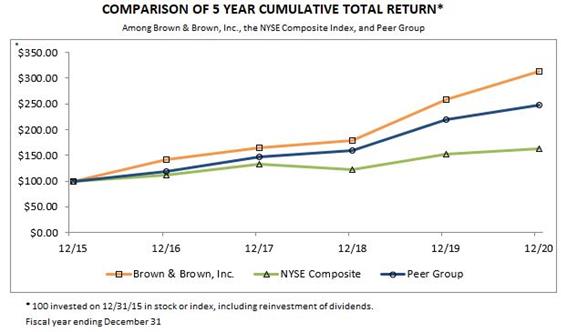]
In connection with certain acquisitions, the Company issued 274,348 shares of Company common stock on May 1, 2020; 68,568 shares of Company common stock on September 10, 2020; 44,978 shares of Company common stock on September 11, 2020; and 335,045 shares of Company common stock on October 9, 2020, to the owners of the businesses acquired.
The issuances were made in reliance upon the following exemptions or exclusions from the registration requirements of the Securities Act of 1933, as amended (the “Securities Act”): Section 4(a)(2) of the Securities Act and Regulation D promulgated under the Securities Act.
On July 18, 2014, the Company’s Board of Directors authorized the repurchase of up to $200.0 million of its shares of common stock, and on July 20, 2015, the Company’s Board of Directors authorized the repurchase of up to an additional $400.0 million of the Company’s outstanding common stock.
On May 1, 2019, the Board of Directors approved an additional repurchase authorization amount of $372.5 million to bring the total available share repurchase authorization at that time to approximately $500.0 million.
| October 1, 2020 to October 31, 2020 | | | 650 | | | $ | 46.12 | | | | — | | | $ | 453,969,269 | |
| November 1, 2020 to November 30, 2020 | | | 23,055 | | | | 45.80 | | | | 20,542 | | | | 453,030,046 | |
| December 1, 2020 to December 31, 2020 | | | 1,040,010 | | | | 45.09 | | | | 1,038,944 | | | | 406,186,901 | |
| Total | | | 1,063,715 | | | $ | 45.10 | | | | 1,059,486 | | | $ | 406,186,901 | |
| | | 12/15 | | | | 12/16 | | | | 12/17 | | | | 12/18 | | | | 12/19 | | | | 12/20 | | |
| Brown & Brown, Inc. | | | 100.00 | | | | 141.79 | | | | 164.69 | | | | 178.34 | | | | 257.99 | | | | 312.32 | |
| NYSE Composite | | | 100.00 | | | | 112.08 | | | | 133.26 | | | | 121.54 | | | | 152.85 | | | | 163.66 | |
| Peer Group | | | 100.00 | | | | 118.67 | | | | 146.56 | | | | 158.69 | | | | 219.34 | | | | 247.57 | |
We did not sell any unregistered securities during 2019.
| October 1, 2019 to October 31, 2019 | | | 814,173 | | | $ | 35.59 | | | | 812,933 | | | $ | 461,282,789 | |
| November 1, 2019 to November 30, 2019 | | | 1,160 | | | | 37.88 | | | | — | | | | 461,282,789 | |
| December 1, 2019 to December 31, 2019 | | | 1,113 | | | | 38.62 | | | | — | | | | 461,282,789 | |
| Total | | | 816,446 | | | $ | 35.59 | | | | 812,933 | | | $ | 461,282,789 | |
| | | 12/14 | | | | 12/15 | | | | 12/16 | | | | 12/17 | | | | 12/18 | | | | 12/19 | | |
| Brown & Brown, Inc. | | | 100.00 | | | | 117.76 | | | | 162.40 | | | | 175.68 | | | | 206.91 | | | | 285.13 | |
| NYSE Composite | | | 100.00 | | | | 96.03 | | | | 107.62 | | | | 127.96 | | | | 116.72 | | | | 146.76 | |
| Peer Group | | | 100.00 | | | | 104.96 | | | | 121.53 | | | | 147.49 | | | | 162.17 | | | | 221.50 | |
Item 6. Selected Financial Data.
31 rewritten, 0 added, 0 removed, 22 unchanged
| (in thousands, except per share data, number of employees and [removed: percentages] [added: percentages)] | | [removed: 2019] [added: 2020] | | | | [removed: 2018] [added: 2019] | | | | [removed: 2017] [added: 2018] | | | | [removed: 2016] [added: 2017] | | | | [removed: 2015] [added: 2016] | | |
| Commissions and fees | | $ | [removed: 2,384,737] [added: 2,606,108] | | | $ | [removed: 2,009,857] [added: 2,384,737] | | | $ | [removed: 1,857,270] [added: 2,009,857] | | | $ | [removed: 1,762,787] [added: 1,857,270] | | | $ | [removed: 1,656,951] [added: 1,762,787] | |
| Investment income | | | [removed: 5,780] [added: 2,811] | | | | [removed: 2,746] [added: 5,780] | | | | [removed: 1,626] [added: 2,746] | | | | [removed: 1,456] [added: 1,626] | | | | [removed: 1,004] [added: 1,456] | |
| Other income, net | | | [removed: 1,654] [added: 4,456] | | | | [removed: 1,643] [added: 1,654] | | | | [removed: 22,451] [added: 1,643] | | | | [removed: 2,386] [added: 22,451] | | | | [removed: 2,554] [added: 2,386] | |
| Total revenues(1) | | | [removed: 2,392,171] [added: 2,613,375] | | | | [removed: 2,014,246] [added: 2,392,171] | | | | [removed: 1,881,347] [added: 2,014,246] | | | | [removed: 1,766,629] [added: 1,881,347] | | | | [removed: 1,660,509] [added: 1,766,629] | |
| Employee compensation and benefits | | | [removed: 1,308,165] [added: 1,436,377] | | | | [removed: 1,068,914] [added: 1,308,165] | | | | [removed: 994,652] [added: 1,068,914] | | | | [removed: 925,217] [added: 994,652] | | | | [removed: 856,952] [added: 925,217] | |
| Other operating expenses | | | [removed: 377,089] [added: 365,973] | | | | [removed: 332,118] [added: 377,089] | | | | [removed: 283,470] [added: 332,118] | | | | [removed: 262,872] [added: 283,470] | | | | [removed: 251,055] [added: 262,872] | |
| (Gain)/loss on disposal | | | [removed: (10,021] [added: (2,388] | ) | | | [removed: (2,175] [added: (10,021] | ) | | | [removed: (2,157] [added: (2,175] | ) | | | [removed: (1,291] [added: (2,157] | ) | | | [removed: (619] [added: (1,291] | ) |
| Amortization | | | [removed: 105,298] [added: 108,523] | | | | [removed: 86,544] [added: 105,298] | | | | [removed: 85,446] [added: 86,544] | | | | [removed: 86,663] [added: 85,446] | | | | [removed: 87,421] [added: 86,663] | |
| Depreciation | | | [removed: 23,417] [added: 26,276] | | | | [removed: 22,834] [added: 23,417] | | | | [removed: 22,698] [added: 22,834] | | | | [removed: 21,003] [added: 22,698] | | | | [removed: 20,890] [added: 21,003] | |
| Interest | | | [removed: 63,660] [added: 58,973] | | | | [removed: 40,580] [added: 63,660] | | | | [removed: 38,316] [added: 40,580] | | | | [removed: 39,481] [added: 38,316] | | | | [removed: 39,248] [added: 39,481] | |
| Change in estimated acquisition earn-out payables | | | [removed: (1,366] [added: (4,458] | ) | | | [removed: 2,969] [added: (1,366] | [added: )] | | | [removed: 9,200] [added: 2,969] | | | | [removed: 9,185] [added: 9,200] | | | | [removed: 3,003] [added: 9,185] | |
| Total expenses | | | [removed: 1,866,242] [added: 1,989,276] | | | | [removed: 1,551,784] [added: 1,866,242] | | | | [removed: 1,431,625] [added: 1,551,784] | | | | [removed: 1,343,130] [added: 1,431,625] | | | | [removed: 1,257,950] [added: 1,343,130] | |
| Income before income taxes | | | [removed: 525,929] [added: 624,099] | | | | [removed: 462,462] [added: 525,929] | | | | [removed: 449,722] [added: 462,462] | | | | [removed: 423,499] [added: 449,722] | | | | [removed: 402,559] [added: 423,499] | |
| Income taxes(2) | | | [removed: 127,415] [added: 143,616] | | | | [removed: 118,207] [added: 127,415] | | | | [removed: 50,092] [added: 118,207] | | | | [removed: 166,008] [added: 50,092] | | | | [removed: 159,241] [added: 166,008] | |
| Net income | | $ | [removed: 398,514] [added: 480,483] | | | $ | [removed: 344,255] [added: 398,514] | | | $ | [removed: 399,630] [added: 344,255] | | | $ | [removed: 257,491] [added: 399,630] | | | $ | [removed: 243,318] [added: 257,491] | |
| Net income per share - diluted(3) | | $ | [removed: 1.40] [added: 1.69] | | | $ | [removed: 1.22] [added: 1.40] | | | $ | [removed: 1.40] [added: 1.22] | | | $ | [removed: 0.91] [added: 1.40] | | | $ | [removed: 0.85] [added: 0.91] | |
| Weighted average number of shares outstanding - diluted(3) | | | [removed: 274,616] [added: 275,867] | | | | [removed: 275,521] [added: 274,616] | | | | [removed: 277,586] [added: 275,521] | | | | [removed: 275,608] [added: 277,586] | | | | [removed: 280,224] [added: 275,608] | |
| Dividends declared per share(3) | | $ | [removed: 0.33] [added: 0.35] | | | $ | [removed: 0.31] [added: 0.33] | | | $ | [removed: 0.28] [added: 0.31] | | | $ | [removed: 0.25] [added: 0.28] | | | $ | [removed: 0.23] [added: 0.25] | |
| Total assets(4) | | $ | [removed: 7,622,821] [added: 8,966,492] | | | $ | [removed: 6,688,668] [added: 7,622,821] | | | $ | [removed: 5,747,550] [added: 6,688,668] | | | $ | [removed: 5,262,734] [added: 5,747,550] | | | $ | [removed: 4,979,844] [added: 5,262,734] | |
| Long-term debt(5) | | $ | [removed: 1,500,343] [added: 2,025,906] | | | $ | [removed: 1,456,990] [added: 1,500,343] | | | $ | [removed: 856,141] [added: 1,456,990] | | | $ | [removed: 1,018,372] [added: 856,141] | | | $ | [removed: 1,071,618] [added: 1,018,372] | |
| Total shareholders’ equity | | $ | [removed: 3,350,279] [added: 3,754,223] | | | $ | [removed: 3,000,568] [added: 3,350,279] | | | $ | [removed: 2,582,699] [added: 3,000,568] | | | $ | [removed: 2,360,211] [added: 2,582,699] | | | $ | [removed: 2,149,776] [added: 2,360,211] | |
| Total shares outstanding at year end(3) | | | [removed: 281,655] [added: 283,004] | | | | [removed: 279,583] [added: 281,655] | | | | [removed: 276,210] [added: 279,583] | | | | [removed: 280,208] [added: 276,210] | | | | [removed: 277,970] [added: 280,208] | |
| Number of full-time equivalent employees at [removed: year-end] [added: year end] | | | [removed: 10,083] [added: 10,843] | | | | [removed: 9,590] [added: 10,083] | | | | [removed: 8,491] [added: 9,590] | | | | [removed: 8,297] [added: 8,491] | | | | [removed: 7,807] [added: 8,297] | |
| Total revenues per average number of employees(6) | | $ | [removed: 243,193] [added: 249,773] | | | $ | [removed: 222,809] [added: 243,193] | | | $ | [removed: 224,130] [added: 222,809] | | | $ | [removed: 219,403] [added: 224,130] | | | $ | [removed: 215,679] [added: 219,403] | |
| Stock price at year-end(3) | | $ | [removed: 39.48] [added: 47.41] | | | $ | [removed: 27.56] [added: 39.48] | | | $ | [removed: 25.73] [added: 27.56] | | | $ | [removed: 22.43] [added: 25.73] | | | $ | [removed: 16.05] [added: 22.43] | |
| Stock price earnings multiple at year-end(7) | | | [removed: 28.2] [added: 28.1] | | | | [removed: 22.6] [added: 28.2] | | | | [removed: 18.3] [added: 22.6] | | | | [removed: 24.6] [added: 18.3] | | | | [removed: 18.9] [added: 24.6] | |
| Return on beginning shareholders’ equity(8) | | | [removed: 13] [added: 14] | % | | | 13 | % | | | [removed: 17] [added: 13] | % | | | [removed: 12] [added: 17] | % | | | 12 | % |
| (1) | Years 2017 [removed: to 2015] [added: and 2016] do not reflect the adoption of “Revenue from Contracts with Customers (Topic 606)” (“Topic 606”), ASC Topic 340 - Other Assets and Deferred Cost (“ASC 340”) and ASU 2016-08, “Principal Versus Agent Considerations (Reporting Revenue Gross Versus Net)”, which was adopted under the modified retrospective method. |
| (2) | Years 2017 [removed: to 2015] [added: and 2016] do not reflect the adoption of ASU 2016-09, “Improvements to Employee Share Based Payment Accounting” (“ASU 2016-09”), which was adopted using the prospective method. |
| (3) | Years 2017 [removed: to 2015] [added: and 2016] reflect the 2-for-1 stock split that occurred on March 28, 2018. |
Item 8. Financial Statements and Supplementary Data.
449 rewritten, 169 added, 228 removed, 745 unchanged
| [Consolidated Statements of Income for the years ended December 31, [removed: 2019, 2018] [added: 2020, 2019] and [removed: 2017](#CONSOLIDATED_STATEMENTS_INCOME)] [added: 2018](#CONSOLIDATED_STATEMENTS_INCOME)] | [removed: 45] [added: 41] |
| [Consolidated Balance Sheets as of December 31, [removed: 2019] [added: 2020] and [removed: 2018](#CONSOLIDATED_BALANCE_SHEETS)] [added: 2019](#CONSOLIDATED_BALANCE_SHEETS)] | [removed: 46] [added: 42] |
| [Consolidated Statements of Shareholders’ Equity for the years ended December 31, [removed: 2019, 2018] [added: 2020, 2019] and [removed: 2017](#CONSOLIDATED_STATEMENTS_SHAREHOLDERS_EQU)] [added: 2018](#CONSOLIDATED_STATEMENTS_SHAREHOLDERS_EQU)] | [removed: 47] [added: 43] |
| [Consolidated Statements of Cash Flows for the years ended December 31, [removed: 2019, 2018] [added: 2020, 2019] and [removed: 2017](#CONSOLIDATED_STATEMENTS_CASH_FLOWS)] [added: 2018](#CONSOLIDATED_STATEMENTS_CASH_FLOWS)] | [removed: 48] [added: 44] |
| [Notes to Consolidated Financial Statements for the years ended December 31, [removed: 2019, 2018] [added: 2020, 2019] and [removed: 2017](#NOTES_TO_CONSOLIDATED_FINANCIAL_STATEMEN)] [added: 2018](#NOTES_TO_CONSOLIDATED_FINANCIAL_STATEMEN)] | [removed: 49] [added: 45] |
| [Note 1: Summary of Significant Accounting Policies](#NOTE_1_SUMMARY_SIGNIFICANT_ACCOUNTING_PO) | [removed: 49] [added: 45] |
| [Note 2: Revenues](#NOTE_2_REVENUES) | [removed: 57] [added: 50] |
| [Note 3: Business Combinations](#NOTE_3_BUSINESS_COMBINATIONS) | [removed: 58] [added: 51] |
| [Note 4: Goodwill](#NOTE_4_GOODWILL) | [removed: 65] [added: 59] |
| [Note 5: Amortizable Intangible Assets](#NOTE_5_AMORTIZABLE_INTANGIBLE_ASSETS) | [removed: 65] [added: 59] |
| [Note 6: Investments](#NOTE_6_INVESTMENTS) | [removed: 65] [added: 60] |
| [Note 7: Fixed Assets](#NOTE_7_FIXED_ASSETS) | [removed: 67] [added: 62] |
| [Note 8: Accrued Expenses and Other Liabilities](#NOTE_8_ACCRUED_EXPENSES_OR_CURRENT_LIABI) | [removed: 67] [added: 62] |
| [Note 9: Long-Term Debt](#NOTE_9_LONGTERM_DEBT) | [removed: 68] [added: 63] |
| [Note 10: Income Taxes](#NOTE_10_INCOME_TAXES) | [removed: 69] [added: 64] |
| [Note 11: Employee Savings Plan](#NOTE_11_EMPLOYEE_SAVINGS_PLAN) | [removed: 71] [added: 67] |
| [Note 12: Stock-Based Compensation](#NOTE_12_STOCKBASED_COMPENSATION) | [removed: 71] [added: 67] |
| [Note 13: Supplemental Disclosures of Cash Flow Information](#NOTE_13_SUPPLEMENTAL_DISCLOSURES_CASH_F) | [removed: 74] [added: 70] |
| [Note 14: Commitments and Contingencies](#NOTE_14_COMMITMENTS_CONTINGENCIES) | [removed: 75] [added: 70] |
| [Note 15: Leases](#NOTE_15_LEASES) | [removed: 75] [added: 71] |
| [Note 16: Quarterly Operating Results (Unaudited)](#NOTE_16_QUARTERLY_OPERATING_RESULTS) | [removed: 77] [added: 73] |
| [Note 17: Segment Information](#NOTE_16_SEGMENT_INFORMATION) | [removed: 77] [added: 73] |
| [Note 18: Insurance Company WNFIC](#NOTE_17_REINSURANCE) | [removed: 78] [added: 74] |
| [Note 19: Shareholders’ Equity](#NOTE_20_SHAREHOLDERS_EQUITY) | [removed: 79] [added: 75] |
| [Report of Independent Registered Public Accounting Firm](#REPORT_OF_INDEPENDENT_REGISTERED) | [removed: 80] [added: 76] |
| (in thousands, except per share data) | | [removed: 2019] [added: 2020] | | | | [removed: 2018] [added: 2019] | | | | [removed: 2017] [added: 2018] | | |
| Commissions and fees | | $ | [removed: 2,384,737] [added: 2,606,108] | | | $ | [removed: 2,009,857] [added: 2,384,737] | | | $ | [removed: 1,857,270] [added: 2,009,857] | |
| Investment income | | | [removed: 5,780] [added: 2,811] | | | | [removed: 2,746] [added: 5,780] | | | | [removed: 1,626] [added: 2,746] | |
| Other income, net | | | [removed: 1,654] [added: 4,456] | | | | [removed: 1,643] [added: 1,654] | | | | [removed: 22,451] [added: 1,643] | |
| Total revenues | | | [removed: 2,392,171] [added: 2,613,375] | | | | [removed: 2,014,246] [added: 2,392,171] | | | | [removed: 1,881,347] [added: 2,014,246] | |
| Employee compensation and benefits | | | [removed: 1,308,165] [added: 1,436,377] | | | | [removed: 1,068,914] [added: 1,308,165] | | | | [removed: 994,652] [added: 1,068,914] | |
| Other operating expenses | | | [removed: 377,089] [added: 365,973] | | | | [removed: 332,118] [added: 377,089] | | | | [removed: 283,470] [added: 332,118] | |
| (Gain)/loss on disposal | | | [removed: (10,021] [added: (2,388] | ) | | | [removed: (2,175] [added: (10,021] | ) | | | [removed: (2,157] [added: (2,175] | ) |
| Amortization | | | [removed: 105,298] [added: 108,523] | | | | [removed: 86,544] [added: 105,298] | | | | [removed: 85,446] [added: 86,544] | |
| Depreciation | | | [removed: 23,417] [added: 26,276] | | | | [removed: 22,834] [added: 23,417] | | | | [removed: 22,698] [added: 22,834] | |
| Interest | | | [removed: 63,660] [added: 58,973] | | | | [removed: 40,580] [added: 63,660] | | | | [removed: 38,316] [added: 40,580] | |
| Change in estimated acquisition earn-out payables | | | [removed: (1,366] [added: (4,458] | ) | | | [removed: 2,969] [added: (1,366] | [added: )] | | | [removed: 9,200] [added: 2,969] | |
| Total expenses | | | [removed: 1,866,242] [added: 1,989,276] | | | | [removed: 1,551,784] [added: 1,866,242] | | | | [removed: 1,431,625] [added: 1,551,784] | |
| Income before income taxes | | | [removed: 525,929] [added: 624,099] | | | | [removed: 462,462] [added: 525,929] | | | | [removed: 449,722] [added: 462,462] | |
| Income taxes | | | [removed: 127,415] [added: 143,616] | | | | [removed: 118,207] [added: 127,415] | | | | [removed: 50,092] [added: 118,207] | |
| Net Income | | | | | | | | | | | | | | | | | | | 480,483 | | | | 480,483 | |
| Common stock issued for agency acquisitions | | | 723 | | | | 72 | | | | 30,048 | | | | | | | | | | | | 30,120 | |
| Purchase of treasury stock | | | | | | | | | | | | | | | (55,095 | ) | | | | | | | (55,095 | ) |
| Balance at December 31, 2020 | | | 299,689 | | | $ | 29,969 | | | $ | 794,909 | | | $ | (591,338 | ) | | $ | 3,520,683 | | | $ | 3,754,223 | |
| Net income | | $ | 480,483 | | | $ | 398,514 | | | $ | 344,255 | |
| Amortization | | | 108,523 | | | | 105,298 | | | | 86,544 | |
| Depreciation | | | 26,276 | | | | 23,417 | | | | 22,834 | |
| Change in estimated acquisition earn-out payables | | | (4,458 | ) | | | (1,366 | ) | | | 2,969 | |
In March 2020, the Financial Accounting Standards Board (“FASB”) issued ASU 2020-04, "Reference Rate Reform (Topic 848): Facilitation of the Effects of Reference Rate Reform on Financial Reporting." The amendments provide optional guidance for a limited time to ease the potential burden in accounting for reference rate reform.
The new guidance provides optional expedients and exceptions for applying U.S. GAAP to contracts, hedging relationships and other transactions affected by reference rate reform if certain criteria are met.
The amendments apply only to contracts and hedging relationships that reference LIBOR or another reference rate expected to be discontinued due to reference rate reform.
These amendments are effective immediately and may be applied prospectively to contract modifications made and hedging relationships entered into or evaluated on or before December 31, 2022.
We are currently evaluating our contracts and the available expedients provided by the new standard; however, the Company can assert there is no impact to any carrying value of assets or liabilities aside from our floating-rate debt instruments that are indexed to LIBOR and are carried at amortized cost.
Any further impact of adoption will be in determining the new periodic floating interest rate indexed to our floating-rate debt instruments with no impact on the balance sheet upon adoption.
In December 2019, the FASB issued ASU 2019-12, “Income Taxes (Topic 740): Simplifying the Accounting for Income Taxes”.
The standard removes specific exceptions in the current rules and eliminates the need for an organization to analyze whether the following apply in a given period: (a) exception to the incremental approach for intra-period tax allocation; (b) exceptions to accounting for basis differences when there are ownership changes in foreign investments and (c) exception in interim period income tax accounting for year-to-date losses that exceed anticipated losses.
The standard also is designed to improve financial statement preparers’ application of income tax-related guidance and simplify GAAP for (a) franchise taxes that are partially based on income; (b) transactions with a government that result in a step-up in the tax basis of goodwill; (c) separate financial statements of legal entities that are not subject to tax and (d) enacted changes in tax laws in interim periods.
The Company does not expect that adopting this standard will have a material impact on the Company’s financial position.
The impact of adoption of this standard on our consolidated financial statements, including accounting policies, processes, and systems, was not material.
The Company adopted ASU 2017-04 effective January 1, 2020, with interim or annual goodwill impairment tests now comparing the fair value of a reporting unit with its carrying value and no longer performing Step 2 of the goodwill impairment test.
There was no impact from adopting ASU 2017-04 as there were no impairments recorded.
In June 2016, the FASB issued ASU 2016-13, “Financial Instruments – Credit Losses (Topic 326): Measurement of Credit Losses on Financial Instruments”.
The new guidance adds an impairment model, known as the current expected credit loss (CECL) model that is based on expected losses rather than incurred losses.
These amendments require the measurement of all expected credit losses for financial assets held at the reporting date based on historical experience, current conditions, and reasonable forward-looking information, which is intended to result in more timely recognition of such losses.
All related guidance has been codified into, and is now known as, ASC 326 – Financial Instruments—Credit Losses.
The new standard is effective for public companies for annual reporting periods beginning after December 15, 2019, and interim periods therein.
The Company adopted ASU 2016-13 effective January 1, 2020 and has determined there is not a material impact on the Company’s Financial Statements given that historical trend analysis and assessments for forward-looking qualitative analysis are already integrated into financial assessments for the Company.
Included in cash and cash equivalents are unrestricted premium from insureds before it is remitted to the appropriate insurance company or companies, net of any commissions we are due.
Unremitted net insurance premiums are held in a fiduciary capacity until the Company disburses them, and the use of such funds is restricted by laws in certain states in which our subsidiaries operate, or restricted due to our contracts with a certain insurance company or companies in which we hold premiums in a fiduciary capacity.
| Net income | | $ | 480,483 | | | $ | 398,514 | | | $ | 344,255 | |
| Basic | | $ | 1.70 | | | $ | 1.42 | | | $ | 1.24 | |
| Diluted | | $ | 1.69 | | | $ | 1.40 | | | $ | 1.22 | |
| Base commissions(1) | | $ | 1,054,619 | | | $ | 422,916 | | | $ | 273,878 | | | $ | — | | | $ | 1 | | | $ | 1,751,414 | |
| Fees(2) | | | 275,900 | | | | 159,337 | | | | 66,051 | | | | 174,012 | | | | (1,291 | ) | | | 674,009 | |
| Incentive commissions(3) | | | 89,920 | | | | 549 | | | | 3,057 | | | | — | | | | 31 | | | | 93,557 | |
| Profit-sharing contingent commissions(4) | | | 35,785 | | | | 27,278 | | | | 7,871 | | | | — | | | | — | | | | 70,934 | |
| Guaranteed supplemental commissions(5) | | | 15,128 | | | | (238 | ) | | | 1,304 | | | | — | | | | — | | | | 16,194 | |
| Investment income(6) | | | 163 | | | | 756 | | | | 184 | | | | — | | | | 1,708 | | | | 2,811 | |
| Other income, net(7) | | | 1,251 | | | | 42 | | | | 452 | | | | — | | | | 2,711 | | | | 4,456 | |
| Total Revenues | | $ | 1,472,766 | | | $ | 610,640 | | | $ | 352,797 | | | $ | 174,012 | | | $ | 3,160 | | | $ | 2,613,375 | |
| --- | --- | --- | --- | --- | --- | --- | --- | --- | --- | --- | --- | --- |
| --- | --- | --- | --- | --- | --- | --- | --- | --- | --- | --- | --- | --- | --- | --- | --- | --- | --- | --- | --- | --- | --- | --- | --- | --- |
| Balance at January 1, 2017 | | | 285,461 | | | $ | 28,547 | | | $ | 454,707 | | | $ | (257,683 | ) | | $ | 2,134,640 | | | $ | 2,360,211 | |
| Net income | | | | | | | | | | | | | | | | | | | 399,630 | | | | 399,630 | |
| Purchase of treasury stock | | | (58,671 | ) | | | (91,250 | ) | | | (128,639 | ) |
The impact of ASU 2018-15 is not expected to be material to the Company.
The Company is currently evaluating the impact of this guidance on future interim or annual goodwill impairment tests performed.
In August 2016, the FASB issued ASU 2016-15, “Statement of Cash Flows (Topic 230)”: Classification of Certain Cash Receipts and Cash Payments (a consensus of the Emerging Issues Task Force) (“ASU 2016-15”), which addresses eight specific cash flow issues with the objective of reducing the existing diversity in practice in how certain cash receipts and cash payments are presented and classified and applies to all entities, including both business entities and not-for-profit entities that are required to present a statement of cash flows under Topic 230.
The Company already presented cash paid on contingent consideration in business combination as prescribed by ASU 2016-15 and does not, at this time, engage in the other activities being addressed in this ASU.
In March 2016, the FASB issued ASU 2016-08, “Principal Versus Agent Considerations (Reporting Revenue Gross Versus Net)” (“ASU 2016-08”) to clarify certain aspects of the principal-versus-agent guidance included in the new revenue standard ASU 2014-09 “Revenue from Contracts with Customers” (“ASU 2014-09”).
The FASB issued the ASU in response to concerns identified by stakeholders, including those related to (1) determining the appropriate unit of account under the revenue standard’s principal-versus-agent guidance and (2) applying the indicators of whether an entity is a principal or an agent in accordance with the revenue standard’s control principle.
The Company adopted ASU 2016-08 effective contemporaneously with ASU 2014-09 beginning January 1, 2018.
The impact of ASU 2016-08 was limited to the claims administering activities of one of our businesses within our Services Segment and therefore was not material to the net income of the Company.
In February 2016, the FASB issued ASU 2016-02, “Leases (Topic 842)” (“Topic 842”), which provides guidance for accounting for leases.
Under Topic 842, all leases are required to be recorded on the balance sheet and are classified as either operating leases or finance leases.
Effective as of January 1, 2019, the Company adopted Topic 842, and all related amendments, which established Accounting Standards Codification (“ASC”) Topic 842.
The Company adopted these standards by the recognition of right-of-use assets and related lease liabilities on the balance sheet.
As permitted by Topic 842, the Company elected the transition practical expedient to adopt as of January 1, 2019, the date of initial application under the modified retrospective approach for leases existing at that date, with an adjustment to retained earnings.
As a result, the Consolidated Balance Sheets at December 31, 2018 was not restated and continues to be reported under ASC Topic 840 (“Topic 840”) which did not require the recognition of operating lease liabilities on the balance sheet, and thus is not comparative.
For the year ended December 31, 2019, all of the Company’s leases are classified as operating leases, which are primarily real estate leases for office space.
The adoption of Topic 842 had a significant impact on the Company’s balance sheet with the recognition of the operating lease right-of-use asset and the liability for operating leases.
Upon adoption, leases that were classified as operating leases under Topic 840 were classified as operating leases under Topic 842.
For the adoption of Topic 842, the Company recorded an adjustment of $202.9 million to operating lease right-of-use asset and the related lease liability, with no impact to retained earnings.
The deferred rent previously accrued under Topic 840 was reclassified to the right-of-use asset upon the adoption of Topic 842.
The lease liability is the present value of the remaining minimum lease payments, determined under Topic 840, discounted using the Company’s incremental borrowing rate at the effective date of January 1, 2019.
As permitted under Topic 842, the Company elected to use the practical expedient that permits the Company to not reassess whether a contract is or contains a lease, the classification of the Company’s existing operating leases, and initial direct costs for any existing leases.
The Company did not elect the practical expedient to use hindsight in determining the lease term (when considering lessee options to extend or terminate the lease and to purchase the underlying asset) and in assessing impairment of the Company’s right-of-use assets.
The application of the practical expedient did not have a significant impact on the measurement of the operating lease liability.
The impact of the adoption of Topic 842 on the balance sheet at January 1, 2019 was (in thousands):
| (in thousands) | | Balance at December 31, 2018 | | | | Adjustments due to Topic 842 | | | | Balance at January 1, 2019 | | |
| Other current assets | | $ | 128,716 | | | $ | (3,004 | ) | | $ | 125,712 | |
| Operating lease assets | | | — | | | | 178,304 | | | | 178,304 | |
| Total Assets | | | 6,688,668 | | | | 175,300 | | | | 6,863,968 | |
| Operating lease liabilities | | | — | | | | 161,464 | | | | 161,464 | |
| Total Liabilities | | | 3,688,100 | | | | 175,300 | | | | 3,863,400 | |
This assessment is based on: (1) whether the contract involves the use of a distinct identified asset, (2) whether the Company obtains the right to substantially all the economic benefit from the use of the asset throughout the period, and (3) whether the Company has the right to direct the use of the asset.
Leases entered into prior to January 1, 2019 are accounted for under Topic 840 and were not reassessed.
For real estate leases that contain both lease and non-lease components, the Company elected to account the lease components together with non-lease components (e.g., common-area maintenance).
Leases are classified as either finance leases or operating leases.
A lease is classified as a finance lease if any one of the following criteria are met: the lease transfers ownership of the asset by the end of the lease term, the lease contains an option to purchase the asset that is reasonably certain to be exercised, or the lease term is for a major part of the remaining useful life of the asset or the present value of the lease payments equals or exceeds substantially all of the fair value of the asset.
An excerpt. Shown here: 40 of 449 rewritten, 40 of 169 added and 40 of 228 removed. The counts are complete. For every sentence, read Item 8. Financial Statements and Supplementary Data. in the FY2020 filing and the FY2019 filing.
Item 9. Changes in and Disagreements with Accountants and Financial Disclosure.
1 rewritten, 0 added, 0 removed, 0 unchanged
There were no changes in or disagreements with accountants on accounting and financial disclosure in [removed: 2019.][added: 2020.]
Item 9A. Controls and Procedures.
2 rewritten, 0 added, 0 removed, 16 unchanged
We carried out an evaluation (the “Evaluation”) required by Rules 13a-15 and 15d-15 under the Securities Exchange Act of 1934, as amended (the “Exchange Act”), under the supervision and with the participation of our Chief Executive Officer (“CEO”) and Chief Financial Officer (“CFO”), of the effectiveness of our disclosure controls and procedures as defined in Rule 13a-15 and 15d-15 under the Exchange Act (“Disclosure Controls”) as of December 31, [removed: 2019.][added: 2020.]
There has not been any change in our internal control over financial reporting identified in connection with the Evaluation that occurred during the quarter ended December 31, [removed: 2019,] [added: 2020,] that has materially affected, or is reasonably likely to materially affect, our internal control over financial reporting.
Item 10. Directors, Executive Officers and Corporate Governance.
17 rewritten, 9 added, 4 removed, 68 unchanged
Set forth below is certain information concerning our executive officers as of February [removed: 24, 2020.][added: 23, 2021.]
| J. Hyatt Brown | Chairman | [removed: 82] [added: 83] |
| J. Powell Brown | President and Chief Executive Officer | [removed: 52] [added: 53] |
| P. Barrett Brown | Executive Vice President; President – Retail Segment | [removed: 47] [added: 48] |
| Robert W. Lloyd | Executive Vice President; Secretary and General Counsel | [removed: 55] [added: 56] |
| J. Scott Penny | Executive Vice President; Chief Acquisitions Officer | [removed: 53] [added: 54] |
| Anthony T. Strianese | Executive Vice President; [removed: President] [added: Chairman] - Wholesale Brokerage Segment | [removed: 58] [added: 59] |
| Chris L. Walker | Executive Vice President; President - National Programs Segment | [removed: 62] [added: 63] |
| R. Andrew Watts | Executive Vice President; Chief Financial Officer and Treasurer | [removed: 51] [added: 52] |
Mr. Brown was appointed as [added: an Executive Vice President and] the President of our Retail Segment in January 2020.
Mr. Lloyd is a Rotarian; [added: a member of the Board of Trustees of Daytona State College, Immediate Past] Chairman of the Daytona Beach Regional Chamber of Commerce; a [added: member of the Florida Chamber Board of Governors, Secretary and] director of the Council on Aging of Volusia County; [added: a member of the National Board of Directors of the University of Florida Foundation; Vice-President of the Dr. Mary McLeod Bethune Statuary Fund Inc.;] and a member of the Advisory Board of the Central Florida Council - Boy Scouts of America.
[removed: Anthony] [added: Anthony] T.
[added: Strianese.] Mr. Strianese has served as [removed: President] [added: Chairman] of our Wholesale Brokerage Segment since [removed: 2014.][added: January 2021.]
Additionally, Mr. Strianese is responsible for certain of our public [added: entity operations located in Georgia, Texas and Virginia.]
Mr. Watts [removed: is] [added: earned] a [removed: Certified] Public [removed: Accountant] [added: Accountancy] (CPA) [added: license from Illinois] and holds a Bachelor of Science degree from Illinois State University.
The additional information required by this item regarding directors and executive officers is incorporated herein by reference to our definitive Proxy Statement to be filed with the SEC in connection with the Annual Meeting of Shareholders to be held in [removed: 2020] [added: 2021] (the [removed: “2020] [added: “2021] Proxy Statement”) under the headings “Board and Corporate Governance Matters” and “Other Important Information.” We have adopted a code of ethics that applies to our principal executive officer, principal financial officer, and controller.
A copy of our Code of Ethics for our Chief Executive Officer and our Senior Financial Officers and a copy of our Code of Business Conduct and Ethics applicable to all employees are posted on our Internet website, at www.bbinsurance.com, and are also available upon written request directed to Corporate Secretary, [removed: 220] Brown & Brown, Inc., [removed: South Ridgewood Avenue,] [added: 300 North Beach Street,] Daytona Beach, Florida 32114, or by telephone to (386) 252-9601.
| Stephen M. Boyd | Executive Vice President; President - Wholesale Brokerage Segment | 47 |
Stephen M.
Boyd.
Mr. Boyd was appointed as an Executive Vice President and the President of our Wholesale Brokerage Segment in January 2021.
Mr. Boyd became a Senior Vice President of the Company in May 2015 and from October 2019 until January 2021, served as our Senior Vice President of Technology, Innovation, and Digital Strategy.
Between July 2013 and October 2019, he served as President and Chief Operating Officer of Arrowhead General Insurance Agency, Inc. (Arrowhead), one of our subsidiaries.
Mr. Boyd joined Arrowhead in 1995 and has served in various roles, including as President of Arrowhead’s Commercial Division and Arrowhead’s Chief Information Officer.
He served as President of our Wholesale Brokerage Segment from 2014 to January 2021.
Since June 2018, he has served as a director of New Planet Energy Development, LLC, a privately held green energy company, and since January 2020, he has served on the Board of Trustees of the Museum of Arts & Sciences, Inc., a not-for-profit corporation in Daytona Beach, Florida.
| Julie K. Ryan | Executive Vice President; Chief People Officer | 48 |
In 2019, Mr. Lloyd was appointed by Florida Governor Ron Desantis to the Board of Trustees of Daytona State College.
Strianese.
entity operations located in Georgia, Texas and Virginia.
Item 11. Executive Compensation.
1 rewritten, 0 added, 0 removed, 0 unchanged
The information required by this item is incorporated herein by reference to the [removed: 2020] [added: 2021] Proxy Statement under the heading “Compensation Matters.”
Item 12. Security Ownership of Certain Beneficial Owners and Management and Related Stockholders Matters.
6 rewritten, 1 added, 1 removed, 10 unchanged
The following table sets forth information as of December 31, [removed: 2019,] [added: 2020,] with respect to compensation plans under which the Company’s equity securities are authorized for issuance:
| Brown & Brown, Inc. 2019 Stock Incentive Plan | | | [removed: 9,515,603] [added: 8,624,668] | | (2) |
| Brown & Brown, Inc. 1990 Employee Stock Purchase Plan | | | [removed: 6,340,598] [added: 5,378,467] | | |
| (1) | All of the shares available for future issuance under the Brown & Brown, Inc. [removed: Performance Stock Plan, and the Brown & Brown, Inc.] 2019 Stock Incentive Plan may be issued in connection with options, warrants, rights, restricted stock, or other stock-based awards. |
| (2) | The payout for [removed: 1,629,618] [added: 1,414,417] shares of our outstanding performance-based restricted stock grants may be increased up to 200% of the target or decreased to zero, subject to the level of performance attained. The amount reflected in the table is calculated assuming the maximum payout for all restricted stock grants. |
The [added: other] information required by this item is incorporated herein by reference to the [removed: 2020] [added: 2021] Proxy Statement under the heading “Security Ownership of Management and Certain Beneficial Owners.”
| Total | | | 14,003,135 | | |
| Total | | | 15,856,201 | | |
Item 13. Certain Relationships and Related Transactions, and Director Independence.
1 rewritten, 0 added, 0 removed, 0 unchanged
The information required by this item is incorporated herein by reference to the [removed: 2020] [added: 2021] Proxy Statement under the headings “Director Independence,” “Related Party Transactions Policy” and “Relationships and Transactions with Affiliated Parties.”
Item 14. Principal Accounting Fees and Services.
1 rewritten, 0 added, 0 removed, 1 unchanged
The information required by this item is incorporated herein by reference to the [removed: 2020] [added: 2021] Proxy Statement under the heading “Fees Paid to Deloitte & Touche LLP.”
Item 15. Exhibits and Financial Statements Schedules.
12 rewritten, 7 added, 6 removed, 75 unchanged
| [removed: 4.1] [added: 4.1] | | [Description of the Registrant’s capital [removed: stock.](https://www.sec.gov/Archives/edgar/data/79282/000156459020006075/bro-ex41_204.htm)] [added: stock (incorporated by reference to Exhibit 4.1 to Form 10-K filed February 24, 2020)](http://www.sec.gov/Archives/edgar/data/79282/000156459020006075/bro-ex41_204.htm).] |
| [removed: 4.6] [added: 4.5] | | [Form of Registrant’s 4.500% Notes due 2029 (incorporated by reference to Exhibit 4.3 to Form 8-K filed on March 12, 2019).](http://www.sec.gov/Archives/edgar/data/79282/000120677419000775/brown3559321-ex43.htm) |
| [removed: 10.4(e)] [added: 10.4(e)*] | | [Form of Director Stock Grant Agreement (incorporated by reference to Exhibit 10.8(e) to Form 10-K filed for the year ended December 31, 2016).](http://www.sec.gov/Archives/edgar/data/79282/000007928217000006/exhibit108e.htm) |
| [removed: 10.8*] [added: 10.9] | | [Term Loan Credit Agreement, dated December 21, 2018, by and among the Company, Wells Fargo Bank, National Association, as administrative agent, Bank of America, N.A., BMO Harris Bank N.A. and SunTrust Bank as co-syndication agents, and Wells Fargo Securities, LLC, Merrill Lynch, Pierce, Fenner & Smith Incorporated, BMO Capital Markets Corp. and SunTrust Robinson Humphrey, Inc. as joint lead arrangers and joint bookrunners (incorporated by reference to Exhibit 10.10 to Form 10-K for the year ended December 31, 2019).](http://www.sec.gov/Archives/edgar/data/79282/000007928219000006/exhibit1010q42018.htm) |
| 21 | | [Subsidiaries of the [removed: Registrant.](https://www.sec.gov/Archives/edgar/data/79282/000156459020006075/bro-ex21_11.htm)] [added: Registrant.](https://www.sec.gov/Archives/edgar/data/79282/000156459021007624/bro-ex21_6.htm)] |
| 23 | | [Consent of Deloitte & Touche [removed: LLP.](https://www.sec.gov/Archives/edgar/data/79282/000156459020006075/bro-ex23_178.htm)] [added: LLP.](https://www.sec.gov/Archives/edgar/data/79282/000156459021007624/bro-ex23_13.htm)] |
| 24 | | [Powers of [removed: Attorney.](https://www.sec.gov/Archives/edgar/data/79282/000156459020006075/bro-ex24_10.htm)] [added: Attorney.](https://www.sec.gov/Archives/edgar/data/79282/000156459021007624/bro-ex24_9.htm)] |
| 31.1 | | [Rule 13a-14(a)/15d-14(a) Certification by the Chief Executive Officer of the [removed: Registrant.](https://www.sec.gov/Archives/edgar/data/79282/000156459020006075/bro-ex311_9.htm)] [added: Registrant.](https://www.sec.gov/Archives/edgar/data/79282/000156459021007624/bro-ex311_8.htm)] |
| 31.2 | | [Rule 13a-14(a)/15d-14(a) Certification by the Chief Financial Officer of the [removed: Registrant.](https://www.sec.gov/Archives/edgar/data/79282/000156459020006075/bro-ex312_8.htm)] [added: Registrant.](https://www.sec.gov/Archives/edgar/data/79282/000156459021007624/bro-ex312_12.htm)] |
| 32.1 | | [Section 1350 Certification by the Chief Executive Officer of the [removed: Registrant.](https://www.sec.gov/Archives/edgar/data/79282/000156459020006075/bro-ex321_7.htm)] [added: Registrant.](https://www.sec.gov/Archives/edgar/data/79282/000156459021007624/bro-ex321_11.htm)] |
| 32.2 | | [Section 1350 Certification by the Chief Financial Officer of the [removed: Registrant.](https://www.sec.gov/Archives/edgar/data/79282/000156459020006075/bro-ex322_6.htm)] [added: Registrant.](https://www.sec.gov/Archives/edgar/data/79282/000156459021007624/bro-ex322_7.htm)] |
| 104 | | Cover Page Interactive Data File for the Registrant’s Annual Report on Form 10-K for the fiscal year ended December 31, [removed: 2019,] [added: 2020,] formatted Inline XBRL (included as Exhibit 101). |
| 4.6 | | [Third Supplemental Indenture, dated as of September 24, 2020, between Brown & Brown, Inc. and U.S. Bank National Association (incorporated by reference to Exhibit 4.2 to Form 8-K filed September 24, 2020).](http://www.sec.gov/Archives/edgar/data/79282/000156459020044547/bro-ex42_7.htm) |
| 4.7 | | [Form of Brown & Brown, Inc.’s 2.375% Notes due 2031 (incorporated by reference to Exhibit 4.3 to Form 8-K filed September 24, 2020).](http://www.sec.gov/Archives/edgar/data/79282/000156459020044547/bro-ex43_8.htm) |
| 10.4(f)* | | [Form of Performance Stock Award Agreement under the 2019 Stock Incentive Plan (incorporated by reference to Exhibit 10.1 to Form 8-K filed on February 25, 2020).](http://www.sec.gov/Archives/edgar/data/79282/000156459020006078/bro-ex101_6.htm) |
| 10.4(g)* | | [Form of Restricted Stock Award Agreement under the 2019 Stock Incentive Plan (incorporated by reference to Exhibit 10.2 to Form 8-K filed on February 25, 2020).](http://www.sec.gov/Archives/edgar/data/79282/000156459020006078/bro-ex102_7.htm) |
| 10.8* | | [Amendment to the Asset Purchase Agreement, dated July 27, 2020, by and among Brown & Brown, Inc., BBHG, Inc., The Hays Group, Inc., The Hays Group Of Wisconsin LLC, The Hays Benefits Group, LLC, PlanIT, LLC, The Hays Benefits Group of Wisconsin, LLC, The Hays Group of Illinois, LLC and Claims Management of Missouri, LLC (incorporated by reference to Exhibit 10.2 to Form 10-Q for the quarter ended September 30, 2020).](http://www.sec.gov/Archives/edgar/data/79282/000156459020048034/bro-ex102_49.htm) |
| 101 | | The following financial statements from the Company’s Annual Report on Form 10-K for the period ended December 31, 2020, formatted in inline XBRL, include: (i) Consolidated Statements of Income, (ii) Consolidated Balance Sheets, (iii) Consolidated Statements of Shareholders’ Equity, (iv) Consolidated Statements of Cash Flows and (v) the Notes to the Consolidated Financial Statements. |
| --- | --- | --- |
| 101.INS | | Inline XBRL Instance Document - the instance document does not appear in the Interactive Data File because its XBRL tags are embedded within the Inline XBRL document. |
| 101.SCH | | Inline XBRL Taxonomy Extension Schema Document. |
| 101.CAL | | Inline XBRL Taxonomy Extension Calculation Linkbase Document. |
| 101.DEF | | Inline XBRL Taxonomy Extension Definition Linkbase Document. |
| 101.LAB | | Inline XBRL Taxonomy Extension Label Linkbase Document. |
| 101.PRE | | Inline XBRL Taxonomy Extension Presentation Linkbase Document. |
Item 16. Form 10-K Summary.
5 rewritten, 10 added, 2 removed, 46 unchanged
| Date: February [removed: 24, 2020] [added: 23, 2021] | | By: | /s/ J. Powell Brown | |
| /s/ J. Powell Brown | | Director; President and Chief Executive Officer (Principal Executive Officer) | | February [removed: 24, 2020] [added: 23, 2021] |
| /s/ R. Andrew Watts | | Executive Vice President, Chief Financial Officer and Treasurer (Principal Financial and Accounting Officer) | | February [removed: 24, 2020] [added: 23, 2021] |
| * | | Chairman of the Board | | February [removed: 24, 2020] [added: 23, 2021] |
| * | | Director | | February [removed: 24, 2020] [added: 23, 2021] |
| * | | Director | | February 23, 2021 |
| * | | Director | | February 23, 2021 |
| * | | Director | | February 23, 2021 |
| * | | Director | | February 23, 2021 |
| * | | Director | | February 23, 2021 |
| * | | Director | | February 23, 2021 |
| * | | Director | | February 23, 2021 |
| * | | Director | | February 23, 2021 |
| * | | Director | | February 23, 2021 |
| * | | Director | | February 23, 2021 |
| | | | | |
| Bradley Currey, Jr. | | | | |