 filings.tools
Devon Energy 10-K 2020-12-31
Filed 2021-02-17. 20 sections, 439K characters. Original on sec.gov · Markdown · JSON
Cover and table of contents
UNITED STATES
SECURITIES AND EXCHANGE COMMISSION
Washington, D.C. 20549
Form 10-K
(Mark One)
| ☒ | ANNUAL REPORT PURSUANT TO SECTION 13 OR 15(d) OF THE SECURITIES EXCHANGE ACT OF 1934 |
For the fiscal year ended December 31, 2020
or
| ☐ | TRANSITION REPORT PURSUANT TO SECTION 13 OR 15(d) OF THE SECURITIES EXCHANGE ACT OF 1934 |
Commission File Number 001-32318
DEVON ENERGY CORPORATION
(Exact name of registrant as specified in its charter)
| Delaware | 73-1567067 | |
|---|---|---|
| (State or other jurisdiction of incorporation or organization) | (I.R.S. Employer identification No.) | |
| 333 West Sheridan Avenue, Oklahoma City, Oklahoma | 73102-5015 | |
| (Address of principal executive offices) | (Zip code) |
Registrant’s telephone number, including area code: (405) 235-3611
Securities registered pursuant to Section 12(b) of the Act:
| Title of each class | Trading Symbol | Name of each exchange on which registered | ||||
|---|---|---|---|---|---|---|
| Common stock, par value $0.10 per share | DVN | The New York Stock Exchange |
Securities registered pursuant to Section 12(g) of the Act: None
Indicate by check mark if the registrant is a well-known seasoned issuer, as defined in Rule 405 of the Securities Act. Yes ☒ No ☐
Indicate by check mark if the registrant is not required to file reports pursuant to Section 13 or Section 15(d) of the Act. Yes ☐ No ☒
Indicate by check mark whether the registrant (1) has filed all reports required to be filed by Section 13 or 15(d) of the Securities Exchange Act of 1934 during the preceding 12 months (or for such shorter period that the registrant was required to file such reports), and (2) has been subject to such filing requirements for the past 90 days. Yes ☒ No ☐
Indicate by check mark whether the registrant has submitted electronically every Interactive Data File required to be submitted pursuant to Rule 405 of Regulation S-T (§232.405 of this chapter) during the preceding 12 months (or for such shorter period that the registrant was required to submit such files). Yes ☒ No ☐
Indicate by check mark whether the registrant is a large accelerated filer, an accelerated filer, a non-accelerated filer, a smaller reporting company or an emerging growth company. See the definitions of “large accelerated filer,” “accelerated filer,” “smaller reporting company,” and “emerging growth company” in Rule 12b-2 of the Exchange Act.
| Large accelerated filer | ☑ | Accelerated filer | ☐ | Non-accelerated filer | ☐ | |||
|---|---|---|---|---|---|---|---|---|
| Smaller reporting company | ☐ | Emerging growth company | ☐ |
If an emerging growth company, indicate by check mark if the registrant has elected not to use the extended transition period for complying with any new or revised financial accounting standards provided pursuant to Section 13(a) of the Exchange Act. ☐
Indicate by check mark whether the registrant has filed a report on and attestation to its management’s assessment of the effectiveness of its internal control over financial reporting under Section 404(b) of the Sarbanes-Oxley Act (15 U.S.C. 7262(b)) by the registered public accounting firm that prepared or issued its audit report. ☑
Indicate by check mark whether the registrant is a shell company (as defined in Rule 12b-2 of the Act). Yes ☐ No ☒
The aggregate market value of the voting common stock held by non-affiliates of the registrant as of June 30, 2020 was approximately $4.3 billion, based upon the closing price of $11.34 per share as reported by the New York Stock Exchange on such date. On February 3, 2021, 673.1 million shares of common stock were outstanding.
DOCUMENTS INCORPORATED BY REFERENCE
Portions of Registrant’s definitive Proxy Statement relating to Registrant’s 2020 annual meeting of stockholders have been incorporated by reference in Part III of this Annual Report on Form 10-K.
DEVON ENERGY CORPORATION
FORM 10-K
TABLE OF CONTENTS
DEFINITIONS
Unless the context otherwise indicates, references to “us,” “we,” “our,” “ours,” “Devon,” the “Company” and “Registrant” refer to Devon Energy Corporation and its consolidated subsidiaries. All monetary values, other than per unit and per share amounts, are stated in millions of U.S. dollars unless otherwise specified. In addition, the following are other abbreviations and definitions of certain terms used within this Annual Report on Form 10-K:
“2015 Plan” means the Devon Energy Corporation 2015 Long-Term Incentive Plan.
“2017 Plan” means the Devon Energy Corporation 2017 Long-Term Incentive Plan.
“ASC” means Accounting Standards Codification.
“ASU” means Accounting Standards Update.
“Bbl” or “Bbls” means barrel or barrels.
“Bcf” means billion cubic feet.
“BKV” means Banpu Kalnin Ventures.
“BLM” means the United States Bureau of Land Management.
“Boe” means barrel of oil equivalent. Gas proved reserves and production are converted to Boe, at the pressure and temperature base standard of each respective state in which the gas is produced, at the rate of six Mcf of gas per Bbl of oil, based upon the approximate relative energy content of gas and oil. Bitumen and NGL proved reserves and production are converted to Boe on a one-to-one basis with oil.
“Btu” means British thermal units, a measure of heating value.
“Canada” means the division of Devon encompassing oil and gas properties located in Canada. All dollar amounts associated with Canada are in U.S. dollars, unless stated otherwise.
“CDM” means Cotton Draw Midstream, L.L.C.
“DD&A” means depreciation, depletion and amortization expenses.
“Devon Financing” means Devon Financing Company, L.L.C.
“Devon Plan” means Devon Energy Corporation Incentive Savings Plan.
“EnLink” means EnLink Midstream Partners, LP, a master limited partnership.
“EPA” means the United States Environmental Protection Agency.
“Federal Funds Rate” means the interest rate at which depository institutions lend balances at the Federal Reserve to other depository institutions overnight.
“G&A” means general and administrative expenses.
“GAAP” means U.S. generally accepted accounting principles.
“General Partner” means EnLink Midstream, LLC, the indirect general partner entity of EnLink, and, unless the context otherwise indicates, EnLink Midstream Manager, LLC, the managing member of EnLink Midstream, LLC.
“Inside FERC” refers to the publication Inside F.E.R.C.’s Gas Market Report.
“LIBOR” means London Interbank Offered Rate.
“LOE” means lease operating expenses.
“MBbls” means thousand barrels.
“MBoe” means thousand Boe.
“Mcf” means thousand cubic feet.
“Merger” means the merger of Merger Sub with and into WPX, with WPX continuing as the surviving corporation and a wholly-owned subsidiary of the Company, pursuant to the terms of the Merger Agreement.
“Merger Agreement” means that certain Agreement and Plan of Merger, dated September 26, 2020, by and among the Company, Merger Sub and WPX.
“Merger Sub” means East Merger Sub, Inc., a wholly-owned subsidiary of the Company.
“MMBbls” means million barrels.
“MMBoe” means million Boe.
“MMBtu” means million Btu.
“MMcf” means million cubic feet.
“N/M” means not meaningful.
“NGL” or “NGLs” means natural gas liquids.
“NYMEX” means New York Mercantile Exchange.
“NYSE” means New York Stock Exchange.
“OPEC” means Organization of the Petroleum Exporting Countries.
“SEC” means United States Securities and Exchange Commission.
“Senior Credit Facility” means Devon’s syndicated unsecured revolving line of credit, effective as of October 5, 2018.
“Standardized measure” means the present value of after-tax future net revenues discounted at 10% per annum.
“S&P 500 Index” means Standard and Poor’s 500 index.
“TSR” means total shareholder return.
“U.S.” means United States of America.
“VIE” means variable interest entity.
“WPX” means WPX Energy, Inc.
“WTI” means West Texas Intermediate.
“/Bbl” means per barrel.
“/d” means per day.
“/MMBtu” means per MMBtu.
INFORMATION REGARDING FORWARD-LOOKING STATEMENTS
This report includes “forward-looking statements” as defined by the SEC. Such statements include those concerning strategic plans, our expectations and objectives for future operations, as well as other future events or conditions, and are often identified by use of the words and phrases “expects,” “believes,” “will,” “would,” “could,” “continue,” “may,” “aims,” “likely to be,” “intends,” “forecasts,” “projections,” “estimates,” “plans,” “expectations,” “targets,” “opportunities,” “potential,” “anticipates,” “outlook” and other similar terminology. All statements, other than statements of historical facts, included in this report that address activities, events or developments that Devon expects, believes or anticipates will or may occur in the future are forward-looking statements. Such statements are subject to a number of assumptions, risks and uncertainties, many of which are beyond our control. Consequently, actual future results could differ materially and adversely from our expectations due to a number of factors, including, but not limited to:
| • | the volatility of oil, gas and NGL prices; |
|---|
| • | risks relating to the COVID-19 pandemic or other future pandemics; |
|---|
| • | uncertainties inherent in estimating oil, gas and NGL reserves; |
|---|
| • | the extent to which we are successful in acquiring and discovering additional reserves; |
|---|
| • | regulatory restrictions, compliance costs and other risks relating to governmental regulation, including with respect to environmental matters; |
|---|
| • | risks related to regulatory, social and market efforts to address climate change; |
|---|
| • | the uncertainties, costs and risks involved in our operations, including as a result of employee misconduct; |
|---|
| • | risks related to our hedging activities; |
|---|
| • | counterparty credit risks; |
|---|
| • | risks relating to our indebtedness; |
|---|
| • | cyberattack risks; |
|---|
| • | our limited control over third parties who operate some of our oil and gas properties; |
|---|
| • | midstream capacity constraints and potential interruptions in production; |
|---|
| • | the extent to which insurance covers any losses we may experience; |
|---|
| • | competition for assets, materials, people and capital; |
|---|
| • | risks related to investors attempting to effect change; |
|---|
| • | our ability to successfully complete mergers, acquisitions and divestitures; |
|---|
| • | risks related to the Merger, including the risk that we may not realize the anticipated benefits of the Merger or successfully integrate the two legacy businesses; and |
|---|
| • | any of the other risks and uncertainties discussed in this report. |
|---|
The forward-looking statements included in this filing speak only as of the date of this report, represent current reasonable management’s expectations as of the date of this filing and are subject to the risks and uncertainties identified above as well as those described elsewhere in this report and in other documents we file from time to time with the SEC. We cannot guarantee the accuracy of our forward-looking statements, and readers are urged to carefully review and consider the various disclosures made in this report and in other documents we file from time to time with the SEC. All subsequent written and oral forward-looking statements attributable to Devon, or persons acting on its behalf, are expressly qualified in their entirety by the cautionary statements above. We do not undertake, and expressly disclaim, any duty to update or revise our forward-looking statements based on new information, future events or otherwise.
PART I
Items 1 and 2. Business and Properties
General
A Delaware corporation formed in 1971 and publicly held since 1988, Devon (NYSE: DVN) is an independent energy company engaged primarily in the exploration, development and production of oil, natural gas and NGLs. Our operations are concentrated in various onshore areas in the U.S. In October 2020, we completed the sale of our Barnett Shale assets.
On January 7, 2021, Devon and WPX completed an all-stock merger of equals. WPX is an oil and gas exploration and production company with assets in the Delaware Basin in Texas and New Mexico and the Williston Basin in North Dakota. This merger enhances the scale of our operations, builds a leading position in the Delaware Basin and accelerates our cash-return business model that prioritizes free cash flow generation and the return of capital to shareholders. In accordance with the Merger Agreement, WPX shareholders received a fixed exchange of 0.5165 shares of Devon common stock for each share of WPX common stock owned. The combined company continues to operate under the name Devon. Our principal and administrative offices are located at 333 West Sheridan, Oklahoma City, OK 73102-5015 (telephone 405-235-3611).
Devon files or furnishes annual reports on Form 10-K, quarterly reports on Form 10-Q and current reports on Form 8-K, as well as any amendments to these reports, with the SEC. Through our website, www.devonenergy.com, we make available electronic copies of the documents we file or furnish to the SEC, the charters of the committees of our Board of Directors and other documents related to our corporate governance. The corporate governance documents available on our website include our Code of Ethics for Chief Executive Officer, Chief Financial Officer and Chief Accounting Officer, and any amendments to and waivers from any provision of that Code will also be posted on our website. Access to these electronic filings is available free of charge as soon as reasonably practicable after filing or furnishing them to the SEC. Printed copies of our committee charters or other governance documents and filings can be requested by writing to our corporate secretary at the address on the cover of this report. Reports filed with the SEC are also made available on its website at www.sec.gov.
Our Strategy
Our business strategy is focused on delivering a consistently competitive shareholder return among our peer group. Because the business of exploring for, developing and producing oil and natural gas is capital intensive, delivering sustainable, capital efficient cash flow growth is a key tenant to our success. While our cash flow is highly dependent on volatile and uncertain commodity prices, we pursue our strategy throughout all commodity price cycles with four fundamental principles.
Proven and responsible operator – We operate our business with the interests of our stakeholders and our environmental, social and governance values in mind. With our vision to be a premier independent oil and natural gas exploration and production company, the work our employees do every day contributes to the local, national and global economies. We produce a valuable commodity that is fundamental to society, and we endeavor to do so in a safe, environmentally responsible and ethical way, while striving to deliver strong returns to our shareholders. We have an ongoing commitment to transparency in reporting our environmental, social and governance performance. See our Sustainability Report published on our company website for performance highlights and additional information. Information contained in our Sustainability Report is not incorporated by reference into, and does not constitute a part of, this Annual Report on Form 10-K.
Premier, sustainable portfolio of assets – As discussed later in this section of this Annual Report, we own a portfolio of assets located in the United States. We strive to own premier assets capable of generating cash flows in excess of our capital and operating requirements, as well as competitive rates of return. We also desire to own a portfolio of assets that can provide sustainable production extending many years into the future. Due to the strength of oil prices relative to natural gas, we have positioned our portfolio to be more heavily weighted to U.S. oil assets in recent years.
During 2019, we sold our Canadian business, generating $2.6 billion in proceeds. During 2020, we sold our Barnett Shale assets, generating proceeds of $490 million and contingent earnout payments to Devon of up to $260 million based upon future commodity prices, with upside participation beginning at a $2.75 Henry Hub natural gas price or a $50 WTI oil price. On January 7, 2021, Devon and WPX completed an all-stock merger of equals. WPX is an oil and gas exploration and production company with assets in the Delaware Basin in Texas and New Mexico and the Williston Basin in North Dakota. As a result of these transactions, our oil production, price realizations and field-level margins will all improve, as we sharpen our focus on five U.S. oil and liquids plays located in the Delaware Basin, Powder River Basin, Anadarko Basin, Williston Basin and Eagle Ford.
Superior execution – As we pursue cash flow growth, we continually work to optimize the efficiency of our capital programs and production operations, with an underlying objective of reducing absolute and per unit costs and enhancing our returns. We also strive to leverage our culture of health, safety and environmental stewardship in all aspects of our business.
With the WPX Merger and continuous improvement initiatives, we are building a scalable, multi-basin portfolio of U.S. oil assets and aggressively improving our cost structure to further expand margins. We have realized annualized cost savings by reducing well costs, production expense, financing costs and G&A costs.
Financial strength and flexibility – Commodity prices are uncertain and volatile, so we strive to maintain a strong balance sheet, as well as adequate liquidity and financial flexibility, in order to operate competitively in all commodity price cycles. Our capital allocation decisions are made with attention to these financial stewardship principles, as well as the priorities of funding our core operations, protecting our investment-grade credit ratings, and paying and growing our shareholder dividend.
Human Capital
Delivering strong operational and financial results in a safe, environmentally and socially responsible way requires the expertise and positive contributions of every Devon employee. Consequently, our people are the Company’s most important resource and we seek to hire the best people who share our core values of doing the right thing, delivering results and being good team members and neighbors to our communities. To develop our workforce, we focus on training, safety, wellness, inclusion, diversity and equality. As of December 31, 2020, Devon and its consolidated subsidiaries had approximately 1,400 employees, all located in the U.S.
Employee Safety and Wellness
We prepare our workforce to work safely with comprehensive training and orientation, on-the-job guidance and tools, safety engagements, recognition and other resources. Employees and contractors are expected to comply with safety rules and regulations and are accountable to stopping at-risk work, immediately reporting incidents and near-miss events and informing visitors of emergency alarms and evacuation plans. To safeguard workers on our well sites and neighbors nearby, we plan, design, drill, complete and produce wells using proven best practices, technologies, tools and materials.
In response to the COVID-19 pandemic, we have developed and implemented a number of safety measures to help our employees manage their work and personal responsibilities, with a strong focus on employee well-being, health and safety. Refer to “COVID-19” included in Item 7. “Management’s Discussion and Analysis of Financial Condition and Results of Operations” for information on actions taken by Devon to protect and support its employees during the COVID-19 pandemic.
Beyond employee safety, Devon also prioritizes the physical, mental and financial wellness of our employees. We offer competitive health and financial benefits with incentives designed to promote wellbeing. For example, we encourage employees to take advantage of our wellness programs and activities by getting an annual physical exam or completing a financial wellness series at no cost to employees.
Employee Compensation, Benefits and Development
We strive to attract and retain high-performing individuals across our workforce. One way we do this is by providing competitive compensation and benefits, including annual bonuses; a 401(k) savings plan with a Devon match; stock awards; medical, dental and vision health care coverage; health savings and dependent-care flexible spending accounts; maternity and parental leave for the birth or adoption of a child; an adoption assistance program; alternate work schedules; flexible work hours; part-time work options; telecommuting support; among other benefits.
Devon also looks to our core values to build the workforce we need. We develop our employees’ knowledge and creativity and advance continual learning and career development through ongoing performance, training and development conversations.
Inclusion and Diversity
Devon’s success depends on employees who demonstrate integrity, accountability, perseverance and a passion for building our business and delivering results. Our efforts to create a workforce with these qualities start with offering equal opportunity in all aspects of employment. We do this with employee-led organizations and corporate policies.
We promote inclusion and diversity throughout the Company to bring a range of thoughts, experiences and points of view to our problem-solving and decision-making processes. Devon has an Inclusion and Diversity Leadership Team, which consists of senior leaders who support others by coaching, motivating and breaking down barriers. The Inclusion and Diversity Leadership Team works together with Devon’s all-volunteer Inclusion Action Team to proactively increase diversity and inclusion awareness, identify challenges and find innovative ways to achieve Devon’s inclusion and diversity vision and strategy.
All Devon employees must act in accordance with our Code of Business Conduct and Ethics (“Code”), which sets forth current business practices and guidance to ensure ongoing compliance. Our Code covers topics such as anti-corruption, harassment, discrimination, privacy, cybersecurity, confidential information and how to report Code violations. On an annual basis, Devon employees are required to acknowledge and agree to abide by our Code, as well as complete a training course on the Code and its related policies. Additionally, our directors, officers and employees are required to comply with policies such as our Zero Tolerance Anti-Harassment Policy, Anti-Corruption Policy and Procedure, Conflicts of Interest Policy and Employee Gifts and Entertainment Declaration Policy.
Additional information regarding Devon’s human capital measures and objectives is contained in Devon’s Sustainability Report published on our company website. Information contained in our Sustainability Report is not incorporated by reference into, and does not constitute a part of, this Annual Report on Form 10-K.
Oil and Gas Properties
WPX Merger Assets
On January 7, 2021, Devon and WPX completed an all-stock merger of equals. WPX is an oil and gas exploration and production company with assets in the Delaware Basin in Texas and New Mexico and the Williston Basin in North Dakota. Financial and operational data, such as reserves, production, wells and acreage, provided in this document exclude amounts related to WPX’s assets unless otherwise noted due to the Merger closing subsequent to December 31, 2020. For additional information, please see Note 2 in “Item 8. Financial Statements and Supplementary Data” of this report.
Canadian Business and Barnett Shale Assets – Discontinued Operations
As a result of our divestment of substantially all of our oil and gas assets and operations in Canada, as well as the divestiture of our Barnett Shale assets, amounts associated with these assets are presented as discontinued operations. The financial and operational data, such as reserves, production, wells and acreage, provided in this document exclude amounts related to our Canadian and Barnett Shale assets unless otherwise noted. Included within the amounts presented as discontinued operations associated with the Barnett Shale are properties divested in previous reporting periods located primarily in Johnson and Wise counties, Texas. For additional information, please see Note 2 in “Item 8. Financial Statements and Supplementary Data” of this report.
Property Profiles
Key summary data from each of our areas of operation as of and for the year ended December 31, 2020 are detailed in the map below.
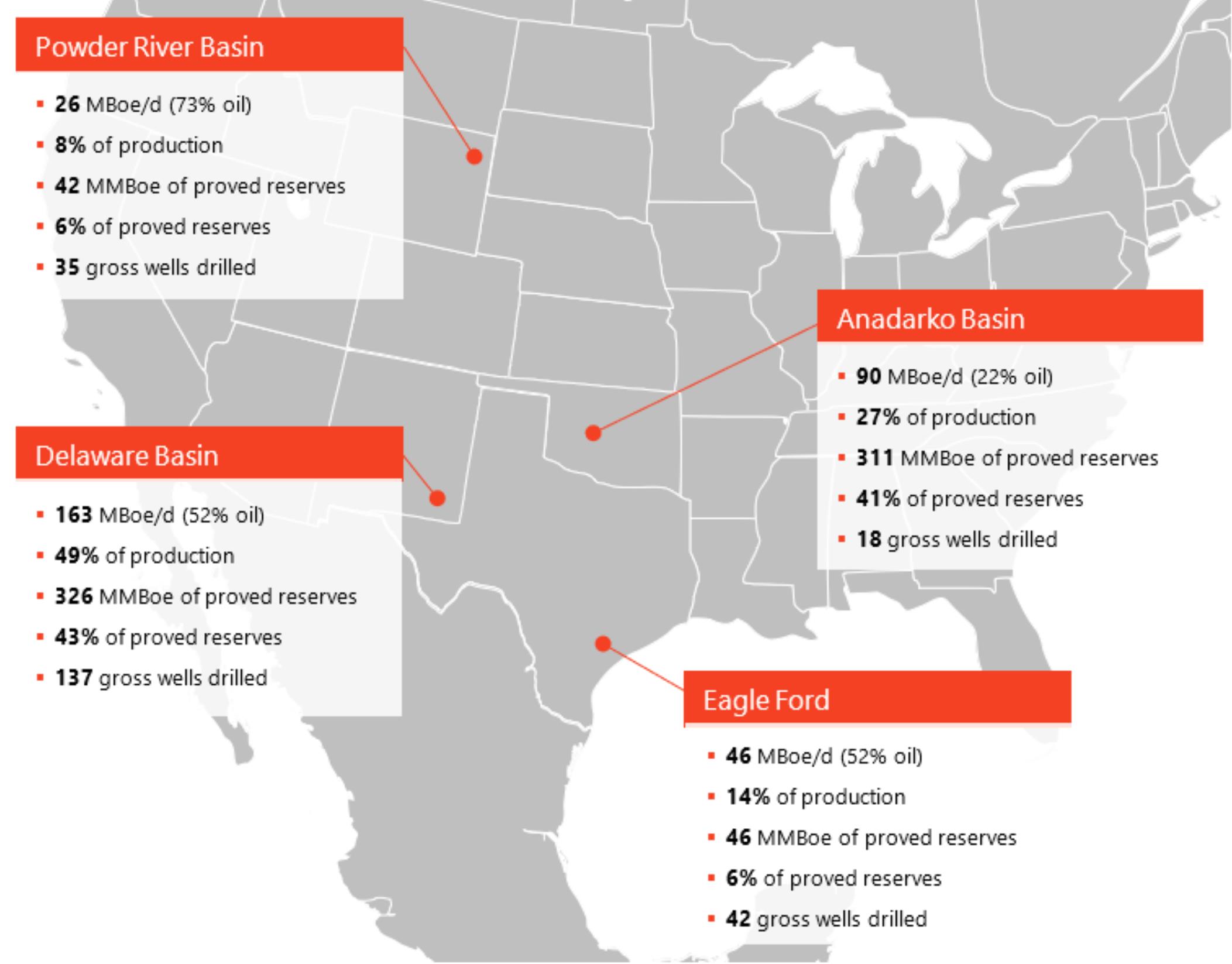
Delaware Basin – The Delaware Basin is Devon’s most active program in the portfolio. Through capital-efficient drilling programs, it offers exploration and low-risk development opportunities from many geologic reservoirs and play types, including the oil-rich Wolfcamp, Bone Spring, Leonard and Delaware formations. With a significant inventory of oil and liquids-rich drilling opportunities that have multi-zone development potential, Devon has a robust platform to deliver high-margin drilling programs for many years to come. At December 31, 2020, we had eight operated rigs developing this asset in the Wolfcamp and Bone Spring formations. Combined with the Delaware Basin assets acquired in the WPX merger, we plan to invest approximately $1.5 billion of capital in the Delaware Basin in 2021, making it the top-funded asset in the portfolio.
Powder River Basin – This asset is focused on emerging oil opportunities in the Powder River Basin. Devon is currently targeting several Cretaceous oil objectives, including the Turner, Parkman, Teapot and Niobrara formations. Recent drilling success in this basin has expanded our drilling inventory, and we expect further growth as we accelerate activity and continue to de-risk this emerging light-oil opportunity. Devon has several uncompleted wells in its Powder River Basin inventory and has resumed capital activity in early 2021. In 2021, we plan approximately $80 million of capital investment.
Eagle Ford – We acquired our position in the Eagle Ford in 2014. Since acquiring these assets, we have delivered tremendous results driven by our development in DeWitt County, Texas located in the economic core of the play. Our Eagle Ford production is leveraged to oil and has low-cost access to premium Gulf Coast pricing, providing for solid operating margins. As a result of the COVID-19 pandemic and related significant decrease to oil pricing in early 2020, Devon did not pursue any drilling and completion
activity in the latter half of 2020 for these assets. Devon has several uncompleted wells in its Eagle Ford inventory and has resumed capital activity in early 2021. In 2021, we plan approximately $110 million of capital investment.
Anadarko Basin – Our Anadarko Basin development, located primarily in Oklahoma’s Canadian, Kingfisher and Blaine counties, provides long-term optionality through its significant inventory. Our Anadarko Basin position is one of the largest in the industry, providing visible long-term production. At the end of 2019, we announced an agreement with Dow to jointly develop a portion of our Anadarko Basin acreage. This joint venture activity was delayed in response to the challenged macro-economic environment resulting from the COVID pandemic. However, due to improvements in natural gas pricing, the joint venture has commenced in the first quarter of 2021 with a two operated rig program. Dow will fund approximately 65% of the partnership capital requirements through a drilling carry of $100 million over the next four years. In 2021, we plan approximately $75 million of capital investment, net to Devon.
Proved Reserves
Proved oil and gas reserves are those quantities of oil, gas and NGLs which can be estimated with reasonable certainty to be economically producible from known reservoirs under existing economic conditions, operating methods and government regulations. To be considered proved, oil and gas reserves must be economically producible before contracts providing the right to operate expire, unless evidence indicates that renewal is reasonably certain. Also, the project to extract the hydrocarbons must have commenced or the operator must be reasonably certain that it will commence the project within a reasonable time. We establish our proved reserves estimates using standard geological and engineering technologies and computational methods, which are generally accepted by the petroleum industry. We primarily prepare our proved reserves additions by analogy using type curves that are based on decline curve analysis of wells in analogous reservoirs. We further establish reasonable certainty of our proved reserves estimates by using one or more of the following methods: geological and geophysical information to establish reservoir continuity between penetrations, rate-transient analysis, analytical and numerical simulations, or other proprietary technical and statistical methods. For estimates of our proved developed and proved undeveloped reserves and the discussion of the contribution by each property, see Note 22 in “Item 8. Financial Statements and Supplementary Data” of this report.
The process of estimating oil, gas and NGL reserves is complex and requires significant judgment, as discussed in “Item 1A. Risk Factors” of this report. As a result, we have developed internal policies for estimating and recording reserves in compliance with applicable SEC definitions and guidance. Our policies assign responsibilities for compliance in reserves bookings to our Reserve Evaluation Group (the “Group”). The Group, which is led by Devon’s Director of Reserves and Economics, is responsible for the internal review and certification of reserves estimates. We ensure the Director and key members of the Group have appropriate technical qualifications to oversee the preparation of reserves estimates and are independent of the operating groups. The Director of the Group has over 30 years of industry experience, a degree in engineering and is a registered professional engineer. The Group also oversees audits and reserves estimates performed by qualified third-party petroleum consulting firms. During 2020, we engaged LaRoche Petroleum Consultants, Ltd. to audit approximately 88% of our proved reserves. Additionally, we have a Reserves Committee that provides additional oversight of our reserves process. The committee consists of five independent members of our Board of Directors with education or business backgrounds relevant to the reserves estimation process.
The following tables present production, price and cost information for each significant field in our asset portfolio and the total company.
| Production | ||||||||||||||||
|---|---|---|---|---|---|---|---|---|---|---|---|---|---|---|---|---|
| Year Ended December 31, | Oil (MMBbls) | Gas (Bcf) | NGLs (MMBbls) | Total (MMBoe) | ||||||||||||
| 2020 | ||||||||||||||||
| Anadarko Basin | 7 | 92 | 10 | 33 | ||||||||||||
| Delaware Basin | 31 | 91 | 13 | 60 | ||||||||||||
| Total | 57 | 221 | 29 | 122 | ||||||||||||
| 2019 | ||||||||||||||||
| Anadarko Basin | 11 | 114 | 13 | 43 | ||||||||||||
| Delaware Basin | 26 | 65 | 10 | 46 | ||||||||||||
| Total | 55 | 219 | 28 | 119 | ||||||||||||
| 2018 | ||||||||||||||||
| Anadarko Basin | 12 | 121 | 14 | 45 | ||||||||||||
| Delaware Basin | 16 | 42 | 6 | 30 | ||||||||||||
| Total | 47 | 206 | 26 | 108 |
| Average Sales Price | ||||||||||||||||
|---|---|---|---|---|---|---|---|---|---|---|---|---|---|---|---|---|
| Year Ended December 31, | Oil (Per Bbl) | Gas (Per Mcf) | NGLs (Per Bbl) | Production Cost (Per Boe) (1) | ||||||||||||
| 2020 | ||||||||||||||||
| Anadarko Basin (2) | $ | 35.80 | $ | 1.66 | $ | 12.11 | $ | 9.61 | ||||||||
| Delaware Basin | $ | 37.25 | $ | 1.08 | $ | 10.64 | $ | 5.76 | ||||||||
| Total | $ | 35.95 | $ | 1.48 | $ | 11.72 | $ | 7.66 | ||||||||
| 2019 | ||||||||||||||||
| Anadarko Basin | $ | 55.13 | $ | 1.97 | $ | 15.90 | $ | 7.36 | ||||||||
| Delaware Basin | $ | 54.01 | $ | 0.99 | $ | 13.54 | $ | 6.43 | ||||||||
| Total | $ | 54.73 | $ | 1.79 | $ | 15.21 | $ | 7.75 | ||||||||
| 2018 | ||||||||||||||||
| Anadarko Basin | $ | 63.81 | $ | 2.29 | $ | 25.53 | $ | 7.16 | ||||||||
| Delaware Basin | $ | 57.24 | $ | 1.80 | $ | 24.05 | $ | 8.15 | ||||||||
| Total | $ | 61.96 | $ | 2.34 | $ | 25.47 | $ | 8.22 |
| (1) | Represents production expense per Boe excluding production and property taxes. |
|---|
| (2) | Production cost per Boe was higher in 2020 due to volume commitments which expired at the end of 2020. |
|---|
Drilling Statistics
The following table summarizes our development and exploratory drilling results.
| Development Wells (1) | Exploratory Wells (1) | Total Wells (1) | ||||||||||||||||||||||||||
|---|---|---|---|---|---|---|---|---|---|---|---|---|---|---|---|---|---|---|---|---|---|---|---|---|---|---|---|---|
| Year Ended December 31, | Productive | Dry | Productive | Dry | Productive | Dry | Total | |||||||||||||||||||||
| 2020 | 106.5 | — | 26.6 | — | 133.2 | — | 133.2 | |||||||||||||||||||||
| 2019 | 161.7 | — | 27.2 | — | 188.9 | — | 188.9 | |||||||||||||||||||||
| 2018 | 154.9 | 3.1 | 69.4 | — | 224.3 | 3.1 | 227.4 |
| (1) | Well counts represent net wells completed during each year. Net wells are gross wells multiplied by our fractional working interests. |
|---|
As of December 31, 2020, there were 156 gross and 77.6 net wells that have been spud and are in the process of drilling, completing or waiting on completion. To effectively manage capital expenditures and provide flexibility in managing drilling rig and well completion schedules, we have a large inventory of drilled but not completed wells. Gross wells are the sum of all wells in which we own a working interest. Net wells are gross wells multiplied by our fractional working interests in each well.
Productive Wells
The following table sets forth our producing wells as of December 31, 2020.
| Oil Wells | Natural Gas Wells | Total Wells | ||||||||||||||||||||||
|---|---|---|---|---|---|---|---|---|---|---|---|---|---|---|---|---|---|---|---|---|---|---|---|---|
| Gross (1)(3) | Net (2) | Gross (1)(3) | Net (2) | Gross (1)(3) | Net (2) | |||||||||||||||||||
| Total | 7,752 | 2,385 | 2,980 | 1,201 | 10,732 | 3,586 |
| (1) | Gross wells are the sum of all wells in which we own a working interest. |
|---|
| (2) | Net wells are gross wells multiplied by our fractional working interests in each well. |
|---|
| (3) | Includes 45 and 57 gross oil and gas wells, respectively, which had multiple completions. |
|---|
The day-to-day operations of oil and gas properties are the responsibility of an operator designated under pooling or operating agreements. The operator supervises production, maintains production records, employs field personnel and performs other functions. We are the operator of approximately 3,942 gross wells. As operator, we receive reimbursement for direct expenses incurred to perform our duties, as well as monthly per-well producing, drilling, and construction overhead reimbursement at rates customarily charged in the respective areas. In presenting our financial data, we record the monthly overhead reimbursements as a reduction of G&A, which is a common industry practice.
Acreage Statistics
The following table sets forth our developed and undeveloped lease and mineral acreage as of December 31, 2020. Of our 1.8 million net acres, approximately 1.0 million acres are held by production. The acreage in the table includes approximately 0.1 million net acres subject to leases that are scheduled to expire during 2021, 2022 and 2023. Of the 0.1 million net acres set to expire by December 31, 2023, we anticipate performing operational and administrative actions to continue the lease terms for portions of the acreage that we intend to further assess. However, we do expect to allow a portion of the acreage to expire in the normal course of business. Subsequent to our merger with WPX, less than 20% of our total net acres are located on federal lands.
| Developed | Undeveloped | Total | ||||||||||||||||||||||
|---|---|---|---|---|---|---|---|---|---|---|---|---|---|---|---|---|---|---|---|---|---|---|---|---|
| Gross (1) | Net (2) | Gross (1) | Net (2) | Gross (1) | Net (2) | |||||||||||||||||||
| (Thousands) | ||||||||||||||||||||||||
| Total | 953 | 504 | 2,994 | 1,267 | 3,947 | 1,771 |
| (1) | Gross acres are the sum of all acres in which we own a working interest. |
|---|
| (2) | Net acres are gross acres multiplied by our fractional working interests in the acreage. |
|---|
Title to Properties
Title to properties is subject to contractual arrangements customary in the oil and gas industry, liens for taxes not yet due and, in some instances, other encumbrances. We believe that such burdens do not materially detract from the value of properties or from the respective interests therein or materially interfere with their use in the operation of the business.
As is customary in the industry, a preliminary title investigation, typically consisting of a review of local title records, is made at the time of acquisitions of undeveloped properties. More thorough title investigations, which generally include a review of title records and the preparation of title opinions by outside legal counsel, are made prior to the consummation of an acquisition of producing properties and before commencement of drilling operations on undeveloped properties.
Marketing Activities
Oil, Gas and NGL Marketing
The spot markets for oil, gas and NGLs are subject to volatility as supply and demand factors fluctuate. As detailed below, we sell our production under both long-term (one year or more) and short-term (less than one year) agreements at prices negotiated with third parties. Regardless of the term of the contract, the vast majority of our production is sold at variable, or market-sensitive, prices.
Additionally, we may enter into financial hedging arrangements or fixed-price contracts associated with a portion of our oil, gas and NGL production. These activities are intended to support targeted price levels and to manage our exposure to price fluctuations. See Note 3 in “Item 8. Financial Statements and Supplementary Data” of this report for further information.
As of January 2021, our production was sold under the following contract terms.
| Short-Term | Long-Term | |||||||||||||||
| Variable | Fixed | Variable | Fixed | |||||||||||||
| Oil | 45 | % | 5 | % | 50 | % | — | |||||||||
| Natural gas | 56 | % | 3 | % | 41 | % | — | |||||||||
| NGLs | 63 | % | 25 | % | 12 | % | — |
Delivery Commitments
A portion of our production is sold under certain contractual arrangements that specify the delivery of a fixed and determinable quantity. As of December 31, 2020, we were committed to deliver the following fixed quantities of production.
| Total | Less Than 1 Year | 1-3 Years | 3-5 Years | More Than 5 Years | ||||||||||||||||
|---|---|---|---|---|---|---|---|---|---|---|---|---|---|---|---|---|---|---|---|---|
| Natural gas (Bcf) | 174 | 90 | 52 | 32 | — | |||||||||||||||
| NGLs (MMBbls) | 7 | 7 | — | — | — | |||||||||||||||
| Total (MMBoe) | 36 | 22 | 9 | 5 | — |
We expect to fulfill our delivery commitments primarily with production from our proved developed reserves. Moreover, our proved reserves have generally been sufficient to satisfy our delivery commitments during the three most recent years, and we expect such reserves will continue to be the primary means of fulfilling our future commitments. However, where our proved reserves are not sufficient to satisfy our delivery commitments, we can and may use spot market purchases to satisfy the commitments.
Competition
See “Item 1A. Risk Factors.”
Public Policy and Government Regulation
Our industry is subject to a wide range of regulations. Laws, rules, regulations, taxes, fees and other policy implementation actions affecting our industry have been pervasive and are under constant review for amendment or expansion. Numerous government agencies have issued extensive regulations which are binding on our industry and its individual members, some of which carry substantial penalties for failure to comply. These laws and regulations increase the cost of doing business and consequently affect profitability. Because public policy changes are commonplace, and existing laws and regulations are frequently amended, we are unable to predict the future cost or impact of compliance. However, we do not expect that any of these laws and regulations will affect our operations materially differently than they would affect other companies with similar operations, size and financial strength. The following are significant areas of government control and regulation affecting our operations.
Exploration and Production Regulation
Our operations are subject to federal, state and local laws and regulations. These laws and regulations relate to matters that include:
| • | acquisition of seismic data; |
|---|
| • | location, drilling and casing of wells; |
|---|
| • | well design; |
|---|
| • | hydraulic fracturing; |
|---|
| • | well production; |
|---|
| • | spill prevention plans; |
|---|
| • | emissions and discharge permitting; |
|---|
| • | use, transportation, storage and disposal of fluids and materials incidental to oil and gas operations; |
|---|
| • | surface usage and the restoration of properties upon which wells have been drilled; |
|---|
| • | calculation and disbursement of royalty payments and production taxes; |
|---|
| • | plugging and abandoning of wells; |
|---|
| • | transportation of production; and |
|---|
| • | endangered species and habitat. |
|---|
Our operations also are subject to conservation regulations, including the regulation of the size of drilling and spacing units or proration units; the number of wells that may be drilled in a unit; the rate of production allowable from oil and gas wells; and the unitization or pooling of oil and gas properties. In the U.S., some states allow the forced pooling or unitization of tracts to facilitate exploration, while other states rely on voluntary pooling of lands and leases, which may make it more difficult to develop oil and gas properties. In addition, federal and state conservation laws generally limit the venting or flaring of natural gas, and state conservation laws impose certain requirements regarding the ratable purchase of production. These regulations limit the amounts of oil and gas we can produce from our wells and the number of wells or the locations at which we can drill.
Certain of our U.S. natural gas and oil leases are granted or approved by the federal government and administered by the BLM or Bureau of Indian Affairs of the Department of the Interior. Such leases require compliance with detailed federal regulations and orders that regulate, among other matters, drilling and operations on lands covered by these leases and calculation and disbursement of royalty payments to the federal government, tribes or tribal members. Moreover, the permitting process for oil and gas activities on federal lands can sometimes be subject to delay, which can stall development activities or otherwise adversely impact operations. The federal government has, from time to time, evaluated and, in some cases, promulgated new rules and regulations regarding competitive lease bidding, venting and flaring, oil and gas measurement and royalty payment obligations for production from federal lands. In addition, President Biden and certain members of his administration have expressed support for, and have taken steps to implement, additional restrictions on oil and gas activities on federal lands, including orders temporarily limiting the approval of new leases and drilling permits to certain high-ranking officials within the Department of the Interior, as well as a pause on entering into future oil and gas leases on public lands.
Environmental, Pipeline Safety and Occupational Regulations
We strive to conduct our operations in a socially and environmentally responsible manner, which includes compliance with applicable law. We are subject to many federal, state, and local laws and regulations concerning occupational safety and health as well as the discharge of materials into, and the protection of, the environment and natural resources. Environmental laws and regulations relate to:
| • | the discharge of pollutants into federal and state waters; |
|---|
| • | assessing the environmental impact of seismic acquisition, drilling or construction activities; |
|---|
| • | the generation, storage, transportation and disposal of waste materials, including hazardous substances and wastes; |
|---|
| • | the emission of certain gases into the atmosphere; |
|---|
| • | the monitoring, abandonment, reclamation and remediation of well and other sites, including sites of former operations; |
|---|
| • | the development of emergency response and spill contingency plans; |
|---|
| • | the monitoring, repair and design of pipelines used for the transportation of oil and natural gas; |
|---|
| • | the protection of threatened and endangered species; and |
|---|
| • | worker protection. |
|---|
Failure to comply with these laws and regulations can lead to the imposition of remedial liabilities, administrative, civil or criminal fines or penalties or injunctions limiting our operations in affected areas. Moreover, multiple environmental laws provide for citizen suits, which can allow environmental organizations to sue operators for alleged violations of environmental law. Environmental organizations also can assert legal and administrative challenges to certain actions of oil and gas regulators, such as the BLM, for allegedly failing to comply with environmental laws, which can result in delays in obtaining permits or other necessary authorizations. Environmental protection and health and safety compliance are necessary, manageable parts of our business. We have been able to plan for and comply with environmental, safety and health initiatives without materially altering our operating strategy or incurring significant unreimbursed expenditures. However, based on regulatory trends and increasingly stringent laws and permitting requirements, our capital expenditures and operating expenses related to the protection of the environment and safety and health compliance have increased over the years and may continue to increase.
Item 1A. Risk Factors
Our business and operations, and our industry in general, are subject to a variety of risks. The risks described below may not be the only risks we face, as our business and operations may also be subject to risks that we do not yet know of, or that we currently
believe are immaterial. If any of the following risks should occur, our business, financial condition, results of operations and liquidity could be materially and adversely impacted. As a result, holders of our securities could lose part or all of their investment in Devon.
Volatile Oil, Gas and NGL Prices Significantly Impact Our Business
Our financial condition, results of operations and the value of our properties are highly dependent on the general supply and demand for oil, gas and NGLs, which impact the prices we ultimately realize on our sales of these commodities. Historically, market prices and our realized prices have been volatile. For example, over the last five years, monthly NYMEX WTI oil and NYMEX Henry Hub gas prices ranged from highs of over $67 per Bbl and $4.80 per MMBtu, respectively, to lows of under $30 per Bbl and $1.50 per MMBtu, respectively. Such volatility is likely to continue in the future due to numerous factors beyond our control, including, but not limited to:
| • | the domestic and worldwide supply of and demand for oil, gas and NGLs; |
|---|
| • | volatility and trading patterns in the commodity-futures markets; |
|---|
| • | conservation and environmental protection efforts; |
|---|
| • | production levels of members of OPEC, Russia, the U.S. or other producing countries; |
|---|
| • | geopolitical risks, including political and civil unrest in the Middle East, Africa and South America; |
|---|
| • | adverse weather conditions, natural disasters, public health crises and other catastrophic events, such as tornadoes, earthquakes, hurricanes and epidemics of infectious diseases; |
|---|
| • | regional pricing differentials, including in the Delaware Basin and other areas of our operations; |
|---|
| • | differing quality of production, including NGL content of gas produced; |
|---|
| • | the level of imports and exports of oil, gas and NGLs and the level of global oil, gas and NGL inventories; |
|---|
| • | the price and availability of alternative energy sources; |
|---|
| • | technological advances affecting energy consumption and production, including with respect to electric vehicles; |
|---|
| • | stockholder activism or activities by non-governmental organizations to restrict the exploration and production of oil and natural gas in order to reduce greenhouse gas emissions; |
|---|
| • | the overall economic environment; |
|---|
| • | changes in trade relations and policies, including the imposition of tariffs by the U.S. or China; and |
|---|
| • | other governmental regulations and taxes. |
|---|
Our Business Has Been Adversely Impacted by the COVID-19 Pandemic, and We May Experience Continuing or Worsening Adverse Effects From This or Other Pandemics
The COVID-19 pandemic and related economic repercussions have created significant volatility, uncertainty and turmoil in the oil and gas industry. This outbreak and the related responses of governmental authorities and others to limit the spread of the virus significantly reduced global economic activity, resulting in an unprecedented decline in the demand for oil and other commodities during 2020. Combined with other factors, this decline in demand caused a swift and material deterioration in commodity prices in early 2020, which adversely impacted our results of operations for 2020 and contributed to our recognition of a material asset impairment to our oil and gas assets during the first quarter of 2020. The negative effects of COVID-19 on economic prospects across the world have contributed to concerns for the potential of a prolonged economic slowdown and recession. Any such downturns, or protracted periods of depressed commodity prices, could have significant adverse consequences for our financial condition and liquidity. Moreover, any such downturns could also result in similar financial constraints for our non-operating partners, purchasers of our production and other counterparties, thereby increasing the risk that such counterparties default on their obligations to us. Such defaults or more general supply chain disruptions due to the pandemic may also jeopardize the supply of materials, equipment or services for our operations.
The COVID-19 pandemic and related restrictions aimed at mitigating its spread have caused us to modify certain of our business practices, including limiting employee travel, encouraging work-from-home practices and other social distancing measures. There is no certainty that these or any other future measures will be sufficient to mitigate the risks posed by the disease, including the risk of infection of key employees, and our ability to perform certain functions could be disrupted or otherwise impaired by these new
business practices. For example, our reliance on technology has necessarily increased due to our encouragement of remote communications and other work-from-home practices, which could make us more vulnerable to cyber attacks.
The COVID-19 pandemic and its related effects continue to evolve. The ultimate extent of the impact of the COVID-19 pandemic and any other future pandemic on our business will depend on future developments, including, but not limited to, the nature, duration and spread of the disease, the vaccination and other responsive actions to stop its spread or address its effects and the duration, timing and severity of the related consequences on commodity prices and the economy more generally, including any recession resulting from the pandemic. Any extended period of depressed commodity prices or general economic disruption as a result of a pandemic would adversely affect our business, financial condition and results of operations.
Estimates of Oil, Gas and NGL Reserves Are Uncertain and May Be Subject to Revision
The process of estimating oil, gas and NGL reserves is complex and requires significant judgment in the evaluation of available geological, engineering and economic data for each reservoir, particularly for new discoveries. Because of the high degree of judgment involved, different reserve engineers may develop different estimates of reserve quantities and related revenue based on the same data. In addition, the reserve estimates for a given reservoir may change substantially over time as a result of several factors, including additional development and appraisal activity, the viability of production under varying economic conditions, including commodity price declines, and variations in production levels and associated costs. Consequently, material revisions to existing reserves estimates may occur as a result of changes in any of these factors. Such revisions to proved reserves could have an adverse effect on our financial condition and the value of our properties, as well as the estimates of our future net revenue and profitability. Our policies and internal controls related to estimating and recording reserves are included in “Items 1 and 2. Business and Properties” of this report.
Discoveries or Acquisitions of Reserves Are Needed to Avoid a Material Decline in Reserves and Production
The production rates from oil and gas properties generally decline as reserves are depleted, while related per unit production costs generally increase due to decreasing reservoir pressures and other factors. Moreover, our current development activity is focused on unconventional oil and gas assets, which generally have significantly higher decline rates as compared to conventional assets. Therefore, our estimated proved reserves and future oil, gas and NGL production will decline materially as reserves are produced unless we conduct successful exploration and development activities, such as identifying additional producing zones in existing wells, utilizing secondary or tertiary recovery techniques or acquiring additional properties containing proved reserves. Consequently, our future oil, gas and NGL production and related per unit production costs are highly dependent upon our level of success in finding or acquiring additional reserves.
We Are Subject to Extensive Governmental Regulation, Which Can Change and Could Adversely Impact Our Business
Our operations are subject to extensive federal, state, local and other laws, rules and regulations, including with respect to environmental matters, worker health and safety, wildlife conservation, the gathering and transportation of oil, gas and NGLs, conservation policies, reporting obligations, royalty payments, unclaimed property and the imposition of taxes. Such regulations include requirements for permits to drill and to conduct other operations and for provision of financial assurances (such as bonds) covering drilling, completion and well operations and decommissioning obligations. If permits are not issued, or if unfavorable restrictions or conditions are imposed on our drilling or completion activities, we may not be able to conduct our operations as planned. In addition, we may be required to make large expenditures to comply with applicable governmental laws, rules, regulations, permits or orders. For example, certain regulations require the plugging and abandonment of wells and removal of production facilities by current and former operators, including corporate successors of former operators. These requirements may result in significant costs associated with the removal of tangible equipment and other restorative actions.
In addition, changes in public policy have affected, and in the future could further affect, our operations. For example, President Biden and certain members of his administration and Congress have expressed support for, and have taken steps to implement, efforts to transition the economy away from fossil fuels and to promote stricter environmental regulations, and such proposals could impose new and more onerous burdens on our industry and business. These and other regulatory and public policy developments could, among other things, restrict production levels, delay necessary permitting, impose price controls, change environmental protection requirements, impose restrictions on pipelines or other necessary infrastructure and increase taxes, royalties and other amounts payable to governments or governmental agencies. Our operating and other compliance costs could increase further if existing laws and regulations are revised or reinterpreted, or if new laws and regulations become applicable to our operations. In addition, changes in public policy may indirectly impact our operations by, among other things, increasing the cost of supplies and equipment and
fostering general economic uncertainty. Although we are unable to predict changes to existing laws and regulations, such changes could significantly impact our profitability, financial condition and liquidity, particularly changes related to leasing and permitting on federal lands, hydraulic fracturing, environmental matters more generally, seismic activity and income taxes, as discussed below.
Federal Lands – President Biden and certain members of his administration have expressed support for, and have taken steps to implement, additional regulation of oil and gas leasing and permitting on federal lands. Such proposals range from more onerous permitting requirements to an outright moratorium on new oil and gas leasing and permitting on federal lands. For example, on January 20, 2021, the Acting Secretary of the Department of the Interior issued an order temporarily limiting the authority to approve certain fossil fuel authorizations on federal lands, including the approval of new leases and new drilling permits, to certain high-ranking officials within the Department of the Interior. In addition, President Biden issued an executive order on January 27, 2021 directing the Secretary of the Interior to pause on entering new oil and gas leases on public lands to the extent possible and to launch a rigorous review of all existing leasing and permitting practices related to fossil fuel development on public lands. While it is not possible at this time to predict the ultimate impact of these or any other future regulatory changes, any additional restrictions or prohibitions on our ability to operate on federal lands could adversely impact our business in the Delaware and Powder River Basins, as well as other areas where we operate under federal leases. Post-merger, less than 20% of our total leasehold resides on federal lands primarily located in the Delaware and Powder River Basins.
Hydraulic Fracturing – In recent years, various federal agencies have asserted regulatory authority over certain aspects of the hydraulic fracturing process. For example, the EPA has issued regulations under the federal Clean Air Act establishing performance standards for oil and gas activities, including standards for the capture of air emissions released during hydraulic fracturing, and it finalized in 2016 regulations that prohibit the discharge of wastewater from hydraulic fracturing operations to publicly owned wastewater treatment plants. The EPA also released a report in 2016 finding that certain aspects of hydraulic fracturing, such as water withdrawals and wastewater management practices, could result in impacts to water resources in certain circumstances. The BLM previously finalized regulations to regulate hydraulic fracturing on federal lands but subsequently issued a repeal of those regulations in 2017. Moreover, several states in which we operate have adopted, or stated intentions to adopt, laws or regulations that mandate further restrictions on hydraulic fracturing, such as requiring disclosure of chemicals used in hydraulic fracturing, imposing more stringent permitting, disclosure and well-construction requirements on hydraulic fracturing operations and establishing standards for the capture of air emissions released during hydraulic fracturing. In addition to state laws, local land use restrictions, such as city ordinances, may restrict drilling in general or hydraulic fracturing in particular.
Beyond these regulatory efforts, various policy makers, regulatory agencies and political leaders at the federal, state and local levels have proposed implementing even further restrictions on hydraulic fracturing, including prohibiting the technology outright. Although it is not possible at this time to predict the outcome of these or other proposals, any new restrictions on hydraulic fracturing that may be imposed in areas in which we conduct business could potentially result in increased compliance costs, delays or cessation in development or other restrictions on our operations.
Environmental Laws Generally – In addition to regulatory efforts focused on hydraulic fracturing, we are subject to various other federal, state and local laws and regulations relating to discharge of materials into, and protection of, the environment. These laws and regulations may, among other things, impose liability on us for the cost of remediating pollution that results from our operations or prior operations on assets we have acquired. Environmental laws may impose strict, joint and several liability, and failure to comply with environmental laws and regulations can result in the imposition of administrative, civil or criminal fines and penalties, as well as injunctions limiting operations in affected areas. Any future environmental costs of fulfilling our commitments to the environment are uncertain and will be governed by several factors, including future changes to regulatory requirements. Any such changes could have a significant impact on our operations and profitability.
Seismic Activity – Earthquakes in northern and central Oklahoma, southeastern New Mexico, western Texas and elsewhere have prompted concerns about seismic activity and possible relationships with the oil and gas industry. Legislative and regulatory initiatives intended to address these concerns may result in additional levels of regulation or other requirements that could lead to operational delays, increase our operating and compliance costs or otherwise adversely affect our operations. In addition, we are currently defending against certain third-party lawsuits and could be subject to additional claims, seeking alleged property damages or other remedies as a result of alleged induced seismic activity in our areas of operation.
Changes to Tax Laws – We are subject to U.S. federal income tax as well as income or capital taxes in various state and foreign jurisdictions, and our operating cash flow is sensitive to the amount of income taxes we must pay. In the jurisdictions in which we operate or previously operated, income taxes are assessed on our earnings after consideration of all allowable deductions and credits. Changes in the types of earnings that are subject to income tax, the types of costs that are considered allowable deductions (such as
intangible drilling costs) and the timing of such deductions, or the rates assessed on our taxable earnings would all impact our income taxes and resulting operating cash flow.
Concerns About Climate Change and Related Regulatory, Social and Market Actions May Adversely Affect Our Business
Continuing and increasing political and social attention to the issue of climate change has resulted in legislative, regulatory and other initiatives, including international agreements, to reduce greenhouse gas emissions, such as carbon dioxide and methane. Policy makers and regulators at both the U.S. federal and state levels have already imposed, or stated intentions to impose, laws and regulations designed to quantify and limit the emission of greenhouse gases. For example, both the EPA and the BLM have issued regulations for the control of methane emissions, which also include leak detection and repair requirements, for the oil and gas industry; although the methane specific requirements of some of these regulations have been repealed, similar or more stringent emissions requirements may be imposed by the Biden Administration. In addition, several states where we operate, including Wyoming, New Mexico and Texas, have already imposed, or stated intentions to impose, laws or regulations designed to reduce methane emissions from oil and gas exploration and production activities. With respect to more comprehensive regulation, policy makers and political leaders have made, or expressed support for, a variety of proposals, such as the development of cap-and-trade or carbon tax programs. In addition, President Biden has highlighted addressing climate change as a priority of his administration, and he previously released an energy plan calling for a number of sweeping changes to address climate change, including, among other measures, a national mobilization effort to achieve net-zero emissions for the U.S. economy by 2050, through increased use of renewable power, stricter fuel-efficiency standards and support for zero-emission vehicles. President Biden issued a number of executive orders in January 2021 with the purpose of implementing certain of these changes, including the rejoining of the Paris Agreement, a call for the issuance of more stringent methane emissions regulations for oil and gas facilities and an order directing federal agencies to procure electric vehicles. Although the full impact of these orders is uncertain at this time, the adoption and implementation of these or other initiatives may result in the restriction or cancellation of oil and natural gas activities, greater costs of compliance or consumption (thereby reducing demand for our products) or an impairment in our ability to continue our operations in an economic manner.
In addition to regulatory risk, other market and social initiatives resulting from the changing perception of climate change present risks for our business. For example, in an effort to promote a lower-carbon economy, there are various public and private initiatives subsidizing the development and adoption of alternative energy sources and technologies, including by mandating the use of specific fuels or technologies. These initiatives may reduce the competitiveness of carbon-based fuels, such as oil and gas. Moreover, an increasing number of financial institutions, funds and other sources of capital have begun restricting or eliminating their investment in oil and natural gas activities due to their concern regarding climate change. Such restrictions in capital could decrease the value of our business and make it more difficult to fund our operations. Finally, governmental entities and other plaintiffs have brought, and may continue to bring, claims against us and other oil and gas companies for purported damages caused by the alleged effects of climate change. These and the other regulatory, social and market risks relating to climate change described above could result in unexpected costs, increase our operating expense and reduce the demand for our products, which in turn could lower the value of our reserves and have an adverse effect on our profitability, financial condition and liquidity.
Our Operations Are Uncertain and Involve Substantial Costs and Risks
Our operating activities are subject to numerous costs and risks, including the risk that we will not encounter commercially productive oil or gas reservoirs. Drilling for oil, gas and NGLs can be unprofitable, not only from dry holes, but from productive wells that do not return a profit because of insufficient revenue from production or high costs. Substantial costs are required to locate, acquire and develop oil and gas properties, and we are often uncertain as to the amount and timing of those costs. Our cost of drilling, completing, equipping and operating wells is often uncertain before drilling commences. Declines in commodity prices and overruns in budgeted expenditures are common risks that can make a particular project uneconomic or less economic than forecasted. While both exploratory and developmental drilling activities involve these risks, exploratory drilling involves greater risks of dry holes or failure to find commercial quantities of hydrocarbons. In addition, our oil and gas properties can become damaged, our operations may be curtailed, delayed or canceled and the costs of such operations may increase as a result of a variety of factors, including, but not limited to:
| • | unexpected drilling conditions, pressure conditions or irregularities in reservoir formations; |
|---|
| • | equipment failures or accidents; |
|---|
| • | fires, explosions, blowouts, cratering or loss of well control, as well as the mishandling or underground migration of fluids and chemicals; |
|---|
| • | adverse weather conditions and natural disasters, such as tornadoes, earthquakes, hurricanes and extreme temperatures; |
|---|
| • | issues with title or in receiving governmental permits or approvals; |
|---|
| • | restricted takeaway capacity for our production, including due to inadequate midstream infrastructure or constrained downstream markets; |
|---|
| • | environmental hazards or liabilities; |
|---|
| • | restrictions in access to, or disposal of, water used or produced in drilling and completion operations; and |
|---|
| • | shortages or delays in the availability of services or delivery of equipment. |
|---|
The occurrence of one or more of these factors could result in a partial or total loss of our investment in a particular property, as well as significant liabilities. Moreover, certain of these events could result in environmental pollution and impact to third parties, including persons living in proximity to our operations, our employees and employees of our contractors, leading to possible injuries, death or significant damage to property and natural resources. For example, we have from time to time experienced well-control events that have resulted in various remediation and clean-up costs and certain of the other impacts described above.
In addition, we rely on our employees, consultants and sub-contractors to conduct our operations in compliance with applicable laws and standards. Any violation of such laws or standards by these individuals, whether through negligence, harassment, discrimination or other misconduct, could result in significant liability for us and adversely affect our business. For example, negligent operations by employees could result in serious injury, death or property damage, and sexual harassment or racial and gender discrimination could result in legal claims and reputational harm.
Our Hedging Activities Limit Participation in Commodity Price Increases and Involve Other Risks
We enter into financial derivative instruments with respect to a portion of our production to manage our exposure to oil, gas and NGL price volatility. To the extent that we engage in price risk management activities to protect ourselves from commodity price declines, we will be prevented from fully realizing the benefits of commodity price increases above the prices established by our hedging contracts. In addition, our hedging arrangements may expose us to the risk of financial loss in certain circumstances, including instances in which the contract counterparties fail to perform under the contracts. Moreover, as a result of the Dodd-Frank Wall Street Reform and Consumer Protection Act and other legislation and regulation, hedging transactions and many of our contract counterparties have become subject to increased governmental oversight and regulations in recent years. Although we cannot predict the ultimate impact of these laws and the related rulemaking, some of which is ongoing, existing or future regulations may adversely affect the cost and availability of our hedging arrangements.
The Credit Risk of Our Counterparties Could Adversely Affect Us
We enter into a variety of transactions that expose us to counterparty credit risk. For example, we have exposure to financial institutions and insurance companies through our hedging arrangements, our syndicated revolving credit facility and our insurance policies. Disruptions in the financial markets or otherwise may impact these counterparties and affect their ability to fulfill their existing obligations and their willingness to enter into future transactions with us.
In addition, we are exposed to the risk of financial loss from trade, joint interest billing and other receivables. We sell our oil, gas and NGLs to a variety of purchasers, and, as an operator, we pay expenses and bill our non-operating partners for their respective share of costs. We also frequently look to buyers of oil and gas properties from us or our predecessors to perform certain obligations associated with the disposed assets, including the removal of production facilities and plugging and abandonment of wells. Certain of these counterparties or their successors may experience insolvency, liquidity problems or other issues and may not be able to meet their obligations and liabilities (including contingent liabilities) owed to, and assumed from, us, particularly during a depressed or volatile commodity price environment. Any such default may result in us being forced to cover the costs of those obligations and liabilities, which could adversely impact our financial results and condition.
Our Debt May Limit Our Liquidity and Financial Flexibility, and Any Downgrade of Our Credit Rating Could Adversely Impact Us
As of December 31, 2020, we had total indebtedness of $4.3 billion. Our indebtedness and other financial commitments have important consequences to our business, including, but not limited to:
| • | requiring us to dedicate a portion of our cash flows from operations to debt service payments, thereby limiting our ability to fund working capital, capital expenditures, investments or acquisitions and other general corporate purposes; |
|---|
| • | increasing our vulnerability to general adverse economic and industry conditions, including low commodity price environments; and |
|---|
| • | limiting our ability to obtain additional financing due to higher costs and more restrictive covenants. |
|---|
In addition, we receive credit ratings from rating agencies in the U.S. with respect to our debt. Factors that may impact our credit ratings include, among others, debt levels, planned asset sales and purchases, liquidity, forecasted production growth and commodity prices. We are currently required to provide letters of credit or other assurances under certain of our contractual arrangements. Any credit downgrades could adversely impact our ability to access financing and trade credit, require us to provide additional letters of credit or other assurances under contractual arrangements and increase our interest rate under any credit facility borrowing as well as the cost of any other future debt.
Cyber Attacks May Adversely Impact Our Operations
Our business has become increasingly dependent on digital technologies, and we anticipate expanding the use of these technologies in our operations, including through artificial intelligence, process automation and data analytics. Concurrent with the growing dependence on technology is greater sensitivity to cyber attack related activities, which have increasingly targeted our industry. Cyber attackers often attempt to gain unauthorized access to digital systems for purposes of misappropriating confidential and proprietary information, intellectual property or financial assets, corrupting data or causing operational disruptions as well as preventing users from accessing systems or information for the purpose of demanding payment in order for users to regain access. These attacks may be perpetrated by third parties or insiders. Techniques used in these attacks often range from highly sophisticated efforts to electronically circumvent network security to more traditional intelligence gathering and social engineering aimed at obtaining information necessary to gain access. Cyber attacks may also be performed in a manner that does not require gaining unauthorized access, such as by causing denial-of-service attacks. In addition, our vendors, midstream providers and other business partners may separately suffer disruptions or breaches from cyber attacks, which, in turn, could adversely impact our operations and compromise our information. Although we have not suffered material losses related to cyber attacks to date, if we were successfully attacked, we could incur substantial remediation and other costs or suffer other negative consequences, including litigation risks. Moreover, as the sophistication of cyber attacks continues to evolve, we may be required to expend significant additional resources to further enhance our digital security or to remediate vulnerabilities.
We Have Limited Control Over Properties Operated by Others
Certain of the properties in which we have an interest are operated by other companies and involve third-party working interest owners. We have limited influence and control over the operation or future development of such properties, including compliance with environmental, health and safety regulations or the amount and timing of required future capital expenditures. These limitations and our dependence on the operator and other working interest owners for these properties could result in unexpected future costs and delays, curtailments or cancellations of operations or future development, which could adversely affect our financial condition and results of operations.
Midstream Capacity Constraints and Interruptions Impact Commodity Sales
We rely on midstream facilities and systems owned and operated by others to process our gas production and to transport our oil, gas and NGL production to downstream markets. All or a portion of our production in one or more regions may be interrupted or shut in from time to time due to losing access to plants, pipelines or gathering systems. Such access could be lost due to a number of factors, including, but not limited to, weather conditions and natural disasters, accidents, field labor issues or strikes. Additionally, the midstream operators may be subject to constraints that limit their ability to construct, maintain or repair midstream facilities needed to process and transport our production. Such interruptions or constraints could negatively impact our production and associated profitability.
Insurance Does Not Cover All Risks
As discussed above, our business is hazardous and is subject to all of the operating risks normally associated with the exploration, development and production of oil, gas and NGLs. To mitigate financial losses resulting from these operational hazards, we maintain comprehensive general liability insurance, as well as insurance coverage against certain losses resulting from physical damages, loss of well control, business interruption and pollution events that are considered sudden and accidental. We also maintain workers’ compensation and employer’s liability insurance. However, our insurance coverage does not provide 100% reimbursement of potential losses resulting from these operational hazards. Additionally, we have limited or no insurance coverage for a variety of other risks, including pollution events that are considered gradual, war and political risks and fines or penalties assessed by governmental authorities. The occurrence of a significant event against which we are not fully insured could have an adverse effect on our profitability, financial condition and liquidity.
Competition for Assets, Materials, People and Capital Can Be Significant
Strong competition exists in all sectors of the oil and gas industry. We compete with major integrated and independent oil and gas companies for the acquisition of oil and gas leases and properties. We also compete for the equipment and personnel required to explore, develop and operate properties. Typically, during times of rising commodity prices, drilling and operating costs will also increase. During these periods, there is often a shortage of drilling rigs and other oilfield services, which could adversely affect our ability to execute our development plans on a timely basis and within budget. Competition is also prevalent in the marketing of oil, gas and NGLs. Certain of our competitors have financial and other resources substantially greater than ours and may have established superior strategic long-term positions and relationships, including with respect to midstream take-away capacity. As a consequence, we may be at a competitive disadvantage in bidding for assets or services and accessing capital and downstream markets. In addition, many of our larger competitors may have a competitive advantage when responding to factors that affect demand for oil and gas production, such as changing worldwide price and production levels, the cost and availability of alternative energy sources and the application of government regulations.
Our Business Could Be Adversely Impacted by Investors Attempting to Effect Change
Stockholder activism has been increasing in our industry, and investors may from time to time attempt to effect changes to our business or governance, whether by stockholder proposals, public campaigns, proxy solicitations or otherwise. Such actions could adversely impact our business by distracting our board of directors and employees from core business operations, requiring us to incur increased advisory fees and related costs, interfering with our ability to successfully execute on strategic transactions and plans and provoking perceived uncertainty about the future direction of our business. Such perceived uncertainty may, in turn, make it more difficult to retain employees and could result in significant fluctuation in the market price of our common stock.
Our Acquisition and Divestiture Activities Involve Substantial Risks
Our business depends, in part, on making acquisitions that complement or expand our current business and successfully integrating any acquired assets or businesses. If we are unable to make attractive acquisitions, our future growth could be limited. Furthermore, even if we do make acquisitions, they may not result in an increase in our cash flow from operations or otherwise result in the benefits anticipated due to various risks, including, but not limited to:
| • | mistaken estimates or assumptions about reserves, potential drilling locations, revenues and costs, including synergies and the overall costs of equity or debt; |
|---|
| • | difficulties in integrating the operations, technologies, products and personnel of the acquired assets or business; and |
|---|
| • | unknown and unforeseen liabilities or other issues related to any acquisition for which contractual protections prove inadequate, including environmental liabilities and title defects. |
|---|
In addition, from time to time, we may sell or otherwise dispose of certain of our properties or businesses as a result of an evaluation of our asset portfolio and to help enhance our liquidity. These transactions also have inherent risks, including possible delays in closing, the risk of lower-than-expected sales proceeds for the disposed assets or business and potential post-closing claims for indemnification. Moreover, volatility in commodity prices may result in fewer potential bidders, unsuccessful sales efforts and a higher risk that buyers may seek to terminate a transaction prior to closing.
We M****ay F****ail to R****ealize the A****nticipated B****enefits of the Merger
The ultimate success of the Merger will depend on, among other things, our ability to combine the legacy Devon and WPX businesses in a manner that realizes anticipated synergies and benefits. If we are not able to successfully achieve these synergies, or the cost to achieve these synergies is greater than expected, then the anticipated benefits of the Merger may not be realized fully or at all or may take longer to realize than expected. It is possible that the integration process could result in the loss of key employees, the loss of customers, the disruption of our ongoing businesses, inconsistencies in standards, controls, procedures and policies, unexpected integration issues, higher than expected integration costs and an overall post‑completion integration process that takes longer than originally anticipated. Furthermore, our board of directors and management team consist of directors and employees from each of the legacy companies. The integration of these individuals could require the reconciliation of differing priorities and strategic philosophies, which may not be successful or take longer than anticipated.
Item 1B. Unresolved Staff Comments
Not applicable.
Item 3. Legal Proceedings
We are involved in various legal proceedings incidental to our business. However, to our knowledge as of the date of this report, there were no material pending legal proceedings to which we are a party or to which any of our property is subject.
Item 4. Mine Safety Disclosures
Item 5. Market for Common Equity, Related Stockholder Matters and Issuer Purchases of Equity Securities
Our common stock is traded on the NYSE under the “DVN” ticker symbol. On February 3, 2021, there were 12,611 holders of record of our common stock. We began paying regular quarterly cash dividends in the second quarter of 1993. Following the closing of the Merger, Devon initiated a “fixed plus variable” dividend strategy. Under this strategy, Devon plans to pay, on a quarterly basis, a fixed dividend amount and, potentially, a variable dividend amount, if any, to its stockholders. The declaration and payment of any future dividend, whether fixed or variable, will remain at the full discretion of the Board of Directors and will depend on Devon’s financial results, cash requirements, future prospects, COVID-19 impacts and other factors deemed relevant by the Devon Board. In determining the amount of the quarterly fixed dividend, the Board expects to consider a number of factors, including Devon’s financial condition, the commodity price environment and a general target of paying out approximately 10% of operating cash flow through the fixed dividend. Any variable dividend amount will be determined on a quarterly basis and will equal up to 50% of “excess free cash flow,” which is a non-GAAP measure and is computed as operating cash flow (a GAAP measure) before balance sheet changes, less capital expenditures and the fixed dividend. A number of factors will be considered when determining if a variable dividend payment will be made. Devon expects that the most critical factors will consist of Devon’s financial condition, including its cash balances and leverage metrics, as well as the commodity price outlook. Additional information on our dividends can be found in Note 18 in “Item 8. Financial Statements and Supplementary Data” of this report.
Performance Graph
The following graph compares the cumulative TSR over a five-year period on Devon’s common stock with the cumulative total returns of the S&P 500 Index and peer groups of companies to which we compare our performance. In 2020, this peer group was recalibrated to better align with Devon’s go-forward size and operations, in light of our strategic transformation in 2019, and due to consolidation within the industry. The new 2020 peer group includes Apache Corporation, Chesapeake Energy Corporation, Cimarex Energy Co., Continental Resources, Inc., EOG Resources, Inc., Marathon Oil Corporation, Occidental Petroleum Corporation, Ovintiv, Inc. and Pioneer Natural Resources. In 2019, the peer group included Apache Corporation, Chesapeake Energy Corporation, ConocoPhillips, Continental Resources, Inc., EOG Resources, Inc., Hess Corporation, Marathon Oil Corporation, Murphy Oil Corporation, Occidental Petroleum Corporation, Ovintiv, Inc. and Pioneer Natural Resources Company. Anadarko Petroleum Corporation, Concho Resources, Inc. and Noble Energy, Inc. were previously included in these peer groups, but have been excluded as a result of being acquired as part of the continuing consolidation in the industry. The graph was prepared assuming $100 was invested on December 31, 2015 in Devon’s common stock, the peer groups and the S&P 500 Index, and dividends have been reinvested subsequent to the initial investment.
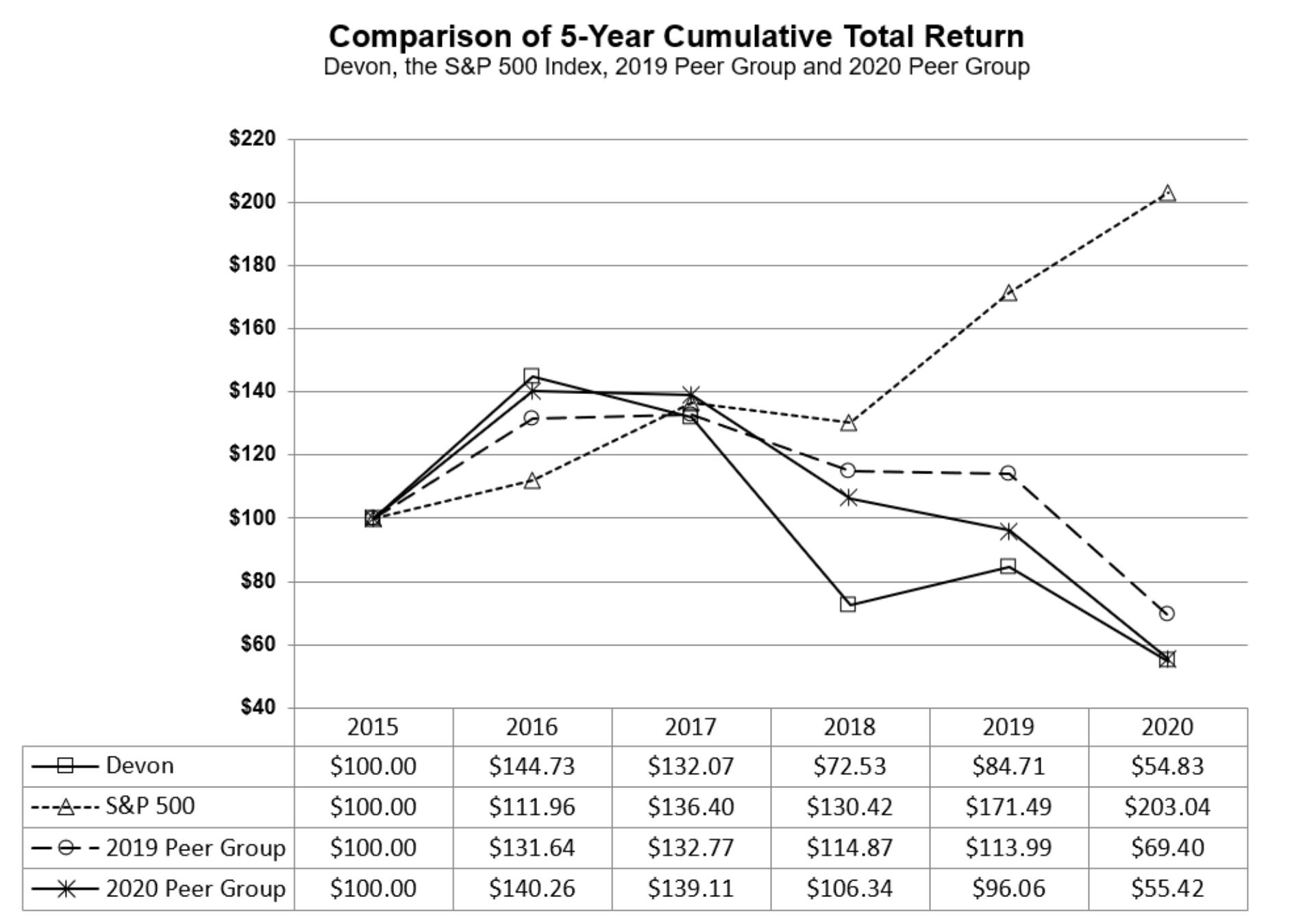
The graph and related information should not be deemed “soliciting material” or to be “filed” with the SEC, nor should such information be incorporated by reference into any future filing under the Securities Act of 1933, as amended, or the Securities Exchange Act of 1934, as amended, except to the extent that we specifically incorporate such information by reference into such a filing. The graph and information are included for historical comparative purposes only and should not be considered indicative of future stock performance.
Issuer Purchases of Equity Securities
The following table provides information regarding purchases of our common stock that were made by us during the fourth quarter of 2020 (shares in thousands).
| Period | Total Number of Shares Purchased (1) | Average Price Paid per Share | Total Number of Shares Purchased As Part of Publicly Announced Plans or Programs (2) | Maximum Dollar Value of Shares that May Yet Be Purchased Under the Plans or Programs (2) | ||||||||||||
|---|---|---|---|---|---|---|---|---|---|---|---|---|---|---|---|---|
| October 1 - October 31 | 63 | $ | 8.98 | — | $ | 962 | ||||||||||
| November 1 - November 30 | 17 | $ | 14.41 | — | $ | 962 | ||||||||||
| December 1 - December 31 | 8 | $ | 14.93 | — | $ | — | ||||||||||
| Total | 88 | $ | 10.58 | — |
| (1) | These amounts reflect the shares received by us from employees for the payment of personal income tax withholding on vesting transactions. |
|---|
| (2) | On December 17, 2019, we announced a $1.0 billion share repurchase program that expired on December 31, 2020. We repurchased 2.2 million common shares for $38 million, or $16.85 per share, under this share repurchase program. For additional information, see Note 18 in “Item 8. Financial Statements and Supplementary Data” of this report. |
|---|
Under the Devon Plan, eligible employees previously had the option to purchase shares of our common stock through an investment in the Devon Stock Fund, which is administered by an independent trustee. Eligible employees purchased approximately 14,000 shares of our common stock in 2020, at then-prevailing stock prices, that they held through their ownership in the Devon Stock Fund. We acquired the shares of our common stock sold under this plan through open-market purchases.
Item 6. Selected Financial Data
Not applicable.
Item 7. Management’s Discussion and Analysis of Financial Condition and Results of Operations
Introduction
The following discussion and analysis presents management’s perspective of our business, financial condition and overall performance. This information is intended to provide investors with an understanding of our past performance, current financial condition and outlook for the future and should be read in conjunction with “Item 8. Financial Statements and Supplementary Data” of this report.
The following discussion and analyses generally focus on 2020 and 2019 items and year-to-year comparisons between 2020 and 2019. Discussions of 2018 items and year-to-year comparisons between 2019 and 2018 that are not included in this report can be found in “Management’s Discussion and Analysis of Financial Condition and Results or Operations” in Part II, Item 7 of our 2019 Annual Report on Form 10-K.
COVID – 19
A novel strain of coronavirus, SARS-CoV-2, causing a disease referred to as COVID-19, was reported to have surfaced in China in late 2019 and has subsequently spread worldwide, resulting in a global pandemic and health crisis. Devon began actively monitoring COVID-19 in January 2020 and formally established a COVID-19 cross-functional planning team at the beginning of March. The COVID-19 team is focused on two key priorities: the health and safety of our employees and contractors and the uninterrupted operation of our business.
| • | Health and safety – The COVID-19 team has developed and implemented a number of safety measures, which have successfully kept our workforce healthy and safe. The COVID-19 team has established an informational campaign to provide employees an understanding of the virus risk factors and safety measures, as well as timely updates from governmental stay-at-home regulations. Expectations have also been set for employees to communicate immediately if they, or someone they have been in contact with, has experienced symptoms or tested positive for COVID-19. Other measures have included closing all of Devon’s office buildings and locations to the public, implementing social distancing and encouraging employees to work from home. Beginning in late March, more than 90% of the workforce assigned to Devon’s Oklahoma City Headquarters office were primarily working from home until the vast majority began a hybrid schedule of working from home and the office late in the second quarter. The COVID-19 team also strongly encourages employees to wear masks, reinforces social distancing measures and continues to perform targeted and routine intensive and deep cleaning of all Devon office locations. |
|---|
| • | Uninterrupted operation of our business – Beyond workforce safety measures, the COVID-19 team has worked with government officials to ensure our business continues to be deemed an essential business or infrastructure. The COVID-19 team has ensured technology and resources are available for employees to execute their job duties while working from home and implemented further social distancing and contactless initiatives in our oil and gas field operations. The collective efforts of our COVID-19 team and our entire workforce have enabled us to avoid the need to implement COVID-19 containment or mitigation measures, which would require closure or suspension of any of our operations. |
|---|
This outbreak and the related responses of governmental authorities and others to limit the spread of the virus have significantly reduced global economic activity, resulting in an unprecedented decline in the demand for oil and other commodities. This supply-and-demand imbalance was exacerbated by uncertainty regarding the future global supply of oil due to disputes between Russia and the members of OPEC in March 2020. These factors caused a swift and material deterioration in commodity prices in early 2020, with NYMEX WTI oil prices falling from a high of over $60/Bbl at the beginning of the year to below $20/Bbl in April 2020. By the end of 2020, NYMEX WTI oil prices recovered to approximately $50/Bbl, and we expect oil and other commodity prices to remain volatile for the foreseeable future.
Overview of 2020 Results
Driven by the coronavirus pandemic, 2020 was a challenging year for the oil and gas industry and our business. Social distancing restrictions, government lockdowns and individual behavior changes all reduced transportation needs, which negatively impacted the demand for oil. The resulting drop in oil prices and cash generated from our operations necessitated a change in our plans. We aggressively reduced our planned capital investment 45%, selectively curtailed production and initiated sustainable cost-reduction measures. Despite these challenges, we continued to improve our capital efficiency and controllable costs per unit of production. Importantly, we maintained competitive leverage and debt metrics.
These market forces led to opportunities for select companies in our industry to create shareholder value from mergers and acquisitions. And, on September 26, 2020, we entered into the Merger Agreement, providing for an all-stock merger of equals with WPX which successfully closed on January 7, 2021. The Merger has created a leading oil producer in the U.S., with an asset base underpinned by premium acreage in the economic core of the Delaware Basin. This strategic combination accelerates our transition to a cash-return business model, including the implementation of a fixed plus variable dividend strategy.
As evidenced by our recent performance highlights below, we remain focused on building economic value by executing on our strategic priorities of disciplined oil volume growth while cutting operational and corporate costs, reducing reinvestment rates to maximize free cash flow, maintaining low leverage, delivering cash returns to our shareholders and pursuing ESG excellence. As we capture synergies and other benefits from the Merger, we expect to improve across all these performance measures.
| • | 2020 oil production totaled 155 MBbls/d, exceeding our plan by 5%. |
|---|
| • | Operating costs continued to decline in 2020, led by a 29% and 6% decrease from 2019 for G&A and production expenses, respectively. |
|---|
| • | Reduced workforce to reflect lower and sustainable capital investment program. |
|---|
| • | Closed on the Barnett Shale transaction on October 1, 2020, receiving net proceeds of $490 million. |
|---|
| • | Paid a special dividend of $0.26 per share for approximately $100 million on October 1, 2020. |
|---|
| • | Remained focused on reducing methane emissions and greenhouse gas while also increasing water recycling. |
|---|
| • | Exited 2020 with $5.2 billion of liquidity, including $2.2 billion of cash, with no near-term debt maturities. |
|---|
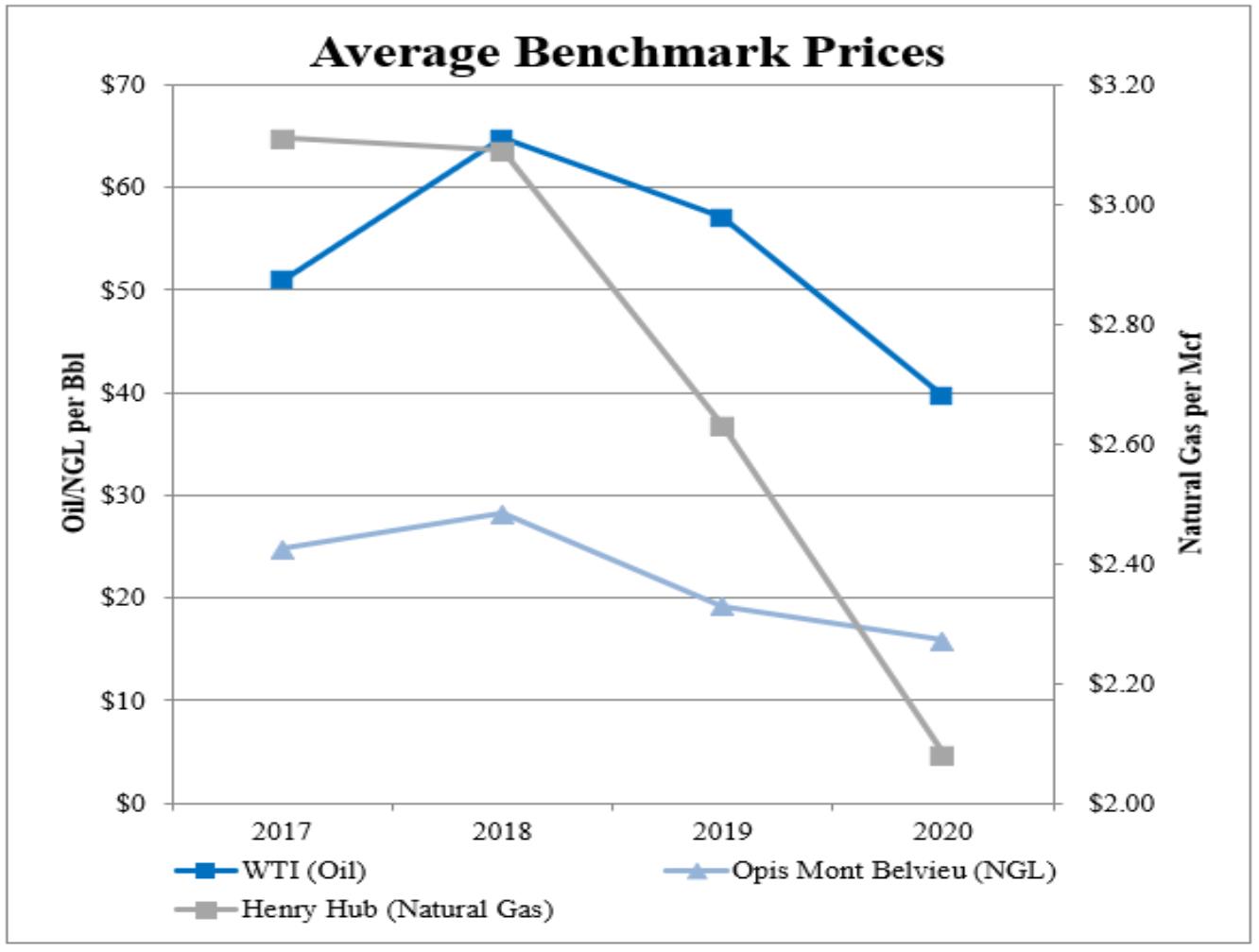 | As presented in the graph at the left, our operating achievements are subject to the volatility of commodity prices. Over the last four years, NYMEX WTI oil and NYMEX Henry Hub gas prices ranged from average highs of $64.79 per Bbl and $3.11 per MMBtu, respectively, to average lows of $39.59 per Bbl and $2.08 per MMBtu, respectively. | |
|---|---|---|
Trends of our annual earnings, operating cash flow, EBITDAX and capital expenditures are shown below. The annual earnings chart presents amounts pertaining to both Devon’s continuing and discontinued operations. The annual cash flow chart presents amounts pertaining to Devon’s continuing operations. “Core earnings” and “EBITDAX” are financial measures not prepared in accordance with GAAP. For a description of these measures, including reconciliations to the comparable GAAP measures, see “Non-GAAP Measures” in
Showing the first 8K of 84K characters. Open the full section
Item 7A. Quantitative and Qualitative Disclosures about Market Risk
The primary objective of the following information is to provide forward-looking quantitative and qualitative information about our potential exposure to market risks. The term “market risk” refers to our risk of loss arising from adverse changes in oil, gas and NGL prices, interest rates and foreign currency exchange rates. The following disclosures are not meant to be precise indicators of expected future losses but rather indicators of reasonably possible losses. This forward-looking information provides indicators of how we view and manage our ongoing market risk exposures. All of our market risk sensitive instruments were entered into for purposes other than speculative trading.
Commodity Price Risk
Our major market risk exposure is the pricing applicable to our oil, gas and NGL production. Realized pricing is primarily driven by the prevailing worldwide price for crude oil and spot market prices applicable to our gas and NGL production. Pricing for oil and gas production has been volatile and unpredictable as discussed in “Item 1A. Risk Factors” of this report. Consequently, we systematically hedge a portion of our production through various financial transactions. The key terms to our oil and gas derivative financial instruments as of December 31, 2020 are presented in Note 3 in “Item 8. Financial Statements and Supplementary Data” of this report.
The fair values of our commodity derivatives are largely determined by estimates of the forward curves of the relevant price indices. At December 31, 2020, a 10% change in the forward curves associated with our commodity derivative instruments would have changed our net liability positions by approximately $118 million.
Interest Rate Risk
At December 31, 2020, we had total debt of $4.3 billion. All of our debt is based on fixed interest rates averaging 6.0%.
Foreign Currency Risk
Devon has certain Canadian dollar obligations associated with its divested Canadian operations which are to be paid with the cash restricted for retained obligations. These balances are remeasured using the applicable exchange rate as of the end of the reporting period. A 10% unfavorable change in the Canadian-to-U.S. dollar exchange rate would not have materially impacted our December 31, 2020 balance sheet for these items. See Note 19 in “Item 8. Financial Statements and Supplementary Data” in this report for additional information.
Item 8. Financial Statements and Supplementary Data
INDEX TO CONSOLIDATED FINANCIAL STATEMENTS
AND CONSOLIDATED FINANCIAL STATEMENT SCHEDULES
All financial statement schedules are omitted as they are inapplicable or the required information has been included in the consolidated financial statements or notes thereto.
Report of Independent Registered Public Accounting Firm
To the Stockholders and Board of Directors
Devon Energy Corporation:
Opinions on the Consolidated Financial Statements and Internal Control Over Financial Reporting
We have audited the accompanying consolidated balance sheets of Devon Energy Corporation and subsidiaries (the Company) as of December 31, 2020 and 2019, the related consolidated statements of comprehensive earnings, equity, and cash flows for each of the years in the three-year period ended December 31, 2020, and the related notes (collectively, the consolidated financial statements). We also have audited the Company’s internal control over financial reporting as of December 31, 2020, based on criteria established in Internal Control – Integrated Framework (2013) issued by the Committee of Sponsoring Organizations of the Treadway Commission.
In our opinion, the consolidated financial statements referred to above present fairly, in all material respects, the financial position of the Company as of December 31, 2020 and 2019, and the results of its operations and its cash flows for each of the years in the three-year period ended December 31, 2020, in conformity with U.S. generally accepted accounting principles. Also in our opinion, the Company maintained, in all material respects, effective internal control over financial reporting as of December 31, 2020 based on criteria established in Internal Control – Integrated Framework (2013) issued by the Committee of Sponsoring Organizations of the Treadway Commission.
Change in Accounting Principles
As discussed in Note 1 to the consolidated financial statements, the Company has changed its method of accounting for leases in 2019 due to the adoption of Accounting Standards Update 2016-02, Leases (Topic 842).
Basis for Opinions
The Company’s management is responsible for these consolidated financial statements, for maintaining effective internal control over financial reporting, and for its assessment of the effectiveness of internal control over financial reporting, included in the accompanying Management’s Annual Report on Internal Control Over Financial Reporting contained in “Item 9A. Controls and Procedures.” Our responsibility is to express an opinion on the Company’s consolidated financial statements and an opinion on the Company’s internal control over financial reporting based on our audits. We are a public accounting firm registered with the Public Company Accounting Oversight Board (United States) (PCAOB) and are required to be independent with respect to the Company in accordance with the U.S. federal securities laws and the applicable rules and regulations of the Securities and Exchange Commission and the PCAOB.
We conducted our audits in accordance with the standards of the PCAOB. Those standards require that we plan and perform the audits to obtain reasonable assurance about whether the consolidated financial statements are free of material misstatement, whether due to error or fraud, and whether effective internal control over financial reporting was maintained in all material respects.
Our audits of the consolidated financial statements included performing procedures to assess the risks of material misstatement of the consolidated financial statements, whether due to error or fraud, and performing procedures that respond to those risks. Such procedures included examining, on a test basis, evidence regarding the amounts and disclosures in the consolidated financial statements. Our audits also included evaluating the accounting principles used and significant estimates made by management, as well as evaluating the overall presentation of the consolidated financial statements. Our audit of internal control over financial reporting included obtaining an understanding of internal control over financial reporting, assessing the risk that a material weakness exists, and testing and evaluating the design and operating effectiveness of internal control based on the assessed risk. Our audits also included performing such other procedures as we considered necessary in the circumstances. We believe that our audits provide a reasonable basis for our opinions.
Definition and Limitations of Internal Control Over Financial Reporting
A company’s internal control over financial reporting is a process designed to provide reasonable assurance regarding the reliability of financial reporting and the preparation of financial statements for external purposes in accordance with generally accepted accounting principles. A company’s internal control over financial reporting includes those policies and procedures that (1) pertain to the maintenance of records that, in reasonable detail, accurately and fairly reflect the transactions and dispositions of the assets of the company; (2) provide reasonable assurance that transactions are recorded as necessary to permit preparation of financial statements in accordance with generally accepted accounting principles, and that receipts and expenditures of the company are being made only in accordance with authorizations of management and directors of the company; and (3) provide reasonable assurance regarding prevention or timely detection of unauthorized acquisition, use, or disposition of the company’s assets that could have a material effect on the financial statements.
Because of its inherent limitations, internal con
Showing the first 8K of 198K characters. Open the full section
Item 9. Changes in and Disagreements with Accountants on Accounting and Financial Disclosure
Not applicable.
Item 9A. Controls and Procedures
Disclosure Controls and Procedures
We have established disclosure controls and procedures to ensure that material information relating to Devon, including its consolidated subsidiaries, is made known to the officers who certify Devon’s financial reports and to other members of senior management and the Board of Directors.
Based on their evaluation, our principal executive and principal financial officers have concluded that our disclosure controls and procedures (as defined in Rules 13a-15(e) and 15d-15(e) under the Securities Exchange Act of 1934) were effective as of December 31, 2020 to ensure that the information required to be disclosed by Devon in the reports that it files or submits under the Securities Exchange Act of 1934 is recorded, processed, summarized and reported within the time periods specified in the SEC rules and forms.
Management’s Annual Report on Internal Control Over Financial Reporting
Our management is responsible for establishing and maintaining adequate internal control over financial reporting for Devon, as such term is defined in Rules 13a-15(f) and 15d-15(f) under the Securities Exchange Act of 1934. Under the supervision and with the participation of Devon’s management, including our principal executive and principal financial officers, we conducted an evaluation of the effectiveness of our internal control over financial reporting based on the framework in Internal Control – Integrated Framework issued in 2013 by the Committee of Sponsoring Organizations of the Treadway Commission (the “2013 COSO Framework”). Based on this evaluation under the 2013 COSO Framework, which was completed on February 17, 2021, management concluded that its internal control over financial reporting was effective as of December 31, 2020.
The effectiveness of our internal control over financial reporting as of December 31, 2020 has been audited by KPMG LLP, an independent registered public accounting firm who audited our consolidated financial statements as of and for the year ended December 31, 2020, as stated in their report, which is included under “Item 8. Financial Statements and Supplementary Data” of this report.
Changes in Internal Control Over Financial Reporting
There was no change in our internal control over financial reporting during the fourth quarter of 2020 that has materially affected, or is reasonably likely to materially affect, our internal control over financial reporting.
Item 9B. Other Information
On December 30, 2020, Devon held a special meeting of stockholders (the “Meeting”) to consider and approve the issuance of shares of Devon common stock in the Merger (the “Stock Issuance”). More than 70% of the outstanding shares of Devon common stock were present at the Meeting, and over 99% of the votes cast were in favor of approval of the Stock Issuance. During the weeks following the closing of the Merger, Devon learned that several stockholders had received their proxy materials for the Meeting after the date of the Meeting. Upon investigation, Devon learned that, while the electronic distribution of proxy materials to stockholders had been timely completed, certain stockholders who were to receive proxy materials by mail had not timely received those materials. The company retained by Devon to process and distribute proxy materials for the Meeting has indicated that, contrary to prior communication on the subject, certain of the proxy materials were not timely delivered to the U.S. Postal Service, resulting in late delivery of such proxy materials to the holders of less than 15% of the outstanding shares of Devon common stock, including record holders of approximately 0.55% of the outstanding
shares. In light of Devon’s good faith belief that the proxy materials had been mailed, the overwhelming vote by the Devon stockholders in favor of approval of the Stock Issuance proposal at the Meeting, which approval could not have been altered by the votes of the affected stockholders, and the closing of the Merger and other significant actions taken in reliance upon the approval of the Stock Issuance at the Meeting, Devon is filing an application with the Delaware Chancery Court under Section 205 of the Delaware General Corporation Law seeking an order confirming the validity of the Meeting and the notice of meeting issued in connection therewith.
PART III
Item 10. Directors, Executive Officers and Corporate Governance
The information called for by this Item 10 is incorporated herein by reference to the definitive Proxy Statement to be filed by Devon pursuant to Regulation 14A of the General Rules and applicable information in Regulations under the Securities Exchange Act of 1934 no later than 120 days following the fiscal year ended December 31, 2020.
Item 11. Executive Compensation
The information called for by this Item 11 is incorporated herein by reference to the definitive Proxy Statement to be filed by Devon pursuant to Regulation 14A of the General Rules and applicable information in Regulations under the Securities Exchange Act of 1934 no later than 120 days following the fiscal year ended December 31, 2020.
Item 12. Security Ownership of Certain Beneficial Owners and Management and Related Stockholder Matters
The information called for by this Item 12 is incorporated herein by reference to the definitive Proxy Statement to be filed by Devon pursuant to Regulation 14A of the General Rules and applicable information in Regulations under the Securities Exchange Act of 1934 no later than 120 days following the fiscal year ended December 31, 2020.
Item 13. Certain Relationships and Related Transactions, and Director Independence
The information called for by this Item 13 is incorporated herein by reference to the definitive Proxy Statement to be filed by Devon pursuant to Regulation 14A of the General Rules and applicable information in Regulations under the Securities Exchange Act of 1934 no later than 120 days following the fiscal year ended December 31, 2020.
Item 14. Principal Accountant Fees and Services
The information called for by this Item 14 is incorporated herein by reference to the definitive Proxy Statement to be filed by Devon pursuant to Regulation 14A of the General Rules and applicable information in Regulations under the Securities Exchange Act of 1934 no later than 120 days following the fiscal year ended December 31, 2020.
PART IV
Item 15. Exhibits and Financial Statement Schedules
(a) The following documents are included as part of this report:
- Consolidated Financial Statements
Reference is made to the Index to Consolidated Financial Statements and Consolidated Financial Statement Schedules appearing at “Item 8. Financial Statements and Supplementary Data” in this report.
- Consolidated Financial Statement Schedules
All financial statement schedules are omitted as they are inapplicable, or the required information has been included in the consolidated financial statements or notes thereto.
- Exhibits
| Exhibit No. | Description | |
|---|---|---|
| 2.1 | Purchase Agreement, dated June 5, 2018, by and among Devon Gas Services, L.P. and Southwestern Gas Pipeline, L.L.C., as sellers, and Enlink Midstream Manager, LLC, Registrant, and GIP III Stetson I, L.P. and GIP III Stetson II, L.P., as acquirors (incorporated by reference to Exhibit 2.1 to Registrant’s Form 8-K filed June 7, 2018; File No. 001-32318). | |
| 2.2 | Agreement of Purchase and Sale, dated as of May 28, 2019, among Devon Canada Corporation, Devon Canada Crude Marketing Corporation and Canadian Natural Resources Limited (incorporated by reference to Exhibit 2.1 to Registrant’s Form 8-K filed May 31, 2019; File No. 001-32318). | |
| 2.3 | Purchase and Sale Agreement, dated December 17, 2019, by and between Devon Energy Production Company, L.P. and BKV Barnett, LLC (incorporated by reference to Exhibit 2.1 to Registrant’s Form 8-K filed December 18, 2019; File No. 001-32318).* | |
| 2.4 | First Amendment to Purchase and Sale Agreement, dated April 13, 2020, by and between Devon Energy Production Company, L.P., BKV Barnett, LLC, and solely with respect to certain provisions therein, BKV Oil & Gas Capital Partners, L.P. (incorporated by reference to Exhibit 2.1 to Registrant’s Current Report on Form 8-K filed April 14, 2020; File No. 001-32318). | |
| 2.5 | Agreement and Plan of Merger, dated September 26, 2020, by and among Registrant, East Merger Sub, Inc., and WPX Energy, Inc. (incorporated by reference to Exhibit 2.1 to Registrant’s Current Report on Form 8-K, filed September 28, 2020; File No. 001-32318). | |
| 3.1 | Registrant’s Restated Certificate of Incorporation (incorporated by reference to Exhibit 3.1 of Registrant’s Form 10-K filed February 21, 2013; File No. 001-32318). | |
| 3.2 | Registrant’s Bylaws (incorporated by reference to Exhibit 3.1 of Registrant’s Form 8-K filed January 27, 2016; File No. 001-32318). | |
| 4.1 | Indenture, dated as of July 12, 2011, between Registrant and UMB Bank, National Association, as Trustee (incorporated by reference to Exhibit 4.1 to Registrant’s Form 8-K filed July 12, 2011; File No. 001-32318). | |
| 4.2 | Supplemental Indenture No. 1, dated as of July 12, 2011, to Indenture dated as of July 12, 2011, between Registrant and UMB Bank, National Association, as Trustee, relating to the 5.60% Senior Notes due 2041 (incorporated by reference to Exhibit 4.2 to Registrant’s Form 8-K filed July 12, 2011; File No. 001-32318). |
| Exhibit No. | Description | |
|---|---|---|
| 4.3 | Supplemental Indenture No. 2, dated as of May 14, 2012, to Indenture dated as of July 12, 2011, between Registrant and UMB Bank, National Association, as Trustee, relating to the 4.750% Senior Notes due 2042 (incorporated by reference to Exhibit 4.1 to Registrant’s Form 8-K filed May 14, 2012; File No. 001-32318). | |
| 4.4 | Supplemental Indenture No. 4, dated as of June 16, 2015, to Indenture dated as of July 12, 2011, between Registrant and UMB Bank, National Association, as Trustee, relating to the 5.000% Senior Notes due 2045 (incorporated by reference to Exhibit 4.1 to Registrant’s Form 8-K filed June 16, 2015; File No. 001-32318). | |
| 4.5 | Supplemental Indenture No. 5, dated as of December 15, 2015, to Indenture dated as of July 12, 2011, between Registrant and UMB Bank, National Association, as Trustee, relating to the 5.850% Senior Notes due 2025 (incorporated by reference to Exhibit 4.1 to Registrant’s Form 8-K filed December 15, 2015; File No. 001-32318). | |
| 4.6 | Indenture, dated as of March 1, 2002, between Registrant and The Bank of New York Mellon Trust Company, N.A. (as successor to The Bank of New York), as Trustee (incorporated by reference to Exhibit 4.1 of Registrant’s Form 8-K filed April 9, 2002; File No. 000-30176). | |
| 4.7 | Supplemental Indenture No. 1, dated as of March 25, 2002, to Indenture dated as of March 1, 2002, between Registrant and The Bank of New York Mellon Trust Company, N.A., as Trustee, relating to the 7.95% Senior Debentures due 2032 (incorporated by reference to Exhibit 4.2 to Registrant’s Form 8-K filed April 9, 2002; File No. 000-30176). | |
| 4.8 | Supplemental Indenture No. 4, dated as of March 22, 2018, to Indenture dated as of March 1, 2002, between Registrant and The Bank of New York Mellon Trust Company, N.A., as Trustee, relating to the 7.95% Senior Notes due 2032 (incorporated by reference to Exhibit 4.1 to Registrant’s Form 8-K filed March 22, 2018; File No. 000-32318). | |
| 4.9 | Indenture, dated as of October 3, 2001, among Devon Financing Company, L.L.C. (f/k/a Devon Financing Corporation, U.L.C.), as Issuer, Registrant, as Guarantor, and The Bank of New York Mellon Trust Company, N.A., originally The Chase Manhattan Bank, as Trustee, relating to the 7.875% Debentures due 2031 (incorporated by reference to Exhibit 4.7 to Registrant’s Registration Statement on Form S-4 filed October 31, 2001; File No. 333-68694). | |
| 4.10 | Assignment and Assumption Agreement, dated as of June 19, 2019, by and between Devon Financing Company, L.L.C. and Registrant, relating to that certain Indenture, dated as of October 3, 2001, by and among Devon Financing Company, L.L.C. (f/k/a Devon Financing Company, U.L.C.), as Issuer, Devon Energy Corporation, as Guarantor, and The Bank of New York Mellon Trust Company, N.A., as successor to The Chase Manhattan Bank, as Trustee, and the 7.875% Debentures due 2031 issued thereunder (incorporated by reference to Exhibit 4.1 to Registrant’s Form 10-Q filed August 7, 2019; File No. 001-32318). | |
| 4.11 | Senior Indenture, dated as of September 1, 1997, between Devon OEI Operating, L.L.C. (as successor to Seagull Energy Corporation) and The Bank of New York Mellon Trust Company, N.A. (as successor to The Bank of New York), as Trustee, and related Specimen of 7.50% Senior Notes due 2027 (incorporated by reference to Exhibit 4.4 to Ocean Energy Inc.’s Form 10-K filed March 23, 1998; File No. 001-08094). | |
| 4.12 | First Supplemental Indenture, dated as of March 30, 1999, to Senior Indenture dated as of September 1, 1997, by and among Devon OEI Operating, L.L.C., its Subsidiary Guarantor, and The Bank of New York Mellon Trust Company, N.A., as Trustee, relating to the 7.50% Senior Notes due 2027 (incorporated by reference to Exhibit 4.10 to Ocean Energy, Inc.’s Form 10-Q filed May 17, 1999; File No. 001-08094). |
| Exhibit No. | Description | |
|---|---|---|
| 4.13 | Second Supplemental Indenture, dated as of May 9, 2001, to Senior Indenture dated as of September 1, 1997, by and among Devon OEI Operating, L.L.C., its Subsidiary Guarantor, and The Bank of New York Mellon Trust Company, N.A., as Trustee, relating to the 7.50% Senior Notes due 2027 (incorporated by reference to Exhibit 99.4 to Ocean Energy, Inc.’s Form 8-K filed May 14, 2001; File No. 033-06444). | |
| 4.14 | Third Supplemental Indenture, dated as of December 31, 2005, to Senior Indenture dated as of September 1, 1997, by and among Devon OEI Operating, L.L.C., as Issuer, Devon Energy Production Company, L.P., as Successor Guarantor, and The Bank of New York Mellon Trust Company, N.A., as Trustee, relating to the 7.50% Senior Notes due 2027 (incorporated by reference to Exhibit 4.27 of Registrant’s Form 10-K filed March 3, 2006; File No. 001-32318). | |
| 4.15 | Stockholders’ Agreement, by and among Devon Energy Corporation, Felix Investment Holdings II, LLC, and EnCap Energy Capital Fund X, L.P., dated January 7, 2021. (incorporated by reference to Exhibit 10.1 to Registrant’s Current Report on Form 8-K filed January 7, 2021; File No. 001-32318). | |
| 4.16 | Registration Rights Agreement, by and between Devon Energy Corporation and Felix Investment Holdings II, LLC, dated January 7, 2021 (incorporated by reference to Exhibit 10.2 to Registrant’s Form 8-K filed January 7, 2021; File No. 001-32318). | |
| 4.17 | Indenture, dated as of September 8, 2014, between WPX Energy, Inc. and The Bank of New York Mellon Trust Company, N.A., as trustee (incorporated herein by reference to Exhibit 4.1 to WPX Energy, Inc.’s Form 8-K filed September 8, 2014; File No. 001-35322). | |
| 4.18 | First Supplemental Indenture, dated as of September 8, 2014, between WPX Energy, Inc. and The Bank of New York Mellon Trust Company, N.A., as trustee, relating to the 5.25% Senior Notes due 2024 (incorporated herein by reference to Exhibit 4.2 to WPX Energy, Inc.’s Form 8-K filed September 8, 2014; File No. 001-35322). | |
| 4.19 | Second Supplemental Indenture, dated as of July 22, 2015, between WPX Energy, Inc. and The Bank of New York Mellon Trust Company, N.A., as trustee, relating to the 8.25% Senior Notes due 2023 (incorporated herein by reference to Exhibit 4.1 to WPX Energy, Inc.’s Form 8-K filed July 22, 2015; File No. 001-35322). | |
| 4.20 | Third Supplemental Indenture, dated as of May 23, 2018, between WPX Energy, Inc. and The Bank of New York Mellon Trust Company, N.A. as trustee, relating to the 5.750% Senior Notes due 2026 (incorporated herein by reference to Exhibit 4.1 to WPX Energy, Inc.’s Form 8-K filed May 23, 2018; File No. 001-35322). | |
| 4.21 | Fourth Supplemental Indenture, dated as of September 24, 2019, between WPX Energy, Inc. and The Bank of New York Mellon Trust Company, N.A. as trustee, relating to the 5.250% Senior Notes due 2027 (incorporated herein by reference to Exhibit 4.1 to WPX Energy, Inc.'s Form 8-K filed with the SEC on September 24, 2019; File No. 001-35322). | |
| 4.22 | Fifth Supplemental Indenture, dated as of January 10, 2020, between WPX Energy, Inc. and The Bank of New York Mellon Trust Company, N.A. as trustee, relating to the 4.500% Senior Notes due 2030 (incorporated herein by reference to Exhibit 4.1 to WPX Energy, Inc.’s Form 8-K filed June 17, 2020; File No. 001-35322). | |
| 4.23 | Sixth Supplemental Indenture, dated as of June 17, 2020, between WPX Energy, Inc. and the Bank of New York Mellon Trust Company, N.A. as trustee, related to the 5.875% Senior Notes due 2028 (incorporated herein by reference to Exhibit 4.1 to WPX Energy, Inc.’s Form 8-K filed January 10, 2020; File No. 001-35322). | |
| 4.24 | Description of Securities Registered under Section 12 of the Securities Exchange Act of 1934. |
| Exhibit No. | Description | |
|---|---|---|
| 10.1 | Credit Agreement, dated as of October 5, 2018, among Registrant, as U.S. Borrower, Devon Canada Corporation, as Canadian Borrower, Bank of America, N.A., as Administrative Agent, Swing Line Lender and an L/C Issuer, and each Lender and L/C Issuer from time to time party thereto (incorporated by reference to Exhibit 10.1 of Registrant’s Form 8-K filed October 9, 2018; File No. 001-32318). | |
| 10.2 | First Amendment to Credit Agreement and Extension Agreement, dated as of December 13, 2019, by and among Registrant, as U.S. Borrower, Devon Canada Corporation, as Canadian Borrower, Bank of America, N.A., individually and as Administrative Agent, and the Lenders party thereto (incorporated by reference to Exhibit 10.2 to Registrant’s Form 10-K filed February 19, 2020; File No. 001-32318). | |
| 10.3 | Devon Energy Corporation 2009 Long-Term Incentive Plan (as amended and restated effective June 6, 2012) (incorporated by reference to Exhibit 10.2 to the Registrant’s Form 8-K filed June 8, 2012; File No. 001-32318).** | |
| 10.4 | 2013 Amendment (effective as of March 6, 2013) to the Devon Energy Corporation 2009 Long-Term Incentive Plan (as amended and restated effective June 6, 2012) (incorporated by reference to Exhibit 10.1 to Registrant’s Form 10-Q filed May 1, 2013; File No. 001-32318).** | |
| 10.5 | Devon Energy Corporation 2015 Long-Term Incentive Plan (incorporated by reference to Exhibit 99.1 to Registrant’s Form S-8 filed June 3, 2015; File No. 333-204666).** | |
| 10.6 | Devon Energy Corporation 2017 Long-Term Incentive Plan (incorporated by reference to Exhibit 99.1 to Registrant’s Form S-8 filed June 7, 2017; File No. 333-218561).** | |
| 10.7 | 2021 Amendment (effective as of January 7, 2021) to the Devon Energy Corporation 2017 Long-Term Incentive Plan.** | |
| 10.8 | WPX Energy, Inc. 2013 Incentive Plan, and amendments No. 1 and No. 2 thereto (incorporated by reference to Exhibit 10.1 to WPX Energy, Inc.’s Form 8-K filed with the SEC on February 19, 2018; File No. 001-35322).** | |
| 10.9 | Amendment No. 3 to the WPX Energy, Inc. 2013 Incentive Plan (incorporated by reference to Appendix A to WPX Energy, Inc.’s definitive proxy statement on Schedule 14A filed March 29, 2018; File No. 001-35322).** | |
| 10.10 | Devon Energy Corporation Annual Incentive Compensation Plan (amended and restated effective as of January 1, 2017) (incorporated by reference to Exhibit 10.1 to Registrant’s Form 8-K filed June 12, 2017; File No. 001-32318).** | |
| 10.11 | Devon Energy Corporation Non-Qualified Deferred Compensation Plan (amended and restated effective as of April 15, 2014) (incorporated by reference to Exhibit 10.1 to Registrant’s Form 10-Q filed August 6, 2014; File No. 001-32318).** | |
| 10.12 | Amendment 2014-2, executed May 9, 2014, to the Devon Energy Corporation Non-Qualified Deferred Compensation Plan (incorporated by reference to Exhibit 10.11 to Registrant’s Form 10-K filed February 20, 2015; File No. 001-32318).** | |
| 10.13 | Amendment 2016-1, executed October 20, 2016, to the Devon Energy Corporation Non-Qualified Deferred Compensation Plan (incorporated by reference to Exhibit 10.13 to Registrant’s Form 10-K filed February 15, 2017; File No. 001-32318).** | |
| 10.14 | Amendment 2018-1, executed August 21, 2018, to the Devon Energy Corporation Non-Qualified Deferred Compensation Plan (incorporated by reference to Exhibit 10.10 to Registrant’s Form 10-K filed February 20, 2019; File No. 001-32318).** | |
| 10.15 | Amendment 2020-1, executed December 23, 2020, to the Devon Energy Corporation Non-Qualified Deferred Compensation Plan.** |
| Exhibit No. | Description | |
|---|---|---|
| 10.63 | 2017 Form of Notice of Grant of Performance Restricted Stock Award and Award Agreement under the 2015 Long-Term Incentive Plan between Registrant and executive officers for performance based restricted stock awarded (incorporated by reference to Exhibit 10.1 to Registrant’s Form 10-Q filed May 3, 2017; File No. 001-32318).** | |
| 10.64 | 2018 Form of Notice of Grant of Restricted Stock Award and Award Agreement under the 2017 Long-Term Incentive Plan between Registrant and executive officers for restricted stock awarded (incorporated by reference to Exhibit 10.1 to Registrant’s Form 10-Q filed on May 2, 2018; File No. 001-32318).** | |
| 10.65 | 2019 Form of Notice of Grant of Restricted Stock Award and Award Agreement under the 2017 Long-Term Incentive Plan between Registrant and executive officers for restricted stock awarded (incorporated by reference to Exhibit 10.1 to Registrant’s Form 10-Q filed May 1, 2019; File No. 001-32318).** | |
| 10.66 | 2020 Form of Notice of Grant of Restricted Stock Award and Award Agreement under the 2017 Long-Term Incentive Plan between Registrant and certain officers for restricted stock awarded (CEO and EVP form) (incorporated by reference to Exhibit 10.1 to Registrant’s Form 10-Q filed May 6, 2020; File No. 001-32318).** | |
| 10.67 | 2020 Form of Notice of Grant of Restricted Stock Award and Award Agreement under the 2017 Long-Term Incentive Plan between Registrant and certain officers for restricted stock awarded (SVP form) (incorporated by reference to Exhibit 10.3 to Registrant’s Form 10-Q filed May 6, 2020; File No. 001-32318).** | |
| 10.68 | 2018 Form of Notice of Grant of Performance Share Unit Award and Award Agreement under the 2017 Long-Term Incentive Plan between Registrant and executive officers for performance based restricted share units awarded (incorporated by reference to Exhibit 10.2 to Registrant’s Form 10-Q filed May 2, 2018; File No. 001-32318).** | |
| 10.69 | 2019 Form of Notice of Grant of Performance Share Unit Award and Award Agreement under the 2017 Long-Term Incentive Plan between Registrant and executive officers for performance based restricted share units awarded (incorporated by reference to Exhibit 10.2 to Registrant’s Form 10-Q filed May 1, 2019; File No. 001-32318).** | |
| 10.70 | 2020 Form of Notice of Grant of Performance Share Unit Award and Award Agreement under the 2017 Long-Term Incentive Plan between Registrant and certain officers for performance based restricted share units awarded (CEO and EVP form) (incorporated by reference to Exhibit 10.2 to Registrant’s Form 10-Q filed May 6, 2020; File No. 001-32318).** | |
| 10.71 | 2020 Form of Notice of Grant of Performance Share Unit Award and Award Agreement under the 2017 Long-Term Incentive Plan between Registrant and certain officers for performance based restricted share units awarded (SVP form) (incorporated by reference to Exhibit 10.4 to Registrant’s Form 10-Q filed May 6, 2020; File No. 001-32318).** | |
| 10.72 | 2020 Form of Notice of Grant of Restricted Stock Award and Award Agreement under the 2017 Long-Term Incentive Plan between Registrant and all non-management directors for restricted stock awarded (incorporated by reference to Exhibit 10.1 to Registrant’s Form 10-Q filed August 5, 2020; File No. 001-32318).** | |
| 10.73 | Form of Restricted Stock Award Agreement between WPX Energy, Inc. and Non-Employee Directors (incorporated herein by reference to Exhibit 10.13 to WPX Energy, Inc.’s Form 10-K filed February 28, 2012; File No. 001-35322).** | |
| 10.74 | Form of Nonqualified Stock Option Agreement between WPX Energy, Inc. and certain executive officers (incorporated herein by reference to Exhibit 10.15 to WPX Energy, Inc.’s Form 10-Q filed May 7, 2014; File No. 001-35322).** |
| Exhibit No. | Description | |
|---|---|---|
| 101.DEF | Inline XBRL Taxonomy Extension Definition Linkbase Document. | |
| 101.LAB | Inline XBRL Taxonomy Extension Labels Linkbase Document. | |
| 101.PRE | Inline XBRL Taxonomy Extension Presentation Linkbase Document. | |
| 104 | Cover Page Interactive Data File (formatted as Inline XBRL and contained in Exhibit 101). |
| * | Portions of this exhibit have been omitted in accordance with Item 601(b)(2)(ii) of Regulation S-K. |
|---|
**Indicates management contract or compensatory plan or arrangement.
Item 16. Form 10-K Summary
Not applicable.
SIG****NATURES
Pursuant to the requirements of Section 13 or 15(d) of the Securities Exchange Act of 1934, the Registrant has duly caused this report to be signed on its behalf by the undersigned, thereunto duly authorized.
| DEVON ENERGY CORPORATION | ||
|---|---|---|
| By: | /s/ JEFFREY L. RITENOUR | |
| Jeffrey L. Ritenour | ||
| Executive Vice President and Chief Financial Officer |
February 17, 2021
Pursuant to the requirements of the Securities Exchange Act of 1934, this report has been signed below by the following persons on behalf of the Registrant and in the capacities and on the dates indicated.
| /s/ RICHARD E. MUNCRIEF | President, Chief Executive Officer and | February 17, 2021 | |
|---|---|---|---|
| Richard E. Muncrief | Director (Principal executive officer) | ||
| /s/ JEFFREY L. RITENOUR | Executive Vice President | February 17, 2021 | |
| Jeffrey L. Ritenour | and Chief Financial Officer (Principal financial officer) | ||
| /s/ JEREMY D. HUMPHERS | Senior Vice President | February 17, 2021 | |
| Jeremy D. Humphers | and Chief Accounting Officer (Principal accounting officer) | ||
| /s/ DAVID A. HAGER | Executive Chairman of the Board | February 17, 2021 | |
| David A. Hager | |||
| /s/ BARBARA M. BAUMANN | Director | February 17, 2021 | |
| Barbara M. Baumann | |||
| /s/ JOHN E. BETHANCOURT | Director | February 17, 2021 | |
| John E. Bethancourt | |||
| /s/ ANN G. FOX | Director | February 17, 2021 | |
| Ann G. Fox | |||
| /s/ KELT KINDICK | Director | February 17, 2021 | |
| Kelt Kindick | |||
| /s/ JOHN KRENICKI JR. | Director | February 17, 2021 | |
| John Krenicki Jr. | |||
| /s/ KARL F. KURZ | Director | February 17, 2021 | |
| Karl F. Kurz | |||
| /s/ ROBERT A. MOSBACHER, JR. | Director | February 17, 2021 | |
| Robert A. Mosbacher, Jr. | |||
| /s/ D. MARTIN PHILLIPS | Director | February 17, 2021 | |
| D. Martin Phillips | |||
| /s/ DUANE C. RADTKE | Director | February 17, 2021 | |
| Duane C. Radtke |
| /s/ VALERIE M. WILLIAMS | Director | February 17, 2021 | |
|---|---|---|---|
| Valerie M. Williams |