 filings.tools
Comfort Systems USA (FIX) 10-K risk factor changes: FY2022 vs FY2021
The 2022-12-31 10-K against the 2021-12-31 one, compared heading by heading and sentence by sentence.
Item 1A51 rewritten31 added40 removed288 unchanged
All filing items751 rewritten299 added502 removed1,620 unchanged
Summary
counted, not written
- Item 1A lists 41 risk factor headings: 2 new, 5 reworded and 34 unchanged since FY2021. 1 heading from FY2021 no longer appears.
- Sentence by sentence, 299 added, 502 removed, 751 rewritten and 1,620 unchanged across 13 items that differ.
New Item 1A headings (2)
- We could be adversely impacted by the effects of inflation, supply chain disruptions, capital market volatility and an economic recession or downturn.
- Third parties contribute significantly to our completion of many projects and labor shortages or increased labor costs from third parties could adversely impact our results of operations.
Removed Item 1A headings (1)
- Third parties contribute significantly to our completion of many projects.
Reworded Item 1A headings (5)
- Rising inflation and/or interest rates
[removed: could][added: may] have an adverse effect on our business, financial condition and results of operations. - Our use of the
[removed: percentage-of-completion][added: cost-to-cost input] method of accounting could result in a reduction or reversal of previously recorded revenue or profits. - If we do not effectively manage [added: our backlog and] the size and cost of our operations, our existing infrastructure may become either strained or over-burdensome, and we may be unable to increase [added: or sustain] revenue growth.
- We have subsidiary operations
[removed: through][added: throughout] the United States and are exposed to multiple state and local regulations, as well as federal laws and requirements applicable to government contractors. Changes in law, regulations or requirements, or a material failure of any of our subsidiaries or us to comply with any of them, could increase our costs and have other negative impacts on our business. - Past and future environmental, [added: social, governance,] safety and health regulations could impose significant additional costs on us that could reduce our profits.
A heading is new when no FY2021 heading matches it after ignoring case and punctuation, and reworded when it shares at least 60 percent of its words with one that went away. All current risk factor headings.
Sentences by item
20 items, with every count and a link to each item that changed
Underlined words on a shaded ground are new in FY2022; struck-through words were in FY2021. Sentences that are wholly new or wholly gone are labelled rather than marked.
Item 1A. Risk Factors
51 rewritten, 31 added, 40 removed, 288 unchanged
Any period of economic [removed: recession, including the ongoing] recession [removed: caused by the Coronavirus Disease 2019 (“COVID-19”) pandemic,] affecting a market or industry in which we transact business is [added: likely to adversely impact our business.]
Additionally, because [removed: 5.7%] [added: 6.2%] of our revenue for the year ended December 31, [removed: 2021] [added: 2022] was attributable to projects in the government sector, a reduction in federal, state, or local government spending in our industries and markets could result in decreased revenue and profit for us.
Our contract prices are established largely based on estimates and assumptions of our projected costs, including assumptions about: future economic conditions; prices, including commodity [removed: prices;] [added: prices and inflation;] availability of labor, including the costs of providing labor, equipment, and materials; and other factors outside our control.
Our backlog as of December 31, [removed: 2021] [added: 2022] was [removed: $2.31] [added: $4.06] billion.
The COVID-19 pandemic has negatively impacted the global economy, [removed: disrupted] [added: affected] consumer spending and global supply chains, and created significant volatility and disruption of financial markets.
The COVID-19 pandemic [removed: and related responses are continuing to evolve and, therefore, continue] [added: continues] to present potential risks to our business, particularly in light of new variants of the [added: virus which have emerged, such as the Omicron variant and the more recent BA.4 and BA.5 sub-variants of the] virus.
The extent of the impact of the COVID-19 pandemic on our business and financial performance, including our ability to execute our near-term and long-term business strategies and initiatives in the expected time frame, depends on numerous evolving factors outside our control including: emergence of new variants of the [removed: virus;] [added: virus and increased transmission rates;] government, social, business and [added: other actions that have been and will be taken in response to the COVID-19 pandemic; additional waves of COVID-19 infections; the efficacy of vaccines on new variants of the virus and overall vaccination rates; the effect of government or customer vaccine or testing requirements on employee retention and recruitment; and the effect of the COVID-19 pandemic on short- and long-term general economic conditions.]
We [removed: have also experienced permitting] [added: continue to experience permitting, regulatory,] and [removed: regulatory] [added: supply chain] delays attributable to the COVID-19 pandemic.
In addition to these current dynamics, the COVID-19 pandemic may create or exacerbate risks related to our operations and regulatory and compliance [removed: matters, including as a result of:][added: matters.]
[removed: Smaller competitors are sometimes able to win bids for these] projects based on price alone due to their lower cost and financial return requirements.
We also expect increased competition from in-house service [removed: providers,] [added: providers] because some of our customers have employees who perform service work similar to the services we provide.
If we are unable to meet these competitive challenges, we will lose market [added: share to our competitors and experience an overall reduction in our profits.]
Our use of the [removed: percentage-of-completion] [added: cost-to-cost input] method of accounting could result in a reduction or reversal of previously recorded revenue or profits.
A material portion of our revenue is recognized using the [removed: percentage-of-completion] [added: cost-to-cost input] method of accounting, which results in our recognizing contract revenue and earnings ratably over the contract term in the proportion that our actual costs bear to our estimated contract costs.
As a result of the requirements of the [removed: percentage-of-completion] [added: cost-to-cost input] method of accounting, the possibility exists, for example, that we could have estimated and reported a profit on a contract over several periods and later determined, usually near contract completion, that all or a portion of such previously estimated and reported profits were overstated.
[removed: Historically] [added: Historically,] surety market conditions have experienced times of difficulty as a result of significant losses incurred by many surety companies and the results of macroeconomic trends outside of our [removed: control.][added: control, such as the current volatility in the capital markets and the possibility of an extended economic downturn or recession.]
The last several years have been periodically marked by political and economic concerns, including the ongoing COVID-19 pandemic, decreased consumer confidence, the [removed: lingering] effects of international [removed: conflicts,] [added: conflicts such as the war between Russia and Ukraine,] tariffs, energy costs and inflation.
Further, ongoing economic instability in the global markets, including from the ongoing COVID-19 pandemic, [added: supply chain disruptions, rising inflation and interest rates and the war between Russia and Ukraine,] could limit our ability to access the capital markets at a time when we would like, or need, to raise capital, which could have an impact on our ability to react to changing business conditions or new opportunities.
Labor shortages, [added: including the current U.S. labor shortage,] increased labor costs or the loss of key personnel [removed: could] [added: may] reduce our profitability and negatively impact our business.
We are a decentralized company and place significant [removed: decision making] [added: decision-making] powers with our subsidiaries’ management, which presents certain risks.
We believe that our practice of placing significant [removed: decision making] [added: decision-making] powers with local management is important to our successful growth and allows us to be responsive to opportunities and to our customers’ needs.
We use and rely significantly on sophisticated information technology systems, networks, and infrastructure in conducting our [removed: day to day] [added: day-to-day] operations, providing services to certain customers and protecting sensitive Company information.
[added: In April 2019, for] example, our information technology infrastructure was impacted by a ransomware attack virus, which caused a substantial majority of our operating locations to experience loss of access to certain data and outages affecting systems including accounting, payroll, billing, job report and management and other software environments.
These disruptions created challenges in key [removed: back office] [added: back-office] functions that required workarounds and alternative procedures.
Our credit agreement and related restrictive and financial covenants are more fully described in Note 9 of “Notes to [removed: the] Consolidated Financial Statements.” Our failure to comply with any of these covenants under the credit agreement, or to pay principal, interest or other amounts when due thereunder, would constitute an event of default under the credit agreement.
If we do not effectively manage [added: our backlog and] the size and cost of our operations, our existing infrastructure may become either strained or over-burdensome, and we may be unable to increase [added: or sustain] revenue growth.
The growth that we have experienced in the past, [added: that we are currently experiencing,] and that we may experience in the future, may provide challenges to our organization, requiring us to expand our personnel and our operations.
[removed: Future growth] [added: Growth] may strain our infrastructure, operations and other managerial and operating resources.
Failing to maintain the appropriate cost structure during a particular economic cycle may result in our incurring costs that affect our [removed: profitability.][added: profitability or failing to be prepared for unprecedented growth.]
Further, we may undertake contractual commitments that exceed our labor, managerial or other resources, which could also adversely affect our earnings and our ability to increase revenue [removed: growth.][added: growth and cause material reputational or other harm.]
[added: Future] legislation could also have an impact on our business.
On March 2, 2020, the United States Supreme Court granted certiorari to review this case, and on June 17, [removed: 2021] [added: 2021,] the U.S. Supreme Court dismissed a challenge on procedural grounds that argued [added: the] Affordable Care Act is unconstitutional in its entirety because the “individual mandate” was repealed by Congress.
In addition, [added: in some circumstances,] our customers may elect to repair or replace the warrantied item by using the services of another provider and require us to pay for the cost of the repair or replacement.
We have subsidiary operations [removed: through] [added: throughout] the United States and are exposed to multiple state and local regulations, as well as federal laws and requirements applicable to government contractors.
[added: These laws and regulations govern many] aspects of our business, and there are often different standards and requirements in different locations.
Because [removed: 5.7%] [added: 6.2%] of our revenue for the year ended December 31, [removed: 2021] [added: 2022] was attributable to projects in the government sector, prohibitions against bidding on future government contracts could have an adverse effect on our financial condition and results of operations.
Past and future environmental, [added: social, governance,] safety and health regulations could impose significant additional costs on us that could reduce our profits.
Each location is subject to numerous safety risks, including [added: fall risks,] electrocutions, fires, explosions, mechanical failures, weather-related incidents, transportation accidents, damage to equipment and, with respect to indoor sites, an increased risk of COVID-19 outbreaks.
[removed: These hazards can cause personal injury and loss of life, severe damage to or destruction of] property and equipment and other consequential damages and could lead to suspension of operations, large damage claims and, in extreme cases, criminal liability.
For example, the U.S. government has [added: recently] pursued a new approach to trade policy, including renegotiating or terminating certain existing bilateral or multi-lateral trade agreements.
Further rising inflation may result in higher costs for labor and materials needed to complete our contracts, and we may be unable to pass these heightened costs to our customers.
We have experienced resulting disruptions to our business operations.
Even after the initial COVID-19 outbreak has subsided, we may continue to experience materially adverse impacts to our business as a result of its global economic impact.
Even though the initial effects of the COVID-19 pandemic may have waned, our business, financial condition, results of operations or cash flows may continue to be adversely affected.
We could be adversely impacted by the effects of inflation, supply chain disruptions, capital market volatility and an economic recession or downturn.
The global economy is experiencing historically high rates of inflation and market and economic volatility, resulting from a number of factors, including the war between Russia and Ukraine and supply chain constraints.
These conditions have increased our cost for labor, materials, utilities, and other goods and services.
In addition, the current market conditions have caused volatility in the capital markets, which may increase our cost of capital or prevent us from raising capital if we desire or need to do so and may have adverse impacts on the mechanical and electrical services industry.
Further, there are market concerns that the United States economy may be in or soon enter a recession.
As a result, these conditions have, and they or any similar future conditions may continue to have, significant adverse impacts on our business, financial condition and results of operations.
In efforts to combat inflation, the U.S. Federal Reserve raised interest rates multiple times in 2022 and may continue to increase interest rates into 2023.
For instance, we have exposure to changes in interest rates under our revolving credit facility and as interest rates increase, our debt service obligations on our variable rate indebtedness will increase even though the amount borrowed remains the same, and our net income and cash flows, including cash available for servicing our indebtedness, may correspondingly decrease.
Furthermore, the cost of our materials, labor, and services may rise as a result of continued inflation and further interest rate hikes, and we may not be able to offset such higher costs through price increases.
Smaller competitors are sometimes able to win bids for these
Third parties contribute significantly to our completion of many projects and labor shortages or increased labor costs from third parties could adversely impact our results of operations.
Recent labor shortages may also lead to higher wages for employees and higher costs to purchase the services of third parties.
Increases in labor costs, such as increases in minimum wage requirements, wage inflation and/or increased overtime, reduce our profitability and that of our customers.
Increases in such labor costs for a prolonged period of time could have a material adverse effect on the company’s financial condition and results of operations.
In addition, flexible working arrangements at our corporate offices increased as a result of the COVID-19 pandemic, and these arrangements have resulted in a higher extent of remote working.
This and other possible changing work practices may adversely impact our ability to maintain the security, proper function and availability of our information technology and systems since remote working by our employees could strain our technology resources and introduce operational risk, including heightened cybersecurity risk.
Remote working environments may be less secure and more susceptible to hacking attacks, including phishing and social engineering attempts that have sought, and may seek, to exploit remote working environments.
Any failure by us or our third party vendors to maintain the security, proper function and availability of information technology and systems could result in financial losses, interrupt our operations, damage our reputation, cause us to be in default of material contracts and subject us to liability claims or regulatory penalties, any of which could materially and adversely affect our business and the value of our securities.
Additionally, actual or perceived environmental, social and corporate governance (“ESG”) and other sustainability matters and our response to these matters could harm our business.
Increasing governmental and societal attention to ESG matters, including expanding mandatory and voluntary reporting, diligence and disclosure on topics such as climate change, human capital, labor and risk oversight, could expand the nature, scope, and complexity of matters that we are required to control, assess, and report.
If we are unable to adequately address such ESG matters or fail to comply with all laws, regulations, policies and related interpretations, it could negatively impact our reputation and our business results.
These hazards can cause personal injury and loss of life, severe damage to or destruction of
In response to Russia’s invasion of Ukraine in February 2022, the United States and other countries imposed trade sanctions against Russia, which impacted global operations and financial performance.
Significant judgment is required in our accounting for income taxes.
In the ordinary course of our business, there are transactions and calculations in which the ultimate tax determination is uncertain.
Changes in tax laws and regulations, in addition to changes and conflicts in related interpretations and other tax guidance, could materially impact our provision for income taxes, deferred tax assets and liabilities, and liabilities for uncertain tax positions.
ongoing COVID-19 pandemic; (vi) general conditions in the securities markets; (vii) our announcements of significant contracts, milestones and acquisitions; (viii) our relationship with other companies; (ix) our investors’ view of the sectors and markets in which we operate; and (x) additions or departures of key personnel.
likely to adversely impact our business.
We have experienced some resulting disruptions to our business operations, and we expect the COVID-19 pandemic could have a material adverse impact on our business and financial performance.
other actions that have been and will be taken in response to the COVID-19 pandemic; any additional waves of COVID-19 infections; the efficacy of vaccines on new variants of the virus; the effect of government or customer vaccine or testing requirements on employee retention and recruitment; and the effect of the COVID-19 pandemic on short- and long-term general economic conditions.
We have been negatively impacted by the COVID-19 pandemic as a result of the shelter-in-place restrictions and work disruptions in some of our service areas creating disruptions to portions of our operations, particularly in major metropolitan markets that have been meaningfully impacted by the pandemic.
| | ● | evolving governmental guidance or requirements, including travel and movement restrictions, that continue to impact our ability to perform services or complete projects in accordance with required delivery schedules, which could result in additional costs or penalties (_e.g._, liquidated damages); |
| --- | --- | --- |
| | ● | additional delays with respect to permitting and regulatory matters; |
| | ● | additional project deferrals, delays, and cancellations and changes in customer spending patterns and strategic plans as a result of, among other things, lack of available financing for our customers’ businesses or termination of, or force majeure events arising under, existing customer agreements; |
| | ● | governmental guidance or requirements, including work-from-home policies and vaccine mandates, or potential illness that negatively impact the availability or productivity of our key personnel or a significant number of employees or cause other disruptions to our business, corporate governance or financial reporting processes; |
| | ● | increased payment risk associated with customers experiencing financial difficulties (including bankruptcy) and an increase in disputes with customers relating to billing and payment under contracts and change orders; |
| | ● | potential liabilities and reputational harm related to occupational health and safety matters associated with COVID-19; |
| | ● | our inability to execute our business strategy, including with respect to certain capital investments such as acquisitions, investments and service offering expansions; |
| | ● | potential supply chain disruptions and limitations on the ability of our suppliers, vendors and subcontractors to perform; |
| | ● | asset impairment charges related to property and equipment, goodwill, other intangible assets, other long-lived assets and investments; |
| | ● | additional costs associated with restructuring, severance and related matters, potential mandated increases in pay for critical infrastructure workers or other increased employment-related costs (_e.g._, workers’ compensation insurance claims); and |
| | ● | an increase in cyber-attacks and attempted intrusions into our information technology systems as a result of, among other things, increased reliance on such systems. |
As a result of these factors, the extent of the impact of the COVID-19 pandemic on our business is highly uncertain.
At this point, we cannot reasonably estimate the duration and severity of the COVID-19 pandemic, or its ultimate impact on our business, financial condition, results of operations or cash flows.
share to our competitors and experience an overall reduction in our profits.
Third parties contribute significantly to our completion of many projects.
In April 2019, for
In addition, the U.K Financial Conduct Authority, which regulates LIBOR, has announced that, after specified dates, LIBOR settings will cease to be provided by any administrator or will no longer be representative of the underlying market and economic reality that such settings are intended to measure.
Those dates are: (i) June 30, 2023, in the case of the principal U.S. dollar LIBOR tenors (overnight and one, three, six and 12 months); and (ii) December 31, 2021, in all other cases (i.e., one week and two month U.S. dollar LIBOR and all tenors of non-U.S. dollar LIBOR).
Accordingly, many existing LIBOR obligations will transition to another benchmark after June 30, 2023 or, in some cases, after December 31, 2021.
However, those transition dates may occur earlier.
The U. K. Financial Conduct Authority and certain U.S. regulators have encouraged market participants to cease entering into new contracts using U.S. dollar LIBOR by December 31, 2021, despite expected publication of U.S. dollar LIBOR through June 30, 2023.
Regulators have also stated that, for certain purposes, market participants should transition away from U.S. dollar LIBOR sooner.
It is not possible to know what the effect of any such changes in views or alternatives may have on the financial markets for LIBOR-linked financial instruments.
Similar developments have occurred with respect to other IBORs.
Future
These laws and regulations govern many
It has also
Our effective tax rates could be affected by many factors, some of which are outside of our control, including changes in tax laws and regulations in the various tax jurisdictions in which we file income taxes.
For instance, the Tax Cuts and Jobs Act was enacted into law in December 2017.
While certain portions of the Tax Cuts and Jobs Act seem to have had a positive impact on the Company’s results of operations, the overall impact of the Tax Cuts and Jobs Act is uncertain and our business and financial condition could be adversely affected.
Furthermore, to the extent that certain of our customers are negatively affected by the Tax Cuts and Jobs Act and/or any uncertainty around its implementation or enforcement, they may reduce spending and defer, delay or cancel projects or contracts.
Reduced government revenue resulting from changes to tax law may also lead to reduced government spending, which may negatively impact our government contracting business.
It is also unknown if and to what extent various states will conform to the changes enacted by the Tax Cuts and Jobs Act.
Significant judgment is required in determining our provision for income taxes and our determination of tax liability is always subject to review or examination by tax authorities in applicable tax jurisdictions.
If our costs were to become subject to significant inflationary pressures or interest rate increases, we may not be able to fully offset such higher costs through price increases.
An excerpt. Shown here: 40 of 51 rewritten, all 31 added and all 40 removed. The counts are complete. For every sentence, read Item 1A. Risk Factors in the FY2022 filing and the FY2021 filing.
Item 7. Management’s Discussion and Analysis of Financial Condition and Results of Operations
136 rewritten, 83 added, 152 removed, 194 unchanged
Approximately [removed: 86.7%] [added: 87.0%] of our revenue is earned on a project basis for installation services in newly constructed facilities or for replacement of systems in existing facilities.
After a customer accepts our bid, we generally enter into a contract with the customer that specifies what we will deliver on the project, what our related responsibilities [removed: are,] [added: are] and how much and when we will be paid.
As of December 31, [removed: 2021,] [added: 2022,] we had [removed: 7,831] [added: 10,636] projects in process.
Our average project takes six to nine months to complete, with an average contract price of approximately [removed: $802,000.][added: $875,000.]
Taken together, projects with contract prices of [removed: $1] [added: $2] million or more totaled [removed: $5.4] [added: $7.7] billion of aggregate contract value as of December 31, [removed: 2021,] [added: 2022,] or approximately [removed: 87%,] [added: 82%,] out of a total contract value for all projects in progress of [removed: $6.3] [added: $9.3] billion.
Generally, projects closer in size to [removed: $1] [added: $2] million will be completed in one year or less.
A stratification of projects in progress as of December 31, [removed: 2021,] [added: 2022,] by contract price, is as follows:
| Greater than [removed: $15] [added: $40] million | | [removed: 77] [added: 20] | | | [removed: 2,167.6] [added: 985.2] | |
In addition to project work, approximately [removed: 13.3%] [added: 13.0%] of our revenue represents maintenance and repair service on already installed HVAC, electrical, and controls systems.
We manage our [removed: 41] [added: 42] operating units based on a variety of factors.
Operational factors we emphasize include project selection, estimating, pricing, [added: safety,] management and execution practices, labor utilization, [removed: safety,] training, and the make-up of both existing backlog as well as new business being pursued, in terms of project size, technical application, facility type, end-use customers and industries and location of the work.
[removed: With larger amounts of capital,] time, and discretion involved, spending decisions are affected to a significant degree by uncertainty, particularly [added: concerns about economic and financial conditions and trends.]
In [removed: early] 2020, the advent of a global pandemic led to some delays in service and construction, including [removed: the potential for] delayed project starts and air pockets [added: or pauses] during 2020 and [removed: early 2021, and we believe those effects are now abating.][added: 2021.]
We have a credit facility in place with terms we believe are favorable that does not expire until [removed: January 2025.][added: July 2027.]
As of December 31, [removed: 2021,] [added: 2022,] we had [removed: $176.5] [added: $580.8] million of credit available to borrow under our credit facility.
We have generated positive free cash flow in each of the last [removed: twenty-three] [added: twenty-four] calendar years and will continue our emphasis in this area.
Critical Accounting [removed: Policies and] Estimates
[removed: We generally use] [added: _Revenue Recognition_ – The Company recognizes revenue based on] the [removed: cost to cost measure] [added: extent] of progress [removed: for our contracts,] [added: towards completion of the performance obligation using the cost-to-cost input method of accounting,] as it best depicts the transfer of assets to the customer that occurs as we incur costs on our contracts.
Under the [removed: cost to cost] [added: cost-to-cost] measure of progress, the extent of progress towards completion is measured based on the ratio of costs incurred to date to the total estimated costs at completion of the performance obligation.
The [removed: percentage of completion] [added: cost-to-cost input] method of accounting is also affected by changes in job performance, job conditions, and final contract settlements.
[added: _Accounting for Self-Insurance Liabilitie_s –] We are substantially self-insured for workers’ compensation, employer’s liability, auto liability, general liability and employee group health claims, in view of the relatively high per-incident deductibles we absorb under our insurance arrangements for these risks.
[removed: However, insurance] [added: Insurance] liabilities are difficult to estimate due to [removed: unknown factors,] [added: various required judgements,] including the severity of an injury, the determination of our liability in proportion to other parties, timely reporting of occurrences, ongoing treatment or loss mitigation, general trends in litigation recovery outcomes and the effectiveness of safety and risk management programs.
[added: _Acquisitions –_] We recognize assets acquired and liabilities assumed in business [removed: combinations, including contingent assets and liabilities,] [added: combinations] based on fair value estimates as of the date of acquisition.
[removed: _Contingent Consideration_—In] [added: In] certain acquisitions, we agree to pay additional amounts to sellers contingent upon achievement by the acquired businesses of certain predetermined profitability targets.
We [removed: have recognized] [added: recognize] liabilities for these contingent obligations based on their estimated fair value at the date of [removed: acquisition with any differences between the acquisition date fair value and the ultimate settlement of the obligations being recognized in income in the period of the change.][added: acquisition.]
In the evaluation of goodwill for impairment, we have [removed: the option] to first assess qualitative factors to determine whether the existence of events or circumstances lead to a determination that it is more likely than not that the fair value of one of our reporting units is greater than its carrying value.
If we [removed: conclude otherwise, or if we elect to] perform a quantitative assessment, then we calculate the fair value of the reporting unit and compare the fair value with the carrying value of the reporting unit.
We amortize identifiable intangible assets with finite lives over their [added: estimated] useful lives.
Results of Operations (in [removed: thousands):][added: thousands, except percentages):]
| | | [removed: 2021] [added: 2022] | | | | | [removed: 2020] [added: 2021] | | | | | [removed: 2019] [added: 2020] | | | | |
| Revenue | | $ | [removed: 3,073,636] [added: 4,140,364] | | 100.0 | % | $ | [removed: 2,856,659] [added: 3,073,636] | | 100.0 | % | $ | [removed: 2,615,277] [added: 2,856,659] | | 100.0 | % |
| Cost of services | | | [removed: 2,510,429] [added: 3,398,756] | | [removed: 81.7] [added: 82.1] | % | | [removed: 2,309,676] [added: 2,510,429] | | [removed: 80.9] [added: 81.7] | % | | [removed: 2,113,334] [added: 2,309,676] | | [removed: 80.8] [added: 80.9] | % |
| Gross profit | | | [removed: 563,207] [added: 741,608] | | [removed: 18.3] [added: 17.9] | % | | [removed: 546,983] [added: 563,207] | | [removed: 19.1] [added: 18.3] | % | | [removed: 501,943] [added: 546,983] | | [removed: 19.2] [added: 19.1] | % |
| Selling, general and administrative expenses | | | [removed: 376,309] [added: 489,344] | | [removed: 12.2] [added: 11.8] | % | | [removed: 357,777] [added: 376,309] | | [removed: 12.5] [added: 12.2] | % | | [removed: 340,005] [added: 357,777] | | [removed: 13.0] [added: 12.5] | % |
| Gain on sale of assets | | | [removed: (1,540)] [added: (1,585)] | | [removed: (0.1)] [added: —] | [removed: %] [added: ] | | [removed: (1,445)] [added: (1,540)] | | (0.1) | % | | [removed: (1,701)] [added: (1,445)] | | (0.1) | % |
| Operating income | | | [removed: 188,438] [added: 253,849] | | 6.1 | % | | [removed: 190,651] [added: 188,438] | | [removed: 6.7] [added: 6.1] | % | | [removed: 163,639] [added: 190,651] | | [removed: 6.3] [added: 6.7] | % |
| Interest income | | | [removed: 24] [added: 46] | | — | | | [removed: 103] [added: 24] | | — | | | [removed: 224] [added: 103] | | — | |
| Interest expense | | | [removed: (6,196)] [added: (13,352)] | | [removed: (0.2)] [added: (0.3)] | % | | [removed: (8,385)] [added: (6,196)] | | [removed: (0.3)] [added: (0.2)] | % | | [removed: (9,317)] [added: (8,385)] | | [removed: (0.4)] [added: (0.3)] | % |
| Changes in the fair value of contingent earn-out obligations | | | [removed: 7,820] [added: (4,819)] | | [removed: 0.3] [added: (0.1)] | % | | [removed: 9,119] [added: 7,820] | | 0.3 | % | | [removed: (2,991)] [added: 9,119] | | [removed: (0.1)] [added: 0.3] | % |
| Other income (expense) | | | [removed: 188] [added: 134] | | — | | | [removed: 52] [added: 188] | | — | | | [removed: 187] [added: 52] | | — | |
| Under $2 million | | 9,812 | | $ | 1,628.5 | |
| $2 million - $10 million | | 610 | | | 2,698.6 | |
| $10 million - $20 million | | 112 | | | 1,645.6 | |
| $20 million - $40 million | | 82 | | | 2,345.3 | |
| Total | | 10,636 | | $ | 9,303.2 | |
With larger amounts of capital,
We believe that delays and air pockets have now substantially abated; however, we expect to continue to experience supply chain constraints and reduced labor availability during 2023.
Management’s discussion and analysis of financial condition and results of operations are based upon our consolidated financial statements, which have been prepared in accordance with U.S. generally accepted accounting principles.
The preparation of these consolidated financial statements requires us to make estimates, judgments and assumptions that can have a meaningful effect on the amounts reported within our consolidated financial statements.
Note 2, “Summary of Significant Accounting Policies and Estimates” of the Notes to Consolidated Financial Statements in Part II, Item 8 of this Form 10-K describes the significant accounting policies and methods used in the preparation of the Company’s consolidated financial statements.
Management bases its estimates on historical experience and on various other assumptions it believes to be reasonable under the circumstances.
The Company has identified the following as its critical accounting estimates:
_Accounting for Income Taxes_ – Our provision for income taxes, deferred tax assets and liabilities, and liabilities for uncertain tax positions reflect management’s best estimate of current and future taxes to be paid.
Significant judgments and estimates are required in the determination of our income taxes, including the ability to recover our deferred tax assets based on assumptions about future taxable income.
We record liabilities for uncertain tax positions when we determine whether it is more likely than not that the positions will be sustained based on their technical merits
and we recognize tax benefits that are more than 50 percent likely to be realized upon ultimate settlement with the relevant taxing authority.
Key assumptions used to determine the fair value of contingent obligations include, but are not limited to, future cash flows and operating income, probabilities of achieving such future cash flows and operating income and a weighted average cost of capital.
_Recoverability of Goodwill and Identifiable Intangible Assets_ – Determining whether impairment indicators exist and estimating the fair value of the Company’s goodwill reporting units and intangible assets for impairment testing requires significant judgment.
Key assumptions in the market approach include multiples used to value each reporting unit.
2022 Compared to 2021
_Revenue_—Revenue increased $1.07 billion, or 34.7%, to $4.14 billion in 2022 compared to 2021.
| | | 2022 | | | | | | 2021 | | | | |
The same-store revenue increase was broad-based and included an increase in activity in the industrial sector at our North Carolina operation ($79.5 million) and one of our Texas operations ($32.7 million), in the retail, restaurants and entertainment sector at one of our Florida operations ($35.0 million) and our Arizona operation ($26.0 million), and in the healthcare sector at another one of our Texas operations ($26.4 million).
The increase primarily resulted from an additional seven months of revenue related to the Amteck acquisition ($110.2 million), as well as the acquisitions of MEP Holdings ($90.6 million) and Atlantic ($31.6 million).
The same-store revenue increase of $198.5 million was primarily attributable to an increase in activity in the industrial sector at our Texas electrical operation ($172.5 million).
| | | 2022 | | | | | | 2021 | | | | |
The year-over-year backlog increase included the acquisition of Atlantic ($30.2 million) as well as a same-store increase of $1.72 billion, or 74.5%.
_Gross Profit_—Gross profit increased $178.4 million, or 31.7%, to $741.6 million in 2022 as compared to 2021.
The same-store increase in gross
profit was broad-based and was primarily driven by higher revenues in the current year including increased volumes at our Texas electrical operation ($20.5 million) and our North Carolina operation ($15.2 million).
Additionally, we achieved improvements in project execution at one of our Texas operations ($12.0 million) and our Arizona operation ($10.7 million).
Furthermore, we recorded an increase of $4.9 million in gross profit related to positive developments on legal matters in 2022.
As a percentage of revenue, gross profit decreased from 18.3% in 2021 to 17.9% in 2022 primarily due to a higher percentage of electrical segment revenue and new construction revenue in the current year, as well as materials and equipment being a higher percentage of our costs in the current year.
The same-store increase is primarily due to higher same-store revenue, an increase in consulting fees and other expenses of $4.7 million related to the credit for increasing research activities (the “R&D tax credit”) for prior tax years and increased compensation costs attributable to increased headcount ($33.1 million), as well as an increase in travel-related expenses ($4.4 million), which were lower in the prior year due to the impacts of COVID-19 on travel.
Additionally, bad debt expense increased $4.1 million on a same-store basis, primarily due to benefits recorded in the prior period when we lowered reserves to reflect the business impacts relating to COVID-19 stabilizing.
| | | 2022 | | | 2021 | | |
| SG&A | | $ | 489,344 | | $ | 376,309 | |
| Same-store SG&A, excluding amortization expense | | $ | 401,737 | | $ | 346,095 | |
_Interest Expense_—Interest expense increased $7.2 million, or 115.5%, in 2022.
Additionally, we expensed $0.2 million in the second quarter of 2022 related to the unamortized debt issuance costs for the term loan, which was refinanced in the amendment of our senior credit facility.
| Under $1 million | | 6,864 | | $ | 841.0 | |
| $1 million - $5 million | | 679 | | | 1,527.5 | |
| $5 million - $10 million | | 158 | | | 1,084.8 | |
| $10 million - $15 million | | 53 | | | 661.2 | |
| Total | | 7,831 | | $ | 6,282.1 | |
concerns about economic and financial conditions and trends.
Our critical accounting policies and estimates are based upon the significance of the accounting policy to our overall financial statement presentation, as well as the complexity of the accounting policy and our use of estimates and subjective assessments.
Our most critical accounting policy is revenue recognition.
We recognize revenue over time for all of our services as we perform them because (i) control continuously transfers to that customer as work progresses, and (ii) we have the right to bill the customer as costs are incurred.
The customer typically controls the work in process, as evidenced either by contractual termination clauses or by our rights to payment for work performed to date plus a reasonable profit to deliver products or services that do not have an alternative use to the Company.
For the reasons listed above, revenue is recognized based on the extent of progress towards completion of the performance obligation using the percentage of completion method of accounting, which we consider to be a critical accounting estimate.
The selection of the method to measure progress towards completion requires judgment and is based on the nature of the products or services to be provided.
Revenue, including estimated fees or profits, is recorded proportionally as costs are incurred.
Costs to fulfill include labor, materials and subcontractors’ costs, other direct costs and an allocation of indirect costs.
In our mechanical segment, for a small portion of our business in which our services are delivered in the form of service maintenance agreements for existing systems to be repaired and maintained, as opposed to constructed, our performance obligation is to maintain the customer’s mechanical system for a specific period of time.
Similar to jobs, we recognize revenue over time; however, for service maintenance agreements in which the full cost to provide services may not be known, we generally use an input method to recognize revenue, which is based on the amount of time we have provided our services out of the total time we have been contracted to perform those services.
As discussed elsewhere in this annual report on Form 10-K, our business has two service functions: (i) installation, which we account for under the percentage of completion method, and (ii) maintenance, repair and replacement, which we account for as the services are performed, or in the case of replacement, under the percentage of completion method.
In addition, we identified other critical accounting policies and estimates related to the recording of our self-insurance liabilities, valuation of deferred tax assets, accounting for acquisitions and the recoverability of goodwill and identifiable intangible assets.
These accounting policies and estimates, as well as others, are described in Note 2 to the Consolidated Financial Statements included elsewhere in this annual report on Form 10-K.
_Percentage of Completion Method of Accounting_
Approximately 86.7% of our revenue was earned on a project basis and recognized through the percentage of completion method of accounting during 2021.
Under this method, contract revenue recognizable at any time during the life of a contract is determined by multiplying expected total contract revenue by the percentage of contract costs incurred at any time to total estimated contract costs.
More specifically, as part of the negotiation and bidding process to obtain installation contracts, we estimate our contract costs, which include all direct materials, labor and subcontract costs and indirect costs related to contract performance, such as indirect labor, supplies, tools, repairs and depreciation costs.
These contract costs are included in our results of operations under the caption “Cost of Services.” Then, as we perform under those contracts, we measure costs incurred, compare them to total estimated costs to complete the contract and recognize a corresponding proportion of contract revenue.
Labor costs are considered to be incurred as the work is performed.
Subcontractor labor is recognized as the work is performed.
Non-labor project costs consist of purchased equipment, prefabricated materials and other materials.
Purchased equipment on our projects is substantially produced to job specifications, normally installed shortly after receipt and is a value-added element to our work.
Prefabricated materials, such as ductwork and piping, are generally performed at our shops and recognized as contract costs when fabricated for the unique specifications of the job.
Other materials costs are generally recorded when delivered to the work site.
This measurement and comparison process requires updates to the estimate of total costs to complete the contract, and these updates may include subjective assessments and judgments.
We generally do not incur significant incremental costs related to obtaining or fulfilling a contract prior to the start of a project.
On rare occasions, when significant pre-contract costs are incurred, they are capitalized and amortized on a percentage of completion basis over the life of the contract.
We do not currently have any capitalized obtainment or fulfillment costs on our Balance Sheet and have not incurred any impairment loss on such costs in the current year.
Project contracts typically provide for a schedule of billings or invoices to the customer based on our job-to-date percentage of completion of specific tasks inherent in the fulfillment of our performance obligation(s).
The schedules for such billings usually do not precisely match the schedule on which costs are incurred.
As a result, contract revenue recognized in our Statement of Operations can and usually does differ from amounts that can be billed or invoiced to the customer at any point during the contract.
Amounts by which cumulative contract revenue recognized on a contract as of a given date exceed cumulative billings and unbilled receivables to the customer under the contract are reflected as a current asset in our Balance Sheet under the caption “Costs and estimated earnings in excess of billings.” Amounts by which cumulative billings to the customer under a contract as of a given date exceed cumulative contract revenue recognized on the contract are reflected as a current liability in our Balance Sheet under the caption “Billings in excess of costs and estimated earnings.”
The effects of these revisions are recognized in the period in which revisions are determined.
When such revisions lead to a conclusion that a loss will be recognized on a contract, the full amount of the estimated ultimate loss is recognized in the period such conclusion is reached, regardless of the percentage of completion of the contract.
An excerpt. Shown here: 40 of 136 rewritten, 40 of 83 added and 40 of 152 removed. The counts are complete. For every sentence, read Item 7. Management’s Discussion and Analysis of Financial Condition and Results of Operations in the FY2022 filing and the FY2021 filing.
Item 7A. Quantitative and Qualitative Disclosures about Market Risk
9 rewritten, 1 added, 3 removed, 10 unchanged
We are actively involved in monitoring exposure to market risk and continue to develop and utilize appropriate [added: risk management techniques.]
We have exposure to changes in interest rates under our [removed: senior] [added: revolving] credit facility.
Our debt with fixed interest rates consists of notes to former owners of acquired [removed: companies.][added: companies and acquired notes payable.]
The following table presents principal amounts (stated in thousands) and related average interest rates by year of maturity for our debt obligations [removed: and their indicated fair market value] at December 31, [removed: 2021:][added: 2022:]
| | | Twelve Months [removed: Ended] [added: Ending] December 31, | | | | | | | | | | | | | | | | | | | | |
| | | [removed: 2022 | | |] 2023 | | | 2024 | | | 2025 | | | 2026 | | | [added: 2027 | | |] Thereafter | | | Total | | |
| Average Interest Rate | | | [removed: 2.6%] [added: 2.5%] | | | [removed: 2.6%] [added: 2.5%] | | | 2.5% | | | 2.5% | | | — | | | — | | | 2.5% | |
| Variable Rate Debt | | $ | — | | $ | [removed: 15,000] [added: —] | | $ | [removed: 22,500] [added: —] | | $ | [removed: 302,500] [added: —] | | $ | [removed: —] [added: 215,000] | | $ | — | | $ | [removed: 340,000] [added: 215,000] | |
The weighted average interest rate applicable to the borrowings under the revolving credit facility was approximately [added: 5.7% as of December 31, 2022 and] 1.4% as of December 31, 2021.
| Fixed Rate Debt | | $ | 9,000 | | $ | 7,332 | | $ | 22,269 | | $ | 2,644 | | $ | — | | $ | — | | $ | 41,245 | |
risk management techniques.
| Fixed Rate Debt | | $ | 2,704 | | $ | 12,900 | | $ | 12,800 | | $ | 19,550 | | $ | — | | $ | — | | $ | 47,954 | |
The weighted average interest rate applicable to the term loan was approximately 1.4% as of December 31, 2021.
Item 1. Business
42 rewritten, 15 added, 11 removed, 191 unchanged
We build, install, maintain, repair and replace mechanical, electrical and plumbing (“MEP”) systems throughout our [removed: 41] [added: 42] operating units with 169 locations in [removed: 126] [added: 128] cities throughout the United States.
Substantially all of our consolidated [removed: 2021] [added: 2022] revenue was derived from commercial, industrial and institutional customers and multi-family residential projects.
Approximately [removed: 46.3%] [added: 48.6%] of our revenue was attributable to installation services in newly constructed facilities and [removed: 53.7%] [added: 51.4%] was attributable to renovation, expansion, maintenance, repair and replacement services in existing buildings.
Our consolidated [removed: 2021] [added: 2022] revenue was derived from the following service industries:
| Mechanical Services | | [removed: 82.7] [added: 76.8] | % |
| Electrical Services | | [removed: 17.3] [added: 23.2] | % |
We believe that commercial, industrial, and institutional mechanical and electrical contracting generate annual revenue in the United States of approximately [removed: $300] [added: $350] billion.
As electrical systems [removed: age] [added: age,] they require service and replacement, and changing building configurations and technological power load requirements lead to the need to reconfigure and improve electrical systems in buildings on a regular basis.
| | ● | construction of and installation in new buildings, which provided approximately [removed: 46.3%] [added: 48.6%] of our revenue in [removed: 2021,] [added: 2022,] and |
| | ● | renovation, expansion, maintenance, repair and replacement in existing buildings, which provided the remaining [removed: 53.7%] [added: 51.4%] of our [removed: 2021] [added: 2022] revenue. |
_Construction, Installation, Expansion and Renovation [removed: Services_— Construction,] [added: Services_—Construction,] installation, expansion and renovation services consist of “design and build” and “plan and spec” projects.
“Plan and spec” installation refers to projects in which a third-party architect or consulting engineer designs the MEP systems and the installation project is “put out for bid.” We believe that “plan and spec” projects usually take longer to complete and frequently [removed: results] [added: result] in less efficient outcomes than “design and build” projects because the system design and installation process are not integrated, thus resulting in more frequent adjustments to project specifications, work requirements and schedules.
_Maintenance, Repair and Replacement [removed: Services_—These] [added: Services_—The Company’s] services [added: further] include maintaining, repairing, replacing, reconfiguring and monitoring previously installed systems and building automation controls.
The growth and aging of the installed base of MEP and related systems, changing requirements due to increasing technology [removed: deployment,] [added: deployment] and the demand for more efficient systems and more capable building automation controls have fueled growth in these services.
We believe that the work [removed: that] we perform to optimize and upgrade systems and to enable wise controls helps Comfort Systems USA to optimize energy use and fundamentally reduce our nation’s carbon footprint.
We focus on strengthening core operating competencies, [added: on] leading in sustainability, efficiency and technological improvement, and on increasing profit margins.
We believe [added: that] we have realized scale benefits from coordinated purchasing, technical innovation, insurance, benefits, bonding, and financing activities across our operations.
Our distribution of revenue in [removed: 2021] [added: 2022] by end-use sector was as follows:
| Office Buildings | | [removed: 10.1] [added: 8.4] | % |
| Retail, Restaurants and Entertainment | | [removed: 6.9] [added: 7.5] | % |
| Multi-Family and Residential | | [removed: 3.7] [added: 3.0] | % |
Approximately [removed: 86.7%] [added: 87.0%] of our revenue is earned on a project basis for installation of systems in newly constructed or existing facilities.
As of December 31, [removed: 2021,] [added: 2022,] we had [removed: 7,831] [added: 10,636] projects in process with an aggregate contract value of approximately [removed: $6.3] [added: $9.3] billion.
Our average project takes six to nine months to complete, with an average contract price of approximately [removed: $802,000.][added: $875,000.]
This average project size, when taken together with the approximately [removed: 13.3%] [added: 13.0%] of our revenue derived from maintenance and service, provides us with a broad base of work in the construction services sector.
A stratification of projects in progress as of December 31, [removed: 2021,] [added: 2022,] by contract price, is as follows:
| Greater than [removed: $15] [added: $40] million | | [removed: 77] [added: 20] | | | [removed: 2,167.6] [added: 985.2] | |
_Construction and Installation Services for New Buildings_—Our installation business related to newly constructed facilities, which comprised approximately [removed: 46.3%] [added: 48.6%] of our consolidated [removed: 2021] [added: 2022] revenue, involves the design, engineering, integration, installation and start-up of MEP and related systems.
We also perform larger project work, with [removed: 967] [added: 824] contracts in progress at December 31, [removed: 2021] [added: 2022] with contract prices in excess of [removed: $1] [added: $2] million.
Our largest project in progress at December 31, [removed: 2021] [added: 2022] had a contract price of [removed: $78.3] [added: $74.5] million.
_Renovation, Expansion, Maintenance, Monitoring, Repair and Replacement Services for Existing Buildings_—Our renovation, expansion, maintenance, monitoring, repair and replacement services in existing buildings comprised approximately [removed: 53.7%] [added: 51.4%] of our consolidated [removed: 2021] [added: 2022] revenue.
In ordinary times, delivery times are typically short for most raw materials and standard components, but during periods of peak demand, including [added: as we continue to experience] the [removed: ongoing] [added: effects of the] pandemic, may extend [removed: one month] to several months.
We estimate that direct purchase of commodities and finished products comprises between [removed: 35% and] 40% [added: and 45%] of our average project cost.
[removed: Chillers] [added: Chillers, electrical switch gear and generators] for large applications typically have the longest delivery time and frequently have lead times of [removed: up to] six [removed: months.][added: months or even longer.]
We have a diverse customer base, with our top customer representing [removed: 9%] [added: 8%] of consolidated [removed: 2021] [added: 2022] revenue, and our largest customer often changes from year to year.
_Employees_—As of December 31, [removed: 2021,] [added: 2022,] we had approximately [removed: 13,200] [added: 14,100] employees as compared to approximately [removed: 11,100] [added: 13,200] employees as of December 31, [removed: 2020.][added: 2021.]
We have collective bargaining agreements covering [removed: less than ten] [added: 12] employees.
Our rate of incidents recordable under the standards of the Occupational Safety and Health Administration (“OSHA”) per one hundred employees per year, also known as the OSHA recordable rate, was [removed: 1.28] [added: 1.01] during [removed: 2021.][added: 2022.]
This level was [removed: 42%] [added: 33%] better than the most recently published OSHA rate for our industry.
We recognize our environmental and societal responsibilities and are committed to sustainability and to improving our environmental footprint as well as operating our business in a manner that seeks to protect the health and safety of our [removed: employees and] [added: employees,] customers, [removed: as well as] [added: and] the public.
| Industrial | | 47.7 | % |
| Healthcare | | 14.1 | % |
| Education | | 10.8 | % |
| Government | | 6.2 | % |
| Other | | 2.3 | % |
| Under $2 million | | 9,812 | | $ | 1,628.5 | |
| $2 million - $10 million | | 610 | | | 2,698.6 | |
| $10 million - $20 million | | 112 | | | 1,645.6 | |
| $20 million - $40 million | | 82 | | | 2,345.3 | |
| Total | | 10,636 | | $ | 9,303.2 | |
Our average project takes six to nine months to complete, with an average contract price of approximately $875,000.
Additionally, we have increased our voluntary reporting through a submission to CDP (formerly the Carbon Disclosure Project), wherein, among other things, we disclosed the results of our first annual greenhouse gas emissions inventory.
Such additional reporting is a continuation of our efforts to adhere to voluntary reporting standards.
Finally, we have published a number of new policies and guidelines related to environmental, social and governance matters, including: a Supplier Diversity Policy, a Supplier Code of Conduct, an Environmental Policy and a Labor & Human Rights Policy.
If
| Industrial | | 44.1 | % |
| Education | | 12.7 | % |
| Healthcare | | 13.6 | % |
| Government | | 5.7 | % |
| Other | | 3.2 | % |
| Under $1 million | | 6,864 | | $ | 841.0 | |
| $1 million - $5 million | | 679 | | | 1,527.5 | |
| $5 million - $10 million | | 158 | | | 1,084.8 | |
| $10 million - $15 million | | 53 | | | 661.2 | |
| Total | | 7,831 | | $ | 6,282.1 | |
Additionally, we plan to increase our voluntary reporting through submissions to CDP (formerly the Carbon Disclosure Project) and the Task Force on Climate-related Financial Disclosures (“TCFD”).
An excerpt. Shown here: 40 of 42 rewritten, all 15 added and all 11 removed. The counts are complete. For every sentence, read Item 1. Business in the FY2022 filing and the FY2021 filing.
Item 3. Legal Proceedings
2 rewritten, 2 added, 3 removed, 4 unchanged
[removed: We are in] [added: The largest change resulted from favorable developments related to] a dispute with a customer regarding the outcome of a completed project [removed: and also regarding] [added: as well as] the obligation to perform subcontract work under two executed letters of intent for subsequent projects that we [removed: believe are] [added: believed were] not enforceable.
As of December 31, [removed: 2021,] [added: 2022,] we recorded an accrual for [removed: this matter] [added: unresolved matters, which is not material to our financial statements,] based on our analysis of likely outcomes related to [removed: this dispute;] [added: the respective matters;] however, it is possible that the ultimate outcome and associated costs will deviate from our estimates and that, in the event of an unexpectedly adverse outcome, we may experience additional costs and expenses in future periods.
In 2022, we recorded a net gain of $5.1 million related to legal matters that merited changes to our assessments of the related accruals in the ordinary course of our business based on information received in 2022.
The net gain of $5.1 million was recorded primarily as an increase in gross profit in our Consolidated Statements of Operations.
The customer is claiming approximately $12 million in damages related to performance of the original project as well as excess costs to perform the work that was subject to the letters of intent.
We are claiming approximately $9 million composed of unpaid amounts under the completed contract as well as costs and inefficiencies that we suffered.
We have a lien on the project, and this matter is currently scheduled for arbitration in the second quarter of 2022 with a likely decision in the following months.
Cover and table of contents
20 rewritten, 2 added, 0 removed, 77 unchanged
| For the fiscal year ended December 31, [removed: 2021] [added: 2022] | |
The aggregate market value of the voting stock held by non-affiliates of the registrant at June 30, [removed: 2021] [added: 2022] was approximately [removed: $2.79] [added: $2.91] billion, based on the [removed: $78.79] [added: $83.15] last sale price of the registrant’s common stock on the New York Stock Exchange on June 30, [removed: 2021.][added: 2022.]
As of February [removed: 18, 2022, 35,956,839] [added: 16, 2023, 35,738,041] shares of the registrant’s common stock were outstanding (excluding treasury shares of [removed: 5,166,526).][added: 5,385,324).]
The information required by Part III (other than the required information regarding executive officers) is incorporated by reference from the registrant’s definitive proxy statement, which will be filed with the Commission not later than 120 days following December 31, [removed: 2021.][added: 2022.]
| [Item 7A.](#ITEM7AQuantitativeandQualitativeDisclosu) | [Quantitative and Qualitative Disclosures about Market Risk](#ITEM7AQuantitativeandQualitativeDisclosu) | [removed: 41] [added: 39] |
| [Item 8.](#ITEM8FinancialStatementsandSupplementary) | [Financial Statements and Supplementary Data](#ITEM8FinancialStatementsandSupplementary) | [removed: 43] [added: 41] |
| [Item 9.](#ITEM9ChangesinandDisagreementswithAccoun) | [Changes in and Disagreements with Accountants on Accounting and Financial Disclosure](#ITEM9ChangesinandDisagreementswithAccoun) | [removed: 81] [added: 76] |
| [Item 9A.](#ITEM9AControlsandProcedures_403685) | [Controls and Procedures](#ITEM9AControlsandProcedures_403685) | [removed: 81] [added: 76] |
| [Item 9B.](#ITEM9BOtherInformation_701400) | [Other Information](#ITEM9BOtherInformation_701400) | [removed: 83] [added: 78] |
| [Item 9C.](#ITEM9CDisclosureRegardingForeignJurisdic) | [Disclosure Regarding Foreign Jurisdictions that Prevent Inspections](#ITEM9CDisclosureRegardingForeignJurisdic) | [removed: 83] [added: 78] |
| [Item 10.](#ITEM10DirectorsExecutiveOfficersandCorpo) | [Directors, Executive Officers and Corporate Governance](#ITEM10DirectorsExecutiveOfficersandCorpo) | [removed: 83] [added: 78] |
| [Item 11.](#ITEMS111213AND14_316091) | [Executive Compensation](#ITEMS111213AND14_316091) | [removed: 83] [added: 78] |
| [Item 12.](#ITEMS111213AND14_316091) | [Security Ownership of Certain Beneficial Owners and Management and Related Stockholder Matters](#ITEMS111213AND14_316091) | [removed: 83] [added: 78] |
| [Item 13.](#ITEMS111213AND14_316091) | [Certain Relationships and Related Transactions, and Director Independence](#ITEMS111213AND14_316091) | [removed: 83] [added: 78] |
| [Item 14.](#ITEMS111213AND14_316091) | [Principal Accounting Fees and Services](#ITEMS111213AND14_316091) | [removed: 83] [added: 78] |
| [Item 15.](#ITEM15ExhibitsandFinancialStatementSched) | [Exhibits and Financial Statement Schedules](#ITEM15ExhibitsandFinancialStatementSched) | [removed: 83] [added: 78] |
| [Item 16.](#ITEM16Form10KSummary) | [Form 10-K Summary](#ITEM16Form10KSummary) | [removed: 83] [added: 78] |
_Certain statements and information in this Annual Report on Form [removed: 10 K] [added: 10-K] may constitute forward looking statements within the meaning of applicable securities laws and regulations.
While the Company’s management believes that these forward looking statements are reasonable as and when made, there can be no assurance that future developments affecting the Company will be those that it anticipates, and the Company’s actual results of operations, financial condition and liquidity, and the development of the industry in which the Company operates, may differ materially from those made in or suggested by the forward-looking statements contained in this Annual Report on Form [removed: 10 K.][added: 10-K.]
In addition, even if our results of operations, financial condition and liquidity, and the development of the industry in which we operate, are consistent with the forward-looking statements contained in this Annual Report on Form [removed: 10 K,] [added: 10-K,] those results or developments may not be indicative of our results or developments in subsequent periods.
If securities are registered pursuant to Section 12(b) of the Act, indicate by check mark whether the financial statements of the registrant included in the filing reflect the correction of an error to previously issued financial statements.
Indicate by check mark whether any of those error corrections are restatements that required a recover analysis of incentive-based compensation received by any of the registrant’s executive officers during the relevant recover period pursuant to §240.10D-1(b).
Item 2. Properties
2 rewritten, 0 added, 0 removed, 9 unchanged
As of December 31, [removed: 2021,] [added: 2022,] we owned 15 properties.
Leased premises range in size from approximately 1,000 square feet to [removed: 110,000] [added: 175,000] square feet.
Item 4A. Executive Officers of the Registrant
6 rewritten, 0 added, 0 removed, 32 unchanged
Lane,_ age [removed: 64,] [added: 65,] has served as our Chief Executive Officer and President since December 2011 and as a director since November 2010.
_William George,_ age [removed: 57,] [added: 58,] has served as our Executive Vice President and Chief Financial Officer since May 2005, was our Senior Vice President, General Counsel and Secretary from May 1998 to May 2005, and was our Vice President, General Counsel and Secretary from March 1997 to April 1998.
Shaeff,_ age [removed: 56,] [added: 57,] has served as our Senior Vice President and Chief Accounting Officer since May 2005, was our Vice President and Corporate Controller from March 2002 to May 2005, and was our Assistant Corporate Controller from September 1999 to February 2002.
McKenna,_ age [removed: 49,] [added: 50,] has served as [removed: Chief Operating Officer and] Executive Vice President [added: and Chief Operating Officer] since January 2022 and was formerly [removed: Chief Operating Officer and] Senior Vice President [added: and Chief Operating Officer] during 2021.
Howell,_ age [removed: 34,] [added: 35,] has served as Senior Vice President and General Counsel for the Company since January 2022 and formerly served as Vice President and General Counsel from January 2019 to December 2021.
_Terrence Reed_, age [removed: 62,] [added: 63,] has served as Senior Vice President of People and Leadership Development for the Company since March 2021.
Item 5. Market for Registrant’s Common Equity, Related Stockholder Matters and Issuer Purchases of Equity Securities
11 rewritten, 13 added, 13 removed, 17 unchanged
As of February [removed: 18, 2022,] [added: 16, 2023,] there were approximately [removed: 301] [added: 285] stockholders of record of our Common Stock, and the last reported sale price on that date was [removed: $88.22] [added: $125.88] per share.
In addition, our credit agreement may limit the amount of dividends we can pay at any time that our [removed: Total] [added: Net] Leverage Ratio exceeds [removed: 2.00] [added: 2.75] to 1.00.
[removed: 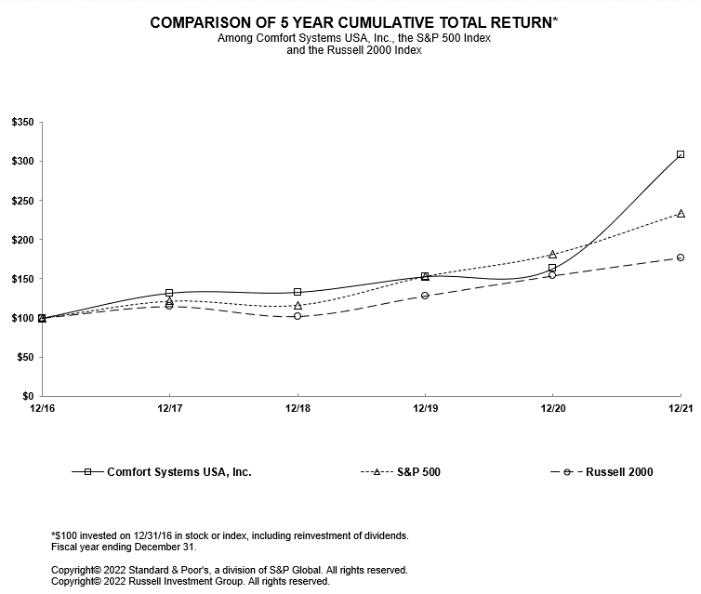][added: 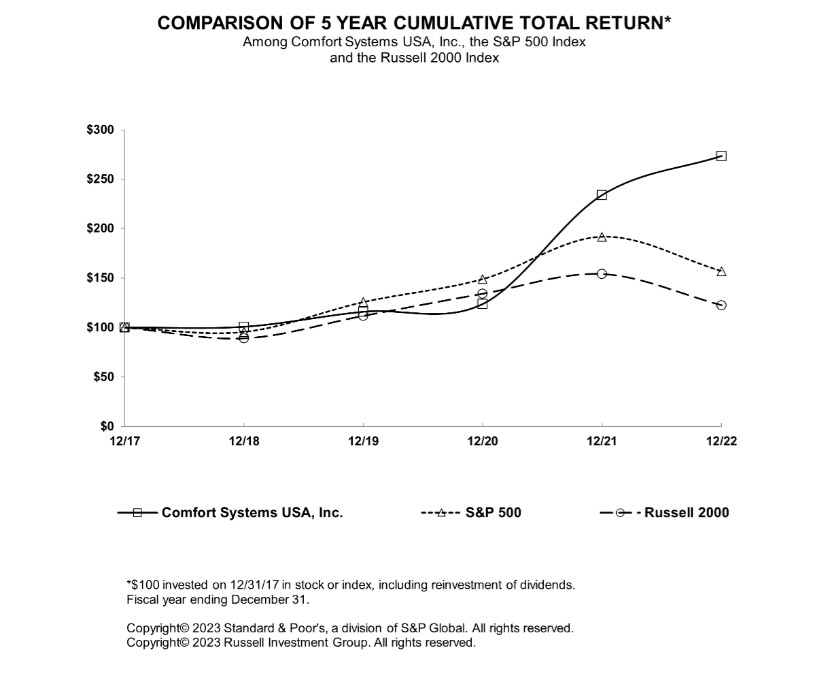]
On [removed: December 8, 2020,] [added: May 17, 2022,] the Board approved an extension to the program by increasing the shares authorized for repurchase by 0.7 million shares.
Since the inception of the repurchase program, the Board has approved [removed: 10.3] [added: 10.9] million shares to be repurchased.
As of December 31, [removed: 2021,] [added: 2022,] we have repurchased a cumulative total of [removed: 9.7] [added: 10.1] million shares at an average price of [removed: $21.69] [added: $24.52] per share under the repurchase program.
The share repurchases will be made from time to time at our discretion in the open market or privately negotiated [removed: transactions] [added: transactions,] as permitted by securities laws and other legal requirements, and subject to market conditions and other factors.
During the year ended December 31, [removed: 2021,] [added: 2022,] we repurchased 0.4 million shares for approximately [removed: $27.1] [added: $38.2] million at an average price of [removed: $74.57] [added: $86.45] per share.
During the year ended December 31, [removed: 2021,] [added: 2022,] we purchased our common shares in the following amounts at the following average prices:
| | (1) | Purchased as part of a program announced on March 29, 2007 under which, since the inception of this program, [removed: 10.3] [added: 10.9] million shares have been approved for repurchase. |
Under our [removed: 2012 Equity Incentive Plan and 2017 Omnibus Incentive Plan,] [added: stock incentive plans,] employees may elect to have us withhold common shares to satisfy statutory federal, state and local tax withholding obligations arising on the vesting of restricted stock awards and exercise of options.
| January 1 - January 31 | | 52,203 | | $ | 89.68 | | 9,727,000 | | 566,751 | |
| February 1 - February 28 | | 82,012 | | $ | 86.07 | | 9,809,012 | | 484,739 | |
| March 1 - March 31 | | 27,399 | | $ | 86.05 | | 9,836,411 | | 457,340 | |
| April 1 - April 30 | | — | | $ | — | | 9,836,411 | | 457,340 | |
| May 1 - May 31 | | 156,680 | | $ | 84.33 | | 9,993,091 | | 951,034 | |
| June 1 - June 30 | | 70,009 | | $ | 79.19 | | 10,063,100 | | 881,025 | |
| July 1 - July 31 | | 4,496 | | $ | 82.13 | | 10,067,596 | | 876,529 | |
| August 1 - August 31 | | — | | $ | — | | 10,067,596 | | 876,529 | |
| September 1 - September 30 | | 32,050 | | $ | 99.97 | | 10,099,646 | | 844,479 | |
| October 1 - October 31 | | 13,200 | | $ | 100.15 | | 10,112,846 | | 831,279 | |
| November 1 - November 30 | | — | | $ | — | | 10,112,846 | | 831,279 | |
| December 1 - December 31 | | 4,000 | | $ | 116.65 | | 10,116,846 | | 827,279 | |
| | | 442,049 | | $ | 86.45 | | 10,116,846 | | 827,279 | |
| January 1 - January 31 | | 3,000 | | $ | 52.59 | | 9,315,001 | | 978,750 | |
| February 1 - February 28 | | — | | $ | — | | 9,315,001 | | 978,750 | |
| March 1 - March 31 | | 10,250 | | $ | 70.99 | | 9,325,251 | | 968,500 | |
| April 1 - April 30 | | 3,500 | | $ | 75.45 | | 9,328,751 | | 965,000 | |
| May 1 - May 31 | | 8,721 | | $ | 80.49 | | 9,337,472 | | 956,279 | |
| June 1 - June 30 | | 14,871 | | $ | 80.39 | | 9,352,343 | | 941,408 | |
| July 1 - July 31 | | 55,886 | | $ | 75.63 | | 9,408,229 | | 885,522 | |
| August 1 - August 31 | | 111,856 | | $ | 74.91 | | 9,520,085 | | 773,666 | |
| September 1 - September 30 | | 138,380 | | $ | 71.39 | | 9,658,465 | | 635,286 | |
| October 1 - October 31 | | 1,170 | | $ | 71.19 | | 9,659,635 | | 634,116 | |
| November 1 - November 30 | | — | | $ | — | | 9,659,635 | | 634,116 | |
| December 1 - December 31 | | 15,162 | | $ | 94.93 | | 9,674,797 | | 618,954 | |
| | | 362,796 | | $ | 74.57 | | 9,674,797 | | 618,954 | |
Item 8. Financial Statements and Supplementary Data
438 rewritten, 142 added, 267 removed, 650 unchanged
| [Report of Independent Registered Public Accounting Firm](#ReportofIndependentRegisteredPublicAccou) (PCAOB ID No. 34) | | [removed: 44] [added: 42] |
| [Report of Independent Registered Public Accounting Firm](#ReportofIndependentRegisteredEY) (PCAOB ID No. 42) | | [removed: 46] [added: 44] |
| [Consolidated Balance Sheets](#CONSOLIDATEDBALANCESHEETS_522126) | | [removed: 47] [added: 45] |
| [Consolidated Statements of Operations](#CONSOLIDATEDSTATEMENTSOFOPERATIONS_39514) | | [removed: 48] [added: 46] |
| [Consolidated Statements of Stockholders’ Equity](#STATEMENTSOFSTOCKHOLDERSEQUITY_511143) | | [removed: 49] [added: 47] |
| [Consolidated Statements of Cash Flows](#STATEMENTSOFCASHFLOWS_915327) | | [removed: 50] [added: 48] |
| [Notes to Consolidated Financial Statements](#NOTESTOCONSOLIDATEDFINANCIALSTATEMENTS_6) | | [removed: 51] [added: 49] |
We have audited the accompanying consolidated [removed: balance sheet of Comfort Systems USA, Inc. and subsidiaries (the “Company”) as of December 31, 2021, the related consolidated] statements of operations, stockholders’ equity and cash [removed: flows,] [added: flows of Comfort Systems USA, Inc. (the Company)] for the year ended December 31, [removed: 2021,] [added: 2020,] and the related notes (collectively referred to as the “consolidated financial statements”).
In our opinion, the [removed: consolidated] financial statements present fairly, in all material respects, the financial position of the Company as of December 31, [added: 2022 and] 2021, and the results of its operations and its cash flows for [added: each of] the [removed: year] [added: two years in the period] ended December 31, [removed: 2021,] [added: 2022,] in conformity with accounting principles generally accepted in the United States of America.
We have also audited, in accordance with the standards of the Public Company Accounting Oversight Board (United States) (PCAOB), the [removed: Company's] [added: Company’s] internal control over financial reporting as of December 31, [removed: 2021,] [added: 2022,] based on criteria established in _Internal [removed: Control-Integrated Framework_ _(2013)_] [added: Control—Integrated Framework (2013)_] issued by the Committee of Sponsoring Organizations of the Treadway Commission and our report dated February [removed: 23, 2022,] [added: 22, 2023,] expressed an unqualified opinion on the Company’s internal control over financial reporting.
Those standards require that we plan and perform the [removed: audit] [added: audits] to obtain reasonable assurance about whether the financial statements are free of material misstatement, whether due to error or fraud.
Our [removed: audit] [added: audits] also included evaluating the accounting principles used and significant estimates made by management, as well as evaluating the overall presentation of the financial statements.
The critical audit matter communicated below is a matter arising from the [removed: current period] [added: current-period] audit of the consolidated financial statements that was communicated or required to be communicated to the audit committee and that (1) relates to accounts or disclosures that are material to the consolidated financial statements and (2) involved our especially challenging, subjective, or complex judgments.
The communication of [added: a] critical audit [removed: matters] [added: matter] does not alter in any way our opinion on the consolidated financial statements, taken as a whole, and we are not, by communicating the critical audit matter below, providing a separate opinion on the critical audit matter or on the accounts or disclosures to which it relates.
Revenue from Contracts with [removed: Customers – Refer] [added: Customers–Refer] to Notes 2 and 3 to the consolidated financial statements
The Company generally uses [removed: the cost] [added: a cost-to-cost input method] to [removed: cost] measure [removed: of] progress for its contracts, as it depicts the transfer of assets to the customer that occurs as the Company incurs costs, which include labor, materials, subcontractors’ costs, other direct costs, and an allocation of indirect costs.
Under the [removed: cost to cost] [added: cost-to-cost] measure of progress, the extent of progress towards completion is measured based on the ratio of costs incurred to date to the total estimated costs at completion of the performance obligation.
Given the judgments necessary to account for the Company’s contracts with customers, specifically the [removed: use] [added: estimates] of [removed: estimates, such as] total costs [removed: to] [added: that will] be incurred at contract completion, which are complex and subject to many variables, auditing the corresponding balances and related accounting estimates required extensive audit effort due to the complexity of these estimates, and a high degree of auditor judgment when performing audit procedures and evaluating the results of those procedures.
| ● | We evaluated [removed: quarter over quarter] [added: quarter-over-quarter] changes in contract profit estimates for a selection of contracts by obtaining explanations from Company’s management regarding [added: the] timing and amount [added: of the changes in estimates] and corroborating these inquiries by inspecting documents, including management [removed: work plans,] [added: workplans,] customer communications, change orders, vendor invoices, and supplier or subcontractor communications. |
| | o | Evaluated the reasonableness of management’s estimates of total costs and profit at completion [removed: for selected contracts with customers] by: |
| | ◾ | Evaluating management’s [removed: ability to] estimate [added: of] total costs at completion for each selected contract by performing corroborating inquiries with the Company’s project managers and personnel involved with the selected contracts, and comparing the estimates to management’s [removed: work plans,] [added: workplans,] suppliers’ contracts, [added: subcontract agreements, third-party invoices from suppliers, historical actual results,] and/or engineering specifications. |
| | ◾ | Evaluating management’s ability to accurately estimate total costs and profits at completion by [removed: comparing] [added: analyzing the comparison of] actual costs and profits [added: or current year estimates] to [added: prior year] management’s [removed: historical estimates for performance obligations that have been fulfilled.] [added: estimates.] |
| | ◾ | Evaluating changes in estimates and obtaining evidence [removed: on] [added: regarding] timing and amounts supporting these changes in estimates such as approved change order documents, communications with the customer, subcontract agreements and related amendments, recent actual costs, and other sources. |
We have audited the accompanying consolidated balance [removed: sheet] [added: sheets] of Comfort Systems USA, Inc. [added: and its consolidated subsidiaries] (the [removed: Company)] [added: “Company”)] as of December 31, [removed: 2020,] [added: 2022 and 2021,] the related consolidated statements of operations, stockholders’ [removed: equity] [added: equity,] and cash [removed: flows] [added: flows,] for each of the two years in the period ended December 31, [removed: 2020,] [added: 2022,] and the related notes [removed: (collectively] [added: (collectively,] referred to as the [removed: “consolidated financial] [added: “financial] statements”).
In our opinion, the consolidated financial statements present fairly, in all material respects, the [removed: financial position of the Company at December 31, 2020, and the] results of [removed: its] [added: the Company’s] operations and its cash flows for [removed: each of] the [removed: two years in the period] [added: year] ended December 31, 2020, in conformity with U.S. generally accepted accounting principles.
| | | [added: | 2022 | | |] 2021 | | | 2020 | | [removed: ] |
| Cash and cash equivalents | | $ | [removed: 58,776] [added: 57,214] | | $ | [removed: 54,896] [added: 58,776] | |
| Billed accounts receivable, less allowance for credit losses of [removed: $8,808] [added: $10,640] and [removed: $9,087,] [added: $8,808,] respectively | | | [removed: 773,716] [added: 1,024,082] | | | [removed: 619,544] [added: 773,716] | |
| Unbilled accounts receivable, less allowance for credit losses of [removed: $715] [added: $1,011] and [removed: $784,] [added: $715,] respectively | | | [removed: 61,881] [added: 77,030] | | | [removed: 45,596] [added: 61,881] | |
| Other receivables, less allowance for credit losses of [removed: $503] [added: $510] and [removed: $759,] [added: $503,] respectively | | | [removed: 57,491] [added: 38,369] | | | [removed: 44,212] [added: 57,491] | |
| Inventories | | | [removed: 21,853] [added: 35,309] | | | [removed: 13,472] [added: 21,853] | |
| Prepaid expenses and other | | | [removed: 23,704] [added: 48,456] | | | [removed: 15,510] [added: 23,704] | |
| Costs and estimated earnings in excess of billings, less allowance for credit losses of [removed: $84] [added: $80] and [removed: $79,] [added: $84,] respectively | | | [removed: 29,900] [added: 27,211] | | | [removed: 18,622] [added: 29,900] | |
| Total current assets | | | [removed: 1,027,321] [added: 1,307,671] | | | [removed: 811,852] [added: 1,027,321] | |
| PROPERTY AND EQUIPMENT, NET | | | [removed: 128,554] [added: 143,949] | | | [removed: 117,206] [added: 128,554] | |
| LEASE RIGHT-OF-USE ASSET | | | [removed: 124,756] [added: 130,666] | | | [removed: 94,727] [added: 124,756] | |
| GOODWILL | | | [removed: 592,114] [added: 611,789] | | | [removed: 464,392] [added: 592,114] | |
| IDENTIFIABLE INTANGIBLE ASSETS, NET | | | [removed: 304,781] [added: 273,901] | | | [removed: 231,807] [added: 304,781] | |
| DEFERRED TAX ASSETS | | | [removed: 22,905] [added: 115,665] | | | [removed: 29,401] [added: 22,905] | |
| OTHER NONCURRENT ASSETS | | | [removed: 8,683] [added: 13,837] | | | [removed: 7,970] [added: 8,683] | |
Variations from estimated project costs could have a significant impact on operating results, depending on project size, and the recoverability of the variation from change orders collected from customers.
February 22, 2023
| | | 2022 | | | 2021 | | |
| Other current liabilities | | | 120,715 | | | 105,666 | |
| Net income | | — | | | — | | — | | | — | | | — | | | 245,947 | | | 245,947 | |
| Issuance of shares for options exercised | | — | | | — | | 34,187 | | | 1,174 | | | (88) | | | — | | | 1,086 | |
| Issuance of restricted stock & performance stock | | — | | | — | | 113,955 | | | 3,657 | | | (113) | | | — | | | 3,544 | |
| Share repurchase | | — | | | — | | (442,049) | | | (38,216) | | | — | | | — | | | (38,216) | |
| BALANCE AT DECEMBER 31, 2022 | | 41,123,365 | | $ | 411 | | (5,362,224) | | $ | (187,212) | | $ | 332,080 | | $ | 854,644 | | $ | 999,923 | |
_____________________________________
| Payments for investments | | | (2,460) | | | — | | | — | |
December 31, 2022
within that year.
We do not expect our adoption of this standard on January 1, 2023 to have a material impact on our consolidated financial statements.
Under the cost-to-cost input method, the extent of progress towards completion is measured based on the ratio of costs incurred to date to the total estimated costs at completion of the performance obligation.
| | 2022 | | | | | | | | | | | | 2021 | | | | | | | | | | |
(“public company approach”).
Income taxes are provided for under the asset and liability method, which requires the recognition of deferred tax assets and liabilities for the expected future tax consequences of events that have been included in the financial
statements.
Under this method, we determine deferred tax assets and liabilities based on the differences between the financial statement and tax basis of assets and liabilities by using enacted tax rates in effect for the year in which the differences are expected to reverse.
We recognize deferred tax assets to the extent that we believe that these assets are more likely than not to be realized.
In making such a determination, we consider all available positive and negative evidence, including future reversals of existing taxable temporary differences, projected future taxable income, taxable income in prior carryback years and tax planning strategies.
Management’s judgment is required in considering the relative weight of negative and positive evidence.
We record uncertain tax positions based on a two-step process in which (i) we determine whether it is more likely than not that the tax positions will be sustained on the basis of the technical merits of the position and (ii) for those tax positions that meet the more-likely-than-not recognition threshold, we recognize the largest amount of tax benefit that is more than 50 percent likely to be realized upon ultimate settlement with the relevant taxing authority.
Investments
We have a $2.5 million investment with a fair value that is not readily determinable and is recorded at cost.
This investment is included in “Other Noncurrent Assets” in our Consolidated Balance Sheet and is reviewed quarterly for impairment.
We did not recognize any impairments in the current year related to this investment.
| | | 2022 | | | 2021 | | |
| | | $ | (434,490) | | $ | (277,396) | |
| | | $ | (434,490) | | $ | (277,396) | |
The cost-to-cost input method of accounting is also affected by changes in job performance, job conditions, and final contract settlements.
These factors may result in revisions to estimated costs and, therefore, revenue.
Such revisions are frequently based on further estimates and subjective assessments.
should be accounted for as more than one performance obligation.
| Total | | | $ | 4,140,364 | | 100.0 | % | | $ | 3,073,636 | | 100.0 | % | | $ | 2,856,659 | | 100.0 | % |
| --- | --- | --- | --- | --- | --- | --- | --- | --- | --- | --- | --- | --- | --- | --- | --- | --- | --- | --- | --- |
| Total | | | $ | 4,140,364 | | 100.0 | % | | $ | 3,073,636 | | 100.0 | % | | $ | 2,856,659 | | 100.0 | % |
Contract assets are not considered a significant financing component, as they are intended to protect the customer in the event that we do not perform our obligations under the contract.
Contract assets are generally classified as current, as it is very unusual for us to have contract assets with a term of greater than one year.
| --- | --- | --- |
Revenue, including estimated fees or profits, is recorded proportionally as costs are incurred.
Due to the nature of the work required to be performed on many of the performance obligations, the estimation of costs at completion is complex, subject to many variables and requires considerable judgment.
| | ◾ | Comparing management’s estimates to supporting documents such as purchase orders, subcontract agreements, third-party invoices from suppliers, historical actual results, and other sources, as applicable. |
February 23, 2022
| | | | | | | | |
| --- | --- | --- | --- | --- | --- | --- | --- |
| Other current liabilities | | | 119,400 | | | 91,492 | |
| BALANCE AT DECEMBER 31, 2018 | | 41,123,365 | | $ | 411 | | (4,229,653) | | $ | (87,747) | | $ | 316,479 | | $ | 268,904 | | $ | 498,047 | |
| Net income | | — | | | — | | — | | | — | | | — | | | 114,324 | | | 114,324 | |
| Issuance of shares for options exercised | | — | | | — | | 114,125 | | | 2,532 | | | (182) | | | — | | | 2,350 | |
| Issuance of restricted stock & performance stock | | — | | | — | | 107,606 | | | 2,303 | | | (297) | | | — | | | 2,006 | |
| Share repurchase | | — | | | — | | (428,940) | | | (19,550) | | | — | | | — | | | (19,550) | |
______________________________________
| Proceeds from sale of business | | | — | | | — | | | 1,611 | |
_Recently Adopted Accounting Pronouncements_
In December 2019, the FASB issued ASU No. 2019-12, “Income Taxes (Topic 740): Simplifying the Accounting for Income Taxes.” This standard simplifies the accounting for income taxes by eliminating certain exceptions to the guidance in Topic 740 related to the approach for intraperiod tax allocation, the methodology for calculating income taxes in an interim period and the recognition of deferred tax liabilities for outside basis differences.
The standard also simplifies aspects of the accounting for franchise taxes and enacted changes in tax laws or rates and
clarifies the accounting for transactions that result in a step-up in the tax basis of goodwill.
We adopted ASU No. 2019-12 on January 1, 2021, and the impact was not material to our overall financial statements.
**
In March 2020, the FASB issued ASU No. 2020-04, “Reference Rate Reform (Topic 848).” The pronouncement provides temporary optional expedients and exceptions to the current guidance on contract modifications and hedge accounting to ease the financial reporting burden related to the expected market transition from the London Interbank Offered Rate (“LIBOR”) and other interbank offered rates to alternative reference rates.
The guidance was effective upon issuance and generally can be applied to applicable contract modifications through December 31, 2022.
Our current debt facility (as further described in Note 9) includes a Eurodollar Rate Loan Option with an interest rate that is determined based on the one- to six-month LIBOR rates, which will cease to be published on June 30, 2023.
We are currently evaluating the impact of the transition from LIBOR to alternative reference rates but do not expect a significant impact to our consolidated financial statements.
ASU 2021-08 is effective for fiscal years beginning after December 15, 2022 and interim periods within that year.
We are currently evaluating the potential impact of this authoritative guidance on our consolidated financial statements.
For the reasons listed above, revenue is recognized based on the extent of progress towards completion of the performance obligation.
The selection of the method to measure progress towards completion requires judgment and is based on the nature of the products or services to be provided.
While our construction and service financial assets are often with
Starting in March 2020, we experienced negative impacts to our business due to the disruption caused by Coronavirus Disease 2019 (“COVID-19”).
In March 2020, the World Health Organization categorized COVID-19 as a pandemic, and the President of the United States declared the COVID-19 outbreak a national emergency.
The Company considered the impact of COVID-19 on the assumptions and estimates used to determine the results reported and asset valuations as of December 31, 2021 and December 31, 2020.
In 2020, we increased our loss rates and increased our specific reserves primarily due to the economic disruption caused by COVID-19, which was reflected in our bad debt expense in the prior year.
This increase was primarily, but not exclusively, due to concern over collectability of receivables from customers more directly impacted by COVID-19.
In 2021, we collected some of these reserve amounts and reduced our assessed risk on collectability as business impacts relating to COVID-19 have stabilized.
| Impact of new accounting standard | | — | | | — | | | — | | | — | | | 310 | | | 331 | | | 54 | | | 695 |
Upon retirement or disposition of property and equipment, the cost and related
Acquisition date fair value estimates are
Income taxes are provided for under the liability method, which takes into account differences between financial statement treatment and tax treatment of certain transactions.
An excerpt. Shown here: 40 of 438 rewritten, 40 of 142 added and 40 of 267 removed. The counts are complete. For every sentence, read Item 8. Financial Statements and Supplementary Data in the FY2022 filing and the FY2021 filing.
Item 9A. Controls and Procedures
10 rewritten, 3 added, 8 removed, 33 unchanged
We [removed: carried out] [added: conducted] an evaluation under the supervision and with the participation of our management, including our Chief Executive Officer and Chief Financial Officer, of the effectiveness of the design and operation of our disclosure controls and procedures (as defined in Rules 13a-15(e) and 15d-15(e) under the Securities Exchange Act of 1934) as of the end of the period covered by this report.
Based on that evaluation, our Chief Executive Officer and Chief Financial Officer have concluded that our disclosure controls and procedures (as defined in Rules 13a-15(e) and 15d-15(e) of the Securities Exchange Act of 1934) [removed: are] [added: were] effective as of the end of the period covered by this report.
There have not been any changes in our internal control over financial reporting (as such term is defined in Rules [removed: 13a 15(f)] [added: 13a-15(f)] and [removed: 15d 15(f)] [added: 15d-15(f)] under the Securities Exchange Act of 1934) during the three months ended December 31, [removed: 2021] [added: 2022] that have materially affected, or are reasonably likely to materially affect, internal control over financial reporting.
Our management is responsible for establishing and maintaining adequate internal control over financial [removed: reporting,] [added: reporting] as [removed: such term is] defined in [removed: Exchange Act Rules] [added: Rule] 13a-15(f) and [removed: 15d-15(f).][added: 15d-15(f) under the Securities Exchange Act of 1934.]
Under the supervision and with the participation of our management, including our Chief Executive Officer and Chief Financial Officer, we conducted an evaluation of the effectiveness of our internal control over financial reporting as of December 31, [removed: 2021] [added: 2022] based on the framework in Internal Control—Integrated Framework issued by the Committee of Sponsoring Organizations of the Treadway Commission (COSO 2013 framework).
Based on that evaluation, our management concluded that our internal control over financial reporting was effective as of December 31, [removed: 2021.][added: 2022.]
Deloitte & Touche LLP, an independent registered public accounting firm, as stated in their report which is included elsewhere herein, has issued an attestation report auditing the effectiveness of our internal control over financial reporting as of December 31, [removed: 2021.][added: 2022.]
We have audited the internal control over financial reporting of Comfort Systems USA, Inc. and [added: its consolidated] subsidiaries (the “Company”) as of December 31, [removed: 2021,] [added: 2022,] based on criteria established in _Internal Control — Integrated Framework (2013)_ issued by the Committee of Sponsoring Organizations of the Treadway Commission (COSO).
In our opinion, the Company maintained, in all material respects, effective internal control over financial reporting as of December 31, [removed: 2021,] [added: 2022,] based on criteria established in _Internal Control — Integrated Framework (2013)_ issued by COSO.
We have also audited, in accordance with the standards of the Public Company Accounting Oversight Board (United States) (PCAOB), the consolidated financial statements [added: of the Company] for the year ended December 31, [removed: 2021, of the Company] [added: 2022,] and our report dated February [removed: 23, 2022,] [added: 22, 2023,] expressed an unqualified opinion on those [added: consolidated] financial statements.
Our internal control over financial reporting is a process designed to provide reasonable assurance regarding the reliability of financial reporting and the preparation of our consolidated financial statements for external purposes in accordance with U.S. generally accepted accounting principles.
Internal control over financial reporting includes those policies and procedures that (i) pertain to the maintenance of records that in reasonable detail accurately and fairly reflect the transactions and dispositions of the assets of the company; (ii) provide reasonable assurance that transactions are recorded as necessary to permit preparation of financial statements in accordance with U.S. generally accepted accounting principles, and that receipts and expenditures of the company are being made only in accordance with authorizations of management and directors of the company; and (iii) provide reasonable assurance regarding prevention or timely detection of unauthorized acquisition, use or disposition of the company’s assets that could have a material effect on the financial statements.
February 22, 2023
The Company acquired Amteck Holdco LLC (“Amteck”) in August 2021 and Ivey Mechanical Company, LLC (“Ivey”), MEP Holding Co., Inc. (“MEP Holdings”), Thermal Equipment Service, Inc. and TES Controls, LLC (collectively “Thermal”) and Kodiak Labor Solutions, LLC (“Kodiak”) in December 2021.
Due to the recent nature of these business combinations, Amteck, Ivey, MEP Holdings, Thermal and Kodiak’s internal control over financial reporting and related processes have not been fully integrated into the Company’s existing systems and internal control over financial reporting as of December 31, 2021.
As such, our management has excluded Amteck, Ivey, MEP Holdings, Thermal and Kodiak from its assessment of the effectiveness of internal control over financial reporting as of December 31, 2021.
Collectively, Amteck, Ivey, MEP Holdings, Thermal and Kodiak comprised 18.3% of total assets and 3.2% of revenues in our consolidated financial statements as of and for the year ended December 31, 2021.
As described in Management’s Report on Internal Control over Financial Reporting, management excluded from its assessment the internal control over financial reporting at Amteck Holdco LLC (acquired August 1, 2021), Ivey Mechanical Company, LLC (acquired December 1, 2021), MEP Holding Co., Inc., Thermal Equipment Service, Inc. and TES Controls, LLC, and Kodiak Labor Solutions, LLC (each acquired December 31, 2021), and whose financial statements collectively constitute 18.3% of total assets and 3.2% of total revenues in the consolidated financial statement amounts as of and for the year ended December 31, 2021.
Accordingly, our audit did not include the internal control over financial reporting at Amteck Holdco LLC, Ivey Mechanical Company, LLC, MEP Holding Co., Inc., Thermal Equipment Service, Inc. and TES Controls, LLC, and Kodiak Labor Solutions, LLC.
February 23, 2022
Item 10. Directors, Executive Officers and Corporate Governance
0 rewritten, 3 added, 4 removed, 6 unchanged
The other information required by this Item 10 will be furnished on or prior to May 1, 2023 (and is hereby incorporated by reference) by an amendment hereto or pursuant to a definitive proxy statement involving the election of directors pursuant to Regulation 14A that will contain such information.
The information required by Items 11, 12, 13 and 14 will be furnished on or prior to May 1, 2023 (and is hereby incorporated by reference) by an amendment hereto or pursuant to a definitive proxy statement involving the election of directors pursuant to Regulation 14A that will contain such information.
Notwithstanding the foregoing, information appearing in the sections “Compensation Committee Report” and “Audit Committee Report” shall not be deemed to be incorporated by reference in this Form 10-K.
The other information called for by this item has been omitted in accordance with the instructions to Form 10-K.
The Company will file with the Commission a definitive proxy statement including the other information to be disclosed under this item in the 120 days following December 31, 2021 and such information is hereby incorporated by reference.
These items have been omitted in accordance with the instructions to Form 10-K.
The Company will file with the Commission a definitive proxy statement including the information to be disclosed under the items in the 120 days following December 31, 2021 and such information is hereby incorporated by reference.
Item 16. Form 10-K Summary
24 rewritten, 4 added, 1 removed, 90 unchanged
| [removed: ] [added: ] | [removed: ] [added: ] | [removed: ] [added: ] | | Incorporated by Referenceto the Exhibit Indicated Belowand to the Filing with theCommission Indicated Below | | |
| ExhibitNumber | | Description of Exhibits | [added: ] | ExhibitNumber | [added: ] | Filing or File Number |
| 10.10 | | [Agreement and Plan of Merger between the Company and Dyna Ten Corporation, dated April [removed: 9,] [added: 7,] 2014](http://www.sec.gov/Archives/edgar/data/1035983/000110465914026747/a14-10230_1ex10d1.htm) | | 10.1 | | April 9, 2014 Form 8-K |
| 16.1 | | [Letter to Securities and Exchange Commission from Ernst & Young LLP, dated March 15, [removed: 2021](https://www.sec.gov/Archives/edgar/data/0001035983/000110465921036255/tm219577d1_ex16-1.htm)] [added: 2021](https://www.sec.gov/Archives/edgar/data/1035983/000110465921036255/tm219577d1_ex16-1.htm)] | | 16.1 | | March 15, 2021 Form 8-K |
| 21.1 | | [List of subsidiaries of Comfort Systems USA, [removed: Inc.](https://www.sec.gov/Archives/edgar/data/1035983/000155837022001753/fix-20211231xex21d1.htm)] [added: Inc.](https://www.sec.gov/Archives/edgar/data/1035983/000155837023001757/fix-20221231xex21d1.htm)] | | | | Filed Herewith |
| 23.1 | | [Consent of Deloitte & Touche [removed: LLP](https://www.sec.gov/Archives/edgar/data/1035983/000155837022001753/fix-20211231xex23d1.htm)] [added: LLP](https://www.sec.gov/Archives/edgar/data/1035983/000155837023001757/fix-20221231xex23d1.htm)] | | | | Filed Herewith |
| 23.2 | | [Consent of Ernst & Young [removed: LLP](https://www.sec.gov/Archives/edgar/data/1035983/000155837022001753/fix-20211231xex23d2.htm)] [added: LLP](https://www.sec.gov/Archives/edgar/data/1035983/000155837023001757/fix-20221231xex23d2.htm)] | | | | Filed Herewith |
| 31.1 | | [Certification of Chief Executive Officer pursuant to Section 302 of the Sarbanes-Oxley Act of [removed: 2002](https://www.sec.gov/Archives/edgar/data/1035983/000155837022001753/fix-20211231xex31d1.htm)] [added: 2002](https://www.sec.gov/Archives/edgar/data/1035983/000155837023001757/fix-20221231xex31d1.htm)] | | | | Filed Herewith |
| 31.2 | | [Certification of Chief Financial Officer pursuant to Section 302 of the Sarbanes-Oxley Act of [removed: 2002](https://www.sec.gov/Archives/edgar/data/1035983/000155837022001753/fix-20211231xex31d2.htm)] [added: 2002](https://www.sec.gov/Archives/edgar/data/1035983/000155837023001757/fix-20221231xex31d2.htm)] | | | | Filed Herewith |
| 32.1 | | [Certification of Chief Executive Officer pursuant to Section 906 of the Sarbanes-Oxley Act of [removed: 2002](https://www.sec.gov/Archives/edgar/data/1035983/000155837022001753/fix-20211231xex32d1.htm)] [added: 2002](https://www.sec.gov/Archives/edgar/data/1035983/000155837023001757/fix-20221231xex32d1.htm)] | | | | Furnished Herewith |
| 32.2 | | [Certification of Chief Financial Officer pursuant to Section 906 of the Sarbanes-Oxley Act of [removed: 2002](https://www.sec.gov/Archives/edgar/data/1035983/000155837022001753/fix-20211231xex32d2.htm)] [added: 2002](https://www.sec.gov/Archives/edgar/data/1035983/000155837023001757/fix-20221231xex32d2.htm)] | | | | Furnished Herewith |
| Date: February [removed: 23, 2022] [added: 22, 2023] | | |
| /s/ Brian E. Lane | | President, Chief Executive Officer, and | | February [removed: 23, 2022] [added: 22, 2023] | |
| /s/ William George | | Executive Vice President and Chief Financial | | February [removed: 23, 2022] [added: 22, 2023] | |
| /s/ Julie S. Shaeff | | Senior Vice President and Chief Accounting | | February [removed: 23, 2022] [added: 22, 2023] | |
| /s/ Franklin Myers | | Chairman of the Board | | February [removed: 23, 2022] [added: 22, 2023] | |
| /s/ Darcy G. Anderson | | Director | | February [removed: 23, 2022] [added: 22, 2023] | |
| /s/ Herman E. Bulls | | Director | | February [removed: 23, 2022] [added: 22, 2023] | |
| /s/ Alan P. Krusi | | Director | | February [removed: 23, 2022] [added: 22, 2023] | |
| /s/ Pablo G. Mercado | | Director | | February [removed: 23, 2022] [added: 22, 2023] | |
| /s/ William J. Sandbrook | | Director | | February [removed: 23, 2022] [added: 22, 2023] | |
| /s/ Constance E. Skidmore | | Director | | February [removed: 23, 2022] [added: 22, 2023] | |
| /s/ Vance W. Tang | | Director | | February [removed: 23, 2022] [added: 22, 2023] | |
| /s/ Cindy L. Wallis-Lage | | Director | | February [removed: 23, 2022] [added: 22, 2023] | |
| | | | | | | |
| *10.29 | | [Resignation and General Release Agreement between Comfort Systems USA, Inc. and Terrence Young, dated as of January 18, 2022](https://www.sec.gov/Archives/edgar/data/1035983/000110465922005448/tm222551d2_ex10-1.htm) | | 10.1 | | January 19, 2022 Form 8-K |
| 10.30 | | [Third Amended and Restated Credit Agreement dated as of May 25, 2022 by and among Comfort Systems USA, Inc., as Borrower, the Lenders listed on the signature pages thereof, and Wells Fargo Bank, National Association, as Agent for the Lenders](https://www.sec.gov/Archives/edgar/data/1035983/000110465922065983/tm2217125d1_ex10-1.htm) | | 10.1 | | May 27, 2022 Form 8-K/A |
| *10.31 | | [Form of Restricted Stock Unit Agreement with a Blank Vesting Schedule under the Company’s 2017 Omnibus Incentive Plan](https://www.sec.gov/Archives/edgar/data/1035983/000155837022011139/fix-20220630xex10d2.htm) | | 10.2 | | Second Quarter 2022 Form 10-Q |
| | | | | | | |