 filings.tools
W.W. Grainger (GWW) 10-K risk factor changes: FY2020 vs FY2019
The 2020-12-31 10-K against the 2019-12-31 one, compared heading by heading and sentence by sentence.
Item 1A42 rewritten45 added15 removed93 unchanged
All filing items978 rewritten659 added274 removed540 unchanged
Summary
counted, not written
- Item 1A lists 20 risk factor headings: 1 new, 3 reworded and 16 unchanged since FY2019. 1 heading from FY2019 no longer appears.
- Sentence by sentence, 659 added, 274 removed, 978 rewritten and 540 unchanged across 18 items that differ.
New Item 1A headings (1)
- Grainger’s business and operations have been and may continue to be adversely affected by the global outbreak of the Coronavirus (COVID-19) pandemic and may be adversely affected by other global outbreaks of pandemic disease.
Removed Item 1A headings (1)
- An inability to successfully implement Grainger’s strategy or to integrate acquisitions, partnerships, joint ventures and other business combination transactions could result in the benefits anticipated not being realized and could have an adverse effect on results of operations.
Reworded Item 1A headings (3)
- Unexpected product shortages, tariffs, [added: product cost increases] and risks associated with
[removed: Grainger's][added: Grainger’s] suppliers could negatively impact customer relationships or result in an adverse impact on results of operations. - Changes in customer base or product mix could cause changes in
[removed: Grainger's][added: Grainger’s revenue or] gross[removed: margin][added: margin,] or affect[removed: Grainger's][added: Grainger’s] competitive position. - In order to compete, Grainger must attract,
[removed: retain][added: retain, train, motivate, develop] and[removed: motivate][added: transition] key employees, and the failure to do so could have an adverse effect on results of operations.
A heading is new when no FY2019 heading matches it after ignoring case and punctuation, and reworded when it shares at least 60 percent of its words with one that went away. All current risk factor headings.
Sentences by item
22 items, with every count and a link to each item that changed
Underlined words on a shaded ground are new in FY2020; struck-through words were in FY2019. Sentences that are wholly new or wholly gone are labelled rather than marked.
Item 1A. Risk Factors
42 rewritten, 45 added, 15 removed, 93 unchanged
Economic, [removed: political,] [added: political] and industry trends affect [removed: Grainger's] [added: Grainger’s] business environments.
Many of these customers operate in markets that are subject to cyclical fluctuations resulting from market uncertainty, trade and tariff policies, costs of goods sold, currency exchange rates, central bank interest rate changes, foreign competition, offshoring of production, oil and natural gas prices, geopolitical developments, labor shortages, inflation, [added: natural or human induced disasters, extreme weather, outbreaks of pandemic disease such as the COVID-19 pandemic,] deflation, and a variety of other factors beyond [removed: Grainger's] [added: Grainger’s] control.
Any of these events could also reduce the volume of products and services these customers purchase from Grainger or impair the ability of [removed: Grainger's] [added: Grainger’s] customers to make full and timely [removed: payments,] [added: payments] and could cause increased pressure on [removed: Grainger's] [added: Grainger’s] selling prices and terms of sale.
Accordingly, a significant or prolonged slowdown in economic activity in [added: Canada, China, Japan, Mexico,] the [removed: U.S., Canada] [added: U.K., the U.S.] or any other major world economy, or a segment of any such economy, could negatively impact [removed: Grainger's] [added: Grainger’s] sales growth and results of operations.
This includes the ease of use of [removed: Grainger's] [added: Grainger’s] high-touch [removed: high-service] operations (branches and digital platforms) and delivery of products.
Downward pressure on sales prices, changes in the volume of [removed: our] orders, and an inability to pass higher product costs on to customers could cause [removed: our] [added: Grainger’s] gross profit percentage to fluctuate or decline.
[removed: We] [added: Grainger] may not be able to pass rising product costs to customers if those customers have ready product or supplier alternatives in the marketplace.
Some of [removed: Grainger's] [added: Grainger’s] products contain significant amounts of commodity-priced materials, such as steel, copper, petroleum derivatives, [removed: or] rare earth minerals, [added: or other materials or inputs required to manufacture PPE] and [added: other pandemic-related products and] are subject to price changes based on fluctuations in the commodities market.
Fluctuations in the price of fuel [added: or increased demand for freight services, including as a result of outbreaks of pandemic disease such as the COVID-19 pandemic,] could affect transportation costs.
Unexpected product shortages, tariffs, [added: product cost increases] and risks associated with [removed: Grainger's] [added: Grainger’s] suppliers could negatively impact customer relationships or result in an adverse impact on results of operations.
Products are purchased from [removed: approximately 5,000] [added: more than 4,500] suppliers located in various countries around the world, not one of which accounted for more than 5% of total purchases.
[removed: Historically, no significant difficulty has been encountered with respect to sources of supply; however, disruptions could occur due to] [added: These] factors [removed: beyond Grainger's control, including] [added: could include] economic downturns, [added: outbreaks of pandemic disease such as the COVID-19 pandemic (which from time to time has resulted in some shortages of PPE, cleaning supplies and other products), natural or human induced disasters, extreme weather,] geopolitical unrest, tariffs, new tariffs or tariff increases, trade issues and policies, [added: detention orders or withhold release orders on imported products,] labor problems experienced by [removed: Grainger's] [added: Grainger’s] suppliers, transportation availability and cost, shortage of raw materials, [added: unilateral product cost increases by suppliers of products in short supply,] inflation and other factors, any of which could adversely affect a [removed: supplier's] [added: supplier’s] ability to manufacture or deliver products or could result in an increase in [removed: Grainger's] [added: Grainger’s] product costs.
Changes in customer base or product mix could cause changes in [removed: Grainger's] [added: Grainger’s revenue or] gross [removed: margin] [added: margin,] or affect [removed: Grainger's] [added: Grainger’s] competitive position.
[removed: Additionally, as] [added: As] customer base and product mix change over time, Grainger must identify new products, product lines and services that respond to industry trends and customer needs.
The inability to introduce new products and [added: services and] effectively integrate them into [removed: Grainger's] [added: Grainger’s] existing [removed: product] mix could have a negative impact on future sales growth and [removed: Grainger's] [added: Grainger’s] competitive position.
The occurrence of one or more natural [removed: disasters such as] [added: or human induced disasters, including] earthquakes, storms, hurricanes, floods, fires, droughts, tornados and other extreme weather; pandemic diseases or viral contagions such as the [removed: coronavirus outbreak;] [added: COVID-19 pandemic;] geopolitical events, such as war, civil unrest or terrorist attacks in a country in which Grainger operates or in which its suppliers are located; and the imposition of measures that create barriers to or increase the costs associated with international trade could result in disruption of [removed: Grainger's] [added: Grainger’s] logistics or supply chain network.
For example, [removed: should] the [removed: coronavirus] outbreak [removed: persist or spread, it could] [added: of the COVID-19 pandemic has disrupted and may continue to] disrupt the operations of the Company and its suppliers and customers.
Although [removed: Grainger's] [added: Grainger’s] information systems are protected with robust backup and security systems, including physical and software safeguards and remote processing capabilities, information systems are still vulnerable to damage or interruption from natural [added: or human induced] disasters, [added: extreme weather,] power losses, telecommunication failures, user error, third party actions [added: such as malicious computer programs, denial-of-service attacks and cybersecurity breaches, and other problems.]
In addition, from time to time Grainger relies on the [removed: IT] [added: information technology (IT)] systems of third parties to assist in conducting its business.
If [removed: Grainger's] [added: Grainger’s] systems or those of third parties on which Grainger depends are damaged, breached or cease to function [removed: properly] [added: properly,] Grainger may have to make a significant investment to repair or replace them and may suffer interruptions in its business operations in the interim.
Moreover, from time to time, Grainger may share information with [removed: vendors and other] [added: these] third parties [removed: that assist] [added: in connection] with [removed: certain aspects of] the [added: products and services they provide to the] business.
While Grainger requires assurances that these [removed: vendors and other] [added: third] parties will protect confidential information, there is a risk that the confidentiality of data held or accessed by them may be compromised.
[removed: If successful, those attempting to penetrate Grainger's or] its [removed: vendors'] [added: vendors’] information systems may misappropriate intellectual property or personally identifiable, credit card, confidential, proprietary or other sensitive customer, supplier, employee or business information, or cause systems disruption.
Further, [removed: Grainger's] [added: Grainger’s] systems are integrated with customer systems in certain cases, and a breach of the [removed: Company's] [added: Company’s] information systems could be used to gain illicit access to [removed: customer] [added: a customer’s] systems and information.
While Grainger has instituted [added: these and other] safeguards for the protection of [removed: such] information, because techniques used to obtain unauthorized access or to sabotage systems change frequently and generally are not recognized until they are launched against a target, Grainger may be unable to anticipate these techniques or implement adequate preventative measures.
Unauthorized use of [removed: Grainger's] [added: Grainger’s] intellectual property by others could result in harm to various [added: aspects of the business and may result in costly and protracted litigation in order to protect Grainger’s rights.]
[removed: Grainger's] [added: Grainger’s] exposure to fluctuations in foreign currency rates results primarily from the translation exposure associated with the preparation of the Consolidated Financial [removed: Statements,] [added: Statements (Financial Statements),] as well as from transaction exposure associated with transactions in currencies other than an [removed: entity's] [added: entity’s] functional currency.
While the [removed: Consolidated] Financial Statements are reported in U.S. dollars, the financial statements of [removed: Grainger's] [added: Grainger’s] subsidiaries outside the U.S. are prepared using the local currency as the functional currency and translated into U.S. dollars.
In order to compete, Grainger must attract, [removed: retain] [added: retain, train, motivate, develop] and [removed: motivate] [added: transition] key employees, and the failure to do so could have an adverse effect on results of operations.
In order to compete and have continued growth, Grainger must attract, [removed: retain] [added: retain, train, motivate, develop] and [removed: motivate] [added: transition] executives and other key employees, including those in managerial, technical, sales, marketing and [added: IT] support positions.
[removed: Grainger's] [added: Grainger’s] results of operations could be adversely affected by increased costs due to increased competition for [removed: employees,] [added: diverse talent,] higher employee [removed: turnover or] [added: turnover,] increased employee benefit [removed: costs.][added: costs, failure to successfully hire executives and key employees or the loss of executives and key employees.]
One of the reasons [removed: why] customers choose to do business with Grainger and [removed: why] employees choose Grainger as a place of employment is the reputation that Grainger has built over many years.
In addition to [removed: Grainger's] [added: Grainger’s] U.S. operations, which in [removed: 2019] [added: 2020] generated approximately [removed: 72%] [added: 78%] of its consolidated net sales, Grainger operates its business principally through wholly-owned subsidiaries in Canada, China, [removed: Germany,] Mexico, [removed: the Netherlands,] and the [removed: United Kingdom,] [added: U.K.,] and its majority-owned subsidiary in Japan.
The wide array of laws, regulations and standards in each domestic and foreign jurisdiction where Grainger operates, include, but are not limited to: advertising and marketing regulations, anti-bribery and corruption laws, anti-competition regulations, data protection (including, because Grainger accepts credit cards, the Payment Card Industry Data Security Standard), data privacy (including in the U.S., the California Consumer Privacy Act, and in the European Union, the General Data Protection Regulation [removed: 2016, with interpretations varying from state to state and country to country)] [added: 2016)] and cybersecurity requirements (including protection of information and incident responses), environmental protection laws, foreign exchange controls and cash repatriation restrictions, health and safety laws, import and export requirements, intellectual property laws, labor laws (including federal and state wage and hour laws), product compliance or safety laws, supplier regulations [removed: regarding the sources of supplies or products, tax laws (including as to U.S. taxes on foreign subsidiaries), unclaimed property laws and laws, regulations and standards applicable to other commercial matters.]
In addition, [removed: Grainger's] [added: Grainger’s] business and results of operations in the [removed: UK] [added: U.K.] may be negatively affected by changes in trade policies, or changes in labor, immigration, tax or other laws, resulting from the [removed: UK's anticipated] [added: U.K.’s] exit from the European Union.
[removed: Grainger's] [added: Grainger’s] contracts with U.S. federal, state and local government entities are subject to various [added: and changing] regulations related to procurement, formation and performance.
Grainger also may be subject to disputes and proceedings incidental to its business, including product-related claims for personal injury or illness, death, [removed: or] environmental or property [removed: damage,] [added: damage or other commercial disputes,] including the proceedings discussed in Part I, Item 3.
[added: The Company’s] reputation could also be adversely affected by any resulting negative publicity.
The trading [removed: price] [added: prices and volumes] of [removed: Grainger's] [added: Grainger’s] common stock [removed: is] [added: may be] subject to broad and unpredictable [removed: fluctuation] [added: fluctuations] due to changes in economic, political and market conditions, the [removed: operating] [added: financial] results [added: and business strategies] of Grainger and its competitors, changes in expectations as to [removed: Grainger's] [added: Grainger’s] future financial or operating performance, including estimates by securities analysts and investors, the Company’s failure to meet the financial performance guidance or other forward-looking statements provided to the public, [added: speculation, coverage or sentiment in the media or investment community or by groups of individual investors,] changes in capital structure, share repurchase programs or dividend policies, [added: outbreak of pandemic disease such as the COVID-19 pandemic,] and a number of [removed: other factors, including those discussed in this Item 1A.]
These factors, many [added: of] which are outside of [removed: Grainger's] [added: Grainger’s] control, could cause stock price [added: and trading volume] volatility or [removed: Grainger's] [added: Grainger’s] stock price to decline.
Grainger’s business and operations have been and may continue to be adversely affected by the global outbreak of the Coronavirus (COVID-19) pandemic and may be adversely affected by other global outbreaks of pandemic disease.
Any global outbreaks of pandemic disease, such as the COVID-19 pandemic, could have a material adverse effect on Grainger’s business, results of operations and financial condition, including liquidity, capital and financing resources.
The COVID-19 pandemic has disrupted and adversely affected Grainger’s business, including its business with customers and suppliers*.* Grainger has experienced customer disruptions to their ability or willingness to purchase Grainger products, customer delays in making purchasing decisions, shifts in the types and quantities of products purchased and, in some cases, diminished customer loyalty and retention rates.
These may continue to persist during and beyond the COVID-19 pandemic.
Grainger has also experienced and may continue to experience supplier disruptions to their supply chains, supplier inability to manufacture or sell products to Grainger or meet the unprecedented demand for pandemic-related products, rapid shifts in the type, quantity or quality of products sold, and higher product costs.
Additional effects on Grainger's business include disruptions or closures of customer and supplier facilities, and their ability to continue as a going concern.
Furthermore, Grainger's ability to collect its accounts receivable or receive product ordered from suppliers, as customers and suppliers face higher liquidity and solvency risks and seek terms that are less favorable to Grainger, may adversely affect the Company’s business.
These developments, alone or in combination, could materially adversely affect Grainger’s future sales and results of operations.
The effects of the COVID-19 pandemic on Grainger also include restrictions on Grainger’s employees’ ability to visit customers and many of Grainger’s employees’ ability to work in offices or at facilities, as well as disruptions or temporary closures of the Company’s facilities, including distribution centers, branches, and support buildings.
Some actions that Grainger has taken in response to the COVID-19 pandemic, including enabling remote working arrangements, may create increased vulnerability to cybersecurity incidents, including breaches of information systems security, which could damage Grainger’s reputation and commercial relationships, disrupt operations, increase costs and/or decrease revenues, and expose Grainger to claims from customers, suppliers, financial institutions, regulators, payment card association, employees and others.
In addition, Grainger’s remote working arrangements have required the Company to make adaptions to its controls and procedures, including to its financial reporting processes, that could impact the design or operating effectiveness of such controls or procedures.
Furthermore, as result of surges in demand and disruptions in supply chains, including in China and other locations, the COVID-19 pandemic has resulted in shortages of certain PPE, cleaning supplies and other products, which may materially impact Grainger's ability to obtain or deliver inventory to customers on a timely basis or at all.
While Grainger attempts to maintain sufficient inventory levels to meet quickly shifting customer demand patterns and supplier lead time requirements, which may become extended due to the pandemic demand increase, the Company cannot be certain it will be able to accurately predict demand or lead times, which might cause it to be unable to service customer demand or expose it to risks of product shortages, or acquire excess inventory, which could lead to additional inventory carrying costs and inventory obsolescence.
Pandemic product shortages may also require the Company to attempt to procure products from new suppliers or through brokers with whom it has a limited or no prior relationship.
Despite due diligence and product compliance protocols, the products from these sources may not be delivered on a timely basis or at all, or their quality may not be as represented, all of which could cause Grainger to incur costs, including the expense of procuring alternate products or recalling or replacing products in addition to other adverse impacts to Grainger’s business.
Moreover, global outbreaks such as the COVID-19 pandemic have resulted in a widespread health crisis that has adversely affected and could continue to adversely affect the economies of many countries, resulting in a global or regional economic downturn or recession.
Any such recession could result in a significant decline in demand for the
Company’s products or limit Grainger’s ability to access capital markets on terms that are attractive or at all, any of which could materially adversely affect the Company’s business, results of operations and financial condition.
The duration and ultimate impact of the COVID-19 pandemic on the Company’s business, results of operations and financial condition, including liquidity, capital and financing resources, will depend on numerous evolving factors and future developments, which are highly uncertain and cannot be predicted at this time.
Such factors and developments may include the geographic spread, severity and duration of the COVID-19 pandemic, including whether there are periods of increased COVID-19 cases, disruption to Grainger’s operations resulting from employee illnesses, the development, availability and administration of effective treatment or vaccines, the extent and duration of the impact on the U.S. or global economy, including the pace and extent of recovery when the pandemic subsides, and the actions that have been or may be taken by various governmental authorities in response to the outbreak, including current and future health and safety measures, such as mandatory facility closures of non-essential businesses, stay in shelter health orders or similar restrictions, social distancing mandates and travel bans, import and export restrictions, pricing mandates, including disaster or emergency declaration pricing statutes, and mandatory directives that certain products be allocated or provided to certain customers, which could disrupt the Company’s relationship with customers, among other actions.
If the Company is unable to respond to and manage the impact of these events, the Company’s business and results of operations may continue to be adversely affected.
The price of commodities has historically been subject to substantial volatility, which among other things, could be driven by economic, monetary, political or weather-related factors.
While Grainger has not generally encountered significant difficulty in procuring sources of supply, disruptions could occur due to factors beyond Grainger’s control.
For example, as a result of the COVID-19 pandemic, the Company has sold higher volumes of lower-margin pandemic-related products to larger, lower-margin customers, while non-pandemic sales have decreased.
In addition, Grainger has entered, and may in the future continue to enter, into contracts with group purchasing organizations (“GPOs”) that aggregate the buying power of their member customers in negotiating selling prices.
If the Company is unable to enter into, or sustain, contractual arrangements on a satisfactory commercial basis with GPOs, Grainger's results of operations could be adversely affected.
If successful, these attacks may expose Grainger to risk of loss or misuse of proprietary or confidential information or disruptions of business operations.
Grainger's IT infrastructure also includes products and services provided by suppliers, vendors and other third parties, and these providers can experience breaches of their systems and products that impact the security of systems and proprietary or confidential information.
If successful, those attempting to penetrate Grainger’s or
While many of Grainger's agreements with these third parties include indemnification provisions, the Company may not be able to recover sufficiently, or at all, under such provisions to adequately offset any losses it may incur.
Moreover, the Company may face the threat to its computer systems of unauthorized access, computer hackers, computer viruses, malicious code, ransomware, phishing, organized cyber-attacks and other security problems and system disruptions.
Such tactics may also seek to cause payments due to or from the Company to be misdirected to fraudulent accounts, which may not be recoverable by the Company.
Grainger maintains information security staff, policies and procedures for managing risk to its information security systems, conducts employee awareness training of cybersecurity threats and routinely utilizes consultants to assist in evaluating the effectiveness of the security of its IT systems.
In addition, although Grainger maintains insurance coverage that may, subject to policy terms and conditions, cover certain aspects of cyber and information security risks, such insurance coverage may be insufficient to cover all losses.
Grainger continuously evaluates the need to upgrade and/or replace its systems and network infrastructure to protect its computing environment, to stay current on vendor supported products and to improve the efficiency of its systems and for other business reasons.
The implementation of new systems and IT could adversely impact its operations by imposing substantial capital expenditures, demands on management time and risks of delays or difficulties in transitioning to new systems.
In addition, the Company's systems implementations may not result in productivity improvements at the levels anticipated.
Systems implementation disruption and any other IT disruption, if not anticipated and appropriately mitigated, could have an adverse effect on its business.
The Company's employee hiring and retention also depend on its ability to build and maintain a diverse and inclusive workplace culture that enables its employees to thrive.
Further, changes in the Company's management team may be disruptive to its business, and any failure to successfully transition and assimilate key new hires or promoted employees could adversely affect its business and results of operations.
There can be no assurance that Grainger will be able to maintain historical gross margins in the future.
such as malicious computer programs, denial-of-service attacks and cybersecurity breaches, and other problems.
aspects of the business and may result in costly and protracted litigation in order to protect Grainger’s rights.
An inability to successfully implement Grainger’s strategy or to integrate acquisitions, partnerships, joint ventures and other business combination transactions could result in the benefits anticipated not being realized and could have an adverse effect on results of operations.
Grainger has implemented and is implementing several initiatives to increase sales and earnings.
If Grainger is unable to successfully implement these initiatives, Grainger’s business, financial condition and results of operations could be materially adversely affected.
In addition, acquisitions, partnerships, joint ventures and other business combination transactions, both foreign and domestic, involve various inherent risks, such as uncertainties in assessing value, strengths, weaknesses, liabilities and potential profitability.
There is also risk relating to Grainger's ability to achieve identified operating and financial synergies anticipated to result from the transactions.
Additionally, problems could arise from the integration of acquired businesses, including unanticipated changes in the business or industry or general economic or political conditions that affect the assumptions underlying the acquisition.
Any one or more of these factors could cause Grainger to not realize the benefits anticipated or have a negative impact on the fair value of the reporting units.
Accordingly, goodwill and intangible assets recorded as a result of acquisitions could, and have in the past, become impaired.
The Company’s
In December 2017, the U.S. government enacted comprehensive tax legislation that included significant changes to the taxation of business entities.
The Company's accounting for the tax effects of such legislation may be subject to change due to subsequent clarification or amendment of the tax law which could adversely affect the Company's operating results or financial condition.
on commercially reasonable terms or at all.
An excerpt. Shown here: 40 of 42 rewritten, 40 of 45 added and all 15 removed. The counts are complete. For every sentence, read Item 1A. Risk Factors in the FY2020 filing and the FY2019 filing.
Item 7. Management’s Discussion and Analysis of Financial Condition and Results of Operations
116 rewritten, 122 added, 58 removed, 51 unchanged
Grainger’s two reportable segments are the U.S. and [removed: Canada (Acklands - Grainger, Inc. and its subsidiaries).][added: Canada.]
These reportable segments reflect the results of the Company's high-touch [removed: solutions] businesses in those geographies.
Other businesses include the endless assortment [removed: businesses,] [added: businesses] (Zoro in the U.S. and [added: the United Kingdom (U.K.) and] MonotaRO in [removed: Japan),] [added: Japan)] and smaller international high-touch [removed: solutions] businesses in [removed: Europe] [added: the U.K.] and Mexico.
The Company’s strategic priority for [removed: 2020] [added: 2021] is clear: relentlessly expand Grainger’s leadership position in the MRO space by being the go-to-partner for people who build and run [removed: safe, sustainable] [added: safe] and productive operations.
The [removed: U.S. business is] [added: high-touch businesses are] focused on growing through differentiated sales and services (e.g., direct customer relationships and onsite services), advantaged MRO solutions (e.g., get customers the exact products and services they need to solve a problem quickly) and unparalleled customer service (e.g., deliver flawlessly on every customer transaction).
The [removed: other] [added: endless assortment] businesses are [removed: primarily] focused on [removed: profitably growing the international high-touch businesses in Europe and Mexico and the endless assortment businesses through] product assortment expansion and innovative customer acquisition.
Additionally, all Grainger businesses are focused on continuously improving [added: customer experience, optimizing and scaling] cost [removed: structures,] [added: structures and] investing in digital marketing, [removed: technology] [added: technology,] and supply chain infrastructure to ultimately deliver long-term returns for shareholders.
| | [added: | |] For the Years Ended December 31, | | | | | | | | | | | | | | | | [added: | | | | | | | | | | |]
| | | | | | | | | | [added: | | | | | |] Percent Increase/(Decrease) from Prior Year | | | [added: | | |] As a Percent of Net Sales | | | | | [added: | | | |]
[removed: | | 2019 | | | | 2018 | | | | 2019 | | | 2019 | | | 2018 | |][added: *2019 Compared to 2018*]
| Net sales | [added: | |] $ | [removed: 11,486] [added: 11,797] | | | [added: | |] $ | [removed: 11,221] [added: 11,486] | | | [removed: 2] | [added: | 2.7 | |] % | | [added: | |] 100.0 | [added: |] % | | [added: | |] 100.0 | [added: |] % |
| Cost of goods sold | [removed: 7,089] | | [added: 7,559] | | [removed: 6,873] | | | | [removed: 3] [added: 7,089] | [added: | | | | | 6.6 | |] % | | [removed: 61.7] | [added: | 64.1 | |] % | | [removed: 61.3] | [added: | 61.7 | |] % |
| Gross profit | [removed: 4,397] | | [added: 4,238] | | [removed: 4,348] | | | | [removed: 1] [added: 4,397] | [added: | | | | | (3.6) | |] % | | [removed: 38.3] | [added: | 35.9 | |] % | | [removed: 38.7] | [added: | 38.3 | |] % |
| Selling, general and administrative expenses | [added: | | 3,219 | | | | | |] 3,135 | | | | [removed: 3,190] | | [added: 2.7] | | [removed: (2] [added: %] | [removed: )%] | | [added: |] 27.3 | [added: |] % | | [removed: 28.4] | [added: | 27.3 | |] % |
| Operating earnings | [removed: 1,262] | | [added: 1,019] | | [removed: 1,158] | | | | [removed: 9] [added: 1,262] | [added: | | | | | (19.3) | |] % | | [removed: 11.0] | [added: | 8.6 | |] % | | [removed: 10.3] | [added: | 11.0 | |] % |
| Other expense, net | [added: | | 72 | | | | | |] 53 | | | | [removed: 77] | | [added: 35.0] | | [removed: (31] [added: %] | [removed: )%] | | [removed: 0.5] | [added: 0.6 | |] % | | [removed: 0.7] | [added: | 0.5 | |] % |
| Net earnings | [removed: 895] | | [added: 755] | | [removed: 823] | | | | [removed: 9] [added: 895] | [added: | | | | | (15.6) | |] % | | [removed: 7.8] | [added: | 6.4 | |] % | | [removed: 7.3] | [added: | 7.8 | |] % |
| Noncontrolling interest | [removed: 46] | | [added: 60] | | [removed: 41] | | | | [removed: 12] [added: 46] | [added: | | | | | 30.3 | |] % | | [removed: 0.4] | [added: | 0.5 | |] % | | [added: | |] 0.4 | [added: |] % |
| Net earnings attributable to W.W. Grainger, Inc. | [added: | |] $ | [removed: 849] [added: 695] | | | [added: | |] $ | [removed: 782] [added: 849] | | | [removed: 8] | [added: | (18.1) | |] % | | [removed: 7.4] | [added: | 5.9 | |] % | | [removed: 7.0] | [added: | 7.4 | |] % |
[removed: *2019* *Compared to* *2018*][added: *2020 Compared to 2019*]
Grainger's net sales of [removed: $11,486] [added: $11,797] million for the year ended [removed: 2019] [added: December 31, 2020] increased [removed: $265] [added: $311] million, or [removed: 2.5%,] [added: 2.7%,] compared to the same period in [removed: 2018.][added: 2019.]
See Note [removed: 14] [added: 15] to the Financial Statements and refer to the *Segment Analysis* below for further details.
Gross profit of [removed: $4,397] [added: $4,238] million for the year ended [removed: 2019 increased $49] [added: December 31, 2020 decreased $159] million, or [removed: 1%] [added: 4%] compared with the same period in [removed: 2018.][added: 2019.]
The [added: following] tables [removed: below] [added: (in millions of dollars)] reconcile reported [removed: Selling, general and administrative expenses (SG&A),] [added: SG&A,] operating [removed: earnings,] [added: earnings and] net earnings attributable to W.W. Grainger, Inc. [removed: and diluted earnings per share,] determined in accordance with Generally Accepted Accounting Principles (GAAP) in the United States of America to adjusted SG&A, operating [removed: earnings,] [added: earnings and] net earnings attributable to W.W. Grainger, [removed: Inc. and diluted earnings per share,] [added: Inc.,] which are all considered non-GAAP measures.
| | [added: | |] Twelve Months Ended | | | | | | | | | [added: | | | | | |]
| | [added: | |] December 31, | | | | | | | | | [added: | | | | | |]
| SG&A reported | [added: | |] $ | [removed: 3,135] [added: 3,219] | | | [added: | |] $ | [removed: 3,190] [added: 3,135] | | [removed: (2] | [removed: )%] | [added: | 3 | | % |]
| Restructuring, net [removed: of branch gains] (U.S.) | [added: | | 6 | | | | | |] 5 | | | | [removed: 9] | | | | |
| Restructuring, net [removed: of branch gains] (Canada) | [added: | | 12 | | | | | |] — | | | | [removed: 35] | | | | |
| [removed: Restructuring] [added: Restructuring, net] (Other businesses) | [added: | | 9 | | | | | |] 2 | | | | [removed: 5] | | | | |
| Impairment charges (Other businesses) | [added: | | 177 | | | | | |] 120 | | | | [removed: 139] | | | | |
| Restructuring [removed: (Unallocated expense)] [added: (Unallocated)] | [removed: (1] | | [removed: )] [added: —] | | [removed: (2] | | [removed: )] | | [added: (1)] | [added: | | | | | | | |]
| SG&A adjusted | [added: | |] $ | [removed: 3,009] [added: 2,911] | | | [added: | |] $ | [removed: 3,004] [added: 3,009] | | [removed: —] | [added: | | (3) | |] % |
| Operating earnings reported | [added: | |] $ | [removed: 1,262] [added: 1,019] | | | [added: | |] $ | [removed: 1,158] [added: 1,262] | | [removed: 9] | [added: | | (19) | |] % |
| Total restructuring, [removed: net and] [added: net,] impairment charges [added: and business divestitures] | [added: | | 308 | | | | | |] 126 | | | | [removed: 186] | | | | |
| Operating earnings adjusted | [added: | |] $ | [removed: 1,388] [added: 1,327] | | | [added: | |] $ | [removed: 1,344] [added: 1,388] | | [removed: 3] | [added: | | (4) | |] % |
| Net earnings attributable to W.W. Grainger, Inc. reported | [added: | |] $ | [removed: 849] [added: 695] | | | [added: | |] $ | [removed: 782] [added: 849] | | [removed: 8] | [added: | | (18) | |] % |
| Total [removed: restructuring and] [added: restructuring, net,] impairment charges, [removed: net of branch gains] [added: business divestitures] and tax [added: (1)] | [added: | | 182 | | | | | |] 109 | | | | [removed: 170] | | | | |
| Net earnings attributable to W.W. Grainger, Inc. adjusted | [added: | |] $ | [removed: 958] [added: 877] | | | [added: | |] $ | [removed: 952] [added: 958] | | [removed: 1] | [added: | | (8) | |] % |
| (1) The tax impact of adjustments and non-cash impairments are calculated based on the income tax rate in each applicable jurisdiction, subject to deductibility and the Company's ability to realize the associated tax benefits. | | | | | | | | | | [added: | | | | | | | |]
Grainger uses a combination of its high-touch and endless assortment businesses to serve its more than 5 million customers worldwide and which rely on Grainger for MRO products and services that enable them to run safe, sustainable and productive operations.
Business Re-segmentation – Effective January 1, 2021
In February 2021, the Company announced a change to its reportable segments to align with its go-to-market strategies and bifurcated business models (high-touch and endless assortment).
Accordingly, on or about March 8, 2021, the Company plans to publish the required restated financial information for the quarters ended December 31, 2020 and 2019 and for the twelve-month periods ended December 31, 2020, 2019 and 2018.
A supplemental investor call is expected to be scheduled on or about March 9, 2021 to discuss the Company's restated Form 8-K results and new segments.
All summary financial information on a prospective basis will be presented under the new reportable segments beginning with the Company’s Quarterly Report on Form 10-Q for the fiscal quarter ended March 31, 2021.
Business Divestitures and Liquidations
Consistent with the Company's strategic focus on broad line MRO distribution in key markets, in June 2020 Grainger divested the Fabory high-touch business, in August 2020 divested the China high-touch business (China) and in November 2020 commenced the liquidation of Zoro Tools Europe (ZTE) in Germany.
Accordingly, the Company’s operating results include Fabory, China and ZTE results through the respective dates of divestiture or liquidation.
In 2020, Grainger recognized a net loss of approximately $109 million, a gain of approximately $5 million and a loss of approximately $9 million (presented within Selling, general and administrative expenses (SG&A)) as a result of the Fabory, China and ZTE exits, respectively.
The go-forward impacts from these business exits are not expected to be material for Company results in an individual or aggregated basis.
In March 2020, the World Health Organization characterized Coronavirus (COVID-19) as a pandemic.
The rapid spread of the COVID-19 pandemic has caused significant disruptions in the U.S. and global markets, and economists expect the economic impact will continue to be significant.
Grainger is an essential business and its major facilities have been allowed to remain operational during the pandemic as customers have depended on Grainger's products and services to keep their businesses up and running.
In 2020, as the COVID-19 pandemic impacted global markets and the needs of customers, employees, suppliers and communities changed, the Company’s efforts and business plans evolved accordingly.
Grainger is currently focused on serving customers and communities well through the pandemic and their respective recovery, supporting the needs and safety of employees and ensuring the Company continues to operate with a strong financial position.
Impact of the COVID-19 Pandemic on Grainger Businesses
The COVID-19 pandemic has impacted and is likely to continue impacting Grainger’s businesses and operations as well as the operations of its customers and suppliers.
From a customer perspective, business re-openings and related activity throughout the year varied based on geography, industry and COVID-19 pandemic conditions.
For example, in the U.S. and endless assortment businesses, sales to government, healthcare and other essential businesses remained strong, but sales to non-essential and disrupted industries were depressed compared to pre-COVID-19 pandemic levels.
The Canada business and other international high-touch businesses were severely impacted by pandemic-related slowdowns with each geography experiencing meaningful year-over-year declines.
The Company's major operational facilities and infrastructure (i.e., DCs, branches, e-commerce sites, and logistic partners) remained operational during 2020 with limited disruptions, while adhering to strict safety and social-distancing protocols.
From an inventory management and supply chain perspective, the Company has experienced elevated levels of demand for pandemic-related products, while demand for non-pandemic products has declined.
To date, the Company has been able to absorb the pandemic impact with minimal workforce reductions or furloughs, which positions the Company for accelerated growth once post-pandemic recovery commences.
Also, the Company has prioritized maintaining all facilities safe for customers and employees to work and interact.
With respect to the Company’s financial position, the Company plans to maintain its focus on liquidity as pandemic-related uncertainties continue into 2021.
During 2020, the Company generated operating cash of $1.1 billion and used the cash generated to invest in the business and return excess capital to shareholders in the form of dividends and share repurchases.
As of December 31, 2020, the Company had approximately $1.8 billion in available liquidity, including $585 million in cash.
For further detail on cash flows refer to the *Financial Condition* section below.
Matters Affecting Comparability
There were 256 sales days in the full year 2020 versus 255 sales days in the full years 2019 and 2018.
The Company completed two divestitures and commenced one liquidation in 2020.
The Company's operating results have included the results of each business until its respective divestiture or liquidation date.
In addition, starting in mid-February 2020, the Company began experiencing elevated levels of COVID-19 pandemic-related product sales (e.g., personal protective equipment (PPE) and safety products) due to higher customer demand in response to the COVID-19 pandemic, while non-pandemic sales have decreased.
The incremental demand came primarily from customers on the front-lines of the pandemic, including government, healthcare and other essential businesses, while the demand from non-essential and disrupted industries decreased over the same period due to business activity slowdown or temporary shutdowns.
Grainger experienced adverse gross margin impacts from sales of lower-margin COVID-19 pandemic-related products to the Company's largest, lowest margin customers.
| | | | | | | | | | | | | | | | | | | | | | | | | | | | | | |
| --- | --- | --- | --- | --- | --- | --- | --- | --- | --- | --- | --- | --- | --- | --- | --- | --- | --- | --- | --- | --- | --- | --- | --- | --- | --- | --- | --- | --- | --- |
| | | | 2020 | | | | | | 2019 | | | | | | 2020 | | | | | | 2020 | | | | | | 2019 | | |
| Income tax provision | | | 192 | | | | | | 314 | | | | | | (38.9) | | % | | | | 1.6 | | % | | | | 2.7 | | % |
More than 3.5 million customers worldwide rely on Grainger for products such as safety, gloves, ladders, motors and janitorial supplies, along with services such as inventory management and technical support.
These customers represent a broad collection of industries (see Note 2 to the Consolidated Financial Statements (Financial Statements)).
They place orders through digital channels, over the phone and at local branches.
Approximately 5,000 suppliers provide Grainger with about 1.6 million products stocked in Grainger's distribution centers (DCs) and branches worldwide.
The Canada business is focused on growing volume and gaining market share after substantially completing a multi-year turnaround.
| | | | | | | | | | | | | | | | | |
| --- | --- | --- | --- | --- | --- | --- | --- | --- | --- | --- | --- | --- | --- | --- | --- | --- |
| Income taxes | 314 | | | | 258 | | | | 22 | % | | 2.7 | % | | 2.3 | % |
The increase in net sales was primarily driven by volume increases in the U.S. business from market share gain and continued double-digit growth in the endless assortments businesses, partially offset by lower sales in the Canada business and other businesses.
The gross profit margin of 38.3% decreased 0.5 percentage points when compared to the same period in 2018, primarily driven by the lower margin endless assortment businesses which are growing at a faster rate than the rest of the Company.
Elsewhere, lower gross profit margins in the U.S. were offset by supply chain favorability in Canada.
All tables below are in millions of dollars:
| | | | | | | | | | |
| --- | --- | --- | --- | --- | --- | --- | --- | --- | --- |
| | 2019 | | | | 2018 | | | % | |
| Subtotal | 126 | | | | 186 | | | | |
| Tax effect (1) | (17 | | ) | | (16 | | ) | | |
In the fourth quarter of 2019, Grainger recorded $120 million of impairment charges related to intangible assets at the Cromwell business in the U.K., which is in other businesses and in the third quarter of 2018, the Company recorded $139 million of impairment charges related to goodwill and other intangible assets for Cromwell.
The decrease in expense was primarily due to lower losses from the conclusion of the Company's clean energy investments during the second half of 2018.
Grainger's effective tax rates were 26.0% and 23.9% in 2019 and 2018, respectively.
The increase was primarily driven by lower tax benefit from stock-based compensation and the absence of the Company's clean energy tax benefits in 2019 as the Company concluded its investments in 2018.
The increase in net earnings primarily resulted from lower SG&A and other expense, net.
*2018* *Compared to* *2017*
| | |
| --- | --- |
| Volume | 2.0% |
| Price | 0.5 |
| Intersegment sales to Zoro (included in other businesses) | 0.5 |
| Other | (0.5) |
Overall, revenue increases were primarily driven by market share gains.
SG&A for the year ended 2019 was flat compared to the same period in 2018 due to strong expense management.
This increase was driven primarily by higher sales, higher gross profit dollars and improved SG&A leverage.
| Volume | (19.0)% |
| Price | 2.0 |
| Total | (19.0)% |
For the year ended 2019, volume decreased by 19 percentage points compared to the same period in 2018 due to customer disruption as a result of actions taken to reduce the branch footprint and optimize sales coverage.
| Volume | 9.5% |
| Total | 8.5% |
partially offset by foreign exchange headwinds from the euro and pound sterling.
Other businesses included impairment charges in 2019 and 2018 relating to the Cromwell business in the U.K. See Note 4 and Note 5 to the Financial Statements.
An excerpt. Shown here: 40 of 116 rewritten, 40 of 122 added and 40 of 58 removed. The counts are complete. For every sentence, read Item 7. Management’s Discussion and Analysis of Financial Condition and Results of Operations in the FY2020 filing and the FY2019 filing.
Item 7A. Quantitative and Qualitative Disclosures About Market Risk
4 rewritten, 6 added, 1 removed, 5 unchanged
Grainger's net earnings exposure to foreign currency exchange rates was not material for [removed: 2019.][added: 2020.]
[removed: Interest] [added: *Interest] Rate [removed: Risks][added: Risks*]
As of December 31, [removed: 2019,] [added: 2020,] the annualized effect of a 0.1 percentage point increase in interest rates on Grainger’s variable-rate debt obligations would not have a material impact on net earnings.
The Company regularly monitors commodity trends and, as a [removed: broadline] [added: broad line] supplier, mitigates any material exposure to commodity price risk by having alternative sourcing plans in place that mitigate the risk of supplier concentration, passing commodity-related inflation to customers or suppliers, and continuing to scale its distribution networks, including its transportation infrastructure.
In February 2020, Grainger entered into certain derivative instrument agreements to manage this risk.
See Note 13 to the Financial Statements.
Grainger is exposed to interest rate risk on its long-term debt.
See Note 7 to the Financial Statements.
In February 2020, Grainger entered into certain derivative instrument agreements to hedge a portion of its fixed-rate long-term debt to manage this risk.
See Note 13 to the Financial Statements.
Grainger is exposed to interest rate risk on its variable-rate debt used to fund international businesses (See Note 7 to the Financial Statements) and it does not currently use any derivative instruments to manage these exposures.
Item 1. Business
64 rewritten, 105 added, 21 removed, 31 unchanged
In the large and fragmented MRO industry, [removed: Grainger’s strategy is to relentlessly expand its leadership] [added: Grainger holds an advantaged] position [removed: (i.e.,] [added: with its] supply chain infrastructure, broad in-stock product [removed: offering] [added: offering, robust eCommerce platform] and deep customer [removed: relationships) by being the go-to partner for customers who build and run safe, sustainable, and productive operations.][added: relationships.]
[removed: Grainger’s] [added: The] high-touch [removed: solutions businesses serve] [added: model serves] customers with complex [removed: needs] [added: buying needs,] primarily in North [removed: America and Europe.][added: America.]
The endless assortment [removed: businesses are focused on] [added: model is designed for] customers with [removed: less-complex] [added: less complex] needs and includes [added: the] Zoro [removed: Tools, Inc. (Zoro)] [added: brand] in the United States (U.S.) and [added: United Kingdom (U.K.) and] MonotaRO [removed: Co., Ltd. (MonotaRO)] in Japan.
Competing with these two [added: business] models allows Grainger to leverage its scale and advantaged supply chain to meet the changing needs of its customers.
[removed: ][added: 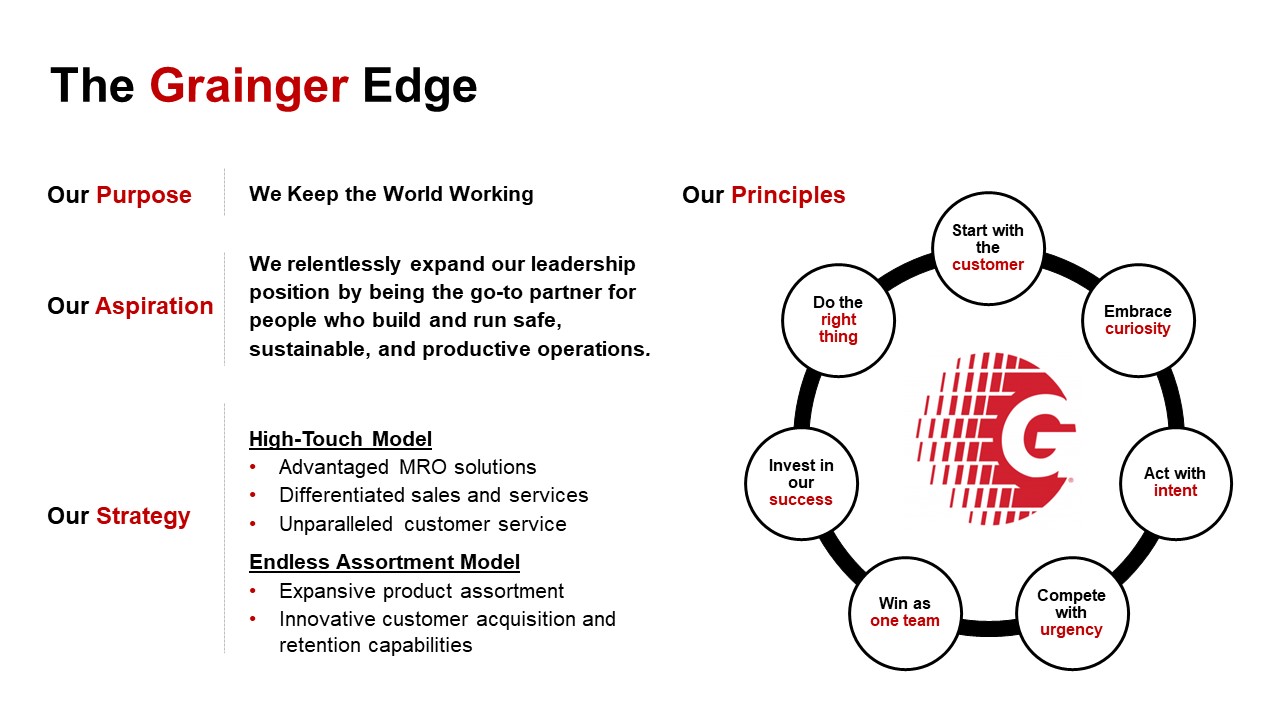]
[added: In total,] Grainger estimates [removed: to have 4%] [added: it has approximately 6%] share within these markets with [added: ample] opportunity [removed: and a track record] for growth.
Grainger’s two reportable segments are the U.S. and [removed: Canada,] [added: Canada through December 31, 2020,] and are further described below.
Other businesses include the endless assortment businesses, Zoro [added: in the U.S.] and [removed: MonotaRO,] [added: the U.K.] and [added: MonotaRO in Japan, and] smaller international businesses primarily in [removed: Europe] [added: the U.K.] and Mexico.
For further segment and financial information, see [removed: “Item] [added: Part II, Item] 7: Management’s Discussion and Analysis of Financial Condition and Results of [removed: Operations”] [added: Operations (MD&A)] and Note [removed: 14] [added: 1] to the Consolidated Financial Statements (Financial [removed: Statements).][added: Statements), included in Part II, Item 8: Financial Statements and Supplementary Data of this report, which is incorporated herein by reference.]
The table below shows Grainger's estimated share of the MRO market and the summary of its operations by [removed: reporting] [added: reportable] segments and other businesses as of December 31, [removed: 2019:][added: 2020:]
| | [added: | |] Approximate Market Share | | [added: | | | |] Distribution Centers [removed: (DCs)1] [added: (DCs)(1)] | | [removed: Branches1] | | [added: | | Branches(1) | | | | | |] Approximate Number of Customers Served [removed: (thousands)2] [added: (thousands)(2)] | [added: | |]
| Other [removed: businesses] [added: businesses:] | | | | | | | | [added: | | | | | | | | | | | | | | | |]
| Endless assortment businesses | [removed: 2%] | | [added: 3% | | | | | |] 4 | | [added: | | | |] — | | [removed: 2,600] | [added: | | | 3,800 | | |]
| International high-touch [removed: solutions] businesses | [removed: 1%] | | [removed: 6] [added: 2%] | | [removed: 119] | | [removed: 150] | [added: | 3 | | | | | | 71 | | | | | | 50 | | |]
[removed: 1] [added: (1)] See Item [removed: 2, "Properties"] [added: 2: Properties] for more information.
[removed: 2] [added: (2)] Customers served in the U.S. may include overlap with Zoro within the endless assortment businesses.
[removed: Approximately 5,000] [added: More than 4,500] suppliers [added: worldwide] provide Grainger businesses with about [removed: 1.6] [added: 1.5] million products stocked in DCs and branches.
Additionally, Grainger’s endless assortment businesses offer [removed: millions more] [added: approximately 26 million] products through [removed: its] [added: the Company's] expanding drop-ship assortment.
No single supplier comprised more than 5% of [added: Grainger's] total purchases and no significant barriers exist with respect to sources of supply.
No single product category comprises more than [removed: 17%] [added: 19%] of global sales.
United [removed: States][added: States - High-Touch]
Sales in [removed: 2019] [added: 2020] were made to approximately 1 million customers and no single end customer accounted for more than [removed: 2%] [added: 3%] of total sales.
[removed: Customers] [added: High-touch customers] desire highly tailored solutions with real-time access to [removed: information and efficient delivery of products and services.]
These trends are reflected in how customers do business as demonstrated in the following tables for the [removed: 2019] [added: 2020] line mix:
| Order Origination | | | | [added: | | | | |] Order Fulfillment | | | [added: | | |]
| *Digital channels:* | | | | [added: | | | | |] *Direct-to-customer:* | | | [added: | | |]
| Website | [removed: 30] | [added: | 32 | |] % | | [added: | |] Ship to Customer | [removed: 70] | [added: | 73 | |] % |
| EDI/ePro | [removed: 25] | [added: | 28 | |] % | | [added: | |] KeepStock® | [removed: 17] | [added: | 15 | |] % |
| KeepStock® | [removed: 16] | [added: | 15 | |] % | | [added: | |] Subtotal | [removed: 87] | [added: | 88 | |] % |
| Subtotal | [removed: 71] | [added: | 75 | |] % | | [added: | |] Branch Pick-up | [removed: 13] | [added: | 12 | |] % |
| *Non-digital channels:* | | | | [added: | | | | |] Total | [added: | |] 100 | [added: |] % |
| Branch | [removed: 10] | [added: | 6 | |] % | | | | | [added: | | | | |]
| Phone | [added: | |] 19 | [added: |] % | | | | | [added: | | | | |]
| Subtotal | [removed: 29] | [added: | 25 | |] % | | | | | [added: | | | | |]
| Total | [added: | |] 100 | [added: |] % | | | | | [added: | | | | |]
Customers have access to more than [removed: 4] [added: 1.5] million products through Grainger.com and other branded websites.
For customers with sophisticated electronic purchasing platforms, the U.S. [added: high-touch] business utilizes technology that allows these systems to communicate directly with Grainger.com.
In addition, approximately [removed: 21%] [added: 20%] of [removed: 2019] [added: 2020] U.S. business sales were private label MRO items bearing Grainger’s registered trademarks, including DAYTON®, SPEEDAIRE®, AIR HANDLER®, TOUGH GUY®, WESTWARD®, CONDOR® and LUMAPRO®.
Sales and service representatives in the U.S. [added: high-touch] business drive relationships with customers by helping select the right products for their needs and reducing costs by utilizing Grainger as a consistent source of supply.
Additionally, inventory management through KeepStock® allows the U.S. [added: high-touch] business to help customers be more productive.
The Grainger Edge (Purpose, Aspiration, Strategy)
Grainger's framework, “The Grainger Edge”, uniquely defines the Company by describing why it exists, how it serves its customers and how its team members work together to achieve its objectives.
Grainger’s purpose is to keep the world working.
Whether that means helping a hospital focus on patient care, a manufacturing plant focus on building great products or a school focus on educating, Grainger and its team members help keep facilities running so customers can focus on what they do best.
The framework also outlines a set of principles that define the behaviors expected from Grainger’s team members in working with each other and their customers, supplier partners and communities.
It is a basis for holding team members accountable to these principles and helps the company execute its strategy and create value for shareholders.
Business Model
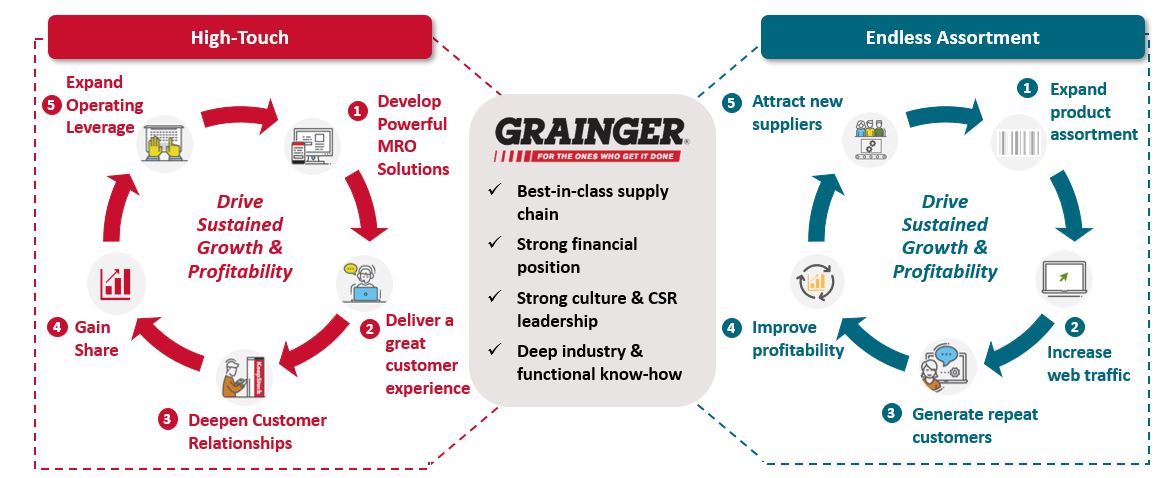
Grainger's strategy is defined by its customers’ needs and the Company uses a combination of its high-touch and endless assortment businesses to serve the varying needs for customers of all sizes.
This model helps Grainger deliver a great customer experience and develop deep customer relationships—whether onsite, at a branch, over the phone or online.
Grainger creates value for customers through its sales and service representatives, technical product support, fulfillment capabilities, inventory management solutions and other services.
Customers buying through the endless assortment platforms have access to an expansive product assortment and can quickly find the products they need with an easy and streamlined online search experience.
The assortment contains millions of Stock Keeping Units (SKUs), including products outside of traditional industrial MRO categories.

Accelerated Growth
Grainger’s high-touch and endless assortment businesses are supported by Grainger's strong competencies to help drive accelerated growth across the MRO industry.
Geographic Overview
While the global MRO market is vastly large, Grainger's estimated addressable market is more than $200 billion.
Grainger is most successful in markets where it has scale positions in purchasing, supply chain and information technology (IT), and where a developed infrastructure exists.
Those markets include North America, Europe and Japan.
Each of these core markets has similar characteristics: the market is large, and the competition is highly fragmented.
Effective January 1, 2021, Grainger’s two reportable segments are High Touch – North America and Endless Assortment to align with Grainger's two distinct business models.
| | | | | | | | | | | | | | | | | | | | | | | | |
| --- | --- | --- | --- | --- | --- | --- | --- | --- | --- | --- | --- | --- | --- | --- | --- | --- | --- | --- | --- | --- | --- | --- | --- |
| United States - high touch business | | | 7% | | | | | | 17 | | | | | | 287 | | | | | | 1,100 | | |
| Canada - high-touch business | | | 4% | | | | | | 5 | | | | | | 49 | | | | | | 50 | | |
| Total | | | 6% | | | | | | 29 | | | | | | 407 | | | | | | 5,000 | | |
Customers
Approximately 5 million customers worldwide rely on Grainger for MRO products and services representing a broad collection of industries, including, but not limited to commercial, government, healthcare and manufacturing.
Grainger's high-touch and endless assortment businesses appeal to varying customer needs and complexities as follows:

Products
Coronavirus (COVID-19) Pandemic Response
In response to the COVID-19 pandemic, the Company built and executed a pandemic-response focused on serving customers, supporting team members, and ensuring the Company remains financially strong.
Grainger is an essential business, allowing the Company to serve its customers with needed supplies and services throughout the pandemic and recovery.
As the pandemic evolved throughout 2020, the Company has continually shifted accordingly to ensure the Company is well positioned to continue executing its priorities.
See Part II: Item 7: MD&A and refer to the *Impact of the COVID-19 Pandemic on Grainger Businesses* for further details.
information and efficient delivery of products and services.
| | | | | | | | | | | | | | | |
| --- | --- | --- | --- | --- | --- | --- | --- | --- | --- | --- | --- | --- | --- | --- |
Strategy
To execute this strategy, the Company competes with two business models: high-touch solutions and endless assortment.
MRO Industry
The estimated market where Grainger has operations is large with an estimated size of more than $290 billion and is concentrated in North America, Japan and Europe.
These large core markets have high gross domestic product per capita, advanced infrastructures and competition is highly fragmented.
| | | | | | | | |
| --- | --- | --- | --- | --- | --- | --- | --- |
| United States | 7% | | 17 | | 282 | | 1,000 |
| Canada | 4% | | 5 | | 53 | | 50 |
| TOTAL | 4% | | 32 | | 454 | | 3,800 |
Customers and Products
| | | | | | | |
| --- | --- | --- | --- | --- | --- | --- |
Canada
Zoro
MonotaRO
Employees
Website Access to Company Reports
| | |
| --- | --- |
| Thomas B. Okray (57) | Senior Vice President and Chief Financial Officer, a position assumed in May 2018. Prior to joining Grainger, Mr. Okray served as Executive Vice President, Chief Financial Officer of Advance Auto Parts, Inc., a leading automotive aftermarket parts provider in North America, a position assumed in 2016. Previously, Mr. Okray served as Vice President, Finance, Global Customer Fulfillment, of Amazon.com, Inc., an online retailer, from January 2016 to October 2016, as Vice President, Finance, North American Operations of Amazon, from June 2015 to January 2016, and was employed by General Motors Company, a global automotive company, from July 1989 to June 2015, in a variety of finance and supply chain related roles, culminating in his position as CFO, Global Product Development, Purchasing & Supply Chain, from January 2010 to June 2015. |
An excerpt. Shown here: 40 of 64 rewritten, 40 of 105 added and all 21 removed. The counts are complete. For every sentence, read Item 1. Business in the FY2020 filing and the FY2019 filing.
Item 3. Legal Proceedings
1 rewritten, 0 added, 0 removed, 0 unchanged
For a description of legal proceedings, see the disclosure contained in Note [removed: 15] [added: 16] to the [added: Consolidated] Financial Statements included in [removed: "Part] [added: Part] II, Item 8: Financial Statements and Supplementary [removed: Data"] [added: Data] of this report, which is incorporated herein by reference.
Cover and table of contents
45 rewritten, 13 added, 7 removed, 30 unchanged
[removed: FORM 10-K][added: FORM 10-K]
For the fiscal year [removed: ended December] [added: ended December] 31, [removed: 2019][added: 2020]
Commission file [removed: number 1-5684][added: number 1-5684]
| Illinois | | | | | [added: | | | | | | | | | |] 36-1150280 | [added: | |]
| (State or other jurisdiction of incorporation or organization) | | | | | [added: | | | | | | | | | |] (I.R.S. Employer Identification No.) | [added: | |]
| 100 Grainger Parkway, | [added: | |] Lake Forest, | [added: | |] Illinois | | | [added: | | | | | |] 60045-5201 | [added: | |]
| (Address of principal executive offices) | | | | | [added: | | | | | | | | | |] (Zip Code) | [added: | |]
| | | [added: | | | |] 847 | [added: | |] 535-1000 | | | [added: | | | | | |]
| (Registrant’s telephone [removed: number] [added: number,] including area code) | | | | | | [added: | | | | | | | | | | | |]
| Title of Each Class | [added: | |] Trading Symbol | [added: | |] Name of Each Exchange on Which Registered | [added: | |]
| Common Stock | [added: | |] GWW | [added: | |] New York Stock Exchange | [added: | |]
If an emerging growth company, indicate by check mark if the registrant has elected not to use the extended transition period for complying with any new or revised financial accounting standards provided pursuant to Section [removed: 139)] [added: 13(a)] of the Exchange Act.
The aggregate market value of the voting common equity held by nonaffiliates of the registrant was [removed: $13,765,366,450] [added: $15,084,028,289] as of the close of trading as reported on the New York Stock Exchange on June 30, [removed: 2019.][added: 2020.]
The registrant had [removed: 53,656,306] [added: 52,375,717] shares of the Company’s Common Stock outstanding as of January 31, [removed: 2020.][added: 2021.]
Portions of the registrant's definitive proxy statement to be filed in connection with the annual meeting of shareholders to be held on April [removed: 29, 2020,] [added: 28, 2021,] are incorporated by reference into Part III hereof of this Form 10-K where indicated.
The registrant's definitive [removed: 2019] [added: 2020] proxy statement will be filed on or about March [removed: 19, 2020.][added: 18, 2021.]
| | [added: | |] TABLE OF CONTENTS | | | | | [added: | | | | | | | | | |] Page | [added: | |]
| | [added: | |] PART I | | | | | | [added: | | | | | | | | | | | |]
| Item 1: | [added: | |] BUSINESS | | | | | [removed: [3](#s6E19BC3F5D2C5ABDB30CF8DFE6DFE8A9)] | [added: | | | | | | | | | [4](#i906ee179ad9f4903b49bbc95a4e596a7_13) | | |]
| Item 1A: | [added: | |] RISK FACTORS | | | | | [removed: [9](#s877B093B45AF50C8A585A16823914EC6)] | [added: | | | | | | | | | [13](#i906ee179ad9f4903b49bbc95a4e596a7_19) | | |]
| Item 1B: | [added: | |] UNRESOLVED STAFF COMMENTS | | | | | [removed: [15](#s3DF7F3AD37AE59E2AA7730C9034F50A7)] | [added: | | | | | | | | | [20](#i906ee179ad9f4903b49bbc95a4e596a7_22) | | |]
| Item 2: | [added: | |] PROPERTIES | | | | | [removed: [15](#sCA9EEB00BC5659C2BCBB7701D568F60A)] | [added: | | | | | | | | | [21](#i906ee179ad9f4903b49bbc95a4e596a7_25) | | |]
| Item 3: | [added: | |] LEGAL PROCEEDINGS | | | | | [removed: [15](#sC1F00ACCD89B5C8CAC2EC998DC749620)] | [added: | | | | | | | | | [21](#i906ee179ad9f4903b49bbc95a4e596a7_28) | | |]
| Item 4: | [added: | |] MINE SAFETY DISCLOSURES | | | | | [removed: [15](#sD25D59042BBB559A8FB2107342C99FC2)] | [added: | | | | | | | | | [21](#i906ee179ad9f4903b49bbc95a4e596a7_31) | | |]
| | [added: | |] PART II | | | | | | [added: | | | | | | | | | | | |]
| Item 5: | [added: | |] MARKET FOR REGISTRANT'S COMMON EQUITY, RELATED SHAREHOLDER | | | | | [removed: [16](#s6B3E9C95158D53AF84B22189BDB25570)] | [added: | | | | | | | | | [22](#i906ee179ad9f4903b49bbc95a4e596a7_37) | | |]
| | | [added: | | | |] MATTERS AND ISSUER PURCHASES OF EQUITY SECURITIES | | | | | [added: | | | | | | | | | |]
| Item 6: | [added: | |] SELECTED FINANCIAL DATA | | | | | [removed: [18](#sA58DC8F71A905121A4B74A57C1A3D7B9)] | [added: | | | | | | | | | [24](#i906ee179ad9f4903b49bbc95a4e596a7_40) | | |]
| Item 7: | [added: | |] MANAGEMENT'S DISCUSSION AND ANALYSIS OF FINANCIAL | | | | | [removed: [19](#sBA7D27C0EAFD521B98CF4B92CE813E00)] | [added: | | | | | | | | | [25](#i906ee179ad9f4903b49bbc95a4e596a7_43) | | |]
| | | [added: | | | |] CONDITION AND RESULTS OF OPERATIONS | | | | | [added: | | | | | | | | | |]
| Item 7A: | [added: | |] QUANTITATIVE AND QUALITATIVE DISCLOSURES ABOUT MARKET RISK | | | | | [removed: [26](#sAE7B9EBEF788517C937EA42D1C861ABD)] | [added: | | | | | | | | | [35](#i906ee179ad9f4903b49bbc95a4e596a7_58) | | |]
| Item 8: | [added: | |] FINANCIAL STATEMENTS AND SUPPLEMENTARY DATA | | | | | [removed: [27](#s53D7B1C212D25BCCA470909569BA6101)] | [added: | | | | | | | | | [35](#i906ee179ad9f4903b49bbc95a4e596a7_61) | | |]
| Item 9: | [added: | |] CHANGES IN AND DISAGREEMENTS WITH ACCOUNTANTS | | | | | [removed: [27](#s29C52189362D5DE6A9800A1FB3E5404C)] | [added: | | | | | | | | | [35](#i906ee179ad9f4903b49bbc95a4e596a7_64) | | |]
| | | [added: | | | |] ON ACCOUNTING AND FINANCIAL DISCLOSURE | | | | | [added: | | | | | | | | | |]
| Item 9A: | [added: | |] CONTROLS AND PROCEDURES | | | | | [removed: [27](#s67E6E43C63055F66A30A69CD5A86B076)] | [added: | | | | | | | | | [35](#i906ee179ad9f4903b49bbc95a4e596a7_67) | | |]
| Item 9B: | [added: | |] OTHER INFORMATION | | | | | [removed: [27](#s55402E4105725AADB488B4A0AA6B5181)] | [added: | | | | | | | | | [35](#i906ee179ad9f4903b49bbc95a4e596a7_70) | | |]
| | [added: | |] PART III | | | | | | [added: | | | | | | | | | | | |]
| Item 10: | [added: | |] DIRECTORS, EXECUTIVE OFFICERS AND CORPORATE GOVERNANCE | | | | | [removed: [28](#s7644661C66505923A41D228D1C5AD1FB)] | [added: | | | | | | | | | [36](#i906ee179ad9f4903b49bbc95a4e596a7_76) | | |]
| Item 11: | [added: | |] EXECUTIVE COMPENSATION | | | | | [removed: [28](#s01518C254EA153C9B7E73DD1715871B3)] | [added: | | | | | | | | | [36](#i906ee179ad9f4903b49bbc95a4e596a7_79) | | |]
| Item 12: | [added: | |] SECURITY OWNERSHIP OF CERTAIN BENEFICIAL OWNERS AND MANAGEMENT AND RELATED STOCKHOLDER MATTERS | | | | | [removed: [28](#s2DBBA479920D5D2BA1BB96977039A4D4)] | [added: | | | | | | | | | [36](#i906ee179ad9f4903b49bbc95a4e596a7_82) | | |]
| | | | | | | | | | | | | | | | | | |
| --- | --- | --- | --- | --- | --- | --- | --- | --- | --- | --- | --- | --- | --- | --- | --- | --- | --- |
| | | | | | | | | | | | | | | | | | |
| | | | | | | | | |
| --- | --- | --- | --- | --- | --- | --- | --- | --- |
Securities registered pursuant to Section 12(g) of the Act:
None
Indicate by check mark whether the registrant has filed a report on and attestation to its management’s assessment of the effectiveness of its internal control over financial reporting under Section 404(b) of the Sarbanes-Oxley Act (15 U.S.C. 7262(b)) by the registered public accounting firm that prepared or issued its audit report.
| | | | | | | | | | | | | | | | | | | | | |
| --- | --- | --- | --- | --- | --- | --- | --- | --- | --- | --- | --- | --- | --- | --- | --- | --- | --- | --- | --- | --- |
| | | | | | | | | | | | | | | | | | | | | |
| Signatures | | | | | | | | | | | | | | | | | | [74](#i906ee179ad9f4903b49bbc95a4e596a7_235) | | |
| | | | | | | | | | | | | | | | | | | | | |
| | | | | | |
| --- | --- | --- | --- | --- | --- |
| | | |
| --- | --- | --- |
| | | | | | | |
| --- | --- | --- | --- | --- | --- | --- |
| Signatures | | | | | | [63](#sBB4028284DAF5A5FB623B4E0CBD80BDD) |
An excerpt. Shown here: 40 of 45 rewritten, all 13 added and all 7 removed. The counts are complete. For every sentence, read Cover and table of contents in the FY2020 filing and the FY2019 filing.
Item 2. Properties
17 rewritten, 5 added, 5 removed, 3 unchanged
As of December 31, [removed: 2019,] [added: 2020,] Grainger’s owned and leased facilities totaled approximately [removed: 28.2] [added: 26.8] million square feet.
| Location | | [added: | | | |] Facility and Use (7) | | [added: | | | |] Size in Square Feet (in thousands) | | [added: |]
| U.S. (1) | | [removed: 282] [added: | | | | 287] branch locations | | [removed: 6,348] | | [added: | | 6,404 | | |]
| U.S. (2) | | [added: | | | |] 17 DCs | | [removed: 9,660] | | [added: | | 9,178 | | |]
| U.S. (3) | | [added: | | | |] Other facilities | | [removed: 3,970] | | [added: | | 4,441 | | |]
| Canada (4) | | [removed: 53] [added: | | | | 49] branch locations | | [added: | | | |] 686 | | [added: |]
| Canada (5) | | [added: | | | |] 5 DCs | | [added: | | | |] 968 | | [added: |]
| Canada | | [added: | | | |] Other facilities | | [removed: 578] | | [added: | | 440 | | |]
| Other businesses (6) | | [added: | | | |] Other facilities | | [removed: 5,034] | | [added: | | 3,742 | | |]
| Chicago area (2) | | [added: | | | |] Headquarters and general offices | | [added: | | | |] 947 | | [added: |]
[removed: |] (1) [removed: |] Consists of 246 stand-alone, [removed: 34] [added: 39] onsite and 2 will-call express locations, of which 202 are owned and [removed: 80] [added: 85] are leased. [removed: These branches range in size from approximately 500 to 109,000 square feet. |]
[removed: |] (2) [removed: |] These facilities are primarily owned and range in size from approximately 45,000 to 1.5 million square feet. [removed: |]
[removed: |] (3) [removed: |] These facilities include both owned and leased locations and primarily consist of storage facilities, office space and call centers. [removed: |]
[removed: |] (4) [removed: |] Consists of 34 stand-alone and [removed: 19] [added: 15] onsite locations, of which 18 are owned and [removed: 35] [added: 31] are leased. [removed: These branches range in size from approximately 500 to 70,000 square feet. |]
[removed: |] (5) [removed: |] These facilities are primarily owned and range in size from approximately 40,000 to 540,000 square feet. [removed: |]
[removed: |] (6) [removed: |] These facilities include owned and leased locations [added: primarily] in North America, Japan and [removed: Europe. |][added: the U.K.]
[removed: |] (7) [removed: |] Owned facilities are not subject to any mortgages. [removed: |]
| | | | | | | | | | | | | | | |
| --- | --- | --- | --- | --- | --- | --- | --- | --- | --- | --- | --- | --- | --- | --- |
| | | | | | | Total Square Footage | | | | | | 26,806 | | |
These branches range in size from approximately 500 to 109,000 square feet.
These branches range in size from approximately 500 to 70,000 square feet.
| | | | | | |
| --- | --- | --- | --- | --- | --- |
| | | Total Square Feet | | 28,191 | |
| | |
| --- | --- |
Item 5. Market for Registrant’s Common Equity, Related Shareholder Matters and Issuer Purchases of Equity Securities
12 rewritten, 12 added, 12 removed, 7 unchanged
The approximate number of shareholders of record of Grainger’s common stock as of January [removed: 31, 2020,] [added: 29, 2021,] was [removed: 604] [added: 585] with approximately [removed: 206,588] [added: 226,759] additional shareholders holding stock through nominees.
| Period | [added: | |] Total Number of Shares Purchased (A) [added: (D)] | [added: | |] Average Price Paid Per Share (B) | [added: | |] Total Number of Shares Purchased as Part of Publicly Announced Plans or Programs (C) | [added: | |] Maximum Number of Shares That May Yet be Purchased Under the Plans or Programs | | | [added: | | |]
[removed: | (A) | There] [added: (A)There] were no shares withheld to satisfy tax withholding obligations. [removed: |]
[removed: | (B) | Average] [added: (B)Average] price paid per share [removed: includes any] [added: excludes] commissions [added: of $0.01 per share] paid. [removed: |]
[removed: | (C) | Purchases] [added: (C)Purchases] were made pursuant to a share repurchase program approved by Grainger's Board of Directors and announced on April 24, 2019 (2019 Program). [removed: The 2019 Program authorizes the repurchase of up to 5 million shares with no expiration date. |]
[removed: | (D) | The] [added: (D)The] difference of [removed: 1,040] [added: 895] shares between the Total Number of Shares Purchased and the Total Number of Shares Purchased as Part of Publicly Announced Plans or Programs represents shares purchased by the administrator and record keeper of the W.W. Grainger, Inc. Employees Profit Sharing Plan [added: (ESPP)] for the benefit of the employees who participate in the plan. [removed: |]
It covers the period commencing December 31, [removed: 2014,] [added: 2015,] and ending December 31, [removed: 2019.][added: 2020.]
The graph assumes that the value for the investment in Grainger common stock and in each index was $100 on December 31, [removed: 2014,] [added: 2015,] and that all dividends were reinvested.
[removed: 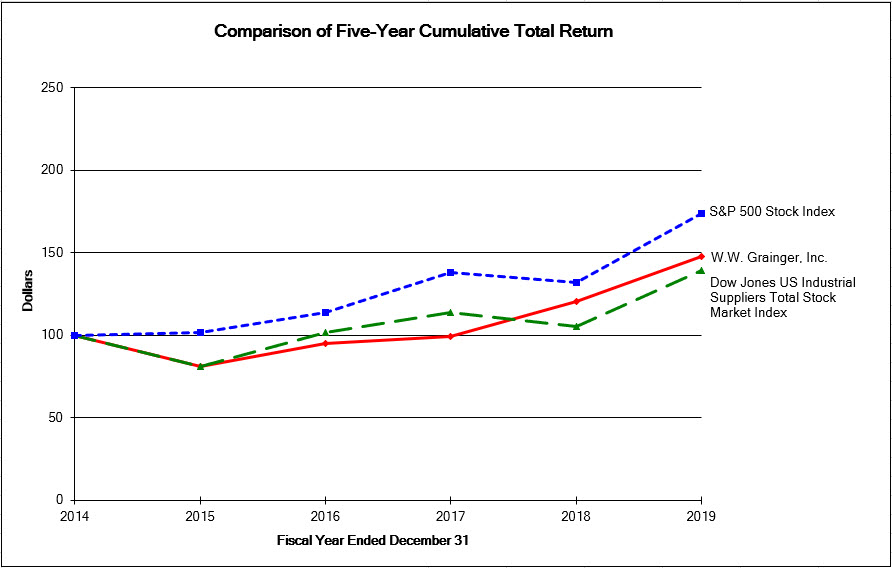][added: ]
| | [added: | |] December 31, | | | | | | | | | | | | | | | | | |
| | [removed: 2014] | | [removed: |] 2015 | | | 2016 | | | 2017 | | | 2018 | | | 2019 | | | [added: 2020 | | |]
| Dow Jones US Industrial Suppliers Total Stock Market Index | [added: | |] 100 | | | [removed: 81] [added: 126] | | | [removed: 102] [added: 140] | | | [removed: 114] [added: 129] | | | [removed: 105] [added: 172] | | | [removed: 139] [added: 214] | | |
| | | | | | | | | | | | | | | | | | |
| --- | --- | --- | --- | --- | --- | --- | --- | --- | --- | --- | --- | --- | --- | --- | --- | --- | --- |
| Oct. 1 – Oct. 31 | | | 102,696 | | | $353.81 | | | 102,696 | | | 2,639,859 | | | shares | | |
| Nov. 1 – Nov. 30 | | | 578,797 | | | $400.63 | | | 578,497 | | | 2,061,362 | | | shares | | |
| Dec. 1 – Dec. 31 | | | 568,214 | | | $408.53 | | | 567,619 | | | 1,493,743 | | | shares | | |
| Total | | | 1,249,707 | | | | | | 1,248,812 | | | | | | | | |
The 2019 Program authorizes the repurchase of up to 5 million shares with no expiration date.
On January 1, 2021, the ESPP was renamed the Retirement Savings Plan.
| | | | | | | | | | | | | | | | | | | | | |
| --- | --- | --- | --- | --- | --- | --- | --- | --- | --- | --- | --- | --- | --- | --- | --- | --- | --- | --- | --- | --- |
| W.W. Grainger, Inc. | | | $ | 100 | | $ | 117 | | $ | 122 | | $ | 149 | | $ | 182 | | $ | 223 | |
| S&P 500 Stock Index | | | 100 | | | 112 | | | 136 | | | 130 | | | 171 | | | 203 | | |
| | | | | | | |
| --- | --- | --- | --- | --- | --- | --- |
| Oct. 1 – Oct. 31 | 112,700 | $301.83 | 112,700 | 3,284,920 | | shares |
| Nov. 1 – Nov. 30 | 126,183 | $320.04 | 126,183 | 3,158,737 | | shares |
| Dec. 1 – Dec. 31 | 81,184 | $319.32 | 80,144 | 3,078,593 | | shares |
| Total | 320,067 (D) | | 319,027 | | | |
| | |
| --- | --- |
| | | | | | | | | | | | | | | | | | | |
| --- | --- | --- | --- | --- | --- | --- | --- | --- | --- | --- | --- | --- | --- | --- | --- | --- | --- | --- |
| W.W. Grainger, Inc. | $ | 100 | | $ | 81 | | $ | 95 | | $ | 99 | | $ | 121 | | $ | 148 | |
| S&P 500 Stock Index | 100 | | | 101 | | | 114 | | | 138 | | | 132 | | | 174 | | |
Item 6. Selected Financial Data
15 rewritten, 5 added, 2 removed, 6 unchanged
| | [removed: 2019] | | [added: 2020] | | [removed: 2018] | | | | [removed: 2017] [added: 2019] | | | | [removed: 2016] | | [added: 2018] | | [removed: 2015] | | | [added: | 2017 | | | | | | 2016 | | |]
| | [added: | |] (In millions of dollars, except for per share amounts) | | | | | | | | | | | | | | | | | | | [added: | | | | | | | |]
| Net sales | [added: | |] $ | [removed: 11,486] [added: 11,797] | | | [added: | |] $ | [removed: 11,221] [added: 11,486] | | | [added: | |] $ | [removed: 10,425] [added: 11,221] | | | [added: | |] $ | [removed: 10,137] [added: 10,425] | | | [added: | |] $ | [removed: 9,973] [added: 10,137] | |
| Gross profit | [added: | | 4,238 | | | | | |] 4,397 | | | | [added: | |] 4,348 | | | | [removed: 4,098] | | [added: 4,098] | | [removed: 4,115] | | | | [removed: 4,231] [added: 4,115] | | |
| Operating earnings | [added: | | 1,019 | | | | | |] 1,262 | | | | [added: | |] 1,158 | | | | [removed: 1,035] | | [added: 1,035] | | [removed: 1,113] | | | | [removed: 1,294] [added: 1,113] | | |
| Net earnings attributable to W.W. Grainger, Inc. (herein referred to as Net earnings) | [added: | | 695 | | | | | |] 849 | | | | [added: | |] 782 | | | | [removed: 586] | | [added: 586] | | [removed: 606] | | | | [removed: 769] [added: 606] | | |
| Net earnings per basic share | [added: | | 12.88 | | | | | |] 15.39 | | | | [added: | |] 13.82 | | | | [removed: 10.07] | | [added: 10.07] | | [removed: 9.94] | | | | [removed: 11.69] [added: 9.94] | | |
| Net earnings per diluted share | [added: | | 12.82 | | | | | |] 15.32 | | | | [added: | |] 13.73 | | | | [removed: 10.02] | | [added: 10.02] | | [removed: 9.87] | | | | [removed: 11.58] [added: 9.87] | | |
| Total current assets | [added: | | 3,919 | | | | | |] 3,555 | | | | [added: | |] 3,557 | | | | [removed: 3,206] | | [added: 3,206] | | [removed: 3,020] | | | | [removed: 3,049] [added: 3,020] | | |
| Property, building and equipment, net | [added: | | 1,395 | | | | | |] 1,400 | | | | [added: | |] 1,352 | | | | [removed: 1,392] | | [added: 1,392] | | [removed: 1,421] | | | | [removed: 1,431] [added: 1,421] | | |
| Long-term debt (less current maturities) | [added: | | 2,389 | | | | | |] 1,914 | | | | [added: | |] 2,090 | | | | [removed: 2,248] | | [added: 2,248] | | [removed: 1,841] | | | | [removed: 1,388] [added: 1,841] | | |
| Total shareholders' equity | [added: | | 2,093 | | | | | |] 2,060 | | | | [added: | |] 2,093 | | | | [removed: 1,828] | | [added: 1,828] | | [removed: 1,906] | | | | [removed: 2,353] [added: 1,906] | | |
| Operating cash flow | [added: | | 1,123 | | | | | |] 1,042 | | | | [added: | |] 1,057 | | | | [removed: 1,057] | | [added: 1,057] | | [removed: 1,024] | | | | [removed: 1,036] [added: 1,024] | | |
| Cash dividends paid per share | [added: | |] $ | [removed: 5.68] [added: 5.94] | | | [added: | |] $ | [removed: 5.36] [added: 5.68] | | | [added: | |] $ | [removed: 5.06] [added: 5.36] | | | [added: | |] $ | [removed: 4.83] [added: 5.06] | | | [added: | |] $ | [removed: 4.59] [added: 4.83] | |
For further information see [removed: “Part] [added: Part] II, Item 7: Management's Discussion and Analysis of Financial Condition and Results of [removed: Operations”] [added: Operations] of this [removed: report, which is incorporated herein by reference.][added: report.]
| | | | | | | | | | | | | | | | | | | | | | | | | | | | | | |
| --- | --- | --- | --- | --- | --- | --- | --- | --- | --- | --- | --- | --- | --- | --- | --- | --- | --- | --- | --- | --- | --- | --- | --- | --- | --- | --- | --- | --- | --- |
| | | | | | | | | | | | | | | | | | | | | | | | | | | | | | |
Net earnings for 2020 included a net expense of $182 million after tax primarily consisting of a $54 million net charge related to intangible asset impairments, a $109 million net charge associated with the sale of the Fabory business, a $9 million net charge for the wind-down of operations of Zoro Tools Europe, and a $14 million net charge related to restructuring in U.S. and Canada.
The net expense was partially offset by a $4 million gain related to the sale of the China business.
| | | | | | | | | | | | | | | | | | | | |
| --- | --- | --- | --- | --- | --- | --- | --- | --- | --- | --- | --- | --- | --- | --- | --- | --- | --- | --- | --- |
Item 8. Financial Statements and Supplementary Data
2 rewritten, 0 added, 0 removed, 0 unchanged
The financial statements and supplementary data are included on pages [removed: 32] [added: 39] to [removed: 63.][added: 73.]
See the Index to Financial Statements and Supplementary Data on page [removed: 31.][added: 38.]
Item 9A. Controls and Procedures
7 rewritten, 0 added, 2 removed, 3 unchanged
[removed: Disclosure] [added: *Disclosure] Controls and [removed: Procedures][added: Procedures*]
[removed: Internal] [added: *Internal] Control Over Financial [removed: Reporting][added: Reporting*]
[removed: | (A) | Management's] [added: (A)Management's] Annual Report on Internal Control Over Financial Reporting [removed: |]
Management's report on Grainger's internal control over financial reporting is included on page [removed: 32] [added: 39] of this Report under the heading Management's Annual Report on Internal Control Over Financial Reporting.
[removed: | (B) | Attestation] [added: (B)Attestation] Report of the Registered Public Accounting Firm [removed: |]
The report from Ernst & Young LLP on its audit of the effectiveness of Grainger's internal control over financial reporting as of December 31, [removed: 2019,] [added: 2020,] is included on page [removed: 33] [added: 40] of this Report under the heading Report of Independent Registered Public Accounting Firm.
[removed: | (C) | Changes] [added: (C)Changes] in Internal Control Over Financial Reporting [removed: |]
| | |
| --- | --- |
Item 10. Directors, Executive Officers and Corporate Governance
2 rewritten, 0 added, 1 removed, 4 unchanged
The information required by this item is incorporated by reference to Grainger's proxy statement relating to the annual meeting of shareholders to be held April [removed: 29, 2020,] [added: 28, 2021,] under the captions [removed: “Nominees and Director Experience] [added: “Board Qualifications, Attributes, Skills] and [removed: Qualifications,” "Annual] [added: Background,” “Annual] Election of Directors,” “Candidates for Board Membership,” [added: “Director Nominees’ Experience and Qualifications,” "Delinquent Section 16(a) Reports," “Audit Committee,” and] “Board Affairs and Nominating [removed: Committee,” “Audit Committee” and “Delinquent Section 16(a) Reports.”] [added: Committee.”] Information required by this item regarding executive officers of Grainger is set forth in Part I, Item 1, under the caption [removed: “Information about our Executive Officers.”][added: “Executive Officers of the Registrant.”]
This code of ethics is part of Grainger’s Business Conduct Guidelines for directors, officers and employees, which is available free of charge through Grainger’s website at [removed: *www.invest.grainger.com*.][added: invest.grainger.com.]
All Grainger employees are trained and certified yearly on these guidelines.
Item 11. Executive Compensation
1 rewritten, 0 added, 0 removed, 0 unchanged
The information required by this item is incorporated by reference to Grainger's proxy statement relating to the annual meeting of shareholders to be held April [removed: 29, 2020,] [added: 28, 2021,] under the captions “Director Compensation,” “Compensation Discussion and Analysis,” “Compensation Committee,” “Report of the Compensation Committee of the Board” and [removed: "Fees for Independent] [added: "Independent] Compensation [removed: Consultant."][added: Consultant; Fees."]
Item 12. Directors and Executive Officers
1 rewritten, 0 added, 0 removed, 0 unchanged
The information required by this item is incorporated by reference to Grainger's proxy statement relating to the annual meeting of shareholders to be held April [removed: 29, 2020,] [added: 28, 2021,] under the captions “Ownership of Grainger Stock” and “Equity Compensation Plans.”
Item 13. Certain Relationships and Related Transactions
1 rewritten, 0 added, 0 removed, 0 unchanged
The information required by this item is incorporated by reference to Grainger's proxy statement relating to the annual meeting of shareholders to be held April [removed: 29, 2020,] [added: 28, 2021,] under the captions “Director Independence,” "Annual Election of Directors" and “Transactions with Related Persons.”
Item 14. Principal Accountant Fees and Services
1 rewritten, 0 added, 0 removed, 1 unchanged
The information required by this item is incorporated by reference to Grainger's proxy statement relating to the annual meeting of shareholders to be held April [removed: 29, 2020,] [added: 28, 2021,] under the caption “Audit Fees and Audit Committee Pre-Approval Policies and Procedures.”
Item 15. Exhibits and Financial Statements Schedules
3 rewritten, 1 added, 2 removed, 1 unchanged
[removed: |] (1) [removed: |] Financial Statements: see [removed: "Item] [added: Item] 8: Financial Statements and Supplementary [removed: Data,"] [added: Data,] on [removed: page 31] [added: pages 38] hereof, for a list of financial statements. [removed: Management's Annual Report on Internal Control Over Financial Reporting. |]
[removed: |] (2) [removed: |] Financial Statement Schedules: the schedules listed in Rule 5-04 of Regulation S-X have been omitted because they are either not applicable or the required information is shown in the consolidated financial statements or notes thereto. [removed: |]
[removed: |] (3) [removed: |] Exhibits Required by Item 601 of Regulation S-K: the information required by this Item 15(a)(3) of Form 10-K is set forth on the Exhibit Index that follows the Signatures page [removed: 64] [added: 74] of the Form 10-K. [removed: |]
Management's Annual Report on Internal Control Over Financial Reporting.
| | |
| --- | --- |
Item 16. Form 10-K Summary
644 rewritten, 345 added, 148 removed, 299 unchanged
December 31, [removed: 2019, 2018] [added: 2020, 2019] and [removed: 2017][added: 2018]
| Page | | [added: | | | |]
| MANAGEMENT'S ANNUAL REPORT ON INTERNAL CONTROL OVER FINANCIAL REPORTING | [removed: [31](#sAE91A5A29CDB52968A89959A0CC67B1E)] | [added: | [39](#i906ee179ad9f4903b49bbc95a4e596a7_106) | | |]
| REPORTS OF INDEPENDENT REGISTERED PUBLIC ACCOUNTING FIRM | [removed: [32](#s873BEE6982F8580587195CCB88F383C0)] | [added: | [40](#i906ee179ad9f4903b49bbc95a4e596a7_109) | | |]
| FINANCIAL STATEMENTS | | [added: | | | |]
| CONSOLIDATED STATEMENTS OF EARNINGS | [removed: [35](#sFD3ED470AD2150428026C4B40806EB52)] | [added: | [43](#i906ee179ad9f4903b49bbc95a4e596a7_115) | | |]
| CONSOLIDATED STATEMENTS OF COMPREHENSIVE EARNINGS | [removed: [36](#s9DA07CDAF3585E4CB21113B481BB5147)] | [added: | [44](#i906ee179ad9f4903b49bbc95a4e596a7_118) | | |]
| CONSOLIDATED BALANCE SHEETS | [removed: [37](#s63B90C90538953D58E1A9A2C387ADA37)] | [added: | [45](#i906ee179ad9f4903b49bbc95a4e596a7_124) | | |]
| CONSOLIDATED STATEMENTS OF CASH FLOWS | [removed: [38](#s407D01560FCF595595D85848BD16F963)] | [added: | [46](#i906ee179ad9f4903b49bbc95a4e596a7_130) | | |]
| CONSOLIDATED STATEMENTS OF SHAREHOLDERS' EQUITY | [removed: [39](#s761730D2A3C957F28DF1652D83855BEE)] | [added: | [47](#i906ee179ad9f4903b49bbc95a4e596a7_133) | | |]
| NOTES TO CONSOLIDATED FINANCIAL STATEMENTS | [removed: [40](#s4E637EA5D47B51F6ABAED2609BAD1776)] | [added: | [48](#i906ee179ad9f4903b49bbc95a4e596a7_139) | | |]
Grainger's management assessed the effectiveness of Grainger's internal control over financial reporting as of December 31, [removed: 2019,] [added: 2020,] based on criteria established in Internal Control - Integrated Framework issued by the Committee of Sponsoring Organizations of the Treadway Commission (2013 framework) (the COSO criteria).
Based on its assessment under that framework and the criteria established therein, Grainger's management concluded that Grainger's internal control over financial reporting was effective as of December 31, [removed: 2019.][added: 2020.]
Ernst & Young LLP, an independent registered public accounting firm, has audited Grainger's internal control over financial reporting as of December 31, [removed: 2019,] [added: 2020,] as stated in their report, which is included herein.
We have audited the accompanying consolidated balance sheets of W.W. Grainger, Inc. and [removed: subsidiaries] [added: Subsidiaries] (the Company) as of December 31, [removed: 2019] [added: 2020] and [removed: 2018,] [added: 2019,] the related consolidated statements of earnings, comprehensive earnings, shareholders’ equity and cash flows for each of the three years in the period ended December 31, [removed: 2019,] [added: 2020,] and the related notes (collectively referred to as the “consolidated financial statements”).
In our opinion, the consolidated financial statements present fairly, in all material respects, the financial position of the Company at December 31, [removed: 2019] [added: 2020] and [removed: 2018,] [added: 2019,] and the consolidated results of its operations and its cash flows for each of the three years in the period ended December 31, [removed: 2019,] [added: 2020,] in conformity with U.S. generally accepted accounting principles.
We also have audited, in accordance with the standards of the Public Company Accounting Oversight Board (United States) (PCAOB), the Company’s internal control over financial reporting as of December 31, [removed: 2019,] [added: 2020,] based on criteria established in Internal Control-Integrated Framework issued by the Committee of Sponsoring Organizations of the Treadway Commission (2013 framework) and our report dated February [removed: 20, 2020] [added: 24, 2021] expressed an unqualified opinion thereon.
The critical audit matter communicated below is a matter arising from the current period audit of the [added: consolidated] financial statements that was communicated or required to be communicated to the audit committee and that: (1) relates to accounts or disclosures that are material to the [added: consolidated] financial statements and (2) involved our especially challenging, subjective or complex judgments.
| | [added: | |] Valuation of Goodwill for the Canadian Reporting Unit | [added: | |]
| *Description of the Matter* | [added: | |] At December 31, [removed: 2019,] [added: 2020,] the [removed: Company’s Canadian] [added: Grainger Canada] reporting [removed: unit] [added: unit’s] goodwill balance was [removed: $126] [added: $129] million. As discussed in Notes 1 and [removed: 4] [added: 5] of the financial statements, goodwill is tested at the reporting unit level annually during the fourth quarter and more frequently if impairment indicators exist. Auditing management’s [removed: annual] [added: interim quantitative] goodwill impairment test [added: performed during the second quarter] was complex and highly judgmental due to the significant estimation required in assessing the fair value of the Canadian reporting unit. The fair value estimate was sensitive to significant assumptions such as the revenue growth expectations, future expected cash flows, [removed: and] operating earnings, [added: and discount rate,] which are affected by expectations about future market or economic conditions. [added: Management performed a qualitative analysis in the fourth quarter.] | [added: | |]
| *How We Addressed the Matter in Our Audit* | [added: | |] Our audit procedures included, among others obtaining an understanding, evaluating the design and testing the operating effectiveness of controls over the Company’s goodwill impairment review process, including controls over management’s review of the significant assumptions described above. | [added: | |]
| | [added: | |] To test the estimated fair value of the Company’s Canadian reporting unit, we performed audit procedures that included, among others, assessing methodologies and involving our valuation specialists to assist in testing the significant assumptions and testing the completeness and accuracy of the underlying data used by the Company in its analysis. We compared the significant assumptions used by management to current industry and economic trends, changes to the Company’s business model, customer base or product mix, and other relevant factors. We assessed the historical accuracy of management’s estimates and performed sensitivity analyses of significant assumptions to evaluate the changes in the fair value of the reporting units that would result from changes in the assumptions. In addition, we reviewed the reconciliation of the fair value of the reporting units to the market capitalization of the Company. | [added: | |]
We have audited W.W. Grainger, Inc. and [removed: subsidiaries’] [added: Subsidiaries’] internal control over financial reporting as of December 31, [removed: 2019,] [added: 2020,] based on criteria established in Internal Control-Integrated Framework issued by the Committee of Sponsoring Organizations of the Treadway Commission (2013 Framework) (the COSO Criteria).
In our opinion, W.W Grainger, Inc. and [removed: subsidiaries] [added: Subsidiaries] (the Company) maintained, in all material respects, effective internal control over financial reporting as of December 31, [removed: 2019,] [added: 2020,] based on the COSO criteria.
We also have audited, in accordance with the standards of the Public Company Accounting Oversight Board (United States) (PCAOB), the consolidated balance sheets of the Company as of December 31, [removed: 2019] [added: 2020] and [removed: 2018,] [added: 2019,] and the related consolidated statements of earnings, comprehensive earnings, shareholders’ equity and cash flows for each of the three years in the period ended December 31, [removed: 2018] [added: 2020,] and the related notes and our report dated February [removed: 20, 2020] [added: 24, 2021] expressed an unqualified opinion thereon.
| | [added: | |] For the Years Ended December 31, | | | | | | | | | | | [added: | | | |]
| | [removed: 2019] | | [added: 2020] | | [removed: 2018] | | | | [removed: 2017] [added: 2019] | | | [added: | | | 2018 | | |]
| Net sales | [added: | |] $ | [removed: 11,486] [added: 11,797] | | | [added: | |] $ | [removed: 11,221] [added: 11,486] | | | [added: | |] $ | [removed: 10,425] [added: 11,221] | |
| Cost of goods sold | [removed: 7,089] | | [added: 7,559] | | [removed: 6,873] | | | | [removed: 6,327] [added: 7,089] | | | [added: | | | 6,873 | | |]
| Gross profit | [removed: 4,397] | | [added: 4,238] | | [removed: 4,348] | | | | [removed: 4,098] [added: 4,397] | | | [added: | | | 4,348 | | |]
| Selling, general and administrative expenses | [removed: 3,135] | | [added: 3,219] | | [removed: 3,190] | | | | [removed: 3,063] [added: 3,135] | | | [added: | | | 3,190 | | |]
| Operating earnings | [removed: 1,262] | | [added: 1,019] | | [removed: 1,158] | | | | [removed: 1,035] [added: 1,262] | | | [added: | | | 1,158 | | |]
| Other (income) expense: | | | | | | | | | | | | [added: | | | | | |]
| Interest expense, net | [removed: 79] | | [added: 93] | | [removed: 82] | | | | [removed: 86] [added: 79] | | | [added: | | | 82 | | |]
| Other, net | [removed: (26] | | [removed: )] [added: (21)] | | [removed: (5] | | [removed: )] | | [removed: 13] [added: (26)] | | | [added: | | | (5) | | |]
| Total other expense, net | [removed: 53] | | [added: 72] | | [removed: 77] | | | | [removed: 99] [added: 53] | | | [added: | | | 77 | | |]
| Earnings before income taxes | [removed: 1,209] | | [added: 947] | | [removed: 1,081] | | | | [removed: 936] [added: 1,209] | | | [added: | | | 1,081 | | |]
[removed: | Income taxes | 314 | | | | 258 | | | | 313 | | |][added: *Income Taxes*]
| Net earnings | [removed: 895] | | [added: 755] | | [removed: 823] | | | | [removed: 623] [added: 895] | | | [added: | | | 823 | | |]
| Less: Net earnings attributable to noncontrolling interest | [removed: 46] | | [added: 60] | | [removed: 41] | | | | [removed: 37] [added: 46] | | | [added: | | | 41 | | |]
| | | | | | |
| --- | --- | --- | --- | --- | --- |
| | | | | | |
| --- | --- | --- | --- | --- | --- |
February 24, 2021
February 24, 2021
| | | | | | | | | | | | | | | | | | |
| --- | --- | --- | --- | --- | --- | --- | --- | --- | --- | --- | --- | --- | --- | --- | --- | --- | --- |
| | | | | | | | | | | | | | | | | | |
| | | | | | | | | | | | | | | | | | |
| Income tax provision | | | 192 | | | | | | 314 | | | | | | 258 | | |
| | | | | | | | | | | | | | | | | | |
| --- | --- | --- | --- | --- | --- | --- | --- | --- | --- | --- | --- | --- | --- | --- | --- | --- | --- |
| | | | | | | | | | | | | | | | | | |
| | | | | | | | | | | | | | | | | | |
| | | | | | | | | | | | | | | | | | |
| --- | --- | --- | --- | --- | --- | --- | --- | --- | --- | --- | --- | --- | --- | --- | --- | --- | --- |
| Net earnings | | | $ | 755 | | | | | $ | 895 | | | | | $ | 823 | |
| | | | | | | | | | | | | | | | | | |
| Impairment of goodwill, intangibles and long lived assets | | | 187 | | | | | | 123 | | | | | | 156 | | |
| | | | | | | | | | | | | | | | | | |
| Net proceeds of business acquisitions, divestitures and sales of assets | | | 20 | | | | | | 17 | | | | | | 86 | | |
| | | | | | | | | | | | | | | | | | |
| | | | | | | | | | | | | | | | | | |
| | | | | | | | | | | | | | | | | | |
| | | | | | | | | | | | | | | | | | |
| | | | | | | | | | | | | | | | | | | | | | | | |
| --- | --- | --- | --- | --- | --- | --- | --- | --- | --- | --- | --- | --- | --- | --- | --- | --- | --- | --- | --- | --- | --- | --- | --- |
| Net earnings | | | — | | | — | | | 695 | | | — | | | — | | | 60 | | | 755 | | |
| Balance at December 31, 2020 | | | $ | 55 | | $ | 1,239 | | $ | 8,779 | | $ | (61) | | $ | (8,184) | | $ | 265 | | $ | 2,093 | |
The following reportable segments reflect how management reviews and evaluates operating performance through December 31, 2020:
- United States (U.S.) - high-touch business
- Canada - high-touch business
Effective January 1, 2021, the Company operates under the reportable segments listed below to align with its go-to-market strategies and bifurcated business models:
- High Touch - North America - the Company’s high-touch businesses provide value-added MRO solutions that are rooted in deep product knowledge and customer expertise.
This includes the Grainger-branded businesses in the U.S., Canada, Mexico and Puerto Rico.
- Endless Assortment - the Company’s endless assortment businesses provide a simple, transparent and streamlined experience for customers to shop millions of products.
This includes the Company’s Zoro Tools, Inc. (Zoro) and MonotaRO Co., Ltd. (MonotaRO) online channels which operate predominately in the U.S., United Kingdom (U.K.) and Japan.
The Company reports MonotaRO on a one-month calendar lag allowing for the timely preparation of Financial Statements.
This one-month reporting lag is with the exception of significant transactions or events that occur during the intervening period.
| | |
| --- | --- |
February 20, 2020
| --- | --- | --- | --- | --- | --- | --- | --- | --- | --- | --- | --- |
| Postretirement benefit plan reclassification, net of tax benefit of $2 million, $3 million and $1 million, respectively | (6 | | ) | | (7 | | ) | | 2 | | |
| | | | | | | | |
| --- | --- | --- | --- | --- | --- | --- | --- |
| Proceeds from sales of assets | 17 | | | | 86 | | | | 120 | | |
| Equity method proceeds (investment) | 2 | | | | (13 | | ) | | (35 | | ) |
| Net decrease in commercial paper | — | | | | — | | | | (370 | | ) |
| | | | | | | | | | | | | | | | | | | | | | |
| --- | --- | --- | --- | --- | --- | --- | --- | --- | --- | --- | --- | --- | --- | --- | --- | --- | --- | --- | --- | --- | --- |
| Balance at January 1, 2017 | $ | 55 | | $ | 1,030 | | $ | 7,113 | | $ | (273 | ) | $ | (6,128 | ) | $ | 108 | | $ | 1,905 | |
| Net earnings | — | | | — | | | 586 | | | — | | | — | | | 37 | | | 623 | | |
Estimates of market-
In July 2019, the FASB issued ASU 2019-07, Codification Updates to SEC Sections - Amendments to SEC Paragraphs *Pursuant to SEC Final Rule Releases No. 33-10532, Disclosure Update and Simplification, and Nos. 33-10231 and 33-10442, Investment Company Reporting Modernization, and Miscellaneous Updates (SEC Update).* This ASU clarifies or improves the disclosure and presentation requirements of a variety of codification topics by aligning with the SEC's regulations, thereby eliminating redundancies and making the codification easier to apply.
This ASU was
effective immediately upon issuance and did not have a material impact on the Company's Financial Statements and related disclosures.
On January 1, 2019, the Company adopted ASU 2016-02, *Leases* as modified subsequently by ASUs 2018-01, 2018-10, 2018-11, 2018-20 and 2019-01(Topic 842).
The Company utilized the simplified modified retrospective transition method that allowed for a cumulative-effect adjustment in the period of adoption, and did not restate prior periods.
Additionally, the Company elected the practical expedients package permitted under the transition guidance.
Adoption of the new standard resulted in the recording of ROU assets and lease liabilities of approximately $208 million and $205 million, respectively, as of January 1, 2019 related to operating and finance leases.
The
| | | | | | | | | | |
| --- | --- | --- | --- | --- | --- | --- | --- | --- | --- |
| | As of | | | | | | | | |
NOTE 4 - GOODWILL AND OTHER INTANGIBLE ASSETS
| | | | | | | | | | | | | | | | | |
| --- | --- | --- | --- | --- | --- | --- | --- | --- | --- | --- | --- | --- | --- | --- | --- | --- |
| Balance at January 1, 2018 | | $ | 192 | | | $ | 130 | | | $ | 222 | | | $ | 544 | |
| Cumulative goodwill impairment charges, December 31, 2019 (1) | | $ | — | | | $ | 32 | | | $ | 152 | | | $ | 184 | |
(1) Restated to include only impairments related to current businesses in Grainger's portfolio.
| | | | | | | | | | | | | | | | | | | | | | | | | | |
| --- | --- | --- | --- | --- | --- | --- | --- | --- | --- | --- | --- | --- | --- | --- | --- | --- | --- | --- | --- | --- | --- | --- | --- | --- | --- |
Qualitative tests for the quarter indicated the existence of impairment indicators for the Canada business and Cromwell (included in other businesses).
As such, quantitative tests were performed.
The risk of impairment for the Canada business is dependent upon key assumptions included in the determination of the reporting unit's fair value, particularly revenue growth expectations, future expected cash flows and operating earnings performance.
Changes in assumptions regarding future performance and unfavorable economic environment in Canada may have a significant impact on future cash flows expectations and require the recording of future impairment charges.
The carrying value of the Canada businesses goodwill was $126 million as of December 31, 2019.
Previously, during the third quarter of 2018 the Company recorded impairment charges totaling $139 million attributable to all of Cromwell’s goodwill and a portion of its trade name assets.
An excerpt. Shown here: 40 of 644 rewritten, 40 of 345 added and 40 of 148 removed. The counts are complete. For every sentence, read Item 16. Form 10-K Summary in the FY2020 filing and the FY2019 filing.