 filings.tools
W.W. Grainger (GWW) 10-K risk factor changes: FY2019 vs FY2018
The 2019-12-31 10-K against the 2018-12-31 one, compared heading by heading and sentence by sentence. One of these filings carries no fiscal year tag, so its year is the calendar year of the period end.
Item 1A40 rewritten41 added4 removed69 unchanged
All filing items891 rewritten385 added637 removed708 unchanged
Summary
counted, not written
- Item 1A headings could not be compared: only 0 carried over between the two years, which usually means one filing was read wrongly, so none is reported as new or removed.
- Sentence by sentence, 385 added, 637 removed, 891 rewritten and 708 unchanged across 21 items that differ.
- Not in this year's filing: Item 4A. Executive Officers of the Registrant.
Sentences by item
23 items, with every count and a link to each item that changed
Underlined words on a shaded ground are new in FY2019; struck-through words were in FY2018. Sentences that are wholly new or wholly gone are labelled rather than marked.
Item 1A. Risk Factors
40 rewritten, 41 added, 4 removed, 69 unchanged
[removed: Weakness] [added: Weakness] in the economy, market trends and other conditions affecting the profitability and financial stability of [removed: Grainger’s] [added: Grainger's] customers could negatively impact [removed: Grainger’s] [added: Grainger's] sales growth and results of [removed: operations.][added: operations.]
Accordingly, a significant or prolonged slowdown in [added: economic] activity in the U.S., Canada or any other major world economy, or a segment of any such economy, could negatively impact [removed: Grainger’s] [added: Grainger's] sales growth and results of operations.
[removed: The] [added: The] facilities maintenance industry is highly competitive, and changes in competition could result in decreased demand for [removed: Grainger’s] [added: Grainger's] products and [removed: services.][added: services.]
Grainger faces competition in all markets it [removed: serves,] [added: serves] from manufacturers (including some of its own suppliers) that sell directly to certain segments of the market, wholesale distributors, catalog houses, retail enterprises and online businesses that compete with price transparency.
These [removed: pressures, and the implementation, timing and results of Grainger’s strategic pricing and other responses,] [added: pressures] could have a material effect on Grainger’s sales and profitability.
If the Company is unable to grow sales or reduce costs, among other actions, [removed: to wholly or partially offset] the [removed: effect on profitability of its pricing actions, the] Company’s results of operations and financial condition may be adversely affected.
As a result, [removed: Grainger’s] [added: Grainger's] ability to effectively compete requires Grainger to respond and adapt to new industry trends and [removed: developments, and implement new technology and innovations that may result in unexpected costs or may take longer than expected.][added: developments.]
[removed: Volatility] [added: Volatility] in commodity prices may adversely affect gross [removed: margins.][added: margins.]
Some of [removed: Grainger’s] [added: Grainger's] products contain significant amounts of commodity-priced materials, such as steel, copper, petroleum derivatives, or rare earth minerals, and are subject to price changes based [removed: upon] [added: on] fluctuations in the commodities market.
In addition, higher prices could [removed: impact] [added: reduce] demand for these products, resulting in lower sales volumes.
[removed: Unexpected] [added: Unexpected] product shortages, tariffs, and risks associated with [removed: Grainger’s] [added: Grainger's] suppliers could negatively impact customer relationships or result in an adverse impact on results of [removed: operations.][added: operations.]
Historically, no significant difficulty has been encountered with respect to sources of supply; however, disruptions could occur due to factors beyond [removed: Grainger’s] [added: Grainger's] control, including economic downturns, geopolitical unrest, [added: tariffs,] new tariffs or tariff increases, trade issues and policies, labor problems experienced by [removed: Grainger’s] [added: Grainger's] suppliers, transportation availability and cost, [added: shortage of raw materials,] inflation and other factors, any of which could adversely affect a [removed: supplier’s] [added: supplier's] ability to manufacture or deliver products or could result in an increase in [removed: Grainger’s] [added: Grainger's] product costs.
[removed: Changes] [added: Changes] in customer base or product mix could cause changes in [removed: Grainger’s] [added: Grainger's] gross margin or affect [removed: Grainger’s] [added: Grainger's] competitive [removed: position.][added: position.]
Changes in customer base and product mix result primarily from business acquisitions, changes in customer demand, customer acquisitions, selling and marketing [removed: activities] [added: activities, competition] and [removed: competition.][added: the increased use of eCommerce by Grainger and its competitors.]
[removed: Disruptions] [added: Disruptions] in [removed: Grainger’s] [added: Grainger's] supply chain could result in an adverse impact on results of [removed: operations.][added: operations.]
The occurrence of one or more natural disasters such as earthquakes, storms, hurricanes, floods, fires, droughts, tornados and other extreme weather; [added: pandemic diseases or viral contagions such as the coronavirus outbreak;] geopolitical events, such as war, civil unrest or terrorist attacks in a country in which Grainger operates or in which its suppliers are located; and the imposition of measures that create barriers to or increase the costs associated with international trade could result in disruption of [removed: Grainger’s] [added: Grainger's] logistics or supply chain network.
Any such disruption [added: or other catastrophic event] could cause one or more of [removed: Grainger’s] [added: Grainger's] distribution centers or branches to become non-operational, adversely affect [removed: Grainger’s] [added: Grainger's] ability to obtain or deliver inventory in a timely manner, impair [removed: Grainger’s] [added: Grainger's] ability to meet customer demand for products, result in lost sales, additional costs, or penalties, or damage [removed: Grainger’s] [added: Grainger's] reputation.
[removed: Interruptions] [added: Interruptions] in the proper functioning of information systems could disrupt operations and cause unanticipated increases in costs and/or decreases in [removed: revenues.][added: revenues.]
Although [removed: Grainger’s] [added: Grainger's] information systems are protected with robust backup and security systems, including physical and software safeguards and remote processing capabilities, information systems are still vulnerable to damage or interruption from natural disasters, power losses, telecommunication failures, user error, third party actions [removed: such as malicious computer programs, denial-of-service attacks and cybersecurity breaches, and other problems.]
If [removed: Grainger’s] [added: Grainger's] systems [added: or those of third parties on which Grainger depends] are damaged, breached or cease to function properly Grainger may have to make a significant investment to repair or replace them and may suffer interruptions in its business operations in the interim.
[removed: Cybersecurity] [added: Cybersecurity] incidents, including breaches of information systems security, could damage [removed: Grainger’s] [added: Grainger's] reputation, disrupt operations, increase costs and/or decrease [removed: revenues.][added: revenues.]
Each year, cyber-attackers make numerous attempts to access the information stored in [removed: our] [added: the Company's] information systems.
If successful, those attempting to penetrate [removed: Grainger’s] [added: Grainger's] or its [removed: vendors’] [added: vendors'] information systems may misappropriate [added: intellectual property or] personally identifiable, credit card, confidential, proprietary or other sensitive customer, supplier, employee or business information, or cause systems disruption.
Loss of customer, supplier, employee or [added: intellectual property or] other business information [added: or failure to comply with data privacy and security laws] could disrupt operations, damage [removed: Grainger’s] [added: Grainger's] reputation and expose Grainger to claims from customers, suppliers, financial institutions, regulators, payment card associations, employees and others, any of which could have a material adverse effect on Grainger, its financial condition and results of operations.
[removed: Grainger’s] [added: Grainger's] ability to adequately protect its intellectual property or successfully defend against infringement claims by others may have an adverse impact on [removed: operations.][added: operations.]
[removed: Unauthorized use of Grainger’s intellectual property by others could result in harm to various] aspects of the business and may result in costly and protracted litigation in order to protect [removed: its] [added: Grainger’s] rights.
[removed: Fluctuations] [added: Fluctuations] in foreign currency could have an effect on reported results of [removed: operations.][added: operations.]
Grainger also has foreign currency exposure to the extent receipts and expenditures are not denominated in [removed: the subsidiary’s] [added: a subsidiary's] functional currency and that could have an impact on sales, costs and cash flows.
[removed: Acquisitions,] [added: An inability to successfully implement Grainger’s strategy or to integrate acquisitions,] partnerships, joint ventures and other business combination transactions [removed: involve a number of inherent risks, any of which] could result in the benefits anticipated not being realized and could have an adverse effect on results of [removed: operations.][added: operations.]
[removed: Acquisitions,] [added: In addition, acquisitions,] partnerships, joint ventures and other business combination transactions, both foreign and domestic, involve various inherent risks, such as uncertainties in assessing value, strengths, weaknesses, liabilities and potential profitability.
[removed: In] [added: In] order to compete, Grainger must attract, retain and motivate key employees, and the failure to do so could have an adverse effect on results of [removed: operations.][added: operations.]
[removed: Grainger’s] [added: Grainger’s] continued success is substantially dependent on positive perceptions of Grainger’s [removed: reputation.][added: reputation.]
[removed: Grainger] [added: Grainger] is subject to various domestic and foreign laws, regulations and standards.
Failure to comply or unforeseen developments in related contingencies such as litigation could adversely affect [removed: Grainger’s] [added: Grainger's] financial condition, results of operations and cash [removed: flows.][added: flows.]
In addition to [removed: Grainger’s] [added: Grainger's] U.S. operations, which in [removed: 2018] [added: 2019] generated approximately 72% of its consolidated net sales, Grainger operates its business principally through wholly-owned subsidiaries in Canada, China, Germany, Mexico, the Netherlands, and the United Kingdom, and its majority-owned subsidiary in Japan.
The wide array of laws, regulations and standards in each domestic and foreign jurisdiction where Grainger operates, include, but are not limited to: advertising and marketing regulations, anti-bribery and corruption laws, anti-competition regulations, data protection (including, because Grainger accepts credit cards, the Payment Card Industry Data Security Standard), data privacy (including in the [removed: U.S.] [added: U.S., the California Consumer Privacy Act,] and [added: in] the European Union, [removed: which has traditionally imposed strict obligations][added: the General Data Protection Regulation 2016, with interpretations varying from state to state and country to country) and cybersecurity requirements (including protection of information and incident responses), environmental protection laws, foreign exchange controls and cash repatriation restrictions, health and safety laws, import and export requirements, intellectual property laws, labor laws (including federal and state wage and hour laws), product compliance or safety laws, supplier regulations regarding the sources of supplies or products, tax laws (including as to U.S. taxes on foreign subsidiaries), unclaimed property laws and laws, regulations and standards applicable to other commercial matters.]
Failure to comply with any of these laws, regulations and standards could result in civil, criminal, monetary and non-monetary [added: fines,] penalties [removed: and/or loss of authorization to participate in, or exclusion from, government contracting,] [added: and/or, remediation costs] as well as potential damage to the [removed: Company’s] [added: Company's] reputation.
[removed: Tax] [added: Tax] changes could affect [removed: Grainger’s] [added: Grainger's] effective tax rate and future [removed: profitability.][added: profitability.]
[removed: Grainger’s] [added: Grainger's] common stock may be subject to volatility or price [removed: declines.][added: declines.]
The trading price of [removed: Grainger’s] [added: Grainger's] common stock is subject to broad and unpredictable fluctuation due to changes in economic, political and market conditions, the operating results of Grainger and its competitors, changes in expectations as to [removed: Grainger’s] [added: Grainger's] future financial or operating performance, including estimates by securities analysts and investors, [added: the Company’s failure to meet the financial performance guidance or other forward-looking statements provided to the public,] changes in capital structure, [removed: stock] [added: share] repurchase programs or dividend policies, and a number of other factors, including those discussed in this Item 1A.
Downward pressure on sales prices, changes in the volume of our orders, and an inability to pass higher product costs on to customers could cause our gross profit percentage to fluctuate or decline.
We may not be able to pass rising product costs to customers if those customers have ready product or supplier alternatives in the marketplace.
Implementing new technology and innovations may result in unexpected costs and interruptions to operations, may take longer than expected, and may not provide all anticipated benefits.
For example, should the coronavirus outbreak persist or spread, it could disrupt the operations of the Company and its suppliers and customers.
such as malicious computer programs, denial-of-service attacks and cybersecurity breaches, and other problems.
In addition, from time to time Grainger relies on the IT systems of third parties to assist in conducting its business.
If critical information systems fail or otherwise become unavailable, Grainger's ability to operate its eCommerce platforms, process orders, maintain proper levels of inventories, collect accounts receivable, disburse funds, manage its supply chain, monitor results of operations, and process and store employee or customer data, among other functions, could be adversely affected.
Unauthorized use of Grainger's intellectual property by others could result in harm to various
Grainger has implemented and is implementing several initiatives to increase sales and earnings.
If Grainger is unable to successfully implement these initiatives, Grainger’s business, financial condition and results of operations could be materially adversely affected.
Grainger is subject to a number of rules and regulations related to its government contracts, which may result in increased compliance costs and potential liabilities.
Grainger's contracts with U.S. federal, state and local government entities are subject to various regulations related to procurement, formation and performance.
In addition, the Company's government contracts may provide for termination, reduction or modification by the government at any time, with or without cause.
From time to time, Grainger is subject to governmental or regulatory investigations or audits related to its compliance with these rules and regulations.
Violations of these regulations could result in fines, criminal sanctions, the inability to participate in existing or future government contracting and other administrative sanctions.
Any such penalties could result in damage to the Company's reputation, increased costs of compliance and/or remediation and could adversely affect the Company's financial condition and results of operations.
In conducting its business Grainger may become subject to legal proceedings or governmental investigations, including in connection with product liability or product compliance claims if people, property or the environment are harmed by Grainger’s products or services.
Grainger is, and from time to time may become, party to a number of legal proceedings or governmental investigations for alleged violations of laws, rules or regulations.
Grainger also may be subject to disputes and proceedings incidental to its business, including product-related claims for personal injury or illness, death, or environmental or property damage, including the proceedings discussed in Part I, Item 3.
Legal Proceedings.
Grainger also may be requested or required to recall products or take other actions.
The Company’s
reputation could also be adversely affected by any resulting negative publicity.
In December 2017, the U.S. government enacted comprehensive tax legislation that included significant changes to the taxation of business entities.
The Company's accounting for the tax effects of such legislation may be subject to change due to subsequent clarification or amendment of the tax law which could adversely affect the Company's operating results or financial condition.
Changes in Grainger’s credit ratings and outlook may reduce access to capital and increase borrowing costs.
Grainger’s credit ratings are based on a number of factors, including the Company’s financial strength and factors outside of Grainger’s control, such as conditions affecting Grainger’s industry generally or the introduction of new rating practices and methodologies.
Grainger cannot provide assurances that its current credit ratings will remain in effect or that the ratings will not be lowered, suspended or withdrawn entirely by the rating agencies.
If rating agencies lower, suspend or withdraw the ratings, the market price or marketability of Grainger’s securities may be adversely affected.
In addition, any change in ratings could make it more difficult for the Company to raise capital on favorable terms, impact the Company’s ability to obtain adequate financing, and result in higher interest costs for the Company’s existing credit facilities or on future financings.
Grainger has incurred substantial indebtedness and may incur substantial additional indebtedness, which could adversely affect cash flow, decrease business flexibility, or prevent Grainger from fulfilling its obligations.
As of December 31, 2019, Grainger’s consolidated indebtedness was approximately $2.4 billion.
The Company’s indebtedness could, among other things, limit Grainger’s ability to respond to rapidly changing business and economic conditions, require the Company to dedicate a substantial portion of its cash flows to the payment of principal and interest on its indebtedness, reducing the funds available for other business purposes, and make it more difficult to satisfy the Company’s financial obligations as they come due during periods of adverse economic and industry conditions.
The agreements governing Grainger’s debt agreements and instruments contain representations, warranties, affirmative, negative and financial covenants, and default provisions.
Grainger’s failure to comply with these restrictions and obligations could result in a default under such agreements, which may allow Grainger’s creditors to accelerate the related indebtedness.
Any such acceleration could have a material adverse effect on Grainger’s business, financial condition, results of operations, cash flows, and its ability to obtain financing on favorable terms in the future.
In addition, Grainger may in the future seek to raise additional financing for working capital, capital expenditures, refinancing of indebtedness, share repurchases or other general corporate purposes.
Grainger’s ability to obtain additional financing will be dependent on, among other things, the Company’s financial condition, prevailing market conditions and numerous other factors beyond the Company’s control.
Such additional financing may not be available
on commercially reasonable terms or at all.
If critical information systems fail or otherwise become unavailable, among other things, Grainger’s ability to process orders,
maintain proper levels of inventories, collect accounts receivable, and disburse funds could be adversely affected.
under data privacy laws and regulations that vary from country to country) and cybersecurity requirements (including protection of information and incident responses), environmental protection laws, foreign exchange controls and cash repatriation restrictions, government business regulations applicable to Grainger as a government contractor selling to federal, state and local government entities, health and safety laws, import and export requirements, intellectual property laws, labor laws (including federal and state wage and hour laws), product compliance laws, supplier regulations regarding the sources of supplies or products, tax laws (including as to U.S. taxes on foreign subsidiaries), unclaimed property laws and laws, regulations and standards applicable to other commercial matters.
Grainger also is, and from time to time may become, party to a number of legal proceedings incidental to Grainger’s business involving alleged damages or injuries arising out of the use of Grainger’s products and services or violations of these laws, regulations or standards.
An excerpt. Shown here: all 40 rewritten, 40 of 41 added and all 4 removed. The counts are complete. For every sentence, read Item 1A. Risk Factors in the FY2019 filing and the FY2018 filing.
Item 7. Management’s Discussion and Analysis of Financial Condition and Results of Operations
129 rewritten, 61 added, 248 removed, 52 unchanged
[removed: General][added: General]
W.W. Grainger, Inc. [removed: (Grainger)] [added: (Grainger or Company)] is a broad line, business-to-business distributor of maintenance, repair and operating (MRO) products and services with operations primarily in North America, [removed: Europe] [added: Japan] and [removed: Japan.][added: Europe.]
More than 3.5 million customers worldwide rely on Grainger for products such as safety, gloves, ladders, motors and janitorial supplies, along with services [removed: like] [added: such as] inventory management and technical support.
They place orders [removed: online, on mobile devices,] through [removed: sales representatives,] [added: digital channels,] over the phone and at local branches.
Approximately 5,000 suppliers provide Grainger with about [removed: 1.7] [added: 1.6] million products stocked in Grainger's distribution centers (DCs) and branches worldwide.
These reportable segments reflect the results of the Company's [removed: high-touch, high-service] [added: high-touch solutions] businesses in those geographies.
Other businesses include the endless assortment businesses, (Zoro in the U.S. and MonotaRO in Japan), and smaller [removed: high-touch, high-service] [added: international high-touch solutions] businesses in [removed: Europe, Asia] [added: Europe] and Mexico.
[removed: | | U.S. | | | | | | Canada | | | | |][added: *Canada*]
| | [removed: Estimated] [added: 2019 | | | |] 2018 | | | [removed: Forecasted] [added: |] 2019 | | | [removed: Estimated 2018] [added: 2019] | | | [removed: Forecasted 2019] [added: 2018] | |
[removed: Outlook][added: Outlook]
[removed: In the] [added: The] U.S. [removed: business, Grainger] [added: business] is focused on growing [removed: market share] through [removed: the three pillars of its strategy: (i) building] [added: differentiated sales and services (e.g., direct customer relationships and onsite services),] advantaged MRO [removed: solutions, which means being able to] [added: solutions (e.g.,] get customers the exact [removed: product] [added: products and services] they need to solve a problem [removed: quickly; (ii) offering differentiated sales and services; Grainger has an advantage in serving complex businesses at their place of business through its direct customer relationships and onsite services] [added: quickly)] and [removed: (iii) enabling flawless order to cash; Grainger is committed to providing the absolute best] [added: unparalleled] customer [removed: experience in the industry through its effort to] [added: service (e.g.,] deliver flawlessly on every customer [removed: transaction.][added: transaction).]
[removed: Results] [added: Results] of [removed: Operations][added: Operations]
| | For the Years Ended December 31, | | | | | | | [removed: | | | | | | | | |]
[removed: | | 2018 | | | | 2017 | | | | 2018 | | | 2018 | | | 2017 | |][added: *2018* *Compared to* *2017*]
| Net sales | $ | [removed: 11,221] [added: 11,486] | | | $ | [removed: 10,425] [added: 11,221] | | | [removed: 8] [added: 2] | % | | 100.0 | % | | 100.0 | % |
| Cost of goods sold | [removed: 6,873] [added: 7,089] | | | | [removed: 6,327] [added: 6,873] | | | | [removed: 9] [added: 3] | % | | [removed: 61.3] [added: 61.7] | [added: %] | | [removed: 60.7] [added: 61.3] | [added: %] |
| Gross profit | [removed: 4,348] [added: 4,397] | | | | [removed: 4,098] [added: 4,348] | | | | [removed: 6] [added: 1] | % | | [removed: 38.7] [added: 38.3] | [added: %] | | [removed: 39.3] [added: 38.7] | [added: %] |
| Selling, general and administrative expenses | [removed: 3,190] [added: 3,135] | | | | [removed: 3,063] [added: 3,190] | | | | [removed: 4] [added: (2] | [removed: %] [added: )%] | | [removed: 28.4] [added: 27.3] | [added: %] | | [removed: 29.4] [added: 28.4] | [added: %] |
| Operating earnings | [removed: 1,158] [added: 1,262] | | | | [removed: 1,035] [added: 1,158] | | | | [removed: 12] [added: 9] | % | | [removed: 10.3] [added: 11.0] | [added: %] | | [removed: 9.9] [added: 10.3] | [added: %] |
| Other expense, net | [removed: 77] [added: 53] | | | | [removed: 99] [added: 77] | | | | [removed: (22] [added: (31] | )% | | [removed: 0.7] [added: 0.5] | [added: %] | | [removed: 0.9] [added: 0.7] | [added: %] |
| Income taxes | [removed: 258] [added: 314] | | | | [removed: 313] [added: 258] | | | | [removed: (18] [added: 22] | [removed: )%] [added: %] | | [removed: 2.3] [added: 2.7] | [added: %] | | [removed: 3.0] [added: 2.3] | [added: %] |
| Net earnings | [removed: 823] [added: 895] | | | | [removed: 623] [added: 823] | | | | [removed: 32] [added: 9] | % | | [removed: 7.3] [added: 7.8] | [added: %] | | [removed: 6.0] [added: 7.3] | [added: %] |
| Noncontrolling interest | [removed: 41] [added: 46] | | | | [removed: 37] [added: 41] | | | | [removed: 11] [added: 12] | % | | 0.4 | [added: %] | | 0.4 | [added: %] |
| Net earnings attributable to W.W. Grainger, Inc. | $ | [removed: 782] [added: 849] | | | $ | [removed: 586] [added: 782] | | | [removed: 33] [added: 8] | % | | [removed: 7.0] [added: 7.4] | % | | [removed: 5.6] [added: 7.0] | % |
[removed: 2018 Compared to 2017][added: Segment Analysis - 2018 Compared to 2017]
Grainger's net sales of [removed: $11,221] [added: $11,486] million for [removed: 2018] [added: the year ended 2019] increased [removed: $796] [added: $265] million, or [removed: 8%,] [added: 2.5%,] compared to the same period in [removed: 2017.][added: 2018.]
The increase in net sales was primarily driven by volume increases in the U.S. business [removed: due to] [added: from] market share gain and [removed: an improved demand environment and] continued [removed: double digit] [added: double-digit] growth in the endless [removed: assortment] [added: assortments] businesses, [added: partially] offset by lower sales in the Canada [removed: business.][added: business and other businesses.]
See Note [removed: 17] [added: 14] to the Financial Statements and refer to the [removed: Segment Analysis] [added: *Segment Analysis*] below for further details.
Gross profit of [removed: $4,348] [added: $4,397] million for [removed: 2018] [added: the year ended 2019] increased [removed: $250] [added: $49] million, or [removed: 6%] [added: 1%] compared with the same period in [removed: 2017.][added: 2018.]
[removed: The gross] [added: Gross] profit margin [removed: of 38.7%] decreased [removed: 0.6] [added: 0.4] percentage points [removed: when] compared to the same period in [removed: 2017.][added: 2018 reflecting the impact of contract renegotiations and customer mix.]
The tables below reconcile reported [removed: SG&A, operating earnings] [added: Selling, general] and [added: administrative expenses (SG&A), operating earnings,] net earnings attributable to W.W. Grainger, [removed: Inc.,] [added: Inc. and diluted earnings per share,] determined in accordance with Generally Accepted Accounting Principles (GAAP) in the United States of America to adjusted SG&A, operating [removed: earnings and] [added: earnings,] net earnings attributable to W.W. Grainger, [removed: Inc.,] [added: Inc. and diluted earnings per share,] which are all considered non-GAAP measures.
| SG&A reported | $ | [removed: 3,190] [added: 3,135] | | | $ | [removed: 3,063] [added: 3,190] | | [removed: 4] [added: (2] | [removed: %] [added: )%] |
| [removed: Restructuring] [added: Restructuring, net of branch gains] (U.S.) | [removed: 19] [added: 5] | | | | [removed: 43] [added: 9] | | | | |
| [removed: Restructuring] [added: Restructuring, net of branch gains] (Canada) | [removed: 36] [added: —] | | | | [removed: 31] [added: 35] | | | | |
| Restructuring (Other businesses) | [removed: 5] [added: 2] | | | | [removed: 51] [added: 5] | | | | |
| Impairment charges (Other businesses) | [removed: 139] [added: 120] | | | | [removed: —] [added: 139] | | | | |
| Restructuring (Unallocated expense) | [removed: (2] [added: (1] | | ) | | [removed: 11] [added: (2] | | [added: )] | | |
| Subtotal | [removed: 186] [added: 126] | | | | [removed: 99] [added: 186] | | | | |
| SG&A adjusted | $ | [removed: 3,004] [added: 3,009] | | | $ | [removed: 2,964] [added: 3,004] | | [removed: 1] [added: —] | % |
| Operating [removed: Earnings] [added: earnings] reported | $ | [removed: 1,158] [added: 1,262] | | | $ | [removed: 1,035] [added: 1,158] | | [removed: 12] [added: 9] | % |
The Company’s strategic priority for 2020 is clear: relentlessly expand Grainger’s leadership position in the MRO space by being the go-to-partner for people who build and run safe, sustainable and productive operations.
To achieve this, each Grainger business has a set of strategic objectives focused on top line growth through market share gain.
The Canada business is focused on growing volume and gaining market share after substantially completing a multi-year turnaround.
The other businesses are primarily focused on profitably growing the international high-touch businesses in Europe and Mexico and the endless assortment businesses through product assortment expansion and innovative customer acquisition.
Additionally, all Grainger businesses are focused on continuously improving cost structures, investing in digital marketing, technology and supply chain infrastructure to ultimately deliver long-term returns for shareholders.
*2019* *Compared to* *2018*
The gross profit margin of 38.3% decreased 0.5 percentage points when compared to the same period in 2018, primarily driven by the lower margin endless assortment businesses which are growing at a faster rate than the rest of the Company.
Elsewhere, lower gross profit margins in the U.S. were offset by supply chain favorability in Canada.
These non-GAAP measures should not be considered in isolation or as a substitute for reported results.
These non-GAAP measures reflect an additional way of viewing aspects of operations that, when viewed with GAAP results, provide a more complete understanding of the business.
| | 2019 | | | | 2018 | | | % | |
| | 2019 | | | | 2018 | | | % | |
| | 2019 | | | | 2018 | | | % | |
SG&A of $3,135 million for the year ended December 31, 2019 decreased $55 million, or 2% compared to $3,190 million in the same period in 2018.
Excluding restructuring, net and impairment charges in both periods as noted in the table above, SG&A was flat to prior year on net sales growth of 2.5%.
Operating earnings of $1,262 million in 2019 increased $104 million, or 9% compared to $1,158 million in the same period in 2018.
Other expense, net of $53 million for the year ended 2019, decreased $24 million, or 31% compared to the same period in 2018.
Income taxes of $314 million for the year ended 2019 increased $56 million, or 22% compared to $258 million for the same period in 2018.
The increase was primarily driven by lower tax benefit from stock-based compensation and the absence of the Company's clean energy tax benefits in 2019 as the Company concluded its investments in 2018.
For the full year 2017 to 2018 comparative discussion, see Item 7: Management’s Discussion and Analysis of Financial Condition and Results of Operations - Results of Operations in Grainger’s Annual Report on Form 10-K for the fiscal year ended December 31, 2018.
| Intersegment sales to Zoro (included in other businesses) | 0.5 |
Overall, revenue increases were primarily driven by market share gains.
SG&A for the year ended 2019 was flat compared to the same period in 2018 due to strong expense management.
For the year ended 2019, volume decreased by 19 percentage points compared to the same period in 2018 due to customer disruption as a result of actions taken to reduce the branch footprint and optimize sales coverage.
Gross profit margin increased 0.7 percentage points in 2019 compared to the same period in 2018 primarily due to inventory and supply chain efficiencies.
Excluding restructuring, net in both periods as noted in the table above, SG&A would have decreased $54 million, or 24% compared to the prior period.
partially offset by foreign exchange headwinds from the euro and pound sterling.
This decrease is primarily due to the endless assortment businesses' investments to drive long-term growth and performance in the high-touch solutions businesses.
For the full year 2017 to 2018 comparative discussion, see Item 7: Management’s Discussion and Analysis of Financial Condition and Results of Operations - Segment Analysis - 2018 Compared to 2017 in Grainger’s Annual Report on Form 10-K for the fiscal year ended December 31, 2018.
For the full year 2017 discussion, see Item 7: Management’s Discussion and Analysis of Financial Condition and Results of Operations - Financial Condition in Grainger’s Annual Report on Form 10-K for the fiscal year ended December 31, 2018.
Grainger believes that its current level of cash and cash equivalents, marketable securities and availability under its revolving credit facilities will be sufficient to meet its liquidity needs.
Grainger expects to continue to invest in its business and return excess cash to shareholders through cash dividends and share repurchases, which it plans to fund through total available liquidity and cash flows generated from operations.
Grainger also maintains access to capital markets and may issue debt or equity securities from time to time, which may provide an additional source of liquidity.
*Cash Flows*
*2019 Compared to 2018*
| | | | | | | | |
| --- | --- | --- | --- | --- | --- | --- | --- |
| | | | | | | | |
| | 2019 | | | | 2018 | | |
In 2019, the Company continued to invest in its North American and Japanese distribution networks (e.g. new DCs and branches as well as machinery and equipment to further automate the distribution process).
Business Environment
Given Grainger's large number of customers and the diverse industries it serves, several economic factors and industry trends tend to shape Grainger’s business environment and provide general insight into projecting Grainger's growth.
Grainger’s sales in the U.S. and Canada tend to positively correlate with Business Investment, Business Inventory, Exports, Industrial Production and Gross Domestic Product (GDP).
Sales in Canada also tend to positively correlate with oil prices.
The table below provides these estimated indicators for 2018 and 2019:
| | | | | | | | | | | | |
| --- | --- | --- | --- | --- | --- | --- | --- | --- | --- | --- | --- |
| Business Investment | 7.3 | % | | 3.4 | % | | 2.8 | % | | 1.2 | % |
| Business Inventory | 1.6 | % | | 2.7 | % | | — | | | — | |
| Exports | 4.0 | % | | 4.1 | % | | 3.2 | % | | 2.2 | % |
| Industrial Production | 3.9 | % | | 2.4 | % | | 2.6 | % | | 1.0 | % |
| GDP | 2.9 | % | | 2.5 | % | | 2.1 | % | | 2.0 | % |
| Oil Prices | — | | | — | | | $65/barrel | | | $55/barrel | |
| Source: Global Insight U.S. (January 2019), Global Insight Canada (January 2019) | | | | | | | | | | | |
In the U.S., Business Investment and Exports are two major indicators of MRO spending.
Per the Global Insight January 2019 forecast, Business Inventory and Exports are forecast to improve while Business Investment, Industrial Production and GDP are forecast to slow, yet still remain stable during 2019 despite slowing global growth, financial market volatility and fading fiscal stimulus.
Per the Global Insight January 2019 forecast, Canada's Business Investment, Exports and Industrial Production are expected to slow due to a reduction in spending and oil production quotas and increasing interest rates.
Each business in Grainger’s portfolio has a specific set of strategic imperatives focused on creating unique value for customers.
The Canada business is focused on stabilizing volume performance in 2019 after completing the majority of its cost structure reset.
In other businesses, the Company is focused on growing the endless assortment businesses profitably, investing in product assortment and innovating around customer acquisition by building marketing and analytics capabilities.
The high-touch, high-service international businesses are focused on the same initiatives as the U.S. business, as mentioned above.
Matters Affecting Comparability
There were 255 sales days in the full years 2018 and 2016 versus 254 sales days in the full year 2017.
Grainger completed one divestiture in 2017, which was immaterial.
The following table is included as an aid to understanding changes in Grainger's Consolidated Statements of Earnings (in millions of dollars):
| | | | | | | | | | | | | | | | | |
| --- | --- | --- | --- | --- | --- | --- | --- | --- | --- | --- | --- | --- | --- | --- | --- | --- |
| | | | | | | | | | Percent Increase/(Decrease) from Prior Year | | | As a Percent of Net Sales | | | | |
On a daily basis, net sales increased 7%.
The lower gross profit margin reflects a 0.5 percentage point decline from the implementation of the Financial Accounting Standards Board (FASB) new revenue recognition standard that primarily reclassified certain costs related to KeepStock® services from Selling, general and administrative expenses (SG&A) to Cost of goods sold (COGS).
Excluding this impact, gross profit margin would have decreased 0.1 percentage point compared to the prior year.
The Company believes that these non-GAAP measures provide meaningful information to assist shareholders in understanding financial results and assessing prospects for future performance as they provide a better baseline for analyzing the ongoing performance of its businesses by excluding items that may not be indicative of core operating results.
Because non-GAAP financial measures are not standardized, it may not be possible to
compare these measures with other companies' non-GAAP measures having the same or similar names.
All tables below are in millions of dollars:
| | | | | | | | | | |
| --- | --- | --- | --- | --- | --- | --- | --- | --- | --- |
| | Twelve Months Ended | | | | | | | | |
| | December 31, | | | | | | | | |
| | 2018 | | | | 2017 | | | % | |
An excerpt. Shown here: 40 of 129 rewritten, 40 of 61 added and 40 of 248 removed. The counts are complete. For every sentence, read Item 7. Management’s Discussion and Analysis of Financial Condition and Results of Operations in the FY2019 filing and the FY2018 filing.
Item 7A. Quantitative and Qualitative Disclosures About Market Risk
3 rewritten, 7 added, 8 removed, 0 unchanged
[removed: Foreign] [added: *Foreign] Currency Exchange [removed: Rates][added: Rates*]
Grainger’s financial results, including the value of assets and liabilities, are exposed to foreign currency exchange rate risk when the financial statements of the business [removed: units,] [added: units outside the U.S.,] as stated in their local currencies, are translated into U.S. dollars.
[removed: Commodity] [added: *Commodity] Price [removed: Risk][added: Risk*]
Grainger's primary market risk exposures as follows:
Grainger's net earnings exposure to foreign currency exchange rates was not material for 2019.
Interest Rate Risks
Grainger is exposed to interest rate risk on its variable-rate debt used to fund international businesses (See Note 7 to the Financial Statements) and it does not currently use any derivative instruments to manage these exposures.
As of December 31, 2019, the annualized effect of a 0.1 percentage point increase in interest rates on Grainger’s variable-rate debt obligations would not have a material impact on net earnings.
Grainger’s transportation costs are exposed to fluctuations in the price of fuel and some sourced products contain commodity-priced materials.
The Company regularly monitors commodity trends and, as a broadline supplier, mitigates any material exposure to commodity price risk by having alternative sourcing plans in place that mitigate the risk of supplier concentration, passing commodity-related inflation to customers or suppliers, and continuing to scale its distribution networks, including its transportation infrastructure.
Grainger may use financial instruments to reduce its exposure to adverse fluctuations in foreign currency exchange rates and interest rates as part of its overall risk management strategy.
The derivative positions reduce risk by hedging certain underlying economic exposures.
Because of the high correlation between the hedging instrument and the underlying exposure, fluctuations in the value of the instruments are generally offset by reciprocal changes in the value of the underlying exposure.
Grainger does not enter into derivative financial instruments for trading or speculative purposes.
While it is difficult to quantify any particular impact of changes in exchange rates, a uniform 10% strengthening in the U.S. dollar (whereby all other variables are held constant and unusual expense items described in "Item 7: Management's Discussion and Analysis of Financial Condition and Results of Operations" are excluded) would have resulted in a decrease in net earnings of $3 million for the year ended December 31, 2018, and an increase in net earnings of $1 million for the year ended December 31, 2017.
Comparatively, a 10% weakening of the U.S. dollar would have resulted in an increase in net earnings of $3 million for the year ended December 31, 2018, and a decrease in net earnings of $2 million for the year ended December 31, 2017.
This sensitivity analysis of the effects of changes in foreign currency exchange rates does not factor in future potential changes in sales levels or local currency prices or costs.
Grainger has limited primary exposure to commodity price risk on certain products for resale, but does not purchase commodities directly.
Item 1. Business
64 rewritten, 39 added, 27 removed, 16 unchanged
[removed: The Company][added: The Company]
W.W. Grainger, Inc., incorporated in the State of Illinois in 1928, is a broad line, business-to-business distributor of maintenance, repair and operating (MRO) products and [removed: services.][added: services with operations primarily in North America, Japan and Europe.]
[removed: Strategy][added: Strategy]
In the large and fragmented MRO industry, [removed: Grainger holds an advantaged position with] [added: Grainger’s strategy is to relentlessly expand] its [added: leadership position (i.e.,] supply chain infrastructure, broad in-stock product offering and deep customer [removed: relationships.][added: relationships) by being the go-to partner for customers who build and run safe, sustainable, and productive operations.]
[removed: The] [added: To execute this strategy, the] Company competes with two [added: business] models: [removed: the high-touch, high-service model] [added: high-touch solutions] and [removed: the] endless [removed: assortment (single-channel) model.][added: assortment.]
Grainger’s [removed: high-touch, high-service model serves] [added: high-touch solutions businesses serve] customers with complex needs [added: primarily] in North America and Europe.
The endless assortment [removed: model is] [added: businesses are] focused on customers with less-complex needs and includes [removed: the] Zoro Tools, Inc. (Zoro) [removed: brand] in the [removed: U.S.] [added: United States (U.S.)] and MonotaRO Co., Ltd. (MonotaRO) in Japan.
[removed: 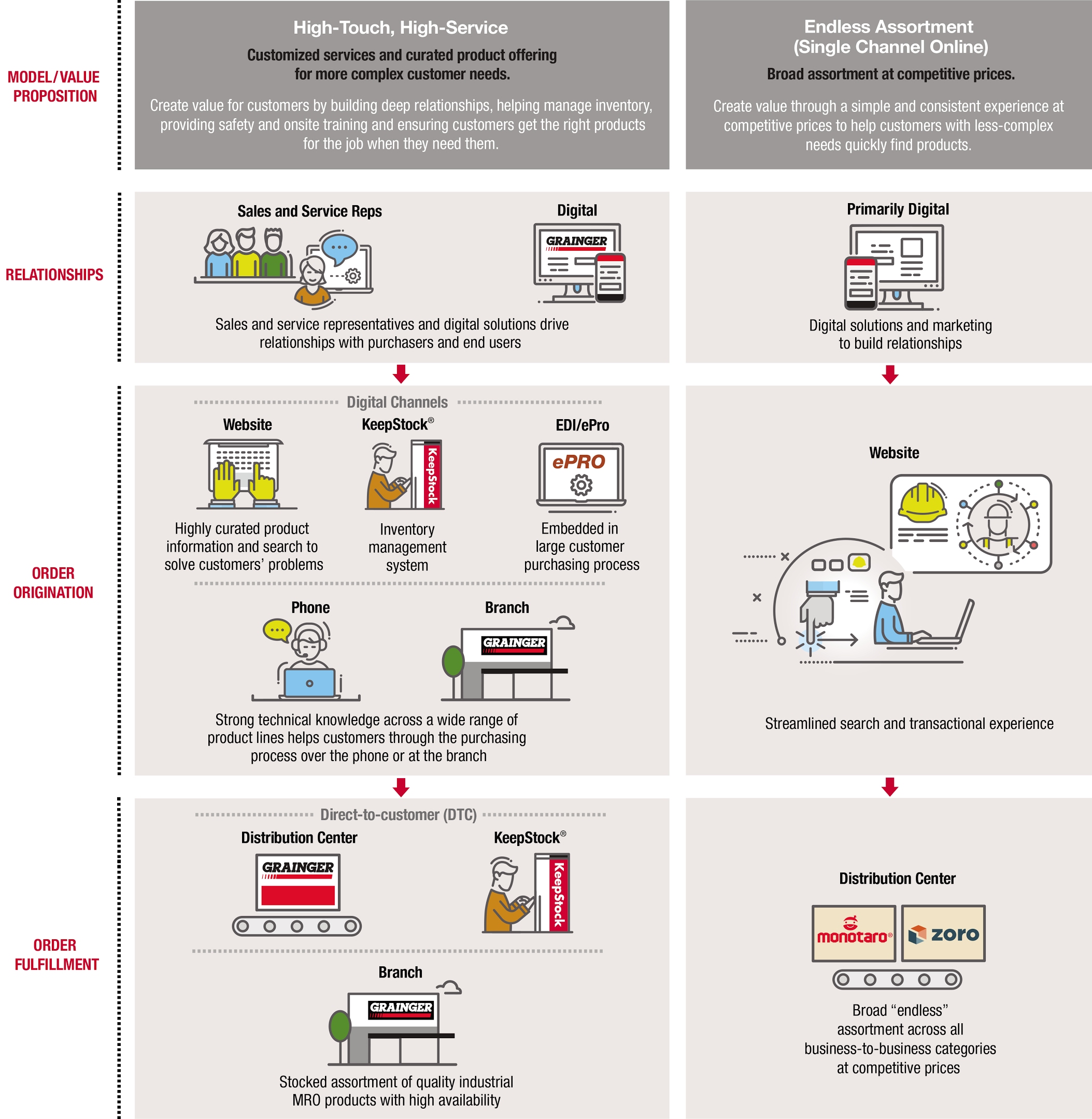][added: ]
[removed: MRO Industry][added: MRO Industry]
[removed: Each of these] [added: These large] core markets [removed: is large] [added: have high gross domestic product per capita, advanced infrastructures] and [removed: the] competition is highly fragmented.
Grainger’s two reportable segments are the U.S. and Canada, and [removed: they] are [removed: described] further [added: described] below.
Other businesses include the endless assortment businesses, Zoro [removed: in the U.S.] and [removed: MonotaRO in Japan,] [added: MonotaRO,] and smaller [added: international] businesses [added: primarily] in [removed: Europe, Asia] [added: Europe] and Mexico.
For further segment and financial information, see “Item 7: Management’s Discussion and Analysis of Financial Condition and Results of Operations” and Note [removed: 17] [added: 14] to the Consolidated Financial Statements (Financial Statements).
The table below shows Grainger's estimated share of the MRO market and the summary of its operations by reporting segments and other businesses as of December 31, [removed: 2018:][added: 2019:]
| | Approximate [removed: MRO] Market [removed: Size (billions)1 | | Approximate Market] Share | | [removed: Branches2 | |] Distribution Centers [removed: (DCs)2] [added: (DCs)1] | | [added: Branches1 | |] Approximate Number of Customers Served [removed: (thousands)4] [added: (thousands)2] |
[removed: | United States | $93 | | 7% | | 283 | | 16 | | 1,100 |][added: United States]
| Canada | [removed: 12 | | 5%] [added: 4%] | | [removed: 54] [added: 5] | | [removed: 5] [added: 53] | | 50 |
| Other businesses | | | | | | | | [removed: | |]
| Endless assortment businesses | [removed: 82 | |] 2% | | [removed: —] [added: 4] | | [removed: 4] [added: —] | | [removed: 2,200] [added: 2,600] |
[removed: 2] [added: 1] See Item 2, "Properties" for more information.
[removed: 4] [added: 2] Customers served in the [removed: United States] [added: U.S.] may include overlap with Zoro [removed: in Endless] [added: within the endless] assortment [removed: business.][added: businesses.]
[removed: Customers] [added: Customers] and [removed: Products][added: Products]
[removed: Grainger offers a] [added: Grainger’s MRO product offering is grouped under several] broad [removed: selection of products to its customers] [added: categories,] including material-handling equipment, safety and security supplies, lighting and electrical products, power and hand tools, pumps and plumbing supplies, cleaning and maintenance supplies and metalworking tools.
Products are regularly added and [removed: deleted] [added: removed] from Grainger's product lines on the basis of customer demand, market research, suppliers' recommendations, sales volumes and other factors.
No [removed: one] [added: single] product category comprises more than [removed: 18%] [added: 17%] of global sales.
[added: |] United States [added: | 7% | | 17 | | 282 | | 1,000 |]
The U.S. business offers a broad selection of MRO products and services through its eCommerce [removed: platform,] [added: platforms,] catalogs, branches and sales and service representatives.
No single supplier comprised more than 5% of total purchases and no significant barriers [removed: thus far] exist with respect to sources of supply.
The majority of products sold by the U.S. business are [removed: nationally branded] [added: third-party owned] products.
In addition, approximately 21% of [removed: 2018] [added: 2019 U.S. business] sales were private label MRO items bearing Grainger’s registered trademarks, including DAYTON®, SPEEDAIRE®, AIR HANDLER®, TOUGH GUY®, WESTWARD®, CONDOR® and LUMAPRO®.
[removed: Customers] [added: U.S. business customers] range from [removed: small and] mid-sized businesses to large corporations, government entities and other institutions within many [removed: industries (see Note 2 to the Financial Statements).][added: industries.]
Sales in [removed: 2018] [added: 2019] were made to [removed: more than] [added: approximately] 1 million customers and no single end customer accounted for more than [removed: 1%] [added: 2%] of total sales.
Macro trends and technology drive the way [removed: Grainger's] U.S. [added: business] customers behave.
Customers [removed: want] [added: desire] highly tailored solutions with real-time access to information and [removed: just-in-time] [added: efficient] delivery of products and services.
These [removed: changes] [added: trends] are reflected in how customers do business [removed: in the U.S.] as demonstrated in the following tables for the [removed: 2018] [added: 2019] line mix:
| Website | [removed: 31] [added: 30] | % | | Ship to Customer | 70 | % |
| EDI/ePro | [removed: 23] [added: 25] | % | | [removed: Pick up at Branch] [added: KeepStock®] | [removed: 13] [added: 17] | % |
| KeepStock® | [removed: 17] [added: 16] | % | | [removed: KeepStock®] [added: Subtotal] | [removed: 17] [added: 87] | % |
| Phone | [removed: 20] [added: 19] | % | | | | |
| [added: Total] | 100 | % | | | | |
The following provides a high-level view of each model:
The estimated market where Grainger has operations is large with an estimated size of more than $290 billion and is concentrated in North America, Japan and Europe.
Grainger estimates to have 4% share within these markets with opportunity and a track record for growth.
| | | | | | | | |
| --- | --- | --- | --- | --- | --- | --- | --- |
| | | | | | | | |
| International high-touch solutions businesses | 1% | | 6 | | 119 | | 150 |
| TOTAL | 4% | | 32 | | 454 | | 3,800 |
Approximately 5,000 suppliers provide Grainger businesses with about 1.6 million products stocked in DCs and branches.
Additionally, Grainger’s endless assortment businesses offer millions more products through its expanding drop-ship assortment.
| *Digital channels:* | | | | *Direct-to-customer:* | | |
| Subtotal | 71 | % | | Branch Pick-up | 13 | % |
| *Non-digital channels:* | | | | Total | 100 | % |
| Branch | 10 | % | | | | |
| Subtotal | 29 | % | | | | |
DCs are the primary order fulfillment channel with approximately 70% of direct shipments.
The U.S. business DC network is also a primary component of Grainger’s North American distribution network and it supplies inventory, product management, supply chain and related support services to all Grainger subsidiaries in the North American region, including the Canada business, Mexico business and Zoro, which are part of other businesses.
Approximately 18%, 62%, and 99% of inventory purchases in 2019 for the Canadian business, Mexican business and Zoro, respectively, were sourced from the U.S. business.
Branches also fulfill local KeepStock® operations in their local markets.
The U.S. business houses the North American Customer Service Centers which support the needs of customers in the U.S. and Canada.
The centers handle more than 73,000 daily customer interactions for the region via phone, email, eCommerce portals and online chat.
MonotaRO also operates small operations in other Asian countries, which represent less than 5% of their sales.
Grainger sells products that may have seasonal fluctuations during the winter or summer seasons or during periods of natural disasters.
However, historical seasonality impacts have not been material to Grainger’s operating results.
Also, competitors vary by size, from large broad-line distributors to small local and regional competitors.
Information about our Executive Officers
Following is information about the executive officers of Grainger including age as of January 31, 2020.
Executive officers of Grainger generally serve until the next annual appointment of officers, or until earlier resignation or removal.
| | |
| --- | --- |
| | |
| Name and Age | Positions and Offices Held and Principal Occupation and Employment During the Past Five Years |
| Kathleen S. Carroll (51) | Senior Vice President and Chief Human Resources Officer, a position assumed in December 2018. Previously, Ms. Carroll served as Executive Vice President, Chief Human Resources Officer of First Midwest Bancorp, Inc., a diversified financial services company, from 2017 to 2018. Prior to that role, Ms. Carroll was employed at Aon Corporation, a global insurance brokerage and consulting company, between 2006 and 2017, in various human resources roles, culminating in her position as Vice President, Global Head of Talent Acquisition. |
| John L. Howard (62) | Senior Vice President and General Counsel, a position assumed in January 2000. Previously, Mr. Howard served in several roles of increasing responsibility at Tenneco, Inc., a global conglomerate. Prior to those roles, Mr. Howard held a variety of legal positions in the federal government, including Associate Deputy Attorney General in the U.S. Department of Justice and in The White House as Counsel to the Vice President. |
| D.G. Macpherson (52) | Chairman of the Board, a position assumed in October 2017, and Chief Executive Officer, a position assumed in October 2016 at which time he was also appointed to the Board of Directors. Previously, Mr. Macpherson served as Chief Operating Officer, a position assumed in 2015, Senior Vice President and Group President, Global Supply Chain and International, a position assumed in 2013, Senior Vice President and President, Global Supply Chain and Corporate Strategy, a position assumed in 2012, and Senior Vice President, Global Supply Chain, a position assumed in 2008. |
| Deidra C. Merriwether (51) | Senior Vice President and President, North American Sales & Service, a position assumed in November 2019. Previously, Ms. Merriwether served as Senior Vice President, U.S. Direct Sales and Strategic Initiatives, a position assumed in September 2017, Vice President, Pricing and Indirect Procurement, a position assumed in 2016, and as a Vice President in Finance from 2013 to 2016. Prior to joining Grainger in September 2013, Ms. Merriwether held various positions as a Vice President, including positions of increasing responsibility at Sears Holdings Corporation, a broadline retailer, PriceWaterhouseCoopers, a global professional services firm, and Eli Lilly & Company, a global pharmaceutical company, across Finance, Procurement and Operations, lastly serving as Chief Operating Officer, Retail Formats, at Sears Holdings Corporation. |
| Thomas B. Okray (57) | Senior Vice President and Chief Financial Officer, a position assumed in May 2018. Prior to joining Grainger, Mr. Okray served as Executive Vice President, Chief Financial Officer of Advance Auto Parts, Inc., a leading automotive aftermarket parts provider in North America, a position assumed in 2016. Previously, Mr. Okray served as Vice President, Finance, Global Customer Fulfillment, of Amazon.com, Inc., an online retailer, from January 2016 to October 2016, as Vice President, Finance, North American Operations of Amazon, from June 2015 to January 2016, and was employed by General Motors Company, a global automotive company, from July 1989 to June 2015, in a variety of finance and supply chain related roles, culminating in his position as CFO, Global Product Development, Purchasing & Supply Chain, from January 2010 to June 2015. |
| Paige K. Robbins (51) | Senior Vice President, Grainger Technology, Merchandising, Marketing, and Strategy, a position assumed in November 2019. Previously, Ms. Robbins served as Senior Vice President and Chief Merchandising, Marketing, Digital, Strategy Officer, a position assumed in May 2019, as Senior Vice President and Chief Digital Officer, a position assumed in September 2017, and as Senior Vice President, Global Supply Chain, Branch Network, Contact Centers and Corporate Strategy, a position assumed in 2016. Since joining Grainger in September 2010, Ms. Robbins has held various positions as a Vice President, including in the areas of Global Supply Chain and Logistics. |
| Eric R. Tapia (43) | Vice President and Controller, a position assumed in October 2016. Mr. Tapia served as Vice President, Internal Audit, from 2010 to 2016. Mr. Tapia is a Certified Public Accountant (CPA) and before joining Grainger in 2010 was an audit partner with KPMG. |
W.W. Grainger, Inc.'s operations are primarily in North America, Europe and Japan.
Grainger's purpose is to help businesses keep their operations running and their people safe.
The global MRO market is approximately $608 billion, and the estimated market size where Grainger has operations is $284 billion.
The most attractive geographies for Grainger are those with high GDP per capita and a developed infrastructure.
Grainger’s strategy is concentrated in North America, Europe and Japan.
In total, Grainger has about 4 percent share within its addressable market with ample opportunity for growth.
| | | | | | | | | | |
| --- | --- | --- | --- | --- | --- | --- | --- | --- | --- |
| High-touch, high-service businesses3 | 97 | | 1% | | 120 | | 6 | | 320 |
| TOTAL | $284 | | 4% | | 457 | | 31 | | 3,700 |
1 Estimated MRO market size where Grainger has operations.
3 Includes businesses in Europe, Asia and Mexico.
Grainger serves more than 3.5 million customers worldwide through its DCs, eCommerce platform, contact centers, branches and sales and service representatives.
These customers represent a broad collection of industries including government, manufacturing, transportation, commercial and contractors (see Note 2 to the Financial Statements).
The U.S. business purchases products for sale from approximately 3,000 suppliers, most of which are manufacturers.
The U.S. business operates and fulfills orders nationally through a network of DCs, branches and contact centers.
The U.S. business also exports to various countries.
Demands for transparency are also increasing as access to information expands.
| Counter | 9 | % | | | 100 | % |
U.S. customers continue to migrate to web and electronic platforms such as EDI, eProcurement and KeepStock®.
DCs in the U.S. business range in size from approximately 45,000 square feet to 1.3 million square feet, the largest of which can accommodate more than 500,000 in-stock products.
Branches also support local KeepStock® operations and allow customers to leverage branch staff for their technical product expertise and search-and-select support.
Grainger's contact center network in the U.S. business on average handles about 73,000 customer interactions per day including approximately 20,000 orders via phone, e-mail and chat.
Customers have access to more than 194,000 stocked products through a comprehensive catalog and website.
Grainger’s business in general is not seasonal, however, there are some products that typically sell more often during the winter or summer seasons.
In any given month, unusual weather patterns, that is, unusually hot or cold weather, could positively or negatively impact the sales volumes of these products.
Grainger has several large competitors and continues to be highly competitive against the predominant number of small local and regional competitors.
An excerpt. Shown here: 40 of 64 rewritten, all 39 added and all 27 removed. The counts are complete. For every sentence, read Item 1. Business in the FY2019 filing and the FY2018 filing.
Item 3. Legal Proceedings
1 rewritten, 0 added, 0 removed, 0 unchanged
For a description of legal proceedings, see the disclosure contained in Note [removed: 18] [added: 15] to the Financial Statements included in "Part II, Item 8: Financial Statements and Supplementary Data" of this report, which is incorporated herein by reference.
Cover and table of contents
56 rewritten, 14 added, 8 removed, 19 unchanged
[removed: UNITED STATES][added: UNITED STATES]
[removed: SECURITIES] [added: SECURITIES] AND EXCHANGE [removed: COMMISSION][added: COMMISSION]
[removed: FORM 10-K][added: FORM 10-K]
[removed: (Mark One)][added: (Mark One)]
[removed: \[X\] ANNUAL] [added: ☒ ANNUAL] REPORT PURSUANT TO SECTION 13 OR 15(d) [removed: OF][added: OF]
[removed: THE] [added: THE] SECURITIES EXCHANGE ACT OF [removed: 1934][added: 1934]
[removed: For] [added: For] the fiscal year [removed: ended December] [added: ended December] 31, [removed: 2018][added: 2019]
[removed: \[ \] TRANSITION] [added: ☐ TRANSITION] REPORT PURSUANT TO SECTION 13 OR 15(d) [removed: OF][added: OF]
[removed: For] [added: For] the transition period from ______ to [removed: _______][added: _______]
[removed: Commission] [added: Commission] file [removed: number 1-5684][added: number 1-5684]
[removed: W.W.] [added: W.W.] Grainger, [removed: Inc.][added: Inc.]
| [removed: Illinois] [added: Illinois] | | [removed: 36-1150280] | [added: | | 36-1150280 |]
| (State or other jurisdiction of incorporation or organization) | | [added: | | |] (I.R.S. Employer Identification No.) |
| [removed: 100] [added: 100] Grainger [removed: Parkway, Lake Forest, Illinois] [added: Parkway,] | [added: Lake Forest,] | [removed: 60045-5201] [added: Illinois] | [added: | | 60045-5201 |]
| (Address of principal executive offices) | | [added: | | |] (Zip Code) |
| [removed: (847) 535-1000] | | [added: 847] | [added: 535-1000 | | |]
| (Registrant’s telephone number including area code) | | | [added: | | |]
[removed: |] Securities registered pursuant to Section 12(b) of the Act: [removed: | | |]
| [removed: Title] [added: Title] of [removed: each class] [added: Each Class] | [added: Trading Symbol] | [removed: Name] [added: Name] of [removed: each exchange] [added: Each Exchange] on [removed: which registered] [added: Which Registered] |
| Common Stock [removed: $0.50 par value] | [added: GWW] | New York Stock Exchange |
Yes [removed: \[X\]] [added: ☒] No [removed: \[ \]][added: ☐]
Yes [removed: \[ \]] [added: ☐] No [removed: \[X\]][added: ☒]
Indicate by check mark whether the registrant has submitted electronically every Interactive Data File required to be submitted [removed: and posted] pursuant to Rule 405 of Regulation S-T (§232.405 of this chapter) during the preceding 12 months (or for such shorter period that the registrant was required to submit such files).
[removed: |] Large [removed: accelerated filer \[X\] |] Accelerated [removed: filer \[ \] |] [added: Filer ☒ Accelerated Filer ☐] Non-accelerated [removed: filer \[ \] |] [added: Filer ☐] Smaller [removed: reporting company \[ \] | Emerging growth company \[ \] |][added: Reporting Company ☐]
Indicate by check mark whether the registrant is a shell company (as defined in Rule 12b-2 of the [added: Exchange] Act).
The aggregate market value of the voting common equity held by nonaffiliates of the registrant was [removed: $16,101,319,439] [added: $13,765,366,450] as of the close of trading as reported on the New York Stock Exchange on June 30, [removed: 2018.][added: 2019.]
The registrant had [removed: 55,679,223] [added: 53,656,306] shares of the Company’s Common Stock outstanding as of January 31, [removed: 2019.][added: 2020.]
[removed: DOCUMENTS] [added: DOCUMENTS] INCORPORATED BY [removed: REFERENCE][added: REFERENCE]
Portions of the registrant's definitive proxy statement to be filed in connection with the annual meeting of shareholders to be held on April [removed: 24, 2019,] [added: 29, 2020,] are incorporated by reference into Part III hereof of this Form 10-K where [removed: indicated the definitive 2018 proxy statement will be filed on or about March 15, 2019.][added: indicated.]
| | [removed: TABLE] [added: TABLE] OF [removed: CONTENTS] [added: CONTENTS] | | | | | [removed: Page] [added: Page] |
| | [removed: PART I] [added: PART I] | | | | | |
| Item 1: | BUSINESS | | | | | [removed: [3](#s6D4F3E1BEA4059B088E4EB952FFAD4D3)] [added: [3](#s6E19BC3F5D2C5ABDB30CF8DFE6DFE8A9)] |
| Item 1A: | RISK FACTORS | | | | | [removed: [8](#s4DFEA9F82E5C534491A614ADAE4883FF)] [added: [9](#s877B093B45AF50C8A585A16823914EC6)] |
| Item 1B: | UNRESOLVED STAFF COMMENTS | | | | | [removed: [12](#s3AE26548915E5796816E7C1EBFA4C5D4)] [added: [15](#s3DF7F3AD37AE59E2AA7730C9034F50A7)] |
| Item 2: | PROPERTIES | | | | | [removed: [13](#s991485F18DD059E69983FA5685C96A1A)] [added: [15](#sCA9EEB00BC5659C2BCBB7701D568F60A)] |
| Item 3: | LEGAL PROCEEDINGS | | | | | [removed: [13](#sE85273CD24F75FAE9E255799ED93578E)] [added: [15](#sC1F00ACCD89B5C8CAC2EC998DC749620)] |
| Item 4: | MINE SAFETY DISCLOSURES | | | | | [removed: [13](#s540B658320F3568283D6679AEE50E1BF)] [added: [15](#sD25D59042BBB559A8FB2107342C99FC2)] |
| | [removed: PART II] [added: PART II] | | | | | |
| Item 5: | MARKET FOR REGISTRANT'S COMMON EQUITY, RELATED SHAREHOLDER | | | | | [removed: [15](#sD8FFCB84A3115794807821EE9BD7CE9D)] [added: [16](#s6B3E9C95158D53AF84B22189BDB25570)] |
| Item 6: | SELECTED FINANCIAL DATA | | | | | [removed: [17](#s4C6435A52EC0540683EC01BFB5AC1697)] [added: [18](#sA58DC8F71A905121A4B74A57C1A3D7B9)] |
OR
THE SECURITIES EXCHANGE ACT OF 1934
| | | | | | |
| --- | --- | --- | --- | --- | --- |
| | | | | | |
| | | | | | |
| | | | | | |
Yes ☒ No ☐
Yes ☒ No ☐
Emerging Growth Company ☐
If an emerging growth company, indicate by check mark if the registrant has elected not to use the extended transition period for complying with any new or revised financial accounting standards provided pursuant to Section 139) of the Exchange Act.
Yes ☐ No ☒
The registrant's definitive 2019 proxy statement will be filed on or about March 19, 2020.
| Signatures | | | | | | [63](#sBB4028284DAF5A5FB623B4E0CBD80BDD) |
10-K 1 gww20181231-10k.htm 10-K
OR
Indicate by check mark if disclosure of delinquent filers pursuant to Item 405 of Regulation S-K is not contained herein, and will not be contained, to the best of registrant’s knowledge, in definitive proxy or information statements incorporated by reference in Part III of this Form 10-K or any amendment to this Form 10-K.
\[X\]
| | | | | |
| --- | --- | --- | --- | --- |
| Item 4A: | EXECUTIVE OFFICERS OF THE REGISTRANT | | | | | [14](#sFEE7EB794E9954E3987E252D1EDBF138) |
| Signatures | | | | | | [75](#sA31A0087E84B51ABA60C25F9CCEF74F4) |
An excerpt. Shown here: 40 of 56 rewritten, all 14 added and all 8 removed. The counts are complete. For every sentence, read Cover and table of contents in the FY2019 filing and the FY2018 filing.
Item 2. Properties
13 rewritten, 0 added, 0 removed, 14 unchanged
As of December 31, [removed: 2018,] [added: 2019,] Grainger’s owned and leased facilities totaled approximately [removed: 27] [added: 28.2] million square feet.
| U.S. (1) | | [removed: 283] [added: 282] branch locations | | [removed: 6,349] [added: 6,348] | |
| U.S. (2) | | [removed: 16] [added: 17] DCs | | [removed: 8,148] [added: 9,660] | |
| U.S. (3) | | Other facilities | | [removed: 3,674] [added: 3,970] | |
| Canada (4) | | [removed: 92] [added: 53] branch locations | | [removed: 1,125] [added: 686] | |
| Canada | | Other facilities | | [removed: 541] [added: 578] | |
| Other businesses (6) | | Other facilities | | [removed: 5,118] [added: 5,034] | |
| Chicago area (2) | | Headquarters and general offices | | [removed: 1,103] [added: 947] | |
| | | Total Square Feet | | [removed: 27,026] [added: 28,191] | |
| (1) | Consists of [removed: 249] [added: 246] stand-alone, [removed: 32] [added: 34] onsite and 2 will-call express locations, of which 202 are owned and [removed: 81] [added: 80] are leased. These branches range in size from approximately 500 to 109,000 square feet. |
| (2) | These facilities are primarily owned and range in size from approximately 45,000 to [removed: 1.3] [added: 1.5] million square feet. |
| (4) | Consists of [removed: 72] [added: 34] stand-alone and [removed: 20] [added: 19] onsite locations, of which [removed: 33] [added: 18] are owned and [removed: 59] [added: 35] are leased. These branches range in size from approximately 500 to [removed: 110,000] [added: 70,000] square feet. [removed: Of these 92 branch locations, 54 are operational.] |
| (6) | These facilities include owned and leased locations in [removed: Europe, Asia and Mexico] [added: North America, Japan] and [removed: other U.S. operations.] [added: Europe.] |
Item 4. Mine Safety Disclosures
0 rewritten, 1 added, 0 removed, 1 unchanged
PART II
Item 5. Market for Registrant’s Common Equity, Related Shareholder Matters and Issuer Purchases of Equity Securities
13 rewritten, 9 added, 6 removed, 17 unchanged
[removed: Market] [added: Market] Information and [removed: Dividends][added: Dividends]
[removed: Holders][added: Holders]
The approximate number of shareholders of record of Grainger’s common stock as of January 31, [removed: 2019,] [added: 2020,] was [removed: 650] [added: 604] with approximately [removed: 191,921] [added: 206,588] additional shareholders holding stock through nominees.
[removed: Issuer] [added: Issuer] Purchases of Equity Securities - Fourth [removed: Quarter][added: Quarter]
| (B) | Average price paid per share includes any commissions [removed: paid and includes only those amounts related to purchases as part of publicly announced plans or programs.] [added: paid.] |
| (C) | Purchases were made pursuant to a share repurchase program approved by Grainger's Board of [removed: Directors. This plan was] [added: Directors and] announced on April [removed: 16, 2015, for 15] [added: 24, 2019 (2019 Program). The 2019 Program authorizes the repurchase of up to 5] million shares with no expiration date. [removed: Activity is reported on a trade date basis.] |
[removed: Company Performance][added: Company Performance]
It covers the period commencing December 31, [removed: 2013,] [added: 2014,] and ending December 31, [removed: 2018.][added: 2019.]
The graph assumes that the value for the investment in Grainger common stock and in each index was $100 on December 31, [removed: 2013,] [added: 2014,] and that all dividends were reinvested.
[removed: 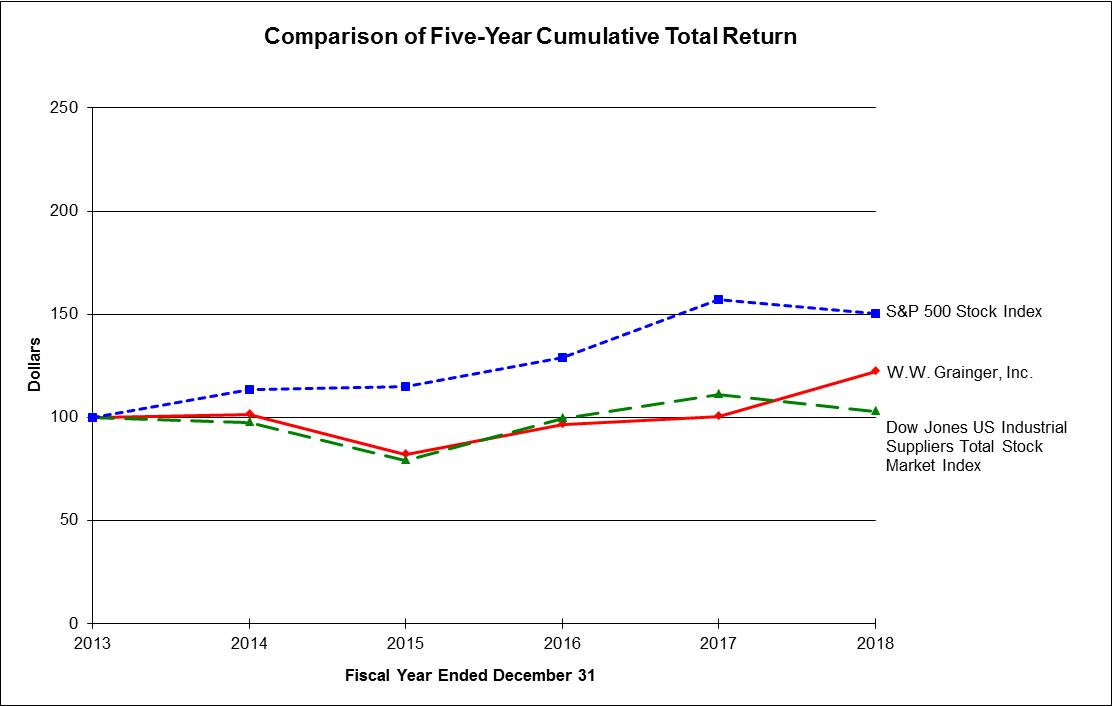][added: 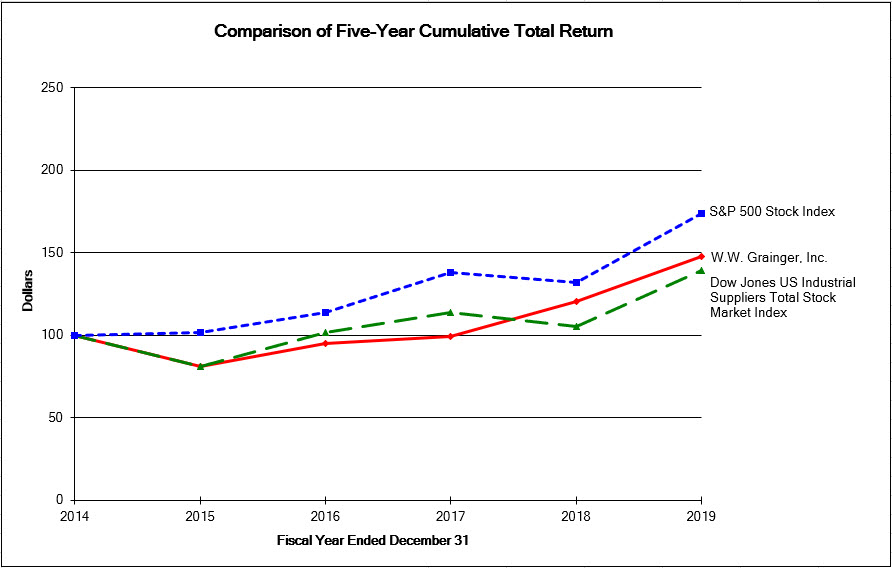]
| | [removed: 2013 | | |] 2014 | | | 2015 | | | 2016 | | | 2017 | | | 2018 | | | [added: 2019 | | |]
| W.W. Grainger, Inc. | $ | 100 | | $ | [removed: 102] [added: 81] | | $ | [removed: 82] [added: 95] | | $ | [removed: 96] [added: 99] | | $ | [removed: 101] [added: 121] | | $ | [removed: 122] [added: 148] | |
| Dow Jones US Industrial Suppliers Total Stock Market Index | 100 | | | [removed: 98] [added: 81] | | | [removed: 79] [added: 102] | | | [removed: 100] [added: 114] | | | [removed: 111] [added: 105] | | | [removed: 103] [added: 139] | | |
| Oct. 1 – Oct. 31 | 112,700 | $301.83 | 112,700 | 3,284,920 | | shares |
| Nov. 1 – Nov. 30 | 126,183 | $320.04 | 126,183 | 3,158,737 | | shares |
| Dec. 1 – Dec. 31 | 81,184 | $319.32 | 80,144 | 3,078,593 | | shares |
| Total | 320,067 (D) | | 319,027 | | | |
| (A) | There were no shares withheld to satisfy tax withholding obligations. |
| | |
| --- | --- |
| (D) | The difference of 1,040 shares between the Total Number of Shares Purchased and the Total Number of Shares Purchased as Part of Publicly Announced Plans or Programs represents shares purchased by the administrator and record keeper of the W.W. Grainger, Inc. Employees Profit Sharing Plan for the benefit of the employees who participate in the plan. |
| S&P 500 Stock Index | 100 | | | 101 | | | 114 | | | 138 | | | 132 | | | 174 | | |
| Oct. 1 – Oct. 31 | 230,018 | $295.99 | 230,018 | 1,619,794 | | shares |
| Nov. 1 – Nov. 30 | 122,422 | $295.33 | 122,422 | 1,497,372 | | shares |
| Dec. 1 – Dec. 31 | 118,627 | $289.72 | 118,627 | 1,378,745 | | shares |
| Total | 471,067 | $294.24 | 471,067 | | | |
| (A) | No shares were withheld to satisfy tax withholding obligations in connection with the vesting of employee restricted stock awards. |
| S&P 500 Stock Index | 100 | | | 114 | | | 115 | | | 129 | | | 157 | | | 150 | | |
Item 6. Selected Financial Data
10 rewritten, 7 added, 6 removed, 7 unchanged
| | [removed: 2018] [added: 2019] | | | | [removed: 2017] [added: 2018] | | | | [removed: 2016] [added: 2017] | | | | [removed: 2015] [added: 2016] | | | | [removed: 2014] [added: 2015] | | |
| Net sales | $ | [removed: 11,221] [added: 11,486] | | | $ | [removed: 10,425] [added: 11,221] | | | $ | [removed: 10,137] [added: 10,425] | | | $ | [removed: 9,973] [added: 10,137] | | | $ | [removed: 9,965] [added: 9,973] | |
| Net earnings attributable to W.W. Grainger, Inc. (herein referred to as Net earnings) | [removed: 782] [added: 849] | | | | [removed: 586] [added: 782] | | | | [removed: 606] [added: 586] | | | | [removed: 769] [added: 606] | | | | [removed: 802] [added: 769] | | |
| Net earnings per basic share | [removed: 13.82] [added: 15.39] | | | | [removed: 10.07] [added: 13.82] | | | | [removed: 9.94] [added: 10.07] | | | | [removed: 11.69] [added: 9.94] | | | | [removed: 11.59] [added: 11.69] | | |
| Net earnings per diluted share | [removed: 13.73] [added: 15.32] | | | | [removed: 10.02] [added: 13.73] | | | | [removed: 9.87] [added: 10.02] | | | | [removed: 11.58] [added: 9.87] | | | | [removed: 11.45] [added: 11.58] | | |
| Total shareholders' equity | [removed: 2,093] [added: 2,060] | | | | [removed: 1,828] [added: 2,093] | | | | [removed: 1,906] [added: 1,828] | | | | [removed: 2,353] [added: 1,906] | | | | [removed: 3,284] [added: 2,353] | | |
| Cash dividends paid per share | $ | [removed: 5.36] [added: 5.68] | | | $ | [removed: 5.06] [added: 5.36] | | | $ | [removed: 4.83] [added: 5.06] | | | $ | [removed: 4.59] [added: 4.83] | | | $ | [removed: 4.17] [added: 4.59] | |
Net earnings for 2018 included a net expense of $170 million primarily consisting of a $133 million net non-cash charge related to [removed: the Cromwell] goodwill and [removed: trade name] [added: intangible asset] impairment [removed: in] [added: at Cromwell, which is part of] other businesses and a net charge of $37 million related to restructuring primarily consisting of asset impairment charges in Canada and other related charges, net of gains from the [removed: sales] [added: sale] of [removed: branches] [added: real estate] in the U.S., Canada and corporate offices.
Net earnings for 2017 included a net expense of $84 million primarily consisting of a net charge of $102 million related to restructuring and other charges primarily consisting of branch closures in the U.S. and Canada businesses, net of gains on sale of [removed: branch] real estate in the U.S., the consolidation of the contact center network in the U.S. and the wind-down of operations in Colombia, which [removed: is] [added: was] part of other businesses.
Net earnings for 2016 included a net expense of $105 million primarily related to restructuring actions in the U.S. and Canada, goodwill and intangible [removed: impairments,] [added: impairments in Europe and Latin America operations,] contingencies and a net tax benefit.
| Gross profit | 4,397 | | | | 4,348 | | | | 4,098 | | | | 4,115 | | | | 4,231 | | |
| Operating earnings | 1,262 | | | | 1,158 | | | | 1,035 | | | | 1,113 | | | | 1,294 | | |
| Total current assets | 3,555 | | | | 3,557 | | | | 3,206 | | | | 3,020 | | | | 3,049 | | |
| Property, building and equipment, net | 1,400 | | | | 1,352 | | | | 1,392 | | | | 1,421 | | | | 1,431 | | |
| Long-term debt (less current maturities) | 1,914 | | | | 2,090 | | | | 2,248 | | | | 1,841 | | | | 1,388 | | |
| Operating cash flow | 1,042 | | | | 1,057 | | | | 1,057 | | | | 1,024 | | | | 1,036 | | |
Net earnings for 2019 included a net expense of $109 million primarily consisting of a $104 million net non-cash charge related to intangible assets impairment at the Cromwell business in the U.K., which is part of other businesses and a net charge of $5 million related to restructuring primarily in the U.S business.
| Total assets | 5,873 | | | | 5,804 | | | | 5,694 | | | | 5,858 | | | | 5,283 | | |
| Long-term debt (less current maturities) and other long-term liabilities | 2,279 | | | | 2,469 | | | | 2,160 | | | | 1,717 | | | | 737 | | |
Net earnings for 2015 included a net charge of $30 million primarily composed of a $25 million net charge related to the reorganization in the U.S. and Canada businesses and a $5 million charge for restructuring in other businesses.
Net earnings for 2014 included a net charge of $56 million primarily composed of a $28 million charge related to closing of the business in Brazil, a $10 million charge due to a retirement plan transition in Europe, a $10 million charge related to restructuring of the business in Europe and an $8 million charge related to a goodwill impairment charge in other businesses.
Grainger completed several acquisitions in the years 2014 and 2015, all of which were immaterial individually and in the aggregate.
Operating results have included the results of each business acquired since the respective acquisition dates.
Item 8. Financial Statements and Supplementary Data
2 rewritten, 0 added, 0 removed, 0 unchanged
The financial statements and supplementary data are included on pages [removed: 37] [added: 32] to [removed: 75.][added: 63.]
See the Index to Financial Statements and Supplementary Data on page [removed: 36.][added: 31.]
Item 9A. Controls and Procedures
3 rewritten, 0 added, 0 removed, 13 unchanged
Grainger carried out an evaluation, under the supervision and with the participation of its management, including the Chief Executive Officer and the Chief Financial Officer, of the effectiveness of the design and operation of Grainger's disclosure controls and procedures pursuant to [added: Rule 13a-15 of the Securities] Exchange Act [removed: Rule 13a-15.][added: of 1934, as amended (Exchange Act).]
Management's report on Grainger's internal control over financial reporting is included on page [removed: 37] [added: 32] of this Report under the heading Management's Annual Report on Internal Control Over Financial Reporting.
The report from Ernst & Young LLP on its audit of the effectiveness of Grainger's internal control over financial reporting as of December 31, [removed: 2018,] [added: 2019,] is included on page [removed: 38] [added: 33] of this Report under the heading Report of Independent Registered Public Accounting Firm.
Item 9B. Other Information
1 rewritten, 0 added, 0 removed, 1 unchanged
[removed: PART III][added: PART III]
Item 10. Directors, Executive Officers and Corporate Governance
2 rewritten, 1 added, 0 removed, 4 unchanged
The information required by this item is incorporated by reference to Grainger's proxy statement relating to the annual meeting of shareholders to be held April [removed: 24, 2019,] [added: 29, 2020,] under the captions “Nominees and Director Experience and Qualifications,” "Annual Election of Directors,” “Candidates for Board Membership,” “Board Affairs and Nominating Committee,” “Audit Committee” and [removed: “Section] [added: “Delinquent Section] 16(a) [removed: Beneficial Ownership Reporting Compliance.”] [added: Reports.”] Information required by this item regarding executive officers of Grainger is set forth in Part I, Item [removed: 4A,] [added: 1,] under the caption [removed: “Executive Officers of the Registrant.”][added: “Information about our Executive Officers.”]
This code of ethics is part of Grainger’s Business Conduct Guidelines for directors, officers and employees, which is available free of charge through Grainger’s website at [removed: www.grainger.com/investor.][added: *www.invest.grainger.com*.]
All Grainger employees are trained and certified yearly on these guidelines.
Item 11. Executive Compensation
1 rewritten, 0 added, 0 removed, 0 unchanged
The information required by this item is incorporated by reference to Grainger's proxy statement relating to the annual meeting of shareholders to be held April [removed: 24, 2019,] [added: 29, 2020,] under the captions “Director Compensation,” “Compensation Discussion and Analysis,” “Compensation Committee,” “Report of the Compensation Committee of the Board” and "Fees for Independent Compensation Consultant."
Item 12. Security Ownership of Certain Beneficial Owners and Management and Related Stockholder Matters
1 rewritten, 0 added, 0 removed, 0 unchanged
The information required by this item is incorporated by reference to Grainger's proxy statement relating to the annual meeting of shareholders to be held April [removed: 24, 2019,] [added: 29, 2020,] under the captions “Ownership of Grainger Stock” and “Equity Compensation Plans.”
Item 13. Certain Relationships and Related Transactions, and Director Independence
1 rewritten, 0 added, 0 removed, 0 unchanged
The information required by this item is incorporated by reference to Grainger's proxy statement relating to the annual meeting of shareholders to be held April [removed: 24, 2019,] [added: 29, 2020,] under the captions “Director Independence,” "Annual Election of Directors" and “Transactions with Related Persons.”
Item 14. Principal Accountant Fees and Services
2 rewritten, 0 added, 0 removed, 0 unchanged
The information required by this item is incorporated by reference to Grainger's proxy statement relating to the annual meeting of shareholders to be held April [removed: 24, 2019,] [added: 29, 2020,] under the caption “Audit Fees and Audit Committee Pre-Approval Policies and Procedures.”
[removed: PART IV][added: PART IV]
Item 15. Exhibits and Financial Statements Schedules
3 rewritten, 0 added, 0 removed, 7 unchanged
(a) Documents filed as part of [removed: the] [added: this] Form 10-K
| (1) | Financial Statements: see "Item 8: Financial Statements and Supplementary Data," on page [removed: 36] [added: 31] hereof, for a list of financial statements. Management's Annual Report on Internal Control Over Financial Reporting. |
| (3) | Exhibits Required by Item 601 of Regulation S-K: the information required by this Item 15(a)(3) of Form 10-K is set forth on the Exhibit Index that follows the Signatures page [removed: 75] [added: 64] of the Form 10-K. |
Item 16. Form 10-K Summary
546 rewritten, 205 added, 316 removed, 486 unchanged
[removed: INDEX] [added: INDEX] TO FINANCIAL STATEMENTS AND SUPPLEMENTARY [removed: DATA][added: DATA]
December 31, [removed: 2018, 2017] [added: 2019, 2018] and [removed: 2016][added: 2017]
[removed: | MANAGEMENT'S] [added: MANAGEMENT'S] ANNUAL REPORT ON INTERNAL CONTROL OVER FINANCIAL [removed: REPORTING | [37](#s67F16689B98C5F6484F46B470AF8944D) |][added: REPORTING]
| REPORTS OF INDEPENDENT REGISTERED PUBLIC ACCOUNTING FIRM | [removed: [38](#sE60BB6C166D2570E89530AA54BD58881)] [added: [32](#s873BEE6982F8580587195CCB88F383C0)] |
[removed: | CONSOLIDATED] [added: CONSOLIDATED] STATEMENTS OF [removed: EARNINGS | [40](#sDB2650611A6E5610984FDA069EA00ADA) |][added: EARNINGS]
[removed: | CONSOLIDATED] [added: CONSOLIDATED] STATEMENTS OF COMPREHENSIVE [removed: EARNINGS | [41](#s59ED7B9127F75492815E5BC0CB88ED5C) |][added: EARNINGS]
[removed: | CONSOLIDATED] [added: CONSOLIDATED] BALANCE [removed: SHEETS | [42](#s790F0FCE31715517AA07ACD3EEA81CA8) |][added: SHEETS]
[removed: | CONSOLIDATED] [added: CONSOLIDATED] STATEMENTS OF CASH [removed: FLOWS | [43](#s1BE6A9B1059059F09F213672A0540B7A) |][added: FLOWS]
[removed: | CONSOLIDATED] [added: CONSOLIDATED] STATEMENTS OF SHAREHOLDERS' [removed: EQUITY | [44](#s552375B334A751D58042BD9CEFA45B91) |][added: EQUITY]
| NOTES TO CONSOLIDATED FINANCIAL STATEMENTS | [removed: [45](#sF35EB77D377E5635AF35F606CAB68B45)] [added: [40](#s4E637EA5D47B51F6ABAED2609BAD1776)] |
[added: |] MANAGEMENT'S ANNUAL REPORT ON INTERNAL CONTROL OVER FINANCIAL REPORTING [added: | [31](#sAE91A5A29CDB52968A89959A0CC67B1E) |]
Grainger's management assessed the effectiveness of Grainger's internal control over financial reporting as of December 31, [removed: 2018,] [added: 2019,] based on criteria established in Internal Control - Integrated Framework issued by the Committee of Sponsoring Organizations of the Treadway Commission (2013 framework) (the COSO criteria).
Based on its assessment under that framework and the criteria established therein, Grainger's management concluded that Grainger's internal control over financial reporting was effective as of December 31, [removed: 2018.][added: 2019.]
Ernst & Young LLP, an independent registered public accounting firm, has audited Grainger's internal control over financial reporting as of December 31, [removed: 2018,] [added: 2019,] as stated in their report, which is included herein.
[removed: Report] [added: Report] of Independent Registered Public Accounting [removed: Firm][added: Firm]
[removed: W.W.] [added: W.W.] Grainger, Inc. and [removed: Subsidiaries][added: Subsidiaries]
[removed: Opinion] [added: Opinion] on the Financial [removed: Statements][added: Statements]
We have audited the accompanying consolidated balance sheets of W.W. Grainger, Inc. and subsidiaries (the Company) as of December 31, [removed: 2018] [added: 2019] and [removed: 2017,] [added: 2018,] the related consolidated statements of earnings, comprehensive earnings, shareholders’ equity and cash flows for each of the three years in the period ended December 31, [removed: 2018,] [added: 2019,] and the related notes (collectively referred to as the “consolidated financial statements”).
In our opinion, the consolidated financial statements present fairly, in all material respects, the financial position of the Company at December 31, [removed: 2018] [added: 2019] and [removed: 2017,] [added: 2018,] and the consolidated results of its operations and its cash flows for each of the three years in the period ended December 31, [removed: 2018,] [added: 2019,] in conformity with U.S. generally accepted accounting principles.
We also have audited, in accordance with the standards of the Public Company Accounting Oversight Board (United States) (PCAOB), the Company’s internal control over financial reporting as of December 31, [removed: 2018,] [added: 2019,] based on criteria established in Internal Control-Integrated Framework issued by the Committee of Sponsoring Organizations of the Treadway Commission (2013 framework) and our report dated February [removed: 28, 2019] [added: 20, 2020] expressed an unqualified opinion thereon.
[removed: Basis] [added: Basis] for [removed: Opinion][added: Opinion]
[removed: Opinion] [added: Opinion] on Internal Control over Financial [removed: Reporting][added: Reporting]
We have audited W.W. Grainger, Inc. and subsidiaries’ internal control over financial reporting as of December 31, [removed: 2018,] [added: 2019,] based on criteria established in Internal Control-Integrated Framework issued by the Committee of Sponsoring Organizations of the Treadway Commission (2013 Framework) (the COSO Criteria).
In our opinion, [removed: W.W.] [added: W.W] Grainger, Inc. and subsidiaries (the Company) maintained, in all material respects, effective internal control over financial reporting as of December 31, [removed: 2018,] [added: 2019,] based on the COSO criteria.
We also have audited, in accordance with the standards of the Public Company Accounting Oversight Board (United States) (PCAOB), the consolidated balance sheets of the Company as of December 31, [removed: 2018] [added: 2019] and [removed: 2017,] [added: 2018,] and the related consolidated statements of earnings, comprehensive earnings, shareholders’ equity and cash flows for each of the three years in the period ended December 31, 2018 and the related notes and our report dated February [removed: 28, 2019] [added: 20, 2020] expressed an unqualified opinion thereon.
[removed: Definition] [added: Definition] and Limitations of Internal Control Over Financial [removed: Reporting][added: Reporting]
[added: |] CONSOLIDATED STATEMENTS OF EARNINGS [added: | [35](#sFD3ED470AD2150428026C4B40806EB52) |]
[removed: | | For] [added: There were no impairments to goodwill for] the [removed: Years Ended] [added: years ended] December 31, [removed: | | | | | | | | | | |][added: 2019 and 2017.]
| | [removed: 2018] [added: 2019] | | | | [removed: 2017] [added: 2018] | | | | [removed: 2016] [added: 2017] | | |
| Net sales | $ | [removed: 11,221] [added: 11,486] | | | $ | [removed: 10,425] [added: 11,221] | | | $ | [removed: 10,137] [added: 10,425] | |
| Cost of goods sold | [removed: 6,873] [added: 7,089] | | | | [removed: 6,327] [added: 6,873] | | | | [removed: 6,022] [added: 6,327] | | |
| Gross profit | [removed: 4,348] [added: 4,397] | | | | [removed: 4,098] [added: 4,348] | | | | [removed: 4,115] [added: 4,098] | | |
| Selling, general and administrative expenses | [removed: 3,190] [added: 3,135] | | | | [removed: 3,063] [added: 3,190] | | | | [removed: 3,002] [added: 3,063] | | |
| Operating earnings | [removed: 1,158] [added: 1,262] | | | | [removed: 1,035] [added: 1,158] | | | | [removed: 1,113] [added: 1,035] | | |
| Other [removed: income (expense):] [added: (income) expense:] | | | | | | | | | | | |
| Interest [removed: expense] [added: expense, net] | [removed: (88] [added: 79] | | [removed: )] | | [removed: (89] [added: 82] | | [removed: )] | | [removed: (76] [added: 86] | | [removed: )] |
| [removed: Loss from equity] [added: Equity] method [removed: investment] [added: proceeds (investment)] | [removed: (19] [added: 2] | | [removed: )] | | [removed: (37] [added: (13] | | ) | | [removed: (31] [added: (35] | | ) |
| Other, net | [removed: 24] [added: (26] | | [added: )] | | [removed: 24] [added: (5] | | [added: )] | | [removed: 12] [added: 13] | | |
| Total other [removed: expense] [added: expense, net] | [removed: (77] [added: 53] | | [removed: )] | | [removed: (99] [added: 77] | | [removed: )] | | [removed: (94] [added: 99] | | [removed: )] |
| Earnings before income taxes | [removed: 1,081] [added: 1,209] | | | | [removed: 936] [added: 1,081] | | | | [removed: 1,019] [added: 936] | | |
Critical Audit Matter
The critical audit matter communicated below is a matter arising from the current period audit of the financial statements that was communicated or required to be communicated to the audit committee and that: (1) relates to accounts or disclosures that are material to the financial statements and (2) involved our especially challenging, subjective or complex judgments.
The communication of the critical audit matter does not alter in any way our opinion on the consolidated financial statements, taken as a whole, and we are not, by communicating the critical audit matter below, providing a separate opinion on the critical audit matter or on the accounts or disclosures to which it relates.
| | Valuation of Goodwill for the Canadian Reporting Unit |
| *Description of the Matter* | At December 31, 2019, the Company’s Canadian reporting unit goodwill balance was $126 million. As discussed in Notes 1 and 4 of the financial statements, goodwill is tested at the reporting unit level annually during the fourth quarter and more frequently if impairment indicators exist. Auditing management’s annual goodwill impairment test was complex and highly judgmental due to the significant estimation required in assessing the fair value of the Canadian reporting unit. The fair value estimate was sensitive to significant assumptions such as the revenue growth expectations, future expected cash flows, and operating earnings, which are affected by expectations about future market or economic conditions. |
| *How We Addressed the Matter in Our Audit* | Our audit procedures included, among others obtaining an understanding, evaluating the design and testing the operating effectiveness of controls over the Company’s goodwill impairment review process, including controls over management’s review of the significant assumptions described above. |
| | To test the estimated fair value of the Company’s Canadian reporting unit, we performed audit procedures that included, among others, assessing methodologies and involving our valuation specialists to assist in testing the significant assumptions and testing the completeness and accuracy of the underlying data used by the Company in its analysis. We compared the significant assumptions used by management to current industry and economic trends, changes to the Company’s business model, customer base or product mix, and other relevant factors. We assessed the historical accuracy of management’s estimates and performed sensitivity analyses of significant assumptions to evaluate the changes in the fair value of the reporting units that would result from changes in the assumptions. In addition, we reviewed the reconciliation of the fair value of the reporting units to the market capitalization of the Company. |
Report of Independent Registered Public Accounting Firm
Basis for Opinion
February 20, 2020
W.W. Grainger, Inc. and Subsidiaries
The accompanying notes are an integral part of these financial statements.
W.W. Grainger, Inc. and Subsidiaries
| Accounts receivable (less allowance for doubtful accounts of $21 million and $25 million, respectively) | 1,425 | | | | 1,385 | | |
The accompanying notes are an integral part of these financial statements.
W.W. Grainger, Inc. and Subsidiaries
| Net earnings | $ | 895 | | | $ | 823 | | | $ | 623 | |
| Subtotal | 402 | | | | 468 | | | | 364 | | |
W.W. Grainger, Inc. and Subsidiaries
| | | | | | | | | | | | | | | | | | | | | | |
| --- | --- | --- | --- | --- | --- | --- | --- | --- | --- | --- | --- | --- | --- | --- | --- | --- | --- | --- | --- | --- | --- |
| | | | | | | | | | | | | | | | | | | | | | |
| Purchases of treasury stock | — | | | — | | | — | | | — | | | (700 | | ) | — | | | (700 | | ) |
| Capital contribution | — | | | 2 | | | — | | | — | | | — | | | — | | | 2 | | |
| Balance at December 31, 2019 | $ | 55 | | $ | 1,182 | | $ | 8,405 | | $ | (154 | ) | $ | (7,633 | ) | $ | 205 | | $ | 2,060 | |
The accompanying notes are an integral part of these financial statements.
The Company recognizes the provision for income taxes using the asset and liability method, under which deferred tax assets and liabilities are recognized for the expected future tax consequences of temporary differences between the financial reporting and tax basis of assets and liabilities, and for operating losses and tax credit carryforwards.
Deferred tax assets and liabilities are measured using the currently enacted tax rates that apply to taxable income in effect for the years in which those tax assets are expected to be realized or settled.
The Company recognizes tax benefits from uncertain tax positions only if (based on the technical merits of the position) it is more likely than not that the tax positions will be sustained on examination by the tax authority.
The Company establishes allowances for customer accounts that are potentially uncollectible and these are determined based on several factors, including the age of the receivables, historical collection trends, and economic conditions that may have an impact on a specific industry, group of customers or a specific customer.
Estimated realizable value consider various variables, including product demand, aging and shelf life, market conditions, and liquidation or disposition history and values.
Depreciation is estimated using the declining-balance, sum-of-the-years-digits and straight-line depreciation methods over the assets' useful lives as follows:
LEASES
The Company leases certain properties and buildings (including branches, warehouses, distribution centers and office space) and equipment under various arrangements which provide the right to use the underlying asset and require lease payments for the lease term.
The Company’s lease portfolio consists mainly of operating leases which expire at various dates through 2036.
Certain of the Company’s lease arrangements contain renewal provisions from 1 to 30 years, exercisable at the Company's option.
The Company’s lease agreements do not contain any material residual value guarantees or material restrictive covenants.
The Company determines if an arrangement is an operating lease at inception.
Leases with an initial term of 12 months or less are not recorded on the balance sheet.
All other leases are recorded on the balance sheet with right of use (ROU) assets representing the right to use the underlying asset for the lease term and lease liabilities representing the obligation to make lease payments arising from the lease.
February 28, 2019
| | | | | | | | | | | | |
| --- | --- | --- | --- | --- | --- | --- | --- | --- | --- | --- | --- |
| Interest income | 6 | | | | 3 | | | | 1 | | |
| | | | | | | | |
| --- | --- | --- | --- | --- | --- | --- | --- |
| Accounts receivable – net | 1,385 | | | | 1,325 | | |
| Losses from equity method investment | 19 | | | | 37 | | | | 31 | | |
| Employment-related and other liabilities | (35 | | ) | | (6 | | ) | | 8 | | |
| Equity method investment | (13 | | ) | | (35 | | ) | | (34 | | ) |
| | | | | | | | | | | | | | | | | | | | |
| --- | --- | --- | --- | --- | --- | --- | --- | --- | --- | --- | --- | --- | --- | --- | --- | --- | --- | --- | --- |
| Balance at January 1, 2016 | $ | 55 | | $ | 1,000 | | $ | 6,802 | | $ | (221 | ) | $ | (5,370 | ) | | $ | 86 | |
| Purchase of treasury stock | — | | | — | | | — | | | — | | | (800 | | ) | | — | | |
W.W. Grainger, Inc.'s operations are primarily in the United States (U.S.), Canada, Europe, Japan and Mexico.
See Note 14 to the Consolidated Financial Statements (Financial Statements).
Foreign currency transaction gains and losses are included in the Consolidated Statement of Earnings.
RECLASSIFICATIONS
See Note 10 to the Financial Statements.
The Company's sales arrangements generally have standard payment terms that do not exceed a year.
The Company’s performance obligations for services are satisfied when the services are rendered within the arranged service period.
The Company considers shipping and handling as activities to fulfill its performance obligation.
Billings for freight are accounted for as Net sales and shipping and handling costs
are accounted for in Cost of goods sold.
The Company’s terms for product returns and sales incentives generally do not exceed a year.
These rebates are credited to COGS based on sales.
Vendor rebates that are earned based on products sold are credited directly to COGS.
See Note 12 to the Financial Statements.
Income taxes are recognized during the year in which transactions enter into the determination of financial statement income, with deferred taxes being provided for temporary differences between financial and tax reporting.
The Company recognizes in the financial statements a provision for tax uncertainties, resulting from application of complex tax regulations in multiple tax jurisdictions.
See Note 15 to the Financial Statements.
See Note 14 to the Financial Statements.
The Company establishes reserves for customer accounts that are potentially uncollectible.
The method used to estimate the allowances is based on several factors, including the age of the receivables and the historical ratio of actual write-offs to the age of the receivables.
These analyses also take into consideration economic conditions that may have an impact on a specific industry, group of customers or a specific customer.
When it is determined that customer accounts cannot be collected, the receivable balances are charged to the allowance for doubtful accounts.
See Note 5 to the Financial Statements.
Grainger uses LIFO method to better match inventory cost and revenue.
For the remaining inventory, cost is determined by the first-in, first-out (FIFO) method.
Grainger regularly reviews inventory to evaluate continued demand and identify any obsolete or excess quantities.
An excerpt. Shown here: 40 of 546 rewritten, 40 of 205 added and 40 of 316 removed. The counts are complete. For every sentence, read Item 16. Form 10-K Summary in the FY2019 filing and the FY2018 filing.
Item 4A. Executive Officers of the Registrant
0 rewritten, 0 added, 14 removed, 0 unchanged
Dropped this year
Following is information about the Executive Officers of Grainger including age as of January 31, 2019.
Executive Officers of Grainger generally serve until the next annual election of officers, or until earlier resignation or removal.
| | |
| --- | --- |
| | |
| Name and Age | Positions and Offices Held and Principal Occupation and Employment During the Past Five Years |
| Kathleen S. Carroll (50) | Senior Vice President and Chief Human Resources Officer, a position assumed in December 2018. Previously, Ms. Carroll served as Executive Vice President, Chief Human Resources Officer of First Midwest Bancorp, Inc., a diversified financial services company, from 2017 to 2018. Prior to that role, Ms. Carroll was employed at Aon Corporation, a global insurance brokerage and consulting company, between 2006 and 2017, in various Human Resources roles, culminating in her position as Vice President, Global Head of Talent Acquisition. |
| John L. Howard (61) | Senior Vice President and General Counsel, a position assumed in 2000. Previously, Mr. Howard served in several roles of increasing responsibility at Tenneco, Inc., a global conglomerate. Prior to that role, Mr. Howard held a variety of legal positions in the federal government, including Associate Deputy Attorney General in the U.S. Department of Justice and in The White House as Counsel to the Vice President. |
| D.G. Macpherson (51) | Chairman of the Board, a position assumed in October 2017, and Chief Executive Officer, a position assumed in October 2016 at which time he was also appointed to the Board of Directors. Previously, Mr. Macpherson served as Chief Operating Officer, a position assumed in 2015; Senior Vice President and Group President, Global Supply Chain and International, a position assumed in 2013; Senior Vice President and President, Global Supply Chain and Corporate Strategy, a position assumed in 2012, and Senior Vice President, Global Supply Chain, a position assumed in 2008. From 2002 to 2008, Mr. Macpherson was a partner and managing director at The Boston Consulting Group, a global management consulting firm. |
| Deidra C. Merriwether (50) | Senior Vice President, U.S. Direct Sales and Strategic Initiatives, a position assumed in September 2017. Previously, Ms. Merriwether served as Vice President, Pricing and Indirect Procurement, a position assumed in 2016, and as a Vice President in Finance from 2013 to 2016. Prior to joining Grainger in September 2013, Ms. Merriwether has held various positions as a Vice President, including positions of increasing responsibility at Sears Holdings Corporation, a broadline retailer, PriceWaterhouseCoopers, a global professional services firm, and Eli Lilly & Company, a global pharmaceutical company, across Finance, Procurement and Operations, lastly serving as Chief Operating Officer, Retail Formats, at Sears Holdings Corporation. |
| Thomas B. Okray (56) | Senior Vice President and Chief Financial Officer, a position assumed in May 2018. Prior to joining Grainger, Mr. Okray served as Executive Vice President, Chief Financial Officer of Advance Auto Parts, Inc., a leading automotive aftermarket parts provider in North America, a position assumed in 2016. Previously, Mr. Okray served as Vice President, Finance, Global Customer Fulfillment, of Amazon.com, Inc., an online retailer, from January 2016 to October 2016; as Vice President, Finance, North American Operations of Amazon, from June 2015 to January 2016; and was employed by General Motors Company, a global automotive company, from July 1989 to June 2015, in a variety of finance and supply chain related roles, culminating in his position as CFO, Global Product Development, Purchasing & Supply Chain, from January 2010 to June 2015. |
| Paige K. Robbins (50) | Senior Vice President and Chief Digital Officer, a position assumed in September 2017. Previously, Ms. Robbins served as Senior Vice President, Global Supply Chain, Branch Network, Contact Centers and Corporate Strategy, a position assumed in 2016. Since joining Grainger in September 2010, Ms. Robbins has held various positions as a Vice President, including in the areas of Global Supply Chain and Logistics. |
| Eric R. Tapia (42) | Vice President and Controller, a position assumed in 2016. Mr. Tapia served as Vice President, Internal Audit, from 2010 to 2016. Mr. Tapia is a Certified Public Accountant (CPA) and before joining Grainger in 2010 was an audit partner with KPMG, a global professional services firm. |
PART II