 filings.tools
Cover and table of contents
33K characters. Original on sec.gov ·
Cover and table of contents
UNITED STATES
SECURITIES AND EXCHANGE COMMISSION
Washington, D.C. 20549
FORM 10-K
(Mark One)
| ☑ | ANNUAL REPORT PURSUANT TO SECTION 13 OR 15(d) OF THE SECURITIES EXCHANGE ACT OF 1934 |
For the fiscal year ended December 31, 2019
or
| ☐ | TRANSITION REPORT PURSUANT TO SECTION 13 OR 15(d) OF THE SECURITIES EXCHANGE ACT OF 1934 |
For the transition period from to
Commission file number 001-13958

THE HARTFORD FINANCIAL SERVICES GROUP, INC.
(Exact name of registrant as specified in its charter)
| Delaware | 13-3317783 | |
| (State or other jurisdiction of incorporation or organization) | (I.R.S. Employer Identification No.) |
One Hartford Plaza**,** Hartford**,** Connecticut 06155
(Address of principal executive offices) (Zip Code)
(860) 547-5000
(Registrant’s telephone number, including area code)
SECURITIES REGISTERED PURSUANT TO SECTION 12 (b) OF THE ACT:
| Title of each class | Trading Symbol(s) | Name of each exchange on which registered |
| Common Stock, par value $0.01 per share | HIG | The New York Stock Exchange |
| 6.10% Notes due October 1, 2041 | HIG 41 | The New York Stock Exchange |
| 7.875% Fixed-to-Floating Rate Junior Subordinated Debentures due 2042 | HGH | The New York Stock Exchange |
| Depositary Shares, Each Representing a 1/1,000th Interest in a Share of 6.000% Non-Cumulative Preferred Stock, Series G, par value $0.01 per share | HIG PR G | The New York Stock Exchange |
SECURITIES REGISTERED PURSUANT TO SECTION 12 (g) OF THE ACT:
None
| Indicate by check mark: | |||||
| • | if the registrant is a well-known seasoned issuer, as defined in Rule 405 of the Securities Act. | Yes | ☑ | No | |
| • | if the registrant is not required to file reports pursuant to Section 13 or Section 15(d) of the Exchange Act. | Yes | No | ☑ | |
| • | whether the registrant (1) has filed all reports required to be filed by Section 13 or 15(d) of the Securities Exchange Act of 1934 during the preceding 12 months (or for such shorter period that the registrant was required to file such reports), and (2) has been subject to such filing requirements for the past 90 days. | Yes | ☑ | No | |
| • | whether the registrant has submitted electronically every Interactive Data File required to be submitted pursuant to Rule 405 of Regulation S-T during the preceding 12 months (or for such shorter period that the registrant was required to submit such files). | Yes | ☑ | No | |
| • | whether the registrant is a large accelerated filer, an accelerated filer, a non-accelerated filer, a smaller reporting company or an emerging growth company. See definitions of “large accelerated filer,” “accelerated filer,” “smaller reporting company” and "emerging growth company" in Rule 12b-2 of the Exchange Act. |
| Large accelerated filer | ☑ | Accelerated filer | ☐ | Non-accelerated filer | ☐ | Smaller reporting company | ☐ | Emerging growth company | ☐ |
If an emerging growth company, indicate by check mark if the registrant has elected not to use the extended transition period for complying with any new or revised financial accounting standards provided pursuant to Section 13(a) of the Exchange Act.
| • whether the registrant is a shell company (as defined in Rule 12b-2 of the Exchange Act). | Yes | ☐ | No | ☑ |
The aggregate market value of the shares of Common Stock held by non-affiliates of the registrant as of June 28, 2019 was approximately $20 billion, based on the closing price of $55.72 per share of the Common Stock on the New York Stock Exchange on June 28, 2019.
As of February 19, 2020, there were outstanding 358,252,183 shares of Common Stock, $0.01 par value per share, of the registrant.
Documents Incorporated by Reference
Portions of the registrant’s definitive proxy statement for its 2020 annual meeting of stockholders are incorporated by reference in Part III of this Form 10-K.
THE HARTFORD FINANCIAL SERVICES GROUP, INC.
ANNUAL REPORT ON FORM 10-K
FOR THE FISCAL YEAR ENDED DECEMBER 31, 2019
TABLE OF CONTENTS
[a] The information required by this item is set forth in the Enterprise Risk Management section of Item 7, Management's Discussion and Analysis of Financial Condition and Results of Operations and is incorporated herein by reference.
[b] See Index to Consolidated Financial Statements and Schedules elsewhere herein.
[c] The information called for by Item 11 will be set forth in the Proxy Statement under the subcaptions "Compensation Discussion and Analysis", "Executive Compensation", "Director Compensation", "Report of the Compensation and Management Development Committee", and "Compensation and Management Development Committee Interlocks and Insider Participation" and is incorporated herein by reference.
[d] Any information called for by Item 13 will be set forth in the Proxy Statement under the caption and subcaption "Board and Governance Matters" and "Director Independence" and is incorporated herein by reference.
[e] The information called for by Item 14 will be set forth in the Proxy Statement under the caption "Audit Matters" and is incorporated herein by reference.
Forward-Looking Statements
Certain of the statements contained herein are forward-looking statements made pursuant to the safe harbor provisions of the Private Securities Litigation Reform Act of 1995. Forward-looking statements can be identified by words such as “anticipates,” “intends,” “plans,” “seeks,” “believes,” “estimates,” “expects,” “projects,” and similar references to future periods.
Forward-looking statements are based on management's current expectations and assumptions regarding future economic, competitive, legislative and other developments and their potential effect upon The Hartford Financial Services Group, Inc. and its subsidiaries (collectively, the “Company” or “The Hartford”). Because forward-looking statements relate to the future, they are subject to inherent uncertainties, risks and changes in circumstances that are difficult to predict. Actual results could differ materially from expectations, depending on the evolution of various factors, including the risks and uncertainties identified below, as well as factors described in such forward-looking statements or in Part I, Item 1A. Risk Factors, in Part II, Item 7. Management's Discussion and Analysis of Financial Condition and Results of Operations, and those identified from time to time in our other filings with the Securities and Exchange Commission.
| • | Risks Relating to Economic, Political and Global Market Conditions: |
| ◦ | challenges related to the Company’s current operating environment, including global political, economic and market conditions, and the effect of financial market disruptions, economic downturns, changes in trade regulation including tariffs and other barriers or other potentially adverse macroeconomic developments on the demand for our products and returns in our investment portfolios; |
| ◦ | market risks associated with our business, including changes in credit spreads, equity prices, interest rates, inflation rate, foreign currency exchange rates and market volatility; |
| ◦ | the impact on our investment portfolio if our investment portfolio is concentrated in any particular segment of the economy; |
| ◦ | the impacts of changing climate and weather patterns on our businesses, operations and investment portfolio including on claims, demand and pricing of our products, the availability and cost of reinsurance, our modeling data used to evaluate and manage risks of catastrophes and severe weather events, the value of our investment portfolios and credit risk with reinsurers and other counterparties; |
| ◦ | the risks associated with the discontinuance of the London Inter-Bank Offered Rate ("LIBOR") on the securities we hold or may have issued, other financial instruments and any other assets and liabilities whose value is tied to LIBOR; |
| ◦ | the impacts associated with the withdrawal of the United Kingdom (“U.K.”) from the European Union (“E.U.”) on our international operations in the U.K. and E.U. |
| • | Insurance Industry and Product-Related Risks: |
| ◦ | the possibility of unfavorable loss development, including with respect to long-tailed exposures; |
| ◦ | the significant uncertainties that limit our ability to estimate the ultimate reserves necessary for asbestos and environmental claims |
| ◦ | the possibility of a pandemic, earthquake, or other natural or man-made disaster that may adversely affect our businesses; |
| ◦ | weather and other natural physical events, including the intensity and frequency of storms, hail, wildfires, flooding, winter storms, hurricanes and tropical storms, as well as climate change and its potential impact on weather patterns; |
| ◦ | the possible occurrence of terrorist attacks and the Company’s inability to contain its exposure as a result of, among other factors, the inability to exclude coverage for terrorist attacks from workers' compensation policies and limitations on reinsurance coverage from the federal government under applicable laws; |
| ◦ | the Company’s ability to effectively price its property and casualty policies, including its ability to obtain regulatory consents to pricing actions or to non-renewal or withdrawal of certain product lines; |
| ◦ | actions by competitors that may be larger or have greater financial resources than we do; |
| ◦ | technological changes including usage-based methods of determining premiums, advancements in automotive safety features, the development of autonomous vehicles, and platforms that facilitate ride sharing; |
| ◦ | the Company's ability to market, distribute and provide insurance products and investment advisory services through current and future distribution channels and advisory firms; |
| ◦ | the uncertain effects of emerging claim and coverage issues; |
| • | Financial Strength, Credit and Counterparty Risks: |
| ◦ | risks to our business, financial position, prospects and results associated with negative rating actions or downgrades in the Company’s financial strength and credit ratings or negative rating actions or downgrades relating to our investments; |
| ◦ | capital requirements which are subject to many factors, including many that are outside the Company’s control, such as National Association of Insurance Commissioners ("NAIC") risk based capital formulas, Funds at Lloyd's and Solvency Capital Requirement, |
which can in turn affect our credit and financial strength ratings, cost of capital, regulatory compliance and other aspects of our business and results;
| ◦ | losses due to nonperformance or defaults by others, including credit risk with counterparties associated with investments, derivatives, premiums receivable, reinsurance recoverables and indemnifications provided by third parties in connection with previous dispositions; |
| ◦ | the potential for losses due to our reinsurers' unwillingness or inability to meet their obligations under reinsurance contracts and the availability, pricing and adequacy of reinsurance to protect the Company against losses; |
| ◦ | state and international regulatory limitations on the ability of the Company and certain of its subsidiaries to declare and pay dividends; |
| • | Risks Relating to Estimates, Assumptions and Valuations: |
| ◦ | risk associated with the use of analytical models in making decisions in key areas such as underwriting, pricing, capital management, reserving, investments, reinsurance and catastrophe risk management; |
| ◦ | the potential for differing interpretations of the methodologies, estimations and assumptions that underlie the Company’s fair value estimates for its investments and the evaluation of other-than-temporary impairments on available-for-sale securities; |
| ◦ | the potential for further impairments of our goodwill or the potential for changes in valuation allowances against deferred tax assets; |
| • | Strategic and Operational Risks: |
| ◦ | the Company’s ability to maintain the availability of its systems and safeguard the security of its data in the event of a disaster, cyber or other information security incident or other unanticipated event; |
| ◦ | the potential for difficulties arising from outsourcing and similar third-party relationships; |
| ◦ | the risks, challenges and uncertainties associated with capital management plans, expense reduction initiatives and other actions, which may include acquisitions, divestitures or restructurings; |
| ◦ | risks associated with acquisitions and divestitures including the challenges of integrating acquired companies or businesses, which may result in our inability to achieve the anticipated benefits and synergies and may result in unintended consequences; |
| ◦ | difficulty in attracting and retaining talented and qualified personnel including key employees, such as executives, managers and employees with strong technological, analytical and other specialized skills; |
| ◦ | the Company’s ability to protect its intellectual property and defend against claims of infringement; |
| • | Regulatory and Legal Risks: |
| ◦ | the cost and other potential effects of increased federal, state and international regulatory and legislative developments, including those that could adversely impact the demand for the Company’s products, operating costs and required capital levels; |
| ◦ | unfavorable judicial or legislative developments; |
| ◦ | the impact of changes in federal , state or foreign tax laws; |
| ◦ | regulatory requirements that could delay, deter or prevent a takeover attempt that stockholders might consider in their best interests; and |
| ◦ | the impact of potential changes in accounting principles and related financial reporting requirements. |
Any forward-looking statement made by the Company in this document speaks only as of the date of the filing of this Form 10-K. Factors or events that could cause the Company’s actual results to differ may emerge from time to time, and it is not possible for the Company to predict all of them. The Company undertakes no obligation to publicly update any forward-looking statement, whether as a result of new information, future developments or otherwise.
Part I - Item 1. Business
Item 1. BUSINESS
(Dollar amounts in millions, except for per share data, unless otherwise stated)
GENERAL
The Hartford Financial Services Group, Inc. (together with its subsidiaries, “The Hartford”, the “Company”, “we”, or “our”) is a holding company for a group of subsidiaries that provide property and casualty ("P&C") insurance, group benefits insurance and services, and mutual funds and exchange-traded products to individual and business customers in the United States as well as in the United Kingdom, continental Europe and other international locations. The Hartford is headquartered in Connecticut and its oldest subsidiary, Hartford Fire Insurance Company, dates back to 1810. At December 31, 2019, total assets and total stockholders’ equity of The Hartford were $70.8 billion and $16.3 billion, respectively.
ORGANIZATION
The Hartford strives to maintain and enhance its position as a market leader within the financial services industry. The Company sells diverse and innovative products through multiple distribution channels to individuals and businesses and is considered a leading property and casualty and employee group benefits insurer. The Company endeavors to expand its insurance
product offerings and distribution and capitalize on the strength of the Company's brand. The Hartford Stag logo is one of the most recognized symbols in the financial services industry. The Company is also working to increase efficiencies through investments in technology.
As a holding company, The Hartford Financial Services Group, Inc. is separate and distinct from its subsidiaries and has no significant business operations of its own. The holding company relies on the dividends from its insurance companies and other subsidiaries as the principal source of cash flow to meet its obligations, pay dividends and repurchase common stock. Information regarding the cash flow and liquidity needs of The Hartford Financial Services Group, Inc. may be found in Part II, Item 7, Management’s Discussion and Analysis of Financial Condition and Results of Operations (“MD&A”) — Capital Resources and Liquidity.
STRATEGIC PRIORITIES
The Hartford’s strategy focuses on realizing the full potential of our product capabilities and underwriting expertise, becoming an easier company to do business with, and attracting, retaining and developing the talent needed for long-term success.

Many initiatives and investments in 2019 advanced our position in each strategic focus area:
| • | Closing on the acquisition of The Navigators Group, Inc. (“Navigators Group”), a global specialty insurance company. |
| • | Integrating the recent Group Benefits and Navigators Group acquisitions successfully, and maximizing our combined potential by deepening our distribution relationships, capitalizing on a broader product portfolio and meeting a wider array of customer needs. |
| • | Increasing the speed and ease of our interactions and business processes through data, digital technology and voice of customer, including expanded use of robotics and continued enhancements to underwriting and quoting platforms. |
| • | Continuing investment in new products and business models such as Spectrum, our next-generation package offering for |
small businesses, which offers customers tailored coverage recommendations as well as the ability to customize their own coverage, including real-time quote pricing. We are investing to maintain market leadership in small commercial as existing competitors and new entrants increase their focus on this business.
| • | Improving employee experience. We are investing in our workforce and striving to attract, retain and develop the best talent in the industry, enhance our industry-leading position in diversity and inclusion, and sustain our ethical culture. We see the benefits of this commitment in our sustained top-decile employee engagement scores. |
2019 Financial Results
Our 2019 financial results were excellent, with strong financial results across all of our business lines. Full year 2019 income from continuing operations, net of tax, available to common stockholders was $2.1 billion, or $5.66 per diluted share and net
Part I - Item 1. Business
income return on equity ("ROE") was 14.4%. Book value per diluted share rose 25%, to $43.85, primarily due to net income in excess of common stockholder dividends during 2019 and an increase in common stockholders' equity resulting from the impact of lower interest rates and tighter credit spreads on net unrealized investment gains within AOCI. Total revenues were $20.7 billion, up 9% since 2018 as growth in Commercial Lines, driven partly by the Navigators Group acquisition, and growth in Group Benefits was partially offset by a decline in Personal Lines.
Integration of the Navigators Group business is underway and we are making progress on improving the profitability of the acquired book of business, including pricing increases and underwriting actions. We are encouraged by the product breadth and depth of underwriting talent that the Navigators Group acquisition has contributed, and we’re already seeing the impact of these additions in our businesses and with our distribution partners.
Our Group Benefits business has benefited from favorable incidence trends in group disability and remains well-poised to compete moving forward with a complete set of voluntary product offerings.
We will also continue to address business challenges, including the need to return our Personal Lines segment to top line growth, the need for additional rate increases in challenging lines, such as in commercial auto, property, general liability and global specialty, and the continued rate pressure on workers’ compensation in response to continued favorable loss cost trends. In addition, the decline in reinvestment rates will continue to put pressure on investment yields and it remains to be seen whether the market will compensate with higher rate increases to increase underwriting profitability or will accept lower overall returns on equity.
2020 Priorities
As we enter 2020, our strategy remains consistent and we are focused on the following priorities:
| • | Commercial Lines |
| – | Benefiting from a firming pricing environment in most property and liability lines while navigating continued pricing pressure in workers’ compensation by staying disciplined in our underwriting; |
| – | Leveraging advanced analytics and technologies as well as the combined product breadth and talent we have acquired with Navigators Group; and |
| – | Continuing our journey to be a top-tier risk player in middle market. |
| • | Personal Lines |
| – | Continuing to upgrade our products and regain competitive momentum; and |
| – | Continuing to drive new business growth in AARP Direct. |
| • | Group Benefits |
| – | Continuing to grow revenues through sales growth in group life and voluntary; and |
| – | Substantially completing by year end the integration of the block of business we acquired from Aetna in 2017. |
Finally, beyond the achievement of business performance goals, The Hartford has long understood that making a sustainable and positive impact on society is an essential element of our ongoing success. Through financial contributions, volunteering and support for our company’s environmental initiatives, we are committed to demonstrating our character to customers and neighbors. We have proactive positions on social, environmental and governance issues important to our sustainability, and our capacity to deliver long-term shareholder value. For more information on the Company’s sustainability initiatives, please refer to our 2018 Sustainability Highlight Report available on the investor relations section of the Company’s website at: https://ir.thehartford.com.
Part I - Item 1. Business
REPORTING SEGMENTS
The Hartford conducts business principally in five reporting segments including Commercial Lines, Personal Lines, Property & Casualty Other Operations, Group Benefits and Hartford Funds, as well as a Corporate category. The Company includes in the Corporate category discontinued operations related to the life and annuity business sold in May 2018, reserves for run-off structured settlement and terminal funding agreement liabilities, capital raising activities (including equity financing, debt financing and related interest expense), transaction expenses incurred in connection with an acquisition, purchase accounting adjustments related to goodwill and other expenses not allocated to the reporting segments. Corporate also includes investment management fees and expenses related to managing third party business, including management of the invested assets of Talcott Resolution Life, Inc. and its subsidiaries ("Talcott Resolution"). Talcott Resolution is the holding company of the life and annuity business that we sold in May 2018. In addition, Corporate includes a 9.7% ownership interest in the legal entity that acquired the life and annuity business sold.
2019 Revenues of $20,740 [1] by Segment
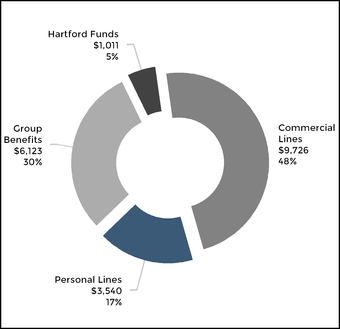
[1]Includes Revenue of $106 for Property & Casualty Other Operations and $234 for Corporate.
The following discussion describes the principal products and services, marketing and distribution, and competition of The Hartford's reporting segments. For further discussion of the reporting segments, including financial disclosures of revenues by product line, net income (loss), and assets for each reporting segment, see Note 4 - Segment Information of Notes to Consolidated Financial Statements.
Part I - Item 1. Business
| COMMERCIAL LINES |
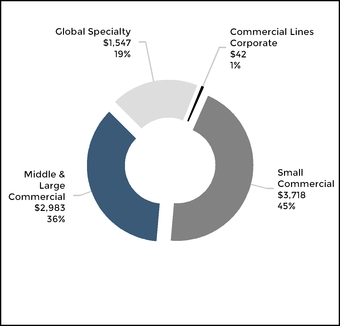
2019 Earned Premiums of $8,290 by Line of Business
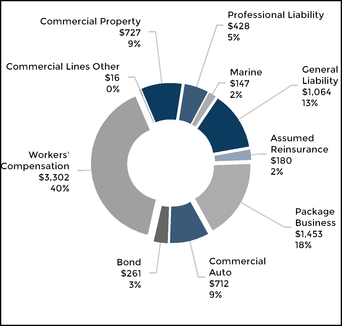
2019 Earned Premiums of $8,290 by Product
Principal Products and Services
| Automobile | Covers damage to a business's fleet of vehicles due to collision or other perils (automobile physical damage). In addition to first party automobile physical damage, commercial automobile covers liability for bodily injuries and property damage suffered by third parties and losses caused by uninsured or under-insured motorists. |
| Property | Covers the building a business owns or leases as well as its personal property, including tools and equipment, inventory, and furniture. A commercial property insurance policy covers losses resulting from fire, wind, hail, earthquake, theft and other covered perils, including coverage for assets such as accounts receivable and valuable papers and records. Commercial property may include specialized equipment insurance, which provides coverage for loss or damage resulting from the mechanical breakdown of boilers and machinery. |
| General Liability | Covers a business in the event it is sued for causing harm to a person and/or damage to property. General liability insurance covers third-party claims arising from accidents occurring on the insured’s premises or arising out of their operations. General liability insurance may also cover losses arising from product liability and provide replacement of lost income due to an event that interrupts business operations. |
| Marine | Encompasses various ocean and inland marine coverages including cargo, craft, hull, specie, transport and liability, among others. |
| Package Business | Covers both property and general liability damages. |
| Workers' Compensation | Covers employers for losses incurred due to employees sustaining an injury, illness or disability in connection with their work. Benefits paid under workers’ compensation policies may include reimbursement of medical care costs, replacement income, compensation for permanent injuries and benefits to survivors. Workers’ compensation is provided under both guaranteed cost policies (coverage for a fixed premium) and loss sensitive policies where premiums are adjustable based on the loss experience of the employer. |
| Professional Liability | Covers liability arising from directors and officers acting in their official capacity and liability for errors and omissions committed by professionals and others. Coverage may also provide employment practices insurance relating to allegations of wrongful termination and discrimination. |
| Bond | Encompasses fidelity and surety insurance, including commercial surety, contract surety and fidelity bonds. Commercial surety includes bonds that insure non-performance by contractors, license and permit bonds to help meet government-mandated requirements and probate and judicial bonds for fiduciaries and civil court proceedings. Contract surety bonds may include payment and performance bonds for contractors. Fidelity bonds may include ERISA bonds related to the handling of retirement plan assets and bonds protecting against employee theft or fraud. The Company also provides credit and political risk insurance offered to clients with global operations. |
| Assumed Reinsurance | Includes assumed reinsurance of property, liability, agriculture, marine and accident and health risks throughout the world but principally in Europe and North America. |