 filings.tools
Raymond James Financial (RJF) 10-K risk factor changes: FY2022 vs FY2021
The 2022-09-30 10-K against the 2021-09-30 one, compared heading by heading and sentence by sentence.
Item 1A82 rewritten80 added72 removed273 unchanged
All filing items1,888 rewritten1,538 added874 removed2,709 unchanged
Summary
counted, not written
- Item 1A lists 31 risk factor headings: 4 new, 8 reworded and 19 unchanged since FY2021. 4 headings from FY2021 no longer appear.
- Sentence by sentence, 1,538 added, 874 removed, 1,888 rewritten and 2,709 unchanged across 12 items that differ.
New Item 1A headings (4)
- We are subject to risks relating to environmental, social, and governance (“ESG”) matters that could adversely affect our reputation, business, financial condition, and results of operations, as well as the price of our common and preferred stock.
- Continued asset growth may result in changes to our status with respect to existing regulations as well as increased oversight, which will result in additional capital and other financial requirements and may increase our compliance costs.
- The rights of holders of our common stock are generally subordinate to the rights of holders of our outstanding, and any future issuances of, debt securities and preferred stock.
- The depositary shares representing our preferred stock are thinly traded and have limited voting rights.
Removed Item 1A headings (4)
- The worldwide COVID-19 pandemic may negatively impact our business, financial condition, and results of operations.
- We continue to experience pricing pressures in areas of our business which may impair our future revenue and profitability.
- Climate change and sustainability concerns could disrupt our businesses, adversely affect client activity levels, adversely affect the creditworthiness of our counterparties and damage our reputation.
- The phase-out of LIBOR could negatively impact our financial condition and require significant operational work.
Reworded Item 1A headings (8)
- Significant volatility in our domestic clients’ cash [added: sweep] balances could negatively impact our net revenues and/or our ability to fund
[removed: Raymond James Bank’s][added: our Bank segment’s] growth and may impact our regulatory ratios. - Our business depends on fees generated from the distribution of financial products, fees earned from the management of client accounts, and [added: other] asset management fees.
- We face intense competition and [added: pricing pressures and] may not be able to keep pace with technological change.
- We are exposed to litigation
[removed: risks,][added: and regulatory investigations and proceedings,] which could materially and adversely impact our business operations and prospects. - The preparation of the consolidated financial statements requires the use of estimates that may vary from actual
[removed: results and new accounting standards could adversely affect future reported]results. - Financial services firms are highly regulated and
[removed: such regulation][added: are currently subject to a number of new and proposed regulations, all of which] may increase[removed: the][added: our] risk of financial liability and reputational harm resulting from adverse regulatory actions. - Changes in requirements relating to the standard of conduct for broker-dealers applicable under federal and state law have
[removed: increased][added: increased, and may continue to increase,] our costs. - Failure to comply with regulatory capital requirements primarily applicable to RJF, Raymond James [added: Bank, TriState Capital] Bank or our broker-dealer subsidiaries would significantly harm our business.
A heading is new when no FY2021 heading matches it after ignoring case and punctuation, and reworded when it shares at least 60 percent of its words with one that went away. All current risk factor headings.
Sentences by item
19 items, with every count and a link to each item that changed
Underlined words on a shaded ground are new in FY2022; struck-through words were in FY2021. Sentences that are wholly new or wholly gone are labelled rather than marked.
Item 1A. RISK FACTORS
82 rewritten, 80 added, 72 removed, 273 unchanged
Our operations and financial results are subject to various risks and uncertainties, including those described in the following sections, which could adversely affect our business, financial condition, results of operations, liquidity and the trading price of our common [added: and preferred] stock.
The market impact from such policies can also decrease materially the value of certain of our financial assets, most notably debt securities, as well as our cash flows, such as those associated with client cash [removed: balances.]
Macroeconomic conditions may also [removed: directly] [added: be negatively impacted by domestic or international events, including natural disasters, political unrest, or public health epidemics] and [removed: indirectly impact] [added: pandemics, as well as by] a number of factors in the global financial markets that may be detrimental to our operating results.
If we were to experience a period of sustained downturn in the securities markets, credit market dislocations, reductions in the value of real estate, increases in mortgage and other loan delinquencies, or other negative market factors, [removed: including from the continuing impact of the COVID-19 pandemic,] our revenues could be adversely impacted.
Periods of reduced revenue and other losses could lead to reduced profitability because certain of our expenses, including our interest expense on debt, [removed: rent, facilities] [added: lease expenses,] and salary expenses, are fixed, and our ability to reduce them over short time periods is limited.
U.S. markets may also be impacted by [added: public health epidemics or pandemics, such as the COVID-19 pandemic, as well as by] political and civil unrest occurring in other parts of the world.
If liquidity from our brokerage or banking operations is inadequate or unavailable, we may be required to scale back or curtail our operations, such as limiting our recruiting of [removed: additional] financial advisors, limiting lending, selling assets at unfavorable prices, and cutting or eliminating dividend payments.
[removed: A sharp change in the market values of the securities utilized in these] transactions may result in losses if counterparties to these transactions fail to honor their commitments.
We also incur credit risk by lending to businesses and individuals, including through offering [added: SBL,] C&I loans, CRE loans, REIT loans, residential mortgage loans, [removed: tax-exempt loans, SBL] and [removed: other] [added: tax-exempt] loans.
Our credit risk and credit losses can increase if our loans or investments are concentrated among borrowers or issuers engaged in the same or similar activities, industries, or geographies, or to borrowers or issuers who as a group may be uniquely or disproportionately affected by economic or market [removed: conditions, such as those most impacted by the COVID-19 pandemic.][added: conditions.]
Credit [removed: quality] [added: risk] may also be affected by [added: the deterioration of strength in the U.S. economy or] adverse changes in the financial performance or condition of our [removed: debtors or deterioration in the strength of the U.S. economy.][added: clients and counterparties.]
[added: Furthermore, the deterioration of an individually large exposure, for example due to natural disasters, health emergencies] or pandemics, acts of terrorism, severe weather events or other adverse economic events, could lead to additional credit loss provisions and/or charges-offs, and subsequently have a material impact on our net income and regulatory capital.
Market risk is inherent in financial instruments associated with our operations and activities, including loans, deposits, securities, short-term borrowings, long-term debt, trading assets and liabilities, derivatives and [removed: private equity] investments.
For example, interest rate changes could adversely affect the value of our fixed income trading [removed: inventories held to facilitate client transactions,] [added: inventories,] as well as our net interest spread, which is the difference between the yield we earn on our interest-earning assets and the interest rate we pay for deposits and other sources of funding, in turn impacting our net interest income and earnings.
Our private equity [added: fund] investments are carried at fair value with unrealized gains and losses reflected in earnings.
When, and if, we recognize gains can depend on a number of factors, including general economic conditions, the prospects of the companies in which [removed: we] [added: the funds] invest and whether these companies become subject to a monetization event.
The inability to reduce our positions in specific securities may not only increase the market and credit risks associated with such positions, but also increase the level of risk-weighted assets on our balance sheet, thereby increasing our capital requirements, which could have an adverse effect on our business results, financial [removed: condition] [added: condition,] and liquidity.
Significant volatility in our domestic clients’ cash [added: sweep] balances could negatively impact our net revenues and/or our ability to fund [removed: Raymond James Bank’s] [added: our Bank segment’s] growth and may impact our regulatory ratios.
The majority of [removed: Raymond James Bank’s] [added: our Bank segment’s] deposits are driven by the RJBDP.
The RJBDP is a source of relatively low-cost, stable deposits [removed: for Raymond James Bank] and we rely heavily on the RJBDP to fund [added: our Bank segment asset growth, particularly at] Raymond James [removed: Bank’s asset growth.][added: Bank.]
A significant reduction in PCG clients’ cash balances, a change in the allocation of that cash between [removed: Raymond James] [added: our] Bank [added: segment] and third-party banks within the RJBDP, or a [removed: transfer] [added: movement] of cash away from the firm could significantly impact [removed: Raymond James Bank’s] [added: our] ability to continue growing interest-earning assets and/or require [removed: Raymond James] [added: our] Bank [added: segment] to use higher-cost deposit sources to grow interest-earning assets.
[removed: The RJBDP] [added: We] also [removed: generates] [added: earn] fees from third-party banks related to the deposits they receive through their participation in the RJBDP.
If PCG clients’ cash balances [removed: remain elevated] [added: continue to decrease] or [removed: increase further and] third-party bank demand or capacity for RJBDP deposits [removed: do not improve or] decline from current levels our RJBDP fees from third-party banks could [removed: continue to] be adversely affected.
In addition, our inability to deploy client cash to third-party banks through RJBDP would require us to retain more cash [removed: at Raymond James] [added: in our] Bank [added: segment] or in our Client Interest Program (“CIP”), both of which may cause a significant increase in our assets.
Our business depends on fees generated from the distribution of financial products, fees earned from the management of client accounts, and [added: other] asset management fees.
As our PCG clients increasingly show a preference for fee-based accounts over [removed: traditional] transaction-based accounts, a larger portion of our client assets are more directly impacted by market movements.
We may incur losses and be subject to reputational harm to the extent that, for any reason, we are unable to sell securities we have underwritten at [removed: the] anticipated price levels.
[removed: Although cybersecurity incidents among financial services firms are on the rise, we have] not experienced any material losses relating to cyber-attacks or other information security breaches.
[removed: Though] [added: In addition, although] we [removed: have] [added: maintain] insurance [removed: against some cyber-risks] [added: coverage that may, subject to terms] and [removed: attacks, we] [added: conditions, cover certain aspects of cyber and information security risks, such insurance coverage] may be [removed: subject] [added: insufficient] to [added: cover all losses, such as] litigation [removed: and] [added: costs or] financial losses that exceed our policy limits or are not covered under any of our current insurance policies.
Further, in light of the high volume of transactions we process, [added: use of remote work,] the large number of our clients, partners and counterparties, [added: and] the increasing sophistication of malicious actors, [removed: and our remote work environment,] a cyber-attack could [removed: occur and persist for an extended period of time without detection.][added: occur.]
Potential liability in the event of a security breach of [added: client data could be significant.]
Financial services firms are subject to numerous actual or perceived conflicts of interest, which are routinely examined by regulators and [removed: SROs] [added: SROs,] such as [removed: FINRA] [added: FINRA,] and are often used as the basis for claims for legal liability by plaintiffs in actions against us.
[added: A perceived or actual] failure to address conflicts of interest adequately could affect our reputation, the willingness of clients to transact business with us or give rise to litigation or regulatory actions.
Our trading margins have been further compressed by the shift from high- to low-touch [removed: execution] services over time, which has created additional competitive pressure.
We believe that price competition and pricing pressures in these and other areas will continue as institutional investors continue to reduce the amounts they are willing to pay, including by reducing the number of brokerage firms they use, and some of our competitors seek to obtain market share by reducing fees, [removed: commissions] [added: commissions,] or margins.
We face intense competition and [added: pricing pressures and] may not be able to keep pace with technological change.
We compete directly with other national full service broker-dealers, investment banking firms, commercial banks, and investment advisors, [added: investment managers,] and to a lesser extent, with discount brokers and dealers.
New technologies have required, and could require us in the future, to spend more to modify or adapt our products to attract and retain clients [removed: and customers] or to match products and services offered by our competitors, including technology companies.
To compete effectively we must attract, develop, and retain qualified professionals, including successful financial advisors, investment bankers, trading professionals, portfolio managers and other revenue-producing or specialized [added: support] personnel.
[removed: Financial industry] [added: Specifically within the financial industry,] employers are increasingly offering guaranteed contracts, upfront payments, [removed: increased compensation] and increased [removed: opportunities to work remotely on a permanent basis.][added: compensation.]
Additionally, like many large enterprises, we have shifted to a more hybrid work environment which includes a combination of in-office and remote work for our associates.
The increase in remote work over the past few years has introduced potential new vulnerabilities to cyber threats.
We may also face increased cybersecurity risk for a period of time after acquisitions as we transition the acquired entity’s historical controls to our standards.
Although cybersecurity incidents among financial services firms are on the rise, we have
Moreover, any such cyber-attack may persist for an extended period of time without detection.
balances.
A sharp change in the market values of the securities utilized in these
In addition, TriState Capital Bank utilizes information provided by third-party organizations to monitor changes in the value of marketable securities that serve as collateral for a portion of its SBL.
These third parties also provide control over cash and marketable securities for purposes of perfecting TriState Capital Bank’s security interests and retaining the collateral in the applicable accounts.
In the event that TriState Capital Bank would need to take control of collateral, it is dependent upon such third parties to follow contractual control agreements in order to mitigate any potential losses on its SBL.
Rapidly rising rates, for example, have made and may continue to make investments in securities, such as fixed-income securities and money market funds, more attractive for investors, thereby reducing the cash they hold.
The labor market continues to experience elevated levels of turnover in the aftermath of the COVID-19 pandemic and we have been impacted by an extremely competitive labor market, including increased competition for talent across all aspects of our business, as well as increased competition with non-traditional competitors, such as technology companies.
Employers are offering increased compensation and opportunities to work with greater flexibility, including remote work, on a permanent basis.
If the broker-dealers from whom we recruit new
Additionally, most of our clients may withdraw funds from under our management at their discretion at any time for any reason, including as a result of competition or poor performance of our products.
Competition from other financial services firms to attract clients or trading volume, through direct-to-investor online financial services, or higher deposit rates to attract client cash balances, could result in pricing pressure or otherwise adversely impact our business and cause our business to suffer.
We must monitor the pricing of our services and financial products in relation to competitors and periodically may need to adjust our fees, commissions, margins, or interest rates on deposits to remain competitive.
investments.
The financial services industry faces significant litigation and regulatory risks.
existence and magnitude of potential claims often remain unknown for substantial periods of time.
In addition, our business activities include providing custody, clearing, and back office support for certain non-affiliated, independent RIAs and broker-dealers.
Even though these independent firms are exclusively responsible for their operations, supervision, compliance, and the suitability of their client’s investment decisions, we have been, and may in the future be, named as defendants in litigation involving their clients.
We are also the subject of inquiries, investigations, and proceedings by regulatory and other governmental agencies.
We are subject to risks relating to environmental, social, and governance (“ESG”) matters that could adversely affect our reputation, business, financial condition, and results of operations, as well as the price of our common and preferred stock.
We are subject to a variety of risks, including reputational risk, associated with ESG issues.
The public holds diverse and often conflicting views on ESG topics.
As a large financial institution, we have multiple stakeholders, including our shareholders, clients, associates, federal and state regulatory authorities, and the communities in which we operate, and these stakeholders will often have differing priorities and expectations regarding ESG issues.
If we take action in conflict with one or another of those stakeholders’ expectations, we could experience an increase in client complaints, a loss of business, or reputational harm.
We could also face negative publicity or reputational harm based on the identity of those with whom we choose to do business.
Any adverse publicity in connection with ESG issues could damage our reputation, ability to attract and retain clients and associates, compete effectively, and grow our business.
In addition, proxy advisory firms and certain institutional investors who manage investments in public companies are increasingly integrating ESG factors into their investment analysis.
The consideration of ESG factors in making investment and voting decisions is relatively new.
Accordingly, the frameworks and methods for assessing ESG policies are not fully developed, vary considerably among the investment community, and will likely continue to evolve over time.
Moreover, the subjective nature of methods used by various stakeholders to assess a company with respect to ESG criteria could result in erroneous perceptions or a misrepresentation of our actual ESG policies and practices.
Organizations that provide ratings information to investors on ESG matters may also assign unfavorable ratings to RJF.
Certain of our clients might also require that we implement additional ESG procedures or standards in order to continue to do business with them.
If we fail to comply with specific ESG-related investor or client expectations and standards, or to provide the disclosure relating to ESG issues that any third parties may believe is necessary or appropriate (regardless of whether there is a legal requirement to do so), our reputation, business, financial condition, and/or results of operations, as well as the price of our common and preferred stock could be negatively impacted.
Moreover, there has been increased regulatory focus on ESG-related practices of investment managers.
A growing interest on the part of investors and regulators in ESG factors, and increased demand for, and scrutiny of, ESG-related disclosures by asset managers, has likewise increased the risk that we could be perceived as, or accused of, making inaccurate or misleading statements regarding the investment strategies of our funds and exchange-traded funds (“ETFs”), or our and our funds’ and ETFs’ ESG efforts or initiatives, commonly referred to as “greenwashing.” Such perceptions or accusations could damage our reputation, result in litigation or regulatory enforcement actions, and adversely affect our business.
Such estimates and assumptions may require management to make difficult,
The worldwide COVID-19 pandemic may negatively impact our business, financial condition, and results of operations.
The worldwide COVID-19 pandemic and related measures intended to control the spread of the virus have had a significant impact on global economic conditions and may negatively impact certain aspects of our business and results of operations in the future.
Although certain economic conditions improved throughout fiscal 2021, the pandemic continues to evolve, as recently experienced with the rapid spread of the Delta variant, and certain of the impacts of the pandemic may continue to affect our results in the future, including: near-zero short-term interest rates resulting in lower net interest income and RJBDP fees from third-party program banks; volatility in our brokerage revenues and investment banking revenues due to market uncertainty caused by the pandemic; and increased credit risk, particularly with regard to industries most vulnerable to the pandemic (e.g., airline, restaurant, gaming, entertainment/leisure and energy), which may result in an elevated bank loan loss provision and charge-offs.
In addition, should market conditions deteriorate, or if there is a decline in equity markets similar to that experienced during our fiscal 2020 second quarter, the value of our clients’ assets and certain of our investments would also be negatively affected.
We may also continue to experience business disruptions as a result of the continued spread of COVID-19 and its variants, resulting from restrictions on our employees’ ability to travel, as well as temporary partial or full closures of our facilities and the facilities of our clients, suppliers, or other vendors.
We often recruit skilled professionals by visiting their offices or having them visit our offices.
Although we have reinstated the majority of our in-person recruiting, renewed travel restrictions or other disruptions that prevent us from meeting with professional prospects may adversely impact our ability to recruit such professional prospects.
Further, the increased availability of remote working arrangements in response to the pandemic has intensified and may continue to intensify competition for prospective new associates and impair our ability to retain current associates.
Recently promulgated OSHA rules related to required vaccines or alternative testing protocols for unvaccinated associates may also have negative effects on our current associates, including additional administrative burdens and concerns related to perceived health and safety risks, and may result in an increase in employee complaints as well as difficulty attracting and retaining associates.
While we maintain contingency plans for events such as pandemic outbreaks, the further spread of COVID-19, or a similar contagious disease could also impair the effectiveness of our executive officers or other associates who are necessary to conduct our business.
In addition, the continued spread of COVID-19 could harm the operations of third-party service providers who perform critical services for our business.
In some cases, the COVID-19 pandemic has accelerated the transition from traditional to digital financial services and heightened customer expectations in this area, and this transition may require us to invest greater resources in technological improvements.
If COVID-19 or another highly infectious or contagious disease, continues to spread or the response to contain it is unsuccessful, we may experience adverse effects on our business, financial condition, liquidity, and results of operations.
A prolonged period of economic deterioration could ultimately result in impairment of our goodwill and identifiable intangible assets.
In addition, if financial markets deteriorate as a result of the current or a future pandemic, our access to capital and other sources of funding may become constrained, which may require us to restructure debt or obtain additional financing on terms that may be onerous or highly dilutive.
The extent of any of the previously-described effects on our business will depend on future developments which are highly uncertain and cannot be predicted, including the duration of the COVID-19 pandemic and the possible further impacts on the global economy.
For example, continued uncertainties loom over the future of the U.K.’s relationship with the E.U., including future trading arrangements between the U.K. and the E.U., following the expiration of the transition period on December 31, 2020.
During the transition period of Brexit, we took steps to make certain changes to our European operations in an effort to ensure that, where possible, we can continue to provide cross-border services in E.U. member states without the need for separate regulatory authorizations in each member state.
There is also continued uncertainty regarding the outcome of the E.U.’s financial support programs and the stability of the E.U.’s sovereign debt.
It is possible that other E.U. member states may experience financial troubles in the future, or may choose to follow the U.K.’s lead and leave the E.U. Any negative impact on economic conditions and global markets from these developments could adversely affect our business, financial condition and liquidity.
This risk was and may further be exacerbated by the effects of the COVID-19 pandemic, particularly in certain sectors.
The deterioration of an individually large exposure, for example due to natural disasters, health emergencies
Moreover, while there is no indication currently that the Fed plans to reduce its targeted Fed funds rate to a negative rate, if such a policy were to be adopted, the cost to hold both firm and client deposits would have an adverse impact on our profitability.
Additionally, like many large enterprises, since mid-March 2020, we have shifted the majority of our associates to remote work arrangements in response to the COVID-19 pandemic, and expect that
many of our associates will continue to work remotely to some extent following the pandemic.
This change in our operating model has enabled us to successfully continue business operations, but also introduces potential new vulnerabilities to cyber threats.
client data could be significant.
A perceived or actual
We continue to experience pricing pressures in areas of our business which may impair our future revenue and profitability.
We continue to experience pricing pressures on trading margins and commissions in fixed income and equity trading.
In equity markets, we experience pricing pressure from institutional clients to reduce commissions, partially due to the industry trend toward the separate payment for research and execution services.
This competition could cause our business to suffer.
Turnover in the financial services industry is high.
The cost of recruiting and retaining skilled professionals in the financial services industry has been considerable in recent years, but has intensified further during the recovery from the COVID-19 pandemic.
As competition for skilled
could seriously harm our business and future business prospects.
If management’s underlying assumptions and judgments prove to be inaccurate, the allowance for credit losses could be insufficient to cover actual losses.
Our financial instruments, including certain trading assets and liabilities, derivatives, available-for-sale securities, certain loans and investments, among other items, require management to make a determination of their fair value in order to prepare our consolidated financial statements.
Where quoted market prices are not available, we may make fair value determinations based on internally developed models or other means, which ultimately rely to some degree on our subjective judgment.
Some of these instruments and other assets and liabilities may have no directly observable inputs, making their valuation particularly subjective and, consequently, based on estimation and judgment.
An excerpt. Shown here: 40 of 82 rewritten, 40 of 80 added and 40 of 72 removed. The counts are complete. For every sentence, read Item 1A. RISK FACTORS in the FY2022 filing and the FY2021 filing.
Item 7. MANAGEMENT’S DISCUSSION AND ANALYSIS OF FINANCIAL CONDITION AND RESULTS OF OPERATIONS
496 rewritten, 513 added, 355 removed, 560 unchanged
| Introduction | | | [removed: [38](#ib199bd4691024dcdae87e54fb4a89c61_181)] [added: [39](#i50879245508b4d3382e6138f77393d6b_181)] | | |
| Executive overview | | | [removed: [38](#ib199bd4691024dcdae87e54fb4a89c61_184)] [added: [39](#i50879245508b4d3382e6138f77393d6b_184)] | | |
| Reconciliation of non-GAAP financial measures to GAAP financial measures | | | [removed: [40](#ib199bd4691024dcdae87e54fb4a89c61_187)] [added: [41](#i50879245508b4d3382e6138f77393d6b_187)] | | |
| Net interest analysis | | | [removed: [42](#ib199bd4691024dcdae87e54fb4a89c61_193)] [added: [44](#i50879245508b4d3382e6138f77393d6b_193)] | | |
| Private Client Group | | | [removed: [44](#ib199bd4691024dcdae87e54fb4a89c61_196)] [added: [47](#i50879245508b4d3382e6138f77393d6b_196)] | | |
| Capital Markets | | | [removed: [48](#ib199bd4691024dcdae87e54fb4a89c61_199)] [added: [51](#i50879245508b4d3382e6138f77393d6b_199)] | | |
| Asset Management | | | [removed: [50](#ib199bd4691024dcdae87e54fb4a89c61_202)] [added: [53](#i50879245508b4d3382e6138f77393d6b_202)] | | |
| Raymond James Bank | | | [removed: [53](#ib199bd4691024dcdae87e54fb4a89c61_205)] | | | [added: 1,205 | | | | | |]
| Other | | | [removed: [54](#ib199bd4691024dcdae87e54fb4a89c61_208)] [added: [57](#i50879245508b4d3382e6138f77393d6b_208)] | | |
| Statement of financial condition analysis | | | [removed: [55](#ib199bd4691024dcdae87e54fb4a89c61_229)] [added: [58](#i50879245508b4d3382e6138f77393d6b_214)] | | |
| Liquidity and capital resources | | | [removed: [56](#ib199bd4691024dcdae87e54fb4a89c61_214)] [added: [59](#i50879245508b4d3382e6138f77393d6b_217)] | | |
| Critical accounting estimates | | | [removed: [61](#ib199bd4691024dcdae87e54fb4a89c61_238)] [added: [65](#i50879245508b4d3382e6138f77393d6b_241)] | | |
| Recent accounting developments | | | [removed: [62](#ib199bd4691024dcdae87e54fb4a89c61_247)] [added: [67](#i50879245508b4d3382e6138f77393d6b_250)] | | |
Year ended September 30, 2021 compared [removed: with] [added: to] the year ended September 30, 2020
[removed: We] [added: For the year ended September 30, 2022, we] generated [removed: strong results for fiscal 2021, with] net revenues of [removed: $9.76 billion, an increase of 22% compared with the prior year,] [added: $11.00 billion] and pre-tax income of [removed: $1.79] [added: $2.02] billion, [removed: an increase of 70%.][added: both 13% higher compared with the prior year.]
Our net income [added: available to common shareholders] of [removed: $1.40] [added: $1.51] billion was [removed: 72%] [added: 7%] higher than the prior [removed: year,] [added: year] and our earnings per diluted share of [removed: $6.63(1), which] [added: $6.98] reflected [removed: the impact of] a [removed: 3-for-2 stock split in September 2021, increased 71%.][added: 5% increase.]
Our return on [removed: equity (“ROE”) was 18.4%, compared with 11.9% for the prior year, and return on tangible] common equity [removed: (“ROTCE”)] [added: (“ROCE”)] was [removed: 20.4%(2),] [added: 17.0%,] compared with [removed: 13.0%(2)] [added: 18.4%] for the prior year.
Excluding these [removed: losses and] acquisition-related [removed: expenses of $19 million,] [added: expenses,] our adjusted net income [added: available to common shareholders] was [removed: $1.49 billion(2),] [added: $1.62 billion(1),] an increase of [removed: 74%] [added: 5%] compared with [removed: adjusted net income for] the prior [removed: year.][added: year, and our adjusted earnings per diluted share were $7.49(1), an increase of 3%.]
[removed: Our adjusted ROE] [added: Adjusted ROCE for the year] was [removed: 19.5%(2),] [added: 18.2%(1),] compared with [removed: 12.5%(2) for] [added: 20.0%(1) in] the prior year, and adjusted [removed: ROTCE] [added: return on tangible common equity (“ROTCE”)] was [removed: 21.6%(2),] [added: 21.1%(1),] compared with [removed: 13.6%(2) for] [added: 22.2%(1) in] the prior year.
[removed: Revenues in the current] [added: The prior] year [removed: also] included $74 million of private equity valuation gains, of which $25 million were attributable to noncontrolling interests and were offset [removed: in] [added: within] other [removed: expenses, compared with $28 million of losses in the prior year, of which $20 million were attributable to noncontrolling interests.][added: expenses.]
Compensation, commissions and benefits expense increased [removed: $1.12 billion, or 20%,] [added: 11%,] primarily [removed: resulting from] [added: attributable to] the growth in revenues and pre-tax income compared with the prior [removed: year.][added: year, as well as the aforementioned acquisitions.]
Our compensation [removed: ratio, or the] ratio [removed: of compensation, commissions and benefits expense to net revenues, decreased to 67.4%] [added: was 66.6%,] compared with [removed: 68.4%] [added: 67.5%] for the prior year.
The [removed: decrease] [added: decline] in [removed: our] [added: the] compensation ratio primarily resulted from [removed: higher revenues and] changes in our revenue mix due to [removed: strong] [added: higher] net [removed: revenues in our Capital Markets segment, which had a lower compensation ratio at 56% than our PCG segment,] [added: interest income] and [removed: the private equity valuation gains] [added: RJBDP fees from third-party banks,] which have [removed: no] [added: little] associated direct compensation.
[removed: (2) “ROTCE,” “Adjusted] [added: (1) Adjusted] net [removed: income,” “adjusted] [added: income available to common shareholders, adjusted] earnings per diluted [removed: share,” “adjusted ROE”] [added: share, adjusted ROCE, adjusted ROTCE,] and [removed: “adjusted ROTCE”] [added: adjusted compensation ratio] are [removed: each] non-GAAP financial measures.
Please see the “Reconciliation of non-GAAP financial measures to GAAP financial measures” in this MD&A for a reconciliation of [removed: our] [added: these] non-GAAP [added: financial] measures to the most directly comparable GAAP [removed: measures] [added: measures,] and for other important disclosures.
[removed: Non-compensation expenses decreased $87 million, or 6%, primarily due to a $265 million decrease in the] [added: The] bank loan provision for credit [removed: losses, which] [added: losses] was [removed: a benefit of $32] [added: $100] million [removed: in the current year computed under] [added: for] the current [removed: expected credit loss (“CECL”) methodology] [added: year,] compared with a [removed: provision] [added: benefit for credit losses] of [removed: $233] [added: $32] million [removed: in] [added: for] the prior [removed: year computed under the incurred loss methodology.][added: year.]
As of September 30, [removed: 2021,] [added: 2022,] our [removed: total capital ratio of 26.2% and] tier 1 leverage ratio of [removed: 12.6%] [added: 10.3% and total capital ratio of 20.4%] were [removed: each more than double] [added: both well above] the regulatory [removed: requirements] [added: requirement] to be considered well-capitalized.
We also continued to have substantial [removed: liquidity,] [added: liquidity] with [removed: $1.16] [added: $1.91] billion(1) of cash at the parent [removed: company,] [added: company as of September 30, 2022,] which includes parent cash loaned to RJ&A.
[removed: Although our results during the year were positively impacted by a benefit] [added: Net loan growth should result in additional provisions] for credit losses [removed: related to our bank loan portfolio, net loan growth and/or] [added: and] future [removed: market] [added: economic] deterioration could result in increased [added: bank loan] provisions [added: for credit losses] in future periods.
In addition, [added: although] we [added: remain focused on the management of expenses, we] expect that expenses will continue to increase in [removed: fiscal 2022,] [added: part] as [added: a result of inflationary pressures on our costs, as] business and event-related travel [removed: increase] [added: occur throughout the entire fiscal year 2023,] and as we continue to make investments in our people and technology to support our growth.
Year ended September 30, [removed: 2020] [added: 2021] compared [removed: with] [added: to] the year ended September 30, [removed: 2019][added: 2020]
Refer to “Item 7 - Management’s Discussion and Analysis of Financial Condition and Results of Operations” of our [removed: 2020] [added: 2021] Form 10-K for a discussion of our fiscal [removed: 2020] [added: 2021] results compared to fiscal [removed: 2019.][added: 2020.]
We believe certain of these non-GAAP financial measures [removed: provides] [added: provide] useful information to management and investors by excluding certain material items that may not be indicative of our core operating results.
| | | | | | | Year ended September 30, | | | | | | | | | [removed: | | | | | |]
| Non-GAAP adjustments: | | | | | | | | | | | | | | | [removed: | | | | | |]
| [removed: Losses] [added: Losses] on extinguishment of [removed: debt | | | | | | 98] [added: debt] | | | | | | [removed: —] [added: —] | | | | | | [added: 98] | | |
| [removed: Acquisition and disposition-related] [added: All other acquisition-related] expenses | | | | | | [removed: 19 | | | | | | 7] [added: 11] | | | | | | [added: 2] | | |
| Reduction in workforce expenses | | | | | | — | | | | | | [added: — | | | | | |] 46 | | | | | | [added: —] | | [added: %] | [added: | | | (100) | | % |]
| Pre-tax impact of non-GAAP adjustments | | | | | | [removed: 117 | | | | | | 53] [added: 147] | | | | | | [added: 180] | | |
| Tax effect of non-GAAP adjustments | | | | | | [removed: (28) | | | | | | (13)] [added: (37)] | | | | | | [added: (43)] | | |
| Bank | | | [56](#i50879245508b4d3382e6138f77393d6b_205) | | |
| Regulatory | | | [65](#i50879245508b4d3382e6138f77393d6b_238) | | |
| Risk management | | | [67](#i50879245508b4d3382e6138f77393d6b_259) | | |
Year ended September 30, 2022 compared with the year ended September 30, 2021
In fiscal 2022, we completed the acquisitions of Charles Stanley Group PLC (“Charles Stanley”), TriState Capital, and SumRidge Partners, which resulted in incremental revenues and expenses during the year.
During the year we also incurred acquisition-related expenses, such as compensation largely related to retention awards, initial provisions for credit losses on acquired loans and unfunded lending commitments, amortization of identifiable intangible assets, and other costs incurred to effect our acquisitions, such as legal expenses and other professional fees.
These expenses totaled $147 million this fiscal year, an increase of $65 million over the prior year.
The increase in net revenues compared with the prior year was driven by the impact of higher PCG client assets in fee-based accounts for most of the current fiscal year, which positively impacted our asset management and related administrative fees, the benefit of higher short-term interest rates on both net interest income and RJBDP fees from third-party banks, and incremental revenues from our acquisitions of TriState Capital, Charles Stanley, and SumRidge Partners.
Brokerage revenues and investment banking revenues each declined compared with a strong prior year, primarily as a result of market uncertainty during the current year.
Excluding acquisition-related compensation expenses, our adjusted compensation ratio was 66.1%(1), compared with 67.0%(1) for the prior year.
In fiscal 2022, certain non-GAAP financial measures were adjusted for additional expenses directly related to our acquisitions that we believe are not indicative of our core operating results, such as those related to amortization of identifiable intangible assets arising from acquisitions and acquisition-related retention.
Prior periods have been conformed to the current presentation.
Non-compensation expenses increased 19%, due to incremental expenses from the aforementioned acquisitions, as well as increases in the bank loan provision for credit losses, business development expenses and communications and information processing expenses.
The bank loan provision for credit losses increased $132 million to a provision of $100 million in the current year, compared with a benefit of $32 million for the prior year; however, $26 million of this increase related solely to the initial provision recorded on loans acquired as part of the TriState Capital acquisition.
Partially offsetting these increases, we incurred $98 million of losses on extinguishment of debt from the early-redemption of certain of our senior notes during the prior year, which did not recur in the current year.
Our effective income tax rate was 25.4% for fiscal 2022, an increase from 21.7% for the prior year.
The increase in the effective tax rate from the prior year was primarily due to the negative impact of nondeductible valuation losses associated with our company-owned life insurance portfolio during the current year compared with nontaxable valuation gains for the prior year.
We believe our funding and capital position provide us the opportunity to continue to grow our balance sheet prudently and we expect to continue to be opportunistic in deploying our capital.
Subsequent to the closing of TriState Capital, for the period June 1, 2022 through September 30, 2022, we repurchased 1.74 million shares and subsequent to that date repurchased an additional 354 thousand shares, for a cumulative repurchase through November 17, 2022 of approximately 2.1 million shares of our common stock for $200 million or approximately $96 per share.
After the effect of those repurchases, $800 million remained under our Board of Directors’ share repurchase authorization.
We currently expect to continue to repurchase our common stock in fiscal 2023 to offset the impact of shares issued with the acquisition of TriState Capital as well as to offset dilution from share-based compensation; however, we will continue to monitor market conditions and other capital needs as we consider these repurchases.
On August 16, 2022, the U.S. enacted the Inflation Reduction Act of 2022, which, among other things, establishes a 1% excise tax on net repurchases of shares by domestic corporations whose stock is traded on an established securities market.
The excise tax will be imposed on repurchases that occur after December 31, 2022 and will be recorded directly to equity as part of the repurchase transaction, rather than as a component of our provision for income taxes.
The act also introduces a corporate alternative minimum tax which we do not expect to have an impact on our results of operations or cash flows in the future.
We believe we remain well-positioned entering fiscal 2023.
We expect fiscal 2023 results to be further positively impacted by a full year’s impact of the combined 300-basis point increase in the Fed’s short-term benchmark interest rate during our fiscal 2022, as well as the 75-basis point increase in November 2022.
With clients’ domestic cash sweep balances of $67.1 billion as of September 30, 2022 and our high concentration of floating-rate assets, we also believe we are well-positioned for any further increases in short-term interest rates, which we expect to positively impact our net interest income and our RJBDP fees from third-party banks, although we expect further declines in client cash balances in fiscal 2023 as we expect clients to continue to shift their cash to higher-yielding investment products.
We also expect to continue to face macroeconomic uncertainties which may continue to have a negative impact on equity and fixed income markets.
As a result, we may experience volatility in asset management fees and brokerage revenues, as well as investment banking revenues, despite our strong investment banking pipelines.
In addition, asset management and related administrative fees will be negatively impacted in our fiscal first quarter of 2023 by the 3% sequential decrease in PCG fee-based assets as of September 30, 2022 and lower financial assets under management; however, our recruiting pipelines remain strong and we continue to see solid retention of existing advisors.
In fiscal 2022, certain of our non-GAAP financial measures were adjusted for additional expenses directly related to our acquisitions that we believe are not indicative of our core operating results, including acquisition-related retention, amortization of identifiable intangible assets arising from acquisitions, and the initial provision for credit losses on loans acquired and lending commitments assumed as a result of the TriState Capital acquisition.
Prior periods, where applicable, have been conformed to the current period presentation.
| Net income available to common shareholders | | | | | | $ | 1,505 | | | | | $ | 1,403 | |
| Expenses directly related to acquisitions included in the following financial statement line items: | | | | | | | | | | | | | | |
| Compensation, commissions and benefits: | | | | | | | | | | | | | | |
| Acquisition-related retention | | | | | | 58 | | | | | | 48 | | |
| Other acquisition-related compensation | | | | | | 2 | | | | | | 1 | | |
| Total “Compensation, commissions and benefits” expense | | | | | | 60 | | | | | | 49 | | |
| Amortization of identifiable intangible assets | | | | | | 33 | | | | | | 21 | | |
| Initial provision for credit losses on acquired lending commitments | | | | | | 5 | | | | | | — | | |
| Segments | | | [42](#ib199bd4691024dcdae87e54fb4a89c61_190) | | |
| Certain statistical disclosures by bank holding companies | | | [55](#ib199bd4691024dcdae87e54fb4a89c61_211) | | |
| Regulatory | | | [61](#ib199bd4691024dcdae87e54fb4a89c61_235) | | |
| Risk management | | | [62](#ib199bd4691024dcdae87e54fb4a89c61_256) | | |
During fiscal 2021, pre-tax margin increased in all of our operating segments and we generated particularly strong results in our PCG, Capital Markets and Asset Management segments.
During fiscal 2021, we completed a $750 million, 30-year senior notes offering at 3.75%, utilizing the proceeds from the offering and cash on hand to early-redeem our $250 million of 5.625% senior notes due 2024 and our $500 million of 3.625% senior notes due 2026.
We recognized losses on the extinguishment of such notes of $98 million.
Adjusted earnings per diluted share were $7.05(1)(2), a 73% increase compared with adjusted earnings per diluted share of $4.08(1)(2) for the prior year.
The significant increase in net revenues compared with the prior year was driven by higher asset management and related administrative fees, largely attributable to higher PCG assets in fee-based accounts, as well as strong investment banking revenues and brokerage revenues.
Offsetting these increases was the negative impact of lower short-term interest rates on our net interest income and RJBDP fees from third-party banks.
Our compensation ratio also benefited from expense management initiatives.
(1) During our fiscal fourth quarter of 2021 the Board of Directors approved a 3-for-2 stock split, effected in the form of a 50% stock dividend, paid on September 21, 2021.
All share and per share information has been retroactively adjusted to reflect this stock split.
Non-compensation expenses also decreased as a result of $46 million of expenses in the prior year related to a reduction in workforce, which did not recur in the current year, as well as a decrease in business development expenses due to lower travel and event-related expenses as a result of the COVID-19 pandemic.
These decreases were partially offset by the aforementioned losses on extinguishment of debt of $98 million in the current year, and an increase in other expenses, primarily due to the change in private equity valuations attributable to noncontrolling interests compared with the prior year.
Our effective income tax rate was 21.7% for fiscal 2021, a decrease compared with the 22.2% effective tax rate for fiscal 2020, primarily due to an increase in non-taxable gains on our corporate-owned life insurance portfolio.
Liquidity and capital remained strong.
We expect to continue to be opportunistic in deploying our capital in fiscal 2022, through a combination of organic growth and acquisitions, as evidenced by our fiscal 2021 acquisitions of NWPS Holdings, Inc., Financo, LLC, and Cebile Capital, and the announced acquisitions of Charles Stanley Group PLC and TriState Capital Holdings, Inc. which we expect to close in fiscal 2022.
Pursuant to our Board of Directors’ share repurchase authorization, we repurchased 1.5 million(2) shares of common stock during fiscal 2021 for $118 million, leaving $632 million of availability remaining under the authorization as of September 30, 2021.
However, due to regulatory restrictions following our announced acquisition of TriState Capital Holdings, we do not expect to repurchase shares until after closing.
We remain well-positioned entering fiscal 2022, with nearly $1.2 trillion of client assets under administration, strong activity levels for financial advisory recruiting, and a strong investment banking pipeline.
However, we expect to continue to face headwinds from near-zero short-term interest rates and economic uncertainty, including that arising from inflation, supply chain complications and uncertainty around U.S. economic policy.
In addition, although the economy has improved since the beginning of the COVID-19 pandemic, the pace of recovery in the future is uncertain due to concerns related to the pandemic, including the spread of the Delta variant and other variants, vaccine distribution, and vaccine rates.
As a result, we may experience volatility in brokerage and investment banking revenues, which may negatively impact our ability to sustain the level of revenues in future periods which were achieved in fiscal 2021.
(2) During our fiscal fourth quarter of 2021 the Board of Directors approved a 3-for-2 stock split, effected in the form of a 50% stock dividend, paid on September 21, 2021.
These non-GAAP financial measures include adjusted net income, adjusted earnings per diluted share, adjusted ROE, ROTCE, and adjusted ROTCE.
| | | | | | | | | | | | | | | | | | | | | |
| --- | --- | --- | --- | --- | --- | --- | --- | --- | --- | --- | --- | --- | --- | --- | --- | --- | --- | --- | --- | --- |
| *$ in millions, except per share amounts* | | | | | | 2021 | | | | | | 2020 | | | | | | | | |
| Net income | | | | | | $ | 1,403 | | | | | $ | 818 | | | | | | | |
| Adjusted net income | | | | | | $ | 1,492 | | | | | $ | 858 | | | | | | | |
| Acquisition and disposition-related expenses | | | | | | 0.09 | | | | | | 0.03 | | | | | | | | |
| Reduction in workforce expenses | | | | | | — | | | | | | 0.22 | | | | | | | | |
| Reduction in workforce expenses | | | | | | — | | | | | | 9 | | | | | | | | |
| Adjusted average equity | | | | | | $ | 7,669 | | | | | $ | 6,868 | | | | | | | |
| Average deferred tax liabilities, net | | | | | | (53) | | | | | | (31) | | | | | | | | |
| Return on equity | | | | | | 18.4 | | % | | | | 11.9 | | % | | | | | | |
| Adjusted return on equity | | | | | | 19.5 | | % | | | | 12.5 | | % | | | | | | |
SEGMENTS
The following table presents our consolidated and segment net revenues and pre-tax income/(loss) for the years indicated.
An excerpt. Shown here: 40 of 496 rewritten, 40 of 513 added and 40 of 355 removed. The counts are complete. For every sentence, read Item 7. MANAGEMENT’S DISCUSSION AND ANALYSIS OF FINANCIAL CONDITION AND RESULTS OF OPERATIONS in the FY2022 filing and the FY2021 filing.
Item 1. BUSINESS
113 rewritten, 54 added, 68 removed, 258 unchanged
We currently operate through the following five segments: Private Client Group (“PCG”); Capital Markets; Asset Management; [removed: Raymond James] Bank; and Other.
The following graph depicts the relative net revenue contribution of each of our business segments for the fiscal year ended September 30, [removed: 2021.][added: 2022.]
[removed: 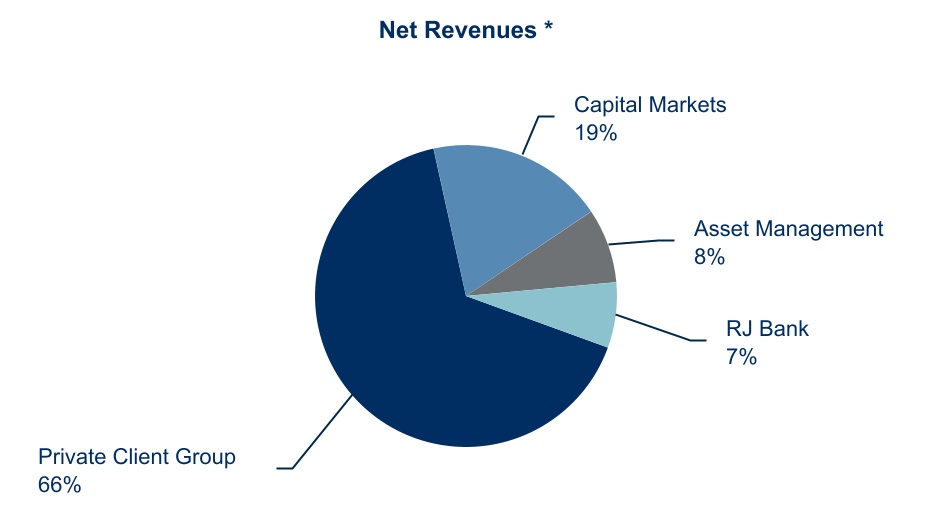][added: 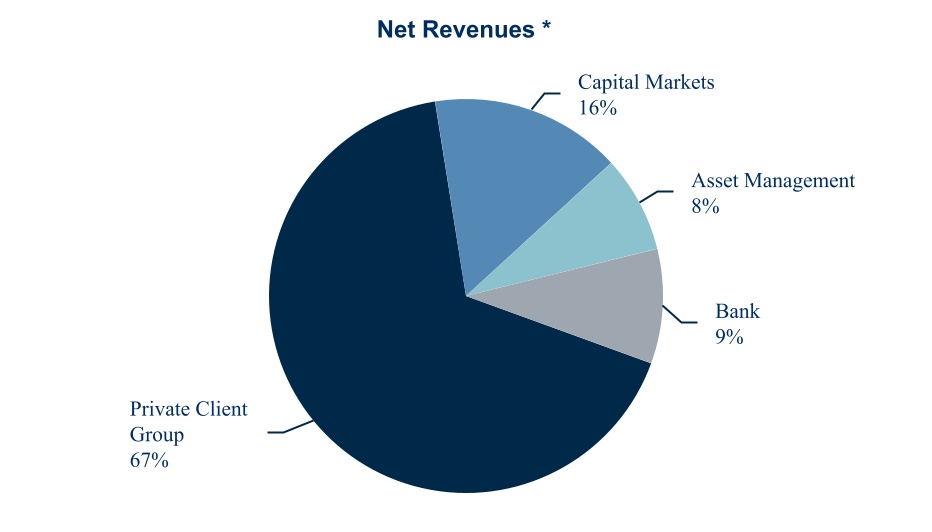]
Total client assets under administration (“AUA”) in our PCG segment as of September 30, [removed: 2021] [added: 2022] were [removed: $1.12] [added: $1.04] trillion, of which [removed: $627.1] [added: $586.0] billion related to fee-based accounts (“fee-based AUA”).
We had [removed: 8,482] [added: 8,681 employee and independent contractor] financial advisors affiliated with us as of September 30, [removed: 2021.][added: 2022.]
Financial advisors primarily affiliate with us directly as either employees or independent contractors, or as employees of the third-party [removed: firms] [added: Registered Investment Advisors (“RIAs”) and broker-dealers] to which we provide services through our RIA and Custody Services (“RCS”) division.
Our independent contractor financial advisor [removed: option is] [added: options are] designed to help our advisors build their businesses with as much or as little of our support as they determine they need.
Through our domestic RCS division, we offer third-party RIAs and broker-dealers a range of products and services including custodial services, trade execution, research and other support and services (including access to clients’ account information and the services of the Asset Management segment) for which we receive fees, which may be either transactional or based on [removed: assets under administration.][added: AUA.]
Financial advisors associated with firms in RCS are not included in our financial advisor counts, although their client [removed: assets, which totaled $92.7 billion as of September 30, 2021,] [added: assets] are included in our AUA.
PCG segment net revenues for the fiscal year ended September 30, [removed: 2021] [added: 2022] are presented in the following graph.
[removed: 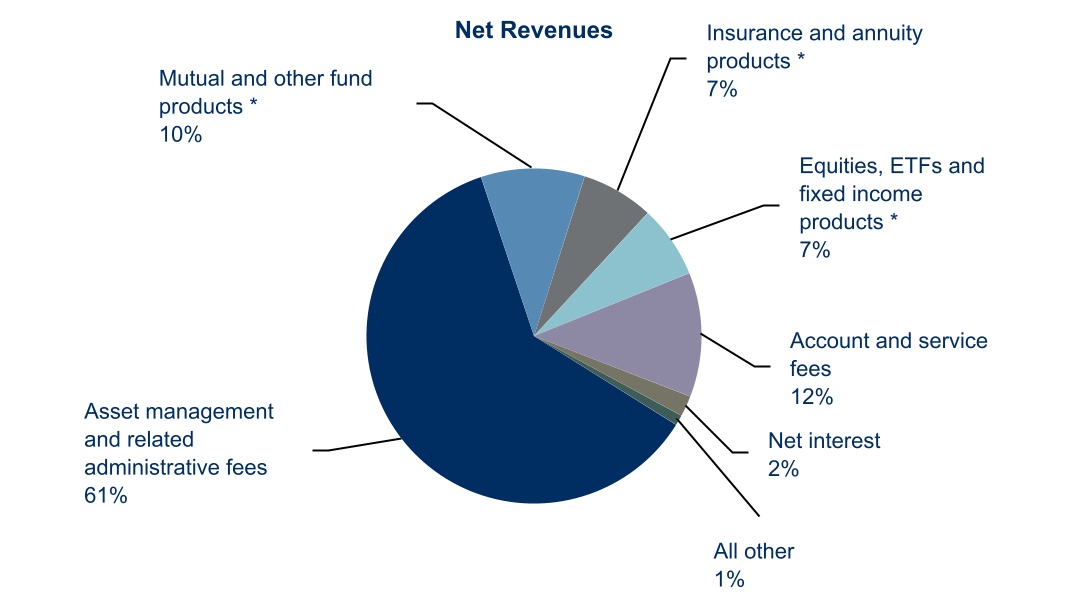][added: 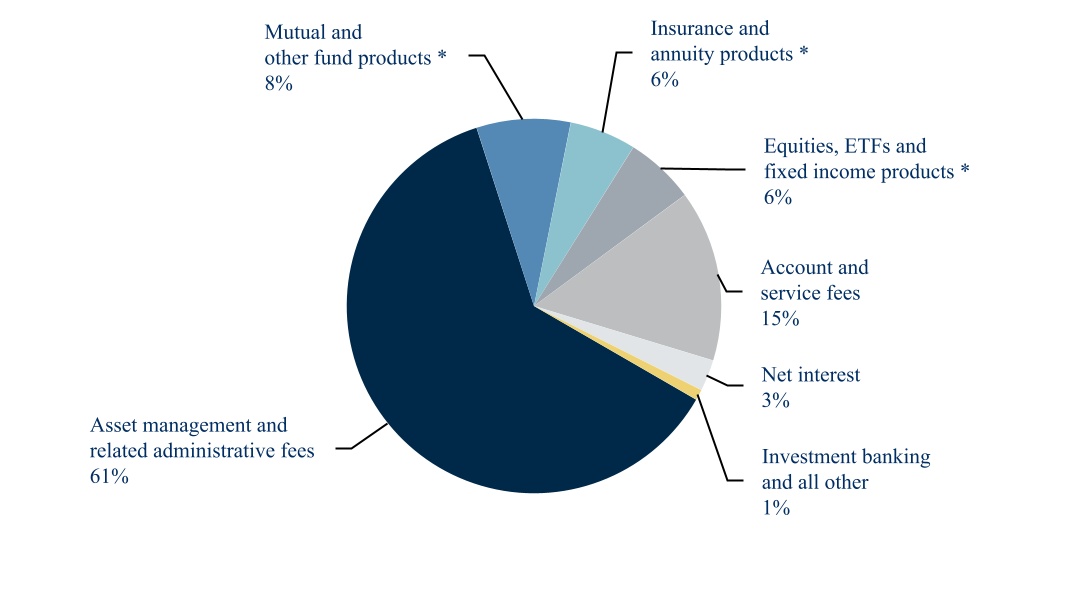]
- Support to third-party [removed: product partners,] [added: mutual fund and annuity companies,] including sales and marketing support, [removed: distribution] [added: distribution,] and accounting and administrative services.
Our Capital Markets segment conducts investment banking, institutional sales, securities trading, [added: equity research, and] the syndication and management of investments in low-income housing [removed: funds,] [added: funds and funds of a similar nature,] the majority of which qualify for tax credits (referred to as our [removed: “tax credit funds” business), and equity research.][added: “affordable housing investments” business).]
Capital Markets segment net revenues for the fiscal year ended September 30, [removed: 2021] [added: 2022] are presented in the following graph.
[removed: 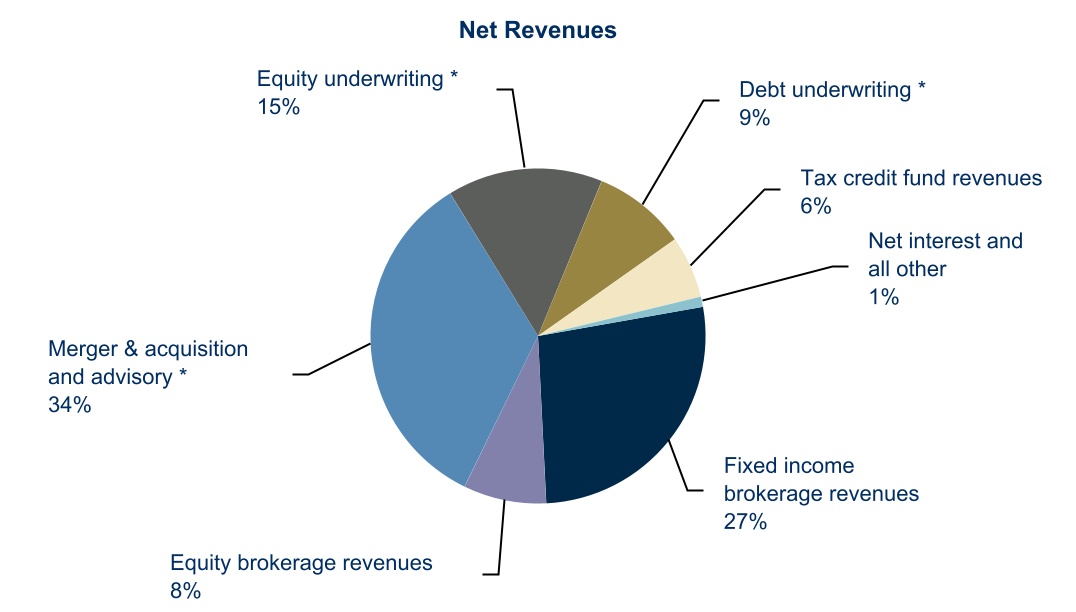][added: 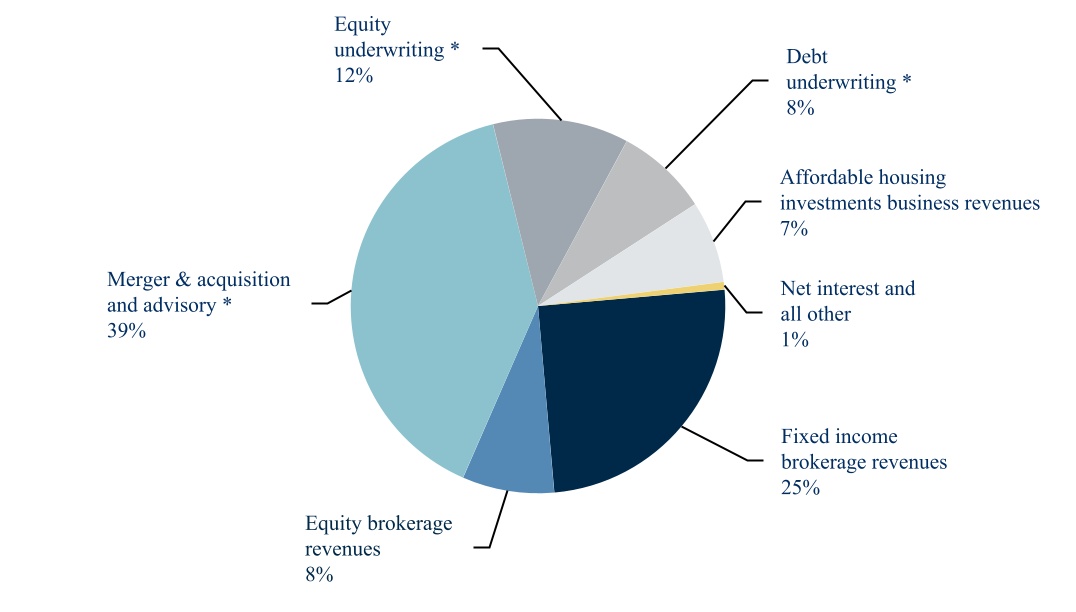]
- Merger & acquisition and advisory - We provide a comprehensive range of strategic and financial advisory assignments, including with respect to mergers and acquisitions, divestitures and restructurings, across a number of industries throughout the U.S., [removed: Canada] [added: Canada,] and Europe.
- Equity underwriting - We provide public and private equity financing services, including the underwriting [added: and placement] of common and preferred stock and other equity securities, to corporate clients throughout the U.S., [removed: Canada] [added: Canada,] and Europe across a number of industries.
- Fixed income - We earn revenues from institutional clients who purchase and sell both taxable and tax-exempt fixed income products, [removed: primarily] municipal, corporate, government agency and mortgage-backed bonds, and whole [removed: loans.][added: loans, as well as from our market-making activities in fixed income debt securities.]
We carry inventories of debt securities to facilitate [removed: client] [added: such] transactions.
This segment also provides asset management services through [added: our Raymond James Investment Management division (“Raymond James Investment Management,” formerly referred to as] Carillon Tower [removed: Advisers and affiliates (collectively, “Carillon Tower Advisers”)] [added: Advisers),] for certain retail accounts managed on behalf of third-party institutions, institutional [removed: accounts] [added: accounts,] and proprietary mutual funds that we [removed: manage.][added: manage, generally using active portfolio management strategies.]
Management fees in this segment are generally calculated as a percentage of the value of our fee-billable financial assets under management (“AUM”) in both AMS, which includes the portion of fee-based AUA in PCG that is overseen by AMS, and [removed: Carillon Tower Advisers,] [added: Raymond James Investment Management,] where investment decisions are made by in-house or third-party portfolio managers or investment committees.
The fee rates applied are dependent upon various factors, including the [removed: distinctive] [added: distinct] services provided and the level [added: of assets within each client relationship.]
The fee rates applied in [removed: Carillon Tower Advisers] [added: Raymond James Investment Management] may also vary based on the account objective (i.e., equity, fixed income, or balanced).
Our AUM are impacted by market fluctuations and net inflows or outflows of assets, including transfers between fee-based accounts and [removed: traditional] transaction-based accounts within our PCG segment.
Our AUM and our [removed: Carillon Tower Advisers] [added: Raymond James Investment Management] AUM by objective as of September 30, [removed: 2021] [added: 2022] are presented in the following graphs.
[removed: 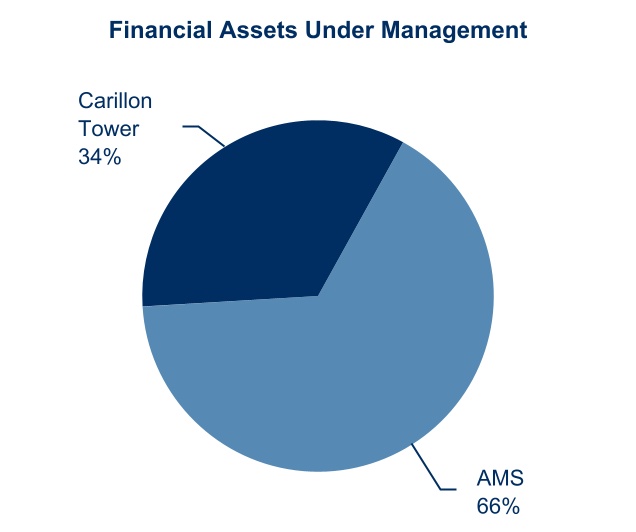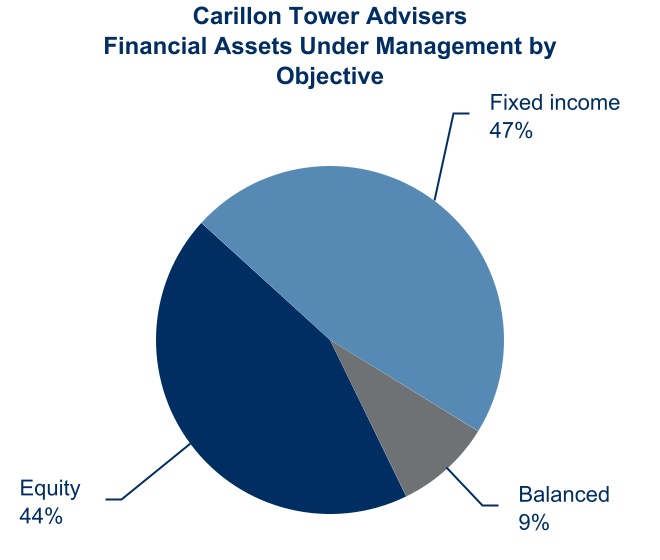][added: 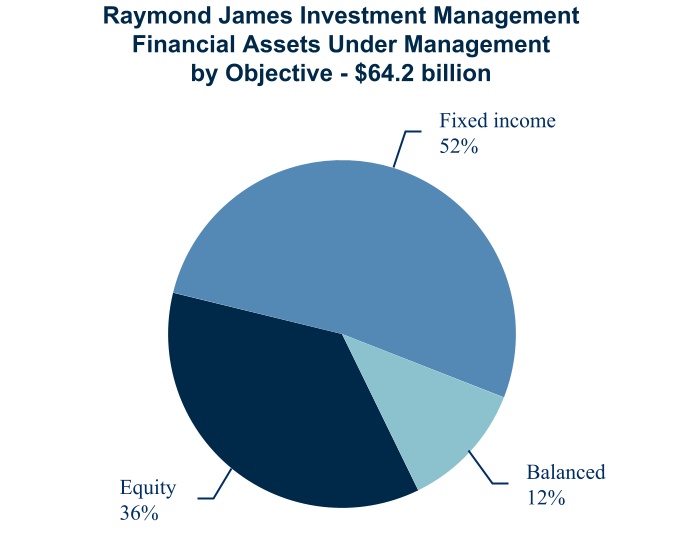]
[removed: Raymond James Bank is a Florida state-chartered bank and Fed member bank that provides] [added: We provide] various types of loans, including [added: securities-based loans (“SBL”),] corporate loans (commercial and industrial (“C&I”), commercial real estate (“CRE”) and real estate investment trust [removed: (“REIT”)), tax-exempt loans,] [added: (“REIT”) loans),] residential [added: mortgage] loans, [removed: securities-based loans (“SBL”)] and [removed: other] [added: tax-exempt] loans.
[removed: Raymond James] [added: Our] Bank [added: segment] is active in corporate loan syndications and [removed: participations.][added: participations and lending directly to clients.]
[removed: Raymond James Bank] [added: We] also [removed: provides] [added: provide] Federal Deposit Insurance Corporation (“FDIC”)-insured deposit accounts, including to clients of our broker-dealer [removed: subsidiaries.][added: subsidiaries, and other deposit and liquidity management products and services.]
[removed: Raymond James] [added: The] Bank [added: segment] generates net interest income principally through the interest income earned on loans and an investment portfolio of [added: available-for-sale] securities, which is offset by the interest expense it pays on client deposits and on its borrowings.
As of September 30, [removed: 2021,] [added: 2022,] corporate and tax-exempt loans represented approximately [removed: 38%] [added: 37%] of [removed: Raymond James Bank’s] [added: the Bank segment’s] total assets, and [removed: 87%] [added: 73%] of such loans were U.S. and Canadian syndicated loans.
[removed: Raymond James Bank’s] [added: The Bank segment’s] investment portfolio is primarily comprised of agency mortgage-backed securities (“MBS”) and agency collateralized mortgage obligations (“CMOs”) and is classified as available-for-sale.
[removed: Raymond James Bank’s] [added: The Bank segment’s] liabilities primarily consist of cash [removed: deposits] [added: deposits, including those at Raymond James Bank] that are [added: primarily] swept from the investment accounts of PCG clients through the [removed: RJBDP.][added: RJBDP, as well as those at TriState Capital Bank, which are primarily money market and interest-bearing checking accounts.]
The following graph details the composition of [removed: Raymond James Bank’s] [added: our Bank segment’s] total assets as of September 30, [removed: 2021.][added: 2022.]
[removed: 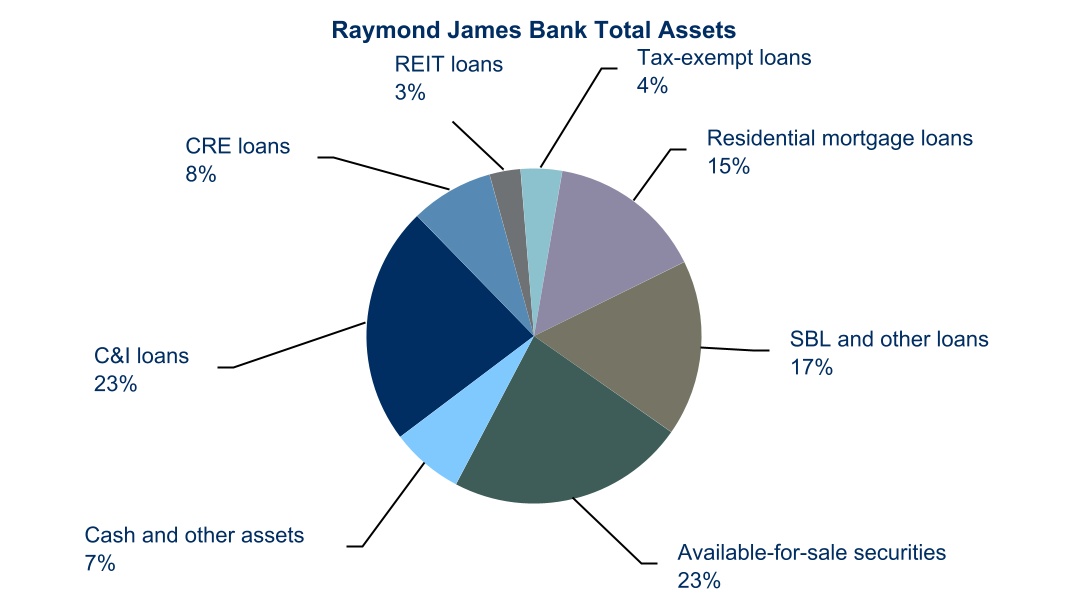][added: 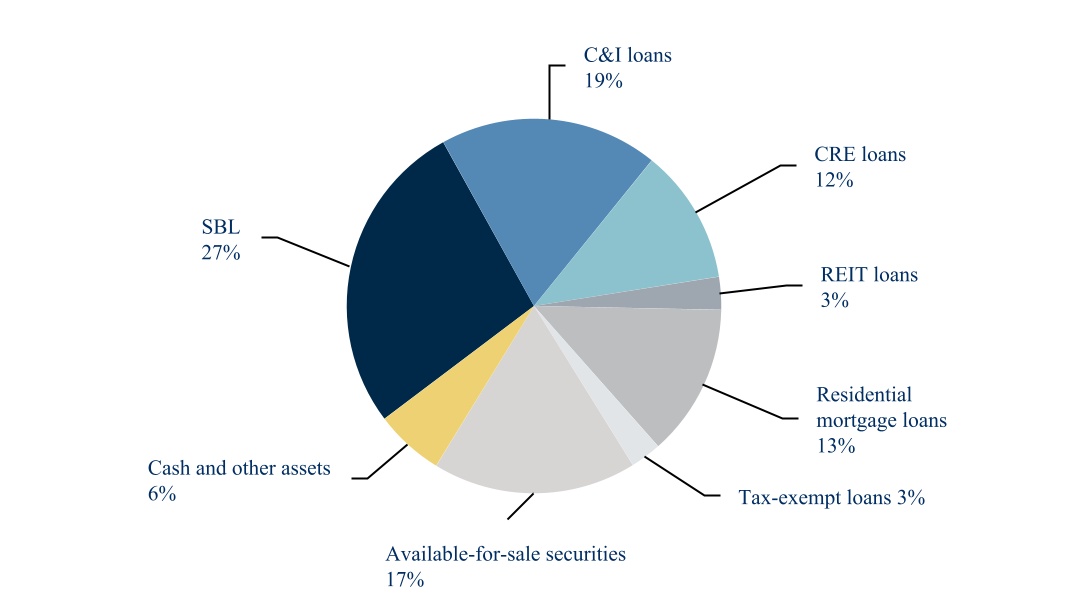]
Our Other segment includes our private equity investments, [added: which predominantly consist of investments in third-party funds,] interest income on certain corporate cash balances, certain acquisition-related expenses, [added: primarily comprised of professional fees,] and certain corporate overhead costs of RJF, including the interest costs on our public debt and any losses on extinguishment of such debt.
As a human capital-intensive business, our ability to attract, [removed: develop] [added: develop,] and retain exceptional and diverse associates and independent advisors is critical, not only in the current competitive labor market, but also to our long-term success.
To compete effectively, we must offer attractive compensation and health and wellness [removed: programs,] [added: programs and workplace flexibility,] as well as provide formal and informal opportunities for associates and advisors to develop their capabilities and reach their full potential.
As of September 30, [removed: 2021,] [added: 2022,] we had approximately [removed: 15,000] [added: 17,000] associates (including [removed: 3,461] [added: 3,638] employee financial advisors) and [removed: 5,021] [added: 5,043] independent advisors.
However, the vast majority of our associates are located in the U.S. Of our global associates, [removed: 42%] [added: 44%] self-identify as women, and among our U.S.-based [removed: employees 24%] [added: associates, 19%] self-identify as ethnically diverse.
Independent contractor financial advisors may affiliate with us directly or through an affiliated bank or credit union in our Financial Institutions Division.
AUA associated with firms in our RCS division totaled $108.5 billion as of September 30, 2022.
Net Revenues — $7.71 billion
PCG also earns fees from our Bank segment, which are based on the greater of a base servicing fee or net yield equivalent to the average yield that the firm would otherwise receive from third-party banks in the RJBDP.
- Custodial services, trade execution, research and other support and services to third-party RIAs and broker-dealers.
Net Revenues — $1.81 billion
Affordable housing investments business
Bank
Our Bank segment reflects the results of our banking operations, including the results of Raymond James Bank, a Florida-chartered state bank and Fed member bank, and TriState Capital Bank, a Pennsylvania-chartered state bank, which was acquired on June 1, 2022 in our acquisition of TriState Capital Holdings, Inc. (“TriState Capital”).
The Bank segment’s liabilities also include borrowings from the Federal Home Loan Bank (“FHLB”).
Bank Segment Total Assets — $56.74 billion
The growth in the number of associates compared to the prior year was due in part to our acquisitions completed during fiscal 2022.
In order to continue to promote and advance inclusion, we have recently launched or expanded certain programs, such as:
- the Encore Inclusion Network, which provides support and opportunities for the growing mature workforce; and
- the Veteran Financial Advisors Network, which is dedicated to supporting armed services veterans in the development of their careers as financial advisors.
Additionally, following our return to office from the COVID-19 pandemic, we have offered more workplace flexibility to our associates as we continue to evaluate our long-term workplace strategy.
After successfully implementing business continuity protocols at the onset of the COVID-19 pandemic, and the following period of working remotely, we implemented our return to office strategy during our fiscal second quarter of 2022.
We have offered more workplace flexibility to our associates as we continue to evaluate our long-term workplace strategy.
Furthermore, the labor market continues to experience elevated levels of turnover in the aftermath of the pandemic and an extremely competitive labor market, including increased competition for talent across all areas of our business, as well as increased competition with non-traditional competitors, such as technology companies.
Employers are increasingly offering guaranteed contracts, upfront payments, increased compensation and increased opportunities to work with greater flexibility, including remote work, on a permanent basis.
We have two depository institutions, Raymond James Bank and TriState Capital Bank (collectively, “our bank subsidiaries”).
TriState Capital Bank is a FDIC-insured depository institution and a Pennsylvania-chartered state non-member bank that is primarily supervised by both the FDIC and the Pennsylvania Department of Banking and Securities (“PDBS”).
RJF and Raymond James Bank are subject to the Fed’s capital rules and TriState Capital Bank is subject to the FDIC’s capital rules.
RJF is subject to the Volcker Rule, which generally prohibits BHCs and their subsidiaries and affiliates from engaging in proprietary trading, but permits underwriting, market making, and risk-mitigating hedging activities.
As required by SEC rules, we disclose in our proxy statements for each annual meeting of shareholders the relationship of our compensation policies and practices to risk management initiatives, to the extent that the risks arising from such policies and practices are reasonably likely to have a material adverse effect on the firm.
On August 25, 2022, the SEC adopted the final “pay-for-performance” rule mandated by the Dodd-Frank Act.
Among other disclosure requirements, the rule requires companies to disclose the relationships among named executive officer compensation “actually paid,” total shareholder return and certain financial performance measures that the company uses to link compensation to company performance for its five most recent fiscal years.
The rule will first apply to disclosures in our proxy statement for the 2024 annual shareholders meeting.
On May 5, 2022, federal banking regulators requested comment on a joint notice of proposed rulemaking on the CRA.
Until the proposed rulemaking is final and effective, Raymond James Bank and TriState Capital Bank will continue to operate under the CRA regulations currently in effect.
The single primary regulator with respect to our conduct of financial services in the U.K. is the Financial Conduct Authority (“FCA”), which operates on a statutory basis.
In 2022, the DOL promulgated a new exemption that enables investment advice fiduciaries to receive transaction-based compensation and engage in certain otherwise prohibited transactions, subject to compliance with the exemption’s requirements.
In addition, the DOL is expected to amend the five-part test by the end of 2023 so that the fiduciary standard would apply to a broader range of client relationships.
The FCA operates on a statutory basis and creates rules which are largely principles-based.
These regulated U.K. subsidiaries and their senior managers are registered with the FCA, and wealth managers and certain other staff are subject to certification requirements.
Retail clients of our U.K. subsidiaries benefit from the Financial Ombudsman Service, which settles complaints between consumers and business that provide financial services, as well as the Financial Services Compensation Scheme, which is the U.K.’s statutory deposit insurance and investors compensation scheme for customers of authorized financial services firms.
In Germany, our subsidiary Raymond James Corporate Finance GmbH is licensed by the German Federal Financial Supervisory Authority (Bundesanstalt für Finanzdienstleistungsaufsicht, or "BaFin") to conduct the regulated activities of investment advice and investment brokerage.
Among other requirements, BaFin requires Raymond James Corporate Finance
GmbH, as a regulated entity, to comply with certain capital, liquidity, governance, and business conduct requirements, and has a range of supervisory and disciplinary powers which it is able to use in overseeing the activities of this subsidiary.
The California Privacy Rights Act amends the California Consumer Privacy Act of 2020 and is expected to be enforced beginning in July 2023.
PCG also earns servicing fees from Raymond James Bank, which are based on the number of accounts that are swept to Raymond James Bank as part of the RJBDP.
Tax credit funds
of assets within each client relationship.
Raymond James Bank
The Other segment also includes the reduction in workforce expenses, primarily the result of the elimination of certain positions, that occurred in our fiscal fourth quarter of 2020 in response to the economic environment at that time.
Our private equity portfolio includes various direct investments, as well as investments in third-party private equity funds and various legacy private equity funds which we sponsor.
One way in which we measure the health of our culture is our overall “engagement” score, which is the percentage of employees that respond to an annual associate insight survey with a positive response to several satisfaction metrics, including that they are proud to work at Raymond James.
In 2021, our overall employee engagement score amongst survey respondents was 88% favorable, with a strong survey response rate of 73%.
We responded to the coronavirus (“COVID-19”) pandemic by putting the health and safety of our associates first in all of our decisions.
Since March 2020, remote work has been the primary work environment for the vast majority of our associates and advisors.
For the small population of those who have worked in the office during the pandemic, we have established protocols designed to mitigate the risk of community spread of the virus.
We also implemented changes to some of our benefit plans to support those of our associates who were most severely affected by COVID-19.
These changes included an expansion of our paid time off policy for those infected or giving care to someone infected by COVID-19, offering flexible work hours for caregivers of children or elders during times when schools were closed or only open for virtual schooling and child/adult care facilities were shut down, offering new programs to assist those in need of mental health services, and implementing extended roll-over opportunities for flexible spending accounts.
In response to the COVID-19 pandemic, we activated and successfully executed on our business continuity protocols and continue to monitor the COVID-19 pandemic under such protocols.
We have endeavored to protect the health and well-being of our associates and our clients while ensuring the continuity of business operations for our clients.
As a result, a substantial portion of our associates continue to work remotely.
The firm continues to monitor conditions and has developed a phased approach to reopening our offices in compliance with all applicable laws, regulations, and Centers for Disease Control and Prevention (“CDC”) guidelines.
We have reopened our offices in a limited capacity and have been operating under strict public
health and safety protocols in such locations.
We are planning for a full return to office in the second quarter of our fiscal 2022, which will include more work location flexibility for our associates; however, disruptions caused by variants may impact the timing of the implementation of these plans.
We continue to monitor the likelihood of changes in taxation and regulations due to changes in the political environment.
As a part of their supervisory functions, the Fed, the
For banks with greater than $10 billion in assets, which includes
We have proprietary private equity investments that meet the definition of covered funds under the Volcker Rule.
The conformance period for compliance with the rule with respect to investments in covered funds was July 2017; however, banking entities were able to apply for an extension to provide up to an additional five years to conform investments in certain illiquid funds.
The majority of our covered fund investments meet the criteria to be considered an illiquid fund under the Volcker Rule and we received approval from the Fed to continue to hold such investments until July 2022.
We have executed the appropriate strategies to comply with the Volcker Rule for many of our covered fund investments and plan to either divest or restructure the remainder of our covered fund investments on or prior to the July 2022 deadline such that any holdings will be in compliance with the Volcker Rule after the extension expires in July 2022.
The Dodd-Frank Act requires the U.S. financial regulators to adopt rules on incentive-based payment arrangements.
The U.S. financial regulators proposed revised rules in 2016, which have not yet been finalized.
On July 20, 2021, the Fed, the FDIC and the OCC issued a joint statement in which they committed to working together to jointly modernize the CRA regulations.
Until such new regulations are implemented, Raymond James Bank will continue to
operate under the Fed’s CRA regulations currently in effect.
Regulation Best Interest and Form CRS.
In addition, the DOL is expected to amend the rule that determines whether an investment professional is a fiduciary to their clients’ retirement accounts under the Employee Retirement Income Security Act and Internal Revenue Code.
We do not expect the U.K.’s withdrawal from the E.U. (“Brexit”) to materially impact our business.
The European Union (“E.U.”) as well as various countries have
Legislative and regulatory changes in connection with COVID-19
The COVID-19 pandemic resulted in governments around the world implementing numerous measures to help control the spread of the virus, including, among others, quarantines, travel restrictions and business curtailments.
In addition, governments globally intervened with fiscal policy to mitigate the impact of the pandemic, including the Coronavirus Aid, Relief, and Economic Security (“CARES”) Act in the U.S., which aimed to provide economic relief to businesses and individuals.
In addition to the CARES Act enacted in March 2020, the U.S. government enacted the Consolidated Appropriations Act, 2021 in December 2020.
An excerpt. Shown here: 40 of 113 rewritten, 40 of 54 added and 40 of 68 removed. The counts are complete. For every sentence, read Item 1. BUSINESS in the FY2022 filing and the FY2021 filing.
Item 3. LEGAL PROCEEDINGS
2 rewritten, 1 added, 1 removed, 11 unchanged
Reviews can result in the imposition of sanctions for regulatory violations, ranging from non-monetary censures to fines and, in serious cases, temporary or permanent suspension from conducting business, or limitations on certain business [added: activities.]
[removed: Over the last several years, the] [added: The] level of litigation and investigatory activity (both formal and informal) by government and self-regulatory agencies in the financial services industry [removed: continues to be significant.]
continues to be significant.
activities.
Cover and table of contents
28 rewritten, 3 added, 1 removed, 71 unchanged
For the fiscal year ended September 30, [removed: 2021][added: 2022]
| [removed: Title] [added: Title] of each [removed: class] [added: class] | | | [removed: Trading Symbol(s)] [added: Trading Symbol(s)] | | | [removed: Name] [added: Name] of each exchange on which [removed: registered] [added: registered] | | |
| [removed: Common] [added: Common] Stock, $.01 par [removed: value] [added: value] | | | [removed: RJF] [added: RJF] | | | [removed: New] [added: New] York Stock [removed: Exchange] [added: Exchange] | | |
As of March 31, [removed: 2021,] [added: 2022,] the aggregate market value of the registrant’s common stock held by non-affiliates of the registrant computed by reference to the price at which the common stock was last sold was [removed: $15,122,502,109.][added: $20,595,928,727.]
The number of shares outstanding of the registrant’s common stock as of November [removed: 18, 2021] [added: 17, 2022] was [removed: 206,161,694.][added: 215,063,590.]
Portions of the definitive Proxy Statement to be delivered to shareholders in connection with the Annual Meeting of Shareholders to be held February [removed: 24, 2022] [added: 23, 2023] are incorporated by reference into Part III.
| Item 1. | | | | | | Business | | | [removed: [3](#ib199bd4691024dcdae87e54fb4a89c61_13)] [added: [3](#i50879245508b4d3382e6138f77393d6b_13)] | | |
| Item 1A. | | | | | | Risk factors | | | [removed: [20](#ib199bd4691024dcdae87e54fb4a89c61_55)] [added: [21](#i50879245508b4d3382e6138f77393d6b_55)] | | |
| Item 1B. | | | | | | Unresolved staff comments | | | [removed: [34](#ib199bd4691024dcdae87e54fb4a89c61_157)] [added: [35](#i50879245508b4d3382e6138f77393d6b_157)] | | |
| Item 2. | | | | | | Properties | | | [removed: [34](#ib199bd4691024dcdae87e54fb4a89c61_160)] [added: [35](#i50879245508b4d3382e6138f77393d6b_160)] | | |
| Item 3. | | | | | | Legal proceedings | | | [removed: [34](#ib199bd4691024dcdae87e54fb4a89c61_163)] [added: [35](#i50879245508b4d3382e6138f77393d6b_163)] | | |
| Item 4. | | | | | | Mine safety disclosures | | | [removed: [35](#ib199bd4691024dcdae87e54fb4a89c61_166)] [added: [36](#i50879245508b4d3382e6138f77393d6b_166)] | | |
| Item 5. | | | | | | Market for registrant’s common equity, related shareholder matters and issuer purchases of equity securities | | | [removed: [35](#ib199bd4691024dcdae87e54fb4a89c61_172)] [added: [36](#i50879245508b4d3382e6138f77393d6b_172)] | | |
| Item 6. | | | | | | Reserved | | | [removed: [36](#ib199bd4691024dcdae87e54fb4a89c61_175)] [added: [37](#i50879245508b4d3382e6138f77393d6b_175)] | | |
| Item 7. | | | | | | Management’s discussion and analysis of financial condition and results of operations | | | [removed: [37](#ib199bd4691024dcdae87e54fb4a89c61_178)] [added: [38](#i50879245508b4d3382e6138f77393d6b_178)] | | |
| Item 7A. | | | | | | Quantitative and qualitative disclosures about market risk | | | [removed: [76](#ib199bd4691024dcdae87e54fb4a89c61_295)] [added: [78](#i50879245508b4d3382e6138f77393d6b_298)] | | |
| Item 8. | | | | | | Financial statements and supplementary data | | | [removed: [77](#ib199bd4691024dcdae87e54fb4a89c61_298)] [added: [79](#i50879245508b4d3382e6138f77393d6b_301)] | | |
| Item 9. | | | | | | Changes in and disagreements with accountants on accounting and financial disclosure | | | [removed: [152](#ib199bd4691024dcdae87e54fb4a89c61_406)] [added: [164](#i50879245508b4d3382e6138f77393d6b_421)] | | |
| Item 9A. | | | | | | Controls and procedures | | | [removed: [152](#ib199bd4691024dcdae87e54fb4a89c61_409)] [added: [164](#i50879245508b4d3382e6138f77393d6b_424)] | | |
| Item 9B. | | | | | | Other information | | | [removed: [154](#ib199bd4691024dcdae87e54fb4a89c61_415)] [added: [168](#i50879245508b4d3382e6138f77393d6b_430)] | | |
| Item 9C. | | | | | | Disclosure regarding foreign jurisdictions that prevent [removed: inspection] [added: inspections] | | | [removed: [154](#ib199bd4691024dcdae87e54fb4a89c61_4468)] [added: [168](#i50879245508b4d3382e6138f77393d6b_433)] | | |
| Item 10. | | | | | | Directors, executive officers and corporate governance | | | [removed: [154](#ib199bd4691024dcdae87e54fb4a89c61_421)] [added: [168](#i50879245508b4d3382e6138f77393d6b_439)] | | |
| Item 11. | | | | | | Executive compensation | | | [removed: [154](#ib199bd4691024dcdae87e54fb4a89c61_424)] [added: [168](#i50879245508b4d3382e6138f77393d6b_442)] | | |
| Item 12. | | | | | | Security ownership of certain beneficial owners and management and related shareholder matters | | | [removed: [154](#ib199bd4691024dcdae87e54fb4a89c61_424)] [added: [168](#i50879245508b4d3382e6138f77393d6b_442)] | | |
| Item 13. | | | | | | Certain relationships and related transactions, and director independence | | | [removed: [154](#ib199bd4691024dcdae87e54fb4a89c61_424)] [added: [168](#i50879245508b4d3382e6138f77393d6b_442)] | | |
| Item 14. | | | | | | Principal accountant fees and services | | | [removed: [154](#ib199bd4691024dcdae87e54fb4a89c61_424)] [added: [168](#i50879245508b4d3382e6138f77393d6b_442)] | | |
| Item 15. | | | | | | Exhibits and financial statement schedules | | | [removed: [154](#ib199bd4691024dcdae87e54fb4a89c61_430)] [added: [168](#i50879245508b4d3382e6138f77393d6b_448)] | | |
| Item 16. | | | | | | Form 10-K summary | | | [removed: [156](#ib199bd4691024dcdae87e54fb4a89c61_4494)] [added: [170](#i50879245508b4d3382e6138f77393d6b_451)] | | |
| Depositary Shares, Each Representing a 1/40th Interest in a Share of 6.75% Fixed-to-Floating Rate Series A Non-Cumulative Perpetual Preferred Stock | | | RJF PrA | | | New York Stock Exchange | | |
| Depositary Shares, Each Representing a 1/40th Interest in a Share of 6.375% Fixed-to-Floating Rate Series B Non-Cumulative Perpetual Preferred Stock | | | RJF PrB | | | New York Stock Exchange | | |
| | | | | | | Signatures | | | [171](#i50879245508b4d3382e6138f77393d6b_454) | | |
| | | | | | | Signatures | | | [157](#ib199bd4691024dcdae87e54fb4a89c61_433) | | |
Item 2. PROPERTIES
5 rewritten, 0 added, 0 removed, 9 unchanged
[removed: Generally, our] [added: Our] owned locations and principal leases, identified below, support [removed: all] [added: more than one] of our business segments.
Our leases contain various expiration dates through fiscal year [removed: 2032.][added: 2036.]
- We occupy leased space of approximately 250,000 square feet in Memphis, along with approximately [removed: 165,000] [added: 185,000] square feet in New York City, 70,000 square feet in [removed: Chicago] [added: Pittsburgh, 70,000 square feet in Chicago,] and 30,000 square feet in Denver, with other office and branch locations throughout the U.S.;
- We occupy leased space of approximately [removed: 30,000] [added: 75,000] square feet in London, along with other office locations in [removed: Europe, primarily in] Germany.
We regularly monitor the facilities we own or occupy to ensure that they suit our needs, particularly as we introduce more flexibility in work location for our [removed: associates as we return to office.][added: associates.]
Item 5. MARKET FOR REGISTRANT’S COMMON EQUITY, RELATED SHAREHOLDER MATTERS AND ISSUER PURCHASES OF EQUITY SECURITIES
4 rewritten, 18 added, 18 removed, 15 unchanged
Our common stock is traded on the NYSE under the symbol “RJF.” As of November [removed: 18, 2021,] [added: 17, 2022,] we had [removed: 309] [added: 346] holders of record of our common stock.
See Note [removed: 24] [added: 20] of the Notes to Consolidated Financial Statements of this Form 10-K for information regarding our intentions for paying cash dividends and the related capital restrictions.
We did not have any sales of unregistered securities for the fiscal years ended September 30, [removed: 2021, 2020] [added: 2022, 2021] or [removed: 2019.][added: 2020.]
The following table presents information on our purchases of our own stock, on a monthly basis, for the twelve months ended September 30, [removed: 2021.][added: 2022.]
| October 1, 2021 – October 31, 2021 | | | 1,305 | | | | | | $ | 94.47 | | | | | — | | | | | | $632 | | |
| November 1, 2021 – November 30, 2021 | | | 94,824 | | | | | | $ | 98.82 | | | | | — | | | | | | $632 | | |
| December 1, 2021 – December 31, 2021 | | | 145 | | | | | | $ | 98.90 | | | | | — | | | | | | $1,000 | | |
| First quarter | | | 96,274 | | | | | | $ | 98.76 | | | | | — | | | | | | | | |
| January 1, 2022 – January 31, 2022 | | | 787 | | | | | | $ | 109.57 | | | | | — | | | | | | $1,000 | | |
| February 1, 2022 – February 28, 2022 | | | 3,391 | | | | | | $ | 109.67 | | | | | — | | | | | | $1,000 | | |
| March 1, 2022 – March 31, 2022 | | | — | | | | | | $ | — | | | | | — | | | | | | $1,000 | | |
| Second quarter | | | 4,178 | | | | | | $ | 109.65 | | | | | — | | | | | | | | |
| April 1, 2022 – April 30, 2022 | | | — | | | | | | $ | — | | | | | — | | | | | | $1,000 | | |
| May 1, 2022 – May 31, 2022 | | | — | | | | | | $ | — | | | | | — | | | | | | $1,000 | | |
| June 1, 2022 – June 30, 2022 | | | 1,137,660 | | | | | | $ | 88.01 | | | | | 1,136,347 | | | | | | $900 | | |
| Third quarter | | | 1,137,660 | | | | | | $ | 88.01 | | | | | 1,136,347 | | | | | | | | |
| July 1, 2022 – July 31, 2022 | | | 8,407 | | | | | | $ | 90.18 | | | | | — | | | | | | $900 | | |
| August 1, 2022 – August 31, 2022 | | | 298 | | | | | | $ | 106.45 | | | | | — | | | | | | $900 | | |
| September 1, 2022 – September 30, 2022 | | | 600,421 | | | | | | $ | 104.06 | | | | | 600,000 | | | | | | $838 | | |
| Fourth quarter | | | 609,126 | | | | | | $ | 103.87 | | | | | 600,000 | | | | | | | | |
| Fiscal year total | | | 1,847,238 | | | | | | $ | 93.85 | | | | | 1,736,347 | | | | | | | | |
In December 2021, the Board of Directors authorized repurchase of our common stock in an aggregate amount of up to $1 billion, which replaced the previous authorization.
Share and per share information has been retroactively adjusted to reflect the September 2021 three-for-two stock split.
| October 1, 2020 – October 31, 2020 | | | 1,806 | | | | | | $ | 53.36 | | | | | — | | | | | | $487 | | |
| November 1, 2020 – November 30, 2020 | | | 139,838 | | | | | | $ | 60.33 | | | | | — | | | | | | $487 | | |
| December 1, 2020 – December 31, 2020 | | | 175,139 | | | | | | $ | 62.01 | | | | | 161,625 | | | | | | $740 | | |
| First quarter | | | 316,783 | | | | | | $ | 61.23 | | | | | 161,625 | | | | | | | | |
| January 1, 2021 – January 31, 2021 | | | 3,602 | | | | | | $ | 66.71 | | | | | — | | | | | | $740 | | |
| February 1, 2021 – February 28, 2021 | | | 10,412 | | | | | | $ | 66.62 | | | | | — | | | | | | $740 | | |
| March 1, 2021 – March 31, 2021 | | | 752,640 | | | | | | $ | 80.03 | | | | | 750,000 | | | | | | $680 | | |
| Second quarter | | | 766,654 | | | | | | $ | 79.79 | | | | | 750,000 | | | | | | | | |
| April 1, 2021 – April 30, 2021 | | | 1,331 | | | | | | $ | 85.94 | | | | | — | | | | | | $680 | | |
| May 1, 2021 – May 31, 2021 | | | — | | | | | | $ | — | | | | | — | | | | | | $680 | | |
| June 1, 2021 – June 30, 2021 | | | 562,500 | | | | | | $ | 85.70 | | | | | 562,500 | | | | | | $632 | | |
| Third quarter | | | 563,831 | | | | | | $ | 85.70 | | | | | 562,500 | | | | | | | | |
| July 1, 2021 – July 31, 2021 | | | 1,217 | | | | | | $ | 86.71 | | | | | — | | | | | | $632 | | |
| August 1, 2021 – August 31, 2021 | | | 114 | | | | | | $ | 90.55 | | | | | — | | | | | | $632 | | |
| September 1, 2021 – September 30, 2021 | | | — | | | | | | $ | — | | | | | — | | | | | | $632 | | |
| Fourth quarter | | | 1,331 | | | | | | $ | 87.04 | | | | | — | | | | | | | | |
| Fiscal year total | | | 1,648,599 | | | | | | $ | 78.24 | | | | | 1,474,125 | | | | | | | | |
Item 8. FINANCIAL STATEMENTS AND SUPPLEMENTARY DATA
1,119 rewritten, 845 added, 351 removed, 1,380 unchanged
| Report of Independent Registered Public Accounting [removed: Firm] [added: Firm (PCAOB ID No. 185)] | | | [removed: [78](#ib199bd4691024dcdae87e54fb4a89c61_301)] [added: [80](#i50879245508b4d3382e6138f77393d6b_304)] | | |
| Consolidated Statements of Financial Condition | | | [removed: [81](#ib199bd4691024dcdae87e54fb4a89c61_304)] [added: [83](#i50879245508b4d3382e6138f77393d6b_307)] | | |
| Consolidated Statements of Income and Comprehensive Income | | | [removed: [82](#ib199bd4691024dcdae87e54fb4a89c61_307)] [added: [84](#i50879245508b4d3382e6138f77393d6b_310)] | | |
| Consolidated Statements of Changes in Shareholders’ Equity | | | [removed: [83](#ib199bd4691024dcdae87e54fb4a89c61_310)] [added: [85](#i50879245508b4d3382e6138f77393d6b_313)] | | |
| Consolidated Statements of Cash Flows | | | [removed: [84](#ib199bd4691024dcdae87e54fb4a89c61_313)] [added: [86](#i50879245508b4d3382e6138f77393d6b_316)] | | |
| Note 1 - Organization and basis of presentation | | | [removed: [86](#ib199bd4691024dcdae87e54fb4a89c61_319)] [added: [88](#i50879245508b4d3382e6138f77393d6b_322)] | | |
| Note 2 - Summary of significant accounting policies | | | [removed: [86](#ib199bd4691024dcdae87e54fb4a89c61_322)] [added: [88](#i50879245508b4d3382e6138f77393d6b_328)] | | |
[removed: | Note 5 - Available-for-sale securities | | | [112](#ib199bd4691024dcdae87e54fb4a89c61_334) | | |][added: Available-for-sale securities]
| Note 6 - Derivative assets and derivative liabilities | | | [removed: [114](#ib199bd4691024dcdae87e54fb4a89c61_337)] [added: [121](#i50879245508b4d3382e6138f77393d6b_346)] | | |
| Note 7 - Collateralized agreements and financings | | | [removed: [116](#ib199bd4691024dcdae87e54fb4a89c61_340)] [added: [123](#i50879245508b4d3382e6138f77393d6b_349)] | | |
| Note 8 - Bank loans, net | | | [removed: [117](#ib199bd4691024dcdae87e54fb4a89c61_343)] [added: [125](#i50879245508b4d3382e6138f77393d6b_352)] | | |
| Note 9 - Loans to financial advisors, net | | | [removed: [123](#ib199bd4691024dcdae87e54fb4a89c61_4129)] [added: [132](#i50879245508b4d3382e6138f77393d6b_355)] | | |
| Note 10 - Variable interest entities | | | [removed: [123](#ib199bd4691024dcdae87e54fb4a89c61_346)] [added: [132](#i50879245508b4d3382e6138f77393d6b_358)] | | |
| Note 11 - Goodwill and identifiable intangible assets, net | | | [removed: [125](#ib199bd4691024dcdae87e54fb4a89c61_352)] [added: [134](#i50879245508b4d3382e6138f77393d6b_361)] | | |
| Note 13 - Property and equipment, net | | | [removed: [127](#ib199bd4691024dcdae87e54fb4a89c61_4395)] [added: [136](#i50879245508b4d3382e6138f77393d6b_367)] | | |
| [removed: Note 17 -] Senior notes payable | | | [removed: [131](#ib199bd4691024dcdae87e54fb4a89c61_370)] | | | [added: 93 | | | | | | 96 | | | | | | 85 | | |]
| Note 19 - Commitments, contingencies and guarantees | | | [removed: [134](#ib199bd4691024dcdae87e54fb4a89c61_376)] [added: [143](#i50879245508b4d3382e6138f77393d6b_385)] | | |
[removed: | Note 20 - Accumulated] [added: Accumulated] other comprehensive [removed: income/(loss) | | | [137](#ib199bd4691024dcdae87e54fb4a89c61_379) | | |][added: income/(loss)]
| Note 22 - Interest income and interest expense | | | [removed: [141](#ib199bd4691024dcdae87e54fb4a89c61_385)] [added: [152](#i50879245508b4d3382e6138f77393d6b_394)] | | |
| Note 23 - Share-based and other compensation | | | [removed: [141](#ib199bd4691024dcdae87e54fb4a89c61_388)] [added: [152](#i50879245508b4d3382e6138f77393d6b_397)] | | |
| Note 24 - Regulatory capital requirements | | | [removed: [143](#ib199bd4691024dcdae87e54fb4a89c61_391)] [added: [155](#i50879245508b4d3382e6138f77393d6b_403)] | | |
| Note 25 - Earnings per share | | | [removed: [145](#ib199bd4691024dcdae87e54fb4a89c61_394)] [added: [157](#i50879245508b4d3382e6138f77393d6b_406)] | | |
| Note 27 - Condensed financial information (parent company only) | | | [removed: [148](#ib199bd4691024dcdae87e54fb4a89c61_400)] [added: [161](#i50879245508b4d3382e6138f77393d6b_415)] | | |
We have audited the accompanying consolidated statements of financial condition of Raymond James Financial, Inc. and subsidiaries (the Company) as of September 30, [removed: 2021] [added: 2022] and [removed: 2020,] [added: 2021,] the related consolidated statements of income and comprehensive income, changes in shareholders’ equity, and cash flows for each of the years in the three‑year period ended September 30, [removed: 2021,] [added: 2022,] and the related notes (collectively, the consolidated financial statements).
In our opinion, the consolidated financial statements present fairly, in all material respects, the financial position of the Company as of September 30, [removed: 2021] [added: 2022] and [removed: 2020,] [added: 2021,] and the results of its operations and its cash flows for each of the years in the three‑year period ended September 30, [removed: 2021,] [added: 2022,] in conformity with U.S. generally accepted accounting principles.
We also have audited, in accordance with the standards of the Public Company Accounting Oversight Board (United States) (PCAOB), the Company’s internal control over financial reporting as of September 30, [removed: 2021,] [added: 2022,] based on criteria established in *Internal Control – Integrated Framework (2013)* issued by the Committee of Sponsoring Organizations of the Treadway Commission, and our report dated November [removed: 23, 2021] [added: 22, 2022] expressed an unqualified opinion on the effectiveness of the Company’s internal control over financial reporting.
*Critical Audit [removed: Matter*][added: Matters*]
The critical audit [removed: matter] [added: matters] communicated below [removed: is a matter] [added: are matters] arising from the current period audit of the consolidated financial statements that [removed: was] [added: were] communicated or required to be communicated to the audit committee and that: (1) [removed: relates] [added: relate] to accounts or disclosures that are material to the consolidated financial statements and (2) involved our especially challenging, subjective, or complex judgments.
The communication of [removed: a] critical audit [removed: matter] [added: matters] does not alter in any way our opinion on the consolidated financial statements, taken as a whole, and we are not, by communicating the critical audit [removed: matter] [added: matters] below, providing [removed: a] separate [removed: opinion] [added: opinions] on the critical audit [removed: matter] [added: matters] or on the accounts or disclosures to which [removed: it relates.][added: they relate.]
As discussed in Note 2 and Note 8 to the consolidated financial statements, the Company’s allowance for credit losses on [removed: Bank] loans was [removed: $320] [added: $396] million as of September 30, [removed: 2021,] [added: 2022,] a portion of which related to the [added: Raymond James Bank] allowance for credit losses (ACL) on C&I, REIT and CRE portfolio segments evaluated on a collective basis (the collective ACL).
[added: The Company uses third-party historical information] combined with macroeconomic variables over the reasonable and supportable forecast periods based on a single economic forecast scenario to estimate the PDs and LGDs.
After the reasonable and supportable forecast periods, for C&I and REIT portfolio segments, the Company reverts to historical loss information over a one-year period using a [removed: straight-line reversion approach.]
We identified the assessment of the September 30, [removed: 2021] [added: 2022] collective ACL on [added: Raymond James] Bank loans related to the C&I, REIT and CRE portfolio segments as a critical audit matter.
Specifically, the assessment encompassed the evaluation of the September 30, [removed: 2021] [added: 2022] collective ACL methodology, including the methods and models used to estimate the PDs and LGDs and their significant assumptions.
We evaluated the design and tested the operating effectiveness of certain internal controls related to the Company’s measurement of the September 30, [removed: 2021] [added: 2022] collective ACL estimate on [added: Raymond James] Bank loans related to the C&I, REIT and CRE portfolio segments, including controls over the:
We evaluated the Company’s process to develop the September 30, [removed: 2021] [added: 2022] collective ACL estimate on Bank loans related to the C&I, REIT and CRE portfolio segments by testing certain sources of data, factors, and assumptions that the Company used, and considered the relevance and reliability of such data, factors, and assumptions.
- assessing the conceptual soundness and performance of the PD and LGD models by inspecting the model documentation to determine whether the models are suitable for [removed: their] [added: the] intended use
We also assessed the sufficiency of the audit evidence obtained related to the September 30, [removed: 2021] [added: 2022] collective ACL estimate on Bank loans related to the C&I, REIT and CRE portfolio segments by evaluating the:
| *$ in millions, except per share amounts* | | | | | | [removed: 2021] [added: 2022] | | | | | | [added: 2021 | | | | | |] 2020 | | |
| Cash and cash equivalents | | | | | | $ | [removed: 7,201] [added: 6,178] | | | | | $ | [added: 7,201 | | | | | $ |] 5,390 | |
| Note 3 - Acquisitions | | | [107](#i50879245508b4d3382e6138f77393d6b_337) | | |
| Note 4 - Fair value | | | [113](#i50879245508b4d3382e6138f77393d6b_340) | | |
| Note 5 - Available-for-sale securities | | | [118](#i50879245508b4d3382e6138f77393d6b_343) | | |
| Note 12 - Other assets | | | [136](#i50879245508b4d3382e6138f77393d6b_364) | | |
| Note 14 - Leases | | | [137](#i50879245508b4d3382e6138f77393d6b_370) | | |
| Note 15 - Bank deposits | | | [138](#i50879245508b4d3382e6138f77393d6b_373) | | |
| Note 16 - Other borrowings | | | [139](#i50879245508b4d3382e6138f77393d6b_376) | | |
| Note 17 - Senior notes payable | | | [140](#i50879245508b4d3382e6138f77393d6b_379) | | |
| Note 18 - Income taxes | | | [141](#i50879245508b4d3382e6138f77393d6b_382) | | |
| Note 20 - Shareholders’ equity | | | [146](#i50879245508b4d3382e6138f77393d6b_388) | | |
| Note 21 - Revenues | | | [149](#i50879245508b4d3382e6138f77393d6b_391) | | |
| Note 26 - Segment information | | | [158](#i50879245508b4d3382e6138f77393d6b_412) | | |
straight-line reversion approach.
*The fair value measurement of a customer relationship intangible asset, bank loans, and core deposit intangible asset acquired in business combinations*
As discussed in Note 3 to the consolidated financial statements, on January 21, 2022, the Company completed the acquisition of Charles Stanley Group, PLC (Charles Stanley), and on June 1, 2022, the Company completed the acquisition of TriState Capital Holdings, Inc. (TriState Capital) and its wholly owned subsidiaries.
The Company accounted for these transactions as business combinations.
Accordingly, the purchase price attributable to these respective acquisitions was allocated to the assets acquired and liabilities assumed based on their estimated fair values.
In the Charles Stanley acquisition, the Company acquired a customer relationship intangible asset at a fair value of $65 million.
The fair value of the customer relationship intangible asset was based on a multi-period excess earnings approach that considered future period post-tax earnings and a discount rate.
In the TriState Capital acquisition, the Company acquired bank loans at a fair value of $11.5 billion, and a core deposit intangible asset at a fair value of $89 million.
The fair value of the bank loans was based on a discounted cash flow methodology that considered loan type and related collateral, credit loss expectations, classification status, market interest rates and other market factors from the perspective of a market participant using key assumptions of credit loss expectations and discount rate.
The fair value of the core deposit intangible asset was based on the discounted cash flow approach, specifically the favorable source of funds method, that considered the servicing and interest costs of the acquired deposit base, an estimate of the cost associated with alternative funding sources, expected client attrition rates, deposit growth rates, and discount rate.
We identified the evaluation of the fair value measurements of the customer relationship intangible asset, bank loans, and core deposit intangible asset as a critical audit matter.
A high degree of audit effort, including specialized skills and knowledge, and subjective and complex auditor judgment was involved in the assessment of the fair value measurements due to significant measurement uncertainty.
Specifically, the assessment encompassed the evaluation of the (1) fair value measurement methodologies, and (2) customer relationship intangible asset fair value measurement key assumptions, including future period post-tax earnings and a discount rate; bank loans fair value measurement key assumptions, including the credit loss expectations and discount rate; and core deposit intangible asset fair value measurement key assumptions, including servicing and interest cost of the acquired deposit base, cost associated with alternative funding sources, expected client attrition rates, deposit growth rates, and discount rate.
The following are the primary procedures we performed to address this critical audit matter.
We evaluated the design and tested the operating effectiveness of certain internal controls related to the Company’s fair value measurements of the customer relationship intangible asset, bank loans, and core deposit intangible asset including controls over the (1) development of the overall fair value measurement methodologies, and (2) determination of the key assumptions used in the fair value estimates.
We evaluated the Company’s process to develop the fair value measurements of the customer relationship intangible asset, bank loans and core deposit intangible asset by testing certain sources of data, inputs, and assumptions that the Company used, and considered the relevance and reliability of such data, inputs, and assumptions.
We involved valuation professionals with specialized skills and knowledge, who assisted in:
- evaluating the fair value measurement methodology for compliance with U.S. generally accepted accounting principles
- reviewing the underlying methodologies for the development of the key assumptions as compared to commonly applied industry valuation techniques as well as internal and external data
- evaluating the historical data for the future period post-tax earnings by comparing to internal data, and the discount rate by comparing to internal and publicly available data for the customer relationship intangible asset
- evaluating the credit loss expectations and discount rate by comparing to internal and publicly available data for the bank loans and
- evaluating the servicing cost, interest cost, and discount rate, by comparing to internal and publicly available data; the costs of alternative funding and client attrition rates by comparing to internal data, and the deposit growth rates by comparing to publicly available data for the core deposit intangible asset.
| *$ in millions, except per share amounts* | | | | | | 2022 | | | | | | 2021 | | |
| Preferred stock | | | | | | 120 | | | | | | — | | |
| Other | | | | | | 325 | | | | | | 295 | | | | | | 250 | | |
| Preferred stock dividends | | | | | | 4 | | | | | | — | | | | | | — | | |
| Net income available to common shareholders | | | | | | $ | 1,505 | | | | | $ | 1,403 | | | | | $ | 818 | |
| Preferred stock: | | | | | | | | | | | | | | | | | | | | |
| Note 3 - Acquisitions | | | [104](#ib199bd4691024dcdae87e54fb4a89c61_4092) | | |
| Note 4 - Fair value | | | [106](#ib199bd4691024dcdae87e54fb4a89c61_331) | | |
| Note 12 - Other assets | | | [127](#ib199bd4691024dcdae87e54fb4a89c61_355) | | |
| Note 14 - Leases | | | [128](#ib199bd4691024dcdae87e54fb4a89c61_358) | | |
| Note 15 - Bank deposits | | | [129](#ib199bd4691024dcdae87e54fb4a89c61_364) | | |
| Note 16 - Other borrowings | | | [130](#ib199bd4691024dcdae87e54fb4a89c61_367) | | |
| Note 18 - Income taxes | | | [132](#ib199bd4691024dcdae87e54fb4a89c61_373) | | |
| Note 21 - Revenues | | | [138](#ib199bd4691024dcdae87e54fb4a89c61_382) | | |
| Note 26 - Segment information | | | [146](#ib199bd4691024dcdae87e54fb4a89c61_397) | | |
The Company uses third-party historical information
November 23, 2021
| Preferred stock; $.10 par value; 10,000,000 shares authorized; -0- shares issued and outstanding | | | | | | — | | | | | | — | | |
| Acquisition and disposition-related expenses | | | | | | 19 | | | | | | 7 | | | | | | 15 | | |
| Other | | | | | | 287 | | | | | | 243 | | | | | | 277 | | |
| Share issuances | | | | | | — | | | | | | — | | | | | | — | | |
| Restricted stock, stock option and restricted stock unit expense | | | | | | 126 | | | | | | 113 | | | | | | 107 | | |
| Acquisition of noncontrolling interest and other | | | | | | 1 | | | | | | — | | | | | | (32) | | |
| Goodwill impairment | | | | | | — | | | | | | — | | | | | | 19 | | |
| Other | | | | | | 66 | | | | | | 92 | | | | | | 51 | | |
| Business acquisitions, net of cash acquired | | | | | | (266) | | | | | | (5) | | | | | | (5) | | |
| Purchases of treasury stock | | | | | | (128) | | | | | | (272) | | | | | | (778) | | |
| Proceeds from borrowings on the RJF Credit Facility | | | | | | — | | | | | | — | | | | | | 300 | | |
| Repayment of borrowings on the RJF Credit Facility | | | | | | — | | | | | | — | | | | | | (300) | | |
| Effect of exchange rate changes on cash | | | | | | 76 | | | | | | 1 | | | | | | (23) | | |
Recent accounting developments
Accounting guidance recently adopted
In June 2016, the Financial Accounting Standards Board (“FASB”) issued new guidance related to the measurement of credit losses on financial instruments (“ASU 2016-13”), which replaces the incurred credit loss and other models with the current expected credit loss (“CECL”) model.
The guidance involves several aspects of the accounting for credit losses related to certain financial instruments, including assets measured at amortized cost, available-for-sale debt securities and certain off-balance-sheet commitments.
The new guidance, and subsequent updates, broadens the information that an entity must consider in developing its estimated credit losses expected to occur over the remaining life of in-scope financial assets.
The measurement of expected credit losses includes historical experience, current conditions and reasonable and supportable economic forecasts.
This new guidance was effective for our fiscal year beginning on October 1, 2020 and was adopted under a modified retrospective approach.
The impact of adoption of this new standard resulted in an increase in our allowance for credit losses of $42 million (including $25 million related to loans to financial advisors, $9 million related to funded bank loans and $8 million related to unfunded lending commitments) and a corresponding reduction in the beginning balance of retained earnings of
$35 million, net of tax.
Prior-period amounts were calculated under the incurred loss model and have not been restated.
See Notes 8 and 9 for further information related to bank loans and loans to financial advisors and the related allowances for credit losses.
Our significant accounting policies described below have been updated for adoption of this guidance where applicable.
Significant Accounting Policies
To facilitate such transactions, we carry inventories of financial instruments.
Our PCG segment also earns servicing fees from Raymond James Bank, which are based on the number of accounts that are swept to Raymond James Bank.
Fixed income business operations
An excerpt. Shown here: 40 of 1,119 rewritten, 40 of 845 added and 40 of 351 removed. The counts are complete. For every sentence, read Item 8. FINANCIAL STATEMENTS AND SUPPLEMENTARY DATA in the FY2022 filing and the FY2021 filing.
Item 9A. CONTROLS AND PROCEDURES
6 rewritten, 13 added, 1 removed, 34 unchanged
[removed: There] [added: Other than as discussed above, there] were no changes [removed: in our internal control over financial reporting] during the [removed: year] [added: three months] ended September 30, [removed: 2021] [added: 2022] that have materially affected, or are reasonably likely to materially affect, our internal control over financial reporting.
Based on this evaluation, management concluded that our internal control over financial reporting was effective as of September 30, [removed: 2021.][added: 2022.]
KPMG LLP, who audited and reported on our consolidated financial statements included in this report, has issued an attestation report on our internal control over financial reporting as of September 30, [removed: 2021] [added: 2022] (included as follows).
We have audited Raymond James Financial, Inc. and subsidiaries’ (the Company) internal control over financial reporting as of September 30, [removed: 2021,] [added: 2022,] based on criteria established in *Internal Control – Integrated Framework (2013)* issued by the Committee of Sponsoring Organizations of the Treadway Commission.
In our opinion, the Company maintained, in all material respects, effective internal control over financial reporting as of September 30, [removed: 2021,] [added: 2022,] based on criteria established in *Internal Control – Integrated Framework (2013)* issued by the Committee of Sponsoring Organizations of the Treadway Commission.
We also have audited, in accordance with the standards of the Public Company Accounting Oversight Board (United States) (PCAOB), the consolidated statements of financial condition of the Company as of September 30, [removed: 2021] [added: 2022] and [removed: 2020,] [added: 2021,] the related consolidated statements of income and comprehensive income, changes in shareholders’ equity, and cash flows for each of the years in the three-year period ended September 30, [removed: 2021,] [added: 2022,] and the related notes (collectively, the consolidated financial statements), and our report dated November [removed: 23, 2021] [added: 22, 2022] expressed an unqualified opinion on those consolidated financial statements.
Effective July 1, 2022, we completed our acquisition of SumRidge Partners.
Management has elected to exclude SumRidge Partners from our assessment of the effectiveness of our internal control over financial reporting as of September 30, 2022, as permitted by the SEC Staff guidance (see further information below).
As of September 30, 2022, management was in the process of integrating SumRidge Partners into our internal control over financial reporting.
Effective June 1, 2022 and July 1, 2022, we completed our acquisitions of TriState Capital and SumRidge Partners, respectively.
Consistent with guidance issued by the SEC staff that an assessment of a recently acquired business may be omitted from management’s report on internal control over financial reporting in the year of acquisition, management excluded TriState Capital and SumRidge Partners from its assessment of the effectiveness of our internal control over financial reporting as of September 30, 2022.
TriState Capital constituted 19% of consolidated total assets as of September 30, 2022 and 1% and 2% of consolidated net revenues and consolidated net income, respectively, for our fiscal year ended September 30, 2022.
SumRidge Partners constituted 1% of consolidated total assets as of September 30, 2022 and less than 1% of both consolidated net revenues and consolidated net income for our fiscal year ended September 30, 2022.
Management’s basis for exclusion included one or more of the following factors applicable to each respective acquisition: the size of the acquisition relative to our pre-acquisition financial statements, the complexity of the acquired business, and the timing between the acquisition and our fiscal year end.
The Company acquired TriState Capital Holdings, Inc. and SumRidge Partners, LLC during the year ended September 30, 2022, and management excluded from its assessment of the effectiveness of the Company’s internal control over financial reporting as of September 30, 2022, TriState Capital Holdings, Inc. and SumRidge Partners, LLC.
TriState Capital Holdings, Inc. constituted approximately 19% of consolidated total assets, approximately 1% of consolidated net revenues, and approximately 2% of consolidated net income, and SumRidge Partners, LLC constituted approximately 1% of consolidated total assets, and less than 1% of consolidated net revenues and consolidated net income included in the consolidated financial statements of the Company as of and for the year ended September 30, 2022.
Our audit of internal control over financial reporting of the Company also excluded an evaluation of the internal control over financial reporting of TriState Capital Holdings, Inc. and SumRidge Partners, LLC.
November 22, 2022
RAYMOND JAMES FINANCIAL, INC. AND SUBSIDIARIES
November 23, 2021
Item 10. DIRECTORS, EXECUTIVE OFFICERS AND CORPORATE GOVERNANCE
2 rewritten, 0 added, 0 removed, 3 unchanged
The balance of the information required by Item 10 is incorporated herein by reference to the registrant’s definitive proxy statement for the [removed: 2022] [added: 2023] Annual Meeting of Shareholders which will be filed with the SEC no later than 120 days after the close of the fiscal year ended September 30, [removed: 2021.][added: 2022.]
The information required by Items 11, 12, 13 and 14 is incorporated herein by reference to the registrant’s definitive proxy statement for the [removed: 2022] [added: 2023] Annual Meeting of Shareholders which will be filed with the SEC no later than 120 days after the close of the fiscal year ended September 30, [removed: 2021.][added: 2022.]
Item 15. EXHIBITS AND FINANCIAL STATEMENT SCHEDULES
16 rewritten, 11 added, 4 removed, 48 unchanged
See below and continued on the following [removed: pages.][added: pages.(1)]
| [removed: 3.1] [added: 3.1.1] | | | | | | [added: [Amended and](https://www.sec.gov/Archives/edgar/data/720005/000072000522000027/ex312022033110q.htm)] [Restated Articles of Incorporation of Raymond James Financial, Inc. as filed with the Secretary of State of Florida [removed: on November 25, 2008, incorporated] [added: on](https://www.sec.gov/Archives/edgar/data/720005/000072000522000027/ex312022033110q.htm) [February 28, 2022,](https://www.sec.gov/Archives/edgar/data/720005/000072000522000027/ex312022033110q.htm) [incorporated] by reference to [removed: Exhibit 3(i).1 to] [added: Exhibit](https://www.sec.gov/Archives/edgar/data/720005/000072000522000027/ex312022033110q.htm) [3.1](https://www.sec.gov/Archives/edgar/data/720005/000072000522000027/ex312022033110q.htm) [to] the [removed: Company’s Annual Report] [added: Company’s](https://www.sec.gov/Archives/edgar/data/720005/000072000522000027/ex312022033110q.htm) [Quarterly](https://www.sec.gov/Archives/edgar/data/720005/000072000522000027/ex312022033110q.htm) [Report] on [removed: Form 10-K, filed] [added: Form](https://www.sec.gov/Archives/edgar/data/720005/000072000522000027/ex312022033110q.htm) [10-Q,](https://www.sec.gov/Archives/edgar/data/720005/000072000522000027/ex312022033110q.htm) [filed] with the Securities and Exchange Commission [removed: on November 28, 2008.](http://www.sec.gov/Archives/edgar/data/720005/000072000508000158/ex3i_1.htm)] [added: on](https://www.sec.gov/Archives/edgar/data/720005/000072000522000027/ex312022033110q.htm) [May 9, 2022](https://www.sec.gov/Archives/edgar/data/720005/000072000522000027/ex312022033110q.htm).] | | |
| 3.2 | | | | | | [Amended and Restated By-Laws of Raymond James Financial, Inc., reflecting amendments adopted by the Board of Directors [removed: on](http://www.sec.gov/Archives/edgar/data/720005/000072000520000070/rjfby-lawsxamendedandres.htm) [December 2, 2020,](http://www.sec.gov/Archives/edgar/data/720005/000072000520000070/rjfby-lawsxamendedandres.htm)] [added: on](https://www.sec.gov/Archives/edgar/data/720005/000072000522000054/rjfby-lawsxamendedrestat.htm) [August 24, 2022,](https://www.sec.gov/Archives/edgar/data/720005/000072000522000054/rjfby-lawsxamendedrestat.htm)] [incorporated by reference to Exhibit 3.1 to the Company’s Current Report on Form 8-K, filed with the Securities and Exchange Commission [removed: on December](http://www.sec.gov/Archives/edgar/data/720005/000072000520000070/rjfby-lawsxamendedandres.htm) [8, 2020.](http://www.sec.gov/Archives/edgar/data/720005/000072000520000070/rjfby-lawsxamendedandres.htm)] [added: on](https://www.sec.gov/Archives/edgar/data/720005/000072000522000054/rjfby-lawsxamendedrestat.htm) [August 30, 2022.](https://www.sec.gov/Archives/edgar/data/720005/000072000522000054/rjfby-lawsxamendedrestat.htm)] | | |
| [removed: 10.3.8] [added: 10.3.15] | | | * | | | [Form of Restricted Stock Unit Award Notice and Agreement for [removed: Non-Bonus Award, as revised and approved on May 17, 2017,] [added: Stock Bonus Award (performance-based vesting with rTSR)] under the Amended and Restated 2012 Stock Incentive Plan, incorporated by reference to Exhibit 10.3 to the Company’s Quarterly Report on Form 10-Q, filed with the Securities and Exchange Commission on February 8, [removed: 2018.](http://www.sec.gov/Archives/edgar/data/720005/000072000518000018/ex103_rjmanagementretentio.htm)] [added: 2022.](https://www.sec.gov/Archives/edgar/data/720005/000072000522000010/ex1032021123110q.htm)] | | |
| [removed: 10.3.9] [added: 10.3.8] | | | * | | | [Form of [added: Restricted Stock Unit] Award [added: Notice and] Agreement for [removed: Grant of Retention RSUs to] [added: Non-Bonus Award for] Mr. Paul C. Reilly, [added: first used for awards granted on November 29, 2018, under the Amended and Restated 2012 Stock Incentive Plan,] incorporated by reference to Exhibit 10.1 to the Company’s Current Report on Form 8-K, filed with the Securities and Exchange Commission on [removed: March 1, 2018.](http://www.sec.gov/Archives/edgar/data/720005/000072000518000024/ex101_reillyretentionrsuaw.htm)] [added: December 6, 2018.](http://www.sec.gov/Archives/edgar/data/720005/000072000518000091/exhibit101_formreillyrsuno.htm)] | | |
| 10.3.10 | | | * | | | [Form of Restricted Stock Unit Award Notice and Agreement for Non-Bonus [removed: Award for Mr. Paul C. Reilly,] [added: Award,] first used for awards granted on November 29, 2018, under the Amended and Restated 2012 Stock Incentive Plan, incorporated by reference to Exhibit [removed: 10.1] [added: 10.3] to the Company’s Current Report on Form 8-K, filed with the Securities and Exchange Commission on December 6, [removed: 2018.](http://www.sec.gov/Archives/edgar/data/720005/000072000518000091/exhibit101_formreillyrsuno.htm)] [added: 2018.](http://www.sec.gov/Archives/edgar/data/720005/000072000518000091/exhibit103_formrsunon-bonu.htm)] | | |
| [removed: 10.3.11] [added: 10.3.9] | | | * | | | [Form of Restricted Stock Unit Award Notice and Agreement for Non-Bonus Award for Canadian Employees, first used for awards granted on November 29, 2018, under the Amended and Restated 2012 Stock Incentive Plan, incorporated by reference to Exhibit 10.2 to the Company’s Current Report on Form 8-K, filed with the Securities and Exchange Commission on December 6, 2018.](http://www.sec.gov/Archives/edgar/data/720005/000072000518000091/exhibit102_formcanadianrsu.htm) | | |
| 10.3.12 | | | * | | | [Form of Restricted Stock Unit Award Notice and Agreement for [removed: Non-Bonus Award,] [added: Stock Bonus Award (time-based vesting),] first used for awards granted on [removed: November 29,] [added: December 14,] 2018, under the Amended and Restated 2012 Stock Incentive Plan, incorporated by reference to Exhibit 10.3 to the Company’s Current Report on Form 8-K, filed with the Securities and Exchange Commission on December [removed: 6, 2018.](http://www.sec.gov/Archives/edgar/data/720005/000072000518000091/exhibit103_formrsunon-bonu.htm)] [added: 20, 2018.](http://www.sec.gov/Archives/edgar/data/720005/000072000518000096/exhibit103_formrsubonustim.htm)] | | |
| 10.3.13 | | | * | | | [Form of Restricted Stock Unit Award Notice and Agreement for Stock Bonus Award [removed: (time-based] [added: (performance-based] vesting) for [removed: Mr. Paul C. Reilly,] [added: Canadian Employees,] first used for awards granted on December 14, 2018, under the Amended and Restated 2012 Stock Incentive Plan, incorporated by reference to Exhibit [removed: 10.1] [added: 10.5] to the Company’s Current Report on Form 8-K, filed with the Securities and Exchange Commission on December 20, [removed: 2018.](http://www.sec.gov/Archives/edgar/data/720005/000072000518000096/exhibit101_formreillyrsubo.htm)] [added: 2018.](http://www.sec.gov/Archives/edgar/data/720005/000072000518000096/exhibit105_formcanadianrsu.htm)] | | |
| [removed: 10.3.14] [added: 10.3.11] | | | * | | | [Form of Restricted Stock Unit Award Notice and Agreement for Stock Bonus Award (time-based vesting) for Canadian Employees, first used for awards granted on December 14, 2018, under the Amended and Restated 2012 Stock Incentive Plan, incorporated by reference to Exhibit 10.2 to the Company’s Current Report on Form 8-K, filed with the Securities and Exchange Commission on December 20, 2018.](http://www.sec.gov/Archives/edgar/data/720005/000072000518000096/exhibit102_formcanadianrsu.htm) | | |
| [removed: 10.3.15] [added: 10.3.14] | | | * | | | [Form of Restricted Stock Unit Award Notice and Agreement for Stock Bonus Award [removed: (time-based] [added: (performance-based] vesting), first used for awards granted on December 14, 2018, under the Amended and Restated 2012 Stock Incentive Plan, incorporated by reference to Exhibit [removed: 10.3] [added: 10.6] to the Company’s Current Report on Form 8-K, filed with the Securities and Exchange Commission on December 20, [removed: 2018.](http://www.sec.gov/Archives/edgar/data/720005/000072000518000096/exhibit103_formrsubonustim.htm)] [added: 2018.](http://www.sec.gov/Archives/edgar/data/720005/000072000518000096/exhibit106_formrsubonusper.htm)] | | |
| 21 | | | | | | [List of [removed: Subsidiaries.](https://www.sec.gov/Archives/edgar/data/720005/000072000521000106/ex212021093010k.htm)] [added: Subsidiaries.](https://www.sec.gov/Archives/edgar/data/720005/000072000522000066/ex212022093010k.htm)] | | |
| 23 | | | | | | [Consent of Independent Registered Public Accounting [removed: Firm.](https://www.sec.gov/Archives/edgar/data/720005/000072000521000106/ex232021093010k.htm)] [added: Firm.](https://www.sec.gov/Archives/edgar/data/720005/000072000522000066/ex232022093010k.htm)] | | |
| 31.1 | | | | | | [Certification of Paul C. Reilly pursuant to Rule 13a-14(a), as adopted pursuant to Section 302 of the Sarbanes-Oxley Act of [removed: 2002.](https://www.sec.gov/Archives/edgar/data/720005/000072000521000106/ex3112021093010k.htm)] [added: 2002.](https://www.sec.gov/Archives/edgar/data/720005/000072000522000066/ex3112022093010k.htm)] | | |
| 31.2 | | | | | | [Certification of Paul M. Shoukry pursuant to Rule 13a-14(a), as adopted pursuant to Section 302 of the Sarbanes-Oxley Act of [removed: 2002.](https://www.sec.gov/Archives/edgar/data/720005/000072000521000106/ex3122021093010k.htm)] [added: 2002.](https://www.sec.gov/Archives/edgar/data/720005/000072000522000066/ex3122022093010k.htm)] | | |
| 32 | | | | | | [Certification of Paul C. Reilly and Paul M. Shoukry pursuant to Rule 13a-14(b) and 18 U.S.C. Section 1350, as adopted pursuant to Section 906 of the Sarbanes-Oxley Act of [removed: 2002.](https://www.sec.gov/Archives/edgar/data/720005/000072000521000106/ex322021093010k.htm)] [added: 2002.](https://www.sec.gov/Archives/edgar/data/720005/000072000522000066/ex322022093010k.htm)] | | |
| 3.1.2 | | | | | | [Articles of Amendment to Amended and Restated Articles of Incorporation of Raymond James Financial, Inc. relating to the Raymond James Financial, Inc. 6.75% Fixed-to-Floating Rate Series A Non-Cumulative Perpetual Preferred Stock, $0.10 par value per share, incorporated by reference to Exhibit 3.3 to the Company’s Registration Statement on Form 8-A, filed with the Securities and Exchange Commission on May 31, 2022.](https://www.sec.gov/Archives/edgar/data/720005/000119312522163765/d361652dex33.htm) | | |
| 3.1.3 | | | | | | [Articles of Amendment to Amended and Restated Articles of Incorporation of Raymond James Financial, Inc. relating to the Raymond James Financial, Inc. 6.375% Fixed-to-Floating Rate Series B Non-Cumulative Perpetual Preferred Stock, $0.10 par value per share, incorporated by reference to Exhibit 3.4 to the Company’s Registration Statement on Form 8-A, filed with the Securities and Exchange Commission on May 31, 2022.](https://www.sec.gov/Archives/edgar/data/720005/000119312522163765/d361652dex34.htm) | | |
| 4.1 | | | | | | [Description of Capital Stock.](https://www.sec.gov/Archives/edgar/data/720005/000072000522000066/ex412022093010k.htm) | | |
| 4.3 | | | | | | [Deposit Agreement among TriState Capital Holdings, Inc., Computershare Inc., Computershare Trust Company, N.A. and the holders from time to time of the depositary receipts described therein relating to 6.75% Fixed-to-Floating Rate Series A Non-Cumulative Perpetual Preferred Stock, incorporated by reference to Exhibit 4.1 to the Company’s Registration Statement on Form 8-A, filed with the Securities and Exchange Commission on May 31, 2022.](https://www.sec.gov/Archives/edgar/data/720005/000119312522163765/d361652dex41.htm) | | |
| 4.4 | | | | | | [Form of First Amendment to Deposit Agreement among Raymond James Financial, Inc., TriState Capital Holdings, Inc., Computershare Inc., Computershare Trust Company, N.A. and the holders from time to time of the depositary receipts described therein relating to 6.75% Fixed-to-Floating Rate Series A Non-Cumulative Perpetual Preferred Stock, incorporated by reference to Exhibit 4.2 to the Company’s Registration Statement on Form 8-A, filed with the Securities and Exchange Commission on May 31, 2022.](https://www.sec.gov/Archives/edgar/data/720005/000119312522163765/d361652dex42.htm) | | |
| 4.5 | | | | | | [Deposit Agreement among TriState Capital Holdings, Inc., Computershare Inc., Computershare Trust Company, N.A. and the holders from time to time of the depositary receipts described therein relating to 6.375% Fixed-to-Floating Rate Series B Non-Cumulative Perpetual Preferred Stock, incorporated by reference to Exhibit 4.3 to the Company’s Registration Statement on Form 8-A, filed with the Securities and Exchange Commission on May 31, 2022.](https://www.sec.gov/Archives/edgar/data/720005/000119312522163765/d361652dex43.htm) | | |
| 4.6 | | | | | | [Form of First Amendment to Deposit Agreement among Raymond James Financial, Inc., TriState Capital Holdings, Inc., Computershare Inc., Computershare Trust Company, N.A. and the holders from time to time of the depositary receipts described therein relating to 6.375% Fixed-to-Floating Rate Series B Non-Cumulative Perpetual Preferred Stock, incorporated by reference to Exhibit 4.4 to the Company’s Registration Statement on Form 8-A, filed with the Securities and Exchange Commission on May 31, 2022.](https://www.sec.gov/Archives/edgar/data/720005/000119312522163765/d361652dex44.htm) | | |
| 4.7 | | | | | | [Form of Depositary Receipt—Series A (included as part of Exhibit 4.4).](https://www.sec.gov/Archives/edgar/data/720005/000119312522163765/d361652dex42.htm) | | |
| 4.8 | | | | | | [Form of Depositary Receipt—Series B (included as part of Exhibit 4.6).](https://www.sec.gov/Archives/edgar/data/720005/000119312522163765/d361652dex44.htm) | | |
(1) Certain instruments defining the rights of holders of the $97,500,000 in aggregate principal amount of 5.75% Fixed-to-Floating Rate Subordinated Notes due 2030 that the registrant assumed from TriState Capital in connection with the acquisition on June 1, 2022 are omitted pursuant to Section (b)(4)(iii)(A) of Item 601 of Regulation S-K.
The registrant agrees to furnish copies of these instruments to the SEC upon request.
| 4.1 | | | | | | [Description of Capital Stock, incorporated by reference to Exhibit 4.1 to the Company’s Annual Report on Form 10-K, filed with the Securities and Exchange Commission on November 26, 2019.](http://www.sec.gov/Archives/edgar/data/720005/000072000519000086/rjf-ex4120190930x10k.htm) | | |
| 10.3.16 | | | * | | | [Form of Restricted Stock Unit Award Notice and Agreement for Stock Bonus Award (performance-based vesting) for Mr. Paul C. Reilly, first used for awards granted on December 14, 2018, under the Amended and Restated 2012 Stock Incentive Plan, incorporated by reference to Exhibit 10.4 to the Company’s Current Report on Form 8-K, filed with the Securities and Exchange Commission on December 20, 2018.](http://www.sec.gov/Archives/edgar/data/720005/000072000518000096/exhibit104_formreillyrsubo.htm) | | |
| 10.3.17 | | | * | | | [Form of Restricted Stock Unit Award Notice and Agreement for Stock Bonus Award (performance-based vesting) for Canadian Employees, first used for awards granted on December 14, 2018, under the Amended and Restated 2012 Stock Incentive Plan, incorporated by reference to Exhibit 10.5 to the Company’s Current Report on Form 8-K, filed with the Securities and Exchange Commission on December 20, 2018.](http://www.sec.gov/Archives/edgar/data/720005/000072000518000096/exhibit105_formcanadianrsu.htm) | | |
| 10.3.18 | | | * | | | [Form of Restricted Stock Unit Award Notice and Agreement for Stock Bonus Award (performance-based vesting), first used for awards granted on December 14, 2018, under the Amended and Restated 2012 Stock Incentive Plan, incorporated by reference to Exhibit 10.6 to the Company’s Current Report on Form 8-K, filed with the Securities and Exchange Commission on December 20, 2018.](http://www.sec.gov/Archives/edgar/data/720005/000072000518000096/exhibit106_formrsubonusper.htm) | | |
Item 16. FORM 10-K SUMMARY
15 rewritten, 0 added, 3 removed, 37 unchanged
Pursuant to the requirements of Section 13 or 15(d) of the Securities Exchange Act of 1934, the [removed: Registrant] [added: registrant] has duly caused this report to be signed on its behalf by the undersigned, thereunto duly authorized, in the City of St. Petersburg, State of Florida, on the [removed: 23rd] [added: 22nd] day of November, [removed: 2021.][added: 2022.]
| Paul C. Reilly, [removed: Chairman] [added: Chair] and Chief Executive Officer | | |
| /s/ PAUL C. REILLY | | | [removed: Chairman] [added: Chair] and Chief Executive Officer (Principal Executive Officer) and Director | | | November [removed: 23, 2021] [added: 22, 2022] | | |
| /s/ PAUL M. SHOUKRY | | | Chief Financial Officer and Treasurer (Principal Financial Officer) | | | November [removed: 23, 2021] [added: 22, 2022] | | |
| /s/ JONATHAN W. OORLOG, JR. | | | Senior Vice President and Controller (Principal Accounting Officer) | | | November [removed: 23, 2021] [added: 22, 2022] | | |
| /s/ THOMAS A. JAMES | | | [removed: Chairman] [added: Chair] Emeritus and Director | | | November [removed: 23, 2021] [added: 22, 2022] | | |
| /s/ MARLENE DEBEL | | | Director | | | November [removed: 23, 2021] [added: 22, 2022] | | |
| /s/ ROBERT M. DUTKOWSKY | | | Director | | | November [removed: 23, 2021] [added: 22, 2022] | | |
| /s/ JEFFREY N. EDWARDS | | | Director | | | November [removed: 23, 2021] [added: 22, 2022] | | |
| /s/ BENJAMIN C. ESTY | | | Director | | | November [removed: 23, 2021] [added: 22, 2022] | | |
| /s/ ANNE GATES | | | Director | | | November [removed: 23, 2021] [added: 22, 2022] | | |
| /s/ GORDON L. JOHNSON | | | Director | | | November [removed: 23, 2021] [added: 22, 2022] | | |
| /s/ RODERICK C. MCGEARY | | | Director | | | November [removed: 23, 2021] [added: 22, 2022] | | |
| /s/ RAJ SESHADRI | | | Director | | | November [removed: 23, 2021] [added: 22, 2022] | | |
| /s/ SUSAN N. STORY | | | Director | | | November [removed: 23, 2021] [added: 22, 2022] | | |
| | | | | | | | | |
| /s/ FRANCIS S. GODBOLD | | | Vice Chairman and Director | | | November 23, 2021 | | |
| Francis S. Godbold | | | | | | | | |