 filings.tools
Steel Dynamics (STLD) 10-K risk factor changes: FY2020 vs FY2019
The 2020-12-31 10-K against the 2019-12-31 one, compared heading by heading and sentence by sentence.
Item 1A91 rewritten32 added45 removed91 unchanged
All filing items809 rewritten457 added441 removed1,438 unchanged
Summary
counted, not written
- Item 1A lists 22 risk factor headings: 6 new, 9 reworded and 7 unchanged since FY2019. 4 headings from FY2019 no longer appear.
- Sentence by sentence, 457 added, 441 removed, 809 rewritten and 1,438 unchanged across 18 items that differ.
New Item 1A headings (6)
- Global and National Risks Related to our Business
- Pandemics, epidemics, widespread illness or other health issues, such as the COVID-19 pandemic may adversely affect our business, results of operations, financial condition, cash flows, liquidity, and stock price.
- Industry Risks Related to our Business
- natural resource protections; and the protection of our employees’ health and safety.
- Operational and Commercial Risks Related to our Business
- the inability to work efficiently with joint venture or strategic alliance partners; and the difficulties of terminating joint ventures or strategic alliances.
Removed Item 1A headings (4)
- The scrap metal recycling industry has historically been, and is expected to remain, highly cyclical and this could have a material adverse effect on our metals recycling operations’ results.
- Fluctuations in the value of the United States dollar relative to other currencies may adversely affect our business.
- We are subject to significant risks relating to changes in commodity prices and may not be able to effectively protect against these risks.
- We have incurred, and may incur in the future, costs to idle facilities, idled facility carrying costs, or increased costs to resume production at idled facilities.
Reworded Item 1A headings (9)
- Our industry, as well as the industries of many of our customers and suppliers upon whom we are dependent, is affected by domestic and global economic factors including periods of slower than anticipated economic growth and the risk of a
[removed: new]recession. - Global steelmaking overcapacity and imports of steel into the United States have adversely affected, and may continue to adversely affect, United States steel prices,
[removed: which][added: which, together with increased scrap prices,] may adversely affect our business, results of operations, financial condition and cash flows. - Volatility and major fluctuations in prices and availability of scrap metal, scrap substitutes,
[removed: and]supplies, and our potential inability to pass higher costs on to our customers, may constrain operating levels and reduce profit margins. - Compliance with and changes in environmental and remediation requirements
[removed: could][added: may] result in substantially increased capital requirements and operating costs. - Increased regulation associated with [added: the environment,] climate
[removed: change and greenhouse gas (GHG)][added: change, GHG] emissions [added: and sustainability] could impose significant costs on both our steelmaking and metals recycling operations. - We may face significant price and other forms of competition from other steel producers, scrap processors and alternative materials, which
[removed: could have a material adverse effect on][added: may adversely affect] our business, financial condition, results of operations and cash flows. - We are subject to litigation and legal compliance risks which
[removed: could][added: may] adversely affect our financial condition, results of operations and liquidity. - Unexpected equipment downtime or shutdowns
[removed: could][added: may] adversely affect our business, financial condition, results of operations and cash flows. - Impairment charges
[removed: could][added: may] adversely affect our results of operations.
A heading is new when no FY2019 heading matches it after ignoring case and punctuation, and reworded when it shares at least 60 percent of its words with one that went away. All current risk factor headings.
Sentences by item
22 items, with every count and a link to each item that changed
Underlined words on a shaded ground are new in FY2020; struck-through words were in FY2019. Sentences that are wholly new or wholly gone are labelled rather than marked.
Item 1A. RISK FACTORS
91 rewritten, 32 added, 45 removed, 91 unchanged
Many factors [removed: could] [added: may] have an effect on our business, results of operations, financial condition and cash flows.
The [removed: factors] [added: factors, as may be exacerbated by the impact of the COVID-19 pandemic,] described below represent our principal risks.
[removed: Risks] [added: Industry Risks] Related to our [removed: Industry][added: Business]
Global steelmaking overcapacity and imports of steel into the United States have adversely affected, and may continue to adversely affect, United States steel prices, [removed: which] [added: which, together with increased scrap prices,] may adversely affect our business, results of operations, financial condition and cash flows.
This, in turn, may also [removed: adversely impact] [added: increase] domestic demand for ferrous [removed: scrap and our ferrous metallics margins.][added: scrap.]
Competition from foreign producers is typically strong and is periodically exacerbated by weakening of the economies of certain foreign steelmaking [removed: countries.][added: countries, at times due to imports of steel involving dumping and subsidy abuses by foreign steel producers.]
A higher volume of steel imports into the United States tends to occur at depressed prices when [removed: steel producing] [added: foreign steelmaking] countries experience periods of economic difficulty, decreased demand for steel products or excess capacity.
While tariffs pursuant to Section 232 of the Trade Expansion Act of 1962, as amended [removed: (“Section 232”),] [added: (Section 232),] other measures to curb unfair trade such as duties or quotas, and the renegotiation of trade agreements with other countries, including the [removed: recently signed United States-Mexico-Canada Agreement (“USMCA”),] [added: USMCA,] have decreased the volume of steel and steel products [removed: imports in the United States,] [added: imports,] domestic steel and steel products prices remain negatively impacted by excessive imports of steel and steel [removed: products into the United States.][added: products.]
Should the Section 232 tariffs, duties or quotas expire or be relaxed, repealed or circumvented by importers of steel and steel products, or should trade agreements be renegotiated, downward pressure may be exerted on United States steel and steel products prices, which [added: may] adversely [removed: affects] [added: affect] our business, results of operations, financial condition and cash flows.
Our industry, as well as the industries of many of our customers and suppliers upon whom we are dependent, is affected by domestic and global economic factors including periods of slower than anticipated economic growth and the risk of a [removed: new] recession.
Global or domestic actions or conditions, including political actions, trade policies or restrictions, such as the [removed: recently signed USMCA,] [added: United States-Mexico-Canada Agreement (USMCA),] changes in tax laws, terrorism, natural disasters, or [added: pandemics, epidemics,] widespread illness or other health issues, such as [removed: the recent Coronavirus outbreak,] [added: COVID-19,] could result in changing economic conditions in the United States and globally, disruptions to or [added: slowdowns in our business or our global or domestic industry, or those of our customers or suppliers upon whom we are dependent.]
[removed: If] [added: A downturn in] our industry or the industries we serve [removed: were to suffer a downturn, then we] may [removed: experience an adverse effect on] [added: adversely affect] our business, results of operations, financial condition and cash flows.
A prospective decline in consumer and business confidence and spending, which is often coupled with reductions in the availability of credit or increased cost of credit, as well as volatility in the capital and credit markets, [removed: could] [added: may] adversely affect the business and economic environment in which we operate and the profitability of our business.
We are also exposed to risks associated with the creditworthiness of our [removed: suppliers] [added: customers] and [removed: customers.][added: suppliers.]
If the availability of credit to fund or support the continuation and expansion of our customers’ business operations is curtailed or if the cost of that credit is increased, the resulting inability of our customers or of their customers to either access credit or absorb the increased cost of that credit [removed: could] [added: may] adversely affect our business by reducing our sales or by increasing our exposure to losses from uncollectible customer accounts.
A disruption of the credit markets could also result in financial instability of some of our [removed: suppliers] [added: customers] and [removed: customers.][added: suppliers.]
Economic difficulties, stagnant or slow global economies, supply/demand imbalances and currency fluctuations in the United States or globally [removed: could] [added: may] decrease the demand for our products or increase the amount of imports of steel into the United States, which [removed: could] [added: may] decrease our sales, margins and profitability.
Volatility and major fluctuations in prices and availability of scrap metal, scrap substitutes, [removed: and] supplies, and our potential inability to pass higher costs on to our customers, may constrain operating levels and reduce profit margins.
Our principal raw material is scrap metal derived primarily from industrial scrap and end-of-life automobiles, [removed: appliances, railroad cars, railroad track materials, agricultural machinery] [added: appliances] and [added: machinery, and] demolition scrap from obsolete structures, [removed: containers] [added: containers,] and [removed: machines.][added: machinery.]
The prices for scrap are subject to market forces largely beyond our control, including demand by United States and [removed: international] [added: foreign] steel producers, freight costs and speculation.
The [added: scrap metal recycling industry has historically been, and is expected to remain, highly cyclical and the] prices for scrap have varied significantly in the past, may vary significantly in the future and do not necessarily fluctuate in tandem with the price of steel.
Moreover, some of our integrated steel producer competitors are not as dependent as we are on scrap as a part of their raw material melt mix, which, during periods of high scrap costs relative to the cost of blast furnace iron used by the integrated producers, give them a raw material cost advantage over [removed: mini-mills.][added: EAF mills.]
While our vertical integration into the metals recycling [removed: business, through our OmniSource operations,] [added: business] and [removed: into the ironmaking business, through] our [removed: IDI facility,] [added: liquid pig-iron operations] are expected to enable us to continue being a cost-effective supplier to our own steelmaking operations, for some of our metallics requirements, we [removed: will] still [removed: need to] rely on other metallics and raw material suppliers, as well as upon general industry supply conditions for the balance of our needs.
The availability and prices of raw [removed: materials] [added: materials, and supplies] may also be negatively affected by [removed: new] [added: new, existing,] or [removed: existing] [added: changing] laws and regulations, [added: including those that may impose output limitations or higher costs associated with climate change or GHG] allocation by suppliers, interruptions in production, accidents or natural disasters, changes in exchange rates, global price fluctuations, the availability and cost of transportation, and competing [removed: uses for raw materials.][added: uses.]
As a major producer of galvanized steel products, we purchase and consume a large amount of zinc, which if purchased at high prices, may [removed: have an effect on] [added: adversely affect] our profit margins.
Any inability to secure a consistent, [removed: cost effective] [added: cost-effective] and timely supply of our raw materials and supplies [removed: could have an adverse effect on] [added: may adversely affect] our business, financial condition, results of operations and cash flows.
Additionally, our inability to pass on all or any substantial part of any cost increases [removed: during periods of rapidly rising scrap prices, through scrap] or [removed: other surcharges, or] to provide for our customers’ needs because of the potential unavailability of [removed: key] raw materials or [removed: other inputs,] [added: supplies,] may result in production slowdowns or curtailments or may otherwise [removed: have a material adverse effect on] [added: adversely affect] our business, financial condition, results of operations and cash flows.
Steel producers like us consume large amounts of energy to melt ferrous scrap in [removed: electric arc furnaces] [added: EAFs] and reheat steel for rolling into finished products.
Since a significant portion of our finished steel products are delivered by truck, unforeseen fluctuations in the price of fuel would also [removed: have a negative impact on] [added: adversely affect] our costs or [removed: on] the costs of many of our customers.
[removed: A] [added: Fluctuations in the value of the dollar can also affect imports, as] strong United States dollar makes imported products less expensive, potentially resulting in more imports of steel products into the United States by our foreign [removed: competitors, while a weak United States dollar may have the opposite impact on imports.][added: competitors.]
Compliance with and changes in environmental and remediation requirements [removed: could] [added: may] result in substantially increased capital requirements and operating costs.
Existing laws or regulations, as currently interpreted or as may be interpreted in the future, as well as future laws or regulations, may [removed: have a material adverse effect on] [added: adversely affect] our results of operations and financial condition.
[removed: | | ● | the] [added: ●the] generation, storage, treatment, handling and disposal of solid and hazardous waste and secondary materials; [removed: |]
[removed: | | ● | the] [added: ●the] management, treatment and discharge of wastewater and storm water; [removed: |]
[removed: | | ● | the] [added: ●the] use and treatment of groundwater; [removed: |]
[removed: | | ● | the] [added: ●the] remediation of soil and groundwater contamination; [removed: |]
[removed: | | ● | climate] [added: ●climate] change legislation or regulation; [removed: |]
[removed: | | ● | the] [added: ●the] need for and the ability to timely obtain air, water or other environmental permits; [removed: |]
[removed: | | ● | the] [added: ●the] timely reporting of certain chemical usage, content, storage and releases; [removed: |]
[removed: | | ● | the] [added: ●the] remediation and reclamation of land used [removed: for iron mining; |][added: in our operations;]
Global and National Risks Related to our Business
Our results of operations, financial condition and cash flows are driven primarily from the metal spread achieved from the price we sell steel and steel products compared to the price of our metallic raw materials, including scrap.
During prolonged periods of steel and steel products overcapacity, leading to lower selling prices, combined with high demand for scrap and raw materials, leading to higher buying prices, our metal spreads could be compressed, which may adversely affect our business, results of operations, financial condition and cash flows.
Pandemics, epidemics, widespread illness or other health issues, such as the COVID-19 pandemic may adversely affect our business, results of operations, financial condition, cash flows, liquidity, and stock price.
The COVID-19 pandemic has and may continue to adversely affect our business, results of operations, financial condition, cash flows, liquidity and stock price.
Other pandemics, epidemics, widespread illness or other health issues may also adversely affect us.
The COVID-19 pandemic has resulted in various government actions globally, including United States federal and state governmental actions designed to slow the spread of the virus and its impacts.
These actions have included quarantines, “shelter in place,” “stay at home” and “social distancing” orders, business shutdowns and restrictions, travel restrictions and other mitigation efforts, which, among other things, have impacted and may further impact demand for our products, as well as our supply chain.
These measures, along with further voluntary measures by businesses and individuals, have impacted and may further impact our working conditions, productivity and operations, as well as those of our customers and suppliers.
These mitigation measures have also adversely affected and may continue to adversely affect the United States and global economies, resulting in increased unemployment in the United States and the communities in which we operate.
However, due to our variable compensation system that rewards productivity, as well as our low fixed cost structure, we have not and do not expect in the future to significantly reduce our workforce due to the COVID-19 pandemic.
We have been identified by the U.S. Department of Homeland Security as a critical infrastructure industry and have been deemed an essential business in all of the states in which we operate.
This has permitted us to continue to advance our commitment to our customers and meet their demand by operating our business consistent with federal guidelines and state and local orders, including social distancing guidelines.
Our teams are our most valued priority, and we have implemented numerous process and procedural initiatives to ensure the health and safety of our people, their families and our communities.
We have adjusted schedules to support social distancing, provided additional and more frequent sanitizing applications, provided additional protective measures, among many other actions.
These health and safety initiatives have not and are not expected to have a material effect on our operations, but further required limitations and restrictions may adversely affect our results of operations.
Additionally, while we have not currently curtailed our operations, a prolonged COVID-19 pandemic, resurgence or further spread of the virus could further materially reduce demand for our products and thus, reduce the productivity of our operations and adversely affect our business, results of operations, financial condition and cash flows.
Certain of our customers and suppliers, such as those in the automotive, energy and related industries, have experienced and in the future may experience temporary shutdowns or significant demand reductions, adversely affecting our operations.
Further reduced demand for our products or raw material supply availability due to shutdowns or slowdowns in businesses may further adversely affect our volumes and margins, results of operations, financial condition and cash flows.
In the event equipment or supplier personnel from foreign countries are delayed due to COVID-19 related constraints, our ability to complete construction and commissioning of our new Southwest-Sinton Flat Roll Division could be delayed beyond the expected commencement of operations in mid-year 2021.
The COVID-19 pandemic has also caused volatility in the financial and capital markets and led to new and expanded governmental programs and initiatives, which affected and may further affect our stock price.
There is considerable uncertainty regarding the economic and industry impacts, including duration, from the COVID-19 pandemic and the measures introduced to curtail its spread and its impacts.
In the event vaccinations for COVID-19 have unanticipated side-effects, are not widely administered or have more limited than expected benefits, the effects of COVID-19 on the economy and our business could worsen.
Although these highly uncertain future impacts cannot be reasonably estimated at this time,
general economic conditions, business closures, slow payments from customers, increased bankruptcies, and labor restrictions may adversely affect our business, results of operations, financial condition, cash flows, liquidity and stock price.
In connection with these laws, we may be required to clean up contamination discovered at our sites including
Operational and Commercial Risks Related to our Business
Additionally, such cybersecurity
Any of these cybersecurity and information technology breaches or disruptions may result in reputational harm and may adversely affect our business, results of operations, financial condition and cash flows.
We maintain an information security risk insurance policy to mitigate the impact of cybersecurity threats and we did not incur any net expenses from information security breach penalties and settlements during 2020, 2019, or 2018.
The project is subject to the above risks, as well
As we begin operations, we could face additional risks related to human capital attraction, development and retention, as well as start-up inefficiencies.
In addition, we believe the downward pressure on, and periodically depressed levels of, United States steel prices in recent years have been further accentuated through imports of steel involving dumping and subsidy abuses by foreign steel producers.
However, while some tariffs, duties and quotas, including those imposed under Section 232, have been put into effect for steel and certain steel products imported from a number of countries that have been found to have been unfairly pricing steel imports to the United States, some foreign steel subject to these duties, tariffs and quotas circumvent the penalties by processing in or transporting through a foreign country not subject to the penalties.
Additionally, there is no assurance that the Section 232 tariffs or other already imposed tariffs, duties and quotas will remain in place or that new ones, even if justified, will be levied, and even when imposed many of these are only short-lived.
If such tariffs, duties or quotas expire or if others are further relaxed or repealed, or if relatively higher United States steel prices make it attractive for foreign steelmakers to export their steel products to the United States, despite the presence of tariffs, duties or quotas, the resurgence of substantial imports of foreign steel could create downward pressure on United States steel prices.
slowdowns in our business or our global or domestic industry, or those of our customers or suppliers upon whom we are dependent, or changes in our pre-tax and post-tax financial performance.
The scrap metal recycling industry has historically been, and is expected to remain, highly cyclical and this could have a material adverse effect on our metals recycling operations’ results.
Scrap metal prices remain subject to fluctuation, and operating results within the metals recycling industry in general have historically been, and are expected to remain, highly cyclical in nature.
Similarly, but not necessarily paralleling the price fluctuations in the steel business, the purchase prices for automobile bodies and various other grades of obsolete and industrial scrap, as well as the selling prices for processed and recycled scrap metals we utilize in our own manufacturing process, or which we resell to others through our metals recycling operations, are also volatile.
During periods of excess domestic supply or increased imports, scrap metal prices may become or remain depressed and adversely affect the sales, profitability and margins of our scrap business.
As a metals recycler, we may attempt to respond to changing recycled metal selling prices by adjusting the scrap metal purchase prices we pay to others, but our ability to do this may be limited by competitive or other factors during periods of low scrap prices, when inbound scrap flow may slow considerably, as scrap generators hold on to their scrap in hopes of getting higher prices later.
As such, a prolonged period of low scrap prices could reduce our ability to obtain, process, and sell recycled materials, and this could adversely affect our metals recycling operations’ results.
Conversely, periodic increased foreign demand for scrap can result in an outflow of available domestic scrap, as well as resulting higher scrap prices domestically that cannot always be passed on to domestic scrap consumers, thereby further reducing available domestic scrap flows and scrap margins, all of which could adversely affect our sales and profitability of our metals recycling operations.
Additionally, during periods of high demand and resulting higher scrap prices, ferrous scrap consumers may seek and develop ferrous scrap alternatives, including pig iron and DRI.
The availability and pricing of these
scrap alternatives in the domestic market may have a longer-term impact on scrap pricing, particularly in prime grades, which could adversely affect our sales, profitability and margins.
Purchase prices for auto bodies, scrap metal and scrap substitute products such as pig iron that we consume and selling prices for scrap and recycled metals that we sell to third parties are volatile and beyond our control.
While OmniSource attempts to respond to changing recycled metal selling prices through adjustments to its metal purchase prices, its ability to do so is limited by competitive and other market factors.
Changing prices could potentially impact the volume of scrap metal available to us and the volume and realized margins of processed metals we sell.
Due to its use in other industries, demand for the primary raw material (needle coke) used in the production of graphite electrodes, a critical raw material in our steelmaking, has expanded in recent years, leading to increased price.
If prices for ferrous metallics increase by a greater margin than corresponding price increases for the sale of our steel products, we may not be able to recoup such cost increases from increases in the selling prices of steel products.
Conversely, depressed prices for ferrous scrap may constrain its supply, which may adversely affect our metals recycling operations and also the availability of certain grades of scrap for our steelmaking operations.
In addition, changes in certain environmental regulations, including those that may impose output limitations or higher costs associated with climate change or greenhouse gas emissions, could substantially increase the cost of manufacturing and raw materials to us and other steel producers.
Fluctuations in the value of the United States dollar relative to other currencies may adversely affect our business.
Fluctuations in the value of the dollar can be expected to affect our business.
| --- | --- | --- |
were disposed.
Risks Related to the Business
The global steel industry suffers from overcapacity, and that excess capacity intensifies price competition for some of our products.
A decrease in the global demand
for steel scrap, due to market or other conditions, including trade restrictions, generally causes a decrease in the price of scrap metals.
A decrease in price could result in some scrap generators exiting the marketplace which could further decrease the availability of scrap.
A shortage in the availability of scrap could have a material adverse effect on both our steelmaking and our metals recycling operations and thus on our business, financial condition, results of operations and cash flows.
We are subject to significant risks relating to changes in commodity prices and may not be able to effectively protect against these risks.
We are exposed to commodity price risk during periods where we hold scrap metal inventory for processing or resale.
Prices of commodities, including scrap, can be volatile due to numerous factors beyond our control.
In an increasing price environment for raw materials, competitive conditions may limit our ability to pass on price increases to our consumers.
In a decreasing price environment for processed scrap, we may not have the ability to fully recoup the cost of raw materials that we procure, process, and sell to our customers.
In addition, new entrants into the market areas we serve could result in higher purchase prices for raw materials and lower margins from our scrap.
Our sales and inventory position may be vulnerable to adverse changes in commodity prices, which could materially adversely impact our operating and financial performance.
Thus, we engage in some hedging of certain commodities in futures markets.
An excerpt. Shown here: 40 of 91 rewritten, all 32 added and 40 of 45 removed. The counts are complete. For every sentence, read Item 1A. RISK FACTORS in the FY2020 filing and the FY2019 filing.
Item 7. MANAGEMENT’S DISCUSSION AND ANALYSIS OF FINANCIAL CONDITION AND RESULTS OF OPERATIONS
98 rewritten, 72 added, 53 removed, 172 unchanged
This report contains some predictive statements about future events, including statements related to conditions in domestic or global economies, conditions in [removed: the] steel and recycled metals market places, Steel [removed: Dynamics’] [added: Dynamics'] revenues, costs of purchased materials, future profitability and earnings, and the operation of new, existing or planned facilities.
These statements, which we generally precede or accompany by such typical conditional words as [removed: "anticipate," "intend," "believe," "estimate," "plan," "seek," "project"] [added: "anticipate", "intend", "believe", "estimate", "plan", "seek", "project",] or [removed: "expect,"] [added: "expect",] or by the words [removed: "may," "will,"] [added: "may", "will",] or [removed: "should,"] [added: "should",] are intended to be made as [removed: “forward-looking,”] [added: "forward-looking",] subject to many risks and uncertainties, within the safe harbor protections of the Private Securities Litigation Reform Act of 1995.
Other [removed: Income,] [added: (Income) Expense,] net.
The non-residential construction market remained strong, [added: with construction activity largely intact,] resulting in record [removed: steel fabrication] [added: 2020] shipments [removed: with increased selling prices] and [removed: margins compared to 2018.][added: operating income for our steel fabrication operations.]
Net income attributable to Steel Dynamics, Inc. for [removed: 2019] [added: 2020] decreased [removed: $587.3] [added: $120.3] million, or [removed: 47%,] [added: 18%,] to [removed: $671.1] [added: $550.8] million, compared to [removed: record 2018.][added: 2019.]
Diluted earnings per share attributable to Steel Dynamics, Inc. was [removed: $3.04] [added: $2.59] for [removed: 2019,] [added: 2020,] compared to [removed: $5.35] [added: $3.04] for [removed: 2018.][added: 2019.]
_Management’s Discussion and Analysis of Financial Condition and Results of Operations_ in Part II of our Annual Report on Form 10-K for the year ended December 31, [removed: 2018,] [added: 2019,] for additional information regarding results of operations for the year ended December 31, [removed: 2018,] [added: 2019,] as compared to the year ended December 31, [removed: 2017,] [added: 2018,] and segment operating results for [removed: 2018] [added: 2019] as compared to [removed: 2017.][added: 2018.]
| | [removed: 2019] [added: 2020] | | | % Change | | [removed: 2018] [added: 2019] | | |
| Steel Operations | $ | [removed: 8,234,179] [added: 7,455,637] | | [removed: (11)%] [added: (9)%] | | $ | [removed: 9,263,152] [added: 8,234,179] | |
| Metals Recycling Operations | | [removed: 2,494,014] [added: 2,403,140] | | [removed: (22)%] [added: (4)%] | | | [removed: 3,202,214] [added: 2,494,014] | |
| Steel Fabrication Operations | | [removed: 963,259] [added: 906,364] | | [removed: 4%] [added: (6)%] | | | [removed: 921,951] [added: 963,259] | |
| Intra-company | | [removed: (1,627,208)] [added: (1,664,846)] | | | | | [removed: (1,994,538)] [added: (1,627,208)] | |
| Steel Operations | $ | [removed: 1,030,554] [added: 889,480] | | [removed: (44)%] [added: (14)%] | | $ | [removed: 1,839,852] [added: 1,030,554] | |
| Metals Recycling Operations | | [removed: 16,308] [added: 32,991] | | [removed: (79)%] [added: 102%] | | | [removed: 75,891] [added: 16,308] | |
| Steel Fabrication Operations | | [removed: 119,099] [added: 120,575] | | [removed: 92%] [added: 1%] | | | [removed: 61,901] [added: 119,099] | |
| Intra-company | | [removed: 7,078] [added: (7,379)] | | | | | [removed: (2,040)] [added: 7,078] | |
Steel operations consist of our [removed: electric arc furnace] [added: six EAF] steel mills, producing [removed: sheet and long products] steel from ferrous scrap and scrap substitutes, utilizing continuous [removed: casting and] [added: casting,] automated rolling [removed: mills,] [added: mills] with numerous [added: value-added] downstream [removed: processing and] [added: steel] coating [removed: lines, as well as IDI, our liquid pig iron production facility that supplies solely the Butler Flat Roll Division.][added: and processing operations.]
Our steel operations sell [removed: a diverse portfolio of sheet and long products] directly to end-users, steel fabricators, and service centers.
These products are used in [removed: a wide variety of] [added: numerous] industry sectors, including the construction, automotive, manufacturing, transportation, heavy [removed: equipment] and [removed: agriculture,] [added: agriculture equipment,] and pipe and tube (including OCTG) markets (see Item 1.
Steel operations accounted for [removed: 76%] [added: 74%] and [removed: 75%] [added: 76%] of our consolidated net sales during [removed: 2019] [added: 2020] and [removed: 2018,] [added: 2019,] respectively.
| | [removed: 2019] [added: 2020] | | % Change | | [removed: 2018] [added: 2019] | |
| Total shipments | [removed: 10,816,641] [added: 10,718,333] | | [removed: 2%] [added: (1)%] | | [removed: 10,609,763] [added: 10,816,641] | |
| Intra-segment shipments | [removed: (975,372)] [added: (1,001,396)] | | | | [removed: (612,655)] [added: (975,372)] | |
| Steel Operations Segment shipments | [removed: 9,841,269] [added: 9,716,937] | | [removed: (2)%] [added: (1)%] | | [removed: 9,997,108] [added: 9,841,269] | |
| External shipments | [removed: 9,402,608] [added: 9,257,334] | | (2)% | | [removed: 9,625,291] [added: 9,402,608] | |
[removed: 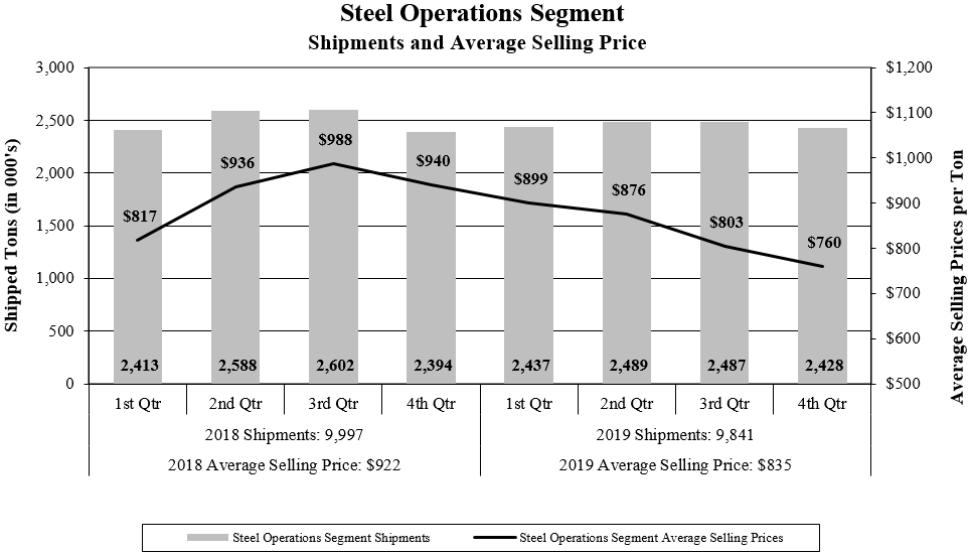][added: 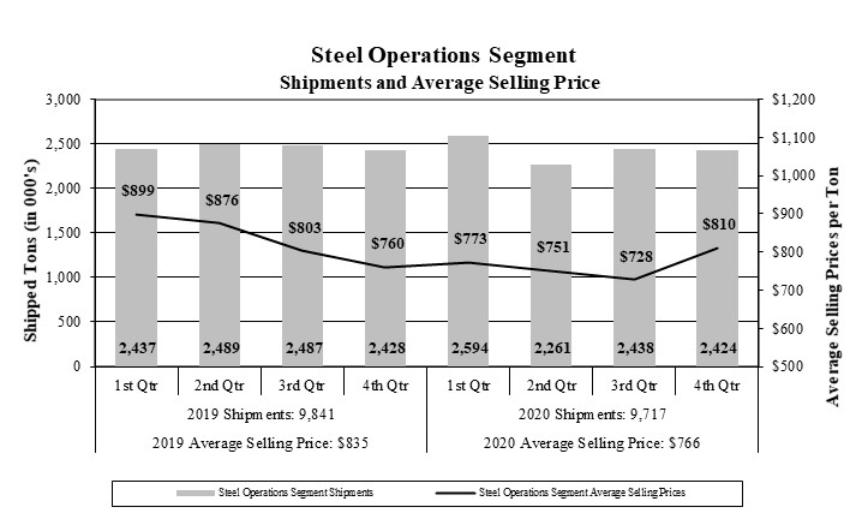]
Segment Results [removed: 2019] [added: 2020] vs. [removed: 2018][added: 2019]
[removed: Ferrous] [added: Metallic] raw materials used in our [removed: electric arc furnaces] [added: EAFs] represent our single most significant steel manufacturing cost, generally comprising approximately [removed: 55] [added: 50] to [removed: 60 percent] [added: 60%] of our steel mill operations’ manufacturing costs.
Our metallic raw material cost per net ton consumed in our steel [removed: operations] [added: mills] decreased [removed: $48,] [added: $25,] or [removed: 14%,] [added: 9%,] in [removed: 2019] [added: 2020] compared to [removed: 2018, consistent with overall decreased domestic scrap pricing.][added: 2019.]
As a result of average selling prices decreasing more than scrap costs, metal spread (which we define as the difference between average steel [removed: mill] selling prices and the cost of ferrous scrap consumed in our steel mills) decreased [removed: 10%] [added: 8%] in [removed: 2019] [added: 2020] compared to [removed: the record-high 2018.][added: 2019.]
Our steel mills utilize a large portion (approximately [removed: 65%)] [added: 69% in 2020 and 66% in 2019)] of the ferrous scrap sold by [removed: OmniSource] [added: our metals recycling operations] as raw material in our steelmaking operations, and the remainder is sold to other consumers, such as other steel manufacturers and foundries.
Metals recycling operations accounted for 11% [removed: and 13%] of our consolidated net sales during [removed: 2019] [added: 2020] and [removed: 2018, respectively.][added: 2019.]
| | | [removed: 2019] [added: 2020] | | % Change | | [removed: 2018] [added: 2019] | |
| Total | | [removed: 4,627,214] [added: 4,591,881] | | [removed: (10)%] [added: (1)%] | | [removed: 5,123,553] [added: 4,627,214] | |
| Inter-company | | [removed: (3,061,257)] [added: (3,184,451)] | | [removed: (9)%] [added: 4%] | | [removed: (3,346,135)] [added: (3,061,257)] | |
| External shipments | | [removed: 1,565,957] [added: 1,407,430] | | [removed: (12)%] [added: (10)%] | | [removed: 1,777,418] [added: 1,565,957] | |
| Total | | [removed: 1,068,208] [added: 977,882] | | [removed: (6)%] [added: (8)%] | | [removed: 1,131,412] [added: 1,068,208] | |
| Inter-company | | [removed: (144,229)] [added: (146,753)] | | | | [removed: (138,001)] [added: (144,229)] | |
| External shipments | | [removed: 923,979] [added: 831,129] | | [removed: (7)%] [added: (10)%] | | [removed: 993,411] [added: 923,979] | |
Ferrous [removed: and nonferrous] scrap average selling prices [removed: decreased 21% and 10%, respectively,] [added: increased 10%] during [removed: 2019] [added: 2020] compared to [removed: 2018.][added: 2019, while nonferrous pricing was flat year over year.]
Some factors that could cause such forward-looking statements to turn out differently than anticipated include: (1) domestic and global economic factors; (2) global steelmaking overcapacity and steel imports, together with increased scrap prices; (3) pandemics, epidemics, widespread illness or other health issues, such as the COVID-19 pandemic; (4) the cyclical nature of the steel industry and the industries we serve; (5) volatility and major fluctuations in prices and availability of scrap metal, scrap substitutes, and our potential inability to pass higher costs on to our customers; (6) cost and availability of electricity, natural gas, oil, or other resources are subject to volatile market conditions; (7) compliance with and changes in environmental and remediation requirements; (8) increased regulation associated with the environment, climate change, greenhouse gas emissions and sustainability; (9) significant price and other forms of competition from other steel producers, scrap processors and alternative materials; (10) availability of an adequate source of supply for our metals recycling operations; (11) cybersecurity threats and risks to the security of our sensitive data and information technology; (12) the implementation of our growth strategy; (13) litigation and legal compliance, (14) unexpected equipment downtime or shutdowns; (15) governmental agencies may refuse to grant or renew some of our licenses and permits; (16) our senior unsecured credit facility contains, and any future financing agreements may contain, restrictive covenants that may limit our flexibility; and (17) the impacts of impairment.
2020 Overview
*Impact of COVID-19 on Our Business*
In March 2020, the World Health Organization categorized COVID-19 as a pandemic, and since that time, efforts to slow the contagion have impacted domestic and global economies.
Countries, including the United States, issued “shelter in place” orders, temporarily closing non-essential businesses and restricting social interactions in an effort to slow the spread of COVID-19.
States began to reopen during the second quarter 2020, and domestic manufacturing started to improve.
Steelmaking and its ancillary support businesses are considered a “critical infrastructure industry” by the U.S. Department of Homeland Security and we have been deemed an essential busines in all of the states in which we operate.
As a result, all of our locations continued to operate during all of 2020 and continue to operate.
Our teams are our most valued priority, and we have implemented numerous additional process and procedural initiatives to ensure the health and safety of our people, their families, and our communities.
We adjusted schedules to support social distancing, provided additional and more frequent sanitizing applications, provided additional protective measures, among many other actions.
*Results Overview*
While our consolidated results for 2020 represented our fourth best year based on net income, we were negatively impacted in the second quarter by the continuing effects of COVID-19 due to the related temporary closures of numerous domestic steel consuming businesses.
This largely reversed during the third quarter, as most manufacturing activity resumed throughout the remainder of the year.
Domestic steel demand rebounded meaningfully during the third and fourth quarters of 2020, driving higher steel shipments, as well as significantly higher scrap flows and profitability for our steel and metals recycling operations.
Consolidated operating income for 2020 decreased $139.7 million, or 14%, to $847.1 million, compared to $986.9 million in 2019.
| Other | | 501,187 | | 25% | | | 400,747 | |
| | | 11,266,328 | | | | | 12,092,199 | |
| | $ | 9,601,482 | | (8)% | | $ | 10,464,991 | |
| Other | | (188,525) | | (1)% | | | (186,159) | |
| | | 854,521 | | | | | 979,802 | |
| | $ | 847,142 | | (14)% | | $ | 986,880 | |
COVID-19 negatively impacted our steel operations during 2020, most notably in the second quarter.
Domestic steel demand and raw material supply were robust early in the year, but demand from many steel consuming industries and scrap generation significantly reduced during the second quarter 2020, as the automotive sector and its supply chain temporarily closed.
As a result, a significant amount of higher-cost domestic steel production was idled.
As travel restrictions and stay at home orders were lifted, and the broader manufacturing base restarted mid-year, steel demand quickly recovered, resulting in steel operations segment shipments decreasing only 1% in 2020, as compared to 2019, reflecting the overall strong steel demand environment.
As demand improved in the second half of 2020, some domestic steel production remained idled.
When coupled with extremely low steel inventory levels throughout the supply chain, flat roll steel index prices increased over $500 per ton from August through the end of the year.
However, overall steel segment operations average selling prices decreased 8%, or $69 per ton, in 2020 compared to 2019.
Net sales for the steel operations segment decreased 9% in 2020 when compared to 2019, due to the 8% decrease in average steel selling prices and minimal decline in shipments.
Due to this metal spread contraction, coupled with the slight decrease in shipments, operating income for the steel operations decreased 14%, to $889.5 million, in 2020 compared to 2019.
Metals recycling operations includes both ferrous and nonferrous scrap metal processing, transportation, marketing, brokerage, and scrap management services.
In August 2020, we completed the acquisition of Zimmer, whose post-acquisition operations are included in 2020 results.
Segment Results 2020 vs. 2019
As stated previously, our metals recycling operations benefitted from a rebound in manufacturing in steel consuming industries during the second half of 2020.
Scrap flows increased as temporary closures of domestic automotive and other steel consuming manufacturers and their related supply chain were lifted.
In addition, domestic steel mill utilization rates rose from the trough experienced in the second quarter 2020, resulting in increased ferrous scrap demand and significantly higher selling prices.
However, net sales for our metals recycling operations decreased 4% in 2020 as compared to 2019, as total annual shipments decreased, most notably in the second quarter.
Metals recycling operations operating income in 2020 of $33.0 million increased 102% from 2019 operating income of $16.3 million, due to ferrous metal spread expansion and positive operating results from our Zimmer acquisition, which more than offset decreases in ferrous and nonferrous shipments.
Segment Results 2020 vs. 2019
As our steel fabrication operations continue to leverage our national operating footprint, market demand, orders and backlog continued to be strong in 2020, indicating resilience of the non-residential construction market during COVID-19.
Some factors that could cause such forward-looking statements to turn out differently than anticipated include: (1) the effects of uncertain economic conditions; (2) cyclical and changing industrial demand; (3) changes in conditions in any of the steel or scrap-consuming sectors of the economy which affect demand for our products, including the strength of the non-residential and residential construction, automotive, manufacturing, appliance, pipe and tube, and other steel-consuming industries; (4) fluctuations in the cost of key raw materials and supplies (including steel scrap, iron units, zinc, graphite electrodes, and energy costs) and our ability to pass on any cost increases; (5) the impact of domestic and foreign imports, including trade policy, restrictions, or agreements; (6) unanticipated difficulties in integrating or starting up new, acquired or planned businesses or assets; (7) risks and uncertainties involving product and/or technology development; and (8) occurrences of unexpected plant outages or equipment failures.
2019 Overview
Our 2019 consolidated results were challenged by high customer steel inventories, as many customers purchased beyond normal demand levels in late 2018.
Underlying domestic steel demand remained steady in 2019, but as customers began to destock
inventories, steel prices declined throughout the year in conjunction with weakening scrap prices, before firming in the fourth quarter as destocking subsided and inventory levels were right-sized.
Declining ferrous scrap prices throughout much of 2019 negatively impacted our metals recycling operations financial results.
In spite of the market challenges faced by our steel and metals recycling operations, our consolidated net sales of $10.5 billion and cash flows from operations of $1.4 billion were the second-best performance in company history, and our consolidated operating income was our third-best in company history.
In addition, our steel fabrication operations segment achieved record shipments of 644,000 tons, resulting in record operating income of $119.1 million.
Consolidated operating income for 2019 decreased $735.5 million, or 43%, to $986.9 million, compared to the record $1.7 billion in 2018.
Acquisition of United Steel Supply, LLC
On March 1, 2019, we purchased 75% of the equity interest of United Steel Supply, LLC (USS) for cash consideration of $93.4 million, plus a customary working capital transaction purchase price adjustment of $3.7 million, which was paid in September 2019.
Additionally, we have an option to purchase, and the sellers have the option to require us to purchase, the remaining 25% equity interest of USS in the future.
Headquartered in Austin, Texas, USS is a leading distributor of painted Galvalume® flat roll steel used for roofing and siding applications, with distribution centers strategically located in Mississippi, Indiana, Arkansas, and Oregon.
USS provides the steel segment a new, complementary distribution channel and connects us to a rapidly growing industry segment with customers that do not traditionally purchase steel directly from a steel producer.
USS’s operating results from and after March 1, 2019, are reflected in our financial statements in the steel operations reporting segment.
| Other | | 400,747 | | (7)% | | | 429,060 | |
| | | 12,092,199 | | | | | 13,816,377 | |
| | $ | 10,464,991 | | (11)% | | $ | 11,821,839 | |
| Other | | (186,159) | | 26% | | | (253,195) | |
| | | 979,802 | | | | | 1,724,449 | |
| | $ | 986,880 | | (43)% | | $ | 1,722,409 | |
Overall domestic steel demand remained steady during 2019, with continued strength in the automotive, construction and other industrial sectors.
However, a challenging steel pricing environment continued throughout 2019, due to customer inventory destocking in conjunction with weakening scrap prices, which led to decreasing steel selling prices compared to 2018.
Steel operations segment shipments decreased 2% in 2019, as compared to 2018.
Net sales for the steel operations decreased 11% in 2019
when compared to 2018, due primarily to decreases in overall steel selling prices, particularly in sheet steel, and decreased steel mill shipments.
Due to this metal spread contraction, most notably in sheet steel, operating income for the steel operations decreased 44%, to $1.0 billion, in 2019 compared to the record results in 2018.
Metals recycling operations consists solely of OmniSource and includes both ferrous and nonferrous scrap metal processing, transportation, marketing, and brokerage services, strategically located primarily in close proximity to our steel mills and other end-user scrap consumers throughout the eastern half of the United States.
In addition, OmniSource designs, installs, and manages customized scrap management programs for industrial manufacturing companies at hundreds of locations throughout North America.
Our metals recycling operations were negatively impacted throughout 2019 by falling ferrous and nonferrous scrap prices compared to 2018, as well as a challenging steel market in which customers were also reluctant to purchase during a falling pricing environment.
Net sales for our metals recycling operations decreased 22% in 2019 as compared to 2018, driven by decreased shipments and ferrous scrap prices declining in eight of the twelve months during the year.
Metals recycling operations operating income in 2019 of $16.3 million decreased 79% from 2018 operating income of $75.9 million, due to lower ferrous and nonferrous shipments, and metal spread contraction.
Our steel fabrication operations continue to leverage our national operating footprint.
Market demand, orders and backlog continue to be strong for non-residential construction project development, as customer sentiment remains positive.
Operating income increased $57.2 million, or 92%, to $119.1 million in 2019 compared to 2018, due to the increases in volumes and metal spread, with selling prices outpacing steel input costs.
Interest Expense, net of Capitalized Interest. During 2019, interest expense of $127.1 million was comparable to the $126.6 million incurred during 2018, based on consistent debt levels during the majority of both years.
We have concluded U.S. federal income tax audits through 2015.
| | | | Short-term investments | | | 262,174 | | | |
| | | | Total liquidity | | $ | 2,801,673 | | | |
In October 2019, our corporate credit rating was upgraded to an investment grade credit designation by three credit rating agencies.
An excerpt. Shown here: 40 of 98 rewritten, 40 of 72 added and 40 of 53 removed. The counts are complete. For every sentence, read Item 7. MANAGEMENT’S DISCUSSION AND ANALYSIS OF FINANCIAL CONDITION AND RESULTS OF OPERATIONS in the FY2020 filing and the FY2019 filing.
Item 7A. QUANTITATIVE AND QUALITATIVE DISCLOSURES ABOUT MARKET RISK
6 rewritten, 14 added, 15 removed, 23 unchanged
To achieve these objectives, we may use interest rate swaps to manage net exposure to interest rate changes related to our portfolio of borrowings; however, we have not done so during [added: 2020,] 2019, [removed: 2018,] or [removed: 2017.][added: 2018.]
The following table represents the principal cash repayments and related weighted-average interest rates by maturity date for our long-term debt, as of December 31, [removed: 2019] [added: 2020] (in thousands):
| | 2022 | | | [removed: 3,923] [added: 3,981] | | | [removed: 5.5] [added: 5.1] | | | 374 | | | 5.1 | |
Certain of these commitments contain provisions which require us to “take or pay” for specified quantities without regard to actual usage for periods of generally up to 5 years for physical commodity requirements and commodity transportation requirements, with some extending beyond, and for up to [removed: 13] [added: 12] years for air products.
We believe that production requirements will be such that consumption of the products or services purchased under these commitments will occur in the normal production process, other than certain air products related to our [added: idled] Minnesota ironmaking [removed: operations during the idle period.][added: operations.]
At December 31, [removed: 2019,] [added: 2020,] we had a cumulative unrealized loss associated with these financial contracts of [removed: $456,000,] [added: $645,000,] substantially all of which have settlement dates in [removed: 2020.][added: 2021.]
| | 2021 | | $ | 4,570 | | | 5.5% | | $ | 82,324 | | | 1.7% | |
| | 2023 | | | 3,799 | | | 4.9 | | | \- | | | | |
| | 2024 | | | 403,438 | | | 2.8 | | | \- | | | | |
| | 2025 | | | 403,488 | | | 2.4 | | | \- | | | | |
| | Thereafter | | | 2,256,684 | | | 3.4 | | | \- | | | | |
| | Total debt outstanding | | $ | 3,075,960 | | | 3.2% | | $ | 82,698 | | | 1.7% | |
| | Fair value | | $ | 3,329,914 | | | | | $ | 82,698 | | | | |
| | 2021 | | $ | 265,736 | |
| | 2022 | | | 124,961 | |
| | 2023 | | | 43,074 | |
| | 2024 | | | 35,248 | |
| | 2025 | | | 16,491 | |
| | Thereafter | | | 139,299 | |
| | | | $ | 624,809 | |
| | 2020 | | $ | 5,697 | | | 6.0% | | $ | 83,659 | | | 3.1% | |
| | 2021 | | | 3,644 | | | 5.9 | | | 35 | | | 5.1 | |
| | 2023 | | | 403,703 | | | 5.3 | | | \- | | | | |
| | 2024 | | | 903,379 | | | 4.3 | | | \- | | | | |
| | Thereafter | | | 1,360,058 | | | 4.1 | | | \- | | | | |
| | Total debt outstanding | | $ | 2,680,404 | | | 4.3% | | $ | 84,068 | | | 3.1% | |
| | Fair value | | $ | 2,750,674 | | | | | $ | 84,068 | | | | |
| | 2020 | | $ | 240,832 | |
| | 2021 | | | 118,613 | |
| | 2022 | | | 105,008 | |
| | 2023 | | | 32,752 | |
| | 2024 | | | 29,888 | |
| | Thereafter | | | 150,559 | |
| | | | $ | 677,652 | |
We also purchase electricity consumed at our Butler Flat Roll Division pursuant to a contract which extends through December 2020, which establishes an agreed fixed-rate energy charge per Mill/kWh consumed for each year through the expiration of the agreement.
Item 1. BUSINESS
121 rewritten, 160 added, 138 removed, 166 unchanged
Steel Dynamics, Inc. is one of the largest domestic steel producers and metal recyclers in the United States, based on [removed: current] estimated steelmaking and coating capacity of approximately 13 million tons and actual metals recycling [removed: volumes,] [added: volumes as of December 31, 2020,] with one of the most [removed: diversified, high-margin steel] [added: diversified] product [removed: portfolios.][added: and end-market portfolios in the domestic steel industry.]
[removed: These six pillars] [added: They] bring us together with a common [removed: focus] [added: focus,] and [added: they] provide [removed: us] the foundation upon which we operate and grow.
Our six pillars and [removed: our] [added: the] team’s execution of them each day has driven our success and sustainability.
| | ● | [removed: Sustaining Superior Operating Culture] [added: Culture] – Our entrepreneurial culture fosters a team of energetic, positive, [removed: driven and] [added: driven,] innovative [added: and diverse] individuals by utilizing open communication and meaningful performance-based compensation aligned to our strategic focus. [removed: This results in our safe, low-cost, and highly efficient operations, which drive “best-in-class” operating and financial performance.] |
| | ● | [removed: Enhancing Customer Relationships and] [added: Customer] Commitment – We focus on being a preferred partner [added: of our customers by] providing [removed: outstanding] [added: quality] products and [added: unique] supply-chain solutions [removed: that exceed expectations, as we anticipate our customer’s future needs] [added: to meet their current] and [removed: deliver greater value.] [added: future needs.] |
[removed: Steel Operations:][added: Our steel operations]
[removed: Steel Fabrication Operations. Steel] [added: Products. Our steel fabrication operations produce steel building components, including steel] joists, [removed: girders] [added: girders,] and [added: trusses, and] steel [removed: deck, including specialty] deck.
In addition, our value-added steel product offerings help to balance our exposure to commodity grade products supplied by other [added: steel] manufacturers.
We will continue to seek additional opportunities and to collaborate with our customers to anticipate their future needs by further expanding our range of products and [removed: offerings, which may allow our customers the ability to more effectively and efficiently navigate their supply chain.][added: offerings.]
[removed: Our new] [added: This $1.9 billion electric arc furnace (EAF) flat roll] steel mill will have an estimated 3.0 million tons of annual steel production capacity, including value-added coating lines comprised of a galvanizing line with planned annual coating capacity of 550,000 tons with galvalume capability and a paint line with annual coating capacity of 250,000 tons.
By leveraging our construction and operating expertise, we are building a [removed: “next-generation”] [added: "next-generation”] EAF flat roll steel mill with [removed: planned] production capabilities [added: designed to have product size and quality capabilities] beyond [added: that of] existing [added: domestic] EAF flat roll steel producers, competing even more effectively with the integrated steel model and foreign competition.
Additionally, our new steel mill site has sufficient acreage to allow for [added: some] customers to locate on-site, providing them with logistics savings and our steel mill with volume base-loading opportunities.
[removed: Based on current expectations, operations] [added: Operations] are planned to begin [removed: mid-2021.][added: mid-year 2021.]
Our low operating costs are primarily a result of our efficient plant designs and operations, our high productivity rate, low ongoing maintenance cost requirements and strategic locations near [removed: our customers and] sources of our primary raw material, ferrous [removed: scrap.][added: scrap, and near our customers.]
[removed: We] [added: Additionally, we] continuously seek to maximize the variability of our cost structure and to reduce per unit and fixed costs.
During [added: 2020,] 2019, [removed: 2018,] and [removed: 2017, our steel operations] [added: 2018, we] consumed [removed: 10.6 million, 10.9] [added: 10.4] million, [added: 10.6 million] and [removed: 10.3] [added: 10.9] million tons, respectively, of metallic [removed: materials,] [added: materials in our steelmaking furnaces,] of [removed: which] [added: which,] iron [removed: units,] [added: units] other than scrap, represented approximately 13% [added: of the tons] in [removed: 2019] [added: 2020] and [removed: 2017,] [added: 2019,] and 14% in 2018.
The majority of our steelmaking operations are in locations near sustainable sources of scrap [removed: materials] [added: metals] and near our customer base, allowing us to realize freight savings for inbound scrap as well as for outbound steel products destined for our customers.
We [removed: have continuously innovated,] [added: intentionally developed a vertically connected operating model,] further strengthening our [removed: company, becoming vertically connected with] [added: company by creating] a [removed: looped] [added: “closed loop”] manufacturing life cycle.
Our metals recycling platform collects and processes [removed: industrial] scrap from [removed: manufacturers] [added: manufacturing] and [removed: obsolete scrap derived] from end-of-life items, such as automobiles, [removed: appliances] [added: appliances,] and machinery.
This processed scrap is then sold to [removed: end users,] [added: end-users for reuse,] including our [removed: electric arc furnace] [added: EAF] steel [removed: mills.][added: mills, which produce new steel from the scrapped material.]
Experienced Leadership Team [removed: and Unique Culture] / [removed: Foster] [added: Fosters an] Entrepreneurial Culture
Our leadership objectives are closely aligned with our [removed: stockholders] [added: stakeholders] through meaningful stock ownership positions and performance-based incentive compensation programs that are correlated to the company’s profitability and operational performance in relationship to [removed: its] [added: our] steel manufacturing peers.
We [removed: foster our entrepreneurial culture and] emphasize decentralized operational decision making and responsibility, while continuing to maintain appropriate corporate governance and risk oversight.
We reward teamwork, innovation, and operating efficiency, and focus on maintaining the effectiveness of our performance-driven incentive bonus plans that are designed to maximize overall productivity and align the interests of our leadership and teams with our [removed: stockholders.][added: stakeholders.]
| Mark D. Millett | | [removed: 60] [added: 61] | | President and Chief Executive Officer |
| Theresa E. Wagler | | [removed: 49] [added: 50] | | Executive Vice President, Chief Financial Officer, and Corporate Secretary |
| Russ B. Rinn | | [removed: 62] [added: 63] | | Executive Vice President, Metals Recycling |
| Miguel Alvarez | | [removed: 52] [added: 53] | | Senior Vice President, Southwest United States and Mexico |
| Chris A. Graham | | [removed: 55] [added: 56] | | Senior Vice President, Long Products Steel Group |
| Glenn A. Pushis | | [removed: 54] [added: 55] | | Senior Vice President, Special Projects |
| Barry T. Schneider | | [removed: 51] [added: 52] | | Senior Vice President, Flat Roll Steel Group |
| James S. Anderson | | [removed: 59] [added: 60] | | Vice President, Steel Fabrication |
Prior to that, Mr. Millett has held various [removed: positions,] [added: positions within the company,] including President and Chief Operating Officer, Executive Vice President of Metals Recycling and Ferrous Resources, President and Chief Operating Officer of [removed: OmniSource Corporation (now] OmniSource, [removed: LLC),] [added: LLC,] and Executive Vice President and Chief Operating Officer for Flat Rolled Steels and Ferrous Resources.
Mr. Millett was responsible for the design, construction, and start-up operation of [added: all of] our [added: steel mills, including our] Butler, Indiana flat roll, [removed: melting] [added: melting,] and casting operations.
[removed: In 1987, Mr. Millett was] [added: His roles included being charged with developing the world’s first commercially viable thin slab casting process as the manager of the project at Nucor’s Hazelett facility and being] given the responsibility by Nucor for the design, construction, staffing, and operation of the melting and casting facility at [removed: Nucor’s world’s-first thin-slab] [added: the world’s first thin slab] casting facility at [added: Nucor’s] Crawfordsville, [removed: Indiana.][added: Indiana facility.]
She is responsible for and oversees accounting and taxation, treasury, risk management, legal, information technology and cyber security, [removed: safety] [added: health] and [added: safety,] human resources, [added: sustainability efforts,] and strategic business development functions, as well as investor relations, and corporate communications.
Prior to joining Steel Dynamics, Ms. Wagler [removed: served] [added: was] as a certified public accountant with Ernst & Young LLP.
Mr. Rinn is responsible for OmniSource’s ferrous and nonferrous metals recycling operations [removed: in the eastern half of the United States, as well as sourcing,] [added: including] marketing, trading, and logistics [removed: activities spanning the nation.][added: activities.]
Prior to joining Steel Dynamics, Mr. Rinn was an Executive Vice President of Commercial Metals [removed: Company (CMC),] [added: Company,] a [removed: Texas-based] [added: Texas based] mini-mill steel company.
_Miguel Alvarez_ [removed: joined the company as] [added: has been] our Senior Vice President, Southwest United States and Mexico [removed: in] [added: since] February 2019.
We refer to our founding principles as our six core strategic pillars.
Our unique entrepreneurial culture and business model benefit us operationally, financially, and through the responsible use of our resources in diverse economic environments.
Innovation in all forms is essential to our success, and our teams focus on how to do things “smarter” within our current operations as well as how we continue to grow.
This means creating solutions for our teammates, customers, suppliers, and other stakeholders.
It also includes finding ways to “do business” with fewer resources and less environmental impact.
| | | |
| | ● | Safety – Creating and maintaining a safe work environment is the foundation of our decision making. Safety is always at the forefront and is a constant topic of conversation across the company. Our goal is zero injuries—no accidents. |
| | ● | Growth – We focus on intentional margin expansion and consistency through-the-cycle. |
| | ● | Innovation – Through individual creativity and ingenuity, our teams drive innovation to improve safety, quality, productivity, and resource sustainability. We strive to provide unique, superior products, customer supply chain solutions, and next-generation technologies and processes. |
| | ● | Financial Strength – Through our adaptable value-added product diversification, vertically connected businesses model, coupled with our highly variable operating cost structure and performance-based incentive compensation, along with our continued operating innovations and efficiency, we achieve higher utilization and lower costs, which provide strong cash flow generation through both strong and weak market cycles. |
Differentiated Model - Uniquely Steel Dynamics
Competitively advantaged differentiation is core to our long-term value creation strategy.
We aim to set ourselves apart in every aspect of our business with a spirit of excellence, with the following core values driving our differentiation strategy.
Unique Entrepreneurial Culture
Our entrepreneurial culture is at the core of our success and is driven by our extensive performance-based incentive compensation philosophy for those on the plant floor to senior leadership.
Over 60% of a plant floor colleague’s total potential compensation is “at risk” to both quality production and cost-effectiveness.
Over 85% of our senior leadership team’s total potential compensation is “at risk” to company-wide financial performance metrics that encourage long-term value creation, including return on equity, growth, cash generation, and return on invested capital metrics.
Our common goal of consistently achieving excellence in all we do is reflected in the esprit de corps that permeates our team.
We believe diversity within our teams enhances broad-based thinking, innovation, and value creation.
Diversified, Value-Added Product Offerings / Supply-Chain Solutions
We have one of the most diversified, high-margin product offerings of any domestic steel producer.
We have a track record of profitable growth, driving diversification in both end markets and product offerings to sustain higher volume and profitability through all market environments.
This includes developing premium, value-added steel products, with over 70% of our steel and fabrication sales being considered value-added.
A key competitive advantage is our numerous supply-chain solutions which provide significant advantages to our customers, creating long-lasting relationships and higher through-cycle sales.
Our new Southwest-Sinton Flat Roll Division growth investment is a prime example of our internal growth and differentiated business model.
As with all our growth initiatives, we seek to competitively differentiate ourselves through service, product capability and quality, and supply chain solutions.
This investment encompasses each of these elements.
We will also be producing value-added steel products at the commencement of operations, providing high-margin product and end-market diversification.
Out new steel mill is being strategically located in Sinton, Texas, which has significant competitive advantages—including geographic market positioning, power accessibility, competitive freight for the intended customers, proximity to a deep-water port and site constructability.
Three customers have committed to locate onsite, representing over 1.0 million tons of annual processing and consumption capacity, and we expect to secure similar commitments from additional customers.
Our new EAF steel mill is adhering to the same sustainability model as our other steelmaking facilities, utilizing state-of-the-art environmental controls and processes to produce high quality sustainable steel.
Our existing EAF steel mills have a fraction of the greenhouse gas emissions (GHG) and energy intensity of average traditional integrated steelmaking technology, resulting in a much more environmentally friendly steel production alternative.
Vertically Connected Businesses and Pull-Through Volume Advantage
Our vertically connected businesses contribute to our higher through-cycle steel production and overall profitability.
Steel demand that is generated from our internal manufacturing businesses is a significant competitive advantage supporting higher and more stable through-cycle earnings and cash flow generation.
Our steel fabrication operations and downstream processing locations use a significant amount of steel in their operations.
During weaker demand environments, we source more of their needs internally, and during strong demand environments, we source more of their needs externally at a preferred cost.
Ultimately, we optimize our company-wide profitability in all steel demand environments.
In 2020, our own steel consuming businesses purchased 1.5 million tons of steel from our steel mills representing 14% of our total 2020 steel shipments.
A strategic synergistic relationship also exists between our steel mills and metals recycling operations, which is the largest supplier of recycled ferrous scrap to our steel operations.
Our Company
We believe our strategic focus to create value for our teams, customers, communities and shareholders is differentiated through our six Core Operating and Leadership Principles.
| | ● | Safety – Creating and maintaining a safe work environment is our number one value and first priority. We want every individual to go home safely at the end of each day and to take an active role in remaining safe both on the job and at home. Our goal is no accidents, no lost workdays, no injuries. |
| --- | --- | --- |
| | ● | Strategic Growth, Intentional Margin Expansion and Consistency “Through the Cycle” – Our intentional, value-driven growth has propelled our diversification in both end markets and product offerings to sustain continued higher volume and profitability throughout both strong and weak market environments. We are squarely focused on continued strategic and responsible growth. |
| | ● | Driving Innovation – Through individual creativity and ingenuity, our teams drive innovation to improve safety, quality, productivity and resource sustainability. We utilize innovative technologies and processes in order to perform at the highest level, and consistently achieve excellence in all that we do. |
| | ● | Financial Strength and Flexibility – We have one of the most diversified steel product offerings in the industry. Coupled with high variability of our operating costs and our vertically connected business platforms, this results in higher utilization and lower costs, providing strong cash flow generation through both strong and weak market cycles. |
Competitive Strengths / Business Strategies
We believe our financial strength and flexibility, coupled with our competitive advantages of maintaining a low, highly variable cost structure, producing a diversified value-added product offering, controlling a secure supply of recycled ferrous metals, fostering an entity-wide entrepreneurial culture and having an experienced senior management team and work force, positions us well to continue to strengthen our leadership position and execute our growth strategy.
Differentiated Business Model / Diversified Product Mix / Expanded Product Offerings
We are one of the most diversified steel companies in the United States, with very broad value-added steel product offerings.
We offer a wide range of steel products (more specifically enumerated in the Steel Operations Products and Tons Sold by End Market discussion later in this section).
We have a proven track record of growing and developing premium, value-added steel product capabilities and unlocking value within our operations.
Additionally, by adding high-margin downstream manufacturing businesses, we are able to provide base-load “pull-through” volume for our steel operations, increasing “through-cycle” steel mill utilization.
We are also identifying new ways to provide value to our customers by providing supply-chain solutions.
Our differentiated business
model and performance-driven culture demonstrate our through-cycle earnings capability through our three vertically connected operating segments.
Sheet Products. Hot roll, cold roll and coated steel, including a wide variety of value-added products, such as light gauge hot roll, and galvanized, galvanneal, Galvalume®, Galfan®, and painted products.
Long Products.
Structural steel beams, pilings, and standard and premium grade rail; engineered special-bar-quality of an expanding range of sizes and chemistries; various merchant-bar-quality products including rounds, angles, flats, reinforcing bar, channels and specialty steel sections.
Steel Finishing.
Turning, polishing, straightening, chamfering, threading, precision saw-cutting, cold draw and heat treating of bar products; and cutting to length, additional straightening, hole punching, shot blasting, welding and coating of beams, channels and specialty steel sections.
Metals Recycling Operations. An array of both ferrous and nonferrous scrap recycling, scrap management, transportation, and brokerage products and services.
Our steel fabrication operations provide “pull-through” volume optionality for our steel operations, as many of the products that we make utilize our own internally produced steel.
One such opportunity is our planned $1.9 billion “next-generation” electric arc furnace (EAF) flat roll steel mill – Southwest-Sinton Flat Roll Division.
One of the Lowest Cost Steel Producers in the United States; State-of-the-Art Facilities / Allowing for Low Production Costs
Our highly performance-based incentive compensation plans at all employee levels are based on both divisional and consolidated company performance.
Performance-based incentive compensation is designed to reward high productivity and efficient use of physical resources and capital
employed.
Additionally, effectively leveraging our existing facilities through capital effective organic growth and diversified product offerings allows us to maximize utilization.
Secure Supply of High Quality Just-in-Time Ferrous Raw Materials
We maintain a secure supply of ferrous raw material resources through the benefit of our metals recycling operations and Iron Dynamics (IDI).
Ferrous materials represent the single largest raw material component of our steel operations’ manufacturing costs, at approximately 55 to 60 percent of such costs.
During 2019, 2018, and 2017, OmniSource, our metals recycling operations, provided our steel operations with 37%, 39%, and 38%, respectively, of its ferrous scrap requirements.
This represented 66%, 65%, and 63% of OmniSource’s total ferrous scrap shipments during 2019, 2018, and 2017, respectively.
IDI supplies 100% of its production to the Butler Flat Roll Division, representing 63%, 64%, and 72% of their iron units other than scrap in 2019, 2018, and 2017, respectively, through the transfer of liquid pig iron and hot briquetted iron, which are higher quality, energy-saving ferrous raw materials.
We believe our metals recycling operations and IDI provide us with a high quality, cost effective, and secure raw material platform for effective working capital management.
Strategic Geographic Locations / Enter New Geographic Markets
Recycled ferrous scrap and iron units represent the most significant component of our cost of steel manufacturing.
Approximately three-fourths of our recycled ferrous scrap needs are sourced within 250 miles of our steel mill locations, minimizing the amount of energy expended on transportation.
An excerpt. Shown here: 40 of 121 rewritten, 40 of 160 added and 40 of 138 removed. The counts are complete. For every sentence, read Item 1. BUSINESS in the FY2020 filing and the FY2019 filing.
Item 3. LEGAL PROCEEDINGS
0 rewritten, 1 added, 1 removed, 3 unchanged
Some of these matters have resulted in fines or penalties, exclusive of interest and costs, which did not exceed $1 million in aggregate, as of December 31, 2020.
Some of these matters have resulted in fines or penalties, for which a total of $512,000 is recorded in our financial statements as of December 31, 2019.
Cover and table of contents
19 rewritten, 21 added, 19 removed, 105 unchanged
| ☒ | ANNUAL REPORT PURSUANT TO SECTION 13 OR 15(d) OF THE SECURITIES EXCHANGE ACT OF 1934 FOR THE FISCAL YEAR ENDED DECEMBER 31, [removed: 2019] [added: 2020] |
Securities registered pursuant to Section 12(b) of the [removed: Act.][added: Act:]
| [removed: Large accelerated filer ⌧ | Accelerated file ◻ |] Non-accelerated filer ◻ | Smaller reporting company ☐ | [added: Emerging growth company ☐ | |]
The aggregate market value of the voting stock held by non-affiliates of the registrant computed by reference to the price at which the common equity was last sold as of June [removed: 28, 2019,] [added: 30, 2020,] was approximately [removed: $5.0] [added: $4.1] billion.
As of February [removed: 20, 2020,] [added: 19, 2021,] Registrant had outstanding [removed: 213,554,449] [added: 211,005,100] shares of common stock.
Portions of registrant’s definitive proxy statement referenced in Part III, Items 10 through 14 of this report, to be filed prior to April 30, [removed: 2020,] [added: 2021,] are incorporated herein by reference.
| [Item [removed: 1A.](#PART01_ITEM01A)] [added: 1A.](#ITEM1ARISKFACTORS_115001)] | [Risk [removed: Factors](#PART01_ITEM01A)] [added: Factors](#ITEM1ARISKFACTORS_115001)] | [removed: 18] [added: 19] |
| [Item 1B.](#ITEM1BUNRESOLVEDSTAFFCOMMENTS_407146) | [Unresolved Staff Comments](#ITEM1BUNRESOLVEDSTAFFCOMMENTS_407146) | [removed: 25] [added: 26] |
| [Item 2.](#ITEM2PROPERTIES_887366) | [Properties](#ITEM2PROPERTIES_887366) | [removed: 26] [added: 27] |
| [Item 3.](#ITEM3LEGALPROCEEDINGS_660817) | [Legal Proceedings](#ITEM3LEGALPROCEEDINGS_660817) | [removed: 27] [added: 28] |
| [Item 4.](#ITEM4MINESAFETYDISCLOSURES_62861) | [Mine Safety Disclosures](#ITEM4MINESAFETYDISCLOSURES_62861) | [removed: 27] [added: 28] |
| [Item 5.](#ITEM5MARKETFORREGISTRANTSCOMMONEQUITY_91) | [Market for Registrant’s Common Equity, Related Stockholder Matters and Issuer Purchases of Equity Securities](#ITEM5MARKETFORREGISTRANTSCOMMONEQUITY_91) | [removed: 28] [added: 29] |
| [Item 6.](#ITEM6SELECTEDFINANCIALDATA_396995) | [Selected Financial Data](#ITEM6SELECTEDFINANCIALDATA_396995) | [removed: 30] [added: 31] |
| [Item [removed: 7.](#ITEM7MANAGEMENTSDISCUSSIONANDANALYSIS_80)] [added: 7.](#ITEM7MANAGEMENTSDISCUSSIONANDANALYSISOFF)] | [Management’s Discussion and Analysis of Financial Condition and Results or [removed: Operations](#ITEM7MANAGEMENTSDISCUSSIONANDANALYSIS_80)] [added: Operations](#ITEM7MANAGEMENTSDISCUSSIONANDANALYSISOFF)] | [removed: 32] [added: 33] |
| [Item 7A.](#ITEM7AQUANTITATIVEANDQUALITATIVEDISCLOSU) | [Quantitative and Qualitative Disclosures About Market Risk](#ITEM7AQUANTITATIVEANDQUALITATIVEDISCLOSU) | [removed: 42] [added: 44] |
| [Item 8.](#ITEM8CONSOLIDATEDFINANCIALSTATEMENTS_437) | [Consolidated Financial Statements and Supplementary Data](#ITEM8CONSOLIDATEDFINANCIALSTATEMENTS_437) | [removed: 44] [added: 46] |
| | ● | [removed: increased] [added: significant] price and other forms of competition from other steel producers, scrap processors and alternative materials; |
| | ● | [removed: periodic fluctuations in the availability and] cost [added: and availability] of electricity, natural gas, oil, or other energy [removed: resources;] [added: resources are subject to volatile market conditions;] |
| | ● | the impact of impairment [removed: charges;] [added: charges.] |
| | |
| | |
| Large accelerated filer ⌧ | Accelerated file ◻ | | |
Indicate by check mark whether the registrant has filed a report on and attestation to its management’s assessment of the effectiveness of its internal control over financial reporting under Section 404(b) of the Sarbanes-Oxley Act (15 U.S.C. 7262(b)) by the registered public accounting firm that prepared or issued its audit report.
Global and National Risks
| | ● | domestic and global economic factors including periods of slower than anticipated economic growth and the risk of a recession; |
| | ● | global steelmaking overcapacity and imports of steel into the United States, together with increased scrap prices; |
| | ● | pandemics, epidemics, widespread illness or other health issues, such as the COVID-19 pandemic; |
Industry Risks
| | ● | the cyclical nature of the steel industry and some of the industries we serve; |
| | ● | volatility and major fluctuations in prices and availability of scrap metal, scrap substitutes, and our potential inability to pass higher costs on to our customers; |
| | ● | compliance with and changes in environmental and remediation requirements; |
| | ● | increased regulation associated with the environment, climate change, greenhouse gas emissions and sustainability; |
Operational and Commercial Risks
| | ● | availability of an adequate source of supply for our metals recycling operations; |
| | ● | cybersecurity threats and risks to the security of our sensitive data and information technology; |
| | ● | the implementation of our growth strategy; |
| | ● | litigation and legal compliance; |
| | ● | unexpected equipment downtime or shutdowns; |
| | ● | governmental agencies may refuse to grant or renew some of our licenses and permits; |
| | ● | our senior unsecured credit facility contains, and any future financing agreements may contain, restrictive covenants that may limit our flexibility; and |
| --- | --- | --- |
| | | | |
| | | | Emerging growth company ☐ |
| | ● | United States or foreign trade policy affecting the amount of, or tariffs on, foreign steel imported into the United States, or adverse or less than satisfactory outcomes of pending and future trade cases alleging unlawful practices in connection with steel imports; |
| | ● | increased price competition brought about by global steelmaking overcapacity; |
| | ● | margin compression resulting from falling selling prices with no offsetting reduction in raw material costs, or our inability to pass increases in costs of raw materials and supplies, if any, onto our customers; |
| | ● | the adverse impact of periods of slower than anticipated economic growth or the risk of a recession, resulting in a general decrease of demand for our products; |
| | ● | the weakening of demand for steel products within the non-residential and residential construction, automotive, manufacturing, appliance, pipe and tube, and other steel-consuming industries; |
| | ● | conditions affecting steel or recycled metals consumption; |
| | ● | cyclical changes in market supply and demand for steel and recycled metals; |
| | ● | changes in the availability or cost of raw materials, such as scrap metal, scrap substitute products such as pig iron and pelletized iron, and other supplies such as zinc, graphite electrodes and ferroalloys, or other raw materials, which we use in our production processes; |
| | ● | the impact of, or changes in, environmental law or in the application of other legal or regulatory requirements upon our production processes or costs of production or upon those of our suppliers or customers, including actions by government agencies, such as the United States Environmental Protection Agency or related state agencies, upon our receipt of pending or future environmentally related construction or operating permits; |
| | ● | the impact of United States government or various other governmental agencies introducing laws or regulatory changes in response to the subject of climate change and greenhouse gas emissions, including the introduction of carbon emissions limitations or trading mechanisms; |
| | ● | increased cybersecurity threats and vulnerabilities and increased global information technology security requirements, and a rise in sophisticated cybercrimes that pose a risk to the security and functionality of our systems and information networks and to the confidentiality, availability, and integrity of sensitive data, including intellectual property, proprietary information, financial information, customer, supplier and business partner information, and personally identifiable information; |
| | ● | changes in our business strategies or development plans which we have adopted or may adopt, and any difficulty or inability to timely, cost efficiently and successfully consummate, implement, integrate or operate any current, planned or potential construction or other projects, acquisitions, joint ventures or strategic alliances; |
| | ● | private or governmental liability claims or litigation, or the impact of any adverse litigation costs or outcome of any litigation on the adequacy of our reserves or the availability or adequacy of our insurance coverage; |
| | ● | the occurrence of unanticipated equipment failures and plant outages; |
| | ● | costs to idle facilities, idled facility carrying costs, or increased costs to resume production at idled facilities; and |
| | ● | uncertainties involving new products or new technologies. |
Item 2. PROPERTIES
14 rewritten, 3 added, 1 removed, 37 unchanged
The following table describes our significant properties as of December 31, [removed: 2019.][added: 2020.]
For additional information regarding our [added: significant] facilities please refer to Item 1.
| Butler Operations | | Butler, IN | | Flat Roll Steel Mill and Coating Facility | | [removed: 1,021] [added: 997] | | — |
| Columbus Flat Roll Division | | Columbus, MS | | Flat Roll Steel Mill and Coating Facility | | [removed: 1,479] [added: 1,387] | | [removed: 14] [added: —] |
| Heartland Flat Roll Division | | Terre Haute, IN | | Flat Roll Steel [removed: Rolling] [added: Cold-Rolling] and Coating Facility | | 193 | | — |
| OmniSource: | [added: ] | [added: ] | | | | | | |
| Indiana | | Multiple Cities | | Ferrous and Nonferrous Scrap Processing | | [removed: 449] [added: 380] | | 26 |
| Michigan | | Multiple Cities | | Ferrous and Nonferrous Scrap Processing | | [removed: 193] [added: 186] | | — |
| Tennessee | | [removed: Johnson City, TN] [added: Multiple Cities] | | Ferrous and Nonferrous Scrap Processing | | [removed: 33] [added: 65] | | — |
| Virginia | | Multiple Cities | | Ferrous and Nonferrous Scrap Processing | | [removed: 196] [added: 121] | | — |
| Joist and Deck Operations | | Butler, IN | | Steel Joist and Deck Fabrication Facility | | [removed: 216] [added: 156] | | — |
| Joist and Deck Operations | | Hope, AR | | Steel Joist and Deck Fabrication Facility | | [removed: 62] [added: 245] | | 4 |
* Our [removed: 2019] [added: 2020] steel mill production utilization was [removed: 88%] [added: 86%] of our estimated annual steelmaking capability.
Southwest-Sinton Flat Roll Division is under construction, with planned commencement of operations [removed: in mid-2021.][added: mid-year 2021.]
| Alabama | | Birmingham, AL | | Ferrous Scrap Processing | | — | | 5 |
| Mississippi | | Multiple Cities | | Ferrous and Nonferrous Scrap Processing | | 54 | | 13 |
| Mexico | | Multiple Cities | | Ferrous and Nonferrous Scrap Processing | | — | | 37 |
**
Item 5. MARKET FOR REGISTRANT’S COMMON EQUITY, RELATED STOCKHOLDER MATTERS AND ISSUER PURCHASES OF EQUITY SECURITIES
3 rewritten, 2 added, 11 removed, 4 unchanged
As of February [removed: 20, 2020,] [added: 19, 2021,] we had [removed: 213,554,449] [added: 211,005,100] shares of common stock outstanding and held beneficially by approximately [removed: 23,900] [added: 24,100] stockholders based on our security position listing.
Because many of the shares were held by depositories, brokers and other nominees, the number of registered holders (approximately [removed: 1,460)] [added: 1,420)] is not representative of the number of beneficial holders.
[removed: 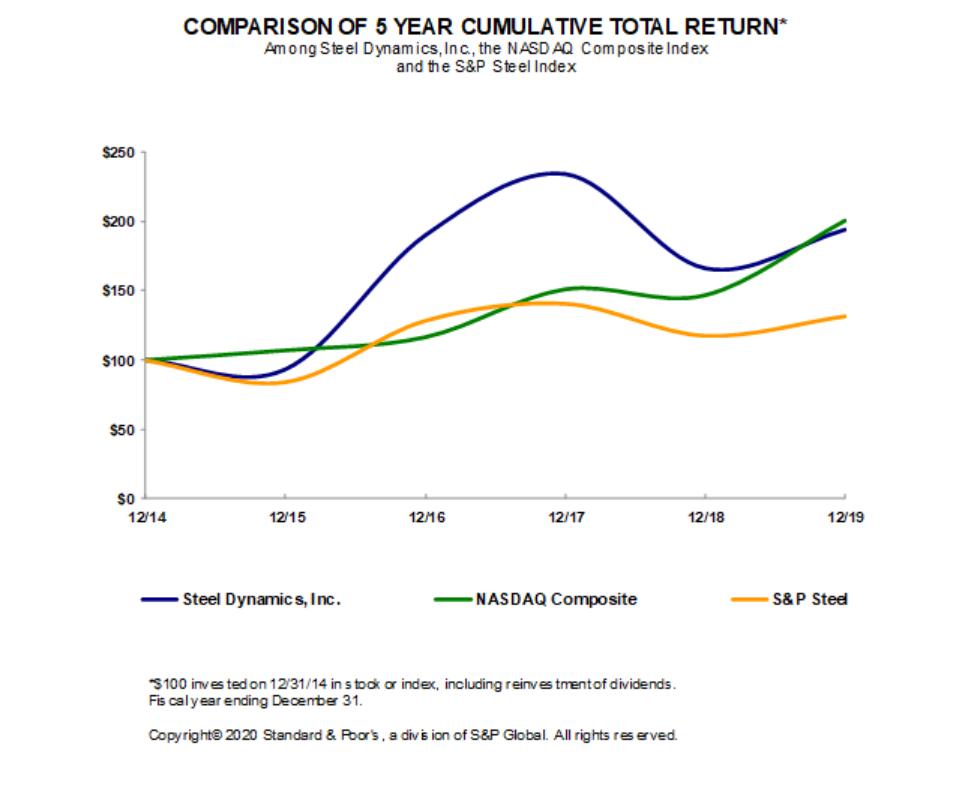][added: ]
During the quarter ended December 31, 2020, we did not purchase any of our equity securities that are registered under Section 12(b) of the Exchange Act.
At December 31, 2020, we had $444.0 million remaining available to purchase our equity securities under our share repurchase program.
We purchased the following equity securities registered by us pursuant to Section 12 of the Exchange Act during the three months ended December 31, 2019.
| | | | | | | | | | | | |
| --- | --- | --- | --- | --- | --- | --- | --- | --- | --- | --- | --- |
| Period | | Total Number of Shares Purchased | | Average Price Paid per Share | | | Total Number of Shares Purchased as Part of Publicly Announced Program (1) | | | Maximum Dollar Value of Shares That May Yet be Purchased Under the Program (in thousands) (1) | |
| Quarter ended December 31, 2019 | | | | | | | | | | | |
| October 1-31 | | 289,185 | | $ | 28.06 | | | 289,185 | | $ | 98,640 |
| November 1-30 | | 1,001,283 | | | 31.71 | | | 1,001,283 | | | 66,885 |
| December 1 - 31 | | 472,793 | | | 34.57 | | | 472,793 | | | 50,540 |
| | | 1,763,261 | | | | | | 1,763,261 | | | |
| (1) | On September 4, 2018, we announced that our board of directors had authorized a share repurchase program of up to $750.0 million of our common stock. |
| --- | --- |
Item 6. SELECTED FINANCIAL DATA
26 rewritten, 4 added, 2 removed, 34 unchanged
The following table sets forth the selected consolidated financial and operating data of Steel Dynamics, Inc. The selected consolidated operating, other financial and balance sheet data, as of and for each of the years in the five-year period ended December 31, [removed: 2019,] [added: 2020,] were derived from our audited consolidated financial statements.
| | ● | On March 1, 2019, we completed the acquisition of 75% of the equity interest of United Steel Supply, [removed: LLC (USS),] [added: LLC,] for a total cash purchase price of $97.1 million. USS operations are reflected in our steel operations from the date of acquisition. |
| | [removed: 2019] [added: 2020] | | | [removed: 2018] [added: 2019] | | | [removed: 2017] [added: 2018] | | | [removed: 2016] [added: 2017] | | | [removed: 2015] [added: 2016] | |
| Net sales | $ | [removed: 10,464,991] [added: 9,601,482] | | $ | [removed: 11,821,839] [added: 10,464,991] | | $ | [removed: 9,538,797] [added: 11,821,839] | | $ | [removed: 7,777,109] [added: 9,538,797] | | $ | [removed: 7,594,411] [added: 7,777,109] |
| Gross profit | | [removed: 1,530,984] [added: 1,434,728] | | | [removed: 2,322,814] [added: 1,530,984] | | | [removed: 1,582,014] [added: 2,322,814] | | | [removed: 1,334,864] [added: 1,582,014] | | | [removed: 731,718] [added: 1,334,864] |
| Operating income [removed: (loss)] | | [removed: 986,880] [added: 847,142] | | | [removed: 1,722,409] [added: 986,880] | | | [removed: 1,066,881] [added: 1,722,409] | | | [removed: 727,966] [added: 1,066,881] | | | [removed: (72,784)] [added: 727,966] |
| Asset impairment charges reflected in operating income [removed: (loss)] | | [removed: \-] [added: (19,409)] | | | \- | | | \- | | | [removed: (132,839)] [added: \-] | | | [removed: (428,500)] [added: (132,839)] |
| Net income [removed: (loss)] | | [removed: 677,900] [added: 570,828] | | | [removed: 1,255,805] [added: 677,900] | | | [removed: 805,796] [added: 1,255,805] | | | [removed: 360,006] [added: 805,796] | | | [removed: (145,170)] [added: 360,006] |
| Net income [removed: (loss)] attributable to Steel Dynamics, Inc. | | [removed: 671,103] [added: 550,822] | | | [removed: 1,258,379] [added: 671,103] | | | [removed: 812,741] [added: 1,258,379] | | | [removed: 382,115] [added: 812,741] | | | [removed: (130,311)] [added: 382,115] |
| Basic earnings [removed: (loss)] per share | $ | [removed: 3.06] [added: 2.61] | | $ | [removed: 5.38] [added: 3.06] | | $ | [removed: 3.38] [added: 5.38] | | $ | [removed: 1.57] [added: 3.38] | | $ | [removed: (0.54)] [added: 1.57] |
| Weighted average common shares outstanding | | [removed: 219,639] [added: 211,140] | | | [removed: 233,923] [added: 219,639] | | | [removed: 240,132] [added: 233,923] | | | [removed: 243,576] [added: 240,132] | | | [removed: 242,017] [added: 243,576] |
| Diluted earnings [removed: (loss)] per share | $ | [removed: 3.04] [added: 2.59] | | $ | [removed: 5.35] [added: 3.04] | | $ | [removed: 3.36] [added: 5.35] | | $ | [removed: 1.56] [added: 3.36] | | $ | [removed: (0.54)] [added: 1.56] |
| equivalents outstanding | | [removed: 220,748] [added: 212,345] | | | [removed: 235,193] [added: 220,748] | | | [removed: 241,781] [added: 235,193] | | | [removed: 245,298] [added: 241,781] | | | [removed: 242,017] [added: 245,298] |
| Dividends declared per share | $ | [removed: 0.96] [added: 1.00] | | $ | [removed: 0.75] [added: 0.96] | | $ | [removed: 0.62] [added: 0.75] | | $ | [removed: 0.56] [added: 0.62] | | $ | [removed: 0.55] [added: 0.56] |
| Capital expenditures | $ | [removed: 451,945] [added: 1,198,055] | | $ | [removed: 239,390] [added: 451,945] | | $ | [removed: 164,935] [added: 239,390] | | $ | [removed: 198,160] [added: 164,935] | | $ | [removed: 114,501] [added: 198,160] |
| Steel operations segment (net tons) | | [removed: 10,816,641] [added: 10,718,333] | | | [removed: 10,609,763] [added: 10,816,641] | | | [removed: 9,726,977] [added: 10,609,763] | | | [removed: 9,245,946] [added: 9,726,977] | | | [removed: 8,328,150] [added: 9,245,946] |
| Ferrous metals (gross tons) | | [removed: 4,627,214] [added: 4,591,881] | | | [removed: 5,123,553] [added: 4,627,214] | | | [removed: 4,952,973] [added: 5,123,553] | | | [removed: 5,070,380] [added: 4,952,973] | | | [removed: 5,139,506] [added: 5,070,380] |
| Nonferrous metals (thousands of pounds) | | [removed: 1,068,208] [added: 977,882] | | | [removed: 1,131,412] [added: 1,068,208] | | | [removed: 1,086,799] [added: 1,131,412] | | | [removed: 1,103,505] [added: 1,086,799] | | | [removed: 1,082,777] [added: 1,103,505] |
| Steel fabrication operations segment (net tons) | | [removed: 644,411] [added: 665,679] | | | [removed: 641,698] [added: 644,411] | | | [removed: 627,274] [added: 641,698] | | | [removed: 562,725] [added: 627,274] | | | [removed: 492,875] [added: 562,725] |
| Number of employees | | [removed: 8,385] [added: 9,625] | | | [removed: 8,200] [added: 8,385] | | | [removed: 7,635] [added: 8,200] | | | [removed: 7,695] [added: 7,635] | | | [removed: 7,510] [added: 7,695] |
| Cash and equivalents and short-term investments | $ | [removed: 1,643,634] [added: 1,368,618] | | $ | [removed: 1,057,003] [added: 1,643,634] | | $ | [removed: 1,028,649] [added: 1,057,003] | | $ | [removed: 841,483] [added: 1,028,649] | | $ | [removed: 727,032] [added: 841,483] |
| Property, plant and equipment, net | | [removed: 3,135,886] [added: 4,105,569] | | | [removed: 2,945,767] [added: 3,135,886] | | | [removed: 2,675,904] [added: 2,945,767] | | | [removed: 2,787,215] [added: 2,675,904] | | | [removed: 2,951,210] [added: 2,787,215] |
| Total assets | | [removed: 8,275,765] [added: 9,265,562] | | | [removed: 7,703,563] [added: 8,275,765] | | | [removed: 6,855,732] [added: 7,703,563] | | | [removed: 6,423,732] [added: 6,855,732] | | | [removed: 6,202,082] [added: 6,423,732] |
| Long-term debt (including current maturities) | | [removed: 2,734,344] [added: 3,102,676] | | | [removed: 2,376,723] [added: 2,734,344] | | | [removed: 2,381,940] [added: 2,376,723] | | | [removed: 2,356,826] [added: 2,381,940] | | | [removed: 2,594,656] [added: 2,356,826] |
| Equity | | [removed: 3,921,241] [added: 4,189,612] | | | [removed: 3,775,989] [added: 3,921,241] | | | [removed: 3,195,068] [added: 3,775,989] | | | [removed: 2,777,459] [added: 3,195,068] | | | [removed: 2,545,111] [added: 2,777,459] |
| Shares outstanding [removed: (in thousands)] | | [removed: 214,503] [added: 210,914] | | | [removed: 225,272] [added: 214,503] | | | [removed: 237,397] [added: 225,272] | | | [removed: 243,785] [added: 237,397] | | | [removed: 243,090] [added: 243,785] |
| | ● | Construction of the Southwest-Sinton Flat Roll Division (Sinton) began in 2019, with operations planned to begin mid-year 2021. Capital expenditures for Sinton were $927.7 million in 2020 and $205.1 million in 2019. |
| | ● | On August 3, 2020, we completed the acquisition of Zimmer for a total cash purchase price of $60.0 million. Zimmer operations, including its approximately 1,000 employees, are reflected in our metals recycling operations from the date of acquisition. |
| --- | --- | --- |
| Steel mill production (net tons) | | 9,620,207 | | | 9,466,955 | | | 9,836,979 | | | 9,119,207 | | | 8,693,800 |
| | ● | In the fourth quarter of 2015, we recorded a pretax non-cash asset impairment charge related to goodwill, trade name and certain other assets associated with OmniSource, which reduced 2015 operating income by $428.5 million, and net income and net income attributable to Steel Dynamics, Inc. by $268.7 million, and basic and diluted earnings per share by $1.11. |
| Steel operations segment production (net tons) | | 10,898,744 | | | 10,899,776 | | | 9,995,082 | | | 9,503,465 | | | 8,528,885 |
Item 8. CONSOLIDATED FINANCIAL STATEMENTS AND SUPPLEMENTARY DATA
373 rewritten, 137 added, 148 removed, 665 unchanged
| [Management’s Report on Internal Control Over Financial Reporting](#MANAGEMENTSREPORTONINTERNALCONTROL_58491) | | [removed: 45] [added: 47] |
| [Reports of Independent Registered Public Accounting Firm](#REPORTOFINDEPENDENTREGISTEREDPUBLICACCOU) | | [removed: 46] [added: 48] |
| [Consolidated Balance Sheets as of December 31, [removed: 2019] [added: 2020] and [removed: 2018](#CONSOLIDATEDBALANCESHEETS_923745)] [added: 2019](#CONSOLIDATEDBALANCESHEETS_923745)] | | [removed: 49] [added: 51] |
| [Consolidated Statements of Income for each of the three years in the period ended December 31, [removed: 2019](#CONSOLIDATEDSTATEMENTSOFINCOME_871598)] [added: 2020](#CONSOLIDATEDSTATEMENTSOFINCOME_871598)] | | [removed: 50] [added: 52] |
| [Consolidated Statements of Comprehensive Income for each of the three years in the period ended December 31, [removed: 2019](#COMPREHENSIVEINCOME_913078)] [added: 2020](#COMPREHENSIVEINCOME_913078)] | | [removed: 51] [added: 53] |
| [Consolidated Statements of Equity for each of the three years in the period ended December 31, [removed: 2019](#CONSOLIDATEDSTATEMENTSOFEQUITY_192323)] [added: 2020](#CONSOLIDATEDSTATEMENTSOFEQUITY_192323)] | | [removed: 52] [added: 54] |
| [Consolidated Statements of Cash Flows for each of the three years in the period ended December 31, [removed: 2019](#CONSOLIDATEDSTATEMENTSOFCASHFLOWS_963353)] [added: 2020](#CONSOLIDATEDSTATEMENTSOFCASHFLOWS_963353)] | | [removed: 53] [added: 55] |
| [Notes to Consolidated Financial Statements](#Note1DescriptionoftheBusinessandSummaryo) | | [removed: 54] [added: 56] |
In conducting our evaluation of the effectiveness of our internal control over financial reporting as of December 31, [removed: 2019,] [added: 2020,] we have elected to exclude [removed: USS] [added: Zimmer] from our evaluation in the year of acquisition as permitted by the Securities and Exchange Commission.
[removed: USS] [added: Zimmer] constituted approximately [removed: 3%] [added: 1%] of the company’s total and net assets as of December 31, [removed: 2019,] [added: 2020,] and [removed: 3%] [added: 1%] of the company’s net sales for the year then ended.
Based on that evaluation, management concluded that our internal control over financial reporting was effective as of December 31, [removed: 2019,] [added: 2020,] the end of the period covered by this report.
To the Stockholders and the Board of Directors [added: of] Steel Dynamics, Inc.
We have audited Steel Dynamics, Inc.’s internal control over financial reporting as of December 31, [removed: 2019,] [added: 2020,] based on criteria established in Internal Control—Integrated Framework issued by the Committee of Sponsoring Organizations of the Treadway Commission (2013 framework) (the COSO criteria).
In our opinion, Steel Dynamics, Inc. (the Company) maintained, in all material respects, effective internal control over financial reporting as of December 31, [removed: 2019,] [added: 2020,] based on the COSO criteria.
As indicated in the accompanying Management's Report on Internal Control Over Financial Reporting, management's assessment of and conclusion on the effectiveness of internal control over financial reporting did not include the internal controls of [removed: United Steel Supply, LLC,] [added: Zimmer, S.A. de C.V.,] which is included in the [removed: 2019] [added: 2020] consolidated financial statements of the Company and constituted [removed: 3%] [added: 1%] of total and net assets, respectively, as of December 31, [removed: 2019] [added: 2020] and [removed: 3%] [added: 1%] of net sales for the year then ended.
Our audit of internal control over financial reporting of the Company also did not include an evaluation of the internal control over financial reporting of [removed: United Steel Supply, LLC.][added: Zimmer, S.A. de C.V.]
We also have audited, in accordance with the standards of the Public Company Accounting Oversight Board (United States) (PCAOB), the consolidated balance sheets of Steel Dynamics, Inc. as of December 31, [removed: 2019] [added: 2020] and [removed: 2018,] [added: 2019,] the related consolidated statements of income, comprehensive income, equity, and cash flows for each of the three years in the period ended December 31, [removed: 2019,] [added: 2020,] and the related notes and our report dated [removed: February 27, 2020,] [added: March 1, 2021] expressed an unqualified opinion thereon.
We have audited the accompanying consolidated balance sheets of Steel Dynamics, Inc. (the Company) as of December 31, [removed: 2019] [added: 2020] and [removed: 2018,] [added: 2019,] the related consolidated statements of income, comprehensive income, equity and cash flows for each of the three years in the period ended December 31, [removed: 2019,] [added: 2020,] and the related notes (collectively referred to as the “consolidated financial statements”).
In our opinion, the consolidated financial statements present fairly, in all material respects, the financial position of the Company at December 31, [removed: 2019] [added: 2020] and [removed: 2018,] [added: 2019,] and the results of its operations and its cash flows for each of the three years in the period ended December 31, [removed: 2019,] [added: 2020,] in conformity with U.S. generally accepted accounting principles.
We have also audited, in accordance with the standards of the Public Company Accounting Oversight Board (United States) (PCAOB), the Company’s internal control over financial reporting as of December 31, [removed: 2019,] [added: 2020,] based on criteria established in Internal Control-Integrated Framework issued by the Committee of Sponsoring Organizations of the Treadway Commission (2013 framework), and our report dated [removed: February 27, 2020] [added: March 1, 2021] expressed an unqualified opinion thereon.
Critical Audit [removed: Matters][added: Matter]
The critical audit [removed: matters] [added: matter] communicated below [removed: are matters] [added: is a matter] arising from the current period audit of the financial statements that [removed: were] [added: was] communicated or required to be communicated to the audit committee and that: (1) [removed: relate] [added: relates] to accounts or disclosures that are material to the financial statements and (2) involved our especially challenging, subjective or complex judgments.
The communication of [added: the] critical audit [removed: matters] [added: matter] does not alter in any way our opinion on the consolidated financial statements, taken as a whole, and we are not, by communicating the critical audit [removed: matters] [added: matter] below, providing [added: a] separate [removed: opinions] [added: opinion] on the critical audit [removed: matters] [added: matter] or on the [removed: accounts] [added: account] or [removed: disclosures] [added: disclosure] to which [removed: they relate.][added: it relates.]
[removed: | | |] Valuation of Goodwill [removed: |]
[removed: | _Description of the Matter_ | | At December 31, 2019, the Company’s goodwill was approximately $453 million.] As discussed in Note 1 of the consolidated financial statements, the Company performs an impairment test for goodwill at least annually or when indicators of impairment exist. [removed: |]
[removed: | | | Auditing management’s goodwill impairment test was complex and judgmental due to the significant estimation required to determine the fair value of the reporting units.] In particular, the fair value estimate was sensitive to significant assumptions, such as estimates of future cash flows and changes in the risk-adjusted discount rate, which are affected by expectations about future market or economic conditions and the impact of planned business and operation strategies. [removed: |]
[removed: | _How] We [removed: Addressed the Matter in Our Audit_ | | We] obtained an understanding, evaluated the design and tested the operating effectiveness of controls over the Company’s goodwill impairment review process, including controls over management’s review of the assumptions and methodologies used in the calculation of the fair value of the reporting units, as well as the Company’s review of the completeness and accuracy of the data used in the Company’s analysis. [removed: |]
[removed: | | |] To test the estimated fair value of each of the Company’s reporting units, we performed audit procedures that included, among others, testing the underlying assumptions used in the Company’s analysis, testing the completeness and accuracy of the underlying estimates of future cash flows used by management and testing the calculation of the fair value of each reporting unit. [removed: We compared the assumptions used by management to historical results. We assessed the historical accuracy of management’s estimates and performed sensitivity analyses over certain assumptions used by management to evaluate the changes in the fair value of each of the reporting units that would result from changes in those assumptions. In addition, we involved our specialist to assist with our evaluation of the methodologies applied and assumptions used by management. |]
| Assets | [removed: 2019] [added: 2020] | | | | [removed: 2018] [added: 2019] | |
| Cash and equivalents | $ | [removed: 1,381,460] [added: 1,368,618] | | | $ | [removed: 828,220] [added: 1,381,460] |
| Short-term investments | | [removed: 262,174] [added: \-] | | | | [removed: 228,783] [added: 262,174] |
| December 31, [removed: 2019,] [added: 2020,] and December 31, [removed: 2018,] [added: 2019,] respectively | | [removed: 841,378] [added: 967,981] | | | | [removed: 1,040,220] [added: 841,378] |
| Accounts receivable-related parties | | [removed: 2,958] [added: 3,937] | | | | [removed: 3,536] [added: 2,958] |
| Inventories | | [removed: 1,689,043] [added: 1,843,548] | | | | [removed: 1,859,168] [added: 1,689,043] |
| Other current assets | | [removed: 76,012] [added: 74,363] | | | | [removed: 72,730] [added: 76,012] |
| Total current assets | | [removed: 4,253,025] [added: 4,258,447] | | | | [removed: 4,032,657] [added: 4,253,025] |
| Property, plant and equipment, net | | [removed: 3,135,886] [added: 4,105,569] | | | | [removed: 2,945,767] [added: 3,135,886] |
| Goodwill | | [removed: 452,915] [added: 457,226] | | | | [removed: 429,645] [added: 452,915] |
| Other assets | | [removed: 106,038] [added: 119,743] | | | | [removed: 25,166] [added: 106,038] |
| Total assets | $ | [removed: 8,275,765] [added: 9,265,562] | | | $ | [removed: 7,703,563] [added: 8,275,765] |
We acquired Zimmer, S.A. de C.V. “Zimmer” on August 3, 2020.
March 1, 2021
To the Stockholders and the Board of Directors of Steel Dynamics, Inc.
_Description of the Matter_
At December 31, 2020, the Company’s goodwill was approximately $457 million.
Auditing management’s goodwill impairment test was complex and judgmental due to the significant estimation required to determine the fair value of the reporting units.
_How We Addressed the Matter in Our Audit_
We compared the assumptions used by management to historical results.
We assessed the historical accuracy of management’s estimates and performed sensitivity analyses over certain assumptions used by management to evaluate the changes in the fair value of each of the reporting units that would result from changes in those assumptions.
In addition, we involved our specialist to assist with our evaluation of the methodologies applied and assumptions used by management.
March 1, 2021
| Accounts receivable, net of allowances for credit losses of $8,209 and $6,387 as of | | | | | | |
| Intangible assets, net | | 324,577 | | | | 327,901 |
| Asset impairment charges | | 19,409 | | | \- | | | \- |
| Dividends declared | | \- | | | \- | | | \- | | | \- | | | \- | | | (210,496) | | | \- | | | \- | | | (210,496) | | | \- |
| Noncontrolling investors, net | | \- | | | \- | | | \- | | | \- | | | \- | | | \- | | | \- | | | (20,965) | | | (20,965) | | | 15,000 |
| Share repurchases | | (4,402) | | | 4,402 | | | \- | | | (106,529) | | | \- | | | \- | | | \- | | | \- | | | (106,529) | | | \- |
| Equity-based compensation | | 813 | | | (268) | | | 2 | | | 7,895 | | | 26,380 | | | (653) | | | \- | | | \- | | | 33,624 | | | \- |
| Net income | | \- | | | \- | | | \- | | | \- | | | \- | | | 550,822 | | | \- | | | 20,006 | | | 570,828 | | | \- |
| Other comprehensive income, net of tax | | \- | | | \- | | | \- | | | \- | | | \- | | | \- | | | 1,909 | | | \- | | | 1,909 | | | \- |
| Balances at December 31, 2020 | | 210,914 | | | 55,704 | | $ | 648 | | $ | (1,623,747) | | $ | 1,207,392 | | $ | 4,758,969 | | $ | 1,902 | | $ | (155,552) | | $ | 4,189,612 | | $ | 158,614 |
| Asset impairment charges | | 19,409 | | | \- | | | \- |
Redeemable noncontrolling interests related to Mesabi Nugget (owned 84% by SDI) are $111.2 million at December 31, 2020, and 2019.
Credit Losses
The company is exposed to credit risk in the event of nonpayment of accounts receivable by customers.
The company mitigates its exposure to credit risk, which it generally extends on an unsecured basis, by performing ongoing credit evaluations and taking further action if necessary, such as requiring letters of credit or other security interests to support the customer receivable.
At December 31, 2020, the company reported $971.9 million of accounts receivable, net of allowances for credit losses of $8.2 million.
| | | 2020 | | | 2019 | | |
| | | | 2020 | | | 2019 | | |
| | | | | 7,331,616 | | | 6,124,714 | |
| | 2021 | | $ | 29,232 | |
| | 2022 | | | 27,840 | |
| | 2023 | | | 27,439 | |
| | 2024 | | | 26,701 | |
| | 2025 | | | 24,783 | |
| | Thereafter | | | 188,582 | |
| | Total | | $ | 324,577 | |
Events occurred during the fourth quarter of 2020, that represented impairment indicators related to the company’s noncore oil and gas joint ventures.
Therefore, the company undertook a fourth quarter 2020 assessment of the recoverability of the carrying amounts of these joint ventures’ property, plant and equipment.
Based on the joint ventures’ outlook at the time of this 2020 assessment, the company concluded that the carrying amounts of its property, plant and equipment were fully impaired.
| --- | --- | --- |
| | | |
We acquired United Steel Supply, LLC (USS) on March 1, 2019.
February 27, 2020
| | | Acquisition |
| _Description of the Matter_ | | As described in Note 2 to the consolidated financial statements, on March 1, 2019, the Company completed an acquisition of 75% of the equity interest of United Steel Supply, LLC (USS). |
| | | Auditing the accounting for the Company's 2019 acquisition of USS was complex due to the estimation uncertainty in determining the fair value of identified intangible assets, which principally consisted of customer relationships. The significant estimation uncertainty was primarily due to the sensitivity of the respective fair value to underlying assumptions about the future performance of the acquired business. The Company used the multi-period excess earnings method to value the customer relationships. |
| _How We Addressed the Matter in Our Audit_ | | We obtained an understanding, evaluated the design and tested the operating effectiveness of controls over the Company’s acquisition process, including controls over management’s review of the assumptions and methodologies used in the calculation of fair value of customer relationships, as well as the Company’s review of the completeness and accuracy of the data used in the Company’s analysis. |
| | | To test the estimated fair value of the customer relationships, we performed audit procedures that included, among others, testing the underlying assumptions used in the Company’s analysis, testing the completeness and accuracy of the underlying data used by management, and testing the calculation of the fair value. We compared the forecasted revenue and earnings to current trends as well as the historic financial performance of the acquired business. We also performed sensitivity analyses to evaluate the changes in the fair value of the customer relationships that would result from changes in the significant assumptions. We involved our specialist to assist with our evaluation of the methodologies applied and assumptions used by management. |
| | | | | | | |
| Accounts receivable, net of related allowances of $15,867 and $17,495 as of | | | | | | |
| Intangible assets, net of accumulated amortization of $322,611 and $294,449 as of | | | | | | |
| December 31, 2019, and December 31, 2018, respectively | | 327,901 | | | | 270,328 |
| Balances at January 1, 2017 | | 243,785 | | | 20,345 | | $ | 641 | | $ | (416,829) | | $ | 1,132,749 | | $ | 2,210,459 | | $ | \- | | $ | (149,561) | | $ | 2,777,459 | | $ | 111,240 |
| Dividends declared | | \- | | | \- | | | \- | | | \- | | | \- | | | (148,231) | | | \- | | | \- | | | (148,231) | | | \- |
| Share repurchases | | (7,439) | | | 7,439 | | | \- | | | (252,242) | | | \- | | | \- | | | \- | | | \- | | | (252,242) | | | \- |
| Equity-based compensation | | 1,051 | | | (178) | | | 3 | | | 3,774 | | | 8,785 | | | (276) | | | \- | | | \- | | | 12,286 | | | \- |
| Comprehensive and net income (loss) | | \- | | | \- | | | \- | | | \- | | | \- | | | 812,741 | | | \- | | | (6,945) | | | 805,796 | | | \- |
These operations include electric arc furnace steel mills, producing steel from ferrous scrap and scrap substitutes, utilizing continuous casting, automated rolling mills, with several coating and processing lines.
The idle Minnesota ironmaking operations consist of Mesabi Nugget, (owned 84% by SDI); the company’s wholly-owned iron concentrate and potential iron mining operations, Mesabi Mining; and the company’s wholly-owned iron tailings operations, Mining Resources.
The company adopted Accounting Standards Codification ASC 606, Revenue from Contracts with Customers (ASC 606), effective January 1, 2018, using the modified retrospective approach.
We applied the standard to contracts that were not completed as of the adoption date, with no cumulative effect adjustment at date of adoption.
Accordingly, amounts and disclosures for reporting periods 2018 and 2019, are presented under ASC 606, while comparative amounts and disclosures for 2017 have not been adjusted and continue to be reported in accordance with historical accounting policies for revenue recognition prior to the adoption of ASC 606.
The balance of cash, cash equivalents and restricted cash in the consolidated statements of cash flows includes restricted cash of
Short-term investments held as of December 31, 2018, consisted of certificate of deposits ($130.0 million), commercial paper ($59.2 million), and U.S. Treasuries ($39.6 million), with contractual maturities of less than one year, when purchased.
| | | | | | | | |
| | | | | 6,124,714 | | | 5,684,970 | |
| | | $ | 327,901 | | $ | 270,328 | | | | | |
| | 2020 | | $ | 28,199 | |
| | 2021 | | | 26,202 | |
| | 2022 | | | 25,263 | |
| | 2023 | | | 23,937 | |
| | 2024 | | | 23,683 | |
| | Thereafter | | | 200,617 | |
| | | | $ | 452,915 | | $ | 429,645 | |
The increase in Steel Operations Segment goodwill at December 31, 2019 is due to the company acquiring a 75% equity interest in United Steel Supply on March 1, 2019 (refer to Note 2.
_Acquisition – United Steel Supply, LLC_), and as a result of that acquisition recorded $26.7 million of goodwill.
| | 2017 | | | | | | | | |
| Basic earnings per share | $ | 812,741 | | | 240,132 | | $ | 3.38 | |
| Diluted earnings per share | $ | 812,741 | | | 241,781 | | $ | 3.36 | |
An excerpt. Shown here: 40 of 373 rewritten, 40 of 137 added and 40 of 148 removed. The counts are complete. For every sentence, read Item 8. CONSOLIDATED FINANCIAL STATEMENTS AND SUPPLEMENTARY DATA in the FY2020 filing and the FY2019 filing.
Item 9A. CONTROLS AND PROCEDURES
3 rewritten, 0 added, 0 removed, 5 unchanged
Based on this evaluation, our principal executive officer and principal financial officer concluded that, as of December 31, [removed: 2019,] [added: 2020,] the end of the period covered by this annual report, our disclosure controls and procedures were designed to provide and were effective to provide reasonable assurance that the information required to be disclosed by us in the reports we file or submit under the Exchange Act is recorded, processed, summarized and reported within the time periods specified in the applicable rules and forms, and that it is accumulated and communicated to our management, including our principal executive and principal financial officer, as appropriate to allow timely decisions regarding required disclosure.
No changes in our internal control over financial reporting (as defined in Rules 13a-15(f) and 15d-15(f) under the Exchange Act) occurred during the fiscal quarter ended December 31, [removed: 2019,] [added: 2020,] that has materially affected, or is reasonably likely to materially affect, our internal control over financial reporting.
Our Management’s Report on Internal Control Over Financial Reporting, as of December 31, [removed: 2019,] [added: 2020,] can be found on page [removed: 45] [added: 47] of this Form 10-K, and the related Report of Independent Registered Public Accounting Firm, Ernst & Young LLP, can be found on page [removed: 46] [added: 48] of this Form 10-K, each of which is incorporated by reference into this Item 9A.
Item 10. DIRECTORS, EXECUTIVE OFFICERS, AND CORPORATE GOVERANCE
1 rewritten, 0 added, 0 removed, 0 unchanged
The information required to be furnished pursuant to Item 10 with respect to directors, executive officers, code of ethics, and audit committee and audit committee financial experts is incorporated herein by reference from the section entitled “Governance of the Company” and “Election of Directors” in our Proxy Statement for the [removed: 2020] [added: 2021] Annual Meeting of Stockholders, which we will file with the Securities and Exchange Commission no later than 120 days after the end of our fiscal year.
Item 11. EXECUTIVE COMPENSATION
1 rewritten, 0 added, 0 removed, 0 unchanged
The information required to be furnished pursuant to Item 11 with respect to executive compensation is incorporated herein by reference from the section entitled “Executive Compensation and Related Information” in our Proxy Statement for the [removed: 2020] [added: 2021] Annual Meeting of Stockholders, which we will file with the Securities and Exchange Commission no later than 120 days after the end of our fiscal year.
Item 12. SECURITY OWNERSHIP OF CERTAIN BENEFICIAL OWNERS AND MANAGEMENT AND RELATED STOCKHOLDER MATTERS
3 rewritten, 3 added, 4 removed, 18 unchanged
The information relating to security ownership of certain beneficial owners and management required by Item 12 is incorporated herein by reference from the section entitled “Security Ownership of Directors and Executive Officers” and “Security Ownership of Certain Beneficial Owners” in our Proxy Statement for the [removed: 2020] [added: 2021] Annual Meeting of Stockholders, which we will file with the Securities and Exchange Commission no later than 120 days after the end of our fiscal year.
The following table summarizes information about our equity compensation plans at December 31, [removed: 2019,] [added: 2020,] all of which have been approved by stockholders.
| (1) | Includes [removed: 1,558,472] [added: 1,698,579] RSUs, [removed: 252,819] [added: 276,866] DSUs, and [removed: 483,595] [added: 432,885] LTIP awards issuable upon expiration of the vesting or deferral periods, which have no exercise price. |
| 2015 Plan and predecessor 2006 Plan (1) | | 2,408,330 | | — | | 6,173,243 |
| 2018 Plan | | 300,487 | | — | | 1,547,064 |
| Total | | 2,708,817 | | — | | 7,220,307 |
Our stockholders approved the _Steel Dynamics, Inc. 2013 Equity Incentive Compensation Plan_ (2013 Plan) at our annual meeting of stockholders held May 16, 2013.
| 2015 Plan and predecessor 2006 Plan (1) | | 2,294,895 | | — | | 8,730,479 |
| 2018 Plan and predecessor 2013 Plan | | 293,423 | | — | | 1,696,361 |
| Total | | 2,588,318 | | — | | 10,426,840 |
Item 13. CERTAIN RELATIONSHIPS AND RELATED TRANSACTIONS, AND DIRECTOR INDEPENDENCE
3 rewritten, 0 added, 0 removed, 0 unchanged
The information required to be furnished pursuant to Item 13 with respect to certain relationships and related transactions is incorporated herein by reference from the sections entitled “Statement of Policy for the Review, Approval or Ratification of Transactions with Related Persons,” and “Governance of the Company – Director Independence” in our Proxy Statement for the [removed: 2020] [added: 2021] Annual Meeting of Stockholders, which we will file with the Securities and Exchange Commission no later than 120 days after the end of our fiscal year; and from Note 10.
_Transactions with Affiliated Companies_ to our consolidated financial statements as of December 31, [removed: 2019] [added: 2020] and [removed: 2018,] [added: 2019,] and each of the three years in the periods ended December 31, [added: 2020,] 2019, [removed: 2018,] and [removed: 2017,] [added: 2018,] included in Item 8.
_Consolidated Financial Statements and Supplementary Data_ of this Form 10-K Annual Report for the fiscal year ended December 31, [removed: 2019.][added: 2020.]
Item 14. PRINCIPAL ACCOUNTANT FEES AND SERVICES
1 rewritten, 0 added, 0 removed, 1 unchanged
The information required to be furnished pursuant to Item 14 with respect to principal accountant fees and services is incorporated herein by reference from the sections entitled “Audit and Non-Audit Fees” and “Policy on Audit Committee Pre-Approval of Audit and Permissible Non-Audit Services of Independent Auditor” in our Proxy Statement for the [removed: 2020] [added: 2021] Annual Meeting of Stockholders, which we will file with the Securities and Exchange Commission no later than 120 days after the end of our fiscal year.
Item 15. EXHIBITS, FINANCIAL STATEMENT SCHEDULES
2 rewritten, 0 added, 0 removed, 6 unchanged
Financial Statements: See the Audited Consolidated Financial Statements of Steel [removed: Dynamics] [added: Dynamics,] Inc. included as part of Item 8.
_Consolidated Financial Statements and Supplementary Data_ and described in the Index on page [removed: 44] [added: 46] of this Report.
Item 16. FORM 10-K SUMMARY
44 rewritten, 8 added, 4 removed, 102 unchanged
| 3.1 | [Amended and Restated Articles of Incorporation of Steel Dynamics, Inc., reflecting all amendments thereto through May 17, 2018, incorporated herein by reference from Exhibit 3.1e to our Form 10-Q filed August 9, [removed: 2018.](http://www.sec.gov/Archives/edgar/data/1022671/000114420418043346/stld-20180630xex3_1e.htm)] [added: 2018.](https://www.sec.gov/Archives/edgar/data/1022671/000114420418043346/stld-20180630xex3_1e.htm)] |
| 3.2 | [Amended and Restated Bylaws of Steel Dynamics, Inc., reflecting all amendments thereto through October 17, 2018, incorporated herein by reference from Exhibit 3.2d to our Form 10-Q filed November 7, [removed: 2018.](http://www.sec.gov/Archives/edgar/data/1022671/000114420418057915/stld-20180930xex3_2d.htm)] [added: 2018.](https://www.sec.gov/Archives/edgar/data/1022671/000114420418057915/stld-20180930xex3_2d.htm)] |
| [removed: 4.1*] [added: 4.1] | [Description of Common [removed: Stock](https://www.sec.gov/Archives/edgar/data/1022671/000155837020001641/ex-4d1.htm)] [added: Stock, incorporated herein by reference from Exhibit 4.1 to our Form 10-K filed February 27, 2020.](https://www.sec.gov/Archives/edgar/data/1022671/000155837020001641/ex-4d1.htm)] |
| [removed: 4.20] [added: 4.27a] | [Indenture [added: dated December 6, 2016,] relating to our issuance of $400 million [removed: of 51/4%] [added: 5.000%] Senior Notes due [removed: 2023,] [added: 2026,] among Steel Dynamics, Inc., as Issuer, the Initial Subsidiary [removed: Guarantors,] [added: Guarantors named therein,] and Wells Fargo Bank, National Association, as Trustee, [removed: dated as of March 26, 2013,] incorporated herein by reference from Exhibit [removed: 4.20] [added: 4.27] to our Form 8-K filed [removed: March 28, 2013.](http://www.sec.gov/Archives/edgar/data/1022671/000110465913025395/a13-9002_1ex4d20.htm)] [added: December 8, 2016.](https://www.sec.gov/Archives/edgar/data/1022671/000110465916161262/a16-22813_1ex4d27.htm)] |
| [removed: 4.24] [added: 4.32] | [removed: [Indenture] [added: [First Supplemental Indenture] dated [removed: September 9, 2014,] [added: December 11, 2019,] relating to our issuance of [removed: $500] [added: $400] million [removed: 5.500% Senior] [added: 2.800%] Notes due 2024, [added: and $600 million 3.450% Notes due 2030] among Steel Dynamics, Inc., as Issuer, [removed: the Initial Subsidiary Guarantors named therein,] and Wells Fargo Bank, National Association, as Trustee, incorporated herein by reference from Exhibit [removed: 4.24] [added: 4.2] to our Form 8-K filed [removed: September 12, 2014.](http://www.sec.gov/Archives/edgar/data/1022671/000110465914066060/a14-20744_1ex4d24.htm)] [added: December 11, 2019.](https://www.sec.gov/Archives/edgar/data/1022671/000110465919071897/tm1924646d4_ex4-2.htm)] |
| [removed: 4.27] [added: 4.27b] | [removed: [Indenture dated December 6, 2016, relating to our issuance] [added: [Form] of [removed: $400 million] 5.000% Senior Notes due [removed: 2026, among Steel Dynamics, Inc., as Issuer, the Initial Subsidiary Guarantors named therein, and Wells Fargo Bank, National Association, as Trustee,] [added: 2026 (included in Exhibit 4.27a),] incorporated herein by reference from Exhibit 4.27 to our Form 8-K filed December 8, [removed: 2016.](http://www.sec.gov/Archives/edgar/data/1022671/000110465916161262/a16-22813_1ex4d27.htm)] [added: 2016.](https://www.sec.gov/Archives/edgar/data/1022671/000110465916161262/a16-22813_1ex4d27.htm)] |
| [removed: 4.30] [added: 4.35] | [removed: [Indenture] [added: [Second Supplemental Indenture,] dated [removed: September 13, 2017,] [added: as of June 5, 2020,] relating to our issuance of [removed: $350] [added: $400] million [removed: 4.125% Senior] [added: 2.400%] Notes due [removed: 2025, among] [added: 2025 and $500 million 3.250% Notes due 2031, between] Steel Dynamics, [removed: Inc., as Issuer, the Initial Subsidiary Guarantors named therein,] [added: Inc.] and Wells Fargo Bank, National Association, as Trustee, incorporated herein by reference from Exhibit [removed: 4.30] [added: 4.2] to our Form 8-K filed [removed: September 13, 2017.](http://www.sec.gov/Archives/edgar/data/1022671/000110465917056953/a17-21927_1ex4d30.htm)] [added: June 5, 2020.](https://www.sec.gov/Archives/edgar/data/1022671/000110465920070271/tm2021405d4_ex4-2.htm)] |
| 4.31 | [Indenture dated December 4, 2019, among Steel Dynamics, Inc., as Issuer, and Wells Fargo Bank, National Association, as Trustee, incorporated herein by reference from Exhibit 4.1 to our Registration Statement on Form S-3 (Registration No. 333-235343) filed December 4, [removed: 2019.](http://www.sec.gov/Archives/edgar/data/1022671/000110465919069748/a19-24378_1ex4d1.htm)] [added: 2019.](https://www.sec.gov/Archives/edgar/data/1022671/000110465919069748/a19-24378_1ex4d1.htm)] |
| [removed: 4.32] [added: 4.38] | [removed: [First] [added: [Third] Supplemental [removed: Indenture] [added: Indenture,] dated [removed: December 11, 2019,] [added: as of October 9, 2020,] relating to our issuance of [removed: $400] [added: $350] million [removed: 2.800%] [added: 1.650%] Notes due [removed: 2024,] [added: 2027] and [removed: $600] [added: $400] million [removed: 3.450%] [added: 3.250%] Notes due [removed: 2030 among] [added: 2050, between] Steel Dynamics, [removed: Inc., as Issuer,] [added: Inc.] and Wells Fargo Bank, National Association, as Trustee, incorporated herein by reference from Exhibit 4.2 to our Form 8-K filed [removed: December 11, 2019.](http://www.sec.gov/Archives/edgar/data/1022671/000110465919071897/tm1924646d4_ex4-2.htm)] [added: October 9, 2020.](https://www.sec.gov/Archives/edgar/data/1022671/000110465920113839/tm2032546d4_ex4-2.htm)] |
| 4.33 | [Form of 2.800% Notes due 2024 (included in Exhibit 4.32), incorporated herein by reference from Exhibit 4.3 to our Form 8-K filed December 11, [removed: 2019.](http://www.sec.gov/Archives/edgar/data/1022671/000110465919071897/tm1924646d4_ex4-2.htm)] [added: 2019.](https://www.sec.gov/Archives/edgar/data/1022671/000110465919071897/tm1924646d4_ex4-2.htm)] |
| 4.34 | [Form of 3.450% Notes due 2030 (included in Exhibit 4.32), incorporated herein by reference from Exhibit 4.4 to our Form 8-K filed December 11, [removed: 2019.](http://www.sec.gov/Archives/edgar/data/1022671/000110465919071897/tm1924646d4_ex4-2.htm)] [added: 2019.](https://www.sec.gov/Archives/edgar/data/1022671/000110465919071897/tm1924646d4_ex4-2.htm)] |
| 10.20† | [Steel Dynamics, Inc., Change in Control Benefit Plan, incorporated herein by reference from our [removed: Exhibit10.20] [added: Exhibit 10.20] to our 8-K filed December 4, [removed: 2012.](http://www.sec.gov/Archives/edgar/data/1022671/000110465912081791/a12-28484_2ex10d20.htm)] [added: 2012.](https://www.sec.gov/Archives/edgar/data/1022671/000110465912081791/a12-28484_2ex10d20.htm)] |
| 10.41b† | [Amended and Restated Steel Dynamics, Inc. 2006 Equity Incentive Plan, as approved by shareholders on May 17, 2012, incorporated herein by reference from our Exhibit 10.41b to our 8-K filed August 21, [removed: 2012.](http://www.sec.gov/Archives/edgar/data/1022671/000110465912059308/a12-18802_1ex10d41b.htm)] [added: 2012.](https://www.sec.gov/Archives/edgar/data/1022671/000110465912059308/a12-18802_1ex10d41b.htm)] |
| 10.52† | [Director Agreement between the Company and Keith E. Busse, dated October 14, 2011, incorporated herein by reference from Exhibit 10.52 to our Form 8-K filed October 20, [removed: 2011.](http://www.sec.gov/Archives/edgar/data/1022671/000110465911056989/a11-28331_1ex10d52.htm)] [added: 2011.](https://www.sec.gov/Archives/edgar/data/1022671/000110465911056989/a11-28331_1ex10d52.htm)] |
| [removed: 10.53†] [added: 10.61†] | [removed: [2013] [added: [2018] Executive Incentive Compensation Plan, approved by stockholders on May [removed: 16, 2013,] [added: 17, 2018,] incorporated herein by reference from our May [removed: 16, 2013,] [added: 17, 2018,] Notice of Annual Meeting of Stockholders filed March [removed: 27, 2013.](http://www.sec.gov/Archives/edgar/data/1022671/000104746913003445/a2213986zdef14a.htm)] [added: 28, 2018.](https://www.sec.gov/Archives/edgar/data/1022671/000104746918002209/a2235065zdef14a.htm)] |
| 10.55† | [Steel Dynamics, Inc. 2014 Employee Stock Purchase Plan, incorporated herein by reference from our May 15, 2014, Notice of Annual Meeting and Stockholders filed March 27, [removed: 2014.](http://www.sec.gov/Archives/edgar/data/1022671/000104746914003056/a2219158zdef14a.htm)] [added: 2014.](https://www.sec.gov/Archives/edgar/data/1022671/000104746914003056/a2219158zdef14a.htm)] |
| 10.59 | [Credit Agreement dated as of December 3, 2019, by and among Steel Dynamics, Inc. and the agents and lenders named therein, incorporated herein by reference from Exhibit 10.59 to our Form 8-K filed December 3, [removed: 2019.](http://www.sec.gov/Archives/edgar/data/1022671/000110465919069530/tm1924080d1_ex10-59.htm)] [added: 2019.](https://www.sec.gov/Archives/edgar/data/1022671/000110465919069530/tm1924080d1_ex10-59.htm)] |
| 10.60† | [Amended and Restated 2015 Equity Incentive Plan, as approved by shareholders on May 16, 2019, incorporated herein by reference from our May 16, 2019, Notice of Annual Meeting of Stockholders filed March 27, [removed: 2019.](http://www.sec.gov/Archives/edgar/data/1022671/000104746919001673/a2238222zdef14a.htm)] [added: 2019.](https://www.sec.gov/Archives/edgar/data/1022671/000104746919001673/a2238222zdef14a.htm)] |
| 21.1* | [List of our [removed: Subsidiaries](https://www.sec.gov/Archives/edgar/data/1022671/000155837020001641/ex-21d1.htm)] [added: Subsidiaries.](https://www.sec.gov/Archives/edgar/data/1022671/000155837021002129/stld-20201231xex21d1.htm)] |
| 23.1* | [Consent of Ernst & Young [removed: LLP.](https://www.sec.gov/Archives/edgar/data/1022671/000155837020001641/ex-23d1.htm)] [added: LLP.](https://www.sec.gov/Archives/edgar/data/1022671/000155837021002129/stld-20201231xex23d1.htm)] |
| 95* | [Mine Safety [removed: Disclosures](https://www.sec.gov/Archives/edgar/data/1022671/000155837020001641/ex-95.htm)] [added: Disclosures.](https://www.sec.gov/Archives/edgar/data/1022671/000155837021002129/stld-20201231xex95.htm)] |
| 31.1* | [Certification of Chief Executive Officer required by Item 307 of Regulation S-K as promulgated by the Securities and Exchange Commission and pursuant to Section 302 of the Sarbanes-Oxley Act of [removed: 2002.](https://www.sec.gov/Archives/edgar/data/1022671/000155837020001641/ex-31d1.htm)] [added: 2002.](https://www.sec.gov/Archives/edgar/data/1022671/000155837021002129/stld-20201231xex31d1.htm)] |
| 31.2* | [Certification of Chief Financial Officer required by Item 307 of Regulation S-K as promulgated by the Securities and Exchange Commission and pursuant to Section 302 of the Sarbanes-Oxley Act of [removed: 2002.](https://www.sec.gov/Archives/edgar/data/1022671/000155837020001641/ex-31d2.htm)] [added: 2002.](https://www.sec.gov/Archives/edgar/data/1022671/000155837021002129/stld-20201231xex31d2.htm)] |
| 32.1* | [Certification of Chief Executive Officer Pursuant to 18 U.S.C Section 1350, as Adopted Pursuant to Section 906 of the Sarbanes-Oxley Act of [removed: 2002.](https://www.sec.gov/Archives/edgar/data/1022671/000155837020001641/ex-32d1.htm)] [added: 2002.](https://www.sec.gov/Archives/edgar/data/1022671/000155837021002129/stld-20201231xex32d1.htm)] |
| 32.2* | [Certification of Chief Financial Officer Pursuant to 18 U.S.C Section 1350, as Adopted Pursuant to Section 906 of the Sarbanes-Oxley Act of [removed: 2002.](https://www.sec.gov/Archives/edgar/data/1022671/000155837020001641/ex-32d2.htm)] [added: 2002.](https://www.sec.gov/Archives/edgar/data/1022671/000155837021002129/stld-20201231xex32d2.htm)] |
| 101.SCH* | [added: Inline] XBRL Taxonomy Extension Schema Document |
| 101.CAL* | [added: Inline] XBRL Taxonomy Extension Calculation [added: Linkbase] Document |
| 101.DEF* | [added: Inline] XBRL Taxonomy Extension Definition [added: Linkbase] Document |
| 101.LAB* | [added: Inline] XBRL Taxonomy Extension Label [added: Linkbase] Document |
| 101.PRE* | [added: Inline] XBRL Taxonomy Presentation [added: Linkbase] Document |
Wagler, either of whom may act without the joinder of the other, as his or her true and lawful attorneys-in-fact and agents with full power of substitution and resubstitution, for him or her, and in his or her name, place and stead, in any and all capacities to sign any and all amendments, and supplements to this [removed: 2019] [added: 2020] Annual Report on Form 10-K, filed pursuant to Section 13 or 15(d) of the Securities Exchange Act of 1934, as amended, and to file the same, with all exhibits thereto, and all other documents in connection therewith, with the Securities and Exchange Commission, granting unto said attorneys-in-fact and agents full power and authority to do and performs each and every act and thing requisite and necessary to be done, as full to all intents and purposes as he or her might or could do in person, hereby ratifying and confirming all that said attorneys-in-fact and agents or their substitute or substitutes may lawfully do or cause to be done by virtue thereof.
Pursuant to the requirements of the Securities Exchange Act of 1934, this [removed: 2019] [added: 2020] Annual Report on Form 10-K has been signed below by the following persons on behalf of Steel Dynamics, Inc. and in the capacities and on the dates indicated.
| _/s/_ MARK D. MILLETT | Chief Executive Officer and Director | [removed: February 27, 2020] [added: March 1, 2021] |
| _/s/_ THERESA E. WAGLER | Executive Vice President and Chief Financial Officer | [removed: February 27, 2020] [added: March 1, 2021] |
| _/s/_ KEITH E. BUSSE | Director | [removed: February 27, 2020] [added: March 1, 2021] |
| _/s/_ SHEREE L. BARGABOS | Director | [removed: February 27, 2020] [added: March 1, 2021] |
| _/s/_ FRANK D. BYRNE, M.D. | Director | [removed: February 27, 2020] [added: March 1, 2021] |
| _/s/_ KENNETH W. CORNEW | Director | [removed: February 27, 2020] [added: March 1, 2021] |
| _/s/_ TRACI M. DOLAN | Director | [removed: February 27, 2020] [added: March 1, 2021] |
| _/s/_ JAMES C. MARCUCCILLI | Director | [removed: February 27, 2020] [added: March 1, 2021] |
| 4.36 | [Form of 2.400% Notes due 2025 (included in Exhibit 4.35), incorporated herein by reference from Exhibit 4.3 to our Form 8-K filed June 5, 2020.](https://www.sec.gov/Archives/edgar/data/1022671/000110465920070271/tm2021405d4_ex4-2.htm) |
| 4.37 | [Form of 3.250% Notes due 2031 (included in Exhibit 4.35), incorporated herein by reference from Exhibit 4.4 to our Form 8-K filed June 5, 2020.](https://www.sec.gov/Archives/edgar/data/1022671/000110465920070271/tm2021405d4_ex4-2.htm) |
| 4.39 | [Form of 1.650% Notes due 2027 (included in Exhibit 4.38), incorporated herein by reference from Exhibit 4.3 to our Form 8-K filed October 9, 2020.](https://www.sec.gov/Archives/edgar/data/1022671/000110465920113839/tm2032546d4_ex4-2.htm) |
| 4.40 | [Form of 3.250% Notes due 2050 (included in Exhibit 4.38), incorporated herein by reference from Exhibit 4.4 to our Form 8-K filed October 9, 2020.](https://www.sec.gov/Archives/edgar/data/1022671/000110465920113839/tm2032546d4_ex4-2.htm) |
| | |
| | |
| 104* | Cover page Interactive Data File (formatted as Inline XBRL and contained in Exhibit 101) |
| March 1, 2021 | | |
| 10.2 | [Loan Agreement between Indiana Development Finance Authority and Steel Dynamics, Inc. re Taxable Economic Development Revenue bonds, Trust Indenture between Indiana Development Finance Authority and NBD Bank, N.A., as Trustee Loan Agreement between Indiana Development Finance Authority and Steel Dynamics, Inc., incorporated herein by reference from Exhibit 10.12 to Registrant’s Registration Statement on Form S-1, File No. 333-12521, effective November 21, 1996.](http://www.sec.gov/Archives/edgar/data/1022671/0000950123-96-006105-index.html) |
| 10.41c† | [Steel Dynamics, Inc. Long-Term Incentive Compensation Program, adopted August 15, 2012, incorporated herein by reference from our Exhibit 10.41c to our 8-K filed August 21, 2012.](http://www.sec.gov/Archives/edgar/data/1022671/000110465912059308/a12-18802_1ex10d41c.htm) |
| 104* | Cover page Interactive Data File – the cover page interactive data file does not appear in the Interactive Data File because its XBRL tags are embedded within the Inline XBRL document. |
| February 27, 2020 | | |
An excerpt. Shown here: 40 of 44 rewritten, all 8 added and all 4 removed. The counts are complete. For every sentence, read Item 16. FORM 10-K SUMMARY in the FY2020 filing and the FY2019 filing.