 filings.tools
Tapestry (TPR) 10-K risk factor changes: FY2020 vs FY2019
The 2020-06-27 10-K against the 2019-06-29 one, compared heading by heading and sentence by sentence.
Item 1A60 rewritten89 added16 removed273 unchanged
All filing items910 rewritten974 added471 removed2,091 unchanged
Summary
counted, not written
- Item 1A lists 28 risk factor headings: 5 new, 0 reworded and 23 unchanged since FY2019. 2 headings from FY2019 no longer appear.
- Sentence by sentence, 974 added, 471 removed, 910 rewritten and 2,091 unchanged across 16 items that differ.
New Item 1A headings (5)
- The Covid-19 pandemic and resulting adverse economic conditions are and may continue to have a material adverse impact on our business, financial condition, results of operations and cash flows.
- The successful execution of our Acceleration Program is key to the long-term success of our business.
- The growth of our business depends on the successful execution of our growth strategies, including our global omni-channel expansion efforts.
- The risks associated with climate change and other environmental impacts and increased focus by stakeholders on corporate responsibility issues, including those associated with climate change, could negatively affect our business and operations.
- We have decided to suspend our quarterly dividend and stock repurchase program; there can be no assurance if, when and at what level our Board of Directors will authorize dividend payments or stock repurchases in the future.
Removed Item 1A headings (2)
- The growth of our business depends on the successful execution of our growth strategies, including our efforts to expand internationally into a global house of lifestyle brands.
- If we are unable to pay quarterly dividends or conduct stock repurchases at intended levels, our reputation and stock price may be harmed.
A heading is new when no FY2019 heading matches it after ignoring case and punctuation, and reworded when it shares at least 60 percent of its words with one that went away. All current risk factor headings.
Sentences by item
21 items, with every count and a link to each item that changed
Underlined words on a shaded ground are new in FY2020; struck-through words were in FY2019. Sentences that are wholly new or wholly gone are labelled rather than marked.
Item 1A. RISK FACTORS
60 rewritten, 89 added, 16 removed, 273 unchanged
One component of our growth strategy [removed: is] [added: historically has been] acquisitions, such as our acquisition of Stuart Weitzman Holdings, LLC during fiscal 2015 and our acquisition of Kate Spade & Company during the first quarter of fiscal 2018.
[removed: Our] [added: Although acquisitions are not currently contemplated in the Company's near term strategy, our] management team has and, in the future, will consider growth strategies and expected synergies when considering any acquisition; however, there can be no assurance that we will be able to identify suitable candidates or consummate these transactions on acceptable terms.
The potential difficulties of integrating the operations of an acquired [removed: business, such as Stuart Weitzman and Kate Spade,] [added: business] and realizing our expectations for an acquisition, including the benefits that may be realized, include, among other things:
We [removed: determined there was no impairment in fiscal 2019, fiscal 2018 and fiscal 2017; however, we] cannot accurately predict the amount and timing of any potential future impairment of assets.
The Company embarked on a multi-year ERP implementation in fiscal [removed: 2017.][added: 2017, which was completed in fiscal 2020.]
[added: Implementing new systems] carries substantial risk, including failure to operate as designed, failure to properly integrate with other systems, potential loss of data or information, cost overruns, implementation delays and disruption of operations.
Third-party vendors are also relied upon to design, program, maintain and service our ERP [removed: implementation program.][added: systems.]
In addition, any disruptions or malfunctions affecting our [added: new] ERP [removed: implementation plan] [added: systems] could [added: lead to the inability to deliver the optimal level of merchandise to our brands' stores or customers in a timely manner and/or] cause critical information upon which we rely to be delayed, defective, corrupted, inadequate or inaccessible.
The growth of our business depends on the successful execution of our growth strategies, including our [removed: efforts to expand internationally into a] global [removed: house of lifestyle brands.][added: omni-channel expansion efforts.]
Our growth depends on the continued success of existing products, as well as the successful [removed: design and] [added: design,] introduction of new [removed: products.][added: products and maintaining an appropriate rationalization of our assortment.]
The failure to develop and launch successful new products [added: or to rationalize our assortment appropriately] could hinder the growth of our business.
In addition, some of these [removed: markets] [added: markets, either through bricks and mortar stores or digital channels,] have different operational characteristics, including but not limited to employment and labor, [added: privacy,] transportation, logistics, real estate, environmental regulations and local reporting or legal requirements.
Further, [removed: such] [added: expanding in certain] markets [removed: will] [added: may] have upfront investment costs that may not be accompanied by sufficient revenues to achieve typical or expected operational and financial performance and therefore may be dilutive to our brands in the short-term.
Consequently, if our [removed: international] [added: global omni-channel] expansion plans are unsuccessful, or we are unable to retain and/or attract key personnel, our business, financial condition and results of operation could be materially adversely affected.
We operate on a global basis, with approximately [removed: 43.7%] [added: 42.8%] of our net sales coming from operations outside of United States.
| • | political or economic instability or changing macroeconomic conditions in our major markets, including the potential impact of (1) new policies that may be implemented by the U.S. or other jurisdictions, particularly with respect to tax and trade policies or (2) the United Kingdom ("U.K.") voting to leave the European Union ("E.U."), commonly known as Brexit. On March 29, 2017, the U.K. triggered Article 50 of the Lisbon Treaty formally starting [removed: negotiations] [added: a 2 year negotiation period] with the [removed: E.U.] [added: E.U., which was subsequently extended to January 31, 2020.] The U.K. [removed: and] [added: officially terminated its membership of the] E.U. [removed: announced in March 2018 an agreement in principle to transitional provisions] [added: on January 31, 2020] under [removed: which E.U. law would remain in force in] the [removed: U.K. until the end of December 2020, but this remains subject to the successful conclusion] [added: terms] of a [removed: final] withdrawal agreement [added: concluded] between the [removed: parties. As a consequence, the] [added: U.K. and] E.U. and [removed: U.K. agreed to postpone Brexit] [added: is now a transition phase] until [removed: October] [added: December] 31, [removed: 2019. This date] [added: 2020. During the transition phase, the U.K.] will [removed: be accelerated to anytime between now and October 31, 2019] [added: generally continue operating as] if [added: it were still] a [removed: withdrawal agreement is successfully concluded] [added: member of the E.U. Trade talks] between the [removed: parties] [added: E.U.] and [removed: ratified by U.K. parliament. Increased uncertainty surrounds future Brexit talks due] [added: U.K.,] to [removed: the new leadership of] [added: determine their future relationship, are still underway. If a trade deal is not reached by December 31, 2020,] the [removed: British government following Theresa May’s resignation as Prime Minister] [added: U.K. can expect checks and tariffs] on [removed: June 7, 2019] [added: products going to] and [added: coming from] the [removed: election of Boris Johnson] [added: E.U. beginning] on [removed: July 23, 2019. In the absence of] [added: January 1, 2021. If] a [removed: withdrawal agreement there would be no transitional provisions] [added: trade deal is not reached by December 31, 2020, the U.K. can expect checks] and [removed: a "hard" Brexit would occur] [added: tariffs] on [removed: October 31, 2019.] [added: products going to and coming from the E.U. beginning on January 1, 2021.] Although the terms of the U.K.'s future relationship with the E.U. are still unknown, it is possible that there will be increased regulatory and legal complexities, including potentially divergent national laws and regulations between the U.K. and E.U. Brexit may also cause disruption and create uncertainty surrounding our business, including affecting our relationships with our existing and future customers, suppliers and employees and resulting in increased cost by way of new or elevated customs duties or financial implications from operational challenges; |
| • | changes in tourist shopping patterns, particularly that of the Chinese [removed: consumer;] [added: consumer and as a result of the Covid-19 pandemic;] |
| • | natural and other disasters; [removed: and] |
We face risks associated with potential changes to international trade agreements and the imposition of additional duties on importing our [removed: products][added: products.]
[removed: This] [added: While the trade deal remains effective, there is no guarantee that the agreement will be honored by either party, which] could in turn adversely affect the profitability for these products and have an adverse effect on our business, financial conditions and results of [removed: operations.][added: operations as a result.]
Our results can be impacted by a number of macroeconomic factors, including but not limited to consumer confidence and spending levels, tax rates, unemployment, consumer credit availability, raw materials costs, [added: pandemics (such as the ongoing Covid-19 pandemic) and natural disasters,] fuel and energy costs (including oil prices), global factory production, commercial real estate market conditions, credit market conditions and the level of customer traffic in malls and shopping centers.
Unfavorable economic [removed: conditions] [added: conditions, as well as travel restrictions and potential changes in consumer behavior resulting from the Covid-19 pandemic,] may also reduce consumers’ willingness and ability to travel to major cities and vacation destinations in which our stores are located.
Our industry is subject to significant pricing pressure caused by many factors, including intense competition and a highly promotional environment, fragmentation in the retail industry, pressure from retailers to reduce the costs of products, and changes [removed: in consumer spending patterns.]
If we misjudge the market for our products [added: or demand for our products are impacted by an unforeseen factor, such as the Covid-19 pandemic,] we may be faced with significant excess inventories for some products and missed opportunities for other products.
Furthermore, the cost of transportation may fluctuate significantly if oil prices show [added: volatility.]
The success of our retail stores located within malls and shopping centers may be impacted by (1) [added: closures, operating restrictions and changes in consumer shopping behavior as a result of] the [added: Covid-19 pandemic; (2) the] location of the store within the mall or shopping center; [removed: (2)] [added: (3)] surrounding tenants or vacancies; [removed: (3)] [added: (4)] increased competition in areas where malls or shopping centers are located; [removed: (4)] [added: (5)] the amount spent on advertising and promotion to attract consumers to the mall; and [removed: (5)] [added: (6)] a shift towards online shopping resulting in a decrease in mall traffic.
Any misstep in product quality or design, [added: executive leadership,] customer service, marketing, unfavorable publicity or excessive product discounting could negatively affect the image of our brands with our customers.
Our success also depends in part on our [added: and our executive leadership team's] ability to execute on our plans and strategies.
We may also incur significant costs implementing additional security measures to protect against new or enhanced data security or privacy threats, or to comply with current and new state, federal and international laws governing the unauthorized disclosure of confidential [added: and personal] information which are continuously being enacted and proposed such as the General Data Protection Regulation in the E.U. and the California Consumer Privacy Act in California, U.S.A., as well as increased cyber security protection costs such as organizational changes, [added: Covid-19 employee and visitor health checks] deploying additional personnel and protection technologies, training employees, engaging third party experts and consultants and lost revenues resulting from unauthorized use of proprietary information including our intellectual property.
In addition, we have e-commerce sites in certain countries throughout the world, including the U.S., Canada, Japan, mainland China, several throughout [removed: Europe] [added: Europe, Australia] and South Korea and have plans for additional e-commerce sites in other parts of the world.
[added: Additionally, Tapestry has informational websites in various countries, as described in Item I, "Business."] Given the robust nature of our e-commerce presence and digital strategy, it is imperative that we and our e-commerce partners maintain uninterrupted operation of our: (i) computer hardware, (ii) software systems, (iii) customer marketing databases, and (iv) ability to email our current and potential customers.
At the same time, however, we recognize [removed: that] [added: that, when possible,] it is helpful to provide investors with guidance as to our forecast of net sales, operating income, net interest expense, earnings per diluted share and other financial metrics or projections.
[removed: While we generally expect] [added: We have decided] to [removed: provide updates] [added: continue] to [removed: our financial] [added: not provide] guidance [removed: when we report our results each fiscal quarter,] [added: at this time and] we do not have any responsibility to [added: do so going forward or to] update any of our forward-looking statements at such times or otherwise.
Investors may have an expectation that we will [removed: continue to pay] [added: resume] our [removed: quarterly] dividend at [added: a] certain [added: time and at certain] levels and / or repurchase shares available under our common stock repurchase program.
The market price of our securities could be adversely affected if our cash dividend rate or common stock repurchase activity differs [removed: from investors’ expectations.]
| • | compliance by our independent manufacturers and suppliers with our [removed: Global Operating Principles and/or] Supplier Code of [removed: Conduct, as applicable;] [added: Conduct and other applicable compliance policies;] |
| • | [removed: unforeseen] public health crises, such as pandemic and epidemic [removed: diseases;] [added: diseases, and other unforeseen outbreaks;] |
| • | natural disasters or other extreme weather events, whether as a result of climate change or otherwise; [removed: and] |
In addition, we require our independent manufacturers and suppliers to operate in compliance with applicable laws and regulations, as well as our [removed: Global Operating Principles and/or] Supplier Code of [removed: Conduct;] [added: Conduct and other compliance policies under our Global Business Integrity Program;] however, we do not control these manufacturers or suppliers or their labor, environmental or other business practices.
If any of these centers were to shut down or otherwise become inoperable or inaccessible for any reason, [added: including as a result of the ongoing Covid-19 pandemic,] we could suffer a substantial loss of inventory and/or disruptions of deliveries to our retail and wholesale customers.
The Covid-19 pandemic and resulting adverse economic conditions are and may continue to have a material adverse impact on our business, financial condition, results of operations and cash flows.
The Covid-19 pandemic has impacted a significant majority of the regions in which we operate, disrupting operations, consumer spending and global supply chains and creating significant disruption and volatility of financial markets.
The impacts of Covid-19 have and may continue to materially adversely impact our operations, cash flow and liquidity.
In March 2020, the outbreak was labeled a global pandemic by the World Health Organization.
National, state and local governments have responded to the Covid-19 pandemic in a variety of ways, including, but not limited to, by declaring states of emergency, restricting people from gathering in groups or interacting within a certain physical distance (i.e., social distancing), requiring individuals to stay at home, and in most cases, ordering non-essential businesses to close or limit operations.
The Company had temporarily closed the majority of its directly operated stores globally for some period of time to help reduce the spread of Covid-19.
As of the end of the fiscal year, the vast majority of the Company’s stores had been re-opened for either in-store or curb-side service.
Many of the Company’s wholesale partners also closed their bricks and mortar stores as required by government orders during the third and fourth fiscal quarter.
The global Covid-19 pandemic is continuing to evolve rapidly and the extent to which the pandemic ultimately impacts our results and our business - including unforeseen increased costs to our business - will depend on future developments, which are highly uncertain and cannot be predicted, including the ultimate duration, severity and sustained geographic spread of the virus, such as the possibility of a "second wave" of increased infections, and the success of actions to contain the virus or treat its impact, among others.
While the full magnitude of the effects on our business is difficult to predict at this time, the Covid-19 pandemic has and is expected to continue to have a material adverse impact on our business, financial condition, and results of operations.
Although the ultimate severity and impact of the Covid-19 pandemic is uncertain at this time and depends on future events outside of our control, our business is expected to continue to be adversely impacted by several factors, including, but not limited to:
| • | The potential economic effects of the pandemic, including a possible recession, increased unemployment and decreased consumer credit availability, may result in lower consumer confidence and decreased disposable income and discretionary spending levels, which may lead to reduced sales of our products. Unfavorable economic conditions, fears of becoming ill and sustained travel restrictions may also reduce consumers’ willingness and ability to travel to major cities and vacation destinations in which the Company’s stores are located. Furthermore, reduced discretionary spending may result in an excess of inventory throughout the industry, which could lead to increased pressure on our gross margin in the near term if the Company has to increase promotional activity above its normal levels to sell through its existing product. |
| • | Social distancing measures and general consumer behaviors due to the Covid-19 pandemic may continue to impact mall and store traffic even after stores return to normal operations, which may have a further negative impact on our business. Furthermore, declines in traffic beyond our current exceptions could result in additional impairment charges if expected future cash flows of the related asset group do not exceed the carrying value. |
| • | The Covid-19 pandemic has resulted in disruption to the financial markets and caused significant volatility and adverse impact on the value of our common stock. On March 30, 2020, we borrowed $700 million under our $900 million Revolving Credit Facility. If a significant number of our stores are required to close again or sales are lower than expected for an extended period of time, our liquidity may continue to be negatively impacted and we may need to draw additional funds from our Revolving Credit Facility or seek additional sources of financing, which may or may not be available. The Company is subject to additional requirements under the terms of the Revolving Credit Facility and its Senior Notes as described in "*We have incurred a substantial amount of indebtedness, which could restrict our ability to engage in additional transactions or incur additional indebtedness"* below. |
| • | While we are making significant efforts to reduce our non-essential SG&A expenses, including but not limited to, through discussions with our landlords and other vendors to obtain rent and other relief, we may not be successful in these endeavors and may be subject to continued expenses and potential litigation or claims from such landlords and vendors. |
| • | We continue to sell products through our stores that have re-opened and through our e-commerce sites. The majority of our distribution centers remain open and operational through the date of this report; however, such distribution centers may be forced to close or limit operations due to governmental mandates, health and safety concerns, or illness or absence of a substantial number of distribution center employees. Our third party logistics providers may also experience delays in fulfilling our orders to our customers. |
| • | We source and manufacture our products on a global scale and may experience material temporary or long-term disruption in our supply chain, given the global reach of the Covid-19 pandemic. Travel restrictions, closures or disruptions of business and facilities or social, economic, political or labor instability in the affected areas may impact the operations of our raw material suppliers or manufacturing partners. |
The successful execution of our Acceleration Program is key to the long-term success of our business.
The Company is undergoing a review of its business under the Acceleration Program.
The guiding principle of this multi-year growth agenda is to better meet the needs of each of its brands' unique customers by (i) Sharpening our Focus on the Customer (ii) Leveraging Data and Leading with a Digital-First Mindset and (iii) Transforming into a Leaner and More Responsive Organization.
The Company believes the successful execution of these priorities will fuel desire for the Coach, Kate Spade and Stuart Weitzman brands, driving accelerated revenue growth, higher gross margins and substantial operating leverage across Tapestry’s portfolio.
The Acceleration Program reflects: (i) actions to streamline the Company's organization; (ii) select store closures as the Company optimizes its fleet (including store closure costs incurred as the Company exits certain regions in which it currently operates); and (iii) professional fees and compensation costs incurred as a result of the development and execution of the Company's comprehensive strategic initiatives aimed at increasing profitability.
The Company believes that long-term growth and increased profitability can be realized through its strategic growth efforts over time.
However, there is no assurance that we will be able to implement such efforts in accordance with our plans, that such efforts will result in the intended or otherwise desirable outcomes or that such efforts, even if successfully implemented, will be effective in achieving long-term growth or increased profitability.
Further, recent or future changes in our executive leadership team may have an adverse effect on our ability to implement or to achieve favorable results under the Acceleration Program and/or result in further changes to our strategy.
If our execution of the initiatives under our Acceleration Program falls short, our business, financial condition and results of operation could be materially adversely affected.
The Covid-19 pandemic has severely impacted and will likely continue to impact many of these factors.
| • | public health crises, such as pandemics and epidemic diseases (including the ongoing Covid-19 pandemic); |
| • | political and civil unrest, such as the recent protests in Hong Kong SAR, China and in the United States; and |
In certain cases, as we have done in the past, we may determine that it is no longer economical to operate a retail store subject to a lease or we may seek to generally downsize, consolidate, reposition, relocate or close some of our real estate locations.
For example, in connection with the impact of the Covid-19 pandemic and our Acceleration Program, we are in active negotiations with our landlords on certain store exits.
Additionally, due to the volatile economic environment, it may be difficult to determine the fair market value of real estate properties when we are deciding whether to enter into leases or renew expiring leases.
This may impact our ability to manage the
profitability of our store locations, or cause impairments of our lease right of use assets if market values decline, any of which could have a material adverse effect on our financial condition or results of operations.
Our success and growth also depends on the continued development of our omni-channel presence for each of our brands globally, leaning into global digital opportunities for each brand, along with continued bricks and mortar expansion in select international regions, notably mainland China.
We may also have to compete for talent in international regions as we expand our omni-channel presence.
Since the outbreak of the Covid-19 pandemic, the majority of our corporate employees and contractors have worked remotely for some time and many continue to do so, which has increased our dependence on digital technology during this period.
However, in January 2020, the U.S. and China reached a phase one trade deal which reduced tariffs to 7.5% on some of the $300 billion of select imports without imposing any retaliatory tariffs on the rest of the products.
in consumer spending patterns.
On May 19, 2020, we entered into an amendment to our credit facility, which requires us to maintain available liquidity of $700 million through October 2, 2021, and waives compliance with our leverage ratio covenant through the date our compliance certificate is delivered for the fiscal quarter ending July 3, 2021 (the “Covenant Relief Period”).
The substantial majority of the implementation was completed during fiscal 2019 and the remainder implemented at the beginning of fiscal 2020.
Implementing new systems
Other substantial risks associated with the multi-year ERP implementation include the inability to deliver the optimal level of merchandise to our brands’ stores or customers in a timely manner.
Additionally, our current growth strategy includes plans to expand in a number of international regions, including Asia and Europe.
We plan to open additional retail stores throughout Asia and other international markets, both directly and through strategic partners.
In many of these countries, there is significant competition to attract and retain experienced and talented employees.
If the U.S. follows through on its further proposed China tariffs, or if the U.S. or other countries impose additional duties, taxes, quotas and/or withdraw from or materially modify trade agreements or other trade restrictions, the cost of our products manufactured in China or such other countries and imported into the U.S. or other countries could increase.
volatility.
Additionally, Tapestry has informational websites in various countries, as described in Item I, "Business." Our e-commerce programs also include an invitation-only Coach outlet flash sale site and Kate Spade flash sale site.
In recent years, we have evolved our senior leadership team and have focused on retaining key roles.
disrupt or harm our business.
The Company has recorded its best estimate of impact of the Tax Legislation through its provision for income taxes in the fiscal year ended June 29, 2019 pursuant to Accounting Standards Codification ("ASC") 740, Income Taxes, and the SEC Staff Accounting Bulletin (“SAB”) 118.
All amounts recorded were based on available guidance on interpretation of the Tax
Legislation and, the Company believes, reasonable approaches to estimating its impact.
As future guidance becomes available, adjustments may be made to reflect the impact of such guidance in the provision for income taxes.
If we are unable to pay quarterly dividends or conduct stock repurchases at intended levels, our reputation and stock price may be harmed.
An excerpt. Shown here: 40 of 60 rewritten, 40 of 89 added and all 16 removed. The counts are complete. For every sentence, read Item 1A. RISK FACTORS in the FY2020 filing and the FY2019 filing.
Item 7. MANAGEMENT’S DISCUSSION AND ANALYSIS OF FINANCIAL CONDITION AND RESULTS OF OPERATIONS
147 rewritten, 280 added, 175 removed, 283 unchanged
The fiscal years ended June [added: 27, 2020, June] 29, [removed: 2019,] [added: 2019 and] June 30, 2018 [removed: and July 1, 2017] were each 52-week periods.
Fiscal 2020 [removed: Strategic Initiatives][added: Impairments]
[removed: Specifically, in] [added: In] fiscal [removed: 2020,] [added: 2020] the Company [removed: intends to:][added: incurred charges as follows:]
[removed: During the second quarter] [added: | • | Fiscal 2019: Deployment] of [removed: fiscal 2019, the Company deployed] global finance and accounting systems for Corporate, Coach and Stuart [removed: Weitzman.][added: Weitzman and global finance, accounting, supply chain and human resource information systems for Kate Spade. |]
[removed: The ERP implementation was substantially completed in fiscal 2019, with the supply] [added: | • | Fiscal 2020: Supply] chain functions for Coach and Stuart Weitzman [added: were] implemented [removed: in] [added: at] the beginning of fiscal 2020. [added: |]
Stuart [removed: Weitzman Production Challenges][added: Weitzman]
[removed: Integration] [added: Organization-related] and [removed: Acquisition] [added: Integration] Costs
Refer to Note [removed: 5, "Integration and Acquisition Costs,"] [added: 6, "Integration,"] Note [removed: 3,] [added: 4,] "Acquisitions," and the "GAAP to Non-GAAP Reconciliation," herein, for further information.
Refer to Note [removed: 6,] [added: 7,] "Restructuring Activities," and [added: the] "GAAP to Non-GAAP Reconciliation," herein, for further information.
[removed: Risk of volatility or a worsening of the macroeconomic environment remains, including] [added: Furthermore,] currency [removed: devaluation, due to] [added: volatility,] political [removed: uncertainty] [added: instability] and potential changes to [removed: international] trade [removed: agreements.][added: agreements may contribute to a worsening of the macroeconomic environment.]
Additional macroeconomic impacts include but are not limited to the United Kingdom ("U.K.") voting to leave the European Union ("E.U."), commonly known as "Brexit." On March 29, 2017, the U.K. triggered Article 50 of the Lisbon Treaty formally starting [removed: negotiations] [added: a 2 year negotiation period] with the [removed: E.U. The U.K. and E.U. announced in March 2018 an agreement in principle to transitional provisions under] [added: E.U.,] which [removed: E.U. law would remain in force in the U.K. for an agreed period, but this remains subject] [added: was subsequently extended] to [removed: the successful conclusion of a final withdrawal agreement between the parties and the ratification by U.K. parliament.][added: January 31, 2020.]
The following table summarizes results of operations for fiscal [removed: 2019] [added: 2020] compared to fiscal [removed: 2018.][added: 2019.]
| | June [removed: 29, 2019] [added: 27, 2020] | | | | | | | June [removed: 30, 2018] [added: 29, 2019] | | | | | | | Variance | | | | | |
| Net sales | $ | [removed: 6,027.1] [added: 4,961.4] | | | 100.0 | % | | $ | [removed: 5,880.0] [added: 6,027.1] | | | 100.0 | % | | $ | [removed: 147.1] [added: (1,065.7] | [added: )] | | [removed: 2.5] [added: (17.7] | [removed: %] [added: )%] |
| Income [added: (Loss)] before provision for income taxes | [removed: 766.2] [added: (624.2] | | [added: )] | | [removed: 12.7] [added: (12.6] | [added: )] | | [removed: 596.8] [added: 766.2] | | | | [removed: 10.2] [added: 12.7] | | | [removed: 169.4] [added: (1,390.4] | | [added: )] | | [removed: 28.4] [added: NM] | |
| Provision for income taxes | [removed: 122.8] [added: 27.9] | | | | [removed: 2.0] [added: 0.7] | | | [removed: 199.3] [added: 122.8] | | | | [removed: 3.4] [added: 2.0] | | | [removed: (76.5] [added: (94.9] | | ) | | [removed: 38.4] [added: (77.3] | [added: )] |
| Net income [added: (loss)] per share: | | | | | | | | | | | | | | | | | | | | |
The reported results during fiscal [removed: 2019] [added: 2020] and fiscal [removed: 2018] [added: 2019] reflect certain items which affect the comparability of our results, as noted in the following tables.
[removed: Fiscal 2019 Items][added: Fiscal 2019 Items]
| | June [removed: 29, 2019] [added: 27, 2020] | | | | | | | [added: June 29, 2019] | | | | | | | [added: Variance] | | | | | [added: |]
| | [removed: GAAP Basis (As Reported)] [added: GAAP Basis (As Reported)] | | | | [removed: ERP Implementation] [added: ERP Implementation] | | | | [removed: Integration] [added: Integration] & [removed: Acquisition] [added: Acquisition] | | | | [removed: Impact] [added: Impact] of Tax [removed: Legislation] [added: Legislation] | | | | [removed: Non-GAAP Basis (Excluding Items)] [added: Non-GAAP Basis (Excluding Items)] | | |
| | (millions, except per share data) | | | | | | | | | | | | | | | | | | | [added: | | | |]
| [removed: Gross profit] [added: Gross profit(1)] | [removed: $] [added: $] | [removed: 4,053.7] [added: 4,053.7] | | | [removed: $] [added: $] | [removed: —] [added: —] | | | [removed: $] [added: $] | [removed: (27.8] [added: (27.8] | [removed: )] [added: )] | | [removed: $] [added: $] | [removed: —] [added: —] | | | [removed: $] [added: $] | [removed: 4,081.5] [added: 4,081.5] | |
| [removed: SG&A expenses] [added: SG&A expenses] | [removed: 3,239.6] [added: $] | [added: 3,234.0] | | | [removed: 36.9] [added: $] | [added: 36.9] | | | [removed: 66.6] [added: $] | [added: 66.6] | | | [removed: —] [added: $] | [added: —] | | | [removed: 3,136.1] [added: $] | [added: 3,130.5] | |
| [removed: Operating income] [added: Operating income (loss)] | [removed: 814.1] [added: $] | [added: 819.7] | | | [removed: (36.9] [added: $] | [added: (36.9] | [removed: )] [added: )] | | [removed: (94.4] [added: $] | [added: (94.4] | [removed: )] [added: )] | | [removed: —] [added: $] | [added: —] | | | [removed: 945.4] [added: $] | [added: 951.0] | |
| [removed: Provision] [added: Provision] for income [removed: taxes] [added: taxes] | [removed: 122.8] [added: 122.8] | | | | [removed: (9.4] [added: (9.4] | | [removed: )] [added: )] | | [removed: (25.8] [added: (25.8] | | [removed: )] [added: )] | | [removed: 9.2] [added: 9.2] | | | | [removed: 148.8] [added: 148.8] | | |
| [removed: Net income] [added: Net income (loss)] | [removed: 643.4] [added: $] | [added: 643.4] | | | [removed: (27.5] [added: $] | [added: (27.5] | [removed: )] [added: )] | | [removed: (68.6] [added: $] | [added: (68.6] | [removed: )] [added: )] | | [removed: (9.2] [added: $] | [added: (9.2] | [removed: )] [added: )] | | [removed: 748.7] [added: $] | [added: 748.7] | |
| [removed: Diluted net] [added: Net] income [added: (loss)] per [removed: share] [added: diluted common share] | [removed: 2.21] [added: $] | [added: 2.21] | | | [removed: (0.09] [added: $] | [added: (0.09] | [removed: )] [added: )] | | [removed: (0.24] [added: $] | [added: (0.24] | [removed: )] [added: )] | | [removed: (0.03] [added: $] | [added: (0.03] | [removed: )] [added: )] | | [removed: 2.57] [added: $] | [added: 2.57] | |
In fiscal 2019 the Company incurred [removed: charges] [added: adjustments] as follows:
| • | *ERP Implementation* - Total charges [removed: of $36.9 million primarily] represent technology implementation costs. Refer to the "Executive Overview" herein for further information. |
| [removed: *•*] [added: •] | *Integration & Acquisition -* Total charges [removed: of $94.4 million] primarily represent integration and acquisition costs related to organization-related costs, professional fees, one-time write-off of inventory and limited life purchase accounting adjustments. [added: Refer to the "Executive Overview" herein and Note 6, "Integration," for more information.] |
[added: | *•* | *Organization-related & Integration Costs -* Total charges represent integration costs primarily related to professional fees.] Refer to the "Executive Overview" herein and Note [removed: 5, "Integration & Acquisition Costs,"] [added: 6, "Integration,"] for more information. [added: |]
| • | *Impact of Tax [removed: Legislation -*] [added: Legislation* -] Total charges [removed: of $9.2 million] primarily related to the net impact of the transition tax and re-measurement of deferred tax balances. Refer to the "Executive Overview" herein and Note [removed: 15,] [added: 16,] "Income Taxes," for further information. |
These actions taken together increased the Company's SG&A expenses by $103.5 [removed: million, Cost] [added: million and cost] of sales by $27.8 [removed: million and Provision] [added: million, decreased the provision] for income taxes by [removed: $(26.0)] [added: $26.0] million, negatively impacting net income by $105.3 million, or $0.36 per diluted share.
| | June [removed: 29, 2019 | | |] [added: 27, 2020] | | | | | | | [added: June 29, 2019] | | | | | | | [added: Variance] | | | | | |
[removed: Fiscal 2018 Items][added: Fiscal 2020 Items]
[removed: ◦Organizational costs as a result of integration][added: Addressing Organizational Costs]
These actions taken together increased the Company's SG&A expenses by [removed: $204.7] [added: $871.2] million, [removed: cost] [added: Cost] of sales by [removed: $116.4] [added: $118.0] million and [removed: provision] [added: Provision] for income taxes by [removed: $41.3] [added: $65.9] million, negatively impacting net income by [removed: $362.4] [added: $923.3] million, or [removed: $1.25] [added: $(3.31)] per diluted share.
Tapestry, Inc. Summary - Fiscal [removed: 2019][added: 2020]
The change in net sales and gross margin in fiscal [removed: 2019] [added: 2020] compared to fiscal [removed: 2018] [added: 2019] has been presented both including and excluding currency fluctuation effects.
Acceleration Program
The guiding principle of the Company’s multi-year growth agenda under the Acceleration Program is to better meet the needs of each of its brands' unique customers by:
| • | Sharpening our Focus on the Consumer: Operating with a clearly defined purpose and strategy for each brand and an unwavering focus on the consumer at the core of everything we do |
| • | Leveraging Data and Leading with a Digital-First Mindset: Building significant data and analytics capabilities to drive decision-making and increase efficiency; Offering immersive customer experiences across our e-commerce and social channels to meet the needs of consumers who are increasingly utilizing digital platforms to engage with brands; Rethinking the role of stores with an intent to optimize our fleet |
| • | Transforming into a Leaner and More Responsive Organization: Moving with greater agility, simplifying internal processes and empowering teams to act quickly to meet the rapidly changing needs of the consumer |
The Company believes the successful execution of these priorities will fuel desire for the Coach, Kate Spade and Stuart Weitzman brands, driving accelerated revenue growth, higher gross margins and substantial operating leverage across Tapestry’s portfolio.
Key strategies by brand include:
| • | Deepening Engagement with Consumers through enhanced brand and cultural relevance, united by our values and purpose to be authentic, inclusive and embody the courageous spirit of New York City |
| • | Creating Innovative and Compelling Product to exceed the expectations of our target consumers by geography and customer segments |
| • | Driving Digital Sales and New Customer Recruitment by offering a true omnichannel experience |
| • | Accelerating Growth in China through tailored and optimized assortments, enhanced marketing and expanded reach across direct channels and third party online distribution |
| • | Enhancing Profitability through more focused assortments and a disciplined approach to promotions, resulting in continued Average Unit Retail ("AUR") improvements and higher gross margin. In addition, achieving operational excellence by right-sizing SG&A cost structure and store fleet |
| • | Crystallizing the Brand’s Purpose and Returning to a Position of Strength by fulfilling our promise as a lifestyle brand representing joy, optimism and color, amplified through unique, best-in-class storytelling on a multi-category lifestyle platform |
| • | Instilling a Laser Focus on the Customer across all touchpoints, and fostering a community of women emotionally connected to and inspired by the Kate Spade brand story and values |
| • | Reenergizing and Growing Handbags and Leathergoods by reintroducing non-negotiable brand elements, rebuilding the core offering, and capitalizing on a new Signature platform |
| • | Leaning into Digital Strength by modernizing and creating engaging brand experiences across all of our digital platforms, fully unleashing the power of Kate Spade community and brand |
| • | Capturing Market Share and Improving Profitability by acquiring, re-engaging, and retaining customers, driving top and bottom line growth |
| • | Renewing the Brand’s Reputation for Fit, Comfort and Quality, listening and responding to our customer’s needs in order to design beautiful and on-trend shoes |
| • | Growing Key Categories by building a leading presence in boots, booties and sandals and expanding the casual assortment, while dramatically simplifying the product offering |
| • | Restoring Profitability by focusing distribution on those markets and channels of greatest opportunity, notably China where the brand has strong momentum and high margins |
| • | Strengthening Relationship with Wholesale Partners by providing relevant products and faster, more consistent execution |
| • | Establishing a Robust Digital Presence which supports best-in-class multi-media content and depth of assortment |
Covid-19 Pandemic
Tapestry began fiscal 2020 with a focus on profitable growth through innovation, global expansion, investing in digital capabilities, and harnessing the power of a multi-brand model.
However, the Covid-19 pandemic has had significant impacts on our business globally.
As a result, while the Company remains confident in its long-term strategy, its short-term focus has pivoted towards adapting to these challenges.
The Covid-19 virus has impacted regions all around the world, resulting in restrictions and shutdowns implemented by national, state, and local authorities.
Consequently, the spread of Covid-19 has caused significant global business disruptions, including full and partial store closures.
As a result of the widespread impact of Covid-19, Tapestry had temporarily closed the majority of its directly operated stores in globally for some period of time to help reduce the spread of Covid-19.
As of the end of the fiscal year, the vast majority of the Company's stores have reopened for either in-store or curb-side service.
Many of our wholesale and licensing partners have also closed their bricks and mortar stores as required by government orders during the third and fourth quarter.
In response to this challenging environment, the Company's focus is on the following actions:
A Focus on Revenue
| • | Re-opening stores as quickly as possible, while following governmental and public health guidelines; and |
| • | Aggressively leaning into the global digital opportunity for all brands. Ensuring that our e-commerce platforms and distribution centers remain operational across all major regions. |
Eliminating Non-Essential Operating Costs Across All Key Areas of Spend
| • | Driving SG&A savings through the right-sizing of marketing expenses to adjust to the lower revenue base, while maintaining a focus on digital; reducing fixed costs such as rent; driving procurement savings, including reducing external third party services. |
Strengthening the Company’s Balance Sheet and Enhancing Financial Flexibility
| • | Tightly managing inventories by reflowing product introductions and cancelling inventory receipts for late summer/early fall 2020; and |
| • | Reducing capital expenditures by delaying or cancelling new store openings, while prioritizing investment in high-return projects aligned with the multi-year growth agenda, notably in digital. |
The company continues to focus on execution in fiscal 2020.
| • | Ignite brand growth driven by innovation |
| • | Drive global growth, with a focus on maximizing opportunities with the Chinese consumer |
| • | Invest in our digital and data analytic capabilities |
| • | Harness the benefit of the multi-brand structure |
During fiscal 2018, the Company implemented a global consolidation system which provides a common platform for financial reporting, a point-of-sale system for Coach in North America as well as a human resource information system for Corporate, Coach and Stuart Weitzman employees.
During the third quarter of fiscal 2019, the Company deployed global finance, accounting, supply chain and human resource information systems for Kate Spade.
The Company expects to incur charges of approximately $30 to $40 million in fiscal 2020 related to this project.
During fiscal 2019, Stuart Weitzman results continued to be negatively impacted by the trailing impacts of the supply chain operational challenges which began in the third quarter of fiscal 2018, including production delays, which caused lower than expected sales, as the brand was not prepared for the level of complexity and new development as it transitioned to a new creative vision.
The Company has addressed these challenges through investment in talent, as well as added infrastructure and manufacturing capacity.
As a result of these investments, Stuart Weitzman returned to sales growth in fiscal 2019.
Impact of Tax Legislation
On December 22, 2017, H.R.1, formerly known as the Tax Cuts and Jobs Act (the "Tax Legislation") was enacted.
The Tax Legislation significantly revises the U.S. tax code by (i) lowering the U.S. federal statutory income tax rate from 35% to 21%, (ii) implementing a territorial tax system, (iii) imposing a one-time transition tax on deemed repatriated earnings of foreign subsidiaries ("Transition Tax"), (iv) requiring current inclusion of global intangible low taxed income ("GILTI") of certain earnings of controlled foreign corporations in U.S. federal taxable income, (v) creating the base erosion anti-abuse tax ("BEAT"), (vi) implementing bonus depreciation that will allow for full expensing of qualified property, (vii) enacting a beneficial rate to be applied against Foreign Derived Intangible Income (“FDII”) and (viii) limiting deductibility of interest and executive compensation expense, among other changes.
Notable changes include the following:
| • | Foreign earnings that generated after December 31, 2017 will generally be eligible for a 100% dividends received deduction, however companies may be subject to the alternative BEAT and GILTI tax regimes which could increase the global effective tax rate. Conversely, companies may be eligible for a reduced rate to the extent their earnings qualify as FDII, which would reduce their global effective tax rate. Of these tax provisions, the GILTI and FDII provisions have impacted the Company in fiscal year 2019. The Company does not anticipate any impact under the BEAT provision. Under GILTI, a portion of the Company’s foreign earnings will be subject to U.S. taxation. For companies subject to GILTI, the Financial Accounting Standards Board (“FASB”) has indicated that companies are allowed to record tax associated with GILTI as a period cost in the period the earnings are included on the U.S. tax return. The Company has chosen this policy. |
| • | The Tax Legislation includes, what many believe, is an unintended consequence that results in certain leasehold improvements, being ineligible for bonus depreciation. The Company has estimated fiscal year 2019 depreciation expense based on how the law was drafted, with no consideration of the perceived legislative intent. The Company has estimated its capital expenditures by class to estimate depreciation expense for purposes of calculating the rate change adjustment of our deferred tax balance. To the extent that legislative actions on Qualified Improvement Property ("QIP") are retroactive, the overall effect associated with the remeasurement of deferred taxes will impact the Company's effective tax rate. |
| • | At this time, it is unknown whether certain states in which the Company operates will conform to the Tax Legislation or adopt an alternative regime. The Company continues to monitor developments; at this time all material aspects of its provision for income tax for the fiscal year ended June 29, 2019 are recorded based on recent guidance or its historical approach to state tax expense. |
| • | The Company applied the guidance in SEC Staff Accounting Bulletin (“SAB”) 118 when accounting for the enactment- date of the Tax Legislation for the twelve-month period following the date of the enactment. As of the fiscal year ended June 29, 2019, the Company completed the accounting for the enactment date income tax effects of the Tax Legislation pursuant to Accounting Standards Codification (“ASC”) 740, Income Taxes, for the measurement of deferred tax assets and liabilities and one-time transition tax. The amounts recorded were further adjusted due to additional guidance released during the third quarter of fiscal 2019. The amounts recorded are subject to adjustment as further regulations or additional guidance becomes available. |
The Company currently estimates that it will incur approximately $20 to $30 million in pre-tax charges, of which the majority are expected to be cash charges, in fiscal 2020.
Operational Efficiency Plan
During the fourth quarter of fiscal 2016, the Company announced a series of operational efficiency initiatives focused on creating an agile and scalable business model (the "Operational Efficiency Plan").
The significant majority of the charges under this plan were recorded within SG&A expense.
These charges were associated with organizational efficiencies, primarily related to the reduction of corporate staffing levels globally, as well as accelerated depreciation, mainly associated with information systems retirement, technology infrastructure charges related to the initial costs of replacing and updating our core technology platforms, and international supply chain and office location optimization.
Under this plan, the Company incurred charges of $87.4 million.
The plan was completed in fiscal 2018.
Global consumer retail traffic trends remain under pressure.
This, along with other factors, has led to a more promotional environment in the fragmented retail industry due to increased competition and a desire to offset traffic declines with increased levels of conversion.
Further declines in traffic could result in store impairment charges if expected future cash flows of the related asset group do not exceed the carrying value.
Several organizations that monitor the world's economy, including the International Monetary Fund, observed that global expansion is slowing at a rate that is somewhat faster than expected.
These organizations expect continued softening of the growth rates in the United States throughout the next two years, and also observed challenging economic growth across markets around the globe recently.
Furthermore, there are factors noted that may pressure the economic growth levels currently anticipated.
As a result, the current global outlook remains uncertain.
It is still too early to understand what kind of sustained impact these trends or changes in trade agreements and tax legislations will have on consumer discretionary spending.
During the first quarter of fiscal 2019, the Trump Administration began to impose duties of 10% related to certain Chinese-made imported products.
In May 2019, the United States increased the tariff rate from 10% to 25% on $200 billion of imports of select product categories into the U.S. from China.
On August 1, 2019, the Trump Administration announced that the U.S. plans to implement an additional tariff of 10% on the remaining $300 billion of products imported into the U.S. from China on September 1, 2019.
The Company continues to monitor this development closely and supports strategies that help diffuse these trade tensions with China.
We expect these changes to have a modest impact on gross margin in fiscal 2020.
Beginning in the second quarter of fiscal 2019, the Company noted volatility in the spending patterns of certain North American customers, believed to be resellers, in advance of changes in Chinese e-commerce laws effective January 1, 2019.
An excerpt. Shown here: 40 of 147 rewritten, 40 of 280 added and 40 of 175 removed. The counts are complete. For every sentence, read Item 7. MANAGEMENT’S DISCUSSION AND ANALYSIS OF FINANCIAL CONDITION AND RESULTS OF OPERATIONS in the FY2020 filing and the FY2019 filing.
Item 7A. QUANTITATIVE AND QUALITATIVE DISCLOSURES ABOUT MARKET RISK
13 rewritten, 2 added, 1 removed, 26 unchanged
As of June [removed: 29, 2019] [added: 27, 2020] and June [removed: 30, 2018,] [added: 29, 2019,] forward currency contracts designated as cash flow hedges with a notional amount of [removed: $398.4] [added: $586.2] million and [removed: $257.4] [added: $398.4] million, respectively, were outstanding.
As a result of the above considerations, we do not believe that we are exposed to any undue concentration of counterparty credit risk associated with our derivative contracts as of June [removed: 29, 2019.][added: 27, 2020.]
This primarily includes exposure to exchange rate fluctuations in the Chinese [removed: Renminbi.][added: Renminbi, the British Pound Sterling and the Euro.]
As of June [removed: 29, 2019] [added: 27, 2020] and June [removed: 30, 2018,] [added: 29, 2019,] the total notional values of outstanding forward foreign currency contracts related to these loans were [removed: $14.5] [added: $76.9] million and [removed: $160.7] [added: $14.5] million, respectively.
The fair value of outstanding forward currency contracts included in current assets at June [removed: 29, 2019] [added: 27, 2020] and June [removed: 30, 2018] [added: 29, 2019] was [removed: $1.1] [added: $2.9] million and [removed: $6.0] [added: $1.1] million, respectively.
The fair value of outstanding foreign currency contracts included in current liabilities at June [removed: 29, 2019] [added: 27, 2020] and June [removed: 30, 2018] [added: 29, 2019] was [removed: $4.9] [added: $1.7] million and [removed: $2.4] [added: $4.9] million, respectively.
As of June [removed: 29, 2019,] [added: 27, 2020,] a 10% devaluation of the U.S. Dollar against the exchange rates for foreign currencies under contract would result in an immaterial impact on derivative contract fair values.
The Company is exposed to interest rate risk in relation to its Revolving Credit Facility entered into under the credit agreement dated [added: October 24, 2019 as amended] May [removed: 30, 2017,] [added: 19, 2020,] the 2025 Senior Notes, 2022 Senior Notes, 2027 Senior Notes (collectively the "Senior Notes") and investments.
The applicable margin will be determined by reference to a grid, as defined in the Credit Agreement, based on the ratio of (a) consolidated debt plus [removed: 600% of consolidated] [added: operating] lease [removed: expense] [added: liability] to (b) consolidated EBITDAR.
A hypothetical 10% change in the credit agreement interest rate would have resulted in an immaterial change in interest expense in fiscal [removed: 2019.][added: 2020.]
At June [removed: 29, 2019,] [added: 27, 2020,] the fair value of the 2025 Senior Notes, 2022 Senior Notes and 2027 Senior Notes was approximately [removed: $630] [added: $577] million, [removed: $399] [added: $393] million and [removed: $606] [added: $565] million, respectively.
At June [removed: 30, 2018,] [added: 29, 2019,] the fair value of the 2025 Senior Notes, 2022 Senior Notes and 2027 Senior Notes [removed: was approximately $593 million, $389 million and $574 million, respectively.]
[added: These fair values are based on external pricing data,] including available quoted market prices of these instruments, and consideration of comparable debt instruments with similar interest rates and trading frequency, among other factors, and are classified as Level 2 measurements within the fair value hierarchy.
Furthermore, a prolonged disruption on our business resulting from the Covid-19 pandemic may impact our ability to satisfy the terms of our Revolving Credit Facility, including our liquidity covenant.
was approximately $630 million, $399 million and $606 million, respectively.
These fair values are based on external pricing data,
Item 1. BUSINESS
91 rewritten, 73 added, 39 removed, 260 unchanged
[added: |] Fiscal 2019 [added: | | 71 | | | 76 | | | 147 | |]
| • | Coach includes global sales of Coach products to customers through Coach operated stores, including the Internet and concession shop-in-shops, and sales to wholesale customers and through independent third party distributors. This segment represented [removed: 70.9%] [added: 71.1%] of total net sales in fiscal [removed: 2019.] [added: 2020.] |
| • | Kate Spade includes global sales primarily of kate spade new york brand products to customers through Kate Spade operated stores, including the Internet, sales to wholesale customers, through concession shop-in-shops and through independent third party distributors. This segment represented [removed: 22.7%] [added: 23.2%] of total net sales in fiscal [removed: 2019.] [added: 2020.] |
| • | Stuart Weitzman includes global sales of Stuart Weitzman brand products primarily through Stuart Weitzman operated stores, including the Internet, sales to wholesale customers and through independent third party distributors. This segment represented [removed: 6.4%] [added: 5.7%] of total net sales in fiscal [removed: 2019.] [added: 2020.] |
| [removed: Fiscal 2019] [added: Fiscal 2019] | | [removed: 391] [added: 391] | | | [removed: 595] [added: 595] | | | [removed: 986] [added: 986] | |
| Net change vs. prior year | | [removed: (11] [added: (16] | ) | | [removed: 10] [added: (12] | [added: )] | | [removed: (1] [added: (28] | ) |
| [removed: %] [added: %] change vs. prior [removed: year] [added: year] | | [removed: (2.7] [added: (2.7] | [removed: )%] [added: )%] | | [removed: 1.7] [added: 1.7] | [removed: %] [added: %] | | [removed: (0.1] [added: (0.1] | [removed: )%] [added: )%] |
| Net change vs. prior year | | [removed: (13] [added: (11] | ) | | [removed: 21] [added: 10] | | | [removed: 8] [added: (1] | [added: )] |
| [removed: %] [added: %] change vs. prior [removed: year] [added: year] | | [removed: (3.0] [added: —] | [removed: )%] [added: %] | | [removed: 4.0] [added: 7] | [removed: %] [added: %] | | [removed: 0.8] [added: 3] | [removed: %] [added: %] |
| [removed: Fiscal 2019] [added: Fiscal 2019] | | [removed: 1,802,410] [added: 1,802,410] | | | [removed: 1,304,618] [added: 1,304,618] | | | [removed: 3,107,028] [added: 3,107,028] | |
| [removed: Net] [added: Net] change vs. prior [removed: year] [added: year] | | [removed: (33,133] [added: (33,133] | [removed: )] [added: )] | | [removed: 48,093] [added: 48,093] | | | [removed: 14,960] [added: 14,960] | |
| [removed: %] [added: %] change vs. prior [removed: year] [added: year] | | [removed: (1.8] [added: (1.8] | [removed: )%] [added: )%] | | [removed: 3.8] [added: 3.8] | [removed: %] [added: %] | | [removed: 0.5] [added: 0.5] | [removed: %] [added: %] |
| [removed: Net] [added: Net] change vs. prior [removed: year] [added: year] | | [removed: (7,942] [added: —] | [removed: )] | | [removed: 80,605] [added: 13] | | | [removed: 72,663] [added: 13] | |
| [removed: %] [added: %] change vs. prior [removed: year] [added: year] | | [removed: (0.4] [added: 4] | [removed: )%] [added: %] | | [removed: 7.4] [added: 9] | [removed: %] [added: %] | | [removed: 2.4] [added: 6] | [removed: %] [added: %] |
| [removed: Fiscal 2019] [added: Fiscal 2019] | | [removed: 4,610] [added: 4,610] | | | [removed: 2,193] [added: 2,193] | | | [removed: 3,151] [added: 3,151] | |
Our [removed: online store] [added: digital channel] provides a showcase environment where consumers can browse through a selected offering of the latest styles and colors.
The wholesale business for Coach brand comprised approximately [removed: 8%] [added: 6%] of total [removed: brand] [added: segment] net sales for fiscal [removed: 2019.][added: 2020.]
As of June [removed: 29, 2019,] [added: 27, 2020,] Coach's products are sold in over approximately [removed: 1,600] [added: 1,700] wholesale and distributor locations globally.
As of June [removed: 29, 2019] [added: 27, 2020] and June [removed: 30, 2018,] [added: 29, 2019,] Coach did not have any customers who individually accounted for more than 10% of the segment's total net sales.
| [removed: Fiscal 2019] [added: Fiscal 2019] | | [removed: 213] [added: 213] | | | [removed: 194] [added: 194] | | | [removed: 407] [added: 407] | |
| [removed: Net] [added: Net] change vs. prior [removed: year] [added: year] | | [removed: 13] [added: 13] | | | [removed: 52] [added: 52] | | | [removed: 65] [added: 65] | |
| [removed: %] [added: %] change vs. prior [removed: year] [added: year] | | [removed: 6.5] [added: 6.5] | [removed: %] [added: %] | | [removed: 36.6] [added: 36.6] | [removed: %] [added: %] | | [removed: 19.0] [added: 19.0] | [removed: %] [added: %] |
| [removed: Fiscal 2019] [added: Fiscal 2019] | | [removed: 578,649] [added: 578,649] | | | [removed: 267,349] [added: 267,349] | | | [removed: 845,998] [added: 845,998] | |
| [removed: Net] [added: Net] change vs. prior [removed: year] [added: year] | | [removed: 83,528] [added: 83,528] | | | [removed: 95,595] [added: 95,595] | | | [removed: 179,123] [added: 179,123] | |
| [removed: %] [added: %] change vs. prior [removed: year] [added: year] | | [removed: 16.9] [added: 16.9] | [removed: %] [added: %] | | [removed: 55.7] [added: 55.7] | [removed: %] [added: %] | | [removed: 26.9] [added: 26.9] | [removed: %] [added: %] |
| [removed: Fiscal 2019] [added: Fiscal 2019] | | [removed: 2,717] [added: 2,717] | | | [removed: 1,378] [added: 1,378] | | | [removed: 2,079] [added: 2,079] | |
| (2) | Fiscal 2019 includes the addition of 21 stores acquired as a result of the Kate Spade distributor acquisitions in Australia, Malaysia and Singapore during fiscal 2019. Fiscal 2018 includes the addition of 50 stores related to taking operational control of the Kate Spade Joint Ventures that operate in Greater [removed: China in fiscal 2018.] [added: China.] |
Wholesale — As of June [removed: 29, 2019,] [added: 27, 2020,] Kate Spade brand's products are sold in approximately [removed: 1,200] [added: 1,000] wholesale and distributor locations, primarily in the U.S, Canada and Europe.
The wholesale business for Kate Spade brand comprised approximately [removed: 13%] [added: 12%] of total [removed: brand] [added: segment] net sales for fiscal [removed: 2019.][added: 2020.]
As of June [removed: 29, 2019] [added: 27, 2020] and June [removed: 30, 2018,] [added: 29, 2019,] Kate Spade did not have any customers who individually accounted for more than 10% of the segment's total net sales.
| Net change vs. prior year | | [removed: 3] [added: (13] | [added: )] | | [removed: 41] [added: (3] | [added: )] | | [removed: 44] [added: (16] | [added: )] |
| [removed: %] [added: %] change vs. prior [removed: year] [added: year] | | [removed: 4.4] [added: 4.4] | [removed: %] [added: %] | | [removed: 117.1] [added: 117.1] | [removed: %] [added: %] | | [removed: 42.7] [added: 42.7] | [removed: %] [added: %] |
| Net change vs. prior year | | [removed: 5] [added: 3] | | | [removed: 1] [added: 41] | | | [removed: 6] [added: 44] | |
| [removed: %] [added: %] change vs. prior [removed: year] [added: year] | | [removed: 7.8] [added: (4.1] | [removed: %] [added: )%] | | [removed: 9.1] [added: (2.0] | [removed: %] [added: )%] | | [removed: 8.0] [added: (2.8] | [removed: %] [added: )%] |
| [removed: Fiscal 2019] [added: Fiscal 2019] | | [removed: 125,336] [added: 125,336] | | | [removed: 90,300] [added: 90,300] | | | [removed: 215,636] [added: 215,636] | |
| [removed: Net] [added: Net] change vs. prior [removed: year] [added: year] | | [removed: 7,467] [added: 7,467] | | | [removed: 42,802] [added: 42,802] | | | [removed: 50,269] [added: 50,269] | |
| [removed: %] [added: %] change vs. prior [removed: year] [added: year] | | [removed: 6.3] [added: 6.3] | [removed: %] [added: %] | | [removed: 90.1] [added: 90.1] | [removed: %] [added: %] | | [removed: 30.4] [added: 30.4] | [removed: %] [added: %] |
| [removed: Net] [added: Net] change vs. prior [removed: year] [added: year] | | [removed: 12,680] [added: (43,742] | [added: )] | | [removed: 6,252] [added: (19,289] | [added: )] | | [removed: 18,932] [added: (63,031] | [added: )] |
| [removed: %] [added: %] change vs. prior [removed: year] [added: year] | | [removed: 12.0] [added: (2.4] | [removed: %] [added: )%] | | [removed: 49.8] [added: (1.5] | [removed: %] [added: )%] | | [removed: 16.1] [added: (2.0] | [removed: %] [added: )%] |
| [removed: Fiscal 2019] [added: Fiscal 2019] | | [removed: 1,765] [added: 1,765] | | | [removed: 1,188] [added: 1,188] | | | [removed: 1,467] [added: 1,467] | |
Our brands convey our belief that true luxury is a freedom of expression that ignites confidence and authenticity.
Acceleration Program
The Company is undergoing a review of its business under its multi-year growth agenda (the "Acceleration Program").
The guiding principle of the Company’s multi-year growth agenda is to better meet the needs of each of its brands' unique customers by:
| • | Sharpening our Focus on the Consumer: Operating with a clearly defined purpose and strategy for each brand and an unwavering focus on the consumer at the core of everything we do |
| • | Leveraging Data and Leading with a Digital-First Mindset: Building significant data and analytics capabilities to drive decision-making and increase efficiency; Offering immersive customer experiences across our e-commerce and |
social channels to meet the needs of consumers who are increasingly utilizing digital platforms to engage with brands; Rethinking the role of stores with an intent to optimize our fleet
| • | Transforming into a Leaner and More Responsive Organization: Moving with greater agility, simplifying internal processes and empowering teams to act quickly to meet the rapidly changing needs of the consumer |
This multi-faceted, multi-year strategic growth plan reflects: (i) actions to streamline the Company's organization; (ii) select store closures as the Company optimizes its fleet (including store closure costs incurred as the Company exits certain regions in which it currently operates); and (iii) professional fees and compensation costs incurred as a result of the development and execution of the Company's comprehensive strategic initiatives aimed at increasing profitability.
The Company incurred $87.0 million under the plan for fiscal 2020.
Including charges taken in the fourth quarter of fiscal year 2020, the Company expects to incur total pre-tax charges under the plan of $185 - $200 million.
The Company estimates that it will realize approximately $300 million in gross run rate expense savings from these initiatives, including $200 million projected for fiscal 2021.
Covid-19 Impact
Tapestry began fiscal 2020 with a focus on profitable growth through innovation, global expansion, investing in digital capabilities, and harnessing the power of a multi-brand model.
However, in December 2019, a novel strain of coronavirus ("Covid-19") surfaced and was officially declared a global pandemic by the World Health Organization on March 11, 2020.
The virus has had significant impacts on our business globally.
As a result, while the Company remains confident in its long-term strategy and executing against its multi-year growth agenda, its short-term focus includes adapting to the challenges resulting from Covid-19.
| Fiscal 2020 | | 375 | | | 583 | | | 958 | |
| Fiscal 2020 | | 1,758,668 | | | 1,285,329 | | | 3,043,997 | |
| Fiscal 2020 | | 4,690 | | | 2,205 | | | 3,177 | |
In fiscal 2021, we expect a modest reduction in overall store count as the Company looks to drive increased profitability under the Acceleration Program and shifts our focus with greater emphasis on digital channels.
Internet — We view our digital platforms as instruments to deliver Coach brand products to customers directly, with the benefit of added accessibility, so that consumers can purchase Coach brand products wherever they choose.
The brand continues to celebrate confident women with a youthful spirit.
| Fiscal 2020 | | 213 | | | 207 | | | 420 | |
| Fiscal 2020 | | 603,487 | | | 291,322 | | | 894,809 | |
| Net change vs. prior year | | 24,838 | | | 23,973 | | | 48,811 | |
| Fiscal 2020 | | 2,833 | | | 1,407 | | | 2,130 | |
We expect to modestly reduce our store count in the next fiscal year as the Company looks to drive increased profitability under the Acceleration Program and shift our focus with greater emphasis on digital channels.
Internet — We view our digital platforms as instruments to deliver Kate Spade brand products to customers directly with the benefit of added accessibility as consumers can purchase Kate Spade brand products wherever they choose.
Our digital channel provides a showcase environment where consumers can browse through a selected offering of the latest styles and colors.
Stuart Weitzman is a leading footwear brand that is synonymous with strength in femininity.
Defined by an energetic, bold and purpose-driven attitude, Stuart Weitzman is known for its unique approach to melding fashion, function and fit in every silhouette.
The brand's focus on creating effortless shoes - each engineered to empower women with both confidence and comfort - has resonated around the world and continues to inspire women to conquer every day, one step at a time.
| Fiscal 2020 | | 58 | | | 73 | | | 131 | |
| % change vs. prior year | | (18.3 | )% | | (3.9 | )% | | (10.9 | )% |
| Fiscal 2020 | | 102,784 | | | 89,182 | | | 191,966 | |
| Net change vs. prior year | | (22,552 | ) | | (1,118 | ) | | (23,670 | ) |
| % change vs. prior year | | (18.0 | )% | | (1.2 | )% | | (11.0 | )% |
| | | | | | | | | | |
| | | | | | | | | | |
Tapestry acquired or obtained operational control of the retail businesses from its distributors or its joint venture partners during fiscal 2018 and fiscal 2019 as follows:
Fiscal 2018
- Coach: Australia and New Zealand
- Stuart Weitzman: Northern China
- Kate Spade: Greater China (including mainland China, Hong Kong, Macau and Taiwan)
- Stuart Weitzman: Southern China and Australia
- Kate Spade: Australia, Singapore and Malaysia
| Fiscal 2017 | | 419 | | | 543 | | | 962 | |
| Fiscal 2017 | | 1,884,204 | | | 1,166,920 | | | 3,051,124 | |
| Fiscal 2017 | | 4,497 | | | 2,149 | | | 3,172 | |
In fiscal 2020, we expect little change in overall store count.
Furthermore, we expect to continue investing in the elevation of our existing store environments.
Internet — We view our www.coach.com website as a key communications vehicle for the brand to promote traffic in retail stores and department store locations and build brand awareness, as well as an additional channel to sell Coach brand products directly to customers.
To a lesser extent, our e-commerce programs also include our invitation-only outlet flash sales site.
Coach's most significant wholesale partnerships are with department stores including Macy's (including Bloomingdale's), Dillard's, Hudson's Bay Company (including The Bay, Saks 5th Ave and Lord & Taylor), Nordstrom,Von Maur, Zappos, Neiman Marcus and Belk.
Coach products are also available on these customers' websites.
During the fiscal year ended June 29, 2019, Coach's most significant distributors are Korea Duty Free, the DFS Group, Al Tayer Insignia and China Duty Free.
We expect to modestly grow in store count in the next fiscal year within North America and internationally.
Internet — We view our www.katespade.com website as a key communications vehicle for the brand to promote traffic in retail stores and department store locations and build brand awareness, as well as an additional channel to sell Kate Spade brand products directly to customers.
To a lesser extent, our e-commerce programs also include our outlet flash sales site.
These partnerships include Nordstrom, Macy's (including Bloomingdale's), The TJX Companies Inc. and Dillard's.
During the fiscal year ended June 29, 2019, Kate Spade's most significant distributors are Al-Futtaim Group, Valiram, DFS Group, Starboard and Pangea.
Stuart Weitzman offers beautiful shoes that combine fashion and function.
For more than 30 years, every pair has been handcrafted using the finest materials and meticulously engineered for a flawless fit.
The brand is one of the most recognizable names in footwear; its award-winning shoes are worn by stylish women around the globe and by celebrities both on and off the red carpet.
Stuart Weitzman is currently evolving into a multi-category brand with the expansion of handbags and accessories.
| Fiscal 2019 | | 71 | | | 76 | | | 147 | |
| Fiscal 2017 | | 69 | | | 12 | | | 81 | |
| Fiscal 2017 | | 117,944 | | | 18,808 | | | 136,752 | |
| Fiscal 2017 | | 1,709 | | | 1,567 | | | 1,688 | |
In fiscal 2020, we expect modest growth in store count and square footage internationally.
Internet — We view our www.stuartweitzman.com website as a key communications vehicle for the brand to promote traffic in retail stores and department store locations and build brand awareness, as well as an additional channel to sell Stuart Weitzman brand products directly to customers.
Stuart Weitzman's most significant wholesale partnerships
include Nordstrom, Hudson's Bay Company (including Saks 5th Ave and Lord & Taylor), Macy's (including Bloomingdale's) and Neiman Marcus.
During the fiscal year ended June 29, 2019, Stuart Weitzman's most significant distributors are Pedder Group and Hermanns Imports.
| Kate Spade | | Footwear | | Steve Madden(1) | | 2019 |
| (1) | The Company intends to bring the majority of the Kate Spade brand women's footwear business in-house in fiscal 2020. |
During the third quarter of fiscal 2019, the Company deployed global finance, accounting, supply chain and human resource information systems for Kate Spade.
Additionally, the Company filed with the New York Stock Exchange (“NYSE”) the CEO’s certification regarding the Company’s compliance with the NYSE’s Corporate Governance Listing Standards (“Listing Standards”) pursuant to Section 303A.12(a) of the Listing Standards, which indicated that the CEO was not aware of any violations of the Listing Standards by the Company.
An excerpt. Shown here: 40 of 91 rewritten, 40 of 73 added and all 39 removed. The counts are complete. For every sentence, read Item 1. BUSINESS in the FY2020 filing and the FY2019 filing.
Cover and table of contents
27 rewritten, 4 added, 2 removed, 76 unchanged
For the Fiscal Year Ended June [removed: 29, 2019][added: 27, 2020]
The aggregate market value of Tapestry, Inc. common stock held by non-affiliates as of December 28, [removed: 2018] [added: 2019] (the last business day of the most recently completed second fiscal quarter) was approximately [removed: $9.6] [added: $7.3] billion.
On [removed: August 2, 2019,] [added: July 31, 2020,] the Registrant had [removed: 286,849,656] [added: 276,241,174] shares of common stock outstanding.
| Proxy Statement for the [removed: 2019] [added: 2020] Annual Meeting of Stockholders | | Part III, Items 10 – 14 |
| [Item [removed: 1.](#s9B51A3CDFD175929ABC90A180ACA3848)] [added: 1.](#sA799DA44ECF5500088978ED1D901DA5D)] | [removed: [Business](#s9B51A3CDFD175929ABC90A180ACA3848)] [added: [Business](#sA799DA44ECF5500088978ED1D901DA5D)] | [removed: [2](#s9B51A3CDFD175929ABC90A180ACA3848)] [added: [2](#sA799DA44ECF5500088978ED1D901DA5D)] |
| [Item [removed: 1A.](#s66D386D42213567E9D11288233C2BFEE)] [added: 1A.](#s3473C0DDF63D57B1BB4CD88DD45F4B50)] | [Risk [removed: Factors](#s66D386D42213567E9D11288233C2BFEE)] [added: Factors](#s3473C0DDF63D57B1BB4CD88DD45F4B50)] | [removed: [13](#s66D386D42213567E9D11288233C2BFEE)] [added: [14](#s3473C0DDF63D57B1BB4CD88DD45F4B50)] |
| [Item [removed: 1B.](#s4B625B049A7854BA9077EE1FEFC5BECA)] [added: 1B.](#sCCF9F50F4DB75747B81E0E53C3B1A6AA)] | [Unresolved Staff [removed: Comments](#s4B625B049A7854BA9077EE1FEFC5BECA)] [added: Comments](#sCCF9F50F4DB75747B81E0E53C3B1A6AA)] | [removed: [21](#s4B625B049A7854BA9077EE1FEFC5BECA)] [added: [25](#sCCF9F50F4DB75747B81E0E53C3B1A6AA)] |
| [Item [removed: 2.](#s46785F80ED5A5BFEB36443C898630E16)] [added: 2.](#s7C4F3E688EDA5C28AAF235D8750CF802)] | [removed: [Properties](#s46785F80ED5A5BFEB36443C898630E16)] [added: [Properties](#s7C4F3E688EDA5C28AAF235D8750CF802)] | [removed: [22](#s46785F80ED5A5BFEB36443C898630E16)] [added: [26](#s7C4F3E688EDA5C28AAF235D8750CF802)] |
| [Item [removed: 3.](#sEB1D17ADDB085DFA9070A75AADFFFBC1)] [added: 3.](#sBB484C6987C15FBA8C1B6483680D2A8E)] | [Legal [removed: Proceedings](#sEB1D17ADDB085DFA9070A75AADFFFBC1)] [added: Proceedings](#sBB484C6987C15FBA8C1B6483680D2A8E)] | [removed: [22](#sEB1D17ADDB085DFA9070A75AADFFFBC1)] [added: [26](#sBB484C6987C15FBA8C1B6483680D2A8E)] |
| [Item [removed: 4.](#s75133D21BB175F7B92F38A515D120641)] [added: 4.](#sC21931AE93D5527C8975E0BED7663E1F)] | [Mine Safety [removed: Disclosures](#s75133D21BB175F7B92F38A515D120641)] [added: Disclosures](#sC21931AE93D5527C8975E0BED7663E1F)] | [removed: [23](#s75133D21BB175F7B92F38A515D120641)] [added: [27](#sC21931AE93D5527C8975E0BED7663E1F)] |
| [Item [removed: 5.](#s77634071FC8456B6B52E510020C33F4B)] [added: 5.](#sD47A9BB78C3455AFADA1DF8120A7C16E)] | [Market for Registrant’s Common Equity, Related Stockholder Matters and Issuer Purchases of Equity [removed: Securities](#s77634071FC8456B6B52E510020C33F4B)] [added: Securities](#sD47A9BB78C3455AFADA1DF8120A7C16E)] | [removed: [24](#s77634071FC8456B6B52E510020C33F4B)] [added: [28](#sD47A9BB78C3455AFADA1DF8120A7C16E)] |
| [Item [removed: 6.](#s1173671E4CBD58F09F4D248517B9C8FE)] [added: 6.](#s51B8C3B19FA857D0A063E2665E574887)] | [Selected Financial [removed: Data](#s1173671E4CBD58F09F4D248517B9C8FE)] [added: Data](#s51B8C3B19FA857D0A063E2665E574887)] | [removed: [26](#s1173671E4CBD58F09F4D248517B9C8FE)] [added: [30](#s51B8C3B19FA857D0A063E2665E574887)] |
| [Item [removed: 7.](#s822113CC598E51138787C609B181059A)] [added: 7.](#s4F2D2D3235105570BB35476EAE045EB1)] | [Management’s Discussion and Analysis of Financial Condition and Results of [removed: Operations](#s822113CC598E51138787C609B181059A)] [added: Operations](#s4F2D2D3235105570BB35476EAE045EB1)] | [removed: [29](#s822113CC598E51138787C609B181059A)] [added: [33](#s4F2D2D3235105570BB35476EAE045EB1)] |
| [Item [removed: 7A.](#s25C55C9BA06C521EA86FCDC5171BF842)] [added: 7A.](#s9197C629A2E953BCAE63A3EEB2596B55)] | [Quantitative and Qualitative Disclosures About Market [removed: Risk](#s25C55C9BA06C521EA86FCDC5171BF842)] [added: Risk](#s9197C629A2E953BCAE63A3EEB2596B55)] | [removed: [47](#s25C55C9BA06C521EA86FCDC5171BF842)] [added: [54](#s9197C629A2E953BCAE63A3EEB2596B55)] |
| [Item [removed: 8.](#s3C3FEBE225EE5CCA8928D7DF19D2B2DA)] [added: 8.](#s4F52E0D5C6045688B17C1656107B48DB)] | [Financial Statements and Supplementary [removed: Data](#s3C3FEBE225EE5CCA8928D7DF19D2B2DA)] [added: Data](#s4F52E0D5C6045688B17C1656107B48DB)] | [removed: [48](#s3C3FEBE225EE5CCA8928D7DF19D2B2DA)] [added: [55](#s4F52E0D5C6045688B17C1656107B48DB)] |
| [Item [removed: 9.](#s3DC91C9C7DAB5C81A31A43B8060A0F87)] [added: 9.](#sC469B28E8BA452B2B1A555CE4BE43A9E)] | [Changes in and Disagreements with Accountants on Accounting and Financial [removed: Disclosure](#s3DC91C9C7DAB5C81A31A43B8060A0F87)] [added: Disclosure](#sC469B28E8BA452B2B1A555CE4BE43A9E)] | [removed: [48](#s3DC91C9C7DAB5C81A31A43B8060A0F87)] [added: [55](#sC469B28E8BA452B2B1A555CE4BE43A9E)] |
| [Item [removed: 9A.](#s0827E32399B950F3904BF5FDE8EAC504)] [added: 9A.](#s1C535E0CA0F75001AC8532D75E131F9F)] | [Controls and [removed: Procedures](#s0827E32399B950F3904BF5FDE8EAC504)] [added: Procedures](#s1C535E0CA0F75001AC8532D75E131F9F)] | [removed: [48](#s0827E32399B950F3904BF5FDE8EAC504)] [added: [55](#s1C535E0CA0F75001AC8532D75E131F9F)] |
| [Item [removed: 9B.](#sB26B7951246C5E10A76DE52B1E9B76C3)] [added: 9B.](#sA600E66B964B5ABC9AAEECCF9B3FB928)] | [Other [removed: Information](#sB26B7951246C5E10A76DE52B1E9B76C3)] [added: Information](#sA600E66B964B5ABC9AAEECCF9B3FB928)] | [removed: [49](#sB26B7951246C5E10A76DE52B1E9B76C3)] [added: [56](#sA600E66B964B5ABC9AAEECCF9B3FB928)] |
| [Item [removed: 10.](#s5BBD88BB14345A6EA0A38E7630048874)] [added: 10.](#s85E94271A1C95E47A303FFA0D40C0428)] | [Directors, Executive Officers and Corporate [removed: Governance](#s5BBD88BB14345A6EA0A38E7630048874)] [added: Governance](#s85E94271A1C95E47A303FFA0D40C0428)] | [removed: [50](#s5BBD88BB14345A6EA0A38E7630048874)] [added: [57](#s85E94271A1C95E47A303FFA0D40C0428)] |
| [Item [removed: 11.](#sA071F1EF0226555789B04267F7A19C01)] [added: 11.](#s8535A177B69758BC9927F817A94AF54E)] | [Executive [removed: Compensation](#sA071F1EF0226555789B04267F7A19C01)] [added: Compensation](#s8535A177B69758BC9927F817A94AF54E)] | [removed: [50](#sA071F1EF0226555789B04267F7A19C01)] [added: [57](#s8535A177B69758BC9927F817A94AF54E)] |
| [Item [removed: 12.](#s68AC04D5A3CD58BF920307438CB519FD)] [added: 12.](#sB2F38CFF47F8559292644B232E1EE675)] | [Security Ownership of Certain Beneficial Owners and Management and Related Stockholder [removed: Matters](#s68AC04D5A3CD58BF920307438CB519FD)] [added: Matters](#sB2F38CFF47F8559292644B232E1EE675)] | [removed: [50](#s68AC04D5A3CD58BF920307438CB519FD)] [added: [57](#sB2F38CFF47F8559292644B232E1EE675)] |
| [Item [removed: 13.](#sDC2C5C8B7EFC5E85AA5DB85A078639FE)] [added: 13.](#s7C93C45E58275843863D7D2AC452D010)] | [Certain Relationships and Related Transactions, and Director [removed: Independence](#sDC2C5C8B7EFC5E85AA5DB85A078639FE)] [added: Independence](#s7C93C45E58275843863D7D2AC452D010)] | [removed: [50](#sDC2C5C8B7EFC5E85AA5DB85A078639FE)] [added: [57](#s7C93C45E58275843863D7D2AC452D010)] |
| [Item [removed: 14.](#s4417ED358F67510D9258ABAECECF9AE1)] [added: 14.](#s472AD5D4B72F5D87B3AB3BF1500B3A52)] | [Principal Accounting Fees and [removed: Services](#s4417ED358F67510D9258ABAECECF9AE1)] [added: Services](#s472AD5D4B72F5D87B3AB3BF1500B3A52)] | [removed: [50](#s4417ED358F67510D9258ABAECECF9AE1)] [added: [57](#s472AD5D4B72F5D87B3AB3BF1500B3A52)] |
| [Item [removed: 15.](#sE38710FBDC4B54D5935322683A76554D)] [added: 15.](#s1E314799515156E98E6E11E75088D6CD)] | [Exhibits, Financial Statement [removed: Schedules](#sE38710FBDC4B54D5935322683A76554D)] [added: Schedules](#s1E314799515156E98E6E11E75088D6CD)] | [removed: [51](#sE38710FBDC4B54D5935322683A76554D)] [added: [58](#s1E314799515156E98E6E11E75088D6CD)] |
[removed: Tapestry, Inc.’s actual results could differ materially from the results contemplated by these forward-looking statements due to a number of factors, including those discussed in the sections of this Form 10-K filing entitled “Risk Factors” and “Management’s Discussion and Analysis of Financial Condition and Results of Operations.”] These factors are not necessarily all of the factors that could cause actual results to differ materially from those expressed in any of our forward-looking statements.
*In this Form 10-K, references to “we,” “our,” “us,” "Tapestry" and the “Company” refer to Tapestry, Inc., including consolidated subsidiaries as [removed: of June 29, 2019 ("fiscal 2019").][added: of* *June 27, 2020* *("fiscal* *2020").]
The fiscal years [removed: ended June] [added: ended* *June 27, 2020* *("fiscal* *2020"),* *June] 29, [removed: 2019 ("fiscal 2019"), June] [added: 2019* *("fiscal* *2019") and* *June] 30, [removed: 2018 ("fiscal 2018") and July 1, 2017 ("fiscal 2017")] [added: 2018* *("fiscal* *2018")] were 52-week periods.*
(212) 946-8400
Indicate by check mark whether the registrant has filed a report on and attestation to its management’s assessment of the effectiveness of its internal control over financial reporting under Section 404(b) of the Sarbanes-Oxley Act (15 U.S.C. 7262(b)) by the registered public accounting firm that prepared or issued its audit report.
| [Signatures](#s78053DDE17FB53B9B82FB022E6FE135B) | | [59](#s78053DDE17FB53B9B82FB022E6FE135B) |
Tapestry, Inc.’s actual results could differ materially from the results contemplated by these forward-looking statements and are subject to a number of risks, uncertainties, estimates and assumptions that may cause actual results to differ materially from current expectations due to a number of factors, including those discussed in the sections of this Form 10-K filing entitled “Risk Factors” and “Management’s Discussion and Analysis of Financial Condition and Results of Operations.” These factors include, but are not limited to: (i) the impact of the novel coronavirus ("Covid-19") global pandemic on our business and financial results; (ii) our ability to successfully execute our multi-year growth agenda under our Acceleration Program; (iii) the impact of economic conditions; (iv) our ability to control costs; (v) our exposure to international risks, including currency fluctuations and changes in economic or political conditions in the markets where we sell or source our products; (vi) the risk of cyber security threats and privacy or data security breaches; (vii) the effect of existing and new competition in the marketplace; (viii) our ability to retain the value of our brands and to respond to changing fashion and retail trends in a timely manner; (ix) the effect of seasonal and quarterly fluctuations on our sales or operating results; (x) our ability to protect against infringement of our trademarks and other proprietary rights; (xi) the impact of tax and other legislation; (xii) our ability to achieve intended benefits, cost savings and synergies from acquisitions; (xiii) the risks associated with potential changes to international trade agreements and the imposition of additional duties on importing our products; and (xiv) the risks associated with climate change and other corporate responsibility issues.
(212) 594-1850
| [Signatures](#s63B9C5C0E583502DA619E1899215E7DA) | | [52](#s63B9C5C0E583502DA619E1899215E7DA) |
Item 2. PROPERTIES
7 rewritten, 3 added, 1 removed, 29 unchanged
The following table sets forth the location, use and size of the Company's key distribution, corporate and product development facilities as of June [removed: 29, 2019.][added: 27, 2020.]
| Hong [removed: Kong,] [added: Kong SAR,] China | | Coach sourcing and quality control | | 17,000(2) | |
| London, England | | International regional management | | [removed: 12,300] [added: 16,500] | |
| Shanghai, China | | Asia regional management | | [removed: 10,400] [added: 16,200] | |
| Ho Chi Minh City, Vietnam | | Coach sourcing and quality control | | [removed: 8,600] [added: 12,600] | |
| (1) | The Company has subleased approximately 148,800 square feet in its global headquarters. [removed: Refer to Note 21, "Headquarters Transactions," in the Notes to the Financial Statements for further information.] |
These leases expire at various times through fiscal [removed: 2032.][added: 2036.]
| Chiba, Japan | | Japan regional distribution | | 244,000 | |
| Shanghai, China | | Asia regional distribution | | 179,000 | |
| Shanghai, China | | Kate Spade Joint Venture regional management | | 7,000 | |
| Fort Lauderdale, Florida | | Stuart Weitzman corporate office | | 7,700 | |
Item 5. MARKET FOR REGISTRANT’S COMMON EQUITY, RELATED STOCKHOLDER MATTERS AND ISSUER PURCHASES OF EQUITY SECURITIES
7 rewritten, 30 added, 17 removed, 29 unchanged
As of [removed: August 2, 2019,] [added: July 31, 2020,] there were [removed: 2,193] [added: 2,123] holders of record of Tapestry’s common stock.
The information under the principal heading “Securities Authorized For Issuance Under Equity Compensation Plans” in the Company’s definitive Proxy Statement for the Annual Meeting of Stockholders to be held on November [removed: 7, 2019,] [added: 5, 2020,] to be filed with the Securities and Exchange Commission (the “Proxy Statement”), is incorporated herein by reference.
The following graph compares the cumulative total stockholder return (assuming reinvestment of dividends) of the Company's common stock with the cumulative total return of the [removed: S&P] [added: Standard & Poor's ("S&P")] 500 Stock Index and the “peer set" companies listed below over the five-fiscal-year period ending June [removed: 29, 2019,] [added: 27, 2020,] the last day of Tapestry’s most recent fiscal year.
The graph assumes that $100 was invested on June [removed: 28, 2014] [added: 26, 2015] at the per share closing price in each of Tapestry’s common stock, the S&P 500 Stock Index and a peer set index tracking the peer group companies listed below, and that all dividends were reinvested.
| • | Capri Holdings Limited [removed: (formerly known as Michael Kors Holdings Limited)] |
[removed: 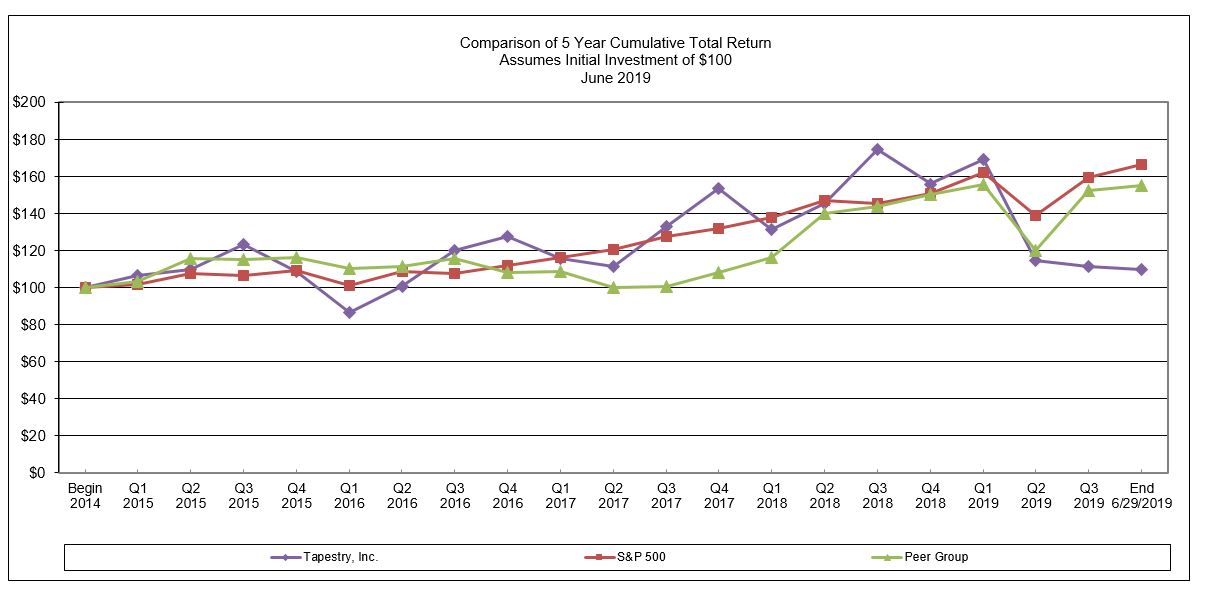][added: 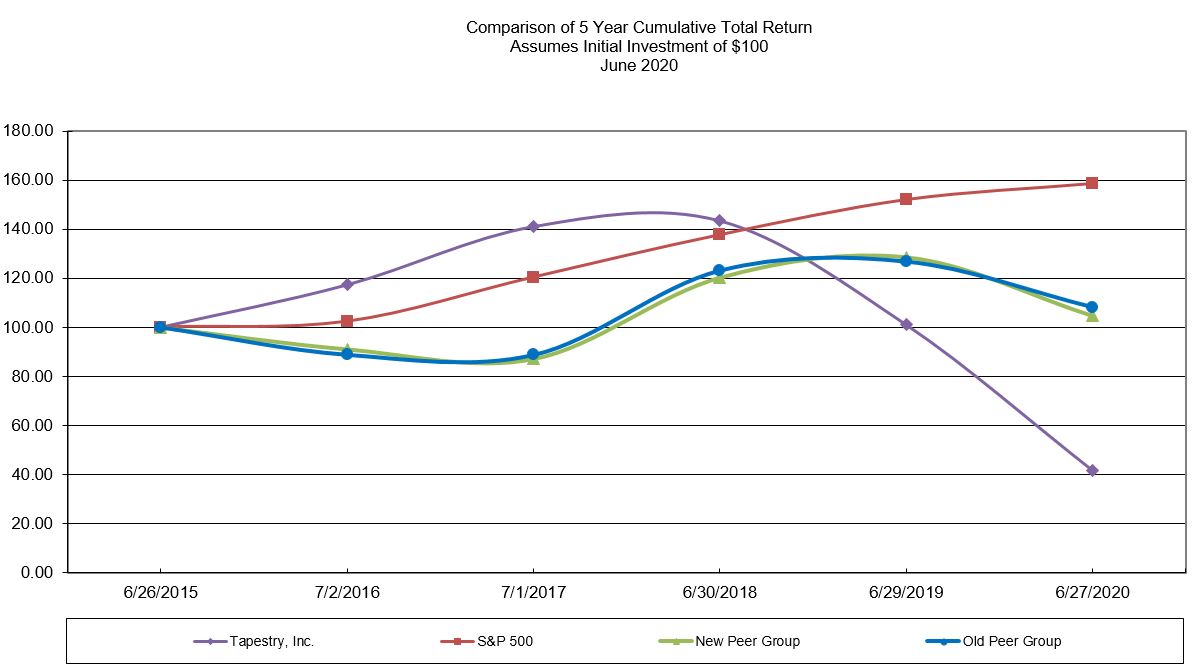]
| | | Fiscal [removed: 2014 | | Fiscal] 2015 | | Fiscal 2016 | | Fiscal 2017 | | Fiscal 2018 | | Fiscal 2019 | [added: | Fiscal 2020 |]
During fiscal 2020, the Company established a new peer group consisting of:
| • | L Brands, Inc. |
The Company's old peer group consisted of:
| | |
| --- | --- |
| • | PVH Corp., |
| | |
| --- | --- |
| • | Ralph Lauren Corporation, |
| | |
| --- | --- |
| | |
| --- | --- |
| • | V.F. Corporation, |
| | |
| --- | --- |
| • | Estee Lauder, Inc., |
| | |
| --- | --- |
| • | Capri Holdings Limited |
The Company removed Tiffany & Co. from the peer set due to recent business updates associated with the company.
Furthermore, Tapestry management selected the "revised peer set" on an industry/line-of-business basis and believes this updated set of companies represent good faith comparables based on their history, size, and business models in relation to Tapestry, Inc.
| TPR | | $100.00 | | $117.28 | | $140.99 | | $143.36 | | $101.04 | | $41.71 |
| Revised Peer Set | | $100.00 | | $91.12 | | $87.19 | | $120.36 | | $128.62 | | $104.69 |
| Former Set | | $100.00 | | $88.85 | | $88.80 | | $123.07 | | $126.73 | | $108.16 |
| S&P 500 | | $100.00 | | $102.33 | | $120.38 | | $137.69 | | $152.03 | | $158.60 |
The Company did not repurchase any shares of common stock during the fourth quarter of fiscal 2020.
As of June 27, 2020, the Company had $600 million availability remaining in the stock repurchase program.
The Company may terminate or limit the share repurchase program at any time.
The Company is restricted from engaging in share buybacks during the Covenant Relief Period under Amendment No.1 to its Credit Facility.
| TPR | | $100.00 | | $108.65 | | $127.46 | | $153.26 | | $155.88 | | $109.86 |
| Peer Set | | $100.00 | | $115.94 | | $108.25 | | $108.19 | | $150.34 | | $154.83 |
| S&P 500 | | $100.00 | | $109.37 | | $111.91 | | $131.66 | | $150.59 | | $166.27 |
The Company's share repurchases during the fourth quarter of fiscal 2019 were as follows:
| | | | | | | | | | | | | | | |
| --- | --- | --- | --- | --- | --- | --- | --- | --- | --- | --- | --- | --- | --- | --- |
| Fiscal Period | | Total Number of Shares Repurchased | | | Average Price per Share | | | | Total Number of Shares Purchased as Part of Publicly Announced Plans or Programs(1) | | | Approximate Dollar Value of Shares that May Yet be Purchased Under the Plans or Programs(1) | | |
| | | (in millions, except share data and per share data) | | | | | | | | | | | | |
| March 31, 2019 - May 4, 2019 | | — | | | $ | — | | | — | | | $ | — | |
| May 5, 2019 - June 1, 2019 | | 2,255,249 | | | 29.44 | | | | 2,255,249 | | | 933.6 | | |
| June 2, 2019 - June 29, 2019 | | 1,156,824 | | | 29.06 | | | | 1,156,824 | | | 900.0 | | |
| Total | | 3,412,073 | | | | | | | 3,412,073 | | | | | |
(1) The company repurchases its common shares under repurchase programs that were approved by the Board as follows:
| | | | | |
| --- | --- | --- | --- | --- |
| Date Share Repurchase Programs were Publicly Announced | | Total Dollar Amount Approved | | Expiration Date of Plan |
| May 9, 2019 | | $1.00 billion | | N/A |
Item 6. SELECTED FINANCIAL DATA
57 rewritten, 7 added, 10 removed, 42 unchanged
The selected historical financial data presented below as of and for each of the fiscal years in the five-year period ended June [removed: 29, 2019] [added: 27, 2020] has been derived from the Company’s audited Consolidated Financial Statements.
| | Fiscal Year [removed: Ended(4)] [added: Ended(3)] | | | | | | | | | | | | | | | | | | |
| | June [removed: 29, 2019] [added: 27, 2020] | | | | June [added: 29, 2019 | | | | June] 30, 2018 | | | | July 1, 2017 | | | | July 2, 2016 | | | [removed: | June 27, 2015(3) | | |]
| Net sales | $ | [removed: 6,027.1] [added: 4,961.4] | | | $ | [removed: 5,880.0] [added: 6,027.1] | | | $ | [removed: 4,488.3] [added: 5,880.0] | | | $ | [removed: 4,491.8] [added: 4,488.3] | | | $ | [removed: 4,191.6] [added: 4,491.8] | |
| Gross profit | [removed: 4,053.7] [added: 3,239.3] | | | | [removed: 3,848.5] [added: 4,053.7] | | | | [removed: 3,081.1] [added: 3,848.5] | | | | [removed: 3,051.3] [added: 3,081.1] | | | | [removed: 2,908.6] [added: 3,051.3] | | |
| Net income [added: (loss)] | $ | [removed: 643.4] [added: (652.1] | [added: )] | | [removed: 397.5] [added: 643.4] | | | | [removed: 591.0] [added: 397.5] | | | | [removed: 460.5] [added: 591.0] | | | | [removed: 402.4] [added: 460.5] | | |
| Net income [added: (loss)] per share: | | | | | | | | | | | | | | | | | | | |
| Basic | $ | [removed: 2.22] [added: (2.34] | [added: )] | | $ | [removed: 1.39] [added: 2.22] | | | $ | [removed: 2.11] [added: 1.39] | | | $ | [removed: 1.66] [added: 2.11] | | | $ | [removed: 1.46] [added: 1.66] | |
| Diluted | $ | [removed: 2.21] [added: (2.34] | [added: )] | | $ | [removed: 1.38] [added: 2.21] | | | $ | [removed: 2.09] [added: 1.38] | | | $ | [removed: 1.65] [added: 2.09] | | | $ | [removed: 1.45] [added: 1.65] | |
| Weighted-average basic shares outstanding | [removed: 289.4] [added: 278.6] | | | | [removed: 285.4] [added: 289.4] | | | | [removed: 280.6] [added: 285.4] | | | | [removed: 277.6] [added: 280.6] | | | | [removed: 275.7] [added: 277.6] | | |
| Weighted-average diluted shares outstanding | [removed: 290.8] [added: 278.6] | | | | [removed: 288.6] [added: 290.8] | | | | [removed: 282.8] [added: 288.6] | | | | [removed: 279.3] [added: 282.8] | | | | [removed: 277.2] [added: 279.3] | | |
| Dividends declared per common share | $ | [removed: 1.350] [added: 1.013] | | | $ | 1.350 | | | $ | 1.350 | | | $ | 1.350 | | | $ | 1.350 | |
| Gross margin | [removed: 67.3] [added: 65.3] | | % | | [removed: 65.5] [added: 67.3] | | % | | [removed: 68.6] [added: 65.5] | | % | | [removed: 67.9] [added: 68.6] | | % | | [removed: 69.4] [added: 67.9] | | % |
| Net income [added: (loss)] | [removed: 10.7] [added: (13.1] | | [removed: %] [added: )] | | [removed: 6.8] [added: 10.7] | | [removed: %] | | [removed: 13.2] [added: 6.8] | | [removed: %] | | [removed: 10.3] [added: 13.2] | | [removed: %] | | [removed: 9.6] [added: 10.3] | | [removed: %] |
| Working capital | $ | [removed: 1,638.8] [added: 811.0] | | | $ | [removed: 1,494.4] [added: 1,638.8] | | | $ | [removed: 3,199.5] [added: 1,494.4] | | | $ | [removed: 1,346.2] [added: 3,199.5] | | | $ | [removed: 1,671.8] [added: 1,346.2] | |
| Total assets | [removed: 6,877.3] [added: 7,924.2] | | | | [removed: 6,678.3] [added: 6,877.3] | | | | [removed: 5,831.6] [added: 6,678.3] | | | | [removed: 4,892.7] [added: 5,831.6] | | | | [removed: 4,666.9] [added: 4,892.7] | | |
| Cash, cash equivalents and investments | [removed: 1,233.9] [added: 1,434.5] | | | | [removed: 1,250.0] [added: 1,233.9] | | | | [removed: 3,158.7] [added: 1,250.0] | | | | [removed: 1,878.0] [added: 3,158.7] | | | | [removed: 1,931.8] [added: 1,878.0] | | |
| Inventory | [removed: 778.3] [added: 736.9] | | | | [removed: 673.8] [added: 778.3] | | | | [removed: 469.7] [added: 673.8] | | | | [removed: 459.2] [added: 469.7] | | | | [removed: 485.1] [added: 459.2] | | |
| Total debt | [removed: 1,602.7] [added: 2,299.4] | | | | [removed: 1,600.6] [added: 1,602.7] | | | | [removed: 1,579.5] [added: 1,600.6] | | | | [removed: 876.2] [added: 1,579.5] | | | | [removed: 890.4] [added: 876.2] | | |
| Stockholders' equity | [removed: 3,513.4] [added: 2,276.4] | | | | [removed: 3,244.6] [added: 3,513.4] | | | | [removed: 3,001.9] [added: 3,244.6] | | | | [removed: 2,682.9] [added: 3,001.9] | | | | [removed: 2,489.9] [added: 2,682.9] | | |
| | June [removed: 29, 2019(1)] [added: 27, 2020] | | | June [added: 29, 2019(1) | | | June] 30, 2018(1) | | | July 1, 2017 | | | July 2, 2016(2) | | [removed: | June 27, 2015(3) | |]
| Coach North America stores | [removed: 391] [added: 375] | | | [removed: 402] [added: 391] | | | [removed: 419] [added: 402] | | | [removed: 432] [added: 419] | | | [removed: 462] [added: 432] | |
| Coach International stores | [removed: 595] [added: 583] | | | [removed: 585] [added: 595] | | | [removed: 543] [added: 585] | | | [removed: 522] [added: 543] | | | [removed: 503] [added: 522] | |
| Kate Spade North America stores | 213 | | | [removed: 200] [added: 213] | | | [removed: —] [added: 200] | | | — | | | — | |
| Kate Spade International stores | [removed: 194] [added: 207] | | | [removed: 142] [added: 194] | | | [removed: —] [added: 142] | | | — | | | — | |
| Stuart Weitzman North America stores | [removed: 71] [added: 58] | | | [removed: 68] [added: 71] | | | [removed: 69] [added: 68] | | | [removed: 64] [added: 69] | | | [removed: 46] [added: 64] | |
| Stuart Weitzman International stores | [removed: 76] [added: 73] | | | [removed: 35] [added: 76] | | | [removed: 12] [added: 35] | | | [removed: 11] [added: 12] | | | [removed: 8] [added: 11] | |
| Total stores open at fiscal year-end | [removed: 1,540] [added: 1,509] | | | [removed: 1,432] [added: 1,540] | | | [removed: 1,043] [added: 1,432] | | | [removed: 1,029] [added: 1,043] | | | [removed: 1,019] [added: 1,029] | |
| Coach North America stores | [removed: 1,802,410] [added: 1,758,668] | | | [removed: 1,835,543] [added: 1,802,410] | | | [removed: 1,884,204] [added: 1,835,543] | | | [removed: 1,892,146] [added: 1,884,204] | | | [removed: 1,917,851] [added: 1,892,146] | |
| Coach International stores | [removed: 1,304,618] [added: 1,285,329] | | | [removed: 1,256,525] [added: 1,304,618] | | | [removed: 1,166,920] [added: 1,256,525] | | | [removed: 1,086,315] [added: 1,166,920] | | | [removed: 1,030,695] [added: 1,086,315] | |
| Kate Spade North America stores | [removed: 578,649] [added: 603,487] | | | [removed: 495,121] [added: 578,649] | | | [removed: —] [added: 495,121] | | | — | | | — | |
| Kate Spade International stores | [removed: 267,349] [added: 291,322] | | | [removed: 171,754] [added: 267,349] | | | [removed: —] [added: 171,754] | | | — | | | — | |
| Stuart Weitzman North America stores | [removed: 125,336] [added: 102,784] | | | [removed: 117,869] [added: 125,336] | | | [removed: 117,944] [added: 117,869] | | | [removed: 105,264] [added: 117,944] | | | [removed: 81,877] [added: 105,264] | |
| Stuart Weitzman International stores | [removed: 90,300] [added: 89,182] | | | [removed: 47,498] [added: 90,300] | | | [removed: 18,808] [added: 47,498] | | | [removed: 12,556] [added: 18,808] | | | [removed: 9,224] [added: 12,556] | |
| Total store square footage at fiscal year-end | [removed: 4,168,662] [added: 4,130,772] | | | [removed: 3,924,310] [added: 4,168,662] | | | [removed: 3,187,876] [added: 3,924,310] | | | [removed: 3,096,281] [added: 3,187,876] | | | [removed: 3,039,647] [added: 3,096,281] | |
| Coach North America stores | [removed: 4,610] [added: 4,690] | | | [removed: 4,566] [added: 4,610] | | | [removed: 4,497] [added: 4,566] | | | [removed: 4,380] [added: 4,497] | | | [removed: 4,151] [added: 4,380] | |
| Coach International stores | [removed: 2,193] [added: 2,205] | | | [removed: 2,148] [added: 2,193] | | | [removed: 2,149] [added: 2,148] | | | [removed: 2,081] [added: 2,149] | | | [removed: 2,049] [added: 2,081] | |
| Kate Spade North America stores | [removed: 2,717] [added: 2,833] | | | [removed: 2,476] [added: 2,717] | | | [removed: —] [added: 2,476] | | | — | | | — | |
| Kate Spade International stores | [removed: 1,378] [added: 1,407] | | | [removed: 1,210] [added: 1,378] | | | [removed: —] [added: 1,210] | | | — | | | — | |
| Stuart Weitzman North America stores | [removed: 1,765] [added: 1,772] | | | [removed: 1,733] [added: 1,765] | | | [removed: 1,709] [added: 1,733] | | | [removed: 1,645] [added: 1,709] | | | [removed: 1,780] [added: 1,645] | |
| Selling, general and administrative ("SG&A") expenses | 3,790.1 | | | | 3,234.0 | | | | 3,176.5 | | | | 2,283.5 | | | | 2,395.5 | | |
| Operating income (loss) | (550.8 | | ) | | 819.7 | | | | 672.0 | | | | 797.6 | | | | 655.8 | | |
| SG&A expenses | 76.4 | | | | 53.7 | | | | 54.0 | | | | 50.9 | | | | 53.3 | | |
| Operating margin | (11.1 | | ) | | 13.6 | | | | 11.4 | | | | 17.8 | | | | 14.6 | | |
| As Reported: (GAAP Basis) | $ | 3,239.3 | | | $ | 3,790.1 | | | $ | (550.8 | ) | | $ | (652.1 | ) | | $ | (2.34 | ) |
| Excluding items affecting comparability | 118.0 | | | | (871.2 | | ) | | 989.2 | | | | 923.3 | | | | 3.31 | | |
| Adjusted: (Non-GAAP Basis) | $ | 3,357.3 | | | $ | 2,918.9 | | | $ | 438.4 | | | $ | 271.2 | | | $ | 0.97 | |
| Selling, general and administrative ("SG&A") expenses | 3,239.6 | | | | 3,177.7 | | | | 2,293.7 | | | | 2,397.8 | | | | 2,290.6 | | |
| Operating income | 814.1 | | | | 670.8 | | | | 787.4 | | | | 653.5 | | | | 618.0 | | |
| SG&A expenses | 53.8 | | % | | 54.0 | | % | | 51.1 | | % | | 53.4 | | % | | 54.6 | | % |
| Operating margin | 13.5 | | % | | 11.4 | | % | | 17.5 | | % | | 14.5 | | % | | 14.7 | | % |
| | |
| --- | --- |
| (3) | The Company acquired Stuart Weitzman Holdings LLC in the fourth quarter of fiscal 2015. |
| As Reported: (GAAP Basis) | $ | 2,908.6 | | | $ | 2,290.6 | | | $ | 618.0 | | | $ | 402.4 | | | $ | 1.45 | |
| Excluding Non-GAAP Adjustments | 9.7 | | | | (160.8 | | ) | | 170.5 | | | | 128.8 | | | | 0.47 | | |
| Adjusted: (Non-GAAP Basis) | $ | 2,918.3 | | | $ | 2,129.8 | | | $ | 788.5 | | | $ | 531.2 | | | $ | 1.92 | |
An excerpt. Shown here: 40 of 57 rewritten, all 7 added and all 10 removed. The counts are complete. For every sentence, read Item 6. SELECTED FINANCIAL DATA in the FY2020 filing and the FY2019 filing.
Item 9A. CONTROLS AND PROCEDURES
6 rewritten, 6 added, 0 removed, 10 unchanged
Based on the evaluation of the Company’s disclosure controls and procedures, as that term is defined in Rule 13a-15(e) under the Securities Exchange Act of 1934, as amended, the Chief Executive Officer of the Company and the Chief Financial Officer of the Company, have concluded that the Company’s disclosure controls and procedures are effective as of June [removed: 29, 2019.][added: 27, 2020.]
Management, under the supervision and with the participation of the Company’s Chief Executive Officer and Chief Financial Officer, assessed the effectiveness of the Company’s internal control over financial reporting as of June [removed: 29, 2019] [added: 27, 2020] and concluded that it is effective.
The Company’s independent auditors have issued an audit report on the Company's internal control over financial reporting as of June [removed: 29, 2019] [added: 27, 2020] as included elsewhere herein.
The second phase of this implementation which was the finance and supply chain functions were implemented for Kate Spade during the third quarter of fiscal [removed: 2019, with the supply chain functions for Coach and Stuart Weitzman to follow in early fiscal 2020.][added: 2019.]
As a result of the [removed: implementations to date,] [added: implementations,] there were certain changes to processes and procedures, which resulted in changes to the Company’s internal control over financial reporting.
Other than the [added: lease accounting standards adoption and] ERP system implementation noted above, there were no other changes in our internal control over financial reporting during the fiscal year ended June [removed: 29, 2019] [added: 27, 2020] that have materially affected, or are reasonably likely to materially affect, our internal control over financial reporting.
During the first quarter of fiscal 2020, the Company adopted ASU 2016-02.
As such, the Company implemented new controls and modifications to existing accounting processes related to lease accounting.
These changes include the upgrade to a new lease accounting system and introduction of processes to evaluate and account for lease contracts under the new accounting standard.
Furthermore, the supply chain functions for Coach and Stuart Weitzman followed during fiscal 2020.
We have not experienced any material impact to our internal controls over financial reporting despite the fact that most of our employees are working remotely due to the Covid-19 pandemic.
We are continually monitoring and assessing Covid-19 as it relates to our internal controls.
Item 9B. OTHER INFORMATION
0 rewritten, 1 added, 8 removed, 1 unchanged
None.
On August 12, 2019, the Human Resources Committee of the Board of Directors of the Company approved the Tapestry, Inc. Special Severance Plan (the “Plan”), which is intended to provide benefits to designated employees of the Company who are members of a select group of management or highly compensated employees (as determined in accordance with Sections 201(2), 301(a)(3) and 401(a)(1) of ERISA) in the event their employment is terminated by the Company without Cause or by the participant for Good Reason (each as defined in the Plan) upon or within 24 months following a Change in Control (a “Qualifying Termination”).
In the event of a Qualifying Termination, the Company shall provide the participants under the Plan with severance payment amounts equal to the sum of such participant’s Base Salary plus Bonus (each as defined in the Plan) multiplied by the Severance Multiple (as defined in the Plan) applicable to each participant, in addition to COBRA, accelerated vesting of unvested awards granted on or after August 12, 2019 and other benefits as described in the Plan.
The Severance Multiple for (i) the Company’s Chief Executive Officer shall by two and one-half times and (ii) for other executive officers, including the Company’s other named executive officers, shall be one and one-half times.
The Severance Multiples for other participants are described in the Plan.
The receipt of severance benefits under the Plan is conditioned on a participant’s execution and non-revocation of general release of claims in favor of the Company and its affiliates, except as expressly provided in the Plan.
Participants are also required to comply with certain post-termination restrictive covenants, including non-competition and employee and customer non-solicitation provisions.
If any payments or benefits under the Plan would be considered “parachute payments” under Section 280G of the Internal Revenue Code of 1986, as amended (the “Code”), and would be subject to the excise tax imposed by Section 4999 of the Code, then such payments will either be (i) reduced so than no portion of the payments is subject to the excise tax or (ii) delivered in full, whichever of the foregoing results in the participant receiving a greater amount on a net after-tax basis, taking into account all federal, state and local taxes and the excise tax imposed by Section 4999 of the Code.
The foregoing summary is not a complete summary of the terms of the Plan and is qualified in its entirety by reference to the text of the Plan, which is filed as Exhibit 10.40 to this Annual Report on Form 10-K for the fiscal year ended June 29, 2019.
Item 10. DIRECTORS, EXECUTIVE OFFICERS AND CORPORATE GOVERNANCE
1 rewritten, 0 added, 0 removed, 1 unchanged
The information required to be included by Item 10 of Form 10-K will be included in the Proxy Statement for the [removed: 2019] [added: 2020] Annual Meeting of Stockholders and such information is incorporated by reference herein.
Item 11. EXECUTIVE COMPENSATION
1 rewritten, 0 added, 0 removed, 0 unchanged
The information regarding executive and director compensation set forth in the Proxy Statement for the [removed: 2019] [added: 2020] Annual Meeting of Stockholders is incorporated herein by reference.
Item 12. SECURITY OWNERSHIP OF CERTAIN BENEFICIAL OWNERS AND MANAGEMENT AND RELATED STOCKHOLDER MATTERS
1 rewritten, 0 added, 0 removed, 1 unchanged
The information under the headings “Securities Authorized for Issuance Under Equity Compensation Plans” and “Tapestry Stock Ownership by Certain Beneficial Owners and Management” in the Company’s Proxy Statement for the [removed: 2019] [added: 2020] Annual Meeting of Stockholders is incorporated herein by reference.
Item 13. CERTAIN RELATIONSHIPS AND RELATED TRANSACTIONS, AND DIRECTOR INDEPENDENCE
1 rewritten, 0 added, 0 removed, 0 unchanged
The information required to be included by Item 13 of Form 10-K will be included in the Proxy Statement for the [removed: 2019] [added: 2020] Annual Meeting of Stockholders and such information is incorporated by reference herein.
Item 14. PRINCIPAL ACCOUNTING FEES AND SERVICES
1 rewritten, 0 added, 0 removed, 1 unchanged
The information required by this item is incorporated herein by reference to the sections entitled “Fees For Audit and Other Services” and “Audit Committee Pre-Approval Policy” in the Proxy Statement for the [removed: 2019] [added: 2020] Annual Meeting of Stockholders.
Item 15. EXHIBITS, FINANCIAL STATEMENT SCHEDULES
490 rewritten, 479 added, 202 removed, 1,045 unchanged
| | | Name: [removed: Victor Luis] [added: Joanne C. Crevoiserat] Title: [added: Interim] Chief Executive Officer |
Pursuant to the requirements of the Securities Exchange Act of 1934, this report has been signed below by the following persons on behalf of the Registrant and in the capacities indicated below on August [removed: 15, 2019.][added: 13, 2020.]
| [removed: Victor Luis] [added: Joanne C. Crevoiserat] | | (Principal Executive Officer) |
| /s/ Joanne C. Crevoiserat | | [added: Interim] Chief [removed: Financial] [added: Executive] Officer |
| [removed: Brian Satenstein] [added: Manesh B. Dadlani] | | (Principal Accounting Officer) |
| [Reports of Independent Registered Public Accounting [removed: Firm](#s67268733DF295234B0D0E05B26AE5E6E)] [added: Firm](#s1A5A30562A0A531F93B0B49F91DFF21F)] | [removed: [54](#s67268733DF295234B0D0E05B26AE5E6E)] [added: [61](#s1A5A30562A0A531F93B0B49F91DFF21F)] |
| [Consolidated Balance [removed: Sheets](#s28AC51A380B0522798057454A5ED4E8E)] [added: Sheets](#sAB1CA9E4FA8359D8AED8CA69AE598F17)] | [removed: [56](#s28AC51A380B0522798057454A5ED4E8E)] [added: [66](#sAB1CA9E4FA8359D8AED8CA69AE598F17)] |
| [Consolidated Statements of [removed: Operations](#sD614209B680C529AB67A99B83B6DDE0C)] [added: Operations](#s88DDF07593495C4685CCB1B86B8215A4)] | [removed: [57](#sD614209B680C529AB67A99B83B6DDE0C)] [added: [67](#s88DDF07593495C4685CCB1B86B8215A4)] |
| [Consolidated Statements of Comprehensive [removed: Income](#sDDBA23C9845457F49A104B53CA691837)] [added: Income](#sB1B43C7971DA5CDFA51C0AF32ADE2D22)] | [removed: [58](#sDDBA23C9845457F49A104B53CA691837)] [added: [68](#sB1B43C7971DA5CDFA51C0AF32ADE2D22)] |
| [Consolidated Statements of Stockholders’ [removed: Equity](#sA751544399EE5F5E8400A584983F665B)] [added: Equity](#s19CEAEED893E58738C4F0C4005A2AE6F)] | [removed: [59](#sA751544399EE5F5E8400A584983F665B)] [added: [69](#s19CEAEED893E58738C4F0C4005A2AE6F)] |
| [Consolidated Statements of Cash [removed: Flows](#sBF2860FA641C59838975F95AEFDA0F7B)] [added: Flows](#s2AA615D09DBD55FD9819B3B60B1B398E)] | [removed: [60](#sBF2860FA641C59838975F95AEFDA0F7B)] [added: [70](#s2AA615D09DBD55FD9819B3B60B1B398E)] |
| [Notes to Consolidated Financial [removed: Statements](#sAABED923785359AD9579DEC388996685)] [added: Statements](#sBDDC462FA96153EFA057AE743ED3A0E5)] | [removed: [61](#sAABED923785359AD9579DEC388996685)] [added: [71](#sBDDC462FA96153EFA057AE743ED3A0E5)] |
| [Schedule II — Valuation and Qualifying [removed: Accounts](#sB3A41328F717515AA2F64FD61991C733)] [added: Accounts](#sFD9C0F70F7025AB4B0757E5B55533EF3)] | [removed: [96](#sB803C26A2AA15571BA299335899A6BE9)] [added: [108](#s4B98B5F95C085EA89FA7CA7926240588)] |
| [Quarterly Financial [removed: Data](#s89746194B3E755E0958DEA08B3847887)] [added: Data](#sB0A9C10AD76F5611B1EB3634F803E3C7)] | [removed: [97](#s89746194B3E755E0958DEA08B3847887)] [added: [109](#sB0A9C10AD76F5611B1EB3634F803E3C7)] |
We have audited the accompanying consolidated balance sheets of Tapestry, Inc. and subsidiaries (the "Company") as of June [removed: 29, 2019] [added: 27, 2020] and June [removed: 30, 2018,] [added: 29, 2019,] the related consolidated statements of operations, comprehensive income, stockholders' equity, and cash flows, for each of the three years in the period ended June [removed: 29, 2019,] [added: 27, 2020,] and the related notes and the financial statement Schedule II listed in the Index to the Consolidated Financial Statements (collectively referred to as the "financial statements").
In our opinion, the financial statements present fairly, in all material respects, the financial position of the Company as of June [removed: 29, 2019] [added: 27, 2020] and June [removed: 30, 2018,] [added: 29, 2019,] and the results of its operations and its cash flows for each of the three years in the period ended June [removed: 29, 2019,] [added: 27, 2020,] in conformity with accounting principles generally accepted in the United States of America.
We have also audited, in accordance with the standards of the Public Company Accounting Oversight Board (United States) (PCAOB), the Company's internal control over financial reporting as of June [removed: 29, 2019,] [added: 27, 2020,] based on criteria established in *Internal Control - Integrated Framework (2013)* issued by the Committee of Sponsoring Organizations of the Treadway Commission and our report dated August [removed: 15, 2019,] [added: 13, 2020,] expressed an unqualified opinion on the Company's internal control over financial reporting.
We have audited the internal control over financial reporting of Tapestry, Inc. and subsidiaries (the “Company”) as of June [removed: 29, 2019,] [added: 27, 2020] based on criteria established in *Internal Control - Integrated Framework (2013)* issued by the Committee of Sponsoring Organizations of the Treadway Commission (COSO).
In our opinion, the Company maintained, in all material respects, effective internal control over financial reporting as of June [removed: 29, 2019,] [added: 27, 2020,] based on criteria established in *Internal Control - Integrated Framework (2013)* issued by COSO.
We have also audited, in accordance with the standards of the Public Company Accounting Oversight Board (United States) (PCAOB), the consolidated financial statements and financial statement schedule as of and for the year ended June [removed: 29, 2019,] [added: 27, 2020,] of the Company and our report dated August [removed: 15, 2019,] [added: 13, 2020,] expressed an unqualified opinion on those financial statements and financial statement [removed: schedule.][added: schedule and included an explanatory paragraph regarding the Company’s adoption of Accounting Standards Update ("ASU") No. 2016-02, "Leases (Topic 842)", using the modified retrospective approach.]
| | June [added: 27, 2020 | | | | June] 29, [removed: 2019] [added: 2019] | | | | June 30, 2018 | | |
| | [added: |] (millions) | | | | | | | [added: | | | |]
| Cash and cash equivalents | $ | [removed: 969.2] [added: 1,426.3] | | | $ | [removed: 1,243.4] [added: 969.2] | |
| Short-term investments | [removed: 264.6] [added: 8.1] | | | | [removed: 6.6] [added: 264.6] | | |
| Trade accounts receivable, less allowances of [removed: $4.4] [added: $15.9] and [removed: $1.5,] [added: $4.4,] respectively | [removed: 298.1] [added: 193.3] | | | | [removed: 314.1] [added: 298.1] | | |
| Inventories | [removed: 778.3] [added: 736.9] | | | | [removed: 673.8] [added: 778.3] | | |
| Income tax receivable | [removed: 55.8] [added: 46.0] | | | | [removed: 25.8] [added: 55.8] | | |
| Prepaid expenses | [removed: 99.8] [added: 57.5] | | | | [removed: 82.6] [added: 99.8] | | |
| Other current assets | [removed: 91.0] [added: 85.0] | | | | [removed: 86.3] [added: 91.0] | | |
| Total current assets | [removed: 2,556.8] [added: 2,553.1] | | | | [removed: 2,432.6] [added: 2,556.8] | | |
| Property and equipment, net | [removed: 938.8] [added: 775.2] | | | | [removed: 885.4] [added: 938.8] | | |
| Long-term investments | 0.1 | | | | [removed: —] [added: 0.1] | | |
| Goodwill | [removed: 1,516.2] [added: 1,301.1] | | | | [removed: 1,484.3] [added: 1,516.2] | | |
| Intangible assets | [removed: 1,711.9] [added: 1,379.4] | | | | [removed: 1,732.9] [added: 1,711.9] | | |
| Deferred income taxes | [removed: 19.4] [added: 55.9] | | | | [removed: 24.3] [added: 19.4] | | |
| Other assets | [removed: 134.1] [added: 102.4] | | | | [removed: 118.8] [added: 134.1] | | |
| Total assets | $ | [removed: 6,877.3] [added: 7,924.2] | | | $ | [removed: 6,678.3] [added: 6,877.3] | |
| Accounts payable | $ | [removed: 243.6] [added: 130.8] | | | $ | [removed: 264.3] [added: 243.6] | |
| Accrued liabilities | [removed: 673.6] [added: 511.0] | | | | [removed: 673.2] [added: 673.6] | | |
| Current debt | [removed: 0.8] | [added: 0.8] | | | [removed: 0.7] | [added: (0.8] | | [added: ) | | — | | |]
| Date: August 13, 2020 | By: | /s/ Joanne C. Crevoiserat |
| /s/ Andrea Shaw Resnick | | Interim Chief Financial Officer |
| Andrea Shaw Resnick | | (Principal Financial Officer) |
| /s/ Manesh B. Dadlani | | Corporate Controller |
| /s/ Susan Kropf | | Chair, Board of Directors |
| /s/ John P. Bilbrey | | Director |
| John P. Bilbrey | | |
Change in Accounting Principle
As discussed in Note 3 to the financial statements, effective June 30, 2019, the Company adopted Accounting Standards Update ("ASU") No. 2016-02, "Leases (Topic 842)" (“ASC 842”), using the modified retrospective approach.
Recently adopted accounting standards - ASC 842 is also communicated as a critical audit matter below.
Critical Audit Matters
The critical audit matters communicated below are matters arising from the current-period audit of the financial statements that were communicated or required to be communicated to the audit committee and that (1) relate to accounts or disclosures that are material to the financial statements and (2) involved our especially challenging, subjective, or complex judgments.
The communication of critical audit matters does not alter in any way our opinion on the financial statements, taken as a whole, and we are not, by communicating the critical audit matters below, providing separate opinions on the critical audit matters or on the accounts or disclosures to which they relate.
Goodwill and Other Intangible Assets - Kate Spade - Refer to Notes 3 and 15 to the financial statements
Critical Audit Matter Description
The Company’s evaluation of goodwill and indefinite-lived brand intangible assets for impairment involves the comparison of carrying value to their respective fair values.
The determination of the fair values requires management to make significant estimates and assumptions related to forecasts of future revenue growth rates and profit margins, as well as discount rates.
Changes in these assumptions could have a significant impact on either the fair values, the amount of any impairment charge, or both.
The carrying value of goodwill associated with the Kate Spade reporting unit was $639.4 million and the carrying value of the Kate Spade indefinite-lived brand intangible asset was $1,300.0 million at June 27, 2020.
The fair value of goodwill and the Kate Spade indefinite-lived brand intangible asset exceeded their carrying values by approximately 13% and 35%, respectively.
Several factors could impact the Kate Spade brand's ability to achieve expected future cash flows, including continued economic volatility and operational challenges related to the Covid-19 pandemic, the reception of new collections in all channels, the success of international expansion strategies including the direct operation of certain previous distributor and joint venture businesses, the optimization of the store fleet productivity, the impact of promotional activity in department stores, and the simplification of certain corporate overhead structures and other initiatives aimed at increasing profitability of the business.
Given the significant judgments made by management to estimate the fair value of the Kate Spade operations used in both the goodwill and Kate Spade indefinite-lived brand intangible fair value analyses and the difference between their fair values and carrying values, performing auditing procedures to evaluate the reasonableness of management’s judgments regarding the business and valuation assumptions utilized in the valuation model, particularly the forecasts of future revenue growth rates and profit margins and the selection of the discount rate, required a high degree of auditor judgment and an increased extent of effort, including the need to involve our fair value specialists.
How the Critical Audit Matter Was Addressed in the Audit
Our audit procedures related to the projected future revenue growth rates and profit margins and discount rates included the following:
| • | We tested the effectiveness of management’s controls over its goodwill and indefinite-lived brand intangible asset impairment evaluations, including controls over the forecasts of future revenue and profit margin, and the selection of the discount rate. |
| • | We evaluated management’s ability to accurately forecast by comparing actual revenue and profit margin results to historical projections. |
| • | We evaluated management’s revenue and profit margin projections over the projection period with (1) internal communications to management and the board of directors, (2) peer companies, and (3) industry and market conditions. |
| • | We used the assistance of our fair value specialists to assess the acceptability of the weighting applied to value indications from different valuation techniques. |
| • | We used the assistance of our fair value specialists to assess the acceptability of the implied equity premium. With respect to the market value of equity, we tested the calculations used in developing the respective market value of equity. |
| • | We used the assistance of our fair value specialists in evaluating the fair value methodology and the discount rate, including testing the underlying source information and the mathematical accuracy of the calculations. Specific to the discount rate, we considered the inputs and calculations, and we developed a range of independent estimates and compared those to the respective discount rates selected by management. |
Goodwill and Other Intangible Assets - Stuart Weitzman - Refer to Notes 3 and 15 to the financial statements
Critical Audit Matter Description
The Company’s evaluation of goodwill and indefinite-lived brand intangible assets for impairment involves the comparison of carrying value to their respective fair values.
The determination of the fair values requires management to make significant estimates and assumptions related to forecasts of future revenue growth rates and profit margins, as well as discount rates.
Changes in these assumptions could have a significant impact on either the fair values, the amount of any impairment charge, or both.
During the third quarter of fiscal year 2020, revenue growth rate and profit margin trends continued to decline from those that were forecasted for the Stuart Weitzman brand, which resulted in reductions of both current and future forecasted cash flows.
As a result of these conditions, the Company concluded that a triggering event had occurred during the third quarter, resulting in the need to perform a quantitative interim impairment assessment over the Company’s Stuart Weitzman reporting unit and Stuart Weitzman indefinite-lived brand intangible asset.
The assessment concluded that the fair values of the Stuart Weitzman reporting unit and Stuart Weitzman indefinite-lived brand intangible asset as of March 28, 2020 did not exceed their respective carrying values.
The Company recorded a goodwill impairment charge of approximately $210.7 million related to the Stuart Weitzman reporting unit, and an impairment charge of approximately $267.0 million related to the Stuart Weitzman indefinite-lived brand intangible asset, each resulting in a full impairment.
Given the significant judgments made by management to estimate the fair value of the Stuart Weitzman operations used in both the goodwill and indefinite-lived brand intangible fair value analyses and the resulting impairment recorded, performing auditing
| | | |
| Date: August 15, 2019 | By: | /s/ Victor Luis |
| /s/ Victor Luis | | Chief Executive Officer and Director |
| Joanne C. Crevoiserat | | (Principal Financial Officer) |
| /s/ Brian Satenstein | | Corporate Controller |
| /s/ Jide Zeitlin | | Chairman and Director |
| Jide Zeitlin | | |
| /s/ Andrea Guerra | | Director |
| Andrea Guerra | | |
| /s/ Susan Kropf | | Director |
August 15, 2019
| | | | | | | | |
| --- | --- | --- | --- | --- | --- | --- | --- |
| | | | | | | | | | | | |
| --- | --- | --- | --- | --- | --- | --- | --- | --- | --- | --- | --- |
| Operating income | 814.1 | | | | 670.8 | | | | 787.4 | | |
| Balance at July 2, 2016 | 278.5 | | | $ | 2.8 | | | $ | 2,857.1 | | | $ | (104.1 | ) | | $ | (72.9 | ) | | $ | 2,682.9 | |
| Excess tax effect from share-based compensation | — | | | — | | | | (3.8 | | ) | | — | | | | — | | | | (3.8 | | ) |
| Excess tax effect from share-based compensation | — | | | | — | | | | 3.8 | | |
| Accrued liabilities | (29.5 | | ) | | (16.9 | | ) | | (50.1 | | ) |
| Hudson Yards sale of investments, net of expenses | — | | | | — | | | | 680.6 | | |
| Sale of former headquarters, net of expenses | — | | | | — | | | | 126.0 | | |
| Debt issuance costs | — | | | | — | | | | (9.8 | | ) |
| Excess tax effect from share-based compensation | — | | | | — | | | | (3.8 | | ) |
Certain of the Company's leases contain renewal options, rent escalation clauses, and/or landlord incentives.
Renewal terms generally reflect market rates at the time of renewal.
Rent expense for non-cancelable operating leases with scheduled rent increases and/or landlord incentives is recognized on a straight-line basis over the lease term, including any applicable rent holidays, beginning with the lease commencement date, or the date the Company takes control of the leased space, whichever is earlier.
The excess of straight-line rent expense over scheduled payment amounts and landlord incentives is recorded as a deferred rent liability.
Certain rentals are also contingent upon factors such as sales.
Contingent rentals are recognized when the achievement of the target (i.e., sale levels) which triggers the related rent payment is considered probable and estimable.
As of the end of fiscal 2019 and fiscal 2018, the Company had asset retirement obligations of $33.2 million and $25.8 million, respectively, primarily classified within other non-current liabilities in the Company's Consolidated Balance Sheets.
This includes the realignment of the Company's segment reporting structure, as further described in Note 17, "Segment Information."
In addition, certain prior year costs related to compensation of the supply chain function for Kate Spade have been reclassified to conform to the current year presentation.
These costs amounted to $5.4 million for the fiscal year ended June 30, 2018 and have been reclassified from SG&A expenses to Cost of sales within the Company's Consolidated Statements of Operations.
The Company is
In February 2016, the FASB issued ASU No. 2016-02, "*Leases (Topic 842),*" which is intended to increase transparency and comparability among companies that enter into leasing arrangements.
In July 2018, the FASB issued ASU 2018-11, with targeted improvements to the guidance including an additional transition method for the new standard.
As a result, the new standard may be applied with a retrospective approach to each prior reporting period with various optional practical expedients.
Furthermore, the Company has determined that it will apply the provisions of ASU 2018-11 with the initial application at the adoption date with a cumulative effect adjustment in the opening balance of Retained earnings in the first quarter of fiscal 2020.
The Company expects the adoption of ASU 2016-02 will result in an initial increase to long-term assets and liabilities of approximately $2.2 billion to $2.4 billion, which will change over time as the Company's lease portfolio changes.
An excerpt. Shown here: 40 of 490 rewritten, 40 of 479 added and 40 of 202 removed. The counts are complete. For every sentence, read Item 15. EXHIBITS, FINANCIAL STATEMENT SCHEDULES in the FY2020 filing and the FY2019 filing.